Ease into hunting by first seeking small game, such as upland birds
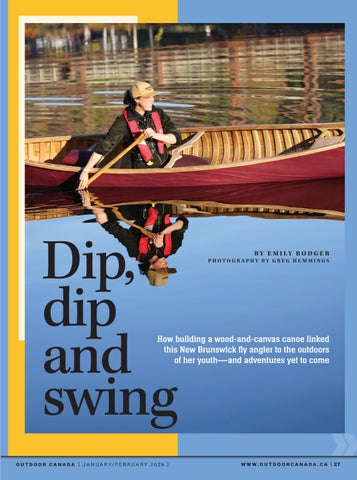
Dip, dip and swing
B Y E M I LY R O D G E R PHOTOGRAPHY BY GREG HEMMINGS
How building a wood-and-canvas canoe linked this New Brunswick fly angler to the outdoors of her youth—and adventures yet to come
O UWTWDWO. OOURT DCOAO N R CAADNA A D[A J . CAAN U A R Y / F E B R U A R Y 2 0 2 6 ]
»
| 27 W WWWW.W O.U TTDDOO O RRCCAA A | 27 OU NN A DAAD. CAA. C
W
hen I think of a canoe, the first image that comes to mind is of my mom on our cottage lake. I can still picture her—curly permed hair tucked beneath a well-worn Tilley hat—paddling with ease, her voice carrying softly across the water as she sings that old Canadian paddling song, “Land of the Silver Birch.” My paddle’s keen and bright Flashing with silver Follow the wild goose flight Dip, dip and swing I’d sit on the front porch of our cottage and watch her glide across the glassy surface, listening to the loons call in the distance and seeing the joy on her face. The sight of her moving so effortlessly across the lake, completely at peace, would always make me smile. In many ways, it captured the essence of who my mom is. It also gave me a lasting lesson in how to navigate life—with ease, strength and a steady trust in the vessel that carries us.
So much of my life has since been spent on the water. From canoe trips through New Brunswick’s backcountry to fishing at our family cottages in Quebec and Ontario, and on to fly-fishing adventures around the world, the water has always been both a place of grounding and discovery for me. It’s where I’ve learned so much about patience, presence and humility—lessons that echo the same quiet grace I still see in my mother. That memory of her paddling has always stayed with me, quietly shaping my relationship with the outdoors and deepening my respect for the craft that makes such moments possible. Perhaps that’s why, when the chance came to build a canoe of my own, it felt less like starting a project and more like continuing a story that began long ago. The tradition of building Chestnut canoes lives on at Miramichi Canoes
28 | O U T D O O R C A N A D A [ J A N U A R Y / F E B R U A R Y 2 0 2 6 ]
T
hat opportunity came through a friend, Norman Betts, who owns Miramichi Canoes, a small workshop on the banks of the famed like-named river in my home province of New Brunswick. Norman has spent years breathing new life into heritage designs, restoring and building traditional cedar canoes that once defined life in the Maritimes. His shop smells of cedar and river air, a place where stories, history and craftsmanship meet. I first met Norman and his wife, Laura, years ago, and over time they’ve become dear friends. Most recently, they joined me on a fishing trip in Argentina. It was their first time fly fishing in South America, stepping away from the familiarity of salmon rivers at home to try something new. Between long days on the water and evenings spent sharing stories, our conversations often turned to what drew each of us to fly fishing in the first place. We spoke about experiences, about the pull of the outdoors, and before long our talk drifted toward canoes and the history of wooden boats in Canada. I’d always admired the heritage of New Brunswick’s Chestnut Canoe Company, and told Norman that building my own canoe had long been a dream of mine. Curious and generous as ever, he began sharing stories of his own work at Miramichi Canoes, where he restores and builds the traditional cedar vessels. I found myself asking endless questions about the process—where he gets the wood, how he selects it, the patience behind bending each rib, and what keeps him inspired after building and restoring so many canoes. Listening to him speak, I could hear the passion in his voice: part craftsman, part historian and every bit the teacher. Norman, with the ease that defines him, simply said, “Well, why don’t you come and build one?” The invitation came with such
Norman Betts of Miramichi Canoes guided Emily Rodger through the canoebuilding process
warmth and generosity that I couldn’t help but tuck it away. Much like navigating a river, I began to plot my own schedule, carving out time to be home long enough in New Brunswick to make it happen. A few months later, under Norman’s guidance, I found myself in his workshop standing before the mould of a 15-foot Chestnut canoe, a design born from New Brunswick ingenuity and now ready to take form once again. The Chestnut Canoe Company holds a foundational place in Canada’s paddling heritage. From its beginnings in Fredericton, New Brunswick, in the 1890s, the company helped define what a classic wood-and-canvas canoe would become. The boats were built from cedar planking and ash trim, with their canvas hulls coated for strength and waterproofing. They
carried explorers, guides, anglers and families across Canada’s countless lakes and rivers—craft that were strong, repairable and built for wilderness travel. Founded by brothers William and Henry Chestnut, the company took its name from their family. The brothers recognized a growing demand for durable, lightweight canoes suited to Canada’s waterways and began producing models inspired by earlier birchbark and Maine designs, refined through local craftsmanship. From their first shop on York Street in Fredericton, their reputation quickly spread. By 1914, the company was turning out 1,200 canoes a year. Their designs helped shape an era of Canadian exploration. Guides relied on them to reach remote waters, and anglers trusted them to access hidden trout streams and salmon pools. Over
time, the Chestnut name became synonymous with adventure, representing resilience, craftsmanship and connection to the land. By 1979, the original Chestnut Canoe Company had closed its doors after nearly a century of shaping Canadian canoe culture. For a time, it seemed the heritage might fade. The knowledge and the moulds lived on, however, carried forward by dedicated builders and restorers—craftsmen such as Norman—who refused to let the tradition disappear.
S
tanding in the Miramichi Canoes workshop, surrounded by the scent of cedar, I realized I wasn’t just building a canoe—I was taking part in something much larger, a living tradition.
»
W W W . O U T D O O R C A N A D A . C A | 29
I wanted to understand every step and every decision that shaped these vessels for generations, not simply as someone who paddled one, but as someone who could feel, first-hand, the labour, the learning and the quiet joy of creation. The smell of cedar and the act of woodworking have always carried a special meaning for me. They take me back to when I was a little girl, spending days with my dad at his mill in New Brunswick, where I first learned the basics of working with wood. He taught me to respect the tools, to pay attention to detail and to appreciate the care that goes into shaping something by hand. In many ways, the project felt like a continuation of that, of the family tradition passed down from my dad, my uncles and my grandfather. It became an opportunity to bring together what I learned from them with what I’ve learned from the water. There’s a clarity that comes from hands-on work, a focus that nar- rows your world to what’s right in front of you. Woodworking, much like fly fishing, demands humility. The grain doesn’t always follow your plan—just as a fish can turn away at the last moment—reminding you that patience and attention matter more than control. It teaches you to slow down, to observe and to adapt. Each step revealed something new: steaming and bending the cedar ribs over the form; watching the hull begin to take shape; then fastening slender planks one by one with rows of tiny brass tacks, each one set by hand. When the frame was complete, Norman and I fitted the yoke and seats, then did more sanding. Before sealing it beneath the canvas, I wrote a small message on the cedar: “May this canoe remind you to stay curious, seek connection, and carry both with you wherever you go. Keep paddling, Emily.” It was a kind of time capsule, knowing the canoe will outlast me, and that one day, if someone restores it, they’ll find a trace of its maker. The finishing process carried a quiet, steady satisfaction. Sanding each curve by hand, I could feel the canoe come fully alive beneath my fingertips—smooth, warm and
breathing with grain. I didn’t want the work to end; there was something almost sacred about those final passes, each one revealing more of the cedar’s beauty. A strong part of me wanted to leave it uncovered, to let the wood speak for itself in all its natural grace. But some things are meant to be protected, sealed not to hide their beauty, but to preserve it, to carry it forward. Together, Norman and I pulled the canvas tight, wrapping it evenly around the hull until it settled perfectly into place. Then came the coats of filler, a tradition-
8
VISIT WWW.MIRAMICHICANOES.CA FOR MORE INFO ABOUT MIRAMICHI CANOES.
30 | O U T D O O R C A N A D A [ J A N U A R Y / F E B R U A R Y 2 0 2 6 ]
Fitting the canoe’s seats and yoke (above) are among the final steps
Now beneath the canvas and paint, Emily Rodger leaves behind her heartfelt message for posterity
al blend of exterior paint, Varsol, boiled linseed oil, Japan drier and silica flour. Between each application, we polished the surface with a heavy mitt until it felt as soft as river-worn stone. I knew immediately what colour I wanted to paint the canoe, as though I had been envisioning it for years. There’s something timeless about burgundy, a colour that feels both grounded and elegant. It
has depth, warmth and quiet confidence. In the right light, it shifts between red and brown, echoing the warmth of the cedar beneath and the reflection of the sunset on still water. It felt like the perfect balance between classic and bold, a colour that speaks softly but leaves an impression. Watching that first coat go on, deepening with each layer, it was exactly as I had pictured it: understated, classy and full of character. When the final coat dried, I carried the canoe to the Miramichi. It was a beautiful fall evening—the air calm, the light golden and the shoreline scattered with leaves that mirrored the deep burgundy of the canoe. The whole scene felt intentional, as if the season itself had been waiting for this moment. As I stepped in and pushed off for the first time, the canoe moved with a grace that surprised me— steady, responsive, alive. The first few strokes felt ceremonial. Dip, dip and swing.
»
W W W . O U T D O O R C A N A D A . C A | 31
The work is complete, and it’s time for the inaugural paddle on the Miramichi
A
s I paddled, I thought of my mom singing on the lake, reminding me that being on the water is as much about presence as it is about movement. Each stroke of the paddle, like each cast, connects you to something beyond yourself, something older, quieter, enduring. In that moment, I could feel the weight of tradition—not heavy, but grounding—rooted in who I am and where I’m from, tied together through song, memory and the gentle pull of a paddle across Canadian waters. My canoe holds meaning far beyond its cedar ribs and canvas skin. It represents the meeting place between tradition and curiosity, between following a blueprint and daring to add your own line to it. I built it from a design shaped by generations before me, yet every decision and every curve carries a trace of my own story. In many ways, it’s a bridge between past and present, honouring the wisdom that came before while allowing room for new discoveries. Now when I look at the canoe, I think of that little girl sitting on
the porch, watching her mother paddle across the lake—wide-eyed, curious and ready to explore the world beyond the shoreline. That same spirit still guides me now: the pull to learn, to feel, to listen and to keep moving forward, both on the water and in life. The canoe is a reflection of that journey—steady, strong and shaped by both wonder and tradition. My hope is that it will continue
32 | O U T D O O R C A N A D A [ J A N U A R Y / F E B R U A R Y 2 0 2 6 ]
to carry that same spirit forward, passed on to those who, in their own time, feel called to build, to paddle and to see where the water might lead them. After all, some stories aren’t meant to be finished—only passed along. OC EXECUTIVE COACH EMILY RODGER HOSTS FLY-FISHING TRIPS AROUND THE WORLD. TO LEARN MORE, VISIT WWW.EMILYSRODGER.COM.
W W W.O U T D O O RCA N A DA .CA