Search for continual improvement
Alliance to end IPSO® equipment sales in North America

RIPON, Wis. — Alliance Laundry Systems will discontinue sales and marketing of IPSO®branded laundry equipment in the United States and Canada, beginning in April 2018, the company reports.

The move will not impact sales of the brand outside of North America.
“This decision, while difficult for our IPSO distributors, was one we felt is necessary for our total distribution network and Alliance Laundry Systems moving forward,” says William Bittner, vice president North American sales for Alliance Laundry Systems. “Rationalization of our brands within our North American portfolio was the primary driver behind the move.”
Alliance says it will continue to support IPSO products through its Customer One® organization, offering parts access and its commercial laundry technical support team.
IPSO commercial products for on-premises and vended laundries are currently sold in the United States and Canada through 64 distributors, the company says. Over the next year, Alliance says it will work closely with these distributors to help them prepare for the discontinuation. ALN
BY MATT POE, EDITOR
CHICAGO — Healthcare laundries face a multitude of issues that impact both patient health and their own business.
Case in point, the recent wrongful death lawsuits against Paris Cos. and the University of Pittsburgh Medical Center (UPMC). Several families of patients with serious diseases or undergoing transplants sued both the laundry and the hospital because the patients died after apparently contracting moldrelated infections from tainted bed linens.
The lawsuits are ongoing, but the issues facing Paris Cos. are ones every healthcare laundry must face and address: infection control and linen security. Other challenges that healthcare laun-
dries face are sustainability, competition from disposables, and cost management.
In order to deal with these issues, experts say healthcare laundries must continually grow and change.
“The impact (of these issues) is to see this as an opportunity to make our companies better, stronger and more valuable to the customer as a partner,” says David Potack, senior vice president of Unitex, a healthcare uniform and linen rental provider.
Laundries competing in healthcare will need to be more professional in their operations by improving employee training, developing stronger management and providing skilled understand-
Kansas hospital goes OPL after 50-plus years
laundry process for several years before diving in.
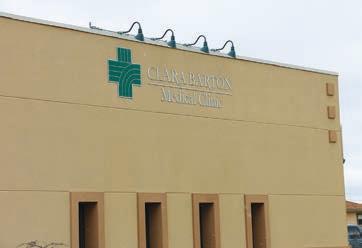
HOISINGTON, Kan. — After outsourcing hospital laundry since 1950, Clara Barton Hospital, located here, brought laundry processing in-house for a $350,000 drop in annual costs, according to the hospital.
“I knew we were getting gouged, but I had no idea by how much,” says Clara Barton Hospital CEO Jim Blackwell. “The results were beyond my wildest dreams.”
Blackwell, who says he was frustrated by the linen service’s cost and quality, studied the


“We just didn’t have any square footage internally to take it in-house without adding bricks and mortar,” he says.

In 2013, that changed. Clara Barton Hospital added a new physical therapy wing, and with the expanded square footage, added an on-premises laundry (OPL). Blackwell says he worked in concert on the project with the hospital’s architect and Brian Asher of Commercial Laundry Sales & Service (CLS&S) in Wichita, Kan.
“The hospital had been paying a linen company in the neighborhood of $3 per pound,” says Asher. “We forecasted that by
bringing the laundry in-house, their cost of doing laundry would drop to 55 cents per pound, which included the cost of labor, utilities, equipment, financing, linen replacement and chemicals.”
Asher says he installed Continental soft-mount washers and dryers to ensure low utilities, maximized throughput, advanced programmability and ease of use. The hospital says one laundry operator uses the equipment to process 11,000 pounds of laundry per month.
The soft-mount E-Series Washers (one 55-, one 30- and one 20-pound-capacity model) are freestanding, feature a flexible control and generate high-
extract speeds up to 387 G-force, Asher says. Three Continental Pro-Series II Dryers (two 35- and one 55-pound-capacity models) round out the equipment mix.
“We could have poured a thicker concrete pad to accommodate hard-mount washers, but it made sense to go with the soft-mount washers for ease of installation, higher G-force extract speeds, and maximized productivity, efficiency and labor savings,” he says.
According to Asher, softmount washers remove considerably more moisture from laundry during extract, so laundry dries in significantly less time.
Embracing Change
Panel of Experts
JUN E 2017
Late News
www.americanlaundrynews.com Volume 43, Number 6 INSIDE [20]
The Newspaper of Record for Laundry & Linen Management
See HEALTHCARE on Page 6
[4] See CLARA on Page 10
Eric Frederick shares his thoughts on how operators can accept change. Cuts $350,000 a year with in-house laundry [16] Experts explore five challenges facing the industry, strategies to overcome Laundry Worker PPE The PPE laundry employees should wear depend on the operation. HEALTHCARE LAUNDRY:
Infection control and linen security are among the healthcare laundry industry’s top challenges. (Image licensed by Ingram Publishing)
Our experts discuss finding good employees in the marketplace.
More exhibitors for Clean ’17 in Vegas
the Las Vegas Convention center Clean ’17 during the 30 days ending May 10, according to show manager Riddle & Associates.
A
❏ Air & Water Systems 3534 Industrial humidification and evaporative cooling equipment.
B
❏ Brother International 561 Corp.
Sewing and embroidery equipment and supplies; labeling systems.
C
❏ Clenacorp 357 7 Specialty lubricants; ironer tapes; hot and cold surface cleaners.

❏ Conf Industries S.r.L. 3 703 Hampers; cabinets; basket liners/covers.
❏
D
D.J. Giancola Exports Inc. 1620 Export management firm specializing in commercial
At press time, the total number of exhibitors stands at just over 470 (see our May issue for the initial list); it’s possible that more exhibitors will be added in the final days leading up to the June 5-8 event. Where available, the descriptions of
laundry, drycleaning, boilers and related equipment.
E
❏ Expo Enterprise Inc. 56 0
F
First Dry Clean, Inc. 37 07 Laundry and dry cleaning app.
G
G&I Innovation 3 532 ❏ Global Retail 13 94
H
Howfleet, trading as 461 Uniform Depo Inc. Apparel.
J
❏ JS Fiber Co. Inc. 247 Hospitality and healthcare bedding products.
K
❏ Kohinoor Mills LTD 255 Dyeing Div.
Dyed fabrics.
products and/or services provided here are general in nature and should not be considered all-inclusive. Listings are subject to change without notice. Check www.cleanshow.com for any updates.
Publisher
Charles Thompson
Phone: 312-361-1680
E-Mail: cthompson@ ATMags.com
Editorial Director
Bruce Beggs
Phone: 312-361-1683
E-Mail: bbeggs@ ATMags.com
Editor
Matt Poe
M
❏ Main Street Hub 3 61 Online social media management services.
❏ Mazars USA LLP 4 46
Cost studies and profitability analyses for textile rental companies.
❏ Movexx 62 5 Electronic tuggers and push/pull assists.
P
❏ Press Cleaners 3 384 App and pickup/delivery service for dry cleaning and laundry.
S
❏ Specialty Adhesive 662 Film Co. Heat-seal adhesives for laminating, coating and bonding applications.
❏ Sysmetic 1295 Software solutions.
T
Phone: 231-740-2842
E-Mail: mpoe@ ATMags.com
Digital Media Director
Nathan Frerichs
❏
Team Products 13 98
Laundry detergents and chemicals.
U
❏
Ultra Soap International 3701 Laundry chemicals and cleaning products.
W
❏
Weifang Kangle 1697 Plastics Co. Ltd. Bags of various types.
❏
X
Xia Fang Hanger 3700 (Cambodia)
Wire hangers and other supplies.
accreditation
PLAINFIELD, Ill. — The Healthcare Laundry Accreditation Council (HLAC) reports it has accredited Mediclean Linen & Laundry Inc., Commerce, Calif. Mediclean was accredited fol-

lowing a voluntary inspection of its facility by an independent contractor who has received training in HLAC standards and inspection guidelines.
“Meeting and maintaining
HLAC Accreditation Standards means Mediclean Linen & Laundry has voluntarily committed to a new level of excellence in the way it processes healthcare textiles,” says John Scherberger, HLAC board president. “The Mediclean team members can have the assurance that their laundry is built right, equipped properly and staffed with qualified and trained personnel for processing product, interacting with customers and vendors, and maintaining operations in a clean and aseptic manner.”
Scherberger says the principal benefit of accreditation to Mediclean’s healthcare customers is the knowledge that their textile provider is meeting the industry’s highest textile processing standards.
“HLAC accreditation is like a dividend, an advantage or benefit, validating for Mediclean’s cus-
tomers their laundry’s expertise, believability, dependability, reliability and soundness,” he says.
Anil Yalamanchi, president of Mediclean, says receiving HLAC accreditation gives the laundry a genuine advantage over its competitors.
“We can tell our clients that we share their patient safety goals and that our practices are the industry’s best and most current available,” he says. “A lot of hard work went into the accreditation process, including preparing for the inspection. All of us at Mediclean can share in this great achievement.”
Phone: 312-361-1681
E-Mail: nfrerichs@ ATMags.com
Advisory Board
Jim Buik • Richard Griffin
Greg Gurtler • Phil Hart
Janice Larson • Tom Marks Gerard O’Neill
Richard Warren
Production Manager
Roger Napiwocki
National Sales Director
Donald Feinstein
Phone: 312-361-1682
E-Mail: dfeinstein@ ATMags.com
Main Phone: 312-361-1700 Fax: 312-361-1685
Subscriptions
630-739-0900 x100 www.americanlaundrynews.com
American Laundry News (ISSN 1091-9201) is published monthly. Subscription prices, payment in advance: U.S. 1 year $46.00; 2 years $92.00. Foreign, 1 year $109.00; 2 years $218.00.

Single copies: U.S. $9.00; Foreign $18.00.
Published by American Trade Magazines LLC, 566 West Lake Street, Suite 420, Chicago, IL 60661. Periodicals postage paid at Chicago, IL, and at additional mailing offices.
POSTMASTER, Send changes of address and form 3579 to American Laundry News Subscription Dept., 440 Quadrangle Drive, Suite E, Bolingbrook, IL 60440. Volume 43, number 6. Editorial, executive and advertising offices are at 566 West Lake Street, Suite 420, Chicago, IL 60661. Charles Thompson, President and Publisher. American Laundry News is distributed selectively to qualified laundry and linen management and distributors in the United States.
© Copyright AMERICAN TRADE MAGAZINES LLC, 2017. Printed in U.S.A. No part of this publication may be transmitted or reproduced in any form, electronic or mechanical, without written permission from the publisher or his representative. American Laundry News does not endorse, recommend or guarantee any article, product, service or information found within.

Opinions expressed are those of the writers and do not necessarily reflect the views of American Laundry News or its staff. While precautions have been taken to ensure the accuracy of the magazine’s contents at time of publication, neither the editors, publishers nor its agents can accept responsibility for damages or injury which may arise therefrom.
HLAC is a nonprofit organization that inspects and accredits laundries that process reusable textiles for hospitals, nursing homes and other healthcare facilities, based on standards for patient safety and infection prevention.
CLARIFICATION
ALN
The May American Laundry News Career Track brief about James Oman of Wholesale Commercial Laundry S.E. LLC reported that he was enlisted to the company. The piece should have stated that Wholesale Commercial Laundry partnered with Oman. ALN
2 JUNE 2017 | AMERICAN LAUNDRY NEWS www.AmericanLaundryNews.com
MEMBERSHIPS INSIDE: June 2017 • Vol. 43 | No. 6 [12] Laundry Equipment and Firefighter PPE Cleaning In this issue’s OPL 101, find out how, and why, more firehouses are bringing PPE cleaning in-house [14] Making Sense of Automation: Folders Learn how moving from hand-folding goods to an automatic folder can make an impact on a laundry business [18] Global Circumstances Impact Textile Supply Read about factors that can affect the supply chain, impacting the cost of producing and processing textiles [32] Career Track [34] Trade Ticker [35] Calendar of Events [36] Classified Advertising [37] Source Directory
Linen &
Mediclean
Laundry achieves
— The following companies and organizations reserved exhibit space
LAS VEGAS
in
❏
❏
❏
Ultra and Nanofiltration: The Modern Solution for Ultra Clean Water.
It’s a whole new way to filter water. Using our exclusive hollow-fiber ceramic membrane, the PurePulseTM system operates in in the lower end of the ultrafiltration range into nanofiltration. Filter total dissolved solids and dyes as small as 5 nanometers – no need to cool water. This is innovative membrane technology for the modern age.
Recycle 70-80% of your facility’s water Filter your water while it’s hot, saving energy
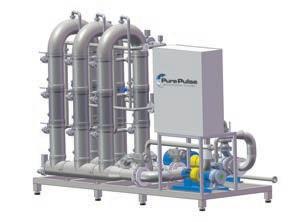

Self-cleaning ceramic membranes have 10 year warranty Reliable and long service life
Less expensive than RO technology
Affordable, low running costs and fast ROI
PurePulse system has a small footprint that won’t change as you expand with additional, stackable membranes. www.PurePulseSystems.com

504-712-7700
’Twas the night before Clean
As I write this note, it’s only a couple weeks before the Clean Show in Las Vegas.
You could say that things are a bit chaotic around here (if you’re heading to Clean, you know what I mean).
It hasn’t been easy focusing on the June issue of American Laundry News with the show and all that entails coming up. And having to get a head start on July.
And don’t forget that August is right around the corner.
OK, I need to breathe and focus on the June issue you hold in your hands (or are reading on a screen).
Everybody around here has worked really hard to shoehorn as much information into these pages as possible.
The Editor’s Desk MATT POE
Flip through the issue, and I think you’ll agree with me that we succeeded.
Just consider the range of topics covered, from global issues, like fiber production and shipping affecting the textile supply chain (page 18) to firehouse
OPLs to wash firefighter gear (page 11).
From an article to get your mind thinking about what personal protective equipment (PPE) your employees should be using (page 16) to a piece examining the option of UV-C decontamination (page 26).
Other topics inside include automated folders (page 14), ways to hire outstanding talent in today’s market (page 20) and a look at a new academic certificate in healthcare environmental services (page 28).
So, I hope you’ll find this issue informative. If you’re in Las Vegas, come see me (booth 2591). I’ll be the one trying to figure out how I’m going to shoehorn all the new info from Clean into upcoming issues. ALN
Apparel programs honored by NAUMD
NASHVILLE, Tenn. — The North American Association of Uniform Manufacturers and Distributors (NAUMD) recently presented its annual Image of the Year (IOY) Award winners for the best apparel programs in North America.
Montage Palmetto Bluff, a luxury South Carolina resort, received the prestigious “Best of the Best” award, which spans across all categories, says NAUMD.
Montage Palmetto Bluff worked with Fourmy, Cintas Corp.’s luxury brand, to design an apparel collection that captures the essence of Southern hospitality. While keeping it relevant and approachable, the program features two custom sublimation prints on fabric creating a unique garment.
“A well-designed apparel program incorporates tailored fits that not only deliver a quality image, but also keep employees looking and feeling good throughout the workday,” says Neal Waters, president of NAUMD. “This program honors companies that have created a competitive edge by investing in apparel to enhance their brand, and the customer experience.”
The winners by category include:
• Entertainment Venues: The Hulk Rollercoaster
at Universal Orlando
• Gaming: Saratoga Casino and Hotel, created by Cintas Corp.
• Healthcare: O’Neil Healthcare, created by Fashion Seal Healthcare
• Hotel – single location: Palmetto Bluff, created by Cintas Corp.
• Hotels – multiple locations: The AccorHotels, created by JA Uniforms
• Restaurant – single location: Universal Orlando Resort City Walk at Universal Orlando
• Restaurants – multiple locations: SONIC, America’s™ Drive-In, created by HPI Direct
• Retail: YMCA of Canada, created by Unisync Group Ltd.
• Service & Industrial Companies: Brightview, created by Aramark Uniform Service, and ExLog Global, created by Unitex Direct
• Transportation – people: Flexjet, created by Affinity Apparel
• Transportation – products: FedEx, created by VF Imagewear
NAUMD says the awards recognize the most fashionable, forward-thinking and innovative commercial apparel designs. ALN

The key to adapt, embrace change
As much as most of us hate change, especially when it is forced upon us, we must learn at times to embrace it.
I have been associated with the healthcare industry in the United States for more than 46 years and have seen many changes roll through the industry, and healthcare laundries specifically. The industry hated some of these changes and complained about them all the time. In the end, we had to adapt the way we did business and embrace the new changes.
I can remember shortly after I started in the healthcare laundry business learning how to process 100% polyester sheets, which were owned by a customer of our laundry. They required different handling through the washer and different conditioning through the dryers if they were to iron properly. Our initial reaction to the product was to wonder why anyone would use such a product when 100% cotton sheets were still the predominate sheet in the industry.
We learned how to properly process the sheets but found that a poly/cotton blended sheet was a much easier product to handle and used some of those painful lessons learned in handling those 100% polyester sheets on the blends. We embraced the blended sheets because we liked the longer life and the decrease in weight per sheet.
The struggles with the 100% polyester sheets prepared us to handle the new trend of blended sheets.
To save energy and increase production, the laundry equipment manufacturers began to produce thermal fluid ironers. I would listen to the sales pitches at the Clean Shows and read about them in the various trade journals.
I was still unprepared to use them properly when I was hired to run a Milwaukee laundry that had three of these ironers. Some key information was left out of the literature. These ironers could run at a higher temperature than the steam ironers I was used to, but there was a limit to how hot you could run them without damaging your ironer pads and causing problems with your linen.
To increase production through the laundry, the production supervisor had turned the heat up to 435 F going into the ironer. The net result of this change was to burn the pads and cause unlimited shrinkage on the linen items being ironed.
The textile mills heat-set the polyester fibers for stability at 375 F. Exposing them to temperatures above this level destabilized the polyester fibers and caused the poly/cotton sheet to shrink as much as the cotton fibers would allow. Shrinkage of 10% after a couple of processings was not unusual.
It took me almost a year of diligent efforts and research to determine the nature of the problem and solve it by turning down the heat to 370 F. I was embracing the change but found I needed additional knowledge to make it work properly.
The lessons I learned in facing change are simply:
1. Fighting it will seldom prevent it from happening.
•
From
•
•
•
•
Experiencing the Clean ’17 Host City
• Unleashing Guerrilla Tactics in Urban Markets
2. Changes forced on us are harder to deal with than those we embrace.
3. Even when we are open to change, it may take time to develop the additional knowledge needed to make it work properly.
Eric Frederick has retired from active laundry management after 44 years. He is available as a laundry operations consultant. He is a past president and two-time manager of the year of the Association for Linen Management. You can contact him by e-mail at elfrederick@cox.net or by phone at 540-520-6288.


4 JUNE 2017 | AMERICAN LAUNDRY NEWS www.AmericanLaundryNews.com
From
COLUMNIST AT LARGE Eric L. Frederick, RLLD
ALN
Top Stories Appearing on AmericanLaundryNews.com for the 30 Days Ending May 15 (WE) = WEB EXCLUSIVE NEWS • Angelica Corp. Enters into Asset Purchase Agreement with ... • OSHA Honors Cintas Fire Protection Location • TRSA Members Engage at Workforce Management ... • Xeros Launches Sustainable Collaborative Laundry Project • Braun Brands Remanufactured Equipment Program COLUMNISTS/FEATURES
Laundry Equipment Leasing: Understanding Your Options
Textile Damage: Pre-Sort vs. Post-Sort
Making Sense of Automation: From Heated Roll to Heated Chest
•
•
•
OPL 101: Hotel Laundry Needs, Wants? There’s a Trade Show for That
Eric
Soiled-Linen Collection
Hamper Stands
Frederick:
Question:
OUR SISTER WEBSITES
AmericanDrycleaner.com:
Sky High to Buy
‘Round Table’ 2017 Shares Ideas in Aruba
From AmericanCoinOp.com:
Vegas Vitals:
“EVEN WHEN WE ARE OPEN TO CHANGE, IT MAY TAKE TIME TO DEVELOP THE ADDITIONAL KNOWLEDGE NEEDED TO MAKE IT WORK PROPERLY.”






















800 821 2221 americandawn.com | imagine@americandawn.com NO MINIMUMS. ADI is proud to announce our new product line of disposable paper products. With a variety of paper options and dispensers, we can help you service all your Customer’s needs. Same Day Shipping. No Minimums. ADI... We ARE the Difference! VISIT US AT BOOTH 1048
Healthcare
ing of healthcare regulations and practices, says Keith Ware, vice president of sales for equipment manufacturer Lavatec Laundry Technology Inc.
“If the laundry cannot provide a hygienic product, meet the customers’ linen requirements and do it cost-effectively, their business will suffer,” he says. “Gone are the days where a good employee can progress to the management level without gaining these skills to operate a laundry efficiently and under the many requirements for cleaning healthcare linen.”
Ware says that healthcare laundries must professionalize their businesses and employees, and search for continual improvement.
“Many of the nation’s largest laundry companies have struggled or gone out of business by becoming complacent, not reinvesting in their business and not focusing on the customer’s needs, wants and desires,” he says.
“If we address these issues openly with customers to develop true partnerships with them, we can improve service and value, creating opportunities for linen, uniform and facility service companies to become stronger and more valuable,” says Joseph Ricci, president and CEO of TRSA, the association for the linen, uniform and facility services industry. “If we do not address them honestly and openly, there will be real challenges from disposable products and pressure to further regulate laundries.”
INFECTION CONTROL
“Among the many issues facing healthcare laundries, the issue of infection control is enormous and ongoing,” says Nancy Jenkins, executive director for the American Reusable Textile Association (ARTA).
Andrew Rupnow, founder and CEO of OMNI Solutions, a laundry chemistry solutions company, says that infection control is top of the list because clinicians are facing more and more antibiotic-resistant organisms.
“Every part of the healthcare system has to be vigilant to make sure a thorough kill is obtained so that there are no surviving organisms able to adapt and become resistant,” he says.
John Scherberger, president of the Healthcare Laundry Accreditation Council (HLAC), believes that healthcare laundry professionals must become familiar with, and be ahead of, the issues coming regarding infection control and the impact it has, now and in the future, on their business and the hospital’s business.
“We live in a litigious society where it is getting very common for people to sue businesses, both large and small, for every perceived, alleged or contrived slight or injustice,” he says. “Yes, things happen that are real, unfortunate, hurtful, debilitating or result in death and often accidental and unintentional that should be addressed in a court of law.”
Scherberger suggests that in terms of infection control, healthcare laundry professionals should have a close business relationship with infection prevention professionals who can guide, train and instruct members of the laundry facility.
“Bacteria, spores, viruses and other pathogenic organisms are not going away. They have been around for much longer than humans,” he says. “As medical professionals
equip themselves to deal with pathogens and superbug pathogens, the healthcare laundry professional must equip their business with appropriate resources as well.”
Ricci says healthcare laundries need to develop, document and train on processes that improve performance and validation of cleanliness and sustainability of reusable linens, garments and other products.
In addition, he recommends that laundries educate customers regarding the quality assurance, processes, certification and testing regimes that demonstrate the value of outsourcing partners and reusable products, as well as help them reduce costs through improved linen control and management that reduces loss.
LINEN SECURITY
Besides using processing techniques that eliminate contamination, healthcare laundries need to assure that laundered linens remain clean, to the best of their ability.
Brian Polatsek, CEO of EcoBrite, which provides full rental laundry service for skilled nursing facilities, says that one of the key health benefits of a commercial laundry is the ability to eliminate cross-contamination. Keeping the soil room fully separated and under negative pressure will help ensure that airborne pathogens will not transfer.
Polatsek also says that a proven cart-wash process must be followed as well.
“Staff must be trained to wash hands when leaving the soil area,” he says. “Clean linen should be covered as soon as carts are filled. The linen carts should be covered during transport, even if your linen is wrapped.”
“Because infection control is a critical issue for all healthcare facilities, launderers need to meet the highest standards for processing and delivering hygienically clean linen, work as a partner, and work to educate clients on the correct handling and storage of linen at their locations,” Jenkins says.
Polatsek recommends coordinating with customers regarding the process of storage, distribution and handling so processed
effectiveness, cleanliness and value of reusable products.
Scherberger says it is a continual challenge to get the message out that, in his opinion, disposables are not economical on any level for healthcare facilities. He adds that disposables are not as effective as reusable products, not good for the environment and cannot be certified as being as safe and sanitary as reusable textiles.
“Who from a local hospital or group purchasing organization goes to a factory in Asia to ensure manufacturing and packaging results in safe and sanitary products?” Scherberger asks. “Any healthcare laundry is open to visits from their customers at any time, and the HLAC encourages this. How many hospital administrators would willingly take cash out of their own pocket and throw it in the waste bin to the tune of hundreds of thousands of dollars a year for large hospitals?”
Scherberger recommends that healthcare laundry owners read A Comparison of Reusable and Disposable Perioperative Textiles: Sustainability State-of-the-Art 2012 by Michael Overcash, Ph.D., International Anesthesia Research Society, May 2012, Volume 114, Number 5. He says the article offers information to provide to hospital clients, particularly hospital sustainability directors and supply chain department directors.

“The information is a veritable gold mine of information for reusable textiles,” he says.
vice providers are beginning to focus on some different metrics and tracking progress in achieving improvement in these areas. He says that standards of cleanliness, water consumption and energy efficiency seen as acceptable today may not be in the future.
“The industry needs to develop appropriate value propositions around reducing waste, controlling costs and increasing sustainability while improving patient experience and combating continued price pressures,” says Ricci.
“Laundries need to embrace the latest state-of-the-art technologies and best practices available,” Rupnow says. “Water conservation, limiting toxins in effluent, reducing carbon footprint are all important. Achieving all of these things while reducing cost are major challenges.”
COST MANAGEMENT
As Rupnow indicates, cost is a major challenge in healthcare laundry. Scherberger says that hospitals are constantly looking to cut laundry costs without regard to the fixed costs laundries face.
goods do not get contaminated. He says that during visits to customer facilities, staff from the laundry should pay attention to ensure that on-site employees are following proper procedure.
“Your chain is no better than its weakest link,” he says.
DISPOSABLES
An ongoing issue facing the healthcare laundry industry is reusable vs. disposable products.
“One challenge that everyone can agree on that adversely affects the industry is the proliferation of so-called disposables,” Scherberger says. “Manufacturers of these products have much deeper pockets than textile manufacturers and healthcare laundries.”
Ricci says that the healthcare laundry industry needs to combat false claims by disposable product providers regarding the
“When healthcare laundries are constantly facing new regulations and machine manufacturers are continuously improving washers to use significantly less water in processing laundry than even a decade ago, it’s difficult to understand how healthcare organizations, particularly hospital members of the American Hospital Association (AHA), who should be morally obligated to follow the AHA Sustainability Roadmap for Hospitals, fail to take into consideration the economics and the environmental life cycle of disposables as well as their costs,” Scherberger says.
SUSTAINABILITY
In line with the argument for reusable products, the experts see healthcare laundries keeping an eye on the sustainability of their processes and products.
“It is good to see that the laundry industry has been stepping up to the plate on environmental issues, safety and providing a clean and hygienic product,” Ware says. Rupnow says that laundry and linen ser-
“Cutting two to three cents per pound is a victory for procurement departments, but those couple of pennies could be the cause of laundries having to cut staff or close their doors,” he says. “Yet, hospitals think nothing of throwing thousands of disposable wipers or mops used by their environmental services departments away, or hundreds of thousands of disposable bed pads/incontinence pads away.
“And really, when it comes to disposable incontinence pads, is it really easier for a nurse to throw a soiled pad in a waste bin or in a soiled-laundry bin? This is not being penny-wise and pound-foolish. It’s just plain foolish and wasteful.”
More and more hospital mergers are forcing healthcare laundries to keep a sharp eye on the bottom line.

“Large hospitals will continue to merge to survive in the current healthcare environment, and by doing so, they will be looking for their providers to solve their issues and demand higher levels of service,” says Ware.
He says that as the healthcare market and hospital groups continue to consolidate in order to compete, these larger groups will require more of their providers and the smaller laundries that cannot meet their demand will suffer.
“During a previous healthcare conference, a
6 JUNE 2017 | AMERICAN LAUNDRY NEWS www.AmericanLaundryNews.com
Continued
Page 1
from
See HEALTHCARE on Page 30
Healthcare laundries must always take patient care into consideration. (Image licensed by Ingram Publishing)
“ONE CHALLENGE THAT EVERYONE CAN AGREE ON THAT ADVERSELY AFFECTS THE INDUSTRY IS THE PROLIFERATION OF SO-CALLED DISPOSABLES.”
—JOHN SCHERBERGER, HLAC
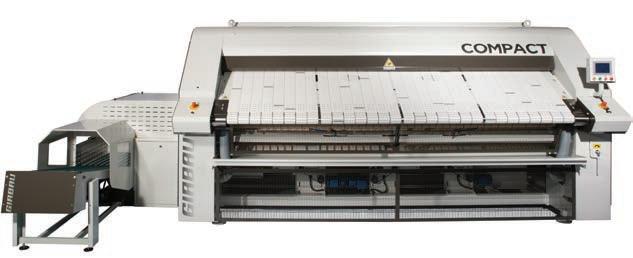
Featuring a compact design and flexibility that allows Whistler Laundry to automatically feed, iron, fold and stack a variety of items, the Compact fits perfectly into its designated spot at the laundry. Configurable for one, two or four working lanes, with one lane for sheets, two for table linens and four for small items, including napkins and pillowcases, it executes up to three-lane primary folds and single- or two-lane cross folds. A bypass option allows goods to exit the front or rear of the machine, and the Compact offers left or right discharge and front or rear stacker orientation to meet specific needs. Finally, it automatically adjusts ironing speed and moisture removal — processing goods with no dryer preconditioning.

Contact Girbau Industrial for a FREE ESTIMATE and discover how production automation can boost productivity and profits in your laundry! (800) 256-1073 • www.girbauindustrial.com









INDUSTRIAL Our first ironer improved production and revenue 30 percent. The new Compact 5-in-One elevated it another 30 percent. The Compact has opened the floodgates to new business and bigger clients.
Steve Wheeler, Co-Owner, Whistler Laundry Inc., British Columbia, Canada
TRSA members engage at Workforce Management, Safety Summits
Both events featured keynote speakers, workshop sessions
BY MATT POE, EDITOR
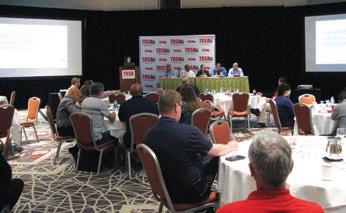
CHICAGO — TRSA, the association for the linen, uniform and facility services industry, hosted its Workforce Management and Safety Summits at the Embassy Suites Magnificent Mile here in mid-April. Each Summit featured a day of keynote speakers and workshop sessions.
“The great thing about these topics is that attendees will share with one another,” says TRSA President and CEO Joseph Ricci. “When it comes to sales and marketing, they’re less inclined to talk, but everyone can use help with human resources and safety.”
Jerry Brand from Crown Health Care Laundry in Pensacola, Fla., attended the Safety Summit.
“I love this kind of stuff,” says Brand. “Actually, the sessions could be longer for me. They could go half a day, with breaks. There is always something you can tweak in your organization. I always want to learn more.”
While this was the sixth Safety Summit, the Workforce Management Summit was a first-time event.
“The Workforce Summit was driven by the success of our monthly webinars,” says Ricci.
“The H.R. ones are always well attended and most active.”
Ricci says about 80% of the total number of attendees for the two days signed up to take part in both Summits. Forty-three TRSA members attended the Workforce Management Summit, while 62 signed up for the Safety Summit.
WORKFORCE MANAGEMENT
The Workforce Management Summit kicked off with a keynote presentation by Valerie Grubb, president of Val Grubb & Associates Ltd. She spoke on defining the value of human resource departments and professionals.
“H.R. departments need to align workforce strategy for the company,” she says. “We can aid in increasing revenue and containing cost. We can also partner with leadership for future success.”
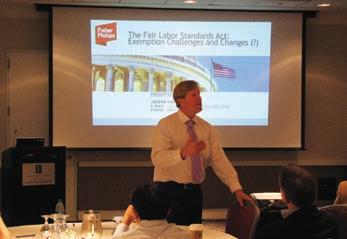
The morning concluded with a workshop presented by Joe Shelton, partner in Fisher & Phillips LLC. The topic: from termination
to trial.
Attendees watched video clips as a fictional employee was terminated from a job, sued the company for discrimination and then went to trial.
The workshop put attendees in the position of the jury in order to determine what the fictional company’s human resources did right—and didn’t do right.
In the afternoon, educational breakout tracks on compliance and employment were offered.
The compliance track featured sessions on Fair Labor Standards Act (FLSA) whitecollar exemptions and employment law, while the employment track examined pretesting to aid hiring and the future of H.R. for success.
The day concluded with a panel questionand-answer session. Issues raised ranged from incentive programs to medical marijuana laws.
The panel agreed that the top issue in human resources today is employee retention.
“Change is here,” says Carmen Berrelleza, senior human resources manager for Prudential Overall Supply. “The industry needs to bring change. If we don’t, we’re going to be in serious trouble.”
SAFETY
At the Safety Summit, Joe Wheatley of EnPro Industries Inc., a 2016 EHS Today Safety Award winner, delivered the keynote address on how his company views safety.
“We have a dual bottom line,” he says. “We have financial profit and human development. Both are on an equal footing, have equal weight in our decision-making process. It’s about being more profitable through safety.”
The rest of the morning through early afternoon presented attendees with six breakout workshop session options: fire protection, fleet safety, low-voltage electrical, lockout/ tagout, confined space and hazard communication.
“We need to make safety materials visual, easy for employees to follow,” says Scott Stone of Brady Corp., which produces safety products for manufacturing environments. “We need to have training to make sure employees
understand every step.”
A panel of safety professionals concluded the day with a question-and-answer session, with topics ranging from starting a safety program to getting senior management to become more safety-driven.
With all of the information presented, attendees walked away with many ideas to help improve workforce management and
safety at their operations.
“I take a lot of notes, and then I’ll go back to the office and send myself e-mails,” says Suzanne Ormond, risk manager for Alsco Inc. “You have to have a management system to keep it all organized.”
TRSA has scheduled its next Workforce Management and Safety Summits for May 16-17, 2018, in St. Louis. ALN
8 JUNE 2017 | AMERICAN LAUNDRY NEWS www.AmericanLaundryNews.com
ALN_Tab_1-4_H.indd 1 3/30/17 2:35 PM
Joe Shelton, partner in Fisher & Phillips LLC, leads a breakout session on FLSA white-collar exemption compliance. (Photos: Matt Poe)
Industry safety professionals answer questions from TRSA Safety Summit attendees.
When dealing with laundry stains, your reputation rides on getting the outstanding results The Laundry Two deliver. RiteGo® laundry spray spotter quickly penetrates to absorb collar & cuff stains, perspiration, ground-in soil and more, all without brushing. Turn to Laundry TarGo® to remove any tough oil based stains that remain behind.
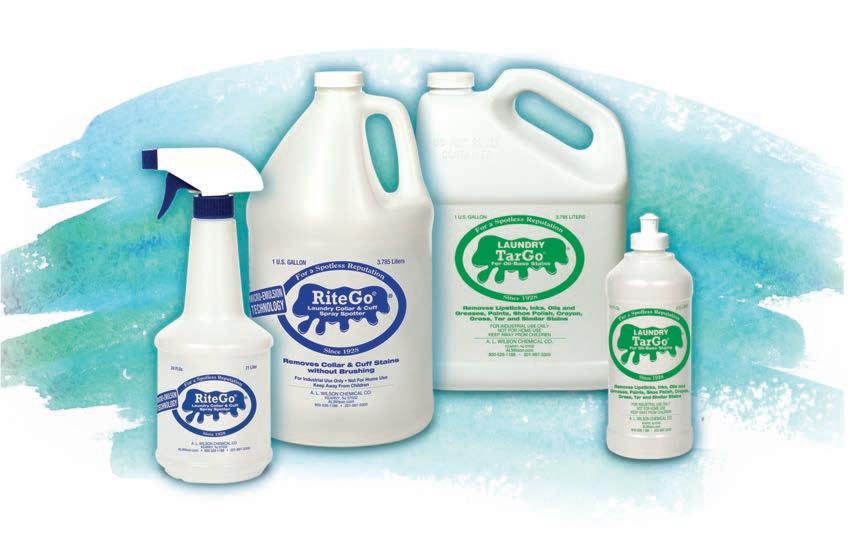
Use The Laundry Two with confidence on shirts, wedding gowns... anything you're washing or wetcleaning.
Both Laundry TarGo and RiteGo are chlorinated-solvent free, biodegradable, noncombustible and California 2013 VOC and Prop-65 compliant.
Use them to deliver stain-free laundry and wetcleaning. You'll build your reputation for quality - which is what keeps customers coming back.
FROM COLLARS AND CUFFS THE LAUNDRY T WO ™ ARE RIGHT FOR YOU! TO THE REALLY TOUGH STUFF... FROM COLLARS AND CUFFS THE LAUNDRY T WO ™ ARE RIGHT FOR YOU! TO THE REALLY TOUGH STUFF... To learn more, visit ALWilson.com or call 800-526-1188 A. L. WILSON CHEMICAL CO.
a STAIN WIZARD at ALWilson.com
Become
“This boosts laundry throughput while reducing natural gas consumption and resulting costs,” he says.
When developing the on-premises laundry, adhering to state and federal health standards was paramount.
“We ensured there was no cross-contamination,” says Blackwell. “Soiled laundry coming in is completely separate from clean laundry going out.”
Other requirements included a 25-minute bath time at 165 F.
“An optional temperature boost on the washers allows them to reach state and federal sanitation standards,” says Asher. “Because of the 25-minute bath time, wash cycles are close to 50 minutes.”
He says that thanks to the high-speed extract and soft-mount washers, laundry loads dry quickly.






The 55- and 30-pound washers also feature the flexible Inteli control, which allows complete control over every conditional aspect of the wash process, including water temperature by degree, wash rotation speed/duration, water levels, bath cooldown by degree, and extract speeds, Asher says.
Chemicals are automatically injected into the wash cycle, at the right time and water temperature, according to the program selected. Asher, who also provides the hospital with cleaning chemicals, set up individual wash programs for items like
blankets, gowns, sheets, towels, bed pads, scrubs and rags.


“It’s really easy,” says Blackwell. “Our laundry operator just enters a program number and presses start.”
Once washed, items are dried in programmable Pro-Series II Dryers. The dryers are engineered with a moisture-sensing system that ensures items are not overdried, according to Blackwell.
Linen Life Extension (LLE) offers 12 programmable dryness levels and targets any dryness level up to 40%. When the load has reached its pre-set target level of dryness, the control shuts the dryer off. Thanks to this moisture-sensing system, dry goods experience less damage and fiber loss, according to Asher.
“LLE effectively reduces over-drying, resulting fabric damage, and cuts energy and labor costs,” he says. “This contributes to high-quality results.”

Clara Barton Hospital says it now enjoys complete control over laundry quality, inventory and production.
“Before we moved laundry in-house, we were getting linens back tattered and stained,” says Blackwell. Now, anything subpar is pulled and replaced with new inventory. “We feel like our wash cycles and attention to detail fit hand-in-hand really well.”
The icing on the cake? Clara Barton Hospital is on track to save $1.75 million over five years.
“The cost savings is impressive, but I’m equally ecstatic about the quality of the product and inventory we have on hand,” says Blackwell. “I can’t imagine why any facility would outsource its laundry.” ALN
10 JUNE 2017 | AMERICAN LAUNDRY NEWS www.AmericanLaundryNews.com
Continued
from Page 1 Clara
now uses three soft-mount washers and three dryers for its laundry. CLEAN SHOW BOOTH #745 monarchbrands.com MICROFIBER CLOTHS • 16”x16” professional microfiber cloths • Use for wet or dry cleaning • Wide variety of colors and weights WET FLOOR CLEANING Pocket Mops, Scrubbing Mops, Tube Mops, Flat Mops and Econo-Mops. We stock a full line of superior wet mops and hardware. DRY FLOOR CLEANING Whether you prefer Velcro® or Canvas-backed, we stock a full range of dusting products from 18” - 72” wide. From yarn manufacturing to edge stitching, we inspect SmartChoice Microfiber at every stage of construction. Learn why at booth #745. TRADITIONAL MOPS We now stock cotton-poly blended wet and dry mops for those who prefer traditional cleaning methods. @ C100 M0 Y44 K0 PMS 3272 C C36 M0 Y29 K0 65% opacity of PMS 346C (Outer ring of logo) C55 M0 Y47 K0 PMS 346 Join Monarch Brands at Booth #745 for The Clean Show June 5-8 at the Las Vegas Convention Center. Try us for the first time, or try something new and receive 10% OFF YOUR FIRST SHIPMENT OR ANY NEW PRODUCTS ORDERED AT BOOTH #745
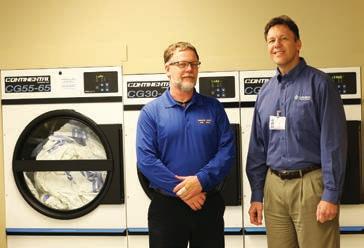
Brian Asher (left) of Commercial Laundry Sales & Service helped Clara Barton Hospital CEO Jim Blackwell (right) bring the hospital’s laundry in-house. (Photos: Continental Girbau)
Clara
Barton Hospital
New equipment to clean fire department PPE
Gear cleaning becomes high priority for firefighter health
BY MATT POE, EDITOR
ESOPUS, N.Y. — The Town of Esopus (N.Y.) Fire Department knows a thing or two about personal protective equipment (PPE).
The department has 45 active volunteer members, and it responds to between 250-300 calls per year. With about half of the calls being fire-related, that translates to a lot of PPE that need to be cleaned. Even without fire calls, the PPE have to be washed on a regular basis.
The department recently installed new on-premises laundry equipment to clean its PPE. American Laundry News spoke to Michael Camuto, first assistant chief, about the department and its new equipment.
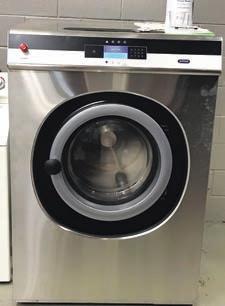
What PPEs do you need to clean most often in the fire department? Why do they need to be cleaned?
Camuto: We are cleaning our firefighters’ bunker gear, hoods and gloves. Years ago, dirty gear was a badge of honor among firefighters. Today, with what we are learning about the instances of cancer among firefighters, it is immensely important that we are washing gear to ensure nobody is wearing PPE with carcinogens present.
How often do you clean these articles?
Camuto: If we don’t have any fire calls, we are on a cleaning schedule of once every six months. However, if we have a structure fire or call that causes your gear to become heavily soiled, we are asking firefighters to have gear washed within a couple days of the call.
We recommend staff to pair up, because the Primus washer can wash two sets of gear. So, both firefighters don’t need to be present for the whole wash cycles. One washes the outer shells and the other staff member takes care of the inner shells.
You recently installed the new laundry equipment you mentioned. What led to the decision to acquire new equipment?
Camuto: We recently transitioned to new leadership, which has brought a more professional approach to operations. Our focus has been on upgrading the department and equipment to make it safer for everyone. Obviously, we are acutely aware of the link between the cancer-causing dangers of soiled PPE. As a result, our leadership made crafting a gear-cleaning solution a top priority for the department. A central component to that was acquiring a washer that would help us do that.
What was your process for evaluating and selecting the new machines?
Camuto: We spent roughly six to eight
months researching equipment, both online and at fire industry trade shows. From there, we narrowed our search and met with four distributors.
The biggest factor in our decision was our sales contact, T.J. McEwen at Super Laundry in East Syracuse, N.Y. He spent a lot of time getting to understand our unique needs and crafted a cost-effective solution in recommending a Primus softmount washer. The soft-mount was a great fit, since we have radiant in-floor heat where we were installing the laundry.
How have the machines worked so far?
Camuto: The Primus washer is working fantastic. T.J. helped us dial in a specific wash program based on instructions from our gear manufacturer. To make the program easy for our firefighters to remember, we named it “number 27” after our fire company number.
If another fire department was thinking about acquiring new laundry equipment, what advice would you give them?
Camuto: Most definitely, do your research and be educated in the variety of products available. What works for my department may not work for everyone. In the end, however, it’s imperative to work with a distributor who will deliver excellent service and support after the installation.
Case in point: I was working on tweaking a program early on and had an issue. I called T.J., and he was able to walk me through the steps over the phone. It was nice to know I had a person like that to assist me in learning the ins and outs of the machine.
Route ready BAR Mops
Route Ready bar mops are optically white and packed in bags of 25 so you never have to pre-wash or recount them prior to use.
TRUE COLOR towels


Ideal for colleges, country clubs, gyms, golf clubs, and hotels. These towels made from soft, ring spun100% cotton, with a dobby border.

white institutional sheets
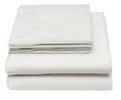
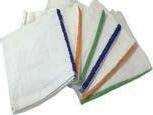
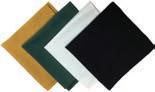
These 180TC 55/45 cotton/poly blend, are more durable than cotton sheets, and are made in China. Chinese sheets provide a softer feel than other imports.
ELITE collection WHITE towels
Made with 100% ring spun cotton and a blended ground to provide a perfect balance of feel and durability. These are optically bright white, soft to the touch, carton packed and ready for use.

www.AmericanLaundryNews.com AMERICAN LAUNDRY NEWS | JUNE 2017 11
ALN
The Esopus, N.Y., Fire Department researched washers for several months before selecting a Primus soft-mount. (Photo: Town of Esopus Fire Department)
CALL FOR PRICING (800) 333-7247 monarchbrands.com CLEAN SHOW BOOTH #745
A staple item for all restaurant laundries, we offer tough and economic poly aprons for chefs, waiters and baristas.
@ C100 M0 Y44 K0 PMS 3272 C C36 M0 Y29 K0 65% opacity of PMS 346C (Outer ring of logo)
Monarch Brands
us
something
and receive 10% OFF YOUR FIRST SHIPMENT OR ANY NEW PRODUCTS ORDERED AT BOOTH #745
Join
at Booth #745 for The Clean Show June 5-8 at the Las Vegas Convention Center. Try
for the first time, or try
new
SPUN POLY APRONS & NAPKINS
Laundry equipment on the front line of firefighter PPE cleaning
CLEANING BASICS
pieces of PPE.
BY BILL BROOKS
RIPON, Wis. — For years, it was a badge of honor among firefighters. Soot-stained bunker gear was a testament to the battles fought alongside their brothers. As a newcomer to the industry 29 years ago, I noted that the guys with the more soiled gear were the veterans to follow and listen to.
Times have changed. Today, we know the dangers that lurk in that gear. For proof, we need only look at the staggering numbers. According to the International Association of Fire Fighters, 60% of career firefighters will die of cancer. Ours is a dangerous profession, and that danger lives on in our soot-covered gear well after the flames are extinguished.
Laundry equipment is now one of firefighters’ greatest tools in protecting their lives from harmful carcinogens.
CURRENT STATE
Over the last five years, the fire industry has ramped up its focus on firefighter safety. It’s not enough to provide staff with the highestquality protective gear, manufactured with cutting-edge fabrics and technical fibers.
Today, we know that gear has to be cleaned in the proper way to not only maintain the integrity of those protective fibers, but also remove the dangerous carcinogens. Soils that end up in and on bunker gear can inhibit the performance of the flame-retardant qualities of the fibers or even be flammable.
While many states are considering moves to mandate that departments install a washer in each firehouse, the National Fire Protection Association (NFPA) has not pushed for such standards to be applied.

At present, NFPA 1851 is the accepted standard that addresses personal protective equipment (PPE) considerations, as well as the guidelines for maintenance of turnout gear. The most recent revisions to the standard were made in 2014.



NFPA 1851 sets forth some basic standards, with the first being that departments have to adopt a plan for maintaining PPE, as well as a detailed record-keeping system that tracks the gear from in-service to disposal, with all cleaning, repairs and inspections in between documented.
The cleaning process recommends firefighters stay responsible for cleaning their individual gear. It also prescribes that layers be separated. Debris that is dried onto gear should be removed and soft brushes used for lightly scrubbing top layers.
Generally, water temperatures should be kept below 105 F, never use bleach, and the use of high-speed extraction cycles in washers is to be avoided.




PROBLEMS

Where I have seen departments make mistakes is by selecting small, home-style, front-load washer-extractors. This presents a couple problems, not the least of which is capacity. Often these wash cylinders are not large enough to deliver an adequate drop in the wash process. Without it, wash quality suffers and gear is not returned to service truly clean.
In addition, a lack of programmability handicaps departments, again reducing wash quality. Programmable controls help departments tailor wash cycles and extract speeds to the specific recommendations of the gear manufacturers.
Lastly, most home-style, front-load washers produce too-high spin speeds, which can be damaging to moisture barriers of turnout gear.

Commercial laundry equipment not only delivers the capacity that departments like mine and others need to return gear to service faster, but also the ability to fine-tune each element of the wash and spin cycles to ensure PPEs get the best care possible. This tailored approach is important from a safety standpoint, but at $2,000 or higher for a set of gear, getting a long, useful life from bunker gear is just as important.
WHERE TO START?
All departments, large or small, are in the











same position in needing to craft a plan— either providing equipment in-house or sending it out to be cleaned. If I’m reading the future, I think eventually most departments will want to have laundry equipment on-site for having equipment cleaned and back in service quickly, and still rely on commercial ISPs for full cleanings, inspections and repairs.
The first step to setting up an in-house laundry is to position your laundry expenditure with government or department budget staff as a health and safety matter, because it truly is. It’s not an equipment purchase.
The next step is to look at equipment sizing to ensure you have the correct capacity. This is where the laundry equipment distributor will be able to assist. A good rule of thumb is 1 cubic foot of cylinder volume is roughly equal to one piece of gear. Gear should be separated between outer shell and inner liner (e.g., a jacket is two pieces, pants are two pieces, etc.). So, a 65-pound washer-extractor with 9.7 cubic feet of cylinder volume could accommodate roughly 10
As you begin to put together a plan for your laundry, obviously, it’s important to become familiar with NFPA 1851 standards and to make sure members of the house understand them as well.
Lastly, connect with organizations such as Fire Industry Education Resource Organization (FIERO). FIERO can be an excellent resource in helping gain a better understanding of firefighter safety.


A LOOK AT THE FUTURE
I think eventually most departments will begin issuing two sets of gear to ensure a clean set is always ready to go when a call comes in. For busy departments in major metro areas, gear cannot be cleaned and returned to service quick enough. Two sets are required. This is no small investment, with upwards of 30 to 45 firefighters per house in some large departments.
However, with an in-house laundry, departments likely will see the ability to produce a quality cleaning process and quickly return gear to service.




Now that we know the risks associated with the harmful substances in our gear, cleaning guidelines and protocols will continue to shape processes in the house.
Already, gear is no longer stored ready in living quarters. I think this will continue to work backward to just how gear is handled immediately after a structure fire. PPE is soiled at the scene, though it is not cleaned until back at the house. Thus, contaminants are brought into the rig, likely transferring to seats and other surfaces.
I believe we’ll see more on-scene cleaning, similar to a hazmat decontamination, with gear then being bagged or isolated for transport back to the house for a more thorough cleaning.
FINAL THOUGHTS
Years ago, firefighters breathed a sigh of relief each time they returned to the house safely after battling a structure fire. Today, we know that the danger doesn’t end when we leave the scene; it lives on in our gear. The
12 JUNE 2017 | AMERICAN LAUNDRY NEWS www.AmericanLaundryNews.com OPL 101
More firehouses to bring PPE laundering in-house, says experienced firefighter Fashion Seal Healthcare®- Outfitting Women in Healthcare The most extensive line of women’s lab coats in the industry SimplySoft ® Scrubs Fashion forward styling designed just for women Vibrant new colors with flattering features A luxurious brushed fabric with a soft, comfortable feel Industrial-Laundry friendly Almost Half of All Medical Students are * Embroidery available on all garments with fast delivery Women Nearly 1/3 of Practicing Physicians are Women 1 (888) 491-5818 www.FashionSealHealthcare.com info@FashionSealHealthcare.com ALN_Tab_1-4_H.indd 1 5/16/17 10:35 AM Today, firefighter safety includes proper cleaning of protective gear. (Image licensed by Ingram Publishing) See OPL 101 on Page 27
Does your laundry need a workhorse?
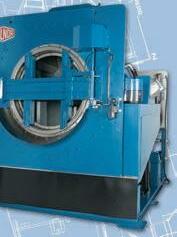
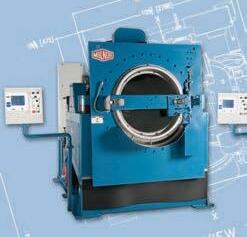

Our M-Series Washer-Extractors are built for optimum performance and easy service access. The simple design with single pivot two-way tilt and large door provide safe, fast and efficient loading and unloading. The open access allows for easy and simplified maintenance. Milnor’s unique and innovative SmoothCoil™ Suspension System means maintenance-free, superior vibration dampening with less wear and tear. Our intelligent bearing design provides three water seals and an excluder seal mounted on an easy-to-replace seal sleeve, along with a leak-off cavity to keep water and chemistry away from bearings. All of this and more, built to Milnor’s legendary ruggedness and durability.
Contact an authorized Milnor distributor or call 504-712-7656 to find out more.




www.milnor.com



















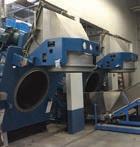
Optional integrated load chute door for automated washer-extractor systems. 275 lb., 400-500 lb. and 600-700 lb. capacities available.







For more information, scan this code.
VISIT BOOTH #3131 AT CLEAN!
BY SETH WILLER
OSHKOSH, Wis. — What’s one of the most tedious tasks for employees in your laundry and linen service operation?
If you work with blankets and towels and the like, I’m guessing hand folding is close to the top of the list. And since it’s laborintensive, folding linens by hand might be a drain on the company’s bottom line.

Have you considered the possibility of switching to an automatic folder?
It’s not easy to know when it makes sense to move to more automated laundry equipment.
That’s why I’m writing for American Laundry News, to help you figure out if it’s time for your laundry to automate.
Last time, I took you through the steps of moving from a heated-roll flatwork ironer to a system that uses a heated-chest ironer. In this article, I’ll examine automatic folders and guide you through when it might be time to stop hand folding and start automating the process.
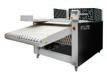
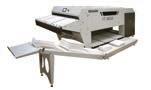
Q. How does an automated folder work?
A: There are two types of automatic drywork folders—models that automatically sort and those that don’t. Both will quickly fold blankets, gowns, bed pads, hand towels, bath towels, bath mats and more. An auto-sort folder, however, offers the added benefit of automatically sorting items as they are fed into the folder. Items are then automatically stacked.
Here’s how an auto-sort folder works: When items are hand-fed into the folder, the machine identifies the fed items and adjusts folding configurations to suit those specific dimensions. The folding timing and air blasts are
automatically adjusted for each item without any interaction from the operator. The machine does this quickly so one operator can feed three different-sized items in a row without changing programs. The folder automatically adapts the folds to fit the item.
The stacks are collected under the folder and delivered to a discharge conveyor. The conveyor returns the stacks to the original operator. It only takes one operator for this entire process. An auto-sort folder can generate up to 1,000 folded pieces per hour.
Q: Why would a laundry install an auto-sort folder instead of hand folding?
A: 1. Production. The most compelling reason to go from folding by hand to an autosort folder is improved production. The typical laundry employee can sort, fold and stack different-sized items at a rate of 120 pieces per hour. An automatic towel folder, using one operator, can fold and stack 800 different-sized pieces per hour.
By using an auto-sort towel folder, which automatically sorts, folds and stacks, productivity further improves to 1,000 pieces per hour. Again, only one operator is needed.
2. Labor Savings. The second reason to move to an auto-sort folder is a drastic reduction in labor hours. Finishing, folding and stacking are the most laborintensive parts of the laundry process. Through automation, and the installation of an autosort folder, you can cut labor hours by 87%.
For example, it takes one
person 10 hours to sort, fold and stack 1,250 items. With an autosort folder and one operator, the process for the same number of items only takes 1.25 hours.
3. Quality. Finally, quality improves with automation. The folder creates consistent folds and stacks every single time. Consistency of folds and stacks simplifies prepping laundry for transportation and storage, which saves additional labor hours and further improves
facility productivity.
Whether yours is a commercial laundry, hotel laundry or healthcare laundry, highquality stacks will give the impression of a high-quality wash and high-quality service.
I hope these considerations help you see how moving from folding by hand to an automatic folder could benefit your laundry
and linen service operation.
In an upcoming issue, I’ll wrap up this series on automation by examining when it’s the right time to move from open-pocket washers to a tunnel system. ALN
Seth Willer, national sales manager for Girbau Industrial, has expertise in on-premises and industrial laundry design, equipment, workflow and productivity.

14 JUNE 2017 | AMERICAN LAUNDRY NEWS www.AmericanLaundryNews.com
Moving from folding by hand to automated folding How can moving from hand-folding goods to an automatic folder make an impact on a laundry business? OPERATORS EQUIPMENT: NONE PRODUCTION BETTER EQUIPMENT: FT-LITE PRODUCTION OPERATORS GOOD 1 1 BEST EQUIPMENT: FT-MAXI PRODUCTION OPERATORS AUTOMATIC FOLDER/STACKER up to 1000 pieces/hour 1 AUTOMATIC FOLDER/STACKER up to 800 pieces/hour HAND FOLDING up to 12O pieces/hour Labor Hours for 1250 Pieces 1.25 850 PPOH (1000 items per hour; 1 lbs. per item/85% efficiency) QUALITY EXCELLENT Labor Hours for 1250 Pieces 10 102 PPOH (120 items per hour; 1 lbs. per item/85% efficiency) INCONSISTENT QUALITY Labor Hours for 1250 Pieces 1.5 680 PPOH (800 items per hour; 1 lbs. per item/85% efficiency) EXCELLENT QUALITY
sense of automation: ALN_Tab_1-4_H.indd 1 4/24/17 11:10 AM
Willer
Making
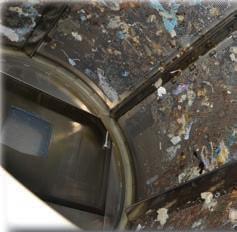
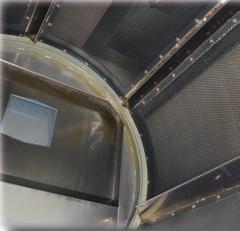
PLASTIC IN YOUR DRYERS CAUSING PROBLEMS?
From This... To This.
HAS YOUR SOLUTION
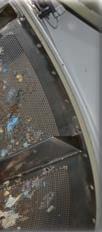
With the application of DECC’s internally reinforced, abrasion resistant release coating to your dryer panels, results are immediate.
Reduced Downtime
No more ice blasting and no more drilling holes. DECC’s coating greatly reduces plastic buildup in your dryer. When plastic does stick - usually because it melts through the panel perforations and sticks to itself - cleaning takes minutes instead of hours...all you need is a plastic scraper.
Improved Bottom Line
As a result of dramatically reduced down-time and labor, combined with increased production capacity and lowered energy costs, your investment in coated panels could be returned in only a few months
Decreased Dry Time
A dryer with clogged panels can experience a 30-35% increase in drying times...or more. Coated panels allow for greater efficiency and air flow as it takes far longer for plastic and debris to build inside the dryer. As a result, production capacity is maintained and energy costs are reduced
Long Lasting Performance
DECC has been applying coating to dryer panels for over four years and some of our very first customers still have original panels in the field that have yet to fail.
Free Test Panel
We understand reading about a product doesn’t compare to seeing it in action. Mention this ad and DECC will coat one of your dryer panels free of charge so you can validate performance…all you have to pay is shipping.
DECC can coat dryer panels of any make or size...if they can be removed, we can coat them. We also offer discounted freight costs due to special negotiated LTL common carrier rates.
DECC is the premier coating applicator of dryer panels for



Go to www.DECC.com/dryer-panel-coating, email salesgroup@decc.com, or call 616-588-2850 for more information Visit us at Clean ‘17, Booth 3731, to see a coated panel, get a freight quote, and learn how we can improve your bottom line with coated panels!

PPE essential to laundry worker safety
electrical has been disengaged, and fall protection,” he says.
BY M ATT PO E, EDITOR
CHICAGO — High injury rates are the most expensive manageable events affecting laundry operating profitability, according to Bob Corfield, president of Laundry Design Group LLC in Las Vegas.
“Laundries with high DIR (disabling injury rates) often pay the highest insurance costs, eroding profits,” he says. “While training and worker activity are key drivers in managing a safe work practice, the diligent use of proper personal protective equipment (PPE) is essential.”
The U.S. Department of Labor’s Occupational Health and Safety Administration (OSHA) defines PPE as “equipment worn to minimize exposure to hazards that cause serious workplace injuries and illnesses.”
“It’s extremely important for employees to use PPEs,” says Laura Gracia, safety director for Admiral by Alsco in Houston. “It helps in the prevention of lifealtering events. Even death.”
“Interestingly, the laundry and uniform industry are in the business of PPE, supplying reusable gloves, uniforms, gowns, aprons, wipers and cleaning cloths designed to protect workers using their products,” adds Corfield.
ESSENTIAL PPE
Essential PPE, regardless of the laundry type, starts with the basics, says Corfield. That includes the right footwear, the correct body and skin protection, and head protection, which includes hardhats (if the area calls for it), and ear and eye protection.
The types of PPE vary in accordance to the type of laundry being processed, says Russell Holt, chief compliance officer for Superior Linen Service in Springdale, Ark. This includes industrial uniform, healthcare, and food and beverage.
“Generally speaking, laundry employees wear PPEs in soil sort, washroom, when welding, handling chemical, handling soiled linens on the route, grinding, performing any live electrical work, including LOTO (lockout/tagout) testing to ensure
Corfield says that PPE for healthcare laundry workers is part of every certification related to healthcare and is required under OSHA safety requirements for BBP (bloodborne pathogens) exposure control measures. These include closed-toe, slip-resistant shoes; blue nitrile puncture-resistant gloves; fluid-resistant gowns that cover arms and torso; and face/eye and breathing protection. He says that all should be used as required by local bylaw.
PPE required for a task or work area in any laundry should be “designed” for that area, and then workers need to be trained in the proper use of the equipment, according to Corfield.
He offers this example: Any person
Gracia offers up the following list as a starting point for a laundry to think about concerning PPE.
• Hard hats: For use in washroom aisles and soil room areas where there is overhead railing for soil bags, soil slings and wet slings. Also for lifts.

• Back belts: In the washroom and soil room for heavy lifting, pushing and pulling.
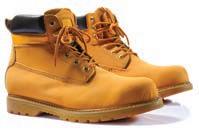
• Steel-toe, high-top safety shoes (slip-resistant, oilresistant): For wet washrooms, if applicable; service personnel on routes; and anyone whose job includes using pallet jacks, forklifts, and in the handling of rolling stock such as baskets, wire cages, racks, etc.
• Steel-toe, high-top safety shoes (slip-resistant, oilresistant, electrical hazard protection): These special shoes are for engineers and maintenance personnel and should be worn always.
protect from free fluids while sorting medical soil.
• Latex/neoprene lightweight gloves: For sorting of medical soil.
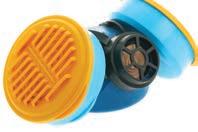
Other PPEs that Holt suggests includes protection for welders (a welder’s apron, gloves, sleeves, goggles, face shield), a respirator for chemical handlers, and a harness and lanyard or lifeline for fall protection.
COMPLIANCE
To help ensure that employees are utilizing PPE, using the right equipment and using it correctly, Gracia recommends job safety assessments.
“Job safety assessments help employers identify exposure to hazards and can then provide proper PPEs needed and training on using those PPEs—and their limitations,” she says.
Once the PPEs are selected and usage policies are in place, a laundry needs to enforce its policy, says Gracia.
“To help with enforcement, do the research and keep the wearers’ comfort in mind,” she adds. “You may consider using employee feedback when selecting PPEs.”
involved in the refilling or transfer of laundry chemicals should have splash-proof, resistant boots; an apron or smock; gloves covering the arms; and full faceguard and breathing protection on while working with open containers or transfers.
“Wet areas should address worker exposure to hot water, steam or chemicals,” Corfield says. “Head protection should come into play with overhead slings/rail and low pipes or steel. Hand protection should protect from repetitive work activities and exposure to sharps. Heat gloves should be used in areas dealing with hot textiles exiting ironers to protect workers’ hands.”
SOME PPE TO CONSIDER
A full list of PPE that a laundry might use can’t be covered in one article. In fact, each laundry has to evaluate the plant and the jobs to determine what equipment is required.
Holt points out that laundries have to do this in order to be compliant with OSHA standard 1910.132(d)(1): The employer shall assess the workplace to determine if hazards are present, or are likely to be present, which necessitate the use of personal protective equipment (PPE).
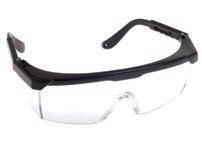
• Safety glasses: Areas of use can include the washroom, to protect eyes from chemical splashes; soil room, to protect from flying debris when sorting soil; and in the healthcare soil room, to protect eyes from debris and free fluids while sorting medical soil.
• Plastic apron: To be used when handling chemicals.
• Rubber boots (steel toe): These should be used for chemical handling and walking/working in areas of wet surfaces and washrooms.
• Rubber/neoprene gloves: For chemical handling.

• Fluid-resistant lab coats, aprons: To
Holt says his company tracks safe and at-risk behaviors by way of its behaviorbased safety program. However, the company does not have a specific percentage as to how often wearing required PPE is ignored.
“It does happen, and when it does, in most cases we coach the employee on safe behavior and monitor to ensure employee behavior changes,” he says.
If a laundry supervisor sees an employee not wearing the necessary PPE, Gracia offers a few simple steps: Retrain, coach and counsel, and possibly discipline.
“If an employee does not or will not wear the assigned PPE, we should ask why,” Gracia says. “There may be legitimate reasons for it. Maybe we missed something in our evaluation of the hazards.”
“PPE is not just something used to protect a worker in his/ her environment; it needs to be maintained as a program, complete with area to put on and take off, dispose items properly discarded, etc.” says Corfield. “If a PPE requires cleaning, it needs to be scheduled and monitored.”
16 JUNE 2017 | AMERICAN LAUNDRY NEWS www.AmericanLaundryNews.com
ALN
Start with basics, evaluate each job, experts say
(Images licensed by Ingram Publishing)
knowledge is power
Control and Information When and Where You Need it
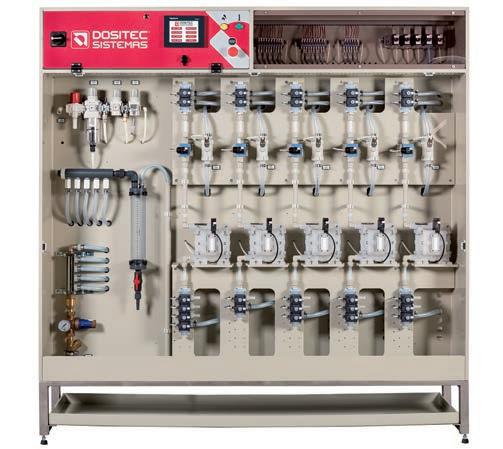
With the Dositec tunnel washer system from Hydro, you can simplify and improve chemical delivery to your tunnel washer with a single, central dispensing system made up of five injection channels. The productivity, chemical usage, cost and alarm reporting features will give you a better understanding of your laundry from anywhere with an internet connection. You will also have confidence in the accuracy of your chemical delivery based on measured dosages from the onboard flow meter. By eliminating squeeze tube maintenance and offering remote troubleshooting capabilities, you will save both time and maintenance costs.
3798 Round Bottom Road Cincinnati, OH 45244, U.S.A. T 513-271-88OO F 513-271-O16O www.hydrosystemsco.com
 Remote Monitoring
Global circumstances continue to impact textiles
Expert shares issues that affect supply chain of fiber products
BY MATT POE, EDITOR
RICHMOND, Ky. — The textile industry is a global industry, and there are many factors involved in the process, from producing fibers to producing goods to laundry processing.
These elements can greatly impact the supply chain, which in turn can impact the cost of producing and processing textile and linen goods by manufacturers and service providers.
Tom Langdon, vice president and GM of Encompass Group LLC, shared some key factors affecting the textile supply during the recent Association for Linen Management (ALM) webinar titled Global Market Update
FIBER
Langdon began by exploring the state of the international cotton market. Obviously, the production of cotton around the world greatly impacts supply and prices for the production of linens and textiles.
He says that according to the International Cotton Advisory Council, about 21 million tons were produced in the crop year 2015-16, followed by nearly 23 million the next year. It’s projected that 23 million tons will be produced in the upcoming crop year.
“The interesting factor is that we’ve actually consumed, as a world, 24 million tons in ’15-’16, which was 3 million more than we produced, a million more the following year and then anticipated a million more the next year,” Langdon says. “What that does is impacts our ending stocks. After the growing season is over, they estimate how much cotton is in the environment.”
He says higher cotton consumption is what caused the sharp increase in cotton prices in 2011 when it was thought because the ending stocks were so low that the world could possibly run out of cotton.
After factoring in all this information, he says the Council projects what the price of cotton will be for the international market.
“For the previous year, they had priced it about 70 cents a pound,” Langdon says. “For the current year we’re in, they priced it at 78 cents a pound, and then next year they’re looking at a possible decrease to 73 cents a pound.”
Tracking global cotton prices from 2013-14 to 2015-16, Langdon says there was good downward movement in ’14-’15, but starting in 2016, prices began to increase. Then, from February 2016 through
March 2017, he says cotton prices went up 30%.
“In February 2016, the price was 66.5 cents a pound. At the end of March this year, it was almost 87 cents a pound,” Langdon says. “The New York futures, China, India, Pakistan, which are the major textile producing regions, there’s an upward trend.”
Then there are the prices for yarn by product type. Langdon says that for bedding, 20s, which is a common yarn size for sheeting products and even in patient gowns, is up 38% since January 2016. He says there are similar trends for blankets, knitted sheets and terry.
“What this does, we’ve actually had to take price increases for these product groups for shipping starting in April because the yarn prices have gone up so much,” he says.
Langdon says his company’s office in Pakistan tracks yarn prices on a weekly basis, and the word is that there’s not going to be much relief until the new crop starts this fall.
CRUDE OIL
Next, Langdon discussed crude oil, since it provides a key component of polyester fibers. Price fluctuations impact raw materials for textile producers. He says that, in general, polyester staple fiber prices trend similarly to crude oil but not always.
“Back in July of last year, crude oil spiked, but polyester remained flat,” says Langdon. “Then, crude oil dropped in September, but polyester fiber actually went up. Then again, oil spiked in November/ December and poly remained on a flatter trend. But in general, they do trend similarly.”
Part of the reason for the spikes, he says, could be the capacity or supply and demand that affect one product versus the other. Langdon says synthetic fiber prices from March ’15 to March ’17 went from price decreases to price increases. The highest consumer for synthetic fiber is Asia, and prices in that part of the world increased the most.
“There are a lot of price pressures in the marketplace right now for synthetic fiber,” he says.
SHIPPING
Shipping is a key factor in the textile supply chain, and Langdon went over five shipping trends affecting the market this year. First is increased consolidation.
“One example is the recent purchase of Hamburg Sud by Maersk,” he says. “One large shipping company purchased another large shipping company. It was estimated that in 2016 this industry saw losses
between $5-10 billion, and that’s part of the reason Hanjin went under.”
The second trend is U.S.-China trade relations. Langdon says these are the two largest trading nations in the world, and they’re going to impact global logistics more than anything.
“It’s really going to depend on whether the Trump administration stays with its protectionism threats, or we’re able to maintain free trade and focus on growth,” he says. “Everyone in the shipping industry is watching this very closely.”
The third factor that will affect shipping is labor unions. With the losses that were sustained in 2016, the labor unions in shipping are concerned about protecting their workers, Langdon says. Two of the biggest unions are the International Longshoremen and Warehouse Union on the West Coast and the PMA on the East Coast, which is contracted to 2019. He says these unions would like to renegotiate this year.
“I’m sure some of you remember the headaches we had back in 2014-15 when we had the longshoremen worker slowdown on the West Coast,” says Langdon. “It was never officially called a strike, but it was started when they closed the ports for Labor Day and didn’t pay the longshoremen for it, so when they did go back to work, they slowed down and it really created a backlog of container ships that took months and months to clear. We are very concerned about that.”
The fourth trend Langdon discussed is uncertain pricing. From 2008 to 2016, capacity has outpaced growth by 5% in shipping, he says.
“What that means is we built more ships to haul more containers than we actually had the demand for the containers,” says Langdon. “What that does is when you have overcapacity, it causes prices to drop, and that’s what’s contributed to the losses in this sector last year.”
The last trend Langdon covered is a new one—increased alliances. He says there have been discussions about vessel-sharing agreements where one company would use another company’s trade routes and vessels.
“This would impact how and where ships picked up cargo and the days on the water,” Langdon says. “A survey was done, and about 50% of the supply chain surveyed anticipated this would create disruptions in the supply chain.”
ENVIRONMENTAL FACTORS
Langdon says that environmental concerns are also starting to affect textile supply. He says that in China, textile manufacturing plants have been coal-powered, since coal
is domestic and inexpensive.
Today, however, he says plants in China are being made to convert to natural gas.
“All textile factories, and other manufacturing companies, that are using coal to run their factories are facing challenges in cost in converting over to natural gas or some other cleaner energy,” Langdon says. “That’s also going to impact the supply chain.”
He says the point where environmental concerns started to get international attention is when the Paris Accord began in 2015.
The United Nations Framework Convention on Climate Change met to begin to manage and mitigate the greenhouse gas emissions.

There were representatives from 195 countries at the Convention, and most everyone signed the Accord that states that by 2020, each of the nations would start to mitigate their greenhouse gases.
In terms of compliance and sustainability, Langdon says that there are many different regulatory institutions, government organizations and non-government organizations that the supply chain has to deal with.
These organizations range from the Food and Drug Administration to Fair Trade USA, which is a governing body that certifies that certain products a company sells were sourced with ethical trade standards and sourcing methods.
Another is the Oeko-Tex Standard, which certifies that the products offered for sale have been tested and found to contain no harmful substances.
“These are just a few of them that our supply chain is having to deal with on a daily basis,” says Langdon.
In addition, he says the public is
pushing businesses to offer more sustainable products. For example, Coca-Cola has developed a 100% plant-based bottle so as not to use fossil fuels. Target, Langdon says, wants to remove all PFCs from its textile products by 2022.
He says GAP has also launched a five-year sustainable fibers pledge. In five years, the company wants 100% of its products produced with cotton to be from a sustainable source, and then 80% of the other fibers from a sustainable source.
“You can see a lot of companies are getting on the sustainability bandwagon,” Langdon says. “It’s something that is really impacting the supply chain that two years ago wasn’t really a factor, but now it’s a daily issue that has to be addressed.”
SOCIAL RESPONSIBILITY
Besides providing sustainable products, Langdon says the need to be more socially responsible impacts the textile supply chain.
For example, textile manufacturers are being pushed to provide workers with a living wage, which Langdon says is the hourly income necessary for a worker to meet basic needs. This includes shelter, clothing, nutrition and other necessities.
He says working conditions also need to be improved. This year marks the fourth anniversary of the Rana Plaza collapse.
“It was an eight-story building in Dhaka, Bangladesh, and there was a different textile company on every floor,” says Langdon. “It killed more than 1,100 garment workers, and injured more than 2,500. That was a huge shock to the world. Primarily, these textile companies
18 JUNE 2017 | AMERICAN LAUNDRY NEWS www.AmericanLaundryNews.com
(Image licensed by Ingram Publishing)
See GLOBAL on Page 31
















IF YOU WANT YOUR LAUNDRY TO RUN LIKE A WELL-OILED MACHINE, YOU NEED TO PARTNER WITH ONE. UNIMAC® LAUNDRY SOLUTIONS AT YOUR SERVICE. When you replace your laundry lineup with new UniMac® equipment, you get more than just durable, high-performance machines. You get a total laundry solution designed to make and keep your operation running at peak efficiency. Our global network of distributors is always by your side to answer any of your questions. Our expert team of service technicians with over 4,500 years of combined experience will help you keep your machines up and running. And when you’re ready to upgrade, UniMac Funding makes financing your equipment fast and easy. Because it takes a well-oiled machine to know one. Find your certified UniMac sales technician at UniMac.com/Service
PANEL OF EXPERTS
Mining ‘diamond’ employees today
need to stay one step ahead in the recruitment and hiring of employees.

In all my years in this business, I have been most fortunate in always being able to recruit and retain a solid, dependable workforce. What’s my secret?
Yogi Berra once said, “If they don’t wanna work for you, nobody’s gonna stop ’em.”
True words, indeed, as finding the right people for the right job at the right time can sometimes prove to be an arduous undertaking.
Labor-intensive industries such as commercial laundries
Be a magnet employer. The laundry business is not glamorous. No one has ever dreamed of being a laundry worker.
The work is hard, but it can be rewarding, enjoyable and fun. I have always strived to make the workplace a safe, professional environment, with plenty of inexpensive employee appreciation initiatives. Some of my best practices cost nothing: getting
to know your employees, having an open-door policy, and giving plenty of smiles, good mornings and thank-yous. Throw in an occasional pizza party or coffee and donuts to celebrate a plant achievement and you will see a marked improvement in employee retention.
Employee referrals. I encourage employee referrals, particularly when they come from my best workers. The referring employee knows both what we look for in an employee, as well as what the job entails. There are rarely any surprises on either end.


Second chances. Everyone deserves a second chance, and
we provide it by recruiting from outreach programs and halfway houses. We have had great success in this arena, with a very low rate of recidivism.
A deep bench. We have two ongoing initiatives that keep us staffed. The first is on-call employees.
Laundry work is not for everyone. As part of the hiring process, laundry workers are first brought in as on-call workers, where they will work a part-time schedule for as many as 30 days. This “tryout” period affords the employee ample training time, as well as time to get up to production rate.
Second is driver helpers. We
will either promote from inhouse, or hire from outside, driver helpers. These are licensed employees who have not had sufficient time behind the wheel to qualify for a driver position. Like the on-call position, the driver helper position allows time to further develop driving skills while learning the intricacies of distribution.
Promote from within. I look to promote from within wherever possible. It is always my primary choice. First and foremost, I already know the employee; I know his or her dependability and passion for the job at hand.
sales@parkerboiler.com

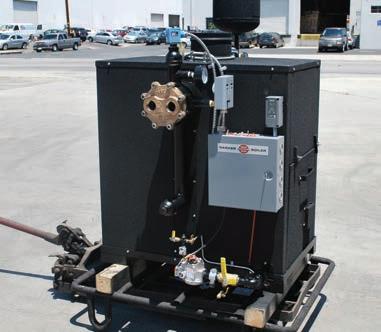
20 JUNE 2017 | AMERICAN LAUNDRY NEWS www.AmericanLaundryNews.com
“Lately, it hasn’t been easy to hire good employees. What recommendations do you have? How is the process different for finding outstanding line workers, route personnel and supervisors/ managers?”
See EXPERTS on Page 22 5930 Bandini Blvd. Los Angeles, CA 90040 Tel: 323-727-9800 Fax: 323-722-2848
Never A Compromise For Quality Or Safety An industrial quality unit designed for economically heating large volumes of domestic or process water, for laundry, commercial and industrial applications. The indirect principle of heating the process water with sealed-in primary water combined with controlled circulation minimizes the possibility of scaling within the heat transfer coil. The unit will provide reliable hot water for low or high temperature applications. Up to 3,000,000 BTU Input - Temperatures up to 190°F 25 year Warranty Against Thermal Shock Extremely Flexible Tube Bundle A Water Heater like no other with all bronze waterways and copper heat transfer coil eliminating the possibility of rust throughout the unit. American Laundry News - 4.75x6.75 April Issue.indd 4 3/2/2017 3:37:27 PM ALN_Jr_half.indd 1 3/3/17 9:02 AM Dedicated to Exceptional Customer Service Since 1969. PO Box 501 Denver, NC 28037 ph: 704.483.9316 / fax: 704.483.4538 sales@leonardautomatics.com http://leonardautomatics.com Pressing Equipment Tunnel Finishers Cart Washers Stack-N-Store Booth #1648 ALN_Jr_half.indd 1 4/26/17 1:17 PM Healthcare Laundry Charles Loelius CleanTex, Irvington, N.J.
www.parkerboiler.com





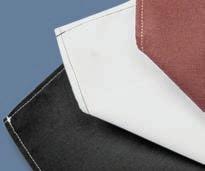




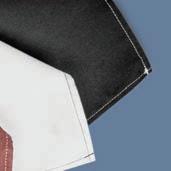
Lunchkin by TM TRAY NAP Dining Experience. Perfect Score. Bottom Line. TM COST | IMAGE | SUSTAINABILITY AVAILABLE IN 12” x 15” VERSABILITY ONE NAPKIN. MULTIPLE SOLUTIONS. 800 821 2221 americandawn.com | imagine@americandawn.com
Imagine the impact on the environment if every hospital replaced paper napkins with a Traynap™; and if every restaurant replaced paper napkins with a Lunchkin™. Add to this, the (recycled polyester) Greenie ® , and we can save the world… one meal at a time.
Experts
The employee already knows the work, the people and the management. Secondly, when the team sees that excellence will lead to advancement, it promotes higher productivity and better employee retention. Throw out any preconceived notions you may have and promote based solely on performance and potential.
Last week, as I was making my rounds through the plant, I was struck by the sight of my production manager, production supervisor and clean scale operator. All had recently received well-deserved promotions, and all were female. I thought to myself, “You don’t see that every day, but you should.”
Invest in talent. Not all positions can, or should be, filled from within. My company’s philosophy is to make the investment in talented people when they are discovered, rather than when an opening occurs. In this way, we are able to maintain a strong management pool, which assures our continued steady growth.
U.N.X. Inc., Greenville, N.C.






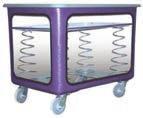
Hiring is tough. There’s no easy way to guarantee success. To make the best decisions, I’ve found it’s best to be as organized and methodical as possible.
The hiring process for different positions varies by education, personality and experience. Route personnel need to understand your business and be organized and personable people. They are the face of your company to your customers.
With supervisors/managers, one can’t assume that good workers make good supervisors. Try to find people that have supervisory experience, or have very good people skills and are experienced in your industry. Employees rightfully resent answering to someone who knows less about the job than they do.
The actual process is similar for every position. First, think of what type of minimum qualifications you need for the position you need to fill. Don’t demand
more education or experience than you need. We all know people without great educational credentials who are smart, motivated people. Clearly describe what the job entails, with hours and pay range. Let the applicants eliminate themselves if they can’t work those hours or for the pay you can afford.
Second, assuming you’ve advertised, posted notices on company bulletin boards, etc., you should have a stack of applicants. Now sort them carefully, eliminating those with sketchy work history, poor or no references, etc. If you are looking for a specific skill set that you can’t easily teach, eliminate those with unrelated work history.
Third, do the hard work. Call references, ask good questions, check backgrounds, and do everything else you can to get a feel for each person. Previous employers are hesitant to say anything negative for fear of repercussions. Try asking them if they would hire the same person again. If you can find those people on social media, you can check their interests and maybe get a feel for them.
Now interview those that are left. This is your final chance to narrow the field down to the best candidates. I have a firm conviction that character counts.
If you can find honest, motivated people, you can train them to do lots of things. If one of your better current employees highly recommends a particular candidate, that’s a big plus.
Finally, choose the one you have the best feel for. Trust your judgment.

Engineers and managers can be tough, since there is not typically a “Textile Laundry” curriculum in schools. I have a textile engineering technology degree myself, but my education focused on fiber and fabric manufacturing processes (not finishing), the chemistry of dyeing (not cleaning), and the logistics of taking raw material to finished goods (not then handling reusable textiles). Ongoing training and development are thus extremely important.
I ’ve attended several trade conferences where this has been a topic of conversation, whether informal or on the event agenda.

Competing on wages—especially with the minimum wage on the rise—and getting good personnel who are suited to our industry is a challenge faced in most markets.
Unfortunately, I’m asked, “Do you know a good manager/ engineer/driver?” much more often than I’m told, “I’m looking for a new opportunity in the laundry industry.” There appear to be more slots to fill than there is talent available.



In engineering, plants should engage personnel with specific aptitudes in the electrical and mechanical fields. These days, knowledge of programmable logic controllers (PLCs) and computers certainly helps, too. Once onboard, they should be directed to take advantage of the training opportunities available from vendors and trade associations.
For managers, there are a lot of facets to the laundry that need to be understood, so growing them in-house would be best. Whether homegrown or not, you should expose them to the same training opportunities referenced above and encourage their participation in seminars, plant tours, and trade shows. Give them as much experience


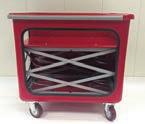
22 JUNE 2017 | AMERICAN LAUNDRY NEWS www.AmericanLaundryNews.com 2460-30 Spring Platform Utility Carts 1-piece molded construction Reinforced bottom Poly Hi-Tech casters Caster thread guards Nestable 9 Standard colors Fire Retardant 2460-18 M c C LURE INDUSTRIES, INC. 800-752-2821 • www.mcclureindustries.com email: kim@mcclureindustries.com Visitusat CleanShow Booth3268 Visit our website for other models and avaliable options. Save Time, Labor And Injury With The Ergonomically Engineered Spring Platform Utility Carts We sell direct 0417aln_McClure_Spring Platform (Clean Show) Jr_half.indd 1 3/13/17 3:59 PM . . . . the development of the MAXX Chemical Series focusing on the large laundry market. The combination of products and dispensing equipment in the MAXX Chemical Series produces superior results on every type of soil one may encounter! Let U.N.X. show you how to get the MAXX from your operation! Connect with us! U N X INCORPORATED (252) 756 -8616 www unxinc com ALN_Jr_half.indd 1 5/12/17 1:11 PM
Continued from Page 20
Chemicals Supply
David Barbe
Consulting Services
Jon Witschy Spindle, Woodridge, Ill.
to the variety that this industry presents, and they can gain the knowledge to best manage and improve your operation.


With route personnel, service and delivery experience are key components. Make sure drivers also have good communications and personal skills, since they are the face of your company with your customers each day. This is another area where you can grow someone in-house, where they might occasionally ride a route before getting a full-time driver position.
For line workers, the industry has challenges just getting help that is consistent and shows up to work. Different positions in the laundry require different motions (soil sorting, smallpiece ironer, large-piece ironer, small-piece folder, garment hanging, etc.).
One thing that could help vet and ensure retention of employees is using motion testing during the interview process. A couple of examples are the Purdue Pegboard Test and the Minnesota Manual Dexterity Test. Such tests are frequently used for occupational therapy, but they can also be applied to evaluate how suited a candidate is for some of the repetitive tasks in the laundry.
For all positions, I’ve seen businesses have success with referral programs. I recall one that provides a nice compensation to employees for referring someone who is hired and stays onboard for a specified period. The employees thus become “headhunters” at a significantly lower cost. They know the jobs well, so they can identify others who would fit, and—since their incentive is based on a successful hire—they typically refer reliable candidates.
Good luck!
graphic, which completely overlooks responsible adults who are seeking employment.
Another major mistake is to target potential candidates who are currently unemployed instead of seeking established, top-notch employees who could
possibly be looking for a better offer or change of pace.
Once you have a potential candidate identified, ensure that you have a detailed job description and job analysis in place. These documents will serve to communicate all expectations
for the position and all attributes required to be successful. Go over these documents in detail.


Invite the candidate on property during production hours. Take the candidate on a tour. Spend time observing and explaining the position they are interviewing for. Ensure the candidate has the capacity, attitude, personality and skills required for not only performing the job, but performing it to your required quality and standards.
Lastly, one of the best sources for finding the perfect candidate is through referrals from your best employees. If you create a
great work environment, appreciate your employees, treat them with respect and provide a space to grow, they will recruit for you.
Your employees will provide their referrals detailed and accurate information about the job, which will typically only result in the candidate entering the application process if they feel it is a good fit. To sweeten the deal even further, I recommend a robust referral program that incentivizes employees and further assists you in keeping a happy and productive team.
The best piece of advice I can offer in regards to hiring good employees is once you have a top performer on your team, do whatever it takes to retain them.
Keep that top performer engaged, challenge them, reward them and promote them. If you lose them, finding a comparable replacement will take a tremendous amount of effort, a tremendous amount of time and, more than likely, several attempts.
If you do find yourself recruiting, hiring the best employees requires some out-of-the-box thinking. I find one of the most common mistakes we frequently make is to target our hiring efforts toward a younger demo-

www.AmericanLaundryNews.com AMERICAN LAUNDRY NEWS | JUNE 2017 23
products are long-lasting.”
equipment has a good reputation: sturdy, reliable and e icient.”
really happy with my CLMs; they’re more than 20 years old and they just keep running.”
the CLM brand has delivered the most cost-e ective, most money-making shuttle conveyors, vacuum feeders, mat rollers, towel folders and its mighty line of 200-1200 lb. dryers. Come to the brand where long-lasting and low-maintenance equipment is standard. From the Pacific to the Atlantic, customers rely upon longevity of CLMs Pomona, CA | T: (323) 232-2417| clmco.com | Visit us at Clean Show booth #3185 Robustly engineered long-lasting DRYERS Smartly productive and safe MAT ROLLERS Intelligently e icient SHUTTLE CONVEYORS Quick and easy-to-use VACUUM FEEDERS Clever and fast TOWEL FOLDERS All CLM equipment can seamlessly integrate into any laundry facility. Made in USA CLM ALN JR Ad June.qxp_Layout 1 5/8/17 12:07 PM Page 1 ALN_Jr Page.indd 1 5/9/17 9:42 AM See EXPERTS on Page 24 Hotel/Motel/ Resort Laundry Nick Fertig Rosen Hotel and Resorts, Orlando, Fla. “IF YOU CREATE A GREAT WORK ENVIRONMENT, APPRECIATE YOUR EMPLOYEES, TREAT THEM WITH RESPECT AND PROVIDE A SPACE TO GROW, THEY WILL RECRUIT FOR YOU.” — NICK FERTIG, ROSEN HOTEL AND RESORTS
“Your
“CLM
“I’m
Since 1983,
Recently, while attending a laundry conference and con-
versing with both laundry operators and suppliers, there was one common question asked by both groups: “Do you know of any good people looking to make a move? We are looking for some talented people to fulfill some key positions.”
I laughed and said, “You and everyone else.”
This seems to be the common battle cry these days, as everyone and their brother on both the operator and supplier sides are looking for that one diamond in the rough to fill some empty positions and help their organizations grow, whether it be

in production, processing, sales or even administrative work. However, it seems that the ones looking for work are the ones who are looking for a change in landscape or may have been released for poor performance. The experienced diamonds seem to be set in their positions with the companies they currently work for and are not looking to make a change.
It seems that today’s employees are not as hungry as those of the past when I was first starting in this business. Instant gratification seems to be the buzz among the younger employees
in our industry. Nobody wants to earn the positions they have and/or put forth the time and effort to really grasp what they were hired to do, lead by example and excel in what they do. What happened to the sponge mentality, wanting to soak up and learn as much as possible to be the best of the best? When searching for staff to fill vacant positions, we need to turn to more creative ways for uncovering those one or two employees to come on board with us. In addition to the usual methods of newspaper and journal ads in the help wanted
sections, we need to take a fresh, new approach and think outside the box when it comes to recruiting, since everyone is looking for good, productive, committed help.
One method for finding good help is to start from within our own organization. Maybe offer a bonus incentive program to our existing workforce for referrals. Better yet, should that new hire stay longer than six months, the one who referred them should receive another bonus as well.
What about internship programs with our schools, whether they be on a high school, secondary or college level? Through an internship program, a person has the opportunity to learn a craft while making a few bucks doing it. More importantly, as the employer, it also allows you to teach, mold and mentor these students into the type of employee you are looking for. It is a way of giving back to the community while offering a sneak peek at what may lie ahead of the interns after they finish their schooling and take that next big step toward fulltime employment.
The real beauty of an internship program, however, is that it allows us to hire summer/ seasonal help and also see if we may have some potential “keepers” we may want to offer fulltime employment when the time is right.
Job fairs are occurring more and more often these days and also serve as a vehicle to find good talent for work within your organization. As more and more jobs are opening up and hiring seems to be on the upswing, job fairs are a good way to promote your company and possibly find one or two good employees as well.
WE COULDN’T LET YOU SETTLE FOR LESS ANY LONGER.
We listened to the desires and needs of the market, and then leveraged our proven expertise in washroom and safety technology to develop the Advantage Side Loader®
With its unique cylinder door locking mechanism, crush hazard protection, an automated step and sleek ergonomic design, the Advantage answered the safety needs of the industry.
Performance features include an all-new direct drive system which comes standard with high extract speed functionality as all our machines, accurate cylinder positioning and standardized Braun machine controls that
provide an efficient operating platform that will improve cycle rate productivity; while reducing operational costs.
We back it all with free 24/7 telephone support for the life of the equipment along with the largest team of direct factory-trained field service technicians in the US and Canada and factory-trained partners internationally.
And, our exclusive Parker Hannifin Hydraulics three-year, leak-free warranty really gives Braun the industry advantage.
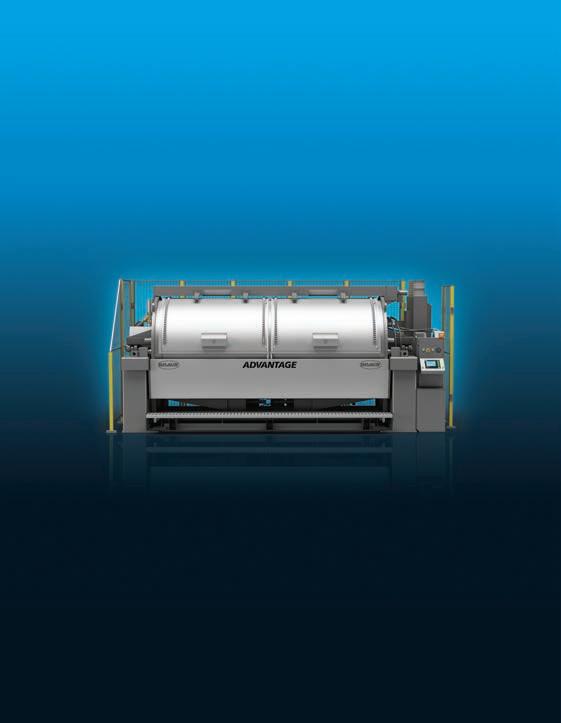
For more information visit gabraun.com or cleanshow17 booth #2261
When looking for more administrative or sales-oriented employees, college job placement centers are a good source to start your search. As students are graduating, they are hungry to get to work and find a rewarding job that pays a decent salary while also giving them an opportunity to showcase their talents and learn the craft.
Granted, they will not be making the mighty dollar from the get-go, but it gives them a nice entry into the workforce and a chance to learn and grow within an organization and work their way up the corporate ladder.
As we all know, social media is changing our way of communicating with each other. This is also a good way to find good, productive employees, whether it be via e-mail, Twitter, Facebook and even LinkedIn.
Everybody seems to be connected these days, one way or another, through social media.
However, the downside of social media also offers a platform for unhappy former
24 JUNE 2017 | AMERICAN LAUNDRY NEWS www.AmericanLaundryNews.com
Continued
Page 23
Reliability Efficiency Safety Get the
from
Experts
Advantage
ALN_Jr Page.indd 1 1/10/17 2:15 PM
Uniforms/ Workwear Manufacturing
Scott Delin
Fashion Seal Healthcare Seminole, Fla.
employees to air their experiences with any said company, making them available for those seeking employment to view and dissect as well.
Last but not least, we have the good, old standby that still proves to be the staple for hiring—the want ads. Posting ads in the employment section still works and should not be forgotten.
One thing we need to keep in mind as we search for hires, just as we are looking for that one diamond in the rough, is that those seeking employment are also looking for a good, stable place for employment, a place to grow and flourish while making a nice salary.
As we will expect our new hires to be on their “A” game all the time, we need to bring our ‘A” game as well. We need to be able to offer our current and new employees a reason to want to stay with us and perform daily at their best abilities. Sure, there are going to be some down days, but the successful companies that recognize and respect their staff as people and not employees will maintain a better workforce by far and capture the best of the best.

Good luck with your search.
mend online recruiting sites like ZipRecruiter, as well as social media sites like LinkedIn. Even craigslist offers some great exposure. Advertising and recruiting is very much like selling. We have sell the value of our employment experience in order to attract interested candidates.

Selling value is really about three branding elements: functional, emotional and social. The very best value branding includes all three. All of us can (and do) write recruitment ads with functional information (job description, company description, etc.). But the
“now” generation wants to be part of something meaningful. Emotional ads point at “belonging” to a group that can make a difference in their life. Social ads point to doing things for the greater good (such as the positive impact on our environment through the use of reusable textiles, laundered with environmentally friendly standards). Beyond advertising, great places to find good employees are at high school and college job fairs. One of my colleagues recommends talking with coaches and looking for competitive athletic students, since they are
typically more disciplined to win.
Most managers wait until an opening arises and then start the planning, advertising and recruiting process. As I have progressed in my own career, it has become more important to continually “build the bench.” What that really means is that I should consistently be interviewing potential associates for any and all positions, regardless of whether I have openings at present. The goal is to have someone (likely employed elsewhere), who is ready to consider a change, lined up as soon as an
opening arises.


We have to keep our eye on the ball here. It’s a proactive vs. reactive approach. It’s a branding approach. And it’s a commitment on the part of all managers—especially you. ALN


Our industry is stable, almost recession-proof, typically doesn’t require a college degree to get hired, and has plenty of opportunity to advance for those who simply want to work hard. We generally pay pretty well, and many of our positions have incentive-based growth opportunities (even in production).

So why is it so hard to find good people? Because the public really doesn’t even know our industry exists. Certainly, in hiring production line employees, we need to look for different skills than we do in hiring route personnel or managers.
As an instructor at TRSA’s EMI (Executive Management Institute), we studied the issue and developed a general advertisement to inform the public that our industry is worthy of a look. The ad highlights the stability of our industry, with opportunity for all, where diversity and gender equality is celebrated—where people can advance to executive levels with experience beyond any education. The ad is offered to anyone who wants to use it, and can be edited by our (ADI) staff at no charge.
Beyond that, I do recom-


A MOUNTAIN OF CONFIDENCE.

G.A. Braun was recently appointed as the exclusive laundry equipment supplier for the Gaylord Rockies Resort, Colorado’s premier meeting and convention center hotel. Situated on 85 acres featuring sweeping views of the Rocky Mountain foothills. The resort has over 485,000 sq. ft. of meeting and convention space, 1,501 guest rooms, including 114 suites, and will process approximately 9.5 million pounds of laundry annually.


www.AmericanLaundryNews.com AMERICAN LAUNDRY NEWS | JUNE 2017 25
gabraun.com
ONE STOP SHOP FROM DESIGN, WASH, TO FINISH.
ALN_Jr Page.indd 1 5/15/17 1:18 PM
Textiles
FOR MORE STORIES FEATURING OUR PANEL OF EXPERTS, VISIT WWW.AMERICANLAUNDRYNEWS. COM!
Steve Kallenbach ADI American Dawn, Los Angeles, Calif.
UV-C disinfection in commercial laundries
 BY MATT POE, E DITOR
BOENNIGHEIM, Germany —
UV-C disinfection is a technology that has been used for decades to remove bacteria from water, surfaces and air, according to the German Certification Association
for Professional Textile Services (GCAPTS). Its biological effectiveness against bacteria, fungi, yeasts and viruses is well proven, but the risks to humans are also well known.
How can this method be used as an additional kind of disinfection
in commercial laundries? What are the best places and purposes to choose for its application? What measures need to be taken to protect workers? GCAPTS has answers to those questions for laundries interested in UV-C disinfection.
HOW UV-C DISINFECTION WORKS

Ultraviolet (UV) radiation is invisible to humans. It is optical
radiation in the short-wave electromagnetic frequency spectrum, right next to the part of the visible light spectrum that the human eye perceives as the color violet. UV radiation is divided into three ranges by wavelength: UV-A (400–315 nm), UV-B (315–280 nm) and UV-C radiation (280–100 nm).
Microorganisms that are exposed to UV-C radiation are irreversibly deactivated in anything
from seconds to a few minutes, says GCAPTS. Most bacteria, with the exception of spores, are killed in about two minutes, even in daylight.
It is because of this excellent biological effectiveness that disinfection using UV-C radiation is used alongside thermal and chemical disinfection, especially to purify drinking water and water for swimming pools, water for industrial processes and sewage water, before it is piped, the association says. Work surfaces in clean rooms, isolation facilities, for example in hospitals, and sterile workbenches are treated with UV-C light to kill bacteria.
In principle, therefore, both aqueous media and hard surfaces can undergo microbial decontamination using UV-C, according to GCAPTS.
USE, BENEFITS IN LAUNDRIES
When disinfecting with UV-C radiation, the general principle is that where there is any dirt or shadow, the radiation is not effective, says GCAPTS. Consequently, only clean, smooth surfaces that are accessible to the radiation can be effectively treated.
So, in practice, this always means two work processes: first, cleaning, and then, disinfecting. This is an aspect that needs to be taken into account by any company considering using this method, whether as a decontamination alternative for technical surfaces that have previously been cleaned by wiping with chemical disinfectants or for container airlocks that are disinfected thermally, GCAPTS says.
The use of UV-C disinfection in loading areas is currently the subject of scientific debate and trials, according to the association. Until now, disinfection has often been carried out by spraying or wiping. The aim of research and development is to replace the spraying method, which is not ideal because of its health risks, the risk of explosion and its inadequate effectiveness. UV-C seems to be the method of choice here, but only if it can be proven safe and effective to use, says GCAPTS.
HEALTH RISKS, WORKPLACE PROTECTION
UV radiation in all three frequency ranges, A, B and C, is carcinogenic and can cause skin cancer. This applies particularly to UV-B and to a lesser extent to UV-C radiation, says GCAPTS. Sunburn, for example, is a clear indication that someone has been exposed to too high a dose of dangerous UV radiation.
That is why the eyes and skin of employees must be protected when working in the presence of this radiation, according to EU directive 2006/25/EC, and has been imple-
26 JUNE 2017 | AMERICAN LAUNDRY NEWS www.AmericanLaundryNews.com
The Optimum Combination of Comfort and Strength Visit us at The Clean Show Las Vegas June 5-8 Booth 1127 Provides the comfort of 100% cotton with the durability of polyester. www.venusgroup.com Toll Free (800) 421-6599 FARM 2 FINISH™ Performance Twill with INVICTUS TECHNOLOGY® ® Performance Twill® is specifically constructed for commercial use, highly durable and customer tested, provides twice the life as that of standard sheets and notably reduces overall customer spend. For more information and samples please contact your Venus Sales Representative A Patented and Trademarked, Innovative Luxury Sheet for Hospitality and Institutional Markets Withstands 200 Commercial Launderings C M Y CM MY CY CMY K VenusGroup_PerformanceTwill_ALN_JUN2017_PRINT.pdf 1 4/28/17 10:43 AM ALN_Jr Page.indd 1 5/1/17 9:25 AM
German textile certification association highlights benefits, risks
mented in German law since 2010, GCAPTS says.


A laundry owner is, therefore, like any employer, obliged to measure, calculate and evaluate the UV radiation to which the employees in their company are exposed, according to the association. This has to be carried out at appropriate intervals and by qualified people or organizations. The data that is collected must also be saved in such a way that it can be viewed at a later date.
On the basis of the information obtained in this way, the employer is then obliged to take measures to limit or avoid UV exposure in order to keep within the legal limits.


GCAPTS says that for UV-A, -B and -C radiation, that maximum radiation dose is Heff = 30 J/m2 over a period of eight hours (i.e., a working day).


SPECIAL PROTECTIVE MEASURES IN LAUNDRIES
In principle in the laundry industry, the association says a distinction needs to be made between two places where UV-C disinfection systems could be installed and operated: in “enclosed” systems on one hand and “open” systems on the other.


Fully encapsulated or enclosed systems would include, for example, a loading area or the airlocks on laundry containers. Those are areas where no one is present while the system is operating and from which no UV-C radiation can escape. Here, the workplace protection requirements are met and there is no risk to laundry workers. Incidentally, even where enclosed systems have viewing windows made of normal glass, there is no risk because conventional glass is impermeable to UV-C radiation, according to GCAPTS.
Open systems, where people are present while they are operating and so could be affected by the UV-C radiation, include the pressing area or laundry sorting conveyor belts. Here, measures must be taken to protect workers. In an ideal situation, that would mean further enclosing the UV-C lamps as completely as possible. Where that is not possible, employees must be provided with appropriate non-UV-Cpermeable protective clothing and goggles, the association says.
In practice, as a rule of thumb for open systems, the following applies: if you cannot see the beam of the UV-C lamp, everything is OK, according to GCAPTS. If you can see the lamp shining, either directly or as a reflection, then eyes and skin must be appropriately protected with non-UV-C-permeable goggles and UV-C-proof clothing.
CONCLUSION


GCAPTS says that UV-C is a sensible option for commercial laundries because of its proven biological effectiveness in practice. Where and how the technology is best used in individual companies can only be determined by taking account of the specific balance of technical and





commercial factors in each case.
The association says factors to be considered include the suitability of the premises or surfaces, including the required cleaning work, the installation costs for the UV-C equipment and whether it can be efficiently supplemented with other decontamination methods; the number of employees in the company; and the cost of the necessary workplace protection measures.


These considerations of the costs and benefits should also include risk management in the event of any harm being caused, says the association.


ALN


OPL 101



very equipment we rely on each day to protect us can actually threaten our health more than the flames.
But changes have come and will continue to advance. There is still educating to be done as the next generation of firefighters enter our industry. We must ensure they are trained as well on proper cleaning guidelines for PPE as they are on firefighting skills and tactics.
I have no doubt that laundry equipment
and chemical companies will become important partners to the firefighting industry. We will work together to develop processes that ensure PPE is properly cleaned to provide maximum protection to these brave men and women. ALN

www.AmericanLaundryNews.com AMERICAN LAUNDRY NEWS | JUNE 2017 27
COME SEE US AT THE CLEAN SHOW BOOTH #2231 kannegiesser-etech.com 612.722.1366 Kannegiesser USA and ETECH are now Kannegiesser ETECH
integrated equipment and systems
12203 Kannegiesser KUSA All Ad 2017 Resize ALN 4-10-17_FINAL.indd 1 4/10/17 3:35 PM ALN_Jr Page.indd 1
SMART LAUNDRY seamlessly
When you combine two companies, you transform a business. When you combine two leaders, you transform an industry.
Continued from Page 12
Bill Brooks is North American sales manager for UniMac laundry equipment. He has been a member of the Berlin, Wis., Fire Department for more than 29 years.
Brooks
AH E, Ohio State Univ. plan to offer 1st academic certificate in healthcare environmental services
CHICAGO — The Association for the Healthcare Environment (AHE) of the American Hospital Association (AHA) has partnered with Ohio State University to create the first academic certifi-
cate in healthcare environmental services within a hospitality management program, the association reports.
Ohio State College of Education and Human Ecology
undergraduate students studying hospitality management, as well as existing healthcare professionals, will soon have expanded management and leadership opportunities within environ-
mental services.
“The collaborative venture with a major university will benefit both healthcare and hospitality professionals,” says Patti Costello, executive director of
AHE, a professional membership group of AHA. “Early participants will gain a competitive edge by choosing highly trained graduates who understand how to ensure health and wellness in both the healthcare environmental services and hospitality fields.”
“As I learned about the new certificate, I thought about the many parallels between a healthcare environment and a more traditional hotel or restaurant hospitality environment,” says Sue Bellan, an alumna of hospitality management and general manager of Columbus Hospitality Management.
“This certificate elevates a candidate’s or employee’s knowledge base in several disciplines within the hotel and restaurant setting, including housekeeping, engineering, food service and even sales and marketing,” she continues. “I do encourage hospitality management students to consider obtaining this certificate.”
Ohio State students in the hospitality management program will be recruited first for the certificate initiative, as will students in other majors concerned with environmental health and safety, according to AHE. Next, a focus will be placed on the large, outside audience of existing healthcare and hospitality professionals.
Milos Bujisic, assistant professor of hospitality management, is creating the initial academic course, which is anticipated in spring 2018, the association says. It will include a discussion of the business of healthcare and analysis of its critical areas and challenges in relation to the hospitality business. Learners will develop the required critical-thinking skills needed to apply expertise in healthcare environmental services in either a healthcare or hospitality setting.
The next academic year, three additional courses will follow to form the undergraduate certificate program, AHE says. They will cover microbiology, epidemiology and infection prevention, patient experience in healthcare, as well as a healthcare environmental services internship. The program will be delivered primarily online.
Ohio State and AHE will collaborate to provide the critically important internship in a hospital or other healthcare setting. It will provide students with handson practice to help direct them to the professional venue that most appeals to them.
28 JUNE 2017 | AMERICAN LAUNDRY NEWS www.AmericanLaundryNews.com
ALN ALN_Jr Page.indd 1 5/3/17 2:05 PM
Hospitality, healthcare professionals to benefit from joint undergraduate initiative, association says
Midwest textile services company earns certification ‘triple crown’
healthcare, retail, manufacturing and automotive services.

WAPAKONETA, Ohio —


Miller’s Textile Services here was awarded certifications in Hygienically Clean Food Safety and Hygienically Clean Food Service, as well as a renewal of its Hygienically Clean Healthcare designation, the company reports.

Miller’s says it is the first textile rental company in the Midwest and the second facility in the country to earn all three certifications. The other, Crown Linen Service, Brockton, Mass., completed the trifecta in November.
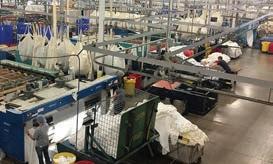


“I am proud of our entire team of men and women here at Miller’s who have worked tirelessly to achieve these certifications,” says Bob Hager, president of Miller’s Textile Services. “This achievement is a testament to their sincere commitment to providing the highest-quality products and services to our customers.”
Miller’s Textile Services supplies businesses and institutions with uniforms, linens, facility services/janitorial supplies and promotional items.
workplaces ranging from small medical practices serving a few patients at a time to stadiums accommodating 100,000 spectators. The largest users of textile rental services are hospitality,


“Congratulations to Miller’s on their certifications,” says Joseph Ricci, TRSA president and CEO. “This achievement proves their dedication to building their customers’ confidence that their laundry takes every step possible to prevent human illness.” ALN
The company says it started in 1946 and has grown from a family business to a high-volume enterprise serving a variety of industries in Ohio, Indiana, Michigan and Northern Kentucky.
The certifications are awarded by TRSA, the association for the linen, uniform and facility services industry, to those laundry companies that pass a battery of on-site inspections and microbial testing, indicating that their processes are producing Hygienically Clean linens and garments.
To maintain certification, laundry plants must pass quarterly testing, including yeast and mold detection. This is to ensure that laundered product quality is consistently maintained if laundry conditions change (such as water quality, textile fabric composition and wash chemistry).

TRSA member companies specialize in providing, managing and delivering quality textile goods directly to facilities and





















www.AmericanLaundryNews.com AMERICAN LAUNDRY NEWS | JUNE 2017 29
LINED UP AND READY FOR WORK SOLID MACHINERY. POWERFUL SUPPORT. Every day we’re building new wash aisles, upgrading old ones, and providing spare parts and technical support that keep our customers’ existing equipment up and running. Brim offers large-capacity open pocket tilting washer/extractors, “Pacesetter” batch tumbler dryers, loose goods shuttles, belt conveyors, and automated control systems that can enhance productivity and safety in your high-volume laundry operation. We have the products, the people, and the experience to provide solutions to your equipment needs. Come visit us to see how Brim Laundry Machinery can make our lineup work for you. BrimLdry.com | 800-527-5886 COME SEE OUR LINEUP AT CLEAN 2017 ALN_Jr Page.indd 1 4/4/17 1:46 PM “I AM PROUD OF OUR ENTIRE TEAM ... WHO HAVE WORKED TIRELESSLY TO ACHIEVE THESE CERTIFICATIONS.” — BOB HAGER, MILLER’S TEXTILE SERVICES Says it’s first in region to be awarded trio of Hygienically Clean certifications
Miller’s Textile Services says it is one of just two companies in the country to have earned the “triple crown” in Hygienically Clean certification. (Photo: Miller’s Textile Services)
speaker said that if you cannot gain the attention of the big guys with big savings, you’ll never get your company into the C-suite,” says Ware. “Bringing the CEO of a large hospital group a savings of $100,000 may not even get you an appointment, since the large healthcare organizations are dealing with billion-dollar budgets. Many large groups want to play ball with only the large players who have the resources to serve them.”
He says that with larger volumes, the systems will demand lower pricing and improved service and benefits, and not being able to meet demands may result in the loss of the business.
“It is always difficult to lose an account if you have many small- to medium-size accounts, but if you are processing with two to three major accounts and one elects to leave, the loss can be devastating to the business,” Ware says. “The challenge is when one large group puts their work out for bid, providers see the huge volume, but at what cost? Lose the business due to low pricing, or accept the lower price? I view this as death by amputation or death by 1,000 pin pricks; one is quick and the other takes longer, but the result is still the same.”
Another cost factor, linen loss, continues to persist in the healthcare laundry market, says Ware. While there are pockets of success, he says that if a laundry can’t control linen-loss cost, or provide the hospital with information as to why the hospital is losing its linen, it will be a constant battle to get paid for the losses.
“During my operational days, I had a large healthcare group that was losing significant amounts of linen,” Ware says. “We provided reports on soil/clean, trained the nursing staff and installed scrub vending units. It was not until we conducted a 48-hour dumpster audit, and pulled out what would have equated to an annual loss going into the trash of close to $750,000 in linen being discarded, did the hospital agree to higher loss charges.”
Polatsek believes that the future of loss prevention lies in technology utilizing radiofrequency identification (RFID) tracking.
“However, training and developing ongoing education and in-servicing with customer staff goes a long way,” he says.
Labor costs will continue to be a major expense for the industry, Ware says. Plants that can justify automation, and reduced labor will benefit by lowering operating costs over time. Those that continue to plan on lower labor rates will suffer if they cannot control the costs, due to tight labor markets, increased benefits and wage “creep,” he says.
“Cheap labor is not always cheaper,” says Ware. “A particular laundry once forecasted reduced labor costs due to working with a state program that gave tax breaks for hiring workers in a specific area. The quality of the workers was poor and the efficiencies did not overcome the benefits from the tax breaks.”
Good workers, when treated well in safe environments, will usually outperform cheap labor, he says.

“There are many good companies and great operators in our business, but there are many competitors who are aiming for your business,” Ware says. “BMW’s VP of sales recently stated the company they fear most is Hyundai. Who would have thought this 20 years ago? Ask yourself if the next Hyundai is sneaking up on you.”
GENERAL STRATEGY
These and other challenges will continue to impact the healthcare laundry industry. An overall strategy is helpful to deal with, and plan for, issues as the arise.
“Continuous improvement needs to become [operators’] mantra,” Rupnow says. “Hitting today’s benchmarks won’t be enough to meet clinicians’ and patients’ needs tomorrow. Keep an open mind and be willing to look and keep learning about the best science and the most efficient equipment and processes.”
Potack recommends building out the processes, documentation and validation of what a healthcare laundry does every day.
GSM_haul_mp july_aug.pdf 1 2/20/2014 7:42 AM
“We need to show our value, prove what we do is accurate and correct, and be a resource for customers to lean on our com-
GSM_haul_mp july_aug.pdf 1 2/20/2014 7:42 AM
Quality...



panies as a partner to help save money and improve outcomes,” he says.
For Ware, development is the key.
“Develop yourself, develop your staff, and then train, train, train your team,” Ware says. “Often during my consulting years, you would walk into a plant and the GM or plant manager had all the answers. When I did a walk-around in the plant and asked the employees what was their practice for X, I often got blank stares. If the team does not know the coach’s playbook, you’ll never win the game.”
Ware also says that relationships with customers should not stop at the linen room door.
“A very smart CEO once told me, ‘If you don’t have relationships with every level of the organization, you’re just a vendor and not a partner,’” he says. “For this reason, your relationships should be ‘High, Wide and Deep.’”
“Through open, honest partnerships, launderers can find opportunities to improve value beyond supplying, maintaining and laundering linens and garments,” Ricci says.

Ware says that in today’s healthcare environment, it’s not the linen room manager

who will decide a laundry’s fate. He suggests getting involved with the industry, attending seminars, reading about the industries served and meeting with industry knowledge brokers who specialize in the skills or topics needed.
“Finally, get to know your competitors,” he says. “I enjoy talking with mine, seeing how they view things and developing longterm relationships. Yes, I know they are your competitors, but look past it. Many are great friends and good sources of knowledge.”
In the end, when it comes to facing the issues in healthcare laundry, Scherberger says communication is the best strategy.
That includes communication with a laundry’s own sales representatives and its customers.



“Communication also includes a great deal of education, but it must be education communicated in cost-effective manners with the right audiences and a unified, onpoint message,” he says. “And repetition, but not badgering. Know the audience, know the message and speak in ways that will connect.
“I learned long ago that to be effective, one must address the audience’s passion, not just their position. Positions can and do change; passions rarely change.” ALN
...for the Long Haul

Precision built, all welded, anodized aluminum carts, specifically engineered for the extremes of loading, handling, cartwash and off-site transport in your busy laundry. Available in a wide range of models and sizes, and always to your custom requirements.
For more information: G.S.M. Linen Handling Systems 1-800-363-CART (2278) www.gsm-cart.com
For more information: G.S.M. Linen Handling Systems 1-800-363-CART (2278) www.gsm-cart.com





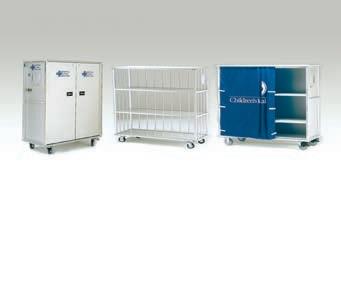
30 JUNE 2017 | AMERICAN LAUNDRY NEWS www.AmericanLaundryNews.com
ALN_3rd Page.indd 1 4/6/15 11:08 AM
ALN_3rd Page.indd 1
11:08 AM See us at The Clean
0317aln_GSM Clean Show.indd 1 1/27/17 9:19 AM contact@davispackaging.net ▪ www.davispackaging.net 800-622- 3015 or 561- 290-0412 DAVIS PACKAGING Laundry Wrapping Equipment ▪ Parts ▪ Wrap CLEAN 2017 Booth 3685 Affordable Professional Linen Wrapping Systems Clear fully sealed packaging Protects clean linen from separation and spills Eliminates costly rewashing Simplifies content identification Enhances image and delivery presentation ALN_3rd Page.indd 1 4/10/17 3:54 PM
4/6/15
Show, Booth 3605
Continued from Page 6
Healthcare
It’s more important today than in the past for healthcare laundries to engage in environmentally friendly practices. (Image licensed by Ingram Publishing)
were making retail garments for the United States.”

He says the tragedy brought to light some of the extreme conditions that workers faced in the apparel supply chain. Government organizations, non-government organizations and the private sector got together and signed several different accords and alliances specifically addressing improving worker safety.
“It sparked the need for, and the demand of, a transparent supply chain,” says Langdon. “What it’s also doing is, since then, it’s empowered the workers to speak up and fight for safe and fair working conditions.”
He says the movement has spread beyond the borders of Bangladesh, and it’s starting to take hold in all other textile-producing regions. However, this has put increased price pressures on the supply chain.
“It’s long overdue, but it’s creating additional costs for the producer,” Langdon says.


INTERNATIONAL TRADE POLICY
Langdon says that international trade agreements continue to have an impact on the textile supply chain. These agreements include the North American Free Trade Agreement (NAFTA) and the Central America Free Trade Agreement (CAFTA).
Another is HOPE (Hemispheric Opportunity Partnership Agreement), basically a free-trade agreement with Haiti, Langdon says.
“We were trying to make up for years of embargoes on Haiti, but the agreement says that, on an annual basis, you can bring in 250 million square meters equivalent of knitted product or woven product, meaning T-shirts, scrubs, whatever, duty-free, regardless of the origin of the raw materials,” he says. “That lasts for 20 years, and it took effect in 2006. It has another 10 years to run.”
Langdon says international trade policy was complicated enough, but now the industry has to take into account what is called the “Trump Factor.”
“We know President Trump’s stance on trade agreements,” he says. “He first and foremost wants to buy American, hire American.”
On April 18, Trump signed an executive order that strengthens “Made in America” policies. It put in a review policy for the H-1B visas for skilled workers, and it put some limits for World Trade Organization and participation from the United States, according to Langdon. It would now require a presidential review before Trump would agree for the United States to participate.
“If that wasn’t enough, we’ve got something else,” he says. “This is



a border adjustment tax, which is being talked about with Mexico, and now we’ve got it talked about with Canada.”
Langdon says that in April, Trump had “shot across the bow” of Canada about soft lumber by putting countervailing duties up to 24% on softwood.
“This goes back to 2001 when there was a dispute when the Commerce Department had accused the Canadian government of subsidizing the Canadian lumber industry,” he says. “I think this is the first attack for the Trump administration to renegotiate NAFTA.”
DISRUPTIVE TECHNOLOGY
Langdon brought up a topic that he thinks will impact the textile supply chain in the future: disruptive technology. He says disruptive technology is when a business can enhance the experience, enable omni-channel and expand its offering.
“One example of that is a direct fabric-printing machine, and the prices of this equipment is coming down radically,” Langdon says. “These used to be up to $50,000. Now you can buy them for as low as $6,000. The inks have improved so much that they’re colorfast, printed right on the fabric.”
Another example, which he says has recently been announced, is from Amazon. The U.S. Patent Office awarded Amazon a patent for an on-demand manufacturing system. According to Langdon, the system is a one-off, print, cut, assemble and pack garments and other items, on demand, without doing them en masse.


“This could be a game-changer for the textile supply chain,” he says. “More and more [disruptive technology] is taking place in all industries, and it’s going to be impacting ours as well.”
Langdon concluded his presentation by saying that supply and






demand is going to continue to impact the supply chain.
“It’s going to impact prices,” he says. “It’s going to impact availability. It’s all going to be about does the farmer want to grow a cash crop, or does he want to grow cotton.”
In addition, Buy American, Hire American, is only going to remain as a policy if it can be globally competitive and we don’t turn into a protectionist society, according to Langdon.
Finally, he says innovation and disruptive technology are going to lead the way for change in not only the textile industry but in every industry. ALN
www.AmericanLaundryNews.com AMERICAN LAUNDRY NEWS | JUNE 2017 31
NEW LUXURY STARTS IN THE LAUNDRY Delight your customers and their guests by consistently providing the bright white she notices, the softness she feels and the quality that makes her experience luxurious. Visit us at CLEAN2017 in Las Vegas BOOTH#2645 LOW TEMPERATURE NON-CHLORINATED OXIDIZING WASH PROGRAM DESIGNED WITH INNOVATIVE, PATENT PENDING TECHNOLOGY TO CONSISTENTLY DELIVER EXCEPTIONAL WHITENESS AND UNPARALLELED SOFTNESS WHILE EXTENDING LINEN QUALITY AND LIFETIME. www.ecolab.com | 800.553.8683 | laundry@ecolab.com OxyGuard40 TRSA Clean Show Issue Ad.pdf 1 5/3/2017 11:32:16 AM ALN_Jr Page.indd 1 5/8/17 2:33 PM Continued from Page 18 Global
AmeriPride’s Saukko earns PR accreditation

MINNEAPOLIS — Ben Saukko, director of communications for AmeriPride Services, has successfully completed all requirements for Accreditation in Public Relations (APR) by the Universal Accreditation Board (UAB) and Public Relations Society of America, the company reports.
This certification recognizes industry professionals who have proven their knowledge and expertise in the field and exhibited competence and mastery of the PR profession through an extensive written application, a portfolio presentation and interview with a panel of APR professionals, and a computer-based examination.
“Earning the APR reflects a mastery of the knowledge, skills and abilities needed to succeed in our increasingly complex profession,” says Elizabeth S. McMillan, APR and 2016 chair of the UAB. “Practitioners who achieve this designation are not only demonstrating their commitment to our profession, but also to a strong code of ethics and the betterment of their organizations and clients.”
The computer-based examination for APR certification assesses a professional’s competency in PR planning and execution; ethics and law; issues management and crisis communications; communication models and theory; leading the PR function; and general business knowledge. APRs must maintain their credentials through continuing professional development, providing leadership to the profession and serving their local communities.
Saukko has been working in corporate communications and marketing for more than 20 years and has served as AmeriPride’s director of com-
munications for the last five, the company says. Prior to his current position, he worked for various corporations and agencies in the Twin Cities area, including Weber Shandwick Worldwide.
He has a bachelor’s degree in mass communications from the University of Minnesota and an MBA from the University of St. Thomas.
Fabritec promotes Bartlett, Jordan


FLORENCE, Ky. — Fabritec International, the maker of Sanitone, Fabritec and Stamford brand detergents and additives, has promoted Amy Bartlett to director of research and Jeff Jordan to vice president of business development, effective May 1, the company reports.
Bartlett joined Fabritec three years ago as a chemist and over-



saw company compliance with Global Harmonization Systems (GHS) and tighter environmental regulations, according to the company.

“Amy was instrumental in ensuring our products were safe and compliant with the new standards while maintaining superior performance,” says Fabritec President John Jordan.
Bartlett trained under her predecessor, long-time VP of research Harold Mains. In her new role as director of research, Bartlett will oversee the formulation and development of products, sourcing of raw materials, and ensure quality and compliance of production. She came to Fabritec with nine years of experience in clinical research for MedPace and Cincinnati Children’s Hospital.
Fabritec says Jeff Jordan recently celebrated his second
year with the company as sales promotion manager, where he oversaw marketing, social media and trade show promotions.


“Jeff has been front and center at trade shows and industry events, interacting with customers, and cultivating our brand,” John Jordan says.
In his new role as VP of business development, Jeff Jordan will be taking on a larger role of directing company initiatives for growth and branding, Fabritec says. He joined the company with seven years of experience in sales management for Citibank North America and Cincinnati’s regional 5/3 Bank.
“I am proud to welcome Amy and Jeff as the next generation of Fabritec International and am confident their contributions will not only benefit the company, but the industry overall,” says John Jordan.
Track
32 JUNE 2017 | AMERICAN LAUNDRY NEWS www.AmericanLaundryNews.com ALN_Jr_half.indd 1 5/3/17 8:19 AM INDUSTRIES, Inc. LAUNDRIES HOSPITALITY HEALTHCARE LAUNDRIES HOSPITALITY HEALTHCARE BUY DIRECT AND SAVE ON ALL YOUR LINEN NEEDS SALES OFFICE: 954-873-0932 SOURCEAMERICA1@aol.com COLOR NAPKINS | 20X20 |100% SPUN POLY COOK SHIRTS | WHITE CHEF COATS | WHITE BED SHEETS | PILLOW CASES PREMIUM QUALITY TOWELS WHITE NAPKINS | 20X20 | 100% SPUN POLY $6.65DOZEN $3.50 EA. $5.35DOZEN BLACK BURGANDY BERMUDA SAND DUSTY ROSE FOREST GREEN GOLD IVORY NAVY BLUE RUST ROYAL BLUE RED SEAFOAM SANDLEWOOD SM MED LG XXL XXXL SM MED LG XXL XXXL CAM BORDER 86/14 BLENDED WASH CLOTH 12X12 BATH TOWELS 20X40 22X44 24X48 24X50 BATH MATS 20X30 PRICE LIST NAPKINS | TABLE CLOTHS | BED SHEETS | TOWELS $6.50 EA. CALL FOR SPECIAL PRICING CALL FOR SPECIAL PRICING FREE SHIPPING AVAILABLE! 3 DISTRIBUTION WAREHOUSES TO SERVICE OUR CUSTOMERS ✪ ✪ ✪ ALL MAJOR CREDIT CARDS ACCEPTED ORDER NOW AND SAVE! 244 FIFTH AVE # S229 NEW YORK, NY 10001 INDUSTRIES, Inc. NO IRON PERCALE WHITE OR BONE 60% COTTON 40% POLYESTER FLAT | FITTED T-180 T-200 T-250 0317aln_Cirisource jr half.indd 1 3/13/17 3:35 PM Saukko
Career
Bartlett
Jeff Jordan
ARCO/Murray adds two to growing process division
DOWNERS GROVE, Ill. — ARCO/Murray has hired Will Davis and Dan Aldrin to join the process division, the company reports. Davis has been hired as a mechanical engineer and Aldrin as a mechanical designer
Davis is a graduate from the University of Illinois’s general engineering program, the company says.
Prior to joining ARCO/ Murray, Davis was an engineer at Valdes Engineering in Lombard, Ill. During his time at Valdes Engineering, he worked on projects at the BP refinery in Whiting, Ind., and Lyondell Basell in Morris, Ill.

ARCO/Murray says Aldrin recently joined the company after spending nine months at MERCO Mechanical. Aldrin’s previous work includes 10 years of experience in the petrol chemical industry at Ambitech
Engineering. Davis and Aldrin are under the leadership of Dennis Parrish, ARCO/ Murray’s senior mechanical engineer and laundry designer.
Gurtler hires Curtier for Northern Calif. market development


SOUTH HOLLAND, Ill. — Gurtler Industries Inc., a manufacturer of detergents and specialty chemicals for the commercial laundry industry, has added Wes Curtier to its team, the company reports.
Gurtler says Curtier joined the company in March as manager of market development and will be covering the area of Northern California.
The company says Curtier has
35 years’ experience in the laundry industry.
Voltea adds global supply chain leader




DALLAS — Voltea, which specializes in Membrane-Capacitive Deionization (CapDI©) for tunable, salt-free and chemical-free water softening and desalination, hired Rekha Masilamani as global supply chain leader earlier this year, the company reports.
Masilamani joins the Voltea operations team at the Dallas office, reporting to Timothy Cavitt, COO.
The company says Masilamani joins Voltea at a time when the manufacturing footprint is growing globally and volumes are growing globally within each channel.
“I am excited to join the team of brilliant minds working toward the goal of delivering world-class customer experience through quality products,” says Masilamani. “There could not be a better time for me to deliver excellence in global supply chain strategy as we continue to expand our manufacturing facilities.”
Masilamani achieved her master’s degree in supply chain

management from UT Dallas and brings with her the experience of working in various key supply chain functions, such as vendor management, demand planning and inventory management within leading companies in the automobile and technology industries, the company says.
Paris Cos. lands two on ‘Top People’ list
DUBOIS, Pa. — David Stern, owner and CEO of Paris Cos., and Randy Rosetti, vice president and COO of Paris Healthcare Linen Services, were recently selected to Pennsylvania Business Central (PBC) magazine’s 2016 list of Top 100 People, the company reports.
Annually, for more than 20 years, PBC has recognized a select group of 100 individuals who have excelled in their fields and demonstrated leadership in their organizations and communities.
This is Stern’s third consecutive selection to the Top 100,
Paris says. He formally joined his father’s retail laundry business out of college in 1973 and eventually transformed it into one of the largest privately owned textile services companies in North America.
“Paris is coming up on its 100th anniversary in 2018, and I’m thrilled that we have contributed to our area’s lifestyle and economy for so many decades,” says Stern.
Rosetti joined Paris in 2003 and quickly rose through the ranks to lead the company’s largest business unit, according to the company. The year 2016 was his first nomination and selection to the Top 100.
“My selection truly represents a team effort,” Rosetti says. “Paris is a great company and a great asset to its communities.” ALN
www.AmericanLaundryNews.com AMERICAN LAUNDRY NEWS | JUNE 2017 33
Redefined. SULAOS has
the laundry disinfection
Water & Energy Savings. SULAOS employs state-of-the-art water reuse
to deliver
water
energy savings
Crisis Averted. Safeguard laundry from dangerous microbes and help ensure patient and guest linen is safe and hygienic. Protect your patients. Protect your guests. Protect your business. OMNI Solutions | 700 Moore Street | Baraboo, WI 53913 | 888.356.9111 ALN_Tab_half.indd 1 4/6/17 9:16 AM
THE CLEAN SHOW | JUNE 5-8 | BOOTH #3090
Clean
revolutionized
process by dissolving organic and inorganic materials through an enhanced oxidation process and ultraviolet light, reducing bacteria by 99.99%.
technology
significant
and
in CBW operations. OMNI Solutions’ unique system also reduces dry times, combining natural gas savings from the wash and the dry cycles, and increasing transfers per hour.
Davis
Aldrin
Curtier
Masilamani
Stern
Rosetti
Jensen Group reports double-digit revenue growth in 2016
PANAMA CITY, Fla. — The Jensen Group, which manufactures a wide range of industrial laundry equipment, experienced an 11.1% increase in revenue in 2016 compared to 2015, the company reports.
The company attributes the growth to its global presence and its continued customer focus on innovative product development.
At the 2016 Texcare International show in Frankfurt, Germany, Jensen says it launched a series of new products and solutions to increase the productivity and ecological efficiency in all sections of heavy-duty laundries. With Jensen, customers have one single local contact for the design, planning, installation and servicing of a total laundry, according to the company.

In addition to product development in single machines and systems, Jensen says it’s prepared for the Internet of Things (IoT) with the new product Globe. The integration of technology and software allows customers to monitor and track production in real time and use the acquired information to improve productivity.
Jensen says it continues to build a local presence in every
market. In 2016, the company acquired the distribution activities of its long-standing Norwegian partner, Sipano Norway, and started a Sales and Service Center in Denmark.
Jensen’s offices in China, the United Arab Emirates and Japan have been expanded. A strong rebound in orders from the European home market, as well as a strong market in North America, led to the record revenue, according to the company.
2016 was also a year of important investments, Jensen says. The year began with an acquisition of a minority share in Turkish laundry equipment manufacturer Tolon. This participation enhanced Jensen’s market share for stand-alone washer-extractors and dryers within heavy-duty laundries, the company says.
In July, a second factory was inaugurated in Xuzhou/ China, ensuring a wider product offering to the fast-growing Chinese market, Jensen says. A further investment was made in Denmark with a third factory that was put into operation in 2016 and that will support the company’s growth plans.
The year 2017 started with another investment: On Feb. 1, the Jensen Group acquired the activities of the German company Sykom. The activities will be continued and further developed by Jensen Components GmbH, a wholly-owned subsidiary of the Jensen Group that produces system components made of metal.
“In 2016, we invested in two new factories, two new distribution companies as well as a JV for software and a participation in Tolon. This has been done in a year with record turnover,” says Jesper Munch Jensen, CEO of the Jensen Group. “Our customer-centered strategy is paying off, and we are determined to develop new products and services that will delight our customers.”
Advantage Equipment moves into new building, triples size of headquarters
AKRON, Ohio — Advantage Equipment Inc. recently moved into a new, larger facility here, the company reports. The 13,000-square-foot building triples the size of the laundry equipment distributor’s headquarters.
Advantage Equipment, in its 20th year, caters to on-premises, vended and industrial laundry customers throughout West Virginia and large portions of Ohio and Pennsylvania.
“Advantage Equipment has experienced significant growth in sales and product offerings,” says Scott Vlahos, company
owner. “We’ve simply outgrown our current space and need room to add staff and services.”
The distributor’s new facility features a product showroom and houses all office, parts, service and warehouse operations, according to Vlahos.
“Our team works hard to provide exceptional service and nurture long-lasting friendships with our customers,” he says. “Our new facility will help us to grow and, simultaneously, more quickly respond to customer needs.”
Advantage Equipment says it provides multiple equipment lines, including Continental Girbau, Hamilton, ADC, Ram Air, LG and Sports Laundry Systems®. Additionally, the company supplies chemical products and ancillary laundry items.
Braun brands remanufactured equipment program
SYRACUSE, N.Y. — G.A. Braun Inc. has branded its Certified Remanufactured Equipment with a new logo and program description, the company reports.
“We felt that it was very important to make certain that the market, and our valued clients, clearly understood that Braun is the only company that is certified to remanufacture its
34 JUNE 2017 | AMERICAN LAUNDRY NEWS www.AmericanLaundryNews.com
Jensen welcomed visitors from all continents to a booth full of innovations at last year’s Texcare International in Frankfurt, Germany. (Photo: Jensen Group)
ALN_3rd Page.indd 1 4/3/17 3:57 PM Company Page Company Page INDEX OF ADVERTISERS A.L. Wilson Chemical Co. 9 ADI American Dawn 5, 21 Brim Laundry Machinery Co. 29 CitiSource Industries 32 Consolidated Laundry Machinery 23 Davis Packaging 30 DECC Company 15 Direct Machinery Sales Corp. 36 Ecolab 31 EDRO 8 Ellis Corp. 36 G.A. Braun 24, 25 G.S. Manufacturing 30 Girbau Industrial 7 The Griffin Group Inc. 37 Hydro Systems 17 J.P. Equipment 36 Kannegiesser USA 27 Kemco Systems 34 LaundryCareers.com 37 Lavatec Laundry Technology 40 Leonard Automatics 20 McClure Industries 22 Monarch Brands 10, 11 OMNI Solutions 33 Parker Boiler 20 Pellerin Milnor 3, 13 PSP Industrial 36 Railex Conveyor Corp. 36 Royal Basket Trucks 14 SonicAire 32 Stanco Industries 36 Superior Uniform Group 12 Unifair Laundry Expo 35 UniMac 19 U.N.X. Inc. 22 Venus Group 26
Machinery Inc. 36
Systems Inc. 28
Advantage Equipment, a laundry equipment distributor based in Akron, Ohio, recently tripled its operation’s size. (Photo: Advantage Equipment)
Washburn
Washing
products,” says Braun President Joe Gudenburr. “Too often, we find clients who buy our products from used equipment resellers that claim that they have remanufactured these items. The reality is that these machines are at best reconditioned, and often are modified from our OEM specifications, resulting in unsupportable units.”
Braun says it takes an existing machine, strips it to bare metal and rebuilds it to current-day equipment specifications.
Braun’s example of rebuilding a washerextractor:

• Strip it to bare metal.
• Convert older multi-motor units to single motor drive (where applicable).



• Inspect all weldments and make any repairs that are required.
• Install a new wash cylinder in the machine.
• Install a new drive motor, bearings, seals and inverter.
• Install all-new hydraulics, pneumatics, electronics (to include a brand-new touch-screen PLC) and a new suspension.
• Repaint the machine using a “green” paint process.


• The machine is certified to CSA and ETL standards.

Braun says it then provides a new equipment warranty with the machine that is backed by Braun as the original equipment manufacturer. This means Braun customers do not have to worry about component obsolescence, according to the company.
“As we all look to reduce our carbon footprint, and reclaim/extend the life of equipment, this solution offering not only provides significant value, but it is an exceptional green initiative,” says Gudenburr.
OSHA honors Cintas Fire Protection location
SPRINGFIELD, Mo. — The Occupational Safety and Health Administration (OSHA) recently honored the Cintas Corp. location here with Voluntary Protection Program (VPP) Star certification, the company reports.
VPP Star is OSHA’s highest recognition for the practice of and commitment to exemplary occupational safety and health.
The company says its Springfield location is the 47th Cintas facility, and the first Fire Protection location, to earn OSHA VPP Star recognition.
“I’m very proud of what the employeepartners at this location have accomplished,” says John Amann, president and COO, Cintas Fire Division. “They have set the standard and proven to everyone that world-class safety and our safety vision can be achieved.”
VPP Star certification is earned by businesses that meet highly rigorous safety requirements and can prove that the elimination of injuries is a key component of a company’s DNA.
“Our employee-partners are dedicated and take ownership of safety, making it part of the way we do business,” says Todd Kimbrell, branch manager. “We know that the only way to go to work, do the work and go home from work is the safe way.”
The company says it has almost 300 facilities throughout the world actively pursuing VPP recognition and is currently ranked fourth in the nation for companies with VPP sites.


ALN


Calendar

June
5-8 The Clean Show
World Educational Congress for Laundering and Drycleaning Las Vegas, Nev. Info: 404-876-1988




21 TRSA Webinar: Food Safety and Uniforms Alexandria, Va. Info: 703-519-0029



July
27 Association for Linen Management Webinar: Solid Relationships Start with Solid Contracts Richmond, Ky. Info: 859-624-0177

August
6-10 TRSA
Executive Management Institute (EMI) Hyattsville, Md. Info: 703-519-0029
6-10 TRSA
Production Management Institute (PMI) Hyattsville, Md. Info: 703-519-0029
24 Association for Linen Management Webinar: Ask the Experts Part 3: Linen Services Richmond, Ky. Info: 859-624-0177



September
12-14 TRSA Annual Conference Miami Beach, Fla. Info: 703-519-0029

27-29 Texcare Asia International Trade Fair for Modern Textile Care Shanghai, China Info: www.texcare-asia.com ALN





www.AmericanLaundryNews.com AMERICAN LAUNDRY NEWS | J UNE 2017 35
SIMULTANEOUS EXHIBITIONS: 2017 The 5th China Leather Care Technology and Product Exhibition; 2017 China Public Textile Laundry Exhibition; 2017 China Laundry Franchise Exhibition China Laundry Expo 2017 ORGANIZEDBY Tel: (86 20) 8327 6369 / 6389 E-mail: echo@unifair.com Web: www.laundryexpo.com 26th~28th September, 2017 China Int’l Exhibition Center, Beijing The Top Brand Pageant in China Laundry Industry! The 3rd China International Laundry Festival 24th~28th September, 2017 Beijing, China ALN_Tab_half.indd 1 5/4/17 8:47 AM
Milnor 12 Module CBW 130lb Stack (2006) 76039L4F


Milnor Washer/Extractor 275lb Tilting 48040F7B
Milnor Washer/Extractor 275lb Tilting 48040F7B
Milnor Washer/Extractor 275lb Tilting 48040F7B










Milnor Washer/Extractor 60lb (2014) 30022T6X








Milnor Batch, Gas 320lb Gas 6458TG1R
Milnor Batch, Gas 320lb Gas 6458TG1R
Milnor Batch, Gas 320lb Gas 6458TG1R
Milnor Batch, Gas 320lb Gas 6458TG1R Milnor Batch, Gas 320lb Gas 6458TG1R Challenge
36 JUNE 2017 | AMERICAN LAUNDRY NEWS www.AmericanLaundryNews.com Classified Advertising EQUIPMENT FOR SALE EQUIPMENT FOR SALE CONVEYORS ALN_3rd Page.indd 1 4/4/17 9:03 AM AMKO AMERICA, INC. Remanufactured Finishing Equipment Parts, Ironer Supplies AmkoAmerica@gmail.com NEW Self Contained Ironers 1-4 Rolls, 15”, 20”, 24”, 32” Roll Dia, 68-130” Wide JBI.Incorporated@gmail.com 561-863-9696 DISTRIBUTOR OFFERINGS DISTRIBUTOR OFFERINGS Stanco Industries, Inc. Serving The Textile Trades Since 1970 800-932-3769 k for Mike or Deb KEEPING IT GREEN SINCE 1970 EQUIPMENT FOR SALE 2-American 8-Roll Super Sylon 1-Lavatec 3-Roll Steam 1-Chicago 2-Roll Powerhouse 1-Chicago S-16 Skyline w/Accumulator 2-Chicago AIR Towel Folders w/Convs. 1-Braun 4-Station Alpha 1-Chicago Edge 1-Lavatec 5-Lane Napkins, w/Primary 1-Lavatec 4-Lane Folder 2-Braun 600# Gas 1-Door 3-Braun 600# Open-Pocket 3-Braun 400# Open-Pocket -OTHER ITEMS AVAILABLEPhotos: www.StanCoInd.com 2014 Chicago 232 Imperial 120” Gas Ironer 2011 Chicago Tristar 32 PCS 136” Gas Ironer/Folder/Stacker 2006 Chicago Tristar 32 PCS 120” Steam Heated Ironer/Folder/Stacker 2016 Chicago GL20 120” Gas Ironer with Optional Rear Return 1996 Chicago Imperial 224 120” Gas Ironer 1998 Chicago Tristar 24 120” Gas Ironer/Folder/Stacker 2008 Chicago Skyline S16 Four Lane Folder/Cross Folder/Stacker Chicago Air Chicago Small Piece Folder (Qty. 3) 2009 Chicago Skyline Mini Blanket Folder with Chi Touch & Triple Fold 2013 Weir Triple Sort Towel Folder 2012 B&C SP100 100 LB Soft Mount Washer (Qty. 4) 2000 UniMac 120 LB Gas Dryer (Qty. 2) Sharper Finish 66” Gas Ironer Sullair 15 HP Air Compressor 2005 Unipress CRDC Double Buck 12 Bushel Laundry Cart (Qty. 18) Cardinal 4’ X 4’ Laundry Scale with Digital Indicator View photos of entire inventory at www.washburnmachinery.com 800-245-8425 Keepin’ it clean for over 65 years! Looking for offers on the following equipment: • 2011 Milnor Pulse Flow Tunnel 130 lb.- 8 Chamber • 2003 / 1993 Milnor Classic Tunnel 110 lb. Rebuilt in 10 Chamber 2001 • 2011 Milnor Four Pocket Load Conveyor • 2003 Milnor Four Pocket Load Conveyor • 2011 Milnor Centrifugal Extractor • 2003 Milnor 110 lb. Press Extractor • (3) 2008 Milnor 260 lb. Gas Dryers • (3) 1993 Milnor 220 lb. Gas Dryers • 2003 Milnor Twin Bed Shuttle Interested Parties should contact Jim Shaw at jshaw@elliscorp.com Railex Conveyor Corp railex railexcorp.com 718-845-5454 www.railexcorp.com 2 FULL Healthcare Plants in Orlando & Atlanta, everything must go! • LOTS of 400lb Braun OP’s Braun: 400lb Medi/400lb TSL /600lb OP • Jensen 275lb OP 135lb Milnor Rigid Mount • 2008 Chicago Air & 2006 Triple Sort • 2012 Braun RTF • StraPack Automatic Strapping Machine • 4- 2005 300lb Milnor Tunnel Dryers (64058) Conway Shuttle • 2003 Chicago Mini w/Stacker Conveyor • 2- 2010 UniMac 55lb Ready to Ship • 1- 2006 100 lb Milnor OP w/Steam, Rigid • 1- 1997 55 lb Milnor Soft Mount - Refurbished Equipment is priced to sell! Call 800/925-3236 www.ineedjpequipment.com “Expect Excellence” Conveyors and Speedrail. HUGE inventory. Fast Shipping. Competitive Prices. @ EQUIPMENT FOR SALE For fastest service, call Ron Hirsch direct at 516-938-4300 St. Francis Laundry Facility equipment for sale! Direct Machinery is the exclusive dealer for all equipment in this sale. HERE’S SOME OF THE SPECTACULAR EQUIPMENT: EXCELLENT PRE-OWNED EQUIPMENT • WON’T LAST LONG • CALL TODAY!
Gas
Gas
Challenge
Gas
Queen Tumbler, Gas 75lb Gas ST075NQTB1G2W01 Energenics Lint Collector, Dry MLF-3630 Energenics Lint Collector, Dry MLF-4545 Chicago Powerhouse 2 Roll 52 Thermal CENTII52 GAS Chicago Edge EDGE Chicago Skyline w/Stacker - 4 Lane S-16 Chicago Powerhouse 2 Roll 52 Thermal CENTII52 GAS Chicago Skyline w/Stacker - 4 Lane S-16 Braun Small piece return to feed folder SIGMA Braun Small piece return to feed folder SPFM Braun Small piece return to feed folder SPFRF Chicago Air Chicago Chicago Air Chicago Chicago S-9 Blaster Chicago EDGE BLASTER S-9 Chicago S-Mini Colmac Steam Tunnel CFS-90 D1202101 Hoffman Hot Head Press UA-45HH Cleaver-Brooks 60hp Gas CFV-700-60-150ST Cleaver-Brooks 60hp Gas CFV-700-60-150ST Gardner-Denver 40hp Air Compressor VS25-40A Gardner-Denver 30hp Air Compressor 300EGB753 Hankinson Air Dryer HES280 LAUNDRY EQUIPMENT FOR IMMEDIATE SALE MANUFACTURER EQUIPMENT MODEL Most delivered new in 2006. Facility will be running till 5/1/17!
Tumbler,
400lb
CGG 400-1
Tumbler, Gas 400lb
CGG 400-1 Speed
Officer


COMTEX (Central Ohio Medical Textiles) located in Columbus, Ohio, seeks a COO for a 40+ million pound 260 FTE’s, stand-alone healthcare laundry including an O.R. repack and sterilization service.






The COO will develop long and short term strategies & objectives to ensure financial success, quality customer services & quality of work life. Will identify and resolve problems, develop & implement policies and procedures to facilitate the process; evaluate feasibility of new and revised systems, oversee audits for compliance with standards; oversee laundry and linen service programs to ensure customer satisfaction, safe working environment, efficient operations and workforce effectiveness and satisfaction.

Will report to the CEO and must have a Bachelor’s in Business, Engineering or Healthcare with 5+ years of experience in Senior Healthcare Management for a large (25m+) standalone healthcare laundry system.

Interested applicants should send their resume and 3 employer references to 575 Harmon Avenue, Columbus Ohio 43223 • Attn: Myles Noel
www.AmericanLaundryNews.com AMERICAN LAUNDRY NEWS | JUNE 2017 37 Source Directory A convenient guide to sources of products and services APPAREL FINISHING CARTS, TRUCKS & BASKETS CARTS, TRUCKS & BASKETS CARTS, TRUCKS & BASKETS POSITIONS AVAILABLE POSITIONS AVAILABLE POSITIONS AVAILABLE Call Craig Lloyd toll free at 877.295.5693 between 9 a.m. – 9 p.m. EST. Please visit www.laundrycareers.com to review current industrial/institutional laundry management openings. ADVANCE YOUR CAREER The Griffin Group, Inc. “Recruitment Specialist” Need to FILL a position? Call Deana Griffin 888-235-2365 www.thegriffingroup.cc deana@thegriffingroup.cc ® PARTS FOR SALE U.N.X. INCORPORATED“ ” grow & expand U.N.X.! U.N.X. INCORPORATED -
PARTS Hard-to-find Washex parts, on-site rebuilding, tech support.
PARTS CENTER
Fax: 305-827-3991 PARTS, PARTS, PARTS Huge stock of parts for most laundry equipment & boilers. Also traps, valves and lubricants. Overnight delivery. Steiner-Atlantic,
americanlaundrynews www. .com
WASHEX
LAUNDRY
800-352-4492
800-333-8883 Fax: 305-751-8390 parts@steineratlantic.com www.steineratlantic.com
Chief Operating
Diversified Plastics, Inc. South Carolina & Georgia • 800.768.7636 sales@dpirotocarts.com • dpirotocarts.com BEST LAUNDRY TRUCKS & CARTS • Laundry/Bushel Trucks • Exchange/Flare/Security Carts • Spring Lifts On-Time Delivery & Quality Service! M c C LURE INDUSTRIES, INC. 800-752-2821 • www.mcclureindustries.com email: kim@mcclureindustries.com Sani-Trux is the only molded cart to pass rigorous independent laboratory testing for NFPA fire codes Made of durable fiberglass making the cart life at least twice that of a poly cart Easy to maneuver even in tight spaces Built with quality components to last years longer than other carts Visit our website for other models and avaliable options. We sell direct to all parties! M.I.T. POLY-CART 211 CENTRAL PARK WEST, NEW YORK, NY 10024 800-234-7659, FAX: 212-721-9022 WWW.MITPOLYCART.COM For more classifieds visit: .com www. AMERICANLAUNDRYNEWS






















38 JUNE 2017 | AMERICAN LAUNDRY NEWS www.AmericanLaundryNews.com Source Directory A convenient guide to sources of products and services FLATWORK IRONERS FLATWORK IRONERS Knowhow In Action Your Tingue rep is a fully trained master of finishing equipment operation, maintenance and installation. Call for: • Pads, covers, belts, waxes, tapes and more • Carts, trucks, baskets and bags • Parts, rebuilds and repairs 800.829.3864 www.Tingue.com MODRoto.com TBR-Associates.com C & W EQUIPMENT (800) 443-3573 FLATWORK IRONER SPECIALISTS REMANUFACTURED IRONERS: Super Sylon Sylon Hypro’s Super Pro Jensen SS700 SS800 Ultima Lavatec UPGRADE KITS: Chain Drive Conversion Vacuum Systems Herringbone Conversion Canopies Inverters Side Covers Roll Springs Jensen Drives SUPPLIES: Aprons Pads Covers Belts Waxes Cleaners PARTS/REPAIRS: All Brands New/Refurbished/Hard to Find COMMITTED TO EXCELLENCE Your friendly Rep can help with: • Pads, Covers, Wax Cloths, Cleaning Supplies • Rebuilding your ironer • Parts, Sales, Service, Rigging (602) 253-9687 • www.azsle.com The Flatwork Ironer Specialists Pellerin Milnor Corp. P.O. Box 400, Kenner, LA 70063 504-467-9591, Fax: 504-468-3094 www.milnor.com DRYERS – 100 POUNDS OR MORE Pellerin Milnor Corp. P.O. Box 400, Kenner, LA 70063 504-467-9591, Fax: 504-468-3094 www.milnor.com DRYERS – 100 POUNDS OR LESS CARTS, TRUCKS & BASKETS DRYER BOOSTER & EXHAUST FANS GO TO: www.AmericanLaundryNews.com TO PLACE YOUR AD ONLINE MISSED OUR DEADLINE? CART-WASHING SYSTEMS www.energenics.com ENERGENICS KARTWASHERS FULLY AUTOMATIC KARTWASHER PREMIER W/TOUCHPAD 1470 Don St. • Naples, FL 34104 • 800-944-1711 Designed to wash and sanitize all popular laundry carts • Automatic two minute cycle • Dries and sanitizes • Minimum water useage Concentrates wash effectiveness on the cart interior Fast automatic washing, sanitizing and drying insure optimum cleaning • 15 second detergent wash and sanitizing rinse cycle • Adjustable automotive car wash style drying 1116aln_Energenics Cart Washers SD.indd 1 9/27/16 3:30 PM In A Cart Washer: M c C LURE INDUSTRIES, INC email: kim@mcclureindustries.com 800-752-2821 • www.mcclureindustries.com A cart washer that works continuously for 15-20 years. The ability to install your cart washer in a cross-contamination barrier wall. A cart washer that really, truly cleans each cart of bio-contaminents inside and out. One that uses existing utilities no remodel costs. Time selectable efficient cycles that use a minimum amount of water. www.olekbelts.com 1-800-869-2683 Free www.olekbelts.com We’re your flatwork finishing and conveying O.E.M. Belt Match H.Q. Get the real thing for a Lot less $$$. O.E.M. Needlefelt Ironer Pads too! Better Belts, Better Prices, Better Service Visit our Website or Call 1-800-869-2683 For free, no obligation, price quotations and for your Free copy of our Product Catalog with over 40 samples. Ironer pads, covers, aprons, guide tapes, carts, slings, cleaners, waxes & more… FLATWORK SUPPORT l-800-275-2436 l-800-275-2436 maxi-movers.com Email:sales@maxi-movers.com Or add a Spring Lift Platform with cloth guarded springs to one of our many transport trucks! SPRING LIFT TRUCKS Redesigned spring lift platform brings the contents to the worker. Offers a 23 cu.ft capacity and powder coated welded steel base. Seeus in BOOTH 400! M2920 Chm #9888 ALN Spring Lift Trks '17:Layout 1 4/28/1 Our engineering marvel hides extra load bearing strength inside to fit more laundry per cart. Smooth inside and out, it won’t snag your linens and rolls like it’s floating on air. Shown with optional, lockable, waterproof lid and door. Call now for free quote. INNER STRENGTH 72S We Put More Into Our Carts So You Can, Too! Call 800.829.4535|questions@MODROTO.com | MODRoto.com
Corp. P.O. Box 400, Kenner, LA 70063 504-467-9591, Fax: 504-468-3094 www.milnor.com









Pellerin Milnor Corp.






P.O. Box 400, Kenner, LA 70063 504-467-9591, Fax: 504-468-3094 www.milnor.com
Pellerin
P.O. Box 400, Kenner, LA 70063 504-467-9591, Fax: 504-468-3094 www.milnor.com


www.AmericanLaundryNews.com AMERICAN LAUNDRY NEWS | JUNE 2017 39 Source Directory A convenient guide to sources of products and services PARTS PARTS & SUPPLIES • Door Handles • Door Locks • Print Boards • Bearing Kits • Drain Valves • Shocks • Heating Elements • Inlet Valves and more! QUALITY LAUNDRY PARTS, GREAT PRICES For questions and custom orders email info@FrontecStore.com (941)726-0808 • Door Handles • Door Locks • Print Boards • Bearing Kits • Drain Valves • Shocks • Heating Elements • Inlet Valves and more! For questions and custom orders email info@FrontecStore.com (941)726-0808 CINCINNATI LAUNDRY EQUIPMENT We stock all the parts you need! We have something for everybody! Parts for All Major Manufacturers 2648 Spring Grove Avenue Cincinnati, OH 45214 Phone: 513-542-5000 • Fax: 513-542-5022 www.cincinnatilaundry.com cle@cincinnatilaundry.com Your #1 AJAX Source! AJAX • CISSELL LAVATEC • ALLIANCE IPSO • HUEBSCH JENSEN HYPRO/SUPER SYLON HOFFMAN • VOSS PERMAC • Hotel • OPL • Coin Op • Dry Cleaners • Industrial • Commercial • Cruise Industry Dry or Wet Style Filters to Work with “ALL” Dryer Sizes or Multiple Situations, Fiberglass or Stainless and Custom for Unique Situations! Lint Filters Model Big and Small – We’ve got a model for you! In-line Duct” Models – the Lint Lasso and Lint Sock –in production since 2011 All manufacturing done on premise 800-826-1245 www.cleancyclesystems.com • ccsystems@tqind.com LINT COLLECTORS & FILTERS
Milnor
Corp.
WASHERS – CONTINUOUS BATCH WASHER-EXTRACTOR – 100 POUNDS OR LESS WASHER-EXTRACTOR – 100 POUNDS OR MORE MICROFIBER SMALL-PIECE FOLDERS MAT ROLLERS
Milnor
Pellerin
PRESSES – EXTRACTION Gardner Machinery Corporation P.O. Box 33818, Charlotte, NC 28233 Ph.: (704)372-3890; Fax: (704)342-0758 www.gardnermachinery.com MATERIAL HANDLING / CONVEYORS www.energenics.com ENERGENICS CORPORATION TALK TO OUR DESIGN AND ENGINEERING STAFF ABOUT YOUR NEEDS 1470 Don St. • Naples, FL 34104 • 800-944-1711 ›› Our In-Line Lint Filter mounts inside, saves space! ›› OPL Duct Mounted Lint Filters 1,000 to 2,700 CFM ›› Fiberglass or Stainless Steel Dry Filters ›› Hundreds Sold Annually TO PLACE YOUR AD CALL DON FEINSTEIN 312-361-1682 Source Directory listings in American Laundry News are sold on an annual basis at the following rates: All Major Credit Cards Accepted 2017 Listings Regular Boldface All Caps Four Line Listing per Year $890 $1,115 $1,115 Display and additional line rates available upon request HEALTH CARE LINEN TRANSPORT CARTS “In-House” or “Over-The-Road Transport” Ergonomic Aluminum - Tough Fiberglass – Ultimate Stainless ALL SIZES & CUSTOM C APABILITIES 800-826-1245 | www.tqind.com | TQcarts@TQind.com America’s #1 Trusted Source Since 1961! HEALTHCARE LINEN TRANSPORTS PRE-OWNED EQUIPMENT
Pellerin
Corp. P.O. Box 400, Kenner, LA 70063 504-467-9591, Fax: 504-468-3094 www.milnor.com
Milnor