Cintas to acquire G&K Services Inc.
CINCINNATI and MINNETONKA, Minn. — Cintas Corp. and G&K Services Inc. have entered into a definitive agreement under which Cintas will acquire all outstanding shares of G&K Services, both companies report.
Cintas says it will purchase the outstanding shares for $97.50 per share in cash, for a total enterprise value of approximately $2.2 billion, including acquired net debt.
The purchase price represents a premium of about 19% to the closing price per share of G&K Service’s common stock on Monday, Aug. 15, according to Cintas.
Upon completion of the deal, G&K Services will be a wholly owned subsidiary of Cintas and is expected to initially operate under its existing brand name.
The boards of directors of both companies have approved the transaction, which is subject to approval by the holders of G&K Services common stock, the expiration or termination of applicable waiting periods under the Hart-Scott-Rodino Antitrust Improvements Act of 1976, as amended, and other customary closing conditions.

The transaction is expected to close in the next four to six months. ALN

Preventative maintenance equals laundry investment
BY MATT POE, EDITOR
OAK BROOK, Ill. — When talking about asset management in a laundry operation, equipment often represents millions of dollars in regards to investments.
“You want to manage your assets,” says Stefan Schurter, senior vice president with Prudential Overall Supply. “Here’s the simple truth: the better the maintenance, it saves for the plant. You’re going to get an immediate savings.”
He shared his insights during an educational session, Preventative Maintenance as Investment, here as part of the Independent Textile Rental Association’s (ITRA) 2016 Mid-Year Training Conference &
Supplier Exhibits.
“I just can’t stress enough to every laundry operator, if you have breakdowns, you shouldn’t,” Schurter says. “Your expectations should be no breakdowns. Our equipment is designed that it doesn’t break down—if we do our preventative maintenance.”
How can preventative maintenance save a laundry money? Schurter offers the following scenario. An operation invests $7 million in equipment that should last 20 years. With preventative maintenance, a company might get another year out of the machines.
“Twenty-one years; that’s 5%. Five percent on $7 million, you just saved $350,000 if we go from 20


years’ operation to 21,” he says. “The difference in equipment to replace, it’s often not technology, it’s just a difference between maintenance.”
Training guidelines, proper techniques important for hospitality laundry staff
BY BILL BROOKS
RIPON, Wis. — No matter what the professional industry may be, in order for employees to perform at their best, they need to be given the proper tools and training to do so.
In the service and hospitality industry, where success depends on guest satisfaction, employee perfor-


mance is critical. Whether it’s an employee, such as a bellman or the concierge who come into contact with guests each day, or one who works behind the scenes in facility operations or the laundry room, every employee plays an important role in achieving and maintaining guest satisfaction.
Therefore, it is important for a hotel to have procedures and policies in place to train laundry room staff to ensure that all linens— whether found in the guestrooms, spa, athletic facility or restaurant— are held to the highest standards before they reach hotel guests.
Not only does training laundry room staff help improve guest satisfaction, but having set policies and procedures in place also helps improve laundry room efficiency, ultimately booting the bottom line.
TRAINING POLICIES AND PROCEDURES
Labor is the greatest expense in a laundry operation, representing an estimated 45-50% of a total laundry room budget. It is critical that labor is being used as efficiently as possible in order to maximize throughput and reduce operating costs. In order to do this, staff must be trained on
how to properly use the equipment, as well as the overall laundry process.
Regardless of the size of the hotel, it’s important that everyone undergoes the same training so that the full staff understands the daily goals and benchmarks, and knows what is expected of them to meet hotel guest needs.
Having training guidelines and checklists accessible to employees after their initial training is an important resource for employees to refer back to if needed.
Randy Dawes has worked for

CLEAN Act
GREAT EXPECTATIONS
SEPTEMBER 2016 Late News
The first lesson Schurter shared
www.americanlaundrynews.com Volume 42, Number 9 INSIDE [14] See PREVENT on Page 6
The Newspaper of Record for Laundry & Linen Management
Signed NYC Mayor Bill DeBlasio signs laundry licensing bill into law.
[4] See TRAINING on Page 10
Columnist at Large Eric Frederick discusses the value of knowledge in textile purchasing.
[4]
The right tools and training lead to increased efficiency, guest satisfaction
Proper equipment upkeep saves money, maintains production, says expert
DISTRIBUTORS DIRECTORY
Part of effective maintenance supervision is setting a timeframe for preventative maintenance activities in a laundry. (Image licensed by Ingram Publishing)
CHICAGO — With the 2016 elections coming up in November, American Laundry News decided to ask readers about the election and related important issues in its most recent Your Views survey.
The result? The majority of respondents favor the Republican Party in the upcoming election.
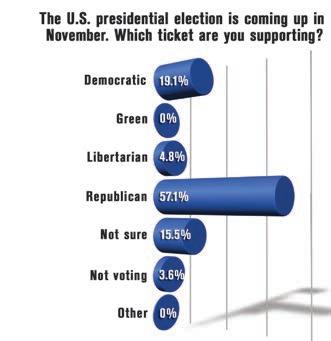
When asked which ticket they would be voting for, 57.1% selected Republicans Donald Trump and Mike Pence. The Democratic candidates, Hillary Clinton and Tim Kaine, trailed by double digits, with 19.1% of respondents indicating they would vote for the ticket.
The only other party that respondents indicated they would vote for was the Libertarian ticket of Gary Johnson and Bill Weld, at 4.8%.
However, 15.5% of respondents indicated they weren’t sure who they would vote for, while 3.6% said they wouldn’t be voting.
Both major party tickets provoked strong responses from laundry and linen managers who took the unscientific survey.
“I’ll vote for the most moral of the two, which doesn’t look too good right now,” a respondent writes.
“I will not vote for a lunatic,” writes another.
Finally, one laundry manager writes bluntly, “I refuse to vote for either idiot running.”
Respondents continued favoring the Republican Party when asked, “Which ticket do you think will more likely be a positive influence for the laundry/ linen industry?” Nearly 70% indicated the Republicans would be better for the industry; 14.3% selected the Democrats. More than 20% selected “not sure” when asked.
That isn’t to say all laundry managers believe political parties can influence the industry, either positively or negatively.
“The parties will have no influence on the laundry industry,” writes a respondent.
The survey then shifted from the presidential race to national, state and local elections. However, 34.9% of respondents pointed to the presidential race when asked, “Which election do you think influences your business more?” That was closely followed by congressional elections, which was indicated by 33.7% of survey takers.
State and local races were selected by 16.9% and 8.4% of respondents, respectively.
One respondent writes, “A mix. Normally, I would say state races. However, federal government power now supersedes state-level power.”
Another writes, “State, in the short term, but president in the long term.”
The issues that respondents see affecting the laundry and linen business are mostly national with a few on a state/local scale.
“Washington state has one of the highest tax rates in the U.S., and we also pay a lot at the (gas) pump,” one respondent writes. “Our hospital/long-term care laundry is set in a rural area and some of my employees drive a long distance to work. Additionally, whenever gas prices go up, the price of our products usually inflates to cover the cost of shipping it.”
Another laundry manager writes, “The state of Illinois and the fact that the Legislature has been controlled by the same party with the same man in charge
of the state Senate has destroyed the economy of the state.”

“We need to find green solutions for laundry,” according to another respondent. “Water recapture, economical drying, less chemicals, etc. and grants to help companies switch over like they did for the car industry with their cash for clunkers program.”
On a national level, immigration is a concern for respondents, along with the issue of minimum wage.
“The laundry industry needs to make sure that we have employees to do the linen processing,” one writes. “Unfortunately, we depend very much on immigration to provide these employees.”
“The minimum wage raise that everyone is proposing would have a significant impact on our industry,” writes a respondent.
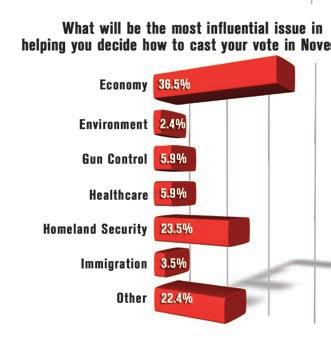
Those who took the survey pointed to several issues that would be “most influential” in helping them to decide how they would vote in November. The top issues: the economy (36.5%) and homeland security (23.5%). Further down the list were gun control and healthcare at 5.9% each, followed by immigration (3.5%) and the environment (2.4%).
That list of issues is by no means comprehensive, as respondents indicated when asked to share other influential issues.
“The Supreme Court pick,” write two managers.
Another writes, “Equal pay for women, and pro-choice.”
“Stop overregulation,” a respondent writes, and another agrees: “Reducing or undoing government regulation.”
And another survey taker indicates that foreign policy will be influential in his/her vote.
Whatever the result of the presidential election, some survey respondents aren’t too impressed with the political landscape of the country.
“It’s a sad day in this country,” a respondent writes. “We have two known liars to vote for and people just accept that. We hear the same rubbish every election year and people just accept the fact that they are being lied to because their favorite candidate stands for a certain ‘right’ or against a certain ‘wrong.’ I say fire the whole bunch and start over from scratch. It won’t happen, though, because we have a public that does and believes whatever the TV says
There is no hope for
Publisher
Charles Thompson
Phone: 312-361-1680
E-Mail: cthompson@ ATMags.com
Editorial Director
Bruce Beggs
Phone: 312-361-1683
E-Mail: bbeggs@ ATMags.com
Editor
Matt Poe
Phone: 231-740-2842
E-Mail: mpoe@ ATMags.com
Digital Media Director
Nathan Frerichs
Phone: 312-361-1681
E-Mail: nfrerichs@ ATMags.com
Advisory Board
Jim Buik • Richard Griffin
Greg Gurtler • Phil Hart
Janice Larson • Tom Marks Gerard O’Neill Richard Warren
Production Manager Roger Napiwocki
National Sales Director

Donald Feinstein
Phone: 312-361-1682
E-Mail: dfeinstein@ ATMags.com
Main Phone: 312-361-1700 Fax: 312-361-1685
Subscriptions
630-739-0900 x100 www.americanlaundrynews.com
American Laundry News (ISSN 1091-9201) is published monthly. Subscription prices, payment in advance: U.S. 1 year $46.00; 2 years $92.00. Foreign, 1 year $109.00; 2 years $218.00. Single copies: U.S. $9.00; Foreign $18.00. Published by American Trade Magazines LLC, 566 West Lake Street, Suite 420, Chicago, IL 60661. Periodicals postage paid at Chicago, IL, and at additional mailing offices.

POSTMASTER, Send changes of address and form 3579 to American Laundry News, Subscription Dept., 440 Quadrangle Drive, Suite E, Bolingbrook, IL 60440. Volume 42, number 9. Editorial, executive and advertising offices are at 566 West Lake Street, Suite 420, Chicago, IL 60661. Charles Thompson, President and Publisher. American Laundry News is distributed selectively to qualified laundry and linen management and distributors in the United States.
© Copyright AMERICAN TRADE MAGAZINES LLC, 2016. Printed in U.S.A. No part of this publication may be transmitted or reproduced in any form, electronic or mechanical, without written permission from the publisher or his representative. American Laundry News does not endorse, recommend or guarantee any article, product, service or information found within. Opinions expressed are those of the writers and do not necessarily reflect the views of American Laundry News or its staff. While precautions have been taken to ensure the accuracy of the magazine’s contents at time of publication, neither the editors, publishers nor its agents can accept responsibility for damages or injury which may arise therefrom.

MEMBERSHIPS
2 SEPTEMBER 2016 | AMERICAN LAUNDRY NEWS www.AmericanLaundryNews.com
think for
this country no matter who INSIDE: September 2016 • Vol. 42 | No. 9 [4] NYC Mayor DeBlasio Signs CLEAN Act Companies have 180 days from the date the mayor signed to comply with the new licensing regulations [8] Tools of the Trade [12] China Laundry Expo 2016 Draws a Crowd The 17th Expo took place at the Shanghai New International Expo Center July 12-14 with nearly 400 brands on display [26] Trade Ticker [27] Calendar of Events [28] Classified Advertising [29] Source Directory
laundry
polled favor
2016
See POLL on Page 25
and can’t
themselves.
Most
managers
Republican ticket in
election
20-year old Milnor tunnel is still working so well, we couldn’t bring ourselves to replace it.”
–
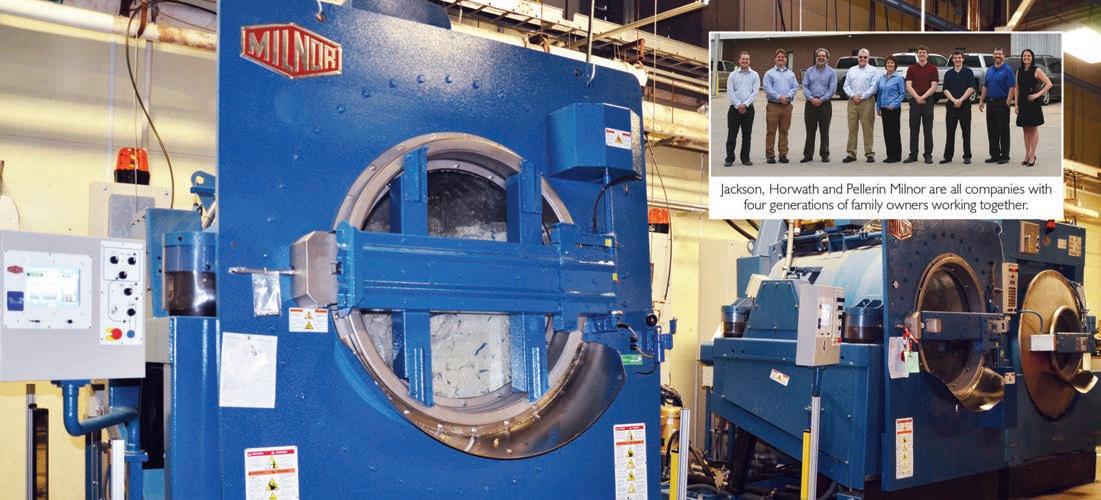
Jackson has trusted Horwath Laundry Equipment, the local authorized Milnor distributor, for four generations. President Jim Horwath said, “We would not normally recommend opting out of replacing a 20-year-old workwear tunnel. Milnor’s ability to support their products (well beyond the life compared to most manufacturers), made us comfortable with this solution.”
Recently, Jackson Services installed four new 6464 pass-through dryers, one 48040 M7K 275 lb. capacity tilting washer-extractor, and a 68036 M5K 400-500 lb. capacity tilting washer-extractor. Milnor worked to update the veteran tunnel with new software and integrate it with the new Milnor M-series washer-extractors, pass-through dryers, and rail system. Jackson is proud to say that productivity is increasing steadily. “At times we’ve had to throttle the washroom to slow it down because production is so fast that the rest of the plant has to catch up!”
To find out how Milnor’s long-lasting machinery can save you money, contact an authorized Milnor distributor or call 504-712-7656.

To read about Jackson Services, scan this code.

www.milnor.com / pellerinmilnor
“Our
Jesse Jackson, President, Jackson Services, Columbus, NE
For directory assistance ...
When September rolls around every year, we here at American Laundry News like to “distribute” a little something special (and valuable) to you.
That’s right. It’s time for our annual Distributors Directory.
We’ve put a lot of effort into making this directory a valuable resource for laundry/linen managers, fully updating the listings to get you the most recent information on companies providing equipment, chemicals, textiles, parts and service, and a range of other products and services.
It’s a resource we’re proud of and know that you’ll find useful.
If you’re shopping for a new company to partner with, there’s no better reference to have.
For ease of browsing, distributors are listed alphabetically by
From The Director’s Chair BRUCE BEGGS
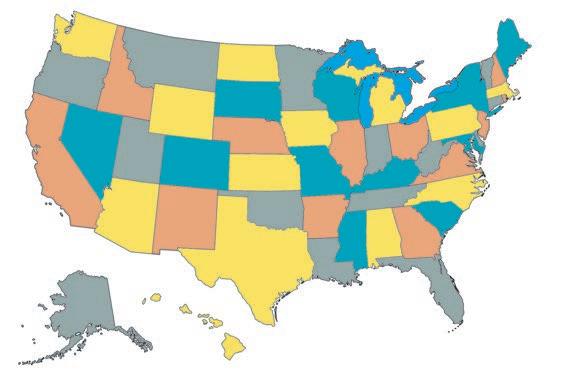
city and state, then name. Refer to the map on page 14 to quickly find your state’s listings. Colored icons by company names will tell you in a flash what types of products and services those companies provide.
If your copy of this issue dis-
appears, don’t fret—you can always find the most updated listings on our website: www. americanlaundrynews.com. If you’re reading this issue on your iPad or tablet, you can visit a distributor’s website directly or e-mail a contact right from the page.
Distributors, if you didn’t know you could be listed here for free, e-mail your company’s name, address, phone number and contact name to nfrerichs@ atmags.com to learn more.
If your distributorship was listed in a previous edition but isn’t found in this one, we might not have been able to verify your information. E-mail Editor Matt Poe (mpoe@atmags.com) and he’ll see about getting you back where you belong. ALN

NYC Mayor DeBlasio signs CLEAN Act into law
will rectify that and protect public health. I look forward to seeing the transformative impact this new law will have on our city.”
I have enjoyed looking at the advancement in equipment at the last several Clean Shows. Innovation is always on full display at the show. The challenge is to look at what we see and to determine if it will work in our operation.
One of the innovations that has caught my attention is that of an automatic bagging machine for small-piece, dry-fold items. This area often represents a production nightmare because they are too small to use with an automatic folder and too numerous to always get an accurate count.
After Clean ’15 in Atlanta, I was determined to further investigate how an auto bagger could benefit my operation. I pulled my staff together and looked at which items in our healthcare laundry could be processed through the system. We determined that the following items were an ideal fit for this method of production:
• 18-inch blue microfiber mops
• 16-inch green microfiber mops
• 12-by-12 yellow microfiber cleaning cloths
• 12-by-12 green microfiber cleaning cloths
• 16-by-16 blue microfiber cleaning cloths
• 16-by-19 gold-striped cotton cleaning cloths
• 16-by-19 white bar towels
• Washcloths
BY MATT POE, EDITOR
NEW YORK CITY — Mayor Bill DeBlasio signed the CLEAN Act, Intro. 697-A, into law Aug. 3, according to a press release from the mayor’s office.
Companies have 180 days from the date the mayor signed the bill to comply with the new licensing regulations for retail laundries, industrial laundries and industrial laundry delivery in the city.
The New York City Council passed the bill by a unanimous vote July 14.
In his remarks at the time of the signing, DeBlasio thanked the bill’s
sponsors, Council members Ritchie Torres and Dan Garodnick.
“I thank the Council and the Administration on partnering with me in the unanimous passage of the CLEAN Act, Intro. 697-A, an important legislation that will clean up our city’s industrial laundries, update the licensing scheme and protect consumers,” Torres says in the release. “There are millions of people who come to NYC to eat at our restaurants, stay at our hotels, and seek care at our hospitals who come into contact with fabrics laundered by industrial laundries, and those industrial laundries have not been regulated for years. This law
Raymond Rodriguez, Torres’ deputy chief of staff, says the following are important provisions in the bill:
• The bill will take effect 180 days after it is signed, meaning that all industrial laundries that are currently not licensed by the city will have to apply to the Department of Consumer Affairs (DCA) for a license when the law takes effect.

• All currently licensed laundries will be grandfathered in and will not be impacted by the law until their current license expires. All
We next pulled our yearly volume of each item, comparing current production rates with those claimed by the manufacturer. We then discounted the potential production rates, adjusting for what we thought was reality versus the highly optimistic projections of the manufacturer. This analysis showed a potential reduction of three full-time employees.
Such a reduction would help sell the capital expense.
We then surveyed the hospitals we served and determined that most nursing units had room to handle the bags (which required additional space) versus the stacked washcloths. The implementation plan was designed to reduce the cost to those units using the new bagged method by lowering the cost of the bagged washcloth by 2 cents each while raising the cost of the flat, stacked washcloth by 2 cents, thus creating a financial incentive to change to the preferred method.
We presented this idea to administration and were excited about the potential cost savings. It was concerned about how nursing would accept the change in delivery styles.
Administration challenged us to prove that it would be accepted before it invested the money in the new system.
So, we went to work with the housekeeping and dietary departments to immediately make the switch. While hand-bagging the system was better than flat stacking, it did not provide the same cost savings.
Next, we approached nursing administration and asked for five test units we could work with on a trial basis to see how nursing and the end-users would accept the new system. After a three-month trial, we surveyed the staff of each nursing unit. The nurses said they had no preference for which delivery method was used. They just wanted to make sure they did not run out of linen.
Six months after our original idea was presented to administration, we were able to get approval for the project. We then needed to compare the pros and cons of the various equipment currently on the market.
What we wanted was a machine that would seamlessly fit into our existing production methods. We mix the green and blue microfiber mops together for washing and drying. We also mix all the microfiber cleaning cloths into one batch. We wanted a machine that would facilitate the processing of these items without a lot of extra handling.
•
4 SEPTEMBER 2016 | AMERICAN LAUNDRY NEWS www.AmericanLaundryNews.com
COLUMNIST AT LARGE Eric L. Frederick, RLLD
handle small, dry-fold pieces Top Stories Appearing on AmericanLaundryNews.com for the 30 Days Ending August 15 (WE) = WEB EXCLUSIVE NEWS • Study: Towels Play Critical Role for Hotel Guests • Texcare International 2016 Breaks Records • Cintas Collaborates with Google on Smart Garments • NYC Council Passes CLEAN Act • Ellis Corp. Appoints Fesmire Jr. to President COLUMNISTS/FEATURES • Where Did All the Linen Go? • Hiring Good Employees from Shrinking Labor Pool • Eric Frederick: Skills That Laundry Operators Need to Succeed • Regain Summer Focus, Motivate Employees • Healthcare Laundry Self-Regulation Goes Under the Microscope OUR SISTER WEBSITES From AmericanDrycleaner.com:
Tuchman Advisory Group: New Name
Run Efficient, Run Deep From AmericanCoinOp.com:
Machine Operator Killed in Accident at Pellerin Milnor ...
Finding a better way to
•
•
•
CSC ServiceWorks Board Appoints Hjelle CEO (WE)
See INNOVATIONS on Page 25 Unlicensed laundries in city, or deliver/provide service there, have until early 2017 to comply
See CLEAN on Page 12













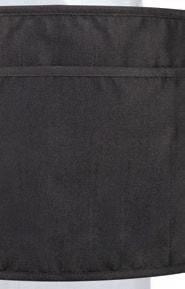


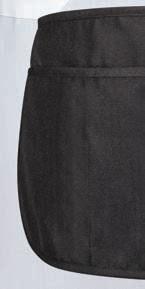
800 821 2221 | imagine@americandawn.com | americandawn.com BECAUSE PROFESSIONAL WAIT STAFF DESERVE CLEAN APRONS THE INDUSTRY’S FIRST RENTAL APRON FOR THE FRONT OF THE HOUSE The ADI Server Pro Collection M ade from Rental Friendly Spun Polyester Server Apron Has 3 Pockets For Straws, Pens, Checks Bistro Apron Has 2 Pockets (Available in Black or White) M ade With The Professional Waiter In Mind O2311BLKMTIM O7529BLKIM O7529WHTNWI
with attendees in regards to equipment maintenance? Set expectations high.
“With too many plants, I see that they’re just accepting breakdowns,” he says. “It accelerates. Once you don’t do some of the basics, it’s going to cost you. Airplanes don’t fall out of the sky. They are much more complex equipment than what we have in our plants. If you don’t set your expectations high, who will?”

Schurter says that laundry managers don’t have to be experts on maintenance. They just need to set expectations high. In the laundry business, what gets measured gets done, and he says management should measure maintenance.
Schurter gave an example from his own company. Prudential bought new, open-pocket washers, and after several years at one plant, the machines still looked quite new. At the company’s plant an hour and a half away, with the same equipment, identical plant layout and the same time in use, the company is replacing some of the machines.
“The difference is not the manufacturer. The only difference is on us,” he says. “At one plant, we have excellent maintenance; the other, I wouldn’t qualify as such. We’re paying the same money, but we’re replacing them in one plant.
“If you know about washers today, it’s in the hundreds of thousands of dollars to replace washroom equipment. Keep in mind when we talk about asset management, it’s really us. It’s us paying attention to it. It’s us challenging each other on the plant equipment.”
Maintenance affects most facets of a laundry operation, according to Schurter. If the equipment is down, the machines can’t make money for the company. The productivity is down. If something like a leaky valve happens, the wash formulas get stretched out, and that affects quality.
“Now that the water is going down, we’re needing more chemical, temperatures don’t adjust— there are all kinds of impact,” he says.
Also, Schurter says, if the equipment is not reliable, employees may have to work overtime, and a company is going to be forced to make adjustments that could affect quality. Customers are not going to be happy with the product.
“If something is well-maintained, it looks clean, it’s easy to get to, the electrical panels are closed—it’s easy to maintain,” he says. “Who wants to work on a dirty machine? Who wants to work on an unsafe machine? Who wants to work on a machine with leaky valves and wires sticking out of it? So, the maintenance contribution is just maybe a little bit bigger than when we walk through our plants and think that magically somebody does stuff.”
Schurter says that the higher the expectations of owners and operators, the more the maintenance team will follow their lead. It’s simply the difference between taking care of equipment and accepting less.
One way Schurter points out the value of high maintenance standards is by examining the maintenance-quota relationship.
“A lot of people, when they talk about the cost of maintenance, having the availability of tools, preventative maintenance, sometimes you have to remind yourself to step back for a second and really think about what do these breakdowns cost us?” he says. “Even if one machine is down, maybe it’s the machine you use for your mats. Now you’re disrupting that flow; the machine and the merchandise stands.
“A lot of people don’t think about that, but again, a machine that experiences a problem, you may now inject bleach and you leave that bleach sitting in the wrong wash formula or wrong wash time, or you overextend the wash time, or you underextend, and you end up damaging some of your merchandise.”
Schurter says that he goes into too many plants where he sees machines bouncing up and down.
“There’s no need to be a maintenance expert. You just walk the


visors are part of a management team, they need to be supervised like everyone else.
He says that in order to have an effective maintenance staff and preventative maintenance plan, the department needs effective supervision. That supervision requires a few basic qualities to be effective.
The first quality Schurter mentions is simple: show interest.

“You don’t need to be an expert, but you show interest in what they do. You take a couple hours out of your busy schedule and say, ‘I’d like to come with you, I’d like to see how you do your preventative maintenance,’” says Schurter. “If the person walks up to the machines, and he has a list and knows what to do and starts lubricating, checking levels and so on, you can feel very good about it.
“If the same person goes around and starts trying to read the list and starts thinking about how to do this and then goes behind the machine and you don’t see things being cleaned, no lube, you probably already realize the problem is the preventative maintenance didn’t get done.”
Schurter points out that maintenance personnel tend to be introverts. It doesn’t come natural for them to speak in front of groups. They like to be separate from the plant staff, with a maintenance office that has a microwave and refrigerator.
“Take that out,” he says. “Force those people to go into the lunchroom so they sit with other employees and a bond is formed. Your production people could walk through the plant as part of your maintenance staff. If the production people know they can talk to your maintenance people because they are not hiding, next time something happens on a machine, they can point out that something is wrong with the machine.”
need to go out there and say, ‘Good job.’ Point out when they fixed a machine or did a good preventative-maintenance task, and thank them, like you do every day for customer service representatives. Their contribution needs to be recognized.”

Schurter also recommends a strong commitment to training and development.
“Are you sending your maintenance people to school? Are you encouraging them in some fashion? Some people in some companies have skill levels. We pay our people based on their skills,” he says. “The long-term maintenance people in your plant, have they kept up with some of those skills? Have you encouraged them? Reward them for learning new trades.”
Schurter says that if the laundry takes care of its maintenance workers, they will take care of the company. He says the laundry needs to make sure it has a commitment to maintenance personnel and give them support.
he says.
Force them to get rid of clutter and establish appropriate materialcontrol lists.
“It’s huge. You have to have an inventory list, or the maintenance staff doesn’t do their job,” he says. “It doesn’t have to be computerized. Doesn’t have to be fancy, but challenge your maintenance people. Just you asking to see the list will force them to take notice.”
Finally, Schurter says give maintenance a budget and make that budget part of staff meetings. Make the supervisor part of operations, and make him understand the impact they have on the bottom line.
THE BEST OF THE BEST
The best of the best in laundry maintenance—what separates some of those?
plant, and you know this is not good,” he says. “Constant pressure is what we want, not bouncing. So, you’re going to have stress fractures, on the equipment and the people.”
Properly maintained equipment also impacts safety, says Schurter. Some laundries pay up to 3-4% of revenue in some areas for workers’ comp premiums. The better a company is on the safety side, he points out, the better are the company’s costs. The whole maintenance contribution has a huge impact on the safety of equipment.
Then there’s the problem of restarts. He says that once a piece of equipment is down, it’s out of sync.
“It’s not where it needs to be; it’s out of rhythm,” he says. “Your people may not even know how to properly restart it, and you have temperature, chemical and mechanical problems.”
EFFECTIVE SUPERVISION
Research shows that maintenance personnel, like everybody else, need a boss, according to Schurter. Management needs management, and if maintenance super-
Schurter encourages management to foster those relationships and to make sure the maintenance staff knows they aren’t different from everyone else in the plant.
“Make sure that they understand that they have eyes and ears out there so that before a problem happens, you’ve got all these people who can tell when small problems happen,” he says. “Production people can be those eyes for you.”
Effective supervision also means setting a timeframe, a policy, setting the conditions in a plant, according to Schurter. Management has a responsibility to fix it when they walk through the plant and see that the maintenance staff and production staff don’t have an understanding with one another.
“That’s how you’re going to get the best of the best,” he says.
Another important quality that maintenance staff need to notice when it comes to supervision is recognition, according to Schurter.
“They want to make decisions, and they want to feel valued. They turn wrenches, they like to do that, and there is a sense of accomplishment,” he says. “You, as a manager,
“As we go to $15 and $18 an hour minimum wage, we’re going to see more automation to come,” says Schurter. “More complex machines are coming, and the maintenance contribution and the maintenance people are going to be more critical.”
APPROPRIATE MATERIAL CONTROL
All of the preventative maintenance that needs to happen in a plant can’t happen if the staff doesn’t have the necessary parts and tools, says Schurter. On the other hand, a shop overrun with parts and supplies isn’t good either, he says.
“Ever been in a maintenance shop with all of this equipment around there?” he asks. “Pumps, motors, nothing is tagged. You don’t know which one is good or bad. They think they know. Then he goes on vacation. Next thing, a water pump goes and somebody just takes whatever from the shop and they realize it’s bad.”
Part of appropriate material control is to throw out the broken stuff, clean out the mess, says Schurter.
“Sometimes, maintenance people have great intentions, thinking they’ll rebuild a valve when they have time—they never have time,”
Schurter says it comes down to a proactive approach. He says he has conducted research that shows preventative maintenance represents 60% of all maintenance activity in the best plants.
As an example, he says that in a plant with three maintenance workers, two should be doing nothing but preventative maintenance.
“If that’s not the case, you’ve got a problem in your plant,” he says. “They shouldn’t be building furniture, moving walls, painting buildings; they should be doing things with a proactive approach—all activity being preventative maintenance. They shouldn’t be troubleshooting, unplanned work, calling back for parts, all of that should be planned—40 hours of pre-planned work.”
The best plants, according to Schurter’s research, say that 80% of all maintenance work was preplanned.
“If you do all this, washers don’t break down,” he says. “We know what we have to do. We need parts at a certain time, to buy them effectively, to put them on the shelf and we schedule it so it doesn’t have to happen on Saturday or Sunday. We take one machine down. We plan it, do our maintenance work and bring it back online. It saves you a lot of money.”
What separates the best from the rest? Schurter says the best simply do basic things well, which is preventative maintenance.
6 SEPTEMBER 2016 | AMERICAN LAUNDRY NEWS www.AmericanLaundryNews.com
ALN Continued from Page 1 Prevent
“IF SOMETHING IS WELLMAINTAINED, IT LOOKS CLEAN, IT’S EASY TO GET TO, THE ELECTRICAL PANELS ARE CLOSED.”
—STEFAN SCHURTER, PRUDENTIAL OVERALL SUPPLY
To be the best of the best, a laundry simply has to do the basics very well. That means preventative maintenance. (Image licensed by Ingram Publishing)
LOOK BETTER. SPEND LESS.













Your clients expect the highest quality – and they should. Girbau Industrial washers and dryers provide a high-caliber clean while extending linen life. Add an Ironer to your equipment mix and linen is perfectly ironed straight from the washer. It feels soft and looks crisp, which is what your clients expect. Thanks to Girbau Industrial laundry equipment, you’ll heighten laundry productivity using less labor, while decreasing utility costs. Even better? Clients will thank you!
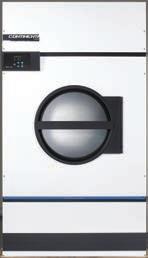










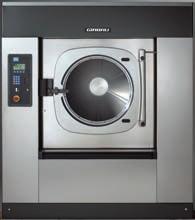

Contact Girbau Industrial for a FREE ESTIMATE to see how you can deliver more productivity to your laundry while increasing product quality! (800) 256-1073 • www.girbauindustrial.com INDUSTRIAL
Tools f the Trade
Cintas Corp. has launched the Traffic™ Mat, a new floor mat featuring the highest traction rating ever recorded by the National Floor Safety Institute (NFSI), the company reports.
This means that the mat’s high-traction backing has far exceeded minimum requirements set in place by the NFSI, Cintas says. The Traffic Mat is part of Cintas’ new High Performance Series™ line of mats.
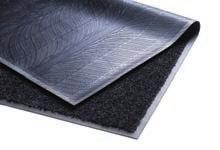
According to Cintas, the Traffic Mat features a
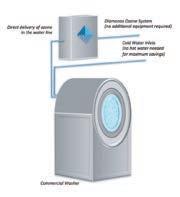
Advanced Diamond Technologies (ADT), which develops and applies ultrananocrystalline diamond (UNCD®) coatings, has introduced two Diamonox® Ozone Technology systems, the company reports. ADT says both systems deliver the long-awaited promise of point-of-use ozone generation through electrolysis.
Diamonox products provide instant delivery of a precise amount of ozone in small, water-based devices that are cost-effective and durable, according to the company.
ADT says that the ozonated water generated by Diamonox acts as a non-toxic biocide with minimal environmental impact. In addition, ADT’s inline Diamonox Ozone Systems can be easily integrated
Workrite Uniform Co., a manufacturer of flame-resistant (FR) clothing, has launched its new line of high-visibility “Hi-Vis” FR workwear, the company reports.
Workrite says the line offers workers protection against thermal hazards along with improved visibility, even when the light is low or conditions are hazardous.

The Hi-Vis FR line includes a work shirt and vest from Workrite Uniform’s Dickies® FR brand made from Westex UltraSoft® fabric.
heavier-weight rubber backing with tire-grip technology. This backing provides high traction to help the mat withstand foot, wheel and cart traffic.
“Placing durable mats in heavily trafficked areas is essential for prolonging the life of costly floor assets and maintaining cleanliness and safety,” says John Engel, director of marketing. www.cintas.com 888-400-9315

Laundry cart manufacturer MODRoto reports that it has unveiled its ergonomic 25P-24 flare truck.
The company says the 25P-24 flare truck features its signature, spring-loaded platform that automatically sinks when loaded with laundry and rises as goods are removed to keep work positioned at a safe, comfortable working height.
into industrial equipment, such as on-premises laundry and greenhouse watering systems, to significantly streamline and improve disinfection, the company says.



According to ADT, the systems require only tap water and electricity to generate ozonated water. www.thindiamond.com/ozone 815-293-0900
The spring-loaded unit sets a durable, rotationally molded, plastic platform that is waterproof and chemical-resistant atop a steel spring mechanism, which is safely hidden under the platform to prevent contact with workers and linens and may be easily removed for cleaning and storage without any tools, according to MODRoto.
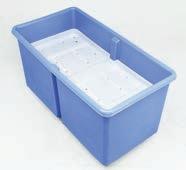
The company says the cart is ideal for transferring laundry from washer-extractors to drying and finishing and for other tasks inplant. The flare truck is rotomolded from 100% polyethylene in a single piece with a safety, roll-top rim around the full cart perimeter; rounded corners for high structural strength; and internal spring
platform guides that help keep the spring-loaded platform level as it moves up and down, even when unevenly loaded.
The laundry cart stands on a rugged, powder-coated steel base atop six industrial-strength, non-marking casters, the company says. The cart was developed as a complement to the company’s larger 25P-30 ergonomic flare truck, according to MODRoto.
The 25P-24 spans the same 66 inches long by 35 inches wide but stands just 31 inches high to fit in a variety of tight spaces.
www.MODRoto.com 800-829-4535
Additionally, the Hi-Vis FR line has two garments from the company’s Workrite FR brand— a long-sleeved knit T-shirt made from Tecasafe® Plus Knit and a mesh vest made from GlenGuard® fabric.
The company says that the workwear featured in the Hi-Vis FR line—with the exception of the mesh vest—is also built to withstand industrial laundering. www.workrite.com 800-521-1888
Penn Emblem has new PennTrans™ Heat Transfers, the company reports. The transfers are launderable, durable, flexible and eco-friendly.
The company says that the highdefinition color and fine detail that PennTrans provides can easily be applied to a variety of fabrics, perfect for uniform rental direct sales programs.
PennTrans is available in “Reflective” and “Flame Resistant” options for added

safety, according to the company. www.pennemblem.com 800-793-7366

8 SEPTEMBER 2016 | AMERICAN LAUNDRY NEWS www.AmericanLaundryNews.com
Laundry cart manufacturer unveils smaller version of ergonomic flare truck
Company says new ozone systems require only tap water, electricity
Uniform company launches ‘Hi-Vis’ FR clothing line
New heat transfers launderable, can be applied to many fabrics
New traffic mat is first of four new designs in high-performance series for rental company
ALN_Tab_1-4_H.indd 1 7/18/16 11:12 AM
Results on whites are excellent. On colors, you have nothing more to lose and everything to gain by trying YellowGo. YellowGo may take out color you want to keep. But if it removes the unwanted dye without damaging the underlying color, you win! You won’t have to pay for the dye-stained garments and you won’t disappoint your customers.
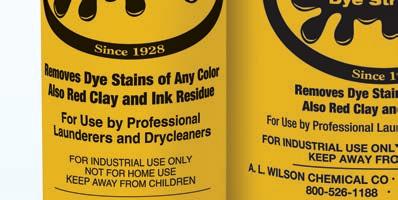
So use YellowGo to keep your customers happy and keep them coming back.








information visit
or
or
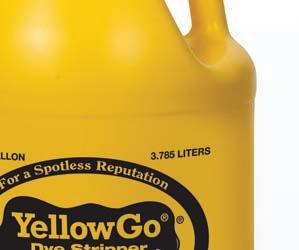
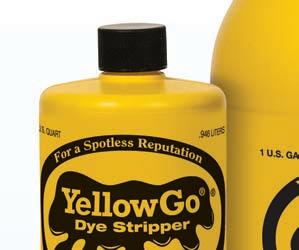
YellowGo® removes unwanted dye from fabric. For more
AlWilson.com
call us at 800-526-1188
201-997-3300
STOP LINEN LOSS!
Training
their laundry operation to monitor equipment usage, labor, utilities and efficiency. With this visibility, managers can make immediate adjustments to help minimize costs at every stage.
Hyatt for nearly 30 years and knows firsthand the importance of training laundry room staff. As the corporate director of engineering for the Hyatt Place and Hyatt House hotels, his role is to monitor and assist with the replacement of equipment and review new hotel laundry construction, as well as review wash times and the chemical usage.
“Our training guidelines are available in both a video and downloadable file format and accessible through our company intranet,” says Dawes. “The training guides review the proper loading techniques for washers and dryers, and the training is consistent across all hotels.”
Additionally, according to a recent Bureau of Labor Statistics report, the turnover rate for the hospitality industry was 72.1% in 2015, up from 66.7% in 2014. With this high turnover rate, having formal training procedures and documents will help on-board new employees as quickly as possible.
TMI Hospitality operates more than 180 hotels across the United States under brands such as Marriott, Hilton Worldwide and InterContinental Hotels Group. To help manage the laundry operation and training across all properties, each hotel receives operational standards and checklists developed by TMI’s director of operational performance standards.
When the time comes to train new staff, all TMI property management teams take a hands-on approach, says Andrew Wallin, TMI’s director of purchasing.
“A property’s general manager or executive housekeeper will train new laundry staff on the standards our team has developed to ensure consistent operation across our properties,” he says.
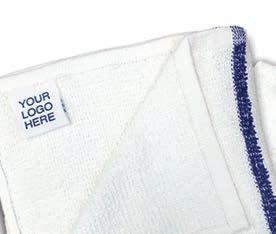
WITH FREE LINEN BRANDING

According to The Economist, between 5% and 20% of linens are stolen annually. Shrinkage is real, especially in hospitals and hotels where guests feel they have paid enough to justify taking a set of towels when they leave.

The truth is simply this: “A logo, whether it’s from the hospital or the company providing the linen, can be a deterrent for textiles to “leave” a healthcare facility.” - American Laundry News
We will help you stop linen loss while promoting your brand 24/7 with complimentary branded labels when low minimums are met.
Stop linen shrinkage. Increase your bottom line. Gain control over your inventory. Call or go online to speak with a linen expert today.
EQUIPMENT USE
Today’s equipment for on-premises laundry (OPL) facilities has undergone major advancements to improve efficiencies and reduce operational costs. However, even with the most innovative equipment on the market, employees still need to be properly trained on how to use the equipment so that the hotel does not waste time and money.
New equipment control systems provide many benefits to both the laundry room manager and the staff processing laundry day to day. With advanced controls and wireless networking, laundry room managers can gather machine performance and maintenance data remotely and in real time. This innovation helps managers stay constantly connected to
If staff is using manual controls, they need to pay close attention when selecting settings and cycles to ensure the best wash and dry quality. Laundering different types of linens throughout the day is inevitable in the hospitality industry. Manual controls require staff to switch the settings for each load, creating a greater chance of the wrong cycle being selected, which will affect throughput and linen life.
“Our newer equipment helps with monitoring the wash cycles and confirming the proper washing temperatures and formulas, which is very important,” says Dawes.
Advanced control systems have user-friendly graphic displays, one-touch operation and multiple languages for multilingual operation, all helping to simplify training and use. Additionally, having the same controls for both washer-extractors and tumble dryers helps streamline training and use of the equipment.
PROCESSING TECHNIQUES
Once employees are fully trained on how to use the equipment, they also need to have a strong understanding of laundry processing.
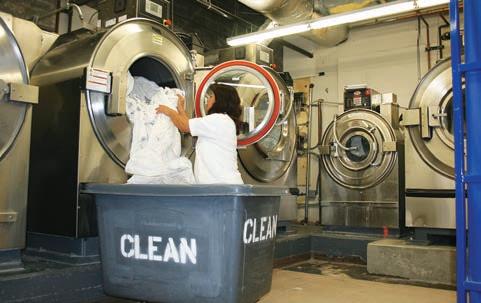
“While our training is consistent across properties, processing will differ based on the number of rooms at a hotel,” says Dawes. “The average room count at our properties is 130 rooms, but the total number of rooms at the hotel will affect the size of our washers and dryers, and therefore affect processing.”
As the types of fabric for hotel linens vary, it is important for staff to sort like items before starting a load. Since linens such as towels and bed sheets have differing compositions and weight, they will need different dry times.

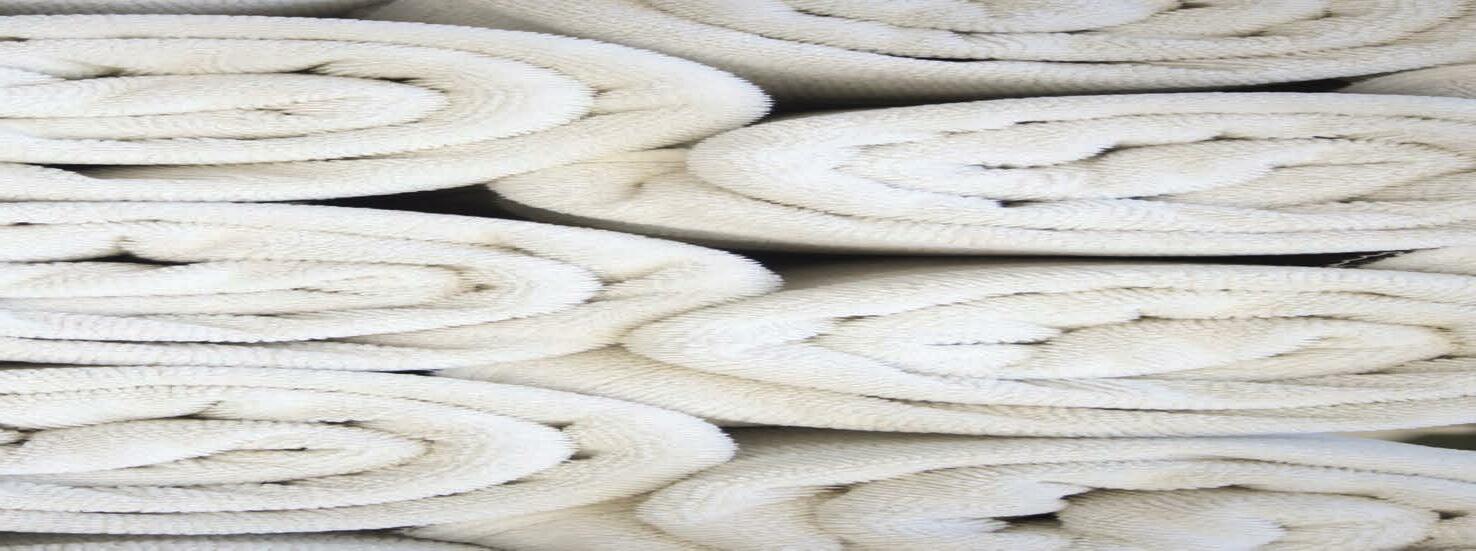
For example, the time required to dry terry towels will cause over-drying of the bed sheets. Over-drying the sheets will not only reduce linen life, it will also affect the quality of the linen; uncomfortable bed sheets will have a negative impact on guest satisfaction.

It is also important to weigh linens before adding them to the washer-extractor. While a load may look full, adding a few more linens to reach the machine’s maximum capacity will have an impact on daily productivity.
SERVICE, MAINTENANCE AND REPAIRS
In order to help extend the life of equipment and ensure it is running at peak efficiency, staff will need to be trained on regular preventativemaintenance needs. If a property does not have set maintenance processes in place, a distributor can be a good resource to help develop formal procedures. They can also help with
10 SEPTEMBER 2016 | AMERICAN LAUNDRY NEWS www.AmericanLaundryNews.com
(800)
monarchbrands.com
333-7247
Continued
Page
from
1
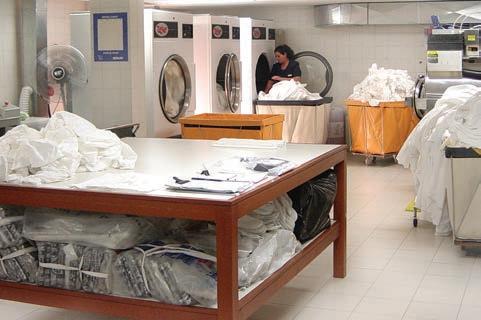
Proper training helps maintain efficiency and quality. (Photos: UniMac)
conducting trainings, especially when it comes to equipment use and maintenance needs.
“Our local distributor performs the maintenance training, and it is handled by the hotel engineer or a local laundry contractor,” says Dawes.
Many equipment manufacturers will provide checklists that outline maintenance needs that should be performed on a daily, weekly, monthly, quarterly and annual basis. In addition to using these materials for training, they are a helpful resource for ongoing maintenance needs.
“With proper cleaning of the machines and the light maintenance performed, we are often able to tell pretty quickly if there is an issue with a machine,” Dawes says. “When we see there is a leak or abnormal sound, we know it’s time to call our distributor for service and support.”
Additionally, with an advanced control system, a laundry room manager will receive an alert if there is a problem such as a leak or slow drainage as soon as it arises. Oftentimes, a manager will receive the alert before the staff can visibly detect the issue, which will not only help prevent a large water or sewage bill but also help reduce equipment downtime, as the problem can be addressed immediately.
When a machine is experiencing an issue or isn’t functioning correctly, the flow of the laundry room will be impacted immediately; this technology helps laundry room managers and staff work together to address any repair needs as quickly as possible.
It’s also important for staff to be trained on when equipment maintenance goes beyond their daily responsibilities and a certified service technician should be called. Staff should not tend to repairs and maintenance that goes beyond their training or comfort level, as more harm can be done to the machine. Staff should also be aware of potential problems such as electrical issues, uncommon noises or error codes that require a factory-trained and -certified service technician.
Distributors have the expertise, resources and knowledge to solve any issues that may arise with a property’s equipment. When the repair is out of the scope of a property’s engineer or maintenance staff, calling a service technician will ensure that the equipment needs are tended to promptly and correctly.
“If our regional maintenance team cannot repair an issue for a property, we will help them identify the right resource,” Wallin says. “It is as simple as typing in the property’s ZIP code. We know we can trust our distributors to get the equipment back up and running quickly, no matter where the property is located.”
MONITORING THE OPERATION
To run an efficient OPL operation, it’s
important that training does not stop after an employee is first on-boarded. Staff should undergo regular reviews to ensure that they are continuously following all proper processes and procedures.
“Each of our hotels undergoes a regular review process, and part of that review includes an analysis of the laundry room to ensure the staff is properly executing their tasks,” says Dawes.
He also says that there are visible signs to look for to ensure the laundry operation is running at peak efficiency.
“The telltale sign that a laundry is running efficiently is the lack of linen backed up in the chute or on the floor,” Dawes says.

With the ability to monitor all aspects of an operation with real-time reports, laundry room operators have increased visibility that helps them make informed decisions on how to best manage labor resources based on the expected volume of laundry during a specific time period.
The machine usage reports will also provide managers with a strong understanding of how and when their equipment is running during a specific shift or day, and can help identify bottlenecks in the laundry process. If linens are sitting for an extended period of time between a wash and dry, a laundry room manager can determine the best way to fine-tune labor resources to eliminate this problem.
Additionally, if an operation does not meet its daily goal, it can pinpoint the exact shift in order to identify the cause of the inefficiency and make modifications. If it was a result of the labor, they can use this as an opportunity to retrain employees and improve staff performance.
“Constantly reviewing a hotel’s laundry operation is very important, as this can make or break a hotel—from both a guest satisfaction and profitability perspective,” says Dawes. “If a hotel laundry operation is not running seamlessly, it will become a major trouble spot for the hotel. While guests do not visit the laundry room, it is just as important to keep the laundry room as neat, clean and organized as the hotel restaurants and lobby.”
Incorporating in-depth employee training processes that provide education on equipment use, processing, preventative maintenance needs and when distributor support is needed will help a property maximize throughput, reduce operating costs and ensure that it is achieving the appropriate guest satisfaction with properly laundered linens. ALN
Bill Brooks is North American sales manager for UniMac®, a provider of on-premises laundry equipment. To learn more about UniMac, visit www.unimac.com/opl101 or call 800-587-5458.
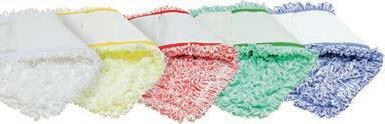
POCKET MOPS
ECONO WET MOPS

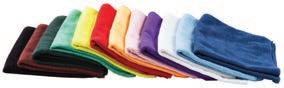
www.AmericanLaundryNews.com AMERICAN LAUNDRY NEWS | SEPTEMBER 2016 11 Minimums apply Promote your brand 24/7 with FREE logo label embroidery! • Personalized microfiber products, terry towels and bar mops • Ultimate control over your inventory • Carry your own product line • Free advertising for your business CUSTOM SOLUTIONS (800) 333-7247 monarchbrands.com MICROFIBER CLOTHS • 16”x16” professional microfiber cloths • Use for wet or dry cleaning • Wide variety of colors 35¢
• Highly absorbent 18” side pocket mop • Industrial strength canvas backing • Matching hardware available $2.65
• Cut cleaning costs without sacrificing quality • Commercial quality microfiber looped flat mops • 18” long with Velcro backing 95¢
Regardless of the size of the hotel, it’s important that all laundry staff undergoes the same training.
China Laundry Expo 2016 promotes development of laundry industry, according to organizers
Exhibition showcases nearly 400 brands from 16 countries
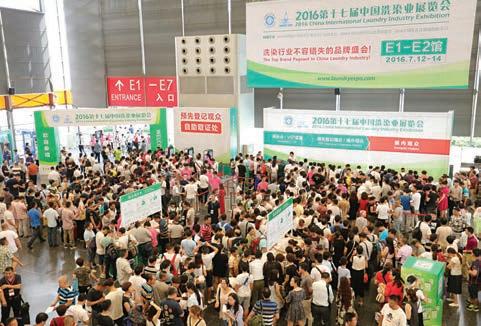
SHANGHAI — The 17th China International Laundry Industry Exhibition (China Laundry Expo) took place here at the Shanghai New International Expo Center July 12-14.
Expo organizers China Laundry Association and Unifair Exhibition Service Co. Ltd. say the China Laundry Expo promotes rapid development of the laundry industry with its global perspective and dedicated effort.
According to the organizers, 16,010 attendees visited the show, and the show floor covered nearly 215,000 square feet.
The exhibition showcased about 400 brands from 16 countries and regions, including the United States, Japan, the United Kingdom, Germany, Netherlands, Denmark, Italy, France, Spain, Belgium, South Korea, Hong Kong and Taiwan.
Some of the companies with U.S. ties that exhibited at the Expo included Kannegiesser, Primus, Speed Queen, UniMac, JENSEN and Pellerin Milnor.
Organizers say the brands presented the most advanced and latest technology, equipment, apparatus and chemicals. The industries covered included laundry and dry cleaning, leather conditioning, laundry franchise, factory design and construction, and other relevant services.
According to the statistics, organizers say, the number of new exhibitors accounted for nearly 40% of the total in 2016, compared to the last Expo held in Shanghai.
Companies offering laundry management software, such as Laundrapp, Youxi and Quanjia, accounted for a higher proportion of new exhibitors, according to show organizers. The products showcased included self-service lockers, online laundry collection software, laundry factory management system and more.
Organizers say that the mode of “central laundry factory plus laundry collection shop” will be an expanding trend. They say an increasing number of hotels and services are outsourcing laundry duties, and that means centralization and energy conservation are required for central laundry factories.
Moreover, some insiders call for formulating laundry and linen standards to
strengthen industry management. These standards will require higher performance of research and design and technical innovation of upstream laundry, say the show organizers.
At the same time, the number of exhibitors in the leather care industry greatly increased. The 4th China Leather Care
currently licensed laundries in New York City have licenses that expire on Dec. 31, 2017. After that date, they will have to adhere to the new license requirements of the CLEAN Act.
• The licensing fee and bond did not change and were kept the same as they have always been. Those amounts are based on the number of employees.
• A task force will convene six months after the law takes effect to look at how the law is
playing out and make recommendations for improvements and changes. The task force will have representatives from DCA, the city’s Department of Health, industrial laundry representatives, representatives of employees and others that may be necessary.
“The CLEAN Act brings New York City’s laundry licensing laws, portions of which were written decades ago, into the 21st century,” says DCA Commissioner Lorelei Salas in the mayor’s press release. “The new provisions strengthen consumer protections while also making clearer how the licensing law applies to different laundry businesses—whether they’re serving families, commercial clients or
delivering laundry.”
Torres introduced the bill in February 2015 in response to allegations of unsanitary laundry practices within the city.
It’s important to realize that the CLEAN Act affects laundries that don’t have operations within New York City limits, says Kevin Schwalb, director, government relations, for the Textile Rental Services Association (TRSA).
“It affects any laundry that delivers into the city,” he says. “There are some laundries in New Jersey, Connecticut, Pennsylvania. Any laundry that goes into any of the five boroughs of the city is required to get a business license.”
Schwalb also says that on-premises laundries, such as those at
hotels and hospitals, will have to get licensed as well.
Throughout the progression of the CLEAN Act, TRSA has been involved in order to represent the laundry industry, Schwalb says.
“We were able to work with them, and ended up coming up with a final product that, while still a bit of a nuisance, was much better than the original,” he says. “The City Council was only hearing one voice, and that was the voice of the unions.”
Schwalb points to three requirements of the original bill that the organization helped remove. The first required laundries to submit client names and client addresses as part of their licensing. There was also a requirement for laundries
to supply the name, address and license number of any driver operating in city limits.

“That’s a lot of personal information” says Schwalb.
Third, the original bill required the DCA develop cleanliness standards, which the department said it wasn’t in a position to develop. Schwalb says that the Council put standards into the bill based on TRSA’s Hygienically Clean certification.
“Now, DCA only has to provide a template for the license and do spot inspections,” he says.
Schwalb also says that TRSA will have representation on the task force, which will meet regularly in order to evaluate the effectiveness of the bill and make necessary changes.
12 SEPTE MB E R 2016 | AMERICAN LAUNDRY NEWS www.AmericanLaundryNews.com
ALN
ALN_Tab_1-4_H.indd 1 2/2/16 9:51 AM
Clean See EXPO on Page 25
The China Laundry Expo attracted 16,010 attendees to the Shanghai New International Expo Center. (Photos: Unifair Exhibition Service)
Continued from Page 4

















IF YOU WANT YOUR LAUNDRY TO RUN LIKE A WELL-OILED MACHINE, YOU NEED TO PARTNER WITH ONE. UNIMAC® LAUNDRY SOLUTIONS AT YOUR SERVICE. When you replace your laundry lineup with new UniMac® equipment, you get more than just durable, high-performance machines. You get a total laundry solution designed to make and keep your operation running at peak efficiency. Our global network of distributors is always by your side to answer any of your questions. Our expert team of service technicians with over 4,500 years of combined experience will help you keep your machines up and running. And when you’re ready to upgrade, UniMac Funding makes financing your equipment fast and easy. Because it takes a well-oiled machine to know one. Find your certified UniMac sales technician at UniMac.com/Service
ALABAMA
Wholesale Commercial E P O Laundry Equipment Co. SE 2950 Highway 77 Southside, AL 35907 B 256-312-4761 or 866-544-7228 O www.alaundryman.com r Russ Arbuckle l thelaundryman@verizon.net
ALASKA
Automated Laundry E C P Systems & Supply 5020 Fairbanks St. Anchorage, AK 99503 B 907-561-1752 or 800-478-1752 O www.autolaundrysystems.com r Kalvin Young l sales@autolaundrysystems.com
ARIZONA
Pierce Machinery E 505 E. Boston Cir. Chandler, AZ 85225
B 602-625-1902 O www.piercemachinery.com r Pat Pierce l pat@piercemachinery.com
Sunshine Sales E P O 6064 N. 57th Ave. Glendale, AZ 85301 B 623-937-0125 or 800-789-6412 O www.sunshinesalesaz.com r Bob Ropp l bobropp@sunshinesalesaz.net
Astro Distributing E P O & Leasing 4329 E. Magnolia St. Phoenix, AZ 85034 B 602-267-7072 or 800-362-7876 O www.astrodistributing.com l admin@astrodistributing.com
C-PEC E P 3120 W. Weldon Ave. Phoenix, AZ 85017 B 602-248-0808 or 877-835-5866 O www.cpec-laundry.com r Dave Svancara l sales@cpec-laundry.com
Wardlaw Equipment E P
Consultants Phoenix, AZ 85013 B 520-791-2804 or 877-927-3529 O www.wardlawequipment consultants.com r Kevin Wardlaw l wardequip@aol.com
C-PEC E P 3202 S. Richey Ave. Tucson, AZ 85713 B 520-790-7377 or 877-835-5867 O www.cpec-laundry.com r Greg Svancara l greg@cpec-laundry.com
ARKANSAS
FabriClean Supply C O of Arkansas 6600 Allied Way Little Rock, AR 72209 B 501-565-5288 or 800-482-1283 O www.fabricleansupply.com l terrys@fabricleansupply.com
Justin Laundry Systems E P 5310 Baseline Rd. Little Rock, AR 72209 B 501-551-8600 or 888-403-9600
O www.justinlaundry.com r Mike Worthy l mworthy@justinlaundry.com
Central Laundry E P O Equipment P.O. Box 324 Ward, AR 72176 B 501-843-3194 or 800-467-3194 O www.centrallaundryequipment.com r Jeff Craig l ar@centrallaundryequipment.com
CALIFORNIA
Washex Machinery E P of California 101 E. Santa Anita Ave. Burbank, CA 91502 B 818-840-8900 or 800-397-8811 O www.washexcalifornia.com r Mark Sanders l washexcasales@aol.com
Western State Design E P 17000 Marquardt Ave. Cerritos, CA 90703 B 800-633-7153 O www.westernstatedesign.com l sales@westernstatedesign.com
ALC Drycleaning E P O & Laundry Systems 937 Lee Ln. Concord, CA 94518 B 510-815-2297 O www.cleaners-laundry.com r Lyman Caulk l lyman@cleaners-laundry.com
Consolidated E T P 3804 Main St., Ste. 1 Chula Vista, CA 91911 B 866-632-2298 O www.cicus.com r Chris Prunk l cprunk@cicus.com
California Textiles T C P.O. Box 77306 Corona, CA 92877 B 951-272-1200 O www.catextiles.com r Lenore Law l catex1@att.net
Golden State E P Laundry Systems 26203 Production Ave., Ste. 11 Hayward, CA 94545 B 510-782-6707 or 800-465-8300 O www.gsls4laundry.com l info@gsls4laundry.com
Innovative Laundry Systems E P 1316 W. Winton Ave. Hayward, CA 94545 B 510-259-1494 or 877-777-3727 O www.innovativelaundry.com r Cheri Guffey l cguffey@innovativelaundry.com
Western State Design E P O 2331 Tripaldi Way Hayward, CA 94545 B 510-786-9271 or 800-633-7153 O www.westernstatedesign.com l info@westernstatedesign.com
United Fabricare Supply C O P.O. Box 01796
Los Angeles, CA 90001
B 310-537-2096 or 800-540-9727


O www.unitedfabricaresupply.com l unitedfabricare@aol.com
Golden State E P Laundry Systems
1729 Coolidge Ave., Ste. B National City, CA 91950 B 619-477-8364 or 800-465-8300 O www.gsls4laundry.com l info@gsls4laundry.com
Pride Laundry Systems E P 8321 De Celis Pl. North Hills, CA 91343
B 818-920-2400 or 800-660-7743
O www.pridelaundry.com r Mark Goodman l mark@pridelaundry.com
Taylor Houseman E P O
162 Harbor Ct. Pittsburg, CA 94565
B 925-432-0323 or 800-464-6866
O www.taylorhousemanlaundry.com l sales@taylorhouseman.com
Golden State E P Laundry Systems
1984 E. Gladwick St. Rancho Dominguez, CA 90220 B 310-223-2240 or 800-465-8300
O www.gsls4laundry.com l info@gsls4laundry.com
Clenacorp C P O

1200 Industrial Rd., #3 San Carlos, CA 94070
B 650-591-1733

O www.clenacorp.com r Jeff Chaknova l sales@clenacorp.com
Pride Laundry Systems E P 7765 Arjons Dr., #A San Diego, CA 92126 B 858-271-5885
r John Pawoll l jpawoll@pridelaundry.com
Continental Girbau West E P 9830 Alburtis Ave. Santa Fe Springs, CA 90670
B 562-205-0140 or 866-950-2449
O www.cg-west.com l info@cg-west.com
TheLaundryList.com E P O 4525 Sherman Oaks Ave. Sherman Oaks, CA 91403
B 818-789-8045
O www.thelaundrylist.com
Brian Cohen l sales@thelaundrylist.com
DISTRIBUTORS DIRECTORY 14 SEPTEMBER 2016 | AMERICAN LAUNDRY NEWS www.AmericanLaundryNews.com These distributors and suppliers responded to American Laundry News’ invitation to be listed. They provide laundry equipment, textiles, chemicals, parts and service, and/or other products or supplies, and are listed alphabetically by city and state. Contact distributors to determine their coverage area—local, regional or national. The map below indicates on which page a given state’s listings begin. No distributor information was received from states that have no listings. The Distributors Directory runs through page 24. WA 24 OR 22 CA 14 NV 19 UT 23 WY — MT 18 ND SD 22 NE 18 KS 17 AK 14 VT 23 DE — NH 19 MA 18 RI 22 CT 15 NJ 19 MD 18 HI 16 PUERTO RICO 24 MN 18 IA 17 MO 18 AR 14 LA 17 MS 18 AL 14 GA 16 FL 15 TN 22 SC 22 NC 21 KY 17 IL 16 WI 24 MI 18 IN 16 OH 21 WV 24 VA 23 PA 22 NY 20 ME 18 AZ 14 NM 19 TX 22 OK 22 CO 15 ID 16
r
Compiled by Matt Poe, Editor
PWS–The Laundry Co. E P O


12020 Garfield Ave. South Gate, CA 90280
B 323-490-1900 or 800-800-4797 O www.pwslaundry.com l web-inquiry@pwslaundry.com
ACE Commercial E P O
Laundry Equipment
14404 Hoover St.. Westminster, CA 92683 B 714-897-4342 or 877-630-7278
O www.acelaundry.com l sales@acelaundry.com
COLORADO
Cowell Sales Co. E P
2220 Downing St. Denver, CO 80205
B 303-861-8826 or 800-861-8826 l cowellsales@aol.com
Katzson Brothers E C T P O
960 Vallejo St. Denver, CO 80204 B 303-893-3535 or 800-332-2417 O www.katzson.com r Richard H. Right l sales@katzson.com
Laundry Specialists E P
3777 Quentin St. #103 Denver, CO 80239
B 303-928-7900 or 800-622-1060


O www.laundryspecialists.com l sales@laundryspecialists.com
Martin-Ray E P O
Laundry Systems 2050 W. 9th Ave. Denver, CO 80204 B 720-359-8000 or 800-279-6622
O www.martinray.com r Bill Mann l bill@martinray.com
Clean Designs E P 2800 S. Oak St. Lakewood, CO 80227
B 303-969-8288 or 800-444-4580
O www.cleandesigns.com
r Tim Stoklosa l tim@cleandesigns.com
CONNECTICUT
Lavatec Laundry Technology E P 49 Lancaster Dr. Beacon Falls, CT 06403 B 203-632-8777
O www.lltusa.com
r Mark Thrasher l m.thrasher@lavatec-laundry.com
Cromwell Textile T
P.O. Box 1099 Cromwell, CT 06416
B 860-828-3946 or 800-996-3268
r Dave Gagnon l sales@cromtex.com
Mac-Gray E P O
266 Prestige Park Rd. East Hartford, CT 06108
B 413-527-4044 or 888-622-4729
O www.macgray.com
r Thomas Heffernan l customercare@macgray.com
Connecticut Laundry E P O Equipment Co. P.O. Box 399 Fairfield, CT 06824 B 203-763-9163
r Steven Olmanni l ctlaundryequip@aol.com
Lubbert Supply Co. P O 626 Surf Ave. Stratford, CT 06615 B 855-922-1705 O www.lubbertsupply.com
r Eric Lubbert l sales@lubbertsupply.com
FLORIDA
Commercial Laundry E P Equipment 2054 Sprint Blvd. Apopka, FL 32703 B 407-886-1722 or 800-226-9449 O www.commerciallaundry.net
Commercial & Coin E P Laundry Equipment Co. 1626 Tradewinds Dr. Gulf Breeze, FL 32563 B 850-932-8348 or 800-366-4168 O www.clecco.com r Craig Dakauskas l sales@clecco.com
Allen Wholesale Supply O 3948 3rd St. S., #374 Jacksonville, FL 32250 B 904-353-7341 or 800-874-0548 O www.steamshop.com l sales@steamsuppliers.com
Automated E P O Laundry Systems 2849 Dawn Rd. Jacksonville, FL 32207 B 904-733-5500 or 800-518-9274 O www.alstoday.com l Walt Shay O wshay@alstoday.com
FabriClean Supply C O of Florida 11705 Industry Dr.
Jacksonville, FL 32218 B 904-696-7685 or 800-553-9040 O www.fabricleansupply.com l terrys@fabricleansupply.com
Laundry Pro of Florida E P O 3920 Holden Rd. Lakeland, FL 33811 B 863-701-7714 or 800-232-5736 O www.laundryproofflorida.com r Ron Jansen or Joel Edris l jedris@laundryproofflorida.com
Coin-O-Matic E P O 3950 N.W. 31st Ave. Miami, FL 33142 B 305-635-4141 or 800-642-9525 O www.coin-o-matic.com
www.AmericanLaundryNews.com AMERICAN LAUNDRY NEWS | SEPTEMBER 2016 15
UPGRADE YOUR CHALLENGE PACESETTER CLM leads the way in dryer technology and provides an upgraded replacement for your old Challenge Pacesetter Our Model 165 fits the Challenge Pacesetter footprint perfectly and gives you technology that no one else o ers, including a fully integrated production management system. • Upgraded heat system with improved efficiency and lower emissions • Micro-Command III PLC upgrade with LAN and Blue Tooth communications • PLC now prepared for flow process management systems • 2-stage variable speed basket drive with 3-port load door. • Soft start to reduce component wear, lower utility use. • Heavy-gauge basket, includes removable steel basket panels • Long-lasting ceramic coating available on removable basket panels. • Configurable exhaust location • Configurable control/burner location Call CLM to replace your Challenge Pacesetter dryers, or for information on our broad range of industrial dryers. 323-232-2417 Model 165 shown with Tumble Green® configuration See Us at Booth 2560 at The Clean Show 211 Erie Street, Pomona, CA 91768 | T: (323) 232-2417 | www.clmco.com ALN_Jr Page.indd 1 11/18/14 2:36 PM 0515aln_CLM.indd 1 4/13/15 4:46 PM KEY B Phone O Website r Contact l E-Mail e Equipment C Chemicals T Textiles P Parts & Service o Other Products or Supplies
Steiner-Atlantic Corp. E P O 290 N.E. 68th St. Miami, FL 33138
B 305-754-4551 or 800-333-8883
O www.steineratlantic.com r Ralph Tuccillo l info@steineratlantic.com
Worldwide Laundry E P 3325 N.W. 97th Ave. Miami, FL 33172 B 305-418-4030 or 877-953-9433 O www.worldwidelaundry.com r Marco Giancola l sales@worldwidelaundry.com
Florida Laundry Systems E P 5149 Northeast 12th Ave. Oakland Park, FL 33334 B 954-928-0950
O www.fllaundry.com r Ira Gottlieb l fllaundry@fllaundry.com
Dry Cleaners & C O
Laundry Supply
1924 N. Rio Grande Ave. Orlando, FL 32804 B 407-648-7083 or 800-486-9274 O www.getdrycleansupplies.com l info@getdrycleansupplies.com
Streamline Solutions O
P.O. Box 560775 Orlando, FL 32856 B 866-244-7700
O www.soiledlinenbags.com r Ross Sanders l rsanders@streamlinesolutionsusa.com
B&C Technologies E T P O
17740 Ashley Dr. Panama City Beach, FL 32405 B 850-249-2222 O www.bandctech.com r Al Adcock l sales@bandctech.com
JENSEN USA E P O 99 Aberdeen Loop Panama City, FL 32405 B 850-271-5959 O www.jensen-group.com l norbert.gittard@jensen-group.com
Mesmen Inc. E P 4100 N. Powerline Rd., Ste. Y2 Pompano Beach, FL 33073 B 954-973-2714 or 800-637-6365
O www.mesmen.com r Jon Menard l mesmen@earthlink.net
PSP Industrial E P
Laundry Equipment 2700 Gateway Dr. Pompano Beach, FL 33069 B 305-517-1421 or 800-517-1432 O www.pspindustrial.com l info@pspindustrial.com
G A Barber Inc. E P O
1103 Marsh Cove Ct. Ponte Vedra Beach, FL 32082 B 904-834-3313
O www.gabarber.com
r Greg Barber l gregabarber@gmail.com
AMKO America/ E P JB Industries 8011 Monetary Dr., Ste. B-5 Riviera Beach, FL 33404 B 561-863-9696 O www.jbilaundryfolder.com r Jurgen Bischoff l jurgenb@bellsouth.net
FRONTEC P
1330 Main St. Unit 2 Sarasota, FL 34236 B 941-726-0808 O www.frontec.us r Peter Fredriksson l sales@frontec.us
PODAB E T P O 1330 Main St. Unit 2 Sarasota, FL 34236 B 941-726-0808 O www.podab.us r Peter Fredriksson l sales@podab.us
Hicks Laundry Equipment E P 4475 28th St. North St. Petersburg, FL 33714 B 727-522-0644 or 800-574-8738 O www.hickslaundry.com l parts@hickslaundry.com
FabriClean Supply C O of Florida 5030 NW 109th Ave., Ste. E&F Sunrise, FL 33351 B 954-306-3342 O www.fabricleansupply.com l terrys@fabricleansupply.com
Commercial Laundries E of West Florida 5122 W. Knox St. Tampa, FL 33634 B 813-886-1477 or 800-876-1477 O www.commerciallaundry-fl.com r Dennis Leto l dennis@clwf.net
FabriClean Supply C O of Florida 6401 Badger Dr. Tampa, FL 33610 B 813-623-3553 or 800-282-2924 O www.fabricleansupply.com l terrys@fabricleansupply.com
Commercial Laundry E P Equipment Co. 1114 53rd Ct. South West Palm Beach, FL 33407 B 561-848-0054 or 800-638-1869
O www.commerciallaundryequip.com r Bob Hensel l bhensel@commerciallaundryequip.com
GEORGIA
Atlantic Coast Textiles T
3132 Oakcliff Industrial St. Atlanta, GA 30340
B 770-458-0772 or 800-533-0228 O www.atlanticcoasttextiles.com r Warren Bearden III l sales@actextiles.com
ZEP Sales & Service E C O
1310 Seaboard Industrial Blvd. Atlanta, GA 30318 B 404-352-1680 O www.zep.com r Bill Hipkins l bill.hipkins@zep.com

FabriClean Supply C O of Atlanta
1200 2nd Ave. N. Birmingham, GA 35203 B 205-251-7272 or 800-626-8428 O www.fabricleansupply.com l terrys@fabricleansupply.com
FabriClean Supply C O of Atlanta
5330 Dividend Dr. Decatur, GA 30035 B 770-981-2800 or 800-688-3032 O www.fabricleansupply.com l terrys@fabricleansupply.com

Southern Automatic E P O Machinery Co. 133 N. 85 Pkwy. Fayetteville, GA 30214 B 770-892-0098 or 800-969-7627 O www.southernautomatic.com r Brett Nolan l sales@southernautomatic.com
Southeastern Laundry E P Equipment 1105 Shana Ct. Marietta, GA 30066 B 770-928-0080 or 800-522-9274 O www.selaundry.com r Joe Cole l joe@selaundry.com
Tingue T O 309 Dividend Dr. Peachtree City, GA 30269 B 770-486-0371 or 800-829-3864 O www.tingue.com r Ty Acton l tacton@tingue.com
TLC Tri-State E P 1800 Lake Park Dr., Ste. 201 Smyrna, GA 30080 B 678-564-1100 or 866-278-0106 O www.tlctristate.com r Janice Ayers l jayers@tlctristate.com
TLC Tri-State E P 912 Francis St. Waycross, GA 31503
B 912-338-9110 or 866-278-0106 O www.tlctristate.com r David Chadsey l dchadsey@tlctristate.com
HAWAII
Associate Chemical E C P O & Supplies 810 Gulick Ave. Honolulu, HI 96819 B 808-841-2423 r Clinton C.C. Lee l ccclee@aol.com
Happy Valley Service E P 2696 Kilihau St., Unit F Honolulu, HI 96819 B 808-833-0800 O www.happyvalleyservice.com r Victor Flocco l victor@happyvalleyservice.com
Sadd Supplies P O 1359 Colburn St. Honolulu, HI 96817 B 808-841-3818 r Michael C. Sadd l saddsupplies@yahoo.com
WLSN Pacific E T C P O P.O. Box 1185 Kapaau, HI 96755 B 808-896-6454 O www.wlsnpac.com r Francis Wilson l info@wlsnpac.com
Happy Valley Service E P 42 Kaniela St. Wailuku, HI 96793 B 808-244-4677 O www.happyvalleyservice.com r Victor Flocco l victor@happyvalleyservice.com
IDAHO
Thompsons Inc. E P O 1707 Broadway Ave. Boise, ID 83705 B 208-344-5179 or 800-881-5179 O www.thompsonsinc.com r Scott K. Thompson l scott@thompsonsinc.com
ILLINOIS
Laundry Concepts E P 302 S. Stewart Ave. Addison, IL 60101 B 630-628-4500 or 800-845-3903 O www.laundryconcepts.com
Great Lakes E P O Commercial Sales Bloomington, IL B 262-790-5885 or 800-236-5599 O www.greatlakeslaundry.com
r Marion Fitzgerald l info@greatlakeslaundry.com
D&M Equipment Co. E P O 4822 W. Fullerton Ave. Chicago, IL 60639
B 773-889-5500 or 800-451-2676 O www.dandmequipment.com r Joe Frankian l info@dandmequipment.com
Midwest Laundries E C P 2910 W. 36th St. Chicago, IL 60632 B 773-538-7892
O www.midwestlaundries.com r Lauren Schultz l lauren@midwestlaundries.com
Washburn Machinery E P 175 Gaylord St. Elk Grove Village, IL 60007
B 847-364-9274 or 800-245-8425
O www.washburnmachinery.com r Jeff Fox l info@washburnmachinery.com
Haiges Machinery E P 11314 E. Main St. Huntley, IL 60142
B 847-669-3300 or 800-542-2828
O www.haigesmachinery.com r Sheila Prince l info@haigesmachinery.com
Equipment Intl. Ltd. E P O 8228 N. Ferris Ave. Morton Grove, IL 60053
B 847-679-2211 or 800-364-0657
O www.equipment-international.com r Steve Zabrin l sales@equipment-international.com
Soap Center/ E C P Hales Equipment 1607 Fulton Ave. Rockford, IL 61103 B 815-965-8767
O www.halesequipment.com r Ben Hales l ben@halesequipment.com
Tingue T O 10024 Skokie Blvd., Ste. 315/317 Skokie, IL 60077 B 224-233-1030
O www.tingue.com r David Tingue l dtingue@tingue.com
American Hotel E T C P O Register Co. 100 S. Milwaukee Ave. Vernon Hills, IL 60061 B 800-323-5686
O www.americanhotel.com l orderdpt@americanhotel.com
Ave.
INDIANA Stanco Industries E 2626 Jefferds
16 SEPTEMBER 2016 | AMERICAN LAUNDRY NEWS www.AmericanLaundryNews.com 1-888-491-5818 info@ FashionSeal Healthcare.com • Blog. FashionSeal Healthcare.com When it comes to patient care and employee uniforms, we’ve got you covered! THEOFHEALTHCARE™ Your Single-Source Provider Combining years of experience and passion for innovation. www. FashionSeal Healthcare.com ALN_Tab_1-4_H.indd 1 8/1/16 9:46 AM
Fort Wayne, IN 46803
B 260-420-2600 or 800-932-3769

O www.stancoind.com
r Michael Stanley l stanco2626@aol.com
Cornerstone Equipment E & Rigging
2535 Burton Ave. Indianapolis, IN 46208
B 317-910-5738 or 877-773-1850
O www.cornerstonemachinery.com
r Eric Trudo l eric@cornerstonemarchinery.com
Great Lakes E C P O
Commercial Sales
8481 Bash. St., Ste. 1800 Indianapolis, IN 46250
B 317-228-9545 or 800-577-7103
O www.greatlakeslaundry.com
r Rick Sharp l info@greatlakeslaundry.com
Haiges Machinery E P
5754 W. 85th St. Indianapolis, IN 46278
B 317-876-8900 or 800-382-4253
O www.haigesmachinery.com
r Bill Haiges l bill@haigesmachinery.com
J.P. Equipment E P
4024 Millersville Rd. Indianapolis, IN 46205
B 317-546-7158 or 800-925-3236

O www.ineedjpequipment.com
r Patrick Bowers l pbowers@ineedjpequipment.com
Loomis Bros. E P
Equipment Co. 5363 W. 86th St. Indianapolis, IN 46268
B 317-472-9979 or 800-783-6665
O www.loomisbros.com
r Curtis McDowell l sales@loomisbros.com
Super Laundry P
2450 N. Shadeland Ave. Indianapolis, IN 46219
B 317-783-6175 or 800-622-4480
O www.superlaundry.com
r Tony Corrice l tcorrice@superlaundry.com
O’Dell Equipment E P 133 Harrison Ave. Jeffersonville, IN 47130 B 812-283-0355 or 800-333-0355






O www.odellequipment.com
r Craig O’Dell l craig@odellequipment.com








CKS Co. E P 6857 E. Watson Rd. Mooresville, IN 46158
B 317-831-7940 or 888-257-6044
O www.ckscompany.com
r Richard Geiger l cks@ckscompany.com
Ultra Clean Sales E P O
419 E. Winona Ave. Warsaw, IN 46580
B 574-267-3254 or 800-523-8349 r Wade Frauhiger l ultracleanwarsaw@gmail.com
IOWA
Ross Chemical E C P O Systems
P.O. Box 523 Altoona, IA 50009
B 515-244-1788 or 800-870-2702




O www.rosschemicalsystems.com r Mike Ross l mike.rosschemicalsystems@ outlook.com
Century Laundry E 775 Kacena Rd. Hiawatha, IA 52233
B 319-364-1592 or 800-791-9321
O www.centurylaundry.com
r Rod Malcolm l rmalcolm@centurylaundry.com
KANSAS
FabriClean Supply C O of Kansas 14400 W. 97th Terr. Lenexa, KS 66215 B 913-492-1743 or 800-832-0096 O www.fabricleansupply.com l terrys@fabricleansupply.com
Midwest Commercial E P O
Laundry Equipment 616 E. North St. Salina, KS 67402 B 785-827-9017
O www.mcle-inc.com r Doug Hoeffner l doug@mcle-inc.com
FabriClean Supply C O of Kansas 1040 E. MacArthur Wichita, KS 67216 B 316-529-8555 or 888-432-0433 O www.fabricleansupply.com l terrys@fabricleansupply.com
KENTUCKY
O’Dell Equipment E P P.O. Box 3366 Louisville, KY 40201 B 502-584-6100 or 800-333-0355
O www.odellequipment.com l sales@odellequipment.com





REM Co. E P O
LOUISIANA
FabriClean
Jim Welsh Inc. E P 7517 Townsouth Ave. Baton Rouge, LA 70808 B 225-766-8905
www.AmericanLaundryNews.com AMERICAN LAUNDRY NEWS | SEPTEMBER 2016 17
P.O. Box 455 Versailles, KY 40383 B 800-292-5070 O www.remlaundry.com r Mark Moore l mmoore@remlaundry.com
Supply C O of Houston 8666 Kiowa Baton Rouge, LA 70815 B 225-237-3045 or 800-738-7380 O www.fabricleansupply.com l terrys@fabricleansupply.com
or 800-348-8905 O www.jimwelshlaundryeqpt.com l welshinc@bellsouth.net Ideal Chemical C O 3848 Industrial Cir. Bossier
LA
B 318-746-4358 or
O www.idealchemical.com r Sam Block Jr. l sblock@idealchem.com kannegiesser-usa.com 800.344.0403 THE LEADER IN LAUNDRY TECHNOLOGY When you purchase a Kannegiesser system, you get more than the world’s finest laundry equipment. You get a long-term partnership with professionals who know our brand of automation inside and out. Our 24/7 phone support won’t cost you a dime. And for the life of your system, we’ll do whatever it takes to work with your team to keep your equipment productive and profitable. Precision systems and support always at your fingertips. 11012 Kannegiesser Product and Service Offerings Ad Resize ALN 8-4-16 FINAL.indd 1 8/4/16 1:57 PM ALN_Jr Page.indd 1
City,
71112
800-231-6776
Allyson Supply C O 247 Hord St. Harahan, LA 70123
B 504-734-1863
r Chris Eichhorn l chriseichhorn111075@yahoo.com
Ideal Chemical C O 5800 Jefferson Hwy., Ste. B Harahan, LA 70123 B 504-733-3531 or 800-233-6776
O www.idealchemical.com r Sam Block Jr. l sblock@idealchem.com
Pellerin Laundry E P Machinery Sales Co. 731 Jackson St. P.O. Box 400 Kenner, LA 70062
B 504-467-9593 or 800-535-8754
O www.pellerinlaundry.com
r Scott McClure l sales@pellerinlaundry.com
Commercial & Coin E P O
Laundry Equipment Co. 226 Goldman St. Lafayette, LA 70501 B 337-234-4377 or 800-366-4168
O www.clecco.com
r Craig Dakauskas l sales@clecco.com
Pierce Commercial E P O
Laundry Distributors 22258 Marshall Rd. Mandeville, LA 70471
B 800-254-9274
O www.piercecommercial.com
Dixie Paper Co. C 148 Country Club Cir. Minden, LA 71058
B 318-371-1954 or 800-924-0348
O www.dixiepaperco.com l info@dixiepaper.net
United Machinery Corp. E P 2530 Canal St. New Orleans, LA 70119 B 504-486-5356 or 800-486-5356 r Chris Rodick l umcldyequi@aol.com
MAINE
Mac-Gray E P O
5 Karen Dr., Ste. 11-12 Westbrook, ME 04092 B 603-859-4811 or 888-622-4729
O www.macgray.com
r Thomas Heffernan l customercare@macgray.com
MARYLAND
Laundry Equipment Services E P 13015 Salem Ave. Hagerstown, MD 21740
B 301-790-0606 or 800-866-6905
O www.leslaundry.com
r Cameron Clark l sales@leslaundry.com
Easco Laundry Systems E P O 822 Snow Hill Rd. Salisbury, MD 21802
B 410-749-7037
O www.eascolaundry.com
r Danny Massey l info@eascolaundry.com
Laundry Equipment E P
Repair Service
3241 Lucky Dr. Street, MD 21154 B 410-452-5260
O www.laundryrepairservice.com r Charlie Fitzpatrick l lersco@gmail.com
Hynes & Waller E P 16000 Trade Zone Ave., Bldg. 403 & 404
Upper Marlboro, MD 20774
B 301-249-9421 or 800-776-9424
O www.hynesandwaller.com l sales@hynesandwaller.com
MASSACHUSETTS
National Conveyor E P O & Machine
16 Scenna Rd. Beverly, MA 01915
B 978-927-1281 O www.ncm1.com
r Bob Baker l ncmtextile@aol.com
Package Supply Corp. T C 5 Mear Rd., Ste. 3 Holbrook, MA 02343 B 508-583-8066 or 800-366-8066 O www.packagesupply.net l sales@packagesupply.net
ERC Wiping Products T 19 Bennett St. Lynn, MA 01905
B 781-593-4000 or 800-225-9473 O www.ercwipe.com r Valerie Sweeney l erc@ercwipe.com
M&R Machinery Corp. E P O 505 Lynn St. Malden, MA 02148 B 781-324-3395
r Robert Carozza l mrmachinerycorp@aol.com
The Clean Shoppe C P.O. Box 421 Mendon, MA 01756 B 508-400-1481
r Jim Tobin l JFTobin@gmail.com
Garment Machinery Co. E P 220-20 Reservoir St. Needham, MA 02494 B 781-559-4077 O www.garmentmachinery.com
Datamars O 250 West Cummings Park Woburn, MA 01801 B 781-281-2216 O www.datamars.com r Daryl Kuna l ussales@datamars.com
Mac-Gray E P O 61 Holton St. Woburn, MA 01801 B 888-622-4729 O www.macgray.com r Thomas Heffernan l customercare@macgray.com
WET-TECH, E C P O
The Ozone People 1102 Pleasant St. Worcester, MA 01602-1232 B 508-831-4229 O www.wet-tech.com r Jack J. Reiff l jackreiff@wet-tech.com
MICHIGAN
Master Clean Equipment E P O 4040 Atlas Rd. Davison, MI 48423 B 248-212-5270
r David Galloway l davidngalloway@hotmail.com
P.B. Gast Laundry E C P Equipment
1801 Howard St. Detroit, MI 48216
B 313-343-0445
O www.pbgast.com l info@pbgastlaundry.com
Curtis Equipment Co. E P 1410 W. Main (P.O. Box 209) Lowell, MI 49331 B 616-897-9810 or 800-594-9004
O www.curtisequipmentco.com
r John Curtis l john@curtisequipmentco.com
Brookstone Laundry E P O Equipment
155 S. Main St., #46576 Mt. Clemens, MI 48046 B 586-229-4994 or 855-200-9274
O www.brookstonelaundryequipment.com l info@brookstonelaundryequipment.com
E&N Equipment Co. E P 30335 Stephenson Hwy. Madison Heights, MI 48071 B 248-866-5500
O www.enequipment.com r Susie Casalou l susie@enequipment.com
A&B Equipment Co. E P O 635 Wellington St. Saginaw, MI 48604 B 989-753-4764 or 800-369-4764 O www.ab-equipment.com r Scott Clark l sales@ab-equipment.com
Great Lakes Laundry E C P O Commercial Sales 27526 Harper Ave. St. Clair Shores, MI 48081 B 248-733-9420 or 888-492-0181 O www.greatlakeslaundry.com r Tom Meisner l info@greatlakeslaundry.com
Eagle Star Equipment E C P O 2329 Alger Dr. Troy, MI 48083 B 248-457-1140 or 800-482-3400 O www.eaglestarequipment.com l info@eaglestarequipment.com
Universal Laundry E P Machinery 38700 Webb Dr. Westland, MI 48185 B 734-727-0478 or 800-825-7787 O www.univlaundry.com r Mark Hubbard l mhubbard@univlaundry.com
Great Lakes Laundry E C P O
Commercial Sales 3455 Byron Center Ave. S.W. Wyoming, MI 49519 B 616-531-8810 or 800-821-8846 O www.greatlakeslaundry.com r Chris Jenkins l info@greatlakeslaundry.com
MINNESOTA
PROS Parts P T 1630 91st Ave. N.E., Ste. 107 Blaine, MN 55449 B 800-359-0628 O www.prosparts.com r Barry Victor l barryv@prosparts.com
Darling’s Sales & Service Co. E P 10007 Baltimore St. N.E. Minneapolis, MN 55449 B 763-786-1803 O www.darlingsales.com r Ralph or Brad Darling l bdar@darlingsales.com or rdar@darlingsales.com
E. Weinberg Supply Co. E C P 7434 W. 27th St. Minneapolis, MN 55426 B 952-920-0888 or 800-279-0888 O www.weinbergsupply.com l david@weinbergsupply.com
Bobco Systems E P O P.O. Box 216 Princeton, MN 55371 B 763-389-3625 O www.bobcosystems.com l tia@bobcosystems.com
BDS Laundry Systems E P O 2430 Enterprise Dr. St. Paul, MN 55120 B 651-688-8000 or 800-688-0020 O www.bdslaundry.com r Karen Ganter l sales@bdslaundry.com
The Minnesota E T C P O Chemical Co. 2285 Hampden Ave. St. Paul, MN 55114 B 651-646-7521 or 800-328-5689 O www.minnesotachemical.com r Michael F. Baker (ext. 205) l mfbaker@minnesotachemical.com
MISSISSIPPI
Delta Laundry Equipment E P 4201 Hwy. 82 East Greenwood, MS 38930 B 662-453-6768 O www.deltalaundry.com l info@deltalaundry.net
Dongieux E P P.O. Box 9386 Jackson, MS 39286-9386 B 601-366-2636 or 800-844-3664 O www.dongieuxs.com r John R. Schemmel l dongieuxs@bellsouth.net
Ideal Chemical C O 106 Ware St. Jackson, MS 39208 B 601-932-4920 or 800-824-0356 O www.idealchemical.com r Sam Block Jr. l sblock@idealchem.com
Laundry South E P O System & Repair 2215 Hwy. 80 East Pearl, MS 39208 B 601-420-9414 O www.laundrysouth.com r Robert Harris l robert@laundrysouth.com
MISSOURI
Commercial Coils P 213 Chesterfield Industrial Blvd. Chesterfield, MO 63005 B 636-532-1523 or 800-532-2645 O www.comcoil.com r Patrick Jovanovic l patrick@comcoil.com
Loomis Bros. E P Equipment Co. 409 Biltmore Dr. Fenton, MO 63026 B 636-343-8888 or 800-783-6665 O www.loomisbros.com r Carl Rees l sales@loomisbros.com
S Q S E P O 410 Silver Maple View Fenton, MO 63026 B 314-941-3120 or 888-443-7180 O www.sqslaundry.com
JETZ Service Co. E P O
3737 N.E. Great Midwest Dr. Kansas City, MO 64161 B 816-454-9274 or 800-530-5726 O www.jetzservice.com l jetzkc@jetzservice.com
KeeWes E C P O Equipment Co. 3509 N. Kimball Dr. Kansas City, MO 64161 B 913-384-5200 or 800-383-9274 O www.keewes.com r Richard Gaar l rgaar@keewes.com
Loomis Bros. E P Equipment Co. 4000 N.E. 33rd Terr., Ste. 5 Kansas City, MO 64117 B 816-452-4115 or 800-783-6665 O www.loomisbros.com r Drew Hoselton l sales@loomisbros.com
Sav-A-Day E P
Laundry Machinery 55 Millwell Ct. Maryland Heights, MO 63043
B 314-291-1910 or 800-489-9274
O www.sav-a-day.com r Jeff Seele l sales@sav-a-day.com
RJ Kool Co. E C P 234 W. 12th Ave. North Kansas City, MO 64116
B 816-474-9274 or 800-345-4551
O www.rjkool.com r William Kimmel l bkimmel@rjkool.com
Phoenix Textile Corp. T 21 Commerce Dr. O’Fallon, MO 63366
B 314-291-2151 or 800-325-1440 O www.phoenixtextile.com r Michelle Harvey l mharvey@phoenixtextile.com
Centraz Industries C 4051 Bingham Ave. St. Louis, MO 63116
B 314-752-7627 or 800-695-7627
O www.centraz.com r Dennis Miller l centrazind@centraz.com
Komro Supply Co. C O 2600 S. 2nd St. St. Louis, MO 63118
B 314-772-4360 or 800-264-6535 O www.komrosupply.com r Gary Thuro l gary@komrosupply.com
John Morris Equipment E P & Supply Co. 2023 S. Glenstone Springfield, MO 65804
B 417-881-1215 or 800-725-5055
O www.johnmorrisequipment.com r Tara Pendergrass l tara@johnmorrisequipment.com
KeeWes E C P O Equipment Co. 4629 E. Calhoun Springfield, MO 65802
B 417-862-8464
O www.keewes.com r Brad Harris l bharris@keewes.com
MONTANA
Altimus Distributing E C P O 21 8th St. W. Billings, MT 59102
B 406-259-9816 or 800-999-9816
O www.altimusdistributing.com r Kevin Graf l altimusd@aol.com
Commercial Laundry Sales E P 341 Gallatin Park Rd. Bozeman, MT 59715
B 406-587-5148 or 800-982-4362 r Mike Acuff
NEBRASKA
A.A. Horwath & Sons E P 1002 S. 13th St. Omaha, NE 68108
B 402-342-1299
O www.aahorwath.com r Jim Horwath l info@aahorwath.com
JETZ Midwest E P 5720 F St. Omaha, NE 68117
B 402-339-2565 or 800-228-9445
O www.jetzservice.com r Mike Lyman l jetzmw@jetzservice.com
J.H. Stuckey Distributing E P O 8814 J St. Omaha, NE 68127
B 402-342-8455 or 800-405-8455 O www.stuckeydistributing.com r John Stuckey l info@stuckeydistributing.com
18 SEPTEMBER 2016 | AMERICAN LAUNDRY NEWS www.AmericanLaundryNews.com
NEVADA
AJ Industries West E P
3095 E. Patrick Ln., Ste. 5 Las Vegas, NV 89120
B 702-547-0444
O www.ajindustrieswest.com
r Mary Dramise l mdramise@aol.com
Brady Industries C
7055 Lindell Rd. Las Vegas, NV 89118
B 702-876-3990 or 800-293-4698
O www.bradyindustries.com l bids@bradyindustries.com
FJG Equipment E P
3981 Argent Star Ct. Las Vegas, NV 89147
B 702-256-7050
r Frank Giancola l fgianc1839@aol.com
Reliable Commercial E P O
Laundry
3180 S. Paurade Rd. Las Vegas, NV 89119
B 702-281-1507 or 800-776-7197



O www.reliablecl.com
r Wayne Hoppal l reliablecl@infowest.com
Laundry Systems of Nevada E P 1217 Gator Way Sparks, NV 89431
B 775-322-5481
O www.laundrysystemsofnevada.com
r Kyle Morris l laundrysysnv@sbcglobal.net
NEW HAMPSHIRE
AWOIS AquaWing E
Ozone Injection System

45 Priscilla Ln. Auburn, NH 03032
B 888-296-4777
O www.aquawingozone.com l info@aquawingozone.com
Daniels Equipment Co. E P
45 Priscilla Ln. Auburn, NH 03032
B 603-641-9487 or 800-258-3570
O www.danielsequipment.com
r Lisa Mahan l sales@decequip.com
Yankee Equipment E P O Systems
P.O. Box 630 Barrington, NH 03825
B 603-868-6691 or 800-239-9265
O www.yankeeequipment.com
r Ted Ristaino l info@yankeeequipment.com
NEW JERSEY
Graham Laundry E P
Machinery Co. 36 Prospect Ave. Bayonne, NJ 07002
B 201-437-3033
O www.grahamlaundrymachinery.com
r Homayoun Harsini l info@grahamlaundrymachinery.com
Super Laundry Equipment E P 368 Starke Rd. Carlstadt, NJ 07072
B 908-862-2200 or 800-992-7269, ext. 0
O www.superlaundry.com
r Dick Luca l dluca@superlaundry.com
Equipment Marketers E P
100 Melrose Ave. Cherry Hill, NJ 08003 B 856-428-3355 or 800-233-1376 O www.equipmentmarketers.net l sales@equipmentmarketers.net
AJ Conveyor and E P O
Laundry Systems
735 Willow St. Cranford, NJ 07016 B 908-789-9990
O www.aj-clsystems.com
r Anthony Bevilaque l anthony@aj-clsystems.com

R&R Steam E 20275 West County Line Rd. Jackson, NJ 08527 B 718-983-5767

O www.rrsteam.com r Robert Rosofsky l robert@rrsteam.com
Edgeco America E T P.O. Box 338
Little Ferry, NJ 07643 B 201-945-5660 O www.edgecoamerica.com l edgecoamerica@msn.com
Imesa USA
E O P.O. Box 2329 Livingston, NJ 07039 B 973-535-8305 or 877-873-8451
www.imesa.com
Stuart Ilkowitz
imesausa@aol.com
Star Linen & Supply T 1501 Lancer Dr. Moorestown, NJ 08057
B 856-231-0700 or 800-782-7999
www.starlinen.com







Joe Haughey
l jhaughey@starlinen.com





Tingue T O
535 N. Midland Ave. Saddle Brook, NJ 07663
B 201-796-5456 or 800-829-1335 O www.tingue.com

Fowler Equipment Co. E P 565 Rahway Ave. Union, NJ 07083 B 908-686-3400 or 800-334-1824 O www.fowlercompanies.com r Susan Gaspar l sgaspar@fowlercompanies.com
NEW MEXICO
Katzson Brothers E T C P O 8500 Los Volcanes Rd. NW, Unit H Albuquerque, NM 87121
B 505-884-8513 or 888-884-8513 O www.katzson.com
Martin-Ray E P O Laundry Systems 2525 Madison N.E. Albuquerque, NM 87110

B 505-883-7277 or 800-279-6622 O www.martinray.com r Bill Mann l bill@martinray.com
Western Equipment Co. E 909 Virginia St. N.E. Albuquerque, NM 87108 B 505-891-4030 or 800-906-1400
O
r
l
O
r
www.AmericanLaundryNews.com AMERICAN LAUNDRY NEWS | SEPTEMBER 2016 19 www.ecolab.com | 800.553.8683 | laundry@ecolab.com COMING SOON! $ LOW TEMPERATURE NON-CHLORINATED OXIDIZING WASH PROGRAM DESIGNED WITH INNOVATIVE, PATENT PENDING TECHNOLOGY TO MAINTAIN YOUR BRIGHTEST WHITES AND EXTEND THE QUALITY AND LIFETIME OF YOUR LINEN . ALN_Jr Page.indd 1 8/10/16 2:10 PM
O www.westequip.com l info@westequip.com
Ultra Clean Laundry E P Equipment
P.O. Box 614 Cloudcroft, NM 88317-0614 B 888-267-5553
O www.ultracleanlaundry.com l info@ultracleanlaundry.com
NEW YORK
Innovative Chemical Systems C
First Prize Industrial Park 76 Exchange St. Albany, NY 12205 B 518-292-0383 or 800-777-1728
O www.icschemicals.com
r Robert J. Strong l rstrong@icschemicals.com
HK Laundry Equipment E P O
530 Main St. Armonk, NY 10504
B 914-273-5757 or 800-229-4572
O www.hklaundry.com r Karl Hinrichs l leads@hklaundry.com
Cleaner’s Supply O 1059 Powers Rd. Conklin, NY 13748 B 607-775-7905 or 800-568-7768 O www.cleanersupply.com r Kathleen Kelleher l customerservice@cleanersupply.com
Mac-Gray E P O 27 Corporate Cir. East Syracuse, NY 13057 B 888-622-4729 O www.macgray.com r Thomas Heffernan l customercare@macgray.com
Direct Machinery Sales Corp. E P 50 Commerce Pl. Hicksville, NY 11801 B 800-572-5573 O www.directmachinery.com r Eleonor Alcantara l ealcantara@directmachinery.com
Hercules Corp. E P 550 W. John St. Hicksville, NY 11801
B 516-281-8754 or 800-526-5760 O www.hercnet.com
r Barry Heller l barry.heller@hercnet.com
Laundrylux E P 461 Doughty Blvd. Inwood, NY 11096 B 516-371-4400 or 800-645-2205 O www.laundrylux.com l sales@laundrylux.com
Hercules Machinery E P 21 Alabama Ave. Island Park, NY 11558 B 516-889-0088 O www.herculesmachinery.net r Joe Carlucci l joepres21@aol.com
Gold Coin E P O
Laundry Equipment 91-26 143rd St. Jamaica, NY 11435 B 718-658-2646 or 888-658-2646 O www.goldcoinlaundry.com r David Hoffman l online@goldcoinlaundry.com
Metropolitan Laundry E P Machinery Sales 127-19 101st Ave. Jamaica, NY 11419 B 718-441-4000
O www.metropolitanmachinery.com r Marc Katzman l info@metropolitanmachinery.com
Trevil America E O P.O. Box 127 Mamaroneck, NY 10543
B 973-535-8305 or 877-873-8451
O www.trevilamerica.com r Stuart Ilkowitz l trevilamerica@aol.com
Sani Wash E C P 58-90 55th St. Maspeth, NY 11378 B 718-729-1700 or 800-288-7264
O www.saniwash.com l contact@saniwash.com
Wascomat Distributors E 20 Sintsink Dr. E. Port Washington, NY 11050 B 516-304-5930
O www.wascomatdistributors.com
r Jim Colletti l jcolletti@wascomatdistributors.com
Gauch Distributing E P O 474 N. Greenbush Rd. Rensselaer, NY 12144 B 518-283-8302
O www.gauchdist.com r Ben Gauch l info@gauchdist.com

Empire Laundry Machinery E P
860 Linden Ave. Rochester, NY 14625-2718
B 585-218-9810 or 800-359-6262
O www.empirelaundryny.com r Gerry Hendershot l gerry@empirelaundryny.com
Statewide Machinery E P O
60 Pixley Industrial Pkwy. Rochester, NY 14624
B 585-426-3870 or 800-527-2219
O www.statewidemachinery.com r Tony Longo l tlongo@statewidemachinery.com
K & D Laundry Equipment E P O 201 Maple Ave. Sarasota Springs, NY 12866 B 518-587-3559
O www.kanddlaundry.com r Don Barnes l don@kanddlaundry.com
A-1 Flatwork Ironer T O Specialists
47 Oakley Pl. Staten Island, NY 10306 B 718-980-0682
r Steve Brusca l stevenjbuddy@aol.com
Latest Products Corp. O P.O. Box 190 Syosset, NY 11791 B 516-367-4708 or 800-288-3547 O www.latestproducts.net l info@latestproducts.net
D.J. Giancola Exports E P 4317 E. Genesee St. (P.O. Box 4) Syracuse, NY 13214 B 315-446-1002 O www.djgexports.com l m.millen@djgexports.com
Super Laundry E P Equipment Corp. 234 Crossways Park Dr.
20 SEPTEMBER 2016 | AMERICAN LAUNDRY NEWS www.AmericanLaundryNews.com Introducing Our NEW Lineup of Chef Apparel Chef Coat – White 100% Spun Poly with Plastic Buttons Kitchen Shirt – White 80/20 with Breast Pocket Baggy Pants – Black/White 100% Spun Poly Yarn Dyed with Draw String Call your local Venus territory manager for samples and pricing, or call our Customer Care department at 1-800-421-6599. Inventory available in South Carolina and California. Kitchen Shirt Chef Coat We’ve Got You Covered We’ve Got You Covered C M Y CM MY CY CMY K VenusGroup_ALN_ChefApparel_SEP2016_PRINT.pdf 1 8/5/16 7:19 AM ALN_Jr Page.indd 1 8/5/16 10:29 AM
Woodbury, NY 11797
B 516-678-4404 or 888-678-9274
O www.superlaundry.com
r Michael Mastorides l sales@superlaundry.com
NORTH CAROLINA
Highland Equipment Co. E 788 Fairview Rd. Asheville, NC 28803
B 828-274-7343
O www.highlandequipment.com
r Barry Carter l carter@highlandequipment.com

B&G Lieberman Co. E C P O
2420 Distribution St. Charlotte, NC 28203
B 704-376-0717 or 800-438-0346
O www.bglieberman.com
r Larry Lieberman l bgl@bglieberman.com
Consolidated Laundry E O Equipment
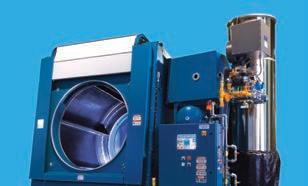
714F Montana Dr. Charlotte, NC 28216
B 704-395-1234 or 888-253-5004
O www.consolidatedlaundry.com
r Billy Kincaid l bkincaid@consolidatedlaundry.com
Gardner Machinery Corp. E P 700 N. Summit Ave. Charlotte, NC 28216
B 704-372-3890
O www.gardnermachinery.com
r Tim McClure l gmc@gardnermachinery.com
T & L Equipment Sales E P 1001-A N. Church St. Charlotte, NC 28206
B 704-372-8615 or 800-423-7937
O www.washcycle.com
r Lamar Thomas l lthomas@washcycle.com

TLC Tri-State E P 5257 Pit Road South Concord, NC 28027
B 704-454-7220 or 800-634-7429
O www.tlctristate.com
r David Chadsey l dchadsey@tlctristate.com
AAdvantage Laundry E P O Systems 101 High Hope Lane Garner, NC 27529
B 919-615-2834 or 800-880-2138
O www.aadvantagelaundry.com
r Jason Napier l jnapier@aadvantagelaundry.com
Tingue E P 7009 Cessna Dr. Greensboro, NC 27409
B 336-664-0012 or 800-222-9954
O www.tingue.com
r Randy Vansparrentak l rvansparrentak@tingue.com
Hulon McCraw Inc. T C P O 5222 Brevard Rd. Horse Shoe, NC 28742
B 828-891-8871 or 800-962-5631
O www.mccraws.com l info@mccraws.com
Consolidated Laundry E O Equipment 530 Maywood Ave. Raleigh, NC 27603 B 919-832-4624 or 800-227-6149 O www.consolidatedlaundry.com r Billy Kincaid l bkincaid@consolidatedlaundry.com
Rocky Mount Cord Co. T 381 N. Grace St. Rocky Mount, NC 27804 B 252-977-9130 or 800-342-9130 O www.rmcord.com r Andy Barker (ext. 124) l abarker@rmcord.com
N.S. Farrington & Co. C P O 2355 Farrington Point Dr. Winston-Salem, NC 27107 B 336-788-7705 or 800-722-0374
OHIO
Advantage Equipment E C P 1660 Scenic Way Akron, OH 44310 B 330-475-8220 or 888-676-5079
Belenky Inc. E P 1601 Frederick Blvd. Akron, OH 44320 B 330-867-3333 or 800-235-3659
Robert Minster (ext. 207)
The M&L Supply Co. E C P O 987 E. Tallmadge Ave. Akron, OH 44310 B 330-633-6241 or 800-328-6000
www.m-lsupply.com
info@m-lsupply.com
Calsco Inc. E T C P O 1114 Ferris Rd. Amelia, OH 45102 B 513-753-9750
O www.nsfarrington.com r John Erskine l info@nsfarrington.com
O
www.advantageequipment.net r Scott Vlahos l svlahos@advantageequipment.net
r
O www.belenkyinc.com
l info@belenkyinc.com
O
l
or
O www.candwcorp.com r Matt Wright or Bob Folchi l m.wright@candwcorp.com Lakeside Laundry E Equipment Co. 26851 Richmond
Bedford
B
O www.lakesidelaundry.com l sales@lakesidelaundry.com Cincinnati Laundry E P O Equipment 2648 Spring Grove Ave. Cincinnati, OH 45214 B
or
O www.cincinnatilaundry.com r Ron Randolph l cle@cincinnatilaundry.com H-M Co. O 2305 Gilbert Ave. Cincinnati, OH
B
O
r Joe Stern l hmco123@aol.com Machinex E P 7654 Production Dr. Cincinnati, OH
B
O www.machinexonline.com l machinex@machinexonline.com Hildreth’s Commercial E P O Laundry Equipment www.AmericanLaundryNews.com AMERICAN LAUNDRY NEWS | SEPTEMBER 2016 21 800.611.6806 www.EllisLaundry.com WE FOUND LOST CASH IN YOUR LAUNDRY. If you want to stop losing money to your dryer, you need to get a machine that’s efficient. The Ellis WHISPERDRYer is your best bet. Given a 450 lb. load of new terry towels, it can dry the load in 21.76 minutes. That means it’s working at 1651 BTUs per pound of water removed. In other words: it’s efficient. The Ellis WHISPERDRYer means increased productivity and lower operating costs. It’ll make sure your money doesn’t get lost in the wash. ALN_Jr Page.indd 1 8/1/16 5:30 PM
800-443-3573
Rd.
Heights, OH 44146
216-475-2040 or 800-628-2588
513-542-5000
877-542-3300
45206
513-281-3832 or 800-365-1900
www.draintroughs.com
45237
513-771-4020
1282 Essex Ave. Columbus, OH 43201 B 614-297-1480 or 888-282-0201 O www.hildrethnet.net r Todd Hildreth l thildreth@hildrethnet.net
Super Laundry E P O dba Ohio Laundry Equipment 2268 Westbrooke Dr. Columbus, OH 43228 B 614-258-5147 or 800-466-1262 O www.superlaundry.com r Tom Duckworth l ohiolaundry@aol.com
Teeters Products E P O 125 E. Second St. Fletcher, OH 45326 B 937-368-2376 or 800-521-9864 O www.teetersproducts.com l info@teeterproducts.com
R.W. Martin & Sons E P 310 Park Ave. Kent, OH 44240 B 330-673-8712 or 800-635-4363 O www.rwmartin.com r Jeff McLain l info@rwmartin.com
Bonneau Dye, Div. of C Kingscote Chemicals 3334 South Tech Blvd. Miamisburg, Ohio 45342 B 937-886-9100 or 800-394-0678 O www.bonneaudyes.com r Tim Muldoon l sales@kingscotechemicals.com
E.J. Thomas Co. C O 5101 Forest Dr., Ste. C New Albany, OH 43054 B 614-294-3373 or or 800-282-2748 O www.ejthomascompany.com l service@ejthomascompany.com
Moore Services E C P 29500 Aurora Rd., Ste. 4 Solon, OH 44139
B 440-498-0200 or 800-941-MORE O www.mooreservices.info r Jerry Moore l mooreservices@aol.com
Great Lakes E C P O Commercial Sales 417 Helke Rd. Vandalia, OH 45377 B 937-435-4382 or 888-877-4382
O www.greatlakeslaundry.com r Mike Enz l info@greatlakeslaundry.com
OKLAHOMA
Arrow Machinery Co. E P 1121 N. Martin Luther King Ave. Oklahoma City, OK 73117
B 405-424-4318 or 800-835-9274
O www.arrowmachinery.org l arrowmachinery@arrowmachinery.org
Elite Equipment Co. E P O 4400 S.W. 134th St. Oklahoma City, OK 73173
B 405-692-4800 or 800-335-3600
O www.eliteequipment.com
r Marty Jackson l marty@eliteequipment.com
FabriClean Supply E P O of Oklahoma 201 N. Ann Arbor Oklahoma City, OK 73127
B 405-232-9289 or 800-654-4117
O www.fabricleansupply.com l terrys@fabricleansupply.com
AAdvantage Laundry E P O Systems
7626 E. 46th Pl. Tulsa, OK 74145
B 918-627-2138 or 800-880-2138
O www.aadvantagelaundry.com
r Daniel Kramer l dkramer@aadvantagelaundry.com
OREGON
True Color Fabric Dyeing T
2305C Ashland St., #281
Ashland, OR 97520
B 541-488-5911
O www.fabricdyeing.com r Sherry Smilo l info@fabricdyeing.com
Arent Machinery Co. E P O 15815 S.E. 135th Ave.
Clackamas, OR 97015
B 503-657-3000 or 800-547-2527
O www.arentmachinery.com r Jay-Dee Arent l jaydee.arent@arentmachinery.com
Absolute Laundry E P Systems Co.
2063 Roosevelt Blvd., Ste. 4 Eugene, OR 97404
B 503-534-3544 or 877-461-4523
O www.absolutelaundry.com r Lisa White l sales@absolutelaundry.com
Northwest Laundry Supply E P O 6722 N.E. Columbia Blvd. Portland, OR 97218
B 503-282-1455 or 877-242-2057 O www.northwestlaundrysupply.com l chadj@northwestlaundry.com
Washington Automated E P 7236 S.W. Durham Rd., Ste. 700 Portland, OR 97224
B 503-570-3350 or 800-422-0380 O www.washingtonautomated.com r Don Whisenhunt l info@washingtonautomated.com
Western State Design E P 6722 N.E. Columbia Blvd. Portland, OR 97218
B 503-222-4288 or 800-633-7153 O www.westernstatedesign.com r Jim Wright (ext. 103) l jwright@westernstatedesign.com
Peterson Equipment Co. E P 151 N. Front St. Woodburn, OR 97071
B 503-981-4032
O www.peterson-equipment.com r Russell Peterson l russell@peterson-eq.com
PENNSYLVANIA
MedSystems International T 155 State St. Baden, PA 15005 B 412-367-7222
O www.msitextiles.com r John Edmondson l sales@msitextiles.com
Olek Belts
P O 443 Mill Rd. Bensalem, PA 19020
B 215-638-4550 or 800-869-2683
O www.olekbelts.com r Denise Crooks l olekbelts@aol.com
Butler Staple Co. E P O 241 North Rd. Butler, PA 16001
B 724-287-6980 or 800-821-8842
O www.butlerstaple.com r Ray Eilenfeldt l info@butlerstaple.com
PAC Industries E P O 950 River Rd. Croydon, PA 19021
B 215-638-1000 or 800-972-2292 O www.pacindustries.com l info@pacindustries.com
M.C.H. Equipment E P
421-A Philmont Ave. Feasterville, PA 19053
B 215-355-3778 or 800-399-5237 O www.mchequipment.com
l info@mchequipment.com
PAC Industries E P 5341 Jaycee Ave. Harrisburg, PA 17112 B 717-657-0407 or 800-692-6214
O www.pacindustries.com r Joseph Leo l sales@pacindustries.com
AC Power Co. E P O 77 Steamwhistle Dr. Ivyland, PA 18974
B 215-364-3430 or 800-362-1900 O www.acpowerco.com r George Gibbs l info@acpowerco.com
CILS E P 36 N. 16th St. Lebanon, PA 17042
B 717-274-2693 or 888-820-2457
O www.cils-inc.com r Tony Mohl or John Noss l info@cils-inc.com
Alco Washer Center E P O 1243 W. State St. New Castle, PA 16101 B 724-658-8808 O www.alcowasher.com r Francis DeJulia l alco.washer@verizon.net
Frankford Machinery E P O 4500 Torresdale Ave. Philadelphia, PA 19124 B 215-289-3434 O www.frankfordonline.com r Nick Kashkashian l info@frankfordonline.com
Pittsburgh Laundry Systems E 7500 Washington Ave. Pittsburgh, PA 15218 B 412-351-4500 O www.pittsburghlaundry.com r Sonny Rogalla l sonny@pittsburghlaundry.com
Sea Isle Corp. T 5447 Guarino Rd. Pittsburgh, PA 15217 B 800-722-0429 O www.seaislecorp.com r Bill Halpern l seaisleco@aol.com
Super Laundry Equipment E P 1201A Brighton Rd. Pittsburgh, PA 15233 B 412-697-9201 or 877-404-7278 O www.superlaundry.com r Bob Guyer l bob@superlaundrypa.com
Central Pennsylvania E P Laundry Equipment 231 Rear E. Main St. Shiremanstown, PA 17011 B 717-761-3617 or 800-242-5520 O www.centralpalaundry.com r Andy Courtney l cple1@verizon.net
RHODE ISLAND
Norton Supply Co. E C O 65 Bath St. Providence, RI 02908 B 401-454-8380 or 800-869-7664 O www.nortonsupply.com r Bill Mark l sales@nortonsupply.com
SOUTH CAROLINA
Texchine Inc. E P 207 Beaufort St. Chapin, SC 29036 B 803-345-5171 or 800-768-8205 O www.texchine.com r Bob Halpin l bobhalpin@texchine.com
East Coast Water Systems E P
520 Folly Rd., PMB 325, Ste. P Charleston, SC 29412 B 843-225-6252 O www.eastcoastwatersystems.com r J.R. Gardner l jr@ecwsinc.com
Central Equipment Co. E P O P.O. Box 288 Columbia, SC 29202-0288 B 803-779-2390 or 800-766-0926 O www.centralequip.com l sales@centralequip.com
FabriClean Supply C O of Carolina 1200 1st Street South Ext. Columbia, SC 29209 B 803-776-7988 or 800-272-0540 O www.fabricleansupply.com l terrys@fabricleansupply.com
SOUTH DAKOTA
Richard-Ewing E C P O Equipment Co. 27121 S. Parklane Dr. Sioux Falls, SD 57106 B 605-368-2528 or 800-658-3368 O www.richard-ewingequipment.com r Al Christianson l al@richard-ewingequipment.com
Ryco Conveyors E P O 1512 E. 17th St. Sioux Falls, SD 57104 B 605-610-4026 O www.rycoconveyors.com l rick@ryco92.com or todd@ryco92.com
TENNESSEE
FabriClean Supply C O of Tennessee 4123 Appalachian Way Knoxville, TN 37918 B 865-689-1221 or 800-888-2234 O www.fabricleansupply.com l terrys@fabricleansupply.com
Cates Equipment Co. E P 1846 Vanderhorn Dr. Memphis, TN 38134 B 901-387-0023 or 800-489-0023 O www.catesequipment.com r Don Terrell l info@catesequipment.com
Ideal Chemical C O 4025 Air Park St. Memphis, TN 38118 B 901-363-7720 or 800-232-6776 O www.idealchemical.com r Sam Block Jr. l sblock@idealchem.com
Larry & Mike’s E P Laundry Services 6376 Winchester Rd. Memphis, TN 38115 B 901-546-8151 or 866-328-5173 O www.lmlaundryservices.com r Mike Leake l laundryservices@comcast.net
Allied Boiler & Supply E P O 419 S. Front St. Murfreesboro, TN 37129 B 615-890-5385 or 800-858-0484 O www.alliedboiler.com r D.J. Baughman l dj@alliedboiler.com
FabriClean Supply C O of Tennessee 741 Massman Dr. Nashville, TN 37210 B 615-254-5192 or 800-622-3479
O www.fabricleansupply.com l terrys@fabricleansupply.com
Star Distributing E T C P O
3729 Charlotte Ave. Nashville, TN 37209 B 615-298-5547 or 800-897-7570 O www.stardistributing.com
r Craig Gilbert l craig@stardistributing.com
Williams Sales E P
221 Shady Grove Rd. Nashville, TN 37214
B 615-885-2310 or 800-535-3733 r Dan Williams l williamssales@aol.com
TEXAS
Commercial E C P O Equipment Co.
15551 Wright Brothers Addison, TX 75001
B 972-991-9274 or 800-899-9379 O www.washerdryer1.com r John Francis john@ceclaundry.com
FabriClean Supply C O of Oklahoma
3412 W. Amarillo Blvd. Amarillo, TX 79106
B 806-374-2851 or 800-648-9665 O www.fabricleansupply.com l terrys@fabricleansupply.com
RAMCO Laundry E T P O Machinery
301 E. Stephens St., Ste. 100 Arlington, TX 76018
B 817-640-5100 or 800-878-5578 O www.ramcolaundry.com r Ralph A. McMillan l sales@ramcolaundry.com
FabriClean Supply C O of Houston 2089 Main St. Buda, TX 78610 B 512-295-5550 or 888-301-4555 O www.fabricleansupply.com l terrys@fabricleansupply.com
Gulf Coast Paper Co. C O 1101 S. Padre Island Dr. Corpus Christi, TX 78467
B 361-852-5252
O www.gulfcoastpaper.com l corpuschristi@gulfcoastpaper.com
Atlas International E P O 2663 Freewood Dr. Dallas, TX 75220
B 214-350-1234 or 800-727-9274 O www.atlaslaundry.com r Uli Mandelbaum l sales@atlaslaundry.com
Ed Brown Distributors E P 2705 Hawes Ave. Dallas, TX 75235
B 214-352-9494 or 800-929-5520
O www.edbrowndistributors.com r Ed Blair l ed@edbrowndistributors.com
FabriClean Supply C O of Dallas 8301 Ambassador Row Dallas, TX 75247
B 214-826-4161 or 800-442-7021 O www.fabricleansupply.com l terrys@fabricleansupply.com
Texas Coin & Commercial E Laundry Distributors 8700 Chancellor Row Dallas, TX 75247
B 214-634-2080 or 800-888-0254 O www.txcoinlaundry.com r Kellie Blumberg l kblumberg@txcoinlaundry.com
Western Equipment Co. E 7024 Alameda Ave. El Paso, TX 79915
B 915-781-7060 or 800-906-1400 r Tony Byrne l equipcowestern@comcast.net
AAdvantage Laundry E P O Systems 3836 Dividend Dr. Garland, TX 75042
22 SEPTEMBER 2016 | AMERICAN LAUNDRY NEWS www.AmericanLaundryNews.com
B 972-278-2138 or 800-880-2138
O www.aadvantagelaundry.com
r Ryan Smith l rsmith@aadvantagelaundry.com
Intex Distributing Co. C O
1173 109th St.
Grand Prairie, TX 75050
B 972-660-1900 or 877-649-9904
O www.intexdistco.com
r Ben Henke l intexdallas@intexdistco.com
Kannegiesser-USA E P O
2425 109th St.
Grand Prairie, TX 75050
B 972-602-8766 or 800-344-0403
O www.kannegiesser-usa.com
r Phil Hart l sales@kannegiesser-usa.com

Pellerin Laundry E P Machinery Sales Co.
2009 108th St., Ste. 903
Grand Prairie, TX 75050
B 972-641-9590 or 888-830-6276
O www.pellerinlaundry.com
FabriClean Supply C O of Houston
9770 Wingfoot Houston, TX 77041
B 713-864-6373 or 800-233-4240
O www.fabricleansupply.com l terrys@fabricleansupply.com
Pro-Tech E T C P O
Laundry Systems
4544 S. Pinemont Dr., Ste. 214 Houston, TX 77041
B 713-797-9000
O www.protechlaundry.com


r Kerry Huynh
l info@protechlaundry.com
Rainbow Water Purification E O
12002 Cassadra Lane Houston, TX 77064
B 281-874-9736
O www.rwptexas.com
r Giovanni Sr. Varela l geo@rwptexas.com
Scott Equipment E P 5612 Mitchelldale Houston, TX 77092
B 713-686-7268 or 800-321-7268
O www.scott-equipment.com l sales@scott-equipment.com
Best Wash E P O
15012 Eddie Dr. Humble, TX 77396
B 281-441-2465 or 800-456-2378
O www.bestwashinc.com
r James West l sales@bestwashinc.com
Brim Laundry Machinery Co. E P
302 Nichols Dr. Hutchins, Texas 75141
B 214-630-4517 or 800-527-5886
O www.brimldry.com l website@brimldry.com
Intex Distributing Co. C 411 Tradesmens Park Dr. Hutto, TX 78634
B 512-474-6075 or 800-322-7131 O www.intexdistco.com
r Russ Dawson l intexaustin@swbell.net
Mustang Enterprises E 1238 W. Laurel San Antonio, TX 78201
B 210-734-3644 or 866-734-3644
O www.mustangenterprises.com
r Steven Dubinski l info@mustangenterprises.com
Rosenberg Supply T C P O 1608 N. Flores San Antonio, TX 78212 B 210-736-1873 or 800-777-1873 r Reuben Briseno l rosenbergsupply@hotmail.com
Dixie Paper Co. C 3010 Hwy. 31 E. Tyler, TX 75713-0729 B 903-597-4000 or 800-556-5002 O www.dixiepaper.net l paige@dixiepaper.net
UTAH
Mendenhall Equipment Co. E P 880 W. 100 North North Salt Lake, UT 84054 B 801-298-1133 or 800-537-0438 O www.mendenhallequip.com r Dana Jeppson l office@mendenhallequip.com
Reliable Equipment P O & Engineering 4245 Airport Rd. Ogden, UT 84405-3301 B 801-622-7000 or 800-366-4415 O www.reliableequipment.com l Reei2002@aol.com
Reliable Commercial E P O Laundry 243 N. Bluff St. St. George, UT 84770 B 435-652-1330 or 800-776-7197
O www.reliablecl.com r Wayne Hoppal l reliablecl@infowest.com
Brody Chemical C 6125 W. Double Eagle Cir. Salt Lake City, UT 84118 B 801-963-2436 or 800-488-2436 O www.brodychemical.com l richard@brodychemical.com
Evans Commercial E P Laundry Sales
3463 W. 1987 South Salt Lake City, UT 84104 B 801-972-6580 or 800-433-6859 O www.evanslaundryequipment.com r Aaron Burningham l aaron@evanslaundry.com
Katzson Brothers E T C P O 3493 W. 1500 South Salt Lake City, UT 84104 B 801-322-5757 or 877-534-4565 O www.katzson.com
VERMONT
Big Bill Work Wear T O 294 Crawford Rd. Newport, VT 05855 B 800-992-6338 O www.bigbill.com l usa@bigbill.com
Foley Distributing C P O 280 Seward Rd. (P.O. Box 99) Rutland, VT 05702 B 802-773-3738 or 800-950-3738 O www.foleydistributing.com l info@foleydistributing.com
VIRGINIA
Consolidated Laundry E O Equipment
209 Research Dr., Ste. 102 Chesapeake, VA 23320
B 757-547-5350 or 800-227-6149
O www.consolidatedlaundry.com r Kevin Kimber l k.kimber@consolidatedlaundry.com
Valley Washers E P O 18 W. Johnson St. Harrisonburg, VA 22803 B 540-434-8086 or 800-433-0506 O www.valleywashers.com r Gene Nemo l nemo@valleywashers.com
Caldwell & Gregory E 129 Broad St. Rd. Manakin-Sabot, VA 23103 B 804-784-6100 O www.caldwellandgregory.com
Commercial Laundry E P Equipment Co.
2507 Jefferson Davis Hwy. Richmond, VA 23234
B 804-231-9668 or 800-543-3499 O www.commlaundry.com r Tom Brittle l commerciallaundry@comcast.net

FabriClean Supply C O of Mid Atlantic
4311 November Ave. Richmond, VA 23231
B 804-232-6703 or 800-446-3006 O www.fabricleansupply.com l terrys@fabricleansupply.com
www.AmericanLaundryNews.com AMERICAN LAUNDRY NEWS | SEPTEMBER 2016 23
For over 50 years U.N.X. INCORPORATED has been
the
products that
only solve quality
customer
U.N.X. was built on the foundation of improving the industry in which we participate. U.N.X. prides itself on being an industry leader with state-of-the-art products and dispensing equipment, and our plans for the future are extraordinary. With a Research and Development team second to none, U.N.X. is in a position to provide the industry with the most technologically advanced products and dispensers as possible. U.N.X. INCORPORATED 707EArlingtonBlvd Greenville,NC27858 (252)756 8616 www.unxinc.com ALN_Tab_half 10/9/12 2:40 PM Page 1 See us at the Clean Show • Booth #2502 0513aln_UNX.indd 1 4/26/13 10:48 AM ALN_Tab_half.indd 1 8/6/13 11:38 AM
involved in
development of
not
problems that exist at the moment, but also provide long term benefits to the
and the environment in which we live.
www.AmericanLaundryNews.com
Richclean C O
2810 Ackley Ave. Richmond, VA 23228
B 804-262-7433 or 800-237-5825
O www.richclean.com
r Barry Gilman l supplies@richclean.com
Virginia Dry Cleaning E P O


& Laundry Equipment
2617 Egee Dr. Richmond, VA 23237
B 804-271-4401 or 800-767-1946



O www.vadrycleaning.com
r Chip Fletcher l chip@vadrycleaning.com
ValueLinen Resource T
Virginia Beach, VA 23456
B 757-471-2071
O www.valuelinen.com



l valuelinenresource@valuelinen.com
WASHINGTON
Washington Automated E P
5801 23rd Dr. West, Ste. 103 Everett, WA 98203
B 425-743-7388 or 800-422-0380

O www.washingtonautomated.com
r Andy Jacoby l andy.jacoby@washington automated.com


Dynamic Sales & Service E P O

12910 N.E. 125th Way, Bldg. B-3 Kirkland, WA 98034
B 425-823-4300 or 800-595-0253
O www.dynamicss.com
r Daniel Danhof l sales@dynamicss.com
CESCO
20830 International Blvd. Seattle, WA 98198
B 206-824-9055 or 844-442-3726
O www.cescoequipment.com
r Rich Boyd l rich@cescoequipment.com
Lind Industries E P 9615 Stone Ave. North Seattle, WA 98103
B 206-517-5463 or 866-517-5463
O www.lindindustries.com
r Neil Lind l sales@lindindustries.com
Northwest Laundry Supply E P O 6446 S. 144th St. Seattle, WA 98168
B 206-242-5500

O www.northwestlaundrysupply.com
r Chad Jergensen l chadj@northwestlaundry.com
Northwest Laundry Supply E O 624 N. Fancher Rd. Spokane, WA 99212
B 509-487-4800 or 800-487-4814 O www.northwestlaundrysupply.com r Craig Moore l craigm@northwestlaundry.com
Western State Design E O 14241 N.E. Woodinville Duvall Rd. Woodinville, WA 98072
B 425-483-5642 or 800-633-7153 O www.westernstatedesign.com r Rick Hall (ext. 102) l rhall@westernstatedesign.com
WEST VIRGINIA
E P O
Char-Ann Equipment Co. E P 2505 Elizabeth Pike
Mineral Wells, WV 26150 B 304-489-9355 or 800-679-9350 r Ed Boice l charann@wirefire.com
WISCONSIN
Great Lakes E C P O
Commercial Sales 12705 Robin Ln. Brookfield, WI 53005 B 262-790-5885 or 800-236-5599 O www.greatlakeslaundry.com r Kirk Niswonger l info@greatlakeslaundry.com
Herb Fitzgerald Co. E O 13150 W. Glendale Ave. Butler, WI 53007-0465 B 262-783-5808 or 800-686-3489 O www.herbfitzgerald.com r Jim Fitzgerald l jim@herbfitzgerald.com
Wausau Chemical C 13137 W. Glendale Ave. Butler, WI 53007 B 262-783-4500 or 800-236-2200 O www.wausauchemical.com l info@wausauchemical.com
Belson Co. E 730 Lambeau Green Bay, WI 54303 B 920-499-1451 or 800-242-6324 O www.belsonprolaundry.com r Jake Paider l laundry@belsonco.com
Commercial Laundry Sales E P 1130 Elizabeth St. Green Bay, WI 54302 B 920-437-0947 or 800-662-8356
O www.claundrysales.com r Wayne Kuhn l sales@claundrysales.com
The Minnesota E C P O Chemical Co. N57W13250 Carmen Ave. Menomonee Falls, WI 53051 B 262-781-8630 or 800-328-5689 O www.minnesotachemical.com r Dan Baker l dabaker@minnesotachemical.com
Badger Laundry Machinery E P 3680 S. 60th St. Milwaukee, WI 53220 B 414-321-3636 O www.badgerlaundrymachinery.com r Jim H. Brown l badgerlaundry@gmail.com
Haiges Machinery E P 131 E. Wisconsin Ave. Pewaukee, WI 53072 B 262-523-4105 or 800-236-1144 O www.haigesmachinery.com r John Kubczcak l info@haigesmachinery.com
Wausau Chemical C 2001 N. River Dr. Wausau, WI 54403 B 715-842-2285 or 800-950-6656
O www.wausauchemical.com l info@wausauchemical.com
PUERTO RICO
Montequin Distributors E Calle 13 S.O. #903 Caparra, PR 00921 B 787-781-6390
O www.montequin.com
r Felix Montequin l office@montequin.com
Manuel Gomez Esteves Inc. E
P.O. Box 11380

San Juan, PR 00922-1380
B 787-251-4560


r Freddie De Jesus l mpereyo@coqui.net
Universal Equipment E Sales & Service Corp.
P.O. Box 194048
San Juan, PR 00919-4048
B 787-724-2448
O www.universalequipmentpr.com r Eng. Pablo Hernandez l pablo_uess@hotmail.com
MISSED GETTING YOUR COMPANY LISTED?
E-mail Digital Media Director Nathan Frerichs (nfrerichs@atmags. com) to learn how your distributorship can be added to our free online Distributors Directory at AmericanLaundryNews. com and to next year’s print edition!
24 JANUARY 2010 | AMERICAN LAUNDRY NEWS www.AmericanLaundryNews.com
24 SEPTEMBER 2016 | AMERICAN LAUNDRY NEWS
ALN_Jr_half.indd 1 2/8/16 4:41 PM It’s not just print anymore. BY MATT POE, EDITOR as small businesses, throughout Virginia and surrounding areas. That’s lot of linen to take in, process and get back to the customers, and Preston McElheney, president of Halifax Linen, says the company committed to supplying the products necessary to meet or exceed the industry standards expected in today’s professional With so much linen being processed, how can the company stay on top of it all, make sure that production is on track and performed properly, and the goods get to the appropriate places? Real-time McElheney. consequences of inefficiency or the unexpected are noticed when they impact the customer or laundry, or the next day after the costs or pain have been felt,” says Simon J. Allen, senior vice president at Late News www.americanlaundrynews.com INSIDE 18 See PROCESS BY MATT POE, EDITOR America are family-owned. That number includes many laundry operations. The challenge to keep the laundry business in the family. Justin B. Craig, Ph.D., clinical professor Family Enterprise, codirector of the Center for Family Enterprises, Kellogg School of that family businesses aren’t good succession, encourage you to go back to them and say there we don’t do very often,” he says. “The public companies, they rotate their CEOs every three to five years. Here, you’re going much longer tenure and you stay around and you absorb the misery from these financial cycles and During the Textile Rental Family Business Dynamics: Innovation in the Family Suite Craig discussed transition planning for family-run laundries and how to train up the next generation. “There are diverse range of issues you’ll be facing, depending on where you are in the life stage of the business and also Experts employee health, Process improvement, savings achieved in laundries through real-time technology Continuity in family business [ on Page 10 Clean Act York City Council passed the Clean Act (intro. 697) by a unanimous vote July 14, says a spokesperson for Council Member Ritchie bill February 2015 unsanitary laundry practices within the city. The legislation requires cleanliness standards when taurants, hospitals, hotels, Torres’ office says that Mayor Bill de Blasio within 30 days of the Council’s 180 days after is signed, according to Torres’ laundries that are currently not licensed by the city Department of Consumer the law takes effect. laundries will be grandfathered in and will not expires. The licensing fee and as they have always been, the spokesperson says. Those amounts depend on the number of people a laundry employs. at Large managers, linen Planning, training are key to keeping a laundry business in the family and successful, says family business expert 16] Instantaneous laundry data means faster equipment, personnel corrections “THERE ARE A DIVERSE RANGE OF ISSUES YOU’LL BE FACING, DEPENDING ON WHERE YOU ARE IN THE LIFE STAGE OF THE BUSINESS...” —JUSTIN B. CRAIG, Laundry in Transition: Real-time reporting can give laundry management valuable snapshot of the plant’s operaLARGECAPACITY DRYERS PRODUCT SHOWCASE American Laundry News can now be viewed on tablets and other mobile devices – great ways to stay on top of the latest industry news and updates. www.americanlaundrynews.com The Newspaper of Record for Laundry & Linen Management 0916aln_House Digital Issue jr half.indd 1 8/10/16 9:40 AM
Technology and Product Exhibition was held in concert with this year’s Expo to provide a diverse platform for professional buyers, organizers say.
The China Public Textile Laundry Exhibition and China Laundry Franchise Exhibition also took place during the Expo.
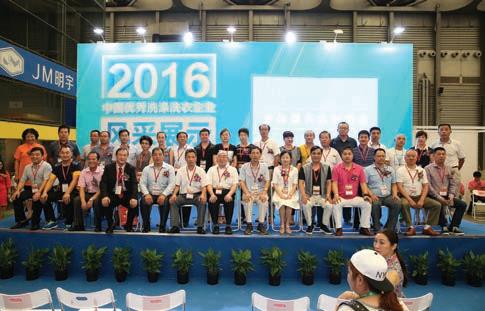
Power-oriented enterprises prefer to highlight their advantages on whole-line



optimization and supporting services, say organizers. Overseas enterprises are actively promoting their products to better adapt the Chinese market, while smalland medium-sized companies and new enterprises focus on the demonstration of single equipment and proprietary technology.
The biennial China Laundry Industry Award Ceremony also took place during the show. This was the third ceremony, which organizers say helps to establish industry benchmark through recognition and promotion to the people and enterprises who make significant contribution
to the industry.
For the first time, the Expo hosted the China Outstanding Laundry Service Companies Show, according to organizers. The show is meant to be a presentation of excellence in the laundry service area, and it has been positively supported by 26 industry associations of 21 provinces and cities from across China and participation of 156 laundry service companies, organizers say.
According to organizers, the show is a review on the China laundry service industry’s performance during the past 20 years to fully present the industrial overall development level.
Organizers say the China Laundry Expo has developed to be a world-class fair in the laundry industry, both in terms of scale and the number of participating brands and attendees. Next year, Beijing will host the show.
ALN
Innovations
The machine we chose has the capability of bagging two different products at the same time, allowing the operators to handle each item once. Once the bags are full, they are automatically sealed and conveyed to our clean collection belt.
We are excited about this labor-saving change and are currently changing as many units over to the new system
Poll
gets elected.”
Continued from Page 2
Another hopes for the best: “We need to reach out to each other to accomplish what is best for the country.”
While the Your Views survey presents a snapshot of readers’ viewpoints at a particular moment, it should not be considered scientific. Due to rounding, percentages may not add up to 100%.

Subscribers to American Laundry News e-mails are invited to take a quarterly industry survey anonymously online. All managers and administrators of institutional/OPL, cooperative, commercial and industrial laundries are encouraged to participate, as a greater number of responses will help to better define operator opinions and identify industry trends.


Continued from Page 4
prior to the arrival of the new piece of equipment.
ALN
ALN

Eric Frederick is director of laundry services for Carilion Laundry Service, Roanoke, Va., and a past president and manager of the year of the Association for Linen Management. You can reach him by e-mail at efrederick@carilion.com.

www.AmericanLaundryNews.com AMERICAN LAUNDRY NEWS | SEPTEMBER 2016 25
facebook/ americanlaundrynews Like our Facebook page Share our content Comment: Tell us what’s on your mind LIKE 0616aln_House Facebook jr_half.indd 1 5/5/16 5:19 PM ALN_Jr_half.indd 1 5/6/16 4:10 PM ALN_Jr_half.indd 1 6/8/16 9:19 AM
The
excellence in laundry service.
12
first China Outstanding Laundry Service Companies Show, held during the China Laundry Expo, honored industry professionals exhibiting
Expo Continued from Page
Unitex acquires Oceanside Institutional Industries in New York




MT. VERNON, N.Y. — Unitex, a regional business with locations throughout the Northeast in the healthcare laundry industry, recently acquired Oceanside Institutional Industries LLC, the company reports.



Terms of the deal were not disclosed.
Unitex says it will take over Oceanside’s business in Long Island and New York City, including six hospitals, 14 nursing homes and approximately 50 outpatient healthcare accounts.
“We are excited to be working with our new clients by way of this transition,” says David Potack, senior vice president of Unitex. “We feel this is a win-win situation and helps our new clients meet the needs of their patients in an effective manner. We are proud to serve them and look forward to long-term relationships with each of them.”

UniFirst opens high-tech facility in Baton Rouge
BATON ROUGE, La. — UniFirst Corp. hosted a grand opening for its new state-of-the-art commercial laundry plant here Aug. 11, the company reports.
The nearly 65,000-square-foot facility officially began operations on May 15, initially creating 35 jobs, with an expected number of employees to be closer to 75, according to the company.
“Our Baton Rouge location is a true showpiece for our company,” says Ron Croatti, president and CEO of UniFirst. “The facility allows UniFirst to demonstrate the latest high-tech processing systems that are among the most modern and efficient within the textile services industry. It will also enable us to consistently deliver the highest-quality services and products possible to area business customers.”
The company says technology automatically controls all garments and processes throughout the facility.
A software-controlled sling system feeds automated washers from overhead; garments are transferred from washers to the dryers and to other processing spaces by preprogrammed controls; the newest versions of tunnel finish-



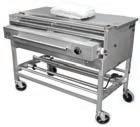
ers allow hygienically cleaned garments to be processed from wet to wrinkle-free dry; and all workwear is automatically sorted and prepared for shipping to customers at up to 4,000 pieces per hour via a proprietary sorting system.

The company also says the new facility is more efficient. UniFirst says its proprietary water treatment systems allow the reuse of approximately 20% of process water. The facility also supports greater energy efficiency through heatreclaiming equipment, contemporary warehouse lighting, modern rooftop HVAC units and more.
UniFirst says all cleaning formulas are 100% environmentally friendly, and that natural light throughout the plant offers a positive employee boost to the workday.
Continental Girbau’s Conference of Champions dedicated to distributor success

OSHKOSH, Wis. — Commercial laundry equipment manufacturer Continental Girbau’s recent Conference of Champions here brought distributors, vendors and business partners together for a four-day seminar focused on nurturing distributor success.
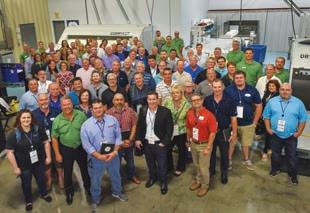
Motivational speaker and stand-up comedian Mack Dryden kick-started the conference, which featured an
array of presentations, product demonstrations and breakout sessions, along with ample time for group receptions, dinners and recreation, according to Continental President Mike Floyd.
Continental’s event included special presentations by Gustavo Gutierrez and Doug Scheer of LG Electronics, Jim Stiles of Lavatec Laundry Technology, Brian Grell and Jennifer Whitney of Eastern Funding LLC, and Albert Lee, owner of multiple vended laundries.
The culminating dinner featured an awards ceremony recognizing Continental’s 2015 Distributors of the Year, including Coronet Equipment, Darling’s Sales & Service, Fowler Equipment Co., Wholesale Commercial Laundry S.E. and Taylor Houseman. The Continental Business Partner of the Year was awarded to LG.
ALM adds three to board of directors
RICHMOND, Ky. — The Association for Linen Management (ALM) has appointed three industry professionals to its board of directors, the association reports.


James Mangini, RLLD, director of linen services for Maine Medical Center Linen Services, has been appointed to fill the unexpired term of senior vice president vacated by Cindy Molko, CLLM, RLLD, director of linen and central services at Mayo Clinic, following her election as president.

Molko has also appointed two new directors: Kathy Harris, CLLM, RLLD, laundry manager, Sea Island Laundry, and Janice Larson, CLLM, vice president clinical resources and consulting, Encompass Group LLC.
“All three bring a wealth of knowledge and influence. We are fortunate to have their expertise, talent and energy at our board of directors table as we continue to strengthen our goal of advancing excellence in the textile care industry,” says Molko.

26 SEPTEMBER 2016 | AMERICAN LAUNDRY NEWS www.AmericanLaundryNews.com
a
picture
Some attendees of Continental Girbau’s Conference of Champions pose for
group
following a
Girbau Industrial demonstration at the company’s headquarters in Oshkosh, Wis. (Photo: Continental Girbau)
Mangini
e ve o you covered! contact@davispackaging.net ▪ www.davispackaging.net 800-622- 3015 or 561- 290-0412 Parts Mini Bundlers Laundry Wrap Dual Roll Consoles Minimize Cost, Loss, and Contamination Simplify Content Identification and Delivery Enhance Your Delivery Presentation Laundry Wrapping Equipment & Supplies ALN_3rd Page.indd 1 8/1/16 9:30 AM Company Page Company Page INDEX OF ADVERTISERS A.L. Wilson Chemical Co. 9 ADI American Dawn 5 Consolidated Laundry Machinery 15 Davis Packaging 26 Direct Machinery Sales Corp. 28 Ecolab 19 EDRO Corp. 12 Ellis Corp. 21 Girbau Industrial 7 Hamilton Engineering 24 IPA 25 The Griffin Group, Inc. 28 Jensen 27 J.P. Equipment 28 Kannegiesser USA 17 LaundryCareers.com 28 Lavatec Laundry Technology 32 Leonard Automatics 27 Monarch Brands 10, 11 Pellerin Milnor 3 PSP Industrial 28 Royal Basket Trucks 8 Stanco Industries 28 Superior Uniform Group 16 UniMac 13 U.N.X. Inc. 23, 28 Venus Group 20
Harris
The three new board members will be joining returning board members Nathan Rivers, CLLM, RLLD, environmental protection specialist, C.W. Bill Young VA Healthcare System, ALM vice president; Shane Woodson, RLLD, general manager/director, SourceAmerica, ALM secretary; Richard Bott, RLLD, general manager, Intermountain Central Laundry, ALM treasurer; Randy Wendland, CLLM, ABM Healthcare Support Services, immediate past president; and Molko.
our business, but also always challenge our people to be the best they can and to provide the best products and support possible to our customers,” he says. “My vision is that we build a world-class legacy business that will go on for another 100 years.”
Robert Fesmire Sr. will continue as the chairman and CEO of Ellis Corp.
Cintas board chairman Kohlhepp to retire


CINCINNATI — Robert J. Kohlhepp has informed the Cintas board of directors of his intention to retire as chairman effective Sept. 30, the company reports.
Calendar



September
13-16 Universal Unilink LEADERSHIP16 San Antonio, Texas Info: 888-830-7872
19-21 Textile Rental Services Association Annual Conference Chandler, Ariz. Info: 703-519-0029








ITASCA, Ill. — Ellis Corp., a manufacturer of industrial laundry and water treatment equipment, has appointed Robert (Bob) H. Fesmire Jr. to president, the company reports.
During his tenure at Ellis Corp. over the past two decades, Fesmire has served in various roles throughout the organization. Most recently as the company’s executive vice president and chief operating officer, Fesmire oversaw a significant growth in sales, as well as the hiring of key personnel in the organization, according to Ellis.
Fesmire’s great-great-grandfather, Wynn Edward Ellis, founded the company in 1898.

“As the fifth generation of the company, I want to carry on the successful traditions of

Cintas says Kohlhepp has served as chairman for seven years. He has been a member of the board since 1979, and served as vice chairman from 2003 to 2009.
Kohlhepp has had nearly 50 years of involvement with Cintas, according to the company.
Cintas CEO Scott Farmer, who is also a board member, will be appointed chairman, according to Cintas. He joined the company in 1981 and held positions of vice president, a board member and COO. Farmer was elected CEO in 2003. ALN

21-22 Wisconsin Association of Textile Services Annual Fall Conference Greenfield, Wis. Info: 414-529-4702
22 Association for Linen Management Webinar: Do’s and Don’ts of Sterile Room Processing Richmond, Ky. Info: 859-624-0177























28-30 Ellis Corp. Washer-Extractor Maint. Seminar Itasca, Ill. Info: 630-250-4848





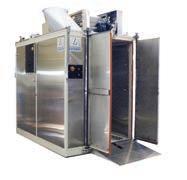
28- Performance Matters Oct. 1 Coaches Clinic—Service Training Seminar (Bravo Class)
Charlotte, N.C. Info: 704-277-6857
October
2-4 Textile Rental Services Association European Laundry Tour Info: 703-519-0029

17-21 Association for Linen Management Laundry and Linen College: Production and Operations Richmond, Ky. Info: 859-624-0177
20 Association for Linen Management Webinar: Converting from Disposable to Reusable Textiles Richmond, Ky. Info: 859-624-0177



26-27 Textile Rental Services Association Production Summit & Plant Tours New Orleans, La. Info: 703-519-0029 ALN

www.AmericanLaundryNews.com AMERICAN LAUNDRY NEWS | SEPTEMBER 2016 27
Ellis Corp. appoints Fesmire Jr. to president; Fesmire Sr. remains chairman/CEO
Larson Farmer Building more than the best equipment... ...building relationships that last. PO Box 501 Denver, NC 28037 ph: 704.483.9316 / fax: 704.483.4538 sales@leonardautomatics.com http://leonardautomatics.com Pressing Equipment Tunnel Finishers Cart Washers ALN_Jr_half.indd 1 7/26/16 12:01 PM ALN_Jr_half.indd 1 7/16/15 3:43 PM
Kohlhepp





28 SEPTEMBER 2016 | AMERICAN LAUNDRY NEWS www.AmericanLaundryNews.com Classified Advertising POSITIONS AVAILABLE For more classifieds visit: AMERICANLAUNDRYNEWS .com www. Call Craig Lloyd toll free at 877.295.5693 between 9 a.m. – 9 p.m. EST. Please visit www.laundrycareers.com to review current industrial/institutional laundry management openings. ADVANCE YOUR CAREER The Griffin Group, Inc. “Recruitment Specialist” Need to FILL a position? Call Deana Griffin 888-235-2365 www.thegriffingroup.cc deana@thegriffingroup.cc ® PARTS FOR SALE EQUIPMENT FOR SALE COMPLETE PLANT OF LAUNDRY EQUIPMENT FOR IMMEDIATE SALE For fastest service, call Ron Hirsch direct at 516-938-4300 Oceanside Laundry Facility closed! Direct Machinery is the exclusive dealer for all equipment in this sale. With the plant now closed, everything must go! HERE’S SOME OF THE SPECTACULAR EQUIPMENT: Senking CBW 20 Mod 110lb Tunnel (3) Senking CBW 12 Mod 110lb Tunnel (1) Colmac Steam Tunnel System 2100-2 Braun Folder/Crossfolders with Stackers Quincy & GD 200HP Screw Air Compressors Unipress Utility Press Braun 500lb Gas Dryers (8) Milnor 72072 500lb Gas Pass-Through System Dryers (2) American Hypro 8 Roll Ironers (8) Chicago Edge Maxx 2-Station Feeders (2) Chicago Edge Maxx Spreader Feeders (3) Challenge Pace Setter Gas Dryers (6) Challenge Pace Setter Steam Dryers (2) Braun Rear Discharge Small Piece Folders (10) Blanket System Edge Feeder & Skyline Folder (2) Jensen LTron 450lb Washers (3) Cleaver Brooks 400HP Boiler (1) Cleaver Brooks 400HP Dual Fuel Boilers (2) Norman Lift Tables Model 5 Ludell Heat Reclaimer Jensen 200 Pound L Tron (1) Sager Spreader Heat Reclaimer with two Stainless Steel 2500 Gallon Storage with Steam Bundle White Conveyors Jensen Single Stage CBW Extraction Press 20042007 (4) PLUS CONVEYORS, CARTS, LIFTS, SCALES AND MUCH MORE! CALL TODAY! U.N.X. INCORPORATED“ ” grow & expand U.N.X.! U.N.X. INCORPORATED WASHEX PARTS Hard-to-find Washex parts, on-site rebuilding, tech support. LAUNDRY PARTS CENTER 800-352-4492 Fax: 305-827-3991 PARTS, PARTS, PARTS Huge stock of parts for most laundry equipment & boilers. Also traps, valves and lubricants. Overnight delivery. Steiner-Atlantic, 800-333-8883 Fax: 305-751-8390 parts@steineratlantic.com www.steineratlantic.com EQUIPMENT FOR SALE AMKO AMERICA, INC. Remanufactured Finishing Equipment Delta Ironers, Omega Folders & Towel Folders PARTS, IRONER SUPPLIES & NEW EQUIPMENT ALSO AVAILABLE “NEW” SELF CONTAINED IRONERS Contact: (561) 863-9696 AmkoAmerica@gmail.com INTERNATIONAL EQUIPMENT GROUP Dealers in all Types, Makes & Sizes of pre-owned Laundry Processing Equipment & Supplies * buy * sell * liquidate * locate * * rigg & transport * email: loustanley69@hotmail.com Phone: 260 409-2547 EQUIPMENT FOR SALE We worry about it so you don’t have to Project Management, Consulting, Facility Planning, Rigging, Turn Key Installations, Equipment Appraisals & Reports. O ering turn key Laundry Solutions nationwide. IN STOCK EQUIPMENT FOR SALE: Qty Washex 480 LB & 700 LB W/X’s 2 Chicago Edge Maxx Feeders 3 Chicago King Edge & Kannegiesser Feeders 3 Chicago Skyline Sheet Folders 7 Lavatec TT745GU Gas Dryers 8 Braun Towel Folders 9 Challenge 400 LB Gas Tunnel Dryers 6 Rebuilt Milnor 170 LB W/X 1 Jensen EXPG-12 Self Contained Gas Ironer 1 Chicago Century 2 Roll x 42 Steam Ironer 1 www.pspindustrial.com Main: 1.800.517.1432 / 305.517.1421 Please visit our website for our complete inventory www.ineedjpequipment.com 800/925-3236 “Expect Excellence” DISTRIBUTOR OFFERINGS MERITEX LLC A subsidiary of Hilton Worldwide Piscataway, New Jersey We are seeking a suitable candidate to fill a Mechanic position. We offer competitive salary and excellent benefits. Candidate must possess strong electrical troubleshooting skills. Please apply online at: jobs.hiltonworldwide.com Position code MER0103 Hilton Worldwide is committed to a Drug-Free & Harassment Workplace; we are proudly EEO/AA Employer • 50 HP Atlas Copco Rotary Screw Air Compressor • 2001 Chicago Tristar 32”x120 Gas ironer with built in folder/ crossfolder • 1997 Chicago Tristar 24”x120 Gas Ironer with built in folder/ crossfolder • 1993 Chicago Imperial 48”x120” Gas Ironer • 200 lb Braun OP, non-tilting, single motor inverter drive • 200 lb Milnor OP • 2006 Braun 200 lb TSL • 900 lb Ellis Completely Reconditioned with new touchscreen controls from ellis • Challenge Dryer 400 lb gas dryer • 1993 Braun 440 Gas Dryer • 2009 Jensen Logic Feeder • 2000 Jensen Logic Feeder • 2005 Braun RTF Meterwide folder, BnR controls • 2005 Jensen Classic “s” Folder, Single lane with dual stackers • 2008 Chicago Pik Quik • 1998 Milnor 110 lb Softmount washer • 1995 Milnor 9 mod 90 lb G2 CBW with 2 stage press, shuttle, and 4 dryers. Great System • 1997 Passat Tunnel, UT5012 • 2002 Kann Press EP865-35 Stanco Industries, Inc. Serving The Textile Trades Since 1970 800-932-3769 k for Mike or Deb KEEPING IT GREEN SINCE 1970 FOR SALE: 1-1995 Braun 400# Open Pocket W/E 2-1993 Milnor 55# EP Plus W/E 1-Jenson Jenroll EXG8 Ironer and Folder WE NEED: • 450 Milnor 2-pocket Rapid-Load W/E • Hypro Ironers • Towel Folders • Direct Contact Water Heaters • Boilers • CBW ALL TYPES OF EQUIPMENT WANTED Stanco Industries, Inc. 800-932-3769 Ask for Mike or Deb or e-mail: stanco2626@aol.com www.StanCoInd.com TO PLACE YOUR AD CALL DON FEINSTEIN 312-361-1682





















www.AmericanLaundryNews.com AMERICAN LAUNDRY NEWS | SEPTEMBER 2016 29 Source Directory A convenient guide to sources of products and services APPAREL FINISHING CARTS, TRUCKS & BASKETS Source Directory listings in American Laundry News are sold on an annual basis at the following rates: All Major Credit Cards Accepted 2016 Listings Regular Boldface All Caps All Caps, Boldface Four Line Listing per Year $885 $1,110 $1,110 $1,175 Display and additional line rates available upon request CARTS, TRUCKS & BASKETS CARTS, TRUCKS & BASKETS AmericanLaundryNews.com More than unique visitors monthly! 5,250 CARTS, TRUCKS & BASKETS Enclosed_Carts_6.25x3:Layout 1 6/18/14 4:23 PM Page 1 Our sturdy workhorse holds more laundry on the same, classic footprint and fits neatly into your cart fleet. Optional, lockable, waterproof lid and door. Call now for free quote. DEPENDABLE We Put More Into Our Carts So You Can, Too! Call 800.829.4535|questions@MODROTO.com | MODRoto.com 72P M.I.T. POLY-CART 211 CENTRAL PARK WEST, NEW YORK, NY 10024 800-234-7659, FAX: 212-721-9022 WWW.MITPOLYCART.COM Diversified Plastics, Inc. 1309 Highway 917 West, Latta, SC 29565 800-768-7636, www.dpirotocarts.com E-mail: sales@dpirotocarts.com Fax: 843-752-7798 Get Rolling with The Best 800.304.4600 www.FIBERTECHINC.net We Create Environmentally Responsible Solutions

























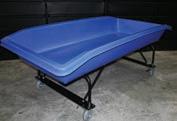


30 SEPTEMBER 2016 | AMERICAN LAUNDRY NEWS www.AmericanLaundryNews.com Source Directory listings in American Laundry News are sold on an annual basis at the following rates: All Major Credit Cards Accepted 2016 Listings Regular Boldface All Caps All Caps, Boldface Four Line Listing per Year $885 $1,110 $1,110 $1,175 Display and additional line rates available upon request Source Directory A convenient guide to sources of products and services FLATWORK IRONERS Knowhow In Action Your Tingue rep is a fully trained master of finishing equipment operation, maintenance and installation. Call for: • Pads, covers, belts, waxes, tapes and more • Carts, trucks, baskets and bags • Parts, rebuilds and repairs 800.829.3864 www.Tingue.com TalleyMachinery.com MODRoto.com TBR-Associates.com To website C & W EQUIPMENT (800) 443-3573 FLATWORK IRONER SPECIALISTS REMANUFACTURED IRONERS: Super Sylon Sylon Hypro’s Super Pro Jensen SS700 SS800 Ultima Lavatec UPGRADE KITS: Chain Drive Conversion Vacuum Systems Herringbone Conversion Canopies Inverters Side Covers Roll Springs Jensen Drives SUPPLIES: Aprons Pads Covers Belts Waxes Cleaners PARTS/REPAIRS: All Brands New/Refurbished/Hard to Find COMMITTED TO EXCELLENCE Pellerin Milnor Corp. P.O. Box 400, Kenner, LA 70063 504-467-9591, Fax: 504-468-3094 www.milnor.com DRYERS – 100 POUNDS OR MORE Pellerin Milnor Corp. P.O. Box 400, Kenner, LA 70063 504-467-9591, Fax: 504-468-3094 www.milnor.com DRYERS – 100 POUNDS OR LESS CARTS, TRUCKS & BASKETS CART-WASHING SYSTEMS Sani Wash - McClure Industries, Inc. 9051 SE 55th Ave., Portland, OR 97206 800-752-2821, www.mcclureindustries.com, info@mcclureindustries.com DRYER BOOSTER & EXHAUST FANS Gardner Machinery Corporation P.O. Box 33818, Charlotte, NC 28233 Ph.: (704)372-3890; Fax: (704)342-0758 www.gardnermachinery.com MATERIAL HANDLING / CONVEYORS americanlaundrynews www. .com www.energenics.com ENERGENICS KARTWASHERS FULLY AUTOMATIC KARTWASHER PREMIER W/TOUCHPAD 1470 Don St. • Naples, FL 34104 • 800-944-1711 Designed to wash and sanitize all popular laundry carts • Automatic two minute cycle • Dries and sanitizes • Minimum water useage Concentrates wash effectiveness on the cart interior Fast automatic washing, sanitizing and drying insure optimum cleaning • 15 second detergent wash and sanitizing rinse cycle • Adjustable automotive car wash style drying M c C LURE INDUSTRIES, INC. 800-752-2821 • www.mcclureindustries.com email: kim@mcclureindustries.com Sani-Trux is the only molded cart to pass rigorous independent laboratory testing for NFPA fire codes Made of durable fiberglass making the cart life at least twice that of a poly cart Easy to maneuver even in tight spaces Built with quality components to last years longer than other carts Visit our website for other models and avaliable options. We sell direct to all parties! DOBERMAN TUFF LAUNDRY CARTS ♦ RUGGED ♦ DURABLE ♦ QUALITY FINISHES TUFF STUFF, NOT TUFF PRICES ll -800-275-2436 -800-275-2436 maxi-movers.com Email:sales@maxi-movers.com Heavy duty polyethylene easy access tables. 50”W x 98”L x 35”H Ergonomic height reduces bending and reaching. MAXI SORTING TABLE Features powder coated steel frame and easy rolling 6” x 2” rubber, non-marking casters. Two braking casters. Chm #9805 ALN Sorting Table:Layout 1 8/3/16 10:21
Pellerin Milnor Corp.
P.O. Box 400, Kenner, LA 70063 504-467-9591, Fax: 504-468-3094 www.milnor.com
Pellerin Milnor Corp.



P.O. Box 400, Kenner, LA 70063 504-467-9591, Fax: 504-468-3094 www.milnor.com
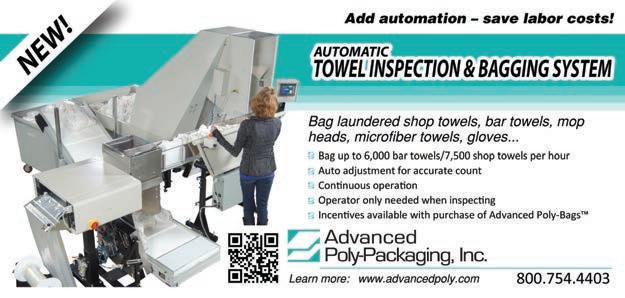









www.AmericanLaundryNews.com AMERICAN LAUNDRY NEWS | SEPTEMBER 2016 31 Source Directory A convenient guide to sources of products and services Source Directory listings in American Laundry News are sold on an annual basis at the following rates: All Major Credit Cards Accepted 2016 Listings Regular Boldface All Caps All Caps, Boldface Four Line Listing per Year $885 $1,110 $1,110 $1,175 Display and additional line rates available upon request PARTS PARTS PARTS & SUPPLIES • Door Handles • Door Locks • Print Boards • Bearing Kits • Drain Valves • Shocks • Heating Elements • Inlet Valves and more! QUALITY LAUNDRY PARTS, GREAT PRICES For questions and custom orders email info@FrontecStore.com (941)726-0808 • Door Handles • Door Locks • Print Boards • Bearing Kits • Drain Valves • Shocks • Heating Elements • Inlet Valves and more! For questions and custom ordersFrontecStore.com (941)726-0808 CINCINNATI LAUNDRY EQUIPMENT We stock all the parts you need! We have something for everybody! Parts for All Major Manufacturers 2648 Spring Grove Avenue Cincinnati, OH 45214 Phone: 513-542-5000 • Fax: 513-542-5022 www.cincinnatilaundry.com cle@cincinnatilaundry.com Your #1 AJAX Source! AJAX • CISSELL LAVATEC • ALLIANCE IPSO • HUEBSCH JENSEN HYPRO/SUPER SYLON HOFFMAN • VOSS PERMAC • Hotel • OPL • Coin Op • Dry Cleaners • Industrial • Commercial • Cruise Industry Dry or Wet Style Filters to Work with “ALL” Dryer Sizes or Multiple Situations, Fiberglass or Stainless and Custom for Unique Situations! Lint Filters Model Big and Small – We’ve got a model for you! In-line Duct” Models – the Lint Lasso and Lint Sock –in production since 2011 All manufacturing done on premise 800-826-1245 www.cleancyclesystems.com • ccsystems@tqind.com LINT COLLECTORS & FILTERS
WASHERS – CONTINUOUS BATCH WASHER-EXTRACTOR – 100 POUNDS OR LESS WASHER-EXTRACTOR – 100 POUNDS OR MORE SMALL-PIECE FOLDERS MAT ROLLERS
Milnor
Pellerin
Corp.
Pellerin Milnor Corp. P.O. Box 400, Kenner, LA 70063 504-467-9591, Fax: 504-468-3094 www.milnor.com PRESSES – EXTRACTION RFID GO TO: www.AmericanLaundryNews.com TO PLACE YOUR AD ONLINE www.energenics.com ENERGENICS CORPORATION TALK TO OUR DESIGN AND ENGINEERING STAFF ABOUT YOUR NEEDS 1470 Don St. • Naples, FL 34104 • 800-944-1711 ›› Our In-Line Lint Filter mounts inside, saves space! ›› OPL Duct Mounted Lint Filters 1,000 to 2,700 CFM ›› Fiberglass or Stainless Steel Dry Filters ›› Hundreds Sold Annually PACKAGING SYSTEMS & SUPPLIES MISSED OUR DEADLINE?
P.O. Box 400, Kenner, LA 70063 504-467-9591, Fax: 504-468-3094 www.milnor.com