Emerson Bearing Boston creates commercial laundry division


BOSTON — Emerson Bearing Boston has created a special division for the commercial laundry industry, the company reports.

Emerson Bearing Boston supplies bearings and related products, catering to original equipment manufacturers (OEM) and maintenance, repair and operations (MRO) markets.
Due to increased demand and a fast-growing commercial laundry customer base stretching across the U.S. and Canada, Emerson Bearing Boston says it established a dedicated Commercial Laundry division led by marketing specialist Mike Quinn.
The company says the new division caters to industrial laundries, including those that launder uniforms, bed linens, and restaurant tablecloths, as well as on-premises laundry facilities of hotels, hospitals, universities and other organizations.
According to the company, Quinn assists clients in determining which bearing technologies would be most suitable by taking into consideration the specifications, recommendations, maintenance strategies, fatigue life, and wear resistance of bearings in relation to the application. ALN
Lean laundries create more value for customers while using fewer resources
BY MATT POE, EDITOR
CHICAGO — Manufacturers
continually strive to do more with less, and that includes using fewer employees to get the same, or more, amount of work done.
Not just done, but done in a timely manner with high-quality results.
For laundry operations, that means using as few employees as possible to get soiled linens washed, dried and packaged properly and on time, and shipped back to the end-users or clients.
It may sound like the end result would be employees working their fingers to the bone and burning out, but that’s not the case. The idea is to have employees and equipment functioning at highly effective levels.
Graham Skinner, RLLD, general manager of laundry services, Mission Hospital, Asheville, N.C., relates this to the concept of running a “lean” operation.
“When I think of ‘lean’ in man-
ufacturing, and especially in laundry, it is more of a mindset and process that has to be embraced at all levels of an organization,” Skinner says. “As far as equipment, any equipment from any manufacturer can be made to operate in more of a lean manner. It’s more about how it ties into the adjacent equipment as it pertains to scheduling, output, staffing and demand. It all starts with training of management and front-line staff. Everyone has to be on board.”
So how can a laundry manager help his or her employees process textiles and linens at the highest level? That state of effectiveness can be reached through analysis, training and using the right equipment.
VALUE STREAM ANALYSIS
For Skinner, creating a lean laundry operation is more about timing and controlling workflow. He says that every plant is different, but they all perform the same process. Therefore, it’s important
to do a current-state value stream analysis (VSA) of the plant, which he says helps managers see and visualize where the wait times are that cost money and time.


“So many of us have been brought up to push the linen out the door. It is not always the best

Emergency preparedness for laundries takes planning
BY MATT POE, EDITOR
ATLANTA — Emergencies, such as natural disasters, happen without warning. These disasters can slow or even stop a laundry’s production if an emergency plan isn’t in place.
During the Industry Chat educational session at the Clean Show
here earlier this year, three panelists—Carolyn Christmas, executive director of environmental services, Wellstar Health System, Marietta, Ga.; Bryna Mason, Walt Disney World Textile Services, Orlando, Fla.; and William Turner, environmental services director at the LaGrange (Ga.) Medical Center—discussed several audience-submitted topics.
However, the one topic that generated quite a bit of interest was emergency preparedness and the value of conducting tabletop exercises—discussion-based sessions during which team members meet in an informal classroom
setting to discuss their roles during an emergency and their responses to a particular emergency situation—in order for laundries to be as prepared as possible to keep processing and delivering clean linens.
Mason says that being in Florida means that hurricanes do come through the area once in a while. One of the things she says Textile Services looks at is redundancy with the options the resort has available in the area.
“We are owned and operated by Walt Disney World, and so we have processes set up with other laundry facilities that if something
is to happen with our plant that they would assist us,” says Mason. “We also, as a company, look at what that means to us.”
She notes that the company has established all the necessary processes with its outside sources.
“Because we’re such a large facility, we have to be sure they’re able to handle it, or handle some of it,” says Mason. “To this day, knock on wood, we have not had to use [other laundries for major disasters], but if we do have situations where equipment breaks and so on, our outside partners, local
Panel of Experts
It’s vital that laundries
DECE MB ER 2015 Late News
Management www.americanlaundrynews.com Volume 41, Number 12 INSIDE [12] [14] See LEAN on Page 6
The Newspaper of Record for Laundry & Linen
use the correct chemical formulas.
[4] See EMERGENCY on Page 6
exercises valuable, according to hospitality, healthcare linen sources PRODUCT SHOWCASE DETERGENTS, CHEMICALS & INJECTION DETERGENTS, CHEMICALS & INJECTION SYSTEMS
Columnist at Large Eric Frederick explores the need for closet checks in textile distribution.
Tabletop
(Image licensed by Ingram Publishing)
Survey: Most managers
CHICAGO — Respondents to the most recent Your Views survey for American Laundry News are a thankful, hopeful bunch.
Almost 90% of respondents agreed with the statement, “I’m thankful because our operation is performing well.” Only 7.7% disagreed.
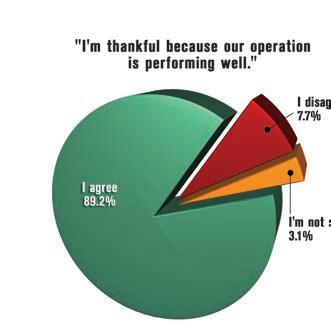
In fact, it seems that laundry operators have a lot to be thankful for. They were asked to name one aspect of their service for which they give thanks every day and why. Here are some of the responses:
• “My team. They take pride in what they do and is the best group I have had the privilege to work with in my 27 years in the industry.”
• “That our laundry department runs as well as it does, and having staff that all work as a team. It makes my job easier!”
• “Over 40 years in the industry, and that it has provided, through hard work, a wonderful life for myself and my family.”
• “I am always thankful for our circumstances of plenty of work. Been that way for decades.”
• “That we are growing, instead of shrinking, the customer base.”
• “Maintenance, because we have made great strides in the past two years in getting and keeping our equipment running in a proper and consistent manner, dramatically reducing our downtime while increasing our productivity, and more importantly, our quality.”
• “I work with great people, and our customers care about what they do. I have the chance to serve patients when they need us most.”
• “The opportunity to interact with and educate our end-users, and feeling good when we have good outcomes.”
• “I am thankful for those end-users/clients that do appreciate our service. Why? Because our job is laborious, yet rewarding (personally) in the end product, and when even a few people expect what you do and consider your role as vital, it can make all the difference in your professional relationships and employee morale.”
In terms of appreciation by customers, some 60% of managers who took the survey completely agreed with the statement, “Our (endusers or clients) appreciate our service.” More than 32% answered, “I somewhat agree.”
On the equipment side, almost 40% of those surveyed completely agreed with the statement, “Our equipment works well and isn’t a concern,” while 34.9% somewhat agreed.
However, there seems to be some equipment issues that need to be
addressed, since equal shares of 10.9% remarked “I neither agree nor disagree” or “I somewhat disagree.” Almost 5% of respondents completely disagreed with the statement.
The statement, “I’m confident that next year will be better for everyone,” generated overwhelmingly positive responses from respondents, with 53.1% completely agreeing and almost 30% agreeing somewhat. Only 3.1% completely disagreed with the statement, while 14.1% answered, “I neither agree nor disagree.”
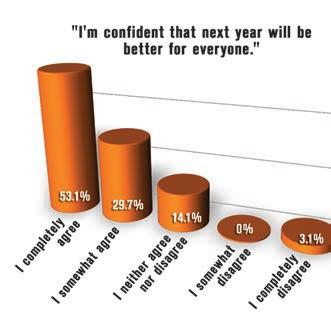
While managers who took the survey were mostly positive, no operation runs smoothly all of the time. In answer to a question asking them to identify the “biggest ‘turkey’—headache-causer” for their laundry, 45.2% answered “Employee(s).” More than 19% said equipment, while it is the end-user or client for 11.3%. More than 8% pointed to their chemicals supplier, and 1.6% pointed to their textiles supplier.
Of the 14.5% of respondents who chose “Other,” responses included the government, linen loss, employees that aren’t committed, local unions, and competition.
While the Your Views survey presents a snapshot of readers’ viewpoints at a particular moment, it should not be considered scientific. Due to rounding, percentages may not add up to 100%.
Subscribers to American Laundry News e-mails are invited to take the industry survey anonymously online each month. All managers and administrators of institutional/OPL, cooperative, commercial and industrial laundries are encouraged to participate, as a greater number of responses will help to better define operator opinions and identify industry trends.
Correction
The length of time between installation of a tunnel washer at Midwest Laundry and installation of its replacement, cited in October’s Sodexo, UC Health tap Lavatec tunnel system for Midwest Laundry , was listed
incorrectly. The correct period was 25 years.
American Laundry News regrets the error and apologizes for any inconvenience it may have caused.
Publisher
Charles Thompson
Phone: 312-361-1680
E-Mail: cthompson@ ATMags.com
Editorial Director
Bruce Beggs
Phone: 312-361-1683
E-Mail: bbeggs@ ATMags.com
Editor
Matt Poe
Phone: 231-740-2842
E-Mail: mpoe@ ATMags.com
Digital Media Director
Nathan Frerichs
Phone: 312-361-1681
E-Mail: nfrerichs@ ATMags.com
Advisory Board
Jim Buik • Richard Griffin
Greg Gurtler • Phil Hart
Janice Larson • Tom Marks
Gerard O’Neill
Richard Warren
Production Manager
Roger Napiwocki
National Sales Director
Donald Feinstein
Phone: 312-361-1682
E-Mail: dfeinstein@ ATMags.com
Main Phone: 312-361-1700 Fax: 312-361-1685
Subscriptions
630-739-0900 x100 www.americanlaundrynews.com
American Laundry News (ISSN 1091-9201) is published monthly. Subscription prices, payment in advance: U.S. 1 year $39.00; 2 years $73.00. Foreign, 1 year $89.00; 2 years $166.00.

Single copies: U.S. $7.00; Foreign $14.00. Published by American Trade Magazines LLC, 566 West Lake Street, Suite 420, Chicago, IL 60661. Periodicals postage paid at Chicago, IL, and at additional mailing offices.
POSTMASTER, Send changes of address and form 3579 to American Laundry News, Subscription Dept., 440 Quadrangle Drive, Suite E, Bolingbrook, IL 60440. Volume 41, number 12. Editorial, executive and advertising offices are at 566 West Lake Street, Suite 420, Chicago, IL 60661. Charles Thompson, President and Publisher. American Laundry News is distributed selectively to qualified laundry and linen management and distributors in the United States.
© Copyright AMERICAN TRADE MAGAZINES LLC, 2015. Printed in U.S.A. No part of this publication may be transmitted or reproduced in any form, electronic or mechanical, without written permission from the publisher or his representative. American Laundry News does not endorse, recommend or guarantee any article, product, service or information found within. Opinions expressed are those of the writers and do not necessarily reflect the views of American Laundry News or its staff. While precautions have been taken to ensure the accuracy of the magazine’s contents at time of publication, neither the editors, publishers nor its agents can accept responsibility for damages or injury which may arise therefrom.

MEMBERSHIPS
2 DECEMBER 2015 | AMERICAN LAUNDRY NEWS www.AmericanLaundryNews.com
Association for Linen Management
INSIDE: December 2015 • Vol. 41 | No. 12 [4] Textile Distribution (Part 2) Columnist at Large Eric Frederick discusses the benefits of regular closet checks in textile distribution [10] Staying on Top of Maintenance Needs In this month’s OPL 101 column, learn how technology and distributor support can help keep machines running well [12] Panel of Experts: The Right Formula “I like to learn about products, but how can I be sure I’m using the right chemicals and detergents in my operation?” [14] Detergents, Chemicals & Injection Systems Manufacturers highlight select products in their catalogs in this month’s Product Showcase [8] Tools of the Trade [18] Trade Ticker [20] Classified Advertising [21] Source Directory
ALN
look
to
thankful for 2015,
forward
2016
ALN
“
They have done everything they promised and more.”
– John Ambrose Magliocco, Arrow Linen, Garden City, NY
From

Arrow Linen first purchased their three Milnor CBW® tunnels two decades ago to replace conventional washer-extractors in their original laundry located in Brooklyn, NY. Since then, Arrow’s business grew to warrant a second laundry. In 2013, Arrow expanded operations–and raised their roof 11 feet! Arrow could have chosen any manufacturer to equip their new washroom, but they knew that would get longevity, durability, and accountability with Milnor.
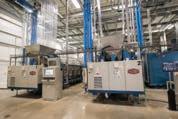
Arrow’s customers’ restaurant linen requires frequent color and soil change formulas, but the quality is not compromised. Corporate Engineer Frank Park boasted the tunnels “have increased our workload over 40% without increasing energy, water, or labor costs we experienced when we converted the conventional washers to CBW® tunnels over 20 years ago. The major improvements from the CBW® to PBW™ are far superior washing capability with only 50% water consumption.”
To find out how PulseFlow® can cut your water bill in half, contact an authorized Milnor distributor or call 504-712-7656.
www.milnor.com / pellerinmilnor
Scan to read Arrow’s success story.
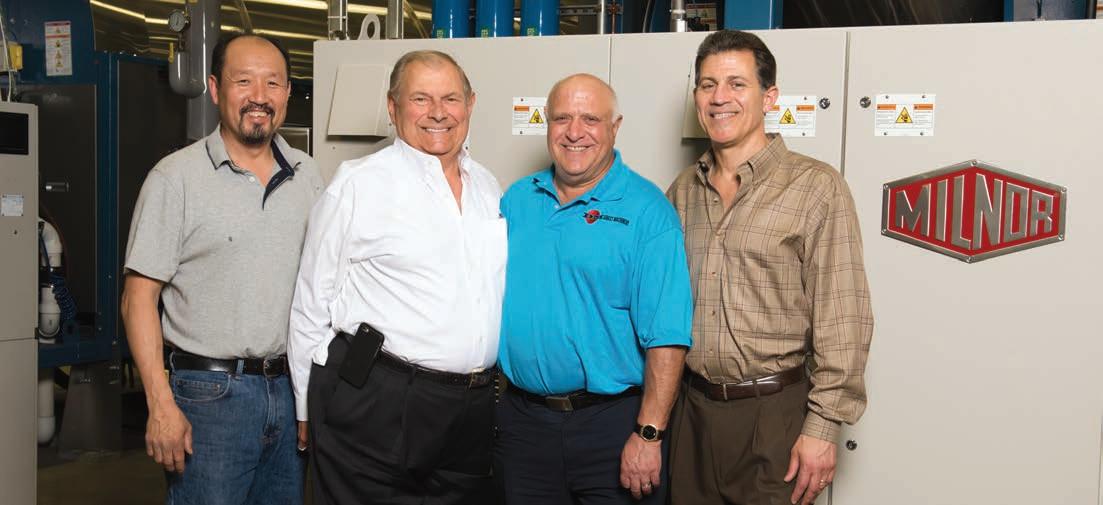
left to right: Frank Park, John Ambrose Magliocco, Ron Hirsch, and John Anthony Magliocco
Keep it lean, and plan ahead
Laundry managers and operators looking to cut labor costs and make employees more efficient and productive can learn something from Editor Matt Poe’s “Lean Laundries” cover story.
Laundry management and equipment manufacturing sources share several tips, from finding employees’ strengths and talents to making sure equipment is up-to-date, efficient and even in the right place to make operations run as smoothly as possible.
Elsewhere in this month’s issue, Poe writes that a group of experts at this year’s Clean Show discussed many topics during an “Industry Chat” and that one issue stood out: emergency preparedness.
The Director’s Chair BRUCE BEGGS
For the experts, the plan was all about being prepared in order to ensure that textiles and linens continue to be processed and delivered in a timely manner.
A key element discussed was conducting tabletop exercises with all parties involved. This

could be what’s needed at your facility to take your emergency plans to the next level.
Looking at on-premises laundries, they have a couple of options to keep operations running at peak efficiency. One method, says UniMac’s Bill Brooks in OPL 101, is to keep up on maintenance by utilizing available technology. Another is to work closely with equipment distributors and technicians to tackle any larger issues.

• • • • •
On behalf of Matt Poe and the rest of the American Laundry News staff, happy holidays!
Here’s hoping that 2015 has been productive for you, and that our magazine played some small part in making it that way. See you in 2016! ALN
Last month, I discussed the need to establish par levels based on peak day usage for each using area and finding textile storage areas for each using area that holds the required inventory.
The next key for excellent textile distribution is a periodic closet check to ensure that the closet has been properly restocked and textiles are left in a neat and orderly manner.
U.S. Bankruptcy Court
SYRACUSE, N.Y. — Coyne International Enterprises Corp will sell its business operations to three industrial laundry companies for a total of $43.45 million as part of its Chapter 11 proceedings. The transactions were approved Oct. 29 by Judge Margaret Cangilos-Ruiz of the U.S. Bankruptcy Court for the Northern District of New York in Syracuse.
The three buyers are Cintas Corp., Prudential Overall Supply Co., and Clean Uniforms and More!

“Since filing for Chapter 11, we have focused our efforts on concluding this process in an efficient and organized manner, and ensuring a seamless transition of our customers and routes,” says Mark Samson, Coyne’s CEO. “We believe all three buyers—Cintas, Prudential Overall Supply and Clean Uniforms—are each a good fit for providing the high-quality service that customers have come to expect from Coyne.”
At press time, Coyne was expecting to complete the sales by Nov. 30.
Cintas will purchase Coyne’s customer accounts and inventory in Bristol, Tenn.; Buffalo, N.Y.; Cleveland; London, Ky.; Syracuse; and York, Pa., for $28.25 million. Current Coyne employees may apply for any of Cintas’ open positions.
“As the premier uniform rental company in the industry, Cintas provides high-quality, innovative products and caring service to our customers. We look forward to a smooth transition and the opportunity to serve our new Coyne customers,” says Todd Schneider, president and COO of Cintas’ Rental Division.
Prudential Overall Supply Co. will purchase Coyne’s operations in Richmond, Va., and Greenville, S.C., for $10.2 million. The company will accept job applications from current Coyne employees.
“We are excited to offer Coyne Textile Services customers the best possible service experience,” says Tom Watts, president of Prudential Overall Supply.
This check should be performed within 15 minutes after the closet has been restocked; all textile items should be re-inventoried and compared with the expected stocking level. No textile item should be stocked above the maximum level. All linen items should be neatly stacked on the shelves. Textile items should be close to their desired stocking levels. Failure to periodically conduct after-delivery audits of textile closets will encourage the staff to underfill or overfill the unit and deliver more of an item that is in ready supply in place of one that is in short supply. Keeping a proper mix of linen items available in the main textile-distribution area is a real key.
Textile users have been known to create alternate storage locations for textile products if they believe in their mind that the textile supply is not dependable. Again, their major concern is that the patients that they are responsible for have the textile product they need. They are not looking out for the unit as a whole, or even for all the patients on a particular wing, but only for those patients for which they are responsible.
As such, these alternate textile storage areas are creative, and only known to that one person. It is amazing how many textile products a nursing staff can place into alternative storage areas when they feel it is needed. It can often become a self-fulfilling prophecy: “I do not believe that the textile distribution system can deliver my unit all the products it needs; we therefore take linen out of the linen room and move it to our alternative storage areas where it is to be used only in the case of an emergency.”
So many textile products are moved to alternative storage that it creates a shortage that reinforces the behavior.
The only way to stop textile users from filling private alternative spots is to deliver linen perfectly for nine months. Once the problem starts, it is very difficult to stop.
Sometimes, the textile distribution personnel do not have sufficient linens to deliver to the end-users because of problems experienced at the laundry facility. Even the best laundry will run into mechanical or staff problems that cause shortages of some textile products. The key is for laundry management to make sure these cases are rare and do not happen often. When they do happen, the distribution staff needs to be proactive and let the using areas know what is happening. They need to move textile products from area to area to make sure each piece is used as effectively as it can be. They need to pass on the when and why of the problem and the expected return to normal service.
Communication will aid in getting through the problem. ALN
4 DECEMB ER 2015 | AMERICAN LAUNDRY NEWS www.AmericanLaundryNews.com
From
COLUMNIST AT LARGE Eric L. Frederick, RLLD
Top Stories Appearing on AmericanLaundryNews.com for the 30 Days Ending November 15 (WE) = WEB EXCLUSIVE NEWS • Coyne’s Chapter 11 Bankruptcy Case Progressing, Has Buyers ... • Introducing HX: The Hotel Experience: Rooms to ... • In Memoriam: Sue Rose Wright Pellerin, Pellerin Milnor Corp. • AmeriPride Services Acquires Model Laundry • TRSA’s Hygienically Clean Healthcare Certification Earns ... NEWS (CONTINUED) • Tours of High-Efficiency Plants Highlights Upcoming TRSA ... • Texcare Asia Trade Fair to Reach Growing Markets COLUMNISTS/FEATURES • Sodexo, UC Health Upgrade Tunnel System for Midwest Laundry • Eric Frederick: Textile Distribution OUR SISTER WEBSITES From AmericanDrycleaner.com: • Rent the Runway Deepens Executive Bench • Texcare Asia Returns to Shanghai Next Month From AmericanCoinOp.com: • On-Demand Laundry Service Expands in Metro Areas (WE) • Too Small to Fail, CLA, Others Launch ‘Wash Time is ... (WE) Coyne business operations sales approved by
“TH E N EXT K E Y FOR EX CELLE NT TE XTI LE D IST RIBU T ION IS A P E RIODIC CLOS ET CH EC K TO E NSUR E TH AT THE CLOSET H A S B EE N PROP ERLY RESTOCK ED AND TE XTI LE S ARE LE FT IN A N EAT AND OR DE RLY MA NN E R.”
ON LY
TEXTI LE US E RS FRO M FI LLIN
Eric Frederick is director of laundry services for Carilion Laundry Service, Roanoke, Va., and a past president and manager of the year of the Association for Linen Management. You can reach him by e-mail at efrederick@carilion.com.
Textile distribution PART 2:
“THE
WAY TO STOP
G PRIVATE ALTE RN ATIV E SPOTS IS TO DELIV ER LIN E N P E RF ECTLY FOR NIN E M ONTHS. ON CE THE PROB LEM STA RTS, IT IS VERY D IFFI CU LT TO STOP.”
See
COYNE on Page 17





























800 821 2221 | imagine@americandawn.com | americandawn.com
by TM The LunchkinTM is intended to extend the color o ering of The Greenie. Six additional colors to replace paper napkins in any lunch setting. Beyond the environmental benefits of The Greenie, The Lunchkin creates a fine dining experience -- at lunch. And the cost is about the same or less than paper napkins! Made in USA Fabric
Milliken. Made in USA Fabric By Milliken.
Replaces single use paper napkins at a lower cost
Creates a better dining experience and sets you apart in the marketplace
Lasts over 100 wash cycles
Never ironed, less energy use
Saves up to 5 billion pounds of trash per year Signature Plus is a registered trademark for Milliken & Company for fabrics. • Smaller 15” x 12” Lap Size
Your table linens touch every Customer at every event. Your linen needs to speak their language… fresh, clean, safe, consistent, reliable, and yes - elegant. They count on it. Together, ADI and Milliken have set the standard of linen excellence for decades. USA made Signature Plus fabric. Soft luxurious hand, consistent long-lasting color. Whites that stay white, and colors that stay bright. ADI American Dawn. The world’s leading supplier of Milliken Signature table linen products. Count on us. The Greenie® is America’s choice to replace paper napkins! At breakfast and lunch, if every American uses reusable linen napkins instead of paper, we can save 60,000,000 trees per year! That means cleaner air, less water use, less energy use, less waste in landfills, less toxic paper production chemicals. And the best part... Money raised through the sale of this product is given back - to educate our children on keeping the planet clean and safe. 84% of Americans prefer cloth vs paper at the table. The Greenie® Because it’s the right thing to do.
Lunchkin
By
•
•
•
•
•
way,” Skinner says. “The best comment I ever heard about this was that the customer does not pay us for linen sitting around on a shelf or in buggies in our plant; they pay us for what we ship them.”
The VSA “map” can help managers and employees work more efficiently by identifying wasted movement, inventory, wait times and machine capacity, or lack of it, says Skinner. He says that the benefit of a current-state VSA map is that it shows a plant’s current efficiency percentage and where improvements can be made— then you get staff engaged to make it happen.
“You are trying to achieve a process of pulling the linen out you need, not pushing out quantities you do not need right now or have to sit and wait for finishing, ironing, etc.,” says Skinner.
One of the next steps, according to Skinner, may be to go back and do a future-state VSA. By using the current-state VSA, managers can create a new future-state map.
This future-state VSA can point out ways to eliminate the inventory of product not currently needed (that was simply being pushed through), according to Skinner.
Other factors the future-state VSA could help eliminate include wait times on products that were not at a machine yet, double handling, and eliminating bottlenecks in the flow.
“Sometimes you can actually improve efficiencies by slowing down certain areas of the process,” he says. “The map can help you do this.”
Skinner says that in many instances, if a VSA is done correctly, staffing requirements are reduced.
“For continued effectiveness, staff should not be laid off but redeployed, or utilize natural attri-
tion,” he says. “Some staff can be used to implement deeper lean training for the facility, so the process can feed itself with improved efficiencies.”
EMPLOYEE TALENTS
So, how does a laundry manager aid employees to do their best, most efficient work? One method is to find the talents and skills of each employee and place him or her in a position to make the best use of those talents.
Keith Pooler, vice president of Sacramento (Calif.) Laundry Co. Inc., recommends standard periodic reviews and team meetings to help employee evaluations and improvement.
mance,” says Pooler. “If a candidate has a consistent employment record, you will probably hire a pretty consistent employee.”
Mason suggests using a professional human resources person so that production staff isn’t spending time filling positions.
“Professionals understand what to look for, and they are not as challenged on time,” he says.
After an employee’s talents and skills are discovered, there are several methods to train up and enhance those skills. As Mason mentioned, laundries can create inside training programs or use outside sources.
Skinner notes that there are a number of other tools like 5S
“Change is always difficult, and some [employees] have a harder time than others with change,” adds Mason. “However, if you have handled the evaluations properly, there should be no surprise to the employee that another position is in everyone’s best interest, and they may actually be relieved.”
While maximizing the talents of individual employees can help a laundry operate in a more efficient and cost-effective manner, managers and operators can engage the entire workforce to elevate the level of production as a whole.
Creating a “company culture” for the entire staff is probably the hardest but most important thing one can do for his/her company in order to maximize the efforts of employees, Pooler says.
“Most of our employees are humble workers who want to support a company, but they lack the education or insight to always do what’s right for the company,” Pooler says. “We can train our employees how to operate a piece of equipment and produce linen at a certain rate, but we also have to educate our employees to the ‘why’ they are doing what they are doing.”
ciency and decrease big operational costs, such as labor and utilities,” says Steven Hietpas, business development manager, Maytag Commercial Laundry, Benton Harbor, Mich.
For Hietpas, the best way to improve overall efficiency of laundry room operations is to incorporate multi-load, high-speed washer-extractors. He says that extracting water in the washer instead of the dryer through higher spin speeds means linens will dry more quickly and gently, and less energy will be consumed.
Also, says Mason, the newer tunnel washers do not require monitoring, so there is not a need for a full-time employee to run the equipment.
“If there is an issue, alarms go off to alert maintenance,” he says.

In terms of dryers, says Hietpas, managers should select large dryers with high-performance airflow distribution systems and sufficient insulation and sealing to prevent the leakage of heated air. He says this allows the machine to dry linens faster using less energy. In addition, dryers with a reversetumble feature assist with efficient drying and reduce the amount of tangled sheets.
Terry Mason, regional manager, Faultless Healthcare Linen, St. Louis, makes a similar recommendation.
“We do development plans on all employees so we can assess their level of knowledge, and we continue to evaluate and train and help them grow into bigger positions, if that is their goal,” Mason says. “We utilize outside professional sources, as well as established inside training programs.”
Discovery of employee talents doesn’t have to only take place after a job candidate is hired. There are steps laundry managers can take during the hiring process to uncover these talents and strengths.
“When determining employee talents, past experience is usually the best predictor of future perfor-

deliveries for several days.
laundries, have helped us with that.”
Christmas says that WellStar has conducted tabletop exercises to help ensure linen supply continues for the healthcare facility in an emergency.
“Even though we have our own laundry, there are also other laundries within the city that provide laundry,” she says. “They are outside the facilities, and we have partnerships throughout the city with them, in addition to our linen providers and the things that they do.”
WellStar had a tabletop exercise in early April to look at all of the logistics and the infrastructure at the facility’s laundry, along with partner facilities. Christmas says staff discussed how the facilities could support one another in situations, such as having the limitation of not being able to make
(sort, straighten, shine, standardize and sustain) that can be used to improve workstation efficiency, cleanliness and staff satisfaction.
“Kazan events are effective in essentially forming a ‘hit team’ to fix a problem in a short amount of time that provide almost instant payback, if done correctly,” he says.
The training and “instant payback” often lead to employees taking on new roles in the plant, and managers need to be prepared for this in order to maintain output and to create a lean operation. Job shifts are a pretty common occurrence in the laundry industry, Pooler notes.
“One way to avoid the problems that come with change is to constantly and consistently be crosstraining,” he says.
“It was an interesting awareness of some of the things that we hadn’t thought about, because even though you may have a program in place, you don’t know what you don’t know until you’re faced with it,” she says. “It most certainly gave us an opportunity to look at a number of different things to make certain that we’re able to provide those laundries within our system.”
Christmas says that WellStar had the opportunity to utilize its emergency linen processes last year during a snowstorm and ice storm. She says the healthcare facility was challenged in terms of being able to transport linens.
“One of the things that we have done and had in place for all of our facilities is a three-day backup supply, because we don’t really anticipate things going beyond that timeframe,” says Christmas. “With the infrastructure that we have and the facilities that we have responsibility for, our laundry was able to get out prior to that and make certain
According to Pooler, if a manager can get every employee to understand “why” the laundry services the customers the way it does, then the company can “create” an employee who will act and make the right choice or decision when needed.
“Our goal is to provide training and educate our employees about what we do so they can do what is best for the company,” he adds.
PROPER EQUIPMENT
Of course, without the proper, most efficient equipment, employee training and utilization can only go so far to improve production and keep labor costs down.
“Outfitting laundry facilities with energy- and water-efficient commercial laundry equipment can significantly increase staff effi-
that all of the facilities were well stocked and prepared for that.”
Turner says that LaGrange has to conduct a certain number of tabletop exercises per year, especially in terms of partnerships with other laundries.
In a recent tabletop, the group discussed the topic of who are the “essential employees” that need to come into the facility during an emergency. Turner says that they learned that the essential employees are going to be laundry workers and housekeepers because there are no surgeries going on.
“In that tabletop, it was an eye-opener,” he says. “We basically try to get by with the bare minimum, but sometimes cleaning and providing these services are overlooked. We did learn something different in our tabletop.”
Another idea that came out of LaGrange’s last tabletop was that employees should bring in what they need, having a bag packed, even to the point of bringing some food in with them.
After the snow and ice storm last year,
“Commercial-laundry manufacturers are engineering the latest equipment with fully programmable controls—such as a set number of preprogrammed and industry-application cycles, plus the ability to program unique cycles for a facility’s specific laundry needs,” says Hietpas.
Automation is another way equipment can help produce labor savings. Examples of labor-saving, automated equipment include automatic cart dumpers, sling systems, conveyors and vacuum sorters/loaders, according to Pooler.
Through analysis, training and optimization, managers can find the right employee-equipment balance for their laundries. These efforts will make for a leaner, more efficient plant and more effective employees.
ALN
Christmas says that one of the laundry managers compiled a list, with input from others, for packing these specific items and keeping them in car trunks to be prepared for an emergency situation.
Mason says that Walt Disney World Textile Services asks for volunteers to work during emergencies because it knows that the laundry has to keep going.
“We’re still going to have guests in our hotel and usually if there is a natural disaster and people are staying there and the airports are closed, they would be there a little longer, and we still need to, as long as our trucks can go on the road, we need to have people there to do the linen,” she says. “We also make accommodations for our volunteers and their families and their pets.”
There are many considerations that need to be made when creating an emergency preparedness plan. Tabletop discussions and other strategy sessions can better prepare a laundry to keep up production on textiles when disaster strikes.
6 DECEMBER 2015 | AMERICAN LAUNDRY NEWS www.AmericanLaundryNews.com
Continued from Page
Lean
1
ALN Continued from Page 1
Emergency
“WE CAN TRAIN OUR EMPLOYEES HOW TO OPERATE A PIECE OF EQUIPMENT AND PRODUCE LINEN AT A CERTAIN RATE, BUT WE ALSO HAVE TO EDUCATE OUR EMPLOYEES TO THE ‘WHY’ THEY ARE DOING WHAT THEY ARE DOING.”
—KEITH POOLER SACRAMENTO (CALIF.) LAUNDRY CO. INC.
TWO ARE BETTER THAN ONE.
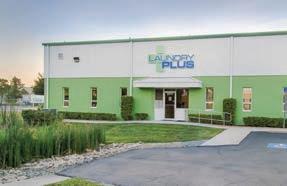
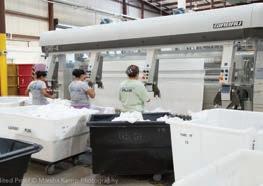
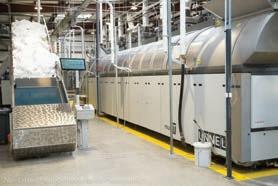
Happy with the productivity, efficiency and flexibility of his first Girbau Industrial (GI) tunnel system, Rick Rone of Laundry Plus maintains the decision to invest in a second identical system was a no-brainer. He likes the security they bring.
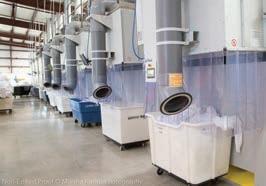



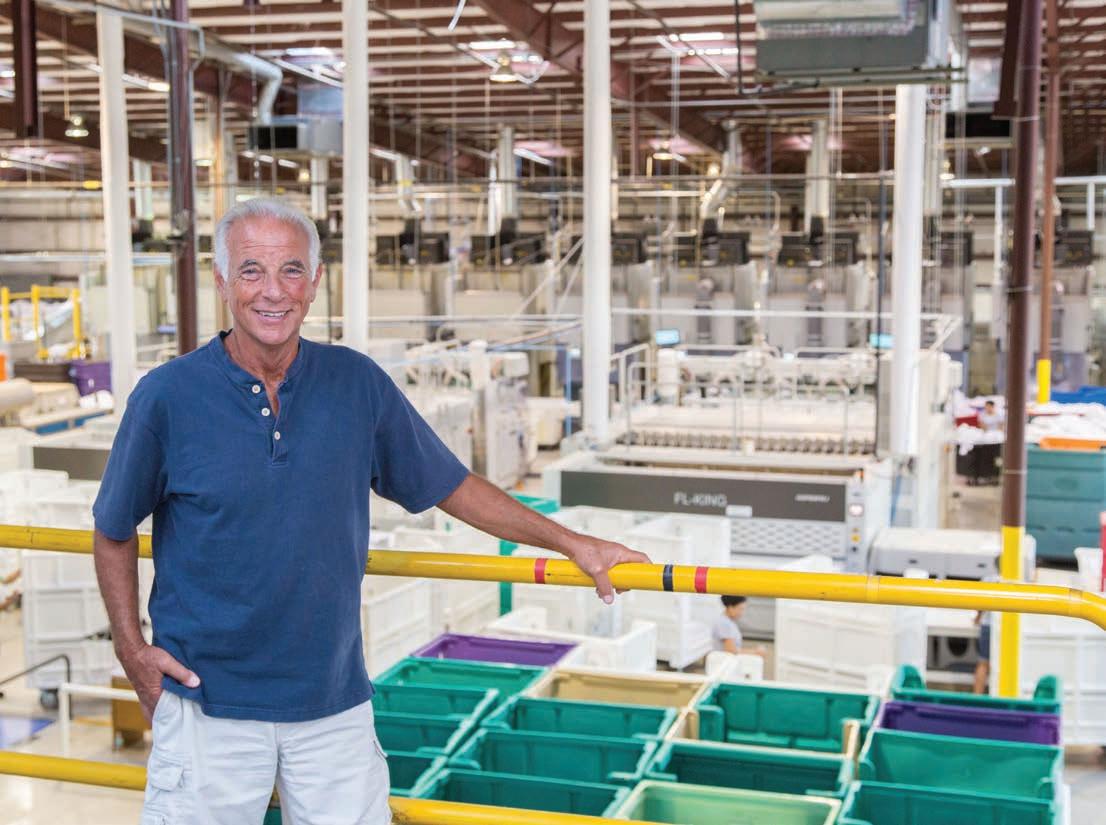
By adding a second GI tunnel system and moving equipment from two buildings into one, Rone enjoys streamlined production. The new plant – with its arsenal of high-performance equipment – opens the floodgates to new business, ensures backup in case of a mechanical failure, and allows Rone to launch a new linen rental program.



Since moving to the new plant and installing its second tunnel, another ironing line and additional open-pocket washers, Laundry Plus has boosted pounds of laundry per operator hour (PPOH) by 15-18 percent.


LAUNDRY SOLUTIONS FOR WET
ON-PREMISE
CONTACT GIRBAU INDUSTRIAL TO SEE HOW WE CAN INCREASE YOUR PPOH!
CLEANING,
& INDUSTRIAL LAUNDRIES
Rick Rone
www.girbauindustrial.com • (800) 256-1073 INDUSTRIAL
Laundry Plus, Bradenton, Florida
Tools f the Trade
Partnership expands textile offerings, ordering options
AmeriPride Services has expanded partnerships with Chef Works and Dickies that will enhance its uniform offering for the food and beverage (F&B) industry. In addition, the company announced the launch of new “Focused F&B eStores” that make it easier for restaurant customers to place orders and manage uniform programs online.

“Executive chefs have been asking us for more comfort and fashion for themselves and their team,” says Andrew Steiner, VP of marketing and customer operations at AmeriPride. “At the same time, managers are looking for uniform programs for their front-of-thehouse employees that support their restaurant image and are easy to manage. Chef Works and Dickies each have an incredibly strong brand presence in the F&B industry, and these partnerships allow AmeriPride to expand our offering and deliver a more diverse rental
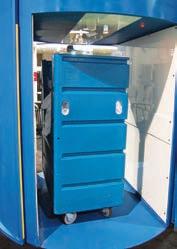
Bulk laundry carts from laundry product manufacturer MODRoto feature a rotationally molded plastic design that is highly compatible with RFID signal transmissions, the company says.
According to MODRoto, its product is ideal for textile services companies and other laundries that track individual linens such as towels, sheets, robes and gowns using RFID tags. The modern, plastic laundry carts allow an RFID signal to pass through the cart body and accurately read each tag, often achieving upward of 99.98% read rates, according to Herb Markman, CEO of Positek RFID.
For maximum RFID compatibility, the 101P Series laundry shelf carts, for example, include two plastic, non-removable shelves set inside the cart
and purchase offering to the market.”

In addition to the new products, AmeriPride is launching a new online ordering tool that it says will help restaurant customers simplify their uniform programs and manage costs by offering customized online stores with specific, approved products; logo customization options; and employee spending allowances.
Focused F&B eStores are the latest addition to AmeriPride’s suite of digital tools that were launched in the last year to help improve the customer experience and provide better service through technology. Together with the online Customer Portal, AmeriPride customers have more visibility and control over their uniform and linen programs, according to the company.
www.ameripride.com 800-610-3651
The HF Series Ozone System is the latest product from equipment manufacturer Wet-Tech.
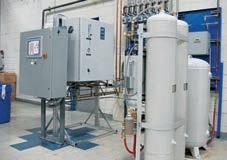


The company says the modular design of the HF Series not only infuses ozone into the wash process to allow for lower wash tempera-
ture, but it can also be directed to waste water, reuse water or any area where environmental clean-up may be necessary.
The equipment is currently installed on tunnel washers, as well as most conventional washerextractor equipment, according to Wet-Tech.
The company says it has received government recognition in Australia, as well as recognition in the U.S., Canada and UAE for greenhouse gas emission reduction.
www.wet-tech.com 508-831-4229

body, says MODRoto. The RFID signal may be read during cart makeup as clean linens are stacked upon the shelves and again when the cart is returned with its shelves converted into a bulk bin to hold soiled laundry.
The 72S bulk laundry cart, with its all-plastic design and metal-free interior, invites accurate RFID reading even with its lockable roof and door closed, since they are rotationally molded from plastic, according to MODRoto. The company’s vinyl cart covers also allow RFID signals to transmit properly without interference.
www.modroto.com 800-829-4535
High-capacity, compact folder suitable for variety of smaller pieces in tumbled terry, healthcare products
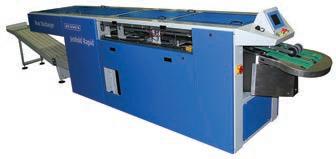
The JENSEN Jenfold Rapid Pro is a simple, high-capacity and compact small-piece folder for tumbled terry and healthcare products such as terry towels, pillowcases, scrub tops/ bottoms, patient/ISO gowns and incontinent pads, according to the company.
The primary fold is made as a 1/3 fold (French fold), up to 40 inches by 74 inches. The items are folded in motion by air blasts folding the piece with a horizontal movement across an adjustable template, ensuring a quality fold, yet maintaining a high speed and allowing a high potential throughput, JENSEN says.
The crossfolds can be made as 1/4, 1/2 or 1/3 (French fold) and are performed with a knife between pinch rollers.
Folded items are stacked in predetermined numbers on a climbing conveyor positioned under the machine.
The conveyor brings the stack up to an ergonomically correct unloading position at the back of the machine. A Return-To-Feeder design is also available, according to the company.
www.jensen-group.com 850-271-5959
Manufacturers: Have you introduced a new product? Revamped your system? Released a new catalog? E-mail your product news, along with a high-resolution image, to mpoe@atmags.com and we’ll consider publishing your news free in Tools of the Trade.



Working with Milliken & Co., ADI American Dawn offers two new products designed specifically for the lunch market.
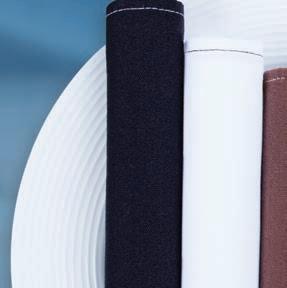
The Greenie® is smaller than traditional dinner napkins, with a 12-by-15-inch lap print, according to American Dawn, and the Milliken fabric lasts 80-100 cycles, just like traditional linens. While many launderers will press the product, ADI suggests that The Greenie® be delivered with a “natural” finish, thus saving even more energy in the process. This product comes in “Earth Green” color and has contrasting stitching (blue) with a yellow woven label.

The LunchKin® is exactly the same lap print as the Greenie®, says the company, and comes in six other colors: white, black, Caribbean blue, hazelnut brown, palm green and vanilla bean.
www.americandawn.com 800-821-2221
Workrite Uniform Company Inc.®, a flame-resistant (FR) clothing manufacturer, has launched a Workrite® FR product line, featuring 5.3-ounce GlenGuard® fabric.
The new Workrite FR GlenGuard 5.3 line offers one of the lightest-weight Category 2 fabrics available on the FR clothing market, according to the company.
Produced by Glen Raven, the GlenGuard fabric offers an arc thermal performance value (ATPV) of 9.5 cal/cm2, and is UL-certified to NFPA 2112, says Workrite. This new line aims to increase wearer compliance by providing an unprecedented level of comfort and protection, according to the company.
The new Workrite® FR line includes coveralls, shirts and pants in a variety of col-
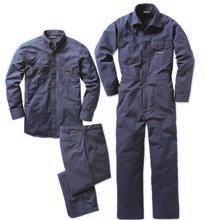
ors— all featuring the 5.3-ounce GlenGuard fabric, the company says. In addition to FR protection and comfortable, lightweight fabric, the garments also offer moisture management, durability and exceptional colorfastness––a hallmark of GlenGuard fabrics, Workrite says.
www.workrite.com 800-521-1888
8 DECEMBER 2015 | AMERICAN LAUNDRY NEWS www.AmericanLaundryNews.com
New ozone generators introduced to commercial linen market
Lunch napkins offer smaller lap print plus potential cost savings
molded plastic carts allow tagged linens to be accurately counted through cart body
Rotationally
New line of ultra-lightweight flameresistant clothing launched
Notice Anything?























InkGo® Is Now Odor Free!






InkGo has been reformulated to remove its odor… and to improve its performance.

















InkGo is still the environmentally friendly,* safe way to remove ink stains from all types of fabric. It’s still great at removing autoclave tape and adhesives. And since it’s odor-free, InkGo is more pleasant to work with.






Does odor really matter? As more drycleaners position themselves as good environmental stewards, keeping chemical odors in the plant to a minimum can help them differentiate from their competition. And odor-free is a real plus if you’re working on ink for an extended period of time.



Now that’s worth noticing!



*InkGo is Biodegradable and is California Prop-65 and California VOC Compliant.













Become a STAIN WIZARD at ALWilson.com

To learn more, visit ALWilson.com or call 800-526-1188 A. L. WILSON CHEMICAL CO.


OPL 101
Using technology, distributor support to stay on top of OPL maintenance needs
BY BILL BROOKS
RIPON, Wis. — Technology plays a significant role in not only running today’s onpremises laundry (OPL) operation, but also keeping machine downtime, labor and utility costs as low as possible.
OPL managers aim to run their operations at peak efficiency, and with the right equipment, technology and distributor support, this goal is more than manageable. Here’s what you need to know.
KEEP UP WITH PREVENTATIVE MAINTENANCE
All washers and dryers in an OPL should be monitored and serviced regularly to ensure they’re running at their optimal efficiency. Frequent preventative-maintenance checks help OPL managers avoid costly repairs down the road when small issues multiply and can create bigger problems. Your distributor should be able to work with you to determine and set up an automated maintenance schedule to monitor equipment aspects such as fill temperatures, water leakage and bearing grease.
While there are several methods to keep track of equipment maintenance, the easiest and most efficient way is through the technology and software included in your machines. It has the ability to monitor everything from cycle times to number of fills, number of drains to water temperature, idle time and more. This information is then used to alert laundry-room operators when service is needed. For example, machine bearings should be greased every 200 operating hours; advanced equipment can send the operator an alert when the 200 hours have been reached and the bearings need to be greased.
“The biggest single maintenance cost on a washer is replacement of bearings,” says Dave Angus, technical service supervisor, Daniels Equipment Co., a UniMac distributor located in Auburn, N.H. “If you don’t stay up to date with greasing your machine’s bearings, you will have to replace them much sooner.”
Leak-detection tests should also be run regularly to ensure laundry machines are not
wasting water or increasing utility bills and cycle times. A washing machine should be able to run selfdiagnostic leak-detection tests automatically, at a pre-set time or after a set number of cycles, without stopping or disrupting the work flow of a laundry operation. The technology will ensure all water and drain valves are working properly and display a message if any issues are discovered. Water leakage can be a problem that flies largely under the radar if regular tests are not performed. Sometimes the only indication of water loss is longer cycle times—as the washer will automatically refill the water it has lost—or higher utility bills.
“We recommend conducting leak detection tests once per week,” says Ralph Daniels, president of Daniels Equipment Co. “In our experience, early detection of water waste can save hundreds of thousands of gallons of water per year.”
TAKE ADVANTAGE OF ADVANCED REPORTING CAPABILITIES
OPL managers can quickly run electronic reports that detail the inner workings of laundry equipment and operations on a daily, weekly, monthly, quarterly and annual basis. Additionally, the results of these reports can be compiled and accessed electronically, which eliminates the need to store lengthy manuals and checklists. These reports can determine aspects of the laundry process as precise as cycle temperatures, which is necessary to confirm proper temperatures were achieved for chemical interaction, cleaning and safety.
Machine technology can monitor everything from aborted cycles to rapid cycles to idle time between loads, which can all impact a laundry operation’s labor costs and bottom line. The best technology can tell the difference between equipment problems and issues with the laundry process, so operating

issues are not redirected as maintenance issues. This gives OPL managers a better understanding of what’s happening in their laundry room—even if they’re not physically present—and the ability to set benchmarks to improve efficiency.
UTILIZE TECHNOLOGY TO ADDRESS MAINTENANCE NEEDS
When a machine issue does arise, technology can quickly diagnose the problem and expedite the solution. The most advanced equipment is able to determine the source of a problem immediately and send a service alert message to the operator.
“The alert is enough to ensure a rather prompt response from the staff due to its persistence,” says Brad Reichenbach, regional field service manager for UniMac.
For example, when an issue with moisturesensing technology arises in a tumble dryer, an alert will pop up on the control that asks the operator to confirm that a load is in the dryer. When a dryer does not obtain a moisture reading in the cylinder while a load is in progress, it instantly identifies that the moisture-sensing circuit is not working.
These alerts are crucial to helping OPL managers and staff technicians diagnose problems with their equipment, as well as determine the best way to fix them to prevent downtime. With the advanced controls on today’s machines, OPL staff is able to test
inputs and outputs without having to open the machine up and do traditional parts or circuitry testing. Diagnostic testing can be done from a computer, which requires less time than taking a machine apart. According to Daniels, this can save 20-30% on labor hours and service calls.
LEAN ON YOUR DISTRIBUTOR FOR SUPPORT
There is a certain peace of mind that comes with knowing that when a problem is too complex for OPL managers to fix on their own, they can turn to their distributor for support. Equipment distributors should have staff that has been trained by their equipment manufacturers to be certified to provide advice, service customers’ machines and have the expertise needed to fix any problem that may arise.
“When a machine needs service, we will receive the same alert on our computer that an OPL manager will get,” says Daniels. “If they don’t see it or don’t respond to it, we will call them and ensure they have what they need to fix the problem.”
The best distributors utilize machine technology to help their customers address problems more quickly than they could on their own. Daniels Equipment Co. receives quarterly reports for each of its customers’ individual machines; distributor representatives
10 DECEMBER 2015 | AMERICAN LAUNDRY NEWS www.AmericanLaundryNews.com
See OPL 101 on Page 19
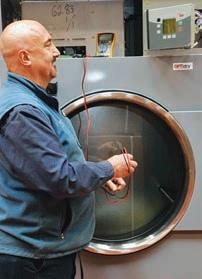
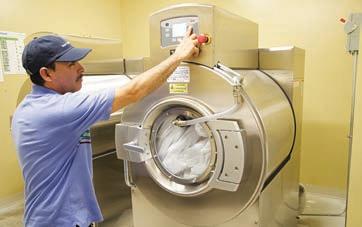
Left: Dave Angus, technical service supervisor, Daniels Equipment Co., services a machine. Above: A service technician repairs a machine that isn’t working properly. (Photos: Alliance Laundry Systems)
E ciency isn’t just about energy.
Count on the EcoWash lineup to boost your productivity.

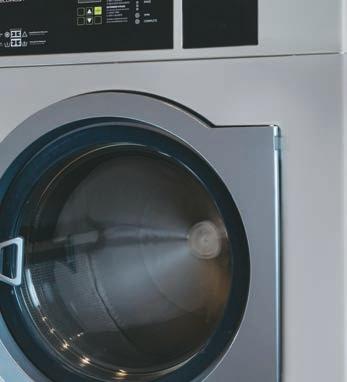
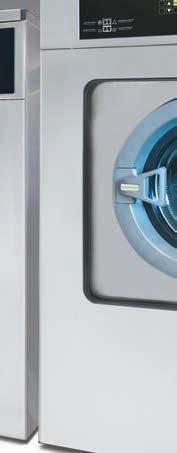
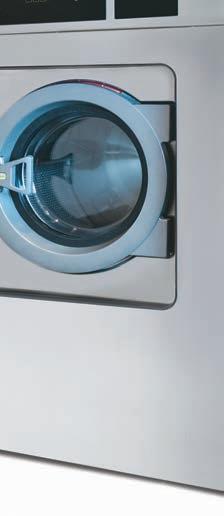
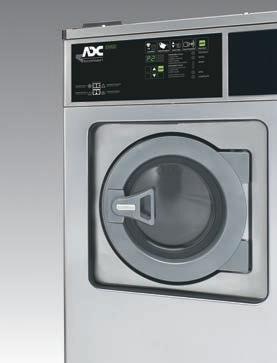
Selecting the right machines to speed up laundry and save labor is simpler with ADC. Turn to our EcoWash lineup for a range of equipment choices, including rigid and soft-mount machines with load capacities up to 60 lbs. and water-extracting performance up to 350 G-Force on most sizes. Plus, all EcoWash models feature full stainless-steel cabinets and the backing of a 10-year limited manufacturer’s warranty.* Because we’re as serious about making things last as we are about making them e cient.

* 10-year warranty limited to frame, tub, cylinder and cylinder’s shaft, seals, bearings and bearing housing.


Ask about low financing rates. 508.678.9000 | sales@amdry.com | www.adclaundry.com

Simply reliable by design.


PANEL OF EXPERTS
Am I using the right chemicals and detergents?
opinions and favorites.
Ilearned long ago that our success surrounding laundry chemicals was only as good as our chemical technician. While branded chemical companies probably would not care for this line, I have long stated that a good technician can do a great job using any company’s chemicals.
It has always been a norm to have conversation with my chemical technician upon his/her arrival to discuss issues and requests. Prior to leaving, I would get a summary of our progress toward our goals and any issues found during their visit.

Many times I have worked with product cost guarantees. My question has always been what products the technician would use and what would the cost be if he used what he liked best. It has been important that my technician would have
I started out using tallow soap, moved on to built detergents, solvent-based detergents, enzymes, ozone and the blended detergents of today. Additionally, I originally used chlorine bleach, which provided beautiful, bright whites. With the advent of Hibiclens®, I moved on to peroxide to eliminate staining.


In the last plant I managed, we were using a bleaching sour. All of these chemicals were used to provide a clean and bright product for the era or time period I was working in. Things change over time.
Originally, most of our linen products were 100% cotton. We then moved on to poly/cotton blends, and we now have items that are 100% synthetic engineered products. Linen makeup, many times, dictates which chemicals are used for cleaning.
Water conditions also play a very important role in chemical

choice. Without soft water, tallow soap could not be used in the past. Currently, there are built or synthetic detergents that are made to work in several poor-water conditions, which include hard water and iron.
While I have concentrated on detergents, alkali plays an important role, too. The process of “breaking apart” dirt continues to be highly relevant.
Producing consistent quality without damaging fabric, controlling linen life and rewash are all important goals. Having linen tested for chemical damage, tensile strength loss, dissolved solids, whiteness retention and the like aids in maintaining quality.
Maintaining proper barrier levels in isolation and operating room (OR) products is part of the current chemical-responsibility wave. We know that many aggressive formulas can hurt barriers, just
like improper rinsing can hurt the barrier performance of isolation gowns and OR products.
In the old days, we would put a washcloth in a plastic bag, which we thought represented the high quality level we were seeking. We would put this in an office drawer for reference over time.
In the end, it is about using the correct chemicals for your washing situation and your washing machines. For me, this cannot be accomplished without a talented chemical technician.
items. If your rewash percentage is lower or nonexistent, you may be overwashing everything to get out a few stains, using extra chemicals and shortening the life of your material.
Rewash formulas are more expensive and more damaging to goods and should be used to recover stained linen sparingly.
Second, what is your linen replacement level? Bleach is usually the least expensive laundry chemical. Vendors trying to achieve the lowest cost may overuse bleach, damaging your linen.
Also, overly aggressive washing to get out every stain every time will shorten the life of any material. Proper wash formulas and chemistry will minimize fabric damage. On the other hand, if you are buying lots of new items because you have a high level of stains and dingy linen, perhaps you have the opposite problem.
First, check your rewash percentage. You should have bright, clean, stain-free goods with a rewash percentage of 2-5%.
If your rewash percentage is higher than this, you are probably wasting rewash time, water and chemicals repeatedly washing
Third, what is your chemical cost per hundredweight (CWT)? A reasonable number is impossible to cite, as it depends on your water conditions, type of goods, type of washers, etc. Check with similar laundries in your area to compare. Note that I qualified that statement
12 DECEMBER 2015 | AMERICAN LAUNDRY NEWS www.AmericanLaundryNews.com
“I see that this issue of American Laundry News has a Product Showcase on detergents, chemicals and injection systems. I like to see the products, but how can I be sure I’m using the right chemicals and detergents in my operation?”
Textiles
Standard Textile, Cincinnati, Ohio Chemicals Supply David Barbe U.N.X. Inc., Greenville, N.C. “... I HAVE LONG STATED THAT A GOOD TECHNICIAN CAN DO A GREAT JOB USING ANY COMPANY’S CHEMICALS.” —CECIL B. LEE STANDARD TEXTILE ALN_3rd Page.indd 1 7/7/15 8:54 AM Quality... ...for the Long Haul. For more information: G.S.M. Linen Handling Systems 1-800-363-CART (2278) www.gsm-cart.com Precision built, all welded, anodized aluminum carts, specifically engineered for the extremes of loading, handling, cartwash and off-site transport in your busy laundry. Available in a wide range of models and sizes, and always to your custom requirements. GSM_haul_mp july_aug.pdf 1 2/20/2014 7:42 AM ALN_3rd Page.indd 1 4/6/15 11:08 AM
Cecil B. Lee
with “in your area.” Water conditions, soil types and many other local factors can affect your costs. These three factors are great indications of the chemical efficiency in your laundry. Many other factors can affect your cost and efficiency, but chemistry is one of the most important to these measurements. Your chemical provider should be monitoring the numbers I mentioned, adjusting equipment settings, formulas and products as needed to keep everything working smoothly. Bring any concerns to their attention during one of their regular service calls.
What? They don’t come by regularly to check your goods, their equipment and your costs? Then this is a sign that you need to talk seriously with your vendor.
Discussing your needs with your chemical provider regularly is highly important. Technology, including chemistry, improves constantly. Methods of washing, types of machinery used and especially fabric type can change your chemical and formula needs. Your vendor should be willing to work on formulas and even try different chemicals if you are having any problems.
If you want to get quotations from another chemical company, ask for references and check them. If possible, visit other laundries washing similar goods in your area, and ask lots of questions. If you are a member of one of the wonderful industry trade organizations (highly recommended), consult with them. See if the three metrics I’ve cited are comparable to similar laundries.
to achieve the proper titration for each of our different wash categories. In fact, there are many people who believe that the chemical company representative is more important than the chemicals themselves. A good person, with the proper knowledge and experience, can probably make any chemical company’s products work well.
That having been said, some companies sell their products by the gallon, others by the amount of poundage you process. There are those that supply a dry to liquid product so you are not paying to ship mostly water all over the
states. There are others who believe that sodium hypochlorite (chlorine) can be used properly at water temps in the 115-120 F range.

Our goal should always be to make sure that:
• The product that we are returning to our customers is as clean as possible.

• The various products have been sanitized.
• The hand (feel) is as it should be.
• All flat goods are properly ironed and professionally folded.
Even if you are in the customerowned goods (COG) side of the
business, you recognize that it should still be your responsibility to make sure that your customers’ goods are going to last as long as possible.
I believe that we all should take a close look at what is the true cost of a pound of reclaim or rewash, and realize that, whatever type of washing equipment we have in our facilities, the laundry chemicals are not the best place to try to save a penny or two.
Ultimately, if your customer is pleased with their returned product and you are keeping your cost of operation to a level at which you are putting the proper percentage
to the bottom line, I believe that you have accomplished the goal of making sure that you are using the proper chemicals and in the correct way.
It might be said that laundry chemicals are the lifeblood of our industry. There is never one specific product or line of products that are correct for all.
Indeed, I believe that most of the chemical companies basically have the same products. Alkalis, detergents, sours, softeners and others are the first things we utilize to accomplish our goal. That is, converting dirty linens into clean linens.
Maybe just as important, or more, is the person who is adjusting the dosages and the formulas

www.AmericanLaundryNews.com AMERICAN LAUNDRY NEWS | DECEMBER 2015 13
YOUR CHALLENGE PACESETTER CLM leads the way in dryer technology and provides an upgraded replacement for your old Challenge Pacesetter Our Model 165 fits the Challenge Pacesetter footprint perfectly and gives you technology that no one else o ers, including a fully integrated production management system. • Upgraded heat system with improved efficiency and lower emissions • Micro-Command III PLC upgrade with LAN and Blue Tooth communications • PLC now prepared for flow process management systems • 2-stage variable speed basket drive with 3-port load door. • Soft start to reduce component wear, lower utility use. • Heavy-gauge basket, includes removable steel basket panels • Long-lasting ceramic coating available on removable basket panels. • Configurable exhaust location • Configurable control/burner location Call CLM to replace your Challenge Pacesetter dryers, or for information on our broad range of industrial dryers. 323-232-2417 Model 165 shown with Tumble Green® configuration See Us at Booth 2560 at The Clean Show 211 Erie Street, Pomona, CA 91768 | T: (323) 232-2417 | www.clmco.com ALN_Jr Page.indd 1 11/18/14 2:36 PM 0515aln_CLM.indd 1 4/13/15 4:46 PM FOR MORE STORIES FEATURING OUR PANEL OF EXPERTS, VISIT WWW. AMERICANLAUNDRYNEWS. COM! “YOUR VENDOR SHOULD BE WILLING TO WORK ON FORMULAS AND EVEN TRY DIFFERENT CHEMICALS.” —DAVID BARBE U.N.X. INC. Commercial Laundry Rick Rone Laundry Plus, Bradenton, Fla.
ALN UPGRADE
PRODUCT SHOWCASE DETERGENTS, CHEMICALS INJECTION SYSTEMS

A.L. WILSON CHEMICAL CO.
A.L. Wilson Chemical Co. offers
The Laundry Two™ to deal with laundry stains.
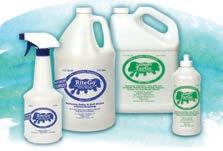
RiteGo laundry spray spotter quickly penetrates to absorb ground-in soil, oils and greases; collar and cuff stains; and more, all without brushing, according to the company. Then, it says, laun-
dries can turn to Laundry TarGo to remove any tough oil-based stains that remain behind.
Both Laundry TarGo and RiteGo are chlorinated solventand NPE-free, biodegradable, noncombustible, and California VOC- and Prop-65-compliant, the company says.
www.alwilson.com 800-526-1188
PARISER INDUSTRIES
Pariser Industries now offers what it calls a new development in garment finishing chemistry.
STAND UP is an advanced, highly concentrated liquid synthetic sizing containing a blend of ingredients
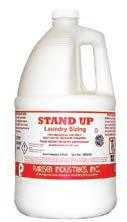
designed to provide significant body and rigidity to textiles in an aqueous environment, the company says.
Pariser says the product provides enhanced sizing qualities where a “heavy starch” like garment is desirable.

STAND UP also prevents sticking and scorching and makes ironing easier, especially on synthetic fabrics, according to the company.
STAND UP’s nonviscous liquid characteristics allow for quick and








easy addition by hand or pump, and the usage rates provide excellent economy, says Pariser.
The product’s high potency can provide heavy starching without the buildup of other synthetic starches, the company adds.
www.pariserchem.com 800-370-7627

SANTEC INC.
Santec Inc. has a new product in its Linden Series of laundry products— Active Detergent. According to the company, Active is a premium, phosphate-free, tripleenzyme blend, combined with
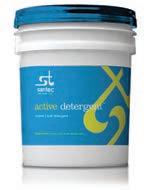
color-safe
dered
Santec says the product is formulated to deliver outstanding performance on white and mixedcolor shirt loads alike in lower temperatures.
oxygen bleach pow-
laundry detergent, designed specifically for shirt laundries.
14 DECEMBER 2015 | AMERICAN LAUNDRY NEWS www.AmericanLaundryNews.com
[Santec Inc.]
[Pariser Industries]
[A.L. Wilson Chemical Co.]
COMPILED BY MATT POE, EDITOR
ALN_Jr_half.indd 1 11/9/15 10:05 AM
ALN_Jr_half 10/4/12 2:30 PM Page 1
&
According to the company, Active is engineered with a blend of nonionic and lipophilic surfactants, buffered alkalis, phosphate-free water softeners and conditioners, soil suspending agents, optical brighteners, an oxygen bleach and three classes of enzymes to create a safe product. A unique blend of emulsifiers affects release of sweat and body oils from shirts constructed from cotton, poly-cotton and synthetic fabrics, says Santec. The peroxygen compound present affects bleaching of food and other stains while not “touching” dyes in colored shirts. The performance is unaffected by water hardness, according to Santec, and the triple enzyme blend of amylases/ proteases/lipases affect removal of a wide range of common food stains, even at lower wash temper atures. Water conditioning agents and optical brighteners keep shirts bright and white, wash after wash, Santec says.
According to the company, Active’s optimal applications include shirt laundries, health care facilities, motels, hotels and nursing homes. The product is economical with dosages as low as 6-8 ounces per 50-pound washer. Under normal wash conditions, no souring agent is necessary due to the 11.2 pH (1%) blend of alkalis used in Active, according to the company.
measurement of every injection— no excessive usage of chemical.

According to U.N.X, the TUNNELTRON features proof of flow and delivery for every chemical and destination and offers complete injection in less than 30 seconds. The TUNNELTRON offers simultaneous injections, simple alarm messages and quick summaries.
U.N.X. says all three systems can be networked together for consolidated, real-time reporting, using Excel.
www.unxinc.com






SANI WASH
Sani Wash recently developed Spectrum , a concentrated, neutral-pH liquid laundry detergent that is formulated specifically to address on-premises laundry housekeeping concerns with high linen replacement, use of unsafe chemicals and high hot-water energy costs.
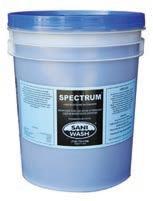
According to the company, Spectrum is gentle on linens and contains low volatile organic compounds (VOC) ingredients that conform to national safety guidelines, making its use much Spectrum may be used with

promoting operational energy savings, Sani Wash says.
The product has been thoroughly field-tested and proven to lower linen replacement costs due to its gentle but effective cleaning as compared with highalkali detergents, the company says. It is safer for the operator to use than traditional highalkali formulations and works well where the water temperatures are lower than 140 F, according to Sani Wash. www.saniwash.com 800-288-7264
U.N.X. I
U.N.X. Inc. says that professional service, proven cleaning formula tions and state-of -the-art chemi cal dispensing systems have built a solid reputation for the company. And it says it designs and builds its own dispensing systems.

According to the company, the DELTATRON can operate up to five washers with eight dif ferent chemicals and dispenses exact amounts and combinations to precisely process any type of goods. The OMEGATRON deliv ers up to 10 chemicals to 10 wash ers, and both units will hold any washer with a problem to ensure linen is properly cleaned, U.N.X. says.
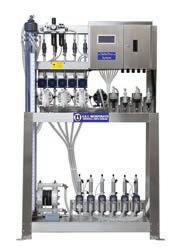
Both the OMEGATRON and DELTATRON offer low-level alarms and visually verifiable functions with full volumetric


www.AmericanLaundryNews.com AMERICAN LAUNDRY NEWS | DECEM B ER 2015 15
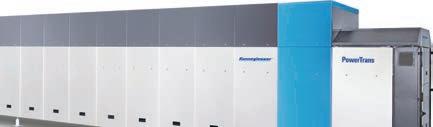
FLEXIBILITY Batch sizes ranging from 90 - 285 lbs Production capacities from 550 - 11,000 lbs Rinse options: counterflow rinsing, standing bath rinsing and JET-rinsing PERFORMANCE Superior mechanical action Maximum compression EFFICIENCY Intelligent water management Insulated drums minimize heat loss Carewash drum perforation is gentle on textiles THE LEADER IN LAUNDRY TECHNOLOGY HIGH PERFORMANCE BATCH WASHER kannegiesser-usa.com 800.344.0403 PowerTrans ALN_Jr Page.indd 1 10/28/15 8:18 AM [Sani Wash]
GURTLER INDUSTRIES INC.
Gurtler Industries Inc. has introduced a new detergent line that is
soils of the industrial uniform market, the company says.
The Work*Team line of products combines a synergistic mixture of surfactants, builders and conditioners that penetrate, lift, emulsify, and deep-clean the toughest soils, the company says.

In addition, Gurtler says that the Work*Team line of products is NPE- and phosphate-free. www.gurtler.com 800-638-7300

M&M TECHNOLOGIES INC.
its only business continues to be the development, manufacture and sale of cost-effective fluid repellents for the laundry industry.
Used in the wash process, its PROTEX 20007 Fluid Repellent helps renew and maintain the repellency of barrier fabrics used in surgical gowns and isolation gowns. It significantly reduces staining and helps protect the healthcare provider, according to the company.
M&M says its newest-generation product, PROTEX 2000®-PM
way as its original product, and it is even more efficient and more environmentally friendly.
With few exceptions, all surgical gowns and most surgical linens are treated with a repellent finish when they are manufactured, the company says. This finish is an important element in the design of the garment; it helps protect the healthcare provider by causing fluids to roll away, and thus these fluids are less likely to be absorbed.
Repeated laundering depletes this mill-applied finish, and the
result in staining and strikethrough, M&M says. PROTEX 20007 is the same finish that is applied in the textile mill. The repellent is consistently maintained at a high level; therefore, the life of the textiles is extended, according to the company.
M&M says that PROTEX 20007 “loves heat,” so steam sterilization only enhances its effectiveness. The product is a fiber treatment and does not affect the breathability or comfort of the fabric.
In addition, PROTEX 20007 costs only pennies per item for each laundering but its use results in a significant increase in the life of the treated items, the company www.fluidrepellent.com 800-658-5958
SUNBURST CHEMICALS
Sunburst Chemicals says that its first EPA Safer Choice (formerly known as the EPA’s DfE Program) solid product, Compass Laundry Detergent, allows launderers to protect the environment and save money.
Compass is a one-shot system that most often requires no additional chemicals in the washing process. It is 100% biodegradable and made from 100% “greener” ingredients, according to Sunburst.
The company says that Compass has no phosphates, caustics, nonylphenol ethoxylates, toxic polymers, solvents or perfumes. It cleans by breaking apart soils and other tough stains, which can then be easily washed away.
Compass is a key part of Sunburst’s Conserv Energy System™ (CES). This program is a combination of products and dispensers incorporating rapidly biodegradable surfactants, highly active enzymes and powerful oxygen bleach, controlled by an easy-to-use dispensing system— washing in both cold and warm water.

Sunburst says that the CES program saves on water, gas, electrical, labor, washing equipment and textile replacement costs.
www.sunburstchemicals.com 800-899-7627
NORCHEM
The NorFlow-Win® system, designed and manufactured by
16 DECEMBER 2015 | AMERICAN LAUNDRY NEWS www.AmericanLaundryNews.com
ALN_Jr Page.indd 1 9/30/15 3:13 PM
[Sunburst Chemicals]
[Gurtler Industries]
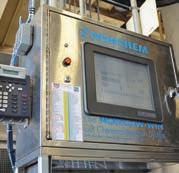
Norchem, is a fully automated chemical delivery system for commercial laundry applications, according to the company.
Norchem offers the NorFlowWin G3 for conventional washers and the NorFlow-Win G4 for tunnel washers.

Norchem says that the pumping technology replaces peristaltic and diaphragm pumps with electric self-priming positive displacement pumps along with all stainless-steel valves and delivery lines.
According to the company, it pioneered the design in the early 1990s to optimize injection precision and consistency by eliminating day tanks, providing operators with proof of delivery, minimizing risk of chemical leaks, and improving the health and safety of the work environment.
The entire system is milled from 100% corrosion-resistant stainless steel for long-lasting durability, and the latest software and hardware provide custom reporting, real-time touchscreen display of wash-floor operations, chemical usage and much more, says Norchem.
With its new-generation chemical lines, Norchem says it has successfully achieved a pHneutral wash cycle for all hospitality and healthcare applications. Furthermore, it believes it has achieved a significant reduction in alkali usage for FOG and industrial applications as well.
www.norchemcorp.com 800-442-4360
WASHING SYSTEMS LLC
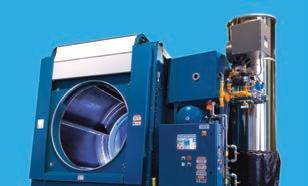
Spectrum™ is the latest innovation in Washing Systems LLC’s Pure Solutions Line™ of completely NPE-free products, according to the company.
A next-generation NPE-free detergent, Spectrum provides soil removal capability on the toughest industrial and heaviest food soils, the company says.
Demonstrating outstanding cleaning quality in a wide range of temperatures, Spectrum further provides operators with maximum wash-aisle efficiencies, increased plant capacity and enhanced productivity through reduced formula run times, says Washing Systems.
www.washingsystems.com 800-272-1974
Coyne
experience
positions.
“Like Coyne, Clean Uniforms and More! is a privately owned and family-managed organization, one of the many synergies between our companies,” says Mark Bodzioch, president of Clean Uniforms and More!
Clean Uniforms and More! will purchase Coyne’s customer accounts and inventory in New Bedford, Mass., for $4 million, and will accept applications from Coyne employees for new
“We look forward to welcoming Coyne’s Massachusetts-based clients into our circle, providing them with unmatched service that is both professional and personal. We are committed to working closely with Coyne to ensure the transition goes smoothly.”
In its Chapter 11 filing on July 31, and under rules approved by the Bankruptcy Court, Coyne’s existing senior management team had a preliminary agreement to purchase the company’s operations and continue running the business unless the auction resulted in higher bids. Coyne will provide severance to all employees not retained.
“We are disappointed that the existing Coyne team was outbid. We want to thank our hardworking employees for their dedication, our customers for their loyalty, and the employee union
leaders who ratified agreements with us prior to the auction,” Samson says. “We are pleased to have obtained a higher value for the company during the auction and are using that additional money to increase severance at the locations we lost.”
During the year prior to its bankruptcy filing, Coyne marketed its assets to prospective industry and financial buyers unsuccessfully. Except for Coyne’s location in Richmond, Va., the company’s physical facilities are not included in these three sales and will shut down. ALN
it’s efficient. The Ellis WHISPERDRYer means
productivity and lower operating costs. It’ll make sure your money doesn’t get lost in the wash.

www.AmericanLaundryNews.com AMERICAN LAUNDRY NEWS | DECEM B ER 2015 17
ALN 800.611.6806 www.EllisLaundry.com WE FOUND LOST CASH IN YOUR LAUNDRY.
you want to stop losing money to your dryer, you need to get a machine that’s efficient. The Ellis
your
bet. Given a 450 lb. load of new terry towels, it can dry
load
minutes.
means
water
ALN_Jr Page.indd 1 10/30/15 8:01 AM
If
WHISPERDRYer is
best
the
in 21.76
That
it’s working at 1651 BTUs per pound of
removed. In other words:
increased
[Norchem Corp.]
“The depth and
of our service team, along with our product and service offering, will help us meet this goal.”
Continued from Page 4
years in business
OSHKOSH, Wis. — Commercial laundry equipment manufacturer Continental Girbau Inc. recently hosted a two-day celebration here marking its 20th year in business.
Formed in 1995 as Girbau S.A.’s North American subsidiary, Continental has grown to become an industry-leading provider of on-premises, industrial and vended laundry solutions, according to Continental
President Mike Floyd.
More than 150 business partners, staff, distributors, community officials and friends participated in Continental’s Sept. 23-24 anniversary celebration here, the company says.
Events on Sept. 23 included an open house and tour at Continental’s headquarters, followed by a presentation and reception at the Experimental Aircraft Association (EAA) Air Venture Museum, according to the company.
Keynote speakers included Floyd; Mercé Girbau, co-CEO, Girbau S.A.; Brian Wallace, president and CEO, Coin Laundry Association (CLA); John Casper, president and CEO, Oshkosh Chamber of Commerce; and John Riddle, senior vice president, LG Home Appliances.
“The formation of Continental came before I joined Girbau S.A.,” says Mercé Girbau. “But I know it took a lot of negotiation between my father, Santi Carol, Len Kafer and Mike Floyd. My father wanted to establish distribution in the United States. Today, Continental accounts for 25% of
Girbau’s total sales.”
The celebration continued throughout the next day with a group tour of Lambeau Field/Packer Hall of Fame, in Green Bay, Wis., and a golf outing in Green Lake, Wis. A riverside tailgate party at the local Best Western Premier Waterfront Hotel culminated the event, says the company.
Continental says that it has ballooned since 1995, expanding product offerings; serving new niche markets; establishing new brands, divisions and subsidiaries; investing in facility expansions and additions; expanding its professional distributor network; and continuing its commitment to environment, community, service and quality.


Locally, the company supports organizations in need; partners with and supports Oshkosh area hotels, restaurants, printers, photographers and schools; and owns and runs a local business—the Express Laundry Center.

G&K Services opens new facility in Little Rock
MINNEAPOLIS — G&K Services Inc., which provides uniforms and facility services programs, has opened a new facility in Little Rock, Ark., the company reports.
The new site will serve customers throughout Little Rock and the surrounding area.
“We’re excited to make this investment to expand our footprint in Arkansas,” says Ian Davis, vice president, U.S. Field. “We look forward to continuing to grow our presence in Arkansas and delivering G&K’s industry leading service to customers across the state.”
The company says it invited guests to tour the new facility and meet members of G&K’s new Little Rock staff during a grand-opening celebration in September. In addition, city officials and members of the local Chamber of Commerce joined the G&K team for a ribbon-cutting ceremony.
TRSA’s Hygienically Clean Healthcare Certification earns AORN ‘Seal’


ALEXANDRIA, Va. — The Textile Rental Services Association’s (TRSA) Hygienically Clean Healthcare Certification program standards have received the Association of periOperative Registered Nurses (AORN) Seal of Recognition™ for its certification materials, TRSA reports.
The association says that the AORN Seal of Recognition confirms the certification program has undergone a thorough quality
review by AORN and is consistent with the organization’s Guidelines for Perioperative Practice.
According to AORN, this is not a product endorsement but rather a demonstration that the educational and informative material provided about the certification program is sound and reliable. Specifically, the Seal of Recognition recognizes the certification program’s materials on the “Standard for Producing Hygienically Clean Reusable Textiles in the Healthcare Industry.”
“Since the creation of the Hygienically Clean certification in 2012, TRSA has continued its work to raise the bar and standards within the commercial laundry industry through this program,” says Joseph Ricci, president and CEO of TRSA. “We’re honored to have successfully earned AORN’s Seal of Recognition for our Hygienically Clean program, and we’ll continue to work with our membership to ensure the industry is held to the highest possible standards of cleanliness and safety.”
To be considered for Hygienically Clean Healthcare Certification, facilities handling healthcare linens are inspected for adherence to best practices and quality assurance requirements, says TRSA. This inspection is preceded by two rounds of bacteriological testing of laundered textiles by an independent, TRSA-approved laboratory. Samples must pass a total of three rounds of testing to qualify for certification.
Memoriam:
KENNER, La. — Sue Rose Wright Pellerin, widow of Pellerin Milnor Corp. co-founder Norvin Leroy Pellerin, died Oct. 23 due to complications from Alzheimer’s disease, the company reports. She was 84.


She was the former first secretary and treasurer for the laundry machinery manufacturer founded in 1947 by her husband and her father-in-law. She was married to Norvin Pellerin for 62 years before his death in 2013.

Sue Pellerin was a graduate of McMain High School and attended Sophie Newcomb College. She and her husband enjoyed traveling and visited interesting destinations on every continent.
She is survived by her children, James Willis Pellerin (Stacy); Julie Pellerin Bukrey (Charles), Grand Rapids, Mich.; Curtis
18 DECEMBER 2015 | AMERICAN LAUNDRY NEWS www.AmericanLaundryNews.com
Continental Girbau Inc. celebrates 20
In
Sue Rose Wright Pellerin, Pellerin Milnor Corp.
ALN_Sixth page H.indd 1 11/6/15 1:43 PM Connect With Us PARISER INDUSTRIES, INC. www.pariserchem.com 91 Michigan Ave. info@pariserchem.com Paterson, NJ 07503 800-370-SOAP (7627) USA LAUNDRY CHEMICAL SOLUTIONS FOR YOUR EVOLVING INDUSTRY For over 40 years, Pariser Industries has been dedicated to providing our customers the best Quality Laundry Products, Value and Consistent Performance, Wash after Wash. Our Service and Expertise Spans the US, Canada and Caribbean in these industries: Hospitality • Resort/Cruise Ships • Hotels • Party Rental Companies Healthcare • Nursing Homes, Assisted Living • Surgical Centers • Hospital Scrubs and Clinic Linens • Veterinary Sports Athletic Garments • Athletic Team Uniforms • Health Club Towels Pariser has the products and reliable service to help you achieve clean, hygienic linens in an efficient and economical manner. For a Free Customized Estimate call 800-370-SOAP (7627) ALN_Jr_half.indd 1 11/9/15 9:37 AM Continental Girbau President Mike Floyd engages visitors during Continental’s celebratory open house and reception. (Photo: Continental Girbau Inc.)
Pellerin
Allen Pellerin (Maria); and Renée Pellerin Gordon (Robert), Palm Beach Gardens, Fla.; her brother, James Luther Wright Jr., Tifton, Ga.; her sister, Vera Louise Thibaut, Mandeville, La.; 13 grandchildren; and eight great-grandchildren.
Funeral services were conducted in New Orleans.
In lieu of flowers, the family requests donations be made to The Alzheimer’s Association, South Louisiana Chapter (3445 North Causeway Blvd., Ste. 902, Metairie, LA 70002), or The Pellerin Foundation, which awards merit-based college scholarships (P.O. Box 400, Kenner, LA 70063).

AmeriPride Services acquires Thief River

Minn.-based Model Laundry
MINNEAPOLIS — AmeriPride Services has acquired Model Laundry in Thief River Falls, Minn., according to AmeriPride.
As of September, AmeriPride began servicing Model Laundry’s existing accounts out of its Hibbing, Minn., branch and service centers, under the leadership of Dave Hardy, general manager, the company says.
“We expect a smooth and seamless transition for the customers,” says John Sutherland, AmeriPride SVP of U.S. Operations. “Our Hibbing production facility has the capacity and resources to take on the additional volume, and this acquisition is a great growth opportunity for us. It also provides an opportunity to introduce new products, services and online tools to the customers.”
AmeriPride says it did not purchase property or equipment as a part of the sale. Other financial details related to the acquisition were not released.
TEK Products adds sterile laundry to services

MINNEAPOLIS — TEK Products, which is a cleanroom and industrial laundry division of VWR, has added a validated sterile laundry program to its list of laundry services, the company reports.
“Up until now, only the largest cleanroom laundries were in the sterile market. TEK gives the customer another choice and adds a high touch level of service,” says Penny Schroeder, directory of laundry sales at TEK.
The company says a full selection of cleanroom apparel that is gamma-irradiated to a sterility assurance level of 10-6 will be offered as a part of the validated sterile laundry.
TEK Products says it already offers cleanroom garments laundered in its ISO Class 5 cleanroom facility.





Outside of Minnesota, it utilizes its Cleanship Tote Program to bring cleanroom and sterile laundry to customers anywhere within the continental United States, the company says.
“The Cleanship Tote Program is our fastest growing business segment,” says Schroeder. “Many customers have inquired if a validated sterile option was available. Now it is.”
TEK works with customers in 19 states outside of Minnesota, according to the company. ALN


OPL 101
then analyze how equipment is working and review with their customers to determine where they can save money and cut down on labor costs.
WHEN A SERVICE CALL IS UNAVOIDABLE
A member of the maintenance staff at an OPL property can often work with a servicing distributor to help diagnose a problem before a service call has to be made. This can sometimes prevent needing the distributor to physically come out to the site, or identify the part or service needed so a repair is done in a single trip. When a service technician does have to be called, he/she can save an OPL manager time and money by testing items remotely or at the controls to quickly diagnose and repair.
“Modern technology has given OPL managers the ability to export location and machine information to a service technician who can then review and assist remotely,” says Reichenbach. “This has become much more common as of late and reduces machine downtime significantly.”
To simplify the job of the servicing technician and reduce costs for the OPL manager, service history can be entered into a machine’s controls so that a technician has instant access. While a compre-


hensive look at a machine’s entire service history may be stored on a manager’s computer, error alerts are stored directly on the machine so that a service technician can quickly and easily access them.
“Machine error history is another invaluable feature used to diagnose equipment and operator issues without having to communicate with the laundry room operator, who may be off-shift at the time, or decipher notes from staff,” explains Reichenbach.
CONSIDER REPLACING EQUIPMENT

If maintenance becomes too frequent, consider replacing your equipment for optimal performance. With the right equipment and advanced technology, OPL management does not have to be a daunting task. With a vision and actionable data, you can ensure your laundry operation is running at peak performance. The idea is to have a laundry operation with equipment that can run as independently as possible, which can cut down on labor costs.
Properly working equipment is the foundation of a successful and efficient OPL operation; if your equipment breaks down frequently, or you spend more time trying to fix it than the machine does washing linens, consider replacing your machines with advanced controls and technology. ALN
Bill Brooks is North American sales manager for UniMac®, a provider of on-premises laundry equipment. To learn more about UniMac, visit www.unimac.com/ opl101 or call 800-587-5458.
•
www.AmericanLaundryNews.com AMERICAN LAUNDRY NEWS | DECEM B ER 2015 19 ANSWER TO A HIGHER CALLING Verifying Processes and Quantifying Cleanliness The ONLY restaurant linen supply certification:
Developed
the industry for the industry
Endorsed
epidemiologist and healthcare professionals
•
by
by
certification experience
• Based on 10 years of laundry
testing protocols and standards
ALN_Jr_half.indd 1 11/6/15 2:01 PM (800) 899-7627 www.sunburstchemicals.com Cleaning solutions for the health of your business WE DELIVER GUARANTEED RESULTS! BEFORE AFTER Sunburst Chemicals’ One-Touch Cleaning™ Laundry Program brings you: Reduced Stain Rates Reduced Rewash Rates Reduced Linen Replacement HYGIENICALLY CLEAN LINENS One Touch. One Source. One Company. SUN AmLaundryAd-9.15.indd 1 9/2/15 10:17 AM ALN_Jr_half.indd 1 11/6/15 8:39 AM
• Adhering to established worldwide
Customers are demanding third-party review of cleaning processes. TRSA Hygienically Clean – Food Service offers unmatched credibility. See the standards and apply today at www.hygienicallyclean.org.
Falls,
Continued
from Page 10
Brooks
WASHEX

PARTS

Hard-to-find Washex parts, on-site rebuilding, tech support. LAUNDRY PARTS CENTER 800-352-4492 Fax: 305-827-3991

PARTS, PARTS, PARTS
Huge stock of parts for most laundry equipment & boilers. Also traps, valves and lubricants. Overnight delivery. Steiner-Atlantic, 800-333-8883 Fax: 305-751-8390 parts@steineratlantic.com www.steineratlantic.com
Major owner/operator’s (>3,000 employees) growth has created an opening for an experienced Dry Cleaning Plant Manager in the Southwest USA. The incumbent will oversee plant operations, personnel training and quality assurance programs. Plant will be supported by corporate HR, purchasing, maintenance and customer service teams. This plant services high-quality clientele and VIP’s. Must have an extensive background in spotting, hydro-carbon D/C machines and garment finishing. Excellent communication skills and ability to multiple-task and motivate team members a must. Submit resume to recruitment.hr.bls@gmail.com.


20 DECEMBER 2015 | AMERICAN LAUNDRY NEWS www.AmericanLaundryNews.com
Classified Advertising PARTS FOR SALE EQUIPMENT FOR SALE AMKO AMERICA, INC. Remanufactured Finishing Equipment Delta Ironers, Omega Folders & Towel Folders PARTS, IRONER SUPPLIES & NEW EQUIPMENT ALSO AVAILABLE “NEW” SELF CONTAINED IRONERS Contact: (561) 863-9696 AmkoAmerica@yahoo.com POSITIONS AVAILABLE POSITIONS AVAILABLE DISTRIBUTOR OFFERINGS www.ineedjpequipment.com 800/925-3236 EQUIPMENT FOR SALE: • Rennco CF4000 Single Lane Bar Towel Bagger, 2009 • 400lb Braun OP W/E, 1996, Single motor drive • 250lb Jensen OP, ready to ship • 2005 Chicago Air • 900lb Ellis, 1998 • 400lb Challenge Dryer, Gas, P/T, 1998 & 1995 • Chicago Tristar 32 + Chicago Fastrack • Chicago Tristar 24 PCS w/OPL • Chicago Imperial Ironer, IMP36, Gas, 2001 • 900lb Ellis Completely Reconditioned, New controls by Ellis • 150lb Lavatec Press, LP582, 2001 • Economizers for 50HP and 70HP Boiler • 50HP Parker Boiler, 2005 • Chicago Edge 2000 • 60lb Milnor Washer Rigid-mount, 2006 • Chicago Pik Quik, 2008 “Expect Excellence” JP Equipment, Inc. buys and sells used industrial laundry equipment. We have been in the used industrial laundry business since 1998 and sell equipment worldwide. What separates us from most of our competitors is that we own almost all of our equipment outright giving us the flexibility to sell equipment “as is”, cleaned and tested, or fully reconditioned. We also sell equipment on consignment. We provide unparalleled service whether you are buying or selling equipment, building a new laundry or upgrading an existing facility. Call Craig Lloyd toll free at 877.295.5693 between 9 a.m. – 9 p.m. EST. Please visit www.laundrycareers.com to review current industrial/institutional laundry management openings. ADVANCE YOUR CAREER The Griffin Group, Inc. “Recruitment Specialist” Need to FILL a position? Call Deana Griffin 888-235-2365 www.thegriffingroup.cc deana@thegriffingroup.cc ® QTY DESCRIPTION 1 Edge Spreader 2000 1 Pik-Quik Sheet Separator Milnor Washers; 60lb, 100lb, and 140lb Rebuilt 1 Mini Neptune 1 Unipress Single Buck Lightning Shirt Unit 1 450lb Washex Open Pocket 2002 1 275lb Milnor Open Pocket Rebuilt 2003 1 Single Lane Skyline Folder 1 Braun 2 Roll 32 Steam Ironer 1 Braun Omege 2-Lane / Crossfolder w/Accumulator 1 Braun Rear Discharge Towel Folder 1 Milnor 120lb Steam Dryer 1 Braun Rear Discharge Towel Folder 1 Reconditioned Jensen Ultima 36 – 2-Roll Steam Ironer 1 Reconditioned Challenge Pacesetter 1 Forenta 2013 Single Buck, Sleever and Collar Cuff For Pricing call Ron Hirsch 516.938.4300 • 516.315.7426 Hicksville, NY • www.directmachinery.com FOR NEW OR USED LAUNDRY EQUIPMENT, DM IS YOUR SOURCE FOR ALL YOUR NEEDS HOSPITAL LAUNDRY CLOSING EXCELLENT EXCELLENT CONDITION Stanco Industries, Inc. Serving The Textile Trades Since 1970 800-932-3769 k for Mike or Deb KEEPING IT GREEN SINCE 1970 WE ARE LOOKING FOR THE FOLLOWING EQUIPMENT: WASHING • DRYING • FOLDING FEEDING • IRONING • FINISHING MATERIAL HANDLING • BOILERS CONTINUOUS BATCH WASHING STACKERS • CART DUMPERS DON’T BE LEFT WITHOUT POWER Emergency Generators Available 50KW to 1000KW Natural Gas & Diesel Stanco Industries, Inc. 800-932-3769 Ask for Mike or Deb or e-mail: stanco2626@aol.com www.StanCoInd.com








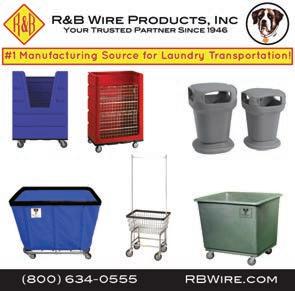

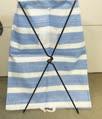
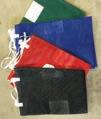
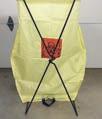




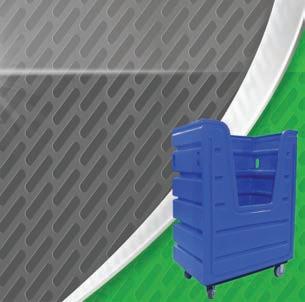



www.AmericanLaundryNews.com AMERICAN LAUNDRY NEWS | DECEM B ER 2015 21 Source Directory A convenient guide to sources of products and services APPAREL FINISHING CARTS, TRUCKS & BASKETS Source Directory listings in American Laundry News are sold on an annual basis at the following rates: All Major Credit Cards Accepted 2016 Listings RegularBoldface All CapsAll Caps, Boldface Four Line Listing per Year $885 $1,110 $1,110 $1,175 Display and additional line rates available upon request Sani Trux - McClure Industries, Inc. 9051 SE 55th Ave., Portland, OR 97206 800-752-2821 www.mcclureindustries.com, info@mcclureindustries.com M.I.T. POLY-CART 211 CENTRAL PARK WEST, NEW YORK, NY 10024 800-234-7659, FAX: 212-721-9022 WWW.MITPOLYCART.COM CARTS, TRUCKS & BASKETS DOBERMAN TUFF LAUNDRY CARTS www.dobermantuff.com 706-376-4793 RUGGED DURABLE QUALITY FINISHES TUFF STUFF, NOT TUFF PRICES CARTS, TRUCKS & BASKETS Diversified Plastics, Inc. 1309 Highway 917 West, Latta, SC 29565 800-768-7636, www.dpirotocarts.com E-mail: sales@dpirotocarts.com Fax: 843-752-7798 CARTS, TRUCKS & BASKETS 619-888-7173 • www.plexusind.com • PVC Coated Mesh • Woven PE • Fluid Resistant Bio Bags Variety of sizes and colors Customization • Ship same day • ECO FRIENDLY • MADE IN USA • DURABLE LAUNDRY CARTS 800.304.4600 www.fibertechinc.net BAGS, SLINGS & COVERS TUFF STUFF, NOT TUFF PRICES! ONLINE STORE CLICK & BUY DOBERMAN TUFF www.dobermantuff.com 706-376-4793 1215aln_Doberman Tuff filler2.indd 1 11/11/15 2:35 PM Enclosed_Carts_6.25x3:Layout 1 6/18/14 4:23 PM Page 1
P.O. Box 400, Kenner, LA 70063 504-467-9591, Fax: 504-468-3094 www.milnor.com
Pellerin Milnor Corp.



P.O. Box 400, Kenner, LA 70063 504-467-9591, Fax: 504-468-3094 www.milnor.com

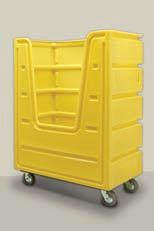
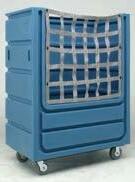





22 DECEMBER 2015 | AMERICAN LAUNDRY NEWS www.AmericanLaundryNews.com Source Directory listings in American Laundry News are sold on an annual basis at the following rates: All Major Credit Cards Accepted 2016 Listings Regular Boldface All Caps All Caps, Boldface Four Line Listing per Year $885 $1,110 $1,110 $1,175 Display and additional line rates available upon request Source Directory A convenient guide to sources of products and services FLATWORK IRONERS FLATWORK IRONERS Knowhow In Action Your Tingue rep is a fully trained master of finishing equipment operation, maintenance and installation. Call for: • Pads, covers, belts, waxes, tapes and more • Carts, trucks, baskets and bags • Parts, rebuilds and repairs 800.829.3864 www.Tingue.com TalleyMachinery.com MODRoto.com TBR-Associates.com To website C & W EQUIPMENT (800) 443-3573 FLATWORK IRONER SPECIALISTS REMANUFACTURED IRONERS: Super Sylon Sylon Hypro’s Super Pro Jensen SS700 SS800 Ultima Lavatec UPGRADE KITS: Chain Drive Conversion Vacuum Systems Herringbone Conversion Canopies Inverters Side Covers Roll Springs Jensen Drives SUPPLIES: Aprons Pads Covers Belts Waxes Cleaners PARTS/REPAIRS: All Brands New/Refurbished/Hard to Find COMMITTED TO EXCELLENCE
Pellerin Milnor Corp.
DRYERS – 100 POUNDS OR MORE
DRYERS – 100 POUNDS OR LESS • Hotel • OPL • Coin Op • Dry Cleaners • Industrial • Commercial • Cruise Industry Dry or Wet Style Filters to Work with “ALL” Dryer Sizes or Multiple Situations, Fiberglass or Stainless and Custom for Unique Situations! Lint Filters Model Big and Small – We’ve got a model for you! In-line Duct” Models – the Lint Lasso and Lint Sock –in production since 2011 All manufacturing done on premise 800-826-1245 www.cleancyclesystems.com • ccsystems@tqind.com LINT COLLECTORS & FILTERS ★ Our In-Line Lint Filter mounts inside, saves space! ★ Fiberglass Wet Filters - 6,000 to 40,000 cfm ★ Fiberglass or Stainless Steel Dry Filters ENERGENICS CORPORATION Talk with our Design and Engineering Staff about your needs. Hundreds Sold Annually. 800-944-1711 www.energenics.com CARTS, TRUCKS & BASKETS Energenics Corp., Kartwasher 1470 Don St., Naples, FL 34104 800-944-1711 www.energenics.com CART-WASHING SYSTEMS Sani Wash - McClure Industries, Inc. 9051 SE 55th Ave., Portland, OR 97206 800-752-2821 www.mcclureindustries.com, info@mcclureindustries.com DRYER BOOSTER & EXHAUST FANS ENVIRONMENTAL SOLUTIONS www.olekbelts.com 1-800-869-2683 Free www.olekbelts.com We’re your flatwork finishing and conveying O.E.M. Belt Match H.Q. Get the real thing for a Lot less $$$. O.E.M. Needlefelt Ironer Pads too! Better Belts, Better Prices, Better Service Visit our Website or Call 1-800-869-2683 For free, no obligation, price quotations and for your Free copy of our Product Catalog with over 40 samples. Ironer pads, covers, aprons, guide tapes, carts, slings, cleaners, waxes & more… • Wash Temperature Reduction • Tunnel Washer Experts • EPA Regulations • Environmental Concerns • Infection Control • Waste Water Treatment New Horizons In Ozone Solutions, Inc 508-831-4229 wet-tech.com FLATWORK SUPPORT Choose your favorite low-cut front for ergonomic access, roll safe and easy on advanced poly base with premium casters—all included as standard. Easy Reach, Easy Roll Call 800.829.4535 or visit MODRoto.com for a FREE QUOTE. 72P 72N Leadership in Every Cart
PRESSES – EXTRACTION
Pellerin Milnor Corp.
P.O. Box 400, Kenner, LA 70063 504-467-9591, Fax: 504-468-3094 www.milnor.com
RFID

WASHERS – CONTINUOUS BATCH


Pellerin Milnor Corp.
P.O. Box 400, Kenner, LA 70063 504-467-9591, Fax: 504-468-3094 www.milnor.com
WASHER-EXTRACTOR – 100 POUNDS OR LESS
Pellerin Milnor Corp.
P.O. Box 400, Kenner, LA 70063 504-467-9591, Fax: 504-468-3094 www.milnor.com
WASHER-EXTRACTOR – 100 POUNDS OR MORE


Pellerin Milnor Corp.



P.O. Box 400, Kenner, LA 70063 504-467-9591, Fax: 504-468-3094 www.milnor.com

PACKAGING SYSTEMS & SUPPLIES




Company
Web Site Page
A.L. Wilson Chemical Co. www.alwilson.com 9
ADI American Dawn www.americandawn.com 5
American Dryer Corp. www.amdry.com 11

Association for Linen Management www.almnet.org 16
Consolidated Laundry Machinery www.clmco.com 13
Davis Packaging www.davispackaging.net 18
Direct Machinery Sales Corp. www.directmachinery.com 20


Ellis Corporation www.elliscorp.com 17
Girbau Industrial www.girbauindustrial.com 7
G.S. Manufacturing www.gsm-cart.com 12
The Griffin Group, Inc. www.thegriffingroup.cc 20
J.P. Equipment www.ineedjpequipment.com 20
Company
Web Site Page
Kannegiesser USA www.kannegiesser.com 15
Kemco Systems www.kemcosystems.com 12


LaundryCareers.com www.laundrycareers.com 20
Lavatec Laundry Technology www.lavatec-laundry.com 24
McClure Industries www.mcclureindustries.com 14
Pariser Industries www.pariserchem.com 18
Pellerin Milnor www.milnor.com 3
Royal Basket Trucks www.royal-basket.com 10
Stanco Industries www.stancoind.com 20
Sunburst Chemicals www.sunburstchemicals.com 19
Superior Uniform Group www.fashionsealhealthcare.com 14
TRSA www.trsa.org 19
www.AmericanLaundryNews.com AMERICAN LAUNDRY NEWS | DECEMBER 2015 23
convenient guide to sources of products and services Source Directory listings in American Laundry News are sold on an annual basis at the following rates: All Major Credit Cards Accepted 2016 Listings Regular Boldface All Caps All Caps, Boldface Four Line Listing per Year $885 $1,110 $1,110 $1,175 Display and additional line rates available upon request PARTS PARTS & SUPPLIES information or contact us: info@FrontecStore.com FRONTEC STORE • Door handles • Door locks • Print boards • Bearing kits • Drain valves And MORE! www.frontecstore.com For more information or custom orders contact us: info@FrontecStore.com ALN 5/28/15 8:11 PM
Source Directory A
INDEX OF ADVERTISERS
more classifieds visit: .com www. AMERICANLAUNDRYNEWS
For
GO TO: www.AmericanLaundryNews.com TO PLACE YOUR AD ONLINE MISSED OUR DEADLINE?