UniFirst facilities earn ISO certification
WILMINGTON, Mass.
— Two UniFirst industrial laundry facilities have recently been awarded ISO 9001:2008 certification for their “quality management systems for cleaning and servicing customers’ work apparel and for providing facility service products,” the company reports. The facilities are located in Titusville, Fla., and Dothan, Ala.

To earn the certification, the facilities were required to document their workflow processes in “exacting detail” to show process and productivity efficiencies. An in-depth audit by Perry Johnson Registrars, a leading certifying authority, took place over the course of a week.
“Our primary business objective is to provide our customers with only the best service possible, along with great-looking, image-enhancing uniforms and facility service items,” says Francis Finlan, general manager of UniFirst in Titusville. “Being awarded this certification underscores our commitment to that objective.”
More than 80% of the company’s processing plants have been ISOcertified, and several more are scheduled to take part in upcoming examinations. UniFirst president and CEO Ronald Croatti says his goal is “to ISO-certify all plants within the next three years.” ALN
oPls: Future success depends on increasing efficiency, cutting costs
 By Theresa Boehl, ediTor
CHICAGO — When linen needs to get cleaned for a business or institution, there are two main ways to go about it: Wash it yourself on-site, or have someone do it for you.
On-premises laundries (OPLs) have served their purposes well for many years, but as costs of textile care increase, and as businesses look to find ways to outsource various aspects of their operations, having an on-site laundry may start to lose its appeal for some. But if the outsourcing trend continues, what will become of OPLs?
For this piece, American Laundry News spoke with several operators of OPLs in hospitality, healthcare and university settings about the challenges of operating and the factors that will allow on-site laundries to stay competitive and even prosper in the coming years.

WHAT THE FUTURE HOLDS
Betty Champlin, laundry supervisor at Campbell County Memorial Hospital, Gillette, Wyo., doesn’t see OPLs going anywhere in the near future, at least in her part of the country, where outsourcing options are few and far between.
“We would have to go probably 140 to 200 miles to have somebody do our laundry and
to get it back here to us,” she says. However, she understands that outsourcing is often the cheaper option for some major hospitals in more populated areas.
David Coe, director of facilities and purchasing at North Central Group, a management
company for hotels in the Midwest and the Phoenix area, sees the value of on-site laundries for the hospitality segment.
“I think there’s great flexibility in
Offer key products, meet requirements to thrive in growing long-term-care market
By Theresa Boehl, ediTor
WESLEY CHAPEL, Fla. — As Americans get older and stays at hospitals get shorter, long-term care is a solution that will see much growth in the future, according to Amanda Lobb, RLLD, formerly director of Calderon Textiles’ healthcare division. This means there may be new opportunities for laundries to process linens for these facilities. Doing so, though,
will mean that businesses will need to become familiar with long-term care and its unique requirements.
Lobb spoke on the topic at the Association for Linen Management’s annual educational conference in June in a presentation titled New Business Opportunities in Long-Term Care
LONG-TERM CARE BASICS
While the average hospital stay may last anywhere from a couple
of days to up to a month, a resident’s time in a long-term-care facility can be much longer.

“When you think about longterm care, this is where people go to ultimately live and die. So it’s not just three days, or 10 days, or five days. It can be three years to 10 years,” Lobb explains.
To classify long-term care a little further, Lobb describes three main kinds: Skilled nursing, for individuals who need help with all aspects
of everyday living, including feeding, bathing, changing, etc.; assisted living, for those who need help with some everyday tasks; and independent living, which allows individuals to live as they normally would while a loved one gets the care they need. There’s also hospice, where Lobb says the emphasis lately has been to bring comfort and help individuals have a more
use automation for more efficient operations.
OPL 101: Laundry for Long-Term Care
The quality of linens at a longterm-care facility can have a big impact on the overall quality of care for residents.
F e B r u ary 2015
Late News
www.americanlaundrynews.com Volume 4 1, Number 2
The Newspaper of record for laundry & linen Management
iNside [14] [18] See OPLs on Page 17
Panel of Experts Advice on ways to
See LONG-TERM on Page 6
[10]
(Photo: ©iStockphoto/LSOphoto)
Product showcase
Survey: Most managers optimistic about meeting goals for 2015
CHICAGO — The majority of laundry/linen managers who took January’s American Laundry News Your Views survey say 2014 turned out as they expected it would—84.3%, in fact, weren’t surprised by how their operations/businesses did, while 11.7% say things did not turn out as they thought they would. Nearly 4% say they are undecided.
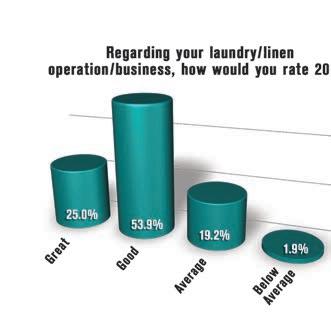
Still, more than half of managers rate 2014 as having been a “good” year, and a quarter of respondents rate it as having been “great.” Fewer than 20% say the year was “average,” and a small percentage (1.9%) report that it was “below average.” No respondents rate 2014 as having been “poor.”
“Great results in 2014—board of directors [was] very pleased,” says a respondent.
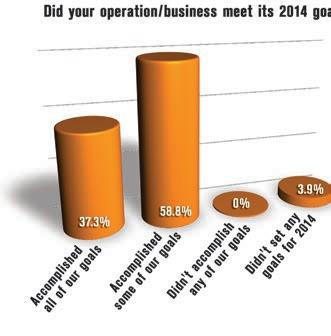
In terms of meeting goals for last year, nearly 60% report that they accomplished some of their goals, while 37.3% say they accomplished every goal set. A small percentage (3.9%) admit they didn’t set goals for last year. No one who took the survey reported not accomplishing any goals.
Goals achieved included developing safety programs, replacing dryers, increasing sales and productivity, staying within budget and reducing operating costs.
Respondents point to a number of unmet goals, too. Adding a second shift, updating equipment, plant expansion and adding business just didn’t happen for some of those polled.
Not surprisingly, respondents have already identified their major goal for this year: 22% say their No. 1 priority for 2015 is to market their service to attract more customers.
Other top goals eyed by respondents include increasing productivity (20%), building on quality staff (16%), adding or replacing equipment (14%), and improving distribution or route management (12%).
Creating greater energy savings is the top goal for just 8% of respondents; another 8% list “other” priorities, such as managing inventory and getting new products.
“We are working to add business, increase efficiency and prepare for HLAC [Healthcare Laundry Accreditation Council] certification,” says a respondent.
“We are looking to expand our production capabilities by updating equipment and looking for a larger production facility,” says another.
Overall, respondents are fairly optimistic about these goals. Nearly half say they have a good chance of accomplishing their top priority; more than a quarter are confident that they will accomplish it, “without a doubt.”
Slightly more than 25% estimate they have about a 50-50 chance of accomplishing their top priority. No one who took the survey said they have a “slim” chance or “no” chance.
“As an in-house laundry, we just want to stay open,” a respondent comments.
“Our company is robust,” says another. “And though not perfect, it is a good company to work for and is very goal-oriented.”
While the Your Views survey presents a snapshot of readers’ viewpoints at a particular moment, it should not be considered scientific; due to rounding, percentages may not add up to 100%. Subscribers to American Laundry News e-mails are invited to take the industry survey anonymously online each month.
All managers and administrators of institutional/OPL, cooperative, commercial and industrial laundries are encouraged to participate, as a greater number of responses will help to better define operator opinions and identify industry trends. ALN
Cause of fire at Mission Linen Plant under investigation
SANTA BARBARA, Calif. — Mission Linen Supply’s Santa Maria, Calif., plant is still operational after a Dec. 13 fire in the soil-sort area of the facility, the company says. The late Saturday blaze started between 11:30 p.m. and midnight; local fire department and police responded when a fire suppression system was triggered.
Mission Linen says there were no injuries and that there was limited product damage. The company tells American Laundry News that the cause of the fire is still under investigation and that it is still working to determine the overall damage to the facility.
Despite the fire, there was no interruption to service and the plant continues to operate, thanks in part to what the company calls “contingency plans in place for a whole range of potential incidents.”
“Our leadership and contingency plan have allowed us to continue to operate our business and service our customers while maintaining the safety of our employees and the community,” says John Ross, Mission Linen president and CEO. “I am proud of our team and how committed they are to providing extraordinary service to our customers regardless of the circumstances.” ALN
Publisher
Charles Thompson
Phone: 312-361-1680
E-Mail: cthompson@ ATMags.com
Editorial Director
Bruce Beggs
Phone: 312-361-1683
E-Mail: bbeggs@ ATMags.com
Digital Media Director
Nathan Frerichs
Phone: 312-361-1681
E-Mail: nfrerichs@ ATMags.com
Editor
Theresa Boehl
Phone: 708-280-1750
E-Mail: tboehl@ ATMags.com
Advisory Board
Jim Buik • Richard Griffin
Greg Gurtler • Phil Hart
Michael Kirsch, CLLM
Janice Larson • Tom Marks
Atisha Mireles • Gerard O’Neill
Richard Warren
Production Manager
Roger Napiwocki
National Sales Director
Donald Feinstein
Phone: 312-361-1682
E-Mail: dfeinstein@ ATMags.com
Main Phone: 312-361-1700 Fax: 312-361-1685
Subscriptions
630-739-0900 x100 www.americanlaundrynews.com
American Laundry News (ISSN 1091-9201) is published monthly. Subscription prices, payment in advance: U.S. 1 year $39.00; 2 years $73.00. Foreign, 1 year $89.00; 2 years $166.00.
Single copies: U.S. $7.00; Foreign $14.00. Published by American Trade Magazines LLC, 566 West Lake Street, Suite 420, Chicago, IL 60661. Periodicals postage paid at Chicago, IL, and at additional mailing offices.
POSTMASTER, Send changes of address and form 3579 to American Laundry News Subscription Dept., 440 Quadrangle Drive, Suite E, Bolingbrook, IL 60440. Volume 41, number 2. Editorial, executive and advertising offices are at 566 West Lake Street, Suite 420, Chicago, IL 60661. Charles Thompson, President and Publisher. American Laundry News is distributed selectively to qualified laundry and linen management and distributors in the United States.

© Copyright AMERICAN TRADE MAGAZINES LLC, 2015. Printed in U.S.A. No part of this publication may be transmitted or reproduced in any form, electronic or mechanical, without written permission from the publisher or his representative. American Laundry News does not endorse, recommend or guarantee any article, product, service or information found within. Opinions expressed are those of the writers and do not necessarily reflect the views of American Laundry News or its staff. While precautions have been taken to ensure the accuracy of the magazine’s contents at time of publication, neither the editors, publishers nor its agents can accept responsibility for damages or injury which may arise therefrom.

2 FEBRUARY 2015 | AMERICAN LAUNDRY NEWS www.AmericanLaundryNews.com
Association for Linen Management
MEMBERSHIPS
INSIDE: February 2015 • Vol. 41 | No. 2 [4] Columnist at Large: Penny-Wise and Pound-Foolish II Are managers focusing on the right areas when trying to reduce the costs of operation? [8] Tools of the Trade [10] Product Showcase: Small-Capacity Washer-Extractors [14] Panel of Experts “How can automation help improve operations?” [18] OPL 101: Laundry for Long-Term Care In this market, linens play a central role in care
“ Only Milnor“
could offer the combined technology ”and support we expect.”
– Rick Hamlin, Crown Health Care, Columbia, MS
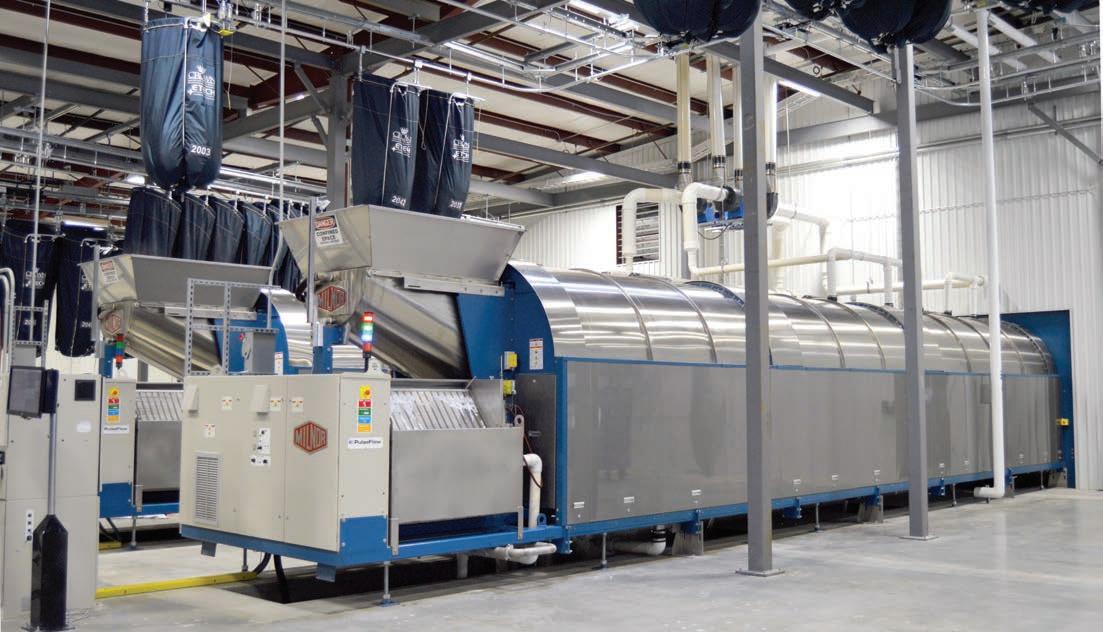
When Crown Health Care Laundry Services opened its fourth plant, it enlisted the help of longtime partner Pellerin Laundry Machinery Sales Company to design, equip, and install the most efficient laundry possible. The end result was a state-of-the-art laundry featuring two 76039 PulseFlow® Technology 10-module tunnels that creates a continuous workflow by integrating an E-Tech rail system to transport linen through the plant. Their Milnor 6464 dryer pod with GreenFlex™ Dryer Mode accepts new loads immediately after the discharge of the clean goods. This facility is designed to process over 25,000,000 lbs. of healthcare linen per year in a single shift operation, while consuming less than 0.5 gal/lb. Hamlin notes that “the project was seamless thanks to the combined efforts of Pellerin and Milnor.”
To find out how Milnor’s PulseFlow® Technology and GreenFlex™ Energy Mode can reduce your laundry’s utility consumption, contact an authorized Milnor distributor or call 504-712-7656.
To see how Crown Columbia’s state-of-the-art laundry works, scan this code.

www.milnor.com / pellerinmilnor
Hunker down, read up
Though it can be hard to look on the bright side during a long, cold, dreary winter, here’s a positive spin you can put on it: Being holed up in our offices and homes trying to stay warm gives us the opportunity to attack our growing to-do lists, and to start on some larger projects.
The latest Your Views survey on page 2 reveals that respondents have set plans for the year and are fairly confident they’ll reach those goals. On the cover, a recap of an ALM conference presentation on long-term care gives tips on entering this market, for those whose plans include venturing into that area. The OPL
101 column on page 18, written this month by Bill Kimmel of RJ Kool Co., offers even more insight into long-term care and its special requirements.


Also on the cover, our story on the future of OPLs offers the input of on-premises laundry operators about how they think these facilities will fare in coming years, and what OPLs can do to stay afloat in challenging times.
Penny-wise and pound-foolish ii
ioriginally wrote this column nearly a decade ago, but I feel it is time to update it based on a number of discussions and plant visits I had during 2014.
ALN
At the root of all of these articles is a common theme: Whatever it is you’re hoping to accomplish this year, it’s time to get to work on it.
AC Linen, Brady Linen merge to create major hospitality service brand
ATLANTIC CITY, N.J. — Atlantic City Linen Supply and Brady Linen Services have merged to serve the hospitality markets on the East Coast and in the Las Vegas area. The merger follows AC Linen’s early 2014 acquisition of Royal Hospitality Services, an outsourced hospitality linen service based in the Boston area.
Between the three companies, 15 facilities are servicing the Las Vegas, Philadelphia, Boston, Atlantic City and Norwich, Conn., areas. A 16th facility will come online in the Bahamas this year.
Eric Goldberg, co-CEO of Atlantic City Linen, tells American Laundry News that while a marketing campaign will be rolled out to introduce a corporate-level brand, the regional brands will remain the same.
He says all three companies “have great reputations and legacies in their respective markets and it’s important for us to maintain their identities and culture.”
No employees were let go as a result of the merger, and more will “certainly” be hired as the companies expand, according to Goldberg.
“All of the senior executives are staying in place, as are the operators, so it’s really three regional laundries coming together under one new corporate-level brand, and working together to integrate and harness best practices across the platform,” he adds.
J.R. Garcia, formerly director of textile services at Walt Disney Parks and Resorts, was hired as executive vice president of operations for the eastern region. Terry Satchwell, previously with Milnor, has joined the company as executive vice president of operations for the West Coast.
Goldberg says the merger was attractive to both companies, since they shared similar “family-business underpinnings” and cultures, and both wanted to “diversify geographically.”
“One of the really neat things for our customers is the ability to service them nationally, across many markets,” he says. “For example, if a hotel brand has properties on both coasts, say in Philly and Boston and Vegas, we can provide laundry service to all of their hotels—a service option no other company in our niche can provide.”
Alvarez & Marsal Capital Partners (AMCP) financed the merger, which included a $92.6 million senior secured term loan and a $20 million delayed draw term loan. Goldberg says AMCP provided the capital the company will need for “retooling and upgrading equipment” and for opening the new facility in the Bahamas this year.
The funding will also go toward expansion into other major U.S. hospitality markets. ALN

It always amazes me how poorly we managers treat our laundry chemical representatives. We hammer them on cost from morning until night and will change vendors in a heartbeat because someone else says they can do it for less. I think it is time that we take a closer look at what we are doing and why. Are we being penny-wise and pound-foolish?
Energy costs have declined substantially since I first wrote this article, but the need to produce linen at the lowest possible cost is still a driving force. Labor costs continue to escalate, and we are being asked by our customers to keep prices down. Many managers find this an impossible situation and simply give up, or worse yet, hammer on their chemical representative to decrease cost. If managers are to keep costs down, then they must be able to either increase volume by 10-15% per year or decrease operating costs. Adding volume year after year is not always possible.
One of the best ways to decrease cost is to spend more money on washroom chemicals. The goal is to create a wash quality that will allow 98% or more of the work to flow through the laundry on a single pass. Many managers are comfortable with anything less than 5% rewash and many are running higher than that. They pride themselves on reducing those costs, but this reduction negatively impacts labor, utility and textile replacement costs.
Labor has always been the largest cost of processing textiles. We waste labor when we give workers goods that must be carefully sorted because of the number of rejects. The least expensive way to process a textile item is to do it right the first time.
If you’re averaging 5% rewash and you can lower that to 2%, how much labor can you save? The 3% reduction in rework should translate into a 5% increase in productivity, because you won’t have to reprocess the work and employees will be better able to establish a reasonable pace at their workstations.
Textile replacement costs are normally your second-highest cost. Many low-cost wash formulas rely heavily on large amounts of chlorine bleach to cover for the more expensive chemicals. Nothing is more corrosive or damaging to fabrics than high concentrations of chlorine bleach.
I have seen many managers brag about their chemical costs while complaining about their textile replacement costs. Some managers blame customers, saying they are not sending the product back to them. I believe it’s human nature for healthcare workers to react to poor wash quality by throwing away unsuitable items, especially when they lack confidence in the laundry to remove the stain or do a better wash job the next time around. The ability to keep an item serviceable during its expected life is one of the keys to reducing textile replacement costs. Longer service life means a reduced cost per use and translates directly into fewer dollars spent on textiles. Also, if you purchase a quality textile product and process it properly, the end-user will respect the item, use it properly and make sure it’s returned to the laundry.
To lower processing costs, we need to make the best use of every utility dollar spent. Stain formulas normally run with high concentrations of chemicals and at higher-than-normal processing temperatures. By reducing the amount of rewash loads, we reduce the cost of utilities. By using less water, gas and electricity, we reduce the cost of doing business.
•
•
•
•
•
•
I dare say that there isn’t a laundry in the country that wouldn’t benefit economically from a reduction of 2-3% in rewash, even if it doubled their cost per hundredweight. What manager in the country wouldn’t be willing to spend up to an extra penny per pound to save an additional 3 or 4 cents per pound through labor, linen and utility expense? Have we focused on the wrong item to control? ALN
Eric Frederick is director of laundry services for Carilion Laundry Service, Roanoke, Va., and a past president and manager of the year of the Association for Linen Management. You can reach him by e-mail at efrederick@carilion.com.
4 FEBRUARY 2015 | AmERicAn LAUndRY nEws www.AmericanLaundryNews.com
COLUMNIST AT LARGE Eric L. Frederick, RLLD
Top Stories Appearing on AmericanLaundryNews.com for the 30 Days Ending January 15 (WE) = Web exclusive news • Cause of Fire at Mission Linen Plant Under Investigation • Cintas to Relocate Northeast Operations to Yonkers, N.Y. • Imperial Laundry Picks Up Business from Potawatomi… (WE) • TradeWinds Island Resorts Reaches Safety Milestone (WE) • G&K Services Pledges More Than $320,000 to United Way (WE) Columnists/Features • Panel of Experts: Measuring Employees’ Productivity • Eric Frederick: The Major Lesson from Ebola • Diligence, Training Crucial for Laundry/Linen Worker Safety
Set Green Goals, Enhance Bottom Line for 2015
Panel of Experts: 2015 Panel Ready to Share Expertise our sister websites From AmericanDrycleaner.com:
Quick Fixes to Common Drycleaning Problems
Plant Design
Grand Prize: Wooven
Awards—
From AmericanCoinOp.com:
Building Customer Loyalty
Doors to New Express Laundry Centers
Continental Girbau Opens
Coming Up Next Month... Clean ’15 Show Guide Complete listings of the exhibitors, educational seminars and events that make Clean the industry’s can’t-miss show.
From The Editor’s Chair ThEREsA BoEhL
•













800 821 2012 | healthcare@americandawn.com | www.americandawn.com
Allows the patient to remain in IV gown during imaging studies, and eliminates multiple inventories.
Innovative plastic snaps do not interfere with magnets during imaging studies.
The only plastic snap proven and guaranteed to withstand industrial laundering with 400 PSI extraction.
55% Cotton / 45% Polyester. Brushed inside for a soft touch.
•
•
•
•
Generously oversized for modesty with plastic snaps at shoulders.
Large chest pocket with oversized hidden access vent, for management of IV tubing and monitoring equipment. Available for purchase through AMERICANDAWN beginning January 2015. Made exclusively by the World’s Global Source.
•
Green
Leaf Print
Long-term
“dignified end.”
“I applaud anyone who can work in long-term care every day,” says Lobb. “It’s a very heartwrenching situation.”
Though acute care and longterm care have traditionally been different markets run independently of each other, hospitals and nursing homes have begun to form partnerships that aim to help them both meet the increas-
ing regulation requirements.
Lobb says both kinds of facilities are learning to understand and communicate with each other, and are building on reciprocal accountability. This open communication and partnership will help both acute care and long-term care be sure that patients are getting the treatment they need, and that they don’t end up back in the hospital due to mistakes made at a longterm-care facility.
Lobb says that as it currently stands, healthcare—and long-term care in particular—is the most highly regulated industry, second only to space travel. Expect that
long-term care will become even more regulated than it already is. “So when we talk about state
[inspections] and we talk about surveys, it’s huge and it’s constant, and it’s constantly changing,” she says.

For example, in the past, individuals could bring items such as linens from their homes to a longterm-care facility, but the future may bring tighter controls on such practices, she explains.
“From an infection control perspective, things are going to change,” Lobb adds. “That’s going to be an opportunity for [commercial] laundry, because right now in assisted living, you bring your own things.”
An important feature of long-


term care is its focus on the quality of life of the individual, and its goal to let people live their lives as they choose.
“In long-term care, the keyword is person-centered care,” Lobb asserts. “When I go there to live, I expect to be able to eat dinner when I want to eat dinner. I expect to be able to bathe when I want to bathe, not when you tell me to.”
TIPS FOR LAUNDERERS
On the surface, it may seem like servicing long-term-care clients would be quite similar to processing linens for hospitals and other healthcare facilities. Not so, Lobb says. There are a number of factors that launderers will need to take into consideration before jumping into this market.
Distribution of linen, for example, can differ from how it may be done in a hospital. In long-termcare facilities, laundries may be delivering smaller carts or smaller amounts of linen to “lots of little places,” such as various campuses in a wide regional area, some of which may have narrow docks and cramped entryways, making delivery a challenge.
Additionally, a nursing home may not have a dedicated individual to manage linen deliveries. For some businesses picking up longterm-care accounts, there may be a need to hire more employees to help with the increased business and to help manage pickup and delivery, according to Lobb.
“Someone’s going to have to get that linen out of the resident room and to you,” she warns. “So you may have to learn to manage labor at 34 different locations if you pick up that nursing home chain.”
Storage, too, may be difficult. Lobb says nursing homes are notorious for having little to no storage space. Hoarding is a major problem, too, exacerbated by that lack of storage.
“They’re hiding linen everywhere you can think of, and we’re taking it all over the place. We’ve got a closet here and a closet there,” says Lobb. “If you think they hide linen in a hospital, you’ve seen nothing.”
Another not-so-small area to tackle: soils. In a long-term-care facility, soils may be very different from what some laundries are used to dealing with. Bowel movement, Lobb says, is a huge issue that greatly affects the soil factor. Vaseline is another common soil, along with things like perfumed lotions, nail polish and other personal products that residents might use in their everyday lives.
“It’s not a hotel room, it’s not a hospital room. It is their home,” says Lobb. “So you’re going to find a lot of interesting things in a resident’s room in a nursing home.”
And because long-term-care facilities often have cardiac units and kidney dialysis units, launderers may find hospital-type chemicals in the linen as well.
Unfortunately, Lobb says, laun-
Continued from Page 1
TALK
“SO WHEN WE
ABOUT STATE [INSPECTIONS] AND WE TALK ABOUT SURVEYS, IT’S HUGE AND IT’S CONSTANT, AND IT’S CONSTANTLY CHANGING.”
WHERE WATERFLOW MEETS WORKFLOW TURNKEY SOLUTIONS FROM ELLIS Whether you need a fully-automated or semi-automated system, Ellis will incorporate all the equipment you need together into a cohesive system. We design around your building and space requirements, creating a truly personalized turn-key solution from washing and drying to folding and ironing. With over 100 years of experience designing and manufacturing for laundries, there is no challenge we haven’t seen and met. BOOTH #1018 800-611-6806 www.EllisCorp.com ATLANTA, GA • APRIL 16-19, 2015 ALN_Jr Page.indd 1 1/8/15 2:56 PM 6 FEBRUARY 2015 | AMERICAN LAUNDRY NEWS www.AmericanLaundryNews.com See LONG-TERM on Page 19
—AMANDA LOBB, RLLD







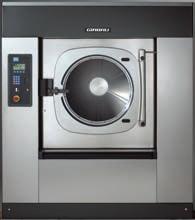
















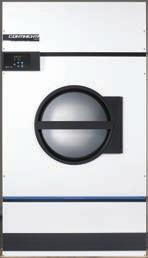

BETTER. SPEND LESS. Your clients expect the highest quality – and they should. Girbau Industrial washers and dryers provide a high-caliber clean while extending linen life. Add an Ironer to your equipment mix and linen is perfectly ironed straight from the washer. It feels soft and looks crisp, which is what your clients expect. Thanks to Girbau Industrial laundry equipment, you’ll heighten laundry productivity using less labor, while decreasing utility costs. Even better? Clients will thank you! Contact Girbau Industrial for a FREE ESTIMATE to see how you can deliver more productivity to your laundry while increasing product quality! (800) 256-1073 • www.girbauindustrial.com
LOOK
Tools f the Trade
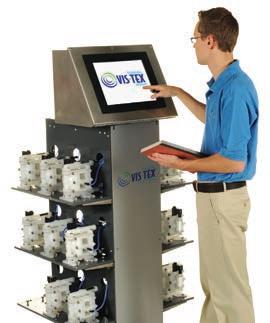
The Tunnel Vis-Tex™ chemical injection system from Gurtler Industries is made to maximize efficiency and provide real-time reporting and management tools for high-volume tunnel operations, the company says.
The system includes 16 individual pumps that allow for greater flexibility in chemical usage. Product injections can be automatically calibrated through the company’s exclusively engineered injection module, which has been designed to consistently assure “precise and accurate” chemical usage measurements.
Pellerin Milnor offers new sales literature about the 76028 PBW™ tunnel washer, which the company says features “unprecedented” utility, water and labor savings through interrupted counterflow and True Top Transfer design. The brochure is intended to highlight the inherent savings of PulseFlow® technology.




For example, page 4 of the brochure illustrates the configurations that maximize efficiency and floor space. This content was created based on the decades of experience of
Full reporting capability and easy-to-use software are features of the product’s data module, which includes a customizable dashboard, according to Gurtler.
The Vis-Tex chemical injection system’s reporting package includes production analysis, chemical usage and more.


Remote monitoring enabled by the system helps users achieve maximum effectiveness, efficiency and impact, the company says.

www.gurtler.com 800-638-7300


Designed for maximum performance under the most trying conditions, the EnviroSaver II from Wet-Tech features a patent-pending, small-bubble ozone infusion system that the company says provides a high-quality wash while maintaining savings in fuel energy, electrical energy, water, sewer and chemical costs.
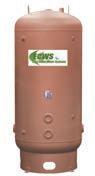
A low operating cost and a quick ROI are other features of the system, according to Wet-Tech.

The system is designed for overall utility and energy savings for hospitality, healthcare, industrial and commercial laundering.

Some units can be wall-mounted, while others stand alone, and the system can be installed on ships in addition to land-based facilities.
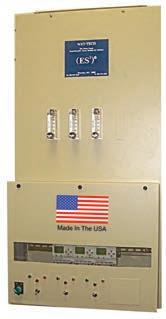
The company offers a two-year parts warranty and says it has the lowest long-term operating costs of
Milnor’s applications engineering department, and details how to select the optimal layout for any laundry, whether the project at hand is new construction or a replacement project.
Pellerin Milnor says customers who process at least 1,000 pounds per hour can justify the capital expense once utility, water and labor savings with a Milnor 76028 PBW are taken into account.
www.milnor.com/pulseflow_technology 504-712-7656


any system in the marketplace. www.wet-tech.com 508-831-4229
weatherproof, lockable outdoor linen bin stores, secures laundry
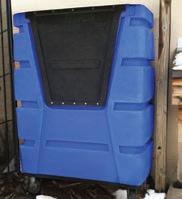
Tingue, Brown & Co. has introduced the Safekeeper® linen bin, a lockable, waterproof container that stores, accumulates and secures foodservice laundry. It is designed to safeguard linens from theft and weather, and can be placed at the rear of restaurants, catering halls, schools and other foodservice facilities, the company says.
Units include a rugged, rotomolded bulk bin, lid and seal-tight door integrated with a sturdy poly base set atop industrial-strength casters. The unit can withstand heavy use and can be permanently installed outdoors.
Soiled, bagged aprons, uniforms, towels and table linens can simply be placed inside the plastic holding unit, which holds up to 38
bushels. Laundry route drivers have quick, easy access, Tingue, Brown says, and the product’s smooth, metal-free interior can help prevent snagging of linens.
www.tinguebrownco.com 800-829-3864
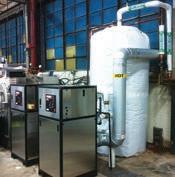
Selling Customer Service FIRST! • OEM Distributor for RBI Water Heaters • 24/7 Technical Support • Laundry Consulting • Serving Commercial Laundries and Prisons across North America and the Caribbean We offer: • Hot Water Heaters 199-6 mil btu • ECWS Hot Water Storage Tanks • Water Softeners • Pre-plumb packages Call us for a quote using our SizeNet sizing program Phone: 1-866-513-7170 www.eastcoastwatersystems.com Fax: 843-225-6258 Visit us at Clean Show booth #1049 1114aln_ECWS ad.indd 1 10/2/14 7:25 AM 8 FEBRUARY 2015 | AmERicAn LAUndRY nEws www.AmericanLaundryNews.com
Tunnel washer sales literature details product savings, advantages, company says
Flexibility, accurate reporting features of new chemical injection system
manufacturers: Have you introduced a new product? Revamped your system? Released a new catalog? E-mail your product news, along with a high-resolution image, to news@ americantrademagazines.com and we’ll consider publishing your news free in Tools of the Trade.
New
Ozone system designed to reduce costs for range of environments
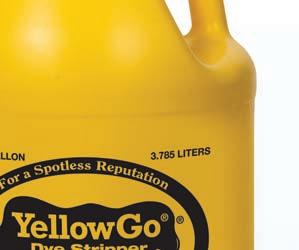
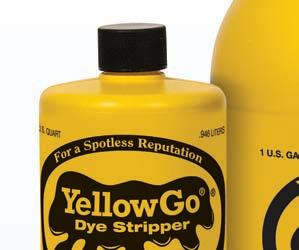
Results on whites are excellent. On colors, you have nothing more to lose and everything to gain by trying YellowGo. YellowGo may take out color you want to keep. But if it removes the unwanted dye without damaging the underlying color, you win! You won’t have to pay for the dye-stained garments and you won’t disappoint your customers.
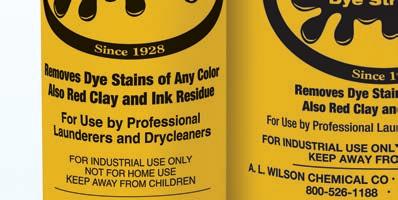
So use YellowGo to keep your customers happy and keep them coming back.









information visit
or
or
YellowGo® removes unwanted dye from fabric. For more
AlWilson.com
call us at 800-526-1188
201-997-3300
Product showcase
IPSO
Designed to help on-premises laundry managers improve the cost-effectiveness and productivity of their operations, the IY55 soft-mount, 55-pound washerextractor from IPSO® boasts an industrial design and intuitive features, the company says. With the IY55’s Aries Elite control system, operators can program up to 99 wash cycles in multiple languages, and a USB port and optional wireless networking allow for easy programming. Wash and spin speeds can be customized, and reduced water and energy usage can result from the washer-extractor’s eco-wash programs, IPSO says. A high G-force extraction speed of up to 400 G, at minimal noise levels, is available thanks to the product’s standard inverter drive.
While the machine’s frame is lightweight, it is engineered for heavy-duty performance, and it has a stainless steel drum, tub and cabinet, and a seal system to protect bearings. Loading and unloading are easy with the machine’s large door opening and wide-set hinge, and near the front, a four-compartment soap dispenser can be quickly accessed. The IY55 is easy to install or relocate and comes with a five-year
warranty on major parts and a three-year warranty on the entire machine, according to IPSO.
www.ipso.com/info 800-USA-IPSO
Maytag COMMerCIal laundry
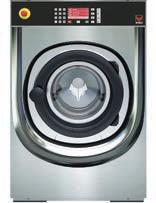
The new Energy Advantage™ soft-mount washers from Maytag® Commercial Laundry have been designed to reduce costs and extend the life of linens. These 55-pound, softmount washers feature extraction speeds of up to 400 G-force, which the company says results in faster dry times and reduced labor and energy expenses.
The company’s proprietary TurboWash™ system includes specially designed spray baffles and programmed tumble patterns to enhance cleaning performance. Other features of the washers include easy-touse controls with up to 20 pre-set wash programs available in multiple languages; two built-in USB ports for easy uploads and downloads of machine settings and soft-
ware; programmable water levels; and more chemical injection ports on the latest models.
Additionally, the washers come with an oversized door opening with a 180-degree door swing for easier loading and unloading and increased durability.
www.maytagcommercial laundry.com 800-662-3587
COntInental gIrbau
High-performance G-Flex washer-extractors from Continental Girbau feature six programmable extract speeds, including 100, 140 and 200 G-force, according to the company. These washer-extractors, which have been engineered to be durable, productive and efficient, are available in 40- and 55-pound capacities.
The highly programmable, flexible Logi Pro Control features 25 individually modifiable programs that allow for cleaning of a variety of soils and fabric types. Each has up to 11 baths, including multiple pre-wash, wash and rinse cycles, Continental Girbau says. Wash temperature, water levels, cycle times, rotation and G-force extract speeds can all be programmed with this system.
While many hard-mount washers can only
generate extract speeds of 75 or 150 G-force, the company says G-Flex washers produce the kind of extract speeds that remove more water, allowing the linen to dry faster, which can help increase productivity and decrease natural gas usage and labor requirements. These washers are backed by a 5/3-year ContinentalCare™ warranty.
www.continentalgirbau.com 800-256-1073

dexter laundry
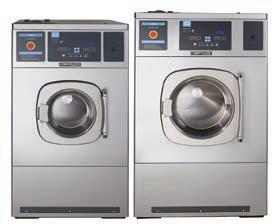
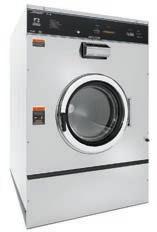
The C-series 90-pound Express washer from Dexter Laundry is built with high-quality materials and has been designed to excel even in the harshest environments, the company says.
The washers feature 200-Gforce extraction, as well as the option of six-cycle or 30-cycle programmable controls, allowing the equipment to be customized to fit installation and processing requirements.

Like all of the company’s washers, this design has gone through a rigorous, 1,000-hour, out-ofbalance test of the product’s durability, according to Dexter, which says its washers process laundry efficiently and effectively for years. Lifetime technical support and a 10-year warranty are offered.
www.dexter.com 800-524-2954
unIMaC
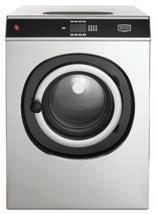
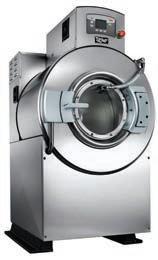
UniMac’s UW65 is an industrialstrength, 65-pound-capacity, hard-mount washer-extractor designed to help on-premises laundry managers reduce water and energy usage, the company says.
10 FEBRua Ry 2015 | amERican LaundRy nEws www.AmericanLaundryNews.com
cOmPiLEd By THEREsa BOEHL, EdiTOR
[IPso]
[Maytag commercial Laundry]
[Dexter]
ALN_Tab_1-4_H.indd 1 7/16/13 3:58 PM
[continental Girbau]
For example, nine unique ECO cycles are offered as part of the 41 customizable cycles in the washerextractor’s UniLinc™ control system. Operators can control water usage through programmable water levels, and an industryexclusive, 400-G-force extraction speed removes more water from each load for shorter dry times and utility savings, according to UniMac.
Also offered through UniLinc is OPTispray™ rinsing technology, which decreases cycle rinse times and delivers better rinse results than bath rinses alone, as it removes more residual wash chemistry from the load, which can ultimately extend linen life, the company says.

UniLinc allows operators to view performance reports on energy and water usage, and they can also access machine service history logs. Information from multiple machines and locations is accessible from any Internet-
connected computer, thanks to the product’s wireless networking capabilities. The UW65 comes with a five-year warranty on major parts and a limited threeyear warranty on all other parts. www.unimac.com/ info 800-587-5458
Wascomat


Wascomat, distributed by Laundrylux, offers a full range of energy- and water-saving washers in a range of capacities, starting at 20 pounds, the company says. Built to be flexible and easy to use, these washers come equipped with the Compass Pro microprocessor for program selection, diagnostics and custom programming.
Also available are 55 programs, 15 custom programs and cycle names, and more than 20 languages, with the ability to display two at a time. A USB in front allows for easy accessibility, the company says, and
detailed user statistics can also be accessed.
An external liquid chemical manifold aims for improved reliability, workflow and flushing, Wascomat says, with its built-in water reservoir for diluting chemicals in the dispensing system. Less maintenance is necessary, and damage to hoses, steel and motors can be avoided.
Wascomat describes its washers as “the workhorse of the industry” and says that there are 40-year-old Wascomats still working in laundries today. www. laundrylux.com 800-645-2205
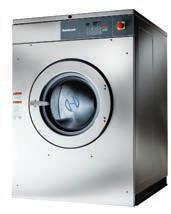
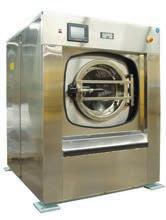
EDRo coRP. The DynaWash® open pocket, soft-mount CSL60 washer-extractor from EDRO Corp. features a highly efficient inverter with single motor drive setup that allows for highspeed extraction of more than
300 G-force, the company says. Other features of the CSL60 include a state-of-theart DynaTrol Human Machine Interface (HMi) touch-screen control V2.0 with an isolated electronic enclosure, a DynaMount shockand-spring suspension mounting, a stainless-steel basket and wash tub, and a stainless-steel cabinet.
The DynaTrol touch-screen control has a simple interface and a full array of owner/ supervisor productivity reporting, and it also allows for specific wash programming. Integrated ozone control is also allowed through the controller to incorporate the DynOzone – DynaWash® ozone cleaning system, which the company says greatly reduces hot-water requirements and decreases rewash.
EDRO Corp. says the washerextractors are typically installed in OPLs at hospitality and healthcare establishments, as well as in correctional facilities and as pony machines in industrial and uniform-rental laundries.
www.edrocorp.com 800-628-6434
HuEbscH
The 40-pound HCN040 washerextractor from Huebsch has been built to optimize energy usage and efficiency for on-premises laundries, the company says. With the Galaxy™ 400 control system, which includes three programmable water levels, operators can choose the best water level for each load. With eBoost™ technology, inverter drive technology allows for operation using 33% less electrical energy than comparable models, Huebsch says.
A 200-G-force extraction speed maximizes water removal and reduces dry times.
The company says its
www.AmericanLaundryNews.com AmericAn LAundry news | F e B r uAry 2015 11
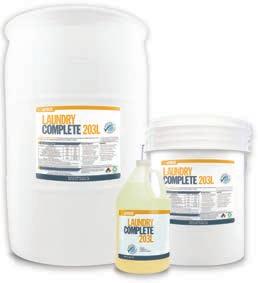
Independent testing shows Evolve removes 14 out of 16 of the toughest stains. INTRODUCING EVOLVE® LAUNDRYCOMPLETE 203L A powerful, new alternative to harsh chemical detergents, Evolve Laundry Complete 203L is the first natural technology to easily outperform conventional alkaline and surfactant-based detergents while neutralizing even the most severe odors. ● Superior stain, grease, and odor removal. ● Improves softness & reduces linen degradation. ● Increases capacity by shortening production times. ● Increases profits by reducing chemical costs, water usage, & utilities. Call (800) 992-4242 to request a FREE gallon sample to experience Evolve’s remarkable technology in your facility TODAY! WWW.AGAIAINC.COM/ TRYEVOLVELAUNDRY 0 00 ® ALN_Tab_half.indd 1 12/15/14 1:40 PM
➢ [UniMac]
[Huebsch]
[Wascomat]
[EDRO]
patented Water Guardian leak detection also eliminates wasted water and resources by automatically sensing leaks in the drain and fill valves.
With Galaxy controls, managers can program equipment from their computers, as well as retrieve and analyze performance data and alerts.
Also featured on the HCN040 washer-extractor is a heavy-duty frame, and seals and bearings designed for optimum corrosion resistance.
The HCN040 comes with a five-year warranty on the frame,
cylinder, shaft, bearings and seals, as well as Huebsch’s standard three-year warranty on the entire machine, according to the company.
www.huebsch. com/info 800-553-5120
B&C TeChnologies
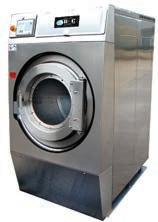
B&C’s HP hard-mount professional line of washers has been
designed to offer long life and dependability, and is available in capacities starting at 65 pounds.
The machines keep repair costs low and downtime to a minimum, and allow for easy maintenance, the company says.
The HP line features a high extract speed to ensure less drying time for goods, which can save
on utility costs and wear and tear. B&C says all of its washers feature a solid foundation, a large door opening for easier loading and unloading, and a strong door and hinge system made of 304 stainless steel.
www.bandctech.com 850-249-2222
Milnor
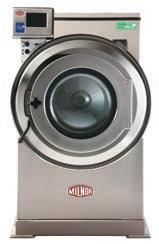
The high-speed 30022 V8Z from Milnor is a 60-pound-capacity, rigid-
mount washerextractor with features including highly programmable MilTouch touch-screen control, the RinSave® water saver, and consistent 300-G, high-speed extraction, among others. These washer-extractors do not slow down during out-of-balance conditions, Milnor says, and are highly programmable to suit operators’ specific needs. The 30022 V8Z has precise basket rotation, programmable water levels and overnight soak, and consistently removes moisture from load to load, according to the company.
www.milnor.com 800-469-8780
peed Queen
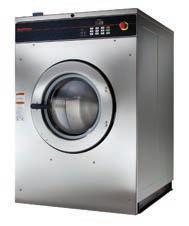
Speed Queen’s SC60 is a 60-pound washer-extractor designed for on-premises laundries and built to extend linen life, reduce utility costs and maximize productivity, the company says.
Two control systems are available: Quantum™ Gold and Quantum Standard. With Quantum Gold, 30 programmable cycles and water levels are offered, and 200-G-force extraction removes more water to shorten dry times and lower utility usage.
Quantum Standard is ideal for more basic management, Speed Queen says, and features a maximum extraction speed of 100 G-force with four cycle selections and two water levels.
Increased efficiency results from the SC60’s sump pump design, which lowers water consumption by minimizing “non-wash” water, according to the company. Patended Water Guardian technology, which detects drain- and fill-valve leaks, comes standard.
Other features include a selfcleaning, four-compartment chemical dispenser that automatically dispenses detergent or fabric softener at appropriate times in the wash cycle; an alternate rotating wash action that produces excellent wash quality

12 FEBRuaRy 2015 | amERican LaundRy nEws www.AmericanLaundryNews.com
[Speed Queen]
[B&C Technologies]
[Milnor]
without damaging delicate fabrics; and a heavy-duty construction that complements the SC60’s advanced control features, the company says.
www.speedqueen.com 800-590-8872
RAMCO
LAundRy MAChineRy
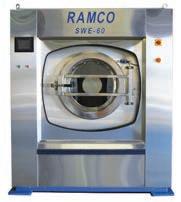
SWE60, a soft-mount washerextractor from RAMCO Laundry Machinery, is built with fewer parts than most commercial washers, the company says.
gram selection, diagnostics and custom programming, all in one knob. Other features include 55 programs, more than 20 languages, and Smart Start, as well as Voice Guidance and Sanitizing Rinse options.
Power Balance automatically calculates an unbalanced load in the drum and adjusts distribution and
extraction speeds appropriately, which the company says leads to lower maintenance, less vibration and maximum water extraction.
These washers can be installed in basements, on wood floors and on upper levels, according to Electrolux.
www.laundrylux.com 800-381-7222
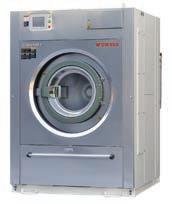
yAMAMOtO JAPAn
Soft-mount washers from Yamamoto Japan come in 50-, 65-, 80- and 95-pound capacities, and can also handle lighter loads
and rarely go out of balance, according to the company.
The washers come standard with steam and cool-down, and have 100-program storage capacity with a simply copy-and-paste touch-screen programmer that allows all parameters to be changed by one unit (degrees, RPM, etc.). Ten
programmable water levels are available.
Yamamoto also offers combo machines that are both washerextractors and dryers, available in 60- and 80-pound capacities. They can save time and labor, as there is no need to transfer goods to a separate machine to dry, according to the company.
www.yamamotolaundry.com 866-204-0519 ALN
Boasting reduced vibrations, these washer-extractors are designed for single- and upperstory installations. The machines are made from high-quality stainless steel materials, and with 300-G-force extraction, drying time and energy costs can be reduced, according to RAMCO. Material snags and tears can be avoided thanks to the machine’s electro-polished and embossed cylinders.
The washers feature four- to five-cup automatic dispensers, an easy-access drain, and microprocessor controls with color touch screens.
www.ramcolaundry.com 800-878-5578
eLeCtROLux
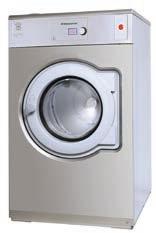
High-speed, 450-G-force extraction washers from Electrolux, distributed by Laundrylux, come in a range of capacities starting at 18 pounds, according to the company.
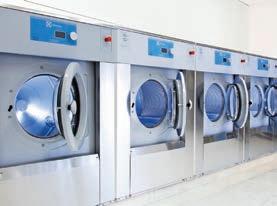
With Automatic Water Savings, the precise amount of water based on the weight of the load is added, with the aim of reducing water consumption and energy costs.
Smart dosing adjusts the ratio of laundry chemicals to water to cut back on chemicals and extend linen life, the company says.
Compass Pro allows for pro-
www.AmericanLaundryNews.com AmericAn LAundry news | F e B r uAry 2015 13
YOUR CHALLENGE PACESETTER CLM leads the way in dryer technology and provides an upgraded replacement for your old Challenge Pacesetter Our
165 fits the Challenge Pacesetter footprint perfectly and gives you technology that no one else offers, including a fully integrated production management system. • Upgraded heat system with improved efficiency and lower emissions • Micro-Command III PLC upgrade with LAN and Blue Tooth communications • PLC now prepared for flow process management systems • 2-stage variable speed basket drive with 3-port load door. • Soft start to reduce component wear, lower utility use. • Heavy-gauge basket, includes removable steel basket panels • Long-lasting ceramic coating available on removable basket panels. • Configurable exhaust location • Configurable control/burner location Call CLM to replace your Challenge Pacesetter dryers, or for information on our broad range of industrial dryers. 323-232-2417 Model 165 shown with Tumble Green® configuration See Us at Booth 2560 at The Clean Show 211 Erie Street, Pomona, CA 91768 | T: (323) 232-2417 | www.clmco.com ALN_Jr Page.indd 1 11/18/14 2:36 PM [Yamamoto Japan] [Electrolux] [RAMCO]
UPGRADE
Model
PanEL oF ExPERts
Automation for efficiency, reduced costs

mix correct? What is needed, or what can we do without for a few hours? It also demonstrates whether the operator and management understand what they are supposed to be accomplishing—processing linen efficiently.
experience this as a result of fabric changes.
Good plants are about systems and automation being used properly to save on costs and the wear and tear on our most valued commodity—people.
always attend the Clean Show to get a look at what is happening in the industry.

during my laundry career, there have been two phases of productivity automation that have greatly influenced me. These are overhead rails and the combination of small-piece folders and spreader-feeders.
Regarding overhead rails, I have seen the transformation of about 14 jobs in a plant as a result of the move from pushing carts to what I call a “managed” overhead rail system. This system relies on a staging computer and the subtle manipulations of individuals.
My goal is to manage as little of the plant (20%) on a daily basis as possible, and have the rest (80%) happen as a result of setup. This setup determines the plant’s production flow and decides the plant’s success. In this example, the savings/payback is quantifiable, quick and ongoing.
Additionally, the dumping or discharge points for the monorail system become a monitoring system of their own. I have managed two plants where I would walk onto the production floor and the first thing I would do is look up.
That glance upward would answer a lot of questions. How is the plant running (in terms of staging)? Is there enough work to keep associates busy? Is the linen
Small-piece folders and spreader-feeders today are phenomenal. They are generally quiet, and they handle an abundance of fabric types without creating significant transition or downtime. The control devices make it easy to change from item to item.
This automation helps to take away some of the excuses employees give for not being able to complete their work, and helps to keep the production conversation simple. Thus, we are helped in our battle to convince associates that they “can do it.”
After many years of production and plant operations experience, I recently began working on the textile manufacturing side of the business. This change in vantage point affords me the opportunity to offer some additional thoughts on the impact of automation.
Automation is also enhanced as a result of the changes in fabric, which can cause productivity to change. Our company has a focus on developing and manufacturing fabrics and products that yield the lowest cost per use. For me, instances where these products were lighter in weight have allowed for larger loads, faster processing, less drying time and greater productivity in pieces. This is true for sheets, pillowcases, blankets or scrubs, and even cubicle curtains are starting to
automation can certainly help improve laundry operations, but there are questions that need to be answered before jumping onto the automation bandwagon.
Every laundry is different, and what may be a huge improvement for one laundry may not work for another. You should look at your individual operation and ask what you would like automation to do for you.
As much as I would have liked to put in an automated rail system and tunnel when I started renovating eight years ago, space and ceiling height made it difficult and potentially costly.
Now, with the rapid changes in technology, more efficient and space-saving systems are available that might make sense moving forward.
Keep up with what is happening with equipment, and be willing to explore new options. Whether I am purchasing new equipment at the time or not, I
203L
● Superior stain, grease, and odor removal.
● Improves softness & reduces linen degradation.
● Increases capacity by shortening production times.
● Increases profits by reducing chemical costs, water usage, & utilities.
Simple automation has helped my laundry operation, as we have our ironer and towel-fold area attached to a conveyor leading down to where bins are loaded.
When we first started, one ironer and three towel-fold machines required four catchers to handle the products. With the simple addition of a conveyor, we then only needed one catcher for all of the products, which reduced the hours needed for catching by 120 hours per week.
We later added a second ironer and had it attached to the conveyor, which only required an additional 20 hours per week to assist with catching, instead of needing a full-time catcher.
This brings up a potential concern when automating: You may well be affecting people’s lives through reducing staff needed in the laundry operation. Is the return of automating worth the cost of potentially putting people out of work?
In my case, automation allowed me to add a second shift to take on more work and no jobs were lost. Thirty new positions have been created as a direct result of the automation installed in the last eight years.
I am a strong supporter of always considering what any degree of automation can do for a laundry operation. There continue to be improvements on existing automation technologies and on new types of equipment coming to the market.
d
uring my recent holiday break, like many of us, I took time to take stock of what’s been accomplished and/or what’s changed in 2014. What stuck out specifically was the exciting transformation over the last year of technology and methods of selling.
Whether we like it or not, smartphone technology is here to stay. I saw an increase in my own personal productivity due to this type of automation, from the way I prepare and submit my reports to how I communicate with customers and my corporate office. I saw an immediate improvement in my time management and what I could accomplish on a daily basis.
In 2014, I witnessed a major change in the way many laundry operators were processing their product mix, whether it was healthcare, linen supply or dust control. It seemed that as our economy changed, the workforce in some geographic areas was depleted. Everyone was looking for a distinct advantage to process more quickly, more efficiently and more economically while decreasing their workforce. The solution? Automation.

As laundry operators made upgrades and improvements to

A powerful alternative to harsh chemical detergents, Laundry Complete 203L is the first natural technology to easily outperform conventional alkaline and surfactant-based detergents while neutralizing even the most severe odors.
Call (800) 992-4242 to request a FREE gallon sample to experience Evolve’s remarkable technology in your facility TODAY!
14 FEBRuaRy 2015 | amERican LaundRy nEws www.AmericanLaundryNews.com
TRYEVOLVELAUNDRY
WWW.AGAIAINC.COM/
INTRODUCING EVOLVE ® LAUNDRYCOMPLETE
® 0 00 ALN_Tab_1-4_H.indd 1 12/15/14 1:44 PM
“How can automation help improve operations? Alternatively, what are some reasons a manager might prefer a human to do the job, rather than a machine?”
Hotel/motel/ Resort Laundry Phil Jones
Sheraton Vistana Resort, Orlando, Fla.
textiles Cecil B. Lee Standard Textile, Cincinnati, Ohio
uniforms/ workwear manufacturing Scott Delin Fashion Seal Healthcare Seminole, Fla.
their existing plants through automation, immediate results were seen, such as cost savings for labor and energy, increased pounds per operator hours, less labor and, in some cases, increased quality of product.
In my travels, I have witnessed automation change how soiled linen is sorted, how it’s laundered and processed, how it’s transported through the plant, and how it’s folded and put up for route distribution. For those who can afford the added expense of automated equipment, real-time savings and return on investment make competing for that almighty new business something worthwhile. However, don’t think that there are no problems with automation. As many of the new automated pieces are run by small computers, there may sometimes be some internal glitches that cause “hiccups.” With a smarter engineering team, these hiccups might be averted.
Prior to automation, more visual inspections of products and product quality took place. It was up to the operators to visually check for inferior quality and pull those pieces aside. Many plants still have quality audits on product being processed in an effort to catch any inferior product that may have passed through the line.
Successful managers and operators realize that not all jobs and tasks performed by humans can be replaced by automation. For many plants of various sizes processing different products, the personal touch and inspection by a real person cannot be replaced.
As we move into 2015, I am sure that we will see an “automation explosion” take place in our laundries. As we strive to be successful and profitable, while producing a quality product for our end-users, we will see more and more operators hop on the automation train and ride it to a more profitable business model.

cutting labor and product costs and increasing production and revenue. A good automated system designed for your specific needs can dramatically change the dynamics of your business. So why are some businesses still operating with manual labor? Why aren’t all production facilities completely automated with machines handling every task? The answer is because we are human.
Following are several factors that continue to drive manual production lines:
• There’s no design for automated technologies to do
some of the things manual labor is handling.
• Companies care about their employees and don’t want them to lose their jobs.
• Automated technologies come with a huge learning curve for employees who have worked on a manual system for years, including managers and supervisors.
• Conversion costs to automation can be prohibitive.
• Automated production lines require a high level of maintenance and repair that company mechanics/engineers are often not trained to trouble-

shoot or fix.
• Automated technologies can shut down an entire production line due to one simple problem.
It has been proven time and again that an automated application can help cut labor and product cost and increase production and revenue. But all those increases can take a plunge if employees don’t understand the equipment, or there is a lack of training and understanding from management and engineers. Maybe that’s why some managers would prefer a human to do the job rather than a machine.
everyone realizes that automation can save labor. But I think automation can improve operations beyond that.
For instance, I would look for ways to eliminate mistakes. As an



in early 1913, Henry Ford pioneered the birth of automation, opening up the first assembly line in his automobile plant, which increased production and lowered costs more than he could have imagined. Before Ford instituted the automatic assembly line, it took his skilled and non-skilled workers 12 hours to build just one car. Afterward, his production increased to one car every 30 minutes. That is roughly 46 more cars a day. That was a huge production increase, which translated to a lot more dollars.
In today’s world, automation is definitely a key factor in
www.AmericanLaundryNews.com AmericAn LAundry news | F e B r uAry 2015 15
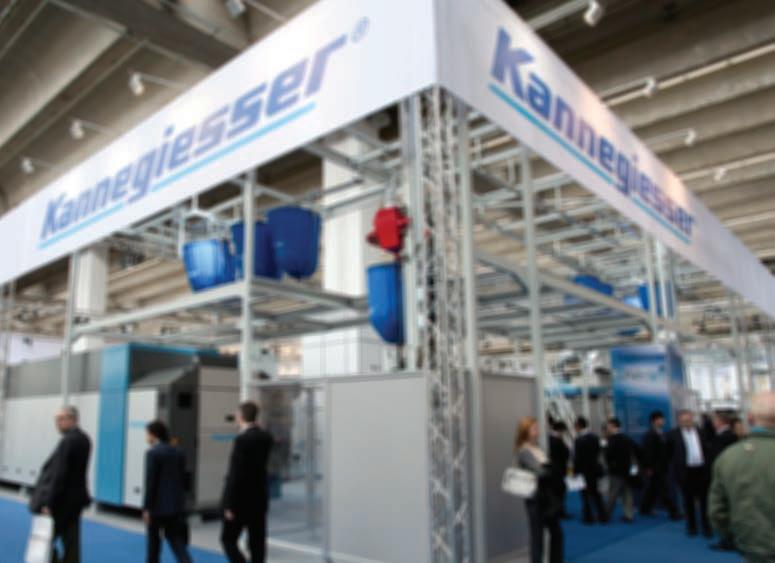
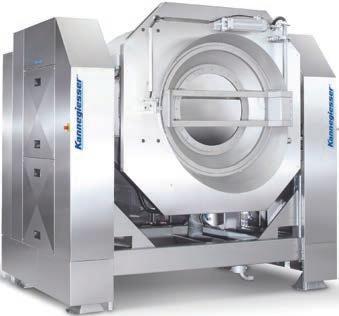
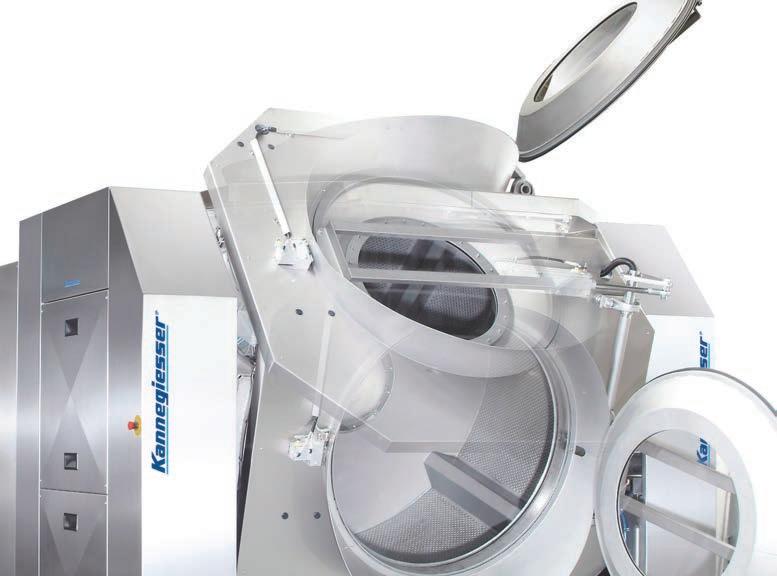
kannegiesser-usa.com•800.344.0403 PRODUCTIVE 90° Tilt Vertical Loading to maximize cylinder volume JET-rinsing for shorter process times “Optimized Process Spinning” extracts goods to a defined retained moisture percentage EFFICIENT Exact water metering with Scaletron PLUS JET-rinsing for reduced fresh water consumption Weight dependent dosing of water, chemicals, etc. Water recovery systems INNOVATIVE Program up to 99 different washing programs Powerful drive unit for infinite speed regulation Manual, semi-automatic or automatic loading possibilities Parameter data logging with DataFocus THE LEADER IN LAUNDRY TECHNOLOGY PowerSwing ALN_Jr Page.indd 1 1/5/15 11:17 AM See EXPERTS on Page 16 Textiles/ uniform rental Angelo Crespo Cintas Corp., Westland, Mich.
chemicals supply David Barbe U.N.X. Inc., Greenville, N.C.
example, soil-sorting systems that weigh bags automatically and alert employees before they can be overloaded will save the labor of weighing each bag, but more importantly, improve the quality and consistency of the wash.
Having the washer automatically select the formula on a chemical system, rather than manually selecting both the washer and the chemical formula, will eliminate errors. This can also improve quality and consistency while saving a little bit of time. Anytime automation can eliminate steps employees have to do, that’s great. On the other hand, automation that adds extra procedures may eliminate labor, but add more variables or mistakes to your operation.
Obviously, as an equipment designer, I like machines. However, a skeptical look at automation is necessary to keep from making an expensive mistake. If the cost is low for a device or system, and installation or implementation is simple, you can try new things and see how they work with the operation.
The more expensive the automation option, the more thought has to go into the decision. Perhaps the vendor has a nearby location you can visit to see the system and talk to a user.
Maybe the vendor will even allow a trial period. Ask for references and do your
homework. Consider not only cost, but maintenance, space requirements, backup operation if it breaks, etc.
One of my favorite things about attending the Clean Show is observing the new automation offerings. I’ve watched machines trying to grab towels out of a bin and feed a towel folder automatically. Sometimes they work well, and sometimes, not so much.
In the future, employees may be relieved of the back-breaking and boring job of feeding goods to ironers and folders. But in every laundry that I’ve been in recently, people are still grabbing goods with their hands. Apparently, in those cases, it’s still quicker and/or cheaper.
The second part of this month’s question brings up one of the most important considerations: quality and customer satisfaction. Obviously, wrinkled or poor-quality goods are unacceptable.
And have you ever called a business and been subjected to the automated phone tree? After about five options, did you remember the first ones? Did you go through multiple levels, get frustrated and just hang up? I have.
If your automation directly affects your customers, think about the perception it conveys of your company. The neatest and most efficient sorting, handling, billing or inventory system can sink your profits if it annoys your customers.
After all, a totally automatic handling system might not even notice the beige or wrinkled napkin mixed in with the pretty white ones. Humans are still smarter than any machine.
ibelieve labor is the No. 1 item on most laundry budgets. With Obamacare and general increases in hourly labor costs, automation is something we all need to review closely. If we can achieve higher productivity, the additional labor costs can be negated.
Automation is definitely one way to gain additional capacity, which should translate to additional profit. Properly utilized, automation can offer better control of production with newer available reporting programs.
Most laundries track pounds per operator hour (PPOH). The acquisition of newer, more productive machinery should afford our laundries the ability to achieve higher PPOH numbers. Some pieces of equipment seem to make a marked impact on productivity.
If your laundry is at a point where an automated tunnel washing and drying system might be a potential acquisition, there can traditionally be very large savings, which come from a multi-faceted approach.
First, let’s focus on potential savings in labor. A quick recap of the numbers will show that if you had a 12-module, 50-kg tunnel operating at two-minute transfers, you would theoretically be washing and drying 3,300 pounds per hour. Providing that you might not have the room for a sling or bag system, this productivity could be accomplished with one person loading the conveyor to the tunnel.
With the automated system moving the laundry from the wash line to the dryers, you might expect a theoretical 3,300 pounds being processed with one worker. If we momentarily ignore the old adage that says “figures lie and liars figure,” one could say that you’d have a PPOH of 3,300.
The second area of savings involves the substantially lower water usage per pound of laundry processed. Another substantial gain can potentially be derived from the use of a spreader-feeder in front of the ironing line.

Automation can be achieved in numerous areas. There are, for example, great programs to automate your scale (weighing) area. These not only provide generous amounts of information, but can be utilized as a great method of asset management. With the use of these systems, we can know exactly where all of our laundry carts are at any given time.
Laundries must look at their individual needs, requirements and space availability when making these major decisions.


Consider the ability of your existing engineering department to keep all machines in proper, safe working order, or the availability of properly trained technicians to assist you in that endeavor.
You’ll also need to think about availability of capital to acquire this level of automation. Will my ROI be acceptable? Also, is there space in the plant for the additional equipment? Consider, too, the utilities necessary to support the added machinery.
And don’t forget what is possibly the most important question: With this automation, how will quality be affected? With automation, we usually have fewer human eyes looking at each piece to confirm that it meets all of our quality-control standards. This can easily create a negative impact on the goods leaving the plant and, ultimately, on the bottom line.
I personally know of a few pieces of equipment that would enhance our PPOH, but would risk a substandard product leaving our laundry. If one is to run a professional laundry with the intent of providing the utmost in quality, then it will always be a balancing act—quality vs. productivity vs. price.
i’ve had the opportunity to work with numerous laundry facilities that process customer-owned goods (COG) or customerspecific rental linen, as well as traditional rental-linen operations. I have seen a number of labor-intensive methods for tracking each customer’s goods throughout the whole production process.
In my experience, a lack of automation seems to steer managers toward heavy human involvement for this task. However, ongoing advancements in laundry technology now allow for fully automating and synchronizing batch data transfer, customer information and material flow throughout a laundry’s entire production flow process.
The goal of this kind of automation is to have the ability for multiple customers’ linen to arrive in the pack-out area of the facility by means of the highest potential machine utilization and PPOH.
This can be accomplished by gathering information at the soil-sorting area where the batch information is subsequently tracked through processing machines, which communicate with a central database. Automated customer, category and weight information flows throughout the washing and drying process, and then the information is converted to piece-tracking in the finishing department, which benefits rental and COG plants alike. An added benefit for COG operations is the ability to then also automatically track and separate final folded stacks of linen for customer-specific cart make-up.
In a fully integrated machine system approach, all data can be transferred through a central on-site server. The monorail system, belt conveyors and shuttles are fully synchronized for automated linen transport, and all machines’ parameters are automatically transferred and changed to match each customer’s specific requirements. All told, this automation provides for a consistent, steady flow of goods to each machine, and it automatically sets machine programs and tracks customer changes to minimize any idle time from an operator’s task at hand.
Another benefit of this integrated database system is that it provides for a full array of reports back to management of each operator’s performance. A visual productivity display can also be equipped at each workstation to provide constant feedback to the individual operator for ongoing reinforcement of their hourly/daily throughput.
How automation can help improve operations is shown in part by this type of technology. Automation can assist plant operators in reducing lost time and capacity of production equipment by minimizing machine idle time; through automatic transfer of data and constant linen flow to each workstation; and by secure tracking of customer batches throughout the complete production process for safe and timely clean-linen cart pack-out and shipment.
16 FEBRuaRy 2015 | amERican LaundRy nEws www.AmericanLaundryNews.com
ALN
continued from Page 15
Experts
Equipment manufacturing
Kelly Outram
ALN_Jr_half.indd 1 1/5/15 3:12 PM
Kannegiesser USA, Grand Prairie, Texas
commercial Laundry
Rick Rone
Laundry Plus, Bradenton, Fla.
having [an] on-site laundry,” he says. “I’ve been in the industry for 30 years now, and they’ve always been around, and I just don’t see them disappearing from a hotel, especially when you’re looking at even smaller operations.”
Of course, Coe adds, in areas with extremely high land costs, such as New York City, for example, hotels might see the value in outsourcing or combining their efforts to do laundry.
The key to staying competitive is the ability to be flexible in terms of products and services, says Jesse Clyma, operations supervisor at Spartan Linen Services at Michigan State University in East Lansing, Mich.
“If you stay the same, you’re not going to continue to do this for very long, I think,” he says.
Sandip Thakkar, vice president of HSM Hospitality Management Co., and owner of several hotels in the Cleveland, Ohio, area, says that he can’t
THE VALUE OF OPLs
Convenience, control and flexibility are the main reasons an OPL might be the best option to serve a business or institution, says Coe.
Thakkar agrees: “I like to have that control.” He says that by outsourcing the laundry, hotel operators would be “putting [their] livelihood in somebody else’s hands.”
The ability to supply an item right away is a major benefit of an OPL, Clyma and Champlin say.
“A cubicle curtain—if they want it right now—I can wash it and have it back within two or three hours, where you couldn’t do that with off-site laundry,” Champlin says.
“To me, if it’s run right, you’ll always have product when you need it,” Haggard adds. “[If] you outsource, you’re totally dependent on them— totally.”
But in order for OPLs to stay competitive, they need to confront their challenges head-on.
Those polled list labor as one of the biggest issues affecting the success of on-premises laundries. Acquiring good, dedicated employees; securing
to increase,” says Coe, who lists highspeed extraction and reverse drying as technologies that can increase performance.
Thakkar says he recently bought a new machine for the Comfort Inn in downtown Cleveland that has made all the difference.
“We were so busy, and I wanted crisp, white sheets,” he says. “We made a substantial investment, and it’s really paid off.”

The new equipment was part of a larger plan to replace anything causing hiccups in the laundering process.
“I started with the chemical compa ny, I started with the labor, and I start ed with the equipment, and upgraded everything. And now, two years later, I couldn’t be any happier,” Thakkar comments.
Modernizing on-premises laundries, including making use of automation, can help operators lower their labor costs, according to Champlin.
“[That’s] probably what saved my laundry,” she says.
ADVICE FOR MANAGERS
Whether you see the future for OPLs as promising or bleak, the administra tors and managers interviewed have advice for managers who want to maintain successful operations for the long haul.
Always look for ways to cut costs, to be more knowledgeable about the industry and modern ways of doing things, and to communicate with fel low managers, Champlin says, adding that you’ve simply “got to work hard to keep it.”
Be dedicated to educating yourselves on possibilities for improving your service, as well as whatever issues endusers are facing, Clyma says.
“That’s the main thing: You have to be flexible and willing to make changes not only in how you do things, but a lot of times, what you’re spending a lot of your time on,” he adds.
fathom running his hotels without onpremises laundries.
“We’ve considered [outsourcing] before, but the things that could go wrong [and be] out of my control would be huge,” he says. “Can you imagine if you outsourced your laundry and the guy didn’t show up with your linen and you had to clean a bunch of rooms?”
However, Rick Haggard, laundry manager at the New Orleans Hilton Riverside, thinks OPLs have a tough future ahead. He knows firsthand what it’s like to see an OPL lose to the competition.
“I’ve been involved in closing a laundry, and it’s heartbreaking,” he says. “I used to be in healthcare and I worked in a 500-bed hospital laundry for 25 years until they closed it.”
Haggard adds that for OPLs to be successful, upper management needs to have a solid understanding of laundry fundamentals and what it takes to run a successful operation.
“If the people [who] are running the hotels don’t understand the laundry industry, they’re going to drop the ball on the laundry,” he says. “It’ll go away.”
the budget to pay their wages; and making sure they’re educated on the wash process are key areas of concern.
Thakkar says he realized some time ago that employees are his laundries’ biggest investment, and since then has made an effort to find good workers and pay them well.
“Do it the right way, and when you find a good person, take care of that person,” he advises. “Because not everybody likes to be in a laundry.”
Aiming for energy efficiency and decreased operational costs are everpresent goals as well.
“Trying to maintain our expenses is the most difficult challenge we have,” Clyma says. Because the departments his laundry serves are themselves dealing with escalating expenses, passing increasing operational costs on to the end-users is not an option.
If you’ve got the capital to do it, get rid of your old equipment and upgrade to more efficient machines, the sources say.
“We’re still cleaning and drying the way we’ve always done, but I’ve noticed that the machines are becoming more sophisticated in enabling the efficiency
Thakkar says managers should roll up their sleeves and get their hands dirty from time to time, doing the tasks that workers do on a daily basis to get a better sense of their roles.
“If you understand what it takes to do it, you can coach it,” he says. “But if you’ve never done it, how are you going to coach it? And so that’s my advice—try it for a week.”
Having a good, trained maintenance person is essential, Haggard adds.
For Coe, it’s important that managers “sit back and watch the efficiency” of their departments, making sure to dig a little deeper if they find any “bumpy portions” in the laundering process. Having a properly trained team, and possibly a designated person or people to handle the laundry, can also be effective.
There are many factors in getting a quality product—personnel, linen, the quality and ability of equipment, and water quality are just a few.
“All of those kind of interrelate, and if any of those get out of whack, that’s a challenge that you have to take care of,” Coe adds.
www.AmericanLaundryNews.com AmericAn LAundry news | F e B r uAry 2015 17 continued from Page 1 OPLs
ALN
(Image licensed by Ingram Publishing)
OPLs have far-reaching effects in long-term care
BY B i LL Kimm EL
With more than 20 years of experience working with hundreds of laundries in the longterm-care industry, we summarize our main goal with the answer to one question: “How can we help you provide the best possible care to your residents?”
While processing laundry is only one aspect of providing quality care to residents, it is one that can have a large impact on the facility as a whole. The ability to provide clean and sanitary bedding, clothing and other garments creates a more comfortable and safe environment for residents, and can also save a facility thousands of dollars annually.
We at RJ Kool Co. see it as our job to educate long-term-care facilities about the steps they can take to improve both their quality of care and their bottom line.
REGULATORY COMPLIANCE

To fully understand the importance of efficiency in running an on-premises laundry (OPL) at a long-term-care facility, one must first understand the unique challenges that these facilities face.
In terms of finances, long-termcare facilities face a more complex situation than other service providers. For other businesses, such as hotels, revenue comes primarily from the exchange of services for a pre-determined price. For long-term-care facilities, revenue comes from many different sources that depend on several factors, including the number of
occupied beds, residents’ insurance policies, the type of care being provided, and government reimbursement policies.
In addition to managing this complex financial situation, longterm-care facilities must comply with regulatory bodies, such as health departments, to continue to operate. Frequent inspections ensure that all regulations are being met and a high quality of care is being maintained in all facilities.
Every part of a long-term-care facility is subject to inspection and must meet certain guidelines; the laundry room is no exception. Guidelines vary by state, but most include the same basic regulations. Water must be heated to (at least) 160 F to ensure that bacteria is being killed as the garments are washed.
Laundry rooms must also comply with certain design regulations to prevent the cross-contamination of clean and soiled linens. Though challenging, these regulations are necessary for ensuring resident health and safety.
With modern equipment and technologies, an OPL can run more smoothly and efficiently, allowing inspectors to see that guidelines are being met. New equipment can also help improve staff productivity, saving the facility time and money.
Consider the differences between an OPL using dated equipment vs. one equipped with newer machines and technologies.
THEN VS. NOW
When we assist a long-termcare facility in upgrading its OPL by adding new equipment, it is not long before it begins to see a multitude of positive differences.
In many instances, facilities are using older washer-extractors with as few as four cycle options, and manual timers. Machines like these are not designed to withstand the heavy usage required by a long-term-care facility, which often adds up to 18-20 hours per day.
Additionally, these older machines may not be able to remove the maximum amount of water from the loads, increasing the gas and time needed to dry the linens. Older dryers, controlled by manual timers, may cause productivity and efficiency issues as well.
Overestimating drying times means risking the possibility of overheating and scorching linens, ultimately shortening the lifespan of the initial investment in the linens.
We help customers solve these time- and money-eating issues by pinpointing solutions and improving best practices. Since upgrading its OPL last January and installing new machines, The Living Center, a non-profit longterm-care facility serving 100 residents in Marshall, Mo., has eliminated many of the issues that were related to using older equipment.
Administrator Theresia Metz estimates that the facility has
saved $70,000 since replacing its machines in January 2014. She says these savings are the result of several factors, including more user-friendly controls, automatic dispensing of chemicals, reduced utility usage and minimal par loss.
“Now, employees simply select the cycles that have been pre-programmed and let the machines do the rest,” says Metz. “Very little error takes place.”
Metz adds that multiple language settings make selecting the proper wash and dry programs even easier for some employees. Meanwhile, she can view machine metrics, such as cycle time and machine usage, to confirm productivity and throughput have improved.
Significant savings—approximately 54%—are due to increased productivity. Additionally, with more efficient equipment and cycles, The Living Center has lowered utility bills by nearly $13,600 compared to 2013, according to Metz.

CLEAN AND GREEN
Maintaining adequate par levels is an important measure in keeping costs low. Before replacing equipment, The Living Center’s par loss was at 50%, meaning that for every piece of linen put back on the shelf, one had to be thrown out and replaced because of improper cleaning and stain removal.
Today, after upgrading their equipment, 97% of linens go back
on the shelf after processing.
“Our linens have improved in appearance. They’re softer and smell fresher,” says Metz.
In an industry that serves patients who are often in poor health and more susceptible to illness, properly sanitized and disinfected linens are crucial. If linens are not properly cleaned to meet regulations, patients are put at greater risk to catch potentially life-threatening infections.
The peace of mind that comes with providing superior care and accommodations to residents may be priceless; however, the savings that result from not having to treat preventable infections are quantifiable—thousands of dollars per case.
These savings and benefits are far-reaching for The Living Center’s OPL, as it also processes linens for a 66-bed hospital, a cancer center, a medical office building and three medical clinics.
As this facility has demonstrated, a more efficient OPL can have significant effects on every aspect of the operation. Even with unique financial situations and health regulations that other industries do not face, there are tools available to help ease these challenges, all while improving the quality of life for residents. ALN
Bill Kimmel is the president of RJ Kool Co., a distributor of UniMac® on-premises laundry equipment. For more information about UniMac, visit www.UniMac.com/ OPL101 or call 800-587-5458.
ARTA & HLAC Breakfast at Clean 2015 e American Reusable Textile Association and e Healthcare Laundry Accreditation Council Questions? NJenkins@ARTA1.com 177:30-9:00 B315 April Friday a.m. Room Georgia World Congress Center RSVP Now Everyone Invited to this Event! Register online at www.ARTA1.com TM ARTA ad2.indd 1 1/21/15 10:04 AM and Film Solutions www.davispackaging.net ▪ contact@davispackaging.net 1-800-622-3015 Protect clean laundry from contamination and loss Sturdy compact models to fit any size operation Repair & replacement parts Laundry wrap - no minimum orders Visit Us at Clean 2015 Atlanta, GA - April 16-19 Booth 3960 ♦ Multi Roll Consoles ♦ Mini Bundlers ♦ Laundry Wrap ♦ Single Roll Table Tops We have you covered!! Affordable professional laundry wrapping equipment and supplies ALN_3rd Page.indd 1 1/5/15 10:25 AM 18 FEBRUARY 2015 | AmERicAn LAUndRY nEws www.AmericanLaundryNews.com OPL 101
Long-term
dry supervisors at long-term-care facilities tend to wear many hats and may not be as educated about the wash process and other elements of textile care as vendors would hope. For some, she says, the process is no more than simply hitting a button on a machine. Herein lies the opportunity for a commercial laundry.
“For you, that’s the advantage.
You are the expert,” Lobb says. “You’re the one who can help bring that [expertise] to the table.”
Other important things to note are that bed changes take place typically every two days; that patients don’t usually wear gowns but rather their own clothes or pajamas; and that healthcareacquired conditions are a growing concern, like they are in hospitals.
Wound care is important, too, and should be understood not only by the director of nursing and RNs, but also by laundry supervisors. For example, staff should be familiar with the role of fabric softeners,
especially in the case of underpads. Lobb says since fabric softeners coat underpads and make them less absorbent, puddles can form and irritate residents’ skin.
“It’s not just a laundry issue, it’s a clinical issue,” she says. “Linen is clinical. It touches everyone.”

Of course, there are some areas in which long-term care and acute care have shared concerns. Thus, laundries already dealing with some of these issues might be better equipped to handle the range of issues presented by laundering goods from a long-term-care facility.

Some hospital co-ops are already processing long-term care linens, Lobb says, and any facility already practicing OSHA’s universal precautions for bloodborne pathogens and using personal protective equipment (PPE) is in a good position to pick up longterm-care business.
Businesses that currently focus on hospitality linen can get a leg up on the competition, too, in some ways. Since napkins and tablecloths are used in the residents’ dining hall, laundries can offer their service and expertise in this area.
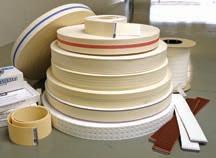
PRODUCTS FOR LONG-TERM CARE
“In a long-term-care facility, there is an expectation for a nicer product,” Lobb says. That’s partly because these facilities function as homes for individuals, whether or not they’re in need of skilled care.
Lobb says that in terms of skin care for residents, offering a product with a smooth skin surface is of the utmost importance, and this is usually best achieved through use of a synthetic product.
“I don’t care how bright-white it is, I don’t care how long you tell me it’s going to last. If it’s not


a smooth skin surface, I’m not interested,” she says. “When you get into a T180 or some of the synthetic products that are out there, you have a much smoother skin surface to deal with.”

Synthetic products also last significantly longer “than even your best poly-cotton,” Lobb says, allowing for savings through extending product life and decreasing product replacement.

Of course, a laundry process-
spreads is a must, Lobb says, and that includes quilted bedspreads, duvets and other items a laundry may not be used to processing. Also, residents have come to expect nicer products, such as satin-striped sheets, especially those who are staying at a long-term care facility on a short-term basis. The expectation is that the facility will be more like a hotel and less like a hospital.
Plan to do clothing protectors, too, as they are a “hot, hot spot” in long-term-care markets. Cubicle curtains could be a money-maker, Lobb says, because they tend to tolerate being put through an ironer. Explaining that these items must be laundered on a certain schedule is an area where businesses can help in terms of education.
And keep in mind that as Americans get bigger, products like bath towels will need to get bigger, too.
ing these synthetic materials may have to experiment with things like wash formulas, drying times and finishing to see if these products are worth adding to the mix. Lobb says finding the time for this experimentation in plants that are trying to be as efficient as possible is a major issue.
“Nobody likes change. But it’s worth it, and it’s definitely the future in this industry,” she comments. “A synthetic product is going to give you a competitive, profitable advantage over someone who is not leaning in that direction.”
Another thing to consider: not all mattresses in long-term-care facilities are the same size, so you may need variable solutions for those different mattress sizes.
The ability to process bed-



“I know we all think about the little 90-pound lady in the nursing home, but only half of those people in nursing homes are little 90-pound ladies,” Lobb says. “Everybody else is pretty average size.”
Laundries will need to have a good partnership with their textile suppliers, and probably other vendors, too, Lobb says.
“Really, if you’re going to make a decision like this and you’re going to change product, add product, [or] eliminate something, you really should have your textile expert, your chemical expert, and your equipment guy all at the table with you,” she says.
And a final piece of advice for anyone looking to enter this market: Go slow.
“Go in on the kiddie-pool side,” Lobb says. “Don’t jump in headfirst into the 12-foot.” ALN
www.AmericanLaundryNews.com AMERICAN LAUNDRY NEWS | FEBRUARY 2015 19 Consolidated international Corporation 866-632-2298 | cicus.com Setting the Standards for Industry Leading Products and Solutions Exceeds OEM Belting Specifications! • Vaderline Premium Cotton 2” and 3” wide x any length up to 100 meters • Vaderline Extra-Strong Cotton (VX) 2” wide x any length up to 100 meters • Vaderline Anti-Static 2” and 3” wide x any length up to 100 meters • Vaderline Premium Two-Ply Cotton 2.5” and 4” wide x any length up to 100 meters • Vaderline Anti-Static Rubber Grip 2” wide x any length up to 100 meters Call today and mention this ad to receive 10% Off your first or next order! Source code: CICALN0115. Consolidated laundry Belting Made from only the highest quality fabrics and textile materials found around the globe, Consolidated custom makes ironer, feeder and folder belts. We can make all industry standard sizes of the materials listed below. - Anti-Static Cotton - Polyester - Anti-Static Rubber Grip - Polyester Vacuum - Aramid Felt - Rubbergrip, Nat. & Syn. - Cotton, Single/Double Ply - Rubbergrip, Marker - Cotton, Marker Belting - Rufftop, Brown & Black - Elastic, White - Rufftop, Green PVC - Nomex Belting - Smooth White Rubber - Pebbletop, White - Smooth Green PVC Laundry Belting top-Quality Belting for industrial laundries Consolidated ALN_3rd Page.indd 1 1/9/15 2:32 PM
Continued from Page 6
“A SYNTHETIC PRODUCT IS GOING TO GIVE YOU A COMPETITIVE, PROFITABLE ADVANTAGE OVER SOMEONE WHO IS NOT LEANING IN THAT DIRECTION.”
—AMANDA LOBB, RLLD
(Image licensed by Ingram Publishing)
PARTS FOR SALE
PARTS, PARTS, PARTS
Huge stock of parts for most laundry equipment & boilers. Also traps, valves and lubricants. Overnight delivery.
Steiner-Atlantic, 800-333-8883 Fax: 305-751-8390 parts@steineratlantic.com www.steineratlantic.com

WASHEX PARTS
Hard-to-find Washex parts, on-site rebuilding, tech support.
LAUNDRY PARTS CENTER 800-352-4492 Fax: 305-827-3991

Service and Sales Representative



Interested in a fast growing company with great innovation, drive and teamwork? We manufacture and sell products within the Industrial Laundry Industry. We are looking for Engineering Sales Reps with a Service background, and whom are very familiar with Flatwork Ironers. Base pay, plus commission and installation fees earned. If interested send your resume to cprunk@cicus.com. No phone calls please.

20 FEBRUARY 2015 | AMERICAN LAUNDRY NEWS www.AmericanLaundryNews.com
Classified Advertising
EQUIPMENT FOR SALE EQUIPMENT
SALE AMKO AMERICA, INC. Remanufactured Finishing Equipment Delta Ironers, Omega Folders & Towel Folders (1 year parts warranty) Like new at half the cost. PARTS, IRONER SUPPLIES & NEW EQUIPMENT ALSO AVAILABLE Contact: (561) 863-9696 jurgenb@bellsouth.net POSITIONS AVAILABLE For more classifieds visit: AMERICANLAUNDRYNEWS .com www. DISTRIBUTOR OFFERINGS www.ineedjpequipment.com 800/925-3236 EQUIPMENT FOR SALE: (1) 2003 Jensen 250lb OP - ready to ship (1) 2012 Milnor 56-Bar 150lb Single Stage Press (1) 3-Roll Braun 32in Ironer (1) 2005 Kannegiesser Feeder “make offer” (1) 2007 Lavatec Master Feed/Master Folder w/2 Stackers “make offer” (4) King Edge Feeders 1 vac (1) Chicago Blanket System w/Folder Stacker (1) 2013 Chicago Flipper (3) 300lb Lavatec Tunnel Dryers TT748G, 2001 with Dryer Contol Panel (1) Lavatec 2 Cake Shuttle, Type DHF1018, 2001 (1) 150lb Lavatec Press LP582, 2001 (1) 2005 Braun SPFRTF (2) 400lb CLM Dryers, Passthru, Gas, 1996 (2) 250lb Lavatec Medicades, Model LX325, 2001 (2) 325lb Lavatec Medicades, Model LX332, 2001 “Expect Excellence” Expect excellence from the leader in used industrial laundry equipment sales and installation. Keep up to date with equipment for sale, and the latest industry news by subscribing to our monthly newsletter. Go to www.ineedjpequipment and sign up TODAY! About JP Equipment JP Equipment is a trusted, full-service, used industrial laundry equipment sales and installation company. We pride ourselves on providing unparalleled service, whether you are Call Craig Lloyd toll free at 877.295.5693 between 9 a.m. – 9 p.m. EST. Please visit www.laundrycareers.com to review current industrial/institutional laundry management openings. ADVANCE YOUR CAREER The Griffin Group, Inc. “Recruitment Specialist” Need to FILL a position? Call Deana Griffin 888-235-2365 www.thegriffingroup.cc deana@thegriffingroup.cc ® QTY DESCRIPTION 1 King Edge 2002 1 Milnor (2000) 8 Mod 130lb CBW with Loading Conveyor 1 Milnor Two Stage Press and Shuttle 3 58058 Gas Dryers 1 Edge Spreader 2000 1 Air Chicago XXL 2012 1 Unipress Single Buck Lightning Shirt Unit 1 Challenge Pacesetter 400lb Gas Dryer 1 450lb Washex Open Pocket 2002 2 275lb Milnor Open Pocket Rebuilt 2002 For Pricing call Ron Hirsch 516.938.4300 • 516.315.7426 Hicksville, NY www.directmachinery.com FOR NEW OR USED LAUNDRY EQUIPMENT, DM IS YOUR SOURCE FOR ALL YOUR NEEDS HOTEL CLOSING SUPER EQUIPMENT HOSPITAL LAUNDRY CLOSING EXCELLENT EXCELLENT CONDITION Stanco Industries, Inc. Serving The Textile Trades Since 1970 800-932-3769 k for Mike @ ext 203 KEEPING IT GREEN SINCE 1970 ----------------- HOSPITAL LIQUIDATION -------------------2009 Braun 400# Open-Pocket (1 left) 1998 Braun 400# Open-Pocket (4) 1995 Braun 400# Medi (2) 1998 ADC 200# Gas. 1 door. 2005 Braun 4-Station Feeder 2003 Chi King Edge no Vac 2003 Chi 2-Roll 32” steam 2000 Chi Tri-Star 32” Gas Super Sylon 8-Roll. 98’ Rebuild (2) 2010 Girbau Maxx Towel/Gown folder 2003 Chicago Air --------- DON’T BE LEFT WITHOUT POWER -------Emergency Generators Available 50KW to 1000KW Natural Gas & Diesel Stanco Industries, Inc. 800-932-3769 Ask for Mike @ ext 203 PLACE YOUR AD ONLINE: www.AmericanLaundryNews.com
FOR


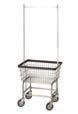
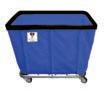






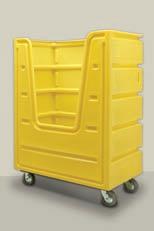





www.AmericanLaundryNews.com AMERICAN LAUNDRY NEWS | FEBRUARY 2015 21 Source Directory A convenient guide to sources of products and services APPAREL FINISHING CARTS, TRUCKS & BASKETS #1 Manufucturing Source for Laundry Transportation! (800) 634-0555 RBWire.com 11744 Blue Bell Rd. Elberfeld IN 47613 800-304-4600 www.fibertechinc.net Rotational Molding, Repair, Recycling...Your Complete Plastic Solution Durable, Economical and Environmentally Friendly. Laundry & Material Handling Booth 6476 Choose your favorite low-cut front for ergonomic access, roll safe and easy on advanced poly base with premium casters—all included as standard. Easy Reach, Easy Roll Call 800.829.4535 or visit MODLaundry.com for a FREE QUOTE. 72P 72N Meese Orbitron Dunne Co. Source Directory listings in American Laundry News are sold on an annual basis at the following rates: All Major Credit Cards Accepted 2015 Listings Regular Boldface All Caps All Caps, Boldface Four Line Listing per Year $850 $1,070 $1,070 $1,130 Display and additional line rates available upon request Sani Trux - McClure Industries, Inc. 9051 SE 55th Ave., Portland, OR 97206 800-752-2821 www.mcclureindustries.com, info@mcclureindustries.com M.I.T. POLY-CART 211 CENTRAL PARK WEST, NEW YORK, NY 10024 800-234-7659, FAX: 212-721-9022 WWW.MITPOLYCART.COM CARTS, TRUCKS & BASKETS CARTS, TRUCKS & BASKETS Diversified Plastics, Inc. 1309 Highway 917 West, Latta, SC 29565 800-768-7636, www.dpirotocarts.com E-mail: sales@dpirotocarts.com Fax: 843-752-7798 AmericanLaundryNews.com More than unique visitors monthly! 5,250 CARTS, TRUCKS & BASKETS Round-Tripper_6.25x3:Layout 1 6/17/14 12:04 PM Page 1
Wash - McClure Industries, Inc. 9051 SE 55th Ave., Portland, OR 97206 800-752-2821 www.mcclureindustries.com, info@mcclureindustries.com

Fax: 504-468-3094 www.milnor.com




Pellerin Milnor Corp.










P.O. Box 400, Kenner, LA 70063 504-467-9591, Fax: 504-468-3094 www.milnor.com







22 FEBRUARY 2015 | AMERICAN LAUNDRY NEWS www.AmericanLaundryNews.com Source Directory listings in American Laundry News are sold on an annual basis at the following rates: All Major Credit Cards Accepted 2015 Listings Regular Boldface All Caps All Caps, Boldface Four Line Listing per Year $850 $1,070 $1,070 $1,130 Display and additional line rates available upon request Source Directory A convenient guide to sources of products and services FLATWORK IRONERS FLATWORK IRONERS Knowhow In Action Your Tingue rep is a fully trained master of finishing equipment operation, maintenance and installation. Call for: • Pads, covers, belts, waxes, tapes and more • Carts, trucks, baskets and bags • Parts, rebuilds and repairs 800.829.3864 www.Tingue.com TalleyMachinery.com MODLaundry.com TBR-Associates.com To website C & W EQUIPMENT (800) 443-3573 FLATWORK IRONER SPECIALISTS REMANUFACTURED IRONERS: Super Sylon Sylon Hypro’s Super Pro Jensen SS700 SS800 Ultima Lavatec UPGRADE KITS: Chain Drive Conversion Vacuum Systems Herringbone Conversion Canopies Inverters Side Covers Roll Springs Jensen Drives SUPPLIES: Aprons Pads Covers Belts Waxes Cleaners PARTS/REPAIRS: All Brands New/Refurbished/Hard to Find COMMITTED TO EXCELLENCE (480) 205-1293 (602) 763-7416 www.azsle.com Whether your ironer needs pads and covers, wax cloths or cleaning supplies, or needs to be completely rebuilt, there is no job too big or too small for Southwest Laundry Equipment Energenics Corp., Kartwasher 1470 Don St., Naples, FL 34104 800-944-1711 www.energenics.com Pellerin Milnor Corp. P.O. Box 400, Kenner, LA 70063 504-467-9591,
DRYERS – 100 POUNDS OR MORE CART-WASHING SYSTEMS
DRYERS – 100 POUNDS OR LESS Sani
HEAT SEALING SUPPLIES/TAPE FLATWORK SUPPORT www.olekbelts.com 1-800-869-2683 Free www.olekbelts.com We’re your flatwork finishing and conveying O.E.M. Belt Match H.Q. Get the real thing for a Lot less $$$. O.E.M. Needlefelt Ironer Pads too! Better Belts, Better Prices, Better Service Visit our Website or Call 1-800-869-2683 For free, no obligation, price quotations and for your Free copy of our Product Catalog with over 40 samples. Ironer pads, covers, aprons, guide tapes, carts, slings, cleaners, waxes & more… Setting the Standard in Lint Filters for 25 Years • Hotel • OPL • Coin Op • Dry Cleaners • Industrial • Commercial • Cruise Industry Dry or Wet Style Filters to Work with “ALL” Dryer Sizes or Multiple Situations, Fiberglass or Stainless and Custom for Unique Situations! All manufacturing done on premise 800-826-1245 www.cleancyclesystems.com • ccsystems@tqind.com LINT COLLECTORS & FILTERS ★ Our In-Line Lint Filter mounts inside, saves space! ★ Fiberglass Wet Filters - 6,000 to 40,000 cfm ★ Fiberglass or Stainless Steel Dry Filters ENERGENICS CORPORATION Talk with our Design and Engineering Staff about your needs. Hundreds Sold Annually. 800-944-1711 www.energenics.com Get the info you need online... www.AmericanLaundryNews.com
PARTS
Pellerin Milnor Corp.
WASHERS – CONTINUOUS BATCH
Pellerin Milnor Corp. P.O. Box 400, Kenner, LA 70063 504-467-9591, Fax: 504-468-3094 www.milnor.com
WASHER-EXTRACTOR

Pellerin Milnor Corp.
P.O. Box 400, Kenner, LA 70063 504-467-9591, Fax: 504-468-3094 www.milnor.com
Pellerin Milnor Corp.


Box 400, Kenner, LA 70063
Fax: 504-468-3094
www.AmericanLaundryNews.com AMERICAN LAUNDRY NEWS | FEBRUARY 2015 23 Source Directory A convenient guide to sources of products and services Source Directory listings in American Laundry News are sold on an annual basis at the following rates: All Major Credit Cards Accepted 2015 Listings Regular Boldface All Caps All Caps, Boldface Four Line Listing per Year $850 $1,070 $1,070 $1,130 Display and additional line rates available upon request
PARTS
PARTS & SUPPLIES
– 100
– 100
POUNDS OR LESS WASHER-EXTRACTOR
POUNDS OR MORE
HANDLING / CONVEYORS
P.O.
504-467-9591,
www.milnor.com Gardner Machinery Corporation P. O. Box 33818, Charlotte, NC 28233 Ph.: (704)372-3890; Fax: (704)342-0758 www.gardnermachinery.com MATERIAL
CONTACT US TO BOOK YOUR AD TODAY! CLASSIFIEDS@AMERICANTRADEMAGAZINES.COM Company Web Site Page Company Web Site Page Agaia International www.agaiainc.com 11, 14 A.L. Wilson Chemical Co. www.alwilson.com 9
Dawn
5
18
International Corp.
19
Laundry Machinery
13 Davis Packaging
18 Direct Machinery Sales Corp. www.directmachinery.com 20 East Coast Water Systems www.eastcoastwatersystems.com 8
Corporation
6 Girbau Industrial
7
Griffin Group, Inc.
20
Manufacturing
19
Engineering
16
17
Equipment
20
15
20
Technology
24
3
Basket Trucks
10
Industries
20 Venus Group
12
OF ADVERTISERS
P.O. Box 400, Kenner, LA 70063 504-467-9591, Fax: 504-468-3094 www.milnor.com PRESSES – EXTRACTION
American
www.americandawn.com
ARTA www.arta1.com
Consolidated
www.cicus.com
Consolidated
www.clmco.com
www.davispackaging.net
Ellis
www.elliscorp.com
www.girbauindustrial.com
The
www.thegriffingroup.cc
G.S.
www.gsm-cart.com
Hamilton
www.hamiltonengineering.com
IES www.iesclean.com
J.P.
www.ineedjpequipment.com
Kannegiesser USA www.kannegiesser.com
LaundryCareers.com www.laundrycareers.com
Lavatec Laundry
www.lavatec-laundry.com
Pellerin Milnor www.milnor.com
Royal
www.royal-basket.com
Stanco
www.stancoind.com
www.venusgroup.com
INDEX