AmeriPride to pay fines as part of EPA settlement
BOSTON — AmeriPride will pay $75,000 as part of a settlement with the Environmental Protection Agency (EPA) following the agency’s claims that the company “failed to seek air permits and control emissions between 1988 and 2013, when it installed new industrial washers and dryers” for laundering shop and print towels at its Worcester, Mass., and Hartford, Conn., facilities.
EPA says AmeriPride “cooperated” in reaching the settlement.
In a statement to American Laundry News, AmeriPride says the fines concerned “potential” harmful emissions, and that “there is no evidence that the plants were actually emitting harmful levels of VOCs.”
“In fact, we believe that because we are a mixed laundry processing a relatively small amount of print towels, the emissions were not at a level that would meet the requirement for permits,” the company says.

AmeriPride adds that the settlement concerns past operations, as the Hartford plant is no longer in operation, and print towels are no longer processed at the Worcester plant.
“We are confident that we have the proper permits for our ongoing operations at other processing plants,” the company says. ALN
Changing pollutants, regulations present challenges for laundries
By Theresa Boehl, ediTor

While a laundry’s wash process results in clean, fresh linens, it also leaves behind dirty water, and what becomes of that water and the potential pollutants in it should be of importance not only to businesses, but their customers and the community at large. How laundries manage wastewater goes hand-in-hand with other efforts to conserve, reuse and be more environmentally conscious.
American Laundry News spoke to industry professionals representing the chemicals sector and wastewater treatment equipment manufacturing, as well as an industrial laundry operator, to get their take on the interplay between wastewater treatment and the laundry’s other processes and environmental goals, and to discuss how treatment presents benefits and challenges for those in the industry.
WASTEWATER TREATMENT: THE BASICS


Laundries of all types have adopted technologies and processes to be sure water used in the wash process has been properly treated before it
goes to the sewer. These systems can range from fairly simple to extremely complex.
John Schultz, senior WEW (water, energy and wastewater) solutions manager for textile care at Ecolab, says pre-treatment before dis-
charge could involve a system as simple as a settling pit, a shaker screen, a heat exchanger, and sulfuric acid for neutralization of the water’s
EPA requirements, upcoming regulations
By Carlo CalMa
ALEXANDRIA, Va. —
Implementing green—or environmentally friendly—efforts in the workplace has become commonplace among many businesses, both big and small.
Though there are many areas to focus on, one operational aspect many owners and managers in the laundry industry have targeted involves cutting back on the use of detergents containing nonylphenol ethoxylates (NPE).
Joseph J. Green, special counsel
at Kelley, Drye & Warren LLP, and environmental counsel for the Textile Rental Services Association (TRSA), explains that the chemical has been the subject of “increasing attention” from environmental activists and regulators, particularly for its “alleged aquatic toxicity.”
“Nonylphenols, which [are] the base compound, are thought to be highly toxic to aquatic animals and in the aquatic environment, as well as very persistent in that environment, and bioaccumulative,” says Green.
These concerns regarding NPE
Panel of Experts Advice on best methods to track productivity of laundry workers.

led to a voluntary industry phaseout of the chemical, says Green, who outlined the history of the phaseout and its current status in a TRSA webinar titled The NPE Phase Out: EPA Requirements and Potential Regulation of Continued Use.
THE LaundryESP PROGRAM
According to Green, there has been a “long-standing” commitment by TRSA to the use of environmentally friendly washroom chemicals, which he says is outlined in the association’s Laundry
Environmental Stewardship Program (LaundryESP).
This effort, he says, stems from a 1999 agreement TRSA made with the U.S. Environmental Protection Agency’s (EPA) Office of Water as an “outgrowth” from negotiations over its Effluent Limitation Guidelines (ELG).
“Those were an effort to regulate wastewater discharges from laundry facilities and address, what was at the time, EPA believed, … a high level of toxics in that
de C e M B er 2014
Late News
& linen Management www.americanlaundrynews.com Volume 40, Number 12
The Newspaper of record for laundry
[14] [18] See WASTEWATER on Page 6
iNside
See NPE on Page 7 [10] OPL 101:
Goals for 2015 Strategies for making operations more eco-friendly can also help cut water and energy costs.
Set Green
Wastewater Treatment: NPE Phaseout: Product showcase Detergents, ChemiCals & inJeCtiOn Detergents, ChemiCals & inJeCtiOn systems
Effluent flows from a wastewater treatment facility into a Denver-area river. (Image licensed by Ingram Publishing)
Survey: Most operators satisfied with facilities’ efforts to be ‘green’
CHICAGO — Though they have many things on their minds at any given point, laundry/linen managers polled in last month’s American Laundry News Your Views survey say that environmental considerations are among the things that weigh on their minds; in fact, a little more than 60% say considering the environment is “highly important,” while nearly 32% say it’s “somewhat important.” Small shares of respondents don’t see the need to put environmental considerations high on the priority list.
When it comes to the most significant action an operation can take to have a positive impact on the environment, the majority of respondents (nearly 31%) point to reducing the consumption of energy. Other highly valued actions are reducing water consumption (22%), using NPE-free detergents and other biodegradable chemicals (15.4%), and promoting the use of reusable linens (15.4%).
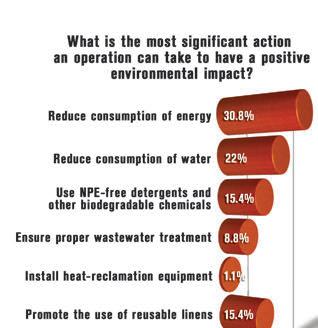
Ensuring proper treatment of wastewater (8.8%) and installing heatreclamation equipment (1.1%), however, do not rank high on the list of significant “green” approaches for laundry/linen managers in this survey. Close to 7% of respondents point to “other” efforts.
“I believe an area that does not get enough attention is textile innovations,” says a respondent. “The development of textile products that are lighter-weight, high-performance and use less energy to process and manufacture would have [a] significant effect on our industry’s environmental impact.”
What drives efforts by managers to be more conscious of the environment is the rising cost of resources, according to 43% of respondents, followed closely by a general desire to be more eco-friendly (35.2%).
Industry rules and regulations provide the impetus to carefully consider the environment for almost 19%, while a small percentage (3.3%) admit that their operations are not currently undertaking any special ecofriendly efforts.
“Space is a problem with our operation, so we spend a lot of time trying to maximize our production, [while] still trying to achieve our goal of making the department as green as possible,” says a respondent.
“I think it is the responsibility of each operation to promote the most green approach by reducing water and fuel consumption, to not only curb costs, but to be more eco-friendly,” says another respondent.
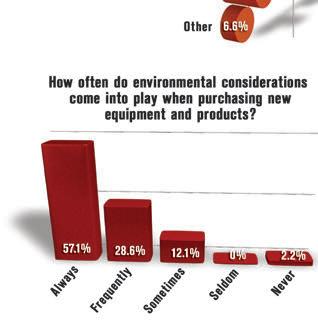
And when new equipment and products are purchased at their facilities, more than half (57.1%) of those polled say that considering green features (energy efficiency, reduced water usage, etc.) always comes into
play in the decision. Nearly 29% report that such considerations are “frequently” on the table, while a little more than 12% report that the impact of equipment and products on the environment only “sometimes” factors into the equation.
A small percentage (2.2%) say eco-friendliness “never” influences their product decisions.
“As an industry, we are very slow to adapt to new technologies or see the benefit of new products,” a respondent comments. “We do what we must to stay one step ahead of the EPA and other regulatory agencies.”
“Can we begin to get real with marketing [and] expectations, and stop stretching the truth about what can and can’t be done?” another respondent asks. “Let’s not put half of our industry out of business in an effort to be green. Our business is to clean and sanitize and be as conscientious as we can about green [efforts].”
Overall, nearly half (47.3%) of managers polled say they are “somewhat satisfied” with their operations’ efforts to be “green.” Nearly 30% are “highly satisfied” with the actions already in place. But 16.5% say they are “neither satisfied nor unsatisfied,” while equal shares of 3.3% say they are “somewhat unsatisfied” and “highly unsatisfied.”
When it comes to additional efforts that could be adopted to make operations more eco-friendly, managers point to replacing equipment, especially dryers; educating customers on the benefits of reusable textiles; using eco-friendly chemicals; and reducing water consumption, among other actions.
“We are always looking for more eco-friendly washing products, and continue making changes as newer products are developed,” a respondent comments.
While the Your Views survey presents a snapshot of readers’ viewpoints at a particular moment, it should not be considered scientific; due to rounding, percentages may not add up to 100%. Subscribers to American Laundry News e-mails are invited to take the industry survey anonymously online each month.
All managers and administrators of institutional/OPL, cooperative, commercial and industrial laundries are encouraged to participate, as a greater number of responses will help to better define operator opinions and identify industry trends.
Publisher
Charles Thompson
Phone: 312-361-1680
E-Mail: cthompson@ ATMags.com
Editorial Director
Bruce Beggs Phone: 312-361-1683
E-Mail: bbeggs@ ATMags.com
Digital Media Director

Nathan Frerichs
Phone: 312-361-1681
E-Mail: nfrerichs@ ATMags.com
Editor
Theresa Boehl
Phone: 708-280-1750
E-Mail: tboehl@ ATMags.com
Production Manager Roger Napiwocki
National Sales Director
Donald Feinstein
Phone: 312-361-1682
E-Mail: dfeinstein@ ATMags.com
Main Phone: 312-361-1700 Fax: 312-361-1685
Subscriptions
630-739-0900 x100 www.americanlaundrynews.com
American Laundry News (ISSN 1091-9201) is published monthly. Subscription prices, payment in advance: U.S. 1 year $39.00; 2 years $73.00. Foreign, 1 year $89.00; 2 years $166.00. Single copies: U.S. $7.00; Foreign $14.00. Published by American Trade Magazines LLC, 566 West Lake Street, Suite 420, Chicago, IL 60661. Periodicals postage paid at Chicago, IL, and at additional mailing offices.
POSTMASTER, Send changes of address and form 3579 to American Laundry News, Subscription Dept., 440 Quadrangle Drive, Suite E, Bolingbrook, IL 60440. Volume 40, number 12. Editorial, executive and advertising offices are at 566 West Lake Street, Suite 420, Chicago, IL 60661. Charles Thompson, President and Publisher. American Laundry News is distributed selectively to qualified laundry and linen management and distributors in the United States. No material appearing in American Laundry News may be reprinted without written permission. The publisher reserves the right to reject any advertising for any reason.
© Copyright AMERICAN TRADE MAGAZINES LLC, 2014. Printed in U.S.A

MEMBERSHIPS
2 DECEMBER 2014 | AMERICAN LAUNDRY NEWS www.AmericanLaundryNews.com
Association for Linen Management
ALN INSIDE: December 2014 • Vol. 40 | No. 12 [4] Columnist at Large: Finding, Solving Problems Sometimes a patient, measured approach is best for finding solutions to a laundry’s problems [8] Steps to Going Green in the Laundry Industry Eco-friendly efforts can positively impact not just the environment, but also your bottom line: ALM webinar [10] Panel of Experts “How are productivity standards best implemented or enforced, and what kind of results can be expected?” [14] Product Showcase: Detergents, Chemicals & Injection Systems [18] OPL 101: Set Green Goals for 2015 When setting goals for next year, consider ways to make operations more environmentally responsible [19] Trade Ticker
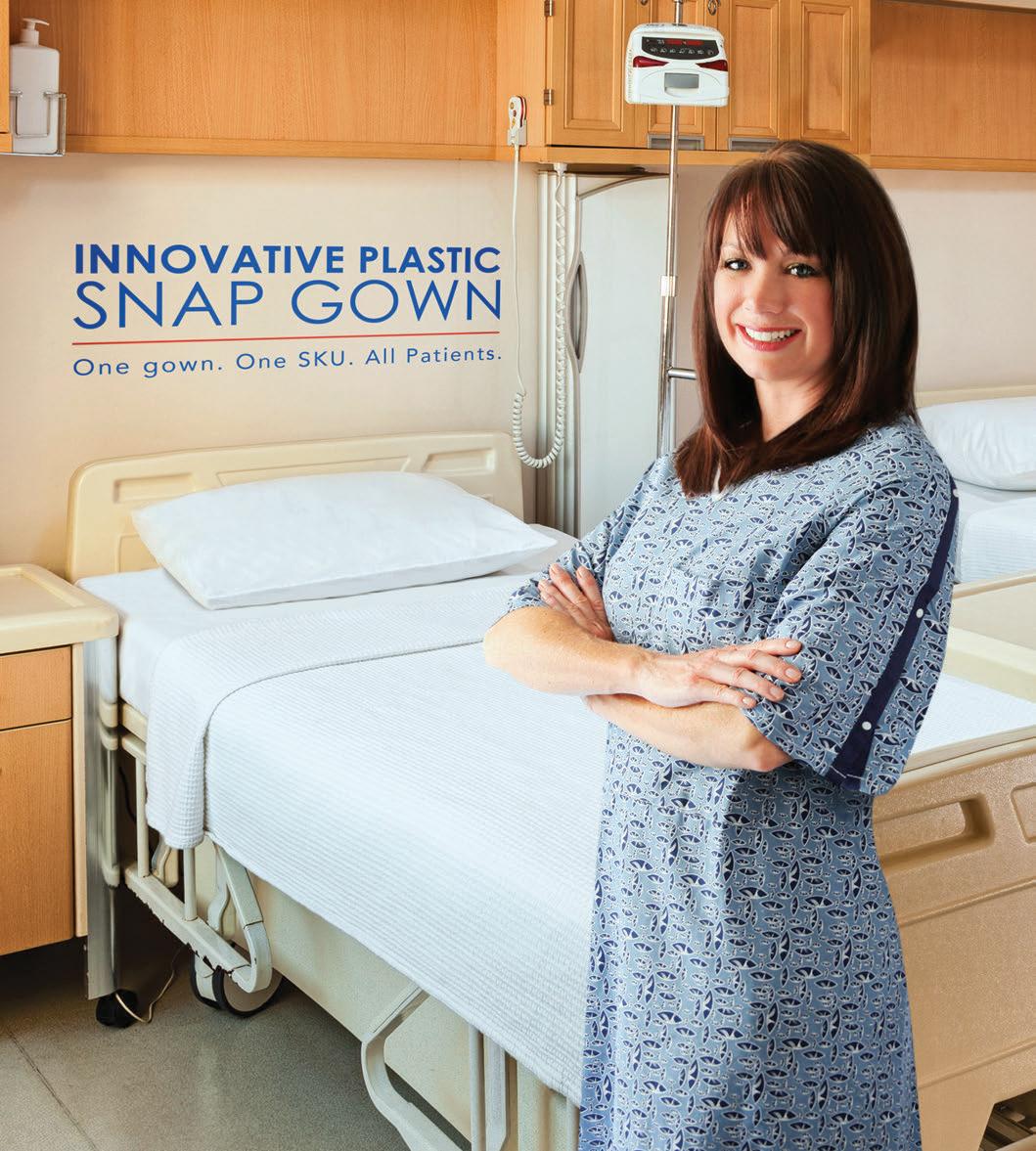












800 821 2012 | healthcare@americandawn.com | www.americandawn.com • Allows the patient to remain in IV gown during imaging studies, and eliminates multiple inventories.
Innovative plastic snaps do not interfere with magnets during imaging studies.
The only plastic snap proven and guaranteed to withstand industrial laundering with 400 PSI extraction.
55% Cotton / 45% Polyester. Brushed inside for a soft touch.
Generously oversized for modesty with plastic snaps at shoulders.
Large chest pocket with oversized hidden access vent, for management of IV tubing and monitoring equipment. Available for purchase through AMERICANDAWN beginning January 2015. Made exclusively by the World’s Global Source.
•
•
•
•
•
Green Leaf Print
Do you take responsibility?
Our Editorial Calendar entry for this month spells out what this issue is all about: “A Laundry’s Approach to Environmental Responsibility.” Thus, the bulk of our industry coverage relates to that topic. Editor Theresa Boehl kicks things off with a detailed look at wastewater treatment, an aspect of laundry operations important to all managers but particularly to those of you who run heavy industrial plants.
From The Director’s Chair bruCE bEggs
Carlo Calma provides an update, courtesy of TRSA, on the status of the industry’s phaseout of detergents containing NPEs.
Another story by Calma summarizes Ed Kwasnick’s recent ALM presentation on sustainability and his strategies for saving natural gas, water and electricity while balancing the three P’s: people, planet and profit.
There are other features, of course, but our “color of the month” is decidedly green. ALN
Judge upholds 2012 OSHA citations against UniFirst
NEW YORK — A judge has issued a ruling upholding all citations and penalties—totaling $186,000—against UniFirst Corp. for alleged worker hazards at its West Caldwell, N.J., location, according to the Occupational Safety and Health Administration (OSHA).
Following a 2011 inspection spanning approximately six months, OSHA cited UniFirst for alleged violations related to bloodborne pathogens, lead exposure and improper training on precautions related to those dangers, among other violations.
UniFirst contested the 2012 citations in a five-day hearing in 2013. Administrative Law Judge Carol Baumerich from the Occupational Safety and Health Review Commission issued a ruling on Sept. 30 that affirmed all the citations originally issued by OSHA.
OSHA says UniFirst’s West Caldwell facility violated the administration’s Bloodborne Pathogens standard by allowing workers to pick up and sort lab coats and other laundry items potentially contaminated with blood without personal protective equipment.
UniFirst serviced several facilities where blood was routinely drawn from patients. OSHA says workers could also have been exposed to contaminated needles and syringes that had been disposed of improperly and mixed in with the laundry.
Baumerich also says management falsified training sign-in sheets and required employees to sign the sheets even when they hadn’t received training. She found that employees did not receive training on the hazards of lead exposure until after the start of the
OSHA inspection. By that time, drivers and dockworkers might have already been exposed to airborne lead, and lead was found on work surfaces at the facility, including in a truck and near laundry sort 65/35 bins, according to the ruling.
“This actual and potential exposure obligated [UniFirst] to provide training on the hazards of lead and lead exposure to the exposed employees,” Baumerich states in the ruling. Additionally, she says, many of the company’s employees were not given the option to receive or decline the Hepatitis B vaccine in a timely fashion, if at all. Non-compliance with OSHA standards for the use of biohazard bags was also cited.
In a comment to American Laundry News, UniFirst says that “safety is, and has always been, a top priority” at the company, and that “the allegations regarding the New Jersey branch are not indicative of UniFirst’s operations as a whole.”
“While we are both in disagreement and disappointed with the Sept. 30, 2014, decision by Judge Baumerich upholding OSHA citations issued against UniFirst for alleged infractions at our New Jersey branch, we fully intend to comply with its requirements and will not be filing any further appeals,” UniFirst says. It adds that the judge’s decision “did not reflect important details provided by UniFirst” that would have provided a clearer understanding of the events at the facility.
UniFirst says it is reviewing communication practices at all of its facilities.
ALN
Drilling down to solve problems
i have often been accused of trying to be a cowboy, looking for a problem and then quickly wanting to draw my gun and shoot it dead. I have an urgent desire to fix a problem and move on to something else. The problem with that approach is that many problems require careful study and review before the best solution is found— one that costs the least to implement and provides the greatest reward.
To illustrate this point, I would like to take a minute and review a problem we had with the compressed air system in our laundry. We have two 60-horsepower air compressors in the laundry while it should be able to run on just one air compressor.
Frustrated with the problem of having to run both air compressors with the result of excessive heat and condensation buildup, we turned to the professionals at Ingersoll Rand to see if they could determine why this was happening.
They recorded the demand on the air compressors continuously for a week. We noticed that even in non-working hours, there seemed to be a drag on the compressors.
We next conducted a leak assessment in our laundry and found a number of leaks that could be corrected. We also questioned why the air compressors needed to operate 24 hours a day, 365 days a year.
by tAking thE timE tO DriLL DOwn intO thE prObLEms wE wErE hAving with thE Air COmprEssOrs AnD trying tO ELiminAtE OnE pOtEntiAL prObLEm At A timE, wE EvEntuALLy fOunD thE sOLutiOn tO thE prObLEm.

I was informed that the level controls on the boilers were air-activated and that the air had to be on to properly regulate the boilers. This information was presented even after we had established that the boilers were only going to run nine hours a day, five days a week.
I quickly drew out my gun and shot the problem dead. We changed out the air-controlled water level controls with more reliable electric level controls. In our journey so far, we had fixed a number of air leaks (saving money) and had been able to reduce the hours on the air compressors from 168 hours per week to 95 hours. This was great progress, but we still had not solved the original problem of needing to run two air compressors at the same time.
Our next move was to send one of our mechanics to a seminar on the safe operation of air compressors. His specific assignment was to look for adjustments that might allow our system to run on just one of the air compressors.
The seminar sparked interest in looking at the parameters of the existing system.
Our system was set up to maintain 120 psi. None of our production equipment required that much air pressure to operate, but the system had been set up with that requirement nonetheless.
By changing the pressure to 100 psi, we were then able to use only one air compressor. The second air compressor is now truly a backup compressor, and we feel confident that we can effectively operate on a single compressor.
•
•
•
•
•
•
Before we started this journey, our maintenance supervisor was convinced that we needed to purchase two new, 75-horsepower air compressors. By taking the time to drill down into the problems we were having with the air compressors and trying to eliminate one potential problem at a time, we eventually found the solution to the problem. My natural tendency to want to solve a problem with a single shot just wasn’t going to get the job done. Drilling down into the problem and methodically going through everything eventually led to the most cost-effective solution.
Eric Frederick is director of laundry services for Carilion Laundry Service, Roanoke, Va., and a past president and manager of the year of the Association for Linen Management. You can reach him by e-mail at efrederick@carilion.com.


4 DEC E mb E r 2014 | AmEriCAn LAunDry nEws www.AmericanLaundryNews.com
COLUMNIST AT LARGE Eric L. Frederick, RLLD
ALN
Top Stories Appearing on AmericanLaundryNews.com for the 30 Days Ending November 15 (WE) = Web exclusive news • Judge Upholds 2012 OSHA Citations Against UniFirst • AmeriPride Acquires Valley Industrial • Registration Opens for Clean 2015 • Ivy Linen Services to Open in Metro Atlanta • Alsco Opens New Processing Plant in Washington State Columnists/Features • Panel of Experts: Sorting, Arranging for Better Efficiency • Career Track: Companies Report New Hires, Promotions • OPL 101: Grand Strand Keeps Rental Housing Linen Flowing
Niche Markets: Unique Environments, Special Equipment Considerations
Eric Frederick: Update: Energy Reduction Via Textile Products our sister websites
AmericanDrycleaner.com:
From
Survey: Drycleaning Sales Up Across Board in September, Third Quarter (WE)
Can You Make a Little Change?
From AmericanCoinOp.com:
as Store Owner of Quarter
Huebsch Honors Milton
Open for
Attendee Registration Now
Clean 2015 (WE)
THE ONE PLACE TO CONNECT, LEARN AND COMPARE.
Clean® 2015 is the only show in our industry where you can:


• Interact with more than 400 exhibiting companies showcasing every aspect of textile care


• Network with more than 10,000 industry professionals
• Gain knowledge through classroom sessions taught by leading experts in the field
• See live equipment demonstrations and compare the industry’s most state-of-the-art offerings, side-by-side
Register now at www.cleanshow.com
April 16-19, 2015
Georgia World Congress Center Atlanta, Georgia USA
C36 M0 Y29 K0 65% opacity of PMS 346C (Outer ring of logo) C55 M0 Y47 K0 PMS 346 C
high alkalinity.
“Most laundries have those basic components in place,” Schultz says. “And it’s primarily to remove suspended solids, to lower the temperature, and to … neutralize the alkalinity.”
Schultz says two key pieces of technology—a dissolved air flotation (DAF) unit and a ceramic air filtration (CEF™) system— can help laundries remove even more pollutants, including tough oils and greases, and help lower the biochemical oxygen demand (BOD) and chemical oxygen demand (COD) in the water, which often come with discharge limitations from municipalities.
With the passage of the Clean Water Act in 1972, which sought to prevent water pollution throughout the nation, wastewater treatment became an important technology for laundries concerned about compliance with the law.
James Buik, president of Chicago-based uniform and textile rental company Roscoe Co., says in the early 1970s, his father, Don Buik, worked with Winchester
Chemical Co. in Franklin Park, Ill., the U.S. Environmental Protection Agency (EPA) and industry associations on a project to develop and test the first dissolved air flotation unit.
After some experimentation, the groups were able to develop a functioning wastewater treatment system, which Buik says makes Roscoe the company with the longest-running record of compliance with the Clean Water Act of any company in the industry.
“We knew that regulation—the Clean Water Act—was passed, so my dad knew that regulations were coming down the pike that were essentially going to threaten the industry if they didn’t come up with a way to comply with those regulations,” Buik says.
With the DAF system, a sophisticated pump injects “billions of tiny bubbles into the water,” which float to the surface with chains of soil, creating a “sludge blanket” that can be skimmed off and disposed of or treated further, Buik explains. The technology is just one piece of the larger treatment process.
At Roscoe, it all starts with equalization of the water, an important step to consider if you’re processing a variety of product types with different soil levels that could cause soil-level spikes in the water.
“Consistency is the key to running any wastewater treatment



system, and the key to that consistency is having tanks or pits that you can collect the water in and allow that water to equalize before you send it over to the treatment system,” Buik says.
Once equalized, the water goes through a shaker screen to eliminate solids, then into chemical chambers, and finally into the DAF.
A plate-and-frame filter press can further extract the water from the sludge created by the DAF, resulting in a nonhazardous dry “cake” that can be disposed of in a landfill.
Schultz says the ceramic element filtration system can prepare the wastewater to be recycled back to the wash floor, depending on the business’ customer base and whether or not the water contains dyes or pigments.
MAINTAINING COMPLIANCE
Besides environmental concerns, surcharges, fines and violations are often the drivers behind a laundry’s investment in wastewater treatment technology.
Randall Jones, president of Wastewater Resources, says laundries may be limited as to how much water they can discharge, and may also have limitations on the quality of that discharged water.
“There are some cases where the laundry is paying so much for water and sewer that they want to treat it, but it’s more often that there are some statutory limitations,” he explains.
Schultz explains that municipalities establish a set of effluent guidelines based on their pretreatment program and their National Pollutant Discharge Elimination System (NPDES) permit. A publicly owned treatment works (POTW) will consider not only EPA guidelines, but also what water is coming in from local businesses and industries in order to come up with regulations based on the “number of players,” or “how many people get what slice of the pie,”
according to Schultz.
A recent change affecting laundries, he says, involves the reclassification of waterways by POTW. Waterways that were once simply described as “navigable” are now being considered “recreational,” meaning people can walk, swim or fish in the water.
With this change comes more stringent guidelines, and a new way of getting businesses to pay their share of the water treatment costs: Rather than demanding a surcharge as in the past, businesses are now being hit with notices of violations, and fines, for being out of compliance.
Phil Anderson, vice president of operations at Industrial Waste Water Services, says surcharges and fines for BODs, suspended solids, and oils and greases make the decision to treat water before discharge easier for many laundries.
“So, once it reaches a point where the fines are high enough, the company says, ‘All right, I need to do something,’” he comments. “They’ve got to meet discharge limits, and once the money gets high enough, they go ahead and buy the equipment.”
CHALLENGES FOR LAUNDRIES
Removing certain pollutants from water to avoid these fines is especially tough for heavy industrial laundries, Jones asserts, since they’re dealing with a “witches’ brew” of materials, including toxic organics.
Anderson says linens used in tool-and-die operations and in printing presses are “terribly loaded” with soils.
Schultz says some of the trickiest soils, in terms of wastewater treatment, are what he calls “emerging pollutants”: chloroforms, chlorines and formaldehyde. These pollutants primarily affect healthcare laundries, but can also be found in laundries serving hospitality and food and beverage.
“And those laundries historically do not have wastewater treatment systems such as the DAF or the CEF and they’re like, ‘What do I do, and how do I address these
issues, then?’” Schultz says.
For laundries that need to upgrade or expand their wastewater treatment systems, securing the capital and the space to do so can be an obstacle.
“I think it’s especially a challenge for small businesses,” Buik says. “We rely on external resources as opposed to hiring internal resources, and we can’t spread those costs over 30, 40 or 100 plants. We have to make sure that we’re compliant and we can do it on our own.”
There are also the issues that come with upkeep on such a system, which can be “substantial” and “formidable,” according to Jones.
In terms of how washroom chemistry affects wastewater treatment, Jones says it makes the process “more difficult.”
“The wash process is to get things into suspension and the treatment process is to get them out of suspension and get them into some solid form,” he says. “So they actually work in opposite directions from each other.”
And while the industry has made great strides in switching to more biodegradable detergents free of nonylphenol ethoxylates (NPEs), doing so has had an impact on the wastewater treatment operations at some facilities.

Schultz says the increased biodegradability of the NPE-free detergents—which allow the surfactant to degrade within an aquatic environment in, say, five days as opposed to the 30 days required for NPE-based surfactants—means facilities may see BOD and COD levels increase. This is because “the more biodegradable a product is, the higher the BOD and COD will be in the wastewater,” he says.
So although NPE-free detergents are “green” chemicals, Schultz adds, POTW consider them “higher pollutant-loading” products.
Anderson says he always advises laundries to have a wastewater treatment vendor come observe the system anytime new washroom chemistry is undergoing trials, to be sure the chemical is

6 DECEMBER 2014 | AMERICAN LAUNDRY NEWS www.AmericanLaundryNews.com • Consulting, Design, Plant Installation • Full Construction Services • Training & Maintenance Support • Operations Assistance We have now partnered with HBD Construction. We are the one and only laundry service company in North America offering a wide range of services including building construction, plant operations and support. Building Smarter Laundries for Smarter Operators. www.eomech.com Or call 978.373.1883 WE DO IT ALL. ALS soup2nutsqthorz .pdf_Layout 1 1/8/14 8:47 AM Page 1 ALN_Tab_1-4_H.indd 1 2/4/14 3:28 PM
See WASTEWATER on Page 17
Continued from Page 1
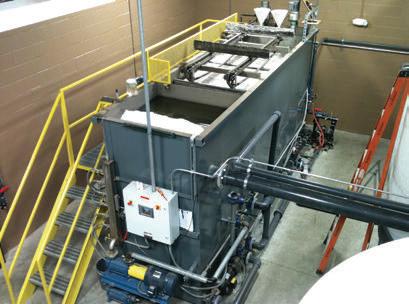
Top: Sludge is removed from treated water through a skimmer assembly. Bottom: A 200-gallon-perminute dissolved air flotation unit. (Photos: Jason Sosebee, Industrial Waste Water Services)
Wastewater
wastewater,” says Green.
Despite this belief by EPA, he explains, the association was able to demonstrate “with actual data” that “the levels of toxics were significantly lower than EPA had initially assumed.”
“They agreed that … instead of installing wastewater treatment processes at laundry facilities to treat those toxics … we could achieve greater toxic reduction through these voluntary stewardship efforts,” says Green.

TRSA then entered into an agreement with EPA’s Safer Detergent Stewardship Initiative (SDSI) program, Green explains, which is a voluntary program using data collected by TRSA with the help of its members— including chemical suppliers and laundry facilities—to “trace the usage and the decline” and the overall phaseout of NPE in the industry.
“That information was made available to EPA and the public through the SDSI program and a fairly significant progress was made in reducing, and certainly developing a trend toward lower usage of, NPE in the detergent formulations,” says Green.

By 2010, TRSA had seen a “decline of approximately 75% in NPE usage” among its membership, he adds.
ENVIRONMENTAL, PUBLIC RESPONSE
Despite the industry’s efforts with EPA in voluntarily phasing out NPE in laundry detergents, in 2007, environmental organization Sierra Club, and worker’s union UNITE HERE, petitioned EPA under the agency’s Toxic Substance Control Act (TSCA) authority to “take a series of action” in addressing both nonylphenols (NP) and NPEs.
“Specifically, [they were] seeking toxicological testing of NPE, [which] largely would entail laboratory testing of various endpoints, both human health and environmental toxicity,” says Green.
In addition to seeking “labeling and restrictions or use conditions on NPE,” he adds, the group also sought an epidemiological study of laundry workers to “assess potential impact on their health.”
“That would entail monitoring the health, and fairly intensive and potentially intrusive monitoring of workers—their health histories and their exposure to various substances in the laundry environment and tracing that for a period of years to identify if there’s a correlation between those exposures and adverse health effects,” he says.
However, EPA following suit with the groups’ petition and regulating NPE under TSCA presented a “fairly complicated proposi-
tion for the agency,” according to Green.
“EPA [had] to establish that either the substance presents an



unreasonable risk of injury to human health or the environment, or the substance is produced in substantial quantities and there
is either substantial potential of human or environmental exposure,” he says.
TRSA’s RESPONSE
Green explains that TRSA and the laundry industry responded “rather vigorously” to the group’s petition.
“We engaged EPA in a series of meetings [and] submitted very detailed comments … with a focus on explaining to EPA how the development and the trends, and the increased automation of laundry technology, has really minimized … worker exposure to the wash chemical,” says Green, who
CLM MEETS
adds that more than 90% of laundries within TRSA’s membership implement a “high level of automation” in their laundry’s processes.
“Also, combine that with the fact that there have been no reports of any identified health impacts in laundry workers related to any of the substances, certainly specific to NPE.”
Green says that their effort provided “very compelling evidence” to EPA. “Therefore, action under TSCA [was] not warranted in this situation.”
www.AmericanLaundryNews.com AMERICAN LAUNDRY NEWS | DECEMBER 2014 7
Continued from Page 1 NPE
(Image licensed by Ingram Publishing)
THE
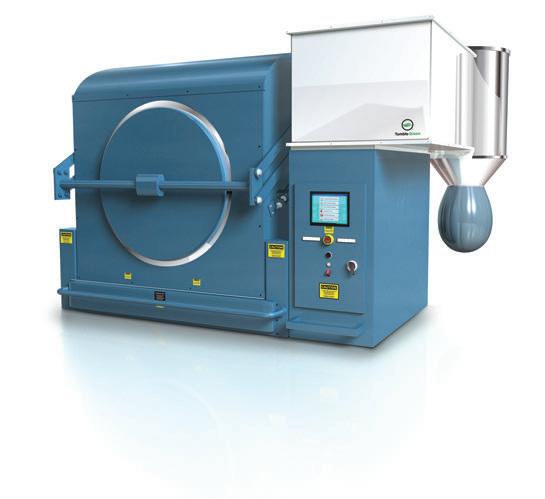
CLM leads the way in advancements in dryer technology and provides a replacement for your Challenge equipment. Our Model 165 fits the Challenge footprint perfectly and gives you technology that no one else offers, including a fully integrated production management system. Take the challenge with CLM. • Upgraded heat system with improved efficiency and lower emissions • Micro-Command III PLC upgrade with LAN and Blue Tooth communications • PLC now prepared for flow process management systems • 2-stage variable speed basket drive with 3-port load door. • Soft start to reduce component wear, lower utility use. • Heavy-gauge basket, includes removable steel basket panels • Long-lasting ceramic coating available on removable basket panels. • Configurable exhaust location • Configurable control/burner location Call CLM to replace your Challenge dryers, or for information on our broad range of industrial dryers. Model 165
Green® configuration 211 Erie Street, Pomona, CA 91768 | T: (323) 232-2417 | www.clmco.com ALN_Jr Page.indd 1 4/8/14 4:42 PM See NPE on Page 13 NONYLPHENOLS…ARE THOUGHT TO BE HIGHLY TOXIC TO AQUATIC ANIMALS AND IN THE AQUATIC ENVIRONMENT, AS WELL AS VERY PERSISTENT IN THAT ENVIRONMENT, AND BIOACCUMULATIVE.” -JOSEPH J. GREEN, KELLEY, DRYE & WARREN LLP
CHALLENGE
shown with Tumble
steps to going green in the laundry industry

 by cAr Lo cALmA
CHICAGO — For Ed Kwasnick, director of business development at ARCO/Murray, Laundry Division, the term “green” has become a buzzword commonly thrown around in the industry.
“Eco-friendly,” “environmentally conscious” and “naturefriendly” are just a few among the many terms that may come to mind when considering the con-
cept, but Kwasnick equates green with another terminology—carbon footprint.
“Carbon footprint means dollars. When you put it in terms of that, dollars is a language that everyone in our industry understands,” he says.“When that carbon footprint is large, I’m spending more money than I need to. ”
Kwasnick delved deeper into the topic of green efforts in a recent Association for Linen
SUSTAINABILITY AND THE THREE-LEGGED CHAIR
Though there are various definitions of what it means to be green—from focusing on preservation and conservation of resources, to taking actions that minimize our impact on the environment—Kwasnick explains the
“major component” lies in the aspect of sustainability.

“Sustainability is all about being able to continuously do something,” he says, listing efforts to save water and money, among other resources. “It’s about being able to sustain that, not for the next six weeks, the next six months, or the next six years, but can [it] be sustainable for the next six generations?”
He stresses the need to apply
sustainability to impact the triple bottom line, which involves society, the environment and economics.
“When we talk about sustaining our triple bottom line, we have to be able to sustain human resources [and] sustain our environment, but also be able to sustain the economics of the situation in order for that business and that technology to move forward.”
A simple way to understand sustainability, according to Kwasnick, is to consider the three P’s: people, planet and profit.
“Is your effort, is the technology that you’re about to invest in … able to sustain your people, [the] planet and profit simultaneously? It’s a three-legged chair, so if any one of those get knocked out, then [the effort] is not going to be sustained for the long haul.”
STRATEGIES TO SAVE ON NATURAL GAS USAGE

There are many overhead expenses laundry managers must balance, and chief among them is utilities, according to Kwasnick. Under this umbrella are costs pertaining to natural gas, which he explains is the “No. 1 highest utility [laundry managers] pay on a regular basis.”
To curb these high costs related to gas, Kwasnick recommends the use of heat conservation technology, which he explains utilizes “waste heat that’s being emitted” from a laundry’s processes to “preheat the incoming water source.”
One green technology Kwasnick advises laundry managers to invest in for curbing high gas costs is a wastewater heat reclaimer, which he calls the “No. 1 defense against natural gas usage.”
“You’re using the outgoing effluent stream that is warm to pre-heat the water coming in, thus reducing the overall temperature of the outgoing wastewater, and increasing the temperature of the incoming water,” Kwasnick explains. “Therefore, you don’t have to use more Btu or more natural gas to heat that [incoming] water.”
Kwasnick says the technology is able to raise incoming water temperature by 40-50 F. The typical cost for wastewater heat reclaimers, he adds, ranges from $120,000$140,000, and can create a savings range of $60,000-$80,000 a year.
Another gas-savings technology Kwasnick advises managers to look into is a stack economizer, which utilizes the exhaust from a boiler system as a heat source.

“We’re actually using the heat of the flue gas to heat the incoming water and to bring that up to temperate water temperatures, or even higher,” he says, adding that the technology is able to increase incoming water temperatures by 20-25 F, and can create a savings between $30,000-$40,000 a year.
While Kwasnick highlights other
8 December 2014 | AmericAn LAunDry news www.AmericanLaundryNews.com
Management webinar titled The Green Conspiracy: Saving the Environment and the Bottom Line.
American Laundry News November 2014 jr page 7.75x10 Easco Laundry Systems is a full-service laundry equipment distributor in Salisbury, MD. We’re focused on maximizing the efficiency of on-premises laundries, and we back up that commitment by offering industrial-strength IPSO® washers and dryers. Built to perform, these machines feature 40 years of European ingenuity to deliver increased productivity and minimized costs. This proven reliability is paired with our dedicated laundry expertise to bring you effective laundry solutions you know you can depend on. Contact Easco Laundry Systems to get started on your upgrade. Danny Massey • dmassey@eascolaundry.com eascolaundry.com • (410) 749-7037 822 Snow Hill Rd., Salisbury, MD 21804 INDUSTRIAL BY DESIGN A SUCCESSFUL PARTNERSHIP. BY DESIGN. 4534-7_IPSO OPL_jrPg-AmerLaundNews vF.indd 1 10/23/14 1:16 PM ALN_Jr Page.indd 1 10/29/14 9:53 AM
systems that can help operators cut natural gas costs—like flash steam recovery and high-efficiency modular boilers—he also stresses the importance of maintenance and upkeep.
“Even if you’re not going to upgrade your boiler technology … an annual tune-up is worth every penny,” he says. “I hope most of you, if not all of you, are doing some type of annual, or even twice-a-year, boiler tune-up … ensuring that boiler is working at optimal conditions, because that will have a significant impact on your natural gas use.”
Other boiler maintenance tasks to stay on top of are insulating steam lines and fixing steam leaks.
“If that steam leak is left unrepaired for a year, it can cost you anywhere from $2,000-$8,000 in
ment at the end of the day can also help.
“In our laundries, we have to learn to turn the lights off, and [turn] equipment off … as soon as we’re done,” he says. “I’ve been in facilities before where it was the plant manager’s job to walk around after the shift and shut all the equipment off, and so that equipment might continue to run, those lights might be on, for another 10, 15, 30 minutes beyond [closing time].”
OTHER IDEAS AND CONSIDERATIONS
Another area Kwasnick advised
managers to examine involves their facilities’ washroom chemicals. Low-temperature chemistry and ozone are among the options he lists, alongside the use of chemistry free of nonylphenol ethoxylates (NPEs), which he says “uses renewable plant oil derivatives [and] biodegrades faster.”




In developing an overall “green strategy,” Kwasnick warns laundry managers to be mindful of technologies that “don’t play nicely together”—for example, utilizing a low-temperature wash alongside a heat reclamation system.
“You don’t have high temperatures going down the drain
[and] you’re not picking up a lot of residual heat coming out of your washers,” says Kwasnick. “The much lower temperature of the wastewater stream can reduce the effectiveness of your heat reclamation system.”
GOING GREEN
“Many laundry managers are already green, but don’t know it,” Kwasnick says in a follow-up correspondence with American Laundry News, stressing the importance that green efforts should be ongoing.
“A green program is a commitment to continuously reducing one’s carbon footprint through a

combination of conservation, new technology and process improvement,” says Kwasnick. “It’s a strategy, not just an event.”
“It’s [a] mindset that is instilled in the entire organization, not just a marketing opportunity, and it’s being aware that a green program is focused on positively impacting people, planet and profit. You must have all three to make it truly sustainable and green.” ALN
gas costs,” says Kwasnick. “When you look up and you see that … little plume of steam coming out of a line … just think of that plume as being $2,000-$8,000 in cash just spewing out of your steam line.”
ACTIONS FOR SAVING WATER, ELECTRICITY
When it comes to reducing costs of water usage, Kwasnick praises water reuse technology, which he says is “inherent” to the design of tunnel washers currently in use by many facilities.
He also recommends the use of water recycling systems, which not only help save water, but also boast another energy-savings benefit.
“When you’re recycling that water, you’re taking out contaminants, but you’re leaving the heat in it,” says Kwasnick, “and if you use that water [again], you don’t have to re-heat that water up too much in order to reach the temperatures you’re looking for.”
And just like in the case of boiler systems, maintenance and upkeep of water reuse/recycling systems is of great importance, Kwasnick explains, adding that managers should look for leaks in the system, no matter how small.
“It’s not the constant drip, it’s the constant stream of water coming out, [so] you are going to waste almost 400,000 gallons a year, at the cost of $3,100 from that leak,” he says.
High-efficiency lighting, roof skylight systems and “soft start”/ VFD (variable frequency drive) motors are among investments managers can consider to slash electricity costs, according to Kwasnick, adding that the simple practice of shutting down equip-
www.AmericanLaundryNews.com AMERICAN LAUNDRY NEWS | DECEMBER 2014 9
Carlo Calma is editor of sister publication American Coin-Op, and previously served as editorial assistant for American Laundry News
2014 AD_Layout 1 10/21/14 4:02 PM Page 1 ALN_Jr Page.indd 1 10/22/14 1:31 PM
NOVDEC ALN
“MANY
LAUNDRY
MANAGERS ARE ALREADY GREEN, BUT DON’T KNOW IT.”
—ED KWASNICK, ARCO/MURRAY
PANEL OF EXPERTS
Measuring employees’ productivity
our daily lives, laundry managers use productivity measurements or standards to plan or forecast every aspect of production output.
Whenever I hear or read something about productivity, I often recall the old saying: “Nothing makes a person or operation more productive than the last minute.” In some cases, this statement is sad, but true. In the healthcare laundry business, waiting until the last minutes of operation can be catastrophic.
In this rather fast-paced healthcare laundry business, productivity and accompanying standards are the key to meeting the linen needs for our hospitals.
Just as meteorologists use measurements and calculations to forecast weather so that we can manage travel and other aspects of

In the healthcare laundry/ linen rental business, the word “standards” has many different meanings. A hospital’s linen standard refers to the standard order quantities needed to fill their daily linen orders.
Within the laundry operation, forecasting is absolutely necessary, and is used throughout the entire production process.


For soiled linens, production standards let managers know how many pounds of soiled linen can be sorted per hour.
In the washroom, standard hourly wash and dry capacities are used to forecast the washroom’s total hourly output.

In the flatwork department, establishing standard rates of actual pieces per operator hour requires counting systems and measurements used to forecast the output of each operator
and machine.
In tumble departments, linen feed into folding machinery also involves standard hourly rates, accompanied by a similar measurement of pieces per operator hour.

To be productive and be able to forecast, you must meet those productivity standards throughout the entire laundry operation. So enforcement of acceptable productivity standards is not only necessary, it’s essential.
Like meteorologists, healthcare laundry managers use standard operations measurements and calculations to forecast their productivity or output. Without standards or enforcement of acceptable output, a laundry operation’s forecast might read, “the perfect storm.”
start to teach them how to pick up towels, washcloths or gowns without looking at the pile, they quit and the process begins again. They never get around to learning much about speed or production standards.
We do have minimum standards for production, and most everyone exceeds them. We don’t spend much time on reaching the minimum standards. But we do give the workers pointers or tips on how to get through the day as quickly as possible.
We do use our standards as a tool for encouragement. For example, we might say, “I realize you are struggling, but look how well you are doing.”
people are just quicker than others, but you are going to need all of them to get the work out today. Most everyone wants to do a good job. Those are the ones you keep, but you must remove the hurdles for them in particular.
Not everyone agrees with me, but we all have different personalities, and not everyone responds well to the same management procedures. Some personalities respond only to a firmer line. And if you build your team that way, it may work out well for you. But you will always need to be there pushing. As for me, I prefer a softer approach.
Whether you have 10 production workers or a hundred, there will always be some turnover. As new workers arrive, you spend a lot of time, after they take to the work floor, teaching them to not be afraid of the folders, which side of the sheet needs to be fed into the system, how to adjust the small folders for size, how to pack a cart, and many other things. About the time you
It takes no wisdom to fire someone, but it does take a certain set of skills to teach, encourage, or salvage a “project employee.” Furthermore, it’s hard for a new employee to learn what you want them to know when they are afraid of you, or they get defensive when you approach them. They know you’re the boss—move on from that. Don’t teach them all the things they need to know, and then scare them off with the “standards.” They are leaving before they can get to the good stuff, and before the management can reap the rewards of increased production.

If there were minimum standards for managers and supervisors, production would improve. I maintain that production is not the product of a few faster workers, but the result of management meeting the production needs of the entire production crew. Some



Productivity standards should be set for all employees in laundry/linen operations—such standards serve as achievement goals, which help the laundry operation meet the expectations of their customers, management and ownership.


As an employee of Ecolab, I have achievement goals and expectations of my management team, per the expectations of the senior management and stockholders. Achievement goals are typical of most employees in all business sectors.

Employee achievement goals

10 DECEMBER 2014 | AMERICAN LAUNDRY NEWS www.AmericanLaundryNews.com Selling Customer Service FIRST! • OEM Distributor for RBI Water Heaters • 24/7 Technical Support • Laundry Consulting • Serving Commercial Laundries and Prisons across North America and the Caribbean We offer: • Hot Water Heaters 199-6 mil btu • ECWS Hot Water Storage Tanks • Water Softeners • Pre-plumb packages Call us for a quote using our SizeNet sizing program Phone: 1-866-513-7170 www.eastcoastwatersystems.com Fax: 843-225-6258 Visit us at Clean Show booth #1049 1114aln_ECWS ad.indd 1 10/2/14 7:25 AM
productivity
Should
standards
be set for employees of laundry/linen operations?
How
are these standards best implemented or enforced, and what kind of results can managers expect?
(Photo: © iStockphoto/Hiob)
Healthcare Laundry Michael Kirsch, CLLM
Retired, HCSC Laundry Allentown, Pa.
Commercial Laundry Richard Warren
Linen King Conway, Ark.
Chemicals Supply Carrie Armstrong Ecolab Eagan, Minn.
are important for helping businesses operate efficiently and economically, and achieve one of the ultimate goals of high customer satisfaction. Other benefits of set standards and/or achievement goals for employees are high morale, low turnover and increased loyalty, but these will only be realized if the standards and goals are implemented fairly.
Doing so requires communication, collaboration, appreciation and recognition. Employees need to know what the standards and goals are and why the goals are set. A clear understanding helps the employee make the decision to meet expectations, and with added incentives, he or she may exceed expectations.
Employees deserve appreciation for their work, from a simple “thank you” to other rewards that your business can provide. Examples I’ve seen throughout my fieldwork over the years are an employee- or team-of-themonth wall, appreciation lunches, plaques, gift cards, parking spots with the employee’s name, a special name tag, and the list goes on.
As long as the standards and goals are achievable, understood and agreed upon by employees, and employees are appreciated and recognized for them, managers can be managers, and not enforcers. What results is a team working toward the goal of their operation.
Appreciate employees’ accomplishments to keep morale high, turnover low and loyalty strong among your employees. This is what I believe and try to practice as a manager.
board, and you will see the results you are looking for.
nance program, to the drivers, to the housekeepers in the plant— there is no other way to maintain an operation that can be competitive in today’s environment.
operation do to correct this?
Productivity standards should be a staple for any operation. Setting production standards gives you the opportunity to gauge your employees’ work performance.
When hiring a new employee, cover the expectations for employees in daily operation. To help track productivity, you can have counters installed on machines to keep an accurate count, and also have employees write down production results if you don’t have software to compute your pounds per operator hour. This will ensure accountability for each employee, and you can use that as a coaching or disciplining tool if necessary. Incentive programs encourage employees to exceed production goals.
Expect results to vary, though hopefully they’ll swing more toward your goal. Keep your standards high and be firm across the
in the words of one of the better operators I know in our industry, “measure and track everything.” From the operators on the floor, to your proactive mainte-



It is the second question, concerning how standards are implemented and enforced, where the rubber meets the road. A few weeks ago, I was in an operation and noted as I went from one processing area to another that production standards were in place and posted throughout the facility. I also noted that they were not even close to being met anywhere in that facility. So, what went wrong, and what could the
I doubted there was going to be a long line at the manager’s office at the end of the shift, with each operator being counseled on their failure to meet the production standards, and just as important, I saw no process in place to correct this as it occurred. So what we had was the worst type of program—one that is on paper only.
The first step is not to implement productivity standards, but to develop them. Managers must take the time to go through their operations and identify the capabilities of their various processes as they stand at that time. Simply
putting numbers up on a board— ones you chose because the last plant you visited was meeting them—is doomed to fail.
One needs to realize what the operation’s capabilities are and how goods flow through a plant, and develop this first set of productivity standards that are specific and distinct to an operation.
Just as important, one should be developing a level of buy-in from the personnel in the operation. The employees should be part of the process. Almost everyone appreciates participating in

www.AmericanLaundryNews.com AmericAn LAundry news | dec ember 2014 11
ALN_Jr Page.indd 1 3/3/14 8:50 AM
equipment manufacturing
See EXPERTS on Page 12
Gary Ostrum G.A. Braun Syracuse, N.Y.
Hotel/motel/ resort Laundry James Brewster, RLLD The Resort at Glade Springs Daniels, W.Va.
a process over having a process forced on them. In addition, doing so ensures that the standards developed will be confirmed as being achievable by the operators themselves.
This process of development will also bring to light the obstacles in a facility that limit the current capabilities, and it allows for changes to be made toward improving capability before the initial standards are set.
One has to consider these standards evergreen in nature. One of the main reasons productivity is being tracked is to be able to improve it. The program is there to allow plant management to determine quickly and accurately whether or not changes made to an operation improved productivity as projected.

This brings up another key point to having a successful program in one’s operation. The standards are there not to identify whether employees are doing their job. What a proper program really identifies is whether the facility’s management team is doing its job. Has the facility’s management team developed a process that

allows the operators to be successful in their daily tasks, or have they created barriers to that?
Let’s take one standard, for example. The process of folding towels was reviewed at a plant, and it was determined that folding 800 towels per hour was achievable, so that became the standard. Now, the following needs to apply: On a consistent basis, does the operator get 800 towels an hour to process? Are they always in the same container so they can be handled in the same manner by the operator?
Is the equipment proactively maintained so it will process 800 towels per hour consistently? Are the finished goods effectively cleared from the equipment so the operator does not have to stop? And finally, the best question, saved for last: Where is the formal training process for new operators that helps them reach this standard in their first days of employment?
That fact is, with proper development of one’s productivity standards, which should be based on the specific capabilities of operations, the standards will need very little enforcement.
Personnel secure in other aspects of their job performance will have no issue meeting the standards, and those who are not will probably have a host of other issues
negatively affecting their job security.
task sheet with identified distribution points and total time of delivery and return for each location. Associates are responsible for the task sheet and turn it in at the end of their shifts.
• Factor in your non-productive time, such as daily associate meetings, breaks and meal periods. Place these times on the task sheet, too, with scheduled times for each associate.
be, the key to any successful endeavor.
With that in mind, how strong are your leaders’ people skills? What is your manager-toassociate ratio—are you keeping up with your overall responsibilities in supervising? How often throughout each shift are managers actively interacting with their associates, building working relationships and trust?
The implementation and management of productivity standards for clean-linen distribution and soiled-linen pickup is the backbone of a successful linen department. Measuring success is a daily task for linen-department leadership.
For inpatient hospitals, here’s some advice for tracking cleanlinen distribution:


Begin by calculating your total number of linen associates, along with the total number of distribution points and the total time for transporting/delivery.
• Complete a time study from the moment of loading a linen cart in the linen room to the return of the cart to the linen room. Factor in any potential delays during transport (i.e., waiting on elevators, foot traffic, any additional interruptions specific to your facility).
• Begin building a production
• Based on your calculation, how many full-time equivalents (FTEs) will it take to complete your daily cleanlinen distribution, by shift, within an 8.5-hour period?


For soiled-linen pickup, repeat the calculation of the total number of associates, but with the total number of soiled-linen pickup locations. These location footprints can be as varied as the total number.
• Complete the same time study as for clean-linen distribution.

• Build the same type of task sheet as mentioned before, but specific to soiled-linen pickup.








• Repeat the calculation of nonproductive time and input it on the task sheet.
• How many FTEs will it take to complete your daily soiledlinen pickup, by shift, within an 8.5-hour period?
Management is, and will always
Are they managing those highperforming staff, encouraging them to continue, and helping lower performers improve, or deciding they’re not the best fit for the position?
Leaders must have scheduled shift inspections of everything their associates are responsible for. Anything less will result in lowered expectations and never lead to consistent and successful production of your department.
The expectations of your customers should drive every outcome you’re trying to achieve. ALN
12 DECEMBER 2014 | AMERICAN LAUNDRY NEWS www.AmericanLaundryNews.com
Experts Continued from Page 11 FOR MORE STORIES FEATURING OUR PANEL OF EXPERTS, VISIT WWW. AMERICANLAUNDRYNEWS. COM! Independent testing shows Evolve removes 14 out of 16 of the toughest stains. Who says green doesn’t clean? Introducing Evolve® Laundry Complete 203L A powerful, new alternative to harsh chemical detergents, Evolve Laundry Complete 203L is the first natural technology to easily outperform conventional alkaline and surfactant-based detergents while neutralizing even the most severe odors. Superior stain, grease, and odor removal. Improves softness & reduces linen degradation. Increases capacity by shortening production times. Increases profits by reducing chemical costs, water usage, & utilities. Experience Evolve’s remarkable laundry technology in your facility, call (800) 992-4242. Request a FREE gallon sample by calling today and pay only $9.95 shipping & handling. WWW.AGAIAINC.COM/ TRYEVOLVELAUNDRY THE WORLD’S MOST POWERFUL LAUNDRY DETERGENT 0 00 EVOLVE LAUNDRY COMPLETE 203L IS THE FIRST DETERGENT TO BE GS-51 GREEN SEAL CERTIFIED ® Evolve Laundry_ ALN_FF.indd 1 11/11/14 2:46 PM ALN_Tab_half.indd 1 11/11/14 2:32 PM
Long-Term
Care Laundry
Brian Barfoot Aberdeen Village/ Aramark Olathe, Kan.
Girbau Industrial, Lavatec Laundry Technology partner for marketing, distribution
OSHKOSH, Wis. — Girbau Group and Lavatec Laundry Technology GmbH have entered into a partnership to market, distribute and provide support for each other’s products in North America, the companies report.
Girbau Industrial, a division of Girbau Group’s North American subsidiary Continental Girbau Inc., will team with Lavatec’s U.S. subsidiary, Lavatec Laundry Technology Inc., in a move that will make both companies’ products and capabilities more widely available in the U.S. and Canada.
Continental Girbau tells American
NPE
EPA’s RESPONSE
from Page 7
EPA provided a “largely favorable response” to the Sierra Club/UNITE HERE petition, says Green, granting the group “certain aquatic toxicity testing requests,” which became the responsibility of NPE manufacturers.
However, Green explains that EPA found that the petitioners “failed to provide facts to support the conclusion that the other tests they requested are necessary to permit a reasoned evaluation of the chemicals.”
“[That] was largely based on the fact that, given the lack of exposure, conducting epidemiological testing of workers would be a fruitless exercise, because up front we recognized that there was minimal, if any, potential for exposure,” says Green.
The response by EPA had some “practical advantages” for the industry, particularly in avoiding possible testing of laundry workers’ health conditions.
“Whenever you have a test like that, the results can often be ambiguous [and] open to interpretation, [which] leads to more requests for testing,” he says. “The union could certainly use that, or the environmental groups, to raise additional concerns, whether with state or local authorities, or the federal government.”
AFTERMATH, EPA’s ACTION PLAN
The give and take by the industry, EPA and petitioners culminated in the June 2010 commitment letter from TRSA members, explains Green, which details the phaseout schedule by the laundry industry of detergents containing NPE:
• Dec. 31, 2013 — All liquid detergent formulations




• Dec. 31, 2014 — All powder detergent formulations
In addition to adhering to this schedule, among other conditions in its letter of commitment, TRSA is also required to provide yearly status reports on the condition of the phaseout, according to Green.
Shortly after TRSA issued its letter of commitment, EPA came out with
Laundry News that the collaboration, which takes effect immediately, has been in the works for months and was chosen “through a thorough analysis of the market that both parties conducted.”
The two companies will operate independently in terms of manufacturing, Continental Girbau says, and products offered as part of the partnership are ones “considered industrial in nature and complementary to both companies.”
“Now both Lavatec and Girbau Industrial customers can take advantage of a wider catalog of equipment
its own “action plan” for NPE, Green explains, because regulation under TSCA can be a “very onerous rulemaking process for the agency.” Part of this action plan by EPA involves the agency’s pursuit of a “significant new use rule” (SNUR), Green says.
“What a SNUR does is it tells the world that if you intend to manufacture or introduce into the market a chemical that has a SNUR, before you do so … you have to notify EPA [and] give them 90 days [notice],” says Green.
“During that 90 days, EPA can ask for more information, can take regulatory action [and] can actually prevent you from going to market if there are some substantial concerns.”
choices,” says Mike Floyd, president of Continental Girbau. “By providing our customers a wider choice of solutions for their laundry needs, all parties should see significant benefits.”
This means, according to Green, that “any future intended use of NPE in laundry detergents” could trigger a required testing by EPA of that manufacturer, including toxicity and epidemiological testing.
Should there be continued use of NPE in laundry detergents, Green says, the EPA also indicated that it would develop a “test rule that would require worker monitoring, and potentially other testing for use of NPE after the phaseout.”
“[SNUR and the testing rule] would provide a fairly significant deterrence, certainly in EPA’s mind, to the use of NPE-based detergents [because] that testing can be rather expensive and time-consuming,” says Green.
CURRENT STATUS
As part of the EPA’s action plan
“This partnership should offer the clients of both companies the opportunity to work with a single provider for their laundry equipment needs,” says Mark Thrasher, president of Lavatec Laundry Technology Inc. “From small in-house laundries to the largest industrial plants in the world, Lavatec Laundry/Girbau Industrial can handle it all,” he adds.
ALN
under its Design for the Environment program, the agency released a list of various alternative solutions in May 2012, identifying eight “safer chemicals [than] NPE for use in laundry detergents,” according to Green, which TRSA has acknowledged.
“These eight [alternatives] don’t necessarily mean all detergent formulations could be successfully reformulated, [but] it was part of the process of encouraging movement away from NPE and toward chemicals perceived to be more environmentally friendly.”
Substituting NPE with more environmentally friendly alternatives can be a challenge for laundry operators, according to Green, in terms of industry adoption, and replicating the original solutions’ potency.
Another challenge he highlights is EPA’s adding a NP/NPE category to its Toxic Release Inventory, a rule that took effect recently and that will apply for the reporting year beginning Jan. 1.
Regardless of these challenges in phasing out NPE, Green says that the association and the industry have made “significant progress … toward elimination.”
In its February 2014 report to EPA, TRSA reported that, though there “was not a full phaseout of NPE usage in liquid formulations,” more than 80% of chemical supplier sales among TRSA’s membership are going to NPE-free facilities.
“The reason for the lack of … complete phaseout is the fact that there are a number of formulations that are difficult, frankly, to reformulate and achieve similar quality results.”
Though there are still challenges in the phaseout process, Green warns facilities still utilizing detergents containing NPE of the possibility of EPA regulation.
“Those who have phased out should not be in peril of regulation,” he concludes.
“They might have to file a response to EPA, for example, affirming that they are not [a] user, and therefore any kind of testing requirement or monitoring would not be applicable to them.” ALN
Carlo Calma is editor of sister publication American Coin-Op, and previously served as editorial assistant for American Laundry News
www.AmericanLaundryNews.com AMERICAN LAUNDRY NEWS | DECEMBER 2014 13
(Image licensed by Ingram Publishing)
Continued
“THE REASON FOR THE LACK OF … COMPLETE PHASEOUT IS THE FACT THAT THERE ARE A NUMBER OF FORMULATIONS THAT ARE DIFFICULT, FRANKLY, TO REFORMULATE AND ACHIEVE SIMILAR QUALITY RESULTS.”
-JOSEPH J. GREEN, KELLEY, DRYE & WARREN LLP
Detergents, ChemiCals & inJeCtiOn systems

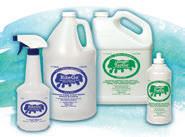
A.L. WILSON CHEMICAL CO.
RiteGo laundry spray spotter and Laundry TarGo from A.L. Wilson work together to attack laundry stains and deliver outstanding results, according to the company. RiteGo quickly penetrates to absorb ground-in soils, oils and greases, as well as collar and cuff stains, all without brushing. Laundry TarGo will target any tough, oil-based stains that remain.
Both products are chlorinatedsolvent-free, biodegradable, noncombustible and compliant with Proposition 65 and California’s 2014 regulations for volatile organic compounds (VOCs), A.L. Wilson says.
www.alwilson.com 800-526-1188
down stains without the need for higher wash temperatures, according to P&G Professional.
Because of this, facilities can reduce the energy needed to heat the water in a commercial washer by up to 75%, and can also reduce the water used by up to 40%, the company says. Gas and water costs can also be slashed, along with linen replacement costs.

The near-neutral-pH formula in the system is designed to protect fabric integrity, and the whiteness enhancer helps keep linens looking newer longer. With the Tide Professional Coldwater System, a 150-room property can save as much as $8,700 per year on water, energy and linen-replacement costs, the company says.
www.pgpro.com/tidecoldwater 800-332-7787
P&G PROFESSIONAL
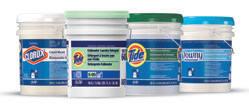
New from P&G Professional, the Tide® Professional Coldwater System features a near-neutralpH detergent, a fabric softener, a bleach and a whiteness enhancer that the company says work together to deliver clean, soft, bright-white linens and towels.
The Tide Professional Coldwater System uses unique enzymes designed for lower wash temperatures that effectively break
ECOLAB
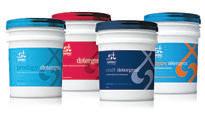
Ecolab’s Performance UltraBoost™ is a new formula featuring the most advanced chemistry for the most challenging industrial soils, the company says. The company recently launched the Performance™ Industrial Program for cleaning industrial garments without using NPEs, and with the addition of UltraBoost, the program is now tougher than ever on industrial
soils, Ecolab says.
UltraBoost improves the Performance program with an optimal concentration of ingredients designed to suspend soils and enhance detergency without using solvents.
www.ecolab.com 800-553-8683
GURTLER INDUSTRIES
Magi-Clens™ is Gurtler Industries’ patent-pending product designed to eliminate the notorious pink stains left by skin sanitizer, a common problem for those in the healthcare laundry field.

Now, those stains can be prevented in one wash cycle, according to Gurtler. The product additionally protects against stains from Hibiclens®, ChloraPrep® or similar chlorhexidine gluconate (CHG) products, and helps to address the infection control issues laundries face by switching to chlorine bleach.
Magi-Clens is only available from Gurtler Industries; contact the company for a product demonstration.
www.gurtler.com 800-638-7300

SANTEC INC.
Laundry products in Santec’s new NPE-free line are as effective as their NPE counterparts, the company says, and provide the same superior cleaning results with a much more eco-friendly product.
Prodigy SP is a fully balanced formula that works well as a stand-alone product for cleaning oily and particulate soils found in personal clothing and mixed loads that are processed in industrial and institutional laundries.
Inspire SP is a concentrated, low-foaming detergent designed for cleaning synthetic and natural fabrics in the same environments.
Santec’s 1420 SP is ideal for removing heavy, industrial-type soils from uniforms, rags and restaurant linens, the company says.
In addition to being NPE-free, Craft SP is phosphate-free, and its high concentration of lowfoaming detergents, combined with a powerful, alkali-blended break, eliminates the need for two separate products. An economical and space-saving product, it is designed for accelerated cleaning of mixed loads in institutional laundries, and is also effective for hospitality linens, Santec says. www.cleanneeds.com 888-726-8323
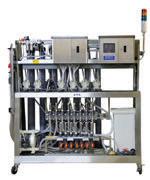
Both the DELTATRON and the OMEGATRON will “hold” any washer with a problem, and offer low-level alarms and visually verifiable functions with full volumetric measurement of every injection, according to U.N.X. The TUNNELTRON is a quick, reliable tunnel injection system with proof of flow and delivery for every chemical and destination, and it offers complete injection in less than 30 seconds, according to U.N.X. This product also features simultaneous injections, simple alarm messages and quick summaries. All three dispensing systems can be networked together to allow for consolidated, real-time reporting with Excel, the company says.
U.N.X. also offers new, superconcentrated detergents that produce superior results for many different soil types at a reasonable use cost, it adds.
www.unxinc.com 252-756-8616
PARISER INDUSTRIES
U.N.X. INC. U.N.X. Inc. designs and builds its own state-of-the-art chemical dispensing systems, such as the DELTATRON, which can operate in up to five washers with eight different chemicals. Able to dispense exact amounts and combinations, this product can process any type of good precisely, the company says. Up to 10 chemicals can be delivered to 10 washers with the OMEGATRON.
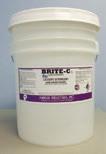
BRITE-C is a multi-purpose, broad-spectrum-use laundry product designed to meet today’s on-premises laundry requirements, according to Pariser Industries. This “one-shot,” high-efficiency liquid detergent is made to be effective across a large range of laundry applications, including personal, hospitality and healthcare. Since the product’s recommended dosages are low, it’s highly cost-effective to use.
BRITE-C is ideal
14 DECEMBER 2014 | AMERiCAn LAunDRy nEws www.AmericanLaundryNews.com
[Santec Inc.]
[P&G Professional]
[Gurtler Industries] [Pariser Industries]
[A.L. Wilson Chemical Co.]
[U.N.X. Inc.]
Product S
e
COMPiLED By THEREsA BOEHL, EDiTOR ALN_Tab_1-4_H.indd 1 7/16/13 3:58 PM
ho WCAS
Detergents, ChemiCals & inJeCtiOn systems
for today’s blended and synthetic fabrics, but is also highly effective on all-cotton items, the company says. With its blend of surfactants and oxygen bleach whitening agent, BRITE-C cleans, brightens and deodorizes while maintaining color and fabric integrity. It is safe for all types of fabrics and removes a wide range of stains. The product is packaged in 4x1-gallon cases, 5-gallon pails and 15-gallon drums.
www.pariserchem.com 800-370-7627

BRIGHTWELL DISPENSERS
Brightwell Dispensers has recently introduced the BrightLogic Diaphragm pump. It has been designed to deliver an excellent flow-rate consistency with highly viscous products. The pump can be easily upgraded into any BrightLogic laundry unit, the company says, and can be combined with low- and high-flow peristaltic pumps for a versatile

laundry dispensing system.
Key features of the BrightLogic Diaphragm pump include Viton® Extreme seals in umbrella foot-valves; diaphragm coating made from a derivative of PTFE; high chemical resistance; selfpriming; quiet operation; a no-squeeze tube; 50 ounces per minute (viscosity of water), with 40 ounces per minute at 240 cP; and the ability to mix and match to any new or existing BrightLogic laundry dispenser. Additionally, any BrightLogic laundry peristaltic pump can be upgraded to the BrightLogic laundry dispenser.
The product features simple unit programming and wireless capabilities that allow for quick setup and maintenance with a laptop computer and free software. With the BrightLogic iPhone app, reporting data from the dispenser can be viewed and formulas can be modified, saving on costly site visits, according to Brightwell.
www.brightwell-inc.com 855-741-8367
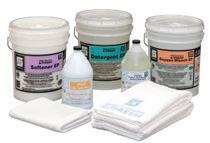
SPARTAN CHEMICAL CO.
The Clothesline Fresh Laundry Care line from Spartan Chemical Co. is made to target soils and stains to get fabrics clean, bright and fragrant. This product con-
tains award-winning green surfactant technology and biodegradable water softeners, according to the company.

Clothesline Fresh Laundry Care excels in most types of water conditions, and can be used in nursing homes, hospitals, correctional facilities, hotels/motels and any facility with commercial/industrial laundry needs, among others. The company says the product is preferable to other traditional products, and its superior cleaning performance comes at a lower cost.
www.spartanchemical.com 800-537-8990



ANDERSON CHEMICAL CO.
The INTEGRA System® is Anderson Chemical Co.’s patented chemical staging and delivery technology. It is a system-by-system approach for handling laundry, kitchen and housekeeping cleaning fashioned around a single concept—utilizing wall-mounted
holders containing super-concentrated liquid chemistry in inverted 1-gallon capsules.
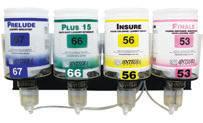
Each capsule contains a SurSeal valve that is opened only when placed into the INTEGRA holder or activator. This closed system allows the liquid to flow safely into an 8-ounce reservoir from which it is pumped to the cleaning device, the company says. Once the inverted capsule is empty, the operator still has an 8-ounce reserve to keep operations going.
DIAMOND CHEMICAL CO.


Introducing the Compact 5-in-One Ironing System
It’s like nothing else. The Girbau Industrial Compact 5-in-One Ironing System delivers a compact design and superior flexibility that allows medium- and high-production laundries to quickly feed, iron, fold, stack and accumulate. It processes a variety of items using up to four lanes and offers a two-lane crossfold option. This space-saving system generates processing speeds of up to 82-feet-per-minute; is available in 24-, 32- and 48-inch diameters with 102- and 130inch finishing widths; and features natural gas or liquid propane (LP) heat sources.
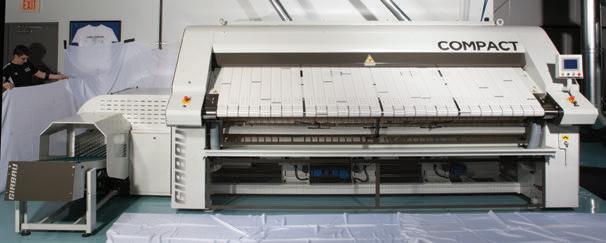
Concentrated products allow the systems to be cost-effective. Product formulas are flexible enough to be used in a three-, four- or five-pump system for all soil levels and water conditions. The INTEGRA Program offers both conventional and Design for the Environment (DfE)recognized products.
www.theintegraprogram.com 800-366-2477
New to the Diamond Chemical product line is Green Key® laundry detergent, an NPEfree, environmentally friendly product that the company says performs as well as or better than conventional products. Green Key is formulated in partnership with the Environmental Protection Agency’s Design for the Environment program and is used wherever a greener option is sought.
Diamond has also introduced its new ALIS™ Accu-Flow™ dispensing system designed for conventional washers. The system combines the proven features of the ALIS system with the latest programmable logic controller technology, Diamond says, allowing for fast injection speeds
www.AmericanLaundryNews.com AmericAn LAundry news | decem B er 2014 15 Contact Girbau Industrial today to see how the Compact 5-in-One can deliver more productivity to your laundry! (800) 256-1073 • www.girbauindustrial.com
MAKE
BIG
iron, fold, stack & accumulate … all with one machine! CompactAd-ALN-sized.indd 1 6/9/14 8:05 AM ALN_Tab_half.indd 1 6/9/14 9:28 AM
SMALL SPACES
Feed,
[Anderson Chemical Co.]
[Brightwell Dispensers]
[Spartan Chemical Co.]
➢
[Diamond Chemical Co.]
and a high level of accuracy. With Diamond’s web-view reporting software, users can get complete web-based reporting of all washroom operations.
An oxygen-type bleaching agent, Diamond Brite™ is safe on colors and extends linen life, according to the company. It’s designed to reduce stains and rejects and to lower total dissolved solids.
Diamond Brite is made to deliver softer textiles while allowing for lower alkali use and lower pH washing. The company says the product’s features can help launderers lower costs through reduced water use and temperature.
www.diamondchem.com 800-654-7627
NORCHEM CORP.
NORGEN is a newgeneration, NPE/APEfree, eco-friendly laundry detergent especially formulated to better remove oil and grease in synthetic fibers using less alkali, according to Norchem. REVOx is an odorless, chlorinefree stain remover with anti-microbial properties that the company says removes stains on both white and color textiles. An alternative to bleach, the product is formulated to increase linen longevity and improve whiteness.
Both products can be used in concert to achieve maximum results, according to Norchem, with benefits including lower-pH washing, lower total dissolved solids in wash/wastewater and reduction of lint at dryers.
An average decrease of 20-30% in alkali and bleach usage has been reported by longstanding clients of Norchem, the company says.
www.norchemcorp.com 800-442-4360
AGAIA INC.
Evolve®, a natural laundry detergent available from Agaia Inc., has been certified by Green Seal as the first detergent to meet its recently published guidelines, GS-51 Laundry Care Products
for Industrial and Institutional Use
The product is formulated for light- to heavy-duty commercial and industrial uses, and it’s manufactured exclusively from plant-based and other natural ingredients, making it free from carcinogens and VOCs, the company says. It is readily biodegradable and non-toxic without chemical fumes or residues.
Evolve breaks down soils, grease, blood and severe odors at the molecular level and delivers superior spot and stain removal, according to Agaia. Because it can often replace pre-spot, detergent, break, sour and most reclaim kits, while remaining compatible with bleach, whiteners and starch, users can enjoy wash times reduced by as much as 38%, Agaia says.
The company reports that Evolve leaves textiles brighter, fluffier, softer and fresher-smelling. It’s available in sizes from five gallons up to tanker delivery. www.evolvelaundry.com 800-992-4242
WASHING SYSTEMS LLC
Washing Systems has introduced two new products as part of its award-winning Pure Solutions line of completely NPE-free and phosphate-free products.
Spectrum is a next-generation detergent that is super-concentrated to optimize the cleaning process, the company says. The product is effective in a wide range of temperatures, and is designed to deliver maximum cleaning quality while increasing production efficiencies, according to Washing Systems. A significant reduction in shipments and packaging is a result of the super-concentrated nature of the product.
Secure, an alternative for safer wash processing, is an environ-

mentally-friendly sour. The company says it is effective on all classifications, including food processing and healthcare. A non-hazardous product, Secure is designed to be less corrosive and an overall safer product for human contact.
www.washing systems.com 800-272-1974
SOFTROL SYSTEMS INC.
The Catalyst XT from Softrol is a shared pump dispenser designed for medium- to high-volume plants processing a light- to medium-soil mix, the company says. Features includes a small footprint for plants with limited space, and an increased flush capacity for fast chemical delivery.
The system can deliver 10 chemicals to 14 washers and can be placed in the chemical storage area or on the washroom floor, allowing for easy access.
Softrol’s Catalyst XT is a highly automated system that includes Catalyst software for formula programming and process reporting. Operation of calibration valves and a back-flush valve are automated, along with other functions, for easy maintenance of the system.
www.softrol.com 888-763-8765
METRO-CHEM
Metro-Chem recently introduced Solar-Solv, a biodegradable laundry additive used in conjunction with existing detergents to emulsify and remove all types of oil-based soils and stains on all laundry classifications.
Solar-Solv is a nonflammable mixture that
is NPE-free and demonstrates low residual odor in finished work. It performs similarly to older laundry solvents that are no longer in use, the company says. A small amount of SolarSolv goes a long way to help with degreasing a wide range of soils and fabric types. It also works in all water temperatures, Metro-Chem adds.
The company says Solar-Solv works well on oil or grease stains on white and colored table linen, on mineral or petroleum-based stains on industrial uniforms, and on vegetable-based oils on shirts and foodservice uniforms.
www.metro-chem.com 800-332-7627
SANI WASH
Spectrum™, an ecofriendly, neutral-pH, concentrated liquid laundry detergent from Sani Wash, is formulated to be gentler on linens than high-alkali detergents often used in the hospitality and healthcare industries, says the company.
Spectrum has outperformed other high-profile, brandname detergents and threechemical systems in tests, Sani Wash reports. The product is designed to help operators lower linen-replacement costs, retain high cleaning standards, lower energy costs while seeing enhanced stain removal in lower temperatures, and eliminate the need for added pH-neutralizing chemicals.
Spectrum contains low-VOC ingredients, and conforms to national safety guidelines. It is available in 5-, 15-, 30- and 55gallon sizes.
www.saniwash.com 718-729-1700
M&M TECHNOLOGIES INC.
PROTEX 2000® from M&M Technologies is a fluid repellent that renews and maintains the repellency of barrier fabrics used in surgical gowns, isolations gowns, wraps and drapes, as well as in hospitality linens and uniforms, the company says.
The finish on surgical gowns and linens helps protect healthcare providers by causing fluids to roll away, making them less likely to be absorbed. The laundering process can deplete this finish, resulting in staining and strike-through.
PROTEX 2000® allows the finish to be reapplied in the laundry process, and since it is consistently maintained at a high level, according to the company, the life of the linen can be extended. Wash formulas, too, can be adjusted accordingly, due to the presence of fewer stains.
Steam sterilization enhances the product’s effectiveness, M&M Technologies says, and PROTEX 2000® costs only pennies per item for each laundering, making it cost-effective.
www.fluidrepellent.com 800-658-5958
BEACON LABS
Beacon Labs’ Wash ’n Bleach Extra 2 is a non-phosphate solid laundry detergent with a unique, patented blend of water softeners and surfactants. The company says it eliminates unwanted odors, bacteria and viruses, and has been designed to remove stains in a single wash. Wash ’n Bleach Extra 2 contains enzymes that provide an activated oxygen bleaching system, and the company adds that it does not cause damage to fabric.
www.beaconlabsinc.com 913-713-4120
16 DECEMBER 2014 | AMERiCAn LAunDRy nEws www.AmericanLaundryNews.com
ALN [AGAIA Inc.] [Norchem Corp.] [Beacon Labs] [Metro-Chem] [Sani Wash] [Softrol Systems Inc.] ALN_Tab_1-4_H.indd 1 2/11/14 2:14 PM
treatable before any contracts are signed. And for laundries interested in reusing water, Schultz warns that doing so can ultimately push up concentrations of pollutants in the water.
“So, for example, if you have a discharge limitation of 100 [milligrams per liter] for oils and greases, and the laundry goes ahead and has a 20% water reduction, their concentration going out the back door is now 120 [milligrams per liter],” he says.
BENEFITS FOR BUSINESSES

Besides keeping pollutants out of waterways and protecting the environment, wastewater treatment can have a number of benefits for businesses.
In addition to avoiding fines and creating the possibility for reusing water in a facility’s processes, there is also the opportunity to use the treatment as a “marketing tool,” Anderson says.
Buik says a major benefit for Roscoe is simply the ability to operate in Chicago, a “strict market in terms of wastewater enforcement.” But, he adds, it’s also just “the right thing to do.”
“Our customers are very inter-

ested in making sure that their soil byproducts are safely taken care of, because they do have a cradleto-grave responsibility, and even though they … entrust us with their soil waste stream, it’s still their responsibility,” he says.
Another benefit, Schultz says, is that laundries can apply for an evaporation credit from their POTW for water evaporated in the wash process.
“When clothes come out of a washer, they hold moisture, and that [eventually] goes up the vent stack, so why pay for something that doesn’t go back to the sewer?” he says.
However, operators should approach their POTW about getting the credit before installing the necessary equipment to measure and record the actual amount of water leaving the facility, Schultz advises.
FUTURE OF WATER FOR THE INDUSTRY
Since water is so integral to a plant’s processes, considering the future of this resource is not a futile task.
Schultz says equipment manufacturers, chemical vendors and other product vendors are all working on ways to help laundries decrease their water usage.
And as for the POTW, even they have ideas for how to conserve and
reuse water. Schultz says POTW have begun to approach laundries about using the municipality’s greywater, or non-potable water, in some laundering processes, especially during portions of the wash cycle where fresh water is not necessarily needed.
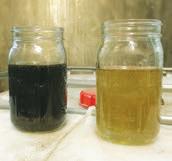
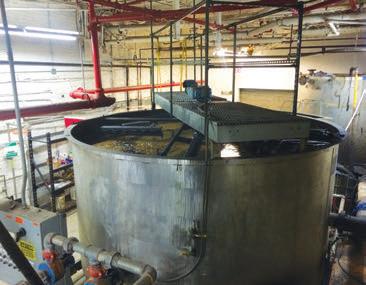
“But this may mean the laundry will have to install potentially a third infrastructure—a third set of valves, a third set of piping—that will handle the greywater into the facility,” he adds.
Shortages of water are already becoming a major problem for some laundries, Anderson says, and not just the ones in areas prone to drought. Restrictions on water usage per day are already a reality for some plants. Reusing water, he says, can help combat this.
“When you can reuse part of your water, you’re not limiting your production based on what water you’re allowed to have,” he says. “[The issue is], how clean can I make this water where I can reuse portions of it to keep production where I’m at, or actually increase production?”
Jones sees the availability of water as “a major, major problem” in the next 10 years, and he believes treatment standards will continue to become more stringent.
“I would say it would be close to impossible to build a new, major commercial laundry in Southern
California,” he says. “I don’t know where you would find a municipality that would sell you that much water.”
As for the laundry/linen industry, it is continuing to find ways to be more efficient in water usage and to be more conscious of the industry’s effect on the environment.
Buik says it’s important to
remember the positive impact of the industry, and to be confident in laundries’ green contributions.
“And I would assert that if our industry didn’t exist, people would use an abundance of water, [and] they wouldn’t be able to get things as clean. They would probably use a lot of disposables and create a lot of waste in landfills and what not,” he says. “And we can show improvements in water use, in energy use, [and] in chemical use, and we have done that. And that’s been a real success story for the EPA and for our industry as well.” ALN
over 50 years U.N.X. INCORPORATED has been involved in the development of products that not only solve quality problems that exist at the moment, but also provide long term benefits to the customer and the environment in which we live. U.N.X. was built on the foundation of improving the industry in which we participate. U.N.X. prides itself on being an industry leader with state-of-the-art products and dispensing equipment, and our plans for the future are extraordinary.
www.AmericanLaundryNews.com AmericAn LAundry news | dec ember 2014 17
With
U.N.X. INCORPORATED 707EArlingtonBlvd Greenville,NC27858 (252)756 8616
ALN_Tab_half 10/9/12 2:40 PM Page 1 See us at the Clean Show • Booth #2502 0513aln_UNX.indd 1 4/26/13 10:48 AM ALN_Tab_half.indd 1 8/6/13 11:38
For
a Research and Development team second to none, U.N.X. is in a position to provide the industry with the most technologically advanced products and dispensers as possible.
www.unxinc.com
continued from Page 6
wastewater
Top: Wastewater at Roscoe before undergoing treatment (left) and after (right). Bottom: The dissolved air flotation unit installed at Roscoe. (Photos: James Buik, Roscoe Co.)
set green goals, enhance bottom line for 2015

 by b i LL b rooks
As we near the end of 2014, it’s an ideal time to reflect on the past year’s achievements and set goals for the next. When it comes to your on-premises laundry, I challenge you to think about one area in particular, an area that affects nearly every aspect of your operation: What practices has your laundry implemented this year to make the operation more environmentally responsible?
Here are some ideas to help you make your OPL’s goals greener in 2015, while enhancing the bottom line and maintaining superior wash quality.
IMPLEMENT
BENCHMARKING
In order to improve laundryroom efficiencies, managers must first take note of where they’re starting out. Setting specific benchmarks can help. Take a holistic look at all aspects of the laundry operation that can affect energy usage, including number of loads processed per shift, machine usage, types of cycles being programmed and soil levels.
For example, a typical hotel laundry operation processes high volumes of lightly soiled linens. As bedding and towels are not typically very dirty after one-time use, they can be washed in a light soil cycle. Doing so not only takes less time, but is more efficient through the use of less water. Knowing one’s light-soil benchmark, which is typically 80% of all loads for hotels, can help a manager save on labor and utility costs.
REPLACE EQUIPMENT
Your current equipment may not be broken, but that doesn’t mean you shouldn’t consider replacement. Old equipment could be costing you money in repair bills, machine downtime and lost efficiency—and maybe even more importantly, it wastes gas and water because it lacks new technologies that get the same job done more efficiently.
While labor, linen replacement and utility costs represent 66-87% of an OPL’s total budget, initial equipment costs represent just 8-12%. The amount of money a laundry room can save in operating costs by upgrading far outweighs the initial equipment investment.
High-capacity machines with advanced technologies have been designed to handle large volumes using less energy and water, while increasing an operation’s productivity by washing more loads in less time. Equipped with stateof-the-art features, including advanced controls, high extraction speeds and spray-rinse and over-dry prevention technologies, newer equipment enables the laundry manager to focus on what end-users care about— clean linens—while minimizing utility, linen-replacement and labor costs.
SHORTEN DRY TIMES
Energy is about 15% of an OPL’s operational cost, and tumble dryers account for 70% of that cost. Reducing drying times not only means facilities benefit from lower utility bills, but
a significant amount of energy is saved, making operations friendlier to the environment.
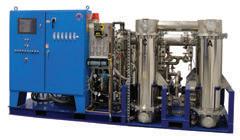
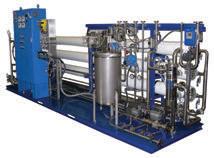
Using a washer-extractor with an industry-leading 400-G-force extraction rate is the single most effective way to reduce drying times, because it removes the maximum amount of water from a load before it even reaches the tumble dryer. Then, look for tumble dryers that balance heat, tumble action and airflow. When these qualities are optimized, hot air is forced through the linens, rather than around them, to get the job done faster.
Certain tumble dryers even contain moisture sensors that automatically shut off the machine when precise levels of dryness are reached.
PRESERVE LINENS
While shorter dry times can lead to decreased utility costs, another benefit is that linens won’t suffer from the degradation that comes with unnecessary overheating. Facilities with an OPL invest a significant amount of money in linens each year— between 13% and 25% of operation costs. The more linen you can keep on the shelf—and out of landfills—the better for your bottom line and the environment.
Tumble dryers with a “step dry” feature use high heat until the load is half dry, and then the temperature is lowered for the remainder of the cycle to save linens from unnecessary heat. Also, a tumbler with various dryness-level settings allows OPLs to define each cycle according to
their specific needs.
Look to your benchmarks to help customize your dry cycles and ultimately preserve your linens.
WASHER-EXTRACTOR FEATURES
State-of-the-art washer-extractors are engineered with water savings in mind. Among other features, manually programmed cycles (up to 41 are available on certain washer-extractors) allow a manager to customize cycle time, temperature and wash formula based on the load to deliver exceptional wash quality. With a properly programmed machine using advanced controls, cycles that consume more water or hot water, such as pre-wash or bleach bath, will only be used when necessary.
Eco-friendly cycles on washerextractors are automatically programmed to save water and reduce energy usage, while still delivering a superior wash when the appropriate cycle is selected based on soil level and linen type. Lastly, washer-extractors with a leak detection feature can detect drain or water-valve leaks, should they occur, and eliminate wasted water.
EQUIPMENT MAINTENANCE
Just like a car should be inspected to ensure it is achieving optimal gas mileage, laundry equipment should be routinely checked to ensure it’s running as efficiently as possible. Equipment with advanced controls
can make preventive maintenance seamless by providing a historical account of what repairs have been made and how frequently, and what maintenance should be performed in the future.
Advanced controls, along with manufacturer manuals, highlight everything from checking the door interlock daily, to verifying the drain valve is working weekly, to lubricating the bearings each month, and finally, to inspecting the bearing mounting bolts. Additionally, automatic or manually programmed leak and slow-drain detection help prevent wasted water any time of the year.
EDUCATE END-USERS
Whether your OPL’s end-user is a hotel guest, long-term care facility resident or a customer, they’ll feel good knowing they patronize a facility that’s doing its part to lower energy usage and water consumption.
Your end-user may not be aware of what goes on behind the scenes in the laundry room, so make it clear to clientele what proactive steps the OPL has taken to lower its environmental footprint. ALN
Bill Brooks is national sales manager for UniMac®, a provider of on-premises laundry equipment. He can be reached at bill.brooks@alliancels. com or 920-748-4437. For more information about UniMac, visit www unimac.com/OPL101 or call 800-587-5458. Brooks
0513aln_Kemco.indd 1 7/9/13 3:28 PM 18 DECEMb E r 2014 | AMEriCAn LAunDry nEws www.AmericanLaundryNews.com OPL 101
Marian University names Alliance Laundry Systems Business of Year
FOND DU LAC, Wis. — Alliance Laundry Systems has been named 2014 Business of the Year by Marian University, the company reports. Alliance was among six Wisconsin businesses recognized at an awards ceremony here on Oct. 28.
“It’s an honor to be recognized by a leading university in our community, and to be added to the list of exceptional companies who have been named Business of the Year before us,” says Mike Schoeb, Alliance CEO and president, who accepted the award on behalf of the company. “While Alliance’s global footprint continues to expand, we take great

pride in telling customers that Ripon, Wis., is our home.”

Jeffrey Reed, dean and professor at Marian University School of Business and Public Safety, says Alliance was “highly deserving” of the recognition because of its “exceptional laundry equipment and service, ever-growing economic influence and dedication to customers and the community.”
The awards program helps raise scholarship funds for Marian University students.
Northwest Health Care Linen earns top EnviroStars certification rating
BELLINGHAM, Wash. — Northwest Health Care Linen has received a five-star rating from EnviroStars for its commitment to environmental stewardship, the company reports. EnviroStars is a state-run program that provides assistance and incentives to smaller businesses for reducing hazardous materials and waste. The five-star rating is the highest a business can receive from the Washington state program.
Northwest Health Care Linen is one of 850 businesses in the state to participate in the EnviroStars program, and the only linen facility in the program that focuses exclusively on medical linens.
The company says it saves energy and resources through reclaiming wastewater heat, recycling water and making use of reusable textiles. By recycling all of its plastic soiled-linen bags and cart covers, it has reduced its solid waste stream by more than 85%, the company adds.


“We are proud of the fact that our record of environmental

awareness and real reductions in our waste stream are being recognized,” says James Hall, Northwest Health Care Linen CEO.
Alsco opens new processing plant in Washington state




KENT, Wash. — Alsco has moved its Tacoma operations to a brand-new, 70,000-square-foot laundry processing plant here, the company reports.
From the newly constructed plant, Alsco will provide linen and garment cleaning and processing for 1,400 customers in Seattle, Tacoma, Kent and surrounding areas. Alsco says the facility can accommodate an increase in production of more than 150%. The company, founded in 1889 in Lincoln, Neb., has been operating in western Washington since 1952.
Alsco’s Oct. 15 grand opening event was attended by company executives, local management and staff, and local government officials.
The company says local employees pitched in to make the transition to the new plant in a single weekend.
“We needed more room, first and foremost,” Steve Bivens, general manager of the Kent plant, tells American Laundry News. “We had nowhere to grow in the property we were on.”
New equipment purchased for the facility includes a soiledlinen sorting and counting system by Automation Dynamics, two 450-pound washers and three 450-pound dryers by Jensen, and a steam tunnel by Colmac Industries. The plant is also using five refurbished ironers, all Super Sylons by American Laundry Machinery. ALN
ALN_Jr_half.indd 1 5/9/14 3:43 PM www.AmericanLaundryNews.com AmericAn LAundry news | dec ember 2014 19 Consolidated international Corporation 866-632-2298 | cicus.com Setting the Standards for Industry Leading Products and Solutions Parts, su PPlies and Belting for - ajax laundry presses - alliance laundry systems - american dryer Corporation - american laundry Machinery - Brim laundry Machinery Co. - Burkert and Gemu Valves - Chicago dryer - Cissell - Clean Cycle systems - Consolidated laundry (ClM) - dexter laundry - edro dyna Wash - ellis Corporation - Forenta Finishing equipment - Ga Braun - Hoffman / new Yorker - Huebsch - Jensen - Kannegiesser - lavatec Feeders and Folders - norman dryer - pellerin Milnor - sager spreader - speed Queen - Unimac - Unipress dry Cleaning and laundry presses - Wascomat laundry equipment - Washex / Challenge Call today and mention this ad to receive 10% Off your first or next order! Source code: CICALN1014. Industrial Laundry Consolidated Parts, suPPlies, Belting and textiles ALN_3rd Page.indd 1 11/10/14 5:55 PM
From left: Jeffrey Reed, dean, School of Business and Public Safety, Marian University; Bruce Wadman, controller, Alliance Laundry Systems; Mike Schoeb, CEO/president, Alliance Laundry Systems; Robert Fale, interim president, Marian University. (Photo: Marian University)
& C GAS IRONER FOR SALE
MODEL - IS18120 YEAR 2010 Good condition • $20,000 Call for more information 201-727-4700 Ext. 4888. Ask for Kevin or E-Mail keving@partyrentalltd.com
PARTS FOR SALE
PARTS, PARTS, PARTS
Huge stock of parts for most laundry equipment & boilers. Also traps, valves and lubricants. Overnight delivery. Steiner-Atlantic, 800-333-8883 Fax: 305-751-8390 parts@steineratlantic.com www.steineratlantic.com
WASHEX PARTS
Hard-to-find Washex parts, on-site rebuilding, tech support.
LAUNDRY PARTS CENTER 800-352-4492 Fax: 305-827-3991


Service and Sales Representative



Interested in a fast growing company with great innovation, drive and teamwork? We manufacture and sell products within the Industrial Laundry Industry. We are looking for Engineering Sales Reps with a Service background, and whom are very familiar with Flatwork Ironers. Base pay, plus commission and installation fees earned. If interested send your resume to cprunk@cicus.com. No phone calls please.
Service Technicians
Loomis Bros. Equipment Company, a St. Louis based Milnor and Chicago dealer, is looking for experienced OPL and heavy equipment technicians to join our growing service team. Serving MO, KS, IL, and IN we currently have openings in St. Louis and Indianapolis. Some travel required. We offer top compensation, medical, 401k and profit sharing. Reply in strict confidence to toms@loomisbros.com.

Summer Job in Alaska!

Denali Princess Wilderness Lodge is currently hiring a laundry manager position for the 2015 summer season. This position is responsible for the overall operations of the laundry department for three lodges. Housing and meal plans available. If you have an adventurous spirit and a passion for service excellence, we would love to meet you. Apply today and begin your Alaska journey! Opportunities to see Denali National Park, majestic Mt McKinley, catch a king salmon or see our amazing wildlife. Visit www.alaskatourjobs.com to apply.
U.N.X. INCORPORATED
seeks skilled professionals in the laundry industry to foster new growth and expansion. With 56 years experience in health care, hospitality and industrial operations, we are an industry leader with the most technologically advanced chemical products and “state of the art” injection systems. If you have had successful selling experience in high volume laundry plants, come grow & expand with U.N.X.!
Territory Managers have advancement opportunities.
U.N.X. is an equal opportunity employer. To apply, contact us at: U.N.X. INCORPORATED
PO BOX 7206 Greenville, NC 27835 Fax: (252) 756-2764 armstrong@unxinc.com www.unxinc.com
20 DECEMBER 2014 | AMERICAN LAUNDRY NEWS www.AmericanLaundryNews.com
Classified Advertising
EQUIPMENT FOR SALE EQUIPMENT FOR SALE AMKO AMERICA, INC. Remanufactured Finishing Equipment Delta Ironers, Omega Folders & Towel Folders (1 year parts warranty) Like new at half the cost. PARTS, IRONER SUPPLIES & NEW EQUIPMENT ALSO AVAILABLE Contact: (561) 863-9696 jurgenb@bellsouth.net POSITIONS AVAILABLE POSITIONS AVAILABLE DISTRIBUTOR OFFERINGS www.ineedjpequipment.com 800/925-3236 EQUIPMENT FOR SALE: (1) 675lb Ellis Washer, needs to be rebuilt (1) 120lb Milnor Steam Dryer, , MLS122, 2009 (1) Braun Alpha 1200 Feeder, 2012, Excellent Condition, (1) BnR Controls, Clamp Auto Feed (1) Braun Omega Folder, 4P-3C with Stacker 1997 (1) Braun 3-Roll 32” Deep Chest 32”, 1984, Rebuilt in 2011 (2) 125lb Milnor Washers SM, 1993,1995 (1) Chicago Skyline, 2 Lane, 2001 (1) 50HP Atlas Rotary Air Compressor, GA-37, 2002 (1) Hypro ll, 6 Roll, Rebuilt in 2010 (1) Central Blanket Feeder & Folder, 1999 (1) Clean Side Conveyor, 80’L x 34” (3) 75lb Milnor Gas Dryers, MLG758D, 2004 (1) 110lb Milnor CBW Module, Completely Reconditioned Multiple Chicago Edge, King Edge & Skylines (1) 200lb ADC Gas Dryer, 1995 (3) 310 ADC Steam Dryer (2) White Conveyors, Dual Stack “Expect Excellence” Expect excellence from the leader in used industrial laundry equipment sales and installation. Keep up to date with equipment for sale, and the latest industry news by subscribing to our monthly newsletter. Go to www.ineedjpequipment and sign up TODAY! About JP Equipment JP Equipment is a trusted, full-service, used industrial laundry equipment sales and installation company. We pride ourselves on providing unparalleled service, whether you are building a new laundry, Call Craig Lloyd toll free at 877.295.5693 between 9 a.m. – 9 p.m. EST. Please visit www.laundrycareers.com to review current industrial/institutional laundry management openings. ADVANCE YOUR CAREER The Griffin Group, Inc. “Recruitment Specialist” Need to FILL a position? Call Deana Griffin 888-235-2365 www.thegriffingroup.cc deana@thegriffingroup.cc ® QTY DESCRIPTION 1 King Edge 2002 1 Milnor 130lb CBW 76/39 – 11/99 1 Milnor Two Stage Press and Shuttle 3 58058 Gas Dryers 1 Edge Spreader 2000 2 Lavatec 110lb CBW’s 1988 6 Lavatec Tunnel Dryers 1 Lavatec 3 Roll Steam Ironer 32” 1 American 6 Roll Hypro 1 Challenge Pacesetter 400lb Gas Dryer 1 450lb Washex Open Pocket 2002 2 275lb Milnor Open Pocket Rebuilt 2002 For Pricing call Ron Hirsch 516.938.4300 • 516.315.7426 Hicksville, NY www.directmachinery.com FOR NEW OR USED LAUNDRY EQUIPMENT, DM IS YOUR SOURCE FOR ALL YOUR NEEDS
B
HOTEL CLOSING SUPER EQUIPMENT HOSPITAL LAUNDRY CLOSING
CONDITION
EXCELLENT
Stanco Industries, Inc. Serving The Textile Trades Since 1970 800-932-3769 k for Mike @ ext 203 KEEPING IT GREEN SINCE 1970 ---------------------- ITEMS FOR SALE ----------------------2009 Braun 400# Open Pocket 2008 Braun 400# Steam Dryer 1998 Braun 400# Pass-Thru (2) 1992 Braun 600# TSL (2) 2005 Braun Omega 2-Lane 2004 Braun Alpha 4-Station Feeder 2005 Chicago 1-Roll 32” Thermal 1995 Chicago 36” Steam --------- DON’T BE LEFT WITHOUT POWER -------Emergency Generators Available 50KW to 1000KW Natural Gas & Diesel Stanco Industries, Inc. 800-932-3769 Ask for Mike @ ext 203 www.StanCoInd.com





























www.AmericanLaundryNews.com AMERICAN LAUNDRY NEWS | DECEMBER 2014 21 Source Directory A convenient guide to sources of products and services APPAREL FINISHING CARTS, TRUCKS & BASKETS #1 Manufucturing Source for Laundry Transportation! (800) 634-0555 RBWire.com 11744 Blue Bell Rd. Elberfeld IN 47613 800-304-4600 www.fibertechinc.net Rotational Molding, Repair, Recycling...Your Complete Plastic Solution Durable, Economical and Environmentally Friendly. BULK DELIVERY TRUCK Rugged, non-marring trucks designed to maximize payload Up to 63.5 cu. ft. capacities in 13 different sizes. l-800-275-2436 maxi-movers.com Fax: 631-661-8209 •Email:sales@maxi-movers.com The Cart Guys Chm #9565 Bulk Del. ALN Class. 2/5/14 2:48 PM Pa Source Directory listings in American Laundry News are sold on an annual basis at the following rates: All Major Credit Cards Accepted 2015 Listings Regular Boldface All Caps All Caps, Boldface Four Line Listing per Year $850 $1,070 $1,070 $1,130 Display and additional line rates available upon request Sani Trux - McClure Industries, Inc. 9051 SE 55th Ave., Portland, OR 97206 800-752-2821 www.mcclureindustries.com, info@mcclureindustries.com M.I.T. POLY-CART 211 CENTRAL PARK WEST, NEW YORK, NY 10024 800-234-7659, FAX: 212-721-9022 WWW.MITPOLYCART.COM CARTS, TRUCKS & BASKETS CARTS, TRUCKS & BASKETS Diversified Plastics, Inc. 1309 Highway 917 West, Latta, SC 29565 800-768-7636, www.dpirotocarts.com E-mail: sales@dpirotocarts.com Fax: 843-752-7798 AmericanLaundryNews.com More than unique visitors monthly! 5,250 www.nortonsupply.com • 800.869.7664 • sales@nortonsupply.com Heavy Duty Rhino Wrapping Machine • Rhino Console Wrapper for finished laundry. • Stainless steel construction. • Solid state controlled electric cut-off rod. In-stock for immediate delivery. FREE Roll of Laundry Wrap with Rhino Wrapper Purchase Pack 25% More On Same Size Cart Call 800.829.4535 or visit MODLaundry.com for a FREE QUOTE. Premium Quality Casters Included! 72S Meese Orbitron Dunne Co. Stronger design for big payloads, yet lighter tare weight for easy handling. The Best of Both Worlds
Ave., Portland, OR 97206 800-752-2821 www.mcclureindustries.com, info@mcclureindustries.com

















22 DEC E mb E r 2014 | AmEriCAn LAunDry nEws www.AmericanLaundryNews.com Source Directory listings in American Laundry News are sold on an annual basis at the following rates: All Major Credit Cards Accepted 2015 Listings Regular Boldface All Caps All Caps, Boldface Four Line Listing per Year $850 $1,070 $1,070 $1,130 Display and additional line rates available upon request source Directory A convenient guide to sources of products and services FLATwOrK irOnErs FLATwOrK irOnErs Knowhow In Action Your Tingue rep is a fully trained master of finishing equipment operation, maintenance and installation. Call for: • Pads, covers, belts, waxes, tapes and more • Carts, trucks, baskets and bags • Parts, rebuilds and repairs 800.829.3864 www.Tingue.com TalleyMachinery.com MODLaundry.com TBR-Associates.com To website C & W EQUIPMENT (800) 443-3573 FLATWORK IRONER SPECIALISTS REMANUFACTURED IRONERS: Super Sylon Sylon Hypro’s Super Pro Jensen SS700 SS800 Ultima Lavatec UPGRADE KITS: Chain Drive Conversion Vacuum Systems Herringbone Conversion Canopies Inverters Side Covers Roll Springs Jensen Drives SUPPLIES: Aprons Pads Covers Belts Waxes Cleaners PARTS/REPAIRS: All Brands New/Refurbished/Hard to Find COMMITTED TO EXCELLENCE (480) 205-1293 (602) 763-7416 www.azsle.com Whether your ironer needs pads and covers, wax cloths or cleaning supplies, or needs to be completely rebuilt, there is no job too big or too small for Southwest Laundry Equipment Energenics Corp., Kartwasher 1470 Don St., Naples, FL 34104 800-944-1711 www.energenics.com Pellerin Milnor Corp. P.O. Box 400, Kenner, LA 70063 504-467-9591, Fax: 504-468-3094 www.milnor.com DryErs – 100 POunDs Or mOrE CArT-wAsHinG sysTEms Pellerin Milnor Corp. P.O. Box 400, Kenner, LA 70063 504-467-9591, Fax: 504-468-3094 www.milnor.com DryErs – 100 POunDs Or LEss Sani Wash - McClure Industries, Inc. 9051 SE 55th
HEAT sEALinG suPPLiEs/TAPE FLATwOrK suPPOrT www.olekbelts.com 1-800-869-2683 Free www.olekbelts.com We’re your flatwork finishing and conveying O.E.M. Belt Match H.Q. Get the real thing for a Lot less $$$. O.E.M. Needlefelt Ironer Pads too! Better Belts, Better Prices, Better Service Visit our Website or Call 1-800-869-2683 For free, no obligation, price quotations and for your Free copy of our Product Catalog with over 40 samples. Ironer pads, covers, aprons, guide tapes, carts, slings, cleaners, waxes & more… Setting the Standard in Lint Filters for 25 Years • Hotel • OPL • Coin Op • Dry Cleaners • Industrial • Commercial • Cruise Industry Dry or Wet Style Filters to Work with “ALL” Dryer Sizes or Multiple Situations, Fiberglass or Stainless and Custom for Unique Situations! All manufacturing done on premise 800-826-1245 www.cleancyclesystems.com • ccsystems@tqind.com LinT COLLECTOrs & FiLTErs H Our In-Line Lint Filter mounts inside, saves space! H Fiberglass Wet Filters - 6,000 to 40,000 cfm H Fiberglass or Stainless Steel Dry Filters ENERGENICS CORPORATION Talk with our Design and Engineering Staff about your needs. Hundreds Sold Annually. 800-944-1711 www.energenics.com CArTs, TruCKs & bAsKETs Round-Tripper_6.25x3:Layout 1 6/17/14 12:04 PM Page 1
Gardner Machinery Corporation

P. O. Box 33818, Charlotte, NC 28233 Ph.: (704)372-3890; Fax: (704)342-0758 www.gardnermachinery.com








P.O. Box 400, Kenner, LA 70063 504-467-9591, Fax: 504-468-3094 www.milnor.com
PRESSES
Pellerin Milnor Corp.
P.O. Box 400, Kenner, LA 70063 504-467-9591, Fax: 504-468-3094 www.milnor.com
Pellerin Milnor Corp.













P.O. Box 400, Kenner, LA 70063 504-467-9591, Fax: 504-468-3094 www.milnor.com
Pellerin Milnor Corp. P.O. Box 400, Kenner, LA 70063 504-467-9591, Fax: 504-468-3094 www.milnor.com
Company

Agaia International www.agaiainc.com 12



American Dawn www.americandawn.com 3
American Laundry Systems www.eomech.com 6

Clean Show 2015 www.cleanshow.com
Consolidated
Consolidated
Davis
Direct
East
EDRO
Girbau
Hamilton Engineering www.hamiltonengineering.com
IPSO www.ipso.com 8
J.P. Equipment www.ineedjpequipment.com
Kannegiesser USA www.kannegiesser.com
Kemco Systems www.kemcosystems.com 18






LaundryCareers.com www.laundrycareers.com 20
Lavatec Laundry Technology www.lavatec-laundry.com 24

Royal Basket Trucks www.royal-basket.com 14
Stanco Industries www.stancoind.com 20
The


www.AmericanLaundryNews.com AMERICAN LAUNDRY NEWS | DECEMBER 2014 23 Source Directory A convenient guide to sources of products and services Source Directory listings in American Laundry News are sold on an annual basis at the following rates: All Major Credit Cards Accepted 2015 Listings Regular Boldface All Caps All Caps, Boldface Four Line Listing per Year $850 $1,070 $1,070 $1,130 Display and additional line rates available upon request PARTS PARTS PARTS & SUPPLIES www. .com A & B WIPER SUPPLY You’re probably not getting enough for your linen discards! We pay TOP DOLLAR for your discarded sheets, towels, thermal & flannel blankets. Call us for an immediate quote: 800-333-RAGS (7247) We’re Hiring! Textile Buying & Sales Executive Positions Available E-mail Résumés to resumes@bestrags.com RAGS WANTED FOR CASH OR TRADE
Pellerin Milnor Corp.
WASHERS – CONTINUOUS BATCH WASHER-EXTRACTOR – 100 POUNDS OR LESS WASHER-EXTRACTOR – 100 POUNDS OR MORE
PLANT
& INSTALLATION
DESIGN
HANDLING / CONVEYORS
MATERIAL
–
CONTACT US TO BOOK YOUR AD TODAY! CLASSIFIEDS@AMERICANTRADEMAGAZINES COM
EXTRACTION
Page
Site Page
Web Site
Company Web
5
Laundry Machinery www.clmco.com 7
International Corp. www.cicus.com 19
Packaging www.davispackaging.net 18
Machinery Sales Corp. www.directmachinery.com 20
Coast Water Systems www.eastcoastwatersystems.com 10
Corp. www.edrodynawash.com 16
Industrial www.girbauindustrial.com 15
G.A. Braun www.gabraun.com 9
19
IES www.iesclean.com 13
20
11
OF ADVERTISERS
Griffin Group, Inc. www.thegriffingroup.cc 20 U.N.X. Inc. www.unxinc.com 17, 20 INDEX