Standards developer adopts


ALEXANDRIA, Va. —
ASTM International, a global organization known for the development and delivery of international voluntary consensus standards, has published the Textile Rental Services Association (TRSA)initiated Standard Practices for Sustainable Laundry Best Management Practices, recognizing the association’s criteria for Clean Green certification as universal indicators of sustainability in commercial laundry work.
The ASTM standard “codifies” practices in TRSA’s Clean Green standard as “the structural, non-structural and managerial techniques” effective for a laundry to achieve green objectives, according to TRSA, adding that ASTM reviewed its standards for 19 months.
The ASTM’s acceptance of the TRSA proposal reflects “our industry’s commitment to sustainability and dedication to further reducing our carbon footprint and enhancing our environmental stewardship,” says Joseph Ricci, TRSA president and CEO. “The ASTM standard, implemented through TRSA’s Clean Green certification, encourages every laundry facility to adopt sustainable, green best management practices.”
Among the best management practices incorporated in the ASTM standard include conserving with a water reuse system; using environmentally friendly detergents; and filtering wastewater before discharge to sewer, among others. ALN
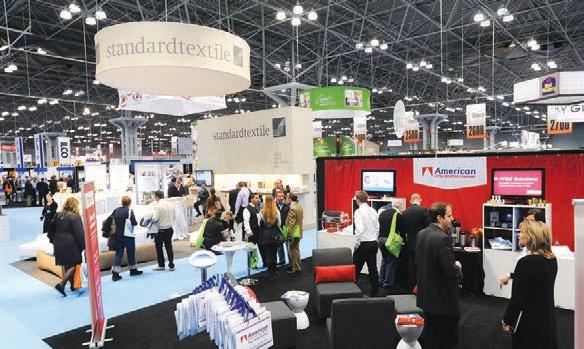
By Mike SchwanzNEW YORK — The 98th annual International Hotel, Motel + Restaurant Show (IHMRS) will have a different look and feel to it this fall, with new pavilions, new partnerships and new management.
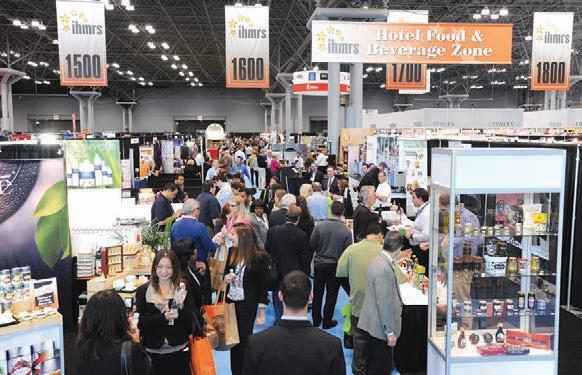
This year’s show is scheduled for Saturday, Nov. 9, through Tuesday, Nov. 12, here at the Jacob K. Javits Convention Center.
Following the Hospitality Leadership Forum, a full day of conference and networking activities, on Nov. 9, the IHMRS will feature three days of exhibits of new products and services for hotels and foodservice properties.
IHMRS is sharing some floor space with the 4th annual Boutique Design New York (BDNY), which features suppliers of high-end, unique and innovative interior design products for hospitality.

The event’s new management company, Hospitality Media Group (HMG), has several changes planned. Attendees can expect a more hands-on show, with inti-
mate, targeted networking events; on-floor education theatres; and a marketplace optimistic about the current business climate.
“We are very excited about this year’s show. Our new team has
experience in both trade shows and hospitality,” says Show Director Phil Robinson. “We are expecting about 18,000 people this year, with about 700 exhibitors.
“Like all trade shows, this one is
about new products, and we feel we have many exciting new products that will be of interest to our attendees.”
The Occupational Safety and Health Administration (OSHA) revised its Hazard Communication Standard (HCS) to align with the United Nations’ Globally Harmonized System of Classification and Labeling of Chemicals. Any company that produces, distributes or uses chemicals must train their employees by Dec. 1 on the changes, reminds the Textile Care Allied Trades Association.
Two significant changes contained in the revised standard, according to OSHA, require the use of new labeling elements and

a standardized format for Safety Data Sheets (SDS), formerly known as Material Safety Data Sheets (MSDS).
The new label elements and SDS requirements will improve worker understanding of the hazards associated with the chemicals in their workplace. Training on this is needed early in the transition process since workers are already beginning to see the new labels and SDS on the chemicals in their workplace, OSHA says.
There are minimum required topics for the training that must be completed by Dec. 1.
Training on label elements must include information on:
• Type of information the employee would expect to see on the new labels, including: Product Identifier — How the hazardous chemical is identified.
Signal Word — Used to indicate the relative level of severity of hazard and alert the reader to the potential hazard on the label. There are only two signal words: “Danger” and “Warning.”
Pictogram — OSHA’s required pictograms must be in the shape of a square set at a point and include a black hazard symbol on a white
background with a red frame sufficiently wide enough to be clearly visible. OSHA has designated eight pictograms (shown) under this standard for application to a hazard category.
Hazard Statement(s) — Describes the nature of the hazard(s) of a chemical, including, where appropriate, the degree of hazard.
Precautionary Statement(s) — A phrase that describes recommended measures that should be taken to minimize or prevent

TRSA’s
CHICAGO — Laundry managers and textile rental operators continue to hone in on customer service, as many believe that “[providing] good customer service” is the most effective way they can best improve the industry (41.2%), according to results from September’s American Laundry News Your Views survey.
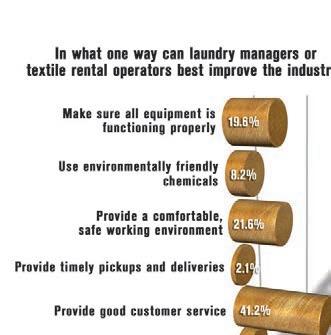
Roughly two out of five respondents (41.2%) see customer service as being key to industry improvement. Other respondents focused more on operational improvements, such as providing “a comfortable, safe working environment” (21.6%), ensuring that “all equipment is functioning properly” (19.6%), using “environmentally friendly chemicals” (8.2%) and providing “timely pickups and deliveries” (2.1%).
The remaining 7.2% of respondents believe that a combination of tactics can be used to best improve the industry.
The majority of managers and operators (30.1%) say that high service cost is the most common complaint they get from “average” customers. Other common gripes include not filling orders correctly, or running short on items (20.4%), losing too many items (15.1%), not cleaning goods well enough (10.8%), not delivering on time (7.5%) and not ironing/pressing goods well enough (6.5%).
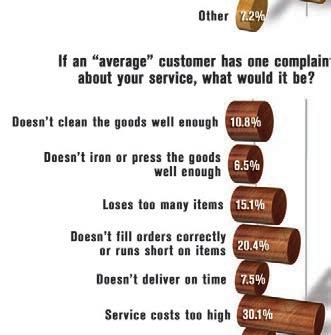
Among the remaining 10% of respondents, some say their customers have no complaints about their service, while others say that their customers “don’t like [their] invoicing method,” or that there are “too many choices in linen.”
In terms of ways distributors can best improve the industry, equal shares of 26.8% of respondents point to offering “more opportunities for service training” or visiting “my facility more often, and offer advice.”
Other respondents believe that distributors should “provide faster parts/supplies delivery” (19.6%), “alert [them] when new or improved technology is nearing release” (12.4%), “provide better equipment service” (11.3%), or other solutions (3.1%).
Many managers and operators value their distributor relationships, with equal shares of 46.9% saying their distributor(s) either plays a “major role” or a “minor role” in the operation’s success. The remaining 6.3% of respondents say that distributors play “no role” in their success. The survey also asked managers and operators about ways in which
manufacturers could best improve the industry.
Exactly half of respondents believe that manufacturers should focus more on equipment “energy efficiency and conservation,” while 21.9% would like them to “offer more comprehensive warranties.” Other choices were offering more financing assistance (9.4%), offering a larger variety of equipment (8.3%), or “other” solutions (10.4%).
While the Your Views survey presents a snapshot of readers’ viewpoints at a particular moment, it should not be considered scientific. ALN
various sections.
• How the information on the label is related to the SDS.
Continued from Page 1
exposure to a hazardous chemical, or improper storage or handling.
Name, Address and Phone Number of the Chemical Manufacturer, Distributor, or Importer

• How an employee might use the labels in the workplace.
• A general understanding of how the elements work together on a label.
Training on the format of the SDS must include information on:
• Standardized 16-section format, including the type of information found in the
OSHA requires employers to present information in a manner and language that their employees can understand. If employers customarily need to communicate work instructions or other workplace information to employees in a language other than English, they will also need to provide safety and health training to employees in the same manner.
OSHA’s Hazard Communication website—osha.gov/dsg/ hazcom/index.html—has resources available to assist employers with the required training.
To help companies comply with the revised standard, OSHA is phasing in the specific requirements from Dec. 1 through June 2016.
ALN
Charles Thompson
Phone: 312-361-1680
E-Mail: cthompson@ americantrademagazines.com

Bruce Beggs
Phone: 312-361-1683
E-Mail: bbeggs@ americantrademagazines.com
Nathan Frerichs
Phone: 312-361-1681
E-Mail: nfrerichs@ americantrademagazines.com
Editorial Assistant Carlo Calma
National Sales Director

Donald Feinstein
Phone: 312-361-1682
E-Mail: dfeinstein@ americantrademagazines.com

Office Information
Main Phone: 312-361-1700 Fax: 312-361-1685
Subscriptions
630-739-0600 www.americanlaundrynews.com
American Laundry News (ISSN 1091-9201) is published monthly. Subscription prices, payment in advance: U.S. & possessions, 1 year $39.00; 2 years $73.00. Foreign, 1 year $89.00; 2 years $166.00. Single copies: U.S. & possessions $7.00; Foreign $14.00. Published by American Trade Magazines LLC, 566 West Lake Street, Suite 420, Chicago, IL 60661. Periodicals postage paid at Chicago, IL, and at additional mailing offices.
POSTMASTER, Send changes of address and form 3579 to American Laundry News, Subscription Dept., 440 Quadrangle Drive, Suite E, Bolingbrook, IL 60440. Volume 39, number 10. Editorial, executive and advertising offices are at 566 West Lake Street, Suite 420, Chicago, IL 60661. Charles Thompson, President and Publisher. American Laundry News is distributed selectively to qualified laundry and linen management and distributors in the United States. No material appearing in American Laundry News may be reprinted without written permission. The publisher reserves the right to reject any advertising for any reason.
© Copyright AMERICAN TRADE MAGAZINES LLC, 2013. Printed in U.S.A. Association
MEMBERSHIPS
More than 100 PulseFlow® Batch Washers are operating around the world and the effects are staggering. Together, Milnor PBWTM tunnel customers are saving millions of gallons of fresh water... over 500 million gallons this year alone.

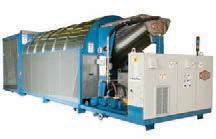
But that is just the tip of the iceberg-sized savings. Thanks to Milnor’s revolutionary PulseFlow® Technology, True Top transfer and RecircONE® pump arrangements, their laundry is getting cleaner than ever before.
Learn more about this radical approach to tunnel washing and how you can save. Contact an authorized Milnor distributor or call 504-712-7656.

s is our annual custom, we devote much of this month’s issue to hospitality laundry operations. And judging by survey data from the American Hotel & Lodging Association’s 2013 Lodging Profile, the guestrooms, swimming pools, restaurants and other amentities in our country’s hotels, motels and resorts are being put to steady use.
The lodging industry generated pre-tax income of $39 billion in 2012, up 13.4% from the prior year, and $155.5 billion in sales, an $8.1 billion increase over 2011.
Travel and tourism is among our nation’s largest services export
From The Director’s Chair BRUCE BEGGSindustries, and one of America’s largest employers.
It includes a number of interrelated businesses—lodging prop-

erties, airlines, restaurants, cruise lines, car rental companies, travel agents, tour operators, among others.
We must once again thank the record 67 million international travelers who came to our country in 2012. The United States receives a larger share of world international tourism receipts than any other country in the world.
So, if you work in the hospitality industry, or run a laundry business that serves hospitality clients, congratulations on doing your part to keep those front-desk bells ringing. ALN
ATLANTA –– The Clean Show will return to a four-day format for its 2015 show, scheduled now for Thursday through Sunday, April 16-19, 2015, at the Georgia World Congress Center in Atlanta, reports Riddle & Associates, the show’s longtime management firm.
“The positive feedback we’ve received on Clean 2013 has been overwhelming. In visiting with exhibitors, attendees and the show partners, it was clear that the best way to build upon that success was to add a day to the schedule,” says Clean Executive Committee Chairman Brian Wallace. “Clean
2015 will run four days, which will give all involved even more opportunity to gain the most value from our industry’s premier trade show event.”
“People are going to be pleasantly surprised at how much Atlanta has changed since the Clean Show was last held in the city in 1987,” says John Riddle, show manager. “It is a major destination with so much to see and do.”
This year’s show in New Orleans drew a total of 10,300 people from all 50 states, including 1,663 attendees from 83 other countries, according to show management.
•
RLLD•
•
•
•
•
Formally known as the World Educational Congress for Laundering and Drycleaning, the Clean Show covers every facet of the textile care industry, and is considered “the world’s largest exhibition of textile care products, featuring working equipment.”
Show sponsors are the Association for Linen Management (ALM), the Coin Laundry Association (CLA), the Drycleaning & Laundry Institute (DLI), the Textile Care Allied Trades Association (TCATA) and the Textile Rental Services Association of America (TRSA). ALN
What’s Hot in Uniforms We analyze this year’s garment styles and take a peek at what will be hot in 2014

Texcare Asia Preview The every-other-year exhibition returns to Shanghai to reach the world’s hottest markets
•
•
•
•
W
e all have had the sinking feeling that something is not going well in our laundry. Production just doesn’t seem to flow properly. We know we need to adjust or fix something, but we really are not sure what it is. Too often, we make changes and adjustments before we have taken the time to determine the problem and the steps needed to fix it.
My laundry has just come out of one of those situations, and can look back and recognize the value to taking the time to determine the causes of our various problems. Our latest predicament was caused by three unrelated problems, and each one required its own fix. The first problem was caused by frequent faults on our tunnel dryers. The flaw that had existed occasionally following installation gradually became more frequent and began to slow the wash and dry process. We researched the various faults we were getting on the equipment, and even changed out some related parts. The defect, however, seemed to bounce from one dryer to another—four dryers in all.
Finally, one of our mechanics noticed that the problem worsened shortly after the gas company changed out one of our gas meters. We determined that the meter was a little undersized for our operation, and it was chattering excessively when the dryers were modulating their burners. The gas company made several corrective attempts over a three-week period before eventually figured out a solution to the problem. This part of our operation is once again moving at optimum speed.
Our second problem was in one of our two tunnels, where the water flow from the back to the front of the washer simply wasn’t working. We were starving pockets four and five for water, and were experiencing higher-than-normal rewash.
We checked our lint screens and made sure the pumps were running and in proper working order, and checked the tunnel for possible blockages. There were times I felt like a referee between my maintenance man (who said the equipment was running properly) and my chemical man (who said there wasn’t enough water in the pockets to properly wash the linen).
When we finally described the problem to the manufacturer’s service department, the representative recommended we adjust two valves manually from full open to partially open. Lo and behold, the pump came on and stayed on like it should, and the water levels in the tunnel returned to normal. Once this solution was put in place, the quality quickly corrected itself.
The third problem was caused by loads jamming up in the first pocket of the tunnel. Maintenance said it was caused by production putting too much linen in the bags, and production workers said they were doing what they had always done, and to look elsewhere for the problem. Employees get very unhappy when they have to climb into the tunnel and remove pounds of extra linen from the first pocket. The solution to this problem was easy to discover once we decided not to blame the soil-sort employees or the size of the loads.
Maintenance had recently replaced a pump that provides the water to flush the linen from the loading chute into the first pocket. The replacement pump was not from the manufacturer, but from a local company that claimed it was as good as the original part. It did not take a well-trained eye to see that the flow of water being provided by the new pump was substantially less than the factory pump. This lesser flow of water meant that all the linen did not make it into the first pocket on a consistent basis. The next load would drop into the chute on top of what was left from the last load, so an overfilling problem was created. By going back to the correct pump, the problem was solved.
In each of these cases, the proper solution required time and effort to find. By working together as a team and helping each other through our frustrations, we were able to find the solutions. Patience is often your most valuable troubleshooting tool.
Eric Frederick is director of laundry services for Carilion Laundry Service, Roanoke, Va., and a past president and manager of the year of the Association for Linen Management. You can reach him by e-mail at efrederick@carilion.com.

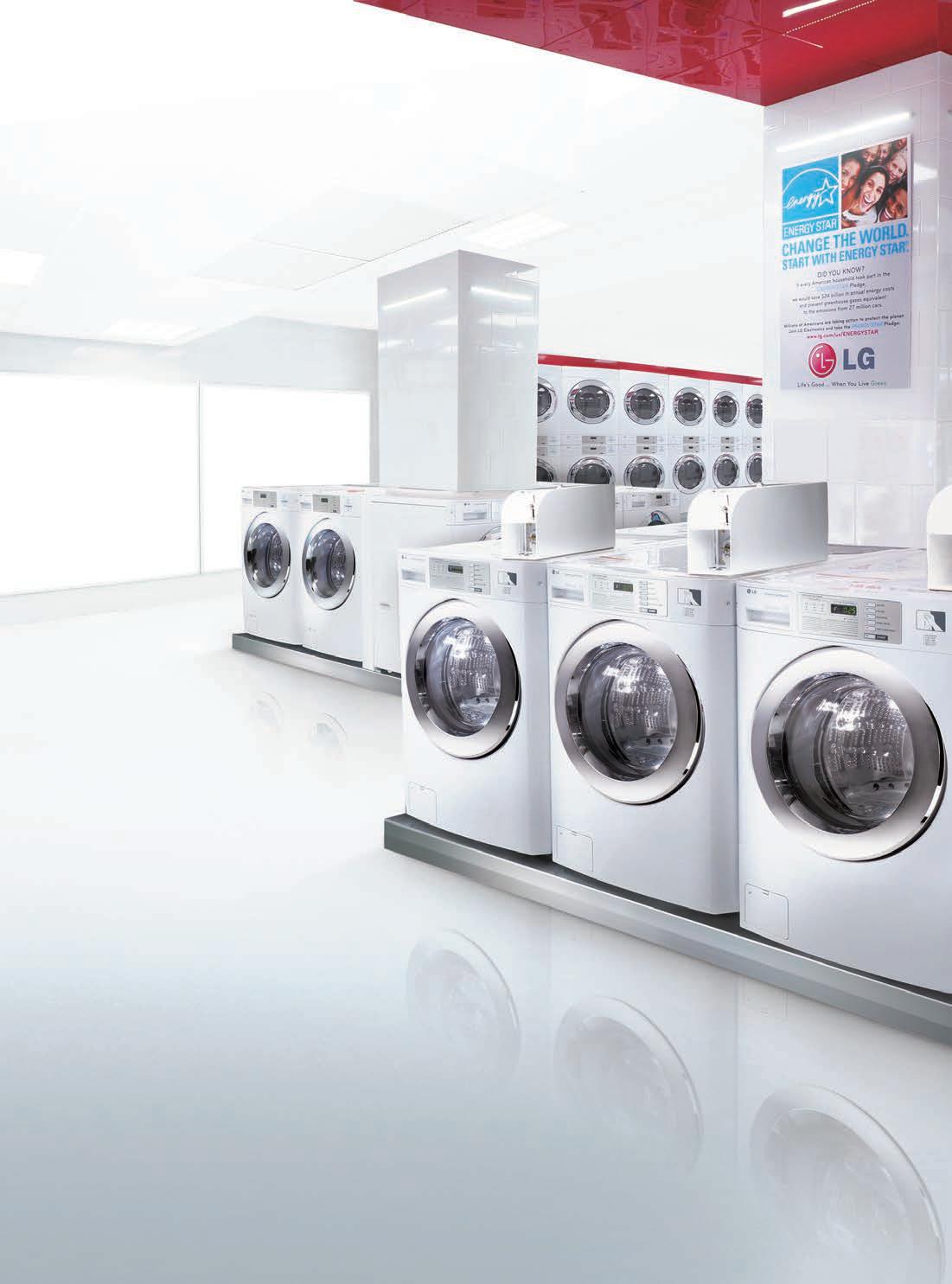

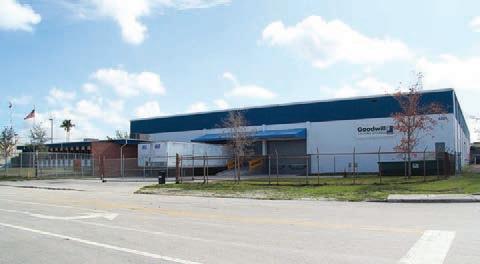
MIAMI — Goodwill Industries of South Florida recently opened one of the largest commercial laundries in the Southeast to serve the booming healthcare industry in the region and, in the process, create some 200 jobs for people with disabilities and special needs in the community.
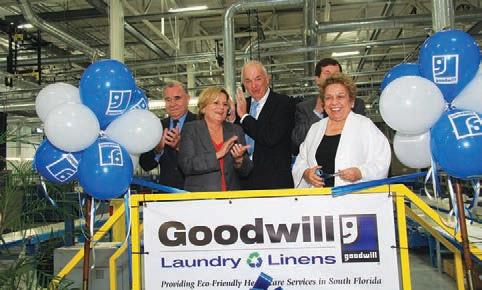
The $14 million, 50,000-square-foot plant at 6201 NW 36th Ave. will serve hospitals and other healthcare facilities, offering a processing capacity of up to 40 million pounds of laundry annually.
Dignitaries officially opened the plant during an Aug. 29 ribbon-cutting ceremony.
Goodwill President and CEO Dennis Pastrana called Goodwill’s entry into the healthcare laundry business “a bold decision” that took eight years to materialize, and is expected to reinforce the diversified entrepreneurial activities that generate the revenues that support the nonprofit’s mission.
The laundry was expected to process approximately 3.6 million pounds of linen in its first month, and production is expected to grow to 12 million pounds by early 2014 and, eventually, to 40 million pounds by working double shifts.
Besides servicing the larger hospitals, the facility will feature a parallel system of washing and drying equipment to process smaller contracts such as those from rehabilitation centers, neighborhood clinics, nursing homes, assisted living facilities, and hospitals with fewer beds.
The dual wash line will help maintain the same cost-effectiveness and efficient service enjoyed by high-volume customers, Goodwill says.
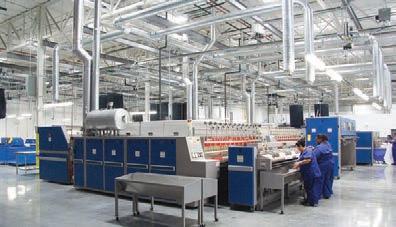
The Laundry Division of ARCO/Murray retrofitted the existing warehouse building to accommodate new Milnor washroom equipment, Chicago Dryer Co. finishing equipment, and E-Tech soil and clean rail systems, all provided and installed by Miami-based distributor Steiner-Atlantic, ARCO/Murray says.
Two 240-pound barrier washer-extractors—teamed with four 120-pound gas dryers, all from Milnor—enable the operation to run express loads, rewash, stain and other specialty formulas as required.
But the workhorses of the operation are the two 8-module, 150-pound Milnor PulseFlow Tunnels (PBW™). They’re each capable of processing up to 4,700 pounds an hour, and are expected to save Goodwill 15 million gallons of fresh water.
The tunnels are loaded with an E-Tech overhead rail system automatically calling for paired slings (like goods); this sequencing ensures the proper mix of goods is processed to maximize flow to downstream finishing areas.
Two 56-bar extraction presses and 10 pass-through dryers with 200-320 pounds of capacity, also from Milnor, round out this part of the system.
Adequate rail space is provided to accommodate 21,000 pounds of clean linen storage, in front of each ironer, folder, and hand-folding station. The clean-side storage system includes 70 slings and trolleys at 300 pounds capacity each.
Large-piece iron-dry slings are staged directly to two Chicago® Cascade linen
separators. Small-piece iron-dry slings are directed to the dedicated small-piece ironer.
Three Chicago® flatwork ironing lines each include an Edge Maxx cornerless spreader-feeder, FasTrack spreader-feeder and a Rapid Feed with vacuum for smallpiece feeding. Sheets and small-piece goods are automatically processed through three 2-roll, 52-inch Powerhouse self-contained gas-heated ironers. Sheets are folded, stacked and delivered to a main conveyor through two Skyline automatic folders, and small pieces are folded and automatically stacked on a Skyline SP-4 ready for delivery onto a main conveyor.
Equipment to process fully dried goods includes two Blanket Blaster folders, three Skyline Mini folders for knitted fitted sheets, six Air Chicago Express high-speed folders, and an Air Chicago XL for large items.
An additional ironer line is planned for future expansion.
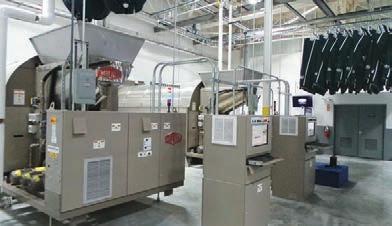
Kemco water systems, Cleaver-Brooks boilers, and Ingersoll Rand air compressors were installed in the new mechanical room.
ARCO/Murray described the project as a “complete turnkey design/build solution, including architectural and engineering design; permitting; upgrading the main utilities; expanding the existing parking lot; renovation of the existing office and production space; installation of all process piping, ducting and electrical systems; and final equipment connections.”
Backup generators will ensure a smooth
operation under adverse conditions, even during and after hurricanes, according to Pastrana.
“The Goodwill laundry will be the most modern plant of its type in the nation,” he says. “It has been built following a blueprint with the latest technologies and innovations, and its advanced automation will help streamline production and provide a major competitive advantage in quality, efficiency and price.”
This advantage, he says, will allow Goodwill to “leverage” additional business from laundry customers in areas such as hospital laundry distribution; janitorial and custodial work; landscaping; document shredding; facilities cleaning; and other services already provided by Goodwill that will help create additional jobs for poor and unemployed workers with disabilities and special needs.
“The laundry project will definitely establish us as a leading force in the implementation of environmentally friendly solutions,” Pastrana says. “It will make us doubly proud of our unique management systems that deliver consistent quality, reliability and service at fair market prices.”
He’s especially proud of the laundry’s proximity to Liberty City, a job-hungry community with an unemployment rate triple that of Miami-Dade County.
Goodwill Industries of South Florida purchased the industrial building from Ryerson, a distributor and processor of metals, in 2012 at a cost of $2.5 million.
As a business enterprise with a social mission, Goodwill uses the revenues generated by its four entrepreneurial divisions—donated goods, apparel/flag manufacturing, commercial services, and service contracts—to significantly support its combination of rehabilitationdriven work programs and creation of employment opportunities.
The new industrial laundry is part of the service contracts division.
With over $60 million dollars of finished goods on hand, ADI delivers.


the right product. the right value. the right place. on time, every time.




















10 Distribution centers across north america healthcare@americandawn.com 800 821 2221 americandawn.com


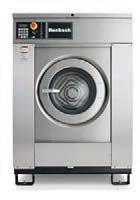
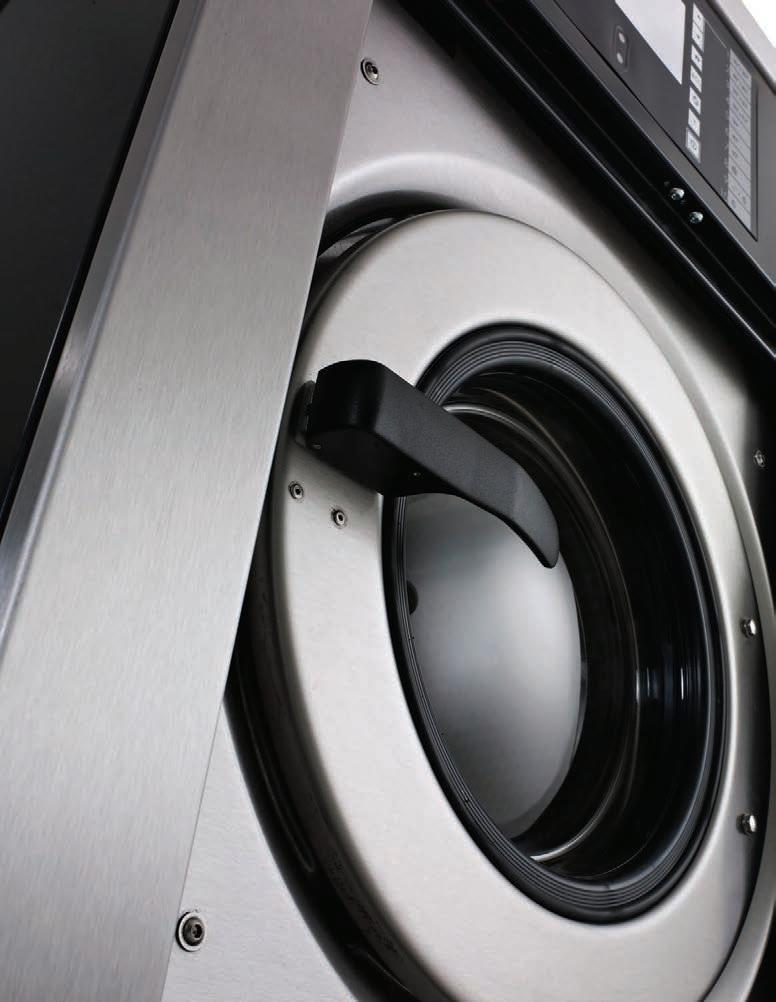
Huebsch now offers on-premise laundries the HX75, a 75-pound softmount washer-extractor. The machine provides efficient performance that helps reduce utility expenses to improve the bottom line, according to the company.
Installation costs are kept low because the washer-extractor has a heavy-duty suspension system and does not require special foundations. This feature also offers flexibility in where the machines can be placed.
Programmable wash speeds also ensure superior linen care, while highspeed extracts of 475 G-force maximize water extraction. Higher extraction speeds remove more water in the wash cycle, leading to shorter dry times and lower dryer energy costs.
The machine is equipped with a four-compartment soap dispenser positioned in front for easy access. The compartment permits the use of both
powder and liquid detergents. The inlet valves also fill the soap compartments for complete flushing of the compartment.
An additional water valve ensures faster filling time, while the 3-inch drain provides fast draining to improve cycle times. The direct mount of the drain under the tub reduces water consumption and lowers operating costs. A large stainless steel door makes loading and unloading the washer-extractor easier for employees. Each door has an improved door lock and ergonomic door handle for increased safety and smooth opening and closing.
“Manufactured with premium materials, this softmount washer-extractor is designed to reduce utility costs and increase productivity,” says Gary Dixon, North American sales manager.
huebsch.com 800-553-5120
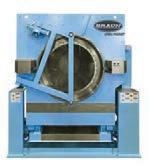
The new Braun 250 N2 openpocket washer-extractor is designed to smoothly integrate into various plant layouts. The machine’s open pocket features a narrow width of just 82 inches. The tilting washer’s 35-inch load and 30-inch unload height is comfortable for operators using chutes, slings and automated systems in loading, and carts or conveyors in unloading. The nontilt machine has a load/ unload height of 34 inches.
The machine evenly distributes
the wet goods against the cylinder, eliminating the need for artificial counterbalances. This balancing method results in consistent thickness of goods throughout the cylinder, the company says.
Using fewer and less complicated parts, the machine’s single motor drive and userfriendly touch-screen controls offer superior reliability and performance, according to Braun. gabraun.com 800-432-7286, ext. 217



DECC has entered the commercial laundry market with an abrasion-resistant release coating applied to dryer panels, the company reports.

Primarily useful to facilities that focus on healthcare laundry, the coating DECC applies drastically reduces the amount of plastic and debris that adheres to the inside of a dryer, according to the company. Its abrasion-resistant qualities greatly increase its durability as well, ensuring extended performance as compared to some other panel treatments that must be redone every seven to eight months, DECC adds.
With dryer panels coated, the need for ice blasting and drilling holes is eliminated. Although routine cleaning of the panels is still required, the time it takes is drastically diminished. “It takes almost 10 hours for one of our maintenance guys to clean one dryer panel that has been in service for seven to 10 months,” says Lenny
Crosby, director of facilities with West Michigan Shared Hospital Laundry. “With DECC’s coating, we were able to clean three dryer panels in a little over an hour, and they had been in service three or four months longer than the uncoated panels.”
A dryer with clogged panels can experience a 30-35% increase in drying times. Coated panels are said to allow for greater efficiency and air flow, because it takes far longer for plastic and debris to build inside the dryer. As a result, production capacity is maintained and energy costs are reduced.
Through reduced downtime and labor, combined with increased production capacity and lowered energy costs, the investment of having dryer panels coated by DECC could be recouped within months, the company claims.
decc.com 616-588-2850



IPSO provides on-premise laundries the opportunity to choose from two different versions of Cygnus, its North American advanced control system. According to the company, each system boasts key traits, including ease of use, flexibility, efficiency, serviceability and the ability to analyze wash data for increased productivity.
“The Cygnus control system offers our on-premise laundry customers the ultimate user experience by providing them with complete control of their equipment,” says Gary Dixon, North American sales manager.
“We strive to constantly innovate and update our control systems so that our OPL managers have the tools needed to achieve peak efficiency and optimize expenses.”
The system is available here in two versions: Select and Ultra. Each model is said to drive down energy
expenses and maximize productivity through new levels of efficiency and wash results. Both Cygnus control platforms include SmartWAVe, a new, patented water absorption verification technology. Not previously available in North America, this program automatically senses the load’s water absorption level and adjusts water and detergent use accordingly, the company says.
The Cygnus Select system offers infrared connectivity, which allows operators to easily program cycles with a laptop, giving them increased flexibility when managing operations. Customers can see a decrease in downtime due to the history logs that let technicians better diagnose issues and provide service reminders, which prevent issues from developing through preventive maintenance. ipso.com 800-USA-IPSO
Superior Uniform Group has released its new FashionPoly™ line from its signature Fashion Seal Healthcare® brand. The new products include scrub shirts, pants and warm-up, all manufactured in a new proprietary 100% polyester fabric.
The line is available in four colors: ciel, jade, misty and navy.
Paired with classic style, the garments offer enhanced comfort and product longevity, according to the manufacturer.
Key benefits include comfort, with moisture wicking; enhanced garment appearance, due to bet-
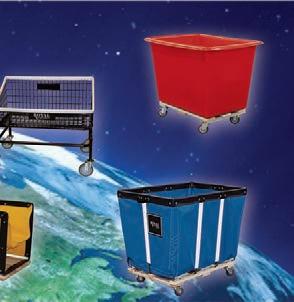
Meese Orbitron Dunne has introduced an extra-heavy-duty model of its spring-loaded PolyTrux® 28P-16 laundry feeder truck.
Developed to help laundry managers specify the ideal feeder truck based on the type and weight of their linens upon reaching the finishing area, this new product features a one-piece, rotationally molded cart bolstered with a rustresistant steel support to accommodate large loads of partially wet sheets, towels, napery and other flatwork in the cart’s original, slim profile design.
The cart includes the same
ter color retention, fewer wrinkles and no fabric shrinkage; and an antimicrobial finish to help control odor.
“We designed our Fashion Poly line to satisfy the needs of both our healthcare laundry and end-user customers,” says Alan Schwartz, president of Superior Uniform Group. “End-users will appreciate this line’s enhanced comfort and image while laundries get a valueadded product that will help grow their business.”
superioruniformgroup.com 800-727-8643
rotomolded, spring-loaded, rising platform as its predecessor to promote ergonomic work positioning by reducing bending and reaching, therefore minimizing worker fatigue.
The flatwork ironer cart is set atop a powder-coated, steel base and includes four premium, 5-inch, nonmarking, rubber Colson casters.
A choice of colors is offered. Custom colors and permanent, molded-in tracking numbers, logos and graphics are among available options.
modlaundry.com 800-829-4535
Large softmount washer-extractor designed to boost productivity on many levels
Special coating helps minimize maintenance hassles from plastic buildup within dryers
Heavy-duty laundry truck made to handle wide range of linens
Imagine a washer smart enough to weigh the load size and add precisely the correct amount of water. Imagine a laundry chemical controller smart enough to adjust dosing for accurate water ratio each time.



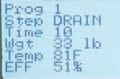



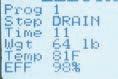
Electrolux Professional washers do all that and more! Introducing AWS & SmartDosing.

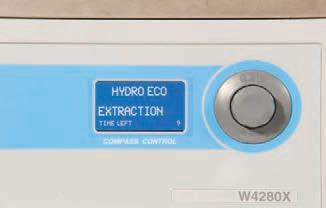

Underloading washers is a common problem in many laundries, wasting water, chemicals, and energy. That’s why Electrolux developed AWSTM, a UNIQUE feature that automatically matches water consumption to load size. Combine that with SmartDosingTM which adjusts laundry chemicals to water ratio, and you will see immediate savings and superior wash results – every time, automatically.
Electrolux’s SmartDosingTM controller automatically dispenses the correct amount of chemicals for the weight load.



ST. PETERSBURG, Fla. —
Though nearly a century old, the Vinoy Renaissance St. Petersburg Resort & Golf Club continues to impress guests with its ornate lobby, soaring ballroom, five classic restaurants and spacious, well-appointed guestrooms, all enhanced by attentive service. Yet, much of what makes the hotel grand happens out of a guest’s sight.
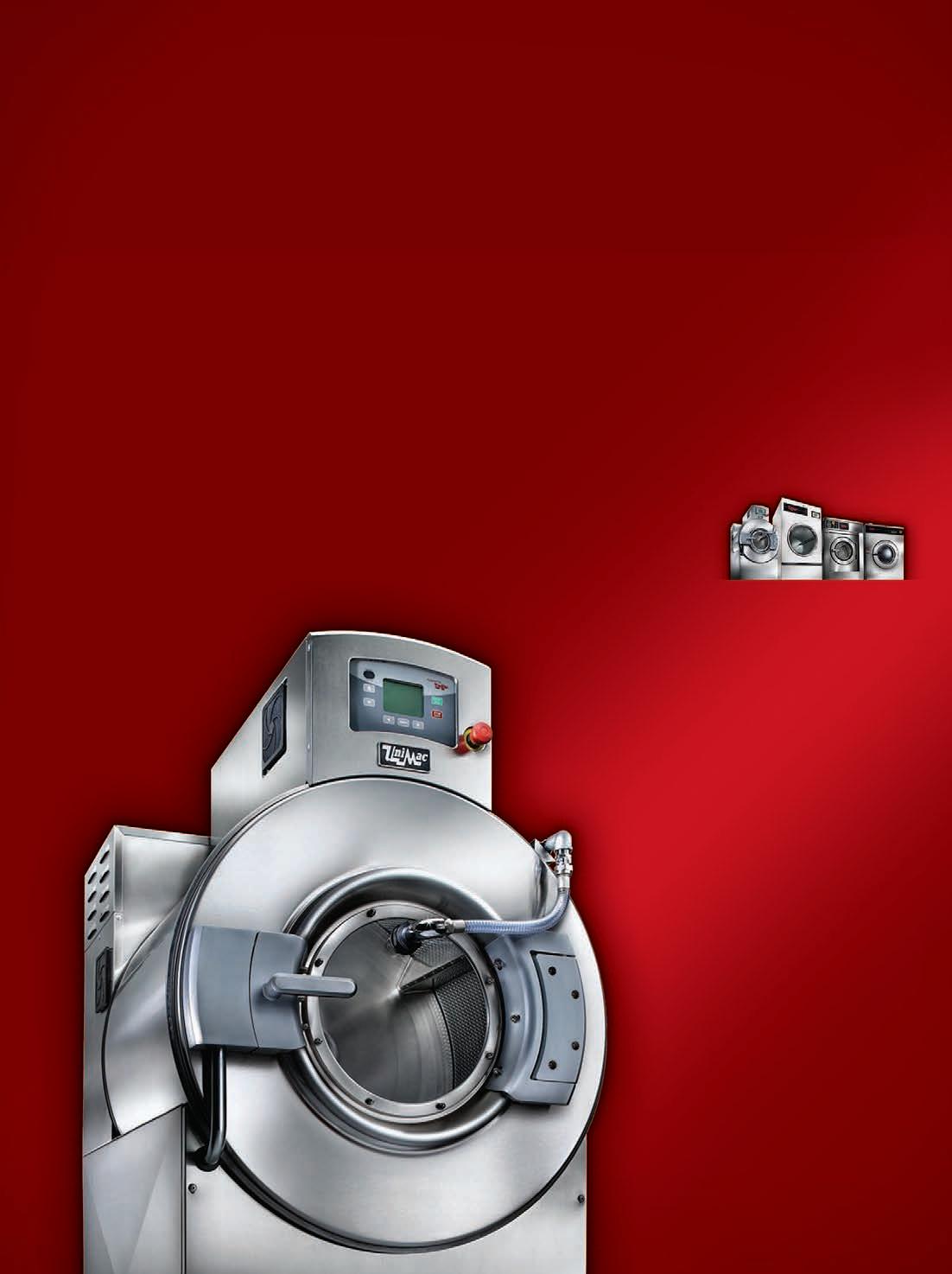
One of the amenities that contribute to the hospitality and reputation of the property is the quality of its linens. Tablecloths and napkins must be spotless, the towels fluffy. The ultimate reason for the stay—a good night’s sleep—should be enhanced by bedding that is soft, comfortable, and appealing. The Vinoy employs UniMac on-premise washerextractors and tumble dryers to efficiently and cost-effectively ensure all hotel linens exceed guest expectations.
Positioned on the St. Petersburg waterfront, the Vinoy Renaissance has a storied past, having gone through more than one renaissance of its own. Opening at the peak of the Florida boom in the Roaring ’20s, the Vinoy is an intricately decorated 375-room hotel.
During its early years, the Vinoy was a stopover for celebrities, the wealthy and U.S. presidents, but its popularity began to stagger following World War II. Leading into the 1960s, changing tastes and a lack of maintenance continued the Vinoy’s steady decline; however, the residents of St. Petersburg did not give up on the hotel, and a 1984 referendum saved it from demolition.
A $93 million renovation project restored the Vinoy to its former glory, and by 1992 it once again was welcoming guests and taking its place as the epicenter
of St. Petersburg’s downtown waterfront. Its current owner, the Renaissance Hotels and Resorts by Marriott, is committed to ensuring the Vinoy is one of its premier properties by offering top-notch amenities and hospitality.
Since the Vinoy’s renovation, the hotel industry has focused on making sleep the most memorable part of a guest’s stay. The purchases of high-end mattresses and pillows have put an increased importance on the quality of linens provided to guests and the upkeep that’s associated.
Throughout two shifts, the Vinoy laundry room staff ensures that linens maintain quality standards. On the first shift, three team members load the washer-extractors and tumble dryers, while two or more iron and fold the linens. A three-person team then feeds the units during the night shift.
But a diligent staff is only part of a laundry operation’s success. Updated equipment is also a key factor.
In 2011, management became aware that the equipment, which dated back to the 1990s, could not keep up with processing demand, according to Joe Lopresti, the Vinoy’s director of engineering.
“Our two 750-pound and one 300-pound capacity washerextractors reached the end of their useful life,” Lopresti says. “The machines had become expensive to run and maintain, and were excessively increasing our utility costs.”
The old equipment also impacted the laundry staff’s efficiency, Lopresti said. The crew had to wait for the washers to finish a cycle and then had to distribute those loads into their four 150pound tumble dryers. The limited
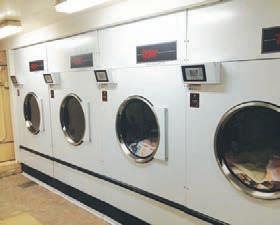
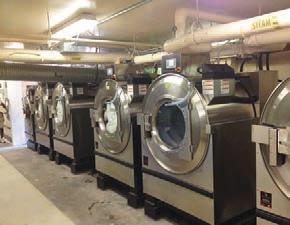
dryer capacity made it necessary for the large washers to be run under capacity.

When the Vinoy staff began to think about upgrading their laundry’s capabilities, they turned to equipment consultant Jason Downey of Southeastern Laundry Equipment to help identify the best
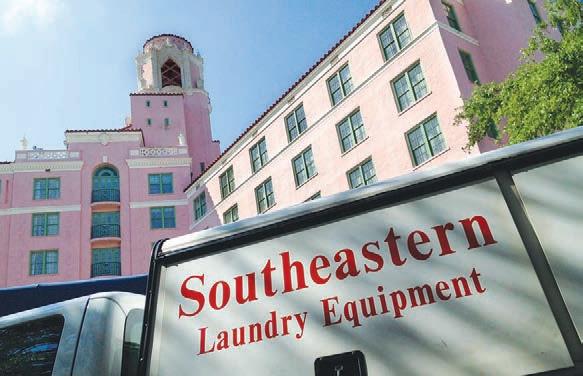
approach. Following an extensive evaluation of the Vinoy laundry facility, Downey and Southeastern developed a plan recommending the right-size, low-maintenance equipment to best fit the department’s needs.
“Every laundry is different; in Vinoy’s case, the staff does more
pounds of laundry than most hotels their size, and handle many high-end types of linen,” Downey notes.
To reliably serve the Vinoy’s needs, he recommended installing washer-extractors with a smaller

With over 50 years strong on the job, we know there are no small parts when it comes to delivering big dependability. In fact, we use all we’ve learned to build durable, longerlasting machines. Machines you can trust with the tough chore of keeping your operation up and running even as they handle the largest of loads. And no matter who’s operating the equipment, our user-friendly controls always keep it easy, shift after shift. Visit mclaundry.com for digital brochures, or for more information, visit our website at maytagcommerciallaundry.com or call 800-662-3587.


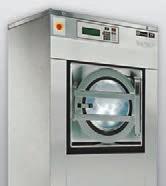

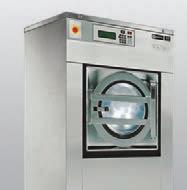




capacity than the old machines while improving throughput by increasing the overall number of washers to six. The resort accepted the recommendation and Southeastern installed five 150pound high-capacity UW washerextractors and one 60-pound midperformance UW washer-extractor, as well as four 170-pound ultrafast UT tumble dryers. With this equipment mix, staff
no longer had to worry about a single machine breaking down and impacting the laundry room productivity for the entire day.
“If service is needed on our laundry units, they are easier to repair due to the way UniMac equipment is packaged,” Lopresti adds. “Plus, quality replacement parts are readily available for order.”
Vinoy operators have been able to take total control of the laundry facility with the UniLinc™ control system. The system, which monitors and manages machine performance and maintenance data,

enables staff to select advanced programming of the wash cycles for fabric type and soil level, plus pinpoint drying times for the tumble dryers.
“These advanced features enable the laundry manager to focus on the very busy workflow instead of worrying about equipment performance and maintenance,” Lopresti says.
In addition, while the crew is washing and drying the Vinoy’s considerable stream of laundry, Lopresti can monitor the operation’s performance from his office or anywhere he has Wi-Fi access, thanks to the system’s wireless
networking capabilities.
Should a problem develop, he can determine when and where it started and look for performance trends. The control system also tells him whether the problem is with the equipment, or if it is due to how it is being operated. In both instances, data provided by the UniLinc system enables Lopresti to develop maintenance programs geared toward laundry room operations.
“The fact that I can dial into the router wherever I want and see how the laundry units are performing has been a huge benefit to our operation,” he adds.
The engineers can also receive error reports and other performance information. As valuable as this data is, its usefulness goes beyond equipment maintenance. If quality issues arise, maintenance can pull reports for analysis by their chemical representatives. Meanwhile, the executive housekeeper can obtain production reports that enable management to gear throughput based on anticipated events such as conferences or holidays.
“For my department, this arrangement means my engineers don’t need to spend a lot of time in the laundry, but can still monitor the equipment,” Lopresti says. “The laundry room is a crucial part of the Vinoy image. We can keep it running and free up our people for other maintenance rather than spending time putting out fires.”
The ability to network the control system wirelessly also proved to be valuable when it came to the installation process.
In a historic building such as the Vinoy, tearing up walls to install wiring could greatly compromise the architecture and cause structural damage in the process. Without having to hard-wire behind the machines, installers did not have to deal with an elaborate system setup. It took just a few hours to seamlessly install the wireless adaptors to the machines.
Tumble dryers require large amounts of energy and can represent 70% of utility consumption in the laundry room. The OPTidryTM Over-dry Prevention Technology offered with UniMac tumble dryers automatically stops machines once the load reaches the ideal level of dryness. Lopresti estimates it has saved the operation $30,000 in gas costs alone since installation.
In addition to conserving energy on drying times, overdry prevention preserves both the softness and life of linens; goods processed in dryers featuring the technology can experience 31% less fiber loss, studies have shown.
The washer-extractors also help improve the Vinoy laundry facility’s bottom line. The highperformance machines provide an advanced water management system that includes 30 programmable water levels that allow laundry staff to precisely match wash cycle to linen type, which can help save thousands of gallons of water each year.
In addition, the 150-pound washer-extractor’s 300 G-force extraction speed results in shorter drying times, further increasing throughput.
Though hotels such as the Vinoy may be best known for their classic design, changing times require these properties to exceed guests’ expectations in all facets of their operation. Vinoy’s choice of laundry equipment makes it possible to exceed those expectations while keeping costs as low as possible.
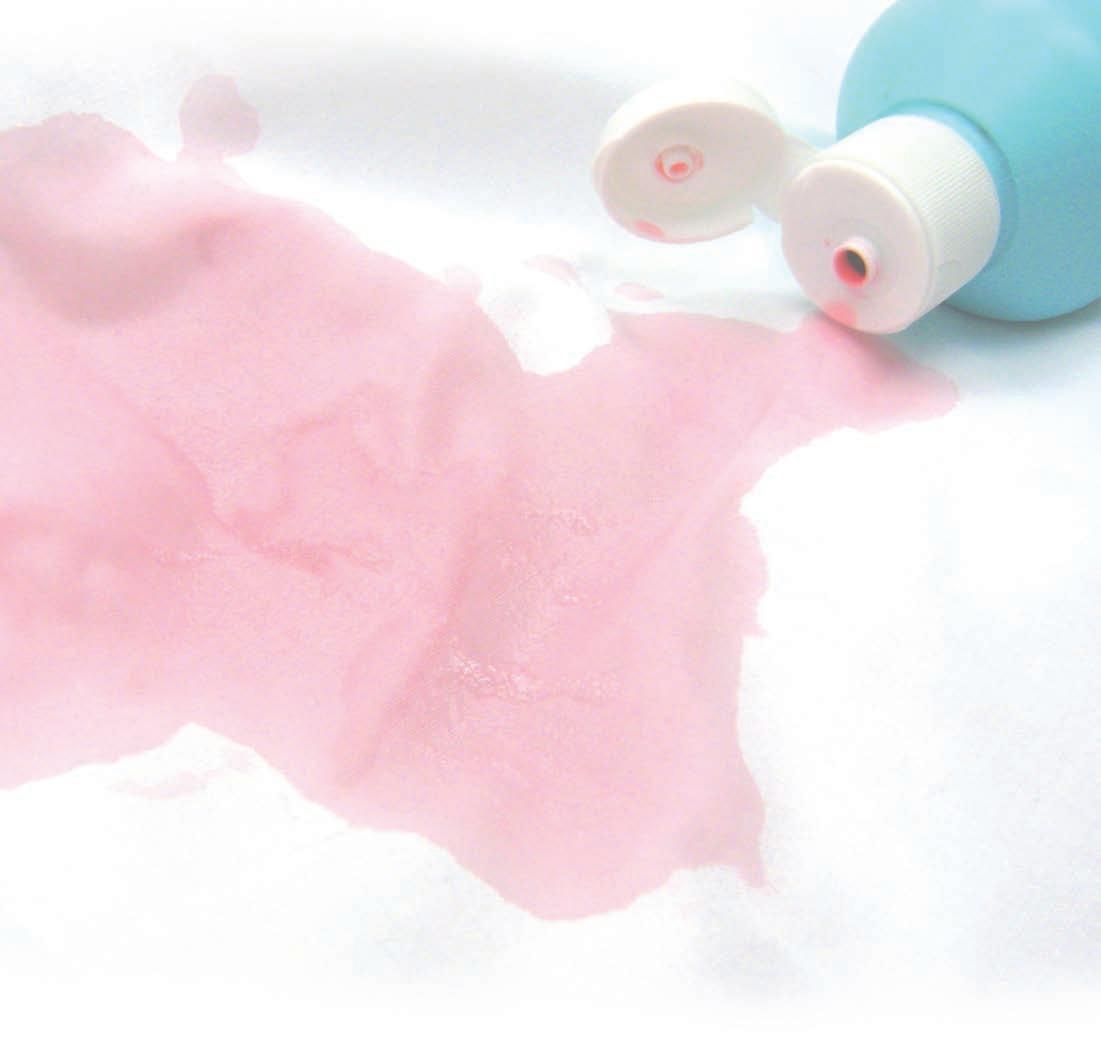
Everyone in the Healthcare Laundry field has experienced the skin sanitizer stain that won’t go away. Now you can prevent those stains in one washing cycle with the new patent pending Magi-ClensTM chemical laundry product from Gurtler Industries. Plus you can eliminate the costly changes you made to avoid the dreaded permanent stains from Hibiclens® or similar Chlorhexidene Gluconate (CHG) products that your healthcare partners use.
And you will be able to address those infection control issues you have faced. We specialize in laundry chemical product technology...it’s our main focus. That’s why we have developed some of the most advanced and trusted laundry chemical products in use today. New Magi-Clens is only available from Gurtler Industries.



Contact your local Gurtler sales consultant today for a free magical demonstration!



Magi-Clens™...eliminates skin sanitizer stains like magic!



 by JeAn teLLer, contributing editor



NEW ORLEANS — Have you ever wondered about the efficacy of ozone laundering? A new study from ClearWater Tech, citing research conducted by North Carolina State University’s

Physical Testing Laboratory in the College of Textiles, may answer some questions.



Cameron Tapp, founder and president of ClearWater Tech, along with Dr. Jan Ballard, supervi-










sor of the NCSU’s Physical Testing Laboratory, and Marc DeBrum, assistant sales manager/applications engineer for ClearWater, provided the results of what is described as “the industry’s first extensive, independently conducted study” to determine the ability of cold-water ozone laundering to extend the useful life of linens vs. traditional hot-water methods. Speaking during a Clean Show press conference, Tapp said the
study came about after a conversation he had with a hotel chain’s sustainability manager, who complained of yellowing and graying fabrics and increased fabric wear when using an ozone method of cleaning. Tapp commissioned an independent study to be conducted at NCSU.
The study compared laundry whiteness, pill resistance and tear strength using both the EcoTex™ ozone cold-water technology from
























ClearWater and traditional hotwater methods of laundering linens and garments. A number of studies already exist that confirm ozone’s efficiency in killing bacteria, particularly in healthcare fabrics, Tapp says.

ClearWater supplied white 60% polyester/40% cotton pillowcases and 100% cotton terry bath towels to be used as samples (all test and control samples were given an initial rinse/dry cycle to remove factory residue). Ecolab supplied chemicals and collaborated on the formulas for wash programs used, and all textiles were washed in the same IPSO washer-extractor.
The study was conducted on 50 cycles of washing using both methods. “We generated a lot of numbers,” Ballard says.
The data analysis conducted showed that fabric whiteness was improved by 9.7% using the ozone method, pilling was improved by 16.77%, and tear strength of the fabric was 6.26% better over fabric laundered using traditional, hotwater methods.












DeBrum offered results showing that the ozone method was at least 11% more efficient than traditional methods. The study showed a projected 40% overall savings using the EcoTex ozone method: about 5% savings in electricity, 19% for energy, almost 20% in water and sewer savings, and an almost 40% improvement in savings for facility and labor efforts. The latter number included time saved on rinses, on overall wash steps and reduced labor time, he says.

The linen life study results come as no surprise to veterans such as Juan Marcano, president and CEO of Riteway Linen Services in Port St. Lucie, Fla. Riteway serves a variety of customers, including high-end hotels and resorts. Acknowledging that many factors contribute to linen life, Marcado’s experience points to linen replacement at an annual rate of 20-30% in traditional on-premise laundry operations.
“That’s a lot of money for a 100room hotel working with three pars (sets of linen),” Marcado says in a ClearWater Tech press release. “Our EcoTex ozone process can reduce that replacement by about half, to 12-15% a year, which is a huge difference. It’s an even bigger savings for a 300-room resort that will purchase $8,000 to $10,000 in terry cloth linens per month.”
Tapp indicated that a longer and more scientific version of the report would be published and peer-reviewed in a scientific journal in the near future.
The comparative scores and study details are spelled out in Cold Facts, a summary report that can be obtained by contacting ClearWater Tech via its website, ecotexlaundry.com, or calling 805549-9724.




California Textiles offers a new Shutterless line of towels that is 86% combed cotton and 14% polyester blend, and made on








European looms. The towels are 25 by 52 inches, and 14- or 17-pound 86/14 blend ring spun cotton.
The line comes in white full terry 16-ring spun yarn in both the weft and the warp. The pile has a soft feel, and it is extremely absorbent, the company says. The line comes in six different colors.







catextiles.com 951-272-1200
American Dawn is the licensee
of the Villa Di Borghese™ linen collection, a line that includes bedding to bath products, robes
to slippers, along with a full line of amenities.
Newly focused on the hospitality sector, American Dawn recently unveiled its new American Dawn Collection™ of core products –for the hospitality, food and beverage, healthcare, industrial and microfiber markets.
americandawn.com 800-821-2221

Marina Textiles offers products for the hospitality and healthcare industries, as well as for linen rental, spas and clubs.

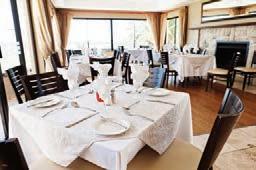
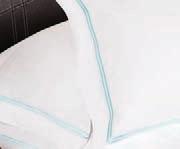
The company’s line of linens is offered in T-180, T-200 and T-250 counts, in a plain bleached white weave for flat and fitted sheets, pillowcases and pillow protectors. The line will soon include T250 and T-310 striped sheets, the company says.
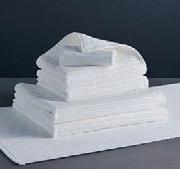
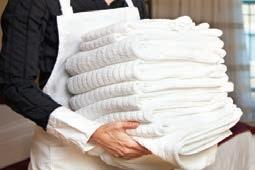
Among Marina Textiles’ other products are pool towels, bathrobes, and a wide range of terry towels made of 100% cotton and

blended cotton/polyester in all sizes and weights.
The company also offers quilted mattress and pillow protectors, blankets and pillows.
marinatextiles.com 888-627-4621
The new Endurance bed linen sheets from Garnier-Thiebaut offer the feel of a higher-count fabric at the cost of lower-threadcount linens, according to the company. The line’s fiber blend requires less water and energy for washing and drying, GarnierThiebaut adds.
To complement the sheets’ striped twill design, Vento twofaced towels come in vertical velour stripes on one side and terry loops on the other side. These 100% carded cotton towels

featuring lockstitch hems measure 28 by 55 inches.
gtlinens.com 888-812-6670


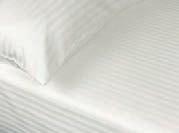
The Venus Group’s Linea Roma™ collection includes cotton-rich, 60/40 blended sheets in thread counts of 200, 250 or 316, the company says.
The sheets are available in a plain percale T200 and T250, or with a tone-on-tone satin stripe in T250 and T316 thread counts.
The T250 has a 10-millimeter satin stripe, and the T316 has a 5-millimeter stripe.
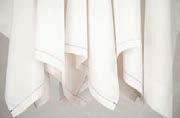
The sheets are engineered to endure industrial washings, Venus
cotton with a cam border and fast selvage. The cloth is made from ring spun cotton, which offers high absorbency and durability, the company says.
riegellinen.com 800-845-2232





Thomaston Mills offers a wide array of bed and bath linens for the hospitality and healthcare industries, and the company recently introduced a line of bath linens.
The line of towels includes bath and hand towels, washcloths
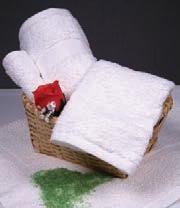
and bath mats.
Offered in white and beige with a cam border, the towels feature a 86% cotton/14% polyester blend and are made in the United States.
An additional line, Royal Suite Luxury Towels, includes towels, washcloths and mats with classic dobby borders with 100% cot-
ton loops for durability and easy laundering.
thomastonmills.com 877-474-3300
Baltic linen co.
Baltic Linen Co. recently introduced the Charisma hotel collection of linens.
The line includes T300-threadcount sateen sheeting, shams and duvet covers, all in a jacquard basket-weave pattern.
The line’s terry products are made in Turkey of Egyptian cotton, and Italian fabrics are converted into decorative scarfs,


[Baltic Linen Co.]




shams and bedskirts, all made in the United States.
balticlinen.com 800-422-5842 ALN



Group says, and are available in flat and fitted sizes, with pillowcases, matching duvet covers and pillow shams also available.
The collection also offers 100% cotton sheets in T250 and T316 in plain percale or satin stripes, and the company recently added a T300 sateen.
venusgroup.com 800-421-6599
Among the textiles offered by Riegel, a division of Mount Vernon Mills, are sheets and towels for the hospitality industry.
The new line of IronLux sheets contains fabric made from a 55/45 cotton-polyester blend. The optically brightened sheets and pillowcases provide a whiter white with colored hem threads for easy size identification, Riegel says.
The company’s Value Plus and Value Terry Towel collections offer towels made from 100%
CHI * Trac–the only built-in data accumulation and reporting system that seamlessly distributes vital production data to a laundry’s management center to ensure that the entire finishing area is operating at peak efficiency. Working in conjunction with CHI•Touch PC machine control, CHI*Trac adds built-in modules, USB ports, and an easy-to-
www.chidry.com




use reporting system, with the ability to export data to tablets, other smart devices, or laundry modules. All from the U.S. manufacturer that has been around the longest and continues to lead the industry in innovations backed by local and factory support. CHI*Trac–the only information handling system that can keep up with CHICAGO equipment.











According to Robinson, business within the hospitality industry seems to be pretty good.
“At two key levels, occupancy and room rates, the numbers are very strong,” he says. “Rates are approximately what they were in 2007 and 2008, before the recession hit, and seem to be especially strong in the Northeast Corridor, from Boston to Philadelphia. So I think our attendees will be in a buying mood.”
This year, attendees walking the floor will find five separate pavilions, so people easily can find the products and services they need. The categories, each with their own easily identifiable logos, are Operations, Technology, Food & Beverage, Tabletop and Green. Here is a quick rundown of what each pavilion will encompass: Operations. A comprehensive collection of guest amenities and services, bedding, uniforms, laundry equipment, HVAC, signage, lighting, security and safety— everything one needs to effectively manage day-to-day operation; Technology. Developed in conjunction with Hospitality Upgrade magazine, this year’s expanded
section will feature the latest solutions in security, telecom, VOIP, point-of-sale software, in-room entertainment, CRM, energy management and more. The exclusive i.MENU EXPO will feature the latest table apps for front- and backof-the-house operations.
Food & Beverage. A broad range of F&B products, energy-saving equipment and supplies. New this year are six trend-focused areas featuring cooking demos, seminars and networking events for foodservice professionals.
Tabletop. Developed in conjunction with Tabletop Journal, the new Hospitality Tabletop division will shine a spotlight on creative, design-driven tabletop products, plus on-floor education in the Hospitality Tabletop Theater, the inaugural Tabletop Challenge, and the Concept Lobby Bar, a specially designed networking space.
Green. From amenities and foodservice equipment to HVAC, recycling and cleaning and maintenance, this new pavilion, in partnership with Green Lodging News, brings the latest energy-saving and footprint-reducing innovations together in one inspiring place.
“For readers of American Laundry News, I would think they would be particularly interested in the Operations Pavilion and the Green Pavilion, where several of the major vendors in your industry will have booths,” Robinson says.
The Exhibit Hall will be open from 10 a.m. to 5 p.m. Nov. 10-11 and from 10 a.m. to 4 p.m. Nov. 12.
Besides visiting the Exhibit Hall itself, attendees will have the opportunity to attend a plethora of educational seminars that will be offered throughout the duration of the convention.
The sessions will cover topics taken from the themes of all of the five pavilions offered at the show. “The seminars and keynote speeches will be representative of the five major pavilions,” Robinson says. “This way, every attendee should be able to find several sessions that are in his or her area of the industry.”
The seminars start on Nov. 9 with the Hospitality Leadership Forum, designed for high-level industry executives. (This all-day event has a separate fee of $159.) All of the other educational sessions are scheduled on Nov. 10, 11 and 12, and are free to all registered attendees.
Two big social events are also planned during the show. The Hotel Association of New York City (HANYC) will kick off the festivities with the 2013 HANYC Hospitality Ball at the Grand Hyatt New York, on 42nd Street next to Grand Central Station, on the night of Nov. 9. The formal event costs $425 a person.
The 33rd Annual Gold Key
Following is a partial list of IHMRS exhibitors with products or services related to laundry and linen operations or hospitality textiles and apparel. Check ihmrs.com for updates leading up the show.
• Amenity Services, booth 2907
• American Hotel Register Co., booth 2820
• Big Ass Fans, booth 2272
• Boca Terry, booth 2731
• G.A. Braun, booth 2754
• Chicago Dryer Co., booth 2750
• Cintas Corp., booth 2738
• Colson Caster Co., booth 1652
• Culligan International, booth 1548
• Dahlgren Duck / Rivolta, booth 2621
• Ecolab, booth 1738
• Elegant Linen Collection Corp., booth 2802
• Faribault Woolen Mill, booth 2747
• Frette, booth 2602
• GM Fleet and Commercial, booth 2162
• Gourmet Table Skirts, booth 1749
• Harbor Linen, booth 2920
• HD Supply, booth 2912
• Hollander Home Fashions, booth 2814
• Kartri Sales, booth TBA
Award for Excellence in Hospitality Design is slated for the evening of Nov. 10 at the New York Palace Hotel. During the ceremony, outstanding design worldwide will be recognized in 14 project categories. The newly renovated hotel is on Madison Avenue and 50th Street, one block from Rockefeller Center.
It goes without saying that visitors also have unlimited entertainment possibilities in New York City itself. To see what is happening that week, go the show’s main website—ihmrs.com—and click on the “Hotel and Travel Guide” tab. There is a separate link entitled “NYC Guide” in that section.
To book a hotel, go to the same “Hotel and Travel Guide,” and click on the “Book Hotel & Travel” link. More than 20 hotels are offering discounts to attendees of this show. Prices are clearly listed.
In addition, this same tab has a separate link with directions,
• Leggett And Platt, booth 2868
• Masa S.P.A. Industrie Tessili, booth 2544
• Maytag Commercial Laundry, booth 2668
• Millicare Textile And Carpet Care Booth: 1669
• Navien America, booth 2956
• Nile Textile Industries, booth 2957
• Pellerin Milnor Corp., booth 2851
• Phoenix Down, booth 2933
• Procter & Gamble Professional, booth 1420
• Protect-A-Bed, booth 2606
• Purecare By Fabrictech, booth 3318
• Reverie, booth 3310
• Rubbermaid Commercial Products, booth 3026
• Simmons Bedding Co., booth 3220
• Speed Queen, booth 2870
• Standard Textile Co., booth 3104
• Star Textile, booth 2730
• T-Y Group, booth 3120
• Tablecloth Co., booth 1304
• UniMac, booth 2966
• Urquid Linen, booth 2756
• Wehsco By Mantua Mfg., booth 3074
• Xeros Ltd., booth 2566
parking and public transportation information. Several bus and subway lines stop near the Javits Center, and there are many parking lots nearby. Taxis, of course, are plentiful at all of the hotels.
The registration fee for IHMRS 2013 after Oct. 4 is $50, and attendees are urged to register through the show website. Also, visit this site for updated information about seminars and exhibitors, which may change after press time.

IHMRS sponsors include the American Hotel & Lodging Association (AH&LA), the Hotel Association of New York City Inc. (HANYC), and the New York State Hospitality & Tourism Association (NYSH&TA). BDNY is a joint venture of the three associations and HMG, the management company. ALN
Schwanz is a freelance editor for American Laundry News
LOS ANGELES — As part of its new growth initiatives to expand market share in manufactured garments, napery and aprons, American Dawn (ADI) has named Jeff Landry its director of global solutions. Landry and his family of five reside in Cincinnati.
With 26 years of experience, Landry is the former chief operating officer of Regent Manufacturing, plus has served stints at Red Kap and Cintas.
“We intend to leverage Jeff’s formidable talents in global sourcing and manufacturing, as well as his knowledge of core apparel lines and private label programs, to support our major growth objectives,” says Vyto Tozer, ADI executive vice president.
To support its targeted growth initiative, ADI has also formed an Executive Supply Chain Committee.
has authored numerous articles published in industry trade magazines, and holds two patents.


Rick Delgado has joined Gurtler as its manager of market development in the U.S. Southwest.
Delgado brings with him 31 years of laundry industry experience.



Brian Heagen is the new manager of market development in the New Jersey and New York areas. Heagen has a marketing degree from William Paterson University.

FOOTHILL RANCH, Calif.
— Venus Group has promoted Chuck Loitz to senior vice president of its Institution Division.
Loitz has been with Venus for 16 years, with responsibilities for national accounts, advertising, and special projects, as well as managing a growing sales territory
in the Western United States. His résumé includes stops at Morgan Services, Mission Linen, National Linen and Penn State Textile before joining Venus Group as a territory sales manager in 1997. ALN
SOUTH HOLLAND, Ill. — Gurtler Industries has added three new employees to its workforce.
Kevin McLaren has joined the company as scientist in the research and development department, reporting to Steven Tinker, vice president of research & development and marketing. McLaren is responsible for new product development and testing.
McLaren has 25 years of product development and technical service experience in the textile and uniform rental, hospitality, food and beverage, specialty cleaners and detergents, and microbiology markets.
He previously was the director of laboratories for Dober Chemical’s Commercial Laundry Group, where he was responsible for its research and development programs, including product development, technical services, regulatory services and more.
Most recently, McLaren managed a commercial laundry chemical sales and service territory in the Chicago area.
McLaren, who has a bachelor of science degree in microbiology from Southern Illinois University,
Gurtler adds McLaren, Delgado, Heagen to staffLandry McLaren
the load. Unlike bath rinses alone, which only dilute wash chemistry, spray rinse technology pulls chemicals through the load and

 By BiLL BROOks
RIPON, Wis. — The hospitality industry continually strives to improve the customer’s sleep experience, because it directly impacts customer satisfaction.
Some hotels have chosen to upgrade to superior mattresses, while others have moved in the direction of expanding their luxury linen collection. Many do both.
In fact, the industry is trending toward using bedding packages that contain 30% more linens.
This is due, in part, to hotels adopting triple sheeting, a new way of using multiple sheets to preserve the cleanliness of the comforter by putting a sheet above and below it. In addition to using more linens, the industry increasingly is using sheets with higher thread counts.
In order to properly care for a hotel’s large linen investment,

laundry operators must adapt to improve laundry efficiency and eliminate common errors.
When caring for luxury linens, effective rinsing is a must. If chemicals remain on linens during the drying process, the heat will cause them to yellow over time. Additionally, the residue can cause linens to become stiff and rough, which negates the purpose of the original investment.
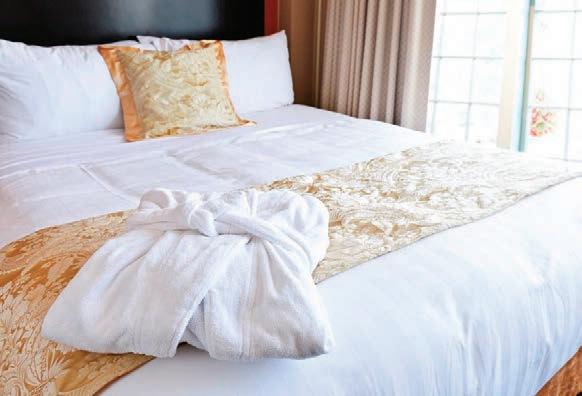
Laundry managers should evaluate the quality of the equipment they currently use and consider upgrading to take full advantage of new technologies available that can protect their investment in luxury linens.
One new feature that increases effective rinsing is spray rinse technology, which leaves up to 22% less residual wash chemistry in

down the drain.
The benefits of spray rinse technology are best explained by comparing a shower to a bath. A show-

er effectively rinses dirt off the body and sends it down the drain. Because there is no spray action to remove residue when someone

Poor rinsing, overdrying, roping enemies of fine bedding and napery everywhere(Image licensed by Ingram Publishing)
takes a bath, the water will leave some dirt on the body when the person steps out of the tub. The same holds true for linens that are only given a bath rinse.
Spray rinse technology not only decreases the presence of residual wash chemistry, it also decreases the cycle rinse time by up to 12%, increasing throughput and decreasing water consumption.
After the wash cycle is complete, when linens move to the dryer, the most common and, perhaps, most damaging error occurs: overdrying.
In a recent survey of commercial laundry distributors and commercial laundry managers, 79% of respondents said they believe on-premise laundries overdry by more than 8 minutes per cycle.
To help decrease the possibility of overdrying, start by examining the washer-extractor. A washerextractor with high G-force will remove the maximum amount of water from the load, which helps to further decrease times.
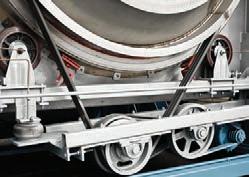
According to the results of a recent study completed by an OPL equipment manufacturer, linens experience 31% less fiber loss when overdrying is eliminated.
Once linens enter the dryer, there are multiple approaches laundry operators can take to prevent overdrying: overdry prevention technology, step drying, and utilizing a reversing tumbler. All of these tactics will help operators avoid fiber loss caused by overdrying.
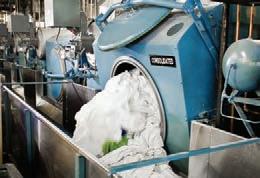
As the term suggests, step-drying linens involves a two-step process.
First, linens are dried in high heat (180-190 F) until a 50% dryness level is reached. The cycle is then completed on low heat. This technique allows operators to hit high temperatures to meet industry sanitation standards, and it significantly speeds up the dryer cycle, increasing throughput and saving linens from potentially overdrying.
Finally, a common problem when drying bedding or tablecloths is the balling or roping of linens. When linens ball up, the outside of the ball dries—often
overdries—but the center remains damp. Typically, this error is not caught until after linens are removed, which decreases productivity and increases labor expenses.
By utilizing a dryer with reversing technology, operators can prevent linens from balling up, ensuring an even dry. By using reversing technology, laundry managers can decrease both utility and labor costs as well as preserve their linen investment.
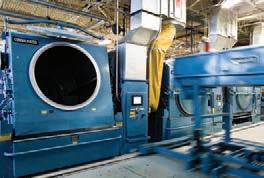
It is recommended that hotels use the three-par bedding method, meaning they have three sets of
linens per bed. This allows for one set of linens on the bed, one set of linens to be processing, and the last set of linens to be “resting.” After the linens come out of the dryer, they can rest for at least 24 hours to let the fibers relax and return to normal.
The most important consideration when choosing to upgrade to luxury linens is understanding how to fully extend linen life to preserve the guest’s sleep quality and the hotel’s investment. If operators avoid the common errors
cited here, luxury linens can have a significant impact on hotel guest satisfaction.
The ultimate goal is to make guests feel like they are sleeping in an environment more luxurious than their home; upgrading and retaining luxury linens is the first step to a good night’s sleep. ALN
Bill Brooks is the national sales manager for UniMac, a provider of on-premise laundry equipment. He can be reached at bill.brooks@alliancels. com or 920-748-4437.

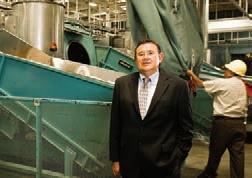
The most recent advance in preserving a luxury-linen investment is overdry prevention technology. This innovation features sensors that run the entire length of the tumble dryer lifter and connect to a rotary transfer switch. The dryer will automatically shut off once it has reached the precise level of dryness, accurately reducing drying time per load.
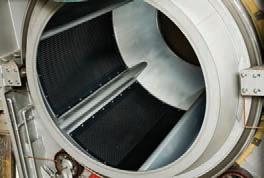
To achieve the longest linen life possible and the best drying results, dryers should leave a little bit of moisture in linens; they should only be 95-97% dry. The remaining 3-5% moisture helps to reduce wrinkles, whereas overdrying creates them.
To accurately hit the targeted level of dryness, some tumble dryer control systems will allow operators to step-dry their linens.
particles embedded in fabric significantly reduce the formation of bacteria and fungi. This antimicrobial property is the result of the high toxicity silver has toward microorganisms, while at the same time having relatively low toxicity for human tissue.
The ancient Greek philosopher Heraclitus wrote, “Nothing endures but change.” Laundry managers, like other professionals, must keep abreast of the most recent developments in both textiles and textile laundering in order to maintain, broaden and improve their job skills.
Cotton, the textile and laundry cornerstone fabric, has been “king” for less than 300 years. For more than 6,000 years, wool, silk and hemp linen were the dominant textiles. Since the first commercial production of the semisynthetic fiber rayon in 1891, changes and developments in textiles have been ceaseless.
The years between 1935 and 1970 saw the development and commercial production of nylon, polyester, Velcro, spandex, Kevlar, and microfiber.
Today’s new technology has ushered in radio frequency identification (RFID) as well as highfrequency chips used to track and identify uniforms and linens. This technology has proven to be a boon for textile rental concerns in reducing actual and artificial loss.

Additionally, nanotechnology is being incorporated in many fabrics and garments. Nanosilver
The nanosilver particles also are efficient at transporting moisture and perspiration away from the body. The introduction of the nanosilver particles to any fabric will darken it. Consequently, pure white fabrics and clothing containing them are not possible.
Nanowhiskers, tiny cotton fibers one-thousandth the width of normal cotton fibers, are used as a treatment in cotton, polyester, wool and rayon fabrics. The treatment, which entails fabric dipped in a nanowhisker solution, repels liquids ranging from coffee and red wine to chocolate and salad dressing. The nanowhiskers attach to the fabric, which creates a cushion of air that makes the fabric wrinkle-resistant as well as liquid-repellent.
Nanoscale wax pyramids are being developed that, when incorporated into fabric, make the fabric dirt-repellent. Also being cultivated are nanotitanium threads, which will make fabric self-cleaning!
Another textile innovation is the “Shower Clean Suit,” a garment comprised of 83% wool and 17% water-soluble polyester. Once the suit is stitched, it is washed, dissolving the watersoluble fibers, leaving a lightweight material through which
water and air can easily pass. The final finish applied to the suit contains L-cysteine, an amino acid that occurs naturally in hair, nails and skin. The suit can be washed in a regular shower and hung to dry in the bathroom. The suit will reportedly be ready to wear without pressing.
The best way to stay up to speed with all the latest changes in textile and laundering technology is to take advantage of the continuing education programs offered by trade associations such as the Association for Linen Management, National Cleaners Association, Textile Rental Services Association, and the Drycleaning and Laundry Institute.
Maintaining certified industry credentials requires continuing education on an ongoing basis.

The Association for Linen Management’s American Laundry and Linen College offers challenging and intensive in-depth classroom education programs. Eastern Kentucky University in Richmond, Ky., hosts this training.
Trade books, such as Fundamentals of Textiles and Their Care (5th Edition), provide an inexpensive way to keep abreast of the latest industry developments. Trade journals constantly keep their readers informed of the latest industry developments.
Attendance at trade shows, such as the Clean Show, provides not only firsthand glances of the latest industry developments, but great networking opportunities as well.
There are many outlets by which laundry professionals can hone their skills; they just need to be utilized.
opportunities in the service and medical fields.
Industrial launderers need to proceed with caution when adding a new product. Adding any new item is an investment in the future. Will today’s hot colors be tomorrow’s harvest gold and avocado green?
The textile rental industry has experienced a number of significant changes in the last 40 years.
The introduction of synthetic mats virtually eliminated waterabsorbing cotton mats. At one time, uniforms were only available in solid blue and brown. Today, textiles allow for the creation of any color/pattern in a variety of comfortable cotton/ poly blends.
Recent newcomers (relatively speaking) are microfibers and spun poly products. All have had a positive impact on industrial processes while allowing consumers more choices.
The fact is: Not all products are right for all launderers.
Microfiber bar towels and mops may be great for production processes, but those customers accustomed to cotton may find the absorbency to be less than acceptable.
Continued developments in microfiber are helping develop new industrial laundry market

They also will need to weigh the risk of the new line investment. Testing samples of the item you are considering can provide insight as to how it will fit into your production facility. By soaking test products in oils, ink, food stains and bleach, you can create your own specifications and formulas for processing a new product with your existing cleaning chemicals.
Textile trade shows and regional laundry organizations can be great places to examine and find the latest new textile products. Trade shows also are great opportunities to rub shoulders with other laundry operators who may have experience in a product you are considering.
And, like all industry, the Internet is always a great place to do research on products. However, more than once have I resorted to searching the web for a product only to find it listed with one of my present suppliers. Calling or meeting with your existing supply reps can keep you abreast of the latest products and trends.
Don’t forget about trade magazines such as American Laundry News. They provide visual information in the form of ads, articles
To what extent must a laundry manager or textile rental operator ‘keep up’ with the introductions of new fabrics and related developments in textiles? How can I stay informed about this aspect of the industry to ensure we achieve the best processing results?
and vendor lists on equipment, products and improved processes.
allows you to change the temperature from one product to another without harming your plant’s efficiency on other items.
If you have the old, traditional thermal heating system with multiple thermal ironers, then temperature changes aren’t as easily achieved because you may have to change across multiple ironer lines.
This topic recently arose with one of my good customers. It is extremely important not only for laundry managers but everyone associated with laundry processing to understand the new fabrics and related textiles.
It doesn’t matter if you are processing room linen, banquet linen or hospital baby blankets, you should keep up with new fabrics.
Fabrics can react differently to chemicals, time, temperature, mechanical action, or extraction speeds or pressures, which can significantly affect the quality of linen.
Today’s technology has helped us become better adapted to special fabrics. Examples of how technology changes have improved the quality of our processing of delicate items include fully programmable washerextractors, continuous batch washers and extraction presses. Some items can handle 56 bars of pressure, while others may require 20 bars because wrinkles are set by the press.
Microprocessor-controlled dryers, inverter blower and basket speed on system dryers are a tremendous addition to processing certain types of fabrics.
Another example is flatwork ironers. Processing items on a self-contained thermal ironer
Benchmarking with others in your industry is the best way to stay on top of fabric changes. Your chemical, textile and equipment vendors are a great place to start. We are in many plants that all face the same challenges.

the fabric at its optimal level of performance.
As healthcare and other industries change, mainly in response to improving outcomes, textiles are becoming more and more important in patient care, as well as in the prevention of infection and potential environmental contamination.
Linens have long been used in the care of patients, and play a significant role in the patient’s comfort and outcomes.
Fabrics are now being lined with silver (a natural antimicrobial agent), impregnated with many other antimicrobial
agents and otherwise treated in an effort to decrease the risk of spreading infections. A laundry manager must be able to identify the proper wash and dry formulas designed to keep these antimicrobial properties from being destroyed during processing.
A laundry manager also must take measures to prevent contamination during the storage, transport and delivery of linens. Steps to keep patient and customer linens hygienically clean do not stop at the dryer. Strict adherence to infection control policies

Alaundry manager must remain abreast of the newest developments in fabrics, textiles and linen treatments in an effort to ensure that his/her cleaning processes will meet the manufacturer’s specifications designed to keep
experts in the industry, will ensure a successful operation, and will help keep the linen industry strong and viable in the future.
and procedures must be followed throughout the processing and delivery steps. Remaining abreast of the most recent developments in this area will ensure that quality product is provided to the customer.


Besides antimicrobial properties, many newer fabrics are now being further developed. Customers are concerned with preserving the natural environment and reducing mankind’s carbon footprint. These customers are more informed, smarter, and have looked to textile vendors to develop alternatives to synthetic products.
Textiles are being made of bamboo, rattan, special silks, etc., as replacements to the traditional blends of cotton and synthetics. In addition, textile manufacturers are utilizing shorter, less desirable fiber filaments during production to decrease as much waste as possible.
Rag vendors are purchasing “rag out” (damaged linens) to sell for recycling, all in an effort to be environmentally responsible.
As the market changes, laundry managers must adapt to provide processing that, again, will provide adequate cleaning without damaging the linen fibers or specific treatment properties.
To stay in touch, a top-notch manager will be involved in many industry and trade associations; will read and contribute to research and development efforts; and will continue to learn about the changes in the marketplace.
Staying on top of these changes, and staying in touch with the
There should be a team effort to stay informed about advancements and developments in all phases of our industry. In this example, managers, supervisors and chemical technicians all should be involved.


The vendor of a new product will provide care instructions if asked. Many times, the instructions make the item seem more exotic than it is; most new items are made with a previously proven fabric, and there is no new process needed to care for the item.
We do need to be thoughtful about shrinkage and color bleeding. Heat sensitivity in standard washing is usually not a problem. Dryer heat could be problematic. Most everything that is to be ironed is OK with the standard ironer temperature. To use chlorine or not can be an issue, and would be addressed on the care label.
Any departure from the norm can give embarrassing and expensive results. Several years ago, when I was working for a previous employer, a customer started sending some blankets that kept getting singed in the dryers. We couldn’t get the temperature low enough to solve the problem. The care label read “dry at low temp.” After some extensive research, we
found that the care instructions from the manufacturer indicated 100 degrees or lower. In a laundry, that’s room temperature. This certainly produced some anxiety, and the customer, who had invested a lot of money in these goods, had to quickly make other arrangements.

If a rental operation is involved, management needs to be aware of advancements in product types in order to stay competitive. Vendors are perhaps the best source of information of new fabrics and developments. An in-house chemist is certainly overkill. I can’t say enough about using trade publications, as they are usually full of current information.
Anytime something out of the ordinary shows up, search it for a care label. There can be surprises from time to time. It is always best if you can get samples of the new product prior to its purchase, or before it’s placed into production.
I have had COG customers change their mind about a particular product. Many times, just tracking the new item through the system is problematic. It also may be an attractive item that tends to disappear. These are qualities that should be addressed before the new item is introduced.
to get some fresh air by taking a quick walk downtown for a cup of coffee. I walked past a local ski shop and noticed a new pair of skis being placed on display in the window. What caught my eye about this particular pair of skis were the color and shape. Being an avid skier, I entered the store to check them out.
During my brief conversation with the store associate, it was explained to me how the technology of skis is changing on a daily basis. The new technology affects the performance and overall life of the product, and would be especially useful for an older skier like me, to reduce wear and tear on my body.
While walking back to my conference, I was still thinking about this new technology. Then I had an epiphany about the similarities of my visit to the ski shop and what we as a company are offering our laundry customers today.
In today’s ever-changing healthcare environment, we uniforms/workwear manufacturers are constantly researching, developing and introducing new innovative fabrics and new fashion styles of uniforms and patient apparel for laundries and healthcare facilities. Our new concepts will not only help reduce energy costs, but also add life to the product. These new concepts also make the end-user feel better about them, and have a direct impact on the customer’s overall satisfaction.
dries are concerned about their energy costs, water consumption and apparel and linen life, new fabrics and equipment technology become important.
More and more plants today are upgrading, outfitting, reengineering or even building new facilities with new technology to produce and deliver a far superior product while keeping their production, delivery and energy costs down in order to meet the competitive demands of our industry and our customers.
The same goes for uniforms being rented and/or sold today. We have gone from 100% cotton to a cotton/poly blend to a poly/cotton blend in an effort to increase the overall life of the product. Now, with the introduction of new polyester garments, poly/rayon and much more, we are not only adding more life to the products, we are adding a better hand and making the enduser more comfortable.
One way to keep up with the ever-changing technology is for vendors to engage and visit with our laundry partners to introduce new technology and ideas as it pertains to fabrics, styling and equipment. We need to stay abreast as to what is going on in our industry. As the needs and demands of our customers continue to change on a daily basis, we need to assimilate technology in an effort to offer the best out there to our customers.
While attending a major conference in Canada, I had some free time on my hands between meetings, so I decided
When processing laundry, we no longer take the product to our local stream and beat it with rocks to clean it. We have evolved from front-load washers to tunnels. As the equipment used to process laundry today has changed, so must the products we rent and/or launder on a daily basis. As laun-
Nobody likes change, but change is ultimately a good thing. New technology improves our game and allows us to perform at a higher level without adding more cost to our bottom line. Is it imperative that everyone should make the change to the new technology? Not really, but for those of us who recognize and welcome
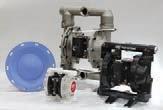
the new technology, only positive things will happen.
As Henry Ford once said when asked what his customers want, he replied, “They want horses that run faster.”
I hope to see you on the ski slopes this season; I’ll be the one with the new skis.
implemented linen purchases within your washroom and finishing department can almost guarantee less-than-desired efficiencies, diminish the finished quality, and also may lead to reduced service life of your valuable linen investment. Arming yourself with the best available information before starting to wash anything new is the best way to help avoid these and other potential pitfalls.

First, a need arises because of a new customer with specific requirements, or maybe your old inventory has hit the wall and it’s time for replacement. You would normally contact your textile provider or distributor salesperson to inquire about pricing, colors, sizes and availability.
We live in an age of innovative new textiles that offer benefits in serviceability and durability that didn’t exist a few years ago. The differences between all of these textiles are considerable, and many require specific laundering and finishing processes.
Getting your plant’s production optimized for the variety of these textiles requires updating your knowledge and procedures every time you plan to initiate a new customer in new, unfamiliar textiles, or plan a switch to a new type of linen or uniform for an existing client.
Failure to stay updated with the available information on newly



The good news is that many modern fabrics are designed to be durable and efficient, with good, built-in stain-resistant properties. We are fortunate to have some good textile providers right here in the United States. These providers maintain ongoing testing facilities that put new textiles through rigorous trials to determine their strengths and weaknesses. As a result, we usually receive the performance levels we expect from quality, name-brand companies when good laundering practices are followed.
So, how do you acquire the information you need to first make the correct purchases of textiles needed, and then institute the proper wash formula choices and finishing procedures? The key is to consult with more than one source. This sounds like a lot of work, but in reality all the resources you need are probably within your reach.
If you are buying a new line of products, consult with the most knowledgeable person on those products. This could well be your salesperson, or perhaps a product specialist from that vendor’s staff. Ask about the prospective new linens or uniforms you are considering, and see if the provider can supply you with contact information of other facilities that are using these products. Call or e-mail to get the real skinny from actual end-users.
Next, insist that copies of the manufacturer’s washing instructions are sent to you prior to shipment of the goods. Examine the instructions to see if anything recommended is a big departure from what you are set up to do in your plant.
Remember that the manufacturer’s instructions, as well as many of the care labels we see, are not the final word on what to do with your new linens. Our laundries are not clones of their testing facilities, and all laundries have differing conditions. But these
instructions are useful as a base guideline and to review any absolute “don’ts” they may suggest. Before you make any large-scale purchase, it is prudent to ask that enough sample linens or uniforms be sent to you to accomplish a small test wash, followed by a rundown with your ironer to help detect any initial issues.
“FAiLure to stAy updAted With the AvAiLAbLe inFormAtion on neWLy impLemented Linen purchAses ... cAn ALmost guArAntee Less-thAn-desired eFFiciencies, diminish the Finished quALity, And ALso mAy LeAd to reduced service LiFe...”

Being “soap guys” means we wear several hats, and one of them is bringing our experience into play on behalf of our customers’ needs. Before you make any major new purchase of textiles, it’s a good idea to ask your chemical provider to review the information you have received on these textiles and to get his or her opinion based on their prior experience in other plants.
They should have some insights
to offer that will prove valuable in helping to make knowledgeable purchasing decisions. This conversation also will give your chemical provider a timely headsup so they can review the existing chemicals and wash formulas to determine if any modifications will be needed from the jump.

For example, did you know that flame-resistant cotton uniforms should be sized up to 2 inches long to allow for major shrinkage? Did you know that 50/50 blended table linens in all but the darkest colors, or black and white, will provide considerable challenges with oily-type stain removal?
Did you know that Frette cotton table linens require special attention on the initial wash, or that all firemen’s turnout gear requires definite washing regulations and have important restrictions that must be followed? This list of special laundering considerations goes on and on, but be assured the answers you need are out there!
As the scope of what is being washed changes, you do need to stay abreast and informed. Utilize your reference sources, always consider functional serviceability of textiles as an extremely important factor to your bottom line, and then go make your new purchases with confidence. ALN
OAKBROOK TERRACE, Ill. — Brad Dannegger, regional manager and vice president of design and construction firm ARCO/Murray, was recently named a finalist in the Ernst & Young Entrepreneur of the Year 2013 program in the Midwest.

The award celebrates entrepreneurs who demonstrate and excel in areas such as “innovation, financial performance and personal commitment to their business and communities,” according to ARCO/Murray. Dannegger was chosen from a “strong pool of nominations by a panel of independent judges.”
“What motivates me is giving our customer a top-of-class experience through the process,” says Dannegger. “Most people don’t view construction as an enjoyable process. We strive to make it enjoyable and beneficial to our customers.”
The Entrepreneur of The Year program, now in its 27th year, recognizes business leaders in more than 140 cities in more than 50 countries, according to ARCO/Murray.
WILMINGTON, Mass. –– UniFirst, a Massachusettsbased provider of uniforms and workwear to businesses in the U.S. and Canada, was recently applauded by Massachusetts Secretary of Energy and Environmental Affairs Richard Sullivan Jr. for its measures to become a “greener,” more environmentally friendly company.
“In a recent visit to the company’s corporate office in Wilmington … [Sullivan] took particular note of the company’s use of domestic natural gas versus imported oil for heating its facilities, and then reclaiming a percentage of that energy for further use,” says UniFirst. “[Sullivan] and his team were also impressed that UniFirst business customers are able to reduce their related carbon footprint by a factor of 18 by renting reusable work clothing from UniFirst versus continually purchasing apparel throughout the year that must be ultimately thrown away.”
Sullivan also took note of its research in recycling greater amounts of water for laundering use, “testing electric-powered trucks for customer deliveries and studying the feasibility of installing solar roof panels on its industrial laundry
facilities,” the company adds.
He also reviewed UniFirst’s sustainability report, and was “pleased” to learn that the company’s products and services help its customers earn sustainability points that could support certification by the U.S. Green Building Council and the Canada Green Building Council, the company says.
Employee Team Partners, from the company’s subsidiary UniTech in Springfield, Mass., also presented the “environmentally sensitive methods” they utilize to launder and process specialized work apparel and equipment for workers in the nuclear power industry.
“Upon learning about the subsidiary’s extensive radiological expertise, [Sullivan] and company representatives agreed that a ‘formal relationship’ should be established between UniTech and the state so UniFirst staff could be called upon for advice should any radiological emergencies ever occur in Massachusetts,” the company says. Also, Sullivan would lend support to any state-sponsored green initiative programs UniFirst would like to take advantage of to become more environmentally friendly.
INWOOD, N.Y. — Equipment distributor Laundrylux is offering a disaster recovery program to Colorado self-service laundry owners whose stores were impacted by flood damage recently, the company reports.
Laundrylux says that the program includes no payments and no interest for up to 120 days, plus low fixed interest rates, and that it will “waive all fees” to help laundry-owner customers rebuild their businesses.
“Our hearts go out to the people of Colorado,” says Neal Milch, CEO of Laundrylux. “We understand what you are going through and want to do our part to help. We are working hand-in-hand with Advanced Laundry Systems of Colorado to make it as affordable as possible for self-service laundry owners, as well as business owners, such as hotels, nursing homes, long-term care, and other facilities, to get the equipment they need right away.”
Advanced Laundry Systems, distributor of Electrolux and Wascomat Professional Laundry equipment, has been in the Denver metro area for 20 years, Laundrylux says.
“We are Colorado natives and we’ve lived in the Denver area our whole lives,” says Diane and Rob Burgess, owners of Advanced Laundry Systems. “We are overcome with grief at this week’s tragic events and our hearts go out to everyone in our communities. Some of our family members lost everything in the flooding, too. We understand your laundry is your livelihood and we will do everything within our power to make sure you get back up and running as quickly as possible.”
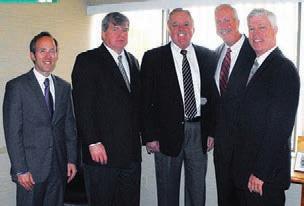
FAIRFIELD, N.J. –– The Textile Care Allied Trades Association (TCATA) recently announced the results of elections for officers and members of the board of directors, with Steve Mathews of M&B Hangers named president-elect.
Mathews, who will assume the post in April, has been an active member of TCATA, having served on its Business Program Committee for the 2013 TCATA Annual Management & Educational Conference; as a board member from 2008 to 2010; Thursday Party Chair for the 2007 Annual Conference; and as Golf Chair for the 2006 Conference, the association says.
“TCATA has always been a special organization to me,” says Mathews. “As a child, I remember my dad (Stan Mathews) being very involved in the association, even serving
as president. He always spoke of the value of the organization, including the business relationships and friendships that he formed. This has been the same for me since I became part of TCATA, and I am truly honored for the opportunity to serve as president.”
Kevin Lawson of Tri-State Laundry Equipment Co. is treasurer-elect and will assume that post in April, according to TCATA.
Vice presidents elected to one-year terms were David Tingue of Tingue, Brown & Co. (Supply Manufacturer Group), Gerald Henke of Intex Distributing Co. (Distributors Group), and Tony Regan of ADC (American Dryer Corp.) (Machinery Manufacturers Group).
Elected to the board for the first time were Tim Grandy of Softrol Systems (Machinery Manufacturers Group), Peter Limoncelli of Yankee Equipment Systems (Machinery Distributors Group), and Gerard O’Neill of American Laundry Systems (Related Trades Group).
Members re-elected to the board were Jeff Allen of E.J. Thomas Co. (Supply Distributors Group), Ed Kirejczyk III of EDRO Corp. (Machinery Manufacturers Group), Lawson (Machinery Distributors Group), Steve Pedelty of M&B Hangers (Supply Manufacturers Group), and Alexander Seitz of Seitz Inc. (Supply Manufacturers Group).

ALEXANDRIA, Va. — Joseph Ricci, CAE, president and CEO of the Textile Rental Services Association of America (TRSA), has been recognized by a national newsletter for association executives, CEO Update, in its Top CEOs list.
CEO Update acknowledged Ricci’s efforts in increasing the association’s revenue by 33% through the establishment of “non-dues generating initiatives” such as education and certification programs, ultimately reducing the association’s dependency on dues revenues by 12%, TRSA says.
Ricci was able to boost revenue by spending “one week a month visiting members,” TRSA adds, resulting in a 21% increase in revenue from new member dues.
The publication also applauded Ricci for “improving performance in member recruiting and retention, and developing certifications for textile services industry companies and individuals.” TRSA says that, under Ricci’s leadership, membership growth is at 10%, and retention 91%; and that the association’s educational institute attendance is up 15%.
Launched in 2012, TRSA’s Clean Green and Hygienically Clean certifications have ensured that laundry facilities are reaching “quantified performance levels,” while its Certified Professional Laundry Manager (CPLM) individual certification “quantifies production management knowledge to objectively distinguish highly competent managers,” according to TRSA.
“These programs, combined with new education and networking opportunities, are the most visible reflection of [Ricci’s] dedication to improving the value of TRSA membership,” says TRSA Chairman Jim Doro, Doritex Corp., Alden N.Y. “Just as pertinent are his improvements to TRSA’s longstanding programs that expand and protect the market for textile services through advocacy and increasing professionalism and productivity.”
“This honor belongs to our members and volunteer leadership,” says Ricci.
“Their support and responsiveness to all our recent initiatives, from advocacy to certification to education, has increased TRSA’s effectiveness. It is a great pleasure to work with them to find new ways to expand and protect the industry by representing their interests and facilitating their
exchange of information.”
“The recognition really must also be shared with the TRSA staff,” adds Ricci. “Our team has continually risen to the challenge of implementing more professional development opportunities, enhancing communications and launching new initiatives.”
PEEKSKILL, N.Y. — New Yorkbased linen supplier White Plains Linen has partnered with clean energy supplier Wheelabrator Westchester, enabling White Plains to “reduce its carbon footprint by 90%” through the use of steam power, the companies report.
Under a long-term supply agreement, steam from the Wheelabrator Westchester waste-to-energy plant is being piped directly to White Plains Linen’s adjacent 100,000-square-foot commercial laundry facility via a newly constructed steam line. White Plains Linen is converting its natural gas-fueled laundry equipment and roomheating systems to steam.
The move will reduce the amount of natural gas White Plains Linen uses to make steam and hot water, from 1 million therms per year to less than 90,000 therms per year, eliminating 4,775 metric tons of greenhouse gas emissions annually, the companies report.
“This partnership with Wheelabrator Westchester makes White Plains Linen an industry leader in the use of eco-friendly, alternative energy,” says Bruce Botchman, president of White Plains Linen. “By practically eliminating the use of fossil fuels in our laundry operations, we are helping to clean the air, protect the environment and preserve natural resources for future generations.”

Leonard Labonia, vice president of operations for White Plains Linen, adds that the “stability of this reliable energy source” will assist the company in planning future growth. “This type of energy source does not react to political unrest overseas or spike due to unforeseen shortages.”
“Westchester County is pleased to support this innovative partnership between two of our larger industrial employers,” Peekskill Mayor Mary Foster says. “It is a great example of how corporate responsibility, especially when it comes to protecting our environment, is also good for business.”
Wheelabrator Westchester processes up to 2,250 tons per day of municipal solid waste, transferring it to utility-type boilers that recover thermal energy in the form of high-pressure steam.
Besides utilizing steam power, White Plains Linen has made other investments in becoming environmentally friendly, such as installing systems to capture rainwater and recycle filtered rinse water, and installing more energy-efficient lighting throughout its facility, the company says. ALN

7-11 Pellerin Milnor Corp. Continuous Batch Washer (CBW®) and PulseFlow (PBW™) Tunnel Systems Service Seminar New Orleans, La. Info: 504-712-7716, service@milnor.com
14-16 G.A. Braun
Washer-Extractors Service School Syracuse, N.Y. Info: 800-432-7286, ext. 254; btoman@gabraun.com
16 Textile Rental Services Association Production Summit Westin Peachtree Plaza Atlanta, Ga. Info: 703-519-0029, ext. 108
17 Association for Linen Management Manager Series Webinar: Laundry and Linen Management for Hospitality Professionals Info: 800-669-0863
17 Textile Rental Services Association Executive Roundtable - F&B Westin Peachtree Plaza

Opening our new plant sent the message to our markets and employees that we are dedicated to their future. Earning TRSA certi cation has demonstrated that we are committed to continuous improvement and adopting industry-leading best practices.
—Patrick J. Dempsey, Dempsey Uniform & Linen Supply, Scranton, PA, picturedwithdaughterKristinandsonP.J.

Demonstrate your commitment by earning TRSA’s international certi cations for cleanliness and sustainability—Hygienically Clean and Clean Green. With nearly 100 plants certi ed, the textile services marketplace recognizes their credibility. Learn more at www.TRSA.org.
Atlanta, Ga. Info: 703-519-0029, ext. 108
17-18 G.A. Braun

Dryers Service School Syracuse, N.Y. Info: 800-432-7286, ext. 254; btoman@gabraun.com
22-25 Pellerin Milnor Corp.
Washer-Extractors Service Seminar New Orleans, La. Info: 504-712-7716, service@milnor.com
5-8 Textile Rental Services Association Maintenance Management Institute Embassy Suites Hotel Dallas Info: 703-519-0029, ext. 108
9-12 International Hotel, Motel + Restaurant Show (IHMRS) Jacob Javits Center, New York City Info: 212-754-7920 ALN


Commercial/Industrial Laundry Equip Service Tech Position serving MidAtlantic: WV,VA,MD,PA,DC. Experience w/ Volt Meter, Wiring Schematics, 1 and 3 Phase power. Physical activity and lifting reqd. Customer relation skills and good driving record reqd. Travel and work 40+ hours per week. Independent work, knowledge w/ plumbing, electric. 800-866-6905 cameron@leslaundry.com







Sani Wash - McClure Industries, Inc. 9051 SE 55th Ave., Portland, OR 97206 800-752-2821 www.mcclureindustries.com, info@mcclureindustries.com


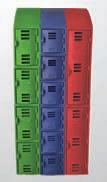










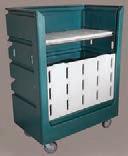




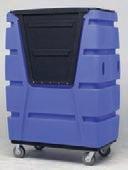






P. O. Box 33818, Charlotte, NC 28233 Ph.: (704)372-3890; Fax: (704)342-0758 www.gardnermachinery.com














A.L. Wilson Chemical Co. www.alwilson.com 14
American Dawn www.americandawn.com 7
American Laundry Systems www.eomech.com 18
Chicago Dryer Co. www.chidry.com 17
Consolidated Laundry Machinery www.clmco.com 21
Cornerstone Equipment & Rigging www.cornerstonemachinery.com 28
Davis Packaging www.davispackaging.net 23
Direct Machinery Sales Corp. www.directmachinery.com 28
EDRO Corp. www.edrodynawash.com 23
G.A. Braun www.gabraun.com 12
The Griffin Group, Inc. www.thegriffingroup.cc 28
Gurtler www.gurtler.com 13
IES www.iesclean.com 22
Ingersoll Rand www.ingersollrandproducts.com 24
IPSO www.ipso.com 19
J.P. Equipment www.ineedjpequipment.com 28
Source
Felins
Pellerin Milnor Corp.
P.O. Box 400, Kenner, LA 70063 504-467-9591, Fax: 504-468-3094 www.milnor.com
Pellerin Milnor Corp.
P.O. Box 400, Kenner, LA 70063 504-467-9591, Fax: 504-468-3094 www.milnor.com
Pellerin Milnor Corp.

P.O. Box 400, Kenner, LA 70063 504-467-9591, Fax: 504-468-3094 www.milnor.com

Kannegiesser USA www.kannegiesser.com 25
LaundryCareers.com www.laundrycareers.com 28

Laundrylux www.laundrylux.com 9
Lavatec Laundry Technology www.lavatec-laundry.com 32
LG www.lgcommerciallaundry.com 5
Maytag www.maytagcommerciallaundry.com 11
McClure Industries www.mcclureindustries.com 20
NATCO www.nationalcombustion.com 24
Parker Boiler www.parkerboiler.com 20
Pellerin Milnor www.milnor.com 3
Royal Basket Trucks www.royal-basket.com 10
Stanco Industries www.stancoind.com 28
TRSA www.trsa.org 27
UniMac www.unimac.com 15
U.N.X. Inc. www.unxinc.com 16