New York laundry workers ratify master labor contract
NEW YORK — Industrial laundry workers who wash linen for New York City’s hotels, hospitals and restaurants voted to ratify a new master contract among 14 laundries in the metropolitan area, reports the Laundry, Distribution and Food Service Joint Board, Workers United/Service Employees International Union (SEIU).
The contract includes significant wage gains for laundry workers, a majority of whom are AfricanAmerican women and Latina immigrants, and will also grant them continued free employer-paid individual medical, dental and vision insurance and a pension, the union says.
Laundry workers will be part of one multi-employer contract, which sets the standards for a majority of laundries in the New York metro area.
Wilfredo Larancuent, regional manager of the Laundry, Distribution and Food Service Joint Board, Workers United/SEIU, says he’s proud of what the group has accomplished. “This contract makes real improvements for laundry workers and their families and continues to raise standards for the industry.”
Elected worker representatives from the laundries bargained the contract with employer representatives for more than a month. A strike vote was held at the laundries, but the contract was settled prior to the strike deadline.
hospital, hotel laundry, linen ops feel brunt of Superstorm Sandy
By RichaRd MeRli
NEW YORK — Superstorm Sandy flooded and crippled numerous hospital and hotel laundry operations when it struck the Northeast in late October.
Several laundry and linen operations were destroyed by saltwater flooding and storm surges, caused by winds of 85 to 90 miles per hour, while numerous other operations were knocked out of service for weeks by power outages, due to overhead electrical lines downed by fallen trees.
A confluence of events, combining a tropical storm, a hurricane, and a high tide, caused by a full moon—some dubbed it the Perfect Storm—created a strong storm surge of 14 feet and left an estimated 102 people dead and caused an estimated $50 billion in property damage and lost business along the East Coast.
On the east side of Manhattan, flood waters from the East River traveled 600 feet and destroyed the laundry and research facili-
ties in Hunter College’s Brookdale Health Science Center on East 25th Street. Salt water also flooded the dormitory in which 660 residents lived. Many of the campus’ programs will be relocated to Hunter College’s main campus on East 68 Street in Manhattan, according to Jennifer Raab, the college president.
The storm also shuttered the Veterans Administration (VA)
Hospital on East 23th Street, Bellevue Hospital Center on East 27th Street, and New York University Langone Medical Center on East 32nd Street, all located on First Avenue, less than 1,000 feet from the East River. Three weeks later, the hospitals were still closed.
“The East River rose and flooded the basement and first floor and knocked out our electrical

and heating systems and linen services,” says Thomas Johnson, a spokesman for the VA hospital in Manhattan. “It may be springtime before we can reopen again.”
In Somers Point, N.J., a popular Jersey shore resort town, the Pier Four luxury hotel’s laundry was flooded and destroyed by more than three feet of ocean water.
SafeTRSA data shows laundries growing safer
CHICAGO — For Toledo’s NuCentury Textile Services, 2012 began under horrible circumstances.
Published reports indicate that, on Jan. 3 last year, an employee failed to turn off and lock a folder before servicing it. His clothes got caught in the machine, and his hand and forearm were injured. He later died from complications while recovering at home.

The Occupational Safety & Health Administration (OSHA) cited NuCentury for several alleged safety violations and fined
it $40,000. NuCentury hired a safety consultant and took other steps to improve its safety program, prompting OSHA to lower the fine to $19,600.
Despite best efforts, on-thejob accidents do occur in and around textile service facilities, and employees are injured or, on rare occasions, even killed.
There are resources available to help an operator ensure his plant is being run safely, and among them is SafeTRSA, a program offered by the Textile Rental Services Association (TRSA).
It provides safety training materials to TRSA members and measures the industry’s progress in implementing enhanced practices to reduce and eliminate occupational injuries and illnesses in plants and depots, according to Ken Koepper, director of marketing and public relations for the association.
Success is quantified when TRSA administers its annual survey of its members’ occupational injury and illness data, he explains.
“Such tracking over the past several years has prompted TRSA’s
creation of industry-specific initiatives and resources to focus on the industry’s highest risk areas and those cited most frequently by OSHA.”

This has resulted in TRSA members’ adoption of proven policies and procedures for maintaining equipment (lockout/tagout), handling soiled linen (especially bloodborne pathogens) and working in confined spaces, Koepper says.

“The networking and informa-

Janua Ry 2013
ALN late n ews
www.americanlaundrynews.com Volume 39, number 1
The newspaper of Record for laundry & linen Management
inSide [4] [14] Panel of Experts Meet the illustrious group of industry experts who will tackle our questions. [10] Product showcase heatgenerating equipment See SUPERSTORM on Page 19 See SAFETY on Page 9
Value
cites four ways that a healthcare laundry can add value.
Adding
Eric Frederick
The Manhattan skyline on the second night without power due to Hurricane Sandy. (Photo: ©iStockphoto/Andrew Cribb)
Survey: 60% of operators say 2012 throughput
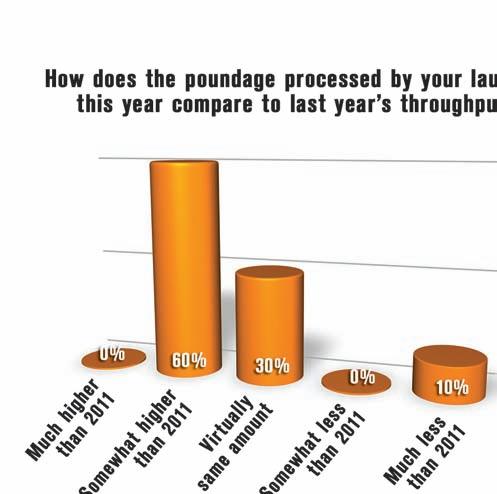
CHICAGO — Sixty percent of respondents to American Laundry News’ final Wire survey for 2012 said their laundry’s poundage processed last year was “somewhat higher” in comparison to 2011 figures.
For everyone else who took the unscientific online survey, their 2012 throughput was at or below 2011 levels. Thirty percent reported processing “virtually the same amount,” and the remaining 10% lamented processing “much less.”
Total estimated production for 2012 ranged by operation from 600,000 pounds to 14 million pounds, according to these anonymous responses.
Operators whose production rose attributed it primarily to gaining institutional business or increasing total accounts (71.4%); adding, replacing or rebuilding equipment (14.3%); expanding a facility or relocating to a larger site (14.3%); and/or “other” (14.3%). (Respondents could choose any or all among several suggested factors or offer their own.)
Why did some operations fall short of annual goals or expectations in 2012? A slowing or loss of business due to the economy, staff productivity, maintenance efforts, administrative indifference or lack of support, and regulatory changes all were seen as receiving some of the blame, according to respondents.
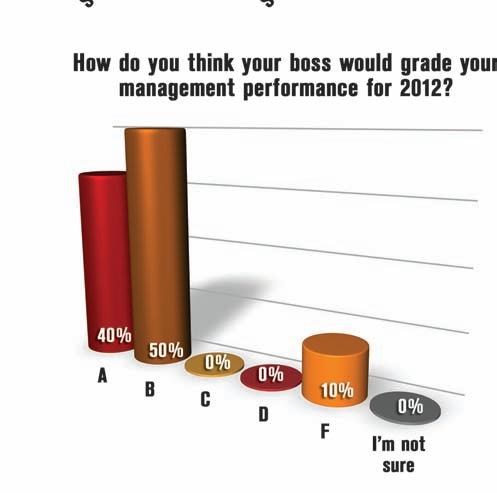
Finally, respondents were asked how they thought their boss would grade their 2012 managerial performance. Half believed they would receive a B (50%), while 40% said they would receive an A. The less-thansunny remainder (10%) said they would receive an F.
The Wire survey presents a snapshot of readers’ viewpoints at a particular moment but should not be considered scientific.
Subscribers to Wire e-mails—distributed twice weekly—are invited to take a brief industry survey anonymously online each month.
All managers and administrators of institutional/OPL, cooperative, commercial and industrial laundries are encouraged to participate, as a greater number of responses will help to better define operator opinions and industry trends.
Linen King opens new company HQ in Oklahoma
TULSA, Okla. — Linen King, a provider of healthcare laundry services, reports that it has added a sixth location that will serve as the company’s new headquarters. Located at 1521 W. 36th Place in Tulsa, the facility provides approximately 3,300 square feet of office and conferencing space and 5,000 square feet of warehouse space.
The new headquarters is centrally located between Linen King’s five Midwest plants, including facilities in Oklahoma, Arkansas, Missouri and Kansas. The company processes more than 50 million pounds of textiles annually for hospitals and medical facilities, and revenue is expected to grow by 20% in 2013.
“Our investment in a new headquarters in Tulsa supports our strategy that focuses on both organic growth and acquisitions,” says Leonard McCullough, CEO of Linen King. “Our goal is to become one of the nation’s leaders in healthcare laundry service. This involves maximizing the capacity in our current markets and also expanding in ways that provide backup for our existing facilities.” ALN
Alliance appoints Washburn
RIPON, Wis. — Alliance Laundry Systems has officially appointed Washburn Machinery, headquartered in Elk Grove Village, Ill., as its new UniMac distributor for northwestern Indiana.
The longtime distributor already represents UniMac’s on-premise laundry equipment in northern and central Illinois and east-central and southern Wisconsin, according to its website.
To learn more about Washburn Machinery and its relationship with Alliance Laundry Systems, visit washburnmachinery.com.
Publisher
Charles Thompson
Phone: 312-361-1680
E-Mail: cthompson@ americantrademagazines.com

Editorial Director
Bruce Beggs
Phone: 312-361-1683
E-Mail: bbeggs@ americantrademagazines.com
Digital Media Director
Nathan Frerichs
Phone: 312-361-1681
E-Mail: nfrerichs@ americantrademagazines.com
Production Manager
Roger
Napiwocki
Contributing Editor Jean Teller
Advertising Sales
National Sales Director

Donald Feinstein
Phone: 312-361-1682 E-Mail: dfeinstein@ americantrademagazines.com
Office Information
Main Phone: 312-361-1700 Fax: 312-361-1685
Subscriptions
630-739-0600 www.americanlaundrynews.com
American Laundry News (ISSN 1091-9201) is published monthly. Subscription prices, payment in advance: U.S. & possessions, 1 year $39.00; 2 years $73.00. Foreign, 1 year $89.00; 2 years $166.00. Single copies: U.S. & possessions $7.00; Foreign $14.00. Published by American Trade Magazines LLC, 566 West Lake Street, Suite 420, Chicago, IL 60661. Periodicals postage paid at Chicago, IL, and at additional mailing offices.

POSTMASTER, Send changes of address and form 3579 to American Laundry News Subscription Dept., 440 Quadrangle Drive, Suite E, Bolingbrook, IL 60440. Volume 39, number 1. Editorial, executive and advertising offices are at 566 West Lake Street, Suite 420, Chicago, IL 60661. Charles Thompson, President and Publisher. American Laundry News is distributed selectively to qualified laundry and linen management and distributors in the United States. No material appearing in American Laundry News may be reprinted without written permission. The publisher reserves the right to reject any advertising for any reason.
© Copyright AMERICAN TRADE MAGAZINES LLC, 2013. Printed in U.S.A.
MEMBERSHIPS
2 JANUARY 2013 | AMERICAN LAUNDRY NEWS www.AmericanLaundryNews.com
Association for Linen Management
INSIDE: [6] Industry Laments Lower IHMRS Turnout Laundry/linen-related exhibitors encounter belowaverage attendance in the wake of Hurricane Sandy [8] Tools of the Trade [10] Panel of Experts Introductions Meet the newest members from across the industry who will answer our laundry management questions in 2013 [13] Career Track [14] Product Showcase: Heat-Generating Equipment [16] Trade Ticker [18] OPL 101: Long-Term Care Laundry Solutions Residents and their family members are becoming increasingly discerning about the level of services provided January 2013 • Vol. 39 | No. 1
ALN
higher
than previous year’s
ALN

Sandy Hook and security
who were gunned down by a troubled young man is the least that I could do to honor their memory.
freedom and security. We live in the land of the free, after all, but that comes with a price.
The Director’s Chair Bruce Beggs
s I was in the midst of writing this, I paused, along with many others in our nation, for a moment of silence to honor the victims of a mass shooting at a Connecticut elementary school. Taking a moment to remember the young children and educators
Each weekday, I commute from the Chicago suburbs into the city, traveling to an office building with a secure entrance. I’m vigilant during my six-block walk from the train station because, after all, I am in Chicago, but once I’ve buzzed myself in and reached my office, I feel safe and can get to the business at hand.
That’s probably how the Sandy Hook Elementary students felt on Dec. 14— secure about their surroundings and ready to learn. But then unspeakable evil burst in without warning and snuffed out their innocence.
My thoughts today are not on gun control, but about how best we can strike a balance between
Take a moment to review your facility and its security measures. How easy is it for people to come and go? Are you and your employees truly safe there?
“That could never happen here,” we think. But then it does, and we’re changed forever.
• • • • •
Lastly, a reminder for you manufacturers, exclusive distributors, or unique service providers about our March Buyer’s Guide issue. You should have received an e-mail invitation instructing you how to update your information on our website. If you didn’t receive one, or have any questions, e-mail me at bbeggs@american trademagazines.com. ALN

Design-build firm relocates mechanical room, adds on to loading dock for Alsco
SAN DIEGO — ARCO/Murray
National Construction Co. recently completed a mechanical room relocation and canopy building addition here for Alsco.
In November 2011, a boiler malfunction caused the textile rental company to shut down its mechanical room and rent a temporary boiler. Alsco hired ARCO/Murray to relocate the mechanical room and install new mechanical-room equipment. The firm was able to complete the project by early April, limiting the amount of money spent to utilize a temporary boiler.
The mechanical-room relocation included demolition of a two-story storage and office area to make room for the new system, which included a 400-horsepower boiler,
a water softener package, and a brand-new water system with a stack economizer. ADA-compliant bathrooms were also constructed.
ARCO/Murray was responsible for the demolition and reconstruction as well as all power and process piping tie-ins to the equipment within the mechanical room and out to the existing wash floor and wastewater systems.
While the expedited mechanical-room project was under construction, ARCO/Murray was also hired to design and permit a 5,000-square-foot loading dock addition. Through careful coordination with the City of San Diego and Alsco, ARCO/Murray was able to complete the project with limited interruption of Alsco’s opera-
tions and minor disruption of the city’s traffic flow, the company reports.
Along with the canopy, ARCO/ Murray was responsible for demolishing and replacing approximately 300 linear feet of sidewalk. The new dock canopy is able to hold six step vans and one box truck, increasing loading capacity and allowing Alsco to load completely within its property lines.
Project executive Elliot Mata and project manager Patrick Hidder represented ARCO/Murray. Bob Stephens served as Alsco’s corporate engineer, and Shane Harrison, the San Diego plant’s general manager, served a vital role in coordinating between Alsco and ARCO/ Murray during construction. ALN
deliver value to owners, customers and employees
•
•
•
•
•
•
•
•
•
•
w
hat is the primary focus of a good manager? I think too often, as managers, we get lost in the weeds of everyday life and fail to focus on the really important things.
A good manager should focus on delivering value to his organization or ownership, his customers, and his employees. During the past several years, there have been ample opportunities for managers increase value to all three groups. Let’s quickly review some of them:
Add a microfilament mop program to your laundry.
These types of mops are designed to be easier to use, provide better cleaning and disinfecting in the healthcare environment, and protects a critical portion of your business.
Add reusable isolation gowns to your product mix.
This product is a cost-effective way to lessen the environmental impact of the healthcare industry. They are more comfortable for the end-users to wear, and provide better protection for the healthcare worker. The additional volume is a nice addition to any laundry facility.
Develop a cubicle curtain-cleaning program.
Cubicle curtains have been identified as a possible source of contamination in a patient’s room. More frequent cleaning is being recommended, and the need to develop a quick, effective cleaning program is becoming essential.
The days of curtains hanging in a room for months or years are gone.
a good manager shouLd focus on deLivering vaLue to his organization or ownership, his customers, and his empLoyees.
Many hospitals have been sending their curtains out to local cleaners to get them processed, and many are paying by the square inch for this service. Developing a cost-effective cubicle curtain program requires minimal research on the part of the manager. The healthcare facility benefits by reducing the cost and improving the turnaround, the patient benefits from a cleaner curtain, and the laundry benefits from having the additional volume.
Develop a microfiber cleaning cloth program.
Effective environmental cleaning in the hospital is the first line of defense. Patients are carefully watching the work of their housekeepers. Lately, there has been an increase in the number of complaints concerning using the same cloth to clean the bathroom and the bedside table. Patients are looking for a readily identifiable change in procedure.
Colored microfiber cleaning cloths are ideal for use, because they do not lint and can be purchased in the preferred 12x12 size. One color can be used for the bathroom and a different color for the patient’s room. This product replaces the use of washcloths as cleaning cloths, increases the effectiveness of cleaning, provides greater patient satisfaction, and is easily processed by the laundry.
In all four of these cases, the laundry manager has increased value at all levels of his or her operation. By increasing the value, the manager increases customer satisfaction and employee job security.
Based on what is happening in our country, with high levels of unemployment, I take my responsibility to provide good working conditions and stable employment to my employees seriously. By focusing on adding value to my operation through improving existing products, adding new products or improving production, I meet this goal.
4 january 2013 | american Laundry news www.AmericanLaundryNews.com
Top Stories Appearing on AmericanLaundryNews.com for the 30 Days Ending Dec. 15 (WE) = Web exclusive news
Design-Build Firm Relocates Mechanical Room, Adds On...
New Consulting Firm Aims at Improving People, Processes...
Columnist At lArge Eric L. Frederick, RLLD
•
•
AmeriPride Plant in Idaho Earns First TRSA Hygienically Clean...
Washing Systems Honored for Green Chemistry...
Laundry Labor Union Elects Taylor President
Columnists/Features
Survey: Many Thankful Because Their Laundry Operations are Performing Well (We)
Panel of Experts: Seek Balance Along with New Business
•
Retrofit Project Enables Spin Linen to Add Healthcare Service to Portfolio
Purchasing Laundry Equipment: Buying New or Used? our sister websites From AmericanDrycleaner.com:
StatShot: Dry Cleaning Sales Rise Across the Board (We)
Pre-Spotting Step Toward Better Cleaning
From AmericanCoinOp.com:
Sales School Arms Attendees with Tools to Compete
Maytag
Girbau
Garners...
e)
Belson Co./Continental
Open House
(W
From
a
ALN
Eric Frederick is director of laundry services for Carilion Laundry Service, Roanoke, Va., and a past president and manager of the year of the Association for Linen Management. You can reach him by e-mail at efrederick@carilion.com.










Laundry industry laments lower turnout for IHMRS
BY RichARd meRLi
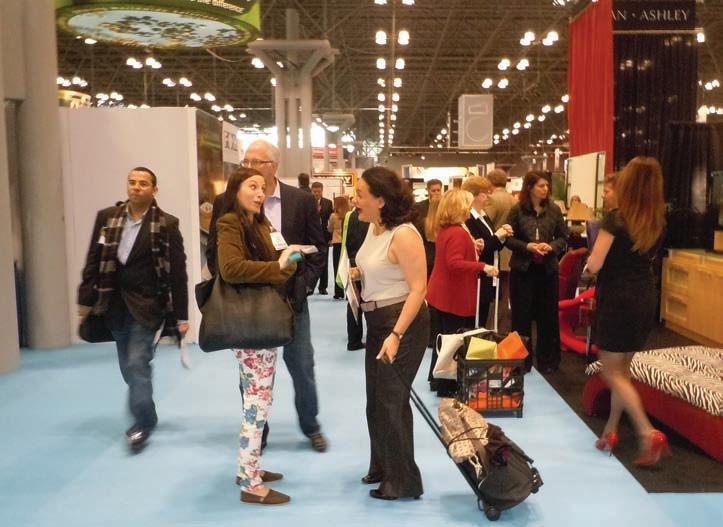
NEW YORK — Manufacturers of laundry machinery, reusable textiles, and laundry chemicals encountered below-average attendance at the annual International Hotel, Motel + Restaurant Show (IHMRS) here Nov. 10-13, in the wake of Hurricane Sandy, which had battered the East Coast Oct. 29. But the dark clouds carried within them a silver lining: Many exhibitors suggested the storm damage to laundries may drive demand for replacement machinery, textiles and chemicals well into 2013.
“Some laundries were able to function with generators, but other laundries were completely devastated,” says John Smith, regional sales manager for Speed Queen. “In the hospitality industry, it’s still too early to make an accurate assessment of the damages to laundries. But equipment replacement orders may lag into the spring. This storm could have an ongoing effect into the next year.”
Total trade attendance at the show this year was unchanged from 2011 at 23,953. But the number of industry buyers totaled 15,082, down from 17,955 in 2011, according to Melissa Gray, a spokeswoman for the show’s management. “The hurricane definitely had an impact,” she adds.
However, among the hotel owners and operators who attended the show, there was strong interest in increasing efficiency in laundry operations to help hotels and motels become more profitable by reducing energy costs, according to Smith. For example, hotels can increase energy efficiency by reducing gas usage, beginning in the wash process. Using a washer-extractor equipped with a 200 G-force extraction speed can ensure optimal water removal from linens, which leads to reduced drying times, he says. In addition, using a tumble dryer equipped to prevent over-drying further decreases gas costs.
Hotel owners and operators demonstrated strong interest in laundry controls capable of providing reports on productivity, according to Bill Brooks, North American sales manager for UniMac. The first day of the show produced little floor traffic, according to Brooks. But then the company experienced rising interest from small, independent hotel owners and representatives of larger chains, who are increasingly cost-conscious.
“Owners and operators understand that
if you can measure your consumption, you can improve your utility, chemical and labor costs,” says Brooks.
He predicted that Hurricane Sandy will have “a big impact” on equipment replacement orders from hotels in 2013, because many laundries on the East Coast were flooded with salt water. Many of those laundries were located on lower floors or in basements, Brooks noted.
“When hotels re-open for business, one of the first things they need is clean laundry,” he says. “They have to do laundry, whether they salvage their equipment or replace it.”
Pellerin Milnor Corp., which shared a booth with Chicago Dryer Co., enjoyed “quality traffic” and generated “strong leads” at the show, according to John Rasimas, regional sales manager for Milnor.
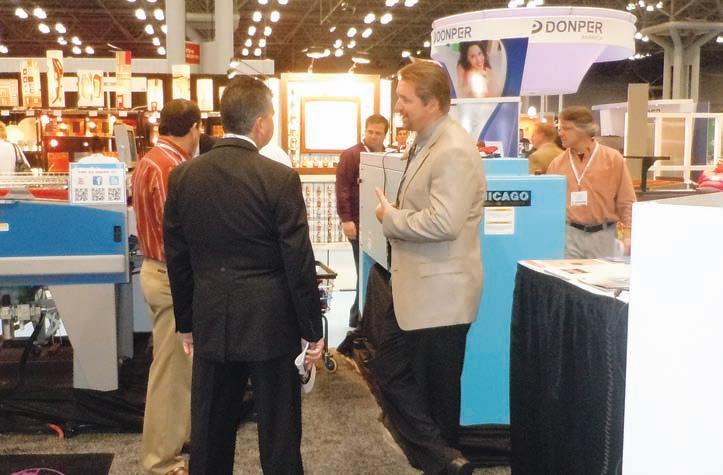
Milnor exhibited a washer-extractor and washer, both with 60-pound capacities, while Chicago® exhibited its new maximumspeed version of its Air Chicago Express high-production small-piece folder. The new folder featuring a continuously running high-speed conveyor is designed to provide faster throughput in a narrower footprint.
“The first day of the show, Sunday, was very slow, but Monday produced some quality leads for us,” says Steve Hietpas, national sales manager for Maytag Commercial Laundry. “There was good interest from owner-operators of smaller hotel facilities of 100 rooms or less, both from the East Coast and the Caribbean.”
Cuddledown, a manufacturer of institutional bedding, pillows and comforters, came to the show “expecting it to be dead – the worst ever – because of Hurricane Sandy,” according to Ryan Scott, a hospitality sales associate for the company. “But it turned out to be much better than expected. We were very pleased, because hospitality represents the fastest-growing segment of our business these days.”
Greg Eubanks, group vice president of Hospitality Sales and Marketing for Standard Textile, echoed that experience. “We expected the show to be really slow,” he says. “But it’s turned out to be a pleasant surprise. It was much better than expected.”
Standard Textile exhibited its Todd-Avery Lenahan Collection of sheets, which are now in use in more than 40 J.W. Marriott hotel properties worldwide, according to Eubanks. The microfilament interior of the sheets provides durability, while the cotton surface
provides comfort. The sheets are laundered with Tide products and delivered clean, fresh and ready-to-use out of the box.
Cintas Corp. teamed with fashion designer Jay Godfrey to present its Fashionable New Apparel Collection, according to Dan Ambrosio, vice president of Global Lodging and Cruise for Cintas. The purpose of the partnership was to create a new line of stylish, distinctive and durable suiting for hotels.
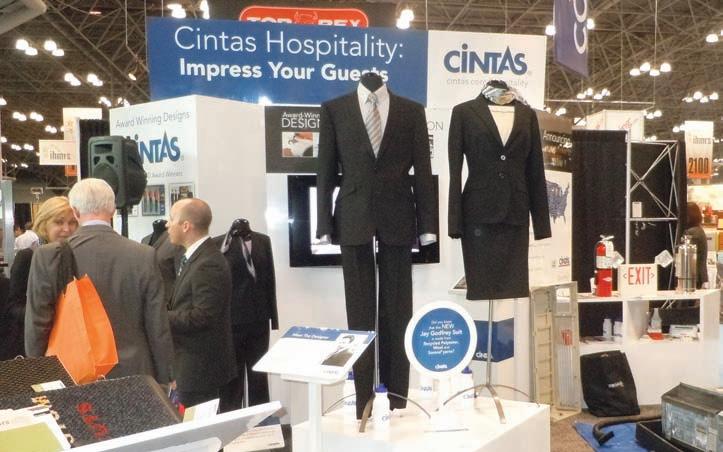
Godfrey collaborated with Cintas to create a distinctively contemporary black suiting collection for men and women. The collection consists of slim-fitting silhouettes with narrow lapels, high-notch collars, shell buttons wrapped in stainless steel and signature jacquard dot-lining with magenta piping.
W Hotels Worldwide debuted the new wardrobe in 28 North American properties and plans to expand it globally. Although the collection is now exclusive to W Hotels, it will become available to all hospitality organizations in early 2013, according to Ambrosio.
The Textile Rental Services Association (TRSA) exhibited to demonstrate how the services of TRSA members can reduce the carbon footprint and increase the profitability of hotel, motel and restaurant operations.
The association emphasized its new Clean Green certification, which provides third-
party verification that the linens, napkins, tablecloths, garments and other reusable textiles obtained from TRSA-certified members are laundered in an environmentally friendly manner.
TRSA gathered market data to help drive future programming. For instance, attendees were asked for feedback on their experiences with contracting for linen services. Many smaller hotel and motel operators appeared to be unfamiliar with the outsourcing option, according to TRSA, and were directed to the association’s website to find a textile services provider.
Proctor & Gamble, the maker of Tide, had a busy second day at the show and enjoyed strong interest in its color-safe products, according to Greg Elmore, an account executive for the company.
Ecolab generated interest with its Aquanomic laundry products, designed for low-temperature washing to achieve energy savings of 30-40%, says Bob Makely, associate district manager.
The IHMRS will convene again in New York in November. ALN
Richard Merli, who resides in Brooklyn, N.Y., is a former editor of American Laundry News.
6 JANUARY 2013 | AmeRicAN LAUNdRY News www.AmericanLaundryNews.com
While attendance at the 2012 International Hotel, Motel + Restaurant Show was reportedly down, exhibitors familiar with the laundry industry say damage from Hurricane Sandy could drive increased demand for replacement equipment and more well into 2013. (Photo: Richard Merli)
Pellerin Milnor Corp. and Chicago Dryer Co. displayed new equipment in a shared booth. (Photo: Richard Merli)
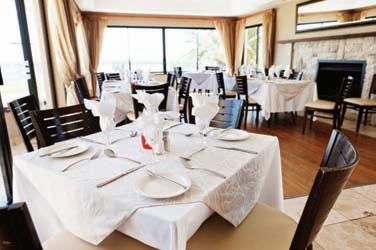
Cintas Corp. teamed with fashion designer Jay Godfrey to present a new line of stylish, distinctive and durable suiting for hotel staff. (Photo: Richard Merli)
SLINGS
PLASTIC
HAMPERS BASKETS
NETS
CARTS FILM COMMERCIAL INSTITUTIONAL
Tools f the Trade
New dual hazard knits protect against arc flash, flash fire

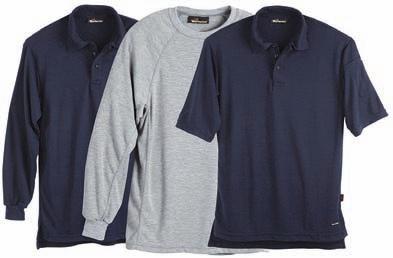
Workrite Uniform Co. has introduced a line of knits with new styling featuring a dual hazard fabric called TenCate Tecasafe® Plus.
The knits protect against both arc flash and flash fire, the company says, and are geared toward both industrial and fire service customers. Workrite is working to have the knits certified to both NFPA 2112 and NFPA 1975, and further report that they meet Hazard Risk Category 2 for NFPA 70E. The line represents a more modern fit and incorporates features such as longer tails, raglan sleeves on the T-shirts and high-low hems on the polos. The dual hazard knit shirts retain their strength,
Sunburst Chemicals has introduced a new line of solid laundry products that are composed of EPAapproved ingredients. Called the Conserv Energy System (CES), the line of products is adaptable to specific laundry needs, uses less water, and can deliver hot-water results with cold-water use to reduce water, heating and electric utility costs, the company says.
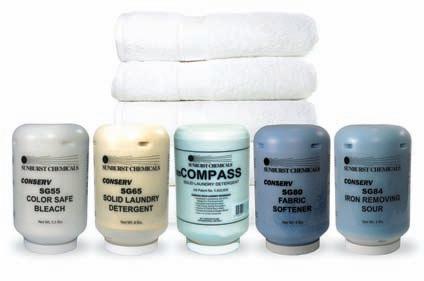
The lineup includes the Conserv SG65 laundry detergent, which is formulated to remove heavy grease and particulate soils; Conserv SG55 color-safe oxygen bleach, which whitens and brightens fabrics in hard, soft, warm or cold water; Conserv SG80 fabric softener, which speeds extraction and drying time while reducing wrinkling and static cling; and Conserv SG84 iron removing sour, which reduces staining problems by controlling metals in the water.
The make-up of the chemicals not only include EPA-approved ingredients, but also a detergent exclusive to their brand, according to Patrick Laughlin, vice
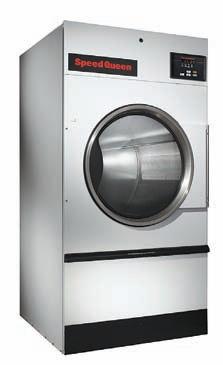
Speed Queen reports that it has upgraded some of its tumble dryers with Over-dry Protection Technology (OPT), and some with reversing technology.
The OPL stack 30- and 45-pound tumble dryers are now available with OPT, while its single-cylinder 25and 55-pound OPL tumble dryers, as well as its 50- and 75-pound vended tumble dryers, are now available with reversing technology.
OPT controls the level of dryness to help sustain the integrity of materials, the company says, reducing fiber loss by as much as 31%. Baffles are used
shape and color after repeated launderings, the company says.
“With the ability to be industrially laundered, they are perfect for all our customers, regardless of what type of [flame-resist] program they are in,” says Charlotte McGee, director of marketing.
The line is protected by a one-year guarantee, and comes in long- and short-sleeved polos in navy blue and a long-sleeved T-shirt in heather gray.
workrite.com/knits 805-981-6502
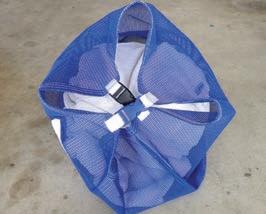
Plexus Industries, in collaboration with Admiral Linen & Uniform Services, reports that it has developed a new closure system for route bags, with no draw cord–or strings–attached.
Called the Buckle Bag, the product design eliminates the issues that can come with draw cords—knots that can’t be untied, cords being cut, bags without cords–and utilizes two side-release buckles made of ballistic plastic, Plexus Industries says.
When placed on a stand and filled with product, the Buckle Bag is closed by locking the opposing color-coded buckles, ensuring that the product stays in place during transport, the company adds. Once the bag arrives at a sorting
station, the buckles are released with a finger pinch and the product is removed. The buckles can also be released when full bags are hanging upside-down.
The company is offering the buckle feature on all of its bags, from the PVC-coated mesh to the woven polyethylene.
plexusindustries.com 619-888-7173
president of sales and marketing. “The foundation of CES is Sunburst’s patented COMPASS solid laundry detergent, an EPA Design for the Environmentapproved product that most often requires no additional chemicals in the washing process.”
sunburstchemicals.com 800-899-7627
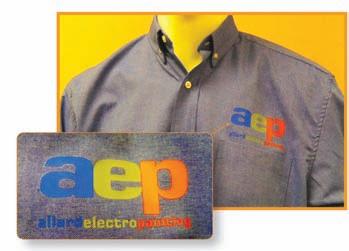
Penn Emblem Co. is releasing a new flame-resistant transfer application combining safety and identity that the company says is safe for use on FR fabrics.
The company says it has obtained certification that meets standards for transfer applications on all FR fabrics.
Launderers that allow Penn to sample a customer’s logo will see that small details are clearly visible and that colors on the transfers are vibrant, the company says.
Product samples and application directions are available from Penn by calling or e-mailing.
pennemblem.com 800-793-7366
as sensors and provide pinpoint moisture readings throughout the entire load.
When the tumbler has reached its preset level of dryness, it shuts off automatically, Speed Queen says.
Reversing technology allows the dryer cylinder to alternate directions, preventing large items such as sheets or tablecloths from becoming knotted and twisted, providing a consistent and even dry, the company explains.
Both OPT and reversing technologies on the company’s tumble dryers are available through its Quantum controls. speedqueen.com 800-590-8872
manufacturers: Have you introduced a new product? Revamped your system? Released a new catalog? E-mail your product news, along with a high-resolution image, to news@ americantrademagazines.com and we’ll consider publishing your news free in Tools of the Trade.

Talley Machinery Corp. is introducing an automated laundry lift table that replaces manual handling and transfer of clean linens with a system that eliminates heavy lifting, speeds work flow and boosts efficiency, the company says.
For use in commercial, industrial and institutional laundries, the table corrals clean, dried linens in a companion laundry truck, which then raises and dumps the linen onto a work surface for folding. The entire process moves automatically through the use of compressed air, Talley says.
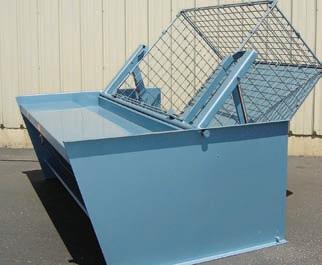
Originally developed by Norman Control, the automated lift tables are offered in a choice of four standard
models with wire trucks, and may be customized to suit various laundries’ production requirements and floor plans.
Talley also manufactures and stocks replacement parts and provides repair services for units in the field.




talleymachinery.com 800-222-9954

8 january 2013 | american Laundry news www.AmericanLaundryNews.com
Solid laundry chemicals formulated to be adaptable to specific needs, use less water
Newly designed route bag comes with ‘no strings attached’
Flame-resistant transfers combine safety and identity
Equipment maker upgrades tumble dryers with over-dry protection, reversing technology
Automated lift table safely removes linens from carts to eliminate manual transfer
tion-sharing between members on such matters has generated new programming for educational institutes and conferences as well as publications, online resources, videos and more.
Membership-wide safety statistics enable TRSA companies to easily compare their improvements to the industry norm and foster further gains.
Data from 2011, reported in 2012, will be released by TRSA shortly.
“Our survey from 2010 covered 59 textile services companies operating 720 processing facilities and depots,” Koepper says. “It showed that in the prior four years, the industry experienced across-theboard reductions in its injury and illness rates. TRSA calculates separate TRIR and DART rates for plants and depots.
“The new report will reflect further reductions. Also, participation in the survey increased in 2012, to 66 companies operating 792 facilities.”
TRIR stands for Total Recordable Incidence Rate. DART is short for Day Aways, Restricted or Transferred.
From 2006 to 2010, TRSA respondents reduced their total number of recordable injuries and illnesses per 100 employees (TRIR Rate) from 9.5 to 5.5, Koepper says. Injuries and illnesses per 100 employees resulting in days away from work, job restrictions and/or job transfers (DART Rate) dropped from 5.8 to 3.9.
TRSA also calculates separate figures for the industrial and linen segments. The new report will cross-reference these with the federal Bureau of Labor Statistics’ (BLS) industry-wide figures, according to Koepper.
In 2011, at TRSA’s request, for the first time in roughly a decade, BLS published separate TRIR and DART rates for textile services (industrial and linen) as opposed to the agency’s prior practice of only consolidating them with all other types of commercial laundry (mostly dry cleaning and coin laundry).
Koepper says TRSA requested this reporting enhancement as a means for tracking future industry-wide improvements.
“Although TRSA and BLS results show that the industry is still short of achieving its ultimate objective—eliminating occupational injuries and illnesses in its facilities—these reports also demonstrate dramatic progress towards achieving that goal,” he says.
TRSA hosted a Safety Summit last year that focused on enhancing safety cultures across the industry.
“It had been four years since the industry conducted a single-subject meeting on safety,” Koepper
says. “Although it was a seminar topic in conferences and educational institutes, too much time had passed since an event dedicated to the subject was held.”
Audiences for prior safetyfocused meetings had consisted mostly of hands-on safety professionals. The Summit concept involved the highest levels of textile services management, elevating TRSA’s involvement in guiding operators in increasing the prominence of safety in their corporate cultures.
“The Summit went beyond day-to-day injury prevention tactics,” Koepper says. “It examined
options the industry could exercise collectively to hire the proper expertise, immediately assess the greatest risks and devise near-term action plans for developing standards and communicating them to operators.”
The TRSA Safety Committee is working on those plans, and a second Safety Summit has been scheduled for May 22 in Indianapolis.
Koepper says he’s seen the industry make great strides in automation in recent decades.
Automated material handling reduces the “manual labor requirement for this purpose. Soil bags are hoisted and carried on rails auto-
matically to washers. Computing drives clean-side garment sorting. To prevent hazardous discharge of energy, smart systems are limiting access to areas where electricity must be controlled to ensure machines don’t start unexpectedly.”
But automation isn’t likely to ever completely eliminate all the different types of human movement required to provide textile services.
“Route service, for example, will always involve an individual walking from a truck to a customer’s receiving area,” Koepper says.
“To reduce exposure, the industry
has increased its proficiency in safer lifting, carrying and pushing. More individuals are cross-trained to perform different jobs in the course of a day to curtail redundant motion.”
TRSA is guiding members in their quest to convince every employee that safety comes first and productivity second.
While it is still a huge job to get to zero incidents in an industry so heavily dependent on athleticism and individual workers’ judgment, Koepper says TRSA is pleased with the gains of recent years and believes more improvement lies ahead.
www.AmericanLaundryNews.com AmericAn LAundry news | JAnuAry 2013 9 continued from Page 1
ALN
safety
2013
Since graduating from the University of Wisconsin with a bachelor’s degree in business administration and marketing, I’ve spent the majority of my career—more than 15 years—in the commercial laundry industry, with a focus on the on-premise laundry segment.
Currently a senior sales manager, I joined the Maytag® Commercial Laundry team in October 2007. To date, I have managed OPL sales throughout the Midwest, Mid-Atlantic and Canadian markets, and I work directly with distributors to ensure our products meet the needs of their customers. Previously, I was a regional sales manager for another commercial laundry equipment manufacturer covering a similar territory. My background also includes working with national accounts that purchase equipment directly for their own use, as well as selling to franchisees.
Maytag® Commercial Laundry offers a full range of commercial washers and dryers to the OPL market through an international network of distributors. Our company is dedicated to developing energy-efficient solutions and dependable products for the commercial laundry market. And in 2008, Maytag® Commercial Laundry celebrated the 50-year anniversary of its entry into the commercial laundry business.
As the industry continues to evolve, so does commercial laundry equipment. From a manufacturer’s perspective, this can create challenges. An excellent example of this is the ongoing objectives to increase the energy and/or water efficiency of equipment, while decreasing the amount of time it takes to do laundry—therefore decreasing labor costs—and providing exceptional cleanability.
2012 was a busy and successful one for Maytag® Commercial Laundry. We introduced an industrial line of soft-mount
PaneL oF exPertS
ready to answer industry questions
washer-extractors available in 180-, 230- and 275-pound models. We also enjoyed continued growth within the OPL market segment and are continuing to work on new product introductions for 2013 and beyond.
Textile Association (ARTA), where I serve on the board of directors, and am a member of the Healthcare Laundry Accreditation Council (HLAC) advisory board. I hold a bachelor of science degree in textile and apparel management from Philadelphia University.
in laundry, dry cleaning and linen management.
Ihave expertise in image apparel and uniform program management, specializing in healthcare laundries. With more than a decade of supplier sales experience, and another 15 years in a mixed-plant linen supply company, I believe my hands-on knowledge base is unparalleled.
I, alongside my father, grew up operating a women’s apparel cutand-sew operation. I am passionate about sharing my knowledge with others and helping them build successful partnerships.
The company I work for, Superior Uniform Group, was founded in 1920 as Superior Surgical Manufacturing. By 1926, its Fashion Seal Uniforms brand was created. After acquiring several other manufacturers over the years, Superior Surgical officially changed its name to Superior Uniform Group in 1998 to better reflect its greatly expanded clientele base.
Superior Uniform produces more than a dozen catalogs, outfitting employees from various industries that include healthcare, restaurant/food service and governmental/public safety. The company has also created a call center division called The Office Gurus, and a digital apparel division called everyBody Media, which were launched in 2008 and 2011, respectively.

I am a board member for the Textile Rental Services Association (TRSA), where I develop and present in-house training programs that can be used in laundries as they seek new, innovative approaches to selling uniforms to the healthcare industry. I am also active in the American Reusable
A couple issues that will present challenges in the new year include market changes and how our healthcare customer base is looking for a new type of uniform look, with new kinds of user-friendly fabrics. I’ll also be thinking about more employee purchase programs as hospital and healthcare budgets continue to be cut.
As director of Laundry Services for The Pierre New York, I am responsible for the day-to-day service, production, distribution, maintenance and procurement for this Five Diamond hotel’s laundry and dry cleaning operations.
During 2012, the laundry processed 2.5 million pieces of rooms and food-and-beverage linen, which represented a 23% increase over 2011. Additionally, it processed more than 350,000 pounds of garments during 2012, representing a year-to-year increase of 11%. Increases in productivity were achieved without any increase in expenses.
The biggest challenges I face at the Pierre today are similar to the challenges faced by the entire industry: providing the best possible products and services at the lowest possible cost.
tion systems, marketing and sales meetings, as well as maintaining many long-term customers in my own Philadelphia area territory.
At Metro-Chem, we manufacture more than 100 laundryspecific products for all laundry needs. We provide innovative, top-quality chemistry to all segments of the industry, but we believe that you can only be as good as your ongoing commitment to service in the field. It is this combination of effective products and a true consultative approach to technical service that I believe helps fuel our sales growth and delivers the greatest good to our individual customers’ businesses.
First, it is an honor to be once again selected for this Panel, and I hope to continue to share the benefit of my experience with the readership of American Laundry News
I have been in the commercial laundry industry for 30 years, having operated healthcare, hospitality and uniform plants throughout the United States. The laundries have ranged in size from 10 million to 40 million pounds annually, and have operated in both union and non-union environments.


I have a wealth of experience in production, distribution and service management, as well as budget preparation and financial analysis—skills honed during my seven years on Wall Street.
During the past nine years, I have concentrated on the hospitality side of laundry management, presently operating an OPL for Taj Hotels at the Pierre New York, as well as serving as a consultant for our sister property, Taj Boston.
I have served on the faculty of NYU, teaching laundry and dry cleaning operations as part of NYU’s Hospitality Management program. I also maintain several industry-recognized certifications
Hello, my name is Phil Bodner, and I am a “soap-man.” I get to wear many hats and mean many things to the customers I serve. I’m pleased to be a part of American Laundry News’ continuing effort to bring new ideas and beneficial information to our industry. I hope to contribute to the conversation and provide whatever insights that my experience will allow.

I live in South Jersey with my wife, Penny. My likes include family, golf, history, politics, current events and dining out with our friends. For the past 28 years, I have worked as a sales representative and sales manager for Metro-Chem Inc., and my expertise in laundry technology extends from shirt laundering, hospitality and institutional, to linen supply and industrial uniform plants.

My responsibilities have included new product ideas and testing, hiring and training field technicians, procurement and engineering of automated injec-
As a company, we stay abreast of everything from local water conditions and water restrictions, to wastewater regulations and new types of textiles and garments. As such, we’ve been busy in 2012 developing a new activated chemistry to help perform well in lower temperatures, lower pH, and with fewer oxidizers required. This concept is moving us toward shorter wash formulas with importance placed on less water consumed per load.
We have also done our due diligence and created several new non-NPE surfactant-based detergents with exciting results. These formulations are more readily biodegradable for those that desire, or are required to take, a greener path toward laundry production.
I would like to wish everyone a Happy New Year, and I hope that 2013 will provide opportunity, renewed prosperity and happiness to all in our industry and our country.
10 january 2013 | amerIcan Laundry newS www.AmericanLaundryNews.com
Iwork for Linen King, which owns laundries in several states. We provide COG (customerowned goods) service, as well as linen rental to hospitals. I am the general manager of the facility in
commercial Laundry
Richard Warren
Linen King Conway, Ark.
Hotel/motel/ resort Laundry Charles Loelius The Pierre New York New York, N.Y.
This year’s contributors introduce themselves, describe their operations, identify challenges, and list their accomplishments for 2012
uniforms/ workwear manufacturing
Superior Uniform Group
Fla.
Metro-Chem
Panel
equipment manufacturing Steve
Hietpas
Maytag® Commercial Laundry St. Joseph, Mich.
Scott Delin
Seminole,
chemicals Supply Philip L. Bodner
Kearny, N.J.
Conway, Ark. I have been here since Linen King acquired the facility from my previous employer in 2007, and am honored they kept me. I have worked at this facility since 1994.
Upon high school graduation, I had no idea what to do. Some said I had no clue. The first real job I had was in a shirt laundry. They must have liked me, because I was promoted to washman. It seemed like wherever I went, there was always a laundry that needed help, and I was fortunate to be able to provide that for them.
I got involved with an industrial laundry and learned a lot during the years I was with it. My production experience started in an industrial laundry. For several years, I owned a small group of leather and fur cleaning stores. For many years now, I have been in the healthcare laundry service, both OPL and commercial.
From time to time, I talk to people about careers in laundry. It certainly doesn’t sound like a sexy career, but it is a good industry, and is generally more stable than many other industries. There are also many companies that supply our industry with textiles, machinery and chemistry, so being involved with a laundry can be rewarding.
Our workers really enjoy coming to work, and reducing the big pile of unfinished linen. An hour or so later, that pile is ironed, folded, and looks, feels and smells nice, with the workers ready for another load. Frankly, it takes a while to learn the rhythm, but when it starts to work, it is fun.
best practices, develop utilization programs, develop linen awareness/use and misuse recommendations, and implement staff development programs. In 2012, we implemented a successful linen-reject program that utilizes the end-user to help improve quality by removing unacceptable linen items at the point of use.
I’ve researched staining concerns, as well as ozone applications in laundry (NMMC was one of the first U.S. facilities to place an ozone system on a CBW®); provided education on topics that include bed bugs, safety, infection



control, etc., at a local and national level; and have written articles for NMMC’s bimonthly Check-up magazine.
I was asked to take on the role of laundry director in February 2008. To become better informed, I turned to the American Laundry and Linen College (ALLC) in Richmond, Ky.
I received my CLLM certification from the Association for Linen Management (ALM) in July 2008 and my RLLD certification in March 2012. I serve as president of the association’s Tri-State Chapter, administrative secretary



on its national Board of Directors, member of its Scholarship and Membership committees, ALLC facilitator for fall 2012, and as a member of a variety of focus groups on a wide range of projects.
Challenges abound in the linen industry. Though it’s truly a manufacturing process, this industry has its own niche.
One universal challenge has been the implementation of the latest Association of Perioperative Registered Nurses (AORN) recommendations regarding reprocessing scrub apparel. NMMC

had been successfully home laundering for years. Processing the scrubs added more than 17 hours of labor to our work day but we received no additional FTEs. Implementing lean processing concepts, learning how other laundry plants were succeeding, and networking with many industry experts has allowed us to adjust and conquer. We’re now researching anti-wrinkling technology and automated scrub-processing equipment.
Another challenge is having to
My background is in education, nursing and quality. I started working for North Mississippi Medical Center (NMMC) in the Education department in February 1988. Via scholarship, I received my associate degree in nursing from Itawamba Community College in June 1991, and my bachelor of science degree in nursing from the Mississippi University for Women in May 1996. During this time, I worked full-time as a staff nurse, charge nurse and in administration.
NMMC has been instrumental in helping me achieve my educational goals and to grow within the organization.
In 1997, I became a clinical liaison for Materiel Management and served as a clinical resource for purchasing, sterile processing, laundry, nursing, surgery, etc. I worked with nursing to develop linen specifications, determine

www.AmericanLaundryNews.com AMericAn LAundry news | jA n u A ry 2013 11 ELLISCORP.COM To receive the complete test data document simply scan here. Or contact Ellis Corporation at: info@elliscorp.com / call 630-250-9222 FASTEST, QUIETEST, MOST EFFICIENT GUARANTEED! Introducing the New Ellis Here’s the Proof: :: New terry towels, nominal 450 lb. weights Averaged 21.76 Minutes at 1651 BTU’s Per pound of water removed. :: New terry towels, nominal 250 lb. weights Averaged 15.23 Minutes at 1910 BTU’S Per pound of water removed. 123098_ELLIS Whisper ALN Ad.indd 1 12/4/12 2:24 PM ALN_Jr Page.indd 1 12/4/12 3:25 PM See EXPERTS on Page 12 Healthcare Laundry Judy Murphy, RN, BSN, CLLM, RLLD North Mississippi Medical Center (NMMC) Tupelo, Miss.
process 6-7 million pounds per year using older, poorly maintained laundry equipment in an older, poorly designed facility.
Fortunately, I work for a company that focuses on quality and customer service (currently the only two-time healthcare winner of the Malcolm Baldrige National Quality Award, in 2006 and 2012) and understands the need for an educated, well-trained staff, stateof-the-art equipment and lean processing concepts.
We’ve been able to slowly replace outdated equipment, and are planning a modern, state-ofthe-art, energy-efficient (possibly LEED-certified) facility with pack room and sterilization capabilities. Our goal is to efficiently process 15 to 20 million pounds of linen per year, with plans to begin operations within the next 18 to 24 months.
In an uncertain future, survival will depend upon our ability to continue to develop and implement best practices, forward “out-of-the-box” thinking, and lean concepts in an effort to become a truly lean, green washing machine.
independent laundry with six routes serving the San Francisco Bay area. Like most laundry companies, there is a real challenge in finding and establishing long-term employees. However, by creating procedures designed to empower employees, Golden West has created a strong retention program.
The last few years of economic belt-tightening has had a profound effect on our industry.
Adapting to an ever-changing economy requires reviewing and modifying policies, procedures and practices.
While identifying key areas for profit and setting practical costcutting measures in 2012, Golden West experienced one of its most successful years for growth and profit. I am excited about the opportunities in 2013, and enter into the new year with the understanding that change is more than a mindset.
out the need for added expense or equipment.
As the fourth generation of my family in this industry, I have a lifetime of experience and more than two decades of professional work in laundries, starting with my tenure as vice president and, later, president of Consolidated Laundry Machinery Co. I worked in all aspects of CLM’s manufacturing, sales and marketing of laundry machinery, and helped our customers with specification, layout, upgrades and improvements to their plants.
Iam the operations manager for an independent industrial laundry located in the San Francisco Bay area. Starting in 1980, delivering linens and mats to the mining industry of northern Minnesota, I have held management positions in sales, service, production and administration. The position of operations manager suits me well, as it affords me an opportunity to interact and direct all departments while drawing on a vast wealth of experience.
Golden West is a family-owned,
Iam senior vice president of Turn-Key Industrial Engineering Services, a consulting firm that has been serving the laundry, healthcare and hospitality industries for nearly 15 years. We are an industrial engineering firm that designs, builds, retrofits and improves the processes and profitability of laundry facilities throughout the world, using professional design, lean manufacturing and project management techniques.
As our name implies, we perform these services “turn-key,” which means we can deliver a multitude of services, including facility design, RFP development, project management, process improvement and Lean Six Sigma implementation. Our team of certified engineers and consultants have extensive experience in the industry, and have helped our clients save money, labor and increase throughput, often with-

Scott Beaton, Kaiser Permanente Northern California
Steve Clark, Laundry Equipment Services

David Dersheimer, formerly with SITEX Corp.
Ronald Evans, RJ Evans & Associates
Tom Gildred, Emerald Textiles
Steve Kallenbach, American Dawn
Tom Langdon, Encompass Group

Steve Marcq, General Linen Service Co.
JR Norris, Delta Uniform & Linen
Kim Shady, Laundrylux Corp.
Douglas Story, Swisher Hygiene
Marlene Williams, Anderson Chemical Co.
I moved into industry advocacy and education as the director of Plant Operations, Customer Service and Information Technology for the Uniform and Textile Service Association (UTSA). The industry was under close scrutiny by OSHA, Congress and safety regulators at that time, and I led the effort to create an industry-wide health and safety program that reached more than 65,000 employees in more than 1,000 plants nationwide, produced an industry-specific safety training DVD, and created a stronger, more positive relationship with OSHA and Congress for the industry.
Following UTSA’s merger with TRSA, I spent more than three years as the chief operating officer at F-MATIC, where I helped lead the development of several new sanitary supply products and product lines, improved and diversified the company’s international supply chain, reduced operating expenses and increased revenues.
I am a past chairman of the UTSA Plant Operations Committee, a former member of the Western Textile Services Association board of directors, a long-time instructor at the industry’s Production Management Institute (PMI) and Maintenance Management Institute (MMI), and a recent addition to the faculty of the American Laundry and Linen College (ALLC). I am also honored to be among an elite group of industry leaders to have been named to the Plant Operations Hall of Fame.
I hold a bachelor’s degree from the University of California, San Diego, and live in Park City, Utah, with my wife and two daughters. I am an avid cyclist, skier, sailor and private pilot. What challenged our clients in 2012 was the continuing difficult economy and the need to find ways to adapt. Laundries in all segments of our industry fought to increase productivity and safety, while dealing with ever-increasing costs of doing business, challenges from unions, and increased regulation. These challenges will no doubt continue in 2013 and beyond, and I expect my colleagues and I, both at Turn-Key and on the esteemed Panel of Experts, will increasingly be called upon to assist the industry with meeting them head-on.
Among Turn-Key’s accomplishments in 2012 were designing and breaking ground on a new healthcare laundry for a client in Florida, designing a new state-of-the-art hospitality laundry for a major international resort and entertainment firm, and helping numerous operators (both large and small) reap the financial and productivity benefits resulting from the implementation of process improvement and the application of Lean Six Sigma methodologies.
in business. I reside in Orlando, Fla., with my wife, Lisa, and our daughters Taylor and Jordan.
As regional vice president for Steiner-Atlantic Corp., I am responsible for sales and service in the central Florida market. Steiner-Atlantic, founded in 1959 by William Steiner, is a large laundry, boiler and dry cleaning equipment, parts and service distributor, with its core business in Florida and the Caribbean.
Upon graduating from college, I set out on my path to a successful sales career by working for Controlled Motion, a small company selling power transmission to equipment OEMs and endusers. My mentor, Tony Harris, taught me the importance of listening and recognizing what my customers needed. I owe much of my success to him.
After working for him for five years, my journey shifted to selling textile sock dyeing and packaging equipment. This move led to my start in the laundry business, when David Carter hired me to cover the central Florida territory for Wink Davis Equipment Co. in 2001. Upon completing my training, I relocated from Charlotte to Orlando. In 2004, when Wink Davis closed its doors, another door opened for me with Steiner-Atlantic.
equipment/ supply distribution
Mike Steiner, our president and CEO, brought me on board to continue servicing our central Florida market. At SteinerAtlantic, we provide customers with turn-key solutions from design-build to equipment sales, installation, start-up and training, with continued parts and service.
Igrew up in Charlotte, N.C., with two loving parents. I have an older sister and a twin brother, and our parents instilled in us the value of hard work, education and moral character, which shaped the adults we are today.
I get my competitive spirit from playing sports throughout my early years. I graduated from Mars Hill (N.C.) College in 1993 with a bachelor’s degree
I am honored to have received many sales accolades, including Chicago Dryer Co.’s “Rising Star” and “Heavy Hitter” awards, and multiple Pellerin Milnor “Key Man” awards. This past year, I also received our local Association for Linen Management chapter’s Allied Tradesman of the Year award.
I look forward to the challenges of 2013, and hope that you will find some of the articles that I participate in to be informative and helpful.
ALN 12 january 2013 | amerIcan Laundry news www.AmericanLaundryNews.com
experts continued from Page 11
Bill Bell Steiner-Atlantic Corp. Miami, Fla.
Textile/uniform rental
Tom Peplinski Golden West Oakland, Calif.
consulting services
David Bernstein Turn-Key Industrial Engineering Services Charlottesville, Va.
american Laundry news wishes to thank the members of the 2012 Panel of experts for their service:
(Photo: ©iStockphoto/Ivelin Radkov)
Alliance Laundry promotes Bittner, honors Brothers
RIPON, Wis. — Alliance Laundry Systems has promoted Bill Bittner to vice president of North American sales. He succeeds Jeff Brothers Sr., senior vice president, who is retiring after 35 years of service.
Track Career
leadership roles in sales, manufacturing, and genuine parts. He most recently served as vice president of Customer One, the global company initiative focused on customer service.


For 35 years, Brothers has served as an important and respected leader in the commercial laundry industry, having made “significant contributions that have helped the company achieve the market success that it continues to build upon today,” Alliance Laundry says. He participated in three major acquisitions and the integration of those companies, resulting in “significant market share, sales and profit growth.”
Bittner is responsible for managing Alliance’s brands, which include Speed Queen, UniMac, Huebsch, IPSO, and Cissell, through a team of national sales managers and their respective regional sales managers. Additionally, he will oversee pricing, budgets, forecasts, sales promotional activity and distributor development.
During his 15-year tenure at Alliance, Bittner has held a wide variety of positions that include

“I want to thank Jeff for his years of service and dedication to Alliance Laundry Systems, and wish him the very best in his retirement,” CEO Mike Schoeb says. “While he will be deeply missed, he has earned the opportunity to enjoy more time for his leisure interests and his family.”
O’FALLON, Mo. — Phoenix Textile Corp. has appointed Geoff Mayo to the newly created posi-



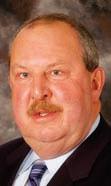
tion of director of key accounts and commercial laundries.
In his new role, Mayo brings with him more than 25 years of industry experience, and will represent the company to large-scale commercial laundries across the nation.
“His experience and knowledge of the industry will support Phoenix’s mission to serve the needs of its customers,” says Scott Rodgers, vice president of sales.
A graduate of the Carlson School of Management at the University of Minnesota, he previously served as senior vice president of operations and partner with Lintex Corp.
He was also executive vice president of the Extended Care Division for Encompass Group and division director of healthcare for American Dawn.
Kemco hires Borden as exec VP of global sales and marketing
CLEARWATER, Fla. — Kemco Systems recently hired Don Borden Jr. as its executive vice president of global sales and marketing.
Borden has spent his professional career as an operating executive in general manufacturing and high technology industries. A majority of his experience is in the fluid handling industry, primarily in the water and wastewater arena.
Prior to joining Kemco, Borden served as president of Crane Environmental and as international vice president at GAITronics, with a record of implementing Six Sigma and LEAN Manufacturing.
Borden holds a bachelor of science degree in water resource engineering from Pennsylvania State University, and a master’s degree from the University of Pennsylvania.
Kannegiesser USA adds Tannert to sales team
GRAND PRAIRIE, Texas — Dave Tannert has joined the sales team for Kannegiesser USA, where he will serve as a regional sales manager in Huntington Beach, Calif.
He holds a bachelor of science degree in manufacturing technology, and has experience in OEM sales to the aerospace, heavy equipment and durable consumer goods sectors.
His responsibilities have included business development and account management.
Leybelman joins Penn Emblem staff
PHILADELPHIA — Rita Leybelman has joined the Penn Emblem Co. marketing department, serving as its Internet marketing coordinator. She will oversee and develop social media initiatives and work to increase the company’s Internet presence. ALN
Phoenix Textile appoints Mayo to new position
www.AmericanLaundryNews.com AmericAn LAundry news | JAnuAry 2013 13 For over 50 years U.N.X. INCORPORATED has been involved in the development of products that not only solve quality problems that exist at the moment, but also provide long term benefits to the customer and the environment in which we live. U.N.X. was built on the foundation of improving the industry in which we participate. U.N.X. prides itself on being an industry leader with state-of-the-art products and dispensing equipment, and our plans for the future are extraordinary. With a Research and Development team second to none, U.N.X. is in a position to provide the industry with the most technologically advanced products and dispensers as possible. U.N.X. INCORPORATED 707EArlingtonBlvd Greenville,NC27858 (252)756 8616 www.unxinc.com ALN_Tab_half 10/9/12 2:40 PM Page 1
Brothers Bittner
Tannert
Borden
Mayo
PRODUCT SHOWCASE HEATGENERATING EQUIPMENT

PICK HEATERS
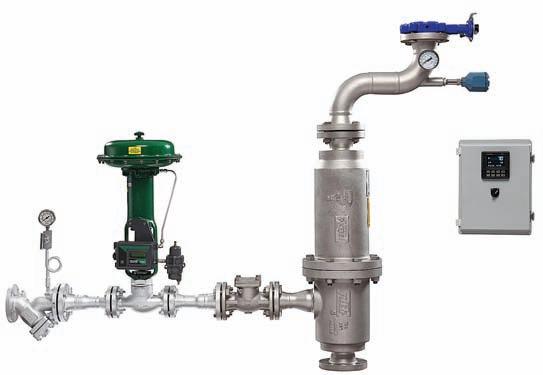
The Pick Constant Flow Direct Steam Injection Heater offers a constant flow of heated liquid at a precisely controlled temperature. The heater delivers a compact system, including all piping, valves and controls that can be easily customized to meet customer specifications.
The company calculates a 16% steam savings through its Energy Savings Comparison Program. This energy and cost savings existed even after considering the added cost of treating boiler feed make-up water resulting from condensate no longer being returned to the boiler, Pick says.
pickheaters.com 262-338-1191
KEMCO SYSTEMS
Kemco Systems offers a 97%-efficient TE-100 direct contact water heater, which, according to the company, reduces water heating costs by 35% to 40%, as well as provides instant, continuous hot water with temperatures of up to 190 F. USDAapproved, the stainless steel TE-100 offers a small footprint and easy operation.

Kemco’s stainless steel Boiler Stack Economizer helps to recover up to 100% of the heat going up a stack, providing continuous hot water by using the latest in energy-efficient heat-transfer technology.
kemcosystems.com 800-633-7055
REIMERS ELECTRA STEAM
Reimers Electra Steam manufactures electric steam boilers and associated equipment specialized for the dry cleaning and garment industries.
The company says it offers compact boilers that fit under a utility press and can be installed without a condensate tank when using Reimers PC-20 piping package.
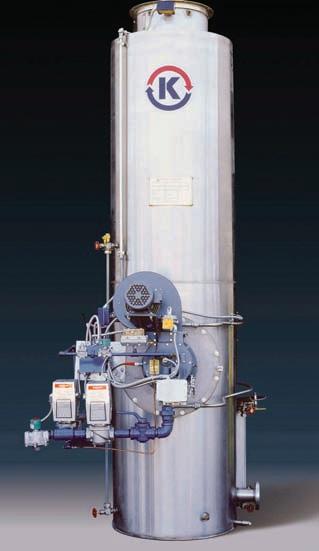
The boilers meet the codes within the United States and Canada, are manufactured and designed to the A.S.M.E. Boiler Code, and have a U.L. Listing, Reimers says.
reimersinc.com 540-662-3811
NATIONAL COMBUSTION CO. (NATCO)
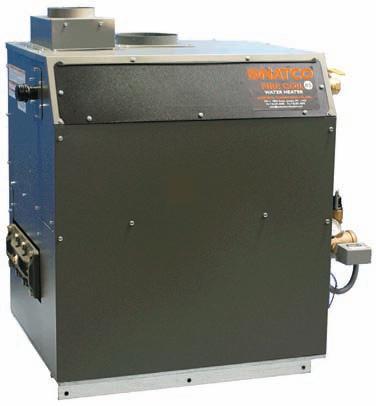
National Combustion Co.’s (NATCO) Fire Coil 85 is a midefficiency (85%), direct-vent, gasfired water heater. It combines the reliability and ease of maintenance of the original NATCO Fire Coil with environmentally responsible low-NOx emissions and venting flexibility, the company says.
In commercial laundry facilities, fresh air for combustion can be a serious problem—atmospheric heaters that depend on passive fresh-air inlets can run unreliably when other equipment draws fresh air, NATCO explains. A fan-assisted, sealed combustion water heater like the Fire Coil 85 maintains its efficiency by drawing its combustion air directly from outside. This also helps ensure good indoor-air quality, as the products of combustion are never open to the inside space, the company says.
Fire Coil 85 water heaters
circulate to a storage tank, and can maintain water temperatures of up to 165 F without a booster heater. nationalcombustion.com 888-OK-NATCO
CLAYTON INDUSTRIES
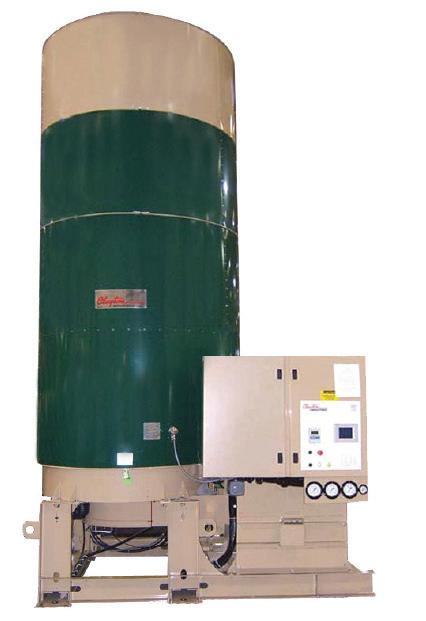
Clayton Industries’ new 1,500-horsepower boiler was designed to meet and exceed the laundry industry’s growing demands for energyefficient heat-generating equipment, while reducing an environmental footprint, the company says.
The boilers offer a quick startup and shut-down, generating clean steam in only 10 minutes, according to Clayton. They need only to be turned on for production, and turned off immediately afterward, which offers laundries an opportunity to lower operating savings.
All Clayton boilers, including its Sigma-Fire™ Signature Series, are 100% explosive-proof, the company says. claytonindustries.com 800-423-4585
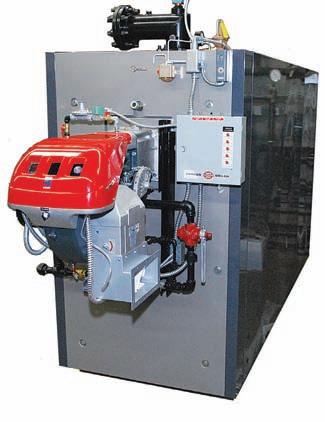
PARKER BOILER CO.
The Parker Boiler Indirect Fired Water Heaters are heavy-duty, packaged boilers used to heat water for laundries, coinoperated laundries and industrial laundry applications, the company says.
The WH Series boilers are available from 300,000 to 3,000,000 Btu input. They can heat water in the low-temperature, 60-degree to 100-degree range without flue gas condensation, and up to 190 degrees without burning out the heat transfer coil.
Boilers are available in natural gas, propane and low-NOx firing, and the company also offers 316 stainless steel heat exchangers or copper/nickel heat exchangers as an option.
The company now offers the TC Series of condensing hot water boilers available in sizes from 399,000 to 5,443,000 Btu input
14 JANUARY 2013 | AMERICAN LAUNDRY NEWS www.AmericanLaundryNews.com
[Reimers Inc.]
Hot water is necessary for traditional laundering processes, but laundries also need steam for presses, continuous batch washers and other equipment. That means that commercial boilers and water heaters are virtually indispensable to nearly any laundry operation. Here, some of the major manufacturers and suppliers of heat-generating equipment share their newest and most popular product offerings.
[National Combustion Co.]
[Pick Heaters]
[Parker Boiler Co.]
[Clayton Industries]
[Kemco Systems]
COMPILED BY JEAN TELLER, CONTRIBUTING EDITOR
with stainless steel construction for resistance to corrosion at low operating temperatures.
The units are available with conventional gas burners or low-NOx power-type burners.
parkerboiler.com 323-727-9800
Raypak
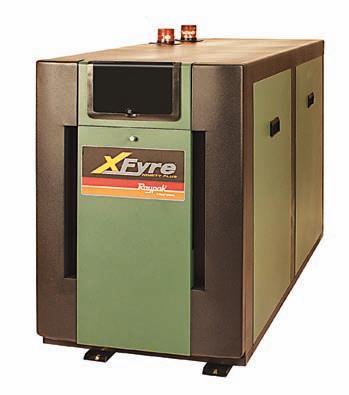
Raypak recently introduced its VERSA IC™ fully integrated boiler control. The new system improves on the Raypak control platform developed 20 years ago.
The new modulating or stage fire VERSA IC™ integrates temperature control, ignition, safety and individual fault monitoring,
and it is field-upgradable.
Raypak’s Cold Water Protection control function is now built in; laundry owners can simply add an appropriate 3-way valve or variable-speed pump. A Modbus communications port is standard for continuous monitoring, trending, and troubleshooting.
The VERSA IC™ control platform is now incorporated into Raypak’s XFyre modulating condensing, hydronic, and domestic hot water boilers. raypak.com 805-278-5300
LudeLL ManufactuRing co.
The Direct Contact Water Heater (DCWH) from Ludell Manufacturing Co. is designed for energy efficiency, heating by a method different from that of a conventional boiler. Efficiencies up to 99% can be achieved and hot water provided instantaneously with this technology, the company claims.
The Ludell high-efficiency Direct Contact Water Heater design simplifies the energy-heat transfer by placing the process water with the combustion
boiler inspections; no tubes to rodout or replace; no need to chemically treat or deaerate feed water; stainless steel construction for equipment longevity; having hot water when needed; a quick return on investment (with 30% water-heater fuel saving being typical); and minimal equipment maintenance, says Ludell, a division of Ellis Corp. ludellmanufacturing.com 800-558-0800
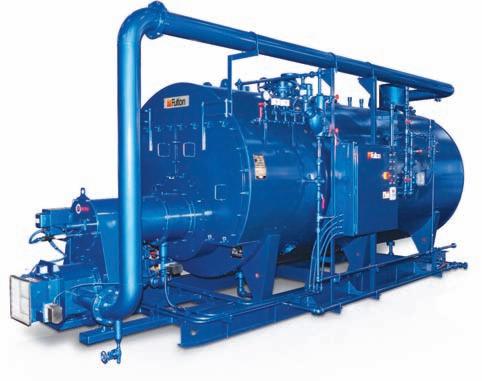
BHP, and up to 300 psig. The furnace is corrugated to maximize efficiency while also minimizing thermal stress. The FBS boiler has a liberal steam-release area, making it an ideal choice for lowpressure steam applications, the company says.
Fulton horizontal firetube boilers are used in a variety of applications throughout many industries. Large-scale laundry operations utilize Fulton horizontal boilers to provide a steady supply of steam for ironers and presses, and steam injection for washers and tunnels.
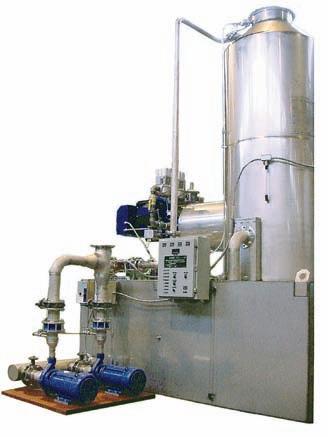
source. That is, the process water is heated directly by the combustion exhaust of the natural- or propane-gas-fired burner.
Ludell says it can maximize profits by supplying a stainless steel system with a compact footprint and easy-to-assemble pre-piped and pre-wired, match-marked pump-and-valve assemblies. The complete system concept greatly reduces installation time and on-site set-up, the company adds.
Some benefits include no required special pressure vessel permits; no required certified
Disinfect with AdvaCare
fuLton
The Fulton FBS boiler product line includes a variety of models ranging in size from 60 to 800
A full range of ancillary equipment also is available.
[Fulton] [Ludell Manufacturing Co.]
fulton.com 315-298-5121
Healthcare linens need to be disinfected, anything less is not clean enough.
The EPA is THE regulatory body with authority over products claiming to have antimicrobial activity.
AdvaCare™ Disinfectant is an EPA-Registered laundry disinfectant that kills:
Staphylococcus aureus, MRSA, E. Coli, Pseudomonas aeruginosa, Acinetobacter baumannii Listeria monocytogenes. (EPA Reg. No. 1677-193) and

www.AmericanLaundryNews.com AmericAn LAundry news | jA n u A ry 2013 15
™ ©2013 Ecolab USA Inc. All rights reserved. 800 553 8683 laundry@ecolab.com
“Clean enough” isn’t an option anymore. Choose AdvaCare™ Disinfectant and step up to a disinfection level of clean. ALN_Tab_half.indd 1 12/5/12 4:07 PM
[Raypak]
AmeriPride plant earns first TRSA Hygienically Clean Healthcare nod
ALEXANDRIA, Va. — AmeriPride Services’ Twin Falls, Idaho, commercial laundry is the first ever to earn TRSA’s Hygienically Clean Healthcare designation, recognizing the plant’s commitment to cleanliness measured through thirdparty, quantified biological testing and inspection.
The certification process utilized by the Textile Rental Services Association maximizes objectivity in verifying that textiles cleaned in a laundry meet hygiene standards appropriate for medical facilities. The designation is a variation of the association’s standard Hygienically Clean seal, which is suitable to any type of business that uses garments, linens, towels, floor mats, mops and other professionally laundered items.

Hygienically Clean Healthcare inspection protocols emphasize scrutiny of techniques for compliance with OSHA’s bloodborne pathogens standard. To attain either designation, a laundry must deploy best management practices (BMPs) and pass bacteriological testing and facility inspections.
A laundry is not required to use particular processes, chemicals or BMPs to achieve certification—whatever tactics management feels are necessary can be used to achieve TRSA’s Minimum Performance Specifications as measured by bacteriological testing. But BMPs must be documented in a written quality-control manual.

“Congratulations to AmeriPride and their Twin Falls management on the attainment of this industry milestone,” says TRSA President/CEO Joseph Ricci. “This achievement proves their dedication to building their customers’ confidence that their laundry takes every step possible to prevent human illness.”
Despite sentiment that bacteria need not be measured to verify laundry cleanliness, TRSA sees such assessment as vital. The International Standards Organization (ISO) emphatically states that certifications of processes do not reflect product quality. Only if a product itself is subjected to a certification standard can the product label or package be embellished with a certification conformity mark. While there is no U.S. standard for bacterial content in textiles,
TRSA prescribes to internationally recognized thresholds established by Germany’s Hohenstein Institute.
Maytag Commercial Laundry sales school readies attendees to compete

ST. JOSEPH, Mich. — Attendees of a recent Maytag University Factory Commercial Laundry Sales School received in-depth, hands-on training of the company’s multisegment product portfolio. In addition, education sessions delved into the company’s energy calculators, financing options and market discussions specific to the on-premise, coin, and multi-housing and segments.
“Whether you’re new to the business or a veteran, our sales school is designed to arm you with the necessary knowledge to compete in the marketplace,” says Rex Braden, national sales manager at Maytag® Commercial Laundry. “The sales school combines selling information into a collaborative and educational setting.”
The 16 attendees representing Canada and the United States toured a local hospitality facility, explored Maytag’s state-ofthe-art testing lab, and compared competitor offerings.
“We learned about what works and what doesn’t work when selling commercial laundry equipment and route services,” says attendee Kellie Blumberg, president and owner of Texas Coin and Commercial Laundry. “This experience will help me close even more sales.”
“We provide our distributors with the competitive advantages of Maytag® Commercial Laundry equipment, as well as the latest industry information,” Braden explains. “Attendees have the knowledge necessary to best support their customers and close sales.”
SK Textile, Standard Textile partner to open new manufacturing facility
CINCINNATI — SK Textile, a custom fabricator of drapery, bedding and accessories, has partnered with Standard Textile to open a new manufacturing facility in Las Vegas.
The facility will provide improved convenience and efficiency for SK Textile’s Las Vegas clients. It allows SK Textile to better support local hotels, purchasing companies, and
designers in providing customized interior solutions for the hospitality industry, and positions the company to respond more quickly to increasing demand.
“We are experiencing a very exciting period of growth and expansion in Las Vegas,” says Kim Heiman, SK Textile president. “The manufacturing facility in Las Vegas will help SK Textile meet market demand and establishes a presence near our customers.”
The partnership allows SK Textile to leverage Standard Textile’s vertically integrated global infrastructure and positions SK Textile for additional growth.
The manufacturing facility in Las Vegas will serve to augment SK Textile’s production capacity in Vernon, Calif.
Alliant Systems, Performance Matters form strategic partnership
FORT MILL, S.C. — Performance Matters, a strategic consulting company dedicated to the textile rental services industry, and Alliant Systems, a provider of route automation solutions for textile rental companies, have formed a new partnership, the companies report.
Both organizations see this as a unique opportunity for their mutual clients to gain significant competitive advantages in the marketplace.

“We are proud to align Alliant Systems with Performance Matters. Their experience in revenue generation, route optimization and strategic planning makes them an ideal partner,” says Jeff Belcher, Alliant Systems president. “We pride ourselves on providing innovative tools for textile rental companies that create functionality for our clients and keep us at the forefront of route accounting and related technologies. Performance Matters’ strength is their ability to execute on our tools and maximize our offerings.”
“Joining forces with Alliant Systems is a natural partnership,” says Troy Lovins, president and founder of Performance Matters. “We both understand the value in straightforward processes and keep clients in the forefront with planning tools to elevate their company and increase their revenue stream. Our partnership will bring value to Alliant’s clients, (and) benefit their customers and the whole Alliant Systems team.”
16 JANUARY 2013 | AMERICAN LAUNDRY NEWS www.AmericanLaundryNews.com
New consulting firm aims to improve people, processes, profits
SADDLE BROOK, N.J. — Longtime industry operator and consultant J.R. Ryan has launched TBR Associates, a new company in the Tingue family of companies focused on helping linen, industrial and institutional laundries and manufacturing companies to reduce operating costs, save energy, increase capacity, and more.
Combining Ryan’s 30-year track record of operational expertise, senior-level management, sales growth and consulting with the Tingue organization’s 110 years of accumulated wisdom, TBR Associates devises, develops and implements custom strategies based on proven principles (including Lean Enterprise and Six Sigma) for quantifiable, sustainable results.
“As both a successful owner-operator and as a consultant, J.R. offers a rare understanding of the challenges facing laundries today and has the knowledge, experience and professionalism to deliver real results,” says CEO David Tingue. “His ideas are sensible, insightful and logical, he’s careful to involve everyone on the team in the process, and I know he’ll be quite an asset to anyone concerned about reducing costs or improving margins.”
Ryan addresses strategic planning, process improvement, operations, sales and service management, supply chain management, human resources and equipment to impact every facet of an organization.
Washing Systems honored for green chemistry, pollution prevention
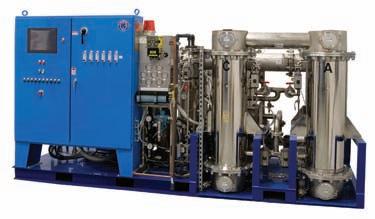
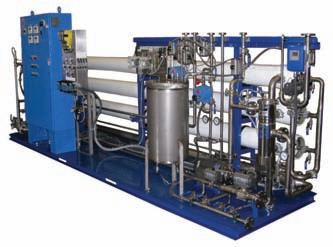
WASHINGTON — The National Pollution Prevention Roundtable has named Washing Systems LLC (WSI) the recipient of the 2012 MVP2 Award, for the company’s “outstanding, innovative achievements in pollution prevention.”
The selection is the result of WSI’s achievement in developing the Pure Solutions Line of Green Chemistry, a complete line of NPE-free detergents, zero-phosphate and zero-EDTA builders, and BioSolve, an environmentally friendly solvent.
Candidates for the award were judged on innovation, measurable results, transferability, commitment, and optimization of available project resources.
WSI committed its organization, beginning in 2005, to develop leading-edge innovations and chemistry that has enabled customers to improve their environmental footprint and profitability. NPE-free detergents that were developed gained U.S. EPA Design for Environment (DfE) approval;
WSI reports that implementation of the detergents has helped its customers reduce NPE releases by more than 4.5 million pounds annually.
A green builder, Structure, formulated to eliminate the use of phosphates and EDTA, was introduced in 2011. Also that year, WSI eliminated petroleum-based solvents from its formulas by introducing BioSolve, a non-hazardous, bio-based solvent.
“The fact that our customers have noticed improved cleaning quality, no increase in costs, and the positive environmental impact is collectively most exciting for our team,” says Roy Praechter, vice president of research and development for WSI.
The National Pollution Prevention Roundtable is a national, non-profit forum that promotes pollution-prevention efforts. Its members include state and local government programs, small-business assistance networks, industry associations, federal agencies, and more.
UNITE HERE elects Taylor president
NEW YORK — The governing body of UNITE HERE recently elected D. Taylor as president. John Wilhelm, who had served as president since 2009, retired at the Nov. 29 meeting of the union’s General Executive Board.
UNITE HERE represents workers throughout the United States and Canada who work in the hotel, gaming, food service, manufacturing, textile, distribution, laundry, and airport industries.
Taylor leads UNITE HERE’s largest affiliate, Local 226 in Las Vegas (also called the Culinary Workers’ Union). Representing 60,000 workers, Local 226 is widely recognized for leading the transformation of hospitality jobs from lowwage, insecure work to stable, middle-class occupations, UNITE HERE says.
Taylor served as Local 226’s staff director from 1990 to 2002 and secretary-treasurer since 2002, and as general vice president of UNITE HERE since 2009.
Upon his election as president, he pledged to develop leadership among young people and people of color, and to expand the success of the union in Las Vegas to hospitality workers elsewhere.
“This is a tremendous honor, and a huge challenge,” Taylor says. “Our job is to fundamentally change the fate of workers in our industries. I’m optimistic that we can do that, but it’s going to require taking some real risks.”
Wilhelm was previously president of UNITE HERE’s Hospitality Division, and before that was president of HERE,
one of the two unions that formed UNITE HERE in 2004.
“I am grateful beyond measure for the privilege of serving as this union’s president,” says Wilhelm. “We are blessed with terrific leadership, and it’s time for a new generation to lead us into the future.”
7th Mission Linen Supply plant receives HLAC accreditation
BAKERSFIELD, Calif. — Mission Linen Supply reports that its Bakersfield facility has been accredited by the Healthcare Laundry Accreditation Council (HLAC), making it the seventh plant companywide to be so recognized.
The Bakersfield plant joins facilities in Phoenix, Ariz.; Albuquerque, N.M.; and Santa Maria, Fresno, Salinas and Chino, Calif.

HLAC is a non-profit organization that inspects and accredits laundries that process healthcare textiles for hospitals, nursing homes and other healthcare facilities. National inspections assure customers that the highest-quality standards are met when processing healthcare products, Mission Linen Supply says.
“Earning accreditation makes us a better company and gives our customers peace of mind from knowing their supplier is meeting the highest standards in processing healthcare textiles,” says Karl Willig, Mission Linen Supply president/ CEO.
Shriners Hospitals admits new equipment to rightsize OPL
ERIE, Pa. — Following the installation of a new washerextractor from Maytag® Commercial Laundry, a Shriners Hospitals for Children® site here is experiencing improved energy and water efficiency and increased staff productivity, the hospital’s manager of environmental services reports.
Pleased with the performance of a Maytag 55-pound multi-load washer-extractor installed seven years ago, the hospital opted to replace an older 135-pound washer with a 55-pound Energy Advantage™ soft-mount, high-speed multiload washer-extractor, to help rightsize its laundry operation.
Recently transitioning from a 30-bed acute-care hospital to outpatient care, Erie Ambulatory Surgery Center and Outpatient Specialty Care Center has a four-day-a-week laundry operation, which cleans about 3,400 pounds of laundry. The 135-pound machine coupled with the existing 55-pound washer was more than it needed. For guidance in its equipment choice, the hospital connected with distributor Equipment Marketers, Cherry Hill, N.J. ALN
www.AmericanLaundryNews.com AmericAn LAundry news | JA n u A ry 2013 17
Long-term care laundry solutions

equipped with state-of-the-art technologies required to exceed cleanliness standards, as well as maintain the quality of linens. And in the long run, the right machines will cost less to operate and save facilities money.
BY mARk deJesUs
WARD, Ark. — The long-term care market is expected to see steady growth in the foreseeable future. Total revenues were anticipated to reach $289.5 billion at end of 2012, and looking ahead to 2015, that figure is predicted to rise to $353.5 billion, according to Kalorama Information, a leading publisher of market research in medical markets.
The increase can be attributed to an aging population – those 65 and older, as defined by the U.S. Administration on Aging. This demographic represents roughly 12.9% of the U.S. population, or about one in every eight Americans. As these predictions become reality, long-term care facilities will need to expand their businesses to meet the population’s needs.
While facility managers plan for future growth, they will need to consider their laundry operations. Residents and their family members are becoming increasingly discerning about the level of services provided and are turning a keen eye to the appearance and cleanliness—or lack thereof—of linens and textiles. Laundry equipment plays an essential role in meeting quality standards. Clean and fresh-smelling linens, towels and garments impact the comfort level of patients, residents and visitors, so finding a way to increase throughput without compromising cleaning quality is a must.
TRUE OPL MACHINES
Although revenue is up, costs and government reimbursement rates are an ongoing issue, so understanding the difference
Let’s look at the financial impacts using a 117-bed facility as an example, considering its use of two 60-pound washer-extractors and two 75-pound tumble dryers.
LIFESPAN
A machine designed to handle on-premise laundry should last 48,000 cycles, which is equal to more than 13 loads each day for 10 years. Other commercial laundry machines sold for OPL use, but manufactured for the coin laundry industry, are typically designed to last between 20,000 and 30,000 cycles, or five years at 13 loads per day.
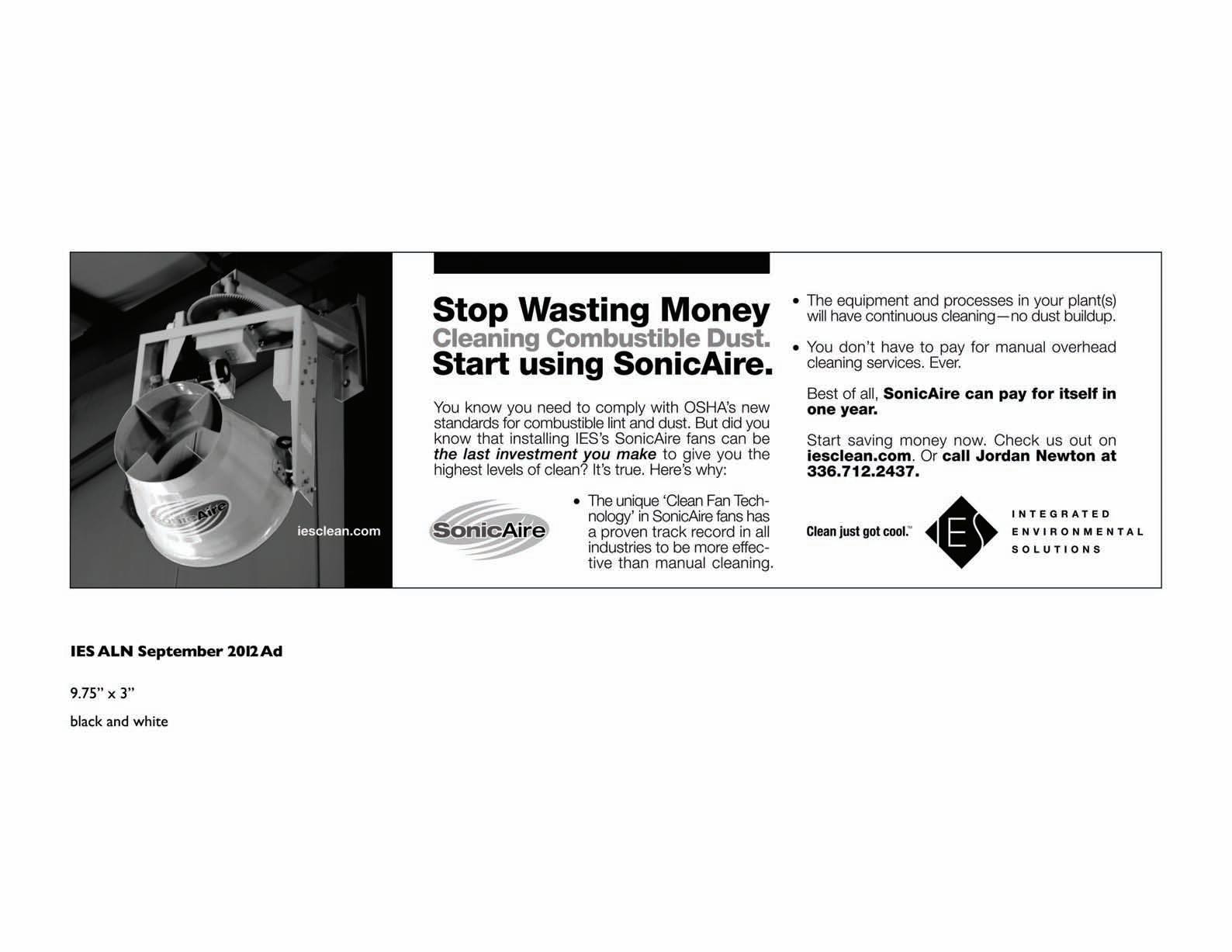
Using our example, with a true OPL machine, laundry personnel will be able to process more than 2,500 tons of laundry over the equipment’s lifespan, while other machines may process 1,275 tons.
WHAT’S ON THE INSIDE?
The components of the machines are critical. For example, steel helps machines handle vibration and unbalanced loads effortlessly. Additionally, the cylindrical front and spherical rear bearings should be able to handle 200% more force than traditional machine ball bearings used in most cabinet washerextractors. And lastly, the machine motors should have nearly 70% more horsepower, enabling it to handle around-the-clock use.
ADVANCED TECHNOLOGY
Machine features and benefits are enhanced with advanced technologies, which can reduce labor and utility costs by improving operational efficiency. With labor consuming 45-50% of the OPL dollar, and utilities another 8-12%, it’s easy to see how technologies that reduce energy consump
CAN YOU AFFORD THE INITIAL INVESTMENT?
By investing a little more up front on laundry equipment, it’s possible to recognize considerable savings over the long run.
Two 60-pound washer-extractors and two 75-pound tumble dryers, for example, would require an up-front investment of roughly $30,000, approximately $5,000 more than less-efficient, non-OPL equipment. But when you consider the total savings over the course of 10 years using the true OPL machines, the facility would have saved more than $184,000.
Purchasing any laundry equipment represents a significant investment, so it is important to understand the options. That is where a knowledgeable distributor comes into play. Look for a distributor that represents an OPL brand that offers machines that will save you money in the long run and meet your facility’s needs.
LEARN FROM OTHERS
When Woodruff County Medical Center
each machine’s computer had to be replaced. The distributor was unable to find the necessary parts to repair the machines, which led to some machines being inoperable for up to three weeks. The breakdowns forced staff to take linens to a local Laundromat and to use disposable paper products instead of washable linens.
After six years and about $4,000 in labor costs not covered under warranty, the facility decided it needed to make a change.
TOTAL COST OF OWNERSHIP
Unfortunately, situations like the one Woodruff faced happen frequently. And with many residents and their family members demanding high-level cleanliness quality, many organizations can’t afford to have a misstep that will put the company at risk.
When considering laundry operations, make sure purchase price is not the only criteria used for selecting machines. The total cost of ownership should be the driving consideration. Take the time to conduct research and make sure your distributor
18 JANUARY 2013 | AmeRicAN LAUNdRY News www.AmericanLaundryNews.com
OPL 101
Why equipment selection shouldn’t be based on price alone
DeJesus
(Photo: ©iStockphoto/Dean Mitchell)
superstorm
“We’re working hard to get back on our feet,” says Bill Wallace, the hotel owner.
Further down the shore, the storm forced the closing for four days of Atlantic City Linen, which services Atlantic City’s casino hotels. The city’s casino hotels closed during the storm.
Riverview Medical Center, which sits on the Navesink River in Red Bank, N.J., revised and enhanced its disaster planning process following Tropical Storm Irene in August 2011, and “came out better because of it,” according to Tim Hogan, hospital president.
The hospital ordered extra supplies of linen and bedding, and an emergency response team set up storm barriers and stacked sand bags behind the hospital “to ward off substantial storm damage,” he says. When the river rose on Oct. 29, the barriers held.
In New York, once the storm knocked out power, backup generators were flooded and knocked out of service in both NYU Langone Medical Center, which has 800 beds, and Bellevue Hospital Center, which has 828 beds. New York City officials were forced to evacuate both facilities and make arrangements to relocate patients to other city hospitals.
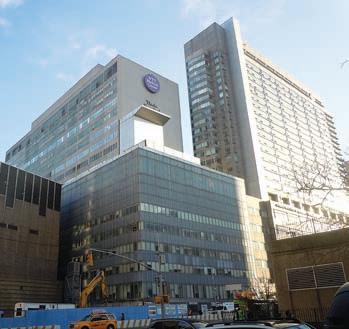

At this writing, Bellevue was still conducting an extensive clean-up and recovery effort, including pumping 17 million gallons of salt water out of its basement. On Nov. 19, the hospital began offering limited ambulatory primary care services for adult and pediatric patients. Bellevue may not resume accepting admissions before February, according to Ruth Hunt, a hospital spokeswoman.
The fuel tanks for NYU’s backup generator were also located in the basement of the hospital. Hospital engineers are still assessing the environmental damage caused by the mixture of salt water and diesel fuel from the tanks. Dr. Robert Grossman, CEO of NYU Langone, estimates the total cost of storm damage, clean up, rebuilding, and lost patient revenue for the medical center to be $750 million to $1 billion.
In mid-November, the New York City Council voted to approve $500 million in emergency capital funding to make vital repairs to public schools and public hospitals damaged by Hurricane Sandy.
Emergency preparedness planning made all the difference for the Hospital Central Services Cooperative (HCSC) Laundry, which consists of five plants and processes approximately 110 million pounds of linen for some 350 healthcare facilities in New York, New Jersey, Pennsylvania, Delaware and Maryland. The town of Asbury Park, N.J., where the laundry has its headquarters, was evacuated before the storm struck. The
laundry lost power for a week.
“This was an unprecedented situation for us,” says Bill Moyer, vice president of Marketing Services for HCSC. “We had never had a plant out of service for a week. It was a worst-case scenario.”
HCSC management put its emergency preparedness plan into effect days before the storm struck, says Moyer. Linen conservation alerts were sent out to all healthcare linen customers, as they share a common linen inventory. Linen orders were escalated and prepared a day ahead of time. Linen volume was shared and produced by the laundry’s sister plants in Camden, N.J., Allentown, Pa., and Baltimore, Md. The laundry’s service suffered only “minimal” disruption, according to Moyer.
In the storm’s aftermath, some manufacturers and distributors of laundry machinery announced programs aimed at helping laundries replace equipment destroyed by Sandy.
Alliance Laundry Systems, Laundrylux and Dexter Laundry were among the companies that announced programs offering deferred payments and interest and no fees on equipment purchases made by qualified on-premise laundries.
Alliance’s Hurricane Sandy Disaster Relief program allows qualified owners in New York and New Jersey to replace their damaged washers and dryers with no payments or interest for up to four months, no loan fees, and a cash allowance to assist with installation costs. Additionally, there is no prepayment penalty if customers choose to pay off their loan in full with reimbursement eventually received from FEMA or their insurer.
“The purpose of the program is to help laundries get back on their feet and start operating again, while they are sorting out their insurance claims,” says Bill Brooks, North American sales manager for UniMac, an Alliance company.
Under Laundrylux’s Disaster Recovery Program, qualified laundries purchasing Electrolux or Wascomat equipment can make no payments for up to six months and pay no interest for up to 12 months. All associated fees will be waived. The program is available in New York, New Jersey, Connecticut, Delaware, District of Columbia, Maryland, Massachusetts, North Carolina, Pennsylvania, Rhode Island, Virginia and West Virginia.
Dexter’s program offers qualifying laundry owners in New York and New Jersey the ability to purchase equipment for up to six months of no payments, with no origination or documentation fees, along with a special allowance for installation and start-up costs.
Customers wishing to pay off their loan after recovery from their insurer or other agency will face no prepayment penalties. ALN
Richard Merli, who resides in Brooklyn, N.Y., is a former editor of American Laundry News
Calendar

January
17 Association for Linen Management Management Level Webinar: Growing Your Business Info: 800-669-0863
February
5-6 Textile Rental Services Association Executive Roundtable: Restaurant/Hotel & Lodging Info: 877-770-9274
5 Association for Linen Management Technician Level Webinar: Infection Control Info: 800-669-0863
10-12 Independent Textile Rental Association 2013 Mid Year Training Conference Sheraton Arlington Hotel Arlington, Texas Info: www.itra.us
20 Association for Linen Management Management Level Webinar: 10 Things You Show Know Before Building a Laundry Info: 800-669-0863
March
18-20 Textile Rental Services Association Leadership & Legislative Conference The Fairmont Washington Washington, D.C. Info: 877-770-9274
21 Association for Linen Management Management Level Webinar: Improving Patient Outcomes Info: 800-669-0863
April
4-7 North-American Association of Uniform Manufacturers & Distributors Annual Convention The Renaissance Orlando at Sea World Orlando, Fla. Info: 516-393-5838
8-12 Association for Linen Management American Laundry & Linen College Eastern Kentucky University Richmond, Ky. Info: 800-669-0863
14-19 Textile Rental Services Association Production Management Institute Doubletree Dallas near the Galleria Dallas, Texas Info: 877-770-9274
15-17 International Association for Healthcare Textile Management 2013 Spring Education Conference Hotel to be determined Allentown, Pa. Info: 208-964-2923
May
18-21 NRA Show 2013: The International Foodservice Marketplace McCormick Place Chicago, Ill. Info: 312-580-5403
21 Textile Rental Services Association Executive Roundtable: Independent Industrial Info: 877-770-9274
22 Textile Rental Services Association Safety Summit Hilton Indianapolis Indianapolis, Ind. Info: 877-770-9274
June
20-22 Clean Show
Morial Convention Center New Orleans, La. Info: 404-876-1988
August
25-29 International Association for Healthcare Textile Management 2013 Annual Member Meeting Banff Springs Resort Banff, Alberta, Canada Info: 208-964-2923
September
15-19 Association for the Healthcare Environment EXCHANGE 2013 Indiana Convention Center Indianapolis, Ind. Info: 312-422-3860
29-2 Independent Textile Rental Association 2013 Annual Convention Silverado Resort and Spa Napa, Calif. Info: www.itra.us
November
9-12 International Hotel, Motel + Restaurant Show Javits Center New York, N.Y. Info: www.ihmrs.com
19-21 Texcare Asia International Trade Fair for Modern Textile Care Shanghai, China Info: www.texcare-asia.com
www.AmericanLaundryNews.com
continued
from Page 1
NYU Medical Center. (
)
Bellevue Hospital Center. ( Photo: Richard Merli )
Photo: Richard Merli
Outside Sales - Great opportunity

Successful UniMac commercial laundry distributor has a position in their Greater Orlando territory in Florida for an experienced outside sales person. Position entails calling on General Managers, Directors of Engineering, Owners, Administrators, etc. for the purpose of selling new or replacement equipment. Customer base includes hotels, motels, resorts, correctional facilities, etc. This is an EXCELLENT opportunity for the right candidate. On premise laundry sales experience strongly preferred. Competitive commission and benefit package. Contact Joe Cole at 800-522-9274 or email/fax resume to joe@ selaundry.com or 800-867-6073. All inquiries kept CONFIDENTIAL.

Outside Sales Representative
Interested in

20 january 2013 | american Laundry news www.AmericanLaundryNews.com www.cornerstonemachinery.com Quality used and reconditioned equipment Rigging and relocation services Satisfaction guaranteed Complete inventory on our website Please call or email John or Eric john@cornerstonemachinery.com eric@cornerstonemachinery.com 877-773-1850 distributor offerings PARTS, PARTS, PARTS Huge stock of parts for most laundry equipment & boilers. Also traps, valves and lubricants. Overnight delivery. Our 53rd year. Steiner-Atlantic, 800-333-8883 Fax: 305-751-8390 www.steineratlantic.com WASHEX PARTS Hard-to-find Washex parts, on-site rebuilding, tech support. LAUNDRY PARTS CENTER 800-352-4492 Fax: 305-827-3991 classified advertising www.directmachinery.com For pricing, please call Ron Hirsch (516) 938-4300 Office • (516) 315-7426 50 Commerce Place • Hicksville, NY 11801 Fax (516) 932-8095 QTY DESCRIPTION Excellent Preowned equiPment WILL SELL QUICKLY 1 Braun SPF Rear Discharge 1996 1 Unipress Single Buck Vacuum with Sleever 1 Shaper Steam 12” Ironer by 120 1 Milnor 110lb. Soft Mount 2000 1 Air Chicago XL Blanket Folder/Small Piece Folder 1 Wascomat Soft Mount 30lb Washer 1 Wascomat Soft Mount 50lb Washer 1 Colmac CFS 150 Steam Tunnel 1 Washex 46/110 700lb Side Loader 2004 1 IPSO 40lb Solid Mount Washer 2003 1 Cissell 55lb IPH Solid Mount Washer 2006 1 Milnor 42026V6J 140lb Washer 2005 Pictures are on Website DIRECT MACHINERY SALES CORP. The Griffin Group, Inc. “Recruitment Specialist” All positions available in the Rental Uniform/Textile Industry Call Deana Griffin 888-235-2365 www.thegriffingroup.cc deana@thegriffingroup.cc ® quipment for saLe parts for saLe positions avaiLabLe equipment for saLe www.ineedjpequipment.com 1-800-925-3236 J.P. EQUIPMENT INC. We will buy/sell/trade EQUIPMENT FOR SALE: (1) 1994 Six-MOD Milnor Tunnel 110lb w/150 lb Centrifugal Extractor plus Dryers - Complete System GREAT TO DO MATS! (1) 1994 Braun 2 way tilt Pass-Through Gas Dryer w/Built-in Lint Trap (1) 2003 Kannegiesser 12 Mod Tunnel Model: PT50-12BT (1) 2005 Kannegiesser Feeder (1) 120lb ADC Steam Dryer, great shape. (1) 2002 275lb Washex OP (1) 2003 Jensen Extreme Feeder w/Blanket Folder System (1) Stacker/Conveyor - All New Belts (1) 1994 8-Mod Milnor System – READY TO PROCESS (1) 2004 240 lb. Washex - Ready to Ship (2) Hypro II 6-Roll - Both Inverter Driven (1) 2005 Washex 48” 2-Roll (1) Chicago Imperial 232 Steam Ironer (2005 and 2000) (1) 2000 Chicago Air (1) Chicago Pik-Quik or 2001 Recently Refurbished: (2) 1999 95 lb. Gas Dryer - Rebuilt Ready to Ship (2) Milnor 110 OP Soft Mount New Seals & Bearings - Painted, tested We want your used equipment, please call or e-mail. “Why buy new when you can trust our used”
innovation,
We
your
If
SALES
Machine Parts, Textiles and Ironer Supply sales.
Spanish
AMKO AMERICA, INC. Remanufactured Finishing Equipment Delta Ironers, Omega Folders & Towel Folders (1 year parts warranty) Like new at half the cost. PARTS, IRONER SUPPLIES & NEW EQUIPMENT ALSO AVAILABLE Contact: (561) 863-9696 jurgenb@bellsouth.net Stanco Industries, Inc. Serving The Textile Trades Since 1970 stanco2626@aol.com 260-420-1232 Fax Visit Our Website: www.stancoind.com 1-2005 Milnor 135# w/e Open Pocket. 1-2007 Jensen Silverline 4-Lane/Double-Stacker. 1-2000 Jensen Silverline 3-Lane. 1-Sager A Sheet Spreader. 1-American 8 Roll 120” Super Sylon. 2-Troy Speedline 8-Roll 120”. Springs & Vacuum. 1-Ludell 4-Pass 24’ with 4-Way Valve. 1-2007 Ludell 4.5M Btu Direct Contact water heater.
Cleaver-Brooks 150hp,150psi Boiler.
City Rail System. 2-Wheel Trolleys, Slings. 2-1990 Washex 350# Side-Load w/e’s. --------------- MANY OTHER ITEMS AVAILABLE----------Stanco Industries, Inc. 800-932-3769 Serving The Industrial Trades Since 1970
a fast growing company with great
drive and teamwork?
manufacture and sell products where
sales outreach initiative will be welcomed. We are interested in hiring Outside Sales Reps nationwide, focusing on parts and supplies within the laundry industry.
you have a proven sales track record or are a recent college graduate, please send your resume to mari@cicus.com. No phone calls please.
Laundry
Various locations and openings. Must have previous sales experience and recognized as a top performer.
a plus. Salary plus commission, bonus and benefits package. Please send resumes to: cprunk@cicus.com.
1-2000
1-Twin
distributor offerings Visit www.americanLaundrynews.com
Sani Wash - McClure Industries, Inc. 9051 SE 55th Ave., Portland, OR 97206 800-752-2821 www.mcclureindustries.com, info@mcclureindustries.com









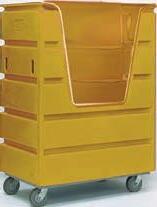









www.AmericanLaundryNews.com AmericAn LAundry news | jA n u A ry 2013 21 source directory A convenient guide to sources of products and services APPAreL FinisHinG cArTs, TrucKs & BAsKeTs Energenics Corp., Kartwasher 1470 Don St., Naples, FL 34104 800-944-1711 www.energenics.com cHemicALs/injecTOr sysTems Gurtler Industries, Inc. 15475 S. LaSalle St., South Holland, IL 60473 800-638-7300, Fax: 708-331-1210 www.gurtler.com Pellerin Milnor Corp. P.O. Box 400, Kenner, LA 70063 504-467-9591, Fax: 504-468-3094 www.milnor.com dryers – 100 POunds Or mOre Pack 25% More On Same Size Cart Call 800.829.4535 or visit MODLaundry.com for a FREE QUOTE. Premium Quality Casters Included! 72S Meese Orbitron Dunne Co. Stronger design for big payloads, yet lighter tare weight for easy handling. The Best of Both Worlds BULK DELIVERY TRUCK Rugged, non-marring trucks designed to maximize payload Up to 63.5 cu. ft. capacities in 13 different sizes. l-800-275-2436 RepsAvailable8 AM-8 PM (EST) maxi-movers.com Fax: 631-661-8209 •Email:sales@maxi-movers.com THE CARTGUYS Chm #9426 3" Bulk Del. ALN Class. 12/6/12 3:06 P Source Directory listings in American Laundry News are sold on an annual basis at the following rates: All Major Credit Cards Accepted 2013 Listings Regular Boldface All Caps All Caps, Boldface Four Line Listing per Year $790 $990 $990 $1,050 Display and additional line rates available upon request cArT-wAsHinG sysTems Sani Trux - McClure Industries, Inc. 9051 SE 55th Ave., Portland, OR 97206 800-752-2821 www.mcclureindustries.com, info@mcclureindustries.com M.I.T. POLY-CART 211 CENTRAL PARK WEST, NEW YORK, NY 10024 800-234-7659, FAX: 212-721-9022 WWW.MITPOLYCART.COM cArTs, TrucKs & BAsKeTs cArTs, TrucKs & BAsKeTs Pellerin Milnor Corp. P.O. Box 400, Kenner, LA 70063 504-467-9591, Fax: 504-468-3094 www.milnor.com dryers – 100 POunds Or Less Rotational Molding Repair, Recycling Your Complete Plastic Solution 11744 Blue Bell Rd. Elberfeld IN 47613 800-304-4600 www.fibertechinc.net Save GREEN, Buy BLACK F-LT67 Laundry Trucks Made from 100% RECYCLED plastic $213.00 Diversified Plastics, Inc. 1309 Highway 917 West, Latta, SC 29565 800-768-7636, www.dpirotocarts.com E-mail: sales@dpirotocarts.com, Fax: 843-752-7798


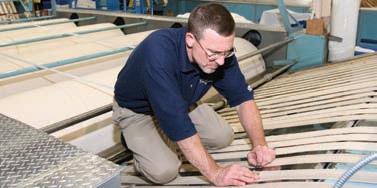





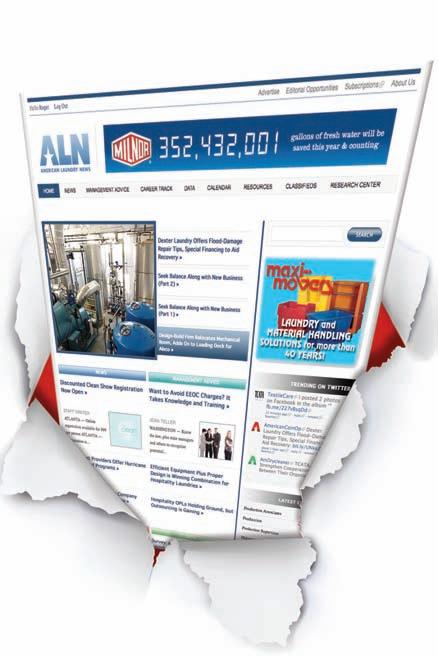






22 january 2013 | american Laundry news www.AmericanLaundryNews.com Source Directory listings in American Laundry News are sold on an annual basis at the following rates: All Major Credit Cards Accepted 2013 Listings Regular Boldface All Caps All Caps, Boldface Four Line Listing per Year $790 $990 $990 $1,050 Display and additional line rates available upon request source directory A convenient guide to sources of products and services FLaTwOrK irOners The latest news, straight to your inbox, 2X a week Setting the Standard in Lint Filters for 25 Years • Hotel • OPL • Coin Op • Dry Cleaners • Industrial • Commercial • Cruise Industry Dry or Wet Style Filters to Work with “ALL” Dryer Sizes or Multiple Situations, Fiberglass or Stainless and Custom for Unique Situations! All manufacturing done on premise 800-826-1245 www.cleancyclesystems.com • ccsystems@tqind.com C & W EQUIPMENT (800) 443-3573 FLATWORK IRONER SPECIALISTS REMANUFACTURED IRONERS: Super Sylon Sylon Hypro’s Super Pro Jensen SS700 SS800 Ultima Lavatec UPGRADE KITS: Chain Drive Conversion Vacuum Systems Herringbone Conversion Canopies Inverters Side Covers Roll Springs Jensen Drives SUPPLIES: Aprons Pads Covers Belts Waxes Cleaners PARTS/REPAIRS: All Brands New/Refurbished/Hard to Find parTs 800.829.3864 www.Tingue.com KnowhowInAction TALLEY M ACH INERY YourTinguerepisafullytrainedmasteroffinishingequipment operation,maintenanceandinstallation.Callfor: •Pads,covers,belts,waxes,tapesandmore •Carts,trucks,basketsandbags •Parts,rebuildsandrepairs Tingue_Knowhow_3x3_ads:Layout 1 2/12/10 12:05 PM Page 1 HeaT seaLing suppLies/Tape LinT cOLLecTOrs & FiLTers More than 5,250 unique visitors monthly! H Our In-Line Lint Filter mounts inside, saves space! H Fiberglass Wet Filters - 6,000 to 40,000 cfm H Fiberglass or Stainless Steel Dry Filters ENERGETICS CORPORATION Talk with our Design and Engineering Staff about your needs. Hundreds Sold Annually. 800-944-1711 www.energetics.com Get the info you need online... AmericanLaundryNews.com 0113aln_aln.com_class.indd 1 Missed our deadline? Place your ad online: www.americanLaundrynews.com
Pellerin
P.O. Box 400, Kenner, LA 70063 504-467-9591, Fax: 504-468-3094 www.milnor.com
Pellerin Milnor Corp.
P.O. Box 400, Kenner, LA 70063 504-467-9591, Fax: 504-468-3094 www.milnor.com
Pellerin Milnor Corp.
P.O. Box 400, Kenner, LA 70063 504-467-9591, Fax: 504-468-3094 www.milnor.com
Pellerin Milnor Corp.

P.O. Box 400, Kenner, LA 70063 504-467-9591, Fax: 504-468-3094 www.milnor.com


www.AmericanLaundryNews.com AmericAn LAundry news | jA n u A ry 2013 23
wAsHer-eXTrAcTOr – 100 POunds Or Less wAsHers – cOnTinuOus BATcH TyinG mAcHines
UsA, inc. Milwaukee, Wi Tying, Banding & Automated shrink Wrap systems
For more information visit us
wAsHer-eXTrAcTOr – 100 POunds Or mOre
Felins
800-843-5667 sales@felins.com
at www.felins.com
Milnor Corp.
Presses – eXTrAcTiOn source directory A convenient guide to sources of products and services PLAnT desiGn & insTALLATiOn Source Directory listings in American Laundry News are sold on an annual basis at the following rates: All Major Credit Cards Accepted 2013 Listings Regular Boldface All Caps All Caps, Boldface Four Line Listing per Year $790 $990 $990 $1,050 Display and additional line rates available upon request contact us to book your ad today! dfeinstein@americantrademagazines.com 312-361-1682 rAGs wAnTed FOr cAsH Or TrAde A.L. Wilson Chemical Co. www.alwilson.com 9 Clean Show www.cleanshow.com 7 Cornerstone Equipment & Rigging www.cornerstonemachinery.com 20 Davis Packaging www.davispackaging.net 16 Direct Machinery Sales Corp. www.directmachinery.com 20 Ecolab www.ecolab.com 15 Ellis Corporation www.elliscorp.com 11 IES www.iesclean.com 18 The Griffin Group, Inc. www.thegriffingroup.cc 20 J.P. Equipment www.ineedjpequipment.com 20 Kemco Systems www.kemcosystems.com 17 Lavatec Laundry Technology www.lavatec-laundry.com 24 LG www.lgcommerciallaundry.com 3 NATCO www.nationalcombustion.com 17 Softrol www.softrol.com 5 Stanco Industries www.stancoind.com 20 TheLaundryList.com www.thelaundrylist.com 20 U.N.X. www.unxinc.com 13 company web site Page company web site Page INDEX OF ADVERTISERS







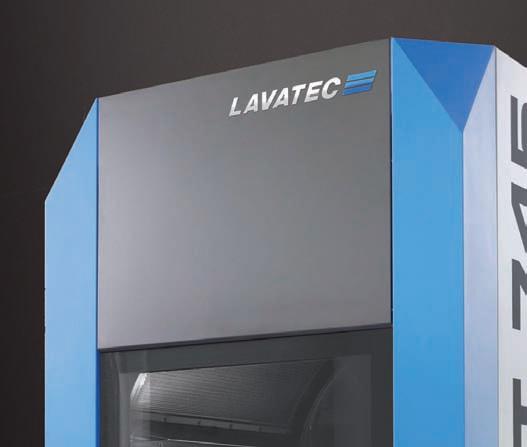


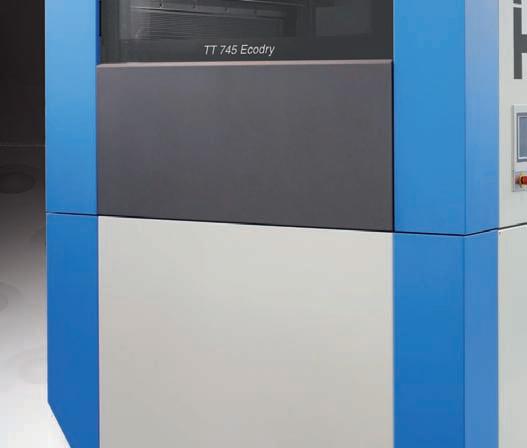









The technical quality and reliability are expressed through enhanced processing performance and extended service life. Unmatched economic efficiency State-of-the-art ergonomics Innovative Technology. Excellent New Design. TT Series Ecodry: The new era of laundry machines. Machines – Systems – Components www.lavatec-laundry.com LavatecLaundryTechnologyInc.,49LancasterDrive,BeaconFalls,CT06403,Phone(203)632-8777ext.201, Fax (203) 632-8775, Mobile (203) 808-0983, m.thrasher@lavatec-laundry.us Unmatched economic efficiency State-of-the-art ergonomics Space-saving flexibility
