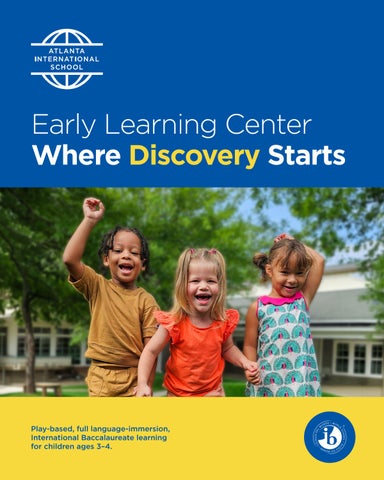
Early Learning Center Where Discovery Starts
Play-based, full language-immersion, International Baccalaureate learning for children ages 3–4.
Welcome! At Atlanta International School, a global education begins in the earliest years. In our Early Learning Center, children learn and play in a diverse, multilingual community, experiencing full immersion in Chinese, French, German or Spanish. Through our International Baccalaureate Primary Years Program, our students experience joyful, inquiry-based learning. They develop strong academic foundations, build skills and understanding, and learn to see the world from different perspectives. These early experiences nurture the curiosity, confidence, and sense of belonging that will support them throughout their learning journey
Contents 4 The early years matter 7 A day in the ELC 10 More than making mud pies! 12 Full language immersion 14 Learning spaces that spark curiosity 16 Learning without boundaries 17 Expert educators and strong partnerships 19 How to apply
欢迎 Bienvenue Willkommen Bienvenido
3
The early years matter A child’s earliest school experiences shape how they learn, communicate, build relationships, and understand the world around them. At the Atlanta International School Early Learning Center, we recognize that early childhood is not a stage to rush through. Young children need dedicated and intentional time to play, explore, wonder, and develop. Our program brings together full language immersion, purposeful play, and the world-leading International Baccalaureate Primary Years Program, with the guidance
of expert early years educators, children develop confidence, independence, and a genuine joy of learning. Every part of the day is designed around the needs of the young learner—creating a nurturing beginning that supports growth now and lays strong academic foundations for the future.
A joyful beginning to a lifetime of learning
Active participants in learning
Learning begins with the whole child An early learner’s brain is developing rapidly across physical, cognitive, social and emotional domains. These areas are deeply interconnected: growth in one supports and strengthens growth in the others. For this reason, we do not separate learning into narrow or single experiences. Children learn about math, literacy, and language all while moving, talking, creating, collaborating, and building relationships. Our whole-child approach recognizes that children need more than simply academic preparation. To be successful they also need opportunities to develop resilience, empathy, self-regulation, communication, and confidence. At the ELC, every experience is considered through the lens of child development. We create an environment that responds to children’s needs while challenging them to grow. The result is learning that is meaningful, age-appropriate and rooted in a deep understanding of how young children develop.
Young children actively construct understanding through experience, relationships and discovery.
We understand that early learners: Make sense of the world through play Ask questions, wonder, and form theories Learn through social interaction Need opportunities to test and revisit ideas Develop best when they feel secure and connected The International Baccalaureate Primary Years Program provides the framework for this approach. Through inquiry, children explore meaningful ideas across language, mathematics, science, movement, the arts and social learning. Teachers listen carefully to children’s questions and observe their interests. They then introduce materials, vocabulary, and experiences that extend children’s thinking. Learning therefore begins with curiosity— but it does not end there. With thoughtful guidance, children move from exploration toward increasingly sophisticated understanding.
5
Discover AIS
Full language immersion
Chinese French German Spanish The ELC offers full immersion in Chinese, French, German, or Spanish. The curriculum is taught through the chosen language throughout the school day. During early childhood, the brain is highly responsive to language. Neural networks are rapidly organizing as children learn to distinguish sounds, identify patterns, separate words, and connect those words with meaning. Experiencing more than one language also engages systems associated with attention, cognitive flexibility, and language control.
Starting young means that students are more likely to continue with language acquisition to a high level. Those students who join in 3K to Grade 1 are generally over twice as likely to receive a bilingual Diploma at the end of their high school journey—a qualification that is highly sought after by US and overseas universities and colleges.
Learning another language is not an added subject at the ELC. It is what sets our Early Years program apart.
The cognitive benefits of bilingualism are well documented. MRI technology can identify differences between monolingual and bilingual brains. Bilingual students often demonstrate stronger academic performance, problem-solving skills, time management, and decision-making abilities. In the ELC children learn language through immersion. They experience it through play, routines, stories, songs, movement, and daily interactions with our specialized teachers who are all native speakers of the target language. Teachers communicate consistently in the target language, creating a rich linguistic environment. They support understanding through repetition, visual cues, gestures, facial expressions, and predictable patterns. Language acquisition begins with listening and comprehension. Some children experience a quiet period while their brains absorb new sounds and structures. Over time, they begin producing individual words, short phrases, complete sentences, and increasingly complex conversations.
7
More than making mud pies!
Carrying buckets, pouring water, and stirring mud strengthen large muscle groups and support physical regulation. Rolling, spreading, and manipulating materials develop the fine-motor control needed for drawing and writing. As children count scoops, compare quantities, and estimate how much water to add, they build early mathematical understanding. They also investigate how materials change when mixed, introducing foundational scientific thinking. Sharing tools and negotiating roles require communication, empathy and cooperation. When a mud pie collapses or a mixture becomes too watery, children adapt, persevere and try another solution. They describe textures, invent recipes and create stories, expanding vocabulary and patterns of oral language.
They are learning through play!
Building mathematical minds
Mathematics is a natural part of a young child’s everyday world that is lived through exploration and classroom routines rather than on worksheets.
Open-ended questions encourage children to think deeply: “How do you know?” “Can you find another way?” “What might happen next?”
Children count classmates during morning circle, measure ingredients, sort materials, create patterns, and compare size, shape and quantity. Through these experiences, they build a genuine understanding of what numbers mean—all while listening and speaking in another language.
At home, families can support mathematical thinking through cooking, board games, building, sorting laundry, and noticing patterns in everyday life.
Rote counting is only one small part of becoming numerate. Children also need to understand value, relationships and the many ways quantities can be combined, separated, and represented.
“Counting scoops, comparing quantities, and estimating build early mathematical understanding.”
Teachers use concrete materials and targetlanguage vocabulary to highlight concepts such as above, below, beside, larger, smaller, more, and less. 9
Time to explore, connect, and grow Each day balances child-initiated play, educator-guided learning, outdoor exploration, community time, meals, and rest. This rhythm gives children the emotional security they need while leaving space for inquiry, imagination, investigation, and spontaneous discovery. The day begins outdoors, where families are welcome to stay and play during morning arrival. Children then move through circle time, snack, extended periods of inquiry, lunch, rest, and further indoor and outdoor learning. Long periods of uninterrupted play are intentional. They allow children to develop ideas, solve problems and sustain collaboration rather than constantly moving from one short activity to another—all while fully immersed in another language! Throughout the day, educators observe children closely and assess development in real time.
A day designed for young children
7:40–8:20 a.m. Morning arrival and outdoor classroom time. Families are welcome to stay and play. 8:20–8:45 a.m. Morning Circle 8:45–9:15 a.m. Snack Time 9:15–11:15 a.m. Inquiry through play, indoors and outdoors 11:15–12:00 p.m. Lunch Time 12:00–1:00 p.m. Rest Time 1:00–2:15 p.m. Afternoon inquiry, indoors and outdoors
2:15–2:30 p.m. Closing Circle 2:30–2:50 p.m. Dismissal 2:50–6:00 p.m. (Optional) Kaleidoscope After School Care and Enrichment Activities
11
More to explore after the school day
The end of the school day opens the door to new interests, skills, and friendships. Children in 3K and 4K can choose from a range of age-appropriate programs that encourage creativity, movement, exploration, imaginative thinking, and play.
Something for every interest! Offerings vary by season and may include:
Art
Playball
Capoeira
Private music lessons
Chess
Storytelling
Dance
Yoga
LEGO
Programs are offered throughout the week, typically from dismissal to 3:30 p.m. Registration opens before each session, and activites are subject to change.
As your student progresses through AIS, the choices grow and include additional activities like Jr Eagles sports, tennis, filmmaking, band, orchestra and chorus.
Kaleidoscope after school care Afternoons at Kaleidoscope include: An afternoon snack Play in the Outside Classroom Arts, crafts, and indoor activities Time to relax and recharge Caring supervision until 6:00 p.m.
Kaleidoscope provides a welcoming and caring environment for children in 3K and 4K from dismissal until 6:00 p.m. AIS also offers childcare on selected teacher conference days and school holidays. Registration opens at the beginning of the school year, and spaces are offered on a first-come, first-served basis.
Learning spaces that inspire
Designed for curiosity and independence Our learning environments are carefully curated to create awe, wonder, and investigation. Materials are placed at children’s level so they can make choices, follow interests, and take increasing responsibility for their learning. Classrooms include areas for art, dramatic play, construction, literacy, numeracy, and sensory exploration. These spaces are flexible and change in response to children’s ideas and developmental needs. We provide loose parts and openended materials to encourage imaginative play and promote creative thinking skills. A wooden block might become a castle wall, a telephone, a hairbrush, or a piece of fruit. The classroom walls also support learning. photographs, questions, drawings, and reflections make children’s thinking visible and allow them to revisit how their ideas have developed and changed over time. Resources also rotate four times a year as students explore different themes during their Units of Inquiry.
Outside in every season Our outdoor classroom is much more than a playground. It is a carefully designed learning environment that offers the same opportunities for inquiry as the indoor classroom.
Children investigate water, sand, and mud, engage in imaginative play and strengthen their bodies through running, climbing, spinning, and jumping. These whole-body experiences support coordination, sensory processing, confidence, and emotional regulation. Outdoor learning also allows children to notice changes in weather, light, plants, and make connections to the natural world. We begin each morning outside and return throughout the day. Children go outdoors in a range of weather conditions, so rain boots and a rain jacket remain at school— ready for the next opportunity to jump in a puddle! Our Multi-Purpose Room provides further space for physical education, music, dance, and movement, as well as weekly ELC assemblies that bring children and families together as a community.
15
Learning without boundaries
Everything is connected A transdisciplinary approach Learning at the ELC is organized into approximately ten-week Units of inquiry. Across a two-year cycle, children experience eight transdisciplinary units built around meaningful central ideas. Traditional subjects are taught together rather than separately. Language, mathematics, science, movement, the arts, and social learning are connected through shared experiences. Play is the driving force behind how children explore each central idea. Teachers observe children’s questions and interests, then introduce new resources and learning engagements to stretch their understanding. For example, within an inquiry into how children use their senses to understand the world, they may taste and classify foods, learn descriptive vocabulary, represent music through drawing, and discuss why some people prefer quieter environments. A single inquiry therefore becomes an opportunity to think like a scientist, mathematician, artist, communicator, and thoughtful member of a community.
Expert educators and strong relationships
Known, supported, and challenged
1:8
Educator-to-child staffing ratio
Our staffing ratio of one educator to eight children allows teachers to know each learner closely and respond thoughtfully to their development. Our qualified educators specialize in early childhood development and language acquisition and are heritage speakers of the languages they teach. They engage regularly in professional learning informed by neuroeducational research, IB practice, and current understanding of child development. Teaching in the early years requires a careful balance. Educators guide inquiry through intentional teaching, observe
closely to understand what each child needs next, and enter children’s play as partners in discovery. They establish consistent routines, clear expectations, and emotional predictability while remaining responsive to children’s interests. This balance—the art and science of early childhood teaching—allows learning to remain child-centered without becoming unstructured. Every interaction is an opportunity to listen, encourage, challenge, and help a child move forward.
“Every interaction is an opportunity to listen, encourage, challenge, and help a child move forward.” 17
Belonging to Learning
Relationships are part of the curriculum Young children move through different stages of social play, from playing alongside others to creating shared plans and cooperating toward a common goal. Each stage requires new skills. Children learn to share materials, communicate ideas, negotiate roles, resolve disagreements, and understand another person’s perspective. Our educators recognize these developmental stages and provide the support children need to progress. Cooperative play can be joyful, but it can also be challenging. These everyday interactions become valuable opportunities to develop empathy, resilience, and self-regulation. The school counselor visits classes every other week to lead Sunshine Circles focused on social and emotional learning. Classroom teachers reinforce these ideas throughout the day through the Personal, Social and Physical Health curriculum, social justice learning, and restorative practices. Children gradually learn that belonging means both expressing their own needs and respecting the needs of others.
Partnership and next steps
Connect to your child’s learning Each week, parents receive updates through their child’s personalized digital portfolio. Photographs, observations, and examples of learning provide insight into what children are exploring and how their skills are developing. Throughout the year, progress is shared through two parent-teacher conferences, two written reports, and a student-led conference. Additional meetings are arranged whenever a family or educator identifies that a child may benefit from further support.
Families are also invited to participate in classroom and community experiences by sharing their cultures, identities, traditions, and areas of expertise. Our goal is to build an open, trusting partnership in which families understand not only what their child is doing, but why it matters. Together, educators and parents create the consistency, encouragement, and sense of belonging that help young children thrive.
Meet your Enrollment Manager Get in touch with Carolina to learn more about the ELC, schedule a visit, and explore upcoming tours and information sessions. Experience our classrooms, meet our educators, discover full immersion in Chinese, French, German, or Spanish—and find out how to apply.
Carolina Clark
Primary Enrollment Manager, 3K–Grade 2
404-841-3895 x 408 carolina.clark@aischool.org
19
Discover an Early Learning Center where children are encouraged to wonder, explore, communicate, and grow.
Register for a tour today Buckhead Campus 2890 North Fulton Drive, Atlanta, GA 30305 www.aischool.org/elc 404 841 3840