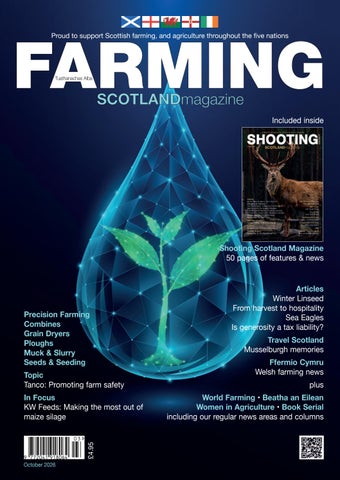
Proud to support Scottish farming, and agriculture throughout the five nations
Tuathanachas Alba
magazine Included inside
Shooting Scotland Magazine 50 pages of features & news
Precision Farming Combines Grain Dryers Ploughs Muck & Slurry Seeds & Seeding
Topic Tanco: Promoting farm safety
£4.95
In Focus KW Feeds: Making the most out of maize silage
October 2026
Articles Winter Linseed From harvest to hospitality Sea Eagles Is generosity a tax liability? Travel Scotland Musselburgh memories
Ffermio Cymru Welsh farming news plus
World Farming • Beatha an Eilean Women in Agriculture • Book Serial including our regular news areas and columns
contents
10
October 2026
46
14
Features
Beatha an Eilean
20
Precision Farming
105 Life on the islands
27
Combines
34
Grain Dryers
39
Seeds & Seeding
48
Ploughs
106 Muck Spreading
Winter Linseed
33
From harvest to hospitality
46
Sea Eagles
150 Is generosity a tax liability?
Flavour of Scotland Scotch red meat
World Farming Global food security
People
Tanco: Prioritising farm safety
All Editorial & PR enquiries EDITOR Athole Murray Fleming Tel. 01738 639747 E-mail: mail@farmingscotlandmagazine.com
128 Subscription Call 01738 639747
118 Livestock
In Focus
127 Sheep
114 KW Feeds: Making the most out of maize silage
132 Pigs 134 Equine
Next Issue Out in November 2026. (Our AgriScot Edition)
148 Land & Property 152 Finance
136 Making Musselburgh memories with Janice Hopper
154 Machinery 168 Events
Women in Agriculture Columns 138 Seeds of tomorrow
Book Serial
6
Editor’s Bit
13
RSABI
47
Crofting
123 NFU Scotland 126 The Vet
140 Part 4: Wild History Journeys into Lost Scotland
131 NSA Scotland
Shooting Scotland Magazine 50 pages of news, articles and stories on shooting, fishing and rural life
Advertising & Editorial Enquiries Call 01738 639747
135 British Horse Society 139 Farm Advisory Service
News Areas
Topic 44
Environment
42
116 Dairy
Travel Scotland
26
18
32
142 Estate
Articles
14
120
145 Scottish Land & Estates
6
Arable
151 Scottish Government
16
Food & Drink
170 People on the Move
30
Science & Technology
170 Book Review
COVER IMAGE: The science of farming
PRODUCTION DIRECTOR Christina Fleming Email: christina@atholedesign.com
ADVERTISING MANAGER Barry Tweed Tel. 01475 910153 Email: barry@farmingscotlandmagazine.com
All Advertising & Editorial enquiries ADVERTISING DIRECTOR Athole Murray Fleming Tel. 01738 639747 E-mail: mail@farmingscotlandmagazine.com
COPYRIGHT This publication has been produced and published by ATHOLE DESIGN & PUBLISHING LTD who are the copyright owners. No reproduction, copying, image scanning, storing or recording of any part of this publication without the permission of ATHOLE DESIGN & PUBLISHING LTD. Contents disclaimer: FARMING SCOTLAND MAGAZINE is not responsible for any factual inaccuracies within press information supplied to us. Any concerns regarding such matters should be directed to the supplier of the materials. FARMING SCOTLAND MAGAZINE is designed, produced and published by Athole Design & Publishing Ltd., Tolastadh, 18 Corsie Drive, Kinnoull, Perth, Scotland PH2 7BU. Tel. 01738 639747 est 1994
ISSN: 2041–918X
©ATHOLE DESIGN 2025
facebook.com/FarmingScotlandMagazine
arable editor's bit Is being an island a future potential protection?
Just a personal thought after the hottest summer on record. We are surrounded by water, so could desalination be a solution to prevent the prospect of future drought conditions? Scotland has plenty of fresh water, but we need it up here, and of course we also had greatly lowered water reserves this year. So instead of draining Scotland, could salinations plants around the UK be one solution that could help? I only ask out of interest, I have no knowledge of the affordability, all I know is that a future Scotland cannot afford a tap that is turned on and off to supply the south and a much greater population on its own. So other solutions have to be created, and desalination of the surrounding waters may be just that? As I admit, I don’t know what is feasible, but one things for sure, if we need to stop pumping crap into our atmosphere. We had better wake the hell up, and pretty damned fast. From discussion comes ideas, and from ideas must come commitment and action. Otherwise? Slàinte, Athole.
Global partnership launches AI project to accelerate development of climateresilient potato and sweet potato varieties
The National Potato Innovation Centre (NPIC) is pleased to be part of a global partnership that has launched a new international research initiative to accelerate the delivery of improved crop varieties to farmers facing climate change, pests and disease pressure. Genetic Acceleration through Artificial Intelligence for Root and Tuber Crops (GAINRT) combines world-leading expertise in crop breeding, artificial intelligence, gene editing and field-based research and aims to accelerate innovation from laboratory to farm. Partners include NPIC, which is hosted by The James Hutton Institute, the International Potato Centre (CIP) and key African partners, the Kenya Agricultural and Livestock Research
Organisation (KALRO) and Egerton University. Climate change, evolving pests, and emerging diseases are advancing faster than conventional crop breeding can keep up. This growing gap threatens farmer livelihoods, food security and nutrition, especially in vulnerable regions such as sub-Saharan Africa. GAIN-RT works to close that gap using advanced AI models to predict which crop varieties will perform best under climate stress, identify stronger, more durable disease resistance and improve breeding efficiency while reducing development timelines. By unlocking insights from large genomic, environmental and field datasets, AI can significantly shorten the time required to develop and release improved
varieties, ensuring farmers have access to better crops sooner. Initially focused on potato, the project aims to speed up climate-resilient varieties, boost yields and reliability for smallholders, reduce chemical use through stronger resistance and enhance food and nutrition security. Building on the success of this first phase, sweet potato and other crops will follow. Professor Ingo Hein, principal investigator from the Hutton and Deputy Director of the National Potato Innovation Centre, said, “This collaboration harnesses the potential of AI and emerging technologies including gene editing to help accelerate the development of more resilient potatoes and other strategically important crops, supporting a more sustainable future and strengthening food security.”
www.farmingscotlandmagazine.com
arable CSFB resilience helps bring oilseed rape back to rotation With a first oilseed rape harvest in three years safely in storage, Lincolnshire grower David Bristow is pleased with the outcome and has already committed to at least maintaining his acreage for 2026-27. Like so many growers, he was forced to take a break from the crop following years of battling flea beetle, but has been tempted back by plant breeding developments, including greater resilience to CSFB. He has grown 52ha of LG Avenger, recording a finally verified yield of 4.04t/ha, with moisture content between 7 and 9%. Whilst being at the lower end of his mid-season expectations, he’s very satisfied,
not least given the impact of the exceptionally hot and dry conditions leading up to harvest. “We harvested the oilseed rape on the 10th and 11th of July, which would be a week to ten days earlier than normal for us,” he reports. “Given the rate at which the crop dried, which may have caused some issues with the desiccation, it was a relatively easy harvest.” Farming at the 650ha Stourton Estate, on the edge of the Lincolnshire Wolds, David is pleased to have a viable oilseed rape crop back in his rotation. Following winter barley, the crop was drilled in the last week of August. Stubbles were cultivated with a low disturbance
www.farmingscotlandmagazine.com
7
arable subsoiler before drilling with the farm’s Horsch Avatar at 2.6 kg/ ha, alongside a companion crop of buckwheat (5 kg/ha) and a surface dressing of 150 kg/ha of DAP fertiliser. Waiting for moisture before drilling paid dividends, as the
LG Avenger was up and away quickly, with the drill achieving an even seed depth and excellent establishment. An absence of the classical ‘shot-holing’ in the autumn was noted, and – as larval assessments in the spring confirmed – CSFB
pressure was generally fairly low. This was despite no insecticides being used on the farm for the past six years, with a large area now under the SFI no insecticide action (CIPM4). Nevertheless, Mr Bristow is very aware that CSFB
remains a threat to oilseed rape, so has been keen to do all he can to mitigate the risks when coming back into the crop. This includes selecting LG Avenger, for it’s CSFB resilience, alongside the other management practices.
Early maize harvest presents opportunity to bolster forage stocks With some maize being harvested already in certain areas , farmers are being encouraged to take the opportunity to bolster forage stocks by getting a grass crop drilled, says Adam Simper, Agrii national grass, roots and environmental seeds manager. “England has seen just 3% of the long-term average rainfall this July, according to the Environment Agency, severely restricting grass growth and forcing farmers to dip into their valuable winter forage stocks early,” he says. “The early maize harvest offers an extended window of opportunity to reseed, provided there is sufficient moisture. “Not only will a catch crop of grass protect the site from bad weather, improve soil structure, reduce soil erosion and reduce nitrogen leaching, it’ll provide useful forage options.” For farmers considering planting grass after maize, it’s important to select a mixture that contains suitable species, he stresses.
8
www.farmingscotlandmagazine.com
arable “One option is Bulk Master, a two-year ley made up of 100% Italian Ryegrass. It’s quick to establish and grows when soil temperatures are as low as 3°C, is winter hardy and will produce a good quality bulky silage crop in the spring. “Westerwolds can also be used – however, as it is an annual plant, a hard winter will see the energy zapped from the plant, delaying the opportunity the take an early first cut.
“Forage rye is another popular option for growers looking to produce large amounts of forage over the winter months, to front load supplies into spring and release pressure on any dry spring/ summer growing conditions.” In a mild autumn, Bulk Master and Westerwolds will grow quickly and could provide late grazing or even a cut this season, followed by early grazing or a cut of silage the following spring, Adam Simper adds.
“However, this depends on weather conditions and farmers need to avoid poaching as this can cause long-term damage. “If your cropping plans have changed, the early maize harvest along with adequate moisture can also present opportunities to drill a medium or longer term mixture using Perennial Ryegrass, however these need to be drilled by the end of September if conditions allow.” After maize is harvested, grass reseeding is straightforward, he says.
“One pass with the discs to ensure a fine and firm seedbed is usually sufficient prior to drilling and then rolling. With the lack of rain, some maize herbicides may still have some residual activity in the soil so check with your agronomist before drilling. “It’s important to utilise every acre to help maximise forage opportunities and minimise the reliance on costly purchased feed. Demand is building and it is advised to secure seed as soon as possible.”
A fresh look at the value of soil health
Measuring and valuing soil health is becoming increasingly important – but it’s not easy to do. Now, oneregenerative farming adviser has written a Centenary Scholarship paper for the Central Association of Agricultural Valuers entitled ‘The value of soil health’, setting out the practicalities of this complex area. “Regenerative farming is driving changes, and farmers are now being paid to provide carbon
and other ecosystem services,” explains report author Harry Epsom. “But we’re operating within legislation written decades ago – I wanted to create a guide on soil principles and valuing soil health.” At a fundamental level, soil quality and soil health are different. “We have been destroying our soils slowly for years; our high input, high output focus has created these problems,” he says. “But soil can be healed quite quickly, which presents us with an opportunity.” Measuring soil health requires a multi-pronged approach including biological, chemical and physical assessments. It can include compaction testing, worm counts, organic matter and carbon measurement, nutrient analysis and plant health tests, says Harry. “Healthy soil is the foundation of our existence – it’s crucial to food, water security, ecosystems and biodiversity.” With the advent of regenerative farming and trade for carbon credits and biodiversity net gain, there is
increasing demand for both measurement and valuation of soil health. But both of those factors might vary according to the client’s objectives. “We can’t give the right advice if we don’t understand the vision, landscape, skills, soil, climate, social, financial and regulatory context.
”For a farmer, healthy soil will increase profits and resilience; for a landowner it might command a higher rent; for the public, it could be flood mitigation. So when it comes to valuations, there are three areas of value to consider: Business, public, and asset.
FARMING SCOTLAND MAGAZINE Next issue out November 2026 www.farmingscotlandmagazine.com
9
arable UK agtech firm Azotic helps farmers cut fertiliser use by up to 25 per cent amid market volatility UK agricultural technology company Azotic Technologies has developed a bacteria-based product it says can cut farmers’ fertiliser use by up to 25 per cent as prices remain volatile. Based in Dunnington, near York, Azotic develops biological solutions to improve nitrogen efficiency. The company says its technologies can help farmers mitigate the risk of future food shortages as a result of rising fertiliser costs and supply uncertainty caused by factors such as global conflicts. The company has seen a rise in enquiries following
10
disruption to global fertiliser markets earlier this year, linked to instability in the Middle East and the temporary closure of the Strait of Hormuz – a key route for energy supplies used in fertiliser production. Azotic’s product, Encera, contains a naturally occurring bacterium that enables crops to access nitrogen internally, supplying a steady source throughout the growing season, in the right place at the right time. This helps improve nitrogen efficiency and reduce overall fertiliser requirements, while supporting crop performance.
The technology works inside the plant to provide a consistent supply of nitrogen throughout the season, an approach the company describes as Systemic Nitrogen Fixation. Sander Pabbruwee, CEO at Azotic, said: “Farmers are under real pressure to produce the same yields with less fertiliser. Our technology helps them do exactly that, by enabling crops to access nitrogen naturally from within the plant itself. “Most nitrogen fertilisers are produced using energyintensive processes that rely heavily on natural gas. When
www.farmingscotlandmagazine.com
disruption hits, prices rise quickly and farmers feel it immediately. “What we’re hearing from farmers and growers is clear, they are looking for more consistent and predictable ways to manage inputs. By improving nitrogen efficiency, they can protect both their margins and their long-term resilience.” Encera can be used across a range of crops, including wheat, maize, oilseed rape and potatoes, delivering consistent nitrogen supply from within the plant and supporting strong crop performance.
arable Biostimulants offer new hope for NUE
Nitrogen, phosphorus and potassium are essential inputs for agricultural productivity, but, with prices remaining high, making better use of nutrients to reduce farm costs has become a priority. Biostimulants provide a sustainable way to make common input go further by increasing nutrient use efficiency (NUE) in a wide variety of crops. Biostimulant specialist and agronomist with Orion Future Technologies, Mike Stoker suggests that agriculture has only scratched the surface of what biostimulants can offer. “Biostimulants are not a fertiliser replacement. The role of biostimulants is to help the plant make better use of the nutrients provided by fertilisers, which has the knock-on benefit of reducing the amount of fertiliser being used,” he says. He points to biostimulants helping to improve root development, nutrient uptake and provide plants with a greater tolerance to abiotic stresses such as drought, heat and salinity. “If a plant can grow deeper seeking roots, it is better placed
to withstand drought conditions. Furthermore, if plants are able to assimilate more nutrients and convert those nutrients into proteins, enzymes, chlorophyll, and other essential compounds, it will be stronger and will need fewer inputs, which will save growers time and money while also producing a healthier crop,” he says. NUE has become something of a buzz term, with many seeking innovative ways to minimise fertiliser inputs as part of a move to more regenerative growing practices. However, Mr Stoker suggests that NUE does not necessarily have to cause dramatic changes to growing systems, and that biostimulants are an easy way to get more from what is already available. “Most biostimulants can be added to the tank along with common fungicides and herbicides, making them easy to apply. Some biostimulants, especially those containing plant available silicon, can be absorbed quickly and immediately make a difference to how efficient the plant is at making use of fertilisers,” he says.
Through trials with KWS on winter wheat, he was able to establish that the use of Sirius, a silicon biostimulant, helped increase the uptake of calcium, copper and iron. “We applied two foliar sprays and compared to a control. The result was enhanced quality and resilience in all five wheat
varieties. We have seen similar results with oilseed rape and ahiflower and noticed that, in particular, potassium uptake was in some cases doubled following the application of Sirius,” he adds. Through plant analysis he has been able to ascertain that cell wall development and cell division is improved
GB Potatoes launches second year of Potato Industry Development Programme Following the success of the 2026 inaugural Potato Industry Development Programme, GB Potatoes, in association with the British Potato Trade Association (BPTA) has opened applications for 2027. Aimed at new entrants to the potato industry, the programme offers participants a comprehensive understanding of the sector, the latest industry insights and the chance to build lasting networks across the industry. Taking place across three sessions, the successful candidates will have the opportunity to engage with some of the leading packers, processors, researchers and 12
scientists within the sector, as well as those who are helping shape future innovations. Three phases, three regions • England, 15-18 February 2027 - starting in Scarborough, participants will be visiting leading brands in the industry including McCains, Branston, and Tayto, as well as potato processing machinery specialists Haith Manufacturing, to build a sound understanding of potato processing and production. • Scotland, 15-17 June 2027 – commencing at the James Hutton Institute, the focus shifts to commercial seed potato
breeding, potato growing, blight, and PCN, with visits to GenTech Propagation, McCains Seed, a seed grower, and SRUC. • Parliamentary visit, November 2027 – held in London, this phase gives participants insight
www.farmingscotlandmagazine.com
into agricultural policy decisionmaking, how it can be influenced through lobbying, and why it matters for the next generation to get involved. Louise Greenhill, Contracts Manager for Agrico, and a
arable participant in the inaugural programme, said: “I’ve really enjoyed being part of the Potato Industry Development Programme, from visiting processing factories and farms in England to seeing the research, science and innovation taking place in Scotland. “It’s been fascinating to see how all the different parts of the industry connect, and meeting other young people in the industry has been just as valuable. I’m looking forward to the remaining legs and hopefully playing a part in the future of the industry.” Alex Godfrey, Chair of GB Potatoes, said: “When we first developed this programme, back at the start of 2026, we wanted to support those who were at the start of their career and looking to grow their skills and knowledge. We were overwhelmed by the number of the responses, and the impact we are already seeing with the current cohort, has highlighted the need for a structured programme, that supports the development of our future leaders and encourages long-lasting connections. “With the sector facing many challenges, not least the current drought, it is more important than ever that we continue to invest in skills and training, so we continue to drive resilience, innovation and effective communications with our consumers. “I would encourage anyone looking to grow their career to consider applying for the next programme and would like to express my thanks to the BPTA for partnering with GB Potatoes to deliver this incredible opportunity.” The programme includes accommodation, meals, and minibus travel as part of each study visit. Participants must make their own arrangements for travel to and from the start and end point of each visit. The cost is £1,200 for GB Potatoes members and £1,700 for non-members. Applications close 2nd October 2026. With limited places available and strong interest anticipated, we encourage all applicants to submit a well-considered application – apply via the GB Potatoes website here – https://www.gb-potatoes. co.uk/gb-potatoes-launchessecond-year-of-pidp/
ALL THINGS partners with RSABI to support Scotland’s agricultural community British dairy brand ALL THINGS has announced a new partnership with RSABI, committing 1% of revenue from its fast-growing cottage cheese range to the Scottish agricultural charity. The partnership reflects ALL THINGS’ belief that building a modern dairy brand also means supporting the people and livelihoods behind the industry. Founded by chef Thomas Straker and entrepreneur Toby Hopkinson, ALL THINGS is known for bringing a fresh, flavour-first approach to everyday dairy. Its cottage cheese range has quickly become one of the brand’s breakout launches, selling more than 1 million pots in its first four months and proving that the conversation around cottage cheese is converting at shelf. From 1st August, 1% of revenue generated by the ALL THINGS Cottage Cheese range will help fund RSABI’s ongoing services across Scotland, including its 24 hour helpline, counselling services and more. As demand for the category continues to grow, the contribution is expected to provide meaningful ongoing
support to people working across Scottish agriculture. Pauline Macmillan, Head of Fundraising at RSABI, said: “We are absolutely delighted to partner with ALL THINGS and are incredibly grateful for this fantastic commitment. It is wonderful to see a brand that manufactures its cottage cheese right here in Scotland giving back so directly to the local agricultural community.
This ongoing support will provide vital funding for our services, ensuring we can continue to deliver crucial emotional, practical, and financial support to farmers, crofters, and their families across Scotland when they need it most.” RSABI offers free practical, financial, and emotional support including counselling services, delivered quickly after receiving the initial enquiry. Its free confidential support service is available 24 hours a day, every day of the year, by calling 0808 1234 555 (calls won’t show up on phone bills) or through a confidential webchat service, available on RSABI’s website www.rsabi. org.uk.
RSABI provides financial, emotional, and practical support to people in the sector, including free confidential counselling available 24/7 at 0808 1234 555 or via webchat at 11www.rsabi.org.uk.
FLAVOUR OF SCOTLAND
Make it Scotch serves up Scotch red meat for schools High schools across Scotland are being invited to bring high-quality Scotch Beef, Scotch Lamb and Prime Scottish Pork into practical food lessons as the Make it Scotch Meat Voucher Scheme, operated by Quality Meat Scotland (QMS), returns for the 2026/27 academic year. Applications opened on 24th August, giving eligible secondary schools the chance to apply for a meat voucher worth up to £180, depending on school size, to spend in their local Scotch Butchers Club member who proudly sells the quality-assured Scotch red meat brands. The scheme is designed to help pupils build confidence in the kitchen while learning more about nutrition, provenance, food production and Scotland’s red meat supply chain. Alongside the voucher, schools can also request copies of QMS’s brand-new recipe cards for use in lessons, featuring Scotch Beef Burritos, Scotch Lamb Cheesy Shepherd’s Pie Loaded Potatoes and Prime Scottish Pork Katsu. The simple, tasty recipes have been developed to support engaging, hands-on cookery lessons that showcase the versatility, taste and nutritional value of Scotch red meat. The scheme continues to support home economics and food education by helping teachers access quality Scottish ingredients and connect classroom cooking with real-life food and farming stories. It also provides an opportunity for pupils to explore the role of local butchers, farmers and processors in producing food to recognised quality assurance standards. Schools can further enhance learning by requesting support from a Make It Scotch Ambassador, bringing farming, food and cookery expertise into the 14
classroom through demonstrations, discussions and first-hand insight into Scotland’s red meat sector. Abby Goldie, Community Engagement Coordinator at QMS, said: “The Meat Voucher Scheme is a practical way to help schools put Scotch Beef, Scotch Lamb and Prime Scottish Pork at the heart of food education. By giving pupils the chance to cook with quality-assured, locally sourced ingredients, we can support teachers in delivering lessons that are engaging, relevant and rooted in Scotland’s food and farming story. “We know that hands-on learning can make a lasting impression. From preparing a nutritious meal to understanding where ingredients come from, the scheme helps young people develop valuable life skills while building a greater appreciation of the people and standards behind Scotch red meat.” Samantha Barrick, Home Economics Teacher at Dumfries High School, said: “The voucher from Quality Meat Scotland enabled us to provide pupils with high-quality Scotch meat sourced from a local butcher, The Butchery. “This opportunity allowed us to use a wider variety of cuts and gave pupils valuable experience working with locally sourced produce, enhancing their learning and appreciation of Scottish ingredients.” The Make it Scotch Meat Voucher Scheme opens for applications on 24th August and closes on 30th January. Vouchers will be issued on a rolling basis and must be spent by 12th February. Teachers can apply via the Make it Scotch website and are encouraged to apply early to make the most of the voucher and supporting classroom resources.
Tomás Gormley introduces Cardinal Kitchen Garden Celebrated Scottish chef Tomás Gormley has announced the creation of the Cardinal Kitchen Garden, a regenerative smallholding on the outskirts of Edinburgh, in collaboration with Bramblewood Farm. Bramblewood Farm is a family farm in Pathhead, Midlothian, dedicated to regenerative
www.farmingscotlandmagazine.com
agriculture and supporting the local community. At the Cardinal Kitchen Garden, Tomás and his team will work closely with Bramblewood Farm’s owner Nick Holmes, deepening the connection between the restaurant and its produce. The first crops will include tomatoes, courgettes, beetroots,
FLAVOUR OF SCOTLAND salad leaves and a huge variety of herbs and flowers, all of which will be transported from garden to plate and, over time, make up the majority of the fresh produce on Cardinal’s menus moving forward. A low-waste ethos is also central to the Cardinal Kitchen Garden, with Tomás and the Cardinal team bringing a cyclical approach as any organic waste that cannot be repurposed in the restaurant, will be transformed into nutrient-rich compost used in the Kitchen Garden.
Of the launch, Tomás Gormley said: “We’re looking forward to bringing these ingredients into every part of our menu, working with Nick and the team to work with the land and become an important cog in the wider farm network. Restaurants aren’t inherently sustainable operations, so we’ll be looking harder at how we can cut waste at the restaurant in a way that benefits both us and the garden.” The kitchen garden follows the launch of Cardinal’s threecourse Market Menu, a vegetable-
forward, three-course menu that will highlight the bounty of the Cardinal Kitchen Garden. The
Market Menu is priced at £25 and available at lunchtimes on Thursdays, Fridays and Saturdays.
Scottish red meat sector passes £4bn as demand stays resilient Quality Meat Scotland’s (QMS) latest Red Meat Industry Profile shows farming, processing and the associated supply chains combined is now worth over £4.2 billion of output and £1.3 billion of GVA in 2025 - its highest level ever recorded. The report - a key statistical tool supporting Scotland’s red meat and business decision makers underlines the continued resilience and socio-economic importance of Scottish beef, lamb and pork, with the sector sustaining around 40,000 jobs across the supply chain. Combined economic impact rose by 18.5% in 2025, driven by higher cattle and sheep prices - prime cattle prices averaged approximately £6.60 per kg deadweight in 2025, up 30.3% year-on-year. The value of cattle, sheep and pig farming increased by 17.6% to £1.9 billion, while primary processing rose by 20.2% to £1.36 billion. While higher farmgate prices supported store producer confidence and underlying consumer demand for foods naturally high in protein remained strong, a 30% increase in the retail price of beef has led to some changes in purchasing patterns, with some shoppers shifting towards cheaper cuts and alternative proteins.
QMS Chief Executive Sarah Millar said: “These figures underline the scale, strength and continued importance of Scotland’s red meat sector. At £4.2 billion of output and £1.3 billion of GVA; beef, lamb and pork are delivering major economic value for Scotland and supporting jobs, businesses and communities across the country including in some of our most remote and rural communities. “Whilst consumers have demonstrated that they continue to value red meat produced in Scotland and the market remains resilient, purchase volumes have reduced as higher prices influence buying behaviour. This, alongside declining livestock numbers, import competition and the severe pressure facing Scotland’s pig producers mean that we must continue to ensure focus is on how this sector can be supported to protect future growth, food security and rural livelihoods.” Sheep sector strengthens on record prices, export growth and flock recovery. The sheep sector has had another strong year following record producer prices, export growth and signs of flock recovery. Average Scottish prime sheep prices reached a new historical high of £3.28 per kg liveweight,
rising 52.1% over the past five years. An improved lambing rate and rebound in abattoir production in Scotland also contributed to longer term optimism, with stronger market signals helping to rebuild confidence after three years of decline in the ewe flock. Livestock decline remains a longer-term risk Despite the stronger economic figures, QMS warned that the reduction in Scotland’s beef cow and pig herds presents a longerterm risk to the sector’s economic and social contribution. The pace of decline in Scotland’s beef cow herd slowed to 1.4% year-on-year in December
www.farmingscotlandmagazine.com
2024, but numbers remained 10.4% below 2021 levels. Meanwhile, the continued net outflow of store and finished livestock limited Scotland’s ability to capture the full economic value of its production, although the outflow of store cattle to finishers in England and Wales slowed further from the peak seen in 2022. The Meating Our Potential campaign, led by QMS in partnership with the Scottish Red Meat Resilience Group, is working to reverse declining livestock numbers and realise an estimated growth opportunity of around £350 million of output and £100 million of GVA by 2032 across Scotland’s red meat sector. 15
food & drink
NFU Scotland calls for fair competition as egg market conditions tighten NFU Scotland is urging the UK Government to ensure imported eggs meet the same production standards required of domestic producers, as growing market pressures begin to impact parts of the UK egg sector. Recent months have seen a significant increase in laying hen numbers, alongside continued growth in imported egg volumes. While demand for eggs remains strong, the combination of increased supply and seasonal market trends is beginning to place downward pressure on egg prices. NFU Scotland Poultry Committee Chair Matthew Steel said: “The long-term outlook for Scottish egg production remains positive. Eggs are an affordable, nutritious and
sustainable source of protein, and demand continues to be strong. “However, as with any agricultural sector, investment decisions must be in conjunction with the realities of market conditions. We are beginning to see signs of increased supply across the market, and that is having an impact on prices in some areas.” The Union believes recent increases in production capacity should be viewed alongside wider market developments and strategic investment in supply chain infrastructure. Furthermore, it is essential that government considers the impact of imports, particularly from countries operating to standards that differ from those required of Scottish producers.
Matthew Steel
NFU Scotland has repeatedly highlighted concerns around the importation of eggs produced in systems that would not be permitted domestically, and is calling on governments to ensure a level playing field for Scottish producers.
Steel added: “Scottish egg producers work to high standards of animal welfare, environmental management and food safety. It is only right that imported products are produced to equivalent standards. “Producers should not find themselves competing against eggs produced under conditions that would not be legal here. That undermines confidence in the marketplace and puts additional pressure on businesses already facing rising costs.” While some parts of the sector are experiencing softer market conditions, NFU Scotland has highlighted that producers supplying retailers through established contracts may be less exposed to shortterm fluctuations.
Growing smarter: Isle of Wight tomatoes tackle waste with data innovation The University of Portsmouth and Isle of Wight Tomatoes (IOWT) team up to use data and machine learning to reduce waste, boost forecasting, and grow smarter. New research led by the University of Portsmouth is set to improve forecasting accuracy and reduce produce waste at a leading local grower, Isle of Wight Tomatoes (IOWT). As a company independently certified to meet high standards for people and the planet, sustainability sits at the heart 16
of Isle of Wight Tomatoes’ operations. Their onsite kitchen plays a vital role in ensuring every tomato grown is valued, including those that fall outside retail cosmetic standards but still offer exceptional flavour. By transforming these into sauces, passatas and other products, the business embraces a circular approach that reduces waste while celebrating the full potential of the harvest. With a mission to become a zero-waste business, this latest www.farmingscotlandmagazine.com
food & drink collaboration with the University of Portsmouth represents a significant step forward, not only for Isle of Wight Tomatoes, but potentially for the wider industry. Led by Dr Huijing Chen, from the School of Organisations, Systems and People at the University of Ports-mouth, the project aims to support IOWT by harnessing the power of predictive analytics to understand
the impact from weather-driven crop growth to major sporting events such as the World cup influence tomato sales. This collaboration has been made possible by a Knowledge Transfer Partnership (KTP), which drives innovation and growth in businesses and organisations. With a portfolio of live projects worth over £4 million at the Uni-versity of
Portsmouth, it is this investment that has made the collaborative partnership a reality. The team of researchers includes Dr Chen and Professor Chris Simms from the University’s Faculty of Busi-ness and Law and Dr Edward Smart from the Faculty of Technology. They will use predictive models to max-imise the production of tomatoes across the whole
farming process, from growing to sales and distribution. This includes forecasting demand based on weather, promotions and seasonal trends. The funding will support the development of advanced analytics and machine learning, bringing crop growth and sales forecasting together into one unified system to drive better, more informed decision-making.
Strawberry gene discovery earns agronomist national recognition New research into how strawberry plants respond to biostimulant treatment at a genetic level has earned an agronomist a prestigious award, presented at a ceremony at the Houses of Parliament. Reed de Rouen, currently a trainee Horticultural agronomist at crop production specialists, Hutchinsons, carried out the research as part of his university thesis, investigating a new elicitor product from Alltech to understand how strawberry plants (Fragaria × ananassa) responded to treatment, and which genes were expressed as part of their defence response. Reed’s thesis, titled “Gene Regulation of PathogenesisRelated Genes in Cultivated Strawberry Plants (Fragaria × ananassa) in Response to Biostimulant Application,”went on to win a Royal Society of Biology top project award, which was presented at a ceremony at the Houses of Parliament. The Houses of Parliament ceremony celebrated students who had won top project awards from Royal Society of Biology accredited institutions across the UK and abroad. Every UK and international university accredited by the Society is invited to nominate one paper for consideration, and Reed accepted the award for his work at Canterbury Christ Church University from which
Reed de Rouen
he graduated with a first class honours degree in Plant Science. The research aimed to build a clearer picture of which plant defence mechanisms were activated, and how this might help suppress pathogen infection.
Reed found that several genes associated with plant defence were activated following treatment with the product. “Notably, one gene appeared to express a splice variant in the treated samples, suggesting
www.farmingscotlandmagazine.com
the product caused the plant to express that gene in a different form. Because the function of this spliced gene is not yet fully understood, the discovery attracted particular interest from lecturers at the university, “ he explained. 17
WORLD FARMING
ICBA and Uzbekistan’s Agency for Innovative Development Launch Farmers’ and Agro-Entrepreneurs Accelerator in Karakalpakstan One-month intensive program will support 200 farmers and agroentrepreneurs in developing value-added products and strengthening market access The International Center for Biosaline Agriculture (ICBA), with support from Abu Dhabi Fund for Development (ADFD) and in collaboration with the Agency for Innovative Development under the Ministry of Higher Education, Science and Innovation of the Republic of Uzbekistan, has launched the Farmers’ and Agro-Entrepreneurs Accelerator in Nukus. The one-month program is being implemented under the ADFD-funded project “Development of Sustainable Agricultural Production Systems in Degraded Areas of Karakalpakstan”. The program, delivered at Youth Technopark in Nukus, will support 200 farmers and agroentrepreneurs in developing value-added products and strengthening their capabilities in agribusiness management and market access with particular focus on attracting women and young people. His Excellency Mohamed Saif Al Suwaidi, Director General of ADFD, said: “The launch of this program reflects the Fund’s commitment to maximizing the development impact of its projects by 18
empowering local communities and strengthening their capacity to achieve sustainable economic growth. Our collaboration with the International Center for Biosaline Agriculture and the Agency for Innovative Development demonstrates the importance of partnerships that bring together development finance, scientific expertise and local knowledge. The program
aims to support farmers and agroentrepreneurs in Karakalpakstan develop value-added products and strengthen their access to markets, supporting the sustainability of the agricultural sector and the local economy.” Dr. Tarifa Alzaabi, Director General of the International Center for Biosaline Agriculture, said: “This program builds on the progress achieved with our
www.farmingscotlandmagazine.com
partners in Karakalpakstan and marks an important step towards translating advances in agricultural production into sustainable economic opportunities. Our work is guided by an integrated approach that covers the entire agricultural value chain, from production and post-harvest management to processing, marketing and delivery to consumers.”
WORLD FARMING
FAD annual report: Investment at the first mile drives food security, economic growth and global stability The International Fund for Agricultural Development (IFAD)’s ongoing investments reached 92 million people worldwide, raising incomes, production and market access, according to the Fund’s 2025 Annual Report launched recently. “Investment in rural development is one of the most effective and strategic responses to the challenges facing the world today,” said Alvaro Lario, President of IFAD. “When rural people are empowered, the benefits reach far beyond rural communities, strengthening economies, reducing vulnerabilities, and creating opportunities.” The report details IFAD’s investments and impacts at the “first mile” of food systems, where small-scale producers, rural entrepreneurs and local enterprises form the backbone of resilient economies and produce one-third of the food that feeds the world. According to the report, IFAD’s global investment portfolio reached US$8,46 billion across 83 countries and more than 170 programmes in 2025. Ongoing IFAD programmes have created nearly 390,000 jobs, constructed 7,300 km of rural roads, and brought 1.9 million hectares of land under climate-resilient management, among other key results. The report also reveals that investment projects that engaged the private sector showed income increases reaching 64 per cent — four times higher than projects without such partnerships. Overall, IFAD has worked with more than 100,000 private sector partners worldwide, linking farmers to markets and investment to help scale impact. Recent assessments unveiled in 2025 show that IFAD investments between 2022 and 2024 boasted
an average increase in production among project participants of 35 per cent, alongside average gains of 34 per cent in both incomes and market access. These results mark a significant improvement in the depth and durability of impact compared to previous assessments. 2025 was also a strong year for IFAD’s financial sustainability. During the year, IFAD adopted an updated Capital Adequacy Policy to ensure that the Fund’s financial strategy supports its strategic objectives and future growth. IFAD’s AA+ credit rating was also revised in 2025 from “stable” to “positive outlook” by S&P and reaffirmed by Fitch as stable, reflecting strengthened confidence in IFAD’s capacity to deliver impact at scale. Through the Fund’s sustainable bond programme, IFAD also successfully mobilized global private wealth to support rural development, issuing an
additional US$340 million in bonds in 2025. In total, IFAD has issued more than US$1 billion in sustainable bonds since the programme’s debut in June 2022. IFAD also ramped up strategic engagement with Member States and partners, including the private sector, to identify priorities for the coming years leading into its Fourteenth Replenishment
(IFAD14) consultation process launched in early 2026. “Looking ahead, IFAD will continue to expand the reach and scale of the Fund’s investments,” added Lario. “By connecting more rural people to local, regional and global food systems, we can secure food, livelihoods and stability – not only for rural communities, but for the world as a whole.”
WFP and ICBA partner to strengthen water governance The United Nations World Food Programme (WFP) in partnership with the International Center for Biosaline Agriculture (ICBA) and with financial support from Global Affairs Canada (GAC), has launched the MURUNA (“resilience” in Arabic) project to strengthen Iraq’s climate resilience. Iraq continues to face serious challenges to food security, with an estimated 2.5 million people requiring humanitarian assistance. Increasing droughts, desertification, rising temperatures, and dwindling water flows in the Tigris and
Euphrates pose increasing threats to rural communities - undermining agricultural productivity, reducing arable land, and exacerbating food insecurity across the country. Implemented in partnership with the Ministry of Water Resources, the MURUNA project will help Iraqi communities to address water scarcity through three interconnected approaches: inclusive water governance, improved community-level water management, and climatesmart agriculture. The project will support water planning and decision-
www.farmingscotlandmagazine.com
making processes at the national level, while working with water user associations to develop water use plans and to improve water infrastructure. These efforts will promote fair and efficient water allocation, and strengthen local participation, with a strong focus on supporting women. The project will also help vulnerable communities and farmers advance climatesmart agriculture by introducing innovative agricultural technologies and practices to strengthen long-term resilience to future shocks. 19
PRECISION FARMING
Adopt SmartFarming to increase profitability
The more farming comes under financial pressure, the more reason there is to adopt SmartFarming technologies which can help, not only with profitability, but can lead to better utilisation of inputs, reduced environmental impact, enables sustainable farming, makes for responsible application, higher operator comfort, more accurate documentation and, perhaps most importantly, facilitates data sharing. So, what can SmartFarming currently offer? Well looking at the above points in detail, we can see that farming has been using GPS to target applications in a part-area, site specific way, applying not just a blanket dose, but rates targeted to the areas which enable them to be better utilised. Variable seed application maps, zonal fertiliser application and spot spraying are obvious examples of this sort of technology, but the size of the zones being treated is getting smaller and smaller as technology improves. Higher operator comfort is a major bonus as work rates are significantly improved through 20
reducing overlaps and product wastage. SectionControl on spreaders with 128 sections mean less fertiliser used, less fill-ups and more time spreading. Sprayers with individual nozzle shut-off use 5% less active ingredients and so again more output, less input. Drills with the MultiSwitch single coulter shut-off reduce seed corn wastage to less than 1% - stopping lodging through mismatched plant populations and enabling better spray efficacy through more even plant stands. CurveControl, that prevents overand under-spraying on headlands, is now not just available on sprayers, but also now on spreaders preventing watercourse and bystander contamination and reducing product wastage and lodging. AI, of course, is also helping to make those decisions for us. AI is extremely good at rapid data analysis and so can be used to work out specific problems. EasyMatch, for example, uses an image of a fertiliser type taken on a smart phone and compares over 250 physical parameters of that fertiliser: granule size, shape, density, surface finish, etc. with
AMAZONE’s in-house database and it predicts the possible brand of fertiliser in the hopper. AI can also be used to accurately analyse field mapping data generated by drone overflying to pick out disease, crop development, weed populations, etc. and generate, for instance, spot spraying maps for a subsequent pass with the sprayer. AMAZONE has formed a strategic partnership with Cultiwise, a market leader in drone supply, support and data analysis who can produce zone by zone maps which enable AMAZONE sprayers to treat those areas individually. Data transfer and the managing of task is now so much simpler by using the AmaTron Share app along with messaging services like WhatsApp. Plus, equipping the sprayer with AMAZONE’s AmaXact pulse width frequency modulation system, means that smaller zones can be treated due to the enhanced on-off times made possible by combining the length of time the nozzle is open for along with the number of cycles possible for it to be open, leading to a much more
www.farmingscotlandmagazine.com
accurate operation and at higher forward speeds than provided by a conventional PWM system. With WeedDetector, data generated by cameras mounted on Claas mowers during the silage season is studied by AI-based software for docks, a weed which is difficult to treat via a blanket herbicide application due to the withdrawal of active ingredients and so a spot application map is produced from this imagery. And it is not just crop establishment and crop care that benefit from this sort of technology, also soil tillage can be included. SoilDetect analyses the soil as it flows through a cultivator and the information collected can generate a soil texture map and identify areas of compaction. This map can be used to alter the depth of subsequent cultivation passes, generate a variable seed rate map or alter the drill coulter pressure zone by zone on the move. Automation is another huge growth area, such as the new AMAZONE ZA-TS 01 autonomous spreaders which watches the sort of fertiliser and the degree of accuracy of the
PRECISION FARMING spread pattern of that product as it is being spread in real-time and automatically adjusts the spreader on behalf of the driver without any input from the seat. The spreader is in constant contact with AMAZONE’s spreader test hall to verify the accuracy using
the new AmaConnect module. AmaConnect also enables the farm manager to monitor and manage the spreading operation from the farm office. Back this up with GPS-ScenarioControl, where the route across the field is recorded, taking into account
the direction of turn in the tramlines, where the spreader has been border spreading, where the spreader needed filling and that recording can be replayed enabling the spreader or sprayer to cover the field on a second pass without any driver input.
This tendency towards plant-by-plant treatment as SmartFarming develops makes for small gains from multiple tasks adding up to the difference between profit and loss in the current economic farming climate.
From Herbicide Restrictions to Precision Spraying Success: How Danish Farmer Uses ARA™ to Keep Weeds Under Control Kresten Bjerre lives in South Funen, Denmark, where arable crops stretch across the region’s rolling agricultural landscape. Kresten manages 650 hectares of farmland, including a portion dedicated to spinach production. However, growing spinach has become increasingly difficult in recent years due to tighter regulations on crop protection products. As a result, Kresten has reduced his spinach area from 110 hectares to 80. One of the biggest challenges is weed control. Because spinach grows slowly during its early stages, young plants are more vulnerable to aggressive weeds that can quickly overtake the field, requiring early intervention. In the past, Kresten used the herbicide Asulox, which provided effective long-term weed control. However, regulatory restrictions removed this herbicide as an option. “Since then, managing the weeds has become a real challenge,” says Kresten. Circumstances like Kresten’s are a major reason why equipment dealer Ag Precision offers Ecorobotix’s ARA™ Ultra High Precision Sprayer to Danish farmers. For Ag Precision, ARA is a solution that can help farmers adapt to changing regulatory requirements. “The ARA represents the kind of innovation that Danish agriculture has been waiting for. Instead of treating an entire field the same way, it enables farmers 22
to apply crop protection only where it is actually needed. This not only reduces input costs but also supports more sustainable farming practices without compromising productivity,” says Ag Precision. With the help of Ag Precision, Kresten implemented ARA into his own operation. This provides him with an effective weeding solution that fits into his existing farming practices. “We can manage that [weeds] now that we have the ARA sprayer here. It’s actually going really well,” he adds. Kresten uses ARA alongside his 36-meter boom sprayer. The conventional sprayer applies the first herbicide treatment. After that, ARA keeps the fields clean with just two highly precise passes, one using Betanal and the other using Roundup. One of ARA’s greatest advantages is its ability to spray weeds located close to the spinach crop without touching the plant itself. This allows Kresten to use a non-selective herbicide, such as Roundup, in ways that would not be possible with a traditional broadcast sprayer. This results not only in highly effective weed control, but also in a significant reduction in crop protection product use. When operating in clean fields with a strong crop rotation, Kresten estimates that his first pass with ARA only requires about 30% of the herbicide volume typically used. The
second application may require as little as 15%. Even in fields with higher weed pressure, where product savings may not be as dramatic, Kresten still sees benefits. Since using ARA, he has been able to eliminate mechanical weeding in his spinach fields. This means less time dedicated to field activities and the ability to roll the soil earlier. This adjustment ensures stones are pressed below the soil before the crop grows, minimizing the number of stones that end up beneath the crop at harvest. “When we do mechanical weeding, the stones end up right under the plants, and that doesn’t sound very good in the combine harvester,” he explains. ARA has delivered immediate value in Kresten’s fields, but
www.farmingscotlandmagazine.com
most importantly, it has given him the confidence to continue growing high-value crops despite increasing production challenges. “We can go ahead and grow more hectares of high-value crops because we can still manage the weeds,” says Kresten. For Ag Precision, helping growers like Kresten maintain and even expand their operations despite rising agricultural challenges is exactly why the dealership offers technologies like ARA. As growers face increasing pressure to reduce crop protection products while maintaining profitability, Ag Precision believes ARA offers a practical path forward for Danish farmers. Additional information about the ARA™ UHP Sprayer can be found at www.ecorobotix.com
Ffermio Cymru
Amrywiaeth buchesi gwartheg traddodiadol yn cael ei heffeithio gan fridio dethol – ymchwil Mae degawdau o fridio dethol ac arferion amaethyddol dwys wedi ail-lunio geneteg gwartheg - yn aml ar draul amrywiaeth werthfawr a gedwir mewn buchesi traddodiadol - yn ôl ymchwil newydd gan Brifysgol Aberystwyth. Mae awduron yr astudiaeth, a gyhoeddwyd yn Applied Animal Science, yn rhybuddio bod diogelu’r adnoddau genetig hyn yn hanfodol ar gyfer amaethyddiaeth gynaliadwy yn wyneb newid yn yr hinsawdd a gofynion byd-eang sy’n newid. Mae buchesi gwartheg traddodiadol yn aml yn cario proffiliau genetig unigryw sy’n darparu gwydnwch yn erbyn clefydau, manteision o ran ffrwythlondeb, neu’r gallu i addasu i amgylcheddau heriol. Dadleua’r ymchwilwyr y byddai colli’r poblogaethau hyn yn golygu colli nodweddion unigryw a allai helpu cenedlaethau’r dyfodol o ffermwyr i ymateb i heriau byd-eang. Mae’r adolygiad yn tynnu sylw at enghreifftiau o fridiau megis gwartheg Swydd Aeron, Jersi, a Henffordd, lle mae poblogaethau traddodiadol yn parhau i fod yn wahanol i’w bridiau modern cyfatebol. Fel arfer, mae’r buchesi hyn yn llai o faint, yn cael eu rheoli’n llai dwys, ac â chysylltiad agosach â’u hamgylcheddau lleol, gan eu gwneud yn hanfodol o safbwynt cadwraeth a strategaethau bridio ar gyfer y dyfodol. Dywedodd Kardelen Oya Temiz, ymchwilydd: “Mae poblogaethau gwartheg traddodiadol yn llawer mwy nag olion o’r gorffennol — maent yn llyfrgelloedd genetig byw sy’n dal atebion i rai o’r heriau mwyaf dybryd sy’n wynebu
amaethyddiaeth heddiw. Mae bridio modern wedi canolbwyntio ar gynhyrchiant, ac er bod hynny’n ddealladwy, mae hyn yn aml wedi digwydd ar draul amrywiaeth genetig. “Drwy astudio a chadw’r buchesi traddodiadol hyn, gallwn ddiogelu nodweddion megis ymwrthedd i glefydau, ffrwythlondeb, a’r gallu i addasu i amgylcheddau caled. Gallai’r rhinweddau hyn fod yn hanfodol wrth i ffermwyr a bridwyr ymateb i newid hinsawdd, gofynion defnyddwyr wrth iddynt newid, a’r angen am arferion ffermio mwy cynaliadwy. Os collwn y poblogaethau hyn, rydym mewn perygl o golli adnoddau genetig anhepgor a allai helpu i sicrhau dyfodol ffermio da byw.” Daw’r awduron i’r casgliad bod cadw poblogaethau gwartheg traddodiadol yn gyfrifoldeb
diwylliannol yn ogystal ag angen ymarferol. Wrth i newid hinsawdd aillunio amodau ffermio ac wrth i alw defnyddwyr symud tuag at gynaliadwyedd, gall y nodweddion sy’n cael eu cadw mewn bridiau traddodiadol ddod yn fwyfwy gwerthfawr. Mae’r astudiaeth yn galw am fwy o arolygon genomig o fridiau lle mae poblogaethau hynafol yn dal i fodoli, er mwyn sicrhau
bod eu hamrywiaeth yn cael ei dogfennu ac ar gael i’w defnyddio yn y dyfodol. Ychwanegodd Dr Matt Hegarty, darlithydd uwch yn Adran Gwyddorau Bywyd Prifysgol Aberystwyth: “Mae amaethyddiaeth fodern wedi cyflawni cynnydd sylweddol o ran effeithlonrwydd ac allbwn, ond mae hefyd wedi lleihau sylfaen genetig llawer o fridiau. Mae’r lleihad hwn yn gwneud buchesi’n fwy agored i glefydau, straen amgylcheddol, ac amodau cyfnewidiol y farchnad. Mae bridiau traddodiadol yn cynnig cyfle i ni sicrhau bod poblogaethau gwartheg yn wydn ac yn gallu addasu. Nid mater o gadw treftadaeth yn unig yw eu diogelu – mae’n golygu rhoi’r adnoddau sydd eu hangen ar amaethyddiaeth i wynebu’r dyfodol.”
Dros un rhan o bump o ffermydd wedi profi trosedd yn ystod y 12 mis diwethaf – arolwg Roedd 22% o ffermydd wedi dioddef trosedd yn ystod y flwyddyn ddiwethaf yn ôl arolwg newydd o droseddau gwledig, a arweiniwyd gan academyddion Prifysgol Aberystwyth. Mae’r astudiaeth, sy’n seiliedig ar arolwg manwl o fwy na 150 o gyfranogwyr, yn datgelu bod cymunedau gwledig yn wynebu heriau parhaus gyda lladrad, difrod i eiddo, a throseddau amgylcheddol,
tra’n profi adnoddau heddlu a gwasanaethau cymorth cyfyngedig. Er bod yr arolwg yn datgelu bylchau sylweddol mewn atal troseddau, mecanweithiau adrodd, a systemau cymorth cymunedol, nododd 78% o ddioddefwyr eu bod yn fodlon ag ymateb yr heddlu. Lladrad yw’r math mwyaf cyffredin o drosedd sy’n effeithio ar ffermydd, gan dargedu
www.farmingscotlandmagazine.com
peiriannau, da byw, ac offer, gyda lladrad peiriannau yn cynrychioli 65% o’r troseddau sy’n taro busnesau amaethyddol. Wedi’i ariannu fel rhan o brosiect Cymru Wledig LPIP, Dr Wyn Morris a Dr Gareth Norris oedd awduron yr adroddiad. Maent wedi bod yn olrhain tueddiadau mewn troseddau gwledig yn Nyfed-Powys a ledled Cymru dros yr 8 mlynedd diwethaf. 23
Ffermio Cymru Dywedodd Dr Morris a Dr Norris o Brifysgol Aberystwyth: “Mae’r canlyniadau diweddaraf yn dangos y gwaith rhagorol y mae heddluoedd yng Nghymru wedi’i wneud i leihau’r effaith y mae troseddau gwledig yn ei chael ar ein cymunedau a’n busnesau. Fodd bynnag, bob blwyddyn rydym ni’n gweld tueddiadau newydd sy’n gofyn am werthuso gofalus ac ymyriadau wedi’u targedu. Rydym ni’n ddiolchgar am y cyfle i weithio ochr yn ochr â’r heddlu ar y fenter bwysig hon a hoffem ni ddiolch i holl
ymatebwyr yr arolwg am rannu eu profiadau.” Ar ddydd Llun 3ydd Awst, bydd Cymru Wledig LPIP yn cynnal trafodaeth ar gyfer lansiad eu hadroddiad Arolwg Troseddau Fferm a Gwledig yn ystod yr Eisteddfod Genedlaethol ar Stondin Heddlu Dyfed-Powys. Bydd y lansiad yn rhoi cyfle i glywed mwy am y canfyddiadau allweddol a fydd yn cynnig cipolwg hanfodol ar gyflwr troseddau gwledig a fferm. Dywedodd Comisiynydd Heddlu a Throseddu DyfedPowys, Dafydd Llywelyn:
“Gall troseddau gwledig gael effaith ddinistriol ar gymunedau, busnesau a theuluoedd. Mae’r adroddiad hwn yn cynnig cipolwg hanfodol ar agweddau tuag
at blismona a throseddu ar draws cymunedau gwledig yng Nghymru. Rhaid i ni barhau i weithio gyda’n gilydd i gefnogi cymunedau gwledig a deall eu pryderon a’u heriau.”
Dairy farming mental health champion wins NFU Cymru/NFU Mutual Wales Woman Farmer of the Year Award Dairy farmer and mental health champion Annie James, from Llandysul, has been recognised as the winner of the NFU Cymru/ NFU Mutual Wales Woman Farmer of the Year Award 2026. Annie was presented with a Welsh crystal engraved bowl and £500 prize money to mark her achievement during a ceremony at the Royal Welsh Show on Thursday 23rd July and becomes the 28th winner of NFU Cymru/ NFU Mutual Wales Woman Farmer of the Year Award. The long-running competition champions the contribution that women make to the agricultural industry in Wales. 40-year-old Annie runs a 150-cow spring blockcalving herd at Hafod Farm, Llandysul, in partnership with her husband, Liam, and daughter, Buddug. She plays a central role in every aspect of the business, overseeing dayto-day management, milking, youngstock rearing, animal health, accounts, administration and herd management. Away 24
from the farm, Annie plays an active role in supporting farmers and her local community. After seeing a presentation from The DPJ Foundation mental health charity, she became a trained volunteer for the charity in 2019 and in December 2025, she joined The DPJ Foundation as Projects Worker while continuing her volunteer work. Having seen first-hand the impact of poor mental health within agricultural communities, Annie has dedicated significant time to supporting farming families and individuals through her work with the charity, including helping to deliver suicide postvention support to those affected by loss. Annie’s determination to further support this important cause was evident earlier this year when she completed a four-day Inca Trail trek of Machu Picchu in Peru, amongst a team of 16, raising funds for the DPJ Foundation to mark the charity’s 10-year anniversary celebrations. This feat was all the more remarkable
given Annie has been recovering from multiple major foot operations in recent years. A member of NFU Cymru’s inaugural Next Generation Group, Annie later took part in the Agri Academy’s Rural
www.farmingscotlandmagazine.com
Leadership Programme. She credits those experiences with helping her develop confidence and find her place within the Welsh agricultural community. Annie takes great pride in promoting Welsh agriculture
Ffermio Cymru to those outside of the industry. As well as opening Hafod Farm to the public through the annual LEAF Open Farm Sunday initiative, Annie also participates in the national ‘FaceTime a Farmer’ initiative, helping school pupils develop a better understanding of food production and modern farming. Annie’s journey could have been very different had she not followed her heart to pursue a career in farming. She had initially intended to study geography at Aberystwyth University. However, after a summer working alongside her father milking cows at the family’s Devon dairy farm, she realised that her passion lay in farming, soils and land management, she made a late change to her application to study agriculture instead. While at university, Annie met her husband, Liam, and after graduating returned home to work in partnership with her parents on the family dairy farm. Following the sale of the family farm and herd, she broadened her experience working as a herdsperson on dairy farms in Gloucestershire and Monmouthshire, gaining valuable knowledge from a range of farming systems. In 2014, Annie, Liam and her father purchased Hafod Farm, where they began rebuilding and developing a business from the ground up. Today, Annie and Liam, with their daughter Buddug own and run the farm, having bought out her father’s share of the business. Reacting to being announced as the winner of the NFU Cymru/ NFU Mutual Wales Woman Farmer of the Year Award, Annie said: “Winning this award has completely taken me by surprise. It means a great deal to me because it shows that I am capable of being a good farmer and a good role model. It shows that perseverance and hard work really does pay off.
Welsh Government farm funding commitment a ‘major boost’, says NFU Cymru NFU Cymru has welcomed today’s announcement of a ringfenced multi-annual funding settlement for the Sustainable Farming Scheme as a ‘major boost’ for Welsh farming. The announcement, on the first day of the Royal Welsh Show (Monday 20th July), was a key ask of NFU Cymru in its Senedd election manifesto published in June 2025 and fulfils a commitment made by Plaid Cymru in its own election manifesto. Speaking at the Royal Welsh Show, NFU Cymru President Abi Reader said: “Today’s announcement securing £340m per annum for the Sustainable Farming Scheme (SFS) for three years through to March 2030 is a major boost to the sector. It’s a move that will provide the sector with much-needed stability and certainty during a time of extreme volatility and global uncertainty.” Also announced today by Welsh Government is a guaranteed £238m per year for the universal layer and £102m for the optional and collaborative layers of the SFS, a continuation of the current 70:30 split weighted to the universal layer. This was another key ask of NFU Cymru in its manifesto and has therefore been warmly welcomed by the union. NFU Cymru President Abi Reader said: “It is the universal layer – and in particular the social value payment within this layer - that provides stability to farm businesses. It is this support that underpins the production of highquality food for the nation, keeps farming families on the land and supports our rural communities, heritage, culture and language.
That is why we warmly welcome the confirmation that the Cabinet Minister will stick with the 70:30 split for the length of this Senedd term. “This year we have seen farm-gate prices fall in some key sectors and input prices soar in response to global instability. This move to a ring-fenced multi-annual system of farm support, coupled with a 70:30 funding split, will underpin the financial resilience of family farms and help them ride out these challenges, whilst at the same time helping deliver on our ambition for the sustainable growth of the sector. “Farming is a long-term business with production and
www.farmingscotlandmagazine.com
business investment cycles which run into many years. By moving away from a funding arrangement which offered no funding certainty from one year to the next, and by allocating 70% of the funding resource to the universal layer, the Welsh Government has recognised the volatile marketplace and complex long-term production cycles we work within. I very much commend the Welsh Government on its announcement, one that provides long term stability not just to Welsh farming but, as evidenced by all the businesses in attendance at the show, also to all those who rely on Welsh agriculture for so much of their income.” 25
ARTICLE
The factors turning farmers to winter linseed Winter linseed is a crop some growers still view through the problems of the past. Tricky to harvest, agronomically uncertain and something of a marginal proposition. But for the farmers growing it today, winter linseed has evolved and the reality is often very different. And from Scotland to Kent, Lincolnshire to Worcestershire, an increasing number of farmers are including winter linseed in their rotation for a variety of financial and practical reasons. A low-input crop in a high-cost environment Andy Crowe, who farms 600 acres on the Kent/Surrey border, is one of them. He’s a returning grower to winter linseed, and his experience this season reflects a broader shift in how the crop is being assessed by growers like him across UK arable farms. One of the first things Andy highlights is the crop’s nitrogen requirement. With fertiliser prices remaining stubbornly high (imported Ammonium Nitrate still trading around £500 per tonne after peaking at £750 per tonne in recent months), winter linseed’s modest requirement of just 80–120 kg N/ha compares very favourably with oilseed rape (OSR), which typically requires close to double that figure. “The winter linseed has only had 100 units of nitrogen, one fungicide and two herbicides, one in the winter one in the spring.” Says Andy. “With fertiliser prices the way they are, that adds up.” That difference in nitrogen requirement can represent close to £200/ha at current prices. That’s the equivalent of needing to grow an extra half tonne of OSR per hectare just to break even on fertiliser costs alone. 26
Contracts that remove the guesswork Alongside lower input costs, price certainty is another of winter linseed’s compelling commercial arguments. Unlike open-market crops, growers producing winter linseed through Premium Crops for example enter a buy-back contract before the seed goes in the ground, locking in a minimum price of £500/tonne. Historically, average returns have settled around £550/ tonne. “Price and yield are the two things that deliver your gross return,” explains Nigel Padbury, Seeds and Marketing Manager at Premium Crops. “If you know what the price is, and you manage the crop properly to achieve the expected yield, you can be so much more confident than you would growing something for an open market.” Mike Needham, who farms in Lincolnshire, is one farmer who has switched from OSR to winter linseed. “It’s the best OSR replacement for us,” he explains, “Our average yield is 1t/ac (2.47 t/ha) with a good price. It requires very low inputs – both fertiliser and chemistry – and we’ve had no harvest issues at all with our rotary combine.” For farms reassessing the reliability of SFI payments, a scheme that was abruptly paused in March 2025, (and its replacement for larger farmers from September coming with a limited pot) that kind of certainty carries real weight.
Agronomy has moved on A recurring theme across grower testimonials is how much the agronomy around winter linseed has improved. Support from dedicated Premium Crops agronomists means crop-specific knowledge is applied in the field from establishment through to harvest, making decisions around timing and crop management increasingly consistent and repeatable. Andy credits Premium Crops’ agronomist Alex Bull, with making a tangible difference to the crop’s performance this season. “It looks phenomenal,” says Alex. “The crop’s chemistry toolbox has also improved. Growers now have a broader range of herbicide and fungicide options than in the crop’s early years, giving more flexibility and a more predictable outcome through the growing season.” A strong rotational fit Beyond the economics, winter linseed offers genuine agronomic benefits to the wider rotation. As a non-host of cabbage stem flea beetle (CSFB), it removes one of the most costly and unpredictable risks in modern OSR management. Slugs also migrate away from established linseed crops, reducing pressure on the following wheat. Premium Crops reports some growers applying a quarter of their usual slug pellet inputs after linseed compared with after OSR.
www.farmingscotlandmagazine.com
The soil benefits of growing OSR are also well documented. Linseed’s fibrous root structure improves soil condition and, unlike OSR, it forms relationships with mycorrhizal fungi that persist into the following wheat. “It leaves the soil very friable” explains Alastair Baiseley at JS Peake who grew 50 acres of winter linseed on their farm in Nottinghamshire. “We can drill directly into the stubble and the following wheats are always good – much better than spring linseed. We’ll be growing it again.” YEN data supports both grower’s experience, showing a 1.1 t/ha yield uplift in first wheat following a winter break crop — a figure that meaningfully strengthens the rotational case. Another farmer impressed by winter linseed is Iain Grant, who farms 370 acres near Elgin in Moray. “We wanted to try something different after mixed results with OSR.” He explains. He was especially impressed by the crop’s resilience. “It proved it can stand a wet winter better than rape, and wasn’t too bothered by birds,” he says, having achieved yields of 3t/ha in his first season. More than the sum of its parts Back in Kent, Andy Crowe says the decision to put winter linseed back into his rotation comes down to a combination of factors rather than any single headline claim. “It has low inputs, clear agronomy, a contracted price, and a crop that when it flowers genuinely looks the part in the field,” he says. “Winter linseed will definitely be on our rotation more than wheat, because it adds up.” For growers currently weighing up their break crop options ahead of the autumn drilling window, Andy’s straightforward assessment may be the most persuasive argument of all.
COMBINES
The reapers of the fields
A look at four combine options for next harvest
New CONVIO FLEX 1530 draper cutterbar with 15.30 m working width, from Claas Following a successful market launch in North America and Australia, CLAAS is now making the new CONVIO FLEX 1530 available to European LEXION customers. The flexible draper cutterbar has an effective working width of 15.30 metres and is equipped with a flexible knife bar as well as all the features and automatic functions familiar from the CONVIO FLEX series. CLAAS CONVIO and CONVIO FLEX draper cutterbars have proven themselves in numerous conditions of use and threshing crops worldwide since their launch in the 2020 season. In addition to their outstanding performance, the cutterbars impress with their ease of operation. For the European sales region, the product range is now being extended upwards with the CONVIO FLEX 1530 for LEXION high-performance combine harvesters. With the CONVIO FLEX 1530, European CLAAS combine harvester customers now have a choice of six working widths from 7.77 m to 15.30 m for flex draper cutterbars. Versatile and practical with full rapeseed suitability While the CONVIO with a fixed knife bar is primarily used for conventional crops of cereals and rapeseed, the CONVIO FLEX with its flexible knife bar and ACTIVE FLOAT contact pressure, which can be infinitely adjusted at the touch of a button during operation, also achieves maximum performance when harvesting
threshing crops close to the ground such as soya, peas and grass. When operated in FLEX mode, the cutterbar knife bar automatically adapts to ground contours by up to 90 mm upwards and up to 135 mm downwards in order to always achieve a uniform cutting pattern with minimised header losses. The hydropneumatically suspended stabiliser wheels fitted as standard keep the cutterbar stable and ensure improved ground contour following with a more even cutting height across the full working width. This ensures smooth cutterbar guidance at all times, even at high driving speeds or on uneven ground. The design of the CONVIO FLEX 1530 - with two side belts and a central centre belt with a twosection knife bar and two-section reel spider - is the same as that of the established CONVIO FLEX 1380. The CONVIO FLEX 1530 works with a split, triple-suspended reel spider and a two-part knife bar. The two cutter bars are each driven by a powerful planetary gear and move synchronously in opposite directions for optimum smooth running. The power train of the CONVIO FLEX 1530 is divided into two areas. The mechanical section with gearboxes and PTO drive shafts drives the intake auger and knife bar, while the hydraulic section drives the side belts, centre belt, reel and rapeseed knives. Overload protection reliably protects the entire power train from damage. Like the smaller working widths, the CONVIO FLEX 1530 is fully suitable for rapeseed harvesting.
The optional rapeseed equipment includes conveyor augers on the right and left with a diameter of 425 mm in the upper area of the cutterbar rear wall and rapeseed knives that can be attached and removed without tools. In order to keep header losses to an absolute minimum, especially in rapeseed and similar types of crop, specially developed rubber lips on the CONVIO and CONVIO FLEX completely seal the side belts to the front knife bar and the rear cutterbar rear wall as well as to the centre belt. Raising the rear wall of the cutterbar also reliably prevents grain spray losses. State-of-the-art automatic functions: More power, more comfort The CONVIO FLEX 1530 is equipped with a wide range of practical automatic functions for optimum performance with maximum driver relief. AUTOMATIC BELT SPEED automatically adjusts the belt speed to the driving speed of the combine harvester and thus
www.farmingscotlandmagazine.com
the volume and mass of the crop flow. The crop flow is equalised, especially in heterogeneous crops. Thanks to the slip and standstill warning of the belts, the operator can intervene early if there is a risk of overloading and thus avoid critical conditions, even in poor visibility due to dust or at night. In combination with a FIELD SCANNER, the DLG silver medal-winning CEMOS AUTO HEADER is now also available for all CONVIO and CONVIO FLEX draper cutters from model year 2026, whereby the vertical and horizontal reel positions are automated in addition to the speed of the conveyor belts, further relieving the operator. This allows the operator to concentrate fully on monitoring all machine functions and overloading during operation, as well as keeping a focussed eye on the crop in front of the combine harvester. Two-section reel spider with tractive force control Introduced in 2019, the unique 27
COMBINES flip-over concept reel spider with its innovatively shaped cam track enables optimum crop flow in all conditions. The reel tines pick up the crop in front of the knife bar and lift it before it is cut, which is particularly important in lodged grain to minimise header losses. Thanks to the flip-over cam track
control, in which the tines in the upper area of the reel spider move gently and slowly out of the crop, this also effectively prevents the crop from wrapping around the reel. The reel spider is driven hydraulically. Thanks to the automatic tractive force control, the reel tractive force is automatically increased in
difficult harvesting conditions such as lodged grain or very dense crops. Automatic height control of the reel spider, which is based on preset and adjustable values for pressure and sensitivity, also prevents the tines from dipping into the soil to maintain crop flow.
Cutterbar and intake reversing: Powerful and gentle The reversing function of the CONVIO FLEX 1530 offers two modes. At the touch of a button on the CMOTION multifunction handle, the centre and side belts reverse during operation to eliminate small problems in the field directly and easily.
Fendt’s combine upgrades bring wide reaching benefits
Fendt has further updated its IDEAL combine range to build on the success of the MY26 developments. The latest MY27 will feature increased cleaning capacity, a greater separation area and a lower total cost of ownership for UK and Irish operators. Reflecting on the performance of IDEAL machines during the 2026 harvest, Fendt’s Ed Dennett says: “The new CyclonePlus cleaning system, that was implemented for MY26, has performed well this harvest. The system features a redesigned presieve with 1.0 m² of concave area, 8% wider sieves and a revised airflow concept. Together, these changes increase cleaning capacity by approximately 25%.” Fendt has also reduced the number of IDEAL balance cleaning configurations from five to one, which simplifies crop conversion to enable switching from grain to maize with only a sieve change. “Customers using this new cleaning system have reported even better grain quality, with lower losses across a wide range of settings. An optional slope performance kit optimises crop
distribution on the top sieve when harvesting on side slopes,” adds Mr Dennett. Fendt has removed all blanking plates from the Helix processor on the IDEAL 8 and IDEAL 9, replacing them with finger separation grates. This increases the total separation area by 27% on the Fendt IDEAL 8 and 12% on the Fendt IDEAL 9. All four Fendt IDEAL models now share the same rotor configuration. “The MY27 will feature a Hi-Wear package for the feed area and feed drum across the entire Fendt IDEAL range. Wear plates in the feed area have been upgraded from stainless steel to Hardox, and the front wear plate and bolt guard are also made from Hardox. These changes extend the service life of key wear components and reduce the machine’s total cost of ownership,” he says. An expanded Hi-Wear option adds a stainless steel base plate for the crop elevator and hardchromed augers throughout the machine. Fendt recommends this option for operators harvesting large areas of maize and soya beans. The Fendt IDEAL also comes with a redesigned
FARMING SCOTLAND MAGAZINE Next issue out November 2026 28
mounting system for wear plates on the front rotor scrapers. The new system uses self-locking nylon nuts and bolts of strength class 10.9, providing a more stable fix that withstands torque under demanding harvesting conditions without additional welding. The MY27 also gets a new straw and chaff spreader kit which uses two hydraulically driven centrifugal discs with adjustable spread width to distribute crop residues without shredding. “This can be fitted in place of the straw chopper and spreader to help reduce unnecessary wear when working in maize,” adds Mr Dennett.
www.farmingscotlandmagazine.com
Finally, a new standard radiator for the MotionShift transmission improves oil cooling performance, maintaining optimum temperatures during long road journeys and on steep gradients. “These updates reflect what our customers and operators tell us matters most; keeping grain quality consistent, reducing the time spent on machine adjustments, and lowering the cost of running the combine over its working life. The CyclonePlus cleaning system combined with the durability improvements for MY27, mean the Fendt IDEAL range is now a more capable and cost-effective machine for UK and Irish harvest conditions,” concludes Mr Dennett,
COMBINES
John Deere’s S7 revolutionises harvesting experience for farmers The S7 combine harvester is John Deere’s answer to fully automated harvesting, packed full of technology designed to optimise productivity, prioritise comfort, and unlock new levels of automation. The four-model range has exceptional cab comfort and a whole host of breakthrough technological advances that make the S7 a supremely attractive proposition for Scottish farms. The first thing operators will experience is the premium cab, which has space in abundance, better visibility, and unrivalled levels of comfort. Packed with technology, operators have a clear picture of the machine’s setting through the high-definition G5Plus CommandCenter display. It’s through this that smart farming
functionalities can be access including AutoTrac, AutoTrac Turn Automation, Machine Sync, and DataSync. A new highdefinition corner post display offers a user-friendly interface and digital readouts of combine performance, enhancing the overall operator experience. Predictive Ground Speed Automation senses the crop through satellite biomass maps and live automation camera feedback which detects crop height and down crop to further adjust ground speed in real time. Harvest Settings Automation delivers automatic adjustments of all internal combine settings that take place during harvest based on grain loss, foreign material, and broken grain limits.
This new level of autonomy reduces the burden on Scottish operators to control every aspect of the harvesting process, increasing productivity and improving efficiency. Equipped with the latest generation JDX engines, the S7 delivers strong results across all harvesting conditions. The 9-litre JD9X engines powers the S7 700, while the S7 800, 850 and 900 are powered by the 13.6-litre JD14X. In addition, the S7 adopts the X9
residue management system to further enhance efficiency and enhanced spread pattern. At 834cm in diameter and 3.12m long, the rotor is the largest on the market, giving unbeatable threshing and separating performance. A new feature available on the S7 range is Active Slope Adjustment, which uses an automatically controlled, variablespeed conveyor belt inside the cleaning shoe to level material on side slopes of up to 18%.
Massey Ferguson introduces Next Edition Combines New Next Edition Massey Ferguson Activa S, Beta and IDEAL combines have been announced for the 2027 harvest, with extra features to boost productivity and comfort. The Next Edition equipment packages come on top of upgrades already appearing on 2026 models, adding even more value for farmers. The new 2027-year model Next Edition combines are available now, with production starting this autumn. The packages represent significant cost savings for farmers, including up to 6,000 € of advantage for MF Activa S and MF Beta models, and 15,000 € for the MF IDEAL. MF Activa S Next Edition Next edition MF Activa S Next Edition models come with a Comfort Pack and a Performance Pack included. The Comfort Pack includes an in-cab fridge, additional working lights, a wide-angle mirror, a camera kit comprising a screen
plus two external cameras and a high-specification DAB radio with MP3 and Bluetooth compatibility. The Performance Pack includes a chaff spreader for improved residue management, electronic adjustment of the sieves with tailings monitoring, allowing the operator to optimise settings on the move and MF Connect telemetry with a five-year subscription. MF Beta Next Edition New MF Beta Next Edition models also come with Comfort and Performance Packs. The Comfort Pack includes an LED worklight pack plus additional worklights, along with an additional camera and highspecification DAB radio with MP3 and Bluetooth compatibility. The Performance Pack is identical to the Activa S Next Edition. MF IDEAL Next Edition The MF IDEAL Next Edition comes with Connectivity and
Performance packs adding 15,000 € of advantage for the customer. The Connectivity Pack comprises PTx Auto-Guide, as well as MF AutoTurn headland management for automated headland turns to maximise working efficiency and reduce operator fatigue. MF TaskDoc Pro brings automated task planning and recording, while MF Connect allows managers to check the machine’s location and
www.farmingscotlandmagazine.com
status, and MF dealers to support remote fault diagnosis and service requirements. The MF IDEAL Next Edition Performance Pack includes an integral air compressor and LED work lights plus rear axle working lights. The pack also allows cab adjustments including cutting table working angle, selection of chop or drop crop residue handling, plus chaff spreader and straw deflector adjustment. 29
science & technology
AFBI scientists secure new research into infectious diseases, bovine tuberculosis and methane emissions
Scientists at the Agri-Food and Biosciences Institute (AFBI) will play a key role in research projects on emerging infectious diseases, bovine tuberculosis, and reductions in methane emissions from cattle. The four projects, worth around €4.3 million, will be carried out with partners across Ireland, following a €37.5 million funding investment from the Irish Government and €3.1m from the Department of Agriculture, Environment and Rural Affairs (DAERA). 30
The ALLIES-Z-Path project will focus on preparing for potential pandemics caused by emerging infectious diseases - particularly fast-mutating viruses which spread from animals to humans The project will look at tracking respiratory diseases like bird flu and swine flu; monitoring viral diseases spread by mosquitos or ticks, such as Louping ill, tick-borne encephalitis and West Nile virus, which are becoming more common in northern regions due to climate change, and preparing
for unknown future diseases which could cause a pandemic. Prof Louise Cosby, Head of Virology at AFBI, said: “ALLIESZ-Path aims to help the island of Ireland become a leader in preparing for future pandemics by improving monitoring systems, using advanced testing methods, training staff, and strengthening cross-border co-operation. “The project aims to detect threats early, assess risks quickly, and respond effectively.” Staying on the health theme, the bovisSNP project aims to
www.farmingscotlandmagazine.com
improve how bovine tuberculosis (bTB) is controlled through better understanding of how the disease spreads and why it persists. The project will use advanced genetic testing and data on cattle movements to track how bTB spreads, identify where infections come from, and provide practical advice to help eradicate it across Ireland. Dr Adrian Allen, Principal Scientific Officer in bacteriology at AFBI, said: “Ultimately, bovisSNP aims to offer practical, evidencebased recommendations which
science & technology will strengthen national bTB eradication programmes across the island.” The third project, SENTINEL, will look at increasing threats from exotic and re-emerging diseases. These diseases pose a significant threat to animal health, food security, trade and farmers’ livelihoods. The project will use artificial intelligence and both existing and new data sources, including information such as texts and images, to develop predictions to strengthen and expand early disease warning systems. Finding diseases early allows action to be taken sooner, helping to reduce their impact. Dr Francis Lively, Principal Scientific Officer at AFBI, said:
“SENTINEL will provide useful feedback for farmers and vets to encourage ongoing data sharing, while analysing behaviours and disease trends. “The project ultimately aims to deliver practical tools which will support and enhance disease surveillance across the island.” Lastly, RU-MIT-LESS will focus on practical ways in which farmers can reduce methane emissions from cattle. The project will look at a range of areas including testing new tools to see how well they detect and measure emissions from dairy-origin beef cattle which have been given feed designed to reduce methane. Scientists will assess how accurate and sensitive the new
tools are in both outdoor grazing and indoor housing over an animal’s life cycle. Dr Omar Cristobal Carballo, Senior Scientific Officer in ruminant nutrition at AFBI, said: “RU-MIT-LESS aims to produce a clear, practical guide for using methane-reducing feed additives in cattle systems across the island of Ireland. “The project will help inform policy and support farmers in reducing emissions, while still maintaining Ireland’s grass-based beef production system.” The projects will be carried out with partners including Teagasc, Queen’s University Belfast (QUB), University College Dublin (UCD), Technological University Dublin (TUD), and the Department of
Agriculture, Food and the Marine (DAFM). Professor Elizabeth Magowan, Director of AFBI’s Sustainable Agri-Food Sciences Division, said: “This significant investment from the Irish Government and DAERA will help bring together researchers from across the island of Ireland to tackle challenges facing our farmers and the wider environment. “I look forward to seeing the vital research these projects will generate.” The investment was announced as part of the Department of Agriculture, Food and the Marine’s 2025 Thematic Research Call, with co-funding from the Department of Agriculture, Environment and Rural Enterprise supporting Northern Ireland-based partners.
Roadmap to transform environmental monitoring using DNA technology Researchers from The James Hutton Institute, Scotland’s pre-eminent interdisciplinary scientific research institute for the sustainable management of land, crop and nature resources, have published a report outlining a national strategy for Scotland to monitor and protect its natural environment, using environmental DNA (eDNA) and other biomolecules to track biodiversity and environmental health. eDNA refers to genetic material organisms leave behind in soil, water or air. By analysing this material, scientists can assess biodiversity and environmental status more efficiently and comprehensively than by traditional survey methods. This report, which resulted from a Fellowship funded by the Scottish, Environment, Food and Agriculture Research Institutions (SEFARI), identifies significant opportunities: rapid detection of ecological change will allow more responsive and effective policy decisions as eDNA-based methods can capture data on a wide range of species simultaneously. This
robust and deeper analysis helps evaluate progress in, for example, environmental restoration projects. Dr David Cooke, Research Leader at the Hutton and coauthor of the report, said, “eDNAbased tools offer Scotland a major opportunity to modernise how we understand and manage our natural environment, “They will be invaluable in advancing the delivery of national and international obligations, including biodiversity strategies, marine protection, river management and invasive species tracking.” The report also highlights challenges that must be tackled, making recommendations on seven key objectives. It states that it is vital co-ordinated best practice sampling, laboratory and metadata standards are implemented and that Scotland must engage proactively or risk loss of influence and divergence from emerging UK and EU standards. Over the longer term, the report calls for sustained investment in national infrastructure, including data
systems, reference libraries and secure storage of samples and highlights the importance of embedding eDNA-based monitoring into long-term environmental reporting and emerging nature markets.
www.farmingscotlandmagazine.com
The report concludes that eDNA and related technologies represent a strategic opportunity for Scotland to lead in environmental monitoring, improving both the scale and quality of data available for decision-making. 31
environment Hutton to coordinate new €6 million project to improve monitoring, reporting and verification of greenhouse gas emissions from agriculture The James Hutton Institute, Scotland’s leading interdisciplinary research institute for sustainable land, crop and nature management, has been tasked with coordinating a €5.94 million (£5.07 million) effort to improve the monitoring, reporting and verification of non-CO² greenhouse gases from agriculture. The project, titled Transparent Reporting and Accountability for Carbon and Non-CO² Emissions with Real-time Data Streams and Advanced Modelling (TRACER), will bring together a consortium of 16 leading research and innovation partners (15 from Europe and one from China) to develop a monitoring, reporting and
verification (MRV) system which can be used in Europe. The network will track nonCO² greenhouse gas emissions from agriculture by combining real-time data with advanced modelling frameworks, providing a clear assessment of agricultural emissions and the impact of mitigation measures. By improving the accuracy, transparency, and accountability of agricultural emissions reporting, the MRV Network will support evidence-based decisionmaking for policymakers and farmers, enable more effective climate mitigation strategies, facilitate progress tracking towards net-zero targets and
promote the adoption of ClimateSmart agricultural practices. TRACER will be financed by Horizon Europe, an EU funding program for research and innovation. €900,000 (£769,000) will be awarded to the Hutton, with the rest of the funds shared amongst the other collaborators. Work on TRACER is scheduled to begin on September 1 – marking the start of an ambitious project to tackle one of the most pressing challenges in climate action. Dr Jagadeesh Yeluripati, an ecosystem modeller from the Hutton’s ICS department, will lead the project.
He said, “TRACER marks an important step forward in improving how agricultural greenhouse gas emissions are measured and understood. By combining real-time data with advanced modelling, we will deliver a transparent and robust system to support monitoring, reporting and verification across Europe. “This will enable policymakers and stakeholders to make more informed, evidence-based decisions. Our long-term vision is to help accelerate the transition to a climate-resilient agricultural sector, supporting meaningful emissions reductions and contributing to global climate goals.”
Supply chain urged to work fairly with farmers on carbon insetting A coalition of farming and rural organisations has called on the agricultural supply chain to ensure farmers and growers are treated fairly as businesses seek to reduce carbon emissions. In an open letter to the supply chain and the governments of the UK – a letter led by Scottish Land & Estates (SLE) and the Central Association for Agricultural Valuers (CAAV) the organisations warn that some farmers are facing increasing pressure to meet evolving compliance requirements linked to sustainability, regenerative farming and emissions reductions - but without enough consideration of the costs, risks 32
and practical implications for farming and producer businesses. Carbon insetting, where buyers claim carbon reductions delivered by their suppliers, is recognised as an appropriate way to support supply chain decarbonisation – the drive to deliver scope 3 emissions reductions under the Greenhouse Gas (GHG) Protocol. However, signatories including the Tenant Farmers Association of England and Wales, The Game and Wildlife Conservation Trust and the Country Land & Business Association – as well as SLE and CAAV - have stressed that it must be delivered in a fair,
transparent and high-integrity manner. The letter says buyers must address four key issues when developing insetting arrangements with farmers and growers: Adequate payment for carbon outcomes, in addition to payment for the product itself. Free, prior and informed consent, with suppliers given time to consider agreements and seek professional advice. Permanence, ensuring carbon removals meet recognised standards and monitoring requirements. Ownership, with farm data and unsold carbon outcomes
www.farmingscotlandmagazine.com
remaining the property of the supplier. The letter also highlights the importance of good contract practice, including ensuring farmers are not discouraged from seeking advice, tenants are able to discuss agreements with landlords, and clear dispute resolution or appeals processes are included. The organisations are also asking the supply chain for improved recognition that agricultural policy is devolved, meaning agreements involving farmers in Scotland and Wales should reflect the laws and policy frameworks of those countries rather than assuming an England-only approach.
ARTICLE
From Harvest to Hospitality: How Britain’s farms are having to reinvent themselves
The Seven-Day Farm. Why Britain’s countryside no longer switches off
For generations, Britain’s farms were viewed almost exclusively as places that produced food. Today, many are also welcoming wedding guests, holidaymakers, café customers, festival goers and families looking for a day out. Across the UK, farms are diversifying at a remarkable pace, creating new income streams that extend well beyond traditional agriculture. From glamping pods and holiday cottages to farm shops, pumpkin patches, sunflower trails and seasonal attractions, rural businesses are increasingly becoming destinations in their own right. The transformation reflects the changing economics of farming. Faced with rising costs,
changing consumer habits and greater financial uncertainty, many farmers are finding innovative ways to make better use of their land, buildings and expertise throughout the year. A Spokesperson at Everywhen, said: “The image many people have of farming is still centred on crops and livestock, but the reality is that many farms have evolved into incredibly diverse businesses. It’s not unusual to see a working farm operating a café, hosting weddings, welcoming holiday guests or running popular seasonal events alongside food production. “Diversification has become an important part of building resilience. It allows farms to
generate income throughout the year, attract new visitors and make better use of existing assets, all while continuing to do what they do best. “What we’re seeing is a countryside that’s becoming more dynamic than ever. Farms are embracing new opportunities that help support the long-term future of rural businesses and the communities around them.” The result is a countryside that looks very different from a generation ago. Visitors who once travelled to farms simply to buy fresh produce are now booking weekend breaks, attending festivals, enjoying outdoor dining experiences or bringing their children to pick pumpkins in
www.farmingscotlandmagazine.com
autumn and meet newborn lambs in spring. This evolution is also helping strengthen local economies, supporting employment, encouraging tourism and creating new reasons for people to spend time in rural communities throughout the year rather than during traditional holiday periods alone. While food production remains at the heart of British agriculture, the modern farm has become something much broader: a business that produces memorable experiences as well as milk, wheat and livestock. For many, the future of farming is no longer defined solely by what leaves the farm gate, but also by the people coming through it. 33
GRAIN DRYERS
GRAIN DRYERS
Some of what is available in the grain drying world
Flexibility for the Future from Alvan Blanch A wet harvest doesn’t have to dampen profits. This season Scotland’s arable crops are looking good, in stark contrast to the poor wheat harvest experienced in parts of England and Europe after a hot and very dry summer. But changing weather patterns bring both challenges – and opportunities – for Scottish farmers. Engineering business Alvan Blanch, who still manufacture their iconic Double Flow grain dryers in the UK are seeing an increasing interest in how drying systems can be adapted to those changing conditions. In a hot, dry summer, farmers use their Double Flow dryer forcooling, or just to take the last percentage of moisture out, without having to operate the burners. In Scotland, however hot the harvest, drying continues to
be the norm and fuel efficiency is therefore an important consideration. Alvan Blanch dryers are designed with features to optimise performance and minimise fuel consumption, such as recycling dry air whenever possible and insulating the dryer to minimise heat loss. For farms with multiple sites, mobile dryers can provide even more flexibility, allowing drying capacity to be moved between sites as needed. Looking further ahead it is difficult to predict exactly what Scottish farmers will be drying in ten years’ time. The crop mix is changing and in future, crops such as hemp could offer new opportunities. That’s why it’s even more important to be flexible. This is where the Alvan Blanch DF dryer
has been designed. It is one of the most versatile drying systems available and can handle a wide variety of crops and materials including products with irregular flow characteristics.
OPICO Grain Dryers OPICO Grain Dryers have been part of the British forming scene since 1967 with 1000’s sold over the years, some still working that are over 40 years old a true testament to the quality and backup provided by OPICO. Easy to install and relocate, when necessary, OPICO Grain Dryers do not require vast expenditure on handling equipment and can easily dry up to 480 tons per day automatically, with minimal supervision. Fuelled using diesel or gas, and with 3 phase electric or PTO drive, OPICO dryers recirculate the grain constantly to dry thoroughly and consistently whilst improving hectolitre weights and augmenting a quality sample. 34
Although this summer has been hot and dry in certain areas of the UK, we don’t know what next season will bring so an OPICO grain dryers gives that insurance that is essential for piece of mind on British farmers for the 2027 harvest and beyond . Why choose OPICO dryers? • Recirculating Constant mixing for even drying. • Augers - Polishes the grain, improving sample with high output. • Grain Cleaner - Removes weed seeds and broken grains improving hectolitre weight as standard. • Grain is Constantly Moving www.farmingscotlandmagazine.com
The goal is to provide farmers with a drying system that works efficiently under current conditions, yet adaptable to what tomorrow’s crops and climate have in store.
GRAIN DRYERS
Is Your Grain Drier Solving Problems Or Creating Them?
When harvest is in full swing, the last thing you need is your grain drier becoming the bottleneck. Wet grain backing up. Drier operator not up to the job. Rising fuel bills. Inconsistent moisture content. Dust and chaff covering your yard. And, in the back of your mind, the risk and disruption a drier fire could cause. A Perry drier is designed to tackle these problems – not add to them.
The Right Drier for Your Operation For farms looking to move from batch drying to continuous flow, the Perry Mistral provides a costeffective solution with capacities from 5–30tph. For larger farms and commercial grain stores, the
industrial Savannah Series offers capacities up to 150tph. Both use Perry’s proven continuous mixed-flow drying technology to deliver consistent, efficient drying. Reduce Costs. Reduce Risk. Reduce the Mess. A Perry drier can be equipped with technology designed to tackle some of grain drying’s biggest headaches: • Grain Sentry automatically controls the drier by monitoring moisture and adjusting drier operation, helping prevent costly over-drying. Greatly reduces the need for experienced drier operators. • Hot Air Recirculation significantly reduces fuel costs by reusing warm air that would otherwise be wasted.
• CentriKleen can collect up to 95% of visible dust, chaff and fines – helping keep your yard, roofs and surrounding equipment cleaner. • Perry Fire Detection provides early warning of a potential fire and can automatically shut down the drier fans, helping prevent the fire from escalating.
The result? Lower operating costs, cleaner sites, reduced risk, consistent grain, and fewer headaches at harvest. Whether you need 5tph or 150tph of drying capacity, talk to Perrys about building a drying solution around the problems your operation needs to solve. Call 01404 890300 or email sales@perryofoakley.co.uk.
GRAIN DRYERS - Airflow through crop is improved decreasing drying time. • Wet or Dry - Can handle and dry the very wettest of grain. • Forced Drying and Cooling - YOU’RE in control, grain is ready to sell when YOU want. • Self-contained - Minimal additional handling equipment required.
• Quiet - To reduce noise in sensitive areas. • Resale Value - Being mobile OPICO Dryers retain a high resale value. • Flexibility - Can be adapted and integrated to fit into most drying systems and stores. Diesel Dryers Our Diesel Grain Dryers range from 12 ton to 48 ton and the
latter can dry up to 480 tons per day automatically, with minimal supervision. Using diesel as the heat source together with 3 phase or PTO drive lines OPICO dryers recirculate the grain constantly to dry thoroughly and evenly whilst improving hectolitre weights and augmenting quality as standard. Gas Dryers Gas Grain Dryers range from
9 to 21 ton capacity which can easily dry up to 168 tons per day automatically, with minimal supervision. Using gas as the heat source together with 3 phase or PTO drive lines OPICO dryers recirculate the grain constantly to dry thoroughly and consistently whilst improving hectolitre weights and augmenting quality as standard.
Tornum continues to deliver In challenging market conditions Tornum Ltd continues to deliver for farming and industrial customers. One of the major projects successfully delivered for harvest 2026 is for JC Lister Farms in North Yorkshire. The system is designed for drying, cleaning, and storage of combinable crops for the farm’s own livestock feed. Two Tornum TK4-12 continuous flow dryers can be used in parallel or individually offering maximum flexibility, whether drying major crops with larger volumes or smaller batches of niche products. Crops are accepted into a twin intake area within a purpose-built intake building with Tornum’s unique drive-over gridding. Conveying is facilitated by Skandia Elevator 120tph I-Line handling equipment which also incorporates Skandia’s effective aspiration cleaning system.
The finished crops are then transported either to the new purpose-built grain store, featuring Martin Lishman’s Floorvent and Barn Owl grain conditioning equipment, or to one of two existing storage buildings. The crops may also be conveyed to the farm’s existing feed mill system reducing manual handling of large volumes of grain. Control is provided by Tornum’s intuitive screen-based control system in conjunction with the Intelligent Drying Control giving highly accurate and fuelefficient drying of all crops. 2026 has seen major change at Tornum Ltd with the retirement of long-serving directors Charles and James White. Tony Simms has been appointed as Managing Director, having been with the business since 2017. He is supported by Tom Pickering who becomes Sales Director and
Andrew Higgins appointed as Project Director. This new senior management team is wholly comprised of existing employees, with external recruitment being undertaken to maintain staffing levels. Sofia Svensson, CEO of Tornum Group, said, “This is
an exciting moment for Tornum Ltd and a natural next step in the company’s development. Tony, Tom and Andrew have each played an important role in the business over many years and their appointments reflect the depth of expertise, commitment and leadership already within the team.
Two new moisture systems from KENTRA Kentra, the Yorkshire-based manufacturer of mixed flow dryers, last year introduced two new moisture measurement and recording systems adding to its existing range of grain moisture management devices. The high-accuracy products come from Canadian manufacturer Dryer Master, whose long established DM510 control system fully automates the grain drying process with minimal manual intervention. 36
The DM100 is a lower cost, less sophisticated version that still provides an element of control to relieve the workload of whoever is managing the dryer. Grain moisture is measured at the discharge point and adjustments to the discharge rate are made automatically when operator-set high, low and target moisture levels for each of three discharge speeds are hit. Unlike the fully automatic DM510, the DM100 requires
the speed set points and moisture targets to be adjusted periodically to maintain optimum performance. The Moisture Monitor Pro records grain moisture and temperature at the discharge – with the option to add an intake sensor as well – to help operators achieve consistent results from fully manual control. As with the DM100 semiautomatic system, values are shown on a colour display, can
www.farmingscotlandmagazine.com
be accessible remotely using a mobile phone and downloaded for analysis on the farm computer. Our ever-changing climate ensures it has never been more challenging to produce a consistent quality harvest. Kentra has been at the forefront of continuous flow grain drying technology for well over 30 years. Today, the range of mixed flow dryers are produced from heavy-duty galvanised steel and
GRAIN DRYERS
Master Farm grain dryers
feature a unique column design for effective drying of all freeflowing combinable crops.
The modular construction of the dryer allows for maximum flexibility in model selections.
With over 40 years of experience, knowledge and on farm installation Master Farm Services can be proud of its achievements. With over 4000 driers commissioned and
www.farmingscotlandmagazine.com
maintained throughout the UK we are “first in the field” when it comes to your grain drying requirements. With every harvest that passes it’s important to extract
37
GRAIN DRYERS as much value as possible out of your on-farm grain drying. More and more farmers are turning to Master Driers as they offer capacity, efficiency, flexibility, durability and reliability as standard, coupled with an in house experienced and comprehensive service back up team with over many years of experience, these mobile driers are a serious, cost effective and viable alternative when it comes to on farm and contract drying. With various options including our innovative Mastermatic Remote Access
Touch Screen Control System now included as standard on Automated Electric Drive Models the savings in both time and money mean that it soon starts paying for itself. For further piece of mind, we have included our Automatic Lubrication System, another positive labour-saving device that sets us apart from the rest. As well as the benefits of full automation, our tried and tested Master Dust Extraction, Gravity Cleaning System and Hoover Kit will soon add financial value to your cereal crops as well as
giving you a cleaner working environment, and not forgetting full galvanizing to keep your drier looking good for the next 25 years!! And lastly, we offer a 3-year full manufacturers parts and labour warranty as standard meaning that we stand by the quality of our products longer than anyone else. But before all this…., the importance of planning. As with all things in life planning is essential especially when it comes to siting your new Mobile Grain Drier.
Throughout the whole process Master Farm Services will fully discuss with you all the options available making sure we take all your requirements into account and come up with the best drier that suits your needs in the most cost-effective way. The positioning of the drier is critical to drive up productivity and keep costs down. Existing buildings and equipment are taken into consideration again enabling costs to be kept to an absolute minimum so whether it’s a new, refurbished or a short term hire we have the solution to help.
Mobile Trayler Driers from Tey Farm Systems If you a considering a mobile drier, then there is only one real option if it has to be truly mobile and that’s a Trayler Dryer from Tey Farm Systems. The Trayler Dryer is, as the name suggests, a drier built on a trailer chassis. It is therefore the only really mobile drier on the market today. It does everything all the other “mobile” driers do, i.e. it dries, cools, and it could be claimed “cleans” all combineable crops. The other big advantage the Trayler Dryer has over its competition is that it doesn’t matter what moisture content you are trying to dry down from and to, it will do it so long as you can get it out of the combine. The Trayler Driers have been marketed by Tey Farm Systems since 2008, and we continue to import new machines today. However, they have been manufactured since the mid-nineties and like all agricultural equipment the considerable price increase in recent years has made the trade in USED machines more attractive. This has meant that some people who bought a machine back in the nineties are realising the same price today that they paid for it when new! 38
“I don’t believe there are many pieces of agricultural machinery that can lay claim to that” says Roger Fairs, Managing Director of Tey Farm Systems. The Trayler Drier is not for everyone, as like all batch driers
its output is well below that of a continuous flow drier or indeed a large-scale floor store. It is however a viable addition to any large-scale producer that needs flexible additional grain drying on outlying land with
www.farmingscotlandmagazine.com
now infrastructure. Likewise for smaller scale producers the Trayler Drier can easily be shared amongst a group of farmers of indeed used to generate additional income drying neighbours’ crops.
SEEDS & SEEDING
AFBI and DLF Seeds Announce New Strategic Forage Grass Breeding Partnership DLF Seeds has been appointed as the new partner for the Agri-Food and Biosciences Institute’s (AFBI) internationally recognised forage grass breeding programme. This partnership will bring together AFBI’s successful grass breeding programme and DLF’s international expertise in variety development, grass seed genetics and grassland innovation. Working together, AFBI and DLF will support the development and commercialisation of improved perennial ryegrass varieties for farmers across Ireland, both north and south, and the UK, with a focus on productivity, resilience and adaptation to climate change. Looking to the Future Across the UK and Ireland, farmers are facing increasing pressure to improve productivity while reducing environmental impact. The partnership will place strong emphasis on breeding varieties to support farmers in managing these challenges and ensure greater profitability. The new commercial contract marks the beginning of an exciting new chapter for AFBI’s site in Loughgall, Northern Ireland, which is one of Europe’s oldest and most respected forage breeding programmes. For more than 70 years, the site has been developing varieties specifically adapted to the climate in Northern Ireland, Ireland and Britain. The forage grass breeding programme has long been supported by strategic funding from the Department of Agriculture, Environment and Rural Affairs (DAERA). Under the new partnership, DLF Seeds will support the evaluation, multiplication, production and commercialisation of future AFBIbred forage varieties locally and
internationally. The partnership will provide a sustainable commercial model which will help ensure the continued development of improved forage genetics for generations to come. Lee Wilson, General Manager, DLF Ireland, said: “We are incredibly proud to have secured the AFBI contract. “This is far more than a commercial agreement; it is a longterm commitment to the future of forage breeding for Northern Ireland, Ireland and Britain. “AFBI has built an exceptional reputation for developing varieties which consistently deliver value to farmers. “Our ambition is simple, to invest in breeding solutions that improve farm productivity, profitability and sustainability locally.” Dr Gillian Young, Head of the AFBI Grass Breeding Research Programme, said: “I am excited about the opportunities that this partnership will bring for the AFBI grass breeding programme. “DLF Seeds has extensive experience in forage breeding and strong links with farmers across many markets. “By working together, we will be able to ensure Northern Ireland’s farmers continue to benefit from locally bred and adapted varieties. This partnership will also extend the reach of AFBI-bred varieties to more farmers while continuing to develop grasses that deliver real benefits.” Supporting Farmers Across Ireland and UK Professor Elizabeth Magowan, Director of Sustainable Agri-Food Sciences at AFBI, said: “Thanks to DAERA’s underpinning funding and the highly skilled grass
breeding team at AFBI Loughgall, AFBI varieties are well known for their superior yield, persistence, disease resistance and forage quality, helping livestock farmers maximise productivity from their grassland. “A total of 25 AFBI-bred perennial ryegrass varieties are currently represented on UK and Irish recommended lists. “As livestock farming adapts to changing weather patterns and economic pressures, grass remains one of its most important resources. “Continued genetic improvements will play an important role in maintaining productivity, improving forage quality and building resilience within grassland systems. “We look forward to working in partnership with DLF to further build our programme.” DLF’s extensive breeding network, international research capability and commercial infrastructure will complement AFBI’s local breeding expertise,
www.farmingscotlandmagazine.com
allowing future successful varieties to reach farmers efficiently while maintaining a strong focus on the needs of the domestic market. The collaboration also creates opportunities to evaluate future breeding material across a wider range of environments, helping ensure varieties are selected not only for yield, but for long-term resilience and sustainability. Tim Kerridge, Managing Director, DLF UK, said: “This partnership represents an important investment in the future of forage breeding and reinforces our commitment to delivering innovative solutions for farmers across the UK and Ireland. “By combining AFBI’s breeding expertise and local adaptation with DLF’s global research capabilities and longterm investment in plant breeding and distribution, we will continue to strengthen the development of high-performing forage varieties for the future.” 39
SEEDS & SEEDING
Advice for successful autumn drilling into cover crops
Simon Weaving
Cover crops have gone from niche to more mainstream on UK farms in the last ten years, driven by a greater emphasis on soil health and the Sustainable Farming Initiative. But it can be a tricky proposition when it comes to planting cereals into them in the autumn. Dense residues, reduced soil movement and increased pressure from pests such as slugs can, however, make autumn cereal establishment more challenging. Simon Weaving, sales director for Weaving Machinery, has worked with farmers across the globe as they adjust to low disturbance systems using Weaving’s range of machinery, as well as transitioning his own farm surrounding the Weaving factory. Here is what he has learned. Residues drive drill choice “Both our Sabre Tine and GD disc drill will work sowing into cover crops,” says Simon. “The Sabre Tine will manage cover crops around a foot tall, or two feet tall where well rooted), without a problem. However, like any tine drill, heavy residues can cause wrapping around the 40
tines. This is where a disc drill like the GD is advantageous. “If you only have a tine drill, and have particularly dense residues, a light disc cultivation can help chop and redistribute material before drilling, without fully inverting the soil. The Weaving ShortDisc can be used for just this purpose. “If you would rather leave the cover crop standing, a front linkage mounted cutting disc toolbar, like our DualDisc, will be a useful investment if your Sabre Tine is frequently drilling into cover crops.” Minimising slug damage The slug risk is invariably higher when there is a large amount of cover crop residue on the surface paired with wetter autumn conditions. A higher seed rate can help compensate for potential losses, but effective slot closure is the most important factor, notes Simon. “The unique design of the GD system, with its angled cutting disc and following press wheel help achieve consistent slot closure, whereas the Sabre doesn’t have a press wheel, so rolling becomes vital,” he adds. First- hand experience at Chadbury Farm The Weaving family farm at Chadbury is 18 months into what Simon terms a reset process after many years spent under a contract farming agreement growing veg. The soil was heavily compacted and lacked good drainage as well as nutrients and organic matter. The first step was to establish a cover crop containing tillage radish, vetch, phacelia and rye. The mix was selected to provide a combination of deep tap roots and shallower fibrous root growth, helping to open
Drilling into cover crops
Root density
channels through the soil profile, improve soil structure and capture nutrients. It was drilled in September and grazed by sheep the following April.
www.farmingscotlandmagazine.com
The ground was then shallow cultivated with the new Weaving Raptor to incorporate the remaining organic matter into the top four inches of soil.
SEEDS & SEEDING A brown mustard cover crop was then drilled at 10 kg/ha at the end of May to add further organic matter, improve soil structure, suppress weeds and capture residual nutrients. “Both cover crops established well following shallow preparatory cultivation, drilling with the Sabre Tine and subsequent rolling. Drilling slightly deeper also helped the plants access moisture during the dry spring.” Simon chose the Sabre Tine to drill the cover crops because he says that he was aiming to create as much tilth as possible with the tine coulter whilst the soils are at this stage in their transition. Looking towards the autumn, the plan will be to establish a Crusoe winter wheat crop with 50% of the field drilled with the GD Disc Drill and 50% with the Sabre Drill to get a side-by-side comparison. “The aim is not to prove that one system is universally
Closer wheels
better than the other. It is to understand which approach best suits the soil conditions, residue
levels and stage of transition in each part of the field. Successful establishment comes from
www.farmingscotlandmagazine.com
matching the drill and cultivation strategy to the conditions in front of you,” concludes Simon.
41
people
Hutton to lead €6 million project to encourage more young people into farming careers The James Hutton Institute is set to lead a new €6 million (£5.1 million) project which aims to bring more young people into careers in farming - working with AI, videogames and young farmer ambassadors. Financed by Horizon Europe, an EU funding program for research and innovation, the project will bring together fifteen different partner organisations from across the Europe. Titled Farm Heroes, the project will use several innovative methods to encourage Europe’s young people into a farming career.
Professor Lee-Ann Sutherland
To begin with, researchers will work with groups of young
people to better understand how they would like to see farming evolve in future. They will then train a large language model (LLM) AI to conduct a higher education curriculum review of agricultural training, providing an oversight of how well curricula support this future vision of farming. As well as trying to encourage more young people into farming, the project will aim to address a lack of women entering the industry. The Hutton is set to receive €1 million (£853,000) in
funding for the project, with the remaining funds being shared amongst the other partners. The project is due to begin in October and will run for four years. Professor Lee-Ann Sutherland, who will lead the Hutton’s contribution, said: “We are delighted that our proposal has been funded. Enabling a diverse group of young people to enter the sector – and supporting current successors to thrive – is crucial to enabling innovation and resilience in the agricultural sector.”
University of Nottingham Research Fellow named as rising star in plant sciences A plant scientist from the University of Nottingham has been recognised for her outstanding research with a rising star award. Dr Poonam Mehra, Principal Research Fellow from the School of Biosciences has been awarded the Rising Stars in Plant Science award 2026. This annual competition hosted by the journal Molecular Plant and its sister journal, Plant Communications recognises outstanding early-career scientists for their groundbreaking research to address global challenges. Dr Mehra’s research explores how plant roots sense and adapt to uneven soil moisture at singlecell resolution. Using advanced imaging technologies, Poonam 42
investigates how roots detect water stress and reprogramme cellular processes in dynamic soil environments. Supported by a BBSRC Discovery Fellowship and a European Research Council Starting Grant, her work is uncovering non-genomic mechanisms that underpin root water sensing and plant resilience. This award adds to Dr Mehra’s accolades as she also awarded the Society for Experimental Biology’s (SEB) President’s Medal earlier this year. This is awarded annually to scientists of outstanding merit and acknowledges and encourages the contributions of the next generation of experimental biologist researchers,
Dr Poonam Mehra
encompassing researchers in the early to mid-stages of their careers, irrespective of age. Dr Mehra said: “I’m truly honoured to receive this award. I’m incredibly grateful to my research
www.farmingscotlandmagazine.com
team, mentors and colleagues for their constant support and encouragement throughout my research journey.” Professor Malcolm Bennett from the School of Biosciences added: “The Rising Stars in Plant Science” award annually awards five outstanding early career researchers, selected from their peer group around the world, based on their exceptional scientific track record. Poonam deservedly ranks in this elite group based on her achievements to date and impact of her research in the future. I and every other Nottingham Plant Science staff member and student are very proud of Poonam’s international recognition.”
people
Leading the Charge for Safer Farms NFU Scotland’s Vice President Named Scotland’s Farm Safety Hero 2026
The UK’s farm safety charity, the Farm Safety Foundation (Yellow Wellies) recently announced Scotland’s Farm Safety Hero 2026. Someone well known across the industry. Duncan Macalister, Vice President of NFU Scotland farms a 2000-acre mixed LFA livestock coastal farm in Glenbarr on the west coast of the Kintyre peninsula. Through his role with NFU Scotland, Duncan has been championing the importance of farm safety, ensuring it remains firmly on the agenda at both industry and policy level. He has used his platform to amplify key
messages around risk awareness, quad bike safety and mental wellbeing - helping to drive a culture shift in an industry where change can be difficult but is critically needed. This blend of hands-on understanding and strategic leadership means Duncan is supporting efforts to improve the resilience and wellbeing of farming and crofting communities in Scotland, including keeping safety firmly on the agenda. Stephanie Berkeley, Manager of the Farm Safety Foundation, said: “We’re absolutely delighted to recognise Duncan
as Scotland’s Farm Safety Hero 2026. From the moment he stepped into his role as Vice President of
www.farmingscotlandmagazine.com
NFU Scotland, championing farm safety was a clear priority. In fact, we were one of his first calls. That speaks volumes about how deeply he cares about this issue.” Known for his warmth, ability to bring people together and get things moving, Duncan is bringing a new energy to the farm safety agenda. He recognises that progress comes from collaboration, shared responsibility and keeping people at the heart of every conversation about the future of farming and his dedication, influence and authenticity make him a truly deserving recipient of this year’s Farm Safety Hero Scotland Award.
43
topic
Prioritising farm safety from field to feed-out
Lloyd Dawson, sales director at Silotite
Manually opening silage bales and climbing under the bale to remove wrap is known to be one of the riskiest tasks on-farm, particularly when working alone and handling up to a tonne of baled silage. Michael Dollard, UK and Ireland sales and support manager at Tanco, says that by reducing the number of times operators need to leave the cab
when moving or feeding out bales could drastically improve farm safety. He says: “Farmers handle bales all the time, but it’s often when people are busy and rushing ahead to the next job that complacency creeps in, increasing the risk of serious injury. “Once you’re out of the cab with livestock, slippery ground
Tanco i73 BaleShearer
Tanco i73 in action
44
Baletite
www.farmingscotlandmagazine.com
and machinery around you, the risk increases.” Safer handling Irish machinery manufacturer Tanco exports specialist machinery, including its i73 BaleShear. Mr Dollard says the company’s bale shear was originally developed in response to a farmer in Kilkenny, Ireland, who wanted a safer and more efficient way to handle wrapped bales. “The machine’s safety technology has been included within the farm safety category of the Targeted Agricultural Modernisation Scheme (TAMS), helping farmers invest in equipment that reduces the need for manual handling at feed-out. “Traditionally, when feeding out bales, the farmer would need to get out of the loader once to cut the bale and again to separate the net from the film to recycle,” he explains. “Tanco’s BaleShear cuts the bale and clamps the wrap for you, reducing the need to exit the cab.”
topic Safety benefits of NRF wrapping He says that with traditional net wrap and outer wrap, it can be a two-person job involving somebody in the cab and somebody on foot, cutting the wrap open and separating the material. “There’s always added risk if someone is walking around your machine, dipping in and out of view, disappearing behind the bale, an accident could easily take place. “The operator is safest in the seat of a tractor, not walking around machinery with a 600kg bale being held above them and carrying a knife to cut through the net.” To further reduce the risks, Mr Dollard recommends switching to a net replacement film. “The bale shear will slice through both layers at once, and the operator can then drop the waste material in one pile with no need to separate them, because the material can be recycled as one.” From a time-saving perspective, a farmer feeding 500 bales a year, that would mean avoiding 1,000 climbs in and out of the tractor. “When you put it like that, the reduced risk becomes hard to deny,” he adds.
reduce the risk of collapses that can cause serious injury or damage,” he says. When stacking round bales, he reminds farmers to follow HSE guidance.
As farming remains one of the UK’s most dangerous professions, Mr Dollard and Mr Dawson agree small operational changes can deliver major safety gains, while also improving efficiency.
Using NRF alongside BaleShear technology can improve forage quality, reduce waste and cut time spent on the ground, supporting safer bale handling and feed-out.
Reducing risk at feed-out Lloyd Dawson, sales director at Silotite, says “We’ve seen how switching from traditional net wrap to NRF, such as Baletite, can significantly reduce risk to operators, with the added benefit of increased forage quality. “There’s also less waste as the forage doesn’t get caught in the netting. Home grown forage is a precious commodity, a kilo here and there of every bale soon adds up to a tremendous amount of waste across the season.” Beyond this, Mr Dawson says it makes bale stacking safer too. “Bales bound and wrapped with film are more compact and uniform, making them easier to transport and stack safely, while their consistent shape helps www.farmingscotlandmagazine.com
45
ARTICLE
Joint sea eagle tagging project launched to discover how birds interact with livestock Forty new satellite tags will soon track sea eagles in western Scotland to investigate how sea eagles and livestock interact. NatureScot has provided funding for the satellite tags for this collaborative research project, which brings together a broad team of experts to assess the extent of sea eagle predation of lambs and sheep. The transmitter tags are to improve understanding of the movement, behaviour of adult and juvenile sea eagles, as well as how they use and interact with the countryside. The researchers will collate and analyse GPS (Global Positioning System) fix data received from the satellite tags to gather information on the ecology of Scotland’s sea eagle population. Over the next two years, licenced ornithologists are fitting up to 35 satellite tags to sea eagle chicks when they are about eight weeks old. By then, the chicks are full-sized and getting ready to fledge from 10 weeks of age on. These tags – which can last for years—will give a unique insight into where the chicks travel after leaving their natal home range. Target ranges for tagging will be within Argyll, Highlands, and the Western Isles. The project also aims to deploy the remaining five tags on adult breeding sea eagles, which are more difficult to trap. Earlier this year, ornithologists using advice and techniques gained from European counterparts, trapped, tagged, and released an adult sea eagle on the Western 46
www.farmingscotlandmagazine.com
ARTICLE Isles, boding well for success in this project. Farm managers who are comfortable hosting trapping work on their land may collaborate with this work. The research project is a partnership between NatureScot, RSPB, Scotland’s Rural College SRUC, Natural Research Ltd, and a collective of independent ornithologists, which are sharing the costs of and resources for the project between them, with policy input from the NFU Scotland and the Scottish Crofting Federation. SRUC are also tracking lambs in Argyll using GPS neck collars as part of a separate research project. This research will complement and benefit the tagging project, giving a broad picture of how sea eagles and lambs interact. Humans persecuted sea eagles—Scotland’s largest bird of prey—to extinction by the early 20th century. Since their reintroduction initially on the Isle of Rum between 1975 and 1985, the birds—now protected by law—have successfully repopulated the west of Scotland, expanding their range in all directions and increasing impacts on upland and hill sheep flocks. The research group will report periodically to the National Sea Eagle Stakeholder Group and NatureScot will provide further updates on its website. NatureScot Senior Ornithologist Andrew Stevenson said, “This project will greatly add to our understanding of how sea eagles move around and their interaction with livestock. A key gap in our knowledge is what role immature eagles play in predating livestock, given they wander widely during their first three to four years until they settle on a territory. Tagging is the best way to get a handle on what they may be doing. While this collaborative partnership began because of the need for more information about livestock predation, the tag data
will also help us understand how eagles use habitat, as well as other topics such as interaction with wind farms.” Duncan Orr-Ewing, Head of Species and Land Management RSPB-Scotland (and Research Group Chair), added, “Gathering evidence on the behaviour and movements of sea eagles is essential to create common understanding, and to inform future conservation and land management decisions. Latest technology in the form of GPS trackers fitted to Sea eagles can help deliver such outcomes sitting also alongside other initiatives being taken forward by the National Sea Eagle Stakeholder Group. The collaborative partnership approach to this project involving NatureScot, expert researchers, farming representatives and conservationists is very welcome, and we hope to present the results in due course.” Georgia Watson, NFUS Policy Manger – Climate, Land & Business, said, “NFU Scotland supports this satellite tagging project as a vital step towards building a clear, shared evidence base on sea eagle behaviour. For farmers and crofters in affected areas, understanding when and where interactions with livestock occur is critical. This research must lead to practical, targeted management solutions that give farmers confidence that impacts on livestock are being properly recognised and addressed.” Scottish Crofting Federation Chief Executive Donna Smith said, “Crofters are reporting increased sightings and issues with sea eagles each year so this research is a very welcome development. Building a greater understanding of how the sea eagles are interacting with livestock will hopefully lead to improved targeting of management measures in the future. We therefore look forward to supporting the research in whatever way we can and to seeing the findings in due course.”
www.farmingscotlandmagazine.com
crofting By Donna Smith This year, overall announcements from Scottish Government at the Royal Highland Show were fairly muted, largely due to a by-election taking place the same day as the First Minister, Cabinet Secretary for Climate Action ad Rural Affairs and the Minister for Agriculture, Marine and the Islands all attending. The First Minister did, however, state that there will be continuing support for small producers through this new session of Parliament. A further show of this ongoing theme was the First Minister choosing to visit the SCF stand later that day when his very simple question to me was “What does my Government need to think about for crofting during this parliamentary session?” His time of course was limited, but I made mention of the implementation of the recently passed Crofting and Scottish Land Court Act, the subsequent review of crofting law which Government committed to starting within two years and that future agriculture support systems must be adequate and the demands of paperwork for crofters to apply for these must be
114
proportionate, pointing out to him that many small producers had withdrawn from the support system in the last two years following the introduction of the Whole Farm Plan. The more recent announcement by the First Minister has been about the 2026 round of FFIS and the SCF welcomes several changes to the scheme, including the higher intervention rate for island businesses. However, while some improvements have been made to the scheme, questions remain about the fair allocation of funds across Scotland and the eligibility of common grazings committees. The new scheme will feature a list of eligible items, and SCF has urged the government to ensure that this list covers machinery and items requested by crofters in the last round that are not covered by CAGS. We are therefore, in summary, calling for a transparent scoring process, a fair geographical distribution of funding, eligibility for common grazings committees and clear guidance on the respective roles of FFIS and CAGS.
www.crofting.org
PLOUGHS
The art of the straight line! The latest news on some of the ploughs currently available
Amazone ploughs designed to minimise running costs The AMAZONE plough range comes in 3 models, the mounted Teres 200 in 4 & 5 furrows, for tractors up to 200 hp, the Teres 300, also mounted and in 4-6 furrows and tractors up to 300 hp, and then the range topping Tyrok 400 semi-mounted model in 5-9 furrows in a choice of in-furrow only or in-furrow / on-land for tractors up to 400 hp. The ploughs are available in either shear bolt or hydraulic stone protection and with a choice of 7 different bodies to suit any soil type and ground condition. Rather than it being the initial purchase cost of a new plough, it is the lifetime litres/hectare of diesel used and the amount of metal parts purchased that influences the cost-effectiveness of the machine and the AMAZONE ploughs are designed to minimise running costs through two distinctive features. The three ranges all share the same operating concept consisting of the beam attached to the tractor headstock via a parallelogram. The beauty of the setup is that, irrespective of the furrow width, the plough always runs true to the direction of pull. This means that the in-cab, variwidth adjustment can be used to the full without the fear of the pulling power increasing by an undesirable side load being applied to the landsides as well as an increase in the wear on the plough components this causes. 48
This true pull ensures that the diesel cost is kept to a minimum as well as wearing metal use. This parallelogram design also offers the advantage of not needing to shut the furrow width up in order to turn the plough over; the beam is shifted across without changing each individual furrow position stopping the wear and tear on the vari-width pivot points thus increasing longevity and cutting running cost. Secondly, the front furrow width adjustment is automatically maintained when changing the overall furrow width, a system called AutoAdapt, which makes sure the plough matches up perfectly from bout to bout and yet can still be used when ploughing on uneven, sloping terrain. The second money-saving feature is the unique SmartBlade
mouldboard design across all 7 bodies. SmartBlade offers a much greater shin area ahead of the main board to carry the wear and tear instead of the mouldboard. The soil flow generated by the point changes with forward speed and, with ploughing speeds generally higher these days, the soil lands further back behind the shin meaning that the board is worn through as well as the shin. The new SmartBlade concept means that even at these faster speeds, the soil is handled by the SmartBlade shin keeping the board wear down and so considerably lowering the wearing metal costs. Depending on the aggressiveness of the soil on farm, the plough points, skimmer points and landsides can be specified in either Standard, HD
www.farmingscotlandmagazine.com
or HD pro versions giving up to 8 times more wearing capability. These parts utilise the renowned ©plus hardening process for maximum longevity. For tractors much smaller than 200 hp, the Cayros M and XM, in 2 – 4 furrows, are suitable for up to 140 hp. AMAZONE has teamed up with VSS Agro and TIGGES to offer a comprehensive range of presses and press arms for those growers wishing to utilise a press with the plough. Finished in AMAZONE livery to match the plough, the presses come either integrated on the plough or towed in a choice of ring profiles, single or double rings and widths up to 4.65 m. All AMAZONE ploughs enjoy two years warranty via the myAMAZONE portal.
PLOUGHS
Advanced headstock and depth wheel for new Master M plough range from Kuhn
Main dealers in Perthshire for OVLAC Ploughs
Sales • Service • Parts
Repairs for a wide range of Agricultural Machinery Murthly, Perthshire, PH1 4HG
Tel: 01738 710381
email: wilksbrothers@btconnect.com
50
KUHN Farm Machinery has introduced a new Vari-Master M plough range offering users a choice of headstocks and depth wheels to increase longevity and road transport safety. The two-model mounted range features four and five furrow ploughs – Vari-Master M 4E and Vari-Master M 4E5 – and sits between the current Master 123 and Master 153 ranges, suited to tractors between 110-240hp. KUHN’s arable and connected services product specialist, Edd Fanshawe, says the new range has been introduced to offer users innovative features that aren’t available on the current four and five furrow KUHN models. “The Vari-Master M models are built on the success of the Master L ploughs, we have introduced the new headstock and depth wheel options to offer users at the smaller end of the market access to these modern features.” Two additional headstocks are optional across both models to upgrade from the standard unit. A GODRIVE headstock features an oscillating system for road transport, allowing a +/- 40º steering angle during transport and the option to store the plough in a butterfly position when not in use. The second option is the GODRIVE OPTIDRIVE and features the road transport movement of GODRIVE, but
www.farmingscotlandmagazine.com
with OPTIDRIVE mechanical suspension for additional comfort on headlands and increased lifespan of the plough’s major components. A new Work and Roll combi depth wheel concept for the VariMaster M 4E5 model features a redesigned swingarm and automatic folding of the depth wheel during turnover to prevent users requiring an excessive lift height. Combined with the GODRIVE headstock, the 845 x 280mm square profile tyre returns to work on accumulators to minimise shock and a working width indicator is visible from the cab. A lock for work and road position is fitted, along with a redesigned large wheel scraper. Edd comments: “The new depth wheel design is streamlined, and the additional strength of the plough allows us to offer butterfly road transport at 40kph. This will make road transport easier and safer as it will follow like a trailer with a wheel always in contact with the ground. Adjustment between the two positions requires no tools.” The new range is aimed at users looking to upgrade from KUHN’s current Master 123 or 153 range but keep the same tractor. The Vari-Master M offers a variable working width of 300-550mm and a depth range between 12-22 inches. A
PLOUGHS generous under beam clearance of 80cm on shear bolt models, while non-stop hydraulic units are 75cm. Interbody clearance to allow trash to flow is 101cm. Building on KUHN’s strong plough heritage, the 130 x 130mm beam features 8mm thick steel and the smart design incorporates the vari-width linkage to keep it free from damage and dirt ingress. The ploughs are available with a large range of bodies, from the multipurpose L Helical mouldboard through to the V slatted body. Using KUHN’s original forged parts increases longevity by 20% compared to standard wear parts and these are available across the full range of wearing plough parts.
FARMING SCOTLAND MAGAZINE Subscriptions Call 01738 639747
Nine furrows bring greater efficiency from Kverneland Replacing one of its two, six furrow Kverneland ploughs with a nine-furrow PN has brought greater efficiency for Perthshirebased Fenton Farming. “We increased tractor horsepower, choosing a John Deere 8370R on 900-section tyres to replace a 7310R, which gave the opportunity to add more furrows,” explains Graham Fenton, pictured with his brother Willie. “We did consider a semimounted 6300S, but the PN was far better value for money. And importantly, it took us out of the furrow for ploughing on-land, which suited the bigger tractor’s much wider tyres.”
Based at Loanhead Farm, the family business extends to around 2,200 acres of which 1,500 is combinable, with the remainder growing potatoes. Seedbed preparation is split between deep cultivations and ploughing, with the later accounting for the lion’s share of the workload. “With the output we can get from a total of 15 furrows, we can cover a lot of ground, though our remaining six furrow 3400S is now more of a back-up,” he says. “The PN now does most of the ploughing, and being on-land, with guidance, the job is much more comfortable, and productive.”
www.farmingscotlandmagazine.com
An 8+1 build using number 28 bodies and rear discs, the PN was supplied by Netherton Tractors, and is comfortably handled by the farm’s flagship 8370R. With field sizes from five to 115 acres and a mix of soil types across the farm, the brothers reckon the PN takes it all in its stride, with over 1,200 acres going over its boards since arriving at Loanhead Farm in September 2025. “We’ve just over 400hp available now, so this outfit does most of the work,” explains Willie. “With the depth wheel part-way up the frame, the manoeuvrability is great.
51
PLOUGHS This plough turns tightly on headlands, keeping downtime to a minimum.” Graham adds that the PN operates at a depth of 12in for potatoes, and 9in for cereals, with a manual furrow width set at 16in. “The quality of the finished work is superb,” he says. “The number 28 bodies take some beating, and with our past experience of both Netherton and Kverneland, there’s no reason to consider anything else for our ploughing needs.”
FARMING SCOTLAND MAGAZINE Next issue out November 2026
52
Graham Fenton (left) and brother Willie are pleased with the shift to on-land ploughing using Kverneland’s ninefurrow PN reversible.
www.farmingscotlandmagazine.com
PLOUGHS
LEMKEN Diamant 18: Intelligent Power for Modern Scottish Tillage LEMKEN’s Diamant 18 semi mounted plough continues to set a high benchmark for largescale ploughing across Scotland’s varied soils, combining robust engineering with advanced technology to deliver consistent, high-quality results. Built for demanding arable operations, the Diamant 18 plough blends strength, efficiency and operator comfort, with its OptiStone autoreset system providing a major advantage for farms working stony or uneven ground. OptiStone is LEMKEN’s heavy-duty, fully automatic overload protection system. Each plough body is mounted within a closed, maintenance-free unit
that allows it to independently lift and return towork when encountering obstacles. This ensures uninterrupted progress, reduces stress on both tractor and implement, and protects the plough structure from impact damage. For Scottish farms where hidden stones and compacted patches are a familiar challenge, OptiStone significantly cuts downtime and keeps work flowing smoothly across long cultivation days. The Diamant 18 also incorporates LEMKEN’s OptiLine steering system, which reduces side draft and improves fuel efficiency—an increasingly important factor as growers
look to manage rising input costs. Hydraulic working width adjustment and intuitive controls give operators precise command over the plough, ensuring consistent furrow profiles even in heavy, wet or variable soils typical
www.farmingscotlandmagazine.com
of Scotland’s autumn and spring cultivation windows. Constructed from high-grade steel and engineered for tractors up to 400 hp, the Diamant 18 offers the durability required for intensive workloads.
53
PLOUGHS
Ovlac Ploughs Located in northern Spain, Ovlac has been manufacturing ploughs for over 75 years. Mouldboard ploughs remain the firm’s flagship product and Ovlac is regarded as something of a specialist in the latest concept of shallow inversion tillage with a range of ploughs built specifically for that growing market. Ovlac in the UK offer three plough ranges; the CLASSIC reversible range (3-5 furrows), the XPERIENCE reversible range (4-7 furrows, in-furrow and in-furrow/ on-land models), Semi-Mounted reversible range (5-9 furrows), and the MINI Shallow Plough range (5-13 furrows, mounted and semimounted). Ovlac’s Classic Reversible Plough range is made up of 4 series’; the 100 series, 120 series,
130 series and 150 series. The 100 series being up to four furrows (rated up to 100hp), the 120 series up to four furrows (rated up to 160hp), the 130 series is available in 4 or 5 furrow configurations and is rated up to 200hp, whilst the 150 series is the largest in the range, available in four or five furrow configurations, designed for more arduous conditions and high horsepower, rated up to 225hp. Ovlac’s XPerience Reversible Plough range is made up of 3 series’; the 130 series, 150 series and 170 series. The 130 series is available in either four or five furrows (rated up to 200hp), the 150 series has the intermediate rating, again available in four or five furrow configurations and is rated up to 225hp, whilst the
180 series is the pinnacle of the mounted range, available as a five, six or seven furrow. The range topping mounted plough which is available as an in-furrow or onland & in-furrow is capable of remarkably high work rates and is rated up to 300hp. Alongside a full offering of conventional and reversible standard mouldboard ploughs,
the company has developed its “Mini” Shallow plough range to work at depths of between 8cm and 20cm. By adopting this technique, reducing ploughing depth to less than 15cm can halve power requirements enabling smaller tractors to cover far greater working widths – it is possible to have a 13-body plough spanning 5m in one pass.
SERVO 2000 Compact Reversible Plough from Pottinger With the introduction of the SERVO 2000 series, arable specialist Pottinger has given its range of ploughs a complete makeover. The lightweight SERVO 2000 hitch-mounted reversible ploughs now round off the range for compact tractors up to 130 hp. The SERVO 2000 ploughs are available with 3 to 4 furrows, as well as various underbeam clearances and point-to-point spacings. And with the SERVO 2000 P, Pottinger presents its first lightweight reversible plough with hydraulic furrow width adjustment. In addition, the SERVO 2000 N features the well-known NOVA hydraulic stone protection. The clearly laid-out and intuitive Servomatic control centre makes it quick and easy to set up the plough correctly. This means the plough can be adjusted for different tractors in just a few steps. When changing the furrow 54
width with the Plus furrow width adjustment, the pulling point and front furrow width are altered accordingly. For tough operating conditions on stony ground the SERVO 2000 is equipped with NOVA hydraulic stone protection. To respond to the prevailing conditions, triggering pressure can be adjusted from 1,000 to 1,350 kg. With vertical trip clearance of up to 36 cm, the force in the system increases to ensure rapid soil re-entry of the plough share. The best working results and a “clean slate” provide the basis for getting the next crop off to a good start. To achieve this, Pottinger offers mouldboards for every type of soil that have proved their quality for many years and are available in various shapes and materials. A wide range of additional tools such as skimmers and coulters are also available.
The design of SERVO 2000 models stays true to that of the larger SERVO 3000 and
SERVO 4000 and completes the new Pottinger plough series.
FARMING SCOTLAND MAGAZINE
Next issue out November 2026
www.farmingscotlandmagazine.com
Scotland's national country sports & rural living magazine
& FISHING
October 2026
Articles Home Office Guidance - One Year On Managing Our Uplands The Fiadh Project - A New Era For Wild Deer? High Court Win For Scottish Shooters From Pledge To Practice - Firearms Licensing We Can Hear Clearly Now - Moderators Update Wildfire - Beyond The Blame Game Here Comes The Rain Deer Management Valuing Tradition, Embracing Change
In Focus An Introduction To Bisley At Braidwood Scottish Venison Gearing Up On The Educational Front
magazine
Scottish Country Life with Jake Swindells Gun Dogs with Stuart Dunn The Ghillie with Bob Whyte
Cooking with Game Wendy Barrie’s Pigeon, Fennel & Pasta Countryside Chronicle with Linda Mellor plus
News • Country Store and our regular columns
contents October 2026
NEWS 4, 5, 6, 7, 8 & 9
editor's bit A new mantra – quality over quantity
Firstly, if you are reading this, then welcome to our last issue for this year. We will of course be back in May and November next year. In 2027 we will only be publishing twice a year, as Christina and I have finally decided the time is right to take things a little easier in our dotage! (LOL). Having said that we will also have more time to plan, arrange and work on each issue, so we hope to bring you a bigger magazine with even more content to read. Our new ‘life balance’ will give us the best of both worlds, we hope! “Quality over quantity” is our new mantra going forwards. We have had great encouragement since bringing back this title, and that has helped us to believe in what we are trying to achieve, so to those supporters, we say a huge ‘Thank you”. I hope you all enjoy reading this issue, and remember this, our door is always open for new ideas. Christina and I don’t shoot or fish (we have given them a go though!), so if you can think of something we are missing, or any other thoughts, please do not hesitate in getting in touch. This magazine is for you, but it can also be about you – if you know what I mean? So here it is, our last issue for this year – roll on 2027, and onwards and upwards.
ARTICLES 10 Home Office Guidance - One Year On 12 Managing Our Uplands 14 The Fiadh Project 18 High Court Win For Scottish Shooters 22 From Pledge To Practice - Firearms Licensing 30 We Can Hear Clearly Now - Update On Moderators 32 Wildfire - Beyond The Blame Game 36 Here Comes The Rain DEER MANAGEMENT 16 Deer People - Valuing tradition, Embracing Change IN FOCUS 20 An Introduction To Bisley at Braidwood
18
SCOTTISH VENISON 24 Gearing Up On Educational Front GUNDOGS 26 Are Gundogs Worth All the Effort! THE GHILLIE 38 Climate Change Is Now An Increasingly Important Factor In Salmon Fishing LINDA MELLOR’S COUNTRYSIDE CHRONICLE 40 Life Among The Hills
22
SCOTTISH COUNTRY LIFE 42 With Jake Swindells COUNTRY STORE 46 Essentials and Gift Ideas COLUMNS 9 World Pheasant Association 17 Gamekeepers Welfare Trust 33 Scottish Gamekeepers Association
39 45
Slàinte, Athole. All Editorial & PR enquiries EDITOR Athole Murray Fleming Tel. 01738 639747 E-mail: mail@farmingscotlandmagazine.com
12
All Advertising & Editorial enquiries ADVERTISING DIRECTOR Athole Murray Fleming Tel. 01738 639747 E-mail: mail@farmingscotlandmagazine.com
PRODUCTION DIRECTOR Christina Fleming Email: christina@atholedesign.com
COPYRIGHT This publication has been produced and published by ATHOLE DESIGN & PUBLISHING LTD who are the copyright owners. No reproduction, copying, image scanning, storing or recording of any part of this publication without the permission of ATHOLE DESIGN & PUBLISHING LTD. Contents disclaimer: SHOOTING SCOTLAND MAGAZINE is not responsible for any factual inaccuracies within press information supplied to us. Any concerns regarding such matters should be directed to the supplier of the materials. SHOOTING SCOTLAND MAGAZINE is designed, produced and published by Athole Design & Publishing Ltd., Tolastadh, 18 Corsie Drive, Kinnoull, Perth, Scotland PH2 7BU. Tel. 01738 639747
©ATHOLE DESIGN 2025 ISSN: 2399–2220
©ATHOLE DESIGN 2025
facebook.com/ShootingScotlandMagazine
news
SHOOTING SCOTLAND
GWCT expands landmark research to unlock the secrets behind red grouse declines A new project designed to bring together almost half a century of unique research with field studies of hens to understand what determines breeding success in one of Britain’s most iconic upland birds has been established by the Game & Wildlife Conservation Trust (GWCT) across northern England and Scotland. After spending decades helping shape modern grouse management through its scientific studies and monitoring programme, the GWCT has embarked on its most ambitious study yet into the factors driving red grouse breeding success – the Maternal Grouse Project. GWCT scientists have monitored the same grouse moors across England, Scotland and Wales using standardised spring and summer counts since the early 1980s. Those unrivalled long-term datasets have revealed an increasingly concerning trend. Over the past decade, red grouse populations have experienced a series of sharp
declines. In spring 2025, GWCT’s long-term monitoring recorded an average 40% decline in pair counts across England and a 34% decline in Scotland following a poor 2024 breeding season. Summer brood counts revealed a further decline in adult birds, with numbers falling by 36% in England and 29% in Scotland. While some moors have experienced repeated breeding failures over successive seasons, in 2025 the remaining adult birds did produce more young when compared to the previous year, with an average young-to-old ratio of 1.4 in England (0.9 in 2024) and 1.3 in Scotland (0.6 in 2024). While grouse populations have always fluctuated naturally, recent years have seen several widespread breeding failures and sharp declines across moors managed under a wide range of different systems, suggesting that multiple interacting factors are now influencing productivity and limiting breeding success. The new study represents the culmination of almost 45 years
of grouse research, combining one of the world’s longestrunning red grouse monitoring programmes with intensive field studies following individual hens throughout the breeding season.
The project aims to answer one of the biggest questions facing upland conservation today: why are some grouse populations recovering while others continue to experience poor breeding years?
New research shows that as few as 1% of wild Atlantic salmon are returning to spawn
A new scientific study by the Game & Wildlife Conservation Trust (GWCT) shows the survival of wild Atlantic salmon at sea has declined dramatically. In recent years, on average, only 3% of fish leaving the river have 4
returned to spawn and this figure has regularly dropped below 1%. The research, based on the Trust’s long-term data over more than 20 years, also revealed that overwinter survival of salmon in the river in the first phase of life was
80% higher than at sea, confirming that the marine environment is now a critical bottleneck in the salmon life cycle. Since 2005, researchers at the GWCT’s monitoring station at East Stoke on the River
www.shootingscotlandmagazine.com
Frome in Dorset have tagged around 10,000 juvenile salmon (called parr) annually, allowing individual salmon to be tracked as they grow into smolts, which migrate out to sea in spring. On their journey downstream
news
SHOOTING SCOTLAND the tagged fish are then caught again, measured and released. Detection stations record when they leave the river, and when surviving adults return from the sea to spawn. So far, this year numbers are higher than average, but still only 111 have been recorded as returning. Whereas around 3% come back after one winter at sea (known as one-sea-winter fish), even fewer, about 1.5%, return after two winters at sea. In some years, survival rates were even lower, with as few as 0.4% of one-sea-winter fish and 0.7% of two-sea-winter fish making it back. Overall, rates of survival at sea declined noticeably over the course of the study. GWCT head of fisheries Dylan Roberts who oversaw the project says: “We believe declining marine survival is
driven by warming seas affecting feeding opportunities for salmon at sea. We’re also very concerned about the potential high risk of young salmon being accidentally caught in commercial factory fishing nets. In this context, improving river habitats for salmon is even more crucial. We know from our research that the largest, fittest smolts are three times more likely to return as adults. So, if you get the habitat right, this can help improve the very low marine survival we have been witnessing in recent years.” In the river system, 12% juvenile salmon survived the transition from parr to smolt, with no clear long term trend over the study period. However, in recent years the number of parr being caught for tagging has dropped dramatically from 10,000 in 2023 to 3,226 in 2025.
Highland octogenarian honoured for ‘remarkable’ wildfire fight A Highlander who worked every day for almost a month at the age of nearly 80 to help extinguish Scotland’s biggest ever wildfire was honoured in August. Davie Taylor (79) of Logie, a former Head Gamekeeper, helped fight the Dava wildfire with colleagues last year when it was at its height and had burned 85% of Dunphail on the southern edge of Dava Moor. Thereafter, following three days of round-the-clock firefighting, he then spent the next 22 days digging out and dousing burning peat hotspots
using 5-gallon drums of water sourced from a burn, spades, axes and chainsaws, until the fire was finally out. With the Cairngorms wildfire of recent weeks having been resourced with millions of pounds of technical firefighting equipment, included extended use of water bombing helicopters, the personal feats of Mr Taylor in 2025 was described as ‘remarkable’. Years earlier the highlander had broken his back whilst working but his stubborn determination to see Dunphail www.shootingscotlandmagazine.com
5
news
SHOOTING SCOTLAND
safe, over 25 gruelling days, outweighed his own personal considerations. Surrounded by family at Moy Country Fair in Inverness-shire, Mr Taylor received a specially inaugurated award by the Scottish Gamekeepers Association (SGA) for his efforts and care. The crafted decanter for outstanding services to Conservation and Community was presented by SGA Chairman Alex Hogg, MBE, on the same day former MSP and Rural Cabinet Secretary, Fergus Ewing, received the Ronnie Rose Award. Davie Taylor
Angus Glens estates deliver £6.6m boost for rural economy, new report finds Seven estates in the Angus Glens contributed £6.6m to the economy last year while supporting hundreds of rural jobs, local businesses and biodiversity work, according to a new report published today by the Angus Glens Moorland Group and Scottish Land & Estates. The report sets out, for the first time, a comprehensive evaluation of the economic, environmental and social impacts of moorland management across seven estates during 2025. The publication comes at a time when rural communities, biodiversity recovery and wildfire resilience are high on the public policy agenda, and its findings show that active moorland management in the Angus Glens is already delivering practical outcomes across all three. Among the findings, the estates provided 86 full-time and 768 seasonal jobs, 68 homes in rural areas, annual expenditure of £6.6m, of which £3.66m was spent on employment costs and £2.94m on contractors, goods and services. 6
Moorland management supports jobs, conservation and the economy
The vast majority of expenditure on goods and services – 82.5% – was with local businesses. There were 84 grouse shooting days during the 2025 season, with 54 seasonal employees required on
average, per shoot day, per estate, reflecting the importance of the grouse sector to seasonal work in the region. The report also demonstrates a diverse ecosystem with abundant native wildlife. Detailed ecological
www.shootingscotlandmagazine.com
monitoring on one estate recorded 102 bird species, 145 species of butterfly and moth, 19 mammal species and 146 plant species. Widely distributed across the landholdings are 16 species of bird of prey. The most common
news
SHOOTING SCOTLAND of these – White Tailed Eagle, Golden Eagle, Buzzard, Red Kite, Peregrine Falcon and Kestrel – were recorded on every estate. Key upland species are also found in abundance, including Curlew, Black Grouse, Skylark, Lapwing, and Oystercatcher. These species are facing severe population decline in the rest of the UK, underlining the importance of actively managed upland habitats for their nesting success. Ross Ewing, Director of Moorland & Strategic Projects for Scottish Land & Estates, commented: “Upland estates in the Angus Glens are creating jobs, providing homes for rural workers, supporting local businesses and enhancing the natural environment. “With the right support, the Angus Glens can continue to be a stronghold for biodiversity, a driver of economic activity and a model for integrated land management.”
Record backing as Angus gamekeeper crowned Scotland’s best Over 50 people back youngster for prestigious prize
A young Angus father who left home at 16 for Balmoral has been crowned Scotland’s best young gamekeeper with a record number of endorsements. Jack Brown (20) of Hunthill Estate landed the profession’s most prestigious youth prize at the GWCT Scottish Game Fair, with family, friends and fellows in attendance.
Judges later confirmed that over 50 people, from peers and ex-seniors to community groups, nominated the youngster – a record in the near 30-year history of the award. Jack, born in Irvine, was on the hills aiding his Head Gamekeeper father, Ali, from heather height and left home as a teenager to take up a 2 year
traineeship at Delnadamph, Balmoral. Impressing there, he was offered a Beat Keeper job ‘back home’ at Hunthill in Angus, where he is still employed, managing moorland for red grouse and the array of co-habiting upland wildlife. Awarded by the sector’s professional body, The Scottish Gamekeepers Association (SGA),
Spare parts for Comb, Bingham, Bayle or Senesi plucking machines, brand new and recon for sale - twin motor from £1,485+VAT For Turkeys/Geese and other PoultryWithout Buying the Kit-HIRE IT & save ££££
• Faster Processing Day • Less Mess • Professional Finish • Delivered to your Door • Less Stress • Group Hire Discounts
“Don’t Buy what you only need for a day or two for the year. For the Processing of Game Birds for the next Season try Long term Hire
HIRE IT... SERVICE WORK NOW BEING UNDERTAKEN Poultry/game crates, drinkers & incubators available.
Storey Poultry Supplies tel: 01473 823598 day, evenings and weekends call Mark on: 07879 496970 email: storeypoultrysupplies@btinternet.com www.storeypoultrysupplies.co.uk www.shootingscotlandmagazine.com
7
news
Jack Brown
SHOOTING SCOTLAND the trophy recognises individuals who, by their management and approach, are judged to be an inspiration to future generations and advocates for the sector. Amongst those nominating him were two former winners of the prize, themselves, who vouched for his diligence, professionalism and his drive towards improvement. One endorsement sent to judges, read that the winner passionately improved the ground that he managed, ‘for all the gamebirds, waders and other wildlife within it.’ Another read: “The industry would be in a greater position if we had more youngsters like Jack Brown.’ For the recipient, who received a voucher from sponsor, Quailhollow Kennels Ltd, alongside his trophies, there was never another job which could have lured him from the moors. “I enjoy things like welding but gamekeeping was always going to be first choice for me,” he said. “I’ve helped my dad and learned from him for as long as I can remember. “Modern gamekeeping today requires more tickets, training and is licensed, more so than 20 years ago, but I still wouldn’t choose anything else. “I love this time of the year when the young chicks are on the
ground. Good game management provides for so much more than just game birds and it makes a real difference. “I love seeing the Curlews. They are nice little things. This year, the Lapwings are a bit later with us but it’s nice to help them because they are dropping a bit in number.” As well as honouring youth, the SGA were rewarding, with Long Service medals, individuals who have dedicated their lives to the sector. SGA Chairman Alex Hogg, MBE, presented medals to Danny Lyon, a gamekeeper at Balruddie, Kinross-shire, who started out in 1979. Also receiving accolades were Kenny Horne, who retired age 70 this year, from Teasses Estate in Fife and Sandy Hinshelwood, whose career began at Forest Lodge back in 1972. “Rewarding outstanding individuals is one of the greatest pleasures of our year,” said Chairman, Alex Hogg. “Whether starting out, like Jack, or stepping back, gamekeeping never leaves you. It is a way of life and a privilege, and it is great to show our appreciation for what these individuals are doing, or have done, for our professioan, our rural communities and Scotland’s countryside.”
Salmon and sea trout fishings for sale on the border Esk
An exciting opportunity has come to market with the launch of 8
www.shootingscotlandmagazine.com
fishings on the River Esk, close to the Scottish border.
news
The World Pheasant Association – working hard for the conservation of Galliformes Photo Jonathan Beilby
It’s been a busy and productive 2026 so far for the World Pheasant Association Photo WPA
Fishings at Willow Pool and Cauldron, a highly regarded and scheduled stretch of the renowned River Esk, has been brought to the market through property consultancy Galbraith. The fishings comprise around 1,330 metres of single-bank fishing across two established beats, The Willow and The Cauldron, producing a 10-year average catch of around 36 salmon and 35 sea trout. The fishings include 12 named pools and can comfortably accommodate up to six rods across the two beats, benefiting from four well-positioned fishing huts and good vehicular and pedestrian access. The riverbank, river, woodland and road access extend to approximately 5.11 hectares (12.63 acres) in total. The fishings are located just two miles south of Canonbie, the beats occupy a picturesque stretch of the Border Esk, widely recognised as one of southern Scotland’s finest small salmon rivers, and rises in the Southern Uplands of Scotland, forming part of the Scottish-English border before flowing through Cumbria to the Solway Firth. The river is fed by key tributaries including the White Esk, Black Esk and Liddel Water, the river has created a varied system of streams, runs and pools well suited to both salmon and sea trout fishing. Fishing is predominantly by fly, with spinning permitted during periods of higher water and in the early season, in accordance with Environment Agency regulations. Salmon are managed under a catch-and-release policy, while sea trout may be retained within seasonal limits. Surrounded by attractive farmland and mature woodland, the fishings enjoy a peaceful rural setting while remaining highly accessible. The larger towns of Langholm, Dumfries, Lockerbie and Carlisle are all within convenient driving distance. The fishings benefit from excellent road links via the A7, A74(M) and M6, together with nearby rail connections and international airports, making them easily accessible from across the UK. Fishings At Willow Pool & Cauldron is for sale through Galbraith for Offers Over £135,000.
Mountain Peacock-pheasant display
WPA team at Global Birdfair 2026
February’s Conservation Breeding Advisory Group (CBAG) meeting, hosted by Cotswold Wildlife Park, was very well attended, with informative talks on aviculture as well as updates on conservation projects. Spring followed with the annual charity clay shoots proving as popular as ever, and the welcome news that the Vietnam pheasants have arrived safely at the Breeding Centre in their home country at long last. Hopes are high for the successful establishment of a new breeding population for eventual release into the wild, helping to restore this species to the forests where it belongs. July saw WPA members and volunteers at the Global Birdfair, Rutland; an extravaganza
of many feathered things birdwatching, education, conservation support, and community engagement - a must-visit event for anyone passionate about nature and wildlife. August brings the meeting of the European Conservation and Breeding Group (ECBG), this year in Austria, and a new-look 32-page magazine in the final stages, ready to wing its way out to WPA members. New conservation projects have been confirmed, planning is well underway for
the 9th International Galliformes Symposium in Nepal next year, and we are looking forward to the AGM at WWT Slimbridge in early September. There’s always a lot to do behind the scenes for the success of any conservation cause, and the WPA works tirelessly to support projects and communities, aid in education and awareness, and support and maintain viable breeding populations of vulnerable Galliformes, inand ex-situ around the globe. All this would not be possible without support, so please consider becoming a member or donating. After all, where would we be without our grouse, pheasants, partridges and chickens? For more information, please contact the WPA Office: office@pheasant.org.uk
The World Pheasant Association
The Gateway, 85-101 Sankey Street Warrington, Cheshire, WA1 1SR Tel: +44 7908795416 Email: office @pheasant.org.uk
www.pheasant.org.uk
Registered Charity No. 1181022
SHOOTING SCOTLAND
Home Office Guidance – One Year On By David McKie, Partner Levy & McRae Solicitors LLP
David McKie
I often find it is helpful to refresh and review changes in the law one year after they take hold. Sometimes we find that changes are dramatic and lead to a flurry of activity. For example, in recent years, we have seen in the criminal courts in Scotland very focused and increased trials on historic sex abuse, domestic abuse and online offences. We have also seen the rise of hate crimes. While these are criminal areas of law, criminal law also has its part to play in firearms licensing. There are a number of criminal offences under the Firearms Act which readers should be alert to. I thought it would be helpful first of all to give an overview of what the updated statutory guidance for chief officers of police covered. While the guidance is primarily aimed at chief officers of police, certificate holders should understand the key themes because they will affect both new applications and renewals. The updates place a greater emphasis 10
on public safety, suitability checks, medical information, referees and the ongoing assessment of certificate holders. Taking these in turn, readers should be alert to the following issues: 1. Greater Focus on Suitability The central message is that holding a firearm or shotgun certificate is a responsibility, not an entitlement. Police licensing teams are expected to take a thorough approach when assessing whether an applicant remains fit to possess firearms. This includes considering criminal history, evidence of violence, domestic abuse, dishonesty and other information that may indicate risk. Practical advice: Be open and honest on application forms. Any omission or inaccurate information may raise concerns and delay the process.
2. Medical Checks Remain Important Medical information continues to play a significant role in licensing decisions. Applicants must disclose relevant health conditions, and police may seek information from GPs where appropriate. Recent changes to application forms also include references to certain neurodevelopmental conditions where relevant medical information may need to be considered. Practical advice: Ensure your GP records are up to date and declare any relevant medical conditions. If circumstances change during the life of your certificate, seek advice from your licensing department. 3. Referees Under Increased Scrutiny One of the most significant changes is the move towards
www.shootingscotlandmagazine.com
requiring two referees for firearm and shotgun applications. Referees play an important role in helping police assess an applicant’s suitability and character. Practical advice: Choose referees carefully. They should know you well enough to provide a genuine assessment of your character and suitability. 4. Social Media and Background Checks The guidance confirms that police may consider a wider range of information sources, including social media activity, when assessing applications and renewals. The purpose is to identify potential risks or behaviours that could affect suitability to possess firearms. Practical advice: Remember that online behaviour can be taken into account. Responsible and lawful
SHOOTING SCOTLAND conduct, both online and offline, is increasingly important.
forces recommend applications are submitted several months before expiry.
5. Home Visits and Secure Storage Secure storage remains a fundamental requirement. Licensing officers may carry out home visits and assess security arrangements, particularly where high-value firearms collections or multiple firearms are involved.
Practical advice: Start preparing renewal paperwork well in advance. Check your local force’s website for current processing times and requirements.
Practical advice: Regularly inspect cabinets, locks and security measures. Notify your licensing department promptly if you change address or storage arrangements. 6. Apply Early for Renewals Many police forces continue to experience significant demand on licensing departments. Some
Conclusion The updated guidance reinforces a risk-based approach to firearms licensing. For responsible certificate holders, the message is straightforward: maintain high standards of conduct, keep medical and personal information up to date, ensure secure storage, select suitable referees and submit
renewal applications early. By doing so, applicants can help make the licensing process smoother while supporting the safe and lawful ownership of firearms and shotguns. For any further questions, please do not hesitate to be in touch with me directly.
David McKie
dmckie@lemac.co.uk 07711 302100
All About Deer WWW.MORAYOUTFITTING.CO.UK MORAY OUTFITTING Deer Management Training specialising in DSC1 & 2 courses at our facilities, Morayshire or Alness
Approved Training Providers for the Cairngorm National Park Authority, we are dedicated to providing a professional, open and friendly service – ‘run by stalkers, for stalkers’ Contact John Allan
07833 535060
j.allan121@btinternet.com
www.shootingscotlandmagazine.com
11
SHOOTING SCOTLAND
Managing our uplands: how active land management reduces wildfire risk while benefiting wildlife By Neil Gunn, Wildlife Estates Scotland project manager, Scottish Land and Estates
The risk of wildfires occurring in Scotland is growing. Several events this year, most notably in the Cairngorms, emphasise the need for individuals and organisations to adapt to a new reality. Such events are becoming more frequent and larger in scale. The Carrbridge and Dava wildfires in 2025 burnt across more than 10,000 hectares of moorland and woodland. The Carrbridge fire alone caused significant damage to multiple peatland restoration projects and commercial forestry. The damage to important habitats and 12
associated impact on wildlife was considerable. In recent wildfire incidents, land managers and businesses have played a vital role in cooperative suppression and containment efforts. A report into the response to the Carrbridge and Dava wildfires from landbased and rural businesses, commissioned by Scottish Land and Estates, found that at least 110 employees from 33 surveyed businesses were involved in containing the fires. At least 83 of these individuals had experience in controlled burning techniques.
Land managers used various methods, including fogging, firebreak creation, tactical back burning and suppression by fire beaters and leaf blowers. The response was coordinated through five key stakeholders; the Scottish Fire and Rescue Service, the Cairngorms National Park Authority, Bright Spark Burning Techniques and several estates. The report emphasises how the significant expertise and capabilities brought to bear by land managers are key to wildfire response, particularly in remote areas.
www.shootingscotlandmagazine.com
When it comes to preventative measures, it is also important to recognise and promote the role that land managers can and do play in safely and responsibly reducing wildfire risk. Weather and topography are contributory factors that cannot be controlled, but fuel load is one that can. Across our upland habitats, the amount, continuity and condition of vegetation can influence whether a small fire remains containable or evolves into a landscape-scale emergency. Continuous stands of mature heather, bracken, gorse and scrub
SHOOTING SCOTLAND can carry fire rapidly, especially in dry and windy conditions. A landscape with varied vegetation height, reduced fuel load, fire breaks and wetter restored areas is likely to be more resilient. It gives firefighters and land managers a better chance of containing an outbreak. One proven method for reducing fuel load is muirburn, the controlled burning of heather and other moorland vegetation. Providing it is properly planned and carried out by trained practitioners, it can reduce accumulated fuel loads and create a patchwork of vegetation of different ages. The Scottish Government’s ‘Strategic Action Plan on Wildfires’ published in March of this year promotes regulated muirburn and the use of firebreaks as key preventative actions. Carried out lawfully and responsibly over several
years, muirburn played a role in limiting the spread of the Green Cleugh wildfire that took place near the Pentland Hills in May of this year. The areas that had been burned previously helped land managers and firefighters to gain access to the affected area, acted as firebreaks and slowed the progress of the fire. Although 17 hectares of moorland and grazing land were affected, active land management and a rapid and coordinated response prevented the fire from spreading further. The benefits of properly managed and targeted muirburn extend beyond wildfire risk mitigation. It encourages fresh heather growth for red grouse and deer, while mature heather is retained for shelter and nesting cover. A mosaic of vegetation supports invertebrates, reptiles and ground-nesting birds by
providing more varied structure than a single, ageing stand. Wading birds such as curlew can benefit from the patches of heather left after a controlled burn. In the right circumstances, cutting or swiping can achieve similar outcomes, particularly where burning is unsuitable or where sensitive habitats need protection. As neither nature nor fire respect land boundaries, collaboration at a landscape scale is required to improve the resilience of sensitive habitats to our changing climate. The Wildlife Estates Scotland (WES) accreditation scheme recognises and promotes exemplary sustainable land management that delivers demonstrable and lasting benefits for Scotland’s natural heritage, rural economy and communities. The robust nature of the accreditation, focus on adherence to best practice
www.shootingscotlandmagazine.com
and the emphasis that it places on landscape scale collaboration means that accredited members are viewed as ‘Trusted Operators’ by NatureScot. In the context of the Muirburn Code and associated licencing, WES accreditation is recognised as a means of compliance monitoring. Recent wildfire seasons have demonstrated the importance of coordinated action and active management of our upland landscapes. Land managers cannot control the weather, but they can help shape more resilient landscapes that are less likely to ignite, less likely to burn intensely and easier to protect when fire breaks out. Used responsibly, muirburn and similar measures remain an important part of the toolkit available. The benefits of these measures for habitats and the species that rely on them are equally important.
13
SHOOTING SCOTLAND
The Fiadh Project – a new era for wild deer? By Hugh Webster Rewilding Relations Officer, SCOTLAND: The Big Picture The question of how best to manage deer populations – together with their impacts, both positive and negative – has come to dominate conversations about the future of the natural environment in Scotland. Deer are much loved, offering many of us our sole remaining contact with a large wild animal. And since elk, wild horses, aurochs and wild boar have been entirely lost from our landscapes or become vanishingly rare, Britain’s
14
remaining native deer species play an especially influential role as ecosystem engineers. Among the many natural processes to which they contribute, deer open gaps in thick vegetation that other plants can then exploit, disperse seeds and fertilise the soil with their dung. But deer also add to some of the environmental challenges we face. Excessive deer numbers create heavy feeding pressure and trampling effects that can prevent woodland regeneration,
inhibit peatland restoration and reduce biodiversity. Often, when deer numbers are high, land managers opt to feed animals through the winter months. But if you must feed deer, either to get them through lean periods or to avoid damage to sensitive habitats, then clearly you have more deer than your local environment can support. The practice of feeding deer is closely associated with the sport of deer stalking. Stalking – especially the pursuit of red
www.shootingscotlandmagazine.com
deer – forms an important part of modern Highland culture, supporting jobs, helping to fund the many other roles of an estate stalker and contributing to the survival of rural communities. So the apparent threat that red deer culls pose to the traditions, values and livelihoods of estate stalkers has contributed to a historic tension – between what might loosely be thought of as ‘traditional’ deer stalkers and a newer school of thought focused on habitat restoration through
SHOOTING SCOTLAND reductions in large herbivore numbers. This mirrors a broader culture clash between those who say Scotland has become nature depleted versus those who claim it is not. At SCOTLAND: The Big Picture, we recognise how much wildlife our nation has lost, from charismatic carnivores to littlenoticed wildflowers. Conserving wildlife in a poorly connected network of small, intensively managed reserves has helped slow these losses. But if we ever want to stop them, let alone reverse them – to restore natural abundance and diversity to the wider landscape – we need to think and act differently. Our vision is for a living network of rewilded land and water connecting all of Scotland. Here, natural processes could be restored to more of their full potential, allowing wildlife and people to thrive in equal measure. Naturally, deer are a central part of that vision. In line with this vision, we launched the Fiadh Project in 2024 (inspired by the Scottish Gaelic word for deer and the closely related word for ‘wild’ - fiadhaich). The project aims to inspire fresh conversations between stakeholder groups and to challenge some of the enduring misconceptions surrounding the subject of deer management. The five changes we want to see are:
deer somehow ‘hate’ deer. The Fiadh Project therefore began by showcasing the work – and feelings – of deer stalkers who have led the way in reducing deer numbers on estates working to allow woodland restoration. We highlighted the real love these stalkers have for deer despite their role in killing them – a paradox familiar to many hunters. And we revealed the common ground they share with every other stalker, extending from the skill and pride they show in their work to the unequalled knowledge they have of their ground and their quarry. Nobody hates deer! A second priority was to enhance public appreciation of the enduring importance of deer stalkers. Some people suggest that if we reintroduce wolves and lynx then we’ll no longer need deer stalkers, but
SCOTLAND: The Big Picture has always been clear that this is not the case. The return of wolves to Scotland is not a realistic prospect in the foreseeable future. Lynx are being discussed and could help manage deer impacts, but their numbers and influence will always be limited. Deer stalkers will therefore continue to be vital for deer management and the practical delivery of Scotland’s nature restoration ambitions – as the Fiadh Project has emphasised at every opportunity. Nonetheless, a key challenge remains: how will deer stalking jobs be funded in a landscape with fewer traditional stalking opportunities and fewer paying clients? There is no single answer to this question, but there is broad agreement that more value from venison sales
needs to reach those producing this high quality meat. Our fourth aim has been to help secure a more sustainable future for deer management. This may require changes within the sector – adjusting to lower deer densities and responding to the demand for venison over the summer months. It’s also likely to need public funding. The Fiadh Project endorses this call. Our final aim is to encourage a new way of measuring successful deer management. The Fiadh Project supports the growing shift towards a more holistic approach that prioritises the welfare of healthy deer alongside the restoration of natural habitats within a more diverse, more resilient landscape. It’s a future that looks quite different, but where many of the values remain the same.
SCOTLAND: The Big Picture are proud signatories of the Common Ground Accord. Find out more: https://www.scotlandbigpicture.com/fiadh
· Recognition that all stakeholders respect and value red deer · Greater public appreciation for the vital work of deer stalkers · Scottish venison being better valued for all its benefits · A secure future for the deer management sector · A common focus on managing healthy deer within healthy landscapes It might seem strange to start with seeking recognition that all stakeholders respect and value deer. But one of the most unhelpful and inaccurate narratives surrounding this topic is the idea that those culling www.shootingscotlandmagazine.com
15
deer management
SHOOTING SCOTLAND
Deer People – Valuing Tradition, Embracing Change Deer People – Valuing Tradition, Embracing Change is the latest collaboration between writer Richard Cooke (former Chair of the Association of Deer Management Groups, and current Chair of industry body Scottish Venison), and artist Ian MacGillivray looking at upland deer management in Scotland through the lens of the lives of those involved on the ground or through their related previous or ongoing work. The book features 24 individuals whose lives have been shaped by Scotland’s red deer and offers a unique insight into their thinking and the wealth of knowledge and breadth of tradition behind upland deer management today. Contained in the book’s 130 pages is a rich and diverse collection of essays, quotes and opinions, stunning artwork, and a selection of wild venison recipes. Together these capture the spirit of upland Scotland and its landscape to which these 24 Highland heroes have devoted their lives, caring for environment and habitat and stewarding Scotland’s iconic red deer. All proceeds from sales of the book go to the Association of Deer Management Groups’
‘Deer People’ fund which supports overseas placements for early career deer management and environment professionals, allowing them to study wildlife and landscape management in other countries around the world. ‘Deer People’ placements to date have included North America, Africa and Europe. Also, first published in 2022 Deer People - Twenty four working lives dedicated to deer in the Scottish Highlands, a collaboration between Cooke, MacGillivray and acclaimed photographer Glyn Satterley, has now been reprinted and in the same format as Deer People 2. There is more information about the Deer People fund and reports from previous beneficiaries of support from it on the ADMG website www. deer-management.co.uk/ general-info/tutorials/ The books are priced at £35 for Deer People 2 (published 2026), and £30 for Deer People (first published 2022), with a special offer price of £60 for both. The books can be purchased at www.ianmacgillivray.co.uk/ category/all-products Prints from Ian MacGillivray’s portraits from Deer People 2 are also available from his website.
Next issue of Shooting Scotland out May 2026 16
Front cover, Deer People – Valuing Tradition, Embracing Change
Richard Cooke, author of the new book, with Dr John Fletcher, one of the ‘Deer People’ featured in the latest volume.
www.shootingscotlandmagazine.com
news One of Dumfriesshire’s oldest sporting estates launched for sale Historic 1,242-acre Blackwood Estate brought to the market in the Nith Valley Savills has launched Blackwood Estate to the market, offering buyers the opportunity to acquire one of Dumfriesshire’s oldest and most established sporting estates. Extending to approximately 1,242 acres in the picturesque Nith Valley, the estate combines a historic principal house, additional dwellings, productive farmland, commercial forestry and exceptional sporting interests within a single ownership. It is available as a whole or within separate lots. Occupying a commanding position on the banks of the River Nith, around eight miles northwest of Dumfries, Blackwood represents the kind of traditional Scottish estate that rarely comes to market. Developed and shaped over generations, it brings together a substantial country house, agricultural land, woodland, river frontage, cottages and sporting opportunities in an established and highly private setting. At the centre of the estate sits Blackwood House, a handsome Category B listed country house offering six reception rooms and ten bedrooms, surrounded by mature gardens and policies overlooking one of Scotland’s most celebrated salmon rivers. Beyond the principal residence, the estate includes six cottages, traditional estate buildings and courtyard accommodation, approximately 662 acres of farmland and around 519 acres of woodland, creating a diverse mix of residential, agricultural, forestry and amenity assets.
The end of a busy summer season is in sight, with many shows and events behind us we can reflect on all that has been achieved during the past few months. Though there are always financial and physical implications with attending so many events across the country they are far outstripped by the obvious benefits, in terms of raising the awareness of a charity like the Gamekeepers Welfare Trust and being able to highlight the many different levels of support and assistance that we provide on many levels to all corners of the UK. During these events our nurse team were incredibly busy with providing health checks, which have become a crucially important service and have led to a number of people returning to our stand the following year and declaring that these simple and relatively quick tests ‘saved my life’. Because, as we know, when we are busy working all hours to sustain our jobs, livelihoods
& families our health can be the last thing we take care of and finding the time to make the trip to the doctor can be continually put on the backburner. This summer has brought some of the driest and most extreme weather conditions in living memory, placing unprecedented pressure on the gamekeeping and farming communities across many parts of the country. I do not need to dwell on the many challenges these conditions have created, as they are
already well known and widely reported. What I do want to emphasise however, is our core message: that we are here for you. Whether through practical guidance, financial assistance or simply someone to turn to, we remain committed to supporting you in whatever way we can during these exceptionally difficult times. Please pick up the phone and speak to our team in full confidentiality and most of all take care of yourself.
The Charity can be reached by phone on 01677 470180, by email at enquiries@thegamekeeperswelfaretrust.com, or by text to 07749 896060
SHOOTING SCOTLAND
BASC’s High Court win is a win for Scottish shooters By Peter Clark, Scotland Director British Association for Shooting and Conservation When BASC secured a High Court victory against Natural England, the headlines understandably focused on England’s gamebird release licensing system. Yet for Scotland’s sporting community, the judgment also counts. It demonstrates the importance of having a strong, credible organisation that is prepared to stand up for shooting, challenge public bodies when necessary and ensure that decisions affecting the countryside are made within the law. Although Natural England has no jurisdiction north of the border, the issues raised by the case will resonate with many Scottish shooters. In recent years, Scotland has experienced some of the most significant legislative changes affecting country sports for generations. From the introduction of grouse moor licensing and changes to muirburn legislation, to debates surrounding wildlife management, species protection and land use, the regulatory landscape has become increasingly complex. As regulations evolve, so too does the need for professional representation. The High Court found that Natural England had acted unlawfully by adopting an interpretation of ‘release’ that exceeded the meaning of the legislation enacted by Parliament. The judgment is an important reminder of a fundamental constitutional principle: public bodies must act within the limits of the law. That principle matters 18
just as much in Scotland as it does in England. As Scottish legislation governing country sports continues to develop, it is essential that those implementing and enforcing the law do so fairly, proportionately and within their legal remit. Cases such as this highlight why organisations like BASC exist. Taking a Judicial Review to the High Court is beyond the means of almost every individual, shooting syndicate or sporting estate. Such cases require specialist legal teams, extensive preparation and considerable financial commitment. It is not simply a matter of disagreeing with a decision, it requires assembling evidence, instructing leading counsel and committing to what can be a lengthy legal process. That is precisely where BASC’s strength lies. With
around 150,000 members across the UK, BASC has the resources, expertise and experience to represent shooting at the highest levels. Whether engaging with government ministers, responding to consultations, commissioning scientific research or pursuing legal action, the association has repeatedly demonstrated its ability to influence decisions that affect the future of shooting. For BASC Scotland, that work continues every day. The Scottish political landscape presents unique challenges. Since devolution, Holyrood has developed its own approach to wildlife management and environmental regulation, often differing significantly from Westminster. BASC Scotland has worked closely with the Scottish Government, NatureScot, MSPs and parliamentary committees on issues including firearms
www.shootingscotlandmagazine.com
licensing, deer management, grouse moor licensing, muirburn reform, lead ammunition transition and responsible gamebird management. Much of that work happens quietly. Meetings with ministers rarely make newspaper headlines. Consultation responses are seldom shared widely outside the sector. Scientific evidence submitted to parliamentary committees often receives little public attention. Yet it is this steady, professional engagement that helps shape legislation before it reaches the statute book. Occasionally, however, that influence becomes impossible to ignore. The High Court judgment against Natural England is one such example. It demonstrates that BASC is not simply prepared to lobby government, it is also willing to test the legality
SHOOTING SCOTLAND
of decisions where it believes public authorities have exceeded their powers. That willingness matters. The shooting community is often the subject of intense public and political debate. Decisions affecting rural businesses, conservation projects and sporting traditions increasingly attract scrutiny from campaign groups, regulators and politicians alike. In such an environment, representation needs to be informed, evidenceled and legally robust. Scotland’s rural economy depends heavily on sustainable country sports. Shooting supports employment in some of the country’s most remote communities, underpins investment in habitat management and contributes significantly to conservation through predator control, woodland management and wetland creation. These are positive contributions that deserve effective representation in government. BASC Scotland has consistently argued that conservation and shooting are complementary rather than conflicting objectives. The association’s policy work seeks to ensure that legislation is practical, evidence-based and capable of delivering environmental improvements without placing unnecessary burdens on those who manage the countryside responsibly. The recent High Court victory strengthens BASC’s standing as it continues that work.
It demonstrates that the association possesses not only political influence but also the legal expertise to hold regulators accountable where necessary. That credibility benefits every member, whether they shoot game, stalk deer, wildfowl, rough shoot or simply value the future of sustainable shooting in Scotland. Natural England has indicated that it intends to appeal. Nevertheless, the judgment has already sent a clear message: regulators must operate within the law, and where they fail to do so, they can be challenged successfully. For Scotland’s sporting community, that is perhaps the most important lesson of all. The future of shooting will not be secured through social media debates or angry headlines alone. It will depend upon constructive engagement with government, sound science, effective advocacy and, when circumstances demand it, the willingness to defend the interests of the sporting community before the courts. As Scottish shooting continues to navigate an evolving legislative landscape, this case serves as a timely reminder that strong representation is not simply beneficial, it is essential. Organisations capable of combining political influence, legal expertise and practical understanding of the countryside will play a vital role in ensuring that shooting remains a respected and sustainable part of Scotland’s rural future.
www.shootingscotlandmagazine.com
IN
SHOOTING SCOTLAND
Bisley at Braidwood Based in both the Scottish Borders, Midlem, and just outside London at Bisley. This is a family run business created at Bisley over twenty-five years ago providing clay pigeon shooting
20
for both experts and beginners. Thirteen years ago the Bisley at Braidwood ground was added and completely rebuilt with additional shooting facilities. The Braidwood ground offers shooting lessons from
Tuesday to Sunday for all levels of shooter in the following disciplines. Shotgun clay shooting over 25 stands with up to 6 targets at each stand, a 30 metre air-rifle range with pop-up targets and Scotland’s only 100 metre underground full-bore rifle range. We regularly host Corporate and Charity fundraising events can involving one or all of the above activities. Kitchen and dining area for up to eighty guests at ‘Oscar’s Cafe’. Both locations are open to all comers with all equipment and
www.shootingscotlandmagazine.com
safety elements provided, and a Membership option is for those who are regular users, especially on the fully automated clay shooting system, of the club and gives them discounts on cartridges and clays. Spreading the word to the young and those who have never been introduced to clay shooting is hugely important of course. Especially in rural areas, they are the future of shooting and it is very pleasing to see the reward they get from exceeding their own expectations.
IN
SHOOTING SCOTLAND
As mentioned above the business does corporate and charity fundraising events that include one or all of the clay shooting, air-rifle and full-bore rifle range. Ladies Days and Young Shots days are very popular and have been growing year on year.
The Bisley at Braidwood Ground is very fortunate to have many of Scotland’s top shots living/working in the area. Everyone at Bisley has been very encouraged to see the uplifting effect they have on the young as the skills go from one generation to another and new friendships are born.
Indeed, Bisley is proud to be regarded as the best Pay and Play Shooting Grounds in both England and Scotland and warmly welcome all newcomers. Bisley at Braidwood has also recently received a delivery of 10 new Laporte traps to extend the variety on the grounds
www.shootingscotlandmagazine.com
Coming up - Bisley at Braidwood are delighted to host the SCTA Fitasc Home International on Saturday, 3rd October 2026. Followed by a 100 bird sporting event on Sunday, 4th October. So, there’s a ‘date for your diary’, and you know where to be in October!
21
SHOOTING SCOTLAND
From Pledge to Practice: Taking Firearms Licensing on the Road By CI Bruce Crawford, Police Service of Scotland National Firearms and Explosives Licensing (NFEL)
CI Bruce Crawford (Police Scotland), Jim Fairlie (Minister for Agriculture, Marine and the Islands)
In my first article, I spoke about the reality of mental health within Scotland’s firearms community. I shared my conviction that firearms licensing must start from a position of empathy, trust, and encouraging early help seeking behaviour, rather than generating fear of immediate enforcement. I also issued a direct challenge to the old culture of “toughing it out”—a culture that many readers will have experienced in the shooting community. But changing a culture requires more than writing articles; it demands active, visible presence in the spaces where our rural and sporting 22
communities gather. That is why Police Scotland’s National Firearms and Explosives Licensing team have taken to the road over the past few months in partnership with some wellknown faces. Throughout the agricultural and sporting show season, our team has been part of the Royal Highland Show, Scone and Moy Game Fairs and the Turriff Show with more to come in Dumfries and elsewhere. Side by side with key members of the Scottish Firearms Mental Health Awareness and Support Partnership—including the British Association for Shooting
and Conservation (BASC), RSABI, Change Mental Health, Farmstrong, the British Deer Society (BDS), and NFU Scotland and others—we spoke directly with certificate holders on the ground. This intensive summer campaign was driven by a desire to be part of the shooting sector, not apart from it. We believe that safer communities are not achieved through isolation or rigid bureaucracy, but through genuine, traditional community policing. My desire is to lead a team known and trusted by certificate holders and their families.
www.shootingscotlandmagazine.com
For many visitors, seeing licensing officers chatting over coffee with BASC or NFU Scotland representatives was an eye-opener. It demonstrated our collaborative approach in action, proving that we treat certificate holders as trusted partners rather than just names on a database. This face-to-face contact is beneficial to all and is something we will build on. Many certificate holders still approach licensing with anxiety, fearing that any medical change or life crisis automatically spells the end of their shooting career. One clear benefit of this outreach was the opportunity to allay those
SHOOTING SCOTLAND fears by answering practical, everyday questions regarding medical conditions and suitability in a relaxed setting. At the shows, we provided clear and consistent advice on how we actually go about assessing suitability. We explained that a suitability review is not a trap, but a nuanced assessment of risk and insight. We reassured certificate holders that declaring a period of situational depression, workrelated stress, or grief does not result in automatic revocation. It is in fact a show of strength. Crucially, our presence at these shows created a safe, neutral space for individuals currently experiencing mental health challenges to step forward. Several certificate holders and their family members approached our joint stands to speak about the heavy burdens they were carrying—ranging
from isolation to financial stress. Flanked by trusted organisations like BASC and RSABI, these individuals felt secure enough to voice their worries. Our team was able to listen without judgement, offer immediate reassurance, and discuss voluntary options— such as temporarily storing firearms with a registered dealer or another certificate holder— while they focused on recovery. These were not moments of enforcement; they were realtime interventions of care whilst balancing the need for public safety. A central feature of our outreach was promoting the public Mental Health Pledge: “I pledge to help communities talk openly about mental health and support early action to seek help.” At the events, we invited showgoers, politicians, and industry leaders to sign a pledge
flag displayed at our partner stands. Watching certificate holders, young farmers, and veteran gamekeepers openly sign their names to this pledge was incredibly powerful. This act provided reassurance. Seeing dozens of peers openly sign a commitment to mental health demonstrated the support available to them from the shooting community. It also sent a definitive message across the community that looking after your mind is a core part of responsible gun ownership. When a certificate holder proactively engages with us at an early stage, it signals to policing that they possess self-awareness, strong insight, and responsible judgement. Those are precisely the traits we look for in a suitable licence holder. By working closely with others, we are demonstrating
www.shootingscotlandmagazine.com
that this pioneering partnership model works in practice. We have moved from a reactive system that waits for a crisis to proactive, preventative system that protects people early. We are not done there though and the work continues. To any certificate holder who did not catch us at Scone, Moy, Turriff, or the Highland Show, my message remains unchanged: you do not have to carry your burdens alone. Reach out to your shooting organisation, your GP, or to us directly. Taking that early step is an act of responsibility that protects you, your family, and your sporting future. Together, through open conversation, strong partnerships, and an unwavering commitment to our core values, we are ensuring Scotland remains a safe, supportive, and responsible place to shoot.
23
scottish venison
SHOOTING SCOTLAND
Scottish Venison gears up on education front
With Scottish Venison Day on 4 September, Scottish Venison, the organisation that represents Scotland’s venison producers and processors, is launching a pack of materials that will support activity in the classroom in a bid to provide youngsters with greater understanding about this natural, sustainable and home-grown food source. The materials include (for students) recipe cards and deer species information sheets and (for staff) risk assessment and check list proforma for 24
estate visits, and themes for in classroom or ‘outward bound’ type projects. These are available on the Scottish Venison website www.scottish-venison.com with the recipe cards and species information sheets also available in print. These are being distributed to ‘venison schools ambassadors’ across the country. The school package also includes the link to the Scotland: The Big Picture film, The Value of Venison launched earlier this summer as part of their Fiadh Project so that schools can also
show this in the classroom or that interested students will view it to learn more about deer, deer management, and venison. Schools’ activity on the venison front to date is widespread and pioneered by projects such as Hill to Grill with Glenurquhart High School and the Wild Cooks Project at Aboyne Academy. Other engagement with schools has taken place in Argyll, Perthshire, Fife, the central belt and the Scottish Borders, and Aberdeen. Richard Cooke, Chair of Scottish Venison, says:
www.shootingscotlandmagazine.com
“There is considerable activity already taking place in our schools around educating youngsters about venison. Much of this happens in isolation with a number of processors, small and large, and estates actively engaging with schools and encouraging some level of in-classroom and often outdoor activity too onto the curriculum. “This is an important part of our ongoing strategy for venison to 2030 and we are grateful for the funding from Scottish Government that has enabled this
scottish venison
SHOOTING SCOTLAND suite of materials that we hope will be widely used in schools across Scotland to be produced. “We must recognise too the work done by the Soil Association, BASC Scotland, NatureScot and
other organisations and individuals who are taking the venison message into schools.” Scottish Venison is especially keen to identify schools and local authorities that would be keen
to do more around educating youngsters on the topics of deer, deer management, and venison. Activity centred on these themes falls into a significant number of subjects including geography,
www.shootingscotlandmagazine.com
history, business studies, home economics and nutrition, biology and ecology as well as combining with local landholdings in outdoor visits covering habitat, environment, ecosystems, plants and wildlife. Richard Cooke says: “The themes of deer and venison can be a rich source of activity and learning for students and several successful collaborative programmes are already in place between schools, estates, land managers, venison processors, NGOs and others. Where schools are interested then Scottish Venison will do its best to support them to develop activities and initiatives and potentially facilitate the involvement of other partners such as deer managers, producers or processors.” Schools interested in what Scottish Venison may be able to offer in terms of materials and support should contact mail@ scottish-venison.com or see the education resources pages on the website www.scottish-venison. com
25
SHOOTING SCOTLAND
GUNDOGS
Are gundogs worth all the effort! By Stuart Dunn Chairperson Caledonian Retriever Club As the heading says “are gundogs worth the effort” it’s a question I’ve asked myself on numerous occasions over the last umpteen years, and having looked back over a few decades now to when I first started shooting, and having an interest in gun dogs, and gundog competitions, even I never fully appreciated how much time and effort it would take to produce a well-trained, or competition level gundog of any breed. Having shot for a few years without a gundog, relying on others to retrieve shot or wounded game, I came to the conclusion that if I’m going to continue shooting, then a biddable gundog of some breed has to be a must, hence the journey began. Even over 30 years ago it didn’t seem correct for me anyway, to go shooting, and hope the generosity of fellow shots, would make the time available to “pick” my game, rather than me walk out and try to find it on foot. In fact, now I think anyone who goes shooting game, or wild fowl, should only do so if they have a reasonably welltrained dog to retrieve quarry back to hand, as quickly as possible, especially wounded quarry. Now, I realise that not everyone can own a dog for various reasons such as cost, lifestyle, work commitments, and a host of other reasons, but there has never been 26
a time when shooting of any kind has been under as much pressure from various sections of the community, as it is at present. Therefore, it is imperative that individuals, or shoot “organisers” ensure that all quarry is retrieved as professionally as possible. This will require well trained gundogs. So, in answering the initial headline, yes, gundogs certainly are “worth the effort” On many fronts, gundogs are more than just a well-trained spaniel, retriever, or pointer. For many people the “well trained gundog” is far more than that, a family pet, a friend to everyone in the family, who’s loyalty to you is unquestionable, a “prescription” better than any doctor could prescribe, especially when life is tough, and days are difficult, nothing better than an honest look, or a nudge from the nose of your dog, and a look that has nothing but affection written all over it. So yes, yet again gundogs are worth the effort. As we’ve stated in previous articles having and training a gundog is a huge commitment, in time, effort and cost, but the benefits to owners, and handlers are many fold, but to achieve the end result, and finish up with a capable gundog, or a top-level competition dog, be well prepared for what’s ahead.
A huge amount of time will need to be “set aside” for training any dog, there are no short cuts, it will all take time and effort, the rewards are greater too though, a well “managed” gundog sticks out a mile when your on a shoot day, keepers notice, fellow shots
www.shootingscotlandmagazine.com
notice, and you, as the gun will feel fulfilled when not only have you had a good day with the gun, but you’ve had just as good a day with your dog. There is something quite special about handling your own dog 200 yards over a field. Or,
SHOOTING SCOTLAND
through cover, over fences, walls, or water, and returning to hand with the quarry. So yes, gundogs, are worth all the effort! Should you choose to compete with your gundog the effort required will be even greater. Should you reach the top level in gundog competition, especially at an international level, you will be running and competing, at some of the most stunning, and spectacular estates in the country. The top 2 or 3 international events are hosted all over the UK and Ireland at various venues, and if your lucky enough to be involved individually or as part of a national team, the memories achieved, will stay with you
Gundogs
and your family for a lifetime. So yes, gundogs are worth the effort! Gundog breeds have seen a big increase in recent years, with cocker spaniels, springer spaniels, and most retriever breeds, hopefully this continues, and across Scotland there are numerous gundog clubs that can assist you with good advice and help on how to achieve the best end result, and aid you in reaching your dog’s full potential. So once again, yes gundogs are worth the effort! So why not get onboard, get a gundog, join a club, create some lifelong memories for all the family. Good luck!
Should you need any help or advice, contact the Caledonian Retriever Club, Stuart Dunn on 07860 290157 or have a look on our website – www.caledonianretrieverclub.org.uk www.shootingscotlandmagazine.com
27
Gundogs
SHOOTING SCOTLAND
Protect your dog’s health during the cold nights Very quickly and suddenly autumn starts creeping in and the nights start getting colder. This is when your dog will benefit from a warmer and draught-free place to sleep. A well insulated nest with high sides and a well insulating, orthopaedic mattress is the ideal way to protect your dog from the cold. While it is obvious that kennel dogs need extra protection during the colder months, we must not forget the house dogs. As the central heating goes off in the house, the temperature can drop significantly. This is first noticeable at ground level where
28
your dog spends the night. If you have an old house with a little bit of draught, this is exacerbated. Keeping your dog warm is extremely important. As dogs get older the clinical onset of arthritis will present themselves. It can be a bit of stiffness first, but later this can be a big problem with debilitating pain. Looking after your dog’s joints starting from puppy stage will be one of the best assurances for good health in older age. Making sure he is not chilled
at night and making sure he is not over-exercised at a young age are
www.shootingscotlandmagazine.com
the two main sources of prevention for onset of arthritis.
SHOOTING SCOTLAND
We can hear clearly now…. Sound moderators removed from firearms certification By Fraser Lamb, Scottish Association for Country Sports
Fraser Lamb
It’s not so long ago that sound moderators were thought of as luxury items – nice to have, but a bit fancy and essentially unnecessary. Nowadays it’s almost unthinkable to buy a new rifle without a thread cut for a moderator, and these items are considered to be an indispensable health and safety tools insofar as they will literally stop you going deaf. Moderators come in every shape and size and they have such a far-reaching impact on modern rifle shooting that it’s hard to remember how things were before they showed up in such abundance. Changes to the law around sound moderators have been widely discussed in shooting circles during the course of this summer, particularly since they were removed from the firearms certification process on 29th June, courtesy of the Crime and Policing Act 2026. 30
The maintenance of public safety underpins the Firearms Act 1968 and all the associated amendments. Given that nobody had ever been shot with a moderator on its own, it just made sense to change the law, and whilst there was ongoing lobbying by all of the shooting representative organisations to have these items removed from certification, they were really just pushing at an open door. Home Office policy officials and the police were already in agreement on this matter, understanding it would make sense to free up time and resources which could be focussed on more pressing issues. Having established the principle of change, the real challenge then lay in working out how to attach this amendment to a legislative vehicle and bring it into law. Westminster parliamentary time is precious and difficult to get.
Not only will this save the police a mountain of time in processing variations, but it will also save certificate holders having to apply for a variation and pay £47.00 for it. This change in legislation can only be welcomed by shooting folk. It has to be said that one of the reasons why the police have welcomed the change in legislation is that they had little confidence in their own records regarding a precise number of moderators in circulation. After all, most moderators don’t have serial numbers. Whilst the records would show who had had access to a moderator, given the difficulty in identification, it wasn’t clear if the moderator in question was a stand-alone object – because it was possible that a father and son might be sharing a single moderator - or maybe they used their own? Removing sound moderators from the
www.shootingscotlandmagazine.com
system clears up that confusion immediately. Everybody wins. All that said, what are the implications of the change to the law? Firstly, although the moderator is now a fitting rather than a component part, you still require a firearm or shotgun certificate to possess one. In Scotland, an air weapons certificate will allow you to possess a small bore moderator. You don’t need to record it on your certificate, and you don’t need to show your certificate when you buy it. This opens up the avenue of remote purchase, as there is no need for a Registered Firearms Dealer to either see a certificate or note the transaction in their register. Firearms certificate holders will have either sound moderators listed on their certificates or a variation available to add a moderator (unless it has been
SHOOTING SCOTLAND renewed post 29 June 2026). These details are now null and void. The variation will fall, and when the next certificate is issued, the moderator will fall from the certificate. There is no need for anyone to do anything with their current certificates. It will all get sorted at the next renewal. One issue that has been asked about often is security. To be clear, as moderators are not subject to certification, there is no requirement to have them stored securely in line with the conditions set out on a certificate. That said, the new Section 2A of the 1968 Act requires that a person who possesses a moderator must have a firearm or shotgun certificate. If you leave the moderator out on the kitchen worktop, technically, another person in the household or visiting
the property may come into possession of the sound moderator and therefore breach the law. Notwithstanding that there would need to be a sufficiency of evidence to support a charge, given this is new legislation, you don’t really want to be the first test case. That involves stress and hassle, not to mention expense, in defending the case. It’s just not worth being that principled person wanting to take on the system. My advice is to keep them in the cabinet when they are at home. They have spent many years living there, and they will be quite happy in that environment. Having spent almost 14 years working in the firearms licensing world on both the official and the advocacy sides, I am fully aware of the pragmatic attitudes taken by the strategic leaders in both the policy and policing sides.
We have to mark this change as a moment of success. The challenge is that in England and Wales, 38 different firearms licensing departments very often interpret the guidance and legislation differently. This can lead to inconsistent processes and sometimes the abandonment of the ‘how can I help you’ principles in favour of a them-andus mentality. It is just plain wrong. Given the statutory monopoly that the police have over firearms licensing, it is a shame that there seems to be a failure of customer service in certain forces. If there were an alternative, certificate holders would have a choice - but they don’t. That said, I am aware that forces are being challenged in relation to performance by the NPCC, and this is a very positive step. The Home Secretary has announced a review of policing
www.shootingscotlandmagazine.com
in England and Wales and one of the intentions is to reduce the number of police forces. This will have an impact on the firearms licensing function and given that Scotland went through a reorganisation in 2013, there is a model which works and delivers 98.2% of all certificates being renewed before expiry. One force in England and Wales can only manage to renew 18.5% of certificates before expiry. That shows the gulf in service delivery and that lessons can be learned from those who have ‘been there, done that’. As always, if you encounter any challenges with sound moderators, don’t hesitate to contact your shooting organisation. They will be able to help you – after all, that is what you pay your subscriptions for.
31
SHOOTING SCOTLAND
Wildfire: beyond the blame game Hugh Webster, Rewilding Relations Officer, SCOTLAND: The Big Picture
Following his experience fighting the devastating wildfires that have ravaged part of the Cairngorms National Park, rewilding advocate Hugh Webster discusses how we might reconcile nature restoration with the growing risk of wildfires, urging a joined up approach that combines knowledge, experience and every available tool. The Glenmore-Strathnethy fire has devastated wildlife habitats and stretched SFRS resources. Hundreds of firefighters – including volunteers like me – travelled long distances to tackle the fire alongside RSPB staff, local residents, gamekeepers, neighbouring estate workers and many others. But could this costly disaster have been prevented? Some have blamed the RSPB (who own the land where the fire started). Others have 32
pointed the finger at rewilding organisations and even the Scottish Government. The key accusation is that deer numbers have been excessively reduced while muirburn (the controlled burning of vegetation to create conditions favourable for livestock or game species) has been neglected. As traditionally managed moorland has begun to transition to a more natural mosaic of woodland, bog and everything in between, critics argue that the accompanying flush of vegetation growth has created a dangerous fuel load. This narrative overlooks the fact that a history of muirburn and grazing didn’t prevent the Dava Moor fire in 2025. Before the Dava Moor fire – still Scotland’s largest by area – a much-cited study published in 2024 detailed the hitherto limited spatial overlap between wildfires and areas subjected to muirburn.
Many have used this study to argue that muirburn prevents wildfires, but the study’s authors were more nuanced. They noted that aside from lower fuel loads ‘there may be other reasons that moorlands under muirburn management have fewer wildfires.’ Crucially, they noted that ‘burnt moorland landscapes are less desirable
www.shootingscotlandmagazine.com
destinations for recreational activities than non-burnt ones and have a lower risk of wildfires caused by disposable barbecues and campfires.’ Clearly then, while there is a kernel of truth in the fuelload narrative, the full picture is, as ever, more complicated. Environmental organisations certainly have been working to
The summer wildfires of Scotland are no longer events that may or may not happen, they will, and we need to be better prepared By Kenneth Stephen, The Scottish Gamekeepers Association
In countries where earthquakes happen frequently, buildings are adapted to cope with tremors. On the back of lessons learned, building regulations are reformulated to ensure new homes can flex to withstand quakes. As with all natural or un-natural disasters, there is a period of learning and reflection, usually precipitated by loss. In Scotland, we need to do this (rapidly) with wildfires. So far, in the wildfire debate, climate change has been used as a means to justify or excuse certain types of land management. Blame culture means some bodies have come out, since the Cairngorms fire, and declared: it wasn’t our fault the fire crept dangerously close to homes, it was climate change. The message appears to be, ‘how can we do anything meaningful when climate change is happening globally and we are up against odds far greater than ourselves.’ This argument logically moves on to: we need to stop fussing about the localised consequences of climate change. We need to tackle climate change itself by reducing the burning of fossil fuels, preventing new oilfields in the North Sea, restoring peatlands, etc, etc. None of this is particularly helpful. There are elements of deflection, and, ultimately, it passes responsibility to others, such as national or international governments. Rather than utilising climate change as a means to justify something or excuse something else, we need to look at what can be done, on the ground, by ourselves. In short, we need to stop passing the buck.
The reality is, just as the Ionian islands of Greece had to safeguard peoples’ houses after the lifechanging earthquakes of the fifties, there are European countries who now have local action plans and protocols to fight the wildfires they know are coming. It is called preparedness and it comes from accepting that climate change is very real and that, correspondingly, fire seasons are extending. Rather than buck passing or using climate change as an excuse for lack of action or thought, these approaches accept and acknowledge climate change, using it as a facilitator for greater (not lesser) local action. Responsibility is assumed, not abdicated. Action flows from there.
In some European countries it is now illegal for land managers to allow fuel loads to build without firebreaks. It is a collective responsibility. Lack of responsibility endangers people, properties and businesses. Everyone has a duty to step up… or else. Portugal is a case in point. Following devastating wildfires in 2017, the state imposed a duty on land managers to create mandatory fuel load strips, clear vegetation around buildings, manage forest vegetation and restrict combustible vegetation around civilian infrastructure. In France, which has suffered highly damaging wildfires in Dordogne this summer, the French Forestry Code obliges forest owners to clear vegetation for 50m around buildings. The
www.scottishgamekeepers.co.uk Scottish Gamekeepers Association, Inveralmond Business Centre. 6 Auld Bond Road, South Inveralmond, Perth, PH1 3FX. Tel: 01738 587515
local Marie can extend this to 100m, if deemed appropriate. In South Africa, land managers must maintain a firebreak at their boundary, acknowledging that their fire can rapidly become a neighbours’, if functional breaks are not in place. This will not always stop the spread, of course. Fire is highly dynamic. However, it creates a system of responsibility, and it increases the best chances of minimising damage, which is sometimes all we can do. The summer wildfires of Scotland are no longer events that may or may not happen. Climate change and central land management policies from Edinburgh -fanned by good intentions or not - have created conditions where fires are likely to be regular events. The Cairngorms fire debrief needs to look at all of this. We need to look to neighbours on other shores and take responsibility. If we do, Scotland will be far better - and more prepared.
SHOOTING SCOTLAND
reduce deer numbers, aiming to expand surviving pockets of native woodland, boost biodiversity and restore degraded peatlands. But they have also reintroduced large herbivores to many sites, including those breeds of native cattle and ponies that best replicate the influence of lost species. Crucially, diverse native woodlands don’t reappear
34
overnight. Once browsing pressure is reduced, a shrubby stage precedes trees becoming established, often incorporating relatively flammable species like gorse, broom or juniper with great value for wildlife. Eventually, broadleaf trees like oak, ash, birch and rowan, create more fire-resistant habitats, but as recent fires have shown, coniferous woodlands – even
mature pinewoods – remain vulnerable. Still, if a natural build-up of vegetation can increase the availability of potential fuel, it hardly follows that we should abandon habitat restoration efforts. Similarly, furniture and belongings increase the fuel load in your house. But just as furniture and furnishings turn a house into a home, vegetation
www.shootingscotlandmagazine.com
growth creates complex three dimensional habitats that turn raw physical geography into rich living systems. The notion we should regularly burn or graze all of Scotland down to ankle height just to reduce the risk of uncontrollable wildfires is therefore plainly absurd and fundamentally incompatible with nature recovery. Muirburn kills young trees – including
SHOOTING SCOTLAND threatened species like whortleleaf willow and woolly willow – and eliminates fire-sensitive shrubs like juniper, a ‘Biodiversity Action Plan’ priority species. Without trees, you can’t sustain rare woodland wildlife like capercaillie, red squirrels, Scottish crossbills or pine hoverflies. Nonetheless, woodland expansion remains unwelcome for some. In a break from tackling the fires, I met a farmer at Nethy Bridge who told me, ‘Rewilding has gone too far. We can’t have trees everywhere.’ In reality, the Cairngorms National Park still only enjoys around 17% woodland cover, while Scotland as a whole boasts levels of woodland cover far below the European average. By contrast, over 40% of the Cairngorms continues to be subjected to muirburn. But if rewilding ambitions are entirely defensible, could landowners of all sorts be better
prepared for wildfires? Above all, do we need more firebreaks? These could limit fire spread through recovering habitats, similar to how compartmentation works to limit fire spread in buildings. Natural firebreaks, provided by rivers or wetlands, already do this job, so we need to redouble existing rewetting efforts, but natural firebreaks will never extend everywhere, meaning artificial firebreaks may be needed. These can be ugly and expensive, but there are ways to reduce the cost. . One option might be to use cattle with ‘fenceless’ collars to graze firebreaks. Alternatively, we could plant more fire-resistant deciduous trees in strips through fire-prone habitats. Everything has to be on the table, including muirburn – not as a landscape scale tool of woodland suppression, but as a practical tool for creating and maintaining linear firebreaks where appropriate.
We also need to increase public awareness about wildfire risk alongside stronger legal deterrents. 95% of wildfires in Europe are started by humans and since rewilded landscapes attract more people, this increases the risk of fires. Is a small fine – up to £500 in the Cairngorms – enough of a deterrent against lighting fires when sheep worrying can attract a £40,000 fine? How strictly are current fines enforced? How long will disposable barbecues remain legal? Lastly, we need to reconsider how we respond to wildfires. In the fallout from the GlenmoreStrathnethy fire, questions have been asked about the official response. Do we have enough readily available personnel with the right training and the right equipment to tackle wildfires before they get out of control, especially when such fires often start in remote locations? Does
www.shootingscotlandmagazine.com
the UK need its own aircraft with the capacity to drop really large volumes of water? Climate change is the common enemy here. The debate shouldn’t be about one philosophy of land management versus another but about how we adapt to a growing threat. Everyone has something to contribute, and we’ll reduce wildfire risk far more effectively by combining knowledge, experience and every available tool rather than by indulging in finger-pointing and tribalism. That’s why we’re calling on the Scottish Government to commence an urgent review, involving all stakeholders, to assess our readiness to combat wildfires. It’s time we treated wildfire as the emerging national crisis it really is. If we don’t prepare better for the next one, the consequences could be even worse.
35
SHOOTING SCOTLAND
Here Comes the Rain By Andrew McCaig I am late writing this article. In fact, sufficiently late that I have now had to telephone the editor on more than one occasion to reassure him that it is actually coming. There is, however, a reason. I have been waiting for rain. After months of exceptionally low water on the Spey, I wanted to see what happened when we finally got some. Not a great autumn spate, just enough water to change the river and perhaps answer one of the questions that has dominated this season: are the fish not there, or are conditions simply making them extraordinarily difficult to catch? Eventually the rain came. The river rose from around minus 15 on our gauge to plus nine. It wasn’t a huge rise and it didn’t last long, but the response was immediate. The fish switched on. Fresh grilse and sea trout appeared. Fish were running. Pools which had seemed almost lifeless suddenly came alive and, for a couple of days, the Spey behaved much more like it should. It was wonderful to see and, to
36
some extent, confirmed what many of us had suspected. Prolonged low water, high temperatures and relentless sunshine have undoubtedly suppressed catches this summer. The conditions have certainly been exceptional. Wildfires in the Cairngorms have provided a rather dramatic backdrop to a summer of heat and drought, while the SEPA gauge at Boat o’ Brig has fallen to historic lows. Against that background, poor fishing is hardly surprising. But the rain didn’t answer the more important question. A few days earlier I had been fishing in Iceland. Conditions there were hardly what the fishing books recommend either: very low water, bright sunshine and difficult fishing conditions. Yet the difference was obvious. There were fish. You could see them. There was a head of salmon in the pools and fresh fish continued to run. Despite the low water, those fish were aggressive and catchable in a way that increasingly seems
unusual on Scottish rivers unless we have fresh water. Perhaps Icelandic water temperatures helped. Almost certainly they did. There will be many other differences, and comparing two rivers in two countries after a few days’ fishing is hardly science. But it left me with an uncomfortable observation. Have many of our Scottish salmon rivers effectively become spate rivers? We increasingly seem to require a rise in water to produce the fishing that previous generations regarded as normal. When the rain comes, fish move, become aggressive and catches improve. We understandably conclude that conditions were the problem. But perhaps that only tells half the story.
www.shootingscotlandmagazine.com
If there is a substantial head of fish in a river, some of them will surely remain catchable even when conditions are poor. Iceland appeared to demonstrate exactly that. Conversely, if relatively few fish are present, adverse conditions may make an already depleted population almost invisible to the angler. That distinction matters when looking at the Spey this year. March and April were widely described as encouraging, and they were. But much of that success was concentrated on the lower river. The middle and upper river did not enjoy anything like the same spring. Why? Nor should “encouraging” be confused with “recovered”. Even catches on some of the betterperforming lower beats remain
SHOOTING SCOTLAND dramatically below the historic highs and long-term averages recorded since the early 2000’s. We are in danger of judging a good season against the increasingly poor seasons immediately preceding it rather than against what these rivers once produced. The absence, so far, of the grilse we hoped would follow that spring has made the picture still more difficult to interpret. Norway has again seen rivers closed because of concerns over salmon numbers. Russia provides comparatively little information. Iceland, meanwhile, appears to have enjoyed a good start, with encouraging grilse runs. There is no simple North Atlantic story emerging from 2026. One thing this season has demonstrated beyond much doubt is the importance of conditions. Give salmon cooler water, cloud and a lift in river level and they can become remarkably aggressive. We saw it ourselves when the Spey rose. Fish which had apparently disappeared suddenly became catchable. Behaviour matters enormously. But abundance matters too. Catch and release has been practised across most of the Spey for the best part of twenty-five years. During that same period the river has experienced years of catches far higher than those we see today. It therefore seems increasingly difficult to explain the present position simply through the way we fish. There are fewer fish. Where and why those fish have been lost is a much more complicated question. This is where I think two quite different problems in salmon conservation are too easily muddled together. The first concerns the river itself. What is its carrying capacity? How many juveniles does it produce? What happens to them during drought? What effect do high temperatures have? What are the consequences of changes in water quality, habitat and food availability?
The second question is simpler. How many adult salmon actually come back? They are clearly related, but they are not the same question. And remarkably, on many rivers we cannot answer either with much confidence. We still rely heavily on catches to tell us what is happening to salmon populations. But catches depend upon fish abundance, river height, temperature, sunshine, angling effort, the number and ability of rods fishing and occasionally sheer luck. Effort is particularly important. As catches deteriorate, rods stop coming. Weeks become harder to let. Middle and upper beats in particular can become increasingly quiet. Fewer rods inevitably catch fewer fish, which makes comparison with historic catch records increasingly problematic. It also creates an economic problem that salmon management rarely discusses. What happens when we can no longer persuade people to come fishing? The value of salmon fishing supports ghillies, estates, hotels, restaurants and rural communities. More importantly for the salmon themselves, anglers and fishery owners provide much of the money and political support behind conservation. If confidence in salmon fishing collapses, conservation risks losing one of its greatest constituencies. This is why I struggle with some of the apparently excellent catch statistics reported across Scotland only three or four years ago. Perhaps they represented a genuine, if shortlived, improvement. But they are increasingly difficult to reconcile with what many of us see on rivers today. It raises a broader question about whether catches alone remain an adequate measure of abundance. We need better evidence. On our major rivers, accurate fish counters should surely become the norm rather than the exception. We need to know how many smolts leave and how many adults return.
Within the river, we should be combining juvenile monitoring with continuous measurements of temperature, dissolved oxygen, flow and water quality. Tagging representative groups of juveniles could allow us to understand survival and movement rather than simply finding fewer fish during the next survey and speculating about where they went. Instead of saying that a particular burn doesn’t produce salmon, we might discover that it produced excellent numbers of fry before exceptionally low flows and high temperatures in June caused significant mortality. Or perhaps the juveniles simply moved elsewhere. Equally, we might discover that the burn genuinely isn’t producing. The important thing is that we would know. The same principle should apply to the interventions we make. Riparian tree planting, for example, intuitively makes enormous sense in a warming climate. Yet there is anecdotal evidence from parts of the river that increased tree cover has not necessarily produced the increase in aquatic invertebrate life that some expected, and in certain stretches perhaps never will. That doesn’t mean planting trees is wrong. It means rivers are complicated. And complicated systems make decision-making difficult. Which brings me to perhaps the most uncomfortable question of all. What is the emergency plan if a salmon run fails? At what point does a disappointing season become a biological emergency? What evidence triggers action? What policy tools are available to fishery boards and government? And who has the authority and confidence to deploy them? Last year’s late catches arguably put a shine on what, for much of the season, had looked disastrous. Did that encourage us to conclude that things weren’t quite as bad as feared? And if so, did we miss an opportunity to ask what emergency measures should look like before we actually need them?
www.shootingscotlandmagazine.com
I have considerable sympathy for those charged with making these decisions. Salmon management is extraordinarily complicated and almost every intervention has supporters and opponents. Making the wrong decision carries consequences. But making no decision carries consequences too. Faced with incomplete evidence, the understandable response is caution. Another study, another consultation, another season’s returns. Eventually caution becomes inertia. And inertia can begin to look remarkably like managed decline. The rain this summer has taught us something. Conditions matter enormously. Fish moved, fresh fish appeared and the fishing improved almost immediately. Iceland taught me something else. There is a considerable difference between a river containing plenty of salmon in poor fishing conditions and a river containing too few salmon in poor fishing conditions. If we are going to restore our rivers, we need to understand which problem we are dealing with. That means counting fish rather than estimating them, measuring environmental conditions rather than assuming their effects, and following juveniles through the system so that we understand where success becomes failure. Rain will change the fishing. Evidence might just change the future. 37
The Ghillie
SHOOTING SCOTLAND
By Bob Whyte Ghillie on Catholes, Pitlochrie, Benchil and Luncarty on the River Tay
Climate change is now an increasingly important factor in salmon fishing We had a good spring and were looking forward to the summer and early autumn period, which in recent years has been the most productive time on the river. This is when we traditionally see good numbers of fresh multi-sea-winter salmon, including some lovely fish up to 20 pounds, together with a strong run of grilse that have spent just one year at sea. Unfortunately, this summer brought much warmer weather, which had a significant effect on both the runs and the fishing. July began with good river temperatures and favourable water levels, but sport remained surprisingly slow. As the month progressed, the river fell away and temperatures soared, with several days seeing water temperatures exceed 20°C. At these levels, fishing effectively has to come to a halt. The run was slow to get started, perhaps because the fish sensed what was coming; remarkably, they often seem to know what is happening before we do. In such warm water, salmon become lethargic and are extremely difficult to catch. Various organisations now advise anglers to stop fishing when water temperatures reach these levels. Although this guidance is not compulsory, it relies on anglers recognising the risks and doing the right thing. 38
The principal concern during periods of warm water is fish welfare. Salmon caught in high temperatures become highly stressed and are much more difficult to return safely to the river, reducing their chances of surviving and continuing upstream to their spawning grounds. In these conditions, fish must be handled with particular care, and maintaining the necessary standard of fish handling can sometimes be challenging. One clear indication of a heavily stressed salmon is the dark colouration that can appear along its back. If this is visible, the fish should be kept in the water and supported gently until its normal colour returns and it has recovered sufficiently before being released. Taking the time to ensure the fish has fully recovered before release is essential to giving it the best possible chance of continuing its journey upstream and contributing to the future of the river. Early in July, a few good fish were still being caught on our beats, including salmon up to 16 pounds, but the larger fish soon disappeared and the catch became predominantly grilse. One of the great advantages of a large river such as the Tay is that salmon will continue to enter the system even when water levels are low. Smaller
rivers can suffer much more severely, with insufficient water discouraging fish from entering at all. Grilse were certainly running the Tay despite the conditions, but they proved difficult to tempt. We caught the odd fish, but on several days we decided not to fish in the afternoons. The river is at its coolest during the early morning
www.shootingscotlandmagazine.com
before temperatures rise as the day progresses, so this is really the time when anglers should concentrate their efforts and pin their hopes on finding success. Needless to say, our July catches were well below expectations, and this was reflected across the river as a whole. August began much more positively. Rain during the first
SHOOTING SCOTLAND week lifted the lower river by more than a foot, while cooler weather brought water temperatures back to much more favourable levels. Sport improved considerably across the Tay as a result. We enjoyed an excellent first week with a lovely party who return year after year. Everyone caught fish, making it another memorable visit. Most of the catch consisted of grilse, although the fly produced several better salmon up to 16 pounds. During that week, the river as a whole probably produced more than 300 salmon, with fish into the low twenties. This provided a much-needed lift and reminded us of the quality of fishing the Tay can still offer when conditions are favourable. The party fishing with me is already looking forward to returning next year, which is always a very welcome endorsement. Let us hope that the weather continues to cool and that we receive more rain in the weeks ahead to encourage salmon to run. A good end to the season would certainly be welcome. Climate Change and the Future of Salmon Fishing Climate change is now an increasingly important factor in salmon fishing, and the weather we experienced this summer has brought the issue sharply into focus. Further south, there has been little or no rain, with none forecast for the coming weeks. The obvious concern is whether these conditions could increasingly extend further north over time. For salmon, this
would be extremely serious. They are cold-water fish and depend on clean, cool water throughout their life cycle. This summer will have had a particularly significant impact on unshaded headwaters, where juvenile salmon are born and spend the early part of their lives. When water temperatures become too high, young salmon are forced to use valuable energy seeking out cooler water rather than feeding and growing. As a result, they are likely to be smaller when they smolt and begin their migration to sea the following spring. We therefore need to concentrate our efforts on producing strong, healthy smolts that have the best possible chance of surviving their time at sea and eventually returning to our rivers. Marine survival is influenced by many factors, but producing smaller and weaker smolts is unlikely to help a species that is already facing such significant challenges. One of the most important measures we can take is to create and maintain shade in the upper catchment. Restoring riparian woodland and protecting existing vegetation can help reduce water temperatures, provide better habitat and create cooler refuges for juvenile salmon during periods of extreme heat. This is inevitably a longterm undertaking and will require considerable investment, cooperation and commitment from everyone involved in the river catchment. However, it must also be treated with
urgency. We can no longer afford to wait and hope that conditions return to how they were in the past. The Atlantic salmon is one of our most iconic species, and its future is increasingly
www.shootingscotlandmagazine.com
uncertain. If we are serious about protecting salmon fishing and, more importantly, the salmon themselves, we must act now to give the next generation of fish the best possible chance of survival.
39
Linda Mellor’s COUNTRYSIDE CHRONICLE
Life Among the Hills by Linda Mellor
Linda Mellor
Like many others, I love to read. I’m particularly drawn to old Scottish countryside books where a love and respect for the people, the land and its wildlife flow through every chapter. There’s something especially poignant about being transported back to the time in which they were written. One of my favourites is The High Tops of Black Mount, the 1907 memoir by Alma Imogen Leonora Charlotta Campbell, the Marchioness of Breadalbane. She writes of the exhilaration of reaching the high tops, the challenge of stalking red deer and the privilege of spending time in the hills, but the stalking is only part of the story. Threaded through every page is a deep respect for the landscape, the deer and the people whose lives revolved around both. She admired the skill of the stalkers and ghillies, valued the work of the ponies and dogs, and often visited the families who lived and worked on the estate after returning from a day on the hill. She believed the hills restored the spirit as much as they tested the body. The Marchioness writes about how little importance she placed on appearances. Her advice on clothing is wonderfully practical: good tweeds, stout boots and clothes that allowed freedom to climb, crawl, and lie still on wet ground were all that was required. As she observed, “no absurd extremes are necessary.” Fashion never entered the conversation as 40
Linda Mellor is a writer, photographer and podcaster with a lifelong connection to Scotland’s countryside and country sports. She hosts the Countryside Chronicle podcast and interviews for the Gamekeepers Welfare Trust podcast. Linda is also the author of That’ll Do, For the Love of Country Sports and Women and the Wild (available on Amazon worldwide). comfort, warmth and common sense mattered far more. Her admiration for the people around her appears throughout the book. She praises the judgement of the stalkers, their remarkable instinct for reading the wind, anticipating deer movements and knowing every corrie, burn and skyline. Shooting was only ever a small part of a day’s stalking. The adventure lay in the hours beforehand, patiently working across difficult ground without ever being seen. She also understood that the hill was never occupied by people alone. Her observations extended far beyond deer. Some of her happiest passages describe reaching the summit after a hard climb and sitting quietly while clouds rolled across the hills. She speaks of days when no shot was fired with exactly the same affection as successful stalks, because the true reward was having spent a day in those hills. There is no sense of social distance in those passages, only genuine warmth and respect for the people whose lives were bound to the landscape every bit as much as her own. One sentence, though, perhaps says more than any other: “Give me but one hour of Scotland... Place me there and set me free.” It is difficult to think of a more heartfelt expression of what these hills mean to those who truly know them. Reading the final chapters, another theme becomes impossible to ignore: gratitude. The
Marchioness wasn’t constantly asking what the hills could give her next, she was simply thankful for what they had given her. She was grateful for renewed health, the kindness of neighbours, the companionship of friends and the hospitality she found wherever she went. A stalker’s house was described with warmth rather
than expectation. A cheerful fire, a comfortable bed and a good meal were appreciated as genuine luxuries rather than everyday entitlements. Even a simple Sunday service in a Highland church became something to treasure. She remembered familiar faces, warm smiles and kind farewells. It wasn’t spectacle she
Richard Macgregor with stalking ponies in 1990s at the top of Bealach Dubh on Ben Alder
www.shootingscotlandmagazine.com
COUNTRYSIDE CHRONICLE remembered, it was kindness and being amongst people. This wonderful book still resonates more than a century later. She concludes that there is “no better school than life among the hills” because they teach discipline and endurance, but also something far more valuable. Away from everyday life, the hills put our worries into perspective. Quiet happiness begins to outweigh restless ambition, and that feels strangely absent today. I doubt anyone today could write a book to match her love and respect for the hills or her regard for her quarry because so much has changed. A day on the hill is now just as likely to be measured in likes and views as in miles walked. Before the next ridge is crossed, photographs are uploaded, locations tagged, and equipment displayed for all to see. Too often, the experience becomes something to broadcast rather than quietly absorb. Respect came first for earlier generations. Somewhere along the way we’ve forgotten that Scotland isn’t wilderness but a working landscape. Behind every estate, glen and moor are gamekeepers, stalkers, ghillies, shepherds, farmers and estate workers whose knowledge has shaped these places for generations. The Marchioness never lost sight of that. She understood that the privilege of walking the hills carried with it a responsibility to respect the people who lived and worked there every day. Perhaps that’s what we’ve lost. Not our love of Scotland, but our sense of gratitude for it. The hills don’t owe us an experience, a photograph or a social media moment. They ask only that we arrive with respect, leave with gratitude and recognise what generations before us understood instinctively: that time spent among Scotland’s hills and glens is a privilege. Ironically, deerstalking remains one of Scotland’s last truly traditional occupations, rooted in skills as old as mankind. It appears a life of freedom among vast landscapes, reading wind, ground and deer. Nevertheless behind that beauty lies a profession facing
Working landscape looking down towards Loch Ericht and across to Ben Alder
Early morning stag stalking looking out over Loch Ericht and across to Ben Alder
ever greater pressures: increasing cull targets, relentless scrutiny, the growing threat of wildfire, and the weight of responsibility that comes with managing some of Scotland’s remotest places. Yet those who care for these landscapes are not immune to the pressures of modern working life. The mental wellbeing of
stalkers, gamekeepers and other countryside workers deserves the same recognition, understanding and support afforded to any other profession. Perhaps, in remembering the gratitude and respect of earlier generations, we might also remember to care for those who continue that work today.
www.shootingscotlandmagazine.com
GWT https://shows.acast.com/thegamekeepers-welfare-trustpodcast-1/episodes Countryside Chronicle Conversations https://lindamellorphotography. co.uk/podcast/
41
SCOTTISH COUNTRY LIFE
Wildfires: Scotland Must Move from Reaction to Prevention By Jake Swindells
Scotland’s recent wildfires have provided a stark reminder that the threat facing our countryside is changing. The devastating fires of 2025, followed by the major wildfire in the Cairngorms in July this year, demonstrate that Scotland needs a longterm approach to wildfire prevention — not simply a stronger response once flames are already spreading. The Scottish Government’s own figures show the scale
Muirburn site visit
42
of the challenge. Its Wildfires Strategic Action Plan states that 2025 was Scotland’s “most severe wildfire season on record”, with 241 recorded wildfire incidents, including 109 in April alone. The fires around Carrbridge and Dava Moor burned almost 10,000 hectares. This summer, the Cairngorms again demonstrated how quickly circumstances can deteriorate. In July, changing winds caused
the fire to spread towards Nethy Bridge, resulting in a precautionary evacuation and the declaration of a major incident. First Minister John Swinney described it as “a very serious situation” and thanked the emergency services working to contain it. However, he initially failed to recognise the efforts of land managers and local machinery operators. The Scottish Countryside Alliance has every reason to
commend the firefighters, police officers, local authorities, land managers and rural communities who have responded to these incidents. Their work has been exceptional. The response to the Cairngorms fire included more than 100 firefighters, specialist wildfire units, highvolume pumps and helicopter water-bombing operations. But we must also ask the question: are we doing enough before the fire starts? The Scottish Governments’ Strategic Action Plan explicitly states that “preventing wildfires is the most effective and least costly way” of protecting communities, businesses, nature and infrastructure. It identifies human activity as responsible for the majority of wildfire ignitions, including unattended campfires, equipment sparks, uncontrolled burning and debris burning. That being said, they seem to put little credence on allowing land managers to muirburn without a licensing system that restricts actions that may prevent and most certainly would help contain the spread of a fire. The countryside cannot simply be treated as somewhere for emergency services to defend once
SCOTTISH COUNTRY LIFE a wildfire is established. Prevention has to begin with the way land is managed throughout the year. Firebreaks, vegetation management and carefully regulated muirburn can all have an important role in reducing fuel loads and slowing the spread of fire. Indeed, the Scottish Government has acknowledged this. In evidence published following the 2025 wildfire season, ministers recognised “the positive benefits which can come from controlled burning to create fire breaks” and acknowledged “the critical role of land managers and their knowledge of landscapes.” That acknowledgement matters. Those who live and work on the land often have an intimate understanding of how vegetation, weather, terrain and access interact. Their expertise should be incorporated into wildfire policy rather than treated as an afterthought. We also welcome measures designed to reduce accidental ignitions. New fireprevention byelaws came into force in the Cairngorms National Park in April 2026, restricting outdoor fires and barbecues in public places between April and September, subject to specified exceptions. Public education must accompany such measures. During periods of extreme wildfire danger, people need clear, consistent and highly visible advice about campfires, barbecues, cigarettes and other sources of ignition. In April 2025, when the wildfire danger reached “very high” to “extreme” levels, the Scottish Fire and Rescue Service warned the public to avoid anything involving a naked flame. However, prevention cannot stop at public messaging.
We need better earlywarning systems, stronger local preparedness and greater investment in the practical resources available to rural communities. The Government’s own action plan proposes improved wildfire danger assessments, enhanced early-warning systems, additional specialist equipment for the Scottish Fire and Rescue Service, stronger multi-agency training and a review of helicopter access and aerial support. These commitments should be delivered as a matter of urgency and this experience should prompt a serious discussion about Scotland’s long-term aerial firefighting capacity. We cannot wait until the next major incident to discover gaps in capability and as Fergus Ewing MSP recently stated – next time, there may be loss of life.
Most importantly, we must recognise that wildfire prevention is a shared responsibility. Government has a responsibility to provide the legislation, funding, coordination and emergency capability. Land managers have a responsibility to manage risks on their land. Visitors have a responsibility to follow countryside access guidance and avoid activities that could start fires. Local communities must be supported to develop their own resilience. The Scottish Government itself concludes that wildfires are “a growing, climatedriven threat” requiring “shared responsibility and strong, coordinated action. We agree. The firefighters and volunteers who tackle Scotland’s wildfires deserve our gratitude. But the ultimate measure of success should
not simply be how effectively we extinguish the next major blaze. It should be how many fires we prevent from becoming major incidents in the first place. Scotland’s rural communities, wildlife, farmland, forests and peatlands cannot afford a cycle of increasingly destructive fires followed by emergency responses. We need a countryside policy that values prevention, recognises the expertise of those who manage the land, invests in practical fire mitigation and prepares for a future in which extreme wildfire conditions may become increasingly common. The lesson from recent years is clear: we must ask the Scottish Government to move from reacting to wildfires towards actively preventing them and surely the introduction of a restrictive licensing system should be reconsidered at this critical time.
Newly burnt
43
cooking with game
Pigeon – Fennel – Pasta By Wendy Barrie Fife has thriving populations of wood pigeons and we watch their antics in our kitchen garden: cursing them scoffing our Shetland kale; watching them squabble, and smiling as they coo perpetually. Characters I’ll admit but also fair game, and regularly available from Kingdom Game Ltd at Woodlea who source pigeon, venison, wild boar and other game in season from trusted local sources. They have a game larder and butchery, including beef, Mangalitza pork and lamb, beside Woodlea café bistro & farmshop – very handy for us cooks. Earlier in the week, we had been out at Ardross where they had just harvested fennel and, together with tagliatelle, this makes a deliciously tasty dish. This pasta is special as it is grown, milled and crafted from wheat harvested at Ardross, so no airmiles in this dish, apart from perhaps the pigeons’ final flight.
Ingredients: 4 pigeon breasts A light drizzle of Summer Harvest rapeseed oil 50g butter Season with Blackthorn Sea Salt & crushed red peppercorns ½ fennel bulb, washed & sliced finely 4 Ardross Farm tagliatelle bundles 300mls double cream
Method: • Pan fry fennel in the butter and oil on a medium heat to soften and gently colour. • Cook pasta in boiling salted water for 10 minutes until al dente. • Remove fennel from pan and add seasoned pigeon breasts to sauté for 3minutes each side. Set aside to rest. • Drain pasta and return to pan. Add cooked fennel. • Deglaze the pan juices with cream, bring to simmering point, then pour the pan contents over the pasta. Combine all the flavours. Taste and adjust seasoning. • Pile pasta in bowls, top with sliced pigeon and saved fennel fronds. Serves 2
Wendy is a cook, food writer & campaigner for local sustainable produce & biodiversity. Founder Director of award-winning Scottish Food Guide, Scottish Cheese Trail & Scottish Farm Shops, Wendy is also Leader for Slow Food Ark of Taste & Cooks Alliance in Scotland, IGCAT Global Experts Network member, International Judge & co-founder of Scottish Bread Championship. She has co-written “Meadows: The Swedish Farmer & The Scottish Cook,” with her husband, on regenerative food production, available online & from selected farm shops. 44
www.shootingscotlandmagazine.com
Photograph © Wendy Barrie
The
Country Store
A smock for all seasons
The Hoggs of Fife Torness Trilaminate Smock is built for farming in wet, windy conditions, with 15,000mm waterproofing and 6,000g/m²/24hr breathability. Both men’s and women’s versions share an extended cut, mouldable hood, two-way side zip for ventilation, waterproof zips, adjustable cuffs, and a front pouch pocket. Available in olive, sizes XS–3XL. Price: £116.95 from £129.95 (Get an extra 10% off with code: FarmingScotland10) www.wildandmoor.co.uk
Longthorne 3002 Vitality Game 20GA 30" (111) PSA West
New Longthorne 3002 Vitality Game 20GA with 30" fixed choke (M/IM), coin finished action featuring fine English scroll and contrasting matte and polished finish. Factory selective, adjustable trigger. Pistol grip Woodward style game stock with slim beavertail forearm. Featuring monolithic barrels manufactured out of a single billet of steel contributing to excellent barrel regulation and weight distribution. Includes factory case, tools. Reduced Price: $19,196.00 www.pacificsportingarms.com 46
See what you’ve been missing… The Pulsar Symbion LRF DXR50 fuses thermal, digital day, and digital night vision into one multispectral binocular, with a Picture-in-Picture mode for viewing two channels at once. Its 640×480, 12µm thermal sensor delivers an ultra-fine sub-18mK sensitivity, detecting targets to 2300m, while the builtin laser rangefinder measures out to 1500m (±1m). The digital channel captures via a 4K CMOS sensor, shown on a crisp 1920×1080 AMOLED display.
With nine colour palettes, Wi-Fi streaming, and IP67 weatherproofing, it’s a serious optic for stalking and pest control alike. Price: £3,779.95 www.nightmaster.co.uk
Be quietly confident with the Stoney Creek Suppressor Jacket
The Stoney Creek Suppressor Jacket is built for stealth: a 3-layer Huntlite fabric with a quiet brushed tricot outer, DWR coating, and hydrophilic membrane delivers 100% waterproofing, windproofing, and full seam-sealing. Both men’s and women’s cuts share a twinadjustment wired hood, fleece-lined collar, large ammo-friendly front pockets, and a double storm flap. The men’s version includes shoulder silicone dots for rifle grip. The Suppressor is designed for comfort and quiet freedom of movement. Price: £299.95 www.wildandmoor.co.uk
www.shootingscotlandmagazine.com
The
Country Store
CW classic watch
The SWAROVSKI OPTIK wristwatch stands out thanks to its elegant design, sapphire crystal, and engraved stainless steel case. The white watch face with the hawk logo enhances the refined design, as does the wristband made from smooth black leather with green stitching. Price: £150.00 www.swarovskioptik.com
Game is Food and should be treated as such
At Fisher Game Larders we specialise in the design and manufacture of Larders and Processing facilities, providing a “concept to completion” service that removes the potential headache of building from scratch. From our smaller models through to high-volume commercial sites and AGHE’s, they are designed for productivity and performance. Having access to a Larder increases the ease and efficiency at which you can process and store Game. Whether you’re managing a private estate or a commercial deer stalking venture, the ability to handle game in a hygienic, temperature-controlled environment is a necessity for carcass quality and safety within the food chain. Designed to provide a compact and efficient solution for Game entering the food chain we have our ‘Hunter’ range. They provide an ideal ‘middle-ground’
GWCT x Schöffel Belton Gilet Made for the outdoors, the Belton Gilet uses a breathable and water-repellent four-waystretch softshell outer that is extremely easy to clean and quick-drying. Wear it as a layer while shooting or revel in its everyday versatility while you’re at the stables or running errands in town. Ribbed fleece lining Two-way YKK front zip Schöffel signature brown trim Two external zip security pockets Internal security pocket Price: £180.00 www.gwctshop.org.uk
for clients who have significant throughput and wish to process their own products but do not require a large-scale facility. All models in this range include : Chiller - with a capacity to suit your requirements • Electrics and plumbing - fully commissioned • Rail system throughout and remote-control Hoist - for easy handling • External equipment - including sink, hose and hygiene facilities • Undercover canopy – to provide ease at unloading and increased operational space The larger ‘Midi VPU’ and ‘Hunter Butchery’ have proved to be popular additions to the range. With all the standard features of our smaller models, they also have an integrated Butchery facility. They are proving effective at fulfilling the demands of those processing their own venison.
A ‘Hunter’ Larder offers more than just functional storage – it provides a modern, purposebuilt facility for you to handle and process carcasses in-line with food standards and industry regulations, as well as the care it deserves. Price: Variable on application To explore Fisher Game Larders full range please visit fisheruk. co.uk.
www.shootingscotlandmagazine.com
47
The
Country Store
Three great books from Linda Mellor… That’ll Do
For the Love of Country Sports
By Linda Mellor
By Linda Mellor
Seventy people share personal stories of shooting, stalking and fishing, revealing how country sports shape memories, identity, wellbeing and a lasting connection to the countryside.
A sharply observed and quietly funny Highland tale of estate life, country sports, colourful characters and the secrets hidden among the glens. Paperback £12.99 Kindle £6.99
Hardback £25.00 Paperback £13.99 Kindle £8.99
Women and the Wild (Loving life in Rural Scotland) By Linda Mellor
Through personal stories and reflections, remarkable women share their experiences of rural Scotland, revealing lives shaped by landscape, community, tradition and change. Paperback £12.99 Kindle £8.99
All three books are available from Amazon. More information: lindamellorphotography.co.uk/buy-books 48
www.shootingscotlandmagazine.com
Beatha an eilean Riatanach sgeama an LFA a chumail a’ dol Le Murray MacLeòid Chaidh aithisg ullachadh dha buill Pàrlamaid na h-Alba a tha mìneachadh carson a dh’fheumas taic a chumail ri croitearan is tuathanaich a tha stèidhichte anns na sgìrean as iomallaiche. Am measg na buill a chaidh an ùr-thaghadh son a’ phàrlamaid sa Chèitein, bha còrr air a dharna leth (65) a’ tighinn a-steach gu tur as ùr. Aon dhe na rudan air am feum iad greimeachadh air gu luath ‘s e sgeama ùr maoineachaidh a chruthachadh dha roinn an àiteachais. Ged a tha gu leòr a cheistean a’ cuairteachadh nan Sgìrean Fho-Leasaichte (LFA) - le mòran de dh’Alba air a chruthachadh mar LFA - tha an sgeama a’ toirt seachad taic riatanach dha leitheid tuathanaich is croitearan. Mar dhòigh air an t-suidheachadh sin a mhìneachadh dha na buill-pàrlamaid, tha Aonadh nan Tuathanach air aithisg mionaideach a chur ri chèile ag innse dè th’anns an sgeama, carson a tha cudromach agus carson a dh’fheumas a chumail a’ dol. Thuirt Lucy Nic Ille Bhraithe, oifigear poileasaidh LFA dhan NFU, gun robh an sgeama “riatanach dha coimhearsnachdan dùthchail, dha àrach bidhe agus dhan àrainneachd”. “Tha duilgheadasan mòra mu choinneimh obair àiteachais anns na sgìrean iomallach: fearann cruaidh, droch shìde, talamh nach eil todhrach, a’ ciallachadh g’eil e na cosgaile agus nas duilghe prothaid a dhèanamh unnta na tha ann an sgìrean eile,” thuirt i. “Dha daoine a tha dealbhadh poileasaidh, tha e cudromach gun tuig iad cho cudromach ‘s a tha LFA agus cho riatanach ‘s a tha e dha àiteachais, dhan àrainneachd agus dha leasachadh coimhearsnachd anns na sgìrean iomallach.”
Stiuiriche poileasaidh Jonnie Hall
Ag innse barrachd mu carson a dh’uillich iad an aithisg seo, thuirt i: “Tha e na phrìomhachas dhuinne dèanamh cinnteach tun tuig buill-pàrlamaid na tha an sgeama a’ dèanamh agus carson a dh’fheumas an taic a chumail a’ dol. “Cumaidh sinn oirnn a’ dèanamh na h-argumaid airson taic dìreach a thoirt dhan fheadhainn a tha ag obrachadh na monaidhean airson dèanamh cinnteach gum faigh iad air cumail a’ dol agus gum faigh iad air prothaid a dhèanamh.” Tha an aithisg cuideachd a’ togail air cuspair gu math cudromach agus a dh’fheumas dèiligeadh leis sa bhad: nach eilear tric a’ caitheamh am buidseat gu lèir. “‘S e fìor cothrom air a chall a th’ann nuair nach eil toirt seachad an airgead gu lèir dha roinn a tha faireachdain nach eil iad a’ faighinn taic gu leòr mar a tha”, thuirt i. “Tha an NFU ag iarraidh feum nas fhearr a dhèanamh dhan airgead seo.”
Tha an sgeama air leth cudromach anns na sgirean iomallach
www.stornowaygazette.co.uk
an taic a tha ri fhaighinn dhan àite cheart.” Ach thuirt e g’eil feum air athnuadhachadh a dhèanamh son seo a thoirt gu buil “Tha mòran cuideam air airgead agus le sin feumaidh e bhith air a thargaideachadh nas fhearr airson sealltainn gu bheil an taic poblachd a’ soirbheachadh dha sluagh na h-Alba,” thuirt e. “Tha dìon siostam a bhidhe agus obair àiteachais cudromach dha tuatanaich is croitearan ann an sgìrean dùthchail. Feumaidh an taic a tha tighinn san àm ri teachd sin a chomharrachadh.” Thuirt Mgr Hall cuideachd gun robh e cudromach an t-suidheachadh a sheachnadh far an tig airgead dha àiteachais a thoirt air falbh airson an àrainneachd. ‘’S urrainn dhuinn cumail a’ dol le bhith ag àrach bidhe fhad ‘s a tha sinn a’ cur an sàs modhan obrachd nas fhearr airson na h-àrainneachd,” thuirt e. “Faodaidh sinn aithne a thoirt dha na duilgheadasan mora a tha mu choinneimh na monaidhean. Faodaidh sinn buannachd nas motha a thoirt dhaibh-san a tha a’ dèanamh barrachd gun a bhith a’ lagachadh an t-siostam gu lèir.”
www.farmingscotlandmagazine.com
105
Aig an aon àm ‘s a tha an NFU a’ dìon sgeama LFA, thuirt iad cuideachd gu bheil e riatanach dèanamh cinnteach gu bheil taic sam bith a tha ri fhaighinn a’ dol gun fheadhainn a tha ag obarachadh na talmhain - agus chan e daoine a tha air an obair a leigeil seachad no nach eil idir ris. Thuirt stiùiriche poileasaidh na buidhne, Jonnie Hall: “Tha a’ cheist simplidh: cò bu chòir a bhith faighinn taic bhon sporan phoblachd? “Ma tha sinn ag iarraidh air luchd paighidh nan cìsean taic a chur ri àiteachais, feumaidh sin a dhol gu na daoine a tha dha-riribh ri obair àiteachais is croitearachd agus a tha ag àrach bidhe dha sluagh na h-Alba. “Chan eil seo idir mu dheidhinn a bhith a’ gearradh taic - an dearg chaochladh. Tha mu dheidhinn an argumaid as fhearr a dhèanamh dha àiteachais ach an tig
MUCK & SLURRY
It’s a mucky business!
A look at some current muck spreading options and slurry management systems
West Maelstrom Rear Discharge Spreaders from Harry West
Built to a high specification and capable of achieving spread widths of up to 12M (40ft), the West Rear Discharge unit is particularly suited for farmyard manure. Fitted with an optional hydraulic rear door it can also be used with poultry muck and semi-solids. The twin rear vertical beaters operate at a powerful 400 rpm from the PTO input drive of 1000 rpm. For trouble free maintenance the rear beaters are fitted with replaceable blades and feature a protected two-piece drive-line with a wide angle PTO c/w slip clutch. The rear discharge machine has large diameter tyres
(580/70R38) to minimise any ground pressure and is fully equipped for road use with standard hydraulic brakes, hand brake and lighting. The wide mouthed design of the main body allows for easier loading with modern telehandlers and larger buckets. The introduction of body extensions alters the model number to reflect the increased load capacity. Additional options are available for these machines including electric in cab controls for the bed chains, mudguards & weighing systems/GPS. Six different models are available in the West Maelstrom
Rear Discharge line up, ranging from 8cuM-18cuM. Introducing to the Maelstrom range are two new
models, the M10+ & M12+ , which carry combined features from the M10 & M14 models.
Spreading booms from Joskin have evolved
The 12-m model in the START range of medium-width spreading booms from JOSKIN has evolved. This upgrade has a single objective: to maximise the productivity of medium-capacity tanker users (farmers, contractors or agricultural cooperatives), for whom time is of the utmost importance. Higher Performances One of the main changes concerns the distribution of the slurry in the boom. Whereas the previous 12-m model had a single macerator to distribute the slurry into the 44 hoses, the new version goes one step further. It is now equipped with 2 Scalper macerators and 4 additional hoses. In total, there are now 48 hoses, with a 25 cm row spacing (compared with 28 cm previously). While the presence of two macerators ensures a better slurry distribution, it also 106
increases the working speed since there is a higher flow of slurry at the tank outlet. JOSKIN is well aware of the importance of a good follow-up of the ground relief when increasing the driving speed with wide implements, and has therefore equipped this model with gauge wheels on both sides of the boom. These improvements can be found on both the Pendislide START version with skids and the Penditwist START version with line hoses.
models with an integrated linkage or a pre-equipment for integrated linkage, but they can also be fitted directly on rear buttresses. The Pendislide/-twist START are equipped with a standard automaton directly connected to the tractor and have all
START Range START spreading booms are available in 9 m, 10.5 m and 12 m working widths. These spreading booms are also compatible with a wide range of slurry tankers. Not only can these booms be fitted to tanker www.farmingscotlandmagazine.com
the electrohydraulic equipment necessary for their operation. The operation of this electrohydraulic system is easy, thanks to the automaton and control box in the tractor cab, both standard on these spreading booms. More info on www.joskin.com
MUCK & SLURRY
50 Years of Producing Robust and Reliable Slurry Handling Solutions For five decades, Major Equipment has built a reputation for robust and reliable slurry handling solutions that combines durable engineering with practical features that help maximise nutrient use while meeting modern environmental requirements. The Major range of slurry handling equipment spans custombuilt tankers, agitators and lowemissions slurry applicators offering solutions for individual farmers, professional contractors and large enterprises. There are four classes of slurry tankers: Standard, Contractor LGP, Alpine and Tandem. Tankers in each category are designed and built around a specific use or requirement. Buyers can further customise the vacuum tankers with an extensive list of industry-leading components and accessories.
Major tankers stand out due to their exceptional design and build: “All our tankers have a separate chassis supporting the barrel, unlike other tankers where the tank and chassis are one unit,” says James Cox of Major Equipment. “This means 80% of the weight is carried on the tanker’s axle and the remainder is carried on the tractor drawbar. This design prevents cracking from the stress of pulling heavy loads and for longer distances.” Major has band spreaders, trailing shoe and disc injectors which all qualify for grant aid for low emissions slurry application. The Major Dribble Bar and Trailing Shoe applicators are available in 7.5m, 9.6m, 10m, and 12m working widths. The Major Disc Injector is a 5.2m unit. The 7.5m Dribble Bar and
Trailing Shoe models can be retrofitted onto an existing tanker. The units are fitted with either a Mastek or Vogelsang macerator to distribute slurry evenly and consistently and hot dipped galvanisation adds extra protection against corrosion.
Dairy farmer Richard Millar invested in a 2800LGP Major Tanker with 9.6m Trailing Shoe for his 300-head operation. “It’s a good, well-built tanker and it’s a reputable company,” said Richard, noting the galvanised finish will help it last the 15 years he intends to keep it.
Bunning reliability and build quality impress contractor After suffering reliability issues with previous spreaders, the appeal of a three-year warranty and improved floor design on every Bunning machine was enough to convince A J Long contractors that the spreaders could cope with the rigorous workload. “Reliability and longevity are essential in our business, especially the spreaders, as it’s a job that happens in the background of the more intensive grass harvesting works,” says Tom Long. “We like the full width bed slats on the Lowlanders, which move loads consistently towards the augers and reduce the number of chains and sprockets on the moving floor. This also means there’s a single chain on each side subjected to the same 108
wear stresses that are maintained and adjusted in unison. “This has made the maintenance requirements simpler and we’ve reduced the problems we used to have with a split bed system. We had a lot of uneven wear between the middle and outer chains due to the different loads across the width of the machine, leading to the two beds becoming out of sync.” Based near Skipton, North Yorkshire, the contracting business began in 1979, and manure spreading has remained a key service. The three spreaders in the fleet include two Bunning Lowlander 105 twin vertical auger (TVA) models and a smaller Bunning Lowlander 85 TVA. When the three machines run together, outputs can reach over 1,000t/day and the smaller
Lowlander 85 is preferred by hire customers who have lower powered tractors and fore-end loaders. The spreaders are kept simple, but all three models have
www.farmingscotlandmagazine.com
narrow pressings on the rear panels to allow wider 580/70 R38s tyres to be fitted, whilst still allowing access to narrow gateways and lanes.
MUCK & SLURRY
Slurry tanks from Conor Engineering Conor Engineering is one of the leading manufacturers of slurry and muck handling equipment in the UK and Ireland. They manufacture high quality slurry tanks ranging in size from 1100 gallon single axle to 6500 gallon tri axle. Conor specialise in making bespoke tanks and with hundreds of optional extras, 42 different models to choose from and many different wheel options anything the customer requires can be made. The Conor recessed tandem axle tank has gained a reputation for being one of the best designed tandem tank available. Its design is unique in that its centre of gravity is much lower than the majority of its competitors. It is built on a tandem suspension with parabolic springs and is
110
extremely stable and safer at high speed and on hilly ground. Conor also offer a wide range of dribble bars and trailing shoes ranging in size from 6.4 metre up to 24 metre. The cost savings on fertiliser and the environmental benefits of using a trailing shoe or dribble bar have been well documented through independent research and testing. Conor also manufacture Rear Discharge Muck Spreaders and the Conor Muck Spreader is an extremely durable and heavy duty product designed with the contractor in mind. It is very well kitted out machine with important equipment such as a wide angle PTO and torque clutch included as standard. The machine is designed with strength and durability in mind; as standard it is fitted
with 15mm hardox tips and the base of the beater is made from 15mm plate.
www.farmingscotlandmagazine.com
For more details contact George Hill on 07740986963 or Melvin Crozier on 07568108598.
MUCK & SLURRY
Hi-Spec muck or slurry spreaders When it comes to comes to the handling of muck and slurry, HiSpec Engineering have the ideal solution in their comprehensive range of slurry and muck spreaders, including the new 20-tonne capacity XCEL 2050 rear discharge spreader. Vacuum tankers The Hi-Spec tanker range includes a wide range of models with capacities from 800 gallons (3,600 litres) up to 5,000 gallons (22,700 litres), all available with numerous filling and other options, allowing you to tailor tankers to your specific needs. New options available from Hi-Spec Engineering for its range of tandem and tridem axle Kompactor trailers and slurry tankers are a FAD SIDRA
hydraulic axle system, plus the option of an electric steering system in place of forced hydraulics. Hydraulic axle suspension One of the main benefits of the hydraulic suspension system is the ability of the system to self-stabilise on slopes and also provide a far smoother ride over rough ground, so allowing for higher forward speeds and increased productivity. In operation, each wheel acts independently. When crossing rough ground, this has the benefit that the ride of the trailer or tanker is far smoother compared to conventional suspension. When traversing slopes, the system effectively enables the trailer or tanker body
to self-level, so reducing the risk of roll-over. The operator can also raise and lower the chassis level if necessary and for transport when empty, the front axle can be raised to reduce tyre wear.
www.farmingscotlandmagazine.com
Overall, the system helps ensure that the trailer or tanker weight is more evenly distributed across all the axles, so helping to minimise soil compaction, but also provide more even braking performance.
111
MUCK & SLURRY
Tramspread slurry machinery update Slurry and digestate management specialist Tramspread offers a wide range of application and storage solutions, backed up by more than 35 years of service and experience. Recent introductions include a 55m³ capacity model to the nurse tank range, joining the existing 70m³ and 90m³ models. All share the same standout features including recessed wheels and a clear central section, hydraulic pivoting drawbar and lift/lower axles, suspension and air brakes, and virtually any combination and type of inlet/ outlet ports. Wider 560/45R22.5 and 560/60R22.5 tyres now join the standard 385/65R22.5 wheel equipment as options. The new 24m vertical-folding Suffolk umbilical dribble bar, which was shown for the first time at LAMMA 2026 following extensive field testing across hundreds of acres of application work over 18
months, is now in production and the first units were delivered to customers this spring. The rest of the Suffolk range includes single macerator models from 6m to 12m and twin macerator versions from 12m through to the aforementioned 24m. All fold vertically, feature front-mounted swinging arms and allow clear access to the tractor pickup hitch. Larger models have left/right variable geometry control. There is a choice of Vogelsang or Alrena macerators. Additionally, Tramspread has seen significant demand for the 12m Suffolk Combination dribble bar, especially in Scotland, which consists of a 12m dribble bar which can carry a Tramspread 1000m random wrap hose reeler. This makes it possible for the spreading tractor to carry a hose reeler in
the front linkage and another on the back of the dribble bar when travelling between fields or jobs. Clear access to the tractor pickup hitch also allows a Tramspread engine-driven pump unit to be towed at the same time. The rest of the Tramspread range includes engine-driven pump units, pump remote control
Shelbourne Reynolds Powerspread Range
The Shelbourne Reynolds Powerspread range of sidedischarge muck spreaders offers the versatility to fragment and accurately spread solid, semi-solid and liquid materials, including dry poultry litter and industrial waste, with a spread pattern of up to 20m. The range is available in six models from 1,600 to 3,200 gallons. The design features a fulllength rotating auger operating at 13rpm. It pulls manure from both the front and rear of the spreader to the discharge rotor, which is centrally located on the right-hand side for ease of operation. The hydraulically lifted door opens vertically allowing the 112
systems, PTO driven pumps, mounted and trailed hose reelers, hose and couplings, metering and mapping systems, Reck PTO and hydraulically driven mixers, electric mixers and pumps, Stallkamp separators and associated equipment, plus a wide variety of slurry and digestate storage solutions.
www.farmingscotlandmagazine.com
full width of the impeller to be used at all times. The discharge rotor works at 700rpm, pulling the manure from the door and using its underside as a shear bar to fragment the material before evenly spreading in an arc pattern away from the side of the machine. The Powerspread range is split into two categories: the generalpurpose Powerspread Dairy and the Powerspread Pro. Powerspread Dairy 1600 and Powerspread Dairy 2000: machines offering capacities of 1,600 and 2,000 gallons respectively. Their simple, robust design is suited to spreading a wide range of solid and liquid
MUCK & SLURRY farmyard manure and waste materials. The Powerspread Pro range is the culmination of more than 15 years of product development. All the traditional key features remain, including the overshot impeller, right-side central discharge and reverse-drive facility, while benefiting from larger capacities, stronger construction, a simplified drive system and a larger discharge rotor for increased discharge rates. Each model is suited to large mixed farms, contractors and commercial waste disposal applications. The Powerspread Pro (SWB) models, with capacities of 1,800 and 2,300 gallons, are available in a short-wheelbase format. The Powerspread Pro (LWB) 2,400 and 3,200 gallon models feature a long-wheelbase format. They are also available with tandem axles and optional rear-wheel steering to spread the load and minimise field damage and tyre wear, options which can be combined with a range of flotation tyres.
Slurry separation: more than just extra storage
Following recent grants, slurry separation has become an investment priority for many livestock farms. But reducing storage volume is only one of the benefits, says Vogelsang’s Andy Hayhurst. “Separators can reduce the amount of slurry being stored by up to 25%, which is attractive for farms close to capacity. But separation can also improve slurry handling, nutrient use and machinery efficiency,” he says. Separating slurry removes much of the fibrous material, producing a more manageable liquid fraction and a solid fraction that can be used for green bedding or transported more economically. Vogelsang XSplit separators have helped some farms save around £40,000 a year on bought-in bedding, while transporting separated solids can cost considerably less than moving liquid slurry.
Separation can also help prevent crust formation, particularly where slurry stores are covered and no rainwater is entering. “A crust is essentially wasted storage space. It is difficult to extract, pump and break up. Separated slurry is much easier to keep homogeneous with a relatively small stirrer,” says Mr Hayhurst. A consistent liquid fraction is also easier and cheaper to pump, requiring less power and allowing slurry to be moved faster and over longer distances. This can make umbilical application practical over distances of two miles or more. Some farms are also using slurry inoculants such as SlurryBugs to further reduce crust formation and improve nutrient availability. Maintaining a homogeneous, lower dry matter slurry can also improve application accuracy,
www.farmingscotlandmagazine.com
reduce crop contamination and place less strain on pumps, macerators and pipework. “With well-separated slurry, a flow meter or variable-rate system, it becomes possible to apply slurry much more accurately,” concludes Mr Hayhurst. “The aim is to treat slurry as a valuable fertiliser rather than a problem.”
113
IN
Making the most out of maize silage – your nutritional powerhouse
Following a series of heatwaves and drought across much of the UK, affecting grass growth and grass silage stocks, there is increased pressure to make the most of every tonne of maize this season. Maize represents one of the most valuable home-grown winter feeds, and given the shortfalls in grass silage quantity and quality, following a second year of drought or prolonged dry weather across large parts of the UK, its importance will be heightened this winter. “Maize truly is a nutritional powerhouse, bringing high-energy, slow-release starch and digestible fibre. It is highly palatable and has a much more consistent feed value than grass silage, and cattle can adapt to it easily in rations,” explains Charlotte Ward, KW Feeds’ ruminant technical manager. This year, all maize crops are coming in early, as evident south of the border with plenty of maize harvested in the south and east of England by mid-August, and a hugely variable crop depending on farm and location. “We are expecting a lot of maize crops to come in at higher 114
dry matters, which can make them more challenging to consolidate, and therefore increasing the risk of aerobic spoilage. With crops changing daily, regular monitoring is essential to ensure maize is harvested at the right dry matter and given the best possible start in the clamp,” continues Ms Ward. “The pressure is really on where those maize crops are looking poor. Either way, maize is going to be cut and clamped whatever the conditions in the field, so the focus now needs to be on supporting the crop and managing the silage to make the most of the feed value available,” she adds. “By getting the ensiling process right from the outset, achieving a good fermentation and stable silage, we can reduce the likelihood of heating, limiting aerobic spoilage and potential mould growth, and protecting the nutritional value of the maize throughout the feeding period. The silage additive SiloSolve FC can help kickstart the fermentation process in the right direction.” Bacterial strains SiloSolve FC contains a patented combination of bacterial strains that
together rapidly remove oxygen from the clamp, minimising the risk of a poor fermentation, effectively reducing the chance of the undesirable bacteria taking hold, while actively inhibiting yeasts and moulds. It contains a combination of homofermentative and heterofermentative bacterial strains, including Lactococcus lactis (L. lactis) , which works quickly to remove oxygen, inhibiting any aerobic spoilage micro-organisms, and improving conditions for anaerobic lactic acid bacteria. L.buchneri is a heterofermentative lactic acid strain that produces both lactic and acetic acid. This improves aerobic stability, as acetic acid is well known for its ability to inhibit yeast and moulds, and thereby decreasing dry matter loss. The patented L.buchneri strain used in SiloSolve FC works differently than any other, as has been stated by the European Food Safety Authority (EFSA). Usually, acetic acid production by L.buchneri leads to higher dry matter losses compared to homolactic strains or untreated silages, however the strain of L.buchneri
www.shootingscotlandmagazine.com
in SiloSolve FC reduces dry matter losses during fermentation. Together, this patented combination of bacterial strains will improve fermentation, enhance aerobic stability, and reduce dry matter losses, preserving the forage value. Mycotoxin risk Maize silage poses a greater risk of mycotoxin contamination than other silage crops, and with many crops drought and heat stressed this year, we may see this risk increased, but this is preventable with correct strategies in place, and SiloSolve FC is an important part of those strategies. “It is also always advisable to feed a broad range mycotoxin binder, such as Ultrasorb R when feeding maize. The ingredients in Ultrasorb R have been specifically selected to be effective against a wide range of mycotoxins,” says Ms Ward. “Maximising the feed value of maize silage will be more vital than ever this winter. By getting harvest timing, ensiling and additive choice right, we can protect forage quality, which will reduce purchased feed costs and improve feed efficiency,” she concludes.
dairy Real-time dry cow monitoring can protect the next lactation Dairy farmers are being encouraged to analyse health and behaviour data more closely during the dry cow period, as issues at this stage can provide an early warning of potential health, fertility and performance problems in the next lactation. By prioritising dry cows and utilising real-time data, farmers and their vets can move from reactive treatment to earlier, evidence-led intervention. Dr Kerstin Duncker, smaXtec veterinarian, says dry cow are often the most underestimated group on the farm, despite the major influence dry-period management can have on postpartum health. “Dry cows should be the princesses; they are the most important animals on the farm and, in my opinion, they’re still often not given the attention they require,” she says. Monitoring total water intake, internal body temperature and rumination particularly can help farmers and their vets move from reactive treatment to earlier, evidence-led intervention. “It is about less gut feeling and more data-driven decisions,” says Dr Duncker. Water and feed intake are closely linked and reduced dry matter intake during the dry period can have a major influence on health after calving. Dry cows should typically drink around 60 to 70 litres of water a day. On one client’s farm, some were drinking just 22 litres a day, which was contributing to significant ketosis problems in early lactation. “Ketosis is usually the start of everything that comes after that, including metritis, ovarian cysts, lower milk yields and mastitis,” she says. Rumination patterns can also highlight cows coming under pressure. Low rumination curves or repeated rises and falls during the dry period may indicate 116
an increased risk of fertility and metabolic problems in the following lactation. Heat stress can add further pressure, particularly when cows are dried off. Heat-stressed cows may spend more time standing and less time lying, increasing lameness risk, while impaired intake can contribute to ketosis and poorer uterine health. The effects can also extend to calves, which may be born lighter, absorb less colostral IgG and show weaker immunity and slower growth. Controlled studies suggest the impact can persist into adulthood, with poorer survival and fertility, shorter productive lives and around 5kg less milk per day during the first lactation. The smaXtec bolus system continuously collects health and behaviour data from within the cow’s reticulum, with information available through an app or web dashboard. Changes in water
intake and rumination can be identified within the first 12-24 hours, giving vets and farmers an earlier indication that cows may be coming under pressure. The data can also help assess whether management changes, such as improved ventilation, sprinklers, ration adjustments or increased water access, are having the intended effect.
“The dry period is not a holiday – it’s the training camp for the next lactation,” says Dr Duncker. “Every decision made during the dry period can influence the cow’s health, fertility, immune function and productivity throughout the next lactation, making dry-cow management a worthwhile investment.”
Prepare now for a successful transition period this autumn As autumn calving approaches, dairy farmers are being advised to plan ahead to avoid costly metabolic disorders and unfulfilled milk yield potential in early lactation
Ensuring sufficient feed intakes, monitoring body condition score and maintaining rumen pH should be key priorities according to Dr Colin Byrne, ruminant technical and deployment manager for Lallemand Animal Nutrition. “A sub-optimal transition period can lead to metabolic issues such as milk fever and ketosis, as well as compromised rumen function. This can increase the risk of sub-acute
ruminal acidosis and leaky gut,” he says. Warning signs include milk yields remaining static or even falling over several days, liquid faeces containing bubbles, and poor rumen fill. The latter may be indicated by a pronounced hollow in the triangle just behind the ribs and below the lumber region on the cow’s left side. Dr Byrne says inadequate feed space is one common pitfall
www.farmingscotlandmagazine.com
leading to reduced feed intake during transition. “Ideally, a minimum of 0.6m of feeding space per cow is recommended during the dry phase, to ensure she gets sufficient intake,” Dr Byrne says. As the UK and Ireland has seen another summer of recordbreaking temperatures, it’s worth noting that heat stress is also known to reduce feed intake and exacerbate the risk of oxidative
dairy stress during the transition phase. This can lead to increased somatic cell counts and reduced fertility. “A high-quality mineral containing organic selenium, vitamin E and other antioxidants should be given during the dry phase and into lactation to reduce the risk of oxidative stress,” he says. Dr Byrne also advises careful monitoring of body condition score (BCS) and planning ahead to optimise the length of the dry period. “BCS should be 3.0-3.5 at calving – anything less will increase the risk of negative energy balance, and anything more will increase the risk of ketosis.” A ddry period of at least eight weeks is often recommended, but in some cases six weeks may be more suitable.
“For example, if the cow is well below a BCS of three 100 days before drying off, she may need more time to get into condition first. Or if she’s already fat at that point, she may be able to milk for longer before drying off, as she can afford to lose some body condition,” Dr Byrne explains. Meanwhile, maintaining a stable rumen pH is an often overlooked but important factor. “Sudden changes in diet can cause the pH to drop to 5.8 or even further. That’s when we start to get damage to the rumen wall,” says Dr Byrne. Trials have shown adding a rumen-specific live yeast to the diet, such as Levucell SC, can support rumen integrity and stabilise rumen pH during the transition period. “It’s best used as a preventative as it takes time for
the rumen to adjust, so it should be added to the ration at least three weeks pre-calving and fed daily into lactation. “Depending on the level of issues expected, up to double the dose can be fed during the transition period.”
Nutritional interventions can help support rumen health and comfort, but this should form part of a wider transition strategy that includes adequate feed space, careful body condition monitoring and good dry cow management, he concludes.
A guide to bypass fats in dairy nutrition How rumen-protected fats improve milk production, fertility and feed efficiency
As margins tighten and production targets continue to rise, dairy farmers are under increasing pressure to maximise herd performance. Foundational to this is meeting energy requirements without disrupting rumen function, says Dr Richard Kirkland, Global Technical Manager for Volac Wilmar Feed Ingredients. One nutritional tool that has helped producers achieve this balance is rumen-bypass fat – more commonly known as rumen-protected fat. Designed to deliver concentrated energy without interfering with rumen fermentation, rumen-protected fats have become an important component of modern dairy nutrition. “Fat is the highest-energy nutrient available to dairy cows, but the way it is supplied is critical,” says Dr Kirkland. “Rumen-protected fats allow producers to increase dietary energy density safely, without the
negative effects that conventional fat sources (e.g. vegetable oils, or high-oil ingredients such as brewer’s grains) can have on rumen function.” What are rumen-protected (bypass) fats and how do they work? Bypass fats are fat supplements specifically manufactured to resist breakdown in the rumen, avoid negative interference with rumen fibre digestion, and pass into the small intestine for digestion and absorption. This allows cows to benefit from the energy and functional effects of fatty acids without disrupting the rumen microbes responsible for fibre digestion. In contrast, unprotected fats such as vegetable oils can create an “oil slick” effect in the rumen, coating fibre particles and reducing digestibility, feed efficiency and milk fat production. “Protection serves two purposes,” explains Dr Kirkland.
“It protects the rumen from the fat to avoid negative effects on fibre digestion, and it protects the fatty acids from rumen biohydrogenation, ensuring they reach the small intestine where they can be absorbed and utilised by the cow in their active form.” How are bypass fats manufactured? One of the most widely used methods of producing rumenprotected fats is through calcium salts of fatty acids. In these products, fatty acids are reacted with calcium to create a rumeninsoluble compound that remains stable in the rumen before breaking down in the acidic conditions of the abomasum. Research by Volac Wilmar Feed Ingredients at the National University of Singapore, has also shown that particle size influences rumen protection. Results demonstrate that smaller granules break down more readily as they pass through
www.farmingscotlandmagazine.com
the rumen than larger granules, reducing the effectiveness of the rumen-protection. “Selecting the Megalac calcium salt brand, which has been manufactured to contain a higher proportion of larger granules, is an effective way to optimise cow performance by minimising negative rumen effects and improving fatty acid supply,” says Dr Kirkland. 117
livestock Aberdeen-Angus gets Royal seal of approval as it looks to the future Special celebrations to mark the 150th edition of The AberdeenAngus Cattle Society Herd Book received the Royal seal of approval from His Majesty King Charles III. The King, who is patron of the Society, attended the unveiling of the 150th Herd Book at Ballindalloch Castle, Banffshire, on Friday, August 14. Ballindalloch is the third ever recorded herd of AberdeenAngus cattle and was a fitting place for the 150th Herd Book, which was first published in 1862, to be unveiled as part of The Aberdeen-Angus Cattle Society’s ‘150 and Beyond’ celebrations. And while the event celebrated the rich history of the breed, new figures from AHDB have pointed to the growing commercial relevance of the Aberdeen-Angus brand as it looks to the future. Robert Gilchrist, Chief Executive of The Aberdeen-
Angus Cattle Society, says: “The breed has deep connections with the Royal Family, with Her Majesty Queen Elizabeth The
Queen Mother being its patron for a remarkable 65 years. “To have His Majesty The King at the unveiling of the
150th Herd Book was a special occasion and highlights the lasting legacy and appeal of such an iconic breed.
Celebrating a Lifetime of Dedication to the Livestock Industry Nominations open for the 2026 David Thomlinson Lifetime Achievement Award Nominations are now open for the 2026 David Thomlinson Lifetime Achievement Award, which recognises an individual who has demonstrated exceptional commitment, achievement and generosity within the livestock farming industry. Presented annually at Borderway Agri Expo, the award was established in 2021 in memory of respected 118
auctioneer, farmer and Limousin breeder David Thomlinson, who dedicated 40 years of his professional life to Harrison & Hetherington. David was a passionate advocate for British agriculture and was widely respected not only for his knowledge and accomplishments, but also for his kindness, sportsmanship and willingness to help and mentor others.
The award celebrates an individual who reflects those same qualities: a passionate livestock farmer, an exemplary role model and someone whose dedication has made a lasting contribution to the agricultural community. Laura Millar, Director and Head of Operations at Harrison & Hetherington and Borderway Agri Expo Event Organiser, said, “Every area of farming has
www.farmingscotlandmagazine.com
those individuals who quietly dedicate their lives to driving the sector forward, mentoring and helping others around them. This award gives us an opportunity to recognise these individuals, whose passion, generosity and commitment have made a lasting legacy specifically to livestock farming. “We are looking for someone who reflects the qualities David Thomlinson embodied
livestock throughout his life: a respected role model, always willing to share their knowledge and offer support. I would encourage anyone who knows such an individual to put their name forward.” The 2025 award was presented to noted Dumfriesshire farmer and pedigree breeder James “Jim” Goldie, recognising his lifelong dedication to the livestock sector and his commitment to encouraging and supporting future generations.
FARMING SCOTLAND MAGAZINE To subscribe call 01738 639747
120
Nominations are invited from across the livestock industry. Those putting forward a nominee are asked to provide details of: • Background and achievements within the livestock industry • Contribution to agriculture • The qualities that make them a deserving recipient of the award The winner must be available to attend Borderway Agri Expo, although they will not be told in advance that they have been nominated. Arrangements will be made confidentially with the person submitting the nomination. The 2026 David Thomlinson Lifetime Achievement Award will be presented at Borderway Agri Expo on Friday, 30th October 2026. Completed nomination forms must be received by Friday, 2nd October 2026 and returned to Carolyn Charlton:
www.farmingscotlandmagazine.com
livestock High Cryptosporidiosis Burden in Calves Drives 143% Rise in Antibiotic Treatment Use Persistently high levels of cryptosporidiosis in calves¹, increasing antibiotic sales², and concerns over possible resistance³ are reinforcing calls for greater focus on prevention-led disease control and antimicrobial stewardship in youngstock systems. According to the Government’s latest Veterinary Investigation Diagnosis Analysis (VIDA) report¹, cryptosporidiosis remains the second most common bovine diagnosis and the leading enteric pathogen in neonatal and preweaned calves. Sales data also show that use of the antibiotic paromomycin², licensed for the reduction in the
occurrence of diarrhoea due to diagnosed C. parvum, has more than doubled over five years— from 96kg to 233kg, a 143% increase—reflecting sustained disease pressure in youngstock. The rise in cases and antibiotic sales comes at a time when concerns have been raised about increasing paromomycin resistance in young calves³, with experts warning that routine or widespread use may increase selection pressure and contribute to resistance development. Dr Kat Baxter-Smith, veterinary adviser at MSD Animal Health, said the trends are worrying and reinforce the need for prevention-led disease control to safeguard the
effectiveness of antibiotics in the future. “Management of cryptosporidiosis requires a multi-pronged approach, as there is no silver bullet for its control. MSD has developed a FivePoint Plan for Cryptosporidiosis Control that focuses on stopping the spread of the microscopic parasite Cryptosporidium by focusing on diagnosis, colostrum management, environment and management, prevention, and treatment. “The Five-Point Plan for Cryptosporidiosis Control is a good starting point to help farmers and their vets identify the areas that need attention, whether that’s improving
www.farmingscotlandmagazine.com
colostrum management, changing or fine-tuning hygiene routines, prevention through vaccination, or implementing appropriate treatment protocols when infection pressure is high. Successful control depends on addressing each of those areas together,” she said. A vaccine, Bovilis Cryptium®, is now available to help protect calves against disease caused by Cryptosporidium parvum. The vaccine is administered to the dam during the third trimester and works by stimulating antibody production in the dam, which is transferred via colostrum and transition milk, helping to reduce clinical signs
121
livestock in early life when calves are most vulnerable. Colostrum and transition milk from vaccinated animals should be fed for five days for maximum benefit. Dr Baxter-Smith added: “The vaccine is just one part of the Five-Point Plan for Cryptosporidiosis Control and when used alongside other elements of the plan, has been shown to help reduce disease impact in young calves, which can then help reduce reliance on antibiotics during the highestrisk period. “Every case of diarrhoea that can be prevented is potentially one less calf requiring treatment. Prevention isn’t just good for calf health; it also helps protect
the effectiveness of antibiotics for the future and saves money and time. If we are serious about improving calf health and tackling antimicrobial resistance, preventative management must remain the foundation of every herd health strategy.” The news comes at a time when greater industry focus is being placed on antibiotic use in ruminants, with work underway to develop a UK Ruminant Antibiotic Stewardship Roadmap, which will influence how data is collected on antimicrobial resistance, how it is reported, and how progress is demonstrated across the country. The roadmap is expected to be launched later this year.
Scottish cattle population continues to show signs of stabilisation Scotland’s beef sector entered 2026 with prime cattle availability supported by lower-than-expected slaughter levels in 2025. In addition, a slowdown in the rate of herd decline provided a slightly more encouraging signal for future supplies than has been the case in recent years. The latest population data points to a modest but meaningful improvement in Scotland’s prime cattle pipeline. Numbers of males and beef-sired females aged 12 to 30-months increased by 1.6% year-on-year in spring 2026, double the rate recorded in January. Particularly notable was a 2% rise in the key 18 to 24-month age category following a period of stability over the winter. Older prime cattle numbers also recovered, increasing by 1.3%, while a 1.4% uplift in the 12 to 18-month category suggests there should be additional cattle available for finishing during the second half of the year. 122
Commenting on the latest position, Iain Macdonald, Quality Meat Scotland’s Market Intelligence Manager, said: “The latest picture in Scotland contrasts with the wider GB market, where supply remains considerably tighter. However, numbers should begin to stabilise by the year-end south of the border. “An increase in younger cattle numbers may eventually provide some further support to finished cattle availability, but this has not yet translated into weaker store cattle prices. Store auction volumes have remained tight and prices have largely held above 2025 levels, which could reflect the shifting balance of production with suckler-bred calves remaining scarce and beef-sired dairy calves being channelled through dedicated supply chains rather than traditional store markets. “One of the key market developments over the past
year has been a sharp reduction in slaughter rates. Under-30month slaughter fell much faster than expected last year and has remained low in the first half of 2026. There remains scope for a modest recovery in slaughter numbers this year, with modelling suggesting Scottish cattle kill could increase by less than 1% if slaughter rates partially rebound. However, a reduction in heifer slaughter continues to limit throughput,
www.farmingscotlandmagazine.com
and heavier carcase weights have supported production volumes.” In 2025, a further small reduction in the net outflow of Scottish-born cattle limited the overall decline in kill at Scottish abattoirs. Moves to English farms and auctions continued to fall back from their 2022 peak but remained elevated, and this pattern continued in the first quarter of 2026. However, moves directly to English abattoirs increased on their 2025 levels.
New research from the Royal Veterinary College (RVC) has found that antibodies against Johne’s disease can be detected in the blood of newborn calves after they have received colostrum from their mothers. The findings suggest these antibody measurements could provide a new way to determine when calves are first exposed to the disease. This will support future efforts to better understand how Johne’s disease spreads and ultimately improve disease control and cattle welfare. Johne’s disease is a chronic and incurable infectious disease of cattle caused by Mycobacterium avium subspecies paratuberculosis (MAP). Cattle are thought to become infected during the first few weeks or months of life, but signs of disease often do not develop for several years. If infected, the disease progressively damages the lining of a cow’s small intestine, which causes chronic inflammation and can lead to severe weight loss, low milk yields, diarrhoea and death. The disease causes major animal welfare concerns and economic losses worldwide, with more than half of UK dairy herds estimated to be affected. Current surveillance programmes mainly focus on identifying infection in adult cattle, leaving important questions about exposure during early life. Seeking to better understand early life exposure, researchers from the RVC analysed blood
NFU Scotland
New research from the Royal Veterinary College identifies potential early indicator of Johne’s disease exposure in calves
Join the NFU to share your voice
By Andrew Connon, President, NFU Scotland
Andrew Connon, President, NFU Scotland
The summer has brought another reminder that farming is never one story. While many have welcomed the warm, dry weather, its impact has varied enormously across Scotland. If you’ve got a decent crop of winter barley or oilseed rape coming in at low moistures, or you’ve made quality hay, you’ll be smiling. But it has been extremely challenging for those with bare grass fields, the need to offer supplementary feeding already, spring barley dying off before filling, and springs and water supplies drying up. The prolonged dry spell has also been a factor in the recent wildfire near Nethy Bridge. We have raised the issue with the First Minister, and will continue to do so, because the impacts of recent wildfires – in terms of emissions and wildlife loss – are devastating
and underline the need for practical solutions. I am increasingly concerned about Scotland’s capacity to tackle fires as they become more frequent and severe. Declining livestock numbers and reduced grazing in many upland and crofting areas are allowing combustible vegetation to accumulate, while changes in land use for carbon, forestry, biodiversity, rewilding and peatland restoration can further increase fuel loads. While there are many factors at play, restrictions on muirburn are also part of the wider conversation around reducing fuel loads and improving wildfire resilience. I get little time on a tractor these days but, at the time of writing, I’ve managed to escape for a couple of evenings this week to top some of the rougher bits in the grass fields. It’s the sort
of job that gives you thinking time. In one field there were four young hares, and later I spotted four oystercatchers and nine lapwings on a hay aftermath – something I hadn’t seen for years. These moments are a reminder that farmers and crofters are not just producing food; we are custodians of Scotland’s landscape. We care deeply about the wildlife and habitats around us, and our practical experience of managing these landscapes must be part of the conversation as we look at how we improve wildfire resilience for the future. That voice matters. If you’re not yet a member of NFU Scotland, please consider joining us. The more farmers and crofters who stand together, the stronger our voice is when we make the case for our industry, our landscapes and our future.
www.nfus.org.uk www.farmingscotlandmagazine.com
123
livestock samples from 38 newborn dairy calves and their dams on a commercial dairy farm in southwest England. These samples had originally been collected as part of routine monitoring of whether calves had successfully absorbed antibodies from colostrum. The research team then measured MAP-specific antibodies in the remaining (residual) serum samples and used statistical modelling to examine how these antibody levels related to the mother’s Johne’s disease status and the efficiency of antibody transfer from colostrum. The study found that calves born to cows with MAP antibodies had higher levels of MAPspecific antibodies than calves born to cows without detectable antibodies. The relationship between antibody levels and the
amount of antibody absorbed from colostrum also differed depending on whether the
mother was MAP-seropositive or MAP-seronegative. Together, these findings are consistent with
MAP-specific antibodies being passed from cow to calf through colostrum.
AFBI Research Helps Shape New Beef Feeding System for Better Rations Rising feed costs, tighter margins and growing pressure to improve efficiency mean that accurate, up to date feed rationing systems have never been more important for beef and dairy farmers. Feed into Milk (FiM), established in 2004 and developed using research outputs from the Agri-Food and Biosciences Institute (AFBI), Scottish Agricultural College and the University of Reading, remains the foundation of UK rationing for dairy cows. FiM provides the predictive engine for most ration formulation software, linking intake with energy and protein requirements and supply, and continues to guide dairy feeding more than two decades after its introduction. Updating beef feed rationing system for modern cattle While robust dairy feed rationing systems are in place and have been reviewed by AFBI to ensure their continued accuracy, the UK’s beef rationing model had remained largely unchanged since the recommendations of the 124
Agricultural and Food Research Council (AFRC) in 1993. However, over the last decade work by AFBI has identified that this older system no longer reflects the energy demands or performance of modern beef cattle. Since then, cattle genetics, feed materials, feeding systems and animal performance have all changed substantially, creating a long recognised need to modernise the underlying nutrition models. To investigate this, researchers analysed more than 20 years of high precision research data from steers, heifers and suckler cows collated from AFBI and the University of Reading, allowing them to assess how animals use energy from their diets. The study found that maintenance energy requirements were 24% higher than the current AFRC system predicts — likely due to larger, faster growing genetics and modern feeding practices. This evidence has underpinned the Feed into Beef (FiB) project, funded by Agriculture and
Horticulture Development Board (AHDB), in partnership with AFBI and Scotland’s Rural College (SRUC) and the Centre for Innovation Excellence in Livestock (CIEL), now part of the UK Agri Tech Centre; and supported by an industry advisory group. The five-year programme aimed to deliver modern, evidence based guidance for predicting
www.farmingscotlandmagazine.com
beef cattle performance and feed requirements. Using the FiB model as its foundation, a new beef feeding system has been developed and validated with the validation data being contributed from research centres across the UK and Ireland, alongside collaboration with industry partners from the commercial feed sector.
livestock
The
Farmlay has been named Egg Packer of the Year at the National Egg & Poultry Awards 2026
The Awards took place in London, bringing together the sector’s leading people and organisations, to celebrate the influential leaders and revolutionary businesses within the industry, with a total of 14 awards presented. Iain Chapman, Managing Director said: “Winning Egg Packer of the Year is a tremendous honour, recognising the hard work and dedication of everyone involved in our business. From our 100 strong team members and 30 producer partners to our customers, this award reflects the strength and longevity of the retained relationships we’ve built over many years and our shared commitment to producing high-quality Scottish eggs.” Founded in 1946, Farmlay is run by the Chapman family. Robert and Ethel Chapman have been at the helm of this growing enterprise until recently being succeeded by the next generation - their son Iain and his wife Debbie. Iain is now Managing Director and the third generation of the family to farm at West Cockmuir near Strichen. 126
The business has now grown to producing approximately 350 million eggs annually and packs around seven million eggs a week, supplying Aldi, Lidl, Spar and other local retailers. Iain added: “We consider our relationship with our producers as very much a partnership with mutual respect built up over many years of successful trading. “Over the past year the producer group has greatly expanded. Several new farmers have joined, and six existing members have increased their bird numbers to help meet market demand.” As a result, Farmlay, and their partner suppliers, total 1.2 million free range hens. The Chapman family say this growth will continue through 2025 and 2026 – with the goal of reaching 1.45 million birds by October 2026. Alongside this growth, the Chapmans estimate that more than £650,000 is being returned into Scottish agriculture every week – employing local people, local suppliers, maintenance companies and working with supplying producers.
VET
Preparation for Tupping By Madeleine Brady BVSc MRCVS
September brings a change in the weather and with it a shift towards more livestock work. Tups will soon be meeting their groups for breeding and many producers will be thinking about cattle housing if they are not in already. Have you considered fertility testing your tups? Every year approximately 1520% of tups are found to be infertile or subfertile which can have a hugely detrimental effect on production! At minimum each tup should have a full examination checking the 5 T’s – Toes, Teeth, Testicles, Tone (Body condition) and Treat (Give any parasite control and vaccinations required). Ideally each tup should also be fertility tested by your vet – tups can pass a physical examination with flying colours yet still be firing blanks! Toes – all tups must be sound with no signs of lameness Teeth – check for broken mouth, tupping time is a marathon for rams and they need to be able to eat sufficient feed to maintain body condition
www.farmingscotlandmagazine.com
Testicles – mature tups should measure at least 33cm and testicles should be firm and even, moving freely within the scrotum. Tone – Body condition scoring is essential and tups should be in good body condition to meet the demands of the tupping period. Sperm production takes 7 weeks so tups should be settled on their diet and in good condition well before being turned out. Treat – ensure all tups are up to date with clostridial vaccines and parasite prevention. Teaser tups can be used to improve breeding and tighten lambing periods. Ideally the surgery should be performed at least 6 weeks before using them so its time to get in touch with your vets now. Autumn is also a peak time for fluke risk however this is very weather dependent and farmers should check the fluke forecast for their area and speak with their local vets. Testing depends on the type of stock and the time of year.
sheep
Rumen-first feeding strategy best for building ewe condition
Feeding to support optimal rumen function will be the best way to help ewes overcome any summer deficits and ensure they make best use of available feed in the run up to tupping. This is the advice of Rumenco’s Technical Services Manager Dr Alison Bond, who says supplementation that offers the right combination of energy with the most appropriate protein sources, and includes key nutrients that may have been lacking in drought-stricken pastures, may well be the most cost-effective route to building and maintaining condition. She recommends Rumenco’s Rumevite Sheep Super block as an ideal supplement to complement grazing or
conserved forages, pointing to a balanced formulation that is geared to supporting the rumen. “Rumevite Sheep Super includes urea, which is used by the rumen microorganisms to produce microbial protein,” explains Dr Bond. “This is a very efficient way of providing true protein and can reduce the ewe’s reliance on protein from other sources. It also provides high-quality natural soya and rapeseed protein, providing sources of digestible undegradable protein (DUP) to support ewe condition.” “The extra high energy also provided by Rumevite Sheep Super, in the form of fermentable starch and sugar and protected fats, feeds the rumen microorganisms, ensuring
they are maximising microbial protein production. “This balanced formulation in a free access, little and often feeding format, helps to support a stable rumen environment and maximise feed use efficiency, allowing sheep to gain condition more quickly and make the most of available forage.” Dr Bond acknowledges the challenges that sheep farmers have faced during the summer, particularly in the more droughtaffected areas, and says the right supplementation will not only help build condition but also ensure ewes receive the important minerals and trace elements that will be essential to future performance. “Sheep farmers will be focused on ewe body condition,
www.farmingscotlandmagazine.com
aiming for the optimum of 3.0 to 3.5, depending on their system, by the time the tups go in,” she adds. “Feeding for optimal rumen function will help greatly towards achieving these targets, but it will also be important to consider other potential deficiencies. “Short supplies of poorquality forage may have left ewes short of vitamins, trace elements and minerals, so providing adequate supplies through supplements such as Rumevite Sheep Super may well help to avoid problems further down the line. Fish oil, which provides a good source of omega-3 fatty acids, is another important inclusion, helping to support fertility at a critical time.” 127
sheep
Five Point Plan overhaul aims to tackle stalled progress in sheep lameness
The industry-leading Five Point Plan for tackling sheep lameness is being refreshed to reflect changing disease pressures, new scientific evidence and the practical realities facing sheep farmers 15 years after its introduction. Funded through the Farming Innovation Programme’s ADOPT initiative and delivered by Innovate UK in partnership with Defra, the 18-month project will update the Five Point Plan, develop free resources for farmers and vets, and explore the potential for a smartphone-based AI tool to detect lameness from video footage.
128 114
Launched by Dr Ruth Clements in 2011, the Five Point Plan, which includes prompt treatment, culling persistently lame sheep, quarantining incoming stock, preventing disease spread and vaccination with Footvax, helped reduce national lameness levels to below 5%. While the plan has delivered significant gains, rising cases of Contagious Ovine Digital Dermatitis (CODD) and inconsistent uptake of all five measures have highlighted the need for a refreshed approach.
Dr Clements is working with Devon sheep farmers Bryan and Liz Griffiths, who are chairing and managing the project. They have been engaging farmers, vets and industry stakeholders across Great Britain to understand current disease challenges and the practical and behavioural barriers affecting adoption. This has been supported by a review of 15 years of research and evidence on sheep lameness. The findings will shape a refreshed Five Point Plan, with a stronger focus on CODD and improved practicality for commercial sheep systems. A suite of supporting resources for vets and farmers will also be developed and freely accessible via a central hub. The updated plan is expected to launch later this autumn. Bryan Griffiths said: “Lameness remains one of the biggest challenges facing sheep farmers. The Five Point Plan has delivered real impact, but it now needs updating to reflect current disease pressures and ensure it
www.farmingscotlandmagazine.com
is practical and easy to adopt on farm.” Dr Ruth Clements added: “Since 2011, we’ve gained a much better understanding of sheep lameness, particularly CODD, and of the factors that influence how and why farmers adopt best practice. This refresh brings that together into an updated, practical and evidencebased plan for the future.” Lameness remains one of the most significant health and welfare challenges in the UK sheep sector, driven mainly by Footrot and CODD. It reduces fertility, lamb growth and flock performance, while increasing antibiotic use and affecting animal welfare and productivity. The refreshed plan aims to support sustained reductions in lameness by combining updated science, farmer experience, behavioural insights and digital innovation, aligned with the ambitions of the Animal Health and Welfare Pathway.
sheep
Sheep farmers encouraged to extend worm monitoring Sheep farmers are being encouraged to extend worm monitoring to ewes, due to Haemonchus contortus, or Barber’s pole worm, becoming more prevalent across the UK. However, it’s important to confirm a high egg count is due to Haemonchus before treating adult sheep, to ensure the correct treatment approach is taken, says Elanco ruminant technical consultant Matt Colston. “At a recent farmer meeting, one farm had reported faecal egg counts into the thousands but only 10% was Haemonchus. Using a narrow spectrum wormer in this case wouldn’t have been the best option as it would have left a significant burden of other strongyles behind,” he explains.
If you suspect Haemonchus, speak to your vet for advice on appropriate diagnostic testing, such as sending samples to the lab, FAMACHA testing (examining the colour of the mucous membranes of the lower eyelid to estimate the level of anaemia), or post-mortems. “Knowing Haemonchus is present means you can put in some checks for adult ewes, such as some mob worm egg counts at routine handlings, and intervene, if required, before any serious problems occur,” Mr Colston says. When considering whether to treat ewes with a wormer, much depends on the situation. “If you get high egg counts from a mob sample, just one or two animals in the pool could be
responsible for driving that number up,” he adds. “A discussion with your vet or adviser will help you decide if group treatment or just treating some individuals in the group is the best course of action.” Product choice will also vary between individual farms, so again, it’s important to discuss appropriate treatment with your vet or SQP. While a broad-spectrum anthelmintic such as Zolvix™ (monepantel) may be the right choice for some situations, other actives or groups might be more
www.farmingscotlandmagazine.com
appropriate in other circumstances. “For lambs the picture is simpler as they have not yet developed the level of immunity to gastrointestinal worms seen in most adult sheep,” says Mr Colston. “As a result, farms are more likely to be carrying out routine FECs and therefore treating lambs before any signs of disease are visible.” Farmers do not need to panic, but you should be prepared, carry out more routine FECs and work with advisers on a worm monitoring plan for your ewes, he concludes.
129
sheep
Sheep Welfare Strategy review reveals good progress on six key goals A midpoint review of the UK Sheep Welfare Strategy has revealed good progress is being made as more farmers were encouraged to engage with the initiative. Launched at the National Sheep Association (NSA) Sheep Event in Malvern on July, the review looks at key successes achieved since the strategy was published in 2023. Developed through Ruminant Health & Welfare with input from farmers, vets, organisations and industry professionals, the strategy is set to formally conclude in 2028. Key progress against the six goals of the strategy was discussed by NSA chief executive Phil Stocker, Sheep Veterinary Society president Phillipa Page, and Gloucestershire sheep farmer Kevin Harrison during a panel session at the Sheep Event. Phil Stocker said: “The reason we did this work back in 2023 was because we felt the need to take ownership of the whole agenda. “There is widespread agreement as an industry that sheep welfare is really important. It is important on farm. It is important for the pride and satisfaction of what we do. And it is important for our reputation among the marketplace and consumers, as well as in terms of new trade deals. “By continuing to work together across the industry, we can demonstrate the positive steps being taken on farm and keep building confidence in the high welfare standards achieved by UK sheep producers.” The strategy created six core goals for better sheep welfare, supported by an industry working group which represents 130 114
stakeholders from across the sheep sector. The six key goals are: sheep comfort; appropriate body condition; healthy feet; thriving lambs; collaborative flock management; and positive welfare. Progress is monitored and reported to help ensure transparency and encourage continued improvement. One of the report’s major areas of focus is sheep lameness and Phillipa Page said this was a key challenge for the industry. She said: “It is about looking at lameness within the context of your own farm and being honest about how much lameness you have. It is then about working with your vet or adviser to get those levels down because, with the right action, it is achievable. Phillipa said the case studies within the report could encourage other farmers to take positive action on sheep welfare.
She added: “This strategy gives farmers ideas. It isn’t about saying ‘this is what you should do’, it’s about sharing examples of what’s worked on farms and encouraging discussion.” Kevin Harrison said the report’s aims and ambitions were key targets upon which
farmers could enhance the health and welfare of their own animals. He added: “If you’ve got those six welfare building blocks in place then you stand a great chance of improving flock performance and the wider performance of the business.”
Cobalt deficiency threatens lamb vigour Sheep farmers targeting a trouble-free lambing in 2027 should be mindful of cobalt as one of a number of key minerals where deficiencies can inflict often unseen constraints on performance. According to Rumenco’s Technical Services Manager Dr Alison Bond, the complex and variable nature of cobalt levels in grassland soils makes its status hard to track, with environmental factors such as
heavy rainfall, and high or low soil pH, affecting availability. She recommends routine soil and forage testing, to ascertain levels of cobalt and other essential minerals and trace elements, as an important base level action, along with adequate supplementation of ewes, particularly in the lead up to tupping, where there are any doubts over availability. “Whilst the situation with many of the important minerals
www.farmingscotlandmagazine.com
is relatively easy to ascertain, cobalt is more difficult because levels can vary quite significantly on any given site,” she explains. “This may be due to changes in soil pH, perhaps due to liming for example, shifts in the soil organic matter content, or excessive cropping. Factors such as heavy rainfall, or severe flooding, can also cause a change in the soil cobalt status. “Cobalt is particularly important as it is required in
sheep Why Grazing Still Matters By Alec Telfer NSA Scotland Chairman
the synthesis of vitamin B12 by rumen microorganisms. Where vitamin B12 is deficient, sheep can suffer poor growth rates, weight loss and anaemia.” Dr Bond also highlights some significant independent research, carried out by the SAC, that links sub-optimal cobalt status to less vigorous lamb behaviour in the first few days of life. The research measured overall lamb activity, exploration and how regularly they nosed the ewe in the first three days; all important indications of colostrum intake and longer term viability. “This work shows very clearly that lambs born from ewes with sub-clinical cobalt deficiency, which is typically without symptoms and goes unnoticed, had lower levels of activity, less exploration, and fewer instances of nosing. The ewes in the control group, with adequate cobalt status, produced lambs that were far more active, seeking the teat more regularly and with greater success. “In this instance, cobalt was making the difference between what many would see as trouble-free lambing, with good results going forward, and a problematic situation with lambs less likely to thrive.”
Since last I wrote this column, we have had the Highland Show, where we had our usual NSA marquee down in “naebody’s corner” which was perhaps quieter than normal owing to our location, which is far from ideal this will be discussed with the Royal Highland Show Society trade stand people when we meet at the end of August. However over the 4 days we had a visit from the Rural Affairs minister Jim Fairley MSP, when we discussed our various concerns including carbon issues and the government’s mission to reduce agricultural carbon emissions, we stressed that methane emissions from grazing sheep and cattle on the hills and uplands was a natural biocycle, however this fell on deaf ears as the minister was not really in listening mode which was frustrating. We did however have a most constructive meeting with a senior member of Nature Scot licencing department regarding applications for Raven control which we will continue to follow up on. The lamb dressing competitions were well attended with strong competition, great to see such enthusiasm among the younger generation. Then all of a sudden, we are approaching the middle of August, quite what happened to July, goodness
Alec Telfer
only knows, catching up with work at home, meetings and of course the Sheep Event at Malvern at the end of the July. This was an outstanding industry event with a lot of interest in innovations and a chance to catch up on the latest technology on offer for sheep farming. However if you thought things were dry in Scotland, my goodness please spare a thought for our farming friends in the South! Holy Moly! The whole countryside resembles sub-Saharan Africa with not a vestige of greenery to be seen, it’s just awful with many animals on full winter rations and very quickly running out of drinking water. This quite conveniently brings me to my next subject, the wildfires which have been raging in the Cairngorms and many
other locations throughout the UK. So serious is this issue that we wrote to the First Minister John Swinney, highlighting the important role grazing sheep have in the management of the hills and moorlands by helping to reduce the fuel load which causes these wildfires to become so intense. We asked the First Minister to at least postpone the new muirburn licencing plans as we feel that this could well lead to a reduction controlled muirburn which will in turn increase the risk of even more dangerous wildfires in the future. The key to the reduction of wildfire intensity is responsible land management which includes a mixture of grazing and controlled cool burn. Rewilding in the name of Net Zero and wildlife enhancement is very misguided and can lead to fauna and flora destruction on an epic scale, as we have seen this summer. Next up, we have the new worries that are associated with the onward march of the Blue Tongue Virus which is raging in the South West of England but spreading northwards. For us, in Scotland the best wish will be for the chilly September to deactivate the midges, in the meantime the industry will need to remain vigilant.
For further information, please visit https://www.nationalsheep.org.uk/webinars/
pigs
Pig production has reduced ammonia emissions by 45% per pig place, AFBI research finds Pig production in Northern Ireland has reduced ammonia emissions by 45% per pig place over the last two decades through the adoption of lower protein diets, research from the AgriFood and Biosciences Institute (AFBI) has found. Dr Elizabeth Ball, from AFBI’s Monogastric Research Group, told a recent pig research seminar at AFBI Hillsborough that targeted nutrition and improved pig efficiency had helped cut emissions. Modern pigs, housed in modern finishing houses and being fed modern diets, emit significantly less ammonia per pig place per year than they did 20 years ago. Pigs previously emitted 2.8kg of ammonia per pig place, according to the UK Ammonia Inventory. Pigs on lower protein diets now emit 1.55kg of ammonia per pig place. This new figure has been accepted by the UK Ammonia Inventory and Northern Ireland Environment Agency (NIEA), which helps farmers operate within the confines of environmental legislation. Nitrogen excretions have also reduced by more than 36% - from 12.6kg per pig place before 2010 to 8kg per pig place according to the most recent figures. Dr Ball said environmental improvements have been achieved by a reduction in the amount of protein in pigs’ diets. AFBI work has shown that for every 1% drop in dietary protein, nitrogen excretion reduces by up to 10%. The percentage of protein in diets for finishing pigs has been reduced from 19% to 15% 132 114
in recent years, lowering the amount of nitrogen excreted per pig and reducing ammonia emissions from production. “This significant reduction has been mainly achieved through the adoption of lower protein diets coupled with advancements in genetics,” Dr Ball said. “Confidence to reduce the protein of the diets has been underpinned by the scientific work, and industry collaborations, undertaken by AFBI. “The pig industry has led the way in addressing environmental challenges and has adopted scientific solutions put forward by AFBI in collaboration with the Pig Research Consortium with Devenish Nutrition Ltd, John Thompson and Sons and Preferred Capital Management.”
Dr Ball said scientific trials at AFBI and on commercial farms have shown that pig performance can be maintained on lower protein diets if they are carefully formulated with amino acids to prevent any impairment in growth rate and efficiency. She said if a pig is not given enough protein and amino acids, its performance will be negatively affected, and excretion of environmental pollutants will increase. The seminar also heard details of a large-scale AFBI study to further assess performance of pigs on very low protein diets. The study found it would be beneficial to house boars and gilts separately and offer them different diets to further reduce nitrogen excretion while maintaining performance.
www.farmingscotlandmagazine.com
In the AFBI trial, boars and gilts were fed two different diets, one with 15% protein and the other with 13% protein. The 13% diet also contained a lower level of lysine (0.9%) and other essential amino acids to test whether this affected pig performance. Regardless of the dietary protein content, boars significantly outperformed gilts in growth rate and feed conversion efficiency due to their higher genetic capacity to lay down lean growth as expected. However, boars given the lower protein/lysine diet grew significantly slower and were less efficient than boars offered the higher protein/lysine diet. There was no difference in the performance of gilts given either 15% or 13% protein diets. Dr Ball said: “The reduction in dietary protein offered to gilts, while maintaining their performance, resulted in nearly 20% reduction in nitrogen excretion per pig due to their lower nitrogen intake. This figure is in addition to the environmental gains already achieved. “AFBI has shown that substantial reductions in nitrogen and ammonia excretion can be achieved through the use of targeted protein nutrition, with further reductions possible through careful diet formulation and strategic pig management.” All of the above research was funded by the Department of Agriculture, Environment and Rural Affairs (DAERA) with contributions from the Pig Research Consortium with Devenish Nutrition Ltd, John Thompson and Sons and Preferred Capital Management.
pigs
UK pig producers step up ASF biosecurity measures, survey shows
A survey of UK pig producers has revealed farmers are taking active steps to strengthen biosecurity in response to the ongoing threat from African Swine Fever (ASF). The survey, conducted by biosecurity specialists Roam Technology, was completed mainly by large indoor farrow-tofinish units (>1,000 sows). It found that more than half of respondents (52%) had already strengthened biosecurity measures due to ASF concerns, including stricter visitor protocols, reduced visitor numbers and enhanced hygiene procedures. However, 13% of respondents said they did not feel prepared for an ASF outbreak, while 39% described themselves as only somewhat prepared, highlighting the continued focus on preparedness planning across the industry. Overall, farms recorded an average biosecurity score of 72 out of 100 (where 0 represents poor biosecurity and 100 excellent), with 43% of producers acknowledging that further improvements would help reduce the risk of disease entering their units. The findings show that many core biosecurity measures are already widely adopted. All respondents reported enforcing pig-free downtime for visitors, while 91% operate visitor logbooks and provide dedicated farm PPE. In addition, 87% have disinfection points and dedicated loading areas in place. Despite these strong foundations, the survey identified variation in the implementation of key biosecurity infrastructure. Less than half of farms reported having both a perimeter fence and controlled entry point, while only 35% operate clean and dirty vehicle routes and 39% have wheel-washing facilities. Internal biosecurity practices were also less consistent, with around half of respondents using foot dips between buildings, only 70% operating all-in/all-out 114
systems, and 13% reporting no specific measures to reduce disease spread between pig groups. Water hygiene also emerged as a notable area of variation. Only 18% of producers said they regularly disinfect water lines on a daily or weekly basis, while 22%
reported no routine cleaning or disinfection of water systems. The survey comes at a time of heightened vigilance across the UK pig sector, as ASF continues to spread across parts of Europe and Asia, posing an ongoing threat to pig health and production.
www.farmingscotlandmagazine.com
Mr Bennet added: “ASF preparedness is not a one-off exercise, but an ongoing process of review and refinement. The sector is already doing many of the right things and is now focusing on where incremental improvements can further strengthen resilience.” 133
equine
Cool hooves, warm hearts…a fresh chapter awaits three stunning Icelandic horses Three Icelandic horses taken into the care of equine welfare charity The Mare and Foal Sanctuary after a major multiagency welfare operation have made such impressive progress that they are now ready to seek new homes through the charity’s rehoming scheme. Their success frees up vital space so more horses and ponies in need across the UK can be helped. Sherlock, his dam Granny (officially named Ebony) and herd mate Hilda have each completed months of handling, training and assessment at the charity’s specialist facilities in the South West. All three are now looking for experienced carers who can offer them long term homes on loan, with ongoing support from the Sanctuary. In total, 13 Icelandic horses arrived at The Mare and Foal Sanctuary last year following a 15 month, vet led, multiagency operation involving 70 Icelandic horses across several sites in Devon. Many were semi feral, with limited experience of handling, and some needed urgent treatment for issues such as high worm burdens and unmanaged injuries. The operation brought together The Mare and Foal Sanctuary, World Horse Welfare and the RSPCA, supported by The Donkey Sanctuary, Redwings Horse Sanctuary and Blue Cross. The Mare and Foal Sanctuary is a South West England–based equine welfare charity that works across the UK supporting frontline rescue teams, has thousands of active supporters 134
nationwide (including around three and a half thousand in Scotland), and has specialist knowledge in helping vulnerable moorland and hill ponies. Its Head of Welfare and Rehoming, Jenna Goldby, said the progress of these three horses shows what patient rehabilitation can achieve. “Sherlock, Granny and Hilda have come a very long way in a relatively short time,” she said. “They arrived as semi handled horses who were not used to routine care. Now they lead quietly, stand for the vet and farrier and genuinely seem to enjoy time with their handlers. “Icelandic horses are a wonderful breed. They are hardy, intelligent and very people focused once they build trust.
Although they are not a rare breed, most Icelandic horses live in Iceland and there are thought to be only around a thousand here in the UK. Helping these amazing horses has been a real privilege for our team, and we know each of them will be a very special addition to the right carer’s home. Where possible we would love to see them rehomed together as a pair or in a small group, but we are just as open to rehoming them individually with suitable companions.” Sherlock, now a yearling gelding, is described as bright and inquisitive, with the potential to be backed as a riding horse once fully mature. Granny is a 20 year old silver dapple mare who is blind in one eye and lives with
www.farmingscotlandmagazine.com
a joint condition but has become a calm, steady companion. Hilda, a 12 year old dun mare, is a gentle, watchful member of the herd who has grown steadily in confidence. All three horses are based at Honeysuckle Farm in Newton Abbot. The Sanctuary at Home scheme allows the charity to place horses with knowledgeable equine carers on long term loan while retaining ownership. Carers receive support from the Sanctuary’s Rehoming Advisors, including training guidance and advice on ongoing care. Jenna added: “Sanctuary at Home is at the heart of how we work. When we find the right homes for horses like Sherlock, Granny and Hilda, we can open
equine
Discover a Career with Horses If
you’re
passionate
about
lead to a variety of careers,
opportunities to turn that passion
professional riders, stud yards
horses, there are countless
into a rewarding career. Working
with horses doesn’t have to mean life in the saddle – the
up vital space at our sanctuary sites for other horses and ponies who urgently need our help. At the same time, the horses we match with carers remain part of the Sanctuary family for life. We stay involved and are always here to help their carers if they need us.” This year The Mare and Foal Sanctuary launched a fundraising appeal focused on Granny, her foal Sherlock and the wider Icelandic group. Funds raised support the ongoing costs of caring for the Icelandic herd and other vulnerable equines. Interim Head of Fundraising and Communications, Charlotte Freeman, said: “We are so grateful to everyone who has already supported the Icelandic horses through our appeal. Their kindness has helped fund months of specialist care, handling and veterinary treatment for this herd. The reality is that our work continues every day. As soon as we have space, more horses and ponies will need that same chance of safety, lifelong sanctuary and, where possible, a home of their own through Sanctuary at Home. “For our teams, there’s nothing quite like watching any horse that may have experienced trauma or neglect in the past start
to relax, trust people and really flourish. It reminds us why this work matters so much. Ongoing donations, fundraising and even just sharing these stories make a real difference.” The Mare and Foal Sanctuary says it will continue to work with other charities, local communities and experts in animal care, education, farming, nature and wellbeing to improve equine welfare. It hopes the story of the Icelandic horses will encourage more people to consider caring for a horse through the Sanctuary at Home scheme, or to support the fundraising appeal. Members of the public can find out more about Sherlock, Granny (listed as Ebony) and Hilda, the Sanctuary at Home scheme and the spring appeal by visiting The Mare and Foal Sanctuary’s website and rehoming pages: https://mareandfoal.org/ rehoming/#horses Potential carers are encouraged to apply online, while anyone who wishes to support the charity’s ongoing work with a donation, fundraising activity or by sharing the appeal can do so via the Sanctuary’s website: https://mareandfoal. org/granny/
equestrian industry offers a wide
including
working
for
or equestrian businesses, as well
as
preparing
you
manage your own yard. BHS
qualifications
to
also
range of fulfilling roles, from
provide a valuable foundation
racing and specialist equine
equine careers. The knowledge
coaching and horse care to professions.
Whatever
your
ambitions, the British Horse Society provides recognised pathways to help you develop the
skills,
knowledge
confidence to succeed. The
BHS
Pathway
supports
journey,
from
and
Coaching aspiring
coaches at every stage of their through
to
entry
level
professional
qualifications. Along the way, you’ll build expertise in riding, horse
management
coaching,
while
and
gaining
a
respected qualification that
can also provide a strong
for a wide range of specialist gained
through
Care
assessments in horse care and
management is highly relevant to
professions
including
farriery, equine nutrition, saddle fitting and a variety of equine
therapy roles. By developing a broad understanding of horse welfare, management and best
practice, BHS qualifications equip learners with transferable skills
that
are
recognised
across the equestrian industry and can support progression into
further
training
professional development.
and
Wherever your interests
foundation for careers within
take you, a career with horses
If your interests lie in horse
the chance to make a real
the racing industry.
care and yard management, the
BHS
Groom
Pathway
develops the practical skills
needed to care for horses and
manage their welfare. It can
offers variety, progression and
difference. With horse welfare at the heart of everything we do, the British Horse Society is here to help you take the first step towards your future.
Find out more at www.bhs.org.uk.
www.farmingscotlandmagazine.com
135
Travel Scotland
Making Musselburgh Memories By Janice Hopper Just six miles, an approximate half hour drive from the Scottish capital, the coastal town of Musselburgh offers a rural escape if you know where to look. Start by waking up in the award-winning five-star Drummohr Holiday Park, just inland of the houses and hubbub of the high street. Drummohr recently lifted the trophy for Best Campsite at the Scottish Hospitality Awards 2026 but, don’t worry, if camping isn’t your scene there are generous pitches for camper vans, cute glamping pods and indulgent holiday lodges with hot tubs. The spacious two- or three-bedroom lodges are the most tempting, providing relaxing home-fromhome vibes, with a welcome pack of Prosecco and Irn Bru to enjoy as the sun sets over the whirlpool bubbles. The lodges also provide barbecues, so buy your meat from a nearby butcher, such as James Anderson’s of Musselburgh, and get those coals on the go. As the sausages and burgers sizzle, visitors at Drummohr are surrounded by greenery — it’s hard to imagine there’s a bustling town and a major city just down the road. For those wishing to embark on some sight-seeing, metres from Drummohr is the free Prestongrange Industrial Museum, which touches on the town’s former salt industry, coal, brick-making and the role of the railway in modernising the area. From there, head into the centre of town to the free Musselburgh Museum to get a proper overview 136
Cockenzie
of local history, heritage and key trades, such as market gardening (growing crops for Edinburgh and beyond), farming, fishing and an array of mills producing fishing nets, paper, cotton and wire. Topics covered include The Riding of the Marches — its first recorded mention dates back to 1682 but it’s thought to date centuries further back. The Riding of the Marches is basically a way of monitoring dodgy landowning neighbours who may adjust land boundaries in their own favour. To police this, every 21 years, selected townspeople ‘ride out’ to inspect the borders. The last big inspection occurred with pomp and ceremony in 2016, so for those who missed this event in all its glory, the next major outing is scheduled for 2037! Thankfully,
a festival is held annually in July, a celebration that complements rather than competes with the Ridings. Since Musselburgh is known as the ‘Honest Toun’, the festival selects an ‘Honest Lad’ and ‘Honest Lass’ to preside over colourful events such as fancy dress parades, dog shows, a Crusaders Beach Chase and the Festival Day Ride Out. The Museum highlights other Musselburgh ‘firsts’. The first official record of golf being played on Musselburgh links is pretty ancient, going back to 1672. A lovely heritage story is that of the Fishermen’s Walk (a traditional September walk that celebrated the boats returning from the herring trade that ran the length of the Scottish east coast down into England to towns such as Lowestoft). The walk would
www.farmingscotlandmagazine.com
Musselburgh riverside walk
commence at the Seamen’s Mission and the most senior
Travel Scotland
Views to the Firth of Forth from Drummohr camping and glamping site near Edinburgh Company bakery
fishermen would lead the way carrying a silver-topped cane. The last walk was held in 1997. The museum also explains how Musselburgh’s fertile land was once a place of conflict. The town suffered during the ‘Rough Wooing’ when English pressure was exerted to try to secure the marriage of Mary Queen of Scots to Henry VIII’s son and heir, Prince Edward. When the Scots rejected the alliance, conflict seemed inevitable and led to fighting in Musselburgh with the battle of Pinkie Cleugh of 1547. Although it was a decisive loss for the Scots, Mary never did marry young Edward. In later years, Cromwell and his troops lodged at Musselburgh before the Battle of Dunbar in 1650. After devouring history, devour lunch at Eskmills. These converted mills once specialised in fishing nets, but now one building is occupied by the much-loved Company Bakery. Alongside renowned sourdough, baked goods and savoury pastries, it sells farm goods such as butter, milk, smoked salmon and meats. Eskmills is also home to the clock workings of the Hayweights Clock, which was a Musselburgh landmark as much as a timepiece. It originally formed part of a weigh bridge where farmer weighed their goods before market. After lunch, head for a sweet dairy treat at Luca’s on the Musselburgh High Street. This Musselburgh ice cream parlour dates back to
the early 1900s when Luca and Anastasia Scappaticcio set up shop here. Spend the afternoon by the sea. First, visit the photogenic Fisherrow Harbour where Musselburgh’ fishing industry once flourished. There’s been a harbour here since Roman times. Then take a peaceful stroll along Musselburgh beach, it’s small but scenic. For a few rural suggestions slightly out of town, take your pick. First option is to head inland, getting back to nature on a calming riverside walk to the National Trust for Scotland Inveresk Lodge Gardens. Smell the flowers, and admire the greenery, beehives and fruit. Alternatively follow the John Muir Trail east out of Musselburgh. This trail runs 134 miles, from Helensburgh in the west, to Dunbar on the east coast. The Musselburgh section of the trail hugs the coastline to Prestonpans where hikers are greeted by a mural celebrating John Muir himself. It celebrates the Dunbar man who made waves in America by establishing the nation’s National Parks. Seaglass is also easy to find en route. We fuelled ourselves by stopping for a steak pie at Bayne’s bakery, a family business that started in Fife, before carrying on to Cockenzie, which has a beautiful sheltered beach popular with wild swimmers. After a quick dip we returned to the rural haven of Drummohr Holiday Park.
Luxury lodges at Drummohr camping and glamping site near Edinburgh
Octo and Hexi glamping pods at Drummohr camping and glamping site near Edinburgh
DISCOVER MORE Drummohr Holiday Park - drummohr.co.uk Prestongrange Industrial Museum - eastlothian.gov.uk/librariesleisure-and-tourism/museums/venues/prestongrange Musselburgh Museum - musselburghmuseum.org.uk Musselburgh Festival - musselburghfestival.org Company Bakery - companybakery.co.uk Luca’s Ice Cream - lucasicecream.co.uk Inveresk Lodge Garden - nts.org.uk/visit/places/inveresk-lodgegarden John Muir Way - johnmuirtrust.org/john-muir-way Bayne’s Bakery - baynes.co.uk
www.farmingscotlandmagazine.com
137
Seeds of Tomorrow: Why Agriculture Matters More Than Ever
More than 170 women from across Scotland’s agricultural sector came together at the Royal Highland Show for the annual Women in Agriculture Scotland (WiAS) Breakfast, celebrating the people behind Scottish food production while highlighting the opportunities, innovation and collaboration shaping the future of farming. With this year’s theme, Seeds of Tomorrow – Why Agriculture Matters More Than Ever, the breakfast focused on the vital
138
role agriculture continues to play in Scotland’s economy, rural communities, environment and food security. It also provided an invaluable opportunity for women working across every part of the industry to network, share experiences and build lasting connections. Opening the event, Women in Agriculture Scotland Chair Cora Cooper welcomed guests and reflected on the importance of bringing women together in an industry that can often be all-
consuming. She spoke of the value of creating opportunities to connect, support one another and celebrate the remarkable contribution women make across Scottish agriculture. As a self-employed farmer, she acknowledged that while the realities of farming leave little spare time, events such as the WiAS Breakfast offer an inspiring reminder of the strength, resilience and passion found throughout the sector. She also reinforced the significance of the breakfast’s
www.farmingscotlandmagazine.com
theme, noting that Scotland’s farmers, crofters, growers and producers remain at the heart of the nation’s economy, communities, environment and food security. Every day, they provide the essentials society relies upon, and despite the challenges facing agriculture, the industry continues to offer opportunities to innovate, inspire future generations and build thriving rural communities. The morning featured an outstanding line-up of guest
Women in Agriculture speakers, each offering a different perspective on the future of food and farming. Lauren Houston of Glenkilrie Larder shared the story of how one mum one a mission can make a huge difference. Drawing on her personal campaign to remove ultra processed foods from her children’s school meals, she spoke about the importance of giving young people access to nutritious, high quality ingredients and reconnecting families with where their food comes from. Her powerful message highlighted the role Scottish farmers play in producing wholesome food and challenged everyone to think more carefully about the choices made within the food system. Jayne Jones, Chief Executive of the Scottish Food Commission, explored the importance of agriculture within Scotland’s wider food system, highlighting the need for collaboration across the supply chain and recognising the essential role farmers play in delivering food security and supporting the Scottish economy. Nutritionist and Quality Meat Scotland Board Member Carrie Ruxton delivered an engaging presentation grounded in science on nutrition, explaining the important role that quality Scottish red meat can play as part of a healthy, balanced diet and encouraging evidence-based conversations around food and farming. An insightful panel discussion followed, giving delegates the opportunity to hear further reflections on female leadership, collaboration and the future of Scottish agriculture. The session encouraged open discussion and highlighted the importance of working together to strengthen the sector and support the next generation. The event was also featured several other insightful speakers, including Cabinet Secretary for Equalities and International Development Simita Kumar, Scottish Association of Young Farmers Clubs Chair Euan Bremner, and RSABI Chief
Executive Carol McLaren, reflecting the shared commitment to supporting Scotland’s rural communities and the people working within them. Women in Agriculture Scotland Vice Chair Julie McLaren provided an update on the organisation’s exciting new membership offers and highlighted the continued success of the WiAS mentoring programme. The initiative is helping women across the industry build confidence, develop leadership skills and create valuable professional networks, further strengthening the support available through the organisation. As always, networking remained at the heart of the breakfast. Throughout the morning, women from every corner of Scottish agriculture took the opportunity to reconnect with colleagues, forge new relationships and exchange ideas, reinforcing the importance of collaboration and peer support within the industry. Bringing the event to a close, Committee Member Lauren Cook thanked the speakers, sponsors, volunteers and guests for making the breakfast another memorable success, encouraging everyone to continue championing Scottish agriculture and the people behind it. The Women in Agriculture Scotland Breakfast once again demonstrated that, while agriculture continues to face its share of challenges, it is also an industry full of opportunity. By celebrating achievements, encouraging collaboration and investing in future leaders, the event continues to plant the seeds for a resilient, ambitious and thriving future for Scottish agriculture. To catch up on the event and watch the inspiring speakers and panel discussion, follow the link below to view the full livestream h t t p s : / / w w w. y o u t u b e . c o m / c h a n n e l / UC664ahIzxSxzDqDN3nF8avQ
www.farmingscotlandmagazine.com
Cover Crops – Not Just an EFA Option
George Chalmers, SAC Consulting
While many growers use cover crops as a way to meet EFA obligations, extending their use across the farm can bring much wider benefits. Cover crops provide an opportunity to maintain ground cover and “the living root” between the main cash crops grown on a farm. Benefits include: • Reduced risk of soil erosion and diffuse pollution • Better nutrient retention and residual fertility • Roots through the winter improve soil health and structure • Improved habitat provision for biodiversity • Potential for grazing as additional fodder crop • Incorporated biomass improves soil health Cover crops encompass a wide range of species. Legumes such as clover and vetch can help fix nitrogen for following crops. Cereals and grasses e.g. rye can scavenge
nutrients, reducing the risk of diffuse pollution and can provide some grazing. Mustard and phacelia can establish quickly, suppress weeds, supporting pollinators and provide biomass for incorporating. Tap rooted species such as fodder radish alleviate soil compaction, improve drainage and offer grazing opportunities with chicory offering animal health benefits. Single species stands can be sown, however a mix of species can clearly bring multiple benefits to a site. Cover crop choice depends on a number of factors: • What benefits are you trying to achieve? • What other crops are in the rotation? • Timing (too early can lead to unwanted seeding, too late can see poor establishment) • Establishment method – seed to soil contact is crucial particularly with smaller seeds • Is it needed for grazing?
BOOK SERIALISATION
‘The Bothy’, Isle of Staffa By Robin Noble The shell of the building backed onto a slope rising from the thin margin of soil and grass that sprouts, like an afterthought, from Staffa’s towering basalt cliffs. Its roof had gone and its walls collapsed. But it is still
known as ‘the bothy’. The wind was up, carrying sheets of rain from the west in intermittent waves, like sea spray. The tumbledown walls provided some, admittedly meagre, protection from the elements.
The bothy was built in the early nineteenth century as a shelter for tourists. For some 200 years now, people have come to this island for just one thing – to gawp at its huge, vaulted caverns and cliffs, all those perfectly
Looking southwest from the site of Staffa’s bothy, over the ‘Port of Refuge’ bay towards the Atlantic Ocean
140
www.farmingscotlandmagazine.com
hexagonal rock columns, formed some 60 million years ago by the slow cooling of molten lava. In 1772 the naturalist Joseph Banks stopped here at the very beginning of a Royal Society expedition to Iceland and penned
BOOK SERIALISATION a description of the ‘mouth of a cave, the most magnificent, I suppose, that has ever been described by travellers’. When he asked his Gaelic guide what the cave was called, the answer he was given was Fiuhn MacCoul. Fionn MacCool; Fingal – the hunter-warrior of Celtic myth. A cave of remarkable geological beauty. A cave that came with a story, and a name. Banks did not discover Fingal’s cave. But he did make it famous. Subsequent visitors were a ‘who’s who’ of eighteenth- and nineteenth-century society: Keats, Turner, Tennyson, Walter Scott, Mendelssohn, Jules Verne, Wordsworth, Robert Louis Stevenson, Queen Victoria. Of course, Boswell and Johnson came here too, and expressed astonishment that the local people had not thought to mention the cave: ‘When the islanders were reproached with their ignorance or insensitivity of the wonders of Staffa they had not much to reply. They had indeed considered it little, because they had always seen it.’ I wondered which of those famous visitors had sat where I was sitting now. Since the early 1800s, the bothy has collapsed, but the view it offers is no different. Look around and you can take in the whole plateau of the island: grass and low hillocks and edges. Edges everywhere. Directly below the bothy is a bay called the Port of Refuge, a narrow cleft framing a rocky beach which looks south-west, out over thousands of miles of uninterrupted ocean. Atlantic waves can travel huge distances before they break, right here, right in front of you. I had crossed to Staffa that morning through a heavy swell. The day itself was relatively calm, but the sea still carried within it the memory of a hurricane that had recently torn across the Gulf of Mexico. Our boat had circled around the entrance to Fingal’s Cave, and
I watched as the wind and the prevailing current sent wave after wave directly towards its dark mouth. Every few minutes a particularly big breaker would roll in, disappear into the darkness, then a half second later explode back out again in a roiling cascade of spray and foam. Forget the fantasy and romance of Fionn MacCool – this is Staffa’s reality. The sea and the waves never stopping. This squat island of volcanic rock hunkers down to meet the elements head on, again and again. Not long after Joseph Banks’s visit, the physician and philosopher Thomas Garnett travelled to Staffa. He came to this bothy too. In fact, he described a pair of buildings on the summit: ‘Two wretched huts, built with fragments of the basaltic pillars and rude pieces of lava.’ Before it was a bothy, the building I was sitting in was the home of a family. The other structure he saw, now just an overgrown circle in the grass, was a barn for the herd of cattle that roamed the island. Garnett described how the family lived on a diet of potatoes, fish and milk, and, with no wood
for fuel, had taken to drying and burning sods of turf. ‘In winter their situation was frequently unpleasant,’ he wrote. ‘For during a storm, the waves beat so violently against the island that the very house was shaken, though situated in the middle of it: indeed the concussion was often so great, that the pot which hung over the fire partook of it, and was made to vibrate.’ One winter storm was so severe that the family became convinced that the shaking of their pot could not be natural and had to be the work of an evil spirit. They lived there for three years, but after that incident they resolved to retreat to Mull and spend only their summers on Staffa. Soon, no one would live here at all. Perhaps it seems scarcely believable that they ever did. Yet the earth on top of Staffa tells a different story. It is everywhere ridged and lined, the whole surface a mass of humps and depressions: a landscape in corrugation. This soil was clearly worked and farmed. But when and for how long? Right in front of me, at the entrance to the bothy, a large rectangle
of turf had been removed and was now partially filled with rainwater: a trench from a recent archaeological dig. Just inches into the soil, shards of decorated pottery and a flint blade were discovered. Later, a burnt grain of hulled barley emerged from the yellowy clay subsoil. It has been dated to the Middle Bronze Age – around 1800 BC. Nearly 4,000 years ago. People, it seems, have lived on and farmed Staffa for a long time. The rain passed and I left the bothy to walk to the beach. A seal and its bright-white cubs were nosing and flapping through the surf. Long cultivation ridges led in parallel lines straight towards the sea. The land here was now colonised by tall marsh grass: light-brown stalks topped with auburn seed-heads that swayed together in the breeze. I could almost picture it as a field of barley leading down to that expanse of blue-slate ocean. An edge, yes. But for those who had lived here, perhaps for thousands of years, the journey from the edge to the centre was just a short walk up a hill.
Looking west over the ruins of Shiaba to the towering cliffs of the Ross of Mull
www.farmingscotlandmagazine.com
141
estate Remove barriers to help boost rural economy, Scottish Government urged Scottish Land & Estates (SLE), the rural business organisation, is calling on the Scottish Government to cut complexity and streamline service delivery to help boost the rural economy. In its responses to the Scottish Government’s consultations on public service reform and future tax and spending plans, SLE recommends a series of measures to help reduce the complexity of doing business and ensure cost savings for Scotland as a whole do not result in a negative impact for remote or rural communities. Cameron Gillies, head of external affairs for Scottish Land & Estates, said: “We welcome the opportunity to comment on the Scottish Government’s proposals for public service reform and the pre-budget evaluation of tax and spending plans. “We support the general principle of public service reform but ask that all changes to service delivery are properly rural proofed to ensure that their impact is properly understood. Rural businesses rely on a positive framework in order to invest, employ more people, increase productivity and generate sustainable economic growth. There are opportunities to reduce duplication of effort and streamline interactions between businesses and government agencies.” Among the recommendations put forward by SLE is that there should be a mapping of the information routinely requested from businesses by 142
different public sector agencies and programmes, to identify opportunities for re-use of information and to adopt the same definitions and data formats. By focusing on common interactions, for example securing consent for a development or applying for a rural support scheme, it should be possible to remove unnecessary stages, repeated information and avoidable delays. For significant processes, the Scottish Government should estimate the number of hours a typical individual would spend complying with the process. A target could then be established to reduce that burden over time. SLE also recommends that a lighter touch approach to regulation should be taken where evidence exists of overregulation or duplication. This could include an expansion of ‘trusted operator’ status for businesses such as those proposed relating to the Wildlife Estates Scotland accreditation scheme. Mr Gillies continued: “SLE continues to work closely with the Scottish Government to build on the existing positive partnership between the public and private sector and to ensure policies are considered in light of their impact on rural communities. “Depopulation, housing shortages, infrastructure limitations, rising business costs and an unpredictable tax and
Cameron Gillies
regulatory environment can all reduce business investment and weaken the tax base. Conversely, well-targeted investment in
housing, transport, energy, digital and water infrastructure can unlock considerable private-sector activity and support thriving communities. Rural businesses are a significant driver of economic growth. Reducing the time spent by a small business owner filling in forms allows them to instead spend time developing their business, boosting the economy and creating job opportunities. “Successful rural businesses ultimately sustain the viability of their rural community, thereby avoiding future costs to several public services. Taking a whole system approach is a win-win outcome for rural businesses and the public sector.”
Invermark Estate statement on general licence restriction Dalhousie Estates, which owns Invermark Estate, issued the following statement in response to a decision by NatureScot to restrict the General Licence on Dalbrack Farm, which is part of the Invermark Estate. A spokesman for Dalhousie Estates said: “We are deeply disappointed by NatureScot’s decision and will now take time to consider whether to appeal. “While Invermark Estate owns the land in question, it does not
www.farmingscotlandmagazine.com
manage it and there is no sporting activity where the bird was found (in the garden of a cottage). An agricultural tenant, and a subtenant, have full control over the land and that tenancy agreement has been in place for more than 10 years. “Furthermore, no estate employee or manager nor the agricultural tenant were interviewed by police. While grouse shooting does take place on land some distance away, the vet
estate who examined the bird concluded that it could not have flown any distance because of its injuries and that the shooting must have happened close to the locus. “Throughout NatureScot’s investigation, substantial information and evidence has been willingly
submitted by the estate in a spirit of co-operation regarding the incident. We also offered NatureScot an opportunity to visit the site and we are disappointed that this was not accepted. “It is difficult to accept this restriction when no allegation has
been made that our organisation was responsible for the offence, and equally difficult to see how imposing such a significant restriction upon us can represent a fair or proportionate outcome. “Invermark Estate has worked very hard in terms of conservation
and improving biodiversity and is home to more than 100 different bird species. “We take our responsibilities very seriously and to be implicated in any allegation of birds being killed illegally is abhorrent to us.”
New advice sets out how Scotland can unlock the full potential of community ownership The Scottish Land Commission has published new advice setting out practical steps to expand community ownership across Scotland and help more communities benefit from owning local land and assets. Next Steps for Community Ownership in Scotland draws
on the significant progress already made — more than 500 community organisations now own over 850 assets across the country, generating jobs, delivering homes and supporting vital local services — and identifies what needs to happen next to build on that foundation.
The report recommends increasing the Scottish Land Fund and moving to multiyear funding cycles, giving communities greater certainty to plan ahead. It also calls for improved post-acquisition support, stronger collaboration across public bodies and
www.farmingscotlandmagazine.com
easier access to legal, planning and technical expertise for communities navigating the ownership process. Community Wealth Building plans should also be used to coordinate local and national support for community assets, the report says, ensuring land
143
estate and buildings deliver lasting public benefit for generations to come. Kathie Pollard, Head of Policy at the Scottish Land Commission, said: “Community ownership is already making a real difference across Scotland, creating jobs, supporting housing, restoring nature and helping communities deliver the services and facilities that matter locally. “This advice sets out how Scottish Government can build on that success. When communities have access to the right funding, capacity and expertise, they can deliver longterm benefits for local people and places. “The public sector has a key role to play in supporting, simplifying processes and working with communities. Ultimately, we want to see communities empowered to
fulfil their ambitions for their place and scale-up community ownership across Scotland.” The report recommends increasing the Scottish Land Fund and moving to multi-
year funding, improving postacquisition support, strengthening collaboration across public bodies and making it easier for communities to access legal, planning and technical advice.
It also says Community Wealth Building plans should be used to coordinate local and national support for community assets, helping ensure land and buildings deliver long-term public benefit.
New project to help protect and restore Bowland’s landscapes for local communities and wildlife Communities across the Forest of Bowland and surrounding areas are set to benefit from a major new project designed to restore nature, improve access to green spaces, and support the people who live and work in this iconic landscape. Thanks to a £250,000 grant from The National Lottery Heritage
144
Fund, Ribble Rivers Trust and a range of partners are launching Bowland Connects; an exciting new project that will bring together organisations, farmers, and local communi-ties to shape the future of the Bowland landscape. The funding, which has been made possible by National
Lottery players, will support early development work focused on improving habitats, helping more people connect with nature, and making sure the landscape continues to support both wildlife and the communities that depend on it. As well as Ribble Rivers Trust, the partnership includes the Forest of Bowland National Landscape,
www.farmingscotlandmagazine.com
Lancashire Wildlife Trust, RSPB, the Yorkshire Dales Millennium Trust, Lancashire County Council, United Utilities and the Woodland Trust. By working together to share knowledge, resources, and experience, the group aims to take a more joined-up ap-proach to protecting and restoring the area. At its heart, Bowland Connects is about people as much as
estate place. The project will focus on building stronger partnerships and developing a shared plan that reflects the needs and views of local communities. By working together Bowland Con-nects will help ensure that future decisions are grounded in both evidence and the lived experience of those who know the landscape best. Hannah Lederer, Ribble Rivers Trust, said: “Bowland is a special place for so many people, whether you live here, work the land, or come to enjoy the countryside. This project is about bringing people together to protect and restore that natural heritage in a way that benefits both wild-life and local communities. One of the first steps will be to build a clearer picture of the landscape by mapping habitats, wildlife, and important herit-age features. This will help identify where work is most needed and where it can make the biggest difference to support wildlife and reconnect habitats.” The project will also look at how to help more people get involved. Existing work with schools, public services, and communities will be reviewed to understand what might be stopping people from taking part. From this, new, more in-clusive opportunities will be developed so more people can enjoy and help care for Bowland. Rachael Antiws, Director of Nature Recovery at Lancashire, Manchester and North Merseyside Wildlife Trust added: “We want to make sure that everyone has the opportunity to connect with nature on their doorstep. By understanding the barriers people face, we can create more inclusive opportunities and inspire more people to get involved in protecting Bowland.” Tony Lund, Partnership Manager at the Forest of Bowland NL said: “We are excited to be working with partners on this major new scheme. Pooling our knowledge and expertise and listening to communities, farmers and other players will make Bowland Connects a radically different landscape-scale programme which we believe will have real and lasting im-pact.”
Michael Devlin, Chief Executive of Yorkshire Dales Millennium Trust, said: “This exciting new project paves the way for nature recovery at scale across the interconnected upland habitats of the Yorkshire Dales and the Forest of Bowland. By working closely with farmers, landowners and a closely aligned group of partner organisations, this project will strengthen connections between people, nature and place.” Robin Horner, RSPB Area Manager, said: “The launch of this project demonstrates the strong partnership between nature organisations and local communities committed to making nature more accessible for everyone.” Bowland Connects will also explore ways to support local skills and employment. This includes looking at training op-portunities in areas like conservation, land management, and traditional rural crafts; helping to build the skills needed to care for the landscape long into the future. Farmers and land managers will play a vital role. Plans are underway to develop a Bowland Integrated Farm Advice Hub, to offer support to those that manage the landscapes, as well as looking at new ways to fund longterm work by bringing together public, private, and community investment. Work on the initial phase of the project has already begun and will run to May 2027. Upon completion of the initial phase of Bowland Connects, there will be opportunity to undertake detailed development and delivery phases, with potentially up to 8 years of delivery. Helen Featherstone, Director, England, North at The National Lottery Heritage Fund, said: “Thanks to National Lottery players, we’re thrilled to support Ribble Rivers Trust and their partners to develop their plans to protect the wildlife-rich landscape of the Forest of Bowland. It is vital that we value, rebuild and protect our natural heritage so it is sustained for the future. This initiative will allow local communities to connect with landscape and learn about its importance.”
www.farmingscotlandmagazine.com
Carbon insetting can deliver for farmers – but only if it is fair By Eleanor Kay, Senior Policy Adviser (Agriculture & Climate Change) at Scottish Land & Estates
Carbon insetting is becoming important to how the food and farming supply chain reduces emissions. In principle, it offers opportunity. Farmers and growers are uniquely placed to cut emissions, store carbon and improve the resilience of our natural environment. When businesses further along the supply chain invest in those outcomes, insetting can support long-term partnerships and finance positive change on the ground. But that opportunity will be lost if insetting becomes another means of transferring costs, risks and responsibilities down the supply chain to primary producers. Farmers are already navigating evolving requirements around sustainability, regenerative agriculture and emissions reduction. Delivering those outcomes often requires investment, changes to established practices and longterm commitments. It is neither reasonable nor sustainable for buyers to claim the benefits without fairly rewarding the businesses that create them. That is why Scottish Land & Estates, alongside the Central Association for Agricultural Valuers and other rural organisations, is calling for four principles to underpin every insetting agreement. First, farmers must receive adequate payment for carbon outcomes, separate from the price paid for their produce.
Second, participation must be based on free, prior and informed consent, with time to understand an agreement and obtain professional advice. Third, claims about permanent carbon removals must meet recognised standards. Finally, ownership must be clear: farm data and any carbon outcomes not sold through an agreement should remain with the farmer. Good contracts are fundamental. They should include clear disputeresolution processes, never discourage professional advice and recognise the legal relationships between landlords and tenant farmers. Arrangements operating in Scotland must also reflect Scotland’s devolved agricultural policy and legal framework, rather than adopting an England-centred template. This is not an argument against insetting. Done well, it could provide farmers with an additional income stream while helping processors, retailers and others meet legitimate climate ambitions. However, decarbonisation must be a shared endeavour. The supply chain cannot expect farmers to carry the cost while others claim the credit. Fair payment, informed consent, transparency and respect for ownership are not optional extras; they are the foundations on which a credible, successful carbon market must be built.
For more information www.scottishlandandestates.co.uk Telephone : 0131 653 5400 www.farmingscotlandmagazine.com www.farmingscotlandmagazine.com
land & property DM Hall brings to market an attractive 104 acre agricultural and woodland holding near Inverurie at offers over £450,000 A rare opportunity to acquire a substantial parcel of agricultural land and mature woodland in the heart of Aberdeenshire has been brought to the market by DM Hall. Extending to approximately 42 hectares (104 acres), the land at Upper Gariochsford, near Rothienorman, Inverurie, is being offered for sale as a whole at a guide price of £450,000. Situated around 16 miles north-west of Inverurie and 14 miles east of Huntly, the property lies in a peaceful rural setting while remaining readily accessible via an established farm track leading from Upper Gariochsford. The holding comprises approximately 67 acres of productive arable land together with 37 acres of mature mixed woodland, creating an appealing mix of agricultural, forestry and amenity opportunities. The arable land is currently in crop under agreement until 31 October, offering purchasers an income-producing agricultural asset from the outset. The land is classified as Grade 3.2 for agricultural capability and benefits from straightforward access and established boundary fencing where present. The woodland areas have benefited from Scottish Forestry Grant Schemes between 1991 and 1994 and again in 2004. They comprise a diverse mix of conifers and native broadleaved species, complemented by areas of mixed conifer planting. The woodland is situated in an area known for favourable growing conditions, supported by productive soils and a mild, wet climate. In addition to its agricultural and forestry credentials, the property offers significant 146
amenity and biodiversity value. The combination of mature woodland, arable acreage and varied habitats is likely to appeal to a broad range of purchasers, including farmers, forestry investors, landowners, conservation interests and those seeking a long-term rural asset. Jennifer Campbell of DM Hall, who is overseeing the marketing of the property, said: “Landholdings that offer such a balanced mix of productive farmland and established woodland are increasingly sought after across Scotland. “Upper Gariochsford presents purchasers with a versatile asset that can support agricultural production while also offering significant environmental, amenity and long-term investment potential. “Its accessible location, attractive setting and diverse land use opportunities are expected to generate strong interest from a variety of buyers.”
The property also benefits from the inclusion of mineral rights, insofar as these are owned by the seller, and is being sold with the benefit of and subject to all existing rights and burdens contained within the title deeds.
Viewings are strictly by appointment through the sole selling agents, DM Hall. For further information or to arrange a viewing, interested parties should contact Jennifer Campbell at DM Hall.
A productive 310 acre farming unit with fishings on river Esk and Liddel water A productive mixed farming unit in Dumfries and Galloway has been launched for sale through Galbraith, offering more than 310 acres of predominantly Grade 3 farmland, a useful range of modern agricultural buildings
www.farmingscotlandmagazine.com
and nearly 5.5 kilometres of fishing rights. Land and Buildings at Parkhouse Farm near the village of Canonbie, is within easy reach of Langholm, Carlisle, Dumfries and the Scottish Borders, and
land & property benefits from excellent road connections. Duncan Barrie, Head of Farm Sales and Valuations with Galbraith, said: “The sale of Land and Buildings at Parkhouse Farm offers purchasers an exceptional combination of productive Grade 3 land, a useful and modern range of farm buildings, and valuable fishing interests. The sale presents a rare opportunity to acquire a substantial ring-fenced block of agricultural land equipped with a range of modern farm buildings and approximately 4,945 metres of single-bank fishing and 608 metres of double-bank fishing on the River Esk and Liddel Water. The fishing rights are currently leased until March 2027. “Land sales of this quality and scale do not come to the market very often, particularly so close to the Scottish Border. Whether buyers are looking to expand an existing farming operation, diversify their investment portfolio or secure a long-term rural asset, the Land and Buildings at Parkhouse Farm offers significant potential. The addition of extensive river fishing rights provides a further income-generating asset and the potential to expand amenity and environmental interests.” The extensive landholding comprises an excellent mix of arable and permanent pasture and is predominantly classified as Grade 3.1 and 3.2 by the James Hutton Institute. Currently, all the farmland is down to grass and is let for summer grazing until August 2026. The excellent range of modern farm buildings includes a general-purpose shed, modern cattle shed, and a slurry tank with a capacity of approximately 605,000 litres. The holding also includes several areas of woodland, enhancing its environmental appeal while providing shelter, biodiversity benefits and longer-term potential for timber production. The farm is located in one of southern Scotland’s most productive farming regions and the area is well served by a wide variety of agricultural contractors, merchants and
suppliers. Regular livestock sales are held at Borderway Mart, Lockerbie Mart and
Dumfries Mart, each providing an excellent outlet for highquality livestock.
Land and Buildings at Parkhouse Farm is for sale as a whole through Galbraith at Offers Over £1,350,000.
Beautiful farm with superb farmhouse close to Edinburgh Galbraith is delighted to bring to the market Buteland Farm, a superb mixed farm close to the sought-after village of Balerno, and just ten miles from the centre of Edinburgh, offering excellent connectivity while retaining a peaceful rural location. Buteland Farm extends to about 250 hectares (619.7 acres) in all, with productive areas of Grade 3.2, 4.2, and 5.3 arable, silage and pasture ground, an immaculate three-bedroom farmhouse and an excellent range of modern and adaptable farm buildings, all in very good order. The farm offers beautiful views over the surrounding countryside. Duncan Barrie, head of farm sales and valuations for Galbraith, commented: “Buteland Farm has an excellent mix of arable and grazing land and amenity woodland, as well as additional land offering the potential to expand the environmental and forestry interests, through natural capital and afforestation schemes, if desired. Planning consent was previously granted for the creation of a residential
property in the farmyard and there is further potential to develop a number of ruined buildings to the west of the farm, subject to all the necessary consents. Buteland Farm benefits from excellent road access from Balerno and Edinburgh City Bypass and is within easy reach of Edinburgh itself. We expect a great deal of interest from potential purchasers.” The farmland is arranged in three blocks, divided by public roads. The principal block lies to the west of the main steading and extends as far west as the Water of Leith. Two further parcels are situated to the north and south of the farm steading, separated by Haughhead Road and Buteland Road respectively, both of which are readily accessible from the farm steading. The land is predominantly classified as Grade 3.2 and Grade 4.2 by the James Hutton Institute, with smaller areas of Grade 5.3, and offers a versatile and well-balanced mix of arable and silage ground, together with established pasture and grazing land, which would support a
www.farmingscotlandmagazine.com
wide range of farming systems. There are several woodland areas which provide shelter along with some more recently established commercial plantations, offering longer-term income potential alongside scope for further woodland creation (subject to obtaining the necessary planting approval). The farm benefits from excellent access from adjacent public or private roads which form much of the southern boundary and link to the majority of the western enclosures and the ruinous farm steading. The modern three-bedroom farmhouse at Buteland Farm, South Cottage, has three bedrooms, bathroom, shower room, sitting room, kitchen/ dining room and separate utility room, all very well presented. The farmhouse has a private enclosed garden with patio to the rear, a single garage and a separate parking area to the front. About a mile to the west of the steading, just to the east of the Water of Leith, are the remains of a former steading, ‘B’ listed by Historic Environment Scotland. The buildings benefit 147
land & property from a secluded position and may offer future development potential, subject to obtaining the necessary planning and listed building consents. A significant level of investment has been made in the farm steading over the years which has resulted in livestock housing with capacity for up to 550 head of cattle. The farm is well served by an excellent range of further modern farm buildings, providing space for machinery, grain and straw storage, along with an outdoor silage pit. Buteland Farm benefits from wonderful views across the surrounding countryside to the northeast and west. The area is rich in wildlife and offers excellent opportunities for outdoor pursuits, with the Pentland Hills Regional Park nearby providing extensive walking and riding routes. The village of Balerno, about 2.5 miles from Buteland Farm provides a comprehensive range of local amenities. Edinburgh city
centre is approximately 10 miles to the north-east, widely regarded as one of the UK’s leading cities,
offering an extensive choice of retail, dining, cultural attractions, and professional services.
Buteland Farm is for sale through Galbraith for Offers Over £3,885,000.
Diverse woodland and farmland in Dumfries and Galloway Galbraith is handling the sale of Penton Linns Woodland, a diverse woodland area with additional area of farmland along with fishing rights on the scenic Liddel Water. Extending to approximately 22.41 Ha (55.38 Acres) acres in total, the holding comprises an attractive combination of mixed amenity and commercial woodland, an area of productive pasture and river frontage, offering significant appeal to natural capital investors, conservation buyers and those seeking an accessible amenity asset in a picturesque location, on the English / Scottish Border. Commenting on the sale, Duncan Barrie, Head of Farm Sales and Valuations with Galbraith, said: “Penton Linns Woodland represents an increasingly rare opportunity 148
to acquire a manageable and highly attractive rural asset with significant natural capital, biodiversity and amenity appeal.
The combination of mixed woodland, river frontage, fishing rights and area of farmland offers purchasers the opportunity to
www.farmingscotlandmagazine.com
enhance valuable environmental assets while benefiting from a beautiful and accessible countryside setting.
land & property With its diverse woodland resource, habitat value and location adjoining the Liddel Water, the property is likely to appeal to a broad range of buyers, including those with conservation, habitat enhancement and natural capital objectives, as well as investors seeking to make return on the woodland and timber production in the longer term.” The property includes approximately 11.88 hectares (29.36 acres) of mixed woodland and 8.48 hectares (20.95 acres) of farmland, along with approximately 760 metres of single-bank fishing on the Liddel Water. The river flows through a series of attractive cascades along the southern edge of the woodland, creating a striking natural environment with considerable biodiversity and amenity value. The fishing rights are currently let until 31 March 2027. The woodland and farmland benefits from direct road frontage and the woodland comprises a diverse mix of conifer and broadleaved species with a varied age structure, creating an attractive habitat mosaic. The size and scale woodland provides a manageable asset for investment or enjoyment, and the adjoining area of farmland offers further opportunities either to extend the existing woodland area (subject to planting approvals) or would be well suited to other forms of amenity or equestrian use. The subject of sale extends to the midpoint of the Liddel Water, which forms the border between Scotland and England, and part of the property falls within the Penton Linns Site of Special Scientific Interest, further enhancing its environmental significance. The property is situated just over 2.5 miles from the village of Canonbie, while the larger towns of Dumfries and Lockerbie are readily accessible by road. Penton Linns Woodland, Dumfries and Galloway, is for sale through Galbraith at Offers Over £225,000
Idyllic shoreline plot on Loch Tay with fishing
An idyllic landholding on Loch Tay, with secluded cove and beach, along with permission to build a jetty and fishing hut, is now on the market through Galbraith. Maggie’s Cove, named after a close relative of the sellers, enjoys a superb rural location on the southern shore of Loch Tay with accessible loch frontage and beautiful views over the loch. The land extends to about 16.45 acres, largely covered in native woodland and opening out to a secluded cove and beach. The charming Allt Breaclaich burn forms the eastern boundary of the land. Planning permission has been granted to build a recreational hut and replacement jetty. The development area is in an elevated position above
the beach and benefits from outstanding views to the west over the loch to Ben Lawers and the munros beyond. Access to Maggie’s Cove is via a wide private path leading from South Loch Tay Road a short distance to the south. Harry Stott, who is handling the sale for Galbraith, said: “This is a superb opportunity to develop a fishing hut and jetty on the south shore of Loch Tay, with unrivalled views of one of Scotland’s most beautiful lochs. The purchaser would have the opportunity to create an idyllic setting for fishing and launching a small boat with family and friends. There may also be the potential to vary the planning consent, if desired, but that would be subject to a separate
www.farmingscotlandmagazine.com
application. Added to all that, the site is easily accessible and just three miles from the muchadmired conservation village of Killin. This is a rare opportunity and the purchaser will no doubt immensely enjoy time spent in this delightful setting.” The property has riparian fishing rights over the foreshore of Loch Tay and the Allt Breaclaich burn. The conservation village of Killin, about three miles, provides day-to-day facilities including a small supermarket, independent retailers, restaurant and cafes. The town of Aberfeldy is approximately 19 miles to the east. Maggie’s Cove, Loch Tay, is for sale through Galbraith for offers over £250,000. 149
ARTICLE
“Why your generosity could be a tax liability” April saw a host of changes to inheritance tax (IHT) in Britain. So divisive were they that it was hard to avoid the headlines, among them being business and agricultural assets no longer capable of benefitting from 100% relief. From the start of the 2027/28 tax year, a further significant change will occur, with pensions becoming subject to the IHT regime. As a result, families across the UK are increasingly feeling pressure to pass on assets during their lifetime in an effort to reduce the potential impact of IHT. And while this can be an effective way of transferring wealth, there is an uncomfortable reality: gifting is not the simple solution many assume. If done in haste, what is intended as generosity can instead become a tax burden for the very people you are trying to help. Often referred to as the “Bank of Mum and Dad,” family support is now an established part of modern financial life. I see this play out in very human ways with parents helping children avoid years of renting, or grandparents wishing to see their grandchildren settled, often with the added expectation of reducing their estate for IHT purposes. As younger generations rely more on family support to access the property ladder, lifetime gifting has become increasingly common. However, the tax system does not take intention into account, and well-meaning decisions can lead to unintended consequences. The seven-year trap One of the most common misconceptions I see is around the “seven-year rule”. In simple terms, if you give assets away and survive for seven years, those gifts will usually fall outside your 150
By Emma Read, Director at Anderson Strathern estate and won’t be subject to inheritance tax. However, as morbid as it is to think, if you die within that period, those gifts can still be included in the inheritance tax calculation. And crucially, the liability does not always fall where families expect. This often arises with lump sum gifts to help children buy their first home. In the wrong circumstances, the child you supported could personally face a tax bill years later, long after the money has been spent on the very home it helped to buy. Depending on the overall lifetime gifting position, the recipients of smaller gifts may also personally face an inheritance tax bill. While reliefs exist, such as taper relief, these are limited and apply only in specific situations – and what is commonly misunderstood is that this relief is only applied where there is tax payable on the gift by the recipient, not universally to all gifts. Depending on the timing of the gifts, you may also find that one child is taxed on a gift while another is not. Unless there are balancing provisions in a will that take account of tax on lifetime gifts, this could mean that one child benefits overall to a far greater extent that other children – even if the overall amounts gifted in life are the same.
Then there is the ‘asset-rich, cash-poor’ estate: a portfolio of property, land or other illiquid holdings, but limited ready money. A large lifetime gift can look sensible on paper, yet if death follows within seven years the tax bill can arrive when the estate is tied up - leaving families scrambling for liquidity or forcing sales on an unhelpful timetable. Families do have options beyond simply giving money away. In many cases, the starting point is understanding their overall position - what their estate is worth, what the potential inheritance tax exposure might be, and what they can realistically afford to do. Some may look at making regular gifts out of surplus income, provided this is done carefully and documented properly. Others may consider trust structures where there are concerns around control or how assets might be used. There is no one-sizefits-all solution. The right approach depends on individual circumstances, and taking advice early can open up more options rather than limiting them later. When simple gifting isn’t so simple If you choose to gift regularly, I would give one piece of advice: document everything.
www.farmingscotlandmagazine.com
One common pitfall is the wellmeaning plan to “give regularly” without applying a proper structure. There is a valuable exemption for gifts made from surplus income, but it is not something you can claim unless a clear structure of gifting can be shown that meets the legal requirements. This is best established and planned for during a person’s lifetime and is helped by maintaining clear and comprehensive records. HMRC requires clear evidence that the gifts form part of normal expenditure, are made from income (not capital), and still leave you with enough to maintain your standard of living. I have witnessed this play out in reality, while working with a family who had been making regular payments to children and grandchildren for years, assuming these would naturally fall within this exemption. When it came to reviewing the estate, there was no clear record of intention or affordability. What they saw as consistent support, HMRC could just as easily view as a series of potentially taxable gifts. Aperson’s income position may well change over time, affecting the affordability of such regular gifts. For example, a higher earner who makes substantial standingorder gifts may assume that this is part of their “normal expenditure”. Later, income becomes irregular (bonus falls, business profits dip, investment income changes), and the paper trail doesn’t clearly show surplus or consistency of intent. Executors may then struggle to prove the exemption, resulting in a possible expensive and stressful HMRC challenge. If you cannot demonstrate the requirements, what you thought was exempt may instead be treated as taxable. This is why record-
ARTICLE keeping is not optional. If your executors are left guessing, your family may find itself navigating HMRC forms, bank statements and uncertainty at an already difficult time. Financial planning first Before making any decisions around gifting, the starting point should always be your own financial security. In practice, I often see two extremes. At one end, there are those with substantial estates who feel they cannot afford to make any gifts, often driven by concerns around future care costs or “what if” scenarios that may never arise. In reality, many are in a stronger position to begin succession planning than they realise, while arguing they cannot afford it. At the other end, there are those keen to help family now, but whose financial position does not support the level of gifting they have in mind. I have seen situations where, for example, a client wanted to gift their home to their child without fully considering how they would fund their own housing or maintain their standard of living afterwards. In circumstances such as these, it is also common for there to be concerns about a client’s longer‑term security in having a home. Understanding what you can genuinely afford, often through financial advice and modelling, is the first step to estate planning. It is not just about reducing future tax bills, but about making decisions that work for you now and protecting your long-term financial wellbeing. Check your will, then check it again It is always worth taking the time to review your succession planning. As a general rule, people regardless of size of estate, should look at their will every five years or so. It may be that no changes are needed, but circumstances can shift significantly over that time. On the topic of gifting, a significant lifetime gift to one child, followed by an unchanged will, can unintentionally create inequality. What many do not realise is that lifetime gifts are not automatically taken into account later. Without
updating a will, one child may benefit both during lifetime and again on death, creating an imbalance that was never intended. Across the UK, succession can also be materially affected by the way property is owned. In Scotland, this most commonly arises where title includes a survivorship destination, while in England & Wales it arises where property is held as joint tenants. I frequently see clients assume that an asset will fall into their estate on death and that any imbalance created by lifetime gifts can be corrected through the provisions of their will. That assumption can be problematic. Ownership arrangements of this kind operate entirely outside the will, with the property passing automatically to the surviving co-owner and bypassing the estate altogether. It is also good practice to revisit your will following any major life event, such as marriage, divorce, or the birth of a child or grandchild, to ensure it still reflects your current situation and intentions. The earlier this is considered, the more options tend to be available. In some cases, that might involve using trusts or passing on capital earlier so it can grow outside of the estate for future generations. So, what should families do now? As I often say, while there may be a clear pressure to act, rushing into gifting without proper advice can create unintended problems, not just for you, but for your family. The answer is to take a step back and gain clarity. Understand what your estate looks like today, what the potential tax exposure might be, and what you can genuinely afford to do. For some, that will involve reviewing a will, speaking to a financial adviser, or sense-checking plans with a tax specialist. For others, it may simply confirm that what they already have in place is appropriate. Emma Read is a Director in Anderson Strathern’s High Net Worth team within its Private Client department. A fully qualified Trust and Estate Practitioner (TEP) she is dual-qualified in Scotland and in England & Wales.
www.farmingscotlandmagazine.com
Protecting our local producers By Gillian Martin, Cabinet Secretary for Rural Affairs I recently announced £2 million of support for independent pig producers in targeted relief to help the sector recover some of the significant losses they’ve experienced as a result of a complicated number of factors, including pressures around pork prices in Europe. This vital funding, which is only available in Scotland, will help protect local jobs, sustain Scotland’s pork supply chain, safeguard the Prime Scottish Pork brand, and protect the production of high-quality, high welfare, locally produced food. Government can’t compensate for all the losses suffered, but we can hopefully help to tide them over some of the most damaging impacts as we work to try and improve the situation more generally. We know that our farmers have been receiving a price much lower than the Standard Pig Price and the cost of production. The reason we have stepped in is because there is a real risk here that if we do nothing we could turn around in weeks and months to come to find that farmers have simply had enough and sold up. And once lost, building back up a globally renowned pork sector would be close to impossible. We know people want to buy Scottish pork, because Scottish produce is recognised as a mark of excellence and quality guarantee. This is reinforced
through the QMS quality assurance branding – Prime Scottish Pork – which has been relaunched this summer. These circumstances originated from a complex mix of factors, not just confined to Scotland or the UK, but in Europe, and this is not the first time the sector has faced such difficulty. Hopefully it’s a temporary situation and this funding helps give comfort to producers as they try and get the best price for their pork as we go forward. I also have a message to those for whom it’s important to have Scottish produce on the shelves and in their ingredients - support Scottish producers. We all benefit from high quality produce as citizens, and can be reassured we’re serving a premium product that meets high standards. To those with responsibility for procuring food, make sure you are looking for Scottish produce. For those doing the weekly shop, look out for that new Prime Scottish Pork sticker – you can then have the confidence that the animal was born and reared in Scotland in line with the highest welfare standards. Together we can protect our local producers and play our part in ensuring farmers are getting a fair price and that we protect the place of Scottish pork on our shop shelves, on our dinner tables and at the heart of a sustainable agricultural sector.
finance
SCF welcomes greater transparency on FFIS and asks for funding to be distributed fairly The Scottish Government has just announced the next round of the Future Farming Investment Scheme (FFIS). While some improvements have been made to the scheme, questions remain about the fair allocation of funds across Scotland and the eligibility of common grazings committees. The new scheme will feature a list of eligible items, and SCF has urged the government to ensure that this list covers machinery and items requested by crofters in the last round that are not covered by CAGS. We are pleased to see that the government has taken on board our plea to offer a higher intervention rate of 60% to island businesses, given the higher costs these businesses
face. We also welcome higher intervention rates for new entrants and items delivering environmental benefits. However, much will depend on how applications are scored and weighted in practice. The last round was extremely disappointing, le ving most crofters who applied emptyhanded, including many who belonged to multiple priority groups at once, such as small and island businesses, tenants and young crofters. At a meeting with government officials last month, we made clear that this year’s scheme must: • distribute the FFIS budget fairly across the whole country and give crofting applications a genuine chance
• allow common grazings committees to be eligible to apply under the scheme • provide clear guidance on which items are eligible under FFIS and CAGS respectively When FFIS was announced last year, the selection of island and smaller businesses as priority groups was seen as a positive. The disappointment arose from the fact that these groups were not effectively prioritised. The government has now done away with the concept of “priority groups”, yet concerns remain that the scoring mechanism will favour larger-scale businesses in particular areas of the country, just as it did last year. SCF Chief Executive Donna Smith said: “We urge
the government to make the scheme equally accessible to all parts of the sector, including small businesses and grazing committees.” Furthermore, in the 2025 round, messaging about items eligible under FFIS and CAGS respectively appeared to be mixed and confusing for crofters in some instances. Mrs Smith continued: “We expect clear guidance to be issued for crofters, setting out which items are exclusively available under the FFIS route, which are exclusively available under CAGS, and which are available under both schemes. In any case, FFIS is not an alternative to CAGS, and current funding under CAGS must be maintained.”
Bank Sees Rise in Free-range Poultry Investment Farmers across Scotland are increasingly turning to free-range poultry as they look to diversify their businesses and increase farm income Changing agricultural support schemes and pressure on farm margins are prompting more Scottish farmers to explore investment in freerange poultry, with Virgin Money reporting a significant increase in finance enquiries. James Heaton, Senior Director – Agriculture and 152
Landed Estates at Virgin Money, says strong demand from egg packers and attractive contract opportunities are encouraging more farmers to look closely at the sector. “Free-range poultry is certainly one of the sectors where we are currently seeing the greatest
level of investment interest. Strong demand from egg packers has created attractive opportunities for producers, with many contracts now offering guaranteed margins and egg prices linked to feed and other key input costs.” While the outlook for the sector is positive, James says
www.farmingscotlandmagazine.com
establishing a free-range poultry enterprise requires careful planning, realistic budgeting and detailed financial forecasting. “A modern 32,000-bird freerange unit can cost upwards of £2 million, making it a significant capital investment. That’s why discussions with lenders should 139
finance begin as early as possible to ensure the right funding is in place when construction is ready to begin. “We would typically want to see detailed quotations for the key elements of the project, planning consent, building warrants where required, projected cashflows covering the first two or three flocks and evidence that the business has both the technical expertise and management capacity to operate the enterprise successfully.” He believes one of the first questions prospective producers should ask themselves is whether they have both the skills and the time needed to run what is considered a highly demanding and specialist business. “Success in free-range poultry relies on consistently achieving high levels of technical performance. Farmers need to be realistic about the time commitment involved and, in some cases, that may mean changing how other parts of the business operate. For example, some businesses choose to use contractors for arable work so they can devote sufficient time to managing the poultry enterprise.” Planning permission also remains one of the biggest hurdles when establishing a new poultry unit, with environmental considerations becoming increasingly important. “Planning applications can take time and the associated costs shouldn’t be underestimated, so working with experienced advisers who understand the planning process can significantly improve the chances of success. “In Scotland, planners and SEPA are paying increasing attention to ammonia emissions, meaning producers should expect to consider mitigation measures such as improved shed design and ammonia scrubbers as part of the planning process.” James has also seen many new poultry developments incorporate renewable energy technologies
to improve efficiency and reduce long-term operating costs. “Free-range poultry units lend themselves particularly well to renewable energy solutions such as solar panels and wind generation, with many of our customers also incorporating battery storage to minimise their reliance on electricity from the grid. “These technologies increase the overall cost of a project, so it’s important they are included within the funding request from the outset where appropriate. As a lender, I would always rather understand the full funding requirement at the beginning so everything, including the appropriate security arrangements, can be put in place from day one. That can save both time and money and help ensure the build progresses as smoothly as possible.” Having supported a number of free-range poultry businesses over the past two decades, James believes the long-term success of the sector depends not only on careful planning but also on strong relationships between farmers and their advisers. “I’ve been fortunate to support several businesses in establishing free-range hen enterprises over the past two decades and it’s been rewarding to see those businesses continue to grow and develop. “Whilst returns are very strong at present, agriculture is cyclical and there will inevitably be periods when returns come under pressure. For farmers considering investing in freerange poultry, the key is to ensure projects are carefully planned, fully costed and financially robust from the outset. “Building strong relationships with customers is a key part of that process. By working together from the earliest stages, we can provide the advice and support needed to help give every investment the best possible chance of long-term success.”
James Heaton
TRACTOR & FARM INSURANCE
Are you paying too much? TRACTORS
Sample Comprehensive Premiums from: Value: £7,000
MOTOR
Pickups, vans and lorries can be added to fleet policies.
On Fleet: £122.52 Value: £15,000
On Fleet: £231.18 Trailers and implements included on comprehensive fleet cover
ESTATES
We are independent brokers (established in 1982) specialising in Insurance Services to the Agricultural Sector dealing with numerous insurers and hundreds of farmers throughout the UK.
We have access to a number of insurer schemes covering, high value Estate property, houses and contents
FARM
If you want us to search for the most competitive rates, contact us for a quotation – Hundreds of Farmers have benefited from savings. Inverness farmer reduced premiums from £1,357 to £941 Aberdeenshire farmer reduced premiums from £5,100 to £3,812
Specialising in Insurance and Financial Services to the Agricultural Sector
Since 1982
Victoria House, 24-28 St Peter’s Churchyard, Derby, Derbyshire DE1 1NN
t: (01332) 362367 | e: info@belmontregency.com www.belmontregency.com Authorised and Regulated by the Financial Conduct Authority
V Insurance V Mortgages V Pensions V Investment V Life Assurance
www.farmingscotlandmagazine.com
139 153
machinery Kverneland product range expands with round balers Kverneland has extended its portfolio with a range of fixed and variable chamber round balers. Built at the Group’s Ravenna production facility in Italy, models include the heavy duty Kverneland 6500F fixed chamber baler, the Kverneland Densus 7060 and 7090 variable chamber balers, and the Kverneland FastBale a non-stop fixed chamber, baler wrapper combination. “Adding balers to the portfolio gives the Kverneland dealer network a more complete range of forage products, alongside mowers, rakes, tedders and mergers,” explains David Perry, Kverneland product manager for grass equipment. “Dealers and customers have been asking for Kverneland balers, and we’ve responded, to increase those options to suit grass and straw crops.” The 18-roller 6500F uses 1.25in chains that are tensions using springs held under compression, and a 2.3m wide pickup complete with internal driveline enables the pickup wheels to sit within the overall width of the baler on 500/50 R17 tyres. This keeps overall width manageable in narrower lanes. A parallelogram drop floor extends clearance under the front and rear of the intake rotor when lowered, simplifying unblocking, and bales are tied using a PowerBind net injection system that places the tail of the net directly into the bale chamber. The introduction of Kverneland balers also coincides with the introduction of a new heavy-duty variable chamber baler model, called Densus. Available in two models – Densus 7060 and Densus 7090 – offering bale sizes up to 1.65m and 1.85m respectively, this new model features a 2.3m pickup with internal drive, and can be configured with either a rotor 154
feed, or chop feed intake, with the latter comprising 15 knives. Its four bale formation belts are constructed from three plies bonded together, to create a belt thickness of 8mm – the toughest
on the market - boosting baler longevity and reliability. In addition, vertical storage for rolls of net has been incorporated, providing easier access for loading, and resulting in a cleaner machine
compared to horizontally stored rolls that can carry a build-up of dust and debris. Prices start from £51,404 for the Kverneland 6500F fixed chamber baler with rotor feed.
TOP V 6520 C: The new manoeuvrable rake from Pöttinger Featuring an innovative pivoting headstock and optimum ground tracking for high forage quality The new TOP V 6520 C is a compact twin rotor rake without chassis that delivers impressive manoeuvrability and is ideal for farms with consistently high volumes of forage and complex logistics. Featuring an innovative pivoting headstock, the rake follows the tractor perfectly when cornering and rakes a central swath. The high centring force of the mechanical stabiliser struts on the pivoting
headstock allows the machine to run smoothly without swaying from side to side. In addition, the machine is prevented from running forward when driving downhill. The floating rotor suspension ensures three-dimensional ground tracking. The new MULTITAST jockey wheel is available as an option and is mounted directly on the headstock, allowing the rake to glide over any bumps
www.farmingscotlandmagazine.com
in the ground. Equipped with these features, the rake works neatly to ensure a low crude ash content and high forage quality. The tandem axles compensate perfectly for uneven ground. This results in very smooth running, even at high speeds. Smooth manoeuvring and compact on the road At the headland, the machine is lifted by the tractor linkage and
machinery gently moved into the centre position. The high ground clearance of the TOP V 6520 C makes headland turns easier and prevents disruption of the already-formed swaths. The TOP V 6520 C is also compact during transport with its centre of gravity close to the tractor. Reliable and flexible machine The working width can be adjusted mechanically from 5.9 m to 6.5 m and can be adapted to the geometry of each tractor.
This produces swath widths between 1 and 1.6 m. The TOP V 6520 C rake is therefore ideal for handling heavy forage in combination with smaller harvesting machines. This new rake sees Pöttinger deliver a rock-solid design. Weight and costs have been saved at the same time as achieving maximum robustness. The TOP V 6520 C is a flexible machine that you can rely on, especially during short windows of optimum harvesting time.
The JOSKIN Betimax RDS with ground-level loading and unloading is the premium livestock trailer from JOSKIN New Single-Axle Model Until now, single-axle models have been available in lengths of 5 or 6 m. To meet the demands of many customers wishing to transport a larger number of animals on a single-axle vehicle, JOSKIN now offers a model with a 6.75 m body length. This means that a higher number of animals (8 to 10) can be transported on a single axle without exceeding the maximum axle load. This version offers an optimal value for money. The next models, i.e. with two axles, are available in lengths of 7.5 m and 9 m Painted or Galvanised, the Choice is Yours All Betimax RDS models are available in painted (P) or fully galvanised (G) versions. The P model is equipped with a nonslip chequered plate, while the G is fitted as standard with a 3-component synthetic resin 156
www.farmingscotlandmagazine.com
floor that is particularly soft and quiet, reducing animal stress. Comfort and Calm for Livestock Getting on and off is particularly comfortable, thanks to the lowering of the livestock trailer, which leaves a 17 cm step that is virtually imperceptible in the pasture. This means animals can get on and off in complete safety and without injury. The trailer is then raised to 63 cm for road transport. Whereas the 17 cm step used to include the lights, these are now located at the top of the rear posts, reducing the risk of breakage and soiling, and making them more visible when driving on the road. Wide Choice of Fences As an option, the Betimax can be fitted with hot-dip galvanised pivoting side fences, up to 4.5 m long. They can also be railmounted or telescopic, folding to the rear or side of the body.
machinery Consider hardened, genuine parts to improve longevity in hard conditions
Investing in genuine, strengthened points for cultivators this autumn could significantly improve the longevity of wearing metal compared with non-genuine or standard points, providing users with a better return on investment and reduced downtime. A lack of moisture during the growing season has baked many seedbeds and will mean growers risk spending significantly more money on wearing metal at a time when margins are increasingly tight. Ed Loder, arable product specialist for KUHN, says there’s a strong case to invest in OEM and hardened parts to increase the working life from soil engaging points. “Every grower will be analysing the return on investment this year and wearing metal is likely to be a greater cost than many had budgeted for. Although genuine, hardened parts are more expensive, they last between six and eight times longer than standard ones, so the additional cost means each point will cover more ground and changes will be less frequent.” KUHN’s V-shaped DuraKarb technology on the 80-50mm points, fitted to the KUHN Cultimer and Performer stubble cultivators, will last eight times longer than the same points without the treatment. It’s similar for the DuraKarb goose foot shares on the KUHN Prolander that features carbide plates embedded and brazed on the leading edge, which don’t increase the thickness of the tine, but offer six times the working life. “Purchasing genuine parts means users benefit from thousands of test hours for each individual item, along with
www.farmingscotlandmagazine.com
157
machinery compliance for quality and safety regulations. Buyers also know the parts have been designed to fit their machine, leading to even wear and better reliability.” DuraKarb hardened points are available on the HR power harrows and rotary tillers, along with the Cultimer, Prolander and Performer stubble cultivators. KUHN UK has an extensive parts store at its Telford headquarters to support growers during the harvest season.
FARMING SCOTLAND MAGAZINE Next issue out November 2026 To subscribe cal 01738 639747
Merlo UK strengthens customer and dealer support through enhanced technical training programme With hands-on courses delivered at its Ringwood training centre and through its dealer network, Merlo UK is equipping engineers with the expertise needed to deliver the highest standards of technical support to customers. Merlo UK’s dedicated training programme has supported more than 220 engineers and dealer personnel across the UK and Ireland this year, helping to develop technical expertise, promote safe working practices and prepare the dealer network
for future technologies. As machinery technology continues to evolve, ensuring engineers have deep expertise to support customers with confidence remains a key priority for Merlo UK. Its technical training programme forms part of the company’s wider dealer support and aftersales offering, building on the expertise delivered from its Ringwood headquarters. Delivered at the company’s purpose-built training centre, with
courses held at dealer locations across the UK and Ireland, the programme currently offers 25 technical training courses, with this number set to grow as new products are introduced and technology continues to advance. Each course is designed to equip engineers with the skills needed to keep machines working efficiently, from first diagnosis through to maintenance and repair. For customers, that means the peace of mind that wherever their machines are operating,
- £3,000 - £4,250 - £5,250 - £6,500 - £8,250
£2800 £3025 £2950 £3300 £6075
158
www.farmingscotlandmagazine.com
machinery they’re backed by highly skilled Merlo engineers trained to deliver fast, effective support that keeps their business moving. Practical training, built on realworld experience Leading the programme is Training Manager Sam Bowles, who is responsible for developing and delivering training courses across Merlo UK’s dealer network. Drawing on more than a decade of experience in agricultural and construction equipment engineering, Bowles works closely with dealers to ensure their teams remain up to date with the latest products and technologies, while shaping practical training around the challenges engineers face in the field. The Ringwood training centre, which opened in 2021, was purpose-built for practical training. With access to dedicated machines, specialist training rigs and dismantled machine components, engineers can build
familiarity with Merlo systems in a realistic learning environment, away from the pressure of a live customer breakdown. The programme offers foundation training for those new
to Merlo products, as well as more advanced modules on the systems engineers work with every day, including hydraulics, driveline, electrics and diagnostics. Courses can also be tailored to individual
requirements, allowing engineers to focus on the areas most relevant to their role and level of experience. Designed to support engineers at every stage of their career, the programme provides a
machinery clear pathway for progression. Whether completely new to Merlo machines, looking to broaden existing expertise or a technically advanced engineer with decades of experience, the courses are designed to challenge and develop engineers’ technical expertise. For Shaun Groom, General Manager at Merlo UK, the breadth of training is central to the programme’s success. “Every engineer is at a different stage of their career, so it’s important our training reflects that,” says Groom. “Sam has built a programme that grows with our engineers. As new products and technologies are introduced, the training continues to evolve, giving engineers new opportunities to develop throughout their careers.” Building confidence through specialist training Among the growing portfolio of specialist courses available is Merlo UK’s ROTO telehandler training
160
programme, which gives engineers an in-depth understanding of one of Merlo’s most advanced product ranges. Over the course of a week, attendees move from machine operation into system understanding, diagnostics and fault finding, building the confidence to support ROTO machines when customers need them most. Through BAGMA-accredited courses, engineers can also gain the qualifications needed to undertake Thorough Examinations, helping dealer teams support machine safety through critical inspections and compliance checks. Feedback from attendees has been overwhelmingly positive, with Merlo UK’s training courses achieving an average satisfaction score of 4.97 out of 5 across approximately 400 participant responses. “One of the most rewarding parts of my role is seeing engineers return to training and watching their confidence grow,” says Bowles. “Having worked as
an engineer myself, I understand the realities of diagnosing and repairing machines in the field, and the difference practical, handson training makes in helping engineers build both confidence and capability.” Keeping pace with innovation In his role, Bowles has spent considerable time at Merlo Group’s headquarters in San Defendente di Cervasca, near Cuneo, Italy, receiving extensive training on the company’s machines and technologies. Working closely with Merlo’s technical and training teams in Italy, he helps bring the latest product knowledge back to dealers across the UK and Ireland. As new Merlo products come into the UK and Ireland market, Bowles and the wider Merlo UK team are focused on keeping dealer teams ready for the machines their customers depend on. That includes preparing engineers for electric models and more advanced machine technologies.
www.farmingscotlandmagazine.com
“We’re constantly developing and updating our training programmes to ensure our dealers are ready to support both current and future products,” confirms Bowles. “The industry is evolving quickly, and it’s important that engineers have the knowledge and confidence needed to support customers as new technologies emerge.” The programme reflects Merlo UK’s continued investment in its people and dealer network, at a time when skilled engineers are in high demand. “Behind every productive machine is a skilled engineer,” says Shaun Groom, “The success of the programme is a testament to the commitment of Sam and the wider team, as well as the enthusiasm of the engineers taking part. Seeing attendees return, develop their skills and grow in confidence is incredibly rewarding, and we’re proud to support that development across our dealer network.”
machinery AMAZONE ZG-TX: model update makes the combi spreader even more precise and versatile Advanced features enhance precision, ease of use and extend the range of applications With a comprehensive model update, AMAZONE is expanding the range of possibilities for the ZG-TX combi spreader. The new functions include an integrated weighing system and the FlowControl automatic spread rate regulation system for lime, which increases both the precision and the ease of use. The AMAZONE ZG-TX has established itself as a highperformance combi spreader for the precise application of mineral
fertiliser and lime. Individualised optional equipment for every application, combined with the ability to spread a wide variety of materials with high precision, makes it a versatile solution for larger farms, contractors and the machinery hire sector. Precise weighing system for greater control in the field An integrated weighing system is now available for accurate hopper fill level indication and
www.farmingscotlandmagazine.com
161
machinery bulk density is not necessary. This means that a wide variety of spreading materials can now be precisely applied. FlowControl for lime – Precise spread rate regulation via torque measurement Another key feature of the model update is the FlowControl automatic spread rate regulation system for lime. Newly developed gearboxes now enable torque measurement, a familiar technique from
fertiliser application, to be used for lime. The desired application rate is entered and then FlowControl continuously adjusts the discharge automatically. This ensures a high degree of application rate accuracy, even with lime of varying quality. Availability for various ZG-TX models Both systems are now available for all ISOBUS-equipped ZG-TX
162
models. This applies both to the ZG-TX Super, with a maximum permissible machine weight of 21 tonnes, and the ZG-TX Special with 12.5 tonnes. This latest model update has enabled the ZG-TX to consolidate its position as a multi-functional combi spreader suitable for a wide range of operating situations. Operators benefit from a high degree of flexibility while ensuring the precise application of a variety of spreading materials.
Great value with Bailey Trailers For Richard Gilson of Old Park Hall Farm in County Durham, value for money from machinery is essential. Since the Gilson family began farming at the farm in 1962, the business has expanded to encompass agricultural contracting, groundworks and major construction projects.
Machinery needs to work hard across a wide range of applications, which is why Bailey trailers have become a key part of the operation. Richard bought his first Bailey trailer, a TB14 Grain Trailer, in 2015. Today, the business runs four Bailey trailers, including two Contract Tippers and a Low Loader.
us Nic no ed e r w m an in ac ge st hi o oc ne f k s
the simple offline spread rate regulation of lime and mineral fertiliser. The weight is registered by means of two robust weigh cells positioned between the axle and the frame as well as via an additional sensor in the drawbar. The weight is clearly displayed on the ISOBUS terminal. The weighing system supports fill level management when used in conjunction with optional the work lights. Flashing work lights indicate the hopper fill level and enable precise filling to the target weight. This helps reduce residual hopper volumes and make the work process more efficient. Thanks to its integration in the ISOBUS software, the weighing system also allows for easy calibration of the spread rate for lime and mineral fertiliser. Once a known quantity has been applied, the weight in the hopper is checked and the calibration factor is calculated from this. Manual determination of the
www.farmingscotlandmagazine.com
“Reputation was probably why we bought the first one,” says Richard. “Once we’d seen how it performed when it came to choosing the first dump trailer, we didn’t look anywhere else.” For Richard, the Contract Tipper’s ability to handle everything from grain and manure to topsoil and stone
machinery makes it particularly valuable. Its reinforced construction provides the strength needed for demanding work, while extension sides give the capacity required during harvest. “You can just put anything in them,” he says. “If a mixed farmer wanted one trailer for grain, manure and occasional soil work, a Bailey Contract Tipper would be a no-brainer.” Safety and stability are equally important, particularly when working on steep banks and travelling on public roads. Richard highlights the trailers’ braking performance and
stability, while also praising the sealed rear door, a practical feature that prevents grain loss during transport. Reliability has been central to Richard’s experience. “As long as we keep them greased and maintain them properly, we’ve had absolutely no issues in over eleven years.” Ultimately, Richard believes the value of a Bailey comes from more than its purchase price: “A Bailey trailer offers real value for money, they are well-built, the finish is excellent and if you look after them they’re going to last for many years.”
New Tersus flail choppers from Kverneland A new range of flail choppers has been introduced by Kverneland, as it updates the portfolio of models available for residue management. Called the Tersus 4000, the new models will replace existing
FRO versions, and with it the range brings several improvements to market. These include a fixed driveline on the gearbox to replace a telescopic shaft previously used with side-shift; manual adjustment
of the multi-vee belt drive; and the option of a rubber stone guard that sits behind the rear roller. The Tersus range includes three models – Tersus 4023, 4028 and 4032 - offering working
www.farmingscotlandmagazine.com
widths of 2.3m, 2.8m and 3.25m respectively. All models include 500mm of hydraulic side-shift delivering 250mm either side of centre, and are suited to tractors from 80-170hp.
163
machinery Maintaining the same balanced rotor, flail tip speed and hood design from the out-going FRO series, the improvements introduced on Tersus models have been engineered to further boost durability. Doing so affords a simpler and more robust driveline, along with easier maintenance. Tersus models can be front- or rear-mounted without need for any conversion, and the introduction
of an optional, full-width rubber guard behind the rear roller offers greater protection from flying stones and similar tough debris often encountered during operation. Kverneland’s Tersus flail choppers can be equipped with conventional hammer flails, or universal Y-type flails. Starting price for the Tersus range is from £12,009.
New Magnon models from Strautmann With the new Magnon 8/9-330 and Magnon 10/11-390 forage wagon models, Strautmann is expanding its successful Magnon forage wagon range to include two more compact models with a lower loading capacity. In doing so, the company is responding specifically to the growing demand for highperformance professional forage wagons with compact dimensions. Both models are aimed at professional users who do not wish to compromise on performance, forage quality and operational reliability, but who
are opting for more compact machines. A response to specific market needs In some markets, forage wagons that combine the performance and features of a professional series with a more compact design are becoming more important. “Many customers want the technology and performance of our profi rotor forage wagons in more compact sizes. We are specifically meeting this demand with the Magnon 8/9-330 and the Magnon 10/11-390,” explains
The Air Compressor and Pressure Washer Specialists
Manufacturers and suppliers, W Bateman & Co has an enviable reputation for manufacturing and supplying both domestic and industrial pressure washers and air compressors. Nationwide DELIVERY on all orders
164
www.farmingscotlandmagazine.com
01772 862948 email: info@bateman-sellarc.co.uk www.bateman-sellarc.co.uk
machinery Felix Rademacher, Director at Strautmann.
Sales
Magnon 8/9-330: The compact Start off model in the Profi segment With a loading capacity of 32 m³ according to DIN, this model rounds out the existing Magnon 8 and Magnon 9 series at the lower end of the range and forms the start into Strautmann’s professional forage wagon segment. The details at a glance: - 32 m³ loading volume to DIN - 18 t boogie chassis for 22 t gross vehicle weight - 35 or 22 mm theoretical cutting length - Hydraulically swivelling front wall Magnon 10/11-390: The highend machine with compact dimensions The new model in the professional class has a load volume of 38 m³ according to
DIN. It combines the unique selling points of the Magnon 10 and 11 series with compact dimensions. The details at a glance: - 38 m³ load capacity according to DIN - 20 t hydraulic chassis for a 24 t gross vehicle weight - 35 or 22 mm theoretical cutting length - Hydraulically swivelling front wall - 2.25 m wide Flex-Load pickup with hydraulic drive Proven advantages Despite their lower loading capacity, the new forage wagons benefit from the well-known features of the Magnon series. They combine high throughput, gentle forage handling and robust construction, thereby providing the ideal requirements for professional use in different harvest conditions. All Magnon 9 and Magnon 11 models
also impress with the shortest cutting length (22 mm) on the market. By expanding the model range, Strautmann is creating more choice in the Magnon series and enables customers to equip their machine even more precisely to their individual operational requirements. The new models bridge the gap between the existing series and open up new applications,
www.farmingscotlandmagazine.com
particularly in markets with growing demand for compact and lightweight professional machines. With the new Magnon models, Strautmann underlines its commitment to offering practical and high-performance harvesting technology for a wide range of farm sizes and market requirements. The first machines will be available for the 2027 season.
165
machinery Efficient performance, smart comfort and uncompromising versatility: the new AXION 8 CMATIC from CLAAS CLAAS is replacing the successful AXION 800 series with three new large tractors from the AXION 8 CMATIC range. Featuring the new VISOR front design, these allrounders impress with their new cab – with noise levels reduced to a maximum of 67 dB(A) – premium seats and the new CEBIS connect terminal, as well as intelligent adaptive drivetrain management, efficient engines, the new CEMOS AUTO POWERTRAIN and future-proof digital connectivity. Furthermore, in combination with a Vehicle Control Unit (VCU), fully automated operation with pre-planned work orders is possible within the framework of driver-supervised Autonomy. Performance, efficiency, automation and comfort taken to a new level: the new AXION 8 CMATIC with CEMOS AUTO POWERTRAIN, Agritechnica award-winning adaptive powertrain management, a spacious premium cab and digital connectivity via CLAAS connect, as well as driver-monitored Autonomy. As the successor to the AXION 800 large tractors, CLAAS will launch the new AXION 8 CMATIC series in summer 2026. The three large tractors, with maximum power output ranging from 240 to 290 hp (264 to 313 hp with DYNAMIC POWER), take comfort, automation and connectivity to a new level, combining triedand-tested technology with new, unique features and functions for efficient and economical use in fields, on grassland and on the road. Further optimized and well tried and tested hardware – such as the engine, transmission and axles – are combined with the new DYNAMIC POWER power management system, a completely redesigned cab, a new electronics infrastructure and new, intelligent driver assistance 166
systems, right through to drivermonitored autonomy. Thanks to new tyre options, CEMOS AUTO POWERTRAIN with DYNAMIC POWER, AUTO DROOP and the innovative, Agritechnica award-winning adaptive driveline management system, CLAAS connect connectivity and the CTIC tyre pressure control system, the new AXION 8 CMATIC is always optimally equipped for any task. In addition to their technical merits, these agile large tractors impress with individual MAXI CARE service contracts valid for up to 8 years and extended service intervals, as well as the new MAXI CARE FOCUS component warranty covering five years or 5,000 operating hours. All AXION 8 CMATIC models are powered by the latest-generation NEF 6.7 six-cylinder engine from FPT, with a displacement of 6.7 l, a maximum power output of 264 to 313 hp and a maximum torque of 1,132 to 1,282 Nm. Peak power and maximum torque are available across a wide rev range and even at low engine speeds. The new DYNAMIC POWER dynamic power management system, part of the new CEMOS AUTO POWERTRAIN, intelligently and fully automatically adapts engine power to every operating situation and distributes it via the gearbox, power take-off shafts, hydraulics and auxiliary consumers precisely where it is needed at any given moment. The system continuously analyses electrical power requirements, optimises the settings and thus ensures high productivity and low fuel consumption at both full and partial load, thereby reducing operating costs. In combination with the CMATIC continuously variable transmission and AUTO DROOP (also part of CEMOS AUTO POWERTRAIN), which adaptively and automatically
adjusts engine droop to conditions of use, this delivers more power with lower fuel consumption – without any extra effort. During idling, the engine speed is reduced to 650 rpm – this saves fuel, provides relief to the environment and lowers the noise level when the tractor is stationary. For easy and effective clearing, the cooling packages can be simply folded open; a reversible fan can be fitted as an option. During operation, the optional reversible fan keeps the radiators free of dirt and dust. The engines are approved for operation with hydrotreated vegetable oils (HVO), which enables a reduction in the CO² footprint of up to 90 per cent. The low-maintenance, costoptimised six-cylinder engine
features DYNAMIC POWER and AUTO DROOP as components of the new CEMOS AUTO POWERTRAIN – this enables the AXION 8 CMATIC to automatically adapt to changing operating conditions and load profiles, optimising performance and efficiency adaptively and dynamically in line with current operational requirements. With a view to cost-effectiveness and total cost of ownership (TCO), maintenance intervals have been extended, amongst other things. For example, oil changes are now scheduled every 750 operating hours instead of every 600, and the replacement intervals for the most important filters have been extended by 150 to 300 operating hours.
New AMAZONE DFW 580 double flex ring roller for mounted implements With the DFW 580 double flex ring roller, AMAZONE is expanding its range of packer
www.farmingscotlandmagazine.com
rollers for the Cenio and Cenius mounted cultivators and for the Catros mounted compact
machinery disc harrows. Thanks to its open design and a ring spacing of 280 mm, the new roller is suitable for use in a wide range of applications and offers high operational reliability on both sandy and loamy soils. The DFW 580 produces a high proportion of fine soil thanks to the continuous spring action of the rings and also provides effective reconsolidation while maintaining a loose soil surface. With a small central tube diameter of 140 mm and an outer diameter of 580 mm, the double flex ring roller offers excellent through-passage on light sandy soils. The staggered arrangement of the rings guarantees the selfdriving effect of the roller. This combination makes the double flex ring roller extremely reliable, especially on light soils. Solid flex rings offer the advantage, particularly for mounted implements, that
they do not become clogged with soil, thereby preventing the weight of the roller from increasing. In addition, the solid rings reduce the carry-over of soil and weed seeds, thereby helping to improve field hygiene when working across different fields. Another advantage is the excellent self-cleaning effect created by the constant flexing of the rings. This ensures reliable operation, even in wet and sticky soil conditions. The optional harrow system results in even finer crumbling and more intensive levelling of the soil. At the same time, the harrow system helps to improve weed control by pulling up emerging volunteer cereals and depositing them on the surface, where they shrivel up. The ZG-TX combines versatile technology with precise application. The specification levels range from the simple
lime spreader to a fully equipped combi spreader for the flexible application of mineral fertiliser and lime through only one machine.
www.farmingscotlandmagazine.com
The robust weigh cells ensure an accurate hopper fill level indication and enable easy rate calibration without the need for manual weighing.
167
events
Borderway Agri Expo Expands National Calf Show Line-up with Two New Breed Society Championships
Borderway Agri Expo has further strengthened its position as one of the UK’s leading showcases for pedigree and commercial livestock with the announcement that the British Limousin Cattle Society National Calf Show and the British Charolais Cattle Society National Calf Show will join the 2026 event. Organised by Harrison & Hetherington and taking place on Friday 30th October 2026 at Borderway Mart, Carlisle, Agri 168
Expo is the UK’s largest autumn livestock event, attracting leading commercial and pedigree cattle and sheep from across the UK. For many years, the event has hosted National Calf Shows for several of the UK’s leading pedigree beef breeds, including Aberdeen-Angus, Beef Shorthorn, British Blue, Hereford and Simmental. The addition of the British Limousin Cattle Society National Calf
Show and the British Charolais Cattle Society National Calf Show takes the total number of National Calf Shows at Agri Expo to seven, further reinforcing the event’s reputation as one of the country’s premier showcases for young pedigree beef cattle. Both competitions are open to UK-born, pedigree-registered cattle born on or after 1 July 2025. Each championship will feature classes for bull and heifer calves, pairs and young
www.farmingscotlandmagazine.com
handlers. Awards will include Male Champion, Female Champion, Champion Pair, Overall Champion and Reserve Overall Champion. The Overall Champion from each breed section will then go forward to compete in the prestigious Borderway Agri Expo Pedigree Calf Interbreed Championship. The British Limousin Cattle Society National Calf Show will be judged by Thomas Illingworth of the Glenrock Herd, while
events Matthew Milne of the Elgin Charolais Herd will judge the British Charolais Cattle Society National Calf Show. Laura Millar, Director and Head of Farmstock Operations at Harrison & Hetherington, said: “We are delighted to welcome both the British Charolais Cattle Society and British Limousin Cattle Society National Calf Shows this year. Since its inception, Agri Expo has earned an excellent reputation for showcasing the very best young pedigree cattle, and it is fantastic to see two more breed societies choosing Borderway as the home for their National Calf Shows. “These championships provide breeders with an invaluable platform to showcase the quality of their breeding programmes while giving buyers the opportunity to see young cattle that will go on to compete at major shows and feature in pedigree sales over the coming months. We look forward to welcoming exhibitors from
across the UK for what promises to be another outstanding Agri Expo.” Borderway Agri Expo continues to attract some of the largest and highest-quality calf show entries in the UK and has become an important fixture in the UK’s livestock calendar, attracting exhibitors and buyers from across the country. Commenting, James Hudson, Breed Secretary of the British Charolais Cattle Society, said: “Borderway Agri Expo is recognised as one of the major fixtures on the autumn and winter livestock show circuit, and as a breed society it is one we have always been keen to support. Limousin cattle are consistently well represented in the show ring, with many championship winners being Limousin-sired. By staging the National Calf Show at Borderway Agri Expo we are provided with the perfect platform to further promote the breed.”
Paul Rainey, CEO, British Limousin Cattle Society added: “These National Calf Shows provide breeders with an invaluable opportunity to present the next generation of pedigree breeding stock to fellow breeders, commercial producers and prospective buyers ahead of the autumn and spring pedigree sale season.” Schedules are now available from the Borderway Agri Expo website and the respective breed society websites.
Entries for all National Calf Shows close on Friday 25th September 2026. For Limousin enquiries contact Lynne Grieve, Harrison & Hetherington Ltd, on 01228 406212 or Paul Rainey, CEO, British Limousin Cattle Society, on 02476 696500. For Charolais enquiries contact Lynne Grieve, Harrison & Hetherington Ltd, on 01228 406212 or James Hudson, Chairman of the British Charolais Cattle Society, on 07377 119233.
FARMING SCOTLAND MAGAZINE
Next issue out November 2026 Call 01738 639747 to subscribe
www.farmingscotlandmagazine.com
169
PEOPLE ON THE MOVE
Andrew Cromie Leading agronomy firm ProCam has strengthened its UK technical team with the appointment of Andrew Cromie as Head of Crop Nutrition. Andrew spent eight years as an agronomist advising farmers and growers before joining Unium Bioscience, where he developed a strong commercial acumen working with nutrition, biostimulant and biological products over four years. These two roles provide the ideal practical and technical backdrop to develop ProCam’s excellent range of nutrition products. “Practical agronomy experience and innovative bioscience knowledge positions me perfectly to lead ProCam’s nutrition offering,” says Andrew. “Nutrition plays a pivotal role in a farmer’s ability to manage crop production in a profitable and sustainable way and UK agriculture is at a tipping point, where input efficiency, soil health and margin optimisation are paramount.” David Duguid ANM Group, one of Scotland’s largest member-owned co-operatives, has announced the appointment of David Duguid as a Non-Executive Director. The appointment follows an extensive recruitment process to further strengthen the Board and support the Group’s long-term direction, ensuring it continues to provide good governance and strategic direction for the benefit of members. David brings extensive commercial and public sector experience to the role. He spent 25 years in the energy industry, holding technical, operational and commercial positions, before serving as the Member of Parliament for Banff & Buchan. During his time in Parliament, he served as a Government Minister and held positions on Parliamentary Select and Bill Committees. Across his career, David has developed significant expertise in strategic planning, financial oversight, risk management and organisational governance. Raised on his family’s farm in the North East of Scotland, David also has a strong understanding of the agricultural sector, and the important role ANM Group plays in supporting its members, livestock markets, and the wider rural economy. Phil Burrell OMEX Agriculture has appointed experienced agronomist Phil Burrell as its new Head of Agronomy, strengthening the company’s technical capability as it continues to invest in innovative crop nutrition solutions and support its ambitious long-term growth plans. Joining OMEX with more than 25 years of experience in agronomy, crop nutrition, and practical farming Phil joins OMEX from ProCam, where he held a joint Head of Agronomy Teams and Crop Nutrition Manager role. Between 2018 and 2024 he held senior technical and commercial roles at Yara, including leading their liquid fertiliser sales team and working as a Product Manager within their foliar nutrition/biostimulant division. He began his commercial career with Syngenta’s agronomy team after studying at agricultural college and working in farm management. In his new role, Phil will lead OMEX’s agronomy strategy, helping to further develop the company’s technical offering while supporting growers with practical, evidence-based crop nutrition advice that delivers both economic and environmental benefits.
THE BOOK SHELF In the Company of Sheep by Polly Pullar
Sheep are an essential and iconic part of the Scottish landscape. Sheep farming has been a major industry in Scotland for hundreds of years. And lately, they have been at the centre of a debate about environmental conservation, land protection, and the sustaining of farming livelihoods. In The Company of Sheep: From Dartmoor to Shetland, one of the country’s foremost nature writers and the owner of a small farm herself, Polly Pullar looks at the sheep issue from a truly holistic lens. Polly has been fascinated by sheep since childhood, when she formed an inseparable bond with her pet lamb Lulu, and dozens more that followed. Through her own years as a sheep farmer, personal encounters, interviews, adventures
and anecdotes, Polly reveals the fascinating world of sheep culture, emphasising the importance of shepherds, crofters, farmers and their flocks as the backbone of a vital way of rural life. As she travels the country from Dartmoor to Shetland, she encounters a whole range of native and primitive breeds perfectly suited to the diverse habitats of the British Isles. Her vivid descriptions of the animals, and those who care for them, reveal exactly why sheep matter. And she shows that despite current ecological debates about overgrazing, with careful management, it is possible to restore habitat alongside an animal that has played a key part of agricultural life throughout Scotland for thousands of years.
In the Company of Sheep by Polly Pullar is published by Birlinn, September 2026, £12.99, paperback. www.farmingscotlandmagazine.com