Proud to support Scottish farming, and agriculture throughout the five nations
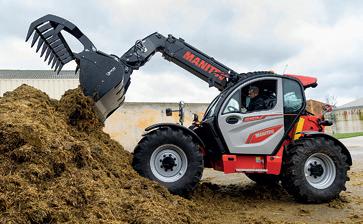
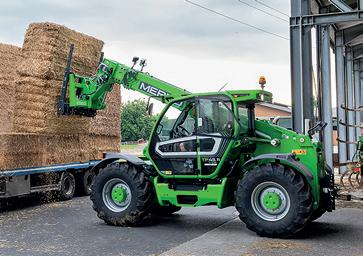
Telehandlers
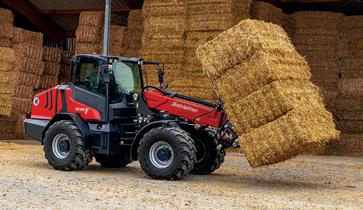
Trailers
Scone Horse Trials
Farming Yesteryear
Perth Show Preview
Topic
Biosolids, farming and Scotland’s
regulatory future
Travel Scotland
The Luss lifestyle
Fighting Rural Crime
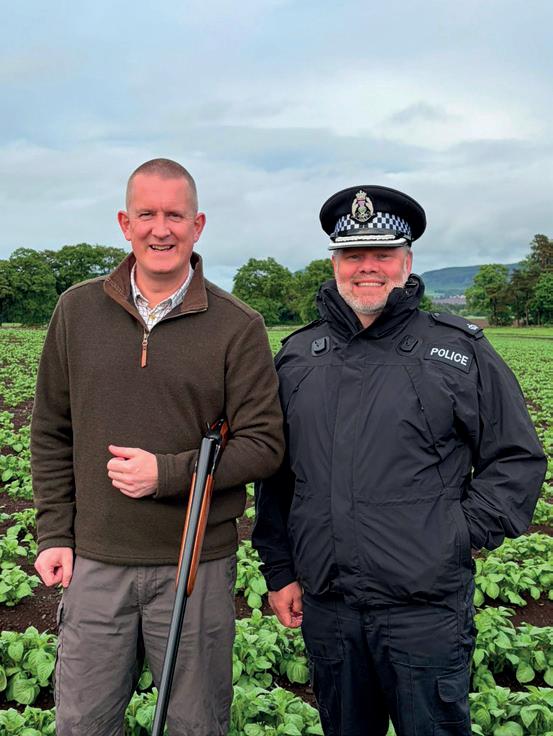
Rural policing in Scotland
magazine
Included inside
Shooting Scotland Magazine
60 pages packed with features & news
Articles
Six months to switch off Offshore moratorium
Annual feed idea
“They kill lambs don’t they?”
Women in Agriculture
New updated website
Ffermio Cymru
Welsh farming news plus
World Farming • Beatha an Eilean Book Serial • Northern Isles including our regular news areas and columns
Tuathanachas Alba
editor's bit Strange weather and pipe dreams
As I write this little column, it is roasting hot outside, and by the time you read this, it will probably be quite chilly, even though it will be July!
Bearing in mind that we had a lovely summer here in Scotland, it was on Tuesday, I suppose I shouldn’t complain, the sun is often a welcome stranger to us Jocks.
Joking aside, the weather is drastically changing – we had our holiday in late September last year taking our campervan up the west coast – the views were stunning, as was the weather.
But change is indeed afoot, and the climate is starting to get quite wild and dangerous in places.
Human destruction of nature and the pollution of our only life support system is the cause.
I believe the science, not the Elon Musk loonies of this world.
In addition to general industry, farming around the planet has to adjust, and work with nature on every level, no matter how hard that may seem right now – there is no other way.
If we are to survive and save our planet, pollution of all kinds must be banned globally.
If not done quickly, the climactic changes, weather disasters, droughts, tropical rains etc will increase and grow…while crops start to fail as a consequence.
Will Andy Burnham save us?
Not a chance in hell, there is too much money and political ego at stake to do anything meaningful.
arable Labour efficiency doubles with new integrated optical sorting line for Scottish seed grower
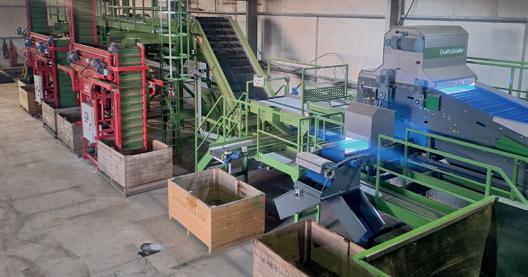
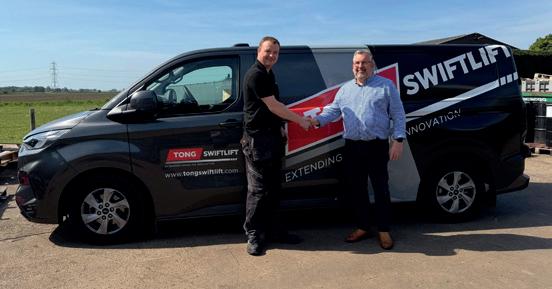
A Scottish seed potato grower has doubled productivity after installing a fully integrated grading line from Tong Engineering, combining advanced optical sorting technology with highperformance grading and handling systems.
WW Martin and Son, high-grade pre-basic seed potato producers based in North Scotland, have now processed more than 4,000 tonnes through the new system, reporting significant gains in efficiency, throughput and grading consistency.
The business decided to invest in a new grading line with a clear brief; achieve four precise size splits, improve box and bag filling efficiency, increase throughput, and integrate optical sorting technology to remove defects.
After reviewing four suppliers, Tong Engineering was selected to deliver the project.
“From the very beginning Tong stood out from the others.
Working closely with the customer, Tong engineered a fully integrated grading line incorporating Tong conveyors, EasyGrade sizing modules, a dry brusher and UniFill big bag and box filling system, designed to optimise flow and efficiency across the operation.
At the heart of the system is an optical sorting unit from Flikweert Vision, fully integrated into the line to ensure consistent, high-throughput defect removal. The Flikweert Vision system uses highresolution camera technology and intelligent image analysis to detect both external and internal defects in real time, removing substandard product without disrupting flow and maintaining gentle crop handling throughout.
line. “We were hugely impressed with Tong’s engineering facility. The attention to detail and skilled and happy workforce was a joy to witness. The new line looked fantastic, minor adjustments were made and the entire line was then delivered North and assembled on site,” said Jonnie.
Since installation, the results have exceeded expectations, with significant gains in operational efficiency. Jonnie reports; “Having now graded 4,000 tons of highgrade seed over the Tong line, we couldn’t be happier. Productivity per labour unit has doubled from our previous grading line, which is more than we anticipated.”
Slàinte, Athole.
The sales team, insightful and knowledgeable, couldn’t have been more helpful. They didn’t force a sale but listened to our brief,” explained Jonnie Martin.
“After several site visits and configuration tweaks, we settled on a final design. Charles assured us that the Flikweert Vision optical unit would be incorporated seamlessly into the line and gave us a specific delivery and install date,” said Jonnie. Prior to installation, WW Martin and Son visited Tong’s Spilsby manufacturing facility to review the fully assembled
www.farmingscotlandmagazine.com
Tong’s engineering and technical teams continue to support ongoing optimisation of the system to maximise output and efficiency. “Throughout the whole process, and now in the aftersales phase, the team at Tong Engineering have been particularly helpful in offering support and advice to help us maximise output of our new line. I’m delighted that I placed my business with Tong and proud to be associated with a British success story.”
Bag in a box biostimulants save 63% plastic
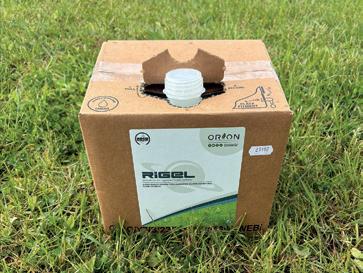
Single use plastics should be reduced to make managing crops more sustainable. This according to agronomist Mike Stoker, from biostimulants specialist Orion Future Technologies, is possible using a new bag in a box solution.
“The price of plastic has risen by more than 40 percent since the Iran/Israel conflict broke out in February. As a UK manufacturer of biostimulants, Orion has seen this as an opportunity to manage our cost of production and protect our customers by reducing the plastic needed to package our biostimulant products,” he says.
“The bag in a box reduces plastic use by 63 percent, which will help us to keep prices down and has knock-on benefits including reduced storage and transport costs which further brings down the carbon footprint of our products,” he adds.
Akin to the packaging used for products like wine, the bag in box also reduces the amount of air that flows back into the contents of the bag, giving the product a longer shelf life compared to when it was packed in hard plastics. It empties quickly, without ‘glugging’, and the design prevents air going back into the pack.
“For growers, the bag in a box is easier and cheaper to recycle and dispose of. It takes up less space and will also appeal to buying groups looking to promote sustainable credentials. The plastic bladder can be extracted, triple rinsed and recycled along with the cardboard outer box,” he says.
The Chartered Institute of Waste Management states that, “Around 135,500 tonnes of agricultural plastic waste is produced each year in the UK,”
and Defra suggests that only 2030 percent is turned into new products.
“As a manufacturer of plant nutrition products, we have targeted more sustainable packaging as part of our overall
desire to reduce unsustainable plastic consumption. While the bag in a box still uses plastic, it is a fraction of what has been used in the past and we see it as a big step in the right direction,” concludes Mr Stoker.
RAU team triumphs in crop plot challenge at Clarkson’s Farm
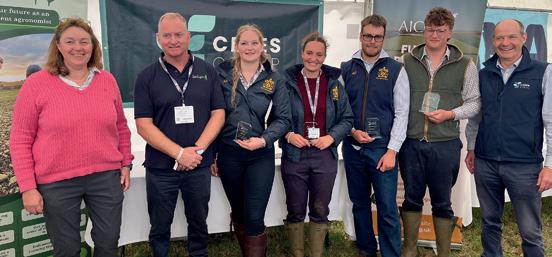
A team of students from the Royal Agricultural University (RAU) has been crowned the winner of this year’s AICC Ceres Rural Crop Challenge 2026 at Jeremy Clarkson’s Diddly Squat Farm.
Taking place as part of the annual Cereals agricultural trade event – which this year took place at the TV celebrity’s farm near Chipping Norton in Oxfordshire - the team fought off stiff competition from five other universities to claim the top spot in the hotly contested competition.
The teams of agriculture students were challenged to grow the best plot of Skyfall wheat in the Diddly Squat Farm Trials Zone. They were judged on the appearance of their plot, as well as decision making, communication, and team collaboration.
The RAU team – consisting of brother and sister duo Charlie and Sophie Turner, Archie Pegg, and team leader Alivia Ross - were judged, by Ceres Rural Managing Partner, and Clarkson’s Farm star, “Cheerful” Charlie Ireland and Roger Davis from Indigro representing AICC (Association of Independent Crop Consultants), to have produced the best crop.
Presenting the trophies, Charlie Ireland said: “It’s been really, really interesting. It’s that balance of highlighting practical constraints, cost control, financial balance, and disease management. That’s the really important thing. So, hats off to you - the standard has been really high this year.”
Student Alivia Ross (21), who led the RAU team to victory, said: “The knowledge we have gained, and the connections we’ve made, through this experience really are invaluable.
I hope to pursue a career in agronomy so I really threw myself in to making sure that our team’s crop management was completed to the highest level.
“The challenge related to many of our degree modules which really us all with our decision making. Thank you so much to Ceres Rural for hosting such a great competition and we are thrilled to have won it!”
The RAU team was crowned the overall winner, knocking rivals Harper Adams into second place while Aberystwyth University came third.
Professor Nicola Cannon, Professor of Agriculture at the RAU who mentored the University’s team, said: “I am incredibly proud of our students. Their management of the crop was particularly impressive, with well-designed crop protection strategies that effectively
controlled key diseases such as yellow rust and Septoria.
“They demonstrated an outstanding ability to translate their academic learning into real-world decision-making, carefully tailoring their crop management approach to the specific site conditions, weather patterns, and the challenges of the season including grain market pressures.
“What stood out most was their dedication, teamwork, and the care with which they approached every decision throughout the season. This achievement is a testament not only to their technical skills, but also to their professionalism and commitment to excellence.”
Edwards Seaweed launches Drone Pack to simplify precision Application
Ready-to-spray solution eliminates mixing, reduces downtime, and supports growing demand for drone-applied seaweed fertiliser.
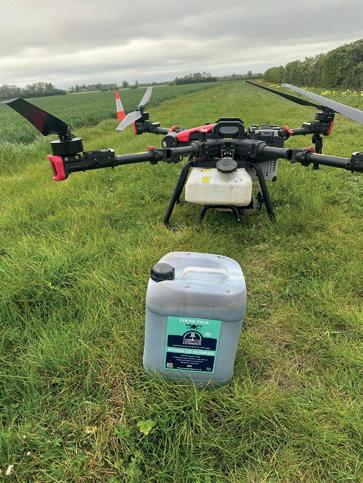
Edwards’ Seaweed Fertiliser UK, suppliers of natural seaweed products for commercial and domestic application, has launched at Cereals 2026 The Edwards Drone Pack, a new ready-made product designed specifically for professional drone applicators across the UK.
Developed in response to rapidly increasing demand for drone applications of natural liquid biostimulants, The Edwards Drone Pack contains a pre-mixed blend of Edwards Advanced Seaweed Fertiliser, EASy BioN soil enhancer, and clean water, professionally prepared and delivered ready for immediate use.
Each pack removes the need for on-site measuring, mixing, or sourcing clean water, and is formulated for drones to spray up to 3.29 acres of crops or grasslands.
The new solution has been designed by Edwards Seaweed to help drone operators work more efficiently while ensuring application accuracy and consistency.
Dave Edwards, CEO and CoFounder of Edwards Seaweed Fertiliser UK, explains: “The Edwards Drone Pack removes any complexity from drone application. By supplying the correct mix ready to spray and refill, drone operators can reduce their downtime, eliminate product loss, and focus on delivering precise applications of high-performance seaweed fertiliser, even in remote or difficult-to-access locations.”
The ready-to-use format is particularly beneficial for operators working in challenging environments, where access to water and mixing facilities can be limited. By arriving pre-mixed and ready for application, the Edwards Drone Pack enables faster turnaround times and more productive drone spraying operations.
Building a Nationwide Drone Network
Complementing the launch, Edwards Seaweed Fertiliser UK is expanding its partnership with Nantwich-based drone services provider Aerial Applications to establish a nationwide network of professional drone operators.
As demand for drone applications continues to grow,
experienced operators are being invited to join the Edwards Seaweed Drone Network and support the delivery of smart, regenerative farming solutions across the UK
Next issue out September 2026
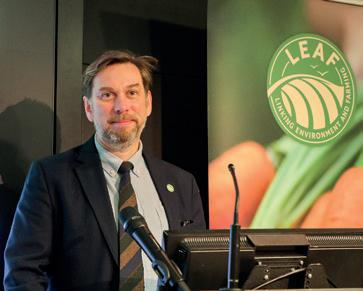
More than one million tonnes of UK cereals now produced by LEAF Marque certified growers
LEAF Marque certified farms now account for around 5.6% of national wheat, barley and oat production by volume, demonstrating the scale of sustainable farming across the UK.
Following Cereals 2026, LEAF (Linking Environment And Farming) is highlighting the significant contribution that LEAF Marque certified growers make to UK food production, with certified farms now producing more than one million tonnes of cereals annually while meeting independently audited environmental standards.
Analysis of crop area data submitted by LEAF Marque certified growers through the LEAF Sustainable Farming Review (LSFR) 2025, indicates that certified growers are responsible for an estimated 1.09 million tonnes of cereals each year.
Production estimates were calculated using the reported crop areas alongside Defra published UK average yields for wheat, barley and oats. This represents approximately 5.6% of total UK production across these key arable crops, demonstrating that sustainable farming practices are delivering at a meaningful commercial scale.
The figures* show LEAF Marque certified growers are estimated to produce:
• 736,884 tonnes of wheat annually - equivalent to 6.1% of UK wheat production
• 303,462 tonnes of barley annually - equivalent to 4.7% of UK barley production
• 52,695 tonnes of oats annually - equivalent to 5.5% of UK oat production
These production estimates are generated from more than 160,000 hectares of LEAF Marque certified cereal crops reported through the LSFR. Collectively, LEAF Marque provides independently audited environmental assurance across this land area and the rest of the farms to which it relates, placing it amongst the most significant voluntary environmental assurance systems operating within UK arable farming.
The figures also reveal the extent to which sustainable farming has moved beyond niche adoption. The data suggests one in every 16 tonnes of UK wheat, one in every 21 tonnes of UK barley and one in every 18 tonnes of UK oats is produced on a LEAF Marque certified farm.
David Webster, LEAF Chief Executive, said: “These figures highlight the scale at which LEAF Marque farmers are contributing to UK food production. Together, certified growers are estimated to produce more than one million tonnes of wheat, barley and oats each year from over 160,000 hectares of certified cereal crops, demonstrating that environmental stewardship and productive agriculture go hand in hand’.
FARMING SCOTLAND
Greater variety and crop choice can help arable growers build resilience
Despite ongoing pressures on arable farm businesses, greater choice across crops and varieties is creating new opportunities for growers to manage risk and build more resilient businesses, according to KWS.
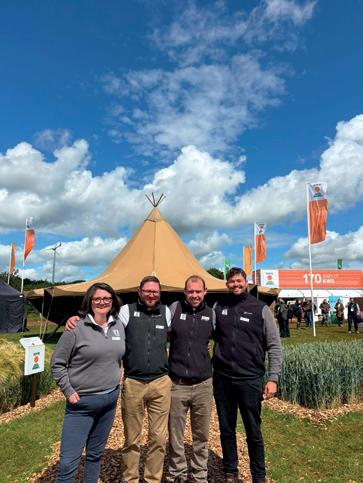
Speaking at Cereals 2026, KWS highlighted how its sustained investment in crop breeding – with 20% of global turnover being reinvested annually in research and development – is delivering stronger genetics and a wider range of cropping options at a time when every hectare must work harder.
Kate Cobbold, head of product management and agroservice at KWS, said: “Despite the pressures facing the industry, there are genuine reasons for optimism. Growers today have access to some of the strongest genetics we’ve ever seen, alongside a broader range of cropping options and routes to market.
“The progress made through plant breeding over the past decade has been significant. Higher yields remain important, but genetic gain is also delivering improvements in disease resistance, input-use efficiency and overall crop resilience.”
Encouraging growers to view crop and variety choice as a strategic business decision, she added: “The businesses best placed to succeed will be those that take advantage of the diversity of options available to them and consider productivity not just in terms of headline yield, but also in terms of consistency, resilience and overall system performance.”
While wheat will remain the foundation of most arable businesses, KWS believes greater diversity within rotations will play an increasingly important role in helping growers spread risk, improve resilience and respond to changing market conditions.
Oilseed rape is one example, said Rory Hannam, KWS product manager for oats, oilseed rape, peas and rye.
“After several difficult seasons, last year reminded many growers of the value oilseed rape can bring to a rotation when conditions are right,” he said.
“Continued breeding progress, including new hybrid material such as KWS Domingos, is helping maintain confidence in the crop and OSR has the potential to be a stand-out crop on farm again this year.”
The same principle applies across the wider rotation. Hybrid barley variety Inys continues to raise performance expectations, offering growers another option where it fits the rotation and business need.
Meanwhile, maize is attracting renewed interest from growers because of its flexibility across forage, grain, anaerobic digestion and contract-growing markets.
Matt Bull, agroservice manager at KWS, said: “There’s no single answer to the pressures growers face and resilience comes from having options and using them effectively.
“Rotations need to deliver against multiple objectives, from
managing disease and workload to supporting cashflow and market opportunities.”
He said it all starts with the seed; genetics give growers the
foundation to manage those risks and that’s why KWS continues to invest not only in wheat breeding but across a wide range of crops.
The James Hutton Institute joins £35 million investment to boost
crop resilience
The James Hutton Institute is proud to be a partner in PhenomUK, a major new £35 million, six-year research infrastructure funded by the UK Research and Innovation (UKRI) Infrastructure Fund and led by Biotechnology and
Biological Sciences Research Council (BBSRC), to accelerate the development of resilient crops and strengthen long-term food security.
PhenomUK will deliver a co-ordinated, nationwide
phenotyping infrastructure tracking crops from controlled environments to field conditions.
Phenomics is the science of the measurement and analysis of an organism’s traits – its characteristics - in order to
understand how genes and environment influence plant growth and development.
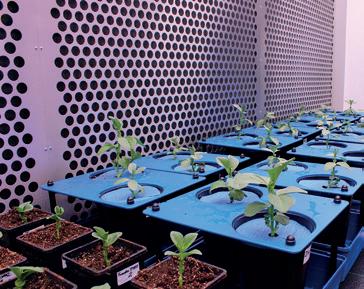
Using advanced imaging and automation, the programme will enable rapid testing of crop performance under stresses such as drought, heat and elevated CO², helping speed up breeding, innovation and the transition from research to real-world agriculture.
The Hutton’s contribution centres on the Advanced Plant Growth Centre (APGC), which includes facilities for molecular analysis, highthroughput phenotyping, vertical growth, post-harvest storage and controlled environments to simulate current and future climates.
Its deputy director, Dr Rob Hancock, said, “PhenomUK represents a fantastic opportunity to integrate and expand UK phenotyping infrastructure. Through the development of shared approaches and
methodologies, the network will significantly alleviate the phenotyping bottleneck, which has been caused by the rapid development of genetic analysis techniques as well as the size of crop populations, and which threatens to restrict developments in crop breeding.
“This new structure should accelerate the time to producing new cultivars which are required to mitigate increasing environmental challenges in crop production.”
By integrating controlled environments with field platforms, PhenomUK will deliver a “seed-to-field” pipeline for crop evaluation. Its national framework for data, access and collaboration will reduce duplication and accelerate innovation across academia and industry.
At a time of increased climate and resource pressures on UK agriculture, the project will support more precise crop
development, strengthen food security and advance sustainable, resilient farming systems.
The APGC is part of a £62 million investment through the Tay Cities Region Deal (TCRD), a partnership between local, Scottish and UK governments and the private, academic and
voluntary sectors and aims to revolutionise crop production systems to produce food with less environmental impact through state-of-the-art research and innovation infrastructure associated with precision and controlled-environment agriculture.
The UK Potato Sector Under Pressure
The humble potato may not make national headlines, but for Britain’s farmers and food system it has become emblematic of the pressures facing modern agriculture. For decades, the UK potato sector has been a reliable cornerstone of our food system. Affordable, versatile, and economically significant, potatoes have long been taken for granted. Yet growers, packers and processors have repeatedly faced periods of volatility, uncertainty, and sudden price shocks. None of these challenges are entirely new, but each successive crisis has chipped away at business resilience across the sector.
From Brexit and the pandemic, to the war in Ukraine, energy inflation, labour shortages and weather extremes, the industry has absorbed wave after wave of disruption. Each period of instability has forced difficult commercial decisions and, over time, has led some businesses to scale back or leave the sector entirely. The challenge facing the industry today is not simply another difficult season, but the cumulative effect of years of sustained pressure.
Global and domestic pressures are acute and converging. The conflict in the Middle East has sent energy and fertiliser costs soaring. Labour and machinery costs continue to climb and the removal of the Basic Payment Scheme in England has removed an important financial cushion that, over the past two decades, has helped many growers manage periods of volatility and absorb external shocks. Contract prices for potatoes have weakened this year and tighter margins throughout the supply chain are increasing commercial pressures for both growers and buyers. At the same time, depressed cereal markets provide little alternative income. For many,
By Scott Walker, CEO, GB Potatoes
the cumulative effect has left growers exposed, vulnerable and questioning the viability of this season.
The reality is stark. While cropping commitments for the current season are now largely in place, many growers will be considering how much exposure they are willing to carry into 2027 and beyond. Experiences will vary across the sector depending on market focus and contractual position, but supply-side shocks and rising cost pressures ultimately affect businesses throughout the supply chain. While the sector has shown remarkable resilience over many years, resilience itself is not unlimited. Without confidence and sustainable returns, there is a risk of gradual but permanent contraction in a sector that underpins more than £4.5 billion of economic activity and plays an important role in UK national food security.
Yet amid these challenges, there remains cause for cautious optimism. This summer, GB Potatoes, in partnership with the National Potato Innovation Centre, is hosting the GB Potato Summit. The Summit brings together growers, researchers, policymakers, and
industry leaders to explore how science, technology, policy and collaboration can help strengthen resilience and support long-term profitable growth across the sector. From tackling emerging pests and diseases to improving soil health and reducing reliance on costly inputs, innovation and practical policy frameworks will be central to securing the future of the industry.
The UK potato industry has the potential to grow in value, underpinned by smarter technologies, science-led production practices, and evolving consumer demand. Realising the potential will
require greater alignment between government policy, research investment, and supply chain innovation. A goal consistent with the UK Government’s proposed Food Strategy, Scotland’s National Good Food Nation Plan and the ambition of the new Farming and Food Partnership Board.
The potato sector is not facing a single defining crossroads moment. Rather, it is navigating a period of uncertainty in which businesses are continually adapting to rising risks and diminishing resilience. Growers will face difficult choices, but the path forward is not without hope. Through decisive action, partnership, and innovation, the UK potato industry can emerge stronger, more resilient, and better positioned to deliver for growers, consumers, and the nation.
The potato, long taken for granted, may yet prove a barometer for the broader challenges and opportunities confronting British agriculture in the twenty-first century. The coming months will test resolve, ingenuity, and leadership — and those who act decisively now will shape the future of Britain’s most essential and favourite crop, and the sector, for decades to come.
Separate slurry to manage phosphorus
The pressure on farms to better manage phosphorus can be addressed using separation. So says Andy Hayhurst, from Vogelsang, who explains that separation is not just about reducing the strain on storage but can also be an important measure to reaching phosphorus management guidelines.
“Defra has clearly outlined its plans to reduce total nitrogen, phosphorus and sediment
Scott Walker
pollution from agriculture into the water environment by at least 40% by 2038. While the process has been slow to take hold, there are movements being made to put additional pressure on farms, especially those near rivers and watercourses,” he says.
Using a separator such as Vogelsang’s XSplit creates a solid fraction with approximately 40 percent dry matter. The majority of phosphorus in slurry is removed into this solid, making it more manageable.
“Moving unseparated slurry costs more and, with the rise in fuel prices, fertiliser prices and the call from government to better manage phosphorus, there seems no better time to be taking advantage of separation technology,” he adds.
Concentrating phosphorus in the solid fraction leaves the liquid fraction with nearly all the soluble nitrogen (ammonium, nitrates, nitrites) and potassium. This allows for different application rates for the solid and liquid fractions to better match soil and crop needs. It can also reduce the cost of transporting the phosphorus solids over greater distances.
“For farms with land spread over wider areas, there are significant cost benefits to managing phosphorus through separation. Similarly, farms with a variety of crops can better manage phosphorus application by top dressing with a solid fraction that is rich in phosphorus for crops and soils that will benefit, and using the liquid fraction in areas that could be more prone to leaching phosphorus,” says Mr Hayhurst.
Recent extreme weather conditions in the UK have led to significant surface run off and soil leaching. By soil and slurry testing, farms can better understand the implications of slurry application to overloading fields that may, subsequently, pose a risk to nearby water.
NFUS launches Future Leader Programme
By Andrew Connon, President, NFU Scotland
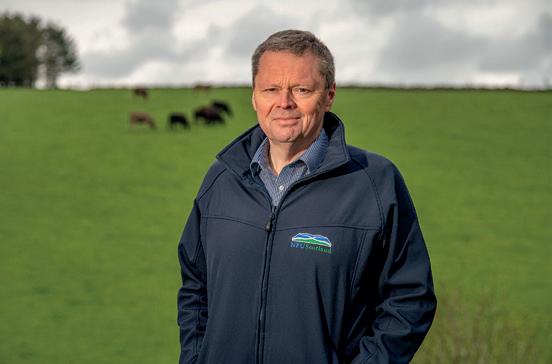
Andrew Connon, President, NFU Scotland
2026 has once again been a demanding year for Scottish agriculture. Producers are under real pressure. Commodity prices have fallen back, while the cost of inputs remains stubbornly high. At the same time, geopolitical instability feels ever present, and continues to rear its head to remind us just how quickly global events can filter through into our food system and hit primary producers hard.
There is no quick fix. Building resilience in our food system is needed, but it will take time. Policy change, legislation and negotiations do not happen overnight. That is the reality we are working within, and we need to make sure we get the decisions right along the way.
In that context, leadership matters more than ever. If Scottish agriculture is to be properly represented and understood at the highest levels of government, we need people who are equipped to step forward, make the case clearly, and
stand up for the industry when it counts.
Within NFUS, leadership exists at every level of the organisation. From our branch network, through our committees, and right up to our Board, we rely on committed members working alongside our professional staff to push the case for Scottish farming. Lobbying is not easy work. It can be slow, sometimes frustrating, and rarely straightforward. But it is work we are determined to do - and do well.
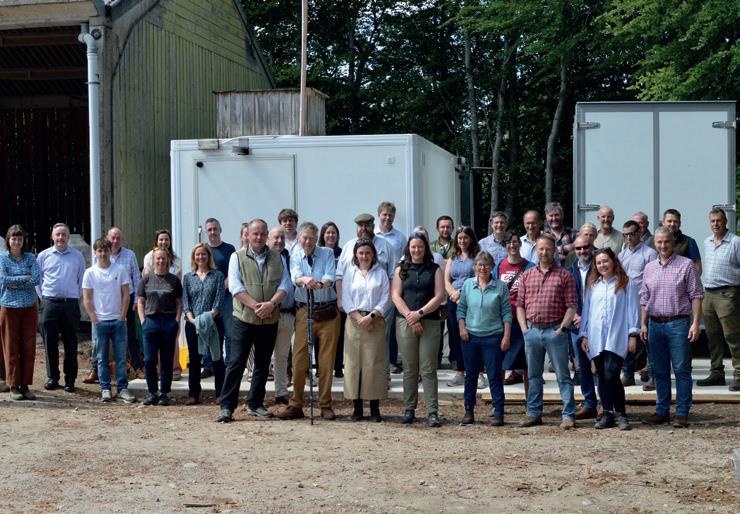
In June, NFUS brought together a group of around 40 members for a leadership event, supported by Johnstone Carmichael, with a strong focus on women and young people. It was a tremendous day. I felt blown away by the talent, passion and energy in the room. It’s clear there is no shortage of talent or commitment within our industry.
We are now taking this forward as part of a wider NFUS leadership programme, starting with
www.nfus.org.uk
our branch chair and vicechair network to identify and develop talent within our membership.
This is part of a broader commitment to strengthen NFUS for the future, making sure we deliver for members in a challenging time for Scottish agriculture.
And amidst all this, we have a newly elected Government, 64 fresh MSPs, and a new Cabinet Secretary, while Minister Fairlie provides continuity by remaining in post. We have written to all MSPs and the party leaders seeking engagement, and there is no doubt that we have a busy summer of political meetings ahead of us.
And amidst all this, we have a newly elected Government, 64 fresh MSPs and a New Cabinet Secretary whilst Minister Fairlie brings continuity remaining in post. We have written to all MSPs and the Party Leaders looking for engagement, and there is no doubt we have a busy summer of political meetings in front of us.
FLAVOUR OF SCOTLAND
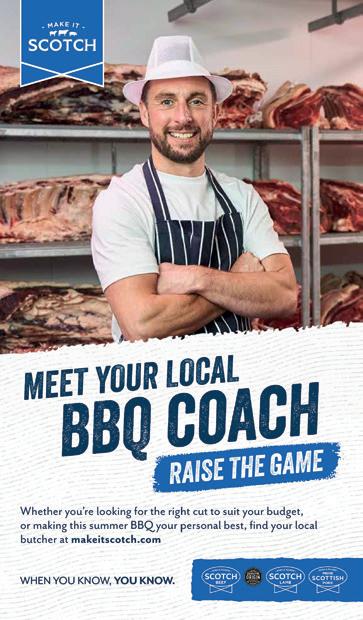
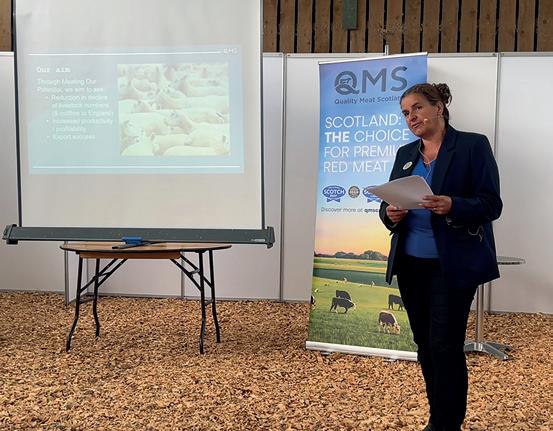
“Make it Scotch and raise the game” - QMS launches new campaign championing the Scotch brands
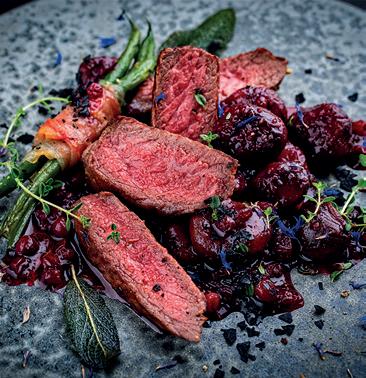
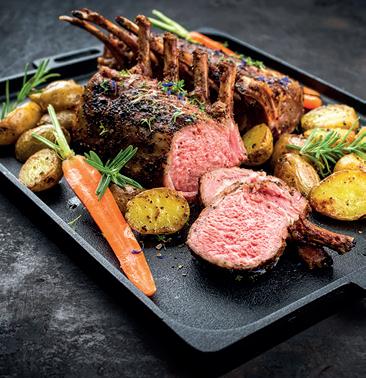
Quality Meat Scotland’s (QMS) consumer-facing campaign returns from 8th June with a major summer push across TV, outdoor, digital audio, social media plus online advertising, encouraging shoppers to choose Scotch Beef, Scotch Lamb and the newly rebranded Prime Scottish Pork, helping drive footfall and sales for retailers and butchers across Scotland.
Launching on 8th June and running until 2nd August, the latest phase of the ‘When You Know, You Know’ (WYKYK) campaign hopes to reach 72% of all adults in Scotland with a bold summer message that puts the quality assured Scotch brands at the top of the league.
The rallying call is strong“An epic summer awaits, and the ‘steaks’ have never been higher! Scotland’s on the global stage. Time to set the standard, fly the flag for the flagship brands of the Scottish red meat industry and make a stand for quality – it’s time to Make it Scotch and Raise the Game”. The campaign celebrates the care, skill and pride behind Scotch Beef, Scotch Lamb and Prime Scottish Pork and the story behind the renowned blue labels.
As in previous waves of the WYKYK campaign, the ads shine a light on some of the real people behind the brands, from cattle and sheep farmer Bruce Duncan and the wider Duncan family who showcase their livestock, to Edinburgh butcher Adam Gallacher of Saunderson’s in Bruntsfield presenting some of
the finest cuts. The ads also depict home cooks who show why quality assured Scotch meat can raise the game this Summer. Together, they help bring the Scotch story to life in a way that feels authentic, relatable and inspiring for shoppers.
The campaign will roll out through STV channel sponsorship, STV Player and SKY Regional TV advertising, high-impact outdoor billboards, digital audio, podcasts, Facebook, Instagram, YouTube and highly targeted online advertising. Outdoor activity will appear close to retailers stocking the brands, with high-profile train station advertising on the large screens at Edinburgh Waverley in June and Glasgow Queen Street in late July, timed to capture high summer footfall.
Alongside the main campaign, QMS has also developed a dedicated butcher’s version with bespoke messaging to support members of the Scotch Butchers Club across the whole of Scotland, helping independent butchers connect the national campaign directly to the in-store experience and reinforce the value of choosing quality assured Scotch produce. Station-endorsed radio features share butchers’ stories, expertise and passion for locally sourced Scotch Beef, Scotch Lamb and Prime Scottish Pork, while digital and social advertising will connect shoppers with butchers in their local area. Supported by advertising in trusted Scottish newspaper titles and BBQ recipe cards given
away in participating shops, the Butcher’s phase of the WYKYK Summer campaign is expected to reach over 2 million people
across Scotland throughout the summer.
Emma Heath, Director of Marketing at Quality Meat
Scotland, said: “This summer, we want to make it easier than ever for people to find the Scotch brands and understand what’s behind those renowned blue labels. Our ‘When You Know, You Know’ campaign continues to educate and inspire shoppers on why Scotch Beef, Scotch Lamb and Prime Scottish Pork stand apart, whether that is the unwavering quality assurance and high standards, the local
Scottish provenance, the skill of the people involved in the supply chain or simply the confidence and reassurance that consumers get from choosing quality. There are no bigger advocates for the brands than real farmers and butchers who passionately stand behind our brands every single day who can help us bring our message to life in a way that feels authentic, warm, accessible and relevant for today’s shopper.”
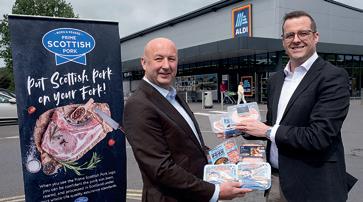
Aldi Scotland extends Scottish pork contract
Aldi Scotland has confirmed a three-year extension to Scottish pork supply through its partnership with Dumfries and Galloway based Browns Food Group. The extension, which covers fresh primary Scottish pork supply for all 113 of its stores in Scotland, is a testament to Aldi’s ongoing commitment to Scottish farmers, with the retailer continuing to promote Scottish-assured meat.
In February, research from the National Farmers Union Scotland (NFUS) 2025-26 ShelfWatch report identified Aldi as the first supermarket to list fresh primary Scottish pork. Aldi also had one of the highest levels of Scottish pork sourcing among supermarkets, at 41%.
Aldi’s Scottish pork is sourced from local supplier, Browns Food Group and the range includes a variety of high-quality products, including pork chops, fillet, loin medallions, shoulder steaks, shoulder joints and 5% fat mince.
Alan Leslie, Buying Director, Aldi Scotland, said: “Extending this partnership reflects Aldi’s longterm commitment to supporting
Scotland’s pig producers and delivering high-quality Scottish pork to our customers. We’ve built a strong and trusted relationship with Browns over the years, and this renewed agreement gives us confidence in the consistency, standards and provenance that the team continues to provide.
“We remain committed to investing in local supply chains and ensuring our customers can continue to access premium, locally sourced pork products for years to come.”
Wayne Godfrey, CEO, Browns Food Group, said: “Browns Food Group are very proud of our ongoing Scottish Pork supply into Aldi Scotland. With Aldi’s renewed long-term commitment and the roll out of the new Prime Scottish Pork logo across the market, this is the time for Prime Scottish Pork to prosper, with increased consumer recognition and continued loyalty to product quality and provenance. Aldi’s new long-term agreement is now reinforcing their steadfast commitment to the Scottish Pork industry.”
Scotland The Brand
Cow-with-calf offers new potential for Scottish dairy
By Ruth Watson
For generations, dairy farmers have been taking calves from their mothers to get the most milk possible but there is growing evidence that keeping cow and calf together can not only improve animal welfare but provide farm-wide benefits too.
A new film about the Ethical Dairy at Rainton Farm, ‘The Dairy Story’, is beginning to make its way into venues around the country, raising awareness and encouraging conversations about this changing approach to keeping cattle. The Ethical Dairy’s David Finlay was raised on a traditional farm, teaching conventional methods before making the move to an organic cow-with-calf system. The first to do it on a commercial scale in Scotland, David and his wife, Wilma - now sadly deceased – went through a steep, stressful, and expensive learning curve. The results, though, have convinced him it was the right decision. Soil health has improved, the diverse pasture provides the nutrients his cattle need; potash and potassium deficiencies which previously needed expensive inputs now
are at good levels. His farm is carbon neutral.
His cows, a careful mix of Holstein, Montbelliard, and Viking Red, give annual yields of around 4,000 litres while raising calves in a system which requires fewer inputs.
Mossgiel Farm uses the local native Ayrshires for their calf-at-foot system. Farmer Bryce Cunningham works with a number of businesses to get his organic milk - “farm milk, the way milk used to taste” - on tables across the country. He would like to see a certified cow-with-calf standard established.
In order to help farmers get a fair return for higher welfare cow-with-calf systems, Peter Stevenson, chief policy advisor for Compassion in World Farming, suggests the Scottish Government introduces a labelling system for dairy produce of a kind similar to the ‘free range’ or ‘caged’ labels we see on egg cartons, helping shoppers make informed choices while reinforcing Scotland’s reputation as a nation which delivers high quality dairy.
Ruth Watson is the founder of the Keep Scotland the Brand campaign
food & drink
Co-op backs British growers with homegrown potato varieties hitting shelves
Retailer looks to weather resilient varieties to maintain British supply
Co-op is strengthening its support for UK potato growers through a move to best-ofseason packs, making greater use of a wider range of homegrown potato varieties.
In a UK retailer first, the major shift supports the convenience retailer’s efforts to maintain British all year round, and has been welcomed by industry body, GB Potatoes, as farmers face continued pressure and ongoing challenges.
The new ‘best of season’ packs, which are in stores now, are curated for how they will be cooked, with Roasting, Mashing, Baking, Salad and Everyday potato packs. Each pack will contain one carefully selected variety, selected for its suitability for the cooking method, which will flex throughout the seasons, so only the best quality potato in season will be included. The
varieties will include Jelly, Tyson, Karelia and Maris Piper.
The new approach recognises that some long-established varieties no longer deliver consistent quality year-round and can be difficult to grow reliably in the UK, contributing to many retailers relying on imports from overseas. Switching to newer and more diverse varieties supports UK growers to be able to benefit from higher yields, fewer inputs or improved resistance to pests and disease, whilst ensuring the quality for Co-op customers and supporting the domestic food supply chain, whose resilience is vital.
Alex Godfrey, Chair of GB Potatoes, which was set up in 2023 to represent the views of the potato sector and champion British produce, said: “The move by Co-op recognises the quality of British-grown potatoes
and supports the long-term sustainability and profitability of UK potato production. With potatoes offering versatility and excellent value for money, helping consumers understand that different varieties are suited to different uses is a positive step that will strengthen the category.”
Scott Saunders, Co-op Senior Buying Manager for Potatoes, said: “We recognise that UK growers have been under pressure in recent years – by switching to newer, more resilient British varieties and focusing on how potatoes are used, we can offer more consistent quality, reduce waste for our members and customers, as well as offer greater flexibility for growers.”
The new Roasting packs will feature Maris Piper when at its best, before transitioning seamlessly into newer varieties
such as Tyson and Karelia as the season changes. Everyday potato packs will include white varieties that are known to be versatile across multiple cooking methods.
The move follows a year of extensive in-store trials and taste panels with shoppers, working closely with Co-op’s supplier, Greenvale to rigorously test quality, flavour and performance.
Sean Liddell, Growing Manager at Greenvale, said: “Towards the end of the season, potato quality can become less reliable, and retailers often rely more heavily on imports for more specific named varieties, while waiting for the new crop to be ready. By embracing newer varieties, we can allow for greater flexibility and ensure shoppers enjoy consistently good quality, UK grown potatoes all year round.”
Cheap food comes at a cost: NFU Scotland warns of growing risks to food security and rural resilience
NFU Scotland is warning that continued pressure to drive food prices lower risks undermining Scotland and the UK’s long-term food security, rural economy and farming future.
While affordable food matters to consumers, there must also be recognition of the real cost of producing safe, high-quality food to some of the highest environmental and animal welfare standards in the world.
Farmers and crofters across Scotland are already operating under enormous pressure. Rising input costs, labour shortages, extreme weather, increasing regulation and volatile markets are all placing huge strain on farm businesses. At the same time, Scottish producers are increasingly competing against imported products produced to standards that would not be permitted here.
NFU Scotland President Andrew Connon said: “Cheap food comes at a cost. If governments and retailers continue to focus solely on driving prices down, we risk eroding the very foundations of our domestic food production system.
“Scottish farmers and crofters are proud to produce highquality food with world-leading standards of animal welfare, environmental stewardship and traceability. But those standards come with a cost, and producers cannot continue absorbing pressure from every direction while returns are squeezed further.
“Food security is national security. If domestic production declines, we become more reliant on imports and more exposed to global shocks, supply chain disruption and geopolitical uncertainty. Recent years have
shown just how fragile global food systems can be.”
NFU Scotland has consistently highlighted the importance of profitability within the agricultural sector, warning that without profitable farm businesses there can be no long-term investment in food production, climate action or thriving rural communities. The Union’s vision remains clear: securing “a profitable and sustainable future for Scottish agriculture.”
The Union also stressed that food production must remain at the heart of agricultural policy and market decisionmaking, particularly as farmers are increasingly being asked to deliver environmental and climate outcomes alongside producing food.
Mr Connon added: “Consumers rightly expect food that is safe, sustainable
and responsibly produced. That depends on a farming industry that is viable and resilient. A food system that fails its producers will ultimately fail consumers too.
“We are not asking for special treatment. We are asking for a fair marketplace, clear food labelling, a level playing field on standards and supply chains that properly value Scottish produce.
“Supporting domestic food production is an investment in Scotland’s economy, environment and national resilience. Without action, the continued erosion of local production capacity will have serious long-term consequences.”
NFU Scotland continues to call on both the Scottish and UK Governments to recognise food production as a strategic national priority and to back policies that support profitable, sustainable domestic agriculture.
NFU Scotland President Andrew Connon
WORLD FARMING
ICBA Organizes “Millets
Harvest Day” to Support the Adoption of Climate-Smart Crops in the UAE
Held to mark World Environment Day, the event builds on the momentum of the National Agricultural Initiative for the Adoption of Climate-Smart Crops in the UAE
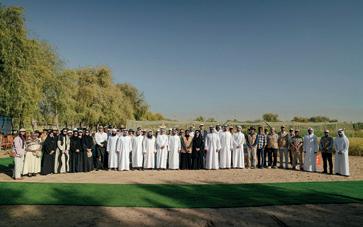
The International Center for Biosaline Agriculture (ICBA) hosted “Millets Harvest Day” to mark World Environment Day, as a field-based milestone that builds on the launch of the National Agricultural Initiative for the Adoption of ClimateSmart Crops in the UAE. The initiative was launched by the Ministry of Climate Change and Environment and ICBA during the Emirati Agriculture Conference and Exhibition 2026.
The event was attended by H.E. Dr. Mohammed Salman Al Hammadi, Assistant Undersecretary for the Food Diversity Sector at the Ministry of Climate Change and Environment, alongside Their Excellencies, senior officials, representatives of national entities and strategic partners, as well as farmers, researchers, decision-makers and a group of university students. It highlighted the importance of millet as a crop capable of adapting to climaterelated challenges, and its role in supporting sustainable agriculture and strengthening food security.
The event forms part of ICBA’s efforts to translate scientific research into practical field applications by demonstrating the value of crops that can tolerate drought, high temperatures and salinity, while requiring less water than conventional crops. This supports more efficient use of natural resources and helps expand food and fodder production options in arid and saline environments.
H.E. Dr. Mohammed Salman Al Hammadi, Assistant Undersecretary for the Food Diversity Sector at the Ministry of Climate Change and Environment, said: “The National Agricultural Initiative for the Adoption of Climate-Smart Crops in the UAE reflects the Ministry’s commitment to advancing practical solutions that enhance local food production and support the sustainability of the agricultural sector. Millets Harvest Day highlights the importance of our collaboration with ICBA, whose research, field trials and technical expertise contribute to identifying climate-smart crops suited to the UAE’s environmental conditions and supporting their adoption. Through this partnership, farmers gain access to sciencebased, more resource-efficient production options that strengthen their resilience and support the long-term sustainability of the agricultural sector”.
H.E. Al Hammadi added that the Ministry is working to support scientific research
and its practical applications to develop agricultural solutions capable of adapting to and withstanding harsh climate conditions, contributing to the UAE’s sustainable national food security objectives, increasing local food production, particularly of strategic crops such as grains.
H.E. Dr. Tarifa Alzaabi, Director General of ICBA, said: “Millets Harvest Day represents an important field milestone in ICBA’s efforts to translate the objectives of the National Agricultural Initiative for the Adoption of Climate-Smart Crops in the UAE into practical agricultural solutions. Organizing this event in conjunction with World Environment Day also underscores the environmental importance of crops such as millet, which can support more resilient production systems in arid and saline environments, where heat, salinity and water scarcity are major challenges. Through our research and field
trials, we are working to connect science with field application, support farmers with evidencebased options, and strengthen the role of climate-smart crops in future food and fodder systems”.
The program featured an overview of the objectives of the National Agricultural Initiative for the Adoption of ClimateSmart Crops in the UAE, an introductory session on the importance of millets as climatesmart and highly nutritious crops, a presentation of ICBA’s research and field efforts in this area, and a field visit that included a live millet harvesting activity.
Millets are among the strategic crops highlighted under the initiative due to their strong ability to adapt to drought, high temperatures and salinity, as well as their lower water requirements compared with conventional crops. They also have high nutritional value, containing around 7 to 12 percent protein, and are a source of iron, zinc, fiber, magnesium and essential antioxidants, reinforcing their relevance to food security, nutrition and sustainable agriculture.
Farmers also expressed their appreciation for the importance of seeing millet in the field, noting that this practical experience helped them better understand the crop’s potential to tolerate heat, water scarcity and salinity, while strengthening the connection between scientific research and farmers’ needs on the ground.
Six minutes to switch off’: New ‘Book Farmacy’ pilot targets mental health crisis in Scotland’s farming communities
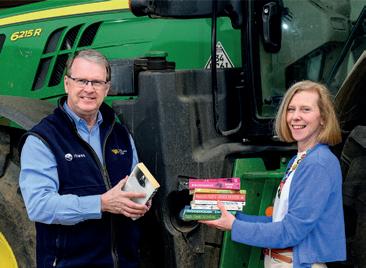
A new initiative aimed at tackling stress, isolation and mental wellbeing in Scotland’s farming communities was launched during Mental Health Awareness Week in May, encouraging farmers and crofters to take just six minutes a day to read.
The Book Farmacy pilotled by volunteers and supported by the Royal Highland and Agricultural Society of Scotland (RHASS) and local authorities in Orkney, East Lothian and the Scottish Borders - aims to increase reading uptake by those working in the agriculture sector, as a means to provide a simple, non-clinical tool to improve mental health within the industry.
At a time when pressure on the agricultural sector continues to grow, the initiative responds directly to the realities faced by farmers, including long working hours, isolation, financial uncertainty and the unpredictable nature of the job.
Findings from a research project by Sussex University show that reading for as little as six minutes a day can reduce stress levels by up to 60%, while also lowering heart rate and easing muscle tension. Wider evidence suggests that regular reading can support mental wellbeing, improve brain function and contribute to greater empathy and overall health. For those in agriculture - where organisations such as RSABI, Farmstrong Scotland and Teagasc identify significant pressures on mental wellbeingreading and related activities like visiting libraries or joining book groups have been shown to make a positive difference.
Those taking part in the initiative will be paired with one of their local volunteer “Book
Farm-assists” - individuals working in farming who are passionate readers - who will create personalised reading packages for participants tailored to their individual interests.
Recognising the long hours of a day’s farming or crofting, the programme encourages participants to commit to just six minutes of reading a day, whether that’s a few pages with a cup of tea or listening to an audiobook while working.
The pilot will run through to December 2026 and will also include silent book clubs and audiobook support, helping create opportunities for connection as well as relaxation.
The initiative is led, in a voluntary capacity, by RHASS member Ruthanne Baxter, Civic Engagement Manager at the University of Edinburgh’s Library & University Collections, and founder of the non-clinical mental health support service Pre scribe Culture.
Ruthanne Baxter said: “Farming can be an incredibly isolating profession, and we know the pressures people are
under aren’t going away. The Book Farmacy is about offering something simple, accessible and realistic that can fit into daily life.
“You don’t have to be a ‘reader’. This is about taking a few minutes to step away mentally - whether that’s through a book, a short story or an audiobook in the cab. There is evidence to show that something this small can make a meaningful difference, and we are keen to prove that also applies to the farming industry.
“We’d urge anyone in the farming or crofting community in the three pilot areas who is thinking about taking part to get in touch, if you are a lapsed or non-reader we’d love to hear from you. We’re also looking to build our team of Book FarmAssists across Orkney, East Lothian and the Scottish Borders - particularly farmers who enjoy reading and want to support others to give it a go.”
The initiative has been designed specifically with the farming community in mind, including support for audiobooks
to improve accessibility for those with dyslexia, which is more prevalent within the sector.
Alex Paterson, Chief Executive of RHASS, said:
“Supporting the wellbeing of Scotland’s farming and crofting communities is absolutely vital, and initiatives like The Book Farmacy bring a fresh, practical approach to that challenge.
“This is about meeting people where they are, recognising the realities of rural life, and offering something that is both accessible and meaningful. If we can help even a small number of people feel less isolated or better able to cope with the pressures they face, that’s hugely important.”
The programme also aligns with wider national ambitions around preventative health and strengthening rural communities, offering a low-cost, scalable model that, if successful, could be rolled out more widely across Scotland.
The Book Farmacy is being supported as part of Scotland’s National Year of Reading.
Alison Nolan, CEO of the Scottish Library and Information Council, said: “Projects like The Book Farmacy demonstrate how reading can reach beyond traditional spaces to support wellbeing, connection, and resilience in every corner of our communities.
“By engaging directly with farmers and crofters, this initiative highlights the power of books to ease isolation and open new pathways to mental health support.”
The project is now recruiting volunteer Book Farm-assists in Orkney, East Lothian and the Scottish Borders, as well as participants from farming and crofting backgrounds who are open to trying something new.
Alex Paterson and Ruthanne Baxter
Ffermio Cymru
NFU Cymru welcomes independent review of the bureaucratic burden on Welsh farming
NFU Cymru President has welcomed the news that Welsh Government is launching an independent review to examine the bureaucratic burden on Welsh farm businesses.
Cabinet Minister for Rural Resilience and Sustainability, Llyr Gruffydd MS, has commissioned a nine-month review examining the cumulative impact of regulatory red tape on Welsh family farms. The review will be led by John Davies, a beef and sheep farmer from Brecon and former NFU Cymru President.
NFU Cymru President Abi Reader said: “An independent review of the regulatory burden affecting Welsh farming businesses was a key ask of NFU Cymru’s Senedd Election manifesto. Given that 15 years have passed since a review of red tape and bureaucracy was conducted, it is only
right that such an independent assessment is held to evaluate how the cumulative impact of new policies and regulations introduced during this period are affecting the industry. The Minister’s announcement is a positive step and recognition of the real concerns being raised by farmers across Wales. Our members are clear that the volume and complexity of current rules is placing unsustainable pressure on farming businesses, with more than 80% identifying regulation as a key concern for the year ahead in a recent survey.
“The review also comes at a time of significant change in the regulatory and policy landscape in Wales. The industry continues to grapple with the complex rules in the Control of Agricultural Pollution Regulations (2021) and many farmers across Wales are focussed on meeting the requirements of the Sustainable
Farming Scheme for the first time in 2026.
“While regulation has an essential role in underpinning high standards, it must also be proportionate, workable and joined-up. This review must focus on streamlining on-farm requirements, cutting duplication, improving clarity and ensuring that policy delivery is practical and achievable for farm businesses on the ground.”
In the coming weeks, NFU Cymru will be engaging with its boards, counties and the wider NFU Cymru membership to enable farmers to share both detailed feedback and practical examples of where regulation and policy is creating challenges, as well as where improvements can be made.
NFU Cymru President Abi Reader said: “It is vital that this review is informed by real-world experience and shaped by those
Gwobrau Gwrthfiotigau
directly affected. By working with our members, we can build a strong, evidence-based picture of the current burden on farming families and provide constructive, solutions-focused input that helps deliver a more streamlined and effective regulatory framework.
“The appointment of John Davies as the person to lead this work is to be welcomed. John is a hugely well-respected figure within the Welsh agricultural industry, possesses an excellent understanding of the regulatory landscape and has the knowledge and passion to take this important area of work forward and ensure that it is scrutinised effectively.
“This is a significant opportunity to reset how policy and regulatory requirements work for Welsh farming. We look forward to working with John Davies and the Welsh Government to ensure that it delivers meaningful, lasting change.”
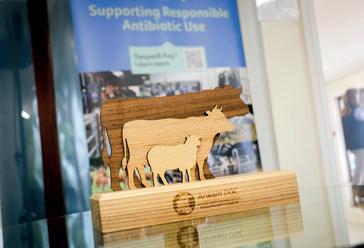
Arwain DGC AR AGOR gyda Chategori Newydd
Bydd cyflawniadau ffermwyr ifanc a milfeddygon ifanc wrth frwydro yn erbyn ymwrthedd gwrthficrobaidd (AMR) mewn da byw ac yn yr amgylchedd yng Nghymru yn cael eu cydnabod yng Ngwobrau Milfeddygon a Ffermwyr Arwain DGC 2026.
Mae enwebiadau bellach ar agor ar gyfer y gwobrau blynyddol, a gyflwynir yn Sioe Frenhinol Cymru ar 22 Gorffennaf.
Am y tro cyntaf, mae Gwobr Milfeddyg Ifanc neu Ffermwr Ifanc wedi’i chyflwyno ochr yn
ochr â’r gwobrau sefydledig: Milfeddyg Da Byw, Ffermwr Da Byw, a Phractis Milfeddygol Da Byw. Mae’r categori newydd ar agor i filfeddygon ifanc neu ffermwyr ifanc 28 oed ac iau.
Mae Arwain DGC yn rhaglen a ariennir gan Lywodraeth Cymru sydd wedi ennill gwobrau, ac sy’n cefnogi milfeddygon a ffermwyr yn y frwydr yn erbyn AMR drwy wneud penderfyniadau sy’n seiliedig ar ddata, defnyddio technolegau arloesol, a hyrwyddo arferion gorau.
Dywedodd Dewi Hughes, rheolwr rhaglen Arwain DGC: “Mae Arwain DGC wedi dod yn arweinydd byd yn y frwydr yn erbyn AMR. Drwy weithio gyda’n gilydd, mabwysiadu arloesi, a rhannu gwybodaeth, mae ffermwyr a milfeddygon yn allweddol i sicrhau bod gwrthfiotigau’n parhau i fod yn effeithiol ar gyfer iechyd anifeiliaid a phobl.
“Sefydlwyd Gwobrau’r Milfeddyg a’r Ffermwr i adlewyrchu eu gwaith caled ac i gydnabod yn gyhoeddus eu hymrwymiad a’u cyflawniadau. Rydym bellach am adeiladu ar eu hetifeddiaeth a thynnu sylw at y brwdfrydedd a’r ymroddiad a ddangosir gan y genhedlaeth iau o filfeddygon a ffermwyr yn y frwydr barhaus yn erbyn AMR.”
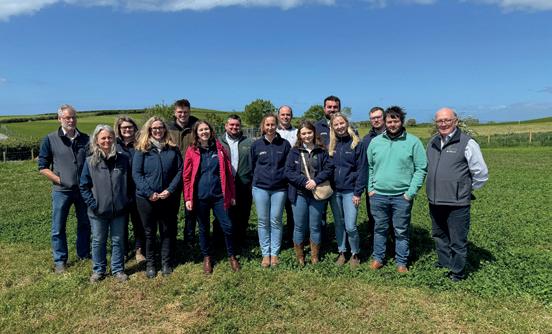
NFU Cymru Next Generation Development Group visits world leading bioscience research centre
Members of NFU Cymru’s Next Generation Development Group have been given an insight into the exciting innovation and research taking place in Wales that could benefit farmers in the future.
The cohort visited Aberystwyth University’s Institute of Biological, Environmental and Rural Sciences (IBERS) on Tuesday 12th May to learn how the department works with farming groups policymakers and the supply chain to dissect the challenges facing the agricultural industry and with a strong focus on applied research, working collaboratively to identify groundbreaking solutions.
Professor Alison KingstonSmith, the Director of Research in IBERS, provided an overview of the institute’s work, particularly its focus on using the genetic diversity of crops to increase resilience and sustainability in the sector. This research has helped create IBERS high sugar ryegrasses back in the 1980s and more recently, the breeding of new winter oat varieties that have since gone on to populate over 90% of the UK market.
The group were then taken on a tour of the National Plant Phenomics Centre, where Dr Fiona Corke demonstrated how the centre uses automated growing and analysis to investigate how the genetics of plants are influenced by their environment and treatment. This has allowed the team to identify genes which cause plants to have increased drought tolerance,
yield or even increased thickness of roots that can then resist flooding and high-speed winds.
Dr Hannah Vallin gave an overview of how the centre uses DNA metabarcoding to identify the best species and traits for grazing, with the potential to then develop the best forage crops that may allow for an improved livestock diet for the benefit of reducing methane output, or the ability to retain more energy from less feed. One highlight of the day for many of the group was speaking to Jason Brook, who is the centre’s lead on drone technology and designated pilot, responsible for the flight of groundbreaking drone technology.
After crossing the road to AberInnovation, the university’s cutting-edge research and development facility, Dr Hugh
Bulson led the group on a tour of the biorefining and biomass conversion centre. Here, expert researchers are developing processes to create products from biomass and waste, including valuable pharmaceutical chemicals and other goods such as prebiotics and sweeteners. The group also heard about the innovative work of the Future Food Centre.
NFU Cymru members then visited Dr Marley and Dr Jones at IBERS’ new Ty Hen grassland platform, where the institute’s ongoing development of clover varieties to create a more sustainable protein source for livestock are tested in a controlled - but field scale - environment which includes livestock grazing.
To end the day, Dr David Lloyd, from Germinal, took the
Next Generation Development Group to Cae Gwastad, IBERs field plots used for testing the growth and breeding of these grasses, clovers and other legumes. Here, Dr Lloyd showed how Germinal scientists have successfully managed to increase the persistence and resilience of red and white clovers
NFU Cymru Next Generation Group member Andrew Peebles said: “It’s great to see the world-leading research and development being carried out here in Wales by IBERS and to learn more about how it can be applied on farm. As the next generation of farmers, it’s vital that we embrace new innovations to improve productivity while building resilience to climate change, ensuring we can continue to produce food sustainably for the future.”
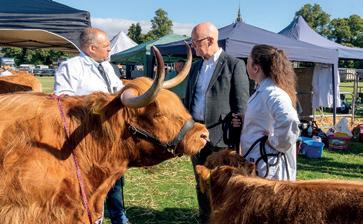
The Scottish agricultural spotlight is poised to turn on Perth as the Fair City welcomes the 164th twoday Perth Show to the South Inch on Friday, July 31st, and Saturday, August 1st.
Regarded as one of the best in the country, Perth Show holds the unique distinction of being the only agricultural show to be held in the centre of a city.
And the two-day spectacular promises to be more diverse than ever with something for everyone in a non-stop programme of agriculture, equestrian, food and family fun events.
Show secretary Jen Leslie said the 2026 Perth Show would again appeal to not only the farming community but the growing number of townspeople and visitors who enjoy the event.
“Perth Show has evolved to become a grand day out for the general public – both young and old,” she said. “The focus is of course on the agricultural sector, but we have built on the successes
Fair City centre prepares for the 164th Perth Show
Journalist Maureen Young looks at what’s in store for visitors to the annual two-day agricultural spectacle
of previous years to ensure we feature crowd-pleasers for all.”
In one of the finest line-ups of would-be champion horses, donkeys, goats, cattle and sheep of any Scottish county show, around 1,000 animals will face the judges’ scrutiny in more than 360 classes, with return champions vying with young pretenders to claim the silverware.
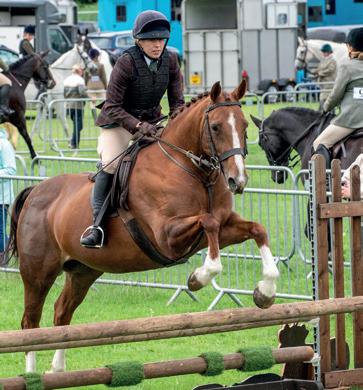
Perth Show has also become renowned for its equestrian showcase on the Friday and is the only agricultural county show in Scotland selected to host a record number of London International Horse Show qualifiers.
“We have attracted a phenomenal 21 qualifying classes which will see some of the country’s best riders head to Perth in a bid to secure a place in the finals at London,” said Jen. “Perth Show is now a springboard for some of our best champions and it’s great to see them progress to the national arenas.”
Champion horses make way for farmyard favourites on the Saturday, including a record number of sheep in a growing number of classes.
“Our sheep entries have just taken off,” said Jen, “particularly our rare breed section which will account for a large part of our 400plus sheep on show. We have even had to split some of the classes to accommodate the volume of entries.
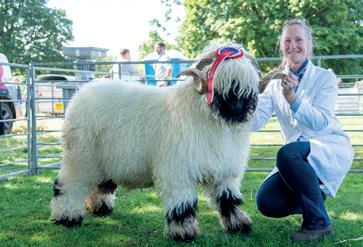
“We’ll welcome our traditional breeds back to the fold with Cheviot and Blackface leading the way, but look out for more rare breeds than ever before including Valais Blacknose, Dutch Spotted and Blue Texel.
“As Perth Show’s reputation as a centre of excellence for rare breeds grows, we’re now welcoming some of the best breeders from all across Scotland.”
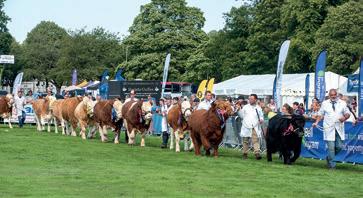
While not hosting a national cattle show for the first time in several years, Perth Show 2026 will again feature Scotland’s native
and foreign cattle at their best –many carrying plaudits from the Royal Highland Show several weeks beforehand.
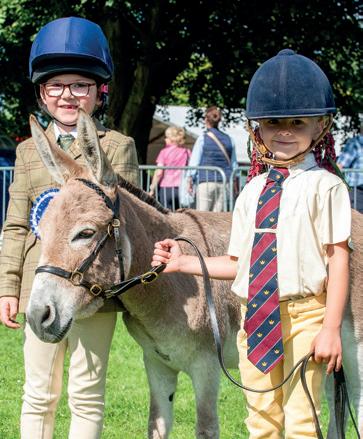
Young handlers often cut their teeth at Perth Show and an increased number will take to the showrings with their animals this year.
And crowd favourites such as the glorious heavy horses make a welcome return with in-hand, ridden and driven classes set to create a spectacle of thundering giants.
At the other end of the size scale, ponies, donkeys and goats will also be groomed to perfection for their turn in the spotlight.
This year will also see the rebranding of the Show’s food and drink festival. “The Perthshire Pantry” (supported by Binn Group, UHI Perth and Perthshire Chamber of Commerce) will focus on local culinary talent and produce - as well as the area’s diversity of international cultures and cuisines - in a range of cookery
demonstrations, produce stands and pop-up restaurants.
Looking forward to the twoday agricultural showcase is this year’s show chairman Jock Wilkie, owner of Netherton Equestrian, livery and riding school, near Perth.
“It’s a real honour to be Chairman of Perth Show when it’s something that has been a part of your life – all your life,” he said. “To welcome thousands of people to the South Inch to see some of the finest livestock, riding talent, produce, craft and rural skills is a real privilege.
“We’re also focussing strongly this year on education, so youngsters – and adults – will have the chance to see rural skills
in action and learn where their food comes from.
“Perth Show is a great chance for city and county to come together to celebrate and acknowledge our agricultural industry and the part it plays in all our lives,” said Jock.
“The farming industry faces increasing challenges with rising costs, competitive markets and ever-changing rules, regulations and restrictions. For two days, Perth Show provides a release from the stresses and concerns of life and allows farmers to come together and enjoy the fruits of their labour.”
Jock highlighted the diersity of trade stands and entertainments at this year’s event which would complement the showcase of
some of the county’s (and beyond) premier livestock ranging from hulking prize bulls and giant heavy horses to pygmy goats and miniature donkeys.
“And with all-family entertainments ranging from giant tortoises, dog shows, children’s races, horseshoe hunts and bouncy castles to stalls, food festival, tractor football, mounted games, vintage tractors and pipe band, it’s shaping up to be two days worth marking in your diaries.”
Jock stressed the huge team effort that has gone in to organising this 2026 event and he highlighted his “top team” of Vice Chairman Tom Rust from Forestry and Land Scotland; Junior Vice Chairman Fraser
Campbell, farm manager at Drummond Estate; and secretary Jen Leslie for pulling it together.
“We’re also hugely indebted to our Show sponsors including main sponsor Binn Group and key supporters Morris Leslie Group, EQ Chartered Accountants, Perth College UHI, Stewarts of Tayside and Netherton Equestrian,” said Jock.
“The costs of staging Perth Show are astronomical – and rising year on year – and we couldn’t hope to stage what is regarded as one of the best county shows in the country without sponsor support and an army of volunteers. We – and the thousands who flock through the gates on the day – owe them our thanks.”
organics
UK organic land surges to highest figure in a decade
Rising fertiliser costs, sustainability concerns and consumer demand are driving a surge in organic farmland in the UK, according to Soil Association Certification
Figures released by Defra this week show that organic land rose by 7.3% in 2025 reaching 540,000 hectares (ha) – the highest total in more than a decade.
This has largely been driven by Scotland, where land in conversion increased by 115%, rising from 26,000ha in 2024 to 56,000ha in 2025.
Scotland is now at 3.3% organic land share, up from 1.8% in 2021 – just 0.3% shy of hitting the Scottish Government’s target to double organic farmland by this parliamentary term, which has just come to an end.
The figures published this week cover the calendar year for 2025, meaning this target is likely to have been hit or exceeded once early 2026 data is available.
Soil Association Certification Senior Commercial Manager Alison Muirhead said: “Farmers
are turning to organic as not only does it provide huge benefits for the environment and wildlife, it also makes good business sense. Even amid cost-ofliving pressures, sustainability and health is a big concern for shoppers and consumer demand for organic has been rising for the last 14 years.
“It’s great to see farmers responding so we can better meet that demand with British products instead of imports. Furthermore, fertiliser costs were rising even before the Iran war, so it is unsurprising that farmers are looking for a system that doesn’t depend on gas from conflict zones. And with increasingly extreme weather, farmers need the healthy soils that organic delivers, to be more resilient to drought and flooding.”
Scotland leads the way for organic
Although Scotland has seen a big rise in land in conversion, this is significantly higher than the figures for the rest of the UK and the Soil Association is therefore calling for Organic Action Plans for England and Wales, to follow Scotland’s example.
England’s land in conversion increased by 23%, rising from 19,600ha in 2024 to 24,200ha in 2025. This is the largest area of land in conversion since 2021, though is still lagging behind Scotland, with the West Midlands seeing the largest increase in land in conversion.
Wales saw a four per cent increase in land in conversion, but fully organic land that has completed the two-year conversion period was down by six per cent.
Alison added: “It is great to see a rise in organic land across most of the UK, but the increase is largely being driven by the
appetite in Scotland. England and Wales are lagging way behind as Westminster and the Senedd are not showing as much commitment as the Scottish Government.
“In Scotland, ministers are actively championing organic for the benefits it can deliver for soils, nature and climate by avoiding harmful, fossil-fuel based inputs. In addition to the target to double organic land, the government has also rolled out a funded Organic Action Plan, which is bringing the supply chain together to break down barriers to making local organic food and drink accessible.
“Scotland is a great example for how with the right backing from politicians and supply chain experts, we can produce naturefriendly food and drink on healthy, home soils. We therefore urgently need Organic Action Plans for England and Wales so the whole of the UK can feel the benefits organic delivers.”
Most living in the Highlands support moratorium on new offshore wind developments
A CLEAR majority of Scots support a moratorium on further offshore wind development until the impacts on fishermen are fully assessed and compensation arrangements are agreed, according to new polling carried out on behalf of the Scottish Fishermen’s Federation.
The nationally representative survey of 1,000 adults across Scotland by Opinion Matters found that 71% of those living in the Highlands and Islands agree that the Scottish Government should place a temporary pause on approving new offshore wind developments.
Around 40% strongly agree with such a moratorium, while just 11% disagree.
The findings underline growing public concern about the cumulative impact of offshore renewables expansion on Scotland’s fishing industry, known as the spatial squeeze.
The SFF has been forthright in calling for a moratorium on future offshore wind development and has urged candidates in May’s Scottish parliamentary election to sign its pledge supporting such a move.
More generally, the Scottish public strongly supports the country’s fishing industry and is more likely to vote for political parties that back it.
Asked whether they would be more or less likely to vote for political parties if they committed clearly to supporting Scotland’s fishing industry, rather than letting it become a casualty of offshore wind development, 60% of respondents said they would be more likely to do so, with more than a quarter saying they would be much more likely to do so
(27%). Just 4% said they would be less likely to support such parties.
The polling also reveals overwhelming backing for safeguarding Scotland’s fishing fleet as competition for marine space intensifies.
More than four in five respondents (91%) agree that Scotland’s fishing fleet should be protected, including 60% who strongly agree. Nobody disagreed.
The results demonstrate broad public recognition of the fleet’s importance at a time when offshore wind and other renewable developments are expanding rapidly across Scotland’s seas.
Scots further believe that where offshore wind developments cause harm to fishing operations, energy companies must take responsibility.
Around four in five respondents (78%) agree that energy companies should be required to pay fair compensation if offshore wind developments restrict access to fishing grounds or cause financial loss to fishermen.
Nearly half (47%) strongly agree. Only 7% disagree.
SFF chief executive Elspeth Macdonald said: “Taken together, these findings send a clear message: the Scottish public supports renewable energy, but not at the expense of Scotland’s fishing fleet or without proper safeguards in place.
“With two thirds of voters backing a temporary pause on further offshore wind approvals, more than eight in 10 calling for protection of the fleet, and strong support
for mandatory compensation where harm occurs, Scots expect policymakers to strike a fair balance between energy development and food security.
“The Scottish Government must take these strong opinions into account before the fishing industry is squeezed out of legitimate and long-established fishing grounds forever.”
The research was conducted by Opinion Matters between 22nd and 26th January 2026 among a sample of 1,000 nationally representative adults in Scotland aged 18+. Opinion Matters abides by the Market Research Society Code of Conduct, follows ESOMAR principles and is a member of the British Polling Council.
environment
Record high for peatland restoration in Scotland welcomed
Rural business organisation
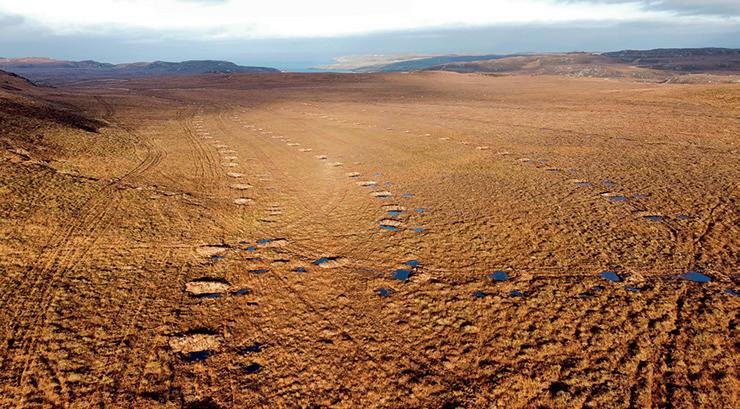
Scottish Land & Estates (SLE) has welcomed new figures from Peatland ACTION showing that 15,448 hectares of peatland were restored in Scotland in 2025, the equivalent of nearly 30,000 football pitches. This figure is in excess of the Scottish Government’s target for 2025/26.
Eleanor Kay, senior policy adviser (agriculture and climate change) for SLE commented: “These figures are fantastic news for Scotland and demonstrate how collaboration can unlock peatland restoration at scale, support local priorities and deliver long-term benefits for the climate, biodiversity and people. The majority of restoration in Scotland is undertaken by private
land owners, with support from NatureScot.
“Peatland restoration offers a wide range of benefits, from carbon capture to flood resilience and water management, habitat creation and wildfire mitigation.
“Around a third of our members are engaged in peatland restoration, alongside wider conservation projects and sustainable land management. We congratulate all those who are making such a valuable contribution to our environment and boosting biodiversity.”
Among the successful peatland restoration projects undertaken by SLE members, Lochrosque Estate has restored over 1,000 hectares of degraded peatland, cutting potential carbon emissions of around
230,000 tonnes over the next 100 years, while also improving water quality and creating jobs in Wester Ross.
Peatland restoration also helps create high-quality habitats for rare native species.
The East Cairngorms Moorland Partnership has reported breeding success for species including golden eagle, hen harrier, red kite, osprey, peregrine, merlin and short-eared owl, following a landscape-scale peatland restoration project.
SLE’s own research into projects undertaken by members reveal that innovation and technology often play a significant role in peatland restoration. From drone surveys to better mapping and monitoring, data is helping target
restoration where it can have the greatest impact for carbon, water and biodiversity.
Organisations such as the Crichton Carbon Centre help build understanding of peatland restoration while Sky-Pin Drones is pioneering the use of drone technology in Scottish land management, agriculture, and environmental restoration.
Eleanor Kay added: “Across rural Scotland, peatland restoration work creates skilled employment, strengthens rural businesses and helps build a green economy rooted in land management. Peatland restoration is not just good for the environment, but also represents an investment in rural jobs, skills and the creation of resilient landscapes.”
Realising Scotland’s renewable energy potential
More than £1 million to support offshore wind skills
Three projects will share almost £1.7 million to provide training that will support the further development of Scotland’s offshore wind sector.
The grants will establish a regional skills hub for the Highlands and Islands, expand engineering construction programmes, and support training courses at North East Scotland College. The awards are expected to attract private investment of a similar value.
The projects will help more people develop the skills needed to secure good jobs and realise
the wider economic benefits of the renewable energy sector.
The announcement was made by Energy Minister Stephen Gethins ahead of a visit to the National Manufacturing Institute Scotland, to meet participants in the Scottish–Irish Offshore Wind Internship Pilot with representatives of the Government of Ireland and Enterprise Ireland.
Mr Gethins said: “I am determined to make the most of Scotland’s remarkable energy potential, with industry reports estimating offshore wind could support up to 49,000 jobs in
Scotland. That is why it is at the centre of both our energy and economic ambitions.
“The Scottish Government is doing everything within our power to help seize this exciting opportunity, and that starts by focusing on skills to ensure communities benefit directly from employment opportunities and businesses have the skilled workforce they need to grow.
Supporting these three projects with almost £1.7 million is central to that, and there will be more to come.
“By bringing businesses together with education and skills
providers, the Offshore Wind Skills Programme is the kind of smart, co-ordinated approach we need to shape the future of our renewables sector. Working with partners is vital given the scale of both the opportunities and challenges, and the Scottish–Irish Offshore Wind Internship Pilot is an excellent example of the benefits achieved by working together.
“However, the full benefits of our country’s offshore wind potential will only be realised when Scotland is an independent nation and our energy resources are in our hands.”
New wind turbine planning proposals could be game-changing for farming land and large land holdings but the details matter, says expert
• Rural landowners and those organisations with large land holdings advised responding to consultation by June 10th
• Foot Anstey Managing Associate Aliki Zeri discusses why this new initiative could be game-changing for those that own large land holdings
The government is consulting on proposals that would allow a single small wind turbine to be installed on non-domestic rural land without
requiring a full planning permission.
For farms, estates and landowning charities, this could have significant implications, allowing them to decrease their reliance on the grid and potentially leading to a reduction in electricity costs.
Published by the Department for Energy Security and Net Zero (DESNZ) on 18 March 2026, the consultation proposes a new Permitted Development Right (PDR) for non-domestic land.
Under the proposals, a single turbine of up to 30 metres could be erected subject to conditions around noise, visual impact and siting. Certain areas, including conservation areas and listed building curtilages will be excluded under new rules.
Aliki Zeri, Managing Associate from Foot Anstey, discusses what this could mean in practice:
“The removal of the requirement to obtain planning
permission could be gamechanging. Planning costs, consultant fees and even the risk of having an application refused has historically made small wind projects uneconomic.
A clear PDR route could change that, with benefits such as lower energy bills and greater price stability, stronger energy resilience where grid connections can be unreliable and a practical route to helping meet net-zero commitments.”
Workhorses with a long reach
A
look at some of the latest telehandlers available today
SCORPION 848 joins the CLAAS line-up
Comprising a total of nine models, the CLAAS SCORPION telescopic handler range covers a wide range of customer requirements. The product range extends from 3,300 to 6,000 kg load capacity and from 6.23 to 9.75 m maximum lifting height. All SCORPION telehandlers are powered by economical 143 or 156hp four-cylinder engines. In combination with the fully automatic, continuously variable hydrostatic VARIPOWER ground drives, the precise load sensing hydraulics and an intelligent network of automated systems that operate seamlessly in the background, they combine outstanding thrust with sensitive precision - with intuitive operation that makes everyday work noticeably easier and more efficient.
The latest addition to the range is the 156hp SCORPION 848 which has a VARIPOWER PLUS drive, and combines a high load capacity of 4,800 kg with a considerable lifting height of up to 8.00 metres, placing it between the SCORPION 756 and 960 models.
Under the side bonnet is a Deutz four-cylinder 156 hp engine with DYNAMIC POWER which, when loading or stacking, will automatically adjust the engine speed relative to the position of the joystick and thus to the desired lift and loader speed. This enables faster and even more efficient loading cycles. When the telescopic arm is lowered without load, the engine speed is automatically reduced, which reduces fuel
consumption. In addition, the reduced transport speed of 1,600 rpm at 40 km/h ensures energyefficient repositioning.
Thanks to DYNAMIC COOLING, the fan speed automatically adjusts to the required cooling demandthis saves additional fuel and guarantees more power reserves under challenging operating conditions.
The SCORPION 848 is equipped with the fully automatic, stepless, hydrostatic VARIPOWER PLUS drive as standard. In addition to the VARIPOWER wide-angle hydrostat with a 45-degree pivot angle, there is a second variable displacement motor with a 32-degree pivot angle. Together with the standard differential lock, this ensures that sufficient thrust, tractive force and traction are always available.
As with all SCORPIONB models, the articulation point of the telescopic arm is positioned low on the chassis for maximum stability. Lengthy overlaps between the telescopic elements guarantee torsional rigidity and stability even with the heaviest loads. A lateral support integrated into the frame increases safety when working with long reach or extreme leverage in asymmetrical pushing operation. An optional fine control further increases precision and safety, especially when stacking heavy loads at great heights or when working with dangerous goods. The standard boom suspension for the telescopic arm prevents the machine from bouncing
during fast loading manoeuvres, for example when handling straw bales.
Thanks to the combination of hydraulic control with electronic pilot control, the comprehensive SMART LOADING functions on the SCORPION 848 provide operators with the following automatic functions and assistance systems:
• Automatic bucket return to the previously saved position: A considerable gain in time and comfort for repetitive work cycles.
• Automatic bucket shake function: The tilt rams ensure reliable emptying of the bucket or even distribution of trickling material, even when the material is very sticky.
• Automatic retraction of the telescopic arm: The boom is automatically retracted when the telescopic arm is loweredmaking work much easier for the operator.
With a hydraulic capacity of up to 187 l/min and 270 bar working pressure, the load-
sensing hydraulic system ensures that fast loading cycles are no problem, even with heavy loads. Additional control circuits for attachments and a choice of single or doubleacting connections at the rear round off the SCORPION 848’s equipment.
The generously designed driver’s cab offers ideal working conditions for working
Kubota
RT305T-2
provides material handling solutions
The RT305-2 is the largest in a range of pivot-steer telescopic loaders from Kubota. It is capable of lifting a 1.2 tonne load up to its maximum lift height of 4.3 metres, using a centrally-mounted, twostage telescopic boom.
A maximum horizontal reach of 3m can be achieved with a 750kg load, and for those seeking additional stability, the RT’s fourtonne operating weight can be increased by 200kg using a bolton, additional counterweight.
Complimenting the telescopic loader’s powerful lift and reach is a low overall height of 2.27m and an overall width of 1.34m.
Power for the range-topping RT305T-2 comes from an EU Stage V compliant, four-cylinder turbocharged Kubota V2403 diesel engine producing 66hp. Its DPF offers a 6,000-hour maintenance interval, contributing to a low cost of ownership.
Like all other models in the RT range, the driveline is hydrostatic. A Bosch Rexroth hydraulic motor drives both Carraro axles through mechanical driveshafts, and offers two speed ranges – 0-15 and 0-30kph. The powertrain includes multi-disc brakes and permanent
comfortably, safely and focussed, even over long working days. The cab offers an almost 360-degree all-round view, and blind spots
can be minimised using up to three optional cameras. Inside, you will find a cab that enables effortless and precise control
thanks to the well-thoughtout ergonomics and intuitive arrangement of all operating and control instruments.
TELEHANDLERS
four-wheel drive, with differential locks on both axles to further boost traction.
Pro Inching control affords fine control of forward and reverse speeds, when operating in confined spaces. It enables engine rpm to be preset on a dial, with the foot-operated throttle pedal then used as a travel pedal, to accurately and precisely manage forward and reverse speeds.
Manoeuvrability is provided by a maintenance-free centrepivot joint with 45 degrees of steering articulation, creating an outside turning radius of 3.15m. Four degrees of joint oscillation contributes to keeping all four wheels firmly on the ground,
when negotiating uneven terrain.
Hydraulic performance extends to 70 litres/min through an auxiliary circuit, with the option of up to three doubleacting services for powered attachments. The telescopic loader features a proportional joystick with two double acting hydraulic services, and a hydraulic locking headstock is fitted as standard.
Hose burst check-valves and load-moment control for forward over-turn protection meeting EN15000 certification, is also part of the standard specification. Engine service intervals are every 500 hours, and the RT305T-2 is offered with a 2,000-hour, two-year warranty.
Manitou: A New Dawn for Agricultural Handling
Manitou Group has refreshed its material handling line-up with the production launch of its latest MLT NewAg telehandler range, signalling a significant step forward in operational efficiency and operator comfort. Featuring fourteen models with lift heights spanning six to nine metres and capacities up to 4.2 tonnes, the lineup is tailor-made for the rigorous demands of modern livestock farming.
By harmonising the boom design with the larger NewAg XL range, Manitou has noticeably bolstered structural robustness. Structural updates include an insulated compensating cylinder and options for automatic centralised lubrication. Operator visibility and safety remain central, preserved through the brand’s signature high-visibility roof grills and safe-access cabs. However, the true evolution lies in the finer details: upgraded LED work lights replace older halogen units, wider mudguards line the chassis, and the heating and air conditioning systems have been overhauled to better manage fluctuating British weather.
Inside the cab, the focus shifts to premium comfort and smart utility. An enlarged armrest and a crisp seven-inch widescreen display house the new Intelligent Shock Cushioning System (SCS),
which automates bucket counts to streamline feed and material tracking.
Crucially, Manitou is catering to varying budget requirements. The MLT 733 and MLT 937 offer an economical, versatile entry point for classic tasks like bale stacking or mixer loading. Meanwhile, those requiring advanced telematics and the premium Vision screen can look toward the higher-spec MLT 738 and MLT 940 models.
Charging into the Future: The MLT 625e
Manitou’s first fully electric telehandler dedicated to agriculture. Driven by a 35 kWh lithium-ion battery, it delivers a robust five-hour runtime under standard agricultural duty cycles.
By eliminating tailpipe emissions, the 625e provides an ideal solution for poorly
ventilated indoor environments like greenhouses and livestock sheds. The reduction in noise pollution drastically improves both operator well-being and livestock calm.
Engineered with a 100% electric transmission and an innovative anti-emulsion filter,
the machine achieves a 30% reduction in hydraulic oil volume. With fewer moving parts and simplified servicing, this zeroemission model represents a cleaner, lower-maintenance future for British estate management. Initial European deliveries are already underway.
Merlo Agricultural Range 2026:
Smarter Performance, Stronger Support
Following a strong presence at the Royal Highland Show, Merlo’s Turbofarmer range continues to set the benchmark
for agricultural telehandlers, combining strength, versatility and advanced operator technology.
Built for Every Farm
Merlo’s agricultural lineup is designed to meet the diverse needs of modern farming operations.
TELEHANDLERS
The compact range, including the TF27.6, TF30.7 and TF33.7, is ideal for livestock and mixed farms where space is restricted. The TF30.7, for example, delivers a full-size cab within a sub-2m footprint, powered by a 100hp Stage V Deutz engine and capable of lifting 3 tonnes to 7 metres— perfect for low buildings without sacrificing comfort or performance.
At the heart of the range, the medium-capacity machines (3.5 to 4.2 tonnes) handle daily, highfrequency tasks with ease. The popular TF42.7 offers impressive power from its 136hp engine and a responsive 139 l/min load-sensing hydraulic system, while the TF38.10 TT provides a 10-metre lift height, side shift and frame levelling - making it a firm favourite for bale stacking and straw contractors. Across this segment, Merlo’s optional cab suspension enhances comfort during long working days.
Until the end of July 2026, Merlo is offering a limited-time
extended warranty promotion on current stock of TF42.7 and TF 38.10 machines ahead of the restyled new generation arriving in the dealer network from September 2026.
For more demanding applications, heavy-duty Turbofarmer models such as the TF45.11, TF50.8 and TF65.9 deliver up to 6.5 tonnes lifting capacity and heights to 11 metres. Equipped with high-flow hydraulics, Adaptive Stability Control System (ASCS), and integrated load chart display with attachment recognition, these machines are built to perform in the toughest conditions.
The Multifarmer remains unique in the sector, combining telehandler lifting capability with tractor functionality. With rear linkage, PTO and a 24-tonne towing capacity, it’s an invaluable extra workhorse during seasonal peaks.
Whatever your operation, Merlo’s agricultural range
combines strength, innovation, and flexibility—keeping your farm running smarter, faster, and more efficiently than ever.
FARMING SCOTLAND MAGAZINE
Next issue out September 2026
Schäffer - Made For More
Schäffer machines are Made for More. More performance, more quality, more efficiency and more reliability for customers who expect the very best from their loader. With almost 70 years of experience, Schäffer has specialised in the design and manufacture of articulated loaders and telescopic wheel loaders, building a reputation for engineering excellence. Built in Germany with premium components and exceptional attention to detail, every Schäffer loader is designed to deliver outstanding productivity, durability and long-term value across agriculture, construction, landscaping and industrial applications.
The latest additions to the range, the 8620 T-3 and 9640 T-3 telescopic wheel loaders, showcase Schäffer’s
commitment to innovation. Featuring the new Comfort Cabin Plus, operators benefit from an even more spacious working environment, a 10-inch touchscreen display for intuitive machine control and monitoring, improved ergonomics and enhanced visibility. Designed with both comfort and efficiency in mind, these models help maximise productivity throughout the working day.
The 8620 T-3 offers an impressive lift capacity of up to 4.2 tonnes with a lift height of 5.20 meters, while the 9640 T-3 extends reach to 5.40 meters. Despite their compact dimensions, both machines provide exceptional lifting performance, maneuverability and fuel efficiency, making them ideal for demanding tasks in confined spaces.
Across the wider range, Schäffer offers compact wheeled loaders and telescopic loaders to suit a broad variety of applications, from ultra-lowprofile yard work to heavy-duty material handling. High levels of standard specification, low operating costs and excellent residual values help customers maximise their investment
throughout the machine’s lifetime.
Schäffer UK and Ireland is supported by an established nationwide dealer network, ensuring customers have access to expert sales advice and after-sales service wherever they are located.
Details of your nearest authorised dealer can be found at www.schafferuk.com.
science & technology
Prestigious international award for wheat scientist from University of Nottingham
A plant scientist from the University of Nottingham has received a prestigious award for her research into the breeding of wheat to improve crop yields.
Dr Surbhi Grewal, Associate Professor in the Division of Plant and Crop Sciences in the School of Biosciences, has been awarded the Nazareno Strampelli Award 2026 at the IV International Wheat Congress (IWC4), held in Bologna, Italy.
The award recognises outstanding scientific contributions to wheat research and breeding and is named in honour of Nazareno Strampelli, a pioneer of modern wheat breeding whose work laid the foundations for scientific crop improvement.
Dr Grewal’s research focuses on unlocking the genetic diversity of wheat’s wild relatives and translating it into tools and traits that can be used in modern breeding to improve yields and overcome challenges such as disease and climate change.
Over the past decade, she has developed extensive introgression resources, molecular marker systems, and genomic approaches that enable breeders to identify and deploy beneficial wild alleles into elite wheat varieties.
Recent work, carried out in collaboration with the John Innes Centre, has successfully mapped a chromosome segment conferring resistance to Fusarium head blight, a major disease affecting wheat worldwide, demonstrating the practical application of these approaches.
Dr Grewal received the award during the International Wheat Congress, a leading global forum for wheat science and breeding, where she also presented a short talk on detecting wild relative introgressions in wheat.
Commenting on the award Dr Grewal said: “I am deeply honoured and humbled to receive the Nazareno Strampelli Award. This recognition reflects the collective efforts of colleagues and collaborators over many years, and it is especially meaningful given Strampelli’s legacy of translating scientific discovery into real-world impact for crop improvement.”
“This recognition highlights the growing importance of integrating genomics and breeding to develop resilient crops in the face of global challenges such as climate change and emerging diseases.”
LH Agro announce new exclusive UK Carbon Bee
Cambridgeshire-based UK precision technology specialist
LH Agro has announced that it is the new exclusive retrofit and aftermarket importer of Carbon Bee in the UK.
Carbon Bee brings cuttingedge agricultural imaging and weed detection to agriculture, with camera-based imaging and AI, in a compact yet powerful system.
The SmartStriker X™ recognises over 20 crops species and various weed types. Combined with AI learning to adapt to lighting, crop stages and weather, the system acts in real time, adjusting each nozzle
for precise application in spot spraying and dual dose spraying modes.
With accurate Green-onGreen™ and Green-on-Brown™ detection modes, users can apply chemicals only where weeds are detected to optimise and reduce chemical use.
The system, which consists of the Sensor X, Controller X and ISOBUS VT application, is designed for most types and sizes of sprayers, and is installed directly on the boom.
In April, Richard and some of the wider LH Agro team visited the Carbon Bee research and development facility in
France for product training and to finalise the agreement.
LH Agro takes over the UK distribution from Jack Harris at Fieldcraft Technologies with the aim of offering wider support and sales across their established UK network. Fieldcraft Technologies had been UK distributor since 2024.
“We are very proud to announce this new distribution partnership,” says Richard Reed, managing director of LH Agro.
“We have been working with Carbon Bee for some time, building the Smart Striker X™ spot spraying demo unit alongside Fieldcraft
Technologies in 2025, which uses Topcon XD+ hardware with RTK and a Capstan Ag Pinpoint 3 PWM spray system,” Richard explains.
“Carbon Bee’s technology is next level, and is fast becoming a standard for new spraying machinery throughout the industry. By taking over from Fieldcraft Technologies as the UK’s retrofit and aftersales distributor, we are enabling this tech to be accessed by growers and contractors with a wider range of machinery and budgets.”
“We are very pleased to be working with LH Agro to distribute the full range of Carbon Bee products and systems to the UK retrofit market,” says Şeref Pinar, sales and marketing director at Carbon Bee.
“We are confident that their knowledgeable team of engineers and fitters will serve customers effectively, installing and looking after
our technology in a variety of crops,” he adds.
In recent years, LH Agro has evolved, supplying a wider range of Topcon products and services, including ISOBUS seed drill and dynamic spreader control, Norac sprayer boom height control, TAP Digital Farm Management,
on-board weighing, TAP Feed and Digi-Star feed indicators. In 2023, LH Agro became a Topcon TopNET live services reseller.
Now, becoming the UK Carbon Bee distributor, the company extends its offering with industry leading AI precision technology to
complement the broad Topcon product line.
The Carbon Bee SmartStriker X™ demo unit will be on the LH Agro stand (no. 910) at this year’s Cereals event. SmartStriker X™ technology can also be seen in action in the Syngenta & CropLife Sprays & Sprayers Arena
Loading the Future with Quicke Q-companion 2.0
Quicke is advancing its commitment to meeting the evolving demands of modern agriculture with the introduction of the new Q-Companion 2.0 control system, launched alongside the updated Q-series loader range. Building on the capabilities of its predecessor, the new system integrates additional features designed to improve operational efficiency, user comfort and precision in material handling.
Attach, Tare and Weigh
A key feature of Q-Companion 2.0 is automatic implement recognition, which identifies attached implements and applies the appropriate settings without manual input. This functionality reduces setup time and allows operators to focus on fieldwork. The system also introduces a live weighing function, displaying load
weight in 10 kg increments without requiring loader movement. Through Bluetooth connectivity, this information can be accessed via the Quicke Mobile App, enabling operators to monitor load data both inside and outside the tractor cabin.
Q-companion 2.0 automates paperwork, for more focus on the farm
To support farm management processes, Q-Companion 2.0 includes an integrated activity log that records material handling tasks and storage locations. The data can be exported as a PDF and shared via email or printed directly using a Bluetooth printer, simplifying documentation and reporting.
Efficiency in the office, precision in the barn
In addition, the system enables users to prepare feeding recipes
in advance using the Quicke Mobile App. These can be transferred to the control system, providing real-time guidance when filling mixer wagons to ensure greater accuracy, consistency and efficiency in daily feeding operations.
When combined with the QEcommand joystick, the system delivers enhanced weighing precision with accuracy down to 1 kg.
Q-companion 2.0 is available in combination with all Q-series loader from Quicke.
Biosolids, Farming and Scotland’s New Regulatory Future
By Andrew McCaig
For years, biosolids — or, as we would more commonly call it in Scotland, “shite” — have often been viewed simply as a waste product that needs to be disposed of. I believe that mindset is outdated.
In a modern world focused on sustainability, food security, soil health and reducing waste, we need to start recognising biosolids for what they really are — a resource that, when managed correctly, can deliver real benefits to Scottish agriculture.
At Anglo Scottish Biosolids Ltd (ASBL), we work with farmers across Scotland recycling treated biosolids back to agricultural land. From my perspective, this is not simply about waste management. It is about nutrient recycling, improving soils, reducing reliance on imported fertilisers and making farming systems more resilient in the long term.
The reality is that farming has always relied on recycling nutrients back to the land. For hundreds of years, livestock manures, composts and organic materials were viewed as valuable assets. Somewhere along the line, modern society became uncomfortable with where nutrients actually come from. We seem perfectly happy to import fertiliser from the other side of the world, but
uncomfortable returning treated nutrients back onto Scottish soils.
At the same time, Scotland is entering a significant new regulatory era through the Environmental Authorisations (Scotland) Regulations (EASR).
A lot of people in agriculture are hearing about these changes but are understandably unsure what they actually mean in practice.
My view is that, although the transition will bring additional regulation and cost, it also presents an opportunity to improve
standards, professionalism and confidence across the sector. Most importantly, the new system should help ensure that biosolids are matched to the correct farms and farming systems where they can deliver genuine benefit.
What are biosolids?
In simple terms, biosolids are the treated organic solids produced through the wastewater treatment process. Once treated and stabilised, they become a nutrient-rich material suitable for agricultural land.
They contain valuable nutrients such as:
• Nitrogen
• Phosphorus and Potassium
• Organic matter and trace elements
At a time when fertiliser prices remain volatile and global phosphate supplies are becoming increasingly strategic, it makes little sense to continuously remove nutrients from the food chain and then discard them.
Historically, farming operated in far more circular systems where nutrients were returned to the land. Biosolids are one of the few large-scale opportunities we have to continue doing that in a modern and regulated way.
Soil health and long-term resilience
One of the biggest challenges facing agriculture today is declining soil health.
We spend a lot of time discussing yields and fertiliser inputs, but less time discussing soil structure, organic matter and biological function — despite these being the foundations of productive farming.
One of the major benefits of biosolids is the addition of organic matter back into the soil. That can help:
• Improve soil structure
• Increase water retention
• Reduce compaction
• Support biological activity
• Improve resilience during dry periods
In Scotland, where weather extremes are becoming increasingly common, that resilience matters.
Biosolids are not a silver bullet and they are not suitable everywhere, but when used correctly they can be a valuable
tool within a wider nutrient and soil management strategy.
Public confidence and responsibility
Often concerns around biosolids are not dealt with properly, and that has damaged confidence in the sector over the years.
The biosolids industry must recognise that public concerns around recycling organic materials to land are legitimate and should be addressed openly, professionally and transparently. Farmers and the wider public rightly expect high standards, good communication and proper environmental controls.
At ASBL, we believe professionalism, traceability and practical common sense are critical to maintaining confidence in land recycling and ensuring biosolids continue to be recognised as a valuable agricultural resource rather than simply a waste product.
The reality is that most people support recycling and sustainability in principle. They simply want reassurance that it is being done properly. That is entirely reasonable.
Matching the correct farms with biosolids
One of the most important points often missed in the wider discussion is that biosolids are not suitable for every farm, every field or every farming system.
Responsible recycling is about matching the correct material to the correct land use.
At ASBL, we assess:
• Land type
• Soil condition
• Cropping
• Nutrient requirements
• Environmental sensitivity
• End market and supply chain requirements
Before biosolids are ever applied.
There are important restrictions within parts of the food chain, particularly around crops destined for direct human consumption. Certain processors, maltsters and food manufacturers — including companies such
as Quaker Oats — may operate their own assurance standards or restrictions relating to biosolids use within supply chains.
That means careful planning is essential.
The objective should never be to force biosolids into unsuitable systems. The objective should be to identify the farms and land uses where biosolids provide genuine agronomic, environmental and economic benefit while remaining fully compatible with food assurance and customer requirements.
In many ways, I believe this is where the new EASR system can improve standards across the industry.
What changes under EASR?
Historically, many recycling activities operated under exemptions. Under EASR, Scotland is moving towards a more formal environmental permitting system.
That will involve:
• Greater regulatory oversight
• More detailed documentation
• Increased operator responsibility
• More emphasis on technical competence
• Improved traceability and environmental controls
There is no point pretending this will not increase costs and administration for operators.
However, I also believe the new system will create a more professional framework long term and help separate responsible operators from poor practice.
Most importantly, it should encourage a far more structured approach to assessing land suitability, nutrient need and environmental risk before materials are applied.
That is good for farmers, good for regulators and ultimately good for public confidence.
Farming and waste management need to work together
Historically, agriculture and waste management have often been treated as separate industries. Increasingly, they are not.
Farmers are under pressure to improve nutrient efficiency, reduce emissions and build healthier soils. At the same time, society needs sustainable outlets for recyclable organic materials. Those objectives should work together rather than against each other.
From my perspective, the best outcomes happen when farmers, operators and regulators work collaboratively using practical common sense and focusing on long-term sustainability rather than simply compliance.
Too often, conversations around waste become ideological. The reality on the ground is usually much simpler. If a material has value, improves soils, replaces imported fertiliser and can be safely regulated and managed, then we should be asking how to use it responsibly rather than how to avoid it altogether.
Looking ahead
The next few years will be an important period for the biosolids sector in Scotland.
There will undoubtedly be challenges as EASR is implemented and interpreted. Operators will need to invest heavily in systems, compliance and documentation, and farmers will likely see changes in how material movements and applications are managed.
But despite those challenges, I remain optimistic.
I genuinely believe biosolids have an important role to play in the future of sustainable Scottish agriculture.
If we are serious about:
• Recycling nutrients
• Improving soils
• Reducing waste
• Lowering reliance on imported fertilisers
• Supporting a circular economy
Then biosolids need to remain part of the conversation. The key is ensuring they are used professionally, responsibly and on the correct farms where they genuinely add value.
At Anglo Scottish, that is exactly the direction we intend to continue moving in.
Farming Yesteryear and Vintage Rally at Scone Palace Parklands
On 13th September 2026, by kind permission of The Earl of Mansfield
The 47th Farming Yesteryear Rally takes place at Scone Palace Parklands on Sunday 13th September 2026, with a preview day (a quiet day, without main ring attractions) on Saturday 12th September.
The organising committee of The Scottish Vintage Tractor and Engine Club has been making plans since last year’s Rally for this year’s event.
Alongside 1,400 entries of tractors, stationary engines,
military vehicles, cars, motorbikes, commercial vehicles, buses, steam engines and horticultural machinery on display from vintage and classic enthusiasts will be Clydesdale horses, Highland cattle, alpacas, pipe band, Highland dancing, children’s entertainment and more.
The agricultural exhibits include Ferguson, Fordson, Allis Chalmers, David Brown, Case, County and International, amongst others.
The main day on Sunday features a full day of main ring entertainment, which kicks off at 9.30 am with the Blairgowrie, Rattray & District Pipe Band, followed by displays of the different types of vehicles and drive rounds by the clubs in attendance. Tay 4 x 4 club’s display is full of action and excitement. The Farming Yesteryear Rally is fortunate to have Peter Small as commentator on the day. Pete has a wealth of knowledge, which he readily imparts.
The main ring is stirred into action on Sunday morning by the swirling pipes and drums of the Blairgowrie, Rattray & District Pipe Band. Sunday also features Highland dancers from the Jeanette Shearer School of Dancing.
The ever popular auto jumble stalls are raked through with a fine toothcomb over the weekend, by the collector seeking that elusive part. Alongside the essential catering and ice cream units is a range of food and drink stalls to delight the taste buds, including the ever popular, locally made
Cairn o’ Mohr wine and cider.
Shoppers can browse the stands which include garden furniture, tools, towing accessories, trailer parts, bags, candles, crafts, bird feeders, leather goods, trailers, jams, training companies, country wear, wood pellets and stove.
This year’s charity cheque presentation is being made to Scotland’s Charity Air Ambulance - SCAA. The donation is made from the monies raised at the annual Vintage tractor Charity Road Run held in and around Perth in May.
The 2026 Tractor of the Year celebrates 80 years of the Wee Grey Fergie. The stationary engine of the year is the Lister D, celebrating 100 years.
At the end of the main ring entertainment in the afternoon, the trophies are awarded, after the all-important draw of the raffle. The main raffle prize is an Allis Chalmers B vintage tractor which is a restoration project. Second prize is a stationary engine and third prize is a child’s pedal tractor.
Before the fields have cleared and all the equipment has been put away, notes have been made, suggestions received and plans are being made for the next Farming Yesteryear.
The Scottish Vintage Tractor and Engine Club was formed in 1976 as the Tayside Group of the National Vintage Tractor and Engine Club. The aims of the club - to preserve and display ageing and historic agricultural vehicles and machinery - remain the same today - fifty years since inception.
Membership is spread across the UK but the base is now at Ardgilzean Farm, Scone, after thirty-seven years at Balboughty, and prior to that, a couple of years at Innerbuist Farm. The club is indebted to Scone Palace estate for the lease of the sheds, and venue for Farming Yesteryear.
Club members work on their machines at Ardgilzean and enjoy the camaraderie and banter. Members also repair and maintain the agricultural machinery owned by the Club.
The first Farming Yesteryear was held at Scone Palace Parklands in 1985, by kind permission of the Earl of Mansfield. The Rally has been made very welcome by the Palace and the Club is indebted to the Estate.
The Club holds monthly talks during the winter months, on a wide variety of topics. There is a cup ploughing match in October and a charity
ploughing match in February.
The annual open day is in May, along with the Vintage Tractor Road Run. Several engine days - or crank ups - are held throughout the year. The popular Christmas Crank Up is held between Christmas and New Year.
This year the Club is running workshops at Ardgilzean demonstrating and explaining the internal workings of tractors and engines. To date, we’ve covered Ferguson tractors and Lister D engines
The Club continues to grow and is always keen to welcome new members. If you have an interest in agricultural machinery and enjoy attending
vintage rallies, you may wish to join the Club.
More details on the website at svtec.org. Up to date information
on club events and Farming Yesteryear is on the Facebook page: SVTEC - The Scottish Vintage Tractor and Engine Club.
Entries for the 2026 rally close on 31st July (or when spaces fully booked). More information on the website at www.svtec.org or to book online: https://www.tickettailor. com/events/scottishvintagetractorandengineclub/
We look forward to seeing you on 12th and 13th September at Scone Palace Parklands, Perth, PH2 6BB.
Admission is £15 for adults, £10 for concessions (65+) and children 12 - 16 years. Under 12s free. Car parking free. Well behaved dogs on leads welcome.
Enquiries: secretary@svtec.org Website: svtec.org
fighting rural crime
Rural Policing is a job like no other
Sergeant Stewart Brannan has worked in a variety of roles during his 20 years at Police Scotland, but it is rural policing which remains one of the most rewarding.
Stewart, who is based in Argyll and Bute, said: “Policing rural communities is very different from policing in the central belt. In urban areas, officers may deal with a high volume of incidents concentrated within small geographical locations. In Argyll, officers police vast areas, often travelling significant distances between incidents and supporting communities who are spread across remote and isolated locations, including the islands.
“One of the key aspects of rural policing is understanding the needs of farming and communities. Agriculture is at the heart of many rural areas, and crimes affecting farms and estates can have a major financial and emotional impact on families and businesses.”
“Argyll and Bute is an area Police Scotland struggles to recruit, but places like this need officers who care - not just about the law, but about the people behind it.”
Police Scotland is encouraging people to consider a career in rural policing, especially in areas like Argyll and Bute where officers can support people and make a real difference.
In his role, Stewart deals with thefts of agricultural machinery, trailers, quad bikes, tools and fuel.
He added: “These offences can leave farmers not only financially out of pocket but also struggling to continue daily operations.
“Dog attacks on sheep and cattle can result in devastating losses for farmers, particularly during lambing season. Raising awareness amongst dog owners about responsible access to the countryside remains an important part of our work.
“Wildlife crime can include poaching, hare coursing, illegal trapping, damage to protected habitats and offences involving birds of prey or other protected species. Much of this offending occurs on farmland or remote estates. Those who live and work in rural communities are often the first to notice suspicious behaviour, damaged fences, illegal activity or unfamiliar vehicles.”
Partnership work with farmers, gamekeepers, crofters and landowners is an important part of Stewart’s role.
Stewart added: “In areas around Dunoon and the Cowal peninsula, officers can be dealing with anything from road traffic collisions on remote single-track roads to missing person searches in difficult terrain, often in challenging weather conditions. Rural policing demands flexibility, resilience and strong local knowledge.
Officers are required to make decisions independently and work closely with communities where relationships and trust are essential.
“The relationships built within rural communities are incredibly important. In smaller communities, officers are often well known to local residents, and policing is built on trust, visibility and communication.
“For anyone considering a career in policing, rural policing offers a fantastic opportunity. It provides officers with exposure to a wide range of policing disciplines and allows them to develop strong communication, problemsolving and leadership skills.”
Police Scotland holds regular recruitment events. This is a great opportunity to meet recruitment specialists, ask questions about the application process and get first-hand insight into what it takes to join Police Scotland.
To find out more about vacancies visit the Police Scotland Recruitment website.
Sergeant Stewart Brannan
Pioneering sustainable animal feed business scoops University’s Grand Idea award
A pioneering business idea which uses fly larvae to produce sustainable, protein-rich, food for livestock, as well as organic fertilizer for crops, has won this year’s Grand Idea competition at the Royal Agricultural University (RAU).
Kenyan Masters student Ian Muthumbi beat four other finalists to win the top prize of £5,000 in the University’s annual Dragon’s Den style competition with his sustainable waste-to-value enterprise Dudufeed which will build resilient and cost-efficient agrifood systems.
Ian, who comes from Nairobi, joined the RAU in January to study for a Masters’ degree in Sustainable Agriculture and Food Security having completed an undergraduate degree in Agribusiness Management at Kenyatta University in his native Kenya.
He explained: “We gather waste from our family pig farm, and organic waste from local markets and restaurants, and allow it to decompose before feeding it to the larvae of the Black Soldier Fly. The larvae are then harvested and sterilised to make a protein-rich feed animal feed.
“The feed is suitable for farm livestock like pigs and cows and also for chicken and fish. In turn, the process also creates frass, an organic nitrogenous fertiliser made from the faeces of the larvae, which can then be used on crops.”
As well as supporting sustainable agriculture and helping to reduce the risk of pollution from organic waste, Ian’s business also helps to reduce the costs of livestock feed.
Ian said: “Globally, pork is the second most consumed meat after poultry and pig production is one of the fastest growing livestock sectors. Feed comprises between 60 and 70% of the total costs in intensive pig production and protein is the most expensive dietary component.
“Traditional protein sources, such as soybean, are increasingly unavailable and are expensive for pig producers, and waste management is also a significant challenge in pig production, so this will help farmers in many different ways.”
Part of the University’s Ignite Enterprise Programme, and now in its 19th year, the RAU’s Grand Idea competition invites RAU students to pitch their business ideas to a panel of experts in a Dragon’s Den-style event.
This year’s Grand Idea judging panel comprised retail consultant and RAU Honorary Fellow Christine Cross; Former Dragon’s Den contestant, food entrepreneur, and RAU Honorary Fellow Levi Roots; multi award-winning PR adviser and brand, marketing, and social media expert Rhea Freeman; Alex Crawley, RAU alumnus (and previous Grand Idea runner up) and founder and co-director of Grazing Management Ltd; and RAU Finance Director Colin Carville.
Ian plans to use his winnings to scale his business up so that he can sell both the larvae feed and the organic fertiliser on to other farmers.
He added: “I only decided to enter the Grand Idea competition when I joined the RAU back in January of this year. The Enterprise offering at the RAU really caught my eye and the support and mentoring from Enterprise team
has really helped me to focus my business.
“Winning the Grand Idea competition will be a great boost for my business. I have already started on a small scale on a pig farm back home in Kenya but, with this opportunity, my business can now really take off.”
Rural Land Management student Lewis Jackson, who is currently working on the placement year of his four-year course, was announced as runner up for his business Cavalier which produces high quality heritage knitwear using 100% British wool and low waste, localised production in Cumbria to reduce environmental impact and increase transparency.
Lewis, 21, from Stamford in Lincolnshire, said: “My Grand Idea entry was all a bit last minute! I’ve been planning my business for more than a year but I’ve spent the last seven months working in South Africa and trying to coordinate it all from the middle of the desert was quite tricky but the support from the RAU Enterprise team has been amazing!
“The original idea came to me because I had a lovely 100% wool jumper that I used to wear all the time. It was getting really old and worn and I really wanted to buy another one but I just couldn’t find one like it – so I decided to make one and it sort of went on from there!
The whole Grand Idea experience has really concreted
things in my head and all the support and feedback I’ve had has been so helpful. I really was not expecting anything and I feel very honoured to have been named as runner up as all the entries were such amazing ideas.”
Lewis’s £500 runner up prize money will allow him to buy materials and machinery to be able to process the raw wool himself and increase production and he hopes to be selling his products by the end of the year.
Christine Cross, who chaired the judging panel, said: “The diversity of businesses and future owners in this year’s Grand Idea almost had us flawed but, in the end, there were two that stood out from the rest, and one that we felt resonated with everything the RAU and its values stand for.
“We are incredibly privileged to live and work in this country but we know that, even here in the UK, food is unaffordable for many. This is even more the case in Kenya and our winner Ian showed a passion, motivation, and plan to help start to solve this problem.
“Meanwhile, our runner-up Lewis embodied everything that is good about provenance and local sourcing. We are all so pleased to support both Ian and Lewis and we looking forward to watching and helping their businesses grow.”
Alongside the Grand Idea prize funding for their businesses, both Ian and Lewis will also continue to receive guidance and business coaching through the RAU Ignite Enterprise Programme to further develop their businesses.
Also receiving awards on the night were third year Rural Land Management student Verity Sellers who was announced as this year’s Student Social Enterprise Championfor her involvement in the RAU’s Cotswold Hills wine enterprise, and Grand Idea judge Rhea Freeman who won the award for Outstanding Contribution to the RAU Enterprise programme for her ongoing support of the programme.
Trailers Some current models available today Passenger trailers from Access Trailers
Access Trailers specialize in designing and selling passenger carrying trailers. A large number of which are used for farm /estate tours. We offer a range of models from lightweight ATV Off Road models to large heavy duty tractor drawn units.
All our trailers are fabricated and assembled by Graham Edwards Trailers and are built on proven chassis. Ease of access for young and old is a key feature of our designs along with an option pack to carry wheelchair users on selected models. Depending on use customers can choose from a number of different seat layouts.
The chassis and steelwork are fully galvanized and trailers come with fixed alloy roofs, powder coated green alloy sides along with see through roll up side curtains which are standard on our lightweight ATV and medium range GP models.
Access Buggy Off Road models can be towed by an ATV. Fitted with low pressure tyres they are designed for softer ground and are good for accessing remote or sensitive areas of countryside.
GP models are built on tandem axles with an overrun braking system. They are incredibly versatile and a number of models have removable tops.
The trailer base can then be used as a general trailer when the passenger carrying top is lifted off (forklift required).
To carry larger numbers of people we produce a heavier range of Access Trailers built
on a 3,500kg chassis or heavy duty tractor drawn TDM models units plated at 8 tons fitted with hydraulic brakes. These units are offer improved ground clearance for operating across more difficult terrain.
Making every second count with Bailey Trailers
Bailey Trailers are very aware that every second counts for farmers, growers and contractors, their trailers have to work hard. Therefore, Bailey Bailey’s aim is straightforward, to supply robust and reliable
trailers that keep on going whatever the load, to rain or conditions.
Available as an option across the range of Bale and Pallet trailers from Bailey Trailers, Hydraulic Bale Clamps provide
the perfect solution for moving high volume round or square bales more easily, quickly and safely.
Bailey has designed each side to lower below the height of the trailer bed, which provides easy access for forklifts. Additionally, because both sides are powered independently you can select either nearside or offside loading to fit your needs. The simple press of a button raises the clamps and the load is
totally secured in just a matter of seconds, then you’re ready for safe transit across field and road
Double the difference
Need more height? Not a problem. Bailey’s Twin Hydraulic Bale Clamps provides the option to load bales at a height of three Hesston‘s. This innovation offers the ideal solution for contractors and large-scale farm businesses looking to further reduce the number of loads and save valuable time, plus save on fuel costs.
From bales to boxes
The 850 mm Single Hydraulic Bale Clamps offer the perfect solution to farmers and contractors carting potato boxes, fertiliser bags or seed bags.All Bailey Bale and Pallet trailers in the range are 2500 mm/8’2” overall and are fitted with a 4.5 mm checker plate floor with 60 x 40 RHS floor runners at 300
mm centres. Bale trailers feature heavy-duty 8 mm side rails and a 600 mm high headboard for safe and secure loading of pallets, bags and boxes.
Making the job even easier
A wide range of optional extras are available for Bale and Pallet trailers including: a Hydraulic Working Platform to aid
filling of potato boxes; a Box Pusher for safe transportation of loads and a Rollover Sheet for protection against adverse weather conditions.
Graham Edwards trailers
Graham Edwards Trailers have a great range of Livestock trailers ranging in size and application.
Specialising in products for the livestock and commercial industries, and with over 20 yearsexperience in developing cattle trailers, sheep trailers, pig and other animal trailers, this brand via BD Supplies will always be able to provide the product you need.
Choose from fixed formation trailer or demount trailers with gross weights up to 3500kg or for larger animal numbers their recommend Tractor Drawn Trailers that can be built to specific requirements.
Small trailers are also available for ATV’s.
Purpose built livestock containers are also made to order to meet specific requirements and uses.
For more information, contact BD Supplies in Perthshire, as and are cost effective over their operational lifetime.
these robust and durable livestock trailers are built for hard work,
Agricultural Trailers from Harry West
Here at Harry West (Prees) Ltd design and manufacture is our highest priority to produce highperformance, high-quality tipping trailers for grain, silage and flatbed/bale trailers.
Our trailers are designed and engineered for maximum efficiency, capacity and wear life, enabling us to deliver a robust and durable product.
All our trailers are designed to provide efficient braking giving you shorter stopping distances and comply with current road regulations. Our prominent LED lights and reflective markers ensure that you are easily seen day or night.
We at Harry West use only the highest quality components for our trailers to ensure that tipping hoses, hydraulic pipe fittings and LED light clusters provide you with reliable and trouble-free use.
A combination of intelligent design and robust construction gives you a machine that operates effortlessly. Harry West trailers are easy to pull and can be relied on to
tow smoothly, making the operators task efficient and pleasurable.
Our monocoque construction and suspension is designed for ease of maintenance, operation and comfort.
Our trailer range is simple and efficient, a machine for all applications and terrain’s.
Sales Director, James Llewellyn commented,” we can build a trailer to suit our
customers specification with numerous options and extras”.
Harry West (Prees) Ltd are ready to make a difference to your work and your farming business.
FARMING SCOTLAND MAGAZINE
Next issue out September 2026
Hi-Spec push-off trailers compact the workload
Hi-Spec Engineering have brought many innovative products and features to the market over the years, focussing on the design and manufacture of innovative new products that offer customers high quality and increased productivity, including the original Kompactor pushoff trailer and most recently the PD20 Push-Off Dump trailer.
The Kompactor is available in three sizes – the K36 (22ft/36m3), K40 (24ft/40m3) and K50 (28ft/50m3). Central to the Kompactor is the hydraulically operated headboard which is powered by a three-stage hydraulic ram. However, due to its size the Kompactor trailer is also ideally suited for use as a conventional trailer for transporting bulky materials, such as woodchip or grain.
By compacting the load, this potentially can increase the load capacity by up to 30% compared to a standard trailer. In addition, all the inherent risks posed of using a tipping trailer are diminished or even avoided, such as striking overhead power lines or trailer instability when tipping on soft and uneven ground.
The Kompactor is lighter in weight compared to a conventional trailer, as its design engineers out traditionally required elements such as lifting rams and the necessary bracing. This results in a lighter trailer which is capable of carrying increased loads and which will help reduce compaction.
As standard, all Kompactor models are equipped with
commercial running gear, air/hydraulic braking and a hydraulically sprung drawbar, through which all the hydraulic and electric lines are routed, LED lighting and reversing light. Options include a hydraulic upand-over sheet.
The unique HiSpec PD20 Push-off Dump Trailer has a heaped load volume of 14.5m3, giving it a carrying capacity of around 20 tonnes, depending on material, and uses the well proven push-off technology originally designed for the company’s larger Kompactor range of push-off trailers.
As with the Kompactor, this features a hydraulically operated
moving floor type headboard that cleanly and efficiently clears the load from the body once the up and over tailgate has been raised.
This enables the Dump Trailer to be safely used and offloaded on slopes or at an angle with less risk of the trailer tipping over, which avoids the need for an exclusion zone around the trailer on construction sites that is normally needed when tipping, or in buildings and situations where there are height restrictions. Where necessary, it also makes it very easy to offload and spread a load while on the move. Once the trailer has been emptied and the tailgate closed, the operator can move off while the headboard is
retracting, so avoiding the delay while a tipping trailer is lowered, and as a result turn around times are reduced.
For maximum durability, the floor of trailer body is constructed from 8mm thick Hardox steel, and 6mm Hardox steel is used for the body sides. By avoiding the need for a hydraulic tipping ram and hinge points, the centre of gravity is lower than for a conventional dump trailer. This not only makes the PD20 Dump Trailer very stable on the road, but the load height at just 2.39 metres is reduced and correspondingly it is also far easier to see into the trailer and the load from the tractor cab.
Joskin Trans-Cap and Trans-Space trailers
The Joskin philisophy says there is a machine for every need. And that also applies to Joskin’s trailer ranges.
With 9 different models of tipping trailers, going from the single axle Trans-Ex dropside trailer with a capacity of 3 ton, to the triple axle Trans-Space 9200/30TRC150 with a capacity of 30m³ DIN (up to 52m³ DIN with 1000 mm extensions), there is surely one that will suit your needs.
The agricultural monocoque tipping trailer range is composed of 2 models : the Trans-Cap and the Trans-Space.
The Trans-Cap is the traditional farm trailer available in single or twin axle
configuration. The twin axle versions are fitted standard with the reknown Joskin Roll-Over Boggie which ensures easier pulling, less compaction, and thus fuel efficiency. Like for all Joskin machines, high tensile steel is used for the complete trailer. A 80mm tapered body helps for an easy unloading of each material through the high opening rear door.The TransCap ranges from 10m³ to 22m³ (10 to 18ton) without extensions, and up to 37,6m³ DIN with 1000 mm silage extensions for the Trans-Cap 6500/22BC150.
The Trans-Space is the high capacity model for intensive use. With its Hardox body floor and high tensile steel sides the number of reinforcements on the sides as well as the thickness of steel used could be reduced, and thus the overall weight of the trailer. The Roll-Over boggie, as well as the hydraulic suspension (standard from the 7500/21BC150 model onwards)
make it easy to pull trailers in all conditions, and are a guarantee for unequal stability on the roads as on the fields.
Capacity-wise there is a choice from 18m³ to 30m³ (18 to 26 ton) without extensions.
Cereal extensions as well silage extensions (up to 1000 mm) are available for all models, as well as weigh cells, tyre inflation systems, … and a wide choice of tyres.
Like for all Joskin ranges,
the trailer range can be ordered as a custom built machine, but also as an Advantage series, which is an in-series built trailer with a specific spec and which is most of the time available from stock
The Logic DST Flat Bed Trailer
The DST is a flat bed, UTV or ATV Drop Side trailer with the wheels situated underneath and therefore designed to give a large load area (1970 x 1400mm) with the same narrow overall width. A great Estate trailer. Mesh high sides can be added at extra cost.
The standard unit comes with has a 300mm head board and ladder rack only, but can be specified with a drop-
side kit which gives 300mm sides and tailgate. It benefits from very strong, all welded construction and has a fully hotdip galvanised body.
The standard construction features a robust, high quality
timber floor which provides good grip for anything in the trailer although there is an option of an alloy tread-plate floor if required. Swivel tow hitches and bead lock wheel rims come as standard for extra safety.
Nugent: The Trailer Behind Every Job
As Ireland’s largest trailer manufacturer for trailers up to 3,500kg gross weight, Nugent Trailers has built a reputation for quality, innovation and reliability. Established in 1985, Nugent has grown from humble beginnings into a market-leading brand, while remaining a proud family-run business rooted in County Tyrone, where every trailer is still designed and manufactured today.
Built on strong family values, Nugent’s success is driven by a commitment to craftsmanship, customer service and continuous innovation. For over four decades, the company has combined traditional values with advanced engineering to create products trusted across Ireland, the UK and beyond.
Best known for its extensive trailer range, Nugent
offers solutions for every application, including Livestock, Commercial, Box and Small Domestic trailers. A key feature that sets Nugent apart is its patented Dual Drive™ suspension system, fitted as standard across the trailer range. This innovative technology reduces vibration, minimises stress on the chassis and towing vehicle, and delivers a smoother, safer towing experience. The difference is clear — “Tow it to know it.”
Nugent’s Livestock trailers are built to last, with features designed to maximise strength, safety and ease of use, making them a trusted choice for farmers. Recently launched, the Nugent TDC trailer, a heavyduty tractor drawn cattle trailer built to meet the demands of today’s agricultural professionals.
Available in 20, 24 and 28ft models.
Beyond trailers, Nugent also manufactures cattle handling equipment and agricultural machinery, reinforcing its commitment to supporting the agricultural and commercial sectors.
If you follow the Cateran Trail north from Kirkmichael towards the Spittal of Glenshee, you’re unlikely to meet another soul. But you can expect to see some wildlife. On a recent walk, I saw numerous fallow deer, several larger groups of red deer, two roe deer and one red squirrel. I also counted two meadow pipits, ten black cock, two red grouse, an oystercatcher, half a dozen curlews, several buzzards, lots of ravens and a red kite. Crossing the high saddle between Strathardle and Glenshee, I saw the tracks of a single fox.
Some might point to this tally as evidence that Scotland still supports a wealth of wildlife. But others could list the notable absentees: the missing wolves, bears and lynx, the elk and wild boar, or the wildcat now stuffed and confined to a glass cabinet at the Dalmunzie Hotel. So, which truth should we recognise: is Scotland nature-depleted, or is it still home to lots of wildlife?
Two things can be true at the same time: Scotland still supports lots of wildlife, but it has also lost more than most. Such complicated and seemingly contradictory messages can be challenging to process. We’re all happier with more straightforward stories. Clinicians call this preference for simplicity: ‘complexity phobia.’
It’s the discomfort we feel when dealing with nuanced information, especially when it disrupts our preferred world-view.
‘Complex messages can feel challenging, and we all prefer simplicity.’
Journalist Sophie Yeo spent three years researching a book on environmental ideas and concluded that ‘simplicity and romance usually won out over complexity and nuance.’ Consider the popular belief that wolves can bring about a landscape of fear, changing deer behaviour and creating a ‘cascade’ of ecological benefits. The full story is more complicated. The science is still debated. But for many, all this complexity has been reduced to an ecological fable and a five-minute YouTube clip.
Of course, predators can affect prey populations, but the extent and nature of that influence depends on many variables. Legendary wolf biologist David Mech has criticised how ‘wolf advocates eagerly seize on any study they consider favourable to wolves’ while ignoring the ‘overriding anthropogenic influences’ found across most of the wolf’s range. Beyond Yellowstone’s relatively natural environment, Mech believes wolves may have little impact. The modern world is much more complicated than the plug-
The Big Picture
and-play ecological solutions we love to reach for.
And yet, while complexity is daunting, the world is undeniably complicated. And this begs the question: in a world that’s far too intricate for any one person to understand, how much do any of us really know?
In truth, perhaps not that much. We hardly ever check our beliefs. Instead, we depend on trusted third parties. This shortcut to understanding has often served us well. No single engineer or scientist understands all the workings of a scanning electron microscope or the large hadron collider, and yet together we make these things work. Science – and human collaboration – has unlocked marvels. Understanding is contagious.
But if understanding is contagious, so is misunderstanding. Among like-minded people, we feel we’re on firm ground simply because we keep hearing our misunderstandings echoed back to us. This is efficient, and there is wisdom in crowds, but there is also foolishness.
Except in the very rare circumstances where we have extensive and well-supported expertise of our own, we’re all just channelling what Professor Philip Fernbach calls our ‘communities of knowledge.’ Too often, these
communities can become echo chambers, and that doesn’t just make us vulnerable to false beliefs – it also makes us prone to misjudging people we disagree with.
In a world dominated by social media, this problem is getting worse. In recent years, political scientists have recorded a rise in what they call ‘affective polarisation.’ This means we don’t just disagree about things anymore, we increasingly disapprove of people with opposing views.
‘If understanding is contagious, so is misunderstanding.’ Whenever we encounter stories that confirm our world-view, we’re eager to adopt them as true. Conversely, we shun anything – and anyone – that contradicts our most cherished narratives. Scientists call this ‘confirmation bias.’ But even when we actively try to understand what’s really going on, there are many factors conspiring to mislead us – from our own internal biases and prejudices to opaque social media algorithms, unscrupulous journalists and shady vested interests. Identifying the truth has never been harder. And the full truth is rarely black and white.
In 2020, a survey by the National Farmers Union Scotland found that 20% of 132 respondents
Badger Wolves
believed badgers were attacking their livestock. However, a followup study, conducted by Science and Advice for Scottish Agriculture, could find no clear evidence of any active predation by badgers on lambs. Across 27 farms that had reported badger issues, 39 lamb carcasses were submitted for analysis, but badger DNA was found on just two and it was unclear if either of these lambs had been killed or merely scavenged. Meanwhile, fox DNA was identified on 87% of the carcasses submitted, including all those which post mortems confirmed had been predated.
Soon after these results were published, an Aberdeenshire farmer claimed to have camera footage of badgers attacking ewes – but the footage was never released. Debate continues and similar arguments surround the impact of sea eagles and wild boar, further clouded by the irresponsible use of AI images. Getting at the full and often complicated truth remains difficult.
Humans are primed to spot patterns, even where none may exist. Those of our ancestors who assumed that a suspicious rustling in the bushes was a predator were more likely to survive than those
crofting
By Donna Smith
who hung around until definitive evidence emerged. But in today’s world, jumping first and judging later has left us vulnerable to new dangers, from misinformation to prejudice and siloed thinking.
‘Perhaps what we need more than anything is humility… to recognise complexity, nuance and the limits of our own experience.’
So how might we do better? Getting in the habit of looking for evidence that contradicts our beliefs – rather than focusing solely on seeking support for our established views – could help guard us against confirmation bias. Above all, science offers a uniquely powerful route towards accessing the truth, provided we resist the temptation to just cherry pick those bits which support what we already believe.
Of course, even scientists make mistakes. But when new evidence emerges, the scientific consensus moves on – and we’d be wise to follow. Perhaps what we need more than anything is humility. To accept how little we know, to recognise complexity, nuance and the limits of our own experience. Maybe then we’ll come closer to understanding the truth – and each other.
With the Scottish Parliament elections now done and dusted, we are waiting to see if there will be any great change of trajectory given that the SNP have retained their overall control. The balance of this Parliament is very different from the previous one which will no doubt impact some policies but it is too early yet to really tell where things will head.
From a crofting perspective, the continuation of Jim Fairlie in his Ministerial role will hopefully mean that we can hold him to his commitment to see a full review of crofting law start within two years, a promise he made during the final debate of the recently passed Crofting and Scottish Land Court Act in March.
We also hope it means that much of the discussion about the future of agricultural support in can continue from where we left off, although much quicker progress towards deciding
how that is shaped is needed so that crofters and farmers can start planning for their future activities with certainty over what they will be required to do.
Mr Fairlie has also restated his desire to see small producers better supported given the important role they can play in both maintaining our rural communities and when we consider more local production of good quality food in a way that supports both health and nature. Many crofters fall into this category and SCF will be working hard to ensure that this commitment from the government is delivered in a way that works for crofters and halts the current trend of small producers pulling out of the agricultural support system through fear of more and more admin burdens being placed on them for what are typically very low values of monetary support.
Black grouse
Badger
The danger of feeding horses while out in the countryside
Spending time in the countryside, whether close to home or further afield, is a great way to enjoy the outdoors, recharge, and reconnect with nature. While exploring green spaces, however, you are likely to come across horses, either grazing in fields or in paddocks alongside public paths.
Although horses can appear friendly and approachable, feeding them can have serious and potentially fatal consequences. What may seem like a harmless act can put both people and horses at risk.
There are several reasons for this. Horses may accidentally mistake your fingers for food and nip you. Feeding can also trigger fighting between horses, which may result in injury. In addition, any food, grass cuttings, or plants offered to horses could make them seriously ill or even prove fatal.
Many foods that people assume are safe for horses can actually be extremely dangerous. Sadly, horses have died from health complications
after being fed without permission. External foods can increase the risk of choking, severe abdominal pain, and poisoning, either from the food itself or from chemicals and herbicides that may be present on it.
While feeding horses is often well intentioned, the safest approach is to admire them from a distance and continue on your way.
If you are crossing land where horses are grazing, it is also important to:
• Leave gates and property as you find them
• Keep to the designated right of way
• Take your litter home
• Keep dogs on a lead and always bag and bin dog mess
• Give horses plenty of space
• If you see a horse in distress, contact the nearest farm or yard, or look for signage displaying the owner’s details
Following these guidelines will help keep both you and the horses safe, while ensuring everyone can continue to enjoy the countryside responsibly.
equine Quick way to test equine forage
A new quick way to analyse forage for horses has been launched by Thunderbrook, in association with Eurofins Agro. Forage Quick Scan will provide forage analysis results in just three working days using dry NIRS testing provided by Eurofins Agro’s laboratories.
“Forage consists of between 80 and 100 percent of a horse’s diet. It supports digestive health, natural behaviour, and overall wellbeing but it is often fed with little understanding for its nutritional values,” says Thunderbrook’s Rob Krabbenborg.
Forage value is affected by factors including soil quality, plant diversity, stage of maturity at harvest, weather conditions and storage. With so many variables it is understandable that no two bales are the same and can vary dramatically in levels of energy, sugar, protein and minerals.
“Analysis is crucial to understanding what is being fed out. Horses are designed to consume fibre little and often, with a digestive system that relies on a steady intake of forage to function effectively. Forage also contributes significantly to the intake of sugar, energy and essential nutrients. If these
elements are out of balance, the effects may be subtle at first, but over time can influence weight, behaviour, hoof quality and metabolic health,” he advises.
Mr Krabbenborg points to the need to control sugar and starch intake, suggesting that both should be kept below ten percent and that this can only be ascertained through accurate and regular testing.
“Eurofins Agro provides very fast but, more importantly, very accurate results that are easy to interpret and action. Understanding the nutritional composition of forage allows for a far more precise and thoughtful approach to feeding. Rather than adding supplements or balancers as a precaution, decisions can be made based on actual requirements,” he says.
The test results are accompanied by practical feeding guidance to help make the data more useable and relevant to owners with a variety of experience levels.
“Horse owners need not be concerned that the data will be overwhelming. In fact, quite the opposite is the goal. The test results have been designed to make forage analysis easy to understand and, more importantly, easy to action,” he concludes.
August 2026 Scotland's
Moy Country Fair Preview
Articles
Grouse Moor Licensing
Could eating more venison support nature recovery?
BASC’s Four Season Campaign
Firearms Licensing Performance in Scotland
The importance of BASC Women in Shooting
‘Bring Back Blue’ - The Vietnam Pheasant
The River Remembers
Wild Bird Legislation - proposed changes
The expansion of wild boar in Scotland
Scottish Country Life with Jake Swindells
Cooking with Game
Wendy Barrie’s Smoked Fish Platter
magazine
& FISHING magazine
Deer Management
Support for upland deer managers
Rural Training
Environmental & Wildlife Law Changes
Gundogs
Pursuing perfection
Countryside Chronicle
The cost of belonging by Linda Mellor
Scottish Venison
Findhorn Venison opens for business
The Ghillie with Bob Whyte plus
News • The Country Store and our regular columns
editor's bit
Its show time!
Hi there, were back again with our 2nd issue of the year, and a big thank you to everyone who helped make this all possible –our advertisers and of course our editorial contributors.
Christina and I could never do this without you! (stating the obvious – LOL).
Rumour has it that summer is around the corner, so that means the country fairs will be in our plans for visiting.
For us, these will be at Scone, just along the road for us, and Moy in Inverness-shire.
We will visit Scone on the Sunday and for Moy, we will make a weekend of it with a hotel break in Inverness – always a trip we enjoy.
It’s just nice to get out of the office!
So, I look forward to meeting some of you during these two events, and for the stand holders, I hope you have a very successful time in Scotland during this coming summer.
Game Fairs, Farm Shows and Country Fairs are great events and its lovely to see the local communities come out in support of the organisers.
There is a huge amount of work that goes unseen when organising these events, and of course the weather can be a right bugger sometimes too!
So, fingers crossed and here’s hoping to a good summer for us all.
Slàinte, Athole.
With Bob Whyte on the Tay
With Jake Swindells, Scottish Countryside Alliance
Wendy Barrie’s Smoked Fish Platter
From essentials to gift
BASC Scotland calls on First Minister to ‘champion shooting and conservation’
BASC has called on John Swinney to protect shooting and conservation for generations to come.
In a letter to Mr Swinney, BASC Scotland director Peter Clark urged the First Minister to ‘protect sustainable shooting and conservation’ in order to help Scotland retain its rural
communities, protect jobs related to shooting, conservation and country sports tourism and reach its biodiversity and nature targets.
There is also an invitation within the letter for Mr Swinney to join BASC Scotland at its office in his constituency to hear more about the important
work of the organisation and its members.
The First Minister represents Perthshire North, a constituency which is home to a significant number of farmers, gamekeepers and land managers.
Peter Clark said: “It is crucial that he and his Government advocate for Scotland’s renowned
shooting sector, recognising its vital contributions to conservation, rural employment, wellbeing, biodiversity and bolstering the Scottish economy.
“We hope to build further on the foundations already laid between us over the course of the forthcoming five-year parliamentary session.”
New report finds no evidence of pheasants affecting insect abundance
A new scientific review undertaken by the Game & Wildlife Conservation Trust (GWCT) suggests pheasant releasing is having no significant impact on insect populations in the wider countryside.
Negative effects were only detected at sites where gamebirds congregated in higher densities such as in release pens and around feeders, and studies showed that well-managed releasing can minimise these local impacts.
GWCT senior scientist Dr Rufus Sage who authored the report, said: “Pheasant releasing is often blamed for causing insect declines, but we have found no evidence for this. The studies showed that, even where up to 20 birds per hectare were present across large areas, there was no detectable effect on invertebrate abundance, species richness or diversity.”
One of the research projects reviewed by the report sampled nearly 40,000 invertebrates, representing 308 species, across six large Sites of Special Scientific Interest (SSSI) grassland sites (50–200 ha each). Released birds were present on these grasslands at average densities of 5–20 birds per hectare in autumn and winter, falling to around 1 bird per hectare or less in spring and summer.
Another study compared 17 paired woodlands (with and without release pens), sampling both woodland edges and adjacent fields, before and after pheasant release. It combined pitfall trapping, vegetation surveys, and pheasant counts.
The report also reviewed studies of pheasant diet. Adult released gamebirds had diets dominated by plants, particularly grain and leafy
vegetation. On arable farmland, invertebrates typically made up less than 3% of the adult food intake. Higher proportions (around 5–20%) occurred in spring and early summer when more insects had emerged and fewer birds remained on the ground, reducing the impact on invertebrate abundance.
All the evidence pointed to pheasants being accidental rather than deliberate predators of invertebrates.
During late summer and autumn when gamebird densities are higher, adherence to GWCT guidance, on careful distribution of feeders and limits on the number of pheasants per hectare of release pen, can further reduce the risk of damage to insect populations. With these mitigation measures in place, studies show there is a likelihood of a biodiversity net gain resulting from releasing on a landscape scale across farmland and woodland landscapes. Woodland rides, hedgerows, game crops, field margins and structurally diverse woodland edges, all maintained for gamebirds, are well documented to support insects, farmland birds and other wildlife.
An exceptional sporting estate in highland Perthshire
Kinnaird Estate occupies an outstanding elevated position in the heart of Highland Perthshire, overlooking the Strathtay valley and framed by some of Scotland’s most iconic scenery. From the house and grounds, the landscape stretches towards the Atholl Hills, with Ben Vrackie, Schiehallion and Ben Chonzie forming a dramatic, ever-changing backdrop.
Despite its spectacular rural setting, Kinnaird is highly accessible, just seven miles from Dunkeld and around 62 miles from Edinburgh Airport.
History
The origins of Kinnaird can be traced to the early 1600s, when the estate was held by the Stewart family. It later passed through several hands, including the Grant family, before being purchased in 1798 by Chalmers Izzet, an Edinburgh hatter, who
began constructing the earliest part of Kinnaird House that stands today.
Kinnaird House
At the centre of the estate sits Kinnaird House, a handsome B-listed property with origins in the late 18th century. The house retains elegant Georgian proportions, with later additions enhancing its character and functionality. Today, it offers six principal reception rooms and seven bedroom suites, having most recently transitioned from a country house hotel to a private residence.
The house is set within beautifully maintained grounds, including sweeping lawns, a gazebo, tennis court and productive walled garden, all surrounded by mature woodland with notable specimen trees and an impressive conifer collection.
The Estate
Complementing the principal house is a high-quality portfolio of 11 estate cottages, many of which have been refurbished and upgraded, providing a mix of long-term tenancies and holiday accommodation. Across approximately 5,771 acres, the estate brings together rich riverside farmland, wooded crags, heather-clad slopes, open moorland and hill lochs.
Kinnaird is renowned for its sporting credentials, widely regarded as among the finest in Highland Perthshire. The estate boasts a highly regarded driven pheasant and partridge shoot, supported by a newly developed shoot complex that combines practical efficiency with welldesigned and comfortable entertaining space.
The estate also offers varied sporting, including red, roe
and fallow deer stalking and rough shooting, with duck flighting ponds enhancing its appeal. Further shooting rights are currently leased over an additional 947 acres.
Fishing is a standout feature, with Kinnaird benefiting from some of the most desirable beats on the Middle Tay, including a picturesque stretch of the River Tummel. The Lower Kinnaird Fishings provide about two miles of double-bank salmon fishing, while Upper Kinnaird Fishings extend to a further two miles of productive double and single-bank fishing.
The fishing performs consistently well, with a tenyear average annual catch of 93 salmon and 15 sea trout. A recently renovated and extended fishing hut serves both beats.
Savills invites offers over £10.5 million for Kinnaird Estate.
BASC Scotland champions shooting’s place at the heart of Scotland’s Living Heritage
As part of its ongoing efforts to recognise and celebrate the positive role that shooting plays in sustaining Scotland’s identity and heritage, BASC Scotland has made submissions for the inclusion of Scottish wildfowling and gamekeeping in the Scottish living heritage inventory.
Shooting is at the heart of Scotland’s culture, identity and heritage. Those involved play a key role in shaping Scottish landscapes and caring for the nature found in them. These are living traditions, a way of life that respects the past without living in it, changing and evolving as Scotland changes and evolves. A failure to recognise, celebrate and safeguard these traditions would be a denial of Scotland’s past, present and future.
The living heritage inventory process being undertaken across the four UK nations follows the UK’s 2024 ratification of the UNESCO Convention for the Safeguarding of Intangible Cultural Heritage. This convention commits states to take steps to protect skills, knowledge, traditions and practices that communities value, maintain and pass on. To meet this commitment, in 2025 the UK government launched a programme to create inventories which will record and celebrate important aspects of the UK’s living heritage and put in place measures to safeguard them for future generations. It is a devolved process, with grass roots organisations being invited to submit examples of living heritage for inclusion in separate national inventories for each of the four UK nations.
BASC Scotland’s submissions highlight the
unique contribution that both wildfowling and gamekeeping have made to Scotland’s landscapes, wildlife and communities.
The wildfowling submission reflects the unique character of Scottish wildfowling, forged over centuries of interaction between people and the country’s coastlines, estuaries, sea lochs and islands. It stresses the vital role of wildfowling in Scottish foodways and land management and highlights how knowledge and skills are passed from generation to generation through mentorship, family traditions and communities.
The nomination for Scottish gamekeeping recognises a profession and way of life deeply embedded in Scotland’s rural identity, highlighting the role gamekeeping plays in supporting biodiversity,
managing habitats, sustaining rural employment and producing high-quality wild food. It also recognises the unique cultural traditions associated with Scottish gamekeeping, including specialist terminology, local knowledge, estate traditions and the transmission of skills through hands-on learning and mentoring.
Practitioner testimony, oral histories and community support are at the heart of this process. The submissions follow extensive engagement with practitioners across the country. BASC Scotland has gathered evidence through workshops, online and in person interviews and public events to ensure submissions reflect the lived experiences of those involved in these traditions.
The move follows growing recognition across the UK that traditional country sports and land
management practices represent an important part of the nation’s cultural heritage.
BASC Scotland director Peter Clark said: “These submissions recognise that Scotland’s heritage is not only to be found in museums, historic buildings and tourist attractions. It is woven into the fabric of our communities and landscapes and maintained by the people who continue to practice traditional skills, manage habitats, support biodiversity and maintain the cultural connections between communities and the land. It has been a privilege to spend time with practitioners across Scotland, hearing their stories and learning about their living heritage.”
These submissions form part of BASC’s wider efforts to gain broader recognition of shooting’s cultural value.
Scotland’s leading rewilding event returns to Perth in September
Tickets are now on sale for The Big Picture Conference 2026, Scotland’s flagship event dedicated to rewilding, which returns to Perth Concert Hall on Saturday 19 September.
Centred around the themes of ‘Rewilding with people and place’ and ‘Coexistence in rewilded landscapes’, the event will tackle some of the most pressing and
complex questions facing Scotland today – from restoring nature alongside productive land use and rural communities, to living well with returning wildlife and building new opportunities for people and nature.
Hosted by rewilding charity SCOTLAND: The Big Picture, the Big Picture Conference will bring together more than 600
people united in their commitment to rewilding – the recovery of the living systems we all depend on.
The conference features a line-up of high-profile speakers, including wildlife presenter and zoologist Megan McCubbin, author and science communicator Chantal Lyons, Rewilding Europe’s Head of Upscaling, Amy Duthie, Trees for Life CEO,
Steve Micklewright, ethnologist and creative practitioner Dr Mairi McFadyen, and many others working at the forefront of nature recovery across Scotland and beyond.
Alongside keynote talks, attendees can choose from a diverse programme of workshops, discussions and break-out sessions exploring topics such as nature finance, careers in rewilding, ecological monitoring, woodland restoration, urban rewilding, amphibian and reptile conservation and community-led nature recovery.
‘Our Big Picture Conference is Scotland’s leading gathering that focuses on rewilding in practice, bringing together the people shaping the future of land, policy, nature and communities,’ explains the charity’s CEO, Lisa Chilton. ‘With a host of fantastic speakers delivering inspiring presentations and learning opportunities, attendees will leave better informed, better connected, moved
and more confident to take action in their own spaces. We’re really looking forward to welcoming a wide ranging audience to Perth in September.’
Since launching in 2019, the biennial conference has become a focal point for Scotland’s growing rewilding
movement, attracting land managers, rewilding practitioners, community groups, policymakers, researchers, students, businesses, and nature enthusiasts from across the country.
This year’s programme reflects the growing momentum behind rewilding in Scotland
and the increasing recognition that nature recovery can deliver benefits for biodiversity, climate, local economies and communities alike.
Tickets to The Big Picture Conference can be purchased via: scotlandbigpicture.com
Spare parts for Comb, Bingham, Bayle or Senesi plucking machines, brand new and recon for sale - twin motor from £1,485+VAT
For Turkeys/Geese and other PoultryWithout Buying the Kit-HIRE IT & save ££££
• Faster Processing Day
• Less Mess
• Professional Finish
• Delivered to your Door
• Less Stress
• Group Hire Discounts
“Don’t Buy what you only need for a day or two for the year.
For the Processing of Game Birds for the next Seasontry Long term Hire
tel: 01473 823598 day, evenings and weekends call Mark on: 07879 496970 email: storeypoultrysupplies@btinternet.com www.storeypoultrysupplies.co.uk
Short term hire for poultry - turkeys, geese, ducks & chickens …long term hire for game processors
For Growers of Turkeys and other Poultry who do so in small numbers, or for those seeking to expand Production, then hiring a Plucking machine makes sense. you can have a top performing machine, tried and tested within the Poultry Industry for many years at your disposal
This enables you to get the hardest task done with minimal labour input and no Capital outlay of outright purchase.
A Machine eases labour requirements at this busy time of year. Also, any further increase of Production of Poultry for the next season, hiring of Machinery allows Capital/Cash Flow to be channelled into the overall cost of Production/Rearing costs throughout the year.
For established Growers who may already have a Machine, the hiring of another unit can ease the work load and work well around labour availability on certain days in this busy period without the need to spend Capital.
All our Plucking Machines for hire are market leaders - Bayle
MP11 or Senesi Q11, either factory refurbished or new, available in 415volt three phase or 240v single phase, 16amp blue push plugs. Machines come with a sprung loaded Gantry to hold birds in plucking position, 3m of flexible feather outlet pipe and feather bag for collection.
Bird Flu within the Poultry Industry has created challenges and uncertainty, but the Sale of Traditional Christmas Poultry reared and processed on farms within the UK remains strong. This type of rearing, most commonly found on Family farms, is carried out to the highest standards of welfare, and the people involved are incredibly proud of what they produce for the all-important meal of the year - Christmas Dinner.
We would always prefer to hire machinery to Growers who have had some previous experience with Dry Plucking machines, as with all machinery there is a technique and understanding of the use of it - thus you get the most out of the Hire machine!
Short term rates of hire: £235.00/day plus delivery/collection plus vat Machines are delivered directly via courier.
For more information: www.storeypoultrysupplies.co.uk or Call - 01473 823598
2026 Big Farmland Bird Count
The results of the 2026 Big Farmland Bird Count (BFBC) show that farms providing supplementary feeding are supporting higher numbers of many farmland bird species whose breeding populations are declining nationally.
Run by the Game & Wildlife Conservation Trust (GWCT) and sponsored by the NFU, the
BFBC takes place each year in February and encourages farmers and land managers to record the bird species and numbers on their farms.
Since 2014 it has formed a national census of farmland birds. It also aims to raise awareness of the important role that land managers play in helping birds across the countryside, quantifies
the impact of the conservation work that many farms and estates carry out, and highlights the crucial support agri-environment schemes provide.
Despite poor weather conditions this spring, over 1,200 submissions were made from across the UK. A total of 275,024 birds were counted over 292,828 hectares of farmland by
farmers, land managers, or their helpers, with the most counts submitted in Suffolk, Norfolk, and Lincolnshire at 139, 101, and 62 counts respectively. This year we found that that 67% of farms surveyed were in an agri-environment scheme, with 64% providing supplementary feeding for birds on their farm. In total, 69,222 red-listed birds
were counted including 34 different species, with the most abundant of those being starling (25,306), lapwing (19,198), and fieldfare (15,816).
Jayna Connelly, GWCT’s science communicator who studied the trends and data in this year’s results, says: “The BFBC data shows that many farmland species that are declining nationally as breeders, can be found in large winter numbers on farmland.
“Red listed farmland specialists such as starling, lapwing and linnet continue to feature strongly in the counts, despite severe long-term declines shown by BTO data.
“This suggests that well managed farmland, with supplementary feeding and improved habitat features, helps provide important winter refuge and food when it is scarce elsewhere. However, it hasn’t solved the underlying breeding problems driving national declines - populations may be boosted locally even where these species remain under pressure overall.
“In contrast, BFBC data for adaptable generalists like woodpigeon and jackdaw show
patterns that closely mirror their national stability or increases, which provides a useful benchmark and helps reinforce that management really matters most for specialist species.
“For highly mobile winter visitors such as fieldfare and gulls, the BFBC data show big year to year swings. When you set that against BTO evidence, it becomes clear these changes are driven much more by weather, movements and redistribution than by real population change.”
Roger Draycott, GWCT’s director of advisory, says: “Findings like this help to demonstrate the impact of practitioner science schemes like the Big Farmland Bird Count and gives us valuable information about how birds are faring across our farmland, and what actions farmers and other land managers can take to help. This makes conversations with other scientists, working conservationists on the ground, and policymakers easier, as we have strong data to back up our points. We are currently working on a long-term analysis of BFBC data recorded to date and look forward to sharing the results of that in due course.”
www.farmingscotlandmagazine.com
The ALTO team maintained full protection of three nesting grounds (Libuun, Kaumosongi, and Panganian) for this Critically Endangered species. Maleo numbers continued to grow at all three sites: Libuun now has a 7-fold increase since protection started and hosts more Maleos than any other site worldwide; Kaumosongi 10-fold increase; Panganian 4-fold increase. Our conservation leases were extended at Libuun for 10 years (to 2034), at Kaumosongi for 20 years (to 2044), and we are gradually growing the Panganian Nature Reserve through purchases of private land; the Reserve now includes over 130 ha.
We assessed potential for new community-based conservation projects at three sites beyond Tompotika and we are continuing to assist a budding community group in the Bongka area to build a conservation programme there.
After Covid, we resumed all-ages school-based outreach with a new curriculum and renewed enthusiasm, as well as occasional field trips. We designed a new PALs club programme for middle school children which allows smaller numbers to become more deeply involved in conservation learning and activities.
We have held World Maleo Day activities and celebrations every year during the project. Each year, our activities have consistently included outreach at local universities, a talk show, and public activities at high-traffic areas. Each year we have also sponsored unique activities: in 2025, we sponsored a Maleothemed art contest which resulted in over 55 original art submissions from children and adults in the Tompotika region. The art was publicly exhibited in the regional capital, Luwuk, to great enthusiasm.
https://www.tompotika.org/
Grouse Moor Licensing: One Year On
By David McKie, Partner Levy & McRae Solicitors LLP
I thought it would be helpful to analyse where we are one year on from the introduction of grouse moor licensing to Scotland.
I fully appreciate that this is something of a niche area, but it is symptomatic of the wider change of culture in shooting that we have
seen over the last twenty-five years in Scotland.
Scotland is a much more tightly regulated country than England on rules relating to our outdoors.
It may surprise some readers to know that there are many areas of the day to day operation of those
who shoot, who are gamekeepers or for those who operate any kind of trap, which are not as strictly applied down south.
One such significant distinction is the licensing of grouse moors which was introduced by the Wildlife Management and
Muirburn (Scotland) Act 2024. The Act was passed in light of Professor Werritty’s review. While he concluded that there were issues in relation to raptor persecution in Scotland, his view was that there should be a five year period to enable things to bed down before any decision was made on legislation. Unfortunately, the Government prioritised its passing before the last Parliament.
If one is to shoot a grouse in Scotland, one needs a licence to do so.
As well as strict laws, we have seen many more licensed activities in the rural community, most of which are operated through NatureScot. By way of example, these include the following: -
• Requiring a licence to use hounds to flush foxes;
• Licences to shoot mountain hares;
• Individual licences for the control of ravens (as opposed to the normal general licence);
Flying Red Grouse
David McKie
• Licences to use wildlife traps; and
• Licences to control muirburn (which are not yet law but will be later this year).
All of the licences applied for were granted. NatureScot processed all applications very quickly and were true to their word in that they did not hold historic issues against estates.
No estate that I know of has as yet either had its licence suspended or revoked. NatureScot also has powers to modify a licence if necessary.
In order for a licence to be suspended or revoked, the following key considerations apply: -
• There either needs to be a breach of the licence or a criminal offence carried out by a person connected to the estate
(presumed to be an employee) and on associated land.
The offences which can lead to the loss of general licence are six separate wildlife offences which, in layman’s terms are: -
• Taking or killing a wild bird or disturbing its nest;
• Illegal trapping;
• Offences against badgers;
• Animal welfare offences;
• Offences against wild mammals;
• Offences against protected species; and
• Hunting with dogs.
Unlike general licence appeals, any appeal against the suspension or revocation of a licence lies with the Sheriff Court, which is a welcome development.
We will see whether the next year brings the possibility of a first case. Clearly the implications for the revocation of a grouse licence are very serious and involve not simply the loss of employment, but also, in some circumstances, the loss of a way of life in certain areas, which could well be irreversible. That would be a very sad day for both shooting and for Scotland.
Moy Country Fair Returns for 2026
There is something rather special about a country fair. Perhaps it is the mix of tradition, skill, community and countryside life all gathered together in one place. Perhaps it is the chance to watch working dogs in action, admire birds of prey at close quarters, meet craftspeople, gamekeepers, stalkers and farmers, and enjoy a day outdoors with family and friends.
Whatever the reason, the Moy Country Fair has become one of the highlights of the Highland calendar, and on Friday 7 and Saturday 8 August 2026 we will once again welcome visitors to Moy Estate for two days celebrating the very best of country life.
Now firmly established as one of Scotland’s leading country sports and countryside events, the fair attracts visitors from across the Highlands and beyond. For many, it is an annual tradition. For others, it is a first opportunity to experience the rich variety of rural
pursuits that play such an important role in Scotland’s countryside.
At the heart of the event are the field sports and working demonstrations that showcase the knowledge, skill and heritage behind many rural activities. Visitors can enjoy a packed programme of displays, competitions and demonstrations throughout both days, offering plenty to see whether they have a lifelong involvement in country pursuits or are simply curious to learn more.
The Main Ring, sponsored by Galbraith, will once again provide a focal point for the fair. Throughout the weekend it will host a variety of demonstrations and displays celebrating country skills, rural traditions and working animals. The ring always attracts large crowds and offers something for every generation.
Dog lovers are particularly well catered for at Moy. The
ever-popular Gundog Trials and Scurry provide an opportunity to watch highly trained dogs and handlers working together, demonstrating the skills required in the field. From experienced competitors to younger dogs gaining valuable experience, these events remain among the most anticipated attractions at the fair.
The Pet Parade, kindly sponsored by ANTA Scotland, offers a slightly lighter-hearted celebration of our four-legged companions. Always a favourite with families, it brings together dogs of all shapes and sizes and is guaranteed to raise a smile.
Terrier Racing, sponsored by Saffery, continues to attract enthusiastic crowds. Fast-paced and entertaining, it showcases the determination and character that have made terriers such an important part of country life for generations.
Fishing enthusiasts will once again find plenty to interest them. The fishing area provides opportunities to meet experts, learn new techniques and discover more about one of Scotland’s most cherished outdoor pursuits.
At the Main Ring, visitors can also enjoy displays from skilled falconers, offering a fascinating insight into the partnership between birds of prey and their handlers. These displays remain among the most striking spectacles at the fair and provide a memorable opportunity to learn more about these remarkable birds.
Another popular feature returning for 2026 will be the muirburn and fire management displays. These demonstrations provide a valuable opportunity to learn more about the management of Scotland’s uplands and the practical skills involved in caring for our landscapes.
Food and drink are, of course, an important part of any country fair, and visitors will once again be able to explore the Highland Food and Drink Trail. Featuring a range of local producers, it offers the chance to sample and purchase some of the finest food and drink from across the Highlands.
The Food Hall and Food Theatre will also return, giving visitors the opportunity to discover local produce, watch demonstrations and pick up ideas from those who are passionate about Highland food and drink.
For those who enjoy browsing artisan products and handmade goods, the two Craft Tents will be packed with exhibitors offering everything from gifts and homewares to artwork and countryside-inspired creations.
Families remain a key part of the Moy Country Fair experience. Children’s Corner will once again provide a dedicated area where younger visitors can enjoy activities and entertainment throughout the weekend. It is often one of the busiest areas of the showground and ensures that the event offers something for all ages.
The Chery Heggie school of Dance add colour, energy and tradition to the event programme, celebrating one of Scotland’s most recognisable cultural traditions. Their performances are always well received and contribute to the distinctive atmosphere that makes Moy such a unique event. This year they are sponsored by Blackadder.
The Clan Chattan Association will once again have a strong presence at Moy Country Fair, with its traditional tent situated close to Moy Hall, home of John Mackintosh of Mackintosh, Chief of Clan Mackintosh and President of the Association. Representing a unique confederation of Highland clans including the Mackintoshes, Macphersons, Shaws, MacBeans, Davidsons, Farquharsons and others, the Association has long been part of the fair. A special highlight this year will take place on Friday 7 August, when anyone bearing one of the Clan Chattan surnames is invited to join a clan march into the Main Ring, led by pipes and banners. It promises to be a memorable celebration of Highland heritage ahead of the Association’s 300th anniversary in 2027.
Alongside the attractions themselves, one of the things that makes Moy special is the opportunity to meet people from across Scotland’s rural communities. Farmers, gamekeepers, land managers, sporting businesses, countryside organisations and visitors all come together to share knowledge, experiences and enthusiasm for rural life.
The event would not be possible without the support of our sponsors and partners. Alongside Galbraith, Ledingham Chalmers returns as Programme Sponsor, while Eneco supports the event through sponsorship of the car
parks. We are also grateful for the continued support of Strathdearn Community Charitable Trust.
As preparations continue, excitement is building for another memorable weekend at Moy Estate. From working dogs and falconry to food, crafts, fishing and family entertainment, the 2026 Moy Country Fair promises a celebration of Scotland’s countryside that has something for everyone.
We look forward to welcoming familiar faces and first-time visitors alike on Friday 7 and Saturday 8 August. Whether your passion is shooting, fishing, farming, dogs, horses, food, crafts or simply spending time in the great outdoors, Moy remains a date worth marking in the diary.
Could eating more venison support nature recovery?
By Hugh Webster, Rewilding Relations Officer
SCOTLAND: The Big Picture
Scotland’s deer population is unsustainably high, especially in the lowlands and our expanding forests. Where there are too many deer for the local environment, they can block nature recovery – so numbers must be managed. But deer management is expensive, raising the question: could these costs be met, at least partly, by growing Scotland’s wild venison market?
One in nine species in Scotland is at risk of national extinction. Since 1970, nearly half of this country’s oncewidespread flowering plants and 57% of lichen species can no
longer be found where they once grew. But against this backdrop, deer have bucked the trend. Deer aren’t declining – quite the opposite. And this has created an unusual dilemma.
Deer are much-loved, offering many of us our only remaining contact with a large wild animal. Deer also contribute to many natural processes, often enriching the natural environment. But in places where there are too many deer for the environment to support, Scotland faces a problem. Too many hooves break up delicate peatlands, letting in oxygen
and letting out carbon. Too many nibbling mouths restrict woodland regeneration and reduce biodiversity.
Deer are much-loved, offering many of us our only remaining contact with a large wild animal
The freshly minted Natural Environment Bill recognises this problem and includes a dedicated Deer Management and Venison Plan. It extends NatureScot’s powers to cull deer, allowing interventions where deer are deemed to be creating a barrier to nature recovery. But while NatureScot may have new
powers, their budget remains limited.
Importantly, landscapelevel culling still depends on goodwill from landowners. Indeed, the Scottish Government estimates that around 80% of deer management is carried out by the private sector. This is why Jim Fairlie, the Minister for Agriculture and Connectivity, has highlighted the importance of a ‘collaborative approach’ to deer management, the need for incentives and a ‘flourishing venison market.’
Around 80% of deer management is estimated to be
carried out by the private sector, often at a loss to those who do the work.
Venison – the edible flesh of deer – is a healthy, locallyabundant, organic source of high quality protein. And because deer often use marginal areas unsuitable for conventional agriculture, wild Scottish venison is exceptionally sustainable. It might even be carbon negative, since deer management can promote peatland recovery and help native woodlands regenerate. Despite these benefits, venison remains a niche choice of meat.
‘We need greater awareness, understanding and education, which means cultural change as well as wider availability,’ says Richard Playfair, Secretary of the Scottish Venison Association. ‘Crucially, there needs to be investment to promote these benefits, so that a venison burger
becomes a familiar and popular alternative to beef or lamb.’
Getting to know venison means getting to know its variety. Red deer venison is rich in flavour and coarsely textured, while roe deer venison is finegrained and slightly sweet in taste. Sika and fallow deer have their own distinctive characters. Age, how long the meat has been hung and the season in which an animal was culled, all further influence flavour.
So, if venison were more popular and producers were better compensated for the deer they cull, could consumer demand help fund the costly business of deer management, as the Scottish Government hopes?
As a natural product with no obvious farming costs (nearly all venison in Scotland is harvested from wild animals), venison is surprisingly expensive to produce. The costs of employing
and housing stalkers, maintaining vehicles and running a larder all add up. One report calculated that the annual income from private sector deer management was £15.8m while expenditure was £36.8m.
‘There are several barriers to expanding the venison market, not least the low price currently paid to producers which, if improved, would encourage an uplift in production,’ suggests Richard.
Buying venison helps fund deer management, but producers still need more incentives to help cover their costs.
But while producers don’t earn enough from venison sales to cover their costs, consumers at the other end of the supply chain still find it expensive. A survey by SCOTLAND: The Big Picture found that existing prices and accessibility were two major barriers to the public’s appetite
for venison. So raising the price of venison for consumers is clearly not the answer.
‘There shouldn’t be a price premium for buying venison versus other red meats in any form,’ acknowledges Richard. Ultimately, the venison market will probably need to be subsidised, if only to level the playing field with the rest of the farming sector. ‘The public funding we receive is tiny compared to that spent on other red meats,’ he continues. ‘Six figure sums are regularly injected into Scotch Lamb for its seasonal campaigns, but we struggle to attract a fraction of that for our annual promotional activity.’
‘There shouldn’t be a price premium for buying venison versus other red meats in any form.’
The price paid to producers isn’t the only issue hampering the market either. According to Richard, the skills base and
workforce for venison production and processing needs to be expanded. ‘We also need support for local micro-processing infrastructure and to develop local markets,’ he explains.
‘Food hygiene regulation could be streamlined to allow for easier set-up of micro Approved Game Handling Establishments (AGHEs) and local processing centres. Equally, we need encouragement for major processors to help them capture national retail opportunities and overseas markets.’
Producers may also need to adapt, to overcome another problem with the current market.
‘Scottish wild venison’s true value is constrained by a stopstart supply chain driven by seasonal culls. These create market gluts after most tourists have left and many restaurants are quiet,’ says John Forteith, from Scottish Quality Wild Venison. ‘The solution is to grow demand – that will in turn grow value up the supply chain. This would then motivate the stalking community to shoot more outside the traditional seasonal peaks.’
‘Scottish wild venison’s true value is constrained by a stopstart supply chain driven by seasonal culls.’
We need to either embrace seasonality and make it a selling point, or lose the idea altogether by ensuring that quality product is available all year round,’ suggests Richard Playfair. ‘The plus side is that as a sector we’re still small and even a small, positive movement of the dial would deliver a significant impact.’
If we want a more consistent, year-round venison supply, consumers need to demonstrate demand by choosing it more often. And one way or another, if we want a healthy natural environment, we need to support deer management. Venison sales may never fully fund these costs, but a stronger domestic market would certainly
help. After all, when it comes to deer management and its essential role in Scottish nature restoration, there’s no such thing as a free lunch.
Want to try venison for the first time? Check out this simple but delicious, traditional family favourite: https://scottishvenison.com/venison-stovies/
deer management
ADMG needs ongoing support of upland deer managers to continue to deliver
By Tom Turnbull, Chair, ADMG
The past year has been both challenging and, at times, frustrating. The Natural Environment (Scotland) Act has occupied much of our organisation’s time as we have strived to influence the decision-making process at Holyrood.
We can I think, however, take pride in our success in influencing many aspects of the Act. Despite the obstacles, we are encouraged that policymakers should now
Tom Turnbull
increasingly recognise and better understand the hard work done by deer managers, the significance of the venison sector, and the crucial role of collaboration in managing deer in the Highlands.
We now have a clearer idea of what the future holds, and there is no doubt that the Scottish Government will demand progress towards meeting its Scottish Biodiversity Strategy targets for 2030 and delivering the new National Deer Management and Venison Plan. If deer managers widely are perceived as not delivering, I am certain that, once again, the blame will fall upon us, so now is the time to ensure that deer management plans are up to date and that population models are being achieved. If we do this, I am hopeful that, when 2030 arrives, we will once again be able to prove our doubters wrong.
As an organisation, it is important that we regularly reflect on what we deliver on behalf of our members. I hope that, throughout the two years of debate in the run-up to the Natural Environment Act, it was clear that ADMG represented its broad membership effectively. The work of the Common Ground Forum was especially prominent, and we worked closely with others to influence the Bill—particularly on vital issues such as venison and support for deer managers.
We are committed to maintaining a strong working relationship with NatureScot to ensure our members are well represented both locally and nationally. Liaising and meeting regularly with NatureScot also enables us to have difficult conversations on our members’ behalf when needed.
We provide direct support to individual DMGs when
that is necessary and facilitate forums for DMGs to share their challenges through regular meetings for DMG representatives. These meetings, for chairs and secretaries, allow ideas to be exchanged and offer opportunities for direct feedback to ADMG centrally, ensuring our members are represented to the best of our abilities with both NatureScot and the Scottish Government, both to officials and Ministers
In addition to promoting the work of all our member DMGs, we uphold high standards in deer management. Through our ongoing support of Best Practice Guidance and Scottish Quality Wild Venison, we strive to ensure deer management is conducted to the highest standards among our members, demonstrating our commitment to progress.
Over the next four years, ADMG will continue to represent and support its members, and I hope we can clearly demonstrate the value of membership to every DMG. As we move towards 2030, we must work together to deliver sustainable, collaborative deer management, with deer welfare at the heart of every decision. With the Natural Environment (Scotland) Act now in place, discussions underway on a new Code of Practice for Deer Management, and the Scottish Government required to deliver a new National Deer Management and Venison Plan, your support for ADMG is more important than ever as, with it, we can continue to represent Highland deer managers as strongly and effectively as possible.
This article was first published in the ADMG Newsletter SCOPE, Summer 2026 More information www.deer-management.co.uk
deer
Scottish environmental and wildlife law changes
By Stewart Blair Programme Leader, Land & Rural, UHI North, West & Hebridies
There have been several important changes and developments in Scottish environmental and wildlife law during 2026, especially around deer management, biodiversity restoration, muirburn, trapping, and wildlife crime.
Major Changes include Natural Environment (Scotland) Act 2026
The biggest environmental and wildlife law reform this year has
been the passing of the Natural Environment (Scotland) Act 2026. It became law in March 2026.
Key wildlife-related changes include:
• New legal biodiversity and nature restoration targets
• Stronger powers for NatureScot to intervene in deer management
• Powers to require landscapescale deer control for habitat recovery
• Greater protection for protected sites and ecosystems
• New duties linked to restoring biodiversity loss
The Act also requires the Scottish Government to develop statutory biodiversity targets aimed at making Scotland “nature positive” by 2030.
Major deer management reforms
The 2026 Act significantly
strengthens the deer management framework under the Deer (Scotland) Act 1996. Important changes include:
• NatureScot can intervene where deer damage biodiversity or prevent habitat restoration
• New powers for compulsory deer control at landscape scale
• Requirement for a National Deer Management Plan
• New Venison Strategy obligations
Stewart Blair
• More formal review and enforcement mechanisms
• excessive deer densities
There is increasing political emphasis on deer control as a climate and ecosystem restoration issue.
Muirburn licensing system coming into force
Under the Wildlife Management and Muirburn (Scotland) Act 2024, Scotland is moving to a fully licensed muirburn system.
Changes taking effect during 2026 include:
• From Autumn 2026, all muirburn will require a licence
• Carrying out muirburn without a licence becomes an offence
• Mandatory training requirements for licence holders
• Stronger restrictions on burning peatland
• Updated statutory Muirburn Code
The muirburn season is also changing to:
• 15 September to 31 March
Trap and snaring reforms
The 2024 wildlife legislation continues rolling into practical effect during 2026.
Important changes include:
• Complete ban on snares/cable restraints
• New licensing system for wildlife traps
• Mandatory training for some trap users
• Additional scrutiny on predator control methods
These changes were introduced largely in response to ongoing concerns around:
• raptor persecution
• animal welfare
• non-target captures
Grouse moor licensing
Scotland has introduced a licensing framework for grouse shooting estates.
The system allows licences to be suspended or removed where:
• wildlife crime occurs
• raptor persecution is linked to an estate
• licensing conditions are breached
This is one of the most significant regulatory changes affecting upland sporting estates in decades.
Wildlife crime enforcement powers expanded
Scottish SPCA inspectors now have stronger investigative powers for certain wildlife crimes.
This includes powers relating to:
• evidence gathering
• searches
• seizure of evidence
General Licences updated for 2026
NatureScot issued updated General Licences for 2026 covering pest bird control and stoat trapping. The licences themselves are broadly similar to 2025, but they now operate within the wider framework created by the Wildlife Management and Muirburn legislation.
Wildlife managers are expected to:
• understand licensing conditions fully
• comply with stricter trap rules
• prepare for expanded wildlife trap licensing
Hunting with Dogs law now fully embedded
The Hunting with Dogs (Scotland) Act 2023 continues to replace the old Protection of Wild Mammals legislation.
The law:
• tightened restrictions on hunting mammals with dogs
• limited the number of dogs used in flushing operations
• expanded investigative powers
• increased enforcement capability
Overall direction of Scottish wildlife law
The overall trend in Scotland during 2026 has been toward:
• tighter wildlife management regulation
• stronger biodiversity restoration duties
• greater state intervention in deer control
• increased licensing of traditional land management practices
• stronger animal welfare protections
• tougher enforcement against wildlife crime
Much of the legislation reflects the Scottish Government’s focus on:
• climate targets
• peatland restoration
• woodland expansion
• biodiversity recovery
Going forward
With all the changes introduced over the last few months, it is imperative that land managers are fully conversant with the new legislation and undertake the relevant training. There has probably not been such a significant change within the sector for many years and, with increasing public scrutiny, it is essential that those involved in wildlife management remain up to date with current training requirements and operate fully within the law.
Courses
Scottish Gamekeepers Association, are now delivering the following courses:
• Mammal Trapping
• Corvid Trapping
• Rodenticide [it is a requirement for anyone wanting to buy/use rodenticide]
• DSC1 & 2
• Muirburn
• Health and Safety
Bespoke fire fogging units help fight suppression
Bespoke fire fogging unitsBuilt by PWS and engineered to deliver precise, reliable, and highly effective fire suppression solutions. Designed around real-world risks rather than offthe-shelf assumptions, each unit is tailored to the specific operational needs of the client to control wild fires.
PWS’s bespoke approach is the ability to build fire fogging units directly onto all-terrain vehicles (ATVs). These mobile systems are designed for rapid response in challenging terrain where fixed infrastructure or standard fire appliances cannot operate effectively. Mounted seamlessly onto ATVs, the units maintain vehicle stability, manoeuvrability,
and payload balance while delivering immediate fire suppression capability in remote, off-road, or industrial locations. making them highly effective for the control of wildfires in forests, grassland, moorland, and rural areas. ATV-mounted units allow operators to reach fire fronts quickly, establish fire breaks, and suppress spot fires before they escalate.
Every ATV-mounted unit is custom-engineered following a detailed assessment of terrain, fire risk, and operational requirements. Tank capacity, pump performance, nozzle configuration, controls, and mounting frames are all adapted to ensure carefully controlled pressures to rapidly cool flames,
Bespoke fire fogging units from PWS provide a modern, efficient, and targeted approach to fire protection.
For more information or to discuss your specific requirements don’t hesitate to get in touch –enquiries@pws-ltd.co.uk or call - 01674 840412
A fair co-existence between wildcats and land management
Written by Ross MacLeod, Head of Policy (Scotland)
In ‘A Question of Balance’ edited by the Trust’s Dr Stephen Tapper in 1999, a section on the wildcat comments on past persecution but speculates whether the effect of protection under the Wildlife and Countryside Act may simply have alienated gamekeepers and increased resentment of conservation activities.
The section goes on to note that, ironically, the species tended to be more numerous within its current range in the Eastern Highlands of Scotland where game interests are high. It also describes contemporary issues around disease transmission between
domestic cats and wildcats, hybridisation, poor habitat quality of commercial forests, and separation of the current population from further areas of potential range expansion.
displace oxygen at the fire source, also preventing re-ignition.
Credit: Saving Wildcats
Whatever the reasons for the further decline in wildcat numbers since the turn of the century, the International Union for Conservation of Nature (IUCN) reported in 2019 that there was no longer a viable population living wild in Scotland, with extinction highly likely without carefully planned releases. This led to the establishment of the Saving Wildcats recovery partnership project in 2020, run by the Royal Zoological Society of Scotland.
Initial wildcat releases took place in the Strathspey area during 2023. Since then, further releases have continued and the first wild-born wildcat kittens have been recorded. The released cats are tracked using GPS-radio collars.
The programme experienced initial complications, with some released wildcats finding their way into domestic poultry runs and gamebird release pens. These predation impacts affected communication with land managers fostered in advance of the releases, and in at least one case, led to the abandonment of a syndicate shoot. Whilst the predation impacts do not appear to have been as significant over the last year, they highlight the need to pay close attention to human-species conflict resolution.
Later this year, the Game & Wildlife Conservation Trust will therefore be working with the partnership project to develop fair co-existence between wildcats and people. GWCT will liaise with estates and practitioners in the wildcat release area to facilitate tracking and develop best practice guidance to mitigate gamebird impacts. The Trust also aims to build evidence recording to support licensing needs, engaging with key partners, communities and government agencies. The project will also monitor for impacts on other species such as waders, grouse and capercaillie. Throughout the initiative, our aim is to ensure that the benefits deriving from game management balance sustainable, economic land use with wider biodiversity objectives.
In this together
The Gamekeepers Welfare Trust has been busy recently showcasing a new documentary around various regions of the country. The film, titled ‘In This Together’ addresses the very difficult subject of suicide in Rural communities and features testimonies from relatives who not only discuss their great personal loss but also the wider impact on their family and the potential upheaval of having to leave their tied accommodation.
According to the Office for National Statistics, one agricultural worker dies by suicide every week in the UK, a rate that places the sector among the highestrisk occupational groups in the country. The isolation inherent to rural professions and to gamekeeping in particular is a key driver for such high rates.
The film also highlights the practical support available, including GWT’s own free
and confidential services.
Donna, a registered mental health nurse and therapist who has worked alongside the charity for several years, addresses concerns within the gamekeeper community that seeking help might put livelihoods at risk.
“I know worries about opening up about mental health and seeking help can lead to fears of loss of livelihood and way of life,” she said. “This is something that is handled with understanding and sensitivity. Many of the
keepers and land workers I have worked with have later shared that having the chance to speak with a mental health nurse or therapist has made a profound difference in their lives.
“Even those who were most hesitant about opening up have found the experience invaluable – they’ve felt supported, experienced personal growth and felt grateful for the opportunity to access help and support. Overall, people have found it has been a positive experience and not at all the one they had feared.”
Once the ‘In This Together’ documentary has toured several locations around the country it will be available for all to view on the Fieldsports TV Chanel and YouTube.
Founded in 1992, the GWT supports gamekeepers, stalkers, ghillies and their dependants, both past and present, across health, finance, housing and employment.
The Charity can be reached by phone on 01677 470180, by email at enquiries@thegamekeeperswelfaretrust.com, or by text to 07749 896060
BASC’s Four Seasons Campaign: Demonstrating the Year-Round Value of Sustainable Shooting
By Peter Clark, Scotland Director British Association for Shooting and Conservation
At BASC, we know that shooting is about far more than a day in the field. Across Scotland and the United Kingdom, our members, syndicates and shoots work throughout the year to create habitats, manage wildlife, support biodiversity and contribute to thriving rural communities.
That is why we launched the Four Seasons campaign, an initiative designed to showcase the year-round value that sustainable shooting delivers for people, wildlife and the environment. The campaign follows the natural rhythm of the countryside through spring, summer, autumn and winter, highlighting the practical conservation work carried out by the shooting community in every
season. From restoring habitats and monitoring wildlife populations to producing sustainable wild food and supporting rural economies, the Four Seasons campaign demonstrates that shooting’s contribution extends far beyond the shooting season itself.
Land managers, farmers and gamekeepers plant cover crops, a natural sanctuary and foraging source for birds. These ‘conservation corridors’ provide plenty of cover during the late winter months and food from the seeds of the crops throughout the year. Songbirds thrive in these otherwise unassuming field fringes, making this habitat a conservation measure assisting to halt the decline of bird species.
While the Four Seasons campaign celebrates the people and projects making a difference on the ground, it is also underpinned by robust evidence.
In 2024, BASC published its Natural Capital Benefits of Shooting Report, and the Four Seasons campaign builds on this report’s findings. The report assessed the environmental and societal benefits generated by shooting-related activities across the UK and found that shooting delivers more than £1.1 billion in natural capital benefits every year.
The report identified four key areas of benefit:
• Carbon sequestration: £382 million
• Recreation: £608 million
• Public health savings: £64 million
• Food and forestry benefits: £100 million
Together, these findings demonstrate that shooting is not simply a recreational activity; it is a significant contributor to environmental management, public wellbeing and sustainable land use.
Starting with Spring, the season of renewal. Across the country, shoots and conservation volunteers focus on habitat management, predator control, woodland enhancement and species recovery projects.
BASC’s wider research has shown that shootingrelated conservation and habitat management takes place across approximately 7.6 million hectares of land in the UK, demonstrating the scale of stewardship undertaken by the shooting community.
The Natural Capital Report also highlighted the significant carbon value generated through the creation and management of woodlands, wetlands and saltmarsh habitats, as well as through deer and grey squirrel management. These activities contribute an estimated £382 million annually in carbon sequestration benefits.
During summer, many shoots focus on maintaining habitats that support biodiversity throughout the year, including pest control. Hedgerows, game cover crops,
wetlands and woodland margins provide food, shelter and nesting opportunities for a wide range of species. Pheasant poults are transferred from the rearing pens to release pens, usually situated in woodland, sometimes on the woodland edge. They provide a secure environment within which the young birds can acclimatise to their new habitat.
This work contributes to healthier ecosystems while supporting national nature recovery ambitions. BASC’s research on nature recovery goals highlights how practices such as hedgerow restoration, habitat creation and woodland management can benefit birds, insects and mammals across farmed landscapes.
Moving through the seasons, autumn represents the most visible connection between shooting, food production and rural economies. More than £44 million worth of sustainably harvested wild game entering the food chain, alongside significant benefits from managing species that can cause agricultural and forestry damage.
Wild game remains one of the most sustainable, low-carbon and nutritious sources of protein available in the UK. Through the Four Seasons campaign, BASC is helping to promote greater understanding of the journey from field to fork and the role sustainable harvesting plays in modern countryside management.
Winter is often viewed as the end of the shooting season, but for many land managers it marks the beginning of the next cycle of conservation work. Habitat improvements,
woodland management, monitoring programmes and planning for future projects all continue throughout the colder months. The work undertaken during winter lays the foundations for the environmental benefits delivered in the seasons ahead.
Importantly, the Natural Capital Report found that recreational participation associated with shooting generates more than £600 million of value annually, with over three million days of activity taking place across rural Britain. These activities support not only participants but also local communities, businesses and the wider rural economy.
Once the shooting season is over, and we enter the new year, continual bird feeding by shoot managers remains of paramount importance, as a dearth of food in harsh winter conditions has been identified as a contributor to the national declines in numbers of some farmland birds, such as corn bunting, linnet and goldfinch. Work begins on preparing for the subsequent shooting season, many continuing on despite the perils of the prevailing economic climate.
Contrary to expectation, the hard work of maintaining a shoot does not simply cease when the season draws to a close. The Four Seasons campaign is ultimately about demonstrating that shooting is a year-round conservation activity.
Through the Four Seasons campaign, BASC is ensuring that this contribution is recognised, celebrated and understood, not just during the shooting season, but every day of the year.
Firearms Licensing Performance in Scotland – a Joint Effort
By Superintendent Caine McIntyre Head of Firearms Licensing, Police Scotland
The recent publication of our annual statistical product has me reflecting on firearms licensing performance in Scotland and my regular contact with our certificate holders where it is clear that shooting remains an integral part of Scotland’s heritage, rural economy, and conservation efforts. Whether it is stalking, target shooting or pest control, the community we support is as diverse as the landscape itself. As Head of Firearms Licensing for Police Scotland, my priority is always public safety and the robust regulation required by law however it is not lost on me the importance of delivering a quality service that is efficient, transparent, and supportive of law-abiding certificate holders. We have recently published the Firearms and Explosives Licensing Annual Statistical and User Satisfaction Publication 2025/2026. This report is more than just a collection of numbers; it is a testament to the dedication of our enquiry officers and administration teams across Scotland and, importantly, a roadmap for how we can work together with the shooting community to improve even further.
To understand the work of our licensing teams it is important to consider the sheer scale of the operation. As of 31
Stuart Allan, Shotgun Certificate Holder, Perthshire with Superintendent Caine McIntyre, Head of Firearms Licensing for Police Scotland
March 2026, there were 24,656 firearm certificates, 41,877 shotgun certificates, and 32,045 air weapon certificates on issue in Scotland. On top of this the team deal with thousands of visitor permits, variations, gun transfer notifications and calls and emails to the department annually.
When you look behind those certificates, the numbers are even more striking. Our teams manage the records for over 300,000 individual guns across Scotland and 65,000 individual certificate holders. This requires a meticulous level of administrative precision and a constant focus on public safety. On average, over the last five years, these numbers have remained consistent, demonstrating the enduring nature of the shooting community in Scotland.
I am particularly proud of our performance regarding renewal enquiries. Our goal is always to ensure that legitimate shooters are not left in limbo due to administrative delays. In the last year, 98.2% of renewals were concluded before the existing certificate expired. This level of consistency is UK-leading and highlights the dedication of our staff who understand that your certificate is often vital to your livelihood. Only one temporary permit had to be issued in the past 12 months at renewal stage and this was due to a delay with provision of a medical report.
Statistics only tell half the story; the human element is found in our User Satisfaction Survey. I was heartened to see that 76% of respondents expressed overall satisfaction with the application process, and a significant 82% felt that
the officers and staff they dealt with were knowledgeable and professional.
Hearing that 74% found it easy to contact our team and 78% found the forms easy to fill in suggests we are moving in the right direction. However, we are not complacent. We know that 12% of users expressed dissatisfaction, and we are listening closely to that feedback—particularly regarding the speed of the service and the desire for more modern, digital solutions such as online applications.
While our renewal rates remain excellent there can, at times, be a challenge in the processing of new applications. This year, 83.5% were concluded within the agreed 16 weeks service level agreement. While still amongst the best performing across the UK however we recognise there are opportunities to improve this.
This is where the partnership effort becomes crucial. To maintain and improve these figures, we need your help. Licensing is a two-way street; the more accurate and timely the information we receive, the faster we can process it.
To ensure the system moves as smoothly as possible, I urge all certificate holders to adopt the following best practice approach:
Be Digital: One of the most common pieces of feedback we receive is the desire for online services. While we work on a fully online application system, please remember that you can already pay your fees online and submit your applications via email. Digital submissions are faster to process than paper mail and reduce the risk of documents being lost or delayed.
Be Accurate: The primary reason for delays in the licensing process is incomplete or incorrectly filled forms. If a single section is missed, our staff have no choice but to send the application back to you. Please double-check every box, ensure your referees are contactable, and that your land authority or club memberships are up to date.
Be Timely: For renewals, please do not wait until the last minute. Submitting your application swiftly, seeking your GP report as soon as you receive your renewal reminder letter and engaging fully with our Firearms Enquiry Officers (FEOs) provides more flexibility to schedule visits and conduct the necessary checks without the pressure of an imminent expiry
date and risk of having to store your guns elsewhere.
The licensing system in Scotland is designed to protect the public while facilitating lawful shooting activities. Our staff are not just administrators; many are part of the rural community themselves and all understand the importance your certificate holds.
We have a high-performing system in Scotland, but it relies on mutual respect and cooperation. By ensuring your applications are right first time and utilising our digital payment and submission options, you help us clear the path for everyone.
Thank you for your continued commitment to safety and for working with us to keep Scotland’s firearms licensing service the envy of the United Kingdom.
The Importance of BASC Women in Shooting
By Peter Clark, Scotland Director British Association for Shooting and Conservation
Shooting has long been a valued part of Britain’s countryside heritage, bringing together people from all walks of life through a shared appreciation of conservation, fieldcraft and responsible firearms use.
At BASC, we believe that the future of shooting depends on ensuring that everyone feels welcome, supported and able to participate. That is why our
Women in Shooting initiative remains such an important part of our work.
While female participation in shooting continues to grow, women remain significantly underrepresented across the sector. According to Home Office statistics highlighted by BASC, women account for just six per cent of shotgun and firearm certificate holders in England and
Wales. This demonstrates both the progress that has been made and the significant opportunity that still exists to encourage more women into shooting and fieldsports.
The BASC Women in Shooting initiative was established to address this challenge by creating welcoming pathways into shooting for women of all ages and backgrounds.
Whether someone is interested in clay shooting, wildfowling, game shooting, deer stalking or pest control, the initiative provides opportunities to develop skills, build confidence and become part of a supportive community.
The impact of this work is already being seen. In 2025, women and girls accounted for a record 7.5 per cent of BASC’s total membership, the highest
proportion of female members in the organisation’s history. Whilst it is good progress and we’ve come a long way, this percentage continues to grow.
Events remain at the heart of the initiative. Across the UK, BASC Women in Shooting days provide safe, friendly and supportive environments where newcomers can learn alongside experienced participants. From introductory clay shooting sessions to rifle training days, simulated game shoots and networking events, these opportunities help break down barriers that may otherwise prevent women from becoming involved. BASC’s programme has welcomed record numbers of participants, demonstrating a growing appetite among women to engage with shooting and
countryside activities. BASC hosts a range of days from an introduction to deer stalking day to a simulated clay shoot day at Findrack near Banchory, which cater for all interests and abilities.
Representation is equally important. When women see others actively participating, leading shoots, competing internationally, mentoring newcomers and holding senior positions within organisations, it sends a powerful message that shooting is a sport and lifestyle open to everyone. As BASC Vice Chair Claire Sadler has noted, greater visibility and relatability are helping to challenge perceptions that shooting is solely a male-dominated activity.
The initiative is also helping to strengthen the future of shooting itself. More women
are becoming involved not only as participants but also as conservationists, gamekeepers, coaches, competitors and ambassadors for sustainable shooting. Their contributions are helping to preserve rural traditions while ensuring that shooting continues to evolve and remain relevant to future generations. BASC’s scholarship, sponsorship and outreach programmes increasingly support female talent, recognising the vital role women will play in shaping the future of the countryside sector.
Importantly, Women in Shooting is about removing barriers, building confidence and ensuring that opportunities are accessible to everyone. By providing support, education and encouragement, BASC is helping more women discover
the enjoyment, challenge and camaraderie that shooting can offer.
There has been significant progress in recent years, but there is still considerable untapped potential. With women currently representing only a small proportion of certificate holders nationwide, there remains a tremendous opportunity to broaden participation and strengthen the future of shooting. Through the Women in Shooting initiative, BASC is committed to ensuring that more women have the confidence, knowledge and support needed to take their place within our fieldsports community. By investing in women today, we are helping to secure a stronger, more diverse and more sustainable future for shooting tomorrow.
GUNDOGS
Gundogs and training
Pursuing perfection, or happy with what you get
By Stuart Dunn Chairperson, Caledonian Retriever Club
Training a gundog can be a long time consuming process, full of highs and lows along the way, so when deciding on what gundog breed you desire, its worth seriously considering what you want to achieve when training is complete, we all set out hoping for perfection but sometimes reality isn’t the same!
Is it a competition dog you would like to end up with to
take part in working tests or field trials or would the owner/ handler be more than satisfied with a competent shooting or picking up dog.
Either way, the initial training plan early days is basically the same, prerequisites for all gundog, competition, or working, is that they must be steady, biddable, quiet, under control at all times, and be able
to find its quarry when asked to do so. The training plan for your new “best friend” early on should include simple uncomplicated training tasks, designed to be achievable, and inline with the dogs mental and physical capabilities. Young dogs should only be trained for short periods at a time; this will allow the dog to hopefully absorb what you’re trying to teach it and not impose undue stress on its developing mind.
For too many handlers, and owners expect their dogs to
somehow go to a few training classes or be taken out for half an hour now and then, can magically end up with a “trained” gundog. It takes a lot of patience, dedication and ability to train a good gundog. So, before you commit to a “pup” of whatever breed think long and hard on what lies in front of you.
Training a gundog can be a hugely rewarding “adventure” when it works out!! Hence proper advice is essential before starting out. Young dogs need to be socialised so that they are
comfortable around other dogs, people, livestock etc, this part of the “training plan” is easy for most handlers and can be incorporated as part of the pups “homelife” as much as anything else. As the dog becomes older it must be introduced carefully around livestock to ensure adequate control and calmness is in place.
As the pup grows up, and naturally matures, walking on a lead at heel is a great way to start to install basic control on your dog, its also great at starting to build confidence in the dog, and help mentally expand its mind to a whole new world that surrounds it.
Teaching a dog to walk to heel on a lead, can prove with some dogs, to be harder than you may think. In days gone past a basic lead was primarily the only “tool” used for teaching dogs to walk to heel, but nowadays the introduction of harnesses, “specialised” heel walking leads and the like are available which may or may not benefit individual dogs, but keep an open mind, and try various aids, or options if your preferred method is struggling to work for you or the dog.
For as basic as it sounds training your dog to walk to “heel” is an important ability for general shooting/picking up dogs or full on competition dogs, a dog that can’t walk to heal on a shooting day, and is constantly “barked” at by its owner to come back in, can be more than annoying for all concerned, and if it can’t do it on a competition day you will seriously marked down on your score, at worst disqualified from the event.
Like most training programmes weather its designed for humans or dogs, the initial secret for success is to keep it simple.
Simple will lead to success, success will lead to confidence building, and a happy dog. Dogs that are confident, bonded and in tune with their handler, and not fearing failure will generally make better decisions on the field when the pressure is on, than dogs that are fearing the consequences should mistakes be made!
As your dog progresses through its “training plan” to more difficult and complicated work, gaining success will always be built on the animals’ “basic” abilities of walking to heel, patience, stopping to whistle, taking directional commands, they must be “installed” by careful encouragement, repetition, and most importantly “reward”.
Too many handlers I’ve seen at training days are happy to give the dog an angry look, or unhappy growl when exercises or training goes wrong, but time after time too many people don’t “reward the dog” when training goes right when the dog achieves success.
Reward can be given in many ways, some handlers train using treats (not my preferred method) I prefer to try and connect with the dog and get it on “ your side” by tickling its ear, or its head or chest, but not overdoing it, but enough to let it know that what its just done is “good news” and a simple touch or tickle is enough to encourage more of the same! A dog that doesn’t “fear” you will have no problem wanting
to please you more and will be a much happier dog, something we should all strive to achieve.
Once the dog is competent with the basic obedience work, moving onto more serious, longer, and more complicated work, can start as touched on earlier, time and patience, is a must when training a gundog.
Training can sometimes be a huge chore, especially when it doesn’t go to plan, but the rewards far outweigh the negative aspects, the elation of getting your dog to retrieve a bird 200 yards away on a shoot day, or win its first competition will create memories within you, that will last a lifetime, and will be well worth the effort.
So, try to create a training plan based on what you would like to end up achieving, stick to it as best you can, but be prepared for things going wrong, seek advice from sound
experienced handlers or trainers, and allow adequate time for you and the dog to learn together. It’s not a race, and missing out on basic training, may come back to haunt you in years to come.
Accessing good training, help, and know how can sometimes prove difficult, but across Scotland, gundog clubs like the Caledonian Retriever Club, can offer help and advice on how to achieve your goal. So, feel free to contact us any time.
Good luck!!
Yet again Scottish gundogs are at the forefront of the competition circuit with the Scotland team winning the Skinners World Cup event held in May, that coupled to a Scottish dog winning the I.G.L. Championship as well. Scottish gundogs are leading the way!!
Congratulations to the team from all at Caledonian Retriever Club.
Bring Back Blue
International conservation partnership launches effort to return the Vietnam Pheasant to the wild
For over twenty years, the forests of central Vietnam have been missing one of their most remarkable inhabitants. The Vietnam Pheasant, once native to the dense, humid lowland forests of the region, has not been reliably recorded in the wild for decades. Among its most striking characteristics is the male’s deep dark blue plumage with a subtle metallic sheen, which, together with its vivid red facial skin, gives the species a particularly elegant appearance. Its decline is the result of multiple pressures over time, including extensive habitat loss, agricultural expansion,
illegal hunting, and the lasting ecological impacts of the Vietnam War, during which large areas of forest in its distribution range were severely degraded. As these pressures continued, the species gradually faded from its natural habitat – until it was eventually feared to be lost.
An international alliance of conservation organisations, zoological institutions, and Vietnamese partners has come together with a shared goal: to return the Vietnam Pheasant to the forests where it once lived. The project represents one of the few global efforts to reintroduce
a species that is likely extinct in the wild, making it both an ambitious and deeply symbolic undertaking.
The survival of the Vietnam Pheasant into the present day is, in itself, a remarkable story. In the early 20th century, a small number of birds were brought from Vietnam to Europe. This tiny founder population became the basis of a carefully managed conservation effort across zoological institutions and private breeders. Over decades, through coordinated breeding programmes and international collaboration, the population
grew and was maintained as a genetically viable assurance population.
Now, for the first time, that population is being used to support a return to the wild. This week, a group of 20 pheasants selected from European breeding programmes will be transported from Berlin to Vietnam. Each individual has been carefully chosen based on genetic diversity, health, and behavioural characteristics, ensuring that the foundation of the future population is as strong as possible. The transfer itself marks a major milestone, but it is
only the beginning of a long and carefully staged process. The selected pheasants will be transported from Germany to Vietnam by cargo aircraft in specially designed transport crates that ensure safety, ventilation, and minimal stress throughout the journey. The transfer will be accompanied by experienced experts, who will monitor the birds continuously and ensure their well-being at every stage of the transport process.
Following their arrival, the birds will undergo a period of acclimatisation and observation under professional care. The immediate goal is not release, but stability: to allow the pheasants to adjust to local climatic conditions, to form breeding pairs, and to establish new, locally born, parentreared generations. Only once this foundation is secure will further steps towards release be considered.
This approach reflects the complexity of the challenge. Reintroducing a species that may no longer exist in the wild requires more than simply returning animals to their former habitat. It requires functioning ecosystems, long-term protection, and the support of local communities.
In central Vietnam, these conditions are being developed in parallel. Within the historical range of the species, protected forest areas are being prepared
as potential future release sites. Conservation teams are working on the ground to safeguard these habitats, monitor biodiversity, and reduce ongoing threats such as illegal hunting.
A central role in this effort is played by the Rare Pheasants Breeding Centre, operated by the local NGO Viet Nature Conservation Centre. As the first facility of its kind in Vietnam dedicated specifically to this species, the centre combines conservation breeding with research and environmental education, while also engaging local communities in protecting their natural heritage. “For Vietnam, the recovery of the Vietnam Pheasant is more than the return of a single species,” said Pham Tuan Anh, director of Viet Nature. “It represents our pride and responsibility in protecting our natural heritage. This project shows how conservation practitioners, scientists, local communities and authorities can come together to rebuild what has been lost.”
The initiative is supported by a wide network of partners, bringing together expertise in breeding management, veterinary science, habitat conservation, and long-term monitoring. Within this collaborative framework, the European Ex-situ Programme (EEP) plays a key role in ensuring the genetic health and long-term viability of the population.
“The coordinated management of the European population has been essential in preparing for this moment,” said Veronika Zahradníčková, the EEP Coordinator at Prague Zoo. “Through careful breeding and long-term genetic planning, we have been able to maintain a healthy and viable population. Contributing individuals to this reintroduction is a significant milestone and an important step towards restoring the species in its natural habitat.”
Building on this foundation of international cooperation, partner zoos have worked
SHOOTING SCOTLAND
closely over many years to secure the survival of the species under human care and to enable its future return to the wild.
“This project is the result of decades of international cooperation,” said Dr Andreas Knieriem, Director of Zoo and Tierpark Berlin. “The Vietnam Pheasant has survived because of coordinated conservation breeding, and now we have the opportunity
to take the next step: returning it to the wild where it belongs.”
“At Vinpearl Safari Phú Quốc, we see our role as building a strong regional hub for the Vietnam Pheasant. One that complements international efforts while ensuring the population is managed sustainably within its native range in central Vietnam. By establishing an additional secure breeding centre in Vietnam, we reduce risk, strengthen resilience, and create the conditions needed for a
successful long-term recovery of this species in the wild,” said Lưu Chí Hiếu, General Manager of Vinpearl Safari Phú Quốc. The importance of long-term commitment is also emphasized by global conservation partners working beyond Europe. “The World Pheasant Association (WPA) is committed to long term collaboration in one of the most challenging but innovative conservation projects in recent years. WPA first sent four pairs of
this species to Hanoi Zoo in 1994 and it has taken many years of determined negotiation to reach today’s momentous export. The Vietnam Pheasant is one of just a handful of bird species now reliant on a captive population for its survival, and WPA is determined to redirect its fortunes by re-creation of a wild population. The strong leadership provided by the Vietnam authorities and the multinational Recovery Team encourage us to believe in the potential for success. One step at a time, in which the return of 20 birds from Germany by “Bring Back Blue” is critical.”
Jo Gregson, Chair World Pheasant Association
Several partners across different countries are contributing specialised expertise to different aspects of the project. One important focus is the longterm monitoring of the birds after their eventual release into the wild. “When reintroducing
a species it’s really important to know how well they are able to survive in the wild, so post-release monitoring is vital. That’s where radio telemetry transmitters come in as they allow birds to be safely followed in the wild without disturbing them. We have been carrying out trials to work out the best attachment method that will work with the pheasants so that they can be used to track the movements and health of the released birds,” said Dr Leah Williams, Lead Conservation Scientist at Chester Zoo.
The return of the Vietnam pheasant represents a rare opportunity to reverse a loss that once seemed final. It highlights the role that long-term conservation breeding can play in safeguarding species, and it demonstrates the importance of international collaboration in addressing global biodiversity challenges.
The Game & Wildlife Conservation Trust (GWCT)
and country clothing brand Schöffel Country are thrilled to announce the 28 finalists for the 2026
Schöffel Countryside Awards
A celebration of private land managers, farms and partnerships whose dedication to wildlife management and conservation is helping to improve the health of the British countryside, the awards are returning for a second year following the success of last year’s inaugural event.
The Schöffel Countryside Awards celebrate those delivering working conservation – practical, onthe-ground action that proves wildlife recovery and food production can go hand in hand.
More than 70 nominations were received from which 28 finalists have been shortlisted across six categories. These countryside heroes include individuals, farms and estates from across England, Scotland, Wales and Northern Ireland.
The ceremony will again be hosted by Coutts Landed Estates in London in November.
Megan Lock, judge and senior farm environment advisor for GWCT, says: “Following on from the successful launch of the Schöffel Countryside Awards, in partnership with GWCT, in 2025, I am excited to act as a judge again.
“I am looking forward to meeting these finalists, who have all been nominated for delivering huge benefits for wildlife on
private land, both independently and collaboratively; to hear of innovations in conservation; meet young passionate rising stars and to hear about the fantastic work that has been done to improve wetlands and water courses. So much work like this goes under the radar and these awards showcase those who are quietly striving to make nature thrive.”
Cultural importance of the British rural landscape
Adrian Thornton-Berry, farmer from North Yorkshire and founding member of Swaledale and Wensleydale Environmental Farmers Group (SWEF), which has been shortlisted in the FarmEnvironment Partnership category, says: “I was genuinely surprised and very proud to learn that SWEF had been nominated for the Schöffel Countryside Awards.
“Supporting SWEF is something I care passionately about because it represents the living heritage of the Yorkshire Dales, from native sheep breeds and traditional farming on the hills and in the valleys, to the iconic drystone walls that help make these landscapes such important havens for wildlife and biodiversity.
“By seeking other funding for upland farming families who are threatened following removal of government support, SWEF
aims to conserve the generational knowledge essential to enhance biodiversity and ensure these managed landscapes remain productive, environmentally resilient and culturally significant for the future.”
The 2026 judging panel has been boosted by two of the winners from the inaugural 2025 Schöffel Countryside Awards – Rupert Brewer, game and wildlife manager of the Bisterne estate, who won the Working Conservationist category and the Wetland and Watercourse category with his team, and Tom Hilder, senior naturebased solutions officer for the Hampshire & Isle of Wight Wildlife Trust, who won the Rising Star category.
Also joining the panel of judges this year are Paul Coulson, Alison Baker and Richard Negus.
The judges, who are made up of GWCT ecologists and advisors and external experts in relevant fields, will visit each finalist to see their conservation work in action before the full panel cast their votes later this year.
Finalists in each award category:
The Nature-Friendly Farm/ Estate Award – sponsored by Oakbank
This category celebrates farms, tenant farms or estates that have excelled in implementing practices that promote biodiversity and species recovery.
• Wyken Estate, Suffolk
• Godminster Farm, Somerset
• EJ Barker & Sons, Suffolk
• Boughton Estate, Northamptonshire
• Bulwick Estates, Northamptonshire
• Llwyn Y Brain Farm, Powys, Wales
• Castletown Estate and Farm, Cumbria
• Racecourse Farm, Staffordshire
• Rottal Estate, Angus, Scotland
• The Grange and Moat Farm, Northamptonshire
The Innovation in Conservation Award – sponsored by B-hive Innovations
This category champions individuals or groups who have developed innovative solutions, technologies or methods that advance conservation and the natural environment.
• John Chantry – Project Laxford and Watershed Connections, Perthshire, Scotland
• Stuart Evans, North Yorkshire
• Siva Sunder Subramanian, Gloucestershire
• Ben Harrower – BH Wildlife Consultancy, Edinburgh
The Farm Environment Partnership Award
This category recognises farms that have formed successful partnerships with others, showcasing the positive outcomes of collaboration.
• Swaledale and Wensleydale Environmental Farmers (SWEF) group, North Yorkshire
• Manhood Peninsular Farmers Cluster Group, West Sussex
• Llwyn Y Brain Farm, Powys, Wales
The Wetland & Watercourse Conservation Award –sponsored by The Atlantic Salmon Trust
This category focuses on efforts and achievements in creating and restoring wetland habitats and watercourses to the benefit of biodiversity and ecosystems.
• Lough Erne Wildfowlers’ Council Breeding Wader Project, County Fermanagh, Northern Ireland
• River Stiffkey, Norfolk
• George Cornelius, Northamptonshire
• Coggeshall Hall Farm, Essex
The Rising Star Award –sponsored by Pressendye
This category shines a light on young individuals who are demonstrating an outstanding approach to conservation.
• Tom Ewin, Suffolk/Norfolk border
• Maaike Vrancken, Edinburgh, Scotland
• George Larcombe, Dorset
• George Parish, Shropshire
The Working Conservationist Award
This category celebrates an individual who has dedicated much of their life to the conservation of flora and fauna in the British countryside.
• David Allison, Grosvenor Reay Forest Estate, Sutherland, Scotland
• Patrick Barker, Westhorpe, Suffolk
• Graham Denny – Brewery Farm, Suffolk
• James Allsop – Barlow, Derbyshire
Tree targets need to be met
By Kenneth Stephen, The Scottish Gamekeepers Association
SGA Chairman Alex Hogg, in his recent column in Scottish Gamekeeper magazine, spoke of his wish for the new Parliament to bring increased scrutiny to large, funded, tree planting schemes.
His tone was not of someone against trees, after all, he’s planted thousands himself.
His primary concern was for wildlife and, if you read some of the latest research, it seems he has a point.
A 2026 paper in the Journal of Applied Ecology studied the impact of tree planting on grassland breeding waders.
Conifer plantations close to wader habitat are widely known to negatively impact conservation listed wading birds but the new study also looked at broadleaved woodlands.
What it concluded was a minimum buffer zone of 500m should surround new plantations, adding ‘fields selected for wader AES management should be in open areas, much further from the woodland edge than the current policy recommendations.”
Is this the sort of thing that is being looked at, closely enough, by a Parliament fixated on ecological restoration and climate mitigation?
Trees are a key battleground when it comes to these twin objectives.
But at what cost and who, if anyone is really asking difficult questions?
‘Right tree in the right place’ seemed to be the mantra of the old Parliament; a statement used to justify large schemes and the continuous drive to new woodland.
However, proper scrutiny of individual schemes can get lost and, rather than politicians or committees providing oversight or demanding accountability, most of the challenges to unpopular schemes thus far have come from local communities who value special habitats.
As SGA Chairman Alex Hogg says, this has to change.
A recent article in the Guardian revealed that commercial woodland has become a favoured route for wealthy landowners to avoid Inheritance Tax; inflating land prices at the same time.
While that may be viewed as good tax planning, it has little to do with protecting wildlife on the edge; wildlife which relies on favoured but diminishing open habitats.
In the new Parliament, the SGA will be asking MSPs to pose more questions.
Are we always taking the right decisions when we approve large planting schemes, supported by tax payers’ money? Are we really looking at all the impacts?
Remember, it is also a Government target to restore endangered species. The two aims can often work at crosspurposes, if the scrutiny isn’t there.
Back in 2015, we explored the loss of moorland habitats,
arguing the need for this signature landscape type to be considered more fully in a policy sense.
Virtually all habitats in Scotland carry a level of protection. However, moorland seems to be undervalued, underappreciated, perhaps because you can see a lot of it in certain locations.
For all it offers and supports, politicians of all hues seem to have taken a largely hands-off approach to it. As a result, it has become fair game for developments, tree planting schemes, energy and the expansion of leisure.
Meanwhile, we are losing iconic upland species faster than we should but still we stand aghast and wonder why. It doesn’t take too much head scratching to find out.
SGA Chairman Alex Hogg witnessed the consequences of this, himself, at West Loch in the Borders.
He recalls an area replete with wading birds and black grouse. He then watched tractors go over it for three months, mounding the ground for subsidised Sitka Spruce planting.
Every black grouse was gone. It was sold for £2.8m then sold again, five years later, for £12m.
Targets need to be met, of course. However, we need to be more mindful of all we could lose If we clatter along blindly. Considering this more deeply would be a good use of Parliamentary time.
Linda Mellor’s COUNTRYSIDE CHRONICLE
The Cost of Belonging
by Linda Mellor
Linda Mellor is a writer, photographer and podcaster with a lifelong connection to Scotland’s countryside and country sports. She hosts the Countryside Chronicle podcast and interviews for the Gamekeepers Welfare Trust podcast. Linda is also the author of That’ll Do, For the Love of Country Sports and Women and the Wild (available on Amazon worldwide).
There are few finer moments in the Highland year. The hills are green, the bog cotton is moving in the breeze, the hinds are calving and the stags, still in velvet, are shedding their thick winter coats and growing a richer red jacket of summer.
And yet, into that scene popped the realities of modern country life: renewing a firearms certificate. It is not that the process was ever entirely straightforward, but many certificate holders feel it has become increasingly involved in recent years. The forms seem longer, the requirements more detailed, and the medical information now required as part of the process comes with its own price tag. Taken together, the level of cost and administration would feel unfamiliar to many who first entered country sports several decades ago.
Even now, the inconsistency is remarkable. One person pays a relatively modest fee for the medical information required by the licensing process, while another, registered with a different GP practice, pays considerably more for essentially the same requirement. It was enough to make me stop and think about how many other rising costs had quietly attached themselves to participation over the years.
Memberships, insurance, cartridges and bullets, dog food, fuel, travel, accommodation, boots, outdoor clothing, vet bills, training days, syndicate fees; the list grows longer every season. None of
it is especially shocking when taken one item at a time. But add it together and the cost of taking part in country sports has become something larger than many people like to admit.
My late father was a mechanic and an enthusiastic gundog, horse and shooting man. My childhood was spent outdoors: around ponies, on shoot days, and travelling around Scotland to gundog tests. What I remember most vividly was not any single event but the texture of it all: the people, the variety of them. Farmers, local doctors, lawyers, business owners and tradesmen all found common ground through dogs, shooting and a shared love of the countryside. A newcomer was introduced through a friend, a neighbour or a family member. Country sports felt woven into the fabric of rural life rather than separate from it.
Country sports always felt less transactional, less processed and more human. I remember people proudly wearing a WAGBI badge on their Barbour jacket, back before everyone quietly acknowledged how impractical waxed cotton actually was, the badge almost a symbol of belonging in itself. Opportunities emerged through people rather than processes. Someone helped on a shoot, met a keeper at a gundog test, was invited to the next shoot and gradually became part of something larger than themselves.
When people discuss the future of country sports, the conversation frequently centres
on encouraging newcomers and attracting younger participants. Scotland will continue to need deer managers, stalkers, gamekeepers and ghillies, and in many respects the sector is better placed than ever to receive them. Standards of deer management have improved enormously, training opportunities are more widely available, and
knowledge of conservation, habitat management and sustainable deer populations has advanced significantly. Scotland’s deer sector today is more professional, accountable and informed than at any point in its history.
Yet the pathways that once introduced ordinary people to these pursuits are quietly shifting.
Lawrie Robertson, winner of a gundog test, circa 1980s
Linda Mellor
Land use and ownership are changing, estates are adapting to different priorities and different economic pressures, and while opportunities remain, whether through seasonal work, beating, stalking or community initiatives, there is a growing sense that some of the traditional routes in are becoming less common than they once were.
Perhaps nowhere is that more apparent than in deer stalking. It is about the stalker guiding you, the stories, reading of the weather, understanding of the ground and the sense that the person leading you knows every fold of that place because they have lived it. That sort of continuity matters. When estates rely more heavily on contractors, however skilled, who move from ground to ground, some of that depth inevitably goes with it. The work still gets done, but lived knowledge and local character do not always travel so easily.
Then there’s the financial reality. The cost of a day’s stag stalking is rising. Hind stalking remains more affordable and demands every bit as much skill, often more so during the harsher months when weather and conditions become more demanding. Yet many people still dream of that traditional late autumn day on the hill during the stag season, and there is a danger that such experiences become the preserve of fewer people over time.
My father often commented on rising costs in his later years. Gundog club memberships increased, competition fees rose and membership organisation fees climbed steadily. He understood why costs had to rise but his budget was stretched far too thin, particularly when you added fuel costs. Gradually he reduced the memberships he held, not because he had lost interest but because practical considerations forced him to make choices. What he valued most was the days out, the chance to catch up with old friends, exchange stories, share a laugh, and watch the dogs work. As the years passed even the practicalities changed. I remember searching for forms online and printing them out for him, the newer systems more efficient but somehow slightly less
personal than the old envelopes with a personal note that arrived through the door.
Country sports are not only about quarry, performance or kit although looking at some social media accounts I have to wonder. In an age that talks endlessly about connection while producing more isolation, the communities built around country sports count for something. Shoots, fishing days, stalking outings, training classes, tests and game fairs all create the sort of real-world community that cannot be replaced by an online following or another WhatsApp group.
So yes, the cost of belonging can be measured in certificate
renewals, syndicate subscriptions, diesel receipts and dog food invoices. But the bigger question is what happens if those rising costs, and the gradual loss of informal ways in, begin to price out the very people who once gave country sports their breadth and character. If that happens, the loss will not simply be financial. It will be cultural and social too. Some of that change is already visible in parts of rural Scotland, where traditional jobs, local knowledge and long-established routes into country sports seem less certain than they once were.
Looking at old photographs, it is easy to see what has changed. The vehicles, the equipment, the paperwork and the costs are
all very different from those I remember when I first became involved in country sports. Yet standing on a Highland hillside and looking out across the landscape, much remains reassuringly familiar. The challenge, perhaps, is ensuring that the next generation has the same opportunity to look across those hills and feel that they belong there too.
May saw the official launch of Findhorn Venison, the third local venison processing project supported through the Scottish Government/Scotland Food & Drink Covid Recovery Fund. The other two local venison processing initiatives supported by this scheme are the Barwhillanty Estate larder in south west Scotland, and Forest Field & Glen in Appin, Argyllshire. Findhorn Venison also received funding from Highlands and Islands Enterprise (HIE).
The project which has been four years in planning and delivery and is now situated on Logie Estate has the potential to expand from a starting volume of 90 carcasses to more than 400 over the course of future years. Carcase supply is currently from the local Moray area and from two west coast estates. Tom and Linzi, the proprietors and the brains behind the project are supported by a part-time butcher and a trainee butchery assistant.
Sales are initially locally focused through farmers markets, local retail, restaurants and catering, community organisations and working closely with Macbeth’s Butchers in Forres. The new facility also provides a collection hub in the region for national game dealer/ processors. The business has also made the facility available to the Findhorn Watershed Initiative with the provision of its chill and contract butchery.
The Scottish Government funding stream that has supported the venture has a number of objectives, the main ones being to:
• demonstrate how each initiative would contribute to adding value to wild venison processing and sales of local produce in Scotland
• demonstrate collective benefit to the supply chain
• be based and delivered in Scotland
• align with the Scotland
Guests gathered at the launch event. Tom Chetwynd (front row, left) and Linzi Seivwright, proprietors of the new business, flank Alasdair Laing of Logie Estate where Findhorn Venison is located.
SHOOTING SCOTLAND
Food & Drink Partnership’s Recovery Plan and specifically demonstrate how they would contribute to sector recovery at a regional level
• demonstrate legacy, with a plan for continuity and growth.
Reasons for the delay in the development were principally down to planning resulting in a change of site in 2025 to Logie
Estate. In addition, rising costs over the period demanded a rethink on infrastructure and equipment with the main unit ultimately being acquired second hand.
The intention is for other enterprises that wish to go down a similar route to these three pilots to have access to them on request as a source of information and support.
scottish venison
Indeed, the three projects, all with different approaches, have learned from each other as they have moved forward.
Tom Chetwynd, proprietor, Findhorn Venison said:
“We are delighted to reach this milestone in bringing a taste of nature to our local community in Moray. We are extremely grateful to Scotland Food and Drink for their funding via SAOS and to HIE also, to Scottish Venison for providing support throughout the process and to all those who have helped make our Findhorn Venison dream a reality.”
Dick Playfair, Scottish Venison, said:
“Opening up local supply chains is an important part of the Scottish Venison strategy, since a
bottleneck in the past has been availability of local chills and processors who can access local markets with minimal food miles, but also act as collection points for the larger venison processing businesses. We wish Findhorn Venison every success - they will be an important part of that growing network.”
Financial support for infrastructure for venison processing is available for similar enterprises situated in lowland areas, with an annual grant scheme also available for major projects across Scotland, the Food and Drink Processing Scheme (currently closed), and Regional Food Fund grants. Your local enterprise company may also be able to help through one of their initiatives.
The River Remembers
By Andrew McCaig
Every few months I sit down to write one of these articles and ask myself the same question: what can I say that I haven’t said before?
Over the past year I have written about salmon, stocking, habitat restoration, predators and the stories we tell ourselves about how Scotland’s rivers work. At times I worry that I sound like an old ghillie repeating the same tale by the hut fire. But perhaps that is no bad thing. The best fishing stories are worth hearing more than once, particularly when the ending is still uncertain.
There is one story that keeps returning. It is the story of our relationship with nature. Or, more accurately, our tendency to imagine that nature exists separately from us, when in
reality our rivers are shaped every day by the decisions we make.
We abstract water to make whisky. We farm the land. We build roads and factories. We restore habitat. And sometimes, despite all our regulations and good intentions, we make mistakes.
When we do, the river remembers.
Two Burns, Two Warnings
In recent weeks the River Spey catchment has suffered two significant pollution incidents. One occurred on the Burn of Carron. The other on the Knockando Burn.
The investigations are ongoing and it would be wrong to prejudge the outcomes. But the visible consequences have
been stark: dead fish, dead invertebrates, dead frogs and the destruction of habitats that took decades, perhaps centuries, to develop.
One incident was dramatic and obvious, a milky-white plume that left little doubt that something had gone badly wrong.
The other was more subtle. To the untrained eye, the water may have appeared almost normal. Yet the ecological consequences were every bit as serious. That contrast is important.
Not all pollution announces itself with discoloured water and floating fish. Some of the most damaging impacts are effectively invisible: warm water during periods of low flow, intermittent chemical releases, sediment, nutrient enrichment and other
subtle changes in water quality that reduce survival. The large incidents attract attention because they are impossible to ignore. The smaller ones may be occurring quietly in the background, year after year, without ever making the headlines.
The Question Nobody Asks
When a pollution incident occurs, there is usually an investigation. There may be a report. There may be a fine. But one question is rarely asked. Who pays to restore the river? Not who pays the fine. Not who writes the press release. Who pays to monitor juvenile fish populations over the next decade? Who pays to assess whether freshwater pearl mussels have been lost? Who pays for habitat restoration, stocking and
long-term ecological recovery? And who compensates the communities and businesses that depend upon a healthy river?
Because the cost of a pollution incident is not confined to the burn itself. It spreads outward to fishery bords and trusts, proprietors and tenants, ghillies and boatmen, hotels, tackle shops and rural businesses whose livelihoods depend on the return of salmon.
The river is not merely an environmental asset. It is economic infrastructure.
A Missing Year Class
When a spawning tributary is badly damaged, the immediate loss is only the beginning. There will be fewer juvenile fish surviving to become smolts. Fewer adults returning in two, three and four years. Reduced catches. Reduced tourism. Reduced income.
The burn may appear healthy again within weeks, but the biological and economic
consequences may continue for decades.
Restoration and Protection
Across Scotland, and particularly on the Spey, millions of pounds are being invested in habitat restoration, woodland creation and biodiversity enhancement. All of this is worthwhile. But what is the point of restoring
habitat on one tributary if another can be wiped out overnight?
Restoration is important. Protection is essential. Without effective protection, restoration risks becoming an expensive exercise in replacing what we continue to lose.
What We Cannot See
As anglers, we focus on what
is visible: the fish that rises, the colour of the water, the height of the gauge. But some of the greatest threats to our rivers are hidden.
A slight increase in water temperature. An episodic discharge at night. A temporary drop in oxygen.
A chemical concentration that causes damage without obvious mortality.
A succession of small insults that individually seem insignificant but collectively erode the productivity of the catchment.
When catches decline, it is tempting to blame the sea. Marine survival is undoubtedly a major factor. But we should not assume that everything happening in freshwater is beyond our control. The truth may be more complicated.
A River Worth Defending
The River Spey is one of the world’s great salmon rivers. It is a source of recreation, employment, identity and inspiration. For many of us, it is woven into the rhythm of life itself.
Opening day still brings the same optimism it always has. We know the numbers are not what they once were, yet we return each spring because hope is as much a part of salmon fishing as the cast. That hope deserves more than sentiment. It requires scrutiny. It requires honesty. And it requires a willingness to ask difficult questions when things go wrong.
What Must Happen Next
The obvious question is: what do we do about it?
We are told that SEPA is investigating, and no doubt it will carry out its role. But incidents of this scale require more than a regulatory investigation and a fine.
They require a genuine multiagency response.
NatureScot, which is investing substantial sums in habitat restoration, should be involved. The Health and Safety Executive should consider whether operational systems and controls were adequate. Fisheries managers, scientists and local stakeholders should be able to assess the biological and economic consequences in full.
Over the past eight weeks, a substantial proportion of the resources of the Spey District Fishery Board have been devoted to responding to these incidents. The Board’s annual expenditure is well in excess of £600,000. On that basis alone, the opportunity
cost of diverting staff, equipment and management time is likely to exceed £100,000 before a single stone is moved in the river. That figure does not include external scientific advice, habitat surveys, real-time monitoring, restocking or long-term ecological assessment.
Most importantly, there must be a mechanism for the accountable authority—whether that is the local fishery board or another recognised body— to quantify the true cost of the damage. Not just the visible losses. Not just the dead fish photographed in the days after the incident.
But the unseen impacts that will unfold over many years: reduced juvenile production, lower adult returns, diminished catches and economic harm to the wider community.
For large companies, the real deterrent may not be a fine. It may be the requirement to recognise pollution as a material liability. If the full cost of environmental damage had to be placed on a company’s balance sheet and disclosed to insurers, auditors, lenders and shareholders, pollution would cease to be an unfortunate incident and become a significant business risk.
In the case of the Knockando Burn, that liability could run into millions. The damage was not confined to salmon. It affected
multiple species, including freshwater pearl mussels, one of the most legally protected and ecologically sensitive species in our rivers. These animals can live for more than a century and may take more than a decade simply to reach reproductive maturity. If a population is badly damaged, recovery may take decades, and in some cases may not occur at all.
If the true cost of restoring a tributary is £1 million—or several million pounds—then that is the figure the polluter should be required to pay, either directly or through its insurers.
That money should be used for habitat restoration, longterm monitoring and, where appropriate, carefully targeted restocking to accelerate recovery rather than simply waiting for nature to repair itself.
Because if we rely solely on natural recolonisation while these incidents continue to occur, we may eventually find there are too few fish left to recolonise anything. And perhaps there is an opportunity here.
Could the Spey become the focus of a pilot project using real-time monitoring in key tributaries?
Continuous measurement of water quality, temperature and flow could help us understand both dramatic pollution events and the far more common, nonvisible stresses that may be
suppressing juvenile survival.
We often assume that salmon losses occur primarily at sea. But what if a significant part of the problem lies in the burns themselves, during the earliest and most vulnerable stages of life?
If we begin to measure what is happening in real time, we may finally discover where the losses are occurring and what is truly within our power to change.
The River Remembers
Pollution incidents fade quickly from the headlines. The photographs are forgotten. The paperwork is filed away. But the river remembers.
It remembers in the missing parr beneath the stones. In the absent grilse two summers later. In the quiet pools where fewer fish return. And in the rural communities that depend upon their presence.
If we are serious about restoring abundance to Scotland’s salmon rivers, protection must come before publicity.
We cannot celebrate restoration while allowing existing habitat to be lost. We cannot assume the cost of environmental damage ends when a fine is paid. The river keeps its own accounts. Eventually, every loss is recorded.
The only question is whether we are prepared to read the ledger.
Proposed Changes to Scotland’s Wild Bird Legislation
Bu Nic MacLeod - Policy & Public Affairs Adviser, Scottish Land and Estates
The 2026 consultation on amending provisions of the Wildlife and Countryside Act 1981 raises important questions about how best to balance species protection with practical land management. While the objective of safeguarding wild bird populations is widely supported, our response highlights a central concern: the proposed changes in Scotland appear to lack a sufficiently robust evidential basis, particularly in the advice underpinning them from NatureScot.
At the heart of the issue is the principle that legislation should be proportionate and grounded in clear, demonstrable evidence. We strongly support conservation goals, but restrictions on legal and sustainable activities - such as the management of certain bird species - must be justified by a proven causal link between those activities and population decline. Across multiple species considered in the consultation, that causal link is notably absent. A consistent theme emerging from the consultation response is that NatureScot’s own analysis repeatedly identifies environmental and ecological factors, not shooting, as the primary drivers of population change. For example, in the case of goldeneye, declines in UK wintering numbers are attributed largely to climatic shifts, particularly milder winters that alter migration patterns. Importantly, NatureScot itself concludes that “a cessation of hunting would not impact the recovery of the species,” indicating that hunting is not a conservation threat.
This pattern is repeated across other species. For pintail, risk of shooting is assessed as low. Similarly, for pocharddespite serious conservation concerns - NatureScot finds no robust evidence that shooting has a measurable impact on population levels. Even for species such as common snipe and woodcock, where declines have been observed in parts of the UK, the available data points overwhelmingly toward habitat loss, land-use change and environmental pressures as the dominant drivers.
Taken together, these findings present a clear challenge to the rationale behind extending close seasons or removing species from existing schedules. If the primary causes of decline lie elsewhere, regulatory changes focused on shooting risk being both ineffective and misdirected.
Survey data from an SLE member survey shows that shooting of sensitive species is already extremely limited or effectively non-existent. Only one surveyed estate reported shooting goldeneye, taking fewer than ten birds annually, while most estates voluntarily avoid the species altogether. The same pattern holds for pintail and pochard, where voluntary restraint is widespread and harvest levels are negligible.
This demonstrates that, in practice, the sector is already operating cautiously and responsibly and introducing additional legal restrictions in such circumstances may offer little added value.
Across multiple species, estates choose not to shoot when
populations are low, reflecting a conservation-led approach grounded in local knowledge.
However, the consultation also raises the possibility of voluntary moratoriums. In the case of grey partridge, a moratorium could be counterproductive in removing the incentive for land managers to invest in habitat creation, predator control and broader conservation work.
Much of the habitat management that supports bird populations is funded and delivered privately, often linked to the prospect of a sustainable harvest and undermining that incentive risks reducing investment in conservation, potentially leading to worse outcomes for the species in question and biodiversity more widely.
Similarly, for species like ptarmigan, there is no evidence that shooting is driving declines and restricting management tools could exacerbate pressures such as predation and habitat degradation.
The consultation also touches on the treatment of woodpigeon, a species that presents a very different set of challenges. Unlike many of the birds discussed, woodpigeon populations are large, stable and capable of causing significant agricultural damage.
Even with the addition of woodpigeon to Schedule 2.1, general licences remain essential for effective population control. Removing or restricting access to these licences would significantly undermine the ability of land managers to
protect crops. Given the species’ high reproductive rate, any reduction in control measures could quickly lead to increased damage and economic losses.
Estates reported shooting an average of around 250 woodpigeons annually, with some managing far higher numbers where crop protection demands it. This activity not only mitigates agricultural impacts but also supports rural employment and contributes to local food systems, with most birds entering the human food chain.
Ultimately, our response is not a rejection of conservation aims, but a call for better alignment between policy and evidence. The repeated conclusion - often based on NatureScot’s own findings - is that shooting is not the primary driver of population decline for the species under review. In many cases, stopping or restricting it would not aid recovery.
Instead, the evidence points toward the importance of habitat management, environmental conditions and broader ecological factors. Addressing these root causes is likely to deliver far greater conservation gains than tightening regulations on already limited and carefully managed activities.
As such, any changes to Scotland’s wild bird legislation should be approached with caution - measures must be proportionate, targeted and underpinned by scientific evidence. Where voluntary restraint and responsible land management are already delivering positive outcomes, policymakers should be careful not to undermine them.
The Ghillie Looking back on the spring season on the Tay
As another spring season on the Tay has drawn to a close, the boats have once again been lifted from the water for their annual maintenance. It is a familiar milestone in the fishing calendar. As temperatures rise in the lower river, the salmon begin to push upstream with greater urgency, leaving us to reflect on another memorable spring.
And what a spring it has been. We finished the season with 23 salmon landed, our best spring return for ten years, along with several fish lost and plenty of stories that will be retold for years to come. More importantly, there were a number of special firsts that reminded us why we spend so much time on the river.
Paul Richardson landed his first spring salmon for several years, a magnificent 13lb fish on the fly. Freddie Sutherland, still going strong at 85 years old, enjoyed
success from the Little Head at Catholes. Arthur Reynolds caught his first-ever salmon on fly, while Andrew Dickinson landed his first salmon, a fine fish weighing 17lb. Seeing anglers achieve milestones like these never loses its appeal.
There were encouraging signs beyond our own catches too. The river itself appeared to enjoy a stronger spring than recent years. Higher water levels and a return to more traditional spring weather seemed to slow the fish through the Stanley pools, giving anglers more opportunities and creating the sort of conditions we all hope for.
Now our attention turns to the summer run. If recent seasons are anything to go by, fresh fish should begin arriving towards the end of June, with sport continuing well into August. We wait with optimism.
Away from guiding duties, I managed to enjoy a couple of
By Bob Whyte Ghillie
on Catholes, Pitlochrie, Benchil and Luncarty on the River Tay
fishing adventures of my own this spring.
The first took me back to Logie on the Findhorn with three friends for our annual three-day trip. Last year the river had been less kind. I lost a fish within ten minutes of starting on the Monday morning and that proved to be our only chance of the entire trip. Despite that, the scenery, the company and the challenge of the river ensured we were eager to return.
Logie is a truly special place. The river cuts through a dramatic gorge, surrounded by spectacular scenery, while the fishing demands concentration, accuracy and plenty of effort. There is no easy water here. Steep banks, rocky paths and precise casts into small holding lies are all part of the experience.
Guiding us once again was Ewan Manson, a ghillie who knows every yard of the river and whose enthusiasm is infectious.
Few people work harder to help anglers succeed.
This year’s trip included my birthday and, thankfully, the river had a gift waiting for me.
Fishing alone, I hooked a fresh-run salmon of around 8lb. With nobody nearby to wield the net, there was a moment of panic as the fish tore around the pool. Fortunately, everything went to plan. The fish was safely landed, photographed and released to continue its journey upstream.
A birthday salmon. It does not get much better than that.
The trip ended on another high when Brian Brogan, ghillie at Cairnton on the Dee, landed a gleaming 10lb fish that I had the pleasure of neaFor any Atlantic salmon angler, the Restigouche is one of those rivers that captures the imagination. Its reputation stretches far beyond Canada. It is famous for its beautiful surroundings, rich
salmon heritage, and, perhaps most importantly, its ability to produce salmon over 30lb year after year. That was the dream: to catch a 30lb Atlantic salmon on the fly.
Over the course of my fishing career, I have been fortunate enough to land two salmon over 30lb, weighing 32lb and 35lb, but neither was caught on fly tackle. The chance to pursue one on the Restigouche was simply too good to miss.
The trip came about through a colleague who introduced me to camp manager Chris Sinclair. That introduction opened the door to what felt like a once-in-a-lifetime opportunity. Joining me on the journey was my good fishing friend, Neil Tong.
Getting there is not straightforward. The Restigouche is remote, and perhaps that is part of its appeal. Our journey began in Edinburgh, followed by flights to Toronto and Montreal before boarding an overnight train to Matapedia. By the time we finally arrived, some 30 hours later, sleep had been scarce and exhaustion had well and truly set in.
Fortunately, the welcome waiting for us quickly lifted our spirits.
Chris met us on arrival and took us straight to the lodge for breakfast. Perched above the river, the lodge commands stunning views of the valley below. The forests were bursting into leaf, creating a patchwork of greens stretching as far as the eye could see. It was one of those places that immediately makes you slow down and take it all in.
The hospitality was exceptional from the moment we arrived. Heather, Ida, Mindy and
chefs Adam and Donnalee made us feel completely at home. Nothing was too much trouble, and within hours it felt less like a fishing lodge and more like staying with family.
Chris spent our first day showing us around the river system, introducing us to the various beats and pools that we would be fishing over the coming week. Everywhere we went seemed to reveal another breathtaking stretch of water. The scale of the river was impressive, and it quickly became clear why local knowledge was so important.
The following morning, we visited the famous salmon statue on Campbellton’s waterfront, a reminder of just how important Atlantic salmon are to the communities of Quebec and New Brunswick. The entire region embraces its salmon heritage, and it is impossible not to be impressed by the pride people take in these remarkable fish.
Our accommodation for the week was equally memorable. We stayed in a converted church filled with local history and artefacts, reflecting the traditions and culture of the surrounding area. It was the perfect base for the adventure ahead.
That evening we prepared our tackle and discussed plans for the week. Chris would be guiding us throughout, and we could not have asked for better company. His knowledge of the river was extraordinary, and his enthusiasm for helping anglers succeed was infectious.
The fishing itself was a serious undertaking. We fished with 15foot rods, Skagit lines and heavy tips designed to cover the vast pools and powerful currents of the Restigouche. Every setup had been
carefully selected to give us the best possible chance.
Our daily routine quickly settled into a rhythm. We fished from 8am until noon, returned for lunch, then headed back out from 4pm until 8pm before gathering for supper in the evening. There are eight beats on the river, each fished on a rotation, allowing anglers to experience a huge variety of water.
We began at Deeside, a section recently acquired by the lodge several miles upstream. Reaching it required a 40-minute journey by jet boat, skimming across the river through spectacular wilderness. We saw a Mouse with its hours old calf when returning at the rivers edge. It was an unforgettable way to start the week.
The Restigouche is enormous. The pools seem endless, the runs stretch on for hundreds of yards, and the sheer scale of the water makes even the Tay feel modest by comparison. It is a river that demands respect and rewards experience. Every cast feels as though it could connect with the fish of a lifetime.
We fished hard all week. Every morning brought fresh optimism. Every new pool carried the promise of something special. Every swing of the fly felt like it might be the one.
But fishing has a way of keeping us humble.
Despite giving it everything we had, neither Neil nor I managed a take. We did not even see a fish. It was one of those weeks where the river simply kept its secrets.
Disappointing? Perhaps, for a moment. But that feeling never lasted long.
By all accounts it had been a slow start to the season, although
fish were beginning to appear during our visit. Four salmon were landed during the week, the largest weighing 23lb, and others were seen elsewhere on the river. It simply was not our turn. That is fishing.
What stayed with me far more than the lack of success was the overall experience. The magnificent river. The stunning scenery. The wonderful people. The friendships formed around the dinner table each evening. Many of the guests had been returning for years, some having landed multiple salmon over 30lb. Listening to their stories only added to the atmosphere.
The food was superb throughout the week, with a memorable lobster night on Friday providing a fitting highlight. By the end of our stay, it was easy to understand why so many anglers return year after year.
As our time on the Restigouche came to an end, I found myself reflecting on what makes a fishing trip truly successful. Of course, we all dream of landing the fish we came for, but sometimes the river offers something different. The places you visit, the people you meet and the memories you make can be just as rewarding.
Would I go back? Without hesitation.
The 30lb salmon remains out there somewhere, and one day our paths may cross. Until then, I will look back on the Restigouche as one of the finest fishing experiences I have ever had.
Now it is time to turn my attention back to the Tay and look forward to what we hope will be an exciting summer season ahead.
The joy of the catch
The perfect meal to end the perfect day!
Boar Rising: the never-ending growth and expansion of wild boar in Scotland
By Patrick Laurie, Scottish Association for Country Sports
The sun rose slow on a cold morning’s walk through the forest with the dogs. It’s a route I follow almost every day above my farm, and after the overnight hardness of stars it’s liable to come up icy in the morning. As I came around a distant corner, golden backlit breath rose through a stickle of birch trees ahead. It was the kind of breath you’d expect to see from cattle in the dusk, and I almost thought nothing of it. But there are no cattle that way, and there’s no such thing as breath without lungs.
I stopped and stared, but there was nothing beyond the shattered black shape of an upturned root in
the trees. I took a few steps off the track and that breath continued to stream into the morning like steam from a Yellowstone geyser. Then it struck me that for all I was watching, something was watching me back. And in a sudden bounding turn, the black root materialised into a heavy wild boar which recoiled and ran deeper into the trees; daft as a minibus; silent as the breath which had first drawn my eye to scene – and without which I’d never have paused to look harder.
This is only the fourth or fifth time I’ve seen these wild boar in the forest above my house, but I know they’re there in good
numbers. You can’t count boar on the basis of what you’ve seen, otherwise they simply wouldn’t exist. It seems that even in the time I’ve been aware of these animals in Galloway, they’ve been growing and expanding their numbers like mushrooms in the dark. To be quite frank, we really have no idea where they are now. They sometimes seem to be cropping up all over the place, then months pass without any sign of them. In the meantime, there are still many people who flatly deny the existence of wild boar here. Ironically, some of the most ardent (and clueless) rewilding landowners dream of a
day when wild boar are allowed to roam again in Scotland, never realising that their dream has already come true.
Wild boar are getting some degree of official recognition in government circles, but attention is generally directed towards squeakier wheels further north. Stalkers and land managers in the Highlands are locking horns with boar and attracting support from official bodies – but aside from a vague and airily ambitious idea that “boar in Galloway should be eradicated”, the fact remains that these animals don’t pose much of a problem here. When you speak to people in NatureSCOT,
they have no specific desire to eliminate boar (which they call “feral pigs”) – at the very most, they’re simply providing landowners who want to kill boar with a degree of guidance on how best to do it. Stories of statemandated extirpation have either gone quiet or never existed, and now there is a suite of very good guidance about management which can be downloaded from the Nature Scot website (link below).
The discrepancy between “wild boar” and “feral pigs” is an edgy one. Domesticated pigs which escape from farms and run wild often take on the appearance of wild boar within a few generations – but they aren’t. Wild boar which escape from captivity definitely are wild boar, and interbreeding between domestic and wild strains of nondescript “pigs” muddy the waters still further. It’s true that the wild boar I see in Galloway look like their hairy, continental counterparts, but some individuals from other parts of Scotland have spotty markings and floppy ears. People say “feral pig” instead of “wild boar” because the two expressions mean different things to different audiences, but domestic pigs have been interbreeding with wild boar in Europe for centuries. Purity doesn’t exist anywhere, and the distinction is more relevant to us than to the pigs themselves.
The boar in Galloway are living in massive areas of commercial forestry and rooting around in upland bogs. It’s no skin off anybody’s nose to have them around, and if they ever did pose a problem, it would be very easy to shoot one or two individuals and afterwards shy the rest back to the forest again. In so many ways, this is a superb wildlife story which Galloway should trumpet with pride –we’ve lost almost everything else since the forestry came and the slurry spreaders belched into life, so why not enjoy something we’ve gained? But this story also depends for its success on the fact that nobody knows it’s happening – these animals owe their expansion to the fact that it’s taken place in silence.
There are no official bodies or organisations publicising or celebrating the status of boar in Galloway. An article like this one is as close as you’ll get to a press release, and maybe that’s a pleasingly piggy folk revival to offset against the grim commercial shininess of the conservation industry. It also means that we have nobody to thank for these animals – although it’s fair to imagine that if it turns out to be good thing, somebody will try
and take the credit someday. For now, there’s still enough doubt in the public sphere as to whether or not wild boar are nice – so maybe it’s a bad idea to stamp your name on something which could later become a problem.
Maybe this explains why many foresters are so tight-lipped about the success of boar. The animals have built their heartland in public-owned spruce crops near Dumfries, but there’s little formal recognition of their existence from
the foresters who manage this land on our behalf. The general public is definitely not being encouraged to “come and see”, so the animals remain under the radar, thrilling us in momentary encounters and consolidating their hold, far beyond the point at which it doesn’t matter what we think – they’re certainly here to stay.
Link to “feral pig” best practice: https://bestpracticeguides.scot/ feral-pigs/
SCOTTISH COUNTRY LIFE
Are rural emergency services in peril?
By Jake Swindells
Across rural Scotland, volunteer emergency services form an essential part of the safety net that protects communities, visitors and those who work in some of the country’s most challenging environments. From our remote islands and rugged coastlines to the mountain ranges that Scotland is well known for, as well as the sparsely populated glens, volunteers frequently provide the first response when lives are at risk. Their contribution is often taken for granted, yet without their dedication many communities would face significantly longer emergency response times and reduced resilience during crises.
Scotland’s geography presents unique challenges for emergency services. Large distances, difficult terrain, unpredictable weather and dispersed populations can make it impossible for professional emergency responders to reach incidents quickly. In these circumstances, volunteer organisations such as HM Coastguard Rescue Teams, Mountain Rescue Teams, Community First Responders, Lifeboat Crews and other search and rescue groups play a crucial role. Volunteer coastguards are a particularly important example. I have spent some time as a Special
Constable as well as a volunteer Coastguard Rescue Officer along some of our extensive South-West coastline, responding to incidents involving missing persons, cliff rescues, stranded walkers, maritime emergencies and searches for vulnerable individuals. We were often called out during unsociable hours, leaving family gatherings, workplaces and personal commitments to assist those in danger. Such volunteers can be called upon at any time to undertake demanding search and rescue activities, supported by extensive training in areas including first
aid, water rescue, cliff rescue and search techniques.
The importance of these volunteers has been highlighted by a recent debate surrounding the status and compensation of Coastguard Rescue Officers. A parliamentary petition launched this year calls on the Government to introduce legislation that would allow emergency service volunteers to be remunerated while preserving their volunteer status. The petition argues that the demands placed upon emergency volunteers have evolved significantly over the past century and that the level of commitment, investment, training and responsibility now expected warrants greater recognition. In fact, some volunteer organisations require a minimum attendance in hours in order to remain operational.
Supporters of the petition point out that modern emergency volunteers are not casual helpers. They undergo rigorous training, maintain operational competence, meet safeguarding requirements and respond to incidents that can be physically and emotionally challenging. In rural Scotland, where alternative resources may be limited, these volunteers frequently serve as a critical component of the emergency response infrastructure.
HM Coastguard and air ambulance on South Coast
Recent court decisions have examined whether volunteers who are entitled to claim remuneration for certain activities should be considered workers under employment law. The Court of Appeal ruled that Coastguard Rescue Officers undertaking activities for which remuneration can be claimed qualify as workers for those activities, despite being described as volunteers. The judgment has implications not only for coastguards but also for wider discussions about how emergency volunteers should be treated and recognised.
For many rural communities, however, the issue goes beyond legal definitions. The reality is that volunteers often incur personal costs in order to serve. Whilst this is their choice, they may lose earnings when responding during working hours, use personal vehicles to
attend incidents, and sacrifice considerable amounts of their free time for training and operational readiness. While many volunteers do not seek full salaries, there is a growing argument that some form of compensation could help ensure that volunteering remains accessible to people from all economic backgrounds.
This is particularly important in rural Scotland, where demographic challenges already affect recruitment and retention. Many communities face ageing populations and rural depopulation is on the increase. Volunteer emergency organisations therefore compete for a shrinking pool of available recruits. If volunteering becomes financially difficult, there is a risk that only those who can afford the financial and time commitment will be able to participate.
At the same time, any discussion of payment must recognise the unique culture that underpins volunteer emergency services. These organisations are built on community spirit, public service and a willingness to help others without expectation of reward. Many volunteers value the independence and local character of their organisations and would be concerned about changes that might undermine that ethos.
The challenge for policymakers is therefore to find a balance. The goal should not be to replace volunteering with a fully professionalised system, which would likely be prohibitively expensive in many remote areas. Instead, it is to ensure that volunteers are properly supported, adequately equipped and fairly recognised for the contribution they make.
Rural Scotland depends upon people who are prepared to answer a call in the middle of the night, risk their own life, search dangerous coastlines in severe weather, or spend hours looking for a missing person on a mountainside. These individuals provide a public service that saves lives and strengthens communities. The current petition concerning Coastguard Rescue Officers raises important questions about how society values that service and whether existing arrangements remain fit for purpose.
Whatever solution emerges, one fact remains clear: volunteer emergency services are not simply an optional extra in rural Scotland. They are a fundamental part of the nation’s emergency response capability, and their continued success deserves both public appreciation and serious political attention.
HM Coastguard crew and helicopter
game cooking with
Smoked fish summer salad
By Wendy Barrie
Oily fish hot smoke beautifully and are ideal for a summer salad, such as Loch Leven trout, Loch Rannoch Arctic char, mackerel from the estuaries or similar line-caught bounty. Powan is another delicious fish to smoke – scarce and protected in Scotland but plentiful in Scandinavian lakes. To hot smoke, simply recommission an old fish kettle with a trivet. Place woodchips (untreated) in base of pan with the gutted fish on the trivet. Place over a steady heat source – too cool and nothing happens; too hot and the woodchips ignite. You want the wood to smoke and the heat to remain steady. The fish is cooked when it flakes easily from the bone. Timing will depend on size of fish, but a minimum of an hour. We always hot smoke outdoors over an open fire for obvious reasons and keep a beaten-up pan for the purpose.
Ingredients:
1-2 whole gutted hot-smoked fish, depending on size
Seasonal salad greens
Freshly boiled new potatoes
Fennel or dill
2 hard-boiled eggs, quartered
Pickled red onions
Method:
For salad dressing:
3 parts Summer Harvest rapeseed oil to 1 part apple cider vinegar, Blackthorn Scottish sea salt, milled black pepper, 1tsp wholegrain mustard, a few marjoram leaves finely shredded & 1tsp local honey
• Rinse greens, shake dry and arrange on a generous serving platter. Quarter potatoes and arrange with herbs.
• Place all salad dressing ingredients in a jar, replace lid tightly and shake well. Drizzle dressing over leaves and potatoes. Potatoes absorb flavours considerably better when they are still warm rather than pre-cooked from fridge.
• Arrange the eggs, seasoning with a little zing of salt.
• Flake fish into generous wedges, taking care to remove all bones, and place evenly around the dish, with a garnish of pickled red onion on top of each.
Serves 4
Pickled red onions
2 red onions, peeled, rinsed & finely sliced
A generous pinch of Blackthorn Salt
2tbsps brown sugar
4tbsps cider/white wine vinegar
A few coarsely crushed peppercorns
Method:
• Place onions in a bowl and pour over boiling water to lightly blanche for a moment before draining into a colander.
• Place remaining ingredients in a pan, together with 4tbsps water. Bring to boil to dissolve sugar, remove from heat, allow to cool a little and add onions. Set aside for an hour then transfer to a serving bowl.
Alternatively, place prepared onions in sterilised jars and pour over the liquid, topping up with a little more liquid to ensure onions are totally covered. Keeps for a couple of weeks in the fridge. If using pure cane sugar, reduce the sugar a little. The result is clearer pink in colour but I prefer the caramel tones of brown sugar. The choice is yours.
Wendy is a cook, food writer & campaigner for local sustainable produce & biodiversity. Founder Director of award-winning Scottish Food Guide, Scottish Cheese Trail & Scottish Farm Shops, Wendy is also Leader for Slow Food Ark of Taste & Cooks Alliance in Scotland, IGCAT Global Experts Network member, International Judge & co-founder of Scottish Bread Championship. She has co-written “Meadows: The Swedish Farmer & The Scottish Cook,” with her husband, on regenerative food production, native breeds & recipes, available online & from selected farm shops.
Thermal on a budget used to mean compromise. The HIKMicro Neos NH35L LRF sets out to change that, delivering impressive capability in a package that tips the scales at just 570g - lighter than many traditional glass scopes.
Built around a 384×288, 12μm thermal sensor with sub-18mK NETD sensitivity, the NH35L picks out heat signatures with impressive clarity even in fog, rain or low-contrast conditions. Pair that with a 35mm F1.0 lens and you’ve got a detection range stretching to 1,800m and a magnification range of 3.2× to 25.6× - more than enough reach for openground foxing.
HIKMicro’s shutterless HSIS system eliminates the mechanical shutter freeze entirely, so there’s no screen blackout or refresh freeze right as you’re about to squeeze the trigger – you know how annoying that can be – making this feature a genuinely practical advantage in the field.
Where the NH35L really earns its keep is the integrated 1,000m laser rangefinder, which feeds real-time distance data directly into the onboard ballistic calculator, automatically adjusting reticle holdover based on range and ammunition type.
Despite the featherweight chassis, it is IP67 waterproof and rated to withstand 6,000 joules of recoil, making it ok to use on centrefire rifles. Battery life is impressive, stretching beyond 9 hours.
All this in a thermal scope that costs just £1,499.95 www.nightmaster.co.uk
*Get a free Night Master H1 head torch with this scope – while stocks last.
Pushing the boundaries: HIKMicro Lynx LQ35L 3.0
HIKMicro is pushing the boundaries of compact thermal imaging technology with a new addition to its popular Lynx series, with the recently launched LQ35L 3.0, which is the flagship of the third-generation Lynx lineup and the first in the range to feature an integrated laser rangefinder.
Built around a 640×512 VOx uncooled focal plane array with a 12µm pixel pitch and NETD below 15mK, the LQ35L pairs its high-sensitivity sensor with a 35mm F1.0 lens, to deliver a visual detection range of up to 1,800 metres. Base magnification sits at 1.9×, extendable to 15.2×, with a 12.5°×7.5° field of view that keeps scanning practical at range.
Image processing is handled by HIKMicro’s Image Pro 3.0, Zoom Pro, and HSIS shutterless technologies, displayed on a Full HD AMOLED screen. Onboard 64GB storage handles photo and video capture with audio, and Wi-Fi connects to the HIKMicro Sight app. It comes with two 18650 batteries, each providing up to 5-hours of use
Price: £1,699.95
www.nightmaster.co.uk
Tel: 01535 611688
Windsor Game Bag
This classically styled game bag is made from “Ogden’s” 3 layer canvas with a 3.5mm bridal leather trim, front straps fasten with brass studs for easy access, full netted front panel with leather cross strap, back zipped pocket for extra storage, fully removable liner that keeps the bag clean inside,2” wide heavy cotton webbing shoulder strap adjustable with a brass slider,25mm waist strap for securing around the waist to stop spinning,
Size: 17” x 14” x 5.5”
Colours: Olive Green with Brown Trim / Fox Brown with Dark Brown Trim.
£99.99
www.ogdensshootingsupplies.co.uk
The Country Store
HIKMicro Alpex Pro A50PL LRF
Gone are the days of swapping between day and night optics. HIKMicro’s Alpex Pro A50PL LRF is built to stay on the rifle from first light to the small hours - and do both jobs exceptionally well… with a rangefinder… and for only £850!
The foundation is a 12MP CMOS sensor paired with a 50mm F1.8 lens, giving shooters a wide 12.6m field of view at 100 metres and a daytime detection range stretching to 1,500m, which is more than enough reach for open-ground fox control.
When the light drops, HIKMicro’s Light Pro algorithm takes over, automatically applying noise reduction, detail enhancement and advanced exposure control to deliver image clarity comparable to an f/0.9 lens. It adapts continuously as conditions change, so there’s no fumbling with settings during those critical twilight moments.
The built-in 1,200m laser rangefinder delivers precise distance readings with ±1 metre accuracy, feeding directly into an onboard ballistic calculator for confident shot placement at distance. A crisp 1080p AMOLED display, 4–24× magnification and IP67 waterproofing complete this professional, yet affordable package.
At just 889g - 27% lighter than its predecessor - with seven hours of battery life, the A50PL won’t punish you for carrying it all day.
Price: £849.95
www.nightmaster.co.uk
*Get a free Night Master H1 head torch when you spend £500 or more – while stocks last.
Negrini Case
New Negrini shotgun case configured for a 34" barrel with full tube set capacity. Designed for competition travel, it accommodates extended chokes and multi-barrel tube systems with a padded, compartmentalized interior for secure storage of stock, barrels, forend, and accessories. Lightweight double-wall construction with lockable latches. Fits 1 shotgun and full tube set.
Price on request www.pacificsportingarms.com
Browning Citori 825 Max
Trap 12ga 32"(698) West
Browning Citori 825 Max Trap in 12 gauge with 32" barrels. Features deep relief scroll engraving on the receiver and high polished finish. Adjustable high rib and adjustable comb for precise fit and point of impact control. Built on Browning’s Citori platform designed for durability and consistent trap performance. Weight is 9lbs 4oz.
Price on request www.pacificsportingarms.com
BP backpack 30
Rugged, comfortable to carry, and spacious: this birding backpack from SWAROVSKI OPTIK is the ideal companion for observing birds and wildlife. Your equipment is ideally protected and stored.
Price: 207.00 www.swarovskioptik.com
The Country Store
LB Lunchbox
This SWAROVSKI OPTIK lunchbox is the perfect solution for storing provisions for your outings. The box is made from highquality stainless steel (90% recycled metal). The laser-engraved lid in FSC-certified bamboo can be secured using clamping fasteners. The stainless steel box is dishwasher safe. The bamboo lid must be washed by hand. Capacity: 1.25 litres.
£38.00 www.swarovskioptik.com
Summer Ready: The Hoggs of Fife Ardross Active Trouser
When the sun’s out and the days are long, the Hoggs of Fife Ardross Active Trouser keeps you comfortable from dawn to dusk. Lightweight four-way stretch fabric moves with you, while reinforced ankles sit neatly over boots. Available in men’s and women’s cuts at Wild & Moor.
Price: from £57.95 www.wildandmoor.co.uk
STX eyepiece module
Many people prefer the straight view of the STX eyepiece module because it allows them to observe and find moving targets, such as animals, more easily. It is also well suited to digiscoping and use in a car or stand.
£2,070.00 www.swarovskioptik.com
The
Summer Essential You
Didn’t Know You Needed
Long days on the hill or in the field demand a top that works as hard as you do. The Bushbuck Apex Tee’s bamboo charcoal-infused honeycomb fabric wicks moisture and regulates temperature, while four-way stretch mesh underarm panels keep you cool and moving freely. Unisex fit, available at Wild & Moor.
Price: £34.95 www.wildandmoor.co.uk
By Linda Mellor
Seventy people share personal stories of shooting, stalking and fishing, revealing how country sports shape memories, identity, wellbeing and a lasting connection to the countryside.
Hardback £25.00 Paperback £13.99 Kindle £8.99
By Linda Mellor
A sharply observed and quietly funny Highland tale of estate life, country sports, colourful characters and the secrets hidden among the glens.
Paperback £12.99 Kindle £6.99
Paperback £12.99 Kindle £8.99 Women and the Wild
life in Rural Scotland)
By Linda Mellor
Through personal stories and reflections, remarkable women share their experiences of rural Scotland, revealing lives shaped by landscape, community, tradition and change.
New strategy launched to support high beef production welfare standards
Gwyn Jones, RH&W chair
An ambitious five-year plan designed to strengthen animal health, welfare and farm productivity across the beef sector has been launched.
The Ruminant Health and Welfare Beef Welfare Strategy 2026–2031 has been developed with input from key industry stakeholders and establishes a goal for every beef animal to be managed within a system that prioritises high welfare standards, sustainable practices and skilled stockmanship.
At its core are six strategic goals focused on health management, thriving livestock, improved housing, stockperson
development, positive welfare and critical health planning.
The strategy has been led by farmers, vets, organisations and industry professionals through Ruminant Health & Welfare and places strong emphasis on proactive herd health planning, as well as encouraging closer links between industry players.
Neil Shand, chief executive of the National Beef Association and chair of the Beef Welfare Strategy working group said: “By improving disease prevention and management, the industry aims to boost productivity, reduce environmental impact and support more responsible use of medicines.”
“Stockpeople are recognised as central to achieving these ambitions. The strategy highlights the importance of ongoing training and skills development to ensure those working with cattle are equipped to make timely, informed decisions that safeguard welfare and improve outcomes on farm.”
Housing and environmental management also feature prominently, with a focus on providing clean, comfortable and enriched conditions that allow cattle to express natural behaviours. This includes planning for extreme weather and ensuring facilities promote good handling and low-stress interactions.
Importantly, the strategy moves beyond basic health measures to promote ‘positive welfare’ and encouraging systems that enable cattle to thrive.
Gwyn Jones, Chair of Ruminant Health and Welfare shared how the strategy is delivered.
“Delivery of the strategy will be underpinned by industry-wide collaboration, data collection and clear measurement of progress. Farmers will play a key role in shaping and implementing practical actions, supported by knowledge exchange and aligned policy frameworks.”
Neil Shand NSA CEO
Wild & Moor Opens New Shop at
Skipton’s
Farm clothing retailer Wild & Moor has opened a new shop at Craven Cattle Mart (CCM) in Skipton, North Yorkshire, bringing a fresh retail offering to one of the North of England’s busiest livestock auction centres.
Following a full interior refit, the Wild & Moor shop opened its doors in June, stocking a comprehensive range of seasonal farming workwear for men, women and children. The product lineup includes waterproofs, bib & braces, shirts, gilets, fleeces, work boots, wellingtons and shorts, with stock drawn from trusted country clothing brands including Stoney Creek, Bushbuck, Hoggs of Fife and Line 7.
Craven
Cattle Mart
The new shop occupies Unit 9 at CCM — a space that many in the local farming community will recognise as the former home of Coverall, a farming outfitter that served the area for many years. Wild & Moor’s arrival breathes new life into the unit, with the full interior refit giving it a fresh, contemporary feel while retaining its roots as a working farmer’s destination.
Heat stress in pregnant cows could impact autumn-born calves, warns specialist
Animal health experts are warning that this summer’s high temperatures could have long-lasting consequences for autumn-born calves, with heat stress in pregnant cows linked to weaker immunity, poorer growth rates and increased disease risk.
According to Nettex’s Technical Livestock Manager Nia Williams, many farmers may not immediately connect current weather conditions with calf performance months later, but the effects of heat stress during gestation can be significant.
“Cows calving this autumn are at greater risk of producing calves with impaired immunity, which can increase susceptibility to diseases
The shop will be open on auction days - Monday, Wednesday and Saturday, from 9am to 2pm. Drop in a say hello!
such as scours during the first weeks of life,” says Ms Williams.
Heat stress can disrupt a cow’s normal production cycle by reducing feed intake, altering metabolic function and suppressing immunity, while also affecting mammary gland development during the dry period. This can ultimately impact milk production in the following lactation and calf performance after birth1.
“Calves born to heat-stressed cows are often lighter at birth and can show reduced growth rates both before and after weaning,” explains Ms Williams. “That makes colostrum management absolutely critical.”
She advises farmers to prioritise rapid colostrum intake after birth and monitor passive transfer levels during the first week of life.
“A blood test between 1-7 days of age can be a useful tool to assess how effectively antibodies from colostrum have been absorbed into the calf’s bloodstream,” she says. “This allows farmers to identify calves at greater risk of health challenges, as well as providing a measure for overall colostrum management on the farm.”
Calves struggling to suckle or showing signs of low energy in the first few days may also benefit from additional nutritional support.
“Energy-boosting supplements, such as Calf Kickstart, can be given alongside colostrum to
help encourage calves to feed and support early vitality,” says Ms Williams.
She adds that electrolytes, such as Hydra Power, can also play an important role in supporting calves recovering from scours, which may be caused by pathogens including Cryptosporidium, E. coli, Salmonella and Rotavirus.
The impact of heat stress is not limited to calves. Ms Williams says freshly calved cows can also struggle with reduced appetite, dehydration and electrolyte loss following calving - challenges that can be intensified during hot weather.
“Water intake often declines before and during calving, increasing the risk of dehydration,” she explains. “During calving, cows can lose close to 60 litres of water through blood and uterine fluids, along with significant electrolyte losses.”
Although cows typically drink soon after calving, Ms Williams warns that water alone is not enough to restore electrolyte balance and normal cellular function.
“Supporting cows immediately after calving with energy, calcium, vitamins and electrolytes, using products such as Fresh Calver, can help aid recovery, encourage intakes and support overall health and milk production during this critical period,” she says.
Lodi UK launches easy-to-use fly spray
Lodi UK’s new Ultra Dairy Fly Spray provides a targeted surface treatment for adult flies in livestock housing as warmer weather increases seasonal pest pressure.
Ross Goodman, technical and key accounts director at Lodi UK, says the launch comes as farmers report rising fly numbers in livestock housing, where warm bedding and muck areas can quickly accelerate breeding.
The dangers of heat stress
By Keira Sannachan, SAC
As the UK experiences longer periods of warm weather, managing cattle during summer is becoming more challenging. Heat stress significantly affects both farm profitability and cow productivity. Research shows in-utero heat stress reduces growth rates and impairs mammary development post-weaning. Heat stress during the dry period can reduce milk yield in the subsequent lactation by 5-7.5kg/cow, while calves may be born earlier and lighter. Monitoring cow performance by calving month and installing THI (Temperature Humidity Index) meters can help identify seasonal risk periods.
When does heat stress occur?
Heat stress occurs when temperature and humidity combine to create a THI of 68 or above. In the UK, this can occur at temperatures of around 22°C with average humidity levels of 60%. Cargill data has shown heat stress conditions occurred on around 30% of days between May and September in 2023.
The impact of heat stress on dairy progeny Studies involving 18,000
Holstein cows in Florida and California found calves born during cooler months had greater longevity, with more cows reaching five or more lactations. Heifers born to heat-stressed dams produced 2.2kg/cow less milk in their first lactation, increasing to 6.5kg/cow less by the third lactation. Summer born cows also experienced higher rates of mastitis, fertility issues, and lameness.
Reducing heat stress
Preventative measures to keep cattle cool, particularly dry cows, are essential. Good housing, careful grazing management, and constant access to fresh feed and clean water remain key. Additional steps include:
• Handling cattle calmly, during cooler morning hours
• Providing shade, including trees and free shed access
• Reducing overcrowding in holding areas and walking distances
• Installing sprinkler system to cool coats
• Installing fans over beds to cool the air, encouraging lying time
• Feeding later in the day so rumination heat is released during cooler evenings
“Animal bedding provides the ideal breeding grounds for fly larvae, particularly as temperatures rise,” he says.
“Once these areas reach around 30 degrees, which is sooner than you’d think, breeding cycles can shorten from 25-30 days to as little as six or seven, so early control is important to protect animal comfort and hygiene.”
For best results, Mr Goodman recommends using the Ultra Dairy Fly Spray as part of a wider fly control programme.
“Good fly control starts with breaking their lifecycle,” he says.
“Treating bedding, muck and breeding areas with an
insect growth regulator, such as Larvenol or Maggots, helps reduce the number of flies reaching adulthood. The surface spray can then be used to target adult flies already active in the building.
“Ultra Dairy Fly Spray contains tetramethrin for rapid knockdown and cypermethrin for longer residual control.”
Mr Goodman recommends applying it with a knapsack or low-pressure sprayer directly on insects or to walls and surfaces where flies are likely to rest.
“Residual activity can last for several weeks, depending on the surface, environment and cleaning regime,” he says.
“Farmers should reapply spray after treated areas have been washed down.”
He adds the spray also supports fly control product rotation, helping farmers maintain effective control as fly pressures change through the season.
“Flies can build resistance if the same products are used repeatedly,” he says.
“This spray gives farmers a new lower-strength option to use before increasing strength, if necessary.”
The product is suitable for use across livestock and equine housing, with particular relevance for dairy units
where hygiene needs careful management.
“The formula is also free from piperonyl butoxide (PBO), making it a practical option for milking parlours and other foodsensitive areas.
“Using a non-synergist spray without PBO within dairy parlours, helps maintain a simpler chemical profile to reduce the risk of mixed residues contaminating milk or milking equipment.
“While synergists like PBO can help overcome insecticide resistance, they add another chemical component that must be carefully managed in foodproduction environments,” he says.
Pig and poultry producers urged to tighten traceability to protect livestock
Pig and poultry producers are being urged to strengthen traceability protocols as part of routine biosecurity, following advice at this year’s Pig and Poultry Fair.
Speaking at the event, Livetec biosecurity advisor Dr Paul Talling said producers should not underestimate the role of accurate visitor and movement records in preventing and managing disease outbreaks.
“Pig and poultry units see a high volume of people movements, including external visitors who may not be familiar with sitespecific biosecurity procedures,” said Dr Talling.
“Any lapse in concentration, or bypassing of protocols, can play a role in the spread of disease. Knowing exactly who’s been on site, when, and why, is crucial for planning, protection, and outbreak investigation.”
While paper-based signin records remain common, Dr Talling warned they can be unreliable.
“Paper records are often incomplete, incorrect or illegible,” he said. “Digital systems make it easier for visitors to provide the right information, while giving producers clearer, more accurate records.”
He added that robust traceability is particularly important in the event of a notifiable disease outbreak.
“If an outbreak occurs, APHA will require traceability data for people, vehicles and livestock entering and leaving the site,” said Dr Talling.
“Missing or inaccurate information can significantly slow down the response, so having
reliable records immediately available is key. The easier the system is to use, the more likely people are to use it properly.”
Livetec’s digital sign-in system, AccessProtect, enables producers to see who is on site, when they checked in and out, the reason for their visit and how long they stayed.
Dr Talling added AccessProtect uses QR codes and can be extended
to manage defined access points, such as individual sheds, giving it an additional role in site health and safety. An auto-fill function also makes repeat entry quicker for returning visitors.
“It’s not about policing people, it’s about strengthening the supply chain and helping producers identify where weaknesses may exist before they become a problem.”
Sunshine driven fence launched
ConTented pig products launched a new solar powered electric livestock fencer and power pack unit at Cereals recentlty.
The new self-contained Contented Stock-Aid Fence Station will conveniently energise electric fencing in paddocks and fields without a mains power supply, or needing to repeatedly recharge and change batteries.
The unit is powered by a large 160-watt photocell and battery power pack, all contained within a purpose-designed moulded shell, complete with integral forklift tine slots to move around sites.
Designed by Norfolk pig Farmer, Rob McGregor, the unit will supply ample energy to work through short winter days, he says. A high-capacity regulator balances voltage and avoids overcharging during sunny days.
“The self-contained unit is designed to reliably power long lengths of fencing, without the constant chore of replacing conventional batteries. The purpose designed container unit, made from recycled plastic, ensures it is fully weatherproof and secure,” he added. Fencing can be hardwired direct into the unit for enhanced reliability. The unit can
be fully recycled and, combined with the solar power generation, further adds to a pig unit’s business sustainability plan.
The battery unit also provides a highly versatile electric power source for ancillary lights, refrigerated medication store
or other equipment. The 100 Ah battery has been selected to enable repeated discharge and fast recharging cycles.
Furthermore, the Contented Stock-Aid Fence Station can be remotely monitored from a smartphone app, to provide
users with fingertip control and confidence that it is all working reliably.
The solar powered electric fence unit is equally useful for all farm livestock electric fencing systems and long-term woodland deer fencing.
New arrivals at the National Museum of Rural Life ahead of 25th anniversary
Two Highland calves have been born at the National Museum of Rural Life in East Kilbride, ahead of the Museum’s 25th anniversary this summer.
The two boys are named Eigg and Muck after the Scottish islands, a theme that started with their dad Lewis. They can be visited at the Museum’s historic working farm
alongside their mums Ceo and Airgead, big brother and sisters, rare-breed Tamworth pigs, this year’s new lambs, and popular Clydesdale horses Anna and Gina.
The National Museum of Rural Life opened in July 2001 and explores the land, people and ways of working that have shaped Scotland’s rural history.
Keeping fields clear of thistles
Thistlex Pro, a new grassland herbicide from Corteva tackles all types of thistles while also giving excellent control of buttercups
Thistles growing in established grassland create tricky problems for beef and sheep farmers looking to grow and utilise as much grass and possible.
Spear thistles are biennial and form a large spikey rosette close to the ground in the first year. They send up one tall flowering spike a year later which reproduces, releasing thousands of wind-blown seeds, increasing significantly the potential for more thistles to grow the following year.
Spear thistles have a single long tap root, unlike creeping thistles, which produces new shoots each year, from a network of underground roots. This creates an ever-expanding patch of thistles in the field.
Spray at the ideal time For best results, thistles must be sprayed when they are actively growing and at the correct growth stage – when they are between 150mm and 300mm across in size and before they send up a flower stem.
If the thistles have grown beyond this stage or the leaves are diseased or damaged, it is a good idea to top these and wait to spray the fresh regrowth a few weeks later. Spraying too soon after topping is not advised, as the size of the leaves will be too small in relation to the size of the root network below ground.
Buttercups
Thistlex Pro also gives outstanding control of two of the most common species of buttercups: meadow buttercup a perennial non-creeping upright
plant that spreads by seed only, and creeping buttercup which has an aggressive, low growing growth habit, spreading by above-ground stolons as well as seed.
Thistlex Pro will control buttercups before and also during flowering, when they become more noticeable in a field. If sprayed when in flower, spray early in the morning or later in the evening to avoid pollinators.
This herbicide is also good against dandelions, hogweed and cow parsley.
Grazing only Thistlex Pro is for use only on established grassland grazed by cattle and sheep and has an application window between 1 March and 31 July. It will not kill nettles, ragwort or rushes
and is not safe to clover and other legumes.
In the absence of ragwort, there is a 14 day post-treatment stock exclusion period. Grass treated with Thistlex Pro must not be cut for animal feed, fresh or conserved, within 12 months of treatment. Always read the product label before use.
Mull Slaughterhouse Launches New Service as Demand from Mainland and Island Producers Grows
Mull Slaughterhouse & Butchery is launching a new livestock collection service this spring, picking up animals directly from farms across the Inner Hebrides and west Highland mainland - making it easier than ever for remote producers to access a high-quality, personal processing service without the need to arrange their own transport.
The trial, funded through the Scottish Government’s Small Producers Fund, will see the facility coordinate collection runs from islands including Coll, Tiree and Colonsay, as well as mainland areas stretching towards Fort William, consolidating journeys, saving farmers time, and reducing the carbon footprint of livestock transport across the region.
Flora Corbett, Chair of Mull Slaughterhouse & Butchery, says the growing demand from beyond the island made the new service a natural next step: “We know we offer something genuinely different here and we want to make it as easy as possible for more people to access it.”
Despite its island location, around 70% of the slaughterhouse’s business already comes from outside Mull. “We are now serving farms and crofts across the Highlands and outer islands who tell us they have found it a more personal, flexible and often cheaper alternative to other processors,” continued Flora.
Processing around 140 cattle, 700 sheep and 200 pigs, as well as a growing number of goats and red deer each year, the facility offers a full slaughter and butchery service under one roof - something larger abattoirs typically cannot. Individual
cutting lists are accommodated as standard, with farmers able to specify exactly how each animal is butchered.
“One farmer took four sheep in today, with four completely different cutting lists,” says Flora. “That’s just not something a large operation has time for. We do, and we think that matters.”
It’s a view shared by Jenny McKerr, who worked with the facility in her former role as QMS’ Private Slaughter Coordinator: “Small abattoirs like Mull are absolutely critical to keeping local, high-quality food production alive in Scotlandespecially for island and remote producers. Flora has done an incredible job managing the abattoir and making it work in a challenging environment, and that kind of commitment is what keeps these vital bits of infrastructure going.
“If we want to support small producers, protect animal welfare, and maintain Scotland’s
strong food provenance, we need practical, joined-up solutions, like this collection service, rolled out more widely.”
The spring launch of the collection service coincides with other significant investment at the facility. Solar panels are currently being installed that are expected to generate enough electricity to effectively eliminate the site’s energy billsits second largest operating cost after wages - freeing up funds for further improvements.
Established in its current form in the 1980s and rebuilt following a fire in 2009, the facility employs five staff and operates a weekly slaughter day, with lairage available for animals arriving the day before. Processed meat is transported back to customers via a cold carrier based in Oban or collected directly.
Flora is keen to challenge the perception that the slaughterhouse is a purely local
facility. “A lot of people assume it’s just for Mull,” she says. “But we’re here for anyone.”
Julie Comins, a sheep and goat farmer from Aberlour drives over 150 miles every fortnight just to get there: “You can rear the best quality animals in the world but if the abattoir experience is stressful and ends up affecting the meat, it can undermine everything you’ve worked for.
“When you arrive at Mull Slaughterhouse, you’re seen to straight away and it genuinely feels like a small business that is working for you – they’re flexible, nothing is too much trouble, and the lairage is calm and quiet which really matters.
“The whole experience is hassle free, and if I ever need butchery done on top of the kill it’s never a problem. For businesses like the slaughterhouse, every customer that makes that journey is the difference between it being viable and not – and I want to be one of those customers.”
Mull Slaughterhouse & Butchery is part of Scotland’s network of small independent processors that campaigners argue are vital to the viability of remote and island farming. Flora has spent more than a decade advocating for the facility’s recognition as critical rural infrastructure.
“This isn’t just about farming,” she says. “The restaurants, the hotels, the food economy of the whole island, they all depend on having somewhere local to process. The slaughterhouse sits at the heart of it all - everything that makes this island’s food economy special, flows from here and we’re looking forward to seeing what comes next.”
New research shows Scottish red meat is more valuable than ever to economy and consumers
New ‘Meating Our Potential’ data reveals a major economic opportunity for Scotland’s sheep and beef sectors by 2032, as overwhelming public support grows for prioritisation and availability of locally-produced red meat.
Quality Meat Scotland (QMS) has unveiled major new ‘Meating Our Potential’ data showing Scotland’s lamb and beef sectors together could unlock around an additional £350 million in output and £100 million in Gross Value Added (GVA) for the Scottish economy by 2032.
The figures, revealed by QMS and the Scottish Red Meat Resilience Group (SRMRG) at QMS’s annual business breakfast at the Royal Highland Show (RHS),
set out the scale of the economic opportunity for Scotland’s red meat supply chain from strong global demand, at a time when consumers in Scotland have unwavering appetite for locally produced food and concerns about imported alternatives.
New QMS-commissioned consumer research findings (Censuswide, May 2026) highlight eight out of 10 (81%) respondents in Scotland say they want their supermarkets to prioritise stocking Scottish red meat over imported alternatives, while seven out of 10 (71%) say they would be concerned if imported red meat became significantly more common on Scottish supermarket shelves. Fewer than 2% of consumers
say they prefer to buy beef, lamb and pork from Europe or markets outside Europe.
QMS said the findings reinforce the strategic importance of a sector already worth £3.5 billion in output and more than £1 billion in GVA to the Scottish economy. As a major pillar of Scotland’s wider food and drink manufacturing base, the red meat sector also supports an industry that provides more than 47,000 jobs across the country.
Exports account for around 13% of Scottish abattoir beef and lamb production, while the value of Scotland’s red meat exports reached a record £173 million in 2024/25 - a 26% increase on the previous year - with export volumes also rising by 10%.
Addressing more than 300 leaders from across Scotland’s red meat supply chain at the QMS’s annual RHS breakfast, QMS Chief Executive Sarah Millar said: “Scotland’s shoppers are sending a clear message –they want beef, pork and lamb they can trust, produced here at home to the standards Scotland is known for.
“People in Scotland back Scottish farmers and support the national economy, and we need this same support from all the decision makers across Scotland’s red meat supply chain - the unintended consequence of undervaluing or overlooking the wider contributions of Scotland’s livestock producers is not an option.
Think about cutting height & timings to boost silage stocks
Farmers are being warned against the temptation to reduce cutting height or delay cutting to boost grass silage shortfalls.
Ken Stroud, Technical Business Manager for Volac, has travelled the length of Britain this spring and noticed a worrying tendency for growers to reduce cutting height.
“I’ve seen many fields that have been shaved off at first cut, probably in an attempt to get as much dry matter in the clamp as possible. But this strategy could actually be achieving the opposite across the season,” he says.
Cutting grass too low stunts regrowth by taking off the leaf node. That can translate into 7-9 days of lost regrowth. “On farms aiming for four cuts of silage, scalping grass at each cut could mean a month of lost growth or 5-6t/acre across a season. At 6t/acre, that’s 600 tonnes lost across 100 acres of grass,” Ken explains.
This is a shortfall farmers can ill-afford, particularly considering the need to replenish forage stocks following last season’s drought.
Results from Volac’s UK Grass Silage Survey found that 20% of the 140 respondents had seen the amount of grass silage made in 2025 reduce by up to a quarter
because of the drought; 19% had seen it reduce between a quarter and a half and 10% had seen it reduce by more than half.
Combine this with lower milk price and increased costs, and maximising the production of quality silage to optimise milk from forage is vital. In fact, nearly two thirds of farmers surveyed said they wanted to increase milk from forage.
With that in mind, Ken urges farmers to review cutting height and avoid cutting below 5cm. “This is even more important as we head into hotter months. You’re really asking for trouble if you scalp grass in June as regrowth could be suppressed even more if the moisture isn’t there,” he explains.
He also emphasises the value of focusing on quality over quantity at each cut, and upping cutting frequency. “You can always add straw to the diet or use wholecrop or maize later, don’t panic,” he says. “Also, fuel costs might be high, but don’t be tempted to reduce the number of cuts as you will quickly lose quality.”
Cut timings will always need to be adapted with the season. Ken says the key is not to wait for grass to bulk up or it will go to head and quality will be lost. He also encourages growers to use a proven silage additive to safeguard forage DM and quality.
“When milk price drops, that’s when it’s imperative to use a proven additive to squeeze as much milk out as possible,” he stresses. “Trial work has found that using Ecosyl on grass silage roughly halves DM losses and delivers silage of higher metabolisable energy and higher true protein. That equals more milk in the tank.”
New Service Offering Cattle Registration Guidance
Farmers or crofters who are anxious about their cattle registrations are being offered a new service organised by contacting agricultural charity, RSABI.
The service offers farmers and crofters the chance to request confidential advice and guidance from an independent cattle registration specialist, simply by calling the charity’s 24 hour helpline – 0808 1234 555 – or emailing helpline@rsabi.org.uk.
The aim is to encourage farmers who may find themselves struggling with any aspect of cattle registrations to seek help and advice at as early a stage as possible, before things start to spiral into greater difficulties.
“It is estimated that around 25% of Scottish farmers are dyslexic and this is one of a number of reasons that people can struggle with keeping cattle registrations up to date,” said Carol McLaren, Chief Executive of RSABI.
“Unexpected challenges in farming and family life can mean paperwork can sometimes start to slip and important administration like cattle registrations can start to fall behind when life gets really tough.
“If calf registrations fall behind it can be surprisingly hard to catch up.”
By avoiding taking steps to address the problem, things will only continue to head in
the wrong direction, and a bigger muddle and more worry is usually the result.
The message is for farmers or crofters who fall behind or are worried about their situation to contact ScotEID (on 01466 794323 or email help@scoteid.com) as soon as possible to have a chat. By flagging things at an early stage, ScotEID can offer guidance and help as far as possible to try to get them back on track.
Farmers and crofters can also contact the Scottish Government, via the rural payments and inspections division teams across the country (RPID offices) who will provide advice and aim to support farmers wherever possible.
“We recognise, however, that sometimes people can hesitate to take steps and our hope is that this new service, arranged confidentially through RSABI’s Helpline, will help to increase understanding of the process and build confidence by getting in touch with us.
“The independent cattle registration expert working alongside RSABI will offer clear guidance to farmers and crofters on how to take steps to contact officials to raise their concerns, and also give an indication of what response they might expect to receive, depending on their individual situations.”
To become a Friend of RSABI or learn more about how your support can help, visit https:// www.rsabi.org.uk/friends or email friends@ rsabi.org.uk.
RABDF launches Dairy Entrepreneurs Club
The Royal Association of British Dairy Farmers (RABDF) has launched a dedicated Entrepreneurs Club to bring together former participants of its long-running Entrepreneurs in Dairying (EiD) programme and support ongoing development across the dairy sector.
Building on the success of the EiD programme, the RABDF Entrepreneurs Club creates a network for former course delegates, offering ongoing opportunities for learning, collaboration and peer-to-peer support.
RABDF Chief Executive Hayley Campbell-Gibbons said: “This new Club is an exclusive network open to all delegates of the Entrepreneurs in Dairying Programme over the last 14 years.
“Those who have been through the programme keep telling us they want more; that the learning and networking EiD offers shouldn’t stop when the programme ends. With the launch of the Club, we’re meeting that need. The Club will deliver something genuinely valuable and unique that supports aspiring dairy producers and those looking to further their careers in farming as they build, manage and grow their businesses.
“It will also open up opportunities for members to gain board-level experience within the industry, should they wish, helping to further develop governance, leadership and strategic skills,” she added.
The initiative forms part of RABDF’s wider strategy to support progression in the dairy industry, opening channels for sharing knowledge, learning through experience, promoting excellence and supporting the development of future industry leaders.
RABDF Vice-Chair, Tim Downes said: “The Entrepreneurs in Dairying programme has supported almost 500 aspiring dairy
producers since its launch in 2012, delivered in conjunction with The Andersons Centre, AHDB Dairy and the NFU.
“So many dairy farmers, myself included, have put members of their team through the programme, it will be fantastic to
reconnect this network of farmers to learn more about their journey and career development since they completed the programme.”
How to control heifer
rearing costs
Dairy producers are being urged to take a more strategic approach to heifer rearing, as rising input costs place increasing pressure on profitability.
Heifer rearing remains one of the most significant on-farm investments, with average costs to 24 months reaching £1,975/ head in 2024. That’s according to Professor James Drackley of the University of Illinois, who was speaking at masterclass hosted by Mole Valley Feed Solutions. Improving efficiency without compromising future performance is therefore key.
There are several routes to controlling heifer rearing costs. These include reducing replacement numbers through genomic selection, increasing productivity per cow, and lowering the age at first calving.
To reduce the age at first calving to 22 months, Prof
Drackley recommends analysing forages and feeding low-cost rations to meet the heifers’ needs.
“Don’t overfeed protein, minerals and vitamins; and monitor the size, age and weight variation of your heifers, so you can adjust rations to maintain growth rates without over-conditioning.”
Feed accounts for around 54% of total rearing costs, making ration efficiency critical. Overconditioning must be avoided, as excess fat deposition negatively impacts health, fertility and milk production. Instead, producers should focus on skeletal growth and frame development.
Post-weaning management plays a pivotal role in achieving target growth rates of over 1kg/ day. And housing conditions are equally important. “Do not crowd this group – ensure they have good ventilation and adequate feed and water space.”
Nutritionally, growing heifers require a careful balance of metabolisable protein (MP) and energy. Forages should be controlled to optimise intake. “The maximum dry matter intake
is 0.5% of neutral detergent fibre (NDF) in weaned calves daily. Limit intakes by feeding bulky forage like straw rather than limit-feeding a higher density diet.”
He also advises dividing rations into four key growth stages, from weaning through to calving, to better match nutrient supply with physiological demands. Early-stage diets should include sufficient concentrates to support growth.
“The lactation ration can work well, with additional starter or grower concentrates. But forage must not limit grain intake.”
Target crude protein levels of around 17%, alongside close monitoring of body condition score (BCS), with an average target of 2.75.
“After six months the rumen can provide nearly all the protein needs as microbial protein, so dietary protein should be highly degradable.” At this stage,
protein levels can be reduced to approximately 14.5%, with the inclusion of slow-release urea. Increasing rumen undegradable protein (RUP) has been shown to enhance growth and efficiency at this age, says Prof Drackley. “Higher RUP (15.1% of DMI) increased body weight, hip height and feed efficiency – and in their first lactation the energycorrected milk yield was 40.2kg/ day versus 38.7kg/day with the standard diet (3.1% of DMI).”
Nestlé and First Milk launch Young Dairy Leaders to promote a confident and resilient future for dairy
Nestlé and First Milk have launched a forward-thinking initiative to support the next generation of dairy farmers.
The format has been developed with 8point9 Training and Education and responds to the lack of opportunity for capable farmers to learn in a way that fits how they think and work. It focuses on practical learning reflecting the realities of running a modern dairy business.
“We are not building a training course. We are building the community, the confidence and the competence the next generation of regenerative farmers needs to thrive,” said Lee Truelove, Head of Regenerative Farming at First Milk.
Young Dairy Leaders was launched at Dovenby Hall in Cumbria, home of international motorsports business M-Sport UK, so attendees could experience a successful business outside farming and explore how different sectors deal with pressure, uncertainty and decision making.
The group toured the facility and took part in discussions on stress management, leadership and resilience. Guest speakers included Cumbrian dairy farmer Robert Craig, who shared his experience of building a progressive and sustainable dairy business,
alongside adventurer, author and charity founder Alex Staniforth, who spoke about overcoming extreme physical and mental challenges.
Attending the launch event, Mike Warmington, Regeneration Lead at Nestlé UK & Ireland, said: “We want to make sure we are helping to build long-term resilience and sustainability in our supply chain. Of course, that means farming regeneratively but
also means the long-term resilience of the farmers and their businesses.
Young Dairy Leaders is a great step forward to help make sure the next generation of farmers keep doing what they’re doing today for many years to come.”
Young Dairy Leaders will run a series of events in 2026 and is for First Milk members looking for relevant learning to support both business performance and personal growth, with a strong
sense of community sitting at its heart.
Nestlé and First Milk believe Young Dairy Leaders comes at a critical time for the sector, as dairy businesses adapt to economic pressures and the transition towards more regenerative systems. Their ambition is to create a lasting network of skilled and confident farmers who can support one another and help shape a sustainable future for the industry.
Feeding ‘cool’ to keep dairy cows cool during hot weather
The high energy density and efficiency of use of rumenprotected fat supplements make them ideal for mitigating heat stress
As warmer temperatures set in, dairy producers are increasingly challenged to protect herd health and maintain performance during periods of heat stress.
“Heat stress is a persistent issue affecting dairy herds worldwide during warmer months,” says Dr Richard Kirkland, ruminant nutritionist for Volac Wilmar Feed Ingredients. “It impacts animal welfare, milk production, feed efficiency, fertility and overall health. Identification, diet and good management are all essential for combating this issue.”
But just how hot is heat stress hot?
Although lactating cows are most comfortable between 5°C and 20°C, problems often begin once temperatures climb beyond 25°C – and the risk intensifies when humidity rises. Under humid conditions, the cow’s natural cooling mechanisms, such as panting and sweating, become less effective.
The combination of heat and humidity places cows outside of their thermoneutral zone and forces them to divert energy away from production in an attempt to keep cool. As a result, cows can begin to experience heat stress even at temperatures in the low 20s.
The VET Lungworm in Grazing Cattle
By Balfour S Hay BVMS MRCVS
As we move through summer, it is important to keep lungworm (husk) on your radar for grazing cattle of any age, but particularly youngstock. Historically, this potentially fatal parasitic disease has been most commonly seen in late summer and autumn, although changing weather patterns have made its incidence less predictable.
The disease occurs when susceptible cattle pick up infective lungworm larvae while grazing. Via the gut, these larvae travel to the lungs where, over the course of 3-4 weeks, they mature into egglaying adults in the airways. Eggs are coughed up and swallowed, allowing larvae to be passed in the dung to complete the lifecycle.
The most common sign of lungworm is a characteristic “husk” cough which is often elicited by light exercise (e.g. running to feed, moving pasture). Other signs include ill thrift, poor appetite, faster breathing rate, and in more severe cases respiratory
distress potentially leading to death.
Whilst the presentation is fairly characteristic, diagnosis can be confirmed by a faecal test to detect the larvae (note that this is a different test to routine worm egg counts which must be specially requested), however this is not a perfect test as false negatives can occur. If losses occur, lungworm is easily diagnosed on post-mortem examination.
Disease is most commonly seen in youngstock during their first grazing season. Following exposure to lungworm animals do develop immunity, but unfortunately
this immunity can wane over time if not re-exposed to the parasite. For this reason, outbreaks can occur in adult cattle if immunity has waned, or if animals have had little previous exposure to the parasite (e.g. bought-in).
Given the importance of repeated exposure to the parasite, routine overuse of wormers can therefore limit the opportunity for cattle to develop their own protective immunity. Such practices can also promote the development of wormer resistance, with resistance to some commonly used wormers already having been reported in lungworm in Scotland.
Cases of suspected lungworm should receive prompt treatment as advised by your vet. On farms with a history of lungworm problems, vaccination is an invaluable tool for the protection of youngstock against this important disease which can otherwise be challenging to control.
Lungworm
5 top tips for managing ewes in summer
Post weaning could be considered downtime for ewes, with many farms choosing to assess body condition and ewe health in the autumn, ahead of tupping. However, Rumenco’s Dr Alison Bond suggests there are beneficial checks that can be quickly and easily handled in the summer months.
“We talk about the four Ts of post weaning. These being tone, toes, teeth and teats. This then dictates a fifth determining factor which is nutrition to help get ewes in the best shape for the fifth T which is tupping,” she says.
Tone or Body Condition Score (BCS)
“BCS is the foundation of fertility, and, post weaning, a lowland ewe should have a BCS somewhere between 2.5 and 3. The aim is then to help the ewe to gain between half to one unit of BCS, which is the equivalent of five to ten percent of the ewe’s body weight, by tupping. Farmers can easily assess this by feeling for the level of fat over the spine and short ribs of the ewe. Ewes with adequate BCS will require a reasonable amount of pressure to be exerted to feel for this. Providing the correct nutrition during summer could help reduce feeding costs in the autumn in the weeks closer to tupping,” says Dr Bond.
Toes
“Foot health is paramount to the ewe’s ability to feed and develop the optimal BCS ahead of tupping. Foot diseases and lameness are relatively easy to spot in both existing flocks and when buying in replacements. Checking between the toes for common infections such as foot rot and scald, and providing regular foot bathing, will help reduce risk of contagion among the flock and ensure that only healthy ewes go to the tup,” she says.
Teeth
“When checking BCS it is also beneficial to look at ewe’s teeth to
check for any broken or missing teeth. This can be a factor in choosing cull ewes, especially if a ewe with broken teeth is looking thin. It is also possible to check for misalignment of teeth which can be just as damaging to ewe health. Examination of incisor teeth alignment by running an index finger along the dental pad, with the sheep’s mouth closed, will identify any concerns with misaligned incisors,” she says.
Teats
“Post weaning summer mastitis can be painful, debilitating and potential fatal for ewes. Checking teats for mastitis, hardness or lumps, is easy to integrate into BCS checks. Lambs that have been oversucking, due to a lack of milk, can damage the teat and
leave it prone to infection. The likelihood is that both lamb and ewe have a nutrient deficiency. The lamb is not getting sufficient nutrition from its mother’s milk, and the ewe does not have adequate nutrition to produce that milk. This is why we recommend LIFELINE Lamb and Ewe both pre and post lambing,” she says.
Tupping
“In summer there is ample time to reduce some the pressure on tupping by managing ewe health and providing the correct nutrition. Rumenco’s Sheep Super with fish oil is a popular supplement because it is a high energy feed block with plenty of protein. It has also been proven to increase live lambs born by up to 22%. Supalyx 4 in 1 is another option that
can help ewes by providing essential minerals, vitamins and trace elements to help balance potential deficiencies in grazing and forage crops,” she says.
Dr Bond suggests that the key message is not to wait until the autumn to assess and improve body condition, especially if forage quality is poor in summer.
“Proactively managing ewe condition throughout the year is important, and while many would see summer as a relative downtime in a ewe’s cycle, it is also a time when forage quality and availability can be compromised, which can lead to sharp falls in body condition. Using these five checks will help ewe’s stay on track and lessen the task when it comes to the vital weeks before tupping,” she concludes.
New QMS modelling highlights wholesupply-chain approach could maximise the value of Scotland’s sheep sector
Quality Meat Scotland’s (QMS’s) new economic modelling shows Scotland’s sheep sector could add around £77 million in output and £21 million in Gross Value Added (GVA) by 2032, driven by strong demand at home and overseas.
The Scottish opportunity was presented by QMS with support from the National Sheep Association (NSA) Scotland to hundreds of producers at Scotsheep 2026 (10 June 2026), building on its 2025 beef sector work with the Scottish Red Meat Resilience Group (SRMRG). The modelling highlights the Scottish supply gap from demographic change and increased consumer appetite for high-quality healthy protein equates to an additional 4.3k tonnes of sheep meat by 2032.
Achieving this extra volume of production would require Scotland’s lamb numbers to rise by 5%, which in practice is a few more ewes per holding each year for the next six years.
Kate Rowell, QMS Chair, said: “Our research shows there is persistent strong demand for Scottish lamb and a significant opportunity to produce and process more at home. The market signals are encouraging, with stronger demand in the UK, a falling EU sheep flock, and a drop in lamb production in England. Combined with significant productivity gains in Scotland over the past decade, we have considerable scope to capture more value from the sector.”
Scotland’s natural climate and landscape further positions the country to support food security, economic growth and environmental outcomes.
The research also highlights an economic opportunity to
retain more value in Scotland by making greater use of domestic processing capacity.
Kate continued: “There remains a large net outflow of store and finished lambs to England and Wales with demand from English finishers and processors for Scottish-born lambs likely to continue from the contraction in England’s sheep flock. It is therefore vital that the full Scottish red meat supply chain is positioned respond to this opportunity.
“Demand is strong, the market fundamentals are positive, and Scotland is well placed to respond. The focus now must be on capturing more of that value at home, supporting rural communities and helping drive sustainable economic growth.”
Alec Telfer, Chairman of NSA Scotland, said: “NSA Scotland is delighted to support this work led by QMS, particularly as it is funded by producers and rooted in the needs of the sector. It represents a fantastic opportunity for our industry to respond to clear market demand and to retain more of that value within Scotland.”
Beyond its direct economic value, QMS-commissioned social research highlights sheep farming remains a defining feature of rural Scotland and a vital part of the country’s environmental, social and cultural fabric.
Kate said: “Sheep support mixed farming systems and are part of more than half of Scotland’s farm businesses, with 90% being kept in less
favoured areas, contributing to remote and disadvantaged regions. The sector is central to Scotland’s national identity and tourism offer, supports rural cohesion and communities, and maintains biodiversity reducing wildfire risk particularly in upland areas, reducing flooding risk and supporting carbon sequestration through natural land management by livestock grazing.”
The socio-economic research can be found on the Meating Our Potential webpage, strengthening the case for a coordinated, whole-supply-chain approach to growth, helping Scotland respond to rising demand, strengthen food security and maximise the value created from its natural livestock strengths.
Clean cut key to maximising wool value
British Wool recently reported that fleece value is at its highest for 10 years. With the shearing season underway for 2026, Heiniger’s Hefin Rowlands suggests that there has never been a better opportunity for farms to realise the best price for wool.
“The average payment increased to 68p per kilo last year, which was up from just 40p. Higher grade wools from breeds such as Cheviots are returning 85p per kilo. This makes the preparation for shearing and the shearing process all the more important,” he says.
Mr Rowlands points to the need for preparation to make the process better for shearers and sheep.
“Fasting, dagging and separating ewes from lambs will help, whether a farm is bringing
in professional shearers or not. Straw, dirt and dung in fleeces seriously detracts from wool value, so both sheep and the area
being used to shear should be as clean as possible,” he says. He suggests that using the best quality equipment will also
play a big part in how efficient the shearing process is.
“Factory sharp blades and the correct clothing are essential
to any shearer. Heiniger has been manufacturing world-leading shears since 1946, so we know how important the right shears are to getting the best cut. But even the best shears need to have clean, sharp combs and cutters, which is why we offer free postage for servicing our equipment,” he says.
British Wool suggests that returns for the 2026 cut could rise by a further 25p-30p per kilo, meaning some wool will realise prices in excess of £1 per kilo.
FARMING SCOTLAND MAGAZINE
“There is strong demand and it pays to meet this with the best quality wool. Investing in equipment and a good set of shears has never been more important for farms looking to take advantage of rising wool prices. However, nothing beats experience and this is where professional shearers can help make all the difference,” he says.
Above all, Mr Rowlands advocates that farms give shearing the attention it deserves, especially in a year when returns are projected to be high.
“Spending on the right equipment, preparing sheep well and working carefully to produce a clean fleece will pay dividends. The average fleece weight is around 4 kilos which means a flock of 250 ewes could return upwards of £1000 this year, and that makes investing time and effort in shearing a worthy choice to maximise returns,” he concludes.
New environmental index launched to cut UK sheep flock carbon footprint
Sheep farmers will have the opportunity to help reduce their flock’s carbon footprint through both improved ewe efficiency and lower methane emissions following the results from Breed for CH4nge, a ground-breaking £3m research project.
Funded from DEFRA’s Farming Innovation Programme, the project has been delivered by Innovate UK as well as 11 industry wide partners, including the National Sheep Association (NSA). Sheep breeding company Innovis has led the innovative work.
Attendees joining a media briefing of the project findings in May heard that flock data gathered from 40 varied flocks confirms that methane emission is heritable. The findings have led to the development a new breeding value (EBV) for methane output. This EBV feeds into the new Breed for CH4nge index that ranks animals on their breeding potential for a naturally low carbon footprint.
The new breeding tools will be available this season for maternal rams from Innovis and will soon be available across the other performance-recording maternal sheep breeder groups involved in the project.
Furthermore, the Breed for CH4nge index will be made available to all other maternal performance recording sheep breeders via Signet, providing them with the opportunity to reduce enteric methane, currently contributing 50% to 60% of a sheep enterprise’s carbon footprint.
NSA Chief Executive Phil Stocker says: “The Breed for CH4nge project’s intention from the start was to inform the wider
sheep industry and breeders and make available strategies for improving ewe efficiency and lowered methane emissions. I now hope all sheep breeders can look at and make use of what this project has achieved.”
SRUC Sheep Geneticist, Dr Nicola Lambe adds: “This project has provided a hugely important, high quality data set, collected from industry flocks which has enabled us to unpick the genetic control of methane emissions and the underlying mechanisms affecting them. The increased understanding has allowed breeding tools to be designed that can help optimise UK sheep’s productivity and sustainability, positioning UK research among the world-leaders in breeding for reduced methane emissions from sheep.”
Dr Janet Roden continues: “Sheep and cattle emissions are not always easy conversations because we often feel they’re unfairly portrayed in the popular press, however we believe this project has helped to identify the win-win solutions that can benefit both the farmer’s bottom line and the environment, consequently it offers them a sustainable route to improving their product’s environmental credentials while helping to address consumers’ concerns over the footprint of the meat they eat.”
The project also provided an opportunity for the flocks involved to build robust data sets for other heritable traits likely to influence the flock’s carbon footprint, for example resistance to gut worms, ewe weight and body condition, alongside genomic profiles.
Innovis Chief Executive Dewi Jones comments: “This
information has helped to understand the relationships between these traits. The data, which so far suggests that there are no real antagonisms with other traits that are directly related to the ewe and lamb’s performance and health, is being fed into improving the EBV accuracy for the breeds involved. This in turn will help to improve ewe efficiency and health in UK grass and forage systems and reduce carbon footprint.
“However we were surprised by the scale of difference in emissions between lambs even within groups that had all been managed together from birth. Furthermore, feed intake measurements of individual lambs has shown that the most efficient lambs ate 20% less feed but grew at the same rate as less efficient lambs, however, this was not reflected in differences in methane emissions. Both daily intake of the lambs and their feed efficiency appear to be highly heritable and so likely to be passed onto the next generation, a very encouraging finding.”
Dr Nicola Lambe went on to combine data from the Breed for CH4nge project and other research projects carried out in Scotland, Wales and Ireland to show that there is a genetic relationship between smaller rumens and lower methane emissions. She explains: “The implication of this groundbreaking research is the need for further investigation, however it strengthens the team’s belief that the methane breeding values should always be used alongside other performance measures to guard against unintended reductions in efficiency and profitability.”
She adds: “Perhaps the most exciting finding, and one that confirms work carried out in New Zealand, is that differences in the rumen microbiome of animals appears to have a strong association with differences in their methane emissions. Again, further research is needed to establish to what extent these differences can be passed from generation to generation and to develop cost effective onfarm tests that will enable these differences to be harnessed in a breeding programme.”
A resounding success at ScotSheep
By Peter Myles
By the time you read this we will be nudging the middle of June, though the weather has had more than a hint of the back end about it. After the welcome warmth of May, it has felt like something of a let-down. Still, anyone who has spent long enough farming in Scotland knows better than to take a good spell for granted. The weather has a habit of levelling things out.
Last week, NSA Scotland held Scotsheep at Wedderlie Farm in Berwickshire, by kind permission of the Tilson family, and it is fair to say the event ticked every box. In fact, more than one person suggested it may have been the best Scotsheep yet. These occasions do not run smoothly by accident. They are the result of months of hard work, careful planning and a fair measure of determination, much of it led by our hosts, John, Marion and Wanda Tilson, who run a highly efficient farming business with a clear focus on quality. That commitment was plain to see in the outstanding livestock on display during the farm tour.
The event was officially opened by His Grace the Duke of Roxburghe, who gave an excellent address on the long-standing importance of sheep farming to Scotland. He spoke of sheep as a
financial bedrock of the nation over the centuries, with wool once central to the national economy. Just as importantly, he highlighted the role sheep continue to play in shaping and maintaining our landscapes. Grazing can create the conditions that benefit wildlife, help manage vegetation and reduce the risk of wildfires. If we want a countryside that produces food, supports nature and sustains rural communities, it must be actively managed — and it must be able to do so in an economically viable way.
One of the most encouraging parts of the day was seeing the Royal Highland Educational Trust welcome more than 250 schoolchildren from the local area. They were clearly captivated by what they saw, and many found the experience both fascinating and inspiring. That sort of early exposure matters. If we are serious about encouraging the next generation into rural careers, we need to give young people the chance to see farming at its best.
There was also a strong competitive element throughout the day, with a busy programme that included: Young Shepherd of the Year Fencing competition Shearing competition Stock judging
With more than 190 trade stands, there was a real sense of energy around the site. Many exhibitors reported strong interest and brisk business, a sure sign that visitors were not simply there for a day out, but were very much drawn from within the industry.
QMS also used the event to announce a new initiative highlighting potential marketing opportunities for the sheep industry. It is an approach NSA Scotland fully supports, and one that could prove important as the sector continues to look for ways to strengthen demand and add value.
All in all, Scotsheep was a resounding success. It showcased the very best of the sheep sector: skilled stockmanship, practical innovation, commercial confidence and a farming family prepared to open their gates and share what they do so well.
A huge thank you must go to our hosts, the Tilsons of Wedderlie, to a fantastic Scotsheep committee, and to our events officer Julia Bell, assisted by Chris Adamson. Their efforts ensured the day not only ran smoothly, but left visitors with a clear reminder of the strength, professionalism and future potential of Scottish sheep farming.
For further information, please visit https://www.nationalsheep.org.uk/webinars/
Check ewes at weaning to allow time to rectify poor condition
Weaning is an ideal time to assess ewes’ body condition score (BCS), as well as checking teeth, feet, and udders, as it leaves sufficient time to optimise their nutrition before tupping.
This is the advice of Rumenco’s Technical Services Manager Dr Alison Bond, who says close monitoring at critical times, with the aim of avoiding significant fluctuations in ewe condition, will ultimately increase overall flock productivity.
Supplementary feeding to boost any ewes that are below optimum condition immediately after weaning would be timely and cost effective, she adds, as waiting until closer to tupping could in many cases lead to a negative impact on performance.
“Weaning at 12 weeks is a good target, when lambs should be in the 25 to 30kg bracket and will be taking very little milk from the ewes,” advises Dr Bond. “There will of course be a focus on the lambs’ readiness for market at this stage, but it is equally important to put a hand across the ewes to assess their condition.
“In the case of lowland flocks, any ewes with a BCS below 2.5
at this stage really need to be prioritised or they will struggle to reach the target of 3.5 by tupping.
“These poorer condition ewes should be grouped accordingly and put onto the better available grazing and will need the appropriate supplementary feeding.”
Dr Bond recommends Rumenco’s Supalyx Super Energy Plus Fish Oil as an ideal supplementary feed for ewes post-weaning, where improving condition is a priority. In addition to essential minerals, vitamins and trace elements to balance any deficiencies in forage, the formulation includes energy and all natural protein to help support grazing utilisation and body condition of the breeding ewe.
“Readily available minerals including selenium and zinc will help with key areas such as udder and foot health,” she adds, “whilst vitamin B12 (thiamine) is also included to combat any risks of cobalt deficiency.
“Offered from weaning onwards, this will give the ewes lacking condition the best chance of being at an optimum stage when the tups go in around two to three months later.”
Reminder to Pig Farming Families that Support is Available
With many Scottish farming families working in the pig sector now facing incredibly difficult decisions about the future viability of their businesses, agricultural support charity RSABI is reminding farmers and farm workers that support is available.
The combination of financial pressures, uncertainty about the future and the emotional strain of the current market situation can take a heavy toll and RSABI is keen to reassure those affected that they do not need to cope alone.
The charity provides practical, emotional and financial support to people in Scottish agriculture, including those currently or previously working in farming and their dependents. Support includes a free 24/7 helpline (0808 1234 555) and web chat, access to counselling, help with essential household costs, and guidance on issues such as benefits, debt and employment.
The charity says getting in touch quickly can make a real difference, whether someone needs a listening ear, short-term financial assistance, or support to explore practical options for moving forward.
“Farming families in the pig sector are dealing with very real challenges as a result of a global market situation completely out of their control, and the pressure can build up quickly with financial worries starting to affect every aspect of day-to-day life,” said Carol McLaren, Chief Executive of RSABI.
“We want people to know that RSABI is here to help in a confidential, professional and non-judgemental way. If you are struggling and feeling overwhelmed, please talk to someone and remember RSABI is here for you too, and the sooner you reach out to us the
sooner we can start to help ease some of that burden and open up practical ways to move forward.”
The prevailing global pigmeat situation is resulting in very low cost pigmeat from Europe coming into the UK, leaving pig producers struggling to retain market share, according to Andy McGowan, Director of Scottish Pigs.
“What we are seeing is unprecedented market turmoil and it is even more heartbreaking as it comes just when there is growing interest from young people entering the industry in Scotland,” said Mr McGowan, welcoming the RSABI support.
“Our pig producers rightly take great pride in the job they do and the high welfare standards they operate to. It is very much a multi-generational business but now some producers are facing the real possibility of having to leave pigs after their family has devoted 40 or 50 years to the sector. Sadly this may also mean jobs will be lost among those who employ staff.”
Aberdeenshire pig farmer Danny Skinner, Vice-chair of the NFU Scotland Pigs Committee
also urged fellow producers to take advantage of the support RSABI has to offer.
“The pig industry in Scotland is a very close-knit community and we are very supportive of each other but, especially at a time when everyone is feeling the strain, I would urge anyone struggling to cope to remember there is also help available at any time of night or day from RSABI.
“I know that some are feeling under a huge amount of angst at the prospect of having to go out
of pigs, especially when we take so much pride in the standards of production in Scotland.”
RSABI offers free practical, financial, and emotional support including counselling services, delivered quickly after receiving the initial enquiry. Its free confidential support service is available 24 hours a day, every day of the year, by calling 0808 1234 555 (calls won’t show up on phone bills) or through a confidential webchat service, available on RSABI’s website www.rsabi.org.uk.
Improve temperature control andperformance with Galebreaker’s new Pig ThermoCover
Livestock housing solutions specialist, Galebreaker, has launched a new automated penlevel cover. The innovative Pig ThermoCover creates a more stable micro-climate throughout the full growing cycle and has
been shown to improve feed conversion ratios (FCR).
The system uses automated precision control to open and close the breathable cover in response to changing external conditions, helping maintain
optimum pen temperatures while preventing condensation and humid air build-up.
Trial results have shown an average pen temperature increase of more than 2°C when the cover is deployed. During a
winter batch, Pig ThermoCover delivered a 1.7% improvement in FCR across the whole batch, rising to a 4% improvement during the finishing-tomarketing stage.
Galebreaker’s Technical Director, Andrew Gardner says the Pig ThermoCover offers producers significant benefits.
He says: “Maintaining the right environment in pig housing is increasingly important, particularly during colder weather when producers need to balance warmth, ventilation, animal welfare and operating costs.
“Pig ThermoCover has been developed to deliver practical, automated control at pen level, helping create a more consistent micro-climate while also
reducing the labour involved in routine bedding and cleaning tasks.”
Designed with daily practicality in mind, the motorised opening function allows workers access from either edge, making re-bedding from a gantry or pen-level cleaning quicker and easier.
Trials demonstrated an approximate 20% reduction in daily labour required for cleaning out and re-bedding.
Compared to traditional breathable fabric membrane covers which are frequently disposed of once pigs become large enough to pull them into the pen, Pig ThermoCover remains securely in place for the full batch.
This allows producers to benefit from improved heat retention across all growth stages, including the finishing and marketing phase when pigs are gradually removed from buildings or groups.
Made from semi-transparent fabric, Pig ThermoCover allows natural light into the pen, while its cleanable and reusable design removes the need to replace fabric covers for every batch.
Factoring in both labour and feed conversion savings, trial data indicates a conservative return on investment of 3.2 years.
Pig ThermoCover joins Galebreaker’s wide range of pig housing solutions, including VVS ventilation systems, Agridoor and VentLogic
controls, all designed to support better air quality, temperature management and working conditions in modern pig production.
New vaccine platform shows promise against pig coronaviruses
Scientists at The Pirbright Institute have tested an innovative vaccine platform developed by SpyBiotech Ltd that could transform how coronaviruses are controlled in livestock, and potentially help guard against future zoonotic outbreaks in humans.
Respiratory coronaviruses remain a major global health concern, highlighted by the COVID-19 pandemic and earlier outbreaks of Severe Acute Respiratory Syndrome (SARS).
Many of these viruses originate in animals. Pigs are of particular interest as they are susceptible to multiple coronaviruses some of which cause serve morbidity and mortality in pigs but also some types of porcine coronaviruses can be transmitted to humans.
Writing in the journal Vaccine, Pirbright and SpyBiotech researchers describe how they used a natural pig model of respiratory coronavirus infection to evaluate a next-generation vaccine.
Their approach was based on a replication-defective adenovirus vector - an engineered DNA virus used in biotechnology to deliver genetic material, such as a gene
or a vaccine antigen, directly into the target cell. The platform is enhanced using a molecular “superglue” system, allowing viral proteins to be displayed also on the surface of the vaccine particle.
The team showed vaccines encoding key coronavirus proteins, Spike (S) and Nucleocapsid (N), were highly effective in pigs, significantly reducing viral load and almost completely preventing lung damage following infection. When the vaccine particles were ‘decorated’ with an additional spike fragment, known as the receptor-binding domain (RBD), immune responses improved.
Animals receiving the decorated vaccine showed stronger neutralising antibody responses in both blood and lung samples, along with indications of reduced viral shedding from the upper respiratory tract, suggesting potential to limit transmission.
Recognising the diversity of coronaviruses in pigs, researchers tested a ‘cocktail’ vaccine combining three different adenovirus constructs, each displaying RBDs from distinct porcine coronaviruses. This
multivalent strategy successfully generated robust antibody responses against all targeted viruses, demonstrating potential as a broadly protective approach.
Currently, there are no licensed vaccines for several important pig coronaviruses, including Porcine Hemagglutinating Encephalomyelitis Virus (PHEV) and Porcine Deltacoronavirus (PDCoV). The ability to target multiple viruses simultaneously could represent a significant advance for livestock health.
Professor Elma Tchilian, Pirbright’s Group Leader in Mucosal Immunology, who led the research, said: “Our study highlights the value of the pig as a large, natural host model for studying respiratory coronavirus
infections and testing vaccine strategies. The findings offer insights to inform the development of next-generation vaccines for emerging human coronaviruses. By combining strong antibody and T cell responses with a flexible and scalable platform, our approach may help address the ongoing challenge of viral evolution and immune escape.”
Dr Matthew Dicks, Group Leader at SpyBiotech and co-lead author of the study said: “This study showcases the ability of our decorated-adenovirus vaccine platform, SpyVector, to generate potent, protective immunity in a large animal model, delivering stronger antibody responses than conventional adenoviral vaccines. We were particularly encouraged by the reduced viral burden observed in the upper respiratory tract, suggesting the platform could support efforts to reduce transmission of respiratory pathogens. Highly versatile by design, SpyVector can be deployed against a broad range of infectious agents in both prophylactic and therapeutic vaccine applications”.
New research exposes staggering pollution rates of NI’s seagrass meadows
New research by Queen’s University Belfast has found that seagrass meadows across Northern Ireland, including those that have legal protection from human disturbance, are under threat from severe pollution linked to agricultural run-off and sewage.
Seagrass meadows are among the most valuable habitats in our coastal waters. They store carbon, nurture young fish, and shellfish, stabilise sediment and buffer shorelines from storms.
They are also woven into the heritage of coastal communities who have fished and foraged around them for generations, but they are disappearing worldwide and nitrogen pollution is one of the main drivers of this decline.
This research, published in Marine Pollution Bulletin, is a region-wide assessment of seagrass condition in Northern Ireland using biochemical indicators.
From the sheltered waters of Strangford Lough to the exposed coast at Waterfoot Bay, seagrass leaves were collected from nine meadows and tested for nitrogen
pollution. Every meadow sampled sits inside a marine protected area, a stretch of sea that has given legal protection to safeguard the wildlife living there, and every site was found to be polluted beyond the limit for healthy seagrass.
The study identified two nitrogen thresholds that could serve as early-warning indicators for managers. When nitrogen content in seagrass leaves rises above 1.8%, plant growth begins to suffer. Above 2.8%, the decline accelerates rapidly, and in this danger zone small increases in pollution trigger disproportionately large plant losses.
Heidi McIlvenny, a PhD student from the School of Biological Sciences at Queen’s, led the research. She said:
“Seagrass takes up nutrients straight from the water around it, so the chemistry of the leaves gives us a longer-term record of pollution than a one-off water sample could. To work out where the nitrogen thresholds leading to plant loss are, we drew on tissue data from studies across 13 countries. We then
tested meadows in Northern Ireland against these thresholds, and not one came back below the limit.”
Heidi added: “Dundrum Bay, on the County Down coast was the starkest example. On paper it’s classified as healthy. In reality, nitrogen levels there were nearly double what seagrass can tolerate, and surveys over the past decade show dense mats of green algae smothering what is left of the meadow.
“But Castle Espie, just up the coast in Strangford Lough, tells a completely different story. The seagrass there is thriving, and the difference is the wetland reserve next to it. The reedbeds and willows act as natural filters before any of that water reaches the Lough. It shows recovery is possible, but only if we deal with what is coming off the land.”
Dr Sarah Helyar, Senior Lecturer from the School of Biological Sciences at Queen’s, said the work provides essential tools to facilitate monitoring:
“This study makes clear that lines on a map don’t protect
ecosystems. The same species, with the same legally protected status, can thrive or collapse depending on what is happening in the catchment. Monitoring still focuses on how much seagrass is left, but once a meadow starts shrinking, the damage has already been done.
“Tissue chemistry can detect stress much earlier, and the nitrogen thresholds identified in this study offer a practical early warning system for environmental agencies. Meadows at or above 1.8% nitrogen warrant closer monitoring and intervention to reduce nutrient inputs, while those exceeding 2.8% require urgent action to reduce nutrient inputs from catchments - before they pass the point of recovery.”
This research suggests that seagrass meadows can recover, but only if pollution is tackled at its source. Researchers at Queen’s suggest better management of agricultural runoff, investment in sewage treatment, and recognising that marine conservation cannot stop at the high tide mark.
Horses Return to Scone:
Why Perthshire’s Premier Equestrian Spectacle Is One of
There are few settings more fitting for a great equestrian gathering than Scone Palace. Steeped in Scottish history and surrounded by some of Perthshire’s most beautiful parkland, the ancient crowning place of Scotland’s kings will once again provide the backdrop for Scotland’s only international horse trials.
From 27–30 August, the Scone Palace International Horse Trials returns for four days of elite competition, family entertainment and countryside hospitality, cementing its position as one of the country’s most exciting sporting events.
Following a hugely successful inaugural event that attracted more than 27,000 spectators, organisers are aiming even higher this year, bringing together world-class riders, rising stars and grassroots competitors in a celebration of equestrian sport unlike any other north of the border.
World-Class Competition
At the heart of the event is international eventing, one of the most demanding disciplines in equestrian sport. Combining dressage, cross-country and showjumping, riders and horses must demonstrate athleticism, precision and partnership across several days of competition. The event hosts classes from pony level through to prestigious CCI4* competition, attracting competitors from across the UK and Europe. Spectators can expect elegant dressage tests on Thursday and Friday before the excitement builds towards the weekend’s
Summer’s Must-See Events
cross-country and showjumping phases, where speed, bravery and accuracy are tested against the dramatic backdrop of Scone Palace Parklands.
Beyond the headline international classes, visitors can enjoy a packed programme featuring British Showjumping, Arena Eventing, Pony Club Games, Native Breed Showing, Retraining of Racehorses competitions and the Scottish Grassroots Championships.
Viscount Stormont, Event owner and Director, commented, “The calibre of competition at Scone is reflected in the worldclass riders it attracts. At the inaugural event, Olympic gold medallist and three-time CCI5*
winner Laura Collett made history with London 52 by becoming the first winner of the CCI4*-S class.”
Praising the event after her win, Collett commented, “I’ve been blown away by the event here at Scone Palace; everything
Equestrian images by Peter Nixon / Lifestyle images by Fraser B and
has been phenomenal. It’s been the best preparation for him, and he loved performing in front of the enormous crowd.”
Fellow Olympic gold medallist Ros Canter also hailed the organisation, while New Zealand star Jonelle Price claimed victory in the CCI4*-L, underlining the event’s growing reputation among the sport’s elite.
More Than Just Horses
Of course, horse trials have always been about more than sport. Much like Scotland’s great agricultural shows and country fairs, they offer a chance to immerse yourself in rural life.
Visitors can browse a bustling shopping village filled with country clothing, equestrian brands and artisan producers, while food and drink outlets showcase some of Perthshire’s finest local produce. Family activities and evening entertainment add to the festival atmosphere, making the event an attractive day out even for those with only a passing interest in horses.
Building on the team’s Racing experience, Friday’s event will host the inaugural Best Dressed Lady competition. Designed to celebrate Scotland’s loyal horsewomen, the brief is countryside chic meets effortless grooming!
Should you wish to soak up everything, then camping is the way to go. Allowing visitors to stay close to the action and enjoy the social side of the event long after the final horse has left
the arena, onsite camping has been extended by 100 pitches and will include shuttle buses to and from the site and the main arena.
Elevate your Experience
Keen to ensure sustainability in the long term, the team behind the event has created various opportunities for those looking to elevate their experience.
The exclusive Members Area offers priority parking, premium dining, table service, bar access, private lawn and prime viewing of the main arena. Members Area ticket holders can also enjoy lunchtime hospitality packages including two courses of firstclass food and service. This extends further for businesses and private celebrations, with bespoke exclusive-use packages designed to create memorable experiences within the grandeur and atmosphere of the event.
A New Chapter for Scottish Eventing
The return of top-level eventing to Perthshire carries particular significance. The region has a long and distinguished association with equestrian sport, and Scone Palace itself previously hosted horse trials for many years before the event’s modern revival.
Today, the combination of Scone Palace’s historic setting and the facilities provided by neighbouring Perth Racecourse has created a venue capable of hosting competition at the highest level while remaining accessible to spectators.
For horse enthusiasts, it is an opportunity to watch some of the sport’s finest combinations in action. For everyone else, it is a chance to enjoy a summer day surrounded by magnificent horses, beautiful scenery and the unique atmosphere that only a great country sporting event can provide.
Key Information
• 27 – 30 August
• General Admission from £25 (online)
• Members Area Admission from £50 (online)
• Picnic Parking from £75 per vehicle
• Lunchtime Hospitality from £65 per head (exclusive to Members Area Ticket Holders only)
• Corporate Networking and Exclusive Use Packages -prices on request
To book tickets and for further information www.sconehorsetrials.com
SLE responds to Scottish Land Commission’s 2026 rural land market report
Scottish Land & Estates, the rural business organisation, has issued the following response to the Scottish Land Commission’s Rural Land Market Insights Report 2026, which explores trends in land sales across Scotland.
Stephen Young, Director of Policy at Scottish Land & Estates, said: “This latest report provides a useful snapshot of activity in Scotland’s rural land market, drawing on insight from agents and property professionals. Its real value, however, lies in what can now be understood from a sequence of reports over several years.
“What is increasingly clear is that the very high land values seen between 2020 and 2022 were an outlier. That period was heavily influenced by a surge in natural capital interest, alongside the impact of the Covid pandemic, which made
land an attractive purchase for a wider range of buyers.
“We urged caution at the time about drawing sweeping conclusions from a limited and unusual period in the market. However, the Scottish Land Commission used those findings to argue for further legislative intervention, and we have since seen the passage of a new Land Reform Act alongside a series of wider government interventions. As highlighted in the report, the effects of these major interventions have yet to be felt.
“As the Commission now acknowledges, there are a range of factors affecting confidence to invest in land. Whilst some may view a decrease in land prices and transactions as a positive, the reality is that it has a very real impact on the economy, especially in rural areas, and on Scottish Government policy targets – particularly on climate
mitigation and nature restoration.
“In 2024/25, Scotland created 8,470 hectares of new forest and woodland - almost 10,000 hectares below the target set under the Climate Change Plan for that year. Reductions in public funding for woodland creation played a role, but so too has the policy environment created by both the Scottish and UK governments, which has made private investment in Scotland’s land less attractive.
“That has direct consequences for the growth of the forestry sector, which contributes £1.1 billion in GVA to Scotland’s economy each year, as well as for wider landbased investment in housing, renewables, nature restoration and rural enterprise.
“With the Land Reform Act now passed, and the prospect of enforced lotting and prior notification hanging over the
market, it is difficult to see how many investors will view Scotland’s land market as a confident proposition in the years ahead.
“One positive aspect of the report is the continuing steady activity in farmland sales. However, the UK Government’s punitive APR and BPR proposals have changed the outlook for many family farming businesses. Opportunities to acquire land do still exist, but we are likely to see some businesses expand while others contract, as scale becomes an increasingly important factor in long-term viability.
“Scotland needs a land market that is transparent, trusted and capable of attracting responsible long-term investment. That will not be achieved by treating investment as a problem to be managed, but by creating a policy environment that gives rural businesses the confidence to deliver.”
Caution replaces speculation in Scotland’s rural land market
A MORE cautious and selective approach to buying land is emerging across Scotland’s rural land market, according to a new report published by the Scottish Land Commission.
The Rural Land Market Insights Report 2026, produced in partnership with SRUC, suggests the rapid growth and speculative activity seen during the post-
pandemic period has given way to a slower and more measured market.
Based on interviews with land agents operating across farmland, forestry, estates and natural capital, the report found that activity levels declined across most sectors during 2025, with fewer active buyers, longer transaction times and reduced competition.
One land agent described the market as “probably the slowest I can remember since around the crash [in] 2008”, while another said “the market just seems to have frozen”.
However, the report suggests the slowdown reflects a broader shift in investor behaviour rather than a collapse in demand.
Buyers are increasingly cautious and selective, with agents reporting that speculative investment has reduced and purchasers are seeking clearer evidence of long-term returns before committing to deals.
The report found that Scotland’s forestry and natural capital markets experienced the sharpest cooling during 2025,
with demand for planting land and carbon-focused projects falling significantly compared to the peak years of 2020–2022.
One agent said: “people were just willing to take the risk. And they’re now not.”
Another commented: “Transactions are scarce relative to recent years but are now constrained more by demand than supply.”
The report identifies a range of factors shaping the market, including high interest rates, inflation, uncertainty around taxation and wider economic pressures. In the forestry sector, agents also highlighted low timber prices and delays in planting approvals as key concerns affecting investor confidence.
In contrast, the farmland sector was found to be comparatively resilient, supported by demand
from expanding farming businesses and strong livestock prices.
James MacKessack-Leitch, Policy and Practice Lead at the Scottish Land Commission, said:
“Over the last few years we’ve seen significant changes in Scotland’s rural land market, particularly around forestry and natural capital investment. What’s interesting in this year’s report is the sense that buyers are becoming more cautious and more selective about where they invest – if at all.
“It’s important that we continue building a clear picture of what’s happening across the market, because these trends have real implications for rural communities, land use and the wider rural economy.”
Dr Ian Merrell, SRUC, who authored the report, said:
“This year’s findings suggest the market is entering a different phase from the highly active period seen during and immediately after the pandemic.
“Across multiple sectors, buyers are taking more time, scrutinising opportunities more carefully and placing greater emphasis on evidence of long-term viability and returns. At the same time, farmland
has remained relatively resilient compared to forestry and natural capital markets.”
The report also highlights that Scotland’s rural land market remains relatively small overall. Previous Scottish Land Commission analysis found that land sales in 2024 accounted for around 0.5% of Scotland’s total land mass.
Long-term NFU campaigning results in new sentencing guidance to crack down on hare coursing
Following extensive NFU campaigning and a public consultation, which the NFU submitted evidence to, the Sentencing Council has published new guidelines for courts to tackle hare coursing¹ offences.
The new guidelines, which come into force in June 2026, mark an important step forward in deterring hare coursing and ensuring courts fully recognise the significant harm and intimidation this serious crime poses to farmers and growers across the country.
Hare coursing, where dogs are released to chase hares, catching and potentially killing them, is a criminal offence that continues to blight rural communities. The guidelines set out clear aggravating factors for judges to consider, including the use of social media to film offences and breaches of community protection notices.
They also draw attention to key powers introduced under the Police, Crime, Sentencing and Courts Act 2022, enabling courts to disqualify offenders from owning dogs and to order them to pay the costs associated with the seizure and detention of dogs involved in hare coursing offences.
In January 2025, the Sentencing Council launched a consultation on the guidelines, with the NFU submitting detailed evidence to ensure the voices and experiences of farmers and growers were fully reflected.
The NFU also attended the Operation Galileo Conference at Leicestershire Police HQ, where two NFU members gave evidence on the devastating impact of hare coursing on victims.
NFU Vice-president Robyn Munt said: “Hare coursing doesn’t just damage farmland, it leaves a lasting emotional scar
on farming families, many of whom are left feeling vulnerable, isolated and fearful of going about their daily work. These new guidelines send a clear message that this crime will be treated with the seriousness it deserves, and that courts must consider the full impact on victims and rural communities.
“Farms are not just places of work but are also our homes and for too long dangerous criminals have exploited this. We know
of one farmer who has reported more than 200 incidents of hare coursing in the past eight months.
“The NFU has driven its campaign to ensure the voices of farmers and growers are heard, and we welcome the Sentencing Council’s recognition of the need for tougher, more consistent sentencing to help protect farmers and their livelihoods and restore the feeling of safety on farm and in rural communities.”
FARMING SCOTLAND MAGAZINE
Modern estates may need to be smaller on the map but stronger in income, says
Knight Frank
Acreage can no longer be treated as the default measure of estate strength, Knight Frank says, as inheritance tax changes and years of squeezed margins prompt rural landowners to reassess the role of land, capital and income.
Land has historically been an effective store of intergenerational wealth, supported in part by agricultural and business property reliefs. But with 100% relief now capped at £2.5 million per person for qualifying assets, and 50% relief applying above that level, Knight Frank says some owners are reassessing lower-yielding
investment land within the wider estate portfolio.
Over the past decade, margins from traditional investment and trading activities on rural estates have been steadily squeezed; add to this the increased tax burden from recent inheritance tax changes, and there is now real pressure to decide whether assets are generating the income needed to support both the estate and the family in the decades ahead.
Ed Mansel Lewis, Partner at Knight Frank, said: “Most estate owners want to hand the estate on in better condition than they inherited it. That objective has not changed, but the environment around it has. Many owners are now looking
more closely at how their assets, income and family objectives align.
“In some cases, the modern estate may look smaller on a plan, but stronger in revenue and resilience. The focus is making sure the estate has the income and flexibility needed to sustain itself and the next generation.”
Retaining land will remain the right decision for many owners, whether for strategic, environmental, amenity, family or emotional reasons. For those farming in hand, scale may also remain important in spreading fixed costs across a larger operating base. Others may need to consider whether capital tied up in loweryielding or non-strategic assets could be redeployed to create sustainable income and support reinvestment.
Knight Frank emphasises that any decision to sell, restructure or wait should be taken as part of a conscious strategy. In some cases, holding assets may be the right response where markets are subdued, capital values are under pressure, development land values are weaker or future policy remains uncertain. The risk, the firm says, is where inaction is driven by incomplete information or delayed decisionmaking.
A growing part of that conversation is the distinction between repurposing capital and consuming capital. A sale does not necessarily indicate decline; the key question is whether capital is being used to strengthen the estate’s long-term position or simply meet shortterm costs.
Ross Houlden, Partner at Knight Frank, said: “For multi-generational estates, the distinction between repurposing capital and consuming capital is critical. Selling a non-core asset to create sustainable income can strengthen the estate. Selling assets simply to meet recurring costs can gradually erode the capital base the family is trying to protect.
“The question is not whether an estate should be bigger or smaller. It is whether the capital
is working in a way that sustains the estate and the family. In some cases, that may mean investing back into the estate. In others, it may mean looking offestate. The purpose should be long-term resilience, not shortterm relief.”
Knight Frank says these decisions are often complicated by changing family expectations. Owners may be trying to provide fairly for multiple children, support older generations, meet care or pension needs and still leave the core estate in a condition the next generation can realistically sustain. In that context, commercial performance becomes closely tied to family responsibility.
Robust evidence is increasingly important in helping families and trustees navigate these decisions. Knight Frank says estate owners need a clear understanding of the estate’s true income position, cashflow, creditors, repair liabilities, labour costs, assetlevel performance and the assumptions sitting behind internal reporting.
Without that evidence, families and trustees risk making decisions based on sentiment, incomplete information or historic perceptions of value, rather than a clear view of how the estate is performing today.
Alastair Paul, Partner at Knight Frank, said: “These are difficult decisions, often involving family history, emotion and imperfect information. The starting point is understanding the evidence properly. Are the numbers reliable? Are repair liabilities fully understood? Is the estate looking at true performance, or at assumptions that have built up over time?
“The challenge is rarely a lack of ambition. Often, the answers are already within the minds of estate owners themselves. The value of impartial advice is helping families test the assumptions, understand the evidence and work through the emotion, so they can reach decisions with clarity.”
Rural
Scotland should be treated as an engine of growth, not an afterthought
By Eleanor Kay, Senior Policy Adviser –Agriculture & Climate Change at Scottish Land & Estates
For too long, rural Scotland has been viewed through too narrow a lens. Agriculture, land management and food production are too often treated as sectors requiring support, rather than as industries capable of driving national economic growth, strengthening supply chains and improving long-term resilience.
That mindset needs to change.
Scotland’s rural economy is not peripheral to our national prosperity. It is central to it. From high-quality food and drink production to renewable energy, tourism, forestry, environmental management and rural employment, the contribution made by landbased businesses reaches far beyond the farm gate.
The question for government should not simply be how much money is spent on rural policy. It should be whether that policy helps businesses become more productive, more resilient and more confident to invest.
In a new report launched at the Royal Highland Show, Scottish Land & Estates sets out more than 30 recommendations on a practical, evidence-based approach which can deliver the tools needed for growth. Support for benchmarking, business planning and better on-farm management may not always make headlines, but these are exactly the measures that can help more businesses adopt the traits of the best-performing farms. Investment in precision agriculture, resource efficiency and innovation can reduce costs, improve productivity and strengthen resilience at a time when margins remain under pressure.
There is also a much bigger opportunity to ensure more value stays in rural Scotland. Every pound invested in Scottish agricultural output generates wider economic activity through supply chains, but too often producers are price-takers rather than valuecreators. Scotland should look closely at successful cooperative models elsewhere, including in the Netherlands, where farmers have built stronger ownership of processing, branding, storage and routes to market.
A Co-operative Growth Fund could help Scottish producers do the same, creating more local value from world-class products. That matters not only for farming, but for the wider food and drink economy, including sectors such as whisky, red meat and barley production.
Rural policy must also stop presenting food production, climate action, biodiversity and profitability as competing objectives. Well-managed land can deliver all of these outcomes, but only if policy is designed with those who manage it.
The signs are positive. In a speech at the Royal Highland Show, First Minister John Swinney spoke of the government’s “bold and ambitious agenda for economic success” – and the steps it will take to help the rural sector grow its contribution towards that.
If Scotland is serious about economic growth, food security and resilience, there is a greater opportunity for rural businesses to be treated as partners in delivery. Practical support, confidence to invest and a stronger share of market value would reap dividends for the whole country.
For more information
Scottish football fever helps farming community raise more than £14,000 for RSABI
With Scotland’s World Cup campaign getting off to a winning start and football excitement building across the country, the farming community got into the spirit of the game by raising over £14,500 for agricultural charity RSABI at its first ever Farmer Football Fundraiser.
Held at McDiarmid Park in Perth, the home of St Johnstone FC, the seven-a-side tournament brought together teams from across Scottish agriculture for a day of friendly competition, fundraising and community spirit.
The event attracted players and supporters from across the sector, with familiar faces from BBC’s This Farming Life taking to the pitch alongside well-known names from farming businesses and rural organisations. Among those involved were Callum Lindsay, Ally and Noah Williamson, Rob Smith and Adam Johnstone, alongside Ben Imrie and Ewan Irvine. They
were joined by farmer comedian and RSABI #KeepTalking ambassador Jim Smith, YouTube star Crawford Niven and Scottish Farmer’s Glen Barclay.
A total of 12 teams took part in the competition, representing farms, agricultural businesses and rural organisations from across Scotland.
Generously supported by programme sponsors Hamilton Ross, ball sponsors Gillespie Macandrew and referee sponsors Drysdale Trailers, the tournament proved a huge success both on and off the pitch, with family and friends cheering from the sidelines throughout the day.
After a closely fought day of matches, the Friday Night Football Crew emerged victorious, finishing ahead of runners-up Kirrie Thistle FC and third-placed North East United.
Nathan of the Friday Night Football Crew was named Player of the Tournament, with the
award selected and presented by Olympic curler Glen Muirhead.
Pauline Macmillan, Head of Fundraising at RSABI, said: “The atmosphere throughout the day was fantastic. With football firmly in the spotlight ahead of Scotland’s first game in the World Cup, there was a real buzz around the event from start to finish.
“We’re delighted to have raised more than £14,500 through the tournament, and it was brilliant to see so many people from across the agricultural community coming together and getting off farm to enjoy some friendly competition while supporting the work we do at RSABI.
“The event was about much more than football. It was an opportunity for people to connect, have fun and support wellbeing across the farming community, while raising awareness of the support we offer and vital funds that will help us continue
that work throughout Scottish agriculture.”
RSABI extended its thanks to everyone who helped make the day a success, including players, sponsors, spectators and volunteers.
Special thanks were paid to the event commentator, pitch managers, first aid team and sweepstake ticket sellers, as well as Glen Muirhead for selecting the Player of the Tournament and Personal Trainer Steve Bonthrone for leading the pre-match warm-up.
Funds raised from the tournament will support RSABI’s ongoing work providing practical, emotional and financial support to people in Scottish agriculture through its free and confidential support services.
RSABI’s support services are available 24 hours a day, 365 days a year by calling 0808 1234 555 or through a webchat service, available on RSABI’s website www.rsabi.org.uk.
land & property
DM Hall brings substantial 260-acre Darrach Hill landholding with environmental and agricultural potential to
Rare SSSI hill site by Denny offers grazing, natural capital and biodiversity opportunities
A rare opportunity to acquire a substantial and versatile landholding at Darrach Hill, by Denny in Central Scotland has been brought to the market by DM Hall.
Extending to approximately 105.06 hectares (259.61 acres), the property comprises an expansive parcel of hill ground within the Denny Muir Site of Special Scientific Interest (SSSI) and is being offered for sale as a whole at offers over £640,000.
Situated to the north-east of Denny and accessed directly from the B818, Darrach Hill occupies an elevated position between approximately 250m and 360m above sea level, forming the highest point within the Falkirk Council area.
The land lies to the south of the River Carron and is bordered by established forestry plantations, creating a striking and secluded rural setting.
Despite its tranquil location, the property has excellent connectivity, with the M80, M876 and M9 motorway network within around three miles, providing easy access to both Glasgow and Edinburgh, as well as their international airports.
The wider Carron Valley area is well known for outdoor pursuits including walking, cycling and equestrian activities.
Darrach Hill has historically been utilised for cattle grazing, including Highland cattle, and offers a significant area of rough grazing land classified predominantly as Class 6.2. In addition the property presents significant environmental and natural capital potential including extensive areas of
open hill and peatland, with mapping identifying zones of raised and blanket bog.
These characteristics, combined with its SSSI designation and inclusion within the Central Scotland Green Network, make it particularly well suited to peatland restoration, habitat creation, carbon capture and biodiversity net gain projects.
Jennifer Campbell, of DM Hall, who is overseeing the marketing of the property, said:
“Darrach Hill represents a rare opportunity to acquire a large-scale and highly versatile landholding in a strategic Central Scotland location.
“Assets of this size and nature are increasingly difficult to source, particularly those offering a combination of agricultural use and strong environmental potential.
“With growing interest in natural capital, biodiversity enhancement and long-term
land stewardship, this property will appeal to a wide range of purchasers, from farmers and investors to environmental organisations seeking to deliver meaningful projects.”
Viewings are strictly by appointment through the selling
agents, and interested parties are advised to exercise appropriate caution during inspection due to uneven terrain and livestock. For further information or to arrange a viewing, interested parties should contact Jennifer Campbell at DM Hall.
Exceptional country property hits the market with land and sheds close to Glasgow
A charming country property set within approximately 80 acres of pasture, hill grazing and woodland on the edge of the sought-after village of Blanefield, just north of Glasgow, has been launched on the open market through Galbraith.
Wester Leddriegreen combines the tranquillity of rural living with excellent connectivity to Glasgow and surrounding commuter routes. The property offers an attractive traditional farmhouse, a useful range of agricultural and equestrian outbuildings, paddocks and an
extensive block of land rising onto the south-facing slopes of the Campsie Fells.
From the top of the land, the property enjoys spectacular panoramic views across the surrounding countryside, stretching south towards Glasgow and west to Loch Lomond, creating a truly unique setting for those seeking a lifestyle property within easy reach of Scotland’s largest city.
The traditional stonebuilt house sits within mature landscaped gardens and orchard grounds, providing a private
and picturesque environment. The property is complemented by a range of traditional stone outbuildings previously used for equestrian purposes, including stables, storage barns and garages, alongside modern agricultural buildings suitable for livestock and general farm use.
Extending to approximately 32.02 hectares (79.12 acres), the land offers a diverse mix of permanent pasture, rough grazing and woodland. The lower fields provide productive grazing paddocks, while the
higher ground offers extensive hill grazing and amenity. A belt of mature woodland enhances the property’s privacy, biodiversity and shelter.
Alistair Christie, partner at Galbraith handling the sale, said: “Wester Leddriegreen represents a fantastic opportunity to acquire a highly versatile, rural property in a desirable location on the outskirts of Glasgow. The breathtaking views across Glasgow and towards Loch Lomond, coupled with the convenience of being within easy commuting distance of the city makes Wester Leddriegreen an attractive proposition.
“The combination of a traditional farmhouse, useful outbuildings and nearly 80 acres of land should be of interest to a wide range of buyers, whether they are looking for an equestrian property, a small farming enterprise or simply a traditional country home with extensive private grounds.”
The property benefits from a peaceful semi-rural setting while remaining highly accessible, lying approximately 4.5 miles north of Milngavie and only 10.4 miles north of Glasgow. The area benefits from excellent schooling options, transport links and outdoor
land & property
recreation opportunities, including access to the Campsie Fells, West Highland Way, local golf courses and sporting facilities.
Glengorm, a commanding Scottish Baronial Castle and Estate on the market for over £9 million
A landmark Scottish Baronial castle and coastal estate extending to approximately 3,702 acres, Glengorm is launched to the international market by Savills. The estate offers an exceptional combination of historic architecture, dramatic Atlantic coastline, established tourism and agricultural enterprises, and cultural significance on the Isle of Mull.
Occupying a commanding position at the northern tip of Mull, Glengorm Estate is defined by uninterrupted vistas across the Sound of Mull towards Ardnamurchan and the Outer Hebrides, with views to the islands of Rum, Coll, the Uists and Barra. This remarkable setting combines rugged natural beauty with tranquillity and scale, while remaining within easy reach of Mull’s principal town, Tobermory, and mainland Scotland.
At the heart of the estate sits Glengorm Castle, a B Listed Scottish Baronial residence constructed in 1860 for James Forsyth of Dunach to designs by the eminent Edinburgh architects Kinnear and Peddie. The castle was the practice’s first Scottish Baronial commission and remains a distinguished example of the style. Its turreted façades, ornate gables, corbelled detailing and crenellated rooflines form a striking
and romantic silhouette against the Atlantic sky. Built from locally quarried granite with sandstone dressings and biblical inscriptions carved into the exterior, the castle has a commanding architectural and historic presence.
Internally, Glengorm Castle marries period grandeur with warmth, light and day to day comfort. Accommodation is arranged over several floors, turrets and self contained apartments, enabling the castle to function both as a private family home and as a setting for entertaining and accommodating guests.
The principal reception rooms take full advantage of the dramatic Atlantic outlook. The drawing room features a large bay window with fine easterly coastal views. A refined formal dining room is well suited to entertaining, while a quieter library provides a more intimate retreat. Throughout, generous proportions, original features and open fireplaces are balanced by a relaxed and unpretentious atmosphere.
A modern biomass central heating system, installed in 2014, provides efficient and sustainable warmth throughout the castle. This system has been sensitively integrated to preserve the fabric of the historic building while ensuring year round comfort.
Set discreetly within the castle are four self contained apartments, three of which are currently operated as high quality holiday accommodation, along with a useful staff flat. Together, these apartments provide versatility, allowing owners to combine privacy with income generation.
Beyond the castle, Glengorm Estate extends to approximately 3,702 acres (1,498 hectares), encompassing pasture, rough grazing, hill and coastline, along with approximately 260 acres of woodland. The estate’s shoreline extends for more than three miles and includes secluded bays, rocky headlands and sheltered anchorages at Loch Mingary and Laorin Bay, complete with a historic pier, mooring and boathouse.
Glengorm carries a well established pedigree livestock enterprise that forms a core
part of the estate’s identity. The Glengorm fold of Highland cattle has been maintained for over 170 years and is internationally respected, with genetics exported worldwide. Notably, the celebrated bull Jock of Glengorm was sold to the United States in the 1980s. A substantial Scottish Blackface sheep flock is also maintained, while beef, lamb and venison are sold locally through the estate’s established meat business.
Residential properties across the estate comprises a portfolio of 17 properties, including a combination of long term rentals and short term holiday lets. Tourism plays a central role in the estate economy, anchored by the well known Glengorm Coffee Shop and Gallery, established in 2002 within the former stable courtyard and now a popular destination in its own right.
Wester Leddriegreen, Glasgow Road, Blanefield, Stirlingshire, is for sale through Galbraith at offers over £700,000
forestry Locally sourced seeds supporting woodland restoration in the Angus Glens
Forestry and Land Scotland (FLS) is sowing the seeds for successful montane scrub restoration in the Angus Glens.
Three new conservation seed orchards have been created to ensure new trees planted in the high parts of the glens will be from stock that has originated from the area.
The local seed provenance – a reference to the original geographic location where the parent plants grow and the seeds were collected – will mean the next generation of trees will have genetics adapted to the local environmental conditions.
FLS Environment Forester Gareth Ventress said:
“Plants grown from seed collected over the last few years – with NatureScot permission –from Corrie Fee National Nature Reserve have now been planted out creating seed orchards for our future montane scrub projects in the Angus Glens.
“The seedlings include rare downy willow (Salix lapponum), dark-leaved willow (Salix myrsinifolia) and woolly willow (Salix lanata).
“These seed orchards should produce viable seed in the next couple of years to be grown on and provide suitable planting stock to increase populations. They will also help ensure that trees are suited to local conditions and capable of adapting to future environmental changes driven by a shifting climate.”
The locally sourced and grown willow species will enhance, protect, and expand the existing montane scrub in high mountain crag zones across the Angus Glens and surrounding open habitats.
Gareth added: “Montane scrub is now very rare but was
once a far more widespread across Scotland creating a natural transition from the upper treeline and the alpine zone.
“A number of species will benefit from the variety of habitat conditions created by the montane willows. The willows diversify the structure of the windswept high places, create shade, shelter and humidity for a variety of invertebrates, birds and plants that would otherwise be too exposed.”
FLS work in the Angus Glens aims to expand native woodlands through all the natural altitudinal zones, improve rivers and peatlands, and support a diverse range of plant and animal species. It also focuses on
strengthening climate resilience and delivering benefits for people through education, responsible
recreation, and positive impacts on local communities and the economy.
New AFBI research project to curb invasive pest attacking native ash trees
Scientists at the Agri-Food and Biosciences Institute (AFBI) have launched a new threeyear project to protect Northern Ireland’s native ash trees from an invasive insect.
The ash sawfly, which is not native to the island of Ireland, feeds on ash trees between May and June. Ash sawfly larvae can strip a tree bare by eating all the leaves.
Ash sawflies, which are native to mainland Europe, were first recorded in Belvoir Park in Belfast in 2016.
The invasive insects have since spread throughout the
greater Belfast area and Lisburn. AFBI scientists will spend the next three years looking at the best, environmentally-friendly, ways to deal with the pest. They will test several methods including using nematodes which eat ash sawflies, installing mesh traps under the tree canopy, removing adult ash sawflies from the trees using a portable vacuum, and installing sticky traps to trunks.
Some traps have already been placed on trees in the Belvoir Park area of Belfast.
During the project, scientists will also carry out laboratory
work to find out which smells or chemicals attract or repel the insects and test different types of ash trees to see if any specific species or varieties are more resistant or better able to cope with the insects.
Although healthy ash trees which have been infested by ash sawfly can usually recover later in the year, their growth will be affected. And if the tree is already suffering from ash dieback - a severe fungal disease which has devastated ash tree populations across Europe –an ash sawfly infestation will eventually be fatal.
An earlier AFBI study, carried out between 2019 and 2021, found that 90% of trees surveyed along the Lagan Towpath in Belfast showed signs of ash sawfly damage.
Over the past 30 years, outbreaks of ash sawfly have become more common, with ash tree damage reported in Italy, Scotland, England and Czechia.
Although the ash sawfly is native to Europe, scientists said it appears that weather extremes associated with climate change are facilitating more outbreaks.
Dr Daniel Leybourne, principal scientist at AFBI, said: “This is a hugely important project which aims to protect the health of native trees across our public parks.
“Over the past ten years, plant health scientists at AFBI have tracked the expansion of the ash sawfly from Belvoir Park.
“Scientists have found that ash sawfly is now widely distributed in and around Belfast, with populations established at Belvoir Park, Lady Dixon Park, Ormeau Park, Shaw’s Bridge, along the Lagan Towpath, Drumbo, and extending out to Stormont Estate to the east, Lisburn to the west and likely as far north as Hazelbank Park.
“Our aim is that this threeyear project will develop sustainable solutions which protect our native trees and natural environment from ash sawflies.”
Shortage of skilled workers in forestry work: technology ensures less strain
Maintenance work on forestry machinery not only takes time, but often puts strain on the hands, arms, and back. This is why the Holz Hoh forestry company uses a battery-powered filling system that delivers grease to central lubrication systems with hardly any effort.
“The ability to simply attach the pump to a cordless screwdriver noticeably reduces strain on the hands, arms, and back,” says Pascal Hoh of Holz Hoh.
According to data from the Federal Statistical Office, approximately 39.3% of workers in german agriculture and forestry are over the age of 55. As the baby boomers reach retirement age, many skilled workers will be retiring in the coming years. Replacing them is not easy. Many forestry operations are reporting increasing difficulties in recruiting new workers, while the workload is rising.
“This makes technical solutions all the more important for reducing the workload on the remaining staff,” says Andreas Rössler, sales manager at Lutz Pumpen. “That was one of
the reasons we developed the Lube Drive, the world’s first eccentric screw pump that can be powered by a standard cordless screwdriver.”
The past: emptying 400 g cartridges laboriously by hand
For forestry operations, regularly refilling the central lubrication systems of vehicles and machinery—such as automatic sawing and splitting machines, skidders, harvesters, forwarders, and tractors with forestry attachments—is part of the daily routine. Many companies are still using manual grease guns. The problem: After weeks of repeated use, these devices can cause strain on the hands, wrists, and forearms.
This is also confirmed by Pascal Hoh, who, through his oneman business Holz Hoh based in Altfeld, Bavaria, supplies people with firewood from the forests of the Spessart. “Every time, we had to use a manual grease gun to empty several 400 g cartridges in order to fill the central lubrication system of the automatic sawing and splitting machine with grease. That was really hard work,” says the 35-year-old.
Today: Just grab your cordless screwdriver
At first, Pascal Hoh considered pneumatic piston pumps that are operated with compressed air. They would have reduced the effort required, but would have been too inflexible, since not all machines and vehicles have a compressed air connection. That is why the 35-year-old chose the Lube Drive filling tool from Lutz Pumpen.
To fill, Pascal Hoh drives the vehicle up to the tank and connects the hose to the central
lubrication system. He then attaches a cordless screwdriver to the pump and uses it to feed up to two kilograms of thick grease into the system per minute with minimal effort.
“Since we started using the Lube Drive, maintenance work has become significantly more ergonomic,” says Hoh. “By simply connecting the pump to a cordless screwdriver, the strain on your hands, arms, and back is noticeably reduced, while at the same time speeding up the entire filling process.”
Join Women in Agriculture Scotland –A New Updated Website for a Growing Community
Women across Scotland play a vital role in agriculture and rural life — not only on farms and crofts, but across a wide range of professional sectors that underpin the rural economy. From farming, food production, and agri-business to veterinary services, land management, finance, education, research, law, environmental consultancy, and rural enterprise, women are central to shaping the future of Scotland’s countryside and communities.
Women in Agriculture Scotland (WiAS) exists to recognise, support, and connect these women through a national network built on collaboration, confidence, and shared experience.
WiAS has recently launched its newly updated website, designed to make it easier than ever for women across Scotland to connect with the organisation, access opportunities, and stay informed.
The refreshed website provides a clearer, more accessible platform for members and new visitors, with streamlined information on membership, upcoming events, mentorship opportunities, and ways to get involved. It reflects the continued growth of WiAS and its commitment to improving engagement across both agriculture and the wider rural professional sectors.
With free membership available, the new website ensures joining is simple, quick, and accessible to everyone.
What Free Membership Offers
WiAS membership is designed to be practical, inclusive, and genuinely valuable. It provides
access to opportunities that help women connect, develop, and thrive within agriculture and the wider rural economy.
Members benefit from:
• Free access to a national network of women working across agriculture and rural professional sectors
• 48-hour exclusive early access to event bookings, giving members priority before public release
• Inspiring webinars featuring speakers from across agriculture, rural business, and professional sectors
• A members’ blog and spotlight feature on the new WiAS website, showcasing member stories, achievements, and career journeys
• A dedicated mentorship programme, pairing members with experienced people across the sector to provide guidance, encouragement, and professional development support
• Opportunities to build confidence and leadership skills through shared experience and peer learning
• Industry updates and insights relevant to farming, crofting, agri-business, land-based industries, and rural professional services
• A safe and supportive space to share experiences, ideas, and challenges
• Connections with like-minded women across Scotland’s diverse rural and agricultural communities The mentorship programme is a particularly valuable element of membership, offering members direct access to experienced professionals across agriculture and rural industries. Whether starting out, changing career direction, or developing a leadership role or business, mentoring provides practical guidance, encouragement, and real-world insight.
Why Join?
Scotland’s rural economy depends on a diverse range of skills and professions, and women are increasingly shaping its direction and success. WiAS helps strengthen that contribution by creating a connected, supportive community where women can share knowledge, build confidence, and progress together.
The value of membership goes beyond events and information — it lies in being part of a growing national network of women across both agricultural and professional rural sectors who support each other and create opportunity together.
WiAS welcomes women from all areas of agriculture and the rural economy, including farming, crofting, food production, veterinary science, finance, law, education, research, environmental management, consultancy, agriservices, and rural enterprise. The organisation is inclusive and open to anyone with a connection to the sector.
With free membership, a newly updated website, exclusive early event access, inspiring webinars, a member spotlight blog, and mentorship support, there has never been a better time to get involved.
Join Today
Becoming a member takes only a few minutes and provides immediate access to a supportive national network dedicated to strengthening the role of women across Scottish agriculture and rural professional sectors. www.
Beatha an eilean
Tha barrachd cothroman sa mhargaidh
Le Murray MacLeòid
Dh’fhaodadh gnìomhachas an turasachd barrachd a dhèanamh son àrdachadh na thathas a reic de feoil uan is feoil mairt ann an Alba, a rèir Aonadh nan Tuathanach ann an Alba.
Dh’fhoillsich iad am beachd an dèidh comhraidhean le Comann Luchd-reic na h-Alba agus aithne annn gu feumar cùisean a dhèanamh nas fhasa do mhargaidhean - gu h-àraidh an fheadhainn a tha air a dhèanamh soilleir gu bheil iad ag iarraidh barrachd cothrom air stuth-bidhe bho Alba fhèin, mar gnìomhachasan ann an roinn an turasachd.
Tha mòran de feoil uan na h-Alba ga reic thall-thairis, san Fhraing gu sònraichte, agus ged a tha prìsean an ìre mhath fallain an dràsta, bhiodh e cus na b’fhearr nan deigheadh barrachd a reic san dùthaich seo fhèin, suidheachadh a bheireadh barrachd seasmhach san àm ri teachd.
Thuirt àrd-oifgear Aonadh nan Tuathanach ann an Alba, Iain MacDhaibhidh: “‘S e aon dhe na prìomh amasan a th’againn ‘s e cothroman a bharrachd a chruthachadh anns a’ mhargaidh.
“Tha croitrearan is tuathanaich na h-Alba a’ cruthachadh bidhe aig na h-ìrean as airde san t-saoghal, ach feumaidh sinn na siostaman reic a neartachadh son barrachd luchd ceannachd a thàladh.
“Se ceum toiseachtoiseachaidh cudromach a th’ann a bhith toirt ri chèile tuathanaich, companaidhean reic bidhe agus gnìomhachasan turasachd airson barrachd tuigse fhaighinn air na dùbhlain a thatar mar coinneimh agus na cothroman a th’ann sa mhargaidh.”
Agus aig an aon àm, thuirt a’ bhuidheann, Inbhe Bidhe na h-Alba, gu bheil dha-riribh
cothrom ann fada barrachd a dhèanamh nuair a thig e gu feoil uan.
Thuirt iad gum bu chòir dha a bhith comasach luach na roinne àrdachadh gu £77 millean sa bhliadhna agus an iarrtas a’ fàs mar a tha.
Ach, bhiodh seo a’ ciallachadh gu feumadh gach croitear is tuatanach an àireamh stoc aca àrdachadh 5% gach bliadhna thairis na sia bliadhna air thoiseach.
Thuirt Kate Rowell, cathraiche QMS: “Tha an rannsachaidh againne a’ sealltainn gu bheil dha-riribh iarraidh laidir ann airson feoil uan na h-Alba
agus gu bheil cothrom ann fada barrachd a dhèanamh.
“Tha a’ mhargaidh a’ coimhead gu math dochasach, le iarrtas ag èirigh air feadh Bhreatainn, agus àireamhan chaoraich ann an Sasainn agus san Roinn Eorpa a’ tighinn sios.
“Le cùisean a’ fàs nas laidire ann an Alba thairis na bliadhnachan, tha sinn dha-riribh ann an suideachadh far an urrainn dhuinn cothrom a ghabhail air an sin.”
Thuirt i gu bheil caoraich “nam pairt mòr de chòrr air leth” dha na tuathasan ann an Alba agus 90% aca ann sgìrean iomallach agus far a bheil dùbhlain sònraichte.
“Tha torr mòr dhe na h-uain ann an Alba a’ dol sios a Shasainn agus tha làn dùil gu lean sin agus na h-àireamhan ann an sin fhèin a’ lùghdachadh,” thuirt Kate.
“Tha e a reisd riatanach gu bheil a’ mhargaidh mothachail air an seo agus deiseil son an cothrom a ghabhail.
“Ach, feumaidh sinn barrachd dhen luach a chumail ann an seo fhèin, a’ cumail taic ri coimhearsnachdan iomallach agus a’ cur ri eaconamaigh a tha seasmhach.”
Cathraiche QMS, Kate Rowell
Travel Scotland
The Luss Lifestyle
After leaving the Auchentullich Farm Shop, with its stacked shelves of meats, preserves and fresh veg, follow the winding A82 to the achingly pretty village of Luss on the bonny banks of Loch Lomond. On a summer’s day the beaches are thronged with teens, families and tourists as paddle-boarders drift along to the background hum of jet-skis cutting up the waves. In this holiday atmosphere, seek out the best the land offers, in terms of food, drink and scenery.
An excellent starting point is the new, modern Luss Distillery Visitor Centre, which officially opened in February 2026. Its pointed motif represents the summit of the nearby beacon hill Ben Lomond, a former navigational tool for the region. The distillery centre is an open and relaxed area to stroll around, and it’s free to visit the gift shop with its sample bar, and drop by the ‘Scoff and Patter’ café for breakfast, brunch and light bites.
As Highland Cattle graze in the adjoining fields, visitors stroll around the free Discovery Centre, which focuses as much on local history and landscape as liquor. Smell the botanicals used to craft the gin, and learn curious facts — apparently there are 22 islands on Loch Lomond, and it’s the largest surface area of freshwater in Great Britain. The hour long Ben Lomond Gin ‘Adventurer Tour’ is set in the former smokehouse, where guests appreciate how juniper berries, Angelica, Orris root, liquorice root, cassia bark, orange and coriander seeds are augmented by four main botanicals of Szechuan pepper, rose petals, blackcurrants and rowan berries. The gin is made onsite, and visitors are introduced to ‘Florence’, the stainless steel and copper still, which can produce 2,500 bottles in one run. Try a signature gin, then three flavoured gins ranging
By Janice Hopper
from raspberry and elderflower to blackberry and gooseberry. End the experience with a delicate cocktail.
If whisky’s more your scene, consider the Loch Lomond whisky ‘Explorer Tasting’, which not only touches on the farmers’ Porteus milled Scottish barley, but also covers three 12-year-old key drams. The ‘Perfectly Balanced’ whisky is distilled in Alexandria with its own cooperage on site. The Inchmurrin offers up light, fruity notes, and peat fans veer towards the smoky Inchmoan. (Tours start at £15, for 30-45 minutes tasting experiences. lussdistillery.com)
After a morning of distilled indulgence, freshen up and appreciate the scenery at the Hot Tottie Sauna on the banks of the loch. This relaxed sauna cabin encourages wild swimming in the cooling loch before cosying up in the heat. With floor to ceiling glass, the views over the water are notably calming (from £12 for 55 minutes: hot-tottie.com).
From here, head to Luss’ iconic streets to appreciate the picturesque cottages with their attractive slate roofs. The cottages were built in Luss beach
Luss pier
the 18th and 19th century by clan Colquhoun to house their workers who mined the quarry, providing the slate for Luss and beyond, such as many of the tenements in Glasgow. A series of walking trails exist in the village, but consider the thirty minute Slate Quarry Trail to see the former quarry site. Earlier history, in the 1740s, positions Luss at the beginning of the Highland Clearances, when Blackface (Linton) sheep were introduced at the expense of local tenants. The 1777 Rams Head Bridge crossing Luss water, about two miles up Glen Luss, marks the impactful links with sheep farming.
Many people have an affection for Luss because it provided a popular film and television backdrop to rural series such as ‘High Road’. This television show ran for over two decades, tackling rural issues such as crop failures, the relationship between landowners, factors and crofters, and the WRI. More recently ‘The Primrose Railway Children’ crew utilised Luss as a scenic backdrop for Jacqueline Wilson’s reimagining of the classic E. Nesbit tale. The photogenic cottages lead down to the pier itself. Hop onboard a Cruise Loch Lomond boat tour to discover a huge amount about the land and loch.
One of the most curious islands the Lomond Princess passes is Inchconnachan. This was the former playground of Lady Arran Colquhoun, who had a holiday home built here in the 1920s. After WW2 she surprised everyone by introducing a mob of red neck wallabies to the island. 20-30 wild wallabies still exist to this day! Red, Roe and Fallow deer inhabit the islands, with Inchcailloch home to eye-catching white deer and several Osprey nests. Wild goats, badgers, Pine Martens, otters, beavers, plus grey and red squirrel also roam the islands.
Inchfad island has a curious history too, all relayed by the engaging and funny cruise skipper. Inchfad used to be home to a whisky distillery, and it’s pointed out that the much-loved fictional character Tintin, had a pal called Captain Haddock. This Captain was often known to carry a bottle of whisky
around, and author Hergé called it ‘Loch Lomond’ whisky, bringing us back to Luss Distillery. A final highlight are tales of cattle dealer and outlaw, Rob Roy MacGregor. This land is primarily associated with four clans, the MacFarlanes, Colquhouns, Buchanans and MacGregors, with Rob Roy being the most famous clansman. A bad deal with the Duke of Montrose led to Rob Roy’s life on the run, he had a cave on the north of the loch where he’d hide with his men, but MacGregor was never captured, living to the relatively ripe old age of 63 (cruiselochlomond.co.uk).
water, and the lodge even boasts its own private beach. This is a wonderfully situated hotel and despite the sheltered spot, it’s easy to stroll into town. Colquhoun’s Restaurant serves traditional hearty fare such as an excellent braised beef with celeriac, mashed potato and slaw. End the meal with a refreshing rhubarb pavlova for dessert, and perhaps another dram of Loch Lomond Whisky, before calling it a night! (loch-lomond. co.uk)
Back onshore, take time to rest up by checking into the Lodge on the Loch. Most of the 48 rooms have excellent views over the Luss distillery
Beef dish at Lodge on the Loch restaurant
View from Lodge on the Loch restaurant
One of the cottages in Luss
NORTHERN ISLES News
Suspected dog attack ‘very distressing’ Sheep worrying brings heartache to Longhope
By Alexandria Ross
A LONGHOPE farmer has spoken of the emotional distress caused after a ewe had to be put down and several lambs were injured in a suspected dog attack.
Grace Robertson, who farms at Peedie Wards, alongside her husband Ian, made the shocking discovery.
The attack is believed to have happened between two or three days beforehand.
It was only discovered when Mrs Robertson went to move the sheep in the field and saw that one ewe, an Aberfield Cross Shetland, was unwell and underweight.
Upon closer inspection, it was discovered that part of the sheep’s neck had been removed, resulting in the sheep not being able to digest cud, causing the severe weight loss.
Mrs Robertson was left with the horrendous decision that the only course of action open to them was for the sheep to be euthanised, as it was unable to recover from its injuries.
The Robertsons run a flock of 500 Aberfield Cross Shetlands and New Zealand Suffolks across 500 acres. The couple also have 60 cattle plus calves. Mrs Robertson was moved to tears when recounting the distress caused by the attack.
“It’s very distressing, personally. When you see an
animal eating, and you know fine well they can’t survive. It’s got to do what it’s meant to do in life.
It’s just eat and have lambs. And it can’t understand why it can’t eat.”
The extent of the injuries sustained was not limited to the ewe though. A four-week-old New Zealand Suffolk lamb’s back leg was flayed so severely that it is still unclear if it will survive if the wound becomes infected.
Despite its extensive injuries, Mrs Robertson is doing all she can to keep the lamb alive.
“We’re not going to give up on it,” Mrs Robertson told The Orcadian.
“He had his antibiotics and he’s had his wound cleaned and we’ve got it covered. We’ve got him in the house here so he can come in at nighttime and if the weather gets too bad or if the flies start coming around. We’ll keep an eye on him.
“We’re not going to give up. That’s the thing about farmers — they don’t give up on them, you know?”
Several other lambs also had bite marks from the attack.
Due to the sheep’s fleece, there is also a high chance that the extent of the damage won’t be known until they are clipped, as the fleece can hide injuries due to its length and thickness until its shearing season.
Dogs chasing or attacking sheep is defined as sheep worrying and is a criminal offence for the
The most severely injured lamb was moved away from the flock with its mother, while its injuries were assessed after a suspected dog attack in Longhope.
Sheep worrying can cause untold harm to livestock, including animals aborting unborn young dueto stress and exhaustion, as well as injuries caused by the dog if it catches any of the livestock.
Sheep worrying is far from a victimless crime.
In this attack, according to Mrs Robertson, the ewe who died would have been worth approximately £270 alone, and had been meant to lamb several times more.
On top of those costs, there is the price of medical supplies and antibiotics which are needed to give the survivors the best chance of recovery.
There is the mental toil, as for any farmer, seeing the animals that you dedicate your life to harmed in such a brutal and needless way can cause a huge amount of upset and distress. It also adds an extra layer of stress and pressure on farmers’ shoulders at an already stressful time of year during calving and lambing season.
“You can have the best trained dog,” said Mrs Robertson, originally from north-west England. “But a dog’s instinct can come through when you are least expecting it — and that instinct is to hunt, chase, grab and kill. That’s a dog’s instinct — that’s where they came from.”
She runs dog classes in Hoy, so is well aware of the dangers that any dog can cause around livestock if not responsibly controlled.
“If you look at the breed, it will usually tell you what its traits are,” she said.
“And some dogs are prone to chase and hunt and some dogs are more prone to lap-dog status. “If you have some that are more prone to prey and hunt, and that sort of chase, you have to put the time in, to give it boundaries, give it some basic training – using your time for 20 minutes a day.
“It’s surprising what it might do”.
A farmer is finally seeing the fruits of her labour
Heather Davidson runs a croft at Brindister, but has just seen her first influx of visitors after converting part of it into a “come and see” attraction.
Sunshine Shetland Croft offers tourists the chance to see Shetland sheep, kye ponies and hens.
Ms Davidson, who runs the attraction with her partner Tim Dix, began working on the project after selling felted sheep products made from her own wool.
But the project has rocketed, with major work taking place last October to renovate a 150 year-old crofthouse to make it an ideal attraction for tourists.
The house had to be completely gutted out. The couple have been so committed to the initiative that they even replaced the glass in the windows on Christmas Day.
“I sell little felted sheep made out of our wool - and I wanted to sell them myself rather than sell them through shops,” she said.
“I sold a few to the cruise ships last year, and the American tourists loved these peerie sheep.”
However, she said the project had since “grown arms and legs” - until Tim suggested gutting out the old crofthouse.
Since then the couple have chipped all the plaster off, pressure washed it and gone through a long, hard process to spruce up the old, stone crofthouse.
“We even put glass in the windows on Christmas Day,” she said.
But the hard has paid off, and the house now looks exactly as it should., It provides a warm environment for anyone seeking to experience a real peat fire.
Away from the house, Ms Davidson said the new attraction offered visitors the chance to see first-hand the livestock they keep on the holding.
She even bought two Shetland ponies to give the site an added bonus. The felted sheep, meanwhile, have taken a back seat.
Despite some initial misgivings about how many people would come, Ms Davidson said she had received an encouraging response.
The couple have already had a “friends and family” day. But an open day was held on Saturday, which proved popular with visitors.
“We were scared that nobody would come, but it was steady the whole day,” she said.
“The sheep eat out of your hands, and everybody loves it.”
She added she had enjoyed having the chance to meet new people and share her experience of working with the animals.
“My partner Tim admitted last night he loved sitting there telling folk about it.”
Ms Davidson said the attraction could yet provide an
educational focus, too. Among the visitors at the weekend were nursery teachers eager to see young people learn more about the origins of food production and the values behind good, local land tenure.
Sunshine Shetland Croft opens on Fridays and Saturdays, but is available for bookings at other times.
Lerwick sales success
Well over a thousand implements, vehicles and other items have found new owners following the latest bidding frenzy at the Lerwick marts.
The machinery sale held by Shetland Livestock Marketing Group (SLMG) is held on an annual basis.
www.shetlandtimes.co.uk
Tel: 01595 742000
But this year’s event saw a bumper number of entries put forward, with everything from household items to tractors - and even boats - going up for grabs.
Organisers say the popular event is growing in popularity.
SLMG’s sales administration manager Elaine Sinclair said an
In association with
incredible 1,306 lots were included in the auction.
That compares favourably with last year when just over a thousand goods were put through the sale. The previous year’s figure was just 500. She said demand for the sale had been particularly strong since bidding went online.
www.orcadian.co.uk
Tel: 01856 879000
Sandwood Bay is an old place. Quite literally. In Gaelic, it was known as Seannabhad – seann for ‘old’, abhad for ‘place’. This name, in turn, may be derived from the Old Norse sandvatn
Sandwood Bay, Sutherland Journeys into Lost Scotland
By James Crawford
– ‘sand water’. It is an apt description of this landscape, with its oddly geometric rectangle of freshwater loch, enclosed at its northern end by a mile and a half of empty beach that faces
on to the relentless waves of the Atlantic Ocean. Travel some 500 or so miles northwards across that ocean and you can find another sandvatn: a striking, crystalblue lake right in the middle of Iceland. The name also occurs –at what may be its origin point –in a handful of lakes in southern Norway. Sandwood, it seems, was visited, and perhaps even settled, by Vikings. But the paucity of other Norse placenames in the north-west of Sutherland suggests that, if those visitors did stay, it was not for very long.
Given the dramatic nature of the location, it may seem self-evident that the seann in Seannabhad was intended to convey some sense of the ancient, or the timelessly elemental. But this would be to misconstrue the Gaelic meaning. In fact, rather than noting the absence of people, it was about recalling their presence. Sandwood was described as an ‘old place’ because it was where people used to live.
Some lingering traces can still be found, just off the track that leads to the beach, on a hillside that overlooks the north-western banks of the loch. I had walked there on a perfectly still October day, picking my way across a wet, spongy slope of peat and heather towards the roofless shell of a house. It was nestled a little in the landscape, backed up against a slope that dropped down steeply to a burn before rising up again into a rocky outcrop. Below it,
the loch was glass-flat, mirroring the hills on the opposite shore so perfectly that it was almost impossible to tell where the water began.
Drystone walls still divided the land here – there were two large enclosures in the front of the house, and one segment of wall running perfectly straight all the way down to the lochside, like a boundary line. I watched as sheep trotted nimbly through the makeshift gates created where the stonework had collapsed. Follow Sandwood Loch back to its southern end, and then trace a course up the Srathain river that flows into it, and you will find ruin after ruin. Abandoned sheep enclosures, the ankle-high footings of shieling huts, the ghostly outlines of long-gone homesteads. A little further up the moor behind me was Loch a’ Mhuilinn: ‘the loch of the mill’. The faint lines of cultivation terraces could still be seen running across the green sward on the hillside above the beach.
The building I was standing in was the last to be abandoned. It was not, however, a symbol of the community that had once lived here. Rather, it was the opposite. Sandwood, as with so many other rural townships across Sutherland, was struck by the potato blight of 1846. The landowner’s response was to judge the generationsold farming system here economically unsustainable and to remove every family and
Looking west over the beach of Sandwood Bay, past the sea stack Am Buachaille towards the Atlantic Ocean.
replace them with sheep. This house, dating from the end of the nineteenth century, was built as the shepherd’s cottage.
Quite how long people had inhabited Sandwood before that point is unclear. Certainly for many centuries. The geographer Timothy Pont included it – as ‘Sandwatt’ – on his sixteenthcentury map of Scotland. His annotations complimented the region’s ‘good tak of herring’ but bemoaned the swarms of ‘black flies seen soaking men’s blood’, and warned that this part of the country was ‘Extreem Wilderness’ roamed by ‘Many Wolfs’.
This tendency to label landscapes as, at once, inhabited and ‘extreme wilderness’ has long persisted. It exposes the innate subjectivity of the work of the early cartographer-explorers – a subjectivity which still lingers in the popular imagination today. As the mapmaker Joan Blaeu put it in his seventeenth-century ‘atlas’ of Scotland, this region of Sutherland was ‘the farthest shore’. But farthest from what?
A family eating lunch among the dunes. An old couple walking the tideline with an excitable Border collie. A young couple in hiking gear I overheard speaking in French. A group of three middle-aged women running down to the sea in swimsuits and woolly hats. High up on the cliffs overlooking the bay was a figure
in silhouette, and rising from his feet came the tiny black speck of a drone. There was life here again on the ‘farthest shore’ –albeit fleeting and transitory. I looked out to sea as the sun broke through the high cirrus clouds and lit up one side of Am Buachaille. The stack’s name is a symbol of life here too. In
Gaelic, it means ‘the herdsman’, someone who watches over a place and its people. A herdsman always needs a herd. I walked back across the dunes and behind me the waves crashed and a woman, one of the ‘wild’ swimmers, let out a scream – of shock or delight? – as she waded into the cold Atlantic water.
Admittedly, if you want to conjure up an ideal image of a ‘farthest shore’, then there are few candidates better than Sandwood Bay. I walked down and away from the shepherd’s cottage, across the massive dunes at the head of the loch and on to the beach. Despite the near absence of any wind, the waves breaking in front of me were huge, towering. They ran and crested for miles, propelled inwards by a hungry swell, and when they hit the shore, they burst in a slick foamy rush over the pale-pink sands. The sheer size and power of them was startling. Their constant breaking filled the air with a mist of sea spray that, with no breeze, just hung like a faint gauze across the sky. Out to the west of the bay, standing like a last marker post before the open reaches of the ocean, was Am Buachaille, a 200-foot-high sea stack of Torridonian sandstone. If this isn’t wild, you might ask, then what is? All the same, I was not alone on the beach. Maybe a dozen other people were there. Waves breaking over the
wrecked hull of the John Randolph at nearby Torrisdale Bay
machinery
Greencrop’s Kemper C30 grass pick-up released in red
Greencrop is pleased to announce that the Kemper C30 grass pick-up is now available in Kemper red, opening a wider access to a proven high-output pick-up that was previously only available through John Deere channels in green and yellow under the R30 and R35 banner.
The C30 has already built a strong reputation over the last few seasons for reliability, simplicity and serious field performance. Now supplied in Kemper’s own red livery, the C30 gives contractors and farmers a direct route to the same high-capacity pick-up technology with Greencrop support, service and product knowledge behind it.
Designed for modern highhorsepower forage harvesters, the Kemper C30 is built to keep crop moving smoothly and consistently, even in heavy, wet or uneven conditions. The intake system helps deliver an even crop flow into the machine, reducing lumping and shock loading while allowing operators to make full use of the forager’s capacity.
William Skea from Greencrop commented: “It is great to have this addition to our portfolio meaning we can offer the latest and most effective products to the market. This fits in well with the rest of our grassland and dairy products as well.”
Key features include a robust pick-up reel, large auger, full-width crop intake, accurate ground following and a heavy-duty driveline with meshed gears rather than chains. The result is a pick-up focused on throughput, clean crop collection and dependable performance when harvest windows are tight.
The Kemper C30 (in red) is available only at this stage
for fitment to Claas foragers and the models in the higher horsepower range are ideal.
Richard Davis, Greencrop UK Sales manager commented: “The Kemper products are really well turned out from the factory and that gives us the confidence we need when
selling the machines UK wide. We experience little or no issues with machinery landing on farms and customers are always pleased with their purchase.
William added: “We have an excellent working relationship with Kemper and find their product support and service
amongst the best of all our franchises.”
The Kemper C30 grass pick-up is available through Greencrop now. Customers interested in pricing, availability or demonstrations are encouraged to contact the Greencrop team.
McConnel brings Tele-VFR capability to the 77-Series Power Arm range
McConnel has introduced TeleVFR as a new option for its latest 77-Series Power Arm range, bringing advanced telescopicvariable forward reach capability to the mid-range sector for the first time.
Previously reserved for McConnel’s flagship heavy-duty machines, Tele-VFR combines the visibility and operator comfort benefits of Variable Forward Reach with the added flexibility of telescopic arm movement. Its introduction to the
77-Series gives contractors, local authorities and farmers access to a highly versatile armset on a more compact machine platform.
The new 77-Series TeleVFR armset has been completely redesigned to suit the machine, delivering the strength, movement and precision required for professional verge and hedge maintenance while maintaining the compact profile expected from the range.
A key development is the use of a phased ram system to
maintain the correct flailhead position as the arm is moved forward and back. This replaces the mechanical parallelogram system used on larger machines, helping to reduce weight while increasing the available range of movement. The flailhead angling ram has also been repositioned to improve the overall arm profile and support greater manoeuvrability in challenging working environments.
Tele-VFR technology allows the operator to bring the
cutting head further forward for improved visibility, helping them keep the flailhead within a more natural field of view while maintaining awareness of the road and terrain ahead. This can support higher working speeds, greater precision and improved comfort over long operating days.
The telescopic extension also provides added reach when required, enabling operators to work more effectively around roadside obstacles, signs, posts and street furniture. In confined lanes or restricted environments, the arm can also be positioned behind the tractor wheel for close-in cutting, giving operators greater flexibility where space is limited.
The 77-Series has been designed for professional users who need strength, performance and reliability in a compact package. The range features larger-diameter pivot pins, providing a 48% increase in bush contact area for improved durability, alongside McConnel’s
in-house designed 70hp hydraulic system as standard. Customers can also specify an optional 85hp hydraulic system for increased power and flow.
Additional features include a 180-litre hydraulic tank, high-
capacity oil cooler, electric rotor control, Soft-Start rotor engagement, LED road lighting, redesigned hydraulic tank and a two-piece rear guard for improved service access. An integrated debris blower,
within the rear guard, is also available.
Built in the UK at McConnel’s Ludlow facility, the new 77-Series Tele-VFR option is available to order now through McConnel’s dealer network.
New bespoke workshop benefits agent training and remapping development
Avon Tuning HD (ATHD), and automotive division Avon Tuning, has completed a full state-of-the-art renovation of its existing premises to allow the whole business to meet the increasing global demand from remapping customers.
The redevelopment of its site near Bristol has been a two-year process, that now includes a bespoke research and development centre, alongside a fully fitted workshop and training facility to support its 175-strong network of agricultural agents, along with automotive agents. The improvements will help the business to continue to provide a high-quality service and support to all agents and remapping users.
Gareth Jones, director at Avon Tuning and ATHD, explains why the upgrades were essential. “Our new workshop and office facilities reflect the future direction of
Avon Tuning and ATHD. Our focus is firmly on research and development, alongside expanding and supporting our global agent network. The new facility matches the demand we are experiencing, especially in agriculture, as users look to maximise efficiencies of their existing equipment for greater output and potential fuel savings.”
The building developments also include a dedicated training room for in-house practical and theory training for agents, and a new office space for sharing ideas between the automotive and HD divisions, enhancing the productivity of the business.
“Some users might not be aware of the research and development we undertake to ensure our maps are the safest and most reliable they can be. To help this process, we have added a second dyno cell, with increased
cooling and exhaust extraction capabilities to enhance our R&D capacity. Our New Holland T5 training tractor allows us to show new and existing agricultural agents the process of adding maps onto tractors.”
Gareth concludes: “We have been professionally remapping
agricultural equipment for over a decade now and our HD agent network has grown significantly over the past five years to reflect demand from farmers and growers. The new facility allows continued growth and support to engineers when they are installing remaps on farms.”
mounted
Kverneland introduces additional f-drill model
Kverneland has introduced a new 6m f-drill model to its portfolio of power harrow drill combinations, with this latest version combining hydraulic folding with the ability to distribute grain and fertiliser, or two different seed types, at the wider working width.
Called the f-drill Plus, this new 6m folding coulterbar brings a second distribution head and pipework to the outfit, for those seeking more output when used in combination with the Rotago F power harrow and f-drill Maxi Plus front hopper. The 2200-litre hopper carries two Eldos electrically-driven seed metering units, and offers a 60:40 split.
Using two 3m toolbars, the 6m f-drill Plus carries a
total of 48 CX-II double-entry coulters. Seed and fertiliser distribution is achieved using dual distribution heads arranged one behind the other, positioned to enable hydraulic folding without interference. Previously, the widest f-drill Plus toolbar for grain and fertiliser, was available as a 4m folding assembly using 32 CXII double-entry coulters.
“Having a 6m hydraulic folding, grain and fertiliser
option in the f-drill range is something that customers have been asking for,” explains Simon Wills, Kverneland product manager for seeding equipment. “And this latest version strengthens our product range for those looking to extract maximum output and efficiency from the f-drill, when used with our Rotago F Isobus power harrow.”
In addition to the folding coulterbar design, the f-drill
series has received a host of upgrades, including a new hopper version called the f-drill Compact Plus, a dual front camera system with dedicated screen and a hopper weighing.
The Compact Plus hopper adds a split tank to the dual Eldos metering unit format, to suit either grain and fertiliser, or two seed types. Previous hopper choices included the Duo, which delivered halfwidth shut-off.
All f-drill front tank options can now be equipped with a weigh cell option, which can be retro-fitted to existing f-drill combinations. Hopper sieves have also been revised, and are now lift-out pieces that are divided into four sections to simplify hopper cleaning.
The f-drill Plus 6m folding grain and fertiliser combination complete with Maxi Plus front hopper and Rotago F Isobus folding power harrow, carries a retail price of £171,651.
Flagship KUHN power harrow with four toolbar options enters UK market
KUHN Farm Machinery has launched a new folding HR 6030 RCS power harrow, with four seeding toolbar options, to match the 4m, 4.5m and 5m models already in the HR 1030 series.
The new flagship HR 6030 RCS 6m model is aimed at users requiring a versatile power harrow combination drill for a variety of soil types and conditions, while offering interchangeable drill toolbars for sowing different crops. The folding models all feature a centre of gravity close to the tractor for improved weight balance and traction and are suited to tractors up to 350hp.
KUHN’s HR 1030 RCS series is a modular concept allowing it to work alone or be fitted with cereal toolbars or precision Kosma CSM seeding unit. The new HR 6030 RCS has three cereal seeding options – a BTFR 6010 with Suffolk coulters; the BTFR 6020 single discs; or the Seedflex 100 cereal bar on the BTFR 6030. Finally, an 8-row Kosma CSM precision unit, for maize and sugar beet, is also available. All seed bars fit onto the roller frame, which keeps the connection close to the tractor and reduces rear lift requirements. A 590mm Megapacker, or 550mm Steelliner packers, provide full width consolidation.
The main Duplex gearbox is equipped with an oil cooler
to prevent overheating, while the Fast-Fit tines are DuraKuhn carbide coated as standard for increased longevity. Maintenance free gears and bearings in the rotors reduce daily requirements.
At the front, KUHN offers
two seed tank options. A single hopper TF 1512, with 1500 litres as standard, rising to 2000 litres with extensions, or the larger TF 2300 C, which is split (60/40) to provide both seed and fertiliser delivery from the 2360-litre hopper. Working
depth, levelling bar and seeding depth are controlled from the cab via Isobus.
The new model is available to order now, with the 4.5m HR 4530 RCS and 6-row Kosma precision toolbar part of KUHN UK’s demonstration fleet.
New comfort features, greater automation and further optimisation of operating costs for CLAAS XERION 12 large tractors
CLAAS is enhancing driver comfort and reducing driver workload on the XERION 12 large tractors with a range of technical innovations. The focus is on further optimising power train management, the introduction from the second half of 2026 of the Vehicle Control Unit from system partner AgXeed for driver-monitored Autonomy, even simpler operation and maintenance, and even greater comfort in the cab. In addition, the TERRA TRAC crawler track units have been further optimised for service life and operating costs.
To ensure an optimal balance between maximum power and operational efficiency at all times, particularly with frequently changing drivers and the use of seasonal staff, the XERION 12 now features a third mode for engine droop alongside ECO mode and POWER. Autodroop automatically and adaptively adjusts the droop to the condition of use.
In addition, the vehicle drive controller for the continuously variable, power-split CMATIC gearbox has been further improved to deliver even better responsiveness in operating conditions with highly variable load profiles. Particularly during abrupt, heavy load changes in tillage and sowing, as well as when engaging implements at the headland to enter the next track, the continuously variable transmission reacts even more dynamically and accelerates more quickly to the target speed. The most powerful 4-wheel drive tractor with a continuously variable transmission on the market thus further increases area output whilst maintaining unrivalled efficiency. “Thanks to the unique XERION 12 concept with a continuously variable allwheel-drive system and engine power of up to 653 hp, farmers around the world have been able to significantly improve
their operational efficiency over the last two years whilst maintaining at least the same level of productivity,” explains Dr Johannes Weisbrodt, CLAAS Senior Vice President System Tractors. “The simple operation also allows less experienced drivers to get the most out of the machine. With Autodroop and the new CMATIC vehicle drive controller, this peak performance is even easier to achieve.”
TERRA TRAC further optimised for the toughest conditions and low operating costs.
The TERRA TRAC tracks for the XERION 12, developed and built by CLAAS Industrietechnik in Paderborn, will undergo detailed revisions for the 2026 season, which will significantly reduce operating costs once again. Particular emphasis has been placed on optimised dirt management to ensure the longest possible service life for the rollers and track belts. The cast frame has been completely redesigned and, thanks to greater distance between the components, now features further improved selfcleaning properties, meaning that scrapers are no longer required at all. Further-developed scrapers can be retrofitted to XERION 12 TERRA TRAC units already on the market.
OPICO introduces Rumex AI spot sprayers
OPICO has expanded its portfolio of innovative machinery by taking on the Rumex range of spot sprayers. The current Rumex line up of products includes the RXF600 a 6-meter and RXF900 a 9-meter front mounted sprayers.
The Rumex brand was established in 2020 by cousins Michael Thier and Thomas Ullrich, who set out to tackle a specific challenge faced by
Bavarian farmers. In Bavaria broadcast spraying of dock plants in grassland is banned, and farmers are forced to rely on backpack sprayers for spot spraying dock plants, creating a labour and cost intensive operation. By developing a spot sprayer which utilises artificial intelligence (AI) Rumex enabled these farmers to significantly reduce labour costs and precisely target weeds. This focus on dock
leaves gave rise to the name Rumex, which is the scientific genus for dock plants. Since then, the AI camera guidance technology has been further developed for a number of high value crops.
Central to the design of the Rumex Spot Sprayer is the AI technology which can accurately identify weeds despite variations in size or vegetation. Additionally, it can differentiate between specific types of weeds to achieve the best possible treatment. Their flagship model, the RXF900, identifies weeds via 6 cameras and two spot lights which achieve an impressive 43,200 lumens per unit. Featuring 222 individually controllable flatfan nozzles spaced just 40mm apart target even the smallest weeds. The adjustable chassis works for all common bed widths from 1.5 to 3m and folds to 3m for road transport.
The AI system can reliably identify weeds in difficult conditions such as poor light or
shadows, eliminating the need for a hood over the nozzles, which differs from other AI spot sprayers on the market, and allows for a complete, uninhibited view of the machine working. Furthermore, as the machine uses bespoke nozzles to produce a precise narrow jet the Rumex boom is able to be positioned lower and closer to the target plant minimising drift in windy conditions.
The Rumex system is easy to set up with a simple 3-point linkage and PTO connection and is not limited by tractor size. This simple set up allows low HP and older tractors to be used, requiring just 50HP and no additional interfaces. The spot sprayer works during turns and at varying travel speeds with oscillating bearings and lateral guide wheels to keep a constant distance between the
nozzle and the plant, even on undulating ground.
“There is a big market for these sprayers in the UK, especially for onion and carrot growers, but the use of AI technology means there is endless potential for other crops.” Explains Product Specialist Tom Brookes. “The spot sprayer offers clear advantage for growers in terms of cost savings, earlier crop harvests and improved crop quality.”
Masons Kings Appointed South West’s Dedicated Dealer for PÖTTINGER Agricultural Machinery
Leading agricultural and turf specialists Masons Kings has announced a major new partnership with PÖTTINGER, becoming the region’s exclusive dealership for the globally respected agricultural machinery brand.
This latest milestone strengthens Masons Kings’ position at the forefront of agricultural innovation in the South West, expanding its product offering with a comprehensive range of highperformance grassland, tillage and drilling equipment.
PÖTTINGER is an internationally recognised, familyowned manufacturer specialising in advanced agricultural technology. The company is renowned for delivering machinery that enhances efficiency, productivity and quality across modern farming operations, with a strong focus on grassland, tillage and seed drill systems.
Through this new agreement, Masons Kings customers will gain access to PÖTTINGER’s full product portfolio, including forage wagons, tedders, rakes, ploughs, cultivators, drills and precision sowing technology.
This appointment marks another significant step in Masons Kings’ continued growth and commitment to delivering
industry-leading solutions to farmers and contractors across the South West.
Jack Drury, Group Sales Manager at Masons Kings, said:
“Becoming the south west’s exclusive dealer for PÖTTINGER is a fantastic milestone for the business. PÖTTINGER’s reputation for quality, innovation and reliability aligns perfectly with our values, and we’re excited to bring their full range of machinery to our customers.
“This partnership allows us to further strengthen the support and solutions we provide to the region’s farming community. Alongside this exciting development, we have recently welcomed Paul Bennett to the Masons Kings sales team, who has been heavily involved with PÖTTINGER in the south west over the previous years.
“Paul joins us with a wealth of knowledge on the PÖTTINGER products through his previous employments in the area.”
Paul added: “This is a positive development for both the Masons Kings team and our customers. PÖTTINGER machinery is widely respected for its performance and durability in the field, and we’re proud to represent such a forwardthinking brand. We’re all looking forward to working closely with PÖTTINGER and supporting our existing & future customers with the latest technology and expertise.”
Quicke completes the wrapped bale handling range with
both new and updated implements
Quicke launches a complete bale handling portfolio, combining new and updated implements: Unigrip S+, M+, L+, XL+, and Quadrogrip TS. This unified range delivers a solution for every wrapped bale type and operational need, strengthening Quicke’s position as a leader in material handling.
Engineered for modern farms and contractors, the new implements feature proven designs with targeted updates for greater productivity, safer
handling of wrapped bales, and longer service life. Quicke now offers everything farmers need for bale handling within one portfolio.
machinery
Product Highlights
Unigrip S+ & M: Secure grip without damaging silage or wrap, excellent stacking ability, ideal for front loaders and lighter material handlers. Enhanced kinematics and reinforcement ensure precise, safe handling. Accessories include bale support, relief valve, and load hold valve.
Unigrip L+ & XL: Built for intensive use and high productivity. Can handle two bales simultaneously with optional 2nd bale support. Accessories include 2nd bale support, equaliser bar, and load hold valve for demanding conditions.
Quadrogrip TS: Ideal solution for square bales. Telescopic design makes it perfect in narrow spaces. Features include robust and easily adjustable wear pads keeping telescopic arms in position, grease-free design, optional 2nd bale support, and load hold valve.
Benefits for Quicke Customers
• One complete portfolio for all wrapped bale handling needs
• Robust, proven designs with focused improvements
• Flexible configurations via a wide accessory range
• Consistent quality and support from a trusted brand
“With the launch of our new and updated wrapped bale handling portfolio, we deliver a complete solution for every
customer, from small farms to large contractors. With the new products we deliver performance, precision, and reliability for every wrapped bale,” said Henrik Jönsson, Quicke Product Manager Implements.
BOSS announces new dealer for AODES
BOSS Off-Road Vehicles has announced the appointment of TH White Agriculture as a dealer for AODES off-road ATVs and utility vehicles. The AODES vehicles will be initially sold and supported by TH White’s Knighton branch in the market town on the England/ Wales border. There are plans to expand to other branches. Well-known in the industry, TH White is a family and staffowned company that has its roots dating back nearly two centuries when it began trading in 1832 from humble beginnings as an agricultural ironmonger. It is the main dealer for an impressive line-up of manufacturer brands covering a broad diversity including agricultural machinery, dairy equipment, lorry cranes, professional groundscare, country stores and much more.
Nicerangeof usedmachines
nowinstock
The company also handles the design and installation of commercial and farm projects for dry goods handling and bulk storage.
Alex Ross, Area Sales Manager, says, “The appointment as AODES dealer is a first for TH White and Knighton. We have not sold ATVs and UTVs before, and we’re really looking forward to this exciting development for the business. AODES is the ideal product for the area and a perfect offering for our agricultural and groundscare customers.”
AODES ATVs and UTVs are sold in over 100 countries and regions, dating back thirty years to when it was established as ODES in China. Today, the company has R&D and development in the USA and China, and a distribution centre in California. AODES vehicles
have been developed for work and play and designed for the serious off-road navigation of difficult terrain. The range comprises ATVs and UTVs, featuring 525cc and V-Twin engines in 650cc and 1000cc displacements.
BOSS ORV National Sales Manager, Neil Everett says, “We’re very excited TH White has joined us on the AODES journey and we look forward to working together in selling and supporting the vehicles. They offer customers in Knighton’s area a high-quality and competitive alternative to other established brands. The team of AODES dealers is going from strength to strength.”
Pantera 4504 with new generation cab and updated design
The Pantera 4504 self-propelled sprayer now features enhanced user comfort and comes as standard with LED work lights
AMAZONE has introduced an upgraded version of the Pantera 4504 self-propelled sprayer. The key feature is the introduction of a new generation of cab, which enhances driver comfort and further simplifies operation. This upgrade is complemented by an updated design and standard LED work lights.
New cab with ergonomic control concept
At the heart of the upgrade is the new cab with enhanced comfort features. It offers more space, improved sound insulation and a more modern interior design.
The ergonomic layout generates a pleasant working environment and contributes to a high level of driver comfort during those long working hours.
A key component of the cab is the armrest. Developed in-house by AMAZONE, it is designed for even greater clarity and follows a straightforward operating concept with a deliberately small number of logically arranged buttons. All the main functions can be operated intuitively without the need to switch from multi-function joystick to other controls whilst driving. An integrated smartphone holder completes the practical features.
Three cab variants offering varying equipment levels
The Pantera 4504 will be
available in future with 3 variants of cab. In addition to the standard cab with comfort seat, 2 versions with an integrated Cat. 4 filter system are on offer. Depending on the variant, equipment includes, amongst other things, leather comfort seat with seat heating and ventilation, a cool box, integrated footrests, fabric carpet and side sun blinds.
Standard LED work lights
With the new generation of cab, the work lights are being fully converted to LED. The LED work lights are standard and support safe and comfortable working in the dark, whilst improving the illumination of the working area.
Updated exterior in the latest AMAZONE design
The exterior appearance of the Pantera 4504 has also been further enhanced. A redesigned front apron, new side panels and a revised styling set give the implement a very modern look. Anthracitecoloured wheel rims emphasise the new look.
The technical basis of the Pantera These innovations are complemented by the Pantera’s existing technical strengths. These include the lightweight machine design with even weight distribution for soil-friendly operation, and precise application thanks to the active ContourControl boom guidance, SwingStop vibration damping and the electric AmaSelect single-nozzle control. This ensures high productivity at working speeds of up to 30 km/h. An intelligent chassis design enhances driving comfort whilst minimising maintenance requirements and ensuring efficient fuel consumption.
Tong Engineering Group appoints Tom Allwood to support Tong SwiftLift growth
Tong SwiftLift, part of the Tong Engineering Group, is strengthening its engineering, electrical development and customer support capabilities with the appointment of Tom Allwood as Electrical and Service Manager.
Bringing nearly two decades of industry experience to the role, Tom joins Tong SwiftLift with extensive knowledge of the SwiftLift range of elevators and conveyors, formerly manufactured by Terry Johnson Ltd, alongside a strong background in electrical engineering, servicing, installations and machinery development across the agricultural handling sector.
Tom’s career in the industry began in 2006 when he started his electrical apprenticeship with DB Cushen, the contractor responsible for wiring SwiftLift machines, giving him early hands-on experience with the product range.
After gaining further electrical installation experience, Tom joined The Burdens Group in 2011, where he spent more than a decade progressing to Electrical and Service Manager. During this time, he
developed extensive expertise in the installation, servicing and maintenance of Tong equipment, whilst supporting customers across the UK and contributing to electrical system development and improvements.
Tom also worked closely with Tong Engineering’s Spilsby-based manufacturing facility, further strengthening his knowledge of Tong machinery, electrical systems and customer support requirements.
Since officially joining Tong SwiftLift in April 2026, Tom is now taking responsibility for
all electrical production across the SwiftLift range, alongside managing aftersales service and support. In addition, Tom will provide local electrical support to Tong Engineering operations when required.
Commenting on his new role, Tom said: “I know the SwiftLift range of products very well and I’m really looking forward to helping grow and develop the business now it is part of Tong Engineering Group. We are excited to provide dedicated service support for all Tong SwiftLift customers
from our Holbeach site, as well as supporting local Tong Engineering customers too.”
Richard Knighton, General Manager at Tong SwiftLift, added: “Tom’s experience with both the SwiftLift product range and Tong equipment makes him a fantastic addition to the team. His technical expertise across electrical systems, machinery installations and customer support will play an important role as we continue to develop the Tong SwiftLift range whilst strengthening the level of service and support we can deliver to existing and new customers.”
ScotGrass proves strong demand for Tama
EZ Web at first UK field demonstration
Tama UK has hailed ScotGrass 2026 as a major success after showcasing its new EZ Web round baling solution in live working demonstrations for the first time publicly in the UK.
Held at Slacks Farm, Lochmaben, Lockerbie and organised by the Agricultural Engineers Association (AEA), the one day event attracted strong interest from farmers, contractors, machinery dealers
and OEMs throughout the day, with the Tama stand consistently busy with enquiries around EZ Web.
The demonstrations generated significant interest from contractors looking to improve baling efficiency and reduce plastic handling, as well as farmers keen to explore more sustainable baling methods without compromising bale quality or reliability.
First public UK field demonstration for EZ Web
The event marked the first practical public field demonstration of EZ Web in Europe following more than four years of global development and field testing across Oceania, the USA and Europe.
Developed with real ‘on farm’ conditions in mind, EZ Web has already undergone extensive commercial trials ahead of wider
European availability this season for approved and tested balers.
EZ Web demonstrated across leading baler brands
Throughout the day EZ Web was demonstrated live in three balers:
• Fendt Rotana 130 F bale wrapper combination (Plot 107) using standard 1230 width EZ Web
• Pottinger Impress 3130 FC Pro bale wrapper combination
(Plot 112) using standard 1250 width EZ Web
• Massey Ferguson RB 4160 V variable chamber baler (Plot 104) using Double Schuss 1250 width EZ WebVisitors were able to see the product working in genuine field conditions while speaking directly with the Tama team about practical performance, bale quality and day-to-day handling benefits.
Practical sustainability without compromising performance
EZ Web has been designed to offer a practical new approach to round baling, helping reduce material handling while supporting efficient bale formation and strong crop protection.
As with all Tama products, the focus remains on delivering reliable performance in demanding conditions while helping farmers and contractors work more efficiently.
Strong commercial opportunities following the event
The ScotGrass event also created strong opportunities for future dealer and OEM collaboration, with Tama now planning further working demonstrations alongside
machinery partners and dealer networks over the coming weeks.
Alastair Thomson, Tama Sales Manager for Scotland commented:
“ScotGrass exceeded expectations for us. There was barely a quiet moment on the stand all day
and the level of interest in EZ Web from farmers, contractors and dealers was extremely encouraging. People could see the product working in real field conditions, ask questions directly and understand the practical benefits for themselves.”
New model for non-domestic rates provides win-win system for business and government
Rural business organisation
Scottish Land & Estates (SLE) is proposing a new model for non-domestic rates in Scotland, to provide certainty for small businesses and ensure the tax offers a net benefit to the Scottish exchequer.
The new system would remove complexity, reduce the administrative burden, and support growth, for both new and established businesses.
Following the business rates revaluation, some SLE members have been hit with tax bills over 600% higher than in the preceding year. In many cases, those wishing to expand or invest are facing disproportionate increases in tax.
The Scottish government has been forced to offer ‘transitional relief’ to many small firms, but business owners warn that a temporary fix is just delaying the inevitable – such exorbitant rises will lead to many businesses either cutting jobs or closing their doors for good.
Cameron Gillies, head of external affairs for SLE, said: “The current non-domestic rates system is no longer fit for purpose. The level of complexity baked into the system, along with the myriad of reliefs available, have created huge uncertainty and a tax structure which doesn’t meet the needs of either local authorities, businesses, or the Scottish government.
“This is not about reducing the tax base. The model we are proposing is based on
a simpler, more stable and more economically grounded model for non-domestic rates in Scotland, which supports investment and growth rather than inhibiting it.”
The SLE model, due to be discussed with parliamentarians in the coming weeks, sets out a simplified tax system reflecting a business’s real economic capacity, taking into account the impact of inflation and offering greater certainty and predictability. Crucially, the new model will not reduce income for local government.
Cameron Gillies continued: “We are not arguing that businesses should pay less tax. Rather, it is a recognition that Scotland requires a tax system capable of sustaining and increasing the tax base over the long term. Perhaps more importantly, Scotland requires a tax system that does not destroy the very businesses that bring in revenue.
“The current system risks prioritising short-term revenue extraction at the expense of long-term business viability. A more stable, predictable and progrowth model has the potential not only to reduce business failures and stagnation, but to strengthen public finances over time through increased investment, stronger business survival, and a broader and more resilient economic base.
“A tax system that enables businesses to succeed is a system that supports jobs and
secures revenue for the future. We believe this is a win-win for government and businesses.”
The new approach to nondomestic taxation is based on a simplified formula combining:
• a property-based foundation
• adjustment factors reflecting sector, geography and economic contribution
• standardised allowances replacing much of the complexity created by layered relief schemes
• rolling revaluations
• caps on annual increases
• tapered transitions replacing cliff edges
• forward projections of liabilities to provide certainty to the business owner
SLE is undertaking a modelling exercise to evaluate the loss of revenue associated with the current regime, as small businesses fail due to their rates liabilities. This data will be compared with the new proposed system and projected growth of businesses that remain viable and continue to pay nondomestic rates, along with other corporate taxes, plus the tax take from employees paying income tax.
The aim of the new model would be to support a thriving economy with a broader tax base which delivers multiple benefits for the whole of society.
The following examples illustrate the proposed system: Example 1 – a farm in the Scottish
Borders with diversified income from holiday lets has seen its rates bill rise by 300% to £15,000 after the latest revaluation. After reliefs are applied, the farm’s liability still stands at £10,000, accounting for more than 50% of operating profits. Under SLE’s proposals, the increase in rates would be capped at a rate linked to inflation, leading to a single figure percentage uplift and protecting the firm’s profit margin for reinvestment and growth. Greater savings from sectoral and geographical multipliers and allowances applied before the final rate is calculated would support further growth and encourage employment, whilst balancing income for public services.
Example 2 – A small scale hydro-electric power station based in the Highlands is handed a business rates bill of £120,000, wiping out most of the profitability of the business. It therefore ceases operations and closes down the plant, which had been producing green energy for the local community. Under our proposals, reliefs applied to the business based on its sectoral volatility, delivery of public good and rural location would insulate this business from an unaffordable bill. Instead of the business failing, with no rates being paid and jobs being lost, the business is supported by the system and continues to operate, providing much-needed employment in a rural area.
UK Government funding failing to meet farmers’ environmental ambitions, says NFU
The NFU has issued a stark warning to Defra that funding for Environmental Land Management schemes (ELMs) is falling short of farmers’ ambition to deliver for the environment.
Today’s announcements on budgets for the Sustainable Farming Incentive 2026 (SFI26) and Countryside Stewardship Higher Tier (CSHT) give some welcome certainty. But they come as farmers face sharply rising costs of fuel, fertiliser and electricity, driven by the conflict in the Middle East.
Against this backdrop, the NFU says funding is not enough
to meet demand or cover the investment farm businesses are making in the public goods being delivered for the environment.
NFU Vice-president Robyn Munt said: “Today’s budgets for key agri-environment schemes provide welcome certainty for farmers and growers, giving them a clearer basis to plan for their businesses. However, it is becoming abundantly clear that there is a significant gap between government and farmers ambition for ELMs and the funding to deliver it. At a time when farm businesses are already hard pressed by the Middle East
conflict, we urge Defra Ministers to step up funding to meet demand from farmers to deliver for the environment and food security.
“With over 13,000 Countryside Stewardship MidTier schemes ending this year, there is a real risk the budget won’t stretch far enough to support those already delivering for nature to move into SFI26. These are farmers who have spent years investing in hedgerows, looking after our waterways and creating habitats. This contract with government must not be broken at such a critical time, bearing in mind the legislative
targets government itself has set for environment delivery.
“We are incredibly frustrated that farmer ambition isn’t being met by government funding to deliver on all our agrienvironment objectives.
“We’ve always been clear that a £5.6 billion agriculture budget is needed to maintain that contract for public money to be spent on public goods. Ministers must ensure there is sufficient funding to keep pace with demand for sustainable farming and with government policy to invest in farming for the delivery of those public goods.”
National Beef Association Appoints H&H Insurance Brokers as Preferred Insurance Partner
The National Beef Association (NBA) has appointed H&H Insurance Brokers (HHIB) as its preferred insurance partner, giving members access to specialist agricultural insurance advice and tailored cover.
With farmers operating in an increasingly complex environment, the partnership is designed to provide practical support, helping beef businesses protect their assets and plan with confidence for the future.
Through the partnership, NBA members will benefit from specialist insight and guidance, alongside access to free, noobligation insurance quotes from the HHIB team.
Neil Shand, Chief Executive of the NBA, said, “Beef farmers are facing a wide range of pressures, both operational and financial. This collaboration is about ensuring our members have access to specialist,
practical insurance advice from a firm which is rooted in agriculture and has a strong understanding of the beef sector.”
H&H Insurance Brokers has nearly 40 years’ experience working alongside farmers and rural businesses across the North of England, the south of Scotland and nationally. While agriculture remains a core focus, the firm also supports clients in tourism and hospitality, commercial and property, and wider rural sectors.
The business operates a dedicated in-house claims team which supports clients throughout the claims process, helping to minimise disruption during difficult times. As an independent broker, HHIB has access to multiple insurance providers, ensuring clients get the right cover at the right price.
Kally Shane, Head of H&H Insurance Brokers, said,
“We’re proud to be working in partnership with the National Beef Association. Our role is to support the farming sector with clear, practical advice and insurance solutions that reflect the real risks they face.“We work closely with our clients, so we understand exactly how their businesses operate, the risks they face and the protections they need, which enables us to tailor
insurance policies to meet their individual requirements.
“For our team, insurance is about more than planning for potential future events, it’s about having the peace of mind that you are protected so you can focus on the day-to-day business of running your business.”
Having the right insurance in place is essential to protecting livestock, buildings, machinery and livelihoods, while also ensuring businesses are supported when things go wrong. As the industry continues to evolve, specialist advice is essential to ensure cover remains accurate, relevant and costeffective.
“This partnership reinforces the value of working with advisors who understand both the farming sector and the realities of running a modern agricultural business,” concludes Neil.
Kally Shane, Head of H&H Insurance Brokers
CPD opportunities at Potatoes in Practice
Visitors to Potatoes in Practice 2026, who are members BASIS or NroSO, can enhance their professional development and earn up to six CPD points at the event on Thursday 13th August.
An interactive knowledge trail, designed to engage visitors while reinforcing key agronomic insights, will run across a number of participating exhibitors stands. There will be ten questions per
exhibitor, each focused on the technical and practical information on display.
This hands-on approach encourages participants to deepen their understanding of current innovations, research and best practices within the potato sector.
Potatoes in Practice, hosted by The James Hutton Institute through the National Potato Innovation Centre (NPIC) in partnership with
SRUC, is a key event for the entire industry.
NPIC, one of several crop centres developed by the Hutton, is a partnership dedicated to delivering scientific solutions to the challenges facing the potato industry.
Professor Ian Toth, Director of NPIC, highlights the significance of the CPD initiative: “Potatoes in Practice is designed not only
to showcase innovation, but also to equip professionals with the expertise they need to drive the industry forward.
“By combining the knowledge trail with seminars, demonstrations and expert-led discussions, the event offers a comprehensive learning experience that will help to drive the industry forward.”
Both BASIS and NRoSO play a crucial role in supporting
professional development within agriculture.
BASIS, a charitable organisation founded by the pesticide industry in 1978, is dedicated to raising professional standards in land management and food production. It provides a range of qualifications, professional registers and auditing schemes that support individuals and businesses alike.
NRoSO (National Register of Sprayer Operators) was formed in 2003 and has evolved to offer many benefits to its members, including training events, up to date industry information, technical updates and networking opportunities.
Potatoes in Practice takes place a week later than usual this year, on Thursday 13th August, at The James Hutton Institute’s Balruddery Farm in Invergowrie, near Dundee.
Tickets are free and available now on Eventbrite.
For more information contact Media Officer, Joyce Reid, joyce.reid@hutton.ac.uk, or on 07970 542 737
PEOPLE ON THE MOVE
Jack Munro Savills has appointed Jack Munro as Associate Director to grow its Food & Farming consultancy team, further strengthening the firm’s rural advisory capability in Scotland.
Based in Perth, Jack brings more than eight years’ experience advising mixed and livestock farming businesses across central and eastern Scotland, alongside hands on commercial farming expertise. In his new role, he will expand Savills Food & Farming presence in Perth, supporting clients across agricultural consultancy, farm business strategy, land use, and rural investment.
Jack joins Savills from SAC Consulting, where he most recently held the role of Area Manager and Senior Consultant, leading a team delivering agricultural consultancy services to predominantly mixed farming enterprises across Stirlingshire and surrounding areas. Prior to this, he worked as a Farming Consultant at SAC, following earlier roles in farm management.
Ellie Burnage
Ellie Burnage has been appointed as Director of Development at the Game & Wildlife Conservation Trust (GWCT).
Ellie will be joining the Trust at the beginning of August, and will take on the strategic leadership of our charitable income streams from Jeremy Payne, who is retiring this summer as Director of Fundraising after nearly 10 years. The new Director of Development role emphasises the GWCT’s renewed focus on all of our charitable income streams, fostering long-term relationships with supporters and donors, and making sure our fundraising benefits from a contemporary and data-driven approach.
Patrick Colquhoun
Scottish Land & Estates (SLE), the rural business organisation, is pleased to announce the appointment of Patrick Colquhoun as its new chairman.
The rural business organisation, which is headquartered in Musselburgh, has appointed Mr Colquhoun to the role at its AGM today, succeeding Dee Ward, the owner of Rottal Estate in the Angus Glens, who concludes a three-year term as chairman. Mr Ward will remain as a director of SLE.
Patrick assumes his new role having served as Vice Chair (Policy) of SLE since 2024 - a role which has seen him steer the policy development and political positions of SLE, as well as chairing its National Policy Group and acting as an SLE representative externally.
Donald Ross
Scottish Agronomy, the farmerowned co-operative for independent agronomy advice and crop trials in Scotland, has appointed Easter Ross farmer, Donald Ross, as its new Chair.
Farming the 350ha mixed unit based at Rhynie Farm, Donald brings a wealth of experience in practical faming as well as a progressive approach to trial and experimentation to improve crop management and farming practices. He predominantly grows wheat for animal feed and distilling, barley for malting, oilseed rape, beans for cattle protein and spinach for seed production sold worldwide, alongside 100 suckler cows and 250 breeding ewes.
Donald has been a member of Scottish Agronomy since 1997, part of the Easter Ross group which exchanges advice and learnings between the coop’s agronomists and other arable farmers in the region.
THE BOOK SHELF
New Editions of the Work of Agnes Owens
This year marks the 100-year anniversary of the birth of acclaimed Scottish author Agnes Owens. Agnes Owens is one of Scotland’s most original but often most overlooked writers. Scottish independent publisher Polygon is re-issuing all new editions of her works in collaboration with the official Agnes Owens Archive for the centenary.
These editions all begin with new introductions from some of Scotland’s finest contemporary writers. As today’s readers are continually seeking out undiscovered classics, these hidden literary gems are sure to find a wider audience.
Just last month, the first four were republished. A Working Mother, perhaps Owens’s best-known work, was named Waterstones’ Scottish Book of the Month. In this novel, our unreliable, witty narrator, Betty is married with children and feels trapped. While her husband, Adam, drinks and bemoans his lot in life, Betty flirts with their best friend Brendan and tries to avoid the roving hands of her new employer. Soon, Betty plots her escape.
For the Love of Willie, follows Peggy – sixteen, ambitious – who is looking for a job to help her rise above her current predicament. Soon, she is employed at Willie Roper’s corner shop, but her
situation goes from bad to worse as she falls in love with her married, older employer.
Gentlemen of the West follows the humorous exploits of Mac, a young bricklayer, who, along with a colourful cast of characters, seeks solace and escape in the convivial atmosphere of the Paxton Arms and the levelling influence of alcohol.
In the follow-up novel, Like Birds in the Wilderness, the building trade in the west of Scotland has slowed, and Mac leaves his home and his companions in the Paxton Arms for the oil-rich north to seek his fortune. But he soon finds himself out in the wilderness, chasing the promise of a job.
Agnes Owens was always a writer, although for much of her life she was preoccupied with making a living and domesticity. Themes of everyday life for working class Scots are prominent across all her works. It wasn’t until she attended an evening creative writing course – taught by Alasdair Gray, James Kelman and Liz Lochhead – that she wrote her first novel Gentlemen of the West, published in 1984 by Polygon to widespread critical acclaim; she would go on to write a further five novellas and three short story collections. She died in 2014.
The reissued works of Agnes Owens are published by Polygon. The first four titles are available from May 2026, with a further three published in September 2026 (£8.99, paperback) https:// birlinn.co.uk/contributor/agnes-owens/