100 US Highway 31 North, Athens, AL 35611 (256) 233-6613 | ahs.acs-k12.org
STATEMENT OF NON-DISCRIMINATION
EQUAL EDUCATIONAL OPPORTUNITIES It is the policy of the Athens City Board of Education not to discriminate on the basis of race, color, national origin, sex, disability, age, religion, or marital status in the education programs, activities or employment, and provides equal access to the Boy Scouts and other designated youth groups. The following person has been appointed to coordinate compliance efforts: Mrs. Dimika Cummings, Title IX/Section 504/ADA. Contact Mrs. Cummings in person at Athens City Schools Board of Education Central Office, 455 U.S. Highway 31 North, Athens, AL 35611, by email at dimika.cummings@acs-k12.org or by phone at 256.233.6600.
CURRICULUM GUIDE DEFINITIONS
TERM
ADVANCED PLACEMENT (AP)
DEFINITION
Advanced Placement courses are accelerated in rigor and pace. Advanced Placement (AP) allows students to complete college-level studies while in high school. Participation in the AP exam is a requirement for any AP course.
BLENDED COURSE
BLOCK SCHEDULE
COLLEGE AND CAREER READINESS INDICATOR
A course offered in an environment that is both traditional and digital. These courses require administrator approval.
A schedule based on four semester-long classes that last until the end of each term.
Each senior must meet College and Career Readiness (CCR) as set forth by the Alabama State Department of Education. Students must earn one or more of the College and Career Readiness Indicators (CCRI) below. See page 16 for details.
CORE COURSE
COURSE
CREDIT
Those courses required for graduation (English, Math, Science, Social Studies) for all students.
A unit of instruction.
A unit of academic work (Carnegie Unit).
DUAL ENROLLMENT
GRADING SCALE
GRADUATION COHORT
HONORS/ADVANCED CLASS
Dual Enrollment/Dual Credit allows eligible high school students to enroll in college classes concurrently with high school classes to receive both high school and college credit.
A-100-90, B-89-80, C-79-70, D-69-60, F-59-0
The student’s graduation year.
Honors courses are designed to exceed the content standards and are intended for college-bound students. Honors/Advanced courses are noted in the course description and receive Honors/Advanced weighted GPA credit per the current grading scale. Honors/Dual and AP English classes require independent reading activities.
INDEPENDENT READING
Students enrolled in Honors, Dual, and AP English classes are required to participate in independent Reading activities. These assignments are due in the fall no matter when the Honors, Dual, or AP English class is scheduled on the student's schedule. The independent reading assignments can be found on the school website, the counselor's office, or students may contact teachers directly through email.
PARENT PORTAL (POWERSCHOOL)
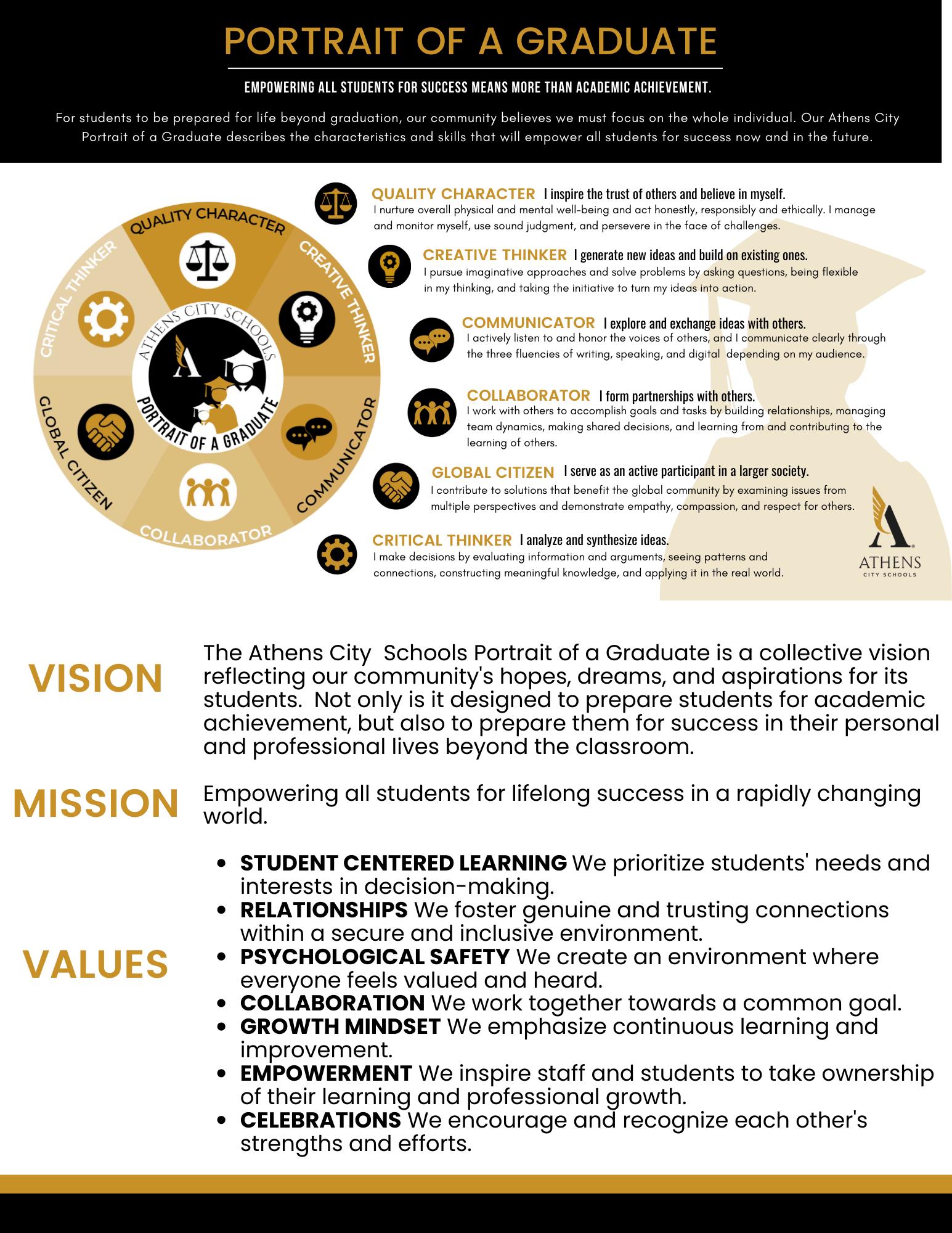
PORTRAIT OF A GRADUATE
REMOTE COURSE
The digital Student Information System (SIS) is used by Athens City Schools to store student data and records. Parents are given information about accessing student accounts at the beginning of the school year.
ACS Portrait of a Graduate prepares students not only for academic achievement but also for success in their personal and professional lives beyond the classroom. Locally developed and globally positioned, the Portrait of a Graduate serves as a North Star for preparing students for the incredible opportunities and challenges of today and tomorrow. Learn more about Portrait of a Graduate at www.acs-k12.org/portrait.
Courses are conducted via web-based instruction and collaboration. Courses are offered through a software platform and are designated for those students who are participating in remote learning. Remote learning requires a nine-week commitment.
SCHEDULE CORRECTIONS
SEMESTER (FALL)
SEMESTER (SPRING)
TEACHER APPROVAL
TRADITIONAL COURSE
Schedule corrections will be made only when approved for the following reasons: duplication of courses, courses out of sequence, or Sports PE/Band, etc., to be entered due to auditions.
The first and second nine-week terms of the school year (18 weeks).
The third and fourth nine-week terms of the school year (18 weeks).
Approval is required when there is a definite screening process (e.g., an audition or an application).
A traditional classroom environment where the instructor and the students are not separated by geographic space or time.
INFORMATION & REFERENCE
BLOCK SCHEDULE
The Block Schedule is based on four semester-long courses that meet each day until the end of the term. Students will take four courses in the fall and four different courses in the spring. Generally, students are scheduled for courses so that at least two academic required core courses are taken each semester. Students will register for a math, science, English, and history course each year. Students commit to the completion of 18-week and/or 9-week courses respectively. If a student registers for an 18-week and/or 9-week remote course, the student commits to completion of the course virtually. If a student commits to an 18-week and/or 9-week traditional, face-to-face course, the student commits to completion of the course. Electives or additional core courses may complete the remaining blocks in the schedule each semester. Consideration will be given to the student's diploma option
CREDIT RECOVERY
In accordance with Alabama State Department of Education guidelines, Athens High School offers students who have received failing grades in any core courses that are required for graduation an opportunity to recover the lost credit through a standards-based approach that targets specific knowledge and skill deficits instead of requiring the student to repeat the entire course. Such students must meet eligibility requirements to apply, and the credit recovery program is operated under board-approved and established guidelines. Instruction is delivered through computer-based instructional software and may also include targeted instruction supervised and managed by a teacher certified in secondary education.
Students who complete their individualized remediation plans by demonstrating minimal proficiency in all required standards will receive a grade of 70 for the recovered course credit. For students who fail to complete the remediation plan by demonstrating minimal proficiency in all required standards, there will be no grade change and no recovered credit for the failed course. (It should be noted that Credit Recovery courses may not be accepted through the NCAA Clearinghouse.)
HONORS/DUAL ENROLLMENT/ADVANCED PLACEMENT
ADVANCED PLACEMENT OPTIONS
The Advanced Placement (AP) Program allows high school students to take college-level courses and potentially earn college credit while still in high school. AP courses are accelerated in both rigor and pace. Students enrolled in AP courses are required to take the national AP exam, which has a testing fee of approximately $100. Many colleges grant credit or advanced placement for exam scores of 3, 4, or 5, though students should consult prospective colleges to confirm their policies before enrolling Students are advised to take no more than two AP courses per term and must meet all prerequisites. Once enrolled, AP courses cannot be dropped. A completed AP Student Agreement must be submitted with the registration form. Athens High School offers AP courses in Calculus, PreCalculus, English, Spanish, United States History, Music, Art, and Psychology, with some courses available based on student interest. Please note that optional study sessions may be offered outside the regular school day to support student success. Advanced Placement courses carry weighted grades that reflect their increased rigor. Please see the grading scale for more information. Interested students should consult their counselor for guidance on course selection. For more information, visit www.collegeboard.com/research.
English
Mathematics
HONORS OPTIONS
Honors English 9
Honors English 10
Honors Geometry w/ Data Analysis
Honors Algebra I with Probability
Honors Algebra II with Statistics
Science Honors Biology
Honors Chemistry
Social Studies
Honors World History
AP World History
Honors US History 10
Honors US History 11
AP US History 11
Dual History 201 (10th grade)
Dual History 202 (11th grade)
World Languages Honors Spanish III
Honors English 11
Honors English 12
Honors Precalculus Calculus
Honors Physics
Honors Human Anatomy
Honors Government
Dual American National Government (POL 211)
Honors Economics
Dual Psychology PSY 200
Dual Sociology SOC 200
AP Psychology
Honors Spanish IV
Honors courses are designed to exceed the content standards and are intended for college-bound students. While all courses taught in ACS schools are expected to be rigorous, honors courses will have increased emphasis on the following components:
● Regularly scheduled writing assignments across the curriculum
● Extended reading opportunities within the content area
● Research-based writing opportunities within the content area
● Real-world skill development
● Understanding of the culture, values, and history of the discipline
● Opportunities for problem solving, critical analysis, and application
Honors courses carry weighted grades that reflect their increased rigor. Please see the grading scale for more information.
DUAL ENROLLMENT OPTIONS
English DE English Composition/ENG 101*
DE English Composition/ENG 102*
DE American Literature I/ENG 251
Mathematics
DE Intermediate College Algebra/MTH 110
DE Pre-Calculus Algebra/MTH 112
Science DE Principles Biology/BIO 103*
DE Principles Biology/BIO104*
DE Inorganic Chemistry/CHM 104
DE Organic Chemistry/CHM 105
Social Studies
DE US History/HIS 201*
DE US History/HIS 202*
DE Government/POL 211*
World Languages DE Introductory Spanish I/SPA 101*
Career and Technical Education
DE Emergency Medical Technician
DE Early Care Of Children/CHD 100
DE Growth and Development/CHD 201
DE Word Processing Applications/CIS 111
DE Industrial Safety/ADM 100
DE SMAW Fillet Welding/WDT 108
DE SMAW Fillet/Pac/Cac Welding/WDT 109
DE Industrial Blueprint Reading/WDT 110
DE English Literature I/ENG 261
DE Fundamentals of Public Speaking/SPH 107
DE Pre-Calculus Trigonometry/MTH 113
DE Calculus/MTH 125
DE College Chemistry/CHM 111
DE Human Anatomy and Physiology/BIO 201
DE Human Anatomy and Physiology/BIO 202
DE Psychology/PSY 200
DE Sociology/SOC 200
DE Introductory Spanish II/SPA 102*
DE SMAW Fillet/ OFC Lab/WDT 122
DE SMAW Fillet/Pac/Cac Lab/WDT 123
DE Introduction to Graphic Arts/GRD 101
DE Introduction to Information Systems and Support Services
DE Engineering Foundations/EGR 101
DE Precision Measurement/ADM 101
DE Principles of Refrigeration/ACR 111
This is a listing of the most popular courses for dual enrollment. This is not the complete listing of dual enrollment courses. Students interested in dual enrollment should speak with a counselor to discuss all and any options available. *Courses offered on the Athens High School campus
Dual Enrollment/Dual Credit allows eligible high school students to take college courses while simultaneously completing high school classes, earning both high school and college credit. Students are responsible for all associated costs, including tuition, fees, textbooks, lab materials, and transportation. To qualify, students must be in the 10th, 11th, or 12th grade, maintain a “B” average in high school courses, and AHS approval. Additionally, students must meet the entrance requirements set by the participating college or post-secondary institution. Dual enrollment courses are offered in partnership with institutions such as Calhoun Community College, Wallace State Community College, University of Alabama, University of North Alabama, and University of Alabama in Huntsville. These courses may be scheduled alongside AP courses in the master schedule.
Course offerings may take place at Athens High School, online, or on the college campus (students are responsible for transportation). Tuition is approximately $140 per credit hour, and students must commit to attending courses for the full academic year. Class times are generally 8:00–9:15 a.m. or 1:30–3:15 p.m. Students interested in dual enrollment should consult with their counselor to review eligibility, course options, and program requirements, including any minimum GPA or prerequisites set by the college. Detailed course descriptions are available in the department listings.
GRADE LEVEL REQUIREMENTS (Student Class Progression)
FRESHMAN Student must have at least 26 credits to graduate, pass all core classes, and have at least 7 credits to be a sophomore in the following school year.
SOPHOMORE Student must have at least 26 credits to graduate, pass all core classes, and have at least 14 credits to be a junior in the following school year
JUNIOR Student must have at least 26 credits to graduate, pass all core classes, and have at least 20 credits to be a senior in the following school year.
SENIOR Student must have at least 26 credits to graduate.
GRADING SCALE
A: 100-90 B: 89-80 C: 79-70 D: 69-60 F: 59-0
GRADE POINT AVERAGE (GPA) SCALE
Students electing to participate in rigorous academic courses such as Honors, Dual Enrollment, and Advanced Placement (AP) are given additional weight in the GPA calculation.
Due to increased expectations, grades earned in Honors, Dual Enrollment, and Advanced Placement Courses are weighted for class ranking purposes only as reflected in the overall numerical (GPA) grade point average. The actual grade earned in the Honors, Dual Enrollment, and Advanced Placement courses shall appear on both the report card and the official transcript.
The following system shall be utilized as the method of weighting numerical grades that will be reflected in the numerical GPA used for class ranking only:
● Honors/Dual Courses: GPA Points +.5 added value
● Advanced Placement Courses: GPA Points + 1 added value
To accommodate those colleges and universities whose scholarship guidelines require a standard GPA (Grade Point Average) instead of a numeric GPA, each transcript will include the weighted standard GPA (i.e., a passing grade in an Honors/Dual Enrollment class receives a weight of .5, while the passing grade earned in an Advanced Placement (AP) course receives a weight of 1). The weighted standard GPA shall be used for class ranking purposes.
Secondary credits for regular, Honors, Dual Enrollment, and AP shall be awarded GPA Quality Points according to the following scale:
GRADUATION PARTICIPATION
The goal of Athens High School is to prepare all students for college and/or career pathways, utilizing individualized four-year high school plans built for each student based on the results from academic and career interest assessments and middle school coursework. Students must be enrolled full-time at Athens High School. Students should take math, English, social studies, and history each year. At the beginning of their junior year, students will choose what diploma option they would like to pursue. Students may not take a lower-level course than one already completed. Students pursuing a Career Ready Endorsement are encouraged to achieve a credential within their field of interest. Athens High School conforms to all U.S. and Alabama Laws, ALSDE Administrative Code, and ACS Policies. Throughout the years, Athens High School has maintained high standards to better prepare its graduates for their future college and/or career plans. The Athens High School principal and administrative team will be happy to meet with parents and students to discuss the importance of following AHS requirements. They may opt out of these requirements to pursue the state minimum program as long as both parents and students agree and sign the appropriate consent forms. Individual cases regarding the number of credits required for graduation will be handled on a case-by-case hardship basis.
AHS GRADUATION REQUIREMENTS: OPTION B - WORKFORCE
ADDITIONAL GRADUATION REQUIREMENTS
In addition to completing the required curriculum, additional Alabama State Department of Education graduation requirements include:
1 All students must successfully pass the Alabama Civics Exam as a required component of the Government course in the high school course of study.
2 After October 1st of the senior year, students must complete and submit either the Free Application for Federal Student Aid (FAFSA) or the FAFSA Non-Participation Waiver.
3 Each senior must meet College and Career Readiness (CCR) as set forth by the Alabama State Department of Education. Students must earn one or more of the College and Career Readiness Indicators (CCRI) below.
a ACT BENCHMARK SCORE Benchmark or higher on any section of the ACT College Entrance Exam: English - 18 Reading - 22 Math - 22 Science - 23
b BENCHMARK ON ACT WORKKEYS Earning a Silver (4 or higher) score on all areas of the ACT WorkKeys assessment, including Applied Math, Graphic Literacy, and Workplace Documents.
c QUALIFYING SCORE ON AP EXAM OR IB EXAM Earning a qualifying score of three or higher on an Advanced Placement (AP) exam or four or higher on an International Baccalaureate exam.
d. COLLEGE OR POSTSECONDARY CREDIT Earning a college credit while in high school with a minimum grade of “D”.
e. CTE CREDENTIAL Earn an approved industry-recognized credential through a declared Career and Technical Education Program.
f. MILITARY ENLISTMENT Enlistment in any branch of the Military before high school graduation. An official letter of acceptance from a Military Recruiter is required.
g. CTE COMPLETER Attain Career and Technical Education Completer Status by successfully completing three courses in the same CTE pathway, earning a 70 or higher in all three courses.
h. APPRENTICESHIP Participate in an approved In-School Youth Apprenticeship Program as defined by the Alabama Office of Apprenticeship
i COMPUTER SCIENCE Complete an ALSDE-Approved Computer Science course
j. Any additional College and Career Readiness Indicator approved by the Alabama State Board of Education.
4. Beginning with the Class of 2028, students must successfully complete a Personal Financial Literacy Assessment as a required component of the Career Preparedness course in the high school course of study
5 Beginning with the Class of 2032, students must earn one credit in a Computer Science course
AHS GRADUATION ENDORSEMENTS
CAREER AND TECHNICAL EDUCATION ENDORSEMENT
1. Three (3) Career and Technical Education credits in an established CTE pathway (in sequence)
2 Complete all other course requirements of the Alabama diploma
SEAL OF BILITERACY
1. Demonstrate proficiency in one of the English language proficiency in one for the following areas: English Language Proficiency Criteria Options
i ACT English: A score of 18 or higher
ii. ACT Reading: A score of 20 or higher.
iii. Advanced Placement Language Examination: A score of three (3) or higher.
iv. WIDA ACCESS 2.0: For non-native English speakers, the student shall meet and maintain Alabama exit criteria in English proficiency A composite score of Level 4 8 or higher
2. Demonstrate proficiency in one or more World Languages other than English through one of the World Language Proficiency Options: World Language Proficiency Criteria Options
i. The Advanced Placement Language Examination: A score of three (3) or higher.
ii. American Council of Teachers of Foreign Language Assessment of Performance toward Proficiency in Languages: An Intermediate Mid-3 or higher score in all four components.
iii American Council of Teachers of Foreign Language Oral Proficiency Interview Writing Proficiency Test: A score of intermediate mid-level.
iv. American Council of Teachers of Foreign Language Latin Interpretive Reading Assessment: A score of intermediate Mid-Level Three (3) or higher
3 Complete all other course requirements of the Alabama diploma
AHS HONOR GRADUATE REQUIREMENTS
CLASS OF 2027-2029 (rising 10th -12 graders)
1. All 12th-grade students with an overall GPA of 4.0 or higher who have earned the Advanced Diploma at Athens High School will be designated Honor Graduates and ranked #1 in class. No Valedictorian or Salutatorian will be named.
2. Athens High School will determine how to recognize these Honor Graduates at the commencement ceremony.
3. The individual(s) who will make commencement remarks at the graduation ceremony will be selected from the pool of Honor Graduates by the principal with input from the senior counselor, senior sponsor(s), and honor graduates.
4. In the event that no student in the graduating class has a GPA of 4.0 or higher, up to the top 10% of students (with a 3.75 or higher GPA) may be designated as Honor Graduates.
5. The rank of the next student below those designated as Honor Graduates should be determined by the total number of students whose average exceeded his/hers. For example, if three students in a class of 100 students are designated as Honor Graduates, each holds a rank of 1/100. The next holds a rank of 4/100.
6. In order to be considered for the designation of Honor Graduate, a student must be enrolled in Athens High School where this designation is made for the entire senior year.
7. Final determination (grade point average) will be made at the end of the first nine-week grading period of the second semester (block schedule) of the senior year.
8. Final determination of both numerical and standard grade point averages will be carried to three (3) decimal places, with no “rounding”. The system will be based on the ACS Secondary Grade Point Average (GPA) Scale.
9. A minimum of twenty-eight (28) courses must be attempted and counted in determining GPA. Full credit courses will be multiplied by 1.0. One-half credit courses will be multiplied by .5 for determining overall GPA.
10. Any extraordinary situation or circumstance that may arise will be resolved by the school principal in consultation with the superintendent.
CLASS OF 2030 AND BEYOND (rising 9th graders)
1. All 12th-grade students with an overall GPA of 4.0 or above who have earned the Scholar’s Endorsement at Athens High School will be designated Honor Graduates and have a ranking of #1 in class. No Valedictorian or Salutatorian will be named.
2. Athens High School will determine how to recognize these Honor Graduates at the commencement ceremony.
3. The individual(s) who will make commencement remarks at the graduation ceremony will be selected from the pool of Honor Graduates by the principal with input from the senior counselor, senior sponsor(s), and honor graduates.
4. In the event that no student in the graduating class has earned a Scholar’s Endorsement and achieved a 4.0 or higher, students who have earned the Advanced Academic Endorsement and a GPA of 4.0 or higher may be designated as honor graduates. In the event that no student in the graduating class has earned either Scholar’s Endorsement or Advanced Academic Endorsement and a GPA of 4.0, then students earning an Honors Academic Endorsement and a GPA of 4.0 may be designated as Honor Graduates.
5. The rank of the next student below those designated as Honor Graduates should be determined by the total number of students whose average exceeded his/her. For example, if three students in a class of 100 are designated Honor Graduates, each holds a rank of 1/100. The next holds a rank of 4/100.
6. To be considered for the Honor Graduate designation, a student must be enrolled at Athens High School, where this designation is awarded for the entire senior year.
7. Final determination (Grade Point Average) will be made at the end of the first nine-week grading period of the second semester (block schedule) of the senior year.
8. Final determination of both the numerical and standard Grade Point Averages will be carried to three (3) decimal places, with no rounding. This system will be based on the ACS Secondary Grade Point Average Scale.
9. A minimum of twenty-eight (28) courses must be attempted and counted in determining the GPA. Full credit courses will be multiplied by 1.0. One-half credit courses will be multiplied by 0.5 for determining the overall GPA.
10. Any extraordinary situation or circumstance that may arise will be resolved by the school principal in consultation with the superintendent.
NCAA REQUIREMENTS FOR COLLEGE ATHLETICS
Not all courses offered at Athens City Schools meet the NCAA eligibility requirements It is the student’s responsibility to review the requirements, schedule classes accordingly, and ensure the NCAA Initial-Eligibility Clearinghouse has the required documents to certify eligibility. Courses taken through the Credit Recovery Program are not accepted by the NCAA Eligibility Center.
POWER SCHOOL PARENT PORTAL AND STUDENT ACCOUNTS
Parents will receive information regarding accessing student records online at the beginning of the school year.
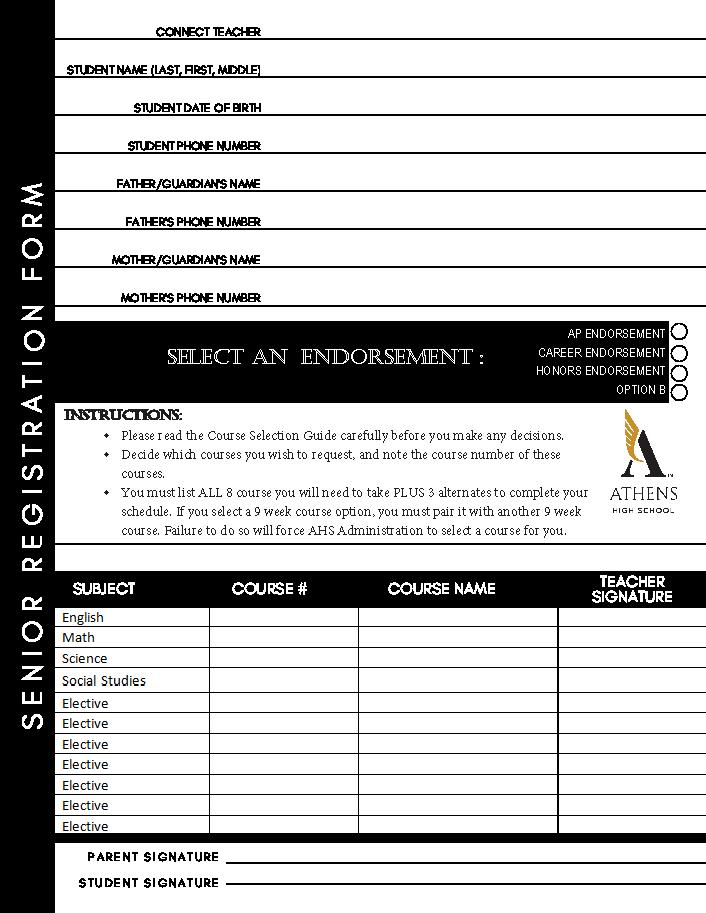
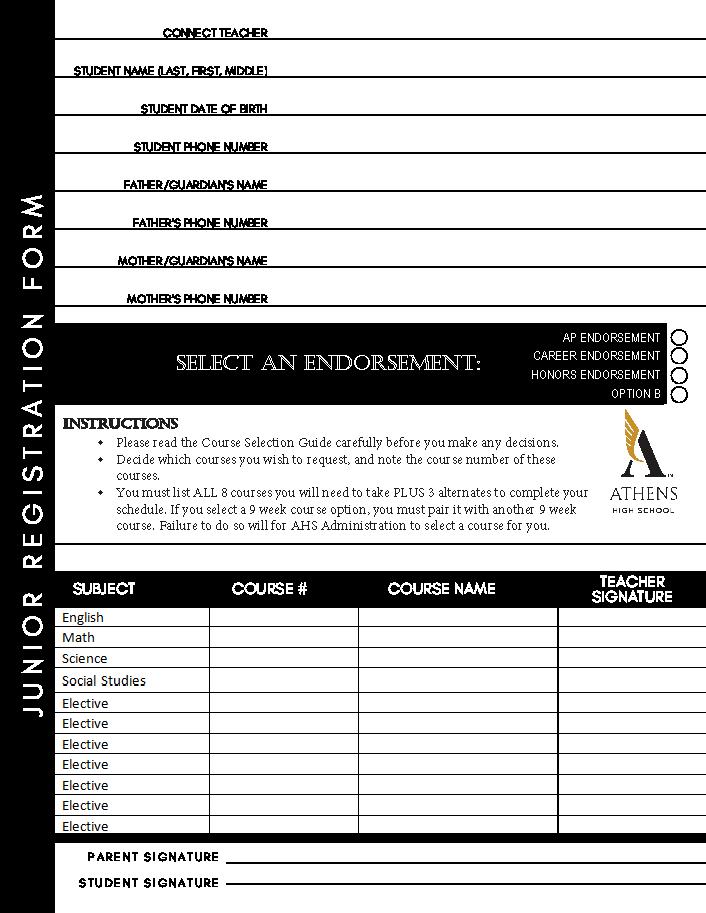
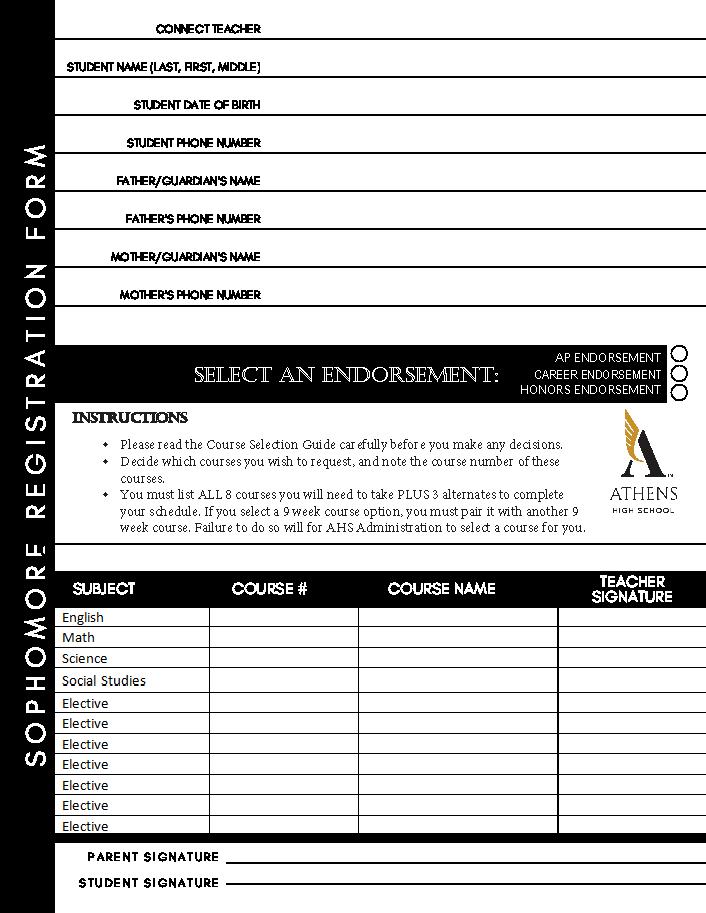
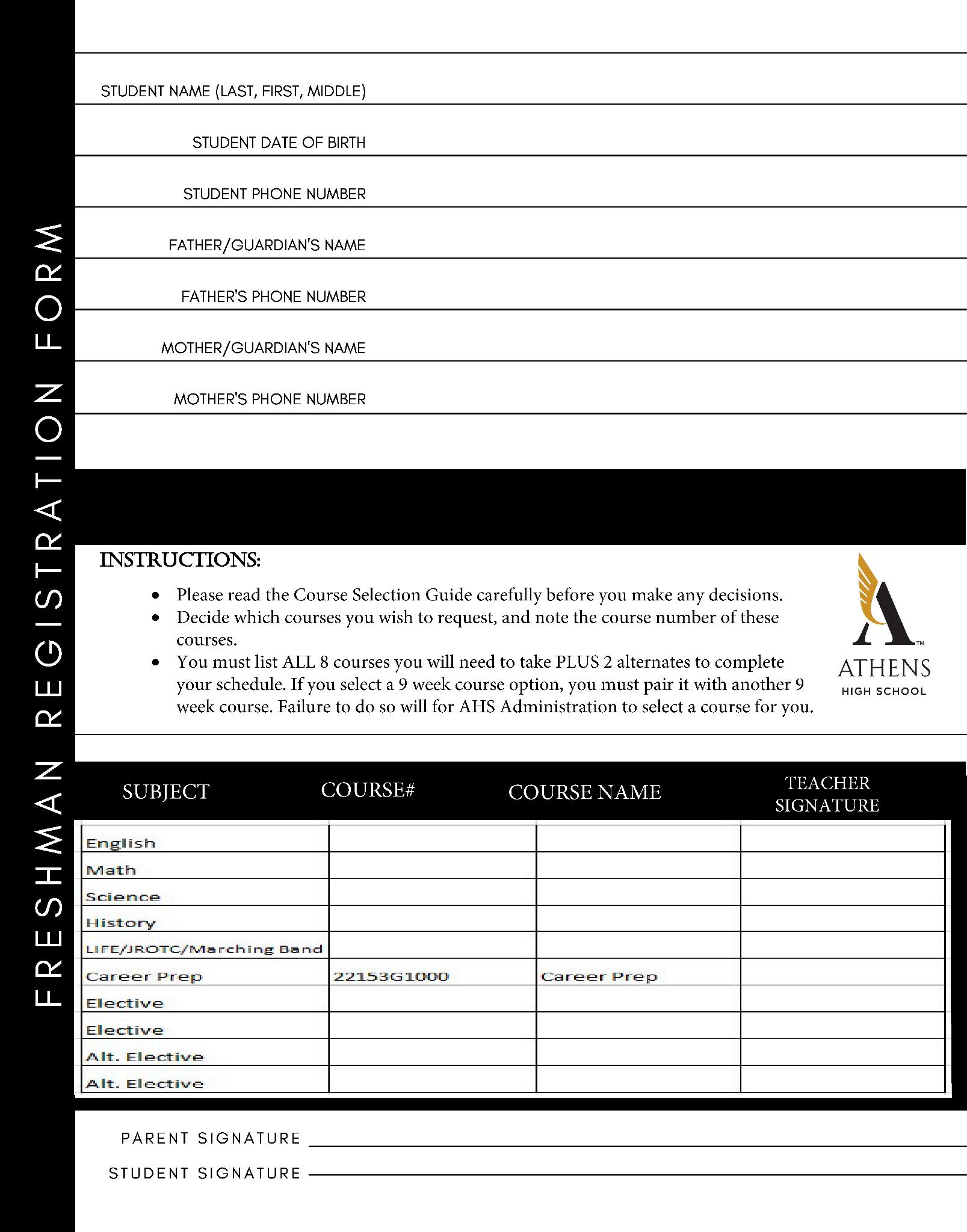
REGISTRATION FORMS
A grade-level specific AHS Registration Form is provided. Students should use the appropriate grade level form to select their individual class schedule. Completion of this form DOES NOT GUARANTEE classes at any specific time, only that students will have the class or an alternate selection.
REMOTE COURSE OPPORTUNITIES
Remote course opportunities are available to students at Athens High School. Remote courses are available to students participating in remote learning. These courses are facilitated through online instruction. Students should be self-motivated, possess time-management skills, and be able to work independently. Courses are offered through a variety of software programs. These courses require a nine-week commitment.
SCHEDULE CHANGES
To maximize the likelihood that students receive the requested courses, students are given the opportunity to review the AHS Curriculum Catalog and complete a Student Registration Form. From there, a master schedule is constructed, and teachers are hired to ensure that what was requested is received. Knowing that not every course request can be honored due to scheduling conflicts, the above procedure offers the greatest potential for requests to be honored. Student registration cards indicate a commitment to completing the requested course Once a schedule is assigned, students commit to course completion as defined in the student schedule Schedule changes should be requested during the first three days of each term. The principal may approve course changes due to extenuating circumstances.
SCHEDULE CHANGES AT 9 WEEKS
For students, demonstrating unsatisfactory progress is defined as a numerical grade of 60 or below, a parent can request a conference with the teacher, counselor, and administrator to discuss student progress and determine placement in a regular course of equal value.
SCHEDULE CORRECTIONS
Schedule corrections will be made and only when approved by the following criteria: duplication of courses, courses out of sequence, or Sports PE/Band, etc., to be entered due to auditions.
TRANSFERS
OUT OF DISTRICT
Counselors will evaluate student transcripts for completed coursework and coursework in progress.
● Completed Coursework:
Counselors will match the course name with the courses from ALCOS and record others as indicated when the course cannot be matched. Transfer grades are recorded based on the grading scales of the sending school. Credits are recorded as indicated on the transfer transcript, and content/subject areas are honored per the previous school Athens High School will contact the previous school for issued credits.
● Coursework In Progress:
When schools use different credit conversion scales, Athens High School will use dates of attendance/course enrollment dates to determine credit and placement When information is unclear, Athens High School will contact the previous school for clarification
Athens High School will work to recognize the work the student has accomplished to date in an effort to prevent the student from starting the course from the beginning upon transfer.
ATHENS RENAISSANCE SCHOOL OR RENAISSANCE VIRTUAL SCHOOL
Students who transfer to ARS or RenV should commit to a full year residency in these programs
FREQUENTLY ASKED QUESTIONS
How are grades reported?
PowerSchool Parent Portal, Web Portal, Progress Reports, and Report Cards
What determines my grade level?
Grade level is determined by the number of core classes successfully passed and the total number of credits See the graduate-level information sheet in the AHS Course Catalog
How do I know which courses are considered Physical Science?
Physical Science, Chemistry, or Physics all meet the state requirements
What courses meet the Health graduation requirement?
Health and Foundations of Health Science both meet the state requirement.
What courses meet the PE graduation requirement?
Beginning Kinesiology satisfies the state PE requirement The following athletics may have a state-approved waiver to satisfy the requirement: football, basketball, wrestling, cheer, softball, baseball, volleyball, and soccer.
How do I know if I will be successful in an Advanced Placement course?
We currently use ACT scores, teacher recommendations, and student interests to identify and inform students about academic areas in which they have demonstrated the ability to succeed in AP coursework Also, other factors such as previous grades, study habits, personal work ethic, and interests all play a part in student success.
What is the difference between regular and Honors?
Both regular and Honors courses will use the Alabama College and Career Ready grade-level standards Honors courses may include additional readings and materials to supplement the curriculum.
What happens if I fail a class?
For students who are not successful during the regular school year and must repeat a class, credit recovery may be a necessity You may have the option of participating in the Credit Recovery Program or re-enrolling in the same course the following semester
Is there a supply list?
Students should come to school on the first day with a pencil and paper. The individual teacher will provide a list of materials needed for their class.
What classes are typically offered in the Summer Session?
Summer Session is mainly for credit recovery and credit advancement Registration information will be posted on the website.
COURSE REGISTRATION CARD -
CLASS OF 2027 (Rising 12th graders)
COURSE REGISTRATION CARD -
CLASS OF 2028 (Rising 11th graders)
COURSE REGISTRATION CARD
- CLASS OF 2029 (Rising 10th graders)
COURSE REGISTRATION CARD -
CLASS OF 2030 (Rising 9th graders)
ENGLISH LANGUAGE ARTS
ENGLISH CORE
ENGLISH 9
Course Number: 01001G1000
Credit: 1
In Grade 9, students understand the importance of aesthetic decisions by the author and note how choices of syntax and diction shape and clarify meaning. standards are organized under types of literacy (critical, digital, language, and research) to reflect the applications of literacy in a rapidly changing world. This format represents an effort to show that successful communication requires multifaceted receptive and expressive skills emphasize the literature of varied times and places. Both ninth-grade standards emphasize world literature to give students a broad and deep foundation. Students learn and practice active listening, read a variety of workplace and literary texts, learn and practice essential digital skills, utilize a process to create and modify written work, implement conventions of language and usage, and utilize context to decipher word meanings, all through reading, listening, writing, and speaking. NOTE: THIS COURSE FULFILLS AN ENGLISH CREDIT REQUIRED FOR GRADUATION.
HONORS ENGLISH 9
Course Number: 01001H1000
Credit: 1
This academically rigorous course focuses on the in-depth study of world literature, writing, grammar, and vocabulary; it is designed to prepare students for the rigors of college. It will include activities that utilize available technologies and digital literacies, such as word processing and creating presentations. An emphasis will be placed on literary analysis, critical thinking, and academic writing. Independent reading assignments are required. Students should obtain the reading list and assignment directions from a member of the English department, a school counselor, or the school website.
ENGLISH 10
Course Number: 01002G1000
Credit: 1
Prerequisite: English 9
In Grade 10, students learn and practice active listening, read a variety of workplace and literary texts, learn and practice essential digital skills, utilize a process to create and modify written work, implement conventions of language and usage, and utilize context to decipher word meanings. Tenth-grade standards emphasize world literature to give students a broad and deep foundation. Students learn and practice active listening, read a variety of workplace and literary texts, learn and practice essential digital skills, utilize a process to create and modify written work, implement conventions of language and usage, and utilize context to decipher word meanings all through reading, listening, writing, and speaking. NOTE: THIS COURSE FULFILLS AN ENGLISH CREDIT REQUIRED FOR GRADUATION.
HONORS ENGLISH
10
Course Number: 01002H1000
Credit: 1
Recommended Prerequisites: Honors English 9
This accelerated, rigorous course is designed to strengthen the student’s background in and foster creativity through the interpretation of texts written from various cultural perspectives, with an emphasis on works outside the United States and the British Isles from 1600 to the present by enhancing listening, speaking, reading, and writing skills. An independent reading assignment is required for this course. Instructors emphasize advanced reading comprehension and daily grammar practice, as well as ACT English and reading preparedness. Independent reading and assignments are required and due before and/or during the semester in which a student’s English class falls. Students should obtain a reading list and assignment directions from a member of the English department, from a school counselor, or from the school website.
ENGLISH 11
Course Number: 01003G1000
Credit: 1
Prerequisites: English 10
In Grade 11, students will explore the literature of America before, during, and after European arrival. A year of specific attention because of literature’s deep ties to all aspects of culture, and its study encourages a cross-curricular understanding and appreciation of qualities that distinguish American literature specifically and American culture in general, with a primary focus on American literature. Students learn and practice active listening, read a variety of workplace and literary texts, learn and practice essential digital skills, utilize a process to create and modify written work, implement conventions of language and usage, and utilize context to decipher word meanings, all through reading, listening, writing, and speaking. NOTE: THIS COURSE FULFILLS AN ENGLISH CREDIT REQUIRED FOR GRADUATION.
HONORS ENGLISH 11
Course Number: 01003H1000
Credit: 1
Recommended Prerequisites: Honors English 10
This accelerated, rigorous course links the concepts of listening, speaking, reading, and writing in practical ways. Participants will write essays, read selections from American literature, review grammar concepts, conduct research projects, learn ACT-relevant vocabulary words, and participate in class discussions. Content is geared toward mastery of ACT skills in both English and reading. Independent reading and assignments are required and due before and/or during the semester in which a student’s English class falls. Students should obtain a reading list and assignment directions from a member of the English department, from a school counselor, or from the school website.
ADVANCED PLACEMENT (AP) ENGLISH 11 - LANGUAGE AND COMPOSITION
Course Number: 01006E1000
Credit: 1
Recommended Prerequisite: Honors English 10
The AP English Literature and Composition course focuses on reading, analyzing, and writing about imaginative literature (fiction, poetry, drama) from various periods. Students engage in close reading and critical analysis of imaginative literature to deepen their understanding of how writers use language to convey both meaning and pleasure. As they read, students consider a work’s structure, style, and themes, as well as its use of figurative language, imagery, and symbolism. Writing assignments include expository, analytical, and argumentative essays that require students to analyze and interpret literary works. NOTE: THIS COURSE FULFILLS AN ENGLISH CREDIT REQUIRED FOR GRADUATION.
ENGLISH 12
Course Number: 01004G1000
Credit: 1
Prerequisite: English 11
In Grade 12, students focus on the literature of the British Isles, which provides both a linguistic and cultural starting point that more fully contextualizes the eventual forming of the United States and informs a sophisticated understanding of the connections between American and British literature, contrasted with the unique character of each. British literature in the twelfth grade should read, analyze, and evaluate a play by William Shakespeare, including an examination of its contributions to the English language and his influences on other works of literature. Students learn and practice active listening, read a variety of workplace and literary texts, learn and practice essential digital skills, utilize a process to create and modify written work, implement conventions of language and usage, and utilize context to decipher word meanings, all through reading, listening, writing, and speaking. NOTE: THIS COURSE FULFILLS AN ENGLISH CREDIT REQUIRED FOR GRADUATION.
HONORS ENGLISH 12
Course Number: 01004H1000
Credit: 1
Recommended Prerequisite: Honors English 11
This accelerated course covers a survey of British Literature from the Anglo-Saxon period to the Modern Age. Activities will involve critical listening, speaking, reading, and writing with a strong emphasis on vocabulary. This course includes a written research paper focused on literary analysis and research-based skills. Independent reading assignments are required for this course and are due before and/or during the semester for which the English course falls. Students should obtain a reading list and assignment directions from a member of the English department, from a school counselor, or the school website before the semester begins.
ADVANCED PLACEMENT (AP) ENGLISH 12 - LITERATURE AND COMPOSITION
Course Number: 01006E1000
Credit: 1
Recommended Prerequisite: AP English 11 or Honors English 11
The AP English Literature and Composition course focuses on reading, analyzing, and writing about imaginative literature (fiction, poetry, drama) from various periods. Students engage in close reading and critical analysis of imaginative literature to deepen their understanding of the ways writers use language to provide both meaning and pleasure. As they read, students consider a work’s structure, style, and themes, as well as its use of figurative language, imagery, and symbolism. Writing assignments include expository, analytical, and argumentative essays that require students to analyze and interpret literary works. NOTE: THIS COURSE FULFILLS AN ENGLISH CREDIT REQUIRED FOR GRADUATION.
DUAL ENROLLMENT ENGLISH COMPOSITION/ENGLISH 101
Grades: 11-12
Course Number: 01999C1001
Credit: 1
Prerequisite: English Honors 10, English Honors 11
This college English course provides instruction and practice in writing extended compositions, both general and literary, including research papers. Instruction focuses on the development of analytical and critical reading skills in the composition process and on research practices and usage. Students who complete English 101 and English 102 are highly encouraged to take English 261- British Literature.
DUAL ENROLLMENT ENGLISH COMPOSITION/ENGLISH 102
Grades: 11-12
Course Number: 01999C1002
Credit: 1
Prerequisite: English Honors 10, English Honors 11
This college English course provides instruction and practice in writing extended compositions, both general and literary, including research papers. Instruction focuses on the development of analytical and critical reading skills in the composition process and practice in research skills and usage.
DUAL ENROLLMENT AMERICAN LITERATURE I/ENG 251
Grades: 11-12
Course Number: 01999C1003
Credit: 1
Prerequisite: ENG 102
This course is a survey of American literature from its inception to the middle of the nineteenth century. Emphasis is placed on representative works and writers of this period, as well as on the literary, cultural, historical, and philosophical forces that shaped these works and are reflected in them. Upon completion, students will be able to interpret the aesthetic and thematic aspects of these works, relate them to their historical and literary contexts, and understand relevant criticism and research.
DUAL ENROLLMENT ENGLISH LITERATURE/ENG 261
Grades: 11-12
Course Number: 01999C1005
Credit: 1
Prerequisite: ENG 102
This course is a survey of English literature from the Anglo-Saxon period to the Romantic Age. Emphasis is placed on representative works and writers of this period and on the literary, cultural, historical, and philosophical forces that shaped these works and that are reflected in them. Upon completion, students will be able to interpret the aesthetic and thematic aspects of these works, relate them to their historical and literary contexts, and understand relevant criticism and research.
LITERATURE: MYTHOLOGY AND FABLES
Grades: 10-12
Course Number: 01069G10MY
Credit: 1
This class covers three major topics, divided into six-week units. During the first six weeks, the unit on mythology and fable examines the classic myths and fables that have influenced all great writing, thus profoundly affecting both British and American literature. During the second six weeks, the unit on the Bible as literature equips the student with a basic understanding of the literary forms in the Old Testament, as well as people and symbols often referenced in literature, art, and music. The final unit on Arthurian legends offers an expansive study of how these legends are reflected in major contemporary works.
DUAL ENROLLMENT FUNDAMENTALS OF PUBLIC SPEAKING
Grades: 11-12
Course Number: 11999C1004
Credit: 1
This course explores principles of audience and environment analysis, as well as the planning, rehearsal, and delivery of formal speeches to specific audiences. Historical foundations, communication theories, and student performances are emphasized.
MATHEMATICS
GEOMETRY WITH DATA ANALYSIS
Course Number: 02073G1000
Credit: 1
Geometry with Data Analysis is the first of three required courses in high school mathematics. In Geometry with Data Analysis, students incorporate knowledge and skills in Geometry and Measurement, Algebra and Functions, and Data Analysis, Statistics, and Probability, leading to a deeper understanding of fundamental relationships within the discipline and building a solid foundation for further study. The prerequisite for Geometry with Data Analysis is either Grade 8 Mathematics or Grade 8 Accelerated Mathematics. For students who opt to accelerate their mathematical pathways in the 9th grade, Geometry with Data Analysis may also be taken concurrently with Algebra I with Probability.
HONORS GEOMETRY WITH DATA ANALYSIS
Course Number: 02073H1000
Credit: 1
Honors Geometry with Data Analysis is the first of three required high school mathematics courses. In Honors Geometry with Data Analysis, students incorporate knowledge and skills in Geometry and Measurement, Algebra and Functions, and Data Analysis, Statistics, and Probability, leading to a deeper understanding of fundamental relationships within the discipline and building a solid foundation for further study. The prerequisite for Honors Geometry with Data Analysis is either Grade 8 Mathematics or Grade 8 Accelerated Mathematics. For students who opt to accelerate their mathematical pathways in the 9th grade, Honors Geometry with Data Analysis may also be taken concurrently with Algebra I with Probability.
ALGEBRA I WITH PROBABILITY
Course Number: 02052G1000
Credit: 1
Algebra I with Probability builds upon algebraic concepts studied in Grade 7 and Grade 8 Mathematics. It provides students with the necessary knowledge of algebra and probability for use in everyday life and in the subsequent study of mathematics. Algebra I with Probability is the second of three courses required for all students. Students may enroll in this course after completing Geometry with Data Analysis in Grade 9 or by completing both Grade 7 Accelerated Mathematics and Grade 8 Accelerated Mathematics. Students who wish to accelerate their mathematics pathways in high school may also elect to enroll in Algebra I with Probability concurrently with Geometry with Data Analysis in the 9th grade
HONORS ALGEBRA I WITH PROBABILITY
Course Number: 02052H1000
Credit: 1
Honors Algebra I with Probability builds upon algebraic concepts studied in Grade 7 and Grade 8 Mathematics. It provides students with the necessary knowledge of algebra and probability for use in everyday life and in the subsequent study of mathematics. Honors Algebra I with Probability is the second of three courses required for all students. Students may enroll in this course after completing Geometry with Data Analysis in Grade 9 or by completing both Grade 7 Accelerated Mathematics and Grade 8 Accelerated Mathematics. Students who wish to accelerate their mathematics pathways in high school may also elect to enroll in Honors Algebra I with Probability concurrently with Geometry with Data Analysis in the 9th grade.
ALGEBRA II WITH STATISTICS
Course Number: 02056G1000
Prerequisite: Algebra I or equivalent
Credit: 1
Algebra II with Statistics builds on the students' experiences in previous mathematics in Geometry with Data Analysis and Algebra I with Probability. It is the third of three required courses, and it is to be taken following the successful completion of Geometry with Data Analysis and either Algebra I with Probability or the combination of the Grade 7 Accelerated Mathematics and Grade 8 Accelerated Mathematics course sequence. It is the culmination of the three years of required mathematics content and sets the stage for continued study of topics specific to the student's interests and plans beyond high school. Algebra II with Statistics is the prerequisite for Applications of Finite Mathematics, Mathematical Modeling, Precalculus, and all other approved ALSDE mathematics classes designed for completion of students' fourth mathematics credit.
HONORS ALGEBRA II WITH STATISTICS
Course Number: 02056H1000
Credit: 1
Honors Algebra II with Statistics builds on the students' experiences in previous mathematics in Geometry with Data Analysis and Algebra I with Probability. It is the third of three required courses, and it is to be taken following the successful completion of Geometry with Data Analysis and either Algebra I with Probability or the combination of the Grade 7 Accelerated Mathematics and Grade 8 Accelerated Mathematics course sequence. It is the culmination of the three years of required mathematics content and sets the stage for continued study of topics specific to the student's interests and plans beyond high school. Algebra II with Statistics courses are the prerequisite for Applications of Finite Mathematics, Mathematical Modeling, Precalculus, and all other approved ALSDE mathematics classes designed for completion of students' fourth mathematics credit.
ALGEBRA WITH FINANCE 12
Course Number: 02155G1000
Credit: 1
Algebra with Finance is a college and career preparatory course that integrates algebra, precalculus, probability and statistics, calculus and geometry to solve financial problems that occur in everyday life. Real-world problems in investing, credit, banking, auto insurance, mortgages, employment, income taxes, budgeting, and planning for retirement are solved by applying the relevant mathematics that are taught at a higher level. Students are encouraged to use a variety of problem-solving skills and strategies in real-world contexts, and to question outcomes using mathematical analysis and data to support their findings. The course offers students multiple opportunities to use, construct, question, model, and interpret financial situations through symbolic algebraic representations, graphical representations, geometric representations, and verbal representations. Math concepts and skills are applied through study and problem-solving activities in workforce situations in the following areas: banking, investing, employment and income taxes, automobile ownership and operation, mathematical operations, consumer credit, independent living, and retirement planning and budgeting. This course may be used as the fourth math credit or an elective.
ADVANCED PLACEMENT (AP) PRE-CALCULUS
Course Number: 02110E10AP
Grades: 10-12
Credit: 1
Prerequisite: Algebra II with Statistics or Honors Algebra II with Statistics, and Geometry with Data Analysis or Honors Geometry with Data Analysis, Algebra I with Probability or Honors Algebra I with Probability
Following the College Board’s course framework designed to parallel college-level precalculus courses, AP Precalculus provides students with an understanding of the concepts of college algebra, trigonometry, and additional topics that prepare students for further college-level mathematics courses. This course explores polynomial, rational, exponential, logarithmic, trigonometric, polar, parametric, and linear transformation functions and their applications. Throughout the course, the mathematical practices of procedural and symbolic fluency, multiple representations, and communication and reasoning are developed. Students experience the concepts and skills related to each function type through the lenses of modeling and covariation, and engage each function type through their analytical, verbal, numerical, and graphical representations.
HONORS PRECALCULUS
Course Number: 02110H0500
Prerequisite: Algebra II with Statistics or Honors Algebra II with Statistics, and Geometry with Data Analysis or Honors Geometry with Data Analysis
This course emphasizes concepts of the unit circle, circular and inverse functions, trigonometric identities, solution of triangles, vectors, polar coordinates, and conic sections.
CALCULUS
Course Number: 02121G1000
Credit: 1
Prerequisite: Pre-Calculus
This rigorous course emphasizes limits and their properties, differentiation, applications of differentiation, integration, logarithmic, exponential, & other transcendental functions, and differential equations.
ADVANCED PLACEMENT (AP) CALCULUS AB
Course Number: 02124E1000
Credit: 1
Prerequisite: Honors Pre-Calculus and/or Calculus
NOTE: FULFILLS ONE OF THE FOUR MATHEMATICS CREDITS REQUIRED FOR GRADUATION. College-level advanced math course approved by the College Board Advanced Placement (AP) program for calculus; functions, graphs, and limits; derivatives; integrals; polynomial approximations and series.
ADVANCED
PLACEMENT (AP) CALCULUS BC
Course Number: 02125E100
Credit: 1
Prerequisite: Advanced Placement (AP) Calculus AB
This course reinforces and expands upon the mathematical explorations students master in AP Calculus AB. In addition to the differential and integral calculus topics seen in AP Calculus AB, students will learn techniques for approximating solutions of differential equations, advanced applications of integrals, applying differential and integral calculus to parametric equations, polar coordinate systems, and vector-valued functions, as well as an introductory exploration of infinite sequences and series, including real-world applications of all of these concepts.
ADVANCED PLACEMENT COMPUTER SCIENCE PRINCIPLES
Course Number: 10019E1000
Credit: 1
Prerequisite: To count as a senior math course: Algebra II with Statistics or Honors Algebra II with Statistics, four core math courses
College-level advanced course following the curriculum established by the College Board Advanced Placement (AP) program for computer science; focuses on the innovative and multidisciplinary aspects of computing as well as the computational thinking practices that help students see how computing is relevant to many areas of their everyday lives; introduces students to the creative aspects of programming, abstractions, algorithms, large data sets, the Internet, cybersecurity concerns, and computing impacts.
DUAL ENROLLMENT INTERMEDIATE COLLEGE ALGEBRA/MTH 100
Course Number: 02999C1009
Grades: 11-12
Credit: 1
Prerequisite: Algebra II with Statistics or Honors Algebra II with Statistics
This course provides a study of algebraic techniques such as linear equations and inequalities, quadratic equations, systems of equations, and operations with exponents and radicals. Functions and relations are introduced and graphed with special emphasis on linear and quadratic functions. This course does not apply toward the general core requirement for mathematics.
DUAL ENROLLMENT FINITE MATHEMATICS/MTH 110
Course Number:02999C1001
Grades: 11-12
Credit: 1
Prerequisite: Algebra II with Statistics or Honors Algebra II with Statistics
This course is intended to give an overview of topics in finite mathematics together with their applications, and is taken primarily by students who are not majoring in science, engineering, commerce, or mathematics (i.e., students who are not required to take Calculus). This course will draw on and significantly enhance the student's arithmetic and algebraic skills. The course includes sets, counting, permutations, combinations, basic probability (including Baye's Theorem), and introduction to statistics (including work with Binomial Distributions and Normal Distributions), matrices and their applications to Markov chains and decision theory. Additional topics may include symbolic logic, linear models, linear programming, the simplex method, and applications.
DUAL ENROLLMENT PRE-CALCULUS ALGEBRA/MTH 112
Course Number: 02999C1002
Grades: 11-12
Credit: 1
Prerequisite: Algebra I, Geometry, Algebra II
This course emphasizes the algebra of functions- including polynomial, rational, exponential, and logarithmic functions. The course covers systems of equations and inequalities, quadratic inequalities, and the binomial theorem. Additional topics will include the study of trigonometric identities and equations, vectors, complex numbers, and polar coordinates.
DUAL ENROLLMENT PRE-CALCULUS TRIGONOMETRY/MTH 113
Grades: 11-12
Course Number: 02999C1003
Credit: 1
Prerequisite: Algebra I, Geometry, Algebra II
This course includes the study of trigonometric (circular functions) and inverse trigonometric functions, includes extensive work with trigonometric identities and trigonometric equations. This course also covers vectors, complex numbers, DeMoivre’s Theorem, and polar coordinates.
DUAL ENROLLMENT CALCULUS/MTH 125
Grades: 11-12
Course Number: 02999C1005
Credit: 1
Prerequisite: MTH 112/113
This is a course taken primarily for students in science, engineering, and mathematics. Topics include the limit of a function; the derivative of algebraic, trigonometric, exponential, and logarithmic functions; and the definite integral and its basic applications to area problems. Applications of the derivative are covered in detail, including the approximations of error using differentials, maximum and minimum problems, and curve sketching using calculus.
LIFE SCIENCES
BIOLOGY
Grades: 9-10
Course Number: 03051G1000
Credit: 1
THIS COURSE FULFILLS THE BIOLOGY GRADUATION REQUIREMENT. Increasing depth of understanding of life science standards from earlier grades to include the integration of engineering design, with a focus on crosscutting concepts, science and engineering practices; and patterns, processes, and interactions among living organisms, including structures and processes, ecosystems, heredity, and unity and diversity.
HONORS
Grade: 9
BIOLOGY
Course Number: 03051H1000
Credit: 1
THIS COURSE FULFILLS THE BIOLOGY GRADUATION REQUIREMENT. Advanced engagement and sense-making to develop an increasing depth of understanding of life science standards from earlier grades to include advanced engagement and sense-making, the integration of engineering design, with a focus on crosscutting concepts, science and engineering practices; and patterns, processes, and interactions among living organisms, including structures and processes, ecosystems, heredity, and unity and diversity.
HONORS HUMAN ANATOMY AND PHYSIOLOGY
Grades: 11-12
Course Number: 03053H1000
Credit: 1
NOTE: DOES NOT FULFILL THE BIOLOGY OR PHYSICAL SCIENCE GRADUATION REQUIREMENT. Advanced level study of the structure and function of human body systems from the cellular level to the organism level; interactions within and between systems that maintain homeostasis in organisms; how personal choices, environmental factors, and genetic factors affect the human body. This course does not fulfill the requirements of the Medical Academy.
EARTH AND SPACE SCIENCE
Grades: 11-12
Course Number: 03008G1000
Credit: 1
NOTE: DOES NOT FULFILL THE GRADUATION REQUIREMENT FOR BIOLOGY OR PHYSICAL SCIENCE. Comprehensive application of all science disciplines with a focus on concepts of the universe and its Stars, Earth and the solar system, history of planet Earth, Earth's materials and systems, plate tectonics, large-scale system interactions, the roles of water in Earth's surface processes, weather and climate, and biogeology; includes integration of engineering, technology and application of science core ideas.
FORENSIC SCIENCE AND CRIME SCENE INVESTIGATION
Grades: 11-12
Course Number: 15055G1000
Credit: 1
Required Prerequisite: Foundations of Health Science
Recommended Prerequisites: Biology and Chemistry or Physical Science
Forensic Science and Crime Scene Investigation teaches students to apply chemistry, physics, and biology to a suspect, a criminal act or behavior, or a victim. This course prepares students in two distinct concentrations. The Forensic Science portion focuses on working in a crime lab setting as a forensic scientist or technician. Crime Scene Investigations covers the application of the scientific method at a crime scene, including scene processing and the identification and collection of evidence.
ENVIRONMENTAL SCIENCE
Grades: 11-12
Course Number: 03003G1000
Credit: 1
NOTE: DOES NOT FULFILL THE BIOLOGY OR PHYSICAL SCIENCE GRADUATION REQUIREMENT. Advanced knowledge and understanding of natural resources, natural hazards, human impacts on Earth systems, and global climate change; and engineering design solutions to solve various problems affecting Earth and its environment. Science and engineering practices and crosscutting concepts from the science framework are incorporated into coursework.
DUAL ENROLLMENT BIOLOGY/BIO 103
DUAL ENROLLMENT BIOLOGY/BIO 104
Grades: 11-12
Course Number: 03999C1002 / 03999C1005
Credit: 1
Prerequisite: Biology and Physical Science or Chemistry
This is an introductory course for both science and non-science majors. It covers physical, chemical, and biological principles common to all organisms. These principles are explained through a study of cell structure, function, cellular respiration, basic biochemistry, cell energetics, the process of photosynthesis, and Mendelian and molecular genetics. Also included with the course are basic ecological and evolutionary relationships of plants and animals and a survey of plant and animal diversity, including classification, morphology, physiology, and reproduction. Laboratory is required.
DUAL ENROLLMENT HUMAN ANATOMY AND PHYSIOLOGY/BIO 201
DUAL ENROLLMENT HUMAN ANATOMY AND PHYSIOLOGY/BIO 202
Grades: 11-12
Course Number: 03999C1008 / 03999C1009
Credit: 1
Prerequisite: Biology and Physical Science or Chemistry
Human Anatomy and Physiology I and II cover the structure and function of the human body. Included are body direction and orientation; basic principles of chemistry; a study of cells and tissues; metabolism; joints; the integumentary, skeletal, muscular, and nervous systems; and the senses. Dissection, histological studies, gross anatomy, and physiology are featured in the laboratory experience.
PHYSICAL SCIENCES
PHYSICAL SCIENCE
Grades: 9-10
Course Number: 03159G1000
Credit: 1
Prerequisite: Biology
NOTE: FULFILLS THE PHYSICAL SCIENCE GRADUATION REQUIREMENT. Conceptual progression of understanding and knowledge of physical science standards from earlier grades with engineering design integration and focus on crosscutting concepts, science and engineering practices, and the basic concepts of chemistry and physics, including matter and its interactions, motion and stability, energy, and waves and information technologies.
CHEMISTRY
Grades: 10-12
Course Number: 03101G1000
Credit: 1
NOTE: FULFILLS THE PHYSICAL SCIENCE GRADUATION REQUIREMENT. In-depth and progression of understanding and knowledge of the properties and interactions of matter including matter and its interactions, concentration of forces and motion, types of interactions, stability and instability in chemical systems, conservation of energy, energy transformations, and applications of energy to everyday life with a focus on the application of biology, earth science, environmental science, and physiology to the study of chemistry. Includes the integration of engineering design, crosscutting concepts, and science and engineering practices from the science framework.
HONORS CHEMISTRY
Grades: 10-12
Course Number: 03101H1000
Credit: 1
NOTE: FULFILLS THE PHYSICAL SCIENCE GRADUATION REQUIREMENT Advanced level in-depth and progression of understanding and knowledge of the properties and interactions of matter including matter and its interactions, concentration of forces and motion, types of interactions, stability and instability in chemical systems, conservation of energy, energy transformations, and applications of energy to everyday life with a focus on the application of biology, earth science, environmental science, and physiology to the study of chemistry. Includes the integration of engineering design, crosscutting concepts, and science and engineering practices from the science framework.
HONORS PHYSICS
Grades: 11-12
Course Number: 03151H1000
Credit: 1
Recommended Prerequisite: Algebra II or Honors Algebra II
NOTE: FULFILLS THE PHYSICAL SCIENCE GRADUATION REQUIREMENT. Advanced level detailed exploration of properties of physical matter, physical quantities, motion and stability, energy, and waves, and their applications for information transfer through authentic investigations and engineering design processes.
DUAL ENROLLMENT IN ORGANIC CHEMISTRY/CHM 104
Grades: 11-12
Course Number: 03999C1013
Credit: 1
Prerequisite: Biology and Physical Science or Chemistry
This is a survey course of general chemistry for students who do not intend to major in science or engineering and may not be substituted for CHM 111. The lecture will emphasize the facts, principles, and theories of general chemistry, including math operations, matter and energy, atomic structure, symbols and formulas, nomenclature, the periodic table, bonding concepts, equations, reactions, stoichiometry, gas laws, phases of matter, solutions, pH, and equilibrium reactions. Laboratory is required.
DUAL ENROLLMENT ORGANIC CHEMISTRY/CHM 105
Grades: 11-12
Course Number: 03999C1013
Credit: 1
Prerequisite: Biology and Physical Science or Chemistry
This is a survey course of general chemistry for students who do not intend to major in science or engineering and may not be substituted for CHM 111. The lecture will emphasize the facts, principles, and theories or general chemistry, including math operations, matter and energy, atomic structure, symbols and formulas, nomenclature, the periodic table, bonding concepts, equations, reactions, stoichiometry, gas laws, phases of matter, solutions, pH, and equilibrium reactions. Laboratory is required.
DUAL ENROLLMENT COLLEGE CHEMISTRY/CHM 111
Grades: 11-12
Course Number: 03999C1016
Credit: 1
Prerequisite: Biology and Physical Science or Chemistry
This is the first course in a two-semester sequence designed for the science or engineering major with a strong background in mathematics. Topics in this course include measurements, nomenclature, stoichiometry, atomic structure, equations and reactions, basic concepts of thermochemistry, chemical and physical properties, bonding, molecular structure, gas laws, kinetic-molecular theory, condensed matter, solutions, colloids, and some descriptive chemistry topics. Laboratory is required.
SOCIAL SCIENCE
WORLD HISTORY AND GEOGRAPHY: AGE OF REVOLUTION TO PRESENT
Grades: 9
Course Number: 04053G1000
Credit: 1
World History and Geography: Age of Revolution to Present is a one-credit course that concludes the three-course world history and geography sequence, covering the period from the Age of Revolution to the present day with an emphasis on Western civilization. It examines the Modern Era through a variety of disciplinary lenses, including civics and economics. Geographic concepts are included to help students comprehend contemporary globalization. Because geography encompasses both the study of places and the relationships between people and their environments, learning about it increases students’ comprehension of global connections and helps them expand their knowledge and understanding of a wide variety of cultures. The analytical study of the various people, events, ideas, and developments that occurred during this period enables students to develop the necessary skills to become informed, productive, and responsible citizens. This culminating course in the world history and geography sequence requires students to reflect on the past as a means of understanding the political, geographic, and economic systems that surround them.
HONORS WORLD HISTORY AND GEOGRAPHY: AGE OF REVOLUTION TO PRESENT
Grades: 9
Course Number: 04053H1000
Credit: 1
World History and Geography: Age of Revolution to Present is a one-credit course that concludes the three-course world history and geography sequence, covering the period from the Age of Revolution to the present day with an emphasis on Western civilization. It examines the Modern Era through a variety of disciplinary lenses, including civics and economics. Geographic concepts are included to help students comprehend contemporary globalization. Because geography encompasses both the study of places and the relationships between people and their environments, learning about it increases students’ comprehension of global connections and helps them expand their knowledge and understanding of a wide variety of cultures. The analytical study of the various people, events, ideas, and developments that occurred during this period enables students to develop the necessary skills to become informed, productive, and responsible citizens. This culminating course in the world history and geography sequence requires students to reflect on the past as a means of understanding the political, geographic, and economic systems that surround them.
AP WORLD HISTORY
Grades: 9-12
Course Number: 04057E1000
Credit: 1
This course introduces students to significant events, individuals, and processes from 1200 to the present. Students develop essential historical thinking skills, such as analyzing primary and secondary sources, constructing historical arguments, and making connections across time and space through comparison, causation, continuity, and change. The course emphasizes six themes, including human-environmental interaction, cultural developments, governance, economic systems, social structures, and technology. Content is organized into units that highlight key developments in world history, providing a foundation for global dynamics. This course aligns with the rigor of an introductory college-level world history course, providing students for college credit opportunities. Participation in the AP World History exam is required for this course.
UNITED STATES HISTORY 1: REVOLUTION TO PROGRESSIVE ERA
Grades: 10
Course Number: 04102G1000
Credit: 1
United States History I: Revolution to Progressive Era is a one-credit course that explores the ideological origins and key events of United States history from the American Revolution through the Progressive Era. The course traces the development and evolution of the United States through the nineteenth century and into the twentieth, illustrating the growth of the American nation and the challenges it faced as viewed from both national and Alabama perspectives. The course emphasizes the skills needed to analyze this period of history. Students will develop critical thinking skills, analyze primary and secondary sources, and evaluate different historical perspectives. Content is designed to increase students’ understanding of how this period shaped the United States and their ability to connect historical events to current events.
HONORS UNITED STATES HISTORY 1: REVOLUTION TO PROGRESSIVE ERA
Grades: 10
Course Number: 04102H1000
Credit: 1
United States History I: Revolution to Progressive Era is a one-credit course that explores the ideological origins and key events of United States history from the American Revolution through the Progressive Era. The course traces the development and evolution of the United States through the nineteenth century and into the twentieth, illustrating the growth of the American nation and the challenges it faced as viewed from both national and Alabama perspectives. The course emphasizes the skills needed to analyze this period of history. Students will develop critical thinking skills, analyze primary and secondary sources, and evaluate different historical perspectives. Content is designed to increase students’ understanding of how this period shaped the United States and their ability to connect historical events to current events.
UNITED STATES HISTORY II: WORLD WAR I TO PRESENT
Grade: 11
Course Number: 04103G1000
Credit: 1
United States History II: World War I to Present is a one-credit course that focuses on the modern history of the country with a strong emphasis on expanding students’ understanding of American principles. The course begins with America’s entry into World War I as a recognized world power and offers a chronological study of major events, issues, movements, individuals, and groups in the twentieth and twenty-first centuries, viewed from both national and Alabama perspectives. The course emphasizes the skills needed to analyze this period of history. Standards challenge students to develop critical thinking skills, analyze primary and secondary sources, and evaluate different historical perspectives, leading to a greater understanding of how this period shaped the United States and fostering the ability to connect historical events to current affairs.
HONORS UNITED STATES HISTORY II: WORLD WAR I TO PRESENT
Grade: 11
Course Number: 04103H1000
Credit: 1
United States History II: World War I to Present is a one-credit course that focuses on the modern history of the country with a strong emphasis on expanding students’ understanding of American principles. The course begins with America’s entry into World War I as a recognized world power and offers a chronological study of major events, issues, movements, individuals, and groups in the twentieth and twenty-first centuries, viewed from both national and Alabama perspectives. The course emphasizes the skills needed to analyze this period of history. Standards challenge students to develop critical thinking skills, analyze primary and secondary sources, and evaluate different historical perspectives, leading to a greater understanding of how this period shaped the United States and fostering the ability to connect historical events to current affairs.
ADVANCED PLACEMENT (AP) UNITED STATES HISTORY
Grade: 11
Course Number: 04104E10AP
Credit: 1
This course is an accelerated study of US History and will focus on understanding the political, social, diplomatic, economic, and cultural/intellectual history of the US and the fundamental issues and themes of US history. Using critical thinking, primary source analysis, and content knowledge to form well-articulated arguments in essays is a focus in this college-level course; these skills will help students succeed on the AP Exam. Successful completion of pre-AP US History is required. This course may be offered in the fall or spring semester. Students are strongly encouraged to attend study sessions that are outside the normal school day, and self-directed study is essential for success on the AP Exam. Participation in the AP US History Exam is required for this course.
UNITED STATES GOVERNMENT
Grade: 12
Course Number: 04151G0500
Credit: .5
United States Government is a required, half-credit course that pairs with another half-credit course, Economics, to provide twelfth-grade students with a deeper understanding of the systems, processes, and institutions that shape the modern world. The goal of the United States Government is to help students understand how the American government functions, the ideas and circumstances that shaped it, and its form today. Key elements of the course include the study of the Constitution, the three branches of government, the role of linkage institutions, and federalism. Mastering the knowledge and skills in this course enables students to better understand the issues being deliberated by today’s state and national governments and to comprehend their own role as responsible citizens in this process.
HONORS AMERICAN GOVERNMENT
Grade: 12
Course Number: 04151H0500
Credit: .5
United States Government is a required, half-credit course that pairs with another half-credit course, Economics, to provide twelfth-grade students with a deeper understanding of the systems, processes, and institutions that shape the modern world. The goal of the United States Government is to help students understand how the American government functions, the ideas and circumstances that shaped it, and its form today. Key elements of the course include the study of the Constitution, the three branches of government, the role of linkage institutions, and federalism. Mastering the knowledge and skills in this course enables students to better understand the issues being deliberated by today’s state and national governments and to comprehend their own role as responsible citizens in this process.
ECONOMICS
Grade: 12
Course Number: 04201G0500
Credit: .5
Economics is a required, half-credit course paired with United States Government (also half-credit) to provide twelfth-grade students with a deeper understanding of the systems, processes, and institutions that shape modern life. Economics is designed to help students understand how economies function, recognize economic and social problems, and evaluate the costs and benefits of choices. Key elements of the course include the study of scarcity, supply and demand, trade, market structures, money and the role of financial institutions, and the role of government. Mastering the knowledge and skills in this course enables students to anticipate changes in economic conditions and take appropriate action to improve their own lives and society as a whole.
HONORS ECONOMICS
Grade: 12
Course Number: 04201H0500
Credit: .5
Honors Economics is a required, half-credit course paired with Honors United States Government or Dual Enrollment American Government (also half-credit) to provide twelfth-grade students with a deeper understanding of the systems, processes, and institutions that shape modern life. Honors Economics is designed to help students understand how economies function, recognize economic and social problems, and evaluate the costs and benefits of choices. Key elements of the course include the study of scarcity, supply and demand, trade, market structures, money, and the role of financial institutions, and the role of government. Mastering the knowledge and skills in this course enables students to anticipate changes in economic conditions and take appropriate action to improve their own lives and society as a whole.
DUAL ENROLLMENT HISTORY/HIS 201
Course Number: 04999C1009
Grade: 10
Credit: 1
Prerequisite: ENR 094 with a C or better
This course is a college-level survey of United States history from the colonial, Revolutionary, early national, and antebellum periods. It concludes with the Civil War. It follows the requirements established by Calhoun Community College and will focus on social, political, economic, religious, and diplomatic history. Students who successfully complete this course will receive three hours of college credit.
DUAL ENROLLMENT HISTORY/HIS 202
Grade: 11
Course Number: 04999C1010
Credit: 1
Prerequisite: ENR 094 with a C or better
This course is a continuation of History 201 and a college-level survey of United States history from the Reconstruction era to the present. It follows the requirements established by Calhoun Community College and will focus on social, political, economic, religious, and diplomatic history. Students who successfully complete this course will receive three hours of college credit.
DUAL ENROLLMENT AMERICAN NATIONAL GOVERNMENT/POL 211
Grade: 12
Course Number: 04999C0517
Credit: 1
This course surveys the background, constitutional principles, organization, and operation of the American political system Topics include the U S Constitution, federalism, civil liberties, civil rights, political parties, interest groups, political campaigns, voting behavior, elections, the presidency, bureaucracy, Congress, and the justice system. Upon completion, students should be able to identify and explain relationships among the basic elements of the American government and function as more informed participants in the American political system. This course may be offered as a semester course at Calhoun or a 9-week course at AHS (Calhoun approved). If offered at AHS, this course must be paired with a 9-week Economics or Honors Economics course.
INTRODUCTION TO PSYCHOLOGY
Grades: 9-12
Course Number: 04254G10PY
Credit: 1
Psychology introduces the basic concepts of psychology and allows students to explore human behavior, social interactions, and the biology of the brain. Throughout the course, students will delve into theories, findings from research, and practical applications aimed at understanding human behavior. The content allows students to gain insight into why people think, feel, and behave the way they do, and how psychologists investigate these processes. The study of psychology requires a flexible, investigative classroom environment which allows for project-based learning, including small- and large-group discussions, in-depth projects, and research activities. Students are encouraged to use critical-thinking skills as they apply knowledge of the brain and its functioning to understand human behavior.
ADVANCED PLACEMENT (AP) PSYCHOLOGY
Grades: 10-12
Course Number: 04256E10AP
Credit: 1
This rigorous course will introduce students to the systematic and scientific study of behavior and mental processes of human beings. Students will learn about psychological principles and phenomena associated with subfields within psychology, as well as the methods psychologists use in their science and practice. Topics include scientific foundations of psychology, biological bases of behavior, sensation and perception, learning/behavioral psychology, cognitive psychology, developmental psychology, motivation, emotion, personality, clinical psychology, and social psychology. Participation in the AP Psychology exam is required for this course. This course may be offered in the fall or spring semester. Students are strongly encouraged to attend review sessions that are outside of the normal school day.
DUAL ENROLLMENT PSYCHOLOGY/PHY 200
Grades: 11-12
Course Number: 04999C1018
Credit: 1
This course is a survey of behavior with an emphasis on the psychological process. This course included the biological bases for behavior, thinking, emotion, motivation, and the nature and development of personality. This course is a three-credit-hour course at Calhoun. This course is best paired with Dual Enrollment Sociology.
DUAL ENROLLMENT SOCIOLOGY/SOC 200
Grades: 11-12
Course Number: 04999C1021
Credit: 1
This course introduces vocabulary, concepts, and the sociological perspective on human behavior. This course is best paired with Dual Enrollment Psychology.
ELECTIVES
WORLD LANGUAGE
Location:
and Location: Off Campus Student Transportation Required
Two years of the same world language is needed for the Athens High School Honors Endorsement.
SPANISH I
Grades: 10-12
Course Number: 24052G10S1
Credit: 1
This course introduces the basic grammatical structure and the skills of listening, reading, speaking, and writing in the Spanish language while being exposed to vocabulary and expressions that are relevant to real-life situations, focusing on the areas of everyday life. Content will cover common conversational exchanges that are useful in doctors’ offices, hospitals, reception areas, the service industry, and schools. The exploration of the geography and the culture of all Spanish-speaking countries will focus on diverse communities, expanding upon cultural knowledge for the future benefit of the global communities. Honors Endorsement students receive priority for this class, as it is required for the Honors Endorsement.
SPANISH II
Grades: 10-12
Course Number: 24053G10S2
Credit: 1
Prerequisite: Spanish I
This course is a continuation and reinforcement of the Spanish 1 course. The course will expand upon the required grammatical concepts and emphasize a greater understanding of phrases and vocabulary necessary for the workforce. Greater emphasis on workforce-related conversation and reading materials will be stressed, along with a deeper examination of the Spanish-speaking world, expanding upon workplace readiness skills that will enhance personal and professional growth. This course will prepare those wishing to continue the study of Spanish for the upper-level Spanish courses. Honors Endorsement students receive priority as this course is required for the Honors Endorsement.
HONORS SPANISH III
Grades: 10-12
Course Number: 24054G10S3
Credit: 1
Prerequisite: Spanish II
This course will review previously learned grammar and vocabulary and will introduce new idioms, phrases, and vocabulary. The subjunctive mood and future, conditional, and imperative tenses will be taught throughout the course. The grammatical concepts will be taught and emphasized through the use of authentic resources. The course will focus on strengthening writing, reading, and conversational skills while at the same time incorporating vast cultural concepts.
HONORS SPANISH IV
Grades: 11-12
Course Number: 24055G10S4
Credit: 1
Prerequisite: Spanish III
This course will develop proficiency and integrate language skills, using authentic materials and sources. The course will require an understanding of Spanish language and culture by applying interpersonal, interpretive, and presentational modes of communication in real-life situations as they explore concepts related to family and communities, personal and public identities, beauty and aesthetics, science and technology, contemporary life, and global challenges.
ADVANCED
PLACEMENT SPANISH
LANGUAGE
Grades: 11-12
Course Number: 24064E10AP
Credit: 1
Prerequisite: Spanish III
This course is equivalent to an intermediate-level college course in Spanish. The course will require an understanding of the Spanish language and culture by applying interpersonal, interpretive, and presentational modes of communication in real-life situations as they explore concepts related to family and communities, personal and public identities, beauty and aesthetics, science and technology, contemporary life, and global challenges. Students may receive college credit with a qualifying score on the AP exam.
ADVANCED
PLACEMENT SPANISH
LITERATURE
Grades: 11-12
Course Number: 24065E1000
Credit: 1
Prerequisite: Spanish III
College-level advanced language course following the curriculum established by the College Board Advanced Placement (AP) Program for Spanish; performance in understanding, analyzing, and interpreting a variety of moderately difficult selections from Spanish literature. Fee: AP Test fee. Course fee $20.00.
DUAL ENROLLMENT INTRODUCTORY SPANISH I/SPA 101
Grades: 10-12
Course Number: 24999C10S1
Credit: 1
Prerequisite: As required by the college program
This course provides an introduction to Spanish. Topics include the development of basic communication skills and the acquisition of basic knowledge of the cultures of Spanish-speaking areas.
DUAL ENROLLMENT INTRODUCTORY SPANISH II/SPA 102
Grades: 10-12
Course Number: 24999C10S2
Credit: 1
Prerequisite: Introductory Spanish I (SPA 101)
This continuation course includes the development of basic communication skills and the acquisition of basic knowledge of the cultures of Spanish-speaking areas.
LATIN I
Grades: 10-12
Course Number: 24342G1000
Credit: 1
This course provides an introduction to the Latin language and Roman culture. Basic pronunciation, spelling, translation, and mythology are included in the coursework. Emphasis is placed on reading translation, grammar, and culture. The course adheres to the ALSDE standards for the curriculum. This is a web-based course offered through ACCESS.
LATIN II
Grades: 10-12
Course Number: 24343G1000
Credit: 1
Prerequisite: Latin I
This course begins with the completion of Latin I skills followed by a review of these skills. More complex issues of grammar and reading via studies of Roman life, history, mythology, and culture in translation build upon these skills. The course adheres to the ALSDE standards for the curriculum. This is a web-based course offered through ACCESS.
FRENCH I
Grades: 10-12
Credit: 1
Course Number: 24102G1000
This course provides an introduction to the French language Basic pronunciation, spelling, translation, and mythology are included in the coursework. Emphasis is placed on reading translation, grammar, and culture. The course adheres to the ALSDE standards for the curriculum. This is a web-based course offered through ACCESS.
FRENCH II
Grades: 10-12
Credit: 1
Course Number: 24103G1000
Prerequisite: French I
This course begins with the completion of French I skills, followed by a review of these skills. More complex issues of grammar and reading via studies of French culture in translation build upon these skills. The course adheres to the ALSDE standards for the curriculum. This is a web-based course offered through ACCESS.
GERMAN I
Grades: 10-12
Credit: 1
Course Number: 24252G1000
This course provides an introduction to the German language. Basic pronunciation, spelling, translation, and mythology are included in the coursework. Emphasis is placed on reading translation, grammar, and culture. The course adheres to the ALSDE standards for the curriculum. This is a web-based course offered through ACCESS.
GERMAN II
Grades: 10-12
Course Number: 24253G1000
Credit: 1
Prerequisite: German I
This course begins with the completion of German I skills, followed by a review of these skills. More complex issues of grammar and reading via studies of German culture in translation build upon these skills. The course adheres to the ALSDE standards for the curriculum. This is a web-based course offered through ACCESS.
FINE ARTS
MARCHING BAND
Grades: 9-12
Course Number: 05103G10MB
Credit: 1
Prerequisite: Ability to play a band instrument or selection to color guard/majorette This class is designed for students with skills in brass, percussion, woodwinds, color guard, or twirling. Emphasis will be placed on marching, musical, and dance/equipment techniques. The group will perform at all varsity football games and marching band competitions. The marching band rehearses twice a week after school during August, September, and October. Students must have at least one full year of band or exhibit proficiency on a band instrument with the director’s approval to enroll. Auxiliary members are eligible for the marching band course. Occasionally, the season could extend through November. Operation fees apply with ample opportunities to raise funds. This course fulfills the L.I.F.E./PE course requirement for graduation.
ADVANCE PLACEMENT (AP) MUSIC THEORY
Grades: 11-12
Course Number: 05114E1000
Credit: 1
AP Music Theory is an introductory college-level music theory course. Students cultivate their understanding of music theory through analyzing performed and notated music as they explore concepts like pitch, rhythm, form, and musical design.
PIANO I
Grades: 9-12
Course Number: 05107G1001
Credit: 1
Beginning Class Piano 1 provides students with individualized training in basic piano technique, musical notation, history, and culture. This course is designed to develop skills both individually and in small groups. Students will have the opportunity to explore repertoire from different cultures and historical periods as they learn the basics of note reading and performance techniques. A command of the basic elements of music is developed through exercises in composing and arranging. Students will also learn about influential musicians from the past and present who have contributed to the development of the instrument. Students need no prior experience playing piano to enroll in this course.
CONCERT BAND
Grades: 9-12
Course Number: 05102G10CB
Credit: 1
Prerequisite: Ability to play a band instrument Band provides opportunities to gain knowledge in instrumental technique, music theory, music history, critical listening, creative listening, self-discipline, and citizenship through a variety of performance settings (i.e. marching band, concert band, jazz band, small ensembles, and solo performance). During the fall semester, students will participate in the Marching Band. The Marching Band performs at varsity football games, pep rallies, marching contests, and parades. During marching season, the band will practice outside of regular school hours. After marching season, the marching band will be divided into various concert bands by audition (i.e. Concert Band and Symphonic Band). After-school rehearsals and/or sectionals may continue throughout the concert season. Student attendance is required for all performances and rehearsals.
THEATER I
Grades: 9-12
Course Number: 05052G10T1
Credit: 1
Students will explore beginning theatre. Creating, performing, responding, and connecting drive critical thinking, meaning, reflection, production, and assessment to understand how theatre communicates ideas and allows for self-expression. Students will study, write, and/or perform scenes and monologues. Students will also be introduced to the basic history of theater and technical theatre.
THEATER II
Grades: 10-12
Course Number: 05052G10T2
Credit: 1
Prerequisite: Theater I
This course, accomplished level, continues the study of theatre. Creating, performing, responding, and connecting drive critical thinking, meaning, reflection, production, and assessment to further understand how theatre communicates ideas and allows for self-expression. Students will study, write, and/or perform scenes and monologues. Students will use their acting to refine their theatre and technical techniques. Students will study the history of theatre and perform solo, duo, and group theatre works.
THEATER III
Grades: 10-12
Course Number: 05052G10T3
Credit: 1
Prerequisite: Theater II
This advanced-level course continues the study of theatre. Creating, performing, responding, and connecting drive critical thinking, meaning, reflection, production, and assessment. Students will demonstrate concepts and skills on how theatre communicates ideas and allows for self-expression. Students will use their acting talent to refine theatre techniques equivalent to college preparatory or honors to reinforce a continued enjoyment of theatre. Students will study, write, and/or perform scenes and monologues. Students will further study the history of theater and technical theatre.
VISUAL ART I
Grades: 9-12
Course Number: 05154G10A1
Credit: 1
In this course, participants will create, present, respond, and connect to art through critical thinking, reflection, production and self-expression. This course emphasizes exploration and experimentation through a general foundation in studio processes, art criticism, aesthetics, and art history. Participants respond to personal experiences and express ideas through a variety of traditional and contemporary media, effectively applying the elements of art and principles of design to create original works of art. Safe practices and proper use of tools and materials are emphasized. This course must be paired with another 9-week course. Recommended pairings: Health, Driver’s Ed, ACT Prep, Personal Finance, Career Prep A.
VISUAL ART II
Grades: 9-12
Course Number: 05154G10A2
Credit: 1
Prerequisite: Visual Art I
This is the second sequential Visual Arts high school course. In this course, participants will continue to create, present, respond, and connect to art through critical thinking, reflection, production, and self-expression. This course emphasizes exploration and experimentation through a more in-depth study of studio processes, art criticism, aesthetics, and art history. Participants respond to personal experiences and express ideas using a variety of traditional and contemporary media while effectively applying the elements of art and principles of design to create original works of art. Safe practices and proper use of tools and materials are emphasized.
VISUAL ART III
Grades: 10-12
Course Number: 05154G10A3
Credit: 1
Prerequisite: Visual Art II
This is the third sequential Visual Arts high school course.
In this course, participants will create, present, respond, and connect to art through critical thinking, reflection, production, and self-expression. This course emphasizes exploration and experimentation through a comprehensive study of studio processes, art criticism, aesthetics, and art history. Participants respond to personal experiences and express ideas using a variety of traditional and contemporary media while effectively developing a personal art style to create original works of art. Safe practices and proper use of tools and materials are emphasized. At the end of this course, participants will have a portfolio review.
VISUAL ART IV
Grades: 10-12
Course Number: 05154G10A4
Credit: 1
Prerequisite: Visual Art III
This is the fourth sequence of Visual Arts high school courses. In this course, participants will create, present, respond, and connect to art through critical thinking, reflection, production, and self-expression. This course emphasizes a self-driven curriculum with a comprehensive study in studio processes, art criticism, aesthetics, and art history. Participants respond to personal experiences and express ideas using a variety of traditional and contemporary media while continuing to effectively develop a personal art style to create original works of art. Safe practices and proper use of tools and materials are emphasized. At the end of this course, participants will have a portfolio review.
VISUAL ART 2- DIMENSIONAL DESIGN 1
Grades: 11-12
Course Number: 05195G1021
Credit: 1
Prerequisite: Visual Art I, II, III, IV
Visual Art 2- Dimensional Design 1 is an intensive, project-based course that focuses on building a professional-quality art portfolio. Students will engage in advanced techniques, conceptual development, and individualized projects to explore their unique artistic voices. Emphasis will be placed on the creative process, critical analysis, and experimentation with a variety of media and styles. Students will work closely with their instructor to set goals, evaluate progress, and prepare their work for AP Art Studio submissions, college applications, and potential art exhibitions. This year-long course complements AP Studio Art and Design by providing additional time to focus on creating and refining works for the sustained investigation and selected works sections of their AP portfolio. Students will also participate in peer critiques, artist statement development, and research into contemporary and historical art practices. Must be paired with AP Studio Art and Design.
ADVANCED PLACEMENT ART STUDIO ART DRAWING
Grades: 10-12
Course Number: 05172E10AP
Prerequisite: Visual Art 1 and Visual Art 2, Portfolio review
In this course participants will develop a college-level portfolio in one of three studio areas: 2D, 3D, or Drawing. The course emphasizes the ability to (1) conduct a sustained investigation through practice, experimentation, and revision, guided by questions; (2) skillfully synthesize materials, processes, and ideas; and (3) articulate, in writing, information about one’s work. Participation in the national AP test is a mandatory component in the rigor of this course. Participants will create 15 works to fulfill the sustained investigation portion of the exam and 5 artworks to fulfill the quality works portion. It is recommended that participants take a full year of Art, by pairing AP Art Studio with Visual Art III or IV.
CHORUS I
Course Number: 05110G10C1
Credit: 1
This novice-level vocal class is designed for the beginning choir student interested in the Artistic Processes of creating, performing, responding, and connecting in a traditional and emerging ensemble setting. Using the four Artistic Processes, students will develop basic vocal practices, skills, and sight-reading techniques as a means of self-expression. Students will learn basic music theory concepts, music history, and musical composition using current technology. Students will also explore a diverse repertoire of music genres, encouraging an appreciation of all music. Students are expected to attend all after-school rehearsals, music assessments, and performances. Choir is a sequential course and is recommended to take both semesters.
CHORUS II
Course Number: 05110G10C2
Credit: 1
Prerequisite: Chorus I
This intermediate-level vocal class is designed for the choir student with at least one year of experience in a traditional and emerging ensemble setting. Using the four Artistic Processes, students will continue to develop basic vocal practices, skills, and sight-reading techniques as a means of self-expression. Students will continue to learn music theory concepts, music history, and musical composition using current technology. Students will also explore a diverse repertoire of music genres, encouraging an appreciation of all music. Students are expected to attend all after-school rehearsals, music assessments, and performances. Choir is a sequential course and is recommended for both semesters.
CHORUS III
Course Number: 05110G10C3
Credit: 1
Prerequisite: Chorus II
This proficient-level vocal class is designed for the choir student with at least two years of experience in a traditional and emerging ensemble setting. Using the four Artistic Processes, students will continue to develop vocal practices, skills, and sight-reading techniques as a means of self-expression. Students will continue to learn music theory concepts, music history, and musical composition using current technology. Students will also explore a diverse repertoire of music genres, encouraging an appreciation of all music. Students are expected to attend all after-school rehearsals, music assessments, and performances. Choir is a sequential course and is recommended for both semesters.
CHORUS IV
Course Number: 05110G10C4
Credit: 1
Prerequisite: Chorus III and audition
Students interested in this course are selected based on individual vocal ability, audition, and audition. This accomplished or advanced-level vocal class is designed for the choir student with at least three years of experience in a traditional and emerging ensemble setting Using the four Artistic Processes, students will continue to develop vocal practices, skills, and sight-reading techniques as a means of self-expression Students will demonstrate music theory concepts and explore music history and musical composition using current technology. Students will also consider a diverse repertoire of music genres, encouraging an appreciation of all music. Students are expected to attend all after-school rehearsals, music assessments, and performances. Choir is a sequential course and is recommended to be taken in both semesters.
HEALTH
Grades: 9-10
Course Number: 08051G05HT
Credit: .5
Prerequisite: None
This course explores physical, mental, and social well-being. The curriculum will cover tobacco, drugs, alcohol awareness, AIDS education, and CPR. Other topics will include skincare, dental health, mental health, and community health. This is a nine-week course and must be paired with another nine-week course. Recommended pairings: Health, Driver’s Ed, and Personal Finance. Foundations of Health Science can be substituted for the required Health credit for graduation. See information located in the Career and Technical Education Programs, Medical Academy. Required for Graduation.
DRIVER’S EDUCATION
Grades: 9-12
Course Number: 08152G1000
Credit: .5
Prerequisite: Valid Driver’s Permit
The goal of this course is to develop proper attitudes and acceptance of civic responsibilities towards all users of our transportation system. This course meets the Alabama State Department of Education’s requirement of 30 hours of classroom exposure, 12 hours of simulated driving, 3 hours of behind-the-wheel experience for each student, and 6 hours of Boating Safety. Upon successful completion of the course, a young driver will have a foundation for mastering perceptual, judgmental decision-making, and motor skills essential for safe and responsible driving. This course may be offered before school. This is a nine-week course and must be paired with another nine-week course. Recommended pairings: Health, Driver’s Ed, and Personal Finance. Fee: $35.00.
BEGINNING KINESIOLOGY 9
Course Number: 08017G1000
Credit 1
This course is a variety of health-enhancing physical activities, as well as reinforcing and applying fitness components and principles. This course fulfills the P.E. course requirement for graduation. Required by the State of Alabama for graduation
STRENGTH AND CONDITIONING
Grades: 9-12
Course Number: 08005G10SC
Credit 1
This elective is for students in grades 9-12 with an emphasis on proper strength and conditioning techniques, cardio-fitness, and physical core maintenance.
TEAM SPORTS
Grades: 9-12
Credit 1
Course Number: 08003G10TS
An elective course that gives students basic knowledge of individual, dual, and team sports. Students will progressively learn skills and game strategies for each sport, as well as historical background and terminology.
ATHLETIC COURSES
Athletes: For the 2026-2027 school year, please select your sport/s. If you play one sport, please select the one sport twice. If you play two sports, please select both sports as electives. Rosters will be verified by coaches. See the table above for course codes.
EAGLES UNITED
Grades: 9-12
Course Number: 23992X10EU
Credit: 1
Prerequisite: Application process, interview, and program acceptance
This course targets students in the academic middle–B, C, and even D students–with the desire to go to college and the willingness to work hard. This course emphasizes organizational and study skills, develops critical thinking, learns to ask probing questions, receives academic help from peers and college tutors, and participates in enrichment and motivational activities to make their college dreams a reality.
CEO CREATING ENTREPRENEURIAL OPPORTUNITIES
Grade: 11-12
Course Number: 22994X10CO
Credit: 1
Creating Entrepreneurial Opportunities is a year-long course designed to utilize partnerships that provide an overview of business development and processes. Our local business community partners with area schools to create project-based experiences for students by providing funding, expertise, meeting space, business tours, and one-on-one mentoring. Students visit area businesses, learn from guest speakers, participate in a class business, write business plans, and start and operate their own businesses. Business concepts learned through the experiential CEO class are critical: the 21st century skills of problem-solving, teamwork, self-motivation, responsibility, higher-order thinking, communication, and inquiry are at the heart of a student's development throughout the course. Application process. UAH Dual Enrollment option.
SCA ONE ATHENS
Grades: 10-12
Course Number: 22994X10SC
Credit: 1
Prerequisite: SCA Sponsor’s Approval
This course is designed for students interested in planning the activities of the student body. SCA officers, class officers, and club officers are encouraged to enroll in this course to further develop leadership qualities. Students will be expected to assist the SCA officers and SCA sponsors with many school-wide activities, fundraisers, service projects, and assemblies.
OFFICE/STUDENT AID
Grades: 11-12
Course Number: 22051X1000
Credit: 1
Prerequisite: Administrator Approval
This course allows students to assist administrative staff with administrative procedures. Students must be in academic good standing. Students should also sign up with Mrs. Holly Hargrove, Mrs. Kristie Murphree, or Mrs. Sharon Johnson.
ATHENS CITY BOARD OF EDUCATION OFFICE ASSISTANTS
Grades: 11-12
Course Number: 22051X10BO
Credit: 1
Prerequisite: Administrator Approval, 95% school attendance rate
This course provides hands-on experience in a workplace environment. Students will also utilize soft skills such as leadership, teamwork, communication skills, problem-solving skills, flexibility, and interpersonal skills. Students must commit to attending daily, being on time, and displaying a strong work ethic. Students will be assisting Central Office staff with answering the telephone, greeting visitors, and completing organizational office tasks. Student must have their own transportation.
JULIAN NEWMAN OFFICE ASSISTANT
Grades: 11-12
Course Number: 22051X10JN
Credit 1
Prerequisite: Administrator Approval, 95% school attendance rate
This course provides hands-on experience in a workplace environment. Students will also utilize soft skills such as leadership, teamwork, communication skills, problem-solving skills, flexibility, and interpersonal skills. Students must commit to attending daily, being on time, and displaying a strong work ethic. Students will be assisting Julian Newman Elementary Office staff with answering the telephone, greeting visitors, and completing organizational office tasks. Student must have their own transportation.
BROOKHILL OFFICE ASSISTANT
Grades: 11-12
Course Number: 22051X10BE
Credit: 1
Prerequisite: Administrator Approval, 95% school attendance rate
This course provides hands-on experience in a workplace environment. Students will also utilize soft skills such as leadership, teamwork, communication skills, problem-solving skills, flexibility, and interpersonal skills. Students must commit to attending daily, being on time, and displaying a strong work ethic. Students will be assisting Brookhill Office staff with answering the telephone, greeting visitors, and completing organizational office tasks. Student must have their own transportation.
ATHENS ELEMENTARY OFFICE ASSISTANT
Grades: 11-12
Course Number: 22051X10AE
Credit: 1
Prerequisite: Administrator Approval, 95% school attendance rate
This course provides hands-on experience in a workplace environment. Students will also utilize soft skills such as leadership, teamwork, communication skills, problem-solving skills, flexibility, and interpersonal skills. Students must commit to attending daily, being on time, and displaying a strong work ethic. Students will be assisting Athens Elementary Office staff with answering the telephone, greeting visitors, and completing organizational office tasks. Student must have their own transportation.
COWART ELEMENTARY OFFICE ASSISTANT
Grades: 11-12
Course Number: 22051X10CS
Credit: 1
Prerequisite: Administrator Approval, 95% school attendance rate
This course provides hands-on experience in a workplace environment. Students will also utilize soft skills such as leadership, teamwork, communication skills, problem-solving skills, flexibility, and interpersonal skills. Students must commit to attending daily, being on time, and displaying a strong work ethic. Students will be assisting Cowart Elementary Office staff with answering the telephone, greeting visitors, and completing organizational office tasks. Student must have their own transportation.
ATHENS INTERMEDIATE OFFICE ASSISTANT
Grades: 11-12
Course Number: 22051X10
Credit 1
Prerequisite: Administrator Approval, 95% school attendance rate
This course provides hands-on experience in a workplace environment. Students will also utilize soft skills such as leadership, teamwork, communication skills, problem-solving skills, flexibility, and interpersonal skills. Students must commit to attending daily, being on time, and displaying a strong work ethic. Students will be assisting Athens Intermediate Office staff with answering the telephone, greeting visitors, and completing organizational office tasks. Student must have their own transportation.
FUNDAMENTALS OF AGRISCIENCE - TURF MANAGEMENT
Grades: 11-12
Course Number: 18003G10TU
Credit: 1
This course is a course that provides students with a fundamental overview of the Agriculture, Food, and Natural Resources cluster, which contains five pathways Power, Structure, and Technical Systems; Environmental and Natural Resources Systems; Animal Systems; Plant Systems; and Agribusiness Systems. The focus of this course is landscape design and plant and field management. Students are involved in classroom and laboratory activities. The emphasis for Fundamentals of Agriscience is based around the NCCER Core Curriculum, including basic safety, construction math, hand tools, power tools, construction drawings, basic rigging, communication skills, employability skills, and materials handling. Fee: $50.00.
AIRCRAFT THEORY OF FLIGHT AND OPERATIONS
Grades: 9-12
Course Number: 20113G1001
Credit: 1
Aviation Program Year 1: This course will provide the foundation for advanced exploration in the areas of flying, aerospace engineering, and unmanned aircraft systems. Students will learn about engineering practices, problem-solving, and the innovations and technological developments that have made today’s aviation and aerospace industries and careers possible.STEM labs and basic flight simulations to learn functional flight movements are also covered.
EXPLORING AVIATION AND AEROSPACE
Grades: 9-12
Course Number: 22994X1AIR
Credit: 1
Prerequisite: Aircraft Theory of Flight
Aviation Program Year 2: This core introduces basic aircraft and unmanned aircraft system (uas) structures and major components, principles of flight, and fundamental physical laws affecting flight. It introduces main systems found on large and small airplanes and uas. Students learn basic aerodynamics and forces that act on an aircraft, which are also experienced during flight simulations, STEM labs, and scientific calculations mimicking these conditions.
SCHOOL PUBLICATIONS
Grades: 9-12
Course Number: 11104X1000
Credit: 1
Prerequisite: Advisor Approval
This course in Publications focuses on student journalism and has two primary objectives: (1) to teach the skills required to create the AHS Aquila (yearbook) and The Acropolis Times (newspaper), (2) to produce and distribute a book which reflects journalistic standards, and (3) to maintain the online news website. Responsibility, creativity, initiative, and time management skills are emphasized throughout the production process. It involves collecting interviews, writing articles and stories, producing photography, and using software to develop layouts for the yearbook and newspaper, which participants will create firsthand. The course also involves a commitment to attending school events to photograph and report. A written application is required and must be approved by the advisor. Due to the nature of this course, a two-semester commitment is recommended to fulfill the requirements of the course.
FLIGHT NAVIGATION AND OPERATIONS
Grades: 10-12
Course Number:
Credit: 1
Prerequisite: Year 1 or Year 2 of the Aviation Program Aviation Program Year 3: This course will include topics such as pilot and aircraft qualifications, principles of flight, aerodynamics, spin awareness, flight maneuvers, pre- and post-flight procedures, airport operations, regulations, safety, weather, aircraft systems, weight and balance, human factors, cockpit management, emergency procedures, night operations, aeronautical decision-making, cross-country flight planning, airspace, and other topics that help prepare students for the Federal Aviation Administration's Private Pilot written exam. STEM labs and simulations are designed to support content.
CAREER AND TECHNICAL EDUCATION
MEDICAL ACADEMY
ENGINEERING ACADEMY
FINANCE ACADEMY
EDUCATION & TRAINING ACADEMY
HOSPITALITY AND TOURISM ACADEMY
ARMY JROTC
General Prerequisite for JROTC students: In accordance with Title 10 USC 2031, all JROTC students must have no medical condition or impairment that would preclude his/her full participation in the Army JROTC and must have permission to participate in any JROTC-sponsored classes, training, or activities.
CAREER AND TECHNICAL EDUCATION ELECTIVES
*If a student takes more than one Cooperative Education course a semester, the fee is for the semester and is only paid once each semester These courses can be taken with any course in any Career and Technical Education Academy.
MEDICAL ACADEMY
FOUNDATIONS OF HEALTH SCIENCE
Grades: 9-10
Course Number: 14002G1001
Credit: 1
This course is a one-credit course that introduces students to a wide range of health careers. Integrated academics combined with healthcare knowledge and skills provide the framework for a strong healthcare delivery system. It is recommended for students who want to prepare for further study in an array of health-related fields at the postsecondary level. Participation in the Medical Academy student organization (HOSA) is recommended. This organization serves as a means to enhance classroom instruction while helping students develop leadership abilities, expand workplace-readiness skills, and broaden opportunities for personal and professional growth. Students should take this class if they are planning to participate in a Health Science Internship. Upperclassmen receive priority scheduling. Foundations of Health Science can substitute for the state-required Health credit.
SPORTS MEDICINE
Grades: 10-12
Course Number: 14062G1010
Credit: 1
Prerequisite: Foundations of Health Science
Sports Medicine I introduces students to the field of sports medicine and its important goals of managing risk and preventing and treating sports-related injuries. The course presents basic concepts and skills regarding legal and ethical considerations, anatomy and physiology, safety, nutrition, assessment, therapeutic exercise, and physical modalities.
SPORTS MEDICINE II
Grades: 11-12
Course Number: 14062G1011
Credit: 1
Prerequisite: Foundations of Health Science and Sports Medicine I
Sports Medicine II extends the content of Sports Medicine I with a strong emphasis on musculoskeletal injuries and on psychological and sociological responses to injuries and illness. The course also emphasizes critical thinking, oral and written communication of anticipated outcomes, and patient care skills related to prevention, rehabilitation, and management. Course content incorporates basic pathophysiology, kinesiology, and principles of treatment. Analysis of a variety of health situations related to the sports medicine pathway is also included through project-based learning, laboratory activities, and simulation.
THERAPEUTIC SERVICES
Grades: 10-12
Course Number: 14099G1000
Credit: 1
Prerequisite: Foundations of Health Science, Sports Medicine I
Therapeutic Services is designed to give students an overview and introduction to careers in therapeutic services, which focus on direct patient care and improvement of the status of patient health over time. Therapeutic services include disciplines in nursing, medicine, dentistry, physical therapy, respiratory therapy, emergency medicine, and veterinary medicine. This course extends core skills introduced in Foundations of Health Science by introducing students to professional standards, skills, settings, and the basic knowledge needed in therapeutic occupations.
PATIENT CARE TECHNICIAN
Course Number: 14051G1000
Credit: 1
Prerequisite: Foundations of Health Science and Sports Medicine I
Patient Care Technician is designed to provide students with the opportunity to become effective, efficient, and multi-skilled healthcare providers. The course aims to provide a working knowledge of advanced patient care skills, vital signs, 12-lead EKGs, oxygen therapy, basic phlebotomy via simulation, and specimen collection and processing. Fee: $20.00 and HOSA membership. Credential offered: Patient Care Technician, CPR.
HEALTH INTERNSHIP I (Sports Medicine focus)
Grade: 12
Credit: 1
Course Number: 14051G1000
Prerequisite: Foundations of Health Science and two additional Health Science-approved courses
This course requires an application and interview process and approval by the Health Science Committee. The application is found in the Forms section of this book. This one-credit course focuses on basic knowledge and skills necessary for beginning health care workers. Health Science Internship reinforces and applies knowledge learned in classroom and laboratory settings. Content Standards 1,3,4,5,6, and 9 must be taught for this one-credit course.
HEALTH INTERNSHIP II (EMS, Nursing, and PCT focus)
Grade: 12
Course Number: 14298G2000
Credit: 2
Prerequisite: Foundations of Health Science and two additional Health Science-approved courses
This course requires an application and interview process and approval by the Health Science Committee. The application is found in the Forms section of this book. This course provides students with the knowledge and skills necessary for becoming a healthcare worker or preparing students for postsecondary healthcare educational programs. Theory and laboratory components comprise 50% of this course and the remaining 50% is designed to be completed in a hospital, extended care facility, rehabilitation center, medical office, imaging center, laboratory, or other health care facility. The certification exam is provided by the National Healthcare Association. This course is eligible for two Carnegie Units. Fee: $20.00 and uniform, HOSA membership, and liability (approximately $100.00 for the class). Credential Offered: Certified Patient Care Technician, CPR certification.
DUAL ENROLLMENT NAS 100 NURSE ASSISTANT
Grade: 12
Course Number: 14999C1034
Credit: 1
While the pandemic has created many challenges in Alabama, our country, and around the world, it has also created a greater awareness of, and appreciation for, the role that healthcare workers play in keeping our communities healthy and safe. Certified Nurse Assistants are a needed and valuable part of the healthcare community, and many CNAs have been on the frontline of the fight against the pandemic. The Calhoun Dual Enrollment CNA program can provide your students with the training needed for certification in this field. It can also serve as a gateway to a career as an LPN, RN, or other healthcare professional. The program includes excellent instruction, meaningful lab assignments, and actual clinical experience in the field. Dual Enrollment CNA is a four-hour, one-semester course. Tuition, textbooks, and supplies are covered by the Workforce Development scholarship grant.
DUAL ENROLLMENT EMERGENCY MEDICAL TECHNICIAN
Grade: 12
Course Number: 14999C1004
Credit: 1
This course is required to apply for certification as an EMT Basic. This course provides students with insights into the theory and applications of concepts related to the profession of emergency medical services. Specific topics include EMS preparatory, airway maintenance, patient assessment, treating trauma patients, various medical procedures, treating infants and children, and various EMS operations. The course is based on the Emergency Medical Technician-Basic National Standard Curriculum. The course will provide students with clinical educational experiences to enhance their knowledge and skills. EMT Basic earns 11 credit hours from Calhoun Community College.
CTE LAB IN HEALTH SCIENCE
Grades: 11-12
Course Number: 14999G1000
Credit: 1
Prerequisite: Foundations of Health Science
This one-credit course is an extended laboratory experience to address the advancement and specialization of careers within Health Science through individualized or small group instruction. This course allows students to enhance the essential and intermediate skills learned through program courses within the career cluster and prepare for industry credentialing opportunities. Fee: $20.00, membership in HOSA, and uniform.
ENGINEERING ACADEMY
ENGINEERING ESSENTIALS
Grades: 9-10
Course Number 21026G1000
Credit: 1
Engineering Essentials serves as the entry point for the Engineering Academy. Students explore engineering as a profession and apply the engineering design process, including experimentally informed design, to a variety of hands-on activities. While learning about diverse career opportunities, they gain foundational knowledge primarily in mechanical, electrical, and civil engineering, with exposure to other disciplines such as aerospace and biomedical. Students develop hands-on skills using tools such as OnShape for 3D modeling (where they design models for 3D printing), Bambu Labs 3D printers for prototyping, TinkerCAD for circuit modeling and block coding, Micro:bit microcontrollers, and breadboards for physical circuits. They also conduct basic stress testing on 3D-printed beams and examine engineering ethics related to real-world designs and emerging technologies. Through an activity- and problem-based instructional approach, students develop problem-solving and critical thinking skills that are essential to success in engineering and other STEM careers. Note: Students enrolled in this course have the opportunity to earn industry-recognized credentialing through Certified Onshape Professional or Autodesk Fusion 360 3D CAD certification.
INTRODUCTION TO ENGINEERING DESIGN
Grade:s: 9-12
Course Number: 21017G1000
Credit: 1
Students dig deep into the engineering design process, applying math, science, and engineering standards to hands-on projects. They use industry-standard 3D modeling software such as Autodesk Inventor or Fusion 360 to design solutions to real-world problems, document their work in an engineering notebook, and present their designs to peers. Throughout the course, students build foundational technical skills essential to success in engineering, including precision measurement, technical drawing, data analysis, and basic CAD modeling. Students also gain exposure to multiple branches of engineering and develop creative problem-solving and design-thinking abilities that prepare them for advanced coursework in the Engineering Academy.
PRINCIPLES OF ENGINEERING
Grades: 10-12
Course Number: 21018G1000
Credit: 1
Prerequisite: PLTW Engineering Essentials and Intro to Engineering Design
This course introduces students to the wide range of engineering disciplines through project-based learning. Students explore mechanisms, robotics, structural systems, and automation while applying engineering and physics principles to design and build working prototypes. Hands-on projects use sensors, motors, and programmable microcontrollers to teach systems thinking and robotics integration. Emphasis is placed on teamwork, testing, data analysis, and iterative design preparing students for advanced engineering, robotics, and technology pathways.
ADVANCED PLACEMENT COMPUTER SCIENCE PRINCIPLES
Course Number: 10019E10AP
Prerequisite: To count as a senior math course: Algebra II with Statistics or Honors Algebra II with Statistics, and four core math courses.
This course focuses on the innovative and multidisciplinary aspects of computing as well as the computational thinking practices that help students see how computing is relevant to many areas of their everyday lives; it introduces students to the creative aspects of programming, abstractions, algorithms, large data sets, the Internet, cybersecurity concerns, and computing impacts. Students are required to take the AP Exam and may earn college credit with a qualifying score.
CTE LAB IN STEM
Grades: 11-12
Course Number: 21997G1000
Prerequisite: PLTW Engineering Essentials and Intro to Engineering Design and Principles of Engineering or a computer science course
The STEM Lab course is a hands-on, project-based continuation of Athens High School’s Engineering and Technology pathway. Students apply skills from prior engineering courses to explore how creativity, technology, and problem-solving intersect in the design process. Through units in Artificial Intelligence, 3D CAD and 3D printing, and Arduino electronics, students design and prototype real solutions to authentic challenges. The course emphasizes critical thinking, innovation, collaboration, and communication key Athens City Schools Portrait of a Graduate competencies. Projects include creating interactive Arduino systems, designing and printing functional parts, and developing an independent Capstone Project that showcases students’ skills in design. Note: This course may be repeated for additional credit as projects and experiences vary each year.
MSSC SAFETY COURSE 101 DUAL ENROLLMENT WITH CALHOUN Grades:
11-12
Course Number: 13999C1003
GPA requirement: 2.5
Calhoun Community College is offering students the opportunity to earn a Certified Production Technician credential. This course addresses the core technical competencies of higher-skilled production workers in all sectors of manufacturing. Four modules are explored in this course: Safety, Quality Practices and Measurement, Manufacturing Processes, and Production and Maintenance Awareness. This course targets students who would like to learn more about the manufacturing process and be prepared to join the workforce or continue their education in a post-secondary setting upon graduation. Fee: Tuition waivers possible.
FINANCE ACADEMY
CAREER PREPAREDNESS
Course Number: 22153G1000
Credit: 1
Career Preparedness focuses on three integrated areas of instruction: academic planning and career development, financial literacy, and technology. Course content includes college and career preparation, computer literacy skills, and personal finance. Technology topics are interwoven throughout course instruction. These standards are designed to provide a strong foundation for student acquisition of the skills, attitudes, and knowledge that enable them to achieve success in school, at work, and across the life span. Other topics addressed in Career Preparedness are business and industry, continuing education, and lifelong learning. Partnerships and alliances between educational institutions, governmental entities, and employers can support these standards and connect students to potential career opportunities.
PERSONAL FINANCE
Course Number: 19262G0500
Credit: 1
This course is a nine-week course and must be paired with another 9-week course. Recommended pairing includes: Health, Driver’s Education, and Personal Finance. This course introduces students to the management of personal and family resources to achieve personal goals and financial literacy. Content provides opportunities for students to explore consumer behavior, laws and legislation, consumer protection, consumer rights and responsibilities, consumer decision-making, advertising and promotional techniques, individual and family money management, banking services, use of credit, income tax, technology, and careers in providing financial services to individuals or families.
BUSINESS SOFTWARE APPLICATIONS I
Course Number: 10005G1001
Credit: 1
Business Software Applications I emphasize the skills required to create, edit, and publish industry-appropriate documents. Areas of instruction include the integration of word processing, desktop publishing, spreadsheets, database management, and presentation software, as well as the use of emerging technologies. Competencies for the co-curricular student organizations, DECA and Future Business Leaders of America (FBLA-PBL), are also embedded in this course. Students will have the opportunity to gain industry-recognized credentials to document basic computer skills needed for future education or employment.
ENTREPRENEURSHIP
Course Number: 12053G1000
Credit: 1
Prerequisite: Career Preparedness
Entrepreneurship focuses on the skills needed to organize, develop, create, and manage a business in a variety of environments. Course standards are designed to foster an entrepreneurial mindset; encourage innovation, critical thinking, and problem-solving in a fast-paced professional setting; and build basic knowledge of various entrepreneurial ventures.
CTE LAB IN FINANCE
Grades: 11-12
Course Number: 12147G1002
Credit: 1
Prerequisite: Business Software Applications or its equivalent CTE Lab in Finance is designed to enhance the students’ general understanding and mastery of content in the cluster This course is designed as a learning laboratory to support students’ interests and goals This laboratory may take place in a traditional classroom, in an industry setting, or a virtual learning environment.
EDUCATION ACADEMY
FOUNDATIONS OF EDUCATION
Grades: 9-10
Course Number: 19151G1001
Credit: 1
This course is the prerequisite for all pathways included in the Education and Training cluster. The course is designed for students who are interested in pursuing careers in education. Course content includes the organizational structure of education, careers, the role of the teacher, characteristics of effective teachers, communication skills, the teaching and learning processes, learning styles, research, characteristics of positive classroom environments, human growth and development, curriculum development, student characteristics, teaching techniques, learning activities, educational initiatives, technology, and careers. Observational experiences are a required component of this course. This class fulfills the Career Preparedness A course requirement.
METHODS OF EDUCATION
Grades: 10-11
Course Number: 1915G1012
Credit: 1
Prerequisite: Foundations of Education
The course content includes information to help students implement the teaching and learning processes. Major topics are funding sources, budget preparations, legal aspects, research, teaching and learning theories, curriculum development, positive learning environments, creative teaching techniques, appropriate learning activities, instructional resources, community resources and services, scope and sequence charts, course outlines, lesson plans, testing, grading, and developing partnerships, technology, and careers. School-based laboratory experiences are essential for students to develop skills in teaching. Observational experiences are a required component of this course. Optional credentialing includes Google Educator.
PRACTICES OF EDUCATION
Grades: 10-12
Course Number: 19152G1001
Credit: 1
Prerequisite: Methods of Education
Practices of Education is a one-credit course. The prerequisite for this course is Foundations of Education. Content provides students with advanced knowledge and skills used in the education field. Concepts of legal aspects of education, instructional resources, motivation, types of assessments, constructing texts, positive learning environments, lesson planning and teaching for various areas and grades, reading level of instructional materials, classroom management strategies, partnerships, public relations, professional associations, technology, and careers are included in the course. Observational experiences are a required component of this course. Optional credentialing includes Google Educator.
EDUCATION AND TRAINING INTERNSHIP
Grade: 12
Course Number: 19198G1000
Credit: 1
Prerequisite: Methods of Education and/or Practices of Education
This course requires an application process and approval from the Education and Training teacher. The internship course is for students who are interested in pursuing careers in the education field. The internship allows students to spend time in a classroom or school setting regularly with a teacher within the school system who teaches the subject-matter area of interest to the student intern, a staff member in the appropriate professional support services area, or a principal or vice-principal. This course provides students with a context in which they can make a personal assessment of their commitment to pursue a teaching, professional support services, or educational leadership career. The school-based laboratory for the internship is an actual classroom or school that provides instruction in the subject-matter area or career area related to the student’s interest. Membership in FCCLA is required. Career and technical student organizations are integral, co-curricular components of each career and technical education course. These organizations serve as a means to enhance classroom instruction while helping students develop leadership abilities, expand workplace-readiness skills, and broaden opportunities for personal and professional growth. Optional credentialing includes Google Educator.
CTE LAB EDUCATION AND TRAINING
Grades: 10-12
Course Number: 19197G1002
Credit: 1
Prerequisite: Education and Training
This course is an extended laboratory experience to address the advancement and specialization of careers within Education & Training through individualized or small group instruction. This course allows students to enhance the essential and intermediate skills learned through program courses within the career cluster and prepare for industry credentialing opportunities.
HOSPITALITY AND TOURISM
HOSPITALITY AND TOURISM
Grades: 9-11
Course Number: 16001G1000
Credit: 1
Students will be introduced to the hospitality and tourism industry, the lodging industry, and culinary arts. This course is a prerequisite for Culinary Arts I, Travel and Tourism I, and Lodging I. This course will be offered at AHS.
CULINARY ARTS I
Grades: 10-11
Course Number: 16001G1000
Credit: 1
Prerequisite: Hospitality and Tourism
Students are introduced to basic food production, management, and service activities in both the back-and-front of the house. Emphasis is placed on sanitation, safety, and basic food production. The prerequisite for this course is Hospitality and Tourism.
CULINARY ARTS II
Grades: 11-12
Course Number: 16053G1022
Credit: 1
PrerequisiteL Culinary I
Culinary Arts II builds on concepts presented in Culinary Arts I to provide expanded experiences in food production, management, and service. Topics include food safety and sanitation, foodservice operations, advanced food production, and international, regional, and cultural cuisine. Skills in mathematics, communication, creative thinking, and entrepreneurship are reinforced in this course. This course requires a fully equipped, school-based commercial kitchen with food service and dining areas. membership
EVENT PLANNING
Grades: 9-12
Course Number: 16001G1000
Credit: 1
Prerequisite: Hospitality and Tourism
Students will learn to organize and plan all aspects of business and social events, including the food, location, and décor associated with hiring an event planner. Concepts taught in the course to meet the needs of clients include planning for the event with activities, establishing a budget, determining the theme, planning the guest list, determining the location, developing an event plan schedule, planning transportation needs, training of staff, staging the event, calculating room and space requirements, providing necessary technology and equipment, planning food and beverage services, securing entertainment, understanding legal issues in event planning, and conducting post-evaluations of event. Students demonstrate leadership characteristics and make decisions based on integrating knowledge of financial, human resources, promotion, and event management principles. Students are prepared for various career opportunities in event planning.
CTE LAB IN HOSPITALITY AND TOURISM
Grades: 10-112
Course Number: 16097G1002
Credit: 1
Prerequisite: Hospitality and Tourism
This one-credit course is an extended laboratory experience to address the advancement and specialization of careers within Hospitality and Tourism through individualized or small group instruction. This course allows students to enhance the essential and intermediate skills learned through program courses within the career cluster and prepare for industry credentialing opportunities, such as Certified Guest Services Professional.
ARMY JROTC
JROTC/LET
Grades: 9-12
Course Number: 09051G1001
Credit: 1
This course is an introduction program designed to develop stronger leaders and model citizens; Cadets will learn about Health and Fitness, Proper Army Uniform Wear and Appearance, Military Customs and Courtesies, Social Etiquette and Manners, and Appreciating Diversity Through Winning Colors. This course will emphasize Critical and Creative Thinking, Personal Growth Plan, Drill and Marching Techniques, and Anger Management. Students should be available for participation in limited out-of-school activities. This course fulfills the PE course requirement for graduation. This class fulfills the Career Preparedness A course requirement.
JROTC/LET II
Grades: 10-12
Course Number: 09052G1001
Credit: 1
Prerequisite: JROTC I
This course emphasizes the knowledge and skills taught during LET I. It also introduces the cadet to new topics such as: Personal Growth and Behaviors, Team Building, First Aid, Decision Making, Service Learning, and Citizenship and Government.
JROTC/LET III
Grades: 10-12
Course Number: 09053G1001
Credit: 1
Prerequisite: JROTC II
This course provides an overview of the skills learned during LET II. It also introduces cadets to Command and Staff Responsibilities, Time Management, Resolving Ethical Dilemmas, Post-Secondary Options, Career Portfolios, Writing Resumes, Overcoming Prejudice, and the Effects of Substance Abuse.
JROTC/LET IV
Grades: 10-12
Course Number: 09054G1001
Credit: 1
Prerequisite: JROTC III
This course emphasizes the skills taught during LET III. It also introduces the cadet to Strategies for Teaching, Life Skills and Abilities, Making Healthy Lifestyle Choices, Effective Communication, Tools for Project Management, and The Future of Citizens’ Rights.
ARMY JROTC 1B
Course Number: 09051G1002
Credit: 1
This course is designed to develop an understanding of leadership traits and principles, citizenship, oral communication, physical fitness, health/wellness, including drug prevention and CPR, motivational techniques such as “Unlocking Your Potential,” and an awareness of military history.
ARMY JROTC 2B
Course Number: 09052G1002
Credit: 1
This course is designed to develop proficiency in health/wellness and CPR techniques, and an appreciation for self-awareness techniques (“Winning Colors”), modern technologies, career opportunities, and role of the U.S. Army, military history, and physical fitness.
ARMY JROTC 3B
Course Number: 09053G1002
Credit: 1
This course develops an understanding of the justice system (military and civilian), the role of the U.S. Armed forces, safety (hunting and boating), orienteering, physical fitness, new technologies, military history, and motivational learning techniques such as “Power Learning."
ARMY JROTC 4B
Course Number: 09053G1002
Credit: 1
This course develops proficiency in command and staff procedures, physical fitness, military parades and ceremonies, citizenship, science, and new technologies and communications. Students must demonstrate the ability to speak to large audiences, perform staff briefings and prepare staff reports, write resumes and cover letters, and complete job applications. They must also apply problem-solving/decision-making skills in leadership and supervisory positions of authority.
LEADERSHIP AND FOUNDATIONS FOR SUCCESS-JROTC
Course Number: 09990G1003
Credit: 1
This course provides each student an understanding of leadership theories, techniques, traits, and principles with an in-depth focus on oral and written communication. Students develop a foundation of requisite skills necessary to successfully complete high school by focusing on personal self-awareness, brain structure and function, individual learning styles, multiple intelligences, and conflict resolution.
CAREER AND TECHNICAL EDUCATION ELECTIVES
COOPERATIVE EDUCATION/APPRENTICESHIP
COOP/APPRENTICESHIP CLASS 1 Course Number: 22998G10C1
COOP/APPRENTICESHIP CLASS 2 Course Number: 22998G10C2
COOP/APPRENTICESHIP CLASS 3 Course Number: 22998G10C3
COOP/APPRENTICESHIP CLASS 4 Course Number: 22998G10C4
Grades: 11- 12
Credit: 1
Prerequisite: This course requires an application process and approval from the AHS Cooperative Education Coordinator (Ms Corrie Edmondson). The application is located in the Forms section of this book. Students in the 11th grade will be required to complete an interview process for acceptance into this course. Student must be in a declared Finance Career and Technical Education Pathway and meet College and Career Readiness Requirements.
The Co-op program is for students who have acquired entry-level employment skills. Work-based experience is a minimum of 140 continuous and successful hours of paid employment (average of 8 hours per week) in the student’s occupational objective performed in a licensed establishment under the supervision of a workplace mentor and the cooperative education teacher/coordinator. Summer hours are not included in the minimum requirement. Students participating in the Co-op Program must be employed within the first week of scheduled classes. The Apprenticeship program is for students who have secured a job site to observe and complete work-based experience requirements. Students must complete an application that requires a parental signature and the coordinator’s permission. Students accepted into the AHS Co-op/Apprenticeship program shall be 16 years of age, have successfully completed all required coursework, and on track for graduation. Seniors are eligible to participate in Co-Op Education for a total of four Carnegie Units. Juniors are eligible to participate in Co-Op Education for a maximum of two Carnegie Units.
LIMESTONE COUNTY CAREER AND TECHNICAL CENTER PROGRAMS
Automotive Services Academy
Advanced Manufacturing
Agricultural Stem
Building Construction Academy
Collision Repair Technology Academy
Cosmetology Academy
Culinary Academy
Diesel Technology Academy
Drafting Design Academy (Architectural & Industrial)
Electrical & Industrial Systems Academy
Firefighting Academy (AM Session Only)
Graphic Arts/Communications Academy
Heating, Ventilation, Air Conditioning And Refrigeration Academy
It Cybersecurity/Networking Academy
It Programming Academy
Law And Society Academy ( PM Session Only)
Precision Machining Academy
Welding Technology Academy
All courses listed are introductory courses for each program. Each program has a series of three to six courses. Please note that Limestone County Career and Technical Center spots are limited. Registration is held annually in January. Students need to register for introductory courses and will be placed in appropriate courses during summer scheduling under the advisement of the Limestone County Career and Technical School Administration. Students are required to attend Limestone County Technical Center for two terms. All Career Tech classes require a counselor’s signature. Fees are associated with individual programs. View available CTE Credentials. View Limestone County Career and Technical Center course descriptions and course codes.
CALHOUN DUAL ENROLLMENT CAREER AND TECHNICAL EDUCATION
Calhoun Community College offers the following Career and Technical Education Dual Enrollment Opportunities. Tuition assistance may apply to some courses as grant funds become available. Any student interested in Dual Enrollment should speak to their counselor.
EMERGENCY MEDICAL TECHNICIAN/EMS 118
Grade: 11-12
DUAL ENROLLMENT CREDIT
The EMT course is required to apply for certification as an EMT Basic. This course provides students with insights into the theory and applications of concepts related to the profession of emergency medical services. Specific topics include EMS preparatory, airway maintenance, patient assessment, treating trauma patients, various medical procedures, treating infants and children, and various EMS operations. The course is based on the Emergency Medical Technician-Basic National Standard Curriculum. The course will provide students with clinical educational experiences to enhance their knowledge and skills. EMT Basic earns 11 credit hours from Calhoun Community College.
INTRODUCTION OF EARLY CARE AND EDUCATION OF CHILDREN/CHD 100
CHILD GROWTH AND DEVELOPMENT PRINCIPLES/CHD 201
Grade: 10-12
DUAL ENROLLMENT CREDIT
This class is primarily designed to accompany Athens High School’s Education Academy. It is designed for students who plan to seek employment in preschool or school-age programs. This class is taught in an online format. This class will earn 3 hours of credit.
This course provides instruction on safety practices and terminology in the shielded metal arc welding (SMAW), (GMAW), and (FCAW) process. In addition to the process of setting up equipment, the procedure and techniques used to make open v-groove welds on plant and open root V-groove welds on pipe. With SMAW, in the 1G, 2G, 3G, 4G Plate, 1G Rotated, 2G, 3G, 5G, 6G positions on pipe. In addition to the criteria listed in Level 1 above, this pipe welding program teaches the process of setting up equipment, the procedures and techniques used to make open v-groove welds on pipe and open-root v-groove welds on pipe with SMAW, in the 1G, 2G, 3G, 4G Plate, 1G Rotated, 2G, 3G, 4G Plate. 1G Rotated, 2G, 3G. 5G, 6G positions on pipe.
WORD PROCESSING SOFTWARE APPLICATIONS/CIS 111
Grades: 11-12
DUAL ENROLLMENT CREDIT
This course is designed for students seeking employment in the field of Computer Information Systems with a technical concentration and the knowledge base of technical skills for information technology careers. Students study the nature of business and demonstrate knowledge of the functions of information systems in business. Emphasis is placed on maintaining a safe working environment and on building interpersonal skills needed for working in the information technology environment. Students demonstrate appropriate knowledge and behaviors regarding the legal responsibilities of information technology professionals. They explore a variety of information technology career opportunities and develop a personal career plan to meet career goals and objectives. Career and technical student organizations are integral, co-curricular components of each career and technical education course. These organizations serve as a means to enhance classroom instruction while helping students develop leadership abilities, expand workplace-readiness skills, and broaden opportunities for personal and professional growth.
INTRODUCTION TO GRAPHIC ARTS/GRD 101
Grades: 11-12
DUAL ENROLLMENT CREDIT
Tuition/Textbook/Certification
This course introduces students to the basic terminology, concepts, and principles of the architectural design field. Students are introduced to various careers involving architecture and principles of architectural design. Emphasis is placed on floor plan layout, electrical plans, foundation plans, wall sections, roof design, and evaluations. Upon successful completion of this course, students can draw a basic residential architectural construction drawing. Career and technical student organizations are integral, co-curricular components of each career and technical education course. These organizations serve as a means to enhance classroom instruction while helping students develop leadership abilities, expand workplace-readiness skills, and broaden opportunities for personal and professional growth.
INTRODUCTION TO INFORMATION SYSTEMS AND SUPPORT SERVICES/CIS 130
Grades: 11-12
DUAL ENROLLMENT CREDIT
This course aims to provide students with knowledge of computer hardware, operating systems, and computer software applications. This course provides students with additional skills necessary to effectively plan, develop, and administer both a local area network (LAN) and a wide area network (WAN). Topics addressed in this course include network operating systems, network architectures, network protocols, and network security. In addition, network scalability and adaptability are discussed regarding emerging computer technologies. Career and technical student organizations are integral, co-curricular components of each career and technical education course. These organizations serve as a means to enhance classroom instruction while helping students develop leadership abilities, expand workplace-readiness skills, and broaden opportunities for personal and professional growth.
INTRODUCTION TO SYSTEM ENGINEERING/SYS 101
Grades: 11-12
DUAL ENROLLMENT CREDIT
This course is an introduction to systems engineering (SE) and the principles of systems definition, development, and maintenance. Topics include basic understanding of systems, systems engineering objectives, terminology, and working methodology, the relationships between systems engineering and other disciplines, the basic elements of the product life cycle, the use of modeling, and the influence of programmatic considerations. Emphasis is on developing an understanding of the Systems Engineering (SE) methodology. Teamwork and cooperative effort concepts are highlighted.
PRECISION MEASUREMENT/ADM 101
Grades: 11-12
DUAL ENROLLMENT CREDIT
This course provides an introduction to manufacturing processes and job opportunities for students who are pursuing careers in manufacturing. Students use critical-thinking skills while expanding upon the principles of science. This entry-level course may be taken in the Manufacturing cluster. Students entering the Manufacturing cluster must meet academic goals and expectations of business and industry. Career and technical student organizations are integral, co-curricular components of each career and technical education course. These organizations serve as a means to enhance classroom instruction while helping students develop leadership abilities, expand workplace-readiness skills, and broaden opportunities for personal and professional growth.
PRINCIPLES OF REFRIGERATION/ACR 111
Grades: 11-12
DUAL ENROLLMENT CREDIT
This course introduces students to the basic skills used in the HVACR industry. Students enrolled in this course exhibit a mechanical aptitude; can comprehend written, verbal, and hands-on instruction, display the ability to visualize a completed project, and possess the physical dexterity to use basic hand tools. Instruction consists of both individual and group classroom and laboratory activities and provides students with the knowledge and skills used throughout the HVACR industry and other trades. Upon completion of this course, students exhibit skills in mathematics, hand tools, torches, and tools particular to the HVACR industry. This course is a prerequisite to all courses in the HVACR pathway. Career and technical student organizations are integral, co-curricular components of each career and technical education course. These organizations serve as a means to enhance classroom instruction while helping students develop leadership abilities, expand workplace-readiness skills, and broaden opportunities for personal and professional growth.
SPECIAL SERVICES: ESSENTIALS/LIFE SKILLS PATHWAY
For students served by Individual Education Plans (IEP) pursuing the Essentials/Life Skills
ESSENTIALS CAREER PREPAREDNESS
Course Number: 19258X1000
Credit: 1
This course is designed to prepare high school students for work-based experiences. Work-based experiences can be an apprenticeship (paid) or an internship(unpaid). The student should have a minimum of 140 successful hours under the supervision of a workplace mentor, the special education teacher, and/or a representative of vocational rehabilitation services. This course meets the requirements of the Essentials Pathway.
ENGLISH ESSENTIALS 9
Course Number: 01001X1001
Credit: 1
This ninth-grade course provides students with a practical knowledge of language and literature. The course also includes the refinement of reading, writing, editing, and speaking skills. It is designed to prepare students for postsecondary education and employment.
ENGLISH ESSENTIALS 10
Course Number: 01002X1002
Credit: 1
This tenth-grade course provides students with a practical knowledge of language and literature. The course also includes the refinement of reading, writing, editing, and speaking skills. It is designed to prepare students for postsecondary education and employment.
ENGLISH ESSENTIALS 11
Course Number: 01003X1003
Credit: .5
This eleventh-grade course provides students with a practical knowledge of language and literature. The course also includes the refinement of reading, writing, editing, and speaking skills. It is designed to prepare students for postsecondary education and employment.
ENGLISH ESSENTIALS 12
Course Number: 01004X1004
Credit: 1
This twelfth-grade course provides students with a practical knowledge of language and literature. The course also includes the refinement of reading, writing, editing, and speaking skills. It is designed to prepare students for postsecondary education and employment.
ESSENTIALS: ALGEBRA I WITH PROBABILITY
Grades: 9-12
Course Number: 02052X1000
Credit: 1
This course contains the course content for students following the Essentials pathway. This course provides students with foundational skills identified in the general education Algebra I course. The course includes essential concepts to equip students with the algebra skills necessary for employment and independent living.
ESSENTIALS: GEOMETRY WITH DATA ANALYSIS
Grades: 9-12
Course Number: 02072X1000
Credit: 1
This course provides students with foundational skills identified in the general education Geometry course. The course includes essential concepts to equip students with the geometry skills necessary for employment and independent living.
ESSENTIALS: ALGEBRA II WITH STATISTICS
Grades: 11-12
Course Number: 02056X1000
Credit: 1
This course provides students with the foundational skills identified in the general education Algebra II course. The course includes algebra concepts to equip students with more advanced algebra skills necessary for employment and independent living.
ESSENTIALS: ALGEBRA WITH FINANCE
Course Number: 02155X1000
Credit: 1
This course integrates foundational algebra, probability and statistics, and geometry to solve financial problems that occur in everyday life. The course includes real-world problems in investing, credit, banking, auto insurance, mortgages, employment, income taxes, budgeting, and planning for retirement to equip students with the skills necessary for employment and independent living.
ESSENTIALS: PHYSICAL SCIENCE
Course Number: 03159X1000
Credit: 1
This course focuses on Physical Science concepts. The emphasis of the curriculum is on the nature and processes of science, properties, and changes in matter, forces and motions, and interactions of energy and matter.
ESSENTIALS: BIOLOGY 9
Course Number: 03051X1000
Credit: 1
This course focuses on Life Science concepts. The emphasis of the curriculum is on the nature and processes of science, structure, and function of living systems; energy, and organization of living systems, diversity and adaptations; heredity and reproduction; and health, nutrition, and safety.
ESSENTIALS: EARTH AND SPACE SCIENCE
Grades: 11-12
Course Number: 03008X1000
Credit: 1
This course is designed to provide students with practical knowledge of Earth and Space Science, including scientific process and application skills; energy in the Earth system; weather; seasons; theories for origin and age of the universe; stars, pulsars, quasars, black holes, and galaxies; Earth and space scientists; space exploration.
ESSENTIALS: ENVIRONMENTAL SCIENCE
Grades: 11-12
Course Number: 03003X1000
Credit: 1
This course is an integrated course that connects previously taught skills in grades 9-12 to real-life situations. This level extends previously learned skills and enables students to apply skills to practical life activities. Fee: $20.00.
ESSENTIALS: HUMAN ANATOMY
Grades: 11-12
Course Number: 03053X1000
Credit: 1
This course is designed to provide students with practical knowledge of human anatomy and physiology, including scientific process and application skills; anatomical terminology; structure and function of cells, tissues, and body systems; biochemistry, system regulation, and integration. Fee: $20.00.
ESSENTIALS I: WORLD HISTORY GR 9
Course Number: 04051X1000
Credit: 1
This course is a study of world history from 1500 to the present. Students can apply and utilize their knowledge to develop informed opinions about issues such as the quest for peace, human rights, trade, global ecology and the impact each has on everyday life situations.
ESSENTIALS II: U.S. HISTORY TO 1877 GR 10
Course Number: 04102X1011
Credit: 1
This course follows a chronological study of major events, issues, movements, leaders, and groups of people of the United States through Reconstruction from a national and Alabama perspective.
ESSENTIALS III: U.S. HISTORY FROM 1877 GR 11
Course Number: 04103X1011
Credit: 1
This course begins with the post-Reconstruction United States and its shift into a more industrialized society and continues through the twentieth century to the present. This course is a one-semester course that focuses on the functions and institutions of modern-day economic systems and theory. Students gain skills that will enable them to anticipate changes in economic conditions and how to adjust to the changes to improve their lives and their communities.
ESSENTIALS IV: U.S. GOVERNMENT GR 12
Course Number: 04151X0511
Credit: .5
This course is a one-semester course that focuses on the origins, structure, and functions of government at all levels. It also includes a detailed study of the Constitution of the United States and its provisions.
SPECIAL SERVICES: EXTENDED STANDARDS PATHWAY
Courses above are for students with significant cognitive disabilities earning core credit through Alternate Achievement Standards (AAS), which are aligned with the Alabama Course of Study, and being assessed through the Alabama Alternative Assessment (AAA).
ADDITIONAL RESOURCES
PROGRAM APPLICATIONS
Click HERE to access all AHS Program Applications for 2026-2027 including:
● Advanced Placement Agreement
● Dual Enrollment Agreement
● Cooperative Education Application for Enrollment
● Cooperative Education Teacher Recommendation Form
● Health Science Clinical Internship Program Application
● Early or Mid Year Graduation Request Form
● First Metro Bank Golden Eagle Branch Info
● First Metro Bank Golden Eagle Teller Application
● CEO Application
Student Name:
AHS GRADUATION REQUIREMENTS CHECKLIST
Diploma Type: Option A (Traditional 4x4 core )
B (Workforce Pathway 2 Math/2 Science)
Endorsement: Honors (28 credits, Adv/AP classes, and 2 Foreign Language courses in sequence) CTE Endorsement (3 courses in same pathway) Scholars
Additional Requirements: Ccri Fafsa Civics
Other:
English 9
10
11
12
HONORS
Hon English 9
Hon English 10
Hon English 11
AP English Lang (11)
AP English Lit (12)
Dual English 101/102
Dual English 251/261
Other
REQUIRED ELECTIVES
Geometry with Data Analysis Algebra I with Probability Algebra II with Statistics Specialized Course Option Other:
HONORS
Hon Geometry w/Data Ana
Hon Algebra I with Probability
Hon Algebra II with Statistics
Honors Precalculus
AP Precalculus
Calculus
AP PreCalculus
AP Calculus AB
AP Calculus BC
AP Comp Science Principles
AP Statistics
Dual Inter College Alg MTH 100
Dual Finite Math MTH 110
Dual PreCalculus/Alg MTH 112
Dual PreCalculus/Trig MTH 113
Dual Calculus MTH 125
OR Equivalent
Other
Health (¹⁄ credit) OR Foundations of Health Sci (1 credit) Beginning Kinesiology (1 credit) OR Marching Band OR JROTC Career Preparedness (1 credit) OR Career Prep A & B