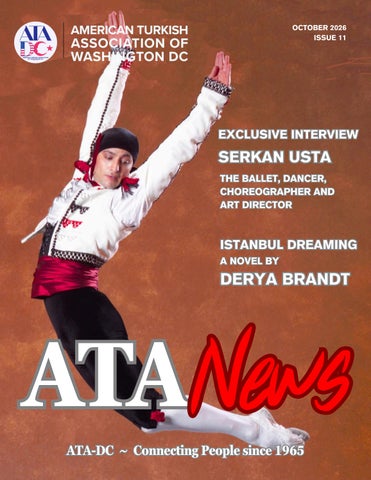
OCTOBER 2026 ISSUE 11
EXCLUSIVE INTERVIEW
SERKAN USTA THE BALLET, DANCER, CHOREOGRAPHER AND ART DIRECTOR
ATA
ISTANBUL DREAMING A NOVEL BY
DERYA BRANDT
ATA News News ATA-DC ~ Connecting People since 1965 ATA-DC ~ Connecting People since 1965
TABLE OF CONTENTS
PRESIDENT’S MESSAGE
03
FROM THE EDITOR-IN-CHIEF
05
COMMUNITY NEWS
09
INTERVIEW, SERKAN USTA A LIFE OF HIS OWN
16
By Özge Övün-Sert INTERVIEW, DERYA BRANDT A JOURNEY THROUGH MEMORY
19
By Yasemin Bayraktar YOUNG MEMBERS CORNER
29
By Dalia Golden PROGRAMS UPDATE
33
By Demet Cabbar/Pelin Tanyeri Koç MASTERCHEF’S JOY OF FOOD
34
By Deniz Orhun
1
ATANews News EDITOR-IN-CHIEF ÖZGE ÖVÜN SERT MANAGING EDITOR ELVAN RAMAZANOĞULLARI CONTENT COORDINATOR GAMZE ÇAKMAK ATA-DC BOARD OF DIRECTORS EXECUTIVE LEADERSHIP
Sevtap Schreffler – President Koray Kükrer – Vice President Özge Övün Sert – Secretary General Patsy Jones – Treasurer Atilla Özdemir – At Large BOARD MEMBERS
Aylin Geçener Aynur Kahveci Özdemir Berk Somer Büşra Kayı Tarhan Burcu Yüksel Demet Cabbar Elvan Ramazanoğulları Erin Özlem Akkaya Feriha Iştar Gamze Çakmak Güçlü Özenci Mert Arkan Nile Karaman Nazlı Göksoy Pelin Tanyeri Koç Seda Arık Selçuk Oflaz Tolga Özek Umut Burak Geyikçi Yasemin Bayraktar
2
PUBLICATIONS COMMITTEE SEVTAP SCHREFFLER DEMET CABBAR FERİHA İŞTAR TOLGA ÖZEK SELÇUK OFLAZ NILE KARAMAN GÜÇ ÖZENCİ YASEMİN BAYRAKTAR PELİN TANYERİ KOÇ CONTRIBUTORS DALIA GOLDEN DENIZ ORHUN PHOTO CREDITS SERKAN USTA PHOTOS: JAMI MILNE MOLLY HUEY WWW.ATADC.ORG WWW.TURKISHFESTIVAL.ORG INFO@ATADC.ORG
PRESIDENT’S CORNER Dear ATA-DC Members and Friends, As autumn settles over Washington, DC, I find myself thinking about how much happens behind the scenes before we reach one of the most visible moments of our year: the Turkish Festival. For the public, Festival Day is a celebration of music, dance, food, art, and culture. For those of us working closely within ATA-DC, however, it represents months of planning, countless volunteer hours, and a great deal of community support. That is why Turkish Heritage Month is so meaningful. It gives us the opportunity not only to celebrate our culture, but also to come together in the weeks leading up to the Festival and remind ourselves why this work matters. This year’s Turkish Heritage Month began with a wonderful kickoff brunch at Beth’s in Bethesda, followed by our Nostalgia fundraiser, where guests gathered around mezes, dinner, conversation, and the familiar tastes and atmosphere that connect so many of us to Türkiye. Still ahead are a film screening with Serkan Koç and two Turkish dance workshops, each offering another way to experience, share, and celebrate our heritage. What I appreciate most about these events is the sense of connection they create. They are not simply fundraisers or programs on a calendar. They are moments when old friends reconnect, new friendships begin, and our community comes together around something shared. At the same time, much of ATA-DC’s work is not always visible. During the summer, while our event calendar was quieter, our Board and volunteers continued working on the organization itself. One important project has been the development of a new mobile app, designed to help our members stay connected, access benefits and resources, and make the most of their ATA-DC membership. We also continued our congressional outreach, meeting with members of Congress and their offices and maintaining relationships that are important to the Turkish-American community in Washington. These efforts may look very different from a cultural event, but they are all part of the same mission. As Turkish Heritage Month continues and we move closer to our 24th Annual Turkish Festival, I am once again reminded that ATA-DC is sustained by people—our volunteers, members, sponsors, donors, partners, and friends. Thank you for showing up, contributing, and believing in what we are building together. With warm regards,
Sevtap Schreffler PRESIDENT OF ATA-DC 3
TURKISH FESTIVAL 2025 WAS SUPPORTED BY MORE THAN 20 LOCAL AND NATIONWIDE SPONSORS. THE FESTIVAL THE FESTIVAL IS IS ONE ONE OF OF THE THE MOST MOST VISITED VISITED CULTURAL FESTIVALS CULTURAL FESTIVALS IN IN THE THE WASHINGTON, WASHINGTON, D.C. D.C. METROPOLITAN AREA. METROPOLITAN AREA.
ORGANIZED BY2025 WAS SUPPORTED BY TURKISH FESTIVAL MORE THAN 20 LOCAL AND NATIONWIDE SPONSORS.
GRANTED BY
PREMIERE LEVEL SPONSOR
DIAMOND LEVEL SPONSORS
GOLD LEVEL SPONSORS
BRONZE LEVEL SPONSORS
MEDIA SPONSORS
FRIENDS OF THE FESTIVAL
WHAT OUR SPONSORS SAID For over 30 years, David Saltzman and I have supported Turkish American organizations nationwide. But the number of successful organizations has not kept up in recent years. In that sense, ATA-DC is exceptional, serving as an organization of its time and the future, always. We believe the Turkish Festival and Republic Day Gala are beautiful celebrations. What a Turkish Delight your leadership has been. Thank you!
I’ve been supporting ATA-DC as RE/MAX since the first festival in 2002, and each year it’s a joy to set up the RE/MAX balloon with my family on Pennsylvania Avenue. It’s a wonderful experience to reconnect with old friends and clients, meet new people, enjoy Turkish cuisine, and watch the amazing shows at the stage. I’m proud to support ATA-DC’s efforts in promoting Turkish culture. Excellent work, ATA-DC !
GUNAY EVINCH, SALTZMAN & EVINCH
MELIH CAKMAK, RE/MAX
FROM THE EDITOR-IN-CHIEF Hello friends and ATA-DC members, October is an important month for our Turkish-American community, both culturally and historically. At ATA-DC, Turkish Heritage Month brings us together through music, food, dance, conversation and the many traditions that connect us to Türkiye. This issue of ATANews reflects that energy in so many ways—from our community events, seminars, fundraisers and the growing work at the ATA-DC House to educational programs like Atatürk School and YCAP, our young people finding their place in America, and the remarkable stories of Turkish-Americans building lives and careers in this country. Our interview with Serkan Usta and our conversation with author Denise Derya Brandt are also, in very different ways, stories about identity, resilience and the connection between where we come from and where we are going. But there is something else that makes this time of year especially meaningful to me. October 29 is Cumhuriyet Bayramı—Turkish Republic Day, when our community celebrates the founding of the modern Republic and the universal values it was built upon: democracy, equality, freedom, and respect for every citizen. I look forward to ATA-DC’s annual Republic Day Ball, and this year we will gather on November 1 to celebrate together. I hope many of you will join us, not simply because it is one of the most beautiful evenings on our calendar, but because I believe the occasion deserves a little more reflection than that. When Mustafa Kemal Atatürk founded the Republic, he was not simply establishing a new form of government. He was envisioning a modern country built on reason, education, secularism, citizenship, and the idea that people should have a voice in their own future. He understood that a nation survives not because of one person, but because each generation understands its values and takes responsibility for protecting them. That feels particularly important today. For those of us who carry love and pride for both countries, while building our lives here and caring about these universal values, keeping those values and ideals alive is a meaningful way of honoring the principles on which both nations were founded. Perhaps that is what Republic Day means to me now. It is not only about remembering 1923. It is about asking what we are carrying forward—and what kind of society we want our children to live in. So, this Republic Day, let’s celebrate with pride, joy, and each other.
,
With warm regards and cheers!
Özge Övün-Sert EDITOR-IN-CHIEF ATA-DC SECRETARY GENERAL
5
The College Planning and Admissions seminar was highly interactive, with students and parents asking many thoughtful questions throughout the program
On September 5, 2026, ATA-DC hosted Robert Turk, M.Ed., Lead Mentor at Robert Turk Consulting, for an informative seminar on college planning and the U.S. admissions process. About 80 students and parents filled the ATA-DC House, making the seminar one of ATA-DC’s most popular educational events of the year. Drawing on more than 16 years of college consulting experience and 10 years counseling in public and private schools, Turk shared practical guidance on how students can identify their interests, choose meaningful activities and summer programs, and prepare for colleges that are a good fit for them. The seminar was highly interactive, with students and parents asking many thoughtful questions throughout the program. Topics ranged from college planning and applications to extracurricular activities and other important parts of the admissions process. SAT instructor Ahmet Can also contributed a section on SAT preparation and answered more specific questions related to the exam. Many parents shared positive feedback afterward, saying they had found the seminar very useful and gained valuable information for their
6
A FULL HOUSE AT ATA-DC FOR COLLEGE PLANNING AND ADMISSIONS SEMINAR children’s college admissions journey. Several attendees asked ATA-DC tocontinue organizing similar educational programs. Reflecting on the event, Turk shared the broader motivation behind his work: “My goal is to help Turkish and Turkic students reach strong academic and professional positions in the United States and, in doing so, strengthen our diaspora here. It was very meaningful for me to come together with people from our community and to see this work appreciated. I hope this awareness continues to grow and that, five or ten years from now, we will see a very different and much stronger Turkish diaspora in the United States.” The strong turnout, thoughtful discussion, and warm sense of community made the seminar a memorable evening at the ATA-DC House.
COMMUNITY NEWS
VICTORY DAY RECEPTION AT THE AMBASSADOR’S RESIDENCE IN DC On August 27, the ATA-DC President and members of the Board attended a reception at the residence of the Ambassador of Türkiye in Washington, DC, held in celebration of August 30 Victory Day. The program brought together members of the diplomatic corps, military attachés, officials from U.S. institutions, representatives of the TurkishAmerican community, and members of the press, among others. Remarks were delivered by Ambassador Sedat Önal and Türkiye’s Military Attaché, Brigadier General Alpaslan Güldal, who reflected on the historical significance of Victory Day and the importance of commemorating this milestone in Türkiye’s national history. The 2026 observance marked the 104th anniversary of the victory of August 30, 1922 which played a decisive role in the final phase of the Turkish War of Independence. The reception provided an opportunity for members of the Turkish-American community and invited guests to come together in recognition of this important national day. ATA-DC was honored to participate in the commemoration and join the broader community in marking the 104th anniversary of August 30 Victory Day in Washington, DC.
AZERBAIJANI TURKS REMEMBER THE HEROES OF THE 44-DAY WAR Members of the Azerbaijani and Turkish-American communities gathered at Baku Delicious in Fairfax for a special event commemorating Azerbaijan’s victory and reflecting on the significance of the occasion for the Azerbaijani people on Sunday, September 27. The special guest of the afternoon was Vüsala Mehdiyeva, Counselor at the Embassy of the Republic of Azerbaijan in Washington, DC, who delivered remarks reflecting on the meaning and significance of the occasion. The program also included a screening of the documentary 44 Gün və... (“44 Days and… ”), offering attendees an opportunity to learn more about the events being commemorated.
∞
∞
ATA-DC President Sevtap Schreffler and Secretary General Özge Övün-Sert, together with their families, attended the gathering, joining community members for an afternoon of remembrance, culture, and fellowship.
7
COMMUNITY NEWS
TASSA’S ANNUAL CONFERENCE STRENGTHENS SCIENTIFIC TIES
TRNC MINISTER’S VISIT BRINGS TURKISH DIASPORA TOGETHER On September 30, ATA-DC President Sevtap Schreffler with board members Pelin Tanyeri-Koc and Aynur KahveciÖzdemir attended a special gathering hosted by Damla Güçlü, Representetive of the Turkish Republic of Northern Cyprus in Washington, DC. The featured guest was Turkish Cypriot Foreign Minister Tahsin Ertuğruloğlu, who was visiting Washington following a series of meetings in New York during the United Nations General Assembly period. The gathering brought together members of the press and representatives of the Turkish and Turkish Cypriot communities for an informal discussion on Cyprus, international relations, and the future of the Turkish Cypriot people.
The Turkish American Scientists and Scholars Association (TASSA) held its 2026 Annual Conference from October 2–4 at the Sancar Turkish Cultural and Community Center in Chapel Hill, North Carolina. TASSA President Dr. Ercan Alp, together with conference co-organizers Prof. Hasan Ayaz of Drexel University and Prof. Canan Dağdeviren of MIT, welcomed scientists, scholars, and academic leaders from across the United States and Türkiye. Under the theme “Bridging Innovation in the Era of AI: Transnational Impact Across the U.S. and Türkiye,” the conference featured keynote presentations and panel discussions exploring artificial intelligence, robotics, sensor technologies, scientific innovation, and the transition from research to commercial applications. Sessions also addressed science philanthropy, immigration pathways for researchers, and opportunities to strengthen institutional partnerships between the two countries. University presidents and academic leaders from Türkiye participated in discussions on reversing brain drain, encouraging scientific collaboration, and building sustainable partnerships. Ambassador Sedat Önal, attended the opening day and addressed participants, highlighting opportunities for greater cooperation between Turkish and American scientific and academic communities.
8
During his remarks, Minister Ertuğruloğlu shared his government’s perspective on the longstanding Cyprus issue and discussed the political and economic realities faced by Turkish Cypriots. He emphasized that, in his view, future relations between the island’s two communities should be based on cooperation between two neighboring entities rather than a return to a federal partnership. This position is consistent with the policy he has articulated during his current U.S. visit.
COMMUNITY NEWS
GROUP MAVI PERFORMS AT WASHINGTON FOLK FESTIVAL IN GLEN ECHO Group Mavi, performing under the umbrella of the DMV Turkish Music Ensemble, took the stage at the Washington Folk Festival held at Glen Echo Park, Maryland, on Sunday, August 23. Performing at the Bumper Car Pavilion, the ensemble presented a repertoire featuring traditional pieces from Istanbul, the Aegean, the Balkans, the Levant, the Caucasus, and Anatolia. The 45-minute program incorporated instruments such as the oud, kemancheh, guitar, bass guitar, bendir, and percusion, alongside featured vocal performances. Focusing on cross-cultural musical heritage, the ensemble shared traditional melodies that reflect the rich geographic and cultural transitions of the region with festival attendees.
CONCERT BY THE ALTIN GUN BAND AT HOWARD THEATRE On Friday, September 25, the Howard Theatre in Washington, DC came alive with the sounds of Altın Gün, as more than 600 concertgoers gathered for an unforgettable evening of Turkish-inspired psychedelic music. Formed in Amsterdam in 2016, the internationally acclaimed band blends traditional Anatolian and Turkish folk music with psychedelic rock, funk, synths and contemporary sounds. Altın Gün has since built a global following, earning a Grammy nomination for Best World Music Album for its 2019 album Gece and making its Coachella debut in 2020. Their Washington performance showcased the band's remarkable energy and musicianship, with the audience dancing and enthusiastically responding throughout the evening. Perhaps most striking was the makeup of the audience, with the vast majority of the more than 600 attendees being nonTurkish. Their enthusiastic response to Turkish melodies, rhythms and instruments was a powerful testament to the growing international appeal of Anatolian music. For many attendees, the concert provided a unique introduction to Turkish musical traditions through a modern, globally recognized band. Altın Gün's performance demonstrated how music can transcend language and cultural boundaries.
9
ATA-DC and Turkish Festival supporters came together for two special fundraisers in Bethesda, MD, at the Beth’s and Fairfax, VA at Baku Delicious.
The two fundraisers demonstrated the generosity and enthusiasm behind the DC Turkish Festival
In the weeks leading up to the 24th Annual DC Turkish Festival, ATA-DC members, friends, and local businesses came together for two special fundraisers in Bethesda and Fairfax. From a traditional Turkish Sunday brunch to an evening filled with nostalgic music, both gatherings highlighted the community spirit and generosity that help make the annual festival possible. On September 27, ATA-DC brought together more than 50 members and friends of the Turkish-American community for a special Sunday brunch fundraiser at Beth’s in Bethesda, benefiting the 24th Annual Turkish Festival in Washington, DC. The event filled the restaurant and was a wonderful celebration of community, friendship, and Turkish cuisine. ATA-DC is especially grateful to Beth’s owners, Celal and Deniz Güllüoğlu, who generously opened their restaurant on a Sunday to host this important fundraiser. Chef Aynur Cooks prepared a beautiful Turkish breakfast spread featuring menemen, sucuk, assorted cheeses, şakşuka, and many other traditional favorites. Special thanks also go to Atilla Özdemir of Fairfax Bakery, which provided delicious baklava, simit, and savory treats for the brunch. The brunch was followed less than a week by another fund-
10
FUNDRAISERS FOR THE 24 th ANNUAL TURKISH FESTIVAL raiser -- this time bringing the community together in Fairfax for an evening of music, memories, and nostalgia. ATA-DC and Turkish Festival supporters came together for a lively Nostalgia Night fundraiser at Baku Delicious in Fairfax on October 3. The evening offered guests a nostalgic journey through beloved songs and memories, with Group Blue providing a rich musical program that set the tone for a warm and entertaining night. Guests also enjoyed a special dinner prepared by Sofra Restaurant and Deniz Bidav. The fundraiser was hosted by Baku Delicious and owner Sevda Tahirli, whose support helped make the evening possible. Proceeds from the event will benefit ATA-DC’s annual DC Turkish Festival, one of the signature community events celebrating Turkish culture and heritage. Together, the two events demonstrated the generosity and enthusiasm behind the DC Turkish Festival. Both fundraisers were also part of ATA-DC’s Turkish Heritage Month programming, with events continuing throughout October.
ATA-DC members came together to honor fathers and celebrate the important role they play in our community. Guests enjoyed delicious food, refreshing drinks, and desserts while reconnecting with friends and making new connections.
11
12
TUNE FOR WIZARDS’ NBA TURKISH HERITAGE NIGHT ON NOVEMBER 15
Your paragraph text
The Washington Wizards will celebrate Turkish heritage in DMV region on Sunday, November 15, when they host the Houston Rockets at Capital One Arena.
Your paragraph text
Presented in partnership with ATA-DC, the special night will highlight Turkish culture and Houston Rocket’s basketball star Alperen Şengün. Fans purchasing tickets through the special offer will receive a limited-edition Turkish Heritage soccer jersey, available in youth and adult sizes while supplies last. The experience also includes early entry to watch players warm up, with 25 children having the opportunity to form a fan tunnel to welcome the players onto the court. For tickets and information, visit the ATA-DC website or email info@atadc.org. You may also find these details through ATA-DC’s mobile app that is available in Apple store as well as Android app stores.
Get a Rate Quote in Just 30 Seconds! www.tolgamortgage.com Mortgage rates change daily and vary depending on your unique situation. Get your FREE customized quote to see how much you qualify for!
republic DAY BALL YOU ARE CORDIALLY INVITED TO THE CELEBRATION OF
THE102ND anniversary of THE turkish republic NOVEMBER
1
6PM-11PM
WASHINGTON PLAZA HOTEL
RSVP to info@atadc.org
FOR TICKETS
Serkan Hasanusta talks about growing up in Türkiye, finding his way to America, building a career and family, and staying curious about what comes next.
A LIFE OF HIS OWN
SERKAN HASANUSTA Still Curious,
Still Creating
BY ÖZGE ÖVÜN SERT
S
ome life stories seem almost impossible to imagine as belonging to the same person. Serkan Hasanusta—known to many simply as “Serkan Usta”—began life in Türkiye under circumstances far removed from the world of ballet he would eventually enter. After losing his father, he spent part of his childhood in an orphanage, where life was far from easy. Yet somewhere along the way, ballet entered his life and opened a door to a future he could hardly have imagined. That journey eventually brought him to the United States, where he built an accomplished career as a dancer, choreographer, teacher and artistic director, and became an important part of the American ballet community.
16
PHOTO BY JAMI MILNE
Today, Serkan has built much more than a career. He has created a life in the United States with his wife, fellow ballet professional Lori Grooters, and together they have devoted decades to their art, their students and their family. Their shared journey has taken them from the ballet stage to classrooms, studios and artistic leadership. As Editor-in-Chief of ATANews, Özge Övün-Sert, had the pleasure of sitting down
with Serkan to talk not only about ballet, but about the life behind the dancer—the experiences that shaped him, the things that continue to drive him, the people he loves, and what it means to build a life of your own. Serkan, thank you so much for being with us. It's really a pleasure to have this conversation with you. How are you? How is life these days? I’m doing very well, thank you, Özge. Life is good. I’m keeping busy with ballet, choreography, teaching, and all the other things I love doing. I’m always working on something, so I really can’t complain. You went through some very difficult circumstances as a child. You grew up in an orphanage. What do you remember most about that time in your life? When you think about your childhood, what comes back to you first? I was about five years old when my mother had to make a very difficult decision. She was pregnant at the time, and for six or seven months she struggled with whether she should put me in the orphanage. Eventually, she made that decision. I am so grateful to my mother for making that decision. I know now more than ever she did it because she was thinking about my safety and my future. I honestly don’t know how she was able to do it. It must have been very, very difficult for her. Now that I have my own children, I understand that even more. I can only imagine how hard it must have been for a mother to make that choice. Looking back now, I don’t see it only as something sad. In many ways it became one of the most important decisions of my life. The orphanage gave me structure, discipline, and eventually an opportunity I could never have imagined. What changed everything for me was when Cem Ertekin came to the orphanage looking for boys to introduce to ballet. I didn’t even know what ballet was. If he had never walked through that door, probably I would never have become a dancer or choreographer. So when I think about my childhood, I think about how something that looked like a very difficult beginning opened a completely different road for my life. Where you start does not have to decide where you can go. When ballet entered your life, what was it about ballet that made you want to keep going? Ballet entered my life completely by chance. I was about ten when Cem Ertekin came to the orphanage looking for boys
who might have potential for ballet. Six boys were chosen, and I was one of them. Before that, I didn’t even know what ballet was. In the beginning it wasn’t like I wanted to become a ballet dancer. It was very different from today, when a child says, “I want to take ballet,” and the parents take them to a ballet school. For us, we were chosen and we were expected to do it. There really wasn’t an option to say, “I don’t want to do this.” So I didn’t really fall in love with ballet right away. It happened slowly. After a couple years I started to understand it and learn to love it. I started loving the movement, the music, the discipline, and the challenge of trying to get better. Eventually ballet became something that belonged to me. I started realizing it could take me somewhere beyond the life I already knew. Something I didn’t choose in the beginning ended up becoming the direction of my whole life.
17
When you look back at your childhood, what do you think made you so determined to build a new life for yourself? I think growing up the way I did made me independent very early. I learned if I wanted something different for my life, I had to work for it. I couldn’t just sit and wait for things to happen. The orphanage gave me discipline, but also made me understand there was a much bigger world outside of the life I knew. Once ballet came into my life, that world started opening little by little. I started seeing possibilities I never imagined before. I also think I developed some kind of survival instinct. When something was difficult, I learned to adjust, keep going, and figure out what the next step was. That became part of me. Later, when the opportunity came to America, I felt I had to take it seriously. Opportunities like that don’t come every day. If a door opened, I wanted to walk through it and give everything I had.I think my determination came from wanting to see how far I could go and what kind of life I could build for myself. I didn’t want my beginning to define the rest of my life. Was there a moment when you realized that ballet could actually take you somewhere in life? Yes, I think there was a point when I started understanding ballet could become much more than just something I was doing. At first I was simply training because that was what expected from me. But as I improved, teachers started seeing something in me, and opportunities started coming. I realized ballet could take me outside the world I knew and maybe give me a completely different future. The biggest realization came when opportunities to continue my training and eventually come to America became real. That was when I understood ballet could actually become my life and take me places I never imagined when I was a child. Once I understood that, I became even more determined. Ballet opened a door for me, and I wanted to see how far that door could take me. You came to America and built an extraordinary career here. How did that story unfold and what did you have to learn about yourself along the way? Coming to America was probably one of the biggest risks I took. I came by myself, and when I first arrived I remember being scared and thinking, “What have you done? You came to another continent by yourself.” Then I told myself, “You grew up in an orphanage. Think America is one huge orphanage. Figure it out.” Somehow that thought helped me.
18
I already learned how to adapt, survive in a new place, and find my way. America opened doors for me I could never imagine. I continued my training at Kirov Academy and School of San Francisco Ballet, and eventually built my professional career with Tulsa Ballet, where I danced as professionally. Later my life became more than performing teaching, directing and choreography became a big part of it. Along the way I learned talent is not enough. You have to be disciplined, you have to work, you have to accept failure sometimes, and you have to keep learning. I also learned I was probably much stronger and more adaptable than I knew. Ballet can be a very demanding and sometimes unforgiving world. What were some of the hardest moments in your career, and what did they teach you about yourself? Ballet is beautiful, but it can also be very demanding and unforgiving. You are constantly being judged your technique, your body, your performance, and if you are good enough for the next part or the next ballet. There were times when I was injured, times when I didn’t get a role I wanted, and times when
when I had to prove myself more. As a dancer you can work incredibly hard and still hear no. That can be difficult, especially when so much of your identity is connected to what you do. What those moments taught me was not to let one rejection, one injury, or one difficult time define me. I learned to keep working, adjust, and come back stronger. I also learned a dancing career cannot last forever just because you want it to. At some point I had to think beyond performing and discover other parts of myself. Those difficult moments taught me resilience. Sometimes the hardest moments are actually what pushes you to the next chapter of your life. You went from being a dancer to building and leading organizations of your own. What made you want to build something rather than simply perform? I always had something in me that wanted to create, not only perform. As a dancer or ballet, you are doing somebody else’s choreography and somebody else’s vision. I loved performing, but over time I realized I had my own ideas about what I wanted to put on stage and how I wanted things to be. Choreography became a big part of that. I loved creating something from nothing choosing music, working with dancers, shaping the movement, and then seeing the whole thing come alive on stage. That gave me a different excitement than performing. Later I realized I also enjoyed building and leading. I liked putting people together, creating productions, making decisions, solving problems and watching an organization grow. I wasn’t afraid of the business side either. I actually liked the challenge of figuring out how to make things work. Of course I also wanted to create opportunities for dancers and give young people a place where they could grow. But probably the biggest thing was I wanted to build something with my own artistic vision. Performing was about what I could do on stage. Building something became about what I could create beyond myself.
hard to separate the two. Ballet comes home with us. We can disagree about a dancer, a production, or how something should be handled, but we learned we don’t have to agree on everything to respect each other. I always say Lori and I are an awesome team. We are like standing back-to-back and leaning on each other. She is the boss and I am happy to follow her guidance! There are so many things she does that honestly I have no idea how she does them. Things that would be very hard and time consuming for me, she just handles it. And I think she probably feels the same with me. There are things I do naturally, problem solving or just figuring something out, that she can absolutely do too, but maybe it would take her much more time. That is why we work good together. We don’t have to be good at exactly the same things. Sometimes she takes the lead, sometimes I do, but we always know we are on the same team. Most important, underneath the business and ballet, we are still husband and wife and we built a family together. We have gone through a lot, built a lot, and I think that history, trust and love is what makes it work.
You and your wife Lori have built much of your life around ballet. How do you make a marriage work when you also share the same profession, ambitions and daily pressures?
You have spent much of your life helping young dancers find their own path. What do you see in a young dancer that makes you think, “This person has something special”?
Lori and I shared so much of our life through ballet, and I think that has been a strength and sometimes also a challenge. We understand each other’s work in a way maybe somebody outside of this world would not understand. We both know the long hours, rehearsals, performances, students, parents, productions and everything that comes with running a school. When you work together and live together, sometimes it is
For me, it is not always the dancer with the best body, highest leg, most turns or best technique. Of course those things get your attention, but that doesn’t always tell you who is going to become a great dancer. I look at how they move, how they hear the music, and if there is something natural about them when they dance. Sometimes a young dancer walks into the studio and your eyes just keep going back to them. You may
19
and really didn’t know what my future was going to look like. So when I look at my life now my wife Lori, our children, our home, our business and everything we built together sometimes I think about how far that journey went. I am proud my children were able to grow up with opportunities, stability and a family around them. That means a lot to me because my childhood was so different. I am also proud Lori and I were able to build something together through many years of work, sacrifice, mistakes and figuring things out as we went. We built our life one step at a time. Ballet gave me the opportunity to come to America, but what I am most proud of is what I did with that opportunity building a family, creating a home and creating a life I could never imagine when I was a child in Istanbul. not even know exactly why. I remember when I was a young dancer, the legendary Russian ballet dancer Vladimir Vasiliev was teaching some classes and rehearsing us. He was not dancing anymore at that time. He told us boys something I never forgot. He said, “By the time you really understand what dance is all about, it is too late. Your body will not let you do it anymore. ”That stayed with me for many years. When you are young, you are so focused on technique, turns, jumps and trying to do everything better. But later you understand that dancing is so much more than that. It is music, feeling, experience, and what you give to the audience. That is also why one of the biggest things I look for is how a young dancer learns. I can give ten dancers the same correction, and one dancer understands it, changes it, and remembers it the next day. That tells me a lot. I also look for curiosity, discipline, intelligence, and really wanting to get better. I watch what happens when things don’t really go their way. Do they get discouraged, or do they work harder? Talent is important, but talent without hard work only takes you so far. When I see musicality, determination, the ability to learn, and something natural that you cannot completely teach, that is when I think, “This person has something special.” When you think about the life you have built in America, what are you most proud of that has nothing to do with being on stage? What I am most proud of has nothing to do with a role I danced or a performance I gave. It is the life and family I was able to build here. When I first came to US, I came by myself
20
You've accomplished a lot. What are you still hungry for? What still excites you? Are there things that you haven't done yet but you want to? I still feel very hungry creatively. I don’t feel like I reached a point where I can say, “I did everything I wanted to do.” There is still a lot that excites me. Choreography is probably the biggest thing. I want to continue creating new work, working with different professional companies and challenging myself. Every time I walk into a studio to create, I still get excited because I don’t completely know what the final work is going to become. would also love to create more internationally, especially in Türkiye. There is something very meaningful for me about taking everything I learned and built in America and bringing some of that back to the country where my journey started. But it is not only ballet. A few years ago I started learning golf, and now of course I want to get better and better at that too. I became a beekeeper. I love gardening. I love fixing things. I love cooking, and I cook for Lori almost every night. I love good gourmet food, and trying new things.
You've lived in both Türkiye and the U.S. for much of your life. What part of Türkiye is still very much a part of you? Türkiye is still very much part of me. It is in the way I think, the way I cook, the music I love, the way I connect with people, and visiting probably even my sense of humor. I lived in America for many years and America is my home too, but Türkiye is where my story started. Istanbul, the culture, the food, the language and the people — those things don’t leave you. I think now I carry both countries with me. America gave me so many opportunities and became where I built my family and my life. But Türkiye will always be inside of who I am. Were you always this determined, or did life make you that way?
PHOTO BY MOLLEY HUEY COURTESY OF RICHMOND BALLET
I guess when you have ADHD maybe you never stop learning something! My mind is always going. Everybody who knows me knows I cannot sit still. People always ask me, “Where do you get this much energy?” I don’t know. I think this is just who I am. I am always thinking, “What else can I create? What else can I learn? What haven’t I tried yet? ”As long as I am curious and excited about something new, I know I am not finished. If you could go back and sit down with the young Serkan you once were, what would you tell him? I would tell him, “Don’t be afraid. Your life is going to take you places you cannot even imagine right now. Most of all I would go back to those days in the orphanage when I was not happy and I was crying. I remember telling myself, “You will be okay. One day you will be happy. If I could sit next to that young boy now, I think I would tell him, “You were right. You are going to be okay and happy one day. I would tell him there will be difficult times and times when you don’t know what comes next, but keep going. I would tell him, “Always be nice, stay positive and help people when you can. Be generous. Keep the friends you really care about close to you. Life gets busy and people go different directions, but the people who really matter, keep them close.”
I always had some determination in me, but life definitely made it stronger. When you have to adapt very young, you learn pretty fast that giving up doesn’t really help you. You learn to keep going, solve problems, and make the best of whatever situation you are in. So maybe the determination was already there, but every experience made it stronger. Ballet taught me discipline. Coming to America taught me courage and independence. Having a family and building business taught me responsibility. After a while determination wasn’t something I thought about anymore. It just became part of who I am. People know Serkan the dancer and artistic director. What do you wish people knew about Serkan the person? I think people who know me through ballet probably see the dancer, choreographer, teacher or director first. But outside of that, I am really a very simple person. I love being home, cooking for Lori, working in the garden, taking care of my bees, playing golf, and spending time with people I care about. I am probably more sensitive than others think. I care deeply about people, and when somebody is important to me, I try to be there for them. I believe in being generous, staying positive and helping people. I love to laugh and have fun too. Ballet has been a huge part of my life, but it is not my whole personality. And I also want to thank you, Özge for having an interest in my story. I don’t think of my life as something so important or exciting, it is just the life I lived. So for someone to want to hear about it and share it with others means a lot to me. Thank you, Serkan! I think you do have a very exciting life, and I’m very glad you let us get a little glimpse of it.
21
ADVERTISE
WITH US! Are you looking to connect with a vibrant, engaged audience in the Washington, D.C., Maryland, and Virginia region? Advertise with ATA-News, the oldest Turkish-American community magazine in the DMV! ATA-News has been a trusted source for local news, cultural events, and community updates, with a dedicated readership that values quality content and meaningful connections.
2025 RATES
OLDEST
TURKISH AMERICAN COMMUNITY MAGAZINE IN THE DMV
FULL PAGE AD INCLUDING DESIGN
$500
$750
BACK COVER INCLUDING DESIGN
1/2 PAGE AD
$250
$650
INSIDE FRONT COVER INCLUDING DESIGN
$150
$550
INSIDE BACK COVER INCLUDING DESIGN
1/4 PAGE AD
Email: info@atadc.org Discount available for full or half year agreements
UNVEILING ISTANBUL DREAMING RECENTLY PUBLISHED NOVEL BY DENISE DERYA BRANDT A Journey Through Memory, History, and Heritage
BY YASEMİN BAYRAKTAR
W
hen Denise Derya Brandt discovered an old photograph of her Turkish mother in a wedding dress, standing beside a man who was not her American father, she found herself staring into a family secret, and into a story that had been waiting decades to be told.
That discovery would eventually lead Brandt, a first-time novelist raised in Arizona, on a deeply personal journey into her family’s past and the history of a changing Türkiye. Her debut novel, Istanbul Dreaming, grew out of that journey, weaving together her mother’s hidden experience of a forced
23
marriage, her escape and reinvention in America, and the social realities of mid-20th-century Türkiye. What began as an unexpected glimpse into her mother’s past became an exploration of memory, identity, belonging, and the complicated ties that bind generations. Brandt’s own life has been shaped by the meeting of cultures. Raised with both American independence and Turkish traditions, she later lived in Istanbul after graduate school, working as an associate publisher for an English-language business magazine. Her international development work subsequently took her to Şanlıurfa and Afghanistan, experiences that further broadened her perspective on culture, tradition, and social change. Today, from her home in Northern Kentucky, she draws on those experiences—and on her family’s history—to bring authenticity and emotional depth to her writing. In this exclusive ATA News Q&A, Brandt speaks with Yasemin Bayraktar about the photograph that changed the way she understood her family, the research and family collaboration behind Istanbul Dreaming, and the journey of transforming a deeply personal history into fiction.
In your Author's Note, you share discovering a photograph of your mother in a wedding dress next to a man who was not your father. How did uncovering this past shape your portrayal of Ayten's forced marriage, and how did it feel to use fiction to imagine answers to questions you could never ask her? My mother always said she ran away to Istanbul to escape an arranged marriage. Finding that photograph revealed she hadn’t escaped before the wedding after all. Both of my parents have passed, leaving me with unanswered questions and frustrating hearsay. So, I turned to fiction to understand. I invented Ayten, torn between duty and happiness, and Salih, whose possessive behavior pushes her to flee. Writing Ayten's decision to leave before the morning call to prayer was my way of sitting with questions I'll never get to ask my mother. Fiction allowed me to imagine an answer, even if it isn't necessarily the true one. How did you balance the romantic tension of Ayten and Earl's love story with historical events like the 1958 Bursa fire, student protests, and the 1960 military coup? I wrote the love story first, then folded in historical details like vehicles, fashion, and music. I had a strict rule: if a historical event didn't impact a character's actions, it didn't belong on the page. The Bursa fire stands in for Ayten's irrational guilt.
Real plane crashes make her fear flying and being with an airman. Protests and curfews keep Ayten and Earl apart, while the 1960 coup adds a ticking clock to their relationship. My approach was to make history personal rather than just accurate. In your research, what archive discovery or lived memory helped bring this era to life? Beyond The New York Times archives, I discovered Facebook groups connecting American veterans who served in Türkiye in the '50s and nostalgia groups sharing daily photos off base. Reading 1950s news struck me because the political tensions of the Menderes era—populism versus secularism—felt like an echo of Türkiye’s recent politics. Understanding the present helped me imagine living through that decade. You open the book with a beautifully reflective "Note on Turkish," highlighting Mustafa Kemal Atatürk's bold 1923 alphabet reform replacing Arabic script with Latin letters. Why was it important to orient English-speaking readers with this linguistic history, and how did you decide when to use Turkish words? I think language says a lot about culture, so I wanted people to understand a bit about the Turkish language and how changes to it were a part of Türkiye’s turn toward the west. Swapping Arabic script for Latin letters was Atatürk literally rewriting the country’s orientation. Also, in reading the pages Denise Derya Brandt and her aunts
Denise Derya Brandt’s parents at their wedding
of Istanbul Dreaming, I wanted readers to fall in love with Türkiye. I decided to use Turkish words sparingly because I know from experience that a page cluttered with foreign words, or with broken English, can push a reader away just as easily as it can pull them in. I once gave up on a novel about a quarter of the way in for exactly that reason and I didn't want to hand my own readers a reason to do the same. So, I decided on some rules to guide my writing. When two Turkish characters talk to each other, I mostly keep it in English since we're meant to understand they're speaking Turkish the whole time. Throwing in Turkish words there would actually break the illusion instead of supporting it, the exception being honorific words that don’t have equivalents in English, such as abi, abla, etc. But when an American like Earl is in the scene, Turkish naturally surfaces, the way it would for anyone learning a new language and culture. That one I know from my own experience. Idioms were the one thing I really wanted to keep. As a native English speaker who picked up some Turkish growing up, I found them endlessly interesting, probably more interesting than a native speaker would, since you stop noticing the idioms in your own language after a while.
25
Your own background is fascinating tapestry — you grew up in Arizona, lived in Istanbul after graduate school working as an associate publisher for an English-language business magazine, and now live in Northern Kentucky. How did your personal bicultural identity influence how you wrote about the tension between tradition and modernity in Türkiye?
means to be a modern woman and how much risk is worth taking to become one. I didn't want the book to suggest there's only one right way to be a "modern woman." Yasemin pushes back loudly. Other women in Ayten's world hold onto tradition on purpose, not out of obligation, and that's its own kind of choice. I respect them all.
My bicultural identity and international career immensely shaped this book. Between my own life and years of international development work, I've seen up close how family and societal pressure, the whole burden of protecting family honor, tends to land on a woman's shoulders more than anyone else's. I did my master's research in Şanlıurfa, Türkiye, which was a completely different world from the Istanbul or Bursa I visited growing up, and living there for a while helped me understand those pressures on a deeper level. Later, in Afghanistan, I saw even sharper versions of the same thing: real, serious consequences for women who didn't meet family or societal expectations. But some of this I learned long before any of that, as an American teenager visiting Türkiye. There's a scene where Ayten thinks about how bold Yasemin is, remembering the time she wandered into an all-men's café, always testing the edges of what she was allowed to do. That actually happened to me; I stumbled into a men's café myself once, which was the kind of thing I did constantly, having grown up somewhere with very different expectations for young women. Ayten and Yasemin share a deep bond, yet they face intense friction over what it means to be a "modern woman" and how to handle painful secrets. Why was it vital to show that female solidarity is just as crucial to a woman's liberation as romantic love? The book is inspired by my parents' love story, but I've always thought of it, first, as a coming-of-age story, as Ayten's emotional journey from an insecure, dutiful daughter to an empowered woman. And most of that journey is a result of her friendships. Those friendships are where Ayten gets her courage and strength, which is part of why the occasional friction between her and Yasemin mattered to me as much as anything with Earl. That kind of friction felt true to what real friendships are like. Yasemin doesn’t just introduce her to Earl —she’s the one pushing Ayten to come clean with Earl before she’s ready to. And they have different views about what it
26
You dedicated this debut novel to your mother and father, noting that their lives and cross-cultural love story served as the primary inspiration. Knowing that this book acts as a tribute to their legacy, what do you hope Turkish-American readers — many of whom navigate these exact cultural crossroads — take away from Ayten's inspiring journey? I hope Turkish-American readers, many of whom live at exactly this same cultural crossroads, take away that there's real beauty in combining cultures. My parents built a marriage across two cultures and two countries that lasted more than fifty years. I wanted this book to honor that, not by retelling their actual story, but by giving readers a character whose courage feels earned and whose happiness feels hard-won. Dreams can come true, even if not in the way you originally imagined them. If Ayten's fictional journey leaves someone feeling a little more hopeful about their own crossroads, or just curious about the parents or grandparents who crossed a similar one, I think I've done what I set out to do.
VOLUNTEER WITH US Do you love Turkish food and culture? Or do you want to visit Türkiye without leaving the Washington D.C. city limits? How about free lunches, free t-shirts, and free events with very cool people?
Come and volunteer for the D.C. Turkish festival on October 20, 2024 (Four separate shifts available) There will be many fun opportunities to work with art, youth, performers, the bazaar, and meet an incredible group of people. After submitting your application, we will contact you with more specific information about your volunteer placement. Spaces are limited, so sign up while you still can! To register, scan the QR code above or email us at festival@atadc.org
YOUNG MEMBERS CORNER
FROM YOUNG CULTURAL AMBASSADOR TO COLLEGE FRESHMAN A Future Still in Progress:
College applications, YCAP, and learning that you don’t need your whole life mapped out at eighteen.
BY DALIA GOLDEN
D
uring senior year, I spent a surprising amount of time trying to describe things I had already spent years doing. I had done sports, internships, volunteering, and clubs. I knew those experiences mattered to me, but a college application asks you to explain those experiences to someone who has never met you and gives you very little space to do it.
During applications, I had questions about everything. Which schools were realistic for me? What did I want to study? How was I supposed to fit years of activities into a few short descriptions and make them sound like they belonged to someone with a plan? “I didn’t figure it all out at eighteen,” my sister told me.
I’m now a first-year political science student at the University of Tennessee, Knoxville. My sister, also a YCAP alum, is now an engineer and seems to have her life together. I would like to point out that she had a six-year head start.
That was reassuring, although I was hoping she had figured out enough by now to do my part too. Her solution was to start with a spreadsheet. I wanted emotional support. She wanted to open Excel. Other Young Cultural Ambassadors knew that feeling as well. Lara Gecener, now a first-year student at UVA
29
told me, “I think the most stressful part of applying to college was definitely making sure my wording for everything sounded unique and represented me best.” She listed YCAP as one of her top activities, describing the leadership and civic engagement she developed through the program. Aslan Yelken, a YCAP alum studying computer science at Georgia Tech, also struggled to connect his research and internships to his motivations. He described the difficulty of fitting those experiences into short essays and advised students to “craft a narrative” that explains what drives them. Before students even get to that stage, there is the question of where to apply. Current YCAP member Tuana Cor mentioned researching class sizes, deciding how many applications to submit, and building a balanced list. She said a college counselor who spoke at YCAP helped her navigate those decisions. That guidance is one part of YCAP’s purpose. Demet Cabbar, an ATA-DC board member who leads YCAP, explained that it began with an emphasis on civic engagement and expanded to introduce students to professionals in their fields of interest. “The goal of the program is to help equip them with all these tools so they can make a change in their own lives and the lives of the people around them.” For me, meeting different guest speakers and attending YCAP events made it easier to approach new people. Selim, another member, described why that matters: “I believe the community aspect of YCAP is beneficial for college, as making a good impression and communicating well with people you might not know is an essential aspect of college life.” I’ve experienced that at UTK. While looking for research opportunities, I cold-emailed professors, including Turkish faculty members, and mentioned our shared background. They welcomed me and offered advice; some invited me for coffee, lunch, or a hike. Leave it to the Turkish community to turn an email about research into making sure you’ve eaten. Those conversations became relationships I value, showing me how supportive the community can be away from home. Lara told me that the communication she practiced in YCAP now helps her talk with different groups and professors at UVA. Aslan said the program helped him work on teams
30
YOUNG MEMBERS CORNER A NEW CHAPTER FOR ATATÜRK SCHOOL: FIRST ACADEMIC YEAR AT ATADC HOUSE ENDS WITH CELEBRATION AND ACHIEVEMENT outside his area of expertise, something he uses in the startup he founded in college. Those benefits became clearer after they submitted their applications. I’ve noticed the same thing: approaching a guest speaker at a YCAP event was good practice for approaching a professor whose work interested me. One YCAP junior I spoke with wondered how students choose a field without second-guessing themselves. I still question parts of my own plan, so I’m probably not the person to consult about never second-guessing anything. But applying to college didn’t require me to have every answer about my future. It required me to look closely at what I’d done and explain it honestly. If you are a student starting applications this year, you can take the process seriously without expecting to have your next forty years of your life planned out. I’m glad I spent time thinking about what mattered to me, even when finding the words was frustrating. Now I get to keep exploring those interests, ask people for help, and occasionally discuss my future over a lunch I hadn’t planned on.
31
11AM-6:30PM ON SUNDAY, OCTOBER 18, 2026
Executive Level ($15,000) Diamond Level ($7,000)
Gold Level ($3,000) Bronze Level ($1,750)
$8,500
WANT TO BECOME A SPONSOR?
Exhibitor ($1,000) Media Sponsor ($1,000)
$2,500
SCAN QR CODE TO EMAIL US
BY DEMET CABBAR / PELİN TANYERİ KOÇ
PROGRAMS UPDATE
YCAP CELEBRATES ITS 10TH COHORT! ATA-DC is excited to welcome the 10th cohort of the Young Cultural Ambassadors Program (YCAP)! Open exclusively to high school students in the DC, Maryland, and Virginia (DMV) region, YCAP helps young people develop leadership skills, give back to their communities, earn service hours, explore career paths and Turkish culture, and build lasting friendships. The program kicks off with orientation on Thursday, October 8, followed by students’ first assignments at the Turkish Festival on Sunday, October 18, 2026. More than 240 students have participated in YCAP since its launch in 2017. No Turkish language skills or previous volunteer experience are required. For questions contact ycap@atadc.org
ATA-DC Celebrated the Largest Graduating Class in the History of YCAP during 2025-26
A NEW SCHOOL YEAR BEGINS: ATATÜRK SCHOOL WELCOMES STUDENTS BACK Inspired by Mustafa Kemal Atatürk’s deep belief in education and in the power of future generations, our school is more than a place of learning. It is a place where language, history, traditions, national holidays, music, stories, and shared cultural values come together. With four classrooms, Atatürk School welcomes students every Sunday throughout the academic year, creating a warm and meaningful environment where they can strengthen their Turkish, discover their cultural heritage, build friendships, and develop a lasting connection to the community around them.
With great pride, joy, and excitement, Atatürk School has once again opened its doors for a new academic year, welcoming both returning students and new members of our community. Established to serve Turkish families living throughout the DMV area, as well as students who wish to learn more about Türkiye, Atatürk School carries an important mission: to teach the Turkish language, introduce the richness of Turkish culture, and help younger generations understand the history, values, and spirit of the Republic of Türkiye.
There is something truly special about seeing our classrooms filled once again with the voices, curiosity, laughter, and enthusiasm of our students. We are incredibly proud and happy to continue building a space where children can stay connected to their roots while also sharing Turkish culture with those who are eager to learn. As we begin this new school year, we look forward to another year of learning, friendship, celebration, and carrying forward the values of the Republic with confidence, knowledge, and love for future generations.
33
Master Chef and Agricultural Engineer Deniz Orhun gives the secrets of nature to nourish your body and keep being healthy
THE JOY OF FOOD
THE JOURNEY OF THE TURKISH GRAPE
From Anatolia to California Some ingredients we cook with carry history. In Türkiye, the grape is one of them. Anatolia sits close to where the grapevine was first domesticated. Researchers point to the South Caucasus and eastern Türkiye, and the oldest chemical evidence of winemaking comes from Georgia, around 6,000 BC. In western Türkiye, archaeologists excavated carbonized grape seeds about 5,000 years old in the Bornova district of İzmir. Whatever the exact map, the grape has been at home here longer than almost anywhere else. Türkiye still grows an extraordinary number of varieties. Estimates run from about 600 to more than 1,400, depending on who is counting, though fewer than 60 are grown commercially. BY DENIZ ORHUN
As summer begins to surrender to autumn, Türkiye enters one of my favorite moments of the year: bağ bozumu, the grape harvest. Depending on the region, grape variety, and weather, harvest can begin in August and continue through September and into October. Across Anatolia and the Aegean, vineyards that have spent the summer under the sun suddenly become places of intense activity. Grapes are picked for the table, for drying, for pekmez, and of course, for wine. In many communities, harvest is more than just agricultural work. It is a seasonal ritual, a reason for families and neighbors to come together, and the beginning of weeks of cooking, preserving and fermenting.
34
Grapes in the United States have a different story According to Andrea Wulf's Founding Gardeners, grapes were among the crops George Washington grew at Mount Vernon. He planted them in the walled garden. Unlike the ornamental native plants in front of the house, they were grown for their economic value and their promise as a future crop for American agriculture. One of Anatolia's grapes ended up in California In 1863, an Englishman named William Thompson settled near Yuba City, in Sutter County. In 1872, he ordered three cuttings of a variety called Lady de Coverly from New York. Only one survived. He propagated it, and in 1875 the fruit was shown publicly in Marysville. The site is now California Historical Landmark No. 929.
Üzüm Hoşafı: Chilled Raisin Compote In Turkish cooking, fruit cooked in sugar and water is known by two names: komposto when the fruit is fresh, and hoşaf when it is dried. Ingredients: 1¼ cups golden raisins (Thompson Seedless) 4¼ cups water ½ cup granulated sugar Instructions: 1. Soak the raisins in a bowl of water for 10 minutes, then drain. 2. Put the raisins in a pot with the water and sugar. Heat, stirring, until the sugar dissolves, then bring to a boil and let simmer for 3 minutes. The raisins will be plump by now. 3. Let it cool, then chill in the refrigerator. Serve cold.
The grape he received is the one known in Türkiye as Sultaniye. The University of California, Davis, Foundation Plant Services lists Sultaniye, Sultana, and Sultanina among its synonyms and names Türkiye as its country of origin. On an American wine label, its federally approved name is Thompson Seedless (Sultanina). It is the most widely planted lightskinned grape in the world, and in California thousands of acres go to raisins, table grapes, and bulk wine. So much of America's raisin crop traces back to a grape with Anatolian roots I found that another Anatolian grape, Emir from Nevsehir, is held in the UC Davis collection, but a clean-plant collection is not a vineyard. Anatolia's contribution to American vineyards is limited to one grape, but it happens to be an enormous one. In Türkiye, the grape's other life is in the kitchen, where it hardly behaves like a wine grape at all: “Yaprak sarma wrapped in its leaves, pekmez boiled down from its juice, tahin-pekmez at breakfast, pestil dried in sheets, cevizli sucuk strung with walnuts, and kuru üzüm hoşafı.” Each side of a grape leaf has a different job. The underside of the leaf helps with breathing; the upper side of the leaf is smooth, with a thicker waxy layer, the leaf's own barrier against losing moisture to the sun. In Turkish cuisine, sarma has been rolled with the shiny side out because the shiny side looks attractive and keeps the steam in.
Remember, when you buy a box of golden raisins at the supermarket, most are Thompson Seedless, make üzüm hoşafı, and you are cooking with the same grape that left Anatolia. The grape travels to California, becomes a raisin, and comes back to a Turkish pot. That is the thing about this grape. It refuses to stay in one category! Deniz Orhun is an engineer, chef, TV personality, businesswoman, and US-certified multidisciplinary food journalist who blends gastronomy with other disciplines. She is an active member of the Community Emergency Response Team, a certified CERT instructor, and a board member of the American Culinary Federation Nation's Capital Chefs Association. Her culinary journey, from earning a culinary degree at Kendall College-National Louis University in Chicago to producing more than 1,300 solo TV shows on national and international channels, brings together creativity, science, and entrepreneurship. Beyond the kitchen, Deniz collaborates with universities, research institutions, and local authorities, advocating for healthy cooking techniques and the role of nutrition in individual well-being through thoughtful flavor combinations. Her research spans natural calendars, celestial observations, unused food resources, healthy recipes for extreme conditions, and food history. She is also a member of the National Capital Astronomers. Deniz is the author of What You Eat Affects How You Behave (Yedikleriniz Davranışlarınız Olur).She is an award-winning chef and received national recognition with the American Culinary Federation Cutting Edge Award (2026)m and the Interdisciplinary Gastronomy Leadership Award in Türkiye (2025).
35
SIGN UP TO BECOME A MEMBER TODAY
INFO ABOUT MEMBERSHIP Enjoy Great Benefits Connect with the Community Involved in educational programs
WANT TO DONATE NOW Donate with confidence Easy online transaction Tax-deductible receipt
WWW.TURKISHFESTIVAL.ORG
All time winner
by Washington City Paper
Turkish Festival Building bridges and Bringing communities together since 2003
1101 PENNSYLVANIA AVE SUITE 300, WASHINGTON DC 20004 WWW.ATADC.ORG