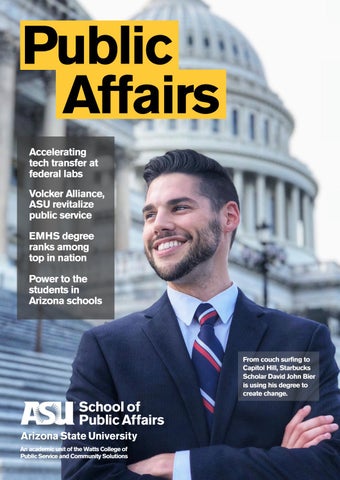
Public Affairs Accelerating tech transfer at federal labs Volcker Alliance, ASU revitalize public service EMHS degree ranks among top in nation Power to the students in Arizona schools
From couch surfing to Capitol Hill, Starbucks Scholar David John Bier is using his degree to create change.
An academic unit of the Watts College of Public Service and Community Solutions
Director’s welcome In recent years, the School of Public Affairs (SPA) at ASU has continued its meteoric rise in the rankings and firmly established itself as one of the leading schools in the nation, distinguished by its impressive breadth in quality. According to U.S. News & World Report, SPA is ranked in the top 10 in the U.S. in seven specializations: #2 in information technology management, #3 in emergency management and homeland security, #3 in local government management, #5 in urban policy, #6 in public management and leadership, #8 in environmental policy and #9 in nonprofit management. After reading this magazine, you will understand why. Our reputation for excellence emanates from the quality of our research. SPA was recently ranked #2 in the nation and #4 in the world for research, according to Shanghai University’s Academic Ranking of World Universities. SPA faculty serve as editors of leading journals (e.g., JPART and JPAM) and have been awarded prestigious fellowships and major federal grants. Seven SPA faculty members are NAPA fellows and another is a fellow of the Academy of Management. This issue highlights our world-class faculty, innovative academic programs, community engagement and cutting-edge research centers, which have helped us develop unique strengths in many fields. Our excellence in teaching, research and academic programs allows us to accomplish our core mission: to train the next generation of leaders in the public and nonprofit sectors. Donald Siegel Director, School of Public Affairs
1
Arizona State Capitol Building
2
05 Center updates Our nine centers represent some of the top public affairs scholarship in the world. They feature a breadth of leading research in the fields of organizational design, emergency management and homeland security, science, technology and environmental policy, urban innovation, participatory governance and more.
07 Outstanding students Meet five of our outstanding students who have excelled in both our undergraduate and graduate programs. Their aptitude and drive showcase just a small fraction of our student body who are committed to being the solution in their local and global communities through their work and research.
On the cover: David John Bier, a Starbucks Scholar and ASU Online student, is majoring in public service and public policy. After overcoming adversity related to his family’s reaction to his sexuality, Bier started working towards his degree and went on to intern in Washington, D.C., with staff of the House Committee on Oversight and Government Reform. 3
Inside this issue 11-15 Features Accelerating tech transfer at federal labs ASU researchers are studying managerial and public policies to help the feds move technology out of the labs and into commercial ventures.
Volcker Alliance, ASU join to revitalize public service The Watts College is partnering with the NYCbased Volcker Alliance to launch a national initiative that will expand public service learning for undergraduates across the country.
EMHS degree ranks among top in the nation Just six years since it was established, Arizona State University’s online master’s-level emergency management and homeland security degree enjoys a spot among the top three such programs in the country.
Power to the students in Arizona schools When Daniel Schugurensky came to Arizona State University from Canada in 2010, very few people at the university were familiar with participatory budgeting. That’s not the case anymore.
01
Director’s welcome
14
Top-ranked EMHS program
05
Center updates
15
Participatory budgeting
07
Outstanding students
17
Global engagement
09
Alumni highlights
19
Faculty spotlight
10
Community engagement
21
Expanding our expertise
11
Accelerating tech transfer
23
Research briefs
13
Volcker Alliance-ASU partnership
24
Faculty in the news
25
Closing thoughts
4
Center updates Our nine centers produce some of the top public affairs scholarship in the world, featuring leading research in organizational design, emergency management and homeland security, science, technology and environmental policy, urban innovation, participatory governance and more. 5
Center tackles internet inequality; civil rights issue revealed Getting science to the people A new communication platform developed by the Center for Science, Technology and Environmental Policy Studies (CSTEPS) is changing the way science information is generated and consumed. SciOPS (which stands for Scientist Opinion Panel Survey) rapid response surveys systematically capture and display expert knowledge from members of the science, technology and innovation (STI) community in a way that’s easy for policymakers, business people, journalists and the public to understand. The result: a stronger, more accessible and empirically valid voice for the STI community. The SciOPS team includes SPA Professor Eric Welch (director), Lesley Michalegko (project manager) and Professor Mary Feeney, along with several CSTEPS PhD students. In May, SciOPS administered a national survey of scientists designed to understand the impacts of COVID-19. Findings are reported at www.sci-ops.org.
While schoolchildren learned at kitchen tables and bedroom desks in the spring, parents and K-12 educators grappled with the lack of home internet access for many of them. The “homework gap” between technology haves and have-nots is not a new phenomenon rising from the COVID-19 pandemic, says Professor Karen Mossberger, director of the Center on Technology, Data and Society (CTDS). She said lack of access to home internet affects everything from homework assignments to college applications. It’s a social policy issue CTDS is tackling head-on. Mossberger and her team are investigating ways to help parents in the Isaac Elementary School district in the west Phoenix community of Maryvale, where many low-income parents have been trying to support remote learning with smartphones alone. With data caps on many phone plans, Mossberger said some parents must use hotspots or resort to driving their children to parking lots, sitting for hours outside public buildings such as libraries that have wi-fi access. According to an ASU analysis, 46% of households in the Isaac district lack internet access, including smartphones, she said.
Ambassador, congressman tapped to lead McCain Institute Arizona State University welcomed Ambassador Mark Green as the new executive director of the McCain Institute for International Leadership in April. Green, administrator of the U.S. Agency for International Development (USAID) since 2017, also formerly headed the International Republican Institute (IRI), served as ambassador to Tanzania and represented Wisconsin in the U.S. Congress. In addition to the McCain Institute, he joins ASU’s School of Public Affairs as a professor of practice. Based at ASU’s Barrett & O’Connor Center in Washington, D.C., the McCain Institute is a unique, action-oriented policy institution with major programs that advance character-driven leadership based on security, economic opportunity, freedom and human dignity. “Character-driven leadership, in America and around the world, has never been more important,” said Green in a statement. “At USAID, I helped strengthen our humanitarian and global development tools. At the McCain Institute, I’ll have an opportunity to reinforce the leadership needed to use these and other tools at a critical moment in our history.”
American Indian Policy Institute joins Watts College American Indian Policy Institute (AIPI) joined the Watts College of Public Service and Community Solutions in late 2019, a move Dean Jonathan Koppell said aligns with the college’s large population of Indigenous students and focus on social policy. AIPI Director Traci Morris (Chickasaw Nation) said the effort combines AIPI’s strengths in programming for Native communities with the college’s commitment to tribal initiatives. AIPI is a think tank specializing in public policy analysis and research related to telecommunications, communications, broadband, digital inclusion and technology for language retention, community advancement and economic development. The center is known nationally for its Tribal Economic Leadership Program (and partnership with the Native American Finance Officers Association) and its awardwinning entrepreneurship classes.
Center for Organization Research and Design examines pandemic’s effects on scientists at home Center faculty are conducting research in hopes of gaining knowledge toward better public policy management. Professor Monica Gaughan and Regents Professor Barry Bozeman were awarded a one-year, $175,687 National Science Foundation RAPID Grant for “Winners and Losers when Science Moves Home: Differential Effects of COVID-19 Based on Discipline, Caregiving and Career Stage.” The purpose of the study is to determine effects of pandemic-based work at home (or related worksite disruptions) on academic scientists’ productivity and research collaboration patterns. Gaughan and Bozeman will examine differences by discipline, career stage, extent of reliance on labs, fieldwork, samples, lab animals and big equipment and consider domestic factors such as caregiving responsibilities. The first phase of the project involves semi-structured interviewing, followed by an online survey of a representative sample of U.S. academic researchers.
6
Outstanding students Thomas Prior Master of Public Administration Some people take online quizzes to find out what movie star they most resemble, or in which state they should be living. When Thomas Prior was an 8th grader, his class took a career exploration quiz that had a lasting impact on his life.
Ashley Funneman Master of Public Administration Ashley Funneman was a case manager and crisis intervention specialist for a state-funded program to help seriously mentally ill adults and children when she realized she wanted to have more of an impact by developing policies and programs that create solutions for local populations. “I really wanted to get more on the administrative side of things,” said Funneman, who holds an undergraduate degree in psychology and received her master’s degree in public administration from Arizona State University’s School of Public Affairs. The Watts College of Public Service and Community Solution’s overall Outstanding Graduate for fall 2019 said she was surprised at this revelation, because she originally had no plans to go into local government. She advises students to grab on to any interest they have in their fields of study and explore it. There are so many topics which overlap. “You never know where it’ll lead you,” she said.
“Although it may sound crazy, basing your career path on a 20-minute online assessment, that is essentially what I did. While other classmates received results like teacher, artist and police officer, my top result was city manager,” said Prior, the spring 2020 outstanding graduate in the School of Public Affairs. “I was eager to learn more, despite the fact that I hadn’t a clue about what a city manager does for a living. My teacher at the time organized an opportunity for me to learn more about local government by job shadowing the city manager of Glendale (Arizona).” Prior said he chose ASU first as an undergrad, and then again for his graduate program, because of the school’s highly ranked local government management program, dedication toward being a leader in innovation and for its value of inclusion. “ASU is committed to improving alongside its students — resulting in an exceptional, co-produced educational experience,” he said.
Atlas Pillar Bachelor of Science, Nonprofit Leadership & Management Atlas Pillar originally enrolled in ASU as a double major in musical theater and journalism. But, reflecting on his life and the many champions who helped him along the way, he eventually decided he wanted to devote his life to serving others. “I’ve always had a passion for caring for others, as well as an aptitude for research and writing, but I didn’t know how applying my skills in the nonprofit sector might look,” said Pillar, a fall 2019 Outstanding Graduate. “Ultimately, I chose ASU because of the Nonprofit Leadership and Management program, which I believed to be my first step in becoming someone who could enact meaningful change.”
7
Fengxiu Zhang and Leonor Camarena Prestigious PhD placements Two graduating students in the doctoral program at ASU’s School of Public Affairs (SPA) began faculty positions this fall at major U.S. research universities. After receiving her degree in May, Fengxiu Zhang joined the Schar School of Policy and Government at George Mason University in Virginia as an assistant professor of public administration. Leonor Camarena, also a May graduate, is now an assistant professor in the School of Public Affairs and Administration at Rutgers University’s Newark, N.J. campus. SPA Director Donald Siegel said the placements reflect the rigor and world-class reputation of the school’s doctoral program and graduate faculty. “A strong PhD program places its doctoral students at major research universities. Our recent placements of Fengxiu Zhang at George Mason University and Leonor Camarena at Rutgers University-Newark add significant luster to our school’s research reputation,” Siegel said. “The School of Public Affairs was recently ranked #2 in the U.S. in research, according to the Shanghai Academic Ranking of World Universities. It is also a testimony to the outstanding job Professor Mary Feeney has done as PhD director, along with Professor Eric Welch, who also works quite closely with many of our top students.” In 2019, Zhang became the second SPA doctoral candidate in three years to be chosen as an Emerging Scholar by the Network of Schools of Public Policy, Affairs and Administration. The other, from 2017, was then-SPA doctoral candidate Federica Fusi, now assistant professor of public administration at the University of Illinois, Chicago. Zhang was among three students selected from among 282 NASPAA schools for the honor. While at ASU, her work has focused on understanding how and why public organizations adapt to the complex and threatening changes in their biophysical and technological environment, particularly those associated with extreme events. Camarena worked as a graduate research assistant at ASU’s Center for Science, Technology and Environmental Policy Solutions (CSTEPS), which, like SPA, is within Watts College of Public Service and Community Solutions. At the center, she managed and was a member of several research projects and conducted surveys related to technology in local government and the use of genetic resources. “The faculty at SPA provided a supportive, yet rigorous learning environment where my research interests were able to grow and my research skills strengthened,” Camarena said. “By working in a research center, I was able to gain hands-on research and mentoring experience that translate directly to my position today.”
8
Alumni highlights Meghna Sabharwal Meghna Sabharwal, who received her PhD in public administration from ASU’s School of Public Affairs (SPA) in 2008, was recently promoted from associate professor to full professor at the University of Texas at Dallas, where she’s headed the public and nonprofit management program since fall 2018. Her areas of research interest are public human resources management, specifically, diversity, equity and inclusion; comparative HR; and highskilled immigration. Sabharwal had just graduated with a master’s degree in agribusiness management from ASU when she decided to explore a PhD in public management. She was intrigued by SPA’s degree program courses in organizational theory, leadership, human resources and management. “I would say that was the turning point,” Sabharwal said, describing the “aha” moment when she identified her course of study. “I had found my path!”
“I am honored and humbled to have had phenomenal professors and mentors who have molded and guided me along the way to be the leader and city manager I am today.” - Daniel Ortiz-Hernandez, City Manager, Wasco, Calif.; Marvin Andrews Fellow and MPF (Urban Management), 2010
9
Alumni provide perspective on Academic Advisory Council Our Academic Advisory Council is comprised of seventeen members — three faculty and fourteen representatives from city, county and state government agencies, seven of whom are also ASU School of Public Affairs alumni. The council provides guidance on the academic preparation and competencies of undergraduate and graduate students in our degree programs. This includes developing course work, guiding center research and identifying internship opportunities for students.
Community engagement Lodestar survey: Nonprofits hit hard during pandemic recession Like their private sector counterparts, many Arizona nonprofits are reeling from the COVID-19 pandemic. A new survey of 449 nonprofits released in May by ASU’s Lodestar Center for Philanthropy and Nonprofit Innovation reported nearly 80% experienced service challenges. The nonprofit sector is Arizona’s fifth largest nongovernment employer, representing $8.3 billion in annual wages, according to the center’s nonprofit management research.
Legacy Corps assists with contact tracing Legacy Corps — a national service program where members provide in-home respite care and support to veterans and their families — faced new challenges during the pandemic, with members unable to visit homes or meet their hour requirements. Housed at ASU and directed by School of Public Affairs Associate Professor David Swindell, the program quickly adapted. Volunteers are now assisting in COVID-19 contact tracing and case investigations in Arizona, Florida and Kansas.
Pastor Center student joins national board Cyrus Commissariat, an Andrew Goodman Foundation (AGF) fellow at ASU, has been named one of two student board members for the national Students Learn Students Vote Coalition. AGF is a nationwide program supporting leadership, social justice policy initiatives and increased voter participation, particularly among college students. It is administered at ASU through the Congressman Ed Pastor Center for Politics and Public Service.
“I’m looking forward to representing ASU on this board and representing student voices in the civic engagement world.” - Cyrus Commissariat 10
Features Accelerating tech transfer at federal labs Researchers aim to influence tech transfer policies and management to increase commercialization opportunities Most academics and policymakers are surprised to learn that our nation’s federal laboratories receive more government funding for research than universities, says Donald Siegel, School of Public Affairs Director and Foundation Professor of Public Policy and Management. Siegel notes that in California, federal labs spend more on R&D and employ more scientists and engineers than all 10 campuses of the University of California. Despite receiving more government funding for research, federal labs transfer less technology to
11
the private sector than universities do. Technology transfer is defined as patents, licenses, startupcreation and other partnerships with industry. This gap has drawn attention from policymakers. Siegel and his collaborator, Professor David Waldman of ASU’s W.P. Carey School of Business, recently received a $150,000 grant from the National Science Foundation (their third NSF grant in five years) to study this problem. More specifically, Siegel and Waldman will collect data from scientists at federal labs and those
who manage them to determine how to advance commercialization of research conducted at these facilities. “Federal labs, like universities, have a technology transfer mission, which is arguably not currently being realized to its full potential,” stated Siegel and Waldman in the project abstract. “Our objective is to determine which managerial and public policies will advance commercialization of federally funded research. Our project has important policy and managerial implications for those who govern and manage technology transfer at federal labs.” Siegel said that the definition of commercialization should be expanded. “Typically, when we think of commercializing research, we think of intellectual property protection, licensing patents,” Siegel said. “I think of commercialization very broadly, such as involvement in startup creation. Most labs are not permitted to do that, but perhaps they should be.” According to Siegel and Waldman, a positive and timely example of federal lab technology transfer is in the ongoing work to develop a vaccine to defeat the COVID-19 virus. Federal labs, such as the U.S. Food and Drug Administration (part of the National Institutes for Health), are working closely with private firms (e.g., Moderna, Johnson & Johnson) to develop treatments and vaccines. The research will also look at how scientists are managed in a lab. “We will be studying relationships between lab managers and scientists to see if they encourage or impede commercialization,” Siegel said. The duo also will be exploring the role of immigration in the commercialization of federally funded research.
of academic entrepreneurship," Siegel said. “This is an important public policy consideration. It considers the question of whether to have an open or closed immigration policy regarding scientists and engineering.” The study is unique because almost all research on technology transfer has focused on universities, not federal labs, and also neglects the human and managerial aspects of these activities. Siegel, who was trained as an economist, said Waldman is an expert on organizational behavior, leadership and human resource management, topics that have not been explored in the context of technology transfer. The authors intend to analyze such key workplace issues as the role of incentives, organizational justice, the championing of technology transfer, leadership, work-life balance and organizational culture. The project, which will involve doctoral students at both schools, will be of great interest not only to scholars of science and innovation policy and technology transfer, but also to the broader community of "micro" or organizational behavior scholars in the fields of management and organizational psychology, Siegel and Waldman said. “Moreover, this research will yield clear policy implications for managers of federal labs, as well as legislators,” said Siegel, who also is co-chairing a National Academies committee that has been charged by the National Institutes of Standards and Technology, a unit of the U.S. Department of Commerce, to study this issue.
“A key fact we’ve observed is that foreign scientists tend to be more productive in research that leads to commercialization and other forms
12
Volcker Alliance, ASU join to revitalize public service National initiative seeks to inspire and educate the next generation of public servants by helping universities build new programs The Watts College is partnering with the NYCbased Volcker Alliance to launch a national initiative that will expand public service learning for undergraduates across the country. The Next Generation Service Partnership (NextGen Service) will help universities design and launch undergraduate programs that prepare students for lives of public service regardless of their academic major. The program is inspired by ASU’s Public Service Academy (PSA), launched six years ago under the leadership of Watts College Dean Jonathan Koppell. This widely-hailed innovative approach to developing collaborative, character-driven leaders now enrolls more than 600 ASU students from more than 170 majors across the university. Two cohorts of graduates have already experienced
13
leadership exercises, internships, classroom study and community engagement opportunities to prepare them to take on society’s most complex challenges. Over the next year, leaders from City University of New York’s Baruch College, Georgia State University, Indiana University at Bloomington and the University of Nebraska at Omaha will receive support from ASU’s PSA team and Volcker to create programs inspired by the ASU example, but tuned to their own campus. “NextGen Service partnership delivers on our original ambition: to create a network of university-based public service academies that will empower undergraduates to create change in the world,” said Koppell.
EMHS degree ranks among top in nation Just six years since it was established, Arizona State University’s online master'slevel emergency management and homeland security degree enjoys a spot among the top three such programs in the country. The renowned program continues to attract top students from around the world who seek to take advantage of its flexibility in scheduling and learning about emergency situations from a variety of global locations. About 400 students enroll each semester. Kimberly Bailey was a paramedic raising three children when she enrolled in 2015. “It allowed me the scheduling flexibility that I needed to complete my advanced degree. The geographic flexibility this program offers creates a comfortable learning environment for people in any stage of their emergency management career,” said Bailey, a 2017 graduate who is an emergency manager for Medical University of South Carolina Health. Each student brings his or her own experiences to the program, Bailey said, providing a richer sharing of knowledge than if everyone was from the same place. The program's national recognition is rooted in the program’s breadth, innovative course content and meaningfully interdisciplinary approach, as well as its national and international reach. Program alumni work in federal, state and local government agencies, as well as in private sector or nonprofit orgnizations. The program's graduates hold key leadership positions in emergency management and homeland security agencies as well as in a range of related areas such as public health, planning,
transportation, hospitals and in corporate security operations center and intelligence analysis units. About a third of the program’s students have a military service background, including a significant number who are active duty. Many veterans have utilized the degree in helping make a transition to a civilian career, as well as for continuing leadership positions in the military. Further, the program has leveraged partnerships through the PLuS Alliance, giving it a unique international component. These partnerships offer engagement with instructors and course peers from Australia’s University of New South Wales, the United Kingdom’s King’s College London and others. Students have access to study abroad opportunities and other learning and peer-topeer engagement with global practitioners.
Students can focus their career development by choosing from six concentrations in the Master of Arts in Emergency Management Homeland Security program: • • • • • •
Emergency management Homeland security Community resilience Biosecurity Threat management Cybersecurity policy and management
14
Power to the students in Arizona schools Youth learn democracy through participatory budgeting program that has grown to multiple sites throughout the state. When Daniel Schugurensky came to Arizona State University from Canada in 2010, very few people at the university were familiar with participatory budgeting, a democratic process practiced in thousands of cities throughout the world in which community members decide how to allocate a portion of a public budget. Schugurensky had been collaborating in Canada with participatory budgeting practitioners and researchers from different parts of the world since the 1990s, when he conducted research in
15
Porto Alegre, Brazil, the birthplace of participatory budgeting. Shortly after his arrival at ASU, he founded the Participatory Governance Initiative (PGI) in 2011 and spearheaded the creation of a graduate certificate in participatory governance. In 2012, doctoral student Quintin Boyce asked Schugurensky if participatory budgeting would work in a school setting. Quintin was the principal of Bioscience High School, just a few blocks from the School of Public Affairs. Together, they
launched the first school participatory budgeting in the United States in 2013 — a great success that continues today. In 2015, another graduate student and Phoenix Union High School District Governing Board member, Stanford Prescott, wondered if Bioscience High’s participatory budgeting process would be successful in other Phoenix high schools to promote citizenship education and civic engagement. The next year, Phoenix Union became the first school district in North America to implement participatory budgeting. The program has since grown from a pilot experiment with five schools to an international reference that includes all 20 of the district’s schools and approximately 28,000 students a year. Schugurensky noted that school participatory budgeting enables students to improve their school communities and prepares them to be active, informed, caring and engaged participants in civic life. Students also learn to develop communication, leadership, critical thinking, research and problem-solving skills. Moreover, school participatory budgeting helps to increase student voice and to register thousands of new voters every year. “In school participatory budgeting, students learn democracy by doing,” he said. Schugurensky also introduced participatory budgeting to a local municipality after Vince Lorefice, then interim town manager and public works director in Wickenburg, Arizona, approached Schugurensky about the idea during a seminar the ASU professor was leading. Lorefice and Schugurensky continued the conversation for several weeks. The following year Wickenburg became Arizona’s first town to implement participatory budgeting. “When properly implemented, participatory budgeting nurtures a more deliberative political culture, improves the quality of democracy, promotes civic engagement, builds stronger communities, empowers citizens, increases
mutual trust and contributes to more transparency, accountability, efficiency and equity in the allocation of public resources,” Schugurensky said. In the last few years, PGI, in collaboration with the Center for the Future of Arizona (CFA) and the Participatory Budgeting Project (PBP), has been working to design, implement and evaluate school participatory budgeting processes throughout Arizona. The effort has grown this year to include five Arizona cities, 40 schools and engaging approximately 50,000 students annually. Schugurensky and colleagues from the CFA also received a grant from the Arizona Developmental Disabilities Planning Council (ADDCP) in 2019 to design, implement and evaluate an inclusive school participatory budgeting program in the city of Mesa, Arizona. Due to the success of this project, the grant has been renewed to expand and refine this process in two schools in Tucson, Arizona.
The Participatory Governance Initiative (PGI) is a universitywide interdisciplinary space that aims to bring together academics, students, elected and non-elected government officials, community members and practitioners interested in the theory and practice of participatory governance. Researchers at PGI pay special attention to emerging trends and innovative experiments in Arizona and around the world. 16
Global engagement Adapting during the pandemic Since 2013, the North American Process Symposium has been a consequential gathering of public policy leaders from the U.S., Mexico and Canada. ASU’s Watts College, Universidad Anáhuac México and the University of Calgary, in association with the Wilson Center in Washington, D.C., host this unique forum for policymakers, members of the business community and academics to discuss and develop recommendations for a more competitive and secure North America. The 2020 symposium, taking place this fall, focuses on economic coordination and adaptation during the global pandemic.
Developing global leaders Janet Leparteleg — a member of the 2018 cohort of Mandela Washington Fellows at ASU, part of the U.S. Government’s Young African Leaders Initiative — is from the Samburu community in Kenya. Known as the “Butterfly People,” they move around frequently in search of water and pasture for livestock, and most of the girls do not go to school. Leparteleg started an education organization, Butterfly Techies, to encourage girls to pursue education and careers in science or technology.
“I got a degree in business information technology, which was a first for my community. When I started a career in technology I decided to go back and empower the girls.” - Janet Leparteleg 17
Fostering understanding between two nations A unique partnership between ASU’s Watts College of Public Service and Community Solutions and Hainan University (HNU) in China created the Hainan University-Arizona State University International Tourism College (HAITC), whose first public affairs graduates, about 50 ASU students, will receive their degrees in May 2021. The relationship, fostering greater understanding between the two nations, is paving the way for future engagement both at HNU and other universities worldwide. The Haikou campus is on the island of Hainan just off the Chinese mainland between the South China Sea and the Gulf of Tonkin. Since 2017, the two institutions have jointly operated HAITC under authority granted by the Chinese Ministry of Education, offering three degree programs (one each in tourism development and management, parks and recreation management, and public service and public policy), all taught in English. About 210 of HAITC’s 1,040 students this year are majors in public service and public policy in a program offered with ASU’s School of Public Affairs. Its courses are taught by three ASU professors, Min-Hyu Kim, Sang Eun Lee and Qingqing Wang.
Broadening our boundaries Public policy and public administration careers increasingly require a deep understanding of how business and public policy intersect, from traditional regulation to the growing reliance on cross-sector partnerships. ASU’s School of Public Affairs is accomplishing this through interdisciplinary degree programs and study opportunities in Washington, D.C. The Executive Master of Global Affairs and Management (EMAGAM), launched in January 2020, is co-offered with ASU’s Thunderbird School of Global Management. Taught by faculty of both schools, the program brings together mid-career professionals in the public, private and not-for-profit sectors to engage with the 21st century’s cross-cutting complexities and develop advanced leadership, management and entrepreneurship skills. SPA’s 19-month Executive Master of Public Administration (EMPA) degree, meanwhile, is taught mostly online by Bob Ramsey Executive Education in collaboration with the McCain Institute for International Leadership. Three-day executive sessions held in both Phoenix and Washington, D.C., encourage professional relationships among students. 18
Faculty spotlight
Donald Siegel elected dean of fellows at Academy of Management Donald Siegel, Foundation Professor of Public Policy and Management and director of the School of Public Affairs (SPA), has been elected dean of the Fellows of the Academy of Management (AOM). Siegel is the first ASU faculty member to achieve this distinction. He assumed the deanship on Sept. 1, succeeding Professor Jean Bartunek of Boston College’s Carroll School of Management. Siegel said his goal is to guide the fellows, whom he identified as among the “greatest management scholars in the world,” toward a larger influcence on public policy. AOM is a global professional association of more than 20,000 academics who teach management.
Mary Feeney appointed NAPA fellow Mary K. Feeney, professor and Lincoln Professor of Ethics in ASU’s School of Public Affairs, was selected by the National Academy of Public Administration (NAPA) for inclusion in its 2019 Class of Academy Fellows. Feeney joins a prestigious group of NAPA fellows at ASU that includes university President Michael M. Crow, Watts College of Public Service and Community Solutions Dean Jonathan Koppell, Regents Professor Barry Bozeman, Foundation Professor Stuart Bretschneider, Frank and June Sackton Professor Karen Mossberger and Thom Reilly (currently on leave of absence and serving as chancellor of the Nevada System of Higher Education), all in SPA. “It’s a great honor to have been nominated and selected for membership,” Feeney said.
Lily Hsueh receives AAUW publication fellowship Lily Hsueh, a School of Public Affairs assistant professor and ASU senior sustainability scientist, has received the American Association of University Women’s (AAUW) 2020-21 American Fellowship. The fellowship will enable her to complete a book, currently under contract at MIT Press, which examines the demand for and supply of global businesses’ climate action across levels of governance sectors and in developed and developing countries. Hsueh said in an AAUW statement that her book-in-progress combines statistical analyses and illustrative company case studies to “tell a larger narrative about the economic and political forces that motivate or dissuade private and public actors, such as corporations and governments, to combat global climate change.”
19
Justin Stritch to chair Academy of Management’s Public and Nonprofit Division programs Associate Professor Justin Stritch is the recently elected program chair of the Academy of Management’s Public and Nonprofit (PNP) Division, which studies ways to improve the effectiveness of government and nonprofit organizations. Research in the public and nonprofit sectors and their component groups is important because of its impact on shaping attitudes regarding modern management. The position puts Stritch on a multi-year leadership track for the PNP Division. Stritch’s research has been published in the Journal of Public Administration Research and Theory, Public Administration Review, International Public Management Journal, and Public Administration.
ASU Public Affairs faculty hold esteemed editorships for national academic journals Five members of our faculty have taken on editorships and co-editorships of some of the field’s most prestigious academic journals. Lincoln Professor of Ethics Mary Feeney is editor of the Journal of Public Administration Research and Theory (JPART), while Associate Professors Yushim Kim and Chris Herbst edit sections on environmental policy and social policy, respectively, for the Journal of Policy Analysis and Management (JPAM). They are joined by School Director and Foundation Professor Donald Siegel, who is an editor of the Journal of Management Studies and the Journal of Technology Transfer, Regents’ Professor Barry Bozeman, who co-edits the Journal of Technology Transfer, and Mark Hager, who is editor-in-chief of Nonprofit Management & Leadership.
Faculty awards • Assistant Professor Angel Molina was recognized by the American Political Science Association with its 2018 Herbert Kaufman Award for the field of public administration — a best paper award — for his paper, “Inclusion, Accountability and the Urban/Rural Divide.” • Professor Siân Mughan received the Association for Budgeting and Financial Management’s 2018 Michael Curro Award for the best student paper when she was a graduate student at Indiana University for her paper, “Budget Deficits and Revenue Extracting Activities in the Criminal Justice System.” • Professor Yushim Kim received the William Petak Award by the Section on Emergency and Crisis Management of the American Society for Public Administration for her article, “Planned but not Planned Effectively: Public Health Emergency Response in Korea..” • Professor Karen Mossberger has received multiple awards, including: ○ In 2015, her 2006 article, “The Effects of E-Government on Trust and Confidence in Government,” was voted one of the 75 most influential articles in the first 75 years of Public Administration Review. ○ In 2018, she was recognized with the Donald Stone Scholar Award by the Section on Intergovernmental Administration and Management, American Society for Public Administration. ○ In 2019, she was selected as one of the 100 Most Influential People in Digital Government by Apolitical Group Limited, UK.
20
Expanding our expertise
Susan Miller
Colleen Wessel-McCoy
Susan Miller, a political scientist specializing in public administration and public policy, will join the School of Public Affairs faculty in January 2021 as a tenured associate professor. Miller comes to ASU from the University of South Carolina, where she has taught political science at its College of Arts and Sciences since 2013. She received her doctorate from the University of Missouri and has focused her research on the consequences of institutional and program design for policy implementation and outcomes. Miller’s work has been published in several journals, including the Journal of Public Administration Research and Theory.
Colleen Wessell-McCoy, a Christian ethicist from Union Theological Seminary in New York City, joined the SPA faculty in August as the first Neely Visiting Professor of Religion and Public Policy, underwritten by the Episcopal Diocese of Arizona. The one-year position is funded by the C.W. & Modene Neely Charitable Foundation. Her online class is titled, “Responding to COVID-19: Religion, Policy and Social Change.” Wessel-McCoy holds PhD and Master of Divinity degrees from Union Theological Seminary.
Cynthia Seelhammer Joining the SPA faculty as a professor of practice in 2020, Cynthia Seelhamer has three decades of public administration service in the city of Phoenix, town of Queen Creek, Coconino County and many other jurisdictions. In her roles, she has set an example of inclusion and fostering professional development among employees — from receptionists to executives — and particularly providing opportunities for women. Seelhammer, who is coordinator of the Marvin Andrews Fellowship Program, was given the 2017 Gabe Zimmerman Civic Leader Award by the Center for the Future of Arizona.
Siân Mughan
Assistant Professor Siân Mughan, who received her PhD from Indiana University, joined the ASU School of Public Affairs faculty in 2019. Her research interests include local government finance, fiscal federalism, criminal justice policy and institutions. Some of her research has shown how tax and budgetary structures impact equity outcomes, while other papers focus on how fiscal stress in local governments leads to revenue-seeking behavior by actors in state criminal justice systems.
21
Anthony Howell
Ulrich Jensen Ulrich Jensen joined our ASU School of Public Affairs as an assistant professor in 2016. He also serves as a faculty affiliate at the ASU Center for Organizational Research and Design. Jensen specializes in public management and organization behavior, and his research interests span issues of leadership, motivation, values and performance in public service. His research was recognized among some of the best offered by young scholars at the 2016 European Group for Public Administration Conference. Jensen earned his doctorate from Aarhus University in Denmark.
Assistant Professor Anthony Howell joined our faculty in 2019 after serving five years on the faculty in the School of Economics at Peking University in Beijing. He was a Fulbright scholar at Peking University and held visiting research fellowships at the National Academies of Sciences in Washington D.C. and the Asian Development Bank in Manilla. He received his PhD from UCLA and is an expert in policy impact analysis, forecasting, cost-benefit analyses, GIS and big data analytics. His main research includes urban-regional economics, economic development, labor migration and innovation with a focus on the Chinese economy.
Min-Hyu Kim Min-Hyu Kim is an assistant professor and faculty affiliate of the ASU Center for Organizational Research and Design. He also holds a faculty position in the Hainan University-ASU Joint International Tourism College (HAITC) in China. His current research touches on issues related to local government, experimental methods and urban policy. Kim’s research has been published in journals including the Public Management Review, International Public Management Journal and American Review of Public Administration. He holds a doctorate in public administration from Rutgers University.
Angel Molina Assistant Professor Angel Molina previously worked as a postdoctoral scholar in the ASU Center for Organization Research and Design. His research interests include the impacts of organizational behavior on policy outcomes in minority communities, performance implications of minority access to organizational leadership, public values, education policy, immigration, Latino politics and the salience of race and ethnicity for both public and private sector outcomes. He holds a doctorate in political science from Texas A&M University.
22
Research briefs The spread of COVID-19 prompted efforts by researchers at the School of Public Affairs to learn more about the pandemic’s effects on such areas as public policy, how scientists share data about the virus and the pandemic, and how the public consumes knowledge about the virus and other scientific information.
SPA Associate Professor Yushim Kim, an ASU Senior Sustainability Scholar, has collaborated since 2017 with an interdisciplinary research team at a university in Seoul, South Korea. The team is examining how inter-organizational emergency response networks formed and evolved during the 2015 Middle East Respiratory Syndrome (MERS) outbreak in South Korea. Currently, she is expanding her research to examine the United States’ COVID-19 policies and their impacts on people who seek and share COVID-19 information on social media. In the past, she collaborated with an epidemiologist, an applied mathematician and practitioners at the Arizona Department of Health Services to understand how the Arizona public perceived the risk of 2009 H1N1 and prepared for it, as well as how to support critical government decisions during the outbreak. Professor Eric Welch, director of SPA’s Center for Science, Technology and Environmental Policy Studies (CSTEPS), is investigating “how scientists’ data access and sharing preferences and behaviors change over the course of the COVID-19 pandemic, as research moves from early crisis response to concrete opportunities for visibility, reputation and innovation,” according to the study’s abstract. As the COVID-19 pandemic evolves over time, researchers expect to see scientists alter how, when and where they share their data. This project, funded by the National Science Foundation, investigates how and why these changes occur in order to design data governance solutions that maximize the community response to public crises, minimize delays in global collaboration and data sharing and ultimately lead to research production and innovation.
The COVID-19 pandemic and technological change make the challenges and opportunities for the governance of genetic data and information more complex, especially as they relate to open access, global equity and science capacity. SPA’s Center for Science, Technology and Environmental Policy Studies (CSTEPS) is joining with the French Agricultural Research Centre for International Development (CIRAD) and the Keystone Policy Center in an international multi-phase consultation. They will “explore underlying tensions, implications of COVID-19 and potential new approaches for collaborative governance for genomic research and innovation,” according to the abstract. “The consultation will result in a white paper identifying scenarios, analytical frameworks and research agendas to inform international policy bodies and others interested in collaborative global governance of genomic research, innovation and genetic diversity.”
23
Faculty in the news Associate Professor Christopher Hayter is collaborating with a 2015 SPA alumnus on a project that examines the origins of autonomous vehicles, funded by a National Science Foundation grant. Hayter was quoted in a July 16 story in ASU’s digital news source, ASU Now, about his collaborator, Andrew Hanus, who was a contestant on the nationally televised NBC series, “The Titan Games,” featuring a series of contests of strength, athleticism and skill. Hayter described Hanus as “a wonderful combination of gentleman, scholar, athlete and friend.” (Photo courtesy NBCUniversal)
Professor Ethan Kapstein wrote an op-ed, “American Racism Beyond Our Borders,” published June 23, in the New York Daily News. In it, Kapstein argued that, “The protest movement sweeping America is focused on systemic racism and police brutality here at home. But America’s racism doesn’t end at our borders. We have long mistreated people of color far from the United States as well.” Kapstein is also senior director for research at the McCain Institute for International Leadership in Washington, D.C. New York Times Pulitzer-Prize-winning writer Claire Cain Miller cited research by SPA Associate Professor Chris Herbst, Research Assistant Professor Christos Makridis of the ASU W.P. Carey School of Business and graduate student Umair Ali in a May 27 Times article arguing for government subsidization of child care. Miller cited a May 2020 paper written by the three for the Germany-based IZT (Institute of Labor Economics). She wrote that the research found “that job postings for early education teachers declined 13 percent in the immediate aftermath of stay-home orders, which equates to the sector losing the capacity to serve 10,000 children each month. But the decreases came only from private programs.”
New research based on data from 20 million websites found digitally-based, small-business people are cranking up huge “spillover” benefits to their communities by spearheading stronger economic recoveries in those communities, reported The New York Times on April 7. Karen Mossberger, SPA professor of public policy, and the University of Iowa’s Caroline Tolbert relied on data from GoDaddy that included customer information combined with third-party data in surveys, the Times reported.
24
Closing thoughts If ever we needed a reminder of the importance of public service — and people dedicated to serving their community — it is right now. The Watts College and the School of Public Affairs are dedicated to these ideals. The college is premised on the idea that our fates are intertwined. We recognize that when one of us thrives, we all thrive. And when one of us suffers, we all suffer. For this reason, the journey for all Watts students begins with a discussion of public goods, the idea that there are things we cannot easily divide or exclude others from using. The classic “public good” is air. Either the air is good for all or it's good for none of us. The COVID-19 crisis has underscored that health cannot be fully enjoyed singly. If one of us is sick, there's a danger to the entire community. This reality emphasizes the importance of the School of Public Affairs. At its core, the school trains people to create and maintain public goods. We are all getting a good education in how difficult that can be. People consume public goods whether they pay or not. And it's really easy for people to mess things up. One person acting alone may not be catastrophic, but when all ignore the implications it is a “tragedy.” In the U.S., we treat health as something less than a public good. I'm not editorializing about that choice, simply acknowledging it. We have quickly pivoted — imposing a variety of controls with enormous economic consequences both in macro and micro terms — to advance public health. So, we're also getting an object lesson in the importance of preparing those headed for careers in public service to make public goods choices. Our school — and all schools of public affairs — are actively preparing students to make and implement the best policies. The conventional lecture on the subject of public goods treats them as fixed. But the reality is far more subtle. We will be asked to provide guidance as to the right balance between public and private, between collective and individual — to define what we treat as a public good. This is never just a technocratic question. Yes, our graduates must have the analytic tools to weigh benefits and costs of state action to maintain public goods. But such decisions always have a value judgment at their core. What kind of community do we wish to build? Our judgments on public goods reflect the aspirations we hold for our community, our nation and our planet. Jonathan Koppell Dean, Watts College of Public Service and Community Solutions
25
About the School of Public Affairs ASU’s School of Public Affairs (SPA) is a nationally acclaimed training ground for a new generation of leaders. We draw inspiration from the Watts College of Public Service and Community Solutions, a community of change agents passionate about problem-solving. SPA's commitment to excellence is making a difference. The school's unique strengths in information technology, science and technology policy, environmental policy, urban innovation, civic engagement and new forms of governance have brought it to prominence among the top programs in the U.S. and the world. Our highly qualified, richly diverse faculty includes seven fellows of the National Academy of Public Administration and world-class professors who have spent the majority of their careers challenging the most critical issues of public policy and governance. At both the graduate and undergraduate levels, they provide hands-on, problem-solving experience in the classroom, internships and capstones.
Connect with us @asupublicaffairs @asupublicaffairs @asupubaffairs @asupublicaffairs
spa.asu.edu 26
Overview The Watts College of Public Service and Community Solutions is Arizona State University’s laboratory for the innovative production of public goods. We are committed to fearlessly taking on the most daunting challenges facing society, with degree programs and research that address challenges affecting communities both locally and globally. Our population represents the highest percentages of minority, transfer and working students and the largest concentration of first-generation college students at ASU. Together, we bring creativity, systems-level thinking and an entrepreneurial spirit to our mission of creating, sustaining and promoting dynamic, prosperous communities.
spa.asu.edu an academic unit of the Watts College of Public Service and Community Solutions University Center Mail Code 3720 411 N. Central Avenue, Ste. 450 Phoenix, AZ 85004-0687 Phone: 602-496-0450
SPA Snapshot 678 undergraduate students 296 graduate students 1,000+ field placement agencies 39 faculty members 3,600+ alumni worldwide