The College of Liberal Arts and Sciences
September
Improving civic literacy in Arizona and beyond
January
April
Crash course on Black history
The tiny but mighty impact of insects
Basketball players from Arizona State University and the Valley Suns G League team learned about Black history in Arizona during a visit to a mural in the lobby of Durham Hall that commemorates King’s 1964 speech at ASU.
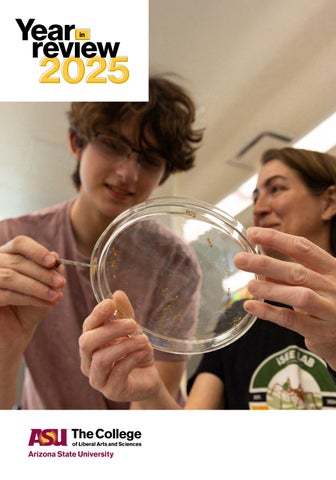
The Social Insect Research Group has been studying insects for over 20 years. Today, the colony of faculty members and student researchers is taking a look at social insects — such as ants, bees and locusts — to answer questions on robots, communication, agriculture and aging.
February
Scientific research honored with prestige Daniel Jacobs, Antia Botana and Gary Moore were awarded the Presidential Early Career Award for Scientists and Engineers. It is the highest honor given to outstanding scientists and engineers with early careers by the U.S. government. March
Uncovering the mysteries of Mars one photo at a time The Mastcam-Z is on board NASA’s Perseverance rover, providing 3D stereo views of the Earth’s red neighbor. Designed by Professor Jim Bell, the camera has captured over 207,000 photos and 39 360-degree panoramic photos.
May
Partnership establishes life science business program In collaboration with ASU alumni Mark and Sheri McKenna and the W. P. Carey School of Business, the McKenna Life Science, Business and Entrepreneurship Program was launched, designed for students who want to lead the future of health care innovation.
“ This program exists to help students combine their passions in life sciences and business — and to accelerate the kind of breakthrough ideas that can improve lives around the world.” — Mark McKenna, ’02 BS Founder, chairman and CEO Mirador Therapeutics
The School of Civic and Economic Thought and Leadership provides free resources to students and teachers to bridge gaps in civic education. The new Civics in a Year podcast, Civic Literacy Curriculum and Arizona Constitution Project are a few of the ways to learn more about American civics and history.
June
Understanding the baby steps of early child development A Department of Psychology study suggests the key to understanding how children learn comes from the comparison of their motor, visual and language development. A new map helps trace how children develop in their first 18 months of life. July
Mapping for the future of urban planning and safety The YouthMappers program has mapped out pedestrian features to make it easier for someone to navigate the Phoenix-metro area. Thanks to the group, 1,200 miles and 10,000 crosswalks have been charted and are accessible via OpenStreetMap.
Milestones This year, units across The College celebrated incredible anniversaries:
15 years
School of Transborder Studies
15 years
Department of Naval Science
20 years
School of Human Evolution and Social Change and the Center for Bioarchaeological Research
125 years
Department of English
Revitalized program sends students to graduate school Originally established in 2020, a new version of the Native Narratives program has set out to support Indigenous students in their journey to pursue a graduate degree. Already, participants have started their programs at schools across the country, including ASU’s Sandra Day O’Connor College of Law.
Digging up new ancestral history August
Innovative experiences expand to chemistry classes
A newly discovered set of fossils in Africa that dates back between 2.6M to 2.8M years ago is answering questions in human evolution with help from the ASUled cross-disciplinary Ledi-Geraru Research Project.
Virtual reality-based Dreamscape Learn sessions have expanded to General Chemistry I and General Chemistry for Engineers courses with content that engages students in narratives to make connections to the realworld applications of hands-on wet lab experiments.
ASU Humanities initiative highlights career outcomes and real-world applications A new website launched that serves as a onestop shop for everything humanities across the university. Students and parents can find information on careerfocused academics and the measurable community impact of ASU Humanities programs and research.
November
The devil’s in the data The Data Devils Lab partnered with St. Mary’s Food Bank to create a data dashboard that visualizes food insecurity and food distribution patterns across Arizona, allowing organizations to identify high-need areas and better target services. December
October
The power of interdisciplinary collaboration The Center for Imagination in the Borderlands launched a new lecture series that will invite larger artistic and scholarly communities to ASU. The two initiatives of the series “Toward Morning— Nyamathaam’im—‘Abini” and “The Tendency” focus on themes around the time of action and building a think tank of ideas.
The College recognizes academic excellence with Dean’s Medalists On December 16, The College celebrated 20 of its highestachieving students from the humanities, natural sciences and social sciences at the fall 2025 convocation ceremony.
The academic heart of the university The College of Liberal Arts and Sciences educates the next generation in the power of language, culture and society, critical thinking, scientific exploration and discovery. Through first-of-their-kind degree programs, world-class research and innovative learning experiences, The College is committed to improving communities on a local, national and global scale.
Leading global impact and intellectual inquiry The College fosters educational excellence through innovative degree programs, unparalleled access to one-of-a-kind research opportunities and award-winning faculty and scholars. One-of-a-kind degree programs and schools, including the only MAS in marriage and family therapy program at a state university in Arizona and the first online accredited undergraduate astronomy degree.
World-class research at hands-on labs, including the
As the academic heart of ASU, The College educates and supports the largest student population within ASU – 31,000+ students.
Educating the next generation in the power of language and belonging by offering
Gene Elefant Laboratory, the Institute of Human Origins and the NanoScience Lab.
10+ undergraduate degrees in languages and cultures with opportunities for over 20 different languages.
Creating supportive and accessible environments for all
Innovation driven by student success, such as the Online
by developing flexible teaching models like NeoBio and NeoChem, a new approach to teaching biology and chemistry adapted to help all learners understand complex scientific concepts.
Undergraduate Research Scholars (OURS) program, which offers hands-on research experiences and mentorship for online undergraduate students.
By the numbers
1,297 total faculty
100+
undergraduate majors
150+
graduate majors
31,578 students enrolled (fall 2025)
$168 million
in research expenditures
Top research rankings* #1
in anthropology
#6
in transdisciplinary, multidisciplinary and other sciences
Learn more about The College. thecollege.asu.edu
#4
Give back to The College. thecollege.asu.edu/give
in geological and earth sciences
Get involved with The College community. thecollege.asu.edu/alumni
in social sciences
@ASUTheCollege
Armstrong Hall 1100 S. McAllister Ave. Tempe, AZ 85287 December 2025
#4 #5
in political science and government * Rankings according to the National Science Foundation’s Higher Education Research and Development (HERD) survey from 2023.