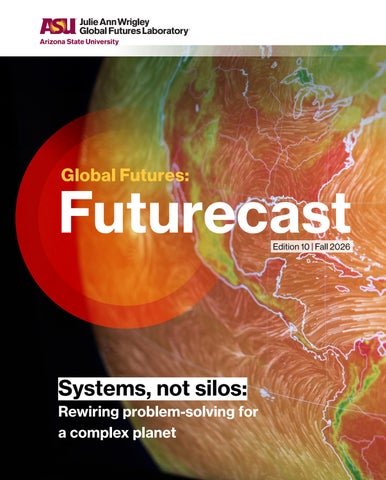
Global Futures:
Futurecast Edition 10 | Fall 2026
Systems, not silos: Rewiring problem-solving for a complex planet
Everything is connected The challenges shaping our future rarely exist in isolation. A warming climate affects public health, energy systems, water resources and the design of our cities. Ocean currents shape weather patterns, marine ecosystems and the livelihoods of coastal communities. Advances in technology create new opportunities while also raising new questions about trust, information and responsible decision-making. At first glance, these may seem like separate issues. Yet in reality, they are part of an interconnected world, with each influencing the others in ways that shape the future we share.
world’s greatest challenges do the same. We hope this issue offers a glimpse into that work and inspires new ways of thinking about the future we build. Help us continue the conversation by subscribing to Global Futures Now, our newsletter featuring the latest research and innovations from across the Global Futures Laboratory.
That is the idea behind this issue of Futurecast. The stories in this issue demonstrate the necessity of thinking in systems. They explore the ocean circulation that regulates Earth’s climate, the urban systems adapting to extreme heat, emerging approaches to managing atmospheric extremes and the information systems that influence how societies make decisions. Together, they reveal a common truth: Our greatest challenges — and our greatest opportunities — lie in the fact that people, nature, technology and society are parts of the same system. That perspective is at the heart of the Julie Ann Wrigley Global Futures Laboratory, where more than 960 scientists and scholars work across disciplinary boundaries in recognition that the
Peter Schlosser University Vice President and Director General of the Julie Ann Wrigley Global Futures Laboratory
Table of contents
2
Systems, not silos: Rewiring problem-solving for a complex planet
6
Why the world looks to Phoenix for lessons in beating extreme heat
8
From enduring extreme weather to redirecting it
10
Mapping the ocean’s hidden lifeline
Subscribe
12
A new plan of attack against misinformation
1
2
Systems, not silos:
Rewiring problemsolving for a complex planet Our planet’s defining challenges seldom arrive one at a time. Prolonged droughts strain water supplies, reduce agricultural production and threaten food security. Rising temperatures intensify wildfires, disrupt energy systems and take a toll on human health. For every challenge, there’s a ripple effect across the globe. That is why research at the Julie Ann Wrigley Global Futures Laboratory focuses on systems, not silos. Rather than organizing around a single issue such as climate, water or biodiversity, the Global Futures Laboratory brings together more than 960 scientists and scholars from across disciplines — engineers, ecologists, economists, historians and humanists alike — to understand how the planet’s interlocking environmental, technological, economic and social systems shape one another. This deeper understanding is key to creating a better tomorrow. “The world, the planet and its subsystems are all complex systems,” said Peter Schlosser, university vice president and director general of the Global Futures Laboratory. “We might home in on parts of that system to solve a particular problem, but once we have solved it, we have to bring it back into the context of the overall Earth system.”
3
Energy doesn’t stand alone Few researchers embody a systems-thinking approach more than Gary Dirks, senior director of the Global Futures Laboratory and Energy Forward, the lab’s energy transformation initiative. A former British Petroleum executive who has spent decades inside the global energy industry, Dirks is blunt about the limits of treating energy as its own silo. “Energy is a system; you can’t just look at it as individual pieces,” Dirks said, noting that all the system’s components must work together — from the underlying technology to how it’s implemented to the surrounding policy framework. This interconnectedness has grown more visible in recent years, especially with the surge in data center construction and its ripple effects on water and power demand. The energy system is more complicated than most people realize, Dirks said, with geopolitical
4
conflicts and the rapid expansion of AI and data infrastructure making overall energy demand increasingly complex. He sees this complexity as an opportunity to step back and more thoughtfully address the interconnected issues at play.
Food systems, hidden costs Kathleen Merrigan, executive director of the Swette Center for Sustainable Food Systems and a former U.S. deputy secretary of agriculture, embraces the same systems logic. She has spent her career showing how the price on a grocery store shelf hides a much larger web of costs. In a recent true-cost accounting study of cattle operations in the western United States, conducted with Colorado State University, Merrigan and her team found that the climate costs of these operations are very high, but solving for climate change alone could threaten the livelihoods of 70,000 ranchers and the rural communities in which they live.
Preparing the next generation of policymakers for navigating food policy’s competing pressures, she created Model USDA, an annual simulation that draws student policymakers from dozens of universities to debate real agricultural policy scenarios.
A new science for complexity Manfred Laubichler, director of ASU’s School of Complex Adaptive Systems, has long contended the tools scientists have traditionally relied on — breaking problems into smaller and smaller pieces, assuming every effect has a single observable cause — simply don’t hold up against modern global challenges. Instead, the science of complex systems looks at information flows, relationships, emerging patterns and iterations, viewing the world as systems that are constantly influencing and adapting to their environment. Laubichler said systems science rejects the idea that sustainable solutions come from tightening control to preserve the status quo, and instead treats adaptation — learning to work with interacting systems rather than against them — as the goal.
To put this approach into practice, he leads Decision Theater. This Global Futures Laboratory facility turns research into tools policymakers and communities can actually use. The facility’s immersive, data-driven demonstrations are designed to make knowledge and data available for informed decision-making about complex challenges facing society — from disaster response planning to building the workforce of the future.
One lab, many systems Whether the subject is energy grids, cattle ranches or pandemic response, the throughline at the laboratory is the same: None of these problems can be solved by a single discipline working alone. As Dirks, Merrigan, Laubichler and hundreds of their Global Futures colleagues continue their work, they remain committed to a systems approach as the one built for a century defined by complexity.
5
Why the world looks to Phoenix for lessons in beating extreme heat As America’s hottest large city, Phoenix exemplifies both the dangers of extreme heat and the innovations cities around the world may need to adapt. That’s why urban planners, public health researchers and climate scientists increasingly look to Phoenix when evaluating heat-resilience policies. The Julie Ann Wrigley Global Futures Laboratory is on the vanguard of understanding heat risks and how cities can be proactive versus reactive in addressing them.
New evidence about how heat impacts our health Jennifer Vanos, an associate professor in the School of Sustainability and senior scientist with the Global Futures Laboratory, led development of a physiological model called HEAT-Lim to assess heat risk. Using detailed human physiology, her research team modeled
6
how the body sweats and cools itself, finding that in dry heat, people — especially older adults — can die at much lower temperatures than the standard model assumes. For decades, scientists used a wet-bulb temperature of 35 degrees Celsius or 95 degrees Fahrenheit as the threshold for unsurvivable heat. The old metric that combines heat and humidity overlooks the danger of dry heat exposure and the fact that older adults who sweat less are at elevated risk during heat exposure, Vanos said. Government agencies and researchers are increasingly using the HEAT-Lim model to predict when extreme heat could become dangerous or even unsurvivable for people and to estimate how many heat-related deaths could occur as the climate changes.
New tool blazes a cooler trail ASU researchers developed Cool Routes, an open-source navigation tool that calculates walking paths based on real-time heat exposure data, factoring in shade from buildings, trees and weather conditions. While the current version covers ASU’s Tempe campus, the framework can be adapted to other cities to support cooler, safer walking, biking and public transit use. City planners elsewhere could use Cool Routes data to identify high-heat walking corridors and prioritize cooling interventions like street trees or shade structures, and even simulate how proposed green infrastructure would reduce pedestrians’ heat load before committing to construction.
Getting ahead of the extreme heat problem While immediate heat dangers require reactive measures like cooling centers, planners and policymakers also need proactive, long-term solutions. The ASU Foundation for a New
American University’s Moonshot Program has developed the Arizona 2050 Heat Strategy, which aims to get ahead of the problem. The strategy comprises three key components: 1.
Scientific modeling of potential heat scenarios through 2050
2. Community and business engagement to assess impacts and envision desirable futures 3. Identification and deployment of innovations needed to create a heat-resilient city By combining climate projections, urban heat island analysis and human health considerations, the initiative aims to move beyond reactive emergency responses to proactive, systematic planning. This work will help central Arizona not merely survive, but thrive amid escalating heat challenges.
7
From enduring extreme weather to redirecting it Global Futures Laboratory scientist Upmanu Lall is proposing a bold new idea: using small, strategic interventions to redirect extreme weather events before they cause catastrophic damage. He calls it “weather jiujitsu,” borrowing from the martial art’s principle of using an opponent’s own energy against them. The concept involves identifying moments of atmospheric instability and applying gentle nudges to steer dangerous weather — from hurricanes and deep freezes to droughts and heat waves — away from populated areas. “We don’t want to control the atmosphere all the time, but we want to control it so that when there is a weather event that is likely to be very impactful, we can steer it away,” said Lall, a senior Global Futures scientist and professor in the School of Complex Adaptive Systems.
8
How it works Artificial intelligence is central to making this possible. Using Aurora, a cutting-edge AI weather model, Lall and graduate student Qin Huang simulated diverting 2012’s Hurricane Sandy out to sea five days before landfall — keeping New York and New Jersey safe. Similar experiments show comparable promise. Techniques like cloud seeding and laserguided lightning discharge could provide the energy needed to shift storm tracks. In Arizona specifically, researchers believe weather jiujitsu could one day prevent droughts by nudging just a few additional storms into the Colorado River Basin each season.
The researchers acknowledge risks — a misplaced intervention could worsen weather elsewhere — which is why precision and phased testing are critical. Initial experiments would take place safely over open oceans, far from populated areas.
The future promise As climate change intensifies extreme weather, and aging infrastructure struggles to cope, weather jiujitsu offers a glimpse of a future where humanity doesn’t just endure dangerous storms, but actively redirects them.
9
Mapping the ocean’s hidden lifeline Seagrass is a remarkable plant that protects coastlines, stores vast amounts of carbon and supports the ecosystems that people and wildlife depend on — yet is a bit of an unsung hero in ocean conservation. Beyond carbon storage, seagrass filters pollutants, supports marine food webs and sustains fisheries that millions rely on for food and livelihoods. When these ecosystems are damaged, the consequences ripple outward: degraded marine habitat, reduced coastal protection, lost income for coastal communities and more greenhouse gases released into the atmosphere. For the first time, scientists have created a highresolution global map of seagrass, tracking how coverage shifted over a four-year period. The study, led by the Center for Global Discovery and Conservation Science, a unit of the Julie Ann Wrigley Global Futures Laboratory, and published in Nature, offers insights that could transform how seagrass ecosystems are managed worldwide.
10
Losses, wins and hope The researchers found that almost 70% of seagrass is concentrated off the coasts of just five countries: the U.S., the Bahamas, Cuba, Australia and Indonesia. The data also reveals a 4% loss of all seagrass over a four-year timeframe. Much of the recorded loss was tied to human activity, from coastal development in China to fertilizer pollution in Florida. Climate stressors
such as Hurricane Dorian in the Bahamas and a marine heat wave in Australia also may play a role, though researchers caution that longer data periods are needed to draw firm conclusions. But the team also found evidence of conservation methods that work. Seagrass increased in South Bay, near Los Angeles, thanks to a restoration project, and in Cuba due to improved water clarity. The map makes it possible to see where future restoration efforts will have the biggest impact.
The importance of this underwater rainforest Unlike seaweed, which is a type of algae, seagrass is a true plant with leaves, flowers, seeds and roots. Those roots bind sediment, shielding coastlines from erosion and locking away carbon. “When we’re talking about seagrass, you can think about it as a rainforest underwater,” said lead author Jiwei Li, an assistant professor in the School of Ocean Futures. “It’s foundational for all the food webs in coastal regions.”
11
A new plan of attack against misinformation A new Global Futures Laboratory study may reshape how we tackle one of the most pressing challenges of the digital age: misinformation. Global Futures Laboratory researchers challenge a long-held assumption — that only gullible or uneducated people fall for misinformation — and point toward more effective future strategies by introducing the Vulnerability and Value framework. The framework’s core insight is that misinformation spreads because it’s useful, not simply because people are fooled. People share and believe false information because doing so offers emotional comfort, a sense of belonging, a simple explanation for something confusing or ammunition against political opponents. “Until we address those underlying needs, fact-checking alone will never be enough,” said study lead author Michael Simeone, a senior Global Futures scientist, co-lead of the Information Competition Lab at the School for Complex Adaptive Systems and member of the senior leadership team for Global Futures Laboratory’s Decision Theater.
12
Simeone said effective interventions must occur simultaneously on three fronts:
1
At the individual level, people will need tools and education that help them recognize when false information is meeting an emotional need rather than an informational one.
2 3
At the group level, the social rewards of sharing misinformation, such as loyalty signaling and identity reinforcement, will need to be countered with healthier ways of building community and trust.
At the platform level, social media companies will face growing pressure to rethink engagement-driven models that profit from outrage and sensationalism, regardless of accuracy.
The researchers tested their framework on the competing conspiracy theories that erupted after the 2024 assassination attempt on Donald Trump, with each theory tailored to a different audience’s emotional and political needs. The case illustrates just how quickly misinformation ecosystems can form and self-sustain. Simeone said understanding our society’s vulnerability to misinformation requires looking at it as a structural condition, not a personal flaw. Solving it will require systemic change at every level of the information landscape, from how individuals think to how platforms are built and regulated.
13
globalfutures.asu.edu
Produced by ASU Knowledge Enterprise. © 2026 Arizona Board of Regents. All rights reserved. 10/2026
14