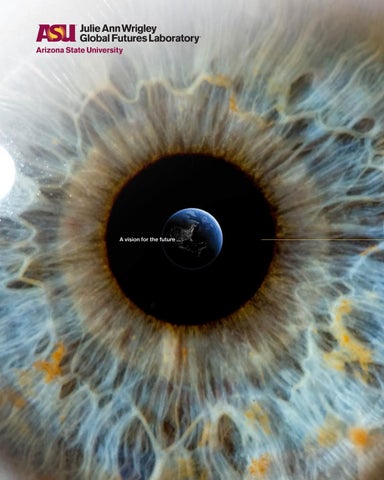
A vision for the future ...
Our mission is to design options to sustain global habitability and improve well-being for all life.
3
Shaping tomorrow,
today
The global systems we depend on are under growing pressures. Food, water, energy, economic and technological systems are more interconnected, fragile and complex than ever before. The pace of change is accelerating. The decisions made today will influence generations to come. Institutions designed for a different century cannot address these challenges at the speed and scale needed. The Julie Ann Wrigley Global Futures Laboratory® at Arizona State University is a working model of what a 21st-century research university must become.
•A nticipatory. We design positive pathways rather than simply react to crises. •S ystems-oriented. We study Earth not in fragments, but as a dynamic system shaped by both natural processes and human decisions. •T ransdisciplinary. We integrate natural sciences, social sciences, engineering, health, policy, the humanities and the arts to advance well-being. •C ollaborative. We bring together communities, industry, nonprofits, governments and universities for wider impact. •A ctionable. We work at the intersection of science, policy and implementation — where evidence informs decisions and decisions shape outcomes. •A gile. We move with purpose and urgency because the decisions made today shape the future for generations. The pace of change will not slow. Neither will we.
Our vision is a future in which all life thrives on a healthy planet.
5
“ We are no longer observers of Earth’s systems — we are active participants shaping them. The window to stabilize those systems is narrowing. The question is not whether change will happen, but whether we will guide it deliberately and responsibly.” — Peter Schlosser University vice president, director general of the Global Futures Laboratory
Leading
with a global perspective Peter Schlosser has spent more than three decades studying Earth’s water and climate systems — from the Arctic Ocean to Antarctica. His research has traced the movement of human-made substances through the atmosphere and deep ocean, documenting the planetary scale of human influence. The rapid changes he observed, from local to global scales, led him to expand his research from environmental physics to Earth science, engineering, sustainable development and holistic studies of possible futures. That perspective informs the laboratory’s approach: Challenges are systemic and highly interconnected, and thus solutions must be designed within this framework. As the Global Futures Laboratory seeks new insights to support decision-makers, it also focuses on translating knowledge into action faster, recognizing that we have more knowledge than we use and many opportunities we have not capitalized on.
7
Designed to work
differently The world’s challenges don’t fit inside a single discipline. Neither do we. The Global Futures Laboratory brings together researchers, educators, policymakers, industries and communities to advance change and impact. We work across five integrated spaces: discovery, learning, solutions, networks and engagement. Inside our spaces, we deploy a variety of experts — from science and engineering to policymaking and governance — to move with the speed and urgency that our planetary futures demand. Each space is powerful on its own. Together, they create something much more valuable: continuous pathways to anticipate change, understand societal will, navigate uncertainty, lead systems transformations and shape a more resilient future.
So
y
l ut
io
ns
g
Ne
nin
two
L e ar
rks
D
is
er v co
E n g a g e m e nt
9
Solutions Solutions translate discoveries into impact. The Global Futures Laboratory works with partners around the globe to move promising ideas into real-world applications. Our work advances direct-air carbon capture technologies, water innovation platforms, energy systems and decision support tools used by governments, industries and other stakeholders. Impact is measured not by publication count, but by implementation.
Mapping the world’s coral reefs Coral reefs are home to 25% of Earth’s marine life. They also provide hundreds of millions of people with food, jobs and protection from storms. But corals face threats from pollution, physical damage, overfishing and climate change. The laboratory’s Center for Global Discovery and Conservation Science maps and monitors the world’s coral reefs, providing actionable data to help stakeholders protect these vital ecosystems.
Pulling carbon out of thin air Our Center for Negative Carbon Emissions is advancing technology to capture CO2 directly from ambient air. This pioneering work involves scalable, energy-efficient air capture along with opportunities to reuse the captured carbon for economic benefit.
11
Discovery
Discovery generates the evidence base for strategic action. We integrate science with governance and Indigenous knowledge to understand how complex systems function — and how they fail. From the Bermuda Institute of Ocean Sciences — home to one of the world’s longest continuous open-ocean time series — to satellite-based biodiversity mapping and urban climate modeling, our teams produce the data and projections decision-makers need to help communities thrive.
Unlocking decades of ocean discovery For more than 70 years, the Bermuda Institute of Ocean Sciences has maintained the world’s longest-running open-ocean time series, providing an unparalleled record of how the Atlantic Ocean is changing over time. This continuous dataset has transformed scientists’ understanding of the ocean’s role in regulating Earth’s climate, revealing new insights into carbon cycling, biodiversity and the impacts of a changing atmosphere. The discoveries emerging from this long-term commitment continue to shape global climate science and improve predictions of our planet’s future.
Learning
Learning empowers through immersive experiences. At the Rob Walton College of Global Futures, learners focus on urgent challenges and themes, transcending fields of study. Through hands-on, immersive learning experiences, our students are equipped with the knowledge, skills and agency they need to tackle complex global challenges, preparing them for careers that drive meaningful impact. Our five transdisciplinary schools address planetary health in the fields of conservation, sustainability, innovation, oceans and complex systems. Programs are designed in close exchange with industry, government and community partners.
Mentoring tomorrow’s leaders The Frasier Global Mentorship Program utilizes a wide practitioner network to prepare future leaders with the professional skills needed to drive impact. College of Global Futures students are paired with sustainability professionals from globally focused organizations, ranging from Johnson & Johnson, Nike, Intel, VOX Global, Persefoni and more. 13
Networks
Networks transform ideas into global action. Global challenges demand global coordination. We cultivate relationships where science, policy and practice intersect, building a network designed to move knowledge into action. Our global collaborators include Future Earth, UNESCO-MOST BRIDGES, the United Nations, Conservation International, Earth BioGenome Project and The Earth League, among others. Our hubs span the globe, from the continental U.S., Hawaii and Bermuda to South America, Antarctica, Africa, Europe and the Middle East. These relationships help discoveries move into places where decisions are made, strengthening communities and accelerating solutions around the world.
Building a library of life on Earth The Earth BioGenome Project is a global effort to sequence, catalog and understand the DNA of all of Earth’s eukaryotic life, and ASU plays a vital role. Through the Global Futures Laboratory’s participation in the EBP Secretariat and the innovative Arizona Desert Ecosystem Genomics Project, ASU connects global genomic discovery with locally relevant solutions for conservation and ecosystem restoration. By linking expertise across continents, the project enables breakthroughs that no single institution could achieve alone.
Turning global research into coordinated action The Global Futures Laboratory serves as North America’s cohost for Future Earth’s Global Coordination Hub, jointly leading this international effort with the Climate Service Center Germany. By strengthening connections across 25 global research networks, the hub aligns scientific expertise, accelerates collaboration and ensures research reaches the people and institutions shaping decisions around our world.
15
Engagement
Engagement informs and inspires action. Scientific discovery alone can’t solve global challenges. Progress depends on understanding how people, institutions and societies make decisions — and ensuring evidence helps shape those choices. The Global Futures Laboratory brings together researchers, policymakers, industry leaders, communities and the public to build trust, explore future scenarios and inform decisions that lead to more resilient futures.
Seeing the impact of tomorrow’s decisions — today The Global Futures Laboratory’s Decision Theater combines advanced modeling, data visualization and systems science — guided by expert, human-centered facilitation. Decision Theater enables policymakers, businesses and communities to test future scenarios, evaluate multiple pathways and understand tradeoffs. Its advanced decision-making tools help leaders make more informed decisions in an increasingly complex world.
Connecting communities to build heat-ready schools HeatReady™ Schools partners with school districts, educators, families and public health leaders to cocreate strategies that keep students safe during extreme heat. By combining scientific expertise with community knowledge, the initiative develops practical resources and policies that schools can put into action. This collaborative approach is helping communities adapt to rising temperatures while protecting children’s well-being and academic success. 17
Impact
at scale
#1
Repeatedly ranked in the U.S. and top 10 globally for progress toward the United Nations Sustainable Development Goals. ASU is often the only U.S. institution in the global top 50, and the laboratory is central to that performance (Times Higher Education).
900+
4.7M+
people reached annually through global education, strategic forums and public engagements
policy documents across 42 countries informed by our scientists and scholars, including international policy frameworks, national strategy documents and local implementation plans (Overton Index).
960+
faculty and scholars working across disciplines to shape planetary futures
80+
centers and initiatives advancing research, innovation, education and outreach
See examples of our impact globalfutures.asu.edu/news
19
Shaping
tomorrow,
together Our world is changing at an unprecedented rate. The important question is: Will that change be guided by evidence, equity and foresight — or forced by crisis? The choice is ours. Today’s decisions shape tomorrow’s possibilities. The good news? We’ve never had more tools at our fingertips. More knowledge. More technology. More opportunity to act with purpose and with speed. The Global Futures Laboratory has created a model for systems transformation that connects these tools with governments, industries, communities, researchers, educators and learners around the world. It is a model that others can adopt, strengthen and scale. Systems transformation happens when people choose to build a different future together. There is a place for you in this work. We invite you to join us.
21
22
The future is in our hands. It will not be determined by what we know. It will be determined by what we do with what we know.
Together, we can create a shared legacy: a future where all life on Earth thrives. globalfutures.asu.edu
globalfutures.asu.edu
Produced by ASU Knowledge Enterprise. © 2026 Arizona Board of Regents. All rights reserved. GFL lookbook - 10/26