Institute of Human Origins 2025 Year in Review
Connecting
the human past to the global future
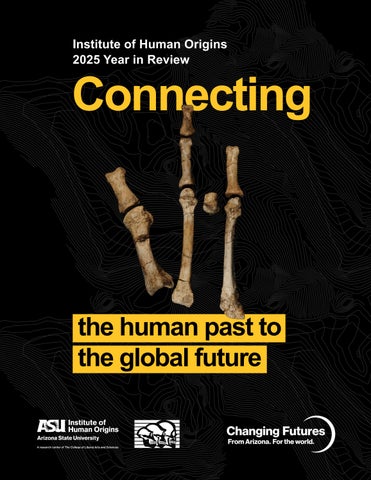
Front cover image: The Burtele foot with its elements in the anatomical position. Photo by Yohannes Haile-Selassie.
Director From the
Over the past year, our scientists and graduate students have made remarkable strides in paleoanthropology, human cultural evolution, nonhuman primate behavior and evolutionary genetics. The depth and range of their publications in high-profile, peer-reviewed journals highlight the Institute of Human Origins’ multidisciplinary commitment to understanding where we came from, who we are and where we are going. This year, our research scientists discovered fossils and announced a new species of ancient human, demonstrated how multiple species coexisted without driving one another to extinction and revealed how genetic adaptations help humans thrive in diverse climates. These examples represent only a portion of the groundbreaking work completed this year. I invite you to explore our Year in Review to learn more. Most importantly, none of these accomplishments would be possible without your partnership and support. As we look ahead, IHO remains dedicated to expanding its research, training the next generation of anthropologists and geneticists, strengthening its educational programs and engaging our community through lectures, outreach and public programming. Thank you for your continued support and for being an essential part of our mission.
Yohannes Haile-Selassie Director, Professor and Virginia M. Ullman Chair of Human Origins
Changing Futu Change the future with the Institute of Human Origins Through service, learning and giving, at all levels and for the good of all, Changing Futures is for all of us and your collaborative investment will change futures — for our students and for the world. Learn more at asuchangingfutures.org What can the past teach us about the challenges of the future? At the Institute of Human Origins, researchers are unlocking the secrets of human evolution to address pressing global issues. “Understanding where we come from as a species is essential,” says Magda Hinojosa, dean of social sciences in The College of Liberal Arts and Sciences. “The lessons of human origins provide critical insights for tackling difficult problems. By exploring our past, we gain the knowledge we need to innovate, adapt and evolve for the circumstances of today and tomorrow.” The Institute of Human Origins is renowned for its innovative, transdisciplinary approach to studying human evolution. Its research connects ancient patterns of human resilience to contemporary global challenges, providing a roadmap for how we can continue adapting to a changing planet.
ures Campaign Advancing research and impact The Institute of Human Origins is a global leader in human origins science. Current projects include: Understanding ancient climate adaptation: How humans evolved in response to past climate changes offers critical lessons for meeting our modern climate crisis. Exploring genetic links to our past: By integrating ancient DNA research, IHO is uncovering new insights into the evolution of human health and behavior. Empowering the next generation of scientists: IHO trains graduate students in fields like paleoanthropology, genetics and cultural studies. How can we ensure a more habitable planet for our children and grandchildren? Join the conversation today at #ASUChangingFutures Top photo: Ekiru Carlistus explains a genetic study at a research camp communal hut in 2017. Photo courtesy of Ekiru Carlistus. Bottom photo: Students examine antelope skulls as part of the ARTIFACT program in Southern Africa. From left: Bennett Davenport, Winnie Kereng and Tanita Vieira. Photo by Patrick Fahey.
3
Who we are Since 1981, scientists at the Institute of Human Origins, housed in The College of Liberal Arts and Sciences, have been conducting innovative research in paleoanthropology, genetics and human and nonhuman primate cultural evolution. Meet our IHO Research Scientists; for information on graduate students and postdoctoral fellows, please visit iho.asu.edu.
Robert Boyd Research Scientist and Professor
Donald Johanson Founding Director and Professor Emeritus
Christopher Campisano Associate Director and Associate Professor
Kevin Langergraber Research Scientist and Professor
Helen Elizabeth Davis Research Scientist and Assistant Professor
Curtis Marean Research Scientist, Virginia M. Ullman Professor of Natural History and the Environment, Foundation Professor
Ian Gilby Research Scientist and Associate Professor
Kim Hill Associate Director and Professor
4
Yohannes Haile-Selassie Director, Virginia M. Ullman Chair of Human Origins and Professor
Sarah Mathew Research Scientist and Associate Professor
Thomas Morgan Research Scientist and Associate Professor
e Charles Perreault Research Scientist and Associate Professor
Anne Stone Research Scientist and Regents Professor
Kathryn Ranhorn Research Scientist and Assistant Professor
Denise Su Research Scientist, Associate Dean of Research and Professor
Kaye Reed Research Scientist and President’s Professor Emeritus
Ben Trumble Research Scientist and Professor
Gary Schwartz Research Scientist and Professor
Sean Bergin Research Associate Professor
Joan Silk Associate Director and Regents Professor
Hillary Lenfesty Research Assistant Professor
5
World-class
Research The Institute of Human Origins at ASU is a global leader in studying the human past through deep time. It is committed to transdisciplinary research on human evolution and how it relates to our global future by conducting innovative research in paleoanthropology, genetics and cultural evolution in human and nonhuman primates. To learn more, visit: iho.asu.edu/news
Robert Boyd is elected to the National Academy of Sciences A leading authority on cultural evolution, Robert Boyd, a research scientist with the Institute of Human Origins and a Professor with the School of Human Evolution and Social Change, has been elected to the National Academy of Sciences. Election to the NAS is one of the highest honors a researcher can receive. It recognizes exceptional scholarly achievement and distinguished contributions to one’s field. Boyd’s research examines how evolutionary psychology has influenced the development of human culture. He has authored and co-authored several foundational texts in the field, including “Culture and the Evolutionary Process” and “Not by Genes Alone: How Culture Transformed Human Evolution.” With his wife, ASU primatologist, IHO research scientist and Regents Professor Joan Silk, he co-authored “How Humans Evolved,” a widely used textbook in biological anthropology courses. His solo work, “A Different Kind of Animal,” continues his exploration of culture’s role in human evolution. When Boyd published “Culture and the Evolutionary Process” in 1985, cultural evolution was not widely accepted as a legitimate scientific field. However, in the decades since, research on human culture and cultural evolution has grown significantly thanks to the foundation created by Boyd. He is among the highest-cited scholars at Arizona State University. Just last year, he was also elected to the American Academy of Arts and Sciences.
6
Human cultural evolution The Institute of Human Origins is home to leading scientists who study human cultural evolution — the process by which human beliefs, behaviors, knowledge, technologies and social systems change and accumulate over time through learning and social transmission rather than genetics. This year, our researchers published studies on topics including the relationship between hormones and PTSD, the development of social norms and traditions, age-related chronic inflammation and new insights into the connection between menopause and cardiovascular health.
Genetic adaptations can help those living in dry climates
New research suggests lullabies and dancing are not universal A new study challenges the long-held belief that dance and infant-directed singing are human universals, based on decades of observations by Arizona State University anthropologist Kim Hill, who spent more than 40 years living among the Northern Aché of Paraguay and never witnessed dancing or lullabies in the community. Lead author Manvir Singh, an assistant professor at UC Davis, explains that while cross-cultural research has traditionally supported the universality of these behaviors, the Aché appear to be an exception, suggesting that dance and lullabies are learned cultural practices rather than spontaneous human instincts. The researchers propose that these traditions may have been lost due to historical population bottlenecks or cultural disruption during reservation settlement, and note that although Aché parents soothe infants in other ways, they do not use song. Their findings highlight the importance of cultural transmission in sustaining musical behaviors and indicate that while humans may have biological adaptations for music, culture plays a far larger role than previously believed.
Scientists working with the Turkana community in northern Kenya have identified key genetic adaptations that support survival in extremely dry environments, including changes in eight genomic regions and a particularly important gene, STC1, which enhances kidney water retention. Arizona State University researchers — including Sarah Mathew, Anne Stone and Melissa Wilson — partnered with institutions such as the Kenya Medical Research Institute, UC Berkeley and Vanderbilt University to combine new high-coverage genome data with physiological datasets. The findings suggest these adaptations emerged around 5,000 years ago as northern Africa became more arid, potentially reflecting gene-culture coevolution shaped by longstanding Turkana pastoralist traditions. ASU alumna Rebecca Siford also led community engagement efforts, ensuring results were shared transparently with participants. The study was published in the journal Science.
Doctoral student awarded prestigious NSF fellowship Madeleine Getz, an ASU School of Human Evolution and Social Change doctoral student and IHO affiliate student, was recently named a National Science Foundation Graduate Research Fellowship Program awardee. Getz’s research broadly focuses on menopause and chronic disease risk. However, her particular passion is researching the human aging process. Getz works with Ben Trumble, a research scientist at IHO.
7
Paleoanthropology This year has been an extraordinary one for our paleoanthropology research scientists, marked by groundbreaking discoveries, powerful collaborations and innovative research that deepens our understanding of human origins. NASA’s Lucy mission honored the legacy of Donald Johanson — whose discovery of Lucy transformed the field of paleoanthropology. Faculty and students participated in new international workshops that united scholars across Africa, Europe and the U.S. to explore when and how Homo sapiens emerged. IHO researchers helped identify Asmodochelys leviathan, a giant Cretaceous sea turtle that illuminates ancient marine ecosystems and also contributed to a landmark study revealing that early hominins were exposed to lead for nearly 2 million years — work that connects fossil chemistry, brain evolution and the origins of human language.
IHO scientists uncover new fossils — and a new species of ancient human ancestor International scientists working at the Ledi-Geraru site in Africa discovered fossils showing that Australopithecus and the earliest known Homo species lived in the same place at the same time between 2.6 and 2.8 million years ago, including a newly identified species of Australopithecus.
New research: Two ancient human ancestors were neighbors A team led by paleoanthropologist Yohannes HaileSelassie has formally assigned the 3.4-million-year-old Burtele Foot — discovered in Ethiopia in 2009 — to the species Australopithecus deyiremeda after a decade of additional fossil discoveries at the Woranso-Mille site. This site is the only known location preserving clear evidence that two related hominin species coexisted in the same place at the same time. The Burtele Foot, with its opposable big toe and climbing adaptations, shows that early bipedality came in multiple forms, contrasting sharply with the fully bipedal A. afarensis (Lucy’s species). Additional fossils, including a juvenile jaw, were analyzed using micro-CT technology by ASU researcher Gary Schwartz, who found that A. deyiremeda shared developmental patterns with other early australopiths despite their diverse locomotor and anatomical traits. These findings offer new insight into how early hominins lived alongside one another without driving each other to extinction.
8
The team led by Kaye Reed and including Christopher Campisano, determined these fossils do not belong to Australopithecus afarensis, confirming that Lucy’s kind does not appear after 2.95 million years ago. Reed explained these findings reveal human evolution is not a straight line, but a “bushy tree” with multiple hominin species coexisting and going extinct.
After 50 years of teaching and lecturing worldwide, Donald Johanson retires Most famous for finding the 3.2 million-year-old human ancestor known as Lucy, Donald Johanson’s legacy at Arizona State University goes far beyond fossils. As the founding director of the Institute of Human Origins, he has dedicated his life to researching the origins of humankind and helping other scholars conduct expeditions all over the world. For Johanson, retirement does not mean he will be leaving the field altogether — he will continue to serve on the board of IHO and travel and lecture.
IHO affiliated student establishes unique lab program for students in Southern Africa For the past two summers, ASU anthropology PhD student Patrick Fahey has led the ARTIFACT program in South Africa, giving students from Africa and the United States hands-on training in zooarchaeology and faunal analysis — opportunities that are often difficult to access. Using funding from his Fulbright Award and the Institute of Human Origins, Fahey designed the seven-week program to teach comparative osteology, taphonomy and lab techniques through direct work with thousands of fossils, supported by visits to major archaeological sites like Pinnacle Point. Students also assisted with Fahey’s dissertation research on more than 30,000 animal remains from Pinnacle Point, a project supported by ASU Foundation Professor Curtis Marean and the Human Origins and Migration Evolution Research Consortium.
Study reveals new details about giant prehistoric otter Six million years ago in a wetland forest in China, a giant otter species called Siamogale melilutra — discovered in 2017 by a team including ASU researchers Denise Su and Jay Kelley — lived as a top predator, weighing nearly 100 pounds and feeding on mollusks and clams. New analysis published in The Anatomical Record, supported by ASU graduate student Brenton Adrian, shows that its limb proportions resembled both semiaquatic and digging animals, suggesting it paddled at the water’s surface and foraged along riverbanks rather than swimming like modern sea otters. Researchers say studying prehistoric animals like S. melilutra helps us understand how ecosystems responded to past climate shifts, offering clues that may guide us in navigating today’s environmental instability.
Archaeologists use sediment and sunlight to date important site At the Pinnacle Point archaeological site in South Africa, a team led by ASU archaeologist Curtis Marean has created the most detailed timeline ever produced for a Middle Stone Age rock shelter, mapping 135 layers of human occupation dating from 110,000 to 50,000 years ago. Using an unusually large set of 169 single-grain optically stimulated luminescence (OSL) dates — made possible by a specialized machine Marean obtained through NSF funding — the researchers reached century-level resolution, a breakthrough that allows scientists to track fine-scale changes in ancient human behavior, environment and technology.
9
Nonhuman primate behavior This year was a somber one for our primatology community following the passing of pioneering primatologist Jane Goodall, an icon whose lifetime of work transformed our understanding of chimpanzees and conservation. Since 2022, the Institute of Human Origins has been privileged to host the Jane Goodall Institute’s Gombe Research Archive — a responsibility we uphold with deep gratitude and respect. Research Scientist Ian Gilby continues to manage the archive. At the same time, Kevin Langergraber advances his research and conservation efforts with chimpanzees in Kibale National Park and Joan Silk leads two major comparative studies.
Lethal aggression, territorial expansion in wild chimpanzees lead to more births, better infant survival A new long-term study of the Ngogo chimpanzees in Uganda’s Kibale National Park shows the strongest evidence to date that lethal intergroup aggression can directly increase reproductive success. After a series of coordinated attacks in which the Ngogo chimps killed 21 rivals and expanded their territory by 22%, females gave birth far more frequently and their infants were significantly more likely to survive, with births rising from 15 to 37 in the three years following expansion and infant mortality dropping from 41% to 8%. Led by UCLA’s Brian Wood with collaborators including IHO’s Kevin Langergraber, the research demonstrates that coalitionary killing can provide clear fitness benefits, likely through improved nutrition and health in an enlarged territory, offering new insight into the evolutionary roots of coordinated violence in chimpanzees and early humans.
Why are humans social creatures?
Decades of data show age plays an important role in primate reproduction
ASU primatologist and Regents Professor Joan Silk draws on decades of research on baboons and other mammals to explore why humans are so deeply social. Silk explains that strong social bonds have long supported survival and reproduction, offering benefits such as reduced stress, protection from predators, shared caregiving and even longer lifespans.
A study examining more than 30 years of data on gelada monkeys and chacma baboons shows that maternal age significantly affects infant survival, even in species where outside forces like infanticide strongly shape reproductive outcomes.
While most mammals live solitary lives, the minority that form social groups — including humans — gain advantages that outweigh the risks of disease and competition. Silk argues that our enduring need for connection, even in a modern world of online conveniences, reflects an evolutionary legacy that shapes our roles as parents, partners, friends and community members.
10
Jacob Feder, a National Science Foundation Postdoctoral Fellow with IHO, found that both very young and older mothers face challenges — from inexperience or incomplete growth to frailty later in life — but was surprised to discover that infants of young gelada mothers actually survived at higher rates, possibly due to the species’ consistent, grass-based diet that provides nutritional stability. The findings highlight how reproductive aging persists despite high infanticide risk and offer broader insight into primate life histories, helping researchers better understand how human reproductive patterns evolved.
Evolutionary genetics Institute of Human Origins Research Scientist and Regents Professor Anne Stone has projects focused on population history and in understanding how humans and other primates have adapted to their environments, including their disease environments. The latter focuses on understanding the co-evolutionary history of pathogens affecting humans and nonhuman primates, including Mycobacterium tuberculosis and M. leprae, the causative agents of tuberculosis and leprosy, respectively and the bacteria and viruses in the oral microbiome. For example, in a paper published recently in Nature Reviews Genetics, Stone and her co-authors discuss how ancient pathogen DNA from historic and more ancient samples help scientists understand how pathogens (and hosts) interact. In addition, Miriam Bravo López, a new postdoctoral fellow in her lab, is investigating historic dental calculus samples from ten primate species to characterize their metagenomic composition and detect the presence of oral pathogens. She identified bacteria belonging to periodontal disease–associated complexes, such as the red complex (Tannerella forsythia, Porphyromonas gingivalis and Treponema denticola) and is currently analyzing complete genomes captured from these samples. This research provides novel insights into the long-term dynamics of oral pathogens and the genetic basis of habitat and host adaptation of periodontal pathogens.
For more information visit stone.lab.asu.edu
Population history, adaptation and research ethics in Kenya Newly minted PhD Rebecca Siford (working with Anne Stone, Sarah Mathew and Melissa Wilson, Mercy Akinyi and Joseph Kamau) addresses how Western ethical practices used in genetic studies accurately align with the understandings, attitudes and perceptions of the Turkana, Borana, Rendille and Samburu pastoral populations of Northern Kenya. In addition, this year, the group published research with Assistant Professor Amanda Lea (Vanderbilt University) and other scientists that examines how Turkana have adapted to water stress in their desert environment. This research, published in Science, points to adaptation in the STC1 gene, which is involved in the kidneys’ response to dehydration.
New research scientist In January, Assistant Professor Eduardo Amorim will join IHO as a research scientist. Amorim earned his PhD in genetics from the Federal University of Rio Grande do Sul, Brazil. He has held postdoctoral positions at Columbia University, UCLA and the University of Lausanne. His scientific interests are human recent evolution, ancient DNA (aDNA) and population genetics. His recent research has focused on the evolutionary impact of major infectious disease outbreaks on polygenic traits related to immunity. His other ongoing projects include studies on the evolutionary history of canids and their relationships with humans, as well as efforts to reconstruct human migration patterns through aDNA analysis. Together, these studies illustrate the power of aDNA in addressing fundamental questions about human evolution.
11
Travel and learn with IHO
Our expeditions are different from any other travel experience. This is not just travel — it is immersion in the span of human history, hosted by IHO and ASU scientists who add a richer understanding to the travel experience. Our travel adventures have been designed for fun, excitement and comfort, taking advantage of the best accommodations in the industry. If you are interested in our excursions, please contact Aubree Morrissey at Aubree.Morrissey@asu.edu or click here.
Paleoanthropology and ancient arts tour of Northern Spain 2026
Grand Canyon 2027
May 27 to June 8, 2026
May 29 to June 5, 2027
We are excited to offer an exclusive travel experience that explores the deep history of human evolution, archaeology and Paleolithic art — delving into the ancient origins of symbolic expression and what these uniquely human traits reveal about where we came from and who we are today.
Float down the Colorado River, sleep under the stars (or in a tent if you wish!). Looking up at towering rock cliffs during the day and a star-filled sky at night. IHO secures two boats for a week-long trip down the Colorado River guided by two ASU geologists — Chris Campisano PhD and Ramon Arrowsmith PhD.
The journey includes visits to eight UNESCO World Heritage Paleolithic art caves, curated museum experiences, boutique dining throughout the region, a wine tasting in La Rioja and a stop at the iconic Guggenheim Museum in Bilbao.
Expert river rafting company Hatch River Expeditions provides seasoned river runners to guide the boats and daily logistics while also providing a wealth of knowledge about the river and the canyon.
12
44
years of excellence
19 20 20
world-class scientists state-of-the-art laboratories research sites
$19M
in total research funding from 2005-2025 Founders Fund:
9
awards totaling $116,000 Student scholarships:
7
student scholarship recipients
1,300 casts of Miocene apes, monkeys and early hominins, including all of the Australopithecus afarensis fossils found in Ethiopia and comparative cast collections of the species from other sites in Tanzania and Kenya. This is one of the largest collections related to human origins research.
13 7
Outreach and public engagement
IHO continued to expand its outreach efforts this year, bringing science to life through energetic, hands-on programs, student involvement and strong community partnerships that connected hundreds of people with human origins research. Our graduate students sparked curiosity at the Arizona Museum of Natural History’s Family Day with live flintknapping demonstrations, while 21 student volunteers powered a full day of interactive activities at ASU’s Open Door. We expanded our reach into K–12 STEM education, hosting an on-site fossil-focused field trip for 30 students (grades 4–7), leading an off-site field trip for homeschooled girls and supporting the next generation of innovators as one of our graduate students spoke to 17 middle-schoolers about robotics in paleoanthropology for their First Lego League challenge. IHO scientists also shared their expertise with the broader community through a series of engaging off-site lectures at Mirabella and Vi Living. Rounding out the year, seven students represented IHO at ASU’s Homecoming Block Party, showcasing the full spectrum of our scientific work. And for the first time, we opened our doors to the public through IHO’s inaugural Open Journal Club, giving attendees a rare, behind-thescenes look at the scholarly discussions and internal activities that shape our research community. Together, these efforts reflect IHO’s growing impact and commitment to inspiring curiosity, supporting STEM learning and our dedication to making human origins research accessible to all.
14
Congratulations! The Institute of Human Origins is excited to announce the graduation of four PhD students. Thanks to the support of donors like you, these scholars conducted fieldwork, published scientific articles and have now officially earned their doctorates.
Mario Apata
Amanda Slotter
What’s Next: Mario is excited to have joined the University of Helsinki in Finland as a postdoctoral researcher studying the genetic history of ancient Finnish populations and investigating the genetic adaptation to heavy metals in ancient Andean populations, using both ancient DNA and functional genomics approaches.
What’s Next: Amanda is excited to be joining the West Virginia School of Osteopathic Medicine in Lewisburg, West Virginia. She will be an assistant professor and will be teaching gross anatomy to medical and master's students and continuing her paleoanthropological research.
Rebecca Siford
Stevie Winingear
What’s Next: Rebecca will be continuing her research as a postdoctoral researcher at the National Institutes of Health in Bethesda, Maryland, through the Postdoctoral Intramural Research Training Award (IRTA) Fellowship.
What’s Next: Stevie is currently exploring opportunities in scientific research, lab coordination, research program management, or academic research administration, with a strong interest in positions within higher education or research institutions.
15
Thank you
to our Donors
As we reflect on another remarkable year at the Institute of Human Origins, we extend our deepest gratitude for your support. Your generosity continues to fuel the innovative research, student training and scientific discovery that define our mission to uncover the human story. This year, donor-supported programs such as the IHO Founders Research Fund awarded more than $116,000 across nine seed grants, empowering faculty, postdoctoral fellows and graduate students to launch bold new projects — from investigating early fire use and hominin diets to advancing research on chimpanzee behavior, evolutionary genetics and the deep history of human cooperation. Your gifts also sustained important student scholarship programs, including the Elizabeth H. Harmon Scholarship and the Transdisciplinary Research Student Scholarship, helping emerging scholars pursue fieldwork, genetic research and primate behavioral studies that advance our understanding of human origins. Finally, the Presidential Research Assistantships in Human Origins — made possible through strategic investment and donor partnership — continue to attract and support exceptional doctoral students, strengthening one of the most competitive graduate cohorts in the nation. None of this would be possible without you. Your commitment ensures that IHO remains a leader in human origins research, education and public outreach, and that the next generation of scientists has the support they need to thrive. Thank you for being an essential part of our community and for helping us illuminate the past to better understand our shared future.
Visit iho.asu.edu/support-iho
16
IHO research scientist Kathryn Ranhorn with community members in Tanzania in front of the primary school they are co-building in association with the Kondoa Deep History Partnership, a field program that Ranhorn leads at Kisese II Rockshelter. Photo courtesy of Ranhorn.
A student group tours a Stone Age archaeological site in Knysna, South Africa. In addition to lab work, students visited key archaeological sites and explored the surrounding wilderness to connect the region’s ecology with its archaeological record. Top left to bottom right: SJ Casillas-Chavez, Bennett Davenport, Brandy Anderson, Hope Chakanesta, Winnie Kereng, Tanita Vieira and Patrick Fahey. Photo courtesy of Patrick Fahey.