ASU Foundation Annual Impact Report
Momentum for what’s
next
Discover how generosity at ASU is changing futures
2025 –26
ASU Charter ASU is a comprehensive public research university, measured not by whom it excludes, but by whom it includes and how they succeed; advancing research and discovery of public value; and assuming fundamental responsibility for the economic, social, cultural and overall health of the communities it serves.
See what generosity sets in motion From reef restoration and medical innovation to stronger communities and global learning, these stories show how generosity turns bold ideas into action — and creates momentum for what’s next.
Table of contents Start here Page 2 — A year of shared impact A message of gratitude and the six priorities guiding Changing Futures. Page 4 — Your impact at a glance The year’s donors, gifts, scholarships and funded projects, by the numbers. Page 6 — This is our moment Introducing the six commitments guiding Changing Futures and ASU’s vision for a better future.
Explore six areas of impact Page 8 — Reshape our relationship with the planet Restoring West Hawai‘i’s coral reefs and preparing conservation leaders through immersive learning. Page 12 — Build the future of health Developing a new model of medical education where engineering, AI and access come together. Page 16 — Inspire tomorrow’s game changers Building resilient supply chains, fueling Sun Devil Football and expanding artistic possibilities. Page 20 — Empower community resilience Strengthening food security and sustaining trusted public media through community-centered giving. Page 24 — Advance technology for good Accelerating tuberculosis drug testing, expanding AI access and exploring the ocean with autonomous technology. Page 28 — Transform global education Opening doors through study abroad, global energy education and lifelong learning at Mirabella.
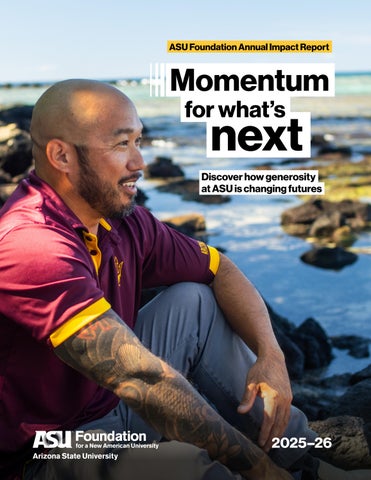
Resources and leadership Page 32 — Meet our volunteer leadership Meet the leaders guiding the ASU Foundation. (Cover) Aaron Hashimoto, ASU Local enrollment and student success coach in West Hawai‘i, works alongside students to expand access to higher education and help more learners achieve their goals.
Page 33 — Tools and resources Explore ASU Link and find new ways to deepen your impact.
A year of shared impact Your support has transformed lives and advanced the university’s mission. As we reflect on the past year, I am filled with profound gratitude for the community of donors, alumni, friends and partners whose generosity continues to transform lives through Arizona State University. Every gift, regardless of size or form, represents a commitment to opportunity and an investment in a brighter future. Whether through annual support, planned giving, gifts of real estate, gifts-in-kind, volunteer engagement or other expressions of philanthropy, your contributions advance our mission in meaningful ways. Together, we are helping students succeed, advancing groundbreaking research, strengthening communities and ensuring that ASU remains a force for positive change in the world. This spirit of collective impact is at the heart of Changing Futures. Through bold aspirations and shared purpose, we are accelerating solutions to society’s most pressing challenges while empowering generations to come. The stories and outcomes highlighted in this report are a testament to what is possible when visionary philanthropy meets an institution dedicated to innovation, inclusion and excellence. They also reflect a broader truth: our work is measured by more than just financial gifts. It is powered by the generosity and enduring commitment of those who believe in ASU’s Charter. Because of your support, futures are being changed every day, in classrooms, laboratories, communities and beyond. On behalf of the ASU Foundation, thank you for your partnership and your trust in what we can achieve together. As we look ahead, we do so with optimism, inspired by the extraordinary impact of your generosity and energized by the opportunities that lie before us. This is our moment to dream bigger and continue changing futures for years to come.
Gretchen E. Buhlig Chief Executive Officer ASU Foundation for a New American University
2
Annual Impact Report
A SpaceX Falcon Heavy Rocket with the Psyche spacecraft onboard is launched at NASA’s Kennedy Space Center. ASU led the launch planning for this mission.
ASU Foundation
3
Your impact
at a glance
v
v
4
Annual Impact Report
Total number of donors
Total number of gifts
126,000
549,000
Total number of scholarships funded
Projects/funds which received philanthropy
770 +
1,930 +
Total endowment
Total new gifts and commitments
$2.048B*
$470M * Unaudited
ASU Foundation
5
This is our moment As society faces the most complicated issues in recorded history, we cannot be bystanders. Arizona State University is uniquely committed — and uniquely equipped — to make a difference.
Reshape our relationship with the planet by driving bold solutions to sustain our world and improve well-being for all.
6
Annual Impact Report
Build the future of health by advancing technology, supporting practitioners and expanding equitable health access.
Inspire tomorrow’s game changers by empowering bold leaders to solve challenges and shape the future.
Through Changing Futures, we’re bringing together people, resources, ideas and solutions, focusing on six commitments that will change the world for the better:
Empower community resilience by fueling ideas, partnerships and resources to build stronger, healthier communities.
Advance technology for good by fueling innovation that makes the future more inclusive and equitable.
Transform global education by expanding access, enriching learning and empowering students in Arizona and beyond.
ASU Foundation
7
Reshape our relationship with the
planet
8
Annual Impact Report
Participants in the ‘Āko‘ako‘a Reef Restoration Partnership of Hawai‘i help restore coral reefs by combining Native Hawaiian cultural knowledge with scientific research to protect one of the islands’ most vital ecosystems.
ASU Foundation
9
For decades, our original program focused on diagnosing land and reef problems using high-tech satellite, airborne and field technologies. The new program further expands this diagnostic work, but it focuses far more effort on interventions that support Hawai‘i’s communities, both coral and human, as one force.” Greg Asner Director, Center for Global Discovery and Conservation Science ASU Julie Ann Wrigley Global Futures Laboratory®
Restoring Hawai‘i’s coral reefs Coral reefs in West Hawai‘i are under increasing threat from pollution, climate change and other environmental stressors — putting vital marine ecosystems and local communities at risk. Through the Āko‘ako‘a Reef Restoration Program, ASU is working alongside community partners to help restore and protect these reefs for future generations. With support from the Dorrance family and the Dorrance Family Foundation, the program is bringing together decades of research, community partnerships and interdisciplinary expertise to better understand reef health and guide restoration efforts. Funding has enabled ASU to purchase tools to track ocean pollutants, create detailed maps that identify areas most in need of intervention and retain restoration professionals who are developing innovative approaches to reef recovery. The many ASU team members engaged with Āko‘ako‘a and on-site collaborators include molecular ecologists, remote sensing experts, dive teams, environmental educators, hydrologists and systems engineers — all working together to help heal Hawai‘i’s reefs.
10
Annual Impact Report
Investment expands immersive learning for future conservation leaders The Rob Walton School of Conservation Futures is helping students turn their passion for the planet into practice through conservation education rooted in collaboration, culture and community. The school has launched its first courses with immersive, real-world learning at the core. During spring break 2026, a group of Arizona State University students spent a week studying coastal marine habitats, riparian zones and inland terrestrial areas along the Northern California coast. Through a biocultural conservation course, they learned directly from Indigenous communities who have stewarded the region for generations, deepening their understanding of how conservation connects science, culture, history and human rights. “What the immersive experience brought was a muchdeepened sense of trust, vulnerability and emotion as students explored the interconnectedness of people with the land and the complexity of navigating conservation through the lenses of science, culture, history and human rights,” said Sharon Hall, a President’s Professor in the School of Life Sciences.
These student experiences are expanding. Last fall, faculty traveled to Kenya and South Africa to identify future field experiences focused on wildlife protection, ecosystem restoration, climate solutions and sustainable livelihoods, while centering Indigenous knowledge. Faculty returned to Kenya this summer to identify additional learning experiences and partnerships. Those conversations are shaping immersive coursework and internships designed to connect student learning with community needs and lasting impact. This summer students began internships with Conservation International, gaining firsthand experience addressing global conservation challenges. All of these opportunities are made possible by a transformative $115 million gift from the Rob Walton Foundation. The investment is accelerating ASU’s efforts to prepare conservation leaders who are ready to address global challenges and drive meaningful change in communities around the world.
ASU Foundation
11
Build the future of
health
12
Annual Impact Report
Students at ASU gain hands-on experience with advanced medical technologies, helping prepare the next generation of health professionals and innovators.
ASU Foundation
13
Words cannot convey what it means for a student to be able to fulfill their dream of becoming a doctor by removing the financial barrier of tuition. This gift will enable the best and brightest students to pursue careers as physicianengineers who will change the future of health care through technology and innovation. Lifting this financial burden for our students gives them more freedom to select their future specialty and career focus without the degree of student loans that many physicians face.” Sarah “Holly” Hollingsworth Lisanby Founding Dean and Foundation Professor ASU John Shufeldt School of Medicine and Medical Engineering
14
Annual Impact Report
A new vision for medical education Two visionary donors are leading the charge on how care is delivered and who provides it. Inspired by a lifelong belief that everyone deserves a chance at health, John Shufeldt’s landmark nine-figure investment is building a new kind of medical school — one that trains physician-engineers to innovate with compassion and reimagine health systems. In support of this pursuit, Annette Beus’ $5 million gift aims to open doors for aspiring students to pursue those paths, with her investment serving as an inspiration for other donors to help fully cover tuition for the first two cohorts. Together, these gifts do more than fund programs — they empower future leaders and donors to blend technology, humanity and access to improve health outcomes across society. ASU looks forward to welcoming the first cohort of changemakers in the 2026–27 academic year.
ASU prepares future physicians to connect oral health and medical care The inaugural class of the John Shufeldt School of Medicine and Medical Engineering will learn to treat oral health as essential to overall health. A $578,947 investment from the Delta Dental of Arizona Foundation embeds oral health education into medical training through the Student-centered Medical Instruction and Learning in Oral Health powered by artificial intelligence known as SMILE-AI. SMILE-AI uses augmented intelligence and patient avatars to strengthen clinical decisions and prepare students to collaborate across disciplines. “Integrating oral health into medical education is essential to preparing the next generation of physicians to deliver comprehensive, patientcentered care,” said Dr. Sarah “Holly” Hollingsworth Lisanby, founding dean of the Shufeldt School. Arizona State University, Delta Dental of Arizona and the Harvard School of Dental Medicine Initiative to Integrate Oral Health and Medicine are developing the curriculum together. Each graduating class could improve care for up to 72,000 patients annually, bringing more connected, comprehensive health care to communities across the country.
ASU Foundation
15
Inspire tomorrow’s
game changers 16
Annual Impact Report
Students from ASU’s School of Music, Dance and Theatre perform on instruments from the Sheldon Urlik Guitar Collection, gaining hands-on experience that prepares the next generation of artists, educators and cultural leaders.
ASU Foundation
17
Playing these historic guitars gives me a rare window into the sound world and technique that earlier generations of guitarists knew firsthand. Each instrument has its own personality and responds differently — not just from one another, but from the modern guitars we’re used to today. That contrast has deepened my understanding of tone, phrasing and touch. The experience shapes how I approach my own instrument and broadens my sense of what the guitar can express.” Caleb Bailey DMA candidate in guitar performance ASU School of Music, Dance and Theatre
18
Annual Impact Report
Expanding artistic possibilities through music education Thanks to a remarkable $1.4 million gift from collector Sheldon Urlik, ASU music students are gaining rare access to world-class classical and flamenco guitars, transforming the educational experience for emerging performers and scholars. Urlik’s donation of 51 guitars to the School of Music, Dance and Theatre spans more than a century of guitar-making history and includes rare, historically significant instruments now used by ASU students in performances, competitions and advanced study. The collection includes guitars dating from 1869 through the modern era, offering students the rare chance to perform on historic instruments while studying the evolution of traditional guitar craftsmanship and sound. Students in the ASU Guitar Program have already incorporated guitars from the collection into concerts and performances, gaining insights into historical repertoire and interpretation through the instruments themselves.
Building more resilient global supply chains When global disruptions exposed fragile supply chains, it became clear that a new generation of leaders was needed — prepared not just to react, but to rebuild. The National Association of State Procurement Officials recognized that need and knew ASU was the right partner to act. With a historic $35 million gift from NASPO, students now step into classrooms transformed into hubs of innovation, where procurement is recognized as the starting point of resilient, ethical systems. Together, ASU and NASPO are designing new initiatives to strengthen procurement, logistics and operations education while preparing the next generation of supply chain leaders.
Fueling the future of Sun Devil Football Sun Devil Football continues to build national momentum under head coach Kenny Dillingham, whose leadership has guided the program to a Big 12 Championship and a College Football Playoff appearance. As the landscape of college athletics evolves, continued investment is helping position the program for sustained success. That momentum received a major boost through a $10 million gift from Brian and Kelly Swette to establish the Swette Family Endowed Football Coach position — the largest endowed leadership position in Sun Devil Athletics history. The endowment will support studentathlete recruitment and retention, coaching excellence and innovative resources that strengthen the future of Sun Devil Football.
ASU Foundation
19
Empower community
resilience
20
Annual Impact Report
Through immersive learning at the Walter Cronkite School of Journalism and Mass Communication, students develop the reporting, storytelling and production skills needed to keep communities informed and connected.
ASU Foundation
21
Arizona PBS is fortunate to have one of the most engaged public television audiences in the entire country. Our robust, growing community of members continues to demonstrate the extraordinary commitment to supporting public media in Arizona.” Scott Woelfel General Manager Arizona PBS
22
Annual Impact Report
Estate gift bolsters Arizona PBS amid public broadcasting challenges As federal funding cuts continue to challenge public broadcasting nationwide, private philanthropy is helping Arizona PBS remain a trusted source of educational programming, journalism and community connection. A generous estate gift from Jack and Margaret Nelson is strengthening that future through unrestricted support that can respond to the station’s most urgent needs. The $707,000 gift was placed into Arizona PBS’s quasi-endowment, helping ensure the organization’s long-term sustainability. Interest from the endowment is already supporting construction of the South Mountain transmission tower — critical infrastructure that keeps Arizona PBS programming accessible to communities across the region. Transformational gifts like this provide stability at a pivotal moment for public media.
Partnering with community members to improve food security Every donor makes a big difference, no matter the size of their gift. PitchFunder, ASU’s premier crowdfunding tool, makes collaborative philanthropic impact a reality. Through these collective contributions, engineering students who volunteer with Engineering Projects in Community Service traveled to Calle Real de Tolapa, Nicaragua, where food insecurity and limited water due to long dry seasons challenge daily life. Working alongside families, they built 12 waterefficient vertical gardens and shared knowledge to sustain them. What began as classroom ideas became lasting solutions — gardens that grow fresh food, conserve water and create opportunity — demonstrating how many small gifts can come together to drive meaningful change.
ASU Foundation
23
Advance technology
for good
24
Annual Impact Report
Leo Bercial, assistant professor in ASU’s School of Ocean Futures, conducts research aboard the R/V Atlantic Explorer, helping develop advanced ocean-monitoring technologies that improve our understanding of marine ecosystems and a changing planet.
ASU Foundation
25
When you are on the sea, you see how powerful the oceans are. The ocean has an incredible capacity to store and move heat. Every mission helps us better understand that system and how it influences life on Earth. ” Alice Ren
New technology dives deep into ocean discovery At ASU’s Bermuda Institute of Ocean Sciences, scientists have studied the waters surrounding Bermuda for more than a century, helping the world better understand how the ocean regulates Earth’s climate and sustains life. Now in its second century, BIOS is entering a new era of ocean discovery. Autonomous underwater gliders are expanding the institute’s legacy of research, enabling scientists to study the ocean continuously, even in places and conditions that were once beyond reach. BIOS operates three Slocum G2 autonomous gliders equipped with sensors that measure conductivity, temperature, depth, oxygen, fluorescence and backscatter. Powered by low-energy technology, the gliders can dive to 3,000 feet, travel up to 15 miles a day and remain at sea for months, collecting data even during turbulent weather. Every few hours, the gliders transmit data by satellite before returning beneath the waves. This continuous stream of information helps scientists understand how the ocean stores and moves heat, supports marine
26
Annual Impact Report
Director of BIOS’s Mid-Atlantic Glider Initiative and Collaboration and Assistant Professor, ASU School of Ocean Futures
ecosystems and responds to a changing climate. BIOS researchers have even deployed gliders into hurricanes, capturing critical observations that are improving storm forecasting while advancing research on ocean circulation, marine food webs and global climate systems. The Mid-Atlantic Glider Initiative and Collaboration was made possible through philanthropic support. Two of BIOS’s gliders—Anna and Jack—were funded by the Grayce B. Kerr Fund of Easton, Maryland. BIOS’s third glider, Minnie, was funded by Simons Foundation International. As the program grows, BIOS is developing an Autonomous Systems Laboratory to support nextgeneration ocean technologies. The institute also aims to expand its fleet to 10 autonomous gliders, grow its teams and create applied learning opportunities for ASU students.
Expanding AI access to accelerate discovery Access to powerful tools can define who leads innovation. Intel’s multimillion-dollar hardware gift is opening those doors at ASU, expanding the scale and flexibility of AI research so students and faculty can tackle larger, more complex challenges across disciplines. Work that was once limited to costly national supercomputers can now happen securely on campus, protecting sensitive data while accelerating discovery. Powering the AI Research Acceleration Platform, this investment removes barriers to advanced computing. It also strengthens ASU’s long-standing partnership with Intel, advancing workforce development and innovation in AI. More than technology, this gift empowers a new generation to create meaningful impact.
A community of donors helps transform TB testing A medical test that once took up to six weeks can now deliver results in less than 48 hours — thanks to the collective generosity of Women and Philanthropy, a community of donors who pool their gifts to create transformative impact. With support from this dedicated giving community, ASU researchers used artificial intelligence to dramatically accelerate tuberculosis drug testing, an advancement that could save lives, reduce transmission rates and reshape how one of the world’s deadliest infectious diseases is treated.
ASU Foundation
27
Pre-med student Carina Ho joins Mirabella at ASU residents Dr. Arnold Victor, Dr. Stan Wolfe and Dr. Kelly O’Keefe for a medical ethics roundtable that brings generations together through shared learning and dialogue.
28
Annual Impact Report
Transform global
education ASU Foundation
29
I was able to continue on in college. My parents had moved out of the country; I was looking for a place to live and also had to work while going to school fulltime. The scholarship allowed me breathing room so I could focus on my studies.”
Mirabella residents invest in the next generation of learners Lifelong learners residing at Mirabella at ASU don’t just audit classes. They help shape the experience for the next generation of learners. Residents mentor students, contribute to research and volunteer in classrooms, labs and campus programs. Rooted in a shared commitment to education and student success, they are also expanding access to an ASU education. Since 2023, the residents have pooled about $750,000 to support the Mirabella ASU Scholarship Fund, which assists Mirabella employees who are pursuing degrees at ASU. The fund has already supported 38 students
30
Annual Impact Report
Brittany Lane ’26 BFA in animation Mirabella scholarship recipient
There will be 23 new Mirabella scholarship recipients this coming academic year. The scholarship fund reflects a broader culture of giving at Mirabella. Since residents began moving to campus in 2020, they have collectively contributed more than $11.6 million to support ASU students, research and programs that expand opportunity and reinforce a lifelong commitment to learning. Residents also serve as mentors, career advisors, guest lecturers, research participants, professional teaching assistants and thesis reviewers, contributing an estimated 16 hours per resident each week. Their contributions are expanding opportunities for ASU students and strengthening a culture of lifelong learning.
Supporting study abroad opportunities Long-time faculty member Jim Eder and his wife, Pia Eder, believe that financial constraints should never prevent students from participating in academically and personally transformative experiences. Their decision to endow the Transformative Travel Through the School of Human Evolution and Social Change Study Abroad Scholarship expands access to faculty-led study abroad opportunities by reducing financial barriers for students. Programs such as the school’s annual One Health Australia study abroad experience demonstrate the impact opportunities like these can have on students. During the program, students explore the connections between human, animal and environmental health across 15 ecosystems while gaining firsthand insight into how ecological change, cultural practices and public health intersect. Experiences like these help students connect classroom learning with real-world research and collaboration. In the process, students build confidence as scholars and global citizens prepared to think across disciplines and borders to help address complex global challenges.
Energy education for a better world For Bob Zorich, managing partner and founder of Texas-based EnCap Investments, a wellinformed public and decision-makers with a deep understanding of complex energy-related issues are essential to securing the global energy future. To build that foundation, Zorich — who earned a master’s degree in international management in 1974 from what is now the Thunderbird School of Global Management — is funding a partnership between the Julie Ann Wrigley Global Futures Laboratory and the Thunderbird School through a $50 million gift to transform the way the world understands one of its most critical resources. The new Global Institute for the Future of Energy brings together education, research and real-world insight to equip the general public and learners — from K–12 students to cross-sector leaders worldwide — with a nuanced understanding of complex energy issues. Zorich’s transformative gift will empower people everywhere to shape the future of energy through bold, pragmatic solutions to support human flourishing.
ASU Foundation
31
Meet our volunteer leadership ASU Foundation Board of Directors John Graham, chair
Malissia Clinton, ’90
Mary Hentges, ’81
Harry Papp
Lauren Bailey, ’02, vice chair
Michael Crow
Chris Howard
Denise Resnik, ’82
Tony Sarsam, ’85, vice chair
Nita Francis
Lisa Loo
Lisa Urias, ’86
Michael Aguirre, ’00, ’02, ’05
Doug Fulton
Anne Mariucci
Roger Wittlin, ’76, ’78
Megan Beus, ’04
Ira Fulton
Jazmin Medina, ’09
Gretchen Buhlig
Hiroshi Hamada, ’91
Naka Nathaniel
Satjiv Chahil, ’76
Jay Heiler, ’83, ’86
Morgan Olsen
Vivek Kopparthi, ’14, chair
Charlene Fan, ’11, ’11
Harrison Sears, ’24, ’24
John Asigbekye, ’18
Mike Fior, ’18
Andrea Singer, ’13
Justin Bailey, ’13, ’14
Sean Green, ’04
Tallin Speek, ’23
Ryan Brotman, ’02, ’08, ’13
Saumya Gupta, ’17, ’22
Kaushik Suggu, ’15
Rosie Burr, ’22
Wesley Nee, ’15
Jackie Vasquez-Lapan, ’08
Teresa Clement, ’02, ’07
Alexis Petznick, ’15, ’16
Nicole Wood, ’11, ’11
Joelle Engler, ’20, ’25
Sam Richard, ’11
Next Generation Council
Investment Committee
Philanthropic Assets Committee
Anne Mariucci, chair
Jazmin Medina, ’09
Lauren Bailey, ’02, chair
Liz Shabaker
Jim Ameduri
Morgan Olsen
Justin Graham, ’15, ’15
Olga Viso
Ginny DeSanto, ’98
Harry Papp
JT Marino
Mary Hentges, ’81
Chris Volk
Daniel McCauley, ’09
John Krimmel
Christian Osmeña
ASU Global Foundation UK Board of Trustees Sir Malcolm Grant, co-chair
Frances Prenn
Gretchen Buhlig, co-chair
Mark Searle
Gina Domanig, ’85, ’87
Michelle Senecal de Fonseca, ’87
Jim O’Brien
32
Annual Impact Report
Your giving, all in one place Explore ASU Link, your go-to resource for fueling change through giving. No matter where you are in your journey of supporting others, ASU Link can help. It’s your personalized platform to manage your charitable gifts, track your impact and find new ways to make a difference. Get started today at asulink.org
We must go where we’re needed, connect people across the world and take bold action. This is our moment to change the future.
Get involved today asuchangingfutures.org/impact
donor.relations@asufoundation.org
All images in this publication showcase real projects and programs at Arizona State University that are addressing society’s biggest challenges.
480-965-2735
© 2026 Arizona Board of Regents. All rights reserved.