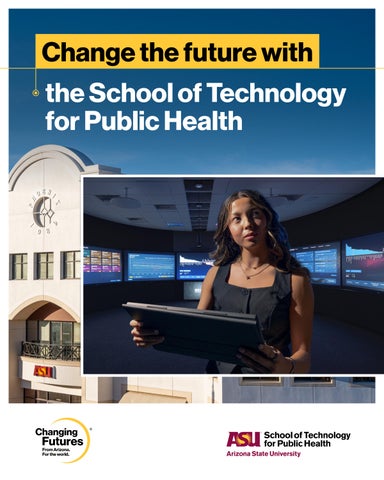

Change the future with the School of Technology for Public Health

Transforming public health through technology
By teaching students to be “technofluent,” the School of Technology for Public Health creates leaders who can respond quickly to protect public health.

health

Twenty-first-century health challenges won’t be solved with 20th century solutions. Today, Arizona ranks among the states with the poorest health outcomes in the country. We face unacceptably lower life expectancy and higher rates of preventable maternal mortality, accidental deaths and suicide. Rural and tribal health centers are struggling, and deepening health disparities continue to leave too many communities behind.
The challenges we face are grand and complex — and yet we are trying to solve them without the technological fluency that today’s threats demand. We need a fundamental transformation of public health technology — the systems, tools and workforce capabilities that determine how we protect and promote health.
The School of Technology for Public Health — a core academic unit within ASU Health — was created to meet this moment. As the nation’s first school dedicated to the emerging field of public health technology, we fuse foundational public health principles with modern, innovative, accessible and ethical technological approaches to solve problems faster, more equitably and at scale.
With the collaboration of national leaders and local communities, we are boldly reimagining how public health can — and must — act.
Through Changing Futures®, we will accelerate a fundamental transformation of public health — advancing innovation, training a new workforce and powering the health of communities that need it most.

A new model for public health
To illustrate the importance of public health — and how desperately public health systems need to change — we can turn to a recent, familiar example: COVID-19. The pandemic forced public health into the national spotlight — revealing just how fragmented, underfunded and outdated much of its infrastructure has become. During this moment of crisis, public health received intense attention and emergency funding. But once the danger faded, so too did the investments and opportunities to build durable capacity.
This “boom-and-bust” cycle is reflective of a broader, historical pattern in public health — one that leaves communities vulnerable. It asks public health to do more with less, again and again, while relying on tools designed for a different era. Modern technology offers a new path forward — significantly scaling both impact and efficiency, making sure that limited funding goes farther and strengthening the case for return on investment through public health initiatives.


Students at the School of Technology for Public Health will work with community partners to identify problems and co-design solutions to improve health outcomes.

Building public trust through public health
We are building a public health infrastructure that is natively digital, predictive and prepared. Modern tools like artificial intelligence, virtual and augmented reality, wearables, digital health platforms and geospatial mapping allow public health systems to see patterns sooner, share information faster and act more decisively.
We are training a new kind of public health professional. Tomorrow’s public health professionals must be bilingual: fluent in data and digital tools and the science of health promotion. Graduates will bring these skills into health departments, schools and neighborhoods, collaborating with communities and cross-sector partners to modernize how public health systems operate.
We are building public health solutions with communities — not for them. Lasting public health change happens when communities help define the problem and shape the solution. Our pioneering partnerships with the Arizona Department of Health Services, Maricopa County Department of Public Health, Pima County Health Department, Phoenix Children’s Hospital and the Arizona Department of Economic Security allow us to pursue radical collaboration with the communities we serve.
We are using technology to democratize access to health care. We see a future where technology empowers communities to protect and preserve their health rather than just measure their decline. Where expectant mothers in rural areas can easily access regular care through telemedicine or mobile health clinics. Where families in heat-vulnerable neighborhoods receive earlier warnings and avoid preventable heat-related illness.
“While technology is advancing at an exponential rate, health disparities are widening just as fast,” says Jyotishman Pathak, founding dean and professor, School of Technology for Public Health. “We have a once-in-a-generation opportunity to leverage this technological surge to democratize health access.”

“Instead of designing tools for users in academic silos, technology for public health uses equitycentered community design to co-create technologies with local communities, ensuring solutions are culturally competent and actively build public trust.”
— Matthew Buman Associate Dean of Research and Professor, School of Technology for Public Health
Protecting health through prevention
Students at the School for Public Health Technology will leverage technology in the field and with community partners to prevent disease and support health outcomes.



We will return public health to its role as a proactive, prevention-focused engine.
Just as the Federal Emergency Management Agency detects early warning signs of natural disasters and offers interventions and solutions to mitigate harm, a technology-forward public health system will be able to spot emerging disease threats and deploy resources before a cluster becomes a crisis.
“Public health is the first line of defense against preventable disease, disability and premature death,” says Michelle VillegasGold, associate dean of health strategy and partnerships and an assistant clinical professor.
“Just like our military is constantly surveilling for threats and proactively taking action to defend us from attacks to our national security, public health does this for the health of our nation and the health of our communities, neighborhoods and families.”

Real problems, real impact
To best serve our communities, we must be embedded in them, working alongside leaders and constituents to understand their challenges and co-create solutions. At the School of Technology for Public Health, learning happens by doing — and both students and communities are stronger for it.
A cornerstone of this approach is the Public Health Technology Corps, a service-learning model inspired by AmeriCorps that places service learning and community development at the center of the student experience. Rather than observing from the sidelines, students are embedded as active contributors and problem-solvers, bringing immediate capacity to communities while gaining hands-on experience in tackling real public health needs.
They are using geographic information systems technology to bring prevention education to areas with high childhood injury rates, leveraging digital communication tools to improve pediatric oral health behaviors and improve brain health, providing multilingual digital education resources to support refugee newcomers and studying cancer patient data to detect trends in service gaps and better support patient needs.
Faculty, too, are working in and alongside communities. They are using AI to map neighborhood walkability and identify gaps in pedestrian features like sidewalks and crosswalks. They are also using wearable devices to deliver real-time health support while ensuring that innovations remain ethical and build trust in the communities they serve.
Hands-on, community-focused, technology-forward experiences define how we learn and teach, shaping a whole new public health workforce that combines deep community care with exceptional technology capabilities to improve health.
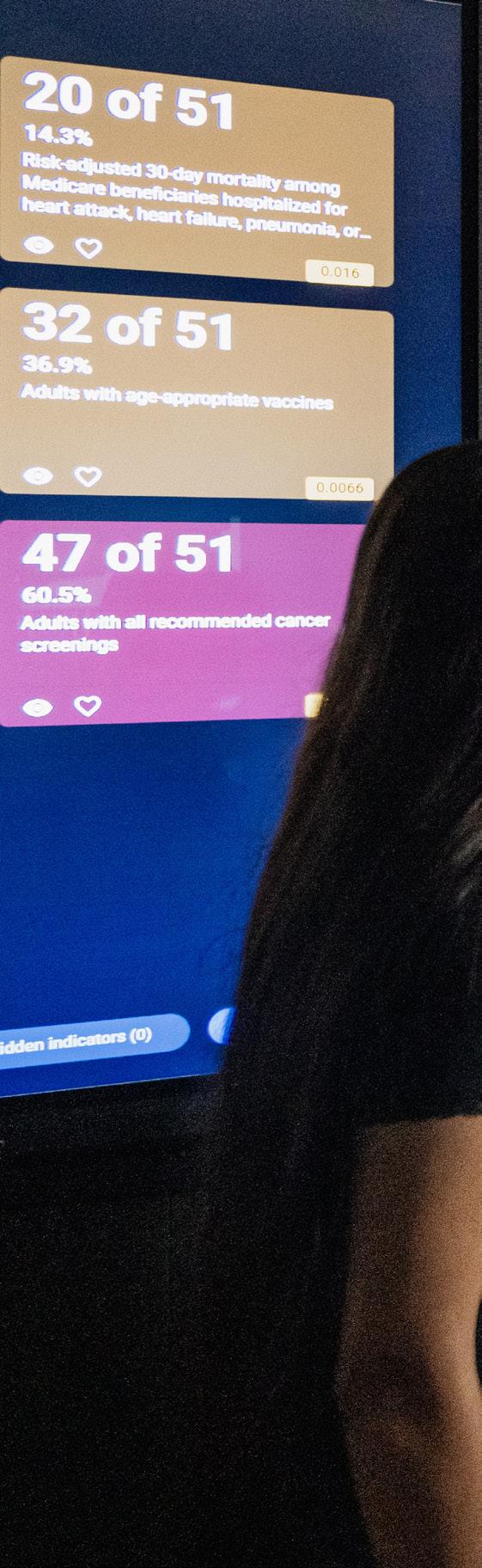

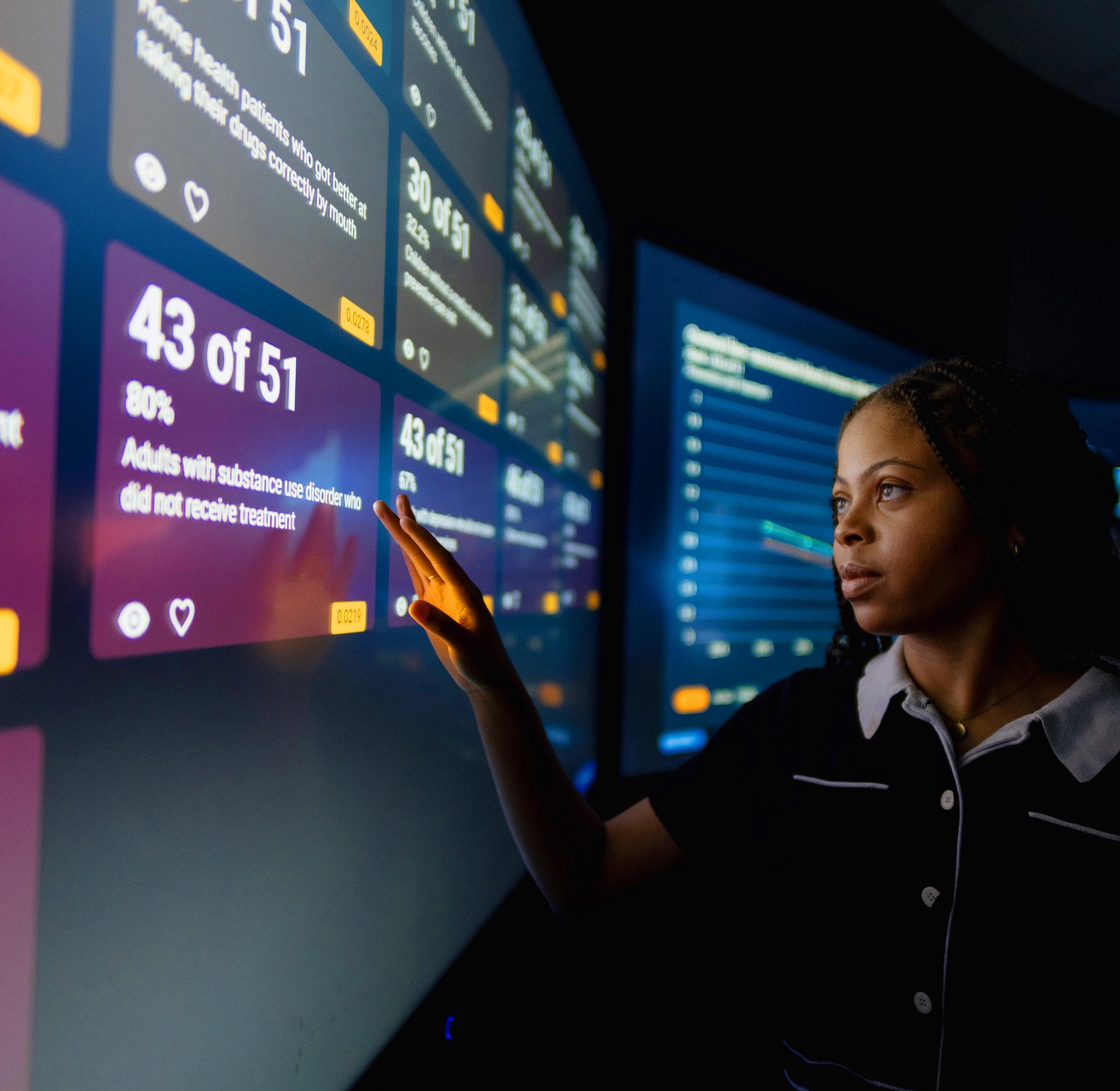
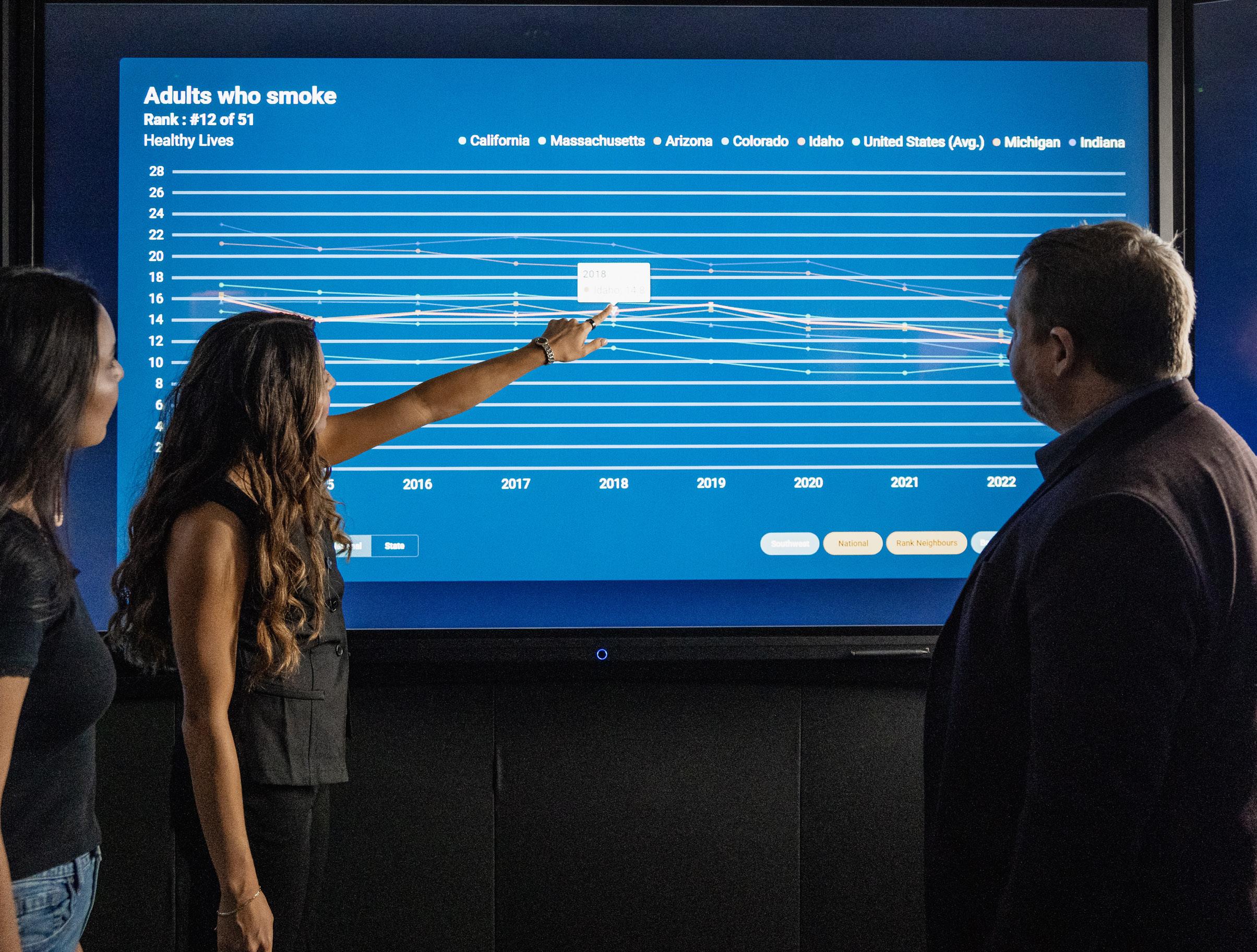
ASU’s Decision Theater leverages advanced data analytics and simulation to help leaders address challenges, manage emerging risks, improve health outcomes and engage in collaborative problem-solving.
“Our students are out in communities doing real work to address real problems. Their projects aren’t just learning experience; they’re catalysts for community change, improving child health, supporting refugees and advancing equitable care.”
Marc Adams Assistant Dean and Professor, School of Technology for Public Health

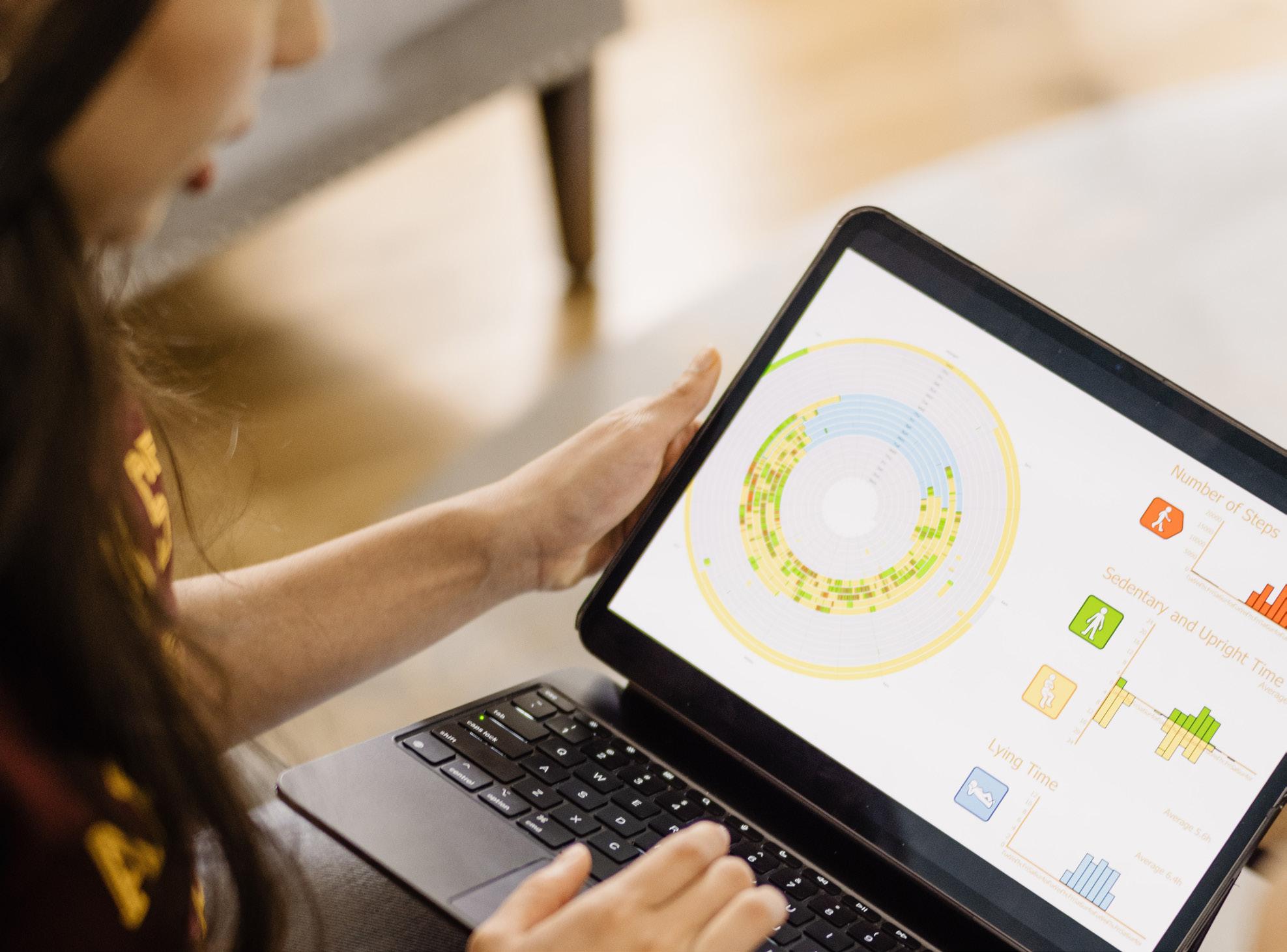
The Public Health Innovation Lab will incubate innovation, developing technologies that can be leveraged to build trust, advance health equity and save lives.


Advancing innovation
To truly transform public health, we must transition from reactive, one-size-fits-all models to proactive, precision solutions. Doing so requires more than isolated research projects — it demands a structured pathway that turns ideas into impact. The Public Health Innovation Lab will be that catalyst. Harnessing ASU’s innovative DNA, the Public Health Innovation Lab will accelerate the development of AI-driven predictive models, advanced digital twins and adaptive interventions that will fundamentally reshape how public health systems operate.
The Public Health Innovation Lab will take a full lifecycle approach to innovation, extending the reach and impact of technologies beyond where most academic discoveries end. Anchored by a dedicated Public Health Technology Foundry, the lab will provide the vital infrastructure, seed funding and commercialization support necessary to rapidly scale viable startup solutions. Few schools or health systems offer this kind of coordinated pipeline — one that seamlessly integrates equity-centered community design, responsible AI, hardware prototyping and real-world testing.
By bringing these elements together, the Public Health Innovation Lab will position ASU as a national model for public health technology innovation, proving that entrepreneurship can and must be channeled for the public good. Technologies scaling from here won’t just improve clinical and economic systems; they will build community trust, advance systemic health equity and save lives.
We aren’t just making faster; we are making smarter and more
making the system making it more
equitable.”
—Jyotishman Pathak
Founding Dean and Professor School of Technology for Public Health
Build the future of health with us

ASU School of Public Health Technology graduate students (clockwise from left) Nichole Escobedo, Emma Eckert, Leela Udupa and Jocelyn Romero created the winning entry in the Arizona attorney general’s contest focused on fentanyl awareness.
by Charlie Leight/ASU News
“I believe that solving the public health challenges of today and of the future — especially as technology continues to evolve so rapidly — will require a new type of scientist, and I am confident that ASU’s MPH program will prepare me for that.”
—Nichole Escobedo, MNS Master of Public Health candidate, School of Technology for Public Health
Photo

We see a future where health risks are not only identified earlier but prevented altogether. Where disease is diagnosed and treated right away — and fewer people suffer from preventable disease, disability, injury and death. Where technology expands access to care and empowers people to make informed decisions about their health and improve health behaviors.
“We are moving toward a world where public health is proactive enough to prevent crises, connected enough to reach every ZIP code and equitable enough to ensure that innovation serves everyone, not just the few,” says Pathak.
Join us in changing futures by harnessing the power of technology to build a healthier, more resilient world.
Change futures by supporting
Empower community resilience
Communities face urgent public health challenges, yet too often lack the capacity and technical support to address them. The Public Health Technology Corps embeds students directly within communities — working side by side to co-design technology-enabled solutions that strengthen local public health systems, build trust and deliver immediate, lasting impact where it is needed most.
Build the future of health
Public health systems were not built for today’s pace or complexity. A naming investment in the School of Technology for Public Health will accelerate breakthrough programs and initiatives that fuse technology with prevention — shaping a new era of public health innovation and positioning ASU to lead nationally in protecting health at scale.
the School of Technology for Public Health
Inspire tomorrow’s game changers Advance technology for good
The future of public health depends on diverse leaders whose depth of technological expertise matches their depth of care for communities. Scholarships expand access to education for talented students from all backgrounds, removing financial barriers and ensuring the next generation of public health innovators reflects the communities they will serve and protect.
Transforming public health requires visionary leadership and sustained academic excellence. An endowed deanship and faculty positions attract top talent, support groundbreaking research and provide long-term stability — ensuring the School of Technology for Public Health can lead, innovate and shape the field for decades to come.
Promising public health ideas too often stall before reaching real-world use. The Public Health Innovation Lab creates a clear pathway from concept to impact — advancing equity-centered technologies through design, testing and deployment, and demonstrating how innovation and entrepreneurship can be harnessed for public good.
About us
The ASU School of Technology for Public Health is creating a new approach to public health for the modern era — one that combines public service, technology, data science, systems thinking, design and community partnership to modernize public health infrastructure and create healthier, more resilient communities. As part of ASU Health, the school prepares tomorrow’s public health leaders to be bilingual — skilled in both digital technology and foundations of public health. Students and faculty work with health departments, schools, industry partners, nonprofits and communities to design, develop and deploy scalable solutions that can detect risk, prevent harm, improve health outcomes and respond to emerging public health threats. Grounded in ASU’s commitment to innovation and public impact, the School of Technology for Public Health is helping transform public health in Arizona and beyond by preparing leaders who can build more adaptable, equitable, responsive and sustainable infrastructure for the 21st century.

ASU Charter
ASU is a comprehensive public research university, measured not by whom it excludes, but by whom it includes and how they succeed; advancing research and discovery of public value; and assuming fundamental responsibility for the economic, social, cultural and overall health of the communities it serves.