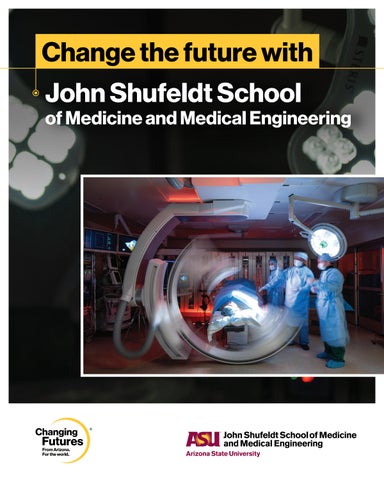
Change the future with John Shufeldt School
of Medicine and Medical Engineering
Students at the John Shufeldt School of Medicine and Medical Engineering will learn to apply artificial intelligence and data science to scale patient impact and elevate care.
“Our graduates will be different. They won’t just learn today’s tools – they’ll build the foundation to adapt to what comes next and lead change throughout their careers.” — Holly Lisanby, MD, DLFAPA Founding Dean and Foundation Professor, John Shufeldt School of Medicine and Medical Engineering
1
CHANGING FUTURES | FROM ARIZONA. FOR THE WORLD.
Redesigning health care to meet today’s challenges The United States spends nearly twice as much per person as other developed nations on health care, yet we see worse health outcomes. Physician shortages, burnout and gaps in access are straining communities nationwide. Meeting this moment requires a new kind of physician — one prepared not only to care for patients, but equipped to effectively redesign the systems that shape health care. At Arizona State University, the John Shufeldt School of Medicine and Medical Engineering is built on a unique curriculum that integrates clinical medicine, biomedical science, engineering and the humanities to prepare physician-engineers to lead health care into the future. From the start, students learn to apply artificial intelligence and data science in ways that drive innovation, helping clinicians reach many more patients and elevate the care each one receives. Graduates are prepared to practice medicine with unparalleled precision and to advance new models of care that strengthen entire communities. Through Changing Futures®, the John Shufeldt School of Medicine and Medical Engineering will train physician‑engineers who will redesign how health care is delivered, measured and scaled — improving outcomes for Arizona and setting new standards for medicine worldwide. Built at ASU, ranked #1 in innovation by U.S. News & World Report for more than a decade, ASU's John Shufeldt School of Medicine and Medical Engineering will equip graduates to do more than practice medicine. It will prepare them to transform it.
JOHN SHUFELDT SCHOOL OF MEDICINE AND MEDICAL ENGINEERING
2
Expanding the clinical learning environment We will turn innovation into effective care for patients. Preparing physician‑engineers means giving them environments where they can refine their skills and test new approaches before they reach patients. The John Shufeldt School of Medicine and Medical Engineering is designed with this purpose in mind. The Center for Translational Simulation is an AI‑powered, immersive workforce-training infrastructure designed to transform how health professionals build skills. The center uses extended reality, digital twin environments and real‑time AI feedback to deliver simulation training beyond traditional site‑bound clinical placements. Students practice realistic clinical scenarios that change based on their choices, helping them see what works, improve their skills and demonstrate readiness for real‑world care. This approach moves training from a fixed, site-based model to one that can scale to meet evolving needs. “Simulation expands the clinical learning environment,” said Jordan Coulston, MD, assistant dean of clinical education in the John Shufeldt School of Medicine and Medical Engineering. “It reduces our reliance on limited clinical placements, allowing more health professionals to be trained effectively as workforce needs continue to grow.”
3
CHANGING FUTURES | FROM ARIZONA. FOR THE WORLD.
America's health system faces unprecedented challenges, and meeting them requires a fundamentally different kind of physician — one who can deliver the highest standards of care and help redesign how that care is delivered.
Lorem ipsum dolor sit amet, consectetur adipiscing elit. Sed id nibh sed massa laoreet posuere. Morbi mollis nulla tellus, in dapibus magna varius tempus.
JOHN SHUFELDT SCHOOL OF MEDICINE AND MEDICAL ENGINEERING
4
Engineering innovation from concept to clinic The MedTech Innovation Suite will incorporate clinical spaces and AI-enabled technologies to pilot new devices in risk-free environments. Rendering provided by DFDG Architecture and CO Architects.
“Many innovations never make it from concept to clinic. The MedTech Innovation Suite is designed to help translate new ideas into care that can make a real difference in peoples’ lives.” — Heather Clark, PhD Senior Associate Dean for Engineering Integration, John Shufeldt School of Medicine and Medical Engineering
5
CHANGING FUTURES | FROM ARIZONA. FOR THE WORLD.
ns c We will pilot and scale novel health care solutions like never before. The MedTech Innovation Suite is an engineering‑driven clinical innovation environment designed to support the development of medical technologies under realistic operational conditions in a patient‑free, risk‑free environment. The suite brings together clinical spaces, leading-edge medical equipment, imaging tools and connected data systems so new approaches and equipment can be tested as part of real care processes, not in isolation. Embedded within MedTech is the Clinical AI Systems Engine, which serves as the artificial intelligence and data backbone of the environment so AI‑enabled technologies can be created and validated as part of integrated clinical systems. Students, faculty, clinicians and industry partners work together in these spaces to pilot new devices, digital tools and care workflows under realistic conditions. By allowing innovation to be stress‑tested before entering the clinic, the suite helps promising ideas move more efficiently toward real‑world use. Together, these initiatives give physician‑engineers the environments they need to apply what they learn, evaluate new approaches responsibly and move innovation into practice – strengthening health systems in Arizona and beyond.
JOHN SHUFELDT SCHOOL OF MEDICINE AND MEDICAL ENGINEERING
6
Reducing risk, improving outcomes We will prepare physician-engineers who deliver better care. An engineering mindset means seeing clinical environments not as a series of isolated decisions but as a system that can be improved through thoughtful analysis and innovation. That mindset is developed through Engineering the Future of Medicine, a pioneering initiative that embeds problem‑solving directly into medical education. Through this work, students learn in Living Laboratories, real‑world care settings where they uncover how clinical systems function and how thoughtful changes can improve care. In many health systems today, challenges like repeated medication errors are addressed by adding layers of rules and checkpoints, increasing complexity without addressing the underlying system design. Living Laboratories cultivate the skills physicians need to step back, examine how care processes work together and apply an engineering mindset to reduce risk and improve care.
7
CHANGING FUTURES | FROM ARIZONA. FOR THE WORLD.
The John Shufeldt School of Medicine and Medical Engineering is dedicated to improving care for Arizona and beyond, with a curriculum that is focused on technology and entrepreneurship.
JOHN SHUFELDT SCHOOL OF MEDICINE AND MEDICAL ENGINEERING
8
Building resilience in f
Supporting the mental health of students will build strong habits and resilience that will last through residency and their professional careers.
9
CHANGING FUTURES | FROM ARIZONA. FOR THE WORLD.
future leaders We will equip future doctors to protect their own well-being. Our approach prepares students not only with advanced technical skills, but with the personal awareness and mental health support they need to practice medicine well over the long term. Graduates will complete their training equipped to meet the demands of a fast‑evolving field while staying grounded in the human dimensions of care, benefiting both patients and the physicians who serve them. This commitment takes shape through Well-being for All, a program that supports students' mental health. Our unique curriculum confers both an MD and a Masters of Science in Medical Engineering, and this rigorous training places special demands on our students, which will require building resilience to carry them through residency and practice. “Students often enter medical school with stronger than average levels of resilience, but by the time they graduate, many experience burnout and lower levels of resilience,” said Suzanne Templer, DO, associate dean of student affairs in the John Shufeldt School of Medicine and Medical Engineering. “Our goal is to help students build skills they can practice during training, so they enter residency with tools to stay engaged and thrive throughout their careers.” Together, these priorities will prepare graduates who are technically strong and grounded in purpose, enabling them to offer compassionate, state-of-the-art care throughout their careers.
JOHN SHUFELDT SCHOOL OF MEDICINE AND MEDICAL ENGINEERING
10
Here, success m different—impro outcomes for pe and beyond. Tha how we teach, h and what we bui 11
CHANGING FUTURES | FROM ARIZONA. FOR THE WORLD.
means something oving health eople in Arizona at focus changes how we partner ild.” —Holly Lisanby, MD, DLFAPA
Founding Dean and Foundation Professor, John Shufeldt School of Medicine and Medical Engineering
JOHN SHUFELDT SCHOOL OF MEDICINE AND MEDICAL ENGINEERING
12
Build the future of health with us The MedTech Innovation Suite will provide students, faculty, clinicians and industry partners a technologically advanced environment to develop and stress-test innovations before entering patient settings. Rendering provided by DFDG Architecture and CO Architects.
13
CHANGING FUTURES | FROM ARIZONA. FOR THE WORLD.
Medicine must change to meet the realities of health care today and remain worthy of the trust people place in it. At the John Shufeldt School of Medicine and Medical Engineering, we are guided by the ASU Charter, which calls for us to assume fundamental responsibility for the economic, social, cultural and overall health of the communities we serve. Education at the school reflects how care works today and where it is headed. Students learn in environments where engineering and medicine operate in tandem. New approaches are tested and improved before they reach patients. Training is shaped by clinical excellence and by the systems that influence access, outcomes and equity across communities. The result is a new kind of physician. Graduates are prepared to improve care not only patient by patient, but across entire systems that govern health and well-being. This work comes to life through focused initiatives that advance the school’s priorities and offer a clear path for impact. This is how we are building the future of health for Arizona and beyond. Join us in building what comes next.
JOHN SHUFELDT SCHOOL OF MEDICINE AND MEDICAL ENGINEERING
14
Change futures
by supporting
Transform global education Medical education has not kept pace with the complexity of modern health care. Engineering the Future of Medicine is a core training approach built around Living Laboratories – real clinical settings intentionally designed for learning and improvement. In these environments, students work alongside clinicians and engineers to identify everyday care challenges, test practical solutions and see how changes affect patients and care teams as part of their medical education.
15
CHANGING FUTURES | FROM ARIZONA. FOR THE WORLD.
Empower community resilience Physician burnout threatens the stability of the health care workforce and the quality of patient care. Well-being for All is a school‑wide program that supports students throughout our unique combination of medical and engineering training through guided reflection, coaching and peer discussion. Participants regularly assess their well‑being, practice skills for managing stress and uncertainty, and develop habits that help them stay engaged and effective through residency and into long‑term practice.
John Shufeldt School of Medicine and Medical Engineering
The John Shufeldt School of Medicine and Medical Engineering will equip graduates to drive innovation and advance new models of care that strengthen entire communities.
JOHN SHUFELDT SCHOOL OF MEDICINE AND MEDICAL ENGINEERING
16
Change futures
by supporting
Advance technology for good Promising medical technologies often struggle to move from idea to patient care. The MedTech Innovation Suite is a patient‑free, risk‑free environment where new technologies are tested under realistic clinical conditions. At the center of the Suite is the Clinical AI Systems Engine, a shared data and artificial intelligence platform that allows teams to evaluate how technologies perform as part of real clinical workflows before they are used with patients.
17
CHANGING FUTURES | FROM ARIZONA. FOR THE WORLD.
Inspire tomorrow’s game changers Health care training is limited by access to clinical placements, especially beyond major medical centers. The Center for Translational Simulation is an advanced simulation platform that allows clinicians and students to practice complex clinical scenarios without relying solely on hospital‑based training. By bringing high‑quality simulation to where students are, the center expands workforce preparation while maintaining rigorous, real‑world standards of care.
John Shufeldt School of Medicine and Medical Engineering
Medical students will blend medicine, engineering, technology and humanities as they earn both an MD and a Master of Science in medical engineering in four years.
JOHN SHUFELDT SCHOOL OF MEDICINE AND MEDICAL ENGINEERING
18
About us The John Shufeldt School of Medicine and Medical Engineering will train next generation physicians-engineers who will earn both an MD and a Master of Science in medical engineering in four years. They will blend medicine, engineering, technology and humanities to become a different kind of health care leader. Graduates will leverage new tools such as AI and data science to connect with more patients, seek innovative practices and improve health outcomes. It is part of ASU Health, a dynamic and comprehensive approach that focuses the nation’s most innovative university on health needs and challenges of the state and the nation. Learn more about ASU's John Shufeldt School of Medicine and Medical Engineering at medicine.asu.edu.
ASU Charter ASU is a comprehensive public research university, measured not by whom it excludes, but by whom it includes and how they succeed; advancing research and discovery of public value; and assuming fundamental responsibility for the economic, social, cultural and overall health of the communities it serves.
asuchangingfutures.org 19
CHANGING FUTURES | FROM ARIZONA. FOR THE WORLD.