ISSUE 174: July -Sept 2026
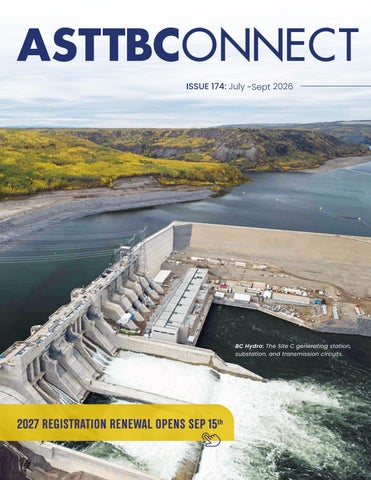
BC Hydro: The Site C generating station, substation, and transmission circuits.
2027 REGISTRATION RENEWAL OPENS SEP 15th
Land Acknowledgement Headquartered in Surrey, BC, ASTTBC
acknowledges the traditional Lands of
the Semiahmoo, Katzie, Kwikwetlem, Kwantlen, Qayqayt and Tsawwassen Peoples.
We thank our hosts for their graciousness in welcoming us to carry out our work on their Land.
In so doing, we recognize their inherent
Indigenous rights and title, the implementation without qualification of the UN Declaration
on the Rights of Indigenous Peoples (UNDRIP), and our support for the 94 calls to action by the Truth and Reconciliation Commission.
Disclaimer: ASTTBC makes no endorsement or guarantee as to the quality or suitability of any activity, professional, product, or service advertised with ASTTBC.
Contents 4
Chair & CEO message
6
The future of technology practice in British Columbia
9
Strengthening compliance and enforcement to protect the public interest
12 2027 registration renewal opens September 15 14 Understanding regulated vs. reserved practice 16
New resource outlines ASTTBC areas of practice and specialties
18
CPD compliance reaches record high following program improvements
20
Building your future in British Columbia: the important role of internationally trained technology professionals
22
ASTTBC congratulates Board Director Prakash Joshi
24
Changes to ASTTBC’s ROWP Planning (PL) application requirements effective October 1, 2026
25
ASTTBC is seeking experienced Registered Fire Protection Technicians (RFPTs) to join our team of volunteer file reviewers
26
Request for review and feedback: draft wetland and CIAS guidance under development
28
ASTTBC Young Professionals Group profile
32
Celebrating innovation & professional excellence: Neat Week 2026
34
Navigating mental health in mid-career transitions for technologists and technicians
37
Volunteer opportunities
on receiving the Order of Canada
ASTTBC register supports transparency
38 and professional recognition
ISSUE 174 July -Sept 2026 ASTTBCONNECT is published by the Applied Science Technologists & Technicians of BC. EDITOR: Cara Christopherson 604-585-2788 ext. 501 cchristopherson@asttbc.org The opinions expressed in ASTTBCONNECT are not necessarily those of ASTTBC or its directors. All rights reserved. This publication may be reproduced provided credit is given as to the source of such material. The Applied Science Technologists & Technicians of BC (ASTTBC) regulates approximately 6,000 applied science and engineering technology professionals in British Columbia under the Professional Governance Act (PGA) and the International Credentials Recognition Act (ICRA). For more information, please visit asttbc.org
Issue 174
e g a s s e M CHAIR & CEO
Last year, we shared an article about the importance of professional identity and why it represents much more than a designation or credential. It
reflects a commitment to competence, accountability, ethics, and serving the public interest.
One year later, that message is even more relevant. Across British Columbia, applied science and technology professionals are
working in an environment shaped by rapid technological change. Artificial intelligence, automation, evolving infrastructure needs, and new ways of
working are transforming our professions at an unprecedented pace. At the
same time, governments are making significant investments that will shape the future of our province and country.
4
ASTTBCONNECT
July-Sept 2026
In July, the Government of Canada and the Province of British Columbia announced the
Canada–British Columbia Cooperative Prosperity Agreement, committing to investments
in infrastructure, clean energy, transportation, childcare, workforce development, and trade
capacity. Delivering on these investments will require more than funding. It will require skilled, accountable and technical professionals supported by a regulatory framework that protects the public and gives employers confidence in the work they perform.
As our province grows and invests in its future, public trust in the professionals delivering this
work becomes even more important. Every day, practicing ASTTBC registrants make decisions that influence the safety, reliability, and sustainability of the systems and infrastructure
British Columbians rely on. Professional identity is about more than technical knowledge. It is demonstrated through integrity, accountability, lifelong learning, and a commitment to upholding professional standards. These qualities strengthen public confidence and distinguish regulated professionals.
In the coming weeks, ASTTBC will open its 2027 registration renewal. Renewal is more than an annual administrative requirement; it is an opportunity to reaffirm the professional commitment that comes with being an ASTTBC registrant. Maintaining registration,
completing continuing professional development, and upholding professional standards demonstrate ongoing commitment to competence, ethical practice, and protecting the public.
As you prepare to renew for 2027, we encourage you to reflect on what your professional
designation represents. Professional identity is not defined by a credential alone. It is earned through the knowledge you apply, the integrity you demonstrate, and the trust you inspire every day.
Kerry Barth, AScT
ASTTBC Chair
Theresa McCurry, BSc, PMP ASTTBC CEO
ASTTBCONNECT
5
Issue 174
THE FUTURE OF TECHNOLOGY PRACTICE IN BRITISH COLUMBIA By ASTTBC CEO Theresa McCurry
When I prepared for my visit to Penticton for our registrant meeting in June, I spent some time thinking about what makes the South Okanagan unique. Like many regions across British Columbia, it is experiencing significant growth and change. Communities are facing aging infrastructure, increasing demands on water resources, wildfire resilience, energy transition, housing pressures, and growing expectations around public safety.
6
ASTTBCONNECT
July-Sept 2026
What struck me is that technology professionals are often the people closest to these challenges. Every day, applied science technologists and technicians conduct field reviews, inspect, test, design, implement, commission, maintain, troubleshoot, and improve the systems that people depend on. They bridge the gap between theory and reality, transforming ideas into practical solutions that serve communities across the province. Speaking with registrants in Penticton reinforced something I have been thinking about for some time: our profession is entering one of the most significant periods of change in its history.
A profession in transition For decades, applied science technology professionals have built successful careers through education, practical experience, mentorship, and demonstrated competence. Those qualities remain fundamental to professional practice today. Increasingly, however, governments, employers, regulators, and the public are asking a different question:
How do we know the person performing this work is qualified, accountable, and acting in the public interest? That question is driving important changes across professional regulation in British Columbia.
One of the most significant developments is the anticipated move toward reserved practice for applied science technologists and technicians. ASTTBC has been working with the Province of British Columbia and Engineers and Geoscientists BC to establish a reserved scope of practice that recognizes the important work technology professionals perform while strengthening public protection. Under the proposed framework, certain technical work would only be performed by, or under the supervision of, appropriately registered professionals. Registration would move beyond title protection to become a requirement for performing specific professional work within an established scope of practice. The intent is straightforward: • Improve public safety. • Strengthen professional accountability. • Ensure consistent standards of competence and ethics. • Provide clearer recognition of the value technologists and technicians bring to society. Importantly, this work is not about replacing engineers or changing the engineering profession’s reserved practice. Rather, it is about defining an independent scope of practice that reflects the unique expertise and responsibilities of technology professionals while preserving the engineering profession’s existing scope. For many of us, this represents an important evolution in professional identity. The conversation is no longer simply about what title we hold. Instead, it is about the responsibility we are prepared and qualified to assume.
Artificial intelligence and the future of practice
public expectations all point to the same reality:
No discussion about the future of technology practice would be complete without considering artificial intelligence.
new regulations, new expectations, and new
There has been considerable discussion about AI replacing workers. While AI will undoubtedly transform how we work, I believe it is best
viewed as a tool that supports professional
practice, not one that replaces professionals.
This is a message ASTTBC reinforced through its
recently published Artificial Intelligence Practice Advisory.
AI can perform calculations – provided there is a review by a human.
AI can summarize reports – with input by a human.
AI can assist with design options – that a human reviews and signs off on.
But AI cannot sign off on work that affects public safety.
AI cannot exercise professional judgment. AI cannot assume legal accountability. Those responsibilities remain with the professional.
As reserved practice moves closer to
implementation, accountability will become
even more important. The future professional will not compete against AI. They will work alongside it, using these tools effectively while continuing to apply sound judgment, technical expertise, and ethical decision-making.
Building the profession of tomorrow Reserved practice, artificial intelligence,
economic needs of Canada, and changing
our profession is evolving.
The next decade will bring new technologies, opportunities. The professionals who thrive will be those who combine technical excellence with leadership, adaptability, professional accountability, and a commitment to lifelong learning.
At the heart of these changes is something that has never changed. Trust. The public does not place its trust in us simply
because we hold a certificate or diploma. They
trust regulated professionals because they know we are competent, ethical, accountable, and committed to serving the public interest.
That trust is earned every day through the
decisions we make, the standards we uphold, and the professionalism we demonstrate.
Whether you are just beginning your career or have decades of experience, each of us has a
role to play in strengthening our profession and maintaining the confidence the public places in us.
As our profession continues to evolve, ASTTBC
remains committed to working with government, employers, educators, and registrants to ensure technology professionals are well positioned to meet the challenges, and opportunities, that lie ahead.
The future of technology practice in British Columbia will undoubtedly be shaped by innovation. But more importantly, it will
continue to be shaped by professionals whose
competence, integrity, and accountability earn the public’s trust every day.
July-Sept 2026
STRENGTHENING COMPLIANCE AND ENFORCEMENT TO PROTECT THE PUBLIC INTEREST Written by Shona Lawson, ASTTBC registrar A key component of professional regulation is the compliance of and enforcing standards of conduct and competence to uphold the public interest. ASTTBC takes all complaints seriously. Its enforcement authority comes from the Professional Governance Act (PGA) and covers non-compliance with the bylaws including Schedule D: Standards of Competence and Code of Ethics, as well as misuse of reserved titles under the Applied Science Technologists and Technicians Regulation. These titles include Applied Science Technologist (AScT), Certified Technician (CTech), Registered Technical Specialist, Trainee, and CTech Trainee. ASTTBCONNECT
9
Issue 174
In the past, timelines for resolving complaints and investigations were longer than expected, and regulatory principles may not always have been applied as intended. However, ASTTBC has adopted and is now implementing the following principles in our compliance, complaints and investigation resolution processes:
• Compassion: Protects the public while treating registrants and applicants with empathy and fairness. This approach recognizes that some individuals may have past trauma or anxiety related to interactions with regulators, health professionals, or law enforcement.
• Risk-based: Ensures that action is proportionate to the risk posed to the public and the environment. Compliance and disciplinary measures use the minimum regulatory force necessary to resolve an issue rather than defaulting to punitive action.
• Right-touch: Considers both the cost of compliance and the intended outcome.
Compliance and enforcement form a continuum, as shown in the diagram below. These regulatory principles guide ASTTBC in assessing allegations and determining noncompliance with the bylaws including the Standards of Competence and Code of Ethics.
Compliance and enforcement form a continuum, as shown in the diagram below. These regulatory principles guide ASTTBC in assessing allegations and determining noncompliance with the bylaws including the Standards of Competence and Code of Ethics.
Over the last several months, ASTTBC has expanded the Compliance & Enforcement Department to better meet its legal obligations and the needs of the organization and registrants. The department includes two compliance officers and a technical advisor who provide expertise and support to the registrar and the Investigation Committee.
10 ASTTBCONNECT
July-Sept 2026
The department will continue to grow and enhance ASTTBC’s compliance and enforcement programs, including finalizing and publishing a compliance plan for regulated practice and the anticipated implementation of reserved practice. Staff also liaise with external investigators, provide complaint and investigation file updates, and prepare materials for Investigation Committee meetings. Staff assess each potential non-compliance referral and complaint using a Complaint & Investigation Risk-Based Matrix and assign a risk level that determines the file’s priority and whether escalation is required. The risk level assigned and file priority may increase or decrease as new information emerges during initial information gathering or an investigation as illustrated by diagram below.
Staff and the Investigation Committee continue to make substantial progress in resolving potential non-compliance referrals and outstanding and new complaint and investigation files. The committee includes volunteer ASTTBC registrants and public representatives, also known as lay members. Under the bylaws and the PGA, both the registrar and the committee may make determinations on complaint files; however, only the committee may decide the outcome of an investigation. All decisions strive to reflect risk-based and right-touch regulation while supporting ASTTBC’s mandate. Through this work, staff and the committee are strengthening trust among registrants, the public, and prospective applicants, supporting the professions ASTTBC regulates, and protecting the public interest. If you have any questions or would like more information, please contact the Compliance & Enforcement Department at complaints@asttbc.org.
ASTTBCONNECT
11
2027 REGISTRATION RENEWAL OPENS SEPTEMBER 15 The ASTTBC registration renewal period for 2027 opens on September 15, 2026.
The renewal deadline is November 30, 2026. Renewing your registration is more than an annual administrative requirement. It is an
opportunity to reaffirm your commitment to
professional standards, ethics, competence, and protecting the public. Maintaining
your registration ensures you continue to
hold your reserved title and remain part of
British Columbia’s community of regulated technology professionals.
12 ASTTBCONNECT
Preparing for reserved practice This year’s renewal comes at an important time for the profession.
ASTTBC continues to work with the Province of British Columbia and Engineers and
Geoscientists BC toward an anticipated reserved scope of practice for applied
science technologists and technicians.
July-Sept 2026
Once implemented, registration with ASTTBC will be required to legally perform certain reserved professional work. Renewing your registration helps ensure you are well positioned for these anticipated changes while maintaining your professional standing.
What registrants need to know When renewal opens on September 15, registrants will be able to complete their declaration and access their invoice through their ASTTBC online account. Payment can be made through: • ASTTBC online account: Credit card (A 2.4% merchant fee will be applied to all credit card transactions. This fee is charged by the bank and does not go to ASTTBC); • Online banking: ASTTBC is a registered payee with most major Canadian banks. To make a payment, log in to your online banking, select ASTTBC as the payee, and enter your registration number as the account number. • E-transfer: Send your payment by e-transfer to finance@asttbc.org. Please include your first and last name and registration number in the message section. ASTTBC no longer mails paper invoices or receipts. All renewal documents are provided electronically through your online account.
Key deadlines Registrants are encouraged to renew before November 30, 2026 to avoid late fees. Registrations renewed after November 30 are subject to late fees in accordance with
the ASTTBC Bylaws. Registrants who have not renewed by January 31, 2027 will have their registration cancelled. Following cancellation, additional requirements and fees apply for reinstatement.
Before you renew Before completing your renewal, remember to: • ensure any outstanding fees, debts, or CPD fines have been paid; • review and update your contact information; and • review your registration status if your circumstances have changed. If you are planning a parental, caregiver, medical, or educational leave, or are not currently practising, you may wish to consider applying for non-practising status. This allows you to remain an ASTTBC registrant while indicating that you are not actively practising and provides a pathway to return to practice when appropriate.
CPD cycle reminder Registrants should also note that ASTTBC’s Continuing Professional Development cycle now runs from June 1 to May 31. Be sure to familiarize yourself with the updated reporting cycle as you prepare for renewal. Watch your inbox beginning September 15 for your renewal notice, or log in to your ASTTBC account to complete your renewal and payment. Renewing on time helps ensure uninterrupted registration and demonstrates your continued commitment to professionalism, accountability, and protecting the public.
Issue 174
UNDERSTANDING REGULATED VS. RESERVED PRACTICE
As ASTTBC moves toward anticipated reserved practice for applied science technologists and technicians, it’s helpful to understand what regulated practice and reserved practice mean, and how they differ. While the two concepts are related, they are not the same.
14 ASTTBCONNECT
July-Sept 2026
What is regulated practice? Regulated practice describes the professional work that Applied Science Technologists (AScT), Certified Technicians (CTech) and Technical Specialists are educated, qualified and authorized to perform within British Columbia. Many regulated professions have areas of practice that overlap. Professionals from different regulators may perform similar types of work within their own areas of expertise, while remaining accountable to their respective regulatory bodies.
What is reserved practice? Reserved practice refers to specific professional activities that legislation limits to qualified registrants of a professional regulator. Not all regulated professions have reserved practice, and reserved practice may apply to only part of a profession’s overall scope of practice. Where reserved practice exists, other authorized registrants may carry out that work or take responsibility for it.
Third-party legislation Reserved practice may also be established through legislation outside a profession’s governing statute. In these cases, the legislation identifies which regulated professionals are qualified to carry out a specific reserved practice. For example, Bills 14 and 15 establish reserved practice through third-party legislation, with government developing regulations that will identify the qualified
registrants authorized to perform those activities. This approach allows reserved practice to apply across multiple regulated professions where appropriate.
Where ASTTBC is today The Professional Governance Act (PGA), and the ASTTBC Regulation currently establish the scope of practice and protected titles for applied science technologists and technicians. However, they do not yet include reserved practice for the profession. ASTTBC is working toward the introduction of reserved practice. When approved by the government, certain professional work would be limited to ASTTBC registrants or individuals under their direct supervision. Mandatory registration would also apply to those performing work within the approved reserved practice.
Why it matters Professional regulation helps protect the public by ensuring that applied science technology work is carried out by qualified professionals who meet established standards of education, competence and ethical conduct. Reserved practice would provide greater clarity about which professional activities require registration with ASTTBC and help ensure that those activities are performed by qualified, accountable professionals. ASTTBC will continue to share updates as more information becomes available. ASTTBCONNECT
15
Issue 174
NEW RESOURCE OUTLINES ASTTBC AREAS OF PRACTICE AND SPECIALTIES
ASTTBC has developed a new Areas of Practice
“ASTTBC registrants work across a wide
level overview of the diverse professional
often in roles that are not well understood
and Specialties document to provide a highpractice represented by its registrants.
The document serves as a reference resource for registrants, employers, government,
regulators, clients, and the public, helping to
illustrate the broad range of work performed by Applied Science Technologists (AScT), Certified Technicians (CTech) and Registered Technical Specialists (RTS) across British Columbia.
16 ASTTBCONNECT
range of industries and technical disciplines, by those outside the profession,” says
Jason Jung, Director of Professional Practice & Development, ASTTBC. “This document
provides a common reference point to help registrants, employers, government, and
the public better understand the breadth
of professional practice represented within ASTTBC.”
July-Sept 2026
Organized by discipline, the document
Read the ASTTBC Areas of Practice and
their associated specialties that reflect the
the diverse fields of professional practice
identifies examples of areas of practice and many ways registrants apply their knowledge and expertise. Rather than defining scopes of practice or specific competencies, it serves
as a reference resource to help members of
the public and other stakeholders understand the diversity of professional practice across ASTTBC.
Specialties document to learn more about represented within ASTTBC.
Click here to view and download
The document is not intended to be an
exhaustive list of every area of practice
or specialty. As technology, industry, and professional practice continue to evolve,
new areas will emerge and existing ones will continue to change.
ASTTBC welcomes feedback from registrants
and stakeholders to help ensure the document remains relevant and representative of the profession.
ASTTBCONNECT
17
Issue 174
CPD COMPLIANCE REACHES RECORD HIGH FOLLOWING PROGRAM IMPROVEMENTS ASTTBC registrants are setting a new benchmark for Continuing Professional Development (CPD) compliance, with overall compliance reaching 91.7 per cent, the highest rate in the program’s history. Overall CPD compliance increased from 87 per cent in the previous reporting cycle to 91.7 per cent this year. Compliance with the Indigenous awareness training and activity requirement also reached a record high, rising from 89 per cent to 97.5 per cent. The results come following several CPD bylaw amendments introduced late last year to make the program more flexible and accessible while maintaining ASTTBC’s commitment to public protection through lifelong learning. Changes included new CPD cycle dates (June 1-May 31), an extension of the 2025 CPD reporting deadline to May 31, 2026, removal of the cap on self-directed learning activities, and a change to the Indigenous awareness training requirement from an annual requirement to a one-time requirement. The record compliance rates highlight registrants’ strong commitment to maintaining and strengthening their professional knowledge and skills. They also demonstrate how thoughtful program improvements can make it easier for registrants to meet their professional obligations.
18 ASTTBCONNECT
“ASTTBC is proud of the commitment our registrants have shown to lifelong learning,” says Jason Jung, ASTTBC Director, Professional Practice & Development. “These results demonstrate that when we make CPD requirements more flexible and accessible, registrants respond, strengthening both professional practice and public confidence in the professions we regulate.” The 2026 CPD reporting cycle also provides valuable insight into how ASTTBC can continue to improve the program while maintaining high standards for professional development and public protection. For more information about the CPD program and recent bylaw changes, visit the CPD webpage.
July-Sept 2026
ASTTBC BOARD OF DIRECTORS 2026 Chair, Kerry Barth, AScT Vice chair, David Sparanese, AScT, PTech, CPWI 3 Immediate past chair, Brian F. Davies, CTech, RSIS
Registrant directors: Jessica Baxter, AScT Prakash Joshi, AScT, PTech, P.L.Eng. Erin Karaim, AScT Randy Meszaros, AScT, PMP, C.E.T. (AB) Laure Nielsen, AScT, PMP
Lay directors: Oluwatobi (Tobi) Abisoye, LLB, LL.M., Barrister & Solicitor Natasha Dookie, BA, CPHR, JD Mary O’Callaghan, MBA, FCMC
Purpose Statement ASTTBC is committed to protecting British Columbians and the environment by regulating applied science and engineering technologists, technicians, and technical specialists.
Registrants are required to notify ASTTBC of any change of name, address, email, place of employment, or other contact information previously provided, within two weeks of any change. Please update your information to ensure it is current.
Through our code of ethics and practice standards, our registrants are qualified, competent, and accountable. ASTTBC monitors compliance with these standards and investigates breaches when necessary.
ASTTBCONNECT
19
BUILDING YOUR FUTURE IN BRITISH COLUMBIA: the important role of internationally trained technology professionals
For internationally trained applied science technology professionals, building a career in a new country often means more than finding employment. It means learning new systems, understanding professional expectations, adapting to a different regulatory environment, and establishing yourself within a new professional community. At the same time, internationally trained professionals bring valuable experience, technical expertise, and perspectives that strengthen industries and communities across British Columbia.
20 ASTTBCONNECT
Applied science technology professionals play an essential role in supporting the systems and infrastructure people rely on every day. From transportation and construction to environmental management, utilities, manufacturing, and emerging technologies, technologists, technicians, and technical specialists contribute to work that directly impacts public safety, sustainability, and economic growth. As the province continues to grow and evolve, the demand for skilled and accountable professionals continues to increase. BC is facing complex challenges related to housing, infrastructure renewal, climate adaptation, workforce shortages, and rapidly advancing technologies. Addressing these challenges requires professionals who can combine technical knowledge with practical problemsolving, sound judgment, and ethical practice. Internationally trained professionals are an important part of that future. At ASTTBC, we recognize the significant contributions these professionals make to BC’s workforce and communities. Diverse educational backgrounds, international experience, and global perspectives strengthen innovation, improve problem-solving, and help industries better reflect the communities they serve. Professional registration also plays an important role in supporting public trust and professional recognition. Under the Professional Governance Act and the International Credentials Recognition Act, ASTTBC regulates applied science technology professionals to help ensure regulated work is carried out competently, ethically, and in the public interest. ASTTBC is committed to supporting internationally trained professionals as
they navigate the registration process and establish their careers in BC. We continue to work with newcomer-serving and immigrant settlement organizations to help provide information, resources, and guidance related to professional registration pathways and opportunities within the applied science technology professions. For internationally trained professionals, registration is not simply about meeting requirements. It is an opportunity to demonstrate professional competence, establish credibility within the profession, and continue building a meaningful career in BC. The professions regulated by ASTTBC are also changing rapidly. Artificial intelligence, digital tools, automation, and evolving industry expectations are transforming how technical work is performed. At the same time, expectations around accountability, sustainability, and risk management continue to grow. These changes create opportunity for professionals who are adaptable, committed to continuous learning, and able to apply their expertise responsibly in changing environments. Applied science technology professionals help bridge innovation and implementation, turning technical knowledge into practical, real-world solutions that support safe, sustainable, and resilient communities. For internationally trained professionals considering their future in British Columbia, your skills, experience, and perspectives are needed and valued. The work of technology professionals continues to shape communities across the province every day, and internationally trained professionals will remain an important part of that future. ASTTBCONNECT
21
ASTTBC CONGRATULATES BOARD DIRECTOR PRAKASH JOSHI ON RECEIVING THE ORDER OF CANADA 22 ASTTBCONNECT
July-Sept 2026
ASTTBC is proud to congratulate board director Prakash Joshi, C.M., AScT, PTech, P.L.Eng., on his appointment as a Member of the Order of Canada, one of the country’s highest civilian honours. A highly respected materials engineering technologist, Prakash was recognized for his outstanding contributions to materials testing and quality control inspection. Throughout his distinguished career, he has developed innovative testing procedures that have advanced materials technologies, particularly in the construction industry. Prakash brings decades of experience to the profession. After nearly 30 years with Amec Earth & Environmental Limited, he joined Metro Testing and Engineering, where he serves as senior materials engineering technologist. Since joining the ASTTBC Board of Directors in 2022, he has served on the appeals board and awards committee,
contributed as an application reviewer and continues to mentor emerging professionals through Engineers and Geoscientists BC. Beyond his professional accomplishments, Prakash has dedicated countless hours to community leadership. He has served as president of the Society of Punjabi Engineers and Technicians of BC, vicepresident of the Uganda-Canadian National Association, and has been an active mentor, keynote speaker, author, musician and composer. His lifelong commitment to technical excellence and community service exemplifies the values recognized by the Order of Canada. On behalf of the board, staff and registrants of ASTTBC, we extend our sincere congratulations to Prakash on this remarkable and well-deserved honour.
ASTTBCONNECT
23
CHANGES TO ASTTBC’S ROWP PLANNER (PL) APPLICATION REQUIREMENTS EFFECTIVE OCTOBER 1, 2026 Effective October 1, 2026, ASTTBC is updating
What’s changing?
applying for registration as a Registered
Applicants will now be required to submit three
the application requirements for individuals Onsite Wastewater Practitioner (ROWP),
Planner (PL), through the practical experience and competency assessment pathway. The changes are intended to maintain
competency-based assessment standards
while providing greater flexibility for applicants who may not have practical experience with every required system type.
24 ASTTBCONNECT
(3) project files that collectively demonstrate competency in:
• one pressurized sand mound system;
• one pressurized non-sand mound system; and
• one non-pressurized system.
July-Sept 2026
At least one of the three project files must be actual/practical onsite wastewater system that has been installed. All work on actual
systems must be completed under supervision of Authorized Persons. Actual systems
must have been designed by the applicant and include all steps from site survey and soil sampling to construction review and commissioning of the system.
Applicants who cannot provide actual/
practical examples for all three required
system types may use ASTTBC case studies to
satisfy the remaining project file requirements.
Case studies
ASTTBC IS SEEKING EXPERIENCED REGISTERED FIRE PROTECTION TECHNICIANS (RFPTS) TO JOIN OUR TEAM OF VOLUNTEER FILE REVIEWERS File Reviewers play an important role in the registration process by assessing applicants’ technical competencies and providing recommendations to the Credentials Committee. This is an excellent opportunity to contribute to the profession, support the next generation of RFPTs, and help ensure that only qualified individuals are registered to practise. As a File Reviewer, you will:
Case studies will form part of the application
• Review RFPT applications within your area(s) of expertise.
administered once the applicant’s practical
• Assess applicants against ASTTBC’s competency requirements.
assessment process and will only be
project submission has been reviewed and determined to have demonstrated the required competencies.
• Provide objective, evidence-based recommendations.
Applicants will have two weeks to complete
• Help uphold consistent, fair, and defensible registration decisions.
and submit any assigned case studies. These changes apply to applications received on or after October 1, 2026.
Questions about the updated application requirements can be directed to registrations@asttbc.org.
ASTTBC provides training, guidance, and ongoing support to all File Reviewers. If you are an experienced RFPT interested in volunteering, we’d love to hear from you. Please contact registrations@asttbc.org for more information.
data resources that support wetland
management and activities occurring
in and around streams under the Water Sustainability Act.
Request for Review and Feedback: Draft Wetland and CIAS Guidance Under Development
The draft materials are intended to improve consistency in permitting,
strengthen environmental outcomes, and provide greater clarity for
proponents, practitioners and decisionmakers. Several of the resources are expected to become preferred or
pilot standards for wetland-related
permitting and mitigation planning. Feedback from qualified professionals will help ensure the resources are scientifically sound, practical to
implement, and applicable across The Ministry of Water, Land and
Resource Stewardship is inviting
qualified environmental professionals to review and provide feedback on
a suite of draft standards, guidance documents, assessment tools and 26 ASTTBCONNECT
British Columbia. The ministry intends to refine the materials over time
based on practitioner feedback and implementation experience.
To learn more please visit the Province’s request for review and feedback.
StrongerBC Future Skills Grant
The StrongerBC Future Skills Grant is open to British Columbians aged 19 years or older — regardless of
financial need — and covers up to $3,500 per person for eligible short-term skills training at public postsecondary institutions.
LEARN MORE
Issue 174
SHAHZAD HUSAIN ASTTBC YOUNG PROFESSIONALS GROUP PROFILE
Shahzad Husain, AScT, MRICS, Senior
Cost Manager, is a construction and cost
management professional with more than 14 years of experience delivering projects across the semiconductor, oil and gas,
EPC, HVAC, and manufacturing sectors. He currently supports major estimating and
cost management efforts on multi-billiondollar semiconductor manufacturing
facilities, overseeing scopes valued from hundreds of millions to several billion
dollars. Shahzad’s expertise includes cost estimating, project controls, risk analysis,
value engineering, budgeting, forecasting, and quantity surveying. His career has
been built on a commitment to technical excellence, continuous learning, and
helping teams deliver complex projects safely, efficiently, and within budget. 28 ASTTBCONNECT
July-Sept 2026
What made you want to pursue a career in your field?
A:
My interest in the construction and engineering industry started with a passion for problem-solving and building things that have a tangible impact. I was drawn to the combination of engineering, project delivery, and financial
strategy. Over time, I discovered that cost management allowed me to bridge both technical and business aspects of projects, helping organizations make informed decisions while supporting successful project outcomes.
How were you introduced to applied science?
A:
I was first introduced to applied science through my studies in mechanical
engineering and my early career experiences in quality control and engineering. Working on manufacturing and construction projects showed me how scientific principles and engineering concepts are applied in real-world situations to
solve complex challenges. Pursuing my Applied Science Technologist (AScT)
designation further strengthened my appreciation for the practical application of engineering knowledge.
What program did you attend?
A:
I enrolled in the Mechanical Engineering Technology Program and later
completed a Bachelor of Science in Mathematical Sciences. These educational experiences provided both the technical and analytical foundation that supports my work in cost management and project delivery today.
ASTTBCONNECT
29
Issue 174
What has your experience in the industry been like?
A:
I have over 14 years of experience across construction, engineering, oil and gas, HVAC, EPC, and high-tech semiconductor industries. My career began as a
Quality Control Engineer, and I progressed into estimating, quantity surveying, project management, and cost management roles. Throughout my career, I have supported projects ranging from small-scale assignments to multibillion-dollar programs. Today, I serve as a Senior Cost Manager, leading
estimating and cost management efforts on some of the largest semiconductor manufacturing projects in North America. These experiences have allowed me to work with multidisciplinary teams, manage significant project scopes, and contribute to the successful delivery of highly complex facilities.
What industry are you in?
A:
I work in the construction and engineering industry, specializing in cost
management, estimating, project controls, and quantity surveying. My primary
focus today is supporting large-scale semiconductor manufacturing and hightech construction projects, while also drawing on experience in oil and gas, HVAC, EPC, and infrastructure sectors.
What are your professional goals, and what are you currently pursuing?
A:
My goal is to continue growing as a leader in construction cost management
and project controls while contributing to some of the world’s most innovative
and technically challenging projects. I am focused on expanding my expertise in advanced project delivery, risk management, digital estimating tools,
and strategic cost engineering. I am also committed to mentoring the next generation of estimators and cost professionals entering the industry.
July-Sept 2026
Any tips or advice for young professionals entering the industry?
A:
• Build a strong technical foundation. Understanding engineering and construction fundamentals will make you a better problem solver.
• Develop communication skills. Technical knowledge is important, but the
ability to communicate with clients, engineers, contractors, and stakeholders is equally valuable.
• Stay curious and keep learning. Technology, construction methods, and project delivery models are continuously evolving.
• Seek diverse experiences. Working across different industries and project types will accelerate your growth.
• Find mentors. Learning from experienced professionals can help you avoid common mistakes and fast-track your development.
• Be willing to start small. Every project and every role provides valuable experiences that contributes to long-term success.
What are you passionate about outside of work?
A:
Outside of work, my greatest passion is spending quality time with my family and creating lasting memories together. My wife, our children, and I enjoy
exploring the outdoors through hiking, beach trips, and visits to new places. I
have a strong appreciation for travel and enjoy experiencing different cultures,
meeting new people, and learning from diverse perspectives around the world. I am also a dedicated football fan and a lifelong supporter of Manchester
United. One of the highlights of this past summer was checking off a bucket-list experience by attending a FIFA match in Seattle, combining my love for sport with the excitement of a world-class sporting event.
ASTTBCONNECT
31
National Engineering and Applied
Celebrating innovation & professional excellence:
Neat Week
2026 32 ASTTBCONNECT
Science Technology Week (NEAT Week) takes place November 23–27, 2026. As a provincial member organization of
Technology Professionals Canada (TPC), ASTTBC is pleased to join organizations across the country in celebrating the
contributions of engineering and applied science technologists and technicians. NEAT Week shines a national spotlight
on the more than 400,000 professionals working in applied science and
engineering technology across Canada. These professionals help design, build, operate, maintain and improve the
infrastructure, systems and technologies that support our communities and drive innovation.
July-Sept 2026
The significance of NEAT Week has also
Inspiring the next generation
message marking the occasion, Prime
A highlight of NEAT Week is the National
is “a unique opportunity to celebrate
post-secondary students from across
been recognized nationally. In his 2025
Minister Mark Carney noted that the week
Capstone Competition Finals, where
the remarkable contributions that engineering technology and applied science professionals make to our nation.” He also recognized the
Canada showcase innovative projects
importance of education and lifelong
learning in preparing the next generation of
that demonstrate creativity, collaboration
and technical excellence. The competition celebrates emerging talent and provides an opportunity to recognize the next
generation of technology professionals.
technology professionals.
At ASTTBC, NEAT Week is an opportunity to
recognize the vital role our registrants play
across a wide range of disciplines, including civil, mechanical, electrical, environmental, biomedical and fire protection
technology. Through their technical
expertise, professional accountability and commitment to ethical practice, ASTTBC registrants help protect the public while
advancing innovation and sustainability throughout British Columbia.
Why NEAT Week matters NEAT Week highlights the importance of
professional registration and recognizes
the essential contributions of engineering and applied science technologists and technicians to Canada’s future.
For students, it is an opportunity to explore rewarding career paths and connect with the profession. For employers and the
public, it reinforces the value of working with regulated professionals who meet
NEAT Week is an opportunity to recognize
established standards of competence,
the tremendous contributions technologists
ethics and accountability.
Their knowledge, professionalism and
Join ASTTBC as we celebrate
stronger communities and support the
keep our communities safe, sustainable
and technicians make every day.
commitment to excellence help build
the professionals whose expertise helps
continued growth of British Columbia’s
and innovative.
economy.
Stay tuned for more information on NEAT Week 2026.
ASTTBCONNECT
33
Navigating mental health in mid-career transitions for technologists and technicians AUTHOR BIO
Jamie Boone, CD, C.Tech is a Project Manager with The Department of National Defence and retired RCAF Construction Engineer, bringing extensive experience in supporting complex National Defence Infrastructure projects and is a trained Mental Health First Aider.
When Experience Meets Uncertainty For engineering technologists and technicians, experience defines professional identity built through years of problem-solving, delivery, and growth. But mid-career transitions, whether chosen or forced, can challenge that identity. Across Canada, many seasoned professionals are moving into new roles, industries, or specializations due to technological change, 34 ASTTBCONNECT
restructuring, or a desire for growth. While professional impacts are often discussed, the mental health challenges are less visible, yet equally important. These transitions are not just about learning new skills they involve rebuilding confidence, redefining identity, and adapting to uncertainty.
July-Sept 2026
Experienced Professionals, New Roles Those navigating these changes are not earlycareer entrants but experienced professionals who have led teams and built strong reputations. Transitioning into unfamiliar roles whether leadership, emerging technologies, or formal education often means no longer being the expert. Despite their experience, many feel like beginners again. This shift can challenge longheld perceptions of competence and self-worth.
The Psychological Impact A mid-career transition disrupts more than routine it disrupts identity. A common experience is imposter syndrome, where accomplished professionals question their legitimacy in new roles, especially when working with unfamiliar tools or alongside younger colleagues. This self-doubt can lead to hesitation, reduced participation, and fear of failure. Over time, it may erode confidence and increase anxiety. At the same time, new responsibilities, technical, leadership, or performance-related add pressure. For those balancing family and financial commitments, the stakes often feel higher, with little room for error.
Workplace and Life Pressures These challenges extend beyond the workplace. Adapting to new systems, workflows, and expectations can be mentally demanding.
Tasks that were once routine may take longer, leading to frustration and self-doubt. Outside of work, the demands of continuous professional development (CPD) add further strain. Learning new tools, pursuing certifications, or returning to formal education requires time and energy often in limited supply. For those away from structured learning for years, this return can feel overwhelming, affecting stress, sleep, and overall well-being.
Why Mental Health Matters Despite how common these experiences are, mental health during mid-career transitions is rarely discussed. There is an assumption that experience equals resilience, which can discourage individuals from seeking support. This silence has consequences. Ongoing stress and self-doubt can lead to burnout, reduced job satisfaction, or even abandoned career transitions not due to lack of ability, but due to emotional strain. Supporting mental health is essential not only for individuals, but for maintaining an adaptable workforce.
Strategies for Resilience Many professionals navigate these challenges by adopting strategies that address both technical and emotional demands. One key approach is reframing experience as an asset. While tools change, core skills (problem-solving, communication, and critical thinking) remain valuable.
ASTTBCONNECT
35
Issue 174
Equally important is accepting the learning curve. Transition periods are inherently uncomfortable; recognizing this reduces unrealistic expectations of immediate expertise. Seeking support also plays a critical role. Mentorship, peer networks, and professional communities provide reassurance and practical insight. Sharing experiences reduces isolation and builds confidence. Professionals should also prioritize mental well-being by setting realistic expectations, managing workload, and recognizing signs of stress. Simple practices (structured time management, regular breaks, and work-life balance) can have meaningful impact. Finally, accepting uncertainty is key. Questions about whether a transition is the “right” move are natural, but confidence develops through experience, not certainty.
The Lingering Question Even after transitioning, many professionals continue to question their decision. Mid-career changes often feel riskier, with higher stakes and less tolerance for error. This uncertainty can be stressful, but it is also a normal part of growth. Over time, what feels like instability can become opportunity (expanding skills, perspective, and professional identity).
36 ASTTBCONNECT
Conclusion: Redefining Strength The technologist and technician profession is built on adaptability. As industries evolve, midcareer transitions are becoming more common and necessary. Acknowledging the mental health challenges that accompany these changes is essential. Strength is not the absence of struggle; it is the ability to navigate uncertainty, seek support, and continue forward. By opening conversations around mental health, the profession can better support its members not just as technical experts, but as individuals managing complex careers. Across Canada, resources such as Wellness Together Canada, employee assistance programs, professional associations, and organizations like the Canadian Centre for Occupational Health and Safety provide support for stress, burnout, and transition. Crisis lines such as Talk Suicide Canada (1-833-4564566) are available 24/7. No one navigating a stressful career transition must do so alone. The most important system to manage is not the one we work on but ourselves.
July-Sept 2026
VOLUNTEER OPPORTUNITIES ASTTBC has several statutory committees that are looking for new volunteers: Lay Committee Member – Audit and Practice Review Committee Lay Committee Member – Credentials Committee Lay Committee Member – Nominations Committee Committee Member – Investigation Committee ASTTBCONNECT
37
Issue 174
ASTTBC REGISTER SUPPORTS TRANSPARENCY AND PROFESSIONAL RECOGNITION
The ASTTBC register is an important
For registrants, the register recognizes
Updated weekly, it includes all registered
experience and competency requirements.
resource for both registrants and the public. technologists, technicians and technical specialists from the past 10 years.
For the public, the register provides a
transparent way to verify an individual’s
those who have met ASTTBC’s education,
It also serves as a valuable networking tool,
making it easier to connect with colleagues
and identify professionals with specific areas of expertise.
registration status, confirm their credentials
Visit the ASTTBC register to explore this
strengthen confidence in regulated
professionals regulated by ASTTBC.
and view any disciplinary actions, helping professionals.
38 ASTTBCONNECT
resource and learn more about the
July-Sept 2026
PAST EVENTS
IN THE COMMUNITY
July
Hosted an ASTTBC Update Webinar for registrants. Hosted Young Professionals Group networking events in Kamloops and Vancouver. Connected with Impact North Shore, an immigrant settlement organization, to support awareness and engagement with internationally trained professionals.
UPCOMING EVENTS September Presenting to students at BCIT. Participating in BC FireCon 2026, including an ASTTBC presentation. Presenting to the Western Canada Onsite Wastewater Management Association (WCOWMA). ASTTBCONNECT
39
Earn CPD!
Registrant Services
BCIT PRESENTS RECYCLING & SUSTAINABILITY OF EV BATTERIES
Our partners offer exclusive rates on their products and services.
12-Sep-2026 - 24-Oct-2026 Burnaby Campus, 3700 Willingdon Avenue, Burnaby, BC
Follow the links below to learn more: » Willis Towers Watson
ACI-BC PRESENTS REIMAGINING CONCRETE INFRASTRUCTURE WITH ULTRAHIGH PERFORMANCE CONCRETE 23-Sep-2026 - 23-Sep-2026 Italian Cultural Centre, 3075 Slocan Street Vancouver, BC
» TD Insurance Meloche Monnex » Manulife » Notarius
To access insurance and other ASTTBC
group benefits including discounts to the
BC FIRECON 2026
24-Sep-2026 - 25-Sep-2026 Coast Langley City Hotel & Convention Centre, Langley, BC
PNE/Playland, Mark’s Work Wearhouse and more, please log into your
ASTTBC account. Once logged on, click
the ‘Resources’ tab for more information.
ASTTBC OCTOBER UPDATE WEBINAR 21-Oct-2026 - 21-Oct-2026 Online
ASTTBC PRESENTS COMPLIANCE AND ENFORCEMENT WEBINAR 03-Nov-2026 - 03-Nov-2026 Online
Position Title Senior Engineering Technologist (Design & Construction)
ASTTBC Job Board
City of New Westminster Manager of Fleet Services
District of Saanich
Mechanical Technologist Unit Electric Ltd
Engineering Drafting Technician
KINTERA (formerly DWB/Chartwell)
Discipline
Location
Posting Date
Closing Date
Civil
New Westminster
08-14-2026
09-10-2026
Mechanical
Victoria
08-10-2026
09-07-2026
Electrical,
Okanagan Fall
08-07-2026
09-07-2026
Civil
North Vancouver or Chilliwack, BC
08-07-2026
until filled
mechanical
BC
BC
BC
July-Sept 2026
REGISTRANT UPDATE New AScT
New RTS
New CTech
Navneet Bhangu
Nichole Pike
Jay Patel
Dennis Klick
Phillip Cavouras
Mitchell Empey Everly Larche
Erick Silfred Mantilla Blandon Kyle Martin
Alan Rezende Pereira Karamveer Singh
John Stephenson
Jehan Thanduparakkal
Christopher Andrew Turner Russel Vanderschaaf Huabo Zheng
Steven Maki
Tyler Flamank
Denzel Generoso
Retired
Aryan Kakria
Charles Simpson
Scott Holcombe Anthony Kerr
Setareh Komaied
Bertus Van Mook
Jeffrey Lawson Zachary Millar Nathan Olsen
Xolotl Sangha
Robert Schaefer Ishaan Sidhu Kaden Strout Drew Brown
Joshua Dingwall
Gregory Dean Siewert Nicolo Volonte
41 ASTTBCONNECT
ASTTBCONNECT
41