Technical note Accelerating Fab fragment polishing development with MiMode PuraBead® Mixed-H 96-well plates Identifying the right resin and starting conditions when sample is limited and timelines are tight is a key challenge in Fab polishing development. When multiple resins and binding conditions need to be assessed, high-throughput screening offers a practical route to compress early development, enabling parallel evaluation while conserving valuable material. MiMode PuraBead® Mixed-H 96well plates are designed to support rapid resin selection and early polishing condition screening in a single high-throughput workflow. The format enables efficient comparison of conditions while helping to minimize sample use in early-stage process development.
In this application note, the MiMode PuraBead® Mixed-H 96well plate was used to identify a negative-mode polishing step for CHO-derived Fab fragments. The Mixed-H plate enabled four resin chemistries and multiple loading conditions to be assessed in a single experiment, reducing the number of separate screening studies required. Together, this enabled resin selection and early load condition screening to be combined in one workflow, with successful verification in column mode.
Application objective To streamline Fab polishing development by combining resin selection and early condition screening in a single highthroughput workflow using MiMode PuraBead® Mixed-H 96-well plates, reducing development effort and accelerating transfer into column mode.
What this study shows
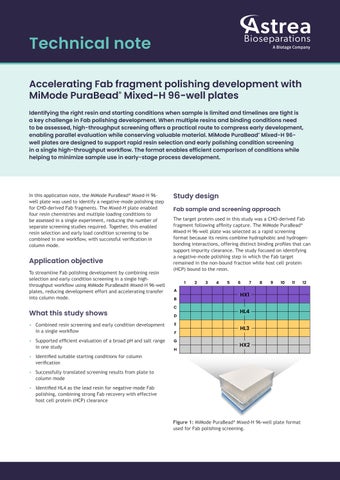
Study design Fab sample and screening approach The target protein used in this study was a CHO-derived Fab fragment following affinity capture. The MiMode PuraBead® Mixed-H 96-well plate was selected as a rapid screening format because its resins combine hydrophobic and hydrogenbonding interactions, offering distinct binding profiles that can support impurity clearance. The study focused on identifying a negative-mode polishing step in which the Fab target remained in the non-bound fraction while host cell protein (HCP) bound to the resin. 1 A B C D
• Combined resin screening and early condition development in a single workflow
E
• Supported efficient evaluation of a broad pH and salt range in one study
G
F H
2
3
4
5
6
7
8
9
10
11
HX1 HL4 HL3 HX2
• Identified suitable starting conditions for column verification • Successfully translated screening results from plate to column mode • Identified HL4 as the lead resin for negative-mode Fab polishing, combining strong Fab recovery with effective host cell protein (HCP) clearance
Figure 1: MiMode PuraBead® Mixed-H 96-well plate format used for Fab polishing screening.
12
Screening design and load conditions
1
To support both resin selection and initial load condition development, a two-factor full factorial design of experiments (DoE) was applied across each resin in the plate. Screening covered pH 5.0–9.0 and NaCl concentrations of 0–200 mM. This enabled structured comparison of binding conditions across the selected design space and supported identification of suitable starting conditions for follow-on evaluation. A citrate bis-tris propane buffer system was used to span the full pH range while minimising any effect of buffer choice on performance. The plate layout and DoE design space are shown in Figure 2.
2
3
4
5
6
7
8
A
HX1
B C
HL4
D E
HL3
F G
HX2
H
Screening workflow and analytics Screening was performed on a high-throughput system (Biomek i7). Loaded samples were incubated for 1 hour at room temperature with shaking at 1100 rpm. The non-bound fraction combined the flowthrough from the load and postload wash steps. Fab recovery was measured by A280, and HCP was measured using a CHO-specific HCP ELISA.
Condition
Buffer
Load 1
20 mM CBTP, pH 5.0
Load 2
20 mM CBTP, 200 mM NaCI, pH 5.0
Load 3
20 mM CBTP, 100 mM NaCI, pH 7.0
Results
Load 4
20 mM CBTP, pH 9.0
Load 5
20 mM CBTP, 200 mM NaCI, pH 9.0
Elution
50 mM citrate, pH 3.0
CIP
0.5 M NaOH
Fab recovery screening Fab non-bound recovery by A280 was low for HX1, HL3, and HX2, with all conditions giving ≤ 40% non-bound recovery (Figure 3). HX1 showed consistently strong Fab binding across the design space, while HL3 and HX2 were more variable. These resins were therefore not suitable for a negative-mode polishing step, helping focus follow-on development on the most promising resin candidate.
Scatterplot 200
HL4 showed variable Fab non-bound recovery across the design space, but all conditions gave ≥ 58% recovery. Condition 1 (0 mM NaCl, pH 5.0) gave > 80% Fab non-bound recovery, making HL4 the clear lead resin for Fab polishing.
Non-bound recovery (%)
80.00 70.00 60.00
3
3
150
NaCl (mM)
90.00
Resin
100
4
50
50.00 40.00 30.00
3
0
20.00 10.00
5
0.00 1
2
3 HX1
4
5
1
2
3
4
5
1
2
HL4
3 HL3
4
5
1
2
3
4
5
HX2
Condition
Figure 3: Fab non-bound recovery (%) across screened resins and load conditions. Error bars show mean ± 1 standard deviation.
3 6
7
8
9
pH Figure 2: Screening layout and load conditions used for Fab fragment polishing evaluation.
HCP clearance in the non-bound fraction was also assessed. Although some HL3 conditions gave higher PPM log clearance than HL4 (Figure 4), the low Fab recovery with HL3 made it unsuitable for negative-mode polishing. HL4 again showed variable performance across the design space, with conditions 1 (0 mM NaCl, pH 5.0), 2 (200 mM NaCl, pH 5.0), and 5 (200 mM NaCl, pH 9.0) each achieving ≥ 0.83 PPM log clearance. Together, these results provided a clearer basis for selecting suitable starting conditions for follow-on development.
1.50
65
1.00
150
70
0.50
NaCl (mM)
HCP clearance screening
Non-bound HCP clearance (PPM log clearance)
Non-bound Recovery (%) 200
0.00
100
1
2
3
4
5
1
HX1
HL4 performance data were modelled to visualize recovery and HCP clearance across the screened design space and identify the most suitable starting conditions for column verification (Figure 5). This approach enabled recovery and HCP clearance to be assessed together, supporting more confident selection of lead conditions. Conditions 1 and 5 both
3
4
5
1
2
HL4
3
4
5
1
2
3
HL3
4
5
HX2
75
-0.50
-1.00
50
Selection of lead conditions
2
Condition
Figure 4: HCP clearance in the Fab non-bound fraction (PPM log clearance) across screened resins and conditions on 80 each resin. Error bars show mean ± 1 standard deviation. 0
5
6
7
8
9
showed high desirability, with condition 1 selected for column pH overall performance. verification based on its slightly stronger
Non-bound HCP clearance (PPM log clearance)
Non-bound Recovery (%) 200
200
65 150
70
NaCl (mM)
NaCl (mM)
150
100
75
0.80 100
0.75 50
50
0.70 0.65
80 0
0 5
6
7
8
9
5
6
200
1
8
9
pH
pH P Number
7
Non-bound HCPConductivity clearance pH (PPM log clearance) 5.000 0.000
Recovery
HCP removal
Desirability
-
82.363
0.837
0.926
Selected
2
9.000
200.000
78.890
0.853
0.893
-
3
9.000
197.343
78.837
0.850
0.886
-
NaCl (mM)
Figure 1505: HL4 performance across the screened design space, showing non-bound recovery (%), HCP clearance (PPM log clearance), and DoE-identified optimized conditions. 0.80 100
Column verification
The results confirmed that the selected HL4 condition (0 mM NaCl, pH 5.0) translated directly into column mode without further optimisation (Figure 6), delivering 90% non-bound recovery and 0.98 PPM log HCP clearance.
90.00
Non-bound recovery (%)
The selected HL4 conditions were verified on a 0.39 mL column. As in the screen, performance was assessed by measuring Fab non-bound recovery by A280 and HCP clearance using a CHO-specific HCP ELISA.
100.00
80.00 70.00 60.00 50.00 40.00 30.00 20.00 10.00
This gives process development teams confidence that the 96-well plate is a reliable foundation for resin selection and early polishing development, rather than only an exploratory screening tool.
Conclusion In this study, the MiMode PuraBead® Mixed-H 96-well plate enabled four resin chemistries to be screened across a broad pH and salt design space to identify suitable starting conditions for negative-mode polishing of a CHO-derived Fab fragment. For this feedstock, HL4 provided the strongest overall balance of Fab non-bound recovery and HCP clearance and was selected for column verification. The selected condition translated successfully to small-scale column mode, delivering 90% non-bound recovery and 0.98 PPM log HCP clearance. While resin performance will depend on the feedstock and impurity profile, the workflow demonstrates how the Mixed-H 96-well plate can accelerate early polishing development by combining resin selection and condition screening in a single, material-efficient experiment.
Non-bound HCP clearance (PPM log clearance)
0.00
Screen
Column
Screen
Column
1.20 1.00 0.80 0.60 0.40 0.20 0.00
Figure 6: Comparison of HL4 performance in plate screening and column mode for non-bound recovery (%) and HCP clearance (PPM log clearance).
For process development teams, this provides a practical starting point for comparing resin options, narrowing the design space, and progressing promising conditions into follow-on optimization and column-based development, while conserving material and reducing experimental burden.
Astrea Bioseparations is a world class provider of chromatography adsorbent and resin services. With over 30 years of chromatography manufacturing expertise, we deliver a unique and trusted service in close partnership with our clients. For more information, please don’t hesitate to reach out at sales@astrea-bio.com or visit astreabioseparations.com. Any data or results provided are only examples and do not provide any guarantee of similar results in future. The products of Astrea Bioseparations may be covered by or for use under one or more patents: astreabioseparations.com/patents All trademarks, trade names, trade dress, product names and logos are the property of Astrea UK Services Ltd or their respective owners. @2026 Astrea Bioseparations Ltd. All rights reserved.