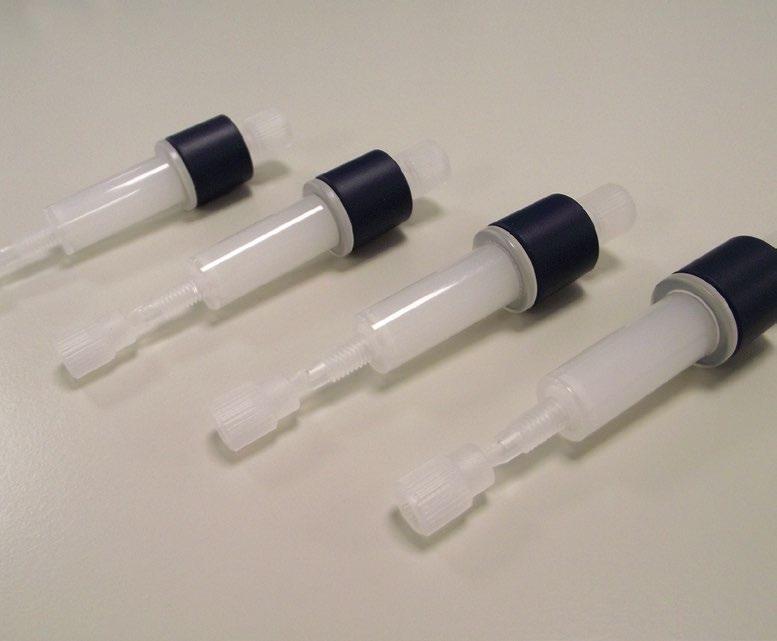
The 1 mL and 5 mL columns kits suppli ed by Astrea Bioseparations are constructed using biocompatible polypropylene. The column kits are comprised of 4 inexpensive, reusable, pre - packed columns, each containing either 1 mL or 5 mL of adsorbent. The column kits allow for rapid, accurate , and cost - effective method development, small - scale purification runs , or as single - use disposable columns for contaminant removal conditions.
This technical user guide is applicable for all 1 mL and 5 mL column kits and is designed to be used in conjunction with the corresponding gel slurry technical user guide supplied. The guide shows how to operate the 1 mL and 5 mL columns using either a chromatography workstation or a syringe.
Note: The accompanying gel slurry technical user guide(s) will provide all the relevant chromatography conditions (i.e., equilibration, wash, elution, clean-in-place, and storage conditions) for the adsorbent(s).
Properties of the 1 mL HT columns:
COLUMN: 1 mL axial flow column (ID: 0.7 cm diameter x 2.5 cm bed height)
COLUMN MATERIAL: Polypropylene
MAXIMUM RECOMMENDED OPERATING PRESSURE (DELTA COLUMN PRESSURE): Not exceeding 5 bar (~72 psi)*
RECOMMENDED OPERATIONAL FLOW RATE: Up to 1 mL/min
OPERATING PH:
PH STABILITY:
CHEMICAL STABILITY:
CLEANING/SANITIZATION:
STORAGE:
*Delta pressure across the column (not the system pressure)
**To minimize the risk of the columns drying out
See accompanying gel slurry technical user guide for specific information
Properties of the 5 mL HT columns:
COLUMN: 5 mL axial flow column (ID: 1.6 cm diameter x 2.5 cm bed height)
COLUMN MATERIAL: Polypropylene
MAXIMUM RECOMMENDED OPERATING PRESSURE (DELTA COLUMN PRESSURE):
Not exceeding 5 bar (~72 psi)*
RECOMMENDED OPERATIONAL FLOW RATE: Up to 5 mL/min
OPERATING PH:
PH STABILITY:
CHEMICAL STABILITY:
CLEANING/SANITIZATION:
STORAGE:
*Delta pressure across the column (not the system pressure)
**To minimize the risk of the columns drying out
See accompanying gel slurry technical user guide for specific information
OPERATING INSTRUCTIONS
1. The preferred option is to use the 1 mL and 5 mL columns with a liquid chromatography system or automated workstation. Note: The column can also be operated manually using a peristaltic pump or even a syringe.
2. Filter all buffers and feedstock through an appropriate filter, prior to running the column.
3. Allow the column, buffers, and sample to reach the operational temperature.
4. Remove the inlet (Top) stopper of the column and attach directly to the liquid chromatography system using a standard 10–32 threaded male for 1/16’’ OD tubing connector, ensuring that the tubing connecting the workstation to the column is primed with equilibration buffer.
5. Snap off the outlet (Bottom) plug of the column and attach to the workstation as in step 4. Note: The reverse of the bottom plug is threaded and can be used as a stopper.
6. Equilibrate each 1 mL or 5 mL column with 10 CV (10 mL or 50 mL respectively) of an appropriate equilibration buffer.
7. Apply the clarified/filtered feedstock at a flow rate of 0.5 mL/min (1 mL columns) or 2.5 mL/min (5 mL column), equivalent to a 2-minute residence time.
8. Remove any non-bound material from 1 mL or 5 mL column with 5–10 CV of the equilibration buffer or until the UV trace returns to baseline.
9. Elute the bound protein using up to 10 CV of an appropriate elution strategy.
10. If required, clean the 1 mL or 5 mL column with 5–10 CV of the recommended clean-inplace solution.
11. Re-equilibrate column with 10 CV of equilibration buffer (to remove sodium hydroxide) and check pH and conductivity of the column eluate is equal to that of the buffer entering the column before storage or re-use.
12. For storage, place the 1 mL or 5 mL column into preservative solution (with up to 10 CV) and disconnect from the chromatography workstation. Connect the end pieces and store appropriately.
Note: The columns cannot be opened or re-packed.
Column Inlet (TOP)
Column Outlet (BOTTOM)
OPERATING INSTRUCTIONS FOR USING A SYRINGE
1. Fill the syringe with binding buffer. Remove the stopper and connect the column to the syringe (using a 1/16” to Luer connector – not supplied) “drop to drop” to avoid introducing air into the column.
2. Remove the snap-off end at the column outlet.
3. Equilibrate the column with 5 column volumes of binding buffer.
4. Apply the pre-treated sample using a syringe fitted to the Luer connector on the column. For optimal results, use a flow rate of 0.2 to 1 mL/min (1 mL column) and 0.5 to 5 mL/min (5 mL column) during sample application*.
5. Wash with 5 to 10 column volumes of binding buffer or until no material appears in the effluent. Maintain a flow rate of 1 to 2 mL/min (1 mL column) and 5 to 10 mL/min (5 mL column) for washing. Optional: Collect the flow-through (in 1 mL fractions for the 1 mL column and 2 mL fractions for the 5 mL column) and reserve until the procedure has been successfully completed. Retain a sample for analysis by SDS-PAGE to measure the efficiency of protein binding to the medium.
6. Elute with 5 to 10 column volumes of elution buffer. Maintain a flow rate of 0.2 to 1.0 mL/min (1 mL column) and 0.5 to 5 mL/min (5 mL column) for elution.
7. After elution, regenerate the column by washing it with 3 to 5 column volumes of binding buffer. The column is now ready for a new purification.
*1 mL/min corresponds to approximately 30 drops/min when using a syringe with a HT 1 mL column; 5 mL/min corresponds to approximately 120 drops/min when using a HT 5 mL column.