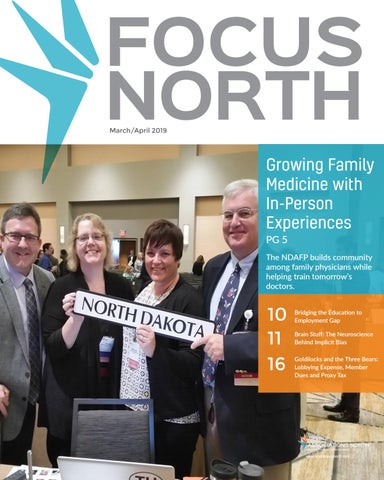
FOCUS NORTH March/April 2019
Growing Family Medicine with In-Person Experiences PG 5
The NDAFP builds community among family physicians while helping train tomorrow’s doctors.
10 11 16
Bridging the Education to Employment Gap Brain Stuff: The Neuroscience Behind Implicit Bias Goldilocks and the Three Bears: Lobbying Expense, Member Dues and Proxy Tax
Published by
www.associationsnorth.com
1
Focus North is published 6 times a year by Associations North, 1970 Oakcrest Avenue, Suite 100, Roseville, MN 55113. Phone: 651.647.6388 Fax: 651.647.6416 Website: www.associationsnorth.com Email: info@associationsnorth.com
5
7
11
17
The opinions expressed herein are those of the authors and do not reflect the opinions of Associations North. Editorial contributors in any area of association management are welcome. Articles accepted for publication are subject to editing by Associations North. Advertising is accepted on a space availability basis. Contact angela@associationsnorth.com or call 651-647-6388 for further advertising information.
Staff Angela Kisskeys, Co-Director VP of Operations & Communications Sarah Ruzek, Co-Director VP of Finance & Education
CONTENTS
Amanda Aldrich Events Manager
March/April 2019
FEATURES
Chris Villeneuve Membership & Office Manager
Family 5 Growing Medicine with
Mission
Leaders: 7 Advancing Fuel For Forward-
In-Person Experiences
To advance and serve the association management profession in Minnesota, North Dakota and South Dakota.
Thinking
Why Essentialism is Key for Small Organizations
The NDAFP builds community among family physicians while helping train tomorrow’s doctors.
Vision
Associations North, our members and their associations will thrive and grow.
8
Diversity & Inclusion
In principle and in practice, Associations North values and seeks diversity and inclusiveness within the association management industry. Associations North advocates for and promotes involvement, innovation, and expanded access to leadership opportunities that maximize engagement across underrepresented groups in the Associations North membership.
Advancing Engagement + Recruitment: Moving Membership
3
Moving Forward Together
4
What’s CO-ing On?
18 Conversations 19 Calendar of Events 20 Brain Power
10
The Power of Inactive Member Research
22 The North Experience Advancing Meetings + Events: In The Details
24 Et Cetera 25 Spotlight: Member in Motion
Bridging the Education to Employment Gap
Advancing 16 Advancing The Essentials: 11 Advancing Diversity & Inclusion: 15 Communications: Stay Connected Invaluable Insights Journey Forward
Brain Stuff: The Neuroscience Behind Implicit Bias
Project Management Apps
Goldilocks and the Three Bears: Lobbying Expense, Member Dues and Proxy Tax
Board of Directors To unplug, I... Mark Salter, CAE, ABC (Chair) CFA Society Minnesota
Sarah Ruzek Associations North
Get outside
Janel Fick Global Management Partners LLC
Cassie Larson, CAE (Past - Chair) Binge watch things on Netflix or Amazon Prime MN Nursery & Landscape Association
Angela Kisskeys Associations North
Get lost in a good show
Amanda Friedrich, CMP Visit Saint Paul
Robbie Thompson (Chair - Elect) Professional Liability Underwriting Society
Justin Bieganek Mercury Creative Group
Clara DeRosier MN Electrical Association
Read a novel or play a round of Toon Blast on my tablet
Sit in the stands at sporting events
David Siegel, CAE, IOM (Secretary / Treasurer) Builders Association of the Twin Cities
Read a great book
Go to a kickboxing class
Go for a walk
Go to the cabin
Play with my kids
Cody Nuernberg Northwestern Lumber Association
I watch golf or recorded reality TV shows
Dave Renner, CAE Minnesota Medical Association
Spend too much time doing crossword puzzles
2
Moving Forward Together: Associations North Partners
YEAR LONG SPONSOR: Arrowwood Resorts
Why we partner with Associations North… Being a part of this organization has provided an opportunity for us to learn through educational sessions and is a great way to continue connecting and building relationships with current and new clients.
What is one memorable moment with Associations North? Hosting the 2016 Leadership Conference at Arrowwood Resort is one of our favorite memories. From serving on the planning commitee, to the connections made and the great speakers, we will always be thankful for the opportunity to host this conference.
PREMIER PARTNERS
ADVANCER SPONSOR
INNOVATOR SPONSORS
ENGAGER SPONSORS
CONNECTOR SPONSORS 3
Fargo-Moorhead CVB | St. James Hotel | Visit Duluth | Visit Greater St. Cloud | Visit Saint Paul
What’s CO-ing On?
When July Becomes January Since becoming Co-Directors in 2017, we have reviewed numerous policies and procedures to guide the association moving forward. In this process, we have done our best to keep an open mind, ask the tough “why” questions and not be afraid of change. Our most recent “why” happened when a board member asked: “why is the fiscal year July – June?” To which we had to stop and think. Because it’s always been that way? It’s written in our bylaws? It would be too difficult to change? This simple question led our board of directors to dig into this more. Would it make sense and create efficiencies to align our fiscal year with our education, sponsorship and advertising calendars? Would we be more fiscally sound and agile to move our fiscal year such that our largest revenue producing event occurs earlier in the year? Would it be worthwhile given the time and expense? All answers came back yes, and we learned it’s quite common to change an organization’s fiscal year. This February, the board of directors approved changing our fiscal year to January – December, starting in 2020. What will this mean for members? Most of the changes will happen behind the scenes and we’ll keep you informed along the way and at Solutions Conference on May 21st. Membership renewal periods will remain the same (July – June) so you will not see any disruption to current cycles. A short six-month budget will bridge the gap until we move into the new (calendar) fiscal year. Additionally, the nominations process will follow the new fiscal year. Watch for details late this summer.
Associations North staff and Board of Directors enjoyed a night in St. Paul cheering on the u MN Wild! Thank yo ul erf nd wo the for conversation and connections.
The lesson: when the pros outweigh the cons and the “whys” become change, embrace it! Speaking of embracing change, we recently attended the second (in a series of three) CEO Strategy Series program with Mary Byers, CAE, and are convinced making time for strategy (at any level) is a game-changer and encourage you and your teams to do the same (on a recurring basis). Another highlight of the program has been the “Hot Seats” and we are excited to pilot a similar format at Solutions Conference for CEO members. Not a CEO, not to worry – workshops on productivity, membership, engagement, meetings and more will provide new strategies and innovations to move your organization forward. We hope to see you there! Shout out to the MN Dental Association who registered their entire team for Solutions Conference! Now that is going to be one fun recap session full of new ideas. We look forward to seeing you there!
Co-Directors, Associations North
Thank you to th ose who particip ated in Associatio Meet & Greet! W ns North Membe e enjoyed getting r to know each of engaging mem you. Cheers to bership and futu an re participation .
4
Growing Family Medicine with In-Person Experiences The NDAFP builds community among family physicians while helping train tomorrow’s doctors. Every physician remembers what their first year of medical school was like: sitting through countless lectures, reading complicated textbooks, and trying to soak in as much information as they can. The experience can even lead students to question their commitment to becoming a doctor and serving patients for the rest of their career. That’s why the North Dakota Academy of Family Physicians (NDAFP) offers these medical students a refreshing opportunity to learn what it’s like to be a family physician in the state. 5
“We do two simple hands-on skills workshops for medical students to try out all the stuff they’re hearing about,” explained NDAFP Executive Director Brandy Jo Frei, who started working for the organization 15 years ago. “They can practice giving some stitches on different types of materials, a joint injection on a mannequin, or even an ultrasound with real patients. The 65 or so participants for each workshop come back with new ideas about their career paths.” The NDAFP also offers a summer externship program where first year medical students have the opportunity to job shadow a practicing family physician in the state and gain practical experience with treating real patients. For students just starting on their journey to becoming a doctor, the externship allows them to see what their life might be like as a family physician in North Dakota. In a time when physicians are stressed and overburdened with recordkeeping, family medicine allows them to establish a strong connection with their patients. Each day brings new experiences and the chance to contribute to the community. A family physician may treat multiple generations of the same family in the course of one week. The NDAFP’s mission is to support these family physicians all the way from medical school to retirement. Although the organization is small, it has a respectable reputation for being simple and focused on the benefits they provide for members.
“What started out as an impromptu get-together 43 years ago between three physician friends has now grown to include 144 attendees from 26 states and other countries this past January.” As with many associations, the NDAFP has been grappling with declining engagement from its members in recent years, although membership itself has remained steady. As older physicians are retiring, younger members are not necessarily stepping in to fill the engagement void. With millennials, in particular, preferring to participate online, the NDAFP has been increasing its efforts to encourage faceto-face conversations and demonstrate the importance of connecting with peers at in-person meetings. To help address this issue, NDAFP recently conducted a financial analysis to determine how to better reach all of its members and provide what they need with only one staff member and a handful of dedicated volunteers.
This past fall, the board of directors decided to slightly increase membership dues for everyone. That additional income will allow all members to attend the annual meeting for free (without any additional registration fees). “This will give us more stable income, encourage the members to come to an in-person meeting for education and networking, and give them the opportunity to interact with medical students and meet residents,” Frei said. “With the financial analysis, we can show that engagement through our events is a huge benefit to them that costs them very little.” In addition to the annual meeting, the NDAFP hosts the Big Sky Conference every January in Big Sky, Montana. It provides educational and networking opportunities for family physicians, as well as a chance to enjoy the crisp Rocky Mountain air. What started out as an impromptu get-together 43 years ago between three physician friends has now grown to include 144 attendees from 26 states and other countries this past January. Since 1950, the NDAFP has been working on behalf of family physicians, medical students, and residents across North Dakota, whether located in larger cities or rural towns. Members can obtain CME credits at NDAFP events to receive the latest education and news and help them offer the best possible care to patients. “I can’t imagine working for a better group of individuals,” Frei said with a smile. “I’m so appreciative of everything the members and volunteers do. The way they treat me is with the same respect and value that they treat their patients.” To learn more about the NDAFP, visit their website at www.ndafp.org. NDAFP is just one of several Associations North member organizations located in North Dakota and South Dakota.
6
Advancing Leaders: Fuel for Forward-Thinking
Why Essentialism is Key for Small Organizations Catherine Iste
Leaders and staff at small organizations are used to wearing multiple hats, doing more with less and other business euphemisms for maximizing resources. However, in order to avoid the burn out, turnover and general stress commonly associated with constantly trying to optimize productivity, leaders should make it a point to embrace essentialism. What is it? Based on Greg McKeown’s book of the same name, essentialism is the disciplined pursuit of less. According to McKeown this means “doing less, but better, so you can make the highest possible contribution.” As association leaders, we already embrace the idea of contribution- for our teams, organizations, members and communities. It makes sense to find a way to ensure we are truly focused on maximizing that practice. We know we cannot successfully be everything to everybody. But practically, we must find a way to draw clear lines between what we could do and what we should do. How? The best way to start is to revisit our organization’s purpose and clearly identify anything we do that does- and does not- directly support the furtherance of that purpose. Everything from annual training events to performance reviews to
7
policies and operating procedures should be put under the microscope of one question: does this activity directly align with our purpose? The idea is not to cut everything out that does not directly support the purpose. Instead, the goal is twofold: to get an honest inventory of all the activities in which we engage; and to understand the way our organizations purpose can be reinforced and supported through even the most routine tasks. For example, one of my association clients had twelve stellar employees who were constantly working more than 40 hours per week. Upon inventorying all of their activities, we found something common among many high-performing, missiondriven organizations: type-A people who embrace the philosophy of an organization focused on something bigger than profit will work themselves to the ground doing the right thing. This is wonderful but not sustainable. So, we looked through the tasks and grouped them into four categories: 1. Basic activity aligned with core purpose; 2. Exceptional activity (a differentiator unique to our organization) aligned with core purpose. 3. Basic activity not or indirectly aligned with core purpose.
4. Exceptional activity not or indirectly aligned with core purpose. Because our goal was to try to capture everything and try to align everything we could with our purpose, everyone felt comfortable sharing their activities. Next steps Once we had our lists, we were surprised how easy it was to cut out a number of activities like certain standing meetings, status reports, and many calls/ visits that were either duplicative or non-productive. We were also able to streamline others. For example, when we discussed expectations around response time, communication preferences and priorities, we were able to decrease the amount of time spent on email, conference calls and in-person meetings and the amount of time spent on communications and work outside of normal business hours.
“Essentialism is the disciplined pursuit of less.” We then looked for ways to reinforce our core purpose in our procedures, policies and daily tasks. For example, we rewrote our performance evaluations to reflect and reward organization priorities; aligned work hours with service expectations; and refocused the budget to better support activities directly related to organization success. The bottom line is by giving our stellar staff the opportunity to collaborate to align activities with the organization’s purpose, we reinforce from the inside out, our commitment to our members and our community while creating sustainable productivity.
Advancing Engagement + Recruitment: Moving Membership
The Power of Inactive Member Research Dawn Wagenaar, Ingenuity Marketing Group, LLC
We recently worked with an association on member research that included a component of inactive member interviews. We were listening for a few things: what made them inactive, what did they value about membership, and what could the association improve to meet their needs?
• Business or professional results through membership • Relative view of fees or dues • Similar organizations and how your association compares
Here are ways to use your data: Inactive or lost members are not always within the association’s control. Attrition happens through life or professional changes for members as well as the natural evolution of the association. But it’s important to understand these reasons in the context of the association’s overall brand perception. Inactive members can be a short-term issue or a symptom of larger service or mission concerns.
• Improve communications or service • Create member value points • Change programming or advocacy • Change the website • Promote positive stats about member value • Campaign to strengthen member engagement • Discuss programming, governance, development and other member interests
To support outreach and feedback from inactive members, here are some techniques to consider:
• Phone interviews get more qualitative feedback than an electronic survey. • A third-party interview process can be less intimidating and more revealing than interviews conducted by association staff. • Make sure that questions relate to the association’s perceived values or competitive strengths to gauge member perceptions. • Keep the interview time reasonable, shorter for electronic surveys. • Let participants know how the data will be used and that individual comments will remain confidential. • Be gracious if inactive or lapsed members don’t want to participate. • Thank participants for their time and honest feedback.
Here are things to listen for in the interviews:
• Participant relationships with other members • Participant relationships with staff or service issues • True experience at events or with specific resources • Value of information shared • Value of advocacy • Business or professional credibility through membership
“A big reason for member inactivity is lack of personalized outreach. An inactive member survey and follow-up can support rebuilding the relationship.” For the majority of inactive members we interviewed, they cited a shift in the association’s educational focus that felt less relevant to them. But they also admitted that they had less time for networking or attending conferences than they used to have, which led to the association’s ideas about more online programming. Inactive member feedback also confirmed that the association’s approach to communications and advocacy was excellent. Don’t let inactive or lapsed members slip away. Give them the opportunity to express what they love and also what they need. They represent a great barometer for the health of your organization. Their views will help you pivot, if necessary, to match market demands.
8
Technology that connects. Learn more at YourMembership.com
9
Advancing Meetings + Events: In The Details
Bridging the Education to Employment Gap Elizabeth Weaver Engel, MA, CAE, Spark Consulting
A crisis is brewing in the global education-to-employment system and it is reaching an inflection point in the United States and in the international sphere. Educators, employers, students, and their families are caught in a complex web of challenges. Higher education is experiencing massive disruption. Americans currently hold over $1.23 trillion dollars (and growing) in student debt, nearly the same amount as total mortgage debt just prior to the housing market crash of 2007-2008. Public funding for education is decreasing at both the K-12 and post-secondary levels. Students and educators disagree about what a college education is supposed to accomplish, the value of a four-year degree, and whether or not college is properly preparing young people for the workforce. At the same time, one-third of employers report struggling to find qualified workers. The Georgetown University Center for Education and the Workforce estimates that, by 2020, over 20 million jobs in the US will be unfilled because Americans lack the necessary preparation. Employers report a substantial skills gap, particularly among new hires, whether they are recent graduates or workers who are retraining for new careers. While there is nearly universal agreement on what those vital skills are - critical thinking, problem solving, oral and written communications,
teamwork, ethical conduct, decisionmaking, the ability to apply knowledge – employers and recent graduates disagree sharply on how well-prepared new hires are to exercise those skills in real workplace situations. In short, there is a significant and growing gap between education and employment. In our recently released whitepaper, The Association Role in the New Education Paradigm, Shelly Alcorn (Alcorn Associates Management Consulting) and I review the substantial body of research on the changes occurring in both education and employment and argue that associations are uniquely suited to bridging that growing education-toemployment gap. There is a symbiotic relationship between education (acquisition of knowledge and skills), employment (meaningful, productive, economicallyrewarded activity) and living a “good life” (conducting an ethical, spiritually rewarding existence as both an individual and as a member of a larger community). Our research demonstrates that, while the current educational system may have been sufficient to prepare people for life in the 19th and 20th centuries, it is not adequate to provide the 21st century skills, like those mentioned above, that are necessary to be an educated citizen employed in meaningful work and engaged in the life of one’s community.
We believe associations hold many of the keys to unlocking both workforce skills and human potential, such as: • Direct connection to and relationship with employers in our relative sectors • Experience with certification and credentialing • Speed and flexibility, at least in comparison to hidebound higher education • Experience with non-traditional students and educational settings
“The Georgetown University Center for Education and the Workforce estimates that, by 2020, over 20 million jobs in the US will be unfilled because Americans lack the necessary preparation. ” Associations currently represent every industry and profession, and will continue to do so for new professions that are emerging. For every association that disappears in the next decade because the profession vanishes due to automation, others will arise to address the professional needs of thousands of individuals employed in professions that don’t exist yet. We need to collectively rethink our current and potential roles within the education-to-employment system. We represent both employers who are continually frustrated by the lack of talent they routinely encounter and workers who are concerned about the real impact the Fourth Industrial Revolution is about to have on their skill sets and livelihoods. These are real problems that we can solve. All systems can be hacked if you know where to apply the pressure. Who better to do it than associations?
10
Advancing Diversity & Inclusion: Journey Forward
Brain Stuff: The Neuroscience Behind Implicit Bias Amy Tolbert, ECCO International
2020 Diversity & Inclusion Leadership Program details coming this fall: associationsnorth.com/andi
No one really starts out the day saying, “I’m going to show my bias today.” Yet, that is the result…we all have unconscious bias. It may seem frustrating that there is no way to understand or control your unconscious. No need to worry: the past few decades of neuroscience and behavioral research have provided immense information explaining the why and how behind unconscious bias.
the brain that forms links between memories and quickly deciphers the meaning of data received. Because the hippocampus matches new, incoming information with subjective memories, data can be matched to make someone believe their understanding of the data is ‘correct’ when it is simply being unknowingly related to one’s own subjective memory or experience.
What is Unconscious Bias? How is it Created? Implicit, or unconscious bias, is a subtle cognitive process that starts in the amygdala. This type of bias can be understood as a form of rapid ‘social categorization,’ whereby we routinely and rapidly sort people into groups.
Attack of the Mindbugs We understand how information moves through the brain and can be affected unconsciously by biases and, while it is based in the brain, there are ways to understand unconscious bias outside of the geography of the brain. One term used by Blindspot: Hidden Biases of Good People author Anthony G. Greenwald, is mindbugs. A mindbug is an ingrained habit of thought that leads to errors in how we perceive, remember, reason and make decisions.
The brain, through the amygdala, processes billions of stimuli per day and our brains must quickly choose what to focus on. This information is used for survival, to make inferences or categorize, and feel emotions that attract us to certain people. Because the amygdala must process billions of stimuli, our conscious brain does not have the opportunity to interpret all that we see. As time passes, a person’s socialization and personal memories produces unconscious biases and applies them as the amygdala defines incoming stimuli efficiently and unconsciously. It is common for these lower level of unconscious survival responses to be like those with whom you are in extended contact. Other people are rapidly categorized as ‘like me’ and ‘not like me.’
“ A mindbug is an ingrained habit of thought that leads to errors in how we perceive, remember, reason and make decisions.”
11 1
The amygdala is where the information is processed; however other parts of the brain are involved in the pervasion of implicit bias. Such information goes through the hippocampus as well. The hippocampus is the part of
“A father and his son are in a car accident. The father dies at the scene and the son, badly injured, is rushed to the hospital. In the operating room, the surgeon looks at the boy and says, “I can’t operate on this boy. He is my son.” How can his be? If your immediate reaction is puzzlement, that’s because automatic mental associations caused you to think ‘male’ on reading ‘surgeon’.” - Anthony G. Greenwald It is important to be mindful of social mindbugs as they can wrongly attribute trustworthiness to those who may not deserve it, as well as wrongly attributing suspicion upon others. Social mindbugs show up in many forms, based on one’s revised memory, as well as physical stereotypes based on race/ ethnicity, age, or gender. Therefore, it is important to break down the various types of biases that can show up and affect the workplace. • Project Implicit: https://bit.ly/1m808ph • Overcoming Implicit Bias and Racial Anxiety, Psychology Today: https://bit.ly/2sIi9H4
Additional Resources
INSIGHTS S U M M I T 4.18.19
UNCOVER AIRTIGHT SALES, MARKETING & MEMBERSHIP STRATEGIES Discover secrets you never thought possible for uncovering opportunities, understanding decision makers and taking advantage of large-scale marketing on a smaller-scale budget. Plus, crack the code on member engagement. SUMMIT HIGHLIGHTS: • Speed Networking • Every Yes Begins with a Know • Getting Past Marketing Buzzwords to Close the Deal • Member Engagement Strategy: Harnessing Your Volunteer Program
FEATURED SPEAKERS
Kate Madonna-Hindes
Sam Richter
Peggy Hoffman
Thursday, April 18 Radisson Hotel Minneapolis/St. Paul North, Roseville 8:30 am - 3:30 pm Details & Register: associationsnorth.com/insights 12
SPONSORED CONTENT
Community Insights
Kahler Hospitality Group is Dedicated to Executing Perfect Client Events Kahler Hospitality Group’s $30 million renovation project is already underway in Rochester, MN! Every room in the building will be upgraded to continue to provide top-notch service to all. The project will allow KHG to continue its dedication to helping clients execute the perfect event.
Inspire, connect and celebrate in close to 50,000 square feet of meeting and event space in Rochester, MN. Whether you are planning a large conference for 800 guests, an intimate dinner party, or an elegant reception, Kahler hotels offer flexible venues for business and social events, weddings, and family gatherings.
The Kahler Hospitality Group is dedicated to making your visit to Rochester, MN a comfortable and pleasant experience. Connected to the Mayo Clinic by pedestrian skyways and underground walkways, our six hotels offer inviting accommodations, vibrant dining experiences, and outstanding hospitality so you have everything you need. Here are some great tips for increasing attendance at your next event from meeting experts at the Kahler Hospitality Group: 1. Do the hard work for your attendees. Thanks, at least in part, to Amazon’s one-click buying feature the bulk of us have begun seeking out processes that require the least amount of clicks. Want me to buy that sweater from you instead of a competitor? Get it to me in one or two clicks! The same philosophy can be applied to your potential attendees. You’re 13 more likely to rack up attendees at a
faster pace if you provide direct links to register or book their accommodations. Kahler Hospitality has pre-built templates that we can customize for your event to provide efficient and informative e-post cards to your potential attendees. 2. Sell your destination!
won’t maximize your attendance. A minimum of three communications is a good goal in the months or weeks leading up to your cutoff date.
Don’t just list the details of your event on your website. Give your potential attendees the run down on what they can expect when they visit the fantastic city you’ve selected as host!
This way, when you send the final reminder as clock winds down, your attendees won’t have to refresh their memory about your event, they can just register before it’s too late!
When you book your events with Kahler, we’ll provide images, banners and videos you can use to show your attendees what a great time they’ll have when they come to Rochester.
As part of our partnership with you, Kahler’s marketing team will help you craft email blasts to stay top of mind with your potential attendees.
3. Follow Up! A sure-fire way to increase attendance is to remind your audience about your event. Sending an announcement with direct links to get registered is a great way to start but a single touch-point
From beginning to end, the Kahler Hospitality Group team will be there to ensure that your next event in downtown Rochester is a perfect 10 experience both for you and your attendees. Rochester is the proud host of Associations North 2019 Leadership Conference, October 6-8!
14
Advancing Communications: Stay Connected
Project Management Apps Anne Lacher, Association Development Services
Association management is a lot like juggling. You have membership projects, marketing projects, financial goals, and so on. How do you keep them all in the air at the same time without dropping a ball? Ask any association staff member, and they can name a project that’s fallen off the radar. Formal project management is vital to keeping all your projects moving forward. There is now a plethora of web-based project management solutions available in recognition of this need. Choosing and implementing a project management system may feel daunting. But, depending on the level of integration and interaction you plan to maintain, you have options. From a simple task tracking system, to a more robust and involved app, there are enough iterations of project management apps to fit any association’s needs. And, all of them have ‘levels’ of features, so you can start small and grow into your chosen app as you become more familiar and engaged. A few benefits you’ll notice once you’ve successfully implemented a project management app include easier collaboration and delegation of tasks, progress reporting and deadline tracking, accountability, and quality control.
$$
To save money while buying a project management tool, you need to remember that not every project needs project management. What matters is not whether the software has a ton of functionalities, but whether they are of use to you. - Software Advice
The main beneficial functions in project management apps are task tracking and team collaboration.
15
Tasks: Tasks provide easy visualization – for the individual and for teams – of what needs to be done today, tomorrow, next week, and beyond. Often, these are available in both
“Once you’ve successfully implemented a project management app benefits include: easier collaboration and delegation of tasks, progress reporting and deadline tracking, accountability, and quality control. list form and in calendar view, and they can be set to recurring for daily, weekly, or even yearly tasks. You can assign tasks to other staff members, add automatic reminders, and set up completion notifications for projects that are dependent on other tasks. If you are particularly interested in staying on task and keeping infrequent tasks on the radar, programs like Asana and Wrike are very intuitive in this area. Collaboration: In addition to delegation and alerts, collaboration within a project management app can be incredibly involved. Many apps allow the attachment of documents for others to view/edit, incorporate a comments section to keep the whole team up to date, and provide an activity log so you can see who, what, and when changes are made – this is especially useful for gaining insight on who is busy and who is not, by user and by project. A program like SmartSheets allows staff to work concurrently on projects through a spreadsheet or grid style framework. Create a ‘Sheet’ for each area of the association or for each project; all columns and settings in a grid are fully customizable for your project. Share your Sheet with staff and leadership to begin collaboration, set alerts and triggers for automated actions, and send specific rows and reports directly from your Sheet. The full spectrum of features and functionality will vary from app to app, as will the user-friendliness of each feature. Most web-based project management solutions will allow you to join at a free level, so you can get a feel for the user experience with reduced features before upgrading for more features and higher functionality at a paid level. I would recommend trying out two or three different apps to find the best fit for your association.
Advancing The Essentials: Invaluable Insights
Goldilocks and the Three Bears: Lobbying Expense, Member Dues and Proxy Tax Russell F. Nelson, CPA and Stephen Usery, MBA
And what, you may ask, does Golidlocks have to do with lobbying expense, member dues and Proxy Tax? Quite simply this: when it comes to these three bears of tax time, it is important that you compute things “just right” – not too high, not too low and clearly in line with IRS guidelines. First, let’s review the basics. The portion of member dues spent on activities which meet the IRS definition of lobbying cannot be deducted as a business expense by members. Associations can either 1) At the time dues are paid, notify members of the percent of dues expected to be spent on lobbying or 2) Choose to pay something called Proxy Tax on the amount spent for lobbying during the year. Since Proxy Tax is computed based on the highest corporate tax rate in effect at the time, proper notification to members regarding lobbying expense is frequently the preferred option.
“Properly computing lobbying expense is critical to either disclosing to members the percent of dues used for lobbying or determining the amount of Proxy Tax to be paid by your organization.”
Regardless of whether you choose to notify members or pay the Proxy Tax, it is critical that you properly compute the amount of lobbying expense per the IRS definition. If you don’t fully understand how the IRS defines lobbying, you could easily over or under report lobbying expense. We’ll touch on the current IRS definitions here, but you should always consult with your tax advisor to determine the proper treatment for your specific circumstances. Per the IRS, lobbying expenditures are those (including allocable overhead and administrative costs) paid or incurred for the purpose of attempting to influence legislation: • Through communication with any member or employee of a legislative or similar body, or with any government official or employee who may participate in the formulation of the legislation • By attempting to affect the opinions of the general public. The IRS further distinguishes between direct lobbying and grassroots lobbying and, in the instructions for Schedule C of Form 990, provides surprisingly clear and straightforward definitions of each. You might be thinking, “I don’t have to worry about that. I hire a lobbying firm and whatever I pay them is the amount I report for lobbying expense.” However, many things that a lobbying
firm might do for you will NOT fall under the IRS definition. Monitoring what is happening in the legislature, briefing you on current or potential legislation, answering questions from you or your members about how to interpret legislation – none of that would count as lobbying expense under the IRS definition. To avoid over reporting lobbying expense (costing your members a tax deduction or forcing you to pay more Proxy Tax), ask your lobbying firm to provide you a detailed accounting of the time they spend and specifically identify the time spent on things that meet the IRS definition. On the flip side, make sure you don’t under report lobbying expenses. You must include the value of your own time and that of your staff, as well as allocable overhead and administrative costs, tied to activities that meet the IRS definition of lobbying. The IRS provides several alternate methods for allocating costs, and your tax advisor can help you determine which is best for your organization. Properly computing lobbying expense is critical to either disclosing to members the percent of dues used for lobbying or determining the amount of Proxy Tax to be paid by your organization. Consult with your legal and tax advisors to make certain you don’t pay too much, don’t pay too little, but, like Golidlocks, get it just right. 16
glberg.com
Call Toll Free (888) 654-6901
Deacon’s Lodge Golf Course
Breezy Point Resort provides flexible meeting and event space, healthy cuisine, professional staff, and free wireless. Let us build a custom meeting package for you! 2016 Best Hotel with Meeting/Event Space - MN Meetings & Events Magazine
(800) 432.3777 17
www.breezypointresort.com
Conversations: In Focus | Different view points. Different solutions.
What energizes you at work?
Darlyne Erickson, CAE Owner The Sapphyre Group
I get excited about developing unique programs for our members. Recent examples are creating a multiple employer 410(k) plan and a business insurance program. Boring to some people, but it energizes me!
Libbie Krueger Chapuran Grassroots & Political Advocacy Manager LeadingAge Minnesota
A positive work culture! Being around others who are positive, have a growth mindset, and passionate is the most energizing part about work for me. That, and snacks. And also getting out of the office to walk and reflect.... but mostly snacks!
Getting things off my desk in a timely manner and knowing that I’ve accomplished what I set out to do in a reasonable amount of time or walking out of a successful conference, convention or meeting and knowing it was amazing!
Andrew Aho Vice President, New Business Development Industrial Fabrics Association International (IFAI)
Results! I am energized at work when our advocacy delivers measurable results for our members that allow them to better fulfill their mission and values.
Rachel Dillion Program & Operations Manager Minnesota Elementary School Principals’ Association
18
Calendar Of Events: Mark It + Make It For more details and to register, visit: www.associationsnorth.com/calendar
18
THURSDAY APRIL
18
9
THURSDAY APRIL
THURSDAY MAY
Webinar: Plan It, Stage It, Sell It. Stay on Message As You Step to the Podium At Your Desk 12:30 pm - 1:30 pm
Insights Summit Radisson Hotel Minneapolis/ St. Paul North 8:30 am - 3:30 pm
Webinar: Go from Worrier to Warrior. Practical and Fun Stress Reduction At Your Desk 12:30 pm - 1:30 pm
What do the YMCA, West Point, NASA and your Association have in common? Their leaders are very comfortable with the key talking points for the organization. Their message is relevant, simple and memorable. Approach your next presentation a chance to persuade- no wait- to sell your association.
Gain insight from industry thought-leaders and uncover airtight sales, marketing and member engagement strategies. NEW! Speed Networking: take traditional face-to-face networking to the next level with advanced matching software that will generate personalized connections!
Stress affects memory, cognitive function, decision-making, ability to take responsibility for our actions and risk taking. It is imperative that we recognize that stress is not the problem - it’s our reaction to our stress and we can learn to control it.
Upcoming Events April
May
2
Webinar: The Impact of New Global Data Privacy Regulations
9
11
Communications Meetup Group
Reduction
12
CEO Meetup Group
20
Associations North Diversity & Inclusion Program:
17
Meetings Meetup Group
Executive Presence - LAB on Skills
18
Insights Summit
21
Solutions Conference with Annual Meeting & Expo
28
Membership Meetup Group
20 30
Associations North Diversity & Inclusion Program (ANDI): Communications - Presenting & Writing
19
CEO Strategy Series: Leadership Development
Member Visits
June 6
29
Webinar: Go from Worrier to Warrior. Practical and Fun Stress
Golf Classic, Prestwick Golf Club
18
Advocacy Meetup Group
18
Webinar: Using Digital Analytics to Drive Your Association
July 25
Associations North Diversity & Inclusion Program:
Conflict as a Productive Tool and Change Management
31
Meetings Meetup Group
BRAIN POWER A CEO’s Wishlist for Association Staff By: Octavio Peralta, AssociationSuccess.org
An organization is only as good as its people. This is also true for associations, who not only employ staff, but also attract volunteers to promote its work and advocacies. As a chief executive of an association, I embody the aspirations of my staff and volunteers. I label these aspirations through an acronym, “IF U CARE”, and here is what it stands for:
I
“I” is for initiative. Having initiative is doing one’s work beyond the call of duty, in fact, working extra without being told or asked to. The aim is to constantly improve on the status quo. Initiative also equates to resourcefulness that spawns innovation within the organization.
F
“F” is for feedback. It is difficult to manage an organization without a feedback culture, which refers to the staff’s conscious effort to let their supervisor know the status of their assigned job. This communication channel allows for better interaction and engagement among everyone in the workplace.
U
“U” is for utility of ideas. Creativity and invention are the ultimate results of the sharing of ideas in the workplace. I aspire for each staff member to be open and ready to offer new and fresh ideas to improve productivity and excellence in service, especially in the case of associations where service is paramount to its very existence.
C
“C” is for concentration. Focus on the organization’s vision and mission and concentrate on how to fulfill them. Without persistence and passion to deliver results, your association will be a ship that wanders aimlessly in the ocean of uncertainty. Doing one’s job with the goal of continuous improvement is a “must” behavior of a staff.
A
“A” is for accountability. Accountability means being responsive to the tasks at hand and being sensitive to the implications that may occur in their performance. Being accountable, however, does not mean suffering from consequences of their actions, but to be aware that it is always better to prevent a miscue before it happens.
R
“R” is for reliability. Being there when needed and being able to lend a helping hand always is what reliability connotes. The essence of timeliness and orderliness also comes to mind. When you have no sense of time and order, you cannot fulfill what is expected of you at very crucial moments of the organization’s day-to-day operation.
E
“E” is for ethical behavior. Habit builds character and character builds ethical behavior. As they say, you cannot put a good person down. Such is the case in organizations made up of people. Ethics is one’s passport to credibility, and credibility is the association’s asset for sustainability.
20
TA K E
Te a m Building TO THE NEXT LEVEL
OUR TEAM of experts is ready to help. Ask about our Event Assistance Fund today. Contact meetings@mplsnw.com
MINNEAPOLISNORTHWEST.COM BROOKLYN CENTER | BROOKLYN PARK | MAPLE GROVE
#WELOVEMNW
21
EXPANDED EDUCATION, DEEPER LEARNING AND ENHANCED TRADE SHOW AWAIT YOU... at the 2019 Solutions Conference with Annual Meeting & Expo Tuesday, May 21 at the Hyatt Regency Minneapolis By attending this conference, you’ll walk away with the ideal mix of connections, inspiration and solutions you’ve come to expect. We encourage you to attend and bring key members of your team as you join 225+ other association professionals to discover new strategies and innovations to move your organization forward.
NEW THIS YEAR FOR CEOS AND EXECUTIVE LEADERS:
• Talk Triggers: Strategies for Accelerating Association Growth • CEO Strategy Seats • Mind Dash Conversations on strategy, innovation, doing more with less and pain points (during Solutions Trade Show) • Lead Your Association’s Evolution
DESIGNED FOR ASSOCIATION PROFESSIONALS:
• Work Like You Own It! • Managing Me - How to use lean thinking to improve your personal productivity • Designing the Future State for Your Learning and Conference Strategies • Fire Up Attendees & Keep Them Talking • Accelerate Engagement • 30 Quick and Practical Ideas for Associations to Spark Action • And more!
Plus, bring an RFP to the Solutions Trade Show (multiple copies recommended) for upcoming needs, such as meeting venues, marketing, speakers, etc. for your chance to win $250 cash (each RFP presented to an exhibitor = one entry). For details and to register your team, visit:
associationsnorth.com/solutions
22
EVENT PLANNERS. We get you. You have a lot on your plate. We’ll help you clear it.
rivercentre.org
23
Et Cetera: Association Extras
WELCOME, NEW MEMBERS! Kelly Bieniek
The Harrington Company
Joshua Clark
Great Wolf Lodge - Minnesota
Dustin Dalbey
Delta Hotel Minneapolis Northeast
Cheryl Dalby
MN State Bar Association
Megan Flanagan
The Harrington Company
Tina Gassman
The Harrington Company
Kim Gilsrud
The Harrington Company
Tim Gross
MN Petroleum Marketers Assn.
Andrea Hendricks
Bethel University
Jennifer Howard
The Harrington Company
Carissa Kemp
MN Dental Association
Jim Kendzel
American Supply Association
Michelle Kvasnik
Creative Resources
Issa Moe
ACA International
Tim Oxborough
Sugar Lake Lodge
Kelly Palmer
Sheraton Duluth
Jackie Qualle
ACA International
Stephen Usery
Leadership Advisors, LLC
Jodi Wegge
Ruttger’s Bay lake Lodge
Ben Wogsland
Hospitality MN
PRE-ORDER YOUR 2019 COMPENSATION & BENEFITS STUDY The 2019 Compensation & Benefits Study is set to be released in May. Pre-order your copy and be the first to have access to data and trends from over 85 Midwest associations and over 1,100 organizations nationally. Pre-order your digital copy at: associationsnorth.com/salary.
NEW! SAMPLES & TEMPLATES RESOURCE Associations North has collected over 120 sample policies, procedures and other templates relating to various association management topics to help save you time and serve as a resource for member. Search by Advocacy & Public Policy, Communications, Financial, Human Resources, Membership, Board & Governance, Diversity & Inclusion, General Operations, Meetings and Volunteer Management. Check it out at: associationsnorth.com/samples.
SAVE 25% OFF ON JOB POSTINGS Visit Associations North Career Center for sample job descriptions, salary information, ask an expert and other career resources. Plus, you can post your job listings and search over 2,500 resumes. Associations North Career Center is the place to Hire and Be Hired. Members use code: MBR2019 for 25% off your job posting. Visit the Career Center at: associationsnorth.com/career.
24
SPOTLIGHT: MEMBER IN MOTION Get to know industry movers and shakers.
Nichol Beckstrand President MN Multi Housing Association
Words to live by... What is something you like doing the old-fashioned way?
Be still.
Making lists (with pen and paper).
What is something you think everyone should do at least once in their lives?
What is the best purchase you have ever made? My Tattoos. They are all reflective of meaningful events in my life and remind me every day to be present.
Go on Sabatical. Take three months off and unplug with your kids or spouse.
How do you recharge and relax? What gets you out of bed every day?
Go for a bike ride, get a massage or drink a glass of wine.
Your biggest pet peeve with modern technology... Taking the time to learn how to use it. Setting up all your preferences again.
25
My passion for working with people to solve problems or at least see them from a different perspective in order to create alternative solutions.
It’s not about being the best golfer, it’s about having fun, making connections and playing a great course!
Golf One of the Twin Cities Premier Golf Courses
Thursday, June 6, 2019 Prestwick Golf Club, Woodbury
Details & Sponsorship Information: associationsnorth.com/golf
26
*BARCODE ENDORSEMENTLINE FIRSTNAME LASTNAME BUSINESS ADDRESSLINE 1 ADDRESSLINE 2 CITY, STATE ZIP
WN NTOMIDW W D O RT S T ILY PO DE A M Y A IR CE S S I CE A F P A AC MS E W D N RE CE E GAT TOWN FOO ONFES Z N E E I F C N I L W IB ER D L ITIE TY EXP WIL ILY DO CESS XIMI AC TIV TEWA T I IS AC PRO AN E GA D NI NG M E A V PPI FA LIS Y F RIC SHO T MSPE APO T CIT E Y CL ILDLI E FOO IT Y C E L N A M W R T L BL OXIM VITI A SO PO INN NIE VA I G S F N S I E EA PPI CE Y PR C T W L L O NE A IR S S M N V M A N MINVISIT SINE TS CO INS IK SHOLIS AC T CIT E AN ALY DOPO N I TIO NGTO RIC AIES BU R AN L S T WESOTAE APO ENIENE Y CL FA M Y AIR A CA E LO OOMI F A M N CIT ESTAUHOTEMINNMINN ONV VALL E MSP TEWA OO V A BL LL O T WI SP R ING TON ESS NTS C IKE A IENC E GA IES Z OLIS L M A RIE T Y UL M PARK ING USIN UR A WINS XPER LDLIF TIVIT E AP A WI VA AUTIF RE AT LOOMIES B ESTA L S T SIT E G WI N AC MINNERIC TOW BE IP G N B N CIT DLY R HOTE A VI PPIN CLE A TON F A M WN N A STRC ATIO T WI RIEN ING ERIC SHO LLE Y MING LL O LY DOST FUTO LO RIE T Y UL F PARK F A M SOTA A VA LOO G M A FA MI IDWE WN E VA AUTIF RE AT ALL O INNE S IKE ESS B PPIN MSP N M LY DOSSIBL BE IP G N M ON M T WIN USIN SHO NCE NGTO FA MI CCE IT Y PR STRC ATIOINGT TEL S IES B SOTAPERIE OMI MSP LIS ANT C TION LO OOM G HO N CIT INNE IT EX BLO NCE E APO ENIE VAC A ILD BL RKIN T WI ON M A VIS SOTAPERIEMINN ONV ZOO NG W SIB PA RIE T Y INGT ERIC INNE IT EX ESS NTS C TIES OPPI CCESIT Y VA OOM F A M ON M A VIS USIN UR A C TIVI A SH LIS A NT C IT BL LL O INGT ERIC IES B ESTA L S A ESOT E APO ENIE C TIV M AOOM F A M N CIT DLY R HOTEMINN INN ONV AN A BL LL O T WI RIEN ING TON ESS MNTS CY CLE M A RIE T Y UL F PARK ING USIN UR A ALLE VA AUTIF RE AT LOOMIES B ESTA L S V BE IP G N B N CIT DLY R HOTE STRC ATIO T WI RIEN ING LO RIE T Y UL F PARK VA AUTIF RE AT B E IP G S TR
MORE CHOICES TO STAY. MORE SPACE FOR ASSOCIATION GROUPS.
With over 42 hotels, six new properties, and 9,200 guest rooms, Bloomington is home to the largest concentration of hotels in Minnesota. That means there’s always room for groups to stay, meet and work. And the Mall of America® serves as a dynamic backdrop and instant entertainment complex for evening outings that everyone can enjoy. Explore Bloomington and book your association group at tcook@bloomingtonmn.org