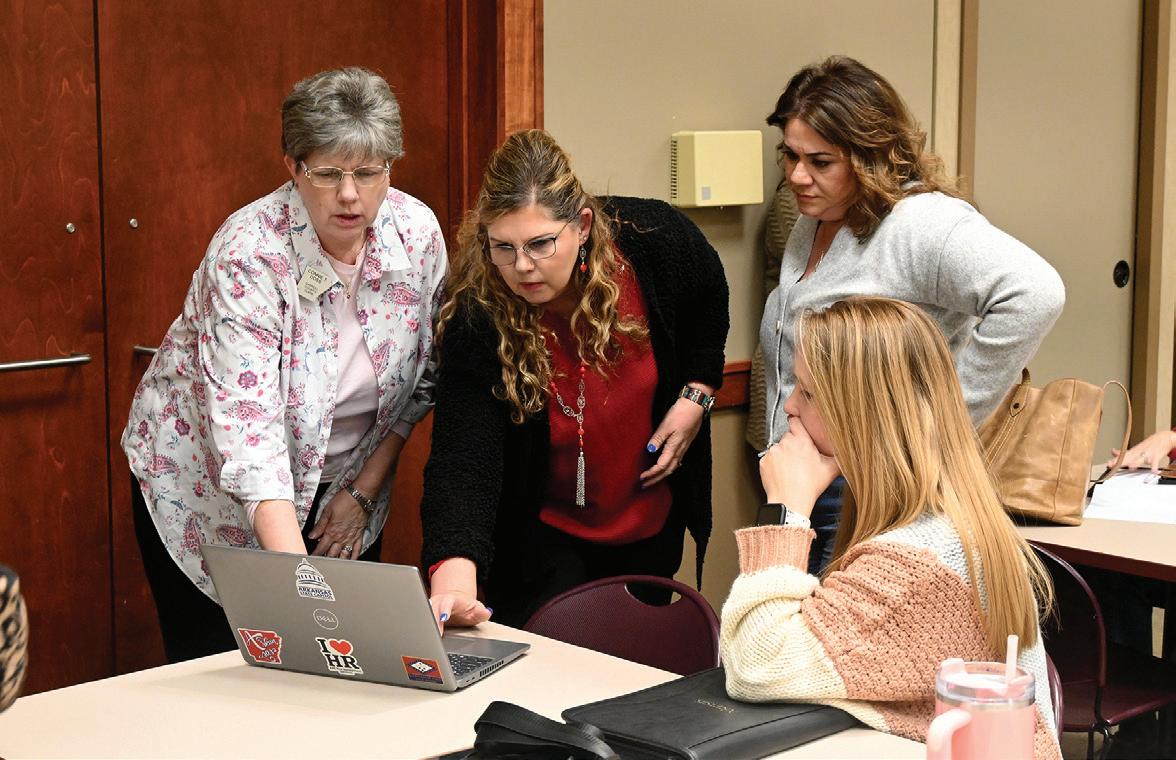
Office specific extensions tailored to your day-to-day business needs. Map parcels, address points, roads, pavement issues, voters, and so much more!
USER FRIENDLY INTEGRATION
Easily create, edit, and export items at anytime from anywhere. The site is mobile-friendly and backed by our unparalleled customer support team.
Real-time access to the local, state, and federal data sources you need to make informed decisions. Bringing everyone and everything together.
ROADS LEAD TO STRONGER COMMUNITY.
A community’s roads connect us to jobs, healthcare, daily essentials, friends and family — and home. Ergon is proud to provide the materials and support needed to help build and maintain safe roadways across America, connecting us all to what matters most.
Issue
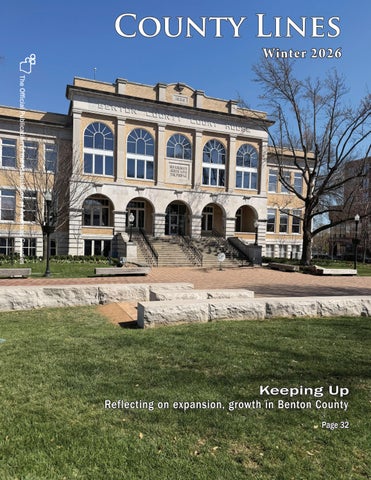
Cover Notes: Keeping Up
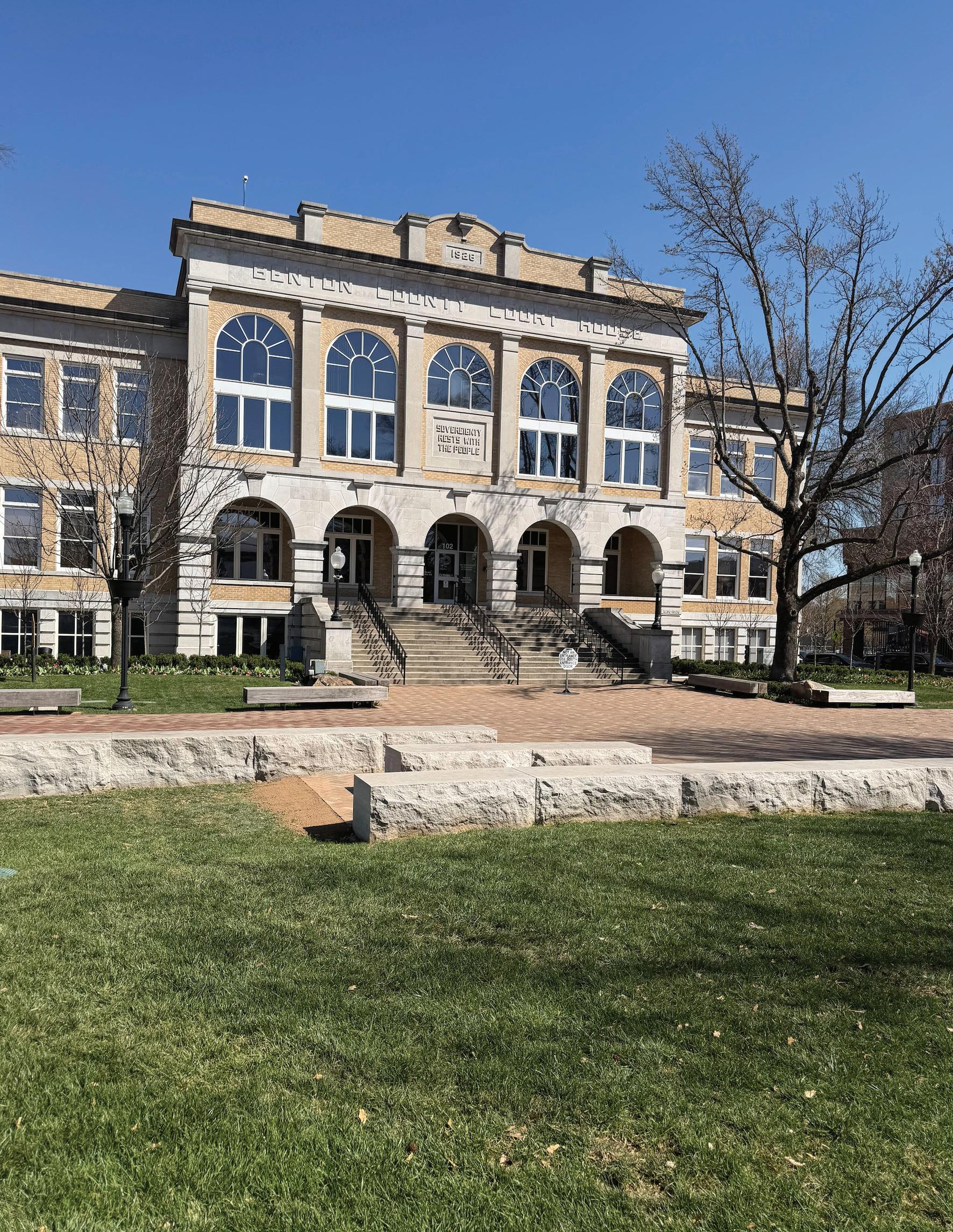
Benton County has been on a growth trajectory for several decades. Judge Barry Moehring attributes much of that growth to businesses such as Walmart, Tyson Foods and JB Hunt Transport Services making a deliberate effort to attract talent. Talent attracts talent, he said. And to manage the growth brought about by the companies’ efforts, the county has relied on a planning board that has been pro-business, prodevelopment, and pro-prosperity.
Photo by Melody Kwok
— Photo by Sarah Perry
April 22-24
Collectors
DeGray Lake Resort, Bismark
May 27-29
Treasurers
DeGray Lake Resort, Bismark
May 31-June 3
Sheriffs Wyndham, Fort Smith
June 3-5
Collectors Wyndham, Fort Smith
June 10-12
County Clerks
Ozark Folk Center
June 17-19
Circuit Clerks
Best Western, Eureka Springs
June 23-26
Assessors Fairfield Bay
June 24-26
Judges Wyndham, North Little Rock
Aug 11
Randy Kemp Golf Tournament
Hot Springs Village
Aug.12-14
AAC Conference
Hot Springs
Calendar activities also are posted on our website: www.arcounties.org
Contact AAC
Chris Villines, Executive Director cvillines@arcounties.org
Anne Baker, Sr. Executive Assistant abaker@arcounties.org
Loretta Green, Receptionist lgreen@arcounties.org
Eddie A. Jones, Consultant e.jonesconsulting@gmail.com
Mark Whitmore, Chief Legal Counsel mwhitmore@arcounties.org
Colin Jorgensen, AAC Litigation Counsel cjorgensen@arcounties.org
Josh Curtis, Governmental Affairs Director jcurtis@arcounties.org
Jennifer Shook, Medical Claims Adjuster jshook@arcounties.org
Jacob Trumble, Claims Analyst jtrumble@arcounties.org
Greg Hunt, Claims Analyst ghunt@aacrms.com
Karen Bell, Program Assistant kbell@aacrms.com
AAC Mission Statement
The Association of Arkansas Counties supports and promotes the idea that all elected officials must have the opportunity to act together in order to solve mutual problems as a unified group. To further this goal, the Association of Arkansas Counties is committed to providing a single source of cooperative support and information for all counties and county and district officials. The overall purpose of the Association of Arkansas Counties is to work for the improvement of county government in the state of Arkansas. The Association accomplishes this purpose by providing legislative representation, on-site assistance, general research, training, various publications and conferences to assist county officials in carrying out the duties and responsibilities of their office.
Ellen Wood, Admin. Asst./Receptionist ewood@aacrms.com
Gary McClain, RMS Loss Control Specialist gmcclain@arcounties.org
County Lines
County Lines [(ISSN 2576-1137 (print) and ISSN 2576-1145 (online)] is the official publication of the AAC. It is published quarterly. For advertising inquiries, subscriptions or other information, please contact Christy L. Smith at 501.372.7550.
Executive Director/Publisher
Chris Villines
Communications Director/ Managing Editor
Christy L. Smith
Communications Coordinator/Editor
Sarah Perry
AAC Executive Board:
Debbie Wise – President
Brandon Ellison – Vice President
Jimmy Hart – Secretary-Treasurer
Tommy Young Deanna Sivley
Debra Buckner Dana Baker
Kevin Cleghorn Terry McNatt
Rebecca Talbert Doug Curtis
Gerone Hobbs Marty Boyd
John Montgomery Heather Stevens
Brenda DeShields Selena Blair
Bobby Burns
National Association of Counties (NACo) Board Affiliations
Debbie Wise: NACo board member. She is the Randolph County Circuit Clerk and president of the AAC Board of Directors.
Brandon Ellison: NACo board member. He is the Polk County Judge and vice-president of the AAC Board of Directors.
Ted Harden: Finance & Intergovernmental Affairs Steering Committee. He is a member of the Jefferson County Quorum Court.
Barry Hyde: Justice and Public Safety Steering Committee. Vice Chair of Transportation Steering Committee. He is the Pulaski County Judge.
Rusty McMillon: Justice and Public Safety Steering Committee. He is the Greene County Judge
Kevin Smith: IT Standing Committee. He is the Sebastian County Director of Information Technology Services.
Gerone Hobbs: Membership Committee. He is the Pulaski County Coroner.
Paul Elliott:Vice Chair of Justice and Public Safety Steering Committee, vice chair of law enforcement subcommittee. He is a member of the Pulaski County Quorum Court.
Ellen Foote: Community, Economic & Workforce Development Steering Committee. She is the Crittenden County Tax Collector.
Tawanna Brown: Telecommunications & Technology Steering Committee. She is the Chief Computer Operator for Crittenden County.
Educating citizens about government is a shared responsibility
As we settle in after the primary, thoughts turn to appreciation for those of you who run for office. Watching news and social media with an onslaught of negative rhetoric sprinkled with out and out untruths make good public servants cringe. The irony is that the lack of civility is thankfully not an accurate reflection of the jobs you all do, or will do, in your positions in county government.
I recently saw a meme that resonated with me. It is called “The Lines of Life.” It shows, in descending length, lines of people at what I would call “doors of involvement” of life. I really thought it an accurate depiction of what social media has become, but because I work with elected public servants, I would make one change. I would re-label the last door from “To help” to instead read “To run for office.”
Our democracy is wonderful for two reasons. First, you get to vote. Secondly, you can run for office if you don’t like how things are going. Many of the readers of this column have taken that courageous leap of faith to raise money, put your name on a sign, establish a platform and, if elected, govern by managing an office that handles a complex and constantly changing list of duties. Let’s not forget that these duties often realign in accordance with state and federal laws that you may be blamed for by people who slept in civics classes when separation of branches and levels of government were taught.
As a society (I’ll step on my soapbox now) where are we failing is that a huge proportion of people don’t understand government, much less state or local. Many would be surprised that there is an Arkansas Supreme Court AND a U.S. Supreme Court that generally hear very different issues. Oh, by the way, be careful when you say a judge considering we have district judges, circuit judges, county judges, appellate judges and supreme court justices — and they are all different. Why don’t my property taxes fix the potholes on I-30? What are you going to do about educa-
Chris Villines AAC Executive Director
AAC DIRECTOR’S DESK
tion or prisons or the government shutdown? This is particularly shown in social media; a lack of fundamental knowledge breeds frustration and inaccuracy.
National studies on simple civics knowledge in the United States are staggering. According to a recent U.S. Chamber of Commerce Foundation study, more than 70 percent of Americans fail a basic civic literacy quiz.
• Over 30 percent did NOT know there are three branches of government.
• Only about 50 percent correctly identified that laws are made in the legislative branch.
• A majority of Americans did not know there are nine U.S. Supreme Court Justices.
Now I’m going to make you feel worse — this is NATIONAL data, not local. Our news every day is flooded with national government particulars, wouldn’t we expect people to know that a little better than local information?
If I stood on a street corner and asked the average Arkansan who runs the jury notification and pool management, would they know? Would they know most property taxes assessed and collected go to schools, not county roads? Would they know the county road millage is split with cities for properties within municipal boundaries? They surely wouldn’t know that solid waste, 9-1-1, elections, and marriage licensing are all handled by the county, would they?
Why would we expect more? We educate civics in school … but until one reaches adulthood and must actually deal with these issues, chances are they are too nebulous and far away to connect to their “real” life. Teaching someone who can’t vote yet about voting is not a recipe for success.
We have a shared responsibility, the Association of Arkan-
sas Counties AND the 16,000 county and district officials and employees. We must do our part to educate the citizens of Arkansas. And we must focus not on those of school age, but those who are adults with direct impact from and interaction with government.
This is why the Board of Directors of the Association has authorized construction of a studio — and why we will turn our communications focus to education through media. The communications team of Christy L. Smith and Sarah Perry do a wonderful job and will now have the tools to take our education efforts in a new direction. Already we have begun thinking about what the top priorities might be in our new communications world, but we need help from you.
What are the top misconceptions the general public has about county government? What do we do well; what do we not do well? What kind of education do we need both internally and externally?
My preacher, Pastor Chad Denmon, always does a great job of teaching valuable doctrinal points, but especially by closing with practical application. In this case, think back to the misinformation you’ve seen on social media or heard in the coffee shop and give us the practical educational ideas that we can put in your hands so that you can immediately respond with accuracy.
A library of Arkansas specific county educational materials would be incredibly useful, and I think eliminate the frustration of misunderstanding. This is our goal. We need your help identifying, scripting and, yes, even videoing for the future of our state. In advance I want to thank you all for giving this idea and opportunity your thoughts and input. Let’s step up to this challenge and make Arkansas better.
AAC PRESIDENT’S PERSPECTIVE
AAC scholarship applications due by May 1
It’s no secret that the cost of a college education has skyrocketed in the last several decades — so much so that college is out of reach for many students. The Association of Arkansas Counties (AAC) took a proactive step in 1985 when it established its Scholarship Trust. Through this trust, the AAC awards college financial assistance to the children, stepchildren and grandchildren of Arkansas county and district officials and employees. Since the trust was established, the AAC has awarded more than 300 scholarships totaling more than a quarter of a million dollars.
I highly encourage you to share this information with anyone in your office who may have a child, stepchild, or grandchild who will be attending college in the fall. The deadline to apply is May 1. You may access the application at http://www.arcounties.org/about-us/aac-scholarship/ or on Pages 22-23 of this magazine.
Scholarship recipients are selected based on the following criteria: applicants must plan to attend or are already attending college; must have a financial need; must have a grade point average of 3.0 or above and a minimum ACT score of 18; must be or will be a high school graduate in the state of Arkansas; and must be a child, grandchild, adopted child, or stepchild of a current or retired county employee of Arkansas.
The AAC currently awards 12 scholarships of $2,000 each per year. Three of those 12 are memorial scholarships — the Randy Kemp Memorial Scholarship, the Matt Morris Scholarship, and the Jonathan Greer Memorial Scholarship.
Randy Kemp was the first AAC Communications Director, serving from July 2008 until his death in August 2011. The scholarship is funded exclusively by the annual Randy Kemp Golf Tournament.
The Matt Morris scholarship was established following the death in 1999 of Matt Morris, son of former Searcy Mayor David Morris, who is a former AAC employee. Matt was an Arkansas Razorback baseball recruit. The scholarship is funded by donations made in Matt’s name and by the County Judges’ Association. It is awarded each year to an applicant who exemplifies Matt’s character, either through their sports involvement or by helping others.
Jonathan Greer was a staff attorney at the AAC and the liaison to the Quorum Court Association when he tragi-
We want your news
cally passed away. The Arkansas Association of Quorum Courts established this scholarship in Jonathan’s memory to be awarded each year to a deserving student.
A fourth memorial scholarship is offered by the County Judges’ Association of Arkansas — the Greg Ray Memorial Scholarship. The scholarship was established to honor the legacy of former Sevier County Judge Greg Ray, who passed away in August 2022.
Along with the AAC, the following county associations contribute to the scholarship trust annually: The County Judges Association of Arkansas, the Arkansas County Clerks Association, the Arkansas Circuit Clerks Association, the County Collectors Association of Arkansas, the Arkansas County Treasurers Association, the Assessors Association of Arkansas, the Arkansas Association of Quorum Courts and the Arkansas Sheriffs’ Association.
The judges, county clerks, circuit clerks, collectors, treasurers, sheriffs, assessors also offer scholarships separate from the AAC scholarship. You can find many of these applications in the Publication Library on the AAC web site. You can find out more about the sheriffs’ scholarship on the Arkansas Sheriffs’ Association website.
So, there are many avenues available to help pay for a college education. Again, please share this information with anyone in your courthouse who may have a qualifying dependent and submit those applications by May 1.
Did an aspect of county government “make news” recently in your county? Did any of your county officials or staff get an award, appointment or pat on the back? Please let us know about it for the next edition of County Lines magazine. You can write up a couple of paragraphs about it, or if something ran in your local paper, call and ask them to forward the story to us. We encourage you or your newspaper to attach a good quality photo, too: e-mail csmith@arcounties.org.
Debbie Wise Randolph County Circuit Clerk/AAC Board President
DEBBIE WISE AAC Board President; Randolph County Circuit Clerk
Debbie Wise
AAC AG OPINIONS
From public defender costs to loitering
AG OPINION NO. 2025-058
The AG explained that the county judge may issue an Act 9 bond or enter a Payment in Lieu of Taxes (PILT) agreement without an ordinance or approval of the quorum court. The AG noted that as the legislative branch the quorum court plays no legal role in the issuance of Act 9 bonds or in the entering of a PILT agreement. Both ACA § 14-164-208(a) (2) and ACA § 14-164-209 require an order from the county court. Neither statute requires an ordinance or resolution from the quorum court. The AG further determined the quorum court can’t overrule a county judge. When a county judge enters a PILT agreement or issues a bond under Act 9, he or she is acting in their judicial capacity.
AG OPINION NO. 2025-054
The AG determined that Act 945 of 2025, the Wind Energy Development Act, is valid. The AG found that the Act’s exemption of wind energy projects under development as of April 9, 2025, is valid (even though the date of the exemption precedes the effective date of the Act of Aug. 5, 2025). The AG noted that wind energy executed leases after April 9, 2025, but before the Act’s effective date do not qualify for the exemption. The AG noted that “under development” is set forth under ACA § 23-18-1418 and exempt if it has: executed leases; begun the required state and federal studies related to construction; and started construction. The AG further explained that the Public Service Commission (PSC) was mandated to develop rules by Jan. 1, 2026 and that leases executed after the April 9 date but before the PSC rules are promulgated are not exempt from the Act.
AG OPINION NO. 2025-077
The AG explained the law concerning property tax exemption of business personal property available to charities under Article 16, § 5 of the Arkansas Constitution. All property is subject to assessment of real and personal property taxes except those properties exempt as per the law. The AG further explained that a medical clinic cannot claim exempt status of business personal property on the basis the property was purchased with a federal grant. However, the Assessment Coordination Division of the Department of Finance and Administration promulgates FAQs and guidance for the assessment of property taxes in Arkansas. County assessors are responsible for making determinations as to property tax exemptions. There is a public charity exemption that applies to buildings, grounds and materials used exclusively for charitable purposes. For a medical clinic to qualify, it must be: open to the public; provide services regardless of the patient’s ability to pay; and use any profits to expand its charitable operations.
AG OPINION NO. 2025-083
Mark Whitmore Chief Legal Counsel
The AG construed ACA § 1215-302, which allows the award of a service pistol by a sheriff to a deputy sheriff upon retirement or if deceased to their window. The AG concluded that under ACA § 12-15-302 a sheriff does not have to get the approval of the county judge to award their service pistol to a retiring deputy sheriff or their widow. This provision of the Arkansas Code is not in conflict with other provisions of law: ACA § 12-15-301 (which permits a sheriff’s deputy that is retiring or honorably discharged to purchase his firearm, subject to the approval of the county judge) or ACA § 14-14-1102(3)(A) (which vests the county judge with the custody of county property, including the right to dispose of county property in accordance with law). These statutes, including ACA § 12-15-302, can be read in harmony.
AG OPINION NO. 2025-123
The AG construed Act 24 of 2025 and the withholding of payment of the salary of the county judge and justices of the peace. The AG concluded that a reading of Act 24 that prohibits back pay would render the Act unconstitutional. The AG explained that Amendment 55, §5, prohibits the reduction of the compensation of the county judge during his or her current term. The AG explained that the county judge and justices of the peace are entitled to back pay once an annual appropriation ordinance is adopted.
AG OPINION NO. 2025-116
The AG construed the law on the support of prosecuting attorney’s offices under ACA § 16-21-146 (Act 1306 of 1993) and ACA § 16-21-156(2) (Act 1044 of 1999). The law directs the county to provide funding for “existing support staff” as they existed in 1999 under the county’s appropriation. If certain positions existed in 1999 under the county’s budget, then the law directs the county to continue the support for the salaries and benefits for the existing positions at the levels sufficient for the prosecutor’s office. The AG explained that if certain positions did not exist in 1999 and were not under the county’s appropriation at the time, then the quorum court is not mandated to fund staff positions that did not exist in 1999. The AG explained that the quorum court may, however, as provided by ACA § 16-21156(2) in its discretion support and fund positions that did not exist in 1999 under the county’s budget at the time but is not mandated by law to fund them.
It’s no secret that juvenile reform is a major topic in Arkansas. This is evident through events like the Senate and House Children and Youth meeting that was held in February.
Elected officials, state employees, and juvenile advocates came together to discuss the progress and concerns of today’s juvenile system. The chairs of the Senate and House’s Children and Youth committees are Sen. Ben Gilmore and Rep. Tony Furman. One of the main concerns of the meeting was costliness. The total amount of money spent housing youth in Division of Youth Services (DYS) custody for 2025 was $36,312,102. The availability of beds is another correlated concern. The state regularly works with county detention centers for temporary beds when facing a shortage. Unsurprisingly, the main demographic struggling are male teenagers. Although progress has been made, it’s safe to say that juvenile reform is one big fish to fry.
Bed shortage
Although the average length of stay for a youth in DYS custody has decreased, providing beds is still a significant problem. Approximately 15 juveniles at a given time are staying at juvenile detention centers due to a lack of beds at DYS’ residential treatment centers. Some counties don’t have juvenile detention centers (JDC) and even see them as a luxury due to the financial cost it takes to have one. There is a total of 10 JDCs in Arkansas, with the one located in Alexander constantly filled.
Youth placed in DYS custody (commitments) have gone from 292 in 2020 to 404 in 2025. The counties with the highest commitments are Pulaski (28), Jefferson (25) and Columbia (23). Four counties — Woodruff, Nevada, Newton and Marion — saw no commitments. As mentioned, a main concern is the financial cost of our system. According to DYS in 2025, $35,421,760 was spent housing youth at residential treatment centers with it costing $320 daily per bed. $890,342 was spent using JDCs at the cost of $100 per day. According to Director of Youth Services Michael Crump, DYS needs around $5 million dollars to cover its deficit. They graciously received a financial increase from legislation this past year.
DYS aims to keep kids within their own communities, yet despite their love for shelter programs, they often lack the necessary resources to fund them. Crump has specifically praised the Alternative Adolescent Placement Center in Benton County and the new emergency youth shelter in Mulberry. The Alternative Adolescent Placement Center
Kristina Garlington Law Clerk
in Benton County is unique; among 300 Juvenile Detention Alternative Initiative (JDAI) facilities across the country, it is the only one situated within a juvenile complex, providing case management and an on-site clinician. After conducting a three-year study, chief probation officer for Benton County, Drew Shover, realized that ¼ of the juveniles released from custody are returning to those who “hit them first.” Beyond providing a safer environment, this shelter is completely detached from JDC practices and runs at a decreased financial cost. While a traditional JDC costs roughly $2.2 million to operate annually, The Alternative Adolescent Placement Center runs on around $500,000. While Benton County is on the rise, other counties are still finding their rhythm.
In Sebastian County, an area of concern is that juveniles are going to jail for curfew violations, which is against Arkansas law. This is partially due to the lack of intake officers in the county. A lack of officers requires police to make the call for whether a juvenile is going to jail. Sebastian County could potentially benefit from an assessment center like the MultiAgency Resource Center (MARC) in Louisiana. The MARC gives law enforcement an alternative location to take juveniles instead of a JDC. Today in South Louisiana, no juvenile goes to jail for a misdemeanor. This type of prohibition can also be found in Florida, Georgia, Mississippi, Texas and Kentucky. This has been a huge success in Texas specifically, as within five years their state facility population was down 69 percent.
Demographics
The face of the juvenile system is teenage boys. Males account for 68 percent of all youth arrests and 81 percent of youth committed to DYS. While most male arrests were of Caucasians (53 percent), they represent a slightly smaller portion of those in DYS custody (42.1 percent). This concentration of males, specifically between the ages of 15 and 17 (who account for 46.6 percent of all arrests) has shaped the state’s infrastructure. This can be seen through the fact that there is only one fully female unit within the state.
African American youth are significantly overrepresented
AAC RESEARCH CORNER
REFORM
within Arkansas’ juvenile justice system. African Americans make up 43.4 percent of all arrests and 45.5 percent of all DYS commitments, with African American boys specifically making up 28.9 percent. To put this into perspective, only 15.6 peercent of Arkansas’ population is African American.
While concerns were raised during the Senate meeting, data shows that only 11 percent of all youth arrested in 2024 were Hispanic and this number drops significantly (.5 percent) when discussing DYS custody. Arkansas’ population is 9.6 percent Hispanic. It was confirmed during the same Senate meeting that a language barrier has not been a threat to the juvenile system. Overall, Caucasian male teenagers seem to be the target audience for juvenile reform.
According to the Arkansas Crime Information Center (ACIC), 2020 saw a total of 2,070 arrests. This number has slowly increased since 2024 to 2,625 arrests. According to Crump, our 13th Judicial District (Calhoun, Cleveland, Columbia, Dallas, Ouachita and Union counties) is where a significant number of the problems lay partially due to a lack of probation staff. For the state of Arkansas, there has been a 48 percent turnover rate on juvenile officers from 2023-2025. However, ACIC’s data for 2020-2024 showed that Pulaski and Benton counties have the highest arrest rates.
In 2024, Benton County was responsible for 9.4 percent of arrests for the state. Pulaski County held 15.2 percent of the arrests, with Little Rock being responsible for 7.9 percent. Although the combined arrests for Little Rock and Arkansas State Capitol Police have increased from 533 juveniles in 2020 to 548 in 2024, Little Rock’s relative share of arrests for the state has decreased. This is due to a rise in arrests in other areas like Faulkner County, which is now responsible for 7.5 percent. Across the board, at least 90 percent of all arrests were conducted by police departments. This could stem from a lack of incentivization for cities to invest in programs. Such a high volume of arrests contributes to the roughly $36.3 million spent annually housing youth in custody.
Education
Arkansas code §9-35-423 states that a court may revoke probation if a juvenile fails to regularly attend school. This creates a direct link between classroom performance and incarceration. To some this may not seem like a big deal, but 15 percent of students in Arkansas fall under chronic absenteeism. Chronic absenteeism is when a child misses 10 percent or more of a school year. Kindergarten and ninth through 11th grades are where the state has its biggest issue. Eighteen to 19 percent of ninth through 11th graders fall under chronic absenteeism. While Arkansas boasts a 90 percent
Continued From Page 13
graduation rate, the demographic within the juvenile system tells another story.
Director Crump claims that chronic absenteeism does play a role in probation revocation. Some judges across the state know that a child won’t go to school on their own and that DYS will make them. While 57 percent of the youth in DYS custody are between the ages of 16 and 20, 80 percent of DYS youth read at or below a third grade reading level. Furthermore, 55 percent of DYS youth are on an individualized education program (IEP) or a 504 plan.
To address these literacy gaps, the Arkansas Consolidated School District, which is responsible for youth in DYS custody, partners with the Arkansas River Education Service Cooperative to provide dyslexia interventions to all students who meet the Characteristics of Dyslexia (COD). Students are given an initial screening upon arrival and if students present with COD, they are enrolled in an Academic Reading course in which they earn skills and credits. Students who are struggling readers but are not dyslexic are also able to enroll in this course and receive support. Another reading program, provided by Virtual Arkansas, will read content to students in several languages if needed.
Despite the difference in circumstances for DYS youth, the law requires that DYS treat teachers the same as other school districts. Thus, teachers receive summer break even though their students will still be in custody and potentially behind academically. Another issue is the significant turnover for school staff and the desperate need for more therapists. The pivot to using Virtual Arkansas has been a big help. With the lack of staff, one teacher can now provide lessons for youth in multiple locations.
In good news, the number of successful GED graduates has increased thanks to collaboration with several entities, including Shorter College, Arkansas Baptist College and the Saline County Career Exploration Program. DYS is currently looking for funding to start training programs for students interested in welding and becoming CNAs. They would also like to continue working with two-year colleges with dorms that can help provide youth with the stability and support they need to be one with their community.
Pressure points
The two main offenses leading to youth arrests in Arkansas are assault and drug/narcotic violations. These offenses made up 25 percent and 12 percent of arrests in 2024, respectively. According to DYS Assistant Director of Treatment Kimberly Key-Bell, around 60 to 65 percent of juveniles in custody have a substance use issue. This could potentially correlate to
the 937 charges of disorderly conduct also seen. Sixty-eight percent of those arrested for drug violations in 2024 were male, and 80 percent were ages 14 through 17. DYS currently provides these juveniles with group therapy, peer recovery support and a sponsor in their area. However, Arkansas does not have any state residential inpatient drug treatment facilities for young people needing more intensive care.
There is not a substantial amount of data on the many layers of the juvenile system. This hinders the state’s ability to triage the system effectively. For example, while it is known that a high percentage of DYS youth struggle with learning complications (via IEP/504 records), mental deficiencies are not officially recorded for data purposes during Structured Assessment of Violence Risk in Youth (SAVRY) assessments. This makes it hard to assess the specialized needs of Arkansas’ youth. Data on probation revocation is also lacking. So, although we know that chronic absenteeism is a problem within Arkansas, we don’t know how often school attendance issues lead to re-incarceration. According to Shover, data collection is overbearing to juvenile professionals. Law enforcement has also been hesitant to join data collection due to the new analysis of their actions.
No improvement would be possible without the magic
word: collaboration. Judges, legislators, correctional officers, and many more must continue working together to achieve a goal as grand as juvenile reform. Judges are responsible for determining probation revocation, sentencing and the proper resolution of a SAVRY risk assessment. Arkansas uses SAVRY risk assessments when determining the best interest for juveniles who have been charged or are in need. With this assessment, judges decide what sanctions or rehabilitative options would be best for youth by looking at the youth’s history and current situation. This shows that Arkansas has chosen a non-standardized route for providing consequences to adjudicated juveniles. This lack of standardization allows judges more leniency in sentencing. If a juvenile’s SAVRY score is in the moderate to high-risk range, the state allows them to be admitted into DYS custody.
Unfortunately, Crump believes that SAVRY is not being implemented equally across the counties. He even referred to the system as separate kingdoms. While the number of juveniles taken into custody has slowly decreased since 2020, Crump claims that 28 to 42 percent of DYS kids will go to prison or be on probation within five years of leaving.
Saving for retirement made easier
The 457(b) deferred comp plan
When you join your employer’s 457(b) deferred compensation (comp) plan, you get a wealth of online resources to help you set your goals, research investment options and decide how much to save for retirement.
But you also get attentive service from Nationwide® Retirement Specialists. We’ll take time to understand your situation so we can provide personalized guidance as you:
Identify your retirement goals
Enroll in your employer’s retirement plan
Determine your contribution level
Develop a personalized long-term investment strategy
Keep track of your plan over time
What matters is where you want to go and how you’re going to get there. Let us help.
District courts in Arkansas
District courts in Arkansas have undergone many changes in the last 30 years. Some of these changes played out over years, such as the transition from municipal courts to local district courts to, ultimately, state district courts. Some of these changes play out and require implementation immediately, such as Act 1256 of 1995 and Act 371 of 2025. Act 1256 was sponsored by Sen. Wayne Dowd of Miller County. Act 371 was sponsored by Sen. Alan Clark, the Senate Judiciary Chair, and Rep. Carol Dalby, the House Judiciary Chair. Act 371 does not happen without the leadership and vision of Sen. Clark and Rep. Dalby.
Act 1256 was, in the words of AAC Consultant Eddie A. Jones, “a radical change in the fundamental government service of administration of justice.” Act 371, while not as radical a change, is still a drastic alteration to the administration of justice, especially if the underlying structure created by Act 1256 was not fully understood and implemented. To understand Act 371, you must grapple with the world that Act 1256 created.
The main purposes of Act 1256 were to bring uniformity to court costs and filing fees in Arkansas courts and to create a reporting system to obtain accurate data on the costs of the judicial system. Before Act 1256, court costs and filing fees were set by city, county, and state authorities. The helterskelter effect of multiple authorities setting court costs and filing fees was seen as an impediment to the fair and efficient administration of justice. Thus, Act 1256 sought to create uniform court costs and filing fees. Section 1(a) of Act 1256 states: “It is further determined that the current method of financing the state judicial system has become so complex as to make the administration of the justice system impossible.”
In order to create a “reporting system” to obtain accurate data and to alleviate concerns from local entities about financial losses, Act 1256 mandated the creation of Administration of Justice Funds (AOJFs) in cities and counties and an Administration of Justice Funds Section in the Department of Finance and Administration. It also retained shares for city and county AOJFs.
The city and county AOJFs (found in A.C.A. §§ 16-10307 and 16-10-308) functioned based on “retained shares” of court costs and filing fees. Retained shares were the result of moving from disparate court costs and fees established at the local level to uniform court costs and fee systems established at the state level. While the uniform court costs and fees were generally set high enough to keep each entity whole, in some places the fees were lower than pre-Act 1256 fees. Retained shares were pegged to a 1994 baseline. The Department of Finance and Administration’s (DFA) Office of Administrative Services, along with city and county treasurers, worked
Taylor Handford Legal Counsel
together to establish how much revenue was collected by each entity in 1994. The total revenue collected was then divided by 12 to arrive at a monthly retained share. Any revenue collected in excess of the retained share was sent to the State Administration of Justice Funds Section. The revenue that remained in the county’s (or city’s) AOJF was to be spent on programming that previously received these funds and “at a funding level no less than they were funded in 1994.” This created a statutory funding minimum for programs supported by city and county AOJFs. If a county AOJF was supporting the county law library with $1,000 a month in 1994, the county AOJF was to continue that level of support.
The biggest difference between city and county AOJFs is found in A.C.A. § 16-10-308(b)(5), which states that the city AOJF shall continue to finance “all county-level programs and agencies funded in whole or in part by court costs and filing fees assessed and collected by the district court…” This transfer mechanism exists because counties, prior to Act 1256, were able to assess and collect court costs on municipal cases. If a county collected $4,000 on municipal cases in 1994, the city had an obligation to continue sending $4,000 from its AOJF to the county AOJF.
Act 371 of 2025 significantly amended the district court system, including retained shares and city and county AOJFs. Additionally, Act 371 removed the obligation of cities and counties to pay the salaries and benefits of district court judges and instituted an annual disclosure of circuit and district court automation fund balances by Sept. 1 of each year.
While the state assuming the full obligation of district court judges and salaries is the topline item of Act 371, the perhaps more interesting — and definitely more intricate — changes to the AOJFs deserve to be understood and used to the utmost advantage of county officials. Whereas the AOJFs and the programs funded by them from court costs and filing fees operated on retained shares pegged to the 1994 study by DFA, Act 371 untied local officials’ hands from the established 1994 baseline. Instead of a mandatory funding minimum, Act 371 allows for adjustments in funding to AOJF programs. In the law library example above, the county was statutorily mandated to continue supporting the law library at $1,000 a month. With the passage of Act 371, a county can re-evaluate expenditure needs and appropriate AOJF revenues according to local needs. For instance, if the
AAC SEEMS TO ME...
Civic engagement for better Arkansas counties
Former French President Charles de Gaulle said, “I have come to the conclusion that politics is too serious a matter to be left to the politicians.” He was right. We don’t need politicians in our governments. We need leaders — leaders that welcome civic engagement. Good county leaders know their jobs and embrace civic engagement. If you shy away from civic engagement you are either insecure in your knowledge of the job or you’re hiding something. Neither needs to be the case.
Years ago Will Rogers, the humorist, said tongue-in-cheek, “The papers say Congress is deadlocked and can’t act. I think that is the greatest blessing that could befall this country.” We all know, again through news media, that we have some Arkansas counties that have been operating in a stalemate position. They have needed civic engagement to move them forward.
Seems to me that county government leaders sometimes shy away from civic engagement due to fear of conflict. Public meetings can sometimes become contentious “battlegrounds” where residents vent frustrations, rather than forums for constructive dialogue. Leaders may be wary of engaging in these polarized environments and facing personal attacks or public scrutiny. There will always be a few troublemakers. But they will soon be put in their place if civic engagement becomes the norm for county operations.
Another reason is often residents only engage when they are upset about a specific issue, rather than participating in ongoing processes. This reactive, rather than proactive, engagement makes it challenging for leaders to build consistent relationships and address concerns before they escalate into crises. That too will take care of itself as civic engagement becomes the normal operating procedure of the county.
County government and civic engagement are intertwined, with civic engagement being active resident participation in county affairs (voting, attending meetings, sharing ideas, volunteering), strengthening democracy by improving transparency, accountability, and local decision-making. At the same time county government provides the structure for these interactions, offering platforms like public hearings, public meetings such as quorum court meetings and committee meetings, advisory boards, and online tools to listen to and incorporate citizen input to better serve community needs and improve quality of life.
County government is often regarded as the most direct form of government to the people, making local civic engagement a pillar of our democracy. Civic engagement is the practices, principles and conditions that breed the fertile conditions where people can interact with their community
and local government to make collective decisions that affect all residents.
How does civic engagement work with county government?
• Two-Way Communication: It’s a dialogue where residents voice needs and opinions, and officials learn from these insights to shape programs and policies, building trust.
Eddie A. Jones County Consultant
• Informs Policy: Direct citizen input helps create more effective, equitable, and reflective policies on issues like infrastructure, public safety, community development and even budgeting.
• Builds Community: It fosters a sense of ownership, leading to stronger communities, increased civic pride, and better quality of life, according to research by the National Association of Counties (NACo).
What are the benefits for the residents of the county?
• Trust and Accountability: Inclusive engagement builds community relations and ensures leaders are held accountable to the “common good.” That’s exactly what you want.
• Improved Outcomes: Better feedback leads to more equitable policies and more efficient service delivery that reflects local needs.
What are the benefits for county government?
• Enhanced Trust & Accountability: Open engagement builds trust and holds officials accountable. Trust is key for a good county operation.
• Better Outcomes: Policies are more effective when they reflect the community’s actual needs.
• Stronger Democracy: It empowers citizens and strengthens the democratic process at the local level, according to Pepperdine University.
How do counties facilitate engagement?
• Transparency: Utilizing meeting management software or something simpler to webcast meetings and provide accessible public documents. Make it easy for residents to find the services and information they need or want. In the era of digital transformation, citizens want on-demand, device-agnostic access, even if it’s midnight on a Saturday and they are searching for
information from a tablet. Every county official should be working toward getting all public information online so that it is readily available to its citizens.
• Outreach: Proactively sharing opportunities via social media, news releases, and official county websites. If you don’t use social media and an active up-to-date website, then you are behind the times. Get with the program.
• Inclusive Practices: Ensure diverse perspectives are heard.
County government serves as a primary bridge between residents and the state, managing essential services like criminal justice, law enforcement, constitutional office operations, elections, road and bridge building and maintenance and so many other services. Civic engagement in this context involves two-way interactions where residents participate in decision-making and counties provide transparent avenues for this involvement.
The National Municipal League, now known as the National Civic League (NCL), was founded in 1894 by reformers like Theodore Roosevelt to fight corruption in city governments, promote professional management, and encourage civic engagement. At the first conference Mr. Roosevelt called on Americans to “be actors, and not merely critics of others.”
Communities with inclusive civic engagement — where everyone has a place at the table to define, direct and implement public services and amenities — experience greater equity, display greater civic pride and exhibit stronger civic responsibility.
As county governments and elected county officials, we would have fewer critics if we developed robust civic engagement. To effectively do that as an elected official, to use an old idiom, you have to “know your stuff.” To know your stuff is to be proficient, competent, and an authority on what you were elected to do. And that takes study. I’ve said it before and I’ll keep saying it, when you are elected to an office take it seriously. And that means a lot of hard work and study to become the competent county official that you were elected to be.
Larry Arnn was a high school friend of mine and my first campaign manager in a successful run for student body president at Pocahontas High School. Dr. Larry P. Arnn is now President of Hillsdale College in Michigan. On Sept. 21, 2025, he spoke at the memorial service for Charlie Kirk in Glendale, Arizona. He told a story about Charlie that I believe to be apropos about what I just said about the necessity of hard work and study.
At that memorial service Dr. Arnn said, “Charlie became a friend of mine because I interrogated him when I first met him as a 19-year-old. Questioning 19-year-olds is my specialty. I asked him some questions he couldn’t answer. He was already becoming famous at the time, and I noticed his
reaction.
AAC SEEMS TO ME...
He asked, “What should I do?”
I answered, “Well you have to suffer. If you want to grow, you have to suffer. It’s hard to learn — into the night, crack of dawn in the morning. Start with the Bible. Read the classics. Study the founding of America. In those places you will find that there’s a ladder that reaches up toward God. And at the bottom of it are the ordinary good things that are around us everywhere. If we can call them by their names, they have being, and the beings of the good things are figments of God. You will find this teaching in Aristotle. You will find it in the Bible. You will find it in Madison and Jefferson.”
How do I learn that?” Charlie asked. “You have to suffer,” I said. “You have to study. You have to think.”
There is more to the story, but this part of Dr. Arnn’s remarks makes the point I want to make — you have to suffer, you have to study, and you have to think. For county officials, it is Arkansas law governing county operations that you have to learn, as well as some federal law. Yes, it’s a monumental job but you asked for the job, and the people afforded you the privilege, and now it’s your job to know the job and do it. It takes competent and earnest county officials to make civic engagement effective and workable.
County elected officials occupy a unique position within the concept of civic engagement, because they are both engaged through the public service of their office and are positioned to encourage and support county residents’ involvement. Likewise, elected officials who reach out and interact with their county residents are providing opportunities for engagement to their community. Are you doing that? All change begins with a conversation.
Sometimes solving county issues is like waiting for your grade on a group project. I know I did my part right, but I’m worried the rest of you screwed it up. That dilemma is greatly helped with civic engagement.
That famous quote, “Never doubt that a group of thoughtful, committed citizens can change the world; indeed, it’s the only thing that ever has,” was said by American cultural anthropologist Margaret Mead, and it’s a powerful reminder of collective action’s impact.
Few public officials would ever claim that government can build a great community or solve problems by itself. Great counties have at their core, strong, inclusive, civic engagement that capitalizes on the ideas and talents of the community to ensure the common good. James Bovard once said, “Democracy must be something more than two wolves and a sheep voting on what to have for dinner.” That is a tragically funny quote and not how governments should work with foregone conclusions. To rephrase a John F. Kennedy quote for a lower level of government, “Ask not what your county can do for you; ask what you can do for your county.”
AAC LEGAL CORNER
Supreme Court rules Legislature can amend citizen-initiated constitutional amendments
In December 2025, the Arkansas Supreme Court issued an opinion overruling 74-year-old case law regarding the Arkansas General Assembly’s authority to amend certain constitutional amendments. Good Day Farms, LLC and Capital City Medicinals, LLC (“Plaintiffs”) sued the State of Arkansas over certain amendments that the General Assembly made to the Arkansas Medical Marijuana Amendment of 2016 (Amendment 98 to the Arkansas Constitution), an initiative voted on and approved by the people at the 2016 general election. Since 2016, the Arkansas General Assembly has passed 28 amendments to the measure, each approved by a 2/3 vote. Plaintiffs sued the State seeking a declaratory judgment that the General Assembly did not have the authority to amend Amendment 98.
Section 23 of the Amendment authorizes the General Assembly to amend “the sections of this amendment” upon a 2/3 vote of each chamber. However, the language also requires that the amendment be “germane to this section and consistent with its policies and purposes.” The section also prohibits the legislature from amending certain provisions of the Amendment, including Section 23. Plaintiffs argued that the amendments are unconstitutional because they were not approved by a vote of the people.
In 1951, the Arkansas Supreme Court ruled in Arkansas Game and Fish Commission v. Edgmon that the Arkansas General Assembly did not have the authority to amend or repeal a constitutional amendment initiated by the people, despite the plain language of Article 5, §1 of the Arkansas Constitution. This section states “no measure approved by a vote of the people shall be amended or repealed” unless approved by 2/3 of both chambers of the General Assembly. However, the Court in Edgmon found: “It is inconceivable that in defining constitutional amendment as a measure the purpose was to invest the General Assembly with the power (a) to repeal a constitutional amendment, or (b) with authority to amend an amendment.” Therefore, the Court stated that “measure,” as used in Article 5, §1, did not include constitutional amendments.
However, Article 5, §1 plainly states: “The word ‘measure’ as used herein includes any bill, law, resolution, ordinance, charter, constitutional amendment or legislative proposal or enactment of any character.” In a 2018 opinion, Martin v. Haas, the Court interpreted this provision to mean that “laws initiated by the people may be amended through a two-thirds vote of both houses of the General Assembly.” In Martin, the amendment being challenged had been made to Amendment 51, the Voter Registration Amendment, which was also a citizen-initi-
ated constitutional amendment. It reads in part: “The General Assembly may, in the same manner as required for amendment of laws initiated by the people, amend Sections 5 through 15 of this amendment, so long as such amendments are germane to this amendment, and consistent with its policy and purposes.”
LINDSEY FRENCH General Counsel
The manner provided by law for such amendments is by a 2/3 vote of both chambers of the General Assembly, according to the Court. The Court noted that this language is nearly identical to the language at question in the Medical Marijuana Amendment. The Court reasoned that the analysis in Martin also applies to the Medical Marijuana Amendment. Ultimately, the Court explicitly overruled Edgmon, ruling that the General Assembly, by a 2/3 vote, can amend laws and constitutional amendments initiated by citizens in accordance with Article 5, §1 of the Constitution. However, the Court pointed out, the General Assembly does not have the authority to amend constitutional amendments referred to the people by the legislature — that requires approval by a majority of voters at a general election in accordance with Article 19, §22.
The result is that the Arkansas General Assembly now has the Arkansas Supreme Court’s recognition that it is authorized to, by a 2/3 vote of each chamber, amend any constitutional amendment that was citizen-initiated. According to the Public Policy Center at the University of Arkansas System Division of Agriculture, citizens have successfully initiated and voters have approved 37 constitutional amendments since 1912, which can now conceivably be amended by the Arkansas General Assembly with a 2/3 vote. Some notable examples of these amendments include:
• 23 and 45: Establishing the Board of Apportionment and creating 100 state House seats and 35 state Senate seats, and giving the Board the authority to redistrict those district lines.
• 27: Creating special sales tax exemptions for manufacturers
• 28: Establishing that the Arkansas Supreme Court shall make rules regulating the practice of law and professional conduct of attorneys
• 29: Filling vacancies in office
• 30 and 38: Millage funding procedures for county and
AAC GOVERNMENTAL AFFAIRS
Penny stoppage presents challenges
Icame into my office several years ago and saw a few pennies on my desk. I didn’t think much about it, but a couple of days later there were more. A few weeks went by and there was about a dollar’s worth of pennies on my desk. Finally, I found the one who was putting pennies on my desk; it was the one and only Mr. Chris Villines, AAC executive director. It’s been a joke ever since. He just stops by my desk from time to time and pulls out his change and drops some pennies off. I thank him now because pennies are more valuable than ever before.
The first U.S. penny ever made was designed by Benjamin Franklin in 1787. It was called the Fugio cent featuring a sundial and “Mind Your Business” motto with 13 chain links on the reverse. The U.S. Mint opened for full-time coin production in 1793, and the one-cent coin was among the very first coins struck at the U.S. Mint in Philadelphia that year. The mint produced 11,178 large coins known as the “Flowing Hair” Liberty, which was pure copper. There have been many different versions of the penny, and the coin’s composition has been changed. In 1943, the Mint began striking the pennies in zinc-coated steel due to copper shortages during World War II. The current Union Shield penny is made up of 97.5 percent zinc with a 2.5 percent copper plating.
The U.S. Mint stopped producing pennies Nov. 12, 2025, ending a 232-year run production of the one-cent coin. The decision was influenced by the rising cost of producing the penny, which has increased by 1.42 cents to 3.69 cents per penny. The government has been spending more money producing a coin than the coin is worth. While it does make sense to stop this practice, it presents some challenges for businesses as well as county governments. The Mint expects to save approximately $56 million per year on production.
The Collectors’ Association had lots of questions after the U.S. Mint made this announcement. During the December collectors’ conference, Joe Pieratt, chief operations officer at Farmers Bank & Trust, discussed the penny ecosystem. He presented some ideas moving forward dealing with almost all coin distribution terminals ending penny orders. First off, he let us know the State Bank Department is understood to be actively considering various options. The Arkansas Bankers Association is working with the federal delegation to present clear and uniform practices for the future. Banks are encouraging customers to bring in their jugs, jars and coffee cans full of pennies, and some banks are waiving the commission they normally charge to turn their coins into cash. He stressed that you need to have a plan of how you will go forward in a penniless society.
State Rep. Les Warren of Hot Springs asked Attorney Gen-
Josh Curtis Governmental Affairs Director
eral Tim Griffin a couple of questions about the U.S. Mint no longer producing pennies. In Opinion No. 2025-125, the AG opined that collectors could enact exact change policies. He also said it would be prudent for the county to take additional steps to notify taxpayers of those changes. This opinion talks specifically about accepting property tax payments, but other county offices could use this if they have a penny shortage. The AAC gave advice late last year that if your office plans to enact an exact change policy, proper notice should be given to the public. This opinion gives guidance as well as states that it may be prudent for the county to take additional steps to notify taxpayers of those changes — like by posting signs or providing notice through other official channels. Baxter County Collector Teresa Smith drafted a policy saying if the office has a penny shortage, customers will be required to pay in exact change. Communicating with the taxpayer and being transparent will always be a good path to take. I received my personal tax bill in the mail, and it had a sentence about the penny shortage and possibly having to provide exact change if payment is made in cash. The AG opinion also talks about the law not requiring county officials to accept cash payment; however, we believe you should continue accepting cash payments along with other payment options that are not affected.
Canada ceased production of their penny in 2012. The Royal Canadian Mint said at the time it was costing them 1.6 cents to produce a penny. Canada adopted mandatory rounding rules for government transactions. Totals for taxes, fees, fines, or government retail sales round to the nearest nickel. Symmetrical rounding is recommended: 1, 2, 6, 7 cents round down, while 3, 4, 8, 9 cents round up. Over time, these gains and losses are expected to even out, ultimately resulting in little to no net financial impact.
At this point rounding is not an option for most government offices, especially collectors. Collectors collect what they are told to collect and follow all applicable laws. AG opinion 2025-122 says, “The county collector does not have discretion in assessing a penalty when taxpayers do not pay their personal property or real estate taxes by October 15 of each year.” Collectors cannot change the tax amount, even if it’s only a couple of cents. Laws will have to be changed to implement rounding policies. Yours truly will have bags of pennies compliments of Chris Villines for sale at the next collectors’ conference.
Association of Arkansas Counties Scholarship Application
The Association of Arkansas Counties (AAC) established its Scholarship Trust in 1985 to provide college financial assistance to the children, stepchildren and grandchildren of Arkansas county and district officials and employees. AAC has since awarded more than a quarter of a million dollars in scholarships.
Along with the AAC, the following county associations contributed to the scholarship trust in 2026: the County Judges Association of Arkansas, the Arkansas Circuit Clerks Association, the Arkansas County Treasurers Association, the Arkansas County Clerks Association, Arkansas Coroners Association, Arkansas Association of Quorum Courts, Arkansas Sheriffs Association, Arkansas County Tax Collectors Association, and the Arkansas County Assessors Association.
Qualifications for those seeking scholarship:
• Applicants must plan to attend or already attend a college, graduate school or other qualifying education institution.
• Applicant must have a financial need.
• Applicant must have a current grade point average of 3.0 or above and a minimum ACT score of 18.
• Applicant must be or will be a high school graduate of the state of Arkansas.
• Applicant must be a child, grandchild, adopted child, or stepchild of a current or retired county employee of Arkansas.
Instructions for completing application:
•Download the application at www.arcounties.org.
•Application is to be completed by applicant.
• All parts of the application must be completed in full.
•Please type or print in black or blue ink.
•Attach the following information to the completed application. Without the following information, application will not be processed:
1. Three (3) character reference letters, one from a county employee other than a relative.
2. An official transcript of courses taken along with your ACT/SAT report.
3. A biographical statement, including family and educational background, financial need, work history and other pertinent information about yourself.
Send completed application with attachments to:
Completed applications must be received between January 1 and May 1, 2026 in order to be considered for that year’s scholarship.
Association of Arkansas Counties Scholarship Application
ASSOCIATION OF ARKANSAS COUNTIES SCHOLARSHIP APPLICATION
Applicant’s Name:
Permanent Address: City, State, Zip:
Age: ____ Marital Status: _______ Number of Dependents: Home Phone Number:
Are you currently employed? Yes _______ No _______
Name of current/last employer (if any)?
Position: Salary/Wages:
Are you a child, grandchild, adopted child or stepchild of a current or retired county employee of Arkansas? Yes: No: Is the employee retired? Name of relative
Which county? _____ ________ Department relative employed:
Relationship to county employee:
Source and amount of funds available for year in which scholarship is requested: REQUIRED INFORMATION Parents projected income:
Own projected income:
Scholarships (current or anticipated): $ ____________
____________
Have you previously received assistance from the Association of Arkansas Counties Scholarship Trust? Yes: _______ No:
Educational Institution Applicant is now Attending:
Institution Name: City, State, Zip:
Major: ____ Grade Point (on a 4.0 scale):
Academic Classification (check one)
Highest ACT or SAT Score:
_____ High School Senior College Junior
_____ College Freshman College Senior
_____ College Sophomore Graduate Student Other
Educational Institution in which enrollment is desired:
Institution Name: City, State, Zip:
Course of Study: Degree Sought:
Expected Date of Completion: Amount of tuition/fees per semester: $
By my signature, I hereby authorize the Association of Arkansas Counties or its agents to make inquiry as to my enrollment status at the educational institution noted above and to seek reimbursement of scholarship funds should I fail to attend a qualifying educational institution.
Signature Date
AAC TAYLOR TALKS
COURTS
county law library has more revenue than expenditures, the county can now reduce revenue to the county law library and reallocate the additional revenue to another fund in the AOJF, such as the county jail fund or prosecuting attorney’s victim-witness fund.
In addition to these changes, the funds in city and county AOJFs can be used on three additional purposes: (1) operating costs of the district court; (2) cost-sharing agreements related to the operation of the district court; and (3) any other necessary costs associated with the administration of justice in the county or city.
Use this language and these changes to your advantage to make sure you are receiving the proverbial most bang for the buck. There is not any reason to continue funding programs that have a surplus of revenue while other programs have revenue needs and shortfalls.
I hope my explanation of retained shares was understandable because Act 371 obliterated retained shares in district court matters. It is important to understand retained shares because the AOJFs operated on them for 30 years. But now it is important to understand that all district courts in Arkansas are now 50/50 courts, meaning that 50 percent of the court costs and filing fees received by a county AOJF are remitted to the State Administration of Justice Funds Section, and the remaining 50 percent is kept in the county AOJF. District courts created after 1995 were, by default, 50/50 courts because the 1994 baseline did not exist for those departments. For cities, 50 percent of the court costs and filing fees received by the city AOJF are sent to the State Administration of Justice Funds Section, and 50 percent is kept in the city AOJF, except for the agreed upon amount to be sent to the county AOJF as instructed in A.C.A. § 16-10308(b)(5).
Under Act 1256 the amount of court costs and fees transferred from the city AOJF to the county AOJF was set according to the 1994 analysis. Act 371 abolished retained shares and thereby abolished the guidelines for how much would be transferred from the city AOJF to the county AOJF. Now, as detailed in A.C.A. § 16-10-604(b)(2)(B), “the amount of the remittance shall be based upon common agreement of the town or city and the county.” Unless your county has agreed otherwise, the law is clear that a town or city with an AOJF shall remit a portion of its retained court costs and filing fees to the county AOJF to continue supporting county-level programs, such as the prosecuting attorney funds, public defender indigent defense fund, and the county jail fund.
Act 371 also expanded the purposes for which district court automation funds can be used and mandated an annual
Continued From Page 17 <<<
disclosure of circuit court and district court automation fund balances by Sept. 1 of each year by county and city treasurers. A.C.A. § 16-13-704(b)(3)(B) was amended to allow district court automation funds to be used for “court security-related expenditures” in addition to technology related purchases. “Court security-related expenditures” does not include “salary, benefits, or overtime pay for court security officers.” In general, cities hold and operate the district court automation fund, unless the district court is solely operated by the county.
A.C.A. § 16-13-704(d) provides a mandatory disclosure of circuit and district court automation fund balances by Sept. 1 of each year by city and county treasurers. For circuit court automation fund disclosures, the county treasurer is to send a written report disclosing the balance to the Administrative Office of the Courts, the Department of Finance and Administration, the county judge of each county in the judicial circuit, and each circuit judge of the judicial circuit. For district court automation fund disclosures, the city or county treasurer (whichever entity holds the fund) are to send a written report disclosing the balance to the Administrative Office of the Courts, DFA, the county judge of each county in the judicial district, the mayor of each city contributing to the operating expenses of the district court, and each district court judge of the judicial district.
The impetus behind the mandatory disclosure is that for years the balances of these automation funds have been an unknown. Additionally, in late 2024, a Freedom of Information Act (FOIA) request was sent to each department of district court to disclose the automation fund balances. Around 148 departments of district court failed to answer the FOIA request. Even after the mandatory disclosure was implemented, 85 departments failed to timely report fund balances. All but a handful of counties responded to the FOIA request and to the mandatory Sept. 1 disclosure, whereas many city-operated departments of district court didn’t respond to the initial FOIA request and failed to respond to the Sept. 1 disclosure. Counties had to report circuit court and any applicable district court automation fund balances and have worked to reconcile any issues in turning in the balances. Identifying the amount of revenue in the automation funds, and what has potentially happened to any misallocated automation funds, is a clear priority of the General Assembly.
I hope the overview of Acts 1256 and 371 is helpful. Between June and August 2025, I visited 52 counties (some multiple times), driving nearly 8,500 miles, to discuss Act 371 and district courts. Additionally, I’ve spoken at treasurers’ conferences, county judges’ conferences, and the AAC annual conference. I also had the privilege to speak at the
Arkansas Municipal League’s winter conference on this topic. I’d say the most common refrain I’ve heard is, “That’s how we have always done it.” I cannot give enough credit to people that have made “the system” work for decades. But, “That’s how we’ve always done it,” is sometimes contrary to the law and to best practices. AAC and the Arkansas Municipal League are creating more district court training, with the hope of clarifying issues, addressing any remaining confusion, and continuing the conversations that Act 371 has sparked.
There are three additional statutes of particular importance for counties to keep in mind when thinking about and discussing district courts: A.C.A. § 16-17-108, A.C.A. § 16-17-115, and A.C.A. § 16-17-707.
A.C.A. § 16-17-108 lists 47 counties with specific personnel and other arrangements. It is important to refer to this statute to see if your county is in the statute as you might find salary, expenditure, or other details that will assist in your understanding of district courts.
A.C.A. § 16-17-115 is the statutory default for counties, cities, and towns district court expenses. This statute says that a county is statutorily obligated to pay for half of each chief
district court clerk’s salary of any district court in the county. A.C.A. § 16-17-115(b)(1)(A)(ii) states that the town or city in which a district court is held shall pay “the operational expenses of the district court organized in that town or city … unless otherwise agreed to by the political subdivisions that contribute to the expenses of the district court.”
Lastly, A.C.A. § 16-17-707 is the accounting records statute for district courts. If I met with you during the last several months on district courts, you’ve heard me refer to this statute over and over again. The statute created three classes of accounting records: the first class is tickets written by city police or State Police inside city limits; the second class is tickets written by county law enforcement; and the third class is comprised of civil and small claims fees and court costs. The first and third classes, unless the county solely operates the district court, are deposited into the city treasury. The second class is deposited into the county treasury.
District courts have many moving parts and require cooperation and communication between the district court staff, city officials, and county officials to ensure that revenues and operations are flowing correctly, and ultimately, that the efficient and fair administration of justice continues.
The password crisis of 2026: why your credentials matter more than ever
The cybersecurity environment of 2026 is defined by relentless threats, expanding attack surfaces, and a digital society drowning in credential exposures. Despite promising advances in authentication — biometrics, FIDO2, passwordless login — passwords still guard the majority of accounts worldwide. Unfortunately, attackers have evolved faster than the defenses protecting those passwords.
Across industries, cybercriminals leverage automation, AI driven reconnaissance, and massive databases of stolen credentials to perform account takeovers at scale. The past few years have demonstrated a simple, sobering truth: your password is only as strong as the least secure place you’ve ever used it.
Inside the AT&T Breach: A Treasure Trove for Attackers
Few incidents better illustrate the danger of modern breaches than the massive AT&T linked dataset that resurfaced on the dark web in early 2026. Researchers found an expanded, reorganized dataset containing:
• Up to 148 million Social Security numbers
• Over 133 million full names and physical addresses
• More than 131 million email addresses
• About 132 million phone numbers
• Roughly 75 million dates of birth
This re-emergence did not require a fresh breach. Criminals simply consolidated years of previously stolen data into a richer, more complete identity set. With the right combination of SSNs, addresses, emails, and birthdates, attackers can commit SIM swapping, financial fraud, tax identity theft, account takeovers, and highly convincing phishing — sometimes targeting people who haven’t been AT&T customers in a decade.
The T Mobile Breach Controversy: Real or Not, the Threat Persists
In mid 2025, hackers claimed to possess a dataset of 64 million T Mobile customer records, including full names, dates of birth, tax IDs, addresses, device identifiers, and IP addresses. T Mobile denied that the data originated from their systems, but independent researchers noted the dataset contained at least partial overlap with prior T Mobile breaches, as well as data points not seen before — suggesting a blended, repackaged leak designed for resale.
Whether authentic or not, once data enters the breach ecosystem, it remains in circulation indefinitely. Attackers constantly mix, update, and repurpose stolen datasets to create increasingly accurate identity profiles.
The 16 Billion Credential Mega Leak: The Largest Exposure in History
In 2025, security researchers discovered what may be the largest credential compromise ever recorded: a massive aggregation of roughly 16 billion stolen usernames and passwords, compiled from infostealer malware logs, phishing kits, and years of prior corporate breaches.
This was not tied to a single company — it was the result of years of global compromise, packaged into a single database containing access information for major platforms such as Google, Apple, Meta, financial institutions, retail platforms, and corporate services.
This mega leak ushered in a new era of credential based attacks:
• Automated credential stuffing across thousands of websites
• Password spraying using known variations
• Targeted account takeover using cross referenced breach data
• Dark web marketplaces selling “digital identity bundles” that combine login pairs with location, device, and behavioral metadata
Even if a user was not part of AT&T’s or T Mobile’s breach, their credentials may still have been included through unrelated malware infections or older data exposures. This credential mega leak became global proof that password reuse is the single biggest cybersecurity mistake people continue to make.
Do Password Changes Still Matter? The Truth in 2026
While older security guidance focused on forcing users to rotate passwords every 60–90 days, the modern NIST standard is more nuanced:
• Only change passwords when compromise is suspected
• Use long passphrases instead of complexity based rules
• Screen new passwords against known breached credentials
• Avoid composition rules that cause predictable patterns
However, reactive password changes remain crucial in response to major breaches. When incidents like AT&T’s resurfaced dataset or the 16 billion credential mega leak occur, password resets become a frontline defense against credential based attacks.
AAC CYBER CORNER
Why Reusing Passwords Between Home and Work Is Exceptionally Dangerous
One of the most damaging security practices — and still one of the most common — is reusing passwords between personal and professional accounts.
This creates a direct, dangerous bridge between your private digital life and your organization’s internal environment.
How Attackers Exploit Password Reuse
Credential stuffing:
Hackers take stolen username/password pairs from personal accounts and test them against:
• VPN portals
• Corporate email
• HR/payroll systems
• Cloud applications
• Remote desktops
If the same password was reused, the attacker gains immediate access.
Business Email Compromise (BEC):
Once inside a corporate email account, attackers can:
• Send fraudulent emails
• Request wire transfers
• Steal sensitive attachments
• Move laterally through internal systems
Lateral Movement:
Valid corporate credentials allow attackers to escalate privileges, plant backdoors, and deploy ransomware — often without triggering alerts.
Identity Linking:
Combined datasets like AT&T’s or the 16 billion credential leak make it easy for criminals to match your personal and professional identities.
Bottom Line:
Never reuse passwords between home and work. Use a password manager and unique passphrases across all accounts.
Modern Password Hygiene: What “Good” Looks Like in 2026
• Use long passphrases (15+ characters) Length > complexity.
• Never reuse passwords anywhere One breach should never compromise multiple accounts.
• Enable MFA on every account, especially email, banking, and work systems.
• Use a password manager to eliminate the temptation to reuse passwords.
Change passwords when compromise is likely triggered by:
• Corporate breaches
• Phishing attempts
• Suspicious account activity
• Inclusion in breach lookup tools
Where to Check Whether Your Data Has Been Leaked
These reputable resources allow individuals to verify whether their credentials appear in known breach datasets:
1. Have I Been Pwned
https://haveibeenpwned.com
The gold standard in breach lookup services.
2. DeHashed
https://www.dehashed.com
Advanced search across usernames, emails, IPs, and more.
3. Firefox Monitor https://monitor.firefox.com
User friendly, powered by Have I Been Pwned.
4. HackNotice https://www.hacknotice.com
Dark web monitoring and real time alerting.
5. Identity Theft Resource Center Breach Tracker https://www.idtheftcenter.org
Tracks major ongoing and historical breaches.
Conclusion: Passwords Still Define Your Security
Despite the rise of passwordless systems, passwords remain the most targeted, most exposed, and most exploited aspect of cybersecurity. From AT&T’s massive resurfaced datasets to the alleged T Mobile leaks — and especially the unprecedented 16 billion credential mega leak — attackers now possess a staggering arsenal of stolen identity information.
You can’t erase your data from the dark web.
But you can make it far harder for criminals to use it.
The formula for 2026 digital safety remains clear:
• Use long, unique passphrases
• Never reuse passwords — ever
• Enable multi factor authentication
• Monitor your breach exposure regularly
• Change passwords when compromise is suspected
In a world where cyber threats never sleep, your password hygiene is your last — and often strongest — line of defense.
www.arcounties.org
AAC RISK MANAGEMENT SERVICES
Best practices in the road department: safe operation & documenting motor vehicle accidents
The road department plays a vital role in county government. Many people depend upon the road department to provide navigable roads to their homes when they live in a rural area. However, road departments account for a large amount of motor vehicle accident claims. Specifically, we continue to see a rise in accidents involving motorists and road graders operating on county roads. Understanding what can be done to prevent these accidents, and determining what documentation and evidence needs to be maintained when an accident occurs is critical to defending claims involving road graders.
The road department fleet frequently includes large vehicles and/or heavy machinery that can cause a lot of damage to a standard size passenger vehicle, even if it is traveling slowly. Frequently, we are seeing claims involving road graders. When operating road graders, it is best practice to have rear view cameras, working back up alarms, flaggers, and road signs alerting motorists that road work is occurring, as well as signage for motorists to stay back from the road grader.
Road graders are large vehicles with significant blind spots. Operators may not always see vehicles behind or near the machine. As a road grader operator, it is incredibly important to stay vigilant and to keep a proper look out for other vehicles on the road. While operators may work on a county road all day without seeing any vehicles pass them, it is critical that operators are constantly watching for oncoming motorists. Before an operator begins to reverse the road grader, it is incredibly important that the operator checks all mirrors and blind spots, to ensure that there are no vehicles behind them before beginning to back up. Road graders backing into passenger vehicles is by far the most common road grader accident claim that we see. Most often, motorists in standard size passenger vehicles are alleging that road graders have backed into their parked or slowly moving vehicle.
If not already in place, county judges and/or road department foremen should enact policies and procedures for the safe operation of vehicles, as well as standard practices to properly document a motor vehicle accident. These procedures should include information on what specific documentation is required for every motor vehicle accident that an employee is involved in. It is crucial to document any motor vehicle accident, regardless of who is believed to be at fault for the accident or how the other motorist acts at the scene. Each accident should be handled with the same standard, regardless of how minor the accident may seem at the time of occurrence. We often do not know the full extent of the property damage or any potential personal injury claim until weeks or even months after the accident.
If a road department employee is involved in an accident, law enforcement should be contacted to complete a formal crash report. It is best practice for the police report to be completed by a non-county agency, such as the local police department or Arkansas State Police, as this alleviates the argument of potential bias. However, if your county sheriff’s office is the only agency that can get to the scene of the accident to assist, it is still better for the sheriff’s office to complete a report than to go without a formal accident report.
In addition, the road department employee should take photographs of the scene, including but not limited to: their vehicle/road grader/equipment, the other person’s vehicle, the road, signage (on the vehicle and/or the road), and flaggers, if being utilized. The employee should be required to provide a written statement of how the accident occurred. The employee’s statement should include information such as date and time of the accident, lighting conditions, road conditions, and the specifics of how the accident occurred. This documentation will be especially important to defending the claim if someone’s story changes between the time of the accident and when a claim is opened. It is better to have too much information than not enough — while we may not need every single photo or piece of information that is provided, it is better to have the documentation and not need it, than to need information that no longer exists.
The documentation should remain within the county’s file and should be provided to the AAC Risk Management Services claims adjuster and/or legal department promptly. Without proper documentation, you are at greater risk of litigation, due to a greater likelihood that the claim will simply become a “he said/she said” situation. When left with no evidence other than each party’s testimony, there is a greater possibility of ending up at a jury trial, where both the grader operator and the motorist will be required to testify about how the accident occurred.
Unfortunately, it is not uncommon for claimants to state that they are fine at the scene of a motor vehicle accident, only to later turn the claim over to the county or AAC Risk Management Services, asking for payment for the damages to their vehicle and/or personal injuries, or to even obtain a lawyer to assist with their claim. The best way to combat these claims is to have thorough documentation of what occurred at the scene of the accident, before memories fade and stories change.
MELLISA DUGGER
Celebrate National County Government Month and share your county’s story
National County Government Month is held every April to celebrate the important role of county government. During this month the National Association of Counties (NACo) encourages county officials to “actively promote our roles and responsibilities in serving residents.”
During the past 30 years, counties have celebrated in various ways, ranging from hosting events to passing proclamations.
According to a proclamation provided by NACo, “counties fulfill a vast range of responsibilities and deliver services that touch nearly every aspect of our residents’ lives.”
Along with a sample proclamation, NACo has an entire toolkit available on its website (https://www.naco.org/page/ national-county-government-month). In this toolkit, NACo suggests ways to celebrate National County Government Month that hit three areas: telling the county story, championing the county workforce and boosting civic engagement.
Telling the County Story
NACo suggests highlighting county services and programs while explaining how counties fit into a larger system of government. County officials can share this information by reaching out to their local media outlets or by posting on social media.
Suggestions for social media include sharing statistical information about the county, posting county trivia questions or asking residents to share their favorite things about their county. One year, county officials in Barnstable County, Massachusetts, organized a photo contest with residents sharing pictures of scenic landscapes and their favorite activities within the county.
Championing the County Workforce
This month is a great opportunity for county officials to recognize and to show gratitude to their hardworking staff. For example, in El Paso County, Texas, county officials enjoyed free snow cones at “Chill Out Day,” which was hosted in partnership with a local restaurant. In Thurston County, Washington, officials used a video series to spotlight individual county employees.
Boosting Civic Engagement
Some counties use National County Government Month to strengthen the connection between county government and residents by hosting events where the public is invited to learn more about how county government operates. Others have also presented information at their local schools. In Edgecombe County, North Carolina, county officials shared a video tour of the county administration building.
Sharing your county’s story does not have to take place only in April. NACo President J.D. Clark of Texas is encouraging counties across the nation to share their story during his president spotlight, “County Storytellers.” You may remember that he spoke about this spotlight during the 2025 AAC Annual Conference.
Recently, Clark also launched “We are Counties,” a national public affairs advocacy campaign centered on telling the county story and elevating the important role counties play nationwide. These campaigns can be a resource to share within your own communities.
Any county officials who plan to participate in National County Government Month are encouraged to reach out to Christy L. Smith at csmith@arcounties.org or Sarah Perry at sperry@arcounties.org.
We want to hear from YOU
Tell us your good news. Be sure to let us know if an aspect of county government “made news” recently in your county. Or if your county officials or staff get an award, appointment or pat on the back. We want the whole state to know about your successes and accomplishments.
Contact Communications Director Christy L. Smith at csmith@arcounties.org or Communications Coordinator Sarah Perry at sperry@arcounties.org. Or you may call us at (501) 372-7550.
AAC FEATURE
All about the WWAC pre-application process
Story by THE ARKANSAS DEPARTMENT OF AGRICULTURE
The Water and Wastewater Advisory Committee (WWAC) provides developmental guidance for water and wastewater projects by recommending financing through different funding agencies. WWAC was implemented in 1992 and is recognized as a unique model due to its cooperative funding efforts and the involvement of partner regulatory agencies. Projects eligible for funding include treatment plants, distribution and collection lines, water/wastewater service extensions, elevated and ground storage tanks, and new water sources. The WWAC application is required for entities to receive state administered funding for eligible projects.
Who We Partner With
WWAC partners with multiple agencies, including the U.S. Department of Agriculture — Rural Development, Arkansas Department of Agriculture, Arkansas Department of Health, Arkansas Department of Energy and Environment, and Arkansas Department of Commerce. WWAC also partners with community-focused organizations, including the Arkansas Rural Water Association, Communities Unlimited, and Water Finance Exchange. Each of these entities may provide comments on water and wastewater projects to assist with compliance requirements and project development. At WWAC’s monthly meetings, each application is reviewed by the committee to provide funding recommendations or to request additional information prior to providing a funding recommendation.
How to Apply
The first step in the state funding process is to complete a WWAC pre-application and submit to AGRI.wwac@arkansas.gov. Applications received by the 15th of each month will be processed and placed on the following month’s agenda.
The application is a savable, fillable Adobe file for applicants to easily complete. The first part of the application asks for general information about the applicant and the applicant’s engineering firm. The remainder of the application is more detailed with questions about the project and application type, which is either water or wastewater. Applicants will identify the project for which they are seeking funding, such as new wastewater treatment plant, new water storage tank, water meter replacement or upgrade, and new or rehab water supply. The applicant must also provide detailed specifications of the project including a brief project description, proposed project location and proposed new service area, anticipated total project funding amount, description of the project need and status of recent inspections and enforcement actions, if any, and the proposed project schedule.
Applicants are also asked to identify the specific sources from which it is requesting funding, such as the USDA — Rural Development, Communities Unlimited, Arkansas Department of Agriculture, the Arkansas Department of Commerce, etc. Applicants may select multiple agencies from which to receive funding or ask for a specific amount from each agency. If no agency is chosen, the funding source will default to the Arkansas Department of Agriculture.
Lastly, the application asks for a signature of the applicant and the applicant’s preparer, as well as the date.
The pre-application is available on our website (scroll to bottom of webpage): https://agriculture.arkansas.gov/natural-resources/waterdevelopment/water-and-wastewater-funding/
Application Process
Please submit a completed application by email to AGRI. wwac@arkansas.gov. WWAC will send an email confirming receipt of the application. WWAC applications are reviewed by committee members on a rolling basis. After members evaluate an application, it is added to the next WWAC meeting agenda. During the monthly meeting, members discuss each application and determine funding recommendations for applicants. After reviewing the application, WWAC will make a funding recommendation in writing. If the information submitted is not complete or the committee members have questions, WWAC will send the applicant a letter asking for additional information. Once all application requirements have been fulfilled, WWAC will provide a recommendation letter listing the potential funding sources for the project.
Applicants may also submit a Department funding application along with the WWAC pre-application if it elects to pursue funding from the Department.
Requested Documents
The Preliminary Engineering Report (PER) explains existing rate structure, existing system, and preliminary estimate costs. Plans and specifications are essentially the layout and design of the project. Although neither are a requirement for WWAC pre-application, they may be requested to assist in funding recommendations.
Water Plan Compliance
Water Plan Compliance (WPC) ensures that projects comply with the state water plan, which provides for the orderly development and management of the state’s water and related land resources. WPC applies to both water and wastewater projects, state and non-state funded projects, and any public entity.
To start the WPC process, the applicant or applicant’s preparer should complete an Exemption Checklist Form. If the project meets the exemption requirements, an exemption letter will be sent. If the project does not meet exemption requirements, a WPC Application will be sent. The application must be accompanied by a PER.
WPC forms are available on the Department’s website and can be requested by email to the coordinator at josh.burns@ arkansas.gov.
REFORM
Achievements
DYS has already found success in many of its approaches to helping juveniles. One of the approaches currently being used is the Civilian Student Training Program (C-STP), which is a court ordered eight- to nine-week program for males ages 13 to 17 located at Camp Robinson. Since its inception in 1993, over 7,000 juveniles have graduated from this program with some earning GED certificates. One member of the program was in the top 25 percent of all GED applications for that year. After they leave C-STP, they participate in a year-long re-entry mentoring program. This program is one to be proud of as 85 percent of its graduates become non-repeat offenders. The program currently helps around 50 kids. With proper funding, they would be happy to welcome more.
Another current, aspirational approach is the Arkansas Group Violence Intervention Initiative. According to evidence gathered by this initiative, less than 1 percent of a population causes at least 60 percent of violent crimes in that given area. This collaborative approach joins law enforcement, community leaders and the targeted group of offenders to engage in ongoing direct communication in hopes of reducing violence. It starts with a very simple message: for those who want help, it will be given and further violence will be met “with specific and swift responses.” Pine Bluff, as well as a few other cities, have opted into this evidencebacked program, with Pine Bluff recently celebrating over 500 days without a juvenile homicide.
In May 2025, to assist courts in connecting with diversion programs, DYS launched a new online provider direc-
Contact Information
For questions about the WWAC pre-application process, please contact Amy Theriac at 501-682-0547 or by email at amy.theriac@arkansas.gov.
To learn more about the WWAC process, please visit our website at https://agriculture.arkansas.gov/natural-resources/ water-development/water-and-wastewater-funding/waterwastewater-advisory-committee/.
Continued From Page 15
tory for families, case workers, courts, local agencies, and school teams. This directory is a centralized list of non-DHS providers offering services to youth who are in crisis or in need of treatment but may not require commitment to state custody. You can access the directory at this web link: https:// humanservices.arkansas.gov/divisions-shared-services/youthservices/statewide-provider-search/#d10. Also beginning in May 2025, the DYS Prevention and Intervention unit spearheaded The Coordinated Youth Response initiative, which is a formal, court-aligned collaboration designed to ensure that court-involved youth are connected to appropriate, timely, and effective community-based services before deeper system involvement becomes the default. The core goal is simple: reduce duplication, close service gaps, and create a clear pathway from the court to trusted providers who are prepared to accept referrals and deliver results.
Conclusion
Within this article, we have discussed the progress and costly tribulations of the Arkansas Juvenile System. Teenage boys, specifically of Caucasian descent, are the biggest demographic of concern. The two main offenses leading to youth arrest in Arkansas are assault and drug/narcotic violations while the two main concerns of the juvenile justice system are its costliness and bed shortage. A great way to continue moving forward is to increase our data intake and programs accessible to juveniles. DYS recidivists rate for youth recommitting within three years has decreased by 6 percent since 2020. Thus, the moral of this story is that a fish can always be fried.
www.arcounties.org
Trying to keep up
Judge reflects on expansion, growth in Benton County
Story by Sarah Perry AAC Communications Coordinator
While some counties are known for their scenic beauty or historic landmarks and others are known for expansive industry or agriculture, Benton County in known as a commercial powerhouse.
The county, which is home to three Fortune 500 companies, has had a steady growth dating back to the 1980s and 1990s.
According to the National Association of Counties, in 1980, the population in Benton County was approximately 78,000 people. By 2000, the population had almost doubled to 153,000 people. According to the most recent census, Benton County’s population in 2020 was 284,000.
County Judge Barry Moehring attributes that growth to the founders of Walmart, Tyson Foods and J.B Hunt Transport Services.
“Those families have passed down to generations this idea of
it’s not about just going into business, which they have done a pretty good job of; it’s about building a fantastic place to live and raise your family and basically thrive,” he said, adding that when a prosperous community brings in talented people, those people tend to attract other talented people.
Benton County has seen other professions such as the healthcare industry bloom.
“I think what you have here is a very deliberate approach to attract talent. Now that has a very trickle-down effect on the rest of us and that’s what helps create growth, but it also helps create a lot of prosperity here,” he said.
While this immense growth has caused unique issues, Moehring said he wouldn’t trade the problems he faces in his county for those of any other county.
“I get to work on some pretty good problems,” he said.
Many of the issues his county faces involve trying to keep up with the commercial world.
“We are surrounded by world class companies and entrepreneurs who are doing amazing and remarkable things at warp speed and local government is not designed for that. We move at the speed of county government, which is not fast,” he said.
Photo by Melody Kwok
Benton County Communications Director
Benton County Judge Barry Moehring attributes his county’s growth to a deliberate approach to attract talent by local companies.
“In government, we’re supposed to be deliberative. In fact, I dare say we’re supposed to be a little bit clunky because we’re supposed to get all of the inputs in. We have elected representatives who represent every single person in the county. Everybody’s point of view is supposed to be known, so we’re not designed to go that fast.”
Because of this mismatched system the county is “lapped continually by our private sector.”
Moehring feels it would be beneficial to combat some issues with a more regionalized approach. One example is current collaboration discussions between Benton County and the Boston Mountain Solid Waste Management District, which services Washington and Madison counties. While regionalism is a challenging topic for county and city government officials, it has worked well in other areas of the country, he said.
Benton County is unique in that the county has had a planning board for decades.
“This county made the decision a long time ago that we were going to be pro-business, pro-development, pro-prosperity and in order to do that you have to have some planning functions, or it just really runs away from you,” Moehring said.
Within Benton County, along with the areas of commerce, there are large agricultural areas and Beaver Lake. The idea of planning was sparked in the county because people wanted to protect the lake.
“Those were some legendary battles back in the day,” he said. He explained that in the county’s code there are two rights: individuals who are using property for agriculture or have one house per acre “can pretty much do what they want.”
Business leaders in Benton County have also been involved in the planning process along the way.
Sam Walton, Don Tyson, J.B. Hunt and other business leaders founded the Northwest Arkansas Council, “a nonprofit dedicated to advancing economic opportunity, workforce development, infrastructure, health care and quality of life in the region,” according to the organization, which now has more than 100 members.
The council was pivotal to the establishment of the Northwest Arkansas National Airport and the development of the I-49 corridor in Northwest Arkansas, Moehring explained.
The group’s initiative also included the Bella Vista Bypass, and key water infrastructure projects.
“Looking ahead, the Council is actively pursuing a regional growth strategy focused on housing affordability, infrastructure enhancement and sustainable land-use planning to ensure long-term prosperity for Northwest Arkansas,” according to the group’s website.
He suggests other counties that are preparing for growth have a similar organization.
“That type of organization bridges the gap between that speed of the private sector and that deliberation of the public sector. They are the uncomfortable glue,” he said.
Moehring suggested other counties also not underestimate their potential.
In the 1990s it was projected that the population of Benton County would grow to 168,000 people.
“Everybody thought they were nuts,” he said, while explaining that the projections were short by 100,000 people.
“It’s so easy to Monday morning quarterback this thing, but the fact is … there were a lot of very rational decisions made based on what they knew at the time. But what we found out later is that we did not really know how big this was going to get,” he said.
Moehring, who is originally from Tucson, Arizona, moved to Arkansas in 1999 when both he and his wife, Cindy, received offers to work for the Walmart home office.
At the time, “excitement here was when the Chili’s opened,” he joked.
Having previously lived in Washington D.C. and Phoenix, the couple decided they would live in Arkansas for three to five years before moving, but then they fell in love with the way of life and the career opportunities in Benton County and have lived there for almost three decades.
Moehring served as a justice of the peace from 2012 to 2016 before he was elected judge.
Now, as Moehring looks to the future, he is planning a new chapter of his life. Because he is a strong believer in term limits, he did not seek reelection for the upcoming term.
“Ten years is enough time for anybody in a position. There are a lot of people in Benton County that can be the county judge,” he said. “My wife and I had always had a plan that about this point in our lives that we would look to go to our next chapter and right now it’s planning out nicely.”
The couple have three children: two sons who are both in the Navy and live on opposite sides of the country and a daughter who is a teacher in Missouri.
When asked about the legacy he is leaving in the county, Moehring told a story about an evaluation he had while working at Walmart. After only one year of experience, Moehring came into the evaluation with plenty of ideas to share and the CEO told him that Walmart was a pretty good company before he got there and would be good if he left.
He feels the same way about Benton County.
“Benton County was in great shape before I got here, and it’s going to be in great shape when I leave,” he said adding that he is proud of the team he has built at the county and that he was a good steward of taxpayers’ dollars.
“I think the legacy I leave behind more than anything else is the people who work here now, the professionalism that they bring … I think in that respect we have a new standard for working here.”
He hopes that he has built a good foundation for the next Benton County judge to build upon.
U.S. Rep. Bruce Westerman of Arkansas spoke about his SPEED Act during a recent legislative conference hosted by the National Association of Counties.
Bill focuses on streamlining federal permitting process
Story by Sarah Perry AAC Communications Coordinator
As Chairman of the House Committee on Natural Resources U.S. Rep. Bruce Westerman joined forces in 2025 with U.S. Rep. Jared Golden of Maine to introduce a bipartisan bill to modernize the National Environmental Policy Act (NEPA) and speed up the permitting timeline on federal projects.
During a recent National Association of Counties (NACo) legislative conference, Westerman informed attendees about his bill, the Standardized Permitting and Expediting Economic Development (SPEED) Act, which is a NACo priority. The SPEED Act passed the House in December and is currently in the Senate.
“This bill… has a great chance to get over the finish line, but it’s going to require efforts from folks like you from all over the country, meeting with your senators and telling them how critical this is to the success of your ability to govern in your individual counties,” Westerman said during the conference. “I hope you will do that. I know you’ve been doing it, but I promise you can’t do it enough and don’t underestimate how important that is to go through … your senators.”
Currently, the NEPA environmental reviews are lengthy, which increases costs and slows down projects tremendously, or in some cases, shuts down projects completely. The average timeline to get a NEPA permit is four to five years, Westerman said.
Permitting delays are affecting a wide array of projects including energy development, resource extraction, infrastructure construction and infrastructure upgrades.
“While well-intentioned, NEPA has evolved into a cumber-
some and lengthy process that has increased costs and permitting timelines. Additionally, NEPA has become a tool used by special interest groups to block critical infrastructure across the country as it is currently the most litigated environmental statute,” according to a press release issued by Westerman when he introduced the bill in July 2025.
Along with streamlining the permitting process and simplifying the analysis required in NEPA, the bill would establish judicial review limitations for NEPA claims, including a 150day deadline for filing claims.
In a podcast about the SPEED Act, Wall Street Journal Editorial Board Members discussed the current process and the need for a reform.
“Not only is it outdated and outmoded, but it’s become warped and the very meaning of it has been abused and it’s clearly not fulfilling the idea that the original creators had for it,” said Kim Strassel. “It was meant to disclose environmental ramifications of larger products to make sure that we were getting the balance right between our economic development and doing economic projects in a way that didn’t just run ramshackle over environmental protections.”
Instead of the expansive reviews currently being done, under the SPEED Act required reviews would determine effects that have “a reasonably close causal relationship” with the project and officials could not speculate about potential environmental consequences.
Both Republicans and Democrats have expressed interest in reforming the process, but the act has hit some snags following disagreements from both sides of the aisle concerning wind projects.
— Photo courtesy of NACo.
WHEN DISASTER STRIKES
THE AAC RISK MANAGEMENT TEAM IS THERE FOR YOU!
Just ask Garland County Judge Darryl Mahoney. When his county’s property was damaged by hail and fire, he relied on the Risk Management experts at the AAC to help.
“AAC RMF has never hesitated to engage in any claim we have turned over. They are always professional and looking out for Garland County’s best interest. We have had major claims on Easter and Christmas Eve, and the staff has always immediately responded to my registration of a claim, up to and including on Christmas Eve. They have also been amazing to allow us to have latitude to work through issues, prior to registering a claim, to reduce the extent of damage.
From offering suggestions about how to move forward with claims to approving work we started prior to having a good claim, AAC RMF has been the best team of insurance providers that I have ever worked with.”
For information:
Brandy McAllister RMF & Insurance Director
• General Liability
• Auto Protection
• Property Protection
• Justice Bridge
• Ordinance Codification
• CDL Drug Testing
• Guardian Inmate tracking system
AAC MEET YOUR BOARD MEMBERS
Bobby Burns
County: White
Board Position: Member
Elected Office: Justice of the Peace
AAC Board Service: 2023-Present
County Service: 17 years
Where were you born and raised? I was born in Searcy, Arkansas, and raised in Lonoke County.
Personal/Family information: Besides gardening, my main hobby is going to Mountain View and getting in a good jam session. My wife and I have four children, six grandchildren and three great-grandchildren.
Employment background: I am a graduate of Carlisle High School. I attended Arkansas State University Beebe and worked for the Arkansas Highway Department and the Lonoke County Sheriff’s Office before attending the Kentucky School of Mortuary Science in Louisville. I graduated in 1980 and became a licensed embalmer and funeral director. In 2021, I retired as manager of Westbrook Funeral Home in Beebe after 40 years of serving families in their time of need. I also served as a deputy coroner for three different coroners. I served six years in the Arkansas National Guard.
What roles have you served on your Quorum Court? I am in
my eighth term on the White County Quorum Court. I will start my 18th year in January 2027. I have served on the Budget and Finance Committee, and I currently serve as chairman of the House and Grounds, and Personnel and Public Safety committees.
What is your No. 1 priority as part of the AAC Board of Directors? I am honored to be a member of the AAC Board of Directors and to be a part of the decisions that affect our county government. I always want to gain more knowledge of the interaction of state and county government and to be able to use that to be a better justice of the peace. I want to be a representative for everyone in my district and to be their voice in county matters.
What roles have you served in the Association of Arkansas Quorum Courts? I have been the White County representative on the Arkansas Association of Quorum Court’s 75-member board, and I represent District 3 on the 12-member executive board.
JUDGES
The County Judges Association of Arkansas met Feb. 18-20 in Benton/Saline County.
Right: Van Buren Judge Dale James showcases street signs that will be installed across the state for the Arkansas 250 celebration. James also informed the judges during his presentation about a statewide event the Arkansas 250 Commission is organizing. The event is set for June and each county will have the opportunity to participate.
Far Left: Saline County Judge Matt Brumley is all smiles while conducting the roll call. Left: Lafayette County Judge Valerie Clark, center, and Jackson County Judge Jeff Philips chat will U.S. Senator Tom Cotton after he addressed the group as the keynote speaker.
Far Left: Yell County Judge Jeff Gilkey tells a story about his county during a presentation about a group of men who are traveling to all 75 counties. Left: Faulkner County Judge and CJAA President Allen Dodson kicks off the winter meeting.
Above Left: Craighead County Judge Marvin Day asks a question to U.S. Senator Tom Cotton during the CJAA luncheon. Above
AAC PHOTO RECAP TREASURERS
The Arkansas County Treasurers Association held its winter continuing education meeting Feb. 11-13 in North Little Rock/Pulaski County.
www.arcounties.org
Above left: Ashley County Treasurer Stacey Breshears and Pike County Treasurer Loletia Rather pose for a photograph. Above right: In keeping with the meeting’s Valentine’s Day theme, Carroll County Treasurer Makita Williams decked out in red from head to toe.
Above left: AAC Legislative Director, Craighead County Treasurer Terry McNatt (middle), poses with the association’s legislative committee — Daniel Watson (Crawford County), Glorie Thornton (Hot Spring County), and Tammy Stanford (Poinsett County) Above right: Retired Greene County Treasurer Debbie Cross teaches a session on Excess Collector/Treasurer Commissions.
SHERIFFS
The Arkansas Sheriffs’ Association conference was held Feb. 1-4 in Pulaski County.
service on the Arkansas
for sheriff.
Right: Attorney General Tim Griffin serves as the keynote speaker for a conference luncheon. Griffin spoke on various topics including organized retail crimes, human trafficking, and overcrowding in county jails.
Far Right: Baxter County Sheriff John Montgomery, right, presents a plaque to Benny Magness for his continued support of the association. Along with assisting during his tenure on the Arkansas Board of Corrections, Magness has also served as a Baxter County reserve deputy for more than 50 years.
Far Left: Columbia County Sheriff Leroy Martin leads a prayer at the start of the second luncheon.
Left: From left, Fulton County Sheriff Jake Smith, Johnson County Sheriff Tom Hughes, and Mississippi County Sheriff Dale Cook listen to a speaker during a sheriff’s training.
Left: Rick Ferguson of Correct Solutions, left, and Benton County Jail Administrator Robert Bersi pause for a photo while chatting in the exhibit hall. Right: Craighead County Sheriff Marty Boyd, right, recognizes Jason Allen for his longtime
Sheriffs’ Association Honor Guard. Allen, who is Craighead County assistant chief deputy, is retiring from the honor guard to run
COUNTY CLERKS
The Arkansas County Clerks’ Association hosted a one-day training Jan. 12 at the AAC.
Left: Amanda Winkley-Bland, senior manager at Landmark CPA speaks about W2s and 1099 forms during the oneday training.
Below: From left, Carroll County Clerk Connie Doss, Clark County Chief Deputy Clerk Crissi Clark, Craighead County Clerk Mary Dawn Marshall and Pike County Clerk Randee Edwards work together during a break between sessions.
Left: Randolph County Clerk Rhonda Blevins asks a question during open discussion at the end of the meeting.
Above: Hempstead County Clerk Karen Smith and Chief Deputy Clerk Nanci Barnes are all smiles while listening.
Below: Polk County Clerk Lisa Standridge, left, and Lawrence County Clerk Brandi Parker listen to the presentation.
AAC WORKERS’ COMPENSATION TRUST
When you participate in the AAC Workers’ Compensation Trust, you can relax in the hands of professional staff members who are going to take care of your needs. The AAC team has decades of experience in handling county government claims –they’re simply the best at what they do!
Did we mention that participants in our plan are accustomed to getting money back? Since we started paying dividends in 1997, the AAC Workers’ Compensation Trust has declared more than $33 MILLION dollars in dividends, payable to members of the fund. In fact, we mailed $550,000 in savings back to member counties in July 2024. The service is available for any size county government and other county government-related entities. We’ve got you covered.
DID YOU KNOW?
We offer a Volunteer Firefighters Supplemental Income Protection Plan that provides additional protection for loss of income above the $20 per week Temporary Total Disability (TTD) offers! COVERAGE INCLUDES
• Weekly temporary total disability benefits up to the maximum allowed
• Weekly benefits for 52 weeks or the period the firefighter is eligible to receive TTD benefits
• $10,000 death benefit to eligible dependent
The rural volunteer fire department must be covered by a county participating in AAC Workers’ Comp Trust. Cost is $20 per firefighter; with a minimum annual premium of $240 regardless of number of firefighters.
AAC FEATURE
AMENDMENTS
city libraries
• 33: Establishing and setting procedures for Boards and Commissions governing state institutions.
• 34: Rights of labor
• 35: Establishing the Arkansas Game and Fish Commission
• 46: Allowing horse racing and pari-mutual wagering in Hot Springs
• 50: Permitting use of voting machines
SPEED
During a December interview with Roby Brock of Talk Business and Politics Westerman noted the bill is designed not to single out any type of energy projects.
“We made a very concerted effort to say that this bill was technology neutral. It wasn’t biased towards any kind of project. We’ve heard people for years say the federal government
Continued From Page 20 <<<
• 63: Four-year terms for state constitutional officers
• 65: Authorizes governmental units to issue revenue bonds in certain cases without election
• 73: Term limits for state constitutional officers
• 87: Establishing the state lottery
• 98: Arkansas Medical Marijuana Amendment
• 100: Approving five casino locations
• 104: Repealing the Pope County casino license and requiring a local election to secure a new casino license
Continued From Page 34 <<<
shouldn’t be picking winners or losers. We looked at the NEPA process as just that — a process — and that’s what the Supreme Court said this summer in a ruling that it is a process that can’t dictate outcomes. There’s no mention of any kind of technology of any kind of project in the bill. It just outlines a fair process for people trying to get a permit to go through,” he said.
This publication was made possible with the support of these advertising partners who have helped to underwrite the cost of County Lines. They deserve your consideration and patronage when making your purchasing decisions. For more information on how to partner with County Lines, please call Christy L. Smith at (501) 372-7550.
LITTLE
DREAM BIGGER .
Stronger, safer and more efficient counties start with smarter investments. Crews & Associates brings decades of experience to funding facilities and public services that make your ideas a reality. Ready to dream bigger? Let’s move your county forward – together.