County Lines
Summer 2026
The Official Publication of the Association of Arkansas Counties
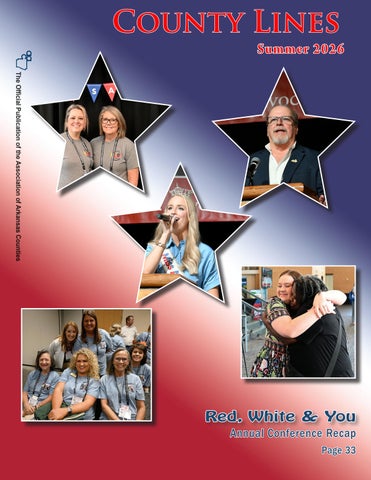
Red, White & You
Annual Conference Recap Page 33
ASSESSOR • ADDRESSING • VOTING • LAW ROAD & BRIDGE • EMERGENCY MANAGEMENT
GIS MAPPING
USER FRIENDLY
INTEGRATION
Office specific extensions tailored to your day-to-day business needs. Map parcels, address points, roads, pavement issues, voters, and so much more!
Easily create, edit, and export items at anytime from anywhere. The site is mobile-friendly and backed by our unparalleled customer support team.
Real-time access to the local, state, and federal data sources you need to make informed decisions. Bringing everyone and everything together.
Contact sales@datascoutpro.com • 888.565.4530 x.3
ROADS LEAD TO STRONGER COMMUNITY. A community’s roads connect us to jobs, healthcare, daily essentials, friends and family — and home. Ergon is proud to provide the materials and support needed to help build and maintain safe roadways across America, connecting us all to what matters most.
In This Issue Summer 2026
Features Ashley County Showcases Patriotic Spirit....................................25 Hang Together...............................................................................26 AAC Scholarships Awarded.........................................................28 Baxter County Sheriff Recognized..............................................31 AAC Cover Story: Officials Embrace Red, White and You ........33 AAC Host Randy Kemp Golf Tournament..................................40 Thank You to Our Exhibitors/Sponsors......................................44 Workers Compensation Fund Pays Dividends..........................46 Counties Receive PILT Payments...............................................47 Staff Profile: Cameron Dunlap....................................................49 AAC Photo Recap: Judges............................................................51 AAC Photo Recap: Assessors..........................................................52 AAC Photo Recap: Circuit Clerks....................................................53
Cover Notes: Red, White and You
AAC Photo Recap: County Clerks.................................................54 AAC Photo Recap: Collectors.........................................................55 AAC Photo Recap: Sheriffs............................................................56
Departments
From the Director’s Desk.................................................................8 President’s Perspective..................................................................11 Seems to Me.....................................................................................13 Legal Corner.......................................................................................16 Governmental Affairs.......................................................................17 AAC Risk Management Services....................................................18 Taylor Talks........................................................................................20 Cyber Corner......................................................................................22 AAC Litigation Lessons.....................................................................23 News from NACo...............................................................................48
Photos by Sarah Perry and Christy L. Smith
Nearly 900 officials, exhibitors, sponsors and guests attended the 58th Annual AAC Conference. Left: AAC Executive Director Chris Villines greets Arkansas Attorney General Tim Griffin and looks over an article Griffin brought with him to reference during his presentation. Above: Stone County officials listen to one of the conference speakers.
COUNTY LINES, SUMMER 2026
5
DREAM BIGGER.
Stronger, safer and more efficient counties start with smarter investments. Crews & Associates brings decades of experience to funding facilities and public services that make your ideas a reality. Ready to dream bigger? Let’s move your county forward – together.
Member FINRA & SIPC
crewsfs.com
2026-2027 Oct. 14-16 Circuit Clerks DeGray Lake Resort, Bismark
Feb. 10-12 County Clerks Wyndham, North Little Rock
Oct. 27-30 Assessors Embassy Suites, Little Rock
Feb. 17-19 Circuit Clerks Wyndham, North Little Rock
Dec. 2-4 Collectors Benton Event Center, Benton
Feb. 23-26 Assessors Wyndham, North Little Rock
Jan. 17-20 Sheriffs Little Rock Marriott
Feb. 24-26 Treasurers Wyndham, North Little Rock
Feb. 2-5 Judges Wyndham, North Little Rock
April 28-30 Collectors Wyndham, North Little Rock
Calendar activities also are posted on our website:
www.arcounties.org
Contact AAC
AAC Mission Statement
T
he Association of Arkansas Counties supports and promotes the idea that all elected officials must have the opportunity to act together in order to solve mutual problems as a unified group. To further this goal, the Association of Arkansas Counties is committed to providing a single source of cooperative support and information for all counties and county and district officials. The overall purpose of the Association of Arkansas Counties is to work for the improvement of county government in the state of Arkansas. The Association accomplishes this purpose by providing legislative representation, on-site assistance, general research, training, various publications and conferences to assist county officials in carrying out the duties and responsibilities of their office.
1415 West Third Street Little Rock, AR 72201 (501) 372-7550 phone / (501) 372-0611 fax www.arcounties.org
Chris Villines, Executive Director cvillines@arcounties.org
Mark Harrell, IT Manager Karen Bell,VFD Program Coordinator mharrell@arcounties.org kbell@aacrms.com
Anne Baker, Sr. Executive Assistant abaker@arcounties.org
Jim Grinder, Cyber/Network Security Engineer Ellen Wood, Admin. Asst./Receptionist jgrinder@arcounties.org ewood@aacrms.com
Loretta Green, Receptionist lgreen@arcounties.org Eddie A. Jones, Consultant e.jonesconsulting@gmail.com
Risk Management/ Workers’ Compensation
Mark Whitmore, Chief Legal Counsel mwhitmore@arcounties.org
Brandy McAllister, RMS & Insurance Director bmcallister@arcounties.org
Colin Jorgensen, AAC Litigation Counsel cjorgensen@arcounties.org
Misty Petrus, Sr. Claims Administrator mpetrus@arcounties.org
Josh Curtis, Governmental Affairs Director jcurtis@arcounties.org
Cathy Perry, County Program Coordinator cperry@aacrms.com
Lindsey French, Legal Counsel lfrench@arcounties.org
Kim Nash, Workers’ Comp Claims Adjuster knash@aacrms.com
Taylor Handford, Legal Counsel thandford@arcounties.org
Renee Turner,Workers’ Comp Claims Adjuster rturner@aacrms.com
Christy L. Smith, Communications Director csmith@arcounties.org Sarah Perry, Communications Coordinator sperry@arcounties.org Michael Roys, ACE Program Coordinator mroys@arcounties.org Cindy Posey, Accounting/HR Manager cposey@arcounties.org Jenny Evans, Accounting & Program Assistant jevans@arcounties.org
COUNTY LINES, SUMMER 2026
Samantha Wren, WC Program Coordinator swren@arcounties.org Jennifer Shook, Medical Claims Adjuster jshook@arcounties.org Jacob Trumble, Claims Analyst jtrumble@arcounties.org
JaNan Thomas, RMS Counsel jthomas@arcounties.org Melissa Dugger, RMS Litigation Counsel mdugger@arcounties.org Mallory McInvale, RMS Employment Counsel mmcinvale@arcounties.org Falyn Traina, RMS Litigation Counsel ftraina@arcounties.org Ali Noland, RMS Litigation Counsel anoland@arcounties.org Anthony Bennett, RMS Litigation Counsel abennett@arcounties.org Fonda Fitzgerald, RMS Paralegal ffitzgerald@arcounties.org Ian Gaebel, RMS Paralegal igaebel@arcounties.org Ashley Pursell, RMS Admin. Assistant apursell@arcounties.org
Greg Hunt, Claims Analyst Gary McClain, RMS Loss Control Specialist ghunt@aacrms.com gmcclain@arcounties.org
7
AAC
DIRECTOR’S DESK
County Lines [(ISSN 2576-1137 (print) and ISSN 2576-1145 (online)] is the official publication of the AAC. It is published quarterly. For advertising inquiries, subscriptions or other information, please contact Christy L. Smith at 501.372.7550.
Executive Director/Publisher Chris Villines Communications Director/ Managing Editor Christy L. Smith Communications Coordinator/Editor Sarah Perry AAC Executive Board: Debbie Wise – President Brandon Ellison – Vice President Jimmy Hart – Secretary-Treasurer Tommy Young Deanna Sivley Debra Buckner Dana Baker Kevin Cleghorn Terry McNatt Rebecca Talbert Doug Curtis Gerone Hobbs Marty Boyd John Montgomery Heather Stevens Brenda DeShields Selena Blair Bobby Burns National Association of Counties (NACo) Board Affiliations Debbie Wise: NACo board member. She is the Randolph County Circuit Clerk and president of the AAC Board of Directors. Brandon Ellison: NACo board member. He is the Polk County Judge and vice-president of the AAC Board of Directors. Ted Harden: Finance & Intergovernmental Affairs Steering Committee. He is a member of the Jefferson County Quorum Court. Barry Hyde: Justice and Public Safety Steering Committee.Vice Chair of Transportation Steering Committee. He is the Pulaski County Judge. Rusty McMillon: Justice and Public Safety Steering Committee. He is the Greene County Judge Kevin Smith: IT Standing Committee. He is the Sebastian County Director of Information Technology Services. Gerone Hobbs: Membership Committee. He is the Pulaski County Coroner. Paul Elliott:Vice Chair of Justice and Public Safety Steering Committee, vice chair of law enforcement subcommittee. He is a member of the Pulaski County Quorum Court. Ellen Foote: Community, Economic & Workforce Development Steering Committee. She is the Crittenden County Tax Collector. Tawanna Brown:Telecommunications & Technology Steering Committee. She is the Chief Computer Operator for Crittenden County. Lisa Ecke: Justice and Public Safety Steering Committee. She is a member of the Washington County Quorum Court.
8
How county government’s legislative process really works
W
e’ve discussed this as individual associations many times, and AAC staff is keenly Chris Villines aware, but outside of our courthouses few AAC truly understand the breadth of county Executive Director government. It becomes incredibly apparent when a legislative session begins, or as our associations meet individually or collectively to discuss legislative ideas and needs. In fact, last legislative session saw 1,696 bills and joint resolutions filed, of which 1,026 became Acts. But how many affected county government? Would it surprise you to know that a whopping 33 percent of the filed bills and joint resolutions would have an impact on day-to-day operations of county government? That’s right, 560 of the total legislative filings had a direct nexus with what we do. When it comes to the county legislative process, there are unfounded rumors that need to be addressed. First of all, the Association of Arkansas Counties did NOT and will NEVER push 560 pieces of legislation. The legislative package for the AAC is something decided by individual associations, pushed upward for AAC Legislative Committee review (a board composed of county and district officials) and then voted on by your AAC Board of Directors (also composed of county and district officials). Usually, the total number of proposed bills lies between 20 to 35. I have heard recently from a county official that a legislator suggested that the county legislation genesis comes from AAC offices, and you have my permission to set them straight. Are we subject matter experts who help you understand laws pertaining to you? You betcha. Do we help you craft bills before legislators present them to the Bureau of Legislative Research (BLR) for drafting? Absolutely. But to say anything negative about the county legislative process without the knowledge that there are hours of association, committee and board meetings of county and district officials is shortsighted and a misunderstanding of who really leads these efforts. It is done as it should be done, and it results in a clean, agreeable slate of proposed legislation that all nine county member associations have developed together. Another laughable unfounded statement I’ve heard is that the AAC decides what is good or bad for counties in a vacuum. This is absolutely untrue. Each one of our subject matter expert team (Mark, Lindsey, Josh, Taylor, Eddie and myself ) talk with leadership constantly. We are well aware of the positions of our associations on all the bills filed last session and the 500+ again likely to be filed in 2027. This system has worked well over the last six decades and will prove to work well again in 2027. ALL of you are an important cog in this wheel. As soon as the 2025 session ended, member associations were working on ideas and fixes to legislation with an eye towards the coming session. The difference between bureaucracy and responsive governance is, in my opinion, embodied in the fact that county officials are elected. You are answerable to a public bent on government efficiency and improvement. This includes technological advancements available to the private sector but sometimes blocked from use in government by stale laws. Laws lacking anticipation that can only be changed COUNTY LINES, SUMMER 2026
AAC every two years. This often drives your ideas for changing the Arkansas Code. As the world changes around us at a quicker pace, who better to offer potential solutions than you? You know what software vendors can and cannot do. You are keenly aware of potential problems associated with changes in the law. In fact, I’ll always remember a piece of legislation years ago that would have required any address change in a tax collector’s office be accompanied by a notarized statement. It was borne from a problem. One problem in one county. But the unintended consequences of passing this legislation would have been hundreds, maybe thousands, of angry taxpayers in search of a notary. The tax collectors had to oppose a bill that came from good intentions because implementation would result in angry constituents, deficient staff and an inefficient office.
DIRECTOR’S DESK
This is the reality of the legislative process. Often one issue has resulted in a legislative change proposed by someone who fails to understand the resulting process. I encourage you all to develop the kind of relationship with your legislators that would result in open dialogue. Invite them into your offices. Show them how it “really” works. If you do not, the inaccuracies of social media or one angry constituent may be all they hear. I often say that if the first time your legislator hears your voice is during a session, it’s too late. Please take that to heart. You both probably want the same things for your constituents. As you prepare for the 2027 session know that our legislators get thousands of emails, text messages and phone calls. You don’t want to be one of the many, you want to be a friendly voice who is working with them to make county government great.
WE KEEP YOUR COUNTY
ROLLING
Springdale Batesville
Fort Smith
Searcy
West Memphis
9 locations in Arkansas!
Little Rock
Hot Springs
TOLL FREE 877.786.4681 Hope
Check out our STM Arkansas stores!
Texarkana, TX
COUNTY LINES, SUMMER 2026
9
TAX PRO MODERN TAX COLLECTION Built for Arkansas’ Counties
Secure, cloud-based billing and collection software designed for county tax collectors
GO WITH TAXPRO Streamlined operations
Faster, more accurate processing
Reduced administrative burden
Modern payment options taxpayers expect
CLOUD BASED
NO UPFRONT COSTS
PROVEN SATISFACTION
USER-DRIVEN DESIGN
No servers or expensive hardware required
Training, support, hosting included
100% customer satisfaction for 11 consecutive years
Built from real world feedback of Arkansas’s collectors
(501) 246-8060
gowithtaxpro.com
AAC
PRESIDENT’S PERSPECTIVE
Leadership training is the theme that runs throughout the course of AAC conferences
A
nother annual AAC Conference is in the books. As always, I stand impressed by the quality of the programming. Two of this year’s speakers particularly resonated with me for their dedication to the tenets of leadership. Leadership is a common thread for all AAC conferences. I believe leadership training is important for government officials because public leadership is fundamentally different from leadership in a private organization. Government leaders operate in an environment of public scrutiny, competing interests, limited resources, legal constraints, and constant pressure to produce results while maintaining public trust. Effective leadership training gives elected and appointed officials the skills to navigate those challenges responsibly. And in their conference presentations, both U.S. Navy Rear Admiral (Ret.) Peter Cressy, director of executive leadership programming at the Washington Leadership Institute, and JD Clark, the Wise County, Texas, judge and NACo Immediate Past President, did an excellent job of conveying to attendees the true meaning and nature of leadership. Cressy and Clark have a shared leadership style — it is mission-driven and relationship-centered. Both share a commitment to service and collaboration, and that came through clearly in their presentations. Cressy learned those principles in environments where people, resources, and decisions must come together under pressure. Clark applies many of the same principles in county government, where success depends on getting elected officials, staff, residents, businesses, and other governmental organizations moving in the same direction. Cressy’s leadership framework is heavily influenced by George Washington, particularly the idea of adapting one’s leadership style to circumstances. His career, like Clark’s, shows an ability to adapt to new roles. Cressy’s background is a broad example of leadership across military, government, education, and business. Clark’s background includes teaching, serving as mayor, city councilman, and judge as well as national association leader. Throughout his career, Cressy has led through collaboration rather than simply command. Cressy has emphasized listening, building teams across divides, strategic patience, and agility as important leadership qualities. His focus shows that he views leadership as something to be practiced and passed on — not merely a title to be held. Admiral Cressy is a true leader because he has consistently combined experience with wisdom, authority with humility, and achievement with service. He has led sailors, educators, executives, policymakers, and business leaders, yet the COUNTY LINES, SUMMER 2026
common thread throughout his career is his ability to see the bigger picture, develop people, navigate change, and bring diverse groups together toward a shared objective. DEBBIE WISE Clark leads because he believes AAC Board President; in serving people, solving probRandolph County Circuit Clerk lems, bringing people together, and leaving his community stronger than he found it. Clark’s entire career has been rooted in public service. That background gave him a perspective that leadership is fundamentally about serving people and strengthening communities — not simply holding office. He also understands the power of telling the story of public service. As NACo president, Clark chose “County Storytellers” as his presidential spotlight, emphasizing the importance of helping people understand what county government does and why it matters. His message is especially meaningful because good leadership isn’t only about making decisions; it’s also about helping people understand the purpose behind those decisions and giving them a reason to believe in their community. Neither Cressy nor Clark believe leadership is measured by the size of the office or the rank. Rather, it is about service and the impact of that service. They exhibit that leadership training is not simply about teaching someone how to become a better manager. It is an investment in the effectiveness, integrity, and future. When public servants are equipped to lead with competence, accountability, and a commitment to service, their organizations are better positioned to earn public trust and deliver meaningful results. I thank the AAC staff for once again planning such a first-rate program. Those who attended the conference and listened to Cressy and Clark were blessed beyond measure to have the opportunity to learn from such capable public servants.
Debbie Wise Debbie Wise Randolph County Circuit Clerk/AAC Board President 11
'JOBODJBM 4PGUXBSF UP &NQPXFS $PVOUZ (PWFSONFOUT 'PS EFDBEFT 'JOBODJBM *OUFMMJHFODF '* IBT EFTJHOFE B TVJUF PG GJOBODJBM TPGUXBSF TPMVUJPOT FYDMVTJWFMZ GPS UIF QFPQMF XIP LFFQ "SLBOTBT DPVOUZ HPWFSONFOUT XPSLJOH 0VS "SLBOTBT DVTUPNFST SFMZ PO '* T DMPVE CBTFE TFSWJDFT UP IPTU UIFJS EBUB BOE GJOBODJBM TPGUXBSF TPMVUJPOT XIJMF FMJNJOBUJOH UIF XPSSZ BOE FYQFOTFT BTTPDJBUFE XJUI BHJOH UFDIOPMPHZ BOE TFDVSJUZ UISFBUT 'PS B MPX BMM JODMVTJWF NPOUIMZ TVCTDSJQUJPO PVS VOJRVF 4PGUXBSF BT B 4FSWJDF 4BB4 NJOJNJ[FT ZPVS PO TJUF *5 CVSEFOT XIJMF LFFQJOH ZPVS GJOBODJBM TPGUXBSF BOE QSPDFTTFT VQ UP EBUF 0VS VOJRVF CVTJOFTT NPEFM BMMPXT PVS "SLBOTBT DVTUPNFST UP GPSFDBTU UIFJS FOUJSF EBUB QSPDFTTJOH DPTUT XJUIPVU GFBS PG TVSQSJTF DIBSHFT GPS TPGUXBSF VQEBUFT PS TVQQPSU $MPVE CBTFE GJOBODJBM TPGUXBSF TPMVUJPOT TVDI BT 1BZSPMM 1PTJUJPO #VEHFUJOH #FOFGJU &OSPMMNFOU .VMUJ 'VOE "DDPVOUJOH "DDPVOUT 1BZBCMF #BOL 3FDPODJMJBUJPO $BQJUBM "TTFU $POUSPM &NQMPZFF 1PSUBM 5SFBTVSZ .BOBHFNFOU
(FOFSBM -FEHFS 3FDFJQUJOH #VEHFU .BOBHFNFOU 1VSDIBTJOH 1SPDVSFNFOU )VNBO 3FTPVSDF .BOBHFNFOU "EWBODFE 5JNF "UUFOEBODF .BOBHFNFOU 3FWFOVF .BOBHFNFOU .PCJMF 5BCMFU $PNQVUJOH 1BQFSMFTT %PDVNFOU $BQUVSF 4UPSBHF
'PS NPSF JOGPSNBUJPO BOE "SLBOTBT DVTUPNFS UFTUJNPOJBMT QMFBTF WJTJU VT BU 'JOBODJBM *OUFM DPN www.financial-intel.com
www.facebook.com/FISoftwareSolutions
8FTU $BQJUPM "WF 4VJUF -JUUMF 3PDL "3 © 20 Financial Intelligence. All rights reserved.
AAC
SEEMS TO ME...
Behind the ledger: Unlocking the county budget
T
he secret to budgeting is that it needs to be honest. Not what you think it should be or wish it could be, but what it really is. Nothing could be truer. Every county should approach the budget process and the administration of the budget in that manner. Budgeting and managing your county’s money is important. So is laughing at it if your “miscellaneous” category becomes your biggest expense. I have written many budget articles and held many budget seminars over the years, but I decided to write another one because several Arkansas counties have dealt with severe budget issues this year — issues that could and should have been avoided with the proper and legal preparation of the budget and the proper administration of the budget. I’m aware of one county that appropriated, for a special revenue fund, almost $100,000 in excess of the 90 percent of projected revenues available for the fund. Before mid-year their wallet was so empty, it echoed. The county budget is, arguably, the most important policy document that a local government produces. The budget decides how the county’s resources will be allocated among services like public safety and law enforcement; county jail operations; the court system; roads and bridges; solid waste disposal; library services; operations of the county constitutional offices; etc. County budgets act as fiscal maps that reflect a county’s policies and priorities. To unlock and understand the county budget process you have to look at the quorum court, which is the governing body that passes the annual budget ordinance and any amendments to it. Because public funds can be complex, understanding “behind the ledger” requires looking at a few key documents and processes. Notice that I said county funds can be complex. The normal county resident might believe that if the county has $100 million in the bank that those funds can be budgeted and spent on any legal expense of a county. But not so. An Arkansas county has several types of funds and many of them are restricted as to how they can be used. Here is a brief description of the type of funds a county may have: • General Funds — The primary operating funds used to account for and report all financial resources not accounted for and reported in another fund. • Road Funds — Funds used to account for and report the proceeds of specific revenue sources that are restricted to expenditures for maintaining and constructing county roads and bridges. • Special Revenue Funds — Funds used to account for and report the proceeds of specific revenue sources that COUNTY LINES, SUMMER 2026
are restricted to expenditures for specific purposes other than debt service or capital projects. These funds may be restricted by federal law, state law, Eddie A. Jones county ordinance, or a County Consultant grant charter. • Capital Projects Funds — Funds used to account for and report financial resources that are restricted, committed, or assigned to expenditures for capital outlays. • Debt Service Funds — Funds used to account for and report financial resources that are restricted, committed, or assigned to expenditures for principal and interest. • Agency Funds — Funds used to report resources held by the county in a purely custodial capacity. • Enterprise Funds — Funds used to report activity that is financed with debt secured solely by a pledge of the net revenues from fees and charges of the activity, activity that is legally required to recover its costs through fees or charges, or activity for which the county’s policy is to establish fees or charges designed to recover the costs of providing services. • Trust Funds — Funds used to account for assets held by the county in a trustee capacity. So, a county dollar is not just a county dollar to be spent as the county wishes. There are restrictions. Every county budget process has some common challenges. They include: • Balancing Revenue and Expenses: Ensuring that ongoing revenues meet expenditure demands, particularly during economic downturns. • Competing Needs: Making decisions on what is necessary versus what is desirable among various departments. • Limited Resources: Often, the budget is described as a math problem where the answer is “not enough.” Accurate revenue projections are the foundation of a county budget because they dictate the legal requirement for a balanced budget. They ensure that projected revenue exceeds appropriations, preventing structural deficits. Arkansas law prohibits counties from appropriating in excess of 90 percent of a fund’s projected revenue for the year. There are a few exceptions to this general rule [Reference: § 14-20-103]. See “BUDGET” on Page 14 > > >
13
AAC
SEEMS TO ME...
BUDGET A solid revenue forecast provides specific, operational benefits to local governance. The core benefits of accurate forecasting are: • Maintains Essential Services: Knowing exactly what funds are available allows the county to fund the constitutional offices, law enforcement, custody of inmates, and infrastructure at reliable, consistent levels. • Avoids “Boom and Bust” Cycles: If revenues are overprojected, the county will run a deficit, forcing painful mid-year service cuts. If revenues are significantly under-projected, valuable programs may go unfunded and capital improvements can stall. • Optimizes Tax and Fee Rates: Accurate projections provide the data-backed rationale needed to adjust property tax millages, and other fees and local charges to match the community’s financial needs. • Sustains Bond Ratings: Transparent and accurate forecasting establishes credibility with bond markets, which lowers borrowing costs for major county projects. • Manages “Rainy Day” Reserves: Identifying surplus periods allows the county to properly fund reserves or rainy day funds to insulate the budget against economic downturns. Revenue forecasting involves analyzing historical data, economic indicators, demographic changes, and statistical modeling. Revenue projections are essential to ensure a structurally balanced budget, prevent mid-year service cuts, maintain public trust, and allocate limited discretionary resources efficiently. The accuracy of revenue projections cannot be over emphasized. It is imperative to good county operations. But when we think of a county budget, the thing that comes to mind is ‘money to spend.’ To design a budget, let’s start with how most Arkansas counties budget: the incremental, line-item budget. “Incremental” means that last year’s budget is used as the starting point for next year’s budget, with incremental changes at the margin accounting to how revenues change. “Line-item” means that the essential building block of the budget are line items, which are categories of inputs that go into delivering public services, such as personnel, supplies, contracted services and other services, capital expenditures and debt service. These major categories break down into detailed categories like salaries and other personnel costs, office supplies, fuel, professional services, utilities, vehicles and equipment, bond principal and interest. These categories aggregate up to divisions and departments. The traditional county budget has long been criticized for 14
Continued From Page 13 < < <
being slow to adapt to changing conditions and not doing enough to best size and shape the budget to address the local problems it faces and the resources it has available. Recently, there has been pervasive decline in trust in government and widespread desire for change in government operations at all levels. However, I believe the major issue is transparency or the lack thereof. Many times, if you are not totally open with the process people believe you are hiding something whether you are or not. Be an open book for your constituents to read. If the budget is the most important policy document that a local government produces, then it follows that the budget, if done well, can build credibility with the public. Responding to the public’s desire for reform may require tweaking the traditional budgeting process and the ways you communicate and engage with the public on the budget. However, the traditional budget process has strengths that account for its staying power: • It is simple. • It provides easy-to-understand accountability in the form of line-item spending controls. • It has predictable results in terms of how much is allocated to what purposes. • It is flexible to accommodating changing political priorities. Arkansas county governments are given a mandate by the state to adequately fund certain areas of service set forth in Arkansas Code Annotated § 14-14-802(a): 1. The administration of justice through the several courts of record of the county; 2. Law enforcement protection services and the custody of persons accused or convicted of crimes; 3. Real and personal property tax administration, including assessments, collection, and custody of tax proceeds; 4. Court and public records management, as provided by law, including registration, recording, and custody of public records; and 5. All other services prescribed by state law for performance by each of the elected county officers or departments of county government. Everything else that a county may legally provide for its residents is secondary and can be found listed in § 14-14802(b). While this list is long and detailed, the major categories include: (1) agricultural services; (2) rural development services; (3) community services; (4) emergency services; (5) human services; (6) solid waste services; (7) transportation COUNTY LINES, SUMMER 2026
AAC services, including roads and bridges; and (8) water, sewer, and other utility services. Each of the 75 Arkansas counties must develop their priorities in the annual budget. The budget is required to be enacted by the end of December for the following calendar year, which is the fiscal year for county government [Reference: § 14-14-904]. The core functions of a county budget are: • Fiscal Planning: It provides a blueprint for allocating limited resources among various departments and services. • Legal Authority: It establishes the legal spending limits that county officials must follow. • Policy and Priority Setting: Changes in budget allocation from year to year signal shifting priorities, such as increased investment in public safety or infrastructure. • Performance Evaluation: Governments use the budget to compare actual spending outcomes against previously set goals. Many cooks are in the kitchen during the budget making process. The county’s finance officers: the county judge, county clerk or comptroller and county treasurer should all be intricately involved. And, of course, the quorum court must be involved and are the ones who ultimately enact the annual budget ordinance. These folks are responsible for architecting a budget process that creates the best chance of producing savvy and wise decisions. But decision-making is messy. It is done by humans, so it comes with the myriad well-documented cognitive biases and inconsistencies in human thought. Hopefully each county will choose one of the budget/finance officers most well equipped to lead the process and reduce the negative impact of bias and noise in decision processes; someone able to coax the cooks to be chefs. While the annual budget is enacted by the legislative branch of county government, the quorum court, the budget is administered by the executive branch in accordance with Amendment 55 to the Arkansas Constitution. Amendment 55, § 3 mandates the county judge, as the chief executive officer, to administer ordinances enacted by the quorum court including the power to authorize and approve or not approve with cause the disbursement of appropriated county funds. Statutory law provides the county judge with additional details on the process. Arkansas Code Annotated § 14-141102(b)(2) provides step-by-step instructions for the county judge or his/her designated representative for the authorization, approval, and disbursement of appropriated county funds from the county treasury. Before approving any claim for the payment of county funds, the county judge or his or her representative shall determine that: • There is a sufficient appropriation available for the purpose and there is a sufficient unencumbered balCOUNTY LINES, SUMMER 2026
SEEMS TO ME...
ance of funds on hand in the appropriate county funds to pay the claim; • The expenditure is in compliance with the purposes for which the funds are appropriated; • All state purchasing laws and other state laws or ordinances of the quorum court are complied with in the expenditure of the money; and • The goods or services for which expenditure is to be made have been rendered and the payment has been incurred in a lawful manner and is owed by the county. Both the Arkansas Constitution and Arkansas Code Annotated say, “No money shall be paid out of the treasury until it shall have been appropriated.” [Reference: Arkansas Constitution, Article 16, § 12 and A.C.A. § 14-14-1102(b)(2)(C)] As a general rule, the treasurer is required to issue the check once the county judge has approved the payment of a claim. That is, of course, if the judge has followed the proper protocol in determining a sufficient balance of funds on hand in the appropriate county fund. The treasurer is required to refuse payment of any check that would cause a deficit balance in any special revenue fund — with the one exception of a reimbursable grant fund [§ 14-15-805(2)(A)(B)(i)(ii)(iii)]. The treasurer shall also refuse payment of any check that would cause a deficit balance of the general fund in aggregate. Not maybe but shall. The counties of Arkansas operate on a 12-month calendar year — January through December. Counties use the modified accrual accounting basis meaning the books remain open through the last day of February the following year only for obligations incurred on or before the end of the fiscal year that are not yet paid. Once those invoices are received and approved for payment they are charged against the year they were obligated. However, Feb. 28 is a drop dead date for charging an invoice to the previous year’s budget. [Reference: § 14-71-101] County government does not have to worry about operating by magnetic north or true north if you enact and administer your annual budget in accordance with law. Under normal circumstances, a compass does not point to true north. It points to magnetic north, which is constantly shifting due to the movement of the earth’s core. In fact, the magnetic north can drift up to a thousand miles away from true north over time. True north, however, never moves. It is fixed; unchanging. Don’t allow your budget appropriation process or the administration of your budget to be affected by magnetic north — the shifting whims of personality or the lack of discipline. The responsibility of county leadership is to continually ensure that your true north is aligned with law. A budget is a tool, and like all tools, the results you get from it will be determined by how you use it. As I learned growing up, “If it’s worth doing, it’s worth doing right.” 15
AAC
LEGAL CORNER
The future of Arkansas’ initiative and referendum process: A look into the 2025 petition reforms, federal litigation, and the Protect AR Rights campaign
B
y nearly every measure, the past 18 months have been among the most consequential periods for Arkansas’ initiative and referendum process since Amendment 7 was adopted more than a century ago. Legislative reforms, federal court rulings, and a statewide petition effort have converged to create an unprecedented level of uncertainty, not only for ballot question committees, but also for the state and local officials responsible for administering elections. For county clerks, election commissioners, and other state and local public officials, understanding these developments is increasingly important. While much of the public discussion has focused on politics, the underlying issues involve election administration, constitutional law, and the balance between election integrity and the constitutional right of Arkansans to propose laws and constitutional amendments. During the 2025 Regular Session, the Arkansas General Assembly enacted a package of election integrity laws substantially revising the state’s initiative and referendum process. Collectively, the legislation added new requirements on petition sponsors, paid canvassers, and signature gathering. Among the most significant changes were: • requiring paid canvassers to issue criminal warnings about petition fraud before collecting signatures (Act 218); • requiring petition signers to present a valid photo identification before signing (Act 240); • adding additional affidavit and registration requirements on paid canvassers (Act 241); • requiring potential signers or canvassers to read the ballot title before giving or obtaining a signature (Act 274); and • requiring paid canvassers to be a resident of and domiciled in Arkansas (Act 453). Supporters argued these reforms were designed to reduce fraud and strengthen confidence in the initiative process. Opponents contended that many of the requirements created unnecessary barriers to exercising constitutional rights reserved to the people. Those disagreements quickly moved into federal court. In July 2025, the League of Women Voters of Arkansas and other plaintiffs challenged several provisions of the new laws in the U.S. District Court for the Western District of Arkansas. Protect AR Rights later intervened because they claimed the stat16
utes directly affected its petition drive. A year later, in June 2026, U.S. District Judge Timothy LINDSEY FRENCH Brooks issued a significant deGeneral Counsel cision that evaluated each challenged provision individually. The ruling struck down portions of the acts that required: • canvassers to give criminal warnings about petition fraud; • potential signers to show photo identification before signing a petition; • paid canvassers to submit affidavits before collecting signatures; • post-collection affidavit and cool-off period for canvassers; • petition sponsor reimbursement of publication costs; and • potential signers or canvassers to read the ballot title before signatures were obtained. Importantly, this ruling did not invalidate every provision enacted in 2025. Several reforms remained enforceable, while others continued to be litigated. Requirements of residency and domicile for canvassers, the prohibition on paying canvassers on a per-signature basis, and other vagueness challenges remained to be tried before Judge Brooks. Because the State appealed the decision to the Eighth Circuit Court of Appeals, the litigation remained ongoing both before Judge Brooks and at the appellate level. Against that legal backdrop, Protect AR Rights began circulating petitions in 2026 seeking to place a constitutional amendment before Arkansas voters. The proposed amendment would: • establish a constitutional right to collect and sign petitions; • prohibit laws that create unnecessary barriers to petition circulation; • require legislative amendments of voter-approved constitutional amendments to receive a two-thirds vote; and • prohibit legislative amendments of voter-approved initiated acts. Protect AR Rights submitted more than 108,000 signatures See “PROCESS” on Page 24 > > >
COUNTY LINES, SUMMER 2026
AAC
GOVERNMENTAL AFFAIRS
Ballot issues: What are you voting on?
A
rticle 5, Section 1 of the Arkansas Constitution provides the General Assembly the opportunity to propose up to three constitutional amendments for the voters of Arkansas to decide. These resolutions are vetted in the Joint House and Senate State Agencies committee. The Senate filed 24 Senate Joint Resolutions (SJR) and the House filed 20 House Joint Resolutions (HJR) during the 95th General Assembly. Many of these resolutions mirrored the opposite chamber resolutions and were properly discussed. At the end of the day this joint committee approved three, HJR1018, SJR11 and SJR15. Following the passage of both chambers these resolutions are now on the ballot for the 2026 general election. Issue 1, popular name: A constitutional amendment to be known as “The Citizens Only Voting Amendment” and providing that only a citizen of the United States meeting the qualifications of an elector under the Arkansas Constitution may vote in an election in this state. HJR1018 passed the Arkansas House of Representatives with 82 yeas; the Senate had zero no votes. The two main sponsors were Rep. David Ray from Maumelle and Sen. John Payton from Wilburn. This proposal asks voters to amend Article 3, Section 1 of the state Constitution. This section defines who can vote and includes Amendment 99 that passed in 2018 requiring voters to present a valid photo ID when voting. If passed it will add this language to the constitution: “Only a citizen of the United States meeting the qualifications of an elector under this section may vote in an election in this state. A person who does not meet the qualifications of an elector under this section shall not be permitted to vote in any state or local election held in this state.” Issue 1 has no organized opposition. Issue 2, popular name: A constitutional amendment to amend Arkansas Constitution, Article 2, Section 5 to protect the right to keep and bear arms. SJR11 passed the Senate 28-7 and the House 86-10. The resolution’s two main sponsors were Sen. John Payton of Wilburn and Rep Matt Duffield of Russellville. This proposal asks voters to amend Article 2, Section 5 of the Arkansas Constitution. Currently Section 5 says “The citizens of this State shall have the right to keep and bear arms, for their common defense.” This amendment would add language including, “lawful hunting and recreational use; any other lawful purpose without limitation the possession and use of ammunition, firearm accessories, and components. The right to keep and bear arms is a natural, fundamental, and individual right that shall not be infringed.” Issue 2 has no organized opposition. Issue 3, popular name: A Constitutional Amendment Concerning Economic Development in the State of Arkansas; and Authorizing the General Assembly to Provide for the Creation of Economic Development Districts Within Cities, COUNTY LINES, SUMMER 2026
Counties, or Cooperative Areas to Promote Economic Development Within the Economic Development District SJR15 passed the Senate 28-6 and the House 74-10. The resolution’s two main sponsors were Josh Curtis Sen. Jonathan Dismang of Beebe Governmental Affairs and Rep Howard Beaty of CrosDirector sett. This proposal asks voters to amend Article 12, Section 5 and Article 16, Section 5 of the Arkansas Constitution as well as Amendment 62, Section 6. This issue has been the most talked about issue on the ballot. If passed it would allow counties and cities to create economic development districts. Each quorum court and city council will have the flexibility to use this new tool to provide economic incentive. They could abate future sales tax or future property taxes for a certain number of years or until the investment is paid for. Counties, cities and schools will not lose any current funding. One ballot question committee has formed in support of this issue — Arkansans for Strong Communities. There is no committee formed in opposition. Issue 4, popular name: Arkansas Water, Waste Disposal, and Pollution Abatement Facilities Financing Act of 2025 Amendment 20 of the Arkansas Constitution requires voter approval before pledging the full faith and credit of the state for the repayment of bonds. More recently Amendment 82 allows the General Assembly through a legislative act, submitting a bond question before the voters to give the legislature the ability to issue general obligation bonds. Senate Bill 421 passed the Senate 24-3 and the House 86-3 and became Act 578 of 2025. The sponsors of this bill were Sen. Bart Hester of Cave Springs and Rep. Howard Beaty of Crossett. If voters approve this question, the Legislature could approve bonds up to $500 million over the next 20 years. The current program was passed in 2006 allowing the legislature to issue bonds up to $300 million over the last 20 years. This money will be used to leverage federal resources for water and sewer projects for local communities through mostly low interest loans. Over the last four years all 75 counties have benefited in some way from this program. One ballot question committee has formed in support of this issue — The Committee For Water Infrastructure Now For Arkansas. No committee has formed in opposition. I refer readers to https://uaex.uada.edu/business-communities/voter-education/state-ballot-issues.aspx to find out more about these issues. It breaks down each issue, gives an unbiased opinion on what each issue would do if enacted by the voters, and provides the views of the supporters and the opponents. 17
AAC
RISK MANAGEMENT SERVICES
The importance of maintaining medical records and facilitating specialty care in Arkansas jails
From a risk-management perspective, proper medical recordkeeping is one of the most important responsibilities of any detention facility. Medical records serve not only as a tool for providing continuity of care to inmates, but also as critical documentation demonstrating that the jail has fulfilled its legal and operational obligations. In Arkansas, the Minimum Standards for Adult Criminal Detention Facilities (Jail Standards) require detention facilities to maintain their own medical records, not solely relying on medical providers to maintain records on behalf of the facility. This requirement reflects the important role that accurate and complete documentation plays in inmate health care, facility operations, and risk management. Medical records provide a comprehensive history of an inmate’s medical treatment while in custody. These records document medical complaints, evaluations, treatment plans, medications, referrals, and follow-up care regarding an inmate’s health needs. Maintaining complete medical records is essential in mitigating the risk of lawsuits related to denials of medical care. From an operational standpoint, thorough documentation promotes continuity of care. Complete records create a clear picture of the inmate’s medical history, health complaints, diagnoses, and treatment recommendations. Without adequate records, important information may be lost, resulting in delays in treatment or gaps in care. Medical records also serve an important risk-management function. When questions arise regarding the medical treatment provided to an inmate, documentation often becomes the primary evidence demonstrating what actions were taken and when those actions occurred. Well-maintained records can establish that the jail staff responded appropriately to inmate complaints, followed medical recommendations, and facilitated necessary treatment. Conversely, incomplete or missing documentation may create uncertainty regarding whether appropriate care was provided. One area where documentation is particularly important is when inmates request specialty medical care, which includes dental treatment. Jails frequently receive requests from inmates seeking appointments with outside specialists or dentists. While inmates may request a particular type of treatment, determination of whether specialty care is medically necessary must be based upon the professional judgment of qualified medical personnel. A clear process should be followed whenever an inmate believes he or she requires specialty care. The first step is for the inmate to submit a sick call request. 18
The sick call process provides a formal mechanism for inmates to communicate medical concerns to jail staff and medical personnel. Once the request is received, it should be documented and routed to FAYLN TRAINA the jail’s medical provider for RMS Litigation Counsel evaluation. The second step is for the inmate to be evaluated by the jail’s medical staff. This evaluation should be thoroughly documented in the inmate’s medical record, including the inmate’s reported symptoms, objective findings, the provider’s assessment, and the provider’s recommendation for treatment, including any prescriptions. It is vital that the jail maintain these records independently from the medical provider. The third step is to allow the medical provider to exercise their independent medical judgment regarding the appropriate course of treatment. Jail administrators and detention staff play an important role in facilitating medical care; however, treatment decisions should be made by qualified medical professionals. The medical provider may determine that the inmate’s condition can be adequately managed within the facility through medication, monitoring of the condition, or other treatment measures that do not require specialty care. Alternatively, the provider may conclude that the inmate requires evaluation by a specialist or, as we see more frequently, a dentist. When medical staff determine, in their independent professional opinion, that specialty care is necessary, the jail is responsible for facilitating this care. Whether the jail medical staff or the jail staff are tasked with making appointments with outside specialists depends on the structure of the operations within an individual jail. Regardless, even when circumstances outside of the jail’s control affect scheduling or transportation, records should demonstrate that the facility acted diligently to obtain the recommended care. Jail records should reflect the provider’s recommendation and referral, appointment scheduling efforts, communications with outside providers, and any delays or complications encountered. Documentation of these efforts is critical, and such documentation should provide a clear record of the jail’s efforts to secure specialist care. Once a specialist or dental appointment has been arranged, See “RECORDS” on Page 49 > > >
COUNTY LINES, SUMMER 2026
Saving for retirement made easier The 457(b) deferred comp plan
When you join your employer’s 457(b) deferred compensation (comp) plan, you get a wealth of online resources to help you set your goals, research investment options and decide how much to save for retirement. But you also get attentive service from Nationwide® Retirement Specialists. We’ll take time to understand your situation so we can provide personalized guidance as you:
Have questions? Your Nationwide Retirement Specialists are here to help.
Retirement Resource Group 888-401-5272 nrsforu@nationwide.com
Identify your retirement goals Enroll in your employer’s retirement plan Determine your contribution level Develop a personalized long-term investment strategy Keep track of your plan over time What matters is where you want to go and how you’re going to get there. Let us help.
To schedule an individual appointment, scan this code.
This material is not a recommendation to buy or sell a financial product or to adopt an investment strategy. Investors should discuss their specific situation with their financial professional. NRM-17501AO.1 (07/21)
Nationwide Retirement Solutions and Nationwide Life Insurance Company (collectively "Nationwide") have endorsement relationships with the National Association of Counties, the International Association of Fire-Fighters Corporation, the United States Conference of Mayors and the National Association of Police Organizations. Information provided by Retirement Specialists is for educational purposes only and not intended as investment advice. Nationwide Retirement Specialists and plan representatives are Registered Representatives of Nationwide Investment Services Corporation, member FINRA, Columbus, Ohio. Nationwide and the Nationwide N and Eagle are service marks of Nationwide Mutual Insurance Company. ©2022 Nationwide
AAC
TAYLOR TALKS
State of Arkansas’ criminal justice system
A
fter the second phase of Ouachita Regional Correctional Unit was completed in 2004, ADC capacity was 11,640 beds. According to Statistical Reports, ADC capacity peaked in 2016 at 15,618. Between 2017 and 2022, ADC capacity decreased by 542 beds to 15,076. According to the July 2026 ADC Director Board Report, the current capacity of existing ADC facilities is 15,362. However, according to internal DOC spreadsheets, the design capacity of existing ADC facilities is 15,797, the Board Rated Capacity is 16,770, and a total of 16,809 beds are operated by ADC. The efforts of Governor Sarah Sanders and the DOC in adding 1,485 beds since 2023 are evident in the internal ADC numbers, as it appears ADC capacity has grown to an historic high of operated beds. ADC capacity has increased in response to an ever-increasing jurisdictional population. In 2004, the jurisdictional population was 13,251, compared to a capacity of 11,640. The jurisdictional population was 18,117 in 2016, 2,775 higher than a reported peak capacity of 15,362. As of July 2026, ADC’s jurisdictional population was 19,454. Comparing the July 2026 jurisdictional population of 19,454 to the current operated beds per DOC of 16,809 results in a difference of 2,645. The jurisdictional population has increased from 13,251 in 2004 to 19,454 in July 2026, an increase of 6,203 inmates across 22 years. The jurisdictional population is expected to grow to 21,497 in 2029, an increase of 2,043 state inmates within three years. As the jurisdictional population grows, the need for additional ADC capacity increases. If ADC capacity does not increase, the county jail backup increases, creating deleterious impacts on the misdemeanor justice system. County Jail Backup The highest average county jail backup occurred in 2015 with an average backup of 2,396 ADC inmates. As of July 31, 2026, there were 2,263 ADC inmates in county jails, an increase of 327 from the January 2026 average. As of July 22, 2026, five county jails (Benton, Pulaski, Sebastian, Washington, and White) are housing 100 or more ADC inmates. Five county jails (Crawford, Faulkner, Miller, Ouachita, and Pope) are housing between 50 to 99 ADC inmates. Together, these 10 county jails are holding 1,409 ADC inmates. Each of these jails has over 20 percent of its capacity occupied by ADC inmates waiting to move upstream. Benton County’s jail has 20.48 percent of its capacity occupied by ADC inmates. Washington County has 25.8 percent capacity occupied by ADC inmates, White County 27.27 percent, Sebastian County 31.46 percent, and Pulaski County 33.97 percent. 20
Of the jails holding between 50 to 99 ADC inmates: Faulkner County has 21.5 percent of beds occupied by ADC inmates; Crawford County 28.66 percent; Miller County 29.62 percent; Taylor Handford Ouachita County 41.5 percent; Legal Counsel and Pope County 44.19 percent. As ADC’s jurisdictional population increases, its capacity must grow as well. There are an approximate 11,842 county jail beds. According to current ACIC information, 10,365 county beds are occupied. With a projected increase of 2,043 ADC inmates over the next three years — and a current backup of 2,263 inmates in county jails — ADC clearly must add capacity. Currently, county jails can manage the state inmate backup through coordination and planning with other county jails. For example, if Faulkner County jail is unable to safely detain state inmates, another county jail may be able to receive state inmates or other detainees. With the expected jurisdictional growth and lower churn out of ADC as the Protect Act’s impacts come to fruition, the ability of county jails to manage this population will decrease. The county jails that have historically detained a large percentage of ADC inmates will push the backup population or other detainees to other county facilities. This will remove those county beds from any kind of use except for detaining the ADC backup. ADCC and County Jail Backup According to the July ADC Director Report, the Division of Community Correction (ADCC) has seven facilities for a total capacity of 2,092 beds and a population of 1,924, leaving open 168 beds. Six of the seven ADCC facilities are designated for males, and the remaining facility is designated for females. According to the same report, five of the seven facilities are undercapacity. While these facilities are undercapacity, county jails are holding at least 84 state inmates that should be in ADCC facilities.
Projected Future State of Arkansas’ Criminal Justice System
JFA Associates, now part of CGL Companies, has been tracking and projecting the ADC and ADCC populations for over 20 years. The information below has been compiled from CGL and DOC reports. ADC Projected Growth CGL projects a 2.1 percent average yearly increase in ADC jurisdictional population between 2025 and 2036. The projected EOY 2029 jurisdictional population is 21,497, COUNTY LINES, SUMMER 2026
AAC an increase of 2,043 inmates from the current jurisdictional population. Assuming the in-house population cannot grow without additional bed capacity — either in existing facilities or a new facility — the difference between the in-house ADC population and the ADC jurisdictional population will grow. And the result of that growth will be more ADC inmates in county jails. In addition to the projected growth of the ADC population, the characteristics of the ADC population have changed as well. In 2004, the ADC population was composed of 58 percent non-violent offenders and 41 percent violent offenders. Since 2004, the ADC population has shifted from majority non-violent to majority violent offenders. In 2022, the ADC population was 39.6 percent non-violent offenders and 60.4 percent violent offenders. CGL projects that 25 percent of ADC admissions will be for the most serious of offenses, such as rape, murder, aggravated robbery, and aggravated residential burglary. ADCC Projected Growth The 2024 CGL Report projected an EOY 2025 ADCC population of 1,829; the actual EOY population was 1,951. While the ADC population is projected to grow at an average of 2.6 percent per year, the ADCC population is projected to grow at an average of 1 percent per year through 2035. The EOY 2029 ADCC population is projected to be 1,899, which has already been eclipsed. As discussed above, the ADCC population at the end of January 2026 was 1,910, only 87 short of the EOY 2035 projections. It should be noted that CGL predicts ADCC forecasts with the assumption that ADCC facilities are operated at full capacity, which they presently do not seem to be.
Needs and Solutions — Immediate, Intermediate, Long-Term
From the information above, it is clear the most pressing need is more bed capacity, especially within ADC. The efforts of Governor Sanders, her staff, and the DOC in bringing beds back online and adding beds at existing facilities has been of tremendous value. Without the 1,485 additional beds, the state of the county jail backup and the ramifications of the backup would be much worse. Secretary Joe Profiri presented three phases of solutions: immediate, intermediate, and long-term. Immediate solutions include the efforts to add beds to existing facilities or to bring beds back online. The intermediate phase looks to solutions like renting beds or repurposing existing non-ADC facilities. The long-term phase includes building new facilities, such as a prison, to create new infrastructure and new capacity. COUNTY LINES, SUMMER 2026
TAYLOR TALKS
The immediate phase is an ongoing phase as there is always an emergent question of, “What can be done with what currently exists?” At some point the ability to add to existing infrastructure ceases to exist, which shifts focus to intermediate and long-term solutions. Intermediate solutions such as renting beds or acquiring and repurposing existing infrastructure are viable options to reduce the county jail backup. The most permanent solution to the issues facing Arkansas is the construction of a new prison.
Conclusion
The ADC backup of state inmates into county jails has been an ongoing and recurrent issue for over 25 years. From 2003 to 2024, the average county jail backup was 1,322. From 2015 to 2024, the average county jail backup was 1,698. The average county jail backup in 2023 was 1,971; for 2024, 1,987. The current county jail backup is 2,263. The jurisdictional population of ADC has increased to over 19,000. According to CGL projections, the ADC EOY jurisdictional population will be 21,497 in 2029, an increase of 2,043 inmates from the present. An additional 2,043 ADC inmates will cause the county jail backup to consistently remain higher than 2,000 without additional capacity. As noted above, 10 county jails are housing 1,409 of the 2,263 ADC inmates in county jails. Counties work together to manage the burdens the ADC population places on their facilities by coordinating between jails and detention centers. It is not only plausible but realistic that soon, the ability of county facilities to absorb additional state inmates will run out. When this occurs, there will not be a pressure relief valve for the overburdened ADC facilities and the overburdened county jails. The ramifications of this scenario are dire. The misdemeanor justice system is currently on life support. There are 144,523 unserved misdemeanor warrants and 24,333 misdemeanor failure to appear warrants. Additionally, there are 24,965 felony warrants and 2,060 felony FTA warrants. This is a total of 195,881 active warrants in Arkansas. There is a total of 26,393 FTA warrants. Arkansas has more active FTA warrants than Mississippi (20,757), Kentucky (12,908), Oklahoma (2,566), Kansas (6,714), Louisiana (6,086), Alabama (6,180), and Missouri (1,275). Sheriffs, prosecutors, and district court judges see the impact a stymied misdemeanor justice system has. As the ADC jurisdictional population grows, capacity must also grow. If capacity does not grow, but the county jail backup does, the ability of law enforcement, prosecutors, and judges to protect their communities will be further diminished. 21
AAC
CYBER CORNER The rise of AI-powered scams: What county officials need to know
A
rtificial Intelligence (AI) is changing the way organizations work. AI tools can help draft emails, summarize reports, and automate routine tasks. Many local governments are exploring ways to use AI to improve efficiency and better serve their citizens. Unfortunately, cybercriminals are embracing the same technology. The phishing emails of yesterday were often easy to spot. They contained poor grammar, unusual wording, and obvious signs of fraud. Today’s AI-powered scams are different. Criminals can now create professional-looking emails, realistic voice recordings, and even convincing videos designed to trick victims into sending money, sharing information, or taking actions they otherwise would not. For county governments, understanding these threats is becoming increasingly important.
The Threat Is Growing
According to the FBI’s Internet Crime Complaint Center (IC3), Americans reported more than $16 billion in cybercrime-related losses during 2024, the highest amount ever recorded. While not every attack involves Artificial Intelligence, law enforcement agencies have warned that AI is making scams faster, cheaper, and more convincing than ever before. The reality is simple: criminals no longer need advanced technical skills to create convincing fraud schemes. AI can do much of the work for them.
When Emails Look Legitimate
For years, employees were taught to look for spelling mistakes, strange formatting, and other signs of phishing emails. AI has changed the game. Modern AI tools can generate professional emails that closely resemble legitimate business communications. An attacker can create a message that sounds like a county judge, sheriff, department head, vendor, or fellow employee in just a matter of seconds. Imagine receiving an email that appears to come from a county official requesting an urgent wire transfer or asking that vendor banking information be updated. The grammar is perfect. The tone sounds authentic. The request seems reasonable. The email may be completely fraudulent. This is why organizations can no longer rely solely on appearances when evaluating electronic communications.
Scams Are Expanding Beyond Email 22
AI-powered scams are not limited to email. Criminals are increasingly using text messages, social media platforms, collaboration tools, and phone calls to impersonate trusted individuals. The same caution used for suspicious emails should apply to any unexpected request, regardless of how it arrives.
Jim Grinder Cyber/Network Security Engineer
Hearing Is No Longer Believing
One of the fastest-growing concerns involves AI-generated voice cloning. Using publicly available recordings from social media, public meetings, speeches, interviews, or online videos, AI systems can create voice models that sound remarkably similar to real people. Imagine receiving a phone call that sounds exactly like your supervisor, elected official, or department head. The caller claims they are in a meeting and need an urgent payment processed immediately. The voice sounds correct. The request sounds reasonable. Everything appears legitimate. But it may not be. As AI technology continues to improve, simply recognizing a familiar voice may no longer be enough to establish trust.
Creating Trusted Verification Methods
As these technologies become more common, organizations should consider establishing verification procedures before they become necessary. One option is the use of a verbal passphrase. Much like a family might use a secret word during an emergency, county departments may establish verbal verification phrases for sensitive requests involving money, confidential information, or unusual actions. If a caller cannot provide the agreed-upon phrase, employees should independently verify the request before proceeding. Organizations should establish clear procedures for verifying sensitive requests, understanding that email signatures, logos, and other visual indicators can be copied by attackers. Employees should know when independent verification is required, particularly for requests involving money, account changes, confidential information, or other unusual actions. These methods are not perfect and should never be the only form of verification. However, they can provide an additional layer of assurance and make it significantly more COUNTY LINES, SUMMER 2026
AAC difficult for criminals to successfully impersonate trusted individuals. The most important rule remains simple: when something involves money, sensitive information, or an unusual request, verify it through a second communication method.
Business Email Compromise Remains a Major Threat
One of the most costly cybercrimes today is Business Email Compromise, often called BEC. These attacks occur when criminals impersonate trusted individuals or vendors to convince employees to transfer funds, change payment information, purchase gift cards, or disclose sensitive information. AI has made these scams more believable than ever. An attacker can gather information from public websites, social media, meeting minutes, and organizational charts. AI can then help generate messages that appear authentic and relevant to the organization. County employees involved in payroll, purchasing, accounts payable, and finance should be especially vigilant. No financial transaction should ever be approved solely because an email appears legitimate.
Why Counties Are Targets
Many local governments assume cybercriminals focus primarily on large corporations or major cities. Unfortunately, that is not the case. Most cybercriminals are looking for opportunities, not specific victims. Automated tools continuously scan the internet for vulnerable systems and potential targets. Counties often provide critical public services while operating with limited technology resources, making them attractive targets. County governments are also highly transparent organizations, often publishing meeting recordings, agendas, organizational charts, and contact information that criminals can use to make scams appear more legitimate. When county email systems, records, dispatch operations, or financial systems become unavailable, the pressure to restore services can be significant. Criminals understand this and often use that urgency to their advantage.
CYBER CORNER
What Counties Can Do Today
The good news is that many effective defenses are simple and inexpensive. County officials should consider the following steps: • Enable Multi-Factor Authentication (MFA) wherever possible. • Provide regular cybersecurity awareness training. • Establish verification procedures for financial transactions. • Verify unusual requests through a second communication method. • Consider verbal passphrases for highly sensitive requests. • Develop a process for identifying legitimate communications from county leadership and IT staff. • Encourage employees to report suspicious activity immediately. Technology plays an important role in cybersecurity, but informed employees remain the first line of defense.
The Human Element Still Matters
Artificial Intelligence is changing the cybersecurity landscape, but it has not changed one fundamental truth. Most successful cyberattacks still rely on human trust. Criminals are simply using better tools to exploit that trust. AI is not creating entirely new cybercrimes; it is making many existing scams faster, more convincing, and more difficult to detect. AI-generated emails will continue to improve. Voice cloning will become more realistic. Deepfake videos will become increasingly convincing. The best defense remains the same: verify before you trust. Before sending money, verify. Before changing account information, verify. Before sharing sensitive information, verify. Before acting on an urgent request, verify. The future of cybercrime may involve Artificial Intelligence, but informed employees, strong procedures, and a culture of verification remain the most effective defenses available to county government.
Follow us on Facebook @75ARcounties for all the latest county news. COUNTY LINES, SUMMER 2026
23
AAC
LEGAL CORNER
PROCESS to the Secretary of State before the July 3, 2026, deadline. The organization asserted that it had submitted enough signatures to qualify for the November ballot. However, upon reviewing the submission, Secretary of State Cole Jester issued a final determination rejecting the petition. According to the Secretary of State’s letter, the petition failed to qualify because no submitted signatures could be counted. The letter cited several fatal deficiencies, including: • circulation of 87 petition parts containing the titles of the Education Rights Amendment of 2026 and The Ballot Measure Rights Amendment of 2026 • no petition part had the Attorney General-approved title on its face; • duplicate, illegible, and forged signatures; • notarization deficiencies; and • other procedural defects. Secretary Jester concluded that these issues rendered the petition parts legally defective, resulting in his office being prohibited by law from counting the signatures and the amendment being disqualified from being on the November 2026 general election ballot. On August 21, Judge Brooks issued his final ruling in the League of Women Voters v. Jester case. In a surprisingly sweeping opinion, Brooks ruled that remaining provisions litigated before him were unconstitutional — specifically, he struck down laws that required all canvassers to be residents of Arkansas, required paid canvassers to be domiciled in Arkansas, and prohibited canvassers from being paid by the signature. Judge Brooks rejected the state’s claim that the canvasser residency requirement was necessary to prevent fraud and preserve investigative access into potential fraud in petition circulation due to a lack of evidence to back its claims. Brooks’ ruling was based on the assertion that these provisions were a severe burden on petition sponsors, limiting who they could choose to deliver their message — with petition circulation constituting core political speech — and that the provision was not narrowly tailored to achieve the state’s specified goals. He struck down the paid canvasser domicile requirement because it severely limited the pool of people that a petition
Continued From Page 16 < < <
sponsor could hire to circulate petitions, including professional canvassers from out of state. The court recognized the state’s compelling interest in being able to conduct criminal background checks on paid canvassers but ruled that there were less restrictive means available to achieve that goal — like requiring paid canvassers to agree to an Arkansas criminal background check. Lastly, Judge Brooks struck down the law that prohibited petition sponsors from paying canvassers by the signature as a violation of the First Amendment. While he did not find this prohibition to be a severe limitation on political speech, he ruled that the state did not meet its burden to prove that it was necessary to prevent petition fraud, citing a lack of evidence that pay-per-signature canvassers engage in fraud more frequently in Arkansas. The litigation surrounding the 2025 reforms remains active. The state has said it will appeal Judge Brooks’ rulings to the Eighth Circuit Court of Appeals. The Secretary of State’s rejection of Protect AR Rights initiative was also challenged to the Arkansas Supreme Court. Valerie Hanna and six other Arkansas citizens who signed the Protect AR Rights petition filed suit against Secretary Jester on Aug. 5, arguing that the laws under which the initiative’s signatures were stricken are an unconstitutional burden on the right of Arkansans to exercise the power of initiative. On Aug. 19, the Court granted the state’s motion to dismiss the lawsuit — affirming the Secretary’s rejection of the petition signatures as lawful, meaning the Protect AR Rights initiative will not be on the ballot in November. For county election officials, these developments extend well beyond statewide politics. County clerks verify signatures. Election commissions prepare ballots. County sheriffs, prosecutors, and circuit courts are tasked with enforcing election laws along with state officials. Currently, Arkansas’ initiative process continues to evolve at an astoundingly rapid pace and will undoubtedly be a hot topic in the 2027 General Session of the Arkansas General Assembly. For now, one conclusion is clear: the laws and potential laws governing citizen-driven democracy in Arkansas are still being written — by the General Assembly, the courts, and the citizens of Arkansas.
www.arcounties.org 24
COUNTY LINES, SUMMER 2026
AAC
FEATURE
Ashley County Courthouse employees showcase their patriotic spirit ahead of the 250th anniversary of the signing of the Declaration of Independence. Photo courtesy of Stacey Breshears
Foster Heavy Duty 316 Thomas Road Pine Bluff, AR 71602 (870)247-2670
COUNTY LINES, SUMMER 2026
2017 Freightliner Business Class M2 Gradall Miles are only 3100 on truck and less than 900 hours on Gradall D152 comes with mower, bucket and tree shear. $74,500
25
AAC
FEATURE
The image above depicts the Founding Fathers signing the Declaration of Independence in the summer of 1776. — Illustration courtesy of Shutterstock
Hang together
T
Story by Eddie A. Jones AAC Consultant
he United States celebrated its 250th anniversary, or semiquincentennial, on July 4, 2026 — and we continue the celebration throughout this year. The nationwide commemoration honors the signing of the Declaration of Independence and highlights 250 years of American history, innovation, and civic milestones. I have been a history buff since childhood so this has been a special year for me. Congress established America250, a nonpartisan commission that has tried to engage all 350 million Americans. It could not have come at a better time when our country is so divided politically. Maybe, just maybe, reflection on our heritage will pull us together. Core initiatives include America Gives, promoting volunteer service and charitable 26
giving and America’s Invitation, an initiative for citizens to share their personal stories. The U.S. Postal Service commemorated the 250th anniversary with a special Forever stamp honoring the founding document. The Smithsonian Institution is hosting year-long educational and cultural exhibitions to both celebrate the nation’s successes and reflect on the consequences of its history. Historic hubs like Philadelphia, Washington D.C., Boston, and Mount Vernon are acting as focal points for tourism and historical reflection. Local communities, parks, and museums across the country have hosted parades, festivals, and independent legacy projects and will continue throughout the year. Remember these words? “With a firm reliance on the protection of divine Providence, we mutually pledge to each other our Lives, our Fortunes and our sacred Honor.” The quote comes from the last line of the Declaration of COUNTY LINES, SUMMER 2026
AAC Independence, signed 250 years ago. Let’s not forget the signers put their lives at great risk. Congress voted on July 4 to approve the text, but almost a month passed before the official, engrossed parchment was ready for signatures. It was primarily signed by most of the 56 delegates on Aug. 2, 1776, and others signed even later. They signed the Declaration of Independence during a difficult time in our country. In fact, at the time the Declaration was adopted and signed in July and August 1776, George Washington was in New York City serving as Commanderin-Chief of the Continental Army, actively preparing defenses against an anticipated British attack. Thirty-five years later, Dr. Benjamin Rush wrote to John Adams about those trying moments. “Do you recollect the pensive and awful silence which pervaded the house when we were called up, one after another, to the table of the President of Congress to subscribe what was believed by many at that time to be our own death warrants?” Through their correspondence, it was clear both Rush and Adams never forgot that day. Other stories of the day were told in the years that followed. Jared Sparks, an American historian, educator, Unitarian minister and President of Harvard from 1849 to 1853, published a work in 1840 quoting John Hancock, “We must be unanimous. There must be no pulling different ways; we must all hang together.” Sparks wrote that the comment led to Benjamin Franklin’s famous words, “Yes, we must, indeed, all hang together, or most assuredly we shall all hang separately.” Because they did “hang together,” the United States just celebrated its 250th birthday. Were the fears the signers endured that summer of 1776 realized? No doubt they experienced many hardships personally, and the country endured the Revolutionary War until a decisive victory at the Siege of Yorktown effectively secured American independence. But it was not until Sept. 3, 1783 that the war formally ended with
FEATURE
the signing of the Treaty of Paris. Interestingly, not a single signer of the Declaration was hung or executed by the British. What can we learn from their example? Hang together. When we hang together as a nation we accomplish so much more. And we are safe when attacked because others have our back. Allies want to know that we are “hanging together.” Be unanimous or of one accord. The founders of our country knew the Biblical principle that a house divided would not stand. When we are of one accord, focused on the primary mission of freedom, we are more likely to survive and be successful in building and retaining a strong nation. That doesn’t mean we all agree whole heartedly with each other. But it does mean that we “don’t cut off our nose to spite our face.” We may not get everything just like we want it, but we find common ground and build on it to advance the cause of a free and great nation under God. Rely on God. The founders realized without “divine Providence” they would not succeed. Neither will we. Remember the last line of the Declaration of Independence, “With a firm reliance on the protection of divine Providence, we mutually pledge to each other our Lives, our Fortunes and our sacred Honor.” As a side note, John Hancock, as President of the Continental Congress, was the first to sign. He purposely wrote his name large and bold so the King could read it without his glasses — originating the term “John Hancock” as slang for a signature. Benjamin Franklin, at the age of 70, was the oldest signer. The youngest were two 26-year-olds from South Carolina: Thomas Lynch Jr. and Edward Rutledge. They were the same age I was when I was first sworn in as an elected county constitutional officer in 1981. We have hung together for 250 years. Let’s hang together for at least another 250.
We want to hear from YOU Tell us your good news. Be sure to let us know if an aspect of county government “made news” recently in your county. Or if your county officials or staff get an award, appointment or pat on the back. We want the whole state to know about your successes and accomplishments. Contact Communications Director Christy L. Smith at csmith@arcounties.org or Communications Coordinator Sarah Perry at sperry@arcounties.org. Or you may call us at (501) 372-7550. COUNTY LINES, SUMMER 2026
27
AAC
FEATURE
AAC names 2026 scholarship recipients Students will study accounting, engineering, nursing and more.
T
he Association of Arkansas Counties has announced its 2026 AAC Scholarship Trust recipients. AAC established the trust in 1985 to provide college financial assistance to the children, stepchildren and grandchildren of Arkansas county and district officials and employees. AAC has since awarded more than a quarter of a million dollars in scholarships. In 2023, the AAC Board of Directors raised the scholarship amounts from $1,500 to $2,000. Along with the AAC, these associations contributed to the scholarship trust in 2026: the County Judges Association of Arkansas, Arkansas Circuit Clerks Association, Arkansas County Treasurers Association, Arkansas County Clerks Association, Arkansas Coroners Association, Arkansas Association of Quorum Courts, Arkansas Sheriffs Association, Arkansas County Tax Collectors Association, and Arkansas County Assessors Association.
al therapy doctoral program. Her father is Sharp County Judge Mark Counts.
tending law school. Jaylin is the daughter of Independence County Deputy Circuit Clerk and Circuit Clerk-Elect Carmen Duncan.
Aidan Blake Crafton Jayda Ferguson
Aidan Blake Crafton is a 2026 graduate of Wonderview High School. He will be attending Arkansas Tech University to pursue a degree in electrical engineering. His grandmother, Joyce Turnage, who is retired, worked as a licensed practical nurse at the former Conway County Memorial Hospital.
Jayda Ferguson is a 2026 graduate of Cornerstone Christian Academy. She plans to attend Louisiana Tech University to pursue a degree in Animal Science with the goal of becoming a veterinarian. Jayda is the daughter of Desha County Assessor Jessica Ferguson.
Jaylinn Duncan
Jessie Kroeger
Jaylin Duncan is a 2026 graduate of Southside Charter High School. She plans to earn her undergraduate degree at Arkansas Tech University before at-
Jessie Kroeger is a 2026 graduate of Manila High School. She plans to attend Daytona State College in Daytona
Reagan Counts
Reagan Counts graduated from Arkansas State University in May. Through her experience working as an occupational therapy technician, she decided to continue her education at the University of Missouri’s occupation28
COUNTY LINES, SUMMER 2026
AAC Beach, Florida, to pursue a degree in hospitality management. Her grandfather, Daryl David Turner, recently retired from the Craighead County Sheriff’s Office after serving the county for more than 20 years.
Layne McNatt
Layne McNatt is a 2026 graduate of Brookland High School. He will be attending Arkansas State University to pursue degrees in accounting and agriculture business. He is the son of Craighead County Treasurer Terry McNatt.
in 2022.
FEATURE
who is the Saline County comptroller.
Sunni Jo Shelton
Kendall Beese
Sunni Jo Shelton graduated from Rhodes College in Memphis with a degree in music therapy. She will further her education at Merryville University in St. Louis, Missouri, with a degree in psychology. She plans to become a board-certified music therapist. Sunni is the daughter of Kelli Barraclough, a deputy tax collector in Jefferson County.
Kendall Beese is the 2026 recipient of the Randy Kemp Memorial Scholarship. She recently graduated from Van Buren High School and will attend Arkansas State University to pursue a degree in sports media. She is the daughter of Brad Beese, a juvenile probation officer in Sebastian County. Randy Kemp was the first AAC Communications Director, serving from July 2008 until his death in August 2011. The scholarship is funded by the annual Randy Kemp Memorial Golf Tournament.
Brooklyn Waller Woodham Kaylee Saling
Kaylee Saling is a sophomore at the University of Arkansas where she is pursuing a degree in graphic design. She is the granddaughter of Sandra Boyette, who served as Hot Spring County Clerk from 2014 until her retirement COUNTY LINES, SUMMER 2026
Brooklyn Waller Woodham earned a bachelor’s degree in nursing in 2024 and currently works as a registered nurse at Washington Regional Medical Center. She has decided to continue her education and is now pursuing a master’s degree in nursing at the University of Arkansas for Medical Science. She is the daughter of Angie Drummond,
Kili Cox
See “SCHOLARSHIPS” on Page 30 > >
29
AAC
FEATURE
SCHOLARSHIPS Kili Cox is the 2026 recipient of the Matt Morris Scholarship. She is a 2026 graduate of Mena High School, and she plans to attend Arkansas Tech University to pursue a degree in kinesiology. She is the granddaughter of Polk County Judge Brandon Ellison. The Matt Morris scholarship was established following the 1999 death of Matt Morris, son of former Searcy Mayor David Morris, who is a former AAC employee. Matt was an Arkansas Razorback baseball recruit. The scholarship is funded by donations made in Matt’s name and by the County Judges Association. It is awarded each year to an applicant who reminds the scholarship committee of Matt, either through their sports involvement or by helping others.
Continued From Page 29 < < <
medical school and eventually work in the neurology field. She is the daughter of Howard County Justice of the Peace Andy Hogg. Jonathan Greer was a staff attorney at the AAC and the liaison to the Arkansas Association of Quorum Courts (AAQC) when he tragically passed away. The AAQC established this scholarship in Jonathan’s memory to be awarded each year to a deserving student.
Delaney Herring
Emma Ray
Lillian “Lilly” Hogg Lillian “Lilly” Hogg is the 2026 recipient of the Jonathan Greer Memorial Scholarship. After graduating from Dierks High School in May, she has plans to attend the University of Arkansas to pursue a degree in biology. She plans to continue her education in
Judges Association of Arkansas (CJAA). The scholarship is funded by the Greg Ray Memorial Fishing Tournament and awarded by the CJAA.
Emma Ray is the 2026 recipient of the Greg Ray Memorial Scholarship. She is the granddaughter of former Sevier County Judge Greg Ray, the namesake of the scholarship. Emma is a graduate of Horatio High School, and she is studying nursing at the University of Central Arkansas. The Greg Ray Memorial Scholarship was established to honor the legacy of former Sevier County Judge Greg Ray, who passed away suddenly in August 2022. Ray, an avid fisherman and hunter, was an active member of the County
Delaney Herring is the 2026 recipient of the A.A. “Shug” Banks CJAA Challenge Scholarship. She recently graduated from Warren High School, and this fall, she will be attending SEARK Community College with the goal of becoming a respiratory therapist. Delaney is the granddaughter of Robin Scott, who has worked in the Bradley County Judge’s Office for more than 20 years. Former Mississippi County Judge A.A. “Shug” Banks was a key leader in the creation and advancement of the AAC. He sat on the original AAC Board of Directors, serving as president from 1968 through 1980. This scholarship is awarded by the County Judges Association of Arkansas to students who are attending a community college or trade school.
www.arcounties.org 30
COUNTY LINES, SUMMER 2026
AAC
FEATURE
Left: Sheriff John Montgomery brought 15 years of municipal law enforcement experience with him when he ran for sheriff in 2005 against a 20-year incumbent. Above: AAC Board President Debbie Wise (far left) and AAC Executive Director Chris Villines (far right) pose with John Montgomery and his wife, Karen.
Baxter County sheriff recognized 2025 Wes Fowler awardee praised for service to county and state Story by Christy L. Smith Photos by Christy L. Smith & SARAH PERRY AAC Communications Staff
Baxter County Sheriff John Montgomery has been awarded the Association of Arkansas Counties’ (AAC) 2026 Wes Fowler Advocacy Award for his “tireless work in boldly advocating for the counties of Arkansas.” The award was bestowed upon Montgomery at the 58th Annual AAC Conference, held Aug. 12-14 in Hot Springs/Garland County. The Wes Fowler Advocacy Award was established in 2017 following the death of Fowler, who spent decades working in Madison County government before finishing his career at the AAC as Government Relations Director. The award is given annually to a county or district official that has exhibited great passion for advocacy. A subcommittee of the AAC Board of Directors selects the recipient of the award. Recipients receive an Arkansas County Diamond Award and are honored in perpetuity at the AAC with a plaque and names added each year. Randolph County Circuit Clerk and AAC Board President Debbie Wise and AAC Executive Director Chris Villines presented the advocacy award to Montgomery. COUNTY LINES, SUMMER 2026
Montgomery already had 15 years of municipal law enforcement experience when he was elected sheriff in 2005. “When he took office, he learned quickly that there was far more to a sheriff’s office than just chasing bad people, he was also responsible for housing them as well,” Wise said. “In a 2009 interview, he was quoted as saying county law enforcement was ‘vastly different’ from municipal government, and he quickly learned of two problems — not enough money to operate and too much legislation that had to be implemented ‘immediately.’” Wise noted Montgomery’s accomplishments — a fine collection program that pulled in hundreds of thousands of dollars in previously uncollected fines from people convicted of crimes, the award-winning Justice Bridge program, and paying crime victims restitution. Villines said Montgomery’s tenure has been “full of firsts.” He was responsible for a “state-of-the-art website copied by others, a focus on communications that makes Baxter County relevant almost daily in statewide press, a leader in pushing four-year terms and getting them passed in 2016, and a sheriff that is always responsible for the most unique, one-of-a-kind lawsuits in the state.” See “FOWLER AWARD” on Page 32 > >
31
AAC
FEATURE
FOWLER AWARD In addition, Montgomery serves on the AAC Board of Directors as well as the AAC Risk Managment Fund Board of Directors. “He has helped steer both organizations to new heights,” Villines said. “Your fingerprints are left all over county government and both the Sheriffs Association and Association of Arkansas Counties.” The annual Fowler award recognizes the county or district official who best embodies Fowler’s dedication to local government and demonstrates tireless work in boldly advocating for the counties of Arkansas. Past recipients of the award include retired Columbia County Clerk Sherry Bell, former Randolph County Treasurer and AAC Executive Director Eddie Jones, retired Madison County Judge Frank Weaver, retired Washington County Sheriff Tim Helder, Conway County Judge Jimmy Hart, Benton County Circuit Clerk Brenda DeShields, Faulkner County Clerk Margaret Darter, former Saline County Judge and state Rep. Lanny Fite, and the late Johnson County Judge, Johnson County Justice of the Peace and AAC Board President Mike Jacobs.
Continued From Page 29 < < <
Above: The Wes Fowler Advocacy Award was established in 2017 following the death of Fowler, who spent decades working in Madison County government. The annual award recognizes the county or district official who best embodies Fowler’s dedication to local government and demonstrates tireless work in boldly advocating for the counties of Arkansas.
THE OFFICER EXPERIENCE PLATFORM
Featuring AI-Powered Observation Checks • Staggered, Irregular Rounds • Capture Data at the Point of Responsibility • Unlimited Video & Image Storage • Monitor Rounds Compliance
GuardianRFID.com • (855) 777-7343 • Youtube.com/GuardianRFID
32
COUNTY LINES, SUMMER 2026
AAC
COVER STORY
Miss Arkansas Ava Weeks, center, poses for a picture with officials from her home county, Faulkner County.
County officials embrace ‘Red, White and You’ event 58th Annual AAC Conference attracts nearly 900 Story by Christy L. Smith Photos by SARAH PERRY &
Christy L. Smith
AAC Communications Staff
T
he Association of Arkansas Counties (AAC) held its 58th annual conference Aug. 12-14, at the Hot Springs Convention Center in Hot Springs/Garland County. “Red, White and You” was the theme for the event, which drew nearly 900 attendees, exhibitors and sponsors. Randolph County Circuit Clerk and AAC Board President Debbie Wise presided over the event. The Wednesday opening session featured the posting of colors by the Arkansas Sheriffs’ Association Color Guard followed by the National Anthem, delivered by Miss Arkansas Ava Weeks. During the Wednesday opening session, Garland County Judge Darryl Mahoney welcomed attendees to his county. Keynote COUNTY LINES, SUMMER 2026
speaker, U.S. Sen. Tom Cotton, discussed the achievements of government at the federal level and took a few questions from the audience. NACo President J.D. Clark, judge in Wise County, Texas, also spoke at the gathering. The nine associations under the AAC umbrella met after the opening session. Many groups adjourned early to attend the meeting of the Senate and House City, County, and Local Affairs committees, which focused on the ballot initiative, Issue 3. The evening ended on a traditional note — with the Southern Fish Fry, featuring music by Arkansas’ own Copper Flats. The Thursday morning general session featured Arkansas Attorney General Tim Griffin, whose presentation focused on crime and the need for more prison beds. Morning breakout sessions included a legislative panel as well as sessions on legislative audit common findings and
quorum court issues. Retired Admiral Dr. Peter Cressy, who serves as director of executive leadership programs at the George Washington Leadership Institute in Mt. Vernon, inspired attendees at the Thursday luncheon, during which scholarship recipients and the 2026 Wes Fowler Advocacy Award winner were announced. Afternoon breakout sessions included George Washington’s Approach to Fully Integrating Strategy, Leadership and Management as well as Campaign Finance Report Updates, and Building Your Team the Right Way. The evening ended with a country and western themed dinner and dance, featuring music from the Dallas-based Straight Tequila Nights. Following the Friday morning business session, Arkansas-based motivational speaker Jason Curry closed the conference. 33
AAC
COVER STORY
Above left: Baxter County Circuit Clerk Canda Reese, president of the Arkansas Circuit Clerks Association, leads an association meeting. Above right: Greene County Assessor Ashley Reynolds and Pike County Assessor Staci Stewart along with other assessors sign a beam that will be used in an expansion of the AAC office. Left: Desha County Judge Wayne Smith visits a booth in the exhibit hall.
Above left: Randolph County Clerk Rhonda Blevins and Randolph Deputy County Clerk Kathy Scott listen to a presentation. Above right: Carroll County Circuit Clerk Sara Huffman and Independence County Circuit Clerk Greg Wallis listen to a presentation at the Arkansas Circuit Clerks’ Association meeting.
34
COUNTY LINES, SUMMER 2026
AAC
COVER STORY
Left: Faulkner County Attorney Phillip Murphy gives his opinion on a topic during a breakout session. Above right: Phillips County Clerk Shakira Winfield chats with Greene County Clerk Phyllis Rhynes.
Far Left: Columbia County Treasurer Selena Blair introduces the conference’s final speaker, Jason Curry. Left: From left, Arkansas Rep. David Ray, Rep. Justin Gonzales and Sen. Matt McKee participate in a legislative panel.
Above left: Jackson County Justice of the Peace and President of the Arkansas Association of Quorum Courts Tommy Young asks a question during Attorney General Tim Griffin’s presentation. Above center: AAC Executive Director Chris Villines kicks of the conference with the county roll call. Above right: AAC Risk Management and Insurance Director Brandy McAllister speaks during a breakout session entitled “Build Your Team the Right Way.” COUNTY LINES, SUMMER 2026
35
AAC
COVER STORY
Above: Pike County Justice of Peace John Plyler gives a presentation during a meeting of fellow justices of the peace. Above left: Retired U.S. Navy Rear Admiral Peter Cressy, director for Executive Leadership Programs at the George Washington Leadership Institute, gives a keynote speech during Thursday’s luncheon. The speech centered on George Washington’s leadership style and how officials can use Washington as a role model to help them become a better leader. Right: Saline County Clerk Doug Curtis and Stone County Assessor Heather Stevens laugh together after they were the focus of one of AAC Executive Director Chris Villines’ jokes.
Above: AAC Litigation Counsel Colin Jorgensen calls a game of Bingo during a spouses’ event. Right: Several current coroners and coroners-elect attend an Arkansas Coroners’ Association meeting. 36
COUNTY LINES, SUMMER 2026
AAC
COVER STORY
Above left: David Cook, director of Public Policy and Government Affairs for the Arkansas Chapter of the Alzheimer’s Association, shares information during the Alzheimer’s Disease and Dementia Advisory Council. Above right: Lincoln County Justice of the Peace Drew Steed takes notes. Far Left: Van Buren County Judge Dale James chats with Van Buren County Justices of the Peace Paul Wellenberger and Nickie Brown. Left: AAC Board Members Pulaski County Treasurer Debra Buckner and Randolph County Circuit Clerk Debbie Wise share a hug.
Above left: Polk County Judge Brandon Ellison laughs with Garland County Judge Darryl Mahoney during the opening session. Above right: Miller County Assessor Joyce Dennington talks with state Rep. Johnny Rye.
COUNTY LINES, SUMMER 2026
37
AAC
COVER STORY
Left: Kenison Holmes of Apprentice Information Systems and Pike County Treasurer Lolita Rather are all smiles while visiting in the exhibit hall. Above right: The Arkansas Treasurers’ Association recognizes treasurers who will be retiring at the end of their term. Right: Jason Owens, of Owens & Parker Law Firm, leads a questions and answer session for quorum courts. Far Right: Craighead County Treasurer and Chairman for the AAC Legislative Committee Terry McNatt gives an update about the committee’s progress.
Above: Union County Justice of the Peace Steven Ward participates in a discussion. Right: Washington County Circuit Clerk Kyle Sylvester, second from left, poses for a picture with Saline County Circuit Clerk Myka Sample and her co-workers Megan Curtis, far left, and Ragan Abbott, far right.
38
COUNTY LINES, SUMMER 2026
AAC
COVER STORY
Above left: Conway County Justice of the Peace Johnathan Trafford asks a question during a breakout session for quorum court members. Above right: Attorney General Tim Griffin addresses attendees during Thursday’s General Session. Left: Lawrence County Justice of the Peace Lloyd Clark listens to Attorney General Tim Griffin’s presentation.
Left: National Association of Counties Immediate Past President JD Clark of Texas gives attendees an update about the work NACo has been doing the past year. Above: Motivational speaker and author Jason Curry closes out the conference by giving attendees tips for things they can stop doing to be more productive.
COUNTY LINES, SUMMER 2026
39
AAC
COVER STORY AAC hosts Randy Kemp Memorial Scholarship Golf Tournament
F
ifty golfers teed off Aug. 11 at Ponce De Leon Golf Course in Hot Springs Village to raise money for the Randy Kemp Memorial Scholarship Fund. Kemp was the AAC’s first communications director. He joined AAC in 2008 after a successful career in newspapers. He died in a motorcycle accident in August 2011. The golf tournament raises funds for scholarships for descendants of county officials or employees who intend to pursue a college degree in communications or a communications-related field. The 2026 Randy Kemp Memorial Scholarship was awarded to Kendall Beese, who will be attending Arkansas State University to pursue a degree in sports media. Her father, Brad Beese, is a juvenile probation officer in Sebastian County. AAC extends its appreciation to those who support the fund, the golfers and sponsors.
Left: Pat Engel watches as his son CJ Engel, Saline County Justice of the Peace and Executive Director for the Arkansas 911 Board, putts. Above: Saline County Sheriff’s Office Chief Deputy Dustin Robertson watches the path of his ball after completing his swing. 40
COUNTY LINES, SUMMER 2026
AAC
COVER STORY
Tournament results First Flight 1st - Jacob Wright and Hunter Wright 2nd - Kevin Tucker and Cade Tucker 3rd - Paul Hively and Todd McGuire Second Flight 1st - Joey Pruitt and Brady Hartwick 2nd - Steve Morgan and Jeremiah Thompson 3rd - Charlie Ashley and Ryan Caldwell
Posing for a group picture are, from left, Aaron Gardner, Darryl Gardner, Hunter Wright, Jacob Wright, Jeremiah Thompson and Steve Morgan.
Long Drive Winner Lucas Graves Putting Contest Winner Charles Maddox Closest to the Pin Winner Doug Speer
Sponsors Platinum Sponsors
Arkansas Ambulance Association Correct Solutions Ergon Asphalt JTS Pafford Medical Services
Above: Yell County Judge Jeff Gilkey poses for a picture with his son Ian Gilkey. Right: Doug Speer watches as his ball rolls into the hole.
Gold Sponsors
Arkansas Sheriffs’ Association Delta Mass Appraisal JCD Consulting Services JTS Owens & Parker Law Firm TK Health
Silver Sponsors
1st Arkansas Bail Bond Apprentice Information Systems JCD Consulting John Thurston for Treasurer JTS Hole Sponsors Apprentice Imformation Systems DataScout Granite Mountain Quarries JTS Karen Crowson for JP Nabholz
Above: Patrick Hardy showcases a piece of a club that flew off when another golfer teed off. Right: Ross Rankin chips his ball.
COUNTY LINES, SUMMER 2026
41
AAC
COVER STORY Left: Kellen Wellenberger watches his Left: ball as Charles Maddox, Brady Hartwick and Joey Pruitt stand by.
Above: Pulaski County Coroner Gerone Hobbs and his wife, Jamie, are all smiles while volunteering at the tournament. Right: Branden Henner gets lined up before attempting a putt.
Above: Todd McGuire looks on as Paul Hively putts his ball.
Above: From left, Lucas Graves, Scott County Judge Brian Jones, Cade Tucker and Kevin Tucker pose for a group picture.
42
COUNTY LINES, SUMMER 2026
AAC
COVER STORY
Right: From left are Jackson County Sheriff Russell Brinsfield, Saline County Sheriff’s Office Chief Deputy Dustin Robertson, John Melton, Richard Mitcham and Hot Spring County Sheriff Richard Tolleson.
Above: Saline County Sheriff Rodney Wright watches as his ball rolls toward the hole. Above: Alan Lorince chips his ball as Desha County Collector Lisa Hutchison stands by. Right: Alan Breshears, left, looks on as AAC Legal Counsel Taylor Handford putts his ball.
Above: AAC Government Affairs Director Josh Curtis welcomes golfers to the tournament.
Above: Rob Winters, Cameron Craig, Yell County Treasurer Debra Craig and Darrell Adams take a break from tournament play to pose for a picture.
COUNTY LINES, SUMMER 2026
43
AAC
COVER STORY
Thank you to our 2026 Exhibitors and Sponsors!
Little Rock, AR 72201 (501) 952-3979 www.gis.arkansas.gov
A-1 LED, LLC 9 William Ct Sheridan, AR 72150 (918) 807-8442 www.a1led.net
AR SHIIP 1 Commerce Way Little Rock, AR 72202 (501) 683-6053 www.insurance. arkansas.gov/consumerservices/senior-health
Advanced Correctional Healthcare 720 Cool Springs Blvd, Ste 100 Franklin, TN 37067 (309) 272-3440 www.advancedch.com
Arkansas 811 2120 Maple Ridge Cir Conway, AR 72034 (501) 472-1005 www.arkansas811.com
AMCC 5250 Old Orchard Road – Suite 240 Skokie, IL 60077 (412) 290-3158 www.amccinc1.com
Arkansas CAMA Technology 38 W. Trenton Blvd, Ste 101 Fayetteville, AR 72701 (479) 521-5607 www.arcamatech.com
American Financial Credit Services 10333 N. Meridian St Indianapolis, IN 46290 (317) 753-7093 www.afcsoptions.com
Arkansas Correctional Industries 6841 W. 13th Street Pine Bluff, AR 71602 (870) 730-0336 www.acicatalog.com
American Stamp & Marking Products 6319 Brookfield Place Alma, AR 72921 (479) 651-0072 www.americanstamp.com Apprentice Information Systems, Inc 900 N Dixieland Rd. Rogers, AR 72756 (479) 631-8054 www.apprenticeis.com AR Commissioner of State Lands 500 Woodlane, Ste 109 Little Rock, AR 72201 (501) 683-3031 www.cosl.org AR Department of Transportation 10324 I-30 Little Rock, AR 72211 (501) 554-6370 www.ardot.govmegan AR Geographic Information Systems 501 Woodlane Street 44
Arkansas Economic Development Commission 1 Commerce Way, Ste 601 Little Rock, AR 72202 (501) 516-9350 www.arkansasedc.com Arkansas Energy and Environment, Division of Environmental Quality 5301 Northshore Dr. NLR, AR 72118 (501) 350-4168 www.adeq.state.ar.us Arkansas Farm Bureau Federation P.O. Box 31 Little Rock, AR 72203 (501) 414-6093 www.arfb.com Arkansas Insurance Department 1 Commerce Way, Ste 102 Little Rock, AR 72202 (501) 371-2641 www.insurance.arkansas. gov/
Arkansas Municipal Equipment 304 Choctaw Road Poyen, AR 72128 (501) 601-5588 www.ametrucks.com
BHC Insurance 5500 Euper Lane Fort Smith, AR 72903 (479) 452-4000 www.bhca.com/homemobi
Diamond Mowers 350 E 60th Street N Sioux Falls, SD 57106 (469) 690-3191 www.diamondmowers. com
Arkansas Network Experts 1101 Museum Rd., Suite 3 Conway, AR 72032 (501) 588-0391 www.arnetex.com
City Tele Coin 4501 Marlena Street Bossier City, LA 71111 (865) 680-7353 www.citytelecoin.com
DivcoData 3721 Powers Court Chattanooga, TN 37416 (662) 213-2217 www.divcodata.com
Arkansas Secretary of State 500 Woodlane St Little Rock, AR 72201 (479) 601-6097 www.sos.arkansas.gov Arkansas Treasurer of State 500 Woodlane St, Ste 220 Little Rock, AR 72201 (501) 682-3817 www.artreasury.gov ARORP 1401 W. Capitol, Ste 420 Little Rock, AR 72201 (832) 350-6566 www.arorp.org AT&T 120 W 8th Little Rock, AR 72201 (501) 697-0714 www.att.com Atlas Asphalt Inc. 69 Huntington Drive Greenbrier, AR 72058 (870) 307-2279 www.atlasasphaltInc.com Autoagent Data Solutions 433 Plaza Real, Ste 275 Boca Raton, FL 33487 (872) 313-3160 www.autoagent.com Bank OZK 5401 Rogers Ave Fort Smith, AR 72903 (228) 223-4642 www.ozk.com
Corrective Asphalt Materials 300 Daniel Boone Trail South Roxana, IL 62087 (816) 946-9435 www.cammidwest.com
EFS Geotechnologies 360 Airport Rd Monticello, AR 71655 (870) 460-9994 www.efsgeotech.com
Cox Implement Co. Inc. 605 SE Lindsey St. Hoxie, AR 72433 (870) 886-2291 www.Coximplement. com
Employer Support of the Guard and Reserve (ESGR) 7301 Kansas Ave N. Little Rock, AR 72199 (501) 212-5517 www.esgr.mil
Crafton Tull 10825 Financial Centre Pk #300 Little Rock, AR 72211 (501) 590-5956 www.craftontull.com
Entergy Arkansas 880 Hwy 278 W Monticello, AR 71655 (870) 224-6162 www.Entergy.com
Crews & Associates, Inc. 521 President Clinton Ave, Ste 800 Little Rock, AR 72201 (501) 215-3532 www.crewsfs.com
Fidlar Technologies 350 Research Parkway Davenport, IA 52806 (563) 723-9326 www.fidlar.com
Custom Products Corporation 1120 Flowood Dr Flowood, MS 39232 (601) 937-4242 www.cpcsigns.com
Financial Intelligence 124 West Capitol Ave, Suite 1882 Little Rock, AR 72201 (800) 276-4213 www.financial-intel. com
DataScout 38 W Trenton Blvd Fayetteville, AR 72701 (479) 521-5607 www.datascoutll.com Delta Mass Appraisal Services, Inc. PO Box 504 England, AR 72046 (870) 318-5764 www.deltamassappraisal. com
First Community Bank 17820 Chenal Parkway Little Rock, AR 72223 (501) 319-6494 www.firstcommunity. net Fortinet 115 Red River Drive Sherwood, AR 72120 (501) 352-2671 www.fortinet.com
COUNTY LINES, SUMMER 2026
AAC Friday, Eldredge & Clark, LLP 400 W Capitol, Ste 2000 Little Rock, AR 72201 (501) 370-3316 www.fridayfirm.com Globe Life — Liberty National Division 74 Providence Ln Greenbrier, AR 72058 (501) 733-3476 www. ln.globelifeinsurance. com/united-states/ arkansas/conway/jasoneverett Government Forms and Supplies 2021 Floyd Blvd. Sioux City, IA 51104 (712) 251-8259 www.governmentformsandsupplies.com Granite Mountain Quarries/Cranford Construction 1501 Heartwood White Hall, AR 71602 (870) 534-7120 www.pbsgc.com Hardwyre 14916 Wade Blvd North Little Rock, AR 72113 (501) 851-2880 www.hardwyre.com Innovative Roadway Solutions 493 Dr. M. Roper Pkwy. N, Bullard, TX 75757 (417) 342-1406 www.innovativeroadwaysoultions.com ION Business Concepts & Payment Systems LLC 517 Cobblestone Court Suite 2 Madison, MS 39110 (601) 850-8529 ionbusinessconcepts. com IVM Solutions LLC 2169 Airport Road Hot Springs, AR 71913
(501) 655-9636 www.ivmsolutions.com Jason Edwards Construction, LLC dba Arkansas Roofing Kompany 1910 Walkers Trail Conway, AR 72032 (501) 764-6986 www.arkansasroofingkompany.com Jim Harris & Associates, Inc. P.O. Box 1505 Searcy, AR 72145 (501) 268-3112 www.jimharrisaa.com JTS 2810 Northeastern Ave Jacksonville, AR 72076 (214) 793-2902 www.jtsfs.com Keep Arkansas Beautiful 1100 La Harpe Blvd Little Rock, AR 72201 (501) 529-6633 www.keeparkansasbeautiful.com KellPro 1729 W Plato Rd. Duncan, OK 73533 (580) 775-7468 www.kellpro.com Kofile 6300 Cedar Springs Rd Dallas, TX 75235 (918) 625-5672 www.kofile.com LaHarpe’s Office Furniture 318 President Clinton Ave Little Rock, AR 72201 (501) 372-6684 www.laharpes.com/ Lift Truck Service Center 12829 Interstate 30 Little Rock, AR 72209 (501) 568-3330 www.lifttruckservicecenterinc.com
COUNTY LINES, SUMMER 2026
Looks Great Services 1501 Hwy 13 N Columbia, MS 39429 (228) 218-4243 www.looksgreatservices. com Mainstream Technologies 325 W Capitol, Ste 200 Little Rock, AR 72201 (501) 940-6508 www.mainstream-tech. com Mapco Services 3433 Main Street Moss Point, MS 39563 (228) 218-1472 Www.mapcoservices. com Mark McLarty Ford 4400 Landers Rd. North Little Rock, AR 72117 (501) 626-6592 www.markmclartyford. com Mid-Continental Restoration 6707 E. 12th St., Ste 101 Tulsa, OK 74112 (918) 282-1772 www.midcontinental. com MowerMax 17105 E Willow Dr Prairieville, LA 70769 (225) 431-9805 www.mowermax.com Nabholz/Entegrity 3301 N 2nd Street Rogers, AR 72757 (479) 616-8110 www.entegritypartners. com National Association of Counties 660 N Capitol NW, Ste 400 Washington, DC 20001 (202) 945-5245 www.naco.org National Medtest, Inc. 601 Southwest Drive Jonesboro, AR 72401
(870) 931-1993 www.nationalmedtest. com Nationwide Retirement Solutions 9467 Manor Way Pike Road, AL 36064 (334) 546-5505 www.nrsforu.com Neel-Schaffer, Inc. 425 W Capitol Avenue Little Rock, AR 72211 (501) 626-3735 www.neel-schaffer.com
COVER STORY
Performance Services 11 Corporate Hill Drive, Suite 102 Little Rock, AR 72205 (501) 414-4663 www.performanceservices.com/arkansas/ PI Roofing and Construction 6109 Remount Road North Little Rock, AR 72118 (501) 351-1720 www.piroofing.com/
NextEra Energy Resources June Beach, FL 29520 (910) 603-1310 www.NextEraEnergy. com
Pivot Legal Services 400 W Capitol Ave Suite 101B Little Rock, AR 72201 (925) 640-9167 www.pivotlegalservices. com/
Oakbridge Insurance 3964 Goodman Rd E Ste 202 Southaven, MS 38672 (901) 258-2395 www.oakbridgeinsurance.com
Polimorphic 285 Fulton St, Unit 71G New York, NY 10007 (949) 375-2015 www.polimorphic.com
Office of Attorney General Tim Griffin 101 W Capitol Ave. Little Rock, AR 72201 (501) 765-3579 www.arkansasag.gov
Powering Arkansas 11610 Pleasant Ridge Road, Suite 103 #176 Little Rock, AR 72223 (501) 454-1260 www.poweringarkansas. org/
Owens & Parker Law Firm, P.A. 1160 Markham St. Ste. 2 Conway, AR 72032 (501) 764-4423 www.jowenslawfirm. com Pafford Medical Services 3509 W 16th St Hope, AR 71801 (870) 451-3334 www.paffordems.com Paymentus 11605 North Community House, Suite 300 Charlotte, NC 28277 (980) 337-4715 www.Paymentus.com
Private Property Rights Institute 2355 Thomas Ave #1711 Dallas, TX 75201 (616) 283-4554 www.privatepropertyrightsinstitute.org/ Records Consultants Inc San Antonio, TX 78260 (210) 366-4127 www.rcitech.com River City Hydraulics, Inc. 122 Magnet Drive Sherwood, AR 72120 (225) 505-6442
See “VENDORS” on Page 58 > >
45
AAC
FEATURE
Workers’ Compensation Fund pays $550,000 in dividends to its member counties in 2026
T
he Association of Arkansas Counties Workers’ Compensation Trust is proud to announce that for the 30th straight year dividends will be returned to all participating counties. The 2026 dividend is declared based on 2022 premiums paid and losses incurred. This brings the total dividends paid over the last 30 years to $33,748,953. AAC Workers’ Compensation Trust Group Manager Chris Villines recommended the $550,000 dividend to the board of trustees at its June meeting. Checks were issued in July. “There are several reasons that we are able to continue returning such large sums to the counties,” Villines said. “Our staff is excellent and efficient and the counties of Arkansas work hard to minimize risks at home. I cannot compliment our Risk Management and Insurance Director Brandy McAllister enough. They have an incredible responsibility and handle it wonderfully. The Workers’ Comp staff is equally adept. Misty Petrus, Kim Nash, Renee Turner, Jennifer Shook, Samantha Wrens, and Ellen Wood do an excellent job.” McAllister said, “From inception to today, this program has performed beyond expectations. It has always been our goal to reward counties with dividends, and this is the 30th straight year that successful management of the program and the commitment to safety in our counties has allowed it to occur.” AAC, along with county officials from around the state, created the AAC Workers’ Compensation Trust in 1985 — a plan to pool resources and form a selffunded, county-owned trust to provide premium Workers’ Compensation cov-
erage at a savings to members. The AAC Workers’ Compensation Trust is fully regulated by the State of Arkansas Workers’ Compensation Commission. Current trustees are Jimmy Hart, Conway County Judge; Debbie Wise, Randolph County Circuit Clerk; Debra Buckner, Pulaski County Treasurer; Brandon Ellison, Polk County Judge; and Rusty McMillon, Greene County Judge. Here are the formulaic dividend amounts per county as approved by the AAC/WCT board: Arkansas County.........................$7,002 Ashley County............................$5,315 Baxter County...........................$11,856 Benton County.........................$18,458 Boone County............................$9,128 Bradley County...........................$5,081 Calhoun County.........................$8,722 Carroll County...........................$8,651 Chicot County............................$3,382 Clark County..............................$5,533 Clay County...............................$4,812 Cleburne County........................$4,588 Cleveland County........................$3,454 Columbia County.......................$7,610 Conway County.........................$7,550 Craighead County....................$15,556 Crawford County.....................$14,018 Crittenden County.....................$9,351 Cross County..............................$7,591 Dallas County.............................$4,721 Desha County.............................$5,779 Drew County..............................$5,030 Faulkner County.......................$13,181 Franklin County.........................$6,680 Fulton County............................$4,057 Garland County........................$17,912 Grant County.............................$4,582 Greene County..........................$10,939 Hempstead County....................$7,379 Hot Spring County.....................$4,905 Howard County..........................$4,877
Independence County..............$10,853 Izard County...............................$6,204 Jackson County...........................$4,485 Jefferson County.........................$4,009 Johnson County..........................$9,601 Lafayette County........................$3,891 Lawrence County.......................$5,334 Lee County.................................$3,763 Lincoln County..........................$4,978 Little River County.....................$5,587 Logan County.............................$9,601 Lonoke County...........................$8,929 Madison County........................$9,425 Marion County..........................$5,004 Miller County................................$500 Mississippi County...................$12,051 Monroe County..........................$3,016 Montgomery County....................$500 Nevada County...........................$5,341 Newton County..........................$5,674 Ouachita County........................$9,100 Perry County..............................$5,369 Phillips County...........................$6,436 Pike County................................$4,225 Poinsett County..........................$3,896 Polk County................................$6,058 Pope County...............................$9,201 Prairie County.............................$5,371 Pulaski County.........................$14,350 Randolph County.......................$3,851 Saline County.............................$6,410 Scott County...............................$4,553 Searcy County................................$500 Sebastian County......................$11,297 Sevier County.............................$6,673 Sharp County..............................$2,975 St. Francis County.......................$6,913 Stone County..............................$5,160 Union County...........................$13,171 Van Buren County......................$6,188 Washington County..................$21,824 White County..........................$15,802 Woodruff County.......................$5,107 Yell County.................................$9,124
www.arcounties.org
46
COUNTY LINES, SUMMER 2026
AAC
FEATURE
Arkansas counties receive $10.6 million in PILT payments
I
n June, the U.S. Department of the Interiorannounced that more than 1,900 state and local governments across the country will receive a total of $733 million in Payments in Lieu of Taxes (PILT) program funding for 2026. Because local governments cannot tax federal lands, these annual payments help defray the costs associated with maintaining important community services. Arkansas counties, which have 3,251,701 acres of federal lands, received $10,696,810. “The Trump administration does not just support local communities—we actively empower them. This funding directly fuels the essential services rural America relies on, from fortifying public safety to rebuilding infrastructure and strengthening education,” said Secretary of the Interior Doug Burgum. “Local governments anchor our nation. We will remain relentless in our mission to bolster their economies and ensure they have the resources needed to serve their citizens.” Payments in Lieu of Taxes payments are made for tax-exempt federal lands administered by Interior’s bureaus, including the Bureau of Land Management, Bureau of Reclamation, National Park Service and U.S. Fish and Wildlife Service. In addition, the payments cover federal lands administered by the U.S. Forest Service, U.S. Army Corps of Engineers and Utah Reclamation Mitigation and Conservation Commission. Payments are calculated based on the number of acres of Federal land within each county or jurisdiction and the population of that area. Since Payments in Lieu of Taxes payments began in 1977, Interior has distributed $13.4 billion to States, the District of Columbia, Puerto Rico, Guam and the U.S. Virgin Islands. Interior collects $18.7 billion in revenue annually from commercial activities on public lands. A portion of those revenues is shared with States and counties. The balance is deposited into the U.S. Treasury, which in turn pays for a broad array of federal activities, including Payments in Lieu of Taxes payments. Individual payments vary from year to year as a result of changes in acreage data, which are updated annually by the federal agency administering the land; prior-year Federal revenue-sharing payments reported annually by the governor of each state; and inflationary adjustments based on U.S. Census Bureau data. At right is a breakdown of the FY 2026 PILT payments to Arkansas counties that contain federal lands. Not all Arkansas counties contain federal lands — Bradley, Cleveland, Drew, Grant, Independence, Jackson, Lawrence, Lonoke, Miller, Nevada, Prairie, Randolph and White counties. Calhoun and Crittenden counties have 10 and 2 acres of federal land, respectively, but did not qualify for payments. Scott and Montgomery counties have the largest amounts of federal land, with 368,017 acres and 357,783 acres, respectively. — Courtesy of U.S. Department of the Interior press release COUNTY LINES, SUMMER 2026
COUNTY Arkansas Ashley Baxter Benton Boone Carroll Chicot Clark Clay Cleburne Columbia Conway Craighead Crawford Cross Dallas Desha Faulkner Franklin Fulton Garland Greene Hempstead Hot Spring Howard Izard Jefferson Johnson Lafayette Lee Lincoln Little River Logan Madison Marion Mississippi Monroe Montgomery Newton Ouachita Perry Phillips Pike Poinsett Polk Pope Pulaski Saline Scott Searcy Sebastian Sevier Sharp St. Francis Stone Union Van Buren Washington Woodruff Yell
PAYMENT $24,683 $7,212 $370,806 $140,183 $48,858 $29,546 $1,604 $63,491 $1,586 $105,913 $353 $3,650 $9,266 $275,357 $142 $142 $14,278 $844 $384,537 $12,675 $549,356 $1,430 $18,439 $46,152 $54,920 $284 $12,430 $623,121 $3,796 $38,956 $135 $59,007 $404,373 $154,854 $264,708 $32,150 $44,743 $1,200,245 $771,663 $426 $336,771 $36,056 $102,020 $25,910 $688,599 $644,480 $6,261 $195,871 $1,230,037 $186,425 $170,257 $68,492 $142 $804 $196,508 $2,369 $130,570 $81,189 $6,140 $811,595
ACRES 6,958 2,130 110,800 40,266 13,773 8,329 452 17,898 447 30,803 160 7,163 2,612 86,158 40 40 4,025 242 119,495 3,573 161,831 403 5,198 13,029 15,571 80 3,504 194,961 1,070 11,909 38 16,634 122,650 48,478 74,952 9,063 12,613 357,783 237,073 120 100,649 11,042 29,537 7,304 205,933 200,685 1,765 58,622 368,017 55,708 76,814 19,308 40 252 61,478 668 42,087 25,068 1,731 242,657 47
AAC
NACo News About NACo – The Voice of America’s Counties National Association of Counties (NACo) is the only national organization that represents county governments in the U.S. NACo provides essential services to the nation’s 3,068 counties. NACo advances issues with a unified voice before the federal government, improves the public’s understanding of county government, assists counties in finding and sharing innovative solutions through education and research and provides value-added services to save counties and taxpayers money.
Governing in the ‘attention economy’
M
Story by Matthew D. Chase NACo CEO/Executive Director
ore than 50 years ago, Nobel Prize-winning economist Herbert Simon proclaimed that “a wealth of information creates a poverty of attention.” That observation, made in 1971, has never been more consequential. The scale of today’s “attention economy” is striking. Americans now spend more than seven hours a day consuming digital media including streaming, work-related screen use and social media. A 2023 Pew Research study found that roughly half of U.S. adults say they are online “almost constantly.” For younger generations, the number is significantly higher. This is not accidental. The platforms driving this behavior are engineered for it. Attention is not a byproduct of the digital economy. It is the product. Every notification, feed and algorithm is optimized to capture more of our attention. Every finger swipe translates into dollars. The consequences are measurable: MIT researchers, writing in Science, found that false information spreads farther and faster than the truth on social media. For county governments, that is not an abstract finding. It is our daily reality. This challenge demands adaptation, not retreat. The counties communicating most effectively in the attention economy are not necessarily those with the largest budgets or the most sophisticated technology. Consider Arlington County, Va., which is confronting a tougher fiscal environment than in recent history, driven by commercial real estate assessments being down as much as 20 percent while county expenses are outpacing revenue growth. Arlington County leaders went to residents early with a plain-language infographic laying out the hard choices: Potential service cuts, tax rate options and exactly what each penny added to the real estate tax rate means in dollars — $9.9 million in revenue, and $88 more per year for the average
homeowner. With roughly 60% of county revenue tied to real estate taxes, residents needed to understand the stakes. The infographic made sure they could. Simon’s insight has never been more relevant: When information is infinite, attention is everything. The antidote is not just to push out more content. It is about building more credibility. Does your county have its own playbook now? In the attention economy, county storytelling is effective governance.
What county leaders must do
Lead with clarity: Simplicity is strategy. Plain language and engaging visuals are not shortcuts. These are today’s standards. If your message doesn’t catch your eye or can’t be read with a quick scroll, it will be lost in cyber space. Be present with residents: Multi-channel communication is the baseline, not a luxury. Residents consume content across different platforms, formats and times of day. Identify the two or three channels where your residents are most active and show up there consistently—not just during a crisis. Everyday connections build credibility before you need it. Invest in trust before you need it: No message breaks through in a crisis if a relationship was never built. Counties that engage consistently and transparently earn the benefit of the doubt when it matters most. Commit to a regular cadence of multi-channel engagement. Trust is currency. Treat it that way. Make accurate information shareable: We cannot outalgorithm the platforms, but we can design for shareability. This requires content that is clear, credible and formatted for the channels residents actually use. Short videos, infographics and plain language summaries all travel further than PDFs. In a world where misinformation and disinformation spreads by design, accuracy must work just as hard.
www.arcounties.org 48
COUNTY LINES, SUMMER 2026
AAC
STAFF PROFILE
LAW CLERK — Cameron Dunlap Where were you born and raised? I was born in Pine Bluff, Arkansas, and was raised in White Hall, Arkansas. Family information: My family currently lives in Saline County. My mom is a nurse at Saline Memorial, and my dad works in outside sales for Baker Distributing. I am the oldest of four boys. One brother goes to UALR and the other two are currently attending Benton High School. My favorite meal: My favorite meal is a French Dip Sandwich.
accomplishment I am the most proud of is being the first person in my family to attend law school. At the top of my bucket list is: The top item on my bucket list is to travel the world. You might be surprised to learn that: You might be surprised to learn that I majored in history in undergrad, and before law school I originally wanted to teach and coach.
Camer on Dun lap
When I’m not working: When I am not working, I am usually spending time with my girlfriend and our dog Moony. I also enjoy seeing friends and playing golf. The accomplishments of which I am most proud: The
RECORDS
My pet peeve is: My biggest pet peeve is bad drivers. Motto or favorite quote: Live your life with no regrets. When did you start at the AAC and what projects have you been working on? I started at the AAC on June 1, 2026, and since then I have been working on projects involving property taxes and mental health in Arkansas.
Continued From Page 18 < < <
the jail must facilitate the inmate’s attendance through appropriate transportation measures. Following the appointment, the jail should obtain and maintain records relating to the specialist’s findings, recommendations, prescribed treatment, and follow-up instructions. Any follow-up appointments, treatment plans, medications, or additional referrals should likewise be documented in the inmate’s medical record maintained by the jail. Ultimately, maintaining comprehensive medical records
and following a structured process for specialty care requests benefits everyone involved: inmates receive timely and appropriate medical care, medical providers have access to necessary information, and detention facilities can demonstrate compliance with applicable standards and constitutional obligations. By maintaining their own medical records, documenting every stage of the treatment process, and promptly facilitating medically necessary specialty care, county jails in Arkansas can effectively reduce potential liability exposure.
75 Counties - One Voice COUNTY LINES, SUMMER 2026
49
WHEN DISASTER STRIKES THE AAC RISK MANAGEMENT TEAM IS THERE FOR YOU! Just ask Garland County Judge Darryl Mahoney. When his county’s property was damaged by hail and fire, he relied on the Risk Management experts at the AAC to help.
“AAC RMF has never hesitated to engage in any claim we have turned over. They are always professional and looking out for Garland County’s best interest. We have had major claims on Easter and Christmas Eve, and the staff has always immediately responded to my registration of a claim, up to and including on Christmas Eve. They have also been amazing to allow us to have latitude to work through issues, prior to registering a claim, to reduce the extent of damage. From offering suggestions about how to move forward with claims to approving work we started prior to having a good claim, AAC RMF has been the best team of insurance providers that I have ever worked with.”
What We Offer > > > >
For information: Brandy McAllister RMF & Insurance Director 501. 375.8694
• • • • • • •
General Liability Auto Protection Property Protection Justice Bridge Ordinance Codification CDL Drug Testing Guardian Inmate tracking system
AAC
JUDGES
PHOTO RECAP
The County Judges Association of Arkansas met June 2426 in Pulaski County.
Above left: Independence County Judge Kevin Jeffery, center, leads the group as they recite the Pledge of Allegiance. Also pictured from left are Saline County Judge Matt Brumley, Faulkner County Judge and CJAA President Allen Dodson, Van Buren County Judge Dale James and Lafayette County Judge Valarie Clark. Above right: Lincoln County Judge Buddy Earnest chats with Tommy Young of Young’s Irrigation and Equipment, LLC. in the vendor area at the conference. Right: Monroe County Judge P.K. Norman listens intently during one of the presentations. Far right: St. Francis County Judge Craig Jones chats with Katherine Andrews, Director for the Arkansas Office of Outdoor Recreation after she spoke with the group about the economic impact of outdoor recreation across the state.
Far Left: Howard County Judge Brent Pinkerton makes a comment. Left: Lawrence County Administrative Assistant Michelle Sheets takes part in a dedicated training session for administrative assistants. This was the first time the association has hosted this type of training.
COUNTY LINES, SUMMER 2026
51
AAC
PHOTO RECAP
ASSESSORS
The Arkansas Assessors Association held its summer meeting June 23-26 in Fairfield Bay/Van Buren County.
Left: Assessors and staff members pose for a group photo on the stairway inside the Fairfield Bay Conference Center, where the summer continuing education meeting was held.
Right: Phillips County was well represented at the meeting. Pictured from left to right are Deputy Assessor Kaylon Swopes, Deputy Assessor Debra Stewart, Chief Deputy Assessor Zane Smith, and Deputy Assessor Latina Taylor. This was the first continuing education session attended by Swopes, Stewart and Taylor.
Left: Desha County Real Estate Manager Tracie Robinson and Desha County Assessor Jessica Ferguson smile for a photo. Ferguson’s daughter, Jayda, was this year’s recipient of the Assessor’s Association scholarship.
52
COUNTY LINES, SUMMER 2026
AAC
PHOTO RECAP
CIRCUIT CLERKS The Arkansas Circuit Clerks Association held its summer meeting June 17-19 in Eureka Springs/Carroll County.
Above: Members of the Arkansas Circuit Clerks Association enjoyed a trolley tour of historic Eureka Springs. Pictured are Garland County Circuit Clerk Kristie Womble-Hughes, Baxter County Circuit Clerk Canda Reese, Poinsett County Circuit Clerk Misty Russell, and Russell’s son, Cameron. Far Left: Saline County Circuit Clerk Myka Bono Sample speaks during a session. Left: Cross County Circuit Clerk Rhonda Sullivan and Sevier County Circuit Clerk Kathy Smith pose for a photo between presentations. Far Left: Ouachita County Circuit Clerk Gladys Nettles and Pulaski County Chief Deputy Circuit Clerk Debrah Mitchell take a break. Left: Pike County Circuit Clerk Sabrina Williams and Howard County Circuit Clerk Angie Lewis sit side by side during the conference.
COUNTY LINES, SUMMER 2026
53
AAC
PHOTO RECAP
COUNTY CLERKS
The Arkansas County Clerks Association held its continuing education meeting June 10-12 at the Ozark Mountain Folk Center in Stone County.
Left: Saline County Clerk Doug Curtis makes a suggestion during a discussion about the association’s legislative package. Right: The association hosted a forum with the three candidates who are vying for the Secretary of State seat. Candidates from left are Kim Hammer, Kelly Grappe and Michael Pakko. Far Left: Franklin County Clerk Tammy Sisson takes part in a discussion with staff from the Arkansas Assessment Coordination Division. Left: Clark County Chief Deputy Clerk Crissi Clark, Pike County Clerk Randee Edwards, Clark County Clerk Tracy Pruitt, Craighead County Clerk Mary Dawn Marshall and Garland County Clerk Sarah Smith showcase their matching shirts. Right: Pulaski County Clerk Terri Hollingsworth asks a question during a forum with the Secretary of State candidates. Far Right: Association President and Faulkner County Clerk Margaret Darter, Columbia County Clerk Tammy Wiltz, Baxter County Clerk Canda Reese and Lawrence County Clerk Brandi Parker are all smiles while posing for a picture. 54
COUNTY LINES, SUMMER 2026
AAC
PHOTO RECAP
COLLECTORS The Arkansas County Collectors’ Association spring meeting was held June 3-5 in Fort Smith/Sebastian County.
Left: Randolph County was well represented by Deputy Collector Nicky McCandless and Collector Jennifer Zitzelberger. Right: Saline County Collector Jennifer Carter and Saline County Chief Deputy Rachel Buffington pose for a photo before the meeting begins.
Left: Pulaski County attendees included Tax Distribution Manager Wes Goodner, Bankruptcy Specialist Leata Tolbert and Cashiering Manager Shantea Lyons. Right: Pictured are Pope County Collector Jennifer Haley, Poinsett County Collector-Elect Pam Harper and Lawrence County Collector Stephanie Harris.
COUNTY LINES, SUMMER 2026
55
AAC
PHOTO RECAP
SHERIFFS The Arkansas Sheriffs’ Association Summer Conference was held June 2-4 in Sebastian County.
Far Left: Cleburne County Sheriff Chris Brown and Cleburne County Deputy Robert Phelps chat with a vendor. Left: Mississippi County Sheriff Dale Cook visits with former Arizona Pinal County Sheriff Mark Lamb after he gave a presentation to the sheriffs. Right: Arkansas Sheriffs Association Executive Director Scott Bradley, far left, and members of the ASA board pose with National Sheriffs Association President Chris West, center. Board members include Benton County Sheriff Shawn Holloway, Newton County Sheriff Glenn Wheeler, Chicot County Sheriff Ron Nichols, Faulkner County Sheriff Tim Ryals, Polk County Sheriff Scott Sawyer, Independence County Sheriff Shawn Stephens, Logan County Sheriff Jason Massey and Cleburne County Sheriff Chris Brown. Left: Faulkner County Sheriff Tim Ryals stands beside his wife, Wendy, as he is sworn in as ASA President by Circuit Judge Marc McCune. Left: Lafayette County Sheriff Jeff Black listens to a presentation. 56
COUNTY LINES, SUMMER 2026
AAC WORKERS’ COMPENSATION TRUST
W
hen you participate in the A A C Wo r k e r s ’ C o m p e n s a t i o n Tr u s t , you can relax in the hands of professional staff members who are going to take care of your needs. The AAC team has decades of experience in handling county government claims –
they’re simply the best at what they do!
Did we mention that participants in our plan are accustomed to getting money back? Since we started paying dividends in 1997, the AAC Workers’ Compensation Trust has declared more than $ 3 3 M I L L I O N dollars in dividends, payable to members of the fund. In fact, we mailed $550,000 in savings back to member counties in July 2026.
CONTACT US TODAY ABOUT YOUR WORKERS’ COMP CLAIM Brandy McAllister Risk Management & Insurance Director
501.375.8694
• • •
The service is available for any size county government and other county government-related entities. We’ve got you
covered.
Misty Petrus
Kim Nash
Senior Claims Administrator
Claims Adjuster
501.375.8698
501.375.8805, ext. 546
Jennifer Shook
Renee Turner Claims Adjuster
501.375.8805, ext.545
Claims Adjuster 501.375.8805, ext. 563
DID YOU KNOW? We offer a Volunteer Firefighters Supplemental Income Protection Plan that provides additional protection for loss of income above the $20 per week Temporary Total Disability (TTD) offers!
The rural volunteer fire department must be covered by a county participating in AAC Workers’ Comp Trust.
COVERAGE INCLUDES Weekly temporary total disability benefits up to the maximum allowed Weekly benefits for 52 weeks or the period the firefighter is eligible to receive TTD benefits $10,000 death benefit to eligible dependent
Cost is $20 per firefighter; with a minimum annual premium of $240 regardless of number of firefighters.
CONTACT US TODAY ABOUT THE VFF SUPPLEMENTAL INCOME PLAN Brandy McAllister Risk Management & Insurance Director
501.375.8694
Misty Petrus
Senior Claims Administrator
501.375.8698
Karen Bell VFD Program Coordinator 501.375.8805
AAC
COVER STORY
VENDORS
Continued From Page 45 < < <
www.rivercityhyd.com
www.stmtires.com
Sealtite Green Asphalt Maintenance 2340 Mulberry Wire Rd Mulberry, AR 72947 (479) 997-2449
Sutterfield Technologies 101 N 14th St, Suite A Duncan, OK 73533 (580) 786-4390 www.sut-tech.com
Sedgwick 8125 Sedgwick Way Memphis, TN 38125 (901) 921-3497 www.sedgwick.com SouthBuild, LLC 108 E. Mulberry St Collierville, TN 38017 (901) 457-7690 www.southbuild.com Southern Paramedics P.O. Box 88 Brinkley, AR 72021 (870) 319-5895 www.southernparamedic.com Southern Tire Mart 800 Hwy 98 Columbia, MS 39429 (877) 786-4681
T&B Auto Sales, Inc 25637 I-30 Bryant, AR 72022 (501) 517-4899 www.worktrucksandvans.com TaxPRO 124 W Capitol Avenue Little Rock, AR 72201 (501) 366-1603 www.gowithtaxpro.com Telogix 5050 Quorum Dr., Ste 700 Dallas, TX 75254 (870) 703-2409 www.telogix.com
The Railroad Yard, Inc PO Box 2283 Stillwater, OK 74076 (405) 612-9007 www.railroadyard.com TheSheriffApp 809 2nd Ave Opelika, AL 36801 (281) 229-9509 www.thesheriffapp. com/ Tiger Correctional Services 6980 Highway 358 Paragould, AR 724508666 (501) 593-1893 Time Striping PO Box 1236 Van Buren, AR 72957 (479) 651-4616 www.timestriping.com TK Health 2593 Baughman Cutoff Harrison, AR 72601 (870) 391-6555 www.turnkeyhealth-
clinics.com Total Assessment Solutions Corp. 272 Hwy 70 E Glenwood, AR 71943 (870) 356-4511 www.totalassessments. com Trueroll 320 W Ohio St Ste 3W Chicago, IL 60654 (985) 966-4663 www.trueroll.io/ UAMS 4301 West Markham Little Rock, AR 72205 (501) 686-7848 www.uams.edu/ U of A System Division of Agriculture 2301 S. University Ave. Little Rock, AR 72204 (501) 889-4575 www.uaex.uada.edu Univo Data 401 S Chestnut St.
Advertiser Resource Index AAC Risk Management Fund. . . . . . . . . . . . . . . . . . . . . . . . . . . . . . . . . . . . . . . . . . . . . . . . . . . . . . . . . . . . . . . . . . 50 AAC Workers’ Compensation . . . . . . . . . . . . . . . . . . . . . . . . . . . . . . . . . . . . . . . . . . . . . . . . . . . . . . . . . . . . . . . . 55 Apprentice Information Systems. . . . . . . . . . . . . . . . . . . . . . . . . . . . . . . . . . . . . . . . . . . . . . . . . . . . . . . . . . . . . . . 59 Crews and Associates. . . . . . . . . . . . . . . . . . . . . . . . . . . . . . . . . . . . . . . . . . . . . . . . . . . . . . . . . . . . . . . . . . . . . . . . . 6 DataScout. . . . . . . . . . . . . . . . . . . . . . . . . . . . . . . . . . . . . . . . . . . . . . . . . . . . . . . . . . . . . . . . . . . Inside Front Cover Ergon Asphalt & Paving. . . . . . . . . . . . . . . . . . . . . . . . . . . . . . . . . . . . . . . . . . . . . . . . . . . . . . . . . . . . . . . . . . . . . . . . 4 Financial Intelligence. . . . . . . . . . . . . . . . . . . . . . . . . . . . . . . . . . . . . . . . . . . . . . . . . . . . . . . . . . . . . . . . . . . . . . . . . 12 Foster Heavy Duty Services. . . . . . . . . . . . . . . . . . . . . . . . . . . . . . . . . . . . . . . . . . . . . . . . . . . . . . . . . . . . . . . . . . . 25 Guardian RFID. . . . . . . . . . . . . . . . . . . . . . . . . . . . . . . . . . . . . . . . . . . . . . . . . . . . . . . . . . . . . . . . . . . . . . . . . . . . . . 32 Jason Owens Law Firm. . . . . . . . . . . . . . . . . . . . . . . . . . . . . . . . . . . . . . . . . . . . . . . . . . . . . . . . . . . . . . . . . . . . . . . . 3 Nationwide Insurance. . . . . . . . . . . . . . . . . . . . . . . . . . . . . . . . . . . . . . . . . . . . . . . . . . . . . . . . . . . . . . . . . . . . . . . . 19 Performance Services. . . . . . . . . . . . . . . . . . . . . . . . . . . . . . . . . . . . . . . . . . . . . . . . . . . . . . . . . . . . . . . . Back Cover Southern Tire Mart. . . . . . . . . . . . . . . . . . . . . . . . . . . . . . . . . . . . . . . . . . . . . . . . . . . . . . . . . . . . . . . . . . . . . . . . . . . 9 Tax Pro. . . . . . . . . . . . . . . . . . . . . . . . . . . . . . . . . . . . . . . . . . . . . . . . . . . . . . . . . . . . . . . . . . . . . . . . . . . . . . . . . . . . 10
58
Morrilton, AR 72110 (501) 223-2236 www.univodata.com UV&S 517 E 30th St. Suite D, KS 67502 (316) 838-2121 www.uvsinc.com Vested Networks 809 Office Park Circle Lewisville, TX 75065 (972) 924-6488 www.vestednetworks. com WER Architects 901 W Third Street Little Rock, AR 72201 (501) 374-5300 ww.werarch.com Young’s Irrigation & Equipment, LLC P.O. Box 996 Tuckerman, AR 72473 (501) 412-0598 www.youngsirrigation. com
This publication was made possible with the support of these advertising partners who have helped to underwrite the cost of County Lines. They deserve your consideration and patronage when making your purchasing decisions. For more information on how to partner with County Lines, please call Christy L. Smith at (501) 372-7550.
COUNTY LINES, SUMMER 2026
5 3
OVER
YEARS
of Technology Solutions to Lift Up Local Government
Thank You!
Courthouse Software Solutions Assessor / Collector / Treasurer / Clerks / Judge ARCountyData.com for Online Records CountyService.net for Online Assessing/Collecting Custom Website Design Historical Document Imaging ApprenticeIS.com
-
479-631-8054
Complete Hardware IT Solutions Networking & Servers Workstations & Peripherals Backup & Disaster Recovery Zero Trust Network Security Phone & CCTV Systems Secure Email Cyber Security Training
Association of Arkansas Counties 1415 West 3rd St. Little Rock, AR 72201
PRSRT STD
U.S. POSTAGE
PAID
LITTLE ROCK, AR PERMIT No. 2797
Helping Arkansas Counties Build with Confidence Arkansas counties deserve infrastructure solutions that deliver lasting value. Performance Services’ integrated approach brings planning, design, and construction together under one contract, giving counties a single point of accountability at every stage of the project. Planning your next project? We’re here to help. Contact our team or scan below to learn more.
Donnie Chambers
dchambers@performanceservices.com
Mike Cranford
mcranford@performanceservices.com
Design & Construction | Water & Wastewater Solutions | Energy Savings Performance Contracts