THE MONEY ISSUE
FALL 2026
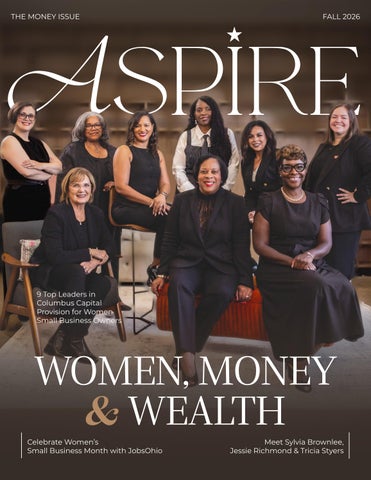
9 Top Leaders in Columbus Capital Provision for Women Small Business Owners
WOMEN, MONEY & WEALTH Celebrate Women’s Small Business Month with JobsOhio
Meet Sylvia Brownlee, Jessie Richmond & Tricia Styers
THE OPPORTUNITY COUNTY
As Central Ohio continues to grow, so do the opportunities for women and emerging business owners. Through the support of Franklin County Board of Commissioners and the Office of Economic Engagement and Community Development, women entrepreneurs and executives have access to the resources, partnerships, and opportunities they need to grow and succeed.
VIEW OUR 2026 STATE OF THE COUNTY REPORT
HEALTHCARE, REDEFINED. A DECADE OF HELPING WOMEN LEADERS R E C L A I M T H E I R E N E R G Y A N D H E A LT H Physician-led. Root cause focused. At Vitality Natural Wellness, we believe true health is built through understanding the whole person—not simply treating symptoms. We believe listening is medicine. Education is empowerment. Prevention is possible. Celebrating over 10 years, and our mission is the same: to help you live, lead, and love from a place of true vitality. A decade of personalized care. A future of limitless possibility.
Melissa McRae, D.O. FOUNDER & CEO, VITALITY NATURAL WELLNESS VITALITYNATURALWELLNESS.COM
Contents Founder/Publisher Keena M. Smith Managing Editor Ana Assis Client Experience Victoria Murray Photography Sam Moeller & Alex Abejuela, The Pearl Creative Agency, Official Photographer Graphic Production JPS Print Advisory Board K. Zulene Adams, Dr. Pamela Gregory, Jill Hofman, Daphne McKinnie, Tawana Mims, Chanel Norton Lee, Natasha Pongonis, Gayle Saunders, Ralph Smithers, Damika Withers
6
7 8 19 22 23 30
Message from the Publisher Message from the Editor 9 Top Leaders in Columbus Capital Provision for Women Small Business Owners Jobs Ohio Women Owned Businesses Drive Ohio Forward Privilege Is Capital Meant to Be Shared Joyce Chen, Ph.D. Allyship Is Wealth for All Nick Bankston Wellness The Q4 Reset: Five Health Habits for Stronger Leadership
Advertising Inquiries, Event News & Press Releases Alexanna Perry Alexanna@womensceo.org | 614-3441070
The Aspire Women’s Book of Business Magazine is a quarterly publication. All contents of this magazine are copyrighted 2026 Aspire Brands, a division of The Women’s Center for Economic Opportunity. Aspire Magazine utilizes innovative technologies, including artificial intelligence, to support content development. All AIassisted content is subject to human review, editing, and final approval by our editorial team.
4 | Aspire Magazine | Fall 2026
26
Your Network Is Capital. BIG Book Launch Recap /Join ASPIRE Community
Solving legal problems before they happen. Starting, growing, buying & selling a business Contracts & agreements, customized Trademark & copyright protection Business legal strategy & advice with confidentiality Fractional general counsel for businesses & entrepreneurs
Scan to schedule an initial consultation.
cericolalegalsolutions.com
(614) 371-4183
Kessia C. Cericola, Esq. English, Portuguese & Spanish
Columbus, OH
FROM THE PUBLISHER
WHAT HAPPENS WHEN CAPITAL MEETS OUR AMBITION
S
haron is one of our highest performing WCEO accelerator alumna. She’s a winner of multiple pitch contests, including ours, her finances are in order and she’s a certified fulltime CEO and technology founder determined to grow her company in one of Ohio’s fastest growing industries. A veteran of the most popular technology labs and cohorts the region has to offer, Sharon is building, refining and pursuing investment. Yet, as a woman, she is navigating a marketplace in which founders like her receive only a fraction of a fraction of venture capital and the data from traditional capital sources doesn’t tell a much more hopeful story. Her experience is personal, but the barrier is systemic. Our forthcoming Fail to Scale: Closing Central Ohio’s Women’s Small Business $60B Opportunity Gap research frames the challenge facing our community clearly: Central Ohio is rich with women entrepreneurs, yet too few women-owned businesses make the transition from owneroperated ventures to growing employers to scaled businesses. Capital is not the only solution, but growth can’t happen without it. What happens when capital meets our ambition? Women create jobs and hire from their where they live. They buy homes, invest in technology, compete for larger contracts, enter new markets, create generational wealth, invest in each other, become financially stable and build
6 | Aspire Magazine | Fall 2026
companies that strengthen entire communities. Reaching that future requires more doors to capital—not a single pathway. Women need better access to affordable loans, lines of credit, equity investment, patient capital, grants and funding designed for different stages of growth. And more women managing funding and making investment decisions. This Women, Money & Wealth issue of ASPIRE recognizes National Women’s Small Business Month
by celebrating women owners and introducing the capital leaders on our cover. These bankers, investors, government officials and community development executives are helping move us from documenting the gap to closing it. Connect with them! Here’s to Your Success,
M. Keena Publisher Aspire Magazine
Smith
MANAGING EDITOR’S LETTER
Women, Money & Wealth For nearly three decades, my career has kept me close to one of the most consequential conversations in business: money. I have sat across the table from business owners seeking capital, worked alongside financial leaders making investment decisions, and watched the right relationship or financial guidance change the direction of a company. I have also seen talented entrepreneurs struggle, not because they lacked vision or determination, but because they lacked access. Those experiences shaped how I think about money today. Money is more than what we earn or what sits on a balance sheet. It influences who can start, who can scale, who can invest, and who can build wealth that extends beyond one generation. And for women business owners, understanding how to access and leverage capital is an essential part of building a sustainable business. That is why Women, Money & Wealth feels deeply personal to me. In this issue, we recognize influential women across banking, finance, investment, wealth management, and economic development who are helping move capital, knowledge, and resources into the hands of women entrepreneurs. They are opening doors, building relationships, challenging barriers, and helping women make more informed financial decisions. But access is only part of the story. October is Women’s Small Business Month, and these pages also celebrate the women putting capital to work. Women building companies, creating jobs, serving communities, taking calculated risks, and making financial decisions every day that affect far more than their own bottom line. Because when a woman builds a financially strong business, the impact travels. It reaches employees and their families. It strengthens communities. It creates purchasing power. It builds assets. And, when done intentionally, it creates wealth that can move from one generation to the next. My hope is that this issue encourages us to talk about money differently, not simply as something women earn, but as something we understand, access, invest, grow, and use with intention. Because women should not only participate in the economy. We should have the knowledge, capital, and relationships to help shape it.
ssis
Ana A
Managing Editor Aspire Women’s Book of Business & Magazine Fall 2026 | Aspire Magazine |
7
Women, Money & Wealth
Cindi Englefield President and CEO Accelerating Angels acceleratingangels.com linkedin.com/in/cindienglefield
1. What is the single biggest misconception women business owners have about building wealth or accessing capital, and what should they be doing instead? One of the biggest misconceptions I see is that women business owners need to do it all themselves. They try to bootstrap longer, control everything and wait to seek capital until they are completely ready. Understand the different forms of capital available, build relationships with investors before you need them, and surround yourself with people who can help accelerate your growth. 2. What three financial practices separate businesses that are truly capital-ready from those that struggle to secure funding? 1. Know your numbers. Investors like to see a founder able to explain the numbers. 2. Manage cash. 3. Know how you will use the capital and exactly what it will accomplish. If you are raising $1 million, then show investors how that $1 million will be deployed, what milestones it will achieve, and how reaching those milestones increases the value of the company. 3. Once entrepreneurs begin generating profits, what advice would you give them about protecting, reinvesting, and leveraging those dollars to build a scalable and credit-worthy business and personal wealth? Once a business begins generating profits, I encourage entrepreneurs to be intentional about what happens to those dollars. My advice would be to build adequate cash reserves, maintain clean financials, establish strong business credit, and don’t become overly dependent on debt or the next
8 | Aspire Magazine | Build
round of funding. Build wealth outside the business. The company shouldn’t be your only asset. Online: Cindi on the opportunity investors keep missing, and the shift every woman business owner should prepare for. Read her full Q&A at womensceo.org
“
Building generational wealth isn’t simply about how much you earn. It’s about what you own, what you build, and how you invest.
”
WOMEN, MONEY & WEALTH
Andrena Austin Director Franklin County Office of Economic Engagement & Community Development (EECD) www.franklincountyohio.gov linkedin.com/in/andrena-austin-84666315b
1. What is the single biggest misconception women business owners have about building wealth or accessing capital, and what should they be doing instead? I think the biggest misconception is that you have to already be wealthy, have perfect credit, or have a huge business before you can access capital. This is simply not true. What women should be doing is getting financially prepared early. Capital is easier to access when you prepare for it instead of waiting until you are in a crisis. 2. What three financial practices separate businesses that are truly capital-ready from those that struggle to secure funding? First, they know their numbers. They understand what is coming in, what is going out, and whether the business is actually making money. Second, they keep good financial records. Third, they build credit and banking relationships. They do not wait until they need a loan to introduce themselves to a banker or lender. 3. Once entrepreneurs begin generating profits, what advice would you give them about protecting, reinvesting, and leveraging those dollars to build a
scalable and credit-worthy business and personal wealth? Do not spend every dollar just because the business is finally making money. Protect some of it. Build an emergency reserve for the business. Reinvest some of it into things that can help the business grow, like better systems, marketing, technology, employees, or equipment. Online: Andrena on building a real pathway from education to funding, and why your business should have value beyond yourself. Read her full Q&A at womensceo.org
“
I think we spend a lot of time telling women where the money is, but not enough time helping them become ready for the money.
”
Build | Aspire Magazine |
9
Women, Money & Wealth
Tiffany Whitner VP, Senior Community Business Banker First Merchants firstmerchants.com linkedin.com/in/tiffany-whitner
1. What is the single biggest misconception women business owners have about building wealth or accessing capital, and what should they be doing instead? The biggest misconception is believing that access to capital creates wealth. In reality, wealth is created by building a strong, scalable business that attracts capital. 2. What three financial practices separate businesses that are truly capital-ready from those that struggle to secure funding? 1. Maintain accurate and current financial records. 2. Actively manage their global cash flow, not just business revenue. 3. Build business credit and, most importantly, a business banking relationship before they need funding. 3. Once entrepreneurs begin generating profits, what advice would you give them about protecting, reinvesting, and leveraging those dollars to build a scalable and credit-worthy business and personal wealth? Build a strong financial portfolio, such as a business contingency or emergency reserve, and do not commingle business and personal funds. Invest back into the business by upgrading processes and technology, purchasing equipment that will increase productivity, and establishing and building business credit. Online: Tiffany on the funding mix women need beyond venture capital, and what to build in the next five years. Read her full Q&A at womensceo.org
10 | Aspire Magazine | Build
“
Every woman business owner must stop running a highincome job they own and start building a self-sustaining enterprise designed for an institutional sale or succession.
”
Women, Money & Wealth
Sabra Kershaw Vice President, Commercial Relationship Manager FCBank ImpressiaConnect.com linkedin.com/in/sabra-thomas-kershaw-980b729
1. What is the single biggest misconception women business owners have about building wealth or accessing capital, and what should they be doing instead? I think the single biggest misconception is that access to capital is the same thing as building wealth. It’s not. I would say: Don’t just ask, “How much can I borrow?” Ask, “How can I use capital strategically to grow an asset that will continue to work for me?” As women, we have to get comfortable talking about money, asking for capital, and understanding our finances. 2. What three financial practices separate businesses that are truly capital-ready from those that struggle to secure funding? 1. Know your numbers. 2. Keep your financial house clean. We want to see that you manage what you already have before we give you more. 3. Plan before you need the capital. Don’t wait until you need money to walk into the bank. Capital should be part of your growth strategy, not an emergency solution.
“
Access to capital is important, but access to knowledge and relationships is what helps women use that capital to scale.
”
3. Once entrepreneurs begin generating profits, what advice would you give them about protecting, reinvesting, and leveraging those dollars to build a scalable and credit-worthy business and personal wealth? I always tell entrepreneurs: don’t confuse making money with building wealth. Once you become profitable, protect those dollars, reinvest strategically, and leverage wisely. Then use credit and capital as tools to grow, not as a lifeline. And don’t forget to pay yourself and build wealth outside of the business through investing, real estate, and other assets. Online: Sabra on investing in women before they need the money, and why women must think like owners and investors. Read her full Q&A at womensceo.org
Build | Aspire Magazine |
11
Women, Money & Wealth
Hannah Baumgartel Senior Program Manager JobsOhio jobsohio.com linkedin.com/in/hannahbaumgartelmpa
“ 1. What is the single biggest misconception women business owners have about building wealth or accessing capital, and what should they be doing instead? The biggest misconception is that access to capital is primarily about finding the right lender or investor. In reality, capital access is earned long before that conversation starts — through clean financials, a clear growth plan, and a credit history that tells a consistent story. Capital-readiness isn’t just a financial discipline — it’s a relationship-building one. 2. What three financial practices separate businesses that are truly capital-ready from those that
12 | Aspire Magazine | Build
The owners who start building that financial foundation today will be the ones positioned to scale, compete, and pass wealth on tomorrow.
”
struggle to secure funding?
wealth?
First, clean, current, and separate books — no commingled personal and business finances, and financials a lender can trust at a glance. Second, a documented growth plan with realistic projections, not just a good story. Third, active credit management — building strong personal and business credit profiles well before capital is needed, and understanding exactly what a lender will look for.
Pay yourself intentionally, but don’t stop there. Build a cash reserve before you reinvest aggressively, and separate what belongs to the business from what belongs to you personally — that distinction protects both. Reinvest with a purpose: capacity, talent, or systems that let you scale, not just spend.
3. Once entrepreneurs begin generating profits, what advice would you give them about protecting, reinvesting, and leveraging those dollars to build a scalable and creditworthy business and personal
Online: Hannah on the connective tissue women entrepreneurs are missing, and why capital access is becoming data-driven. Read her full Q&A at womensceo.org
WOMEN, MONEY & WEALTH
Anne Richie Managing Director The Mezzanine Fund themezzaninefund.com linkedin.com/in/anne-richie-1097b164
“
The Great Wealth Transfer is a huge opportunity for women to steer money to women managers who fund women.
1. What is the single biggest misconception women business owners have about building wealth or accessing capital, and what should they be doing instead? In accessing capital, the biggest misconception I see is that banks will serve as a first capital provider after friends, family, and founders. 2. What three financial practices separate businesses that are truly capital-ready from those that struggle to secure funding? 1. A discipline of constantly reviewing data about financial performance, as opposed to waiting until month- or quarter-end. 2. A discipline of maintaining relationships with potential funders through communicating updates and performance.
”
3. A keen eye on asset utilization and cost drivers. 3. Once entrepreneurs begin generating profits, what advice would you give them about protecting, reinvesting, and leveraging those dollars to build a scalable and creditworthy business and personal wealth? I would advise them to understand what triggers performance on the revenue and expense side and continually assess risks to the profitability they have achieved. If you have reached profitability, you have a formula that can be repeated and improved! Online: Anne on why investing in women fund managers changes outcomes, and the business model trend set to accelerate. Read her full Q&A at womensceo.org
Build | Aspire Magazine |
13
Women, Money & Wealth
Dina Shultz Chief Revenue Officer Telhio Credit Union
telhio.org linkedin.com/in/dinashultz
1. What is the single biggest misconception women business owners have about building wealth or accessing capital, and what should they be doing instead? One of the biggest misconceptions is that access to capital is determined primarily by business size, revenue, or the age of the company. In reality, lenders and financial partners are often evaluating preparedness, consistency, and the overall financial story behind the business. The businesses that successfully access capital are often the ones that prepare long before they need it. 2. What three financial practices separate businesses that are truly capital-ready from those that struggle to secure funding? First, strong financial management. Capital-ready businesses maintain timely financial statements, understand their cash flow (extremely important), and can clearly explain their performance and projections. Second, disciplined credit management.
“
The businesses most likely to create lasting wealth are those that can operate and grow independently of the founder.
”
14 | Aspire Magazine | Build
Third, effective banking relationships. Businesses that engage regularly with trusted financial partners receive guidance, insights, and access to financing opportunities that may not be available during a last-minute funding request. 3. Once entrepreneurs begin generating profits, what advice would you give them about protecting, reinvesting, and leveraging those dollars to build a scalable and credit-worthy business and personal wealth? Protect profits by maintaining a cash reserve strategy with short-, mid-, and long-term liquidity to help navigate uncertainty and fund future opportunities. Reinvest strategically in growth drivers such as technology, talent, operational efficiency, and customer acquisition, while avoiding investments that place excessive pressure on cash flow. Use leverage thoughtfully to preserve working capital and support sustainable growth. Online: Dina on why capital alone does not guarantee success, and how data and AI will shape competitive advantage. Read her full Q&A at womensceo.org
Women, Money & Wealth
Daphne McKinnie SVP, Regional Community Development Director The Huntington National Bank huntington.com linkedin.com/in/daphnemckinnie
“
Owning property, land, and real estate is key.
”
1. What is the single biggest misconception women business owners have about building wealth or accessing capital, and what should they be doing instead? Using their own finances first or mixing business with personal finances. They should always separate the two, and before even beginning the business, seek financing. Typically, financial institutions want to assist at the startup stage or once the business has been established. It can be harder at the in-between stage. 2. What three financial practices separate businesses that are truly capital-ready from those that struggle to secure funding?
3. Once entrepreneurs begin generating profits, what advice would you give them about protecting, reinvesting, and leveraging those dollars to build a scalable and credit-worthy business and personal wealth? Keep good records, and if you are not skilled in this space, seek professional help. It will allow financial institutions to take you more seriously. Online: Daphne on what women miss about available funding, and how to learn what lenders view favorably. Read her full Q&A at womensceo.org
Creditworthiness, understanding their financials, and keeping good records.
Build | Aspire Magazine |
15
Women, Money & Wealth
Heather Yomboro Executive Director Ohio Statewide Development Corporation osdc.net linkedin.com/in/heather-yomboro80b80b207
“
Accessing the capital they need starts with confidently making a big ask!
1. What is the single biggest misconception women business owners have about building wealth or accessing capital, and what should they be doing instead? Women sometimes think the smallest ask is the most likely to be granted, but accessing the capital they need starts with confidently making a big ask! 2. What three financial practices separate businesses that are truly capital-ready from those that struggle to secure funding? Good bookkeeping, great financial analysis, and the ability to communicate their business plans and financial forecasts to a lender.
16 | Aspire Magazine | Build
”
3. Once entrepreneurs begin generating profits, what advice would you give them about protecting, reinvesting, and leveraging those dollars to build a scalable and credit-worthy business and personal wealth? Invest in a great bookkeeper, CPA, or financial advisor. Don’t be afraid to take on loans to support strategic growth. Online: Heather on the opportunity for banks, credit unions and lenders, and how the Great Wealth Transfer opens doors. Read her full Q&A at womensceo.org
ADVISORY | ADVOCACY | INVESTMENT | PHILANTHROPY
Strategic Guidance.
Lasting Impact. TMH $trategies helps women-owned and minority-owned organizations turn vision into sustainable growth through strategic guidance and meaningful opportunity.
“Where Advocacy Meets Opportunity for Small Business Growth”
FOUR WAYS WE HELP YOU MOVE FORWARD
ADVISORY
ADVOCACY
INVESTMENT
PHILANTHROPY
Clear plans for growth and stronger operations.
A stronger voice for your business and community.
Capital and partnerships for promising ventures.
Resources that expand access and lasting impact.
ABOUT THERESA MARTIN HARRIS
Founded by Theresa, TMH Strategies reflects more than two decades of experience in strategic advisory, investment guidance, advocacy and philanthropy. Her career has been dedicated to creating opportunity, expanding access and making a lasting impact on communities.
theresa@tmhstrategies.com • tmhstrategies.com • 614-400-9324
PRINT WITH PURPOSE.
Business Cards · Flyers · Apparel Banners · Direct Mail
Start your next project today
jprintshop.com
Women Owned SPONSORED CONTENT
Businesses Drive Ohio Forward
O
ctober is Women’s Small Business Month—a time to celebrate the innovators, risk-takers, and communitybuilders who are helping shape Ohio’s future. Across the state, women-owned businesses are creating jobs, revitalizing neighborhoods, and introducing new products and services that strengthen and grow local communities.
Sylvia Brownlee, founder of Skin by Brownlee & Co.
Skin by Brownlee & Co. Cincinnati
One entrepreneur who has benefitted from these offerings is Sylvia Brownlee, founder of Skin by Brownlee & Co., a Cincinnati-based skincare clinic specializing in acne and hyperpigmentation treatment. Brownlee participated in Lightship Bootcamp, a hands-on business development program supported by JobsOhio. Through one-on-one coaching and educational workshops, she gained valuable insights into business strategy, branding, and growth planning. The experience helped her secure partnerships that supported the expansion of both her flagship location and fulfillment operations, enabling her company to reach more customers and advance its mission of building confidence through skincare.
JobsOhio is part of a statewide team supporting small businesses to help accelerate economic growth in every corner of the state. Through programs like the JobsOhio Small Business Grant and partnerships with organizations including Lightship Foundation, Aileron, and ThinkModa, Ohio is helping entrepreneurs access capital, training, mentorship, and resources that position them for long-term success.
Skin by Brownlee & Co is an esthetician-formulated skincare clinic founded by skincare expert Sylvia Brownlee. Based in Cincinnati, this woman-owned small business offers a comprehensive range of products specialized in the prevention and treatment of acne and hyperpigmentation. www.skinbybrownleeandco.com
Connect | Aspire Magazine |
19
Maggie’s Farm & Aromatics, based in Chillicothe, Ohio, manufactures bath and body, home fragrance, and personal care products for wholesale, supplying over 100 boutiques nationwide. Maggie’s is owned by Jessie Richmond, who founded the business in 2020 in the kitchen of an old farmhouse. www.maggiesfarmandaromatics.com
Maggie’s Farm & Aromatics Chillicothe • Columbus
100+
boutiques nationwide carry Maggie’s Farm products Jessie Richmond, founder of Maggie’s Farm & Aromatics, transformed an at-home startup into a thriving manufacturer of bath, body, and home fragrance products now sold in more than 100 boutiques nationwide. To meet increasing demand, the company invested in a 4,000-square-foot expansion in downtown Chillicothe. A JobsOhio Small Business Grant assisted the project, increasing manufacturing capacity, creating new jobs, and boosting the company’s capacity in both its Chillicothe and Columbus retail operations.
4,000
square-foot expansion in downtown Chillicothe
When entrepreneurs excel, communities benefit, jobs are created, and Ohio’s economy grows stronger. 20 | Aspire Magazine | Connect
Simply Sweet
Fredericktown • Knox County
Tricia Styers, owner of Simply Sweet in Fredericktown, turned a small bakery into a growing regional supplier. With support from a JobsOhio Small Business Grant, Simply Sweet purchased specialized equipment that doubled production capacity and enabled the company to expand distribution through major retailers such as Kroger and Sheetz. The investment also helped create new jobs while preserving existing positions in the company’s Knox County facility.
2x
production capacity with new specialized equipment Simply Sweet is a specialty wholesale bakery based in Fredericktown, Ohio, that began as a small operation selling baked goods locally at the Mount Vernon Farmers Market. To meet rising demand, owner Tricia Styers grew the company and expanded operations through persistence, community support, and a commitment to quality. www.simplysweet.online
Ohio’s Next Chapter These three stories represent the thousands of entrepreneurs across Ohio who are turning ambition into opportunity. Whether through funding, educational programs, or strategic partnerships, JobsOhio remains committed to helping small businesses build, grow, and thrive. Resources to empower small business leaders can be found at jobsohio.com/ smallbusiness. When entrepreneurs excel, communities benefit, jobs are created, and Ohio’s economy grows stronger. This Women’s Small Business Month, we celebrate the founders whose determination and vision are helping write Ohio’s next chapter of economic success.
Connect | Aspire Magazine |
21
Privilege Is Capital Meant to Be
Shared By:
Joyce Chen
, PhD
The Ohio State University, Professor www.joycejchen.com www.linkedin.com/in/joyce-chen-econ/ Joyce Chen is Professor of Economics in the Department of Women’s, Gender and Sexuality Studies at The Ohio State University. Her research addresses climate vulnerability, migration, and inequality and focuses on bringing a critical feminist lens to working with data and artificial intelligence. She has served five years on boards for Governor DeWine’s Economic Roundtable and serves on the boards for Action for Children, Planned Parenthood Advocates of Ohio, and the ACLU-Ohio, as well as the advisory council for Children’s Defense Fund of Ohio.
O
n February 14th, 2025; the U.S. Department of Education issued a “Dear Colleague” letter stating that educational institutions would be stripped of federal funding if they “us[e] race in decisions pertaining to admissions, hiring, promotion, compensation, financial aid, scholarships, prizes, administrative support, discipline, housing, graduation ceremonies, and all other aspects of student, academic, and campus life.” Two weeks later, The Ohio State University shuttered its 55-year-old Office of Diversity and Inclusion (ODI) and effectively ended all diversity, equity, and inclusion (DEI) programming at the institution. I love my work, but as author Sarah Jaffe warns, “work won’t love you back.” And in this moment, the fragility of our institutional support became glaringly obvious. We had seen firsthand the benefits
22 | Aspire Magazine | Connect
generated by DEI programs, directly for participants and indirectly for the broader university community. But it was clear that the institution did not share those values. Sitting with this discomfort – along with disappointment, disillusionment, and distrust – forced me to revisit beliefs about my own value, voice, and power, and to reflect on how I needed to change the ways in which I lead and show up for others. I had been serving as a Faculty Fellow at The Women’s Place, which was housed in ODI and whose mission was to promote women’s advancement and gender equity for faculty and staff at OSU. The Women’s Place was similarly – and summarily – shuttered a few months later. I was very fortunate to be able to return to my full-time, tenured faculty position in the Department of Women’s, Gender, and Sexuality Studies (WGSS). What I learned during this transition was how to lean into my privilege, to use my voice, my influence, my platform in service of those who did not have, or no longer had, the power and the privilege to speak for themselves. When I was a people manager, I had always endeavored to shield my team from unreasonable demands, unwarranted critiques, and excessive scrutiny. But this was something more – I needed to speak not just to current harms, but to the ways in which fundamental values had been undermined. To the disingenuous portrayal
of the work. To the attempted erasure of years of effort and struggle. As I was being asked to uphold amorphous and evolving organizational values, I had to reconcile with the fact that those values no longer aligned with my personal values. Countless employees are placed in this impossible bind, day after day, month after month. But – as a tenured faculty member, as a homeowner with savings and familial support, as part of a racial group that is often viewed as white-adjacent – I have been granted a certain privilege and space to speak my truth and to make visible the work and experiences of others that the institution is attempting to make invisible. So now, my mission is to seize every opportunity I can to elevate the progress that was made and document the regression that is occurring. To applaud those who did the hard work and to hold accountable those who dismantle that work. To highlight the failings of the systems we live in and to advocate for systemic change that centers people over both profit and politics. I recognize that I am in a position of immense privilege. Almost all of us have some privilege, in some space. If we all exercise that privilege to advocate for those who are unable to, I believe we could create a much more inclusive and equitable world. This essay was first published in the 2026 BIG Book of Business
Allyship is Wealth
for All
When Support Requires More Than Words By:
Nick Bankston Columbus City Councilmember
I
t is easy to support women’s empowerment when doing so costs you nothing.
It is easy to applaud women’s leadership at award ceremonies, celebrate Women’s History Month, or post affirming words about equity on social media. The real test of allyship comes when support requires discomfort. When it means challenging systems, sharing power, making room, or using your voice when silence would be politically easier. That is where leadership reveals itself. Over the past year, I have spent a great deal of time reflecting on what allyship actually requires, particularly in a climate where social, political, and economic headwinds have made conversations about equity more polarized and, in some spaces, less welcome. As a public servant, nonprofit leader, husband, father, and someone who has worked alongside extraordinary women throughout my career, I have learned that allyship cannot simply be an identity you claim. It must be a discipline you practice. One lesson has become especially clear: advocacy without action is simply branding. Some of the most transformative initiatives I have had the privilege to help lead – from supporting women entrepreneurs through economic development strategies, to expanding behavioral health services for women in recovery, to investing in reproductive justice and confronting the inequities driving infant and maternal mortality – have reinforced a simple truth: systems are rarely designed with women’s realities centered in the first place. And if you recognize that reality, neutrality
is not leadership. I have watched women in leadership be expected to prove competence repeatedly in ways their male counterparts are not. I have seen women entrepreneurs asked to scale businesses with less access to capital, fewer institutional relationships, and more scrutiny. I have worked alongside mothers rebuilding their lives after addiction or incarceration, carrying both extraordinary resilience and the burden of systems that too often confuse punishment with accountability. Those experiences have shaped my leadership. Earlier in my career, I believed allyship meant advocacy: speaking up, supporting initiatives, or opening doors where possible. I still believe those things matter. But experience has taught me that meaningful allyship often requires something harder: surrendering space.
Advocacy without action is simply branding. exhaustion simultaneously. That perspective has made me a better listener, a more intentional advocate, and, I hope, a better leader and man. If I have learned anything, it is this: allyship is not measured by what you say when equity is convenient. It is measured by what you are willing to risk when it is contested. So, my advice to women building businesses, institutions, and movements is this: do not wait for permission to own your expertise.
Not every room needs your voice to be the loudest. Not every table needs your hand at the head of it. Sometimes leadership is not about being the architect of the solution, but about being the person willing to remove barriers so others can lead fully.
Your value is not determined by how comfortable others are with your confidence. Your voice does not require unanimous approval to be valid. And your power grows the moment you stop shrinking it to fit someone else’s expectations.
That shift changed how I think about power.
The strongest leaders I know do not simply ask for space. They define it.
Power is not diminished when shared. Influence is not weakened when extended. In fact, communities become stronger when leadership reflects the lived realities of the people being served. As a husband, I see this personally. My wife, Habiba Bankston, is a remarkable leader in her own right, and watching her navigate spaces, challenges, and expectations has sharpened my understanding of how often women are required to carry excellence and
And the smartest men I know remove the barriers that keep the women who shape our economy, communities, and families from doing the same.
This essay was first published in the 2026 BIG Book of Business
Connect | Aspire Magazine |
23
Scooping Unforgettable Moments
Premium ice cream catering for Columbus's most memorable events. Konfetti carts is luxury ice cream catering for weddings and
corporate galas. Featuring artisanal flavors, elegant carts, and white-glove service to make your celebration unforgettable.
Includes: Gourmet flavors
Professional attendants Classic-style cart
Custom branding options
RESERVE YOUR EXPERIENCE TODAY Serving Columbus, OH & surrounding areas
konfetticarts.com
@konfetticarts
Faith, Finance & the People God Sends by Lisa Gutierrez, CEO, Dos Hermanos
Looking back on my entrepreneurial journey, I realize that faith and finance have never been separate. They have always walked side by side. When my husband, Vicente, and I started Dos Hermanos, we had a borrowed food truck, about $2,000 in savings, and a dream. As the business grew, so did our financial responsibilities. There were seasons when cash was tight, doors seemed closed, and I couldn’t see how we would face the next challenge. One of the hardest seasons came when I was leading the company through a severe financial crisis. Bills went unpaid. Payroll and vendors weighed heavily on us. Members of our leadership team questioned whether they could stay, and our personal lives suffered under the strain. On Sundays, I sat in the pews of two different churches, praying for God to deliver our business. I didn’t know how we would make it through the next week. Still, I kept praying, leading, serving and believing that God wasn’t finished with us yet. Then came one of the most unexpected moments of my entrepreneurial journey. A dishwasher on our team, a family member I never expected to become part of the solution, heard what we were facing. He came to us and said he was willing to invest in us during that difficult season. He believed in what we were building. He wasn’t seeking recognition. He didn’t have a corporate title or a financial résumé. He simply wanted to help,as an act of giving and serving God. That moment stopped me in my tracks. I had been looking for an answer in all the places I thought it would come from. I expected a banker, CEO, CFO, or COO to walk through the door with a solution. An investor to appear. Instead, God sent me a dishwasher. That experience changed how I see people and how I lead. Sometimes we look for the person with the biggest title while God is preparing someone we never saw coming. The person who makes the greatest difference may not be at the head of the table. It may be the person serving it. I’ve learned that faith in business doesn’t mean ignoring the numbers. It means facing them honestly, making wise decisions, stewarding what you’ve been given, and trusting God when the answer isn’t visible yet.
Sometimes you pray for a financial solution and God sends a dishwasher.
“Commit your actions to the LORD, and your plans will succeed.” — Proverbs 16:3 (NLT) So I keep my eyes open. Provision can come from the most unexpected places, and God can use the most unexpected people. We made it through that season. Dos Hermanos is still serving today, and I have never forgotten who offered to stand with us when it mattered most. Thrive | Aspire Magazine |
25
Your Network Is Capital. POWER IN CONNECTION
Financial capital funds a business. Social capital helps expand what’s possible. Social capital lives in your relationships: who knows your work, who recommends you and who says your name in a room you haven’t entered yet. It never appears on a balance sheet, yet it often decides who hears first about the contract, the board seat or the funding round. When Harvard Business School researchers followed nearly 1,000 venture competition participants, men were nearly twice as likely as women to follow up with investors they had met. Women who did follow up heard back at similar rates.
Composition matters too. Northwestern and Notre Dame researchers found that women who landed the highest leadership roles paired a broad network with a close inner circle of women who shared insight that never makes it into a job description. And MIT Sloan research found that women in business referral groups asked for business as often as men, yet were referred less, especially in fields dominated by men.
Aspire was built for that gap: intentional rooms where women are seen, recommended, introduced by name and encouraged to make the ask. Women don’t need to be told to network. They need rooms where other people say their name.
26 | Aspire Magazine | Thrive
People. Partnerships. Possibilities. VISIBILITY
ACCESS
Be seen and known for your work.
Leaders, resources and opportunities.
CONNECTION
OPPORTUNITY
Build meaningful relationships.
Pathways to referrals and partnerships.
GET IN THE ROOM. Build your network. Expand your access. Grow your social capital.
COMMUNITY
Relationships that extend beyond the room.
JOIN ASPIRE ›
Thrive | Aspire Magazine |
27
Conferencext
Wellness
The Q4 Reset: Five Health Habits for Stronger Leadership By Keeanna Smith, MD
“
Preventive care is an investment, not an interruption.
7 to 9
hours of sleep most adults need
”
150
minutes of moderate activity each week
As the final quarter fills calendars with meetings, conferences and year-end goals, many women CEOs focus on preparing everyone else. It is also the right moment to reset your own health. Just as organizations benefit from strategic planning, your health benefits from consistent routines. Start with these three habits. 1. Reset your sleep. Most adults need 7 to 9 hours a night to support focus, immunity and heart health. Keep a consistent bedtime and wake time, even on weekends. To adjust, move bedtime earlier by 15 to 30 minutes every few nights and limit screens in the hour before bed. 2. Schedule movement like a meeting. The American Heart Association recommends at least 150 minutes of moderate aerobic activity each week, plus muscle strengthening two or more days. Treat exercise as a standing appointment on your calendar. Even three 10-minute walks during the workday count.
minute walks count toward your goal
3. Book the appointments you’ve postponed. Preventive care is an investment, not an interruption. Early detection and prevention remain among the most effective tools for protecting long-term health. Rather than striving for perfection, focus on consistency. Investing in your health is investing in your power. Read all five habits, including how to fuel busy days and support your immune system, at womensceo.org
Q4 Reset Checklist • Annual physical • Recommended screenings • Dental visit • Eye exam • Ask about recommended vaccinations
This article is for educational purposes only and is not medical advice. Consult your physician before making changes to your health or wellness routine.
30 | Aspire Magazine | Fall 2026
3 × 10
Do more than meet your growth goals. Exceed them with help from JobsOhio. As Ohio’s private economic development corporation, JobsOhio specializes in maximizing your business’s potential. Based on your needs, we can help connect you to small business opportunities and programs to help you build, grow, and thrive – so your business can grow bigger and succeed faster.
Let’s grow, together. JOBSOHIO.COM/SMALLBUSINESS