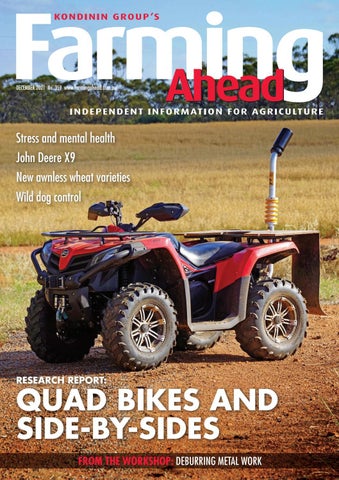
DECEMBER 2021 No. 359 www.farmingahead.com.au
Stress and mental health John Deere X9 New awnless wheat varieties Wild dog control
RESEARCH REPORT:
QUAD BIKES AND SIDE-BY-SIDES FROM THE WORKSHOP: DEBURRING METAL WORK
Takeadvantage advantage of of the the Take EarlyOrder Order Program. Program. Early Savenow. now. Save Terminate later. later. Terminate
Kills 99% Max Uptime Kills 99% Max Uptime Independently tested, Superior wear life & Aussie steel mills. Independently tested, Aussie steel mills.
easy access forlife quick Superior wear & changeouts. easy access for quick changeouts.
Contact your local dealer Contact your local dealer Untitled-2 8
T T S S E E V V R HHAAR22002222 Y L Y L R RERR EA D E R D OOR S INGGS V N SAAVI S
Efficient Efficient rotors Aerodynamic
for lowest no-load Aerodynamic rotors power. for lowest no-load power.
Future Proof Future Proof stays New technology
compatible with stays New technology machines. compatible with machines.
seedterminator.com.au/dealers seedterminator.com.au/dealers 11/10/21 4:50 PM
DECEMBER 2021 No. 359 www.farmingahead.com.au @KondininGroup Kondinin Group
Editorial
Senior editor / machinery researcher: Mark Saunders Research general manager: Ben White Engineering manager: Josh Giumelli Online researcher: Macey Hill Contributors: Pamela Lawson, Jill Griffiths, Nicola Bell Enquiries: editorial@kondinin.com.au
Advertising
Advertising sales executive: Gillian Doreian Enquiries: gillian.doreian@aspermont.com Digital and Creative Group digital & creative director: Abisola Obasanya Senior layout designer: Catherine Hogan Enquiries: print.management@aspermontmedia.com
Subscriptions
www.farmingahead.com.au/subscribe Phone: 1800 677 761 Email: contact@kondinin.com.au
Publishing
Publishing director: Simon Tarmo
Executive
Chairman: Andrew Kent Managing director: Alex Kent Group chief operating officer: Ajit Patel Group chief financial officer: Nishil Khimasia Chief content & strategy officer: Ian Hart Chief commercial officer: Matt Smith COPYRIGHT WARNING: The opinions expressed in Farming Ahead are not necessarily those of Kondinin Information Services Pty Ltd (ABN: 72 133 413 920), trading as Kondinin Group. All material appearing in Farming Ahead is the subject of copyright owned by Kondinin Group and is protected under the Australian Copyright Act (1968), international copyright and trademark law. No portion may be reproduced or duplicated by any process without the prior written permission of Kondinin Group. DISCLAIMER: This publication is for information purposes only. The publisher and its agents or employees shall not be liable for any loss or damage suffered by any person as a result of reliance on any of the contents hereof, whether such loss or damage arises from the negligence or misrepresentation or any act or omission of the publisher or its agents. SN 1038-1678 Printing: Vanguard Press Kondinin Information Services Pty Ltd is a fully owned subsidiary of Aspermont Ltd.
14
36
CENTRE LIFTOUT RESEARCH REPORT
QUAD BIKES AND SIDE-BY-SIDES
24
FROM THE WORKSHOP
Editorial
Livestock
4
30 32 34 36
When a “like” should be a “dislike”
Health and safety 5
Farm stress can test resilience
Farmer of the Year 7
Nominations for Farmer of the Year open
Machinery 8 10 11 13 14
New products and services 3S spraying system launched by Exel New spreaders launched in South Australia Industry approaching 17,000 tractor sales for the year John Deere X9 – first look
Mycoplasma can hit hard Opportunities for climate-friendly red meat Wild dog control a contentious issue To restock or not? The cost of waiting
Pastures and soils 38
Mind the gap
Cropping 40 42 44
New awnless wheats increase frost options Multi-million dollar analytics investment announced Reminder to test for chemical resistance early
Weather 46
Soil moisture maps
Special feature
Market information
16 17
47 48 49
18 20 21 22
Spray applications TeeJet’s AccuPulse TwinJets feature non-air induction First RoGator performs well in NSW Goldacres gets weed detection tech on board New features added to QuickDraw 3000 Hardi’s Rubicon 9000 puts you in control
From the workshop 24
Cutting edge deburring tools
DEBURRING
What’s driving local wheat prices? Spotlight on NZ beef AEGIC launches info series for Latin American barley customers
Ideas & innovations 50
Harvester clean up made easier
Farm photo 51
Wild weather re-build takes shape
16
40
Subscribe today! Visit www.farmingahead.com.au, phone 1800 677 761 or email membership@kondinin.com.au
FROM THE
EDITOR
When a “like” should be a “dislike”
I
t’s a little distressing to be honest, to see some of the antics people get up to on social media platforms involving farming gear and a complete disregard for safety. It’s one thing to chase “likes” or followers on Twitter, Instagram or TikTok, but it’s a completely different matter when it involves sitting or standing on the roof of a moving harvester to gain social notoriety. While in terms of commodity prices (and land values), agriculture is currently riding a wave but there are many challenges also, including attracting staff to the workforce. Primary production is begging to be taken seriously but some of the recent examples of plain stupidity Kondinin Group has witnessed on social media really do defy belief and make it harder for those who take their safety at work seriously.
4
Farming Ahead December 2021 No. 359
We don’t begrudge anyone the chance to let their hair down and have a bit of fun but walking or jogging beside a tractor while it is running (and the jogger is the operator) is simply out of the question. As an organisation which passionately supports farming, we bang on about the safety and wellbeing of those involved in the industry, and with good reason. The Research Report in this edition of Farming Ahead looks at quad bikes and side-by-sides which are a great example of where safety needs to be a high priority. Quad bikes in particular can be deadly on a farm and recent legislation has seen the compulsory introduction of Operator Protection Devices (OPDs) to be fitted to all new quads sold. A quad is a great example where applying common sense to the work place can pay dividends when it comes to safety. There’s no excuse for not wearing a helmet while riding a quad (or motor
bike on farm for that matter) and training in an active riding style as well as an induction on the quad’s specifications and capabilities should be a no-brainer. It’s pleasing to see a few manufacturers of quads and side-by-sides have made other safety improvements with speed limiting keys and devices, remote monitoring, and SOS messaging via Bluetooth. Being the December edition of Farming Ahead, all the staff at Kondinin Group and Farming Ahead would like to wish our members and those in the agricultural community a safe and festive Christmas and New Year. See you in 2022 when we hope nationwide things are back to something approaching normal, especially in the ability to travel interstate. Mark Saunders mark.saunders@kondinin.com.au www.farmingahead.com.au
HEALTH AND SAFETY FARM STRESS
Farm stress can test resilience The pressures of running a business, natural disasters and isolation can all be stressful parts of being a farmer. Add to that the general risk of farming, uncontrollable weather and market conditions and the pressure of farming can affect a farmer’s mental health. By Nicola Bell
T
he past couple of years with bushfires, floods, drought and a global pandemic have been enough to affect even the most resilient person’s mental health. While many people place importance on their physical health, mental health can sometimes be forgotten. According to Beyond Blue, there is some evidence to suggest that the farm environment is hazardous to mental health, with farmers experiencing high rates of stress and depression. In Australia, male farmers die by suicide at rates significantly higher than the general population and non-farming rural males. The National Centre for Farmer Health’s Mental Health for Ag program’s research assistant, Sonya Duke, said agriculture overall is quite a dangerous industry in terms of accidents and fatalities, and it is the same for mental health. “What we know is there are lower rates of help seeking among those in rural and regional areas and higher rates of suicide, the more remote you go, the higher the suicide rate,” Duke said. As a result, it was important to make mental health and wellbeing a priority.
SHIFTING FOCUS Duke said that like physical health, mental health is your number one asset. “Farmers are good at making sure their machinery is working and in good order, so the best thing they can do for their farm and their family is to look after themselves from a mental health perspective,” she said. And while many will seek out help when the problem becomes acute, Duke said it was even better to look after mental wellbeing on a daily basis to build resilience.
BUILDING RESILIENCE Duke said some things farmers can do to set themselves up for good mental wellbeing include: 1. Stay connected to others. “While we know that was hard during Covid, even phone calls or checking in with the www.farmingahead.com.au
neighbour or doing something for them can help you stay connected. A lot of people want to naturally pull away in acute mental health times, but social support and connect are the things that will help when times get tough,” Duke said. 2. Take time to do things you enjoy. “We know farmers are busy, but it is important to try and fit in some things during the day they enjoy. For example, it could be sitting down to enjoy a cup of tea and just breathing. Or if you don’t know what you enjoy, think about what you liked as a child, such a puzzle, and try to add in some of those things.” 3. Exercise. “We know exercise is good for physical health but it is also good for mental health. We don’t want it to add more stress, but find something that is manageable like a walk and make a habit of it.” 4. Learn your signs of overwhelm. Duke said learning when things are getting tough or overwhelming were important, so you can then seek help if it is needed.
STEERING STRAIGHT Steering Straight is a resource that has been developed by the National Centre for Farmer Health in collaboration with members of the farming community. It aims to help farmers look beyond the endless cycle of tasks to do, and help with reflection, planning for the challenges ahead, and preparing for action, with a focus on wellbeing. The four-page Steering Straight document will help people know what activities are helpful and keep them feeling positive during tough times; achieve future goals, and break them down into manageable steps; and know who to call on for support when tackling a goal or a challenge. The document includes questions on how people are feeling, what they can do to feel better if they are stressed or down, a plan to make goals for the coming weeks and months and the people they can talk to. “From the feedback from farmers, just making the time and putting pen
to paper was valuable, as they felt they were prioritising wellbeing and it’s developing a resource they can come back to if things aren’t going well,” Duke said. “It is designed to be a resource for everyone and no matter where someone is at, it can help to develop good habits.”
FIND AND ASK FOR HELP Often finding help outside a major city can be hard or access to care may be more difficult if you need to travel a long distance. But there are options. Duke said she would recommend going to your doctor for a mental healthcare plan as the first step if mental health is becoming an issue. “If you aren’t sure, ask a friend to recommend someone, but the most important thing is not to give up when seeking help.” There are also online psychology services and many organisations you can contact for help. Farm Hub, administered by the National Farmer Federation has an extensive list of support services on its website. Farmsafe chair, Charles Armstrong, encourages members of farming communities to seek help from family, friends, and colleagues during challenging times or periods of significant stress. “We must take active steps to dispel the stigma associated with mental health issues and support each other to speak up when we feel overwhelmed with the stresses associated with working and living on a farm,” Armstrong said. More information: • Steering Straight: www.farmerhealth. org.au/mental-health-4-ag and https://bit.ly/3Fs9vQL • Farm Hub: www.farmhub.org.au/ mental-health • Beyond Blue: www.beyondblue.org.au/ who-does-it-affect/men/what-causesanxiety-and-depression-in-men/men-inrural-and-remote-areas • List of support services: www.healthdirect.gov.au/rural-remotemental-health No. 359 December 2021 Farming Ahead
5
C
M
Y
CM
MY
CY
MY
K
FARMER OF THE YEAR NOMINATIONS
Nominations for Farmer of the Year open
N
ominations are now open for the Kondinin Group and ABC Rural 2022 Australian Farmer of the Year Awards. Nominations can be completed at www.farmeroftheyear.com.au Each year, the Awards celebrate excellence in farming – seeking out those going above and beyond to build successful farming enterprises and elevate the agricultural industry in the eyes of mainstream Australia. Ben White, General Manager of Research at Kondinin Group, anticipates this year’s nominations to uncover another excellent group of potential award winners. “The Awards have provided us with some incredible winners since we started them in 2010,” Ben said. “We have seen farmers from many industry sectors, from horticulture to grains to pearl farming last year. Winners have each brought with them a desire to be the best primary producer they can be to ensure the industry’s sustainability is strengthened not only for their own future, but that of their family and community.
“That is what the Awards are about – discovering the stakeholders who are committed to safeguarding the future of our industry and supporting their leadership. “I encourage those who may have considered nominating in previous years, and especially those who may have been recognised as finalists in previous Awards programs, to nominate this year.” The 2022 Australian Farmer of the Year Awards are supported by Platinum Sponsor WFI. WFI Executive Manager, Partnerships & Development, Kent Hannam, said that recognising outstanding farmers through the Awards was a significant opportunity for the insurer. “Australian farmers are some of the most innovative and resilient in the world,” Mr Hannam said. “WFI has a long history of working with growers across the country and seeing firsthand their ingenuity and hardy spirit. We are pleased to be part of these unique Awards again in 2022.” The Kondinin Group and ABC Rural
2022 Australian Farmer of the Year Awards are supported by Platinum Sponsors WFI; Award Sponsors McDonalds, Corteva, AgriFutures, Telstra, New Holland and supported by the Australian Centre for International Agricultural Research; Leadership Program supported the Department of Agriculture and Water Resources; media partner RM William’s OUTback; and industry supporters the National Farmers’ Federation and AgSafe. 2022 Award categories include: • Australian Farmer of the Year • Young Farmer of the Year • Farming Legend of the Year • Community Leader of the Year • Rural Consultant of the Year • Agricultural Student of the Year • Award for Excellence in Innovation • Award for Excellence in Technology • Award for Excellence in Diversification • Award for Excellence in Agricultural Research Nominations for all categories can be completed at www.farmeroftheyear.com.au Follow the Awards on social media @ausfarmerawards
Exceptional: Last year’s Farmer of the Year Award winner James Brown from Western Australia with Minister for Agriculture, Drought and Emergency Management Australia, David Littleproud. www.farmingahead.com.au
No. 359 December 2021 Farming Ahead
7
MACHINERY NEW PRODUCTS AND SERVICES
Safety plan The Australian Fodder Industry Association (AFIA) has launched a series of new safety resources in partnership with Safe Ag Systems. Three Fodder Safety Briefs on telehandler safety, traffic management plans and worker training have been released to help guide safe work practices. “Often complacency and fatigue result in accidents and deaths on our farms so this busy period is the perfect time to stop and think about safety,” said Paula Fitzgerald, AFIA chief executive officer. “During these busy months we also need to be mindful that sufficient time has been spent inducting new staff, particularly those unfamiliar with the farm’s operations,” she said. “The new Fodder Safety Briefs being released today build on AFIA’s safety signage and our existing resources which
address working safely when moving, loading and unloading fodder.”
CNH adds spark CNH Industrial has entered into an exclusive multi-year technology licensing agreement with Monarch Tractor. The agreement centres on tractor electrification and is the latest development between the two parties, building upon a minority investment stake made by CNH Industrial in March. Monarch Tractor is a US-based ag tech company specialising in fully electric, autonomous tractors. The license agreement is a precursor to a future launch of a scalable, modular electrification platform focusing on low horsepower tractors.
The new safety resources can be found at www.afia.org.au/resources/#safety
Monarch Tractor currently builds a 52kW fully electric tractor with a run time of about 10 hours depending on operating conditions. The tractors produced by the partnership will be developed across multiple product families in the coming years, CNH said. A CNH statement noted that the agreement furthers CNH Industrial’s ongoing commitment to decarbonizing agriculture through alternative propulsion systems and that electrification and machine automation are key tenets of CNH Industrial’s strategy to become an even stronger technology leader in agriculture.
160kW LDV ute The new LDV ute has been launched sporting new looks and a 160kW motor. The LDV T60 Max also delivers 500Nm of torque and is priced at just under $36,000 drive away. At the heart of the T60 Max is a 2.0-litre, four-cylinder, bi-turbo diesel engine delivering 160kW at 4000rpm and 500Nm of torque from 1500rpm. The engine is based on the D20 unit – a small block design electronically controlled, with high-pressure common rail technology from Bosch. Mated to a six-speed manual or eightspeed automatic transmission from ZF, the T60 Max might be well worth a look for the budget conscious.
8
Farming Ahead December 2021 No. 359
www.farmingahead.com.au
Skeletons targeted A summer campaign for the agricultural plant pest, skeleton weed, is under way across the Grainbelt in Western Australia with ground and drone searching. Skeleton weed is a declared plant that ties up nitrogen and soil moisture, reducing crop yields. The 2021 program, led by the Department of Primary Industries and Regional Development (DPIRD) in collaboration with seven Local Action Groups, will cover more than 400,000 hectares. Targeted surveillance activity will cover 200 properties across more than 56,000ha to find and map infested areas for follow up treatment, while additional searching will be undertaken to identify areas where the weed could spread.
The drones are installed with digital imaging technology to accurately and confidently capture, record and map the presence of skeleton weed to aid
Crop guidance The Grains Research and Development Corporation (GRDC) has released the 2022 Victorian Crop Sowing Guide. Available as a hard copy or for download on the GRDC website, the publication enables growers to drill down into specific variety characteristics, such as yield performance and disease ratings to ensure selected varieties are ideally suited to local production conditions. GRDC’s National Variety Trials (NVT) regional manager – South,
eradication strategies and treatments. For more information about the Skeleton Weed Program visit www.agric.wa.gov.au/skeletonweed
Trevor Garnett, said the sowing guide was published every spring to assist growers make variety choices for the following season. “The NVT data is used to collate the guide with the aim of providing independent information on varieties for growers, including disease resistance ratings,” Garnett said. “Importantly, the guide prompts growers to ask whether they’re growing the best variety for their location, environment and farming system.” For more details, visit: https://bit. ly/3CXJgRh
Risk guidance GrainGrowers has released a guide called ‘Managing Risk in Grain Contracts’ to assist growers when reviewing or looking to enter into new grain contracts. The Guide covers a range of topics including negotiating contracts, insurance, due diligence, and risk management. Spreading risk is an important consideration made by many grain industry participants as a risk management approach to transacting grain. The Guide stated that spreading risk with grain contracts can be done by considering selling grain to multiple buyers or considering selling grain via a range of contract options. The GrainGrowers ‘Managing Risk in Grain Contracts’ guide can be found by visiting www.graingrowers.com.au/ managing-risks-in-grain-contracts www.farmingahead.com.au
No. 359 December 2021 Farming Ahead
9
MACHINERY Spray AI: A new spraying system from Exel Industries uses high definition cameras, sensors and artificial intelligence algorithms. Photo courtesy Exel Industries
3S spraying system launched by Exel
E
xel Industries has showcased a new approach to spraying with the launch of its 3S Spot Spray Sensor which allows onboom, high definition image capture and processing in real time. Announced at a global virtual launch last month, the new system uses cutting edge camera and sensor technology combined with artificial intelligence processing. The 3S Spot Spray Sensor was developed by Exxact Robotics, a subsidiary of Exel Industries. Exel Industries owns several brands of sprayers including Hardi and Agrifac. Exxact Robotics said the system is fully integrated into the sprayer via boom-
mounted sensors and cameras which are capable of detecting weeds, fungal disease, pests and being able to help with fertiliser requirements. Exxact Robotics said the system will be available in two configurations; a low density system which uses one sensor for every three metres of boom width, and a high density system which uses one sensor every one metre of boom width. Spray speeds can be up to 25km/h as the system can capture imagery and process the data in real time. Exel expects the system to be ready for use with herbicides before the end of next year (the system has been in development for five years) with fungicide capabilities
by 2025 and insecticide and fertiliser capabilities by 2026. The 3S system follows Hardi Australia’s release of the GeoSelect setup in August which uses similar technology with imagery provided by a drone. Hardi Australia has participated in briefings throughout the 3S development project and says it is a great breakthrough for the Exxact Robotics team and for the Exel group. Hardi Australia said in maintaining a commitment to both camera and decoupled imaging technology (GeoSelect), it is believed that Exel Industries is in a leading position to meet the needs of farmers as they seek out more efficient spraying practices.
AMAZONE debuts direct injection spraying AMAZONE has detailed its new DirectInject system at a virtual product launch recently as part of the lead up to Agritechnica in Germany next year. While direct injection spraying, where ‘neat’ chemical is applied as needed from its own storage tank on the sprayer and not pre-mixed as a bulk solution, is not new, this is Amazone’s approach. The DirectInject system consists of an additional 50 litre tank with its own metering system, which is integrated into the storage compartment of the Amazone UX 01 Super trailed sprayer. The tank is easily accessible from the ground and can be filled safely. In the field, if the driver of the sprayer notices, for instance, a prevalence of unwanted weeds that need to be controlled in a specific area, they can activate the metering of DirectInject from the cab at the touch of a button. The supplementary product from the DirectInject tank is then added to the spray agent from the spray agent tank in a twin-line system.
10
Farming Ahead December 2021 No. 359
Pre-mixed spray agent from the spray agent tank and the plant protection agent from the DirectInject tank are held in a second spray line in the boom. When the direct feed system is activated, the mixture is applied through the nozzle bodies and nozzles via several injection points in the boom. Amazone’s DUS pro high-pressure recirculation system enables the spray agent in the spray line to circulate with the pre-set spray pressure at all times, even when the nozzles are closed. Circulation is stopped when the direct feed system is activated, meaning that the spray agent from the spray agent tank is not mixed with the product from the DirectInject tank. Since DirectInject can work with undiluted chemicals, unused quantities can be returned to the original container of the product after application. As a result, the amount of plant protection agent actually needed does not have to be known before application,
Direct approach: Amazone’s DirectInject system features a 50 litre product tank where ‘neat’ chemical is carried.
nor do mixed residual amounts have to be dealt with afterwards. The entire system can be cleaned automatically and remotely from the tractor cab after application. All components are integrated in a Comfort-Pack on the sprayer. The DirectInject direct feed system can be used with UX 01 single-axle sprayers with standard ISOBUS communication and AmaSwitch or AmaSelect single nozzle control with DUS pro high-pressure recirculation system. www.farmingahead.com.au
New spreaders launched in South Australia
H
orwood Bagshaw has released a new range of fertiliser spreaders which were on display at the Yorke Peninsula Field Days in South Australia recently. The spreaders offer capacities up to 20 tonnes tonnes and have a range of high specifications features including dynamic calibration as standard fitment. Models and capacities vary from the GSR 8 (ground drive with a fertiliser capacity of 7.8 tonnes) to the GSR 20 (hydraulic drive with a capacity of 20t). A twin-chain delivery design, variable spread width and rate, Raven ISOBUS controller and stainless steel bin and product delivery components are standard on the three largest models (GSR 13, GSR 16 and GSR 20) as is a dynamic calibration.
The dynamic calibration on the twinchain models allows the Raven controller to automatically calibrate the spreader at the touch of a button using the inbuilt load cells to ensure an accurate flow of material onto the spinners. In the paddock, the spreader can automatically change the spreading width the speed of the spinners and the speed of the twin chain will also automatically change to control the spreading width on both sides, or individually on left or right side. Hydraulic motors are used to drive each spinner while the chain speed can be adjusted manually or automatically via GPS. The twin chain system can also stop completely on one side of the machine for fence lines or creeks.
Spread the word: Horwood Bagshaw has launched a new range of fertiliser spreaders with capacities to 20 tonnes of urea. Photo courtesy Horwood Bagshaw
The spreaders are built by Rovic (a South African machinery manufacturer), assembled in Mannum, South Australia and also come standard with a full set of test trays and software to interpret the spreading results. The spreaders are available through the CNH tillage machinery dealer network.
Success at harvest begins at Seeding. Bourgault’s NEW
9000
Series Air SeedersTM
Get fast and even emergence with the world’s most advanced seeding equipment. Achieve greater input control with up to 5 individual tanks, each capable of accurate on-the-go product rate verification!
Contact your local Bourgault Dealer today!
@BourgaultAu www.farmingahead.com.au
No. 359 December 2021 Farming Ahead
11
AUSTRALIAN FARMERS TRUST AGI
www.harberger.com.au andy@harberger.com.au 0429 333 225
Supplying Australian farmers with leading edge grain storage, grain handling & grain monitoring technology. AGI Silos (Gas-tight sealable to Australian Standard AS2628) AGI Grain Augers
AGI Batco Conveyors/Tubulators
AGI SureTrack Silo Monitoring
AGI REM Grain Vacs
aggrowth.com | @AgGrowthIntl
Untitled-1 8
6/22/21 2:15 PM
:15 PM
MACHINERY
Industry approaching 17,000 tractor sales for the year
O
ctober was another outstanding month for agricultural equipment sales with combine harvesters showing big gains. According to the Tractor and Machinery Association (TMA), the long-promised lift in harvester sales has now materialised with half the year’s supplies delivered in October. The TMA said this was a mammoth effort despite the challenges associated with the well documented slowdowns at several Australian ports. The strong October result puts the full-year position for harvester at around 1000 units, a figure not seen for some years. Tractor sales across the nation were also again strong with a rise of 16 per cent on October 2020. The year-to-date figure is 30 per cent above last year and the rolling 12-month figure is approaching 17,000 tractors. The TMA’s Gary Northover said whilst there remain considerable supply challenges and long lead times, current demand is being satisfied by aggressive ordering from dealers back in 2020 in anticipation of strong ongoing activity. Sales have been strong in all states fuelled by the expectations of a bumper
On the rise: Machinery sales continue to defy forecasts, showing little signs of slowing down.
season coming up and supported by the government’s various company tax incentive programs. New South Wales has been on a positive run for around 18 months now and sales were up 20 per cent for the month and 46 per cent up for the year-to-date. Queensland was again strong with sales up 10 per cent while Victorian tractor sales rose 12 per cent. Sales in Western Australia recorded a healthy 56 per cent lift for the month in support of what is developing into a big harvest season.
Northover said the expected drop off in 2022 sales coinciding with the end of the government programs is looking less likely to occur. “The general strength of the agricultural market combined with such things as the ongoing restocking of fleets following the droughts and bushfires, along with the growth in tree changers becoming hobby farmers is leading to the view that we may say a continuation of these buoyant conditions beyond initial expectations,” Northover said.
A SAFER & CLEANER Working Environment
By using an Ultrasafe Carbon Filter, chemical spray operators are able to experience a cleaner and safer working environment inside the tractor cab.
Carbon Air Filters must be regularly inspected and serviced each season to remain effective.
www.ultrasafe.com.au www.farmingahead.com.au
PH: (08) 8351 9222 No. 359 December 2021 Farming Ahead
13
MACHINERY
John Deere X9 – first look Getting to see any new machinery operating has been a challenge in the last 18 months, so when the opportunity recently arose to see the highly anticipated X9 harvester in the flesh, Kondinin Group engineer, Ben White jumped at the chance.
T
he Kondinin Group research team reckons it normally takes two years for gear on show at Agritechnica in Germany to make its way to Australian shores. Two years to the day after seeing the John Deere X9 on show at Agritechnica, the Kondinin research team saw one in the flesh in an Australian paddock. It was a handy crop of Rosalind barley at Toodyay, Western Australia yielding around 7t/ha in parts, but with some more challenging frosted areas yield dropped to 3t/ha but with the same crop residue to handle as the 7t/ha crop. The X9 1100 inspected is fitted with the new 13.6 litre John Deere Final Tier 4 emission compliant engine delivering a rated 450kW (603hp) to a maximum power output of 515kW (690hp). A tier 3 version of the X9 is optionally available which will have a significantly less complex exhaust stream and is likely to be favoured by Australian farmers. The dual rotor configuration is noticeably different to the S-series of harvesters with the feeder house measuring significantly wider at 1720mm. A divider vane splits the crop mat into two streams to feed each of the 610mm diameter rotors which measure 3.51m in length. With 1.6m2 of concave area and 3.6m2 of separating area and 6.97m2 of cleaning area, the X9 is a significant shift
14
Farming Ahead December 2021 No. 359
over the S-series with 1.1m2, 1.54m2 and 5.9m2 for those specifications respectively. Every harvester is limited in terms of capacity by either power or excessive losses. As harvesting platforms evolve, more power is typically thrown at them to increase capacity. But if threshing, separating and cleaning areas are not sufficiently sized, this approach can simply translate into grain losses.
The X9 1100 is not limited by processing capacity. During our test drive, throughput was as high as 75t/h but averaged just above 60t/h at 95 per cent engine loading and with sub one per cent machine losses. Pushed harder, we started to run out of power meaning that all 690 horses were put to work in patches. We understand John Deere is working with Redekop to produce an SCU impact www.farmingahead.com.au
mill for the X9 – an item that is likely to become a standard requirement than an option for many in the market for an X9 in Australia. So could the impressive throughput of the X9 be compromised if an estimated 15 per cent of that capacity-limiting engine power was robbed for harvest weed seed control duties? Only time will tell, although it leaves the door open to more powerful iterations of the X9 platform down the track. The clean-sheet design of the X9 is apparent in many areas. The track system for example is not common to any other Deere machine but designed specifically to carry a full 16,200L grain tank. Unloading happens at 186L/s to a maximum auger length of 9.4m. Evidence of a drive for efficiency can be found in multiple places. Idle is fixed at 1200rpm and operating at a pre-set 1900rpm to ensure optimal fuel burn. The straw spinners are now belt driven and the straw chopper blades feeding them are dimpled to reduce drag.
www.farmingahead.com.au
There is no doubt Deere is hanging its hat on fuel efficiency with this machine and during our test drive, the performance monitor indicated 2L of diesel burn per tonne of barley harvested. This is impressive given it is inclusive of the frosted patches in the paddock and a huge throughput with negligible losses. The new US-made HD50R (15.3m cut) hinge-draper front performed well and seems well matched to the X9. It features four outrigger wheels, two for each wing section serving to reduce the load on the feeder house. The bottom line is that the X9 was an impressive machine to operate and has some serious capacity, but it needs to be to justify the seven figure price tag. Kondinin Group engineers will look to work with the demonstration team to see the X9 in action in canola in the south of Western Australia and will bring Kondinin Group members more information and data after that.
No. 359 December 2021 Farming Ahead
15
SPECIAL FEATURE SPRAYING Well applied: New technology is changing the way spraying occurs on farm, from handling to application.
Spray applications In this spraying feature, Kondinin Group has gathered some of the latest developments in chemical applications, which will ultimately help producers deliver efficient and effective spray programs.
W
hen it comes to applying chemicals on farm, whether it’s herbicide, fungicide or insecticide, farmers should be using everything at their disposal to make the process as safe and effective as possible. This should apply to both self-propelled and tow-behind sprayers which have seen gains made in size and technology capabilities in recent years. Tank capacities of 10,000 litres or more are available and boom widths are hitting 50m. Nozzle designs are continually being worked on as are the delivery mechanisms, including pneumatic and electronic systems feeding and controlling individual nozzles and nozzle bodies.
16
Farming Ahead December 2021 No. 359
Other gains are being made in imagery and sensor technology, heading towards being able to spray green-ongreen or in other words, detecting weeds or target plant species within a growing crop (as opposed to green-on-brown or weed detection in fallow or bare ground). Other efficiencies can be gained in handling and batching processes which can also be a safer approach thanks to less handling of and exposure to neat chemicals. If handling chemicals, do not forget the appropriate personal protective equipment (PPE), whether out in the paddock or at bulk storage areas.
A dedicated chemical storage and handling area is a great idea for any broadacre farm and it should include a bunded section, spill kits, shower facilities and clear labelling of what is stored. Security is also to be considered, especially as the price of chemical inputs is historically high and supplies may be tight. It’s not difficult to find plenty of good advice and products when it comes to training and PPE. Chemcert offers a range of training programs for handling chemicals (www.chemcert.com.au) and suppliers such as UltraSafe Products (www.ultrasafe.com.au) make it easy to purchase high quality PPE gear, spill kits and carbon and dust filters.
www.farmingahead.com.au
Non-air: TeeJet has released a new range of nozzles well suited to pulse width modulation spraying systems. Photo courtesy TeeJet
TeeJet’s AccuPulse TwinJets feature non-air induction
A
new family of AccuPulse TwinJet (APTJ) flat spray nozzles for pulse width modulation (PWM) equipped sprayers has been introduced by TeeJet Technologies. The non-air induction spray tip features a patent-pending design that incorporates a unique, recirculating chamber and concave exit orifice geometry. The AccuPulse TwinJet produces droplets primarily in the Extremely Coarse (XC) and Ultra Coarse (UC) droplet size range for maximum drift control. This spray nozzle is ideal for broadcast application of soil applied, pre-emergent and post-emergent systemic herbicides, including glyphosate and 2,4-D. The AccuPulse TwinJet offers a 110
degree wide, tapered, twin spray pattern for improved coverage and canopy penetration. This tip is being offered in 015-12 capacities for a wide range of application rates and ground speeds. “The AccuPulse TwinJet was designed specifically for use with PWM control systems,” noted Jake Lanyon, technical specialist with TeeJet Australasia. “The unique design provides rapid pattern formation, consistent droplet size, and excellent spray distribution and coverage, both in the direction of travel as well as across the boom. “These are important details to consider when operating PWM equipped sprayers. We expect the AccuPulse TwinJet will prove very popular with operators of PWM equipped sprayers.”
BigBoom oom SPRAYER SPRAY A ER AY BIG HECTA HECTARES T RES NEED TA DA
6000L tank capacity
|
36, 42 or 48m booms
|
Lanyon added that the AccuPulse TwinJet can also be used for non-PWM applications, where maximum drift control and coverage is required. “It’s extremely compact design fits into tight boom spaces and standard nozzle caps, and excellent wear life and chemical resistance is assured with its durable acetal construction.” TeeJet Technologies manufactures a comprehensive line of products including agricultural spray nozzles for various herbicide/fungicide applications, boom components, valves/manifolds, strainers, and spray guns, as well as GPS guidance systems, sprayer control systems, ISOBUS job computers, assisted steering systems and other precision farming products.
The G6 Crop Cruiser Series 2 is smarter, faster and stronger. Delivering the perfect blend of capacity & weight with a 6000L product tank and boom sizes up to 48 meters, while maintaining the lightest tare weight in its class. Check out why more Aussie farmers are turning to Goldacres for sprayers suited to our growing conditions.
12,000kg tare weight*
|
2 or 4 wheel mechanical drive
11.8 l/hr average fuel usage* | ISOBus 16 section control
|
|
XRT radar height control
Lowest cabin noise in class 65.5 db
|
Fast Fill
goldacres G6 *G6 with 36m boom. Over 40 hours of use.
www.farmingahead.com.au
No. 359 December 2021 Farming Ahead
17
SPECIAL FEATURE SPRAYING
First RoGator performs well in NSW
W
hen father and son Rodney and Joel Jelbart were looking to improve the efficiency of their spraying, they decided to take a chance on a selfpropelled RoGator 1300C. Moving to the RoGator in February was a big decision as it was different to anything the New South Wales farmers had used previously. “This is the first RoGator we have had. We have had trailing booms before this,” Joel said. “I was keen on the increased efficiency of the self-propelled sprayer and the ability to apply higher water rates over shortening spray windows. The higher clearance also gives us the flexibility to apply later in the season. “We are very happy with it so far.” Joel and his wife Laura are based at ‘Tarcoma’ in the Alectown, NSW district. They farm about 2000 hectares in partnership with Joel’s parents Rodney
and Penny. The broadacre cropping operation grows wheat, barley, canola and pulse crops – mainly lupins and peas. They sow winter crops in April and May, ready for harvesting in November and December and do all their own spraying. The Jelbarts purchased the RoGator 1300C in February this year, and Joel has been the main operator so far. In the last six months he has done one round of fallow spraying, some pre-sowing applications and some in-crop work. Joel says he likes the SmartDrive traction control feature, which is standard on all C series RoGators. SmartDrive controls each wheel to ensure any wheel slip is automatically countered as power goes to the gripping wheels. This gives the slipping wheel a chance to regain traction. It also matches engine speed to the power required ensuring minimal fuel usage.
He also likes the operating controls in the cab and is impressed with the boom. “We have got other AGCO gear, and the RoGator is very similar technology. We are very familiar with it. I have also been impressed with the boom’s strength and stability.
CLEARFLOW The ClearFlow chemical recovery system allows the operator to flush unused product out of the boom and back into the tank at the end of the day. Joel says it is another big plus. It means the boom can be properly rinsed and cleaned out after use, while minimising waste and contamination. Joel is also impressed with the Croplands fill station which makes it easy to fill up with chemical and water. “It is all very quick, whether you are filling with liquid or granular.” RoGator’s LiquidLogic recirculation system ensures a more accurate
BUILT FOR SCALABILITY HAWKEYE® 2
This scalable platform sets up your operation for years of success.
Using optimized spray control systems gives applicators more accurate droplet size and coverage and more precise and consistent spray patterns, helping to achieve the ideal application rate for maximum weed control.
› › ravenprecision.com 18
Hawkeye® 2 works with nearly all the commercially available spot spray technology solutions on the market today and as well as products coming on the market soon.
Farming Ahead December 2021 No. 359
www.farmingahead.com.au
Increased efficiency: The Jelbart family have been impressed with the efficiency their RoGator 1300C sprayer provides. Photo courtesy Croplands
application, with less overlap. Nozzle body valves provide precise section control giving the operator more control of where the spray goes. “We have noticed an improved coverage
with the nozzles spaced at 250 mm compared to our older 500 mm spacings.” Joel has no hesitation in recommending the RoGator 1300C to other farmers and contractors.
“I have been very impressed so far. It has got all the features that you would expect in a sprayer these days, but it is really easy to use and to get going in the paddock.”
REDUCE CHEMICAL COSTS UP TO 90%
Brings tomorrow’s spraying technology to your farm today.
HARDI’S NEWEST INNOVATION IN SPRAYING TECHNOLOGY DESIGNED FOR THE UNIQUE AUSTRALIAN CONDITIONS.
AUSTRALIAN
GeoSelect’s technology, developed in-house at HARDI Australia’s headquarters in South Australia, removes the hurdles of other market alternatives by directly utilising spatial data with centimetre precision.
DESIGNED AND MANUFACTURED
COMPLETE AGRONOMIC APPLICATION SYSTEM Selective Summer Sprayer Selective Summer Sprayer wtih Blanket Spray In-crop Selective Application Sprayer - i.e liquid fertiliser
PRE-SCANNED
PRE-PROGRAMMED
HARDI Australia | www.hardi.com.au
www.farmingahead.com.au
PRECISE
ENQUIRE NOW
PROOF
Call 1 300 042 734 Visit www.geoselect.com.au Scan the QR code to watch video No. 359 December 2021 Farming Ahead
19
SPECIAL FEATURE SPRAYING
Goldacres gets weed detection tech on board
G
oldacres has this year announced its latest spraying development called Weedetect, developed in conjunction with Bilberry. Goldacres’ project manager, Dave Tuppen and the Goldacres engineering team have been working with Bilberry to produce Weedetect, which is Goldacres’ own artificial intelligence selective spraying system. The on-boom, camera-based system is able to perform green-on-green and green-on-brown spraying solutions utilising either Raven Hawkeye 2 or standard section control delivery systems already available on Goldacres sprayers. Goldacres says its Research and Development team in conjunction with external partners have jointly invested countless hours into the Weedetect spraying camera system. “Working with Bilberry and Raven and along with our own engineers has been a great experience,” said Tuppen. “Bilberry have also been very busy working on the algorithms and logic behind the weed detection system. Basically, teaching the cameras what is a weed and what is not.” Weed detection camera technology provides substantial chemical savings as opposed to blanket spraying. To have a system with the ability to detect weeds in crop is a real game changer for a year-
Detective: Goldacres’ latest spraying development is Weedetect which uses cameras and artificial intelligence software. Photo courtesy Goldacres
round spraying program, according to Goldacres. “The algorithms are the key to accurate target identification. The more data we provide the more accurate this system will be. This has been the time-consuming part of the project,” Tuppen said. Developing the data required a lot of photos of various weeds in a range of crops at different stages of growth. Photos need to be taken up to three times a day for varying light, different angles at different weed and crop growth every 8-10 days for a 10-week period. “Basically, we are getting the full weed and crop growth over the growth cycle of the crop,” he said. Crops that have now been evaluated include, sorghum, cotton, potatoes, wheat, barley, oats, (cereals), canola and
Carbon Filters designed for every tractor
Ph: 1800 633 696 20
Farming Ahead December 2021 No. 359
lupins, detecting broadleaf weeds and rye grass. The system relies not only on accurate information, but the stability and performance of the boom. The cameras work most accurately at 1.5 metres from the target; therefore, a height controller is recommended for camera fitted sprayers. Weedetect has two configurations, green-on-brown with green-on-green an upgradable option, and can be used with pulse width modulation (Hawkeye 2) for individual nozzle control at 250mm or 16 section (five nozzles) for a 2.5m spray coverage. Weedetect is available on Goldacres G6 & G8 Super models with the G4 due for release in 2022. For more information, visit www.goldacres.com.au
Providing clean cabin air since 1988
info@purecab.com.au www.farmingahead.com.au
New features added to QuickDraw 3000
W
ith the increase in carrier blending and liquid fertiliser use in recent years, the QuickDraw 3000 has a new feature aimed at helping growers control exactly what elemental mixes they want applied to their crops and being able to mix these on farm from bulk tanks. The new feature, enabled with the latest software, allows the use of the QuickDraw’s high flow carrier meter to mix bulk quantities of different fertilisers or chemicals. The display can manage up to four carriers and will dispense them one at a time. The feature does require some additional hardware in 75mm electronic valves to control the flow. However, the ability to control your own mixes from the one unit is a great
feature and one that widens the versatility of the QuickDraw 3000 which is an automated batching system. Another of the more advanced features of the new model QuickDraw 3000 is its ability to rinse the product hoses more accurately when the user is finished applying a particular product type. Most growers use this feature when they are changing crop types and require new chemistry to control their weeds. From the 3000’s display, the operator enables the product hose rinse before the last batch, and also inputs a length and diameter of the hose it is about to rinse. From there, the computer calculates how much product is held in the hose and when drawing that product into the batch, the volume of chemical in the hose is accrued to the correct place.
Auto handling: The QuickDraw 3000 is an automated chemical batching system.
Similarly, the water used to rinse that line is added to the total for carrier. This is a neat feature which makes using the Quickdraw even easier and faster and it also ensures that there is zero wastage of product as it is cleaned into the last batch to be sprayed out. With the QuickDraw, product left in the tank at the end of a day is a thing of the past. To learn more about chemical handling and the new products, visit www.ajsmachinery.com.au or contact Ollie Smith for sales and technical enquiries on mobile 0475 633 959.
MINIMISE DRIFT & MAXIMISE CONTROL INTRODUCING THE ACCUPULSE® TWINJET® • Recirculating design offers big performance in a compact size • Twin 110º spray pattern improves coverage NEW!
DOWNLOAD THE NEW & IMPROVED SPRAYSELECT MOBILE APP TODAY! teejet.com/SpraySelect
www.farmingahead.com.au
• XC & UC drops provide excellent drift control • Ideal for systemic herbicide applications, including 2,4-D and glyphosate • Designed for use on sprayers equipped with PWM control systems, as well as conventional sprayers
Learn more at teejet.com/accupulse
No. 359 December 2021 Farming Ahead
21
SPECIAL FEATURE SPRAYING Big volumes: Hardi’s Rubicon self-propelled sprayer has a 9000 litre tank capacity.
Hardi’s Rubicon 9000 puts you in control
T
he country’s largest selfpropelled sprayer, the Rubicon 9000 establishes a new class in self-propelled sprayers, according to Hardi. The Hardi Rubicon, with 9000 litre capacity and front mounted Paragon
36.5 or 54.5m aluminium boom, takes spraying to new heights. The 9000 litre tank signifies a quantum leap in productivity, spraying 150 hectares at 60 l/ha which is a huge 50 per cent increase in hectares sprayed compared to a 6000 litre capacity SP.
“Today, Rubicon 9000 is spraying in all major cereal markets with sales and interest surpassing expectation,” said Hardi’s self-propelled product manager, Steven Lancaster. “A 9000 litre capacity means less filling, and more spraying… and it’s this capacity
Rinse them out Round them up Run them in drumMUSTER provides Australian agricultural and veterinary chemical users with a recycling pathway for eligible empty agvet chemical containers.
Recycle your empty eligible agvet containers. Visit the drumMUSTER website to find the nearest collection site to you. Remember, every container counts.
Contact drumMUSTER P 02 6280 6888 I E info@drummuster.org.au
22
Farming Ahead December 2021 No. 359
drummuster.org.au www.farmingahead.com.au
which yields its greatest productivity. When combined with a 48.5m boom, Rubicon shows improvements in work rate of up to 35 per cent,” Steve explained. “Designed to bring extra precision and efficiency to large sprayer booms, Hardi H-Select automatically provides accurate target rate control through the widest possible speed range.” H-Select precisely co-ordinates four different nozzles at each nozzle body to continually maintain the required dose set point right across a wide, turning boom. This rapid switching between nozzle combinations means H-Select can achieve a dosage accuracy of 90 per cent or more over the field, and reduce chemical usage by five per cent to seven per cent. H-Select’s unrivalled turn compensation is the only rate management system available for booms over 36m and is an exclusive option on all Rubicon models.
GEOSELECT Hardi’s latest innovation in spraying technology is GeoSelect which works in conjunction with the H-Select nozzle technology.
GeoSelect is a new system which enables centimetre perfect herbicide application and can reduce spraying costs by as much as 90 per cent. It is a selective spraying solution that combines prescanned paddock insights with real-time metrics to enable strategic, accurate and accountable chemical application. By measuring levels of infestations and application efficacy over time, GeoSelect helps you to develop new
and efficient strategies to combat weeds. Now with H-Select and GeoSelect, the Rubicon further elevates itself to the top of its class. On top of this, the Rubicon has 3-4m track width adjustment, and a generous 1.85m of ground clearance that significantly reduces turbulence and spray drift as the sprayer moves over the crop. For more information, visit www.hardi.com.au
Light years ahead. WEED-IT from Croplands is the number one optical spot sprayer in the world. Since its development, it has set the benchmark when it comes to detecting, targeting and eradicating weeds. Features include: • Superior mode of detection for accurate targeting of even the smallest weeds • Fluorescence interacting with chlorophyll delivers the highest level of accuracy without requiring any background calibration − regardless of conditions • Sensors spaced every 1m controlling four narrow angled nozzles spaced at 25cm gives exceptional coverage while saving more water and chemical • Super-fast 50Hz PWM-capable solenoid
When you invest in a WEED-IT from Croplands you are also investing in Croplands’ spot spraying expertise. Whether it’s technology or application, Croplands has the experience to provide unparalleled service and ongoing technical support.
Talk to your dealer or visit croplands.com.au
www.farmingahead.com.au
No. 359 December 2021 Farming Ahead
23
FROM THE WORKSHOP DEBURRING Photos: Ben White and Josh Giumelli
Cutting edge deburring tools There are many ways to cut metal these days, including laser profiling, but most produce burrs or sharp edges in varying degrees. It is always good practice to remove burrs off anything you fabricate, to reduce the risk of future injuries. By Josh Giumelli
A
ny repair or fabrication project involving cutting, drilling or machining metal can produce sharp edges capable of significant injury. Burrs are produced whenever metal is cut but the severity depends largely on the method used. Grinding processes are the worst offender, often producing razor sharp edges capable of deep skin laceration. Machining will produce burrs, but generally cutting metal produces less burrs than grinding. The prevalence of laser cut components on modern machinery also produces
24
Farming Ahead December 2021 No. 359
edges which can be surprisingly sharp. Anyone who has ever had any thin steel plate laser profile cut will be familiar with just how sharp the edges can be. Sharp edges are not only a safety risk. Paint will struggle to adhere to sharp edges, leaving them poorly protected against corrosion. Check out any machinery with laser-cut plate that has been outside. Chances are rust has started at the edges of the plate.
PRIDE IN A JOB WELL DONE Nothing spoils an otherwise good job more than sharp, unfinished edges, and it
takes only minutes to rectify the problem. Ultimately, you cannot have pride in your work if you are prepared to leave rough edges which may injure someone. Deburring or chamfering edges can be done in a number of ways, including mechanical removal and grinding. Commercially, sharp edges are treated by tumbling parts, or even chemical pickling. Most of us will have various burr removal tools in the workshop, but there are a few new products that are worth considering if you want to speed up the process and improve the results.
www.farmingahead.com.au
HAND TOOLS FOR DEBURRING
1
Sheet metal is one of the main offenders for producing razor-sharp burrs when cut. But the choice of cutting methods will play a large part in the severity of the burr. Pictured above are the results of cutting with an angle grinder and 1mm abrasive disc (top), and workshop sheet metal guillotine (bottom).
3
The tool is simply run along the edge of the sheet as shown. The guard over the handle will protect the hand from coming into contact with the rough edge.
6
This Toolmaster deburring set should have you covered for most manual deburring jobs, and costs $99 from www.machineryhouse.com.au. It includes both standard blade style and sheet metal deburring tools, plus two handles, a range of blades, scrapers, a countersink and extension pieces.
2
This sheet metal deburring tool costs less than $20 and can quickly cut the burr off both sides of a sheet metal edge. Note the two cutting discs which need to be adjusted up together. They can be rotated and also reversed as they wear out.
4
There are many styles of deburring tools with cutting blades, including small pen-sized tools that can be carried in a pocket, and telescopic deburring tools as pictured. The hardened steel hook-style cutting blades do wear out, but often the tools have spares stored in the handle.
5
The tool is simply drawn along the edge in a scraping motion to cut the burr as shown.
7
Of course there is nothing wrong with using a good old hand file to deburr metal, it just takes a little longer. A bastard-cut file is generally the best choice.
www.machineryhouse.com.au SYDNEY MELBOURNE BRISBANE PERTH www.farmingahead.com.au
MEAT PROCESSING EQUIPMENT
No. 359 December 2021 Farming Ahead
25
FROM THE WORKSHOP DEBURRING USING ABRASIVE DISCS
1
As mentioned previously, the choice of cutting method plays a big part in the surface finish and severity of the burr produced. Cold-cutting saws and metal bandsaws will produce the cleanest edge on thicker steel sections compared with abrasive disc drop-saws and angle grinders. The steel bar above only has a minor burr on the bottom edge from the bandsaw.
2
An abrasive flap disc fitted to an angle grinder is a great choice for smoothing sharp edges and removing burrs. While they typically come in abrasive sizes of 40, 60, 80 and 120 grit, the 120 will be the best choice for rounding edges and removing burrs without removing too much material.
When purchasing flap discs, try to get a disc with an angled face (bottom) as opposed to a flat face (top). You will find the angled face disc requires less pressure to remove material quickly. This is more of an issue for bulk metal removal than simply rounding a few edges.
5
4
The beauty of flap discs over a standard grinding disc is they are flexible and can deform around the edge, helping create a rounded edge in the process. But they do wear quickly and at around $8 a disc it can add up on big jobs.
A potential cheaper option is to use fibre discs, as they are also flexible, and cheaper to purchase than flap discs. Single discs typically cost around $3 but purchased in bulk the cost can drop to less than a dollar if you shop around. Grit sizes are similar to those available with flap discs and 125mm is the most common size.
7
6
To use a fibre disc with an angle grinder you will need a flexible backing pad, which will often include a couple of adapters for different size angle grinder spindle threads. Often the angle grinder guard will need to be removed to use the disc affectively, so extreme care needs to be taken while operating the tool, and where sparks are directed.
8
Use the fibre disc in the same way you would a flap disc. The backing pad should allow some deformation of the disc surface for smoothing and rounding over edges. Fibre discs are also ideal for rust removal.
26
3
Farming Ahead December 2021 No. 359
Choose a finer grit such as 60 for rounding edges and removing burrs. Coarser grit discs (such as 36 on the left) are more suited to bulk metal removal, smoothing welds and edge preparation for welding.
9
There is a range of new abrasive options on the market utilising ceramic particles instead of abrasive grit (typically aluminium oxide). These ceramic discs (red coloured, above) are ‘self-sharpening’ to a degree as they wear, exposing new cutting edges. Manufacturers claim the ceramic media is faster cutting, longer lasting and cooler running, and initial tests shows this is indeed the case. Naturally, they are also more expensive. Next month’s Workshop will focus on welding edge preparation, as well as a review of ceramic abrasives.
www.farmingahead.com.au
10
Laser cut parts can have very sharp edges, especially on thinner plate. Even the edge on this 6mm laser-cut plate is too sharp for general handling or painting.
11
This small, compressed air-powered grinder is often used with 50mm surface cleaning discs for removing old gasket material from engine components. But 50mm sanding discs are also available, and are ideal for cleaning up edges on smaller components.
CHAMFERING TOOL
1
Possibly a better option is this air-powered chamfering tool, which costs around $100 (we purchased ours online from ebay.com.au). For cleaning and chamfering the edges on laser-cut plate, the tool is absolutely ideal, and leaves a very neat 45-degree chamfer.
3
The rotating depth collar is locked into place with a grub screw. You need very little protrusion to do a good job – even 0.5mm is probably sufficient. You may need to check the graduations on the collar actually correspond with the protrusion of the cutter head (this can be adjusted if not).
www.farmingahead.com.au
2
The small pilot bearing at the end of the spindle runs along the edge of the steel in the same way the pilot bearing on a router bit bears against the edge of a piece of timber. The rotary collar controls the depth of cut, or the protrusion of the cutter. The cutter itself is simply two indexable carbide lathe cutting tips (right). Note they can be rotated three times before they require replacement.
4
To use the tool, set the depth of the cutter and run it along the edge as shown. It works best if the travel direction is against the cutter direction, otherwise the cutter tends to dig in. Keep downward pressure against the part so the guide sits perfectly flat on the surface. While the tool produces no sparks, it does throw tiny sharp metal particles everywhere, so it pays to wear gloves in addition to standard protective gear.
5
The pilot bearing controls the depth of cut, but will also reproduce any edge irregularities in the finished chamfer. The advantage of the pilot bearing is that once the depth of the bevel is reached, the tool will not cut any deeper if it is run back over the surface.
No. 359 December 2021 Farming Ahead
27
FROM THE WORKSHOP DEBURRING DEBURRING HOLES
2
1
Holes require deburring or chamfering, even if it is only to help insert fasteners or ease installation of a tight-fitting part. This six-piece countersink set costs about $74 and covers hole sizes from 1.5 to 20.5mm. It leaves a 45-degree chamfer on the edge of a hole.
While the bits are designed for countersinking holes, they are also ideal for chamfering and deburring in the drill press, or even in a hand-held drill with care. Simply touch the bit carefully into the hole. It will tend to self-centre the part, so leave the part secure but moveable (for example, place in the drill vice but don’t bolt the vice to the drilling table).
3
The air-powered chamfering tool can also be used for internal deburring as long as the hole is larger than the diameter of the pilot bearing. Run the tool around the inside edge of the hole opposite to the direction of the cutter rotation. Compare the chamfered and un-chamfered holes (bottom).
EXTERNAL DEBURRING
1
This eternal deburring tool is a little bit like a pencil sharpener for metal, and is placed in the chuck of a hand drill.
3
There are also deburring tools for pipe which work in much the same way and are handoperated. The blue unit is designed for copper and PVC pipe so that fittings can slip easily over the end of cut pipe. It also includes internal deburring blades on the opposite side.
28
Farming Ahead December 2021 No. 359
2
Simply touch it down over the end of a rod clamped in the vice and remove once the desired chamfer has been formed. These chamfering tools are also ideal for tidying up the end of threaded rod.
5
4
Simply place over the end of the pipe and rotate back and forth a couple of times. This Irwin brand tool costs about $20.
You can get external deburring tools suitable for steel, but they cost a bit more. This unit is doubleended for internal and external deburring and costs about $84 from www.machineryhouse.com.au www.farmingahead.com.au
PO #738252 | Sent 18-11-21
ORDER BEFORE 17th December IN TIME for Christmas Delivery!
“Setting the standard for Quality & Value”
THE FARMER ’S CHOICE! CNC Machinery
Metal Working
RST-300P Platform Trolley • • • •
300kg load capacity 910 x 610mm platform 2 fixed & 2 swivel wheels 203mm pneumatic tyres
Sheet Metal & Fabrication
Wood Working
Lifting Handling
Workshop & Automotive
XDP-1800 - Soluble Metal CHP-60 - Hydraulic Cutting Fluid - 20 Litre Chassis Punch Set • • • • •
Semi-synthetic & water soluble Antibacterial & Antifungal Chlorine, nitrate & silicone free Long lasting, low foam coolant 100% made in Australia
Established 1930
• 1.6mm mild steel capacity • Swivel punch head • Includes 22.5, 28.3, 34.6, 43.2, 49.6, & 61.5mm dies
Cutting Tools
UB-100H - Industrial Manual Bar Bender • • • •
Flat: 100 x 7mm Square: 20 x 20mm Round: Ø20mm dia. Adjustable bending angle stop
Machine Tool Accessories
Measuring Equipment
P6 - Hand Lever Hole Punch Kit Package Deal • • • •
Fabricated steel 6mm thickness cap. Material back stop Includes Ø10mm punch & die
MADE N A IN TAIW Order Code: S091
165
Order Code: P020
176
$
SAVE $33
$
SAVE $16.50
BTT-450i Ball Transfer Insert Panel • 390 x 150mm • Steel ball rollers • Powder coated
$
SAVE $46
BTT-450 Ball Transfer Conveyor • • • •
Order Code: B044
229
$
450 x 1500mm 300kg load capacity Steel bell rollers Powder coated frame
RSH-970V Roller Stand - V-Type
• 800kg load capacity • 580 - 970mm height adj. • 2 x Ø52 x 125mm steel roller
Order Code: L805
SAVE $4.70
• • • •
305 x 178mm capacity Mitre cuts to 45º Built-in coolant system 1hp, 240V motor
2500kg Ratchet Tie Down Strap
• 9 metre x 50mm • Load capacity 2500kg • Complete with straps, hooks and keepers • Complete to AS/NZS 4380.2001
1000kg lift capacity 500mm chain length Alloy steel chain - 6 x 18mm Lifts 20, 60, 205 litre steel or plastic drums
MGT-1TGT - Mobile Girder Rail Gantry Package Deal • • • • •
Order Code: K088
108.90
$
SAVE $4.40
SAVE $12.10
SAVE $209 off RRP
1811167K - Professional KKOXY2 - Uni-Flame Oxyset Portable Brazing & Oxygen & LPG Gas Kit Welding System Package Deal Includes: • • • • •
Torch handpiece with twin 2M hose set MAP-PRO gas & oxygen cylinders 5 x welding nozzle tips 2 x flashback arrestors Includes goggles, flint sparker, 2 x pressure gauges & plastic carry stand
• • • • • •
Order Code: K075
$
Bottle regulators 10 metres gas hose Heating & cutting attachments Brazing tips & cutting nozzles Safety flash back arrestors Goggles, tip cleaner & flint starter
385
• • • •
Order Code: A351
389
$ U
E
WO
AC R KIN G C AP
I
SAVE $95
2300mm
HS-2S - Throatless Hand Lever Shear • • • •
1.2mm mild steel capacity Cast steel construction Tool steel quality blades Gear drive shearing action
CM-1310S - 3-in-1 Pressbrake, Guillotine & Rolls • • • •
1310 x 1mm steel capacity Cast iron construction Segmented pressbrake blade Wiring groove rolls
DES INCLU D STAN
Order Code: A347
462
FA1221
P FOLD U LEGS
OWN 4 TIE D TS POIN Order Code: S184
176
Order Code: S654S
289
$
SAVE $33
1T lifting capacity Hydraulic & pneumatic 2300mm lift height 6 cast steel swivel wheels
R
680kg load capacity 115 - 420mm lift height Foot operated hydraulic lift 3 stage position safety lock
$
UNIQUE PROMO CODE
TESTED &
• • • •
1 TONNE CAPACITY
MLR-680 - Hydraulic ATV & Motorcycle Lifter
Order Code: O012
SAVE $41.80 off RRP
1,045
IAN AL TR
TR
23.10
HPC-1T - Pneumatic & Hydraulic Engine Crane
1 tonne load capacity 2540-3600mm adjust. height 2300mm width inside frame Swivel wheels with brake Includes mobile girder rail, 1T x 3M chain block & 1T girder trolley
Order Code: C1775
$
SAVE $110
ED AT
$
1,639
$
SAVE $23
RADE HIGH GKS HOO Order Code: H284
Order Code: B006
109
GDLC - Vertical Chain & Clamp Drum Lifter • • • •
L VICE SWIVE
$
SAVE $36
®
BS-7L Metal Cutting Band Saw
Order Code: W3436
239
SAVE $112 off RRP
TY
$
AU S
25
$
449
$
SAVE $47
ON CAST IRCTION RU CONST Order Code: L805A
Order Code: K130
349
3,179
$
SAVE $44
$
SAVE $41
SAVE $440
COMPETITIVE *DELIVERED
Simple & Quick Online Freight Rate Check!
FREIGHT RATES! TO YOUR DOOR
*Remote areas may require depot collection in your town
ONLINE OR INSTORE!
VIEW AND PURCHASE THESE ITEMS ONLINE AT www.machineryhouse.com.au/signup
$70 FREE DISCOUNT VOUCHERS
www.machineryhouse.com.au/FA1221
(02) 9890 9111
SYDNEY
(07) 3715 2200
(08) 9373 9999
PERTH
MELBOURNE
1/2 Windsor Rd, Northmead
625 Boundary Rd, Coopers Plains
11 Valentine St, Kewdale
4 Abbotts Rd, Dandenong
BRISBANE
(03) 9212 4422
Specifications & Prices are subject to change without notification. All prices include GST and valid until 24-12-21
12_FA_011221
Order Code: T672
LIVESTOCK MYCOPLASMA
Mycoplasma can hit hard By Jill Griffiths
J
ason Pymer noticed a couple of dead lambs in a paddock on a wet, cold and miserable day last July. Then his father found another 10 dead in another paddock where the sheep had been fed four days earlier and all were healthy. There were another 15 the next day and by that stage Jason was well and truly worried. “The lambs looked fine – no fluid, no foam, no scouring, no dags,” Jason said. “They were big healthy lambs. There was an effort involved in lifting them; they were maybe 15kg. They were just dead.” The deaths were restricted to two mobs of sheep, but Pymer was concerned that all the mobs could become affected by whatever was causing the problem. The Pymers run a good operation, and make a point of keeping up to date with what’s going on with animal health and livestock. They’ve done LifeTime Ewe Management and are in the local Best Wool, Best Lamb group. They follow recommended best practice at lamb marking, including using pain relief and paying attention to hygiene. They were flummoxed by the lamb deaths and sought some external help in diagnosing. Unfortunately, they are in an area not well served by large animal veterinary support, and had trouble sourcing someone to help; a situation which wasn’t helped by Covid restrictions. An initial diagnosis from an animal health advisor was for barber’s pole worm, but that didn’t quite add up in the Pymers’ estimation. “The lambs did look a little bit anaemic but no bulbous nose or anything,” Pymer said. They took egg counts anyway and they came back around 30 eggs per gram with no sign of barber’s pole. Clearly that wasn’t the problem. Pymer caught a lamb that was looking poorly and hanging at the back of the mob. It fitted when caught and it had to be euthanased. “A local vet in Hamilton then became involved in the case,” Pymer said. “She wanted to do an autopsy. So I drove down to Hamilton that afternoon and took the euthanased lamb and also a live lamb that was a bit sick.” Veterinarian Kathryn Robertson diagnosed the lambs as having a bacterial infection called mycoplasma.
30
Farming Ahead December 2021 No. 359
Horsham, Victoria, farmer Jason Pymer was concerned that whatever was killing his lambs could infect other mobs as well. Photo: Jason Pymer
Case study Pymer Family Location: Horsham, Victoria Size: 2200ha Enterprise: Sheep and cropping (cereals, oil seeds and legumes) Livestock: 1800 breeding ewes Rainfall: Long term average about 450mm “At that stage of the disease process you can’t do anything to treat it other than not stressing them,” Pymer said. “Kathryn was fantastic. She said to keep the feed up to them and not to stress them. “Once the animal is stressed, the heart starts pumping and pushes the toxins around.” “We lost 35 lambs out of two mobs with about 100 in each mob, so total loss of 15 per cent across those two mobs. It really knocked the numbers around.”
WHAT IS MYCOPLASMA? Mycoplasma is a blood born disease caused by the bacteria Mycoplasma ovis. “It’s a disease mainly of weaner sheep but sheep of all ages are susceptible,” Dr Robertson said. “It can be really hard to diagnose by finding the bacteria in the blood, however the history, clinical signs and the laboratory analysis enable a diagnosis. “It’s not a rare bacteria, and the prevalence in southern Australia is actually quite high, but an outbreak like www.farmingahead.com.au
The sudden death of otherwise big, healthy lambs last winter was ultimately attributed to infection by the bacteria Mycoplasma ovis. Photo: Jason Pymer
this isn’t a common presentation. When you get to the stage of an outbreak like Jason had, it’s pretty obvious what it is. “It is likely to have spread around the time of lamb marking and hygiene is very important in preventing it, although it sounded like Jason was very hygienic. “Outbreaks tend to occur in young animals – possibly older sheep are carriers but don’t go on to die from the disease. It seems to pop up in all areas where sheep are, but outbreaks aren’t common. Individual cases could occur more often that we realise and not be diagnosed,” Dr Robertson said.
“I’m trying to eliminate the procedures – we didn’t ear mark this year. We used self-piercing ear tags. One less source of infection.” Because mycoplasma is blood-borne, sheep are infected through a wound, so eliminating the number of procedures causing wounds can help prevent it. Preventing lambs sitting around in yards after marking procedures or mulesing is important in reducing the chance of infection. In the Pymers’ case, this wasn’t an issue as lambs were put straight out to grassed paddocks with their mothers after mulesing.
PREVENTING INFECTION
KEEPING AN EYE OUT
“The first thing I asked Kathryn was what we have to do next year to stop it happening again,” Pymer said. Dr Robertson and Pymer went through every possible infection source that may have caused the outbreak. It can be transmitted by insects, but given the time of year and region that was unlikely. The only possibility they could come up with was to do with mulesing, coupled with the wet, cold conditions causing additional stress on the lambs. The outbreak occurred about four weeks after mulesing. “Kathryn suggested we try to cease mulesing, but that’s not possible for us at the moment with the sheep we have,” Pymer said. “The mulesing contractor we use is accredited. He disinfects and does all the right things. We used Trisolfen pain relief.
Pymer said the first sign to look out for is a lamb hanging off the back of the mob. “Ours had no visible signs, except perhaps being a bit anaemic looking,” he said. “When Kathryn did the autopsies, they showed jaundiced fluids and horrible purple-black kidney. The muscles in the hindquarters were really pale pink. They were the tell-tale signs. Dr Robertson said there was little explanation as to why the Pymers experienced such a bad outbreak this year. “The reason why I have suggested they cease mulesing is because it’s a bloody process and Mycoplasma is a blood born disease, so anything that causes bleeding can spread infection,” she said. “The other thing is to minimise stress as much as possible. That includes stress from yarding, handling, worm burdens, lack of feed, exposure.
www.farmingahead.com.au
Autopsy revealed the lamb’s organs to have a jaundiced (yellow) look, typical of Mycoplasma infection. Photo: Kathryn Robertson
Lambs infected with Mycoplasma have pale gums associated with anaemia. Photo: Jason Pymer
“If you do notice anything, talk to your vet.” In regions where access to large animal veterinarians is limited, Dr Robertson recommends the Phone a Vet app (www.phoneavet.com.au) as being a quick and easy way for sheep producers (and others) to seek veterinary advice. More information: Fact sheet on Mycoplasma: https://bit.ly/3wUmuYo No. 359 December 2021 Farming Ahead
31
LIVESTOCK CARBON NEUTRAL
Opportunities for climate-friendly red meat With almost more carbon in the headlines than in the atmosphere of late, there are a lot of words floating around about carbon neutrality and net zero emissions. A lot of that talk is about agriculture and in particular, methane emissions from livestock. Way ahead of anything said at COP26 in Glasgow, the Australian red meat industry announced its Carbon Neutral 2030 (CN30) target to achieve carbon neutrality by 2030, decades ahead of the targets now being set more broadly. By Jill Griffiths
32
Farming Ahead December 2021 No. 359
WHY CARBON NEUTRAL? Dr Jewell listed five main reasons that have driven industry to cut net carbon emissions to zero: • maintaining consumer and community support • maintaining market access • maintaining access to capital • reducing the need for regulation • ensuring more productive land, animals and people. “Industry and MLA have been conducting research in this area for many years,” she said. “Insights generated through market research and consumer surveys demonstrate that embarking on a net zero target is a really good strategic move for the red meat industry. It will position Australian red meat to thrive in the face of some of the issues the industry may face in the future.” Dr Jewell said maintaining market access by demonstrating environmental
stewardship was an increasingly important point of difference in international protein markets. “Most importantly, MLA wants to ensure we can support the industry so it can continue to produce a really high-quality product in the face of the challenging climatic conditions that we can expect in the future,” she said. “The opportunity for producers is that they can improve farm productivity and profitability, while at the same time achieve multiple other benefits that may enable them to access other emerging markets.”
IMPRESSIVE PROGRESS The red meat industry’s CN30 target was set in 2017 and uses emissions from 2005 as the baseline against which to measure progress. Net emissions for 2018 were 53 per cent less than in 2005. “Red meat and manufacturing are the only major sectors in the Australian www.farmingahead.com.au
Images: iStock.com/Alfio Manciagli
M
eat & Livestock Australia (MLA) CN30 manager, Dr Margaret Jewell, said that CN30 would turn today’s challenges into tomorrow’s opportunities. “There are two key components of CN30. Firstly, it is an industry-wide target to achieve net zero greenhouse gas (GHG) emissions by 2030, and secondly, it is a coordinated research, development, and adoption effort,” Dr Jewell said. “The industry strategy to reduce emissions considers all the greenhouse gases associated with red meat production (including carbon dioxide and nitrous oxide), but the main area of focus for CN30 is methane. That is, the enteric methane emitted by livestock. “GHG emissions are measured and reported by the National Greenhouse Gas Inventory accounts and the goal is for GHG emissions from livestock operations to be balanced by carbon stored in the landscape by 2030.”
economy to have reduced emissions since the 1990s,” Dr Jewell said. “The red meat industry’s contribution to national emissions has fallen by 46 per cent since 2005.” MLA and its stakeholders are supporting work across four work areas, which are industry leadership, GHG emissions avoidance, carbon storage, and integrated management systems.
INCREASED PRODUCTIVITY Dr Jewell said that it’s important for producers to understand that reducing GHG emissions can lead to increased productivity. “Methane production in the rumen is actually lost productivity,” she said. “The average cow emits 50 – 90kg of methane per year, which is equivalent to 33 – 60 grazing days lost a year. Similarly, the average sheep emits 6 – 7kg of methane per year, equivalent to 30 – 31 grazing days lost. Imagine if that went into production instead of into the atmosphere.” Priority research areas for reducing enteric emissions include a feed additive called Bovaer, which has been shown to reduce emissions by up to 90 per cent in a feedlot trial. It may, through early life programming, cause long-term changes to rumen microbial populations, meaning those animals maintain low emissions for extended time periods. Work on the widely-publicised marine seaweed, asparagopsis, is continuing. Cattle consuming asparagopsis in research trials have demonstrated up to 98 per cent reduced methane production. Other research is focusing on genetic selection, legumes (such as leaucaena and desmanthus), and multi-species pastures. Dr Jewell said all these technologies would be important for achieving CN30. “Every producer in Australia operates in different ways and in different environments, and industry recognises that there’s unlikely to be a ‘one-size fits all’ solution to reducing emissions,” she said.
Images: iStock.com/Alfio Manciagli
BECOMING CARBON NEUTRAL According to MLA’s Insights, consumers are the driving force behind sustainability action, brands are the driving force behind carbon neutrality, and opportunities exist for producers to work with brands to meet current and future demand. Dr Jewell said there were a number of steps for producers to take to become carbon neutral. www.farmingahead.com.au
“MLA’s insights are that the first step towards carbon neutrality is to establish your baseline through doing a carbon account,” she said. Beyond that, it is recommended that producers evaluate their emissions reduction options, which may include selecting low methane producing animals or animals that convert feed more efficiently, managing herds and flocks to maximise production efficiencies, using improved feed that includes legumes and high-performance pastures, and the use of antimethanogenic additives. Offset options can also be identified. These may include planting vegetation, avoiding clearing, managing regrowth, or planting perennial pastures. Dr Jewell said red meat producers manage half of Australia’s land mass, so they have significant opportunities for carbon storage within the industry. “Whatever you do, measurement and reporting is essential. “It is also helpful to seek advice. Ask farm advisors, carbon project developers, and others who have walked the talk.” MLA has a swag of online resources to help producers understand and chart their pathway to carbon neutrality: www.mla.com.au/cn30 Contact: Dr Margaret Jewell, MLA +61 436 476 312 mjewell@mla.com.au
TALLY TAGS trading as SWINGERTAG
2021
Y E A R CO LO U R I S
YELLOW CODE B3
Pre-stabilised non brittle sheep ear tags in 20 different colours
IN CONTRASTING COLOUR 110 Tudhoe St, Wagin, WA W 6315 PO Box 89, 9 Wagin, WA 9, W 6315 P: (08) 9861 1290 E: info@tallytags.com.au
www.tallytags.com.au No. 359 December 2021 Farming Ahead
33
LIVESTOCK BEEF PRODUCTION
Wild dog control a contentious issue As livestock prices continue to rise, so too does the cost of wild dog predation on Australian livestock. But as Pamela Lawson discovers, views differ among cattle producers about how to best tackle the ever-growing wild dog population.
AT A GLANCE f Wild dogs, including dingoes, are
considered a pest species in most livestock grazing areas across Australia.
f Guidelines for the control and
management of wild dogs is provided in the recently updated National Wild Dog Action Plan.
f Recent studies suggest the degree of
crossbreeding between dingoes and modern dog breeds may not be as extensive as once thought.
f Some cattle producers have found
economic and environmental benefits from allowing wild dogs to remain on their properties.
Controversial issue: There is a call for a better balance between dingo conservation and livestock protection when considering wild dog control in Australia. Photo: Brett Carlson
I
n 2017 it was estimated by the NSW Natural Resources Commission that wild dogs cost Australian agriculture at least $89M annually. By 2019, in the Northern Territory, wild dogs were thought to be costing cattle producers alone at least $60M annually. These costs are made up of direct calf and yearling losses, dog-bite injuries and carcase damage, diseases carried by dogs such as hydatids and Neospora caninum (which causes abortions) and wild dog control efforts. While it remains difficult to estimate the true cost of wild dog predation, it appears to be a growing concern for beef producers rather than just being a problem for sheep and goat producers. During late 2018 and early 2019, full-time licenced ‘dogger’ (wild dog controller) Matthew Cole trapped 172 dogs across seven cattle properties in the Kimberley and Pilbara regions over a six-month period. He said that while it was hard to put a figure on annual losses, he estimated 10 – 20 per cent of calves were lost each year to wild dog attacks. This significant financial cost forced at least one WA cattle producer to spend over $50,000 annually on wild dog control.
34
Farming Ahead December 2021 No. 359
PROBLEM AREAS Wild dogs first came to Australia about 3500 years ago when dingoes (Canis familiaris) were brought from Asia. They are now widespread in Queensland, the Northern Territory and much of WA and South Australia and are also present in parts of New South Wales and Victoria. Crossbreeding between dingoes and modern dog breeds, especially near populated areas, has occurred throughout Australia. But the degree of this cross breeding is a contentious issue and can cause problems in states where dingoes and wild dogs are differentiated for control and management purposes. Research conducted in 2011 into dingo purity using DNA samples shows the degree of crossbreeding was much greater in southeast Queensland, NSW, Victoria and around townships in northern Australia. In these areas, the dingo purity in wild dogs was thought to be less than 60 per cent. But a 2019 study undertaken by researchers at the University of NSW and the University of New England also used DNA sampling to show that up to about a quarter of the dogs sampled in NSW were pure dingo and less than one per cent had no dingo ancestry at all.
A similar study in 2020 looked the genetic profile of 5000 dogs across Australia and found that only about 30 animals were not either completely dingo or a majority dingo hybrid.
ACTION PLAN During 2020, the first National Wild Dog Action Plan (NWDAP, 2014-2019) was updated to create the next phase of wild dog control in the form of the NWDAP 2020 – 2030. The Plan is a livestock industry-driven initiative that promotes a nationallycoordinated approach to wild dog management. Extensive industry and community consultation and independent review has ensured the second phase plan will continue to deliver latest best practice and technological advances as well as inform regional, state and national policy on wild dog management. Wild dog management is a state jurisdiction, but the responsibility for wild dog control rests with local land managers and stakeholders. The NWDAP principles therefore underpin local, regional and state government wild dog management plans. The Plan will also guide producers and stakeholders to form effective, best www.farmingahead.com.au
practice, humane management programs rather than prescribing on-ground actions and activities. The NWDAP also advocates that wild dog co-ordinators, as well as other pest and natural resource management specialists, operate in local, regional, state-wide and national roles to encourage land managers to adopt best practice wild dog management principles. This includes recognition of the nil-tenure approach and encourage communitydriven, collaborative control programs. The NWDAP 2020-2030 can be viewed at https://bit.ly/3FuAU4j
EFFECTIVE CONTROL One of the most common tools used to control and manage wild dogs is baiting, either via dried meat injected with the toxins 1080 or Para-aminopropiophenone (PAPP) or using Canid Pest Ejectors loaded with either toxin. Other options include trapping, shooting, exclusion fencing and guardian animals, with a combination of control methods often used. The PestSmart Glovebox Guide for Managing Wild Dogs (developed by the Centre for Invasive Species Solutions (CISS) and available at www.pestsmart.org.au) looks at which tools will work best in different situations. The PestSmart website also contains detailed Standard Operating Procedures for wild dog control methods, including: • Ground shooting of wild dogs, • Using padded jaw traps, • Using cage traps, • A field guide to poison baiting wild dogs and foxes,
• Ground baiting of wild dogs with 1080, and • Aerial baiting of wild dogs with 1080.
outback’ can be found on the Remote Area Planning and Development Board’s website www.notjustafence.org
OTHER RESOURCES
DIFFERING VIEWS
Before producers start trying to control and manage wild dogs, they are encouraged to get involved in the WildDogScan website and phone app (found at www.feralscan. org.au/wilddogscan). This is a free resource that has been developed so that landholders, community groups, local councils, professional pest controllers and biosecurity groups can record on the website wild dog: 1. Sightings and evidence of presence (such as footprints), 2. Attacks on livestock, and 3. Control activities such as baiting or trapping. The records logged to the website can then be used to develop property or local area maps of wild dog activity to guide and inform control plans, help form a co-ordinated approach to wild dog management and notify the community and nominated individuals such as neighbours or biosecurity authorities about wild dog activity and control. The PestSmart website also contains many other tools and resources for wild dog control and management including the Wild Dog Control Toolkit, the Best Practice Manual for the use of Livestock Guardian Dogs and Cost-Effective Feral Animal Exclusion Fencing. PestSmart’s parent company, the CISS, has a guide for using Canid Pest Ejectors containing 1080 capsules on their website www.invasiveanimals.com.au and details about ‘The fence that’s saving the
While research into the best methods of wild dog control and management continues, there are several landholder groups keen to point out the benefits they have found in keeping a wild dog population on their cattle properties. A group called Landholders for Dingoes, made up of cattle producers from western Queensland and WA says they have found economic and environmental benefits from allowing wild dogs to remain on their properties. The graziers claim the wild dogs help them to manage kangaroo and feral goat populations on their properties, reducing over-grazing and allowing pastures to be rested and recover. Some have also seen lower populations of foxes, feral pigs and feral cats on their properties but do not appear to have significant losses of calves or attacks on older cattle. These feelings towards wild dogs are echoed by a number of cattle producers in SA who have found similar benefits from leaving wild dogs uncontrolled on their cattle properties north of the 5400 kilometre long ‘dog fence’ that stretches across the state and continues up and across southern Queensland. Satellite imagery has also shown there is significantly more vegetation north of the fence in SA, indicating wild dogs play an important role in controlling kangaroo populations in these regions. The legal status of wild dogs varies across Australia’s states and territories, as does the differentiation between wild dogs and dingoes. Queensland and WA have similar policies of regarding all wild dogs as pest species to be controlled in livestock grazing regions but protected in national parks and nature reserves. In NSW they are all regarded as wild dogs and are a declared ‘noxious animal’ by law. In Victoria, dingoes are a threatened, protected species whereas wild dogs are a declared pest animal. But dingoes can be controlled in some areas where they threaten livestock. The legal protection of wild dogs in SA depends on whether they are north or south of the dog fence. But since mid-2020, the SA State government has offered a $120 bounty to landowners who kill a wild dog on their property, regardless of which side of the fence they live on.
Preparing baits: Government organisations such as PestSmart and regional Wild Dog Co-ordinators can help landholders to control wild dogs using baits such as dried meat injected with 1080. Photo: DAFWA www.farmingahead.com.au
More information: Farming Ahead No. 267 (April 2014), pages 90 – 92. No. 359 December 2021 Farming Ahead
35
LIVESTOCK BEEF PRODUCTION
To restock or not? The cost of waiting
Getting back in: Use available tools, advice and information when deciding when and how to restock and utilise available feed. Photo: Pamela Lawson
After years of drought followed by sky-high cattle prices, it can be difficult to know when and how to get back into the cattle market. But some self and enterprise analysis can help the decision-making process, as Pamela Lawson discovers.
A
t the 2021 Graham Centre Livestock Forum, John Francis from Agrista agricultural consultancy gave a timely presentation about restocking and making good decisions when livestock prices are high. At the time of the Forum in late July, cattle prices were reaching record-breaking highs, which have continued well into spring, making it difficult for producers trying to re-enter the cattle market. But as John explained at the beginning of his presentation, producers should focus on making well-informed, ‘good quality’ decisions rather than trying to predict the likely outcome of their decision. It is possible to make a good quality decision and still end up with a poor outcome, or even a bad quality decision and end up with a good outcome, but luck plays a major role in deciding these outcomes. While luck can’t be changed, producers can gather information, get outside opinions and improve their knowledge before making a decision, to maximise the likelihood of a desirable outcome.
MAKING HEADWAY Before making any decision, John explained that there are three psychological issues to consider which influence a producer’s decision-making ability.
36
Farming Ahead December 2021 No. 359
The first is the ambiguity effect, which means people inherently dislike uncertainty and will avoid choosing an option which they have the least information about. The second is anchoring bias, which can make people hesitant to change because they are focussed on how things were in the past. An example of this is saying cattle prices are now too high to buy stock compared to in the past, without considering the new selling prices and margins of gain available. The third consideration is loss aversion, which refers to people’s strong dislike of the feeling of ‘loss’, which is generally stronger than the pleasure achieved from making a gain. The decision to restock will also depend on a producer’s individual goals. As John explained, a producer whose primary goal is to maximise profit will aim to get to optimum stocking rates as quickly as possible and minimise foregone production from being understocked. But a producer whose priority is pasture regeneration and improving groundcover levels will accept lower levels of beef production provided it comes with increased pasture cover. John therefore suggested producers need to know themselves, their biases,
their attitude to risk and their business goals, to ensure their decision-making ability is not being unduly influenced. The best way to overcome these possible psychological issues is to improve the information available to you before making any decisions about when and how to restock.
HIGHER KNOWLEDGE Before deciding to begin buying livestock and what class of livestock to purchase, producers can use a number of tools to identify the feed they have on hand now and into the future and how best to use it. To assess current and future pasture growth, John discussed available tools such as Pastures from Space (https://pfs.landgate.wa.gov.au), the Bureau of Meteorology soil moisture charts (www.bom.gov.au/water/landscape), and NDVI images of pasture growth (www.csbpdecipherag.com.au). The feed demands of various classes of livestock are well documented by state departments of agriculture to help producers decide which livestock to buy given current and future feed availability. Similarly, Meat & Livestock Australia (MLA) publishes daily updates about the cattle market, showing trends and seasonal information about prices for different classes of animals. www.farmingahead.com.au
CURRENT VALUE
COST OF WAITING Another way to look at the opportunity cost of delayed restocking is to compare the returns from running fewer breeders than optimal to restocking now and optimising feed utilisation immediately. John did this by looking at the cash flow and inventory value from running 350 PTIC cows compared to buying 150 head and running 500 PTIC cows to optimise feed utilisation in a beef breeding operation. This comparison using pricing in an increasing beef market (2019 – 2021) is shown in Figure 1. For some producers, breeding up is a more desirable way of restocking as it does not require a large capital outlay to purchase livestock. To accommodate this option, John also looked at the cash flow and inventory value if a producer bred
Figure 1. The opportunity cost of sub-optimal feed utilisation and delayed restocking
2 year cashflow and inventory value ($M)
$3.00 $3.00
2 year cashflow and inventory value ($M)
John continued his presentation by looking at the sensitivity of return on investment to changing cattle prices if a producer decides to restock by buying pregnancy-tested-in-calf (PTIC) cows. If PTIC cows are worth $2500, the yearling progeny are worth $4.50/kg liveweight and processor cows are $3.20/kg liveweight, producers can expect a return on investment (ROI) of about 27 per cent. If prices drop to $3.15/kg for yearlings, $2.24/kg for processor cows and $1750/ head for a replacement PTIC cow, the ROI is about seven per cent. As John points out, although the ROI has declined, it is still positive so there are gains to be made from restocking at high PTIC cow prices even if cattle prices then fall.
$2.50 $2.50 $2.00 $2.00 $1.50 $1.50 $1.00 $1.00 $0.50 $0.50 $0.00 $0.00
350 PTIC 350cows PTIC cows
500 PTIC 1 Yr 1500 PTIC Yr 2by Yr 2 500cows PTICYr cows 500cows PTICby cows 2019-21 pricingpricing 2019 pricing 2019-21 2019 pricing
Source: John Francis, Agrista
and bought in breeding females to reach 500 PTIC cows by Year 2. The results of the three-way comparison showed there was a significant opportunity cost from delaying restocking and not optimising the available feed utilisation. Even if prices were kept at 2019 levels, there was still a 15 – 20 per cent gain from increasing feed utilisation and running more cows, even if a combination of breeding up and buying in females was used. He concluded that while running lower numbers does provide certainty in carrying ability, it does come at a cost of
missed production opportunities, even if the market is not rising. The Graham Centre is a research alliance between Charles Sturt University (Charles Sturt) and the NSW Department of Primary Industries (DPI). A recording of John’s presentation at the 2021 Graham Centre Livestock Forum can be viewed at https://youtu.be/Dc9T4MDbiCs Contact John Francis, Agrista 0427 259 005 john@agrista.com.au www.agrista.com.au
In the market: There are still gains to be made by restocking in a high cattle market, even if prices fall quite significantly in the future. Photo: Pamela Lawson www.farmingahead.com.au
No. 359 December 2021 Farming Ahead
37
PASTURES AND SOILS SUMMER FEED GAP Well planned: Preparation is a key to help overcome the summer-autumn feed gap. Photo: Mark Saunders
Mind the gap With summer heating up the perennial problem of filling the feed gap looms in many sheep producers’ minds. Long term planning to match feed supply and feed demand as closely as possible is the best long-term strategy, but is easier said than done. By Jill Griffiths
A
gricultural consultant Phil Barrett-Lennard, agVivo, said overcoming the challenge of the summer autumn feed gap is critical to achieving high levels of livestock profitability on most farms in southern Western Australia. “It’s always about knowing what you need and what you can supply,” BarrettLennard said. “What systems can you adopt to fill gaps when they occur? There are different ways of doing this. Some
38
Farming Ahead December 2021 No. 359
of it’s about the pastures you grow, and whether you have stubbles or forage shrubs available. Some of it’s about animals and how you manage them. “It’s about using a combination of strategies that decrease livestock demand and increase feed availability during late summer and early autumn. “The seasonal variability is the thing that makes it hard. In WA, we’ve had two dry years then this year has been wetter. That’s maybe why some people aren’t
doing everything they could be in this space. In a good year, it’s easy. But in a tough year, it’s hard. It’s in the tougher years that good systems shine out.”
LIVESTOCK DEMAND Barrett-Lennard said the conundrum in dealing with the summer-autumn feed gap is that reducing numbers by too much leads to inadequate stock numbers to produce a decent profit from available feed during winter, spring and summer. He said www.farmingahead.com.au
moving from a breeding enterprise to a trading enterprise is one way of dealing with that, but that trading has its own challenges and is not for everyone. “The easiest way to reduce feed demand in autumn is to shift the time of lambing,” he said. “Not only does this better align feed supply and demand, but this approach can also enable supply and demand tools such as confinement feeding, pasture deferral and break of season destocking (via selling or agisting) to be used. “I’ve also noticed over the last few years that more people are selling lambs into stores at the start of summer. That’s a relatively easy way of matching supply and demand. It’s not difficult to get a lamb to the point of being ready to sell into stores. The challenge is in finishing them.”
FEED AVAILABILITY Barrett-Lennard said there are numerous ways to increase feed availability and the best option depends on the individual situation. “Some options are more reliable than others,” he said. “Some are more costly
than others. Some require more labour and machinery than others. There is no one-size-fits-all. “A key strategy in increasing feed availability in autumn is carrying over surplus feed from spring. This could be as dry pasture, hay, silage, stubble or unharvested crop.” Barrett-Lennard said chaff carts can be valuable in mixed farming enterprises as they provide a way of collecting the high feed components and placing them in reasonably weather-proof heaps. He said growing feed over summer is another way to fill the gap, but can be risky in areas where summer rainfall is unreliable.
UNDERSTAND YOUR SITUATION “Every farm has a different feed supply curve,” Barrett-Lennard said. “Farms that have a lot of stubbles, don’t have a summer gap. If they have a large cropping enterprise, they often have a squeeze point in October as they are waiting for harvest to start and stubbles to become available. “It’s important to understand your situation and when the feed gap is likely
to occur. Work out how much feed you have on offer and how many stock you need to feed. “If the sheep are out on the paddock, you are thinking more about how much you need to be topping them up. If you are in confinement feeding, you need much more accurate numbers. “The MLA online calculator has been available for a long time and is easy to use. It’s pretty basic, whack in your animal numbers and your pastures and it gives you a result. Or if you are half decent at Excel you can do your own. If you are stuck, ask an advisor.” Barrett-Lennard said dealing with the seasonal variability is the key to good management through the summerautumn feed gap. “Having good exit strategies can make or break it,” he said. “Every day later for a season break can make a difference long term. It takes discipline to stick to an exit strategy, but the discipline begins with creating the strategy in the first place.” Contact: Phil Barrett-Lennard, agVivo phil@agvivo.com.au
Marshall Multispread
Australia’s highest selling spreader! Contact Roesner or one of our dealers today for New & Used Sales, Spare Parts and Service.
• New & Used Spreaders • Australia Wide Support
www.farmingahead.com.au
• Fast Despatch on Spare Parts • Factory Reconditioned & Upgrade Services
For dealer detail go to www.roesner.com.au Free Call 1800 651 288
No. 359 December 2021 Farming Ahead
39
CROPPING AWNLESS WHEATS Frost tolerant wheat trials at Farrell Flat, South Australia – (L-R) LRPB Bale, Calibre and Vixen. Photo: Mick Faulkner
New awnless wheats increase frost options Two new wheat varieties are set to give growers more options in frost-prone areas of their farms. By Jill Griffiths
R
eleased by Longreach Plant Breeders, LRPB Bale and LRPB Dual are awnless bread wheats for the low to medium rainfall zones with the added advantage of being able to be used for producing quality hay. CSIRO plant geneticist, Dr Greg Rebetzke, said the aim in developing the new varieties was to provide growers with another option when crops were frosted. “Listening to growers, there was a need for options for wheat crops damaged by frost,” Dr Rebetzke said. Dr Rebetzke became involved in the search for other options after a Grains Research and Development Corporation (GRDC) Western Panel tour of cropping regions in spring 2016. “Many of the farmers had moved out of sheep,” he said. “If a crop is frost-affected, there was little opportunity for grazing but you could cut it for hay. However, its value was limited because of the awns. “In the past, wheats had been bred to be both milling quality and awnless, and there are some longer-season varieties for growers in the higher rainfall and northern areas of eastern Australia. But there were few options for the Western and Southern regions.” Dr Rebetzke and his team had been asking the question as to why there had been a move away from awnless cereal varieties over the past few decades. “At CSIRO, we had awnless genetics in relatively modern backgrounds sitting on the shelf, and after the 2016 tour, my team investigated their potential after some further selection before sending to interested commercial breeders.”
LOOKING FOR OPTIONS South Australian agricultural consultant Mick Faulkner had been looking at how to best mitigate frost impacts for many years. Most of his research was done privately and with the Mid North
40
Farming Ahead December 2021 No. 359
High Rainfall Zone farm group. He was pursuing awnless wheats for frost prone areas, as his research had indicated they could produce high quality hay, suited to most livestock and the export hay market. But the genetic options were very limited. “The industry was desperate, with increasing wheat and barley losses to frost but without premium quality hay as a backup when debilitating frost occurred,” Faulkner said. “The mid-north of SA led the way because it’s a severely frost prone area. They had some options but they were based on using one awnless variety, Orion.” Faulkner said options in the area rested on growing soft wheats, such as Buckley and then Orion. But as more farmers grew these, the biscuit wheat market became saturated and they needed a bread wheat suitable for highly frost prone areas of the landscape. After five years of research, the availability of the genetic material from the CSIRO team gave him the boost he needed. Working with AgriFutures, Faulkner took on a small project to look at the adoption and methodologies to investigate dual purpose grain and hay (not grain and graze). Investigating dual purpose wheat requires research protocols that simultaneously assesses yield and quality of grain and hay. “Having selection criteria for two end uses is difficult and time consuming and entries into the research program get no second chances if they fail either,” Faulkner said. “Then, if we were going to have adoption into frost areas, we didn’t want something that was going to mature earlier than their other hay enterprises. Farmers told us they are not going to cut the frosted wheat before they cut their mainstream hay and oats. So, we needed a slightly later variety or one that had different drivers of maturity.
“The frost mitigation ideas are that a slightly later maturing, awnless wheat might avoid the frost but, if not, then it could be cut to produce high quality hay, or grazed as a standing crop.”
DOWN TO TWO Through the selection process, many lines were culled from the program for one reason or another. This resulted in four lines that were sent to farmers for trials. Further selection refined this to two. LongReach Plant Breeders expressed interest in these lines and took them through grain quality analysis. The maturity of the varieties is largely influenced by photoperiod so that their maturity is consistent from year to year and largely independent of seasonal warmth. The two varieties commercialised by LongReach Plant Breeders are LRPB Bale and LRPB Dual. LongReach Technical development manager – Southern Region, Colin Edmondson, said they are primarily for managing frost. “Bale is a longer season variety with an ability to hold back its maturity to avoid early spring frosts,” Edmondson said. “Dual is more of a mid-slow maturity, typical of later wheats we grow already, such as Trojan and Yitpi. It will suit mid frost areas and is a bit more main season in its use.” Both varieties have the two end uses – milling quality grain and good quality hay. Edmondson described them as ‘steady wheats’, with yield of around 85 – 90 per cent of common main season varieties. “There were two drivers in developing these wheats – an identified gap in the market and the real need to give growers faced with regular frost damage some options. We wanted to bring the awnless varieties back into the picture to put some tangible options into farmers’ hands. “These varieties have had three years of quality testing. We were never expecting www.farmingahead.com.au
to beat current commercial varieties for yield. It’s all about options. “Ultimately growers are a bit lost in some of those frost prone areas. They are looking for some support to help manage that situation. The hay product is a fall back for when the crop gets severely frosted. In developing these varieties, we were targeting a system use. There aren’t a lot of options out there already.” The two varieties arising from this collaboration have been released in SA and are now on-farm. “We have a classification on the varieties in SA and Victoria, so they are commercially available in both states,” Edmondson said. “We are hopeful we will have the classification through for WA during the 2022 growing season.”
PROVIDING OPTIONS Faulkner said that even though the new varieties yield lower than other bread wheats, they will improve productivity through the highly frost susceptible ‘red zones’ on farms. “When I talk to farmers in frosty areas, if they get 60 per cent of their income from their red zones, then they are fine,” he said. “We know that in most years, those areas won’t yield as much as the non-frost zones. “In developing our parameters to select these varieties, we said they had to have 85 per cent of the bread wheats adapted to those areas. It doesn’t apply to those in high rainfall areas – they have the European genetics flowing through their varieties and they tend to be awnless. They’re pretty well served. But the drier wheatbelt area isn’t.” Faulkner said that by using Bale or Dual (depending on the specific situation), growers in highly frost prone, dry areas will achieve as good or better wheat yields as they would with other bread wheats. “But if they do get frosted, they will yield plenty of good quality hay,” he said.
Hay quality from these varieties will be as good, if not better, when they are frosted as when they are not. When frosted, the sugars that would have gone into the grain remain in the stems and leaves, thus improving hay quality. Dr Rebetzke said that although generally speaking it was desirable for bread wheats to have high harvest index – that is most of the biomass and productivity goes into the grain – there are advantages for these dual purpose wheats to have greater biomass and potential for higher grain yields. “They are a little taller in height and so have potential for greater biomass,” Dr Rebetzke said.
AWNS AND AWNLESSNESS Dr Rebetzke said the removal of the awns is linked to greater numbers of grains in each head. “The awns grow at the same time as the head and flowers in the head are growing,” he said. “In turn, the awns compete for sugars important for keeping flowers alive. The growth of the awns consumes up to 40 per cent of the sugars produced by the plant. “If you remove the awns, you free up those sugars. More sugars for florets results in more grain but this can risk too many grains and the potential for smaller and even pinched grain to reduce milling quality. It’s the potential for smaller grain and reduced quality that has limited the delivery of awnless wheats throughout hot and dry environments. “In the UK and much of Europe, the cooler and wetter grain-filling conditions have allowed for wheat heads to set and size more grain, so awnless wheat varieties have remained the mainstay there. “That said, work carried out under carefully-controlled conditions in the GRDC’s Managed Environments Facilities has highlighted that awnless wheats can be selected that achieve larger grain size.”
LRPB Dual and LRPB Bale are newly developed awnless wheat varieties frost-prone areas. Photo: Colin Edmondson www.farmingahead.com.au
South Australian agricultural consultant Mick Faulkner had been looking for options for heavily frosted areas for years. Photo: Colin Edmondson
OTHER ADVANTAGES Further development of dual-purpose, awnless, frost-tolerant varieties would likely lead to higher yielding varieties. “Without these two varieties that we currently have, we wouldn’t know what the parameters were for a proper dualpurpose wheat,” Faulkner said. Another advantage with Dual and Bale is that development is governed by photoperiod – that is they respond to day length, not warmth. “The main bread wheat varieties across WA and SA are temperature sensitive,” Faulkner said. “The problem is that when you have warm conditions at the start and middle of the year, the growth stage responds and maturity moves earlier, potentially into a more frost prone timeframe. Dual and Bale are photoperiod sensitive, so won’t flower until triggered by daylength, almost regardless of temperature during the different growth stages.” Both varieties have a long coleoptile, making them suitable for deep sowing to chase soil moisture. “There is a second advantage of a long coleoptile,” Mr Faulkner said. “It gives the crop a little bit more tolerance to soil incorporated herbicides.” Dr Rebetzke said the development of these new varieties was a testament to the passion and commitment of the many people involved. “Peter Roberts from Grower Group Alliance put the challenge out there to deliver growers in frost-prone areas with greater options,” he said. “Similarly, Mick Faulkner had been on the lookout for hay options and jumped the potential here. Mick drove hard with his close links to industry to develop the understanding and potential for growers. LongReach coordinated closely to assess and understand value from a commercial breeding perspective. “It’s great when the different elements form industry work closely to deliver something new of long-term benefit to farmers.” More information: www.longreachpb.com.au No. 359 December 2021 Farming Ahead
41
CROPPING ANALYTICS
Multi-million dollar analytics investment announced The Grains Research and Development Corporation (GRDC) is planning to invest about $25 million in an innovative, new analytics investment platform called Analytics for the Australian Grains Industry (AAGI).
T
hrough new analytical technologies and a new model for research and development partnerships, the investment will set up Australian grains research, development and extension (RD&E) – and Australian grain growers – for the future. GRDC is seeking expressions of interest from traditional and non-traditional partners for this new investment. GRDC Genetics and Enabling Technologies general manager, Nicole Jensen, said AAGI will use analytics
including machine learning (ML), artificial intelligence, data fusion and statistics to support innovation in grains RD&E investments for Australian grain growers. “This new investment is about pursuing the next frontier of transformational gains for the grains industry. It is ambitious and bold, with the potential to deliver major changes for Australian growers,” Dr Jensen said. More than a decade ago, GRDC identified the value of investment in statistics for the Australian grains
industry and AAGI will be a significant step change in that approach. This new research will build on the foundational work done under the GRDC’s Statistics for the Australian Grains Industry 3 (SAGI3) investment, which will finish in June 2022. SAGI3 has provided statistical expertise to over 210 GRDC projects, together worth more than $490M. SAGI3’s original research has also led to publication of more than 50 statistical research papers and several software packages. SAGI has also delivered annual
STRUCTURALLY CERTIFIED. ENGINEERED TO LAST.
WITH A RANGE OF ONGROUND AND ELEVATED SILOS CYCLONE WILL HAVE ALL YOUR GRAIN STORAGE NEEDS COVERED! Act fast to reserve your build slot for 2022! P: 1800 199 450 W: www.cycloneproducts.co.au/silos 42
Farming Ahead December 2021 No. 359
www.farmingahead.com.au
training workshops to grains researchers on statistical topics. Some examples of GRDC investments which have benefited growers include better germplasm selections in prebreeding programs, clearer researchdriven agronomic recommendations, and tools that use data to support on-farm decision-making. “GRDC research projects take a rigorous, data-driven approach, so statistical and analytical capabilities are essential for converting raw data into meaningful knowledge for the benefit of grain growers and the broader grains industry,” Dr Jensen said. “Through AAGI, we want to get even better outcomes for growers. Over the next five years GRDC expects to invest in the order of $25 million in AAGI and attract co-investment from partners. GRDC has released an Expressions Of Interest (EOI) document that signals the start of a multi-stage approach for selecting AAGI project partners. AAGI Expressions of Interest will close on Thursday, 23 December. Interested partners can learn more about this EOI at https://bit.ly/3DMGbUN
New approach: The GRDC is seeking expressions of interest to partner in new analytics research projects.
RUBIN 10 HIGH EFFICIENCY. HIGH ACREAGE. HIGH YIELDS.
RUBIN 10 – its superior clearance and 25” discs allow the Rubin 10 to work and control a greater amount of organic matter. Its symmetrical arrangement of discs is unique in the industry and ensures work in a straight line without any lateral offset. Working in a straight line saves fuel and optimizes GPS guidance. Hydraulic depth control adjustable from the tractor cab Unique symmetrical disc arrangement for optimized GPS and fuel economy Individually mounted and guided discs with non-stop spring-loaded safety device for high speed work Craig Hopkins Area Sales Manager Australia/New Zealand Mobile: +61 410 445 952 · E-Mail: c.hopkins@lemken.com
www.farmingahead.com.au
No. 359 December 2021 Farming Ahead
43
CROPPING CHEMICAL RESISTANCE Resistance reminder: Industry experts warned of a brewing storm of crop chemicals resistance at a recent forum in Tasmania.
Reminder to test for chemical resistance early The importance of testing for resistance early before the problem gets away was the key message for Australian grain growers from the annual Crop Protection Forum held in Tasmania recently.
M
ore than 50 agronomists, researchers, growers and industry members participated in the oneday forum in Launceston, which was focused on tackling the brewing storm of fungicide, herbicide and pesticide resistance facing Australian cropping systems.
The forum, now in its seventh year, is a collaboration between the Centre for Crop and Disease Management (CCDM) – a national research centre co-supported by the Grains Research and Development Corporation (GRDC) and Curtin University, along with the GRDCinvested Australian Herbicide Resistance Initiative (AHRI), and independent
research and extension company Cesar Australia. CCDM director, Professor Mark Gibberd, said the event drew on information from local agronomists, as well as chemical resistance experts from across the nation, raising issues and solutions for going forward, particularly in states like Tasmania where growers manage multiple enterprises.
Central Wheatbelt Imports Importers of Billericay Air Bubble Jets
PULZAR
ExRAY XC
BUBBLE JETS
www.cwimports.com.au P: 0893352700 or see your local dealer
44
Farming Ahead December 2021 No. 359
www.farmingahead.com.au
“It is clear growers have a lot of diversity in their rotations and that is a great asset to them,” Professor Gibberd said. “However, they still only have a few select active ingredients available, which means the weeds, diseases or pests present in the crop are still being exposed to the same compounds, increasing the risk of resistance.
FRONT FOOT “Industry members have come to the realisation that they need to be on the front foot, and if they see a problem in the paddock, don’t delay, find out if resistance is there and manage it accordingly.” Southern Farming Systems senior technical officer, Brett Davey, based in Longford, Tasmania, said events like the annual crop protection forum were important for the agriculture sector to keep everyone up-to-date in best practice for tackling resistance, especially in systems where there is a heavy reliance on chemicals to control diseases, pests and weeds. “What became clear at the forum was the need to be more proactive with
www.farmingahead.com.au
sampling and testing for resistance,” Davey said. “Next steps from here would be to know where to go to get a testing kit from the various providers to get the result as soon as possible.” Dr Fran Lopez-Ruiz from CCDM presented his fungicide resistance research at the forum, and said he had the opportunity to visit and talk with growers dealing with the challenges of fungicide management. “Farm visits are so important to my work, as they often guide me towards new ideas for future research, training and extension projects,” Dr Lopez-Ruiz said. “The crops in the region look very well managed and disease pressure looks low, so far this year. However, growers and advisers must be vigilant as with the current level of inputs there is a high selection pressure for fungicide resistance.” Other take-home messages from the forum included: • Growers are managing herbicide resistance well in Tasmania - diversity in rotations diversifies selection pressures. Different crops facilitate different mixtures.
• Most fungicides are still effective in Tasmania, so it is important they stay that way. Industry can look to Europe for clues, as it is a similar environment. • Diversity is a great asset here, but could also be a detriment, as there is so much to be aware of and information overload is common. • The increase in the amount of pasture provides a significant break from cropping and may be an option for fighting resistance issues in Tasmania. • Agronomist networks are very strong and are actively sharing information with one another. A cohesive approach is needed to deal with resistance. The eight presenters at the forum included Professor Hugh Beckie and Dr Roberto Busi from AHRI, Dr Fran Lopez-Ruiz from CCDM, Associate Professor Paul Umina from Cesar Australia, Nick Poole from FAR Australia, Dr Joshua Thia from the University of Melbourne, Jana Dixon from WeedSmart and Simon Burgess from Vaucluse Agricultural Company. The presentations are available online at https://theccdm.lpages.co/ cropprotectionforum
No. 359 December 2021 Farming Ahead
45
WEATHER SOIL MOISTURE
Australia Plant Available Soil Moisture 14th November 2021 LEGEND Shire Boundary Wheatbelt Boundary Soil Moisture mm
Western Australia
<1
50 - 60
1 - 10
60 - 80
10 - 20
80 - 100
20 - 30
100 - 120
30 - 40
> 120
Queensland
South Australia
40 - 50
New South Wales
0
200
400
600
800
Victoria
1000
Kilometres
(approximate only)
agrometeorology
Based on data provided by the State of Queensland (Department of Environment and Resource Management) [2021] Mapped by Geographic Information Services, Department of Primary industries and Regional Development, 2021
Tasmania
C Agrometeorology Australia, 2021
Soil moisture maps Thanks to support from John Deere, Kondinin Group has engaged Dr David Stephens from Agrometeorology Australia to produce these soil moisture maps for Kondinin Group members for the lead up to 2022 winter crop sowing.
T
he maps show shire names and are produced as close to realtime after rainfall is recorded at more than 1000 real-time rain stations across the country. Farming Ahead will publish soil moisture maps online at the beginning of each month between now and April 2022 to assist growers with a summer cropping program. Readers are reminded that the latest images can also be found online at www.farmingahead.com.au
STATUS: 16 NOVEMBER, 2021 The first summer soil moisture map shows the typical plant available soil moisture in the plant rooting zone that has accumulated on fallow soil since the 1 October. This map assumes that crops and pastures will have sought out and used deeper soil moisture carrying through from winter and spring rains. Even though Western Australia had a wet October, much of this rain has evaporated. The map really highlights soil moisture in the north central wheatbelt in
WA that went further down the soil profile from heavier rain on the 9 November. Likewise in eastern Australia, very heavy rainfall from storms between 5 – 8 November and 11 – 13 November show as good soil moisture reserves for summer cropping. Overall, the forecast wetter start to summer appears to be on track in most areas. The Southern Oscillation index has been averaging between +6 to +11 over the last month, while the Indian Ocean Dipole has remained in weakly negative values.
SETTING THE STANDARD
Continuing to set the standard, even after a decade in the field, S-Series Harvesters are designed to stay in the field longer and get the job done. Now with new performance drapers ranging from 30-45 foot, you can maximise your harvesting day – and night. Talk to your local John Deere dealer about our Total Harvesting Solutions and order your S-Series Harvester today. TRACTA_J64240_HARVEST_FA_AU
46
Farming Ahead December 2021 No. 359
TOTAL HARVESTING SOLUTIONS www.farmingahead.com.au
GRAIN MARKET INFORMATION PROFARMER
What’s driving local wheat prices? Grain marketing is front of mind with harvest underway across Australia.
T
he Australian wheat crop is estimated at around 34.5 million metric tonnes (Mmt) with Queensland and Western Australian production at record highs. Export demand is underpinning wheat values, with prices starting strong at the beginning of harvest. All zones saw above average wheat prices in November, although harvest pressure was starting to weigh on prices in northern zones. WA and South Australia ports have a busy export program ahead with shipping stems nearly fully booked. Wheat prices are at a higher level compared to other large production years, due to low output from competing wheat export nations. Figure 1 shows the wheat end stocks of the six largest wheat exporters excluding Australia. Wheat end stocks in these countries combined are now lower than 2012/13. Australia is benefitting from this supply shortfall as production has increased and Australia holds a freight advantage into growing markets within the Asian region. Nations are becoming increasingly concerned about food security and are wanting a buffer. Grain tender activity has picked up in the past two months with wheat tenders booked by Tunisia, Egypt, Taiwan, Philippines, Japan, Turkey, Jordan, South Korea, and Saudi Arabia. Profarmer expects elevated Australian wheat exports to continue with current
Figure 1. Major exporter wheat ending stocks (Mmt)
estimates at 23 million tonnes of wheat exported in 2021/22. The fundamentals underpinning global wheat prices remain supportive with Russian export taxes, United States production concerns and increased global wheat consumption influencing prices. Wheat exports out of Russia are currently restricted due to their export tax and suggestions the Russian government will set an export quota from February 2022 will likely push global wheat values higher. The condition of the United States winter wheat crop was at 45 per cent good to excellent at time of writing which is similar to last season but below the fiveyear average.
Longer term forecasts predict drought conditions for key US cropping areas which could lower wheat production. If Northern Hemisphere supply is below average in 2022, high wheat prices may persist well into next year, especially if global consumption continues to outpace production. Wet weather across Australian cropping regions is now the major concern. Wheat quality is likely to be downgraded if rainfall continues. Recent rainfall events have already seen premiums to higher protein wheat blow out and feed grade spreads widen. It is important to assess grade spreads on your contracts and ensure you allocate tonnes to increase overall profitability.
“We’re constantly improving our operation using the technology already built into our equipment.” Image: iStock.com/Tengguo Wu
George Williams, Racecourse Projects
Scan the QR code to watch their story. www.farmingahead.com.au
PRECISION PAYS
No. 359 December 2021 Farming Ahead
47
LIVESTOCK MARKET INFORMATION MECARDO
Spotlight on NZ beef We’ve just seen Australia prevail in a Trans-Tasman cricket match, which gave a little inspiration in terms of topics for this week. We’re not talking about cricket, but instead are having a look at the competition for beef export markets, or more accurately in the current environment, the ability to supply increasing demand.
N
ew Zealand punches above its weight in the sporting world, competing with Australia despite a smaller population. The story in meat markets is a little similar. New Zealand has a lot of cattle, and produces and exports a lot of beef, if you work on volume divided by area. And its exports have been rising. A couple of weeks back we looked at the falling NZ sheep flock, which is being replaced by cattle. For much of the period from 1990 to 2014 it was dairy cattle taking hectares off not only sheep, but also beef cattle. In the last five years, beef cattle have staged a recovery, with Figure 1 showing a 12.6 per cent recovery in the beef herd. The rise in the beef herd has almost been matched by a fall in the dairy herd, with the total number of cattle in NZ increasing by just 0.5 per cent. Beef+Lamb NZ is forecasting a further 2.5 per cent increase in the beef herd in 2021– 22, with the dairy herd forecast to steady. An increasing beef herd, the associated higher slaughter weights, and the liquidation of the dairy herd, has driven an increase in beef exports from NZ over the last five years. Figure 2 shows NZ beef exports have increased by 21.5 per cent from 2017 to 2021, and by 4.5 per cent in the last year, to hit a record of 4.8 million tonnes. Record NZ exports and falling Australian exports are expected to see NZ hit 50 per cent of Australian volumes this year. Beef+Lamb NZ is forecasting a 2.6 per cent fall in beef exports in 2022 as the dairy liquidation halts and the beef herd rebuild continues. While the lower beef exports from NZ are small on a global scale, it does signal the end of the rise in NZ exports, which means growing demand for quality lean beef will again have to come to Australia.
Figure 1. NZ cattle herd
head (000) 7,000 6,500 6,000 5,500 5,000 4,500 4,000 3,500 3,000
Dairy
1990
1994
1998
2002
Beef
2006
2010
2014
2018
Source: Stats NZ, Beef+Lamb NZ
(000 tonne swt) 1,400
Figure 2. NZ and Australia beef exports
NZ Exports
1,200
Aust Exports
1,000 800 600 400 200 0
1990
1994
1998
2002
2006
2010
2014
2018 2022f
Source: Stats NZ, Beef+Lamb NZ
WHAT DOES IT MEAN? With a finite area for red meat and dairy production, New Zealand doesn’t have the scope to increase herds in a similar fashion to Australia. This means the
48
Farming Ahead December 2021 No. 359
rising competition we have seen from NZ in exports markets over the last five years will wane, which bodes well for Australian export demand.
We know with the rapid increase in the Australian herd, we’ll need stronger demand to maintain prices at historically high levels. www.farmingahead.com.au
INTERNATIONAL MARKET NEWS AEGIC
AEGIC launches info series for Latin American barley customers The Australian malting barley industry is working to stimulate demand in Latin American markets to diversify market options for premium Australian malting barley.
A
EGIC has commenced a series of webinars to provide customers in Latin America with information about the quality, value and functionality of Australian malting barley. The seminar series features representatives from Grain Trade Australia (GTA), Barley Australia (BA), Grains Industry Market Access Forum (GIMAF) and the Department of Foreign Affairs and Trade (DFAT). The webinars focus on Mexico, Colombia, Ecuador and Peru, with Australia’s ambassadors to these countries featured in the program.
www.farmingahead.com.au
AEGIC Barley Markets Manager, Mary Raynes, said AEGIC was taking the conversation about Australian barley to new markets and building close relationships with maltsters, brewers, and the grain trade in these regions. “We have a great story to tell about the quality of Australian barley and the supply chain that underpins it. These interactive sessions give us the chance to share this and answer questions that buyers may have,” she said. “Each of the webinars are conducted live with simultaneous translation for each market, so no matter where someone
is they can join and ask questions in their local language”. The webinars are supported by the Australian Trade Market Access Cooperation (ATMAC) program. The project aims to deliver more diverse market options for Australian malting barley, ultimately resulting in greater market access for growers. More than 15 webinars are expected to be delivered over the next 12 months promoting Australian malting barley. Keep up to date with AEGIC webinars at www.aegic.org.au/events. Participants can register and submit questions to AEGIC prior to each event.
No. 359 December 2021 Farming Ahead
49
IDEAS AND INNOVATIONS DECEMBER
Harvester clean up made easier
A
nything that makes a tough job easier is a good idea and that’s especially true for blowing down and cleaning a harvester. Harvester hygiene is an important job. A daily blowdown reduces the risk of fires due to dust and debris build up, is good practice to prevent the spread of weeds and helps with overall maintenance. However, with a seemingly endless supply of dust, harvester cleaning can be an itchy, uncomfortable task. Knowing too well the feeling of oat dust down his neck and back, Kulin West graingrower Tim Barndon invested in a full body overall suit, gloves and full face mask a few years ago. “Bloody best thing I ever did,” Tim said. “The full overalls, or sperm suit, are disposable but if you look after them and make sure they aren’t damaged, they will last more than a season.
50
Farming Ahead December 2021 No. 359
“I got the full face mask from ebay for about $50 and it’s a ripper as well. It has made a crappy job much easier which means you will be more likely to do it, and do it thoroughly,” Tim said. A pack of anti-bacterial wipes are also part of Tim’s blow down kit. He uses the wipes to give the face mask a once over to keep it fresh. “And the disposable overalls material is quite smooth so it does not trap awns and seeds. It gets a quick blow down as well before being stored away for the next use.” Tim said harvest was progressing well and he expects above average yields from the 2800ha of crops grown on the property which includes canola, barley, wheat and lupins. Thanks Tim for the handy hygiene tip. If you have an Idea and Innovation for the Farming Ahead magazine, email a photo and some details to contact@kondinin.com.au or text it to 040 111 FARM (040 111 3276).
www.farmingahead.com.au
FARM PHOTO DECEMBER
Wild weather re-build takes shape
T
here are no prizes for guessing the before and after shots in these pictures from Karl Suckling, Northampton in Western Australia. Apart from the usual vagaries in the weather, Karl, along with quite a few other farmers in WA had to deal with cyclonic conditions earlier this year. Cyclone Seroja saw huge amounts of damage to all manner of infrastructure including power lines and many a shed
and water tank. There was clearly very little left of Karl’s workshop shed post-cyclone but he has thankfully reported the replacement is now standing and providing some much needed shelter from the elements. Kondinin Group hopes other farmers who suffered extensive damage have been able to get on with repairs and/or replacements with a minimum of fuss. It’s great to see some return to
normality on the farm after such a harrowing experience. Do you have a photo that reflects the challenges or joys of farming? We’d love to see it! You can send them to us via Facebook, Twitter, or message it from your phone to 040 111 FARM (040 111 3276). Alternatively, you can email it to contact@kondinin.com.au. Monthly winners receive a pair of boots thanks to our friends at Blundstone.
HARD AT WORK SINCE 1870. BLUNDSTONE.COM.AU
BLD_FarmingAhead_180x90_4_FA.indd 3 www.farmingahead.com.au
16/7/21 9:54 am No. 359 December 2021 Farming Ahead 51
WFI
DES3434_B REV1 11/21
Proud Supporter of the Australian Farmer of the Year Awards
At WFI, our history of providing specialist insurance to rural and farming communities stretches way back to 1919. Today, we are proud to continue that support. Not only by providing tailored farm insurance to suit your requirements, but as a platinum sponsor of the Australian Farmer of the Year Awards. Insurance issued by Insurance Australia Limited ABN 11 000 016 722 AFSL 227681 trading as WFI (WFI). This is general advice only and does not take into account your individual objectives, financial situation or needs (“your personal circumstances”). Before using this advice to decide whether to purchase a product, you should consider your personal circumstances and the relevant Product Disclosure Statement and Target Market Determinations available from wfi.com.au.