Aspen Waite



‘‘Flowers grow back even after the harshest of winters. You will too.”
- Jennae Cecelia

‘‘Flowers grow back even after the harshest of winters. You will too.”
- Jennae Cecelia
If you are reading this and you would like to contribute an article, get in touch with me at: Paul@aspen-waite.co.uk

I am a highly superstitious man, so reaching the age of 66 in 2026 filled me with a degree of trepidation. I have had a pathological fear of the number 6 for most of my life as a result of the Book of Revelation in the New Testament.
Numerologically, 2026 is the number 10, i.e. 1, and should be good. A similar story is arrived at through the change of the Chinese New Year. We are going through a period of great change, but it is important that you are ready for it.
The year has so far raced by, and so much has already happened, notably the USA and Israel’s war with Iran. The knock-on effects of this have been significant. However, from a business and personal perspective, the most significant issue is the huge increase in fuel and energy prices.
The prospect of enormous civil unrest has increased greatly, given the anti-Anglo-Saxon indigenous population policies of this government. We are about to witness many council elections which will probably change the face of British politics, and maybe even our way forever.
We are also days away from the launch of the new Digital Tax regime. The impact of this on business people should not be underestimated. Perhaps even another example of 1984 coming to life.
All self-employed individuals, as well as landlords with income over £50k per annum, now have to quarterly account to HMRC. Income and expenses must be recorded digitally on a medium that is compatible with HMRC software. No more spreadsheets or preparing accounts several months after the tax year end. This new regime will be extended, so that by April 2028 the majority of the self-employed will be captured by this system. We explore this more fully in this issue.
I am going through a period of change as a result of my new “rest of life” work plan. One by-product of this has been the appointment of my brother Mark as Group Operations Director, including responsibility for staff matters.
My normal work routine bears little resemblance to that of previous years, somewhat to my shock I have become a born-again accountant/auditor.
Last year, I had to put tremendous effort into improving the quality of our audit effort and was highly successful in doing so. I have always believed that acquiring more and more audits would be an inevitability of our ‘Complete Business Growth Service’ approach.
The level of bureaucracy required to fulfill one’s audit duties is significant, and several firms have exited the audit space. To my immense delight, and no little pride, my protégé Tim Champion has passed his final audit exams, thereby ensuring succession and an improved team.
The quality and diversity of the work we are picking up continues to improve, including;
· Tax schemes
· Tax advice
· Enterprise Management Incentive Schemes (EMI)
· Enterprise & Seed Investment Schemes (EIS/SEIS)
· Due diligence for acquisitions
I am extremely proud of our range of services and our highly client-centric approach, as well as our impressive client base and marketing partners. On this note, I must thank Norbert and Andras from SMD, and Andrew Horkan from Cyber Czar, for their dedication over and above the call of duty.
I also have three notable projects outside of Aspen Waite (although linked):
- CFO of Evolution Music & Brighton Vinyl
- CFO and Chairman of Devon Civils
- Effective CFO & mentor of David Edwards empire (notably Lanelay Hall and Glen Usk (weddings).
Evolution Music is on the cusp of enormous success, which has also been recognised in industry awards. I am very proud of my friend and business partner for seven years, Marc Carey.
If you want to maximise your potential, Aspen Waite is the place to be. I am dedicated to growing our business and will be making targeted acquisitions over the coming months.
Please do support Aspen Waite Radio. It really is the best radio station out there.
Albion’s Keeper – Thursday 9pm
Just Because – Friday 6pm
Reflections – Sunday 9pm
www.aspenwaiteradio.com
I have also made a start on my next book, which I hope will be the best one yet.
For most of Aspen Waite’s life we were essentially a quality, boutique type of accountancy practice. Different Yes! But still very much branded as Chartered Accountants.
One day sitting at the traffic lights close to my gym I had what I can only describe as a near spiritual experience and a voice in my head told me to offer a complete business services solution. This made a big impression on me and I decided to run with it. I came up with the branding for this fairly soon afterwards. The Complete Business Growth Service. It was a brave step to remove the Chartered Accountant ‘strap’ as the lead branding. R&D Tax Credits headed up the CBGS and to some extent they still do, but at my ripe old age I’m much happier in my skin as a top Chartered Accountant and so I see us now as a high quality firm of business advisers that aim to offer a complete service. The way I see it is, how can I claim to be the best adviser if I don’t know or can’t offer all the products a client needs.
My brother Mark has done a great job of breathing new life into the CBGS and to some extent Aspen Waite ‘Legacy’ which was my design and his construction has taken over as Aspen Waite Sales & Services.
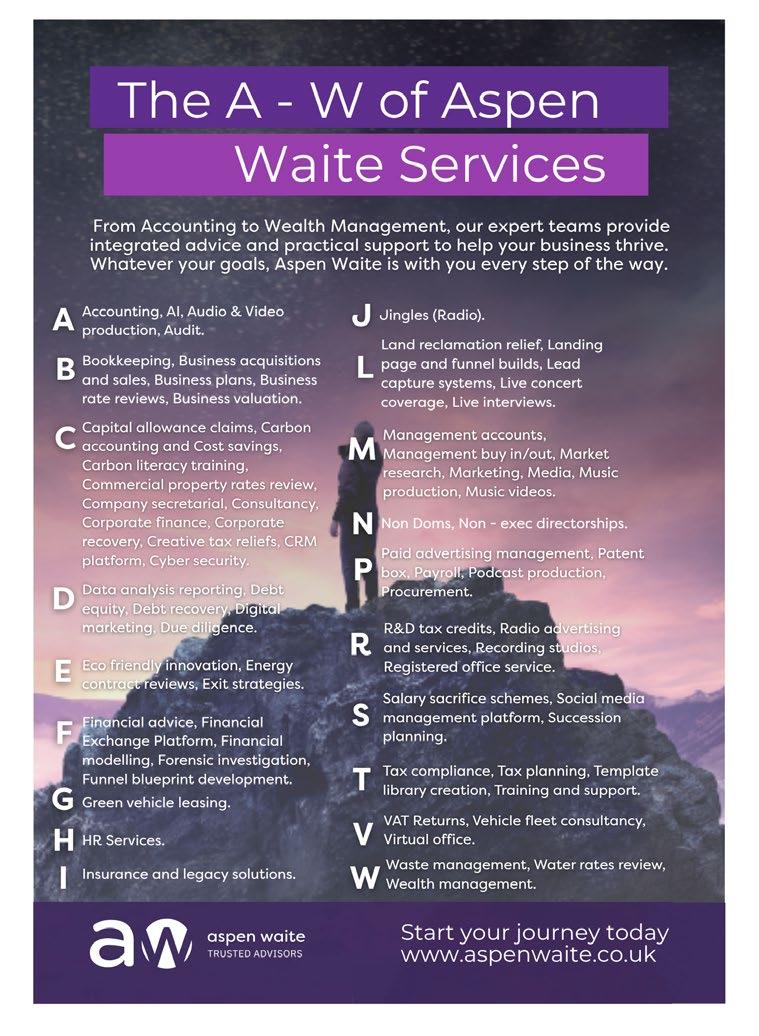
We came up with the idea of the ‘A to W’ of services which I think is a really clever idea. This is featured elsewhere in the magazine.
The basic idea of the CBGS is to offer every service a business could want. We can’t do everything ourselves nor do we want to recreate the wheel, so we are always looking to find quality partners with a similar ethos and values as ourselves.
We currently have a bit of a vacancy for Insolvency Practitioners and also a firm of Corporate Lawyers. Thanks to Mark, though we have an impressive array of working partners maybe best evidenced by Cyber Tzar.
In this feature I asked my friend Sarah Kelley to introduce her company, The Future Travel Group (FTG)as official working partners of the CBGS. FTG has won a number of awards with everything centered around Service, Service, Service. Quality people, quality company that you can trust.
There is still a lot left to be done to do justice to this great concept.




In the fast-paced, competitive world of business, finding ways to save money isn’t just a bonus—it’s crucial to staying ahead. That’s where Aspen Waite Legacy steps in, offering a comprehensive Business Health Check designed to unlock hidden savings across water, energy, and business rates. Our team of experts specialises in uncovering inefficiencies that could be costing your business thousands every year.
Imagine streamlining your operations with lower water bills, optimised energy procurement, and corrected business rates, all without the headache of navigating complex contracts. Aspen Waite’s innovative solutions don’t just fix current inefficiencies—they set you up for long-term financial health.
Think water savings are a trickle? Think again. For businesses with annual costs over £5,000, our team can secure rebates and rectify overcharges, identify billing anomalies, and even reduce your meter size where appropriate. Not to mention, we have an expert eye for detecting leaks—saving you money in
real time and recovering past losses.
Energy costs can drain resources, but with Aspen Waite, businesses spending over £100,000 annually can benefit from independent rate comparisons and cutting-edge energy management. We not only secure the best rates but also implement smart meters and innovative monitoring software to help you reduce consumption. Our unique Price Shield feature lets you fix wholesale prices while still taking advantage of market dips.
Did you know your property’s rateable value might not be optimised? Our business rate review ensures you pay only what’s necessary. We’ll conduct a thorough audit, appeal for more favourable rates, and manage your account for maximum efficiency.
We’re proud to partner with Concorde Insurance Brokers to support clients with comprehensive insurance reviews. Insurance is essential for managing risks and ensuring continuity. through our partner we are able to access leading markets to secure competitive pricing and tailored cover.
Aspen Waite can now offer a wide range of solutions to meet your waste challenges. These include balers, compactors and for unavoidable food waste on site organic digesters. These are all aimed at helping reduce waste volumes, disposal costs and potentially achieve income from any significant waste stream you may have. For example the Aerobic Digester reduces food waste volumes by 81% in a 24 hour period leaving a soil enriching compost.
Aspen Waite Legacy’s Business Health Check isn’t just about cutting costs today—it’s about ensuring sustainable savings for the future. Don’t wait for inefficiencies to erode your profits; act now to secure your financial success.
For more information on how to optimise your business, contact Mark Waite at:
legacy@aspen-waite.co.uk or visit
www.aspenwaitelegacy.co.uk



Bernard Critchley - Tax Manager
From April 2026, MTD for Income Tax will start to become mandatory for self-employed businesses and landlords with turnover above £50,000 in 2024/25. From 6 April 2027 it will become mandatory for self-employed businesses and landlords with turnover above £30,000 in 2025/26 and this threshold is further reduced from 6 April 2028 to turnover above £20,000 in 2026/27.
The position is still under review for self-employed businesses and landlords with turnover below £20,000, and no timetable has yet been introduced to include partnerships within MTD ITSA.
Under MTD ITSA, the Self-Assessment Tax Return will be replaced by new reporting obligations made during and after the tax year. For each trade or property business, four quarterly updates will be required during the tax year. In addition, a digital tax return will be required.
MTD ITSA will also apply to non-UK resident or domiciled individuals who will have to follow the same procedures where they have UK self-employment and/or UK property and meet the turnover threshold.
Digital records of all transactions will be needed. These will form the basis of the quarterly updates, as follows:
· The quarterly update must be submitted by the 7th of the month following the end of the relevant quarter.
· Relevant persons under the VAT threshold may choose to categorise their digital records of income and expenses in less detail. Where under the VAT threshold:
- Self-employed and landlords are only required to submit two figures, total income and total expenditure instead of the totals of the amounts falling within each category listed. This option is also available to a relevant person(s) who jointly let property.
- Each individual item of income and expenditure still needs to be recorded but can be categorised as either 'income' or 'expenditure'.
- If there are residential property finance costs i.e. a mortgage, landlords will be required to create a separate digital record for these costs.
· Relevant persons over the VAT threshold must provide totals of the amounts falling within the categories listed below.
· Retailers can choose to create a digital record of daily gross takings, instead of individual sales.
There will be a requirement to use software for the record-keeping/accounting.
Quarterly updates must be submitted to HMRC, with everyone adhering to the following quarter dates:
An election (a 'calendar quarters election') can be made to change to calendar quarters, which will stay in place until withdrawn. The filing deadlines will remain the same.
A year-end tax return must then be made for the relevant tax year to finalise the Income Tax position. This will involve agreeing and entering all the other sources of income and claiming any available reliefs and allowances. The information provided will then be used to generate the Self-Assessment tax bill for that tax year, which must be filed by 31 January following the relevant tax year, as is the case with all other Self-Assessment Tax Returns.
Tax payments
There are currently no changes to the way that tax liabilities are paid, so Income Tax payments will not be required to be paid quarterly. The tax liability will need to be paid by 31 January of the next year, as is currently the case.
The penalties regime that will apply to all individuals who are mandated into MTD ITSA will be similar to the system in operation for MTD for VAT and use a point-based system for late submission and the late payment of tax liabilities. Penalties already apply for errors in returns or documents and for late payment interest and these will be unchanged.
There will be a year of grace so that there will be no late submission penalties for missing quarterly updates for individuals joining MTD ITSA on 6 April 2026 to enable taxpayers and their agents to bed the system in.
HMRC will be granted the power to cancel or reset late submission penalty points and cancel any associated financial penalties.
Exemptions
The digitally excluded exemption
An individual is exempt from MTD ITSA if HMRC agree that they are digitally excluded, for example:
· The person is a practising member of a religious society or order whose beliefs are incompatible with using electronic communications or keeping electronic records.
· For any reason (including age, disability or location) it is not reasonably practicable for the person or partner to use electronic communications or to keep electronic records.
Income exemption
MTD ITSA will not currently apply where turnover is less than £20,000. The government is consulting as to when and if smaller businesses will join.
Other exemptions
There are a number of miscellaneous exemptions from MTD ITSA including for those without a National Insurance Number, those submitting a tax return as a trustee, including a charitable trustee or a trustee of non-registered pension schemes and those submitting an Income Tax return on behalf of a non-resident company.
Lloyd’s members are already treated differently to other taxpayers and will be excluded from MTD ITSA unless they have self-employment or property income above the thresholds mentioned above. Finally, anyone who is submitting any tax return as a personal representative of a taxpayer who has died or submitting a tax return on behalf of a taxpayer because they have power of attorney or were appointed by a UK court to act on their behalf will also be excluded from MTD ITSA.
MTD ITSA has been promised for a long time, the implementation has been postponed several times, and the system is now finally upon us. There will inevitably be glitches and misunderstandings as the first year unfolds and, hopefully, we will be able to bring our clients into the system as seamlessly as possible. This will be an opportunity for us to show that we can embrace new challenges in an informed and professional manner so that we can maintain the high level of professionalism that our clients expect.
Bernard Critchley - Tax Manager Bernard.Critchley@aspen-waite.co.uk
Over the past six months, Aspen Waite has seen a clear shift in how its client base is approaching cyber security. Through targeted communication, increased awareness, and the adoption of structured tools such as the Cyber Tzar platform, businesses are moving from reactive to proactive risk management.
Across the Aspen Waite client base, measurable improvements have been recorded:
· Wholesale & Retail: 595 → 721
· Manufacturing: 648 → 715
· Education: 646 → 761 (strongest improvement)
· Tradesman: 682 → 692
· Professional Services: 657 → 700
· Other: 739 → 770
· Leisure & Sport: 701 → 711
· Healthcare: 666 → 632 (highlighting ongoing sector pressure).
This uplift reflects a growing recognition that cyber security is not just an IT issue — it is a fundamental business risk.
While progress is clear, several consistent vulnerabilities remain across organisations:
· Lack of DMARC configuration, leaving businesses exposed to phishing and impersonation
· Outdated JavaScript libraries, creating exploitable entry points.
· High infrastructure exposure, with too many “open doors” accessible to attackers.
These are not complex problems, but they are widespread, and increasingly targeted.
Cyber risk is no longer theoretical, it has measurable financial and operational impact across the UK economy:
· £14.7 billion, Annual cost of cyber attacks to the UK economy.
· 43% of UK businesses (~600,000 organisations) have experienced a breach.
· ~£195,000, Average cost of a significant cyber incident
Recent high-profile incidents reinforce the scale of impact:
· Jaguar Land Rover: ~£1.9 billion economic impact, including supply chain disruption affecting ~5,000 UK businesses.
· Marks & Spencer: ~£300 million in losses linked to cyber disruption.
· SMEs: Often face losses in excess of £100,000 per incident, with many unable to fully recover. The key implication is clear: Cyber incidents are not just technical failures, they directly affect revenue, operations, supply chains, and longterm business viability.
One of the most significant emerging risks is not internal, but within the supply chain.
A single vulnerable supplier can introduce risk across an entire network, as demonstrated in major UK incidents. Aspen Waite has recognised this and taken a leading approach by incorporating supply chain cyber assessments into its advisory offering.
Using Cyber Tzar, Aspen Waite and its clients can:
· Identify vulnerabilities across suppliers and partners
· Map risk across interconnected businesses
· Highlight potential entry points for attackers
· Proactively inform customers and suppliers of risks
This positions Aspen Waite clients ahead of the curve, not only protecting themselves, but strengthening their entire ecosystem.
Aspen Waite has also taken significant steps internally, demonstrating its commitment to best practice.
Through the Cyber Tzar platform, Aspen Waite has improved its cyber security rating from 587 to 851, reflecting a structured, proactive, and measurable approach to cyber resilience.
This leadership is now being extended across its client base, helping businesses:
· Improve their cyber posture
· Reduce exposure to financial loss
· Build trust with customers and partners
· Prepare for increasing regulatory expectations
The organisations seeing the greatest improvement are not those reacting to incidents, but those taking early, proactive action.
Aspen Waite, supported by Cyber Tzar, is enabling clients to turn cyber security from a risk into a competitive advantage, strengthening resilience, improving credibility, and unlocking new opportunities in an increasingly securityconscious market.
As cyber threats continue to increase in scale and sophistication, the UK regulatory landscape is evolving rapidly. Organisations are now expected to demonstrate not only that they are secure, but that they are resilient, able to prevent, respond to, and recover from cyber incidents.
The UK Government’s proposed Cyber Security and Resilience Bill represents a significant step forward in strengthening national cyber defences. The legislation is expected to expand existing requirements and place greater responsibility on organisations to actively manage cyber risk.
Key themes within the Bill include:
· Stronger accountability for cyber risk at a leadership level
· Enhanced requirements for risk management and incident reporting
· Greater oversight of supply chain and thirdparty security
· A shift from compliance to continuous resilience and monitoring
The direction of travel is clear: organisations will be expected to demonstrate a clear understanding of their cyber risk and take proactive steps to manage it.
Alongside legislative developments, the Financial Conduct Authority (FCA) continues to place increasing emphasis on operational resilience and cyber governance.
Recent FCA focus areas include:
· The ability to maintain critical services during cyber disruption
· Clear identification and management of cyber risks
· Ongoing testing, monitoring, and reporting of controls
· Effective management of third-party and supply chain risk
Cyber security is now firmly positioned as a core component of regulatory compliance, rather than a purely technical function.
A notable shift in both regulatory guidance and enforcement is the expectation that directors and senior leadership teams take ownership of cyber risk.
This includes:
· Understanding the organisation’s cyber risk exposure
· Ensuring appropriate controls and frameworks are in place
· Reviewing regular reporting on cyber posture and vulnerabilities
· Overseeing incident response and recovery planning
Cyber risk is increasingly being treated in the same way as financial or operational risk, requiring visibility, accountability, and governance at board level.
In response to these changes, organisations are moving beyond traditional security measures towards a more structured and continuous approach to cyber resilience.
This includes:
· Regular assessment of vulnerabilities and exposures
· Continuous monitoring of internal systems and external risks
· Visibility across supply chains and third-party dependencies
· Clear reporting and measurable improvement over time
Aspen Waite is supporting clients in navigating this evolving landscape by combining regulatory awareness with practical implementation.
Through platforms such as Cyber Tzar, businesses are able to:
· Gain a clear, measurable view of their cyber risk
· Identify and prioritise vulnerabilities
· Demonstrate improvement over time
· Align with emerging regulatory expectations
This approach ensures that clients are not only improving their security posture, but also preparing for future regulatory requirements.
The introduction of the Cyber Security and Resilience Bill, alongside increasing FCA scrutiny, signals a long-term shift in expectations.
Organisations that take early, proactive steps to strengthen their cyber resilience will be better positioned to:
· Meet regulatory requirements
· Protect their operations and reputation
· Build trust with clients and partners
· Reduce exposure to financial and operational loss
Aspen Waite continues to work closely with its clients to ensure they are prepared for this changing environment, supporting a transition from reactive security to proactive, business-wide resilience.


Last year, there was a great deal of enthusiasm around AGI, which is roughly defined as the point at which AI can do everything better than humans. Many believed that some form of breakthrough was within reach. In recent months, though, there has been a cooling of that enthusiasm and a recognition that simply scaling up existing approaches may not be enough on its own to make AI more capable. Further innovation, and some kind of change in approach is going to be needed. One approach in particular, known as “world models”, has been attracting a lot of attention. A world model is a system that contains an explicit internal representation of the world. The concept dates back to a 1943 book by Kenneth Craik, a Scottish psychologist who suggested that organisms carried a “small-scale model” of the world inside their head. If an animal did not have some internal representation of the real world, it couldn’t take actions with an intention of changing it.
When we close our eyes and imagine a cube floating in front of us and then rotate it 90 degrees along a vertical axis, we can visualise it and anticipate what the cube will look like afterwards.
That is the world model. We have a mental model that is geometric and not dependent on language. Cognitive science tells us we need such a model for intelligent behaviour. The challenge, however, is how
to build it and pair it with AI systems that need it.
Today’s LLMs do not have a strong world model. Their world model is built around the text they were trained on, rather than an accurate representation of the world. They see the world through text. As a result, they do not have an understanding of the physical spaces around them, which hinders their ability to be turned into systems that steer robots, operate smart homes, or analyse video.
The question for AI development over the next few years is how we can pair emerging visual reasoning skills from world models with the intelligent systems we already have. One approach is to build a super massively multimodal model that integrates these capabilities. The heads of leading AI labs are seeking to scale up existing approaches and enhance them with worldmodel capabilities.
Others argue that new architectures, a new paradigm of AI system, are required. Yann LeCun, Meta’s former chief AI scientist, has long argued that there is a chance LLMs may be a dead end, and that scaling current approaches alone may not get us to AGI. He believes that real intelligence does not start in language. It starts in the world.
“An agentic system that is supposed to take actions in the world cannot work reliably unless it has a world model to predict the consequences of its actions. Without it, the
system will inevitably make mistakes. This is the key to unlocking everything from truly useful domestic robots to Level 5 autonomous driving” Yann LeCun, founder of Advanced Machine Intelligence
Those who firmly believe that scaling will win argue that separate external world models will play a role in providing more structured inputs for future multimodal language models. In this view, if we feed a future version of Gemini or Claude huge amounts of high-quality training data harvested from world models, it might be able to infer the rules of the world.
Leading AI labs believe that scaling will continue and are investing in large data centres. They are investing billions of dollars in the idea that more compute and more data equals more capable systems.
The main criticism of scaling is not that it stops giving returns, but that it follows a power-law dynamic, which is the opposite of exponential. You need ten times more inputs to get twice as much output. Scaling may continue to work forever in principle. But in practice, we might run of capital, physical space, or data. The real question is not whether scaling works, but how long we can sustain it.
Monika Stukova, CFA
Our client and partner testimonials speak for themselves. This issue, we have some great feedback from Luke Melluish of Venom Group.
“My name is Luke Melluish, and I operate a group of companies within the construction industry. We have worked with Aspen Waite since the initial set-up of the business two years ago, following the closure of my previous company. Their support has played a key role in allowing me to rebuild, stabilise, and move forward with confidence.
From past experience, I understood how critical it is to have the right accounting support in place, so selecting a new accountant was an important decision. From the outset, Aspen Waite took the time to fully understand both the business model and the lessons learned from previous challenges. This ensured that the foundations were structured correctly from day one, creating a more organised and stable platform for growth.
A major strength of their service is the clarity and practicality of their advice. In an industry where decisions often need to be made quickly, having access to straightforward, well-considered financial guidance is invaluable. They provide not only accounting support, but also ongoing financial advice, strategic planning, and tax planning, ensuring that decisions are made with a full understanding of both immediate and long-term implications. Their proactive approach to financial planning has been particularly beneficial. Rather than simply reacting to situations, they actively support forward planning, helping to manage cash flow, optimise tax efficiency, and structure the business in a way that supports sustainable growth. This level of involvement provides real confidence when making key business decisions.
Communication has been excellent throughout. They are approachable, responsive, and professional in all interactions. Whether dealing with routine matters or more complex issues, their support is consistent and dependable, which has made a noticeable difference at management level.
Another valuable aspect of working with Aspen Waite is the opportunity to network with other business owners and professionals within their client base. This has opened doors to new relationships and opportunities that support wider business growth, something that goes beyond traditional accounting services.
Over time, this has developed into a strong working relationship built on trust, consistency, and reliability. In the construction sector, where there are constant moving parts and external pressures, having that level of structured financial support in place is essential.
In summary, Aspen Waite have played a significant role in supporting both the development and ongoing management of the group. Their approach is professional, proactive, and well-suited to the demands of a growing business. I would have no hesitation in recommending them to any company seeking dependable accounting, financial planning, and strategic support.”
Luke Melluish - Venom
If you have some feedback for us or a positive story about working with Aspen Waite, we would love to hear from you!
Email us your testimonial at: emily.short@aspen-waite.co.uk
Hello there,
My name’s Nathaniel. I’ve been working for Aspen Waite for almost five years now, and since September I’ve been travelling and reporting my adventures on AW Radio.
The last time we spoke was over Winter (or our Summer here in Australia!), where I broke down my takeaways from travelling and the epiphanies I was met with.
This time, I want to talk about something a little different, as the three months since then have told a different tale. One where my travels have concluded and a new life in Sydney has begun. It’s my first time leaving home and being thrown out into the real world, which has come with both challenges and accomplishments in abundance. These have manifested themselves into two different eras of my Australian life.
The first was full of events and experiences. People I had met travelling were all slowly drip feeding into Sydney, which meant big groups for big days like Christmas, New Year’s, and whatever other summer bash occurred that weekend. But there was a lot of uncertainty that accompanied this. Stresses about finding a place to live, a way to earn a living, and a sense of comfort that had been missing with the travel lifestyle which I had adopted for four months.
In those times, I would find myself needing to rally far more frequently than ever before, as each setback had to be brushed off in pursuit of this comfort that eluded me.
A few months later, I’m writing this on a bench in the sun as the waves crash on the rocks before me. I have a house that I’ve been fortunate to move into alongside some of my closest friends, and a job that allows me to work not just for my current life, but also in preparation for future adventures down the line.
So how did I get here? And what have I learned?
One particular turning point I can recall was on New Year’s Day. The previous night, we had all been celebrating until the early hours of the morning as we camped out at a lookout point.
playing cards, drinking beers, and watching fireworks erupt over the Sydney Harbour Bridge, Opera House, and glistening city.
It was one of my favourite nights ever, and yet the next day I woke up with a pit in my stomach, wondering how to make the year successful and how to get out of what felt like a jail cell of an apartment and a jobless life.
I called one of my best friends in the city, Brad, and we set off to hand out resumes in a bid to change our fortunes. And whilst I didn’t leave that day with a job, I left with something far more valuable.
Hope.
Because that day we talked. A lot.
And we realised that we weren’t so alone in our struggles. In fact, it seemed to be a rite of passage for travellers trying to make their way down under.
Somewhere between banging on windows of closed shops and facing endless rejections, we had one particular conversation that still feels poignant today.
We were discussing what we needed to do to get out of our current situation, and we agreed on one word:
Persevere.
Not in a cliché sense. Just in a real, day-to-day way. Keep going. Take each moment as it comes. Try to enjoy it where you can.
Fast forward to now, and Brad and I live in a house together and get to grace the pickleball courts of Sydney every Tuesday without a stress in the world.
And when I look back at that time now, I don’t think of the cage with no windows that I was living in, or the hundreds of CVs that I handed out with zero success.
Instead, I think of the laughs I was able to have with loved ones who allowed me to lean on them. I think of the long walks through the city that never failed to reset me, and the nights we spent dancing until the sun came up.
“ if you’re in that uncertain stage right now, stick with it, it might just be the part you end up being most grateful for. ”
I even find myself feeling grateful for that period now.
A struggle that allows me to appreciate what I have here right in front of me. A struggle that makes each turn of the key to my front door, each birdsong in the morning, and every bit of sun on my beach walks feel that much better.
So as spring blooms life into the world once more, try to take a second here and there to appreciate the small things. And if you’re in that uncertain stage right now, stick with it, it might just be the part you end up being most grateful for.
If you want to hear more from my travels, including interviews with the many characters I meet and tales of the quests I embark on, then tune into AW Radio every Thursday from 8–9PM for The Travel Tapes, or listen anytime on our app or website.
Nathaniel Warren Radio & Media



Iran tensions, rising network charges & why energy strategy can’t wait.
Over the past few weeks, energy prices have been pulled in two directions. Global uncertainty continues to drive market volatility, while UK policy-led cost increases are now being built into bills (charges like TNUoS!). These changes in energy billing mean businesses need a clear financial strategy around energy.
Here’s what’s shaped March.
1. Iran conflict
Why the Middle East still moves global markets... Headlines have been dominated by escalating tensions involving Iran and the disruption to global energy supply.
As we know, the reason markets react so quickly is the Strait of Hormuz, a narrow shipping route between Iran and Oman where around one fifth of the world’s oil supply passes through daily. Because there are very few alternative routes for this supply, any risk to uninterrupted flows adds a risk premium to prices. This is exactly why energy procurement shouldn’t be treated as a lastminute renewal decision. When global events can shift prices overnight, businesses need strategies that protect them from sudden spikes and unpredictable market swings.
One of the biggest misconceptions in energy procurement is that renewal means locking in at today’s price. Many businesses can reduce risk through phased or blended purchasing strategies, where pricing is secured over time and across future periods. This helps smooth out volatility and create a more stable, predictable energy budget!!
2. UK network charges are rising sharply
While global conflict gains attention, one of the biggest confirmed developments this month is happening closer to home.
From April 2026, businesses across the UK are expected to feel the impact of sharply higher network charges. Final Transmission Network Use of System (TNUoS) rates published by the National Energy System Operator confirm increases of more than 60%.
The UK’s sustainability ambition requires major investment into the transmission network to connect renewable generation, strengthen the grid and support decarbonisation.
That investment has to be funded, and it’s increasingly recovered through non-commodity charges like TNUoS....
3. Passive procurement
The businesses most exposed over the next two years won’t necessarily be the biggest energy users. TNUoS charges are capacity driven. They interact with:
· Demand profiles
· KVA banding
· Peak usage behaviour
· Contract structures (pass-through vs fixed).
Two businesses using the same amount of energy can see very different cost impacts depending on how their supply is structured.
4. What your business should do now
· Review KVA and capacity requirements
· Modelling cost scenarios for 2026–2028
· Assess on-site generation and demand management
· Understand exposure to fixed vs pass-through structures
How can we help? Aspen Waite’s Energy Partner GEAB, monitors energy markets daily and support businesses with procurement strategies that reduce risk, improve cost certainty, and prepare for upcoming regulatory and pricing changes.
If you want to understand how these developments could affect your energy costs, get in touch.
Message us directly at legacy@aspen-waite.co.uk


The R&D tax credit scheme has gone through a number of changes over the years, including rate reductions and tweaks to the legislation around what does and does not qualify.
However, the biggest change came with the launch of the merged RDEC scheme for all accounting periods starting on or after 1 April 2024. This was detailed in Drew’s article “R&D Tax Credits Update 2024: Key changes you should know”, published in the Autumn 2024 AW magazine.
But what has happened since then? How has the transition been going? How are HMRC doing with claim processing? Has there been a rise in claim enquiries?
Let’s start with a review of the current state of the scheme as of March 2026.
Following the most significant overhaul in two decades, the UK R&D tax credit landscape in 2026 is defined by the new merged RDEC scheme – a deliberately streamlined but more stringent framework. As of March 2026, the system has fully transitioned into two primary paths for all businesses, with a heavy emphasis on domestic activity and HMRC compliance.
To summarize (in case you haven’t read Drew’s article), for all accounting periods starting on or after 1 April 2024, the previous SME and RDEC schemes have been replaced with:
1. The Merged Scheme (Main RDEC Scheme):
• Applicability: The default for most companies, regardless of size
• Rate: A 20% taxable “above-the-line” credit
• Net Benefit: Approximately 15p for every £1 spent (at the 25% Corporation Tax rate) or 16.2p for loss-makers.
• Eligibility: Exclusive to loss-making SMEs where qualifying R&D spend is at least 30% of total expenditure
• Benefit: An effective cash relief of roughly 27p for every £1 spent
• Grace Period: A one-year “year of grace” allows companies to keep ERIS status if they temporarily fall below the 30% threshold but met it the previous year.
The major regulatory restrictions that now apply are:
• Overseas Expenditure: Costs for overseas subcontractors and Externally Provided Workers (EPWs) are now largely disallowed. Relief is restricted to UK-based activity unless a “wholly unreasonable” lack of UK conditions (e.g., geographical or legal necessity) can be proven
• Subcontracting Rules: The right to claim generally sits with the decision-maker (the customer) who “intended or contemplated” the R&D, rather than the contractor doing the work
• Expanded Categories: Cloud computing, data license costs, and pure mathematics are now officially eligible for relief.
Perhaps the most significant change has been in ‘Compliance and Enforcement’. HMRC has shifted from “pay and check” to an intensified “check before pay” model, which includes:
• Mandatory Additional Information Form (AIF): Every claim must be supported by an AIF submitted via the HMRC portal before the CT600 tax return. Failure to do so results in automatic claim rejection
• Claim Notification: First-time claimants, or those who haven’t claimed in three years, must notify HMRC of their intent to claim within six months of the end of the accounting period. [It is important to note that even if you have made a previous claim in the three year claim window, you will have to notify HMRC if the previous claim was for a period starting before 1 April 2023 and the claim was filed by amendment on or after 1 April 2023.]
• Increased Scrutiny: Approximately 20% of claims are now subject to compliance checks, with a particular focus on sectors previously flagged as “low risk” (e.g., hospitality or retail) that are now being heavily challenged
• Adviser Oversight: Starting May 2026, all tax advisers must register with HMRC and meet minimum standards, allowing the government to track high-risk agents more effectively.
As of Spring 2026 HMRC are introducing new support mechanisms:
• HMRC Advance Assurance Pilot: A new targeted pilot for SMEs allows businesses to seek clarity on specific issues – such as R&D definitions or overseas cost eligibility – before filing, reducing the risk of later rejection
• Intra-group RDEC: New rules (effective late 2025) clarify that intra-group payments for surrendered RDEC credits are not taxable income for the surrendering company, removing a major point of ambiguity for group structures.
But what about the claim handling itself? Has there been a slowdown in HMRC’s processing and subsequent paying out of R&D tax credits?
In short, yes. There has been a significant and sustained slowdown in HMRC’s processing and payment of R&D tax credits over the last few years, which continues into 2026.
While HMRC’s official target for SME claims was previously to process 85% of payable R&D tax credit claims within 28 working days, this has been extended to a standard 40 working days to accommodate mandatory additional checks. In practice, however, many businesses are experiencing much longer wait times.
HMRC’s current processing timelines are:
• SME Claims (Merged RDEC Scheme/ERIS): HMRC aims to process these within 4–6 weeks of submission
• Large Company (RDEC) Claims: Usually take 8–12 weeks due to the complexity of the technical and financial assessments
• Loss-making SMEs (Cash Repayments): These often face a wait of 6–12 weeks because HMRC performs additional verification checks before releasing funds
• Post-Approval Delay: Once a claim is approved, it can take an additional 5–20 days for the actual funds to reach your bank account. [We have experienced extreme cases where this has actually taken 3 months or more!]
• Enquiries: If HMRC decides to open a formal compliance check instead of paying out immediately, they aim to do so within 60 days of receiving the claim. [Here it is important to note that this 60 day target is just for opening the compliance check. The process of accepting or rejecting and, in the event a claim is rejected, the appeal process to overturn it can last a very long time indeed – up to 18 months in some cases.]
• The “Check Before Pay” Model: Since HMRC moved away from its old “pay and check later” system, now, roughly 17–20% of all claims are subject to intensive compliance checks before any payment is authorized
• Mandatory Documentation: The introduction of the Additional Information Form (AIF) means HMRC must now verify more data for every single submission
• Seasonal Backlogs: Processing times peak during the “spring slog” (following December and March year-ends), where high volumes can push total wait times up to 100–120 days
• Staffing and System Teething: Stretched resources and the implementation of new digital systems (like the HMRC portal for AIFs) have contributed to an ongoing – and increasing – backlog.
In order to try and minimize the risk of your claim being “stuck” in the system:
• Submit early: Filing at least three months before peak deadlines (December/March) can help you avoid the largest backlogs
• Ensure BACS details are included: Missing bank details on the CT600 is a common cause for claims falling out of the 40-day target
• Check the AIF First: Submitting the mandatory Additional Information Form before your tax return is essential; failure to do so results in automatic rejection.
But what do we need to watch out for? Which specific red flags currently trigger the longest HMRC compliance delays for R&D tax credits?
HMRC uses advanced data systems, such as the Connect system, to cross-reference claims against external data in seconds. While some checks are part of a random sampling program (MREP), the following specific “red flags” are most likely to trigger intensive compliance delays:
• Vague or “Buzzword” Narratives: Overuse of terms like ‘bespoke’, ‘custom’, ‘unique’, or ‘revolutionary’ without explaining the underlying technological advancement
• Lack of “Competent Professionals”: Failing to name the lead technical experts or providing reports that sound like they were written by marketing teams rather than engineers
• Commercial vs. Technical Advances: Describing a business challenge (e.g., “we needed a faster website”) instead of a specific technological uncertainty (e.g., “we had to overcome latency issues in X protocol”)
• Missing “Failed” Iterations: Reports that show a perfectly linear path from problem to solution without documenting dead ends, failed tests, or failed prototypes, etc.
• Inconsistent Data: Discrepancies between the Additional Information Form (AIF) and the company’s annual accounts or PAYE/VAT filings
• Optimistic Staff Apportionments: Claiming 100% of staff time for R&D is a major red flag, as HMRC expects even R&D-heavy staff to spend time on non-qualifying admin or training
• Sudden Spikes: A large or unexplained yearon-year increase in claim size
• High-Risk Sectors: Claims from sectors with historically high error rates, such as care homes, hospitality, and construction, are currently under higher scrutiny.
• “Rogue” Advisers: HMRC flags claims linked to unregulated specialist firms that promise “guaranteed” payouts or use aggressive marketing
• Overseas Expenditure: Including costs for overseas subcontractors or Externally Provided Workers (EPWs) without proving it was “wholly unreasonable” to perform the work in the UK.
So, to sum up, while the R&D tax credit space is now more complex, with more hoops to jump through, followed by stricter enforcement and a higher number of enquiries by HMRC, it is still an incredibly useful tax saving tool that all companies who are seeking to improve through the advancement of an element of science and/or technology should avail themselves of.
Here at Aspen Waite, we will guide you through the process and – as long as you provide all the information we ask for – will do all the hard work for you, including defending your claim fully should HMRC open a compliance check.
It’s a more complicated – and often frustrating –world, but it can still be a profitable one!
John Porteous Technical Director
John.Porteous@aspen-waite.co.uk

In an industry shaped by constant change, Future Travel Group has quietly redefined what luxury travel should feel like.
Founded during 2020, one of the most uncertain moments in modern travel, the business wasn’t created in ideal conditions—but it was built with absolute clarity.
“When travel stopped, it gave me time to reflect on what I felt was missing,” explains founder Sarah Kelley. “I didn’t just want to build a travel business—I wanted to create something more personal, more thoughtful, and genuinely centred around people.”
Five years on, that vision has evolved into a thriving luxury travel brand—one built not just on expertise, but on trust, relationships, and an unwavering commitment to care.
A People-Led Business - At the heart of Future Travel Group is its people.


Operating as a fully remote business, all the team have at least 20 years’ experience in the industry. The company has created a culture that prioritises wellbeing, flexibility, and connection—proving that exceptional service doesn’t depend on a traditional office, but on empowered individuals.
That culture is felt throughout the business.
“From the moment I joined, I felt part of the team,” says Nicola. “The support and encouragement has been incredible
Luxury, Reimagined - Luxury travel has evolved— and so has Future Travel Group.
Today, luxury is defined by authenticity, exclusivity, and deeply personal experiences. Each journey is curated with precision, whether it’s a private vineyard visit, a remote safari, or a once-in-alifetime adventure.
At the core of this approach is a simple but powerful belief:
“You Matter When You Travel with Us.”
From concierge-style planning to thoughtful touches such as Apple Air Tags for multi-stop journeys, every detail is considered—because it’s often the smallest things that create the greatest sense of ease.
When travel runs smoothly, great service is expected. It’s when things don’t go to plan that true expertise is revealed.
Recent disruption across the Middle East, including widespread airspace closures, left many travellers facing uncertainty. Flights were cancelled; routes changed and plans quickly unravelled.
Future Travel Group responded immediately working around the clock to re-route journeys, secure alternative flights, arrange accommodation, and ensure every client felt supported.
In one case, honeymoon clients due to travel to the Philippines with Emirates were at risk of missing their trip entirely.
Through determination, expertise, and strong supplier relationships, the team ensured they still made it to their honeymoon.
Moments like these don’t just solve problems— they build lifelong trust.
This level of service has consistently been recognised at the highest level.
At the recent Carrier A-List Awards at Sopwell House, Future Travel Group was named: Best Luxury Agent – South-West 2026.
This marks an incredible milestone—having been awarded Best Luxury Agent with Carrier for five consecutive years, alongside multiple shortlisting’s for prestigious industry awards including the TTG Luxury Awards and Aspire Awards.
Reflecting on the evening, Sarah shares: “It was an incredibly proud moment—not just for me, but for the whole team. Every single person has contributed to that success.”
Flamingo Chicks in 2026, a charity dedicated to breaking down barriers to inclusion through dance. Their #BalletNotBarriers mission creates opportunities for all children—including those with disabilities or serious illnesses—to experience movement, joy, and connection.
The business also partners with Trees4Travel, helping offset carbon emissions and contribute to global reforestation projects—ensuring travel gives something back to the world it explores.
Future Travel Group has built its reputation through trust, consistency, and genuine care. Clients don’t just return for the destinations—they return for the experience.
One recent client shared: “This is exactly why I’ll never book with anyone else.”
Future Travel Group continues to grow—but its focus remains unchanged.
To deliver exceptional, personalised travel / To build meaningful, lasting relationships.
And to ensure every client feels truly valued.
As Sarah reflects: “This was never just about building a business. It was about creating something that genuinely cares—for our clients, our team, and the experiences we deliver.”
Whether it’s a once-in-a-lifetime escape, a special celebration, or simply time away to unwind, we’re here to make every moment seamless, personal, and unforgettable.
DISCOVER YOUR NEXT JOURNEY
�� futuretravelgroup.co.uk travel@futuretravelgroup.co.uk 0117 452 3201 or 0117 929 3211
A Business with Purpose - As the business grows, so too does its focus on impact.

The Government have introduced a wide-ranging set of employment law reform:
“The biggest upgrade of workers’ rights in a generation”.
The Employment Rights Bill proved to be a contentious item. However, just before Christmas 2025 it was finally agreed and we now have the Employment Rights Act 2025.
This Act contains major change to employment law, which will come into force in different sections throughout 2026 and 2027.
Several employment law changes will come into effect in April. Below is a summary of the most relevant updates.
Minimum wage for workers aged 21 and over the rate will increase to £12.71 per hour, a rise of £4.1%. For 18–20-year-old, the increase will be to £10.85, and 16–17-year-olds / apprentices to £8.00.
Statutory Sick Pay will be payable from the first day of absence, removing the current 3-day waiting period and the lower earnings limit will be removed. This means many more people will be entitled to SSP.
Paternity leave and unpaid parental leave will become day-one rights (i.e. no qualifying period required).
There will be a new right to 52 weeks of paternity leave for partners if the mother or primary adopter dies within the first year of the child’s life.
The Act will bring in enhanced protection for workers who report sexual harassment (this follows the positive duty to prevent sexual harassment introduced in October 2024).
The maximum period for a collective redundancy award will double from 90 days to 180 days’ pay. This is an award if a company fails to carry out consultation obligations relating to collective redundancies.
The new Fair Work Agency will be launched on 7th April 2026 who will be able to enforce workers right and support compliance with new rules.
A Weeks Pay: The statutory limit on a week’s pay will increase from £719 to £751. This figure is used in a number of employment law calculations, including the basic award in unfair dismissal cases and statutory redundancy pay.
SSP Rate: will increase from £118.75 to £123.25 per week.
Lower Earning Limit: will increase from £125 to £129 per week
Maximum compensation for Unfair Dismissal: will increase from £118,223 to £123,543
There are many more changes in the pipeline over the next year or so with the Employment Rights Bill and we will keep you updated as developments progress.
Please do contact me if you have any questions or concerns:
www.aspenwaitepeople.co.uk
hello@aspenwaiteprople.co.uk
At Royal Assent or 6 January 2026
• Repeal the Strikes (Minimum Service Levels) Act 2023
• Repeal the Workers (Predictable Terms and Conditions) Act 2023
18 February 2026
• Reduced trade union facility time information needed for the public sector.
• Simpler strike ballot rules for the public sector. Removing the 40% vote in favour in ballots in important public services.
• Simplification of ballot notices and voting papers
• Notice period unions must give employers before action is reduced from 14 to 10 days
• Industrial action mandates extended to 12 months (for ballots opened on, or after, 18 February 2026)
• Repeal of provisions in the Trade Union Act 2016 that impose specific requirements on how unions must supervise picketing
• Protection from “prescribed” detriments for industrial action
• Strengthened protections against dismissal for taking protected industrial action
• Removal of the previous 12-week limit on unfair dismissal protection
• Trade union political fund opt-in requirement removed
1 April 2026
• End of the levy that trade unions and employer associations needed to pay to the Certification Officer to oversee them
6 and 7 April 2026
• Unions only need to demonstrate that 10% of the workers in the proposed bargaining unit are union members on applications for statutory recognition
• Trade union recognition will be achieved if a simple majority vote in favour in a recognition ballot (removing the requirement that at least 40% of eligible voters back recognition)
• Once a union recognition application is accepted, employers must agree access arrangements with the union upon request, rather than after a ballot has been ordered
• Right to Statutory Sick Pay (SSP) from day one of sickness, rather than day four, and from the start of employment
• Removal of the Lower Earnings Limit (LEL) so all eligible employees, regardless of earnings, will have access to SSP
• Employees to be paid SSP at a rate of 80% of their normal weekly earnings, or the flat rate, whichever is lower
• The maximum period of the collective redundancy protective award doubles, so where employers fail to properly consult the potential protective award rises from 90 days’ to 180 days’ pay
• Paternity leave becomes a right from day one of employment (removing the 26 weeks’ service requirement)
• Unpaid parental leave becomes a day-one right (removing the one year’s service requirement)
• More explicit definition of whistleblowing protections for workers who make a disclosure relating to workplace sexual harassment
• Voluntary requirement for employers with 250+ employees to publish action plans on gender equality and menopause
• Bereaved partner’s paternity leave becomes a day one right
• 7 April: The establishment of a new enforcement body, the Fair Work Agency (FWA)
July 2026
• The change to reduce the unfair dismissal qualifying period to six months comes into force on 1 January 2027 but employers should be aware that employees who have six months or more service on 1 January 2027 will have a right to claim unfair dismissal. This means that employees hired on or before 1 July 2026 will be able to claim unfair dismissal from 1 January 2027 as they will meet the new sixmonth qualifying period
No earlier than August 2026
• Unions are permitted to hold electronic and (with agreement of the employer) workplace ballots in respect of industrial action. Hybrid ballots (being a mixture of electronic and paper balloting) also permitted.
October 2026
• Strengthen trade unions’ rights of access
• New rights and protections for trade union reps
• Extending protections against detriments for taking industrial action
• Fair pay agreement adult social care negotiating body
• Mandatory to consult employees when developing tipping policies
• Requirement to review tipping policy at least once every three years
• Requirement for employers to take all reasonable steps to prevent sexual harassment
• New provision requiring employers to not permit harassment from a third party (such as a client or customer)
No earlier than October 2026:
• Extending the time limit to bring tribunal claims from three months to six months
January 2027
• For dismissals from 1 January 2027 the unfair dismissal qualifying period reduction (reduced to six months) applies
• The compensation cap for unfair dismissal reward will also be removed.
• Severely restrict employers’ ability to use fire and rehire
2027
• Extend measures to address the malpractice of blocklisting (or “Blacklisting” as it is referred to in the UK Government roadmap)
• Introduction of industrial relations framework
• Electronic and workplace balloting permitted for recognition and derecognition ballots
• New threshold test whereby employers proposing 20 or more redundancies ‘at one establishment’ OR a certain number/ percentage of employees are affected across the employing entity must carry out collective consultation
• Introduction of a power to enable regulations to specify steps that are to be regarded as “reasonable”, to determine whether an employer has taken all reasonable steps to prevent sexual harassment
• Give zero-hours and ‘low-hours’ workers a right to a guaranteed hours contract which reflect the hours they regularly work
• Give zero hours and low-hours contract workers a right to reasonable notice of changes to shifts or working hours
• Workers will also have a right to compensation that is proportionate to the notice given for any shifts cancelled or curtailed
• Make flexible working a default day-one right (apart from when it is not reasonably feasible)
• Mandatory requirement for employers with 250+ employees to publish action plans on gender equality and menopause
• Enhanced dismissal protections for a woman while pregnant or on maternity leave
• Introduction of a day-one right to at least one week of bereavement leave for employees
• Bereavement leave will also be extended so it is available to parents who experience a miscarriage before 24 weeks of pregnancy
There are a number of proposed reforms outside of the Act:
• The right to switch off.
• Employee status review.
• Disability and ethnicity pay gap reporting.
• Disability and ethnicity equal pay protections.
If you have any concerns or queries, please contact Rhona Hope at: hello@aspenwaitepeople.co.uk

DREW ARMSTRONG
Redefining Wealth: ICAEW’s New HNWI Threshold and What It Means for You
From November 2025, the Institute of Chartered Accountants in England and Wales (ICAEW) introduced a revised definition of a High Net Worth Individual (HNWI), bringing a significantly larger proportion of individuals into scope for enhanced anti-money laundering (AML) considerations.
Under the updated guidance, an individual is now considered a HNWI if they meet either of the following criteria in any of the previous three years: annual income of £200,000 or more, or net assets of at least £2 million (excluding primary residence and pension benefits).
This is a substantial shift from the previous £20 million asset threshold and represents a fundamental change in how “high net worth” is interpreted within a compliance context. Importantly, this is not limited to ultra-highnet-worth individuals. Many business owners, consultants, property investors, and individuals with accumulated wealth over time may now fall within scope.
For example, individuals who have:
• Built up property portfolios over several years
• Sold a business or hold significant retained profits
• Generated strong income through dividends or partnerships may now meet the revised criteria, even if they would not traditionally consider themselves high net worth.
As a result, this change could materially increase the number of clients subject to enhanced compliance requirements.
Being classified as a HNWI does not imply wrongdoing or increased tax exposure. However, it does mean that you are more likely to fall into a higher-risk category under AML regulations, requiring additional due diligence.
In practical terms, this may include:
• More detailed Source of Wealth (SOW) reviews: You may be asked to demonstrate how your overall wealth has been accumulated over time. This could involve providing documentation relating to business activities, investments, inheritances, or historic transactions.
• Enhanced Source of Funds (SOF) checks: For specific transactions—such as property purchases, large investments, or intercompany transfers—you may need to evidence exactly where the funds originated.
• Increased ongoing monitoring: Your financial profile may be reviewed more regularly to ensure that it remains consistent with known activity and risk assessments.
For many individuals, particularly those who have not previously been subject to this level of scrutiny, these requirements may feel more detailed or intrusive than expected.
The revised definition reflects a broader regulatory focus on transparency and risk-based compliance. As financial affairs become more complex— often involving multiple entities, jurisdictions, or income streams—there is increased emphasis on understanding and evidencing how wealth is generated and utilised.
From a regulatory perspective, expanding the HNWI definition ensures that a wider group of individuals with potentially complex financial arrangements are subject to appropriate levels of review.
Given the scale of this change, many individuals may be unaware that they now fall within the HNWI category. A review of your financial position may reveal that enhanced due diligence requirements will apply going forward.
At Aspen Waite, we work closely with our clients to ensure they are both informed and wellprepared. We can support you by:
• Assessing your position against the new criteria: Helping you understand whether you are likely to be classified as a HNWI under the revised definition.
• Preparing and organising documentation: Assisting in collating clear, structured evidence of your Source of Wealth and Source of Funds, reducing the likelihood of delays or repeated queries.
• Providing forward-looking planning: Advising on how future transactions, restructures, or disposals can be managed in a way that aligns with AML expectations.
• Acting as a point of contact: Supporting you in responding to queries from financial institutions, solicitors, or other regulated parties who may require enhanced information.
Our approach is to simplify what can often feel like a complex and administrative process, ensuring that your financial affairs are presented clearly, accurately, and efficiently.
ICAEW’s revised HNWI definition represents a meaningful shift in the compliance landscape. While it may introduce additional requirements for many individuals, it also provides an opportunity to ensure that your financial position is welldocumented and robustly supported.
If you are unsure how this change may affect you, or would like to take a proactive approach to preparing for these requirements, Aspen Waite is here to guide you through the process with clarity and confidence.
Contact us:
advice@aspen-waite.co.uk
As spring arrives, there’s a noticeable shift in the world around us. The days stretch a little longer, the air feels lighter, and suddenly everything seems to be waking up again. After the slower, darker months of winter, it’s the perfect time to reconnect with nature.
The challenge, of course, is that modern work life doesn’t always make that easy. Between meetings, deadlines, and time spent at our desks, getting outside can feel like a luxury rather than a priority. But the good news is that reconnecting with nature doesn’t require a complete lifestyle overhaul. In fact, small, simple moments can make a meaningful difference.
Spending time in natural environments has been shown to reduce stress, improve mood, and boost concentration. Even brief exposure to greenery can help reset our mental state and bring a sense of calm. It’s not about escaping work, it’s about supporting ourselves so we can show up feeling clearer and more energised.

One of the biggest misconceptions about wellbeing is that it requires big, timeconsuming changes. But it’s often the small, consistent habits that have the greatest impact. Here’s a few ideas to get you started:
- Stepping outside for 10 minutes between meetings
- Taking a short walk at lunch, even if it’s just around the block
- Sitting near a window and consciously noticing the change in light
- Choosing to walk for a call instead of staying at your desk
On busier days, when stepping away isn’t always possible, there are still ways to bring elements of nature into your workspace.
Something as simple as adding a plant to your desk, opening a window for fresh air, or even having a view of greenery can subtly improve your environment. These small changes can make your workspace feel less enclosed and more energising.

“Spending
”
It’s not about creating a perfect setup, it’s about introducing small touches that make your day feel lighter. One of the best things about spring is the return of lighter evenings. It gives us a little more flexibility, an opportunity to step outside after work without it feeling rushed or squeezed in.
This doesn’t need to mean doing more. In fact, it can be the opposite. A short walk, sitting in the garden, or simply being outside for a few quiet minutes can help create a clear boundary between the workday and the evening. It’s a chance to decompress and reset before moving into the rest of your day.
Spring naturally encourages a sense of renewal, but that doesn’t mean everything needs to change overnight. Even the smallest steps; stepping outside, taking a breath of fresh air, noticing the world around you, can have a lasting impact on your wellbeing.





Spring has sprung and we are now on British Summer Time, so why not have a go at these seasonal recipes.
John Porteous John.Porteous@aspen-waite.co.uk
Lamb shoulder is cheaper and easier to cook than lamb leg. More importantly, it has more flavour. The slow cooking makes it incredibly tender, so you won’t even need to carve it.
This should serve 4 people
• 1.8kg / 3.5lb lamb shoulder (bone in).
• 2tbsp olive oil
• 2tsp salt
• 1tsp black pepper
• 1 onion, quartered (no need to peel)
• 1 head garlic, cut in half horizontally
1. Preheat the oven to 240°C/465°F/ gas mark 9 (220°C fan).
2. Rub the lamb with the olive oil, salt and pepper.
3. Use a thin, sharp knife to make deep slits in the lamb. Then stuff bits of rosemary and garlic into the holes.
4. Place the onion, halved garlic bulb and remaining rosemary into the base of a roasting pan. Place the lamb on top. Pour water around.
5. Cover tightly with a double layer of foil. Place in the oven, turn down to 180°C/350°F/gas mark 4 (160°C fan), and roast for 3 hours.
6. Remove foil, check to ensure there’s still liquid in the pan. If not, add ¾ cup water (otherwise the onion & garlic will burn). Turn up the oven to
• 3 garlic cloves, cut into slivers
• 8 sprigs rosemary
• 250ml water
• 20g flour
• 500ml beef stock (or 1 cup red wine & 1 cup water)
• Salt & pepper
220°C/425°F/gas mark 7 and roast for a further 20 to 30 minutes, until the skin is browned and crisp.
7. By now, you should be able to part the meat with two forks – if not, just cover and return to the oven at 180°C/350°F/gas mark 4 (160°C fan) until you can do so.
8. Remove the lamb from the roasting pan and transfer to a plate. Cover loosely with foil then a couple of tea towels and let it rest for at least 20 minutes, up to a couple of hours (after this, you may want to reheat).
To make the gravy:
1. Tilt the pan and use a spoon to remove most of the fat (try to avoid scooping out any juices).
2. Place the roasting pan on the stove over medium high heat. Add the flour and stir to mix in. Cook for 30 seconds.
3. Add the stock gradually and stir to combine. Use a potato masher to mash the onion and garlic, making sure that all the garlic squeezes out of the skin.
4. Allow it to simmer for 1 to 2 minutes until it is just before your desired consistency (it will thicken a bit as it cools), then remove from the stove. Season to taste with salt and pepper, strain into a bowl being sure to squeeze all juices out of garlic etc, then transfer into gravy jug.
Serve whatever accompaniments you prefer – roast potatoes green beans, glazed carrots, etc. Don’t forget the mint sauce!
John Porteous John.Porteous@aspen-waite.co.uk
I pinched this recipe from Waitrose. As they say, skip fancy chocolate desserts and bake this big, squidgy, sweet-shop-inspired cake instead.
• 175g unsalted butter, softened
• 175g caster sugar, plus 2tbsp
• 400g rhubarb
• 3 medium free range eggs
• 175g self-raising flour
• 65g custard powder
• ½tsp fine sea salt
• 100g soured cream
• For the Earl Grey custard:
• 1 pint whole milk
• 2 Earl Grey teabags
• ½tsp vanilla bean paste
• 35g custard powder
• 35g caster sugar
1. Preheat the oven to 180oC/350oF/gas mark 4. Grease and base-line a deep 20cm springform or solid-base cake tin, then sprinkle 1tbsp sugar over the base. Trim and arrange the rhubarb neatly in a single layer over the sugar. Sprinkle over another 1tbsp of sugar and set aside.
2. In a large mixing bowl, beat together the butter and sugar for 3-4 minutes until light and fluffy. Beat in the eggs one at a time, then sift in the dry ingredients and fold together. Stir through the soured cream, then dollop on top of the rhubarb, spreading into an even layer. Bake for 45-55 minutes until risen and golden and a skewer comes out just shy of clean. Leave it to cool completely in the tin, before turning out, upside down, onto a plate.
3. While the cake is cooling, put the milk, teabags and vanilla in a pan. Bring to a simmer, then remove from the heat and transfer to a container to cool. Once cooled to room temperature, remove and discard the teabags, wipe out the pan and continue to make the custard according to pack instructions, with the Earl Grey-infused milk. Serve slices of the cooled cake with the hot custard.


John Porteous John.Porteous@aspen-waite.co.uk
For something to accompany a slice of your rhubarb and custard cake, try this rhubarb-infused gin. Try to use early forced rhubarb, but whatever you use, pick the pinkest stalks.
• 500g/18oz forced rhubarb (trimmed weight), washed & cut into 5mm/¼ inch thick slices
• 250g/9oz white caster sugar
• 500ml/18fl oz gin
• Optional extras:
• ½ vanilla pod
• 4-5 slices fresh root ginger
• 2 star anise
• 1 blood orange, pared zest only
1. Tip the rhubarb into a large, Kilner jar and add the caster sugar. Stir well to combine and thoroughly coat the rhubarb slices in sugar. [If using, add the vanilla, ginger, star anise or orange zest.] Seal the lid and set aside at room temperature for 12 hours or overnight, shaking the jar from time to time. During this time the sugar will dissolve and draw out sticky pink juice from the rhubarb.
2. Pour the gin into the jar, stir well to combine with the rhubarb, cover and set aside for at least 1 week and up to 1 month, giving the jar a shake every day to draw out as much flavour from the rhubarb as possible.
3. Strain the gin through a fine mesh sieve into a jug and decant into clean bottles. Serve over ice in tall glasses and topped up with either soda or tonic water and a slice of lime or blood orange.
This is the perfect cocktail to accompany the lamb, as it cuts through the richness of this dish.
• 1½tsp sugar (to taste)
• Ice
• 4 leafy fresh mint sprigs Club soda or sparkling water
• 60ml/2fl oz white rum Angostura bitters (optional)
• 20ml/¾fl oz lime juice Slices of fresh lime (for garnish)
1. In a heavy-bottomed, tall cocktail glass, add the sugar and 3 sprigs of the mint (save the last sprig for garnish).
2. Muddle the mint with the sugar about 5 to 10 times, until the mint is very fragrant (not so much that the mint completely falls apart).
3. Pour in the rum and the lime juice, and gently stir a few times to help dissolve the sugar. Fill the glass with ice.
4. Fill with club soda nearly to the top. Gently stir to combine, then use the spoon to drag some of the muddled mint higher up into the glass.
5. Taste, and stir in more sugar if desired. Add a drop or two of Angostura bitters, if desired.

Head Office
Rubis House
15 Friarn Street
Bridgwater, Somerset
TA6 3LH
Tel: 01278 445151
Lions House Media, Trade and Innovation Centre
Benjamin Holloway House West Quay
Bridgwater
TA6 3HW
Tel: 01278 445151
London New Broad Street House
35 New Broad St London
EC2M 1NH
Tel: 02038 807314

Wantage Boston House
Grove Business Park
Wantage, Oxfordshire
OX12 9FF
Tel: 01235 766162
Dedicated representation in Ireland and Scotland and trusted partners and associates nationwide.
Editorial Team
Paul Waite, Editor in Chief
Emily Waite, Branding, Editing and Design
Craig Arthur, Print and Digital Support
Drew Armstrong, Digital Support and Design
John Porteous, Proof Reading
Thanks to all our content contributors.