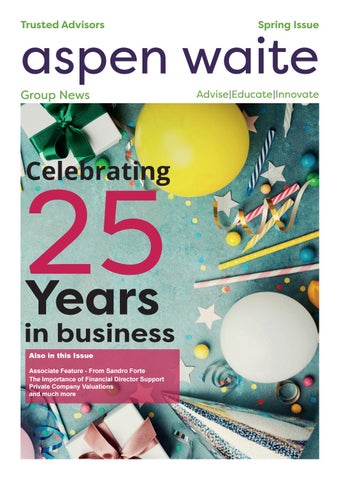
Trusted Advisors
Spring Issue
aspen waite Group News
Celebrating
Also in this Issue Associate Feature - From Sandro Forte The Importance of Financial Director Support Private Company Valuations and much more
Advise Educate Innovate
Aspen Waite started its life in August 1993 when the founder, yours truly, drove to his new office at Aspen House (no there really is no Mr Aspen) and prepared for his new life on his own as a Sole Practitioner. One of my few, but better, clients commented that I was too good to be on my own for long and her prediction quickly proved to be a correct one. Nonetheless, for a period I did literally everything. Saturdays consisted of trudging into work in my track suit and typing letters. I prepared a pretty good business plan and Barclays loaned against it. My expectations were pretty realistic, so I budgeted for sales of £45000. I exceeded this by over 70% as it turned out. In those days I use to feel decidedly uncomfortable about budgeting in effect for customers that I had not even met. In many ways I was ill suited to business life on my own. In previous lives I had always pretty much been free to be the client facing, personable one in the office. I knew nothing about credit control, or some of the games sharper people played with you. I was NAÏVE for sure. On the other hand, my survival mode was strong and I got to meet enough people to allow my natural personality to build a decent practise. I have always felt I have a big advantage over most accountants, as literally all I do every day is be my natural self. As this is our 25th year, we are proudly celebrating while making sure we make the decisions to allow us to continue another 25 years.
Elsewhere in this edition there are articles on various things that have happened to me over the period, including some views and things I have learned. Much of the history is in my first book called “Raising the Bar”.If you have not read it, it has been well received, is honest and at least moderately inspirational. Through liaison with new friends at Purple Fish I became motivated to start my second book, which is now under way and is called “Winning 2-1, Reflecting on 25 years in business.’’ Apparently only about 7% of businesses last 25 years so this degree of longevity is in itself an achievement. I am proud of the many people I have employed and the literally hundreds and hundreds of businesses I have helped, some in quite a major way. Most of all I am proud that I stand for something, being essentially a values driven entrepreneur. The client failure rate has been remarkably low, testimony to the quality of our advice. For the greater part of the 25 years we have been a moderately successful niche firm of Chartered Accountants, who had a lot of quality but were a little bit of a best kept secret. Nobody thinks life is fair and excellence does not always lead to success. I think I/we have proved over and over again that we had a bit of class and sometimes you just need a bit of luck.
In my case this was fuelled by one of my better decisions, which was to be recognised as experts in a key area, in our case R&D Tax Credits. We have done this most successfully and, buoyed by our success, we have branched off into other valuable tax incentive areas that are poorly understood. We are proud of our re-branding and our “Trusted Advisors” tag. Nothing happens quickly in business, but we are slowly picking up wider business from clients. I have covered this aspect in a feature later in the news. Over my history I have in effect had several careers running together, such is the beauty of self-employment. In so doing, I have built up a range of experience which would be almost impossible to recreate elsewhere. The fire burns inside me as brightly as it ever did, and I am greatly enjoying the many challenges of growth. I try to be the best I can be, in all respects and for the first time in my life I am at peace with myself. My biggest problem as an individual is that I care too much, losing a client is like losing an arm. This is what led me to calling my latest book “Winning 2-1”. This year started off with a bang and I am especially looking forward to growing our Corporate Finance offering. One thing I am keen to do in the future is not getting up in the dark. I really don’t like it. I wish all our readers a truly successful and rewarding year. Stay positive and remember you never need to be on your own.
Paul's Top 5 Business Decisions Rebranding as a Professional Services Company In This Issue
Calling the business Aspen Waite
The huge focus on R&D Tax Credits Forming our own Marketing Department
My Introducer's Model
The Power of the Lens… By Sam Clyde - Chief Commercial Officer We live our lives through a lens. Whether it's the lens in our eye, the lens of a camera, our phone, video or TV camera and for those of us that are fortunate to see, we make our decisions, big and small, on a daily basis based on what we see through all those different types of lenses. If the vision through the lens is funny, we laugh.. If it’s sad we cry … If it’s profound, we give it a lot of thought. So we live in a world where the lens plays a big part in our decision making …
Now let's look at that in context of your business. I want you to think about your favourite / most powerful piece of marketing. Is it a written piece? A picture? Or is it a video? Think about it. What would happen if, instead of seeing the things in everyday life that you make judgements and decisions on, you could only read about them or see a still picture about them.
You couldn’t really make the sort of informed decision or judgement you do at the moment when you can see it in motion. This is what happens with a large percentage of businesses who still use mainly written and static images for their marketing and don’t use video in their marketing campaigns. Recent studies showed that videos accounted for 69% of all internet traffic in 2017.
Let’s look at some important stats about using video content: 1. 2. 3. 4. 5. 6. 7.
An initial email with a video receives an increase click-through rate by 96%. Video on a landing page can increase conversions by 80% or more Before reading any text, 60% of site visitors will watch a video if available. One minute of video is worth 1.8 million words. 56% of consumers believe if a company has a website, it should have video content. The Average user spends 16 minutes and 49 seconds a month watching online video ads. 80% of consumers say a video showing how a product or service works is important when learning about the company. 8. 51% of marketing professionals worldwide name video as the type of content with the best ROI. 9. Video search results have a 41% higher click-through than plain text results. 10. 50% of marketers consider customer testimonials, explainer tutorial videos, and demonstration videos the most effective types of video content used.
These are just some of the benefits of using video content to promote your business as opposed to print or static digital campaigns. Video and, in particular, online video content is more effective and accessible than ever before and its impact is set to grow even stronger over the next few years. I used video content many years ago (obviously setting the trend as it was before the internet marketing took off!) to help sell services for the company I was working for and I have to tell you, it helped me outsell every other sales person in my area, smashing the targets I had been set. Something I am still proud of today, as I didn’t consider myself to be a natural sales person, so just tried using the video to assist my efforts. It wasn’t me who did the selling , it was the video I made!
What story can you tell in 90 seconds? What results could you achieve? That’s all it takes. Less than two minutes of creativity to engage with and sell to potential new clients. Video offers a more interactive experience for consumers by educating, informing and entertaining them and when watched leaves a more lasting impression than a static ad. It allows you to tap into consumer emotions, provoking a response that will influence their opinions, choices and ultimately their buying decisions. It’s time to start getting inspired, and if you are not already doing so, invest in some vibrant creative and a professional editor to produce something that gives you some real competitive edge! It could be the best 2 minutes you’ve ever committed to. If your competitor already does video, watch it and analyse it… then do something different and more imaginative. John Lewis is the perfect example of doing it differently. Their ‘Monty the Penguin’ Christmas ad was shared over 202,000 times in the first 24 hours and has been viewed more than 23 million times. What has a penguin got to do with a department store? Nothing! But it got the John Lewis brand talked about by millions of people. The creativity you can produce is only limited by your imagination, so my message to you is: what are you waiting for? Wishing you a very productive and warmer Spring! Sam
Associate Feature
www.fortefinancial.co.uk
Family fortunes are often lost through a reluctance to confront the issue of Inheritance Tax By Sandro Forte - CEO Forte Financial Group Sandro Forte has built a business which centres on relationships and client service. He represents the interests of some of the UK's wealthiest and highest profile sports stars, celebrities and business owners, with all new enquiries coming from personal introduction from existing clients or from other professionals. He has written a best-selling book (published in 8 languages) and lectures on businesses success and personal development all around the world. There are few more confusing – or unpopular – taxes than Inheritance Tax (IHT). For older generations, the prospect of paying up to 40% tax on what they leave behind is difficult to contemplate. For some children and grandchildren, grappling with IHT is something they are ill-equipped to do; yet more and more families are having to deal with it. What is more, IHT is set to be an even greater money-spinner for the government over the next few years: the amount collected has passed £5 billion for the first time in 2017/18 (Source: HMRC, November 2017) and the Office for Budget Responsibility predicts that receipts will increase to £6.2 billion by 2021/22. Nevertheless, despite more than a third of over 55s being concerned about having to pay IHT on their estate, less than a fifth have actually taken action to reduce their potential tax bill. Fewer than one in ten are seeking financial advice or making gifts to family members (Source: Prudential, May 2017). You can make gifts worth up to £3,000 in each tax year (£6,000 if you use the previous year’s allowance as well) without incurring any IHT. You can pass on larger amounts of money free of IHT so long as you live for seven years after making the gift. You may also want to take account of the “normal expenditure out of income” rule – if you make gifts out of your income and, in so doing, don’t affect your standard of living, they are exempt from IHT and there is no upper limit. Many individuals have the desire and ability to give away some of their wealth during their lifetime. Indeed, this is becoming increasingly necessary as families look to use their combined resources in the best, most taxefficient way to benefit all generations. Gifting while you are still alive can be very rewarding. Moreover, taking steps to reduce your taxable estate by topping up a child’s pension or Junior ISA could go a long way to providing them with an individual head start in life. The establishment of a Trust may affect the timescale over which your gift may be considered exempt, so advice should be taken if you are considering a gift into a Trust or you are looking to set one up.
Will you allow the taxman to decide your legacy? HM Treasury is expected to see around a 25% boom in IHT revenues over the next five years (Source: Office for Budget Responsibility, March 2017). IHT receipts and latest forecasts show the following:2009-10 – £2.4 billion 2010-11 – £2.7 billion 2011-12 – £2.9 billion 2012-13 – £3.1 billion 2013-14 – £3.4 billion 2014-15 – £3.8 billion 2015-16 – £4.7 billion
2016-17 – £4.9 billion 2017-18 – £5.0 billion (forecast) 2018-19 – £5.2 billion (forecast) 2019-20 – £5.5 billion (forecast) 2020-21 – £5.8 billion (forecast) 2021-22 – £6.2 billion (forecast)
Other Useful Information •
The IHT nil rate band is £325,000 for single people or £650,000 for married couples or civil partners. IHT is due on death at a rate of 40% above this threshold.
•
There is currently an additional £100,000 “residence nil rate band” (RNRB) that can be used against the value of your property although certain restrictions apply.
•
Unused elements of both allowances are transferable to a surviving spouse or registered civil partner, allowing up to double the nil rate band applicable at the date of the second death.
•
Exemptions, such as the annual £3,000 exemption and regular gifts from income, can all help to reduce your taxable estate.
•
Individuals can pass on larger amounts of money free of IHT, so long as they live for seven years after making the gift.
•
Having a valid Will and reviewing it regularly is vital to effective estate planning.
Did you Know The government raises more money from Capital Gains Tax (CGT) than IHT: over £8 billion in the last year (Source: HMRC, December 2017). If you sell an asset that is not held in a pension fund or an ISA, you could be liable for CGT on profits earned. Every taxpayer has an annual allowance of £11,300. Gains above that are taxed at up to 20% on assets such as shares and up to 28% for gains made on the sale of residential investment properties. If your spouse is not using their allowance, you can transfer assets across – a procedure that is not subject to CGT. If you both then sell assets before the end of the tax year, you can effectively double the allowance to £22,600. If you do not exploit the allowance this year, it does not roll over and is lost forever.
Gifts that are worth more than the annual exemption are subject to IHT at the following rates:• • • • •
Less than 3 years between gift and death: 3 to 4 years between gift and death: 4 to 5 years between gift and death: 5 to 6 years between gift and death: 7 or more years between gift and death:
40% tax charged 32% tax charged 24% tax charged 16% tax charged 0% tax charged
Help your family to escape the IHT trap by removing up to £12,000 from your estate immediately If you think your estate is likely to be hit by IHT and you can afford to give some money away now then you should move quickly. With the end of the 2017/18 tax year looming, you only have a short window of opportunity to make this year’s £3,000 allowance count – and to carry forward last year’s if you haven’t used it already. Using the carry forward provisions, a couple could potentially remove £12,000 from their joint estate immediately.
To find our more contact Sandro - CEO - Forte Financial Group Tel: 0208 723 8370 or 07971 268686
www.fortefinancial.co.uk
Too Many Options in a
World of Technology? By Johno Harris - Business Development Executive
Just the other day, I had to post a parcel to my Sister in Australia - It was an iPad she had left behind from visiting over Christmas, so it was pretty urgent. I did what anyone would have done, I Googled it, chose a company, transacted the deal online at high cost to ensure speed. Then wrapped it and delivered it to the closest pick-up point about 5 miles away where it winged its way merrily into total oblivion... There is almost no way to retrieve it and we cannot speak to a human - the courier company don’t seem to care (she still does not know where it is as I write this article). Electronic tracking yet cannot be found. 5 years ago, I would just have walked down to my local village post office and posted it 1st class in the sure knowledge it would arrive. I did not even consider that this time. Duh! The same could be said of the way we conduct our business activities today. We live in a world of high speed communications where social media, e-mails, texts and voicemails (options, options, options) seem to replace good old fashioned face-to-face meetings. How often do we send someone an e-mail and hope they will react before we move to our next task - never scheduling in to follow-up! "Do a conference call" I hear you shout - all well and good thanks, but how do you get your personality to shine through on a conference call? Again, people have options to turn their cameras off (which most seem to choose). Even with the camera on, people can only see your head and shoulders and we all know how ineffective these calls can be with background noises, interruptions, etc. In a face to face meeting you can assess other people’s attitudes and enthusiasm, you can find out far more about what makes them tick, … real gold in terms of
relationship building, and let’s face it, relationships are what business runs on. How can anyone today expect to build a great relationship with someone they have never met personally? It’s possible in some circumstances, but usually pretty difficult. Two particular examples spring to mind in the last fortnight to illustrate there is no substitute for face to face meetings. First, I met with a client prospect in December last year regarding R&D Tax Credits. We discussed many issues and initially all they wanted to do was negotiate our fee downwards as they had spoken to other providers on the phone and e-mail and had cheaper quotes than us. Because I was there chatting with them personally, I was able to find out far more about their future ambitions, their current challenges and what they were really looking for in terms of financial support and advice. Long story short, couple of meetings and we are now acting for them in an R&D capacity, but additionally we are going to be helping them with many other aspects of their growth in terms of Corporate Finance, Land Remediation, RDA’s, etc. Very exciting as this company has massive ambition. Second, the reverse side of the coin. I have recently been following up on leads we received last year but never progressed. One such company told me they had just received their first R&D Claim pay-out and it had been handled by a competitor of ours! When I enquired why they did not use us (we came highly recommended), they said all my colleague did was speak with them on the phone initially and send them a contract, our competitors went to see them! Just one example of why you can never beat a face-toface meeting - it could lead on to great things! Read on for my top tips for a great first meeting.
Johno’s 5 Top Tips
For Successful Face-to-Face Meetings Make an Agenda Ensure you have an agenda and make sure all attendees see it in advance in order to prepare anything they may need to contribute. (Unless you’re just dropping by for a cuppa - then make sure you bring doughnuts!)
Initial Introduction Before I meet with anyone for the first time, I send them a confirmation note and attach our Service Guarantee, which sets expectations and fees, etc. in advance. Nice touch because then I do not even have to bring it up in our meeting, it’s already a given, unless the client wants to discuss it….
Never Try to Sell Nobody wants to attend a meeting where someone is trying to sell something.
Always Try
Pointer If you must use conferencing facilities due to distance or timings, then do so but perhaps it could be a signal that you need to recruit someone in that geographic zone to substitute for you.
To understand the other person's/peoples’ issues, try to ascertain their biggest challenges currently (usually people and cashflow) and be genuinely interested in them. Understand their ethos and motivations which is hard to do on a conference call.
Meeting Face to Face Face to face meetings really should be fun and interesting. They do not always have to be in an office or Hotel, think of a quirky venue and meet them there (e.g. Swindon Rail Museum) or alternatively do an activity (Round of golf, tennis, rugby (Watching, not playing if over a certain age!), football, horses, go carting, sailing, etc. - The list is endless. Go for lunch/ breakfast/drinks!
Thanks for reading this post. Now, instead of sending that e-mail, pick up your phone and schedule a memorable meeting!
In Brief
PAUL'S 1993
2018
Paul shares some of his favourite moments from the past 25 years... Best Films
Best Single
Hives Hate To Say I Told You So – wonderfully exciting.
Best TV Series
Foyles War – Michael Kitchen is a superb actor – Series 7 Episode 3 is the defining episode – closely followed by Sharpes War – I have every Bernard Cornwell book.
Best Horse
FLAT: Frankel – simply legend JUMPS: Denman – watching him win the Gold Cup was a real happy moment.
Forrest Gump / Gladiator - memorable mentions to all the Lord of the Rings films and latterly the new Star Wars films – Daisy Ridley is amazing.
Greatest Moment
England winning the 2003 World Cup and beating Ireland away to win the Grand Slam in the same year. JP and I had one of the great drinking days.
Best Comedy Series
Father Ted / The Fast Show.
Never Happier Than When
Sitting in my seat at The Rec – nowhere like it.
The Importance of Financial Director (FD) Support By Darren Talbot
We at Aspen Waite cannot agree more with these results and believe that the FD support we offer and the FDs involved have all the key attributes and are ready to help your business.
In today’s business world, you have to work hard to increase revenues and constantly review your costs base. Therefore, the suggestion of employing a full time or part time FD for support may not make financial sense, especially if you already have a good accountant. However, there is one big factor you must consider. Today’s Finance Directors are striving to contribute more to organisational performance, and FDs have emerged as much more rounded, commercial and strategic business leaders than the traditional role of ‘scorekeeper’ of yesteryear.
What are the signs that your business needs an FD or FD Support? • • • • • •
Lack of good data to make informed decisions Information not provided in a clear or timely manner Data is always historical Financial reports not linked to commercial reality Financial processes that are cumbersome and full of duplication Resignation of FD financial controller or management accountant
What should the role of the FD or FD support be in your business?
The FD wears three primary hats: first as a finance expert, second as an active member of the management team, and third as leader of the finance function and team. The key point is that the FD has multiple roles and they are working both ‘in’ the business and ‘on’ the business.
The need to get into the business and out of the back room has been a long-standing requirement if they are to add value. The analogy I always use is that of a car mechanic who can use all the diagnostic tools he has to find out what is wrong, but he has to get under the bonnet to really find out what’s happening. The same is true for FDs - they need to get under the bonnet of the business rather than account for it behind a desk.
What makes a good FD?
According to the most recent survey by Directorbank Group the key attributes of a good FD are: • • • • •
Excellent communication skills – with the board, across the business as a whole and with shareholders and the outside world Wider people skills, particularly the ability to lead a high calibre team Commerciality and in-depth understanding of the business, its markets and customers The ability to support and challenge the Chief Executive An affinity with numbers and the ability to interpret them for others
Technical competence for any FD should be a given, and today’s outstanding FDs should place more importance on strategic awareness, commerciality, communication skills and leadership.
For more information about the Financial Director services that Aspen Waite can provide, talk to one of our trusted advisors today.
Matchmaking for trustworthy
European partners
Finding reliable business partners across Europe can be a struggle. The Crowdhelix platform aims to help match-make European researchers and credible businesses to win large EU collaborative grants, as its director Abdul Rahim explains. With the European Commission's ever-growing emphasis on innovation, European project proposals increasingly feature consortia comprising closer to half businesses and half research organizations. Academics thus face the difficulty of putting together a truly European consortium of researchers and those that will make use of their research "end-users" that will work well together and stay the distance. Crowdhelix is a platform that can be used for plugging gaps in existing consortia or for starting new ones. The idea behind Crowdhelix is to create a single technology platform for open innovation and collaboration where researchers and businesses interested in similar research projects can find each other easily. The platform builds on the Vision2020 network, which began during Fram work 7, as the switch from research to innovation started to happen. Crowdhelix now offers a base for people and organisations to present themselves so that the technology can match expertise with the funding opportunities available in Horizon 2020.
Contact Abdul to find out more: abdul@2020visionnetwork.eu
We have around 350 members in 41 different countries so far; 70 are research and technology organisations, or universities, 250 are small or medium-sized enterprises {SMEs) and 15 are large businesses. According to the Commission's Community Research and Development Information Service, Cordis, so far members have secured 7 per cent of the €8O-billion Horizon 2020 budget. Rajiv Jalan, hepatology professor at University College London, for example, leads a €7.8-million Horizon 2020 project ALIVER that includes two universities, four hospitals, two foundation and four industrial partners, including IBM.
HOW IT WORKS
The platform is structured around clusters or "helixes” led by research organisations. There are 16 live clusters: climate, cybersecurity, digital, energy, experts, general topics, health, manufacturing, materials, mobility, quantum, Security, smart cities, society, space, and water. Research organisations leading the clusters organise themed events in response to forthcoming calls about 10-12 a year - for instance, a biotechnology-themed event in Spain in February. It's a more advanced way of bringing together consortia for calls and far more efficient than relying on the random meeting of potential partners at events. Members subscribe to the network and we try to get them to engage as much as possible, profiling individuals within their organisation, hosting and attending events. For institutions the cost to subscribe to the platform is €5,000 euros a year for however many Individuals want to register and includes the events hosted by helix leaders. For SMEs the cost is €900 for three years.
We encourage members who are looking for collaborators to post opportunities, for now principally from Horizon 2020,
on the platform. Then potentially interested researchers or SMEs or end-users are recommended based on the data from registered profiles.
CREDIBLE PARTNERS
This is quite a different set up to projects in previous Framework programmes, where researchers would focus on the research and For example, you might get a Crowd consider impact later on, only helix post from Delft University of bringing in SMEs and others who Technology in the Netherlands, might use the research at the end. which is coordinating a project and looking for six collaborators, That model no longer works, and hospitals and patient organisations, impact needs to be factored into vendors and technical developers. project proposals at the beginning. All those people registered and profiled on the Crowd helix One of the most important aspects of platform would be notified. Crowd helix is the credibility of those involved. While there are lots of platforms to find partners and many FUTURE PLANS of them are free. For example, the Crowdhelix is a growing network European Enterprise Network and we're looking for more and the Commission's University institutions to get involved across Business Co-operation Network, and Europe and globally in Africa and Knowledge Alliance - Crowdhelix Asia. For now, the focus is on provides trusted referrals. Horizon 2020 but we plan to look at other funding sources in time. Some helixes have produced policy We have spoken to everyone on papers and there is scope for helix board and we can help broker bilateral meetings, events and staff leaders and those involved in exchanges. specific dusters to have a voice on policy, but our focus is much more We curate the relationships and upon innovation and impact. memberships so that it's a trusted community and we have a good Our aim is to make the platform success rate on matching people. as transparent as possible so that SMEs in smaller countries, without a huge innovation infrastructure to It's all about open innovation and support them, can be as involved in members have to be active and engaged. As a collective we are set to collaborative EU projects as bigger gain far more than working in silos. regions and countries. As soon as opportunity is posted, we can see if they match it and contact them. We moderate the opportunities so that people aren't being spammed with information they aren't interested in. Over time we want to automate the matchmaking of people with similar intentions and profiles.
Find out more online by visiting https://2020visionnetwork.eu/ https://www.crowdhelix.com/
Industry News
National Minimum Wage & Living Wage
Update Liz Atyeo Payroll Manager
The National Minimum Wage (NMW) is the minimum pay per hour most workers are entitled to by law. The rate depends largely on a worker's age and if they are an apprentice. Over 25s qualify for the National Living Wage (NLW) instead. It is a legal requirement to pay these rates to your staff and failure to do so can result in fines and penalties of up to ÂŁ20,000 per worker. The Low Pay Commission has stated that the National Minimum Wage increase is the largest increase in a decade for 18-20 and 21-24 years olds with a rise of 4.7% and 5.4% respectively.
These increases will come into effect from the 1st April 2018.
National Living Wage April 2018
April 2017
£7.83
£7.50
April 2018
April 2017
Adult rate (21-24 inclusive)
£7.38
£7.05
Development rate (18-20 inclusive)
£5.90
£5.60
Under 18, but over the compulsory School age
£4.20
£4.05
Apprentices under 19 or in the first year
£3.70
£3.50
Over 25 years old
National Minimum Wage
The new pay rate will only affect someone’s pay from the first full Pay Reference Period after that date, e.g. if the Pay Reference Period starts 19th March to 19th April then the pay between 1st and 18th April will be based on the NMW rates. The allocated pay from 19th April to 19th May would be at the new NLW rate because this is the first full pay reference period after 1st April. The same rules apply when a monthly paid employee reaches the age of 25, e.g. if the employee’s birthday falls on 25th May and the next Pay Reference Period starts on 10th June, the employee is entitled to receive the NLW pay rate on 10th June and not their birthday
Associate Feature
A Common GDPR Journey By Phil Sampson - Sampson Hall Most of us started to hear about GDPR about six months ago when we were told normally in a very scary manner that new European legislation was being introduced to restrict our use of personal data that carried enormous big hairy fines. At that stage we had just voted to leave Europe so many thought we could give it a stiff ignoring. Little did we know that it had already been enshrined in UK Law from April 2016 and the May 2018 date is merely the date it would be enforced from by the Information Commissioner. Well to most of us previous experience of the Information Commissioner involved stories of fines for large scale breaches normally as a result of a cyber-attack. We hadn’t suffered one of those and some businesses were not registered with the ICO so we were unlikely to be involved in the new regulation. Besides we don’t hold much personal data anyway and many cry our work is all B2B, we don’t process any personal data. Elizabeth Denham, the Information Commissioner, is determined that we look at personal data differently in every aspect of our work and organisation. After all, data has now become big data and our personal information is far more accessible than it has ever been; Cyber criminal activity is proliferating at a phenomenal rate with organised crime having latched on to the considerable rewards available at low risk. The last Data Protection legislation was the Data Protection Act of 1998 and that was a fairly toothless piece that was designed in a very different time as a result of a European Directive. In 1998 President Clinton was impeached, Bill Gates was denying that touch screens had any future and a computer filled half a desk. So it is about time we stopped others from exploiting our public profile exposed through our personal data. It’s about time that our own information was better protected and used only as we want it to be. It’s about time that we can stop unwanted calls or mail that waste our time and only add to our trash. Now if we want this it’s only fair that we do the same for those whose data we hold in our own organisations. Better data leads to more efficient working, better processes avoiding nugatory work and running an efficient and effective organisation. GDPR is evolution, not revolution, and it is not designed to stop us working just to make us work and think differently about personal data. This cultural shift in the way we think about and use data is an important aspect as we work towards compliance. The tone has to be set from the top and this has to be in a positive way and in the same way as any organisational transformation programme. Many organisations we are working with are seeing the real benefits from carrying out their gap analysis to determine their current position and then, from mapping and creating their data flow maps, this enables all the risk areas to be identified. Most importantly it identifies the processes we are carrying out just because we have always done it that way. If you need practical, sound help and advice as to where to start your GDPR journey then get in touch and we will ask one of our EU GDPR Practitioners to give you a call. 0844 848 9594 info@sampsonhall.co.uk
t itl e
Issue 3
A DAY OUT WITH THE HEYBRIDGE SWIFTS By Cora Joscelyn
As you may be aware, Aspen Waite is one of the proud sponsors of Heybridge Swifts Football Club who were founded in 1880. Gary White is their Chairman. The football ground has been re-named the Aspen Waite Arena and is located at Scraley Road in Heybridge, Essex. My 7 year old daughter, Chloe, who is an avid Swifts fan, was kindly invited to be a mascot at their match against Brentwood on Saturday 17th February 2018. We were visiting the area on holiday for halfterm and kept the day a surprise for Chloe who was absolutely gobsmacked when we arrived. To add to the day the weather was perfect for a football match. I had first seen Swifts in action when I was kindly invited to join Gary, Paul and others for the FA Cup first round against Exeter City on 5th November 2017. Although Swifts lost 3-1 they played brilliantly against a team who were clearly the favourites to win and a full time professional club who were 4 divisions higher than the Swifts.
Chloe’s first encounter with the Swifts was watching them play against Dorchester on 11th November 2017 where they won 2-1 in the second qualifying round of the FA Trophy. We were therefore hopeful that she would bring them luck again. Chloe has a 2018 calendar that had been signed by all of the players so she was very excited to see them all again. Chloe waited patiently at the tunnel for the players to come out following their warm up session and then ran onto the pitch for the line-up and shaking of hands. There were 253 people in attendance including all of the regulars called the “Scraley Road Army” who maintained a great atmosphere throughout the match with their songs and drumming behind the goal. The first half was very exciting with goals from Luke Callander, Ryan Henshaw and Harrison Chatting. Swifts’ excellent first half display allowed for a sluggish second half with Brentwood scoring a goal in the 84th minute to make the result 3-1 to Swifts. The score could easily have been more like the 6-1 result the previous Saturday at home against Ware. The hosts went in front after 5 minutes with a Callander penalty after Chatting was upended. Brentwood goalkeeper Anthony Page saved well with
his feet from Juan Luque when he cut in from the left and then the Spaniard had another effort cleared off the line. Swifts had a fright 23 minutes into the game when a header down from a set piece was headed wide by striker Tony Stokes. But it was 2-0 on 36 minutes when Luque’s far post cross was headed back across by Chatting and flicked in by Ryan Henshaw from close range. Two minutes later it was 3-0 after a great run by Luque was once more controlled and slotted in by the impressive Chatting who was awarded Man of the Match. Luque was denied by a good Page save with 20 minutes to go and the Swifts star then missed a good chance to make it 4-0 when a good run and cross from substitute Charles Clayden bobbled just as he shot. It was identical to a chance missed by Lewis Godbold in the first half. Luke Foster pulled back a late consolation goal when he slid in for a rebound after goalie Danny Sambridge beat away a fierce drive. At the time of writing Swifts have moved from 15th to 12th in the League Table with 9 games in hand. Chloe played football with the other mascots before and after the game. To her delight and surprise, Luque joined the children for a kick around after the match and even shared his chips with her!
Chloe got her match programme signed by some of the players. She was very lucky because she was allowed to keep her Swifts football shirt and one of the match footballs which will be cleaned ready for the next time we visit so that signatures can be added to it. She is getting quite a collection of Swifts memorabilia! Thanks to everyone at Swifts for their hospitality. It was such a great day out which I would recommend to anyone. STOP PRESS: Swifts romped to a remarkable 9-1 victory over Romford on 20th February 2018. Unbelievably Swifts were 7-0 up at the break, never looking back from the moment that Luke Callander converted a penalty with Juan Luque doubling the lead after only 13 minutes followed by 2 goals in quick succession from each of Harrison Chatting and Kreschnic Krasniqi as well as one from Ryan Henshaw. Chiduben Onokwai netted a consolation for Romford in the 74th minute, only for Henshaw to put Swifts 8-1 up with his second of the night just 2 minutes later. New signing James Baker, on as a substitute, bagged the ninth in the 78th minute. Swifts remain in 12th spot in the League Table but have 7 or 8 games in hand over many of their rivals and are now 15 points away from the top 5. As Chloe would say, “GO SWIFTS”!
Top 5 Places
Visited on Aspen Waite Business By Paul Waite
1 Bahamas I was fortunate enough to spend nearly 2 weeks in the Bahamas very early on in my AW career. I had a hovercraft client based in Aberystwyth who had the opportunity to relocate to the Bahamas. Martin wanted my help in the meetings he was to have with the big liner companies. I got to do almost unlimited jet-skiing plus helicopter rides and water sports. Amazing pink sand and the clearest water you will ever see. A wonderful experience.
2 Bangkok Through Lovell International I became Chairman of VSL, a vehicle sales and logistics company based in Bangkok. I have remained close friends with the CEO, Dean Robinson, to this day (now living in Australia). Bangkok is an amazing city and Dean played and worked hard. Fantastic food and lots of great drink plus I was inducted as a member of the Bangkok Lions Rugby Club. Many of you will have seen my lovely blue and yellow made to measure silk blazer. I greatly admire Buddhism, so it was a real privilege to be in Thailand. The people love us and it was an unforgettable experience.
3 Philadelphia I had the most amazing time in Philadelphia representing one of our large innovation companies. Probably the best English style pubs complete with in-house breweries I have ever been in. Totally surreal drinking a pint of Irish Red listening to 80s English music. The highlight was a tour of the Hall
of the Presidents at Independence Hall followed by a beautiful dinner there. Life size paintings of every single President of the USA. It was a huge honour.
4 Sofia My first overseas Due Diligence exercise working for a UK client looking to buy a group of dry cleaning companies in Bulgaria. I was there for a week and it was quite surreal as none of my Bulgarian hosts spoke English. Most fortunately my visit coincided with Bulgaria’s best ever World Cup (they got to the semi-finals). I have memories of cheesy chips and really high quality food which I was not expecting. Lots of whiskey drank out of coffee cups and watching Bulgaria play at the many open screens in the city.
5 Budapest Through my position in First Group I travelled to Poland 17 times in 1995/96. My duties also took me to Volvo’s main bus factory, Cadburys’ new factory in Warsaw and RZB Banks’ head office in Vienna. The highlight undoubtedly was my trip to Budapest, the home of Ikarus buses. The old city of Buda was knee deep in snow and I met the executives of Ikarus in this beautiful restaurant. They plied me with large amounts of the local brew, flavoured Slivovitz - but they had picked on the wrong guy!
Private Company Valuation By Monika Stukova
Monika Stukova, our resident Business Valuation specialist, takes a look at some of the techniques used to value companies. This is especially relevant for anyone looking to monetise their private business equity or considering an acquisition to grow their business and highlights the complexity!
3 Basic Techniques The three basic valuation techniques that advisers use to value private companies in an M&A context are:
Discounted Cash Flow A method of valuing a project, company, or asset using the concepts of the time value of money. All future cash flows are estimated and discounted by using cost of capital to give their present values (PVs).
Guideline Public Company This method entails a comparison of the subject company to publicly traded companies. The comparison is generally based on published data regarding the public companies' stock price and earnings, sales, or book value , which is expressed as a ratio known as a "multiple."
Guideline Transaction
The guideline transaction method establishes a value estimate based on pricing multiples derived from prior transactions (i.e. mergers and acquisitions, divesture, etc.) of comparable companies. Such a transaction might represent either a minority perspective or a majority perspective.
The Approach Whilst valuing a company is complex with many variables, in this article I will explain the guideline public company analysis approach. In this approach, the analyst first defines a set of comparable publicly quoted companies that are similar to the target company under review. This set may include companies within the target’s primary industry as well as companies in similar industries. The sample should aim to include as many such companies as possible. Once a set of comparable companies is defined, the next step is to calculate various multiples based on the current market prices of the companies in the sample. Examples include: • • •
enterprise value to EBIT (EV/EBIT); enterprise value to EBITDA (EV/EBITDA); enterprise value to sales (EV/S).
The equity can also be valued directly using equity multiples, such as price to sales (P/S), price to earnings (P/E), and price to book value (P/B). Analysts typically review the mean, median, and range for whichever multiples are chosen, and then apply judgement and experience to adjust the multiples for relative risk and growth prospects. Then they apply the adjusted values to corresponding estimates for the target to develop an estimated company value. Each multiple (P/S, P/E, etc.) is likely to produce a different estimate for the target’s value. Analysts hope that these values converge because that increases confidence in the overall estimate. In order to calculate an acquisition value - assuming the buyer is strategic - the analyst must also estimate a takeover premium.. A control premium of 20% is considered reasonable.
What is a control premium? Control premiums are measured based on the value of the equity of publicly quoted companies before and after acquisition. The analyst must estimate a takeover premium and usually compiles a list of the premiums paid for companies similar to the target .Control premiums can vary markedly based on numerous factors such as risk and growth potential – for example, the tech takeover premiums can be as high as 33%. Finding a Fair Value for Company X using Guideline Public Company Analysis Company X operates in the United Kingdom in the rental and leasing industry, specifically in the equipment hire market. I have gathered the following valuation metrics of five comparable companies and calculated the mean for each. This information is publicly available.
Rela�ve Valua�on Ra�o
Aggreko PLC
Ashtead Group PLC
Speedy Hire PLC
Lavendon Group PLC
HSS Hire Group PLC
Mean
P/E
16.48
18.25
25.75
59.44
n/a
29.98
P/S
1.21
2.84
0.80
1.73
0.13
1.34
P/B
1.51
4.67
1.56
1.94
0.36
2.01
EV/EBITDA
5.28
7.7
5.57
8.61
14.33
8.30
EV/EBIT
13.26
13.26
18.78
30.9
-10.17
13.21
Source: Morningstar I then deflated public price multiples by 30% because of the increased risk evaluation for a private firm. In order to calculate the comparable equity value for Company X, I applied the adjusted mean relative valuation ratios to the corresponding data. I decided I am comfortable using an average of three estimates to produce an estimate of equity value. It is important to note that there is no “standard” – the 30% and use of averages are down to the analyst’s own experience and judgement. These adjustments are necessary because private companies are smaller in size and therefore riskier. Additionally, a lack of access to public equity financing may limit private firm growth. • • •
Earnings – profit after tax adjusted for nonrecurring items. Often referred to as persistent or core earnings. Sales – turnover, revenue generated from business activities. Book Value – Book Value of Shareholders’ Equity (total assets minus total liabilities).
RiskAdjusted Mean Mul�ples for Comparable Companies
Control Premium of 20% Applied to RiskAdjusted Mean Mul�ples
Es�mated Equity Value Based on Comparables
Target Company Valua�on Variables
Target Company X
Comparable Companies’ Valua�on Variables
Earnings
595,000
P/E
20.99
25.18
£14,984,004
Sales
4,221,000
P/S
0.94
1.13
£4,758,249
Book value
2,630,000
P/B
1.41
1.69
£4,436,074
Es�mated equity value Source: Aspen Waite Analysis
Mean:
̴£8,059,000
Private Company Valuation Continued..
I followed the same steps when using multiples of EBIT and EBITDA, multiplying the adjusted mean multiple by the corresponding variable for Company X to produce an estimated enterprise value. In this case, however, I must subtract net debt of £1,200,000 (obtained from the company’s balance sheet) from the estimated enterprise value to calculate the estimated equity value.
RiskAdjusted Comparable Mean Companies’ Mul�ples Valua�on for Variables Comparable Companies
Control Premium Es�mated of 20% Es�mated Enterprise Applied Equity Value Value Based to RiskBased on on Adjusted Comparables Comparables Mean Mul�ples
Target Company Valua�on Variables
Target Company X
EBITDA
1,120,000
EV/EBITDA
5.81
6.97
£7,806,758
£6,606,758
713,000
EV/EBIT
9.24
11.09
£7,909,338
£6,709,338
EBIT
Es�mated equity value
Mean:
̴£6,658,000
Source: Aspen Waite Analysis
I then decided to calculate a weighted average of the two estimates to determine an overall equity value estimate of £7,358,000 for Company X. (£8059k + 6658k / 2) The control premium is used because the buyer is strategic and synergies are available from control. Essentially this means because the acquisition of Company X will have future benefits to the buyer (i.e. a bigger competitor buying a company operating in the same industry), the premium of 20% is applied. If the buyer is non-strategic (i.e. had no relevance to its primary industry), no control premium is applied.
Looking to buy or sell? Buying and selling a business is a complex matter, and so you should always seek expert advice when considering your options. Enlisting the support of a professional analyst to conduct a business valuation is an essential part of any decision to buy or sell a business. It is important to be aware that there is no such thing as a “correct” valuation – the analyst must use reasonable care and exercise independent professional judgement when conducting valuation analysis. For more information on valuing a business, or any aspect of corporate finance, speak to one of our advisors: Paul Waite paul@aspen-waite.co.uk Monika Stukova monika.stukova@aspen-waite.co.uk
Paul's Top 5
Moments in 25 Year Career
Completing John O’Groats to Land’s End over 1,000 miles in 8 days. Helped me to find myself and created a lot of self-respect. Attending the National Haulage Awards at the Royal Albert Hall representing the TJ Group (nominated as best UK haulier). It was a fabulous evening hosted by Jeremy Clarkson who was incredibly funny. I remember thinking I deserve to be here, so it inspired me greatly. Being nominated as Best Firm of Accountants in the National Accountancy Awards (twice now in 2015 and 2017). After all that hard work it was deeply satisfying to be recognised by one’s peers. Winning the First Group contract in what was the end of my second year. Being European Financial Consultant was good in itself but being promoted to Managing Consultant was extremely satisfying and I was very proud of what I had achieved. Looking at my first year’s accounts and seeing how much more money I made off my own efforts. Overall finally coming to peace with myself.
Are you an Addict? You may well be one! By David Scheeres
No I’m not suggesting addiction to gambling, drugs or alcohol; I’m talking about a piece of plastic and metal, an inanimate object that is undoubtedly in your hand or pocket or within reaching distance right now – your smartphone. You may consider my choice of words extreme but I can assure you that mobile phone addiction can lead to nomophobia and this is now recognised worldwide. Nomophobia is the irrational fear of being without your mobile phone or being unable to use your phone for some reason, such as the absence of a signal or running out of minutes or battery power. A phobia is by definition an irrational fear. To pre-empt any accusation that I am a Luddite or have reached that time in life that Victor Meldrew reached in his early teens, I can assure you that I have a smartphone and can use it and I find it useful and essential for my professional career. I am raising a more insidious aspect of their use. The purpose of this short article is not to moralise but to possibly raise your awareness of the potential addiction of use particularly in respect of social media such as Facebook and Twitter. I banned smartphones from dinner parties and family meals some years ago when I noticed that some individuals weren’t engaging as they were pre-occupied with their phones checking Facebook and Twitter and were oblivious to the conversation taking place around them. I regarded this as rude behaviour and this resulted in my draconian action, much to the annoyance of my younger relatives. I first noticed this phenomenon of opting out of engagement with those around you some years ago but it seemed to be the prerogative of my teenage relatives and their friends. That has changed. Last year I landed at Chicago O’Hare airport and there was a problem with Skywalk congestion and we disembarked the aircraft onto a shuttle bus to the terminal. As soon as the bus started moving it occurred to me that there was no conversation whatsoever despite the fact that there were at least 50 people on the bus. Everyone was occupied on their smartphone with heads down and twitching thumbs…. In
fact I was the only person without a phone in their hands. Some months ago we had a celebratory dinner in a nice restaurant with a close relative. During the meal she constantly checked her phone and I asked her if she had a problem at home. The reply I had was that she was checking her Facebook page for activity in case she missed anything. Really? Is it so important to know that Fred has taken Fido out for a walk or Susan has forgotten Uncle Fred’s birthday, no doubt because she had not scheduled a Facebook reminder. Our relative is 58 years old and is a smartphone addict. My comment to my relative was that she spent so much time interacting with social media that she had no social life! She countered by saying that she had more than 500 “friends” and I replied that I considered myself fortunate to have six true friends and that cyber relationships in which parties did not meet could never be meaningful as a relationship in which parties met and could discuss matters unconstrained by the anonymity of a keyboard. Instead of making us more connected, our smartphones could be making us more isolated. Not only are we more distracted and less ‘present’ in social scenarios thanks to our smartphones, we’re also becoming less connected to our peers on a deeper level. Researchers from the University of Essex found that people who discussed personally meaningful topics when a smartphone was nearby (even if they weren’t being used) reported lower relationship quality and less trust in their partner. They also felt their partner was less empathic to their concerns. Smartphone use is also likely to make us more selfish, and less likely to engage in ‘prosocial’ behaviour, a University of Maryland research study revealed. Prosocial behaviour is defined as an action intended to benefit another person or society as a whole – like volunteering or simply helping out someone in need.
So what causes this addiction? Experts say our brains get a hit of dopamine and serotonin – the chemicals linked to happiness – when our phones beep or ring. These are the same chemicals that give drug users their ‘high’! Conversely, people whose lives revolve around social media and spend too much time staring at a screen can suffer anxiety and even depression as they expect constant updates and interaction from friends, and worry when these aren’t received. The physical ramifications of excessive phone use are also becoming rapidly recognised and I will cite only a few examples. The British Chiropractic Association stated that the number of young people with back problems has risen dramatically over the last number of years, thanks to smartphone use. According to 2015 statistics, 45% of young people aged 16 to 24 now suffer from back pain as their spinal disks are put under pressure. That’s a 60% rise from 2014! This pain isn’t just occasional either, with 25% of those young people suffering on a daily basis. But it is no small wonder that texting can cause such pain. A 2014 study, published in Surgical Technology International, found that the activity can add up to 50 pounds of pressure on a person’s spine, depending on the angle at which the person is texting. That’s a similar weight to carrying a seven year old child! Having a smartphone means we’re always ‘available’ – to take calls, text messages, instant messages, social media notifications and emails. The workday no longer finishes at 6pm as emails continue to push through late into the night. Recent research has found that the need to immediately read and respond to every one of these incoming alerts is causing rising stress levels as the messages control you, you cannot control the messages and this can create a degree of inappropriate responsibility. You have to ask yourself how much traffic received is really an opportunity and be able to segregate the mundane from the important. What is so important that a reduced response time would cause a problem and surely contemplation leads to a more well thought out and measured response, if indeed one is needed. How many “knee jerk” emails have you sent and regretted over the years and suffered angst as a result? Trouble sleeping? What’s really worrying is that, according to a study published in September 2015, the amount of caffeine in a double espresso has less of an effect on sleep schedule than bright light exposure at night! While most of us wouldn’t bring a double espresso to bed, we happily bring our phones. The light exposure can actually push back sleep time twice as long as coffee does, thanks to its ability to suppress melatonin, the hormone that helps with sleep timing. When Harvard researchers looked at the effect of 6.5 hours of exposure to blue light, and to green light, they found that the blue light suppressed melatonin for twice as long as the green did.
I think I have made the point and could continue with dangers like occipital neuralgia or carpal tunnel syndrome – and of course addiction can increase your risk of indirect injuries, like from a nasty fall or car crash and phone use in cars is such a serious issue that legislation has been passed to try and reduce this risk. Aspen Waite is proud to be involved with the Helios business management app and this is a powerful management tool that utilises many of the smartphone functions such as GPS positioning. During risk analysis of the software, exception scenarios were discussed such as the possibility of users circumnavigating the software by leaving their phone in a location. It became obvious very quickly that this was not a real risk because most people in the target market would suffer emotional stress and withdrawal symptoms if separated from their phones. This helps our business model but also serves to highlight some of the issues I raise in this article in respect of nomophobia. I would ask the reader to consider that if they were separated from their smartphone for two hours would they suffer anxiety? If so, you may have a problem. It is important to differentiate between the necessity of the smartphone as a business tool or communications device and its use as a portal to constant social media. Are the majority of your relationships conducted through an object? At Aspen Waite we value our clients as people and made a conscious decision to meet clients face to face regularly and this is a positive management decision that was made as we genuinely believe that in spite of the difficulties of time and distance a personal meeting can be of more benefit to both parties than an email or twitter exchange. How can you truly understand someone or their business if you never meet them? In the Elsevier publication “Computers in Human Behaviour” the statement is made; “Facebook is the world’s most popular online social network and used by more than one billion people. In three studies, we explored the hypothesis that Facebook activity negatively affects people’s emotional state. A first study shows that the longer people are active on Facebook, the more negative is their mood afterwards. The second study provides causal evidence for this effect by showing that Facebook activity leads to a deterioration of mood compared to two different control conditions. Furthermore, it was demonstrated that this effect is mediated by a feeling of not having done anything meaningful. With such negative outcomes for its users, the question arises as to why so many people continue to use Facebook on a daily basis. A third study suggests that this may be because people commit an affective forecasting error in that they expect to feel better after using Facebook, whereas, in fact, they feel worse”. In conclusion I would say that we should all be aware of the dangers of an asset becoming a liability. It’s great to be able to summons help instantly with our smartphone if we crash our car but not if the crash was caused by answering it!
Advice and Support for any sized business For us, it's about much more than offering outstanding professional services It's about being there for our clients every step of the way
Proudly supporting ambition Trusted Advisors
Important Tax Dates for your Diary Whether you're self-employed or PAYE, make sure your affairs are in order in good time to avoid a fine.
Self Assessed:
31/01/2018 – deadline for first payment on account for the 2017/18 tax year 05/04/2018 – deadline for claiming tax overpaid for the 2013/14 tax year under self-assessment 06/04/2018 – first day of the new tax year 2018/19 06/04/2018 – time to gather detailed documents for your 2017/18 tax return and if you’re self-employed or have income from property in the year ending on April 5th 2016 31/05/2018 – last date to give employees a P60 for 2017/18 31/07/2018 – deadline for second payment on account for the tax year ending on April 5th 2018 05/10/2018 – deadline to register with HMRC if you became self-employed or started receiving income from property. 31/10/2018 (midnight) – deadline for paper self-assessment returns for the 2018/19 tax year 30/12/2018 – deadline for online submission of selfassessment tax returns for the year ending on April 5th 2017 for HMRC to collect tax through PAYE tax codes where they owe less than £3,000 31/01/2019 (midnight) – deadline for online self-assessment tax returns for the 2017/18 tax year 31/01/2019 (midnight) – deadline for paying tax bill for the tax year ending on April 5th 2017/18 05/04/2019 – end of tax year 2018/19
PAYE: 05/04/2018 – 2017/18 tax year ends 05/04/2018 – deadline to claim PAYE tax refund for the 2013/14 tax year 06/04/2018 – first day of the new tax year 2018/19 31/05/2018 – copies of 2017/18 P60 documents issued to employees 06/07/2018 – copies of 2017/18 P11D documents issued to employees 06/04/2019 – end of tax year 2018/19
If you'd like professional advice on your personal tax affairs, or to ensure your business remains compliant, speak to Aspen Waite today.
Introducing Aspen Waite Client Map
As pen Wai t e - Key St a f f Di recto ry
Head Office - Bridgwater
Business Development Team
Paul Waite - Group CEO 07703 584 648 paul@aspen-waite.co.uk
Samantha Clyde - Chief Commercial Officer 07775 855 001 samc@aspen-waite.co.uk
Carl Turner - Accounts Partner 07817 067 575 carl@aspen-waite.co.uk
Rachael Wood - Business Development Executive rachael.wood@aspen-waite.co.uk
Ben Phillips - R&D Director ben@aspen-waite.co.uk John Porteous - R&D Technical Director 07495 193 759 john.porteous@aspen-waite.co.uk Tim Champion - Head of Management Information tim@aspen-waite.co.uk Ann Williams - Tax Partner ann@aspen-waite.co.uk Irene Harris - Accounts Manager irene.harris@aspen-waite.co.uk
Johno Harris - National Business Development 07943 307 431 johno.harris@aspen-waite.co.uk Tina Fincham - South West Sales Manager tina@aspen-waite.co.uk
International Business Kevin Smith - CEO AWS International 07855 785 575 kevin.r.smith@awsconsult.co.uk
Liz Atyeo - Payroll Manager liz.atyeo@aspen-waite.co.uk
Darren Horne - CEO China UK 07817 795 089 darren.horne@chinaukenterprise.co.uk
Ross Curry - Marketing Manager ross.curry@aspen-waite.co.uk
Wellington Office
Carley Jones - Marketing and Payroll Executive carley@aspen-waite.co.uk
John Fox - Office Principle john@aspen-waite.co.uk
London Office Steve Collins - Chief Operating Officer (Group) steve.collins@aspen-waite.co.uk Grant Aldridge - R&D Manager grant.aldridge@aspen-waite.co.uk Monika Stukova - Corporate Finance Executive (Group) monika.stukova@aspen-waite.co.uk
Southwick Office Chris Coulter - Senior Partner chris@aspen-waite.co.uk Tom Keitley - Audit Manager tom@aspen-waite.co.uk
Welsh Executive David Scheeres - CEO Wales 07969 132 060 david.scheeres@aspen-waite.co.uk Darren Talbot - CFO Wales darren.talbot@aspen-waite.co.uk
01278 445 151 info@aspen-waite.co.uk www.aspenwaite.co.uk