ASM MUN GAZETTE
EDITION #2
10TH ANNIVERSARY - 2025
BREAKING NEWS Navigating Change: Building Stability in an Unpredictable World
ASMMUN Gazette
PAGE 1
ASM MUN GAZETTE THE OPENING CEREMONY
EDITION #2
BY ANNA BERGAMO
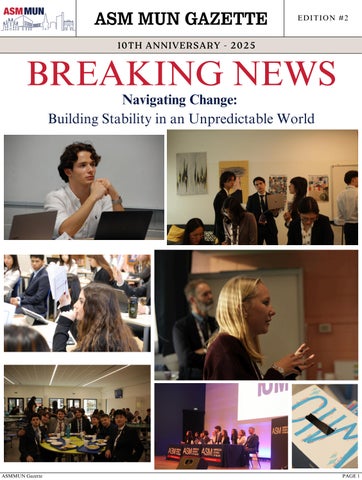
The Opening Ceremony of ASMMUN 2025 begun with a welcoming speech by ASM’s Director Wayne Rutherford. Delegates then had the privilege of welcoming Ines Rocha, the guest speaker for this year’s conference. Ms. Rocha has dedicated her career to improving the lives of thousands of citizens affected by conflict, poverty and displacement. Her moving address on Thursday emphasized the importance of empathy, resilience, and global cooperation in tackling today’s most pressing challenges. Drawing from her personal experience in conflict zones, she reminded us of the human side of diplomacy: the people and stories behind every policy decision debated within the UN. Next, ASMMUN’s Secretary-General, Madalena Bonina, along with senior Secretariat members Matteo Pellegrini and Francesca Montani, delivered powerful and inspiring remarks that set the tone for the conference. Their words encouraged delegates to approach each debate with open-mindedness, integrity, and a true commitment to collaboration. They reminded us that Model United Nations is not only about negotiation and policy-making. It is about building understanding, leadership, and lasting connections across cultures.
ASMMUN Gazette
PAGE 2
ASM MUN GAZETTE
EDITION #2
COMMITEE ARTICLES HISTORICAL SECURITY COUNCIL BY TAMAR SPEKTOR Will they? Won’t they?: The Reunification of The West and The East The Historical Security Council (HSC), raised the central question of how to manage German reunification whilst ensuring European stability and respecting the sovereignty of the German Democratic Republic (East Germany). The debate highlighted a harsh division between those prioritizing immediate reunification and those advocating for a gradual, heavily monitored process. India, proposed a phased approach through the creation of a Joint German Council (JDC) to manage East Germany raised specific and serious concerns infrastructure, trade, and family reunification. However, Indian and Austrian delegates debated over about fairness, fearing potential discrimination against its citizens in a country with a majority of the necessity of certain clauses. India voiced its West Germans. The East German delegate also position, stating that a specific subclause was stressed their "right to sovereignty" while "ridiculous" and did not "justify a whole clause," simultaneously suggesting a willingness to explore a emphasizing the need for focused, impactful action. This exchange suggested the difficulties in drafting a more democratic independent government.
North Korea was highly skeptical, claiming that the council failed to acknowledge that "East Germany does not want to reunify” and they want to be independent. The North Korean delegate notably raised two specific points of argument: the status of the GDR's own currency and the subclause concerning German neutrality, arguing that these foundational issues of sovereignty were being overlooked. The resulting conclusion called for a structured process, balancing the historic momentum of reunification with cautious, monitored steps to maintain peace, acknowledging that economic and sovereign challenges remain significant obstacles.
resolution that satisfies all regional and global Meanwhile, China raised a critical safety concern, concerns. The Soviet Union (USSR), a key actor in 1989, spoke in favour of the motion, acknowledging noting that the inter-German border was "not the most well protected," demanding that the council that reunification was "inevitable.” The USSR "ensure safety of civilians whilst they cross the delegate argued that with ongoing global disagreements, the reunification of Germany was "not border." China later supported the long-term goal, claiming a "stronger reunified Germany" would considered to be significant towards peace" in the benefit the continent economically and politically. grand scheme.
NATO BY TAMAR SPEKTOR Beyond the Threshold: A United Response to Gray Zone Coercion The North Atlantic Treaty Organisation (NATO) committee debated the updating of Article 5 to address non-conventional threats, such as cyberattacks and disinformation, which operate below the traditional threshold of armed conflict. The discussion concentrated on member states to be alert and cooperate. The Netherlands, contributing a widely held opinion among many delegates, called for a shift in NATO’s function "from 'reactive tool to productive shield'" in the face of evolving threats. This push for proactivity was reflected in the final resolution, which encourages members to enhance joint situational awareness and develop secure crossborder communication networks between national intelligence and defense agencies. Early in the session, consensus was strong on the need for transparency. While Ukraine, speaking in favour of the motion, stressed the need for "transparency, and awareness about giving up free intelligence," Denmark clarified that this transparency should be limited "only
ASMMUN Gazette
towards NATO members." Poland and Slovakia also offered their support, with the latter emphasizing that "smaller member states rely on support from NATO" and the need for adaptation to modern warfare. Greece, voicing concerns about civilian safety through the impact of cyber warfare, claimed that cyberattacks "don't affect civilians directly." This was countered by the United Kingdom, who claimed that civilians are "the 'Heart' of NATO concerns" and that the resolution's amendments already include considerations for civilian infrastructure. An unfriendly amendment from Belgium regarding transparency, was ultimately passed after Belgium clarified that transparency was already thoroughly covered in existing clauses. GOSSIP BOX The UK delegate received a specific compliment for their British politeness, being thanked for "thanking delegates for their speeches." They also received a sheepish request to "say 'bottle of water'.” The session chairs were not immune to the delegates’ comments, with compliments given to the "female chair" and a shout-out for the "best curls" of the male chairman. PAGE 3
ASM MUN GAZETTE
EDITION #2
COMMITEE ARTICLES
COUNCIL ON REFUGEES BY LILAH ROBERTSON UN Refugee Council Passes Panama’s Clause to Safeguard Stateless Populations The United Nations Council on Refugees focused on protecting the rights of stateless people in regions of political instability. The discussion began with a clause proposed by the delegation of Panama. It called upon all nations to create systems that identify and support stateless individuals. The clause provides these individuals with legal status and access to essential services such as healthcare, education, and employment opportunities. Central to this is the belief that every person deserves recognition, protection, and the opportunity to live in a place of respect, regardless of their citizenship status. The clause received wide support from many delegations, including Ethiopia, Japan, and Serbia. In their support, they emphasized the humanitarian importance of ensuring that stateless individuals are not forgotten. Japan further suggested expanding the plan to include modern systems for documentation and registration, providing online portals
to register for citizenship. Some delegations, such as Russia and Lebanon, voiced concerns about possible loopholes within the clause and the possibility of countries using them to their advantage. An amendment was introduced to clarify how stateless individuals would be officially identified by government authorities through careful verification processes. This amendment strengthened the clause by addressing questions of implementation and accountability, gaining broad approval among the members. The debate was long and arduous. It led to a strong majority supporting it with a 16 to 6 vote, and one country abstaining. The final clause passed. The discussion reflected a shared international commitment to addressing the struggles faced by stateless populations and ensuring that even the most vulnerable individuals are recognized, protected, and allowed to build a better future.
UNITED NATIONS OFFICE ON DRUGS AND CRIME BY OPHELIA COATES How the opioid crisis sparked reform, and ridicule As the UNODC begins its first topic, the Global Synthetic Opioid Crisis, it demonstrates a clear picture of modern diplomacy and cooperation. Occasional disagreements and intense negotiation characterise the nature of this committee. Brazil emerged as a leading voice, promoting national reform as the foundation for broader global progress. However, Colombia's focus on international collaboration highlighted its dedication to shared responsibility and accountability. This led to a debate over how realistic and inclusive such measures could be in practice, regardless of absent delegates.
Despite moments of tension, delegates showed persistence, compromise, and adaptability, in line with guest speaker Ines Rocha’s advice. This focus on core diplomatic values results in forward-looking resolutions that aim to balance cooperation while addressing the growing global synthetic opioid crisis. It encourages increasing surveillance, improving and modernising systems to prevent over-prescription and illegal diversion, and public health initiatives targeting high-risk regions.
ASMMUN Gazette
PAGE 4
ASM MUN GAZETTE
EDITION #2
COMMITEE ARTICLES
UNITED NATIONS DEVELOPMENT PROGRAM
BY NAIMA EL OAURGUI-MAYERHOFER
UNDP Unites Behind Post-Conflict Recovery Plan for Middle East and North Africa Debates in the United Nations Development Programme (UNDP) focused on ensuring sustainable economic recovery in the Middle East and North Africa (MENA) region in the aftermath of prolonged conflict. Countries in the region continue to face immense challenges, including political instability, weakened state institutions, and severe humanitarian crises that have left millions in need of aid. Reemerging civil conflicts, particularly in Lebanon and more recently in Yemen, have destroyed infrastructure and displaced more than 16 million people. Ongoing struggles, combined with fragile governance and eroded public trust, have made it difficult to achieve equitable reconstruction and lasting socio-economic stability. In response, the delegation of Syria introduced a clause aimed at creating country-specific
development indicators and supporting long-term economic rebuilding aligned with the Sustainable Development Goals (SDGs). The proposal received strong backing from other MENA nations: Lebanon, Qatar, and Yemen, who co-submitted the clause in a clear show of support. In response, the delegate of Iran was quick to give a speech in favor. The motion passed with an overwhelming majority of eleven votes in favor in the face of three abstentionS. This regional consensus within the UNDP committee highlights a significant moment of cooperation, underscoring the constructive, solution-driven approach that multilateral organizations such as the United Nations continue to promote in the pursuit of peace and long-term development.
SECURITY COUNCIL
BY NAIMA EL OAURGUI-MAYERHOFER
Security Council Sparks Tense Debate Over Sudan’s Escalating Conflict For ASMMUN’s tenth anniversary the Security Council has chosen to debate the conflict in Sudan as their first topic. Sudan’s conflict stems from decades of war and dictatorship, reignited after the 2019 fall of Omar alBashir. A power struggle between the state-sponsored Sudanese Armed Forces (SAF) and the paramilitary Rapid Support Forces (RSF) over control and integration escalated into a full scale war in 2023, plunging Sudan into chaos once again. The United Kingdom submitted the first clause. The delegation was motivated by the recent Al Fashir massacre and made great efforts to ensure the safety of Sudanese civilians. The clause aims to limit access of the paramilitary group Rapid Support Forces (RSF) to military and financial support by foreign mercenaries and state-sponsored actors. The co-submitter of this clause, Sierra Leone, states that this is essential in safeguarding innocent civilians, as well as working towards long-term regional stability.
ASMMUN Gazette
In response, China reacted to this clause by stating that the “coercive” measures outlined were “counterproductive” to achieving accountability of the foreign actors involved. In response, the delegate of Somalia submitted an amendment to expand the breadth of the investigation to all member states and private actors' interference in support of Sudan’s conflict. Ultimately, the delegates of the Security Council demonstrated their enthusiasm for diplomatic debate by asking multiple POIs per speech, citing historical case studies, and fostering high levels of debating, appropriate for such an experienced committee.
PAGE 5
ASM MUN GAZETTE
EDITION #2 BY LEA PRETI
CARTOONS
MUN in a nutshell
The ideal delegate
The ASMMUN Secretariat A tribute to our secretary general ASMMUN Gazette
PAGE 6
ASM MUN GAZETTE
EDITION #2
FUNNIEST MOMENTS "Nothing is everything" -China, UNICEF
*asks the UK to say “bottle of water”* -Gossip Box, NATO
“Was the title of your article chat gpt?” -Press team Editor in Chief
*destroyed the chair that was used as a podium for computers* -Environmental committee
“Ethiopia has a beautiful brain” -Gossip Box, Council on Refugees
“ Is the delegate of Serbia a magnet? Because you sure are attracting me over here” -Gossip Box, Council on Refugees
“colombias socks are so cute” -Gossip Box, Council on Refugees
‘Thank you chair, we did not ask for that extra information” -Qatar, UN Women
TRIVIA NIGHT HONORABLE MENTIONS Thursday night, we hosted our annual trivia, and we had 82 teams! Many of you did great. However, many of you also left the judges perplexed and incredulous at your answers. We wanted to create a collection of the funniest answers we found when grading your papers! Which US president, who resigned in 1974, is the only person to fall from the office due to impeachment proceedings? Mohammed jAli A drawing of a stick man figure The winter only pics will begin with opening ceremonies in which country? Los Angels Robert Frances Pevost is named as the first American pope. What is his pope name? Hot damn Name the currency The Vatican Guess the theme based on the hints school of rock, podcast, pride, and murder on the orient express. Elton John Top 3 funny group names: 1. Trendstruzzo 3000 with 24/40 points 2. Jingle juice joggers with 33/40 points 3. Acolytes of despair with 25.7/40 points
ASMMUN Gazette
PAGE 7
ASM MUN GAZETTE MEET THE ASMMUN PRESS CORPS
Editor in Chief: Anna Bergamo
Social media manager: Sofia Salvatori
Photographers: Sebastiano Cabassi Sofia Salvatori Ophelia Coates
Videographers: Ryan Clabot Adele Charman Leonardo Monforte
Reporters: Naima El Ouargui-Mayerhofer Ophelia Coates Lilah Robertson Tamar Spektor
Cartoonist: Lea Preti
Brought to you by the ASMMUN Press Corps ASMMUN.ORG
@ ASMILANMUN
EDITION #2