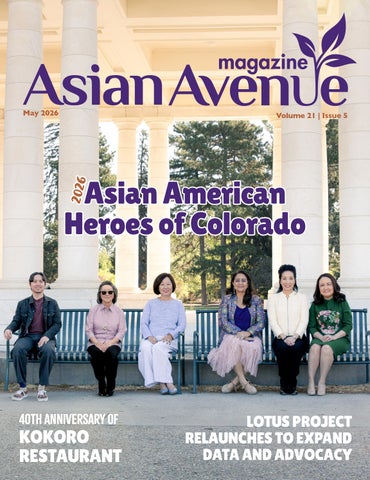
Asian American Heroes of Colorado

















ASIAN AVENUE - PRESIDENT’S NOTE
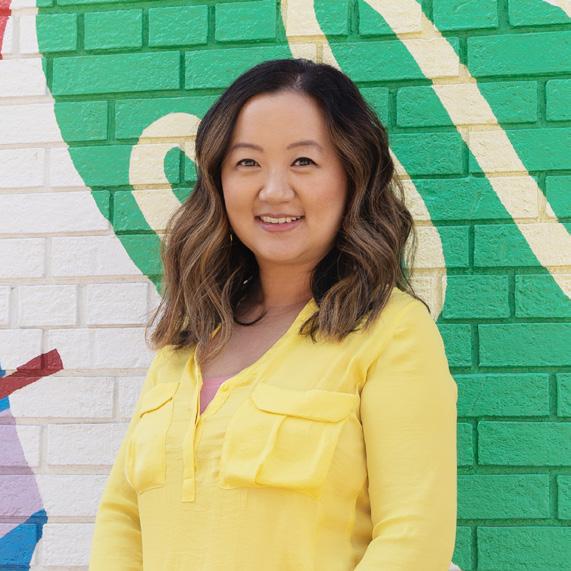
Annie Guo VanDan, President Asian Avenue magazine
Connect with us! asianavemag@gmail.com @asianavemag
In celebration of our 20th anniversary, we will have two special editions in June and July. June will be a reflective issue highlighting the last 20 years, while July will feature the program book for our anniversary event on July 18th.
We invite you to share any stories and photos to asianavemag@gmail.com to be included in our next edition.
As we celebrate AANHPI Heritage Month, this May edition is filled with stories of leadership, culture, resilience, and community connection. Join us on Saturday, May 30 to celebrate our 2026 Asian American Heroes of Colorado, when we will honor six remarkable individuals whose contributions continue to inspire and strengthen our communities. Their stories remind us that leadership takes many forms — through advocacy, poetry and music, entrepreneurship, and simply consistently showing up for others.
We also congratulate Kokoro for their 40th anniversary and the imprint they have made on our local community. To the Torito family, longtime friends and supporters of Asian Avenue and countless community causes, we thank you for your generosity and commitment to share Japanese cuisine to Denver.
This month also features a special collaboration with the AAPI Culture Fest, taking place on May 22, 2026. Flip the magazine over to explore the program book for the festival. We are especially excited to highlight the Community Hubs, where local organizations share their cultures and heritage — not only during the festival, but throughout the year in communities across Colorado.
We are thrilled to partner with the Denver Asian American Pacific Islander Commission, Asian Roundtable of Colorado, Civic Center Conservancy, and Bonfire Event Co., to showcase the incredible diversity of community. At a time when connection and understanding matter more than ever, we hope this edition encourages our readers to support local organizations and businesses, and celebrate the many stories that make our community so vibrant and unique. Happy Asian American, Native Hawaiian, and Pacific Islander Heritage Month!
With gratitude, Annie Guo VanDan
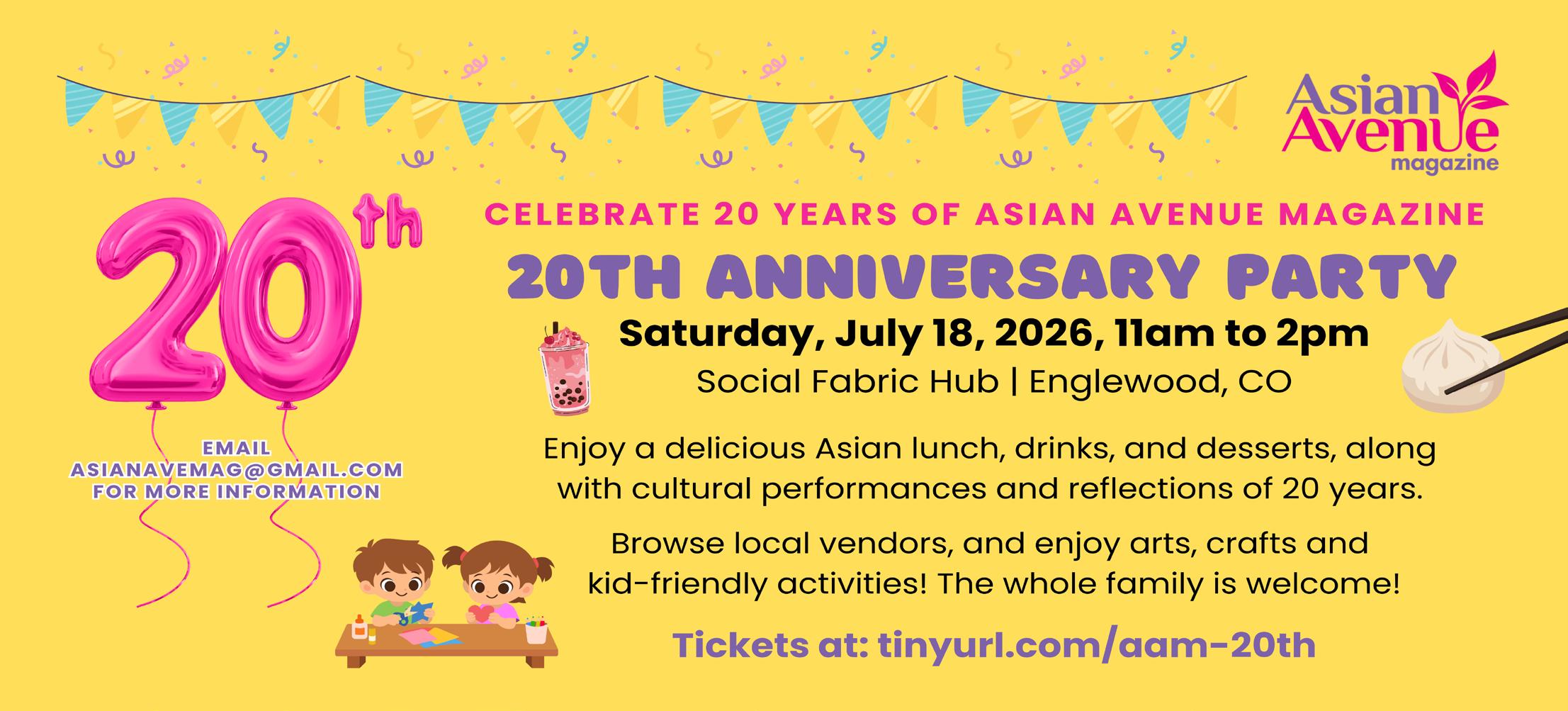
Please contact us at asianavemag@gmail.com for special sponsorship and advertising opportunities in our June and July 2026 commemorative editions.



JON NGUYEN
Staff Writer GIL ASAKAWA
JADYN NGUYEN
Website Manager KAI VONG
9 10 16
years of serving Denver fast-casual Japanese
17th annual
American Hero of Colorado Awards
Mary Nguyen,
and President of Olive & Finch Collective
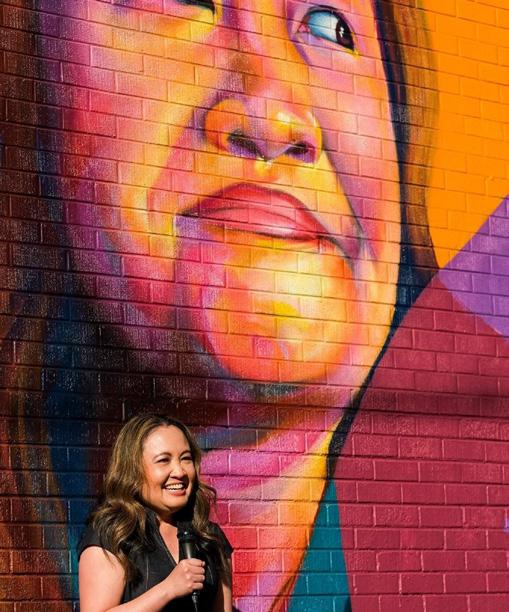
Dr. Nira Singh, licensed psychologist and
Nga VươngSandoval, Executive Director, Refugees + Immigrants United
ON THE COVER
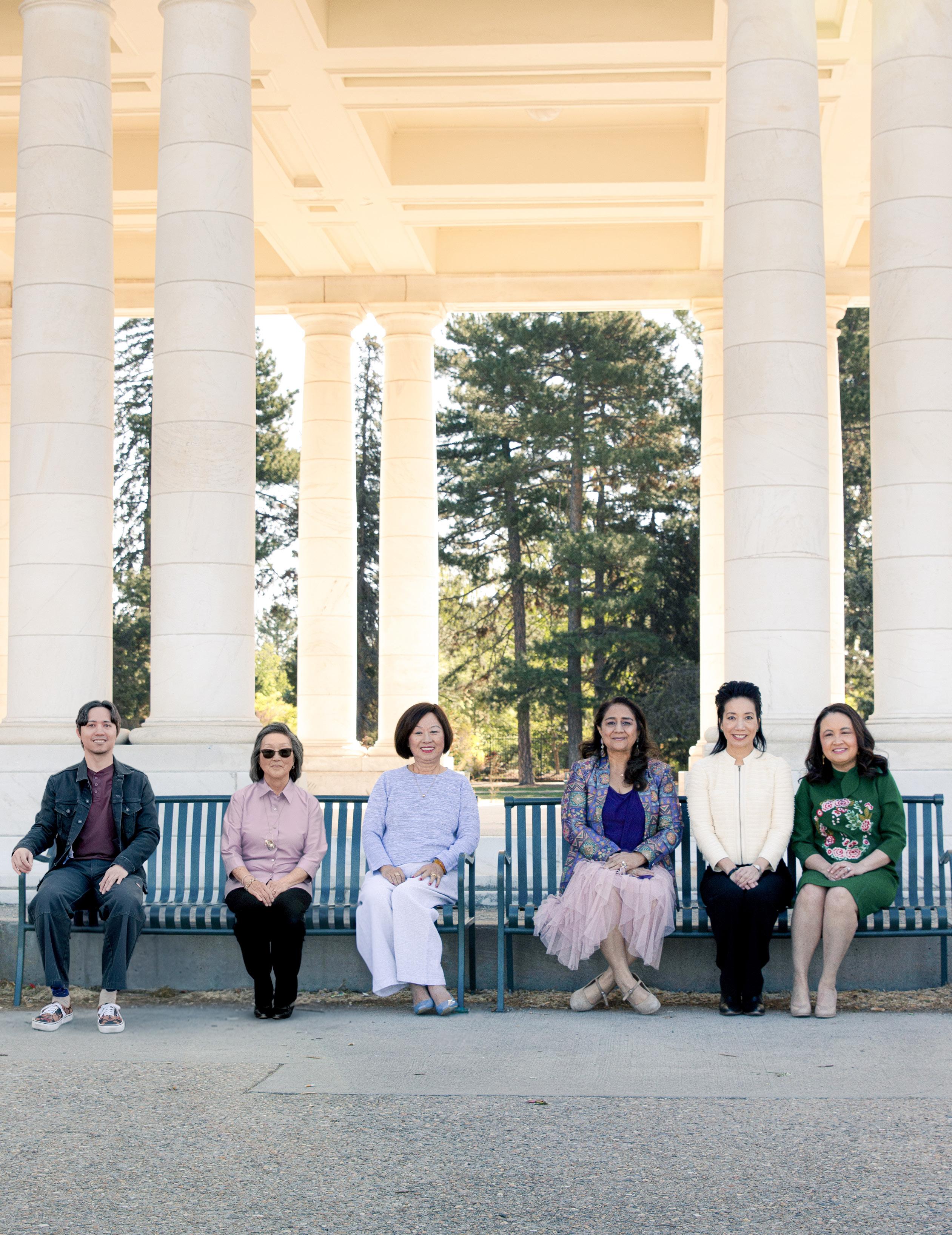
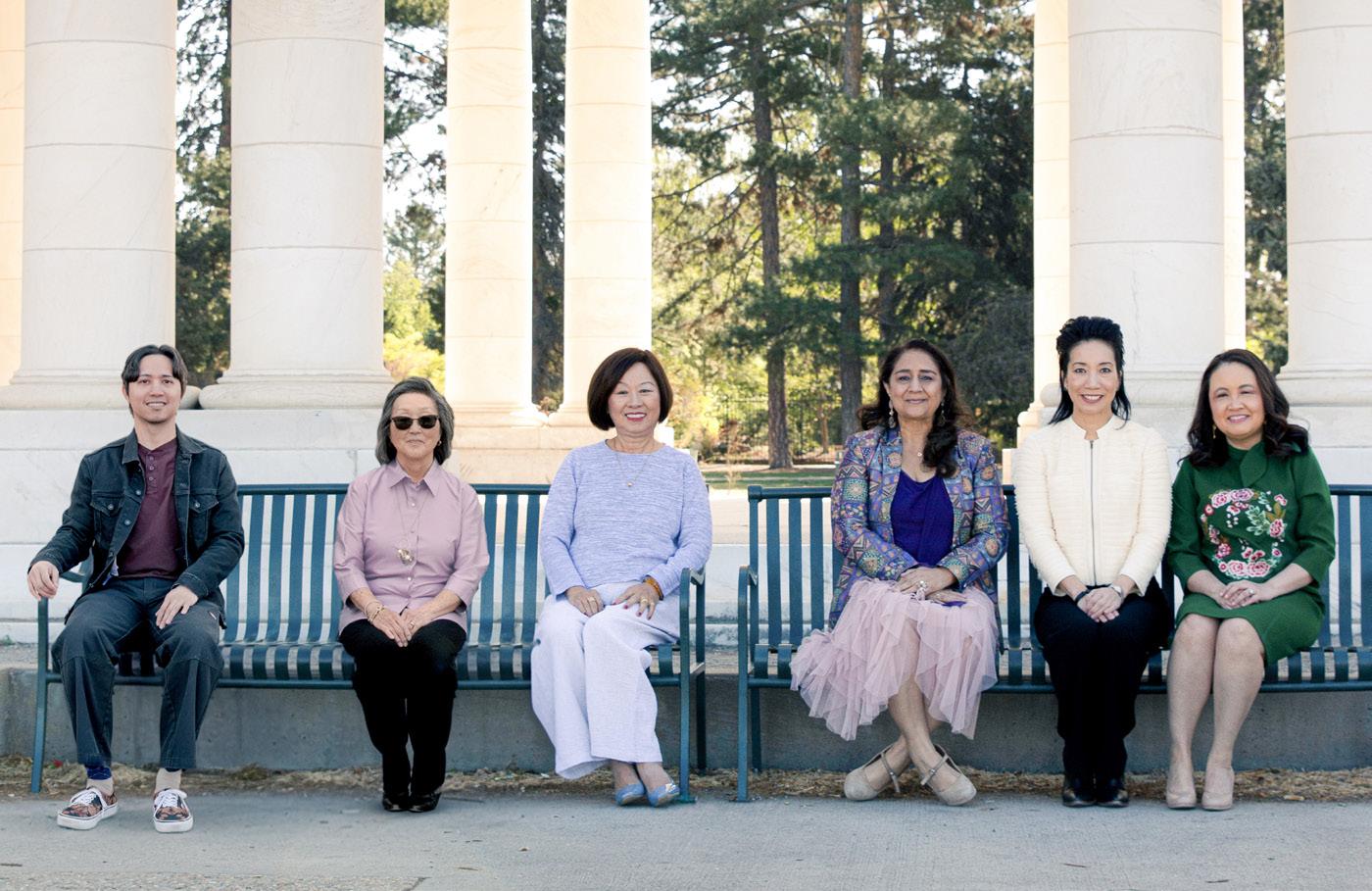
The 2026 Asian American Heroes of Colorado include human rights and health advocates, business owners, and artists. The awardees will be recognized on Saturday, May 30, 2026 at the Social Fabric Hub. | Photo Credit: Dao Than
Asian Avenue magazine (ISSN 1932-1449) reserves all copyrights to this issue. No parts of this edition can be reproduced in any manner without written permission. The views expressed in articles are the authors’ and not necessarily those of Asian Avenue magazine.
Looking to promote your business? Asian Avenue magazine offers businesses a cost-effective way to reach consumers in the Denver/Boulder metro areas and beyond. For more information, call 303.937.6888 or e-mail us at asianavemag@gmail.com for our media kit and ad rates. Send story ideas to asianavemag@gmail.com.
Asian Avenue magazine is in association with the Colorado Asian Culture and Education Network.



Colorado’s community bank—local decisions, lasting relationships, genuine care.
Colorado Lotus Project relaunches under Colorado Asian Culture and Education Network to expand and strengthen community data
The Colorado Lotus Project, a groundbreaking data research initiative focused on understanding the experiences and needs of Colorado’s Asian American, Native Hawaiian, and Pacific Islander (AANHPI) communities, is officially launching its next phase. The project will now operate under Colorado Asian Culture and Education Network (CACEN), a 501c3 organization dedicated to uplifting and strengthening AANHPI communities through culture, education, and civic engagement.
Originally created to address the lack of comprehensive data on Colorado’s diverse AANHPI populations, the Colorado Lotus Project brings together research, community voices, and policy insights to highlight key challenges and opportunities.
“Building upon CACEN’s strong foundation in the community and the progress from our first phase, we look forward to advancing our long-term goals of expanding accessible disaggregated data, increasing equitable resource allocation across Colorado, and laying the groundwork for a dedicated advocacy infrastructure,” says Jin A. Tsuchiya, Project Director, Colorado Lotus Project.
In partnership with Colorado Health Institute, which served as the project’s research and data lead, the Colorado Lotus Project integrates disaggregated data with community-informed and communityled storytelling, grounded in the voices,
experiences, and leadership of AANHPI community members, and consolidates multiple data sources into an accessible report, fact sheets, and maps, that help community leaders, policymakers, and funders better understand and respond to AANHPI community needs.
The report revealed a striking gap: in 2018, only $0.60 of every $100 awarded by foundations in Colorado explicitly supported AANHPI communities, underscoring the importance of elevating this data so these communities are not overlooked.
2026 Priorities: Educating the Community and Activating the Data
In 2026, the Colorado Lotus Project will focus on community education and engagement around the report’s findings. CACEN plans to present the research to community organizations, government agencies, and conferences across the state to demonstrate how the data can inform programs, funding priorities, and policy decisions.
The next phase will include updating the report with new and expanded data, with a focused effort on advancing analysis in health and civic engagement, alongside an updated look at the philanthropic landscape supporting AANHPI communities. The project will also place special emphasis on the health and democracy domains.
Democracy & Civic Engagemen:
An increasing number of Asian Americans in Colorado are stepping forward to run for office and take on leadership roles in public service. The data will serve as a tool for organizations, candidates, and advocates working to expand representation and participation in the democratic process. Health & Wellness: Many organizations across Colorado are already working to address both physical and mental health challenges within AANHPI communities. CACEN hopes to bring together stakeholders in this domain to better understand existing gaps, share resources, and explore opportunities for collaboration to improve health outcomes.
Long-Term Vision for Data, Advocacy, and Equity
The team continues to work towards the long-term goals initially sought out for this project: (1) use learnings to elevate and advance the needs of AANHPI communities in Colorado, (2) increase transparent, accurate, and accessible disaggregated data on Colorado’s AANHPI communities, and (3) increase equitable resource allocation to support Colorado’s AANHPI communities.
The project also envisions forming an advocacy network that can translate data into policy action, helping community leaders and organizations push for systemic change.
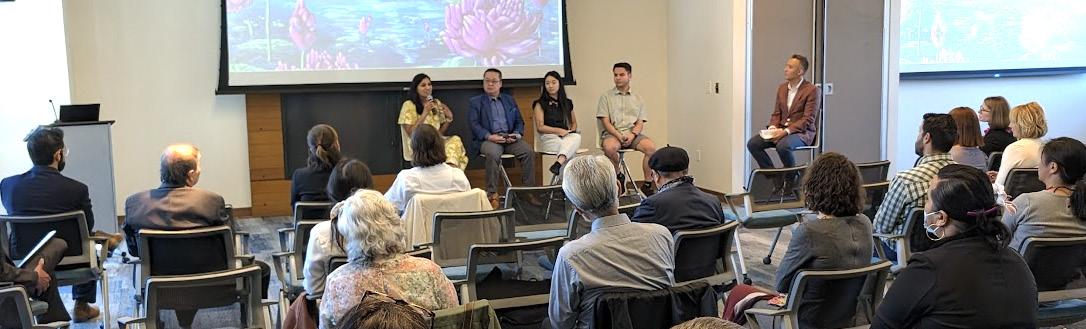
The Colorado Lotus Project, launched in May 2024, is entering its second phase in May 2026 to deepen data research on AANHPI communities in Colorado, in order to better inform policies and programs.
Mosaic of Cultures: Aurora's Filipino Community
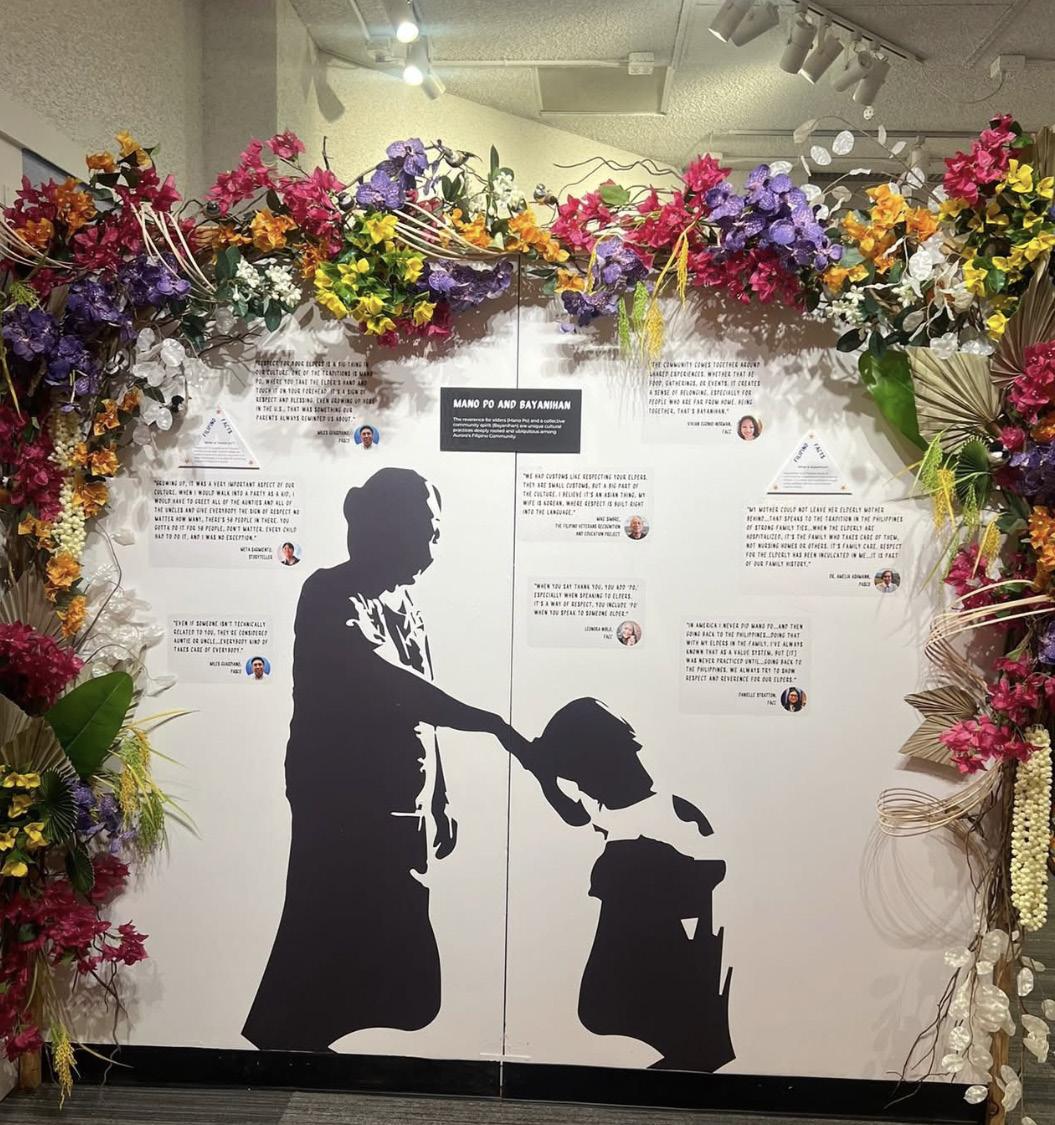
www.auroragov.org/things_to_do/aurora_ history_museum
The Aurora History Museum and the Aurora Office of International and Immigrant Affairs celebrate Aurora’s vibrant Filipino community with the new exhibition “Mosaic of Cultures: Aurora’s Filipino Community" at the Aurora History Museum, 15051 E. Alameda Parkway.
This exhibition is part of the “Mosaic of Cultures” series, which promotes understanding of Aurora’s culturally diverse populations while incorporating the voices of those local communities into the city’s history. For the creation of the exhibition, the Aurora History Museum conducted a community
outreach campaign to capture the perspective of the Filipino people in Aurora and receive crucial feedback on how they wanted to be represented in this unique exhibit.
The Filipino community in Aurora represents a rich tapestry of traditions, customs and cultural practices. From vibrant festivals to traditional music and dance, the Filipino community has added a unique and colorful dimension to the cultural fabric of the city. The exhibition will allow residents and visitors to learn about and appreciate the diverse cultural heritage. The exhibition will run through April 2027.
Threaded Narratives: Weaving South Asian Identity in Colorado
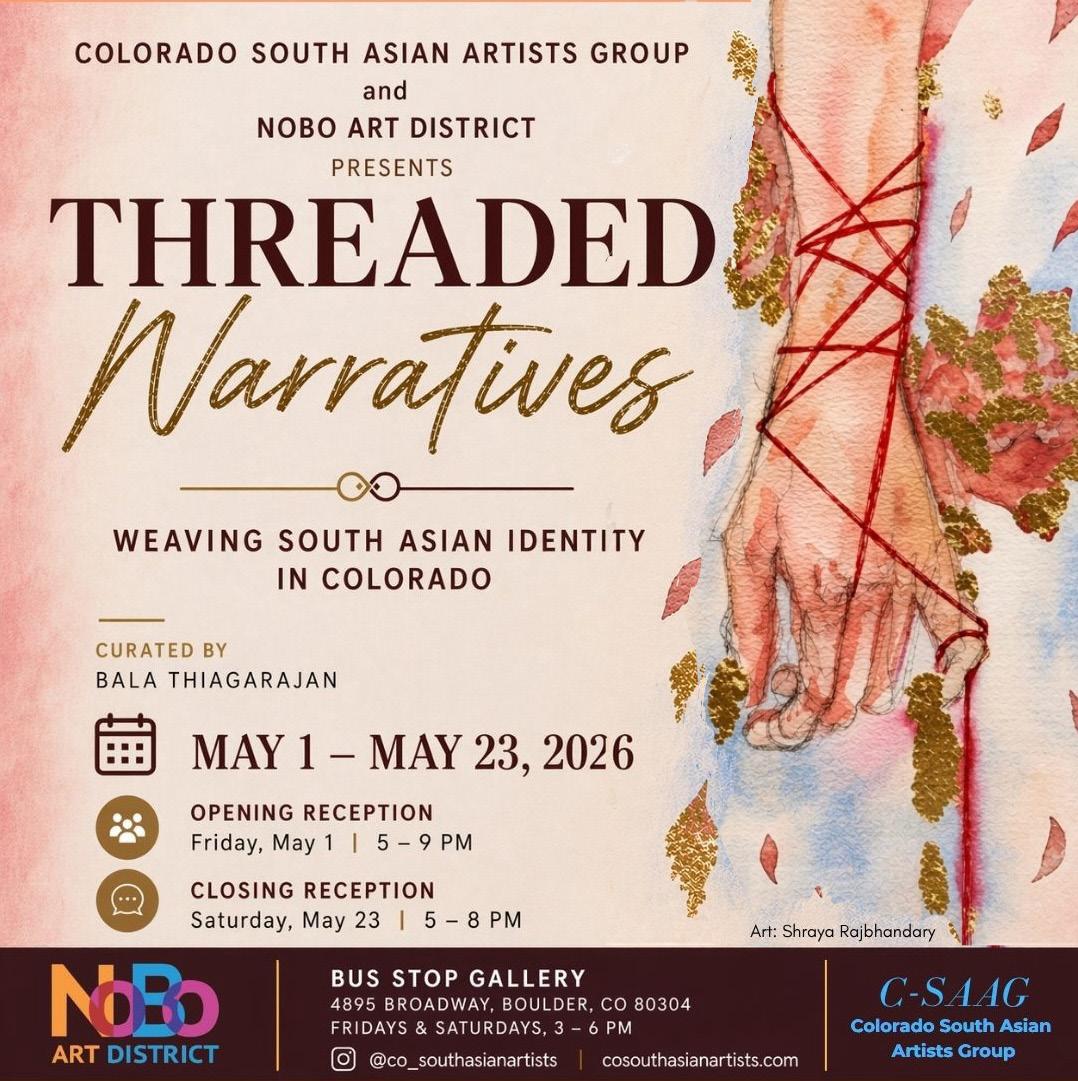
The NoBo Art District will present a new collaborative exhibition with the Colorado South Asian Artists Group (C-SAAG) this May, titled Threaded Narratives: Weaving South Asian Identity in Colorado. The exhibition will feature 21 artists and 32 artworks artworks and will be on view from May 1 through May 23 at the NoBo Bus Stop Gallery in Boulder, CO. Presented during AANHPI Heritage Month, the exhibition highlights contemporary artistic practices from South Asian artists living and working across Colorado.
An opening reception was held on Friday, May 1 with more than 300 guests, as part of First Friday in the NoBo Art District.
A closing reception and artist talk will take place on Saturday, May 23 from 5 p.m. to 8 p.m., offering visitors an opportunity to engage more deeply with the work and the artists. Curated by artist and C-SAAG founder Bala Thiagarajan, recent recipient of the CBCA 2026 Cultural Leadership Award, Threaded Narratives explores the layered and evolving nature of identity through connections to memory, migration, land, and belonging.
The exhibition brings together
perspectives shaped by lived experience, reflecting how cultural practices and personal histories are carried forward, adapted, and reimagined within the Colorado context.
The works on display include painting, sculpture, textiles, photography, and mixed media, offering a broad survey of contemporary South Asian artistic expression.
In addition to the exhibition, C-SAAG will take over the gallery’s gift shop for the duration of the show, featuring smaller works, prints, and artist-made items, expanding opportunities for audiences to engage with and support local artists.
Additional programming includes a Mandala Painting workshop by artist Aishwarya Puthran on May 9 from 3 p.m. to 5 p.m. and a Kolam Drawing workshop by artist Bala Thiagarajan on May 16 from 3 p.m. to 4:30 p.m.
This exhibition contributes to a broader moment of visibility during AANHPI Heritage Month, centering South Asian voices within Colorado’s arts ecosystem and fostering connection across communities through shared artistic experience.
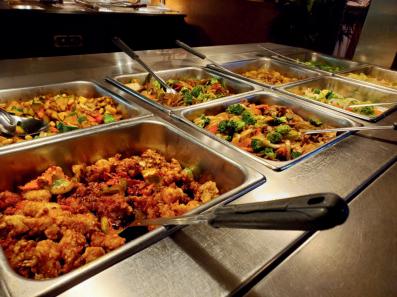
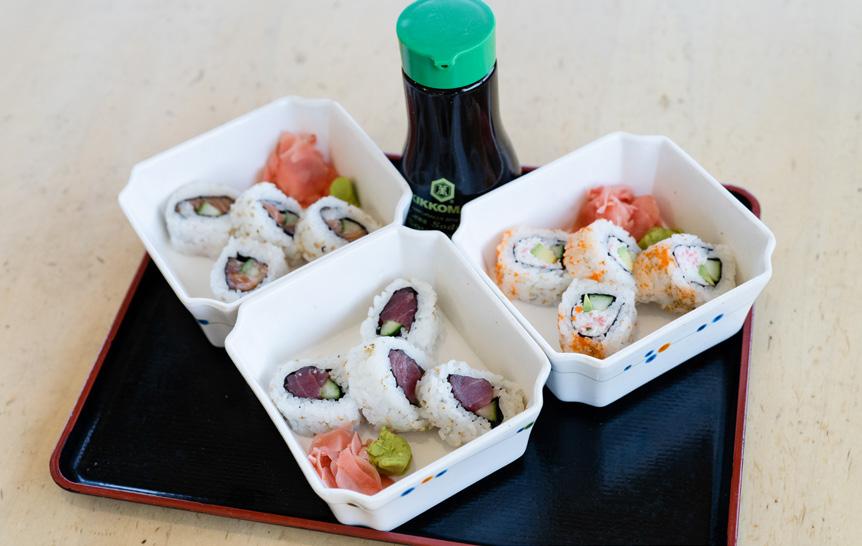
Since 1986, Kokoro has built a loyal following of diners who love Japanese food, want it authentic, affordable, quick and easy. Kokoro, with two locations in Denver and in Arvada, was “fast casual” before the term became a business model for chains like Chipotle and Noodles & Company.
This year, Kokoro celebrates its 40th birthday as a popular pillar of Den ver’s Japanese dining scene. It is a reliable destination for loyal diners who want real, legit Japanese cuisine in a relaxed setting (or from a drive-through window) at an affordable price.
But, most of its fans may not know that Kokoro, a family-run business, has roots that are even older than four decades, and in fact, reaches back to 1899 and the estab lishment of a gyudon, or beef bowl, restaurant named Yoshinoya in Japan.
the state. Today, there are still over a hundred Yoshinoya restaurants left in America, but mostly in California.
Yoshinoya’s legacy in Denver is Kokoro, which took over the vacant Colorado Boulevard location in 1986. The
Torito in 1990, RedBird Farms has become a powerhouse brand known for its high-quality chicken, raised without antibiotics or steroids, and fed a vegetarian diet in a cage-free environment. The company supplies both restaurants and major supermarket chains like King Soopers and Safeway. In a news report, Torito noted that RedBird accounts for approximately 40% of Colorado’s chicken market.
Birthday bowl: Kokoro celebrates of serving up fast-casual Japanese 40 years
By Gil Asakawa
Yoshinoya began as a street food concept, selling thin-sliced marinated beef and onions over rice to laborers for a quick meal. In the postwar 1950s, it expanded into a chain that would go on to dominate Japan’s beef bowl market, with nearly 1,200 locations across the country. Yoshinoya expanded into the U.S. in 1973 and established its headquarters near downtown Denver. Just two years later, in 1975, Yoshinoya opened its first Colorado restaurant at Colfax and Logan.
Although Yoshinoya opened several more Denver locations by the mid1980s the company had pulled out of
man who opened it, Mareo Torito, came from Japan and had been the manager of Yoshinoya’s Denver operation. He married a woman who was a server at Yoshinoya and stayed in Colorado when the company left for California.
Torito later opened Kokoro, which means “heart” in Japanese and built it into its own successful operation, eventually expanding to a second location in Arvada. Today, the restaurants are run by his son, Masaru, while Mareo leads a broader family enterprise that includes RedBird Farms.
Founded in 1949 and acquired by
Masaru, Torito’s son, reflects on his father’s ambition: “He never expected RedBird to get so big, but I believe he wanted it to reach a scale where it could compete with the industry’s biggest players. In my words, he aimed to be a predator in the ocean, even if he never saw himself as a ‘big fish.’”
Kokoro is not a big fish in the restaurant scene, but it’s doing just fine, thank you. Celebrating 40 years is no small feat, and for its anniversary, a new item was added to the menu: Miso-Teriyaki Japanese Chicken Wings, made with RedBird chicken coated with a spicy-sweet miso-teriyaki garlic glaze sprinkled with sesame seeds.
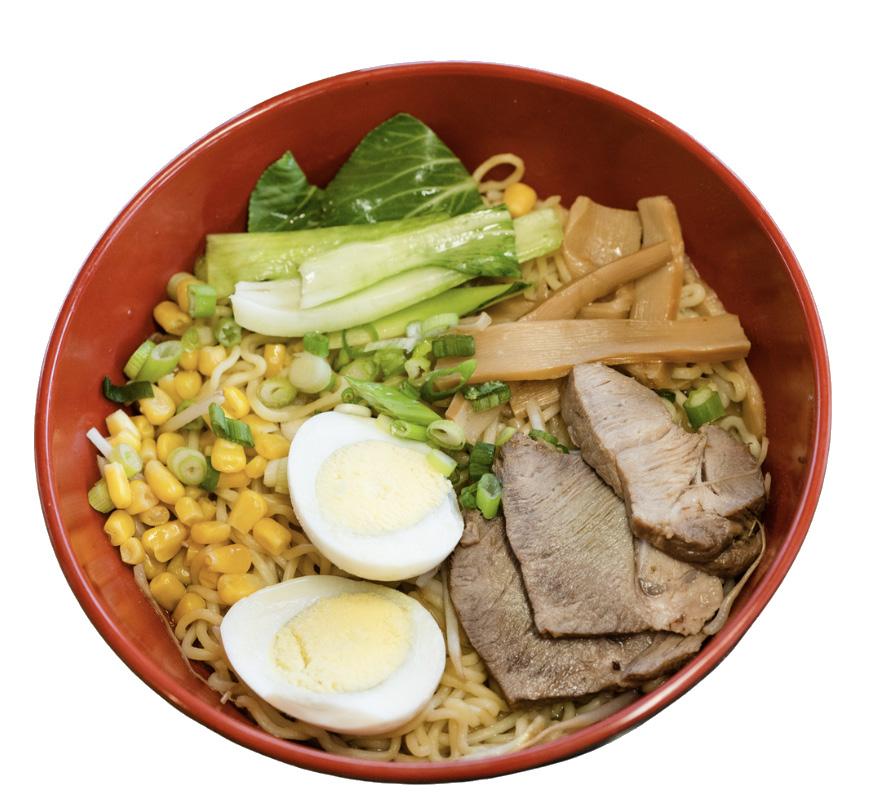
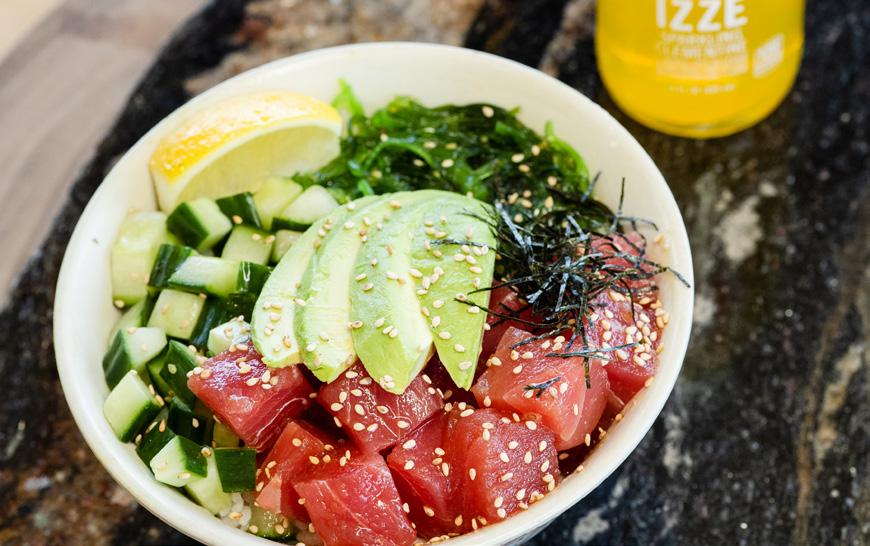
Over the decades, Torito has added plenty of items to the menu, from its beef and chicken and veggie bowls to tasty ramen dishes. Traditional udon noodles are served under the modern name “Splash,” while yakisoba fried noodles carry the playful moniker “Sobaghetti.” The menu also features beef and chicken curry, seafood rice bowls with unagi eel, salmon, and shrimp tempura, as well as Hawaiian-style poke bowls. Last year, the restaurant

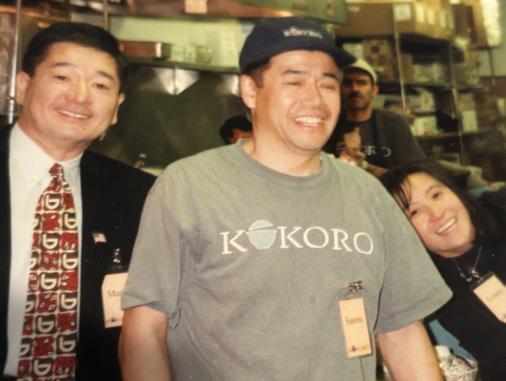
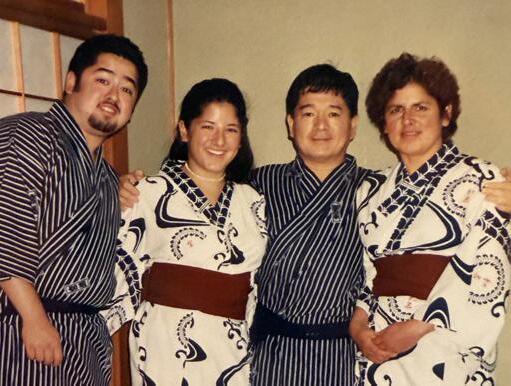
Kokoro was founded by Mareo Torito (right) in 1986 and is now operated by his son Masaru (left).
even added handmade onigiri rice balls to its sushi selection.
Masaru was just six years old when his dad launched Kokoro, but he has since helped guide the business while expanding its visibility through participation in community events such as the Colorado Dragon Boat Festival and Mile High Asian Food Week. He has also been known for his generosity in providing discounted meals to Asian and Japanese community organizations throughout the Denver area. Today, Kokoro is widely recognized within the Japanese American community and has built a loyal following among fans of Japanese cuisine across Colorado.
He credits the customers’ loyalty and growth of the business to the consistent quality of the food. While few staff members at either location are Japanese, the menu has long been prepared for years through a shared commissary kitchen. Until recently, the kitchen was overseen by a Japanese chef who has since retired, alongside a Latina assistant chef who has been with the company since 1999.
That attention to efficiency and consistency are hallmarks of the company’s roots in Yoshinoya and the lasting
influence of the elder Torito.
“The two of them worked in the commissary space, so all of our vegetables, for example, are cut by two people,” Torito explains. “It’s about 1,000 pounds of hand-cut vegetables every week, done by the same two people for the last 20 years, and we split it to both stores. That’s how you maintain consistency. It’s the same with the sauces. Two people make the curry and teriyaki sauce, and the same two people prepare the broths. That consistency makes a difference.”
Another hallmark of Kokoro has been its commitment to employees, from chefs to front-of-house staff. Su Hsu, who has worked as a server at the Arvada location for 26 years, says she has always been treated like family, by staff and the diners.
“The customers treat me very nice,” she says. “And the owners too. Just everybody is so nice to me. I feel like Kokoro is a part of a bigger family here for me.” She explains she came from Taiwan with two children and a bleak future, but she waves to the staff in the restaurant and adds, “but then you guys are like a big family for me.”
She knows many customers by
name and always treats everyone with a smile and an upbeat attitude.
Having such dedicated and reliable employees has given the Torito family confidence that Kokoro can continue thriving despite the challenges of the turbulent restaurant industry. “I’ve had really good general managers at both stores, and the long-standing staff helps too,” Masaru says.
It allows him the freedom to dream of the company’s future, working with his dad and his staff. He had been developing a ghost kitchen concept in Aurora, but put the idea on hold after he and his wife welcomed their second child.
He’s still scoping out possible locations for another Kokoro, focusing on areas that would complement rather than compete with the existing restaurants. A savvy restaurateur and entrepreneur, he is active in hospitality industry organizations and closely follows emerging trends, including the growing role of AI in the food service industry.
As Kokoro celebrates this 40-year milestone, the celebration is not just a look back at a remarkable legacy, but a toast to continued growth.
Learn more about Kokoro at: kokororestaurants.com.
2026
HEROES
In its 17th year, Colorado Asian Culture and Education Network proudly announces the 2026 Asian American Heroes of Colorado:
17th annual Asian American Heroes of Colorado Awards Ceremory
Saturday, May 30, 2026
Awards and Lunch | 11am to 1pm
Networking Reception | 1pm to 2pm
Social Fabric Hub: AANHPI Community and Cultural Center
67 Inverness Dr East, Unit C, Englewood, CO 80112
Tickets: $45 General | $35 Student
Be inspired by powerful stories of resilience and achievement as we recognize this year’s six honorees over an AANHPI-inspired lunch. Connect with community leaders and changemakers. as we celebrate the end of AANHPI Heritage Month, energized by the inspiring people giving back to our communities and Colorado.
More information and tickets at: coloradoasian.org/hero-awards
Mary Nguyen
Founder and President, Olive & Finch Collective Chair, Asian Chamber Foundation of Colorado
Meta Sarmiento
Director and Editor, Saltwater Stories
Lead Community Partner, AAPI Islander Club at Florida Pitt Waller Top 10 Denver Acts, Indie 102.3
Dr. Nira Singh
Clinical Director, Cultural Development and Wellness Center Aurora Mental Health & Recovery Board of Director, National Asian American Pacific Islander Mental Health Association
Nga Vương-Sandoval
Founding Executive Director, Refugees + Immigrants United Judicial Officer Outreach Program Lead, Colorado Judicial Department Human Rights Advocate
Lifetime Achievement
Jolie Noguchi
Third-generation Owner, Pacific Mercantile Member, Japanese American Community Graduation Program
Christina Yutai Guo
Publisher, Asian Avenue Magazine and Rocky Mountain Chinese Weekly
Founder, Happy Living Adult Daycare President, Chinese American Council of Colorado
2026 awardees were selected by representatives from Asian Chamber of Commerce, Asian Girls Ignite, Asian Pacific American Bar Association Colorado, Asian Real Estate Association of America Greater Denver, Asian Roundtable of Colorado, Asian Vibes in Denver, Colorado Asian Culture and Education Network, Colorado Asian Pacific United, Colorado Dragon Boat, Denver Asian American Pacific Islander Commission, Rocky Mountain Asian Student Coalition, and Sakura Foundation.
Story by Patricia Kaowthumrong
Photos by Dao Than
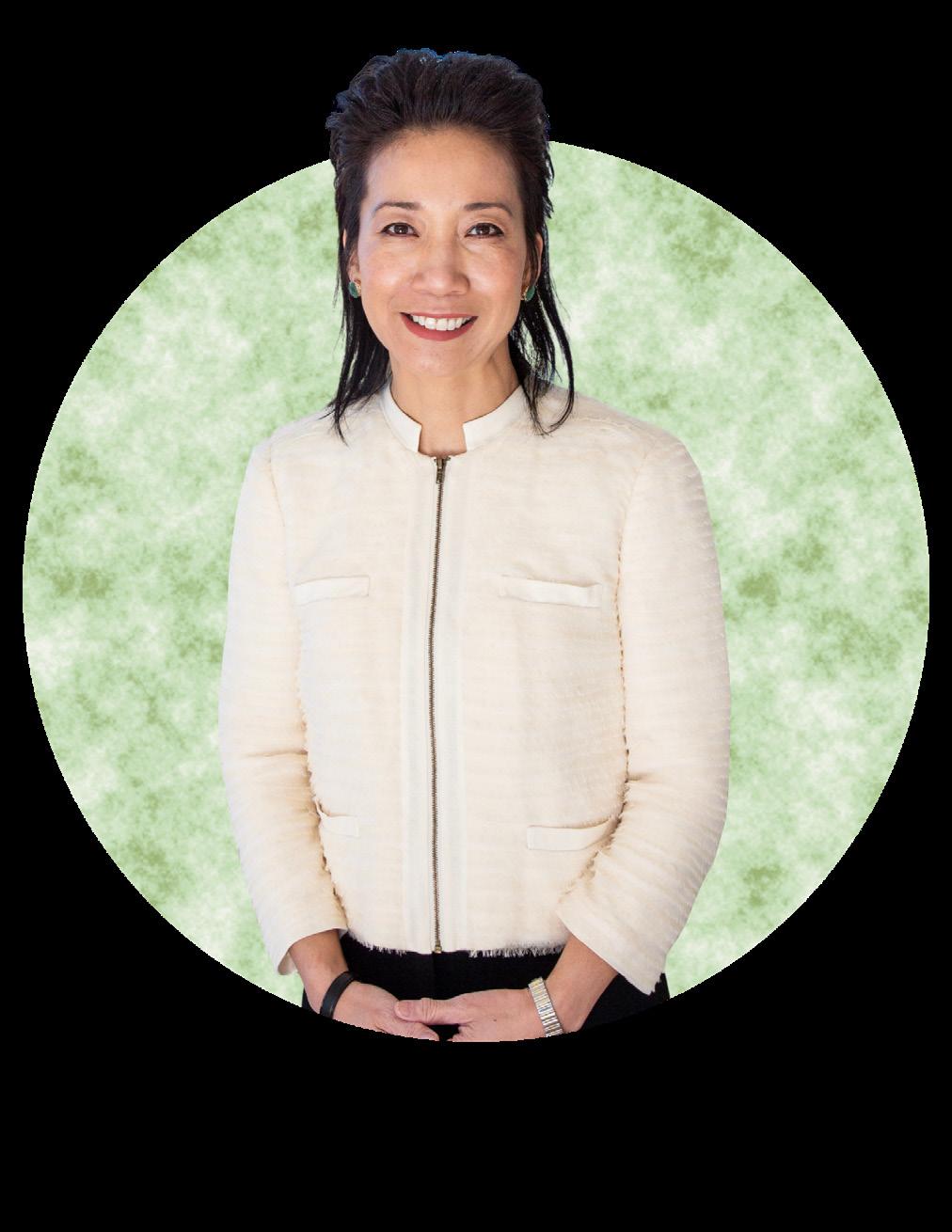
At her core, Mary Nguyen is a com munity builder. Whether through her restaurants, mentorship or civic lead ership, she brings people in spaces where connection and opportunity can take root.
As the founder and president of Olive & Finch Collective, Nguyen’s transformed a single neighborhood restaurant into a multifaceted hospitality company spanning cafés, micro-markets and production operations across Denver. But for her, the work has never been just about food. “Hospitality is more than a physical space,” she says. “It’s about creating en vironments where people feel welcomed, connected and cared for.”
That mindset carries into everything she does. The daughter of Vietnam ese immigrants, Nguyen was raised with a strong sense of responsibility, resilience and work ethic. At the same time, she had to push against cultural expectations that emphasized humility and not standing out. Stepping into leadership—and using her voice—didn’t always come naturally. But over time, it became necessary.
Mary Nguyen
power, and ensures our community is seen, heard, and invested in for the future,” says Alyssa Inouye, a friend and colleague who nominated her for the award.
A big part of her work is building connections across communities. Through partnerships and collaborative events, Nguyen brings people together across cultures, recognizing that stronger relationships lead to stronger outcomes.
Her approach reflects a belief that progress happens when communities move together.
She built her career by taking unconventional paths and stepping into spaces without a clear roadmap. That experience now influences how she shows up for others. Through her work, Nguyen is focused on creating access so others don’t have to navigate those same challenges alone.
Today, that impact extends far beyond her businesses. Nguyen serves as
port and elevate the next generation of Asian leaders across the state. At a time when communities are seeking greater unity and long-term representation, the program is helping turn momentum into lasting infrastructure. Her leadership also reaches into spaces where decisions are made. Nguyen serves on multiple boards and commissions, including Visit Denver, the Downtown Denver Development Authority, and the Emily Griffith Foundation. In these roles, she advocates for small businesses, workforce development and more inclusive economic growth to make sure Asian and immigrant voices are part of the conversation from the beginning.
“Mary creates space, cultivates
That same philosophy shows up in how she runs her business. Community care, she says, should be built into work. From offering benefits and advancement opportunities within her company to mentoring young entrepreneurs, she focuses on creating environments where people feel supported and valued.
For Nguyen, leadership is ultimately about service. It starts with listening, showing up consistently and making intentional choices about who is included along the way.
Being recognized as an Asian American leader in Colorado is both an honor and a responsibility,” she says. It’s a reminder not only of how far she’s come, but of the importance of continuing to open doors for others.
She adds: “There is space for you— and sometimes you have to be the one to create it. And when you do, bring others with you.”
Founder / President, Olive & Finch Collective Chair, Asian Chamber Foundation of Colorado
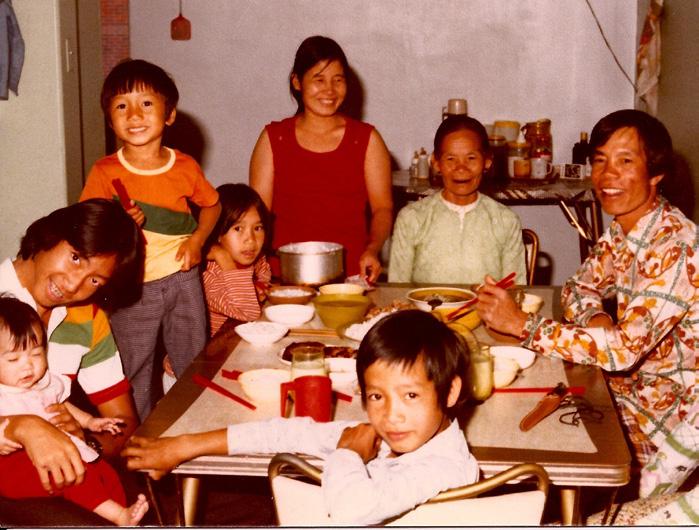
Nguyen and her family are immigrants from Vietnam.
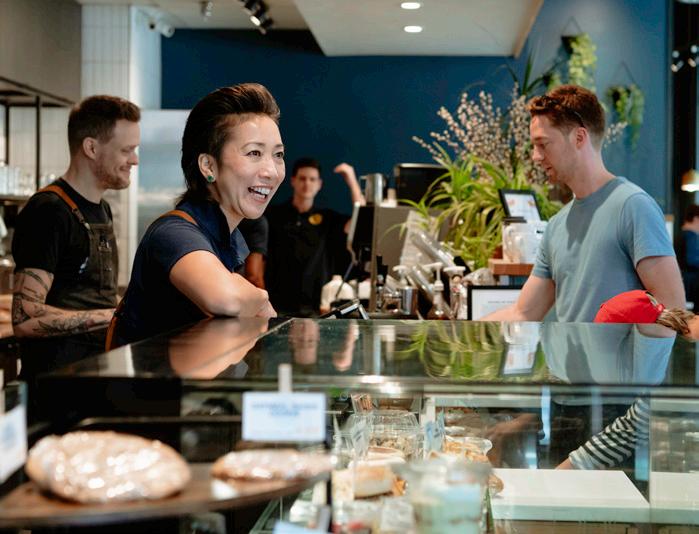
The Olive & Finch Collective includes Olive & Finch, Little Finch, catering and wholesale.
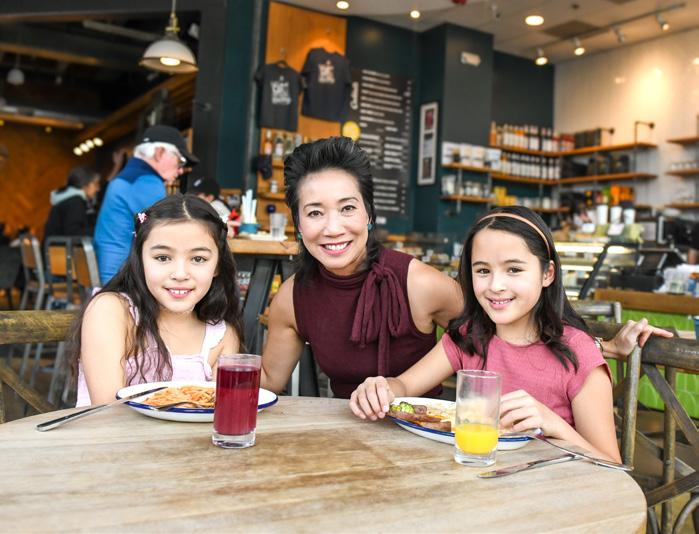
Nguyen’s twin daughters join her at Olive & Finch.
Photo Credit: Lucy Beaugard
For Meta Sarmiento, storytelling is how he finds his place and helps others find theirs. As a Filipino poet, rapper, filmmaker and educator, he uses art to uplift voices that are often over looked and bring people together through shared stories.
That journey began in sixth grade, when a language arts teacher showed him how writing could help make sense of the world and carve out space within it. Short stories evolved into poetry in high school, and eventually into a multidisciplinary creative practice spanning music, film and community programming. “The limits of my words would become the limits of my world,” a college professor once told him. Sarmiento took that to heart, pushing himself to expand both.
through the Asian American Pacific Islander Club at Florida Pitt Waller, helping students explore identity, creativity and belonging through storytelling and cultural expression.
Meta Sarmiento
Director and Editor, Saltwater Stories
Lead Community Partner, Asian Pacific Islander Club at Florida Pitt Waller
His approach is collaborative by design. Whether leading writing workshops like “Saltwater Stories”—a statewide initiative bringing together Asian American and Pacific Islander writers—or directing community-based projects, Sarmiento prioritizes co-creation.
“There is no ‘I’ without the ‘we,’ there is no ‘me without the ‘us,’” he says.
“We understand ourselves even better when we view our life through the lens of the community.”
Born and raised in Guam, Sarmiento grew up navigating a complicated identity. As a U.S. territory, Guam exists in a paradox—American, yet often invisible. Residents are U.S. citizens who cannot vote for president, and the island is often reduced to a tourist destination or military outpost. That invisibility became a driving force. His work pushes back against flattened narratives, offering a more nuanced picture of Pacific Islander and Asian American communities.
Across nearly two decades, Sarmiento has built a career rooted in creativity and community. His poetry book “Tie Your Shoes Kid” was a finalist for the
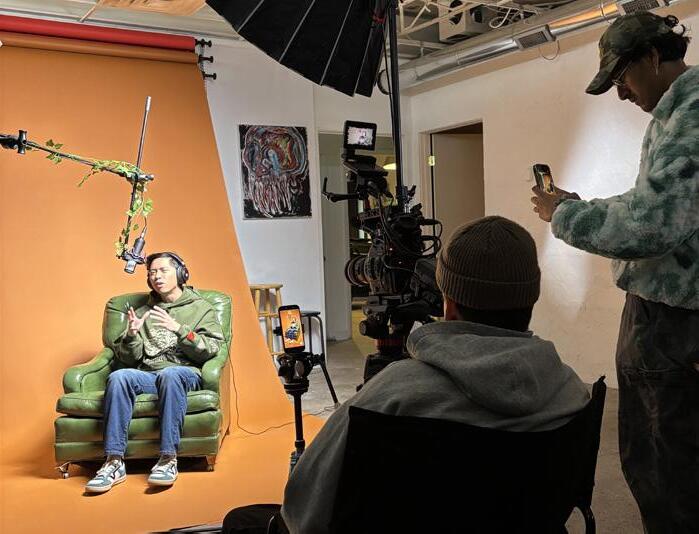
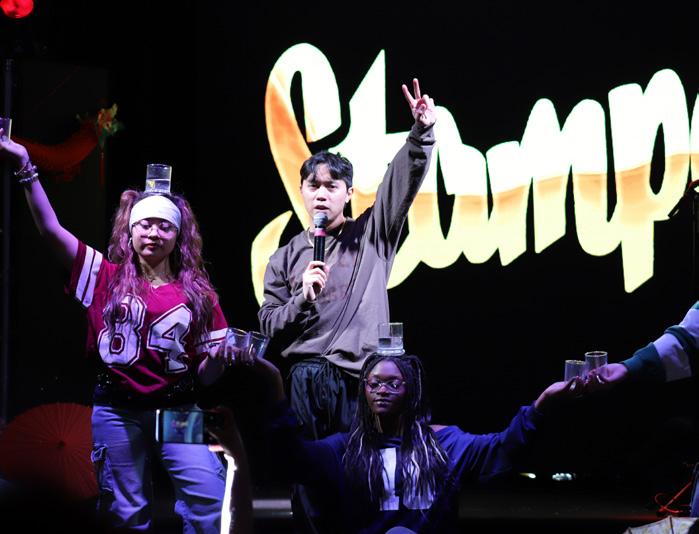
for the 2026 Colorado Dragon Film Festival. As a musician, he raps in Tagalog and English, weaving together themes of identity, politics and solidarity. His performances—from local stages to international platforms like the United Nations Climate Change Conference— reflect his commitment to educate and mobilize.
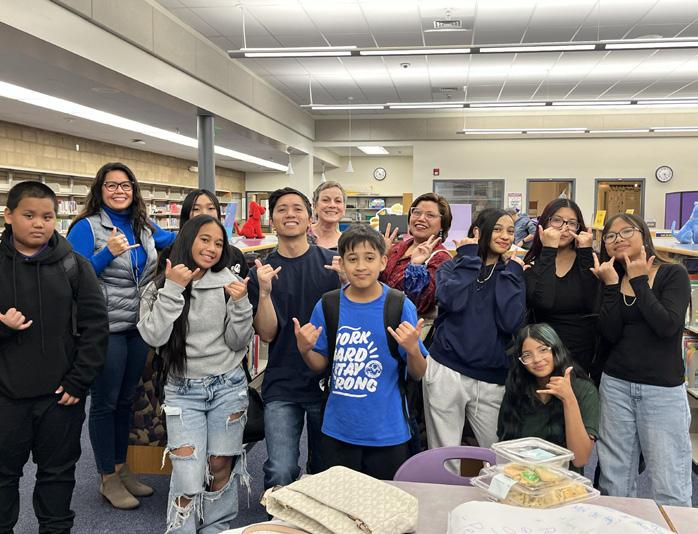
For Sarmiento, the work has never been about individual recognition. Grounded in the hip-hop philosophy of “each one, teach one,” he sees knowledge as something to be shared. That belief led him into education, where he has worked with thousands of students across Colorado. Today, he continues that work with young people, including
That philosophy shows up in the spaces he builds. In classrooms, workshops and community events, Sarmiento positions himself as a facilitator— someone who helps others recognize the power of their own stories. The result is spaces where people feel seen and empowered to create. “He does not pursue his goals unilaterally,” says Joie Ha, Sarmiento’s collaborator and partner, “but instead works with people to elevate a shared message and goal.”
For Sarmiento, success has never been about standing alone. It’s about bringing others with him—making space, passing on knowledge and ensuring the next generation has the tools and confidence to tell their own stories. In doing so, he’s finding his place and helping others claim theirs.
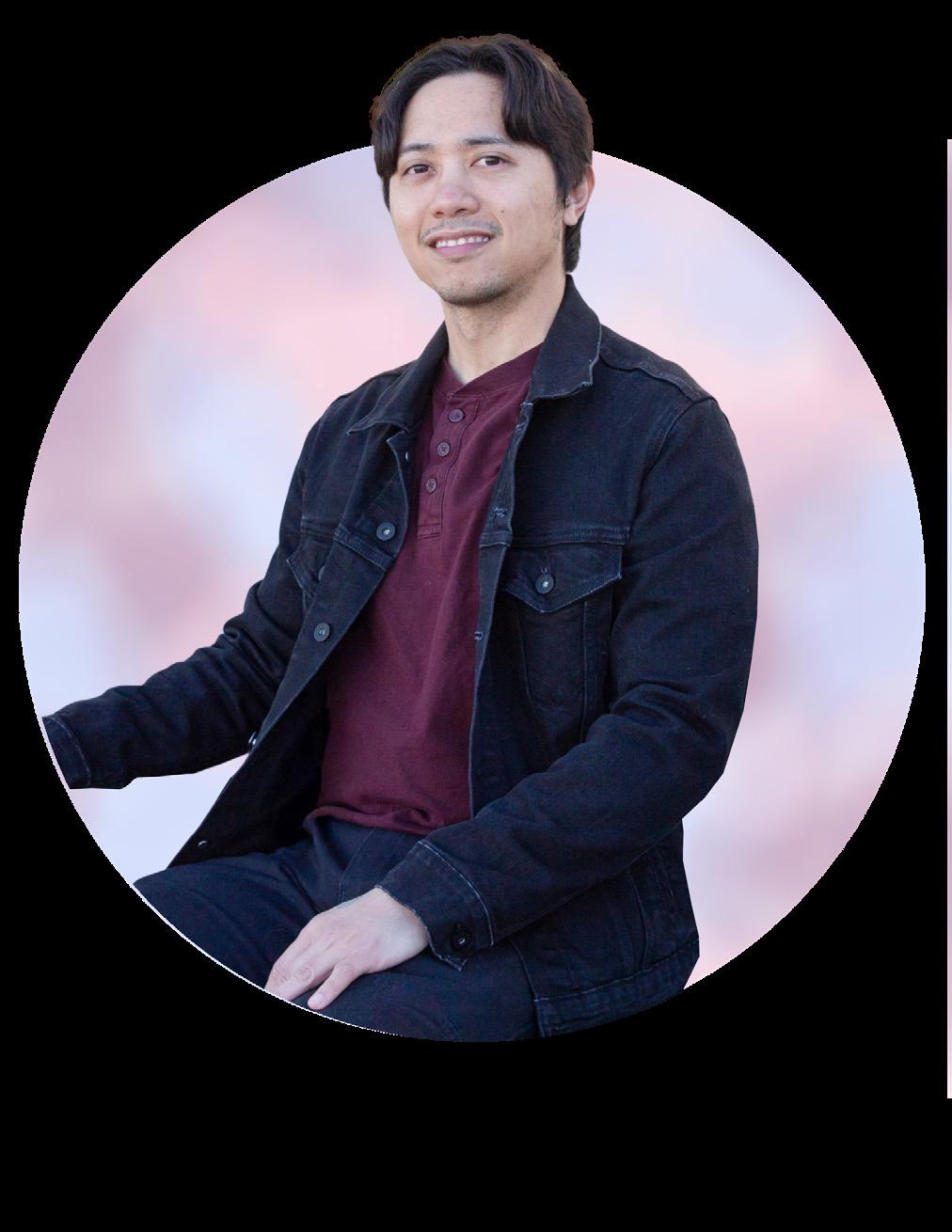
Sarmiento films an episode of “The Sit Down at Friendly Collective.”
Florida Pitt Waller’s AAPI Club explores cultural expression with Sarmiento.
Sarmiento performs at the 2026 Lunar New Year On Havana Street celebration.
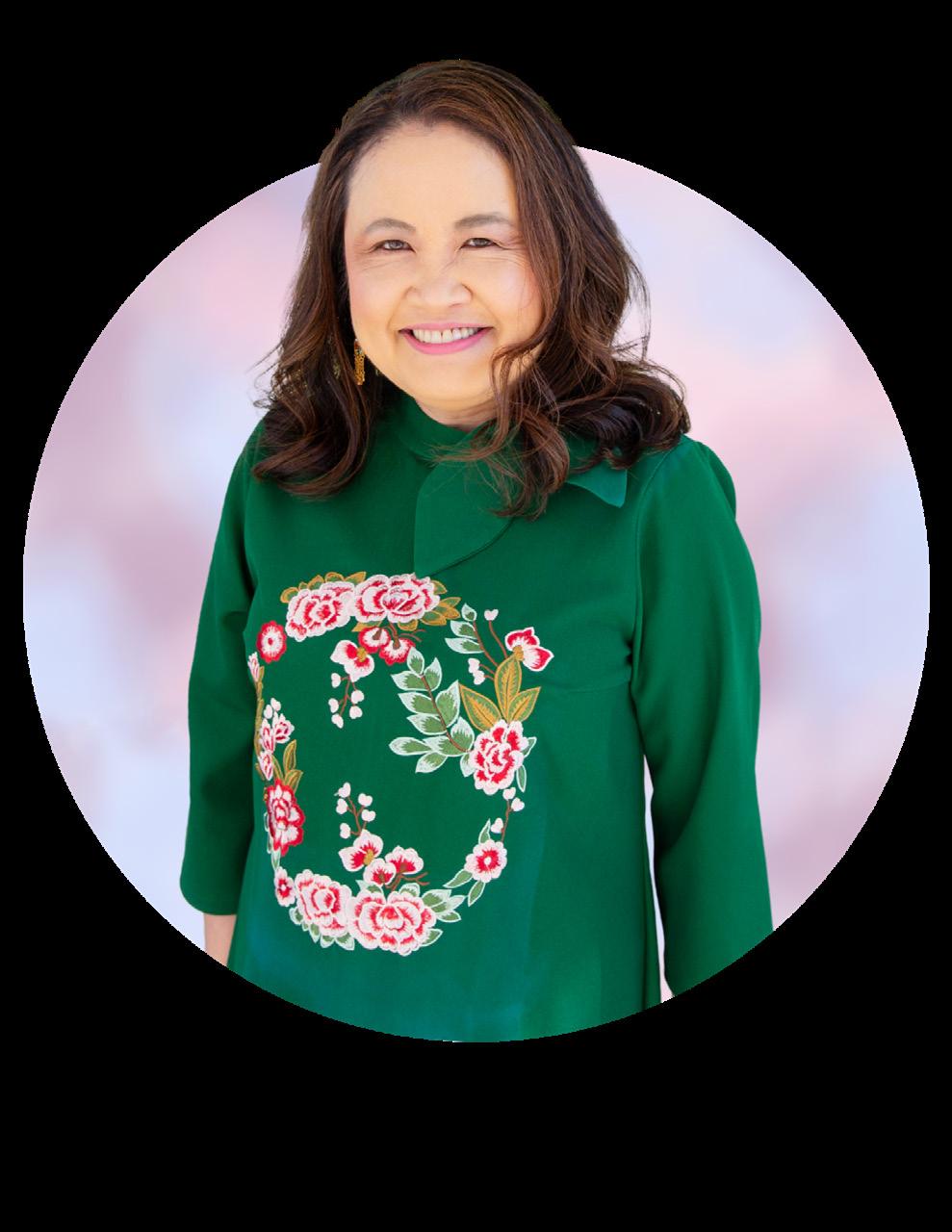
“Mental health is health,” says Dr. Nira Singh, a second-generation South Asian American psychologist whose 34-year career has been dedicated to ensuring immigrant and refugee communities receive care that honors their cultures, languages and lived experiences.
For Singh, that belief is both professional and deeply personal. The daughter of immigrants from Rajasthan, India, she often describes herself as “made in India, born in the USA,” raised in Colorado at a time when South Asian culture was far less visible. Her family built community through cultural organiza tions, temple and a close-knit network of family friends—but outside those spaces, Singh was acutely aware of being different. Experiences of racism and exclusion—along with witnessing inequities—shaped her understanding of identity and the need for culturally grounded care.
learning. She says being recognized as an Asian American leader in Colorado is a full-circle moment—an opportunity to give back to the community that shaped her. It is also a reminder of the responsibility she carries to continue uplifting others.
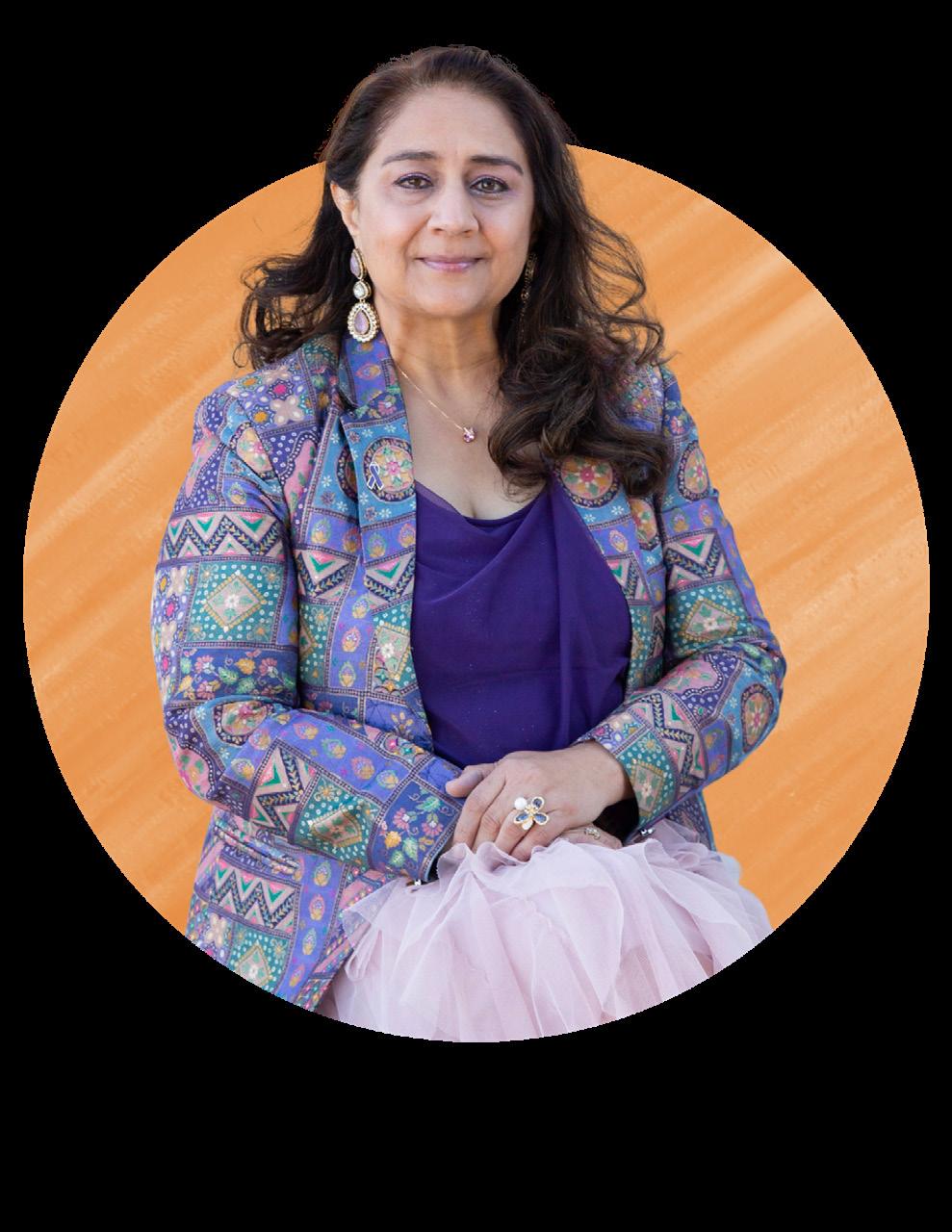
Dr. Nira Singh
Clinical Director, Cultural Development and Wellness Center at Aurora Mental Health & Recovery
That awareness became personal early in her career. After graduating from the University of Colorado Boulder, Singh worked at a domestic violence shelter, where she never saw survivors from Asian communities accessing services. She knew they were out there—but barriers like stigma, language and culturally misaligned care kept them from walking through the door. Determined to change that, she began building more inclusive pathways through grassroots partnerships and multicultural training.
Today, as clinical director of the Cultural Development and Wellness Center (CDWC) at Aurora Mental Health & Recovery (auroramhr.org), Singh leads a wide range of programs designed to meet people where they are. In addition to behavioral health services through its Asian Pacific and Refugee and Immigrant clinics, the center supports community members with education, workforce development, youth leadership, victim support and interpretation programs.
“Nira’s impact is both broad and deep-
what stands out most is how connected she remains to the communities she serves.” Through her leadership, those programs have expanded language access and reimagined care to better reflect the realities of immigrant and refugee communities.
Central to this work is language access and representation. CDWC offers services in more than 40 languages, with many providers and health navigators coming from the communities they serve. “It requires activism and advocacy to ensure that all voices are lifted,” she says, “and that services are not just one size fits all, but responsive to unique needs.”
Her impact reaches far beyond the programs she leads. Singh has worked alongside community organizations and national partners to make behavioral health care more equitable—improving crisis response systems and expanding access for communities often left out. She’s also spent more than 20 years mentoring students and early-career professionals, supporting the next generation of providers to lead with cultural understanding and care.
Despite the scale of her impact, Singh remains guided by simple but powerful values: Listen intentionally, build relationships and never stop
For Singh, the work is far from finished. As many community-based services face uncertainty, she emphasizes the importance of staying informed, involved and supportive of organizations doing this critical work. Ensuring access to culturally and linguistically responsive care, she believes, will take not just leaders—but entire communities committed to showing up for one another. She adds: “We are all stronger when we care for and support those most marginalized and underserved.”
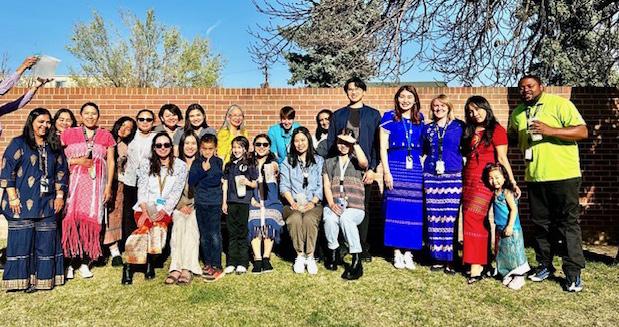
The Asian Pacific Team at CDWC celebrates the Water Festival.
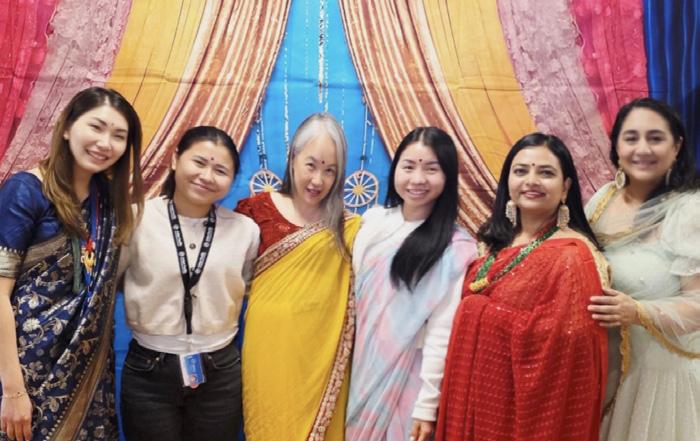
The Asian Pacific Clinic hosts a Teej Celebration for South Asian communities.
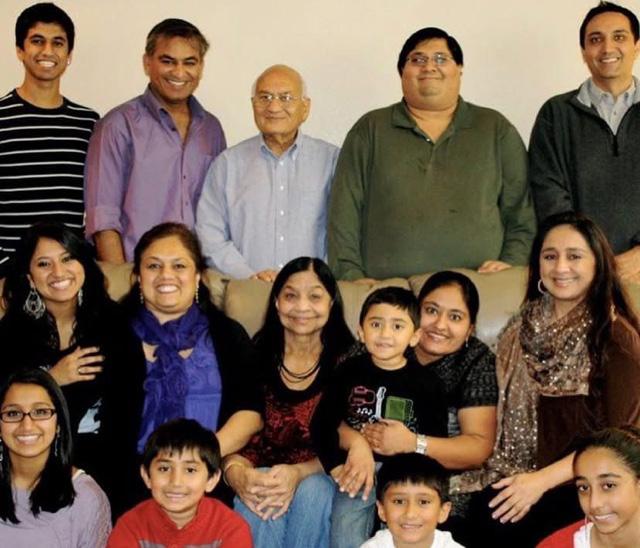
Singh and her family
For Nga Vương-Sandoval, commu nity care begins with a simple truth: She survived what many did not. It’s something she carries—and what drives her to hold the door open for others seeking safety, belonging and a voice.
A proud Vietnamese refugee, Vương-Sandoval carries memory and a deep sense of responsibility. She and her family didn’t leave Việt Nam by choice; they were displaced by war and forced to rebuild far from home, carrying loss, resilience and the will to survive. That experience still shapes how she moves through the world today.
Nga Vương-Sandoval
Founding Executive Director, Refugees + Immigrants United Judicial Officer Outreach Program Lead, Colorado Judicial Department
Growing up in the United States, she
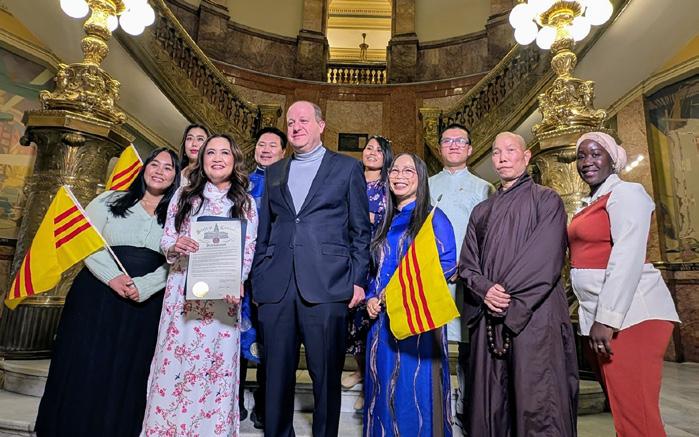
In April 2025, Governor Polis signed the Vietnamese Remembrance and Resilience proclamation authored by Vương-Sandoval at the State Capitol.
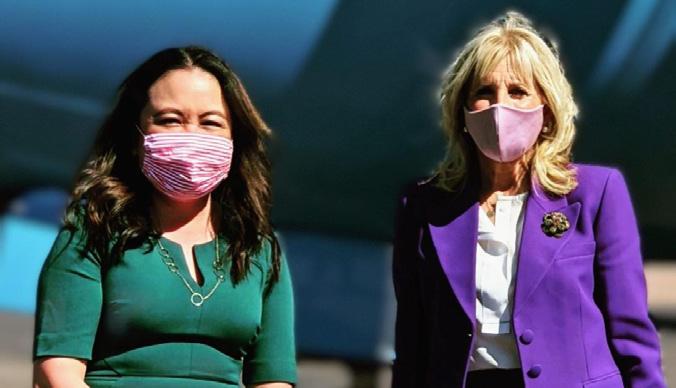
In front of Air Force 2, Vương-Sandoval meets with First Lady Dr. Jill Biden.
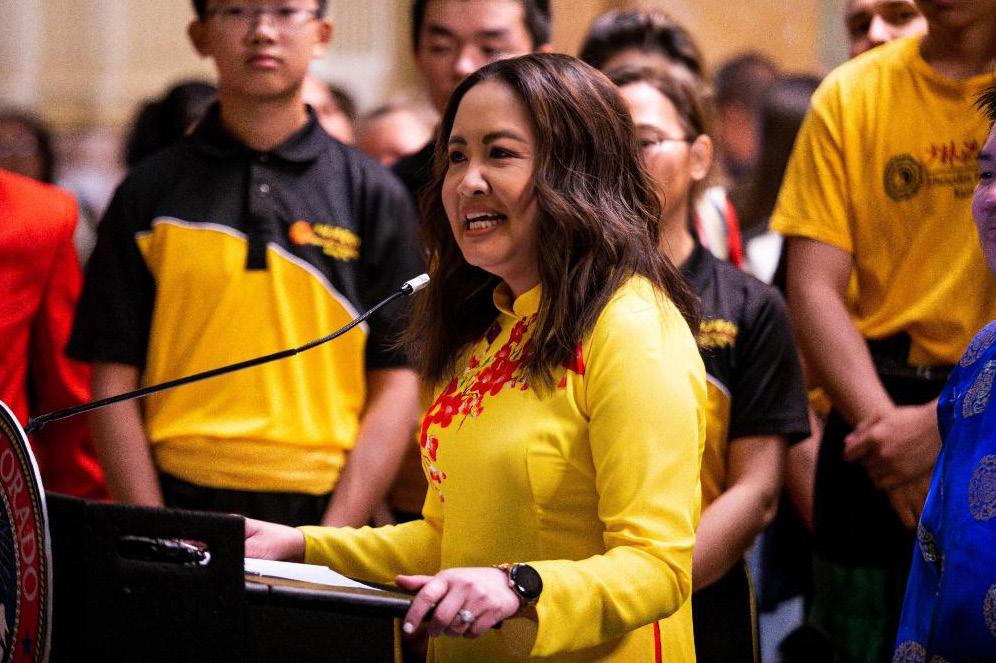
Vương-Sandoval shared remarks during the Lunar New Year Bill signing at the State Capitol on June 2, 2023.
she made a deliberate choice to preserve what could have been lost—language, culture, and connection—for herself and others navigating similar journeys. “Memory is a form of resistance,” she says. “Identity is continuity, and dignity is non-negotiable.”
For more than 20 years, this belief has shaped her work in Colorado and beyond. As founding executive director of Refugees + Immigrants United, a refugee-founded and entirely refugee and immigrant-led nonprofit, Vương-Sandoval works to uplift the voices of displaced communities. Her work centers on the principle that those most impacted by policies should be the ones shaping them.
In her concurrent role with the Colorado Judicial Department, she leads the nation’s first initiative to diversify the judicial bench, helping ensure systems of power better reflect the communities they serve. It reflects a broader commitment to expanding access and representation in spaces that have historically excluded refugee, immigrant, and underrepresented voices. “Nga is inspiring,” says colleague John Lee. “Her work has and will continue to make Colorado better.”
Vương-Sandoval’s work has taken her from Colorado to the global stage.
Whether speaking at the state’s first World Refugee Day at the State Capitol or representing refugee communities at the United Nations in Geneva, Switzerland, she has used her platform to advocate for equity and human rights. She spearheaded the work, making Lunar New Year an official Colorado-observed state holiday and authored statewide proclamations honoring Vietnamese remembrance and resilience and the first statewide proclamation recognizing AANHPI Heritage Month both in 2025.
Despite her accomplishments, ương-Sandoval doesn’t see herself as a “hero,” but as part of a larger story rooted in community. Two Vietnamese proverbs continue to guide her: “Ăn quả nhớ kẻ trồng cây” (When you eat the fruit, remember who planted the tree) and “Cái khó ló cái khôn” (Adversity creates ingenuity), reminders to lead with gratitude, resilience and action.
“If there is anything close to heroism in my life, it’s in choosing to persevere, to remember, to speak, to fully exist without erasing where I come from. Not as a singular act, but as a continuation,” she says. “I don’t know if that makes a hero, but it feels right to me and in my heart I believe my ancestors are smiling.”
For Vương-Sandoval, community care means standing alongside others—even when their stories differ—and creating space where none existed before. It’s about opening doors, challenging systems and making sure others don’t have to navigate those barriers alone.
Being recognized as an Asian American leader in Colorado, she says, is not something she holds alone. It belongs to the mentors, family and community who believed in her—and to the generations who came before her.
Grounded in memory, Vương-Sandoval continues to work toward a future where displaced and underrepresented communities are seen, heard—and able to shape what comes next.
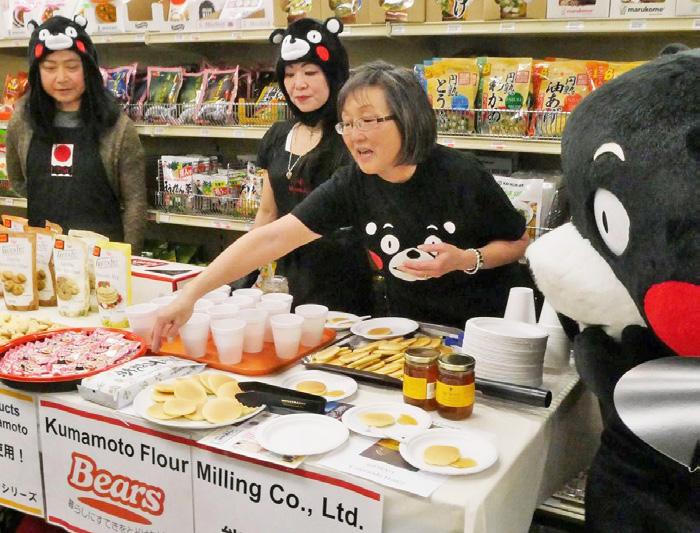
For more than 80 years, Pacific Mercantile has been a cornerstone of Denver’s Japanese American com munity—and at its heart today is Jolie Noguchi, a third-generation steward of a legacy that began with her grandfather, George Inai, in 1944.
Nestled in Sakura Square since 1972, Pacific Mercantile has served as a grocery store, gathering place, a cultural hub—and ultimately a welcoming source of comfort for generations seeking connection through food and tradition. Today, Jolie and her brothers, Kyle and Kebo Nagai, carry that legacy forward and are grounded in the same spirit of service and community their grandfather instilled decades ago.
Noguchi’s path was shaped early on. “Grandpa George led by example through a life of community service,” she recalls. Growing up, she and her siblings were often brought along to volunteer events and community gatherings, experiences that left a lasting impression. Surrounded by the Japanese American community her entire life, she came to understand not only the importance of preserving culture.
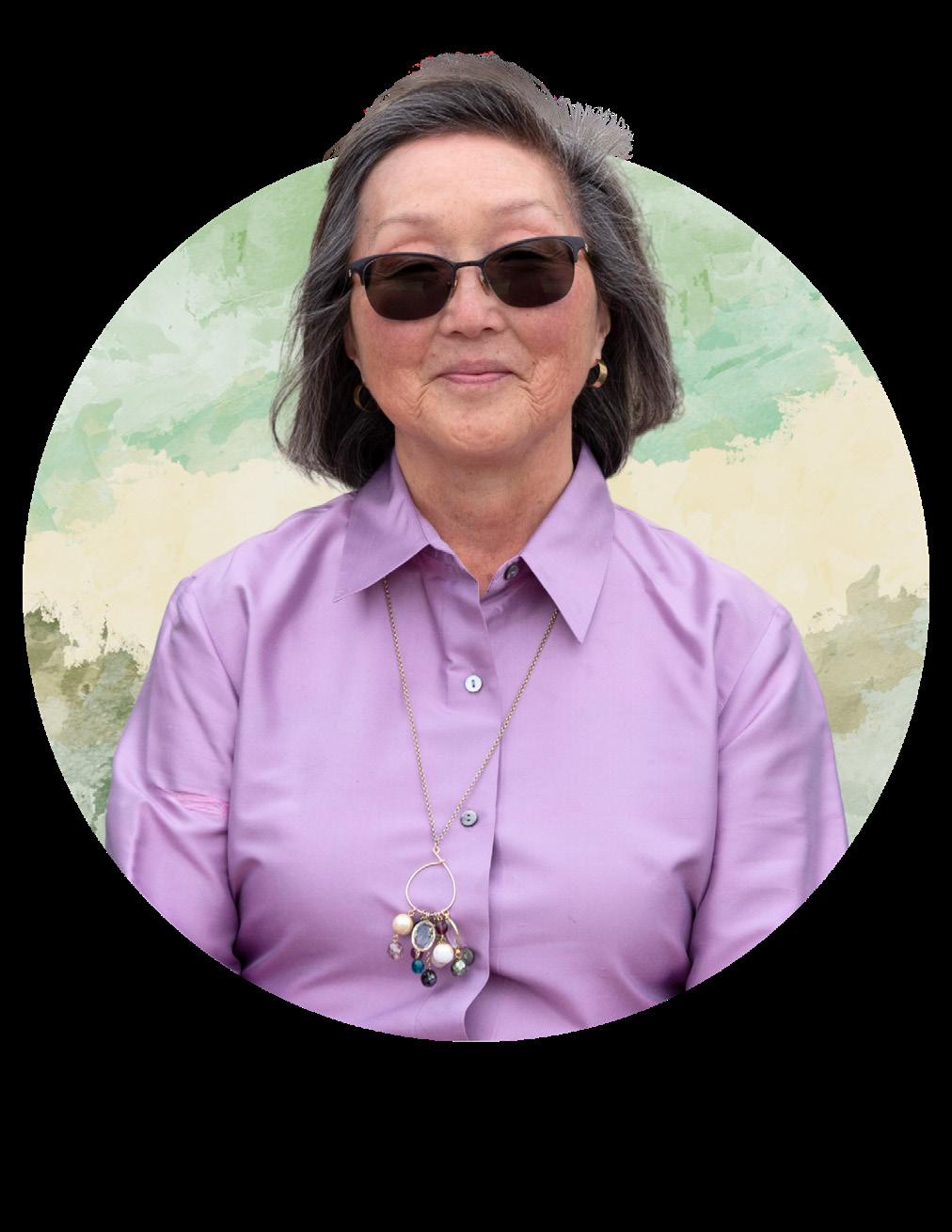
heritage and treat people with dignity and respect.”
Under her leadership, Pacific Mercantile continues to thrive as both a business and a cultural anchor. Especially during events like the Denver Cherry Blossom Festival or New Year’s celebrations, the store becomes a vibrant meeting place, filled with customers searching for traditional ingredients like sashimi and ozoni—and with
Jolie Noguchi
Third-generation Owner, Pacific Mercantile Member, Japanese American Community Graduation Program
culture and cuisine.
But what truly sets Noguchi apart is the care she brings to each interaction. She believes in “laughing lots, giving plenty of hugs and getting to know people personally.” That philosophy is felt throughout the store, where every customer is treated not as a transaction, but as part of an extended community. It’s a quality that has made Pacific feel less like a place of commerce and more like a place of belonging.
“No one forgets a hug from Jolie, which she gives freely and with a kind and loving smile,” says Stacey Shigaya, executive advisor to Sakura Square and a friend of Jolie’s. “She exemplifies what it looks like to take pride in your
Noguchi’s commitment to giving back extends far beyond the store’s walls. She has been a longtime member of the Japanese American Community Graduation Program (JACGP), helping support scholarships for graduating seniors. Pacific Mercantile is also a dedicated sponsor of the annual Go For Broke Golf Tournament, which raises funds for JACGP, and Noguchi has also supported educational initiatives like Chibi no Gakko (a local Japanese heritage school). Whether through sponsorships, partnerships with local vendors or simply showing up for community events, Noguchi’s impact is both broad and deeply personal.
And by sharing her family’s story—including the early support they received from Colorado Governor Ralph Carr during a time of profound injustice for Japanese Americans—Noguchi also helps preserve history and foster understanding for future generations.
Being recognized as an Asian American leader in Colorado, she says, is both an honor and a continuation of that legacy. “It is proof that the legacy of my grandparents and parents’ lives on,” she says. With her daughter, Alyssa, poised to one day take the reins, Noguchi remains focused on what has always mattered most: honoring the past, serving the present, and ensuring that the community continues to flourish for generations to come.
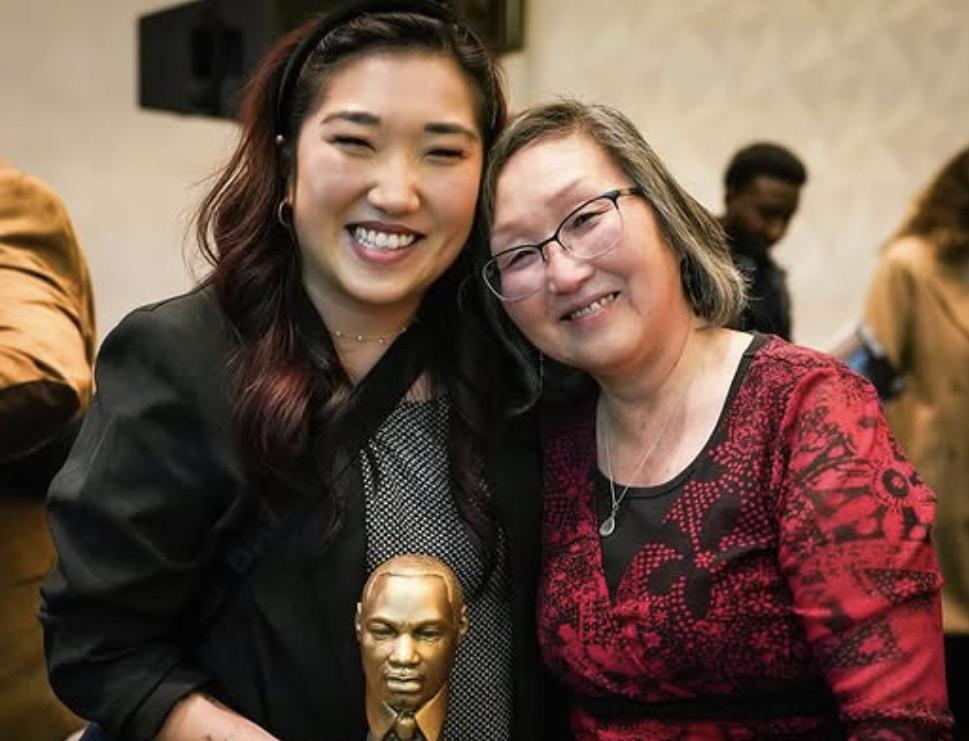
Alyssa and Jolie Noguchi receive the Martin Luther King, Jr. Business Award
Jolie Noguchi and her brothers operate Pacific Mercantile founded by their grandfather in 1972.
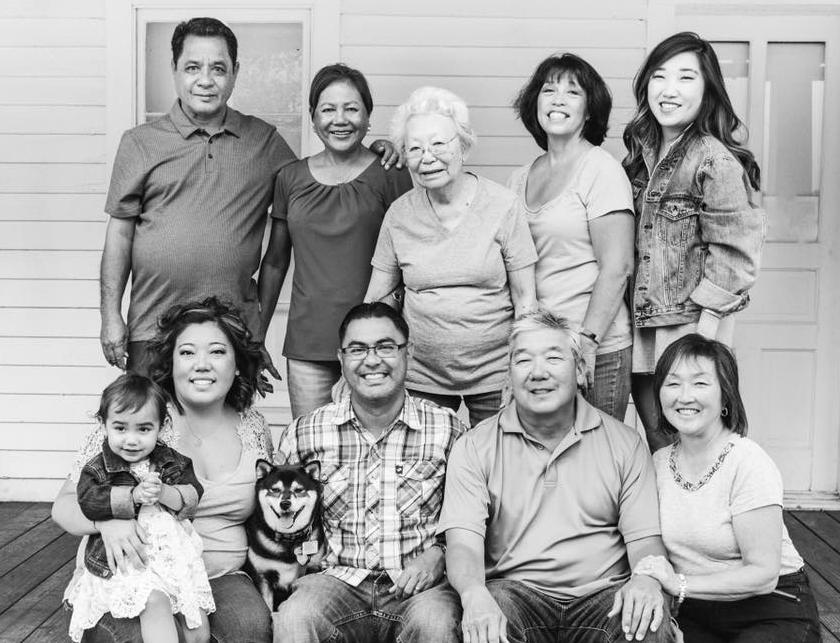
Noguchi and her family
Lifetime Achievement Award
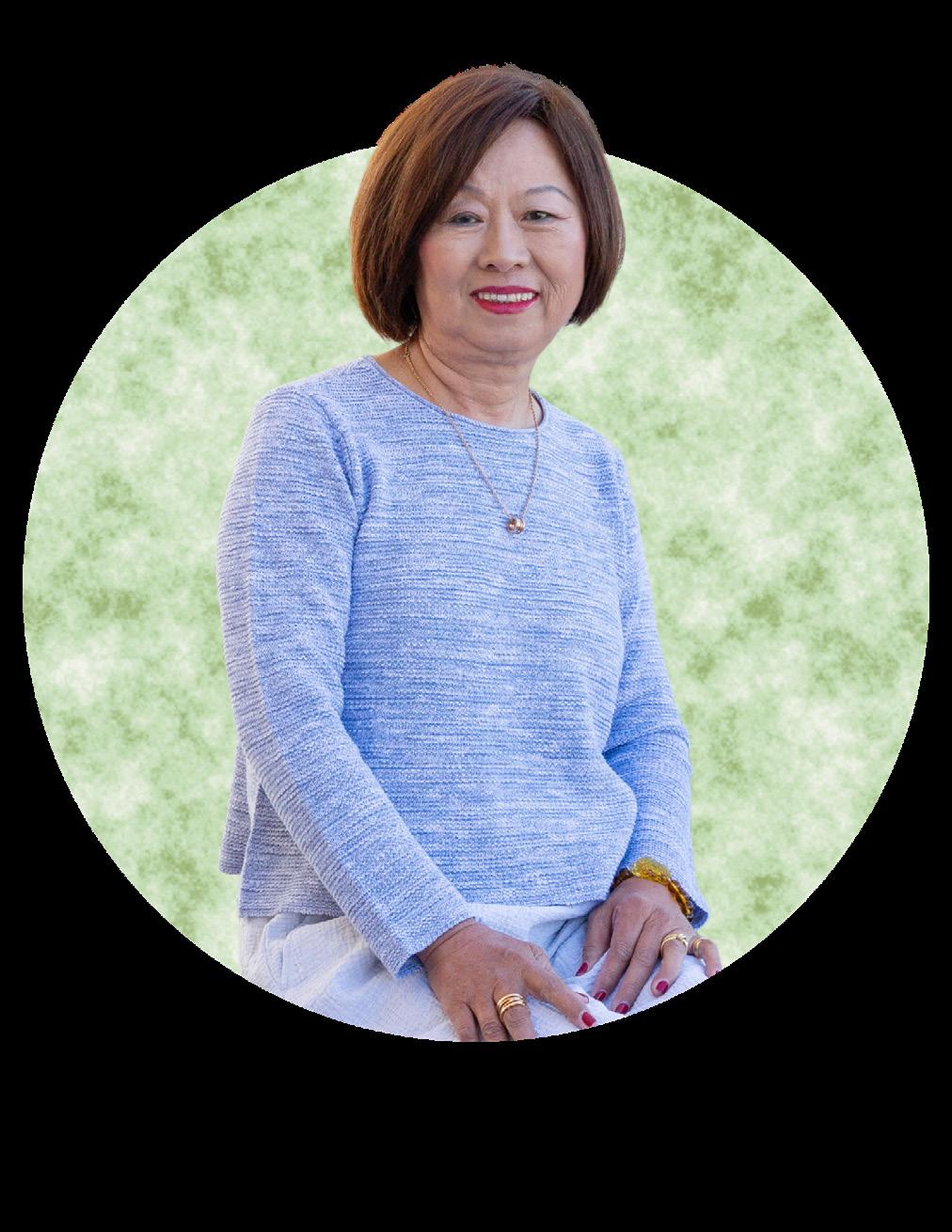
Two decades ago, Christina Yutai Guo helped create a platform to tell the stories of Colorado’s Asian American community. Today, as she is honored as an Asian American Hero of Colorado, her own story comes full circle—one rooted in resilience and a lifelong commitment to community.
Guo arrived in Denver from Taiwan in 1987, as her husband pursued graduate studies and their young family began building a new life. In those early years, she found connection at the Colorado Chi nese Club. Over time, that involvement grew into leadership, including serving as president of the organization and leading the Chinese American Council of Colorado, Double Tenth Celebration Committee and Denver Chinese Culture Center.
Lifetime Achievement Award
Publisher, Asian Avenue Magazine and Rocky Mountain Chinese Weekly
Founder, Happy Living Adult Daycare
nese Civil War. She saw how his friends, who were aging veterans, struggled with loneliness.
“Many never married nor had children because they had hoped to return to China one day to reunite with their families. Seeing their situation deeply impacted me,” she says.
Christina Yutai Guo
Years later, she saw similar isolation among elderly immigrants in Colorado, many of whom face language barriers, limited mobility and a lack of social connection. Determined to help, she founded Happy Living Adult Daycare in Aurora, a place where seniors could build friendships and age with dignity.
Her path, however, was not without challenges. Despite a background in journalism and media in Taiwan, language barriers limited her opportunities, and she spent decades working in retail. Still, the desire to create something meaningful—and to uplift her community—never left her.
In 2006, she took a leap and founded Asian Avenue Magazine, a publication dedicated to sharing the stories and experiences of AANHPI community members in Colorado.
At the time, those stories were largely absent from mainstream media. With limited English and no roadmap, Guo taught herself every aspect of the business—from securing an ISBN
one dedicated to sharing the stories, voices, and experiences of Asian Americans that had long been overlooked,” says Guo’s daughter Jenny.
This year, “Asian Avenue,” which still honors Guo’s mission to be a space for community connection and pride, celebrates its 20th anniversary. Her commitment to bridging cultures continued in 2009 with the founding of the nonprofit Colorado Asian Culture and Education Network (CACEN).
Through student exchange programs and youth leadership programs, Guo worked to connect people across cultures in meaningful ways.
For Guo, she saw the importance of community care at a young age. Her father, who was a soldier in China, moved to Taiwan in 1949 after the Chi-
“I feel a responsibility to serve others, especially those who may feel unseen or isolated, such as elderly immigrants facing language and cultural barriers,” she says.
Her care for the community became even more visible during the pandemic. When the center was forced to close, Guo continued to show up by delivering meals, coordinating resources and staying in constant contact with seniors who depended on her for support.
Guo’s work is guided by values rooted in her upbringing: respect for elders and a deep belief in caring for community. “How we treat our seniors reflects who we are,” she says.
“Even if the journey is not easy or looks different from others, stay committed to what you believe in,” Guo says. “You can create your own path to make an impact in your community.”
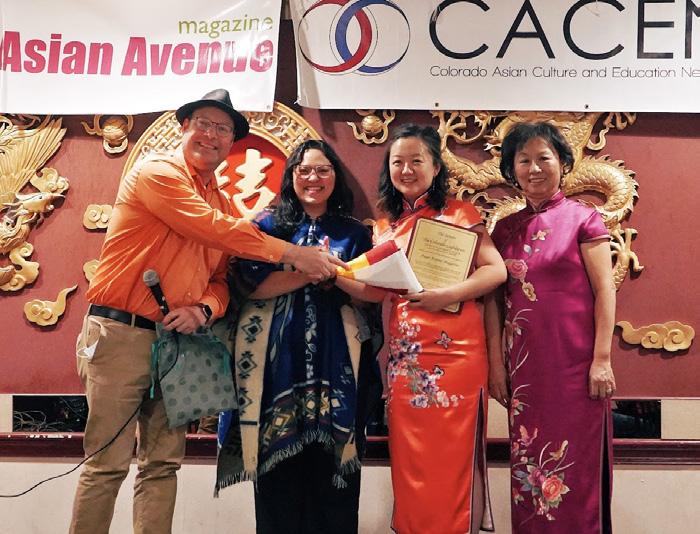
Guo founded Happy Living Adult Daycare to provide a space for seniors to thrive.
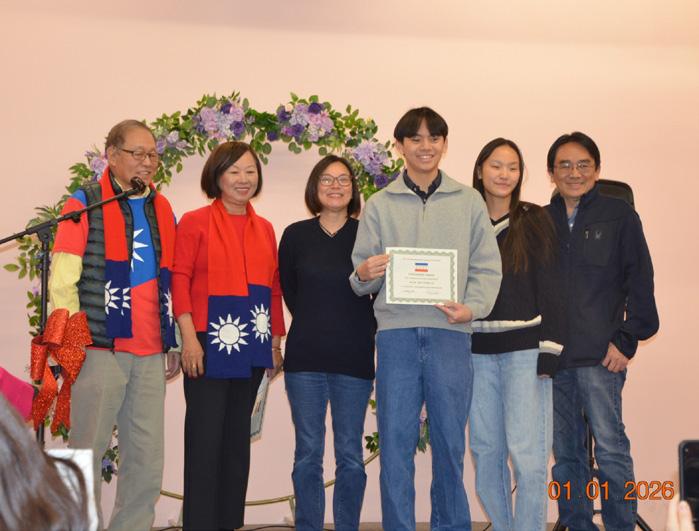
Guo awards scholarships as President of Chinese American Council of Colorado.
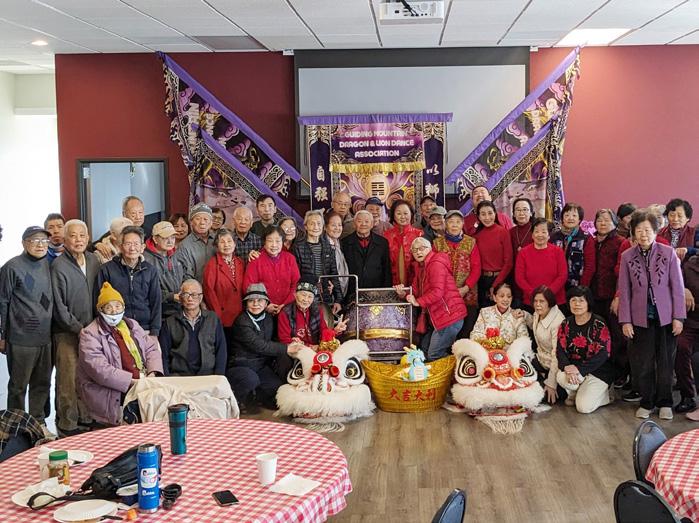
Asian Avenue and CACEN were founded by Guo and her daughter, Annie.

Starting therapy can feel like stepping into the unknown, so it makes sense that you’re thinking carefully about what will help you feel comfortable and understood.
Your question—whether it matters if your therapist is also Asian—doesn’t have a one-size-fits-all answer, but it does matter in the sense that your comfort, identity, and sense of safety in the room matters.
For some people, having a therapist who shares their racial or cultural background can be deeply reassuring. You may feel less pressure to explain certain family dynamics, cultural expectations, or experiences with bias.
There can be a kind of shorthand—an assumption of understanding—that helps you open up more quickly. If parts of your identity, like being Asian, are central to what you want to explore (for example, intergenerational expectations, cultural stigma around mental health, or identity conflicts), then a therapist who has lived or deeply understands that
Dear Dr. Amy,
I've never tried therapy before, but I am looking to start. The whole process feels a bit overwhelming. There are so many therapists and so many options, I can’t help but wonder: Does it really matter if my therapist is also Asian?
- Searching for the right fit
context might feel especially validating.
At the same time, a therapist doesn’t have to share your background to be effective. Good therapists are trained to listen carefully, ask thoughtful questions, and remain aware of cultural differences.
In some cases, having someone from a different background can even give you a fresh perspective—though that only works if you feel respected and understood.
It’s also worth noting that not every reason for seeking therapy hinges equally on cultural understanding. For certain conditions—like OCD, anxiety disorders, or specific phobias—treatment often relies on structured approaches. In those cases, a therapist’s training and experience with the condition may matter more than their background.
That doesn’t make identity irrelevant, but it can shift the priority: you might find that expertise and fit outweigh shared background. And even here, it can still come down to preference— feeling at ease with your therapist can
make it easier to engage with the work.
A helpful way to think about it is this: it’s less about checking a demographic box and more about how you feel in the relationship. Do you feel heard? Do you feel like you can be honest? Do you feel like the therapist is curious about your experiences rather than dismissive or overly confident in their assumptions? Those factors tend to matter more over time than any single shared identity.
If you’re unsure, it’s okay to prioritize this in your search and see how it feels. Many therapists offer initial consultations—use that space to notice your comfort level. You can even ask directly how they approach cultural identity in their work.
Ultimately, therapy works best when you feel safe enough to be real. Whether that safety comes from shared background or from the therapist’s approach and presence is something only you can determine—and it’s completely valid to take your time figuring that out.

The AAPI Culture Fest x Civic Center NIGHT MARKET program book begins on the next page.

Welcome
from the Denver Mayor’s Office
Greetings:
As Mayor of the City and County of Denver, I’m honored to join Denver Human Rights & Community Partnerships, the Asian American Pacific Islander Commission, Civic Center Conservancy, and community partners in celebrating AAPI Heritage Month at the upcoming AAPI Culture Fest x Civic Center NIGHT MARKET, which will be held on May 22 in Civic Center Park. This event is a powerful reflection of the cultures, traditions, and contributions that help make Denver such a vibrant city.
AAPI Culture Fest x Civic Center NIGHT MARKET brings people together to experience the rich diversity of foods, art, and traditions that define AAPI communities across our city. From local small businesses and artisans to performers and community organizations, this celebration highlights the talent, resilience, and leadership that continue to shape Denver in meaningful ways.
Welcome
from Denver Asian American Pacific Islander Commission
To Our Community,
Welcome to the 2026 AAPI Culture Fest x Civic Center NIGHT MARKET — a historic milestone for our city. This year, our festival proudly serves as the Mayor’s official AAPI Heritage Month flagship event for the City and County of Denver.
Today, 16 AANHPI communities are gathered at Civic Center Park to share their history, traditions, and pride with all of Colorado. We invite you to enjoy spectacular live performances celebrating the music, dance, and artistry of our communities, and to explore Artist Alley, where local AAPI artists bring their creativity directly to you.
From Chinatown to Little India, Hawaii to Mongolia — this is who we are, together.
- Taemy Kim-Mander & Alana Pettaway Co-Chairs, Denver Asian American Pacific Islander Commission
Events like this play an important role in strengthening connection and belonging. Occasions like these encourage residents and visitors alike to come together, learn from one another, and celebrate the many cultures that make our city stronger. I am especially grateful to the local businesses, artists, and community leaders whose efforts make this event possible.
As we gather at Civic Center Park, I encourage everyone to explore, support local vendors, and enjoy all that Denver has to offer. Together, we continue building a city where every community is seen, valued, and celebrated.
- Mike Johnston City and County of Denver Mayor
A Warm Welcome
from Civic Center Conservancy
The Civic Center Conservancy is thrilled to welcome you to this year’s AAPI Culture Fest x Civic Center NIGHT MARKET! Working together through this special partnership with DAAPIC and Asian Roundtable of Colorado, we are proud to create an unforgettable event in the heart of Downtown Denver!
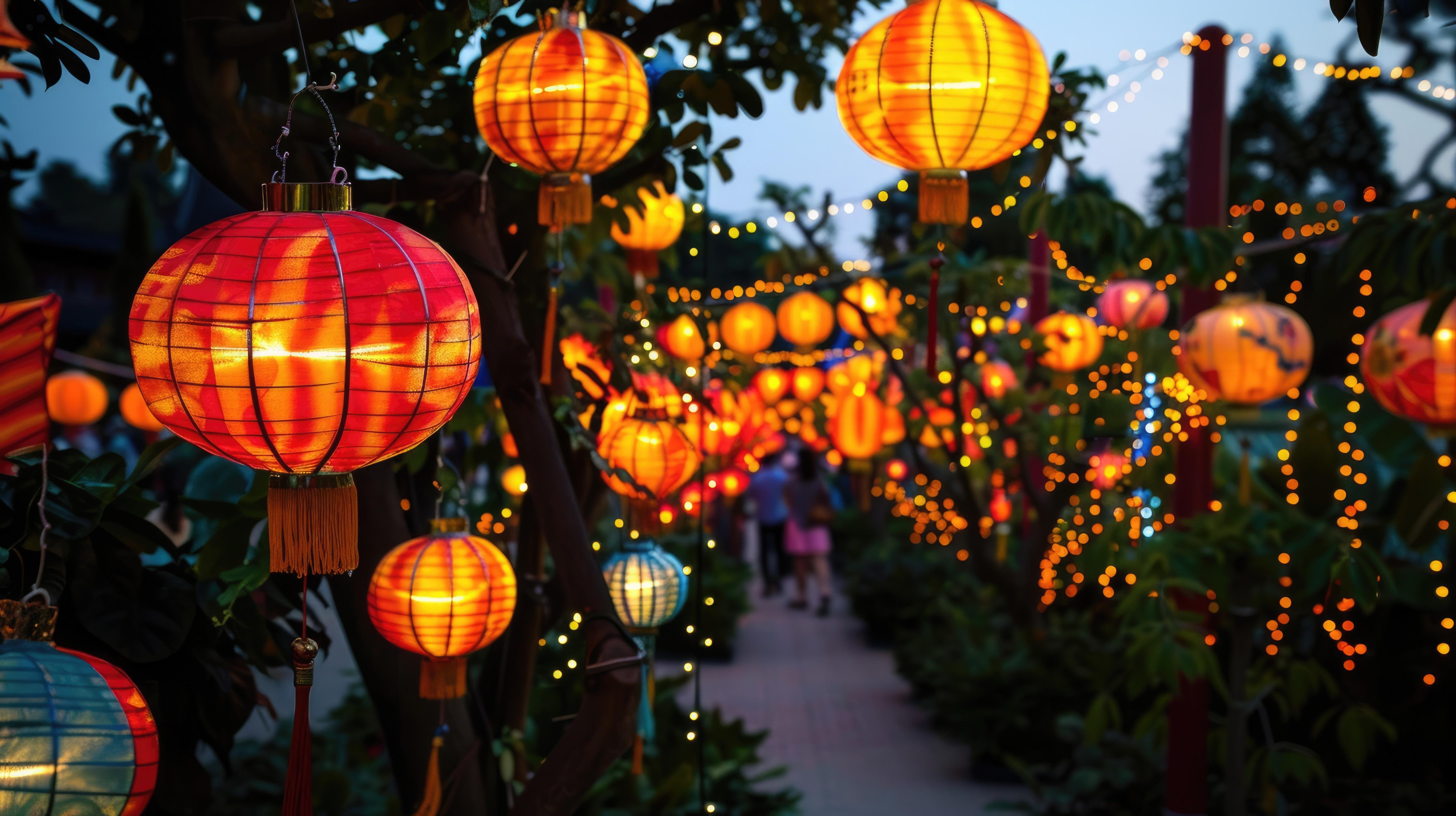
Civic Center Conservancy stewards one of Denver’s most important civic spaces and creates platforms for groups to tell their stories and spotlight their community and culture authentically and with visibility. Inspired by the night markets of China and southeast Asia, Civic Center NIGHT MARKET brings together vendors representing Denver’s vibrant AAPI communities, including an assortment of Asian and Pacific Islands cuisines, alongside artisans and small businesses.
We are excited to have you join us at Civic Center Park, and eager to see how this event continues to grow and evolve through Civic Center Park’s transformation and beyond!
- Civic Center Conservancy Team
The AAPI Culture Fest x Civic Center NIGHT MARKET serves to foster connection, dialogue, and celebration. Join as we unite to honor the stories, struggles, and triumphs of the AAPI community. Together, we will celebrate and honor our heritage, and embrace the diversity that truly defines us.
WHEN: Friday, May 22nd, 2026 | 5 pm - 10 pm
WHERE: Civic Center Park | 101 14th Ave, Denver, CO 80204
At the AAPI Culture Fest x Civic Center NIGHT MARKET, explore cultural community hubs, performances, and indulge in local AAPI foods and drinks.
EVENT MAP EVENT MAP
More than 40 food and beverage vendors will showcase cuisines from across Asia and the Pacific Islands, alongside artisan vendors and small businesses representing Denver’s vibrant AAPI communities.
View the full list of vendors here:

CELEBRATION STAGE
5:00 PM DJ sean
5:30 PM Denver Police Lion Dance Team: Chinese Lion Dance
5:50 PM Mayor’s Welcome
6:10 PM Gamlen Tunas Mekar
6:45 PM Ajnai Horsehead Fiddle Center
7:00 PM Hmong Dance Academy
7:30 PM KalaCOa: Polynesian Music and Dance
8:00 PM Asian Connect Denver
8:05 PM Jasmine Flower Dance
8:25 PM Jojo Dance
8:20 PM Rocky Mountain Chinese Calligraphy Association
8:35 PM Colorado Bhangra Team
8:50 PM Filipino-American Community of Colorado
8:55 PM Payadon Cultural 9:05 PM Hawak Kamay Dance Company
9:20 PM Kpop Showcase by 3456ent + Palace Studio
Civic Center NIGHT MARKET Music by DJ sean and DJ Innaseoul (on Bannock and in the Greek Triangle)
*Schedule subject to change
Emcee: Tak Landrock
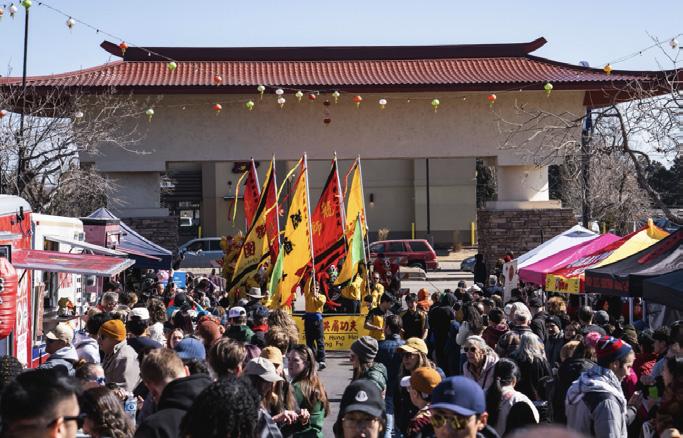
Cambodian VILLAGE
Organization: Cambodia Buddhist of Colorado
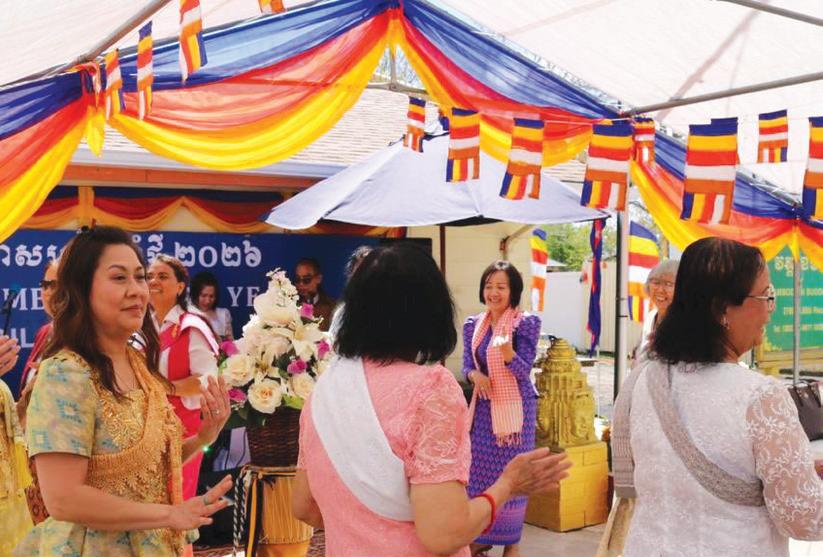
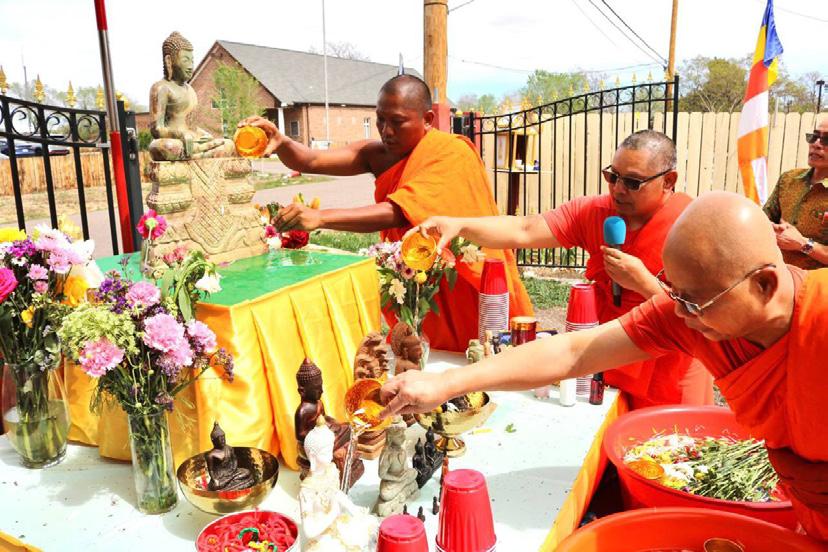
The Cambodian community in Colorado is a vibrant and resilient part of the state’s diverse cultural fabric. Many Cambodian families fled their homeland in the late 20th century following the genocide brought by Pol Pot and the Khmer Rouge. Carrying memories of hardship and survival, they rebuilt their lives in the United States while holding tightly to their cultural identity, traditions, and faith.
At the heart of this community is the Cambodian Buddhist of Colorado, also known as Wat Khemarak Puthearam, which serves as both a spiritual center and a cultural gathering place. The temple hosts regular religious services, prayer and chanting, and meditation, while also organizing important celebrations throughout the year. These include Khmer New Year, Pchum Ben (Festival for the Ancestors), Visak Bochea, and Bon Phka Prak, a traditional merit-making
and fundraising ceremony.
Community members actively participate by offering food to monks, making donations, and engaging in merit-making rituals—practices that strengthen both spiritual life and community bonds. Cultural gatherings often feature traditional dance, music, food, and games, creating opportunities for younger generations to learn the Khmer language and customs while staying connected to their heritage.
Beyond the temple, Cambodian Coloradans are active in small businesses, education, and community service. Their journey reflects remarkable resilience—transforming past trauma into strength and unity. Through cultural events, storytelling, and community partnerships, they continue to preserve their heritage while enriching the broader Colorado community with their history, traditions, and enduring spirit.
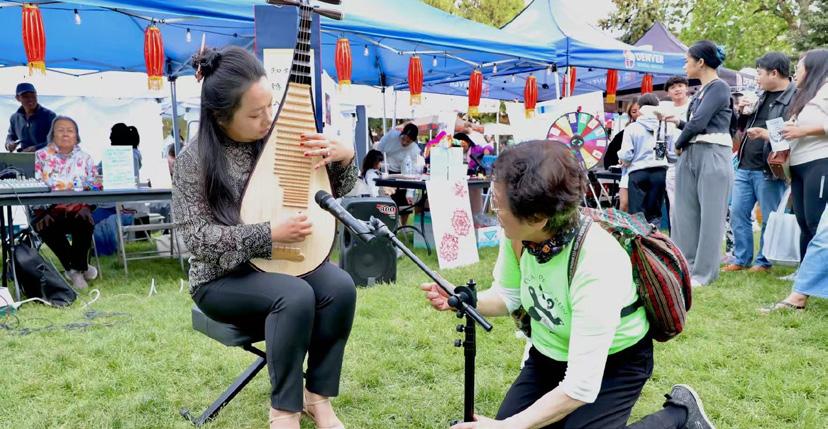

Explore the rich past and vibrant present of Chinese culture. Meet hosts like the Han Emperor and Miss Panda as they guide you through history and traditions, enjoy interactive games and Kau Chim fortune telling, and browse the OCA night market with unique goods and homemade Chinese food and drinks. Enjoy the entertaining Chinese musical instruments, songs and dance.

Chinatown by oca
Organization: OCA Colorado
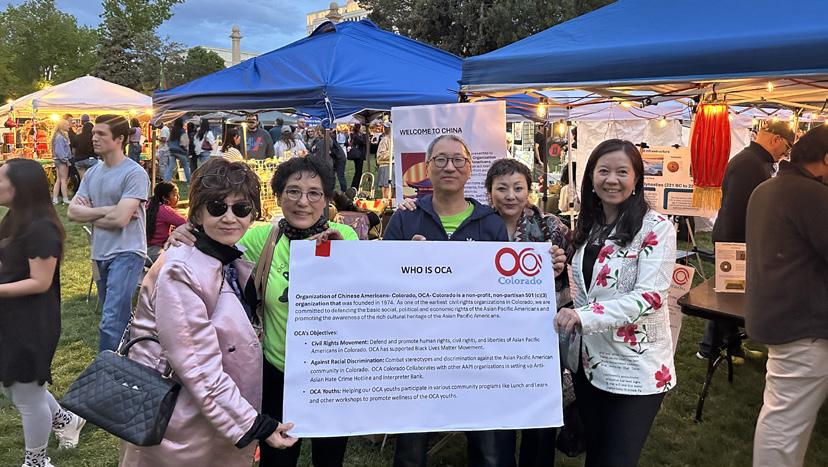
Founded in 1974, OCA Colorado is a nonprofit, non-partisan organization dedicated to advancing the social, political, and economic rights of Asian Pacific Americans while celebrating and preserving cultural heritage. As one of Colorado’s earliest civil rights organizations, OCA actively works to combat racial discrimination, challenge stereotypes, and support initiatives such as anti-Asian hate resources, community hotlines, and interpreter services.
OCA serves all generations through a wide range of programs, including youth leadership development, wellness workshops, and community education initiatives. Its Senior Loving Care program provides transportation, translation, seasonal celebrations, and care packages to support older adults.
The organization also acts as a vital bridge between government and local communities through voter outreach, Census education, and programs that help community members better understand public policies and access services.
Through its Education Fund, OCA has established multiple endowed scholarships at local colleges and universities, awarding financial support each year to help Asian Pacific American students pursue higher education in Colorado.
Signature events such as the Panda Run, Chinatown Hub, Moon Festival Banquet, and Lunar New Year Gala bring the community together to celebrate culture, strengthen connections, and promote unity and pride across generations.
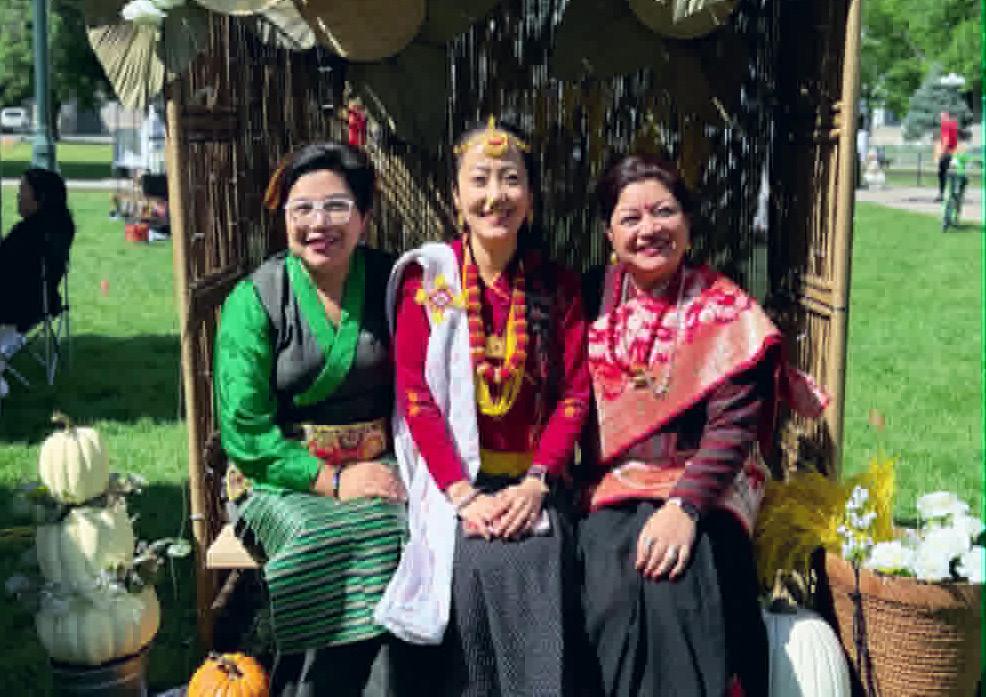

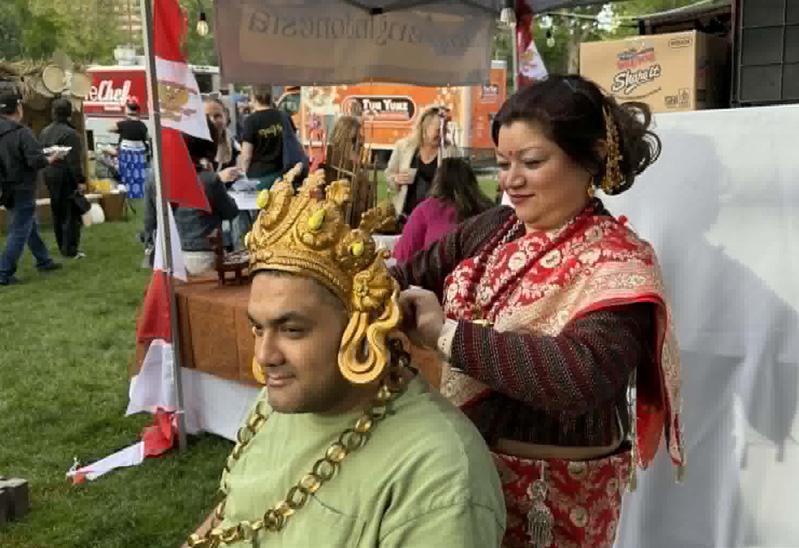
Experience a lively and immersive glimpse into Nepali culture through traditional music and dance performances, interactive cultural displays, authentic Nepali cuisine, and hands-on activities such as traditional games and art. The hub will be a welcoming space to learn, connect, and celebrate the spirit of Nepal.
Discover Nepal
Organization: Colorado Nepalese Community
The Nepali community in Colorado is a vibrant and steadily growing diaspora rooted in resilience, culture, and connection. Some Nepali students and professionals began arriving in the US in the late 20th century, the community in Colorado expanded significantly in the early 2000s.
Many came as students, skilled professionals, and through diversity visa programs, while others arrived as refugees from Bhutan, carrying rich cultural traditions shaped by their Nepali heritage. Over the years, Nepalis have built strong community networks across the Denver metro area and beyond, contributing to Colorado’s cultural and economic landscape. Organizations such as the Colorado Nepalese Community (CNC) have played a central role in fostering cultural preservation, community support, and cross-cultural exchange. From organizing festivals like Dashain,
Explore Bangladesh
Organization: Bangladeshi Colorado Community
Bangladeshi culture is a “living mosaic” rooted in the Bangla language, the fertile delta landscape, and a deep history of religious coexistence. It is a collectivistic society that prioritizes family and community over the individual, defined by a spirit of resilience and hospitality.
Life is intrinsically tied to the country’s vast river systems—the Ganges, Brahmaputra, and Meghna. This is reflected in the national cuisine (fish and rice) and traditional transport like wooden boats (nawka). The Bengali New Year in mid-April is the most significant secular festival, celebrated with colorful parades (Mangal Shobhajatra).
Bangladesh is the only country founded on a movement to protect its mother tongue. February 21 (International Mother Language Day) is a solemn national
holiday honoring those who died for the right to speak Bangla. Colorado proclaimed February 21 as International Mother Language Day in 2024.
In the late 19th century, Bangladeshi students and professionals began arriving in the US. The community in Colorado expanded significantly in 2015, when many came as students and skilled professionals, and through diversity visa programs.
The Bangladeshi Community of Colorado (BCC) and Colorado Bangladesh Chambers of Commerce (CBCC) played a central role in fostering cultural preservation, community support, and cross-cultural exchange from organizing festivals like “Break the Fast” during Ramadan, Eid Picnic, Pohela Baishak (Bengali New Year), and more.
Tihar, and Teej to hosting art exhibitions like Heritage in Motion, Mosaic Of Cultures, Nostalgic Expressions at major institutions including Denver International Airport, Aurora History Museum, Boulder Museum, the community continues to create spaces where heritage and contemporary identity intersect.
Nepali-owned businesses, restaurants, and cultural initiatives have further enriched Colorado’s diversity, introducing traditions such as Momo, dal bhat cuisine, folk music, and Himalayan art to wider audiences. The community also actively participates in civic engagement, nonprofit work, and creative industries, strengthening the multicultural fabric of the state.
Today, the Nepali community in Colorado stands as a dynamic bridge between the Himalayas and the Rockies—sharing stories, traditions, and a deep sense of belonging.
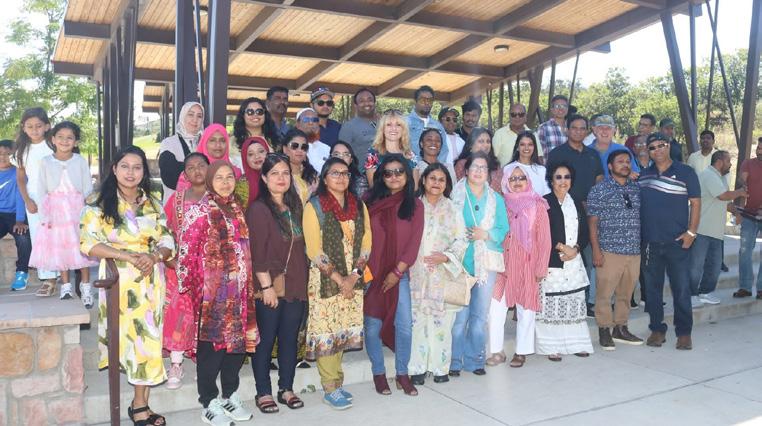
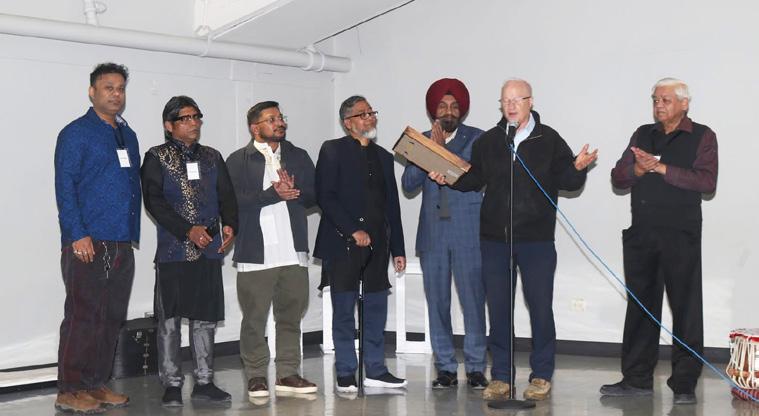
Visitors can experience a lively and immersive glimpse into Bangladeshi culture through traditional music and dance performances, interactive cultural displays, authentic Bangladeshi cuisine. The hub will be a welcoming space to learn, connect, and celebrate the spirit of Bangladesh.
Filipino Barrio
Organization: Filipino-American Association of Colorado
Founded in 1954, the Filipino American Community of Colorado (FACC) is one of the state’s longeststanding Filipino organizations, dedicated to celebrating culture, fostering connection, and serving the community.
Rooted in the spirit of bayanihan (communal unity), this all-volunteer nonprofit engages thousands each year through cultural programs, youth initiatives like the Padayon dance group, and community support efforts including food drives and mutual aid.
connections across Colorado’s diverse communities.
At the heart of FACC’s impact is its commitment to intergenerational connection, creating opportunities for youth, families, and seniors to engage with culture in meaningful ways. Each year, Padayon engages dozens of youth performers and showcases Filipino culture at schools, community events, and regional celebrations.
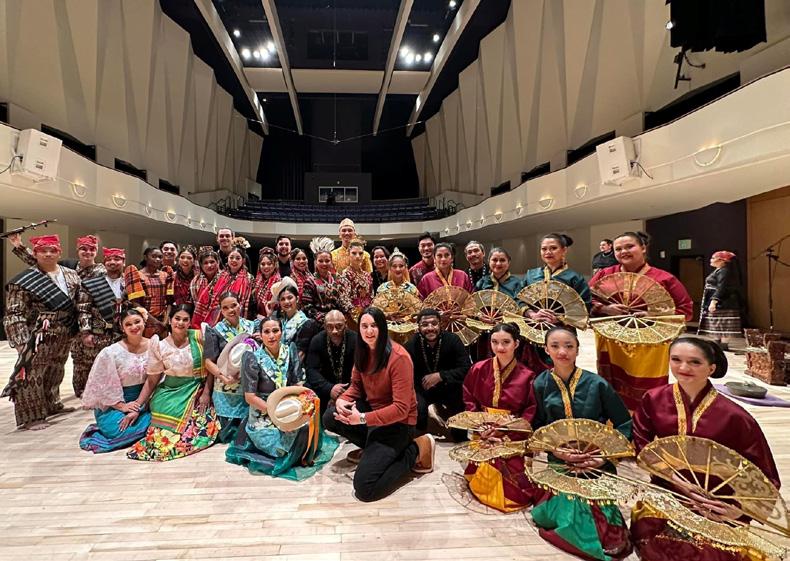
FACC brings people together through year-round events, workshops, and its signature Philippine Independence Festival, which draws over 5,000 attendees annually with performances, food, and cultural exhibits. Through its work, FACC continues to preserve Filipino heritage, uplift future generations, and strengthen
Their annual Philippine Independence Festival, entering its 31st year, is a highly anticipated celebration that welcomes over 5,000 attendees each year with vibrant cultural performances and authentic Filipino cuisine.
As the Filipino American community continues to grow, FACC remains a cornerstone organization—bridging cultures, supporting families, and creating spaces where heritage is not only remembered, but lived and shared.
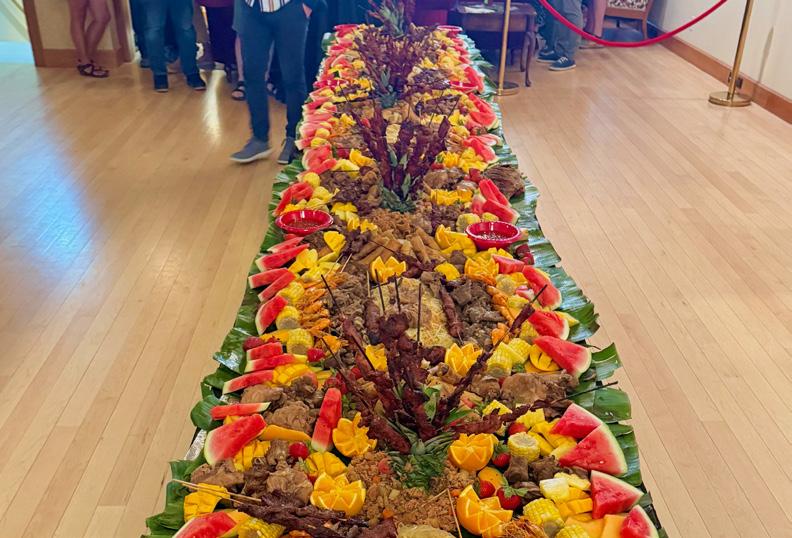
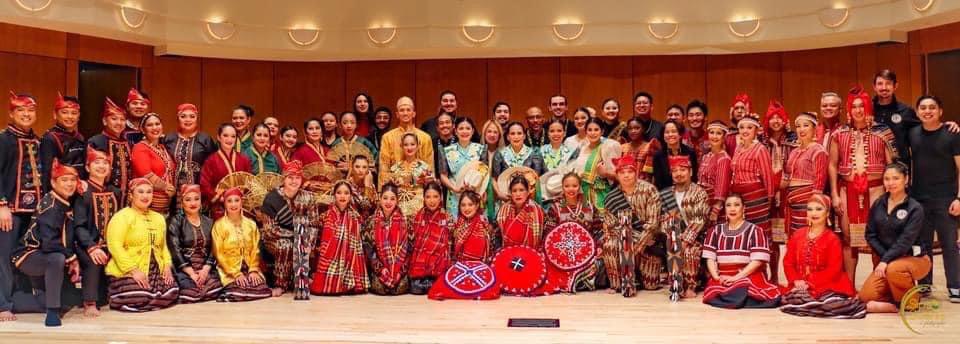
Colorado’s Hawaiian and Pacific Islander community brings the spirit of aloha to the Rocky Mountain region through music, dance, food, and cultural traditions.
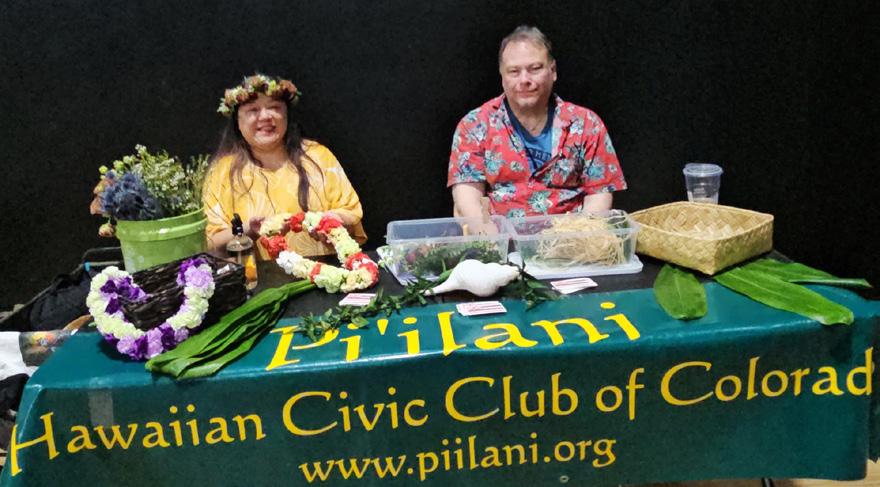

From hula performances and Hawaiian music gatherings to community organizations and educational programs, the community has created strong cultural ties across the state.
Grand Junction, in particular, has become home to a growing Hawaiian population connected through Colorado Mesa University and multigenerational family networks. Across Colorado, Native Hawaiians and Pacific Islanders continue to preserve their heritage while contributing to the state’s diverse cultural landscape.
The Pi’ilani Hawaiian Civic Club of Colorado is dedicated to preserving and promoting Hawaiian culture while fostering a sense of community among Hawaiians and Hawaii enthusiasts in Colorado. Our mission is to educate, engage, and empower through cultural events, community service, and advocacy. We strive to create a welcoming environment where the spirit of aloha thrives, offering support and connection to all who share our passion for Hawaii.
Organization:
Hawaian Civic Club of Colorado
PI’ILANI HAWAIIAN CIVIC CLUB OF COLORADO
Hawaiian Hale
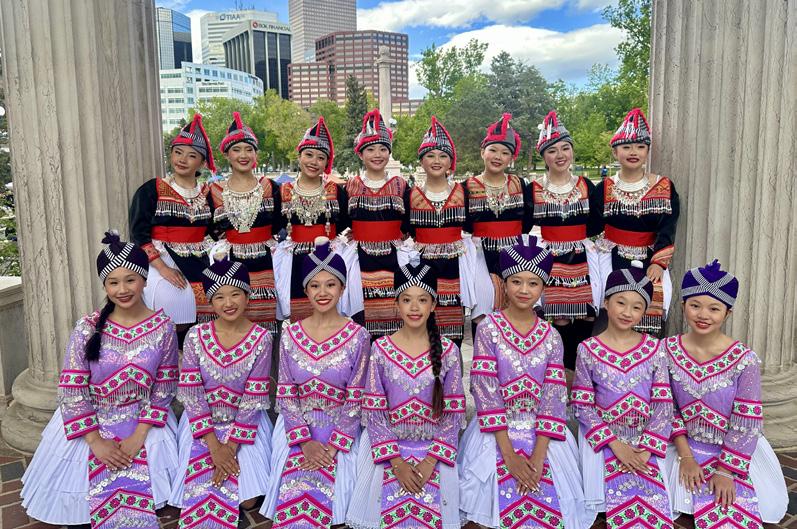
Explore Hmong culture through educational displays, art, and hands-on crafts, along with specialty snacks and beverages for purchase. Take photos with the complimentary photobooth modeled after a traditional Hmong village hut, plus traditional music and dance performances, and storytelling for an engaging and immersive experience.
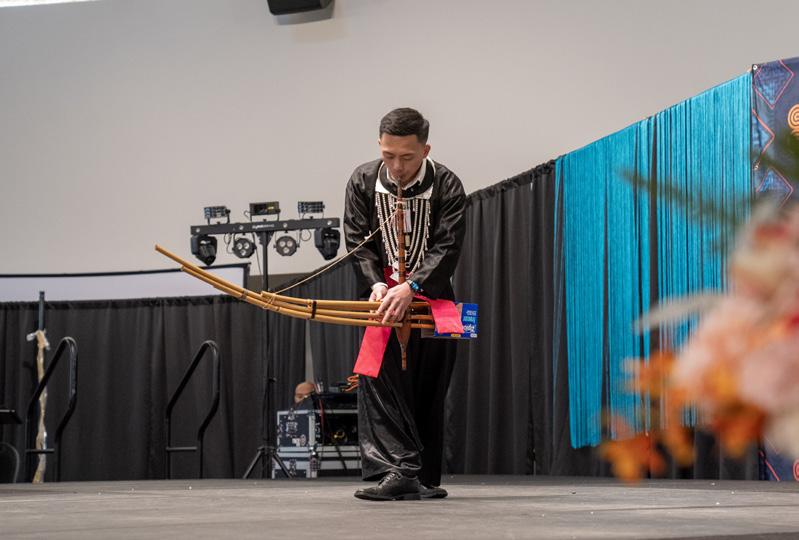
HMONG VILLAGE
Organization: Hmong American Association of Colorado
The Hmong are an ethnic group with a distinct language, culture, and history tracing back thousands of years. They originally lived in what is now central and southern China before migrating south into the mountainous regions of Laos, Vietnam, Thailand, and nearby areas. In these highlands, Hmong communities sustained themselves through farming, livestock raising, and close-knit family and clan systems.
camps in Thailand. From these camps, many resettled in the United States, including Colorado, while preserving their language, culture, and traditions.
During the Vietnam War era (1960s–1975), many Hmong in Laos were recruited by the U.S. Central Intelligence Agency to fight against communist forces in the Secret War. After the war ended and communist governments took control, Hmong soldiers and families faced persecution, prompting tens of thousands to flee across the Mekong River into refugee
JAPAN SQUARE
Organization: Consulate-General of Japan in Denver
The Japanese community has been present in Colorado as early as 1886, and a large number of Japanese immigrant miners, railroad workers, and farm hands traveled to Colorado from the Pacific Coast in the early 1900s. Many thrived as sugar beet farmers in Brighton, Fort Lupton, and Greeley and brought Rocky Ford melons to the San Luis Valley and Western Colorado.
By 1940, more than 2,000 ‘Nikkei’ (emigrants/descendants of Japan) lived in Colorado and Denver’s thriving ‘Little Tokyo’ Larimer Street corridor, located between downtown Denver and Curtis Park.
World War II increased Colorado’s Nikkei population significantly, as free citizens voluntarily relocated here and others were involuntarily imprisoned in the War Relocation Authority’s Granada (Amache) Relocation Center in western Colorado. Governor Ralph L. Carr welcomed people of
Japanese descent to Colorado and despite political pressure, stated that they were loyal citizens and that their incarceration was unconstitutional.
During the late 40’s and early 50’s, Nikkei rebuilt in Denver flourished and were concentrated in the Five Points area alongside other communities of color due to redlining which did not allow them to reside elsewhere in the city. In 1973, Sakura Square was established as a central hub for the Japanese community, including businesses and institutions such as Pacific Mercantile market, Tri-State/ Denver Buddhist Temple, and Tamai Tower residential building.
Today, Sakura Square remains an anchor for the Japanese community, hosting the annual Denver Cherry Blossom Festival and organizations that support Colorado’s connections to Japanese culture.
Today, an estimated 5,000 Hmong people live in Colorado, with the largest concentration in Adams County. Founded in 1992, the Hmong American Association of Colorado (HMAAC) has been a central hub for the community. HMAAC offers programs in cultural preservation, youth leadership development, language and arts education, and community services including translation and citizenship support. Its signature events — the Colorado Hmong New Year and the Mile High Hmong Summer Festival — provide opportunities to celebrate Hmong heritage and share traditions with the broader Colorado community.
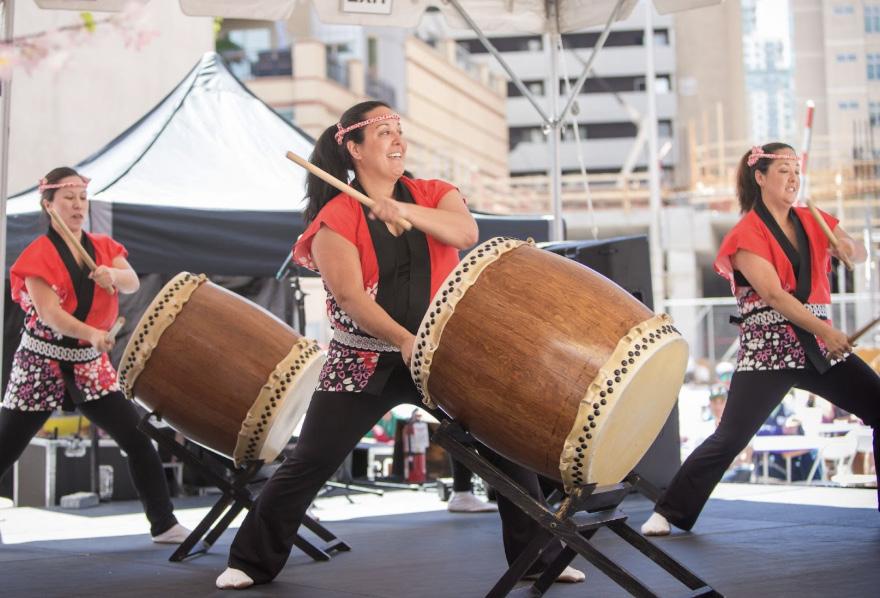
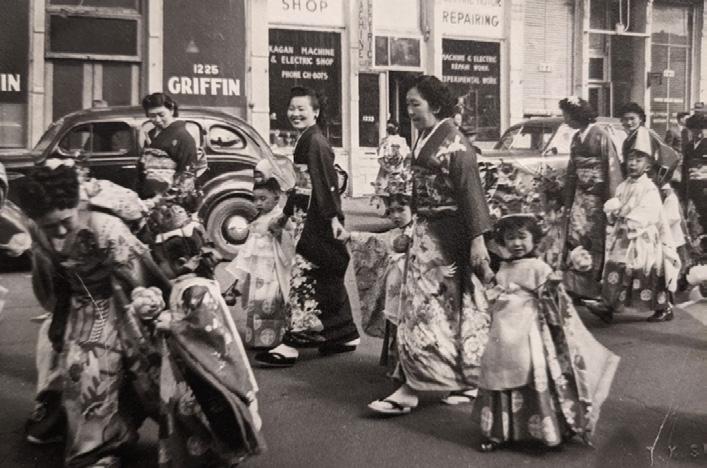
Partners from the Japanese and Japanese American communities will highlight and share their rich culture and heritage. Stop by to learn more, and enjoy origami folding!
Photo Courtesy of Ozaki Family
Photo Credit: Andrea Dreskin
Kampoeng Indonesia
Organization: Indorado, Corp. (Indonesian Market)
Indonesia, officially the Republic of Indonesia, is a country located in Southeast Asia and Oceania, between the Indian and Pacific Oceans. It is the world’s largest archipelago and the 14th-largest country by land area, comprising five major islands— Sumatra, Java, Kalimantan (Borneo), Sulawesi (Celebes), and Irian Jaya— along with more than 17,000 smaller islands.
The Indonesian community in Colorado has been present since the 1980s and continues to grow each year. According to the Indonesian Consulate in Los Angeles, the Indonesian
population in Colorado is estimated to be around 10,000.
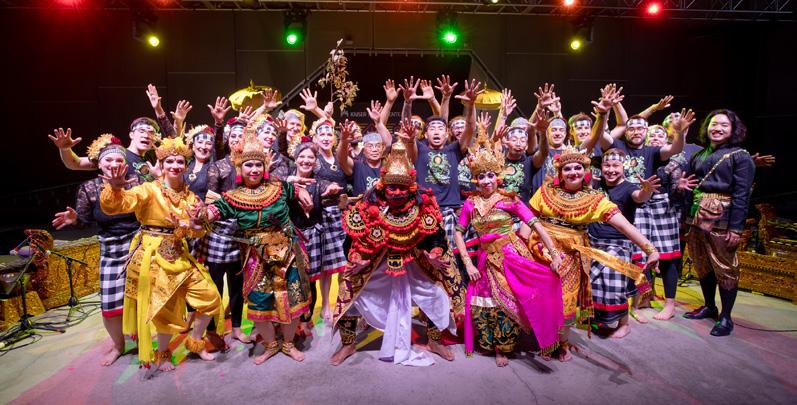
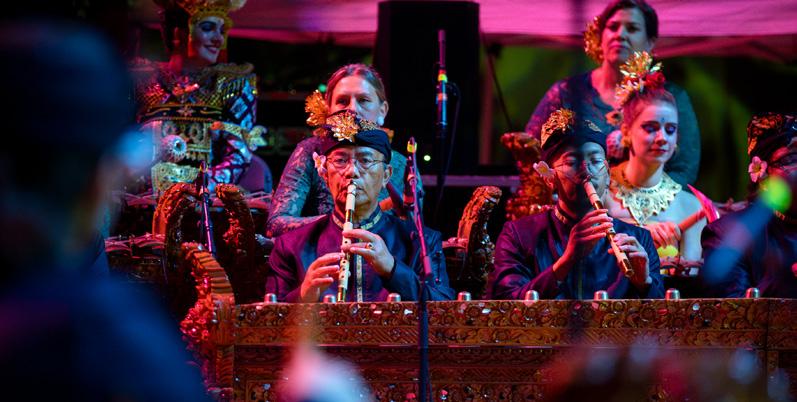
While relatively small, the community is highly active and closely connected through food and cultural events. Key organizations include ARCINDA (Arts and Culture of Indonesia), which promotes Indonesian arts and culture, Gamelan Tunas Mekar, known for its music and dance programming. Community members also gather regularly through the Colorado Kumpulan. Local businesses such as IndoRado and Jaya Asian Grill help bring familiar flavors and a sense of home to the community.
KoreaTown
Check out the community hub booth and Indonesian food and beverage booth to learn more about Indonesia.
Organization: Korean Academy of Colorado
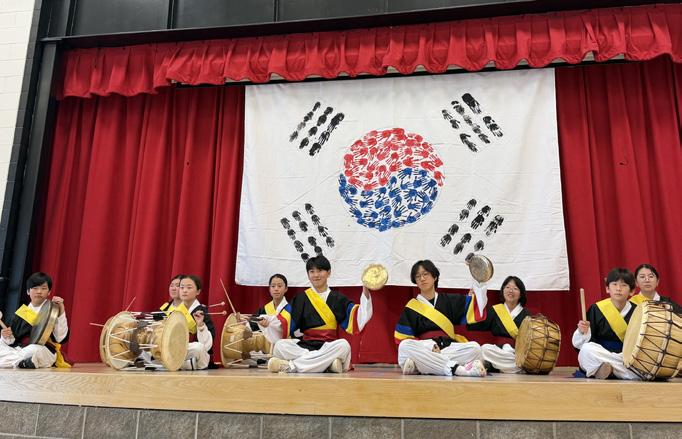
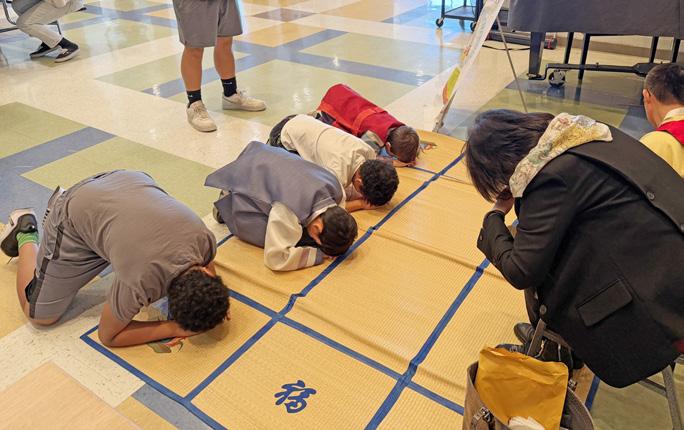
The story of Korean Americans in Colorado does not begin where most would expect. In the early 1900s, Denver quietly emerged as a hub for Korean independence efforts in the western United States. At the margins of a growing city, early immigrants took on physically demanding work in mines, railroads, and agriculture. Their numbers were small, and their presence often overlooked, but their role in shaping the foundation of the community was lasting.
The contours of that community became more visible in the decades following the Korean War. The arrival of Korean war brides in the 1950s, followed by an influx of professional immigrants in the 1960s, marked a turning point.
Many settled in Denver and Aurora, establishing small businesses—grocery stores, laundromats, and restaurants— that anchored both economic stability and cultural continuity. These were not simply commercial spaces, but sites where language, memory, and identity were sustained.
Today, the Korean American population
in Colorado is estimated to exceed 50,000. Nowhere is that presence more tangible than along Havana Street in Aurora, widely recognized as the region’s Koreatown. Here, culture unfolds in motion.
The steady rhythm of Korean barbecue grills, the casual familiarity of ramen and street-style dishes, and the everyday presence of kimchi—now readily available in local grocery stores—reflect how deeply Korean foodways have entered the broader fabric of life in Colorado.
What distinguishes Colorado’s Korean American community is not only its history, but its ability to move fluidly between tradition and contemporary culture. In 2025, the Denver Art Museum presented an exhibition of Korean moon jars, offering a refined and contemplative expression of Korea’s artistic heritage.
This evolution is also linguistic. As K-pop continues to expand its global reach, so has interest in the Korean language. The Korean Academy of Colorado has responded by offering online programs that connect students not only to language, but to the cultural context that sustains it.
The Korean Academy of Colorado is dedicated to promoting Korean cultural heritage in Colorado by sharing the history of Korean American immigration, engaging visitors with interactive traditional Korean games, and providing light Korean snacks for free.
Gamelan Tunas Mekar | Photo Credit: Sara Hertwig
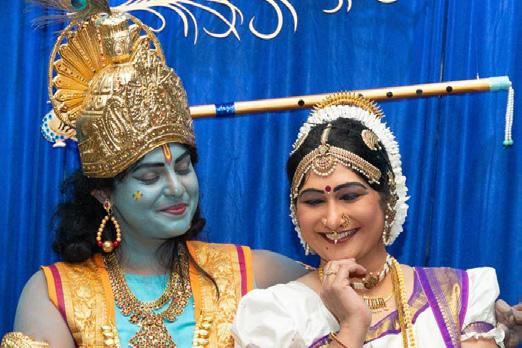
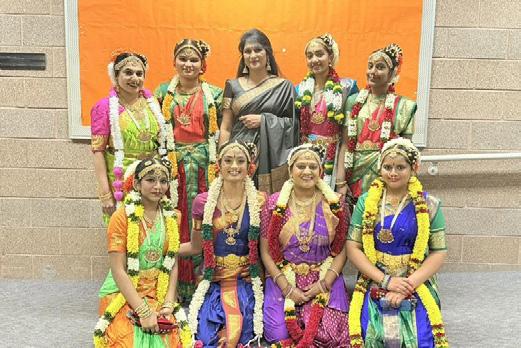
Step into a vibrant, immersive celebration of Indian culture. Visitors will enjoy captivating traditional dance performances, explore interactive cultural exhibits, and participate in hands-on activities like traditional art experiences.
Beyond the festivities, the hub offers meaningful opportunities to connect with and support local nonprofit organizations—making it easy to give back to the community. Whether you’re curious about India’s rich heritage or eager to get involved, there’s something here for everyone to learn, experience, and be inspired by.
Little Saigon
Little India
Organization: Laya Dance Academy
The story of Colorado’s Indian community is one of growth, resilience, and vibrant cultural expression—a journey that bridges continents while enriching local life. While Indian immigration to the US began in the mid-20th century, Colorado experienced a remarkable rise in its Indian population starting in the 1980s, gaining momentum through the 1990s and early 2000s. Drawn by opportunities in technology, healthcare, engineering, academia, and entrepreneurship, families and professionals laid the foundation for what would become a thriving and influential community.
Today, the Indian community across the Denver metro area stands out not only for its professional achievements but for its deep-rooted commitment to culture, connection, and continuity. It is a community that has grown together— building networks of support while preserving the traditions that define its identity.
Organizations like the National Association of Telugu Society (NATS),
Organization: Asian Pacific American Medical Student Association
The history of Vietnamese immigration to Colorado is a story of resilience and perseverance. After the end of the American War in Vietnam, many Southern Vietnamese and allies left Vietnam to start anew. Many of these refugees and migrants left by boat hence why they were called “boat people”. From 1975 to the early 1990s, over 200,000 Vietnamese came to America. By 1990, Colorado was home to about 5,800 Vietnamese refugees. Because of Denver’s history of refugee resettlement and recent Vietnamese immigrants coming due to ties in Denver, the metro area is home to over 31,000 Vietnamese American community members.
Vietnamese people hold numerous roles and built roots in Colorado’s (hi) story through economic and cultural
contribution. Little Saigon is an historic landmark that holds not only markets, restaurants, and businesses but memories and stories. Outside of Little Saigon, you can see communities of Vietnamese people at Catholic churches or Buddhist temples. They are also in your backyard cooking up a feast or karaoke-ing in their homes. Each place is a preservation of our culture and community. Vietnamese people are cooking your bowl of pho, landscaping your yard, doing your pedicure, taking care of children, and so much more. We are everywhere and have created our own communities and culture in Colorado. As the new generations grow, we continue to honor those who created the paths for us and dream of new worlds and leaving it better for the next generation.
along with many regional and cultural groups, have played a vital role in bringing people together through festivals, education, and service.
But the community’s impact reaches far beyond its own circles. Through colorful celebrations of Diwali, Holi, Navratri, and regional New Year festivals, Indian traditions have become a shared experience—inviting all Coloradans to take part in their beauty and meaning. The rhythms of classical dance, the melodies of traditional music, the practice of yoga, and the richness of Indian cuisine have all found a welcoming home in Colorado’s cultural landscape.
Economically, Indian professionals and entrepreneurs continue to shape key industries, driving innovation and contributing to the state’s growth. Socially, the community is equally engaged—supporting nonprofits, fostering education, and participating in civic life, all while strengthening a spirit of inclusivity and cross-cultural understanding.
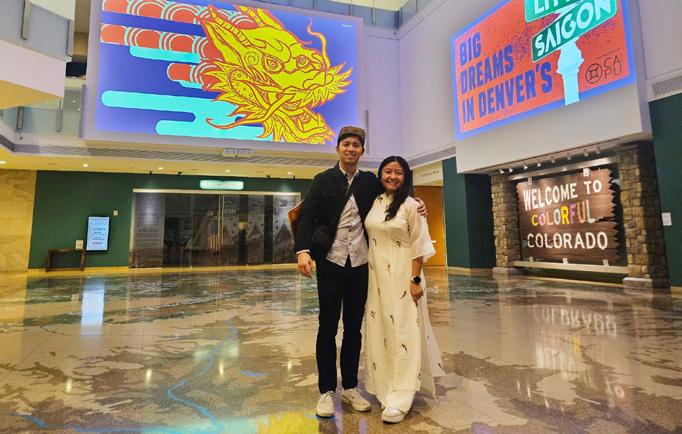
Big Dreams in Denver’s Little Saigon exhibit at History Colorado
Mongolia Town
Organization: Mongolian Community of Colorado
Nestled against the backdrop of the Rocky Mountains, Colorado’s Mongolian community has quietly built a meaningful presence spanning nearly three decades. It began simply: three Mongolian students arrived in Colorado in the 1980s, laying the foundation for what would grow into a thriving diaspora community.
Through the 1990s and 2000s, more Mongolian families and individuals were drawn to the Denver metro area by educational and professional opportunities — and perhaps by landscapes that echo the vast, open terrain of their homeland.
The relationship between Colorado and Mongolia expanded significantly as Colorado became an early supporter of Mongolia’s democratic transition, forging a bond grounded in shared values of

freedom and self-determination. Over 30 years, that partnership has grown across multiple dimensions. Educational exchanges through School of Mines, CU Denver and Colorado State University have brought generations of Mongolian students to Colorado, while mining industry partnerships have created lasting professional and economic ties between the two places. At the civic level, Denver and Mongolia’s capital, Ulaanbaatar, have formalized this relationship through a sister city designation — a milestone that continues to strengthen cultural and diplomatic connections. 2026 is proudly celebrating the 25th anniversary of this sister city relationship.
Today, Colorado’s Mongolian community represents professionals, students,
Pakistan Pavilion
The Pakistani American community in Colorado is a dynamic and steadily expanding diaspora grounded in cultural pride, resilience, and a strong dedication to building and uplifting community. While initial waves of Pakistani immigrants arrived in the US in the late 20th century as students, professionals, and entrepreneurs, the community in Colorado has grown substantially over the past twenty years.
Today, Pakistani Americans in the Denver area and across Colorado make meaningful contributions to the state’s social, cultural, and economic fabric. From healthcare and education to entrepreneurship, technology,
At the Pakistan Pavilion, experience a rich and immersive introduction to Pakistani culture through traditional music, vibrant cultural displays, freshly brewed chai, traditional desserts, and Urdu calligraphy. From henna art and truck art–inspired visuals to fashion, storytelling, fun facts , history tidbits and community engagement, the pavilion offers a welcoming space to learn, connect, and celebrate the essence of Pakistan.
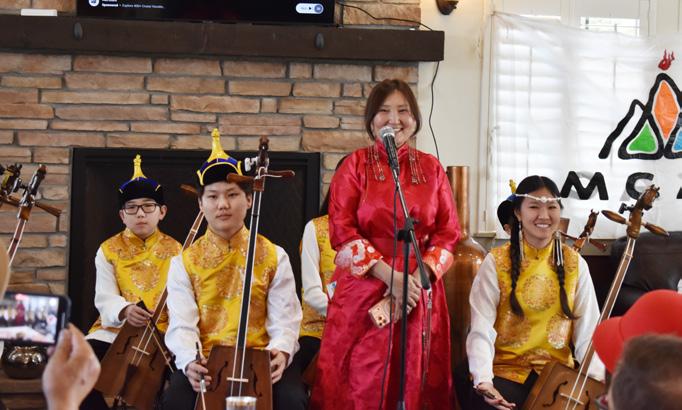
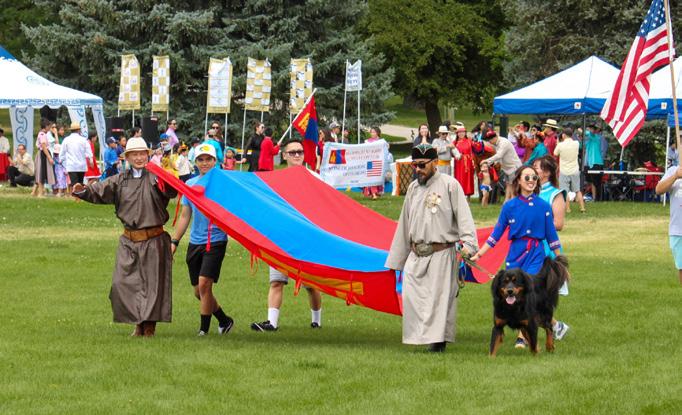
artists, and entrepreneurs contributing meaningfully to the state’s cultural fabric. Their presence at the 2026 AAPI Culture Fest x Night Market as Mongolia Town is a proud marker of how far the community has come in its growth.
Organization: Pakistani American Community of Colorado
and public service, the community remains actively engaged in fostering a diverse and inclusive society.
Over the years, organizations like the Pakistani American Community of Colorado (PACC) have played a vital role in strengthening community ties, preserving cultural heritage, and encouraging civic participation. Through events such as Eid festivals, Chaand Raat (night before Eid) celebrations, Pakistan Independence Day gatherings, cultural showcases and various family centered activities, the community continues to cultivate inclusive spaces that honor tradition while fostering
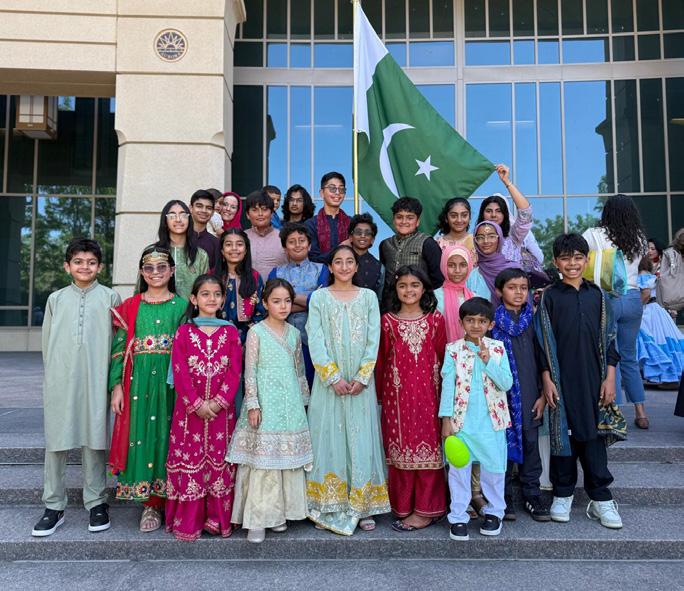
cross-cultural connection.
Pakistani-owned businesses, restaurants, and creative ventures have further enriched Colorado’s multicultural landscape, bringing traditional cuisine such as biryani, nihari, gulab jamun, truck art, henna art ,qawwali music, traditional clothes and jewelry to broader audiences. The community is also engaged in interfaith dialogue, nonprofit initiatives, and youth leadership, strengthening both cultural identity and collective impact.
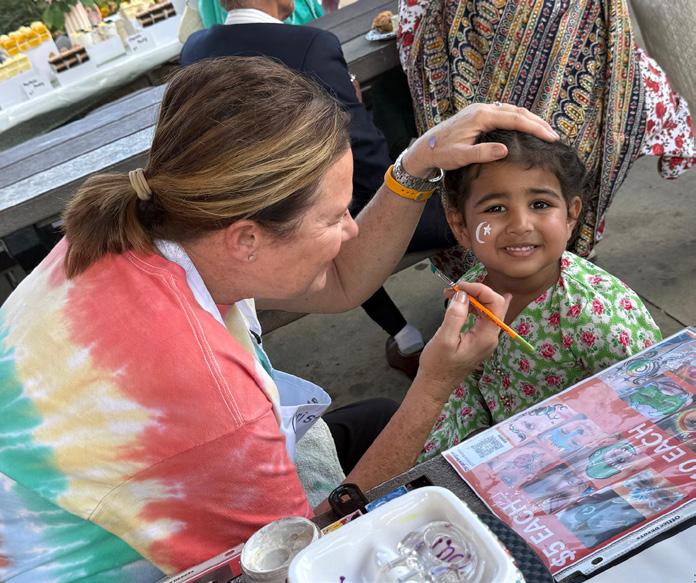
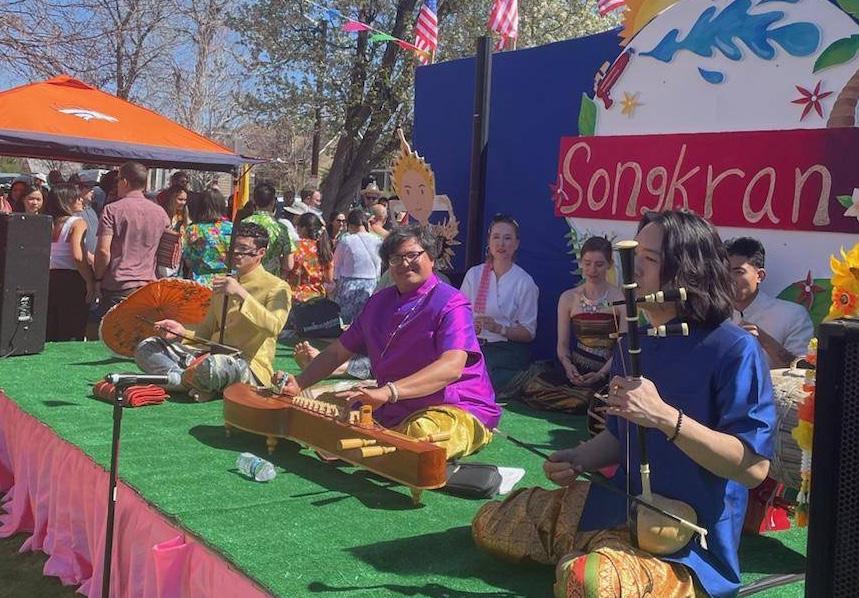
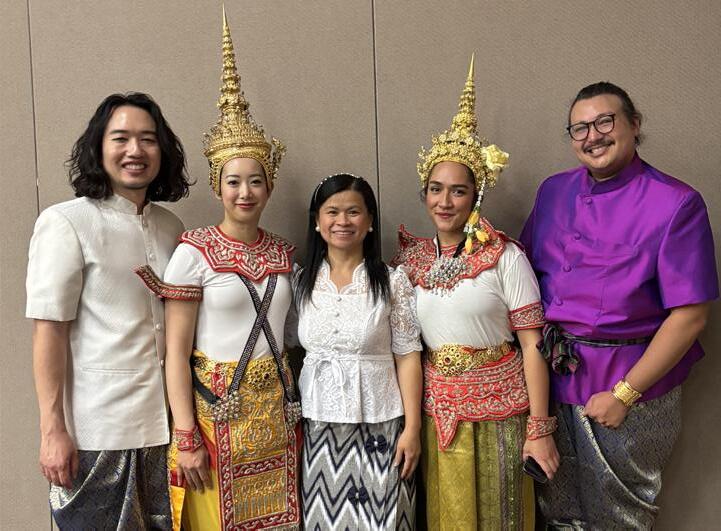
Sala Thai
Organization: Thai Cultural Connection
The “Sala Thai” hub will feature a hands-on interactive display of some of the Thai classical instruments and dance objects that are used for celebrations and festivities in Denver’s Thai community, as well as stations where you can try your hand at creating a variety of traditional Thai crafts. Come experience Thai arts and culture, try out the instruments yourself, and learn more about the Thai community from some of our local community members!
Thai Cultural Connection is a Denver nonprofit organization that aims to foster Thai cultural expression and community collaboration across the Rocky Mountain region. Since its inception in the early 2000s by Thai community leader Piangjai “Eed” Cefkin, the Thai Cultural Connection has worked closely with the Thai Harmony Traditional Arts Ensemble and Thai Language and Culture School at Wat Buddhawararam Denver to facilitate the education of Thai traditional performing arts for members of Colorado’s Thai diaspora community and the broader Denver metropolitan community.
Tibet Village
Despite its small size in comparison to the larger Thai communities along the United States’ East and West coasts, Denver’s Thai community has immense historical significance.
The US’s very first Thai restaurant, Chada Thai, was opened in Denver in 1958 and the local Thai Buddhist temple, Wat Buddhawararam, in 1976 was the fifth Thai Buddhist temple to be established in the US, and the only to remain at its original location. This year, 2026, the Denver’s Thai community is celebrating the 50th anniversary of the establishment of the Wat Buddhawararam temple.
Organization: Tibetan Association of Colorado
Founded in 1997, the Tibetan Association of Colorado (TAC) is a 501c3 nonprofit dedicated to preserving Tibetan culture while fostering unity across diverse communities.
Rooted in values of compassion, resilience, and cultural pride, TAC serves as a vital hub for Tibetans living in Colorado and a bridge connecting eastern and western traditions.
Colorado is now home to more than 500 Tibetans, many of whom were drawn to the region by its striking resemblance to Tibet’s landscape mountains, high altitude, and expansive skies.
The community includes families who have lived in Colorado for over 30 years, representing generations who have built their lives while maintaining strong cultural and spiritual ties to Tibet.
Guided by the teachings of His Holiness The 14th Dalai Lama, the Tibetan community places a strong emphasis on compassion, kindness, and nonviolence.
These values are reflected in daily life and
community efforts, shaping how members support one another and engage with the broader Colorado community.
TAC’s mission centers on cultural preservation, community building, and maintaining Tibetan American identity. Through events such as Losar (Tibetan New Year), traditional performances, and educational outreach, TAC actively shares Tibetan language, arts, and traditions with both younger generations and the broader public.
Beyond cultural celebration, TAC fosters mutual understanding by creating spaces for connection across backgrounds and beliefs. Colorado’s welcoming spirit has helped the Tibetan community thrive, while TAC continues to strengthen these relationships through collaboration and service.
Through its ongoing efforts, TAC ensures that Tibetan heritage remains vibrant honoring the past while building meaningful connections for future generations.
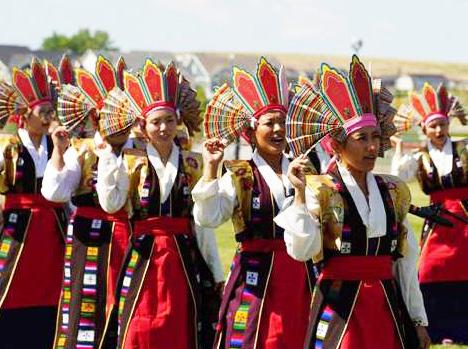
Celebrating Songkran Festival (Thai New Year) at Wat Buddhawararam Denver
Thai Harmony Traditional Arts Ensemble
The Village Behind the Festival
Dear Friends, Partners, and Supporters,
The AAPI Culture Fest x Civic Center NIGHT MARKET would not have been possible without the dedication, collaboration, and generosity of an extraordinary community of leaders, volunteers, artists, sponsors, and partners.
We extend a heartfelt gratitude to our planning team:
• Angela Han for leading marketing and reaching thousands across our community;
• Cameron Green for bringing Artist Alley to life and creating a meaningful
platform for local AAPI artists;
• Taemy Kim-Mander and Gigi de Gala for coordinating our 16 community hubs with care and cultural intention;
• Jory Zhang, our Founder and Executive Producer, for guiding the vision and holding every moving piece together;
• Summer Hubka-Lee for rallying our incredible volunteers; and
• Alana Pettaway for curating the spectacular performances that inspired and moved us all.
A special thank you to our emcee, Tak
Landrock, for bringing energy and heart to every moment to every moment on the Celebration Stage.
We are also deeply grateful to our sponsors and partners whose support made this vision a reality: Denver Human Rights & Community Partnerships (HRCP), the Denver Mayor’s Office, Asian Avenue Magazine, Civic Center Conservancy, Asian Roundtable of Colorado, and Bonfire Event Co.

x
AAPI Culture Fest
Civic Center NIGHT MARKET Team