Vol.32 | Issue 4 | October–December 2026
THE MAGAZINE FOR SECURITY PROFESSIONALS
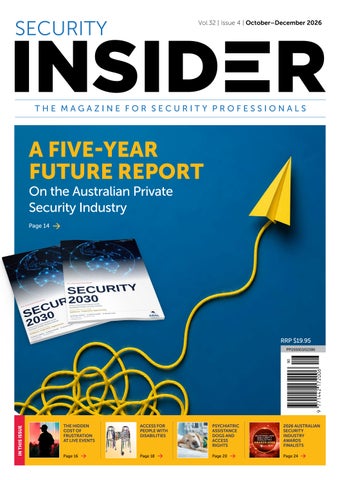
A FIVE-YEAR FUTURE REPORT On the Australian Private Security Industry Page 14
RRP $19.95
IN THIS ISSUE
90 18
PP255003/02390
THE HIDDEN COST OF FRUSTRATION AT LIVE EVENTS
ACCESS FOR PEOPLE WITH DISABILITIES
Page 16
Page 18
PSYCHIATRIC ASSISTANCE DOGS AND ACCESS RIGHTS Page 20
ASIAL PRESENTS
AUSTRALIAN SECURIT Y INDUSTRY
AWA R D S 2 0 2 6
2026 AUSTRALIAN SECURITY INDUSTRY AWARDS FINALISTS Page 24
A DV E RT ORIAL
How super helps build a better future for all Australians Australia’s superannuation system is one of the best in the world1. Superannuation is built on three principles: everyone should have access to it, contribute regularly to it and keep it for retirement. These three things work together to give Australian retirees extra income and financial security beyond the Government Age Pension. As Australia’s largest super fund2, AustralianSuper supports these goals by aiming to help Australians reach their best financial position in retirement.
Why super is important The population is aging, and it’s predicted that the number of Australians over the age of 65 will double 1 3. Superannuation helps reduce over the next 40 years the likelihood of younger generations needing to pay higher taxes to fund increased government spending on the Age Pension. Australians are living longer and healthier lives, so it’s vital that super continues to deliver strong, long-term returns for the growing number of retirees.
The super guarantee (SG) explained The SG is the percentage of your salary your employer must pay into your chosen super fund. In Australia, it’s compulsory for employers to pay super to eligible employees. If you’re an employee, and aged 18 or over then you’re generally eligible to receive SG super contributions. When the SG was introduced in 1992, the rate was only 3%, and the plan was to gradually increase this amount. As of 1 July this year, employers now must contribute a minimum of 12% of employees’ wages into super. At this stage there’s no plan to increase this percentage.
How Australian invests for mem
As Australia’s largest super fund and one of the top 20 largest pension f investor both in Australia and ove globally , AustralianSuper is an active How super helps the country Super doesn’t help individuals save for their This breadth of investments means thatjust members can benefit from grow retirement, it helps Australia too. The aim is to make it opportunities from across the world across different types less likely and that future taxpayers will face higher taxes of assets to support the Age Pension. The system is designed to including:
help people have better retirement outcomes, and has now grown to hold more than $4 trillion in retirement Credit Listed Shares savings. This pool of funds is the fourth largest in the Super is your money, growing over time world, despite Australia only being ranked 56th providing in Credit investments involve finance f means while owning part of companies SuperOwning is a way listed to saveshares for retirement you’re population size5agreed . Super also supports the Australian period in exchange for a return. thatThe areregular listed payments on a public exchange, like the Australian working. paid into a super economy by investing in things likehas infrastructure, AustralianSuper a specialised team that in Stock AustralianSuper account are Exchange invested by(ASX). your super fund and growinvests in housing, renewable energy and businesses. private credit opportunities directly in the pro Australian and international companies. over time. Any money earned increases the balance in and infrastructure sectors. your super and this continues to be invested by your fund. Listed This process is generally known as compounding, shares make moneywhich in two ways – means your money earns money, that price moneyand when Fixed Interest through an increase in theand share earnscompanies more, and sopay on. dividends. To increase your retirement savings you also have the option to add to your super Fixed interest investments provide income fro from either your before-tax or after-tax pay. Even interest payments. Fixed interest investments Private equity small amounts you add to your super can make a big bonds and debt issued by governments and 4 difference over time . The earlier you start, the more companies. time your money has involves to grow. investing in companies that are Private equity
Scan to see how super helps all Australians
not listed on a public exchange like the ASX.
Cash
Sponsored by AustralianSuper Pty Ltd, ABN 94in 006 457 987, AFSL 233788, Trustee of AustralianSuper ABN 65 714 394 898. AustralianSuper co-invests private equity along with Any general advice provided in thisequity article is provided under the AFSL held by AustralianSuper, it does not take into account your personal objectives, specialised private managers. financial situation or needs. Before making a decision, consider if the information is right for you and refer to the relevant Product Disclosure Cash investments arethat short-term Statement, available at australiansuper.com/PDS or by calling 1300 300 273. A Target Market Determination (TMD) is a document outlines the money mark target market a product has been designed for. Find the TMDs at australiansuper.com/TMD. instruments. These are issued by banks, like th Investment returns aren’t guaranteed. Past performance isn’t a reliable indicator of future returns. NAB and Westpac, governments and compan 1. 2024 Mercer CFA Institute Global Pension Index ranked Australia’s superannuation system 6th out of 48 retirement systems. Infrastructure investments are assets provide 2. Source: APRA Quarterly fund-level superannuation statisticsthat June 2025. Released September 2025. 3. Treasury, 2023 Intergenerational Report. These include bridges, roads, essential public services. 4. Before adding to your super, consider your financial circumstances, eligibility, contribution caps that may apply, tax issues and when your super can airports and power plants. AustralianSuper’s portfolio AustralianSuper has investments throughout t be accessed. We recommend you consider seeking financial advice. includes large-scale infrastructure investments in at a Glance 2023: OECD 5. Organisation for Economic Cooperation and Development (OECD), Pensions andThis G20 Indicators, OECD Publishing, Paris, world. helps support Australia’s economy p222, (https://doi.org/10.1787/678055dd-en), and World Development Indicators database, World Bank, 1 July 2023. Australia and international markets
Unlisted infrastructure
Global diversification
2 SEC UR IT Y IN S IDE R | OCTOBER–DECEM BER 2026
members benefit from growth in local and international markets. Importantly, this global approach can help reduce investment risk thro diversification.
Contents Vol.32 | Issue 4 | October–December 2026
WHEN THE SHIFT ENDS BUT THE WORK DOESN’T: UNDERSTANDING HANDOVER AND ADDITIONAL WORKING TIME
30 ASIAL PRESENTS
AUSTRALIAN SECURIT Y INDUSTRY
AWA R D S 2 0 2 6
14 SECURITY 2030 - A FIVEYEAR FUTURE REPORT ON THE AUSTRALIAN PRIVATE SECURITY INDUSTRY
24
16 THE HIDDEN COST OF FRUSTRATION AT LIVE EVENTS
2026 AUSTRALIAN SECURITY INDUSTRY AWARDS FINALISTS
04 PRESIDENT’S MESSAGE
25 SECURITY EXHIBITION & CONFERENCE 2026
05 INDUSTRY NEWS
28 SECURITY CAREERS CASE STUDIES
14 SECURITY 2030: A FIVE-YEAR FUTURE REPORT ON THE AUSTRALIAN PRIVATE SECURITY INDUSTRY
30 WHEN THE SHIFT ENDS BUT THE WORK DOESN’T: UNDERSTANDING HANDOVER AND ADDITIONAL WORKING TIME
16 THE HIDDEN COST OF FRUSTRATION AT LIVE EVENTS
32 WELCOME TO OUR NEW MEMBERS
18 IT IS FRUSTRATING WHEN YOU HAVE A DISABILITY AND THEY DON’T LET YOU IN 20 PSYCHIATRIC ASSISTANCE DOGS AND ACCESS RIGHTS
33 ASIAL MEMBER RECOGNITION PROGRAM RECIPIENTS 34 ASIAL GRADED SECURITY MONITORING CENTRES
24 2026 AUSTRALIAN SECURITY INDUSTRY AWARDS FINALISTS ASIAL STRATEGIC PARTNERS
SEC URI T Y I N SI DER | O C TO BER –DEC EMBE R 2 02 6 3
Editorial and Advertising Security Insider is published by The Australian Security Industry Association Limited
President’s Message Dear Members, In September, our industry came together in Sydney for the 2026 Security Exhibition & Conference and ASIAL Gala Dinner. For me, these events are always an important opportunity to step away from the day-to-day and spend time speaking directly with ASIAL members, industry colleagues, and those helping shape the future of private security in Australia. Walking through the exhibition floor provided a clear reminder of just how quickly our industry continues to advance. Artificial intelligence, video analytics, access control, integrated security platforms and increasingly sophisticated monitoring solutions are no longer simply discussions about what may be possible in the future. They are technologies being deployed today to solve real security challenges. However, what stood out was the people behind that technology. The conversations taking place across the exhibition floor, conference sessions and networking events demonstrated the depth of knowledge and experience that exists within our industry. Technology will undoubtedly continue to change how security is delivered, but our ability to apply it effectively will continue to depend on skilled and professional people. That theme carried through to our Gala Dinner, where we celebrated an important milestone; the 40th anniversary of the Security Exhibition & Conference. Looking back over four decades provides some perspective on just how much our industry has changed. The security environment of 2026 is vastly different from that of 1986. Technology has transformed, risks have become more complex, client expectations have increased and the role performed by private security has expanded considerably. Yet some things have not changed. Trust, professionalism and the quality of our people remain fundamental to what we do.
PO Box 1338 Crows Nest, NSW 1585 Tel: 02 8425 4300 | Fax: 02 8425 4343 Email: communications@asial.com.au Web: www.asial.com.au Publisher
As I reflected on the night, the milestone 40th anniversary of the Security Exhibition & Conference and ASIAL Gala Dinner, is ultimately the story of the people and businesses that have built our industry. It is also a reminder that we have a responsibility to those who will take it forward over the next 40 years. For me, that means continuing to raise the bar. Meeting minimum requirements should never be the measure of success for a professional industry. We should continue investing in our people, improving training, embracing appropriate technology, strengthening standards and demonstrating the value that professional security providers deliver to their clients and the wider community. ASIAL continues to have an important role in supporting that objective through advocacy, standards, education and engagement with government, regulators and other stakeholders. But the reputation of our industry is ultimately built through the actions of members every day. I would like to thank everyone who attended, exhibited, presented, sponsored or contributed to this year’s Security Exhibition & Conference and Gala Dinner. Your participation is what makes these events successful and, importantly, creates opportunities for our industry to come together, exchange ideas and learn from one another. After 40 years, we have much to be proud of. But perhaps the most exciting part is considering what comes next. Our industry will continue to change. Our challenge, and our opportunity, is to ensure we continue to change with it.
Editor Bryan de Caires Editorial Enquiries communications@asial.com.au Advertising Marketing Communications advertising@asial.com.au Graphic Design + Digital Mitch Morgan Design 0402 749 312 mitch@mitchmorgandesign.com www.mitchmorgandesign.com Editorial Contributors David Duncan, Chelsea Deeley, Psychiatric Assistance Dogs Program team, Maria Rigas Print + Distribution CMYKHub Pty Ltd Published quarterly Estimated readership of 10,000 Views expressed in Security Insider do not necessarily reflect the opinion of ASIAL. Advertising does not imply endorsement by ASIAL, unless otherwise stated with permission. All contributions are welcomed, though the publisher reserves the right to decline to publish or to edit for style, grammar, length and legal reasons. Press Releases can be emailed to: communications@asial.com.au. Internet references in articles, stories and advertising were correct at the time of printing. ASIAL does not accept responsibility for leading views. Copyright©2026 (ASIAL) All rights reserved. Reproduction of Security Insider magazine without permission is strictly prohibited. Security Insider is free to ASIAL members. For non members, it is available via paid subscription. Full details can be found at: www.asial.com.au/securityinsider
NEXT ISSUE: JANUARY - MARCH 2027 Printed ISSN 1442-1720
Dr John Gellel President, ASIAL
4 SEC U R IT Y IN S IDE R | OCTOBER–DECEM BER 2026
Digital ISSN 2207-8282
IN DUS T RY NE WS
2026 Security Exhibition & Conference
ASIAL PRESENTS
AUSTRALIAN SECURITY INDUSTRY
THANK YOU TO ALL ATTENDEES!
AWA R D S 2 0 2 6
2026 Australian Security Industry Awards Finalists Announced! The 2026 ASIAL Awards for Excellence and Outstanding Security Performance Awards (OSPAs) finalists are now available on our website! The security industry will come together on Wednesday 28th October 2026 at the Park Hyatt Melbourne to celebrate excellence and innovation. Award winners will be announced at the prestigious 2026 #SecurityAwards ceremony and dinner, hosted by highly acclaimed entertainer Tim Stackpool. Organised by ASIAL, the 30th Australian Security Industry Awards for Excellence will be joined by the 11th Outstanding Security Performance Awards (the OSPAs) and 15th Australian Security Medals Awards to celebrate excellence and achievement in our industry. Join us for an unforgettable evening celebrating excellence, recognising industry achievements and connecting with security leaders from across Australia. Tickets includes; pre-dinner drinks event, a three-course meal, premium wines and beers, an engaging MC and live entertainment.
Thank you to all ASIAL Members who attended the 2026 Security Exhibition & Conference, for making this year’s event a success. Meeting our incredible members, whether at the ASIAL Exhibition stand, the ASIAL Security Conference floor, or at the entertaining Gala Dinner, made the 40th anniversary a standout year! We extend our gratitude to our valued sponsors. Thank you to Lead Conference Sponsor, ADT Security, Lead Gala Dinner Sponsor, MSS Security, and Gala Dinner Entertainment Sponsor, Chubb Fire & Security, for all your support.
SAVE THE DATES: Security Exhibition: August 25-27, 2027 ASIAL Security Conference: August 25-26, 2027 Security Gala Dinner: August 26, 2027 Sponsored by
Scan to read more
Single Ticket: $230 including GST Table of 10: $2,070 including GST, saving 10%
Scan to book your tickets
UNDERSTANDING AWARD PERCENTAGE ADJUSTMENTS Why Published Allowance Increase May Not Mirror the Annual Wage Review Percentage Following implementation of the recent 4.75% Annual Wage Review increase determined by the Fair Work Commission (the Commission) effective 1 July 2026, we have received member enquiries concerning apparent discrepancies between the announced wage increase percentage and percentage adjustments appearing against certain allowances contained within the Security Services Industry Award (the Award). A recent example concerns the Relieving Officer Allowance under clause 17.6 of the Award, where the published adjustment percentage of 4.18% has prompted understandable questions regarding its relationship to the Commission’s broader 4.75% wage increase determination. It is important that employers understand that these figures do not always operate interchangeably. Scan to In Member Bulletin 136, we offer context and read more information regarding award percentage adjustments.
Protective Security Procurement Practices Study The Australian Strategic Policy Institute (ASPI) has been engaged by ASIAL to deliver an evidence-based assessment of whether current protective security procurement practices are supporting Australia’s national security objectives or inadvertently constraining industry capability, workforce sustainability and market resilience. The anticipated publication date is November 2026. SEC URI T Y I N SI DER | O C TO BER –DEC EMBE R 2 02 6 5
INDUST RY NE W S
ASIAL WEBINAR
Understanding the New Video Surveillance Systems (VSS) Standard (IEC 62676-4:2025)
SECURITY 2030 RESEARCH REPORT Security 2030: A Five-Year Future Report on the Australian Security Industry was officially launched at the ASIAL Security Conference. The report provides strategic insights into the future landscape of the Australian security sector, supporting informed decision-making by industry stakeholders, government agencies, and ASIAL members.
Scan to access the report and the Executive Summary
The 2025 update to IEC 62676-4 represents one of the most significant changes to VSS system design in over a decade. In this webinar, internationally recognised CCTV expert Vlado Damjanovski explains what has changed, why the long-standing DORI model has been revised, and what the new pixel density standards mean for consultants, integrators, end users and anyone specifying or designing CCTV systems. Learn about the introduction of the new validation and scrutiny performance levels, the increased pixel density requirements for reliable facial recognition, and how the updated standard better reflects today’s AIenabled video analytics and Automatic Face Recognition technologies. Whether you design, specify, install, or manage VSS, this webinar will help you understand how the new IEC 62676,4 (2025) standard will influence future CCTV performance expectations and best practice.
Scan to view the FREE webinar
CTP AND WORKERS COMPENSATION
Understanding the Difference
Facial Recognition Technology and Privacy The Office of the Australian Information Commissioner has issued updated guidelines for organisation considering using facial recognition technology in commercial or retail settings.
Scan to read more
6 SEC UR IT Y IN S IDE R | OCTOBE R– DECEM BER 2026
A recent member enquiry highlighted an issue that frequently causes confusion for employers – when does an injured worker fall under the workers compensation scheme, and when might a Compulsory Third Party (CTP) motor accident claim apply? While both schemes provide compensation for injuries, they operate very differently and serve separate yet distinct purposes. In Member Bulletin 137, we offer context and information regarding CTP and Workers Compensation.
OUR OURSPECIALITY SPECIALITY
RETAIL RETAILSECURITY. SECURITY. REAL REAL EXPERTISE. EXPERTISE. OUR SPECIALITY REAL REALRESULTS. RESULTS. RETAIL SECURITY. REAL EXPERTISE. REAL RESULTS.
Protect Protect your your people, people, stock stock and and reputation reputation through through our our highly highly trained trained security security officers. officers.
Protect your people, stock and reputation through our highly trained security officers.
DISCREET DISCREETSECURITY. SECURITY.PREMIUM PREMIUMSERVICE. SERVICE. HIGH-VISIBILITY HIGH-VISIBILITY GUARDING GUARDING
LUXURY LUXURY GUARDS GUARDS
AA visible, visible, professional professional presence presence
Professional Professional suited suited guards guards provide provide discreet discreet protection protection forfor luxury luxury boutiques boutiques and and premium premium retail, retail, preserving preserving a welcoming a welcoming customer customer experience. experience. LUXURY GUARDS
DISCREET SECURITY. PREMIUM that that deters deters theft, theft, reassures reassuresSERVICE.
NSW Master Licence No. 000 106 961
customers customers and and supports supports your your team. team.
HIGH-VISIBILITY GUARDING
A visible, professional presence that deters theft, reassures customers and supports your COVERT COVERT && PLAINCLOTHES PLAINCLOTHES OPERATIVES OPERATIVES team.
Professional suited guards provide discreet protection for luxury boutiques and premium retail, INVESTIGATIONS INVESTIGATIONS && FOLLOW-UP FOLLOW-UP preserving a welcoming customer Incident Incident investigation, investigation, police police experience. liaison liaison and and case case support support toto help help you you respond respond with with confidence. confidence.
Discreet Discreet observation, observation, offender offender identification identification and and evidence evidence gathering gathering toto support support informed informed action. action. COVERT & PLAINCLOTHES
INVESTIGATIONS & FOLLOW-UP
OPERATIVES
Discreet observation, offender identification and evidence gathering to support informed action. • •Real-time Real-time incident incident reporting reporting • •Daily Daily and and weekly weekly statistical statistical summaries summaries • •Hotspot Hotspot identification identification and and offender offender trends trends • •Actionable Actionable recommendations recommendations • •Custom Custom dashboards dashboards and and KPI KPI tracking tracking
Incident investigation, police liaison and case support to help you respond with confidence.
SMART SMARTREPORTING. REPORTING. CLEAR CLEARINSIGHT. INSIGHT.
REAL REALRESULTS. RESULTS.
SMART REPORTING. CLEAR INSIGHT.
REAL RESULTS.
• Real-time incident reporting • Daily and weekly statistical summaries • Hotspot identification and offender trends • Actionable recommendations • Custom dashboards and KPI tracking
• •Millions Millions saved saved • •Thousands Thousands ofof apprehensions apprehensions • •Organised Organised retail retail crime crime smashed smashed • •Police Police rapport rapport • •400+ 400+ interactions interactions weekly weekly • •Real-time Real-time reporting reporting • Millions saved • Thousands of apprehensions • Organised retail crime smashed • Police rapport • 400+ interactions weekly • Real-time reporting
NSW NSW Master Master Licence Licence No.No. 000 000 106 106 961 961
INDUST RY NE W S
Congratulations Espy Alarms Australia & Investigation Systems Pty Ltd on Platinum Membership!
Terry Phuoc, Espy Alarms Australia
ASIAL is delighted to award Espy Alarms Australia & Investigation Systems Pty Ltd Platinum Member status, in recognition of 25 years of continuous membership of the Association! Attaining Platinum Member status is well-deserved recognition of your ongoing commitment to the security industry and to ASIAL. Thank you for your support and for being a valued member of our community!
Terry Flanders, Managing Director, Investigation Systems Pty Ltd presented by John Fleming, General Manager, ASIAL
Western Australia
LIVE FACIAL RECOGNITION TECHNOLOGY TRIAL Security Monitoring Centre Information Ownership and Data Transfer Guidelines 2026 The transfer of alarm and CCTV lines between stations is a critical process that involves meticulous coordination, communication, and data handling. This paper addresses the ethical considerations that must be considered during such transfers to ensure that clients are not negatively impacted. It also outlines a code of conduct for members of the Australian Security Industry Association Limited (ASIAL) to uphold the highest standards of professionalism and integrity.
Scan to read more in the Security Monitoring Centre Information Ownership and Data Transfer Guidelines
8 SEC UR IT Y IN S IDE R | OCTOBE R– DECEM BER 2026
The WA Government are trialling Live Facial Recognition (LFR) technology to help identify and locate identified persons of interest and to protect vulnerable people. Live Facial Recognition (LFR) uses cameras to detect faces in real time. When someone walks into the camera’s view, in a defined area, the system detects their face, creates a biometric template based on their features and checks this against a list of people police are looking for.
Scan to read the results of the LFR Technology trials
INDUST RY NE W S
A Conversation Could Change a Life
R U OK? Important New Australian and New Zealand Standards for Video Surveillance Systems ASIAL is pleased to announce the recent publication of two important Australian and New Zealand Standards for video surveillance systems: •
•
AS/NZS 62676.6, Video surveillance systems for use in security applications, Part 6: Performance testing and grading of real-time intelligent video content analysis devices and systems AS/NZS 62676.4, Video surveillance systems for use in security applications, Part 4: Application guidelines
These Standards will provide valuable guidance to support the performance, reliability and effective application of video surveillance technology across the security industry. Congratulations and sincere thanks to everyone who contributed their time, expertise and commitment to achieving this important outcome. Special recognition goes to ASIAL General Manager John Fleming, whose leadership and dedication were instrumental throughout the process. This achievement reflects the vital role industry collaboration plays in strengthening professional standards and supporting better security outcomes for the Australian community.
R U OK? Day is a national day of action, reminding us to check in with those around us. On Thursday 10 September 2026, Australians were encouraged to start meaningful conversations that could make a real difference to someone who may be struggling. Life’s ups and downs happen to all of us. You don’t have to be an expert to have a meaningful R U OK? conversation. Listening and giving someone your time might be just what they need to help them through. Use these four simple steps to start a conversation that could change a life: 1. 2. 3. 4.
Ask R U OK? Listen Encourage action Check in
Scan to find out more rescouces
ASIAL’s Continued Engagement with Policy Makers ASIAL Vice President Rachaell Saunders and CEO Bryan de Caires recently attended a meeting at Parliament House to discuss ways to improve the security industry in Victoria. The meeting provided a valuable opportunity to highlight key industry priorities, share the experiences of security businesses and professionals, and reinforce the importance of effective regulation, workforce development and consistent professional standards. ASIAL will continue to engage with government and industry stakeholders to advocate for practical reforms that support a stronger, more professional and sustainable security industry.
10 SEC U R IT Y IN S IDE R | OCTOBE R– DECEM BER 2026
IN DUS T RY NE WS
Statewide Security Monitoring
INTRODUCING OUR
4G SOS WATCH Personal safety at the touch of a button
Recent Fair Work System Reforms What Security Industry Employers Need to Know Recent legislative amendments introduced under the Federal Government’s workplace relations reform agenda between 2023 and 2025, together with evolving case management practices adopted by the Fair Work Commission (the Commission), continue to reshape how workplace disputes are managed in Australia. While many of these reforms apply across all industries, employers operating within the private security sector should be aware that recent procedural changes are likely to increase the importance of early compliance, strong record keeping and careful workforce management when responding to employee disputes. In Member Bulletin 135, we offer context and information regarding what security industry employers need to know about recent fair work system reforms.
Scan to read more
LOOKING FOR A WHOLESALE ALARM MONITORING ALTERNATIVE? Your business. Your customers. Our focus.
BUREAU ONLY
Monitoring Centre
PERTH-BASED
COMPETITIVE PRICING
Wholesale Pricing
BUREAU FOCUSED
Operators
We don’t compete with our customers
GRADE A1
24/7/365
Monitoring Centre
Monitoring
IDEAL FOR: SENIORS
NDIS PARTICIPANTS
AT-RISK INDIVIDUALS
CHILDREN
LONE WORKERS
FEATURES: ONE TOUCH SOS ALARM
FALL DETECTION
TWO-WAY VOICE COMMUNICATION
4G 4GCONNECTIVITY
GPS LOCATION TRACKING
DIRECT MONITORING CENTRE RESPONSE
Partner with Western Australia’s Wholesale Monitoring Specialists Reliable. Professional. Bureau focused. We help you protect what matters most.
swsm.net.au
08 6424 8336
SEC URI T Y I N SI DER | O C TO BER –DEC EMBE R 2 02 6 11
Explore What’s Possible with HID Mobile Access Where Will Mobile Access Take You?
Turn your smartphone into a digital key. From the car park to the meeting room, HID Mobile Access lets you move through your day with a simple tap or wave—using the device that rarely leaves your hand. Unlock doors, check in, call the lift, access workstations, and more. It’s secure, seamless, and ready for wherever work takes you.
Powering Trusted Identities
|
Discover
what’s possible
Learn more at hidglobal.com/open-more
©2026 HID Global Corporation/ASSA ABLOY AB. All rights reserved. Part of ASSA ABLOY
A DV E RTO RIAL
BEYOND SECURITY Why Choice Is Emerging as the Next Evolution in Access Control For decades, access control has been defined by a relatively simple objective: ensuring the right people can access the right places at the right time. While that remains fundamental, the way people expect to interact with buildings is changing. Across the commercial property sector, access is increasingly being viewed not only as a security function, but as part of the broader workplace experience. This shift reflects a wider trend in workplace technology. Occupants have become accustomed to digital-first experiences in many aspects of their daily lives, from payments and travel to communications and identity verification. Increasingly, they expect similar convenience when interacting with the buildings where they work. The experience of Melbourne’s 101 Collins Street demonstrates how these expectations are influencing access strategies. Rather than simply replacing one credential technology with another, the project introduced a frictionless and connected approach for users to securely access 101 Collins, lifts and lockers using credentials stored in a smartphone or smartwatch. What makes this approach noteworthy is that it expands choice rather than eliminating it. For years, access control deployments have typically standardised on a single credential format. Today, many organisations are recognising that different users have different preferences and operational requirements. While physical cards remain an important and effective credential or visual identity across countless environments, mobile credentials offer an alternative that aligns with increasingly digital workplace behaviours. This evolution mirrors a broader trend occurring across the security industry. End users are seeking solutions that combine strong security with flexibility, allowing organisations to accommodate a wider range of user needs without compromising protection or operational control. For building owners and operators, the benefits extend beyond convenience. Digital credential management can help streamline onboarding and credential administration, while giving organisations greater visibility into credential lifecycles and access permissions. Equally important, it enables security teams to introduce new capabilities without fundamentally changing the way occupants interact with the building.
The strong adoption achieved at 101 Collins suggests that when organisations offer users greater flexibility in how they access a workplace, many are willing to embrace it. For security professionals, this may be one of the most important shifts shaping the future of access control. Historically, innovation focused on making credentials more secure. While that objective remains critical, attention is increasingly turning towards how credentials fit into the broader user experience. The future of access control is unlikely to be defined by a single credential technology. Instead, it may be defined by the ability to provide secure, intuitive and flexible options that accommodate the diverse needs of modern workplaces. In that sense, the next chapter of access control may not be about replacing cards at all. It may be about giving organisations and users the freedom to choose the credential experience that works best for them.
SEC URI T Y I N SI DER | O C TO BER –DEC EMBE R 2 02 6 13
SEC URIT Y F E AT URE
SECURITY 2030 A defining period for Australia’s private security industry
Australia’s private security industry is entering a period of significant growth, transformation and increasing national importance. Yet its future capacity cannot be measured by market expansion alone. The industry must also address structural challenges involving workforce capability, technology governance, regulation, procurement and professional recognition. Security 2030: A Five-Year Future Report on the Australian Private Security Industry, commissioned by the Australian Security Industry Association Limited and undertaken by the Security and Intelligence Research Group at Edith Cowan University, examines these issues. Led by Dr Nicola Lockhart and Dr Warren Doudle, the research provides a comprehensive, jurisdiction-aware and evidence-based analysis of the industry’s current position and likely trajectory to 2030.
Building an evidence base for the future Security 2030 was conducted in two phases. The first involved a systematic review and synthesis of academic and industry literature, establishing a 2025 baseline and considering the industry’s trajectory across five analytical domains: technology convergence and digitisation, workforce transformation and professionalisation, regulatory and standards evolution, risk landscape volatility, and customer and environmental, social and governance expectations. The second phase involved qualitative interviews with practitioners from across the security value chain. These interviews tested the literature findings against operational experience and clarified the pressures facing security providers and practitioners.
14 SEC UR IT Y IN S IDE R | OCTOBE R– DECEM BER 2026
Together, the two phases establish an evidence base that connects market data, regulatory developments and technological change with the realities experienced by the industry.
An industry of growing scale and significance The report highlights the considerable scale of Australia’s private security industry. Private security is estimated to account for 54 per cent of Australia’s national security mix, making it larger than defence and law enforcement combined. In 2025, 170,698 security personnel were individually licensed, representing growth of 15.5 per cent over six years. By 2030, the licensed workforce is projected to exceed 200,000 people. Industry revenue is also expected to increase substantially, from approximately $11.22 billion in 2025 to a projected $14.59 billion by 2030. Overall, the Australian security market is expected to continue growing at a sustained rate of approximately 6 per cent each year, with demand extending across every major service line. Growth, however, will not be uniform. Video surveillance is forecast to grow at about 8 per cent annually, monitoring services at around 6 per cent, and guarding and cash-intransit services at about 4 to 5 per cent.
S E C URIT Y FE ATU RE
This reflects an industry in which technology-enabled services are expanding rapidly, while physical security remains an essential foundation.
Nine areas shaping future demand Security 2030 identifies nine environments expected to influence demand through to the end of the decade. These include retail loss prevention and organised retail crime, healthcare, critical infrastructure, electronic security and system integration, crowded places and major events, mining and remote operations, government and defence, education and community institutions, and investigations and specialist advisory services. Across these environments, several interconnected factors are shaping demand. Rising retail theft and weapon-related incidents are increasing the need for intelligence-led loss prevention and AIenabled surveillance. Occupational violence in healthcare is strengthening demand for appropriately trained security personnel. Critical infrastructure organisations face expanding obligations under the Security of Critical Infrastructure framework and related government requirements. The continuing transition from analogue systems to internet protocol and AI-enabled platforms is also accelerating demand for surveillance, access control and systems integration expertise. At the same time, major events, including the Brisbane 2032 Olympic and Paralympic Games, will require substantial workforce planning and operational capability. Government, defence and national security projects are creating further demand for cleared practitioners, while regulatory complexity is increasing the need for professional security risk and governance advice.
Six structural findings The report’s six principal findings demonstrate that market growth alone will not resolve the industry’s underlying challenges. First, the most experienced generation of security practitioners is beginning to leave the workforce. The next generation is not yet sufficiently developed to replace that experience at the pace required by the evolving threat environment. Succession planning, professional development and knowledge transfer must therefore become strategic priorities. Second, technology will extend protection, but it will not replace human judgement. AI-enabled surveillance, cloud-based access control, virtual guarding and remote monitoring are changing how security services are delivered. However, human presence and decision-making remain essential in securitycritical situations. Third, governance frameworks are struggling to keep pace with technological and operational change. Security technology can be deployed more quickly than appropriate regulatory, ethical and professional frameworks
can be developed. Without effective governance, technological investment may create the appearance of protection without delivering genuine assurance. Fourth, current procurement settings are placing the sustainability of security services under increasing pressure. Low margins may be insufficient to support the wages, training, governance and technology clients and regulators increasingly expect. Procurement models that continue to reward the lowest price over capability and compliance risk widening the gap between expectations and sustainable service delivery. Fifth, the breadth and value of the industry remain poorly understood. Security is frequently viewed primarily through the lens of guarding, despite encompassing risk advisory, systems design, resilience, investigations, governance and converged technology. This visibility deficit affects client investment, executive engagement, workforce attraction and public recognition. Finally, the report concludes that the existing regulatory architecture requires fundamental reform. State and territory licensing remains the principal enforceable compliance mechanism, but it does not provide a sufficiently consistent national foundation for the obligations now being placed on the industry.
Overall, the Australian security market is expected to continue growing at a sustained rate of approximately 6 per cent each year, with demand extending across every major service line.
The trajectory is not fixed Security 2030 presents recommendations for government, industry bodies and security providers. Priorities include establishing a nationally consistent licensing standard, strengthening the compliance framework beyond licensing, improving enforcement, reforming procurement, developing a practitioner competency framework, expanding continuing professional development and creating guidance for responsible technology adoption. The report also calls for coordinated workforce planning for Brisbane 2032, stronger succession planning and sustained investment in the industry’s public profile. For security providers, the message is equally clear. Organisations should begin developing auditable governance evidence, investing in future leaders and articulating security investment in the language of business value and proportionate risk. The trajectory to 2030 is not fixed. It will be shaped by the decisions made by governments, clients, industry bodies and security providers in the years immediately ahead. Understanding the evidence is the first step towards making those decisions well.
Dr Nicola Lockhart
Dr Warren Doudle
Source: Security 2030, published September 2026.
Scan to download the full Security 2030 report Explore the findings, practitioner insights and recommendations in detail.
SEC URI T Y I N SI DER | O C TO BER –DEC EMBER 2 02 6 15
SEC URIT Y F E AT URE
THE HIDDEN COST OF FRUSTRATION AT LIVE EVENTS David Duncan Director of Strategic Partnerships, Parim
As summer event season gets underway, millions of people will head to festivals, concerts and sporting events around the world. Some will spend months planning their trip. Others will spend hundreds, if not thousands, of dollars on tickets, travel and accommodation. From the FIFA World Cup to sold-out stadium tours and major festivals, competition for people’s time, attention and money has never been greater. Yet when attendees talk about their experience afterwards, they rarely start with the headline act. More often than not, they talk about everything around it - the queue to get in, the half hour wait for a drink, the confusion around entry points, the lack of communication when plans change and the difficulty of getting home afterwards. It’s easy to dismiss these as minor frustrations, but they often have an outsized impact on how people remember an event. Earlier this summer, severe weather disruption at Primavera Festival created operational challenges that quickly became part of the attendee conversation. A few years earlier, the 2022 Champions League Final generated headlines around congestion and delays outside the stadium before a ball had even been kicked. Different events, different circumstances, but the same underlying lesson: attendees don’t experience events in departments. Of course, there are examples of the opposite too. Events such as Glastonbury demonstrate what happens when operations fade into the background. Despite welcoming more than 200,000 people and effectively becoming a temporary city for five days, much of the public conversation centres on the music, atmosphere and experience rather than the logistics supporting it. That’s often the hallmark of a well executed event. Attendees leave talking about what they came to see, not the operation that made it possible. The challenge for organisers is that great operations rarely generate headlines. Poor ones often do.
When frustration becomes the story For years, the events industry has thought about risk through the lens of safety, security and compliance. Those responsibilities remain fundamental and always will. But there is another risk that deserves more attention, frustration. Not because frustration is more serious than a security incident, but because it is far more likely to be experienced
16 SEC U R IT Y IN S IDE R | OCTOBER–DECEM BER 2026
by every attendee. Most people will never encounter a major security issue at an event. Almost everyone will encounter a queue, a delay or a moment where the experience falls short of expectations. The challenge is that frustration rarely arrives in the form of one catastrophic failure. More often, it’s the accumulation of small points of friction throughout the day. An entrance that’s harder to find than it should be. Five extra minutes at a security checkpoint. A delay in communicating a change to attendees. Individually, they may seem insignificant, collectively, they shape how people feel about an event. And increasingly, that feeling determines whether an event is remembered fondly or criticised publicly.
Every attendee has a platform Operational challenges aren’t new. What has changed is how quickly they become visible. There was a time when an event could have a bad day and very few people outside the venue would know about it. Today, every attendee carries a camera, a publishing platform and an audience in their pocket. A queue that moves too slowly, a crowded walkway or a poorly communicated delay doesn’t just frustrate attendees; it becomes content. Before organisers have had time to understand what’s happening, photos, videos and commentary are already circulating online. That’s why Primavera is such an interesting example. The weather disruption itself wasn’t the story. Festivals have always had to contend with unpredictable conditions. What drew attention was the attendee experience that followed and the speed at which those experiences were shared and discussed. We’ve seen similar patterns across major events in recent years. Whether it’s transport issues after sporting fixtures, overcrowding at live music events or confusion around venue access, the conversation often shifts quickly from what happened on stage or on the pitch to what happened around it. Operational friction has always existed but today, it has an audience.
S E C URIT Y FE ATU RE
Expectations don’t stop at the gates Attendee expectations continue to rise. People aren’t simply comparing your event to last year’s version, they’re comparing it to every other experience they have in their daily lives. The convenience of online shopping, the speed of a food delivery app, the personalised experiences delivered by streaming platforms. Fair or not, those experiences shape expectations. People increasingly expect events to feel intuitive, responsive and seamless. When they don’t, frustration takes hold quickly. We see it reflected in reviews, social media posts and post-event conversations. Rarely do these discussions focus on the quality of the staffing plan or the complexity of the operation behind the scenes. More often, they focus on how the event felt and that’s what makes delivering live events so challenging. The best experiences often appear effortless, despite requiring an enormous amount of coordination behind the scenes.
The operation nobody sees Long before gates open, workforces have been recruited, trained and scheduled. Entry points have been planned. Crowd movement strategies developed. Contingencies discussed, tested and refined. It’s something Elliot Harwood, Head of Operations at Alliance Management Group sees first hand: “Every event organiser wants people talking about the performance, not the queue. The challenge today is that attendees can broadcast their experience in real time, so small operational issues can quickly become the story if they’re not managed effectively. Delivering a great attendee experience requires an enormous amount of coordination behind the scenes, and much of that work happens long before the gates open. The better the planning and preparation, the less attendees tend to notice it on the day.”
The most successful event teams understand that attendees don’t notice good operations. They notice the absence of friction. As events continue to grow in scale, so does the challenge of delivering that seamless experience. During peak event season, Parim customers see shift volumes increase by 1521%, reflecting the significant increase in workforce coordination required across security, stewarding and event operations teams. It’s a useful reminder that what attendees experience as a single day or weekend often represents months of preparation and thousands of individual workforce decisions. As expectations continue to rise, operational teams are under increasing pressure to remove friction wherever they can. That doesn’t just apply to the attendee journey. It applies to the operational processes behind it too. We’re seeing more organisations look for ways to streamline workforce planning, reduce administrative bottlenecks and free up teams to focus on execution rather than administration. Recent innovations such as Parim’s Shift Import functionality reflect that wider shift, helping teams manage large-scale workforce mobilisation more efficiently and spend more time focused on delivering the event itself. The irony is that the better the operation, the less visible it becomes. Nobody leaves Glastonbury talking about workforce coordination or crowd management plans. They talk about the performances, the atmosphere and the experience. That’s exactly how it should be.
What people remember The events industry has always measured success through attendance figures, ticket sales and incident reports. Those metrics still matter, but they’re no longer the whole story. Increasingly, success is measured in moments: how quickly people got through the gates, how easily they found information when plans changed, how smoothly they moved through a venue and how they felt when they left. The challenge for organisers isn’t simply delivering a safe event. It’s delivering an experience that feels effortless, even when the operation behind it is anything but. As this summer’s event season unfolds, the organisers that stand out won’t necessarily be those with the biggest budgets, the most recognisable headliners or the largest crowds. They’ll be the ones that make complexity look simple. Because attendees don’t remember the workforce plan, the staffing model or the contingency document, they remember the experience.
About the Author: David Duncan is Director of Strategic Partnerships at Parim, where he works with security, events and workforce management organisations to improve workforce coordination, operational efficiency and resilience at scale.
SEC URI T Y I N SI DER | O C TO BER –DEC EMBE R 2 02 6 17
SEC URIT Y F E AT URE
IT IS FRUSTRATING when you have a disability and they don’t let you in
Chelsea Deeley Gig Buddies
Everyone has a right to access the community and live the life they choose. But for some, support, respect, patience and avoiding assumptions can go a long way into breaking down the barriers that many people encounter - particularly those living with a disability.
18 SEC UR IT Y IN S IDE R | OCTOBER–DECEM BER 2026
We at Gig Buddies Sydney, a not-for-profit committed to promoting the rights of people with learning disabilities to live the lifestyle of their choosing, know the vital role that security personnel play in keeping people safe in our community. They can help intervene in challenging situations and provide assistance when help is needed. However, based on the experiences and stories shared from those within our community, we’re also aware that not all security officers have an understanding of people with disabilities - especially those living with an ‘invisible disability’, such as autism. The premise of the Gig Buddies project is simple: Going out to see bands, clubbing, or catching up with friends is part of everyday life for many people. However, if you have a learning disability you may need support to do this. We have found many people with learning disabilities aren’t able to lead full and active social lives because their support workers finish long before the night’s got going. As such, Gig Buddies pairs up adults with learning disabilities (aka our buddies) with volunteers, both of whom share similar interests. The gig buddies then catch up regularly to experience fun things together within their local community. In over ten years of operation, we’ve organised over 1000 social events at various venues across Sydney and the Central Coast. These have included some private events, and we’ve been able to work with a variety of security officers. At one such event, Gig Buddies user-led committee member Nalyn had an encounter with a security officer at The Shark Hotel in Sydney. It was for the Gig Buddies 7th Birthday Event. “I think the [officer] didn’t know that I had a disability, even though I was with my support worker,” Nalyn explains. “Me and my support worker are the same age, and they let her in but not me”. Nalyn says that the security officer asked her for ID, which she did not have on her person at the time due to it not being a requirement to show it if the person looks over 25. As Nalyn was in her late-30s at the time, she did not think she would need ID to get into a Gig Buddies private event. “In the end my support worker explained to the officer ‘she’s here for an event that you are hosting, she is part of Gig Buddies’ and in the end, he let me in,” Nalyn said.
S E C URIT Y FE ATU RE
“It is frustrating when you have a disability and they don’t let you in. Normally when I go out with my parents, they let me in. But when I’m out with Gig Buddies, I always try to remember my ID in my phone.” Nalyn says she feels like some people make assumptions about her when trying to get into venues. It’s a sentiment that is echoed by fellow Gig Buddies member, Ben. Ben is a young man with Cerebral Palsy and describes an encounter with a security officer at Goro’s in Surry Hills a couple of years ago. “We’d finished up karaoke and went to the Keg and Brew down the road. After this, we then decided to head back to Goro’s to finish the night off. The bouncer at Goro’s asked me how many drinks I’d had. I’d only had two so I told him this, but said “sorry mate, not tonight” and said I couldn’t come in.” It was at this point that a Gig Buddies staff member stepped in to explain what Gig Buddies is and then asked to speak with the manager. Ben explains: “Then [the manager] came out and I explained to her ‘I’ve got cerebral palsy, I’ve got low blood pressure’. She asked me if I’d had anything to eat, which I had. She eventually let us in.” Ben also had another similar experience at Watsons, Moore Park. Ben headed to the venue from work to meet up with friends and was running late – arriving a little puffed. The security officer questioned his moves prior to arrival and was hesitant to let him in due to incorrect assumption that he was already intoxicated. “I guess it’s hard when your disability is not as obvious,” Ben said. “I’ve now had to resort to wearing one of those hidden disabilities sunflower bands and having one of those passes in my wallet every time I go out” “Before [these experiences] my mum really didn’t think I’d need to do that”.’ Both Nalyn and Ben feel that listening and clear communication is crucial when interacting with security officers. And as an organisation, we have witnessed plenty of examples where such skills have been effectively demonstrated.
One recent example was during a trivia night that we attended in Macarthur, southwest Sydney. A table near our group were having a few drinks, laughing, and getting excited about their answers and occasionally swearing. They weren’t doing anything particularly wrong and were not directing their behaviour towards us. However, one of our buddies started to become upset by their actions and started calling out that they were drunk. A security officer overheard her calls and came over to ask what was happening. He patiently listened to her and could see that she was genuinely upset. He told her that he would go and have a word with the group. He politely spoke to the other table and asked them to tone it down a little, without making a big deal out of it or getting anyone in trouble. This was enough for the buddy to feel like she had been listened to, and she was happy to return to the trivia. The security officer handled this with care, respect and patience - keeping everyone calm and avoiding it turning into a bigger issue. Another example was from the COVID era. We were attending a gathering at The Argyle Hotel in The Rocks, and one of our buddies struggled to use the QR code technology to order food. He and a Gig Buddies staff member went to the bar to order instead. As it was during the social distancing days, a bouncer approached to ask what was going on. After a chat about the situation and our organisation, the conversation then progressed into some of the troubles we, as a group, had previously encountered - with a focus on the misconception that buddies appear drunk when they’re so often not. The security officer was understanding, listened and allowed them to order at the bar. We believe that people with learning disabilities have the right to stay up late, meet new people, go to events and have some fun - and security officers can play a vital role in ensuring this happens without incident.
SEC URI T Y I N SI DER | O C TO BER –DEC EMBER 2 02 6 19
A DV E RT ORIAL
Psychiatric Assistance Dogs and Access Rights What the Security Industry Needs to Know Psychiatric Assistance Dogs Program team Department of Veterans’ Affairs
When a person arrives with a psychiatric assistance dog, the starting point is simple: welcome them, assess the situation respectfully and avoid assumptions. Security personnel are often the first point of contact at venues, transport hubs, shopping centres and events, so their response can shape whether access is handled safely and lawfully.
Psychiatric assistance dogs support people with psychosocial disability, including post-traumatic stress disorder and anxiety disorders. They are not pets or emotional support animals. They are trained to perform disability-related tasks, such as grounding a handler during distress, creating personal space, guiding the handler to an exit or helping them manage public environments.
Understanding access rights under the DDA In Australia, assistance animal access rights are protected under the Disability Discrimination Act 1992 (DDA). The DDA makes it unlawful to discriminate against a person with disability because they are accompanied by an assistance animal, subject to limited exceptions. Psychiatric assistance dogs have the same public access protections as guide dogs or hearing assistance dogs when they meet the relevant legal requirements.
2 0 SEC U R IT Y IN S IDE R | OCTOBE R– DECEM BER 2026
Under the DDA, an assistance animal may be recognised if it is accredited under a State or Territory law, accredited by a prescribed training organisation, or trained to assist a person with disability and meet appropriate hygiene and behaviour standards. Access decisions should not be based on whether the handler’s disability is visible or whether the dog looks a certain way.
For Frontline Staff Allow access unless there is a clear, evidence-based safety, hygiene or behaviour concern. When in doubt, escalate for guidance rather than refusing entry.
A DV E RTO RIAL
How to identify an assistance dog There is no single national uniform, vest or identification card that all assistance dogs must display across Australia. Identification may include a coat, harness, badge, identification card, public access evidence or training documentation. The absence of a vest, patch or standard card should not, by itself, result in access being refused. A psychiatric assistance dog supported through the Department of Veterans’ Affairs may display a veteran assistance dog patch. The patch indicates the dog is working with a veteran and should not be approached, distracted or treated as a pet. It is a useful visual cue, but access decisions should still be based on evidence, behaviour and legal requirements. Security staff may request evidence that the dog is an assistance animal, but only where needed and in line with procedure. The request should be polite, discreet and limited to access requirements, not medical information. Staff should not ask the handler to disclose a diagnosis, explain trauma history or require the dog to demonstrate a task. Behaviour is also relevant. A trained assistance dog should generally remain under effective control, stay close to the handler, avoid unnecessary public interaction and meet hygiene standards. If concerns arise, staff should respond to the specific behaviour observed rather than make assumptions about the handler or disability.
Good practice example In one shopping centre example, staff read the access information, applied checks consistently, apologised for any inconvenience and asked whether the handler was comfortable with the process.
Managing public interaction with assistance dogs Security staff can help by reminding the public that an assistance dog is working. Members of the public should not pat, feed, call, photograph, distract or deliberately block an assistance dog. Even well-intentioned interaction can interfere with the dog’s concentration. If public behaviour becomes intrusive, a simple intervention such as, “Please give the assistance dog space; it is working” can protect the handler’s dignity and help maintain a safe environment.
When access may need to be managed differently Access rights are strong, but they do not excuse unsafe or uncontrolled behaviour. If a dog is not under effective control, behaves aggressively or presents a genuine hygiene or safety risk, staff may need to act. The response should be proportionate, evidence-based and focused on what is observed. Where possible, give the handler an opportunity to regain control or move to a quieter area, and involve a supervisor before refusal or removal.
A respectful access culture For the security industry, supporting psychiatric assistance dog access requires lawful practice, professionalism and public confidence. The message for frontline teams is clear: do not rely on assumptions, appearance or blanket pet policies. Ask respectfully, assess behaviour fairly and escalate uncertainty rather than refuse access. Consistent handling protects dignity, supports safe operations and helps people with assistance dogs participate with confidence.
What security staff should do Security teams should have a clear procedure for assistance animal access, including what evidence may be requested, who can approve access, how concerns are recorded and when matters should be escalated. Frontline staff should welcome first, ask only what is necessary and escalate uncertainty rather than refuse access. Crowded queues, screening points, bag checks and noisy entry areas can be stressful. Where practical, staff can offer a quieter screening point, give clear instructions, allow the handler to keep the dog close and avoid unnecessary separation.
If a situation becomes difficult Stay calm, focus on observable behaviour and give the handler a reasonable opportunity to respond or regain control. Refusal or removal should be a last resort and should follow the organisation’s approved escalation process.
SEC URI T Y I N SI DER | O C TO BER –DEC EMBER 2 02 6 2 1
CYBER INSURED NO INSURANCE CYBER CYBERINSURED INSURED vvvsss NO NOINSURANCE INSURANCE ONGOING PREMIUM, PREMIUM, LESS LESS RISK RISK ONGOING ONGOING ONGOING PREMIUM, PREMIUM, LESS LESS RISK RISK
A cyber attack can occur simply by someone clicking a link or A cyber cyber attack can occur simply byby someone clicking A A cyber attack attack can can occur occur simply simply by someone someone clicking clicking aalink alink link ororor attachment in an email, posing as a company you trust. Combined with attachment in an anan email, posing asas company you trust. Combined with attachment attachment in in email, email, posing posing as aacompany a company you you trust. trust. Combined Combined with with a good cyber response plan – insurance can provide extra support. a good good cyber response plan insurance can provide extra support. a a good cyber cyber response response plan plan ––insurance – insurance can can provide provide extra extra support. support.
#1 #1 #1
Cybercrime is the Cybercrime isthe the Cybercrime Cybercrime is is the number 1 economic number 1 economic number number 1 economic crime in1 economic Australia crime inAustralia Australia crime crime in in Australia
63 63 63 63
Data breach Data breach Data Data breach breach notifications made in notifications made in notifications notifications made made in the first 3 months of in the first 3 months thethe first first 3 months 3 months ofof of new laws new laws new new laws laws
$2.1m $2.1m $2.1m $2.1m
The maximum The maximum The The maximum maximum fine per breach fine per breach fine fine per per breach breach
SMES ARE NOT IMMUNE SMES ARE NOT IMMUNE SMES SMES ARE ARE NOT NOT IMMUNE IMMUNE
60% 60% 60% 60%
2 out of 5 cyber attacks are 2 out 2 out of 5 cyber attacks attacks are out of 55ofcyber cyber attacks areare on small business on small on small business business small business
Small businesses go out Small Small businesses businesses go go out Small businesses goout out of business in the first 6 of of business ininthe in the first first 66 6 ofbusiness business the first months of a cyber attack months months of a cyber attack attack months ofaof acyber cyber attack
COVER TO HELP WHEN YOU NEED ITIT MOST COVER COVER TO TO HELP HELP WHEN WHEN YOU YOU NEED NEED IT MOST MOST TO HELP WHEN YOU NEED IT MOST $1M $1M $1M $1M
$1M $1M $1M $1M
$1,570* $1,570* $1,570* $1,570*
Turnover Turnover Turnover Turnover
Cover Cover Cover Cover
Typical premium Typical Typical premium premium Typical premium
Contact your AonAon broker forafor apersonalised personalised quote **Contact * Contact your your Aon broker broker for a personalised quote quote * Contact your Aon broker for a personalised quote
Byhaving having good cyber response plan By having aaagood a good cyber cyber response response plan plan ByBy having good cyber response plan and cyber insurance, you can receive and and cyber cyber insurance, insurance, you you can can receive receive and cyber insurance, you can receive expert support when your business expert expert support support when when your your business business expert support when your business most vulnerable, with minimal isismost is most vulnerable, vulnerable, with with minimal minimal is most vulnerable, with minimal interruption, react quickly and get back interruption, interruption, react react quickly quickly and and get get back back interruption, react quickly and get back tobeing being operational earliest. to to being operational operational atatthe atthe the earliest. earliest. to being operational at the earliest.
NO ONGOING ONGOING COST, COST, HIGH HIGH RISK RISK NO NO NO ONGOING ONGOING COST, COST, HIGH HIGH RISK RISK
Not having insurance can save a SME $10,000 to $15,000 over 5 years. Not having insurance can save aaSME $10,000 over 55 years. Not Not having having insurance insurance can can save save a SME SME $10,000 $10,000 toto $15,000 to$15,000 $15,000 over over 5 years. years. But ask yourself, in the event of an attack will you have funds to cover But ask yourself, event attack will you have funds But But ask ask yourself, yourself, ininthe inthe the event event ofof an ofan an attack attack will will you you have have funds funds to to cover to cover cover costs like detection, recovery and lost revenue due to interruption? costs like detection, recovery and lost revenue due costs costs like like detection, detection, recovery recovery and and lost lost revenue revenue due due toto interruption? tointerruption? interruption?
52% 52% 52%
Over half your data breach costs Over half your data breach costs Over Over half half your your data data breach breach costs costs can come from internal causes can come from internal causes can can come come from from internal internal causes like human error andcauses IT or process like human error and IT or process like like human human error error and and IT or ITprocess orhackers. process failure – not just external failure ––not just external hackers. failure failure – not not just just external external hackers. hackers.
THE STAKES ARE HIGH THE STAKES ARE HIGH THE THE STAKES STAKES ARE ARE HIGH HIGH ANNUAL DATA IS ANNUAL ANNUAL DATA DATA ISISIS DATA ANNUAL COST AN ASSET $1Bn $276,323 COST COST AN AN ASSET ASSET $1Bn $1Bn $276,323 $276,323 AN ASSET COST $1Bn $276,323 Cyber attacks in The average cost of a If it is valuable to you, Cyber Cyber attacks attacks ininin Cyber attacks Australia alone cost Australia Australia alone alone cost cost Australia alone cost businesses a huge businesses businesses a huge huge businesses a ahuge amount every year amount amount every every year year amount every year
The The average average cost cost of aof ofaa If itIfIfis valuable isvaluable valuable to to you, toyou, you, ititis The average cost cyber attack. 53% of a clever hacker can hold cyber attack. attack. 53% 53% of of of a clever clever hacker hacker can can hold hold cyber aaclever hacker can hold cyber attack. 53% this is detection it hostage. This includes this this is detection detection it hostage. hostage. This This includes includes itithostage. This includes this isisdetection and recovery. payment systems, client and and recovery. recovery. payment payment systems, systems, client client payment systems, client and recovery. data etc. data data etc. etc. data etc.
BUSINESS INTERRUPTION BUSINESS BUSINESS INTERRUPTION INTERRUPTION BUSINESS INTERRUPTION IS REAL & EXPENSIVE ISIS IS REAL REAL & EXPENSIVE EXPENSIVE REAL && EXPENSIVE 60% DAYS DAYS 60% 60% DAYS DAYS DAYS DAYS 60% DAYS DAYS
Small businesses Small Small businesses businesses Small businesses go out of business gogo out goout out ofof business ofbusiness business 6 months after an attack 6 6months 6 months after after anan attack anattack attack months after
Average time to Average Average time time to to to Average time resolve an attack resolve resolve an attack an attack resolve an attack
To resolve an attack ififitit To To resolve Toresolve resolve anan attack anattack attack if itif it was aamalicious insider was was a malicious malicious insider insider was a malicious insider – employee/contractor – employee/contractor employee/contractor ––employee/contractor
You have a choice – you could decide to take You You have have a choice choice – you you could could decide decide to to take to take You have aachoice ––you could decide the risk. Remember to ask yourself, in the the the risk. risk. Remember Remember to ask to ask yourself, yourself, in the in the the risk. Remember to ask yourself, in the event of a cyber incident do you have the event event ofof aofcyber cyber incident incident dodo do you you have have thethe the event aacyber incident you have resources and funds Consider resources resources and and funds funds toto recover? torecover? recover? Consider Consider resources and funds to recover? Consider ififyou can rebuild continue without your if you you can can rebuild rebuild oror or continue continue without without your your if you can rebuild or continue without your intellectual property. intellectual intellectual property. property. intellectual property.
Aon, we take fresh approach toto insurance broking and risk advice. We draw on our local, national and global AtAt Aon, we we take take aafresh fresh approach approach to insurance insurance broking broking and and risk risk advice. advice. We We draw draw on on our our local, local, national national and and global global At Aon, Aon, we take aa fresh approach to insurance broking and risk advice. We draw on our local, national and global knowledge knowledge and and industry industry expertise, expertise, and and invest invest time time getting getting tototo know know you you and and your your business. business. knowledge and industry expertise, and invest time getting know you and your business. knowledge and industry expertise, and invest time getting to know you and your business. We We understand understand your your unique unique risks risks and and work work with with you you tototo deliver deliver the the best best combination combination ofof of service, service, advice advice and and cover cover understand your unique risks and work with you deliver the best combination service, advice and cover We understand your unique risks and work with you to deliver the best combination of service, advice and cover forfor your your business. business. your business. for your business. Want Want to know know what what cyber cyber cover cover could could look look like like for for your your business? business? toto know what cyber cover could look like for your business? Want to know what cyber cover could look like for your business? Contact Contact an Aon Aon cyber cyber specialist specialist for for aano-obligation ano-obligation no-obligation quote quote today! today! Contact anan Aon cyber specialist for quote today! Contact an Aon cyber specialist for a no-obligation quote today! Michael Michael Pham Pham Michael Pham Michael Pham Client Client Manager Manager Client Manager Client Manager Michael.pham@aon.com Michael.pham@aon.com Michael.pham@aon.com Michael.pham@aon.com tt +61 t +61 22 9253 2 9253 7326 7326 +61 9253 7326 t +61 2 9253 7326
aon.com.au/smecyber aon.com.au/smecyber aon.com.au/smecyber aon.com.au/smecyber 2 2 SEC UR IT Y IN S IDE R | OCTOBER–DECEM BER 2026 AFF0992C AFF0992C 05190519 AFF0992C 0519 AFF0992C 0519
A DV E RTO RIAL
SOLID PROTECTION AON & ASIAL Combined Security Liability Security and the safety of other people’s property is your business. Protecting your business is equally important.
AON has over thirty five (35) years’ experience working with the Security Industry and has designed specific insurance cover that aims to meet the needs of security businesses. We have an in-depth knowledge of the risks associated and the insurance programs required to help reduce your exposure.
AON & ASIAL POLICY HIGHLIGHTS Designed specifically for security organisations and Approved by the Australian Security Industry Association APRA (Australian Prudential Regulation Authority) authorised insurer – Liberty International Underwriters. Tailored Business Activity to capture your risk associated to your unique security activities Financial Loss Liability (Errors & Omissions) is Automatically included up to $2,000,000 Loss of Keys Cover Automatically included up to $500,000 Loss of Money Cover Automatically included up to $100,000
Cover for the use of guns and dogs automatically included $1,000 excess for crowd control/assault claims, our competitors impose a $5,000 excess for claims of this nature No injury to contractors/sub-contractors excess, otherwise known as worker to worker excess, our competitors impose a $25,000 excess for claims of this nature Civil Liability Professional Indemnity included as an optional extension Statutory Fines & Penalties included as an optional extension Cover for Cash in Transit / Cash in Safe optional extension
The difference is clear, speak to Michael Pham your AON Relationship Manager for ASIAL Members for an obligation free quote and get the peace of mind you deserve. Michael Pham Corporate Authorised Representative 02 9253 7326 | michael.pham@aon.com
SEC URI T Y I N SI DER | O C TO BER –DEC EMBER 2 02 6 2 3
SEC URIT Y F E AT URE
ASIAL PRESENTS
AUSTRALIAN SECURITY INDUSTRY
AWA R D S 2 0 2 6
2026 Australian Security Industry Awards Finalists The Security Industry will come together to celebrate excellence and high achievement at the 2026 Australian Security Industry Awards at the Park Hyatt dinner 28 October 2026. Where the 30th Australian Security Industry Awards for Excellence winners will be announce in a joint ceremony with the 11th Annual Outstanding Security Performance Awards (OSPAs) and the 15th Annual Australian Security Medals Awards. Here are the finalists for 2026. ASIAL Security Industry Awards for Excellence • ACESGroup • Ajax Systems • Ancar • Ash Potter - Evolve Security • Belinda Salerno - Ultimate Security • Blueforce • Brisbane Alarm Monitoring Security Services • Davcor • Doogood Australia • Elissa Barker Cann - Sapio • Fortis Security • Gallagher Security • Grant McKechnie - Optic Security Group • Guardhouse & Security Registers • H3C Plus (VIC) • HID • Insurance Australia Group (IAG) • Jonathon Tindale - Crimp • Jose Pereira - Western Power • Kodaa • Leigh Oxley - Access Group Solutions • Mark Costello - Asset College • Matthew Parrelli - Insurance Australia Group (IAG) • Mike Margrain - Gallagher Security
ASIAL Lead Sponsor
• • • • • •
• • • •
Mudi Perera - OmniVision Nicholas Longman - Blueforce OmniVision Phong Vuong - Ultimate Security Rachael Serra - Barwon Security Sapio - Upper South Creek Advanced Water Recycling Centre (AWRC) Securitas Technology Se’epa Alarna Leausa - Labourplus Security SPL Security Solutions Vision Intelligence
Outstanding Security Performance Awards • Angelo Yfantis – Securecorp • Armaan Narang – Genetec • Asset College & Five Bridges • Chemist Warehouse & Ultimate Security • Chris Percey – MSS Security • Christina Rose – Capital Shield • Core42 • Diploma of Operational Safety (Critical Threat Management) – Asset College • Ema Collings – Assetlink • Enhanced Assurance Framework (EAF) – Ultimate Security
OSPAs Lead Sponsor
24 SEC U R IT Y IN S IDE R | OCTOBER–DECEM BER 2026
Entertainment Sponsor
• • •
• • • • • • • • •
• • • • • • •
EXEC Security Gallagher Security Game of Codes Secure Coding Academy – Insurance Australia Group (IAG) Hayley Davidson van Loon – Magnolia Intelligence HID Intelligent Risks (IR) James Radalj – Certis Security Lara Baillie – Sydney Metro Mark J. Golsby – Sydney Metro Monash Health Security Team Sam Ekinci – Allied Risk Solutions Scentre Group Westfield Tuggerah, Access Group Solutions & Tuggerah Lakes Police (NSW) Security Governance and Assurance Team – Sydney Metro Shuhrat Pulotov – Certis Security Terryn Robinson – Robinson Hart Security Consulting The Powerlink Protective Security Team – Certis Security Ultimate Security Waleed Saleh – Access Group Solutions Zohaib Sajid – MSS Security
Trophy Sponsor
SECURE YOUR STAND AND SHOWCASE WHAT KEEPS AUSTRALIA SAFE.
“Great show. High quality visitors, both specifiers and end users. The new separate floor format dramatically increased the relevance of visitors to our stand, therefore the quality of sales leads was extremely good.” EZI Security Systems 2026 Exhibitor
The 40th Anniversary edition of Security Exhibition & Conference at ICC Sydney, proved exactly why it's the industry's leading event. Security professionals filled the floor for three days of new technology, sharp conversations and real answers to the challenges shaping the security industry. The co-location with Fire Security Expo and Integrate meant more quality conversations with those responsible for connected building solutions, spanning systems integration across security, fire safety, and AV.
Network with your peers
The real value wasn't just in badge scans or brochures handed out - it was in the quality of the conversations. Exhibitors reported qualified leads arriving at their stands already knowing what they needed, ready to talk budgets, timelines and real projects. That's where the real value lies and why so many exhibitors had already booked for 2027 before this year's show had even closed. These genuine face-to-face conversations reinforce why the event has been the leading industry event for 40 years. That same commitment carries us forward: growing the exhibition and expanding the business opportunities it delivers for every exhibitor.
N
Who is onN the floor End Users. Integrators. Consultants. Specifiers. Corporate buyers and government decision makers, all on the same floor. Real conversations, with real people from all stages of the security ecosystem. The buyers, the products and the conversations that matter all took place at this year’s event. Be a part of the conversation and the community of Security Exhibition & Conference 2027 and enquire about exhibiting today. Enquire to Exhibit
Contact the Team securityexpo@divcom.net.au 1300 DIVCOM (1300 348 266) securityexpo.com.au
“The experience being here is fantastic. Having that faceto-face conversation with the customer and then being able to touch the product, feel the product and try it, is really worth it.” Dormakaba 2026 Exhibitor
“All the people are decision makers, they are really like minded people, they are here to invest in technology. It’s the future of Australia.” Ultimate Security 2026 Exhibitor
Jointhe theCommunity Community Join
SEC URIT Y F E AT URE
Security Exhibition & Conference 2026
40 YEARS OF CONNECTING AUSTRALIA’S SECURITY INDUSTRY The Security Exhibition & Conference 2026 celebrated a significant milestone, marking 40 years as a leading meeting place for Australia’s security industry. The exhibition floor provided an opportunity for visitors to see new products and technologies in operation, compare solutions and meet directly with suppliers and manufacturers. The ASIAL Security Conference once again formed an important part of the event, providing two days focused on the issues shaping the future of the industry. A major highlight of the 2026 program was the 40th Anniversary Gala Dinner, held on 3 September at the Parkside Ballroom at ICC Sydney. The event will return to ICC Sydney from 25–27 August 2027.
2 6 SEC U R IT Y IN S IDE R | OCTOBER–DECEM BER 2026
S E C URIT Y FE ATU RE
SEC URI T Y I N SI DER | O C TO BER –DEC EMBER 2 02 6 2 7
SEC URIT Y F E AT URE
Security Careers Case Study
ELECTRONIC SECURITY Sargon Yousif, Sales Director, Oceania, Axis Communications who are multi-award winners. Sargon began his career in July 1999, just over 27 years ago, and has experienced the industry’s evolution from film and analogue systems to intelligent, connected technology. His career began in Wellington, New Zealand, while studying electrical engineering. A family friend, Basil, who owned BW Security, offered him a job. He had not planned to enter security, but that opportunity opened the door. He spent a year contracting on bank upgrades, installing Inner Range Concept 3000/4000 systems. Working nights five days a week was difficult to sustain, but provided valuable experience. He then spent three years at Harbour City Security, broadening his technical knowledge across different systems. In mid-2005, he joined ADT, part of Tyco. A Wellington City Council project introduced him to Axis IP cameras. Still with ADT, he moved into sales and business development in early 2008, having the opportunity to work on a major IP video project with Axis and Milestone for a New Zealand government agency. When Axis explored establishing a New Zealand office in late 2011, he saw an opportunity to help the industry move from analogue to IP. He joined Axis Communications in June 2012 as its sole New Zealand employee, based in Wellington. He relocated to Sydney in January 2017, became National Sales Manager in 2019 and was appointed Sales Director in January 2023. His technical background still shapes how he understands customer needs and supports their partners; however he also still enjoys getting on a ladder to help with installations or event pack-downs! Sargon holds a Certificate in Electrical Engineering, plus Electronic Security Installer and National Security Assessor qualifications, from the Wellington Institute of Technology. Success starts with understanding what a customer, partner or colleague is trying to achieve and what a good outcome means for them. Sargon is persistent by nature. When the answer is ‘it cannot be done’, he wants to understand why and explore the possibilities. That means accepting setbacks, taking responsibility and learning. Strong relationships underpin that approach. Trust develops through listening, following through and being there when challenges arise. He believes in relationships that last beyond individual projects and give them the confidence to move forward together. Every achievement comes with challenges. His approach is to stay focused on the outcome, understand the obstacles and bring the right people together to find a solution.
2 8 SEC UR IT Y IN S IDE R | OCTOBER–DECEM BER 2026
Experience has taught Sargon to stay resilient and adapt. Strong relationships support honest conversations and give everyone confidence to contribute. A shared goal keeps them moving forward when the approach needs to change. Success comes from resolving problems together, learning from the experience and delivering an outcome the team can be proud of, better prepared for the next challenge.
What does it mean to win the Awards? Recognition acknowledges the difference we have made together and the colleagues, partners and friends who supported us. It celebrates the team’s contribution and motivates us to keep learning together, improving and making a positive impact.
What do you enjoy about working in the security industry? Seeing technology help protect lives, businesses and assets gives our work purpose. Applications that help identify selfharm risk and support intervention show why it matters. In 1999, I was changing 35mm film in banks and using VHS recorders. Today, cameras act as sensors, counting objects and providing useful information. I call it ‘making the invisible visible, intelligently’. The value lies in turning that information into better decisions and action. I entered security almost by accident, but stayed because I enjoy the work, believe in its impact and keep learning.
What would you say to someone considering a role in the security industry? Security combines technology, innovation and purpose, offering a rewarding career while contributing to a smarter, safer world. My advice is to stay curious, keep learning and understand the people using the technology and the problems they need to solve. Security was not an obvious career path when I started. I would like more people to see its opportunities. After 27 years, I am still enjoying the work and excited about what comes next.
S E C URIT Y FE ATU RE
Security Careers Case Study
PROTECTIVE SECURITY Winner of 35 industry awards, including NSW Business Woman of the Year, being named Australian Small Business Champion seven times, Nepean Regional Security won Company of the Year at the 2025 Women Changing the World Awards and Gina won Penrith’s Local Woman of the Year for 2026. Gina Field, Founder and Managing Director of Nepean Regional Security Gina has spent 38 years building a career that has challenged perceptions, broken down barriers and demonstrated the value of strong, authentic leadership in the protective security industry. Field’s journey into security began almost by chance. At 19, while working in a hardware store, she met a security officer who came in to purchase tools. Curious about the industry, she asked how she could get into security. His response implied that woman don’t work in security. This strengthened her determination. She applied for a security position, secured the job and began what would become a remarkable 38-year career. When Field entered the industry in the late 1980s, opportunities for women were limited and women were often restricted to roles considered lower risk. Rather than allowing those perceptions to define her career, she continued to push forward, taking on challenges and establishing her credibility through experience, performance and determination. Her greatest professional achievement came when she founded Nepean Regional Security. Starting the business from the kitchen bench of her home, Field built it into an established security company with a strong team and major contracts across NSW. She describes building the business on her own terms as a life achievement and a legacy she hopes will inspire others to believe in themselves. Field’s approach to success is grounded in authenticity, resilience and leading by example. She believes that effective leadership means being prepared to get on the ground with her team and demonstrate the work ethic expected of others. Her philosophy is straightforward: If employees see their leader working hard alongside them, they are more likely to work hard themselves. Her journey has not been without challenges. Over the course of her career, Field says it has sometimes been difficult, her credibility was sometimes questioned because she was a woman leading a security business. Rather than allowing these obstacles to derail her, she continued to demonstrate her capability through results. Her experience has reinforced her belief that persistence, resilience and selfbelief are essential qualities for anyone seeking to succeed in security.
Gina does not describe herself as an academic, she has developed extensive practical knowledge through nearly four decades in the industry. Her leadership style is based on treating people as she would want to be treated, creating a workplace where employees feel safe, valued and proud of what they do. The loyalty of staff, including employees who have remained with the company for as long as 27 years is something she considers a strong indication that her approach works.
What does it mean to win the Awards? I am incredibly grateful and humbled for winning these awards. For me, winning the Company of the Year at the 2025 Women Changing the World Awards is a pinnacle achievement because it represents global recognition of my work, voice and contribution.
What do you enjoy about working in the security industry? What I enjoy most about security is the variety. I have worked across different sites, experienced situations I never expected and met a wide range of people. I also value the opportunity to inspire others, particularly women considering careers in traditionally male-dominated industries.
What would you say to someone considering a role in the security industry? My message to anyone considering security as a career is clear: there is a place for you in the industry. I encourage people to research the many opportunities available before choosing a pathway, pointing out that security extends well beyond traditional roles in pubs and clubs. Concierge, customer service, event security, specialist technology and corporate positions all offer potential career paths. For me, the security industry has been more than a job, it has been a 38-year journey of resilience, leadership, entrepreneurship and breaking barriers. My advice is equally straightforward: Believe in yourself, find the area of security that suits you and, above all, don’t give up.
SEC URI T Y I N SI DER | O C TO BER –DEC EMBER 2 02 6 2 9
SEC URIT Y F E AT URE
WHEN THE SHIFT ENDS BUT THE WORK DOESN’T Understanding Handover and Additional Working Time Maria Rigas Workplace Relations Advisor, ASIAL
In 24-hour security operations, the difference between rostered time and working time can be a few minutes. Across a workforce, those minutes can become significant compliance exposures. Security operations depend on continuity. An outgoing security officer may need to brief the incoming officer about incidents, access issues, persons of interest, outstanding tasks or changes to site instructions. Employees may also be required to complete records, return equipment, finalise incident reports or perform duties immediately before or after their rostered shift. These activities appear incidental to the shift itself. However, where an employee is required to perform duties for the employer, the fact that the work occurs outside the employee’s rostered start or finishing times does not necessarily mean that the time falls outside their paid working time. For employers, the material question is not simply: What hours was the employee rostered to work? It is also: When did the employee commence and cease performing work?
Handover is part of the operation Handovers are notable risk management tools. In many security environments, the incoming employee cannot properly assume responsibility without receiving information from the outgoing employee. A handover may include: • Incidents occurring during the shift, • Persons requiring monitoring or restricted access, • Keys, radios, access cards or other equipment, • Changes to client or site instructions, • Outstanding patrols or operational tasks,
• •
Safety or security risks identified, and Information required for continuity of service. Where an employer requires this exchange to occur, it should consider whether the roster provides sufficient time for it. A recurring requirement that an employee arrive early or remain after their scheduled finishing time to perform duties can create exposure if that time is not paid appropriately. The issue is not determined by what the activity is called. Describing a period as a ‘handover’, ‘briefing’ or ‘changeover’ does not determine whether it is working time. Employers should instead consider what employees are required to do and whether those activities are performed for the purposes of employment. Whether additional payment is required will depend on the circumstances in each case. The mere assertion that a handover occurred does not, by itself, establish an entitlement to a period of additional payment. Employers should consider the work performed, whether it was authorised, when and for how long it occurred, the employee’s roster and employment status, and the available records before determining whether an entitlement arises and, if it does, how it should be calculated.
What does the Security Services Industry Award 2020 say? The Award contains provisions dealing with ordinary hours and working time. Importantly, the Award provides that an employee’s start and finish
30 SEC U R IT Y IN S IDE R | OCTOBE R– DECEM BER 2026
times for ordinary hours operate from when the employee arrives at, or leaves, their job or workstation. It also expressly identifies certain activities as ordinary working time, including time spent filling in a time record or making another record, subject to the Award’s exception for checking in or out when entering or exiting the employer’s premises. This distinction is significant. An employee merely entering a workplace and checking in is not necessarily in the same position as an employee who has commenced substantive duties. If, an employee arrives and is then required to receive an operational briefing, review an occurrence book, complete documentation or exchange information for the incoming shift, the employer should consider whether work has commenced. The same principle should be considered at the end of the shift.
“It’s only 15 minutes” Small periods of unpaid work can become significant when repeated. Consider a security officer who is established to have been routinely required to perform 15 minutes of work outside their paid rostered hours. If the requirement occurs five times each week, it represents 1.25 hours per week. Over 48 working weeks, that amounts to approximately 60 hours. Multiply that across a workforce and the potential exposure becomes considerable. There may also be consequential issues. Depending on the employee’s employment status, roster and hours already worked,
S E C URIT Y FE ATU RE
additional time may interact with overtime provisions, penalty rates and other Award obligations. The payment consequence may also differ according to employment status. The Award separately provides for full time, part time and casual employment under clauses 9, 10 and 11. Part-time employees have an agreed regular pattern of ordinary hours, while different overtime thresholds apply to casual employees. Clause 19.2 of the Award deals with payment of overtime. Full-time employees are entitled to overtime for time worked in excess of their ordinary hours. Part-time employees are entitled to overtime for time worked in excess of their ordinary hours agreed under clause 10.3, as varied. Separate overtime thresholds apply to casual employees. This means employers should not assume that identifying an additional 15 minutes means it is paid at the employee’s ordinary rate.
Look beyond formal handovers Handover is only one example. Employers should consider whether employees perform other tasks immediately before or after their rostered hours, including: • Attending mandatory pre-starts, • Reading instructions before duty, • Completing incident or occurrence reports, • Receiving or returning equipment, • Exchanging keys, radios or devices, • Completing required records, • Responding to instructions after the scheduled finishing time, or • Performing duties while waiting for a relieving employee. The Award also contains provisions concerning the collection or return of employer equipment. Under clause 13.4(b), where an employee is required to collect equipment before, or return it elsewhere after work, and doing so adds more than 15 minutes to the journey that would otherwise occur between the worksite and employee’s residence, the employee’s start or finish time operates from the point of collection or return respectively. The practical lesson is that employers should examine the work reality rather than relying on the roster.
Rosters and payroll should reflect reality A roster may indicate a shift finishes at 6:00 pm. If practice requires the outgoing employee to remain until 6:15 pm to brief their replacement, there may be a disconnect between the roster and the work performed. That disconnect can create payroll and compliance risks. Employers should also be mindful of clause 13.5(c) of the Award. Where an employer changes a rostered start or finish time without the required notice or agreement, time worked outside the previously notified starting and finishing times may attract overtime. Employers should consider reviewing:
1. 2. 3. 4.
Rostered start and finishing times, Site instructions and handover requirements, Timekeeping and payroll records, Expectations imposed by supervisors and clients, and 5. What employees do immediately before and after their rostered shifts. Where a handover is necessary, employers can design the roster so that appropriate overlap occurs between shifts and the required activity is remunerated. Managers and supervisors should understand that routinely directing employees to commence duties before their rostered start time or continue duties after their finishing time, may have consequences.
Record keeping matters
Accurate records are a critical part of managing risk. Employers should be cautious about systems that automatically record an employee’s rostered hours where actual working hours differ.
Accurate records are a critical part of managing risk. Employers should be cautious about systems that automatically record an employee’s rostered hours where actual working hours differ. If employees regularly perform additional work that is not captured by the employer’s timekeeping system, discrepancies can accumulate. Periodic payroll and roster audits can help identify these issues before they develop into underpayment claims. Employers should also ensure that expectations, payroll practices and time recording systems align. A policy requiring employees to record all time worked will have limited value if workplace culture discourages employees from recording amounts of additional time. An allegation of unpaid time should be properly examined against the available evidence. Rosters, time and attendance records, site instructions, occurrence books and other contemporaneous records may assist in establishing whether additional work was performed, its duration and whether an additional payment obligation arose.
A small amount of time can create a large risk Security is a service built around continuity. Effective handovers, accurate reporting and reliable shift changes are often essential to delivering that service. The compliance challenge arises when essential operational activities occur outside the time being recorded and paid. For employers, a practical risk management approach is not to eliminate appropriate handovers or briefings. It is to ensure that necessary work is recognised, rostered and remunerated appropriately. A useful question for security employers is: If we observed the 15 minutes immediately before and after every rostered shift, would our payroll records accurately reflect the work being performed? That simple review may identify a compliance issue before it becomes an underpayment dispute. Disclaimer: This article provides general information only and does not constitute legal advice. The application of workplace laws and industrial instruments depends on the circumstances. Employers should seek advice specific to their operations and obligations before making commercial decisions.
SEC URI T Y I N SI DER | O C TO BER –DEC EMBE R 2 02 6 31
WELCOME TO OUR NEW MEMBERS ASIAL welcomes the following members who have recently joined the Association. NEW CORPORATE MEMBERS Allcom Communications & Security Pty Ltd Apacific Australia Pty Ltd t/a Apacific Australia Security ASSI International Pty Ltd Bunker Solutions Pty Ltd Cybernest Pty Ltd Damien O’Gorman t/a SIXTHREE Dinstream Pty. Ltd. t/a Bayview Cameras EEVE Security Services EON Protection Pty Ltd Gold Crest Services Pty Ltd Integral Electrics Qld N & R Trading Pty Ltd t/a Ai Security Systems Omega Training & International Protection Services Pty Ltd Plunkett (Vic) Pty Ltd t/a Dalhousie Security Training Reliable Security Protection Pty Ltd Riv Connect Security & Communications Pty Ltd Strike Electrical and Security Pty Ltd Sydneywide Security Solutions Pty Ltd
VIC NSW WA NSW NSW VIC VIC WA WA NSW QLD VIC NSW VIC NSW NSW NSW NSW
NEW PROVISIONAL CORPORATE MEMBERS Alpha Strike Security Pty Ltd Andrew Peter James Kettle t/a Gold Standard Investigations & Consultancy (GSIC) Aneliz Lawrence Investigations Pty Ltd AP Technologies Group Pty Ltd Apex1 Australia Pty Ltd t/as Apex1 Security APG Electrical Contractors Pty Ltd Arokin Pty Ltd AutoNest Pty Ltd Axis Protective Services Pty Ltd Bhaagir Pty Ltd BM Integrated Pty Ltd Cadence Systems Pty Ltd Camera Installations Australia Pty Ltd CEML Pty Ltd t/a Gardner Electronics Citisec Group Pty Ltd Citywide Automation Pty Ltd t/a WECANCU Construction and Services Management Pty Ltd Coranex Pty Ltd CRIMP Pty Ltd Crown Audio Visual Pty Ltd CSG Queensland Pty Ltd DNY Security Enforce Pty Ltd Duke Electrical Group Pty Ltd Eagle Hawk Facility Services Pty Ltd Facility 360 Pty Ltd Falcon Watch Protective Services Pty Ltd Fisher Brothers Electrical Contractors Pty Ltd FM Apex Services Pty Ltd Gold Coast Computer Centre Pty Ltd Group 5 Conglomerate Pty Ltd HA Security Pty Ltd Hive Tech Solutions Pty Ltd Horizon Capital Services Pty Ltd IKON Blue Security Pty Ltd IRC Ops Pty Ltd t/a Intrepidus Risk Consulting Jeremy Stewart JMP Services Group Australia Pty Ltd JRM Security Pty Ltd K.P. Security Services Pty Ltd Kestrel Security Service (KSS) Pty Ltd Kiron John Catanghal Calpito t/a Katalis Asset Protection Lachlan Edward George Green t/a Praetorian Security Life Australia Pty Ltd MLI Services Pty Ltd Modex Group Pty Ltd t/a Modex Electrical MSM Communications Pty Ltd t/a Newscom Nextgen Plus Pty Ltd t/a Guardsec Security No.1 Security Services Pty Ltd NQB Security Pty Ltd NQPS Cairns Pty Ltd Omnishield Pty Ltd. Pride Security Services Pty Ltd Pyrmont Property Services Pty Ltd RA Services Group Pty Ltd RAVN Intelligence Pty Ltd Reliant Security Services Pty Ltd
32 SEC UR IT Y IN S IDE R | OCTOBER–DECEM BER 2026
QLD WA VIC NSW QLD VIC NSW VIC NSW ACT QLD QLD QLD VIC VIC VIC QLD NSW NSW QLD QLD VIC VIC ACT NSW VIC VIC NSW QLD NSW VIC VIC VIC VIC VIC VIC VIC VIC QLD QLD QLD QLD QLD VIC VIC VIC VIC NSW QLD VIC VIC SA NSW VIC NSW VIC
Rext Pty Ltd Rogue Security Group Pty Ltd Sancra Pty Ltd Seifert & Co. Security Pty Ltd Site Cam Security Pty Ltd SMD Security Services Pty Ltd SMG Enterprise Pty Ltd South Eastern Electrics Spotless Services Group Pty Ltd Stand Easy Pty Ltd Star PG Pty Ltd t/a Star Management Services STK Technologies Pty Ltd Supreme Guard Services Pty Ltd Swifton Group Pty Ltd Tech Engine Australia Pty Ltd t/a Tech Engine Australia Technical Services Victoria Pty Ltd True Serve Services Pty Ltd Ultimate Guard Pty Ltd Urban Digital Australia Pty Ltd Vanessa Judith Ward t/a Ward Security Veridion Security Pty Ltd Vertex Services Group Pty Ltd Victora Security Pty Ltd Viper Security Solutions Pty Ltd Xander Security Pty Ltd Xenka Pty Ltd Yaldas Security Services Pty Ltd Zeid Security Pty Ltd t/a Elite Guardian Protection
NSW QLD QLD QLD VIC QLD QLD VIC NSW VIC ACT NSW VIC VIC QLD VIC NSW QLD VIC VIC QLD QLD VIC QLD NSW VIC NSW VIC
UPGRADES TO FULL CORPORATE MEMBERSHIP Alert Security Pty Ltd NSW All Hills Fencing NSW All Nation Security Group Pty Ltd VIC Apacific Australia Pty Ltd t/a Apacific Australia Security NSW AS Facilities Management Pty Ltd t/a AS Security VIC Australian Education Excellence Centre Pty Ltd VIC Beyond All Solutions Pty Ltd VIC Beyond Services Group Pty Ltd VIC Bhaagir Pty Ltd ACT Bonnett’s Staff Electrical Contractors Pty Ltd VIC Bunker Solutions Pty Ltd NSW Capital Security Services Pty Ltd ACT Chameleon Strategic Pty Ltd VIC Check 6 Pty Ltd VIC Citadel Security Services Pty Ltd VIC Crowne Services Australia Pty Ltd NSW Cube Automation Pty Ltd QLD D&G Security Services Trading Pty Ltd NSW Damien O’Gorman t/a SIXTHREE VIC Elite 9 Group Pty Ltd t/a Elite Guard NSW Esteemed Electrics Pty Ltd ACT Fire and Safety Australia Pty Ltd VIC G-Tech Innovative Security Pty Ltd t/a G-Tech Integrated Security NSW Gurkha Force Security Pty Ltd NSW Guztech Group Pty Ltd NSW Ha Telecom Pty Ltd ACT Hexagone Group PTY LTD NSW iLOQ Oceania Pty Ltd VIC Infinity Circle Group Pty Ltd VIC Lewis Security Services Pty Ltd VIC M3 Integrated Services VIC Pty Ltd VIC Markhor Security Services Pty Ltd VIC Masot Pty Ltd QLD MAVE Security Solutions Pty Ltd VIC N & R Trading Pty Ltd t/a Ai Security Systems VIC NAAS Protection Group Pty Ltd ACT Organisational Risk Consulting Pty Ltd t/a Organisational Risk Consulting QLD Orisec Pty Ltd NSW QSACS Group Pty Ltd QLD Robinson Hart Security Consulting Pty Ltd ACT Secure Mobile Solutions Pty Ltd t/a Secure Mobile Solutions QLD Security Concepts Services Pty Ltd NSW Securityeyes Australia Pty Ltd QLD Sunshine West Security Pty Ltd VIC Talon Education and Training Pty Ltd t/a Talon Security Services NSW Tolai Technical Pty Ltd QLD United League Security Pty Ltd VIC W1 Security Pty Ltd VIC
RECOGNITION PROGRAM The ASIAL member recognition program acknowledges longstanding members of the Association. We would like to congratulate the members who have recently achieved the following recognition levels: CATEGORIES: PLATINUM – 25 YEARS +
GOLD – 16 – 24 YEARS
SILVER – 11 – 15 years
BRONZE
GOLD
3M Security Pty Ltd NSW Addpro Security Pty Ltd VIC Alltech Ent Pty Ltd VIC ATEK Solutions Pty Ltd t/a ATEK Solutions VIC Blackbox Australia Pty Ltd t/a BlackBox Australia QLD Bowen Byte-Wise Pty Ltd t/a Byte-Wise IT Solutions QLD Carecom Solutions Pty Ltd QLD City Integrated Maintenance Services Pty Ltd VIC Complete Security Protection Pty Ltd VIC Comtex Security and Defence Pty Ltd NSW DJL Global Pty Ltd t/a SKLD Security QLD Donvac Pty Ltd VIC First 5 Minutes Pty Ltd t/a First 5 Minutes QLD Focus Security (Aust) Pty Ltd NSW Group One Security Pty Ltd VIC Guardian Venue Management International Pty Ltd NSW Head Enterprises Queensland Pty Ltd QLD t/a HEQ Comms & Data KJEJ Pty Ltd t/a USAU Group VIC MB & JP Security Group Pty Ltd NSW t/a Security Mick Protection Services Michael Smith t/a Smith Biz Consulting NSW MLD Security Pty Ltd VIC MS Group Australia Pty Ltd t/a MS Protective ServicesVIC Open Industries Pty Ltd t/a Hitec Security VIC Penta Services Australia Pty Ltd t/a Fog Bandit ANZ & Security Guards WA WA Ryan Singh t/a Red Fox Surveillance and Alarms VIC Smith & Co Locksmiths (NSW) Pty Limited NSW t/a Andrew Warren Emergency Locksmith St John Ft Pty Ltd t/a Code Red Smart Technology QLD
SILVER ADT Security Group Pty Ltd t/a ADT Security
BRONZE – 6 – 10 years
ABT Security Systems Pty Ltd
NSW
Australian Indigenous Security Service Pty Ltd t/a Australian Indigenous Security Service
QLD
Bullant Security Pty Ltd
WA
Caliber Security Group Pty Ltd
VIC
Challenger Knight Service Pty Ltd t/a Challenger Knight Service
QLD
City Facilities Management (Aus) Pty Ltd
VIC
CM Security Pty Ltd
QLD
Dorian Prior Hart t/a Hart Security Solutions
NSW
Elite Auspak Pty Ltd t/a Metropolitan Guard Services
VIC
Fullnet Security Pty Ltd
VIC
GK Solutions Pty Ltd
VIC
Hathway’s Pty Ltd
NSW
Keenfinity Pty Ltd
NSW
Night Focus Pty Ltd t/a BJ Systems
WA
Oliver Ramsay Group Pty Ltd t/a Oliver Ramsay Security
VIC
Securenet Monitoring Services Pty Ltd Security Alarm Monitoring Service Pty Ltd
SA
Sturdie Trade Services Pty Ltd t/a Sturdie Trade Services
SA
TECSEC Security Technology
WA
Urban Protection Group Pty Ltd
NSW
Wilson Security Pty Ltd t/a Wilson Security
VIC
PLATINUM NSW
Alarm Monitoring Australia Pty Ltd
SA
Allied Security Management Pty Ltd
NSW
Azguard Security Pty Ltd
VIC
Ausscot Systems Pty Limited
NSW
Bayside Australia Pty Ltd
WA
Digital Connections & Security Systems Pty Limited
NSW
Baaz Security Services (Vic) Pty Ltd
VIC QLD
Edward Harry Dirks t/a Hills District Alarms & Intercom Systems
NSW
Blue Light Security Services Pty Ltd Brian Lewis t/a Lewis General Services
VIC
Investigation Systems Pty Ltd
NSW
WA
Kings Security Services International Pty Ltd
QLD
Luxfield Pty Ltd t/a Luxfield Communications
QLD
NSW
Monjon (Australia) Pty Ltd
VIC
Simtec Surveillance & Security Pty Ltd t/a Simtec Surveillance & Security
Nationlink Holdings Pty Ltd t/a SWC Security
VIC
Iconic Security Services Pty Ltd
NSA National Pty Ltd
VIC
Opstar Pty Ltd
NSW
Risk-e Business Consultants Pty Ltd
NSW
Rum City Locks and Security Pty Ltd t/a Rum City Locks and Security
QLD
Site View Security Pty Ltd
VIC
SLR Security Pty Ltd
VIC
Topguard Security Services Pty Ltd
QLD
VCPG Security Australia Pty Ltd
VIC
Vibrant Services Pty Ltd t/a Vibrant Security Services VIC
SEC URI T Y I N SI DER | O C TO BER –DEC EMBER 2 02 6 33
ASIAL GRADED SECURITY MONITORING CENTRES List current as at 12 June 2026
COMPANY
STATE
CERTIFICATE NO.
GRADE
STANDARD VERSION
GRADING EXPIRY DATE
ADT Security
NSW
658
A1
2022
12 May 2027
ADT Security (Data Centre)
NSW
659
Not Normally Staffed
2022
12 May 2027
A1
ARM Security Systems
WA
647
A1
2022
27 Mar 2027
ART Security
VIC
650
A1
2022
31 Mar 2027
Back2Base Monitoring
QLD
681
A1
2022
22 Mar 2028
BENS Wholesale Monitoring
NSW
644
A1
2022
19 Nov 2026
Central Monitoring Services
NSW
660
A1
2022
09 May 2027
Chubb Monitoring Centres
NSW
649
A1
2022
25 Mar 2027
Energize Australia
VIC
679
C1
2022
01 Apr 2028
Executive Security Solutions (EXEC Security)
VIC
673
A1
2022
25 Mar 2028
Glad Security
NSW
641
A1
2022
11 Nov 2026
Golden Electronics
TAS
682
A1
2022
16 Oct 2028
Instant Security
QLD
672
A1
2022
08 Dec 2027
Intelligent Monitoring Solutions (Kingsgrove)
NSW
684
A1
2022
30 Sept 2028
Paul-Tec
NSW
665
A1
2022
28 Feb 2027
Protection Pacific Security
VIC
680
C1
2022
01 Apr 2028
SA Security Monitoring
SA
670
A1
2022
03 Feb 2028
Sapio – Hamilton
NSW
677
Sometimes Staffed
A1
2022
31 May 2027
Sapio – West Ryde
NSW
676
A1
2022
31 May 2027
Secom Australia
NSW
667
A1
2022
14 Dec 2027
SECUREmonitoring
VIC
671
A1
2022
05 Dec 2027
Securitas Australia Remote Services
VIC
645
A1
2022
03 Dec 2026
Security 1
ACT
646
A1
2022
14 Feb 2027
Security Alarm Monitoring Service
SA
642
A1
2022
01 Nov 2026
SMC Australia
QLD
678
A1
2022
29 Jan 2027
Securt Pty Ltd t/a Stateguard Monitoring
VIC
664
2022
19 Sept 2027
Ultimate Security Australia - Moorebank
NSW
662
A1 A1
Not Normally Staffed
2022
31 Jul 2027
Ultimate Security Australia – Greenacre
NSW
661
A1
2022
31 Aug 2027
Valour Security Services
QLD
657
A1
2022
09 Jul 2027
Vision Intelligence Pty Ltd
NSW
683
C2
2022
30 Sept 2028
The ASIAL Graded monitoring centres above have been inspected and graded for compliance with the applicable Australian Standard: AS 2201.2 – 2004 or AS 2201.2 – 2022. PLEASE NOTE: ASIAL takes no responsibility for companies which may change the nature of their operations subsequent to Grading. Scan the QR code to see the full range of services ASIAL provides.
ASIAL CERTIFIED REDUNDANT MONITORING CENTRES List current as at 9 October 2026 CORE CENTRE
GRADE
CERTIFICATE
REDUNDANT LEVEL
EXPIRES
Chubb Monitoring Centres, Rydalmere
A1
R16
R1A
25 Mar 2027
Security Monitoring Centres Australia, Salisbury
A1
R17
R1A
25 Mar 2027
Ultimate Security Australia, Greenacre
A1
R20
R2A
31 Jul 2027
Monitoring Excellence
A1
R18
R1A
18 Sept 2026
Security Alarm Monitoring Services
A1
R19
R1A
18 Sept 2026
These Centres have been certified as Redundant Monitoring Centres in accordance with the current versions of the ASIAL documents: ‘Redundant Centres – Background’ and ‘Redundant Centres – Requirements and Testing’.
34 SEC U R IT Y IN S IDE R | OCTOBE R– DECEM BER 2026
REACH A TARGETED AUDIENCE 8 REACH
ADVERTISE IN SECURITY INSIDER MAGAZINE
5%
OF TH
E SEC U INDUS RITY TRY
As the peak body for security professionals, the Australian Security Industry Association Limited (ASIAL) provides an extensive and cost effective range of channels to promote your brand. Whether it is advertising in our flagship publication Security Insider, on our online platform or sponsoring one of our prestigious industry events, we have a range of promotional opportunities to meet your marketing needs
10,000+ READERSHIP
4.5K
EDM SUBSCRIBERS
23K
SOCIAL FOLLOWERS
Scan to watch video and learn more
Ask us how: communications@asial.com.au
SEC URI T Y I N SI DER | O C TO BER –DEC EMBER 2 02 6 35
ASIAL’s Security Insider Podcast Series The ASIAL Security Insider Podcast series explores some of the issues and challenges facing the security industry.
EPISODE 160
EPISODE 163
Changing the Guard: The Future of Security in Crowded Places 13 July 2026
Security 2030 - What’s Next for Australia’s Security Industry? Part 2 14 September 2026
In this episode, we speak with Lauren Campbell, Security Manager at South Bank Corporation, about the changing role of security in major public precincts, the limitations of traditional guarding models, and the need for a more coordinated approach.
In this episode, we speak with Dr Nicola Lockhart and Dr Warren Doudle from Edith Cowan University’s Security & Intelligence Research Group about the Security 2030 report commissioned by ASIAL, and what needs to be addressed. This study establishes an evidence base for the future direction of Australia’s private security sector and provides recommendations to help create a more resilient, professional and future-ready industry.
EPISODE 161 From Compliance to Resilience: SOCI Reforms in an AIDriven Threat Landscape 27 July 2026 In this episode of the Security Insider podcast, Dr Maher Magrabi, Director of Security, Cybersecurity & Risk at Lote Consulting Pty Ltd, discusses the original purpose of the SOCI Act, what changed under the 2026 CIRMP reforms, and more.
EPISODE 164 Are You Too Smart to Be Fooled? Social Engineering, Mentalism and the Age of AI 6 October 2026 In this episode, we speak with professional mentalist and illusionist Andy Nunn about what decades of deliberately deceiving intelligent, attentive audiences can teach us about social engineering, cognitive bias and human vulnerability.
EPISODE 162 Security 2030 - What’s Next for Australia’s Security Industry? Part 1 9 September 2026 In this episode, we speak with Dr Nicola Lockhart and Dr Warren Doudle from Edith Cowan University’s Security & Intelligence Research Group about the Security 2030 report commissioned by ASIAL. This study establishes an evidence base for the future direction of Australia’s private security sector and provides recommendations to help create a more resilient, professional and future-ready industry.
Subscribe on
Apple Podcasts
Visit www.asial.com.au/asial-podcasts