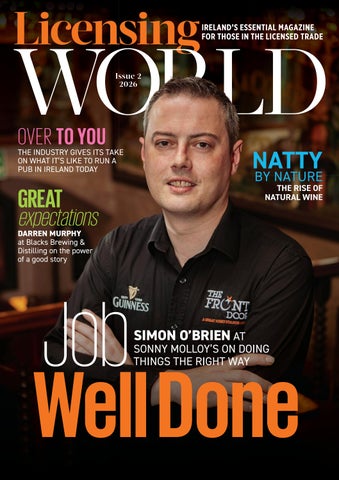
Issue 2 2026
OVER TO YOU
NATTY
THE INDUSTRY GIVES ITS TAKE ON WHAT IT’S LIKE TO RUN A PUB IN IRELAND TODAY
BY NATURE
THE RISE OF NATURAL WINE
GREAT
expectations DARREN MURPHY at Blacks Brewing & Distilling on the power of a good story
Job Well Done SIMON O’BRIEN AT
SONNY MOLLOY’S ON DOING THINGS THE RIGHT WAY
OFC_Licensing World_Issue 2 2026_Cover_FINAL.indd 1
13/08/2026 09:30
C
M
Y
CM
MY
CY
MY
K
256790_Coca Cola_Licensing World Issue 2 2026.indd 1
30/07/2026 15:25
CONTENTS
Contents
4
Issue 2 2026
NEWS
The latest updates from the on trade
10
COVER STORY Simon O’Brien at Sonny Molloy’s Irish Whiskey Bar on doing things the right way
16
WINE
16
L'Attitude 51 and Le Caveau are flying the flag for natural wine and bringing a younger generation into the fold
18
INTERVIEW The Sales Manager at Blacks Brewing & Distilling on the power of a good story
20
VAT The VAT windfall is a lifeline for pubs and bars but it could still be lost at the till, writes John O’Beirne
10 22
VIEWS
The industry gives its take on what it’s like to run a pub in Ireland today
28
LAST ORDERS The Founder of Ember on creating a whiskey brand straight from the heart
28 L I C E N S I N G W O R L D. I E 1
001_Licensing World_Issue 2 2026_Contents_FINAL.indd 1
13/08/2026 09:33
EDITOR'S LETTER
Welcome
Simon O’Brien, General Manager at The Front Door Pub, Sonny Molloy's Irish Whiskey Bar and Tigh Nora, takes staff training seriously. Back when he first started working in pubs in his hometown of Tralee, the importance of training was impressed upon him by his customers who pointed out that if they were to be looked after in their old age, he’d need to know how to pull a pint properly. It’s a lesson he brought with him to Galway and one he makes sure his staff take heed of. Sonny Molloy’s is, says Simon, a great bar in a great location but it’s not immune to industry challenges. Food costs are prohibitive, finding chefs is an issue and Ireland’s drinking culture has altered in recent years. It’s still an industry he enjoys though, in a pub he loves to work in. For more on Sonny Molloy’s, turn to page 10. Elsewhere in this issue, we chat to Beverley Matthews at L’Attitude 51 and Pascal Rossignol at Le Caveau Wine Merchants about the growing popularity of natural wine. Gen Z consumers are opting for natural wine, attracted by its lack of chemicals and sustainability credentials. On page 18, Darren Murphy at Blacks Brewing & Distilling talks about the importance of differentiating yourself in a crowded market and on page 20, John O’Beirne at Square talks about why it’s so important for pubs and bars to use the VAT cut to reinvest where it counts. Finally on page 22, hospitality owners and managers give their opinion on what it’s like to run a pub in Ireland today.
Editor: Denise Maguire Creative Director: Jane Matthews Art Director: Lenny Rooney Production: Claire Kiernan Stock Photography: iStock.com Sales Director: Trish Murphy Managing Director: Gerry Tynan Chairman: Diarmaid Lennon Published by: Ashville Media, Unit 55, Park West Road, Park West Dublin 12 Tel: (01) 432 2200 ISSN: 1393-0826 All rights reserved. Every care has been taken to ensure that the information contained in this magazine is accurate. The publishers cannot, however, accept responsibility for errors or omissions. Reproduction by any means in whole or in part without the permission of the publisher is prohibited. © Ashville Media Group 2026. All discounts, promotions and competitions contained in this magazine are run independently of Licensing World. The promoter/advertiser is responsible for honouring the prize. ISSN 1393-0826
We hope you enjoy this issue and if you’ve any thoughts or opinions, please drop us a line.
Denise Maguire Editor The Licensing World editorial team email: editor@licensingworld.com
VISIT US ONLINE www.licensingworld.ie
2 L I C E N S I N G W O R L D. I E
002_Licensing World_Issue 2 2026_EdLetter_FINAL.indd 2
13/08/2026 09:34
257241_REL Group_Licensing World Issue 2 2026.indd 1
14/07/2026 15:09
NEWS
The main events this summer...
2 minutes with… Peter O’Halloran
The Nancy Spains Co-Founder on expansion plans and partnering with Dingle Gin How is business going? We're four sites in – three in London and one in Manchester's Northern Quarter – and we're now moving into an ambitious growth phase, targeting additional venues across the UK over the next few years. Bristol is next up and two more are in the pipeline. What inspired you to open your own pub? I moved to London from Kerry and just couldn't find anywhere with the energy, the craic and the live music I grew up around. So I built it myself. The name comes from Nancy Spain, a Kerry woman who became London's first Irish landlady back in the late 1800s – it felt like the right spirit for the brand. Was expansion always part of the plan? Yes, always. But we're deliberate about it. We only move into cities and neighbourhoods where we genuinely believe our concept can add real value to the community, rather than just chasing numbers. What's your experience in the hospitality industry? I've worked in hospitality from a young age and it's been my
whole life. It's in the family and it's the only trade I've ever really known. With so many pubs in London and Manchester, what makes Nancy Spains stand out? We're a live music and nightlife brand first – that's the whole point of difference. Real Irish pub energy, proper live music, not a themed version of it. What are the main challenges you face as a hospitality group? Rising costs across the industry are relentless and the real challenge is absorbing that pressure while still keeping our teams motivated and happy. That balance never gets easier. What do you miss about Kerry? The seaside and the mountains, without question. Being able to surf or swim in the sea whenever I feel like it, or head up into the hills for a hike. In London, you have to travel hours just to get a flavour of that. What does the partnership with Dingle Gin mean to you? It's close to home in every sense – we're from Kerry and Dingle has always had a pull on us, with many summers spent there. It's a fantastic gin and it sells brilliantly across
"We only move into cities and neighbourhoods where we genuinely believe our concept can add real value to the community, rather than just chasing numbers" our group. We're excited that this October we get to bring some of our team and community back there for a proper session in West Kerry. Our "Sip into Summer with Dingle" competition will give
six winners a two-night stay at Dingle Distillery House, a guided distillery tour and tasting, plus the opportunity to experience some of Kerry's most iconic attractions and pubs.
4 L I C E N S I N G W O R L D. I E
004_Licensing World - Issue 2 2026_News_FINAL.indd 4
13/08/2026 10:20
NEWS
New lease of life A 1,000-year-old Irish oak tree that was brought down by Storm Elin in December 2023 has been transformed into three rare whiskey casks. Specialist coopers at Kentucky Bourbon Barrel in Kildare have created three 225-litre casks from the giant tree on Preston’s Estate on Swainstown Farm, Co Meath for Boann Distillery. The Preston family are descendants of the Preston's of Drogheda – operators of a whiskey bonding business for almost a century from 1886. The tree's new lease of life, a collaboration between Boann Distillery, Kentucky Bourbon Barrel and Swainstown Farm, marks the first time in over a century that complete Irish oak whiskey casks have been coopered by Irish hands on Irish soil. The three casks will now be filled with matured whiskey based on the secret Preston’s Vintage Mashbill XI recipe – a late 19th-century recipe uncovered through Boann’s Vintage Mashbill programme. The whiskey will be bottled and launched next year. “This oak stood at Preston’s Estate for around 1,000 years and its story could easily have ended when it fell during Storm Elin. Instead, it begins a new life as three extraordinarily rare whiskey casks. Using the wood to mature Preston’s Irish Whiskey creates a direct connection between the Preston family’s land, its historic whiskey-bonding legacy and Boann’s work to revive old Irish whiskey recipes,” said Peter Cooney of Boann.
Double win for Ardara Distillery
Pictured: Peter Cooney (centre) from Boann Distillery with Mark Quick and Ian Leonard, Kentucky Bourbon Barrel
The Ardara Distillery in Co Donegal has claimed two major international accolades at two of the world’s biggest spirits’ competitions. The distillery was named Best Irish Craft Distillery at the Tokyo Whisky & Spirits Competition, while Ardara Single Malt Cask Strength won a Double Gold medal at The San Francisco World Spirits Competition. James Doherty, Co-Founder, The Ardara Distillery said: “San Francisco is arguably the toughest room in the world of spirits to be judged in. To come away with a Double Gold medal for our first Ardara single malt release is powerful and a strong signal that grain-in, heavily peated Irish whiskey has a serious place on the international stage. We make whiskey the way it was made in Donegal a century ago. It’s not a style everyone expected the market to embrace, but awards like this tell us otherwise.”
170 years of brewing at Lady's Well This year, HEINEKEN Ireland is celebrating 170 years of continuous brewing at Lady’s Well Brewery in Cork city. More than 95% of the company's draught beer sold in Ireland is brewed in Cork, with the company supporting local farmers and suppliers across communities. All of its pale malted barley is sourced from farming families across the country, generating further employment and positive economic impact. Sharon Walsh, Managing Director of HEINEKEN Ireland, said: "Celebrating 170 years of brewing at Lady's Well is a proud moment not only for HEINEKEN Ireland, but also for Cork and Irish brewing more broadly. Given our long and deep-rooted association with Cork, this anniversary is an opportunity to recognise the generations of people whose dedication, skill and commitment have built this brewery into what it is today. From our employees and customers to our suppliers and farming partners, this milestone celebration belongs to everyone who has been part of our story.”
L I C E N S I N G W O R L D. I E 5
004_Licensing World - Issue 2 2026_News_FINAL.indd 5
13/08/2026 10:21
NEWS
What I'm drinking this summer PR guru Lisa Regan is cooling down this summer with a no-alcohol option
BLOOD ORANGE LIVE SODA My go-to summer drink? Honestly, it's less about what's in the glass and more about the glass itself. You might think I'm being a bit ridiculous, but I genuinely believe the right glass changes your whole relationship with a drink. I can't bear pint glasses so give me a chunky whiskey rocks glass or a beautiful stemmed glass any day. Somehow, everything tastes better. I've been having a very low-alcohol summer and loving All About Blood Orange Live Soda over plenty of crushed ice. I also top it up with sparkling water – about half and half – which gives it even more fizz and makes it extra hydrating without losing that lovely blood orange flavour. Made with real blood oranges, 1 billion live cultures and 4g of prebiotic fibre, it's become my favourite refreshing drink at home.
New release from Ballina Whiskey The team at Ballina Whiskey have put their latest liquid innovation out as a general limited release – a seven year old, single malt distilled and bottled on site that was aged exclusively in an ex-Sauternes cask. Produced in their signature slower fermentation and slower distillation style, only 344 bottles have been released. As a sweet dessert wine, the influence the Sauternes barrel had on this whiskey is robust and dramatic in flavour. Ballina Whiskey's blender Stacy Longworth's notes on the bottling are: Colour Light golden amber Nose Peaches in syrup, ripe apricots Creamy vanilla sweetness & soft honey notes Middle Notes Marmalade and citrus Base Notes Subtle sweet wood/ soft oak Palate Sweetness: rich sweetness, honeyed fruit and stonefruit syrups
Acidity: High, giving a refreshing palate cleansing that balances the sweetness Tannin: No bitterness, no mouth drying sensation Alcohol: Gentle warmth, balanced and smooth Body: Medium bodied, quite a mouthcoating syrupy texture Length: Medium finish with lingering fruit sugars and freshness from the citrus notes Finish Has warmth that fades quickly, leaving notes of the honey, marmalade and vanilla oaky sweetness
Guinness 0.0 Bartenders’ Race takes to the streets The Guinness 0.0 Bartenders’ Race took place at this year’s Liberties Festival. Participants raced from The Lark Inn on Meath Street to The Liberty Belle on Francis Street with plastic pint glasses of Guinness 0.0, recreating the historic race in the area. The Barmans' Race has decades-long history in The Liberties – a 1960s black-and-white TV advert held in the Guinness Archive features footage of a Guinness barman's race, while a Liberties Festival programme from the 1990s documents the race's place within the festival over 30 years ago.
6 L I C E N S I N G W O R L D. I E
004_Licensing World - Issue 2 2026_News_FINAL.indd 6
13/08/2026 11:19
NEWS
Jägermeister expands partnership with Richmond Marketing Spirits brand Jägermeister has expanded its partnership with Richmond Marketing to include distribution and brand development across Northern Ireland. The agreement reflects growing confidence in the NI market, particularly within the premium spirits sector, with Jägermeister continuing to perform strongly among younger adult consumers through nightlife, festivals and music-led partnerships. Barry Connolly, Managing Director of Richmond Marketing, said: “Our Belfast team has built strong relationships across the hospitality and retail sectors and we see real opportunities to further grow the brand through local market investment, customer engagement and impactful activation activity across the region.”
Champagne over ice Moët & Chandon has launched Moët Ice Impérial – a fresh, fruity and intense blend that’s best served over ice. To serve like a pro, ditch the traditional flutes, grab a large cabernetstyle glass and follow the 7-12-3 rule – chill the bottle to a crisp 7 degrees, pour a generous 12cl splash of Ice Impérial and drop in exactly three large ice cubes. Take your glass to the next level by dropping in one of these three expert-approved garnishes: The Renegade: A slice of ginger for a sharp, spicy kick of freshness The Cool Down: A few slapped mint leaves for a breezy, herbaceous vibe The Classic: A twist of orange peel for pure, refined elegance.
Changing Times enters UK market Changing Times Brewery has launched in the UK market, with the expansion expected to grow sales this year by over 30%. The UK launch marks the brewery’s first move into an international market less than two years since it was established by the families behind some of Ireland’s best-known pubs. UK wholesale drinks supplier Inn Express will manage distribution, with initial listings for the naturally brewed Irish beer secured across more than 50 outlets nationwide this year. Commenting on the move into the UK, Shane Long, Head of Brewing Operations at Changing Times and Founder of the Franciscan Well Brewery in Cork, said: “Things moved much quicker than we expected. We had always planned to expand into the UK, but our timeline was a little further down the road. The team at Inn Express came across Changing Times while visiting pubs over here. They were searching for a new premium Irish stout and they got in touch. From those first conversations it was clear there was a real appetite for what we were doing. It was an opportunity we didn’t want to let pass, so we brought our plans forward and got to work.”
L I C E N S I N G W O R L D. I E 7
004_Licensing World - Issue 2 2026_News_FINAL.indd 7
13/08/2026 10:21
PARTNER PROFILE
SEAI IS EMPOWERING IRISH SMES TO CUT ENERGY COSTS AND EMISSIONS
Easy Wins T
he Sustainable Energy Authority of Ireland (SEAI) is enabling the SME sector to tackle rising energy costs by empowering businesses through practical support and targeted grants SEAI grants helps small and medium sized businesses transition away from fossil fuels, while reducing costs through lower energy bills. SMEs switching to renewable energy not only experience financial benefits but environmental too by cutting emissions which contribute to national climate goals. SEAI introduced a new, integrated suite of rapid approval grants, designed specifically with SMEs in mind. These financial supports for energy audits, insulation upgrades, heating and cooling upgrades, solar PV, among other upgrades, bring clarity and simplicity for SMEs to choose measures in any order that suit individual budgets, energy and building requirements. To date, thousands of businesses have benefitted, from SEAI supports resulting in reduced bills and increased comfort for staff and customers. In addition to grants, SEAI provides a wide range of other supports to help businesses strengthen their energy performance and reduce operating costs. This includes the SEAI Energy Academy free, online e learning platform designed to empower businesses and their staff with the knowledge and tools to improve energy efficiency and cut energy related expenses. SEAI offers free Energy Management training to help SMEs implement effective energy plans, with a lively, interactive online workshop led by experienced advisors for owners, senior managers and facilities managers starting their energy-saving journey. SEAI has launched its Easy Wins Campaign to help businesses get started on their energy saving journey
Fergus Sharkey, Head of Business Supports at SEAI
Our Easy Wins Campaign aims to raise awareness of SEAI business supports and the positive impact targeted grants can have on reducing energy costs for SMEs across Ireland
with SEAI. This national campaign showcases real Irish businesses that have taken practical steps to reduce energy costs with the support of SEAI grants. By highlighting tangible upgrades, such as improved heating systems, insulation or process efficiencies, the campaign aims to demonstrate the measurable benefits achieved and provides practical examples for other SMEs considering similar actions. “Our Easy Wins Campaign aims to raise awareness of SEAI business supports and the positive impact targeted grants can have on reducing energy costs for SMEs across Ireland. These supports make SMEs more competitive, resilient and ultimately, contribute to our collective climate goals,” says Fergus Sharkey, Head of Business Supports at SEAI. “Many SMEs are struggling to understand their energy and the grants landscape,” he adds. “That’s why SEAI is promoting accessible supports designed specifically for the SME sector – ones that prioritise financial savings alongside sustainability. We want to reassure the businesses that we are here to help them strengthen their operations and that becoming more sustainable can be achieved step by step, rather than feeling like a mammoth or overly complex task.” By simplifying access to supports and focusing on practical, high impact measures, SEAI is helping Irish SMEs take confident steps towards a more energy efficient and sustainable future – one easy win at a time. Search SEAI EASY WINS to find out more or log onto www.seai.ie/easywins
8 L I C E N S I N G W O R L D. I E
000_Licensing World_Issue 2 2026_PP_SEAI_V1.indd 8
13/08/2026 10:37
NEWS
Fire, Folklore and Flavour
Mayo bar makes ‘World’s Best’ guide Ashford Castle's Prince of Wales Bar has been recognised among the world's best hotel bar experiences, earning a place on the 2026 Forbes Travel Guide Star Bars list. The listing sees the Bar join just 37 hotel bars across 18 countries, selected
for their beverage programmes, service, presentation and atmosphere. As part of the assessment process, the Prince of Wales Bar created a signature cocktail, The Last High King – a blend of Slane Triple Cask Irish Whiskey, Antica Formula Vermouth and Aperol.
In celebration of the summer solstice, Boatyard Distillery has released a new limited edition gin in partnership with Killahora Orchards in Co Cork. Only 1,000 bottles of the new gin have been produced. The addition of Rare Apple Ice Wine from Killahora Orchards, combined with Boatyard's signature juniper notes, delivers a vibrant character and a taste of Ireland's finest orchard fruit.
Late nights are back at HOUSE Dublin HOUSE Dublin has officially relaunched its late night weekends, welcoming guests until 2.30am every Thursday, Friday and Saturday night. As part of the relaunch, HOUSE Dublin commissioned research among more than 3,000 Irish residents to understand how people really felt about Dublin's nightlife in their absence. Their findings found that nine in 10 Dubliners struggle to find a late night venue they actually want to visit while 93% said they struggle to even think of
somewhere they would actively choose for a night out. A further 86% believe other European cities such as London, Barcelona and Berlin offer a much better late night social scene than Dublin. The research confirms there's still a huge appetite for (now super rare) 2.30am late night experiences in the capital city. The venue has also unveiled its new ‘VIP Garden Tables’ experience, offering guests dedicated table service throughout the evening, premium seating and an enhanced experience.
L I C E N S I N G W O R L D. I E 9
004_Licensing World - Issue 2 2026_News_FINAL.indd 9
13/08/2026 10:21
COVER STORY
Job
10 L I C E N S I N G W O R L D. I E
010_Licensing World - Issue 2 2026_Cover story_FINAL2.indd 10
13/08/2026 11:21
COVER STORY
SIMON O’BRIEN AT SONNY MOLLOY’S IRISH WHISKEY BAR ON DOING THINGS THE RIGHT WAY
b well done I
T’S AN IN-BETWEEN time in Galway city. The Races and the Arts Festival have finished up and while the city’s pubs might be a little quieter right now, that’ll soon change once the estimated 20,000 students that call the city home return for the new semester. Huge crowds visited the city for the Races, while this year’s Arts Festival attracted a slightly older crowd who weren’t as inclined to make a night of it. “Bands like Bell X1, Sophie Ellis-Bextor and James played this year. Festival goers were of an age that they’d have things to do the next day and so wouldn’t necessarily be on for a late night. That definitely had a knock-on effect on our business,” says Simon O’Brien, General Manager at The Front Door Pub, Sonny Molloy's Irish Whiskey Bar and Tigh Nora on Cross Street. Sonny Molloy’s dates back to the 1600s and takes its name from the well-known draper that sold sensible underwear and outdoor clothing from the building for many years. The bar’s counter is the same one that Sonny used to stand behind and sell his wares. Sonny Molloy's is part of The Front Door Pub complex, owned and operated by Highcross Bars Limited. Whiskey is a speciality – over 120 varieties are on offer. It’s also one of the only bars in the world to host the full Midleton Very Rare Silent Distillery Collection. Whiskey sales are consistent, says Simon. “You get surprising situations sometimes. A couple of weeks ago we had two men come in with their partners, all probably in their 30s, who ended up spending almost €2,000 on whiskey. You’ll have other customers that just want to be able to say they had a whiskey in Sonny Molloy’s. It’s like a tick box exercise.” When indulging, Simon’s whiskey of choice is a Redbreast 27 or a Bushmills 16 Year Old.
“It’s such an interesting industry. At the moment, independent distilleries are producing their own Irish whiskey, many for the first time. Different flavours are starting to emerge which is great because up until now, everything has been fairly generic. I think we’re set for some interesting times ahead.” Galway’s year-round calendar of festivals and events means big business for its pubs and bars. “Weekend trade also keeps us busy. You get hens and stags and people visiting from other parts of Ireland and then of course, tourists from other countries. Galway’s a city that has always done well. I was here during the recession and pubs weren’t hugely affected.” The aforementioned students that live and study in the city are also to be found working across its hospitality venues. Recruiting and retaining staff is sometimes an issue. “You could be fine for a year and then all of a sudden, you could go through six months of torture. I’m constantly chopping and changing the roster, trying to fill in shifts here and there. With about 75 staff on the books at peak season and 65 the rest of the year, it’s a lot of work.” Several members of staff have worked at the bar long-term. “We look after our staff; we’re a late bar so we have to make sure they’re well paid and get time off when they need it. Ideally, they work fourday weeks during the summer months so they get
Sonny Molloy’s dates back to the 1600s and takes its name from the well-known draper that sold sensible underwear and outdoor clothing from the building for many years
L I C E N S I N G W O R L D. I E 11
010_Licensing World - Issue 2 2026_Cover story_FINAL2.indd 11
13/08/2026 11:21
COVER STORY
an extra bit of rest. That helps when it comes to retention.” A team of 75 means a significant wage bill. Meeting that cost every week means selling as much as possible when you’re open. “When it comes down to it, hospitality is a sales industry. You have to be as productive as you can, when you can. Government costs like the increased minimum wage and sick pay have added to our costs, but we can meet them because we're a big bar in a great location. If I was a smaller bar in a rural area or even just in a normal town – maybe somewhere like my hometown of Tralee – it would be a different story.” Simon has worked in bars, restaurants and hotels for over 25 years. In that time, the change in Ireland’s drinking culture has been striking. “Younger people aren't drinking as much. The older generation are bogged down with bills so disposable income has reduced. The price of alcohol has also shot up. When I first moved to the city, you could get a double Vodka Redbull for €5. Now you’re paying about €17 or €18. The average person is probably making about €16 or €17 an hour – the price of that drink. People just don’t have that kind of money.” Simon is also seeing that “spend less” mentality among tourists. “They’re paying huge premiums for hotels rooms so they might come out for a couple of drinks after dinner, but they won’t stay out. Students are also going home an hour earlier than they used to. Everyone is cutting back.” While the reduced VAT rate is welcome, the everincreasing price of food will negate any potential cost savings. Food has, says Simon, almost doubled in price over the past two years. “The average customer isn’t going to benefit from the reduced
12 L I C E N S I N G W O R L D. I E
010_Licensing World - Issue 2 2026_Cover story_FINAL2.indd 12
13/08/2026 11:21
COVER STORY
VAT rate. I expect we’ll see suppliers increasing their prices in the near future and that’ll have an impact on whether savings are passed onto the customer or not.” Another price increase from drinks suppliers is also expected before the end of the year. “Those companies argue that they haven't increased their prices for years and yet in the last two years alone, we’ve had a total of five increases. It doesn’t make any sense.” Alongside higher costs in the kitchen, finding chefs is an ongoing challenge. “About 10 years ago, I had a conversation with the head of hospitality at ATU. She told me there’s going to be a shortage of chefs in Ireland in the next five years and she was right. At the time, very few people were signing up to do cheffing courses. So today, they’re difficult to get. It’s a problem for us, as is accommodation for our staff. There’s nothing
available across the county, never mind the city.” Simon began working in bars in his hometown of Tralee when he was 16. Proper training is, he says, the most important lesson he can pass on. “When I was young, customers would tell me they wanted someone behind the bar who could pull a pint properly and who knew how the industry worked so they’d be looked after when they were older. Today, that’s my mantra – the next generation has to be trained properly. Otherwise, when we’re on the other side of the bar enjoying a pint when we’re older, there’ll be nobody there to serve us.”
When I was young, customers would tell me they wanted someone behind the bar who could pull a pint properly and who knew how the industry worked L I C E N S I N G W O R L D. I E 13
010_Licensing World - Issue 2 2026_Cover story_FINAL2.indd 13
13/08/2026 11:22
PARTNER PROFILE
AS THE DEMANDS ON MODERN BARS CONTINUE TO EVOLVE, REL GROUP’S PARTNERSHIP WITH INFRICO BRINGS A NEW REFRIGERATION OFFERING TO IRELAND’S LICENSED TRADE
Performance behind the bar
T
here’s no shortage of conversation in the licensed trade right now around rising costs, margins and changing consumer habits. For operators, the focus is constant, balancing standards, managing overheads and maintaining consistency in an environment where expectations remain high. And while much of that conversation naturally centres around staffing, stock and service, the systems supporting day-to-day operations are under more pressure than ever. The modern bar has changed significantly over the last decade. Product ranges are broader, customer tastes have evolved and service expectations continue to rise.
Premium draught systems, craft offerings, cocktails, low and no-alcohol options, ready-to-drink products, iced coffees and premium mixers have all become part of the standard offer. Customers expect more choice, better quality and faster service, and that shift has had a direct effect on how bars are designed and how they operate. That evolution has increased pressure on the systems working behind the scenes. Refrigeration, in particular, now plays a much bigger role than it once did. It’s no longer simply about keeping bottles cold. Back bar refrigeration affects stock presentation, speed of service and product quality. Cellar cooling impacts consistency from keg to glass. Ice
14 L I C E N S I N G W O R L D. I E
014_Licensing World_Issue 2 2026_REL Group_FINAL.indd 14
13/08/2026 10:33
PARTNER PROFILE
production affects service flow, particularly during busy trading periods or warmer weather. These systems are no longer separate considerations – they are part of the overall rhythm of the business and that’s particularly noticeable during peak trade. A busy Friday evening, a bank holiday weekend or a major event can place huge pressure on equipment. Recovery times become more important. Ice demand rises sharply. Bottle coolers are opened constantly. Draught systems are working harder. Stock turnover is faster. In those moments, reliable equipment becomes critical not because anyone notices it, but because the business continues to run as it should. It’s one of the reasons the conversation around refrigeration has changed. Experienced operators know that while price will always be part of the decision, the long-term value of equipment is often measured differently. Energy efficiency, build quality, recovery speed and reliability over time all have a direct effect on the total cost of ownership. A unit that struggles to hold temperature, uses excessive power or requires repeated repairs can quietly become far more expensive than expected. That’s a reality REL Group understands well. For years, REL Group has worked closely with bars, hotels and licensed premises across Ireland, supporting the technical and operational systems that keep service moving. From refrigeration and air conditioning to beer systems, water filtration and preventative maintenance, the business has built its reputation on practical support, technical knowledge and long-term service relationships. It’s a side of hospitality that often goes unseen, but one that has a direct impact on profitability. REL’s work in beer dispense systems is a strong example of that. A well-maintained glycol system, properly balanced beer lines and efficient cellar cooling all contribute to product consistency at the tap. Temperature, pressure and flow all affect the final serve and in a trade where quality matters, these details are important. It also reinforces why refrigeration can’t be viewed in isolation. The systems behind a bar are closely connected – cooling influences stock quality, stock affects speed of service and speed shapes the overall customer experience. That wider operational understanding is exactly what shaped REL’s decision to partner with Infrico. For REL Group, the partnership was never about simply adding another refrigeration brand to the offering. It was about working with a manufacturer whose standards aligned with its own, reliability, quality and equipment designed for real hospitality environments. Infrico has built a strong reputation across Europe for precisely that reason. Its refrigeration range covers everything from bottle coolers and back bar displays to refrigerated tables, ice machines and larger cold storage solutions. What stood out to REL Group wasjust the breadth of the range, but how practical it is for busy hospitality spaces.
Strong temperature stability, efficient airflow, durable construction and energy-conscious design all contribute to better long-term performance. And in the current climate, that matters. Energy remains one of the biggest operational costs for bars and refrigeration runs constantly. Choosing equipment that performs efficiently over time can make a meaningful difference, particularly across multiple units and larger sites. Just as important is usability. Bar teams need quick access to stock. They need clear visibility, practical storage and equipment that supports fast-moving service without slowing them down. The right refrigeration setup can improve workflow just as much as it improves cooling performance. That’s where product and support need to work together, and that’s where REL Group continues to differentiate itself. Beyond supply, the business offers nationwide delivery, installation, preventative maintenance, system upgrades and in-house technical support, giving customers access to a team that understands hospitality environments and the pressures that come with them. That means support doesn’t stop once the unit is delivered. It continues across the life of the equipment. For many operators, the second half of the year is when those operational decisions begin to sharpen into focus. Summer trade leads into autumn, and before long attention turns to the Christmas period, one of the busiest and most demanding trading windows of the calendar. That’s often when equipment is under the greatest pressure. For businesses reviewing their refrigeration, cooling or dispense systems, it’s not simply about replacing what’s there. It’s about making sure those systems are fit for where the trade is now and where it’s heading. That’s the space REL Group has always operated in and with Infrico now part of the offering, it’s another way the business is continuing to support the licensed trade across Ireland, with equipment, expertise and the service behind it. To explore the full Infrico range or speak to the REL Group team, visit professionalrefrigeration.ie
Infrico stood out to REL Group for its reliability, quality and equipment designed for real hospitality environments
L I C E N S I N G W O R L D. I E 15
014_Licensing World_Issue 2 2026_REL Group_FINAL.indd 15
13/08/2026 10:33
WINE
by nature L'ATTITUDE 51 AND LE CAVEAU ARE FLYING THE FLAG FOR NATURAL WINE AND BRINGING A YOUNGER GENERATION INTO THE FOLD
N
ATURAL WINE is one of the global wine industry’s fastest-growing segments but in Ireland, it’s still somewhat niche. The interest is there, says Beverley Matthews of Cork’s L'Attitude 51, and while it may never rival traditional wine’s market share, it’s a segment that’s continually growing in confidence. It’s also a segment that’s caught the attention of one notoriously elusive group – the Gen Z consumer. “I think traditionally, wine has had a reputation of being elitist or only appealing to an older cohort. Natural wine has made the segment much more fun and accessible to younger drinkers. The sustainability element of it appeals to Gen Z; they’re keen to learn about how it starts with organic farming, how it’s better for the environment and also for the consumer as no additives are used,” says Beverley, who opened L'Attitude 51 in 2011. Part wine shop, part wine bar/restaurant, the venue features over 400 wine listings and is considered one of Ireland’s premier wine bars. Natural wine is, she says, her thing and it’s why she took part in this year’s Cork on a Fork event. Alongside Colm McCann of Le Caveau Wine Merchants, she talked about natural winemaking and the growth of the segment in recent years. “We chatted about our role as natural wine advocates and the opportunities around spreading that message. We also talked about the challenges – it’s a small sector and it will always be smaller because that’s the nature of it. It’s not easy – you have to work at it and you have to explain the wines to people. What we’re finding though is that people are getting more curious and so they’re asking more questions. Once they try our wines, they come back.”
CHAMPIONING NATURAL WINE Set up in 1999 by Pascal Rossignol, Le Caveau specialises in importing artisan wines, sourced directly from small, family-operated vineyards from around the world. It was, says Trade Account Manager Colm McCann, the first Irish wine merchant to bring natural wine into the country. “We continue to champion it, along with our other artisan wines. We supply owner-run restaurants and boutique hotels, cafes and bars across the country. In hospitality, there’s definitely a trend towards lighter, fresher, more food-friendly wines. Natural wine is a perfect fit,” says Colm.
Back in the early days, when Le Caveau first began trading, persuading hospitality businesses of the virtues of natural wine was tough. “For me, it was one thing to fall in love with those wines and completely another to bring them to market. In 2008, we started to include those wines on our list and it was a challenge, because they don't look like a conventional wine. Our growers believe in adding nothing, but taking nothing out of the wine either so they might look a bit cloudy because they’re not filtered," says Le Caveau Founder, Pascal Rossignol. At the time, the business had a small wine shop in Kilkenny, which closed just after Covid. "Back then, it really helped us. We had natural wines on the shelf and our customer’s reaction, what they liked and what they didn’t like, helped us when we began selling into hospitality venues." Le Caveau also supplies to several pubs around the country. “They find that natural wines pair really well with food – they’re lighter and fresher. They’re not heavy; obviously if you drink too much you’ll have a hangover the next day, but because natural wine is process-free, it tends to be more digestible. That’s also probably part of the reason why younger people are increasingly opting for natural wine. I also think natural wine goes against the stuffiness of conventional wine – it’s irreverent. I liken it to music; there was a time when rock and roll became boring and then grunge came along in the 90s and revolutionised music. Natural wine did something similar in the trade.” Sourcing wine is becoming more challenging due to climate change. Some wine regions, says Pascal, are experiencing temperatures of 44°. “That cannot be good for the vine, for the plant itself. Interestingly, organic vineyards can resist the heat way better so the vine tends to be healthier. How impactful climate change will be on wine production is still an unknown, but availability may become an issue in the future.” Sales at Le Caveau are strong. “We’re a small, independent business and we’re still growing. We see great potential in natural wines – it’s such an interesting field to work in.” L'Attitude 51 runs wine appreciation courses with a focus on natural wine. For more information, go to wwwlatitude51.ie
16 L I C E N S I N G W O R L D. I E
016_Licensing World - Issue 2 2026_Cork on a Fork_FINAL.indd 16
13/08/2026 09:49
WINE
It’s challenging – you have to work at it and you have to explain the wines to people. What we’re finding though is that people are getting more curious so they’re asking more questions. Once they try our wines, they come back Beverley Matthews
Beverley Matthews, L'Attitude 51
We supply ownerrun restaurants and boutique hotels, cafes and bars across the country. In hospitality, there’s definitely a trend towards lighter, fresher, more food-friendly wines. Natural wine is a perfect fit Colm McCann
Pascal Rossignol, Le Caveau Colm McCann, Le Caveau
L I C E N S I N G W O R L D. I E 17
016_Licensing World - Issue 2 2026_Cork on a Fork_FINAL.indd 17
13/08/2026 10:23
INTERVIEW
Darren Murphy THE SALES MANAGER AT BLACKS BREWING & DISTILLING ON THE POWER OF A GOOD STORY
YOU’RE JUST BACK FROM A TRIP TO INDIA. HOW WAS IT? We were in Delhi and it was an unbelievable experience. India has a strong whiskey culture so we’re hoping to get some business out of the trip. There are some challenges though, including import and excise duties. If your stock isn’t moving fast enough, then charges will start to accrue. So it’s difficult, but not impossible and there are some Irish brands doing well out there at the moment. The opportunity is there – India has a young, growing middle class with disposable income. They love whiskey, it’s the biggest selling spirit by far. ARE YOU EXPORTING INTO OTHER REGIONS? Yes, we export our spirits along with our beers, although spirits are more stable for longer journeys. We have a great partner in the US and we're exporting to various markets across Europe and Asia. Ukraine is also a good export market for us. Some people are surprised when they hear that but when I speak to our contacts there, they say children are still being
born, people are still getting married, birthday parties are still happening. Although this awful war is taking place, life is still going on. We see a lot of opportunities there and in other developing countries. IN A COMPETITIVE CATEGORY LIKE IRISH WHISKEY, HOW DO YOU DIFFERENTIATE YOURSELF? It’s tough. We have to be creative around presentation, flavour profile and storytelling. A huge amount of work goes into that side of the business, which is the part people don’t see. We came up with the “Flavour Mavericks” tagline a few years ago to have something we could be innovative around and to differentiate ourselves. Doing something that might be considered disruptive is another great way to differentiate yourself. A few years ago, we produced a beer that was infused with terpenes from the Pineapple Express strain of cannabis. Nothing like that had been produced before so it got the market talking. On the spirits side, we have a product called Maple Mayhem. Maple syrup casks are used to finish it – we were the first to do that.
18 L I C E N S I N G W O R L D. I E
018_Licensing World - Issue 2 2026_Darren Murphy_FINAL2.indd 18
13/08/2026 11:23
INTERVIEW
Being first to market with innovations help us stand out. Some of our ideas work and some don’t, but you have to keep trying. WHEN WAS THE BUSINESS SET UP? Blacks Brewing and Distilling Kinsale was founded in 2013. It's a family-owned business, started by Maud and Sam Black. They did everything themselves – brewing, packaging, loading up the van and driving around to shops and bars and selling their product. Fast forward to where we are now – in a state-ofthe-art production facility in a beautiful part of the world. We have a visitor centre where we run tours and tasting events and at the moment, we have a popup restaurant with American chef, Caitlin Ruth. That creativity and get up and go has been there from the start and it’s still very much part of the brand.
The drinking experience needs to be experiential. If you want to grow, you have to give the consumer a story that they’ll want to share
a mesh to wrap our bottles in, our spent grain goes to a local farmer which he feeds to his cows. That sustainability message is one that consumers want to know about. YOU TOOK PART IN A DEBATE WITH DANIEL EMERSON OF STONEWELL CIDER AT THIS YEAR’S CORK ON A FORK. HOW DID THAT GO? It was billed as ‘Beer vs Cider’ and it was great! We have a great relationship with the guys in Stonewell and I personally love cider. But I think from a broader perspective, beer is a much broader category with a greater range of flavour profiles. I'm a beer sommelier myself – I did my training in Vienna. I did it through German too, which was a challenge! One of the biggest learnings was how food friendly beer actually is. Traditionally in Ireland, we see wine as a match to food and not necessarily beer. I think you could find a beer to match any food in the world. That’s a challenge I’d be willing to take on!
HOW’S BUSINESS GENERALLY AROUND KINSALE? It’s great, there’s a lot going on, especially at this time of year. From talking to local people, there are less international tourists visiting the area than in previous years, which is probably down to the cost of living crisis in the US and the general uncertainty caused by global conflicts. We get great support from local businesses. I feel like we’re very much part of the community and there’s a feeling that we’re adding value to the region. We’re giving visitors another reason to come to Kinsale. HOW HAS THE INDUSTRY CHANGED IN RECENT YEARS? I think the consumer has become more sophisticated and expectations are higher. The drinking experience needs to be experiential. If you want to grow, you must give the consumer a story that they’ll want to share. The sustainability piece is also huge. We generate 50% of our power from solar panels, we recycle hot water in the production process and we got rid of single-use plastic. We also recycle our own cardboard to make
L I C E N S I N G W O R L D. I E 19
018_Licensing World - Issue 2 2026_Darren Murphy_FINAL2.indd 19
13/08/2026 11:23
PAYMENTS
A chance to
20 L I C E N S I N G W O R L D. I E
020_Licensing World - Issue 2 2026_Square_FINAL.indd 20
13/08/2026 09:52
Thrive
PAYMENTS
T
THE VAT WINDFALL IS A LIFELINE FOR PUBS AND BARS BUT IT COULD STILL BE LOST AT THE TILL, WRITES JOHN O’BEIRNE
HE PRESSURE that Ireland’s bars and pubs are facing has been well reported. The ongoing challenge of managing costs, like electricity and insurance bills, while trying to keep doors open and menus affordable, means that the VAT cut has arrived at a critical moment. The reduction will not fix every issue the sector faces, but it is meaningful for operators and it may impact what is possible over the months ahead. It gives hospitality operators breathing room to reinvest, retain people and deliver great experiences to their customers. That could make all the difference between a quiet month that sets a business back and one it comes through comfortably.
CONTROL THE CONTROLLABLES What operators do now is critical to take full advantage of the VAT cut. They should use this opportunity to assess whether they are controlling the controllables with regard to labour and payments and ensure they are reinvesting wherever the gaps appear. From a labour perspective, while rising costs, staffing shortages and high turnover are par for the course for the sector, these challenges can be mitigated somewhat. The windfall allows operators to employ more staff, protect hours, improve pay or fund the training that keeps good people in the sector. Another element of control comes with reinvesting in the business itself through essential repairs, new equipment and building a buffer to fall back on in the case of a surprise bill. Operators should also ensure that there is no leakage with their payments system, which is leading to funds being lost at the till. New research from Square has found that 'payment friction', including slow processing and limited payment options, is driving customers out of the door. More than a third (34%) of Irish consumers, equivalent to 1.4 million people, found that a store could not accept their preferred payment method. Faced with this barrier, a quarter (25%) of consumers simply walked out without making a purchase, meaning operators are losing sales because they haven’t kept their payment technology up to date. The most common complaint at the till is slow card processing, followed by reaching contactless limits and minimum card spend requirements, all of which leave
Square’s research found that for consumers, the ideal payment experience centres on universal acceptance across all outlets and stores, highlighting the importance of reducing this payment friction
customers feeling frustrated, embarrassed and dissatisfied. With four in five (80%) transactions in Ireland now digital, fast, reliable payment processing that accepts a wide range of methods is non-negotiable. Customers now expect seamless, modern and flexible payment options that fit into their lives. Square’s research found that for consumers, the ideal payment experience centres on universal acceptance across all outlets and stores, highlighting the importance of reducing this payment friction. Payment barriers at the till aren’t just an inconvenience, they are a major cost for businesses. For pubs and bars, where every sale counts, catering to customer demand for newer, popular payment options such as scan-to-pay, QR codes and contactless, offers an edge in this increasingly competitive market. While meeting these consumer expectations requires operators to invest in modern payment solutions, this is one cost the VAT windfall can help absorb and will assist in cutting costs down the line. Square's research found that more than two in five (41%) sellers say high transaction fees are their biggest challenge and this burden falls hardest on small businesses. For a quarter (25%) of sellers, especially larger operators, software fees are a further drain. These costs add up and have led half of all sellers in our research to switch payment providers in search of a better deal. When hospitality operators change payment processing systems, they want reliability, faster payouts, better customer support and systems that integrate cleanly with the rest of their business. For a venue looking to capitalise on the back of the VAT cut, this is exactly the moment to weigh up whether their current payments set-up is working as hard as it should. Choosing the right payment partner, one that keeps fees fair and the technology dependable, ensures more of every sale stays in the business. Pubs and bars are essential, not only to the social fabric of life but to Ireland’s economy. The VAT cut is a relief for the hospitality sector and one that lands at an important time. The businesses that use this opportunity to reinvest where it counts will be best placed for whatever comes next. It is a step forward for a sector that has shown remarkable resilience and one that gives pubs and bars a chance to thrive. John O’Beirne is CEO of Square International
L I C E N S I N G W O R L D. I E 21
020_Licensing World - Issue 2 2026_Square_FINAL.indd 21
13/08/2026 09:52
VIEWS
Over to you THE INDUSTRY GIVES ITS TAKE ON WHAT IT’S LIKE TO RUN A PUB IN IRELAND TODAY
22 L I C E N S I N G W O R L D. I E
022_Licensing World - Issue 2 2026_Industry views_FINAL.indd 22
13/08/2026 11:26
VIEWS
MARK HEATHER Co-Owner Hospitality Projects Ireland
WILL THE LOWER VAT RATE MAKE A DIFFERENCE? Absolutely and I must agree with the sentiment from trade associations that in Ireland, with the other costs of doing business, 9% is the correct long-term rate for food. Our business is 60% food sales and the savings on VAT will go a long way to sustaining the viability of our business and allowing us to invest in the future. Thrive, not just survive.
IS IT DIFFICULT TO KEEP UP WITH PRICE INCREASES FROM MAIN SUPPLIERS? In the not so distant past, you could agree beverage prices with a supplier and not need to revisit them for 12 months. That is now a three month period and we still need to use an AI tool to scan all our invoices and dockers to ensure our price agreements are being honoured. Food is far more challenging. Since 2025, we are reviewing prices every couple of weeks. In my 25 year career, I’ve never experienced such price volatility.
WHAT ARE SOME OF THE OTHER CHALLENGES YOU FACE? The cost of labour is a persistent challenge. The minimum wage growth is an issue but I’m happy to see the MFF in place, especially for my senior team. I do think there must be a better way than making contributions to a State fund for a student from overseas, who in 40 years’ time won’t remember that for 12 months in 2026, they paid into a State pension pot.
HOW DO YOU FEEL AT THE MIDPOINT OF THE YEAR? HOW IS BUSINESS GOING? The first seven months of 2026 have been very mixed. January and February outperformed both YOY comparisons and our projections, but March and April were the opposite and left us more or less balanced out in terms of turnover. May was a solid month but June fell short again. However our cover/diner numbers in the Gastro Pub & Courtyard are down on 2025, so our spend per head has increased to offset that. Essentially we see people a little less but when they visit, they spend a little more.
I am a naturally optimistic person outwardly, but inwardly I am always preparing for the worst. I think that’s an accurate summary of how I feel for the rest of 2026.
I am a naturally optimistic person outwardly, but inwardly I am always preparing for the worst
L I C E N S I N G W O R L D. I E 23
022_Licensing World - Issue 2 2026_Industry views_FINAL.indd 23
13/08/2026 11:26
VIEWS
LOUISE FITZGERALD Director Louis Fitzgerald Group
WILL THE LOWER VAT RATE IMPACT YOUR BUSINESS? We welcome the lower VAT rate change and we appreciate Minister Simon Harris in doing so. It’ll help offset the higher cost base we face in the industry.
HOW DO YOU KEEP UP WITH DIFFICULT PRICES FROM YOUR MAIN SUPPLIERS? We need to be mindful of escalating prices. It’s a worrying trend. It’s important for our business to keep customers coming through the doors – higher prices make that more difficult. A price freeze from suppliers and retailers in the hospitality business for one year would help cool the market. Keeping in touch with suppliers on a regular basis is essential to help anticipate changes coming down the line.
Going out for food and drinks should be for everyone and the increase in minimum wage will help that
WHAT ARE SOME OF THE OTHER CHALLENGES YOU’RE FACING? One of the challenges we face in the future is staff communication with our customers. Front of house is a vital part of our business and how staff converse with customers. Recruitment and staff training is an ongoing job.
ARE YOU FEELING POSITIVE ABOUT THE FUTURE? We have a positive outlook on future business because of our great team of management and staff who have a strong work ethic. We’re passionate about what we do. I also want to mention current government initiatives like the reduction of VAT and the increase of minimum wage as they will help the hospitality business. Going out for food and drinks should be for everyone and the increase in minimum wage will help people continue going out.
24 L I C E N S I N G W O R L D. I E
022_Licensing World - Issue 2 2026_Industry views_FINAL.indd 24
13/08/2026 11:26
VIEWS
HOW IS BUSINESS GOING?
MALACHY DUGGAN Owner The Blue Note
Business is going very business-ey. We have never been as busy and it has never cost so much to stay there. As long as the former outweighs the latter by a bit, we'll call it good.
WILL THE LOWER VAT RATE MAKE A DIFFERENCE TO YOU? We don’t do food so not for us. We learned the hard way that we are great publicans and terrible restaurateurs.
WHAT ARE SOME OF THE OTHER CHALLENGES YOU'RE FACING? Accepting the passage of time and that your ideas are old and stupid.
AS WE REACH THE MIDPOINT OF THE YEAR, ARE YOU FEELING POSITIVE? You'd have to be. No-one likes to listen to a whinging publican.
We are great publicans and terrible restaurateurs
WILL THE LOWER VAT RATE MAKE A DIFFERENCE TO YOUR BUSINESS? It sure will. We have a strong turnover as a group and it will definitely help towards alleviating some of the huge costs that have been put on all businesses over the past few years.
IS IT DIFFICULT TO KEEP UP WITH INCREASING PRICES FROM MAIN SUPPLIERS? Yes, it’s endless. We use group purchasing as much as we can and our accounts team, group managers and kitchen have to be all over it. I would be lying if I told you it hasn’t slipped at times and we missed things, but we’re all over it now.
WHAT ARE SOME OF THE OTHER CHALLENGES YOU'RE FACING? At the moment in the centre of the city, we’re surrounded by a huge amount of roadworks which have been on and off for the last few years. It’s had a detrimental effect on business. We’re also very mindful of wages, energy and supplier costs, along with further potential minimum wage increases.
NOEL ANDERSON Managing Director Grandslam Bars
ARE YOU FEELING POSITIVE ABOUT THE FUTURE?
The World Cup and good weather helped the summer
Yes, despite all of the above. I’m always a glass half full person. Footfall numbers in the city seem to be improving. Blackrock is flying, the RDS is coming back and Upstairs at McSorleys will kick on post summer. The World Cup and good weather helped the last few months. Here’s to Changing Times.
L I C E N S I N G W O R L D. I E 25
022_Licensing World - Issue 2 2026_Industry views_FINAL.indd 25
13/08/2026 11:27
VIEWS
great value, so it's about finding the right balance. Thankfully, we have a fantastic disndat team that are always looking for ways to improve and adapt.
KASSIE CONNEELY Bar Manager disndat
HOW’S BUSINESS? Business has been good overall and we're happy with how the year has gone so far. Like everyone, we've noticed customers are more conscious about how they spend, so we've focused on creating offers that provide value. For example, €6 pints and €8 spirit and mixers Sunday to Thursday and two for €15 spritzes all day, all week. Our offers, combined with live music seven days a week, have definitely helped bring new people through the door and many of them come back again.
WILL THE LOWER VAT RATE MAKE A DIFFERENCE? Absolutely. Any reduction in VAT is a positive for small businesses like ours. It gives us a bit more flexibility to keep our prices competitive while we continue to prioritise the quality of the experience we offer our customers.
ARE YOU OPTIMISTIC ABOUT THE FUTURE?
We've built a loyal customer base, we're continuing to welcome new customers and we have exciting plans for the months ahead
Yes, definitely. We're proud of what we've achieved so far this year and we're optimistic about what's ahead. We've built a loyal customer base, we're continuing to welcome new customers and we have exciting plans for the months ahead. If we keep delivering a great experience, we're confident the second half of the year will be a strong one.
IS IT DIFFICULT TO KEEP UP WITH HIGH PRICES FROM YOUR MAIN SUPPLIERS? It hasn't been easy. Costs have increased across the board over the past few years and that's something we've had to manage carefully. We've built strong relationships with our suppliers, which has helped, and we've worked hard to absorb as much of those increases as possible without compromising on quality or passing costs on to our customers. They know that and we have developed quite the community because of it.
WHAT ARE SOME OF THE OTHER CHALLENGES YOU'RE FACING? Running a hospitality business always comes with challenges. Staffing, energy costs, insurance and general day-to-day operating expenses continue to rise. At the same time, customers still expect
26 L I C E N S I N G W O R L D. I E
022_Licensing World - Issue 2 2026_Industry views_FINAL.indd 26
13/08/2026 11:27
VIEWS
MICHAEL O’ DONOVAN President Vintners Federation of Ireland ARE RURAL PUBS STRUGGLING?
HOW IS BUSINESS? Something that's become noticeable in the last 24 months is that when you're busy, you're really busy. But when you're quiet, you're really quiet. That’s been a big change over the past 15 years or so. There has to be an event to get people out – previously, people would come out just to have a drink and a chat. That’s a real challenge for our industry.
WILL THE REDUCED VAT RATE IMPACT YOUR BUSINESS? If the VAT rate was 0%, it would have no impact on my business. Like many of our members in the Vintners Federation of Ireland, we don’t do food. We did a survey recently which found that 64% of our members, especially rural members, don't do food. It’s a welcome move and a huge help for pubs that do food but unfortunately, there's a big cohort that don't.
There has to be an event to get people out – previously, people would come out just to have a drink and a chat
Yes, it’s a perfect storm. Transport is a huge issue. People can get to the pub, but they can’t get home. A lot of publicans in rural Ireland are becoming drivers at night time and taking people home. Running a pub is difficult enough, but then if you're doing another hour or so of driving, that's a real challenge. At the VFI, we’d like to see progression around helping people get back into the taxi industry in rural Ireland. That lack of transport has a knock-on effect on not just rural pubs, but on lots of other businesses too.
WHAT ARE SOME OF THE OTHER ISSUES AFFECTING RURAL PUBS? Aside from government-led price increases, which are putting businesses under a lot of strain, the cost of living crisis is preventing our customers from going out. We’re very much dependent on them having a disposable income. There’s talk in the next budget about having a tax package which would increase people's disposable income. That would make a huge difference.
L I C E N S I N G W O R L D. I E 27
022_Licensing World - Issue 2 2026_Industry views_FINAL.indd 27
13/08/2026 11:31
LAST ORDERS
every decision. We started with the mood that we wanted each expression to represent before considering the flavour profile that best matched that feeling. Every tasting was about asking whether the whiskey genuinely reflected the mood we wanted people to experience. The names were chosen because they’re reflective of the moods they capture and are easy to relate to for the consumer and rather than asking consumers to navigate technical whiskey language, we wanted them to recognise themselves in a moment.
Laura O’Connor The Founder of Ember on creating a whiskey brand straight from the heart We want Ember to become a recognised name for people who are looking for an approachable, premium Irish whiskey experience
HOW DID YOU GO FROM LAW TO WHISKEY? My background is probably a little unconventional for the whiskey industry. I studied psychology before qualifying and practising as a corporate lawyer, where I spent years advising businesses on strategy, growth and commercial transactions. Alongside my legal career, I’ve always had a genuine love of Irish whiskey and became increasingly curious not just about the whiskey itself, but about the psychology behind how people choose what they drink. I realised there was a disconnect between the way the industry talks about whiskey and the way most people actually make decisions. That combination of psychology, business and a passion for whiskey ultimately led to Ember. WHERE DID YOU GET THE IDEA FOR EMBER? The idea came from countless conversations with friends and family. As the person who loved whiskey, I was always asked, “What whiskey should I drink?” I realised that I never answered by asking whether they preferred bourbon barrels or sherry casks. Instead, my instinctive response was always, “How do you want to feel?” or “What mood are you in?” It was based on the occasion, atmosphere and the emotion they were looking for, not the technical details. That insight became the foundation of Ember. We wanted to create a whiskey brand that speaks the language people already use, making whiskey feel approachable, intuitive and enjoyable rather than intimidating. HOW LONG DID IT TAKE TO COME UP WITH THE THREE EXPRESSIONS? Developing Bright, Still and Deep was a thoughtful and collaborative process and took many months of tasting, refining and questioning
WHAT’S YOUR VIEW OF THE WHISKEY INDUSTRY? Irish whiskey has an incredible story to tell and the craftsmanship within the industry is something to be celebrated. At the same time, I do think the category can sometimes feel intimidating to people who are new to whiskey. There is a lot of technical language and while enthusiasts enjoy that depth, it can create an unnecessary barrier for everyone else. Our ambition with Ember isn’t to simplify whiskey itself – it’s to simplify the journey into whiskey. We want to decode the category and make it more accessible so people feel confident choosing a whiskey that suits the mood or moment they’re in. WHAT HAS SURPRISED YOU THE MOST ABOUT THE WHISKEY INDUSTRY? IS IT VERY COMPETITIVE? It’s certainly a competitive industry but I’ve also been pleasantly surprised by how welcoming and supportive many people have been. Irish whiskey is growing and while every brand wants to stand out, there’s also a shared desire to see the category continue to succeed, both in Ireland and internationally. What’s reinforced my belief in Ember is that there’s still room for fresh thinking. Innovation doesn’t always have to come from creating a new style of whiskey – sometimes it comes from changing the way people experience and engage with it. HAVE YOU PLANS TO EXPAND THE BRAND? This is only the beginning for Ember. Our immediate focus is on introducing more people to the brand and continuing to build awareness, both in Ireland and overseas. We want Ember to become a recognised name for people who are looking for an approachable, premium Irish whiskey experience. Longer term, we see opportunities to expand the range, develop new expressions and bring the brand into new markets. However, our ambition goes beyond launching new products. Our goal is to change the conversation around whiskey. If we can help people feel more confident exploring the category and make Irish whiskey accessible to a wider audience, then we’ll have achieved something we’re incredibly proud of.
28 L I C E N S I N G W O R L D. I E
028_Licensing World_Issue 2 2026_LastOrders_FINAL.indd 28
13/08/2026 10:32
257241_REL Group_Licensing World Issue 2 2026_V1.indd 1
14/07/2026 10:28
Casamigos Blanco, Pink Grapefruit Soda, Pink Sea Salt, Fresh Lime Juice
256861_Diageo_Licensing World Issue 2 2026_V1.indd 1
23/07/2026 09:57