HOUSING HORROR DEJA-VU WHO BUYS COUNTRY ESTATES? NEW RENT RULES
PAULO BARROS TRINDADE ON
Dear Member,
2026 will prove to be a decisive test of whether or not the Government’s new housing plan, the fourth in a decade, can deliver the accelerated supply urgently needed to stabilise a market under severe pressure on both home ownership and rental.
The plan, along with the infrastructure report, marks the most comprehensive response to the housing crisis to date. The renewed emphasis on delivery is welcome. However, significant issues remain, as you will read elsewhere in this edition.
With very few exceptions you, our members, are reporting on the desperation of aspiring home buyers who week after week attend viewings hoping to buy but invariably finding themselves outbid by either cash buyers or those on much higher salaries.
While no one is expecting miracles in year one, effectiveness can be judged if it is seen to stimulate activity, with institutional investors increasing their interest in the Irish market. You would also expect higher commencement notices and a modest uplift in annual new-build supply for the year with an accelerated pipeline into 2027.
On the rental front, Rent Pressure Zone rules continue to result in a diminution of supply with landlords continuing to exit the market, particularly small landlords who still form the mainstay of the market outside of the Dublin region. Despite some commentary to the contrary, latest Residential Tenancies Board figures show it is now indisputable that small private landlords are rushing to the exit gates, with new rules due to take effect from March 1st appearing to accelerate the trend.
As we go to print, the legislation to give effect to these rules is entering the Oireachtas. It looks like the law of unintended consequences still stalks the market, unless sense can prevail before the legislation is finalised.
While we continue to live in a very uncertain property market, we at IPAV headquarters will continue to work together to deliver for you our members so that you are best placed to deliver for your clients.
Meanwhile I very much look forward to meeting and engaging with you in my travels around the country in the New Year.
Genevieve McGuirk CEO
HOT TOPIC:
NEW RENT RULES Fighting the Last War?
The conflicting ideologies informing housing policy were evident in the Dáil on December 2nd when IPAV, among others, participated in the Oireachtas pre-legislative scrutiny of the Residential Tenancies Amendment No. 2 Bill. This legislation gives effect to the new rent laws due from 1st March following the June 2025 Government announcement.
Almost 74% of IPAV members who responded to a recent survey said landlords are leaving the market at an increasing rate. It came in the wake of data from the Residential Tenancies Board showing a 35% increase year-on-year in Q3 2025 in Notices of Termination to tenants, and a drop of 1,820 landlords from the market between Q4 2024 and Q3 2025, with 1,381 of these being landlords with just one tenancy.
These facts made little impact with several of the participants, some of whom continued to advocate for the return of the eviction ban.
Michael Byrne, a lecturer in political economy at the School of Social Policy, Social Work and Social Justice at UCD told the Oireachtas hearing that the majority of tenancies will be categorised as being under large landlords and those tenants will have “lifetime security of tenure and it will not be possible to evict them as long as they will meet their obligations, they will have the strongest security of tenure rights in Europe.”
The issue of landlords having to sell properties at less than market value arising from the new rules gained little traction. However, there was something closer to a consensus on the issue of complexity of the legislation. IPAV pointed out that following passage of the Bill there would be four
types of tenancies with three different rules – confusing for both landlords and tenants. The four tenancy types: Existing tenants under RPZ rules (will continue until tenant leaves which could be years); Small landlords; Large landlords and Student Specific Accommodation. And the three tenancy rules applying will be: tenancies created before 11th June 2022 (where a landlord can terminate the tenancy at the end of the 6-year Part 4 tenancy period, for example); tenancies created on or after 11th June 2022 (Tenancies of Unlimited Duration); and tenancies created on or after 1st March 2026. (Tenancies of Minimum Duration).
While the legislation has not yet completed its passage through the Oireachtas it looks like the momentum is towards going full steam ahead to add
further layers to the maze, with only a weak nod to the suggestion that the rules should be examined in their entirety and simplified.
Apart from the complexity, it defies logic that if small private landlords are leaving no account would be taken of the impact on workers and others seeking homes outside of the large urban centres. Urban areas are generally inclined to be primarily, if not adequately, served by institutional investors.
One cannot help but think we may be fighting the last war. Housing policy still seems to be informed by a mindset of ‘whatever we do we cannot repeat the mistakes of the financial crash’. Economics is cyclical. We may be running the risk of the State being financially exposed at a time when the small landlord has all but vanished and investment capital may be attracted by a better yield elsewhere.
Genevieve McGuirk on rental legislation
If you are buying a security service your provider must be licensed by the PSA even if their primary business is not security.
Electricians, Property & Facilities Management Companies, and others providing security services must be licensed.
Using unlicensed providers puts your business at risk as you could:
•Face Prosecution
•Invalidate your insurance cover
•Compromise the safety of your staff and customers
To ensure that your security provider is licensed with the PSA visit www.psa-gov.ie
IPAV PSRA CPD Bundles: Closes 31st December 2025
IPAV’s PSRA CPD Bundles are available for all Property Service Providers who have not yet completed their 2025 PSRA CPD requirements. This year, IPAV has launched a newly redesigned online CPD portal. Once you purchase access to the online PSRA CPD, you will be automatically enrolled in the two mandatory modules: Anti-Money Laundering and PSRA Regulation. You can then select any three additional modules of your choice from our library of CPD courses. We strongly encourage members to complete their PSRA CPD at the earliest opportunity. Please be aware that technical support will be limited after 1pm on 23rd December. All modules must be fully completed before midnight on 31st December 2025, at which point the system will automatically close. Any incomplete modules cannot be accessed or completed after this deadline.
November IPAV PSRA CPD | Live Webinar | (5 PSRA CPD Hours)
4th December IPAV Member’s Lunch | (Dublin)
IPAV’s Young Professionals Network (YPN) is thrilled to announce that applications are now open for the 2026 Rostrum Auctioneer Competition, taking place in Tattersalls Ireland on Friday, 6th March 2026. This prestigious event offers an exceptional opportunity for aspiring auctioneers to demonstrate their talent on the iconic rostrum at Tattersalls Ireland, Co. Meath. The winner of the Novice Auctioneer category will receive the perpetual Ron Duff Memorial Cup along with a week-long training experience with Mike Jones Auctioneer at America’s Auction Academy in Dallas, Texas, USA.
Fully furnished application forms must be emailed to Jakub@ipav.ie no later than Monday, 23rd February 2026.
Registration Open for February 2026
Special Purpose Award – Top-Up Route for Green Cert Graduates (A Licence)
Are you or your employees interested in completing the Special Purpose Award Top-Up Route for Green Cert graduates? This programme offers the delivery of a special award that satisfies the requirements of Property Services Regulator for A licensing purposes (A licence only) and is designed for individuals who are currently working, or wish to work, in Mart auctioneering. Graduates who have successfully completed the Teagasc level 6 green cert are eligible to apply for this award based on their qualification.
Delivery: Online
Duration: One academic semester
Days: Two full days plus submission work with ongoing support
Award: 30 ECTS
Please register your interest for the course commencing in early February 2026. For more information, please contact jennifer@ipav.ie.
EDI Masterclass Wrapping Up the Year
Reset, Recharge & Get Ready for What’s Next!
Lisa Kearney looks back on the wellness advice she’s shared over the past year, and why looking after yourself is as important as ever.
As we get to our final magazine for 2025 and another whirlwind year in the property world, it’s the perfect time to look back at the little tips, reminders, and resets we’ve shared throughout our magazine. This year wasn’t just about market updates and industry insights – it was also about looking after you, the person behind the phone calls, viewings, emails, and endless to-do lists.
We began the year by looking at wellbeing in the workplace, taking a short quiz that helped us understand where we sit on the wellbeing spectrum – from cool, calm and collected to just about holding it together. That piece reminded us that wellbeing isn’t a luxury; it’s a tool for better decision-making, stronger client relationships, and long-term career sustainability.
an age of constant distractions, our steps and guide aimed to help us improve our focus, from minimising multitasking and mindset resets to setting boundaries around tech. This encouraged us to create small habits that help to look after ourselves.
And most recently, we dived into our daily routines, looking at how the small choices we make every day really add up over time. Alongside this, we shared a quick and easy wellness check-in – a little tool to help you pause, reset, and make sure both your mind and body are getting the care they need, even on the busiest days. Because in a fast-paced world, it’s often the small daily habits that make the biggest di erence.
We’re always happy to hear from you so please contact the EDI team valerie@ipav.ie
Next came the universal struggle: staying focused. Between notifications, client needs, and the occasional o ice distraction, it’s no wonder our concentration takes a hit. Our “6 Steps to Stay Focused” gave you simple, realistic tricks to reclaim your attention – and based on your feedback, quite a few desks now have “one task at a time!” scribbled somewhere nearby.
Later, we tackled the challenge of staying focused and we brought you our Mind & Body Survival Guide for Estate Agents. In
Together, these pieces all pointed to one simple message: when you look after your wellbeing, your focus, and your energy – everything else gets easier. Better balance. Better productivity. And yes… even better days.
So as we wrap up the year, take a moment to breathe, recharge, and celebrate another successful year. Here’s to stepping into 2026 with fresh energy, sharp focus, and the confidence to take on whatever the market throws your way.
Here’s to a bright, balanced, and brilliantly productive new year!
Shift to vendor funded marketing.
Work smarter and grow faster with Daft.ie, empowering you to make vendor-funded advertising work for your business.
NEW HOUSING PLAN:
WE WISH, YOU… DEFY EXPECTATIONS
A message from our CEO, Genevieve McGuirk
January 2026 marks the first anniversary of the formation of the government, meaning the next general election must be held no later than January 2030, unless an unforeseen event triggers an earlier poll.
So, there’s a mere four years left to achieve the bulk of government ambition to deliver 300,000 homes by the end of 2030, as set out in ‘Delivering Homes, Building Communities’ launched on 13th November.
The new updated plan has generally been acknowledged to be a far more comprehensive effort to tackle the myriad of issues afflicting housing delivery, with what one hopes is something closer to a whole of government approach.
The critical issues of zoning more land and prioritising infrastructure feature strongly. The plan will need to be supported by emergency planning measures, as IPAV has advocated for some time. In fairness, this does appear to be on the way under Minister for Justice, Jim O’Callaghan.
IPAV has consistently pointed to the need for a greater emphasis on delivery. Strategy is all fine but without the accompanying delivery mechanisms, strategy is a mere aspiration.
It seems the delivery message is gaining some traction, a measure of the impatience being felt by wider society, not just opposition parties who clearly have a vested interest in attacking government. An essay by Irish entrepreneur and international businessman John Collison of tech company Stripe in The Irish Times on October 25th, though taking some by surprise, captured the essence of a debate that has been in the offing among a small but increasing number of commentators, including IPAV, for some time.
Highlighting the delivery soup that the public sector has become, he pointed to 303 new government agencies, quangos or departments created since 2000 compared with 74 in the previous 25 years. And he called for greater accountability while also making the point that ‘our leaders have more
power than they currently use.’
So true. Housing policy has also been captured by competing ideologies and political correctness. Day after day in Dáil Éireann and across the airwaves, debate, such as it is, takes place on the extremes. Landlords and tenants are pitted against each other. They have a shared, if often unappreciated, interest, but policy ‘noise’ and consequent decisions, sets them apart. It sometimes feels like to be morally correct you must support State control of virtually all aspects of housing. If you profit from housing, as builder, developer or landlord, dare I say agent, you are likely to be accused of profiteering at the expense of vulnerable people.
Such a pity we as a society don’t seem able to openly debate housing market dynamics. Were we to, citizens might just realise how
much of that so-called ‘profiteering’ actually goes back to the State in taxation and levies, or they might appreciate the level of risk developers take in their journey to completions, such as costly delays caused by issues outside of their control, interest rate movements and much else. It just might dawn that landlords and tenants do, in reality, have a common interest.
On the government’s housing plan, it’s in the interest of everyone in society that it works. Delivering homes will depend hugely on the mechanisms and energy the government devotes to implementation.
A concern is the fact that the role of head of the new Housing Activation Office is being pitched at the level of Deputy Secretary General, and more acutely will sit within the
Department of Housing. This has no legislative underpinning as the Housing Commission recommended.
Given the disjointed and ‘independent republic’ culture of many of the state housing delivery elements, the question it begs is: has government caved to the power and accretive instincts of the public sector?
The Housing Commission found a core issue was ‘ineffective decision making and reactive policy making where risk aversion dominates’ . To address this it recommended a Housing Delivery Oversight Executive be established in statute for a period. This body would be ‘legislatively empowered to remove obstacles to housing delivery and would drive coordination across legislation, regulation, and administrative practices.’
There does seem to be a good degree of optimism around the work of the Accelerating Infrastructure Task Force set up in May under the Department of Public Expenditure, Infrastructure, Public Service Reform and Digitalisation, and chaired by Seán O’Driscoll, Chairman of the Economic and Social Research Institute (ESRI) and former Chairman and Chief Executive of the Glen Dimplex Group.
Its role is to advise Government on accelerating infrastructure delivery by identifying the key barriers impeding progress, and how these can be overcome to unlock infrastructure delivery. The Task Force report was published on 3rd December, and it will remain in place to oversee implementation of the recommended reforms. Let us hope that the government succeeds, and that it defies expectations.
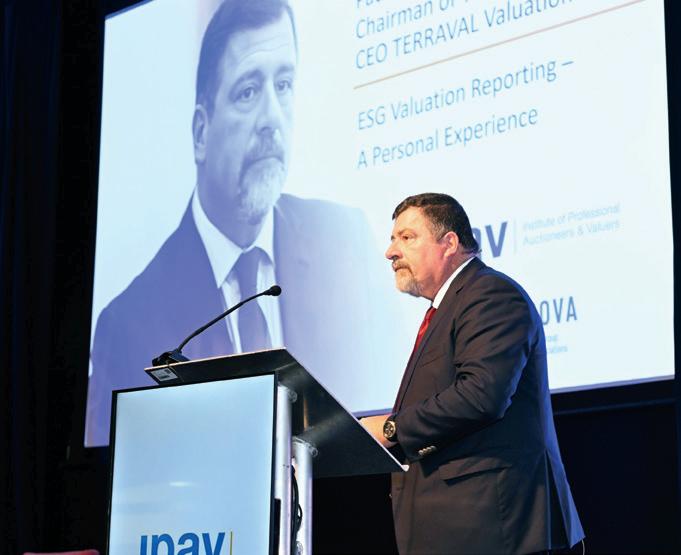
ESG Criteria and Prudential Valuation:
The New European Paradigm Sustainablefor Lending
Chairman of
TERRAVAL Valuation,
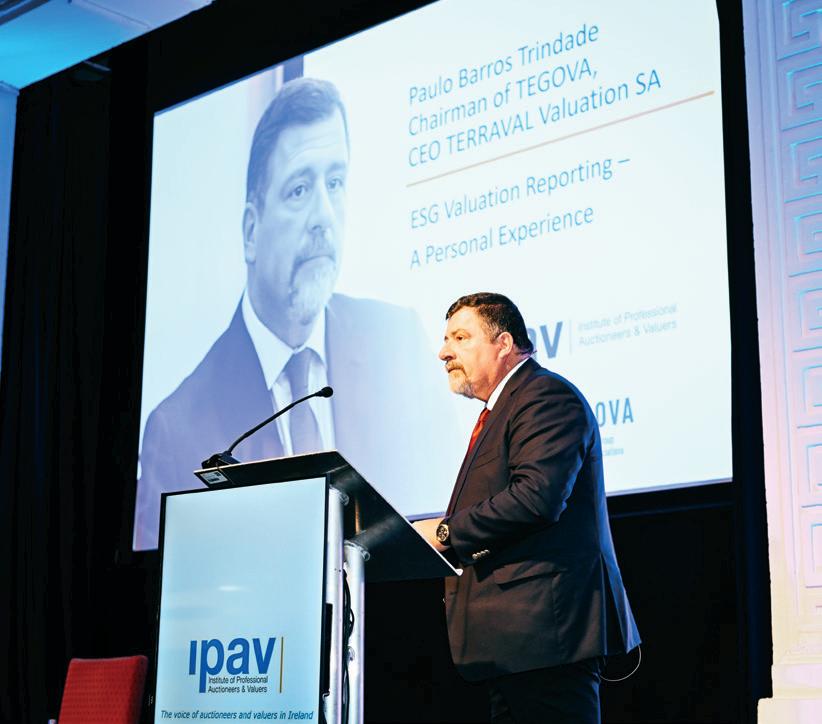
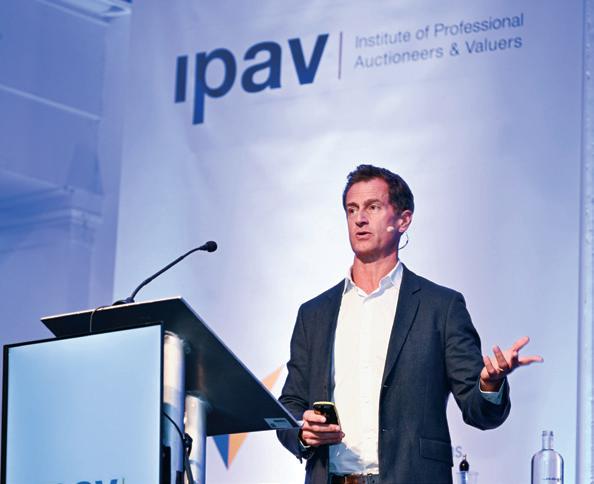
Paulo Barros Trindade, talks us through the impact of Environmental, Social and Governance criteria on the market
The growing integration of Environmental, Social and Governance (ESG) criteria into finance and investment is fundamentally transforming the way real estate is valued. What was once a market driven almost exclusively by location and construction quality is now subject to a broader and more complex set of variables. These include a building’s energy performance and its resilience to physical and transition risks.
The valuation profession therefore stands at the intersection of financial markets, public policy, and environmental transition. For valuers, understanding ESG is no longer optional – it is central to assessing the long-term sustainability of property assets and, by extension, the stability of financial systems that depend on real estate as collateral.
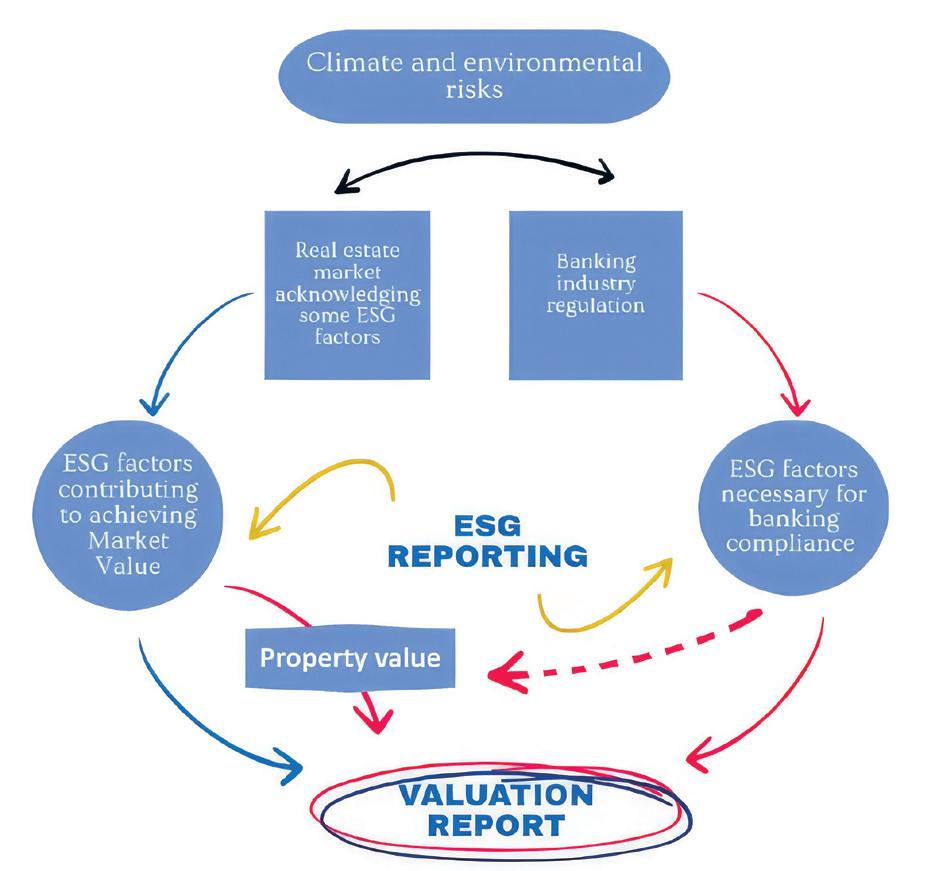
From the valuer’s perspective, ESG considerations enter the valuation process through two complementary yet distinct lenses...
Market Value
The first is market value, which is a spot value at a specific date. If any ESG factor has an influence on market value, this will already be reflected in the available evidence and comparables. This reflects the extent to which the market recognises and prices sustainability features. In certain segments – particularly prime commercial real estate in major cities – the market is beginning to assign premiums to energyefficient, climate-resilient, or certified green buildings.
However, this recognition remains inconsistent across Europe and largely absent in secondary or residential markets. On the other hand, ESG criteria mainly affect values over the medium to long term and therefore do not impact market value unless they are already recognised as drivers of that market.
Property Value
The second concept is property value, closely associated with prudential regulation and the banking industry. It emerged from the new Capital Requirements Regulation (CRR) that came into effect on 1 January 2025. Property value aims to represent a sustainable value – that is, a more stable, longterm measure of value that reflects the ability of an asset to maintain its utility and income-generating capacity over the life of a loan. ESG criteria, particularly those related to energy efficiency, resource management, and climate risks, are fundamental to this notion of sustainable value.
An asset that fails to adapt to stricter energy requirements or that is exposed to recurrent flooding, for instance, will face a progressive erosion of its property value, even if the market has not yet fully priced in those risks.
In this sense, ESG is not merely an additional layer of information; it is part of the mechanism that determines whether an asset will remain viable and bankable in the long run. It therefore plays a crucial role in achieving a sustainable value such as property value.
The
regulatory and institutional context
The European Union has established an extensive legal framework to embed sustainability in economic activity. The EU Taxonomy Regulation, the Corporate Sustainability Reporting Directive (CSRD), and the Sustainable Finance Disclosure Regulation (SFDR) are just some of the instruments that form the backbone of this system. Together, they define what constitutes a sustainable economic activity, require companies to disclose their environmental and social performance, and ensure transparency for investors and lenders.
Professional capacity and methodological evolution
Integrating ESG into valuation challenges the profession at a methodological level. Traditional valuation approaches like comparison, income, and cost were designed to measure tangible, static attributes. Incorporating ESG means valuers must now analyse dynamic, forward-looking factors that influence value over time, often with limited market evidence.
This demands new competences: understanding life-cycle carbon performance, interpreting energy certificates, reading flood-risk maps, and assessing the financial implications of retrofitting and adaptation. It also calls for collaboration between valuers, engineers, and environmental experts to ensure credible, multidisciplinary assessments.
TEGOVA is focused on developing and updating guidance for valuers. EVGN 2, the guidance note on prudent and conservative valuation criteria forming part of EVS 2025, is evolving to incorporate ESG criteria as one of the main factors for determining property value.
The valuation profession is central to Europe’s green transition. By quantifying how sustainability affects value, valuers help capital flow toward assets that are efficient and resilient. This role extends beyond compliance – it contributes to financial stability, risk transparency, and responsible investment.
In the coming years, valuation reports are expected to evolve in three key ways:
• Greater disclosure of ESG-related assumptions and limitations; Closer alignment with banking requirements for property value and risk monitoring;
• More systematic integration of climate and environmental data into valuation models. This transformation will not happen overnight. It requires training, investment, and continuous dialogue among regulators, banks, valuers and data providers. But the direction is clear: sustainability will increasingly define what constitutes a prudent, credible, and professional valuation.
The role of the valuer is evolving from that of a market observer to a key player in the financial system’s sustainability agenda. ESG factors influence not only today’s prices but
also the durability of those values over decades — the horizon that matters most to regulators, lenders and investors.
Recognising this, valuers must refine their methodologies to capture both the market’s perception of sustainability and the intrinsic, long-term resilience of property assets. The integration of ESG into valuation practice is ultimately about ensuring that the concept of value itself evolves — from a static estimate to a dynamic measure of sustainability and trust.
Despite growing awareness, several structural barriers remain:
• Data reliability and coverage: EPCs and climate-risk data remain incomplete or outdated in several markets.
• Market immaturity: ESG premiums are limited to a few prime segments; in most markets, they are not yet drivers of value.
• Skill gaps: Many valuers lack formal training in sustainability and risk modelling.
• Valuation fees: ESG reporting adds workload and cost, but clients often resist fee adjustments. Nonetheless, things are moving. In the November issue of European Valuer Journal, José Caetano Soares de Oliveira, Director of Valuation at Millenium Bank (Portugal), states clearly that valuers must be paid for this very demanding ESG valuation work that reflects the importance of their reports for bank sustainability and long-term profitability. The same must be happening with Irish banks.
Unless these barriers are addressed, the integration of ESG into valuation risks becoming a formal requirement devoid of substantive impact.
With banks working to comply with all EU law, it is essential for valuers to distinguish between ESG criteria that are already drivers of market value — those supported by evidence and reflected in comparables — and those not yet recognised by the market. When valuers are instructed by banks to include ESG criteria in their reports, even if these factors are not yet market value drivers and there is no evidence of their impact, they should still include them, clearly stating that while these factors are present, they do not currently affect market value.
If banks ask for property value, see EVS’s EVGN 2 guidance and try to organise collectively to pressure banks to pay what they should for this complex extra work.
Whether you are looking to buy, sell or you are happily staying put, be inspired by Property & Home magazine in Saturday’s Irish Examiner.
• We bring you through the keyhole of a range of properties on the market each week, from rural retreats to urban sophistication.
•Our Home section opens the door to the latest, must-have interiors trends, from sublime sofas to cosy cushions.
•Garden lovers can dig deep with expert advice.
Plus antiques and fine art with a diary of upcoming events not to be missed.
To advertise in Property & Home magazine email propertyads@examiner.ie
Home
Trading Places
Making The Move From City To Country
Can you tell me about your initial background in the industry?
As a teenager, I had a summer job in an estate agency o ice in my home town of Charleville, Co. Cork. The owner, Paddy Carroll (past president of IPAV and current board member) always encouraged me to take up a career in property. I always stayed in touch with Paddy, and when I finished university in UCC, I took his advice and decided to complete the IPAV course by night in CIT (now MTU Cork). Once I completed the course, I went travelling for a year with my girlfriend (now wife) and when I returned home, I ended up back full circle, working for Paddy Carroll in Charleville. I had 7 great years with Paddy before moving to Dublin in 2013. I worked with Wyse Property Management for a number of years before setting up a sales business with my former employer Peter Wyse. I will be 20 years in the industry next year.
You’ve recently moved to Athlone to start your own business. Why did you make that move, and how has that transition been?
My wife Clare is from Athlone, and we had purchased a house there a number
of years ago with the intention of moving there eventually. The move probably took longer than initially intended and we finally moved down when our first daughter Roisin (now 4) was a toddler. I commuted to Dublin for a period of time, but with two young children (Darragh is 2 next week), it became unmanageable. So when the opportunity came up to take over the Sherry FitzGerald Franchise in Athlone, I jumped at the chance. The move has been great, and I definitely do not miss the endless commute.
What are the main di erences you’ve found going from partner to franchisee?
I had always traded independently until I took over the Sherry FitzGerald franchise in Athlone. I would say that being part of the largest franchise network in the country provides massive opportunities and opens many doors. The brand is known nationally so many people will already know the name before they ever look for an agent. There are also huge benefits such as a dedicated business development manager, in house marketing team, tech support and a fantastic CRM system. There is also the added benefit of being able to reach out to other members for advice and guidance.
What are the biggest di erences between selling in Dublin versus Athlone?
The prices! I do think it was more challenging to build up a rapport with both vendors and perspective buyers in Dublin than in more rural areas, but maybe that’s just me.
What are some of the biggest challenges you’ve faced?
After so many years in Dublin building up a network of contacts, I was not looking forward to starting from scratch again. But thankfully this been much less di icult than expected and it turns out I had more contacts locally than I had imagined.
What are some of your observations about the property market in Athlone at the moment, and how do you see that changing in the coming months and years?
Like many regional towns, there are a large number of agents active in the area so there is competition for every listing. The second-hand market is extremely active and there is strong demand from first time buyers. There are also a good selection of higher end properties in the Athlone area, but there are fewer buyers in this segment of the market therefore these properties can take a bit longer to sale agree. There is a strong pipeline of new build property coming on stream in Athlone at present and over the coming months and years. Thankfully, I am involved in a couple of New Home schemes and demand is strong. I may be biased, but I think Athlone is a fantastic town to make home.
Liam Quain tells us about his move, from working in an office in Dublin to setting up his own franchise in Athlone.
A day in the life of Eoghan Murray
Managing Director The Property Shop, Eoghan Murray, tells us how he spends a typical working day…
7:30am: Morning!
I don’t really have much of a morning routine – I’m definitely not someone who’s up at 6am to go to the gym! I have an eight month old son so he definitely dictates the morning schedule – he’s my second job, as I like to say. I try to do as much as I can at home before I race out the door to the office.
9am: On the road
I’m usually in the office first thing checking my emails, but today I had a couple of valuation inspections on my way into the office. We do everything in here – we’re general practitioners and a small family business, so there’s nothing we don’t do. I could be doing inspections for mortgage evaluations, but we also do commercial sales and lettings, residential sales and lettings, property management, and so on.
10am: Coffee time
Once I get back into the office I have my morning coffee and a banana to keep me fuelled until lunch. I like to catch up on my calls and emails while having my coffee.
1pm: Lunch
I always make sure I step out of the office to eat lunch. If I don’t have any lunchtime viewings, I like to head to my parents’ house which is close by, to catch up with them. The Property Shop has been in operation since 1988, but I took over the company three years ago, when my father retired. He still does a bit part time, but he’s more or less retired.
3pm: Afternoon viewings
No two days are the same, but I’m usually out on viewings during the afternoon. I think viewings are my favourite part of the job – I love meeting different people. However, today I’m writing up the valuation reports from inspections carried out earlier that morning.
5.30pm: Home time
Once I get home, I try to help my wife with the dinner and spend some precious family time before it’s our little boy Paídí’s bedtime. Now he’s come along, I try not to do viewings in the evenings or weekends, so I can spend time with my son. Before that, I would have gone golfing at the weekend too! I do sometimes have viewings in the evening, but mostly I’d be catching up on paperwork and bookkeeping when I can.
7.30pm: Wind Down
Once I have everything organised for the next morning, I head out for a short run to clear the head. Unless Man Utd are playing, and if that’s the case you’ll find me glued to the TV!
IPAV Young Professional Network NEW PROGRAMMES LAUNCH
The IPAV Young Professionals Network continues to strengthen its commitment to boosting and engaging with the next generation of property professionals, with exciting new initiatives and events designed to enhance career development and grow industry connections.
The YPN’s flagship new offering is a 12-month mentorship programme, which will connect emerging professionals with established industry leaders from the first quarter of 2026. This structured programme offers invaluable opportunities for knowledge sharing, professional development, and expanded network connectivity within the Irish property sector.
Recent members and those seeking career guidance will benefit from personalised support and insights from experienced practitioners who understand the challenges and opportunities within today’s ever-changing property market. Established professionals interested in sharing their expertise whilst contributing to industry development are equally encouraged to participate.
Dates
Both prospective mentors and mentees should contact the IPAV office to register their interest and learn more about this new professional development opportunity.
1
The YPN hosted its annual Christmas drinks reception on Thursday, 11th December at the IPAV office. This relaxed networking event provided an excellent opportunity for members to connect with peers, exchange experiences, and build lasting professional relationships in a convivial atmosphere.
2
The highly anticipated and successful Annual YPN Rostrum Novice Auctioneer Competition will take place on Friday, 6th March at the prestigious Tattersalls venue in Ratoath, County Meath. This competition offers aspiring auctioneers invaluable live auction experience within one of Ireland’s most renowned auction environments. Participants will develop confidence, presentation skills, and practical auction techniques while competing for
recognition within the industry. Those interested in participating should contact the IPAV office immediately, as places are limited and demand traditionally exceeds availability.
3
The YPN’s expanded educational offerings now include dedicated ‘Lunch and Learn’ sessions specifically tailored for young professionals. These targeted knowledge development sessions address contemporary industry challenges and emerging trends affecting property professionals across Ireland. Keep an eye out for more details on these new ‘Lunch and Learn’ sessions.
These initiatives reflect the YPN’s growing commitment to professional growth and education within the Irish property sector. Current and prospective members seeking to get involved should contact the IPAV office or IPAV YPN to participate in these exciting opportunities. The future of Irish property lies with today’s young professionals – join us in shaping that future.
HOUSING HORROR DEJA-VU
Is there a touch of groundhog day here?
Tommy Barker, Property Editor of the Irish Examiner, shares his thoughts on some old patterns re-emerging…
Is it like the start of Michael Jackson’s Thriller video, where zombies and the undead emerge from cracks in the ground, coming up from drains to form a choreographed sequence of shape throwing?
Is there a new chapter to be told in Ireland’s long-running housing horror saga, starring some of the characters reemerging from series one of The Boom and the Bust, shot on location in Ireland, and occasionally overseas?
“It was the worst insult I ever got,” an estate agent recently confided when discussing the re-emergence of a name from the distant past who had sunk, seemingly without a trace, when the ship hit the fan.
Suddenly, the man was mentioned again
two decades on in 2025, as the possible buyer of a small property bundle mix, seemingly back to business.
CRASH COURSE
This was the back-from-the-dead developer who’d bought a residential site for a few dozen homes, and had promised the sale of any completed homes to the agent he’d bought the site from.
But, when the houses were ready for marketing, the sales route had taken a swerve: “I gave my son a two-hour crash course in auctioneering,” the developer told the dis-appointed estate agent of his disposal strategy.
Property professionals with more than two hours’ education to their credit will be relieved to hear sales and this ‘second
generation’ scheme were scant, and an only slightly-humbled call later went out to a number of o ices in the locale to see if any were interested in taking on sales instructions for the still-unsold homes.
The ensuing schadenfreude (and, gossip) for me prompted increased curiosity as to who was doing what, where and on how di erent a scale, as we come up to the 20th anniversaries of peak Irish housing output. It was 2006 at 93,000 units, and house prices in 2007, before it all unravelled in 2008.
THE STATE OF US
We’ve had workouts on so many levels in the two decades since, from banking and building blame games to soul-searching and confessions, then on to promises and practices of best behaviour. We’ve had
ramped up regulatory procedures, safeguards and oversight bodies… so much so and on such a scale that they recently prompted Stripe fintech founder and multi-billionaire John Collison to put pen to paper to berate the now-inbuilt inertia of our infrastructural and planning failings.
Collison appears to have got a seminal debate (re)started as 2026 rolls around, the start of the ‘20 Years Since’ anniversaries from 2006 to when we realised it was all going wrong. It’s like a property-focused equivalent of the Decade of Centenaries which the Irish State celebrated a few years back… only it’s more a case of the State of Building, rather than the Building of the State.
The Limerick native’s considered op-ed piece came out in the same week it was announced that Irish bank PTSB was to seek
new owners, majority-owned since its 2011 NAMA bailout to the tune of €4 billion, as part of the Irish taxpayers overall €30bn to save the banking system (ah, if we’d only had the stewed Apple’s €13 billion back then…)
Indeed, sorry chapters are closing, and new ones beckon. Given the passage of time since Boom/Bust, it’s not surprising to see an inter-generational shift in enterprises in the intervening period: builders, developers, and allied professionals like estate agencies all tend to draw in sons and daughters to pick up the mantle (or, the pieces), following the Biblical line “did you not know I must be about my father’s business?’
SUCCESSION
Things have moved on from the days of the slump, haven’t they? There’s hardly a ghost
estate left; sites boarded up for years are coming back into life – in some cases it’s taken 15 years or so for services to reach them; the ‘commuter’ belt is getting stretched once more, another notch in the belt at a time. Local authorities may be urged to do wholesale rezonings; we’ve another Government housing plan, yaaaay.
Fresh blood has entered the fray, with the increasing importance of the publicly-listed building behemoths like Glenveagh Properties and Cairn Homes (with 5,000 homes in their short-term delivery pipeline) surpassing even the output of doughty survivors of The Crash, such as Ballymore, the O’Flynn Group (who’ve recently revealed plans for over 1,000 homes on the home patch of media-accessible Michael O’Flynn) the Gannon Group and under the Irish radar John Fleming.
The latter’s Fleming Group had a factory in Cork harbour back in the 2000s manufacturing steel-framed houses, for Irish and UK markets. Having entered a highprofile UK bankruptcy process in 2010/2011 with then debts of €1bn, today his Vision Modular firm’s a leader in modular housing in Britain, doing the likes of 1,000+ unit schemes, including one Croydon project with factory-built apartments in towers of 38 and 44 stories tall, trucked to site and finished in time-spans as short as a year.
The bad news? The saving’s in time: modular apartments aren’t any cheaper to build.
PREDICTION
The years 2006-2008 were tumultuous, for sure. So too has been the aftermath and the dysfunction evident even still in financing, planning, services, delivery – the gamut right up to today’s marginally jittery property market.
Housing output is just 40% of what it was in 2006; prices are 10-20% higher; global challenges to ‘the old order’ exacerbate, and property ‘players’ might still chance to give two-hour ‘crash’ courses in, well, anything to their kin next in line.
Of interest, the year 2008 saw the publication of a quite seminal yet timewarped book The Builders, almost a fin de siècle account of the Celtic Tiger era and the drivers behind Ireland’s bricks and mortar obsession.
Planning for builders’ 20-year ‘Where are They Now’ sequel and update could start anytime around about now…
WHO BUYS COUNTRY ESTATES WITH LAND IN IRELAND?
Mike Brady gives us an insight into these appealing Irish trophy properties
Ireland’s property market has long held a special allure for both domestic and international buyers. In recent years, trophy properties – i.e. country estates with significant acreages of land, historic homes, or unique natural features –have attracted a diverse set of purchasers. These properties are more than just real estate – they represent status, heritage, and potential for financial growth. The main buyers typically fall into five categories:
1
High Net Worth Individuals
High Net Worth Individuals are among the most prominent buyers of Ireland’s trophy properties. For many, acquiring a country estate with land is not simply a financial transaction, but an emotional or lifestyle decision. These buyers often seek privacy, prestige, and exclusivity, drawn by Ireland’s rich landscapes and unique heritage properties. Beyond prestige, the stability of Ireland’s economy, legal system and the country’s reputation as a safe, peaceful nation also enhance its appeal for global elites.
2
Tax Investors
Another important category of buyers is the tax investor. These individuals often purchase Irish properties to take advantage of our favourable capital tax laws. Ireland’s reputation as a low capital tax jurisdiction for certain asset structures, coupled with its EU membership, makes it a compelling destination for wealth planning. For these investors, trophy properties combine lifestyle with fiscal efficiency.
3
Land Investors
Land investors approach trophy properties with a more analytical eye. Their focus lies in the land’s potential, i.e. for forestry, renewable energy, agricultural pro -
duction, or other development options. These investors want to invest in land as a safe counter cyclical investment, with investment returns but a good hedge against inflation.
4
Farmers
Farmers are the traditional backbone of Ireland’s rural property market, they still remain a significant buyer group. Successful farmers who have built wealth through sale of development land, compulsory purchase, enterprise or inheritance often aspire to purchase notable properties as symbols of success or heritage. These buyers blend emotional and economic motivations, ensuring that trophy estates remain connected to Ireland’s agricultural tradition.
However, it is becoming increasingly difficult for the successful farmers to acquire country estates with significant acreage of land, they are priced out of the market.
5Private Equity Investors
Private Equity or foreign institutional buyers are significant buyers of trophy properties with land in other countries, but not to date in Ireland due to low returns, though forestry is an exception. The question is, will the private equity investor ever see value to tempt them to purchase trophy country estate with land-properties? I would say watch this space.
The market for country estates with a significant acreage of land in Ireland is presently buoyant and reflects a unique mix of purchasers seeking prestige, practicality, and good investment strategy. From global high
Mike Brady
Mike Brady
is an
net worth elites to well-heeled local farmers, these buyers sustain Ireland’s enduring legacy of land ownership. Long may this niche but intriguing market continue.
Agricultural Consultant and Managing Director at Brady Group
Brady Group: Agricultural Consultants & Land Agents. The Lodge, Lee Road, Cork. Tel: 021- 45 45 120 email: mike@bradygroup.ie
LIVING CITY INITIATIVE
Donal Buckley compares the two schemes in the face of the new changes
THE VACANT PROPERTY REFURBISHMENT GRANT
Are owners and purchasers of older properties in most towns around Ireland (as well as in city suburbs) being discriminated against when it comes to refurbishing their old properties?
That is the question that arises following the recent Government Budget.
That Budget increased the amount of assistance it will provide for refurbishment of private properties in the centres of the five Irish cities, as well in the centres of the towns of Athlone, Drogheda, Dundalk, Letterkenny and Sligo. In contrast, it failed to increase the amount of grants available for the Vacant Property Refurbishment Grant (VPRG) which appears to have been quite successful in rural Ireland.
As well as being available for properties which were built in the above urban areas before 2008, the VPRG offers up to €50,000 for homes in all other parts of the country which have been unoccupied for more than two years and are intended as the buyer’s principal residence. For structurally unsound buildings, the Derelict Property Refurbishment Grant increases this support to €70,000. But that amount was unchanged in the Budget.
In contrast, the Budget increased the amount available under Living City Initiative, for selected urban areas referred to above. The qualifying amounts that can be spent on LCI refurbishments
Breaking Down The Numbers
Take a unit with €300,000 in qualifying refurbishment costs: the owner-occupier can claim €45,000 against their tax bill per year for six years, and €30,000 in year seven. If they pay tax at the 40 per cent marginal rate, the annual tax saving would be €18,000 per annum for the first six years and €12,000 in year seven, making for total tax savings over seven years of €120,000. LCI is also available for refurbishments for rental properties, whereby Revenue says the capital allowances are offset “primarily
against rental income”. While the rules do not explicitly forbid people from applying for both types of assistance it will be best to choose which suits the particular project being undertaken, because Revenue does point out that where any part of an LCI refurbishment or conversion expenditure is met directly or indirectly by the State or any State bodies, the amount of expenditure qualifying for tax relief “will be reduced by a multiple of three times the amount of that sum received or receivable.” In other words, it may not be worth
have increased from €200,000 up to €300,000 per unit, which is then reclaimable against tax relief over seven years. However, the LCI properties have to be older than VPRG properties, although the Budget did increase the LCI age limit from 1915 to 1975. Nevertheless, for some property owners the amount of tax that can be recouped is much greater than suggested by the new LCI limits.
Some developers can install a number of apartments in their premises and then sell them on to owner-occupiers, who would then benefit by claiming the LCI tax relief on their share of the refurbishment costs against their personal income tax over seven years.
undertaking the project if returns are not sufficient without adequate state assistance. Here is one of the advantages of the VPRG over the LCI. With the former, one is allowed to also qualify for an SEAI grant which would cover work to make your home more energy efficient such as insulation, solar panels heat pumps and windows. Applications for LCI residential projects should be made to the relevant local authority while those involving commercial property should submit their claim to Revenue.
Who’s applying & where?
Revenue estimates that the number of LCI applications to local authorities up to this year were as follows: Dublin 242; Cork 145; Limerick 71; Waterford 89; Kilkenny 19 and Galway 11 bringing the total to 577.
Explaining the reason for the extension of the LCI scheme to Athlone, Drogheda, Dundalk, Letterkenny and Sligo, Minister Donhoe told the Dáil in October that these are the five regional centres set out in the National Planning Framework identified for "a tailored approach to urban development... "strengthening Ireland’s overall urban structure, particularly in the Northern and Western and Midland Regions, to include the regional centres of Sligo and Letterkenny in the North-West, Athlone in the Midlands and cross-border networks focused on the Letterkenny-Derry North-West City Region and Drogheda-Dundalk-Newry on the Dublin-Belfast corridor..."
However, by the time we went to press the Minister had not decided on which areas of Athlone, Drogheda, Dundalk, Letterkenny and Sligo towns will be selected for SRAs as he explained that SRA designation requires careful planning and preparation in consultation with the relevant local authorities. With the scheme intended to close by December 2030, they will need to decide fairly quickly.
The European Commission’s Housing Agenda
Solenne Cormier from Rockwood breaks down what the new EU Housing Agenda means for members.
A New EU Housing Agenda
The housing crisis across the EU has intensified over the past decade. Between 2014 and 2023, rents in major cities rose by more than 45% on average, while housing prices increased by 48%. As a result, 10.6% of EU residents now spend over 40% of their disposable income on housing, a level the European Commission describes as “unsustainable.”
Housing was a leading issue in the 2024 European Elections. In response, the EU created its first Special Subcommittee on Housing and appointed a Commissioner for Energy and Housing. For the first time, housing has moved to the centre of EU-level policymaking. Though housing policy sits primarily with national governments, the EU is taking a more active coordinating role by providing guidance, data, and shared expertise to help Member States tackle the growing strain on housing markets.
In July 2025, the Commission proposed a nearly €2 trillion long-term EU budget (2028–2034) with housing prioritised through the new National and Regional Partnership Plans (€865 billion), which include objectives on affordable housing, homelessness reduction and investment in social infrastructure.
Sources: Making housing affordable - Housing - European Commission and A coordinated EU approach to housing https://housing.ec.europa.eu/ index_en
In October 2025, the European Commission published its 2026 Work Programme, which outlines the key initiatives:
1 European Affordable Housing Plan
Informed by the 2025 Affordable Housing Dialogue which gathered insights from citizens, experts, and local authorities, the plan will guide Member States on boosting supply, reducing construction and land costs, increasing private investment, and supporting social and not-for-profit housing providers.
2 Cutting Energy Costs
The EU’s housing strategy is closely tied to the climate and affordability agendas, helping households cut energy bills and reduce long-term housing costs. Under the Energy Performance of Buildings Directive, all new buildings must be zero-emission by 2030, with the EU’s entire building stock reaching net-zero by 2050.
3 Updated State Aid Rules
To help Member States respond rapidly to housing needs, updated state aid rules will speed up approvals and expand the types of affordable housing projects eligible for support.
4 Pan-European Investment Platform
Working with the European Investment Bank and other financial institutions, the Commission will establish a panEuropean investment platform to channel public and private financing into affordable and sustainable housing projects, reducing borrowing costs and stimulating long-term investment.
5 Regulating STRs
Short-term rentals (STRs) have surged across Europe, reshaping housing markets across the EU. While STRs are regulated locally or nationally, from May 2026, new EU rules will require consistent data sharing from platforms, improve transparency, and help local authorities design evidence-based regulations to address supply pressures, rising rents and over-tourism, without eliminating STRs.
Example 1:
Key “Tax Messages to Rental Clients
Shay O’Brien, Managing Director of SOBT, breaks down the key messages you should be relaying to your rental clients regarding tax.
Joey comes to you and asks you to let and manage a 3-bed house in Castleknock. He asks you what he needs to do tax wise. Now let’s look at the key messages you need to express to him…
• Set up special “rent” account, which should be used to pay expenses, such as insurance, service charges and any expenses incurred on rental property (which is better than paying these from a current account)
• It’s good practice for “multiple” properties to have separate “rent” accounts
• RTB compliance (we can do if you wish?) to ensure compliance with Part 7 of Residential Tenancy Act
• Ensure you keep receipts for expenses paid and keep good records Understand how rent is taxed and treatment of deposits
• Understand what expenses are deductible
• As the property is let in 2025, you are obliged to file a Tax Return by 31 October 2026. As you rented in 2025 you get a “double” hit as you have to pay 2025 and 2026 tax
• Consider paying tax on monthly basis to avoid lump sums Make sure you work out your tax bill in advance of letting the property
• Retain sufficient funds to pay 2025 tax bill and make a 2026 Preliminary Tax payment
Example No 2:
Two messages you could consider putting on your Rental Statements Messages each year are…
*Reminder when doing your Tax Return* Did you claim the new Residential Premises Rental Income Relief?
• For 2024, if claimed it is worth €600. Its €800 in 2025, and €1,000 in 2026 and 2027 so €3400 in total over these years in total if claimed. You should familiarise yourself with this relief and also be aware there is clawback criteria if property is sold etc.
Example No 3:
• *Reminder re Retrofitting Expenditure*
• Retrofitting Expenditure – this relief is extended for a further 3 years to 31 Dec 2028 and also allows you to claim the deduction in year incurred (effective for expenditure 1 Jan 2026) Can be worth up to €10k as a tax deduction
Example No 4:
Liam G from Manchester approaches you about letting out a second apartment he has bought in Dublin. You know he is not an Irish Tax Resident. Let’s look at your message to Liam…
• We will deduct 20% tax on GROSS rent each month
We will pay and log the 20% to Revenue
• If you are married and are joint owners, we submit the 20% on 50% share of gross rent each and you must do separate Tax Returns in Ireland
Example no 5:
Noel G from Manchester approaches you about letting out a house in Howth he has bought. On a flight, he was reading up about non-resident rules in Ireland and asks you what you need from him. Let’s look at your answer to Noel…
• Are you Tax Resident in Ireland or abroad
I confirm I am a Tax Resident of
• Confirm you are registered for Income Tax in Ireland under your PPS number. I confirm my PPS number is _________ and I am registered for Income Tax in Ireland.
Are you married? If so, is property jointly owned and confirm above point also for your spouse
Address of rental property
Address in your country of residence, phone, email, Foreign Tax number
• Irish PPS number confirmation for the owners of the rental property
• LPT ID confirmation to be provided
• Photo ID and utility bill to be provided (address in country of residence should be shown)
Carol Tallon talks us through the new placemaking opportunities for estate agents under the Planning & Development Act 2024
AGENTS OF PLACE
The conversation around the future of estate agency in Ireland is changing decisively, and nowhere was this more apparent than during the panel I hosted at this year’s National Property Summit. What emerged clearly is that estate agents are positioned in the shifting centre of property sales, client service, market intelligence, community insight, digital communication, and – most importantly –urban development.
Bluntly, the profession is evolving beyond its traditional remit of listings and transactions. Estate agents are increasingly called upon to help shape the physical, social and economic fabric of the places they serve.
This transition is driven in part by necessity. With the housing crisis continuing to bite, the market has become more complex, policy frameworks have tightened, and consumer expectations have risen. However, the deeper driver is the recognition that placemaking is no longer a niche discipline reserved for planners, architects or local authorities. Instead, it is the collective work of all stakeholders who understand that successful places need the combined efforts of local knowledge, economic opportunity and community voice. Estate agents are well positioned to play a key role here. They understand the micro-geographies of demand and supply, they maintain relationships within neighbourhoods, and they observe firsthand the conditions under which streets,
districts and towns either thrive or decline.
Purpose-built proptech and planning technologies now provide the missing link that allows this intelligence to be captured, analysed and acted upon. I believe that most estate agents already possess a heightened awareness of underused buildings, vacant commercial premises, emerging neighbourhood dynamics and shifting consumer behaviours locally. This is powerful, actionable insight. Historically, this knowledge has been informal and anecdotal – highly valuable but rarely leveraged or systematised.
With the integration of geospatial mapping, digital twins, and other tools, estate agents can now convert that local intuition into structured insights. In doing so, they begin to function not only as intermediaries for individual properties but as interpreters –and brokers – of urban potential. This is not a new concept, but over the decades, agents have been pushed out of local development. Now is the time to push back and leverage this valuable local knowledge and relationships, and site identification capability.
This is particularly important as Ireland moves toward the rollout of Urban Development Zones (UDZs) under the Planning & Development Act 2024. UDZs change how the State approaches land use, density and regeneration. They are intended to accelerate delivery, streamline decision-making and create more compact, resilient and people-centred settlements. Yet the success of UDZs hinges on the early identification of oppor-
tunity sites and the ongoing contribution of private-sector participants who understand the rhythms of local property markets.
Estate agents can bridge this gap. Their daily immersion in neighbourhood activity positions them to spot development opportunities long before they appear in official zoning maps or policy statements. By integrating digital tools with on-the-ground experience, agents could help identify buildings suitable for adaptive reuse, land parcels with unrealised value, and clusters of vacancy that could be aggregated into meaningful revitalisation projects and retrofit masterplans.
Beyond property expertise, estate agents also have a critical role in strengthening community confidence in the development process. As hybrid models of engagement become the norm – combining in-person
consultations with digital participation tools – estate agents can help translate planning information into practical, accessible insights for residents. Through organic and authentic social media and short-form video updates (and perhaps interactive mapping, in time!) estate agents can demystify the market, humanise the development process, and ensure that local voices are neither tokenistic nor afterthoughts. By focusing the community of the place as it could be, the agent becomes not just a communicator but a true placemaker: someone who facilitates the conversations and partnerships needed to build trust and shape sustainable communities.
As a longtime advocate of proptech, I genuinely believe that when administrative and compliance functions are streamlined, agents are free to invest more time in the work that
builds long-term value: interpreting market trends, advising clients, and participating in the shaping of their place. In a market where trust is both scarce and essential, technology helps ensure consistency and integrity while enabling more meaningful human engagement.
In the intelligence age, when AI and other tools can replace many of the traditional touchpoints of the property services industry, future estate agents will be part negotiator, part market analyst, part digital communicator and, more than ever before, part urban development catalyst. This evolving role strengthens both the profession and the wider ecosystem of planning and placemaking, resulting – hopefully – in better, more liveable places.
With access to real-time data, agents
can help set realistic expectations around viability and absorption rates. With digital engagement tools, they can encourage and even lead community participation in regeneration. With a placemaking mindset, they can advocate for thoughtful, people-centred development. And with an understanding of UDZ potential, they can help point or guide the private sector toward opportunities that will deliver housing, activate vacant spaces and support town-centre renewal.
As the regulatory environment evolves and UDZs come into force, the profession has a generational opportunity to redefine itself. So the question for the sector in 2026 must surely be: Do you wish to remain market takers, or become market makers?
caroltallon.com
CONNECT EVENTS
Highlights of the IPAV calendar
LEFT:
IPAV Member’s Lunches 2025
Westbury Hotel, Dublin, 28th November and Clayton Hotel Cork, Cork City, 5th December
A sincere thanks to all members and guests who joined us at IPAV’s Members Lunches in Dublin and Cork. These festive gatherings are always a highlight of the year, wonderful moments to come together, celebrate, and give back. We are truly grateful for the generosity shown by everyone in supporting the charities chosen for each event. This year, the Dublin lunch proudly supported Cian’s Kennels, while the Cork lunch was held in aid of Cliona’s Foundation. Thank you to all who attended for making both occasions meaningful, memorable, and a tremendous success.
Ivan Connaughton, Senator Aidan Davitt, Genevieve McGuirk, Fintan McGill, Liam Quain and Sean Naughton.
Lisa Kearney, Senator Aidan Davitt and Kim Doyle. RIGHT: Janet Carroll, Miriam Calton, Roslyn Geraghty and Maeve Garvey.
ABOVE: Niamh Maguire and John Fitzgerald. RIGHT: Margaret Healy, Genevieve McGuirk and Grainne McKenna.
ABOVE: Jennifer Buckley and Wendy Buckley. RIGHT: Cyril Murtagh, Kay McGuire and Paul Campbell.
ABOVE: Heather Armstrong, Susan Clarke and Giles Belton. RIGHT: Fintan McGill, Genevieve McGuirk and Lord Mayor of Dublin Cllr. Ray McAdam.
ABOVE: Pat Walsh, Kim Clarke, Niamh Giffney, John Farrelly. LEFT: Evelyn and Enda Neary of Cian’s Kennels.
ABOVE: Barry Nagle, Dawn Holton, Michael O’Driscoll, Con Nagle. BELOW: Michael O’Riordan, Brid Cahill, Orlaith Cahill and Fintan McGill.
ABOVE LEFT: PJ Buckley, James O’Connor, Fintan McGill , Genevieve McGuirk and Tom Crosse. ABOVE RIGHT: Fintan McGill and Philip Farrell.
ABOVE: Caroline Downey, Charlotte Kavanagh and Michael Downey. LEFT: Maeve Pigott, Sandra McGrath, Jane Kirrane, Maria Lehane, Adrianna Hegarty and Niamh Hegarty. RIGHT: Terri Murphy and Will Lyons.
ABOVE: Gitana Prochorovaite, Evelina Saltenyte, Ernesta Prochorovaite and David Elsaih. BELOW: Fintan McGill, Genevieve McGuirk, Charlotte Kavanag and Cllr. Albert Deasy.
ABOVE: Mike Brady, Ella Dunphy, Genevieve McGuirk and Colm Farrell.
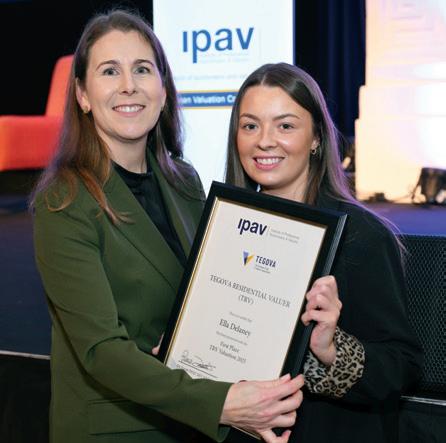
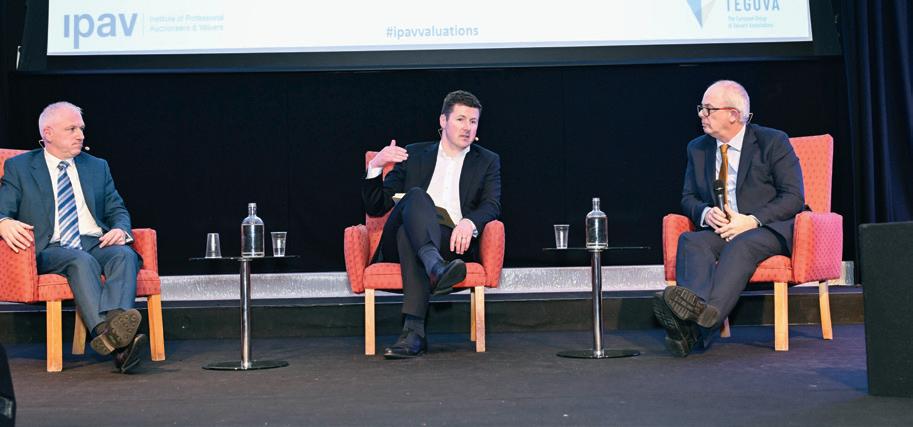
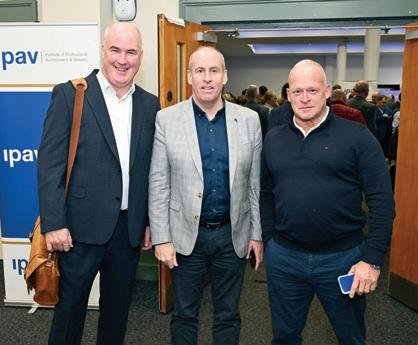
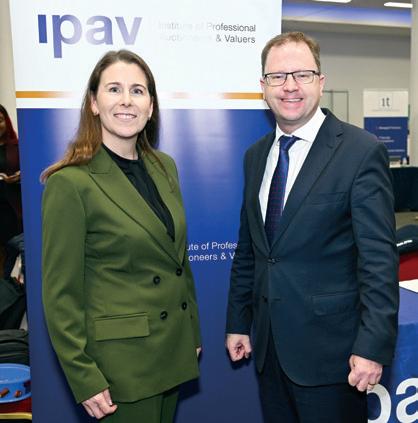
IPAV European Valuation Conference & Trade Expo
RDS, Dublin 4 4th November 2025
This year’s European Valuation Conference & Property Exhibition was a resounding success, welcoming over 680 attendees, 19 expert speakers, and 31 industry-leading exhibitors. The programme featured a diverse range of insightful topics, including ESG, Planning, Development, Economics, Green Growth, Marketing, and Technology, all contributing to a dynamic and future-focused discussion on the evolving property landscape. We extend our sincere thanks to all exhibitors and speakers for their invaluable contributions. Their expertise and engagement helped create an exceptional event that was both highly informative and rich in networking opportunities for all participants.
Tony Wallace.
RIGHT: Peter Garrigan.
RIGHT: Paulo Barros Trindade.
BELOW RIGHT: Genevieve McGuirk and Ella Delane.y
RIGHT: Genevieve McGuirk, James Lawless TD, Minister for Further and Higher Education, Research, Innovation and Science.
LEFT: Marc Thornton. RIGHT: Kate English.
ABOVE: Marcus Hartwall.
ABOVE: Conor Moore, Dara Keogh, Carol Tallon and Genevieve McGuirk. BELOW: Fergus Sharkey, Michael Dowling and Mike Brady.
LEFT: Michael Dowling, Mike Brady, Genevieve McGuirk, Fergus Sharkey.
BELOW: Niall Deegan, Peter Garrigan, Gavin Lawlor.
ABOVE: Conor Moore, Carol Tallon and Dara Keogh. RIGHT: Andrew Rechtman.
ABOVE: Ivan Yates. RIGHT: James Lawless TD, Minister for Further and Higher Education, Research, Innovation and Science.
THE BIG DEBATE: Thoughts on the rental market
Each quarter, we ask our members a question and get the inside scoop on your thoughts and opinions on a hot topic. For this issue, we focused on the rental market.
How would you describe the current supply of rental properties?
61% Decreasing 94%
How would you describe current demand for rental properties in your area?
Strong demand
“Small-scale landlords in particular are feeling squeezed: the balance between income, tax, and regulation isn’t working for them. The departure of these landlords is likely making the rental supply tighter, which contributes to the rental affordability crisis. From a long-term perspective, unless policy incentives improve more landlords may exit, further reducing rental stock.”
Dawn Holton, Holton Homes and Properties
Cork
What you said…
“Experiencing a dire lack of properties for the demand that is there. Getting impossible for tenants to find alternative rental accommodation.”
DNG Brid Feely Maynooth
“In my 20 years in the industry, the current rental market is the most under-supplied I’ve ever seen, with demand at an exceptionally high and unprecedented level.”
Nessa O’Farrell RE/MAX Carlow
“It is a crisis. Massive social issue due to increased homelessness. Impediment to economic growth. Employers can’t find properties for staff.”
Regina Mangan, Liberty Blue
Have you observed existing landlords leaving the market?
Are you seeing new investors entering the rental market in the past 6-12 months?
What you said…
“It’s frightening how little supply has come up in 2025. It’s a depressing situation with so many people having to move in with parents or become homeless.”
Anonymous
“The market remains structurally undersupplied and consequently over-priced, creating an environment where neither tenants nor landlords enjoy genuine security or stability.”
Ellen O’Sullivan, Keane Mahony Smith Auctioneer
“Changes in legislation, and the fear of uncertainty around being able to sell the property in the future if tenants have the right to stay in situ during the sale. The incentive of market rent for new tenancies is not enough of a reason for small landlords to stay.”
Anonymous
How confident are you about the stability of the rental market for the next 12 months?
“They feel that they have no control over their investment. New regulations coming in next March. Rent pressure zones stopping market rent Paying high tax compared to institutional investors paying none.”