S U P P O RT I N G E N T R E P R E N E U RS | VA LU I N G SM A L L B U S I N ESS | R E W A R D I N G R I S K TA K E RS | S U M M E R 2026
BUSINESS LEAP OF FAITH
SMALL BUSINESS OWNER BERNIE WONG ON SWAPPING KUALA LUMPUR FOR BLACKROCK
PRACTICE PIONEERS
BALANCING PATIENT CARE WITH THE REALITY OF RUNNING A MEDICAL PRACTICE
THE CANARY IN THE COALMINE
SMALL FIRMS ARE NAVIGATING A 44% SURGE IN BUSINESS COSTS
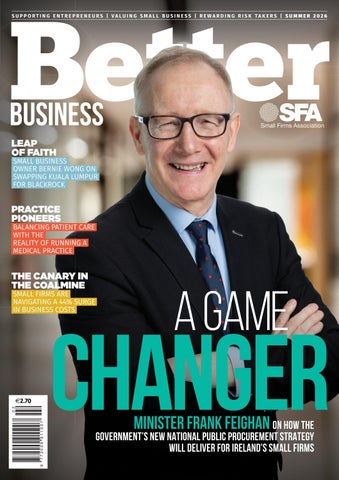
CHANGER MINISTER FRANK FEIGHAN ON HOW THE
GOVERNMENT’S NEW NATIONAL PUBLIC PROCUREMENT STRATEGY WILL DELIVER FOR IRELAND’S SMALL FIRMS
9
772009 911007
02
2.70
A GAME
OFC_BB Summer 2026_Cover_V2.indd 1
13/08/2026 16:24
Your next Big Step is Micro boost skills - boost business Future-proof your skills with Skills to Advance Micro-Qualifications - short, targeted courses, at little or no cost, in key areas like sustainability, digital business skills, market development, and more. Stay ahead by contacting your local Education and Training Board or visit skillstoadvance.ie. Supported by the SOLAS Skills to Advance initiative and the Government of Ireland.
256523_Solas_Better Business Summer 2026.indd 1
13/08/2026 15:30
S U P P O RT I N G E N T R E P R E N E U RS | VA LU I N G SM A L L B U S I N ESS | R E W A R D I N G R I S K TA K E RS | S U M M E R 2026
WELCOME SUMMER 2026
BUSINESS LEAP OF FAITH
SMALL BUSINESS OWNER BERNIE WONG ON SWAPPING KUALA LUMPUR FOR BLACKROCK
PRACTICE PIONEERS
BALANCING PATIENT CARE WITH THE REALITY OF RUNNING A MEDICAL PRACTICE
THE CANARY IN THE COALMINE
A GAME
SMALL FIRMS ARE NAVIGATING A 44% SURGE IN BUSINESS COSTS
CHANGER MINISTER FRANK FEIGHAN ON HOW THE
GOVERNMENT’S NEW NATIONAL PUBLIC PROCUREMENT STRATEGY WILL DELIVER FOR IRELAND’S SMALL FIRMS
9
772009 911007
02
a2.70
On the cover: Minister Frank Feighan
Editor: Denise Maguire Creative Director: Jane Matthews Designer: Alan McArthur Production Executive: Nicole Ennis Managing Director: Gerry Tynan Chairman: Diarmaid Lennon Email: info@ashville.com or write to: Better Business, Ashville Media, Unit 55, Park West Road, Park West Industrial Estate, Dublin 12, D12 X9F9. Tel: (01) 432 2200 All rights reserved. Every care has been taken to ensure that the information contained in this magazine is accurate. The publishers cannot, however, accept responsibility for errors or omissions. Reproduction by any means in whole or in part without the permission of the publisher is prohibited. © Ashville Media Group 2026. All discounts, promotions and competitions contained in this magazine are run independently of Better Business. The promoter/advertiser is responsible for honouring the prize. ISSN 2009-9118 SFA is a trading name of Ibec.
Welcome to Better Business, a magazine dedicated to the small business community. As the summer rolls on, the SFA’s public affairs focus is on the Budget and Ireland’s Presidency. The SFA is encouraged by the Presidency’s focus on improving competitiveness to foster greater prosperity. Despite the healthy state of Ireland’s economy, small businesses continue to be vulnerable to burdensome regulations, fluctuating energy prices and labour cost pressures. These points were directly communicated to Government by the SFA in a series of engagements including the Cost of Business Advisory Forum and the National Economic Dialogue which took place in Dublin Castle. This issue of Better Business focuses on procurement and includes commentary from Minister of State Frank Feighan who chairs the SME committee on Public Procurement. The Government recently published its procurement strategy for small businesses which aims to improve the process of participating in the public procurement process for small businesses. In addition to political stakeholder activity, the SFA has been on the road meeting members around the country, engaging with experts and showcasing the benefits of membership to the wider business community. In this issue, you will find details of the SFA’s recent roadshow events which took place in Limerick, Cork and Galway. There is also a special report on the results of the SFA’s annual Small Business Survey which highlights a range of issues including access to finance, business costs and AI usage. Alarmingly, the survey found cumulative costs for small businesses are up 44.4% in three years. The Sector Spotlight features companies involved in medical services while our entrepreneurs section features profiles of companies that were recently recognised for their efforts around sustainability at the SFA National Small Business Awards. Also in this issue, the HR page looks at how companies can design more inclusive staff policies. Our travel page looks at South Africa while our health page explores the future of workplace mental health. Better Business is the magazine of the small business community. We welcome your feedback, suggestions and ideas to info@sfa.ie David Broderick Director, Small Firms Association
SFA | BETTER BUSINESS 1
001_BB Summer 2026_SFA Welcome Note_V3.indd 1
13/08/2026 16:26
CONTENTS SUMMER 2026
04 06 08
Big News for Small Business News, views and profiles from SFA members and small businesses in Ireland
Costs
Small firms are navigating a 44% surge in business costs
Events
SFA was the voice of small business at the National Economic Dialogue
13 22 28
Cover Story The new National Public Procurement Strategy aims to remove obstacles to SME participation in public tenders
Sector Spotlight Three founders share their views on balancing patient care with the realities of running private medical practices
Expansion Clír Water on why serendipity and divinity are at the heart of its operations
32 34 36
Hairdresser Bernie Wong chats about why he risked it all on a one-way ticket from Malaysia to Ireland
Growth Peter Wynne at Ecofil on expanding into the hospitality sector
Entrepreneurs These Irish companies have put sustainability at the heart of their business
Policy What Ireland’s EU Presidency means for small business
HR Designing inclusive policies as an SME
Travel From green tech to continental trade access, South Africa is cementing its place as Ireland’s primary African trading partner
Small Business
49 50 52
2 SFA | BETTER BUSINESS
002_BB Summer 2026_Contents_V2.indd 2
13/08/2026 16:26
Summer 2026 Contents
FROM TOP LEFT: Minister of State Frank Feighan on the Government’s new National Public Procurement Strategy, page 13 //
Rachel Bothwell shares her views on the commercial realities of running a private medical practice, page 22 // Bernie Wong on new challenges and swapping Malaysia for Ireland, page 32 // Raquel Noboa chats about why it’s the small steps that lead to meaningful change, page 41
SFA | BETTER BUSINESS 3
002_BB Summer 2026_Contents_V2.indd 3
13/08/2026 16:26
Updates News
BIG NEWS FOR SMALL BUSINESS
Angela
a lliv O’Su
n
QT9 SOFTWARE MARKS TWO YEARS IN BUSINESS
Cllr Gregory Conway, Cathaoirleach, Municipal District of Cappamore-Kilmallock; Maria Ryan and Christy Murphy, Crystal Lean Solutions, winner of Export Award; Mike Cantwell, Head of Enterprise, LEO
AWARD
Crystal Lean Solutions clinches export award Crystal Lean Solutions has achieved a major milestone in its international expansion, winning the Export Award at the National Enterprise Awards Limerick County Final. The accolade recognises the company’s success in taking its Limerick-born expertise and scaling it into competitive global markets. From its beginnings in Croom, County Limerick, the company has evolved into an internationally focused business. Established in 2008, it delivers business transformation, training and project management across the global manufacturing, construction and services sectors. A key driver behind this award-winning export success is CoPlan, Crystal Lean Solutions’ digital project management software. Built around the principle of “One Plan, One Team, One Build,” CoPlan enables international growth by improving collaboration and project delivery for teams working across multiple locations. Beyond software, the company’s Training Academy drives global success by providing flexible learning solutions in Lean and continuous improvement, supporting organisations both in Ireland and overseas. Winning the Export Award marks an exciting new chapter for Crystal Lean Solutions as it continues to solve real-world business challenges worldwide under its core vision – “Delivering Excellence Together.”
A Kerry-based software company is celebrating two years in business since expanding into the European market. QT9 Software Ltd, which is located in Killarney town centre, was established in 2024 as part of the company’s move to better serve customers across Europe. The business is part of a US-based company founded more than 20 years ago in Chicago by Brant Engelhart. Its Irish office is headed up by Angela O’Sullivan, who serves as Operations Director. The company provides quality management software to businesses worldwide, with the Irish office supporting European customers within their own time zones. As part of its continued European expansion, the software company also opened a new data centre in Amsterdam in 2025 to meet data storage and compliance requirements. QT9 Software works with businesses that must meet quality standards such as ISO 9001 and ISO 13485, as well as industry-specific regulations across sectors such as automotive, aerospace and life sciences. As its QMS software is pre-validated, the company is increasingly focused on the med-tech and life science industries. The company is currently recruiting for an IT Systems Administrator and Software Implementation Specialist, which will be office based in Killarney. www.qt9software.com
www.crystalleansolutions.ie 4 SFA | BETTER BUSINESS
004_BB Summer 2026_News_V3.indd 4
14/08/2026 10:20
Hesaid Shesaid
News Updates
TOPFORM CELEBRATES 50 YEARS OF MANUFACTURING EXCELLENCE 2026 marks a significant milestone for Topform as the company celebrates 50 years in business. Founded in 1976 as an export-focused laminate worktop manufacturer in the Shannon Free Zone, Topform has grown from modest beginnings into one of Ireland’s leading manufacturing businesses. Following acquisition by Irish entrepreneur Sean Stewart in 1985 and a management buyout led by Paul Glynn in 1996, the company embarked on a journey of continuous improvement, innovation and growth. Over five decades, Topform has successfully navigated oil crises, recessions, the millennium bug, the global financial crash, Brexit and Covid. Throughout that time, the business has continued to evolve, adapting to changing markets and customer needs while investing in its people, products and manufacturing capabilities. Today, Topform serves customers across Ireland, the UK and Europe, supplying innovative worktop solutions to both the kitchen and leisure vehicle sectors.
“The Irish Presidency will work to further eliminate barriers, tackle unnecessary regulatory burdens and boost internal market trade. We will drive the digital and climate transition and ensure a level playing field for businesses and communities across the EU.” Address by Taoiseach Micheál Martin, presenting the priorities of the Irish Presidency of the Council to the European Parliament
www.topform.ie
Zen Pensions launches digital, app-based pension Zen Pensions, a Small Firms Association (SFA) member, has launched Ireland’s first fully digital, app-based pension, giving employers a simple, transparent way to provide staff with a pension, and at zero cost to the business. For SMEs, Zen offers a smarter more flexible alternative to auto-enrolment. Employers can onboard employees via the app in minutes, without the paperwork, ongoing admin, or cost traditionally associated with workplace pensions. There are no employer setup or ongoing fees. For employees, charges are simple - a single transparent fee capped at 0.9% (dropping to 0.7% for larger funds), with no hidden policy or contribution charges – less than half the typical cost of incumbent personal pension providers. Employees get 24/7 visibility of their pension in-app, can pay AVCs through payroll, and take their pension with them when they change jobs. www.zenpensions.com
“The clear message from this survey is that almost all small businesses are operating in a high-cost environment in recent years. For many, this is not sustainable.” SFA Director David Broderick commenting on the SFA Small Business Survey findings
“Businesses play a pivotal role in driving this change, but government initiatives are equally crucial. By investing in education, addressing the cost of disability and simplifying support systems, policymakers can empower individuals with disabilities and enrich our society and economy.” Jeanne McDonagh, CEO of The Open Doors Initiative, speaking at its annual Leadership Summit
SFA | BETTER BUSINESS 5
004_BB Summer 2026_News_V3.indd 5
13/08/2026 16:28
News Costs
The
Canary Coalmine in the
SMALL FIRMS ARE NAVIGATING A 44% SURGE IN BUSINESS COSTS
R
unning a small business has always required resilience, but the latest data from the Small Firms Association (SFA) confirms what owners across Ireland already know all too well – the current cost environment is pushing many to the brink. The SFA Annual Small Business Survey 2026, conducted by Amárach Research among more than 400 small firms, has revealed a staggering 44.4% cumulative increase in average business costs over the past three years. Far from stabilising, overheads have spiked by another 10.9% in the last 12 months alone, leaving virtually no sector untouched. For small business leaders, identifying the source of the pressure isn’t difficult. This prolonged high-cost environment has severely eroded cash reserves. The survey reveals a deeply alarming reality – 59% of small firms now have six months
According to the survey, the top contributors to spiralling operational costs include: Employee & Labour Costs Cited by
50%
of respondents as a major strain Energy (Gas & Electricity) Impacting
44% of businesses
Insurance & Raw Materials Creating severe pressure for
39% & 37%
of firms, respectively
Crucially, much of this burden is driven by state-imposed measures. The combined rollout of Auto-Enrolment, increases to the National Minimum Wage and rising statutory sick pay obligations have hit small employers at a time when profit margins are already wafer-thin.
or fewer of financial buffers and nearly half warn they could face critical liquidity challenges within the next three months without additional funding. Compounding this vulnerability is a rigid financing landscape. High borrowing costs and ongoing economic uncertainty have left one in five firms reluctant or unable to access the short-term capital required to manage day-to-day cash flow. In response, owners are taking drastic internal actions to survive. Half of those surveyed are actively reviewing their spending plans, 23% have paused capital investment and 15% have implemented hiring freezes – steps that protect shortterm survival but inevitably threaten longterm growth. SFA Director David Broderick has described these findings as a "canary in the coalmine" moment for the wider economy. Viable, community-based enterprises cannot absorb these costs indefinitely. In response, 90% of members are calling for immediate Government intervention. The SFA is actively lobbying policymakers for targeted reliefs before it is too late. Key demands include an expansion of VAT reductions, a temporary PRSI rebate for heavily impacted firms, a freeze on commercial rates and state utility supports. Going forward with this survey, the SFA will continue to ensure the voice of small business owners is heard at the highest levels of Government, fighting for the breathing room that many businesses deserve.
David Broderick, Director, SFA
6 SFA | BETTER BUSINESS
006_BB Summer 2026_News_Costs_V2.indd 6
13/08/2026 16:28
EASY WINS FOR LOWER ENERGY BILLS
SEAI BUSINESS SUPPORTS
SAVED MSA SAFETY
€24,000
Based on MSA metered data and market energy rates over same time period.
257167_SEAI_Better Business Summer 2026.indd 1
13/08/2026 15:31
Events National Economic Dialogue
REFORMING NOW FOR A SECURE FUTURE THE SFA WAS THE VOICE OF SMALL BUSINESS AT THE NATIONAL ECONOMIC DIALOGUE SFA Chair Geraldine Magnier and SFA Public Affairs Lead Jonathan McDade represented small business owners at the annual National Economic Dialogue in Dublin Castle. The event was a good opportunity to communicate the SFA’s policy priorities for Budget 2027 to key Ministers and officials in Government. The discussions at the Dialogue focused on the theme of ‘Reforming now for a secure future: Putting Future Forty into practice’. In his opening remarks, Taoiseach Micheal Martin said: “Our economy continues to show real resilience, but we all know that the scale and pace of change, particularly in the international economy on which we rely, is going to continue to accelerate. That is why we have taken the initiative to publish in-depth reviews of the long-term scenarios for the Irish economy and public finances.” 8 SFA | BETTER BUSINESS
008_BB Summer 2026_Events_V3.indd 8
13/08/2026 16:29
Budget 2027 Events
Preparing for Budget 2027
A Pre-Budget Forum gave the SFA and other stakeholders an opportunity to discuss priorities for Budget 2027 During the summer, the SFA attended the annual Pre-Budget Forum at Chartered Accountants House, hosted by the Department of Social Protection. The forum was an opportunity for various community stakeholders to come together to discuss their priorities for Budget 2027. Minister Dara Calleary was one of a number of people that addressed the event, which was moderated by Ingrid Miley.
SFA | BETTER BUSINESS 9
008_BB Summer 2026_Events_V3.indd 9
13/08/2026 16:29
KEY REMAINING DATES FOR THE UPCOMING CALENDAR YEAR:
Events B2B Networking
WATERFORD
15th SEPT Ibec Waterford Office, X91 DEC4 DUBLIN
8th Oct
SFA Office, Ibec Head Office, 84/86 Lower Baggot St, Dublin
Making Connections
Regional SFA events give members a chance to network and learn from each other The Small Firms Association recently hosted three free B2B networking events in Cork, Limerick and Galway for business owners. Attendees got to hear from a range of experts in various fields about how to improve their own prospects. Upcoming regional gatherings will feature expert-led panels on business resilience, digital strategies and HR. This will provide an excellent opportunity to connect with fellow entrepreneurs.
10 SFA | BETTER BUSINESS
008_BB Summer 2026_Events_V3.indd 10
13/08/2026 16:29
Credit where it’s due. Having difficulty getting a new business loan or restructuring your existing debt with your bank? Established by the Minister for Finance, Credit Review is here to help. Talk to the credit experts today on 0818 211 789 or visit creditreview.ie
256569_CRO_Better Business Summer 2026.indd 1
13/08/2026 15:31
Support local to lift us all
AllAll Rise Rise ChampionGreen.ie
Champion Green_A4 Advert.indd 1
13/08/2026 28/10/2021 15:41 14:59
Public Public Procurement Procurement Cover Story
THE GOVERNMENT’S NEW NATIONAL PUBLIC PROCUREMENT STRATEGY OFFERS AN OPPORTUNITY FOR MEANINGFUL CHANGE BY REMOVING THE OBSTACLES TO SME PARTICIPATION IN PUBLIC TENDERS
A Game
Changer
SFA | BETTER BUSINESS 13
013_BB Summer 2026_Feature_Public Procurement_V2.indd 13
13/08/2026 16:40
Cover Story Public Procurement
The Government’s National Public Procurement Strategy – the first of its kind – promises a more competitive and strategic public procurement landscape, particularly for small firms. The aim is to completely transform Ireland’s procurement process and provide an overall direction for public procurement in Ireland through a wholeof-Government approach. “Our strategy for public procurement is based around four key pillars – strategic, innovative, sustainable and transparent. With this new strategy we want to support Ireland’s small firms, so many of which are long-standing family businesses. We also want to empower public buyers to create participation through competition. I come from a retail background – my family had a newsagent and I also had a bar and restaurant so I know how challenging running a small business can be. There’s just no time to sit down and apply for public procurement contracts. So I want to transform that
have been incremental improvements that have made it easier for small firms to engage with the procurement process. What we want to do is ensure there’s a consistent approach for small firms – that they can be included in opportunities that are advertised and that there are different avenues for them to participate so they can focus their resources where they’re needed. The less time they spend on filling out forms and the more time they spend on working on proposals that will allow them to win business, the better.” The new strategy must, says Sweeney, set a clear direction so that every buyer across Government departments, agencies and right down to local authorities, has a clear statement on why small firms need to be included in the process. “After all, procurement rules are written
“OUR STRATEGY FOR PUBLIC PROCUREMENT IS BASED AROUND FOUR KEY PILLARS – STRATEGIC, INNOVATIVE, SUSTAINABLE AND TRANSPARENT. WITH THIS NEW STRATEGY, WE WANT TO SUPPORT IRELAND’S SMALL FIRMS, SO MANY OF WHICH ARE LONG-STANDING FAMILY BUSINESSES.” landscape and make it much easier for small businesses to engage in the process,” says Minister of State at the Department of Public Expenditure, Infrastructure, Public Service Reform and Digitalisation, Frank Feighan. Transforming Ireland’s public procurement system sounds like a big ask but it’s a change that’s required, says Head of Infrastructure & Environmental Sustainability at Ibec, Aidan Sweeney. “For the first time ever, we will have a central Government policy that will make it easier for small firms to do business with the State. We have found that year on year, there
from the point of view of those selling into the system, not from the buyer perspective. The new strategy is about opening up the marketplace.” Small firms are often discouraged from engaging in the public procurement process as financially, it just doesn’t make sense. “The new strategy should ensure buyers don’t enforce standards or requirements that might increase insurance costs for small businesses and therefore make the whole process financially impossible. It can’t be about the lowest price anymore – that race to the bottom has to come to an end,” added Sweeney.
14 SFA | BETTER BUSINESS
013_BB Summer 2026_Feature_Public Procurement_V2.indd 14
13/08/2026 16:40
Public Procurement Cover Story
Aidan Sweeney, Head of Infrastructure & Environmental Sustainability, Ibec
A transparent process
Frank Feighan, Minister of State at the Department of Public Expenditure, Infrastructure, Public Service Reform and Digitalisation
For small firms, the cost element associated with public tendering is often prohibitive. In 2025, a large proportion of small businesses that were eligible to engage with the process felt the cost of doing the tender would outweigh the margin gain if they were successful. With Ireland’s public procurement market worth €20 billion a year, there are huge opportunities for small firms – if it was actually worth their while engaging in the process. Small firms make up 98% of businesses in Ireland and employ over 1.2 million people. Yet their share of public contracts does not reflect those figures. “With no dedicated tendering team, small firms cannot meet the cost and complexity of bidding. A culture of awarding on lowest price can produce false economies, where a cheap bid turns into an expensive contract once delays and add-ons are counted and bundling work into very large frameworks pushes smaller suppliers out before they can even apply,” says Geraldine Magnier, SFA Chair and Director at Idiro Analytics. A more transparent e-tender system would, says Geraldine, make it easier for small firms to identify opportunities. “We don’t always know who else is going for a job. If we did, it would very quickly determine whether we could continue with a tender or not. The process needs to be more time efficient for SFA | BETTER BUSINESS 15
013_BB Summer 2026_Feature_Public Procurement_V2.indd 15
13/08/2026 16:40
Cover Story Public Procurement
LOWEST COST OVER BEST VALUE One small firm gives its experience with Ireland’s public procurement process A recent public procurement exercise for a contract valued at over €60m highlights a challenge frequently encountered by SMEs. The contract covered multiple distinct service areas and required bidders to invest significant time, expertise and cost in preparing a compliant, high-quality submission. This included: • • • •
External tender Consultancy support Extensive compliance reviews Substantial senior management involvement
The process introduced a significantly expanded set of service and governance obligations, yet the commercial rates were predetermined and did not allow bidders to reflect the true cost of delivering those additional requirements. Although the SME was ranked as a successful bidder, it ultimately withdrew from the award process because it could not responsibly commit to delivering the enhanced obligations at a price that was commercially sustainable. This experience demonstrates a wider procurement challenge. When suppliers are required to deliver increased levels of quality, compliance and accountability but are unable to transparently cost those requirements, procurement can inadvertently favour the lowest-cost bid over the best-value solution. SMEs are prepared to invest in competing for public contracts, but procurement frameworks should ensure that sustainability, quality, operational reality and long-term value are given equal consideration alongside price.
“WHAT WE WANT TO DO IS ENSURE THERE’S A CONSISTENT APPROACH FOR SMALL FIRMS – THAT THEY CAN BE INCLUDED IN OPPORTUNITIES THAT ARE ADVERTISED AND THAT THERE’S DIFFERENT AVENUES FOR THEM TO PARTICIPATE SO THEY CAN FOCUS THEIR RESOURCES WHERE THEY’RE NEEDED.” small business. On top of that, the focus on building commercial skills inside public bodies matters. Tenders are still being written with big business in mind. A buyer who understands the small business market writes fairer tenders.” For a small business struggling to maintain cash flow, it’s not possible to do a tender on their own. “At Idiro Analytics, we would often partner with a larger firm. The Government views larger businesses as a more risk averse approach to getting the job done so for small firms, partnership or consolidation is a must. The whole area of public procurement is also becoming more complex in the age of AI. There’s so much work needed across so many areas so I don’t think it’s good enough to tell semi-states to think small first. We should be seeking an agreement that big companies must bring along a small company within their win. That consolidation piece needs to go beyond a nice to have, but a must have.” To allow small businesses compete for public work, Geraldine believes three elements of the process must be addressed – value must be measured properly, barriers to SME participation must be reduced and long-term outcomes, not just upfront costs, must be assessed. “If procurement strengthened the weighting given to quality, service outcomes, workforce sustainability, innovation and social value alongside price, that would reduce the over-reliance on lowestcost bids and allow SMEs to compete on the full value they deliver. This would also better reflect the original intent of the Most Economically Advantageous Tender (MEAT) principle by focusing on long-term public value rather than lowest upfront cost,” she says.
16 SFA | BETTER BUSINESS
013_BB Summer 2026_Feature_Public Procurement_V2.indd 16
13/08/2026 16:40
Public Procurement Cover Story
Geraldine Magnier, SFA Chair and Director at Idiro Analytics
in Dublin, Cork and Athlone. “From the outset, we wanted to engage with suppliers, public buyers, departments, ETBs, family businesses and local authorities. We also held a supplier webinar last September, which allowed for a final opportunity for public feedback. Meetings have been held with various organisations including the SBA Advisory Group which includes members of the SFA, IBEC, ISME and CIF Chambers. All stakeholders have had an opportunity to feed into the strategy.” The Government’s new strategy will, says Minister Feighan, make the process of onerous form-filling a thing of the past. “We want to make the process much easier. The message I want to convey is that public procurement is a real opportunity for SMEs. To improve that process further, we will have a mentoring service available to small firms that want to tender for public projects – we want to equip and empower small firms to participate in public procurement and equally, we want Government to feel it can collaborate
“WE DON’T ALWAYS KNOW WHO ELSE IS GOING FOR A JOB. IF WE DID, IT WOULD VERY QUICKLY DETERMINE WHETHER WE COULD CONTINUE WITH A TENDER OR NOT. THE PROCESS NEEDS TO BE MORE TIME EFFICIENT FOR SMALL BUSINESS. ON TOP OF THAT, THE FOCUS ON BUILDING COMMERCIAL SKILLS INSIDE PUBLIC BODIES MATTERS.” Additionally, a proportionate pre-tender assessment stage would enable suppliers to demonstrate capability, experience and service quality through a simplified submission before progressing to a full tender. “That would significantly reduce bidding costs and barriers for SMEs and would encourage broader participation, increase competition and innovation. It would also ensure businesses only make major tender investments where they have a realistic opportunity to compete.” A stronger whole-life value assessment when evaluating bids, including contract performance, service resilience, workforce stability, delivery risk and long-term outcomes, would help prevent false economies and deliver better value for the taxpayer over time. “Major public projects have demonstrated that the lowest-priced bid at award stage does not always result in the most economically advantageous outcome over the life of a contract.”
A game changer The first consultation on the new strategy was held in March 2025, followed by three regional roadshows
with small firms. We see this as a collaborative process that benefits both suppliers and buyers.” The aim is to create a competitive SME market. “We will be providing practical resources and support, such as perhaps the ability to build consortiums. We know that this strategy won’t be for everybody – there’s a proportion of small businesses that won’t be in a position to engage with public procurement – but for those that are, we’re trying to encourage more SMEs and family businesses to get involved.” If the strategy is successful, it’ll be a game changer for the small business community. “That’s the message we want to get across, that Government and departments are open for business, not just for the bigger companies, but to everybody.” The strategy is currently going through final approval stages and although there is no official launch date, it’s hoped that it will be this year. “We have so many fantastic, innovative small firms in Ireland that provide exceptional quality goods and services. We want to work with them. There’s a real prospect for doing great business with these firms in the public procurement arena.” SFA | BETTER BUSINESS 17
013_BB Summer 2026_Feature_Public Procurement_V2.indd 17
13/08/2026 16:40
Awards 2026 Leap Irish Law Awards
Celebrating dedication and excellence THE LEAP IRISH LAW AWARDS RECOGNISED THE FIRMS AND INDIVIDUALS SHAPING THE FUTURE OF IRISH LAW
Ireland's legal elite gathered in style in June at the Clayton Hotel, Burlington Road, Dublin, for the 14th annual LEAP Irish Law Awards. With over 650 attendees and 34 award categories, the event recognised the professionals, firms and rising stars who continue to shape the future of Irish law. Proudly serving as headline sponsor, LEAP reaffirmed its commitment to excellence and innovation in the legal sector while MC Anton Savage kept the audience entertained throughout the evening. The event featured special appearances by Rosemarie Loftus, President of the Law Society of Ireland and Richard Hammond, Solicitor and Partner at Hammond Good LLP and Chair of the judging panel. Both praised the remarkable quality of this year's entries. One of the evening’s highest honours, Law Firm of the Year, sponsored by LEAP, was awarded to Sweeney McGann LLP, Co Limerick, representing the Munster region. The firm took home two awards, reflecting their outstanding client service and strategic growth. Throughout the evening, winners were recognised across a diverse range of practice areas including Family Law, Employment Law, Corporate Law and more. The awards also paid tribute to educational institutions and rising legal talent, with categories such as Law Student of the Year and Law School of the Year. The 2026 LEAP Irish Law Awards were made possible through the generous support of a dedicated community of sponsors including Calcutta Run, Dublin Simon Community, The Hope Foundation, Appleby Jewellers, Arachas, Clio, Davy, IILEX, Irish Legal News, Dye & Durham, HRM4Less, MSL Motor Group and media partners The Business Post and Truehawk. The 2026 LEAP Irish Law Awards highlighted not only individual excellence but also the collective spirit, innovation and integrity that define Ireland's legal community. Closing the night was the presentation of the Lifetime Achievement Award, sponsored by LEAP, to His Honour Judge Gerard Griffin. The room rose in a standing ovation to honour his extraordinary career, bringing a memorable evening celebrating dedication and excellence in the legal profession to a perfect close.
18 SFA | BETTER BUSINESS
018_BB Summer 2026_LEAP Irish Law Awards 2026_V2.indd 18
13/08/2026 16:49
2026 Leap Irish Law Awards Awards
IRISH LAW AWARDS 2026 ADR Firm of the Year Sponsored by HRM4Less Graham Kenny Solicitors, Co. Dublin Banking & Finance Legal Team / Lawyer of the Year Fexco, Co. Kerry Civil Litigation Law Firm/ Lawyer of the Year Dublin & Overall Winner Lavelle Partners LLP, Co Dublin Connacht/Ulster McGinley Solicitors LLP, Co Donegal Leinster Coghlan Kelly LLP, Co Wexford Munster Sweeney McGann LLP, Co Limerick Corporate / Commercial Law Team / Lawyer of the Year Sponsored By Arachas MHP Sellors LLP, Co Clare Criminal Law Firm / Lawyer of the Year Michael Hennessy Solicitors, Co Dublin Diversity and Inclusion Firm of the Year Jacob Law LLP, Co Waterford Employment Law Firm / Team / Lawyer of the Year Award Sponsored By Business Post Leinster Inc Dublin & Overall Winner Anne O'Connell Solicitors, Co Dublin Connacht/Ulster: Alastair Purdy LLP, Co Galway Munster: Aoife McCarthy, Douglas Law Solicitors LLP, Co Cork Excellence & Innovation in Client Services Sponsored By Clio Dublin & Overall Winner Chief State Solicitor's Office - Public Procurement Law Section, Co Dublin Connacht/Ulster Lacey Solicitors, Co Antrim Leinster Coghlan Kelly LLP, Co Wexford Munster: Katherina White Solicitors, Co Cork 'Engine Room' Excellence Award Gillian Lynch, William Fry Excellence in Communications Sponsored by Irish Legal News Laura Croke, Croke Medical Law, Co Cork Expert Witness of the Year James Northridge, UrAbility, Co Cork Family Law Firm / Team / Lawyer of the Year Award Dublin & Overall Winner Niamh Walsh Gore & Grimes Solicitors LLP, Co Dublin Connacht/Ulster Geraghty & Co. Solicitors, Co Galway Leinster Clarke Jeffers LLP, Co Carlow Munster Teresa O'Sullivan, Douglas Law LLP, Co Cork
In-House (Non-Civil Service / Public Sector) Legal Team / Lawyer of the Year Ernst & Young General Counsel Office, Co Dublin Law Book of the Year Irish Legal Capacity and Assisted Decision-Making by Aine Hynes S.C, Co Dublin Law Correspondent of the Year Connor Beaton, Irish Legal News Ltd, Co Dublin Law Firm Innovation Award Sponsored by Dye & Durham O'Donoghue and Associates, Co Cork Law School of the Year DCU School of Law and Government, Co Dublin Law Student of the Year Colman Monaghan, University of Galway, Co Galway Róisín Cunningham, University of Galway, Co Kildare Lawyer of The Year Sponsored by MSL Motor Group Dublin & Overall Winner Keith Walsh S.C, Keith Walsh Solicitors LLP, Co Dublin Connacht/Ulster Natasha McDermott, McDermott Solicitors, Co Donegal Leinster Paul Brady, Paul Brady & Co. Solicitors LLP, Co Meath Munster Ronan Hynes, Sellors LLP, Co Limerick Legal Educator of the Year Dr. Suzanne Egan, Associate Professor, UCD Sutherland School of Law, Co Dublin Legal Executive of the Year Sponsored by iilex Mary Hughes, Michael Staines and Co. Solicitors, Co Dublin Mental Health and Capacity Law Firm / Team / Lawyer of the Year Joan Doran, Joan Doran Solicitor, Co Dublin Personal Injury / Medical Negligence Law Firm / Lawyer of the Year Sponsored by Davy Dublin & Overall Winner PBN Litigation, Co Dublin Connacht/Ulster Damien Tansey Solicitors LLP, Co Sligo Leinster Connellan & Noone Solicitors LLP, Co Longford Munster MM Halley & Son, Co Waterford Pro Bono Publico / Community Law Firm / Lawyer / Barrister / Barrister Group of the Year Sponsored by Appleby Jewellers Mercy Law Resource Centre, Co Dublin
Winners Probate Law Firm / Team / Lawyer of the Year Connacht/Ulster Geraghty & Co. Solicitors, Co Galway Dublin Lavelle Partners LLP, Co Dublin Leinster Coonan Cawley LLP Solicitors, Co Kildare Munster & Overall Winner HOMS Assist, Co Limerick Property Law Firm / Team / Lawyer of the Year Connacht/Ulster William Wilson, Lacey Solicitors, Co Antrim Dublin & Overall Winner O'Connor LLP, Co Dublin Leinster Clarke Jeffers LLP, Co Carlow Munster Kieran Mulcahy Solicitors, Co Limerick Public Sector / Civil Service In-House Legal Team / Lawyer of the Year EirGrid PLC, Co Dublin Service Provider to the Legal Profession Dye & Durham Ireland, Co Dublin Sole Practitioner of the Year Connacht/Ulster & Overall Winner Niall Fox, Niall Fox Solicitors, Co Cavan Dublin Aaron Duff, Signal Legal Foundry, Co Dublin Leinster Breda Cullivan & Co. Solicitors, Co Kildare Munster Majella Walsh Solicitors, Co Cork Sole Principal of the Year Connacht/Ulster Deirdre Gallagher, Boner Gallagher and Co. Solicitors, Co Donegal Leinster Inc Dublin & Overall Winner Andrea Clarke, Coyne Solicitors, Co Dublin Munster Kevin O'Donoghue, O' Donoghue And Associates, Co Cork Special Merit Gareth Noble, Solicitor, KOD Lyons Solicitors The Global Excellence Award for the Leading International Law Firm in Ireland 2026 Addleshaw Goddard Lifetime Achievement Award Sponsored by LEAP Gerard Griffin Regional Law Firm of the Year Connacht/Ulster Alastair Purdy LLP, Co Galway Dublin OSM Partners LLP, Co Dublin Leinster & Overall Winner Clarke Jeffers LLP, Co Carlow Munster Sweeney McGann LLP, Co Limerick
SFA | BETTER BUSINESS 19
018_BB Summer 2026_LEAP Irish Law Awards 2026_V2.indd 19
13/08/2026 16:49
Advice Wise Guys
WISE GUYS
SIX INDUSTRY EXPERTS SHARE ONE PERSONAL NUGGET OF ADVICE FOR ASPIRING ENTREPRENEURS.
1
Patrizia Niehaus CEO, KINTO Join Limited
2
Head of Financial Lines, Gallagher What’s striking is how quickly AI-enabled deception has moved to the top of the risk agenda. Many organisations have taken important steps, but our research suggests there’s still a gap when it comes to more targeted protections. Organisations need to strengthen internal controls while also considering how visible their senior leaders are and what information is publicly accessible.
3 IT and cybersecurity
Insurance
Sustainable Mobility
Treat sustainability as a growth driver, not a compliance task. Embedded into your business strategy, it will build up resilience, unlock innovation and create long-term value. It will open doors to new markets, partnerships and ways of working. Stay humble, listen closely to your customers and stakeholders and use data to guide decisions. Then you will turn environmental and social responsibility into real business value.
Michael Cunningham
Ken Kelleher
Managing Director, Landmark Technologies As cyber risks become more complex, data protection is paramount. However, our research reveals factors that are creating environments where risky behaviours are becoming normalised. As AI reshapes the workplace, organisations must ensure that compliance processes are robust, comprehensive and easy for employees to adhere to. Strong leadership and regular training are critical to reduce risk and maintain trust.
There are many definitions, but there’s one thing that all great business leaders agree on and that’s how success can only come by persevering, despite failure.
20 SFA | BETTER BUSINESS
020_BB Summer 2026_Wise Guys_V2.indd 20
13/08/2026 16:49
Wise Guys Advice
Don’t worry about failure; you only have to be right once.
4
Ray Armstrong
Co-Founder and Co-CEO, Saros Consulting
Head of Commercial, Atradius The Cyber Resilience Act risks being seen as a compliance issue – our research shows the commercial impact is being under-estimated by some firms. Leadership teams need to ensure their organisations fully understand and are prepared for the incoming regulation. Our report gives manufacturers a practical framework to assess exposure and protect production, contracts and cashflow – with readiness embedded across the business.
6 Sustainability and social inclusion
Trade credit insurance
IT consultancy
Organisations that deprioritise cybersecurity risk exposing not only their systems, but also their customers, their reputation and their long-term resilience. At Saros, we see first-hand that the most effective organisations take a governance-led approach, embedding cybersecurity into the fabric of their IT strategy. It’s not simply about spend, but about making informed investments that reduce risk and support sustainable growth.
5
Sheena Bohan
Drew Houston Entrepreneur and Co-Founder of Dropbox
Linda O’Sullivan
Head of Social Inclusion, Business in the Community Ireland Inclusion is a business necessity. With the current challenging geopolitical context and the threat of AI exacerbating exclusion of some from the labour market, businesses must unite, lead and invest in creating a more inclusive and equitable society. Our “Elevate: The Inclusive Workplace Pledge” campaign has improved outcomes for some, but more intentional action and accountability is required.
you feel you have some words of wisdom to share with If you are a business leader and the small business community, please email info@sfa.ie
SFA | BETTER BUSINESS 21
020_BB Summer 2026_Wise Guys_V2.indd 21
13/08/2026 16:49
Sector Spotlight Private Medical Practice
The
e c i t c a r s P r e e
n iP o
THREE FOUNDERS SHARE THEIR VIEWS ON BALANCING PATIENT CARE WITH THE COMMERCIAL REALITIES OF RUNNING PRIVATE MEDICAL PRACTICES 22 SFA | BETTER BUSINESS
022_BB Summer 2026_Sector Spotlight_V2.indd 22
13/08/2026 16:50
Private Medical Practice Sector Spotlight
In 2018, Rachel Bothwell was working as a fashion buyer when an unexpected family crisis completely redirected her career. “I had gone travelling and my dad was diagnosed with pancreatic cancer,” Bothwell explains. Her plan was to come back and take over management of the family practice – where her father was the GP and her mother the practice manager – but only as a temporary measure. “I hadn’t planned to be there for long, but I had probably underestimated how complex it was going to be,” she says. Bothwell remembers how well run the practice was by her mother, but as she immersed herself in the day-to-day operations of practice management, she realised there was a critical lack of centralised resources and peer support in the sector. Unlike clinical staff, practice managers had no formal network to lean on. “I started to look at ways to create some peer support for practice managers, but also to simplify things and help them have all their information in one place,” she says. This gap in the market led to the founding of GP Practice Ally in 2021. In the five years since, Bothwell’s business has scaled to support a growing and highly engaged community, with an active placement in 75% of Irish GP practices. Her team of seven staff (most of whom are contractors to keep the business lean) offers everything from website design and management to training and business resources. It also holds an annual summit which combines practical education, peer learning and networking for those in general practice. GP Ally’s business model relies heavily on a steady revenue base with around 50% of its income recurring through membership. Its services have become vital for GP practices across the country at a time when primary care faces immense national pressures. As Bothwell highlights, changing demographics, rising demand for services and workforce constraints are creating a storm for the industry. “There is a huge pressure coming on the health service and feeding into that are things like an ageing population, and you’ve also got increasing complexity and rising rates of chronic disease,” she says. Adding to this, Bothwell notes a significant GP shortage, with over 20% of GPs currently over the age of 60. This is compounded by changing career preferences among newly qualified doctors. “The GPs that are coming out don’t want to work full-time. Many are choosing to work three or four days a week, so they’re not replacing those who retire at the same rate. That’s a big pressure on the service.” Bothwell’s mission is to help ease these burdens by building peer connections and introducing smarter systems so that practices can run more efficiently. “The practice manager role is isolating and it’s very
Rachel Bothwell
overwhelming. You’re dealing with day-to-day firefighting a lot of the time, so really it’s about trying to break things down,” she says. “Our ethos is that no practice manager or GP who’s running their practice should feel alone.” Looking ahead to the future of GP Practice Ally, Bothwell is focused on long-term stability. Her company’s upcoming summit focuses on “future proofing practice health”, bringing the preventative medical lens directly into the boardroom. “We always talk about GPs focused on the health of their patients,” she says. “We focus on the health of the practice. There’s a lot of work being done in healthcare generally around preventative healthcare, trying to look at identifying risks early and putting things in place to prevent things from becoming issues. We’re looking at applying the same lens to practice management.” SFA | BETTER BUSINESS 23
022_BB Summer 2026_Sector Spotlight_V2.indd 23
13/08/2026 16:50
Sector Spotlight Private Medical Practice
“The beauty about being small is it’s very controllable” When Dr John Clarke returned to Ireland after completing his post-fellowship training in London and California, the cardiac care landscape was unrecognisable compared to today’s. It was against this stark backdrop that he began building a highly successful, specialised private practice. “At the time there was no cardiologist at all in the Midwest, which sounds amazing in this day and age, but that’s the way it was,” Clarke explains. “So I set up privately in what was Barrington’s Hospital and then after a few years, I went out on my own and established what is now Eagle Lodge.” Over the decades, Eagle Lodge Cardiology Clinic has grown significantly, reflecting the advancements in cardiac treatments and a rapidly ageing population. “We’ve 20 staff and we do a big volume of patients,” explains Clarke. “What’s interesting is that we have over 300 people who are over the age of 85 now on our books, which is an amazing statistic.” This older demographic has benefitted from massive improvements in cardiovascular medicine, particularly around chronic conditions. When Clarke first started, of those diagnosed with heart failure, only 50% would live beyond five years. That’s now risen to 80-90%. To cater to these people, Eagle Lodge has developed a robust suite of on-site diagnostic services. While the clinic outsources some cath lab work, most cardiac care is carried out on-site. It has also pioneered a unique national Holter monitoring service, whereby monitors are couriered to clients anywhere in the country. Despite the integration of modern technology in healthcare, Clarke is determined to keep the business deeply personal, resisting the push toward digital commoditisation or automation. “It depends on how you look at healthcare,” he explains. “You could say, well, it’s all about the mechanics of the body and getting that right. But there’s obviously a very big personal component and we’ve a frontline of very experienced cardiac nurse specialists who interact with the patients and explain to them what’s going on. That’s a very good resource, which you won’t get through things like bots.” Despite all the advancements in healthcare, the realities of running an independent practice in Ireland today are highly demanding. Clarke highlights the rising pressure of medical indemnity costs and the strain of litigation, which is forcing many clinicians out of the sector early. “Professional indemnity insurance is just a wicked area at the moment, costwise. Also, Ireland has become very trigger-happy in terms of legal cases and particularly in high-risk specialties like mine. It’s certainly something that’s forcing guys to retire earlier.”
These pressures, alongside the financial demands of sustaining a strong team of healthcare specialists, are shifting small private medicine toward more corporate structures. It’s a trend Clarke views with caution. “The natural way of things is that the corporate will reach for the lucrative, while the care delivery will reach for the sick. So you have to find that balance and you need to have strong medical representation on hospital boards and rely on the integrity of medical professionals to make sure it doesn’t shift too far towards the corporate. But there’s continuing pressure all the time.” As he looks to the future, Clarke recognises the necessity of aligning Eagle Lodge with larger clinical networks to ensure its survival, while still valuing the direct oversight of a smaller environment. “I have to align with some bigger institutions to stay alive, because that’s just the nature of the world. But the beauty about being small is it’s very controllable, you can stay on top of things and are less likely to miss important details.”
Dr John Clarke
24 SFA | BETTER BUSINESS
022_BB Summer 2026_Sector Spotlight_V2.indd 24
13/08/2026 16:50
Private Medical Practice Sector Spotlight
“The corporates are taking over practices” When Ted McNamara set up his private orthodontics practice in Limerick, he brought a level of expertise the region hadn’t seen before. After spending six years specialising at London’s world-renowned Eastman Dental Institute, he returned as the only consultanttrained orthodontist in private practice across Limerick, Clare and Tipperary. For years, McNamara straddled two worlds, serving as Consultant Orthodontist for HSE West while training the next generation of specialists. Eventually, McNamara transitioned to focus entirely on running his private practice, Limerick Orthodontics. He built it into a highly efficient, tech-forward dental business, being an early adopter of advanced technology like digital scanners, 3D printers and clear aligner systems. As the years have passed, McNamara’s daily focus has shifted from the clinical side of straightening teeth to the complex realities of running a modern business. His perspective on the changing face of Irish healthcare echoes that of cardiologist Dr John Clarke. Both returned to Ireland to establish highly respected, independent clinics, but today witness that independent business model face serious pressure from corporate consolidation. “The corporates are taking over practices,” says McNamara. “They’re buying up practices all over, which makes it very hard for a dentist starting their own business to compete. We’re seeing it in other industries like in veterinary too.” Compounding the corporate squeeze is a severe specialist recruitment crisis. Because
Ted McNamara
“THERE IS A SHORTAGE OF ORTHODONTISTS IN THE COUNTRY AT PRESENT AND OUR SYSTEM IS NOT ABLE TO ATTRACT THEM. THE NUMBER TRAINED IN IRELAND HAS BEEN VERY LIMITED AND THEN THERE ARE HUGE BLOCKAGES TRYING TO GET INTO THE COUNTRY.” training pathways within Ireland are highly restricted, there simply aren’t enough locally trained orthodontists to meet demand. Turning abroad for talent isn’t much easier due to regulatory red tape. “There is a shortage of orthodontists in the country at present and our system is not able to attract them,” McNamara explains. “The numbers trained in Ireland have been very limited and then there are huge blockages trying to get into the country.” To keep Limerick Orthodontics agile and capable of handling patient volumes without compromising on care, McNamara has leveraged the role of orthodontic therapists, who can carry out certain parts of orthodontic treatment, to help streamline clinical
delivery. “Nowadays, the therapists and the dental nurses can do a qualification and become orthodontic therapists. Then, they’re legally allowed to fit and remove appliances and do all the orthodontic procedures. It’s been a really positive development for the industry.” This collaborative way of working has kept the business thriving. Today, McNamara is supported by two orthodontic therapists whom he personally trained, along with a dedicated team of qualified dental nurses and a secretary, which has allowed him to transition into a slower pace of life. “I’m semi-retired now, so I don’t work full-time. But I’m happy to keep going the way I am,” he concludes. SFA | BETTER BUSINESS 25
022_BB Summer 2026_Sector Spotlight_V2.indd 25
13/08/2026 16:50
Awards Irish Investor Awards 2026 in assocation with Forvis Mazars
Shaping Irish
investment OVER 450 INVESTORS, INDUSTRY LEADERS AND RECOGNISABLE FIGURES GATHERED TO COMMEMORATE OUTSTANDING DEALS AND ACHIEVEMENTS IN THE IRISH FINANCIAL COMMUNITY
Held in May in the Round Room at The Mansion House, the 2026 Irish Investor Awards in association with Forvis Mazars recognised the leaders shaping the future of Irish investment. Keynote speeches were delivered by An Tánaiste and Minister for Finance Simon Harris and Tom O’Brien, Managing Partner at Forvis Mazars, who commended the remarkable accomplishments of the finalists, especially amongst such a tense geopolitical climate. Now in its third year, the event has grown to become a key fixture of the investment calendar. This year’s winners included Waterland Private Equity, who took home the Irish Private Equity House of the Year award, along with the Environmental, Social, and Governance Deal of the Year award. SME Equity was awarded the Deal of the Year (Sub €5m) award, while Corporate Law Firm of the Year went to McCann FitzGerald LLP. On the night, Forvis Mazars presented the Lifetime Achievement award
26 SFA | BETTER BUSINESS
026_BB Summer 2026_Irish Investor Awards 2026_V3.indd 26
13/08/2026 17:03
Irish Investor Awards 2026 in assocation with Forvis Mazars Awards
IRISH INVESTOR AWARDS 2026: THE WINNERS Corporate Finance Advisory Firm of the Year Sponsored by DunPort Capital IBI Corporate Finance powered by DC Advisory
Corporate Law Firm of the Year McCann FitzGerald LLP
Deal of the Year (€5m - €10m) Sponsored by Business Post Renatus Capital Partners Investment in Strata Financial
Deal of the Year (Sub €5m)
SME Equity Limited - Investment in WorkCompass, acquired by Invincible Software Holdings
Deal of the Year (> €10m)
BGF - Investment in CWC Group
Debt Funding Deal of the Year < €10m
Due Diligence Team of the Year KPMG Ireland
Environmental, Social, and Governance Deal of the Year
Sponsored by Development Capital Waterland Private Equity Acquisition of Hometherm by NetZero Group
International PE Investment in Irish Company Deal of the Year Exponent - Investment in Chanelle Pharma
Portfolio Deal of the Year Goodbody Capital Partners - Sale of Johnson Hana
Rising Star Under 30
Maria Traynor, KPMG Ireland
Claret Capital Partners Investment in Neurent Medical
Irish Private Equity House of the Year
Debt Funding Deal of the Year > €10m
Irish VC House of the Year
Bank of Ireland Corporate Banking, Tikehau Capital & Clearwater Debt provided as financing package for Towerbrook investment in GMC Utilities Group (Ireland)
posthumously, to John Purdy, former founder of Ergo and a respected figure within the Irish financial industry. Under his leadership, Ergo grew from an idea into a €200m tech business and spun out tech unicorn, Fenergo. The Irish Investor Awards in association with Forvis Mazars were sponsored by Dunport Capital, Development Capital, The Business Post, Whelehans Wines and headline sponsor and hosts, Forvis Mazars. With increased engagement and an ever-expanding pool of high-quality submissions, the Awards continue to represent the pinnacle of excellence within the private equity and venture capital space in Ireland.
Waterland Private Equity
Atlantic Bridge
Lifetime Achievement
Sponsored by Forvis Mazars John Purdy, in memoriam
IRISH INVESTOR AWARDS 2027
The 2027 Irish Investor Awards will take place on Friday 14th May in the Mansion House. For more information, go to www.irishinvestorawards.ie
SFA | BETTER BUSINESS 27
026_BB Summer 2026_Irish Investor Awards 2026_V3.indd 27
13/08/2026 17:03
Feature Expansion
Divine CLÍR WATER RECENTLY ANNOUNCED A MULTI-MILLION-EURO INVESTMENT IN ITS PRODUCTION PLANT AT THORNLEIGH, COUNTY ARMAGH. SERENDIPITY AND DIVINITY ARE AT THE HEART OF ITS OPERATIONS, AS CEO NEIL SANDS TELLS DEREK NAGLE Neil Sands is no stranger to successful drinks ventures. His previous company Lost Irish Whiskey, a premium offering, is currently available in 31 countries around the world. In recent years Sands has turned his attention to drinks of the non-alcoholic variety, as he explains: “I really became fascinated with water about two years ago. We drilled a source in Eskragh Valley in County Tyrone and a second in Boyne Valley in County Louth where I’m from. Serendipitously, we were setting up both of those sources when an operation in Thornleigh in County Armagh became available. The latter is Ireland’s oldest water company – it’s been there since 1948. It was closing in late 2024 and we managed to acquire and open it in the last quarter.”
Sands explains that in 1989, a priest called Father John Flanagan arrived in Eskragh Lough in Eskragh Valley to divine water and placed an ‘X’ on a map to mark the source. After Father John died the map was lost, but once it was found again it was sent to his brother, who was also a priest in Kenya. He placed his ‘X’ on the exact same place on the map and drilling subsequently commenced at a depth of 180 feet. “Ours is a purity story. When we tested it, the purity was 96%. Evian for example is 56% and Volvic is 44%. We have ‘From Divine Origins’ written on every bottle. It’s incredibly pure water and something we’re very proud of. If there’s any part of the story that we’d like to emphasise, it’s that it’s From Divine Origins,” he says.
28 SFA | BETTER BUSINESS
028_BB Summer 2026_Expansion_V2.indd 28
13/08/2026 16:51
Expansion Feature
DEMAND
Sands believes that while the spring water side of the
Neagh, Europe’s largest lake. This water has become
current market is competitive, the innovation side
contaminated with a naturally occurring algae in re-
is perhaps a bit lacking, so that’s where Clír Water’s
cent years, which has seen a rise in demand for 5 litre
focus lies. He’s keen to bring machine learning and
and larger water formats.
Generative AI (which is his own background) into
COMPANY OF FIRSTS
the manufacturing sphere and feels Clír has learnt a lot from those who have joined the company from
Clír Water is certainly a company of firsts. Its Thorn-
Coca-Cola. “We’re putting sensors on our machines
leigh facility is Ireland’s first multi-source spring
to count efficiencies and fill sizes that tell us if the
water operation, allowing the company to maintain a
machines are operating at an efficiency that could be
consistent water supply to commercial customers and
improved. All these analytics are really providing us
retailers alike. Clír is also the only company in Ireland
with an edge that we’re excited to be able to exploit,”
to offer a boxed water which is available in 5 and 10
he says. The company has already installed new equip-
litre formats. Sands believes the company may be the
ment in Eskragh, with similar plans for its Boyne Valley
only one in Ireland to publish its water quality results
operation.
certificates on its website, reflecting both transparency and confidence in the quality of its water.
SUSTAINABILITY
DIASPORA
The Irish diaspora forms a large part of Clír’s customer base according to Sands, who is reacquainting himself
All Clír Water’s trucks are electric. Sands is proud of
with the Irish language: “I like to think the ‘Kneecap
how the company is leading the way when it comes
Effect’ has something to do with the resurgence in
to sustainability: “We’re being led by our own values,
interest in the Irish language. There’s a moment hap-
but also by customers. Our boxed water product is
pening here. It’s hard to put your finger on it, but Irish
fantastic as its 100% recycled. It’s not a requirement,
people are proud of being Irish again. The modern
but rather how we choose to do business,” he says.
Irish identity is different and we’re conscious of it,”
PRODUCT DEVELOPMENT
While spring water is at the centre of company oper-
Neil Sands, CEO, Clír Water
INNOVATION
41% of Northern Ireland’s water comes from Lough
he says.
INVESTORS
ations, Clír Water is also passionate about creating a
Clír Water has had what Sands calls ‘good conversa-
suite of products that are much more innovative. This
tions’ in the UK and Europe and there’s big interest in
includes a collagen soda named ‘Holla’ in response
the US, particularly around the company’s collagen
to the rise in demand for protein waters. Collagen is
soda ‘Holla’. ‘’It’s not an open door that you’re pushing
known to benefit hair, skin, teeth and nails but can also
but it is a familiar one,’’ he says. Sands emphasises
benefit connective tissue, joints and muscles. Clír’s
that Clír Water is keen to collaborate with others
offering is very low calorie at only 48 calories per can,
in the near future. “We welcome investors into the
with 10 grams of collagen protein. “Our ‘Holla’ product
project as we continue to expand into international
is a lifestyle brand that’s targeted at those who are not
markets and create innovative new drinks products.
minded about the spring water source, how old it is or
When we look at the burgeoning business of 60ml
whether a monk had founded it. We wanted to create
and 100ml shots, we’re always looking at acquiring
a product that’s desirable and already searched for in
companies that can produce those. There’s a lot that
the market. We wanted to create a set of products that
we can do before we move on, but those are top of
were lifestyle forward,” Sands says.
our list for the next 18 months or so,” he says.
SFA | BETTER BUSINESS 29
028_BB Summer 2026_Expansion_V2.indd 29
13/08/2026 16:51
Feature Probate
CLAIRE TUOHY EXPLAINS WHY COMPLEX AFFAIRS REQUIRE GOOD, TIMELY PLANNING
When an
ESTATE is anything but simple
30 SFA | BETTER BUSINESS
030_BB Summer 2026_Probate_V2.indd 30
13/08/2026 16:53
Probate Feature
Your will and your business need to agree If you own shares or a stake in a partnership, your will is only half the picture. Your shareholder agreement, company constitution and any partnership agreement all have a say in who inherits, who takes control and whether shares can pass at all. When these documents contradict each other, the problem only surfaces after you are gone, when it is hardest to fix. Read them together, with your solicitor and make sure they tell the same story.
Plan for the cash, not just the assets
Claire Tuohy, Partner, HOMS Assist
A
family business, built over 30 years. A second marriage. Children from both relationships. A holiday home in Spain. On paper, a life well lived. In practice, when the owner dies without the right planning, it can become months of delay, tax bills nobody budgeted for and relationships that never fully recover. I see this often. The estates that cause the most difficulty are rarely the largest. They are the ones where the family and the finances are more layered than the will ever accounted for. If that sounds like your situation, here is what I would tell you across the table.
REVIEW AFTER EVERY MAJOR LIFE EVENT A will drafted a decade ago may no longer reflect your family or your business. Marriage, separation, a new child, buying or selling a company, moving abroad – each is a reason to look again. An out-ofdate will is one of the most common causes of a contested estate. Good planning does not remove every difficulty but it does reduce delay, uncertainty and conflict and it leaves your executors a plan they can actually work with. If your affairs are more complex than your current will assumes, do not wait for a life event to force the issue. Talk to a specialist now. We are here to help you get it right.
An estate can be rich in property and shares, yet short on ready money. Inheritance tax, debts and business commitments often fall due before anything can be sold. That pressure can force a rushed sale of the very asset you wanted to protect. Work out now where the liabilities will land and how they will be funded. Life cover written correctly, held outside the estate, is frequently the simplest answer.
Protect everyone in a blended family Second marriages call for care. You may want to provide for your spouse while making sure children from an earlier relationship still inherit what you intended. Leaving everything outright to one person rarely achieves both. A clear plan, set out properly, prevents the competing claims that tear families apart and cost a fortune to resolve.
Use trusts where they earn their place A trust lets you provide for someone while keeping a measure of control over how and when they benefit. A discretionary trust suits beneficiaries who are young, vulnerable or simply not ready to manage a large sum. A life interest trust can support a spouse for life while preserving the underlying asset for your children. Trusts are not for everyone and they carry their own tax rules. Used for a clear purpose, with the right trustees, they can balance fairness and protection when a straightforward gift cannot.
Mind the foreign assets Property abroad brings a second legal system into play and the rules on who inherits can differ sharply from ours. Do not assume your Irish will covers everything. Take advice in each country where you hold assets, so the arrangements work together rather than against each other.
SFA | BETTER BUSINESS 31
030_BB Summer 2026_Probate_V2.indd 31
13/08/2026 16:53
Small Business Bernie Bernie Coiffeur Coiffeur
Leap of
HAIRDRESSER BERNIE WONG CHATS ABOUT THE CHALLENGES OF RUNNING A SMALL BUSINESS AND WHY HE RISKED IT ALL ON A ONE-WAY TICKET FROM MALAYSIA TO IRELAND
Faith 32 SFA | BETTER BETTER BUSINESS BUSINESS
032_BB Summer 2026_Small Business_V3.indd 32
13/08/2026 16:52
Bernie Coiffeur Small Business
At
the beginning of July, the VAT rate on hairdressing services in Ireland was cut from 13.5% to 9%. A much called-for move from organisations like the Irish Hairdressers Federation, the reduction will go some way towards easing cost pressures on hair salons struggling to keep their doors open. Like all small businesses across the country, hairdressers are being squeezed by rising costs in energy, insurance, labour and materials. Those costs are showing no sign of coming down says Bernie Wong, who runs ‘Bernie Coiffeur’ in Blackrock, Co Dublin. “Alongside those costs, rent is a massive expense. It’s really the biggest challenge I face. I’ve had my own salon for the past eight years and have experienced rent increases between 35-50%. For a small business like mine, that’s very difficult.” Offering clients a lower quality service isn’t an option – especially in this southside village – so where can savings be recouped? “They can’t! I think you just need to find a way to survive. Everyone wants to pay themselves more but because of the high rent, it’s just not possible. If I can make enough to put food on the table and pay for my children’s education, I’m happy.” Education is the reason Bernie made the decision to relocate from Malaysia to Ireland in 2014. Back home, he headed up a prestigious hair salon in Hilton Kuching, Borneo. “For 12 years, I ran the salon. My client list was made up of the royal family and socialites. It was a great job, very secure.” Bernie and his wife Melissa often discussed the possibility of moving to Ireland. “Melissa’s grandfather was Irish. He left Ireland in the early 1920s and moved to Borneo, becoming a police commissioner. Having an Irish grandfather meant we could apply for an Irish passport and citizenship, so that’s what we did.” In Ireland, the couple’s two girls would benefit from a higher standard of education. “We moved for our children’s future. It was a big risk – we sold our house, left our extended family and I left my five-star salon and large client list. In those early days, there were a lot of sleepless nights!”
Up to the challenge Bernie was also ready for a new challenge. “After 12 years in the salon in Malaysia, it was time to try something different. I wanted to learn something new and test myself.” And test himself he certainly did. Dublin presented Bernie and his family with an entirely different culture, a different way of working and living. “In those early days, we faced discrimination. That was something I was prepared for. I had already decided I wanted to work in an Irish community rather than an Asian community. I wanted to learn, to gain experience and immerse myself in Irish culture.” Finding accommodation was a major issue. “That’s something I wasn’t aware of before buying a one-way
ticket to Ireland! I knew there was plenty of work, but Ireland’s housing crisis wasn’t something I knew about. At house viewings, I would be asked for a local reference. I had just arrived so didn’t have any. I remember at the time, agents only wanted people working in tech or large multinationals. When I told them I was a hairdresser, they would immediately ask if I could afford the rent. I remember thinking, I’ve made a terrible mistake. My children were only three and seven years old and I had sold everything in Malaysia.” Bernie couldn’t open a bank account without an address. All of his time was spent trying to find somewhere to live, leaving no time to look for a job. “I remember a taxi driver saying to me, there’s no point bringing your international references to a house viewing, you need local references. He said, you could have a reference from Bill Gates himself and it would be worthless. He was right.” To secure accommodation, Bernie was forced to pay almost a year’s rent upfront. The landlord gave the family eight months in the apartment – then it was back to house-hunting. Next up was a house share with the owner. “That was a terrible experience. We weren’t allowed turn on the heating! We had two girls in school and couldn’t wash or dry their uniforms. I just had to suck it up, there was nothing I could do. There are so many people in situations like this across the country, forced to live in unacceptable conditions but with nowhere else to go. I just kept thinking of my children’s future and hoping that it wouldn’t last forever.” The next apartment, where the family stayed for seven years, was a much more pleasant experience and a couple of years ago, they finally moved into their own home. “To have somewhere to call our own, a place we can decorate how we want and we don’t have to answer to anyone, it’s such a relief.”
Word of mouth In Blackrock village, there’s around 12 hair salons. That’s a lot of competition. Bernie’s client list has grown from word of mouth and referrals. “I worked in a few other salons before opening up myself, so I brought those clients over. I think I’ve managed to retain clients through attention to detail and the personalised experience I offer.” There are, he says, huge differences between running a business in Malaysia and Ireland. “There are no rates in Malaysia, just rent, so straight away costs are less prohibitive. Running a business is much more straightforward in Asia, there’s so much to consider in Ireland. You need a good accountant.” Bernie turned 60 this year. Looking to the future, he would like to spend the next 10 years “doing good hair” and ensuring his family is well provided for. “Ireland is my home, I love it. It might have taken a while, but this is where I belong now. People are so welcoming. I walk everywhere and every day it’s ‘Hi Bernie, how are you’. I’m glad I made the right decision.” SFA | BETTER BUSINESS 33
032_BB Summer 2026_Small Business_V3.indd 33
13/08/2026 16:52
Pictured (l to r): Adam Wright, Business Development Executive, Ecofil; Peter Wynne, Director, Ecofil at the Irish Hotels Federation 88th Annual Conference at the Gleneagle Hotel, Killarney
Going for
Growth OUR NEW REGULAR FEATURE TAKES A LOOK AT A SMALL FIRM ON THE PRECIPICE OF GROWTH. FIRST UP, DEREK NAGLE CHATS WITH PETER WYNNE AT ECOFIL ABOUT THE COMPANY’S NEW PREMIUM RANGE OF BOTTLE COOLERS AND WATER DISPENSERS AND EXPANSION INTO THE HOSPITALITY SECTOR
Photo: Don MacMonagle
Growth
B
ased in Kildonan, Dublin 11, Ecofil is Ireland’s leading provider of sustainable bottle filling stations. Its parent company, Euro Refrigeration, is part of the ERG group of companies which includes Euro Water Solutions Ltd (Ecofil’s water filtration company for the domestic market). It provides water services to the hospitality industry, the OPW, schools, colleges and government buildings amongst others. Managing Director Peter Wynne explains the genesis of the company and how it has dealt with unexpected challenges. “Covid-19 meant refrigeration engineers were all out of work because of pub closures. I wanted to hold on to those we had trained over the years, so we looked at alternative markets. We examined water filtration and other types of water solutions so started with the domestic market as so many people were housebound because of the pandemic. That grew rapidly and is now almost as big as refrigeration. Then we started to look at plastic waste in relation to the environment,” he says. Ecofil was the first company to introduce water refill stations into Ireland when its first trial units with Fingal County Council were introduced almost eight years ago. The success of this trial resulted in a subsequent roll-out.
34 SFA | BETTER BUSINESS
034_BB Summer 2026_Feature_Growth_V3.indd 34
13/08/2026 16:52
WORD OF MOUTH
The ICONIC-V The company spent almost two years researching what the public wanted and the best features of other products that were on the market before designing its own machine. Ecofil designed the ‘Iconic-V’ bottle filling station which is manufactured here in Ireland. “We’re proud that this machine is now the choice of more than 20 local authorities. Irish Rail has also started installing them into selected stations, with many more to follow. The benefit of our product is that it’s non-electric and has a live data recording of bottle usage and savings to the environment, which is key to councils who have multiple units. We want to be able to inform the public on the amount of CO2 emissions that have been saved,” says Wynne. Ecofil’s commitment to the environment is taken very seriously, to the extent that the company has been finalists at the National Green Awards on numerous occasions and has won three times. Ecofil is introducing its units into hotels, where guests can fill their own water bottles. This represents a huge saving for the environment as each individual hotel won’t need to transport water bottles to their establishment or deal with empty bottles afterwards. The company’s latest products were unveiled at the Irish Hotel Federation (IHF) Showtel 2026 Conference which took place recently in Killarney, County Kerry. Ecofil has also brought a brandnew product to the market through ERG, which is chemical free glass washing. All bars within the Guinness Storehouse now wash glasses using the system. This is one of a long list of innovations the company has brought to the hospitality industry over the years as it was the first to provide ‘fast taps’ at Dublin’s Point Depot (now the 3Arena) which could pour a full pint in a matter of seconds. Ecofil was also the first to introduce still and sparkling water into the Irish hospitality market.
Word of mouth seems to be a key factor in Ecofil’s success. With its products so visible in public spaces, the company has found that once one council views its products, others inevitably follow. In 2025 the company won the tender for the four Dublin councils over a four-year period for refillable water stations and has also introduced a new built-in ‘auto-flush’ system. Ecofil is also involved with group water schemes and the Tidy Towns competition. “We’ve done a big rollout with the GAA and have had nearly 40 stations installed in Croke Park alone. Other stadiums have followed suit as they’re all trying to match what Croke Park has achieved as it’s the first stadium in Europe to reach net zero. We’re providing stations to GAA clubs all over the country, from Derry and Donegal to Kerry. One station in one club can save an awful lot of plastic bottles,” Wynne says. Wynne believes the water industry is changing. With several private equity firms entering the Irish market through acquisitions, most of Ecofil’s competitors have been bought up. He also believes that being a wholly Irish-owned company will stand to Ecofil and its customers who appreciate dealing with an organisation whose reputation has been built on service, reliability and reputation.
Ecofil Growth
CONSUMER CONFIDENCE Wynne feels that a lot of confidence has been lost in Irish water in general around the country. With so many variations in the quality of water, from old pipes to boil water notices, consumers are conscious about the water they are drinking. Ecofil’s domestic water company, Euro Water Solutions, has gained over 5,000 new customers over a three-year period, all seeking filtered water. “Our units are designed to take high volume carbon block filters which are medical grade. Our filters are good enough to even remove harmful cryptosporidium. People are looking for safety in drinking good quality water. They want access to water and our job is to provide refillable stations. Our goal would be to get rid of the number of plastic bottles that are sold in supermarkets,” he says.
Pictured (l to r): Cllr Tom O’Leary, Mayor of Fingal; Peter Wynne, Director, Ecofil at the announcement that over one million single-use plastic bottles have been prevented from entering landfill and the environment across Fingal
FUTURE PLANS Wynne is ambitious for Ecofil’s future. “For Q3 of 2026 we’re launching a ‘total package’ into the hospitality industry which will be a big expansion. This will be water solutions that no other company in Ireland can provide. The aim is to provide a cleaner, simpler product range. We’re already looking into a newer version of what we already have in our outdoor range. The company is continuously looking to improve on what we already have.” SFA | BETTER BUSINESS 35
034_BB Summer 2026_Feature_Growth_V3.indd 35
13/08/2026 16:52
Entrepreneurs Sustainability
sustainability MOE MCKEOWN
THESE IRISH COMPANIES HAVE PUT SUSTAINABILITY AT THE HEART OF THEIR BUSINESS
A
business that promises sustainable practices using the best in local talent is nothing new. A business that stays true to those promises – while also growing at scale – is a little rarer, which is just one of the reasons Dingle Sea Salt is a truly special brand. Founded in 2019 by Tom Leach and Moe McKeown, Dingle Sea Salt creates a range of 100% pure sea salt from the Atlantic, using a natural evaporation process powered by the elements – the inspiration for which arose from Leach and McKeown’s “mutual grá for the
natural environment”. Expanding on their unique extraction process, McKeown explains that while the willingness to create something meaningful was always there, the challenges were plentiful, saying: “As we researched sea salt production, we realised that most sea salt produced in colder climates relied on energyintensive evaporation methods. We saw an opportunity to rethink the process and create a premium Irish sea salt using only the sun, wind and sea. The result was a product that combines exceptional flavour with a genuinely sustainable production method. “We spent several years researching, testing and refining our methods while balancing full-time jobs and family life,” explains McKeown. “Developing a completely new seasonal production process that is completely off-grid and relies only on solar evaporation during the warmer months of the year was by far our biggest challenge. There were plenty of setbacks and moments when it would have been easier to take a more conventional
36 SFA | BETTER BUSINESS
036_BB Summer 2026_Entrepreneurs_V2.indd 36
13/08/2026 17:00
Sustainability Entrepreneurs
“PERSISTENCE, A WILLINGNESS TO LEARN FROM FAILURE AND A CLEAR BELIEF IN WHAT WE WERE TRYING TO ACHIEVE HELPED US GET OVER THE LINE IN THE END.”
Tom Leach and Moe McKeown, Co-Founders, Dingle Sea Salt
route. Persistence, a willingness to learn from failure and a clear belief in what we were trying to achieve helped us get over the line in the end.” This commitment to sustainability and working with local talent was, according to the pair, both their most important and most difficult decision – bringing with it a variety of opportunities and challenges. McKeown and Leach were also trying to leverage the power of good PR and increased customer knowledge, which has led to an appetite for global expansion. “The Dingle Peninsula is woven into every aspect of our business and being part of a strong, vibrant and creative community has played a huge role in our growth,” McKeown continues. “Committing fully to sustainability from the beginning, even when it made things more difficult, was our most important business decision. We chose to prioritise a low-carbon production process and plastic-free packaging, rather than taking easier or cheaper options. A major turning point came when our products began receiving national and international awards, which gave us confidence that consumers valued both the quality of the product and the values behind it. “Consumers increasingly want to know where products come from and how they are made and there is a much greater appreciation for businesses which combine commercial success
with positive environmental and social impact. For Irish businesses, this creates exciting opportunities to build brands around authenticity, sustainability and place. Ireland has a remarkable reputation for food production and there is huge potential for small producers to reach global markets. “We are entering an exciting phase of growth. We have recently secured funding that will allow us to expand our production capacity, improve our packaging facilities and create new opportunities for education and food tourism on the Dingle Peninsula. We want to continue proving that a small rural business can grow successfully while remaining true to its environmental values, local roots and commitment to quality.” The advice McKeown gives to any budding entrepreneurs who have identified a gap in the market is to lead with passion and to stand strong in your convictions:
“We assumed that sustainability would always come at a price and put us at a competitive disadvantage. In reality, our environmentally-focused decisions have strengthened the business. Operating off-grid reduces our exposure to energy price volatility, our refill model encourages repeat purchases and customers increasingly value products that align with their own environmental values. Sustainability has become one of our strongest competitive advantages. “Start before you feel completely ready. It’s ok to not have all the answers at the beginning. Be prepared to learn – often hard lessons – as you go, accept that mistakes are part of the process and stay focused and honest on why you started in the first place. If you are passionate about what you are doing, that enthusiasm becomes one of your greatest assets.” SFA | BETTER BUSINESS 37
036_BB Summer 2026_Entrepreneurs_V2.indd 37
13/08/2026 17:00
Entrepreneurs Sustainability
JOHN BYRNE John Byrne, Chief Executive Officer, Hygeia
Ask
any entrepreneur what defines the success of their business and they’ll give any number of answers, from turnover and profit to scaling metrics and investment strategies – but dig a little deeper and you’ll find that any entrepreneur committed to long-term growth will say people. That investing in people and encouraging long service will make or break a venture. Case in point? Galway business Hygeia – founded by Donny Coyle in 1939 with a commitment to gardencare, plant and animal husbandry. This visionary business boasts staff service of 40 years plus, helping it grow from a small local manufacturer into a resilient, family-owned success story, adapting through economic, environmental and regulatory changes. For John Byrne, Chief Executive Officer, this commitment to the local area is a cornerstone of the company’s success and of his own personal approach to leadership. He says: “Your colleagues are the driving force behind the organisation’s success, so investing in their skills, strengthening your teams and building the capabilities needed for future growth should be a priority. Supporting the local community in Galway has always
been a core part of our identity. We take great pride in our contribution to the local economy and in building strong relationships with the communities in which we operate.” Such is the company’s commitment that in 2023, it launched the Hygeia Scholarship in partnership with University of Galway – a long-term initiative designed to empower the next generation of changemakers in research, innovation and environmental stewardship. This approach is one of the reasons Byrne took on the mantle of CEO back in 2017, explaining that while he was initially familiar with the company’s portfolio, a heritage business looking for sustainable growth piqued his interest. “My initial attraction to Hygeia came from my familiarity with its product portfolio. Since then, the portfolio has diversified and grown significantly. The objective was to unlock the company’s full potential by focusing on strategic growth platforms, strengthening our core business areas and creating the foundations for long-term success through customer centric partnerships.” Continuing to talk about his journey of steering a family business, Byrne is transparent about the difficulties both he and the brand have faced and the importance of constant reinvention. “Over the years, we have navigated a number of significant challenges, most notably Brexit and Covid. In addition, the evolving regulatory landscape and the complexities of expanding into European markets have presented ongoing
challenges. Successfully adapting to these has required reflection, resilience, agility and the dedication of our valued teams. “The key lessons I have learned are that change is constant and organisations must always be prepared with robust contingency plans to respond. Equally important is empowering our subject matter experts to lead in their areas of expertise, while investing in the training and development of colleagues to build strong internal capabilities. Developing this expertise not only strengthens the organisation, but also creates a sustainable competitive advantage. Looking back, it’s the cumulative impact of consistently making the right strategic choices that has driven the business forward. “In preparation for Brexit, we invested in developing our internal capabilities, enabling us to manage customs processes in-house. Today, having our own customs expert provides greater flexibility and agility in meeting customs-trade requirements.” Speaking about the future for both Hygeia as a brand and the place of entrepreneurship and SMEs in Irish business, Byrne remains optimistic and realistic – citing the constantly changing regulations within his industry as an example of the need for agility. “What stands out most about the industry is its resilience in responding to an ever-evolving regulatory environment and its ability to adapt quickly by developing new products and innovative solutions. This agility has been critical in ensuring the industry continues to meet changing market demands while maintaining compliance. “Another notable strength is the spirit of ‘coopetition’ that exists across the sector, where businesses compete in the marketplace while collaborating in areas of mutual benefit. This approach has proven valuable in optimising manufacturing capabilities, sharing expertise where appropriate and managing the significant investment required for product registration and regulatory compliance. Such collaboration ultimately strengthens the industry and supports sustainable growth. “Hygeia will continue to invest in its portfolio of brands as key platforms for sustainable growth, building on the strong progress achieved to date. Expanding into complementary product categories and new geographic markets that align with our longterm strategic ambitions will remain a central pillar of our growth strategy.”
38 SFA | BETTER BUSINESS
036_BB Summer 2026_Entrepreneurs_V2.indd 38
13/08/2026 17:01
Sustainability Entrepreneurs
BILL SHEPPARD
Bill Sheppard and Aileen Crean O’Brien, owners, Tom Crean Brewery Kenmare
“WE OFFER PEOPLE CHOICE – A QUALITY, ALL NATURAL DRINK THAT’S VEGAN AS WE USE CARRAGEEN MOSS AND IRISH SEAWEED.”
A true labour of love and the epitome of a family business,
Tom Crean Brewery Kenmare opened in 2019 and has been an industry pioneer ever since. Owned by Aileen Crean O’Brien (granddaughter of Arctic explorer Tom Crean) and her partner Bill Sheppard, the brewery came a few years after the couple launched their Expedition Red Ale in 2016, created in honour of Tom Crean and his centenary expedition to South Georgia. Tom Crean Brewery Kenmare operates from the rear of the family restaurant and B&B and with Aileen’s son Cian stepping into the fray, this multi-generation business has its eyes set firmly on the future. However, there is no success without difficulties and that’s something Crean O’Brien and Sheppard know only too well. From coming up against industry giants to tackling the Deposit Return Scheme and pivoting into spirits, the couple have no shortage of advice for up and coming entrepreneurs – starting with the most practical of all. “Be quick to change according to the market,” says Sheppard, who goes on to explain that while the brewery was quick to pivot from cans to bottles to avoid additional charges, that brought with it a host of additional problems such as extended deliveries due to bottles being heavier than cans. While this was ultimately solved by buying an electric van with a larger payload, the stress was unavoidable but as Sheppard is keen to point out, their path has been littered with problems since the very beginning – including accessing financial support, economic instability and the change in drinking culture.
He says: “We offer people choice – a quality, all natural drink that’s vegan as we use Carrageen Moss and Irish seaweed to clarify, as opposed to isinglass that’s used in other beers and wines. In moderation, our beer is a healthy option. If you have a night on it, there’s no hangover! “We have faced a series of challenges from day one. We opened in November 2019 and started building with our own money. In 2020 we closed in January and February for our annual holidays. We returned, we brewed beer and we re-opened March 13th 2020 – soon to be shut due to Covid. All the beer went down the drain and we had to learn to bottle with a ‘McIver’ bottling machine.” It’s this entrepreneurial spirit and refusal to be beaten that has stood to the couple, who have recently bought a still with a view to distill their own range of spirits. However, Sheppard is transparent about the difficulties that come from running your own business, saying: “It has become more challenging to run a business, it’s driving people from the market. The economic sanctions, wage increases, pensions, sick pay and limited opening hours for breweries are all disincentives to entrepreneurs. I don’t see opportunities, I see challenges to stay in business. The opportunities come from increased sales, but these are stifled by large breweries. The business is going from strength to strength but unfortunately we are too old to expand.” SFA | BETTER BUSINESS 39
036_BB Summer 2026_Entrepreneurs_V2.indd 39
13/08/2026 17:01
Partner Profile Credit Review
TURNED DOWN FOR BUSINESS FINANCE? HELP IS AVAILABLE INDEPENDENT SUPPORT FOR BUSINESSES AND FARMS SEEKING LENDING SOLUTIONS
Did you know that if you have been turned down for business or farm finance you can appeal your banks decision? The government-backed Credit Review Service provides a simple and affordable appeals process to help SMEs and farms challenge bank decisions on business lending. It focuses on viability or ability to repay the credit sought. Following a review, almost 80% of businesses assessed as viable by Credit Review have been offered a loan or credit solution by their bank. Requests for credit facilities up to €3 million, such as overdrafts, term loans or asset finance, from participating banks (AIB, Bank of Ireland and PTSB) can be reviewed. Reviews
Credit Review_BB Partner Profile Half Page_Summer 2026_V2.indd 40
are not just for new credit applications: existing credit facilities that are being restructured, reduced or even withdrawn are also eligible.
HOW DOES IT WORK?
When you apply to Credit Review, one of its experienced credit reviewers will independently assess your case. They will consider whether your business or farm is viable and whether it has the capacity to repay the finance requested or meet any proposed restructuring arrangements. Once the review is complete, they will issue an independent Credit Review Opinion to both you and your bank, setting out our assessment of the bank’s lending decision.
NEXT STEPS
If you’re having difficulty accessing business credit, contact Credit Review. Its helpline offers free, practical guidance and can help you understand your options. In many cases, credit issues can be resolved without the need for a formal appeal. Or visit the website for a range of clear, easy-to-understand guides on banking and business finance, designed to help SMEs and farmers navigate the lending process with confidence. For more information on the independent appeals process and information services, visit creditreview.ie or call the helpline on 0818 211789.
13/08/2026 15:34
Sustainability Tips
STOP OVERCOMPLICATING SUSTAINABILITY. SMALL STEPS ARE WHAT LEAD TO MEANINGFUL CHANGE, WRITES RAQUEL NOBOA
Small actions, When business leaders hear the word sustainability, many get overwhelmed, picturing stacks of carbon reports, mountains of ESG frameworks, various consultants and endless paperwork. However, the reality shouldn’t be that complicated. Sustainability is not about producing perfect reports; it's about making better business decisions every day.
1.
3.
bg impact Raquel Noboa, Founder of Fifty Shades Greener
2.
START MEASURING SOMETHING
You cannot improve what you don't measure. Begin by tracking a few basic metrics such as electricity use, waste volumes, fuel consumption or water usage. And remember, you don’t have to wait for the perfect data. A simple spreadsheet is often enough to identify opportunities to reduce costs and environmental impact. How many kWh of electricity did you use this month? How does that compare with last month?
ASK EMPLOYEES FOR SOLUTIONS
Your employees know where resources are being wasted because they see it every day. Create opportunities for staff to suggest improvements and reward practical ideas. The best sustainability solutions often come from the people closest to the work.
TRAIN YOUR PEOPLE AND PRACTICE EFFECTIVE COMMUNICATION
A sustainability strategy doesn't reduce emissions, people do. Employees make hundreds of decisions every day that affect energy usage, waste, purchasing, travel and resource consumption. Investing in sustainability awareness and green skills often delivers greater results than investing in another mundane policy briefing. There is a huge range of green skills courses out there, some of which are even fully funded for all Irish employers!
4.
MAKE SUSTAINABILITY PART OF EVERY JOB
6.
MAKE THE SUSTAINABLE CHOICE THE EASY CHOICE
One of the biggest mistakes organisations make is assigning sustainability to a single person or department. Sustainability shouldn’t be pigeonholed and instead should be incorporated across a broad scope of business functions, influencing decisions across finance, operations, procurement and HR. When it comes to sustainability, every employee has a role to play and as such, every job should be a green job.
5.
PROGRESS BEATS PERFECTION
Don't wait until you have the perfect sustainability strategy before taking action – every organisation needs to start somewhere. One good decision today is worth far more than a perfect plan sitting in a drawer. Sustainability is a journey, not a destination and every small step moves your business in the right direction.
Most people want to do the right thing but busy workplaces don't leave much room for deliberation. That’s why encouraging sustainability means making the sustainable choice the easy choice – whether you make recycling bins easier to find, switch printers to double-sided by default or replace disposable items with reusable ones, good systems make good habits happen naturally. The most important step is simply to start. Small actions, taken consistently, create meaningful change over time.
SFA | BETTER BUSINESS 41
041_BB Summer 2026_Sustainability_V2.indd 41
13/08/2026 16:53
Partner Profile SOLAS
EMPOWERING TEAMS DEVELOP NEW SKILLS AND BOOST YOUR BUSINESS WITH SKILLS TO ADVANCE FROM SOLAS Irish companies face a constantly changing business environment. With global and national economic shifts, climate change, and advances in technology, local enterprises need to remain agile and adaptable. Skills to Advance is a national upskilling initiative, created and funded by SOLAS, that assists business owners to develop new skills in their teams and increase their competitiveness through highly subsidised training. Delivered flexibly by the 16 Education and Training Boards (ETBs) around Ireland, Skills to Advance programmes are accredited and available to companies of all sizes. Employers and employees can choose from in-person, online or blended learning formats, with tutor support and online resources to enhance the learning experience. One such business benefitting from Skills to Advance upskilling is Great Southern Killarney, a landmark hotel that first opened its doors in 1854. While speaking to Caoimhe Spillane, Cluster HR Manager at Great Southern Hotel, about how the hotel has maintained such a stronghold in the hospitality industry, she details: “Our team is at the heart of everything we do, and providing opportunities for development not only strengthens individual confidence and skills but also supports the continued success of our business.” The constant and rapid development of the hospitality industry is a key motivator for the hotel to upskill their team. To this, Spillane says: “We want our team to feel empowered, adaptable, and ready to embrace new challenges. The programme offers practical learning that complements their day-to-day roles while encouraging creativity. It also aligns with our values of inclusivity and open communication, ensuring that every team member feels supported and valued in their growth journey.”
Employees completed several programmes with their local Education and Training Board, Kerry ETB, including Developing Your Leadership Style and Motivating People in the Workplace. Speaking of their experience with the ETB, Spillane notes: “Our experience with the ETB has been extremely positive. From the outset, the team were approachable, supportive, and made the process very straightforward. The course delivery was clear, engaging, and tailored to suit the needs of our team, which ensured that the learning was both practical and enjoyable. Accessibility was excellent, with flexibility that worked well alongside their busy schedules. The content itself was highly relevant, providing valuable skills that could be applied immediately in the workplace.” Spillane’s parting message to any business owner or employee considering a Skills to Advance course is this: “My advice would be simple — do it!
The Skills to Advance courses are a fantastic opportunity to invest in your team. They’re accessible, practical, and designed to build confidence as well as skills. The support from the ETB makes the whole process straightforward, and the impact on day-to-day work is immediate. It’s a chance to grow, to feel empowered, and to bring real value back to your workplace.” Since 2019, over 127,000 training opportunities have been availed of under the initiative. All Skills to Advance programmes are accredited at Levels 5 and 6 on the National Framework of Qualifications. A wide range of programmes are available in areas such as AI and digital skills, manufacturing, healthcare, hospitality, leadership and management, sustainability skills, and more. To explore available programmes or discuss a tailored training solution, contact your local ETB today or visit skillstoadvance.ie
42 SFA | BETTER BUSINESS
Solas_Full_Better Business Summer 2026_V1.indd 42
13/08/2026 15:38
Solar PV Tips
EÓIN CULLEN ON MAKING THE MOST OF SEAI'S SOLAR PV GRANTS FOR BUSINESS
In today’s increasingly volatile economic environment, businesses are under growing pressure to control operating costs and improve efficiency. One of the most effective ways to reduce long-term overheads is by investing in a Solar Photovoltaic (PV) system. The Sustainable Energy Authority of Ireland (SEAI) supports this transition through the Non- Domestic Microgen Scheme with grants for Solar PV technology.
PLANNING FOR A SUCCESSFUL PROJECT
Before the installation, it is essential the correct application and agreement are obtained from ESB networks as the conditions and costs outlined in this agreement can fundamentally impact the design of your planned works. It is important that the solar PV system is correctly sized to match the consumption and patterns of usage of your building. Ensure that you take the time to understand the proposals being offered including the use of battery storage. Ensure you stay informed through your contractor, on any final requirements from ESB for final certification, as the system cannot be made live until these are met. Once completed, your project may be selected for inspection by SEAI. We would advise you liaise with your contractor to ensure any required personnel are available on site for this inspection.
POST INSTALLATION AND NEXT STEPS
Once the installation is complete, businesses should ensure they receive and retain all relevant system documentation. This includes equipment datasheets, warranties, the Operations and Maintenance (O&M) Manual, and clear guidance on system startup, shutdown, safety procedures, operation and maintenance. It is recommended to set up a maintenance agreement with your contractor. To maximise the benefits of a solar PV system, you should combine it with the energy efficiency measures and advice available through the rapid approval suite of grants and audits.
HOW THE SCHEME SUPPORTS BUSINESSES
The Non-Domestic Microgen Scheme forms part of SEAI’s rapid approval business grants which provide support for a range of energy-efficiency and renewable measures. Through this scheme, businesses can access financial support to install solar panels and generate their own electricity on-site, helping to reduce energy costs and improve energy security. In addition to delivering long-term savings, Solar PV helps organisations reduce their carbon footprint, demonstrating a clear commitment to sustainability.
–C om me rcial Retro
ive ut
Costs down
I fit Team at SEA
Get your
l Eóin Cu
s
l en i
m gra Pro
ec Ex
HOW TO APPLY
The SEAI Solar PV Grant is available to all SMEs. To get started, businesses need to select a contractor from our list of Registered Non-Domestic Solar PV Contractors and are encouraged to obtain multiple quotes before proceeding. Once a contractor has been chosen, the business can submit its grant application online. Applications must be made by the business itself, not by the contractor. The online application takes only a few minutes with automated confirmation emails sent to the applicant and chosen contractor within minutes of submission. The grant offer is valid for eight months.
SEARCH SEAI EASY WINS TO FIND OUT MORE OR LONG ONTO WWW.SEAI.IE/EASYWINS
SFA | BETTER BUSINESS 43
043_BB Summer 2026_Top Tips_V2.indd 43
13/08/2026 16:54
WE DON’T WANT TO SAVE CHILDREN’S LIVES Children’s lives shouldn’t need saving from entirely preventable causes. Every day tens of thousands of children worldwide die needlessly from illnesses such as measles, tetanus and diarrhoea. UNICEF wants you to help prevent these deaths. We believe that one child dying is one too many. We believe in zero and we desperately need your help. Call 01 878 3000 or visit unicef.ie today to give your support.
Believe in zero.
256569_CRO_Better Business Summer 2026.indd 1
13/08/2026 15:36
Sustainable Energy Authority of Ireland (SEAI) Partner Profile
EASY WINS SEAI IS EMPOWERING IRISH SMES TO CUT ENERGY COSTS AND EMISSIONS
The Sustainable Energy Authority of Ireland (SEAI) is enabling the SME sector to tackle rising energy costs by empowering businesses through practical support and targeted grants SEAI grants helps small and medium sized businesses transition away from fossil fuels, while reducing costs through lower energy bills. SMEs switching to renewable energy not only experience financial benefits but environmental too by cutting emissions which contribute to national climate goals. SEAI introduced a new, integrated suite of rapid approval grants, designed specifically with SMEs in mind. These financial supports for energy audits, insulation upgrades, heating and cooling upgrades, solar PV, among other upgrades, bring clarity and simplicity for SMEs to choose measures in any order that suit individual budgets, energy and building requirements. To date, thousands of businesses have benefitted, from SEAI supports resulting in reduced bills and increased comfort for staff and customers. In addition to grants, SEAI provides a wide range of other supports to help businesses strengthen their energy performance and reduce operating costs. This includes the SEAI Energy Academy free, online e-learning platform designed to empower businesses and their staff with the knowledge and tools to improve energy efficiency and cut energy-related expenses. SEAI offers free Energy Management training to help SMEs implement effective energy plans, with a lively, interactive online workshop led by experienced advisors for owners, senior managers and facilities managers starting their energy-saving journey. SEAI has launched its Easy Wins Campaign to help businesses get started on their energy saving journey with SEAI. This national campaign showcases
Fergus Sharkey, Head of Business Supports, SEAI
real Irish businesses that have taken practical steps to reduce energy costs with the support of SEAI grants. By highlighting tangible upgrades, such as improved heating systems, insulation or process efficiencies, the campaign aims to demonstrate the measurable benefits achieved and provides practical examples for other SMEs considering similar actions. “Our Easy Wins Campaign aims to raise awareness of SEAI business supports and the positive impact targeted grants can have on reducing energy costs for SMEs across Ireland. These supports make SMEs more competitive, resilient and ultimately, contribute to our collective climate goals,” says Fergus Sharkey, Head of Business Supports at SEAI. “Many SMEs are struggling to understand their energy and the grants landscape,” he adds. “That’s why SEAI is promoting accessible supports designed specifically for the SME sector – ones that prioritise financial savings
alongside sustainability. We want to reassure the businesses that we are here to help them strengthen their operations and that becoming more sustainable can be achieved step by step, rather than feeling like a mammoth or overly complex task.” By simplifying access to supports and focusing on practical, high-impact measures, SEAI is helping Irish SMEs take confident steps towards a more energyefficient and sustainable future – one easy win at a time. Search SEAI EASY WINS to find out more or log onto www.seai.ie/easywins By simplifying access to supports and focusing on practical, high-impact measures, SEAI is helping Irish SMEs take confident steps towards a more energyefficient and sustainable future – one easy win at a time. Search SEAI EASY WINS to find out more or log onto www.seai.ie/easywins SFA | BETTER BUSINESS 45
SEAI_Full_Better Business Summer 2026_V1.indd 45
13/08/2026 15:36
Partner Profile DeCare Dental Insurance Ireland Ltd
EVERYDAY WELLBEING MAKE THESE SMALL HABITS PART OF YOUR EVERYDAY ROUTINE AND SUPPORT YOUR HEALTH, INCLUDING YOUR ORAL HEALTH WRITES DAVID CASEY
Structure
One of the most important daily habits is maintaining structure around basic health routines. This includes sleep, hydration, movement, and nutrition – but also oral health. Brushing twice daily and cleaning between the teeth once a day is a simple routine that supports long-term health, preventing issues that can affect comfort, confidence, and overall wellbeing.
Movement
Movement is another key pillar. Short breaks during the day help reduce physical tension and improve focus. Even brief periods of walking or stretching can support circulation and energy levels, particularly for those working in desk-based roles.
Hydration
Hydration plays a dual role in both general and oral health. Drinking water regularly supports concentration and energy, while also helping to cleanse the mouth and support saliva flow, which protects teeth naturally throughout the day.
“BY FOCUSING ON SMALL, CONSISTENT HABITS – INCLUDING ORAL HEALTH – WELLBEING BECOMES SOMETHING THAT IS INTEGRATED INTO DAILY LIFE RATHER THAN TREATED AS A SEPARATE TASK.”
Dr
a ec
re
Wellbeing is built through small, repeated habits that support both oral, physical and mental health over time. In busy work and home environments, these habits often make the biggest difference, even though they are easy to overlook.
Da v id
Cas ey, W M ellness ti on Health Promo
ge ana
r, D
Stress management
Stress management is also closely linked to wellbeing. When stress levels rise, people may unintentionally neglect routines such as brushing, healthy eating, or regular meals. Simple techniques like pausing for a few deep breaths or taking short breaks can help restore balance and support more consistent self-care habits.
Connection
Finally, connection with others is a powerful wellbeing factor. Conversations with colleagues, friends, or family can improve mood and reduce stress, reinforcing the idea that health is not only individual but also social. By focusing on small, consistent habits – including oral health – wellbeing becomes something that is integrated into daily life rather than treated as a separate task. David Casey is DeCare’s Head of Health Promotion and a Doctorate Candidate of Trinity College Dublin. Find out more about our dental, vision and wellness programs at decare.ie 46 SFA | BETTER BUSINESS
DeCare Dental_Better Business Summer 2026_V1.indd 46
13/08/2026 15:39
Mental Health Health
id l Health First A
nd ela ) Ir A F ( MH
Culture is experienced E
very year, new strategies are launched, values are refreshed and leaders promise a renewed focus on culture. Yet despite talking endlessly about it, many organisations still struggle to define what culture really means. Culture isn’t created in a strategy document. It isn’t a slogan on the office wall. It’s experienced. It’s how a workplace makes you feel. It’s whether people believe they can speak honestly, ask for help or admit they’ve made a mistake without fear of judgement. It’s found in thousands of everyday interactions that shape whether people feel valued, heard and psychologically safe. At Mental Health First Aid (MHFA) Ireland, we’ve spent the past 11 years helping organisations understand that mental health is shaped not just by individual experiences, but by workplace culture and everyday interactions. During that time, we’ve trained more than 35,000 Mental Health First Aiders through Adult and Youth programmes, Awareness Sessions and Refresher training – helping to normalise conversations about mental health and giving people the confidence to recognise when a colleague may need support. But healthy workplace cultures require more than individual champions. They require leaders, managers and teams to recognise that every interaction contributes to culture. How we respond under pressure, how we listen, how we support colleagues through uncertainty and whether people feel safe to speak up, all influence organisational performance. As workplace expectations evolve, mental health education must evolve with them. That is why MHFA Ireland is introducing The Working Mind to organisations across Ireland – an evidence-informed
Sc
an lan ,
He
ad o f
Menta
DONAL SCANLAN EXPLAINS WHY THE FUTURE OF WORKPLACE MENTAL HEALTH DEPENDS LESS ON POLICIES AND MORE ON THE EVERYDAY BEHAVIOURS THAT SHAPE HOW PEOPLE FEEL AT WORK
Do
programme that helps businesses move beyond awareness and intentionally build mentally healthy workplace cultures. Developed in Canada and delivered internationally, The Working Mind helps people understand that mental health exists on a continuum we all move along. It reduces stigma, builds resilience and gives leaders and employees practical tools to create psychologically healthier workplaces. The programme complements Mental Health First Aid by helping organisations move from intervention to prevention – from supporting individuals in crisis to intentionally creating environments where people are more likely to thrive. As organisations navigate AI, economic uncertainty, geopolitical instability and constant change, technical capability alone is no longer enough. High-performing organisations also need cultures built on trust, psychological safety and genuine human connection. At MHFA Ireland, this is where our work is focused. We equip leaders and teams with practical, evidenceinformed skills that make culture tangible – helping organisations shape behaviours, reduce stigma, strengthen psychological safety and build workplaces where people can both perform and belong. So, the question is no longer whether culture matters. It’s whether we are intentionally shaping it. Culture is revealed when deadlines are tight, mistakes are made or someone quietly says, “I’m not okay.” Those moments determine whether people feel supported or isolated. Because in the end, culture isn’t what an organisation says it values. It’s what people experience every day. Culture is behaviour. Culture is feeling. Culture is a relationship.
l na
Donal Scanlan is Head of Mental Health First Aid (MHFA) Ireland
SFA | BETTER BUSINESS 47
047_BB Summer 2026_Health_V1.indd 47
13/08/2026 16:54
SFA Policy Minimum Wage
Another boost to minimum wage? Low Pay Commission recommends increase to National Minimum Wage The Low Pay Commission has recommended to Government to increase the national minimum wage by 5.6% (79 cents), raising the standard hourly rate from €14.15 to €14.94. If approved by Government during Budget 2027 discussions, the new rate will take effect on 1 January 2027. In the SFA’s submission to the Low Pay Commission, it explicitly called for a complete freeze on the national minimum wage to protect small enterprises struggling with rising operational overheads.
The Low Pay Commission has recommended raising the standard hourly rate to
€14.94
SFA calls for National Training Fund support for AI/Digital Upgrades THE SFA IS URGING THE GOVERNMENT TO DEPLOY THE NATIONAL TRAINING FUND’S ESTABLISHED CHANNELS TO HELP SMALL FIRMS MOVE FROM BASIC DIGITAL USAGE TO STRATEGIC AI INTEGRATION. Findings from the SFA 2026 AI Survey, conducted by Amárach, reveal a stark divide in how small enterprises approach technology. While 92% of small businesses now use generic AI tools like ChatGPT, usage remains heavily concentrated in low-risk routine tasks: sales and marketing (63%), administration (63%) and digital file management (65%). Only 30% currently deploy customised AI models and just 20% build standalone in-house software. Small firms are eager to innovate to offset spiralling operational costs but primary barriers – including limited technical expertise, time and financial constraints – prevent deeper technological deployment. To bridge this capability gap, the SFA is calling on the Government to urgently unlock the surplus National Training Fund (NTF) directly through proven enterprise support structures. "AI offers immense potential to boost productivity, but small firm owners lack the bandwidth and capital to deploy it strategically," said David Broderick, Director of the SFA. "To safeguard Ireland’s broader competitiveness, we must transform our small firms from passive tech users into active tech innovators. Releasing employer NTF funds through existing, high-impact programs is essential to achieve this."
48 SFA | BETTER BUSINESS
048_BB Summer 2026_SFA Policy_V4.indd 48
13/08/2026 16:55
EU Presidency SFA Policy
WHAT IRELAND’S EU PRESIDENCY MEANS FOR SMALL BUSINESSES
A CRUCIAL OPPORTUNITY Ireland has taken the helm of the Council of the European Union and the Government’s agenda is squarely focused on three core pillars – Competitiveness, Values and Security. For small businesses, this leadership term represents a crucial window to shape a leaner, more practical European trading environment. At the heart of Ireland’s Presidency is a commitment to reducing the regulatory burdens that disproportionately stifle smaller firms. Drawing inspiration from recent landmark EU competitiveness reports, Ireland is prioritising a strict "simplification" agenda. This means auditing existing red tape, halting overly complex legislation and pushing forward "omnibus" legislative packages to streamline rules across taxation, digital tools and green transition requirements. In recent years, there has been a spate of legislation from EU member states that has resulted in non-tariff trade barriers within the Single Market. Arising from that, the Irish Presidency aims to strengthen the Single Market by harmonising cross-border trade, helping Irish startups scale into Europe with fewer legal hurdles. For small businesses, a successful presidency will deliver practical, measurable drops in administrative duties for small firms.
“THE GOVERNMENT’S AGENDA IS SQUARELY FOCUSED ON THREE CORE PILLARS – COMPETITIVENESS, VALUES AND SECURITY.”
SFA | BETTER BUSINESS 49
048_BB Summer 2026_SFA Policy_V4.indd 49
13/08/2026 16:55
HR Diversity, Equity and Inclusion (DEI)
MOHAMED CAMARA ON DESIGNING INCLUSIVE POLICIES AS AN SME
D
DEI
IN SMES
rafting a Diversity, Equity and Inclusion (DEI) policy that genuinely includes persons with disabilities is less about producing a long document and more about reshaping how your organisation makes everyday decisions. Employers are operating in a context where labour shortages persist, public expectations around inclusion have sharpened and policy signals from Government and EU frameworks are steadily raising the baseline. For SMEs, this is about prioritising limited resources into everyday accessibility practices and informal cultures. In this article, we will explore areas where SMEs can strengthen their inclusive policies to ensure no-one is left behind.
STARTING WITH POLICY AS A WORKING TOOL, NOT A STATEMENT
Many SMEs begin with a broad DEI policy that mentions disability or cultural intersection, but does not operationalise it. A stronger approach is to treat the policy as a framework for decision-making across recruitment, onboarding and retention. A useful way to think about this is to imagine two SMEs hiring for the same role. One relies on a standard job description, informal interviews and “reasonable accommodations on request”. The other has already built accessibility into each step – clear language in adverts, multiple application formats, structured interviews and a budget line for adjustments. The difference is not intent; it is design. One system is reactive and most of the time, leaves people out. The other is proactive and allows talent to show up. To develop an inclusive disability policy, you must keep the following in mind: Small firms often lack HR staff and formal disability policies, but can still offer tailored solutions via flexible work arrangements Requirements and supports that work in large companies (eg dedicated disability managers) may be unrealistic for SMEs and need adaptation.
50 SFA | BETTER BUSINESS
050_BB Summer 2026_SFA HR_V3.indd 50
13/08/2026 16:57
Diversity, Equity and Inclusion (DEI) HR
DRAFTING YOUR POLICY Every policy is made up of key components that shape how things are done in the workplace; thus, when developing one that prioritises disability inclusion, the following should be considered:
Values and Commitment
This must include a brief inclusion statement and link disability to overall DEI and business goals. This is important because it reduces uncertainty for your prospective employees and demonstrates your commitment to inclusion.
Recruitment and Hiring
Create a clear, simple process; openness to accommodations; reconsider strict degree/office requirements. Many SMEs unintentionally design processes that screen out candidates with disabilities before they are even assessed. These are not costly interventions.
Workplace Adjustments
Consider flexible hours, tailored tasks and a safe space for open conversation and disclosure for your employees. In Ireland, postpandemic norms have made flexibility a key retention tool, particularly for employees managing health conditions.
Communication and Disclosure
Create safe ways to disclose; single point of contact; clear information on supports. When employees feel safe, the environment becomes a productive setting for their talent.
Learning and Capability
Managers need easy access to legal and practical guidance, as well as disability awareness training. For example, how to run inclusive meetings, manage fluctuating capacity, or respond to disclosure. These help the senior management coordinate tasks effectively within the group.
IMPLEMENTATION STEPS FOR SMALL FIRMS
1. Co-create principles with staff, including disabled employees where possible, to “get people on board” and surface real barriers. 2. Map current practices (hiring, scheduling, performance management) to identify where people with disabilities are excluded or discouraged. 3. Define simple procedures for: ▶ Advertising roles inclusively ▶ Handling requests for accommodations ▶ Making case-by-case adjustments 4. Strengthen capabilities and opportunities: build basic knowledge on inclusion, identify external support like (Employers for Change) to provide the relevant knowledge and training that equips your workforce. 5. Create feedback and review loops so policies are updated based on experience and open communication, not just written once.
ALIGNING WITH CURRENT IRISH TRENDS AND EXPECTATIONS There is a growing trend in disability inclusion in Irish workplaces. First, there is a gradual shift from compliance to performance. Employers increasingly recognise that inclusion improves retention, reduces recruitment costs and strengthens organisational resilience. Second, partnerships are becoming more common. SMEs are working with specialist organisations, social enterprises and programmes such as Employers for Change to access expertise they lack in-house. Third, data is gaining importance. While many SMEs hesitate to collect disability-related data, even basic, anonymised insights can help identify gaps in recruitment and retention. The key is to ensure transparency and trust in how data is used.
BRINGING IT TOGETHER An inclusion policy that includes disability is not a static document. It is a set of decisions about how work is designed, how people are assessed and how support is delivered. For small firms, a disability-inclusive policy means a short, clear commitment backed by simple, flexible processes: inclusive hiring, practical adjustments, clear communication and basic training, all tailored to an informal, relationshipbased environment and supported by external expertise where needed. If they are not, even the strongest wording will struggle to make an impact. The organisations that are moving ahead are not necessarily larger or better resourced. They are simply more deliberate. They treat accessibility as part of good business, not an add-on. And in a labour market where talent is scarce, that distinction is beginning to matter. At Employers for Change, a programme of the Open Doors Initiative, we provide information services, disability awareness training, reasonable accommodation training, webinars and specialised training upon request. 90% of our training costs are covered by the Work and Access scheme, which is available to all SMEs across the island of Ireland.
Book a free consultation today to take your journey a step forward. Email: info@employersforchange.ie Mohamed Camara is Program Coordinator at Employers For Change SFA | BETTER BUSINESS 51
050_BB Summer 2026_SFA HR_V3.indd 51
13/08/2026 16:57
Travel South Africa
FROM GREEN TECH TO CONTINENTAL TRADE ACCESS, SOUTH AFRICA IS CEMENTING ITS PLACE AS IRELAND’S PRIMARY AFRICAN TRADING PARTNER. BETTER BUSINESS EXPLORES THE COMMERCIAL LANDSCAPE AND MAPS OUT 24 HOURS OF DOWNTIME IN THREE KEY HUBS
The Gateway to
Africa
52 SFA | BETTER BUSINESS
052_BB Summer 2026_Travel_V2.indd 52
13/08/2026 16:58
South Africa Travel
1st
Business district of Johannesburg
BOOK RECOMMENDATION
In a recent LinkedIn post, former Finance Minister and current World Bank Managing Director Paschal Donohoe said he always tries to learn about the places he visits, noting that colleagues had recommended Understanding South Africa by Carien du Plessis and Martin Plaut during a trip to Cape Town. He described the book as a thoughtful introduction to a country of “remarkable complexity and resilience.”
€388m The value of Irish goods exported to South Africa in 2023
S
outh Africa might not be the first country that springs to mind when mapping out Ireland’s primary trading partners, but the numbers tell a different story. In 2023, the nation solidified its position as Ireland’s largest trading partner on the African continent. CSO figures reveal Irish goods exports reached €388 million, while imports from South Africa hit €320 million. Some of the top-traded commodities were Irish whiskey heading south and platinum heading north. This healthy bilateral relationship represents a massive frontier for ambitious Irish companies looking to diversify beyond traditional Western markets. Supported by insights from Doreen McKeown, Enterprise Ireland’s Overseas Manager for South Africa, we look at what makes this market tick and how to navigate its unique commercial landscape.
South Africa’s rank as Ireland’s largest trading partner on the African continent
TOP TIPS FOR IRISH BUSINESSES
To successfully navigate this dynamic market, Enterprise Ireland’s Doreen McKeown shares her essential advice for Irish businesses: CHOOSE THE RIGHT ROUTE Dedicate time for thorough market research to identify the most viable and cost-effective entry strategy for your sector.
PRIORITISE LOCAL PARTNERSHIPS Building local relationships is nonnegotiable. Finding reliable distributors, agents or joint-venture partners requires face-to-face trust and meticulous due diligence. NAVIGATE THE REGULATORY MAZE South Africa’s import and regulatory environment can be slow and complex. Prepare for detailed customs procedures and potential bureaucratic delays by seeking local specialist advice. UNDERSTAND TRADE BARRIERS Familiarise your team with specific tariffs, non-tariff obstacles, import duties and strict packaging or labelling standards to avoid costly border delays. GET PROFESSIONAL LEGAL COUNSEL Always secure expert local guidance on South Africa’s intricate legal frameworks and employment laws before hiring or setting up an entity. DEFINE YOUR VALUE PROPOSITION This is a highly competitive, pricesensitive market where local players hold strong brand loyalty. You must clearly articulate your Unique Value Proposition to justify premium pricing.
SFA | BETTER BUSINESS 53
052_BB Summer 2026_Travel_V2.indd 53
13/08/2026 16:58
1 hour
The convenient time difference between Ireland and South Africa during Irish Daylight Savings, simplifying daily business communication
DATE FOR YOUR DIARY
Enterprise Ireland is hosting its ‘Doing Business in Sub-Saharan Africa’ summit on October 7th at Croke Park, Dublin. The event is a must-attend for Irish exporters, offering practical insights into overcoming challenges and seizing high-growth opportunities across South Africa, Kenya and Nigeria.
NT
What makes South Africa so attractive to Irish exporters is just how familiar and sophisticated the business landscape feels. Beyond its advanced infrastructure and deep R&D capabilities, the country is a pioneer in green energy and sustainable tech, sectors where Irish firms are already global leaders. Practicalities are also refreshingly simple – English is the default language of commerce and a negligible one-totwo-hour time difference means no exhausting midnight calls to align with teams back home. But the real strategic prize is South Africa’s role as a launchpad to the wider continent. It is deeply integrated into key regional trade frameworks including the African Continental Free Trade Area (AfCFTA), which opens doors to a massive, interconnected market. Backed by stable legal and financial systems, an open business culture and a highly skilled workforce, South Africa’s steady rise in tech, engineering and life sciences makes it a brilliant starting point for any Irish firm looking to scale in Africa.
If you get a spare day between meetings in any of these major South African cities, here’s what you shouldn’t miss:
O
W
THE SOUTH AFRICAN APPEAL
IM E
Travel South Africa
OF D
JOHANNESBURG
Start your day in South Africa’s financial heart with a sobering visit to the Apartheid Museum to understand the nation’s difficult past and modern soul. Afterwards, head to the trendy Maboneng Precinct, a vibrant urban arts hub packed with local galleries and cafes. Wrap up your afternoon exploring the leafy suburbs of Rosebank or Sandton, where world-class dining spots offer the perfect setting for hosting clients over a South African steak.
CAPE TOWN
Beat the crowds with an early morning cableway trip up the iconic Table Mountain for unparalleled coastal views. Once back on sea level, wander through the historic, colourful streets of Bo-Kaap before heading to the bustling V&A Waterfront for lunch. Spend your afternoon networking or relaxing in the nearby Constantia Valley, home to some of the world’s oldest vineyards. Finish the day enjoying seafood along the Camps Bay promenade at sunset.
DURBAN
Embrace the warm Indian Ocean breeze with a morning stroll along the famous Golden Mile beachfront. Visit the bustling Victoria Street Market to experience the city’s rich Zulu and Indian heritage and don’t leave without tasting an authentic “bunny chow” (curry in a hollowedout loaf). Spend a relaxed afternoon exploring the lush Durban Botanic Gardens before heading to the upscale Umhlanga Arch for evening drinks with your new business contacts.
54 SFA | BETTER BUSINESS
052_BB Summer 2026_Travel_V2.indd 54
13/08/2026 16:58
And Another Thing… Opinion
AND ANOTHER THING… TOM ROWAN ON HOW WE CAN CREATE COMMUNITY SUPPORT FOR RENEWABLE ENERGY, EVEN WHEN IT’S PROPOSED IN OUR BACK YARD
One
of Ireland’s biggest challenges is to deliver the critical infrastructure needed for a sustainable future, while maintaining public support. Most people enthusiastically support renewable energy in principle. We all like the idea of lower carbon emissions, eliminating fossil fuels, cleaner air, and a secure energy supply but… that enthusiasm wanes very quickly when a wind farm, solar development or battery energy storage or AD facility is proposed close to home. The challenge isn't really about renewable energy. It is about emotional sentiment, understanding and trust. People have genuine fears such as devaluation of their property, changing their view, shadow flicker, glare, odours or noise. However, in order to generate the renewable energy Ireland needs, we must find a harmony where people’s fears are alleviated, renewable facilities are sited sensibly, designed with empathy, and the local community embrace the positive aspect of living beside renewable energy generation with clearly demonstrated community benefits. The solution is complex but two key aspects are essential to solving our renewable energy dilemma: robust environmental impact assessment (EIA) and genuine empathetic stakeholder engagement. Communities are entitled to ask questions and know what effect a renewable development will have on them and their community. A robust EIA should answer these concerns by identifying the potential environmental effects of a project before construction begins. An EIA identifies how a development may affect people, biodiversity, water resources, landscape, cultural heritage, traffic, noise and many other environmental factors. It explores alternatives and recommends
practical measures to avoid, reduce or offset adverse impacts and it provides the framework and legal obligation to present the information to those potentially affected. Genuine empathetic stakeholder engagement cuts both ways. Renewable Developers need to actively engage with the community and listen to people’s concerns, but it also requires the community to peacefully engage with an open and curious mind. Not everyone can be converted but empathetic design, detailed information packs, consultations and site visits to other renewable facilities can ensure the local community understands the project and the positive effect it can have on their environment, community and local amenities. Renewable facilities can incorporate local amenities such as walking/ cycling tracks, playgrounds, exercise equipment and biodiversity walks. They generate employment and support local clubs, school STEM programmes, biodiversity projects, community projects and can provide more affordable electricity for the area. Every source of electricity has an environmental footprint. If we reject renewable generation in our own communities, the demand for electricity does not disappear. We simply relocate the infrastructure to someone else’s back yard… or continue relying on fossil fuels. I look at wind turbines and solar panels as modern architecture and sculptures. I would love to have my very own Eco Energy Park with wind, solar, BESS and AD across the road… but how can we spread this vision? Start by taking your kids out for a walk or cycle around a wind or solar farm and listen to what they say. Tom Rowan is Founder and MD of Irish owned environmental consultancy Rowan
SFA | BETTER BUSINESS 55
055_BB Summer 2026_And Another Thing_V1.indd 55
13/08/2026 16:58
A Day in the Life
THE CUSTOMER IS AT THE CENTRE OF EVERYTHING, SAYS BRENDAN ALLEN, CO-FOUNDER & MANAGING DIRECTOR AT SENUS
6:15AM My first priority of the day is a coffee with my wife. Spending time together in the morning is a great way to set up the day, even if conversation at that hour tends to stay on the lighter side. 7AM We walk the dogs for half an hour regardless of hail, rain, or shine. This gets easier from mid-February onwards as the mornings get brighter. It’s a small ritual that helps me clear my head and prepare for whatever the day holds. 8:30AM I’m at my desk – sometimes in the office, sometimes at home – and I start the work day by reviewing emails, messages and my calendar. These first 30 minutes are a valuable window to organise and prioritise what truly needs my attention. At Senus, we provide climate intelligence software that delivers robust Measurement, Reporting and Verification (MRV) solutions for environmental monitoring across agricultural and land-based supply chains. We strongly believe in the importance of our work and the customer is always at the centre of everything we do, so I make it a top priority to align my day with that mindset. 9AM Mornings are typically a mix of internal and external meetings. I travel frequently around Ireland and the UK and on those days, it’s all about client engagement. I strongly believe in meeting clients face to face whenever possible; the level of engagement that comes from in-person meetings is far more meaningful. 1PM I make sure to take time for a lunch break to relax and recharge, something I encourage all our employees to do. Even brief moments of rest help maintain focus and energy for the afternoon. 1:30PM I often reserve afternoons for more strategic work where possible. Whether it’s investor relations, planning or project development, that all depends on the day of the week or time of year. While I’m always accessible to colleagues and especially clients, as and when they need, I find I’m most productive when I can work without interruption. 6PM Before I know it, the afternoon has passed and I’m usually home around 6pm. The day doesn’t stop quite yet; l often spend another 30-60 minutes catching up on emails or reading industry news. Every day differs slightly, but most follow a consistent routine similar to this. By 7pm, I try to switch off and focus on family time or a session at the gym. www.senus.com
Brendan Allen, Co-Founder & Managing Director, Senus
“I STRONGLY BELIEVE IN MEETING CLIENTS FACE TO FACE WHENEVER POSSIBLE; THE LEVEL OF ENGAGEMENT THAT COMES FROM IN-PERSON MEETINGS IS FAR MORE MEANINGFUL.”
56 SFA | BETTER BUSINESS
056_BB Summer 2026_Day in the Life_V1.indd 56
13/08/2026 16:59
Business support made simple VISIT NEH.GOV.IE
Finding the right government support for your business has never been easier. The National Enterprise Hub is the single source of information on over 250 government supports. Whether you’re looking for grants, training or advice, you’ll find it all in one place. Support starts here An initiative of the Government of Ireland
NEH_Better Business Summer 2026.indd 1
13/08/2026 15:40
Dental & Vision Benefits Employees Value A simple way to support employee wellbeing, attraction and retention. Good oral health is linked to overall wellbeing and clear vision helps employees perform comfortably at work.
Why Choose DeCare? Supporting employers across Ireland. Suitable for SMEs and growing businesses. Over 26 years’ experience supporting employee wellbeing.
Important Information Dental and vision benefits may be provided separately or together depending on the plan selected. Dental plans may include routine care such as check-ups, cleanings and x-rays, subject to limits, terms and conditions. Vision plans may include benefits such as eyewear or contact lens exams, subject to limits, terms and conditions. Cover, limits and benefits differ between dental and vision elements. Terms, conditions, eligibility criteria, waiting periods, limits and exclusions apply. Full details of cover, including terms, conditions and eligibility criteria, are available on request. Summary information is available at www.decare.ie
DENTAL
VISION
Talk to our corporate team today Fees and employer contributions apply and will vary depending on the plan selected.
www.decare.ie
corporate@decaredental.eu
Specialists in Dental and Vision Benefits. DeCare Dental Insurance Ireland DAC trading as DeCare, DeCare Dental & DeCare Vision is regulated by the Central Bank of Ireland
256993_DeCare_Better Business Summer 2026.indd 1
Scan for product details.
13/08/2026 15:41