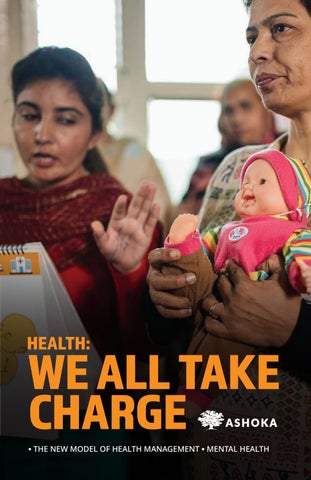
HEALTH:
WE ALL TAKE CHARGE • THE NEW MODEL OF HEALTH MANAGEMENT • MENTAL HEALTH
HEALTH: WE ALL TAKE CHARGE
of its specialized services, e.g., neurosurgery, will long be needed. Therefore, it is important that the new architectures build bridges. In an Everyone a Changemaker (EACH) World, millions of people are equipping themselves and others with new behaviors and skills that allow them to be powerful givers and players in the new game. An EACH Revolution is in itself a health revolution. Being a giver (which, in a world defined by accelerating change, requires being a changemaker) is what brings health, happiness, and longevity. THE NEW MODEL OF HEALTH MANAGEMENT The decision-making and delivery of health care happens through a series of steps.
The world is shifting rapidly to a new way of managing health. Each person, their family, neighbors, friends, and peers will do the overwhelming bulk of diagnosis, communications, and the provision of care and support. We’re moving towards a world where individuals will lead and direct their own health journeys and contribute to the good health journeys of others. The accelerating pattern is very clear: Ninety percent of the 950 Ashoka Fellows who focus primarily on health put the patient and then those who are close to them and their community in charge. This shift, which has been gaining ground for decades, has been greatly helped by the rise of technology seen through (1) big data, (2) rapidly improving communication and connection, and (3) rapidly evolving artificial intelligence. Social entrepreneurs have focused on systematically empowering everyone from the start because the current health care system has not served much of humankind, typically helps with only some parts of health, and does a poor job even where it does reach because it is bureaucratic, stovepiped, and often guessing wrongly. However, some 1
1
It begins with: (1) diagnosis (2) accessing information (often through a continuous, two-way flow) to help the patient understand the problem and what needs to be done, (3) taking the steps necessary for cure, rehabilitation, and reintegration and (4) ensuring that everyone can afford this care, which requires insurance and other reforms. All this requires action by “you and me.” The new “everyone a changemaker” “we’re all in charge” system must deal with each of these tasks and ensure that they come together in a coherent, efficient flow. And through all of these phases, you and I (everyone) must take on 95 percent of the work. Anticipating, contributing to, and therefore doing well in this radically new environment is something that every health sector manager and participant needs to think through carefully now. The Ashoka Fellows are the ones who conceive of and develop these new steps and their connections. Let us introduce you to: • • • •
Miguel Luengo-Oroz (diagnosis). Aparna Hegde (communications) Edith Elliot (getting the different steps and actors to work together) Shailabh Kumar (grassroots insurance by and for everyone) 2
2
DIAGNOSIS
Miguel Luengo and (students? colleagues? examine the results of review their AI model that rapidly and autonomously quantifies parasites in a microscope smear.
MIGUEL LUENGO OROZ SPAIN, SPOTLAB
Gaming on the web with AI allows everyone to make medical diagnoses that are many times better, faster, and less expensive.. Miguel Luengo-Oroz has harnessed the power of global crowdsourcing, video games, mobile devices, and AI to provide quality fast, low-cost medical diagnosis available to all. This is especially critical for billions of people in low- and middle-income countries. In many ways, diagnosis is the most critical step in the entire health value-added chain. Research from the Institute of Medicine shows that 10-20% of diagnoses made by doctors are incorrect. Miguel trains ordinary people to play the role of specialized microscopists. They have been able to reach expert-level accuracy – more than 99% correct in their disease identification, remarkably better than professional labs. 3
3
Players use their mobile phones and computers to view digitized images of blood samples and must “hunt” for the presence of a disease within a set time limit, typically one minute. The game tracks the results of thousands of players. An algorithm turns the results into collective intelligence. When a large number of players agree on the location of a parasite, it is considered a confirmed detection. Mozambique, for example, has one of the highest burdens of malaria globally, with the entire population at risk. Malaria is the leading cause of death in the country and causes significant strain on the healthcare system. It takes one of the country’s few specialists 20 minutes to identify a stain of malaria. When Miguel’s model was deployed in Mozambique, peer-reviewed results showed when people “play” for one minute, it produces the same result as the specialists. This dramatically lightens the load on Mozambique’s health system, allowing specialists to focus on other diseases. Miguel has taken this model and applied it to many other illnesses that can be identified through blood samples, like tuberculosis, cervical cancer, and neglected tropical illnesses. “The strength of this technology is that you don’t need large infrastructures, laboratories, running water, or even electricity. You can use it in a hospital, but you can also take it to a remote community.”
4
4
COMMUNICATIONS
APARNA HEDGE INDIA, ARMMAN
ARMMAN health worker demonstrates mobile access to postpartum resources to a new mother.
The world’s largest phone-based systems providing pre to post birth mothers all the health information they need.
Aparna also pioneered the world’s largest mobile-based training program for frontline health workers. It uses mobile phone networks to deliver refresher training and certification in maternal and child healthcare for government frontline healthcare workers, reaching over 470,000 workers in 24 Indian states and union territories.
Maternal and infant mortality in India are frighteningly high – one woman dies in childbirth every 20 minutes. Millions of mothers lack access to the information and healthcare that could prevent it. To change that, Aparna conceived and scaled up the world’s largest mobile phone-based messaging system for maternal and neonatal medical information and healthcare training. Mothers receive free, targeted, preventative care information in their vernacular language during pregnancy and early childhood, from the second trimester of pregnancy until the child is a year and a half, the period in which most deaths occur. Mobile phones are ubiquitous in India, and Aparna effectively connects with some 54 million women and counting across the country, regardless of where they live or their literacy or educational attainment. 5
5
These “tech plus touch” innovations bring knowledge and resources right to those who need it the most – mothers, their support networks, and their doctors.
“In a country where [one woman dies in childbirth] every 20 minutes, ARMMAN has been working to ensure pregnant women and mothers seek timely healthcare, and health workers are equipped to provide quality services through timely voice calls and video messaging services.”
6
6
BRINGING TOGETHER DIFFERENT ACTORS
EDITH ELLIOT INDIA, NOORA HEALTH
Hospitals give patients’ families the skills they need to provide care to their loved ones. In India (and much of the world), institutional health doesn’t listen or talk to/help the caregivers who do all of the work. From the point of admission until discharge, the role of family is minimized to waiting as their loved ones are treated by the medical staff. However, on account of their inherent empathy and concern for their loved ones, family members are best positioned to provide timely and attentive health and wellbeing care, both within and outside of the hospital. Edith has developed a training platform that allows nurses and hospital staff to step into the role of educators. In the course of their day, these nurses then empower families as health agents, teaching them all the skills needed to provide routine care to their loved ones. This is a major transition
Family members receive Noora Health’s infant care training through their health systems, learning to support the new mothers in their lives.
session on the benefits of checking blood pressure regularly and the accepted range within which it should stay. These classes are further reinforced by a practical demonstration in the ward, to help family members practice taking blood pressure with an actual machine or checking the pulse on their patient. To date, Edith has trained more than 43 million caregivers and patients. Her work decreases rates of re-hospitalization (a 71% reduction in 30-day post-surgical complications in cardiac care patients) and ensures a smooth transition to proper care at home. This summer, Edith’s Noora Health and the World Health Organization began a long-term partnership to enhance global support for family caregivers.
“This ad hoc classroom is part of a decade-long experiment unfolding in Asia that has been testing a simple yet radical idea: If patients are most comforted by their loved ones, why not involve them in the medical process and see how that affects recovery?”
For instance, families are given the option of attending a nurse-run 7
7
8
8
FINANCIAL MODELS THAT BENEFIT ALL
Dr. Amit Wadkar, an Uplift Mutuals physician, issues prescriptions and discusses preventative care with mutual members at pop-up community health clinics.
SHAILABH KUMAR INDIA, UPLIFT MUTUALS
Mutual health microinsurance models that put communities in the driver seat of their own healthcare costs. Shailabh has organized first multi-community mutual health microinsurance model in India, a country where 90% of the total workforce is part of the unorganized sector and makes under $6 a day. Insurance is not a priority expense. When a health crisis hit, it pushes a family further into poverty (as they borrow or mortgage or sell to cover costs). And timely access to quality care with reasonable prices remains a dream. Shailabh’s model uses ‘value-added preventive healthcare services’ to limit the rate of claims and enable policy holders to take charge of their health. Members have access to resources including a 24/7 helpline, health clinics, free check-ups, and drug, outpatient, and hospital discounts. Early detection of diseases and preventative care keep 9
9
health emergencies to a minimum and costs down. Primary healthcare access, along with accessible follow-ups and counselling services, reduce hospitalizations by 80% based on Uplift Mutual’s experience. In Uplift Mutuals’ model, a community’s members are also owners. They take part in designing the product and processes, and they are also the key decision-makers when it comes to claims. They are able to process claims quickly, in 1-3 days, which puts funds back in the hands of those who need it the most. Policies are one price range for all ages and groups -- including the most vulnerable in society. Costs remain low because mutuals have simple structures, and coverage is customized by the member owners to a community’s specific needs. Shailabh’s mutuals have nearly 1 million members, and he has brought his model into government funded and government aided schools to provide free health insurance to 100,000 children -- creating a more health-informed youth, decreasing risks over their lifetime. “The mutual model represents a major opportunity to reach out to the vast missing middle in India, and to create a primary model of risk management that’s currently missing.”
10
10
THE STRATEGIC CHALLENGE FOR ALL HEALTH INSTITUTIONS
Health insurance companies are faced with a profound strategic challenge and also the need to change each of their three most critical operating areas – investing, pricing, and management. Ashoka has developed Three Changemaking Measures (the Changemaker Index, Changemaker Density Ratings, and Dashboards) to guide the adoption of changemaking into the core values of the sector. This is a clear strategy for insurers, the health sector, and management. This will change very quickly how insurance companies invest, how they choose and price clients (low Changemaking Density Rate organizations are riskier in terms of likely business success and will have dramatically higher health care costs), and in terms of management of their staff and agents. Insurance companies will need to carefully think about how they’re going to serve all the new actors and intermediaries. More individuals are going to need insurance, but what types and delivered in what ways and with what pricing? This strategic challenge for the health insurance industry is illustrative of the profound transformations facing every type of institution and every person in the health sector now.
In a world where everyone is a health agent for themselves and others, and where people have full access to information and easy diagnostic tools, health institutions must respond to key questions: how are they going to serve this new reality? What can health actors do that will bring real value to the millions of people acting for the future of health? Insurance companies, a critical institution in the health ecosystem, have a core strategy closely tied to Ashoka, because Everyone a Changemaker (EACH) is what its clients and stakeholders most need in the world. Changemaking is good for society -- it improves health and happiness. Changemakers, and the communities they are part of, are connected, active, informed, and engaged throughout their lives, meaning their risk resilience improves. 11
11
12
12
MENTAL HEALTH
Ashoka Fellow weave together these steps and develop new ways of managing care. To truly understand how this changes a field, we’ll look deeply at one dimension, possibly the most challenging: Mental Health. Over a billion people are living with mental health challenges. Conditions such as anxiety and depression, all the way to the most serious diagnoses, can affect every demographic -- from the young to the old -- anyplace in the world. Many countries’ mental health systems are erratic, and they lack qualified professionals to address the overwhelming problems. The current models simply cannot manage the needs. In Zimbabwe, for example, there are only six clinical psychologists for a population of 17 million. Over 10% of the population and as high as 30% among those in primary healthcare facilities suffer from mental health challenges. Ashoka Fellow Dixon Chibanda, who you will read more about on the subsequent pages, is addressing this dramatic gap. When Ashoka Fellow Thara Rangaswamy was elected decades ago, there were fewer than 1,000 psychiatrists for a burgeoning population. Estimates suggest that about 15% of people in India experience 13
13
mental health challenges. The gap between need and care is staggering. The failure to provide early interventions only aggravates the problem. Ashoka Fellows serve different demographics with different systems, but they all understand the power and possibilities when patients, family, friends, neighbors, and peers are in charge and do the work. In this section, let us introduce you to: •
Tom Osborn (young people supporting other young people)
•
Dixon Chibanda (grandmothers serving their communities)
•
Paulo Longo (sex workers as peer educators)
•
Jimmy Westerheim (democratizing mental health resources)
•
Mark Swift (building bridges between traditional healthcare system and new one) 14
14
YOUTH-LED CARE FOR YOUTH
TOM OSBORN KENYA, SHAMIRI INSTITUTE
A youth mental health care model that engages young people to help other young people where they happen to be already: in school. Tom Osborn has designed a new model of youth mental health care that replaces traditional expert-driven systems with a way more accessible and affordable approach. This “Shamiri” approach – which means “thrive” in Swahili – engages young people to help other young people where they happen to be already: in school. The model begins with Shamiri Fellows, aged 18 to 22, who must come from the same area as the students to maximize cultural understanding. By being close in age and background to the students, Fellows create a relatable environment where students feel comfortable discussing their challenges. 15
15
Shamiri Fellows work within schools to provide mental health guidance to students.
Fellows complete a 10-hour training in evidence-based techniques such as growth mindset, gratitude, and value affirmations. To ensure quality, Fellows are supervised by nearby undergraduate psychology students. The supervisors provide mentorship and monitor delivery standards. For complex cases, clinical experts such as psychologists or psychiatrists are called in, forming the third tier of care. This structure ensures every student receives appropriate support. Over 80 percent of young people who are part of Shamiri show significant improvement in depression and anxiety symptoms within just four weeks. Shamiri has already served over 100,000 young people and is on its way to 1 million by 2027. Tom plans to spread the idea more worldly via establishing hubs across the continent.
“Tom’s goal is to give more young people the chance to do what he did: recognize problems and feel equipped to solve them.”
16
16
THE POWER OF GRANDMOTHERS
support and serve the psychological needs of the community in local languages and cultural contexts. Some benches are affiliated with primary care facilities, nonprofits, and some are publicly accessible in public spaces like parks. When affiliated clinics and nonprofits see patients with a range of symptoms (both physical and psychological), they are screened with a basic questionnaire. Individuals who score above a certain threshold for indicators of depression and anxiety are referred to sit with a grandmother on the Friendship Bench for a series of sessions. Public benches also offer free, one-off counseling sessions to individuals.
DIXON CHIBANDA
“Without the Friendship Bench, Zimbabweans would have virtually no mental health care, except for those who can afford the few private doctors.”
ZIMBABWE, FRIENDSHIP BENCH
Mental health support for community members, provided by their trusted peers. In Zimbabwe, there are only six clinical psychologists for a population of 17 million (as of April 2024). It’s impossible for these psychologists to serve the entire country. Dr. Dixon Chibanda, a Zimbabwean psychiatrist and public health expert, has devised an innovative solution to address this gap in Zimbabwe and beyond. Through his organization Friendship Bench, Dixon positions anyone to take on the role of a frontline workers who provide free mental health counseling in their communities. In Zimbabwe, it started with grandmothers, who are seen as approachable trusted keepers of wisdom, tradition and knowledge. But anyone can see the need and play this role. Friendship Benches can be found in dozens of cities, New York City to Harare, at major events like the Olympics, where individuals provide 17
17
18
18
UPDATE Since our last report on Dixon Since our last report on Dixon two years ago, he has swiftly and brilliantly spread his model and the idea that ordinary people have an all-important role to play in mental healthcare delivery. Friendship Bench is in six new countries, with a total presence of 12. There are now benches in major cities like Washington DC, and New York City, where local governments are integrating Dixon’s model into their mental health services. Friendship Bench has grown from 14 grandmothers to over 3300. To date, more than 1 million clients have been seen on the benches, with a 78 percent reduction in depression and suicide ideation among people referred to Friendship Bench.
SEX WORKERS AS PEER EDUCATORS
PAULO HENRIQUE PINHEIRO LONGO BRAZIL, SEPED Ashoka commemorates and celebrates the life and work of this deceased Ashoka Fellow.
Paulo found that psychological conditions affecting many sex workers made their peers the only effective way of conveying warnings and help. Pablo, then a young psychologist, saw HIV building, decided he had to do way more than provide clinical services to 12 or 20 individuals. He mapped the groups most responsible for the disease’s spread. This analysis quickly led him to focus his interventions on bisexual male sex worker who averaged many transactions a night. However, he quickly discovered that to successfully influence these workers’ behaviors he needed to work through their peers, a group far more impactful than (often counterproductive) family or health workers let alone public campaigns.
19
19
20
20
Paulo pioneered an innovative community model of psychological support. Paulo trained counselors who were not medical professionals, rather peer educators from the community with similar backgrounds. They made themselves present nightly to talk with sex workers where they work, helping them think through their life stories and possible paths. He also gave them condoms and informed them about health care availability. Many sex workers themselves then became educators.
DESTIGMATIZING MENTAL HEALTH WITH STORIES
Paulo’s broad surprising to many success came from reaching out and empowering a key class of grassroots health changemakers – peers.
JIMMY WESTERHEIM NORWAY, THE HUMAN ASPECT
A library of accessible, relatable mental health resources for all to use. Jimmy Westerheim empowers individuals, schools, and mental health practitioners to access personal narratives about mental health journeys so that anyone -- specifically those who are suffering from one of the mental health problem areas or those who are helping them -- can learn directly from the stories without having to go through unavailable, expensive, or unsympathetic medical professionals and their institutions. His “Life Experience Library” contains 700+ in-depth interviews with people from 95 countries who have experienced mental health challenges. When ordinary people hear the struggles and successes of their peers, they feel less isolated and see pathways forward to sound mental health. People are impacted by these human anecdotes, 21
21
22
22
BUILDING BRIDGES BETWEEN SYSTEMS
Jimmy Westerheim’s school program brings mental health care into the classroom.
not through concept and theory. The library is available for people whenever they have the time and need. Moreover, family, friends, and peers can help someone who is suffering by sharing one or several such stories with them. This library of content and resources is provided at no cost to individuals and institutions. Mental health professionals use the library as a tool for their clients and as a way of extending the work they do. Jimmy partners with social media platforms to ensure global distribution and viewership in accessible formats. He engages Oslo public schools in conversations about how young people learn about and understand mental health. He enriches the current mental healthcare systems across Norway and other countries such as Poland, Latvia, the UK, and Nepal by sharing Life Experience Library videos and supplemental resources with therapists and medical professionals. Much of The Human Aspect’s impact is measurement qualitatively, rather than in numbers alone. Feedback from users -- from Norway to Nepal to Seirra Leone -- point to the deep impact the videos have had on how people deal with their own mental health struggles. More than 100 million people have viewed his interviews on social media, and 850,000 people have used the mental health resources available on the public platform 23
23
MARK SWIFT UNITED KINGDOM, WELLBEING ENTERPRISE
A social prescribing system of care that connects new approaches and treatments with traditional healthcare models. The current healthcare system in the UK relies heavily on clinical solutions. Mark pioneered an asset-based approach that mobilizes communities to take control of their own health and wellbeing. His model, a social prescribing system of care, builds bridges between new approaches and treatments with traditional healthcare models. Mark understood that the non-clinical activities, like exercise, coaching, meditation, self-help courses, and music classes, run outside the formal, institutionalized, stove-piped system with great success. But they are not recognized and funded by the NHS. Using thousands of case studies including qualitative and quantitative data, Mark showed the NHS that community-based care and social prescribing help to augment clinical outcomes as well as reduce 24
24
THE EACH HEALTH REVOLUTION Ashoka has 950 Fellows focused on health. Ninety percent of them support people and their communities to lead and direct their own good health journeys and contribute to the good health journeys of others.
Non-clinical activities increase wellbeing and health, a social prescription now recognized by the NHS.
demand for over stretched public services. He has convinced the health system that community approaches are (1) successful and (2) cost effective. (We the powerful influence of many of the 950 Health Fellows, including that of Ashoka Fellow Edith Elliot of Noora Health whose work is pushing the Indian health system towards a big transition.)
Through his work, Wellbeing Officers to deliver one-to-one consultations, source and refer patients to non-clinical programs (like exercise, coaching, mediation, self-help courses, and music classes). Wellbeing Officers also encourage patients to lead their own wellbeing projects for the benefit of their communities.
This value-added chain is demonstrated through Fellows working the field of mental health, possibly one of the most challenging dimensions. But it doesn’t stop there. Social entrepreneurs show us how in every aspect of health— the healthcare workforce, equity, public health, medical devices, insurance, etc.
After three-month follow-ups with Wellbeing Officers, patients benefited from a 70% reduction in depression symptoms, an 80% improvement in well-being levels, and 53% improvement in self-reported health status. On average, the social prescribing is associated with a 28% fall in General Practitioner visits and a 24% drop in attendance at emergency wards.
This health revolution is an EACH revolution. Millions of people are equipping themselves and others with new behaviors and skills that allow them to be powerful givers and players in the new game.
His model is now supported by public taxes as it is mainstreamed into the NHS system where health practitioners prescribe a wide array of health services.
25
These Fellows operate a “everyone a changemaker” system where patients, family, friends, neighbors, peers are in charge of the work. Each of these actors will find themselves doing the overwhelming bulk of diagnosis, communications, and the provision of care and support.
25
Exercise is prescribed, often at low or no cost, and improves overall health beyond just treating illness 26
26
The world is shifting rapidly to a new way of managing health where individuals will lead their own health journeys and contribute to the good health journeys of others. Ashoka Fellows (a small sample in this paper) are showing how to best put patients, family, friends, neighbors, peers are in charge as full participants in the “everyone a changemaker world.”
“Ashoka… nourishes itself on the nearly bottomless, practical think tank of its Fellows.” Harvard Magazine
“The relationship between Ashoka and its Fellows is one of total confidence.” Jorno do Brasil
“Ashoka’s global network of Fellows have become an important force for ingenuity in service of society.” The Atlantic
“I would like to emphasize how important and productive this network has been. I am so grateful for all we learned for the sake of children suffering from cancel in Latin America There is much to be learned, so many connections to be made, and so many inspiring stories to learn from.” Ashoka Fellow Marcela Zubieta
ASHOKA: EVERYONE A CHANGEMAKER™ 1000 Wilson Blvd., Suite 1900 Arlington, VA 22209, USA www.ashoka.org | +1 (703) 527-8300