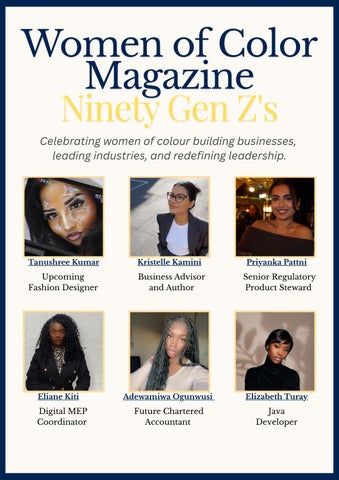
Women of Color Magazine Ninety Gen Z's Celebrating women of colour building businesses, leading industries, and redefining leadership.
Tanushree Kumar
Kristelle Kamini
Priyanka Pattni
Upcoming Fashion Designer
Business Advisor and Author
Senior Regulatory Product Steward
Eliane Kiti
Adewamiwa Ogunwusi
Elizabeth Turay
Digital MEP Coordinator
Future Chartered Accountant
Java Developer
Message From The Author
31st August - two days before the Launch Well this Women of Colour idea has been quite a journey but first allow me thank Lena for all of her hard work designing and publishing this magazine......not least, me changing my mind from launching at the end of June for 30 Gen Z's and moving to to Sep 2nd for 90 Gen Z's...so bless you Lena! And secondly to the 90 women who dealt with my sporadic questions with integrity, honesty and beautiful heart-felt stories that were so personal at times. Not sure where I dreamt this idea up from but once you read, I hope you understand. Our view is to create a safe space and possible platform where these Women can connect and socialise if they so wish. As some of you may know, this is Part 1 as we have had such a large influx of interviewees in the past six weeks so once you have read, look out for Part 2 on the Women of Colour magazine at the end of October. Enjoy the Read Kind Regards Ashley
Headline Interview
Tanushree Kumar “Boldness was never meant to be concealed” Firstly, our "Women of Colour" magazine wouldn't be the same without a Headline Act, introducing the future of an upcoming, innovative Fashion Designer, whose work has continuously displayed deluxe and futuristic concepts as well as pride within her future profession. She is no other than Tanushree Kumar, a fashion designer from Milton Keynes. Most importantly, her heartfelt passion-related response was an incredible story in itself.
Headline Interview: The Upcoming Fashion Designer
"My parents had seen my skills and interest in art and were open for me to keep doing that in the future.
Q1- Thank you, Tanushree, for agreeing to this interview and looking forward to your responses and views. I always like to start with a light-hearted question...so if you don't mind, please tell us where you grew up, about life with your siblings, what you learnt from your parents growing up and whether your parents supported your A-level subjects and future career in Fashion? TA N U S H R E E
I grew up here in England, however I was born in India. I was an only child up until the age of 12, when I had my little sister. It was often very challenging as we were often told to share, whether it was clothing or jewellery, nothing felt like it was yours at the time. I'd wanted that girly moment, like in the movies, where girl friends on a night out would do makeup together and gossip whilst getting ready to sneak out. I’d have moments like that, and each time I’d be dropped off at my friend’s house, I’d be told not to use any makeup there, however we'd still put on makeup, dress up, and I’d always come back with a heap of messy eyeshadow and lipstick on my face, even a bit of jewellery if lucky. I love that moment, where I’d feel like I had a big sister at the time, as I was a quiet kid, and was obsessed with appearance and being pretty, as well as fairy tales and felt almost like a princess.
Interest in clothing. My interest in fashion has been with me since I was a toddler, but entering my teens, I was sure I wanted to get into the industry of fashion design.
Q3- Can you explain your interest in streetwear, Y2K, and luxury/deluxe-inspired concepts? TA N U S H R E E
I loved the whole concept regarding luxury dresses, as they were designed to look glamorous and bring confidence, whilst bedazzled in Swarovski crystals and fine shimmering silk. It would have been my childhood dream to own one of them, and even better to design one myself. Y2K and Streetwear came from Pinterest, where I was drawn to a blend of baggy, vibrant clothing, and the 2000s night aesthetic (Y2K) quite recently, actually.
Q4- If you could work at one of the following companies, which one would you choose and why?: LVMH, Hermès, Inditex or Nike? TA N U S H R E E
Hermès or Nike. As they target similar audiences as my interests I feel like it would be beneficial. Branding and clothing- wise, I admire it's iconic, luxurious authenticity and simplicity and how they make a bold statement when worn with clothing.
My parents had seen my skills and interest in art and were open for me to keep doing that in the future. I also wanted to do something regarding fashion, as it was a way to express myself through art and aesthetics. Throughout secondary, uniforms were obviously mandatory, and there was a strict policy around that time, even where the slightest sign of expression of hair colour would be restricted unless it looked natural. Fashion was not it at the time as skirts had to be worn below the knee and would not be suitable for every body shape, and would sometimes even be uncomfortable to wear. This provoked me to choose fashion as it was a way to express individuality whilst developing ways of clothing that would be inclusive to all types of people, in a way that would lift confidence and self-esteem.
Q2- How long have you wanted to get into the Fashion Industry? TA N U S H R E E
Since i entered my teens and already had an obsession of
Pic 1: Inspired by designs from the 1992 Chanel Haute Couture collection
Q5- If you had the opportunity to attend a lunch with one of the following people, which one would you choose? and why? Rhianna, Zendaya or Harry Styles? Which three questions would you ask them? TA N U S H R E E
Zendaya. Mainly because interest wise, it would be more relatable as I loved watching her in roles in Spiderman and Euphoria. I haven’t watch full episodes of Euphoria
4
Headline Interview: The Upcoming Fashion Designer but I would binge-watch scenes on TikTok or YouTube. I was obsessed and still am with the makeup and styles portrayed, whilst showcasing realistic friendship dramas and individual struggles that are relevant in today's generation. If I were to pick three questions, I would ask how would Rue’s personal experiences influence decision-making in your real life?, What advice would you give to people going through similar experiences as Rue? And who’s clothing and makeup style in the show is your favourite?
Q6- Tell me what you think about the adoption of AI within the Fashion Industry? TA N U S H R E E
I think it is beneficial in many ways. If you are someone who is not very keen on designing using pencils or paint, Adobe would help display your concept and communicate it further when being viewed by peers or employees. It also helps with efficiency when making elements of clothing, which may be time-consuming when done by hand, therefore making the process faster. In terms of branding, it helps promote advertisements for small businesses and can be customised through the designer’s choice instead of using templates, which could restrict individuality and professionalism depending on the circumstance.
Q9- Please explain how you would build a deluxe, high-quality fashion empire? TA N U S H R E E
As mad as this sounds, I am aware this is a big statement to make. I am currently improving my sewing skills. I would say based on my designs, I would aim to bring these garments to life in physical form. My main goal is to create a fashion brand, improving quality of fashion and experience through bold and striking designs which hopefully, when I improve my knowledge of the business aspect of fashion, I can convey this concept into something big, that will hopefully showcase my designs and go onto creating Met Gala clothing for celebrities as well as contributing to the fashion industry through improvement of authenticity and glamour.
"
I loved the whole concept regarding luxury dresses, as they were designed to look glamorous and bring confidence.
Q7- If you could work in any country from the following, which would it be and why; US, Singapore, UK or France?
Pic 2: Egyptian inspired, Fishtail sillouette paired with angel sleavee (slightly alterd to fit the arm and curved inwards at the wrist) topped off with off the shoulder neckline embedded with Hyrogliphic-styled sublimation design and velvet corsetry. Contextual indications include the front tail embedded with Hyrogliphic symbols decorated with black beading.
TA N U S H R E E
US, as it is known for holding fashion shows and designer runways as well as getting the chance to visit Hollywood.
Q8- Do you think TikTok can influence the Fashion Industry? TA N U S H R E E
It already does. It is the baseline of trend setting, whether its clothing or aesthetic, social media holds a big influence on branding and fashion.
5
Lena Anosike Founder of FoundersFlow "Starting FoundersFlow felt like God's calling. I've learned to trust Him and follow the journey, even when the path wasn't clear." Lena shares her journey navigating entreprenusrhip and said a lovelt thing about her parents, “ My dad always emphasises the point of letting your work do the talking. They've always been supportive when I decided in secondary school that I wanted to learn to play the drums, they invested in lessons. I'm not a drummer now, lol, but I do know how to read music!
6
Building FoundeFlow: Lena On Entreprenurship, Authenticity And Personal Branding My parents taught me was that determination will get you far. It's " been the main driving factor navigating a life of entrepreneurship. Q1-Thank you Lena for agreeing to this interview especially as you are the Magazine Designer. I always like to start with a light hearted question...so if you don't mind, please tell us where you grew up, about life with your siblings, what you learnt from your parents growing up and whether your parents supported your Studies and your entrepreneur career? LENA
Thanks for having me! I grew up in a small town called Wellingborough, where I still live at home with my sister and my parents. It's a predominantly white town, and growing up I often felt quite lost almost like I didn't really fit in which led to me becoming a very quiet child. Growing up in a Belgian and Nigerian household, the idea was always sixth form, uni, then a corporate 9-5. I did sixth form, studied Psychology with Sociology at Nottingham, and then made a complete career change into marketing which has now become my own personal branding agency. One thing my parents taught me was that determination will get you far. It's something that was instilled in me from a very young age, and it's been the main driving factor navigating a life of entrepreneurship. My dad always emphasises the point of letting your work do the talking. They've always been supportive when I decided in secondary school that I wanted to learn to play the drums, they invested in lessons. I'm not a drummer now, lol, but I do know how to read music! When I first told my parents I wanted to go down the freelancing route, they were unsure the world of making money online and remotely was completely different to what they knew. Then when I told them I wanted to start a business, they were probably even more confused. But even though they didn't fully understand what I wanted to do, they still supported me and trusted that I'd follow through on what I set my mind to. I'm very stubborn like that.
Q2-You have made the final of Northamptonshire Business awards...Well deserved. Tell us more? How do you feel? How did you achieve this in such a small space of time? LENA
Honestly, I wasn't even going to apply! My mum told me to submit my application just a few days before the deadline. I'm only six months into building a business, so imposter
syndrome was at an all-time high! I kept thinking, who am I to put myself forward for something like this? When I got the call a few weeks later, I was ugly crying to the point where my sister thought something bad had happened, ahaha. For me, it wasn't just the label of "young business person of the year finalist" it was the recognition. Someone seeing my hard work, seeing the late nights and the doubt and the moments I nearly gave up, and telling me it meant something. It was also very much a joint effort. If it wasn't for my mentors and friends, the people checking in on me, talking me through the hard weeks, reminding me why I started when I couldn't see it myself, I don't think I would have had the strength to keep going. Building something on your own can feel incredibly isolating, and having people who believed in me even when I didn't fully believe in myself made all the difference. This recognition doesn't just belong to me — it belongs to everyone who showed up for me along the way. I find out on the 11th of septmeber if I have won!
Q3-I hear you are building an APP using AI and no-code technology which is fascinating. Can you tell us a little bit about this? When do you hope to launch? LENA
Yes! I'm building something using AI and no-code tools, it actually came out of problems I kept noticing while working on personal branding with my clients. I kept hearing the same frustration over and over, and once I noticed that gap in the market, I couldn't ignore it. It's going to be great for agencies juggling multiple clients, but just as useful for solo founders and freelancers who need one consistent place to capture their thinking. I'm keeping the exact details close to my chest for now. It won't launch as an app straight away, much like Notion, it'll start out accessible online, then come to app form further down the line. I'm hoping to launch in December, or worst case early 2027. All will be revealed soon!
"
For me, it wasn't just the label of "young business person of the year finalist" it was the recognition. 7
Building FoundeFlow: Lena On Entreprenurship, Authenticity And Personal Branding Q4-Can you tell us more about Foundersflow, the business you launched six months ago? LENA
Absolutely! FoundersFlow is my personal branding agency, launched it six months ago, and it's built around being genuinely human-first in a space that's becoming more and more automated. Rather than taking on huge volumes of founders and senior leaders, I keep it intentionally small so I can actually build real relationships with the people I work with. There's no corporate feel to it, no being passed between account managers, it's just real connections and understanding someone's voice properly before I ever write a word for them. I focus purely on LinkedIn, because I believe in doing one thing really well rather than spreading myself thin across every platform. Clients typically get 2-4 posts a week depending on the package they choose and also a choice of add-ons like a comment strategy to build engagement and visibility, and profile optimisation so everything ties together and actually reflects who they are. At the end of the day, it all comes down to results helping founders and senior leaders build a presence that genuinely moves the needle for their business, not just vanity metrics. What makes it different is that it’s not generic thought leadership; it’s built around the founder’s real perspective. We’re not creating content for them, we’re translating what they already know into something they can consistently share.
Q5-Do you think you are an Introvert or extrovert?...or somewhere in the middle?...depending on your answer, how has this helped you in life? and career? LENA
I'd say I'm somewhere in the middle. I'm naturally introverted, but I've grown to be a bit more extroverted over time — and honestly, I think entrepreneurship has made me that way. When you're building something on your own, you're forced out of your comfort zone constantly, whether that's networking, pitching yourself, or just showing up in rooms you wouldn't naturally gravitate towards. I've learned to read when to speak up and when to be quiet, it really depends on who I'm with and the environment I'm in. In client meetings or when I'm building relationships, I lean into that more extroverted side. But when I'm writing, strategising or just need to think clearly, I need that quiet, introverted space to actually do my best work. Having both has helped me massively in business, because it means I can adapt to what a situation actually needs rather than forcing one version of myself onto everything.
Q6-If you had the opportunity to attend a lunch with one of the following people, which one would you choose? and why?:Barack Obama, Oprah Winfrey, Elon Musk or someone else? Which three questions would you ask them? LENA
If given the choice, I'd actually choose David Attenborough. He's spent his entire life patiently observing the world, telling stories that make people care, and doing it all with this quiet, genuine authenticity that never feels forced — and honestly, that's exactly what I try to help my clients do with their own personal brands, just in a completely different arena. The three questions I'd ask him: 1."After decades of storytelling, what's the secret to making people genuinely care about something rather than just watching passively?" 2."How do you stay consistent in your voice and values when the world around you keeps changing so fast?" 3."What's something you've observed about human nature, from all your years studying the natural world, that's stuck with you the most?"
Q7- From the Seven Wonders of the World, which of the following places would you love to visit and explain why: Petra in Jordan, Machu Picchu in Peru, the Taj Mahal in India, Chichén Itzá in Mexico, the Colosseum in Italy, Christ the Redeemer in Brazil or the Great Wall of China? LENA
I'd love to visit Christ the Redeemer in Brazil. It actually works out perfectly, because I'm heading to Brazil for a friend's birthday, so I'm already so excited to see it in person rather than just in photos. As a Christian, that particular wonder means even more to me than the others standing beneath something so symbolic of my faith, in a country as vibrant and full of life as Brazil, feels like it's going to be a really special moment.
"
I focus purely on LinkedIn, because I believe in doing one thing really well rather than spreading myself thin across every platform
8
Building FoundeFlow: Lena On Entreprenurship, Authenticity And Personal Branding Q8-If you could work in any country from the following, which would it be and why; US, Singapore, UK or France? or any other country? LENA
Honestly, it would probably be Belgium, Ghent specifically. I'm half Belgian, so there's already a personal pull there for me, but Ghent also has a surprisingly big tech and startup scene that people don't really talk about. There's something about WinterCircus in Ghent that I absolutely love, it's this incredible old industrial building that's been turned into a startup and innovation hub, and I'd genuinely love to have a space there one day, surrounded by other founders and entrepreneurs building things. If anyone based there is reading this and wants to let me shadow them for a day, I am fully available and very willing! Being able to run FoundersFlow from a city that's actually part of my heritage, while still being right in the middle of that growing tech ecosystem, feels like the perfect combination. It wouldn't just be about the work either, it would mean being closer to that side of my culture and identity in a way I don't get to experience day to day living in the UK. If I had to pick a second option, it would be Singapore. It's such a fast-moving, ambitious business environment, and I think being surrounded by that kind of energy and pace would push me to think even bigger and move even faster with FoundersFlow.
Q9-If an investor gave you £2m, which startup would you launch?....product and industry? LENA
If an investor gave me £2 million, I think I'd actually put it towards building out my app properly, but if I'm choosing something completely separate, I'd base it on my dissertation from university, which looked at the lack of visual representation of skin conditions on Black skin online. It's a genuine gap that most people don't even realise exists until they're personally affected by it. So much medical imagery, dermatology resources and even general skincare content online is built almost entirely around lighter skin tones, which means conditions can look completely different or go completely unrecognised on darker skin. That's not just an inconvenience, it can genuinely delay diagnosis and treatment for real health issues. I'd want to build a platform or database that properly represents a full range of skin tones, condition by condition, so that people, and even medical professionals, have an actual point of reference that reflects the world we live in. It ties back into something
I care about deeply — representation shouldn't be an afterthought, especially not when it affects people's health.
Q10-If you could build a house anywhere in the world, where would it be and why? LENA
f I could build a house anywhere in the world, it would be Barcelona. There's something about the lifestyle there the sun, the sea, the food, the energy of the city, that I'm completely drawn to. I'd want the house itself to feel tropical inside, almost like an escape from the world: lots of greenery, big open windows, an indoor-outdoor feel with a pool and plants everywhere, so even on a busy day it feels like a retreat. Barcelona also just makes sense for how I work. It's close enough to home and to Europe that I could still run FoundersFlow properly, but it has this relaxed, creative energy that I think would be amazing to build a business and a life around. Food, culture, community, all wrapped up in one place, I don't think I'd ever want to leave.
Q11-How will AI play a role in your career? LENA
AI is a big part of how I work, but it's baked into my workflows, not my writing. I don't use it to write for my clients, that has to come from real understanding of who they are and how they actually speak but I do use it to streamline the operational side of running FoundersFlow, so I can spend more time on the human-first part of the work rather than admin. I recently went to Google for a Gemini masterclass, and it really reinforced how important it is to stay clued up. I genuinely think if you're not keeping up with where AI is heading, you'll be noticeably behind within the next few years. But at the same time, people still want that human connection especially in personal branding, where the whole point is authenticity. So it's important to stay ahead of the curve with AI, while making sure you never lose the human element that actually makes the work resonate.
"
I genuinely think if you're not keeping up with where AI is heading, you' ll be noticeably behind within the next few years.
9
Evelyn Ajayi Software Engineering Degree Apprentice “It's only too late if you're too convinced it is.” A software degree apprentice, Evelyn gives us a beautiful summary of her speech to 5-11 year old girls with their energetic personalities.
10
Navigating Degree Apprenticeships: Evelyn On Software Engineering, Barriers In STEM & Vibe Coding already wanted to challenge the " From the age of 15/16 Inarrative. Q1- Thank you Evelyn for agreeing to this interview and I'm excited as I've found a real STEM person who has gone into the software industry...music to my ears. I always like to start with a light hearted question...so if you don't mind please tell us where you grew up, about life with your siblings and whether your parents supported your STEM choices and subsequent career in IT? E V E LY N
Of course Ashley. Thank you for having me, i was so excited when you asked me to feature - it’s a dream come true. I was born in north london, moving to a beach side town called worthing at 2 years old where i grew up until I turned 11, and then subsequently moved back to London to continue my schooling. Now, I live in Hoxton (near Liverpool street) and I absolutely love it there’s always something to do and I live about a 10 minute walking distance from Lidl which is a major bonus. I grew up in a very female orientated household consisting of me, my mum, my two sisters and the exception of my dad. Because of this, I was never short of the positive female influences in my family who impacted the trajectory of my life - particularly my older sister who’s been on the West End since 2021 and was featured as a dancer in the popular Wonka movie that debuted in 2023. When I expressed interest in pursuing a STEM career, I'd say it was my dad who was the most excited, especially since my mum didn’t mind which career I chose as long as I prioritised my own fulfillment. My dad was also very supportive through my Apprenticeship journey. He’s a businessman, so he knows what organisations are looking for and he helped me perfect my interview technique, leading me to land my role as a Software Engineer.
Q2- When did you decide a STEM career was for you? E V E LY N
It clicked when choosing my A levels, which were a pivotal moment in my career. This was in the early months of 2022 and I was intensively researching the different A level combinations that would be required for certain career paths. Engineering sounded the most
stimulating to me and I yearned for the challenge, especially since I enjoyed my STEM subjects at GCSE. From the age of 15/16 I already wanted to challenge the narrative. It was originally between mechanical engineering and software engineering but after a month into studying mechanics in physics A level, I realised that mechanical engineering may not be my destiny after all. After that point, I started learning front end software development alongside a 2 week intensive Python course with Stemettes, a non-profit enterprise that encourages women and girls to pursue careers in STEM.
Q3- What needs to be done to ensure more women go into an IT career as I certainly believe this is much needed? E V E LY N
I think the main barrier that is preventing women from entering STEM is the lack of female orientated spaces both in the workplace and externally paired with the idea that you have to be of a certain type of person to operate in these spaces. Workplaces are certainly putting in the work to make female colleagues feel more included in male dominated spaces, however there is still a lot more work to go. Particularly the outsourcing and retention of female managers (in my office, there are no female managers), some male colleagues harbor unconscious attitudes towards women and in some cases, favouring male colleagues for certain opportunities over female colleagues. I would like to stress once again that not all men fit into some of these categories and I have plenty of wonderful male colleagues. However, there is a minority of men who operate under some of these conditions, which can make existing in the STEM environment as a woman rather difficult.
"
The main barrier that is preventing women from entering STEM is the lack of female orientated spaces both in the workplace and externally.
11
Navigating Degree Apprenticeships: Evelyn On Software Engineering, Barriers In STEM & Vibe Coding Q4- If you had the opportunity to attend a lunch with one of the following three people, which one would you choose: Jensen Huang - Nvidia, Satya Nadella - Microsoft or Elon Musk - X and Tesla? E V E LY N
Jensen Huang for sure, as someone whose favourite game franchise is supported by NVIDIA, i’d love to have the opportunity to find common ground with video games as well as learn about the future for NVIDIA.
Q5- I heard you gave a speech to 5-11 year olds who may be interested in a career in STEM, (although quite early in their lives) but what a great experience that must have been....please tell me how this was for you?...and do you like public speaking? E V E LY N
It was absolutely amazing, they were all so energetic and full of life! Even though some of these girls ranged from as young as 5, some of them already had programming experience and had experience creating their own small scale games, I even had some really engaging conversations with some of the girls about projects they were working on and what they wanted to do in the future I really wish I had an opportunity like this as a kid, It’s so reassuring to know that the younger generation are having their STEM interests made accessible in spaces dedicated to them and putting role models that look like them on a pedestal too. That representation is extremely important for development and I'd love for there to be more awareness about these kinds of opportunities for kids in the future. On public speaking, I'll admit, it’s still something that I'm still getting used to. I have only begun speaking publicly this year and so far it’s been a success but I'm always eager to improve! I notice that before I'm about to speak, I get really anxious. To try and overcome this, I've been practicing different breathing techniques to help with this anxiety.
Q6- It's a strange and exciting time to break into the software Industry when Low-code companies are cutting down the need for people to write long lists of code and also with Vibe coding taking an AI-assisted development approach....not to mention Anthropic's Claude. What are your views on Vibe and Claude? E V E LY N
You’ll have to excuse my slightly amateur take on this situation. I aim to develop my knowledge in the current affairs occurring in software engineering and Claude AI, but from the research that I have done, I believe that vibe coding is not sustainable for the career of a software engineer. Developers see it as a ‘cheat code’, however vibe coding is arguably more laborious that traditional software engineering: you need to learn how to properly prompt the AI so that you get the exact output you want as well as taking time to go through the coded output, fixing bugs and changing the code to be tailored to your organisations standards, as there is no guarantee the code will be 100% right. Vibe coding also defeats the purpose of software engineering - the purpose is to engineer solutions. Regurgitating code from an AI output that you don’t completely understand can only be detrimental in the long run, in more severe cases developers may be so comfortable with vibe coding that they lose the programming skills that took them so long to acquire.
"
I believe that vibe coding is not sustainable for the career of a software engineer.
12
Japneet Kaur Senior Consultant at a Big 4 “Stay humble enough to keep learning. Stay confident enough to keep leading” Japneet has spent her career in London and India and provides a wonderful inspirational comparison between the two and her love for New York.
13
Spotlight Interview: Consulting, AI and the Road Ahead
" AI is not our competition, it is our collaborator. Q1- Thank you Japneet for agreeing to this interview and I'm excited as you are only the 2nd IT person I've interviewed I always like to start with a light hearted question...so if you don't mind please tell us where you grew up,about growing up with your sibling and your parents, and whether your parents supported your STEM choices and subsequent career in IT? JAPNEET
I grew up in Jalandhar, a vibrant city in the state of Punjab in northern India. I have a younger brother who is currently working in a founder’s office role primarily overlooking Finance. From a very early age, I was drawn to computers. By the time I reached high school, I had already started learning Java, and honestly, there was no looking back from there. There was something incredibly exciting about writing code and seeing it come to life on screen, that sense of immediate feedback and creation is really what sparked and sustained my passion. I was always very open with my parents about my interest in IT and my desire to pursue it as my undergraduate major. We come from a family of engineers, so there was already an appreciation for technical fields — but interestingly, no one had ventured into IT specifically before me. Rather than seeing that as a gap, my parents saw it as an opportunity, and they were incredibly supportive. They made sure I was connected with the right mentors and people who could guide me as I explored this path — and that support really made all the difference.
Q2- When did you decide a STEM career (IT) was for you? JAPNEET
I would say the decision crystallized around 10th grade — that’s when I knew with clarity that IT was the path I wanted to pursue. And I didn’t just stop at knowing it internally; I acted on it. In 11th and 12th grade, when we had the option to choose an elective alongside our core subjects, I didn’t hesitate — I chose IT. College then really opened up a whole new world for me. I was introduced to such a rich variety of subjects — security, data structures, computer architecture, and so much more. What I loved about it was that almost every semester brought at least one subject that deepened my curiosity and reaffirmed my
decision. It wasn’t just about ticking boxes academically — each of those areas genuinely excited me and made me more certain that I wanted to build my career in this field. By the time I was approaching graduation, it felt less like a choice and more like a natural progression.
Q3- What needs to be done to ensure more women go into an IT career as I certainly believe this is much needed? JAPNEET
This is a topic I feel strongly about, and I think the solution lies in addressing multiple factors simultaneously. It starts with awareness — young women graduating college need much clearer visibility into what a career in IT actually looks like: the growth opportunities, the variety of roles, and the real impact they can have. Seeing relatable role models in the field goes a long way in making IT feel like an accessible and exciting choice rather than a distant one. But awareness alone isn’t enough — the workplace culture has to be genuinely welcoming once women get there. Strong allyship among women is absolutely critical to building that kind of environment. Whether it’s informal coffee conversations or dedicated forums and networks, both matter and both should be actively encouraged. These aren’t just nice-to-haves — they create a real sense of belonging, which is especially vital in today’s hybrid work environment where connection can sometimes feel harder to come by. And I’d like to specifically call out the role of male leaders here, because I think it’s an important one. They need to be genuinely aware of the challenges women face in the workplace and take deliberate steps to become better allies — not just in policy, but in everyday interactions and decisions. When leadership, regardless of gender, actively champions an inclusive culture, it sends a powerful message throughout the entire organization.
"
The best leaders are those who bring people along with them, and that's the kind of leader I aspire to be.
14
Spotlight Interview: Consulting, AI and the Road Ahead Q4- If you had the opportunity to attend a lunch with one of the following three people, which one would you choose: Jensen Huang - Nvidia, Satya Nadella - Microsoft or Elon Musk - X and Tesla? JAPNEET
If I could have lunch with anyone, it would be Jensen Huang without a second thought. And the reason is deeply personal to my journey. I work at the intersection of ERP, healthcare, and AI — a space where the kind of GPU-powered computing and AI infrastructure that NVIDIA has pioneered is quite literally changing how we solve real-world problems. Jensen didn’t just build a company; he had the conviction to back a technology — AI and accelerated computing — long before the rest of the world caught up. That kind of vision and patience is something I deeply admire. I’m at a point in my career where I’m thinking about how to lead teams through a rapidly shifting technology landscape, how to mentor the next generation, and how to stay ahead of change rather than react to it. Who better to have that conversation with than the man who arguably saw this AI revolution coming earlier than anyone else and had the courage to bet everything on it? Over lunch, I wouldn’t just want to talk technology — I’d want to understand his mindset. How do you hold firm to a vision when the world isn’t ready for it yet? How do you build a culture that attracts and retains exceptional talent? Those are questions that are very relevant to where I want to be in five years — and I suspect even an hour of that conversation would be worth a lifetime of lessons.
Q5- I believe your place of work is Hyderabad, how does this compare with London or New York?. Which would be your favourite city to work in? JAPNEET
You know, when I think about it, there are more similarities than you might expect! Hyderabad has that same unmistakable energy — the morning rush, the crowds, the traffic, everyone navigating their way to work and back. There’s a certain universal rhythm to big city life that transcends geography. What’s been truly remarkable though is witnessing Hyderabad’s transformation firsthand over the nearly seven years I’ve been here. The city has grown exponentially — I’d say almost five times over — and that’s no coincidence. Virtually every major IT company either already has a significant presence here or is actively planning one. It really is cementing itself as a world-class technology hub, and I genuinely believe it’s on a trajectory to stand shoulder to shoulder with the likes of New York or London in the nottoo-distant future. As for my dream city to work in — if the opportunity ever presented itself, I’d love to experience New York. There’s an energy and ambition to that city that is just legendary. Singapore would be equally exciting — it sits at such a fascinating crossroads of cultures and is such a powerhouse in the global tech landscape. Beyond just the professional experience, I think immersing yourself in a different city’s culture and pace of life gives you a perspective that genuinely makes you a better professional and a more wellrounded person.
Q6- Where would you like to be (Career wise) in five year's time? Is the big four Consulting for you? JAPNEET
Big Four consulting has been an incredible journey so far — consistently challenging, constantly evolving, and never short of opportunities to make a real impact. Within the ERP healthcare space specifically, the focus has always been on understanding and solving genuine pain points, and increasingly, that means harnessing the power of AI and emerging tools to drive meaningful innovation. It’s a space I find deeply rewarding. Looking five years ahead, I see myself progressing further up the ladder — not just for the title, but because I genuinely want to be in a position where I can better anticipate change, shield my team from uncertainty, and present them with newer and more exciting opportunities. In a technology landscape that’s evolving as rapidly as ours, staying ahead of the curve isn’t optional — it’s essential, and I want to be someone my team can rely on to do exactly that. Beyond the professional progression, what excites me just as much is the idea of giving back. I would love to grow into a mentoring role within my practice — being that guiding voice for people navigating their early years in the field. Finding your footing in consulting can be daunting, and if my experience can help even a few people find their path with a little more clarity and confidence, that would be incredibly fulfilling. I think the best leaders are those who bring people along with them, and that’s the kind of leader I aspire to be.
Q7- It's a strange and exciting time to be in Technology when Low-code companies are cutting down the need for people to write long lists of code and also with Vibe coding taking an AI-assisted development approach....not to mention Anthropic's Claude. What are your views on Claude and AI? JAPNEET
It truly is a fascinating time to be in technology — and I say that with genuine excitement rather than apprehension. My view on AI is straightforward — it is not our competition, it is our collaborator. Yes, AI can generate code, surface insights, and accelerate workflows, but what it produces still needs to be reviewed, evaluated, and thoughtfully adapted to meet specific client needs and business contexts. That human layer of judgment, domain expertise, and nuanced understanding is something that remains very much ours. What I find most exciting is what AI is actually doing for us — it’s freeing up bandwidth. Time that was once spent on repetitive or mechanical tasks can now be redirected towards higher-order thinking, skill building, and expanding our professional portfolio. That’s a tremendous opportunity if you choose to see it that way. And I think that mindset shift is really the key. The professionals who will thrive are those who lean into AI early, integrate it into their daily workflows, and learn to work with it rather than around it. The benefits compound quickly once you start. So rather than viewing tools like Claude as a threat, I see them as a genuine force multiplier — one that makes skilled professionals even more impactful.
15
Aisha O Freelance Creative Strategist “Everything I do now is intentional. Who I work with. What I say yes to. What I walk away from.” A creative strategist, Aisha doesn't chase opportunities but works with intent.
16
Move With Intention: Strategy, Freedom and Building on Her Own Terms how to position yourself, sell your skills, and stay " If you know visible… you’ll be fine in almost any industry. Q1- Tell us about your background, upbringing, and family
Q4- What is a Creative Strategist? Can you share some of your work?
AISHA
AISHA
I grew up in London with my mum and dad, with my two older brothers and my younger sister. I come from a Nigerian background, so my parents took values like respect, discipline, and being self-reliant very seriously. But at the same time, my parents have always been incredibly supportive. And I mean in anything I wanted to do. Even if I’d said I wanted to be a dustbin collector, they would’ve stood by me. Especially when I decided to take a non-conventional route and go into freelancing. They never questioned it. They trusted me. And that’s something I don’t take for granted.
Q2- Was marketing always the career path you wanted? AISHA
Honestly, no. Marketing wasn’t something I always dreamed about. But it made sense. A lot of people say the industry is saturated, and I get that. But I also think if you know how to position yourself, sell your skills, and stay visible… you’ll be fine in almost any industry. For me, marketing aligned with the kind of life I wanted. Flexibility, control, and long-term leverage. I’ve always known I wanted to build a business one day. Working in marketing provides me with a firsthand understanding of what truly drives brand success, particularly in the DTC space.
Q3- What is paid social? AISHA
Paid social is essentially when businesses pay to promote their products or services on social media platforms. So instead of relying purely on organic content, brands invest in ads, whether that’s on Instagram, TikTok, Facebook, YouTube to reach the right audience faster.
“Creative strategist” can mean different things depending on who you ask, because it’s still a relatively new role. But for me, it’s being the brain behind the ads. I’m responsible for understanding the audience, identifying what will resonate, writing the messaging, and directing how the ad should look and feel. So everything from: Research, copywriting and creative direction for designers and editors. I essentially guide the entire ad from idea to execution. Right now, I work mainly in the supplement and wellness space. Across the brands I’ve worked with, my ads have spent over $2M and generated around $3- 4M in revenue.
Q5- “Move in alignment. Move with intention.” What does that mean to you? AISHA
When I first started out, I said yes to everything. Every opportunity, client, and random project, even the underpaid ones or the ones that drained me. I was operating from a scarcity mindset. I thought I had to take everything just to “make it.” And honestly, it made me burnout, anxious and very stressed. I had some very questionable client experiences, loool. Now, I move differently. I don’t chase opportunities. I don’t work with people who are disrespectful or misaligned with where I’m going. Everything I do now is intentional. Who I work with. What I say yes to. What I walk away from. And that shift has seriously improved my quality of life.
"
My ads have spent over $2M and generated around $3- 4M in revenue.
17
Adewamiwa Ogunwusi Business and Accounting Student Future Chartered Accountant
“Faith is my foundation, ambition is my drive” An incredible insight of Ade's life growing up in Ireland and her appreciation to this beautiful part of the world.
18
Building a Future: Ambition, Identity & Belonging Being a woman of colour can sometimes be challenging, " particularly in environments where diversity is still growing. Q1- Before we get into the interview, if you don't mind I'd like to know about you, where did you and your family live when you were young? what was it like growing up with your parents & siblings?, what did your parents instill in you? Did your parents support your Business & Accounting studies at Uni? ADEWAMIWA
I grew up in Ireland in a close knit family where values like hard work, resilience, and respect were strongly emphasised. My upbringing played a big role in shaping who I am today.
Q4- What would be your ideal career/Industry post Uni as I guess you could have a choice of any Industry? ADEWAMIWA
After university, I see myself building a career in accounting or finance. I’m interested in roles that involve financial analysis and strategic decision making, where I can continue to develop my skills while gaining exposure to different industries and markets.
Q5- So kind of aligned to Networking, do you see yourself as an extrovert?..... or somewhere in the middle? ADEWAMIWA
Living with my parents and siblings taught me the importance of responsibility, patience, and supporting one another. My parents always encouraged me to pursue education and aim for a secure and successful future. They’ve been very supportive of my decision to study Business and Accounting at university and have always believed in the power of education as a foundation for growth.
Q2- Ireland is one of my favourite places in the World....please tell me how long you have been there and that you love about Ireland? ADEWAMIWA
I’ve been living in Ireland for all my life,and it’s a place I’ve come to really appreciate. What stands out most to me is the sense of community and how welcoming people can be. There’s also a calm and balanced lifestyle here that makes it a great environment for both personal and professional development.
Q3- Hope you don't mind me asking, but what is it like living in Ireland as a Woman of colour? ADEWAMIWA
Being a woman of colour can sometimes be challenging, particularly in environments where diversity is still growing. There are moments where you may feel underrepresented or have to work a bit harder to be recognised. However, these experiences have helped shape my resilience, confidence, and ability to adapt. They’ve also given me a unique perspective, which I see as a strength, both personally and professionally. Overall, I’ve found Ireland to be a safe and increasingly inclusive place, especially within education.
I would describe myself as an ambivert somewhere in the middle. I enjoy social interaction and networking, especially in professional settings, but I also value listening and taking time to reflect. I think this balance helps me connect well with others while staying thoughtful in my approach.
Q6- Love to ask this silly question.....If you had the chance to go to lunch with one of the following people, who would it be; Barack Obama, Elon Musk, Donald Trump or Bear Grylls? ADEWAMIWA
I would choose Barack Obama. I really admire his leadership especially because he’s a man of colour his communication,style, and ability to inspire people. I think having a conversation with him would be both insightful and motivating.
Q7- Do you think you will stay in Ireland after your studies and if not where in the world would you love to work? ADEWAMIWA
I’m open to staying in Ireland after my studies, particularly to gain valuable work experience. However, I would also love the opportunity to work internationally in the future to broaden my perspective and experience different cultures and work environments.
"
My upbringing played a big role in shaping who I am today. 19
Eliane Kiti Digital MEP Coordinator – Bouygues UK “I believe in learning in public building my career through curiosity, connection, and sharing the journey along the way.”
Eliane wanted to become an architect when she was six years old and subsequently went into Building Information Modelling, sitting between design and the construction teams.
20
Building a Career: Digital Construction & Storytelling
"
I did it scared, I did it tired, I just kept going.
Q1- I like to start with an icebreaker question so here goes.....You studied and lived in Lincolnshire so cheeky question....do you have their local accent?
managing buildings before they are physically constructed. Instead of different disciplines working separately, BIM allows architects, structural engineers, and services engineers to collaborate within a shared digital model.
ELIANE
Thats a funny question! I actually didn’t pick up the Lincolnshire accent. I was born in France but moved to the United States when I was five, so the accent that really stayed with me is the American one. I also lived in Ireland before eventually moving to the UK, but none of those accents stuck the way the American one did. While I was studying in Lincoln, what I really gained wasn’t the accent it was exposure to the industry. Straight out of university I started attending networking events, and often I was the only student in the room. Being surrounded by professionals from different parts of the built environment opened my eyes to how much more there was to learn and become. That experience pushed me to explore opportunities beyond what I initially imagined for myself.
MEP stands for Mechanical, Electrical and Plumbing, which are the building services that make a building actually function things like heating, ventilation, lighting, power systems, and water systems. My role as a Digital MEP Coordinator is to help coordinate these systems within the BIM environment, ensuring everything fits together properly in the model before it reaches site. In simple terms, we try to solve problems digitally so they don’t become expensive problems during construction.
Q4- So Eliane, if you are not plastering walls or carrying bricks up a ladder....what exactly does your job entail? (showing my ignorance now). ELIANE
Q2- Before we get into the interview, if you don't mind I'd like to know about you, growing up with your parents & siblings (my favourite question). ELIANE
I grew up in a very supportive family with my parents and siblings who always encouraged curiosity and creativity. From a young age I was fascinated with spaces and design. I loved things like Lego, drawing, painting, and even rearranging furniture or designing little houses with my toys. Instead of cartoons after school, I was often watching interior design shows with my mum or visiting museums. I actually decided I wanted to become an architect when I was around six years old. That dream stayed with me throughout school and eventually led me to study Architecture at university. My family has always been very encouraging, especially when I decided to move from the Midlands to London after graduating to pursue opportunities in the industry
Q3- Please help me out Eliane, for my understanding, what is BIM & MEP? ELIANE
BIM stands for Building Information Modelling. It’s essentially a digital way of designing, coordinating and
That’s actually a great question because many people assume construction is only physical work on site. My role sits between the design teams and the construction teams. I work with digital models using software like Revit and coordination tools to make sure all the different systems within a building fit together correctly. For example, we check that ventilation ducts, electrical trays, pipes and structural elements don’t clash with each other. If something conflicts, we resolve it digitally before installation happens on site. Because I work closely with the project teams, I also have the opportunity to go on site, see how the building is progressing, and speak directly with engineers and contractors. It’s a mix of technology, coordination, communication, and problem solving.
"
I never allowed other people's limitations to define what was possible for me.
21
Building a Career: Digital Construction & Storytelling Q5- I've seen that you attend many networking events and now that you have been compared to me, tell me about why you enjoy this part of your job? ELIANE
Networking gave me something very important at the beginning of my career: hope and direction. When I graduated from university, I came out of it feeling lost and financially broke. I asked my parents to support me for three months and promised them that within that time I would find a job. The truth is, I was starting from scratch. I was sleeping on a couch that I was renting from a family friend, waking up early in the mornings, catching buses making the journeys even longer to save money across London, attending events, learning, introducing myself to people and asking questions. I then went home and sent my connections my cv with a reintroduction applied to jobs posted about my day on LinkedIn and did it all over again like it was my job. At that stage it wasn’t strategy it was faith. My parents were the only people who truly believed in me at that time. To others, what I was doing probably looked reckless, unprepared, even irresponsible actually that’s all I kept being told. I had just arrived in London and decided this was where I was going to build my career. I never allowed other people’s limitations to define what was possible for me. I had nothing to lose. I hadn’t worked all those years to graduate just to give up at the first obstacle. The pressure was on, and backing down was never an option. Networking gave me the reassurance that I was on the right path and helped me understand the industry far beyond what I had learned in university. No one in my position was going to this events and putting themselves out there because I refused to be a name on a cv people gave 5 seconds time for. it was my advantage I did it scared I did it tired I just kept going for me and for whoever was going to watch me.
Q6- So kind of aligned to Networking, do you see yourself as an extrovert?..... or somewhere in the middle...I guess Extroverts gain energy from social interaction and thrive with stimulating situations but then again being in the middle and maybe leading towards an Introvert means you listen more. ELIANE
I would say I sit somewhere in the middle. I do enjoy meeting people and having conversations, which might come across as extroverted. But I’m also naturally reflective and enjoy observing and listening I think balance actually helps when networking. Being able to speak confidently is useful, but being able to listen and understand people’s stories is just as important.
ELIANE
That’s a really interesting question because I try not to place myself in a box. Growing up, one of the people who inspired me a lot was Oprah Winfrey. She showed that you don’t have to be defined by just one role. You can be many things, explore different talents, and still use your platform to serve others. I see myself the same way. I’m a woman with many interests and passions, and I believe my purpose in life is to serve through whatever I do. Whether that’s through construction, business, mentorship, or storytelling, I want to always be someone who adds value and becomes an asset in the spaces I’m part of. The construction industry right now is giving me a powerful foundation. It allows me to learn, to grow technically, to fail, to succeed, and to look back one day and see the impact of the projects and people I’ve been part of. In five years, I see myself continuing to grow within the industry but also expanding beyond it. I can see myself building a business or two as my knowledge and experience increase. The more I learn, the more my limitations expand and new doors open. Ultimately, I see myself becoming a voice within the industry, someone who advocates for early careers, women, and people who might not always see themselves represented in these spaces. I would love to travel, speak at industry events, and be invited to share my story in ways that inspire others to believe that there is space for them too. For me, the sky really is the limit.
Q8- I noticed within many of your Linkedin posts, your excellent poetic writing, is this just a talent or the answer to question 7? ELIANE
Writing has always been a part of my life, largely because of my mother. My mother is a writer, and growing up I was always inspired by the way she expressed herself. When she spoke or wrote, it wasn’t just words it made you think, reflect, question, and sometimes even take action. As a child I would write pieces myself, and she always encouraged me to push further and go deeper with my ideas. That influence stayed with me. When I write on LinkedIn, I often describe it as passion, life, and storytelling. I’m simply sharing my experiences as a human being navigating life and career the good moments, the difficult ones, and everything in between. I try to educate people through my journey while also making them feel something. If someone can relate to it or develop compassion for someone else’s path, then the writing has served its purpose. I’m not seeking perfection in my writing. I’m seeking reality reminding people that we are human, that emotions are part of our journeys, and that it’s okay to acknowledge them even in a world that can sometimes feel very complex.
Q7- My other favourite two questions, where do you see yourself in five years time? and where would you like to be in five years time?
22
Kai Romain Fashion Management Student specialising in Marketing & Branding
“Your job is something you do, but it’s not your defining quality.” Kai is an aspiring Fashion Marketer and says, "Fashion and the way you presented yourself was definitely something that I took seriously as a child and into my teens"
23
Spotlight Interview: Fashion, Marketing and Making It Her Own
"
Your job doesn't define you, you are who you are, and that's what defines you as a person.
Q1- Thank you so much Kai for agreeing to be part of the magazine and to conduct this interview... and I'm excited to hear your responses.I always like to start with a light hearted question...so if you don't mind please tell us where you grew up,about life with your siblings and whether your parents supported your Fashion Marketing career? KAI
I grew up in a very working-class environment on a council estate, with my two younger siblings. Life was pretty close-knit with family ,my cousins lived next door and we saw each other almost every day, it was very enjoyable. Fashion and the way you presented yourself was definitely something that I took seriously as a child and into my teens, because I realised that the way that you look is something that you have control over. As a child, you can't control your financial economic background or other qualities about your life, but the way that I look, yeah, I can. Funnily enough, even though I was the oldest, a lot of my clothes in my teens were hand-me-downs from my god sister. Every month she would give my mum a big bag and would let me sift through and try on everything I wanted to keep. Within an hour, I had a new wardrobe. In regards to fashion marketing, my parents have always supported my career. I was ambitious and was always business oriented even from a young age. Although no one put the idea in my head, aged four, I would tell my parents, that I wanted to go to university. At 9, I’d watch The Apprentice and do mock job interviews with my father. Even in primary school, I remember writing a plan during my break time about how I’d buy the local mall and restructure it to make it more profitable. I always dreamed about having a job that I loved and living independently. When it came down to fashion marketing, I know many would think, your parents would question it, but if anything, they were overly supportive. My family have always said that as long as I wasn’t doing nothing or anything negative, it doesn't matter. If I was working part-time or if I was at school studying, they just wanted me to do something. So they didn’t pressure me into a specific path ,doing my A-levels was my choice and even leaving college would’ve been supported, as long as I was working my parents would still be proud of me. Their main thing was, make sure you're doing something! When I told them about fashion marketing, my mum actually said “oh my gosh, I'd love that for you.” My family was really happy for me, not because I was a girl but because, I had a drive for it and then the fact that I wanted to go to uni, they were happy and did support me. However, the initiative and the main decision was mine.
Looking for unis, my course, etc. I did that by myself. My parents were mainly involved in the practical side of things, like signing the necessary documents or accompanying me to open days when I asked. For the most part, I did that experience independently and with the support of my tutors and lecturers at my college.
"
I always dreamed about having a job that I loved and living independently.
Q2- I have to say, I believe Fashion to be a very challenging Industry....was this always the career path you wanted to follow ? KAI
This definitely developed over time. As a child, I looked at a bunch of different careers. I mean, to be honest, my earliest memories, I remember saying I wanted to be a fashion designer. In reality, I wasn't really one for sewing, even to this day, I haven't got the knack for it. What I really meant was that I wanted to be a stylist but that evolved over the years. At one point, I wanted to get into law or activism. During the first year, of AS levels, fashion was always just something that I always had a strong interest in, watching outfit analysis’s but not something I took as serious for a career. I didn't think I'd have any support, and always perceived this as sewing and cutting up clothes, something I had no interest in, trust me, I had no interest in textiles. I didn't think I'd be good at it and I thought that was the only option. I thought, well, I'm not trying to make clothes, so that's not really gonna be something for me. Then I had the opportunity to go to a UCAS exhibition, and it’s funny because I went in thinking I already knew what I wanted to do and where I wanted to go. I was pretty set on continuing with one of my A-level subjects, either sociology and criminology or media and I was mainly there to look at different universities and figure out which one I preferred. At the exhibition, I'm not gonna front, I went to the stand solely because the woman was giving out lollipops ,she mentioned fashion marketing, and something about that, it just clicked. The concept, that you can do fashion and marketing, because I love, love, love, love marketing. She explains to me about the course and how you can travel Paris, Milan and New York. Wait, you can travel on your course? Again, growing up, as much as I had the dream to go to university, no one else that I knew really went, if I'm honest. Even to go on to A-levels at college I'm the oldest of my siblings and the first in my generation My family is very working class they instantly worked, and took care of their kids and very driven. But then because of that, there was a lack of awareness of certain things that I didn't know regarding uni.
Spotlight Interview: Fashion, Marketing and Making It Her Own I'm not talking about the whole family, but I'd say, more so my maternal side, and the ones who I was around, were dedicated within their lives, but uni wasn't something they were fluent with.
marketer and that's all I have to be. No, I do fashion marketing I'm also an author, I also work with charities. I think that you are is who you are and that’s what defines you as a person. Your job is something that you do, something that you partake in, but it's not your defining quality, character or trait. That's something that I've definitely realised, so yeah, it did develop over time.
I saw that option for fashion marketing and I remembered one of the lecturers there, approached me, and mind you, she had no idea of my situation asked about my interests she mentioned how she teaches sociology and talked about how she interviewed people Q3- I can see you put out a lot of wonderful Linkedin effected during the AIDS epidemic etc. But she emphasised, why it was so important for young women to posts and I'm sure you are utilising other Social media go to university because when her husband passed, she platforms...but what do you think about the TikTok needed a source of income, so she was grateful that she beauty products marketplace?...Do you think they could went. However, she mentioned her true penchant was also launch a Fashion/clothing Marketplace? fashion and she wished she went to UAL, talking about her dilemma that was essentially now my dilemma. KAI
I took this as a sign and I made a vow to myself. After that I made sure every uni that I was gonna apply to, had sociology and had a fashion marketing course because I thought if at any point I wanted to change, I didn't wanna change uni as well. Even though the fashion marketing thing clicked and I was kind of nervous because I was like, this is something I’ve never studied before. Is this gonna be a real career for me? Do I really wanna do this? Before going to university, I was in two minds of getting into sociology and criminology and getting into social work with children, or I was going to go into fashion, which are obviously two very different careers. As time went on, I went to a couple of taster days for criminology and the guy came in and he said, he was on placement he told us he came back from an emergency and a woman was murdered at 3am. It was only then I realised how intense it was. I had to question Can I do this all day every day? What type of toll would that take on me? Because I'm emotional and sensitive. The thought of having to see someone get murdered every day or having to see that would absolutely affect me. If I do wrong or I do bad in fashion, I can go to sleep at night and I can deal with that. If I were to go wrong in a court case, or be responsible for placing a child in maybe not the best home, that would eat me up alive. Not necessarily making the best deal for a company, I can resurrect that, but when it comes down to people I take that a lot more personal. My mum said “you know, you're the type of person to be really invested with things like that. Are you able to handle the load?” I reasoned I'd be way too invested and way too involved. So I realised that fashion marketing for the long run, for my own, personal health, I felt like that would be better. So I made that decision towards the end of my first year during A-level. But promise you, up until that point, you could’ve asked me at any point in my life, what I wanted to do career wise and you would have got different things. You would have been told a lawyer, an activist, criminology, a fashion designer, a model etc. You would have got so many different answers. But yeah, this one, this passion has definitely stuck and along with that, I'm definitely open to expanding from that. So I do enjoy writing, philanthropy and charity work ,which is something I genuinely want to get involved with and even if it's not a career for me, it's still something I can also do. You don't always have to do one job and I think as I got older I realised that, your job doesn't actually define you I don't always think, okay, I'm a fashion
I definitely do think they can. Thank you. I definitely think something could happen in fashion, but the thing with TikTok is there are a lot of subcultures and different aesthetics, and they contribute to the fast cycles of fashion. They've compressed it. I remember seeing an article saying the fashion used to cycle every 20 years, and now with the rise of TikTok, it’s now every 10 years. The fact that 2016, which was only a decade ago is even considered as almost vintage and people are now trying to relate 2016 aesthetics, and the Kylie Jenner era. It just displays how TikTok, in regards to cycling and resurgence, is very powerful. I believe there could be a marketplace for fashion and could see that happening if the platform continues to be on the rise, because right now TikTok is the most predominant social platform, particularly for Gen Z and Gen Alpha. However, If I asked you 10 years ago, the most popular app, it would have been maybe Instagram, Snapchat, I think even Facebook would have even been thrown into the mix. Today, TikTok monopolises as the new channel, so it depends on future platforms, and what the future aesthetic is, reels may not be the most popular concept to engage people. I also believe the beauty marketplace is definitely something to tap into. I’ve noticed that the beauty marketplace is trying to cater towards younger generations. I see a lot of kids skincare and makeup brands, which I know has been such a hot debate if it's appropriate. My own experience as a child my mum didn't really let us wear makeup, like day to day. We were allowed to play in her makeup and she'd do my face up, but essentially it was in the house, Halloween type occasions ,I wasn’t allowed to do it seriously. But in regards to skincare or that side of the beauty, I had cucumbers on my eyes from the age of three I'd get my acrylics at 11 for a holiday, I loved to be pampered and I was really educated in skincare by the time I was like 12, due to my own research. I think as long as these chemicals are not harmful and they're using cruelty-free ingredients that are safe for children's skin ,I think it's okay. Also to reinforce the message, if you're encouraging young people to invest in and pamper themselves by using natural and healthy products. I think there's nothing wrong with that. But if you're then telling kids, if you don't have clear skin,
Spotlight Interview: Fashion, Marketing and Making It Her Own then you're not desirable or trying to reinforce the very toxic beauty standards that they throw onto generations the moment they hit their teens, particularly for young women, that you need to look like X. If you're trying to project, exploit and profit off of insecurities, then no I'm not on that. But I don't think it is mostly, it’s just another playful way to kind of encourage the young tweens to, have fun self care, and it’s no different to playing in mum's makeup now. Now we're we're playing in our mum's micellar water and trying to cleanse our skin.
Q4- This may be a tough question...What's the balance between Men and Women in the FashionMarketing Industry? ...is it a fair split in your view? KAI
So, this is very interesting. I'll be honest, before I got into it, I just presumed that it would be very feminine or woman-based for sure. Going on my course, there were more guys than what I expected. There's about 10, so it's still very limited, but they were from different backgrounds and personalities. I think many presume, fashion instantly is flamboyant. When a lot of the guys on my course are very masculine, actually and are into simplistic aesthetics. They're not all necessarily, into suave or advant garde fashion, some of them are very, white t-shirt, casual jeans, but it’s the marketing aspect they're into. The course I'm taking is fashion management, which covers marketing, buying, designing, and supply chain operations. I personally have more of an interest and lean into the marketing aspect. But I would say that the split is different. While there it’s more woman-dominated and I would love more men to get involved with it, but I think as the years have gone on, particularly new generations, there's so many people, including men getting into fashion now, which I find so interesting. I think if we look at male artists, we've seen a lot of men getting into fashion and doing it their own way for example Kid Cudi. I like the fact that we're starting to see a lot of brands that are also pushing the envelope even doing unisex clothing and fashion not being one way, and it's become so interpretative, within the fashion marketing industry, I would say the split is more women-dominated, but I definitely see more of a rise with men. And do I think the split's fair? So here's the thing. Sometimes, because men are in the minority, on my course, they can actually receive more visibility or encouragement, which creates a different kind of imbalance. For the most part, it depends, because when it comes down to fashion marketing, I see the split a bit more even. Fashion as a whole, theres more women but within my course when I've gone to conferences or talks, I’ve seen a lot of men in this industry ,some who don’t align with the typical, more expressive or traditionally feminine stereotype and both perspectives are equally valid. So I would say that the split definitely leans more over to women, but I see a lot more men pursuing this industry and especially as we push forward to maybe even destigmatize this idea of men not being allowed to get
involved to fashion or the emasculation of men who have an interest in such subjects. So, I see the split becoming a bit more slimmer.
Q5- Could you see yourself staying in Fashion- Marketing or some other Industry/career? KAI
Fashion's is one of my passions, but I think marketing's one of my cores and I wouldn't really be moving completely away from it, but just elaborating and expanding into something, so if I was in fashion marketing, I could see myself doing beauty marketing or, lifestyle work. I see myself staying within the fashion marketing realm, but as I mentioned before, I would love to go into different career paths. I don't want to just do one thing. Something I've learned is that you don't have to stay in one field, in one job. I studied media, I studied film and I looked at advertising for the majority of my A-level career and I had such a zeal for it and I love working with people, so I could see myself doing marketing beyond just fashion and expanding into beauty or food and brands and that I’m really interested in. I would love to explore writing for sure and maybe publish a book or two in the future, but I don't know if it will even be about fashion, but I could see myself getting into lifestyle and maybe even expand within the charity work. I don't think it was a degree that I wasted on myself. I know that I applied with the intention of something that I felt passionately about, something I did desire to work in and I hope to do. Even in the future, if that doesn't align with what I want to do anymore, I can say, I didn't just go for a degree because I thought, this sounds cute or impressive. I really did do it because I wanted to. So for the long term, it’s something I'd be interested in and it just all depends on if I find anything else that interests me.
Q6- Similar to the previous question, If you had the opportunity to work for a company in the following locations: New York, Singapore or stay in the UK, which location would you choose? KAI
I'm going to preface, I've travelled, but I have never been to New York or Singapore and I would love to go to both. As a kid, I think if obviously you're involved in fashion, you do think of New York at one point and my friends who have also been, I do like the hype of Sex and the City and the bustling of the cars and hot dogs and living in Manhattan in a really luxe apartment. I mean, that would be definitely my cute fashion journalism dream. However, my family is in the UK. If I had to move to New York, I would definitely consider, but I'd say temporarily. I'd say the US isn't somewhere I'd migrate to permanently for now. For now, based on the current climate, not to make it political, but I wouldn't live there. For New York, I love the fashion, the market and the branding. I just love it and I think it really captivates it, especially the trench coats and the heels, and also such a
Spotlight Interview: Fashion, Marketing and Making It Her Own diverse mix of African Americans and Latinos. As an Afro-Latino, the fact that our culture within New York, particularly, in the Lower East Side, is so celebrated, I would love to go there ethnically, because, in the UK, they haven't been as welcoming or as honest about giving credit to the ethnic minorities that contributed to certain fashion trends and prints. For the longest time, in the UK, there was this huge, “English Rose” appraisal, whereas in New York, diversity, for the most part, it was like a melting pot. It was so celebrated. So I would definitely want to go to New York for the celebration of culture, for the celebration of representation. I would absolutely adore and love to be in New York. In regards to Singapore, I have never been, but I've heard quite nice things and I would love to see ,it’s so beautiful. It seems very innovative, I think if I wanted to get into luxury international market, I would love to go there. I've noticed there is a very huge growth within Singapore. Especially for fashion, there has been a lot of people trying to kind of go over there and tap into that market from what I've seen, it's definitely creative, but I'm not as well versed on Singapore, so I would definitely love to go there at one point and see how life is, but from what I know it’s gorgeous, but I still am unsure. In regards to the UK, I mean, I do have such a base here. I've been so used to it, I've always said that I'd probably live in the UK, but I would always travel staying in other places and for work. So my home would be in the UK, I think that's something that you'll see as a recurring thing for me is I always have a base, even if it’s simple, as long as it satisfies me and I'm able to go out and do other things, then I'm good. This isn’t to bash the UK, because I contribute to the UK fashion culture because I live within it and I live within that hub. I think many people think of London as whole when they think of the “UK fashion” and I think as much as that's nice, I feel like there's a lot of other cities that need to kind of be held accountable for to contributing to UK fashion culture. For example Bristol, they're known a lot for their thrifting, streetwear and graffiti ,also the different parts of London. North London has a different vibe to South London, to East London, to West. And I think if I stay in the UK, I would love to really promote fashion that's not just within the capital, because I think many people look at London, as “the main style”, but they never really look at what's going on in Manchester or Brum, or what goes on the Midlands streetwear. Not to diminish fashion in London, but I just wish that other cities maybe could get a bit more credit and visibility. But I don't know where I'd choose for now my main home is in the UK, but I’d temporarily travel and be open to work elsewhere. But before I make my final decision, I'd have to definitely visit New York and Singapore for sure.
Q7- What is your view on AI in the Fashion-Marketing Industry? Has it changed your specific role? KAI
I would say AI, as somebody who's going to university in the 2020s ,my view on AI and fashion marketing: I think
it's the elephant in the room, it's affecting every industry. Whether you're in medicine, marketing or television, you know, whatever your industry is, AI is being used. Within the fashion industry, in particular, we have CLO3D, which I found so interesting. By simulating garments using this software, as opposed to cutting in real life, it helps people produce less fabric waste. Also, I had the pleasure of going to the CITEVE in Portugal and seeing AI assistance within fashion. I do think AI can be leveraged in a good way depending on how you use it. Obviously there are lots of bad things about AI in no way am I co signing inappropriate generated images or anything to be used to simulate negativity. But in regards to my field, I don't think that AI is necessarily taking away from a job, but it's finding a way to enhance it. Here's the thing with AI it’s something that they're trying to introduce. I believe we as, people who are in this industry, have to learn how to leverage it to maintain our jobs because there's always going to be somebody to operate it and use it to its best advantage. I can give two people AI right now ask them to generate an image, depending on the prompt, your mind and what you want to see, you can get two very different results ,even though it's the same AI system, it's about generating it. AI is generative, it can generate ,but that's it, it's generic. We as the creatives are able to use it to help enhance our work and I think if you leverage it in that way, it can be used very positively. I don't think AI should replace anything it should be used to enhance and to experiment with. If we can kind of learn the balance between experimenting with something versus relying on something, we could turn it into making something so beautiful, particularly within fashion. It's impacted my work because it's definitely something that's been expected. I've had to work with an AI for a group project, and the brief told us to work with Microsoft Copilot it was like quite interesting to work with an AI, as an actual group partner and assess: Are the contributions good? Are they accurate? Within the fashion industry, AI had been used to reinforce the sustainability. So virtual try-ons for people to try on the outfits visually, before buying it in the store to reduce returns. It's also a creative way to engage them from a marketing perspective and also been used with the intention of sustainability. Mainly it’s used for personalisation for consumers, which is one of the main things I think both freaks out and excites people about AI. It's definitely impacted my work quite strongly, but in a positive way for the most part.
"
AI is generative, it can g e n e r a t e , b u t t h a t ' s i t . We a s the creatives are able to use it to enhance our work.
Priyanka Pattni Senior Regulatory Product Steward
“Passion, persistence, and a love for the unknown.”
Priyanka is an incredible Tutor for young children and speaks fondly of her love to work in New York.
28
Her Own Terms: Chemistry, Compliance & a Career Built With Purpose
"
For me, it’s about maintaining that balance between a structured, impactful career and creative expression.
Q1- Thank you, Priyanka, for agreeing to be part of the magazine and agreeing to this interview... and I'm excited as you were my Son's Tutor. I always like to start with a light-hearted question...so if you don't mind, please tell us where you grew up, about life with your siblings and whether your parents supported your Healthcare career? P R I YA N K A
Hi Ashley, firstly, thank you so much for allowing me to be part of something so special. I’m genuinely so excited to be featured in your magazine. I grew up in Leicester with my mum, stepdad, dad, and sister. My childhood was very creative and outgoing; I was always involved in activities at my local temple, volunteering with charities, and helping my parents with their business ventures in property development and travel. Those experiences really shaped my work ethic and confidence from a young age. Academically, I wouldn’t say I was always the brightest in the class, but I’ve always valued education and had a strong sense of determination. Interestingly, chemistry wasn’t even my favourite subject at college, economics was, but with the guidance and encouragement of a teacher and tutor, I decided to pursue chemistry at university. My parents were incredibly supportive of this decision. Coming from an Indian background, they were, of course, very proud and excited, and they’ve always encouraged me to pursue a stable and meaningful career. That support played a huge role in my journey. I went on to achieve the grades needed to progress onto a master’s course, which ultimately led me into my current career in regulatory affairs within chemical and medical device manufacturing. Looking back, it’s been an unexpected but rewarding path, shaped by both my upbringing and the support system around me.
NHS supporting looked-after children, as well as administrative roles. Each of these experiences has taught me something different and helped me build a wide range of transferable skills, particularly in organisation, communication, and attention to detail. Looking back, those roles definitely shaped the industry I’ve chosen to work in today. My current role in compliance and regulatory affairs is something I can genuinely see myself progressing in. It’s a field that’s increasingly in demand, especially as consumers are becoming more aware and curious about what goes into products and how they’re made. With so much information readily available, industries are becoming more regulated, making compliance and documentation more important than ever. What makes it even more rewarding is being part of the medical field—knowing that the products I work with are used to support real patients gives a real sense of purpose to what I do. That being said, I don’t see myself as being limited to just one path. Alongside my career, I definitely want to continue exploring more creative opportunities, as that’s something that brings me a lot of joy. For me, it’s about maintaining that balance between a structured, impactful career and creative expression.
"
Q2- I have to say a Master’s in Chemistry is incredible and can see you work in many different jobs/industries...do you think you have followed your chosen path? Also, I see that compliance and documentation is key in your current role, and these skills are very much in demand. P R I YA N K A
I have to say, my journey hasn’t been completely linear, but I do believe I’ve followed a path that’s naturally evolved into the right one for me. I actually started working from a very young age—my first job was in a sweet shop at 16, which only lasted three days as I quickly realised it wasn’t for me! Since then, I’ve had a variety of roles, from working at Leicester City Football Stadium to positions within the
So while there’s still progress to be made in terms of fairness and representation, I do feel optimistic about the direction things are heading.
Q3- I know you Tutor students (my Son included), how much energy does this give you with these being the last of the Gen Z children? P R I YA N K A
Working with children can be very demanding, as you can probably imagine. When I first started tutoring, I was working almost seven days a week with students ranging from ages 9 to 16. Alongside a full-time 9–5 role—and sometimes a commute—it required a huge amount of energy, planning, and consistency, so it could definitely feel intense at times. Over the years, though, I’ve learned how to prioritise better, particularly focusing on the age groups I genuinely enjoy teaching the most. That shift has made a big difference, as it’s allowed me to find the work far more rewarding and sustainable. In terms of energy, while it can be tiring, it’s
Her Own Terms: Chemistry, Compliance & a Career Built With Purpose also incredibly fulfilling. Working with Gen Z students keeps me on my toes, they bring a fresh perspective, curiosity, and a different way of thinking that I really enjoy engaging with. It’s also been so lovely building strong relationships with families, like yours, which adds a personal and meaningful aspect to the work. That connection and seeing students grow in confidence is what really gives me energy and makes it all worthwhile.
Q4- This may be a tough question...What's the balance between Men and Women in the Healthcare Industry? ...is it fair in your view? P R I YA N K A
This is a tough question, and to be completely honest, I don’t think the balance is entirely fair yet. While the healthcare industry overall has a strong presence of women—especially in patient-facing roles—when you look more closely at areas like leadership, regulatory roles, and certain parts of the chemical and medical manufacturing space, it can still feel quite maledominated. In my own experience as a young Asian woman, there have been moments where it feels like my voice can be overshadowed or not heard as strongly as others in the room. That being said, I do think things are changing. There is a clear rise in women entering and progressing within this field, which is really encouraging to see. The area I work in, particularly around compliance and within sectors like personal care and medical products, isn’t always the first thing people think of when they consider careers in chemistry or healthcare—but it’s growing rapidly. I also think social media has played a big role in that shift. It’s brought more visibility to different career paths and industries, helping more young women see opportunities they may not have considered before. So while there’s still progress to be made in terms of fairness and representation, I do feel optimistic about the direction things are heading.
Q5- I must admit I had to research this topic to create this question for you Priyanka..Could you see yourself working for the big Medical Manufacturers such as: Medtronic, Johnson & Johnson, MedTech or Abbott? P R I YA N K A
Yes, I could definitely see myself working with large medical manufacturers such as Medtronic, Johnson & Johnson, MedTech, or Abbott in the future. At the moment, I’m working with Solventum, which is a spin-off from 3M. Being part of such a large and wellestablished organisation has already given me a huge amount of valuable education and insight into the medical field. I’m also very fortunate to work within a supportive team, which has made a big difference to my growth and overall experience. Looking ahead, I would love the opportunity to branch out and explore roles within other global companies like these. I think gaining exposure to different environments and ways of working would really help me expand my
skill set and continue progressing within the industry.
Q6- Similar to the previous question, If you had the opportunity to work for a company in the following locations: New York, Singapore or stay in the UK, which location would you choose? P R I YA N K A
This is a tough question, and to be completely honest, I don’t think the balance is entirely fair yet. While the healthcare industry overall has a strong presence of women—especially in patient-facing roles—when you look more closely at areas like leadership, regulatory roles, and certain parts of the chemical and medical manufacturing space, it can still feel quite male-dominated. In my own experience as a young Asian woman, there have been moments where it feels like my voice can be overshadowed or not heard as strongly as others in the room. That being said, I do think things are changing. There is a clear rise in women entering and progressing within this field, which is really encouraging to see. The area I work in, particularly around compliance and within sectors like personal care and medical products, isn’t always the first thing people think of when they consider careers in chemistry or healthcare—but it’s growing rapidly. I also think social media has played a big role in that shift. It’s brought more visibility to different career paths and industries, helping more young women see opportunities they may not have considered before. So while there’s still progress to be made in terms of fairness and representation, I do feel optimistic about the direction things are heading.
Q7- What is your view on AI in the healthcare Industry? Has it changed your specific role? P R I YA N K A
Another great question! I’m very supportive of AI in the healthcare industry, and I’ve actually been involved in recent projects within my team exploring how we can integrate it more into our day-to-day roles. AI has already started to make a real impact in my work. In a field like regulatory affairs, where we deal with large datasets and complex, ever-changing regulations, AI is incredibly useful. It helps streamline tasks like reviewing documentation, analysing regulatory requirements, and tracking key metrics. It also allows us to create projections for upcoming chemical registrations and notifications, which makes planning much more efficient. From a personal perspective, it’s also been a great learning tool. AI can provide a strong starting point when trying to understand new laws or regulatory frameworks, helping to build foundational knowledge more quickly. That said, it’s important to use it carefully—there can be inaccuracies at times, so it always needs to be cross-checked against official sources. Overall, it is starting to shape the direction of my role. My company is very open to adopting AI, and we’re encouraged to use it in our daily activities. I think it will continue to enhance the way we work—making processes more efficient while allowing us to focus more on critical thinking and decision-making.
Timi Adeshina Commercial Trainee
“Comforts never made history” Timi is a commercial trainee supporting construction projects and pushing more women into this Industry.
31
Commercial Trainee: paving her own path through live sites, study and leadership
"
My mum instilled in me the importance of faith and discipline from a young age.
Q1-Before we get into the interview, if you don't mind I'd like to know about you, where did you and your family live when you were young? what was it like growing up with your parents & siblings? What did your parents instil in you? TIMI
I grew up in Bedfordshire with my mum and siblings in a supportive and hardworking environment, which really shaped who I am today. My mum instilled in me the importance of faith and discipline from a young age. Seeing how hard she worked had a big impact on me; it built a strong work ethic and sense of responsibility. She always encouraged me to aim high and stay focused, and that’s something I carry with me in both my studies and my career.
Q2- Please tell me about your role as a Commercial Trainee and studying Quantity Surveying. TIMI
As a Commercial Trainee alongside studying Quantity Surveying, I’ve been able to apply what I learn directly into practice. I’ve worked on residential projects such as Clapham Park and the Cambridge Road Estate, supporting with cost management, valuations, and gaining an understanding of commercial processes on live sites. What I enjoy most is seeing how our decisions contribute to real, physical developments. Balancing work and study has definitely been challenging, but it’s strengthened my discipline and time management, and made the learning much more meaningful.
It’s really encouraging to see more women attending and being involved. While there’s still progress to be made, the industry is definitely moving in the right direction, and these events play an important role in creating more visibility and opportunities.
Q5- So kind of aligned to Networking, do you see yourself as an extrovert?... or somewhere in the middle...I guess Extroverts gain energy from social interaction and thrive with stimulating situations but then again being in the middle and maybe leading towards an Introvert means you listen more. TIMI
I’d say I’m somewhere in the middle. I naturally do get nervous speaking in groups, but I actively push myself to step outside my comfort zone. For example, I recently organised and hosted a Graduate and Trainee meet-up, and I’ve also represented my company, speaking to students about careers in construction. Experiences like that have really helped build my confidence. To manage nerves, I keep it simple, I take a breath, stay present, and focused . At the same time, I think being slightly more introverted is a strength in this role, as I’m a good listener and stay calm under pressure.
Q6- My other favorite two questions, where do you see yourself in five years time? and where would you like to be in five years time? TIMI
TIMI
In five years, I see myself as a qualified Quantity Surveyor, confidently managing my own projects and making key commercial decisions. I’d also like to be mentoring trainees or graduates, supporting others who are starting out, while continuing to develop both technically and professionally.
Once I qualify, I’d like to work on large-scale, impactful developments that are widely recognised and make a real difference to communities.
Q7- I noticed you organised and hosted the Graduate & Trainee meetup, how was that?
One of the reasons I chose this industry is because of how global it is. Construction and property exist everywhere, and the skills are transferable. I’m open to working both in the UK and internationally I don’t have a fixed location in mind, as I’m open to opportunities wherever they take me, including places like the Middle East or Australia where there’s significant development happening.
t was a really rewarding experience and a big step outside my comfort zone. Around 20 people attended, and I was involved in organising the structure of the event, coordinating with speakers, and helping bring everything together.
Q3- Once you've completed your studies as a Quantity surveyor, what would be your ideal role and in which country?
Q4- There seems to be a lot of events in the Surveying Industry, do you attend many of these? and are there many women at these events? TIMI
Yes, I try to attend industry events where I can, as they’re a great way to learn and connect with others in the field.
TIMI
One of the highlights was creating a revamped Monopolystyle activity, where teams worked together to ‘buy’ land and plan real developments. It became a really engaging way to explore collaboration and decision-making across different disciplines. It challenged me, especially stepping into a more visible role, but it reinforced that confidence grows when you put yourself forward even before you feel completely ready.
Serena Patel Incoming Associate Product Specialist at Mastercard
“Take the opportunity. Figure it out after”.
Serena worked in Melbourne for a while and created a startup....hope we can keep her entrepreneurial talent with us.
33
From Cardiff to corporate: Melbourne trip, Mastercard and life as university president
"
In five years I see myself working at Mastercard, having progressed into a role with greater responsibility and ownership.
Q1-Thank you Serena for agreeing to this interview and I'm excited to interview you after reading your eventful profile. I always like to start with a light hearted question...so if you don't mind please tell us where you grew up, about life with your siblings, what you learnt from your parents growing up and whether your parents supported your Study choices and career you may choose? SERENA
I grew up in North West London in a supportive and close-knit family environment, shaped by strong values around hard work, independence, and making the most of every opportunity. My parents encouraged me to pursue what genuinely interested me rather than following a fixed path, which led me to choosing BSc Business Management (International Management) at Cardiff University, and explore different career paths within that.
Q2- You are in your final year at Cardiff studying Business, this opens up so many career/industry choices, which way do you want your career path to go? SERENA
Studying International Business Management has opened a wide range of career paths, which is exciting but also overwhelming. Initially I was particularly interested in roles within finance, technology, or consulting, but through my experiences I developed a strong interest in product management as it combines problem-solving, client interaction, and innovation. I am really pleased to say that I am joining Mastercard as an Associate Product Specialist on their 18 month Launch programme.
Q3- If you were to choose a finance career, what needs to be done to ensure more women go into a finance career as I certainly believe this is much needed? SERENA
While there are intentional and ongoing efforts by large organisations to increase Female talent in finance roles more could be done. The industry should continue to increase early exposure as many young women are not introduced to finance as a realistic and accessible career option. Initiatives such as women insight programmes, mentorship schemes, and networking opportunities that spotlight senior women are key to breaking this barrier. Secondly, there is an abundance of evidence that depicts the unconscious bias towards women in the hiring process.
Q4 – If you had the opportunity to attend a lunch with one of the following four people which one would you choose: Warren Buffet, George Soros, Ray Dalio, Mary Callahan Erodes at JMPC, Barack Obama? And what questions would you ask them? SERENA
I would choose to have lunch with Mary Callahan Erodes. While Warren Buffett and Ray Dalio are strong contenders, I aspire to Mary as she runs one of the largest asset management organisations in the world and has a strong reputation for exceptional leadership and client focus. I would ask her what she believes has been the single biggest driver of her success in this male-dominated industry, and what she wishes she could have known earlier. As well as how she approaches people management and leadership at a very large scale, and any challenges she encountered when she first stepped into the role. Lastly, how she sees asset management evolving over the next decade, given the rise of AI, different client expectations, and passive investing.
"
The industry should continue to increase early exposure as many young women are not introduced to finance as realistic and accessible career option.
Q5- Please tell me about your recent month in Melbourne and funded by Cardiff Uni. SERENA
I recently had the opportunity to travel to Melbourne for the HEX Global Entrepreneurship Internship, where I ideated, validated, and launched a start-up idea. The start-up I created was BankHerr, a community platform for early-career women in finance, designed to strengthen external support networks to improve female retention within the industry. It aims to address the critical gap between the large influx of female graduates entering finance and the relatively smaller proportion progressing into senior leadership roles. Across the two weeks I attended a series of workshops at the likes of Google, Canva, LCI Melbourne, and SEEK, as well as fireside chats with founders andindustry leaders to support the product development. I then pitched BankHerr at Cremorne Digital Hub to a panel of judges including Jeanette Cheah (CEO of HEX), alongside venture capitalists, and members of the public. It was an incredibly valuable experience and pushed me to think like a founder. I am grateful to Cardiff University Global Opportunities for funding the programme.
From Cardiff to corporate: Melbourne trip, Mastercard and life as university president Q6 – I see you also worked at Mastercard for an internship in a product management role. Would this be of interest to you in your first job? SERENA
I secured an internship at Mastercard in Product Management within the Industry Partnerships Value Added Services team, where I had the opportunity to contribute to the Go-to-Market strategy for a product focused on streamlining corporate travel expenses. It was really insightful as it gave me exposure to the different elements of product implementation, such as understanding customer pain points, aligning stakeholder needs, navigating technical implementation, and building sales materials for commercial teams. This experience made me realise that a job in Product Management is of great interest to me, and while my associate role is within a different team, I am looking forward to positively contributing and thriving to make a difference.
Q7 – You are also the president of the business school society at university did you win that vote hands on also do you think this will help you later in life and how?
created was BankHerr, a community platform for earlycareer women in finance, designed to strengthen external support networks to improve female retention within the industry. It aims to address the critical gap between the large influx of female graduates entering finance and the relatively smaller proportion progressing into senior leadership roles. Across the two weeks I attended a series of workshops at the likes of Google, Canva, LCI Melbourne, and SEEK, as well as fireside chats with founders andindustry leaders to support the product development. I then pitched BankHerr at Cremorne Digital Hub to a panel of judges including Jeanette Cheah (CEO of HEX), alongside venture capitalists, and members of the public. It was an incredibly valuable experience and pushed me to think like a founder. I am grateful to Cardiff University Global Opportunities for funding the programme.
"
SERENA
Being President of Cardiff Business School Society has been one of the most valuable experiences of my time at university. It has supported my development of crucial leadership, communication, and organisational skills and pushed me in ways that lectures and coursework fail to. It has also taught me how to manage responsibility and confidently make decisions that impact a wider group of people. I think this experience will benefit me in the future, particularly in roles that require teamwork, leadership, and the ability to take initiative.
Q8 – Where do you see yourself in five years? SERENA
In five years I see myself working at Mastercard, having progressed into a role with greater responsibility and ownership. I want to have built a strong and credible foundation in product management. Alongside that, I would lobe to grow as a leader within business resource groups and actively support women in finance, whether through mentorship, networking, or continuing to develop BankHerr into something with real reach and impact.
Q9- What would your top 3 companies to work for after uni and favourite countries to work in from UK, US, or Singapore and why? SERENA
I recently had the opportunity to travel to Melbourne for the HEX Global Entrepreneurship Internship, where I ideated, validated, and launched a start-up idea. The start-up I
Being President of Cardiff Business School Society has been one of the most valuable experiences of my time at university.
Thevahi Asokan Nursing Student at University of Surrey
“With great power comes great responsibility”
Thevahi provides us with her meaningful moments listening to her patients.
36
Student Nurse: Community care, Tamil identity and finding her place in healthcare
"
I’ve learned how important it is to take time for yourself - reflection and self-care are essential in this profession.
Q1- Thank you Theva for agreeing to this interview and so excited for this conversation as you are our first Nurse. I always like to start with a light hearted question...so if you don't mind, please tell us where you grew up, about life with your siblings, what you learnt from your parents growing up and whether your parents supported your A level subjects and subsequent career choices? T H E VA H I
I grew up in South London, surrounded by a strong Tamil community, which has really shaped my identity and sense of belonging. I live with my parents and my younger sister, and we have always been very close. Honestly, my parents are like my friends therefore I have always felt comfortable being open with them about my goals and ambitions. As a young woman of colour, having that kind of support at home has meant everything. They have always encouraged my education and stood behind my decisions, including my A level choices and my journey into nursing. That support has given me the confidence to pursue a career I’m truly passionate about.
Q2- Nursing is such a wonderful profession which must give back so much positive energy, but must be tiring as you are so much in demand.Do you agree with this point of view? T H E VA H I
Nursing is incredibly rewarding, especially as a student where you have more time to really connect with patients. Some of the most meaningful moments for me have been simply sitting with patients, listening to their stories, and learning from their experiences. At the same time, it can be physically and emotionally demanding. There are challenging days, and not every experience is easy. But being able to see patients improve, makes it all worthwhile. I’ve also learned how important it is to take time for yourself - reflection and self-care are essential in this profession.
Q3- At what age in your life did you know you wanted to be a Nurse? T H E VA H I
I have always been interested in healthcare, mainly because of personal experiences growing up. Initially, I wanted to go into paediatric nursing but
through speaking with lecturers and professionals, I realised that starting in adult nursing would give me a broader foundation. What I have come to appreciate is that nursing isn’t a fixed path. As a professional, you can grow and specialise over time. That flexibility really appealed to me and helped shape my decision.
Q4- I believe your Uni studies finish next year...which Hospital would you like to work in? I hear St Georges in Tooting is a wonderful place...do you know this hospital? If not a hospital, where else would you like to work? T H E VA H I
My clinical placements have encouraged me to remain openminded, but I have consistently been drawn to communitybased care. My long-term goal is to work in a GP setting as a Practice Nurse, progressing to an Advanced Nurse Practitioner role. I am particularly passionate about building sustained, meaningful relationships with patients and delivering holistic, person-centred care. The continuity within community settings allows for a deeper understanding of patients’ needs, which I find especially rewarding. At the same time, I recognise the value of gaining experience in hospital settings, such as St George’s, to further develop my clinical skills and confidence early in my career.
"
Some of the most meaningful moments for me have been simply sitting with patients, listening to their stories, and learning from their experiences.
Q5- Which is your favorite movie?....and who is your favorite actress and why? T H E VA H I
One movie that has always stayed close to my heart is the Tamil movie “Something Something - Unakkum Enakkum ”. I grew up watching it, and over time it became much more than just a film to me - it’s a comfort movie that I can always return to. In Kollywood, the actress who inspires me the most is Jyothika. Beyond her success in cinema, I really admire her involvement in social causes and community work. Through the Agaram Foundation, she has helped support underprivileged students and promote access to education. Her grounded personality, compassion, and dedication to helping others are what make her truly inspiring to me.
Student Nurse: Community care, Tamil identity and finding her place in healthcare Q6- If you were invited to a Networking event and you didn't know anyone there, would you go over and make conversation in an Extroverted way? Please explain your personality if you would take a different approach? T H E VA H I
I may take a moment to settle in, but I’m always willing to connect and put myself out there and would still make the effort to approach people to start conversations. As a student nurse, you are constantly meeting new people, which includes patients, staff, and other students - so I have definitely become more confident over time.
Q7- Do you think A Levels are harder to study for than a Uni degree? T H E VA H I
Both have been challenging in different ways. A levels were demanding because you are balancing multiple subjects at once, which requires a lot of discipline and time management. In contrast, university study is more specialised and aligned with my career goals. The inclusion of clinical placements enhances practical learning, which suits my preferred learning style. Ultimately, success in both contexts depends on effective time management, consistency and adaptability.
the practices and standards. It provides a strong foundation for the early stages of my career. However, I remain open to exploring opportunities abroad in the future, particularly in countries that may offer alternative perspectives on healthcare delivery and work life balance. Gaining international experience is something I would certainly consider as my career progresses.
Q10- If you had to choose another career apart from Nursing, what would it be and why? T H E VA H I
Honestly, if I had to choose another career apart from nursing, I’d probably look into business, maybe running a café. It’s something that’s always been close to my heart because of how my parents have shown love through food. Growing up, we’d always prepare meals that brought everyone together, whether family or friends. I’d love to create that same sense of community in a business, offering warmth and hospitality to others. Another passion of mine is photography. I’ve always loved capturing moments that tell a story and preserve memories. It’s a way for me to reflect and appreciate life in different ways, and it’s something I’d definitely explore more if I ever decided to take a different path.
Q11- I'm sure you were at school during covid so wondered if your studies/exams were affected? T H E VA H I
Q8- Tell me what you think about AI in Nursing? Will AI affect your future career? T H E VA H I
While artificial intelligence has the potential to enhance efficiency within healthcare, I do not believe it can replace the fundamental elements of nursing such as compassion, empathy and human connection. These are intrinsic to patient care and cannot be replicated by technology. AI may support administrative tasks or data management; however, it is essential to consider ethical implications such as patient confidentiality. Essentially, AI should be viewed as a complementary tool rather than a replacement for healthcare professionals.
Q9- If you could work in any country from the following, which would it be and why; US, Singapore, UK or France? T H E VA H I
Currently, UK is my preferred choice, as I am training within this healthcare system and I am familiar with
Yes, my GCSEs were impacted by COVID. We had additional teacher-assessed exams, and it was all a bit unexpected. It definitely added some pressure, but I did my best to stay focused and get it through it all. Looking back, I’m just grateful I was able to manage and keep moving forward, despite the challenges.
"
I’ve always loved capturing moments that tell a story and preserve memories.
Elizabeth Turay Java Developer
“We don’t just exist in these spaces, we actively shape and redefine them.” Too many tech accolades to mention with Elizabeth but loved her take on Women's Neurodivergent identities.
39
Shaping the Room: Tech, Neurodivergence & Refusing to Be Invisible
"
One thing my parents always reminded us of was that “charity begins at home”
Q1-Thank you Elizabeth for agreeing for this interview after we have had many IT discussions for the past few years and at last we now have a formal platform to summarise your views and opinions. I always like to start with a light hearted question...so if you both don’t mind, please tell us where you grew up, about life with your siblings, what you learnt from your parents growing up and whether your parents supported your study choices and subsequent career in IT? ELIZABETH
Thank you for having me, it is a pleasure! My name is Elizabeth Turay, born and raised in Southeast London with my parents and younger sister. One thing my parents always reminded us of was that “charity begins at home”, which I did not fully understand until much later in life, that how you manage your space and inner world is what reflects in the external world around you. My family carries a rich Sierra Leonean heritage that has always grounded me, and the values instilled by that culture, through community, resilience, and pride in where you come from, have shaped how I move through every space I enter. My parents had the usual big three in mind: a doctor or nurse, a lawyer, or a career in finance. But through showing them the fruits of my tenacity, they have cheered me throughout my transition into tech.
Q2- When did you decide a STEM and subsequent IT career was for you? ELIZABETH
Growing up, watching the evolution of technology has always fascinated me. From phones to laptops, gaming consoles going from wired to wireless, and the gradual improvement in streaming quality. It was always a silent fascination. I also loved science for the way it constantly brewed new possibilities, and the near-enough answers to my constant question of “why?”. THe decision to pursue it formally came later and less linearly than most. My original ambition was radiography, and I studied Biomedical Science with that path in mind. But somewhere along the way, the pull of technology became impossible to ignore, and I realised the problems I actually wanted to solve lived in that space. Finding Code First Girls and completing my MSc in Data Science laid the foundation, and the Generation UK programme gave me the pathway to make that shift real.
Q3- What needs to be done to ensure more women go into an IT career as I certainly believe this is much needed? ELIZABETH
Many names of tech-pioneering women have been quietly praised in what we broadly see as a ‘male-dominated’ field, but praise is not the same as visibility. Girls need to see women who look like them, not just succeeding but being celebrated loudly and early, before they’ve already talked themselves out of a STEM path. Encouragingly, there has been a visible rise in programmes created by women, for women; spaces built specifically to support those who are curious about tech or actively transitioning into it. Organisations like Code First Girls, Generation UK, Stemettes and Coding Black Females, to name a few, are doing vital work in making those entry points accessible, visible and community-led. Programmes like these changed my own trajectory, and that kind of structured, accessible entry point matters so much.
Q4- Well Elizabeth, Data Science, Code First and Cyber Security...that make a Geek like me very happy but which path will you follow as the opportunities are endless? ELIZABETH
Having window shopped across a few disciplines to find what truly resonates, I see myself building toward what I would describe as a portfolio career. Right now I'm deep in backend engineering as a Java Developer alongside conversational AI work, and I'm enjoying the range of it. I'm also studying for cloud certifications, hoping to grow as a developer toward security within the cloud as the world becomes more reliant on it. Protecting the systems and data people depend on feels genuinely worth doing, particularly in the public sector.
"
Girls need to see women who look like them not just succeeding but being celebrated loudly and early, before they’ve already talked themselves out of a STEM path.
Shaping the Room: Tech, Neurodivergence & Refusing to Be Invisible Q5- If you had the opportunity to attend a lunch with one of the following people, which one would you choose? and why?: Jensen Huang - Nvidia, Satya Nadella - Microsoft, Elon Musk - X and Tesla? What questions would you ask that person? ELIZABETH
This was a tough one, but I’d go with Jensen Huang. Nvidia often works behind the scenes of the AI revolution, quietly powering everything with GPUs that most people don’t even realise exist. Without them, a lot of the tech we’re talking about today wouldn’t even be possible. I think my questions wouldn’t be about market dominance or enterprise strategy. I’d like to talk about the individual. I built my own PC from scratch, and let me tell you, the graphics card alone almost gave me a heart attack at checkout. As Nvidia focuses more on data centres, AI infrastructure and big corporate clients, I’d be curious whether everyday builders, hobbyists and creators who just want to game, stream or experiment still get a look in, or if affordability has quietly left the room. And of course, I’d ask how he thinks about the responsibility of being so deeply embedded in shaping the future of AI. When your hardware is embedded in how the world is being reshaped, business and ethics stop being separate conversations.
Q6- Do you both think A Levels are harder to study than a Uni degree? ELIZABETH
They are difficult in very different ways, but A Levels can feel far more intense. There is a heavy emphasis on memorisation, rigid assessment structures and highstakes exams that leave little room for flexibility. You are expected to perform consistently within a system that does not always account for different learning styles, which can be particularly challenging for neurodivergent students. I experienced this first-hand, which is why I chose the BTEC route.
and reshape your direction as you grow, student debt notwithstanding. Neither path is inherently easier. The real difference lies in how well the structure aligns with the individual. For many, especially those who think differently, university can feel less restrictive and therefore more manageable.
Q7- You and I had a brief discussion about a passionate topic of yours: “Women of Colour with neurodivergence navigating the tech space”. I’m keen for you to give us a paragraph or two on this. ELIZABETH
Women are increasingly reclaiming their neurodivergent identities, recognising the ways their minds have always worked differently, even if systems have taken far too long to recognise them in return. For women of colour in particular, symptoms are often overlooked entirely, measured against diagnostic frameworks historically built around a narrow, “white hyperactive male” presentation. What many of us come to realise, often after burnout forces the pause, is that clarity only arrives when we begin centring our own wellbeing. We were conditioned to adapt,to mould ourselves into systems that never truly accounted for us, masking daily and performing a version of “normal” that was never designed with us in mind. The quiet pressure to appear effortlessly capable while internally managing something unacknowledged or misdiagnosed creates a unique, compounding exhaustion that too often goes unseen. And yet, from within that complexity, there is an undeniable brilliance. Time and time again, neurodivergent individuals have reshaped the world through the very differences they were once asked to suppress. Figures like Maggie AderinPocock, Temple Grandin, Simone Biles, Dr. Larissa Suzuki, Dr. Carol Greider, Whoopi Goldberg, and Lisa Nichols are powerful reminders that different ways of thinking are not deficits, but distinct advantages.
For women of colour, especially, that brilliance often goes unnamed, undiagnosed, and uncelebrated. The invisibility is part of the problem, but visibility is also the solution. The techspace, with its intensity and structure, can heighten our challenges, but it can equally be a place where we thrive. Our Traditional exam conditions did not reflect how I actually pattern recognition, creative efficiency and introspective curiosity are not quirks to be managed, but strengths to be learn. Coursework gave me the space leveraged. With the right environments and support, we to revisit, refine and truly understand concepts, rather don’t just exist in these spaces; we actively shape and redefine than retrieve information under pressure. I them. learn best by breaking things down and re-explaining them in my own words, a process that simply does not fit into a timed exam format. There is also the added pressure of having to decide your entire future before you have truly had the chance to discover yourself. Choosing subjects, universities, and career paths at sixteen or seventeen carries a weight that is often underestimated.
"
University, for all its challenges, offers a different kind of experience. It demands independence, critical thinking, and the ability to manage your own time without constant oversight. While the content can be more complex, there is greater freedom in how you engage with it, and importantly, the flexibility to pivot, switch courses
Neurodivergent individuals have reshaped the world through the very differences they were once asked to suppress.
Shaping the Room: Tech, Neurodivergence & Refusing to Be Invisible Q8- You are the best person for this next question...tell me what you think about Vibe coding? and will people even need to study Python or Java anymore to enable them to write code for applications? ELIZABETH
Vibe coding is a fascinating shift, and honestly, I understand the appeal. AI-powered tools are lowering the barrier to entry, allowing people to build faster and experiment more freely. For those working primarily on the front end, it can be genuinely liberating. If your strengths lie in design, user experience or product thinking rather than deep technical implementation, these tools bridge a gap that once required years of study or a dedicated developer. It opens the door for more people to bring their ideas to life, and that in itself is powerful. However, without a foundational understanding of what is happening beneath the surface, you are ultimately building blind. Vibe coding is a layer on top of code, not a replacement for understanding it. Languages like Python and Java are not going anywhere. As technology continues to integrate deeper into everyday life, there will always be a need for specialists who can refine, maintain, and scale the systems behind the scenes. The developers who will stand out are not those who can simply prompt well, but those who understand systems, logic and architecture. That depth does not go out of style. If anything, as fewer people take the time to develop it, its value only increases.
Q9- Do you think any other other cloud providers will catch up with the big three (AWS, AZURE, GOOGLE)?..so guess I’m referring to IBM or Oracle? ELIZABETH
The dominance of Amazon Web Services, Microsoft Azure and Google Cloud is not a coincidence. It comes down to years of deep infrastructure investment, strong ecosystems and, most importantly, years of user trust. It is a steep climb, but not impossible for new faces to emerge. Companies like IBM and Oracle are not necessarily trying to outpace them head-on. They are playing a different game, focusing more on enterprise clients, hybrid cloud solutions and supporting legacy systems that many large organisations still rely on, serving a very specific and loyal clientele. So, the more interesting shift is not really about who catches up, but more about how the rules are changing. Tools like Terraform are quietly reshaping the space by making it easier to work across multiple cloud providers at once. Instead of being locked into one ecosystem, teams can build, manage, and move infrastructure more flexibly. With multi-cloud strategies becoming more common, adaptability is starting to matter more than brand loyalty. The future of cloud feels more like an interconnected ecosystem, where the real advantage lies in how well you can move between platforms rather than staying tied to just one.
Q10- Regarding AI, what’s your take on Anthropic’s Claude, OpenAI’s GPT models and Google’s Gemini? Who has the best product? ELIZABETH
Honestly, this is one of the most interesting debates in tech right now. Each of the major players, Anthropic, OpenAI and Google, is building towards a slightly different vision of what AI should be, and that diversity is definitely a strength. ChatGPT is arguably the most versatile and widely adopted. It is fast, accessible and handles a broad range of tasks well, which explains why it has become the household name. Gemini makes the most sense if you are already embedded in the Google ecosystem that is often used in workspaces, with strong integrations, and one of the largest context windows available. Then there is Claude, which, in my experience, really stands out when it comes to analysis, design, long-form writing and maintaining tone and nuance across extended pieces. That said, I don’t have a single “winner”, as I use each tool intentionally. It is just interesting to see how quickly the gap between them is closing. The competition at this level is pushing innovation at a pace we have not seen before, and ultimately, that benefits everyone using these tools day to day.
Q11- Where do you see yourself in five years time? ELIZABETH
In five years, I'd like to be working in cloud security within the public sector, on problems that actually matter to the people using the systems. I want to have built a technical portfolio strong enough that I get to choose the work I take on. Ideally somewhere that keeps technology humancentred, because that's the part I care about most. Beyond the work itself, I want to be in rooms I was never automatically invited into. Speaking at events, advocating loudly for neurodivergent women in tech, and helping to create the kind of visibility I wish had existed earlier in my own journey. If an award or two happens to find me along the way, I will accept it gracefully, of course. The bigger picture is freedom and alignment. The ability to work globally, build platforms that make tech more accessible, and contribute to an industry that feels more inclusive and human. And somewhere in that fiveyear plan, ideally sooner rather than later, securing a driving licence would be a victory.
Martha Mensah Founder & CEO, Duafe
“Execution is the only opinion that matters.”
A founder and Entrepreneur in the Beauty industry who honed her skills in Germany and the UK.
43
Building on her own terms: the woman fixing beauty's broken payment system
"
You learn very quickly who you are when you have to define yourself outside of the familiar.
Q1- Tell us where you grew up, about life with your siblings, the influence and guidance your parents gave you, and whether your parents supported your career choices? MARTHA
Growing up, my world was shaped by movement and contrast. I was raised in Germany, which gave me a particular kind of groundedness. I gained respect for structure, precision, and doing things properly. But home life was more complex than that. Like many families, mine wasn’t defined by constant agreement. I was encouraged to think independently, make my own decisions, and take responsibility for the path I chose. I moved to the UK at 20, essentially building my adult life from scratch in a new country, and I think that experience forged something in me. You learn very quickly who you are when you have to define yourself outside of the familiar. It made me resilient, self-reliant, and deeply intentional about the choices I make, including the career ones.
Q2- Tell us more about your startup and why you have decided to launch in mid 2026? Does this time feel right? MARTHA
Duafe is a booking and payment protection platform built specifically for independent beauty professionals. It exists because I saw a talented professionals losing income to no-shows, late cancellations, and informal arrangements with no protection on either side. The beauty industry is worth billions, but at the grassroots level, it runs on WhatsApp messages and good faith. That’s a gap worth fixing. As for timing? Honestly a founder rarely feels fully ready. But mid-2026 is right because the product is ready, the market has matured in its understanding of app-based services, and frankly, I’ve done the work. I’ve been building, testing, iterating, and talking to real users. The launch is the result of methodical preparation rather than a bet. That distinction matters to me.
Q3- Do you think problem solving and team building skills have helped you in creating your startup? MARTHA
Absolutely and I’d go further than that. I’d say systems thinking has been the real superpower. I’ve spent my career looking at how things actually work versus how they’re supposed to work, and finding the gap between those two things. Whether I was in asset management, operations, or tech the question was always: where is this breaking, and what would it look like if it worked properly?
Duafe came directly from that instinct. And building a team, even a lean one, requires you to communicate that vision clearly enough that other people can run with it. I’m a generalist by nature, which means I can speak across disciplines, and in an early-stage startup, that’s genuinely valuable. You can’t afford to only understand your lane.
Q4- What was it like working for TikTok? MARTHA
Exhilarating, honestly. TikTok operates at a pace that most organisations can only dream of.. decisions move fast, the scale is enormous, and you’re constantly working at the intersection of culture and technology. What I valued most was being inside a business that was genuinely shaping how millions of people consume content and discover brands. That’s not something you take for granted. It also sharpened my operational instincts in ways I still draw on today. When you’re working in a high-growth environment, you develop a tolerance for ambiguity and a bias for action that becomes second nature. Both of those qualities serve me well as a founder.
Q5- In 2024, only 2.3% of VC went to female-only founding teams. What’s your perspective? MARTHA
It’s a damning statistic and the fact that it sits alongside research showing female-led ventures performing as well as or better than male-led points to a structural bias in who gets to be perceived as credible, bankable, and worth backing. What I find most telling is that this isn’t a pipeline problem. Women are building businesses. The gap is in access to networks, to rooms, to the quiet conversations where capital actually moves. That’s what needs to change, and it won’t change through individual heroism. It requires investors to audit their own patterns, and for more women who do break through to stay connected to those behind them. I’m building Duafe without waiting for a room to validate me. But I hold that statistic in mind because it reminds me that the systemic work still needs doing, even as I focus on the operational work in front of me.
"
Yo u c a n ’ t a f f o r d t o o n l y understand your lane.
Building on her own terms: the woman fixing beauty's broken payment system Q6- If Duafe succeeds and you sell — would you do it all again? Do you have startup fever? MARTHA
Yes, but not in the way people typically mean when they romanticise the startup journey. I’m not addicted to the chaos or the hustle narrative. What I am is genuinely energised by building things that solve real problems. That feeling of seeing a product you designed from scratch land in someone’s hands and make their life measurably better, that’s worth a lot. Once Duafe reaches the right exit, I’d use that as a springboard, not a finish line. I have other ideas. Duafe isn’t the only broken system I’ve noticed. So yes - I’d do it again, but more efficiently and with better leverage. That’s the honest answer.
Q7- Lunch with Elon Musk, Barack Obama, or Oprah Winfrey — who and why, and what three questions would you ask? MARTHA
Barack Obama, without hesitation. Here’s why: I don’t need lunch with Elon Musk as I can study his moves publicly. Oprah is a masterclass in brand and emotional intelligence, and I have enormous respect for what she built. But Obama represents something specific: the ability to hold complexity with grace. To operate at the highest possible level of pressure and still communicate with clarity, warmth, and moral seriousness. That combination is extraordinary. My three questions would be: 1.When the system failed to move as fast as the vision required, how did you decide when to compromise and when to hold the line? I ask that as a founder navigating the gap between what’s possible and what’s practical every single day. 2.What do you know now about building diverse, high-performing teams that you wish you’d known earlier? 3.What does success look like to you now, outside of legacy? I’m curious about the human behind the institution. What does he actually want for the next chapter?
Q8- If you could launch your company in New York, Singapore, or the UK which would you choose and why? MARTHA
Singapore. And I say that as someone who has built Duafe in the UK and believes deeply in this market. Singapore sits at the intersection of East and West, it’s a global financial hub with a government that actively courts innovation, a highly educated workforce, and extraordinary connectivity into Southeast Asian markets that are among the fastest-growing in the world. For a platform operating in the service economy, the growth runway there is significant.
The UK gave Duafe its foundation, the problem we’re solving is a UK problem first. But if I were designing a company from scratch with global ambitions from day one, Singapore would give me the infrastructure, the regulatory environment, and the geographic positioning to scale meaningfully and quickly. It’s a city that thinks in systems. So do I.
Q9- What is your view on AI in the Marketing & Beauty Industry? Will it change your startup? MARTHA
AI is already reshaping both industries, and I think the beauty sector specifically is at an interesting inflection point. On the marketing side, the ability to personalise at scale content, recommendations, timing is transforming how brands connect with consumers. For independent professionals, who don’t have marketing teams or budgets, that democratisation is genuinely significant. For Duafe, AI isn’t a threat, it’s an accelerant. The more intelligent the platform becomes about matching, scheduling, predicting demand, and surfacing insights for professionals, the more valuable it becomes. I think about AI as infrastructure, not a feature. The founders who will get this right are the ones building with it baked in from the beginning, not bolted on later. The beauty industry has always been personal. AI doesn’t change that, it just gives professionals better tools to protect their time, grow their business, and serve their clients. That’s entirely aligned with what Duafe is trying to do.
"
I’m building Duafe without waiting for a room to validate me.
Alisha Jarman Junior Marketing Executive at Paperplanes UK
“When one door closes, another door opens... everything happens for a reason." Alisha is a Creative designer who whilst studying A-levels discovered a passion for media and news and volunteered to host a video-podcast with a media platform.
46
First gen graduate: forging her own path from journalism to marketing
" I was the first in my family to complete any further education Q1- Please tell us where you grew up, about life with your siblings, what you learnt from your parents growing up and whether your parents supported your Study choices and subsequent career in Marketing? ALISHA
I grew up in Northwest London, in a working-class family. I have 3 siblings, but I was the first in my family to complete any further education. Both my older sibling and parents left school at 16, so it was very much a solo journey. My parents have always supported my study choices, and they never put pressure on me to pursue a specific career. As you can imagine, they didn't have much knowledge about further education and different career pathways. So, I was fully independent when it came to choosing what I wanted to do after my GCSE's. After my A-levels, I went into University to study Journalism. It was a confusing time of my life: I was part of the generation whose GCSEs were cancelled, and Alevels disrupted, so life felt really unpredictable. I kind of just went with the flow when I picked Journalism ( it wasn't my sole ambition, but it felt right at the time because I loved reading and writing). Fast-forward to now, I realised as a journalism undergrad that I didn't quite want to be a journalist, but I do still see media and communication as my strong point. That's how I ended up working in marketing with Paperplanes.
Q2- Please tell us about your skills in digital marketing graphic design/creative content marketing? ALISHA
While I was at Uni, I did a marketing placement with Paperplanes, a UK based direct mail marketing company. I currently work there part-time, and I was very fortunate to have the chance to transfer journalism skills to the job. Since I've been with the company, I've helped manage digital marketing campaigns across social media, specifically creating video content for our products and services. The broadcast training I've had at City St. George's university certainly helped with that. Another part of the job I love, is the fact I get to design the direct mail creatives. This is where graphic design comes in - I put together graphics and digital designs which are then transformed into print pieces like letters/postcards for clients. It's a big jump from journalism, but I love the creativity of it and the chance to do something new.
Q3- I believe you are also a News and Media Enthusiast...please explain? ALISHA
Before I started my Journalism degree, a side-project I did while studying A-levels led me to discover a passion for media and news. I volunteered to host a video-podcast with media platform Vodtalk, where I discussed social issues with young people. The episodes went on Youtube, and I discovered loved connecting with people on shared experiences. From there, I went on to do my journalism degree which I mentioned before. Part of this course involved producing articles, researching topics and interviewing people. We also learnt how to create broadcast journalism for radio, TV, and social media. As part of my coursework, I've covered really interesting and important stories, from community food banks and organisations in my local area, to the issue of violence against women, and also people living with disabilites. All of these topics were personal and inspired by lived experience, so I developed an enthusiasm for sharing and learning through media and journalism.
"
For me, I'm much more likely to listen to a person's story if it feels real and human rather than polished by AI.
Q4- Well done for winning the Micro Placement Student of the Year award...what did this involve? ALISHA
Thank you! City University runs an internship programme called the Micro-Placement Programme. I applied and completed an internship for 2 months at Paperplanes. It was a fantastic opportunity to explore a career that isn't journalism, and I really enjoyed learning new skills. This is where I started producing video content for marketing and learning graphic design from scratch. The Paperplanes founder, Daniel Dunn, really appreciated my work and nominated me for a student award. The Micro Placement programme recognises students who do well in their internships, so they award students and I think what got me recognition was that I was offered a job at the end of my placement. It's a really big achievement for me, especially given how hard it is to get an ideal job post-graduation.
First gen graduate: forging her own path from journalism to marketing Q5- If you had the opportunity to attend a lunch with one of the following people, which one would you choose? and why?: Debbie Millman, Kubi Springer: or Linzi Boyd:? What questions would you ask them? ALISHA
I'd pick Kubi Springer because of her marketing expertise. I'd love to ask her what moments transformed her career in marketing and how she realised she could make branding stand out. I'd also ask her for advice for someone like me - who has a small network and at an entry-level career in marketing. How do I develop effective branding and marketing skills and what are things most people get wrong at first?
Q6- Do you think A Levels are harder to study for than a Uni degree? ALISHA
In my personal experience, a Uni degree is harder. I naturally perform better in exams, and I'm one of those odd people that actually like doing them! It's also the fact that by the time I got to uni, I had so much going on in my personal life, so it's much harder to juggle uni work with that compared to when I was doing my Alevels. When you start worrying about the future and what to do post-degree, it does make it harder to study. But I think when I did my A-levels, I didn't experience as much stress or pressure.
Q7- Tell me what you think about AI in the Marketing or TikTok space? ALISHA
I think AI is a great tool, it can help sharpen my workflow with mundane tasks - especially numbers and data which isn't my strong point. I mostly like it for brainstorming ideas, but I also think that if it's relied on too much for marketing or TikTok, it can get a bit boring. I think TikTok and marketing needs a touch of the weird, imperfect and authentic human stuff to make it stand out and relatable. For me, I'm much more likely to listen to a person's story if it feels real and human rather than polished by AI.
"
When you start worrying about the future and what to do postdegree, it does make it harder to study.
Q8- If you could work in any country from the following, which would it be and why; US, Singapore, UK or France? ALISHA
I'd probably stick to the UK because it's my home and I love the diversity of London especially. But my dream is to move and work in Italy - I know it's not one of the options but that is really the one place I want to go! I love the culture, the language and the landscape. I mean who doesn't love Italy?!
"
For me, I'm much more likely to listen to a person's story if it feels real and human rather than polished by AI.
Q9- Barack Obama or Ofrah Winfrey for next US president? ALISHA
Oprah Winfrey, because first it would be amazing and inspirational to see a woman as US President for the first time - and second she seems to be able to emotionally connect with people which I think is important.
Q10- If you had the opportunity to read the ten o'clock news on the BBC or ITV, would you accept? If yes, which channel would you prefer? ALISHA
If I had the opportunity, I would choose BBC news as I admire their neutral reporting style and commitment to diversity and representation in the workforce.
Niamh & Anni Clarke-Shannon Property Investors
“We’ve taken small steps, without much certainty, trusting God more than our own sense of timing” Our first and only twins in the mag who both provide wonderful insights into their youth and future.
49
Spotlight Interview: property company, finance students and paving their own path
"
Having parents who didn’t go to university also encouraged me going into university, and aiming for a brighter future.
Q1- Please tell us where you grew up, about life with your siblings, what you learnt from your parents growing up and whether your parents supported your Study choices and subsequent career in Marketing? NIAMH
We grew up as being the youngest siblings in a big family, based in Wolverhampton. I’d say because of the age gap between ourselves and our siblings, it brought us to being really close as it could sometimes feel like we only had each other as our older siblings were going out into the world and finding themselves. But having older siblings set the standard – we have been able to learn from their mistakes as well as see how high we can aim, and hopefully go past them in the future. Having parents who didn’t go to university also encouraged me going into university, and aiming for a brighter future. Finally, I would say that my parents did encourage me to go into finance, especially as finance has a high potential for moving up the ladder, and become as successful as we can. ANNI
So we grew up in Wolverhampton, and because most of my siblings are older it was mainly me, niamh and mom in the house. So mainly me and niamh just mainly had ourselves to play with but we didn’t mind. If one of us had a sick day from school, we’d go to talk to the other and then remember they weren’t their, and theirs so many memories in the past that we’ve mixed up because we can’t remember who it really happened too. So I’d say we were pretty close growing up, you know we were “the twins”. From our parents, its always been installed into us to go on to be successful, get good grades,a good job, car etc. From our dad’s side of the family as well they installed the religion of christianity too, because our nan would take us to church. Growing up, we were the youngest girls for a while and it was like we were the princesses. My mom wasn’t too fussy about university though, she thought an apprenticeship might be better but my dad really wanted us to go to university.
Q2- When did you decide a Finance career was for you both? I guess you helped each other in STEM type GCSE and A Levels? NIAMH
My interest first peaked in secondary school, as I really enjoyed business – presenting new solutions, finding alternatives, and applying the different models to support my point. I then carried this into A-levels and developed my skills further. Now, when it came to uni, I knew that I wanted to do business, but it was finding a niche. And I then chose business finance as my niche because I wanted to see how businesses
funded themselves, handled the changes in the economy and minimised costs – I wanted to gain this understanding from uni. ANNI
I actually had no idea what I wanted to do. I even applied to university through clearing because I kept changing my mind on whether I was going or not, but I’ve always loved numbers and dealing with money, which is why I chose finance to study
Q3- What needs to be done to ensure more women go into a Finance career as I certainly believe this is much needed? NIAMH
I feel like having more representatives, and encouraging women from a younger age. Even now in university, I’d say my course is more male dominanted, but I feel like if we had this representation in school at career events or even showed us more women in finance on social media, it would encourage more women to come into this field. ANNI
Yes it is needed, finance is a really male dominated field. Even in my lectures / seminars you can see it. To get more women into finance maybe more initiatives could be introduced or promoted.
"
From our parents, its always been installed into us to go on to be successful, get good grades,a good job, car etc.
Q4- If you had the opportunity to attend a lunch with one of the following four people, which one would you both choose: Warren Buffet (Berkshire Hathaway), George Soros, Ray Dalio, Mary Callahan Erdoes at JPMC or Barack Obama? And what questions would you ask them? NIAMH
I’d chose Mary Callahan Erdoes at JPMC: to see what steps she personally took, the challenges and barriers she faced and how she overcame them. As well as asking if she would of done anything differently. ANNI
Probably Warren Buffet. He’s 95 now, I bet he has some stories to tell. To hear his years of experience as a value investor and knowledge that contributed to his success would honestly be a once in a lifetime experience
Spotlight Interview: property company, finance students and paving their own path Q5- @ Niamh..I believe you also work as a mental health support worker — and building a property investment company? That's incredible, please tell us how these activities/startup came to fruition? NIAMH
Both myself and my sister have gone on the journey of building a property company while working part time as a mental health support worker. Our interest was first peaked when we saw a Samuel leeds event posted on social media a couple years ago, but we just didn’t have the capital or the knowledge to get started and it was scary as we know that property can come with expensive problems. After saving, we invested into education, and have now set out on our journey of going into property, as everyone is always going to need somewhere to stay, especially in a world where we are becoming more interconnected. Being a mental health support worker is more so because it feels rewarding helping people integrate back into society, as well as benefiting from the flexibility it offers in terms of the hours, as it makes it easier to manage university and starting our business.
Q6- At time of creating this article, both of you will finish Uni in summer of 26, which specific career path in Finance or Accounting will you both follow? NIAMH
When university finishes, I want to give myself the opportunity to learn more about the opportunities in the finance world. One thing I realised is there is so many different careers that I can follow, and I want to gain a better grasp of what they all intail first. However, if I had to pick one, I’d choose becoming an Investment Banker: it’s intellectually stimulating where I’d have to find new solutions and apply my problem solving skills each and every day. ANNI
As of right now, I want to just see where life takes me. Maybe take a year or two out to see if a career in finance is something that I truly want because I’ve gone straight from secondary school, to college to university and never taken that break to discover what I truly want. But if I had to choose right now, it’d probably be accountancy
Q7- Where do you see yourself in five years time? Is there a specific Finance or Accounting company of interest to you both? NIAMH
In five years time, I see myself as running a fully profitable business within property, and making significant contributions within which ever firm I end up working for. I want to be someone people can rely on, trust and know I’ll always get the job done.
ANNI
In the next 5 years, I have two visions. I’d love to work for one of the Big 4 like KPMG, fully in my office, corporate girl era. But then I’d also love to be my own boss. I still want to work with numbers, but becoming self employed would be amazing.
Q8- Last twin question I promise.....could you both work alongside each other at the same company? NIAMH
Yes: we’ve worked together before and I feel like working together would help us to be more productive as we can apply our different takes and different levels of understanding to achieving whatever goal we are trying to tackle. ANNI
Oh yeah we could. We’ve worked together before - at TGI’s one of our first part time roles, and we work for the same company currently. It benefits us, we get almost double the information, if one of us forget something the other reminds them.
"
Both myself and my sister have gone on the journey of building a property company while working part time as a mental health support worker.
Mya-Nicole Adesanya Biomedical Engineering student
“If you really want to do something, you’ll find a way. If you don’t, you’ll find an excuse” - Jim Rohn
Mya-Nicole is a Biomedical engineer undergraduate giving us incredible insights into AI and prosthetics,
52
Prosthetics, AI, and Purpose: Inside the Mind of a Biomedical Engineering Student
"
My parents, who are immigrants and had fewer educational opportunities themselves, have been a significant influence on my academic journey.
Q1- Thank you Mya-Nicole, for agreeing to be part of the magazine and agreeing to this interview... and I'm excited as you are our first Biomedical engineering undergraduate. I always like to start with a lighthearted question...so if you don't mind please tell us where you grew up, about life with your siblings, the influence and guidance your parents gave you, and whether your parents supported your medicinebased career? M YA - N I C O L E
I grew up in the UK in a small, close-knit family where education was always strongly valued and encouraged. I have a younger sister, and growing up with her shaped my sense of responsibility, particularly in setting a positive example and helping to pave the way for her. My parents, who are immigrants and had fewer educational opportunities themselves, have been a significant influence on my academic journey. They’ve always emphasised the importance of pursuing meaningful work, something you’re genuinely passionate about, rather than simply working to get by. From a young age, they instilled in me the belief that education can open doors and create opportunities to build a career aligned with your interests and values. Although they don’t come from medical or engineering backgrounds, they were incredibly supportive when I chose to study biomedical engineering. They recognised my early interest in science and problemsolving, and they’ve consistently encouraged me to pursue a path where I can make a tangible difference in people’s lives. That support has been a constant source of motivation for me.
Q2- I have to say, any Medicine based degrees seem as though they would be very intense during your years of study. How have you found this and which industry/career path do you think you will follow? M YA - N I C O L E
Biomedical engineering is definitely an intense degree, it combines the technical depth of engineering with the complexity of human biology. There are times when it feels challenging, especially balancing coursework, labs, projects with exams but I’ve found it incredibly rewarding. I’m particularly interested in roles that combine healthcare and technology, such as medical device development, like designing systems for patient monitoring and developing signal processing tools. I’ve realised I enjoy both the technical design side and the analytical side of healthcare innovation.
Long term, I see myself working around medical technology and prosthetic development, possibly contributing to devices or technology that directly improve patient outcomes.
Q3- You have an interest in AI and Prosthetics? Please tell us more about this?....and how the two are linked? M YA - N I C O L E
Yes, I’m very interested in both AI and prosthetics, especially where they overlap. Prosthetics are no longer just mechanical devices—they’re becoming increasingly intelligent systems. AI plays a key role in this by enabling devices to adapt to the user. For example, I recently researched into machine learning algorithms and using Matlab coding platform, interpreted signals from muscles or nerves and translated them into precise movements for prosthetic limbs. My report on this project focused on how this creates a more natural and responsive experience for the user. I find this area fascinating because it combines engineering, biology and data science to restore not just function, but independence and quality of life.
"
I’m particularly interested in roles that combine healthcare and technology, such as medical device development.
Q4- This may be a tough question......What's the balance between Men and Women in the Medical/Engineering Industry? ...is it fair in your view? M YA - N I C O L E
The balance between men and women in engineering is improving but definitely not anywhere near equal. Unsurprisingly, the difference is visible even in areas as small as lecture rooms. Within my class alone there is a clear imbalance between men and women but even more so when solely considering the ratio of men to black women. In my experience, biomedical engineering tends to be more balanced than some other engineering sectors, which is exciting for what the future could look like for female engineers. I think fairness is improving as awareness grows and more initiatives support women entering STEM fields, but there’s still work to be done. Personally, I’ve felt supported in my academic environment, but representation is still necessary for long term change.
Prosthetics, AI, and Purpose: Inside the Mind of a Biomedical Engineering Student Q5- Could you see yourself working for one of the big Medical Engineering companies such as: Medtronic, Johnson & Johnson, MedTech or Abbott?...and why?
Q7- Prosthetic legs and arms, whilst restoring mobility, also improve quality of life for many people. I guess there is a lot of positive energy gained from this activity?
M YA - N I C O L E
M YA - N I C O L E
I’m definitely open to working with global companies like Medtronic, Johnson & Johnson or Abbott but what draws me isn’t just their size or reputation, it’s the level of responsibility they carry. These companies don’t just design products, they design systems that professionals rely on and patients trust with their lives.
Absolutely! Prosthetics engineering is one of the most rewarding areas within biomedical engineering. Beyond restoring mobility, these devices can significantly improve confidence, independence and overall quality of life.
What particularly interests me is the opportunity to work on devices that are valuable in real clinical environments, where engineering decisions directly affect usability, safety and patient outcomes. I’d want to be involved in applying technical design with real world application, understanding how a device performs not just in theory, but on a busy hospital ward or in a patient’s daily life. At the same time, I’d also want to ensure I don’t lose sight of innovation at a smaller scale. I think the ideal path would involve gaining experience in a large company, then potentially contributing to more specialised or emerging areas within medtech where there’s room to consider how devices are designed and used.
Q6- Similar to the previous question, If you had the opportunity to work for a company in the following locations: New York, Singapore or stay in the UK, which location would you choose? and why? M YA - N I C O L E
If I had the opportunity, I’d actually like to experience both at different stages of my career, starting in the UK to build a strong foundation in patient centred, system aware design and then exploring Singapore to gain exposure to a faster paced, innovationdriven environment. Staying in the UK is appealing to me because my educational journey has progressed here. I’m drawn to the idea of giving back to my community, especially with the number of opportunities I’ve been given to encourage my career. I’m also keeping in mind the NHS system, which offers a really unique environment where engineering decisions are directly involved with accessibility and public health impact. Working within that system would give me the chance to design solutions that need to work at scale which I think is where meaningful innovation happens. However , Singapore is a really interesting alternative. It’s considered a hub for biomedical innovation, with strong investment in research, technology and healthcare infrastructure. What stands out to me is how quickly ideas can move from concept to implementation there, compared to more complex systems like the UK.
Knowing that your work can directly help someone regain the ability to perform everyday tasks or feel more like themselves again is incredibly motivating. That positive impact is a big reason why I’m drawn to this field; it’s engineering with a real human outcome.
Q8- If you could have lunch with one of the following people, who would it be and why: Elon Musk, Barack Obama or Oprah Winfrey....and what 3 questions would you ask them? M YA - N I C O L E
I’d choose Elon Musk, not just because of the amount he’s built, but because he tends to approach problems from a completely first principles perspective. I’d want the conversation to go beyond surface-level success and focus more on how he thinks through complex, high-risk ideas. The three questions I’d ask would be: If you were starting again today, with no companies or resources, what problem in healthcare or human biology would you focus on and why? When you’re working on something with a high chance of failure, how do you decide it’s still worth pursuing? In fields like AI, where do you personally draw the line between innovation and ethical responsibility?
Q9- What is your view on AI in the BioMedical Engineering Industry? Will it change your future role when you start within your respective Industry? M YA - N I C O L E
AI is already transforming the biomedical engineering industry, and I believe it will play an even bigger role in the future. From diagnostic tools to personalised medicine and smart medical devices, AI is enabling more precise, efficient and data-driven healthcare solutions. In my future role, I expect AI to be integrated into many aspects of my work, whether that’s analysing patient data, improving device performance or supporting clinical decision making. Rather than replacing engineers, I see AI as a tool that will enhance our capabilities and allow us to focus more on innovation and problem-solving. It’s an exciting time to be entering the field because we’re at the point where technology and healthcare are becoming more interconnected than ever before.
Lien Opoku Trainee Trademark Paralegal at HGF Limited
“The flower doesn’t think about competing with the flower next to it. It just blooms”
Lien moved from the Netherlands to the UK at fourteen and provides us wonderful views on Networking
55
Netherlands to the UK: The Journey That Led to a Legal Career
"
From my parents, I learned the importance of having a moral compass and keeping these morals regardless of the environment.
Q1- Thank you, Lien, for agreeing to this interview and looking forward to your views and opinions. I always like to start with a light-hearted question...so if you don't mind, please tell us where you grew up, about life with your siblings, what you learnt from your parents growing up and whether your parents supported your A-level subjects and subsequent Uni and career choices? LIEN
It’s a pleasure to be here! I grew up in the Netherlands, born and raised in the south, and moved to the UK when I was 14 years old. It was a very hard transition as I needed to learn a new language and had to understand a different culture. I was put in a very uncomfortable position where I had to start my life over, basically. I have three younger siblings and am the oldest of four girls. Being the oldest came with a lot of responsibilities, and it was hard having to take on that motherly figure. From my parents, I learned the importance of having a moral compass and keeping these morals regardless of the environment I found myself in. My parents were supportive of my A-level subjects. One of my options in sixth form was Law, which led me to study Law at the University of Birmingham. That degree eventually led me to my current role in Intellectual Property.
Q2- You are heading down the Law career but would it be trademark law or intellectual property? LIEN
It’s a bit of both! Just three months after graduating, I landed a role at an intellectual property law firm, specifically within the trademark sector. It is such a fascinating area of law, and I have really grown to love it. One of the coolest parts of the job is the real-world connection. It’s incredibly rewarding to see products that you’ve worked on sitting right there on the shelves of shops. It makes the work feel very tangible when you see the ‘trademarking stuff’ come to life in public. I am currently working as a trademark paralegal, and I am looking forward to the future where I hope to become a qualified trademark attorney.
Q3- How was your placement year at Citizens Advice Bureau? LIEN
A placement year wasn’t a mandatory part of my university degree, but I specifically requested to go on
one because I felt it was vital to gain hands-on experience before graduating. My time at Citizens Advice was incredibly rewarding and provided a massive amount of practical experience. I was able to develop a variety of key skills, particularly in communication, as I was constantly advising clients on a range of issues. I sharpened my research skills by consistently reviewing complex information to provide the best possible advice. Those core skills are exactly what allowed me to transition so effectively into my career in intellectual property. Beyond the professional development, it was also just a wonderful feeling to help so many people; knowing I could make a tangible difference for them was a highlight of the experience.
"
I believe the key to networking is moving away from the idea that it only happens “upwards”.
Q4- How would you network and foster meaningful connections within the legal community? LIEN
I believe the key to networking is moving away from the idea that it only happens “upwards”. While it’s important to connect with senior leaders, I place a huge emphasis on networking with people in the same role as me. This allows us to connect over the specific challenges we face and the day-to-day work we do, creating a unique support system of peers who truly understand the job. Beyond just making that initial contact, I focus on building a real relationship rather than just a professional transaction. I try to consistently check in with people and see how they are doing. When you shift the focus from “networking” to relationship-building, and that effort is reciprocated, it fosters a much deeper and more meaningful connection within the community.
Q5- If you had the opportunity to attend a lunch with one of the following people, which one would you choose? and why?:Rosezena Pierce ("The Biz Lawyer"), Anna Copeman (Dentons), and Catherine Wiseman (Barker Brettell) Which three questions would you ask them? LIEN
As an aspiring trademark attorney, I would jump at the chance to have lunch with Rosezena Pierce. She hasn’t just practised law; she has completely revolutionised the “traditional” law firm model. Coming from a paralegal background, I’m eager to learn exactly how she transformed legal services into a relatable, high-demand brand.
Netherlands to the UK: The Journey That Led to a Legal Career I’m particularly inspired by how she empowers minority business owners. a community that has historically been underserved in the realm of Intellectual Property. As a paralegal, I often see the tension between a client’s creative vision and the legal necessity of a distinctive mark. How do you approach the conversation when you have to tell a client their ‘dream’ name is legally weak, without dampening their entrepreneurial spirit? You emphasise legacy building for your ‘Bizpreneurs’ rather than just filing paperwork. As a paralegal, what mindset shift should I make now so that I’m not just ‘doing the work’, but actually learning how to advise clients on the long-term commercial value of their brands? You’ve done amazing work making trademark law accessible to minority-owned businesses. From your perspective, what is the biggest barrier these entrepreneurs face when protecting their IP, and how can I, as a future attorney, better position myself to help bridge that education gap for underrepresented founders?
Q6- Do you think A Levels are harder to study for than a Uni degree? LIEN
I would say A-Levels was the harder challenge. The mental battle of having to work so hard just to secure a place at the university you want is incredibly taxing; there is so much pressure riding on those specific results. On top of that, the sheer volume of information we were required to master across different subjects felt immense. In A-Levels, you really must push yourself to the limit because the stakes are so high. In university, while I still wanted to achieve the best grades possible, the dynamic felt different. There weren’t the same immediate, life-altering consequences if you didn’t get an A in every single module. At uni, you are focused on passing and progressing, whereas with A-Levels, it felt like your entire future depended on every single exam.
Q7- Tell me what you think about the adoption of AI within the Law Industry? LIEN
I think the adoption of AI is a great addition to the law industry. I believe it allows for tasks that don’t necessarily require a human touch to be handled by technology, which means more detail and time can be put into the complex things that really matter. For instance, AI can help with quick checks like looking up how long specific designs are valid for, which makes the process so much more efficient. It’s a helpful tool because it streamlines the smaller details, allowing us to focus our energy on the more strategic parts of the job.
Q8- If you could work in any country from the following, which would it be and why; US, Singapore, UK or France? LIEN
I would choose the UK. It is such an empowering environment for a young Black woman, especially within the corporate world. One of the things I value most about being here is the visibility; I constantly see other young Black professionals thriving in corporate spaces, which is incredibly inspiring. I attend networking events and professional gatherings where I can see people who look like me succeeding and pushing boundaries. While the US might offer a similar dynamic, I don’t feel that the same level of representation and community is as prevalent in the other countries mentioned. Being in a place where I can see that success firsthand and feel like I truly belong in the room makes the UK the best fit for my career and personal growth.
"
One of the things I value most about being here is the visibility;I constantly see other young Black professionals thriving in corporate spaces, which is incredibly inspiring.
Q9- Please choose one; Barack Obama or Oprah Winfrey for next US president? and why? LIEN
Haha, between those two, I would probably say Barack Obama! He did a decent job during his presidency and implemented some significant things, like DACA, which had such a huge impact. Of course, technically, Obama wouldn’t be able to serve as president again because of the 22nd Amendment, which limits presidents to two terms. So, if I were choosing for the future, I would love to see Kamala Harris in the role. I think having a woman as president would be a positive and powerful thing for the country!
Marisa Mistry Graduate Business Analyst at DXC Technology
“I believe confidence is built by doing the things that once intimidated you.”
Marisa is incredibly organised with a keen interest in development and Management consulting.
58
Psychology, Business and Balance: One Graduate's Unconventional Route Into Analysis
"
For me, having a healthy balance between work and life is really important for staying well both physically and mentally.
Q1- Thank you, Marisa, for agreeing to this interview. I’m looking forward to hearing your views and opinions. I always like to start with a light-hearted question, so if you don’t mind, please tell us where you grew up, about life with your siblings, what you learnt from your parents growing up, and whether your parents supported your A-Level subjects and subsequent career choices. MARISA
I grew up in a small town called Bedford, and I really enjoyed growing up with siblings. When my little sister was first born, I actually did not want a younger sister at all. I think it took me almost ten years to properly warm up to her, which is quite a long time, but we got there eventually. Now she is my best friend, and I honestly do not know what I would do without her advice and support. In terms of my A-Level subjects, I originally wanted to go into medicine, so I chose Biology, Chemistry and Maths. In hindsight, that was probably a mistake. I remember my headteacher actually pulling my mum aside and saying, “Marisa should be doing humanities — she should be doing History, Spanish, Psychology or English.” Looking back, she was completely right, because I think my brain is much more naturally wired towards those subjects, and I enjoy them far more. However, it ended up being a blessing in disguise because doing Biology and Maths allowed me to get onto a Psychology course, which I really enjoyed studying at university.
Q2- I feel this interview is quite unique, as I met you in Thailand with your parents ten years ago. Have you been back there since? MARISA
I actually have not been back to Thailand since then. A lot of my friends have been, and I think it has become quite popular to solo travel around Southeast Asia because it is so affordable and there is so much to see. I am yet to hop on that trend, but I would really like to go. I think if I went by myself, I would be able to explore places that I probably would not have visited with my parents. You also end up meeting so many more people along the way when you travel independently, so I think it would be a completely different experience. And yes, I do remember meeting you in Thailand, Ashley, which feels quite surreal now. I am also very grateful that you helped me out at the time.
Q3- I see you were part of the Mountaineering Society at university. Please explain. MARISA
Yes, I was part of the rock-climbing society for about a year. I learnt how to boulder, which is a type of climbing without a harness, as well as top-rope climbing, which involves wearing a harness while someone else controls the ropes for you. To be completely honest, I mostly went to the climbing gym for the social side and to build my upper-body strength. I used to do a lot of long-distance running, so my strength was definitely lacking in that area. I really enjoyed it and made a lot of new friends through the society. I think it is so important to have a balance of different things going on in life in order to feel properly fulfilled, rather than only focusing on work or studying.
Q4- Your early career seems to have taken you down the Business Analysis path. Is this something of interest to you? MARISA
The reason I have gone down the Business Analysis path is because I wanted to get a better understanding of business from an on-the-ground, operational perspective. Although I studied Psychology at undergraduate level, I later went on to do a master’s degree in Organisational Psychology, which focused on how culture, recruitment tools and training can be used to drive a more effective and profitable business. Typically, people with that degree might go into HR and look at how to improve people and culture from a broader internal perspective. That was my original plan, but after speaking to people with more experience in the field, I realised it would probably be better to gain real experience as an employee first before trying to transform broader workplace culture. I think having that practical business experience gives you much more credibility and a better understanding of how organisations actually work day to day.
Q5- If you had the opportunity to attend lunch with one of the following people, who would you choose and why: Barack Obama, Elon Musk, Donald Trump or Bear Grylls? What three questions would you ask them? MARISA
I would choose Barack Obama because I think he has a history of offering a more thoughtful and deliberate perspective on world affairs, especially compared with someone like Donald Trump or Elon Musk. The three questions I would ask him are: First, what is the first policy you would implement to protect workers from AI displacement?
Psychology, Business and Balance: One Graduate's Unconventional Route Into Analysis Second, given the current global and democratic shifts we are seeing, how can traditional democratic institutions adapt effectively to respond to the rise of authoritarianism and misinformation? Third, what is one skill or mindset you believe future leaders need most in order to build bridges across current political and cultural divides?
Q6- Do you think A-Levels are harder to study for than a university degree? MARISA
For me, A-Levels were definitely much harder because I chose subjects that I really did not enjoy. It was much easier for me to study for my degree because I was genuinely passionate about the subject. A-Levels are also very exam-based, which can be really stressful because they rely so heavily on memory. You often have to retain two years’ worth of content for each subject, which is quite intense. At university, a lot of my modules were assessed each semester through open-book essays or coursework, so it felt more focused on understanding, analysis and argument rather than just memorising large amounts of information. That suited me much better.
Q7- Tell me what you think about AI in the Information Technology or Business Analysis space. MARISA
but it is still more challenging and fast-paced than some other European work cultures. For me, having a healthy balance between work and life is really important for staying well both physically and mentally. I think if you are worked too intensely too early in your career, it can have quite serious consequences. France is also an interesting option, but from what I have heard, the work hierarchy can be quite fixed. As an expat, it may also be harder to progress if you are not a native French speaker. So overall, I think the UK offers the best balance for me in terms of opportunity, challenge and quality of life.
"
If AI removes too much of the need to process things ourselves, there may be a knock-on effect on our cognition and critical thinking over time
Q9- Please choose one; Barack Obama or Oprah Winfrey for next US president? and why? MARISA
I would probably choose Barack Obama, although I do think Oprah Winfrey would be an incredibly interesting candidate because she has such strong emotional intelligence, communication skills and public trust.
My company actively encourages employees to use AI in their daily work to speed up output and support learning. I use AI quite regularly to help me identify which Excel formulas I need to use, understand how to format certain graphs in PowerPoint, and learn about technologies or concepts that I am not familiar with.
The reason I would choose Barack Obama is because he already has direct experience of the presidency and understands the complexity of government, foreign policy and managing competing interests. I think charisma and relatability are really important in politics, but they are not enough on their own.
We also have a company Copilot tool available to employees, which is secure and very useful. I think AI is rapidly improving the way we work, especially in roles like Business Analysis where you often need to process information, summarise content, create structure and improve efficiency.
You also need someone who understands how institutions work and how to make decisions under pressure. I also think Obama has a very calm and measured leadership style, which feels especially important in the current political climate. There is so much division and misinformation now that I think people need a leader who can communicate clearly, bring people together and think carefully before acting.
At the same time, I do think there is a potential downside. If AI removes too much of the need to process things ourselves, there may be a knock-on effect on our cognition and critical thinking over time. So I think it is incredibly useful, but it needs to be used as a tool to support thinking rather than replace it completely.
Q8- If you could work in any country from the following, which would it be and why: the US, Singapore, the UK or France? MARISA
I would honestly still choose to work in the UK. I think UK work culture is not as intense as the US or Singapore,
That being said, Oprah would probably be very powerful in terms of connecting with people emotionally and inspiring hope. But overall, I would still choose Barack Obama because I think his experience, judgement and understanding of global affairs would make him better suited to the role.
Esther Bardi Solutions Engineer at Ruler Analytics,
“I don’t wait until I feel ready — I learn fast, think things through, and figure it out.”
If Esther would launch a startup it would be using AI within the Fashion industry
61
Data, Decisions and Drive: The Solutions Engineer Rewriting Her Own Tech Story
"
From my parents, I’d say the biggest things I learnt were discipline and resilience.
Q1- Thank you Esther for agreeing to this interview and I’m excited to interview you as you are the first Master AI student we have interviewed…. so we welcome you. I always like to start with a light hearted question… so if you both don’t mind please tell us where you grew up, about life with your siblings, what you learnt from your parents growing up and whether your parents supported your Study choices and subsequent career in IT? ESTHER
I grew up in a Nigerian household, and I’d say my upbringing was quite structured , education and doing well were always a big focus. I have siblings, so there was always that element of responsibility and learning to carry yourself properly from a young age. From my parents, I’d say the biggest things I learnt were discipline and resilience. My mum especially has always been very strong and hardworking, so that definitely shaped how I approach things, once I decide I want something, I’m quite focused on making it happen. In terms of my career path, I didn’t start off in a traditional “tech route, so it wasn’t something that was planned from the beginning. But my parents have always supported me in progressing and doing something meaningful, even if the path evolved over time. So overall, I’d say I’ve had a strong foundation.
Q2- When did you decide a STEM path + how do we get more girls into AI? ESTHER
I didn’t start off thinking I’d go into STEM at all my background was actually more marketing focused. It was only when I started working with data and seeing how much insight you can actually pull from it that I realised I wanted to go deeper technically. AI felt like the natural next step because it’s where data, decisionmaking, and real impact all meet. In terms of getting more girls into AI, I think the biggest thing is exposure early on. A lot of girls just don’t see themselves in those roles because they’re not shown what it actually looks like in practice. Also making it less about hardcore coding and more about problem-solving helps because AI isn’t just coding, it’s understanding people, systems, and decisions.
Q3- What does a Solutions Engineer involve in your role? ESTHER
It’s basically sitting between the technical side and the
business side and making sure both actually understand each other. Day-to-day for me, that looks like helping clients implement tracking properly, troubleshooting issues across their tech stack, and making sure the data they’re getting is actually accurate and usable. But more importantly, it’s translating that data into something meaningful , so not just here’s your data, but here’s what’s working, what’s not, and what you should do next.
Q4- What are your views on Vibe coding against normal coding? ESTHER
I think vibe coding is good for speed and getting started , especially when you’re learning or prototyping. But you can’t rely on it long-term. If you don’t understand what’s actually happening under the hood, you’ll hit a wall very quickly, especially in production environments. For me, it’s more about balance use AI to accelerate, but still build your own understanding so you can debug, adapt, and actually own what you’re building.
"
A lot of girls just don’t see themselves in those roles because they’re not shown what it actually looks like in practice.
Q5- If you had the opportunity to attend a lunch with one of the following people, which one would you choose: Jensen Huang - Nvidia, Satya Nadella - Microsoft, Elon Musk - X and Tesla? What three questions would you ask that person? ESTHER
I’d choose Jensen Huang. 1. How do you decide what to bet on longterm when the technology is moving so fast? 2. What separates companies that use AI from those that actually build defensible advantage with it? 3. If you were starting your career again today, what skills would you focus on first?
Q6- In your view, how safe is AI Anthopic's Claude from a Cyber Security perspective? ESTHER
From what I’ve seen, models like Claude are designed with safety in mind, especially around things like prompt injection and misuse.
Data, Decisions and Drive: The Solutions Engineer Rewriting Her Own Tech Story But realistically, the model itself is only one part of the risk. The bigger issue is how companies implement it things like data exposure, API security, and access control. So I’d say it’s relatively safe at the model level, but security really depends on the overall system it’s sitting in.
"
The bigger shift is that expectations increase people will need to work alongside AI, not compete with it.
Q9- Regarding AI, What's your take on Anthropic's Claude, OpenAI's GPT models and Google's Gemini?....who has the best product? ESTHER
I don’t think there’s a single best it depends on the use case. GPT is very strong overall and versatile, Claude is known for being more cautious and structured, and Gemini integrates well into Google’s ecosystem. The real advantage comes from how you use them the tooling, the data, and the workflow around the model matter more than the model itself.
Q10- Where do you see yourself in five years time? ESTHER
Q7- If you were to create your own startup business, what would it be?
In a more technical, solution architecture-type role, ideally working on AI-driven products or systems.
ESTHER
I want to be in a position where I can design solutions endto-end — not just implement things, but actually decide how they should be built and used from a business perspective.
I’d build something in the fashion space using AI specifically around how people actually discover and buy outfits. Right now, if you see an outfit you like online, it’s surprisingly hard to find the exact pieces or even similar ones that actually match the vibe. You’ll get random links that aren’t really what you’re looking for. So I’d build a platform where you can upload or save an outfit from Instagram, Pinterest, anywhere and it breaks it down properly, then links you to items you can actually buy or close alternatives that fit your style and budget. From a business side, I’d monetise it through affiliate links and brand partnerships, especially with retailers that want more visibility but struggle with discovery. Long term, I’d want it to learn your personal style and recommend outfits proactively, not just reactively so it becomes more like a personalised shopping assistant rather than just a search tool. I would also want to build my own consultancy that helps businesses adopt AI responsibly by designing AI automations, improving operational efficiency, and implementing AI governance and safety frameworks so organisations can use AI effectively and securely
Q8- Why do you think the big three cloud providers have invested so heavily in AI?....do you think they will continue to reduce staff due to AI? ESTHER
AI is the next major compute layer like what cloud was 10–15 years ago. If you own the infrastructure and the models, you basically own the ecosystem. In terms of jobs, I don’t think it’s as simple as “AI replaces people.” It’ll remove certain tasks, especially repetitive ones, but it also creates new roles. The bigger shift is that expectations increase people will need to work alongside AI, not compete with it.
"
I’d build something in the fashion space using AI specifically around how people actually discover and buy outfits.
Q11- Perhaps hypothetically, Choose one: Barack Obama or Oprah Winfrey for next US President. ESTHER
Obama mainly because he already has experience in that role and understands the complexity of it.
Eshal Sajid History and Political Economy student at King's College London, incoming Graduate Analyst at BlackRock.
“ It's always worth trying.” Eshal made a wonderful statement saying she has never felt she needed to choose between her Pakistani and British heritage and cultures.
64
The only one in the room: How Eshal turned dual identity into her greatest strength
"
My parents never had to push me academically because they'd already done the deeper work: instilling a real discipline and work ethic from a young age.
Q1- Hi Eshal, firstly thanks so much for agreeing to this interview, and you are our first Uni student studying History & Politics so keen to hear your responses. I have started with this question for all involved in this journey so if you don't mind I'd like to know about: where you lived when growing up, life with your siblings, what your parents taught/instilled in you at a young age, and memories that have stayed with you? ESHAL
It's lovely to be involved! I was born in Pakistan but moved to the UK almost immediately, so in many ways Britain is all I've ever known as home, but Pakistan has always been very present in my life. We visited often, and I grew up genuinely proud of both identities - our food, our culture, our hospitality, our language. I never felt I had to choose between them; if anything, holding both made me feel like I could navigate different worlds easily, which I think has been a real asset. Being an only child meant I grew up quickly. I was surrounded by adults a lot, which made me quite independent and mature for my age and I learned early how to hold my own in a room. My parents made a huge effort to expose me to as many different experiences and situations as possible, which meant I was often the youngest person in any given room. My parents never had to push me academically because they'd already done the deeper work: instilling a real discipline and work ethic from a young age, and this idea that it's okay to try and fail, as long as you try. That ethos has genuinely taken me places I never thought possible. Starting my career at BlackRock on their graduate scheme feels like a direct line back to those values - the belief that if you show up, work hard, and back yourself, doors open. And I have this very specific memory that captures all of it. Every summer, my mum would print out pages and pages of maths worksheets so I wouldn't forget what I'd learned. And after every family day out, I'd have to write an essay about it in Urdu, so I'd keep the language. At the time it felt like a lot! But looking back, that was my upbringing in a nutshell: high expectations, dual identity, and a belief that effort is never wasted.
Q2- How does politics, economics, and finance shape global challenges ? ESHAL
Politics, economics, and finance are simultaneously the cause of and solution to global challenges, and I think that's what makes them so fascinating and so frustrating. They don't operate in isolation; they constantly shape each other, and that feedback loop is
where so much of the world's complexity lives. The clearest recent example for me is Trump's presidency. His financial interests and political ideology directly shaped global economic relationships - the trade war with China, the tariff regime - and the ripple effects of those decisions were felt far beyond America's borders. That's politics and finance becoming a global challenge in real time. Studying History and Political Economy has genuinely sharpened how I see this. Game theory in particular was a lightbulb moment, and understanding how political actors make calculated decisions based on financial incentives reframed how I read almost everything. And my module on Race, Orientalism and Islamophobia added another layer entirely, showing how power, economics, and politics intersect with identity and history in ways that have very real, very present consequences. There's a reason so many world leaders have studied PPE or History, because governing requires understanding all three simultaneously. Growing up between Pakistan and the UK also gave me an early, instinctive sense of this. Seeing two very different political and economic realities, and how people's lived experiences differed as a result, made me curious about why those gaps exist and what sustains them. That curiosity is a big part of why I study what I study.
"
My parents made a huge effort to expose me to as many different experiences and situations as possible, which meant I was often the youngest person in any given room Q3- I'm really interested in your research on youth mental health during COVID-19...what was your final output here?
ESHAL
At 15, during the first COVID lockdown, I co-authored a research study commissioned by the UCL PACT Network exploring the impact of COVID-19 on young people's mental health and their family relationships. We used a mixed methods approach of surveys and focus groups, and analysed the data using thematic analysis. The finding that struck me most was the disconnect between how parents and children understood mental health. Parents thought the solution was structure - strict routines, fresh air, keeping busy. But young people were saying something quite different: that sometimes taking care of your mental health meant doing nothing, switching off, giving your mind a rest. That gap felt really significant and I don't think it's gone away.
The only one in the room: How Eshal turned dual identity into her greatest strength And honestly, I was partly researching my own experience. I felt isolated during lockdown like many young people did, but I also found something unexpected, which was a chance to get to know myself better, away from the noise of school and social life. That duality came through strongly in the data too. The research went further than I expected. I presented the findings at a webinar alongside Oxford University researchers and with The Mental Elf, and I'm a named author on an academic paper on youth mental health that came out of it
Q4- When it comes to Networking, do you see yourself as an extrovert?... or somewhere in the middle...I guess Extroverts gain energy from social interaction and thrive with stimulating situations but then again being in the middle and maybe leaning towards an Introvert means you listen more. ESHAL
I'd describe myself as an ambivert, and I think that's actually the most honest answer most people could give if they really reflected on it. In networking settings or around people I genuinely connect with, I can be very outgoing, because I enjoy conversation, I'm curious about people, and I lean into those interactions. But I do need time to recover afterwards. Too much social stimulation and I hit a wall and need to retreat and recharge. The clearest example of this playing out in practice was during my internship at HSBC. Networking wasn't optional - we had to build relationships quickly, across teams, across seniority levels, in a pressured environment. I made a conscious effort to try to be present and genuinely engaged with everyone I met, not just the people who could obviously help me. I think that came through, because I was nominated for three awards at the end of the internship - which was unexpected and meant a lot. What the ambivert thing gives you, I think, is the ability to really listen, which is honestly the more underrated networking skill. Extroverts can fill a room, but if you're someone who makes people feel genuinely heard, that's what people remember. I've made peace with being somewhere in the middle. It's a strength, not a contradiction.
Q5- If you could have lunch with one of the following people, which one would you choose and why; Daron Acemoglu, Barack Obama, Elon Musk or Greta Thunberg? What three questions would you ask them? ESHAL
Without hesitation, Barack Obama. I'd ask him first about race and identity, specifically how he held onto a sense of self while being, in many ways, a symbol for so many different people simultaneously. As someone who navigates a dual identity myself, as a British Pakistani Muslim woman, I want to know how he stayed grounded in who he was when the weight of representation was so heavy.
My second question would be about the gap between vision and delivery. He came into office on an extraordinary wave of hope and promise, and yet governing is messy, constrained, and full of compromise. I'd want to know - does he think he made the right trade-offs? And what would he do differently? And my third question is the most personal one: how do you navigate being the first, or the only, in every room you walk into? Because I feel that too (not on his scale obviously) but as often the only British Pakistani Muslim woman in academic and professional spaces I occupy. I'd want to know how he turned that isolation into fuel rather than letting it become a burden.
Q6- If you could choose to work in any of the following countries, which would it be and why; Singapore, Hong Kong, US, Tokyo or the UK? ESHAL
The US, and specifically New York. But what draws me there is the diversity and the sheer scale of it as a melting pot. As someone who has always navigated multiple identities, there's something about a city where everyone is from somewhere else that genuinely appeals to me. You can hold a complex identity in New York and it doesn't need explaining. And practically speaking, New York is home to the UN, major think tanks, and some of the world's most influential policy institutions, which aligns directly with where I see my career heading. Starting at BlackRock feels like the first chapter of that journey, of understanding how global finance and institutions operate from the inside before moving into the policy space. But I'll be honest, I wouldn't want it to be forever. I'd want to go, absorb everything I could, grow in ways that probably aren't possible anywhere else, and then bring that back to the UK, to home. I believe in its institutions, my family is here, and my identity is rooted here in a way that feels important to honour. The dream is to go wide and then come back with something to contribute.
"
I'd describe myself as an ambivert, and I think that's actually the most honest answer most people could give if they really reflected on it.
Q7- Where did you get your organisation and Leadership genes from, your Mum or Dad? ESHAL
Both, and I think the combination of the two is what makes me who I am. My mum is a natural leader in the emotional sense she has this ability to rally people, bring them together, make them feel seen and motivated. She leads with warmth, and that's something I've tried to absorb. My dad is the opposite end of the spectrum - incredibly detail oriented and organised to a level that genuinely impresses me.
The only one in the room: How Eshal turned dual identity into her greatest strength The man has binders full of every document our family has ever accumulated, just in case we ever need them someday. Growing up watching that taught me that real organisation isn't just tidiness, but it's about being prepared, being thorough, never being caught off guard. I've found myself drawing on both throughout my career so far. At HSBC, the people skills got me in the room and kept me there, but it was the rigour and preparation behind the scenes that meant I could actually deliver. I think good leadership needs both. You have to be able to inspire people and have the substance to back it up. I'm still working on balancing the two, but I'm lucky to have had both modelled for me at home.
Q8- Where do you see yourself in five years time? ESHAL
Happy. I know that sounds simple but I think it's the most honest answer I can give, and I've learned not to underestimate it. But beneath that, I want to be doing work that makes a tangible difference to someone somewhere. I'm starting my career at BlackRock, which I'm incredibly excited about - understanding how global finance and capital actually move feels like essential grounding for everything I want to do next. But my longer term pull is towards policy work within international organisations, the UN in particular. The intersection of global governance, humanitarian work, and education policy feels like where my degree, my research background, and my personal passions all converge. What really drives me is breaking down barriers for young girls facing systemic obstacles to education, in South Asia, and here in the UK too, where those barriers are closer to home than people sometimes acknowledge. That's a very personal cause for me. I see my own journey in it. As for where - maybe New York, maybe back in the UK. I'm open to wherever the work takes me.
support, disability assistance, educational programmes, or legal rights, many people are excluded not because they are ineligible, but because the systems themselves are confusing and fragmented. The product would combine AI with human expertise to provide personalised guidance, helping users understand what support they qualify for and how to access it. I would launch it in the civic technology sector, where I think there is enormous potential to improve people’s lives while making public services more efficient. Institutions shape people’s opportunities. Rather than creating another app that captures attention, I would want to build something that helps people overcome barriers and access opportunities that already exist.
Q10- It took a century for the globe to warm the first 0.3°C, but the world has warmed by 1°C in just the last 60 years....If you could direct world Leaders to make three decisions that would change World Sustainability and Global warming...what would they be? ESHAL
I would focus on changing the systems that drive environmental damage rather than relying on individual behaviour. First, I would introduce a global carbon pricing framework. At the moment, the environmental costs of emissions are mostly externalised. If carbon emissions carried a meaningful financial cost, markets would naturally reward cleaner alternatives and accelerate innovation. Second, I would establish a major international fund to help developing countries transition to clean energy. Many lower-income countries face the difficult choice between economic growth and environmental sustainability. Wealthier nations, which have historically produced the majority of emissions, should help finance that transition.
Five years is enough time to have gone somewhere, built something, and figured out where I can have the most impact. I intend to make the most of every step of my journey!
Third, I would require governments to measure success using long-term environmental and social outcomes alongside economic growth. Too many political decisions are driven by short election cycles, while climate change is a challenge measured in decades. Leaders should be incentivised to think beyond the next election and consider the next generation.
Q9- If a VC gave you $2m to launch a startup, what product would you launch? and in which industry?
Ultimately, climate change is not just an environmental problem but it is a governance problem. Solving it requires aligning political and economic incentives with the longterm health of the planet.
ESHAL
I would create a platform that helps people navigate complex public systems such as healthcare, education, benefits, legal aid, and government services. There are plenty opportunities that exist, but people don’t know how to access them. Whether it’s financial
Kristelle Kamini Business Advisor and Author
“The people closest to the problem can now build the solution themselves, and that is the most exciting shift in tech right now.” Kristelle Kamini is a Business Advisor and Author. She talks about choosing a lunch with Dr. Margaret Mitchell on ethical AI. 68
She Didn't Wait for Permission: Kristelle Kamini on AI, Self-Teaching and What's Next
"
I think we have to be careful about what story we tell young women about what “a career in tech” looks like... a lot of women count themselves out before they’ve started.
Q1- Thank you Kristelle for agreeing to this interview and I'm keen to see how you have progressed in your current role since we spoke a few years ago. Please tell us where you grew up, about life with your sibling(s) and your parents, and whether your parents supported your Study choices and subsequent career in IT? KRISTELLE
Thanks for having me back, it’s lovely to reconnect. I grew up in South East London, the middle child of five (older brother, older sister, younger brother and younger sister) to West Indian parents from Trinidad and Tobago. My parents have been married for sixty years; they received their telegram from the King last year, which I had framed and now hangs proudly in the main corridor of the family home. They are wonderful humans with very different personalities, and they were traditional working parents. Mum would come home, relax for a moment, and then it was straight on to dinner. Dad worked too, but still made time for us; he was and still is a fixer. We also had an incredible nanny - Brenda, who is also from Trinidad, looked after us when Mum and Dad were at work. We went on family trips almost every weekend, since my parents worked. I have so many photos and memories of these times. Like all large families, we have our moments, but I wouldn’t trade them for anything. I can now appreciate what being a parent is like, as I am a mother to a 15- year-old son and an aunt to a 17-year-old niece. Brenda still visits us regularly and lives closeby. Family is what is most important to me. To be honest, my path wasn’t a traditional IT one. My parents would have loved for me to go to university, but at eighteen, I genuinely didn’t know what I wanted to study, and I wasn’t going to commit to something just for the sake of it. I was headstrong and passionate about travel and music. I had some wonderful adventures in those years of travel, freedom and responsibility which shaped how I see the world. My technical skills, from the early days of SharePoint, Access databases, Dreamweaver, CSS and Flash, through to HTML, automation and AI today, are entirely self-taught. That foundation and all I have achieved, is something I’m genuinely proud of. My parents are proud of where I’ve landed, and that means a great deal to me.
Q2- The percentage of women choosing IT as a profession is still too low. What needs to be done to ensure more women choose an IT career? KRISTELLE
If we imply that the only path into technology is a traditional software engineering degree, we lose a massive pool of talent before they even try. Technology isn't a gated club for a specific type of programmer anymore. With the tools available today, the title of developer belongs to
anyone who wants to solve a problem, from administrative partners in an office right down to children learning to build in their classrooms. My own path is the counterexample I'd offer. I'm a Business Partner at a large global tech company who has built live AI tooling to streamline complex workflows, using generative AI and scripting to automate day-to-day operations. I came in laterally through curiosity, self-teaching, and being willing to put my hand up for the technical bits of every role I've ever had. That route is just as valid, and frankly, there are a lot more women already adjacent to tech (in operations, in business roles, in admin functions) who could move into the building if someone showed them the door is open. So my answer is: more visible non-traditional paths, more sponsorship (not just mentorship, actual sponsorship into stretch work), and more permission for women to call themselves "technical" before they feel they've earned the title. Most of the men I know didn't wait for permission.
Q3- I've just read you recommendations on Linkedin and it's one of the most detailed I've read, full of glowing tributes and high praise. It seems you give 100% in all that you do. How do you think you are able to keep up this momentum? KRISTELLE
Thank you, that’s kind of you to say. Honestly, I think it comes down to caring. I genuinely care about the people I work with and the quality of what I put my name to, and when you care, the effort doesn’t feel like effort in the same way. The other piece is that I’ve gotten better over the years at recognising what fuels me versus what drains me. Learning new tools, building things that solve real problems, helping someone unblock themselves: those things give me energy back. I also try to be honest about rest. Momentum isn’t about going at full speed all the time. It’s about knowing when to push and when to recover, so the next push is actually sustainable
Q4- If you had the opportunity to attend a lunch with one of the following three people, which one would you choose: Jensen Huang - Nvidia, Satya Nadella Microsoft or Elon Musk - X and Tesla?...and why? KRISTELLE
Honestly? I’d like to bend the rules of the question a little. Lunch with Satya would be profound, and Elon would be interesting and unpredictable, which would be its own kind of fun. But the lunch I’d really love is with some of the women shaping this moment in tech. Dr. Margaret Mitchell on ethical AI, Mira Murati now building Thinking Machines Lab after her time as OpenAI’s CTO, Melanie Perkins on what it takes to build Canva into a global platform as one of the youngest female tech CEOs, Reshma Saujani on the systemic work of Girls Who Code, and Fei-Fei Li on the research foundations underneath all of this.
She Didn't Wait for Permission: Kristelle Kamini on AI, Self-Teaching and What's Next Q8- It's a strange and exciting time to be in Technology Q5- I know you have also been a Life Coach for ten years, but please tell us about your contribution to the when Low-code companies are cutting down the need for people to write long lists of code, and also with Vibe "Life Coach's Tool Kit" coding taking an AI-assisted development approach, not KRISTELLE to mention Anthropic's Claude. What are your views on I contributed a chapter to The Life Coach's Toolkit Vol. 3, published by Thin Leaf Press in 2024. It's a collaborative Claude, AI and Gemini?
volume bringing together coaches with different KRISTELLE specialisms and approaches, and being part of it was I use all major AI models regularly, and I think the most meaningful for two reasons. First, putting my coaching philosophy into print forced a level of clarity I hadn't quite interesting thing about this moment is not which model 'wins'. It's which tool/s do you use to build and why. The reached before; there's nowhere to hide on the page. workflow automation tools I built would once have required a Second, it sits alongside the other parts of my life rather developer. I built them myself, with AI and scripting tools, to than separately from them. The way I coach informs how solve real bottlenecks. That's the real story of low-code and I show up in my day-to-day corporate role, and the way I AI-assisted development. It's not that programmers are work with executives informs how I coach. Being becoming obsolete (they're not, the hard problems are still published gave me a way to make that integration visible. hard), it's that the people closest to the problem can now build the first version of the solution themselves. That changes who gets to be a builder, and I think that's I think we have to be careful overwhelmingly good.
"
about what story we tell young women about what “a career in tech” looks like.
Q6- I believe you have worked in quite a few countries. Which would be your favorite city to work in? KRISTELLE
I’ve not done long stints abroad, but I’ve worked weeks at a time in some incredible cities: Tel Aviv, Dubai, Singapore, Prague, Budapest, Osaka, Tokyo and New York. I genuinely couldn’t pick one; each was magical in its own way. The languages, the food, the strangers and colleagues you end up sharing a moment with, it’s all part of it. The experience that stands out most was a global training programme I led, where the workstream took me from London to Los Angeles and straight on to Singapore. Three cities, three energies, one piece of work. That kind of momentum is hard to replicate. That said, London is home, and after all that travel, I love it more, not less.
Q7- Where would you like to be (Career-wise) in five years’ time? KRISTELLE
I'd love to be running my own business. That's the honest answer. I'm building toward it already. My portfolio site at www.kristelle.co.uk is part of it, and I've been developing a coaching practice specifically for Executive Assistants and Administrative Business Partners who want to grow into AI-fluent strategic partners. There's a real gap there. ABPs sit at the centre of executive decision-making, often with a clearer view of how a business actually runs than most people in it, and AI is about to amplify that role enormously, but only if we equip the people in it. So in five years, ideally, that's a real business with real clients. Whether I'm doing it full-time or alongside another role, I haven't decided yet. My current career tenure in tech has been generous to me, and I'm not in a hurry to leave it. But the centre of gravity is shifting toward the thing that's mine.
Q9- Its incredible to teach younger children about such advanced topics such as AI. What was it like coaching a Year 12 student (16-17 year old)...especially tackling career-readiness? KRISTELLE
It’s been one of the most rewarding things I’ve done this year. My mentee is a sharp mathematician, a real problemsolver who genuinely enjoys testing what AI can and can’t do, which is exactly the right instinct for this moment. We’ve worked through the STAR framework for interviews, talked about AI roles and the kinds of organisations they might want to work for, and I demoed NotebookLM so they could see how these tools change the way you research and learn. A lot of the sessions are structured, but the best moments are the free-flowing ones, when they ask a question I haven’t prepared for and we work it out together. What’s struck me is how much of career-readiness at sixteen or seventeen isn’t really about careers, it’s about helping someone trust their own judgment, articulate what they’re good at, and see that the world of work is more navigable than it looks from the outside. The technical content matters, but the confidence matters more. On a related note, I’m also tutoring my own son through his GCSEs, which is an entirely different kind of coaching, and a humbling one. Thank you for the conversation. For anyone who’d like to continue it, I’m on LinkedIn as Kristelle Kamini and always open to a thoughtful connection request.
Vrunda Pancholi Undergraduate Student
“Being open to change is often what creates the best opportunities.” Vrunda was born in India and moved to the UK when she was two years old, spent part of her childhood in London, then went back to India for two years before returning and settling in Essex....what an experience!
71
Undergraduate Student: Audit, Ambition and Keeping an Open Mind
"
My parents have had a huge influence on me. As immigrants, they have worked incredibly hard and built a life for themselves through dedication, resilience and sacrifice.
Q1- Thank you Vrunda for agreeing to this interview and I'm excited to interview you after reading your eventful profile. I always like to start with a light hearted question...so if you don't mind please tell us where you grew up, about life with your siblings, what you learnt from your parents growing up and whether your parents supported your Study choices and subsequent Uni studies? VRUNDA
I was born in India and moved to the UK when I was around two years old. I spent part of my childhood in London, then went back to India for two years before returning to the UK and settling in Essex, where I completed secondary school and sixth form. I have one younger brother, and he is honestly my absolute best friend. Growing up with him has been such a big part of my life, and we have always been really close, despite our six-year age gap. My parents have had a huge influence on me. As immigrants, they have worked incredibly hard and built a life for themselves through dedication, resilience and sacrifice. Watching them growing up taught me the importance of working hard, staying grounded and making the most of opportunities. They have always supported my study choices and university journey. Even when I chose to take different paths or explore new opportunities, they trusted me and encouraged me to do what felt right for my future. That support has played a big role in giving me the confidence to pursue university, internships and different career experiences.
Q2- I know you have completed some great internships. What were your key takeaways from these? VRUNDA
I’ve been really fortunate to gain experience across both banking and professional services. I completed a Finance and Treasury internship at an international bank, and before university I also worked in Audit and Assurance at a Big Four professional services firm. I now also have another Big Four opportunity lined up while at university, so each experience has helped me understand different sides of the corporate world. One of my biggest takeaways from my banking internship was understanding how important finance is behind the scenes. I was exposed to treasury operations and saw how financial institutions think about liquidity, capital and wider decision-making.
It helped me appreciate that finance is not just about numbers, but about making informed decisions that affect the whole organisation. From my Big Four experience, my main takeaway was the importance of attention to detail, professionalism and communication. Working in Audit and Assurance showed me how much care goes into reviewing information, understanding regulatory requirements and producing work that others rely on. It also taught me how important teamwork is in a professional services environment. Overall, these experiences helped me become more commercially aware, more confident in professional settings and more open-minded about my career. They showed me that I enjoy working with people, learning quickly and being in environments where I am challenged.
Q3- Do you see yourself following a career in Audit within Finance? VRUNDA
I would not rule out a career in Audit or Finance. My experience in Audit and Assurance gave me a strong appreciation for the profession, especially the level of structure, judgement and attention to detail it requires. It also helped me understand how important audit is in building trust in financial information. At the same time, that experience opened my eyes to other areas within professional services. I realised that I enjoy work that involves problem-solving, communication and understanding how businesses operate, which has naturally sparked my interest in consulting too. My next internship is within that space, so I am excited to explore it further and see how it compares to my previous experience. At this stage, I would say Audit is definitely still a route I respect and would consider, but I am also keeping an open mind. I want to continue gaining experience across different areas and better understand where my strengths and interests fit best.
"
Before university I also worked in Audit and Assurance at a Big Four professional services firm. I now also have another Big Four opportunity lined up while at university,
Undergraduate Student: Audit, Ambition and Keeping an Open Mind Q4- In your mind, is there enough women in Audit/Finance?
Q6- Do you think studying for A Levels was harder than your University degree?
VRUNDA
VRUNDA
From my own experience, I have been fortunate to work in teams where women were well represented. In both of my corporate experiences, I was surrounded by women across different roles, and my departments felt quite balanced. That was encouraging to see early on in my career, because it showed me that there is definitely space for women in Audit and Finance.
I would say yes and no, because they are hard in very different ways. A Levels felt harder in the sense that it was a very intense period, with a lot of pressure around exams and grades. At that age, it also felt like everything depended on those results, so the pressure felt quite heavy.
However, I also recognise that my experience may not reflect the whole industry. Representation can look very different depending on the firm, department and seniority level. There may be good representation at the junior or team level, but the bigger question is whether women are equally represented in senior leadership and decision-making roles. So I would not say the industry is doing badly, but I also would not say the work is complete. From what I have seen, progress is definitely there, but it is important that women are not only entering Audit and Finance, but also being supported to grow, lead and stay in the industry long term.
Q5- If you had the opportunity to attend a lunch with one of the following people, which one would you both choose and why?: Warren Buffet (Berkshire Hathaway), George Soros, Ray Dalio, Mary Callahan Erdoes at JPMC or Barack Obama? And what three questions would you ask them? VRUNDA
If I had the opportunity to attend lunch with one of them, I would choose Barack Obama. Although the others have had incredible careers in finance and investment, I think I would be most interested in speaking to someone who has led at such a high level, communicated with so many different people and dealt with pressure on a global scale. For me, leadership is not just about having a title, but about how you connect with people, make decisions and stay grounded when there are many expectations placed on you. That is why I think a conversation with Barack Obama would be really valuable, especially at this stage in my career where I am still learning what kind of leader I want to become. The three questions I would ask him are: 1. How did you stay confident in rooms where you knew every decision would be heavily judged? 2. When making difficult decisions that affected so many people, how did you handle the pressure of knowing not everyone would agree with you? 3. What advice would you give to someone at the beginning of their career who wants to make an impact, but is still figuring out which path is right for them?
University is harder in a different way because it is much more independent. You have to manage different modules, deadlines, exams, work and other commitments without someone constantly checking in on you. It teaches you a lot more about discipline, time management and taking responsibility for your own progress. So for me, A Levels felt more stressful at the time, but university has been more demanding in terms of independence and balancing everything.
"
For me, leadership is not just about having a title, but about how you connect with people, make decisions and stay grounded when there are many expectations placed on you.
Q7- If you could work in either the US, Singapore, France or stay in the UK, which country would you choose and why? VRUNDA
If I had to choose, I would probably say the US. I am about to go on a study abroad program in the US, so I already have an exciting opportunity to experience life there from a student perspective, so the idea of working there in the future is definitely something I would be open to. I think the US would give me exposure to a very fast-paced and ambitious work culture, especially in areas like consulting, finance and business. It would also push me out of my comfort zone, which I think is important both personally and professionally. That being said, I am still very open-minded. The UK is home, my family is here and it has given me so many opportunities already, so I would never rule out staying. However, if I had the opportunity to work abroad, the US would be my first choice because it would push me outside my comfort zone and give me a new perspective.
Undergraduate Student: Audit, Ambition and Keeping an Open Mind Q8- I see you like building relationships, where do you think you are between Extrovert and Introvert? VRUNDA
I would say I am definitely more on the extroverted side. Growing up, I moved schools a few times because of relocation, so I got used to meeting new people and adapting quite quickly. I genuinely enjoy building relationships and getting to know people and I think that has helped me become more confident in both social and professional settings. At the same time, I definitely have my introverted moments. I love being around people, but I also need time to myself to recharge.
Q9- If you were keen on creating a startup, what idea/product would you take to market? VRUNDA
This is something that would probably change as my life goals and interests develop, but based on where I am right now, I would be interested in creating something centred around community and connection. As technology continues to grow, I think people are becoming more connected online but sometimes less connected in person. I have noticed that for many people around me, it becomes harder to meet new people and build genuine friendships after the first year of university. In first year, there are usually more natural opportunities to meet people, but after that, it can feel more difficult to find spaces where people can connect properly. So if I were to create a startup, I think it would be some kind of in-person community platform or events-based concept that gives people a “third space” outside of home, university or work. The aim would be to bring people together in a relaxed and meaningful way, whether that is through social events, shared interests or smaller community experiences. For me, the value of that idea would not just be financial. It would be about creating something that helps people feel more connected and less isolated.
Q10- What is you take on AI within the Audit/Finance space? VRUNDA
I think AI can be really valuable in Audit and Finance, especially because both areas involve a lot of data and processes that can be quite repetitive. Used well, AI can make those tasks quicker and more efficient, which gives teams more time to focus on the areas that need professional judgement.
From a business perspective, I can also see why firms are investing in it. It can save time, reduce costs and improve the way systems work. But I do think there has to be a balance. In Audit and Finance, accuracy and trust are so important, so AI should be used as a tool to support professionals rather than replace human judgment completely. There still needs to be proper oversight to make sure it is being used responsibly.
"
If I were to create a startup, I think it would be some kind of in-person community platform or events-based concept that gives people a “third space” outside of home, university or work.
Praveena Ambikaipakan Second year LLB Law Aspiring Solicitor
“A person who never made a mistake never tried anything new”
Praveena found herself drawn to subjects involving debate and reasoning, which gradually led her towards law.
75
Law Student: Interest in justice system, tutoring and navigating a degree
"
My parents have always encouraged hard work and education, and while the legal profession can be demanding, they have been supportive of my decision to pursue it.
Q1- Thank you Praveena for agreeing to this interview and I'm excited as you are the first Uni student studying law. If you don't mind please tell us where you grew up, about life with your siblings and whether your parents supported your Law career?
The balance between men and women in the legal profession has improved significantly over the years, particularly at entry level, where many law schools now see an equal or even higher number of women studying law. However, when you look at more senior positions within law firms and chambers, the representation can still become less balanced.
P R AV E E N A
While progress has certainly been made, there are still discussions within the profession about ensuring equal opportunities and addressing the factors that may affect career progression. In my view, fairness in the profession ultimately depends on continuing to create environments where talent and ability are what determine success, rather than gender.
I grew up in Kent in a close and supportive family environment. From quite early on I found myself drawn to subjects involving debate and reasoning, which gradually led me towards law. My parents have always encouraged hard work and education, and while the legal profession can be demanding, they have been supportive of my decision to pursue it. Studying law has only strengthened that sense that this is the field I want to build my future in, and their support has played an important role in helping me pursue that ambition.
Q2- When did you decide you wanted to conduct research within the Justice system ? P R AV E E N A
My interest in the justice system deepened during my law degree, particularly though my involvement in a university project focused on miscarriages of justice. Being part of that initiative has made me more aware of the complexities of the legal system and the importance of ensuring that justice is delivered fairly and accurately. It has been a valuable opportunity to look more closely at real cases and understand how legal processes can sometimes go wrong, as well as the importance of continued scrutiny to ensure that justice is administered fairly and effectively.
Q3- I see you Tutor 11+ and GCSE students, how much energy does this give you with these being the last of the Gen Z children? P R AV E E N A
Tutoring students preparing for the 11+ and GCSE exams has been an incredibly rewarding experience. it allows me to support younger students as they develop confidence in their academic abilities while also reinforcing the importance of education as a tool for opportunity. Working closely with students at this stage of their development has definitely been energising, as their curiosity and determination are often very inspiring.
Q4- This may be a tough question...What's the balance between Men and Women in the Law Industry?...is it fair in your view? P R AV E E N A
Q5- If you had the opportunity to work at a top Law firm, which with one of the following would you choose: Kirkland & Ellis, Latham & Watkins, DLA Piper or A&O Sherman? P R AV E E N A
If I had the opportunity, I would be particularly interested in working at Kirkland & Ellis because of the firm’s reputation for handling complex and high-value matters across a wide range of industries. Firms like this operate at the intersection of law, business and global markets, and being able to learn from experienced lawyers while working on matters that have a real impact on the economy and business would be an incredibly valuable opportunity early in a legal career.
Q6- If you had the opportunity to work in any country in the world for a Law Firm, which with one of the following would you choose: New York, Singapore and stay in the UK? P R AV E E N A
I would choose to stay in the UK because it is home to one of the most influential legal systems in the world, and London is widely recognised as a global legal centre. many international disputes and commercial transactions are handled under English law, which makes the UK legal market particularly dynamic. Beginning my career here would provide a strong foundation and exposure to high-quality legal work, all while allowing me develop a deeper understanding of the egalitarian system that originally inspired me to pursue law.
"
The balance between men and women in the legal profession has improved significantly over the years, particularly at entry level
Divine Winner Kangolo Founder of Scrolla
“Founder by faith, creator by choice”
Divine chose a lunch date with Oprah Winfrey and was inspired by her journey, influence, and ability to connect purpose with impact.
77
Founder: Faith, building a startup and studies
"
From my parents, I learnt the value of consistency, faith in God, and working hard even when results aren’t immediate.
Q1- Thank you Divine for agreeing to this interview and excited to interview you as you are one of a small few who have Founded a Startup. I always like to start with a light hearted question... please tell us where you grew up, about life with your siblings, what you learnt from your parents growing up and whether your parents supported your Study choices and a career in Business ? DIVINE
Thank you so much for having me. I grew up in the UK in a family that really valued both faith and education. Life with my siblings was lively - we challenged each other, supported one another, and learned the importance of resilience and discipline early on. From my parents, I learnt the value of consistency, faith in God, and working hard even when results aren’t immediate. They taught me to stay grounded and to always aim to make an impact, not just an income. They were supportive of my studies and my interest in business, although like many parents, they also valued stability. Over time, as they saw my passion and commitment, they became more supportive of my entrepreneurial journey.
Q2- I'm intrigued with Scrolla, the company you founded....what's this all about? Why did you feel the need to start Scrolla? It's an App and a Platform...is that correct? DIVINE
Scrolla is a digital notebook and productivity platform designed to help people stay organised while staying connected to their faith. It’s both an app and a wider platform — combining productivity tools, faith-based content, and community. I started Scrolla because I personally struggled with balancing productivity and faith. Many tools focus on one or the other, but not both. I felt there was a gap for something that supports your goals while also nurturing your spiritual life. Scrolla is built around three core ideas: focus, faith, and fellowship — helping users grow holistically.
Q3- You were one of the Finalists at the Inspirational Young Project of the Year Awards ‘26....Please tell us how you got to the final? DIVINE
Being a finalist for the Inspirational Young Project of the Year Awards 2026 was an incredible experience. I got there through consistent work on Scrolla, sharing the vision, and putting myself forward for opportunities even when I didn’t feel fully ready. I believe what stood out was not just the idea, but the purpose behind it, creating something that genuinely helps people. It
It reminded me that impact-driven ideas are recognised.
Q4- If you had the opportunity to attend a lunch with one of the following people, which one would you choose and why?Bear Grylls, Barack Obama, Oprah Winfrey or Elon Musk? Which three questions would you ask them? DIVINE
I would choose Oprah Winfrey. Her journey, influence, and ability to connect purpose with impact really inspire me. The three questions I would ask her are: 1. How did you stay confident in your vision when others didn’t fully understand it? 2. What habits helped you grow both personally and professionally at the same time? 3. How do you ensure your work continues to positively impact people at scale?
Q5- If you could work in either the US, Singapore, France, or stay in the UK, which country would you choose and why? DIVINE
I would choose to stay in the UK. While global exposure is valuable, I believe there is a strong opportunity to build something impactful here and expand globally from this base. The UK has a diverse community and growing startup ecosystem, and I’d love to contribute to that while building something that can reach people worldwide.
Q7- If you were to create another startup, what idea or product would you take to market and why? If I were to create another startup, it would likely still be in the space of community and personal development, possibly a platform focused on connecting young people with mentorship, opportunities, and structured growth systems. I’m passionate about helping people reach their potential, especially in a way that feels guided and purposeful.
Q8- What is your take on AI within Business? How is AI helping your Startup? DIVINE
AI is transforming business in a powerful way. It allows startups to operate more efficiently, personalise user experiences, and scale faster than ever before. For Scrolla, AI plays a role in helping users organise their thoughts, structure their notes, and improve productivity. It also has the potential to support study, reflection, and content recommendations in a more personalised way. I see AI not as a replacement for human creativity, but as a tool that enhances it when used intentionally.
Claire B George Paralegal - Hire Compliance
“Impact is measured by the lives and systems we quietly shape.”
Claire's parents moved to the UK with limited English and faced many challenges but supported her to becoming a recent law graduate
79
Recent Law Graduate: Paralegal, Continuous Learning, and Breaking Into a Competitive Field
"
My parents have always been very involved in both our local community and church... Their sacrifice and determination have been a major influence in my life.
Q1- Thank you Claire for agreeing to this interview and looking forward to your responses and views . I always like to start with a light hearted question...so if you don't mind, please tell us where you grew up, about life with your siblings, what you learnt from your parents growing up and whether your parents supported your A level subjects and subsequent career in Law? CLAIRE
Thank you both for having me and for giving me this platform to share my experiences. I was born and raised in Liverpool, UK, in a close-knit family with an older sister who is studying nursing and a younger brother who will soon be pursuing accounting and finance. My upbringing was culturally rich and strongly rooted in community. My parents have always been very involved in both our local community and church, where they are well known and respected. They moved to the UK with limited English and faced many challenges, but through hard work and resilience, they built a stable life for us and both work as Registered Nurses within the NHS. Their sacrifice and determination have been a major influence in my life. They have always been present and supportive throughout our upbringing, shaping my values and outlook. I studied Law, Criminology, and English Literature and Language at A-Level, and they encouraged my siblings and me to follow our own interests. That support naturally guided me into my current role within the legal field.
Q2- Please tell us why you chose the Paralegal path? CLAIRE
I didn’t always know exactly what role I would begin my legal career in. As a recent law graduate, receiving a paralegal position felt like a real blessing and an important first step into the industry. I knew I needed a role where I could continue learning while also being challenged and able to fully use my skills and academic background. More honestly, I was open to any opportunity that would allow me to get my foot in the door and begin building experience. I think many law students and early professionals understand just how competitive it is to break into the legal field. For me, becoming a paralegal was not just about the title, but about finally having the opportunity to enter the profession, and continue to grow within it, and prove myself.
Q3- I believe a Paralegal deals in case preparation & research, are these the areas you enjoy working in? I hear you are highly organised and detailed orientated, does this help as a paralegal? CLAIRE
Yes, case preparation and legal research are definitely areas I enjoy working in. I find it rewarding to take complex information, break it down, and help build a clear and structured understanding of a case. Being highly organised and detail-oriented is a big advantage in my role as a paralegal. In law, small details can make a significant difference, so having the ability to stay structured, focused, and thorough is essential. It helps me manage workloads effectively, ensure accuracy in my work, and support the wider legal team with confidence. Overall, I genuinely enjoy the process of research and preparation, especially knowing that the work I do contributes to the bigger picture of a case.
"
For me, becoming a paralegal was not just about the title, but about finally having the opportunity to enter the profession, and continue to grow within it, and prove myself.
Q4- If you could work at one of the following companies, which one would you choose and why?: DLA Piper, Clifford Chance, A&O Shearman or Linklaters CLAIRE
If I had the opportunity to work at one of these firms, I would choose Linklaters. What draws me to Linklaters is its strong reputation for excellence, particularly within regulatory, competition, and advisory work. These are areas that require a high level of precision, critical thinking, and attention to detail — all of which I value in my development as a legal professional. As someone who is still early in my career and interested in progressing towards medical law in the future, I am especially drawn to environments that provide a strong foundation in regulation and complex legal frameworks. I see Linklaters as a place where I could build those core skills before eventually specialising. On a more personal level, as a woman of colour entering the legal profession, representation and inclusion matter to me.
Recent Law Graduate: Paralegal, Continuous Learning, and Breaking Into a Competitive Field Working in a firm that demonstrates a commitment to diversity and creates space for people from different backgrounds to thrive is important. Initiatives and communities that support women of colour within the profession make a real difference in ensuring that progression feels both visible and achievable.
Q5- If you had the opportunity to attend a lunch with one of the following people, which one would you choose? and why?:Oprah Winfrey, Barack Obama or Elon Musk? Which three questions would you ask them? CLAIRE
I would choose to have lunch with Barack Obama. I admire his leadership style, particularly his ability to remain calm, thoughtful, and composed under pressure while leading at the highest level. His journey and resilience are also very inspiring, especially in how he has used his platform to advocate for change and unity. The three questions I would ask are: 1. When you had to make decisions where there was no “good” option, how did you decide what was still the right thing to do in your own judgment? 2. During your presidency, what is something you learned about people in power that you think most citizens would misunderstand or never see from the outside? 3. If you could redesign how future leaders are trained before entering office, what one skill or mindset would you prioritise above everything else?
Q6- Erin Brockovich is the most famous example of a paralegal who achieved national recognition for her work in legal cases. Would you like to achieve this kind of status? CLAIRE
Erin Brockovich is definitely a powerful example of how persistence outside of formal legal training can still lead to real, life-changing legal impact. Her work showed how determination and attention to people’s lived experiences can bring important cases into focus and create meaningful outcomes. Alongside that, I’m also inspired by women like Michelle Alexander, whose work has driven systemic conversations around justice, race, and inequality through both legal thinking and public discourse. Her ability to challenge how entire systems operate shows another dimension of legal impact at scale. For me, both examples reflect different but equally important forms of influence within the legal world. I don’t see myself as someone focused on recognition or status. I’m more interested in the consistency of my work, the detail, the preparation, and the contribution made behind the scenes that ultimately supports real outcomes for people.
If anything, I would want my career to reflect that same principle: that impact can be measured in the lives affected and the systems improved, not just in visibility or recognition.
Q7- Tell me what you think about the adoption of AI within the Law Industry? CLAIRE
I see AI in law less as a replacement or even just a “tool”, and more as a shift in what we consider legal skill. Traditionally, value in law has often been tied to how much information someone can process or draft. AI is starting to remove that layer of repetition, which means the real distinction in future legal professionals will be judgment — knowing what matters, what is fair, and what should not be automated. From that perspective, I don’t see AI as making law less human. I think it will force the profession to become more human in the areas that actually matter.
Q8- If you could work in any country from the following, which would it be and why; US, Singapore, UK or France? CLAIRE
If I had to choose, I would say Singapore, but not because it is simply a global legal hub. What interests me is the way the country feels almost intentionally designed — where law is not just a system that reacts to society, but one that is actively used to shape it. There is a clarity and precision in how regulation, governance, healthcare, and innovation sit alongside each other, almost like they are part of the same conversation rather than separate disciplines. For me, that raises a deeper question about what law is becoming. In some places, law is slow-moving and reactive. In others, like Singapore, it feels more forward-facing — almost predictive in how it engages with change. That idea is what draws me most, especially as I’m interested in medical law, where ethics, science, and regulation are constantly evolving together. I find myself more interested in environments where law is not just applied, but continuously reimagined.
Q9- Please choose one; Barack Obama or Oprah Winfrey for next US president? and why? CLAIRE
If I had to choose, I would select Barack Obama. What stands out to me about his leadership is not just his ability to inspire, but his capacity to hold complexity without rushing to oversimplify it. In a role like the presidency, where decisions often sit in morally and politically difficult spaces, that kind of measured thinking feels essential. He also represents a form of leadership that is both intellectual and grounded in humanity, someone who communicates with clarity, but also with restraint and awareness of consequence. For me, it comes down to the kind of steadiness needed in leadership: the ability to listen, to reflect, and to decide without losing sight of the people those decisions ultimately affect.
Ariba Azam Scientist
“Curiosity and consistency have taken me further than confidence ever did.”
Ariba would choose to live in the US at some point because of the scale of innovation within biotech and pharmaceuticals.
82
Chemistry Graduate: Pharma, EquiSTEM, and the Mission to Make STEM More Accessible
"
My parents always valued education and encouraged me to work hard and stay ambitious, which definitely influenced me growing up.
Q1-Thank you Ariba for agreeing to this interview and excited to interview you as you are one of a few STEM and Chemistry gurus withing this journey. I always like to start with a light hearted question...so if you don't mind please tell us where you grew up, about life with your siblings, what you learnt from your parents growing up and whether your parents supported your STEM Study choices and a career in Chemistry?
students and young people who may not have direct exposure to these industries or role models within them.
ARIBA
"
Thank you so much for having me. I’m really excited to be part of this interview. I grew up in the UK in a close knit family alongside my siblings, and growing up together taught me a lot about resilience, teamwork and ambition. My parents always encouraged us to work hard and stay curious, regardless of the field we chose. From a young age, I was naturally drawn to science because I loved understanding how things worked and solving problems. My parents were very supportive of my interest in STEM and education overall, even if Chemistry was not something they personally worked in themselves. They always encouraged me to aim high and pursue opportunities that challenged me. That support gave me the confidence to study Chemistry at Imperial College London and eventually build a career in the pharmaceutical industry.
Q2- You have obtained a certification for the Affiliate of the Royal Society of Chemistry....please tell us more about this? ARIBA
The Affiliate Membership with the Royal Society of Chemistry is a professional recognition that connects individuals working or studying within the chemical sciences community. It provides access to scientific resources, networking opportunities, industry insights and professional development. For me, it represents being part of a wider scientific community that is focused on innovation, collaboration and advancing chemistry for real world impact. It has also helped me stay connected with developments across the industry and continue growing professionally outside of my day to day role.
Q3- I read the following within your profile "EquiSTEM was created to help make early STEM career pathways clearer and more accessible?" - This is brilliant...can you tell us more about EquiSTEM? ARIBA
EquiSTEM was created to help make STEM career pathways clearer and more accessible, particularly for
When I was navigating university applications, internships and career decisions, I realised that a lot of information about STEM careers can feel overwhelming or inaccessible. EquiSTEM aims to bridge that gap by sharing opportunities, advice and insights in a more relatable and approachable way. The goal is to help students feel more confident pursuing careers in science, technology, engineering and maths, especially individuals from underrepresented backgrounds who may not always see themselves represented in these spaces.
When I was navigating university applications, internships and career decisions, I realised that a lot of information about STEM careers can feel overwhelming or inaccessible.
Q4- If you had the opportunity to attend a lunch with one of the following people, which one would you choose and why?Bear Grylls, Barack Obama, Oprah Winfrey or Elon Musk? What three questions would you ask them? ARIBA
I would probably choose Elon Musk because I admire the scale of his ambition and his willingness to take risks in industries that completely change the future, from space exploration to electric vehicles and AI. I find it inspiring how he pushes innovation beyond what people initially think is possible. The three questions I would ask are: 1.What mindset helped you continue taking risks even when people doubted your ideas? 2.Which emerging technology do you think will have the biggest impact on society over the next 10 years? 3.What advice would you give young people who want to create something innovative but are afraid of failure?
Q5- You also have Python programming skills, do you still code? ARIBA
Yes, I still use Python occasionally, particularly for data analysis and scientific problem solving. Programming has become increasingly valuable within science because of the amount of data generated in research and industry settings. Even having foundational coding skills can make scientific workflows more efficient, whether that is analysing datasets,
Chemistry Graduate: Pharma, EquiSTEM, and the Mission to Make STEM More Accessible automating repetitive tasks or visualising results. I definitely think coding is becoming an important complementary skill for scientists.
Q6- If you could work in either the US, Singapore, France or stay in the UK, which country would you choose and why? ARIBA
I think I would choose the US at some point in my career because of the scale of innovation within biotech and pharmaceuticals, as well as the opportunities for research and entrepreneurship. The US has a very fast paced and ambitious scientific ecosystem which I find exciting. That said, the UK will always feel like home to me, and I really value the strong academic and scientific foundations here too. Ideally, I would love to gain international experience while still maintaining connections to the UK scientific community.
Q7- You are a First-Class MSci Chemistry Graduate at Imperial... a wonderful achievement....did these genes come from Mum or Dad? ARIBA
I think probably a bit of both. My parents always valued education and encouraged me to work hard and stay ambitious, which definitely influenced me growing up. At the same time, studying Chemistry at Imperial taught me that success is less about natural talent and more about consistency, resilience and being willing to keep learning even when things get challenging.
"
I would love to gain international experience while still maintaining connections to the UK scientific community.
Q8- If you were to create a startup, what idea/product would you take to market and why? ARIBA
If I were to create a startup, I think it would be something focused on sustainable chemistry and developing greener alternatives within the pharmaceutical or manufacturing industries. As science continues to advance, I think there is a growing responsibility to make innovation more environmentally conscious as well. I would love to work on solutions that reduce waste, improve sustainability and still deliver strong scientific and commercial impact
Q9- Can AI help in Science ? How is AI helping your role? ARIBA
Yes, I think AI is becoming increasingly important within science, particularly in areas such as drug discovery, research and data analysis. Scientific research produces huge amounts of data, and AI has the potential to help process information more efficiently and identify patterns that may otherwise take much longer to detect. Although AI is not heavily integrated into my day to day role at the moment, I can definitely see its growing impact across the pharmaceutical industry. I think it will continue to support scientists by improving efficiency and accelerating certain stages of research and development.
Q10- Which of the following two places would you love to visit: Petra in Jordan, Machu Picchu in Peru, the Taj Mahal in India, Chichén Itzá in Mexico, the Colosseum in Italy, Christ the Redeemer in Brazil or the Great Wall of China? ARIBA
Of the options listed, I would love to visit the Colosseum in Rome. I’ve always been fascinated by ancient history, and the Colosseum is one of the most iconic historical landmarks in the world. I think it would be incredible to see it in person. The combination of its architectural significance, rich history and cultural impact makes it a place I would really love to experience.
Natasha Ezeh PR, Brand Partnerships & Social Creative
“You will never be denied of your portion.”
Natasha was drawn to fashion at the age of 16 which is why she moved into PR, influencer marketing and brand partnerships
85
University of Essex Graduate: PR, Influencer Marketing, and Championing Diversity in the Creative Industry
"
My parents always encouraged me to pursue education and opportunities that aligned with my interests and strengths.
Q1- Thank you Natasha for agreeing to this interview and I'm excited to interview you after reading your eventful profile. I always like to start with a light hearted question...so if you don't mind please tell us where you grew up, about life with your siblings, what you learnt from your parents growing up and whether your parents supported your Study choices and subsequent career in PR & Brand Partnerships? N ATA S H A
I grew up in London in a close and supportive family environment, which really shaped the person I am today. Growing up with three sisters taught me a lot about communication, patience and understanding different personalities, these are skills that I now use daily within PR and brand partnerships. My parents always encouraged me to pursue education and opportunities that aligned with my interests and strengths. Although I pondered pursuing an apprenticeship, they supported my decision to study at the University of Essex, where I completed my degree and dissertation and graduated with a 2:1. They always believed in allowing me to be creative, whilst also pushing me to stay focused and ambitious. From the age of 16 I was naturally drawn to fashion, beauty and the digital world, so moving into PR, influencer marketing and brand partnerships felt like a natural career path for me.
Q2- You are organised and detail focused...did you get these Genes from your Mum or Dad? N ATA S H A
I would say I inherited my determination and detail focused nature from both of my parents. They always taught me the importance of being prepared, professional and consistent in everything that I do. Working in PR and content creation requires strong organisational skills because there are always multiple campaigns, deadlines and creative ideas happening at once.
Over time, I realised I was just as interested in the strategy and creative direction behind brands as I was in the products themselves. That is what made me want to pursue PR and branding professionally.
"
Beauty and fashion have always interested me, but I think what really attracted me to the industry was the storytelling and branding behind it.
Q4- If you had the opportunity to attend a lunch with one of the following people, which one would you choose and why?:Fatou B. Barry, Sarah Evans, or Tonya McKenzie? And what three questions would you ask them? N ATA S H A
I would choose to attend lunch with Fatou B. Barry because I really admire her leadership within PR and communications, especially as a woman of colour navigating the industry. Her journey is inspiring and I would love to learn more about how she built her career and maintained authenticity within such a fast-moving industry. The three questions I would ask are: 1. What helped you stand out most early in your career? 2. How do you maintain creativity and innovation within PR today? 3. What advice would you give young women entering the communications and influencer industry?
Q5- Do you think studying for A Levels was harder than your University degree? N ATA S H A
I think both A Levels and University came with different challenges. A Levels felt more intense academically because of the pressure and structure, whereas university required more independence, self-discipline and time management.
Q3- PR and Branding across the Beauty Industry, this is a growing Industry, did you always want to work in Beauty?
For me personally, University helped me grow more as an individual because I had the opportunity to balance academics alongside placements, networking, living alone and developing my interest in digital media and branding.
Beauty and fashion have always interested me, but I think what really attracted me to the industry was the storytelling and branding behind it.
Q6- Do you think TikTok and Instagram started the need for skilled PR, Branding and Influencers like yourself?
N ATA S H A
I love how brands like KIKO Milano, Space NK, INDITEX and GUCCI create communities and emotional connections with consumers through their campaigns, social media and influencer partnerships.
N ATA S H A
Yes, absolutely. Platforms like TikTok and Instagram completely changed the way brands communicate with audiences.
University of Essex Graduate: PR, Influencer Marketing, and Championing Diversity in the Creative Industry Consumers now want authenticity, personality and relatable content, which has created huge demand for skilled PR professionals, influencers and digital creatives. Social media has made branding much more community-focused and fast-paced, so brands need people who understand trends, storytelling, partnerships and audience engagement in real time.
Q7- If you could work in either the US, Singapore, France or stay in the UK, which country would you choose and why? N ATA S H A
Although I enjoy working in the UK, I would love the opportunity to work in the France at some point in my career. Paris has a huge influence on fashion and beauty. I think working there would allow me to expand creatively, network globally and gain experience working on large-scale campaigns and partnerships with luxury brands.
Q8- Where do you see yourself in five years time? N ATA S H A
In five years time, I see myself working in a senior PR, social or brand partnerships role within the fashion, beauty or lifestyle industry. I would love to continue building strong relationships with brands whilst also growing my own digital presence and creative projects. I also hope to work on campaigns that champion diversity, creativity and authentic storytelling within media and influencer marketing.
"
P l a t f o r m s l i k e T i k To k a n d Instagram completely changed the way brands communicate with audiences.
Q9- If you were keen on creating a startup, what idea/product would you take to market and why? N ATA S H A
If I were to create a startup, it would combine fashion, beauty and digital content, which is something I have already explored through my platform, NK Association. Through NK Association, I focused on connecting emerging creators and diverse talent with brands in a more authentic and community-driven way through PR, partnerships and digital campaigns. Building the platform gave me valuable insight into
influencer marketing, brand relationships and creative strategy, and it reinforced my passion for the industry. Although I enjoyed creating something independently, I am now more focused on developing my career within an established company where I can continue learning, grow within a strong team environment and gain experience working on larger-scale campaigns and brand strategies. There is still room within the influencer and PR space for more transparency, inclusivity and meaningful collaborations, and I hope to contribute to that throughout my career.
Q10- What is you take on AI within the PR and Influencer space? N ATA S H A
I think AI will continue to play a major role within PR, influencer marketing and branding, especially in areas like analytics, trend forecasting and content planning. However, I do not think AI can replace genuine creativity, emotional intelligence or authentic storytelling. The human side of PR, building relationships, understanding audiences and creating meaningful connections will always be important. I believe AI should be used as a tool to support creativity rather than replace it.
"
There is still room within the influencer and PR space for more transparency, inclusivity and meaningful collaborations,
Janet Amoakoh Law undergraduate|Law student mentor| Secretary for the Young Professionals Society at the University of Surrey
“Either Increase your sacrifice or decrease your desire.” Janet says "My parents moved to the UK in their twenties and thirties, carrying with them resilience, sacrifice, and a determination to build a better life for their children." 88
Law Undergraduate: A Levels, Medical Negligence, and the Future of Law
"
Throughout my academic journey, they (parents) stood by me with constant encouragement, always reminding me to pursue what genuinely makes me happy.
Q1- Thank you Janet for agreeing to this interview and looking forward to your views and opinions . I always like to start with a light hearted question...so if you don't mind, please tell us where you grew up, about life with your siblings, what you learnt from your parents growing up and whether your parents supported your A level subjects and subsequent Uni choices? JANET
I was born and raised in South London in a lively Ghanaian household, as the youngest of seven siblings. Growing up, our home was never quiet; there was always the sound of laughter, raised voices, and the familiar bickering over who ate the last portion of food or who had taken too long in the shower. It was chaotic at times, but it was a chaos rooted in love. Those moments, as loud and messy as they were, shaped some of my happiest memories. My parents moved to the UK in their twenties and thirties, carrying with them resilience, sacrifice, and a determination to build a better life for their children. Watching them work tirelessly to provide for us is something I will never take for granted. They are the reason I have become the person I am today. From them, I learned independence, discipline, and the value of hard work, but also the importance of gratitude and staying grounded. What I appreciate most is the way they supported me, not by imposing expectations, but by giving me the freedom to discover my own path. Throughout my academic journey, they stood by me with constant encouragement, always reminding me to pursue what genuinely makes me happy. That freedom allowed me to explore my interests with confidence. I went on to study Psychology, Sociology, and Business at A-level, before choosing to pursue Law at university, where I could apply my curiosity about human behaviour in a more analytical and challenging way.
Q2- Please tell us why you want to become a Medical Lawyer? and explain what that involves? JANET
Medical law has always been deeply personal to me. I have seen first-hand the consequences of medical negligence, where misdiagnosis has led to delayed treatment and, in some cases, outcomes that could have been prevented. Medical negligence, the failure of a healthcare professional to provide an adequate standard of care resulting in harm, is not just a legal principle to me; it represents real lives altered by avoidable mistakes.
I have also experienced the frustration of feeling dismissed when seeking help from a GP, a reality that many people continue to face. That sense of being unheard, or having concerns minimised, can be just as damaging as the condition itself. These experiences have instilled in me a profound sense of justice and urgency. They have shaped my ambition to stand up for those who feel overlooked and powerless, to ensure that their voices are not ignored. I am driven by the desire to hold systems accountable and to advocate for individuals who cannot always advocate for themselves, turning their experiences into a force for change.
Q3- You also want to become a Commercial Property investor which is very strategic, why have you chosen this alternate path? Have you friends in Commercial property? JANET
I have always had a strong interest in real estate and architecture, something that has stayed with me from a young age. If I had not chosen to study Law at university, I would have likely pursued a degree apprenticeship in real estate. In particular, I am drawn to commercial property and the opportunities it presents, both intellectually and professionally. To explore this interest further, I completed an online course in real estate and have begun building connections within the industry. What appeals to me most about this field is the level of autonomy it can offer in the long term. I value independence in how I structure my time and approach my work, and I am motivated by the idea of creating a career that allows for both professional growth and personal freedom. As someone who is naturally spontaneous and increasingly passionate about travelling, I am drawn to a path that enables me to experience more of the world while maintaining a sense of purpose in what I do. I believe there is far more to life than being confined to the four walls of an office. I feel a strong desire to explore, to grow, and to immerse myself in different cultures and perspectives. For me, success is not only defined by career achievements, but also by the richness of experiences and the ability to continuously learn from the world around me.
"
For me, success is not only defined by career achievements, but also by the richness of experiences and the ability to continuously learn from the world around me.
Law Undergraduate: A Levels, Medical Negligence, and the Future of Law Q4- If you could work at one of the following companies, which one would you choose and why? Fieldfisher, Irwin Mitchell, or Kingsley Napley? JANET
I am particularly drawn to the opportunity to work with Irwin Mitchell, recognised as one of the leading firms for medical negligence in the UK. The firm’s reputation for excellence and its commitment to securing justice for those affected by negligence strongly resonate with me. I am particularly drawn to the opportunity to learn from highly respected lawyers whose work has made a tangible difference in people’s lives. I deeply admire the firm’s ethos and values, especially its client-centred approach and dedication to supporting individuals through some of the most challenging moments of their lives.
Q5- If you had the opportunity to attend a lunch with one of the following people, which one would you choose? and why?:Barack Obama, Oprah Winfrey or Bear Grylls? Which three questions would you ask them? JANET
I would choose Bear Grylls because he embodies resilience. He has spent years facing discomfort, uncertainty, and failure in situations where mindset matters more than status. A lunch with him would probably be more about learning how someone stays calm under pressure, continuing to move through fear, and finding purpose even in uncertainty. If I could only ask him three questions, I would ask: What part of your identity comes from survival, and what part exists in spite of it? If survival strips life down to essentials, what’s something you were surprised isn’t essential? What anchors you during chaos and gives you the strength to continue?
Q6- Do you think A Levels are harder to study for than a Uni degree? JANET
I think A levels are incredibly demanding because they require not only intelligence, but also resilience, discipline, and emotional endurance. The pressure placed on students can be overwhelming, often creating an absolutist mindset where people believe that if they do not achieve the highest grades or get into their firstchoice university, their future is ruined. In reality, that could not be any further from the truth. Academic results do not solely define success, happiness, or fulfilment, and many people go on to live prosperous and meaningful lives regardless of the path they take. That being said, I believe A levels and university are difficult in completely different ways, and comparing its difficulty is highly dependent on the individual. A levels are academically intense because so much pressure is concentrated into final exams after two years of study. Knowing that everything depends on performing well in a limited number of exams can feel emotionally taxing
and relentless. However, university introduces an entirely different level of challenge because the difficulty extends far beyond academics. It is often the first-time people move away from home and are forced into independence. Suddenly, you are balancing lectures, assignments, deadlines, finances, rent, cooking, responsibilities, relationships, and personal growth all at once. At the same time, you are still trying to discover who you are, what you value and where you see yourself living in the next 5 years. University is not just an academic experience. It is a personal transformation. What makes university feel healthier to me is that it allows space for growth. You are still learning, still making mistakes, and still figuring out what revision methods and study habits work best for you. There is more opportunity to improve, adapt, and recover from setbacks. Not every assessment has to define you immediately. University teaches you that growth is a process, and sometimes success comes not from getting everything right the first time, but from having the resilience to keep learning, improving, and trying again.
"
University is not just an academic experience. It is a personal transformation.
Q7- Tell me what you think about the adoption of AI within the Medical Law Industry? JANET
AI has enormous transformative potential within medical law, from analysing vast volumes of medical records and detecting patterns of malpractice to strengthening compliance and improving risk assessment. Tasks that once required weeks of manual review can now be completed in a matter of hours through AI-assisted tools. However, the greatest challenge is not capability, but trust. Medical law is built upon confidentiality, accuracy, informed consent, accountability, and ethical responsibility, all areas where AI can still fall short if used without proper safeguards. A system may process information faster than any human, but speed alone cannot replace judgment, empathy, or moral reasoning. This is why most organisations currently use AI as a tool to assist professionals rather than replace them entirely, with human oversight remaining essential at every stage of decision-making. Ultimately, AI may reshape the future of medical law, but it is unlikely to diminish the importance of human professionals. In fact, qualities such as ethical judgment, empathy, critical thinking, and responsibility may become even more valuable in an increasingly automated world.
Law Undergraduate: A Levels, Medical Negligence, and the Future of Law Q8- If you could work in any country from the following, which would it be and why; US, Singapore, UK or France? JANET
If I had the opportunity to work in Singapore, it would be because of the way the country combines innovation, efficiency, and global opportunity. Singapore is known as one of the world’s leading centres for finance, technology, healthcare, and law, while also offering strong infrastructure, safety, and cultural diversity. What stands out most is how progressive the country is. Industries in Singapore are often quick to adopt new technologies, whether that’s AI, healthcare innovation, or digital regulation. That creates an environment where ambitious ideas are not just talked about, but actually put into practice. It’s also one of the few places where Eastern and Western cultures blend so naturally. Living and working there means being exposed to different perspectives, cultures, and markets all at once, which can really encourage both personal and professional development.
"
AI may reshape the future of medical law, but it is unlikely to diminish the importance of human professionals.
Q9- Please choose one; Barack Obama or Oprah Winfrey for next US president? and why? JANET
9. Between Barack Obama and Oprah Winfrey, I would choose Obama as president because leadership at that level requires more than influence. It requires experience under pressure. He has already handled global diplomacy, economic crises, legislation, and the responsibility that comes with leading a nation. Oprah’s strengths are different. She has an exceptional ability to connect with people, shape culture, and inspire millions through empathy and communication. However, while influence can shape public opinion, governing a country requires proven political judgment and the ability to make difficult decisions where the consequences can affect the entire world. Obama represents experienced leadership within government, while Oprah represents transformative cultural influence. Both are influential in very different ways, but when it comes to the presidency, experience carries more weight.
Bhavini Patel Pharmacy Student
“One day, or day one”
Bhavini said "For me, it starts with curiosity. You tweak something at a molecular level"
92
Small Changes, Big Impact: How Bhavini is Pushing the Boundaries of Pharmaceutical Research
"
My parents are immigrants who came to the UK and built their lives here from scratch, and honestly, that shaped everything about how I approach challenges.
Q1- Thank you Bhavini for agreeing to this interview and excited to hear your responses and views. If you don't mind, please tell us where you grew up, about life with your siblings, what you learnt from your parents growing up and whether your parents supported your A-level subjects and a subsequent future path into pharmaceutical research? B H AV I N I
I grew up in Acton, West London, and it is where I spent my whole life before moving to Nottingham to pursue my MPharm degree. I have one older sister, and growing up, we were very close. My parents are immigrants who came to the UK and built their lives here from scratch, and honestly, that shaped everything about how I approach challenges. Watching them navigate a new country and build something from nothing taught me resilience, and that hard work genuinely pays off. They were incredibly supportive of my A-level choices in Chemistry, Biology and Maths and never tried to steer me away from the sciences. If anything, they encouraged me to follow a path I was genuinely passionate about. That support gave me the confidence to pursue a path into pharmaceutical research, which is not always the most obvious or straightforward route. I think when your parents have sacrificed so much to give you opportunities, you feel a responsibility to make the most of them, and for me, that means doing something that matters.
Q2- In your opinion, how can science translate into innovative therapies? B H AV I N I
For me, it starts with curiosity. You tweak something at a molecular level, and it can completely change how a drug behaves in the body, and I find that genuinely fascinating. I think when scientists stay curious and keep asking why, that is when real innovation happens, and that is when science starts becoming something that actually helps people.
Q3- What specifically drives you to get involved in research and the field of drug discovery? B H AV I N I
I think it comes back to something that has always fascinated me, which is how something so small can have such a huge impact. The idea that you can alter a molecule slightly and it completely alters how the body responds to it genuinely excites me in a way that is hard to explain to people outside of science. That curiosity became a lot more real for me when I had the opportunity to conduct a research project producing inverse agonist congeners for the atypical chemokine
receptor 3. Working alongside PhD students on that gave me a real taste of what research looks like day to day, and not just the textbook version of it. Despite the challenges faced, the experience confirmed for me that this is exactly the environment I want to be in. There is something about being in a lab working on something that has not been fully figured out yet that I find really motivating.
Q4- If you could work all the way up to become the CEO of a company, which company would you like that to be? B H AV I N I
Pfizer. I am drawn to them because of the sheer scale of impact they have had, especially during the COVID-19 pandemic, where they delivered a vaccine faster than anyone thought was possible. That kind of ambition is what I want to be part of and eventually lead.
Q5- Tell me what you think about the adoption of AI within the Pharma Industry? B H AV I N I
AI in pharma genuinely excites me because of what it means for drug discovery specifically. Being able to analyse huge amounts of data to identify candidates and predict interactions in a fraction of the time is something that could completely transform the industry. My only thought is that it should be enhancing human expertise rather than replacing it.
Q6- If you had the opportunity to attend a lunch with one of the following people, which one would you choose? and why?:Oprah Winfrey, Barack Obama or Elon Musk? Which three questions would you ask them? B H AV I N I
Oprah without a doubt. Her story resonates with me personally, coming from humble beginnings with immigrant parents who built everything from nothing, I see parallels in my own life. She did not just succeed; she brought people with her, and that is something I really admire. My three questions would be: what kept you going before anyone believed in you? How do you decide which people and causes are worth your energy? And what do you wish someone had told you at my age?
Q7- What is the Pharmacists' Defence Association? B H AV I N I
The PDA is essentially a support network for pharmacists and pharmacy students, covering things like legal protection and insurance. As a student representative, I am passionate about making sure students know it exists because so many do not, and honestly, having that backing from the very start of your career is so important.
Deborah Tabi Founder of the Young Minds Campaign
“I am who I am by the grace of God”
Deborah founded Young Minds Campaign, an initiative dedicated to helping young people develop confidence, self-belief and a stronger vision for their future. She says, "Our work aligns closely with growing priorities within the UK education system around personal development, aspiration-raising and social mobility." 94
Built From the Ground Up: How Deborah is Using Business, Faith and Vision to Transform Young Lives
"
They (parents) gave us a lot of freedom to be ourselves, but always encouraged us to take education seriously and aim high.
Q1- Thank you Deborah for agreeing to this interview and excited to hear your responses and views as you seem to have multiple careers. . I always like to start with a light hearted question...so if you don't mind, please tell us where you grew up, about life with your siblings, what you learnt from your parents growing up and whether your parents supported your A level subjects and subsequent future career path? DEBORAH
Thanks for having me, Ashley, really looking forward to this! I grew up in South East London as the youngest of four siblings. My parents moved from Ghana to London a few years before I was born, and they’ve always embodied strength, resilience, and deep faith in everything they do. Growing up, the home environment they created was very supportive but also very grounded in values such as hard work, discipline, and belief in God. They gave us a lot of freedom to be ourselves, but always encouraged us to take education seriously and aim high. For my A-levels, I studied English Literature, Psychology, and Sociology because at the time I thought I wanted to become a lawyer. I’ve clearly since taken a slightly different path! But even then, my parents were very supportive. They were open to my choices and always encouraged me to do the best I could academically, while trusting me to figure out my own direction over time.
Q2- You are the founder of ‘Young Minds Campaign', please tell us about this and why you started this? DEBORAH
I grew up on an estate where stabbings and drug activity weren’t distant headlines; they were part of everyday life. I’d seen first-hand how easy it was for a place, and the people in it, to be written off. I even experienced things like burglary myself. It was the kind of environment where expectations were low, and success stories were rare. But my parents gave me something different to hold onto. With their support, I found myself pushing beyond those expectations—overachieving at GCSE and A-level, going on to study Law at the University of Warwick, and eventually building a career in wealth and asset management. At a certain point, I started asking myself a deeper question: What does success really mean if it doesn’t reach back and lift others up too? That question became the foundation for the Young Minds Campaign. I truly see it as a God-given vision, one rooted in helping young people from disadvantaged backgrounds see beyond the limitations of their environment. So far, we’ve reached over 270 students across England through
workshops and talks focused on building confidence, developing a strong sense of identity, and helping them recognise their leadership potential. More than anything, I want them to realise that where they start doesn’t have to define where they finish. We talk about vision, not just as an idea, but as something practical. I show them how to set goals, take action, and begin shaping lives they may not have thought were possible. This work is deeply personal to me. Because I know what it feels like to come from a place where people don’t expect much from you, and I also know what can happen when just one person, or one message, helps you see yourself differently. Additionally, the work we’re doing speaks directly to areas the UK education system is increasingly prioritising, particularly around character development, confidence-building, and improving social mobility for young people.
"
So far, we’ve reached over 270 students across England through workshops and talks focused on building confidence.
Q3- I believe you are also a Personal Growth and Mindset Coach, where did these wide breadth of organisational and leadership skills come from?....your Mum or Dad?...or you developed yourself? DEBORAH
Yes, I am. I’d say a lot of it started with my parents. They were both incredibly hardworking, and I grew up watching them take on multiple roles with discipline and purpose. My father, for example, balanced writing books, pastoring a church, studying for his master’s, working, and being present as a parent. My mother is the queen of multitasking and highly organised. She’s a strong woman and a great example of womanhood to me. She’s also a real people person, always looking for ways to serve and help others, and able to connect with people no matter where she is or who she meets. That environment definitely shaped my mindset early on. At the same time, I’ve been very intentional about developing myself. From a faith perspective, as a Christian, I strongly believe in using every gift or talent I’ve been given for the glory of God and in service to others. That belief has pushed me to constantly reflect on my abilities and ask, how can I use this to create impact? I think once you begin to truly understand your potential, you stop seeing growth as optional, it becomes a responsibility. For me, leadership grew naturally from that journey. As I started discovering more of what I was capable of, I felt a strong pull to help others do the same, which is where my passion for personal growth and mindset really comes from.
Built From the Ground Up: How Deborah is Using Business, Faith and Vision to Transform Young Lives Q4- If you could work all the way up to become the CEO of a Tier 1 company such as WPP, Google or Netflix, which one would you choose? DEBORAH
I’d choose Netflix. I’ve always believed that media has a far greater influence on how we think, behave, and see the world than we often acknowledge. What draws me to Netflix specifically is the level of influence it has over the type of content that is funded, produced, and promoted globally. In a role like that, you’re not just leading a company, you’re shaping culture. I would want to use that platform to encourage more intentional, edifying content, stories that challenge, inspire, and elevate the way people think, particularly for younger audiences. Because early exposure to certain messages can have a lasting impact on how individuals see themselves and the world around them. For me, it wouldn’t just be about commercial success, but about using that level of influence responsibly, to contribute to a shift in mindset and ultimately, a shift in society.”
05- If you had the opportunity to attend a lunch with one of the following people, which one would you choose? and why?:Oprah Winfrey, Barack Obama or Elon Musk? Which three questions would you ask them? DEBORAH
I’d choose Elon Musk. It was a difficult decision, as all three are incredibly influential in different ways, but I’m most drawn to the future-facing nature of his work. He operates at the intersection of technology, energy, space exploration, and artificial intelligence, all areas that are actively shaping the direction of the global economy and, more broadly, the future of society itself. I’d be interested in understanding how he thinks about long-term impact and decision-making at that scale, and what he sees coming that most people are currently underestimating. What questions would I ask him? 1.How close do you think we are to the point where AI progress becomes more dangerous than beneficial if left unchecked? 2.What is the internal driver that keeps you pushing at the level you do? 3.What do you understand about the direction AI and technology are heading that you think most people would benefit from paying closer attention to right now?
Q6- You seemed to be an entrepreneur, did this start at an early age? DEBORAH
Yes, in hindsight I think it did start quite early. I was always interested in making money as a child, it’s funny, my sister and I were constantly coming up with little business ideas. At one point during secondary school, we even planned to sell popcorn with Capri-Sun as a lunchtime deal. That curiosity carried on in small ways. I remember selling my homemade lunches at school so I could buy the snacks I
I actually wanted afterwards, and later at university I started selling eyelashes alongside my studies. Interestingly, I never initially saw entrepreneurship as a path I would intentionally pursue. I was very much guided towards the traditional route of securing a stable, well-paying job, especially coming from a low-income background, where stability is often the priority. But in recent years, my perspective has shifted. I’ve come to really value the importance of allowing my ideas to find expression, and that’s what’s led me to be more intentional about pursuing entrepreneurship today.
Q7- Tell me what you think about the adoption of AI within your current role? DEBORAH
My professional background is in Compliance within asset management, where I’ve seen first-hand how AI can enhance efficiency, particularly in areas like record-keeping, monitoring company activity, and maintaining accurate audit trails for regulatory reporting. I think AI is incredibly valuable in that sense. It enables organisations to operate more efficiently and scale at a pace that would otherwise be difficult to sustain. On the other hand, my work in personal growth coaching and through the Young Minds Campaign has shown me the limits of what AI can do. In those spaces, human connection is everything, the ability to relate, and to share lived experiences. That kind of connection, that shared understanding of the human experience, isn’t something AI can replicate. So for me, it’s about balance, leveraging AI where it enhances performance, but recognising that in people-centred work, the human element will always be irreplaceable.
Q8- If you could work in any country from the following, which would it be and why; US, Singapore, UK or France? DEBORAH
I would choose the U.S. I’ve always seen it as a land of dreamers. Of course, I recognise that this isn’t the reality for everyone, especially when you consider the very real inequalities in opportunity and access. But from my perspective, it remains a place where entrepreneurship is deeply embedded in the culture, and where choosing a nonlinear path is not only accepted, but often celebrated. Many of the individuals I look up to in business have come from the U.S., and that has undoubtedly shaped how I view it, as a place where ambition is encouraged, and where people are more willing to take risks in pursuit of something bigger.
Q9- I believe you are very good at Public speaking, where does this confidence come from? DEBORAH
It wasn’t always like this. I was a confident child, but as I got older I became much more aware of people’s perceptions, and public speaking actually became something I feared. Even now, I still feel nerves before speaking to large audiences. But the biggest shift for me came when I reframed what speaking meant. I began to see every opportunity to speak as one given by God, because there’s something within me that someone in that room may need.
Abigail Gachukia Biomedical sciences student at Birmingham City University
“Nothing worthwhile comes easily.” Abigail would choose to have lunch with Oprah Winfrey, and would ask her:"How do I get in the rooms where I need to be?"
97
Nothing Worthwhile Comes Easily: How One Biomedical Student is Carving Her Own Path in Clinical Science
"
They (parents) gave us a lot of freedom to be ourselves, but always encouraged us to take education seriously and aim high.
Q1- Thank you Abigail for agreeing to this interview and excited to interview you as you are the second Medical Science interviewee. I always like to start with a light hearted question...so if you don't mind please tell us where you grew up, about life with your siblings, what you learnt from your parents growing up and whether your parents supported your Study choices and a possible career Biomedical Sciences? ABIGAIL
I grew up in Northampton as the middle child of three sisters, which is probably where my hyper independence kicked in, classic middle child syndrome! From my parents, I learned that nothing worthwhile comes easily. Their dedication to building success in a country that wasn’t originally theirs inspires me every day. They were genuinely thrilled when they saw my passion for science, supporting me at every step, even when I faced academic challenges, making my path into biomedical sciences possible.
Q2- Please explain what a role in Clinical Science involves? ABIGAIL
I would choose to have lunch with Oprah Winfrey, a black woman with a huge solo career, she is the one I would relate to the most and I would want to understand how she achieved success despite being a woman and black. I would ask: What is your drive? How do I get in the rooms where I need to be? What obstacles did you face and how did you overcome them as a black woman in your profession?
Q5- Do you think studying for A Levels was harder than your University degree? ABIGAIL
A levels were definitely difficult, but I do not think it was necessarily harder because university is very independent. It is rare to be checked up on to ensure you are on track, so your success is heavily based on the effort you put in.
Q6- If you could work in either the US, Singapore, France or stay in the UK, which country would you choose and why? ABIGAIL
While I have strong roots in the UK, if I had to choose internationally, I’d go for the US. It’s culturally similar, so I wouldn’t have to navigate a language barrier, and the job prospects in clinical science are strong—there’s a wide range of opportunities in research, innovation, and healthcare. The scale of the industry and its global impact would offer exciting career development.
A role in clinical science in the UK involves using specialist scientific expertise to help diagnose, monitor, and treat patients. Clinical scientists work either in labs or directly with patients, depending on their speciality, whether that’s blood sciences, physiological sciences, imaging, or reproductive science. They analyse complex test results, operate advanced medical equipment, and collaborate with healthcare teams to ensure accurate diagnoses and safe, effective patient care. Many train through the NHS Scientist Training Programme and register with the HCPC.
In five years, I see myself working in a lab, applying my biomedical science skills in diagnostics or research. I’d aim for career progression. Perhaps stepping into a more senior or specialised role, and continuing to grow my expertise in a field that directly impacts patient care and innovation.
Q3- Would you work for a big firm such as Johnson & Johnson, Eli Lilly, Pfizer or Merck & Co?
Q8- If you were keen on creating a startup, what idea/product would you take to market and why?
Q7- Where do you see yourself in five years time? ABIGAIL
ABIGAIL
ABIGAIL
While Johnson & Johnson, Pfizer, or Merck are known globally, they go far beyond consumer products. They’re leaders in pharmaceuticals, medical devices, and diagnostics. With a science background, I could contribute in areas like clinical research, drug development, regulatory affairs, or medical communications—helping to bring new treatments to patients worldwide.
If I were to create a startup, I’d explore a lash-focused product, like a lash growth serum or an innovative lash care line. Beauty, especially lashes, has always been a passion of mine. This would give me a creative outlet beyond the science field, blending my personal interest with an entrepreneurial challenge.
Q4- If you had the opportunity to attend a lunch with one of the following people, which one would you choose and why?Bear Grylls, Barack Obama, Oprah Winfrey or Elon Musk.? What three questions would you ask them? ABIGAIL
Q9- What is you take on AI within the Clinical Science space? ABIGAIL
While I’m still learning about AI in clinical science, I’m aware it’s transforming diagnostics, data analysis, and even personalised medicine. I’d be keen to see how it can enhance accuracy and efficiency, and I’m open to learning more.
Devika Nair Medical Device Production Associate
“Precision defines our science, but empathy drives our purpose.” Devika would choose a lunch with Jensen Huang and would ask him "How do you maintain a culture of relentless innovation without sacrificing operational discipline and data integrity as you scale so quickly? 99
From India to Ireland, Physics to MedTech: The Woman Redefining What's Possible in Medical Technology
"
My parents always made sure I followed what I loved and never questioned my decisions, giving me the ultimate freedom to map out my own journey
Q1- Tell us where you grew up, about life with your siblings, what you learnt from your parents, and whether they supported your path into Medical devices. DEVIKA
I grew up in India within a really vibrant and supportive family. My parents always made sure I followed what I loved and never questioned my decisions, giving me the ultimate freedom to map out my own journey into Physics and eventually Medical Devices. I have one sister who has always been incredibly encouraging, especially when it came to fostering my reading habits growing up. Their collective belief in me taught me to trust my instincts, stay curious, and pursue my goals with confidence.
Q2- Moving from Physics to Medical Devices and technology... tell us about this change? DEVIKA
My curiosity began in higher secondary school, where my teachers fascinated me by showing how physics impacts real life. Fueled by that curiosity, I chose to pursue an integrated MSc in Physics. To be completely honest, there were moments when the deep, complex physics grew incredibly tough and hard to understand, and I found myself doubting my decision. But I refused to give up. During my final semester, my research focused on radiation physics, specifically proton beam therapy simulation. Delving into the sophisticated devices used in cancer radiation treatments sparked a deeper curiosity within me. I became captivated by how advancing innovations in the medical device industry actively give people hope and save lives, which naturally guided me into this life-changing field. Ultimately, my passion grew out of a simple, profound realisation: at the end of the day, I wanted my work to be deeply meaningful and to have a direct, meaningful impact on someone's life.
Q3- Please tell us what it's like living and studying in Ireland? DEVIKA
Honestly, it has not been as easy as I initially thought it would be. On the one hand, Ireland is incredibly welcoming, and the career opportunities are immense. On the other hand, a complex reality exists. While I receive beautiful compliments for my hard work and education, I have also encountered racism. Fortunately, I have never experienced it within my academic or professional circles. However, when randomly going out for walks, I have heard the phrase "go back to your country" multiple times. It is a harsh reminder of what many international professionals or students face. People need to understand that we are not here to take over; we are here to integrate, contribute, and showcase our unique capabilities and talents.
Despite these challenges, my academic journey was incredibly rewarding. I completed my second Master’s degree at Griffith College Dublin, where the lecturers offered immense, unwavering support. The practical, rigorous education I received there was a perfect foundation, and absolutely everything I learned in that classroom is being actively used in my work life today.
Q4- If you could work all the way up to become the CEO at Johnson & Johnson, Merck, or AstraZeneca, which one would you choose and why? DEVIKA
I have immense respect for all three of these legendary healthcare giants. AstraZeneca’s fast paced innovation in global clinical trials and oncology is phenomenal, and Merck’s deep, foundational research in complex therapeutics is truly inspiring. However, given my background, I would choose Johnson & Johnson. J&J MedTech is experiencing incredible momentum right now, especially with their heavy strategic pivot into high-innovation markets like the VARIPULSE electrophysiology platform and its recent regulatory filing for the OTTAVA robotic surgical system. This massive drive toward next-generation medical technology aligns perfectly with my passion for quality engineering and operational precision. Furthermore, J&J’s core "Credo" which fundamentally mandates putting the safety and well-being of patients, doctors, and nurses first, proves that massive commercial success can walk hand in hand with deep human empathy. Leading an organisation at the forefront of this modern tech evolution would be the ultimate opportunity to champion highstandard, compliant, and life-saving care.
"
Delving into the sophisticated devices used in cancer radiation treatments sparked a deeper curiosity within me
Q5-If you could attend lunch with Oprah Winfrey, Barack Obama, Jensen Huang, or Elon Musk, who would you choose? Why? And what 3 questions would you ask? DEVIKA
I would choose Jensen Huang (CEO of NVIDIA). He has masterfully positioned his company at the absolute epicentre of the AI revolution, transforming it from a graphics hardware company into an indispensable AI powerhouse. My three questions for him would be: 1. How do you maintain a culture of relentless innovation without sacrificing operational discipline and data integrity as you scale so quickly? 2. As AI rapidly integrates into heavily regulated spaces like medical devices, what steps should young engineers take to
From India to Ireland, Physics to MedTech: The Woman Redefining What's Possible in Medical Technology to bridge the gap between fast-moving software and strict regulatory compliance. 3. What was the most difficult pivot or failure in your career, and how did you guide your team through the uncertainty?
Q6- You have dual Master’s degrees in Physics and Medical Device Business & Technology. Tell us what opportunities this has given you? DEVIKA
the future of medical technology. Ireland is recognized globally as a premier, high-innovation powerhouse for the medical technology industry, hosting major global R&D centres alongside advanced manufacturing plants. The incredibly collaborative ecosystem here between top-tier academic institutions, cleanrooms, and global regulatory bodies offers a learning ground. If this environment continues to fuel my growth and allows me to pioneer nextgeneration medical technology, this is exactly where I choose to stay.
Q9- I love Ireland, but which do you prefer, Cork or My Physics background gave me strong technical depth and computational skills, while my Master’s in Medical Dublin? Device technology added vital knowledge of international DEVIKA regulatory frameworks (like ISO 13485) and risk management. That is a tough choice because they both have such distinct personalities. While Cork has a fantastic community and a A perfect example of this combination is my work testing massive footprint for pharmaceutical companies, Dublin and ensuring the uncompromising quality of Intraocular definitely wins for me. Dublin holds a very special place in Lenses (IOLs) at Alcon. All trained associates will be able my heart because it is where I created my very first home to test a lens by following the Standard Operating away from home in Ireland. From pursuing my higher Procedure (SOP), but my background drives me to look education to navigating student life, making lifelong friends, deeper. I want to truly understand why that specific and constantly learning new things, the city truly embraced procedure exists and the exact physical laws governing it. me. The vibrant energy and warmth of Dublin make it an I understand the precise optics of how light bends to incredibly inspiring place to live, learn, and grow. restore a patient's vision, as well as the strict quality management and manufacturing standards required to bring that life-changing device safely to market. Q7- Tell me what you think about the adoption of AI within the Medical Technology Industry? DEVIKA
"
It is one of the most exciting frontiers in modern healthcare, but it requires a very disciplined approach. AI has immense potential to revolutionise diagnostics, automate predictive maintenance in cleanrooms, and speed up clinical data analysis. However, in med-tech, data integrity and compliance are non-negotiable. We must ensure that AI models are fully traceable, highly accurate, and securely validated against strict standard operating procedures (SOPs). AI should be used to augment human precision, never to replace the rigorous checks that keep patients safe.
"
AI has immense potential to revolutionise diagnostics, automate predictive maintenance in cleanrooms, and speed up clinical data analysis.
Q8- If you could work in the US, Singapore, UK, France, or stay in Ireland, which would it be and why? DEVIKA
Right now, my choice is entirely driven by growth. I want to build my career in a place that actively helps me evolve and pushes my boundaries, and as long as Ireland continues to do that, I will choose to work here. My ultimate goal is to transition into Research & Development (R&D) to help design
My ultimate goal is to transition into Research & Development (R&D) to help design the future of medical technology
Isabelli Viesi Law with International Relations Student
“All things are possible with God.”
Isabelli moved from Brazil to the UK at the age of 10 She said "It was really scary, to say the least. I remember that on my first day at primary school, I cried
102
From Brazil to the UK: How Resilience, Humility, and a Passion for Justice Shaped an Aspiring Lawyer
"
They (parents) have always been really supportive of me, and were always happy with any career paths I chose for myself.
Q1- Thank you Isabelli for agreeing to this interview and excited to hear your responses and views. I always like to start with a light hearted question...so if you don't mind, please tell us where you grew up, about life with your siblings, what you learnt from your parents growing up and whether your parents supported your school subjects and subsequent career as an aspiring Lawyer? ISABELLI
Thanks for choosing me as an interviewee. I appreciate it. I grew up in Sorocaba, Brazil, as an only child. Although I was extremely close with my cousins growing up, we were all kind of like each other’s siblings. My parents struggled to make ends meet when I was younger, but they were both so resilient, a skill I picked up on as time went. They also taught me humility, something I think is extremely important nowadays. They have always been really supportive of me, and were always happy with any career paths I chose for myself, but I guess they were extra happy when I chose the law path, especially given how I decided to do such a wordy subject when English isn’t my native language. Even though I am scared of the job market and how I may struggle to find a career in my desired sector, they have always reassured me with their support.
Q2- Please tell us about moving from Brazil to the UK at the age of 10, adapting and learning the language ? ISABELLI
It was really scary, to say the least. I remember that on my first day at primary school, I cried because they gave all of us a test, and because I spoke no English, I did not understand a single thing on that paper. As the years went by, I started to pick up English much faster than I expected. I did struggle with it up until I was 13, but once I learned how to speak, the only struggle became my accent. I did get bullied for having a foreign accent when I spoke to my classmates, but eventually, I adapted, and now I would like to think that most people cannot tell I am not an English speaker unless they personally know me. I am really proud of my English and pronunciation.
Q3- You made it to University to undertake your dream course in Law....have you wanted this from a young age? ISABELLI
Yes, it was always in the books for me. My grandad was a police detective, my aunt is a lawyer, and my dad eventually became a lawyer too. While my family has always been accepting of my career paths, law was always an option I knew I wanted to go for, even if it was hard.
Q4- Tell us about Viesi teaches.....what age were the children you taught? ISABELLI
They were all in the range of 17 to 18. I tutored them at a Sixth Form level, so they were all young adults. I very much enjoyed tutoring while it lasted, but I mainly enjoyed the entrepreneurial aspect of it. I set my own hours, my pay, and set up the lessons in the best way I saw fit for my students. I eventually stopped it altogether as university clashed too much with the tutoring, and even though it was fun, I don’t think I would do it again.
Q5- If you could work for any law firm in the world, which company would you choose? ISABELLI
Clifford Chance or Deloitte would be amazing options due to their dealings with South America, specially Brazil. However, I am unsure whether commercial law is the path I want to follow. While lucrative, I have seen and heard the lack of work-life balance that they offer. Perhaps an immigration firm might be more suitable, like AY & J solicitors, or Bates Wells.
Q6- If you had the opportunity to attend a lunch with your favorite singer, who would you choose and why? Which three questions would you ask them? ISABELLI
It would most likely be Michael Jackson. My grandad was obsessed with him, and now I understand why. Listening to his music now really shows me how ahead of his time he was. His political ideas really align with mine, not to mention how charitable and kind he was to those in need. He was truly a gem, and what happened to him breaks my heart. I would ask him: What is the biggest driving factor for fighting for those who don’t have a voice despite all of those who have consistently tried to silence you?
"
While my family has always been accepting of my career paths, law was always an option I knew I wanted to go for, even if it was hard.
From Brazil to the UK: How Resilience, Humility, and a Passion for Justice Shaped an Aspiring Lawyer Q7- What are your favorite memes? ISABELLI
This is a great question, and the answer is easy. There was one episode in This Morning where Gino D'Acampo says to Holly Willoughby, “if my grandmother had wheels, she would have been a bike”, as a response to a comparison Holly made between carbonara and British cuisine. It’s such an iconic and funny meme. I never skip it when it comes up on my feed.
Q8- You are working as an independent advocacy support where there is no direct cost to those individuals who have a learning disability, mental health issue or other vulnerabilities...what is this like? The energy you get from helping these people must be incredible? ISABELLI
While I have not yet undertaken my position at the Kingston Advocacy Group yet, I have undertaken a similar role at the Citizens Advice Bureau. This position is what made me turn away from the commercial law path. Seeing just how many people need help really broke my heart. Helping them was always the highlight of my day, but it also taught me a lot about the real world, and how brutal it can be.
"
I am currently developing a program using Lovable to help students develop legal awareness
Q11- At Uni, you were President of the Brazilian Society and Marketing and Media Manager for the Feminism Society. Please tell us how these roles differed and what energies you got back from them respectively. ISABELLI
They felt different in regards to pressure. Being president required me to lead projects, fundraise and create new partnerships. I could always delegate and thankfully, I had a great committee to help me. Constrastingly, being social media manager was a more relaxed role. My main job was to show up and take pictures on my phone, something all of us do on a daily anyway. However, I did enjoy being president a lot more than being social media manager, despite the pressure. It was way more empowering, and it taught me a lot of things that will help me navigate my future career, and it also allowed me to create new friendships and partnerships with people from other cultures and societies.
Q12- From the seven wonders of the world, which two would you love to visit: Petra in Jordan, Machu Picchu in Peru, the Taj Mahal in India, Chichén Itzá in Mexico, the Colosseum in Italy, Christ the Redeemer in Brazil or the Great Wall of China? ISABELLI
From the seven wonders of the world, which two would you love to visit: Petra in Jordan, Machu Picchu in Peru, the Taj Mahal in India, Chichén Itzá in Mexico, the Colosseum in Italy, Christ the Redeemer in Brazil or the Great Wall of China?
Q9- Where do you see your career path going in the coming years? ISABELLI
Law or entrepreneurship. I want to put my degree to good use, so I pray that I can get into one of these two sectors. I would love to potentially become an inspiration for other young women out there.
Q10- If you were to launch a new startup in 2026, what would it be? If using AI, in what context? ISABELLI
I would use Lovable to either build a program which can assist the Citizens Advice Bureau in reducing their workload, eventually hiring a developer if the CAB adopted my program into their system. I am currently developing a program using Lovable to help students develop legal awareness, but as it is really early stages, I won’t say too much more on the matter.
"
I would love to potentially become an inspiration for other young women out there.
Deborah Adejobi Final year law student
“Discipline builds the life that motivation only imagines” Deborah would choose a lunch with Barack Obama and says "for me fashion is a form of self-expression”
105
Fashion Is a Form of Self-Expression: Meet the Law Student Dressing For Success & Working Hard
"
My family emphasised doing things to the best of my ability, whenever given the opportunity to.
Q1-I always like to start with a light-hearted question...so if you don’t mind, please tell us where you grew up, about life with your siblings, what you learnt from your parents growing up and whether your parents supported your A-level subjects and subsequent future path into Law? DEBORAH
I grew up in the UK in a supportive environment where good health, education and hard work were encouraged. My family emphasised doing things to the best of my ability, whenever given the opportunity to, which helped shape my approach to both my academic, life trajectory and career. At A Level, I was particularly drawn to subjects that involved analysis and discussion, and these were English, History and Classical Civilisation, which further contributed to my interest in studying Law at degree level. I had first brought up the idea of studying law when I was in year nine, and my family were supportive of my choices and encouraged me to make decisions based on my own interests and long-term goals, as these were important in doing well in life.
Q2- You seem to have completed many extracurricular tasks and activities for your University....has this helped you develop as a person?....are you a strong networker? DEBORAH
My extracurricular activities at university have definitely played a key role in my personal development. I was the co-president of my law society, volunteered at Citizens Advice, EDI intern at my university, partook in a GLD vacation scheme, was a law student mentor, and so much more. They have helped me become more confident in engaging with others and more comfortable stepping outside of my academic environment. Through different experiences, I have learned how to communicate with a range of people and adapt to different settings. I would say my networking skills have developed naturally over time, particularly through opportunities where I have had to introduce myself, work collaboratively and build professional relationships.
Q3- Please tell us about your “Work-Based Learning Student of the Year 2025” ?...an incredible achievement. DEBORAH
Receiving the Work-Based Learning Student of the Year 2025 award was a meaningful recognition of over 400 hours of work-based learning completed throughout the academic year. This included work experience at KPMG, serving as a school representative, and gaining experience through a mini pupillage at One Pump Court, as well as many others. These experiences helped me develop key
skills such as communication, adaptability and resilience, while also strengthening my understanding of professional environments beyond the classroom. For me, the award reflects consistency and commitment rather than a single achievement, as well as the value of engaging fully with every opportunity to learn and grow. It has encouraged me to continue building on these experiences with greater focus and determination. I also see it as a reminder that we often reap the rewards of the effort, discipline and dedication we invest over time, which motivates me to continue striving for growth and excellence in everything I do.
"
Through different experiences, I have learned how to communicate with a range of people and adapt to different settings.
Q4- If you could work all the way up to become the CEO at one of the following companies, which one would you choose and why?: DLA Piper, Clifford Chance, A&O, Shearman or Linklaters. DEBORAH
If I had the opportunity to become CEO of one of those firms, I would choose Clifford Chance. I am particularly drawn to its highly integrated global platform, where teams across different jurisdictions work closely together on complex cross-border matters rather than operating in isolation. I am also interested in how the firm maintains consistency, quality and coordination across such a large international network, particularly when advising clients on matters that span multiple legal systems. From a leadership perspective, the challenge of aligning strategy, Culture and delivery across jurisdictions is particularly compelling.
Q5- If you had the opportunity to attend a lunch with one of the following people, which one would you choose? and why? Oprah Winfrey, Barack Obama or Elon Musk? Which three questions would you ask them? DEBORAH
I would choose Barack Obama. I admire his ability to communicate with clarity and composure in high pressure leadership environments. I would be interested in asking him how he developed resilience when facing complex and often high-stakes decisions, how he balanced personal values with public responsibility in leadership roles, and what advice he would give to individuals entering competitive and demanding professional environments.
Fashion Is a Form of Self-Expression: Meet the Law Student Dressing For Success & Working Hard Q6- You have developed “leadership, mentoring and teamwork skills”. Are these Genes picked up from your Mum or Dad? DEBORAH
I would not say these are “genes” from either my mum or dad, but I do think my leadership and teamwork skills have developed through a combination of upbringing, education and experience. My leadership, mentoring and teamwork skills have developed over time through a combination of academic, volunteering and extracurricular experiences. Working with different people has helped me understand the importance of communication, reliability and being adaptable within a team. I think these skills come more from experience, exposure and environment rather than anything fixed, and they continue to develop as I take on new challenges.
Q7- Tell me what you think about the adoption of AI within the Law Industry? DEBORAH
experience in jurisdictions such as the US, Singapore or France, my immediate focus is on developing my legal career within the UK, where I have already built a strong academic and professional foundation. I would also value the opportunity to contribute to the community in which I have developed personally and academically, and to ensure my work has a meaningful impact on individuals navigating legal challenges.
Q9- Your fashion sense is very unique and dressing for the occasion seems to be something you really care about....please tell us more? DEBORAH
For me, fashion is a form of self-expression, but personal presentation is also about feeling confident and appropriate for the setting. I believe the way you present yourself can influence both your mindset and how you engage in professional and social environments. I try to dress in a way that reflects the occasion and allows me to feel comfortable and confident, while remaining mindful of professionalism and context.
I think the adoption of AI within the legal industry has the potential to significantly improve efficiency, particularly in areas such as legal research, document review and drafting. I recently read a report by Thomson Reuters highlighting that while most legal professionals recognise the efficiency benefits of generative AI, there is also a strong consensus that it is no substitute for thorough legal work, but rather a tool to accelerate it. However, it is important that its use remains carefully managed, particularly in relation to data security, privacy, and professional judgement. In a field such as law, where decisions can have significant human impact, critical thinking, ethical responsibility, and discretion must remain central.
"
I do think my leadership and teamwork skills have developed through a combination of upbringing, education and experience.
Q8- If you could work in any country from the following, which would it be and why: the US, Singapore, UK or France? DEBORAH
If I could work in any of those countries, I would choose the UK. Having built my education and early professional experiences here, I feel strongly connected to both the legal system and the wider community. I am particularly drawn to the UK’s well-established legal framework and its diverse, internationally connected environment, which offers strong exposure to a wide range of legal work. While I would be interested in gaining international
"
I believe the way you present yourself can influence both your mindset and how you engage in professional and social environments.
Lola Omoworare Founder of Visibility Club & Social Media Growth Strategist at Social Server
“Visibility can change your life, but only if you’re brave enough to be seen.” Lola watched her mother and grandmother build businesses and she says "they had a huge impact on me growing up". 108
Content Should Move People to Take Action": Inside the Strategy Behind 140,000 Followers and Counting
"
Being exposed to women who were bold, resilient, and business-minded naturally shaped my drive and ambition from a very young age.
Q1- Thank you Lola for agreeing to this interview and excited to hear your responses and views as you are our first person from Canada . I always like to start with a light hearted question...so if you don't mind, please tell us where you grew up, about life with your siblings, what you learnt from your parents growing up and whether your parents supported your school subjects and subsequent career as a Social Media Creator ? LOLA
I grew up in Nigeria and spent the first 18 years of my life as an only child. However, I was raised in a very large entrepreneurial family surrounded by incredibly ambitious and audacious women. Watching my mother and grandmother build businesses had a huge impact on me growing up. My grandmother, for example, retired from banking and went on to build a multi-million naira business. Being exposed to women who were bold, resilient, and business-minded naturally shaped my drive and ambition from a very young age. At first, my parents did not really support my career path in social media because, coming from an older generation, they simply did not see it as a “real” career. My mum especially used to tease me constantly for always being on my phone because she genuinely thought I was just scrolling all day and not actually working. I think things began to shift once they saw me earning income, building a community, working with brands, and getting invited to speak. Even now, I don’t think they fully understand what I do, they just know “Lola does social media” (laughs).
Q2- As you say, you "turn attention into a scalable business". Please explain how you do this?
LOLA
Honestly, consistency and understanding human behavior played a huge role in growing my community to over 140,000 followers. I spent years studying audience psychology, storytelling, trends, engagement patterns, and what truly makes people feel connected online. I also focused heavily on creating educational and relatable content that people genuinely found valuable enough to share. Beyond growth tactics, I think people stayed because I built a brand that felt human, honest, and community-driven rather than overly polished or transactional.
Q4- If you could work in any country in the world, which one would you choose and why? LOLA
Right now, I genuinely feel like I’m in my dream continent, being in North America because of the opportunities, innovation, and creative energy here. However, later in my career, I would love to explore Europe more deeply, especially from a creative and cultural perspective. I think Europe has such a rich blend of art, storytelling, design, and lifestyle that would inspire a completely different side of me creatively.
"
For me, attention alone is never enough. A lot of people go viral but never build a sustainable business from it.
Q5- For your clients, you have managed to generate over 130+ million views and thousands of qualified leads in a single year. How did you achieve this?
LOLA
LOLA
For me, attention alone is never enough. A lot of people go viral but never build a sustainable business from it.
The biggest factor behind generating over 130 million views and thousands of qualified leads for clients was understanding that content growth is both strategic and psychological.
What I focus on is helping brands and creators transform visibility into trust, community, and conversion. That means creating strategic content ecosystems where every piece of content has a purpose, whether that is attracting the right audience, building authority, nurturing trust, or driving inquiries and sales. I always say that content should not just look good; it should move people to take action. That is where scalability comes from.
Q3- You have managed to build your own community of 140,000+ followers....that's incredible.....please explain how?
We focused heavily on strong hooks, audience-centred storytelling, community engagement, platform behaviour, trend adaptation, and building systems that encouraged people not only to watch content, but to interact with it and trust the brand behind it. I also believe a huge mistake many brands make is creating content only for visibility instead of for conversion. We intentionally build content that creates emotional connection while also positioning brands as valuable and trustworthy.
Content Should Move People to Take Action": Inside the Strategy Behind 140,000 Followers and Counting Q6- If you had the opportunity to attend a lunch with one of the following people, which one would you choose? and why?:Oprah Winfrey, Barack Obama, Elon Musk or Greta Thunberg? Which three questions would you ask them? LOLA
I would probably choose Oprah Winfrey. As a woman, seeing another woman build something so impactful, influential, and globally respected is incredibly inspiring to me. I admire the way she built influence through authenticity, storytelling, empathy, and emotional intelligence. At the same time, Elon Musk fascinates me because of how he went from South Africa to building globally recognised companies that completely changed industries. Three questions I would ask Oprah are: 1. How did you remain confident in your vision during seasons where people doubted you? 2. What do you think separates influential people from truly transformational people? 3. What personal sacrifices do people underestimate when pursuing greatness?
I also focus heavily on helping people become more intentional with their content instead of just posting randomly and hoping something works.
Q9- Where do you see your career path going in the coming years? LOLA
In the coming years, I see myself growing beyond just social media management into a larger space involving education, speaking, mentorship, and building platforms that help creators and entrepreneurs globally. I want to continue building communities, speaking on international stages, and creating systems that help people become more visible, confident, and impactful online.
"
A lot of people are posting online without truly understanding positioning, audience psychology, visibility strategy.
Q7- What are you favorite memes?
Q10- If you were to launch a new startup in 2026, what would it be? If using AI, in what context?
LOLA
LOLA
My favorite meme is definitely “Periodt!” because honestly... it really periodt (laughs).
If I were to launch a startup in 2026, it would likely exist at the intersection of education, creator growth, and AI.
I love memes because they reflect internet culture in such a funny and relatable way. Some of the simplest memes somehow become universal languages online.
I would love to build a platform that helps creators and business owners simplify content strategy, trends, and digital growth using AI-powered systems, while still maintaining authenticity and human connection.
"
I also believe a huge mistake many brands make is creating content only for visibility instead of for conversion.
Q8- You have also created lead high-level workshops for creators, founders and teams. Without giving away any secrets, what is it these founders and teams get from you to improve themselves? LOLA
One thing founders, creators, and teams usually gain from my workshops is clarity. A lot of people are posting online without truly understanding positioning, audience psychology, visibility strategy, or how to communicate their value effectively. I help simplify those things in a way that feels actionable rather than overwhelming.
I think AI is powerful, but the future belongs to people who know how to combine technology with human emotion, storytelling, and creativity.
Diaraye Barry LLB Law with International Relations | Aspiring Commercial Solicitor | President of The 93% Club at LMU
“ ‘Planting the right seeds early and staying curious has been the most powerful combination in my journey so far.” Diaraye's experience of living and studying in Belgium, Germany, and the UK has given her a unique perspective and the ability to communicate fluently in several languages. 111
Planting Seeds Early: Meet the Law Student Bridging Global Politics and Governance
"
From my parents, I learned the importance of delayed gratification and planting seeds early, whether in education or in life in general.
Q1- Thank you, Diaraye, for agreeing to this interview. I always like to start with a light-hearted question. Please tell us where you grew up, about life with your siblings, what you learnt from your parents growing up and whether your parents supported your A-level subjects and subsequent future career path? D I A R AY E
I was born and raised in Germany and I also spent a few years living in Belgium. That mix shaped me a lot and made me quite comfortable moving between different cultures. I have one younger brother, and growing up together taught me a lot about responsibility, patience and having someone you want to set a good example for. From my parents, I learned the importance of delayed gratification and planting seeds early, whether in education or in life in general. They have always been very supportive of my choices, including the path I am now taking in law and global politics.
Q2- Combining legal studies with global politics at Uni...please tell us what this involves? D I A R AY E
Studying law with global politics means looking at how legal rules work in practice in an international context. I focus on areas like public international law, human rights, international trade and global governance, but also on topics such as security, diplomacy, foreign policy and the social and economic factors that influence how states interact. So I am not only learning what the law says, but also how politics and society shape the law and people’s lives.
Q3- You have lived and studied in Belgium, Germany, and the UK. How do the three compare? D I A R AY E
Living and studying in Belgium, Germany and the UK has shown me three different ways of living and working. In Germany, there is a strong sense of structure and reliability, but also a real respect for worklife balance. Belgium feels socially open, multilingual and quite relaxed. The UK, especially London, feels very fast paced and opportunity driven, with a lot of diversity and chances to meet people from all over the world, but also a more intense everyday rhythm.
transactional practice areas such as M&A and banking and finance, which are closely linked to questions of global markets, regulation and policy that I am already interested in through my studies in law and international politics. Working in that type of environment would allow me to combine a legal career with my interest in how political and economic decisions play out in practice across different jurisdictions.
Q5- If you had the opportunity to attend a lunch with one of the following people, which one would you choose? and why?:Oprah Winfrey, Barack Obama or Elon Musk? Which three questions would you ask them? D I A R AY E
I would choose to have lunch with Barack Obama. His journey combines law, politics and global leadership, and he has had to handle pressure on a completely different level. I would ask what advice he would give to someone who wants to stay on their own path when there is a lot of noise and outside opinions, and about a moment where patience and resilience clearly paid off for him, even though it might not have looked like it would at the time.
Q6- Tell us what you learnt from research on African economic development? D I A R AY E
From my research on African economic development, I learned that progress is about much more than GDP numbers. Good governance is essential for deeper economic integration and for building effective free trade areas. It is also important to have economic and social policies that actually benefit the wider population, not just a small group. Diversifying economies and reducing dependence on extractive resources is crucial, as well as integrating young people into the labour market, because they are a major driver of future growth. A move towards greener models, such as solar energy, is another key element. Overall, the continent has made positive steps, but there is still a long way to go to achieve development that is both sustainable and inclusive.
Q7- Tell us what you think about the adoption of AI within the Law Industry? D I A R AY E
I see the adoption of AI in the legal industry as something that is already changing the profession. Tools like Harvey, Legora, and similar systems can summarise documents, support research and take over some of the more routine work. That means lawyers will increasingly be valued for their judgement, their commercial awareness and their Q4- If you could work all the way up to become the understanding of the bigger picture. People working in law CEO of one of the following three Law Firms: Kirkland need to be able to work with this technology, not just around & Ellis, Latham & Watkins or DLA Piper....which it.
would you choose and why? D I A R AY E
If I had to pick one of those firms to eventually become CEO of, I would choose Latham & Watkins. The firm has a strong international presence and focuses heavily on
The industry is moving fast, and those who are curious, willing to learn new tools and ready to question old assumptions will have a clear advantage.
Planting Seeds Early: Meet the Law Student Bridging Global Politics and Governance Q8- If you could work in any country from the following, which would it be and why; US, Singapore, UK, Germany, Belgium or France? D I A R AY E
From the countries listed, I would choose Singapore. It offers a new environment for me, with steady and strong economic growth and a lot of opportunities, especially in areas like finance and international business. It also has a reputation for stability and a strong legal framework, which is attractive if you are interested in building an international career while experiencing a different region of the world.
Q9- Do you think you are an Extrovert, Introvert or somewhere in the middle? Explain your choice. D I A R AY E
I see myself somewhere in the middle between an extrovert and an introvert. I can be very outgoing and engaged in the right environment, especially when I am talking about topics I am curious about or I am around people I connect with. At the same time, I do need quiet time to recharge and I am quite selective about where and with whom I spend my energy. So how I show up socially depends a lot on the context, the people and the conversation.
"
The industry is moving fast, and those who are curious, willing to learn new tools and ready to question old assumptions will have a clear advantage.
Q10- If an investor gave you £2m to start a company, which startup would you launch and why? D I A R AY E
If an investor gave me £2m to start a company, I would begin by identifying problems I understand well from my own experience and studies, rather than forcing an idea simply because funding is available. I would look closely at areas such as access to legal information, pathways for students from underrepresented backgrounds, or ways in which technology can make complex systems more transparent and easier to navigate. From there, I would focus on building something sustainable that addresses a clear need and creates opportunities for others, instead of launching a start‑up for the label alone.
Q11-From the Seven Wonder of the World, which of the following two places would you love to visit and explain why: Petra in Jordan, Machu Picchu in Peru, the Taj Mahal in India, Chichén Itzá in Mexico, the Colosseum in Italy, Christ the Redeemer in Brazil or the Great Wall of China?
D I A R AY E
From the Seven Wonders of the World listed, I would choose to visit Machu Picchu in Peru. The site combines history, landscape and architecture in a way that really draws me in. It shows how a civilisation was able to build something remarkable in a very demanding environment, which I find both inspiring and humbling. Experiencing Machu Picchu in person would offer space to reflect on long‑term thinking, resilience and the legacy that societies can create beyond their own time.
Q12-With regards to AI and Security in the Law Industry.Major companies such as Cisco & Google have created Project Glasswing in order to secure critical software and protect the digital infrastructure we all rely on. The initiative aims to use advanced AI to find and patch vulnerabilities before they can be exploited by adversaries. Do you think the law firms takes AI Security seriously? D I A R AY E
I believe AI security is increasingly taken seriously by law firms, but the depth of engagement still varies across the sector. Larger firms, especially those advising major corporate and public clients, are under clear pressure to protect sensitive data and demonstrate robust digital practices. At the same time, the speed of AI development means that awareness does not always translate into fully integrated safeguards. Technical initiatives aimed at detecting and addressing vulnerabilities are important, but they need to be supported by clear internal policies, regular training and a culture in which security is treated as part of everyday legal work rather than a separate, purely technical issue.
"
How I show up socially depends a lot on the context, the people and the conversation.
Harsimran Kaur Aspiring Solicitor | University of Manchester
“No one in my family had done it before. That was never a reason not to. It was the only reason I had to.” Simran provided an incredible summary of observing her Grandmother in the Punjab as a "quiet and powerful kind of Leadership" that guided her. 114
Aspiring Solicitor: Leadership, resilience and thoughts about AI in the legal field
"
I will be the first lawyer in my family, and that means everything to me. It is not just a career; it is a statement.
Q1- Thank you Simran for agreeing to this interview and excited to hear your responses and views. I always like to start with a light-hearted question...so if you don’t mind, please tell us where you grew up, about life with your siblings, what you learnt from your parents growing up and whether your parents supported your A level subjects and subsequent future path into Law? SIMRAN
I was born in Punjab, India, where I was raised by my grandmother and attended boarding school from a very young age at the Badhani School in Pathankot. That experience, being away from my parents so early, really laid the foundation for who I am today. It taught me independence, resilience and adaptability in ways I could not have learned anywhere else. When I eventually moved to Harlington, West London to be with my parents, life changed significantly. I also have a younger sister with an 8 year gap between us, and navigating that dynamic was an experience and a challenge in itself! But we have grown much closer over time and I would not change it. When I told my parents I wanted to pursue Law, they were genuinely baffled at first as there are no lawyers in our family, so this was completely uncharted territory for them. But to their credit, they supported me to the best of their ability, trusted my judgment and let me choose the university I wanted. I will be the first lawyer in my family and that means everything to me. It is not just a career, it is a statement.
about the legal profession have come from those one to one conversations with people who were kind enough to give me their time. Being invited by Addleshaw Goddard to attend a high-achieving student event also reinforced for me just how important it is to put yourself in the right rooms. I do not see networking as collecting contacts. For me it is about building genuine relationships, and once you approach it that way it stops feeling like a task and starts feeling natural.
Q3- Please tell us, what is “structured legal arguments using Westlaw and LexisNexis”? I’m fascinated by these terms. SIMRAN
Westlaw and LexisNexis are two of the most powerful legal research databases used by law students, solicitors and barristers across the UK and internationally. They give you access to an enormous library of case law, legislation, legal journals and academic commentary all in one place. When I talk about producing structured legal arguments using these tools, I mean the process of identifying the most relevant legal authorities, whether that is cases, statutes or legal principles, and weaving them together into a coherent, well-reasoned argument that can withstand scrutiny. I actually hold certifications in both. I completed the Westlaw Basic and Westlaw Advanced Certifications, as well as the Lexis+ UK Practical Guidance Certification issued by LexisNexis Legal, all in January 2025. So it is not just something I use casually. I have been formally trained in how to get the best out of these platforms.
In practice, at the Manchester Innocence Project, this has meant researching miscarriage of justice cases in depth, identifying legal precedents and drafting documents that were used directly in case strategy, including a formal Q2- You seem to have completed many extracurricular representation submitted to the Criminal Cases Review Commission. It is detailed, rigorous work and honestly it is tasks and activities at your University....has this helped the part of law I find most fulfilling.
you develop as a person?....are you a strong networker? SIMRAN
Yes, getting involved in so many extracurricular activities at university has genuinely helped me develop as a person. From being elected President of the Manchester Punjabi Society, to serving as Competitions Officer for ELSA, to leading casework at the Manchester Innocence Project, each role has pushed me in different ways and built skills that a lecture theatre simply cannot teach you. As for networking, I would say I have grown into it and actually really enjoy it now. I make a conscious effort to reach out to people on LinkedIn, whether that is solicitors, partners at law firms or fellow students on similar paths. I do not just send a connection request and leave it there either. I will send a personalised message, ask thoughtful questions and try to build a real conversation. Some of my most valuable insights
"
Getting involved in so many extracurricular activities at university has genuinely helped me develop as a person.
Q4- If you could work all the way up to become the CEO at one of the following companies, which one would you choose and why?: DLA Piper, Clifford Chance, A&O Shearman or Linklaters SIMRAN
Without hesitation, I would choose A&O Shearman. The 2024 merger between Allen and Overy and Shearman and Sterling was not just a business decision; it was a statement of intent. It created a transatlantic powerhouse with over 3,900 lawyers across 40 plus countries and a combined revenue exceeding
Aspiring Solicitor: Leadership, resilience and thoughts about AI in the legal field $3.4 billion. For someone with a genuine passion for Mergers and Acquisitions and Intellectual Property, there is simply no more compelling place to build a career right now. Their M&A pedigree is extraordinary. The firm advised on some of the most landmark transactions in recent memory, including AstraZeneca’s $39 billion acquisition of Alexion Pharmaceuticals, one of the largest deals ever seen in the pharmaceutical sector. They also advised on Activision Blizzard’s $68.7 billion acquisition by Microsoft, a deal that touched not only corporate law but raised significant IP and regulatory questions across multiple jurisdictions simultaneously. That kind of multidimensional complexity is exactly what excites me about M&A. And that is where my interest in IP becomes just as relevant. As AI, biotech and digital assets continue to disrupt entire industries, the legal questions around ownership, licensing, valuation of intangible assets, and cross-border IP protection are becoming some of the most contested and commercially significant in the world. A&O Shearman sits right at that intersection and is advising the companies and institutions that are literally shaping the future. To one day lead that firm as CEO would mean more to me than just reaching the top. It would mean using that platform to open doors for the next generation of lawyers who, like me, never saw themselves represented at that level. As the first lawyer in my family, that responsibility feels very real and very personal.
Q5- If you had the opportunity to attend a lunch with one of the following people, which one would you choose? and why?: Oprah Winfrey, Barack Obama, Elon Musk or Bear Grylls? Which three questions would you ask them? SIMRAN
If I had the opportunity to attend lunch with any one of those four extraordinary people, I would choose Oprah Winfrey without a second thought. Oprah is not just a billionaire media mogul and philanthropist. She is a woman of colour who grew up in poverty, faced adversity that would have broken most people, and went on to build one of the most influential empires in modern history entirely on her own terms. As a young woman of colour navigating a profession that has historically not looked like me, her story is not just inspiring; it is a blueprint. What strikes me most about Oprah is that she never compromised who she was to get to where she is. She brought her full self, her culture, her experiences, her vulnerability into every room she entered and turned that into her greatest strength. That is something I think about a lot as I build my own path in law. The three questions I would ask her are: 1. At what point did you stop waiting for permission to take up space and truly back yourself, and what advice would you give to young women of colour who are still waiting for that moment? 2. You have used your platform to amplify voices that
would otherwise never have been heard. How do you think women of colour in law and business can do the same within their own industries? 3. What is the one decision, looking back, that changed the entire trajectory of your life, and did you know at the time how significant it was? I think that lunch would last well beyond the dessert course.
"
As a young woman of colour navigating a profession that has historically not looked like me, her (Oprah) story is not just inspiring; it is a blueprint. Q6- You have developed leadership, mentoring and teamwork skills from your various running of Uni clubs...are these Genes picked up from your Mum or Dad? SIMRAN
Honestly I would say it is a combination of both my parents and my grandparents, and I think that makes for a richer answer than simply pointing to one person. My grandparents played a huge role in shaping my character from a very young age. Growing up with my grandmother in Punjab, I observed a quiet but powerful kind of leadership. The ability to hold a family together, to make decisions under pressure with grace and to handle situations aptly without drama or panic. That steadiness is something I have carried with me ever since and I see it in how I approach leading teams and mentoring others today. But my parents brought something different and equally important. Both of them were deeply involved in sport throughout their lives, my dad as a basketball player and my mum as a hockey player. What sport teaches you that no classroom can fully replicate is how to perform under pressure, how to read a team, when to lead from the front and when to support from behind, and how to pick yourself up and keep going when things do not go your way. Those transferable skills are ones I draw on constantly, whether I am chairing a meeting at the Manchester Innocence Project, organising events as President of the Punjabi Society or mentoring junior caseworkers. But perhaps the greatest gift my family gave me was their trust. Knowing that my parents and grandparents had my back unconditionally gave me the freedom to take risks, put myself forward for things and back myself even when the outcome was uncertain. That kind of foundation is everything. It is very easy to be bold when you know that the people who matter most to you believe in you completely. So when people ask where my leadership comes from, the honest answer is that it was never one person. It was built across generations, and I am incredibly grateful for every single one of them.
Q7- Tell me what you think about the adoption of AI within the Law Industry? SIMRAN
I find the adoption of AI within the legal industry genuinely
Aspiring Solicitor: Leadership, resilience and thoughts about AI in the legal field fascinating and I think it is one of the most important conversations our profession needs to be having right now.
Q9- Do you believe you are an introvert or extrovert...or somewhere in the middle?
The most immediate and obvious impact is on legal research. Tools that would have taken a junior lawyer or trainee hours to work through can now be completed in a fraction of the time. As someone who works extensively with Westlaw and LexisNexis, I can already see how AI is enhancing those platforms and changing the way we approach research entirely. That is not a threat, that is progress, and it frees lawyers up to focus on the higher level thinking, the strategy, the advocacy and the human judgment that AI simply cannot replicate.
Extrovert, without a doubt. I thrive off energy, people and conversation and I always have.
What I also find really exciting is that AI is not just replacing tasks, it is creating entirely new roles within the legal industry. Legal technician positions, legal operations specialists, AI compliance advisors, these are jobs that did not exist a decade ago and they are growing rapidly. The legal profession is broadening, not shrinking, and I think that is a really positive story that does not get told enough. My view is simple. AI in law is inevitable. Fighting it or fearing it is a waste of energy. The lawyers and firms that will thrive in the next decade are the ones who embrace it earliest, understand it most deeply and use it most strategically. As someone at the very beginning of my legal career, I feel genuinely excited to be entering the profession at a moment of such significant transformation. I want to be part of shaping what that future looks like, not catching up with it.
Q8- If you could work in any country from the following, which would it be and why; US, Singapore, France or stay in the UK? SIMRAN
Honestly, for me it would be the UK and I say that with complete conviction rather than default. The UK legal market, particularly London, is one of the most prestigious and dynamic legal hubs in the entire world. It sits at the centre of international finance, global M&A activity and some of the most complex cross border legal work being done anywhere. For someone with ambitions in Mergers and Acquisitions and Intellectual Property, there is genuinely nowhere better to build a career. But beyond the professional opportunity, it is also about identity and purpose. I want to build something here, in the country I call home. There is something deeply meaningful about carving out a path and proving what is possible right here on your own doorstep. The other cities on that list are all incredible in their own right and I have no doubt I will work across borders throughout my career. Singapore in particular is a fascinating and rapidly growing legal market in Asia that I would love to experience at some point. But as a base, as the place where I plant my flag and build my reputation? It is the UK every single time.
SIMRAN
Whether I am chairing a meeting, presenting at a mooting competition, running events as President of the Manchester Punjabi Society or simply networking with people I have never met before, I genuinely come alive in those moments. Being around people does not drain me, it energises me and I think that comes through in everything I do. I also think being an extrovert is a real asset in law. So much of what makes a great solicitor comes down to how you communicate, how you make people feel in a room and how confidently you can articulate an argument under pressure. Those things come naturally to me and I have always leaned into that. That said, being an extrovert does not mean I cannot be still or focused when the work demands it. Legal research, drafting a case strategy these require deep concentration, and I can absolutely switch into that mode. But given the choice, put me in a room full of people and a challenge to solve and I am completely in my element.
Q10- You were interviewed by the BBC on perspectives regarding youth participation in elections. How did you find this? SIMRAN
It was honestly one of the most memorable experiences of my time in sixth form. The BBC came to visit our school and were looking for young people willing to share their perspectives on youth participation in elections. I put myself forward and I am really glad I did. Speaking on camera for the BBC is not something most people get to do at that age and I remember feeling a mix of nerves and excitement in equal measure. But once the conversation got going it felt very natural. Youth participation in elections is something I genuinely care about. Young people are so often spoken about in political conversations but rarely spoken to, and I felt it was important to represent that perspective as authentically and articulately as I could. Looking back it was also a really significant moment for my own confidence. Standing in front of a camera, knowing your words are going to be broadcast, and being able to hold yourself and deliver a clear and considered view under that kind of pressure was brilliant preparation for everything that has come since, from mooting to client facing work at the Manchester Innocence Project to networking at firm events. It reminded me early on that I was not afraid of a big moment. If anything I welcome them.
Vinita Patel MSc Human and Molecular Genetics student
"Somewhere, something incredible is waiting to be known" - Carl Sagan. Vinita would choose a lunch with Jensen Huang and says "he is arguably the most consequential figure in technology right now" 118
No Point Curing Cancer for the 1%: Meet the Student Bringing Science and Access Together
"
Their (Parents) support for my path into biochemistry and human genetics was unconditional.
Q1- Thank you Vinita for agreeing to this interview and very much looking forward to your responses. I always like to start with a light hearted question...so if you don't mind, please tell us where you grew up, about life with your siblings, what you learnt from your parents growing up and whether your parents supported your A level subjects and subsequent future path into Biochemistry/Human genetics? V I N I TA
Of course, thank you for having me! I grew up in Northwest London which, if you don’t know, meant I was raised on incredible food and the constant sound of at least three languages on any given high street. I have one younger brother, who is 19, and keeping up the tradition of making our parents simultaneously proud and mildly anxious. My mum is a pharmacist, and my dad is a senior IT engineer – watching them both show up for their work with genuine passion and commitment every day instilled a work ethic in me that I honestly would not be where I am today without. Their support for my path into biochemistry and human genetics was unconditional, which as foundations go, is fairly hard to beat, and their belief that whatever I chose would be done properly was just as valuable.
say that as someone who grew up in London, so I thought I was prepared for anything. Surrey felt polished and relatively contained. Sheffield has a different kind of energy to it – more eclectic, with students more embedded in the city rather than adjacent to it. Academically, Sheffield has pushed me in ways I did not anticipate. The exposure to the field of genomics has been exceptional, and I have found the teaching to be more applied and research- forward than I expected. The placement opportunity that came as part of this course in the Julia Garnham Centre where I classify variants has been particularly valuable. When I started this course I was a little overwhelmed with how far we were being pushed, but after quickly finding my footing I soon realised that I was in exactly the right place. On a more personal level, I have found that Sheffield has some of the best independent coffee and matcha shops in the country, which has done wonders for my productivity and absolutely nothing for my caffeine dependency.
"
Q2- Please tell us, what exactly is a Genomic Counsellor? V I N I TA
Think of a genomic counsellor as the person who sits between the raw science and the human being holding the results – and makes sure neither side gets lost in translation. More formally, a genomic counsellor is a healthcare professional trained in both the science of genomics and the psychological and ethical dimensions of what genomic information means for patients and their families. They specialise in helping people understand what a result actually means for their life – the risk of disease, their family implications, their reproductive choices and so much more. It is a role that necessitates being fluent in variant classification one moment and grief counselling the next – this balance is what drew me to the career. The role is growing rapidly as genomic testing becomes more mainstream, moving from rare disease specialisms into oncology, parental care and even pharmacogenomics – and yet the trained number of counsellors still lags significantly behind the demand.
Q3- How have you found studying in Sheffield compared to Surrey ? V I N I TA
Honestly, the change required some acclimatisation – and I
Academically, Sheffield has pushed me in ways I did not anticipate.
Q4- If you could work all the way up to become the CEO at one of the following companies, which one would you choose and why?: Roche, Pfizer, Johnson & Johnson, Merck or AstraZeneca V I N I TA
I would choose AstraZeneca. Their purpose – pushing the boundaries of science to deliver life-changing medicines – is not just a tagline; their track record in oncology and rare disease actually reflects it. They have set an ambitious target of launching 15 new medicines between 2023 and 2030, and they are one of the few major players that actively embed sustainability (which is a BIG problem in labs) and health equity into their core strategy as opposed to treating it as a footnote in their annual report. Their focus on cancer (with an explicit ambition to one day eliminate it as a cause of death) is exactly the type of audacious goal I find inspiring rather than unrealistic. It ties in with a saying I am constantly quoting: “Shoot for the moon. Even if you miss, you’ll land among the stars”. However, the biggest challenge is the gap between what medicines AstraZeneca can produce and who can actually access it. As CEO, that is where I would lie my focus – not just on developing the next breakthrough, but on ensuring the breakthroughs they already have are reaching the patients who need them most, not just the highest bidder. There is no point curing cancer for the 1% and calling it a revolution.
No Point Curing Cancer for the 1%: Meet the Student Bringing Science and Access Together Q5- If you had the opportunity to attend a lunch with one of the following people, which one would you choose? and why?:Oprah Winfrey, Barack Obama, Jensen Huang or Elon Musk? Which three questions would you ask them? V I N I TA
I find it genuinely exciting – and I think anyone who does not has probably never had to manually trawl through gnomAD at midnight. More seriously, AI has already demonstrated real capability in variant classification, rare disease diagnosis and phenotype matching in ways that are shortening diagnostic odysseys that used to have families waiting for years. That is not a small thing.
I would choose Jensen Huang. Some may go for the political heavyweights, but there is something about choosing the person who is arguably the most consequential figure in technology right now – someone being called the “Taylor Swift of tech” – that feels more honest to where my interests lie. What draws me to him more than the accolades, though, is that he has said “I hope to die on the job”. In a world of people desperately counting down to retirement, there is something deeply compelling about someone with that level of genuine love for what they do. My three questions would be as follows:
That said, I have two concerns. The first is bias – genomic databases have historically underrepresented non-European populations, which means AI tools can carry embedded assumptions that clinical users do not always investigate. The second is the risk of treating the human layer as inefficiency. A tool can output a classification; it cannot sit with a family and help them understand what it means. The future belongs to practitioners who use these tools critically, not those who simply defer to them.
1. “How do you stay creatively hungry after everything you have already built?”. Sustained passion is more rare than talent, and I’d like to understand how it is maintained. 2. “Where do you think AI will have its biggest impact in healthcare and genomics specifically?”. Given that I am heading into a field being reshaped by the very chips his company makes, the answer would be professionally relevant as well as genuinely interesting. 3. “What is the best piece of advice you have ever ignored?”. Because I suspect that one would be more revealing than anything rehearsed.
V I N I TA
I would also, if the moment allowed, ask exactly how many leather jackets he owns – someone has to.
Q6- Please tell us about the NCFE CACHE Level 3 Diploma in Counselling Skills? And why have you taken this extra path? V I N I TA
The NCFE CACHE Level 3 Diploma in Counselling Skills is a nationally recognised qualification covering the core theories and practical skills underpinning effective counselling. It is the type of qualification that teaches you not just how to talk to people, but how to genuinely hear them. Whilst it may seem like it, the diploma was not purely a career calculation – psychology has always genuinely fascinated me, and the baseline for whatever path I chose was always going to be something rooted in helping people. The science came first, but the human element was never far behind at all. What genomic counselling gave me was a field where both could coexist. The qualification formalised something I was already drawn to, and it has also made me a more thoughtful scientist – learning to hold complexity with another person sharpens how you think about uncertainty in data too, which I did not completely anticipate.
Q7- Tell me what you think about the adoption of AI within the Molecular Genetic Industry? V I N I TA
Q8- If you could work in any country from the following, which would it be and why; US, Singapore, UK or France? Singapore. And I do have genuine reasons apart from enthusiasm for the food, although the food does not hurt. Singapore is currently mid-way through Phase III of its National Precision Medicine programme, sequencing up to one million people and linking that data to clinical outcomes by 2027. As part of that expansion, they have explicitly identified a growing demand for genomic counsellors – to the point where dedicated programmes have been launched just to meet the gap. The opportunity to help build a genomic counselling workforce rather than slot into an already established one is appealing to me. I would rather be at the forefront of something than sit comfortably in the middle of it.
Q9- You mention that your lab experiences have sharpened your analytical skills as well as your attention to detail. Please explain? V I N I TA
Laboratory work has a wonderful way of making you completely honest. You cannot bluff a gel, and a cell culture will not forgive lack of attention – contamination does not care how tired you were when you opened the hood. Some of my most formative experiences have not come from things going right, but from having to methodically work backwards through a protocol to find where something went wrong, which turns out to be excellent training for evidence-based reasoning. Don’t get me wrong – there are definitely days where my head is not screwed on properly and I do not handle things with as much grace as I would like. But another thing my lab work, and specifically my module leader, has taught me is the take a walk, have a bar of chocolate and come back. Those five minutes will not change your work, but they may be the difference between methodical problem solving and running around like a headless chicken. I have also found that lab work builds a quiet confidence in ambiguity. Science does not always give you clean answers, and learning to sit with that – to report what the evidence supports rather than what would be most convenient – is something the lab teaches you in a way that theory alone simply does not. I hope this has given you a snapshot of not just my academic and professional journey, but the person behind it – and thank you so much for the opportunity to share it.
Isra Ayub UCL Undergraduate 28'
“Treat failure like a scientist. Each attempt is an experiment. Each mistake is a clue. You're not failing. You're refining.” Isra's teachers and mentors describe her as "A resilient role model and a lightning-fast learner with natural leadership” 121
Put Yourself in Rooms That Make You Uncomfortable": Meet a Rising Star in Corporate Law
"
My parents gave me three things I carry everywhere. Sacrifice now for later, read everything and put yourself in rooms that make you uncomfortable.
Q1- Thank you Isra for agreeing to this interview and looking forward to your responses and views . I always like to start with a light hearted question...so if you don't mind, please tell us where you grew up, about life with your siblings, what you learnt from your parents growing up and whether your parents supported your A level subjects and subsequent future path into Law? ISRA
I grew up in Southtown, Great Yarmouth - one of the more deprived corners of the country before my parents moved us back to London when I was ten. They were both born and raised in Hackney and we settled in Chingford, in the north-east. I'm the middle of three girls: an older sister four academic years above me and a younger sister two below. It's a complicated, loud, loving dynamic. My older sister and I can argue like it's the end of the world, and now that she's moved out I see her less; my younger sister and I are inseparable. Sitting in the middle, slightly outside the older-sister/younger-sister rhythm the other two share, taught me to observe before I act. My parents gave me three things I carry everywhere. First, sacrifice now for later - discipline today buys freedom tomorrow. Second, read everything, then read it critically, so you work out what you actually believe rather than borrowing your opinions. And third, put yourself in rooms that make you uncomfortable, because you learn nothing from people who only ever agree with you. They backed my A-levels completely. Politics was inevitable. I've been outspoken since I could talk, sometimes too much for my own good. Economics came from a family steeped in business and English Literature from a genuine obsession with reading. Law felt like the natural place all of that pointed and they supported that too.
Q2-When did you know you wanted to become a lawyer? ISRA
Honestly, the signs were there long before I understood them. I'm autistic and have ADHD, and growing up that meant I challenged every opinion and argument put in front of me - usually not in the most diplomatic way, which earned me plenty of trouble at school. It clicked properly in Year 9, just after the second lockdown. I realised I love strategy, and I love rules not because I'm rigid, but because structure is what lets me make sense of the world. It felt less like a decision and more like a calling. The specifics came later. On the Clifford Chance Access programme, and after studying United
States v. Microsoft at an Oxford summer school the summer before Year 13, I knew it was corporate law I wanted antitrust in particular.
"
I'm autistic and have ADHD, and growing up that meant I challenged every opinion and argument put in front of me
Q3- Where did you get the genes for “a lightning-fast learner with natural leadership” ......your Mum or Dad? ISRA
A tricky one, because I think I'm a split inheritance. The leadership is my mum. She's an assistant principal at a thriving secondary school, and if you ask anyone who works with her, she's adored she leads by building real relationships with the people in her charge rather than simply being in charge of them. That's exactly the kind of leader I want to be. The lightning-fast learning is my dad. He taught himself electrical engineering and built his own business with no GCSEs, A-levels or degree one of many siblings raised by a single parent in Hackney. Watching someone learn their way out of those circumstances is why I trust my own ability to pick things up quickly.
Q4- If you could work all the way up to become the CEO at one of the following companies, which one would you choose and why?: DLA Piper, Clifford Chance, A&O Shearman or Linklaters ISRA
Please don't read this as a cop-out just because I've been part of their Access programme Clifford Chance is the obvious answer for me. The first time I walked into the Canary Wharf office I had a strange certainty that this was where I wanted to end up. The culture is genuinely homely in a way I didn't expect from a Magic Circle firm. What sealed it was talking to partners like Adrian Levy and understanding what the firm actually stands for. Their attitude towards the next generation taking it seriously, investing in it properly is something I deeply respect, and it's the kind of place I'd want to lead one day.
Q5- If you had the opportunity to attend a lunch with one of the following people, which one would you choose? and why?:Oprah Winfrey, Barack Obama or Elon Musk? Which three questions would you ask them? ISRA
Elon Musk, without hesitation. The debate around him fascinates me: the constant tension between the argument
Put Yourself in Rooms That Make You Uncomfortable": Meet a Rising Star in Corporate Law that he's reached his position through questionable means and the undeniable scale of what he's built. I'd want to sit with that contradiction rather than resolve it in advance.
of my generation won't be the ones who resist it, or the ones who lean on it uncritically, they'll be the ones who use it intelligently, as a complement to their own judgement rather than a substitute for it.
I'd ask him three things: When ambition and ethics pull in opposite directions, how do you actually decide and have you ever got it wrong? Which of your failures taught you more than any of your successes? You move between wildly different industries; what's the underlying way of thinking that travels with you across all of them?
Q8- If you could work in any country from the following, which would it be and why; US, Singapore, UK or France?
"
I see AI in law as inevitable, and largely positive. I'm not a sceptic, I think it's a genuinely useful tool.
Q6- Who do you respect the most from this list of people and why?; Lord Grabiner KC, Justin Fenwick KC, or Gavin Kealey KC ISRA
Of the three, Lord Grabiner KC. What draws me isn't just his intellect it's the consistency behind it. He became one of the leading commercial advocates of his generation by handling some of the most complex, high-profile cases in the country, and then stayed at that level for decades. The quality I most admire is his ability to cut through complexity and find the few arguments that actually decide a case. That kind of clarity is rare even among brilliant lawyers. His influence reached beyond the courtroom too, through leadership and public service. To me, he represents what sustained excellence really costs: not just talent, but discipline, adaptability and resilience over a very long time.
Q7- Tell me what you think about the adoption of AI within the Law Industry? ISRA
I see AI in law as inevitable, and largely positive. I'm not a sceptic, I think it's a genuinely useful tool. The profession has always absorbed new technology, and document review, legal research, due diligence and data analysis are exactly the tasks AI can accelerate, freeing lawyers for the work that actually requires judgement. What I don't believe is that it can replace the lawyer. Law is a human profession. Clients come for judgement, advocacy, persuasion and ethical reasoning for someone who can read a room and a set of commercial facts at the same time. Those things can't be automated. So the real question isn't whether to adopt AI, but how to do it responsibly: understanding its limits, verifying its output, and protecting professional standards. The best
ISRA
Singapore. The climate helps, of course, but what genuinely draws me is the combination of economic dynamism, stability and quality of life. It has become one of the world's leading commercial hubs remarkable for so small a nation through a deliberately outward-looking model built on trade, efficiency and international connection. For a lawyer, its standing as a global centre for arbitration and commercial dispute resolution is the real attraction: working at the crossroads of international commerce and law would be endlessly stimulating. I also admire its commitment to long-term planning and social cohesion. No country is without flaws, but Singapore consistently delivers on safety, education and public services, and its multicultural character makes it a genuinely international place to live and work. It's a country that has turned ambition into tangible results and I find that inspiring.
Q9- In your opinion, who is the smartest economist: Andrei Shleifer, James J. Heckman, Daron Acemoglu or Adam Smith? ISRA
Adam Smith's influence is unmatched historically, but my choice is Andrei Shleifer. What makes him compelling is that he refuses to treat markets as abstractions running under ideal conditions. His work asks how real outcomes are shaped by incentives, institutions and human behaviour. I'm especially drawn to his law-and-economics research the argument that prosperity flows not from resources or geography but from property rights, sound legal institutions and good governance. As someone interested in both law and economics, I find that deeply persuasive. It's also a genuinely nuanced position: he respects markets without worshipping them, and recognises that their success depends entirely on the institutions underpinning them. He combines theoretical insight, empirical rigour and realworld relevance - and he's shaped how I think about the relationship between legal systems and long-term prosperity.
Fatima Diallo Founder, Vanguard Partners Consulting
“I refuse to live a life limited by fears that were never mine” Starting a Consultancy Business during her placement year, Fatima shows her drive to succeed
124
Built from the beginning: Fatima on childhood, instinct and building in the age of AI
"
I was born and raised in the Netherlands, in Roosendaal, until I was eight... the word that comes to mind is free. It felt safe, it felt full.
Q1- Thank you, Fatima, for agreeing to this interview and excited to hear your responses and views. I always like to start with a light hearted question...so if you don't mind, please tell us where you grew up, about life with your siblings, what you learnt from your parents growing up and whether your parents supported your A-level subjects and subsequent future path into running your own Consultancy? FAT I M A
I was born and raised in the Netherlands, in Roosendaal, until I was eight. When I look back on that part of my childhood, the word that comes to mind is free. It felt safe, it felt full, there was always something going on, I was always outside, always in some club/activity or sport or event. We had a Fulani community around us (my family originated from Guinea). I was a confident, sociable, curious child, and the environment matched that. Coming to the UK changed everything. We first lived in Stockton-on-Tees, and it was a hard adjustment in a way I didn’t have words for at the time. I’d come from a place where my confidence was normal, and suddenly that same confidence was something to be mocked, partly, I came to understand, because I was Black. It showed up in small, constant ways. Teachers who’d deliberately say my name wrong at register, every day, so the class laughed to the point where I’d feel anxious before the register was even read out. Comments about my lips, my nose, my body. I went from feeling surrounded and accepted to feeling like I had to brace myself just to walk into school. There was an academic side to it too that I still think about. When I arrived, people seemed genuinely shocked at how quickly I worked, maths problems other children were struggling with, I’d finish fast and get right. To me that was just normal; it was the basics of where I’d come from. I was only in year three. I sometimes wonder how differently things might have gone academically if I’d stayed. Later we moved to Milton Keynes, which was more diverse, and slowly I rebuilt. But the lesson of those years stayed with me: being different didn’t make me less capable, less valuable, or less entitled to take up space. That wasn’t something I understood straight away. I had to grow into it.I’m one of five, and being one of the older siblings made me independent early. used to figuring things out for myself. Education was taken seriously at home; I was the “smart girl,” which was encouraging but came with pressure. Doing well wasn’t optional, it was expected.
My dad especially drilled in hard work, discipline, being careful about the company you keep, and making sacrifices early so you’d have more choices later. I didn’t fully get those lessons then. I do now. The clearest sign of who I’d become, though, came in year six. The year before, the sports crew hadn’t really organised anything, and I decided I wanted ours to be the best — to actually put something on. So I went home, got on my computer, and built an entire obstacle-course event for key stage two. The teams, who’d face who, how the days would run, how we’d score it and decide a winner. I printed all the plans and brought the blueprints into school. It ran, the kids loved it, and people said we were the best crew because we’d actually built something real. Everyone shared the credit — but I’d designed and directed the whole thing, and I knew it. It’s still one of my proudest memories. And looking back, that was the tell. The event was never the part I loved. It was the strategy underneath it: building the structure, making something work. I just didn’t have the word “consultancy” yet. When it came to my A-levels and choosing this path, it wasn’t immediately understood at home. From an immigrant background, there’s natural comfort around traditional, secure careers — medicine, law, engineering. Business and consultancy can feel abstract when stability has always been the priority. Choosing it meant trusting my own instinct before anyone else could see the vision. I’ve learned people can only understand your vision as far as they can see it — so sometimes you build quietly, back yourself deeply, and let the work speak.
Q2- Love this statement Fatima...."I've been building businesses for other people since I was 17"....Can you elaborate on this? FAT I M A
When I say I’d been building businesses for other people since 17, I mean I was doing the work long before I had the word for it. One of the clearest examples was a little jewellery venture I ran at around 15 or 16. I’d noticed something specific in my community: people wanted gold jewellery from back home in Guinea — particularly earrings, the kind that don’t irritate your ears the way a lot of what you find here does — but you couldn’t get it unless someone happened to fly back. There was real demand and no supply. So when an aunt was coming to visit, I handpicked a selection and asked her to bring them over. By the time the jewellery arrived, I’d already built the whole thing — and I mean properly built it, not just imagined it. While I was waiting for the stock, I sat down and documented the entire operation: the logo, the Instagram page, a social media and marketing plan, exactly who my market was and how I’d reach them. Most of it I couldn’t fully execute, because I had about £50 to my name — I’d priced up Shopify, packaging suppliers, label printers, shipping, and the reality didn’t stretch that far. So I packaged the pieces into little envelopes and sold them whenever we had visitors. And it worked: I made well over £300 in less than 2 weeks — while
Built from the beginning: Fatima on childhood, instinct and building in the age of AI I was studying for my GCSEs — off a £50 start. It wasn’t 10K, but at 16, with exams running alongside it and almost nothing to invest, I knew I’d built something that actually worked. It worked so well that my mum eventually took it over and ran it herself at events — she still uses the structure I set up. And that’s the part that actually told me something about myself. I realised I had no real attachment to the jewellery. What I loved was the building — the planning, the positioning, working out how the whole thing should run. If I’d been passionate about the product itself, I’d probably have a jewellery brand today. But I was far more interested in the machine behind it than the thing it sold. That pattern kept repeating. Friends and family would come to me with ideas and half- formed plans, and I became the person people went to for clarity — to structure the thing, find the gaps, get an honest read. When I got to university and started looking at where that instinct fit professionally, I found strategy consulting, and it clicked immediately. What I’d been doing informally for years had a name. That’s really the seed of Vanguard Partners Consulting — taking the thing in someone’s head and turning it into something structured, credible and real.
Q3- Please tell us about Vanguard Partners Consulting? What do you do? Who are your clients (generally...no specifics)? FAT I M A
Vanguard Partners Consulting helps founders turn ideas, early-stage concepts and under- structured businesses into something clearer, stronger and more strategic. It came from a personal place. During my placement year I had a choice: take a more traditional opportunity within an established company abroad, or use the time to build the consultancy I’d been thinking about for years. I chose to back myself. My clients tend to fall into two groups. Some are at the idea stage and need to know whether their concept is actually viable — who it’s really for, whether it works, what to do next. Others have already started selling but realise the business has no real structure or positioning underneath it. What I don’t do is hand people a generic playbook, or tell them what they want to hear. I look at the founder as much as the business — their goals, resources, life, the reality they’re actually operating in — because a strategy that doesn’t fit the person won’t survive contact with their week.
not the software, but him, as the trusted expert who takes the problem off a client’s hands. Same instinct, viable business. That’s the work: honest clarity, and a plan someone can actually execute, rather than motivation. The word “Partners” is deliberate. I didn’t want to build a consultancy that gives advice and disappears. The aim is to be a genuine strategic partner — helping founders think through decisions and build something that lasts. Ultimately Vanguard exists for ambitious people who may not come from traditional business environments but know they’re capable of building something serious. My job is to help them turn what’s in their head into something structured, credible and real.
"
Va n g u a r d P a r t n e r s C o n s u l t i n g h e l p s founders turn ideas, early-stage concepts and under-structured businesses into something clearer, stronger and more strategic. Q4- Apart from your own company, If you could work all the way up to become the CEO at one of the following companies, which one would you choose and why?: DXC, Accenture, BAIN or PWC. FAT I M A
I’ll be honest — I haven’t worked inside these firms, so I’m not going to pretend to a strong verdict on all four. But if I had to choose, I’d say Accenture, because of where it sits: the meeting point of strategy, technology and actually implementing change. That’s the work I’m naturally drawn to. I’ve never believed strategy should stay as a document or a nice presentation — it only matters if it turns into real systems, decisions and outcomes. A firm built around that, at the point where technology is reshaping how every business operates, is the kind of place I’d find genuinely interesting to lead. For me leadership isn’t about sitting at the top; it’s about understanding where things are heading and helping people get there with clarity.
Q5- If you had the opportunity to attend a lunch with one of the following people, which one would you choose? and why?:Oprah Winfrey, Barack Obama, Elon Musk or Jensen Huang? Which three questions would you ask them? FAT I M A
To give you a sense of what that looks like in practice: a founder recently came to me wanting to build an AI tool, convinced the product was the opportunity. When I did the research, the product as he’d imagined it wasn’t viable — the market he was aiming at didn’t carry the obligation he thought it did, and the feature already existed inside far bigger competitors.
If I had the opportunity to attend lunch with one of them, I would choose Oprah Winfrey. Oprah represents something much bigger than success alone. She built a career and a business empire around storytelling, emotional intelligence, media, influence and human connection. What I find powerful about her journey is that she didn’t just succeed by fitting into an existing space; she created a space around who she was, what she believed in, and the way she connected with people.
The easy thing would have been to encourage him anyway. Instead I showed him the gap, and reframed the whole thing around what was genuinely defensible,
As someone building my own consultancy, I’d want to understand how she turned personal authenticity into a trusted
Built from the beginning: Fatima on childhood, instinct and building in the age of AI brand. People underestimate that. It’s one thing to be talented or ambitious; it’s another to build enough trust that people listen to you, believe in your vision, and let you have influence across different industries. And representation matters — seeing a Black woman build at that level, across media, business and philanthropy, shows that your story, background and voice don’t have to limit you. They can become part of what makes your work meaningful. The three questions I’d ask her: 1. How did you learn to use your personal story as a source of power without feeling like you had to overexpose yourself? I think about this a lot — I believe storytelling is powerful, but I also value privacy, and I’d want to understand how she found that balance. 2. At what point did you realise you were no longer just building a career, but building an empire? I’m interested in how people think at scale — when the mindset shifts from individual success to legacy, ownership and long-term impact. 3. How do you stay grounded in your purpose when your name, brand and business become bigger than you imagined? Growth can become overwhelming if you’re not clear on your values, and I’d want to understand how she protected her purpose along the way. Ultimately, I’d choose Oprah because I wouldn’t just want business advice from her. I’d want to understand how she built trust, influence and legacy while staying connected to the human side of her work.
Q6- Which extra-curricular activities have helped you in life? FAT I M A
A few things shaped me, but in different ways. Sport was the big one early on — swimming, tennis, football, netball, badminton, and later cheerleading at university, which pushed me well outside my comfort zone. Collectively those taught me discipline, teamwork, and how to keep showing up in unfamiliar rooms — useful, as it turned out, for everything that came later. The one I always forget to mention, though, taught me the most. At university I went out of my way to join an eight-week Code First Girls coding course — Python and app development because I genuinely wanted to get into tech and thought I should understand how it’s built. I stuck it out, finished it, got the certificate. And what I learned was that I didn’t actually enjoy coding itself. Not what I expected. But it was one of the more useful things I’ve done, because it taught me you don’t have to chase something just because it looks impressive, or smart, or like there’s money in it. I tried it properly, I learned from it, and I could say “this isn’t for me” without it being a failure. Knowing what to walk away from is its own kind of clarity. The rest came from self-led learning. I didn’t always have access to every opportunity I wanted, so I taught myself — researching, observing, pulling businesses apart to see how they worked. That independent curiosity has probably done more for me than anything formal,
because it taught me to take ownership of my own growth.
Q7- Tell me what you think about the adoption of AI within the Tech or Consulting Industry? FAT I M A
I use AI constantly — probably more than I’d admit. And I think the people who pretend they don’t, or who treat it as something to be suspicious of, mostly just haven’t figured out how to use it, or don’t have a real purpose for it. Refusing something this powerful out of pride has never made sense to me. But here’s the part people miss: AI is not another brain. It’s an assistant. And in consulting, that distinction is everything. The way I actually use it is to think out loud. I’ll spend hours strategising, then brain-dump everything — messy, unfiltered — and let it structure that into something I can work with, or push back on it. It analyses the data in my CRM, shows me where things are breaking and where they’re working, finds the answer inside numbers I’ve already got. It saves me the part of the job that used to eat my time, so I can spend that time on the part that actually matters: judgement. Because AI doesn’t have judgement. If I tell it I want a particular outcome, it’ll build me a whole plan to get there — and it won’t stop to tell me the outcome was the wrong thing to want in the first place. It doesn’t know the line between realistic and unrealistic, because it’s only working from what I fed it. When I catch it later and say “you had me focused on the wrong thing,” it’ll tell me it was going off what I asked for. And it’s right. That’s exactly the point. (For what it’s worth, I’m also fairly relaxed about the data side of it — our data is everywhere already; there are bigger things to worry about.) So you can’t hand it the wheel. You need discernment — the bit that knows what actually matters for this client, in this real life, not on paper. That’s why I don’t believe AI replaces consultants. It makes good ones faster and exposes the ones who were only ever repeating information. The future belongs to people who can use the tool without mistaking it for the thinker.
"
But here’s the part people miss: AI is not another brain. It’s an assistant. And in consulting, that distinction is everything.
Q8- If you could work in any country from the following, which would it be and why; US, Singapore, France or stay in the UK? FAT I M A
Honestly, the easy answer is the US. There’s a whole stereotype we lean on — that America has the ambition, the scale, the appetite for risk, and that the UK is the place where you play it safe and dim yourself down. And I understand why people believe it; a lot of people I admire have left for exactly those reasons. But the more I sit with it, the more I think that’s the lazy answer — and a bit of a self- fulfilling one. Every time an ambitious person runs to the US, the UK gets a l
Built from the beginning: Fatima on childhood, instinct and building in the age of AI little more underserved, and we get to keep telling ourselves there’s no opportunity here. I don’t fully accept that. Why can’t we be as ambitious here? Why does building something serious have to mean leaving? If the opportunity feels thin, that’s almost an argument for staying and creating it, not proof you should go.
I have a lot of interests — beauty, fashion, technology, digital products — so I could imagine building in different industries. But when I think about the problem I care about most, it always comes back to access. I know what it feels like to have ambition, ideas and potential, but not the environment, network or guidance around you to know how to move forward with confidence.
So I’d stay in the UK for now — not as the safe choice, but as the more interesting one. I’d rather be part of the answer to “why is it harder to build here” than just add myself to the list of people who left. That doesn’t mean closing myself off; I’d still want US exposure, US-scale thinking, international reach. But my base, and the thing I’d want to prove, is that you can build something ambitious and unapologetic right here.
The product would probably be a digital platform or membership community combiningbusiness education, career development, founder resources, networking and practical tools — for women who want to build serious businesses, careers or personal brands but need more than motivational content. They need structure, exposure, honest guidance, and a community that makes ambition feel normal rather than intimidating. Workshops, founder resources, accountability spaces, templates, mentoring, expert sessions, and access to people in industries they wouldn’t usually be exposed to. Not another surface-level empowerment platform — something practical and aspirational at the same time.
Q9- Do you believe you are an introvert or extrovert...or somewhere in the middle? FAT I M A
I’m somewhere in the middle, but I lean more introverted than people probably realise. People often read me as extroverted because I can be bubbly, expressive and socially confident. I don’t usually struggle to speak to people, and I can adapt to a room quickly — I think that comes from moving around so much when I was younger and constantly having to start again. Over time I developed strong social skills because I had to. But the way people experience me socially isn’t the full version of who I am. I’m actually quite private, reflective and selective. I can be open in the moment without people knowing everything I think or feel. I’d describe myself as socially adaptable rather than purely extroverted — I enjoy meaningful conversations and the right people, but I also need time alone to process and recharge. A lot of my best thinking happens when I’m by myself.
It connects closely to my own journey. So much of what I want to build comes from the things I’d have appreciated when I was younger — spaces where I could see people like me thinking bigger, building seriously, and not feeling like they had to shrink themselves to be accepted. So if I built it, it would be a platform that helps ambitious women turn potential into direction, confidence and opportunity.
"
Something connected to that: I actually started using AI seriously during a quieter, harder period — not for business at first, but to think. I process internally, and I found real value in having somewhere to lay my thinking out and have it reflected back to me clearly. People can only ever understand you through their own experience; a tool that works purely from what you give it shows you your own patterns. That’s what first made me realise how powerful it was — and it’s not far off from what I now do for founders: help them see their own thinking more clearly than they can on their own. So overall, I’m an introvert with extroverted qualities. I can show up confidently in public, but privately I’m far more observant and introspective than people expect.
Q10- If you were to launch another new startup, which area would you choose and which product? FAT I M A
If I launched another startup, I’d build something around community, access and development for ambitious young women from underrepresented backgrounds. And I should be honest — this isn’t just a hypothetical for the question. It’s something I genuinely intend to build one day.
If I launched another startup, I’d build something around community, access and development for ambitious young women from underrepresented backgrounds.
Adanna Akinfenwa Founding CEO of Access Law Legal Services
“I don’t believe potential is rare. I believe belief is. The moment you truly believe you’re capable, your life begins to change.”
Adanna's parents taught her two principles that have shaped her entire life: inner conviction and excellence. 129
No Roadmap, No Handouts: How Adanna Turned Belief into an Award-Winning Legal Legacy
"
From a young age, I was taught that I was capable... I was expected to approach every room, challenge, and opportunity with confidence and discipline.
Q1- Thank you, Adanna for agreeing to this interview and looking forward to your views and opinions. If you don't mind, please tell us where you grew up, about life with your siblings, what you learnt from your parents growing up and whether your parents supported your Study choices and career in Law? ADANNA
I grew up in Feltham, West London, in a hardworking Nigerian household. My mother is an immigration officer and my father is a businessman. Between them, they taught me two principles that have shaped my entire life: inner conviction and excellence. From a young age, I was taught that I was capable. Not because life would be easy, but because I was expected to approach every room, challenge, and opportunity with confidence and discipline. Education was highly valued in our home. It wasn't simply about obtaining qualifications; it was presented as a tool that could open doors, expand your imagination, and create opportunities that didn't previously exist. My parents fully supported my educational journey and my decision to pursue law. Looking back, I realise they gave me something more valuable than financial support. They gave me belief. They taught me to pursue excellence unapologetically and to never allow my background to determine the size of my ambition.
Q2- How do you mix legal expertise and mindset mentorship? ADANNA
For me, the two are inseparable. To become a barrister, I needed far more than legal knowledge. I needed the mindset to persevere when things weren't working. I didn't grow up with legal connections. I attended a state school. I lived on a council estate. There was no roadmap and no handouts. When you have big dreams, you only have two choices: train your mind for possibility or train it for mediocrity. Everything we do flows from the way we think. The confidence to apply. The resilience to handle rejection. The courage to keep going when others stop. Those are mindset skills. That's why my work extends beyond law. I help people maximise their thinking because I know firsthand that success is often won in the mind long before it is seen in reality.
Q3- You are a keynote speaker, addressing audiences at universities, community events, and professional forums. Do you enjoy this? What type of energy do you get back from this? ADANNA
I absolutely love it. I believe words are one of the most powerful tools we possess. Words can build. Words can create. Words can restore confidence and unlock potential. Every time I step onto a stage, I am conscious that someone in that audience may be one conversation away from changing the trajectory of their life. The energy I receive is incredibly rewarding. I meet aspiring lawyers, entrepreneurs, students, and professionals who are searching for clarity, confidence, and direction. There is something powerful about investing in the next generation and watching people realise they are capable of more than they previously believed. For me, speaking isn't about being heard. It's about helping others find their voice.
Q4- If you had the opportunity to attend a lunch with Barack Obama, Oprah Winfrey, Elon Musk or Jorja Smith, who would you choose and why? What three questions would you ask them? ADANNA
Without hesitation, Barack Obama. I've always admired his ability to communicate vision, inspire hope, and lead through periods of immense pressure and scrutiny. The three questions I would ask him are: 1.How do you maintain conviction when leading through criticism and opposition? 2.What do you believe is the greatest leadership lesson needed by the next generation? 3.If your goal was to create long-term systemic change rather than short-term success, where would you invest your time and energy today?
"
When you have big dreams, you only have two choices: train your mind for possibility or train it for mediocrity.
Q5- You are the Founder of an Award-Winning Company. What drove you to start this? Will you ever sell and do something else? ADANNA
Access Law Legal Services was born out of frustration and compassion. I saw countless people navigating the family justice system without representation, without understanding, and without access to affordable support. Many were facing some of the most difficult periods of their lives and simply couldn't afford traditional legal services. I wanted to bridge that gap.
No Roadmap, No Handouts: How Adanna Turned Belief into an Award-Winning Legal Legacy Q6- Tell me what you think about AI within the legal industry. Are you using AI at work? ADANNA
Q9- Do you think you are an extrovert, introvert or somewhere in the middle? Please explain how this helps you drive business for your company?
AI is one of the most exciting developments within the legal profession. Used correctly, it can dramatically increase productivity, improve efficiency, and free up lawyers to focus on higher-value work. However, it must be used ethically and responsibly. Law is ultimately a human profession. AI can assist with research, administration, and drafting, but it cannot replace professional judgment, empathy, or the nuanced decision-making required when people's lives are affected by legal outcomes. I do use AI as a tool, but I see it as an assistant rather than a replacement.
Q7- If you could work in any country from the following, which would it be and why: US, Singapore, France or stay in the UK? ADANNA
If I had to choose, I would choose the United States. I've always been fascinated by the concept of the American Dream. There is a culture of possibility, entrepreneurship, and innovation that encourages people to think boldly. The scale of opportunity is enormous, and I admire environments that reward ambition, creativity, and perseverance. That said, the UK will always hold a special place in my heart because it is where my journey began.
"
AI is one of the most exciting developments within the legal profession.
Q8- If an investor gave you £2 million, which startup would you launch? ADANNA
I would build a technology-driven empowerment platform focused on law, mindset, and life transformation. The platform would combine legal education, mentorship, personal development, coaching, and practical tools to help people navigate major life transitions. Too many people have access to information but lack guidance. I would use technology to make empowerment scalable and accessible to people regardless of their background or financial circumstances.
ADANNA
I'm definitely an ambivert. I genuinely enjoy connecting with people, speaking, networking, and building relationships. Much of my work requires me to engage with clients, audiences, and professionals, and I gain a lot of energy from those interactions. At the same time, I need periods of reflection and solitude to think, create, and recharge. I believe this balance has been incredibly valuable in business. The extroverted side helps me build relationships and opportunities. The introverted side helps me develop strategy, exercise good judgment, and remain grounded in my purpose.
"
To o m a n y p e o p l e h a v e a c c e s s t o information but lack guidance. I would use technology to make empowerment scalable and accessible to people.
Samantha Taffou Pharmacovigilance Associate
"You don't have to see the whole staircase, just take the first step" by MLK
High flying Samantha taught us about Pharmacovigilance....a lady to watch in the future
132
Safety, Science & Resilience: Meet the Pharmacovigilance Professional Redefining What's Possible
"
I grew up in a single-parent household where resilience and independence were core values.
Q1- Thank you Samantha for agreeing to this interview and looking forward to your views and opinions . I always like to start with a light hearted question...so if you don't mind, please tell us where you grew up, about life with your siblings, what you learnt from your parents growing up and whether your parents supported your Study choices and career in Pharmaceutical medications? SAMANTHA
I grew up in a single-parent household where resilience and independence were core values. Being the eldest child meant I naturally took on responsibility early, which shaped how I approach work and problem-solving today. My family didn’t come from a medical background, as a matter of fact on my father’s side, I’m the first in my family to continue education beyond the age of 14. My family strongly valued education and encouraged me to pursue something stable and impactful. My parents were supportive of my study choices, even though my path into pharmaceuticals and healthcare wasn’t something they initially understood in detail. Over time, they saw how passionate I was about patient safety, data, and medicine, and they supported me fully. Growing up in that environment taught me discipline, adaptability, and the importance of working hard even when things are unfamiliar or challenging.
Q2- Please tell us, what is a Pharmacovigilance professional ? SAMANTHA
A Pharmacovigilance professional is someone responsible for the detection, assessment, understanding, and prevention of adverse effects or any other drug-related problems. In simple terms, we ensure that medicines remain safe once they are in real-world use. We analyse safety data from clinical trials and post-marketing reports, identify risk signals, ensure regulatory compliance, and support benefit-risk decisions to protect patients. It’s a highly detail-oriented, patient-focused role that sits at the intersection of clinical medicine, data analysis, and regulation.
Q3- Apart from your family, who else has supported your development and early career? SAMANTHA
Beyond my family, my development has been supported by several key influences:
My academic supervisors who encouraged my interest in data, research, and quality improvement work More recently, managers in my current role who have trusted me with responsibility early, which has accelerated my learning significantly.
Q4- If you had the opportunity to attend a lunch with one of the following people, which one would you choose? and why?:Barack Obama, Oprah Winfrey, Elon Musk or Jorja Smith? Which three questions would you ask them? SAMANTHA
I would choose Barack Obama because of his leadership style, communication skills, and ability to make complex systems understandable and actionable. Three questions I would ask: 1.How do you maintain decision-making clarity under pressure when outcomes are uncertain? 2.What strategies do you use to build trust across highly diverse and conflicting stakeholder groups? 3.If you were entering a highly regulated industry like healthcare today, where would you focus innovation first?
"
I’m the first in my family to continue education beyond the age of 14.
Q5- Do you think A Levels are harder to study for than a Uni degree? SAMANTHA
I think A Levels and university degrees test different skills rather than one being universally harder. A Levels are more structured, time-pressured, and syllabus-focused, so success often depends on exam technique and consistency. University is more independent, requires critical thinking, self-directed learning, and applying knowledge in less structured environments. For me personally, A-levels felt more challenging because it was so syllabus-focused, University is less structured and open to critical analysis.
Q6- Tell me what you think about AI within the Healthcare Industry? SAMANTHA
AI in healthcare is one of the most transformative developments we’re seeing. In pharmacovigilance and medicine specifically, AI can: Improve adverse event detection through signal mining in large datasets
Safety, Science & Resilience: Meet the Pharmacovigilance Professional Redefining What's Possible Reduce manual workload in case processing and documentation Support earlier identification of safety risks in clinical trials and post-market data However, it must be carefully governed. Issues like bias, transparency, and regulatory validation are critical because patient safety decisions cannot rely on “black box” outputs. I see AI as a decision-support tool rather than a replacement for clinical and regulatory judgment.
Q7- If you could work in any country from the following, which would it be and why; US, Singapore, France or stay in the UK? SAMANTHA
I would choose the United States. The US has a highly advanced pharmaceutical and biotech ecosystem, with strong innovation hubs in clinical research, drug development, and health data science. For someone interested in pharmacovigilance and data-driven healthcare, it offers exposure to largescale datasets, cutting-edge trials, and faster-moving industry environments. That said, the UK and Swiss also have strong regulatory frameworks, so my choice is mainly driven by scale and innovation opportunity.
"
AI in healthcare is one of the most transformative developments we’re seeing.
Q8- If an investor gave you £2m, which startup would you launch?....product and industry? SAMANTHA
If I were given £2m, I would build a healthcare data and pharmacovigilance AI startup. The idea would focus on: AI-assisted signal detection tools for pharma companies and regulators A platform that improves reporting efficiency for clinicians and reduces under-reporting The goal would be to bridge the gap between clinical practice and pharmaceutical safety monitoring using scalable data infrastructure.
Q9- Do you think you are an extrovert, introvert or somewhere in the middle? SAMANTHA
I would describe myself as somewhere in the middle, leaning slightly towards extroverted.
I’m comfortable working independently and deeply focusing on analysis and detail, but I also enjoy collaborative environments where I can discuss ideas, present findings, and engage with multidisciplinary teams. In clinical and industry settings, I adapt depending on what the situation requires, whether that’s stakeholder communication, presenting safety findings, or working quietly on data analysis.
Q10- Please tell us what an MLSSF Ambassador entails? SAMANTHA
As an MLSSF (Minorotided Life Scientists Future Forum) Ambassador, I support the development and progression of students, researchers, and early-career professionals within STEM. My role has included serving as a poster and abstract judge, mentoring aspiring STEM professionals, providing community support, and helping to organise events that bring together students, researchers, and industry professionals. Through these activities, I aim to create opportunities for learning, networking, collaboration, and career development, helping to inspire and support the next generation of STEM professionals.
Q11- From the Seven Wonders of the World, which two places would you love to visit? SAMANTHA
I would love to visit the Taj Mahal in India and Christ the Redeemer in Brazil. The Taj Mahal has always fascinated me because of its rich history, breathtaking architecture, and the story of love behind its creation. As someone who appreciates both creativity and culture, I would love the opportunity to experience such an iconic landmark in person. I would also love to visit Christ the Redeemer in Brazil. As a Christian, the monument holds a special significance for me as a powerful symbol of faith, hope, and unity. Standing before one of the world’s most recognisable representations of Christ while overlooking the beautiful city of Rio de Janeiro would be an unforgettable experience.
Deborah Cosmas
LLM Sports Law Legal Immigration Coordinator
“The struggle is only temporary; it always gets better.” High achieving Deborah has too many accolades to mention and is our first and only Sports Lawyer
135
Precision, Purpose & Perseverance: Deborah Cosmas on Law, Legacy, and What It Takes to Succeed
"
I grew up in Nigeria in a family that placed a strong emphasis on education, discipline, and hard work.
Q1- Thank you Deborah for agreeing to this interview and excited to interview you as you are presently only our third Lawyer from fifty. I always like to start with a light-hearted question...so if you don't mind please tell us where you grew up, about life with your siblings, what you learnt from your parents growing up and whether your parents supported your study choices and a career in Law? DEBORAH
I grew up in Nigeria in a family that placed a strong emphasis on education, discipline, and hard work. My father is a lawyer, and my younger sister is also pursuing a legal career, so law has always been a significant part of our family environment. Growing up with my siblings taught me healthy competition, teamwork, and the importance of supporting one another. The most valuable lesson I learnt from my parents was resilience. They consistently encouraged me to pursue excellence and persevere through challenges, regardless of how difficult the journey seemed. My parents were incredibly supportive of my decision to study law. They never imposed the profession on me, but they provided the guidance, encouragement, and resources that helped me succeed. Their support played a major role in shaping my academic and professional journey.
Q2- You have a wide range of Law paths that you have crafted, Sports, Property, which one is more interesting to you? DEBORAH
I enjoy both areas because they are closely connected to commercial law, which has been the foundation of my legal career. In Nigeria, I gained experience in commercial and real estate law, and I found the transactional and business aspects particularly rewarding. However, sports law has always appealed to me. It combines commercial law, contracts, governance, dispute resolution, and international regulation in a unique way. When I was awarded a scholarship to pursue a Master's degree in Sports Law in the UK, I saw it as an opportunity to specialise in an area I had long been passionate about. Sports law allows me to combine my legal expertise with my interest in the global sports industry.
Q3- You won the Director General’s Prize for topperforming students....that's an incredible achievement...tell us more about this? DEBORAH
The Director General's Prize is one of my proudest achievements. The Nigerian Law School examinations are widely regarded as some of the most demanding professional legal examinations. Success requires not only intelligence but also discipline, consistency, and meticulous planning. From the very first day of Law School, I approached the programme with a clear strategy. I spent months studying systematically, maintaining a rigorous schedule, and continuously assessing my progress. The effort paid off when I graduated with a First Class and received the Director General's Award. Out of approximately 6,000 students nationwide, only about 5% achieved a First Class. Being part of that group was a tremendous honour and a testament to the value of hard work and perseverance.
"
Sports law allows me to combine my legal expertise with my interest in the global sports industry.
Q4- If you had the opportunity to attend a lunch with one of the following people, which one would you choose and why? Bear Grylls, Barack Obama, Oprah Winfrey, Elon Musk or Tobi Amusan? What three questions would you ask them? DEBORAH
I would choose Tobi Amusan. As a Nigerian who has successfully built an international career, she has navigated many of the challenges that come with competing and thriving abroad. As someone who has also moved to the UK to advance my education and career, I believe her experiences would provide valuable insights. The three questions I would ask her are: 1.What were the biggest challenges you faced as a Nigerian building a global career, and how did you overcome them? 2.How do you stay mentally resilient during periods of intense pressure and public scrutiny? 3.What advice would you give to young Nigerians seeking to build successful international careers while remaining connected to their roots?
Precision, Purpose & Perseverance: Deborah Cosmas on Law, Legacy, and What It Takes to Succeed Q5- How would you compare Nigerian and English Universities?
with professionalism, attention to detail, and an unwavering commitment to excellence.
DEBORAH
His example taught me that success is rarely accidental; it is usually the product of preparation, consistency, and discipline. Those values have had a profound influence on the way I approach my studies and legal practice.
Both Nigerian and English universities offer excellent educational opportunities, but they differ in their approach. My experience in Nigeria emphasised academic rigour, extensive reading, and strong theoretical foundations. Students are often required to demonstrate a high level of independence and resilience throughout their studies. In contrast, English universities place significant emphasis on critical thinking, independent research, practical application, and classroom discussion. Students are encouraged to challenge ideas, engage in debates, and develop their own perspectives. I believe both systems have strengths, and having experienced both has helped me become a more versatile and globally minded legal professional.
Q6- If you could work in either the US, Singapore, France, Nigeria or stay in the UK, which country would you choose and why? DEBORAH
I would choose to stay in the UK. I am already qualified to practise law in Nigeria, and I expect to qualify in the UK next year. Having qualifications in both jurisdictions would place me in a unique position to operate across two major common law systems. The UK also offers a highly developed legal market, international exposure, and opportunities to work on cross-border matters. Combined with my Nigerian qualification, this dual perspective would allow me to bridge legal and commercial opportunities between both jurisdictions.
"
My experience in Nigeria emphasised academic rigour, extensive reading, and strong theoretical foundations.
"
Rather than replacing lawyers, I see AI as a tool that enhances legal practice.
Q8- If you were to create a startup, what idea/product would you take to market and why? DEBORAH
I think I'll keep that one confidential for now! If I revealed the idea and it was published, someone might beat me to it. Hahaha. What I can say is that I am particularly interested in solutions that sit at the intersection of law, technology, and business, and I believe there are significant opportunities for innovation in those areas.
Q9- What is your take on AI within Law? How is AI helping your case? DEBORAH
I believe AI is one of the most transformative developments currently affecting the legal profession. Rather than replacing lawyers, I see AI as a tool that enhances legal practice. It can significantly improve efficiency by assisting with legal research, document review, contract analysis, due diligence, compliance monitoring, and drafting. In my own work and studies, AI helps me conduct preliminary research more efficiently, analyse large volumes of information, identify relevant legal issues, and explore different perspectives on complex topics. This allows me to spend more time on the aspects of legal practice that require human judgment, strategic thinking, negotiation, and client engagement. As AI continues to evolve, I believe the most successful lawyers will be those who learn how to use it responsibly and effectively while maintaining the professional judgment and ethical standards that clients expect.
Q7- You said "I bring precision and dedication to every case"....which parent did this drive come from? DEBORAH
Without hesitation, I would say my father. He is the most precise and dedicated person I know. Throughout my life, I have watched him approach every task
Kansola Deborah Social Media Manager & Content Strategist
“The internet can’t amplify a voice that’s afraid to be heard. Your voice is an asset, stop playing small.”
Kansola is a gifted writer who encourages & inspires her Instagram followers.
138
Posting More Doesn't Mean Growing More: Kansola on Strategy Over Consistency
"
My parents really instilled a strong work ethic in me when it came to academics, which I am so grateful for.
Q1- Thank you Kansola for agreeing to this interview and excited to hear your responses and views. Please tell us where you grew up, about life with your siblings, what you learnt from your parents growing up and whether your parents supported your school subjects and subsequent career in Content Creation? KANSOLA
Thank you so much for inviting me for this interview. I grew up in South East London, and although the schools in the area weren’t the best, my parents really instilled a strong work ethic in me when it came to academics, which I am so grateful for. I was always a high achiever across all subjects in school, so when I started to explore more of my creative side after university, it was quite unexpected and they always wanted me to keep pursuing more of a corporate role (I started off my career as a graduate at Deutsche Bank). While every path I have chosen has always been my choice and they support whatever I choose, I know their desire was for me to continue in that field.
Q2- Where did your passion for content creation come from? As well as becoming a social Media Coach? KANSOLA
It came from a difficult time in my life where all I could do was journal. I soon realised I had a gift of writing, and started to post some of my bold thoughts on my Instagram stories which a lot of people could relate to. So I decided to create a new account which didn’t even grow much in the first year. It was simply a hobby and I didn’t think too much about growth, until one day one of the posts took off and went viral, and then a few others after that too. Before I knew it, I had grown the page by 15,000 followers in one month and 30,000 followers in 3 months. I became passionate about teaching others how to do the same. I used to be a secondary school teacher and realised that it’s natural for me to break down concepts in a way that can be understood by others. So for me, there was nothing better than taking my teaching ability and applying it to something I was passionate about.
Q3- If you could work in any country in the world, which one would you choose and why? KANSOLA
Q4- I'm very interested in your comment "posting more doesn’t automatically mean growing more"....can you explain this? and where do you mostly create posts for your clients?; Instagram, TikTok, Twitter or LinkedIn KANSOLA
So I mainly create on Instagram, and one or the things I’ve realised is that while consistency is great and it increases your chances of doing well, it doesn’t mean that you actually will. Posting with the correct strategy is when social media success really happens. I often emphasise the importance of strategy and clarity. Consistency alone simply isn’t enough.
Q5- I'm fascinated in how you have 70,000 followers...how did you achieve this? KANSOLA
By being me and being real. The best thing you can do for your brand is to be authentic. Lots of people think that by copying someone’s formula, they will generate the same results. But the reality is, leaning into who you are and owning your personality and talents is what will cause things to naturally take off. It doesn’t come by forcing it
"
I used to be a secondary school teacher and realised that it’s natural for me to break down concepts in a way that can be understood by others.
Q6- If you had the opportunity to attend a lunch with one of the following people, which one would you choose? and why?:Oprah Winfrey, Barack Obama, Elon Musk or Greta Thunberg? Which three questions would you ask them? KANSOLA
I would choose Oprah Winfrey. What makes Oprah so inspiring is not just her success, but the way she has used her influence to empower others. She transformed a difficult start in life into an extraordinary career and became one of the most influential voices in media, education, and philanthropy. I admire her ability to connect with people from all walks of life, ask meaningful questions, and create conversations that inspire growth and positive change. A lunch with Oprah would be a rare opportunity to learn about leadership, resilience, and how to make a lasting impact on the world.
America. Absolutely. I’ve visited three times and one thing I’ve found is that certain environments push you to think The three questions I would ask her are: and dream bigger. I love big dreamers! 1.Looking back on your career, what decision had the greatest impact on your success and why?
Posting More Doesn't Mean Growing More: Kansola on Strategy Over Consistency 2.How do you stay true to your values and purpose while managing fame, influence, and constant public attention? 3.What advice would you give to young people who want to make a meaningful difference in the world but don’t yet know where to start?
Q7- You mentioned you learnt investment planning & financial leadership whilst working in Banking....how does this help you now? KANSOLA
One of the biggest lessons I learned was how to think long-term and make decisions based on measurable goals rather than short-term results. I apply the same approach when helping clients build their online presence. Social media success isn’t just about creating content; it’s about having a clear strategy, understanding return on investment, analysing performance data, and building a sustainable brand.
"
The best thing you can do for your brand is to be authentic
Q8- I hear you are a great public speaker....do you ever get nervous? KANSOLA
I have mainly done virtual speaking which is very different from in person. I love talking to the camera so that doesn’t make me nervous. But the times where I have stood in front of a live audience, I must admit I do get nervous, but I just keep my attention on the purpose for which I have been brought into a room.
Q9- Where do you see you career path going in the coming years? KANSOLA
This is a question I always find hard to answer, and it’s due to the unpredictable nature of life. The only thing that’s constant is change. But I would say, bigger and better- with more clients, more opportunities and more impact made.
Q10- What advice would you give to someone starting a business in Social Media Coaching? KANSOLA
I’d say start by choosing a niche and becoming known for helping a specific type of client achieve a specific outcome. Build your own online presence so that potential clients can see your expertise in action. Make sure you focus on delivering measurable results, and keep learning because social media changes quickly. Most importantly, prioritise relationships and trust. People invest in coaches who understand their goals and can help them achieve them
Q11-If a VC gave you $2m to start a business…which product would you launch and why? KANSOLA
I’d build an AI-powered personal branding and content education platform that helps people confidently communicate their ideas online. So many talented people have incredible expertise but struggle to articulate it in a way that connects with others. I’d want to combine strategy, confidence coaching and technology to make high-quality personal brand education accessible to anyone with a message worth sharing. I genuinely believe your voice can change your life, and I want more people to have the tools and confidence to use it.
Q12-From the Seven Wonders of the World, which would you most love to visit? KANSOLA
The Great Wall of China. I’ve always been fascinated by places with incredible history, and the sheer scale of the Great Wall amazes me. The idea that something built centuries ago still stands today is inspiring. I’d love to experience it in person, take in the views, and reflect on the determination and vision it took to create something so extraordinary.
"
So many talented people have incredible expertise but struggle to articulate it in a way that connects with others.
Kiran Kaur Social Media Strategist & Founder of Marketing by Kiran.
"Never let the fear of striking out keep you from playing the game.”
Kiran wrote a wonderful comment, "One of the biggest influences in my life was watching my mum study for her degree while I was growing up." 141
Strategy First, Creative Second: 10 Years of Building Brands That Work
"
One of the biggest influences in my life was watching my mum study for her degree while I was growing up.
Q1- Please tell us where you grew up, about life with your siblings, what you learnt from your parents growing up and whether your parents supported your Study choices and subsequent career in Social Media Marketing ? KIRAN
I grew up in Leicester, in the East Midlands, and my upbringing played a huge role in shaping the way I see education, ambition and my career choices. One of the biggest influences in my life was watching my mum study for her degree while I was growing up. My dad encouraged her to study IT, which at the time was not necessarily the norm, especially within her generation and community. I remember seeing her work hard towards her degree, and she graduated when I was around 10 years old. As a child, I saw a real shift in our day-to-day life after that, and I always connected that change with education. It made me understand from a young age that studying could open doors for me, create opportunities and give me more choice in life. I have always liked nice things and wanted to build a life where I had independence, security and the freedom to do work I genuinely enjoyed, so university always felt like a natural step for me. Both of my parents really encouraged me to study something I was passionate about. They never pushed me towards a traditional career path or made me feel like I had to follow what society expected. Within South Asian communities, there can sometimes be pressure to become a doctor, lawyer etc. but my parents were different. They cared more about me choosing something that suited who I was. That support gave me the confidence to study and later build a career in Social Media Marketing. At the time, social media was not always seen as a serious or obvious career route, but I was drawn to creativity, communication and storytelling. Looking back, my parents’ encouragement helped me trust my own path and build a career in an industry that I love.
Q2- You help brands and individuals build strong, strategic and commercially focused social media presence. How do you do this? KIRAN
I help brands and individuals build a strong social media presence by making sure their content is not just noise, but purposeful. That there is a real story behind what is being posted. For me, social media should always start with strategy. Before creating content, I look at who the audience is,
what the brand wants to be known for, what their business goals are and how social media can support those goals. That could be increasing awareness, building trust, generating enquiries, strengthening their personal brand or positioning them as an expert in their industry. From there, I focus on creating clear content pillars so there is a balance between education, personality, proof, community and sales-led content. A strong social media presence is not about constantly selling. It is about creating moments for your community to share, content that feels valuable to your audience, so if it is a sales post it is about making it a sales post without showing it a lot of psychology goes into it. I also look at the commercial side of social media. Content needs to look good and sound good, but it also needs to work. I consider what action we want people to take, whether that is visiting a website, making an enquiry, booking a consultation, following the account or simply remembering the brand when they are ready to buy. A big part of what I do is helping brands and individuals communicate in a way that feels authentic to them. I do not believe every brand needs to follow every trend or copy what everyone else is doing. The strongest social media strategies come from understanding what makes a brand different and then turning that into content people can connect with. Ultimately, I help clients move away from posting for the sake of posting and towards using social media as a tool for visibility, credibility, growth and, most importantly, building a loyal community.
"
A strong social media presence is not about constantly selling. It is about creating moments for your community to share,
Q3- Well Kiran, 10 years in Social Media....great experience...how do you get new business? You work with Founders, you say "My approach is strategic first, creative second"...please explain? KIRAN
New business has come through a mixture of referrals, relationships and networking. I would say my network has been one of the biggest factors. Over the years, I have built strong relationships with people I have worked with, clients, colleagues and contacts within the industry. A lot of my new business has come from those old relationships, where people have either come back to work with me or referred me to someone else. That has
Strategy First, Creative Second: 10 Years of Building Brands That Work shown me how important it is to do good work, communicate well and leave a positive impression, because you never know where those relationships may lead. Networking events have also played a big part. At the beginning, they were something I really did not enjoy, and I found the idea of putting myself in those rooms quite uncomfortable. But I knew that if I wanted to grow, I had to get myself out there. Over time, I have become more confident with it, and it has helped me build connections, have conversations with business owners and be visible in spaces where opportunities can happen. Being active on social media myself has also helped capture leads. I think it is important that I practise what I encourage my clients to do. By showing up, sharing my knowledge, talking about my work and building my own presence, people are able to see how social media can work in real life. It gives potential clients a sense of my approach, my personality and the value I can bring before they even enquire. When I say my approach is strategic first, creative second, I mean that I do not create content just for the sake of it. I always start by understanding the business, the audience, the goals and the message. For founders, especially, this is really important because they often have the vision and passion, but they need help translating that into a clear social media presence. Once the strategy is in place, the creative becomes much stronger. The content is not random or reactive. It has direction, purpose and a reason behind it. Strategy gives the content structure, and creativity brings it to life.
Q4- You have a greeting card and print business.....May be a silly question, do people still want print? (I certainly do) KIRAN
considered. So yes, people still want print, but I think what they really want is connection, and print is such a beautiful way to create that.
Q5- If you had the opportunity to attend a lunch with one of the following people, which one would you choose? and why?:Barack Obama, Oprah Winfrey, Elon Musk or Jorja Smith? Which three questions would you ask them? KIRAN
I would choose Elon Musk. I know he is a controversial choice, but that is partly why I would choose him. For me, I would not choose him because I agree with everything he says or does. I would choose him because I would want to understand how someone thinks when they are building at that level. I am really interested in the mindset behind risk, innovation and long-term vision, especially as someone who is building my own business. I also think he would be an interesting person to question because he is not afraid to challenge the norm (less media trained). That is something I find fascinating, even when it creates debate. In business, social media and personal branding, the people who stand out are often the ones willing to think differently. The three questions I would ask him are: 1. Are you more motivated by changing the world, proving people wrong, or being remembered? 2. When you are building something that people criticise or do not understand, how do you decide whether to listen, adapt or keep going? 3. And finally, slightly cheeky but I would have to ask: would you post about my marketing business on your social media please? Because if you are going to have lunch with one of the most followed people in the world, you may as well make the most of the opportunity.
I do not think it is a silly question at all, because we live in such a digital world now.
Q6-Do you think A Levels are harder to study for than a Uni degree?
But yes, I absolutely believe people still want print. There is something very different about receiving something physical. A text, email or social media message can be lovely, but a card feels more intentional. Someone has chosen it, written it, posted it or handed it to you. That small act makes it feel more personal and meaningful.
KIRAN
With my greeting card and print business, I have seen that people still love having something they can keep. A card can sit on a mantelpiece, go into a memory box or be found years later and bring back a moment. Print has a lasting quality that digital messages often do not have. I also think people are becoming more drawn to thoughtful, personal touches again. In a world where everything is instant, print feels slower in the best way. It gives people a chance to pause, celebrate someone properly and say something that feels a bit more
Personally, I found A Levels harder to study for than my university degree. That is not to say university was easy, because it definitely came with its own challenges, but A Levels felt like a much bigger adjustment. You are moving from school into a completely different level of independence, while also trying to juggle several subjects at once. Each subject has its own workload, exams, expectations and revision style, so it can feel like you are constantly switching your brain between different topics. With university, I felt I had more time and space to focus on one area in more depth. The work was still demanding, but I found it easier to produce a solid piece of work because I could research, plan and develop my ideas properly. I think A Levels are especially difficult because they come at a stage where you are still figuring out how you learn, what you want to do next and how to manage pressure. Looking back, I would say A Levels tested my discipline and resilience
Strategy First, Creative Second: 10 Years of Building Brands That Work more, whereas university allowed me to build on a subject I genuinely enjoyed.
Q7- Tell me what you think about AI in the Marketing or TikTok space? KIRAN
From a marketing perspective, I think France, and especially Paris, has such a strong connection to brand storytelling. So many global brands, particularly in fashion, beauty, food and lifestyle, have built their identity here. Working from Paris during my solo trip gave me a small taste of what that could look like, and I loved the idea of being able to balance work with experiencing a city that genuinely inspires me.
I love AI, and I think in marketing and the TikTok space especially, it is something we need to embrace rather than fear. The reality is, AI is already here. If you pretend So yes, it would definitely be France. Paris already has a piece it does not exist or refuse to learn how to use it, you risk of my heart, so being able to work there would feel like a being left behind. dream. For me, AI is not about replacing creativity or human connection. It is about making the process smarter. It can help with research, idea generation, content planning, trend analysis, caption development and understanding what audiences are engaging with. In the TikTok space, where trends move so quickly, AI can be really useful for spotting patterns, speeding up brainstorming and helping creators and brands respond faster. However, I do not think AI should be used as a shortcut for everything. The best marketing still needs human emotion, cultural understanding, personality and strategy. AI can give you ideas, but it cannot fully understand your lived experience (yet!) The brands and marketers who combine AI with strong strategy, creativity and human insight are the ones who will stand out.
"
For me, AI is not about replacing creativity or human connection. It is about making the process smarter.
Q9- If an investor gave you £2m, which startup would you launch?....product and industry? KIRAN
If an investor gave me £2m, I would launch a property development business. Although my background is in social media and marketing, I have always had a strong interest in property, interiors and creating beautiful spaces. My idea would be to buy the cheapest house on a good street in a desirable area, completely renovate it and turn it into a high-spec home with strong design, AI/smart technology and thoughtful details throughout. The product would be beautifully renovated homes, and the industry would be property development and interiors. I would want to focus on homes that feel modern, practical and aspirational, not just houses that have been quickly done up to sell. For me, it would be about taking a property with potential and turning it into something people can genuinely imagine building a life in. The business model would be to renovate, sell and then reinvest the profit into the next project, gradually building a portfolio of successful developments. I like the idea of taking something overlooked, adding real value to it and then repeating that process on a larger scale. I think there is a real opportunity to create homes that feel high-end, but still warm, liveable and functional.
Q8-If you could work in any country from the following, which would it be and why; US, Singapore, UK or France? KIRAN
I would choose France, mainly because I absolutely love Paris. I have been to Paris five times, and one of those trips was a solo trip where I was still working while I was there. That experience really stayed with me because it showed me how much your environment can impact your creativity, motivation and mindset. There is something about Paris that makes me feel inspired, the architecture, culture, the fashion, food and overall energy of the city. It has a slower, more intentional pace in some ways, but it is also full of creativity, style and ambition.
Riya-Bhavya Patel Creative Freelancer
“Why not everything?”
Riya made a wonderful statement "human kindness and strong leadership should go hand in hand"
145
A Pull Towards the Arts: Meet the Self-Made Marketer Building Her Own Path in Media
"
It was always important that I created a life for myself where I would do everything I love outside of what I couldn't control.
Q1- Thank you Riya-Bhavya for agreeing to this interview and looking forward to your views and opinions . I always like to start with a light hearted question...so if you don't mind, please tell us where you grew up, about life with your siblings, what you learnt from your parents growing up and whether your parents supported your Study choices and subsequent career in Marketing and as a performer?
Marketing came naturally, although it's something I never thought about at first. I knew I wanted something stable, another form of income so I wouldn't completely struggle whilst working as an actor. I had always been around social media, helping out with my sports team and college accounts. I networked to start doing it more professionally and built multiple small businesses whilst aiding professional companies and start ups, all without a degree.
R I YA
Q2- Please explain how your unique blend of passion for performance drives a data-driven approach to Marketing?
I grew up in Wolverhampton. I'm a third generation immigrant and growing up as a South Asian in Britain has had its uglies and its beauties. I have a bit of a different story. I grew up in a challenging household and I am very distant with my family and siblings, so I've had to navigate a lot of my own life as it comes, including my career as an adult. I never really had that support or those role models to look up to, so my successes and failures were always weighed upon myself. I think because I didn't have that golden childhood I prayed for, it was always important that I created a life for myself where I would do everything I love outside of what I couldn't control. I was a big nerd. I loved everything growing up. I loved learning and I especially loved winning. I loved sports, painting and extra homework. I think it made me feel good knowing I could do everything. As I grew older I found I had a natural talent and a pull towards the Arts. I remember reading a lot about how troubled kids use art as an escapism and as much as it did help me have an outlet, I think I just did a lot of acting, singing and fine arts because I liked it. But as someone who excelled in school, gearing towards a creative path gave me as much confidence as it weighed me down. I actually planned to go to Sixth Form to study Law, Acting and Art. My GCSEs were cancelled due to Covid and without letting me know, they cancelled the Acting programme at my school. I was devastated. I think it was the first time I remember being fully aware that I wasn't where I was supposed to be. I was such a shy and insecure kid back then, the complete opposite to now, so this was a big deal. It was like I finally grew some backbone. Everyone thought I was insane but it didn't bother me. I went towards what felt right. Although I was not allowed to take my A levels alongside Acting, leaving that school and taking that first risk helped shape my mindset and ended up completely reinventing my confidence and self love in a whole new way.
Being my own support system, even today I find myself questioning whether I'm doing the right thing. But all roads lead back to my passions and knowing I do what I love.
R I YA
Being in the creative space both as a performer and an artist means I am good at marketing for those industries because I know and am the target audience. I love the spotlight and I love shining it onto other people. I live, breathe and speak art. The creative side of my brain powers my marketing brain daily. I love creating new campaigns and putting on a performance, which I think helps with creating show stopping campaigns for brands and media. Show business is also messy. So when things don't work you learn how to do damage control fast and you learn how to pivot accordingly. I use data analytics and research to help aid my work in the same way. I won't lie, I hated the idea of data analytics and having extra metrics in my creative work when I first heard about it. But it's not as scary as one may think. As I said before, the creative parts of marketing come easily to me. The main challenge was learning what tools could help me along the way
Q3- Really interested in your action career....what age did this start and any roles we should know about? R I YA
As I mentioned previously, I always felt very insecure being in the acting space. Not when I was actually acting, but when I looked towards my cast-mates. Almost everyone I knew was in extra clubs, private programmes, agencies and theatre. I was about 15 and already felt so behind. I think it fuelled my fire more as I went throughout college. I didn't even know about agencies, casting calls or that I needed to train at drama school instead of university until I got into my second year. I felt so hopeless, but my passions kept me going. Going into college I struggled with what I look at as dysmorphia. I got extremely insecure in front of camera work or in costumes, even after I had lost over 10kg. I always was confident enough to know I had star power and talent but I never felt like I looked like one. Besides the weight, growing up looking differently to everyone around you and having to comply with typecasting and an industry that
A Pull Towards the Arts: Meet the Self-Made Marketer Building Her Own Path in Media focuses heavily on your looks gets to you sometimes. I remember when I was auditioning, I found out about the term diversity hire, basically meaning you get into spaces to make companies and spaces look good and diverse. That was also something that played in the back of my mind. As I have grown older and gone through some good and bad training days, I am much more comfortable now. I have done a few short films and theatre pieces as well as hosting at our event shows and helping out on set with music videos, but it is nothing Hollywood-level. Yet. I have actually taken a big break from acting to build myself a stable career in media, and I am now ready to face my fear of getting an updated headshot. I think that is the beautiful thing about acting and having versatile side hobbies and hustles. You can always pick them back up at any time. Your passions and your dreams will never leave you.
"
I live, breathe and speak art. The creative side of my brain powers my marketing brain daily.
Q4- In your words "Transforming creative vision into strategic execution that resonates".....Please explain? R I YA
As I mentioned in the second question, one of my greatest strengths is being able to take everything in my mind and make it into something. Being a creative means ideas and epiphanies can hit you like a truck at the most convenient and inconvenient times. Getting the ideas down is one thing, being able to then execute them into reality is a whole new level. A lot of the time you can push so hard for something and it can fall through, but ideas can always circle back and be used in the future. I have learnt to try not to take things too personally, which can be hard when it is your own art. For example, when working on short films or music videos we can spend ages working on a scene, storyboarding it, getting to a location, and sometimes things just do not work out. But that is okay. Strategic execution means a lot to me as an artist. It is important to not get too in your own head, especially when art becomes your work. You have to put your head over your heart sometimes. I feel like I have had a lot of experiences choosing sacrifice over suffering and being in this industry means you have to learn to love and let go of things very quickly.
Q5- What makes a good President? R I YA
Honestly, the closest equivalent I can draw on as someone in the UK would be mayors or prime ministers, and I think that says a lot in itself because I genuinely struggle to point to someone in recent memory who people have actually trusted or felt represented by. I think we’re living in a time where kindness and humanity are read as weakness, and controversy is mistaken for strength. Since Covid especially, the country feels divided, economically drained, and a bit lost. People are struggling and they know it, and then they look up and don’t see anyone fighting for them. The closest I’ve seen to what a good leader looks like is Zohran Mamdani in New York. Someone community-rooted, tackling real issues head-on, open about where he stands, and genuinely for the people. That energy feels rare right now. Because to me, human kindness and strong leadership should go hand in hand, they’re not opposites. What we’re seeing instead is people being led by fear mongering rather than by what leaders actually stand for and believe in. That’s true in politics and honestly in communities too. The trust between those in power and those being led has broken down, and I think it only gets rebuilt when leaders stop performing strength and start showing up with both conviction and humanity.
Q6- Do you think A Levels are harder to study for than a Uni degree? R I YA
Funny Question because I actually have not done A-levels (I started then ended up doing BTEC), nor a Uni Degree. I wanted to go to drama school at first whilst I was pursuing Acting, but the more I did private training and went for auditions, I felt like I’d already done my part. When it came to me possibly studying something more technical, such as Digital Marketing or Graphic Design or something entirely different, I knew I was already working in those jobs I would want to get out of my degree. I am still personally thinking about it, I always think maybe there is a part I’m missing out on. From what I was witnessed, I think a Uni Degree is 100% Harder to study / Achieve than acing your A-levels. There is so much more of a workload and I think the nature of being in University, with possibly managing bills, social life, mental health, moving and also working alongside staying on top of studying and extra-curricular activities seem near to impossible. I’ve stayed away from home with my friends whilst we were all doing our private studies and have also helped out financially. I think it’s important for everyone to have some version of that experience, especially in your 20s, getting thrown into the deep end like that may be hard at times but I truly think it shapes you as a person. I have a massive respect for everyone pursing a Degree and continue to be in awe of my friends studying at the moment.
A Pull Towards the Arts: Meet the Self-Made Marketer Building Her Own Path in Media Q7- Tell me what you think about AI in the Marketing or TikTok space? R I YA
This is going to be controversial. I do not mind it, depending on what is actually being used. I saw a clip online the other day with these two guys doing a podcast and they said something along the lines of how did computers and machines become the things that make art whilst humans are the ones in warehouses. Shouldn't the robots be working so we could paint? I feel like that describes exactly how I feel about it. AI is useful and progressing technology is useful, but I think AI has this dangerous balance of evening the stakes for everyone whilst also pushing talent aside. I like how AI can help polish scripts, sharpen concepts and help diminish workloads. That is what I personally use it for. I do not like how it takes people out of jobs and how it is being held against people in almost a threatening way. Art has always been something that comes from the heart, mind and soul. Something so beautiful about art is that it is yours and it cannot be taken away from you. Behind every piece of art there is meaning and hard work and it has come from someone. I always thought I was just being a hater when it came to AI art, but every time I have looked at something impressive and then found out it was made by AI, instead of thinking I want to know more about the artist or the meaning behind it, it is more like oh. Just oh. It lacks substance if that makes sense? Do not get me wrong, technology is always going to be evolving, the same way the creative industry has also been evolving over the years. It is something everyone will naturally have to adapt to. I think instead of saying no to evolution we must instead remember that we are the ones who should be recognised and celebrated.
"
I think AI has this dangerous balance of evening the stakes for everyone whilst also pushing talent aside.
Q8- If you could work in any country from the following, which would it be and why; US, Singapore, UK or France? R I YA
I love this question. One of the main reasons I chose going into media industry was not only because it was the next responsible and profitable thing next to being an artist, but because it allowed me to work remotely. I want to be able to travel all over the world! Now I have been in the Uk for my entire life, I do not like it here. I feel like one of the
main reasons my ancestors moved here was because of stability, better healthcare, economic culture and open arms, every year that passes by I feel like unfortunately it’s not longer the case. Being a part of the classic British Culture is one thing, but I don’t know a single person who is happy to be living in the UK at the moment. Moving is always something that’s on my mind, I would love to go and work in America, I love the countries values, the different states, the school culture and, coming from a creative background, I love how much opportunity they have out there. Unfortunately, the gun laws and current politics, especially being a woman of colour does scare me. I’ve always wanted to move to a hot country, I love beaches, and tropics, I love warm weather and quiet spaces and rural areas out in nature. However, I also love how Singapore and China have evolved so much technology-wise, from seeing clips and news online, they seem lightyears ahead of us. I’d love to also have the chance to move out there if I could. I truly want to visit and work anywhere and everywhere. Learning about different cultures and being in different cities makes me remember how much there truly is out there in the world.
Q9- What celebrity do you look up to most? R I YA
Honestly, the only celebrity I’ve ever truly looked to as a role model is Michael Jackson. And I know that might surprise some people, but hear me out. What drew me to him was never just the talent, it was the humanity. The way he stayed rooted in kindness, stayed true to his craft, and never stopped being himself no matter the pressure or the noise around him. Watching the recent documentaries and hearing the music come back into the light has been bittersweet, because it’s like the world is finally catching up to what a lot of people already knew. As someone who comes from a challenging family background, who wasn’t born into privilege or nepotism, and as a woman of colour, seeing someone like him take over the entire world through sheer dedication and authenticity means everything. He worked for every single thing he had. He wasn’t afraid to be different, to push boundaries, to be misunderstood. And in doing that, he didn’t just build a career, he built an entirely new legacy. (Plus, his music is the greatest of all time) That’s what I think a real role model looks like. Someone who shows you that staying true to yourself isn’t a liability, it’s the whole point.
Michaela Akinlabi Legal Caseworker
“Purpose is stronger than fear because fear tells you to stop, while purpose reminds you why you started.” Michaela loves the West Sussex Sea and said "My parents always told me to dream big and work twice as harder than my peers” 149
Helping Others Is Why I Chose Law": Inside Michaela's Work with Domestic Violence Survivors
"
My parents always told me to dream big and work twice as harder than my peers.
Q1- Thank you Michaela for agreeing to this interview and excited to hear your responses and views. I always like to start with a light-hearted question...so if you don’t mind, please tell us where you grew up, about life with your siblings, what you learnt from your parents growing up and whether your parents supported your A level subjects and subsequent future path into Law? MICHAELA
I grew up in a small town in West Sussex, along the seafront. I always enjoyed living by the sea, but only in my recent years, I have realised how much I truly love it. I have two brothers; one older brother, and one younger. My older brother was my rock and I always wanted to do everything with him, even if he did not. My younger brother was just the most adorable baby and I thoroughly enjoyed supporting him in his growth. My parents always told me to dream big and work twice as harder than my peers. This has followed suit with me wanting to do Law. For A levels, I chose Media studies, Applied Law and Criminology. My parents supported my choices, but my mother leaned more to the artistic side, and pushed for me to do Media. My father was just happy to hear I had picked law and could not care less about the others. As they differed, my mother wanted me to look into a career of Media and Law, but I was not entirely sure on even having a career in Law. I still strived to do my best and over the years studying, I fell in love with Law and knew I would want to continue studying it. My parents, more my father, were pleased in my subsequent career path.
Q2- You have started within the Domestic Violence area, please tell us about this wonderful cause/chosen Law path?
Q3- You have also worked with children, did you enjoy this? MICHAELA
have always enjoyed working with children. I believe growing up with a younger brother is where it started. In my church, I worked with the youth group, ages from 0-6. I think we bond so much because I enjoy being a child with them. I have been praised for how I am with children, and I believe a good childhood is not only from your family, but how you’re supported in society.
"
Helping others is one of the main reasons why I chose to study law.
Q4- If you could work all the way up to become the CEO at one of the following companies, which one would you choose and why?: DLA Piper, Clifford Chance, A&O Shearman or Linklaters. MICHAELA
If I could work my way up to become CEO, I would choose A&O Shearman. I believe it combines everything that makes me want to be a legal professional: global impact, creativity, and the opportunity to create meaningful change. What stands out to me most is that A&O Shearman has shown that leadership in law does not have to look the way it traditionally has. Hervé Ékué becoming the first Black leader of a Magic Circle law firm was incredibly inspiring. As a woman of colour, seeing people from underrepresented backgrounds reach the highest levels of the profession is incredibly motivating. It reminds me that leadership is becoming more diverse and that there is space for people like me to succeed.
MICHAELA
For my placement year, I started working in the Domestic Violence area and it has been such an enlightening stray from my usual studies. The survivors I work with each day are some of the strongest people that I have had the pleasure of helping. For some of the victims, this is their first time talking about the abuse they had suffered, throughout the course of their relationship. Being able to help them, when they have felt so unsupported or isolated by their abuser is an amazing feeling. Helping others is one of the main reasons why I chose to study law.
I would ensure talented people, from all backgrounds, feel supported and have the tools in place to progress. I believe that representation matters, but so do the opportunities and support systems that help people get there. I would want future generations of women of colour entering the legal profession to see leadership positions as something that is genuinely attainable.
Q5- If you had the opportunity to attend a lunch with one of the following people, which one would you choose? and why?:Oprah Winfrey, Barack Obama, Elon Musk or Bear Grylls? Which three questions would you ask them? MICHAELA
Helping Others Is Why I Chose Law": Inside Michaela's Work with Domestic Violence Survivors I would choose to attend lunch with Barack Obama as he was the first African American president of the United States. He created significant change and became a source of inspiration for millions. I would want to understand how he dealt with the racism and criticism he was thrown throughout his presidency, while remaining focused on his goals and values. 1) What was something that kept you grounded, while facing criticism, racism and doubt throughout your career? 2) Was there ever a moment during your presidency where you almost gave up? If so, what kept you grounded? 3) Did you feel you had to sacrifice aspects of who you were to achieve your position?
Q6- Which extra-curricular activities helped build a strong foundation in analytical thinking and legal research? MICHAELA
Extra-curricular activities that helped me build a strong foundation in analytical thinking and legal research, was my university’s legal clinic. During my academic year, and the summer holidays, I was fortunate enough to volunteer in my legal clinic, aiding those who could not qualify for legal aid. Here, I drafted legal paperwork, prepared attendance notes, and deliberated difficult cases with my peers using legal research. Further, I was fortunate to attend the IBM Change maker challenge. Here we were split into groups and we had to create a sustainable business, in a hypothetical scenario. This helped to build a strong foundation in analytical thinking, as we had to deliberate ideas and problem-solve.
Q7- Tell me what you think about the adoption of AI within the Law Industry? MICHAELA
I think the adoption of AI within the law industry has its pros and cons. AI is rapidly becoming more and more popular within the industry, and I believe that firms have been forced to use AI, as there is a risk of being left behind by their peers. Tasks that would usually take hours, can now be done in minutes, increasing the more clients firms can take. However, AI cannot understand real human emotion and make moral decisions. AI is helpful, but there is a risk of removing that one to one relationship between clients and firms, if pushed.
Q8- If you could work in any country from the following, which would it be and why; US, Singapore, France or stay in the UK? MICHAELA
I would choose to stay in the UK. While it would be amazing to experience different country’s work ethics and culture, I believe my skills have been honed for the UK.
The UK offers one of the strongest and most internationally respected legal markets in the world, with London ranking just behind New York in global influence. As a Black woman, the UK provides a safer and more supportive environment than many other jurisdictions. The Equality Act, the SRA’s diversity monitoring, and networks like the Black Solicitors Network create a framework where I can build a career with confidence. In contrast, the US has significantly higher levels of workplace discrimination, France requires requalification and has ongoing issues with racial profiling, and Singapore, while safe, has a smaller and less diverse legal community. Overall, the UK offers the best combination of opportunity, safety, cultural alignment, and long-term professional growth, making it the place where I personally see myself thriving.
"
AI is helpful, but there is a risk of removing that one to one relationship between clients and firms, if pushed.
Q9- Do you believe you are an introvert or extrovert...or somewhere in the middle? MICHAELA
I believe I am an introvert, who can be extroverted with small groups. I always try to do one thing outside of my comfort zone, and little by little each day, I am socially expanding.
Q10- If you were to launch a startup, which area would you choose and product? MICHAELA
If I were to launch a startup, I would create a browser extension that translates legal jargon on websites and documents into simple, everyday terms. Many people have rights at work, when renting, dealing with discrimination, or interacting with public services, but they often do not know what those rights are, or find the information too difficult to comprehend because of legal jargon. My extension would break down complex legal information into clear and easy to read explanations. I would choose this area because I believe everyone should be able to understand their rights, regardless of their education, background, or income. Many people are missing out on opportunities and accepting unfair treatment because they do not have the means available. My goal would be to empower people with knowledge and confidence, making the law feel less intimidating and more accessible to the communities that need it most.
Apsara Naguleswaran Economics student at UCL
"Risk is always better than regret" Apsara would choose a lunch with Oprah Winfrey without hesitation and says "She built a global empire from almost nothing, as a woman of colour, and did it by combining business sense with genuine purpose.”
152
Never Assume You're the Smartest Person in the Room: Lessons from Bank of America, Fidelity and Ardea
"
My parents have always backed my choices, instilling the value of hard work and education early on.
Q1- Thank you Apsara for agreeing to this interview and looking forward to your views and opinions. I always like to start with a light-hearted question...so if you don't mind, please tell us where you grew up, about life with your siblings, what you learnt from your parents growing up and whether your parents supported your Study choices and future career in Finance? APSARA
I grew up in Northern England in a close, supportive household. The biggest influence on me was my older brother - he's built a career in finance, and watching him is really what first drew me to the industry and made me believe it was a path I could pursue too. My parents have always backed my choices, instilling the value of hard work and education early on, and that foundation is a big part of where my drive comes from today
Q2- I have seen your GCSE and A Level results...amazing grades...did those genes come from your parents or just diligent studying? APSARA
Honestly, a bit of both! I think I was lucky to have a natural pull towards maths and logic from quite young, but grades like that don't happen on talent alone. It was a lot of discipline, a lot of past papers, and a household that valued education. I'd say the aptitude opened the door, but the work is what walked me through it — and I'm a big believer that consistency beats raw ability over time
Q3- You also had a very impressive list of Spring Internships, what did you learn from these opportunities in Finance/Banking? APSARA
The biggest lesson was humility. You walk into rooms full of incredibly sharp, driven people, and you quickly realise how much further you have to go - which I found motivating rather than intimidating. Each one taught me something different: at Bank of America I got proper exposure to how deals are actually structured and valued; at Fidelity I had to pitch a stock under timed, real-world pressure, which taught me to back my conviction; at Ardea, I sat with an associate weighing up a real acquisition and saw how nuanced valuation judgement is. Across all of them, the throughline was the same - be curious, work harder than you think you need to, and never assume you're the smartest person in the room.
Q4- If you had the opportunity to attend a lunch with one of the following people, which one would you choose? and why?:Barack Obama, Oprah Winfrey, Elon Musk or Jorja Smith? Which three questions would you ask them? APSARA
I'd choose Oprah without hesitation. She built a global empire from almost nothing, as a woman of colour, and did it by combining business sense with genuine purpose - which is exactly the intersection I want to live in. My three questions would be: 1.When you had no roadmap and no one who looked like you in the room, how did you keep backing yourself? 2.How do you decide which opportunities to say no to, especially once everything is available to you? 3.What's the one thing about success that nobody warns you about?
Q5- Do you think A Levels are harder to study for than a Uni degree? APSARA
I actually think a degree is harder, mainly because of how little support there is compared to school. At A Level you have a fixed syllabus, teachers chasing your deadlines, and a lot of structure holding you accountable. At university you're handed independence, and suddenly the responsibility to understand the material, manage your time, and push yourself deeper is entirely yours. The content is more demanding, but it's really that shift to self-direction that makes it tougher.
Q6- Tell me what you think about AI in the Investment Banking space? APSARA
I think AI is going to reshape the mechanics of banking far more than the essence of it. So much of an analyst's early work - data processing, building comps, drafting first versions — is exactly the kind of thing AI accelerates. I've seen that first-hand, having built a Python tool during my time at HM Treasury and used simulation platforms in my internships. But I don't see it replacing bankers; I see it freeing them up for the parts that actually require human judgement - relationships, negotiation, reading a client, knowing when the 'right' answer on paper is the wrong one in practice. The analysts who thrive will be the ones who use AI to do more, not the ones who hope it does the thinking for them.
Never Assume You're the Smartest Person in the Room: Lessons from Bank of America, Fidelity and Ardea Q7- If you could work in any country from the following, which would it be and why; US, Singapore, France or stay in the UK?
Q10- Do you think you are an extrovert or introvert or somewhere in the middle?
APSARA
Honestly, it depends entirely on who I'm with! With the right people I'm very much an extrovert - I love the energy of a room, public speaking, performing, all of it. But I'm just as happy in my own company, focused and quiet, and I think I need that balance to actually do my best work. So I'd say I'm somewhere in the middle - an ambivert who reads the room and adapts.
London will always be home base for me - it's where my family and friends are, and where I feel most rooted. But I'm genuinely excited to explore the US, especially New York, Seattle and California; there's an energy and ambition to those places I'd love to be part of, even for a while. I'd also really like to live in Singapore for a few years - it's such a dynamic gateway into Asian markets. So my honest answer is: London as my anchor, but with chapters spent abroad. I don't think you have to choose just one.
Q8- If an investor gave you £2m, which startup would you launch?....product and industry? APSARA
It would sit right at the intersection of my two worlds fashion and finance. As a model myself, I've featured in publications like Moevir Paris and worked with highend bridal and prom brands, so I understand the industry from the inside. The startup I'd launch is an AI-powered styling app that helps people create outfits from the clothes they already own - instead of constantly buying more. It's part personal stylist, part sustainability tool, and it democratises something that's usually reserved for people who can afford a stylist. With £2m I'd build the tech, prove it with a strong community, and grow from there. It combines creativity, technology and a real-world problem - which is exactly the kind of thing I love.
"
The analysts who thrive will be the ones who use AI to do more, not the ones who hope it does the thinking for them.
Q9- If you could work for any organisation in the world, which one would you choose and why? APSARA
Vogue, or somewhere like it. It might sound like a departure from finance, but my real ambition is the intersection of the two - I'd love to work on the financial or strategic side of a fashion or beauty company, where commercial rigour meets creativity. Vogue and the houses around it shape culture, and I find the business behind that world fascinating: how brands hold pricing power, build desirability, and stay relevant. Being able to bring my finance background into an industry I'm genuinely passionate about would be the dream.
APSARA
"
Being able to bring my finance background into an industry I'm genuinely passionate about would be the dream. Q11- From the Seven Wonder of the World, which of the following two places would you love to visit and explain why: Petra in Jordan, Machu Picchu in Peru, the Taj Mahal in India, Chichén Itzá in Mexico, the Colosseum in Italy, Christ the Redeemer in Brazil or the Great Wall of China? APSARA
Christ the Redeemer was my pick. Growing up, I watched the animated *Rio* movies over and over, and Christ the Redeemer was always there in the background, watching over the city. Seeing the real statue after growing up with the animated version would feel like stepping into a childhood memory.
Nadia Perez International Relations and Law Student at SOAS University of London
“Be the reason someone believes they can survive deadlines and still thrive.” Nadia was born and raised in Barcelona and moved to the UK at a young age and said "Growing up between cultures has shaped a lot of who I am today." 155
Leadership Isn't About Authority, It's About Serving Others: Lessons from Head Girl to Law Student
"
My parents have always emphasised the importance of education, hard work and treating people with respect.
Q1- Thank you Nadia for agreeing to this interview and looking forward to your views and opinions. If you don't mind, please tell us where you grew up, about life with your siblings, what you learnt from your parents growing up and whether your parents supported your Study choices and future career in Finance? NADIA
I was born and raised in Barcelona, Spain, and spent the first ten years of my life there before moving to the UK. Growing up between cultures has shaped a lot of who I am today. My mother is from South America and my father is Spanish, so I was fortunate to grow up in a multilingual and multicultural household. Speaking more than one language from a young age taught me the value of communication and adaptability. Moving to the UK at the age of ten was one of the biggest challenges of my life. I arrived speaking very little English, and suddenly I had to navigate a completely new education system, culture and language. Looking back, that experience taught me resilience, determination and the confidence to step outside of my comfort zone. My parents have always emphasised the importance of education, hard work and treating people with respect. They encouraged me to pursue opportunities, stay ambitious and never let setbacks define me. Their support has been invaluable throughout my academic journey. When I developed an interest in law, they were very supportive. Although becoming a lawyer can be a demanding path, they encouraged me to follow a career that genuinely interested me and allowed me to make a positive impact. Their belief in me has been one of the biggest factors behind my confidence and determination today.
Q2- Please tell us about you Uni: Oriental and African Studies (SOAS) as it sounds fascinating ? NADIA
SOAS is one of the most unique universities in the world because it approaches education through a truly global lens. Studying law and international relations has allowed me to explore legal systems, cultures, and international perspectives that go beyond the traditional curriculum. One of the things I value most about SOAS is its diversity. I've met students from all over the world, which has helped me develop a broader understanding of global issues and different viewpoints. For someone interested in commercial law and international business, that's incredibly valuable. The university encourages critical thinking and challenges students to look at law not only as a set of rules but also as something that shapes societies, economics and people’s lives. That
perspective has helped me grow both academically and personally.
Q3- You were also the head prefect at City of London Academy Islington (COLAI) ....what energy did you gain from this extra curricular activity? NADIA
Being Head Girl at City of London Academy Islington was one of the most rewarding experiences of my school years. The role taught me leadership, responsibility and accountability. I learned how to represent student voices, work alongside teachers and support younger students. It also showed me that leadership isn't about having authority, it's about serving others and helping people reach their potential. The experience gave me confidence in public speaking, teamwork and decision-making, all of which have continued to benefit me throughout university and my professional experiences. It reinforced my belief that meaningful leadership is about creating opportunities for others and setting a positive example.
"
One of the things I value most about SOAS is its diversity. I've met students from all over the world, Q4- I read you have also completed 40+ legal and business simulations....that's brilliant....how did you complete so many? What did you learn from these courses? NADIA
I’ve always believed that learning doesn't stop when you leave the classroom. The legal industry is incredibly competitive, so I wanted to expose myself to as many practical experiences as possible. Many of these simulations were completed alongside my studies and volunteering commitments. It required discipline and time management, but I viewed each programme as an opportunity to learn directly from professionals in the industry. The simulations helped me develop commercial awareness, legal research skills, client communication skills and a better understanding of how law firms operate. They also exposed me to different practice areas, from commercial law and intellectual property to corporate transactions and dispute resolution.
Leadership Isn't About Authority, It's About Serving Others: Lessons from Head Girl to Law Student Most importantly, they helped me confirm that law is the right career path for me. Each experience strengthened my enthusiasm for the profession and gave me valuable insight into the realities of legal practice.
Q5- If you could work for any law firm in the world, which company would you choose? NADIA
If I could work for any law firm in the world, I would choose HFW. One area of law that has always fascinated me is maritime law. Shipping and international trade are at the heart of the global economy, and I find it incredibly interesting how legal frameworks help facilitate commerce across different jurisdictions and cultures. HFW is recognised internationally for its expertise in shipping, maritime and international trade law, which makes it particularly appealing to me. The firm's global presence would also allow me to combine my interest in international work with my multilingual background and passion for cross-border legal issues. While I am also passionate about immigration, family, criminal and human rights law because of their direct impact on people's lives, maritime law stands out to me because it combines international business, strategy and complex legal problem-solving on a global scale. Working at a firm like HFW would provide an opportunity to contribute to matters that shape international trade while continuing to develop as a lawyer with a global perspective.
Q6- If you had the opportunity to attend a lunch with your favorite singer, who would you chose and why? Which three questions would you ask them? NADIA
I would choose Future. People often focus on the music itself, but what interests me most is the journey behind the success. Future has managed to remain relevant in an industry that changes constantly, building a global brand while staying true to his style and identity. As someone who is ambitious and working towards a career in law, I admire people who can consistently perform at a high level despite pressure, competition and setbacks. I think there is a lot to learn from that mindset, regardless of the profession. The three questions I would ask him are: 1. What was the turning point in your career when you realised your life was about to change? 2. How do you stay motivated when things don't go according to plan? 3. Looking back, what advice would you give your younger self before fame and success arrived? I think his answers would reveal a lot about resilience, discipline and long-term success.
Q7- What are you favorite memes? NADIA
I wouldn't say I'm a meme expert, but the memes that make me laugh the most are the ones that perfectly capture everyday struggles. As a law student, my favourite genre is probably the "I have plenty of time" meme right before a deadline suddenly appears out of nowhere. Those feel a little too realistic sometimes! I also enjoy the classic memes about trying to balance university, work, volunteering, networking events, internships, family life and somehow still getting eight hours of sleep. Every student sees them and immediately thinks, "Yes, that's exactly my life." If I'm being honest, the best memes are usually the ones your friends send out at 1 a.m. when you're supposed to be studying.
"
One area of law that has always fascinated me is maritime law.
Q8- In your opinion, how will AI change the Law Industry? NADIA
AI is already transforming the legal profession and I believe its influence will continue to grow significantly. Tasks such as document review, legal research and contract analysis can now be completed much faster with AI-assisted tools. This allows lawyers to spend more time focusing on strategic thinking, client relationships and complex problem-solving. However, I don't believe AI will replace lawyers. Law involves judgment, negotiation, empathy, ethics and understanding human behaviour—qualities that technology cannot fully replicate. Instead, I think the lawyers who embrace AI and learn how to use it effectively will have a significant advantage. The future of law will likely involve lawyers working alongside AI rather than competing against it.
Q9- Where do you see your career path going in the coming years? NADIA
In the coming years, I hope to qualify as a solicitor and continue building experience across areas of law that genuinely interest me, particularly maritime law, immigration law, family law, criminal law and human rights. One experience that has had a significant impact on me has been volunteering with Citizens Advice. Through that role, I have seen how legal and practical support can make a real difference to people's lives, especially during difficult circumstances. It reinforced my belief that law is ultimately about helping people navigate challenges and access justice. Long term, I would love to build a career that combines international legal work with meaningful social impact.
Leadership Isn't About Authority, It's About Serving Others: Lessons from Head Girl to Law Student Maritime law particularly fascinates me because of its global nature, but I also want my work to contribute positively to communities and individuals who need support. My goal is to become a lawyer who is not only technically skilled but also approachable, empathetic and committed to making a difference.
Q10- If you were to launch a new startup in 2026, what would it be? If using AI, in what context? NADIA
If I were to launch a startup in 2026, I would create a global AI-powered platform that helps people navigate major life transitions, whether that's moving to a new country, accessing legal support, finding educational opportunities or building a career. This idea is inspired by my own experiences. I moved from Barcelona to the UK at the age of ten without speaking English and had to adapt to an entirely new culture, education system and way of life. While that journey taught me resilience and determination, it also showed me how overwhelming it can be when you don't know where to turn for guidance. The platform would act as a trusted companion, using AI to provide personalised support, explain complex legal and administrative processes in simple language, connect people with relevant organisations and help them access opportunities that might otherwise feel out of reach. I would also want it to support students and young professionals by helping them discover internships, mentors, scholarships and career pathways. Too often, opportunities are available, but people simply don't know where to find them. My volunteering experiences have shown me how transformative the right advice can be at the right time. That's why my goal wouldn't just be to build a successful technology company—it would be to create something that genuinely empowers people, regardless of their background, language or circumstances. If successful, I would hope the platform becomes a bridge between ambition and opportunity, helping people turn challenges into possibilities just as I have tried to do throughout my own journey.
"
My volunteering experiences have shown me how transformative the right advice can be at the right time.
Q11- From the Seven Wonder of the World, which of the following two places would you love to visit and explain why: Petra in Jordan, Machu Picchu in Peru, the Taj Mahal in India, Chichén Itzá in Mexico, the Colosseum in Italy, Christ the Redeemer in Brazil or the Great Wall of China? NADIA
If I could visit one of the Seven Wonders of the World, I would choose the Colosseum in Rome. As a law student, I've always been fascinated by history and how it continues to influence the world we live in today. Ancient Rome played a significant role in shaping many of the legal principles and systems that have influenced modern law, so visiting the Colosseum would be about much more than seeing an iconic landmark. I would love the opportunity to immerse myself in the history, learn more about Roman civilisation and appreciate how one structure has stood for nearly two thousand years while continuing to inspire millions of people from around the world. I also love travelling and experiencing different cultures, so visiting Rome would allow me to combine my passion for history, law and exploring new places. For me, the Colosseum represents resilience, legacy and the importance of learning from the past to help shape the future.
Q12- If you could instruct someone to build you a house anywhere in the world, where would this be and why this particular place? NADIA
If I could build a house anywhere in the world, it would be on the Mediterranean coast, just outside Barcelona, Spain. Barcelona will always feel like home because it's where I was born and spent my childhood. It holds so many of my happiest memories, and I love the balance it offers between city life, beautiful beaches and a relaxed lifestyle. Living there would also allow me to stay connected to my Spanish roots while remaining close to my family and culture. I can imagine starting my mornings with a walk by the sea, enjoying the incredible food and weather, and then travelling internationally for work when needed. At the same time, I hope my legal career allows me to work across different countries, so having a home in Barcelona would give me the perfect place to return to after travelling. For me, it represents both where my journey began and where I would always feel most at peace.
Marisha David Doctoral Researcher
"Hardships often prepare ordinary people for an extraordinary destiny" - C.S. Lewis Marisha teaches children between 7 and 14 years old as they prepare for their SATs and end-of-year exams and feels this is a crucial time for children.
159
The Sky Is the Limit: Marisha on Neuroscience, Resilience, and Giving Back to the Caribbean
"
My parents constantly remind me to take care of myself, even to this day because I am an overachiever.
Q1- Thank you Marisha for agreeing to this interview and looking forward to your views and opinions . I always like to start with a light hearted question...so if you don’t mind, please tell us where you grew up, about life with your siblings, what you learnt from your parents growing up and whether your parents supported your Study choices and career in Psychology/Neuroscience?
explore why they are smoking than just solely introducing the ban. Therefore, my research explores trends and psychological reasons for smoking, along with examining brain training on smokers.
MARISHA
Q3- Love that you also work as a teaching assistant, how much energy do you get back from working with children?
I grew up in Hemel Hempstead, Hertfordshire under the age of 11 years old and later moved to Northwest London. I have close relationships with my siblings; I have three sisters and two brothers, and I am the eldest sibling. As siblings, we all have different strengths, one sibling is great at mathematics, one is good at acting, two are highly artistic, etc. We encourage each other to do well in life, but also remind each other to look after ourselves mentally, physically and spiritually while achieving our goals. My mum taught me that education is important and the sky is the limit while I was growing up and she introduced me to a lot of different things; these included museum tours, different cultures, academic books, travelling, etc. I believe she ignited my curiosity a lot as a child, which I truly do appreciate. My dad had always made sure that I was feeling okay emotionally and even with the success that I have gained over the years, my happiness is still his priority, for which I am grateful. My parents constantly remind me to take care of myself, even to this day because I am an overachiever. My mum encouraged me to go to university, as I was previously not going to attend. I did not have the confidence at the time, but I’m happy I enrolled eventually. I wanted to study BSc Psychology with Counselling Theory, as I really wanted to understand people around me and in general. I never really fitted in socially, be it at school or events. So, I thought… why not? My parents supported my decision. I think they were surprised about the neuroscience aspect because they have never seen me show an interest in lab work, so it was quite new to them.
Q2- Marisha, you may be our first PHD student, please tell us about what you are researching? MARISHA
How exciting! I have always wondered why it is so hard for individuals to stop smoking. As I got older, I started to understand that there are psychological reasons why people feel that they need to smoke and in the UK, there is currently an issue with children and adolescents smoking vapes. There is currently a Tobacco and Vapes bill as a measure to stop children from smoking, however, I believe that it may be more advantageous to
The research can inform health professionals and the government about the psychological risk factors that are prevalent in smoking and promote more interventions to help with these specific risk factors to reduce smoking.
MARISHA
It is so interesting to experience the difference with teaching adults at university and children during tutoring. I feel that it is a very crucial time for the children, as they are usually between the ages of 7 and 14 years old and they are preparing for their SATs, end-of-year exams and early preparation for GCSEs. Personal and self-esteem issues can arise while I am teaching. I am very careful when these situations arise and I deal with them as professionally and sensitively as possible. It is very important to have this skill as a teacher, otherwise you could negatively impact the child. I like teaching children because I feel that in a way, I am helping to build their confidence.
Q4- You are also involved with technologies such as coding & statistical data.....is this a career path you would consider? MARISHA
Yes, I would consider a career that involves these skills because I enjoy analysing data using a quantitative approach. Initially, I did not know that I was going to end up analysing data in this way. When I enrolled in my psychology course, there was only one module in the first year that heavily focused on quantitative research. I would read commentary online that would say statistics is the ‘worst’ class; if you can pass it, then you will be fine on the course. But honestly, I scored higher in my statistics exams and reports than in my qualitative reports. So, I guess I was naturally good at it. I do enjoy finding trends and significance in data, so I would consider a career path as either a lecturer, researcher or a management consultant.
"
I like teaching children because I feel that in a way, I am helping to build their confidence.
The Sky Is the Limit: Marisha on Neuroscience, Resilience, and Giving Back to the Caribbean Q5- If you had the opportunity to attend a lunch with one of the following people, which one would you choose? and why?:Barack Obama, Oprah Winfrey, Elon Musk or Jorja Smith? Which three questions would you ask them? MARISHA
I would attend a lunch with Oprah Winfrey because she supports personal growth, self-improvement and authenticity. These factors are values that I appreciate in myself and I always want to improve in these areas. From her podcast/interviews, Oprah has expressed the importance of resilience, which I believe is a valuable skill to have in all aspects in life, especially in work and education. The three questions I would ask are: 1. What belief about yourself took the longest to change? 2. How do you tell the difference between intuition and fear? 3. What do people misunderstand about confidence?
Q6- I believe you received the ‘Best Representative of the Doctoral Community’ award at the Impact Awards....how was this for you? MARISHA
This was a profound and deep experience for me because I didn’t even expect an award, I was focused on improving the student experience of doctoral students. I wanted to make sure the students’ voices were heard, to see if we could find solutions or alternatives to issues. But also, to let the graduate school staff know that the students appreciate the work that they do as well. I have created a regular social workshop at the university called the ‘PhD Coffee Event’ where PhD students can socialise with each other. Research seminar workshops are complete after one year in the PhD, so PhD students do not spend as much time together as Masters or Bachelor students would. The workshop was created to form a space where researchers could connect and unwind.
Q7- Tell me what you think about AI within the Neuroscience Industry? MARISHA
Last year, I attended a workshop at my university that focused on the use of AI in psychology. Neuroscience is linked to counselling in the way that the practice helps to regulate the threat system, stress and emotions in an individual. I feel that AI is useful in a therapeutic sense for some individuals, for example, some people will prefer to use ChatGPT as a counsellor than to book an appointment with a counsellor in person. I believe it is because AI gives a speedy response, and some individuals like the robotic responses that they receive. It validates some behaviours and mindsets of some individuals, or it can give them advice in their situation. Some people do not like to be vulnerable in front of individuals that they do not know, and it can be less nervewrecking to use their phone or another electronic device and vent to AI instead. However, AI cannot replace real human experiences. I believe we can build robots and AI to be as close as it can to humans, however, I honestly believe it won’t be the same, as there would be some aspect(s) missing. We are very complex creatures. For individuals that want to speak to a human for therapy or counselling, AI is just not enough. This is because they want to receive human emotion and facial responses from the therapists that AI cannot perfectly replicate at this time.
"
I feel that AI is useful in a therapeutic sense for some individuals.
Q8- If you could work in any country from the following, which would it be and why; US, Singapore, France or stay in the UK? MARISHA
I also booked it in the business hub at our university, so that researchers had the opportunity to create their own businesses or collaborate with a business if they felt like it. So, I wanted to fuse entrepreneurship and research together, if the researchers wanted to explore that area.
I would love to work in the USA, particularly, New York. I can see that there are influential research institutions such as Columbia University and New York University that heavily focus on neuroscience and applied psychology. Also, there is huge access to conferences, NGOs and policy institutions which are all in the same city.
They formed an award for the doctoral community during my time as a PGR Representative, as there was not one previously. To be the inaugural recipient of the award was an absolute honour and I cannot believe it to this day. To read the nomination reasons from the doctoral students made me quite emotional and it made me feel like I did a good job.
There is a way to form my work to become interdisciplinary, where I could mix psychology, neuroscience and education all together. The networking opportunities would be amazing, as there are world-leading researchers that would be at science conferences.
The Sky Is the Limit: Marisha on Neuroscience, Resilience, and Giving Back to the Caribbean Q9- If an investor gave you £2m, which startup would you launch?....product and industry? MARISHA
I have not thought about creating a business, but if I did, it would have to be for a cause that I am very passionate about. Education is important to me and I want to help students in the Caribbean to access more education opportunities. I live in the UK, so I’ve always had access to education and scholarships. Also, Student Finance UK is the reason why I was able to pay for my previous degrees. I have Jamaican, Dominican and St Lucian heritage, so I feel that I need to give back to my places of origin. My great-grandparents on both sides worked very hard to make a life in the UK, which has allowed me and other relatives to have the opportunity to study at any level. I am very grateful for them and their hard work. I want to give Caribbean students admission coaching, where they learn how to generate good personal statements and interviews for universities at home and abroad. I want to give them exam preparation for SATs, A-Levels or the equivalent in their country. I want to be able to identify existing scholarships, match them to students and help them apply successfully. I’d want to create academic bridging courses and English academic writing classes that prepare students for international study and to partner with Caribbean schools and governments to make this business happen.
Q10- If you could work for any organisation in the world, which one would you choose and why? MARISHA
I would work for the World Health Organisation (WHO) because the organisation helps countries to prevent, monitor and respond to health threats. Not only does the organisation promote good physical health, but they also promote good mental health by sharing mental health services, suicide prevention, community wellbeing and health equity. I would either work in the research area and become a Data Scientist, or I would work in a consulting role in project management.
"
Education is important to me and I want to help students in the Caribbean to access more education opportunities.
Q11- Do you think you are an extrovert, introvert or somewhere in the middle? MARISHA
Deep down, I am an introvert. I’m a very sensitive person in an emotional sense and I sometimes have sensory overload. When I get overwhelmed from my obligations and life in general, I have to retreat to my bedroom for a while. I force myself to have resting days so that I can recharge. But when I’m at university or doing any of my extra-curricular roles, it may come across like I am an ambivert - this is when one falls somewhere between introverted and extroverted. When the students need me for something or have a query, I give speedy responses and I am very attentive. Therefore, I seem extroverted. However, I am not full of loads of energy, and I give people space, so, I’m not highly extroverted.
Q12- From the Seven Wonder of the World, which of the following two places would you love to visit and explain why: Petra in Jordan, Machu Picchu in Peru, the Taj Mahal in India, Chichén Itzá in Mexico, the Colosseum in Italy, Christ the Redeemer in Brazil or the Great Wall of China? MARISHA
Since I was young, I have always wanted to visit the Pyramids in Mexico, so I would love to visit Chichén Itzá in Mexico. I mainly want to go there to understand the history, as I understand that it was a political and religious centre a long time ago. I feel that a visit there will allow me to understand Mayan culture in more depth and learn about the different rulers throughout the years. There were priests that exercised different rituals and on a spiritual level, that information intrigues me.
Tilottama Chowdhury PHD Student at King’s College London
“Bring me that horizon”
As a child Tilottama trained in classical dance and regularly performed at major theatres and cultural venues.
163
Meaningful Ideas Emerge from Personal Experience: A Storyteller's Journey from Kolkata to Durham
"
I was fortunate to be raised in a family that valued both education and creativity equally.
Q1- Please tell us where you grew up, about life with your siblings, what you learnt from your parents growing up and whether your parents supported your Arts and Humanities Study choices and a future career in Literature or Film making?
project further. With funding from my college, I was able to produce the play and bring it to an audience. Following that experience, I went on to stage additional plays and direct short films during my time at Durham, which further strengthened my interest in storytelling across different media.
T I LOT TA M A
Even today, my family remains deeply involved in my intellectual and creative journey. Whenever I return to India, my father usually has a carefully curated list of films and TV shows that he thinks I should watch. He chooses them for a variety of reasons—sometimes because of their storytelling, sometimes because of their character development, and sometimes simply because he admires the craft behind them. Many of these are Bengali films, and they have had a profound influence on how I think about narrative, character, and creativity. Watching and discussing them together often challenges me to think differently and to approach storytelling from new angles.
I grew up in Kolkata, India, which is often regarded as the cultural capital of the country. It is a city with a rich literary, theatrical, and artistic heritage, so in many ways I was surrounded by stories from a very young age. I was fortunate to be raised in a family that valued both education and creativity equally. My parents encouraged me to pursue academic excellence, but they also ensured that I had the freedom to explore artistic interests outside the classroom. As a child, I trained in classical dance and regularly performed at major theatres and cultural venues across Kolkata. Through these performances, I became fascinated not only by dance itself but by the wider world of theatre, storytelling, and performance. Both of my parents have always had a deep appreciation for literature, cinema, and the arts, so creative discussions were a natural part of family life. My love for stories probably began with my mother. She used to read bedtime stories to me every night, and I quickly developed a habit of reading on my own. At school, I was a frequent visitor to the library and would borrow books whenever I had the opportunity. Reading became more than a hobby; it became a way of understanding different worlds, people, and perspectives. At the same time, my parents always emphasised the importance of education and academic achievement. They encouraged me to be intellectually curious and to approach learning seriously. I think the combination of creative freedom and academic discipline shaped the person I am today.
My parents are equally engaged with my academic work. They read my essays and dissertations, attend my conference presentations virtually whenever possible, and are always willing to discuss my research ideas. Often, I will share a concept or argument with them and receive thoughtful feedback that helps me refine my thinking. I recognise that not everyone has access to that kind of support, and I feel incredibly fortunate to have grown up in an environment where both intellectual and creative growth were encouraged. Their support has been one of the most important influences on my academic and creative development.
Q2- I read you are also a social media intern creating digital content that brings mental health and neuroscience research to wider audiences...sounds fascinating....can you tell us how you achieve this? T I LOT TA M A
When I was sixteen, I received my first major creative writing award from the Australian South Asian Centre. That recognition gave me confidence that writing was something I wanted to pursue more seriously. From that point onward, I continued writing poetry and short stories. During my undergraduate studies at Durham University, however, I found myself increasingly drawn to playwriting and filmmaking. What fascinated me was the transformation of a written script into a live or screen performance. There is something remarkable about seeing words leave the page and take shape through actors, directors, sound, and visual storytelling.
I currently work as a Social Media Intern for the Institute of Psychiatry, Psychology & Neuroscience at King’s College London. What makes this role particularly interesting is that I come from a Humanities background rather than a STEM one. Because I am not a scientist myself, I approach the content from the perspective of someone encountering the research for the first time. In many ways, that mirrors the experience of the wider public, which helps me think about how to make complex research more accessible and engaging.
In 2023, I received a High Commendation in the BBC International Playwriting Competition for my radio play A Sister’s Letter. That was an especially meaningful moment because it was one of the first times my creative work received recognition on an international platform. My Principal at Durham University was incredibly supportive and encouraged me to take the
One of my main responsibilities is creating digital content that communicates research findings and laboratory work to broader audiences. I am particularly drawn to projects that have a strong visual element. For example, I have created videos featuring microscopy images, laboratory procedures, and MRI scanners. Rather than simply presenting the research findings, I often focus on explaining how a piece of equipment works, what it allows researchers to discover, and
Meaningful Ideas Emerge from Personal Experience: A Storyteller's Journey from Kolkata to Durham why that research matters in everyday life. By combining interviews, visuals from laboratories, scanner footage, and graphics, I try to transform what might otherwise feel like a highly technical topic into something that is engaging and easy to understand. I think one advantage of coming from a Humanities background is that I naturally ask the kinds of questions that members of the public might ask. If I do not understand a technical term or acronym, there is a good chance that many viewers will not understand it either. When I interview professors, researchers, or laboratory technicians, they quickly become aware that they are speaking to someone outside their field. As a result, they tend to avoid jargon and explain concepts in much clearer language. This helps us create content that is informative without being overwhelming. What I find most rewarding about the role is the opportunity to act as a bridge between researchers and the public. Groundbreaking research can only have a wider impact if people are able to engage with it and understand why it matters. My role is to help tell those stories in a way that is accurate, accessible, and visually compelling. It has also taught me that effective communication is just as important as discovery itself. Whether the topic is mental health, neuroscience, or psychology, making knowledge accessible allows more people to participate in conversations that affect all of our lives.
Q3- And certainly not last..you are also an awardwinning playwright and filmmaker....can you tell us more and where we can watch these plays and films? T I LOT TA M A
Some of my work is available online, although not all of it. One of my short films and one of my radio plays can be found on YouTube. Unfortunately, most of the theatre productions I have been involved with are not publicly available because many theatres do not permit performances to be recorded, so those productions were experienced exclusively by live audiences. My journey into playwriting began with a radio play called A Sister’s Letter. I wrote and submitted it to the BBC International Playwriting Competition in 2023 and was fortunate to receive a High Commendation. As a student writer, receiving recognition from a competition of that scale was incredibly encouraging. When I shared the news with my Principal at Durham University, he encouraged me to think beyond the competition itself and explore ways of bringing the script to life. He informed me about university funding opportunities and introduced me to recording facilities available in Durham. With the support of a university grant, I assembled a team of actors and technicians and produced the play as a professional audio drama. The finished play was first showcased at a Durham University alumni event. Seeing an audience respond to something that had previously existed only in my imagination was a transformative experience and gave me the confidence to pursue more ambitious creative projects.
Following that experience, I wrote another radio play called Devil’s Child for Elysium Theatre. The play explores themes inspired by the history and folklore of the English-Scottish borderlands and remains available on YouTube. Alongside playwriting, I also became involved in filmmaking through Durham’s Student Filmmaking Society. I wrote and directed two short films, One-Sided and Good Will. One-Sided went on to become a finalist at the Durham Film Festival and was later selected for the Kerala Short Film Festival in India which was a particularly rewarding experience because it allowed the film to reach audiences in both the UK and India. The film is available to view on YouTube as well. Perhaps the project closest to my heart, however, is a television pilot called Waiting for the Tide. The script was selected as one of the top three finalists for the Channel 4 Writing for TV Award 2025 under Rope Ladder Fiction. While it did not ultimately win, the feedback I received was extremely positive. I was told that one concern was whether I would be able to dedicate sufficient time to the development process while simultaneously beginning my Master’s degree, as television development can be a lengthy and intensive commitment. What makes Waiting for the Tide especially meaningful to me is that it draws inspiration from my own family’s history. The story follows three generations of women and is rooted in my grandparents’ experiences in the Andaman Islands, the political circumstances that forced them to leave, and my mother’s journey of rebuilding her life in the mainland. It explores themes of migration, resilience, family, and memory—subjects that continue to influence both my academic research and creative writing. Although the project has not yet reached the screen, it remains a story I care deeply about, and I hope to develop it further and bring it to life in the future. Looking back, I think what connects all of these projects— whether radio, theatre, film, or television—is a fascination with storytelling and the ways in which stories can move between different media. Each format presents its own challenges and opportunities, and I enjoy exploring how the same creative impulse can take shape in different forms.
"
Seeing an audience respond to something that had previously existed only in my imagination was a transformative experience and gave me the confidence to pursue more ambitious creative project.
Meaningful Ideas Emerge from Personal Experience: A Storyteller's Journey from Kolkata to Durham Q4- You have such a wide range of skills, are you using AI in any of these areas?
of resilience, adaptability, and public service.
T I LOT TA M A
The three questions I would ask are: 1. Looking back on your career, what leadership lesson do you think is most relevant for young people today? 2. How do you maintain optimism and purpose when facing significant challenges or criticism? 3. What skills do you believe will be most important for the next generation of leaders in an increasingly digital and interconnected world?
The only time I have used AI in a creative capacity was during a Research Internship at Durham University. The project explored whether AI-generated 360-degree virtual reality images could enhance engagement with literary texts. We selected passages from well-known works of literature and used AI tools to generate immersive visual environments based on those descriptions. The aim was to investigate whether these visual interpretations could help readers, particularly those from different cultural backgrounds, better understand, visualise, and connect with the text. What I found most interesting was that the project encouraged us to think about AI not simply as a technological tool but as a new form of artistic translation. It raised fascinating questions about interpretation, creativity, and how readers construct meaning. No two readers imagine a scene in exactly the same way, and AI offered one possible visual interpretation among many. The project also highlighted the potential educational applications of AI. For students encountering unfamiliar cultural settings, historical periods, or literary landscapes, immersive visualisations can sometimes provide an additional point of entry into the text. It was a unique experience because it brought together literature, technology, pedagogy, and creative practice in ways I had not previously encountered. That said, when it comes to my own academic and creative work, I do not rely on AI for generating ideas, arguments, or stories. For me, one of the most enjoyable aspects of research and writing is the process of discovery itself. I enjoy reading widely, making unexpected connections, wrestling with difficult questions, and gradually developing an argument or narrative. The challenge of arriving at an idea is often just as rewarding as the finished piece of work. Similarly, in creative writing, I think some of the most meaningful ideas emerge from personal experiences, observations, conversations, and long periods of reflection. Those moments of uncertainty and experimentation are an important part of the creative process. While I think AI can be a valuable tool for certain tasks and can open exciting possibilities in areas such as education and accessibility, I still prefer the human process of generating ideas and shaping them into stories. That process is ultimately what drew me to literature and research in the first place, and it remains the part I find most rewarding.
Q5- If you had the opportunity to attend a lunch with one of the following people, which one would you choose? and why?:Barack Obama, Oprah Winfrey, Elon Musk or Bear Grylls? Which three questions would you ask them? T I LOT TA M A
I would choose Barack Obama. What I admire most is his ability to communicate complex ideas clearly while bringing together people with very different perspectives. His leadership journey also demonstrates the importance
"
When it comes to my own academic and creative work, I do not rely on AI for generating ideas, arguments, or stories.
Q6- Do you think A Levels are harder to study for than a Uni degree? T I LOT TA M A
Having experienced both the Indian school system and higher education in the UK, I would say they are challenging in different ways. My school board examinations in India were significantly more intensive in terms of volume, memorisation, and exam pressure. University study, however, demands a different set of skills. It requires greater independence, critical thinking, original research, and time management. Rather than one being harder than the other, I would say they prepare students for different kinds of intellectual challenges.
Q7- If you could work in any country from the following, which would it be and why; US, Singapore, France or stay in the UK? T I LOT TA M A
At the moment, I would choose to stay in the UK. One of the main reasons is that my research focuses on colonial and postcolonial India, and the UK provides access to an extraordinary range of archival materials that are invaluable for this work. Beyond the archives, the UK also has a vibrant academic and cultural environment. It offers opportunities to engage with scholars from diverse disciplines, attend conferences, collaborate on interdisciplinary projects, and participate in a wide range of literary and cultural events. As someone whose interests span both academic research and creative writing, I find this combination particularly appealing. That said, I try to keep my mind open to new opportunities, collaborations, and experiences. One of the things I enjoy most about academia and the creative industries is their international nature. Research often benefits from engaging with different perspectives, cultures, and institutions, and I would certainly be open to spending time abroad if the right opportunity arose. Whether through research collaborations, teaching, archival work, or creative projects,
Meaningful Ideas Emerge from Personal Experience: A Storyteller's Journey from Kolkata to Durham I think there is tremendous value in learning from different places and communities.
Q8- If an investor gave you £2m, which startup would you launch?....product and industry? T I LOT TA M A
If an investor gave me £2 million to launch a start-up, I do not think I would create a traditional commercial product. Instead, I would be interested in building an organisation that combines education, research, and cultural engagement. One issue that I have become increasingly aware of throughout my academic journey is that many talented students face significant financial pressures. These pressures often prevent them from pursuing research opportunities, creative projects, or further study. I would therefore love to create a fellowship programme that provides funded research and creative opportunities for students who might otherwise be unable to access them. Alongside this, I would want the organisation to promote greater engagement with literary and cultural traditions that are often underrepresented in the Anglophone world. There is an incredible wealth of literature, theatre, folklore, and historical knowledge from different regions of the world that remains relatively inaccessible to wider audiences because of language barriers, limited translation, or lack of public awareness. As someone who works on Bengali literature and culture, I have often encountered remarkable texts and histories that deserve far greater visibility internationally. The goal would be not only to support academic research but also to ensure that knowledge reaches people outside universities. Ultimately, I would want the project to serve both students and the general public.
Q9- If you could work for any organisation in the world, which one would you choose and T I LOT TA M A
If I could work for any organisation in the world, I would probably choose the United Nations or one of its affiliated agencies. What appeals to me most is the opportunity to contribute to work that has a tangible impact on people’s lives across different countries and communities. Throughout my academic and creative work, I have been drawn to questions of identity, migration, displacement, inequality, education, and cultural understanding. These are all issues that extend beyond national boundaries and require international cooperation. The UN’s work in areas such as education, cultural preservation, refugee support, sustainable development, and international dialogue aligns closely with many of the themes that interest me both as a researcher and as a writer. Ultimately, wherever I work, I would want the work to have a positive social impact. Success, for me, is not simply about professional achievement but about contributing in some
way to improving opportunities, understanding, and quality of life for others. That is why an organisation such as the United Nations would be particularly appealing.
"
What appeals to me most is the opportunity to contribute to work that has a tangible impact on people’s lives across different countries and communities.
Q10- Do you think you are an extrovert or introvert or somewhere in the middle? T I LOT TA M A
I would describe myself as an introvert. I enjoy spending time reading, researching, and working independently, which naturally suits many aspects of academic and creative work. That said, I also enjoy collaborating with others and presenting my research at conferences. I think I am an introvert who has learnt to become comfortable in publicfacing roles when the topic is something I am passionate about.
Theresa Asante Assistant Project Manager
“The only person that can limit you is you.”
Theresa grew up in Ireland and lived there for a small part of her life, and said, "Some of my favourite memories are from my time there”
168
You Have to Be Disciplined: A Journey from Pharmacy to Project Management
"
They (parents) always said that no one is going to hand you anything in life. You have to be disciplined, determined and focused if you want to achieve your goals.
Q1- Thank you Theresa for agreeing to this interview and looking forward to your views and opinions. Please tell us where you grew up, about life with your siblings, what you learnt from your parents growing up and whether your parents supported your STEM Study choices and future career in Pharmacy? THERESA
I was born in Ireland and lived there for a small part of my life. Some of my favourite memories are from my time there. I grew up with my two younger sisters, and from a young age my parents taught me the importance of hard work. They always said that no one is going to hand you anything in life. You have to be disciplined, determined and focused if you want to achieve your goals. My parents definitely supported my STEM choices. They both wanted me to go into the medical field, so they were very happy with my decision to study Pharmacy.
Q2- Do you think there are enough girls going onto STEM at school and subsequently going into a related career? THERESA
I think there are definitely more girls going into STEM than when I was younger. Growing up, I didn't see many people who looked like me in the roles I aspired to have. However, I would say there is now much greater representation of women in STEM, which is really encouraging to see.
Q3- Please tell us about you collaborating with the BBC with a feature discussing your journey after university? This is incredible....were you nervous? THERESA
Since finishing university, I've been very open about my journey from Pharmacy into Project Management. The BBC reached out because they were interested in hearing more about my story and how I navigated a very challenging job market. It was an incredible opportunity. Of course, I was a little nervous, but I was also excited because I knew my experience could potentially encourage others who are going through similar challenges.
Q4- If you had the opportunity to attend a lunch with one of the following people, which one would you choose? and why?:Barack Obama, Oprah Winfrey, Elon Musk or Jorja Smith? Which three questions would you ask them? THERESA
Definitely Barack Obama. I've admired the Obamas for a very long time and have always found it incredibly
incredibly inspiring how Barack was able to defy the odds and change the course of history. I would ask him: 1.When faced with opposition and criticism, how do you remain resilient and keep moving forward? 2.What is one memory from your childhood that shaped you into the person and leader you became? 3.What was the hardest part about being the first Black President of a country as influential as the United States?
Q5- Do you think A Levels are harder to study for than a Uni degree? THERESA
Personally, yes, I do. The jump between GCSEs and ALevels is something that no one really prepares you for. The amount of depth and understanding required across all three subjects can be incredibly challenging to balance. I definitely found A-Levels more difficult than my degree.
Q6- Tell me what you think about AI in the Pharmacy Industry? THERESA
I can definitely see AI being beneficial to the day-to-day running of a pharmacy. For example, it could help answer basic patient queries around doses and symptoms or assist with recommending over-the-counter medications. I don't think it will replace pharmacists, but I do think it can be a useful tool that improves efficiency and allows pharmacists to focus on more complex patient needs.
Q7- If you could work in any country from the following, which would it be and why; US, Singapore, France or stay in the UK? THERESA
I would say the US. The scale of opportunities there is incredible, especially in industries like technology, business and innovation. I also admire the ambition and entrepreneurial mindset that seems to be deeply embedded in the culture. I think working in the US would challenge me, expose me to different ways of thinking and allow me to grow both professionally and personally.
Q8- If an investor gave you £2m, which startup would you launch?....product and industry? THERESA
If I'm being honest, I would want to build something that creates real impact rather than just focusing on profit. I would launch a social enterprise that supports children in Africa by improving access to education, mentorship and essential resources. I believe that where a child is born shouldn't determine the opportunities available to them, and I would love to create something that empowers young people to reach their full potential.
Akshaya Kerupagaran Associate business consultant at Veeva Systems
“Believe you can and you are halfway there”
Akshaya would choose to live in the US and says "it has one of the most aggressive ecosystems for scientific innovation and cross-sector collaboration."
170
Success Rarely Comes Overnight: From Biochemistry to Life Science Consulting
"
One of the biggest lessons my parents instilled in me was the importance of resilience and perseverance.
Q1-Please tell us where you grew up, about life with your siblings, what you learnt from your parents growing up and whether your parents supported your STEM Study choices and future career in BioChemistry? A K S H AYA
Thank you for having me. I grew up in South London with my older sister and younger brother. Life at home was always busy and chaotic ( as you can imagine with 3 children ). Growing up with siblings taught me a lot about patience- particularly as the middle child, where arguments over who got the front seat in the car often felt like the end of the world! More importantly, it taught me the value of supporting one another through different stages of life. We've all taken different paths and faced different challenges, but we've always been there to celebrate each other's successes and provide encouragement during difficult times. One of the biggest lessons my parents instilled in me was the importance of resilience and perseverance. They built a life from scratch in a completely new country, facing unfamiliar challenges and having to work incredibly hard and long to create opportunities for our family. Growing up, I witnessed first-hand the sacrifices they made and the determination they showed, even when things were difficult. They taught me that success rarely comes overnight and that setbacks should be viewed as opportunities to learn and grow rather than reasons to give up. Seeing their journey unfold gave me a deep appreciation for hard work, adaptability, and persistence. I was also very fortunate to have parents who were incredibly supportive of my interest in STEM. When I decided to study Biochemistry, they fully supported my choice and encouraged me to follow a career that I was genuinely passionate about. Looking back, having that support and belief from my family gave me the confidence to pursue opportunities that may have otherwise felt out of reach.
Q2-You are a private Tutor...what are you teaching and to what ages of children? A K S H AYA
I teach STEM subjects to students ranging from Key Stage 2 through to GCSE and A-Level. This includes subjects such as Mathematics, Biology, Chemistry, and Physics, depending on the student's needs and stage of education. One of the aspects I enjoy most about tutoring is that it is incredibly rewarding to help younger students build confidence in foundational concepts, but also in supporting older students as they prepare for important exams and make decisions about their future studies and careers. Working across such a broad age range has taught me the importance of adapting my teaching style to each individual student and finding ways to make STEM subjects both accessible and engaging.
Q3- You are studying Biochemistry and Molecular Medicine...which career path do you think you will take? A K S H AYA
While my degree has given me a strong scientific foundation, I've become increasingly interested in the intersection between science, business, and strategy. As a result, I will soon be starting my career in Life Science Business Consulting, where I'll have the opportunity to work with organisations across the life sciences sector to help solve complex challenges and drive innovation. What excites me most about consulting is the ability to combine scientific knowledge with problem-solving and strategic thinking. Advances in healthcare and biotechnology don't just depend on scientific discoveriesthey also require effective business decisions, collaboration, and implementation to ensure those innovations ultimately reach patients and create real-world impact. Although my path may not be the traditional laboratory route that many people associate with a Biochemistry degree, I see it as an opportunity to apply my scientific background in a different way. My studies have taught me how to analyse complex information, think critically, and approach problems methodically, all of which are highly transferable skills in consulting.
"
Wo r k i n g a c r o s s s u c h a b r o a d a g e range has taught me the importance of adapting my teaching style to each individual student
Q4- If you had the opportunity to attend a lunch with one of the following people, which one would you choose? and why?:Barack Obama, Oprah Winfrey, Elon Musk or Jensen Huang? Which three questions would you ask them? A K S H AYA
Great question! I would choose Barack Obama. Beyond being the first African American President of the United States, I've always admired his leadership and authentic self, from a young age. What I find particularly inspiring is his journey, from a relatively ordinary background to one of the most influential leadership positions in the world. His story demonstrates the power of education, perseverance, and believing in a vision larger than yourself. .The three questions I would ask him would be: What personal habit or mindset helped you stay resilient during the most challenging moments of your presidency?
Success Rarely Comes Overnight: From Biochemistry to Life Science Consulting Looking back now, what advice would you give young people of colour entering professional spaces where they may be underrepresented and feel pressure to prove themselves? What is something about being the first Black President that nobody could have prepared you for?
Q5- Do you think A Levels are harder to study for than a Uni degree? A K S H AYA
Personally, I found A-Levels harder than my university degree. Looking back, I think a large part of that was because there felt like there was so much more at stake at the time. Your A-Level results determine whether you get into your chosen university, and when you're 17 or 18 years old, it can feel as though your entire future depends on those exams. I also found the pressure more intense because everything was condensed into a relatively short period, with a heavy emphasis on final examinations. There was very little room for mistakes, and I remember constantly feeling that every test, mock exam, and revision session mattered. At university, although the content was undoubtedly more advanced, I felt I had developed better study habits, greater confidence in my abilities, and a stronger sense of perspective. There were also multiple opportunities to demonstrate my understanding through coursework, practicals, presentations, and exams, rather than relying so heavily on a few papers.
Q6- Tell me what you think about AI in the Biochemistry and Molecular space? A K S H AYA
I think AI has the potential to be one of the most transformative technologies in Biochemistry and Molecular Medicine. We're already seeing it accelerate areas such as drug discovery, protein structure prediction, genomics, and personalised medicine. Tasks that might have previously taken researchers months or even years can now be completed much more efficiently with the support of AI-driven tools. What excites me most is the potential impact on patients. AI can help researchers identify new drug targets, improve disease diagnosis, and develop treatments more quickly, which could ultimately lead to better healthcare outcomes and save lives. At the same time, I don't see AI as a replacement for scientists. Rather, I see it as a powerful tool that enhances human expertise. Scientific research still requires critical thinking, creativity, ethical decisionmaking, and experimental validation, qualities that cannot simply be automated. The challenge is no longer just developing groundbreaking technologies, but ensuring they are adopted responsibly, ethically, and in ways that genuinely benefit society. I believe the scientists and professionals who thrive in the future will be those who can combine strong scientific knowledge with an understanding of emerging
technologies like AI. Rather than fearing it, I think we should be learning how to work alongside it and harness its potential to solve some of the world's most pressing healthcare challenges.
Q7- If you could work in any country from the following, which would it be and why; US, Singapore, France or stay in the UK? A K S H AYA
I’d choose the US because it has one of the most aggressive ecosystems for scientific innovation and cross-sector collaboration. The scale of biotech, pharma, and tech industries there means exposure isn’t limited to one lab or one company- you’re constantly around people building, funding, and scaling ideas at a level that can rapidly accelerate your career trajectory. That density of opportunity and networking is hard to replicate elsewhere, especially early on. That said, the UK will always have a special place in my heart. Having grown up in London and completed my studies here, I appreciate the world-class universities, research institutions, and healthcare ecosystem we have.
Q7- If you could work in any country from the following, which would it be and why; US, Singapore, France or stay in the UK? A K S H AYA
I’d choose the US because it has one of the most aggressive ecosystems for scientific innovation and cross-sector collaboration. The scale of biotech, pharma, and tech industries there means exposure isn’t limited to one lab or one company- you’re constantly around people building, funding, and scaling ideas at a level that can rapidly accelerate your career trajectory. That density of opportunity and networking is hard to replicate elsewhere, especially early on. That said, the UK will always have a special place in my heart. Having grown up in London and completed my studies here, I appreciate the world-class universities, research institutions, and healthcare ecosystem we have.
Q8- If an investor gave you £2m, which startup would you launch? What product and industry? A K S H AYA
If I were given £2 million to launch a startup, I would create a science-led natural wellness company in the UK focused on evidence-based remedies and preventative health. Growing up in a Sri Lankan family, I have always been fascinated by traditional approaches to healing and the role that natural ingredients have played in supporting health for generations. This personal interest has inspired me to explore how these practices can be combined with modern research to promote healthier lifestyles. The company would offer carefully sourced herbal products, teas, supplements and wellness solutions, alongside educational resources explaining the scientific evidence behind each product. Rather than positioning natural remedies as replacements for conventional medicine, the goal would be to complement modern healthcare and empower people to make informed
Success Rarely Comes Overnight: From Biochemistry to Life Science Consulting decisions about their wellbeing.
Q9- If you could work for any organisation in the world, which one would you choose and why? A K S H AYA
I am ultimately most drawn to building something of my own, because I enjoy ownership, problem-solving, and shaping ideas from the ground up rather than working within fixed structures. If I had to choose an organisation, it would be one like NASA. I have always been fascinated by space- it represents curiosity at the highest level and work that pushes the boundaries of what we know. For me, it’s less about a specific employer and more about being part of environments that tackle ambitious, meaningful problems.
"
Growing up in a Sri Lankan family, I have always been fascinated by traditional approaches to healing and the role that natural ingredients have played in supporting health for generations.
Q10- Do you think you are an extrovert or introvert or somewhere in the middle? A K S H AYA
I would describe myself as somewhere in the middle. I really enjoy engaging with people, in both professional and personal settings where I can build relationships, exchange ideas, and network in a meaningful way. I also enjoy meeting new people or working in teams and stepping outside of my comfort zone. However, I do also enjoy reflecting independently as some of my best work happens when I focus on myself. Therefore, a good balance of both would be the best way to describe me.
Q11-If you could build a new house anywhere in the world, where would it be and why? A K S H AYA
If I could build a house anywhere in the world, it would be in Sri Lanka. My parents left their home country to build a better life for our family, and I know Sri Lanka will always hold a special place in their hearts. I’d love to build them a beautiful home there so they always have somewhere to return to whenever they want to reconnect with family, friends, and the place they grew up. Sri Lanka is also an incredibly beautiful country with so much to explore (from its stunning beaches and lush tea plantations to its wildlife, mountains, ancient temples, and rich culture). I love that you can experience so many different landscapes and traditions within a relatively small island, making it a place that’s both peaceful and full of adventure.
Q12- From the Seven Wonder of the World, which two of the following places would you love to visit and explain why: Petra in Jordan, Machu Picchu in Peru, the Taj Mahal in India, Chichén Itzá in Mexico, the Colosseum in Italy, Christ the Redeemer in Brazil or the Great Wall of China? A K S H AYA
I would choose Machu Picchu in Peru. I’ve always been fascinated by its history and the incredible engineering behind an entire city built high in the Andes Mountains centuries ago. I’d love to hike the trail rather than simply arrive there, taking in the breathtaking scenery along the way and appreciating the journey as much as the destination. It represents resilience, innovation and human ambition, and I think experiencing such a remarkable place in person would be both inspiring and humbling.
Q13-The School and College Panel Survey 2022 found that when asked if they would consider teaching in a secondary school at some point in their career, 60% of primary teachers said no, 19% said yes, and 22% said “maybe”. If you had to be become a teacher, would you choose to teach 11-16 year olds or primary school kids?...And why this choice? A K S H AYA
I would choose to teach 11-16 year olds. Those years are such an important stage in a young person’s life because they’re beginning to discover who they are, what they’re passionate about, and what they might want their future to look like. I remember how much encouragement from teachers influenced my own confidence and interest in science, so I’d love the opportunity to have that same positive impact on someone else. Having worked as a private tutor for several years, I’ve really enjoyed helping students overcome challenges and seeing that moment when something finally clicks. I particularly enjoy making complex ideas easier to understand, especially in STEM subjects, and showing students that they’re capable of more than they often believe. Beyond academics, I think secondary school teachers have a unique opportunity to help students build resilience, curiosity and confidence all of which are qualities that are just as valuable as exam results.
Charishma Arugula Cyber Community Engagement Manager
"Patience builds the foundation, learning shapes the journey, and giving back defines true success." Charishma grew up in Vizag as most people call it. It's known as the "City of Destiny" and is famous for its beautiful beaches
174
They Believed in My Dreams More Than Their Fears: A Cybersecurity Journey from Vizag to the UK
"
My parents have always believed in me, and I honestly wouldn't be where I am today without their support.
Q1- Thank you Charishma for agreeing to this interview. I always like to start with a light-hearted question. Please tell us where you grew up, about life with your siblings, what you learnt from your parents growing up, and whether your parents supported your study choices and future career in Cyber Security? CHARISHMA
First of all, thank you for having me. It's a real pleasure to be here, especially as someone who is still at the beginning of my cybersecurity journey. I'm originally from Andhra Pradesh in the south-eastern part of India. I grew up in Visakhapatnam, or Vizag as most people call it. It's known as the "City of Destiny" and is famous for its beautiful beaches. I have a younger brother who is actually following in my footsteps. He's also pursuing a career in cybersecurity, and I couldn't be prouder of him. Growing up, my parents taught us many valuable lessons, but the biggest one was patience. They always reminded us that life doesn't always go according to plan, and sometimes you have to wait patiently for the right opportunity while continuing to work hard. I've always been interested in cybersecurity, but where I grew up, opportunities in this field were quite limited. I also didn't have a clear roadmap of how to begin my career. Throughout that journey, my parents stood by me. They supported my decision to study cybersecurity, encouraged me to move to another city for work, and later supported my decision to come to the UK for my Master's degree. As the first daughter in my family to move away from home and even abroad, it wasn't an easy decision for them. Naturally, they were protective, but they believed in my dreams more than their fears. My mother, in particular, has always been my biggest inspiration. Even when people questioned my decisions or believed I shouldn't move so far from home, she remained firm and encouraged me to become independent, build my own career, and stand on my own feet. My parents have always believed in me, and I honestly wouldn't be where I am today without their support.
Q2- What's your comparison between studying in Andhra Pradesh, Hyderabad and Birmingham? CHARISHMA
Studying in each place has given me a different perspective on learning. During my studies in Andhra Pradesh and Hyderabad, the focus was mainly on building strong theoretical knowledge. I gained a solid understanding of
the concepts and fundamentals of cybersecurity. When I came to Birmingham, I had the opportunity to apply that knowledge through practical, hands-on learning. Working on real-world projects, labs, and industry-focused activities helped me understand how cybersecurity works beyond the classroom. One thing I've learned is that regardless of where you study, your growth ultimately depends on your own curiosity and willingness to learn. Self-study, consistency, and a genuine passion for learning make the biggest difference in achieving your goals.
Q3- Please tell us about your time in the Cyber Clinic. What did you learn there? CHARISHMA
My time in the Cyber Clinic is something I'll never forget. It was my first real step into the cybersecurity industry in the UK and one of the most valuable experiences of my academic journey. In simple terms, the Cyber Clinic is a university project led by one of our professors and supported by external funding. Its purpose is to connect cybersecurity professionals and students with small and medium-sized businesses (SMEs), helping them understand and improve their cybersecurity posture. We provided cybersecurity consultations, helped businesses identify potential cyber risks, and explained what they needed to protect and why. We also organised workshops to raise cybersecurity awareness among SMEs. One of the biggest things I learned is that many SMEs don't have a technical background. It's our responsibility to understand their business needs and explain cybersecurity in simple, practical language instead of using technical jargon. Personally, the Cyber Clinic helped me grow in confidence. I often knew the answers but hesitated to speak because I lacked confidence. Thanks to the encouragement and support of the managing professor, I gradually became more confident in presenting my ideas and communicating with clients. I also had opportunities to deliver presentations, organise workshops, and work with different teams, which strengthened my communication, leadership, and organisational skills. Technical skills are essential in cybersecurity, but they're only part of the picture. The Cyber Clinic taught me that being able to communicate technical concepts in a way that business leaders understand is just as important.
Q4- Please tell us what a Certified GRC Practitioner is CHARISHMA
Becoming a Certified GRC (Governance, Risk, and Compliance) Practitioner gave me a much broader understanding of cybersecurity beyond the technical side. The certification helped me understand how organisations
They Believed in My Dreams More Than Their Fears: A Cybersecurity Journey from Vizag to the UK establish governance structures, manage risk, and ensure compliance with regulatory requirements. I also learned about enterprise risk management, risk assessment methodologies, internal controls, policy development, and how security strategies should align with overall business objectives.
Q7- If a VC gave you $2 million, what startup would you launch?
One of the biggest takeaways for me was realising that cybersecurity isn't just about technology—it's about enabling businesses to manage risk effectively while supporting their strategic goals.
But if I had the opportunity, I would build a cybersecurity consultancy. My goal would be to make cybersecurity advice affordable and accessible for SMEs, many of whom struggle because cybersecurity often feels too technical or expensive. I would focus on explaining cyber risks in simple language and helping businesses understand what they need to protect and why.
Q5- Do you see yourself as an extrovert or somewhere in the middle? CHARISHMA
I'd say I'm somewhere in the middle. Starting conversations has never come naturally to me, and I can be quite shy when meeting new people. However, once the conversation begins, I genuinely enjoy talking, listening, and learning from others. I think being somewhere between an introvert and an extrovert has actually helped me. My quieter side encourages me to listen carefully, understand different perspectives, and learn from people's experiences before sharing my own thoughts. I believe that when you genuinely understand someone's perspective, conversations become much more meaningful and engaging because you're connecting on the same level. Although I may need a little time to get started, once I'm comfortable, I really enjoy interacting with people.
Q6- Where do you see yourself in five years' time? CHARISHMA
In five years, I see myself as a cybersecurity professional with strong industry experience, continuously learning and growing in the field. One of my biggest goals is to give back by mentoring students and fresh graduates who are just beginning their cybersecurity journey. I know how challenging it can be to find guidance at the start of your career because I've experienced that myself. I've also always wanted to become a speaker. I hope to be speaking at conferences, universities, and community events, sharing my knowledge, inspiring others, and helping more people discover opportunities in cybersecurity. If I can build a successful career while encouraging others to do the same, I would consider that a great achievement.
"
For me, success wouldn't just be about building a business—it would be about creating opportunities for others.
CHARISHMA
I think my first reaction would simply be shock!
I would also run cybersecurity awareness workshops for businesses, students, and the wider community. Another important part of my startup would be supporting students. I know how difficult it can be to find practical experience, mentors, and networking opportunities when you're starting your career. I'd love to create a platform where students can learn, connect with industry professionals, gain hands-on experience, and showcase their skills. For me, success wouldn't just be about building a business— it would be about creating opportunities for others.
"
One of my biggest goals is to give back by mentoring students and fresh graduates who are just beginning their cybersecurity journey.
Q8- If you had the opportunity to attend lunch with Barack Obama, Oprah Winfrey, Elon Musk or your favourite singer, who would you choose and why? Which three questions would you ask them? CHARISHMA
I would probably choose One Direction—or at least whichever members were available! They were my favourite band growing up, and I still enjoy listening to their music today. Their songs bring back a lot of great memories. If I had the chance to meet them, I'd ask: 1. What was the real reason behind the band taking different paths? 2. Do you ever see yourselves reuniting and performing together again? 3. Looking back, what advice would you give to young people who dream of building successful careers while staying grounded and handling fame? I think it would be fascinating to hear not only about their music but also about how they managed success, teamwork, and personal growth.
Kiera Tania J.A Hewitt-Smikle Graduate quantity surveyor at Skanska
“I wish that I could have this moment for life” Kiera made a wonderful statement about her Mum, "I was born to a beautiful 22-year-old mother who did her absolute best to raise me with love, kindness, and drive in South East London"
177
Personality, Purpose, and Property: Kiera’s Path Into Construction
"
I was born to a beautiful 22-year-old mother who did her absolute best to raise me with love, kindness, and drive in South East London.
Q1- Thank you Kiera for agreeing to this interview and looking forward to your views and opinions . I always like to start with a light hearted question...so if you don't mind, please tell us where you grew up, about life with your siblings, what you learnt from your parents growing up and whether your parents supported your A Level Study choices and your Real Estate degree at Uni ? KIERA
I was born to a beautiful 22-year-old mother who did her absolute best to raise me with love, kindness, and drive in South East London. I’m of Jamaican descent, and family connections—especially with my grandmother, Auntie Rea, and Uncle Jonah—mean everything to me. They motivated me most, not just with words but through their actions. Each of them graduated from university, including my grandmother, who went back to education later in life. My grandmother, a social worker, inspired my A-Level choices. She has such a deep understanding of people, and I wanted to develop even a fraction of that insight. That’s why I picked Sociology and Psychology. I also chose Business because I’ve always had a knack for numbers, and I thought the theory aspect would be interesting. Deciding to pursue a Real Estate Management degree felt natural. I’ve always been fascinated by property— watching shows like Away in the Sun, travelling the world, and appreciating different architectural styles. While I didn’t know exactly what I wanted to do, I knew it would be within the property sector.
Q2-So Kiera, where does your passion lie, Real Estate or Construction? And why? KIERA
Right now, I’m really passionate about construction, but I’m open to exploring the real estate side in the future. If an opportunity arises to gain experience in that area, I’d definitely consider it, maybe even as a side hustle.
"
Deciding to pursue a Real Estate Management degree felt natural. I’ve always been fascinated by property
Q3-Can you explain to us what the RICS insight schemes are? KIERA
The RICS Insight Schemes are designed to give you a deeper understanding of the different roles within the
Royal Institution of Chartered Surveyors. I completed one on Springpod, a virtual work experience platform, and it was incredibly helpful. It gave me a solid overview of surveying and the various types of surveyors out there.
Q4-Can you explain this great quote I found on your profile, "Big believer that professionalism and personality can coexist"? KIERA
The quote on my page—“a big believer that professionalism and personality can coexist”—reflects my belief that you shouldn’t have to suppress who you are to fit into the professional world. I see myself as a blend of physicality, mentality, and personality—these are the core aspects that make me me. None of these should be diminished or hidden to satisfy corporate expectations, because who you are is already wonderful, incredible, and uniquely you.
Q5-If you had the opportunity to attend a lunch with one of the following people, which one would you choose? and why?:Barack Obama, Oprah Winfrey, Elon Musk or Bear Grylls? Which three questions would you ask them? KIERA
I’d choose to meet Bear Grylls because he could introduce me to a world I’m unfamiliar with, and I’d learn so much from his experiences. Here are three questions I’d ask him: What’s the most beautiful scenery you’ve ever seen? Have you noticed changes in nature over the years due to climate change? What’s one experience you’d recommend everyone have at least once in their life?
"
I see myself as a blend of physicality, mentality, and personality—these are the core aspects that make me me.
Q6-Do you think A Levels are harder to study for than a Uni degree? KIERA
I found A-Levels more challenging because they rely solely on exams at the end of sixth form, which can feel intense and high-pressure. In contrast, my degree was assessed through a combination of coursework and exams over three years. This gave me the chance to improve and bounce back if I didn’t do as well in one area—I could focus on doing better next time.
Personality, Purpose, and Property: Kiera’s Path Into Construction Q7- If you could work in any country from the following, which would it be and why; US, Singapore, France or stay in the UK?
I think it’s fair to say that, in the past, surveying was a maledominated field. But I’m starting to see a real shift, especially with the younger generation.
KIERA
My career is still very young, but I’ve noticed some trends through university and work experience: Throughout the course of my RICS-accredited real estate management degree, there was a much healthier balance between women and men, and more women stayed in the course until graduation. At professional talks and insight days, the gender ratio was pretty even for those under 35. But once you get above that age, the number of women drops off noticeably. Even at assessment centres, the balance between men and women was much fairer.
If I had £2 million to start a business, I’d focus on sustainable building materials—things like timber, lowemission concrete, and other eco-friendly alternatives. The construction industry has a massive impact on the environment, and I’d want to be part of the solution.
I’m optimistic about the future of surveying, it feels more diverse now. But, like most industries, there’s still work to be done, particularly in making the field more welcoming and inclusive for women of colour.
Q9-From the Seven Wonder of the World, which of the following two places would you love to visit: Petra in Jordan, Machu Picchu in Peru, the Taj Mahal in India, Chichén Itzá in Mexico, the Colosseum in Italy, Christ the Redeemer in Brazil or the Great Wall of China?
Q12- I picked up a comment in one of your posts, as I'm passionate about Energy waste and the environment. You said "Clear out your inbox – Old emails pile up in data centres that use a ton of energy and water. Less clutter = less waste." Please tell us how you think we can cut down on E-waste?
KIERA
Absolutely, I’d jump at the chance to work in Singapore. I’m in awe of their efforts to reverse climate change through architecture, especially their use of solar-punk styles and functional greenery. These are features I wish every city in the world would adopt.
Q8- If an investor gave you £2m to start a company, which startup would you launch and why?
KIERA
I’d visit Christ the Redeemer in Brazil. My mum’s very close friend, whom I see as a godfather, is Brazilian, and I’d love to explore his culture further, even though I’m not religious.
"
The construction industry has a massive impact on the environment, and I’d want to be part of the solution.
Q10-Do you think you are an extrovert or introvert or somewhere in the middle? Whatever your choice, how does this help you in your current role/Uni? KIERA
I’d describe myself as a quiet extrovert—it’s a bit of a juxtaposition, but it works for me. I find peace in silence, but in social settings, I’m confident and comfortable expressing my thoughts. This balance has been incredibly helpful in university and work. It allows me to listen deeply while also speaking up clearly, which I think is key to effective communication.
Q11-Do you think there are enough Women surveyors?...If not how would you encourage more women within this Industry? KIERA
KIERA
Caring for the Earth isn’t just important to me it’s essential. The planet gives us everything we need to survive, and it’s our responsibility to protect it so future generations can enjoy its beauty. Reducing e-waste might seem like a small action as an individual, but when you think about the collective impact of 8 billion people, it adds up. A lot of our device data is stored in habit destroying data centres, which consume massive amounts of water. By cutting down on e-waste, we reduce the demand for these centres, saving water and resources. This is especially critical right now. The UK is facing a drought, our parks and green spaces are drying up, forest fires are becoming more common, and wildlife is suffering because of our actions. It’s a stark reminder of why we need to act. Here are a few simple ways we can all reduce e-waste: Unsubscribe from irrelevant mailing lists to cut down on digital clutter. Once the return period for an online order is over and everything’s fine, delete those emails and texts—less storage needed. Clear out your camera roll; those old photos and videos take up space. Delete unused apps; they’re just digital junk. Instead of replacing devices, service their batteries to extend their lifespan. Be mindful of AI usage—it’s resource-intensive, so limit it where you can.
Imogen Gomez Gap year student, part-time bartender
“Leave places, people, and the planet better than you found them.” Imogen's mum was an inspiration to her when she was young and said "Growing up, she always taught me the importance of being resilient, kind, and open to opportunities."
180
The Journey So Far: Imogen Gomez on Gap Years, Conservation, and Career Ambitions
"
One thing she (mum) always says is that if you don’t take opportunities when they come, someone else will, and that mindset has always stayed with me.
Q1-Thank you Imogen for agreeing to this interview and excited to hear your responses and views . I always like to start with a light hearted question...so if you don't mind, please tell us where you grew up, about life with your siblings, what you learnt from your parents growing up and whether your parents supported your A level subjects and subsequent Gap year to prepare for your future career?
improvement, so stepping outside of my comfort zone was a big challenge for me.
IMOGEN
One of the most valuable parts of the experience was building friendships with people I would never normally meet. I became particularly close with a French volunteer called Luna, despite the slight language barrier and age difference. Speaking to people with careers in industries like finance also broadened my perspective on future opportunities, especially as I’m currently interested in degree apprenticeships and have upcoming work experience with Rothschild.
My name is Imogen Gomez, and I grew up in Enfield, North London. I’m an only child and was raised in a single parent household by my mum, who is an interior designer and a very hardworking entrepreneur. Growing up, she always taught me the importance of being resilient, kind, and open to opportunities. One thing she always says is that if you don’t take opportunities when they come, someone else will, and that mindset has always stayed with me. My mum travelled a lot with me when I was younger, making me fortunate enough to experience travelling from such a young age as well. By the age of 19, I have visited over 28 countries, which has helped me become more open-minded and appreciative of different cultures and ways of life. Although my mum does not work in STEM herself, she has always fully supported my passion for subjects like Biology, Maths, and Chemistry at A-level. She also encouraged me to take a gap year, which has been one of the most valuable experiences for my personal growth. Travelling through countries like Indonesia and Vietnam helped improve my communication skills, confidence, and understanding of different cultures and lifestyles. It also made me realise how grateful we should be for the opportunities we have in the UK. My gap year also helped me become more independent and motivated. After returning home, I quickly secured a job as a bartender, which has strengthened my work ethic, confidence, and ability to work with different people. Overall, these experiences have made me more mature and excited about my future career path, whether that involves university, business, or opportunities within STEM.
Q2-Can wait to hear about your Turtle Conservation Program in Lombok? Please tell us more?...How has this developed you as a person? IMOGEN
Before starting the Turtle Conservation Programme in Lombok, I was honestly very nervous because it was my first time staying independently in another country and meeting people from so many different backgrounds. At the time, I also felt that my communication skills needed
However, from the first day I was welcomed so warmly by the volunteers and programme leaders that I quickly felt comfortable. I met people from countries including Australia, Switzerland, Germany, France, and Jersey, all with completely different lifestyles and career paths. Some were also on gap years, while others had taken time away from work to travel and volunteer.
Our daily routine involved waking up early and spending the day caring for sick turtles, cleaning tanks, preparing food, feeding them, administering medicine, and taking part in beach cleanups. My favourite part was helping directly with the turtles’ rehabilitation because it felt rewarding knowing we were contributing to their recovery and survival. Outside of volunteering, we spent weekends exploring smaller islands nearby, which helped me become more independent and confident. Managing my own money, travelling responsibly, and adapting to a completely different environment taught me a lot about maturity and selfdiscipline. Overall, the programme developed my confidence, communication skills, independence, and teamwork, while also strengthening my passion for conservation and learning from different cultures.
Q3-And I guess the "Beach Clean Ups" are looking after the environment from a Sustainability point of view...is this important to you? IMOGEN
Yes, sustainability and environmental conservation are very important to me. During the programme in Lombok, I took part in regular beach cleanups and learned a lot about the environmental challenges local communities face. One of the local group leaders explained that littering is often linked to a lack of education about how pollution affects the environment and marine life. The experience opened my eyes to the serious impact plastic pollution and climate change have on sea life, especially turtles. Many turtles struggle to survive because beaches are polluted, hatchlings cannot safely reach the ocean, and marine animals often mistake plastic for food. What I also found inspiring was that the local community was actively trying to educate younger generations through
The Journey So Far: Imogen Gomez on Gap Years, Conservation, and Career Ambitions volunteer teaching programmes and environmental awareness projects. It showed me that real change starts with education and small actions within communities. I strongly believe everyone has a responsibility to play their part in protecting the environment. Even small actions, such as reducing waste or participating in beach cleanups, can make a positive difference when people work together.
Q4-If you could work in any country in the world, which one would you choose and why? IMOGEN
If I could work anywhere in the world, I would choose Australia. During my gap year, I developed a real love for outdoor activities and marine environments, especially surfing, which was something I originally wanted to do to overcome my fear of the ocean. I also really admired the lifestyle and mindset of many of the Australians I met while travelling. I appreciated how much importance they placed on wellbeing, spending time outdoors, staying active, and maintaining a healthy work-life balance. It matched a lot of my own values and reminded me how important it is to step away from screens and focus on physical and mental wellbeing. In addition, Australia offers great opportunities in areas such as environmental conservation, marine biology, business, and innovation, all of which interest me. I would love the opportunity to continue travelling, gaining experience, and developing both personally and professionally in that type of environment
Q6-What did you learn from working with volunteers from around the world? IMOGEN
Working with volunteers from around the world taught me a huge amount about communication, teamwork, and confidence. I learned that even when people come from completely different cultures and backgrounds, you can still connect through shared goals and experiences. Everyone brought different perspectives and life experiences, which made conversations really interesting and helped me become more open-minded. I also met several people involved in entrepreneurship and online businesses, including dropshipping business owners, who inspired me with their mindset and ambition. They encouraged me to start young, take risks, and not be afraid of failure, which gave me a lot more confidence in my own future goals and ideas. Overall, the experience made me more independent, socially confident, adaptable, and motivated for the future.
Q7-What is the feeling you get back from watching rehabilitated turtles going back into the ocean? IMOGEN
Watching rehabilitated turtles return to the ocean is an incredibly rewarding and emotional experience because you know you have helped give them another chance at survival. It makes all the hard work feel worthwhile and reminds you why conservation is so important. At the same time, the experience also made me realise how much more still needs to be done, not only for turtles but for marine life and the environment as a whole. It motivated me to become more aware of environmental issues and the importance of protecting our oceans for future generations.
Q5-If you had the opportunity to attend a lunch with one of the following people, which one would you choose? and why?:Oprah Winfrey, Barack Obama, Elon Musk or Greta Thunberg? Which three questions Q8-Where do you see you career path going in the coming years? would you ask them? IMOGEN
IMOGEN
I would choose Greta Thunberg because I really admire how passionate and determined she is about environmental issues and climate change, especially at such a young age. I think it takes a lot of courage to speak publicly about something you believe in, even when facing criticism, and I respect the positive impact she has had in raising awareness around sustainability and protecting the planet.
In the coming years, I see myself continuing to develop both professionally and personally through a mixture of education, business, and creative opportunities. I am currently interested in areas such as biomedical engineering, business, marketing, and technology, and I would like to continue building practical skills within these industries.
After volunteering in turtle conservation and seeing firsthand how pollution and climate change affect marine life and local communities, I feel much more connected to environmental issues myself. I would find it really interesting to hear her perspective on what more young people can do to create change and how we can encourage more people to care about sustainability.
I have recently gained experience modelling for small businesses and restaurants for content creation and marketing, which introduced me to the creative and business side of branding and social media. In the future, I would love to use these skills to support smaller or Blackowned businesses with marketing and online growth.
The three questions I would ask her are: 1. What motivated you to continue speaking out, even when facing criticism and pressure? 2. What do you think are the most important changes young people can make in their everyday lives to help the environment? 3. Despite the challenges surrounding climate change, what gives you hope for the future?
Alongside this, I also hope to complete a coding course to expand my technical skill set and explore opportunities within STEM and innovation. Long term, I would love to create something meaningful that positively benefits people’s lives, potentially within healthcare or medical technology. I also hope to continue travelling and gaining international experience, whether through volunteering, work placements, or potentially spending time abroad in Australia in the future.
Cecilia Kanneh Graduate Instrumentation, Control & Automation Engineer
“ I engineer solutions, but Christ is the foundation on which I build my life.” Cecilia talks wonderfully about her parents saying, "Their belief in me gave me the confidence to challenge myself, and I naturally wanted to be the best version of myself."
183
Success Isn't Measured by What We Own: An Interview on Engineering, Faith, and Giving Back
"
I grew up in London in a close-knit African community where education, ambition and hard work were highly valued.
Q1-Thank you, Cecilia for agreeing to this interview and looking forward to your views and opinions . I always like to start with a light hearted question...so if you don't mind, please tell us where you grew up, about life with your siblings, what you learnt from your parents growing up and whether your parents supported your A Level Study choices and future STEM career studies at Uni ? CECILIA
I grew up in London in a close-knit African community where education, ambition and hard work were highly valued. I was surrounded by positive role models who inspired me to dream big and strive for excellence. My older brother and sister both attended university, and my sister and I have always been incredibly close. We constantly encouraged and challenged one another to reach our full potential. From a young age, I loved mathematics and problemsolving. I was Head Girl in primary school and later became a prefect in secondary school, experiences that helped develop my confidence and leadership skills. My parents have always been my greatest supporters. They never placed pressure on me to achieve academically, but instead encouraged me to pursue what I genuinely enjoyed. Their belief in me gave me the confidence to challenge myself, and I naturally wanted to be the best version of myself. That passion eventually led me to study Mechanical Engineering and begin my career in STEM.
Q2-You have mentioned you "approach challenges with analytical thinking, precision, and a focus"....are these Genes from your Mum or Dad? CECILIA
I’d definitely say both. My mum has always been exceptionally intelligent. She attended university in Sierra Leone at just 16 years old before moving to the UK at 18 to continue building her future. Her discipline, resilience and love of learning have always inspired me. My dad was born and raised in the UK during a time when he experienced significant racism growing up. Despite those challenges, he remained determined to succeed and fulfilled his ambition of becoming a police officer. I admire his strength, perseverance and commitment to creating opportunities for our family. I believe I’ve inherited my analytical mindset from my mum and my resilience and determination from my dad.
Q3-You are also a business owner, please tell us more about this?
CECILIA
Alongside my engineering career, I’ve always enjoyed being entrepreneurial. I started as a hairstylist, which taught me valuable lessons about customer service, discipline and managing my own business. More recently, I’ve shifted my focus towards my AfroCaribbean catering business. For me, it’s about much more than food—it’s a way to bring people together and give back to my community. Through my church, I’ve had the privilege of preparing meals for people experiencing homelessness, and I hope to continue growing the business so I can support even more charitable projects in the future.
Q4-You are also passionate about giving back through charity and community......is there a specific reason you are making sure you give something back? CECILIA
Absolutely. My faith in Jesus Christ is the biggest reason I believe in serving others. Jesus taught us to love and care for those who are vulnerable, and I try to live by that every day. Whether it’s feeding people experiencing homelessness or encouraging someone who simply needs support, I believe every act of kindness matters. I’m also deeply inspired by my grandmother in Sierra Leone. She regularly took in children born from difficult circumstances, paid for their education, cared for them as her own and never expected anything in return. Watching her generosity has shaped the way I view success. I believe true success isn’t measured by what we own, but by how many lives we positively impact.
"
Alongside my engineering career, I’ve always enjoyed being entrepreneurial.
Q5-If you had the opportunity to attend a lunch with one of the following people, which one would you choose? and why?:Barack Obama, Oprah Winfrey, Elon Musk or Bear Grylls? Which three questions would you ask them? CECILIA
I would choose Elon Musk because he’s transformed multiple industries by solving complex engineering problems rather than accepting the status quo. Whether it’s electric vehicles, reusable rockets or AI, he has shown how engineering and innovation can completely reshape the future. As someone beginning a career in engineering and hoping to build businesses one day, I would love to
Success Isn't Measured by What We Own: An Interview on Engineering, Faith, and Giving Back understand how he thinks. I would ask : Which emerging technology do you believe will create the most opportunities for engineers over the next 20 years? What’s one industry you think is ready to be completely reinvented through engineering and innovation? What separates an engineer who invents great technology from an engineer who builds a billionpound company?
Q6-Do you think A Levels are harder to study for than a Uni degree? CECILIA
A Levels were harder. The content is incredibly condensed into a short period of time, and success depends heavily on final examinations. University is certainly challenging, but it develops much broader skills including independent learning, research, teamwork, presentations, practical projects and critical thinking. I found university more rewarding because it allowed me to truly understand engineering rather than simply memorising content.
Q7-If you could work in any country from the following, which would it be and why; US, Singapore, France or stay in the UK? CECILIA
I’d choose to work in Singapore. I’m fascinated by its innovation, engineering excellence and forward-thinking approach to infrastructure and technology. It would be an incredible place to develop professionally. That said, I’d always want my home to remain in the UK because my family means everything to me. Having the opportunity to work internationally while returning home would be the ideal balance.
Q8-If an investor gave you £2m to start a company, which startup would you launch and why? CECILIA
During my Mechanical Engineering degree, I briefly explored how engineering is evolving through automation, smart technologies and predictive maintenance. That sparked my interest in how data and artificial intelligence can help engineers solve problems before they happen rather than reacting afterwards. The company would develop intelligent sensor systems that continuously monitor critical infrastructure such as bridges, water networks, buildings and industrial facilities. Using AI, the system would detect early signs of wear, leaks, structural movement or equipment failure and alert engineers before problems become dangerous or costly. This would improve public safety, reduce maintenance costs, minimise downtime and help organisations make smarter, data-driven decisions. As I begin my career as an
Instrumentation, Control & Automation Engineer, it’s exactly the type of innovation I’d love to contribute to— combining engineering, automation and technology to create more resilient infrastructure for the future.
"
My faith in Jesus Christ is the biggest reason I believe in serving others.
Q9-From the Seven Wonder of the World, which of the following two places would you love to visit: Petra in Jordan, Machu Picchu in Peru, the Taj Mahal in India, Chichén Itzá in Mexico, the Colosseum in Italy, Christ the Redeemer in Brazil or the Great Wall of China? CECILIA
Without hesitation, Christ the Redeemer in Brazil. As a Christian, it represents far more than an impressive landmark. It reminds me of Christ’s love, hope and sacrifice. Visiting it would be a meaningful personal and spiritual experience.
Q10-Do you think you are an extrovert or introvert or somewhere in the middle? Whatever your choice, how does this help you in your current role/Uni? CECILIA
I’m definitely an extrovert.I genuinely enjoy meeting new people, building relationships and creating environments where everyone feels welcome and included. I’m naturally energetic, approachable and always keen to listen to different perspectives and contribute ideas. These qualities have helped me throughout university in group projects, leadership roles and presentations. As I begin my career as a Graduate Instrumentation, Control & Automation Engineer, I believe being an extrovert will help me build strong relationships with colleagues, communicate effectively on site and continue learning from experienced professionals while contributing positively to every team I’m part of.
Komal Haq Law student
“Not every closed door is a loss, some are redirection” As a Law Clinic Volunteer she supported clients with their cases whilst analysing them and remaining confidential.
186
Coaching Confidence, Chasing Ambition: A Conversation on Sport, Law, and Entrepreneurship
"
I am so grateful that my parents have supported me through all my decisions and have guided me when I’ve been a bit unsure about my future or career paths.
Q1-Thank you Komal for agreeing to this interview and looking forward to your views and opinions . I always like to start with a light hearted question...so if you don't mind, please tell us where you grew up, about life with your siblings, what you learnt from your parents growing up and whether your parents supported your Study choices and your future Law career? KOMAL
I grew up in a very healthy and understanding family, I have 2 older sisters and a younger brother, and it’s safe to say I am the favourite child. My parents moved from Pakistan to the UK to build their lives with their family, and I am so grateful that my parents have supported me through all my decisions and have guided me when I’ve been a bit unsure about my future or career paths. I remember having a conversation with my dad when applying for college, at the time I wasn’t too sure what I actually wanted to be in the future so we actually researched together and found some career paths, seeing what excited me the most. All they truly cared about is that we are happy with what we pick and we are able to become independent, successful people. Growing up in a Pakistani Christian family, I really found that praying to God really guided me in picking my career, which is law. When I wasn’t sure if I even wanted to study law, I prayed to God to give me guidance, then I discovered fashion law, something which I never heard of before. It really intrigued me and I was determined to study and work my way up the corporate ladder. Growing up as a woman of colour, I did not see a lot of diversity and especially not seeing many women in law firms when I used to visit them which sort of discouraged me, but when I recently visited a law firm with my university, seeing the diversity motivated me further and helped me see that there is always a way, you just have to work hard and put your mind to it, anything is possible with God.
Q2-You've completed the Higher Sports Leader course.....how has this helped you in you career aspirations or generally as life skills? KOMAL
The Higher Sport Leader Course was an opportunity that I didn't know I could do before college. After high school, I stopped playing sports even though it was the biggest passion of mine, to focus on my A-levels. I started missing playing sport so when talking to my friend she recommended this course where I not only get to play different sports but also coach and teach children my skills and help them better their experience. This job taught me confidence, great communication skills as I had to do public speaking and through being a referee for tournaments I had to deal with a lot of disappointed
parents who disagreed with my scoring however, I was taught to be resilient and confident In my decisions. This helped me earn my job as a sports leader in holiday camps where I was able to work individually and in a team to effectively plan and deliver sessions whilst reporting back to my manager.
Q3-You have been Planning and leading sports sessions and activities for children aged 4-12, working independently and in a team to ensure a safe and happy atmosphere. This is incredible, What energy to you get back? How important do you think this is for children? KOMAL
The biggest aspect about teaching sports is making the children feel safe, seen and comfortable whilst making sure they have fun. There have been times when children were too shy to participate or were struggling with issues at home and just were not in the mood to take part, In scenarios like this, having 1-on-1 conversations with the children, finding out how they are feeling and sharing my own experience with being a shy child growing up really helped the children feel comfortable and they were able to join in at their own pace and time, and they ended up having a lot of fun. I'd also encourage the children to remain respectful to their peers and to the coaches as this is crucial to maintaining a fun and safe environment.
Q4-If you had the opportunity to attend a lunch with one of the following people, which one would you choose? and why?:Barack Obama, Oprah Winfrey, Elon Musk or Bear Grylls? Which three questions would you ask them? KOMAL
Honestly, I would pick Bear Grylls as I watched his content growing up, I always found it interesting how resilient and brave he was and actually for some time wanted to be an adventurer like him. His ability to push out his comfort zone and learn is quite admirable so I would love to have lunch with him to hear about his experience both personal and professional. The 3 questions I would ask him are: 1) How would you say your personality has changed throughout your work from when you first started to now? 2) Is there any opportunity you almost rejected that you ended up doing that you now think that it was the best decision that you took that opportunity? 3) What advice would you give young people who want to push themselves outside of their comfort zone?
Coaching Confidence, Chasing Ambition: A Conversation on Sport, Law, and Entrepreneurship Q5-From the Seven Wonder of the World, which of the following two places would you love to visit and explain why: Petra in Jordan, Machu Picchu in Peru, the Taj Mahal in India, Chichén Itzá in Mexico, the Colosseum in Italy, Christ the Redeemer in Brazil or the Great Wall of China? KOMAL
the two places I would pick are Petra in Jordan and Christ the Redeemer: Petra because it has always been a dream place of mine to visit, it is so fascinating and beautifully made even after so many years. I love ancient history and I feel as if visiting there would make me step back in time and really make me experience an adventure. I'd love to hear the stories about it. Christ the Redeemer in Brazil is the top wonder I would love to visit because as a Christian Pakistani, I am quite religious and love exploring about christianity. It is a very respected statue and the view of Rio de Janeiro is stunning and I would like to experience it some day. Both places are historically fascinating and cover both the adventure I would like to seek and the beautiful view I would like to see.
Q6-Tell me what you think about AI within the Law Industry? KOMAL
AI is a fast growing sector within a lot of businesses and especially in law It is used to proofread and research about cases or statues. I think that If used correctly AI can be quite useful however, it is not fully developed and there can be issues with the use of AI as sometimes we think it can completely take over human jobs. In addition, law is a very confidential career involving people's personal rights and life and handing this information to an AI who stores this information and could share it to God knows where can actually be quite dangerous and scary so in my opinion AI can be of great use but with boundaries in place and used responsibly for minimal guidance.
Q7-If you could work in any country from the following, which would it be and why; US, Singapore, UK or France? KOMAL
I would love to work in France specifically Paris. The fashion, retail and market in France is highly respected and well-known. In terms of law France has a strong legal system with links to international law. France is a great place to learn the international and European market and a place for growth with the business and legal opportunities there with the charities, organisations and environment. Coming back to the fashion industry, I have a great interest in this alongside law, so learning about the creation of worldwide known brands like Cartier and Christian Dior would be very interesting. I believe I would be able to grow professionally the best in France exposing me to diplomacy, business environments and international organisations.
Q8-If an investor gave you £2m, which startup would you launch?....product and industry? KOMAL
I would start my own Beauty brand, it is a fast growing industry and the demand for products grows faster than we think. growing up I started learning about Beauty and makeup but found that a lot of products like foundations, blush etc, were not easily available for darker skin tone, so I would love to make an inclusive and diverse brand and that widely available, has a large range to choose from and also affordable. Although now, the beauty industry is more "woke", products can be very expensive, so I would like to create a brand that feels personal and affordable. I would use professional consulting and technology to create the best possible product for consumers and also use the money to portray the best marketing, branding and partnerships In order for growth.
"
I really found that praying to God really guided me in picking my career, which is law.
Q9-If you could build a house anywhere in the world, where we you build this and why? KOMAL
I would love to build a house near Lake Como, Italy. It is my dream destination and I would love to have a house away from professional life where I can go to relax and enjoy my life. If I am building my own house, why not it be in my dream place with my dream view and interior.
Elisha Mingle - Hubbard Freelance creative Director
“Be unapologetically Black in the most creative way possible.” Elisha made a wonderful comment "From a young age I already had a deep interest in people, culture and societies"
189
Resilient, not dependent: Elisha on creativity, authenticity, and building a real estate brand from scratch
"
I would say that my parents taught me to be resilient, not dependent and to always keep trying no matter the circumstances
Q1- Thank you Elisha for agreeing to this interview and looking forward to your views and opinions . I always like to start with a light hearted question...so if you don't mind, please tell us where you grew up, about life with your siblings, what you learnt from your parents growing up and whether your parents supported your Study choices and subsequent career in Social anthropology ? ELISHA
Hello my name is Elisha and I grew up in South east London elephant and castle area and most of my childhood in East Dulwich. I have 2 older siblings and 3 younger ones whom I live with, we’re all very close. I would say that my parents taught me to be resilient, not dependent and to always keep trying no matter the circumstances given that they weren’t born in this country and achieved their career goals through becoming an entrepreneur or through a degree. They supported me on my path to social anthropology because it was something that I wanted to do after studying psychology , sociology and English literature for A levels
Q2- I personally find the study of how human beings live in societies and organize their lives, relationships, and cultures fascinating...what made you choose this topic? ELISHA
From a young age, I already had a deep interest in people, culture and societies and I personally love understanding the whys behind a culture and how it evolved to what it is now. While studying social anthropology, I have delved into segments that I would’ve never questioned before and experienced my culture’s traditions from a completely different perspective within an academic environment. Not only am I learning more about myself but I’m also learning how history has been altered therefore hiding the truth which flips modern “truths” on its head.
Q3- And in parallel Elisha, you are a Freelance Creative Director......please tell us about your key offerings to your clients? I believe you also work with Real Estate professionals.....Please explain how you help them? ELISHA
As a creative director , I work with real estate professionals to create campaigns that highlight THE PEOPLE . For example , I’ve worked with Inner space , Davison Highely London and I’m working beside the founder of BD circle , Aisha Siddiq, to paint the true narrative of her networking society . I also have more projects in the works. As a younger person, I see the value behind using social media to gain exposure and make your brand more visible. A lot of real estate professionals often don’t utilise TikTok and Instagram as a digital portfolio and given that 2026 is
already becoming extremely digitalised and an era of AI, it is crucial to situate your brand identity on real people and showcase that your company isn’t operated by robots . So , in short I’m basically a scientist extracting your DNA and injecting it into your brand . I have a passion for Real Estate so that’s the industry I am starting in to ensure that the people behind these systems are being recognised and to add more creativity into the industry .
Q5- If you had the opportunity to attend a lunch with one of the following people, which one would you choose? and why?:Barack Obama, Oprah Winfrey, Elon Musk or Jorja Smith? Which three questions would you ask them? ELISHA
I would choose to speak with Oprah Winfrey because she is a black woman within the industry that’s made an image for herself in the best way possible despite coming from a limiting social and economic background and she has conquered the struggles she encountered at a young age . I would ask her : What shifted her mindset to help her become successful ? Her advice for surviving within the industry . The ins , outs and trials of creating a production company .
Q6- Do you think A Levels are harder to study for than a Uni degree? ELISHA
I think it is easier to do a uni degree just because there’s more freedom but that’s only if you have the self discipline to manage your time accordingly and not procrastinate during your free time . A levels in a sixth form offered me more time to stay on track because there was no leeway to procrastinate as I was there from Monday to Friday 8am-3pm. Transitioning to uni was a very big difference because I was use to the structure and university is more flexible , so I had to create a structure for myself to ensure I wouldn’t miss deadlines and still complete the necessary readings .
"
As a younger person, I see the value behind using social media to gain exposure and make your brand more visible
Resilient, not dependent: Elisha on creativity, authenticity, and building a real estate brand from scratch Q7- Tell me what you think about AI in the Marketing or TikTok space?
Q10- If you could build a house anywhere in the world, where would it be and why?
ELISHA
ELISHA
AI being used for marketing is good for when you want to draft or enhance an idea but I think it should be used in moderation because if people continue to use AI to replace creative roles then products and services will start to lack meaning and value. I often see people using AI “people” to review products and it isn’t the best because it’s very clear that it is AI that’s being used . This often makes the product look fake even if it isn’t and discredits the company as a whole . When real people are used to review an item , you’re able to calculate whether or not a product is for you and seeing a person review a product builds more familiarity and trust compared to seeing a counterfeit person . Aside from marketing and advertisement , the AI fruit tales can be very entertaining and informative when discussing the pros and cons of different foods because they keep you engaged.
I would build a house in Jamaica Negril because it is deeply rooted in culture , a quiet environment because it’s mostly populated by the older generation , full of beautiful beaches and a nice place to retire .
Q8- If you could work in any country from the following, which would it be and why; US, Singapore, UK or France? ELISHA
I would probably work in Singapore because it’s something new , taxes are cheaper and inheritance isn’t taxed. Singapore also looks really nice!
Q9- If an investor gave you £2m, which startup would you launch?....product and industry? ELISHA
I would use that money to create a real estate company . I’m already working towards building one from scratch , but I’d use the money to pay to be mentored by investors and professionals within the industry who will help me to understand what it takes to start a real estate company , financial advisors and property consultants. I come from Ghana and Jamaica so I would invest in land and property in Ghana and Jamaica that would be used for STRs. And the product I would make is courses for young girls and women in these countries who want to gain access into the industry so they can learn the ins and outs and have the opportunity of building generational wealth.
"
I often see people using AI “people” to review products and it isn’t the best because it’s very clear that it is AI that’s being used
Q11-From the Seven Wonder of the World, which two places would you love to visit: Petra in Jordan, Machu Picchu in Peru, the Taj Mahal in India, Chichén Itzá in Mexico, the Colosseum in Italy, Christ the Redeemer in Brazil or the Great Wall of China? ELISHA
Christ the Redeemer in Brazil and the Great Wall of China
Q12-Do you think other social media platforms such as Instagram and X will be able to challenge TikTok or will their clients be swallowed up by TikTok in the future? ELISHA
I think that TikTok offers a new perspective of vulnerability compared to X and Instagram because it allows people to be themselves without a filter . Instagram is mostly used for aesthetics and to showcase lifestyle but this is not the case with TikTok . It is like one big group chat. So , TikTok definitely has the potential to surpass Instagram and X in the future .
Ayomide Victoria Somotan MBA Candidate | Research Team Leader | Political Writer & Analyst
"Great leadership begins with understanding people before expecting results." Ayomide said a beautiful thing about her Sister, "Growing up with my sister taught me the importance of sharing, patience, and supporting one another, even when life became challenging".
192
Barcelona Is the Future I'm Building. Nigeria Is the Roots That Shaped Me
"
My parents have always encouraged me to pursue knowledge and to become someone of integrity rather than simply someone with a title
Q1-Thank you Ayomide for agreeing to this interview and looking forward to your views and opinions . I always like to start with a light hearted question...so if you don’t mind, please tell us where you grew up, about life with your siblings, what you learnt from your parents growing up and whether your parents supported your A Level Study choices and your HR career? AY O M I D E
I grew up in Ibadan ( Largest city is West Africa), Oyo state, Nigeria, which happens to be my state of origin, in a close-knit family where education, respect, and hard work were never optional, they were simply part of who we were. Growing up with my sibling ( sister) taught me the importance of sharing, patience, and supporting one another, even when life became challenging. My parents have always encouraged me to pursue knowledge and to become someone of integrity rather than simply someone with a title. One lesson that has stayed with me is that your character will often take you further than your qualifications. When I decided to study Political Science, my family supported my choice because they knew it aligned with my passion for understanding society, governance, and people. Today, that journey has naturally evolved into Strategic Management and Leadership (MBA in view), where I can combine my interest in people, policy, leadership, and organizational development.
Q2-You are our first and only person who currently lives and studied in Barcelona...a place that I love for many reasons. How does this compare to studying in Nigeria? AY O M I D E
Studying in Barcelona has been one of the most rewarding experiences of my academic journey. While my undergraduate studies in Nigeria gave me a solid academic foundation, studying at C3S Business School has challenged me to learn beyond the classroom. I’ve had the opportunity to participate in research projects, lead a research team, speak on my first research seminar panel, collaborate with students from different cultural and professional backgrounds, and engage directly with industry through workshops and company visits. One of the things I’ve enjoyed most is how much the school encourages students to participate, contribute ideas, and take on leadership opportunities. Those experiences have helped me grow professionally and personally in ways I never expected.
Studying in Barcelona has shown me that education is not only about earning a degrees about building confidence, developing practical skills, and learning how to work with people from around the world.
Q3-You have moved to strategic management and leadership....Where would you like your career path to be focused on? AY O M I D E
My career interests are centred around administration, leadership, research, and people management. I genuinely enjoy working in structured corporate environments where I can contribute to organisational growth, improve processes, and support both employees and leadership teams. Human Resources, Business Partnering, Operations, Compliance, and other administrative leadership roles are areas that naturally interest me because they combine strategy with people. Alongside my corporate career, I hope to continue conducting research and writing on topics related to leadership, management, public policy, and organisational development. For me, research complements administration because both are about understanding people and improving systems. Ultimately, I see myself building a meaningful career within organisations while continuing to contribute to research and thought leadership.
Q4-Do you think you are an Introvert or an extrovert?...or somewhere in the middle?...depending on your answer, how has this helped you in life? AY O M I D E
I would describe myself as an ambivert. Earlier in life, especially during my undergraduate years in Nigeria, I was naturally outgoing and enjoyed engaging with people, leading activities, and building communities. However, as I gained more life and professional experience and especially after moving to a new country, I realised that my energy depends greatly on how comfortable I feel within my environment. In familiar settings with friends, family, or people I trust, I’m very expressive and sociable. In new environments, I’m usually more observant until I find my footing. I’ve learned that leadership isn’t about being the loudest person in the room. It’s about listening, understanding people, and knowing when your voice can add value. That balance has helped me grow both personally and professionally.
Barcelona Is the Future I'm Building. Nigeria Is the Roots That Shaped Me Q5-If you had the opportunity to attend a lunch with one of the following people, which one would you choose? and why?:Barack Obama, Oprah Winfrey, Elon Musk or your favorite actress or singer? Which three questions would you ask them? AY O M I D E
I would choose Michelle Obama. I’ve always admired her wisdom, grace, and quiet strength. She has shown that leadership isn’t always about holding public office—it can also be about influence, service, resilience, and lifting others. Beyond being the wife of a former president, she has built her own legacy through education, advocacy, and empowering young people around the world. She represents the kind of thoughtful, compassionate, and impactful leader I hope to become. The three questions I would ask her are: • How do you remain grounded while carrying so much responsibility? • What qualities do you believe every young woman should develop before pursuing leadership? • Looking back, what advice would you give your younger self at the beginning of your career?
Q6-From the Seven Wonders of the World, which of the following two places would you love to visit and explain why: Petra in Jordan, Machu Picchu in Peru, the Taj Mahal in India, Chichén Itzá in Mexico, the Colosseum in Italy, Christ the Redeemer in Brazil or the Great Wall of China? AY O M I D E
I would choose the Great Wall of China because visiting China has been on my travel list for a long time. Beyond its rich history and remarkable engineering, I’m fascinated by China’s approach to innovation, education, leadership, and long-term planning. I admire how the country invests in developing skills, technology, and infrastructure from an early stage. As someone who enjoys learning about leadership and organisational development, I believe visiting China would be an opportunity not only to experience a historic landmark but also to better understand the systems and culture that have contributed to its global influence.
Q7-Tell me what you think about AI within HR and Business Management? AY O M I D E
I believe AI is transforming HR and business management in remarkable ways. AI can improve efficiency by screening applications, analysing large datasets, and automating repetitive tasks. However, recruitment is ultimately about people, and people cannot be reduced to algorithms alone. One concern is bias. If AI systems are trained using biased data, they may unintentionally disadvantage certain
groups of applicants. That’s why I believe AI should support human decision-making rather than replace it entirely. As someone currently involved in research exploring AIdriven recruitment, I’ve become increasingly interested in finding the right balance between technological efficiency and human Judgment.
Q8-If you could work in any country from the following, which would it be and why; US, Singapore, UK or France? or any other country? AY O M I D E
I would choose Spain. Living in Barcelona has shown me how much I enjoy working in an international environment. Spain has introduced me to diverse cultures, collaborative learning, and opportunities to participate in research that I may not have experienced elsewhere. That said, I also hope my career allows me to work across different countries because every culture offers new perspectives and valuable lessons.
Q9-If an investor gave you £2m, which startup would you launch?....product and industry? AY O M I D E
The first would be a professional beauty and haircare business serving Afro-textured hair in Barcelona while also creating employment opportunities and celebrating African beauty. Having lived in Barcelona, I’ve seen the growing need for specialised services that cater to diverse communities. The second would be a career development platform that helps young professionals prepare for the modern job market through mentorship, employability training, career coaching, and responsible use of AI in recruitment. Although they operate in different industries, both businesses share the same purpose: creating opportunities, empowering people, and improving lives.
Q10-If you could build a house anywhere in the world, where would it be?...and why there? AY O M I D E
Barcelona has become a place of growth for me. It is where I have continued my education, developed as a researcher, discovered new opportunities, and grown both professionally and personally. It has given me experiences that have shaped the direction of my career, and I can genuinely see myself building a life here. But Nigeria will always be home. No matter where life takes me, I know I would always want somewhere to return to—to spend time with family, reconnect with friends, and enjoy what we Nigerians proudly call “Detty December”. There is a unique energy that comes with being home during the festive season: the music, the food, the laughter, the reunions, and the sense of community. It is something that can never be replaced. For me, home is not limited to one location. Barcelona represents the future I am building, while Nigeria represents the roots that shaped me. Having a home in both places would allow me to embrace both parts of my journey without having to choose one over the other.
Alessia Prandini Assistant Quantity Surveyor at NG Bailey.
“Your potential deserves action.” Alessia is Eritrean & Italian and started secondary school in the UK at the age of 12...what a wonderful mix of cultures.
195
You Can't Aspire to Something You've Never Seen: One quantity surveyor's mission to open construction's doors
"
They (parents) made us feel like we could achieve anything if we were willing to work for it, and that’s something I’ve carried into every area of my life.
Q1-Thank you Alessia for agreeing to this interview and looking forward to your views and opinions . I always like to start with a light hearted question...so if you don't mind, please tell us where you grew up, about life with your siblings, what you learnt from your parents growing up and whether your parents supported your A Level Study choices and Quantity Surveying career?
We also need to lower the barriers to entry by making apprenticeships and career pathways easier to understand. A lot of young people simply don’t know the opportunities available.
ALESSIA
Q4-Do you think you are an Introvert or extrovert?...or somewhere in the middle?...depending on your answer, how has this helped you in life?
I was actually born in Zimbabwe. Ethnically, I’m Eritrean and Italian, but my parents met and started our life there before we moved to the UK when I was 12 for secondary school. I grew up with two brothers, and my parents are genuinely the hardest-working people I know. They’ve always worked in hospitality and ran businesses, so life was busy, but no matter how much they had going on, they always invested time in us. They made us feel like we could achieve anything if we were willing to work for it, and that’s something I’ve carried into every area of my life. At A Level I studied Maths, Biology, Sociology and Italian because I wanted to keep my options open. I eventually chose Quantity Surveying after speaking to family friends already in the industry and doing my own research. Initially my parents were a little cautious because construction wasn’t something they knew much about, but once I explained the opportunities, career progression and apprenticeship route, they were completely supportive.
Q2-You HS2 Apprentice of the Year 2024. How did you achieve this and what was it like? ALESSIA
I think it came down to consistently showing up and always being willing to go the extra mile. I wasn’t afraid to ask for more responsibility, but I also knew I had to back that up with my work ethic. Winning the award felt like recognition of all the growth that happened behind the scenes; the early mornings, the challenges, stepping outside my comfort zone and constantly trying to improve. More than anything, it was affirmation that the hard work had been worth it and that I was on the right path.
Q3-You said "I’m passionate about promoting careers in construction for young people". How would you go about promoting the Construction industry to young people? ALESSIA
I think it starts with exposure and visibility. You can’t aspire to something you’ve never seen.
Finally, I think the industry needs to market itself better. Construction isn’t just a “boys’ club” anymore. There are so many different roles, personalities and career paths, and we need to showcase that diversity so more young people can see themselves in the industry.
ALESSIA
I’d say I’m definitely more of an extrovert, although I definitely value my quiet time as well. Being naturally outgoing has been a huge advantage. I genuinely enjoy talking to people, asking questions and learning from others. I’ve found that if you’re willing to start a conversation, most people are happy to share their experiences and advice. A lot of what I’ve learnt throughout my career has actually come from those conversations rather than sitting in a classroom.
"
Finally, I think the industry needs to market itself better. Construction isn’t just a “ boys’ club” anymore.
Q5-If you had the opportunity to attend a lunch with one of the following people, which one would you choose? And why?:Barack Obama, Oprah Winfrey, Elon Musk or your favourite actress or singer? Which three questions would you ask them? ALESSIA
Who would you have lunch with and what three questions would you ask? I’d choose Oprah Winfrey. She’s someone who’s built an incredible career through resilience, confidence and consistency, while also remaining authentic. The three questions I’d ask would be: 1.What was the biggest mindset shift that changed your life? 2.How did you maintain confidence when people doubted you? 3.Looking back, what’s one piece of advice you’d give your younger self that’s still relevant today?
You Can't Aspire to Something You've Never Seen: One quantity surveyor's mission to open construction's doors Q6-From the Seven Wonder of the World, which of the following two places would you love to visit and explain why: Petra in Jordan, Machu Picchu in Peru, the Taj Mahal in India, Chichén Itzá in Mexico, the Colosseum in Italy, Christ the Redeemer in Brazil or the Great Wall of China? ALESSIA
Which Wonder of the World would you most like to visit? Definitely Christ the Redeemer in Brazil. As a Christian, I think seeing such an iconic monument would be incredibly meaningful. It’s somewhere I’ve wanted to visit for a long time, and I’m actually hoping to go next year if everything works out.
Q7-Tell me what you think about AI in the Construction Industry? ALESSIA
I think AI has enormous potential in construction. It can help automate repetitive tasks, improve efficiency and even standardise processes that have traditionally been quite subjective, which could reduce disputes and improve consistency. That said, I think it’s important that we use AI as a tool rather than a replacement for human expertise. Construction relies on creativity, engineering judgement and innovation, and I’d hate to see over-reliance on AI undermine those strengths. Used well, AI should enhance the industry, not replace the people driving it.
"
Construction relies on creativity, engineering judgement and innovation, and I’d hate to see over-reliance on AI
Q8-If you could work in any country from the following, which would it be and why; US, Singapore, UK or France? or any other country? ALESSIA
As much as everyone knows I’m made for sunshine, I’d probably choose somewhere in the Middle East. I’ve always been fascinated by the speed at which infrastructure is being delivered there and the ambition behind many of the projects. I’ve also noticed there seems to be strong female representation across parts of the industry, and I’d love to experience that firsthand and understand how culture influences the workplace.
Q9-If an investor gave you £2m, which startup would you launch?....product and industry? ALESSIA
I’d probably build a construction technology company focused on making project delivery simpler and more collaborative. There’s still so much admin, fragmented communication and inefficient processes across the industry. I’d love to create software that uses AI to streamline project management, improve communication between contractors and clients, and make commercial processes more transparent. It combines two things I’m really interested in, construction and innovation, and I think there’s huge potential to improve the way projects are delivered.
"
I’d probably build a construction technology company focused on making project delivery simpler and more collaborative.
Q10-If you could build a house anywhere in the world, where would it be?...and why there? ALESSIA
Cape Town, without a doubt. It’s one of my favourite cities in the world. I love the lifestyle, the culture and the fact that you have mountains and beaches all in one place. It’s also a city that’s constantly evolving, with exciting development happening alongside incredible natural beauty. For me, it strikes the perfect balance between a relaxed way of life and being somewhere that’s full of opportunity.
Iqra Salman
First Class Honours LLB Law Graduate LLM Commercial, Banking and Finance Student
“You must always have faith in people. And, most importantly, you must always have faith in yourself.” - Elle Woods Iqra has a twin sister and said, "When we were younger, we were incredibly competitive with each other. But as we've grown older, she’s become my closest friend"
198
Law Isn't Just About Applying Rules: A future finance lawyer on AI, empathy, and why judgment can't be automated
"
The biggest lesson my parents taught me is that failure isn’t the end. No matter how many setbacks you face, you can’t give up.
Q1-Thank you lqra for agreeing to this interview and looking forward to your views and opinions. I always like to start with a light hearted question...so if you don’t mind, please tell us where you grew up, about life with your siblings, what you learnt from your parents growing up and whether your parents supported your A Level Study choices and career? IQRA
Firstly, thank you, Ashley, for inviting me to take part in this interview. I’m really looking forward to sharing my experiences and answering your questions. I grew up in Solihull with my two sisters. I have an older sister, who is three years older than me, and a twin sister. My older sister has always been someone I’ve looked up to. She’s always given me the best advice and, at times, has been like a second mum. As for my twin sister, thankfully, we’re non-identical, otherwise my parents would probably have spent years mixing us up! When we were younger, we were incredibly competitive with each other. But as we’ve grown older, she’s become my closest friend, my ride or die. I love both of my sisters to bits. The biggest lesson my parents taught me is that failure isn’t the end. No matter how many setbacks you face, you can’t give up. You have to keep moving forward, no matter what life throws your way. That mindset has stayed with me throughout my life and has helped me through some challenging moments. My parents are both doctors, and my older sister is also a doctor, while my twin sister is studying medicine. Naturally, there was an expectation that I would follow the same path. For my A Levels, I chose Biology, Chemistry and Religious Studies. Biology and Chemistry were largely because I thought that was the route I was expected to take, while Religious Studies was the one subject I chose purely because I loved it. After receiving my A Level results, while everyone around me was excited about going to university, something didn’t feel right. That was the moment I realised I wanted to pursue something I was genuinely passionate about. I was nervous about telling my dad because I didn’t want to disappoint him, but his response is something I’ll never forget. He simply said “You have my full support.” Hearing that gave me the confidence to make one of the biggest decisions of my life. I turned down my university choice for a STEM degree, went through clearing, and secured a place to study Law at Aston University.
Q2-Your path seems to be in Commercial Banking Law...is the Finance space where you would like to practice Law? IQRA
Law is such a broad profession, and there are so many different areas you can specialise in. However, throughout university, I found myself consistently drawn to the commercial side of law. Those were always the modules I enjoyed the most because they challenged me to think critically and understand how legal principles operate in the real business world. As I’ve explored different career paths, Finance Law has really stood out to me. It’s an area that is both intellectually challenging and constantly evolving, and I do enjoy a good challenge. What interests me most about Finance Law is that it goes beyond financial transactions. It influences how businesses operate, manage risk, and make important decisions, which I find really fascinating. Of course, I’m still at the beginning of my legal career and I’m looking forward to gaining more practical experience. However, at this stage, Finance Law is definitely the area I see myself pursuing, which is why I’m excited to be starting my LLM in Commercial Banking and Finance Law at the University of Birmingham this September.
Q3-Please tell us about volunteering at IMRA? What qualities will you take from this experience to be used later in life? IQRA
Volunteering with IMRA was an incredibly rewarding experience. IMRA is a UK based charity that provides medical relief across the world by supporting healthcare professionals, delivering training, and funding life changing medical interventions for people in some of the world’s most underprivileged communities. During the fundraising event, I had the opportunity to interact with attendees, assist with the auction bidding, and help with administrative tasks such as completing forms. It was great to be part of a team where everyone was working towards the same goal of raising money for such an important cause. One of the biggest things I took away from the experience was the importance of teamwork and communication. Everyone had a different role, but by working together we helped the event run smoothly. It also strengthened my confidence in interacting with people from different backgrounds and reinforced the value of giving back to the community.
Law Isn't Just About Applying Rules: A future finance lawyer on AI, empathy, and why judgment can't be automated Q4-Do you think you are an Introvert or extrovert?...or somewhere in the middle?... depending on your answer, how has this helped you in life? IQRA
I would definitely describe myself as an extrovert. In fact, if you asked my friends, they’d probably describe me as a social butterfly! I love talking to people, meeting new faces, and hearing about their life stories. I find it fascinating because everyone has a different journey and perspective. Being an extrovert has helped me build meaningful friendships and has also been a real advantage when networking. It’s allowed me to step outside my comfort zone, take on opportunities, and connect with people from all kinds of backgrounds. I also love keeping busy, trying new activities, and getting involved in different experiences. I think those qualities have really helped me grow, both personally and professionally. They’ve given me the confidence to communicate with others, build relationships, and make the most of opportunities that come my way.
Q5-If you had the opportunity to attend a lunch with one of the following people, which one would you choose? and why?:Barack Obama, Oprah Winfrey, Elon Musk or your favourite actress or singer or someone else? Which three questions would you ask them? IQRA
I would love to have lunch with Emma Watson. While she is an incredibly talented actress, what I admire most about her is the way she has used her platform to advocate for causes she believes in, particularly gender equality and education. I also admire that she has always prioritised learning and personal growth alongside her career, which is something I really value myself. The three questions I would ask her are: 1. You have balanced acting, studying, and activism throughout your career. How did you stay true to yourself while managing so many different responsibilities? 2. Looking back on your journey, is there one piece of advice you wish someone had given you when you were in your early twenties? 3. If you were starting your career again today, knowing everything you know now, would you do anything differently? I think it would be such an inspiring conversation because she’s someone who has shown that success isn’t just about your career, but also about using your voice to make a positive impact on others.
"
Being an extrovert has helped me build meaningful friendships and has also been a real advantage when networking.
Q6-From the Seven Wonder of the World, which of the following two places would you love to visit and explain why: Petra in Jordan, Machu Picchu in Peru, the Taj Mahal in India, Chichén Itza in Mexico, the Colosseum in Italy, Christ the Redeemer in Brazil or the Great Wall of China? IQRA
I think I would choose Petra in Jordan and the Taj Mahal in India. Petra would be my first choice because I’ve always enjoyed learning about history and different cultures. Religious Studies was one of my favourite subjects at school, so I’ve always been curious about the history behind different civilisations and how they have shaped the world today. The fact that Petra was carved into rose coloured sandstone cliffs over 2,000 years ago is incredible, and I think seeing it in person would be a once in a lifetime experience. My second choice would be the Taj Mahal. I’m a bit of a romantic at heart, so the story behind the Taj Mahal is something I’ve always found really beautiful. Knowing it was built by Emperor Shah Jahan in memory of his wife, Mumtaz Mahal, as a symbol of everlasting love makes it even more meaningful to me. I would also love the opportunity to experience India’s rich culture, traditions, and food, so I think it would be an unforgettable trip. I think both destinations would allow me to do something I really enjoy, which is learning about different cultures, meeting new people, and experiencing places that have so much history and meaning behind them.
Q7-Tell me what you think about AI within the Law Industry? IQRA
I think AI is a really interesting topic, especially in the legal industry. Personally, I’m in favour of AI being used, but with appropriate safeguards and clear limits. I don’t think it should replace lawyers or judges, nor do I think it should be making decisions or rulings on legal cases. At the end of the day, the law isn’t just about applying rules. It also requires human judgment, discretion, empathy, and an understanding of the wider context, which AI simply can’t replicate. Where I do think AI has real value is in improving efficiency. It can assist with tasks such as legal research, reviewing large volumes of documents, drafting initial documents, summarising case law, and automating routine administrative work. This can save both time and costs, allowing legal professionals to focus on the more complex aspects of a case. So overall, I see AI as a tool to support legal professionals rather than replace them. If it’s used responsibly, with proper regulation and human oversight, I think it can bring significant benefits to the legal profession.
Law Isn't Just About Applying Rules: A future finance lawyer on AI, empathy, and why judgment can't be automated Q8-If you could work in any country from the following, which would it be and why; US, Singapore, UK or France? or any other country?
Having been the Equality, Diversity and Inclusion Officer for my Law Society, I have also seen how important access and encouragement are. Sometimes people don’t lack ability.
IQRA
Although the UK is where I see myself starting my legal career, if I could work anywhere in the world, I would choose Germany.
They simply lack confidence, guidance, or awareness of the opportunities available to them. I would want this platform to help bridge that gap.
I’ve always been fascinated by the country, its culture, and especially the language. At GCSE, I achieved a Grade 9 in German, and I enjoyed it so much that I was awarded a scholarship to continue studying it at sixth form.
Ultimately, the aim would be to create a community where people feel encouraged to try new things, meet new people, and realise their potential. I believe that many of the opportunities that shape our lives come from simply having the confidence to say yes, and I would love to help others reach that point.
Unfortunately, studying Biology, Chemistry, Religious Studies, and German all at once became too much to balance, so I made the difficult decision to let German go. Even so, my interest has never disappeared. I’ve always wanted to visit Germany, and the idea of combining my passion for law with my interest in the country would be a dream come true. Hopefully, one day I’ll have the opportunity to work there, even if it’s just for a period of my career.
"
I see AI as a tool to support legal professionals rather than replace them.
Q9-If an investor gave you £2m, which startup would you launch?....product and industry? IQRA
If I were given £2 million to launch a startup, I would create a platform focused on helping young people build confidence through meaningful experiences. The idea would come from my own personal journey. When I first started university, I wasn’t the most confident person and I was unsure of what opportunities were available to me. However, I realised that confidence doesn’t appear overnight. It grows through experiences, whether that is volunteering, joining societies, attending networking events, taking on leadership roles, or simply stepping outside your comfort zone. The platform would work by helping users discover opportunities based on the areas they want to develop. For example, if someone wanted to improve their communication skills, they could be connected with public speaking groups, volunteering opportunities, mentoring programmes, or workshops. If someone wanted to expand their network, they could find relevant events and connect with people who share similar interests or goals. I would also incorporate AI, but in a supportive way. It could provide personalised recommendations based on someone’s goals, track their progress, and encourage them to take small steps towards personal development. However, the focus would always remain on real human experiences and connections.
Q10-If you could build a house anywhere in the world, where would it be?...and why there? IQRA
It might not come as a surprise, but I would choose Germany. I’ve always been drawn to the country because of its culture, history, and the experiences it offers. Another reason Germany appeals to me is that I would love the opportunity to reconnect with the language. As I haven’t actively spoken German for a while, I’ve definitely become quite rusty, so living there would allow me to practise it again naturally while interacting with people and becoming more immersed in everyday life. I also love the idea of experiencing different traditions and ways of living. One thing I have always wanted to experience is Oktoberfest in Munich. It looks like such a fun celebration of German culture, bringing people together through traditional food, music, and festivities. I think being part of an event with such a strong sense of community would be an amazing experience.
"
I believe that many of the opportunities that shape our lives come from simply having the confidence to say yes, and I would love tohelp others reach that point.
Jada Gill
First Class Mathematics Graduate Incoming Corporate Tax Assistant at RSM UK
“The best investment you can make is in yourself” - Warren Buffett Jada talked fondly about growing up with her Sister, "Whether it was celebrating achievements or helping each other through challenges, those experiences have shaped who I am today" 202
Financial Literacy Is One of the Most Valuable Skills: Incoming Tax Assistant on money and making a difference
"
From a young age, they (parents) encouraged me to work hard, stay curious and take pride in whatever I chose to do.
Q1-Thank you jada for agreeing to this interview and looking forward to your views and opinions. If you don't mind, please tell us where you grew up, about life with your siblings, what you learnt from your parents growing up and whether your parents supported your A Level Study choices and your Tax career? JADA
I grew up in the midlands UK with my younger sister, and family has always been a huge part of my life. Growing up with sister taught me a lot supporting one another and being there for each other during both the good and bad times. Whether it was celebrating achievements or helping each other through challenges, those experiences have shaped who I am today. My parents have always been my biggest supporters. From a young age, they encouraged me to work hard, stay curious and take pride in whatever I chose to do. Being teachers themselves, they always emphasised the value of education and gave me the confidence to pursue opportunities that would help me grow, both academically and personally. When it came to choosing my A Levels, they were completely supportive. They trusted me to follow the subjects that interested me and played to my strengths, which ultimately led me to study Pure Mathematics at the University of Birmingham. Choosing a career in tax was another decision they fully backed. Although it wasn't a field they were particularly familiar with, they recognised how well it suited to my analytical and communication skills. Throughout my studies and my internship at RSM, they have celebrated every milestone and encouraged me to keep pushing myself.
Q2-I have to say Jada, A- Level Maths, Chemistry and Biology... all A*...that is incredible...do these brains come from your Mum or Dad? JADA
Firstly, thank you so much for your kind words – I really appreciate them! That's a question I get asked quite a lot! I'd love to say I inherited the best bits from both. Both of my parents are teachers, so I grew up in a household where education was valued and curiosity was encouraged. They always motivated me to work hard and do my best, but they never put pressure on me to achieve perfect grades. Instead, they focused on helping me develop a strong work ethic and a genuine love of learning. If I had to answer the question, I'd say my analytical side probably comes from my dad, while my determination and organisation come from my mum. Ultimately, though, I think my achievements are a combination of their support, the values they instilled in me, and a lot of hard work along the way.
Q3-I believe you worked at Wolves Football stadium, what did you learn here and take onto future life experiences ? JADA
Working at Wolverhampton Wanderers Football Club was my first experience in a fast-paced, customer-facing environment, and it taught me some invaluable life skills that I still carry with me today. On matchdays, the stadium would be incredibly busy, so I quickly learnt the importance of staying calm under pressure, thinking on my feet and communicating effectively with both customers and colleagues. Every shift was different, and being able to adapt to changing situations was essential. The role also strengthened my teamwork skills. It showed me that when everyone works together and supports one another, even the busiest days can run smoothly. I also developed confidence in interacting with people from all walks of life, providing excellent customer service and resolving issues professionally.
Q4-Do you think you are an Introvert or extrovert?...or somewhere in the middle?...depending on your answer, how has this helped you in life? JADA
If I had to choose, I'd say I'm somewhere in the middle, although I probably lean slightly more towards being an introvert. I'm naturally quite reflective and enjoy spending time thinking through problems, which is one of the reasons I was drawn to mathematics. I enjoy working independently and often find that some of my best ideas come when I have the space to focus and think things through. University, my teaching experience and various extracurricular activities have helped me become much more confident in social and professional settings. I genuinely enjoy meeting new people, working as part of a team and building relationships, particularly when we share a common goal. I think being somewhere in the middle has helped me in many ways. My introverted side allows me to be thoughtful, analytical and a good listener, while my more extroverted side gives me the confidence to communicate effectively, collaborate with others and step outside my comfort zone when opportunities arise. Ultimately, I've learnt that success often comes from being adaptable. There are times when you need to sit quietly and focus, and there are times when you need to speak up, network and take the lead. Being able to do both has been incredibly valuable throughout my academic and professional journey.
Q5-If you had the opportunity to attend a lunch with one of the following people, which one would you choose? and why?:Barack Obama, Oprah Winfrey, Elon Musk or your favorite actress or singer? or someone else? Which three questions would you ask them?
Financial Literacy Is One of the Most Valuable Skills: Incoming Tax Assistant on money and making a difference JADA
I would choose to have lunch with Oprah Winfrey. What I find most inspiring about Oprah is the incredible success she has achieved and the impact she has had across television. She built her career from humble beginnings and became one of the most influential women in the world, which I think is a testament to her resilience, determination and ability to connect with people. Another reason I would choose Oprah is that throughout her career, she has interviewed and worked with some of the most successful, talented and influential people in the world. Having had those conversations and experiences, she has gained a unique perspective on what drives success across so many different industries. The three questions I would ask her are: Out of all the people you have interviewed, who had the biggest impact on you personally and why? What common qualities have you noticed among the most successful people you have met? If you were starting your career again today, what advice would you give your younger self?
As someone with a mathematics background, I'm excited by how AI combines data, technology and analytical thinking. I see it as a powerful tool that will enhance the industry, and I think those who learn to work alongside it will be best placed for future success.
Q8-If you could work in any country from the following, which would it be and why; US, Singapore, UK or France? or any other country JADA
If I could work anywhere, I would choose the UK, specifically London. London is one of the world's leading financial centres and offers incredible opportunities in both finance and tax. It is home to a diverse range of businesses, from global corporations to innovative startups, making it an exciting place to build a career and learn from professionals across different industries. I am also drawn to London's multicultural environment. The city brings together people from all over the world, creating opportunities to gain different perspectives, expand my network and continuously learn from others. Having studied and worked in the UK, I already appreciate the professional culture here, and I believe London would provide the perfect balance of career development, diversity and opportunity. It is a city where ambition is encouraged, and I would love the chance to contribute to and grow within such a dynamic environment.
Q6-From the Seven Wonders of the World, which of the following places would you love to visit and explain why: Petra in Jordan, Machu Picchu in Peru, the Taj Mahal in India, Chichén Itzá in Mexico, the Colosseum in Italy, Christ the Redeemer in Brazil or the Great Wall of China?
Q9-If an investor gave you £2m, which startup would you launch?....product and industry?
JADA
JADA
Out of the Seven Wonders of the World, I would most love to visit the Taj Mahal. While the Taj Mahal is undoubtedly one of the most beautiful buildings in the world, what fascinates me most is the story behind it. It was built by Emperor Shah Jahan in memory of his wife, Mumtaz Mahal, and stands as a symbol of love, devotion and remembrance. I think it's incredible that a monument created centuries ago continues to tell such a powerful story and attract millions of visitors from around the world.
If an investor gave me £2 million to launch a start-up, I would create a financial education programme for schools that teaches young people practical life skills such as banking, mortgages, credit scores, taxes, pensions, investing and budgeting. I believe that many students leave school with strong academic knowledge but very little understanding of how money works in the real world. Yet, shortly after leaving education, they are expected to make important financial decisions that can have a longterm impact on their lives. My goal would be to develop an engaging programme that is delivered in schools through workshops, interactive activities and digital learning tools. The focus would be on making financial concepts easy to understand and relevant to everyday life, helping students build confidence in managing their finances from a young age.
As someone with Indian heritage, visiting the Taj Mahal would also allow me to connect with an important part of India's history and culture. Seeing such an iconic landmark in person, learning more about its history and appreciating the craftsmanship that went into its construction would be a truly memorable experience. For me, it's not just the architecture that makes the Taj Mahal special, it's the emotional story behind it that makes it a place I would love to visit one day.
Q7-Tell me what you think about AI within the Finance/Tax Industry? JADA
I think AI will have a hugely positive impact on the Finance and Tax industry. It can automate repetitive tasks, analyse large amounts of data quickly and improve efficiency, allowing professionals to focus more on problem-solving and providing value to clients. However, I don't believe AI will replace tax professionals. Tax legislation is complex and constantly changing, so professional judgement, ethics and human interaction will always be important.
As someone who enjoys mathematics and problem-solving, I am passionate about helping people make informed decisions. I believe financial literacy is one of the most valuable skills a person can have and introducing it into schools could make a meaningful difference to future generations.
Q10-If you could build a house anywhere in the world, where would it be?...and why there?
It would be a beach hut in the Maldives. I've always been drawn to the natural beauty of the Maldives, the white sandy beaches, crystal-clear blue waters and peaceful atmosphere make it feel like the perfect place to unwind. In today's fast-paced world, I think it's important to have somewhere that allows you to switch off, recharge and appreciate the simple things in life.
Temi Opejin Student Radiographer
“What is impossible for people is possible with God.” (Luke18:27NLT) Temi tells us how she helps people, "As radiographers, we are often involved in the very first step towards a diagnosis, helping doctors identify what is causing someone’s symptoms” 205
Real Growth Happens Outside Your Comfort Zone: Radiographer on patient care and inclusive healthcare
"
My parents taught us the importance of hard work, resilience, and always striving for our goals, regardless of the obstacles we face.
Q1-Thank you Temi for agreeing to this interview and looking forward to your views and opinions . I always like to start with a light hearted question...so if you don't mind, please tell us where you grew up, about life with your siblings, what you learnt from your parents growing up and whether your parents supported your A Level Study choices and Uni studies? TEMI
I grew up in County Cork, Ireland, with my four siblings, and I am the middle child. My parents moved to Ireland over 20 years ago to give us opportunities that they did not have growing up. Their sacrifice and determination have shaped the person I am today. Growing up, my parents taught us the importance of hard work, resilience, and always striving for our goals, regardless of the obstacles we face. As a Black girl, they often reminded me that I might have to work harder to be seen and heard, but that I should never let that discourage me. They taught me to trust in God, have faith in myself, and persevere through challenges. My parents have supported my educational journey to the best of their ability. This was not always easy, as they were supporting several children at different stages of education. My older sister was studying Nursing, my older brother was studying Biopharmaceutical Science, while my younger sister was going through secondary school, and my younger brother, who has autism, required additional support. Despite these challenges, my parents remained committed to helping each of us pursue our ambitions. They gave up the comfort of being close to family and friends and worked tirelessly so that my siblings and I could build bright futures for ourselves. I am incredibly grateful for their sacrifices, and they continue to inspire me every day.
Q2-A future Radiographer....what a great career....what energy do you get back from helping people? TEMI
One of the most rewarding parts of becoming a radiographer is knowing that I play a vital role in a patient’s healthcare journey. As radiographers, we are often involved in the very first step towards a diagnosis, helping doctors identify what is causing someone’s symptoms or confirming that a treatment has been successful. Being part of that process is incredibly fulfilling. What I get back from helping people is a real sense of purpose. Whether it’s reassuring an anxious patient before a scan, helping someone feel more comfortable during a difficult time, or knowing that the images I produce could lead to a life-changing diagnosis, it
reminds me that even small acts of care can make a huge difference. For me, radiography is about more than taking images; it is about supporting people when they are at their most vulnerable. Knowing that I can offer reassurance, compassion, and contribute to improving someone’s health is what makes me feel like I am making a meaningful difference in the world.
Q3-What is an AI short film Hackathon? TEMI
An AI Short Film Hackathon is a fast-paced collaborative event where people from different backgrounds such as filmmakers, developers, designers, writers, artists, and creatives come together to create a short film within a limited time limit using artificial intelligence tools. Teams use AI technologies for different stages of the filmmaking process, including brainstorming ideas, creating storyboards, generating visuals, producing voiceovers, editing, and sound design. It’s a unique way of combining technology, creativity, and storytelling. Participating in the AI Short Film Hackathon was one of the most exciting experiences I have had. My team created a film called Still Becoming, which follows a young Black woman overwhelmed by the pressure to constantly become more. She falls through memories of her younger selves and enters a mirrored space filled with versions of who she believed she had to become, before returning to the present moment and choosing to simply exist. The story resonated deeply with me because it is something I relate to personally, and I know many other young Black people do too. There is often a feeling that we must work harder, achieve more, and constantly prove ourselves. Through this film, we wanted to explore identity, self acceptance, and the importance of embracing who you are rather than constantly chasing the next version of yourself. The experience also introduced me to powerful AI tools like SeedDream and ElevenLabs, showing me how technology can enhance creativity while still allowing authentic human stories to shine through. Winning the Community Vote was an incredible honour and reinforced my passion for using AI to create meaningful and impactful work.
Q4-Do you think you are an Introvert or extrovert?...or somewhere in the middle?...depending on your answer, how has this helped you in life? TEMI
Growing up, I was probably the most introverted child you could meet. I was incredibly shy, rarely spoke up, and preferred to stay in the background. I only had two close friends throughout school, and even in group settings, I would often just stand by rather than get involved. Looking back, I think that really affected my self-esteem and confidence. I spent a lot of time overthinking and staying in my own head, and it held me back from opportunities because I was too afraid to put myself out there.
Real Growth Happens Outside Your Comfort Zone: Radiographer on patient care and inclusive healthcare Everything changed when I started university. Moving to a new city where I didn’t know anyone pushed me completely out of my comfort zone. I realised that if I wanted to make friends, grow as a person, and make the most of my university experience, I had to be the one to start conversations, join societies, and get involved. It was not easy, but it was one of the best decisions I’ve ever made. Today, I would say I am somewhere in the middle an ambivert. I still enjoy quiet time to recharge, but I am much more confident meeting new people, speaking up, and embracing opportunities that I would have once avoided. Whether it is participating in an AI hackathon, meeting people from diverse backgrounds, or simply putting myself forward for new experiences, I have learned that real growth happens outside your comfort zone. I am still growing every day, but I’m proud of how far I’ve come.
Q5-If you had the opportunity to attend a lunch with one of the following people, which one would you choose? and why?:Barack Obama, Oprah Winfrey, Elon Musk or your favorite actress or singer? or someone else? Which three questions would you ask them? TEMI
I would choose to have lunch with Barack Obama. As the first Black President of the United States, he inspired millions of people around the world and showed that barriers can be broken through determination, leadership, and hope. For many Black men, women, and children, including myself, seeing someone who looked like us lead one of the world’s most influential countries was incredibly powerful. It made so many people believe that their dreams were possible, no matter where they came from. I would ask him these three questions: 1. What was the most difficult decision you had to make as President, and what did it teach you about leadership? 2. How did you stay grounded and maintain your confidence despite the constant pressure and criticism that came with being the first Black President? 3. What advice would you give to young people, especially young Black people, who want to create meaningful change in their communities and pursue careers where they may be underrepresented? I think that conversation would leave me feeling inspired and motivated to keep working hard, embrace challenges, and use my own journey to make a positive impact on others.
"
What I get back from helping people is a real sense of purpose.
Q6-From the Seven Wonder of the World, which of the following two places would you love to visit and explain why: Petra in Jordan, Machu Picchu in Peru, the Taj Mahal in India, Chichén Itzá in Mexico, the Colosseum in Italy, Christ the Redeemer in Brazil or the Great Wall of China? TEMI
If I had to choose two of the Seven Wonders of the World, I would choose the Great Wall of China and Petra in Jordan. The Great Wall of China fascinates me because of its incredible history and scale. It is amazing to think that such a massive structure was built centuries ago, stretching across mountains and valleys. I would love to experience it in person, learn about the history behind it, and appreciate the determination and engineering that went into creating one of the world’s greatest landmarks. Petra in Jordan is another place I would love to visit because of its breathtaking beauty and rich history. Seeing an entire city carved into rose-coloured cliffs is something I have only ever seen in pictures, and I think experiencing it in real life would be unforgettable. I would love to learn more about the civilisation and explore one of the world’s most remarkable archaeological sites. I enjoy travelling because it allows me to experience different cultures, learn about history, and gain a new perspective on the world. Visiting places like these would be both inspiring and educational.
Q7-Tell me what you think about AI within your Industry? TEMI
AI is having an incredibly positive impact on the field of radiography. It has the potential to improve patient care by reducing scan times, helping detect abnormalities more quickly, and assisting radiographers and radiologists in identifying potential pathologies with greater efficiency. This can lead to earlier diagnoses, faster treatment, and better outcomes for patients. At the same time, I do not believe AI should replace healthcare professionals. Like any technology, it is not perfect and can make mistakes or miss important findings, which could lead to misdiagnosis if relied on alone. That is why I see AI as a tool to support radiographers and radiologists rather than replace them. Human expertise, clinical judgement, and compassion will always be essential, and AI findings should always be reviewed and confirmed by trained professionals. As someone who is passionate about both healthcare and technology, I am excited to see how AI continues to transform medical imaging while ensuring that patient safety remains at the heart of every decision.
Real Growth Happens Outside Your Comfort Zone: Radiographer on patient care and inclusive healthcare Q8-If you could work in any country from the following, which would it be and why; US, Singapore, UK or France? or any other country? TEMI
If I had the opportunity to work in any country, I would choose somewhere that not only offers strong career opportunities but also provides a safe, inclusive, and supportive environment for families. As a radiographer, I would love to work somewhere that values innovation, diversity, and continuous learning. Singapore would be a country I would seriously consider because of its advanced healthcare system, commitment to technology, and reputation for excellence in medical imaging. With the rapid growth of AI and new technologies in radiography, I would be excited to work in an environment where I can continue developing professionally while contributing to better patient care. I would also consider countries like the UK because of the opportunities available for radiographers and the ability to progress within the healthcare sector. Ultimately, my decision would not only be based on career opportunities but also on finding a place where I could feel welcomed, create a stable future, and provide opportunities for my future family. As a woman of colour, representation and belonging are also influential factors for me. I would want to work in a place where diversity is celebrated and where I can bring my experiences, perspectives, and passion for healthcare to make a positive impact.
"
I see AI as a tool to support radiographers and radiologists rather than replace them.
Q9-If an investor gave you £2m, which startup would you launch?....product and industry? TEMI
If I were given £2 million to launch a startup, I would create a healthcare technology company focused on improving the medical imaging experience for autistic and anxious patients. This idea is very personal to me because I have seen the challenges my younger brother has faced when attending hospital for scans. The process can be overwhelming due to the unfamiliar environment, loud noises, communication barriers, and anxiety around procedures. On some occasions, obtaining a diagnostic-quality image has been difficult, which can delay answers and create other stress for both the patient and their family. My startup would develop an AI-supported, patientcentred imaging preparation platform. The product would
help patients understand and prepare for scans through personalised visual guides, virtual simulations, sensory preparation tools, and communication support tailored to individual needs. It could also assist radiographers by providing insights into a patient’s preferences and triggers before the scan, allowing them to create a more comfortable and successful imaging experience. The industry would be healthcare technology, specifically AI in medical imaging and accessibility. I believe the future of healthcare is not only about improving technology but also making healthcare more inclusive. AI has the potential to support radiographers by improving workflow and helping patients feel safer, but it should always work alongside the human connection that is essential in healthcare. My goal would be to ensure that every patient, regardless of their needs or challenges, has the opportunity to access high-quality diagnostic imaging without fear or unnecessary distress.
Q10-If you could build a house anywhere in the world, where would it be?...and why there? TEMI
If I could build a house anywhere in the world, I would choose Nigeria but not as a home for myself. I would build a sanctuary and a safe space for children, where they could learn, create, explore their talents, and develop new skills. When I visited Nigeria last summer, I was deeply impacted by seeing young children selling items on the streets to help support themselves and their families. Seeing children carrying responsibilities far beyond their years made me reflect on the opportunities and privileges I have often taken for granted. It reminded me how important access to education, creativity, and a safe environment is in shaping a child’s future. My vision would be to create a place where children feel encouraged to dream bigger a space offering learning opportunities, creative activities, mentorship, and practical skills that could help them build confidence and future opportunities beyond their circumstances. For me, building this sanctuary would not just be about creating a building; it would be about creating hope, opportunity, and a community where children feel valued and supported.
Nowfa Mohamed Strategy & Management Consulting Apprentice
“Nobody offered me a seat at the table. I introduced myself, pulled up a chair, and made sure others could do the same.” Nowfa showed slight nerves upon meeting a CEO of a multi-billion dollar company and said, "the moment we started talking, I realised he was just a person”
209
If I'd Held Back, My Life Would Look Completely Different: Management Consultant On Networking And Career Growth
"
My parents raised us with a really strong mindset: follow your dreams and don’t let anyone get in your way. That’s stayed with me.
Q1-Thank you Nowfa for agreeing to this interview, I’m looking forward to your views and opinions. I always like to start with a light hearted question. If you don't mind, please tell us where you grew up, about life with your siblings, what you learnt from your parents growing up and whether your parents supported your A Level Study choices and your Business Management career? N O W FA
I grew up in the Netherlands and moved to the UK about 12 years ago. Growing up there was amazing; I loved horse riding with my friends and going on random trips to the beach which was right next to my house. My dad made the decision to move the family over here for better education and religious reasons, which honestly was one of the best things that happened for us. I’m the middle child - two sisters, one older, one younger - and if you know, you know. The middle child is somehow responsible for everything that goes wrong in the house. But jokes aside, my parents raised us with a really strong mindset: follow your dreams and don’t let anyone get in your way. That’s stayed with me. For A Levels I did Law, Politics and Business. At the time I genuinely thought I was heading into law, and my parents fully backed that - they gave me the freedom to choose my own path, which I’m really grateful for. Life had other plans, but that foundation in law and business has actually been more useful than I ever expected.
Q2-You are a Strategy & Management Consulting Degree Apprentice...what type of varied work does this involve? N O W FA
It’s genuinely one of the broadest industries you can work in. In my company, I’ve had the flexibility to work across health and public services, retail, finance, marketing - you name it. No two days look the same, which is exactly what I wanted. In terms of the actual work I’ve done, it’s been really varied. On the project management side, I’ve worked on a client account where I managed delivery tracking, financial reporting and resource planning - building out Power BI dashboards to give the team real visibility on project performance and using Asana to manage workstreams and flag risks early. I also led process improvement work, including mapping out existing processes and identifying where things could be made more efficient and automated. But it’s not all data and spreadsheets. I’ve also taken on a lot of the people and culture side - leading Inclusion and Diversity initiatives within my team, organising events, and contributing to an internal AI newsletter that tracks how AI is being adopted across different
businesses. It’s that combination of analytical work and people-facing work that I love most about consulting you’re constantly switching between the two.
Q3-You spoke to a CEO of a Multi-billion dollar organisation. What was that like? What did you learn from them? N O W FA
Honestly? I was terrified going in. The idea of sitting down with the CEO of a multi-billion dollar company felt massive. But the moment we started talking, I realised he was just a person - calm, genuinely warm, and actually curious about my journey too. What he told me has stuck with me ever since. When I asked him the key to standing out in a final interview, his answer was simple: confidence, preparation, and presence. He said most people talk too fast when they’re nervous, and that real power comes from slowing down and owning your words. That one piece of advice completely changed how I carry myself in high- stakes situations. He also told me to walk into any room knowing the company like an insider - not just the basics, but their recent work, their challenges, their culture. And when you present, know your content so well you could deliver it with a blank screen behind you. I took all of that on board and applied it when I was going through my own application processes. It worked. For anyone reading this who has a big interview coming up - trust that advice.
Q4-Do you think you are an Introvert or extrovert?...or somewhere in the middle?...depending on your answer, how has this helped you in life? N O W FA
One hundred percent extrovert - always have been. My parents always tell me I’m the social butterfly in the family. That side of me has genuinely shaped my life in ways I couldn’t have predicted. I’ve always gone out of my way to speak to people, get to know them properly, and build real connections - not just surface-level ones. And those connections have opened so many doors. I’ve ended up on panels at major conferences, hosted large-scale events, and been given opportunities I never imagined for myself. A lot of that is directly because of people I met and the relationships I invested in. I’ve also made some of my closest friends through networking -people I’d genuinely call sisters for life. So, when people ask whether it’s worth putting yourself out there, for me the answer is always yes. I honestly believe that if I’d held back, my life would look completely different right now.
If I'd Held Back, My Life Would Look Completely Different: Management Consultant On Networking And Career Growth Q5-If you had the opportunity to attend a lunch with one person, who would it be and why? Which three questions would you ask them? N O W FA
I’d choose Malala Yousafzai. I know she’s not a historical figure in the distant sense, but her story is one of the most powerful of our time and she’s someone I genuinely connect with. Here’s a young woman who the entire world tried to silence -and she refused. She was shot for believing girls deserved an education and came back stronger, louder, and more determined than before. Everyone doubted her. Everyone told her to stop. And she became one of the most recognised voices on the planet, won the Nobel Peace Prize, and has directly changed the lives of millions of girls who would otherwise have had no access to education. What resonates with me is that she never pretended to be fearless -she was scared, but she kept going anyway. That’s the kind of courage I aspire to. I’d ask her three things: How do you stay grounded when the whole world is watching you? What do you do when self-doubt creeps in? And what does she think it’ll take for the next generation of young women -especially women of colour -to step fully into their power without having to fight as hard as she did?
Q6-From the Seven Wonder of the World, which of the following two places would you love to visit and explain why: Petra in Jordan, Machu Picchu in Peru, the Taj Mahal in India, Chichén Itzá in Mexico, the Colosseum in Italy, Christ the Redeemer in Brazil or the Great Wall of China? N O W FA
I’d pick Petra in Jordan and Machu Picchu in Peru -both have been on my bucket list for years. Petra fascinates me because it’s a city that was literally carved into rosered rock by the Nabataean people over 2,000 years ago. The engineering and artistry involved is extraordinary and it existed long before modern tools or technology. There’s something humbling about standing in a place that old and realising how much human ingenuity has always been capable of.
important to talk about it honestly rather than just hype it up. As a tool, it’s incredibly powerful. It can speed up research, surface insights faster, support decision-making, and free consultants up to focus on the work that actually needs a human brain -the creative thinking, the stakeholder relationships, the nuanced judgement calls. In that sense, it’s not replacing consulting, it’s elevating it. But it’s not without its challenges. The environmental cost of AI -particularly around energy and water usage -is something I think about. The good news is that the industry is increasingly aware of this and working on more sustainable infrastructure, which takes some of the pressure off. But it’s still a conversation we need to keep having. What I feel strongly about is that people need to learn how to use AI well. In my company we get training on effective prompting -the idea being that one well-crafted prompt is far better than ten rushed ones, both for the quality of output and for minimising unnecessary resource use. That shift in how we engage with AI tools is something I really advocate for.
"
I’ve always gone out of my way to speak to people, get to know them properly, and build real connections - not just surfacelevel ones.
Q8-If you could work in any country from the following, which would it be and why; US, Singapore, UK or France? or any other country? N O W FA
I think I’d pick Portugal -specifically Lisbon. It’s got everything I’d want: a thriving, modern city with a buzzing work culture, absolutely stunning beaches within easy reach, incredible food, and a pace of life that feels more balanced than a lot of major capitals. I’ve always been someone who loves to explore -good food, good weather, going out and soaking up a place properly. But I also care deeply about having a strong work-life balance and living somewhere stable and safe. Portugal ticks all of those boxes. It’s a country that’s genuinely investing in its future -the tech and startup scene in Lisbon has grown massively in recent years -so it feels like somewhere with real opportunity too, not just a beautiful backdrop and honestly, having grown up near the coast in the Netherlands, being close to the sea again would feel like coming home a little.
Machu Picchu pulls me in for a similar reason. Built high in the Andes by the Inca civilisation in the 15th century, it’s a place that still holds so many unanswered questions -how it was built, what it was truly used for, why it was abandoned. I’ve always been a curious person and a big traveller at heart, and the idea of standing somewhere that historians are still trying to fully understand is exactly the kind of thing that excites me.
Q9-If an investor gave you £2m, which startup would you launch?....product and industry?
Q7-Tell me what you think about AI in the Consulting Industry?
Two ideas live rent-free in my head and honestly, I’d struggle to choose between them.
N O W FA
AI in consulting is genuinely exciting -but I think it’s
N O W FA
The first is a boutique marketing and strategy consultancy
If I'd Held Back, My Life Would Look Completely Different: Management Consultant On Networking And Career Growth one that works specifically with start-ups and emerging brands that have a brilliant product but don’t yet know how to communicate it. I’ve always been someone with a lot of ideas and a genuine love for problem- solving. When someone comes to me with a challenge, I want to understand it, turn it inside out, and come back with something that actually works. Marketing done well is one of the most powerful things a business can invest in -and a lot of smaller businesses just don’t have access to that quality of thinking yet. The second is a student wellbeing and early careers platform. This one’s close to my heart. I spent years wanting to be a teacher, and even though my path went a different way, my passion for supporting young people never left. I’d want to build something that connects students to real career opportunities, helps them navigate their options, and genuinely advocates for their wellbeing -not just their grades. Collaborating with firms across industries to give students access to the kind of conversations and experiences that change the trajectory of their careers. That would be something I’d be really proud of.
Q10-If you could build a house anywhere in the world, where would it be?...and why there? N O W FA
Somewhere with a beach, without question. I’ve had this image in my head for years -waking up, walking down to the sea for an early morning swim, then coming back to ride my horses on my own little patch of land. That’s the dream. A proper farm, some space, fresh air, and the ocean on my doorstep. But I’m also someone who’s grown up with city life and honestly, I’d miss the noise and the energy if it was too remote. So ideally, I’d want a beautiful coastal spot -somewhere warm, somewhere with character -with a little town or village nearby where I can go for breakfast, bump into people, and feel like part of a community. Somewhere like the south of France or coastal Portugal keeps coming to mind. The best of both worlds peaceful and grounding at home, alive and buzzing just down the road.
Q11-You are a Alumni Ambassador for Young Professionals and have recently started working with FO Perspectives as a partner for the Apprenticeship Sector. How did you achieve both of these accolades? N O W FA
I've been passionate about degree apprenticeships for a long time- and I mean that genuinely, not just as something nice to say. I knew early on how competitive ey were so I threw myself into the process completely. One of the first things I did was join communities of other apprentices and applicants, because I wanted to learn from people who had been through it, get mentorship when I needed it, and build real connections along the way. What I didn't expect was how much those communities would give back to me beyond just advice - I made some of my
strongest friendships through that process, people I still lean on today. When I eventually received five offers, something shifted in me. I had all of this knowledge - about applications, assessment centres, final interviews, navigating the process and it felt wrong to keep it to myself. That's when both Dan Miller, CEO and Founder of Young Professionals, and the CEO of OuterCircle approached me about becoming an ambassador, and I didn't hesitate. Since then I've hosted workshops on final interviews and assessment centres, run insight sessions into the industries I'd applied for, and spoken at events aimed at helping students find their footing. But honestly, it didn't stop there - if anything, it lit a fire. Most recently I’ve started working with FO Perspectives, a recruitment company, as Apprenticeship Co-Partner. The goal is simple - to make it easier for students to gain real knowledge about the industries that offer apprenticeships. I’ll be hosting insight sessions and bringing in company sponsors and senior professionals to share their experiences, as well as running workshops on everything from CVs and cover letters to final interviews and assessment centres. It’s about giving students the tools and the access that can genuinely change their trajectory. On top of that, I co-founded an initiative called The Corporate Blueprint alongside another consulting apprentice based in finance. It started as a social media platform but it’s grown into something that genuinely means a lot to me. We post advice for aspiring apprentices on everything from the application process to what consulting is actually like day to day - but we also share the real, unfiltered experience of being a degree apprentice. The wins, the hard days, the things nobody tells you. We keep it real, because that’s what we wish we’d had. And what makes it special is that it goes both ways our community shares their experiences back with us, including people further along in their careers who give us advice in return. It’s become a genuine two-way conversation, not just a broadcast. For me it was never about the titles. It was about making sure the young people coming up behind me didn’t have to figure it all out alone.
Q12-In your opinion, are there enough women working within the top Consultancies? N O W FA
Honestly? Not yet. Yes, it’s incredible to see the progress that has been made so far and it's worth acknowledging that some firms are genuinely leading by example. Accenture, where I work, is headed by Julie Sweet as Global CEO, and seeing a woman at the very top of one of the world's largest consultancies is not something to gloss over. But when you look across the industry more broadly - at the partners, the MDs, the people in the rooms where the biggest decisions get made - the numbers still don't reflect the talent that exists. And when you layer in race and ethnicity on top of gender, the gap becomes even more stark. The women are out there. The talent is out there. The industry just needs to do a better job of finding it, hiring it, and making space for it at every level - not just at the door.
Cai Finch Social entrepreneur
“Success came when I stopped thinking and started doing” Cai had a very interesting idea for a startup, "If an investor gave me £2million, then as of right now, I would build car parks"
213
I Don't Want My Brain to Turn to Slop: Inside Cai Finch's World of Politics, Cai's Circle and AI
"
When it came to education, thankfully my parents encouraged me to study the subjects that I was passionate about.
Q1-Thank you Cai for agreeing to this interview and looking forward to your views and opinions . I always like to start with a light hearted question...so if you don't mind, please tell us where you grew up, about life with your siblings, what you learnt from your parents growing up and whether your parents supported your A Level Study choices and your future career? CAI
I am lucky enough to say that I grew up in multiple locations. After being born in Manila, the capital of the Philippines, we temporarily moved to South Africa, where I learnt how to walk. Then finally, to the United Kingdom, where I have attended four schools, in four different counties across Hampshire, Berkshire, Somerset and Devon! Being the second youngest out of three brothers definitely taught me how to collaborate, which is likely why I enjoy building teams in both my professional and social life today. When it came to education, thankfully my parents encouraged me to study the subjects that I was passionate about. My ALevel subjects were History, Economics, and Law, all of which I thoroughly enjoyed and occasionally even miss studying. Similarly, with my career, as long as I continue to give everything my best shot with a smile on my face, they are happy with whatever route I take. Being raised by high-energy people taught me that work does not, and should not, be a task that you dread. Rather, it is very possible to make a living and a name for yourself in conjunction with cherishing the process.
Q2-I can see you have many career avenues, do you see yourself going into Politics? CAI
I don't see myself being solely a politician for my entire life. However, helping people derives the most fulfilment for me, so if I can assist with policy-making that creates widespread positive change, then it's a yes to politics as one of many career avenues.
Q3-Please tell us about Cai's Circle? CAI
Cai's Circle is an insider channel that I have created on social media. This began as a two-person podcast on YouTube and Spotify in March, but this summer I have been diving even deeper. After receiving DMs asking "how do you get into these rooms?", "what's it like to speak to senior politicians?", and "can anyone apply for that?", I realised that I have so much more to speak about, on top of hosting great interviews. Therefore, on my personal Cai Finch social media accounts, I have posted every single day to share valuable knowledge to my audience. The idea here is that when you listen, you are part of my Circle.
Q4-Do you think you are an Introvert or extrovert?...or somewhere in the middle?...depending on your answer, how has this helped you in life? CAI
I would say that I am an introvert, which may surprise some people. I love being in my own company, and very rarely go clubbing or to the pub despite being in a huge capital city! This doesn't stop me from having fun of course- although I often prefer 1:1 interactions over large groups- I still go to big events. But I strategically give myself time for social recovery afterwards!
"
Being raised by high-energy people taught me that work does not, and should not, be a task that you dread.
Q5-If you had the opportunity to attend a lunch with one of the following people, which one would you choose? and why?:Barack Obama, Oprah Winfrey, Elon Musk or your favorite actress or singer or someone else? Which three questions would you ask them? CAI
Barack Obama. The obvious answer would be to speak about everything that goes on inside the White House and unspoken intricacies involved with being president. But honestly I want to gain more insight into his personal philosophy, and ask for advice on how to be such an inciting public speaker.
Q6-From the Seven Wonder of the World, which of the following two places would you love to visit and explain why: Petra in Jordan, Machu Picchu in Peru, the Taj Mahal in India, Chichén Itzá in Mexico, the Colosseum in Italy, Christ the Redeemer in Brazil or the Great Wall of China? CAI
Out of the seven wonders of the world, I am extremely keen to go to the Taj Mahal at sunrise. This will (fingercrossed) be achieved in the near future, since I have an amazing friend that lives in India. Photos of the Taj Mahal look unworldly, and I anticipate the day where I can marvel at this breathtaking structure in-person.
I Don't Want My Brain to Turn to Slop: Inside Cai Finch's World of Politics, Cai's Circle and AI Q7-Tell me what you think about AI and how it could help your future career? CAI
In regard to AI, as with everything, I am glass half full. Yes, jobs will be lost, people will become over-reliant on unnecessary technology, and it has negative environmental impacts. However, I would still argue that in the long-term, the benefits of AI will outweigh the costs. If jobs are lost and people feel bored, then that opens up an entire new entertainment industry, where human connection is at the centre, and hence new jobs will be created. Additionally, the government should also act on the excessive use of AI, setting regulations in place that help educate people on how to actually use this technology effectively, and invest more into industries like sport that get people off of their devices. With environmental impacts, Artificial Intelligence is already assisting us with how to optimise energy efficiency- we can only predict that this shall expand on a larger scale. Now with my future career, I plan on using AI to make my daily tasks operate quicker, cheaper, and more accurately. For example, using AI tools to help design YouTube Thumbnails, or Claude to brainstorm ideas for a project. Although I will continue to refrain from letting it do any "original thought processes" for me. This includes deciding my verdict over an essay I have just read, writing up an article like this, or the first brainstorm of a new business. Since I don't want my brain to turn to "slop".
"
The government should also act on the excessive use of AI, setting regulations in place that help educate people on how to actually use this technology effectively
Q8-If you could work in any country from the following, which would it be and why; US, Singapore, UK or France? or any other country? CAI
Working in Singapore at some point would be insane. I already work in the UK, and will be visiting the US this summer, so if I could take an opportunity to live and work in Singapore for 6-12 months then that would be a dream come true. As we all know, the architecture is extremely unique, delicious food, fascinating people, it would be a no-brainer to choose there.
Q9-If an investor gave you £2m, which startup would you launch?....product and industry? CAI
If an investor gave me £2million, then as of right now, I would build car parks. The government is planning on generating more homes and the population is rising, therefore, demand for car parks in areas of new growth will increase. Instead of buying a location in London,
which is very expensive, I would pick a few more rural areas with growing populations, buy land and then build a car park. I could also have my own parking online-pay infrastructure to support this and generate more profit.
Q10-If you could build a house anywhere in the world, where would it be?...and why there? CAI
If I could build a house anywhere in the world, then I would build a ski chalet on the Alps. Which resort? That is to be decided. I would have large glass windows that let me gaze at the mountainous skyline, and this home would be situated right next to a quiet slope, so that I can ski-in and ski-out. Skiing is such a relaxing, therapeutic, and yet exciting thing to do, I acknowledge that it is a privilege to be able to type that sentence. Nevertheless, my first thought on how to answer this question was to place my home in a location that lets me do what I adore.
Q11-If you can remember all of the countries you lived in whilst growing up, how would you compare them? CAI
Growing up, I’ve lived in the Philippines, South Africa, and England. However, I can only truly remember England! I was born in the Philippines, then my parents and I moved to South Africa, where learnt to walk, but by the age of 1 we we already in the UK. I have been back to the Philippines since then, and having grown up with a Filipino mother I would say that I understand Filipino culture and values. However, when people ask about what “identity” I align with the most, my answer is always British since I was raised and educated here.
Q12-Apparently the earth warming at 0.27 degrees every decade and AI GPU's and Bitcoin mining continue to grow and consume our Datacentres (which are responsible for at least 0.5% of global greenhouse gas emissions). If you could halt the warming of our planet, what three things would you do to try and stop this? CAI
Slowing down global warming is not just a task for the government and corporations, but for us consumers as well. Because the biggest issue preventing us from reaching net zero is not a moral one but an economic one. Which is why my first task would be to make green energy as cheap as possible, through investing into energy storage (better batteries) and the infrastructure to make green energy viable on a large scale. By making eco-friendly options cheaper, consumers will opt for the healthier choice. At the moment Bitcoin mining is already moving towards techniques that emit less greenhouse gases. Though after my first amendment above, I would enforce firmer regulations onto Bitcoin mines and data centres to run primarily off of renewable energy, locate where renewable or nuclear energy is abundant, and reuse wasted heat for other nearby industries. Lastly, I would stop subsidising the fossil fuel industry, to encourage focus on other sectors, and to also incentivise consumers to pick the cheaper option (renewables).
Djita Cisse Founder of NiiMAG, Editorial writer
"Why not?" Djita gives us a glimpse of what her work entails, "The work I do sits at the intersection between writing, culture and people. I need to know how to best place my words to shine the light on a topic, an artist, a place"
216
Communication Is At The Core Of Everything: Editorial Writer On Culture And Storytelling
"
I believe expanding your skills and learning new things is always a benefit.
Q1-Thank you Djita for agreeing to this interview and looking forward to your views and opinions . I always like to start with a light hearted question...so if you don't mind, please tell us where you grew up, about life with your siblings, what you learnt from your parents growing up and whether your parents supported your A Level Study choices and your future marketing career? DJ I TA
I tend to regain my energy and focus in solitude, but on the flip side, meeting people and throwing myself into social situations gives me the opportunity to meet the most amazing, interesting people!
Q5-If you had the opportunity to attend a lunch with one of the following people, which one would you choose? and why?: Barack Obama, Oprah Winfrey, Elon Musk, or your favorite actress or singer? Which three questions would you ask them?
I come from Mali originally on both sides, born in VA, in the US- but I grew up in Vienna, Austria. Growing up I was lucky that I was able to travel back to Mali frequently which really meant a lot to me growing up and even now.
DJ I TA
Q2-You are a brand and editorial writer working at the intersection of culture, fashion, and global communications. Please explain what this involves?
"
DJ I TA
The work I do sits at the intersection between writing, culture and people. I need to know how to best place my words to shine the light on a topic, an artist, a place, etc. So knowing how to make that topic shine is something that’s very important in my work. Showing, through words, why people should care about something. Communication is at the core of all operations everywhere I think, so it also makes it very useful to have these skills.
Q3-I looked at all your incredible accolades around writing/editorial and you could probably give me some advice on this magazine? DJ I TA
Thank you! For me, I’m still learning... I’m learning that nailing the communication of your message is really important. What’s the point? What do I represent? It’s through asking these questions that I learnt I have to be able to bring that across to people through visual means as well as writing.
Q4-Do you think you are an Introvert or extrovert?...or somewhere in the middle?...depending on your answer, how has this helped you in life? DJ I TA
I think of myself as an introvert mostly, but I’ve learnt to switch it up given the situation. As I grow in my career and interact with professionals across fields, across the globe– I’ve learnt that knowing how to speak to people and relate to one another is essential. This goes beyond just networking and getting contacts but relating on a human to human level – pretense and career interests aside.
To be honest, I’d probably choose to have lunch with Aya Nakamura. I’d ask her, What was your biggest promise to yourself? What is the easiest thing you do that others find difficult? What do you never do?
I’m learning that nailing the communication of your message is really important.
Q6-From the Seven Wonders of the World, which of the following two places would you love to visit and explain why: Petra in Jordan, Machu Picchu in Peru, the Taj Mahal in India, Chichén Itzá in Mexico, the Colosseum in Italy, Christ the Redeemer in Brazil or the Great Wall of China? DJ I TA
The Great Wall of China is the only one on the list I’ve ever been to, so if I have to pick the next one - I’d go to Taj Mahal in India secondly, working my way through the ones in Asia first before I continue to the other wonders on the list.
Q7-Tell me what you think about AI in the Editorial Industry? DJ I TA
Creation, art, and craft is what breathes life into the work we do every day. I’d be remiss to not bring up the valid concerns about AI’s impact on our planet - we cannot afford another planet so we have to protect this one despite the widely held notions about AI’s business impact. Ai runs the risk of flattening the art of writing in a way that convinces people to care, the kind of writing that you know could only be felt, experienced and written by another person.
Communication Is At The Core Of Everything: Editorial Writer On Culture And Storytelling Q8-If you could work in any country from the following, which would it be and why; US, Singapore, UK or France? or any other country? DJ I TA
Singapore’s the only country I’ve never been to on this list. Never been to Singapore, so I’d honestly not mind working in a new place to discover something new! I’ve heard really good things.
Q9-If an investor gave you £2m, which startup would you launch?....product and industry? DJ I TA
I’d probably start Third Spaces company in Mali, offering places outside of work and the home for young Malians all over the country to hang out, learn, have fun and play in.
Q10-As of August 2026, the world population is approximately 8.3 billion people and approximately 6.9 billion people are over the age of 18......with nearly 2.3 billion houses in the world, If you could build a house anywhere in the world, where would it be?...and why there? DJ I TA
Somewhere hopefully close to the equator for perfect weather and somewhere with a beach for sure.
Q11-You have completed the “INSIDE LVMH Certificate” and said "Over the past few weeks, I've gained an incredible level of insight into the luxury industry". How do you think this will help you in your future career? DJ I TA
I believe expanding your skills and learning new things is always a benefit.
Q12-You were also selected for the Frieze New Writers programme, a three-day intensive for emerging art writers led by the Frieze editorial team and supported by Phileas, the Austrian Office for Contemporary Art. This is amazing, please tell us more about this 3-day course? DJ I TA
The Frieze New Writers program was a really cool way to meet and interact with other writers getting into the field. It was 3 days of immersive and thorough coaching on how to critically write about art, and honestly beyond just art. The skills are very transferrable.
Q13-There are approximately 195 recognized countries in the world, and the total number of cities is estimated to be over 10,000, (depending on definitions). If you could become a Travel writer, which three cities would you visit and why? DJ I TA
I'd visit Timbuktu in Mali, Cotonou in Benin and Salvador (Bahia) - I feel like there's a wealth of history and culture to see and experience.
Q14-The United Kingdom has had six different prime ministers in the last ten years: David Cameron, Theresa May, Boris Johnson, Liz Truss, Rishi Sunak and Keir Starmer. If you were the Prime Minister what three things would you do to effectively combat climate change? DJ I TA
Promote cleaner energy sources, incentivizing the use of renewable energy for large corporations, investigating the frequent use of private air travel.
"
I’ve learnt that knowing how to speak to people and relate to one another is essential. This goes beyond just networking and getting contacts.
Lucy Uchendu Hospitality Professional
“I am driven by the desire to grow, create opportunities and challenge myself. With determination and the right mindset, there are no limits to what we can achieve.” Lucy said a heart-felt thing about her parents " My parents always taught me to outshine my peers by working hard, setting clear goals and thinking carefully about my future whenever I made important decisions" 219
Strong Relationships Are Built on Trust, Honesty and Consistency: Inside the Mindset of a Rising Business Talent
"
My parents always taught me to outshine my peers by working hard, setting clear goals and thinking carefully
Q1-Thank you Lucy for agreeing to this interview and looking forward to your views and opinions . I always like to start with a light hearted question...so if you don't mind, please tell us where you grew up, about life with your siblings, what you learnt from your parents growing up and whether your parents supported your Study and Uni choices? LUCY
I grew up in Tottenham, North London, in a close-knit family where respect, hard work and ambition were important values. Growing up with my siblings taught me the importance of supporting one another, healthy competition and always encouraging each other to do our best. My parents always taught me to outshine my peers by working hard, setting clear goals and thinking carefully about my future whenever I made important decisions. Those lessons have stayed with me throughout my education and continue to shape the way I approach both my personal life and career. They were very supportive of my decision to study Business because they knew it aligned with my ambitions and passion for working with people.
Q2-You have worked in the service Industry whilst studying, you must have wonderful service and people skills. Please elaborate on this? LUCY
Working in the service industry while studying has been one of the best learning experiences I've had. It has taught me how to communicate with people from all backgrounds, remain calm under pressure and solve problems quickly. I've learned the importance of listening carefully, being patient and making people feel valued. These experiences have strengthened my customer service skills, improved my confidence and helped me become more adaptable in different situations.
Q3-You said you are a motivated Business student with a strong passion for people, communication, and building meaningful connections. How do you do this? LUCY
Building meaningful connections starts with being genuine. I enjoy listening to people's stories, understanding different perspectives and communicating openly and respectfully. Whether it's through university, work or networking events, I make an effort to be approachable, reliable and supportive. I believe strong relationships are built on trust, honesty and consistency, and these qualities have helped me connect with people both personally and professionally.
Q4-Do you think you are an Introvert or extrovert?...or somewhere in the middle?...depending on your answer, how has this helped you in life? LUCY
I would describe myself as somewhere in the middle—an ambivert. I enjoy meeting new people and working in teams, but I also value quiet time to reflect and recharge. This balance has helped me adapt to different situations. I can confidently communicate and collaborate when needed, while also taking time to think carefully before making decisions. I believe this has helped me grow both academically and professionally.
Q5-If you had the opportunity to attend a lunch with one of the following people, which one would you choose? and why?:Barack Obama, Oprah Winfrey, Elon Musk or your favorite actress or singer? or someone else? Which three questions would you ask them? LUCY
If I had the opportunity, I would choose to have lunch with Oprah Winfrey. I admire her resilience, leadership and ability to inspire millions while creating opportunities for others. Her journey demonstrates the power of perseverance and using your platform to make a positive impact.
"
I've learned the importance of listening carefully, being patient and making people feel valued.
Q6-From the Seven Wonder of the World, which of the following two places would you love to visit and explain why: Petra in Jordan, Machu Picchu in Peru, the Taj Mahal in India, Chichén Itzá in Mexico, the Colosseum in Italy, Christ the Redeemer in Brazil or the Great Wall of China? LUCY
I would love to visit Machu Picchu in Peru and Petra in Jordan. Both places have incredible history and architecture, and I find it fascinating how such remarkable landmarks were built centuries ago. I enjoy learning about different cultures, and visiting these sites would be an unforgettable opportunity to experience history firsthand while appreciating the beauty of the natural landscapes surrounding them.
Strong Relationships Are Built on Trust, Honesty and Consistency: Inside the Mindset of a Rising Business Talent Q7-If you could work in any country from the following, which would it be and why; US, Singapore, UK or France? or any other country? LUCY
If I could work anywhere in the world, I would choose Singapore. It is known for its innovation, strong economy and multicultural environment. I believe working there would expose me to global business practices, advanced technology and diverse perspectives, helping me grow both professionally and personally. It would also allow me to build an international network and gain valuable experience in one of the world's leading business hubs.
Q8-If an investor gave you £2m, which startup would you launch?....product and industry? LUCY
If an investor gave me £2 million, I would launch an AIpowered career development and recruitment platform designed to help students, graduates and young professionals bridge the gap between education and employment. The platform would use AI to match candidates with opportunities that fit their skills, interests and career goals, while also providing CV support, interview preparation, mentoring and networking opportunities with industry professionals. I believe many talented people struggle to access the right opportunities, and I would love to create a business that helps people build successful careers while supporting employers in finding the right talent. For me, success isn't just about building a profitable business—it's about creating something that genuinely changes lives and gives people the confidence to achieve their full potential.
Q9-If you could build a house anywhere in the world, where would it be and why? LUCY
If I could build a house anywhere in the world, I would choose Canada. I've always admired its beautiful scenery, high quality of life and multicultural communities. I love the balance between vibrant cities and breathtaking nature, and I think it would be the perfect place to build a home and raise a family. Canada also offers great opportunities for personal and professional growth, making it somewhere I could truly see myself settling in for the future.
"
I've learned the importance of listening carefully, being patient and making people feel valued.
Q10-How will AI play a role in your future career? I believe AI will play a significant role in my future career by helping me work more efficiently, make better decisions and analyse information more effectively. As someone interested in business and communication, I see AI as a tool that can automate routine tasks, provide valuable insights and improve customer experiences. However, I also believe that human qualities such as empathy, creativity, ethical judgement and relationshipbuilding will remain essential. The future belongs to people who know how to combine technology with strong interpersonal skills, and I want to be one of those professionals.
"
I believe many talented people struggle to access the right opportunities
Q11-Human-caused warming has increased at a rate of around 0.27°C per decade (2016-2025) and is mainly, roughly 80%, due to the continued build-up of greenhouse gases in the atmosphere. If you could halt the warming of our planet, what three things would you do to try and stop this? LUCY
If I could halt the warming of our planet, the three things I would focus on are: Ending the captivity of animals by ensuring no animals are kept in zoos or aquariums. Wildlife belongs in its natural habitat, and protecting ecosystems is essential for the health of our planet. Using technology more mindfully including limiting the unnecessary use of AI where it increases energy consumption or replaces genuine human connection. I believe innovation should always be balanced with environmental responsibility. Ending war and reducing political corruption. Conflict and corruption waste enormous resources, damage the environment, and slow down meaningful global cooperation. A more peaceful and accountable world would make it far easier to tackle climate change together.
Nadia Kanyike Planning Engineer
"Closed mouths don't get fed" Nadia said a beautiful thing about her parents, "Being the youngest also meant my parents were able to pour all of their time, love and encouragement into my future. Looking back, I realise just how fortunate I was to have that level of support." 222
Be The Change You Wish To See: Faith, Giving Back, Representation And Building An Engineering Career
"
They (parents) taught me that if you have the knowledge, resources or ability to improve someone else’s life, then you should.
Q1-Thank you Nadia for agreeing to this interview and looking forward to your views and opinions . I always like to start with a light hearted question...so if you don't mind, please tell us where you grew up, about life with your siblings, what you learnt from your parents growing up and whether your parents supported your A Level Study choices and your "Built Environment" career? NADIA
I grew up in Peckham, South East London in a close-knit Ugandan family. I have three older half-sisters, but because there is a significant age gap between us, they had all moved out by the time I was growing up. In many ways, I experienced childhood as an only child, which made me incredibly independent, resilient and selfmotivated from a young age. Being the youngest also meant my parents were able to pour all of their time, love and encouragement into my future. Looking back, I realise just how fortunate I was to have that level of support. My parents are two of the hardest working people I know. They each climbed the ladder in their respective careers and, through years of sacrifice, determination and smart decisions, built property portfolios in both the UK and Uganda. Watching them create opportunities through property inspired me to establish my own property company, through which I was able to purchase my first new-build property in Uganda last year. My father also passed down land to me and my siblings, and that land has become the foundation for one of my biggest dreams, building an AI and STEM school for girls in Uganda. Helping others wasn’t simply something my parents encouraged. It was the way they lived their lives. They’re known within our community for always being the people others can rely on. Naturally, I inherited that mindset. They taught me that if you have the knowledge, resources or ability to improve someone else’s life, then you should. One of my earliest memories of this was when I was eight years old. After taking part in Red Nose Day at school, I came home crying because I hadn’t managed to raise as much money as I’d hoped for children living in poverty. My mum comforted me, wiped away my tears and said, “If you’re so passionate about helping people, why don’t you create your own charity and raise your own money?” That conversation changed something in me. Inspired by my childhood role model, Zendaya Coleman, who always finished her YouTube videos by saying, “Don’t forget to smile,” I began designing my own charity called DFTS Don’t Forget To Smile. Looking back, it was an ambitious idea for an eight year old, but it was the beginning of a purpose that still drives everything I do today. That passion for helping others continued throughout my childhood. Between the ages of 13 and 16, my very first
job was tutoring Maths and English to children with special educational needs. Looking back now, I realise I’ve always been happiest when my work has centred around helping other people grow. My mum was also the person who first encouraged me towards STEM. Although she had no background in engineering herself, she recognised the opportunities it could create for women who looked like her. She often reminded me of Mahatma Gandhi’s words, “Be the change you wish to see in the world.” She also prepared me for the reality that I would often be the only Black woman in the room. Rather than allowing that to intimidate me, she taught me to see it as an opportunity to represent others with confidence, professionalism and excellence. I inherited my love of Maths and problem-solving from my dad. My A Levels, BTEC Business, and my personal strengths all naturally led me towards project management and engineering, while my mum encouraged me to choose a broad university degree so I would always have options if I changed my mind. At the same time, both of my parents were incredibly laid-back about my career choices. They simply wanted me to be happy doing something I enjoyed that would also provide financial stability. Originally, I thought I wanted to become a Project Manager. My oldest sister is a Planning Engineer, and she and her husband introduced me to the world of planning by giving me my very first opportunity as a Planner. From that point onwards, my sister became my greatest mentor professionally, and I genuinely learnt everything I know about planning from her. The more experience I gained, the more I realised planning suited my personality perfectly. I’ve always enjoyed solving complex problems, organising people and projects, and bringing structure to challenging situations. That passion became even stronger during my placement year in property construction. Spending three years learning planning from my sister, watching my parents develop their own properties in Uganda and experiencing the construction industry firsthand all confirmed that engineering and construction was where I belonged. I’ve always been fascinated by infrastructure. Understanding how something is designed, planned and ultimately delivered into a finished asset that benefits society is something I still find incredibly rewarding today.
Q2-You said, “I contribute to initiatives that support diversity and inclusion.” Can you tell us more about this? NADIA
Diversity and inclusion are something I’m deeply passionate about because I understand how powerful representation can be.
Be The Change You Wish To See: Faith, Giving Back, Representation And Building An Engineering Career Within Amentum, I serve on the Black Excellence Committee, where I help organise outreach initiatives that encourage more young Black people to pursue careers in engineering and STEM. Representation matters because you can’t aspire to become something you’ve never seen. Outside of work, I mentor students, speak at schools and universities, volunteer with STEM organisations and support programmes that widen participation across engineering. I particularly enjoy working with young girls because many don’t yet realise how many exciting careers exist within engineering and project controls. For me, diversity isn’t about improving statistics. It’s about ensuring talented people from every background believe they belong and have access to opportunities that allow them to succeed.
Q3- You also serve in advisory and trustee roles supporting education-focused initiatives. Please tell us more about this. NADIA
Creating opportunities for others has become one of the biggest priorities in my life. I currently serve as a Trustee for Kanaama Foundation, where we work to improve education and welfare for women and young people in south-western Uganda. My role involves governance, fundraising and travelling to Uganda to better understand the needs of the communities we support and how we can create lasting impact. I’m also proud to serve as a Global Advisory Board Member for Academy Achievers, where I contribute to initiatives that promote AI, STEM education, leadership and employability opportunities for young people across the world. Alongside these roles, I mentor students, speak on career panels, deliver STEM outreach sessions and support organisations working to improve diversity and inclusion across engineering and construction. Everything I do outside of my career is driven by one purpose, creating opportunities that empower people through education, technology, mentorship and community support.
Q4-Do you think you are an introvert or extrovert? NADIA
I’d describe myself as an ambivert.
Today, I’m just as comfortable speaking on a stage as I am quietly planning my next project, and I think that balance has helped me become both an effective engineer and an effective leader.
Q5-If you had the opportunity to attend a lunch with one of the following people, which one would you choose? and why?:Barack Obama, Oprah Winfrey, Elon Musk or your favorite actress or singer? or someone else? Which three questions would you ask them? NADIA
I would choose Keanu Reeves. I’ve always admired the way he carries himself. Despite being one of the most recognisable actors in the world, he’s known for his humility, generosity and quiet kindness. He reminds me of my dad in many ways, someone who believes in helping others without seeking recognition or praise. I think that’s a rare quality, and one I admire deeply. The three questions I’d ask him would be: What has helped you stay so grounded despite your success? Which life experiences have shaped your outlook on kindness and generosity? What legacy do you hope to leave behind, beyond your career?
"
Creating opportunities for others has become one of the biggest priorities in my life.
Q6-From the Seven Wonder of the World, which of the following two places would you love to visit and explain why: Petra in Jordan, Machu Picchu in Peru, the Taj Mahal in India, Chichén Itzá in Mexico, the Colosseum in Italy, Christ the Redeemer in Brazil or the Great Wall of China? NADIA
I would choose Petra in Jordan and the Great Wall of China.
Naturally, I’m very introverted and enjoy time to think, plan and recharge. However, my passion for helping people has continually pushed me outside my comfort zone.
Petra has fascinated me for years because of its incredible engineering and its significance within the history of the region. As a Muslim, visiting Jordan has always been high on my list because of its rich Islamic heritage and the opportunity to visit places connected to many of the prophets mentioned in the Qur’an.
Public speaking, mentoring and networking didn’t come naturally to me. They became skills I developed because I realised that creating meaningful change often requires finding your voice.
The Great Wall of China amazes me for a completely different reason. Working in project controls, I can’t help but wonder how something of that scale was planned and delivered centuries before modern technology existed.
Be The Change You Wish To See: Faith, Giving Back, Representation And Building An Engineering Career I’m fortunate to have travelled extensively already, and every country I visit reminds me how much we can learn from different cultures, histories and ways of thinking. Travel allows me to appreciate not only beautiful places but also the incredible engineering and human ambition behind them.
Q7-You have made this year’s Empower Future Leaders Role Model List...this is incredible. How did you achieve this,? NADIA
It was a huge honour, and I’m incredibly grateful. I don’t think there was one defining moment. It has been the result of consistently saying yes to opportunities that allow me to help others. Alongside my career in project controls, I’ve dedicated my own time to mentoring, volunteering, STEM outreach, diversity initiatives and encouraging more young people to pursue careers in engineering. Awards are wonderful, but the most rewarding part is hearing that someone believed in themselves because of a conversation we shared.
"
The UK will always be home and has provided incredible opportunities to build my career. Q8-If you could work in any country from the following, which would it be and why; US, Singapore, UK or France? or any other country? NADIA
The UK will always be home and has provided incredible opportunities to build my career. If I were to work internationally, I would choose the United Arab Emirates or Saudi Arabia. The Middle East is delivering some of the world’s most ambitious infrastructure and megaprojects, and as a Planning Engineer and Project Controls professional, contributing to programmes of that scale would be an incredible opportunity to learn and grow. I’d love to bring that international experience back to future projects in both the UK and Uganda.
Q9-If an investor gave you £2m, which startup would you launch?....product and industry? NADIA
I would launch an organisation that combines AI, STEM education and community welfare for girls and young women across Africa, beginning in Uganda.
Education would be one pillar, but it wouldn’t stop there. I’d also focus on welfare, mentoring, access to technology, healthcare initiatives, leadership development and employability support because lasting change requires tackling the wider barriers that prevent girls from reaching their full potential. My vision is to create safe spaces where girls don’t simply learn technical skills. They build confidence, discover their purpose and receive the support they need to thrive personally and professionally. Ultimately, I want to build something that transforms not only individual lives but entire communities for generations to come.
"
My vision is to create safe spaces where girls don’t simply learn technical skills.
Q10-If you could build a house anywhere in the world, where would it be?...and why there? NADIA
I would build my dream home in Uganda. Uganda is where my family comes from, and it will always hold a special place in my heart. Building a home there would allow me to remain closely connected to my heritage while supporting the education and welfare initiatives I hope to establish in the future.
Lorraine-Victoria Muyi Governance Coordinator Volunteer
"Closed mouths don't get fed" Lorraine-Victoria learnt great skills from her parents and said "While my Mum was very much focused on academics, my Dad was what I would call "the fun parent". He was passionate about ensuring we developed creatively and pursued interests outside the classroom." 226
Always Have a Plan B, C, D and E: Career in Compliance Law, Bridging Barriers, and Building Rooted on the Side
" The lessons I learnt from my parents continue to influence me today. Q1-Thank you Lorraine-Victoria for agreeing to this interview and looking forward to your views and opinions. I always like to start with a light hearted question...so if you don't mind, please tell us where you grew up, about life with your siblings, what you learnt from your parents growing up and whether your parents supported your A Level Study choices and subsequent Uni/career in Compliance Law ?
At A Level, I studied Economics, Sociology and Government & Politics. Sociology fascinated me because it explored how society functions and examined issues such as class, race and inequality. Government & Politics developed naturally from conversations I would have with my dad about politics, both in the UK and Nigeria. Those discussions sparked my curiosity about power, leadership and how decisions made by governments can shape people’s lives, which reflects the current state of the country.
LORRAINE-VICTORIA
Hi, I’ll start by introducing myself. My name is LorraineVictoria Muyi — yes, double-barrelled! I was born in Belgium and moved to the UK when I was around three years old, so most of my childhood and education took place here. I’m the youngest of five children, and growing up with older siblings definitely shaped my experience. From my siblings, the two that are closest to my age, attended grammar school, so there was always a strong expectation that I would do the same. Thankfully, all three of us passed our 11 Plus examinations and attended grammar schools. Education was something my mum took very seriously, and she consistently encouraged us to work hard and strive for excellence in our studies. While my mum was very much focused on academics, my dad was what I would call the “Fun parent”. He was passionate about ensuring we developed creatively and pursued interests outside the classroom. My sister and I attended music lessons growing up-she plays the piano, and I learned the guitar (My dad wishing stardom on us girls). We were also involved in Taekwondo and eventually achieved our black belts. The lessons I learnt from my parents continue to influence me today. From my dad, I learnt the importance of adaptability and always having a backup plan. One thing he often said was that if Plan A doesn’t work, you should already be thinking about Plans B, C, D and E. He taught me that life rarely follows a straight path and that success often comes from being able to adjust to changing circumstances and make the best of the opportunities in front of you. From my mum, I learnt the value of hard work and respect. As someone from a Yoruba background, respect for others, particularly elders, was a fundamental part of how I was raised. My parents were supportive of my A Level choices and my decision to study Law and Politics at university. I remember having conversations with my dad when I was around sixteen about what career path I wanted to pursue. He suggested Law because he believed it was powerful for women to understand the law and be able to advocate for themselves and others. What started as a suggestion quickly became something that genuinely aligned with my own interests.
Studying Law and Politics at university felt like the natural next step because it brought together all of those interests. Through my studies, I became increasingly interested in governance, power structures, inequality and the role organisations play in society. I began to realise that the world is rarely black and white. Many of the most important legal and ethical questions exist in grey areas, particularly when it comes to business, regulation and corporate responsibility. That curiosity ultimately led me towards compliance and white-collar crime.
Q2-Please tell me what white-collar crime is? LORRAINE-VICTORIA
White-collar crime is a broad term used to describe nonviolent crimes that are typically committed for personal or financial gain by individuals or organisations in professional or business settings. The term was first introduced by criminologist Edwin Sutherland in 1939, who described it as “a crime committed by a person of high social status and respectability in the course of his occupation.” Today, white-collar crime includes offences such as fraud, money laundering, bribery and corruption, insider trading, cybercrime, embezzlement and identity theft. Although these crimes do not usually involve physical violence, they can have significant consequences for individuals, businesses and entire economies (The University of Law) What interests me most about white-collar crime is understanding the relationship between power, accountability and responsibility, particularly within corporations. Through studying Law and Politics, I became increasingly interested in how institutions and organisations operate, and how those with significant influence can shape society both positively and negatively. For me, compliance and governance are not just about ensuring rules are followed; they are about creating systems that hold corporations accountable, promote transparency and encourage ethical decision-making. As businesses become increasingly powerful and operate across complex global networks, ensuring that corporate power is exercised responsibly has become more important than ever.
Always Have a Plan B, C, D and E: Career in Compliance Law, Bridging Barriers, and Building Rooted on the Side Q3-You said you display qualities such as critical thinking, adaptability, strong analytical skills and excellent communication skills.....did this come from your Mum or Dad? Were/are they in Law as well? LORRAINE-VICTORIA
I would say many of those qualities came from my dad, although neither of my parents worked in law. Growing up, my dad was always teaching us to think beyond the obvious and to prepare for different outcomes. One of the lessons he regularly repeated was that Plan A will not always work, so you should always have a Plan B, C, D and even E. Looking back, that mindset taught me adaptability, resilience and the ability to think critically when faced with challenges. Another phrase he often used was, “Anything worth doing is worth doing well.” He encouraged us to take pride in our work and approach every task with effort and attention to detail. I believe that lesson helped develop my analytical mindset and work ethic. My communication skills were also shaped by him. I can still remember him correcting my grammar and encouraging me to express myself clearly and confidently. At the time, I probably found it frustrating, but now I appreciate how valuable those lessons were. These qualities have been particularly useful throughout my legal studies. Law requires you to analyse complex information, evaluate different arguments, identify strengths and weaknesses in a case, and communicate your reasoning clearly. Whether you’re interpreting legislation, analysing case law, assessing evidence or advising clients, critical thinking, analytical ability and strong communication skills are essential.
Q4-Please tell us about Bridging Barriers...?the number one mentoring charity helping young people from disadvantaged backgrounds to achieve career success. Sound incredible. LORRAINE-VICTORIA
Bridging Barriers is an incredible charity that helps young people from underrepresented and disadvantaged backgrounds, access opportunities, professional networks and career guidance that they may not otherwise have. The organisation works to improve social mobility by connecting young people with mentors, employers and development opportunities. I currently volunteer within Compliance and Governance, where I support work that helps strengthen the charity’s governance framework and operational effectiveness. What I admire most about Bridging Barriers is its commitment to creating opportunities and helping people realise their potential regardless of their background. It’s rewarding to contribute to an organisation that is genuinely making a positive impact on people’s lives.
Q5-If you had the opportunity to attend a lunch with one of the following people, which one would you choose? and why?:Barack Obama, Oprah Winfrey, Elon Musk or Bear Grylls? Which three questions would you ask them? LORRAINE-VICTORIA
I would choose Elon Musk. Regardless of people’s opinions of him, I find his mindset fascinating. Coming from South Africa and becoming one of the most influential entrepreneurs in the world is an incredible achievement. What interests me most is his ability to think beyond what most people consider possible. Whether it’s electric vehicles through Tesla, space exploration through SpaceX, or advancements in artificial intelligence, he has consistently entered industries that many people believed were impossible to disrupt. I also find it inspiring that he has spoken openly about being on the autism spectrum. As someone who believes I may be neurodivergent myself, it’s encouraging to see someone think differently, embrace that difference and use it as a strength. The three questions I would ask him are: How did you develop the confidence to pursue ideas that most people initially thought were impossible? What habits or ways of thinking have contributed most to your success? Looking back, what is one lesson you wish you had learned earlier in your career? Yes he is very controversial, but there are a couple things you can learn from him.
"
What I admire most about Bridging Barriers is its commitment to creating opportunities
Q6-From the Seven Wonder of the World, which of the following two places would you love to visit and explain why: Petra in Jordan, Machu Picchu in Peru, the Taj Mahal in India, Chichén Itzá in Mexico, the Colosseum in Italy, Christ the Redeemer in Brazil or the Great Wall of China? LORRAINE-VICTORIA
I would love to visit the Taj Mahal in India. I remember learning about it when I was in primary school and being amazed by both its beauty and history. It is one of the most recognisable landmarks in the world, yet I still feel it doesn’t always receive the appreciation it deserves. The architecture is stunning, and the story behind its construction makes it even more fascinating.
Always Have a Plan B, C, D and E: Career in Compliance Law, Bridging Barriers, and Building Rooted on the Side Visiting India is already on my travel bucket list, so seeing the Taj Mahal in person would be an unforgettable experience. I would love to get proposed to there..maybe. haha!
Q7-Tell me what you think about AI in the Law Industry? LORRAINE-VICTORIA
I don’t believe AI will replace lawyers. Instead, as cliche as it sounds,I believe lawyers who know how to use AI effectively will have a significant advantage over those who don’t. We’re living through an exciting period of technological innovation, and AI is becoming increasingly integrated into professional services, including law. Tools such as Definely are already helping legal professionals review contracts, analyse documents and work more efficiently. Rather than replacing legal expertise, these technologies allow lawyers to spend less time on repetitive administrative tasks and more time on strategic thinking, client relationships and complex legal analysis. Law will always require human judgement, ethical decision-making and the ability to understand context. AI is a powerful tool, but it is exactly that - a tool. The future of the legal profession will be shaped by lawyers who can successfully combine legal expertise with technological innovation.
Q8-If you could work in any country from the following, which would it be and why; US, Singapore, UK or France? or any other country? LORRAINE-VICTORIA
I would choose Singapore. As someone interested in compliance, governance and financial crime, Singapore’s reputation as a global financial and business hub makes it particularly appealing. It would provide exposure to international business, complex regulatory frameworks and a diverse professional environment. That said, the UK will always feel like home. It’s where I grew up, studied and developed my career aspirations. I could definitely see myself building a long-term career in the UK. However, if I had the opportunity to experience working abroad, Singapore would be my first choice because it would allow me to challenge myself, experience a new culture and gain international exposure. I’ve never visited Asia before, so it would be an exciting personal and professional adventure!
"
We ’ r e l i v i n g t h r o u g h a n e x c i t i n g period of technological innovation, and AI is becoming increasingly integrated into professional services, including law.
Q9-If an investor gave you £2m, which startup would you launch?....product and industry? LORRAINE-VICTORIA
I would invest in a technology-driven platform that I am looking to call, Rooted. Rooted is an idea I’m currently developing that focuses on the intersection of technology, beauty and education, with the aim of transforming the way women with textured and natural hair access information, support and solutions. The inspiration came from recognising that many women spend years trying to understand what works best for their hair, often navigating a lot of information without having a personalised starting point. I would love to create something that makes that journey more accessible, empowering and enjoyable. It is still something I’m currently building and exploring, so I’m excited to see where it goes.
Q10-You had the amazing opportunity to talk about your experience at Bridging Barriers for the Kent Student Law Society weekly podcast...how was this? LORRAINE-VICTORIA
It was an incredibly rewarding experience. The podcast gave me the opportunity to reflect on my journey, discuss the importance of social mobility and highlight the impact organisations like Bridging Barriers can have on young people. It also reminded me of the importance of sharing your story. Sometimes we underestimate how much our experiences, challenges and lessons can encourage others who may be navigating similar situations. I enjoyed the conversation and appreciated the opportunity to contribute to a discussion that could inspire students and young professionals to pursue opportunities they may not have previously considered.
Jemima Omotosho Hairstylist & Entrepreneur
“Talent may open the door, but discipline keeps it open” If an investor gave Jemima £2m to start a company she said "I’d invest it into building a global beauty technology company"
230
Your First Dream Isn't Your Final Destination: University Degree With Building a Business From the Ground Up
"
Watching them (parents) build businesses from the ground up gave me an appreciation for hard work, consistency and taking calculated risks.
Q1-Thank you Jemima for agreeing to this interview and looking forward to your views and opinions . I always like to start with a light hearted question...so if you don't mind, please tell us where you grew up, about life with your siblings, what you learnt from your parents growing up and whether your parents supported your A Level Study choices and your future career? JEMIMA
Thank you so much for having me, it’s an honour to be featured.
When I was younger, I wanted to be a chef because I loved cooking. Later I became fascinated by science and imagined becoming a scientist. Then I wanted to be a vet because I loved animals. It wasn’t until I was older that I discovered hairdressing. What surprised me was that it combined everything I already loved-creativity, problem-solving, working with people and building something of my own. While building my business, I was also studying at university, and I’m incredibly proud to have graduated with a First-Class degree. Balancing university alongside running a growing business taught me discipline, resilience and effective time management.
I grew up in Essex alongside my siblings, growing up as the oldest child taught me resilience, independence and the importance of supporting one another. We were always encouraged to work hard, dream big and make the most of every opportunity.
The biggest lesson I’ve learnt is that your first dream doesn’t have to be your final destination. Every stage taught me something valuable, and all of those experiences have shaped the entrepreneur I am today.
One of the biggest influences in my life has been my parents, who are both entrepreneurs. Watching them build businesses from the ground up gave me an appreciation for hard work, consistency and taking calculated risks. It also showed me that creating something of your own is possible if you’re willing to put in the effort.
Like many young people, I wasn’t always sure what career I wanted.
Like many young people, I wasn’t always sure what career I wanted. My parents supported my education and my A Level choices, but they also encouraged me to explore different interests until I found what genuinely excited me. Looking back, I’m grateful they gave me the freedom to discover my own path because it eventually led me to entrepreneurship and a career I truly love.
Q2-What is a celebrity Braider? Sounds fascinating! JEMIMA
A celebrity braider is a hairstylist who works with public figures such as athletes, musicians, entertainers and influencers, creating hairstyles for events, media appearances, campaigns and everyday life. It’s much more than simply doing hair. You’re expected to work under pressure, be reliable, maintain confidentiality and consistently produce high-quality work. Celebrities often have demanding schedules, so professionalism is just as important as technical skill.
Q3-Loved your post with pictures showing how you went from Chef to Scientist to Vet and then Hairstylist.......Can you explain this journey? JEMIMA
That post represents something I think many people can relate to- it’s okay not to have life figured out as a child.
"
Q4-Do you think you are an Introvert or extrovert?...or somewhere in the middle?...depending on your answer, how has this helped you in life? JEMIMA
I’d describe myself as somewhere in the middle—an ambivert. Naturally, I’m quite reserved, but my work has helped me become much more confident. Meeting new clients every day has taught me how to communicate with people from all walks of life and build genuine relationships. Being more introverted also means I’m comfortable spending time alone planning, setting goals and working on my business. Then, when it’s time to network or work with clients, I can confidently step into that role. I believe having a balance between the two has been one of my greatest strengths.
Q5-Tell me what you think about AI within your Business? JEMIMA
I think AI is transforming the way businesses operate, and I embrace it as a tool rather than something to fear. It helps me brainstrom ideas, improve marketing, create
Your First Dream Isn't Your Final Destination: University Degree With Building a Business From the Ground Up content, organise workflows and save valuable time. As a business owner, anything that allows me to become more efficient is a huge advantage.
Q8-If you could work in any country from the following, which would it be and why; US, Singapore, UK or France? or any other country?
However, I don’t believe AI can replace hairdressing. Hair is a hands-on craft that requires creativity, technical skill, experience and, most importantly, human connection. Every client has different hair, preferences and personalities, and the trust built between a stylist and their client is something technology simply can’t replicate.
JEMIMA
Q6-If you had the opportunity to attend a lunch with one of the following people, which one would you choose? and why?:Barack Obama, Oprah Winfrey, Elon Musk or your favorite actress or singer? or someone else? Which three questions would you ask them? JEMIMA
I would choose Oprah Winfrey. I’ve always admired how she’s built an incredible career while remaining authentic and using her platform to uplift others.
If you could work in any country from the following, which would it be and why? I would choose the United States. The US has one of the world’s largest entertainment and sports industries. As a hairstylist, it would provide incredible opportunities to collaborate with people at the highest level. I also admire the entrepreneurial culture, where innovation and ambition are celebrated. I believe it would challenge me to grow both personally and professionally while expanding my business on a global scale.
Q9-If an investor gave you £2m, which startup would you launch?....product and industry? JEMIMA
The three questions I’d ask are:
I’d invest it into building a global beauty technology company that combines premium haircare, education and AI-powered innovation.
1. Looking back, what decision had the biggest impact on the person you became? 2. How do you stay authentic while leading at such a high level? 3. What advice would you give to a young entrepreneur who wants to build a business that creates a lasting legacy?
The global beauty industry is worth well over £28 billion (UK) , yet there is still enormous opportunity for innovation. Consumers today want more personalised products, better education and seamless digital experiences, and I believe technology can help deliver that.
Q7-From the Seven Wonder of the World, which of the following two places would you love to visit and explain why: Petra in Jordan, Machu Picchu in Peru, the Taj Mahal in India, Chichén Itzá in Mexico, the Colosseum in Italy, Christ the Redeemer in Brazil or the Great Wall of China? JEMIMA
I would love to visit the Taj Mahal in India. Beyond its breathtaking architecture, I admire the story behind it. It’s a timeless symbol of love, dedication and craftsmanship, qualities that resonate with me personally
"
The global beauty industry is worth well over £28 billion (UK) , yet there is still enormous opportunity for innovation.
My vision would be to create a company with three key areas: a premium line of haircare products, an international academy that trains and certifies hairstylists, and a technology platform that uses AI to provide personalised haircare advice, education and booking services for both clients and professionals.
Q10-If you could build a house anywhere in the world, where would it be?...and why there? JEMIMA
I would build my home in the south of France. I love the balance it offers-beautiful scenery, warm weather, a slower pace of life and easy access to the rest of Europe.
Hiva Bamshad Architectural Designer | ARB/RIBA Part 2 Graduate
"Every setback became another foundation for the future I was determined to build" Hiva first became interested in architecture during high school and said, "It was when I realised it combined everything I enjoyed creativity, problemsolving, and the ability to make a real difference to people's lives" 233
Architecture Is About Far More Than Buildings: Hiva's Vision For Sustainable, Human-Centred Cities
"
My parents worked incredibly hard to build a new life for us and always encouraged us to value education.
Q1- Thank you Hiva for agreeing to this interview and looking forward to your views and opinions . I always like to start with a light hearted question...so if you don't mind, please tell us where you grew up, about life with your siblings, what you learnt from your parents growing up and whether your parents supported your A Level Study choices and future Architecture studies at Uni ? H I VA
I grew up in Iran before moving to Glasgow with my parents and older brother when I was 11 years old. Arriving in a new country without speaking English was challenging, and because my parents couldn't speak the language either, my brother and I quickly became their translators, helping with everything from doctor's appointments to paperwork. Those experiences taught me responsibility and independence from a young age. My parents worked incredibly hard to build a new life for us and always encouraged us to value education. Watching their resilience taught me that opportunities should never be taken for granted. Although financial challenges meant that some opportunities were out of reach, they also motivated me to work harder and make the most of every chance I was given. Looking back, those experiences shaped not only the person I am today but also the architect I aspire to become someone who believes that resilience, hard work, and determination can overcome almost any obstacle.
I'm also passionate about public spaces because they bring people together. Well-designed spaces can encourage interaction, improve wellbeing, and create a stronger sense of community. As architects, we have a responsibility to design places that are environmentally responsible, socially inclusive, and adaptable to future needs. I believe the best architecture doesn't just respond to today's challenges it creates lasting value for generations to come.
"
Architecture is about far more than buildings; it's about creating places that bring people together,
Q4-I was interested in your comments about Copenhagen...you said "The proposal develops a continuous network of floating and adaptable pedestrian bridges that reconnect disconnected areas while creating spaces for gathering, pause, and interaction with the water...Can you explain this further and how this benefits the people of Copenhagen ? H I VA
H I VA
Copenhagen is already recognised for its sustainable approach to urban design, but parts of its waterfront remain physically disconnected. My proposal reimagines bridges as more than just a way to cross the water. Instead, they become public spaces where people can meet, relax, exercise, and reconnect with nature.
I first became interested in architecture during high school when I realised it combined everything I enjoyed creativity, problem-solving, and the ability to make a real difference to people's lives. The more I learned, the more I understood that architecture is about far more than buildings; it's about creating places that bring people together, respond to their surroundings, and improve the way communities live. From that point on, I knew it was the career I wanted to pursue.
The bridges are designed to adapt to future environmental challenges, such as rising sea levels, while also supporting biodiversity through integrated habitats for marine life. My aim was to create infrastructure that not only improves movement around the city but also strengthens communities, enhances wellbeing, and encourages people to engage more closely with the waterfront.
Q2-When did you first know you were interested in Architecture ?
Q3-You have interests in sustainability, adaptive reuse, public space...can you explain this further and how Architecture plays a part in this?
Q5-Do you think A Levels are harder to study for than a Uni degree?
H I VA
I think they're challenging in different ways. A Levels require you to build strong academic foundations and develop the discipline to study independently. University, particularly architecture, takes that to another level by asking you to think critically, solve complex problems, manage multiple deadlines, and develop your own ideas.
For me, sustainability is about designing with the future in mind. Architecture shouldn't only create new buildings it should also make better use of what already exists. I believe adaptive reuse is one of the most powerful ways to preserve history, reduce waste, and give existing places a new purpose.
H I VA
For me, university wasn't just academically demanding it
Architecture Is About Far More Than Buildings: Hiva's Vision For Sustainable, Human-Centred Cities also taught me resilience, adaptability, and how to keep moving forward during difficult periods in my life. Looking back, both experiences played an important role in shaping who I am today.
Q6-If you had the opportunity to attend a lunch with one of the following people, which one would you choose? and why?:Barack Obama, Oprah Winfrey, Elon Musk or Bear Grylls? Which three questions would you ask them? H I VA
I would choose Barack Obama. Throughout my life, I've learned that leadership isn't about being the loudest person in the room it's about listening, staying true to your values, and inspiring others to believe in themselves. Those are qualities I admire in Barack Obama, and they're qualities I hope to carry into my own career as an architect. The three questions I would ask are: 1.Looking back on everything you've achieved, are you proud of yourself, not for your success, but for the person you've become? 2.What is the most important lesson you've learned about leading people with empathy and integrity? 3.If you could give your younger self one piece of advice before starting your journey, what would it be?
Q7-If you could work in any country from the following, which would it be and why; US, Singapore, France or stay in the UK/Scotland? H I VA
I would choose Singapore. I admire how the country has become a global leader in sustainable architecture, urban planning, and innovation. It has shown that rapid urban growth can exist alongside green spaces, biodiversity, and high-quality public environments, which closely aligns with my own design philosophy. That said, I will always be grateful to Scotland. It is where I grew up, where I discovered my passion for architecture, and where I was fortunate enough to study at the Mackintosh School of Architecture. I would love to gain international experience, learn from different cultures and design approaches, and one day bring that knowledge back to contribute to projects in the UK.
"
I believe adaptive reuse is one of the most powerful ways to preserve history, reduce waste, and give existing places a new purpose.
Q8-If an investor gave you £2m to start a company, which startup would you launch and why? H I VA
I would create a design studio focused on wellbeing architecture designing spaces that improve people's physical and mental health while responding to environmental challenges. The studio would bring together architects, psychologists, landscape designers, and sustainability experts to create healthier homes, workplaces, healthcare environments, and public spaces. I believe architecture has the power to improve everyday life, not just through beautiful buildings but by creating environments where people feel happier, healthier, and more connected to one another. If I had the opportunity to build a company, I would want its success to be measured by the positive impact it has on people and communities rather than the number of projects it completes.
Q9-From the Seven Wonder of the World, which of the following places would you love to visit: Petra in Jordan, Machu Picchu in Peru, the Taj Mahal in India, Chichén Itzá in Mexico, the Colosseum in Italy, Christ the Redeemer in Brazil or the Great Wall of China? H I VA
I would choose Petra in Jordan. I've always been fascinated by places that tell a story, and Petra is an incredible example of how architecture, landscape, and history can exist in perfect harmony. The idea that an entire city was carved into rock thousands of years ago is both inspiring and humbling. As an architect, I enjoy learning from places that have stood the test of time. Visiting Petra would remind me that great architecture isn't only about innovation, it's also about understanding culture, respecting the environment, and creating spaces that leave a lasting legacy.
Q10-Do you think you are an extrovert or introvert or somewhere in the middle? Whatever your choice, how does this help you in your current role/Uni? H I VA
I would say I'm somewhere in the middle. I enjoy collaborating with people, sharing ideas, and learning from different perspectives, but I also value quiet time to think, reflect, and develop my work. I believe architecture requires both qualities you need to communicate confidently with clients, consultants, and communities, while also having the focus to solve complex design challenges independently. Being adaptable has helped me throughout university and in professional practice. It has allowed me to work effectively within teams while also taking ownership of my own responsibilities. I think finding the right balance between listening, collaborating, and independent thinking has been one of the most valuable skills I've developed.
Hillary Coker Founder of Nesu
"Be tough on ideas, but kind to people." Hillary works with My Life My Say and says "It is a youth-led organisation that works to empower young people to participate in democracy and shape public policy through campaigns, events and opportunities to engage with decision-makers"
236
Bravery Isn't About Never Feeling Anxious: A Founder's Journey into Social Innovation
"
Watching her (mum) resilience and determination shaped many of the values I hold today. and disadvantaged backgrounds turn ideas into real impact. We bridge the gap between young innovators, researchers, organisations, funding opportunities and communities by making innovation more accessible, collaborative and inclusive. We do this through a combination of in-person community workshops, events and partnerships, alongside an online platform that provides resources, opportunities and a digital community. Our goal is simple: to build an innovation ecosystem where talent, not background, privilege or connections, determines who gets to innovate.
Q1-Thank you Hillary for agreeing to this interview and looking forward to your views and opinions . If you don't mind, please tell us where you grew up, about life with your siblings, what you learnt from your parents growing up and whether your parents supported your A Level Study choices and your Political career? HILLARY
Thank you so much for having me. I was born in Reading, but I spent much of my early childhood in Nigeria before returning to the UK, where I completed my education. I’m an only child, raised by my mum, who has always been my biggest inspiration. As a single parent, she consistently emphasised the importance of education, not simply as a pathway to a career, but as a way to better understand the world and contribute to it. Watching her resilience and determination shaped many of the values I hold today.
At the moment, I’m also seeking funding to bring this vision to life because I believe there are thousands of young people with brilliant ideas who simply lack access to the networks and opportunities needed to make them happen.
"
At A Level I studied Psychology, Sociology and Maths. At the time, I thought my future would be in psychology or academic research because I knew I wanted to help people and was fascinated by human behaviour. However, throughout sixth form and university, my interests gradually shifted towards social policy and politics. Through advocacy work, volunteering and engaging with migrant communities, I realised that while psychology helps us understand individuals, policy has the power to change the systems that shape people’s lives. My mum was incredibly supportive of my subject choices and, although neither of us imagined I would end up working in policy and social innovation, she always encouraged me to follow my curiosity and pursue work that creates meaningful change.
Q2-Please tell us about "My Life My Say? HILLARY
My Life My Say is a youth-led organisation that works to empower young people to participate in democracy and shape public policy. Through campaigns, events and opportunities to engage with decision-makers, they encourage young people to believe that politics isn’t something that happens to them; it’s something they can actively influence. I’ve been fortunate to work with My Life My Say because I believe that young people, particularly those from underrepresented backgrounds, deserve meaningful seats at decision-making tables rather than simply being consulted after decisions have already been made. Alongside this, I’m currently building Nesu, a Community Interest Company (CIC) focused on making innovation more equitable. Nesu is an innovation equity platform and community that helps young people from underrepresented
Our goal is simple: to build an innovation ecosystem where talent, not background, privilege or connections, determines who gets to innovate.
Q3-Please tell us about NOREAM? HILLARY
While I was in sixth form, I was fortunate to secure an internship with the Centre for Evidence and Implementation (CEI), where I worked on evaluating this pilot programme. The project explored how early intervention could improve outcomes for migrant families living under the No Recourse to Public Funds (NRPF) condition. Having previously volunteered with organisations supporting migrant communities, this work was especially meaningful to me. It gave me the opportunity to help evaluate the mental health and wellbeing needs of young people and families navigating incredibly difficult circumstances, while also seeing how evidence can be used to shape better policy and services. That experience showed me the importance of combining lived experience with rigorous research to influence meaningful social change.
Q4-Do you think you are an Introvert or extrovert?...or somewhere in the middle?...depending on your answer, how has this helped you in life? HILLARY
I’d probably describe myself as a forced extrovert. Naturally, I’m actually quite introverted, and many people are surprised to hear that I have an anxiety disorder. Public speaking, networking and social situations don’t always come easily to me. However, I’ve learnt that if I want my ideas to make a difference, I have to be willing to
Bravery Isn't About Never Feeling Anxious: A Founder's Journey into Social Innovation share them. There’s a saying that “closed mouths don’t get fed”, and I’ve found that to be true. Speaking up has opened doors I never imagined, from internships and research opportunities to building incredible professional networks. I’ve learnt that bravery isn’t about never feeling anxious; it’s about doing things despite the anxiety. Every uncomfortable conversation has helped me grow a little more confident.
Q5-If you had the opportunity to attend a lunch with one of the following people, which one would you choose? and why?:Barack Obama, Oprah Winfrey, Elon Musk or your favorite actress or singer or someone else? Which three questions would you ask them? HILLARY
If I could have lunch with anyone, it would be Audre Lorde.
We’ve already seen examples of politicians reading AIgenerated responses without properly engaging with the issues themselves. There have also been experiments internationally, such as Albania introducing an AI cabinet adviser. While these developments are interesting, they also raise important ethical questions. My concern is that technology is advancing much faster than the laws designed to regulate it. AI has progressed far beyond what many people imagined possible only a few years ago, yet legislation and governance frameworks are still trying to catch up. Used without accountability, AI risks making politics feel less human at a time when public trust is already fragile.
Q8-If you could work in any country from the following, which would it be and why; US, Singapore, UK or France? or any other country? HILLARY
Her writing fundamentally changed how I think about identity, power, race, feminism and justice. She challenged people not just to recognise inequality but to confront it with honesty and courage. Her work continues to shape the way I approach policy, advocacy and leadership. The three questions I would ask her are: 1. How do we continue building solidarity across different communities without erasing our differences? 2. What responsibility do writers and activists have in an age dominated by technology and AI? 3. What advice would you give to young people who are trying to create systemic change but feel overwhelmed by the scale of the challenges we face?
Q6-From the Seven Wonder of the World, which of the following places would you love to visit and explain why: Petra in Jordan, Machu Picchu in Peru, the Taj Mahal in India, Chichén Itzá in Mexico, the Colosseum in Italy, Christ the Redeemer in Brazil or the Great Wall of China? HILLARY
I would love to visit Machu Picchu in Peru. I’ve always been fascinated by places that tell stories about human civilisation and resilience. Machu Picchu represents ingenuity, history and our ability to create extraordinary things despite difficult environments. I think standing somewhere with so much history would be incredibly humbling and a reminder of how much we can learn from past societies.
Q7-Tell me what you think about AI within the Political Landscape? HILLARY
I think AI presents both enormous opportunities and significant risks within politics. AI can undoubtedly improve efficiency by helping analyse large amounts of information, summarise documents and automate administrative tasks. Used responsibly, it has the potential to make governments more effective. However, I worry about becoming too reliant on it. Politics is fundamentally about people, values and judgement.
If I could work anywhere in the world, it would be a choice between Paris and the Netherlands. Paris appeals to me because of its rich political history, international institutions and role in European diplomacy. The Netherlands stands out for its progressive approach to policymaking, social innovation and evidence-based solutions, values that closely align with the work I’m building through Nesu. Ultimately, I’d love to work in an environment where innovation, collaboration and public policy come together to create meaningful social change.
Q9-If an investor gave you £2m, which startup would you launch?....product and industry? HILLARY
If an investor gave me £2 million, I would invest it into Nesu. It is an innovation equity platform and Community Interest Company designed to help young people from underrepresented and disadvantaged backgrounds transform ideas into meaningful impact. Too often, innovation depends on who you know rather than what you know. Many talented young people never receive funding, mentorship or opportunities because they lack the right networks. The investment would allow us to build our digital platform, expand community workshops across the UK, create partnerships with universities, charities, researchers and businesses, and establish a dedicated fund to support young innovators with grants and mentoring. Ultimately, I want Nesu to become a place where brilliant ideas can thrive regardless of someone’s postcode, income or background
Q10-If you could build a house anywhere in the world, where would it be?...and why there? HILLARY
It would probably be in Hawaii. Whenever I think of Hawaii, I picture peace, nature and balance. The slower pace of life, tropical climate and connection to the ocean make it feel like somewhere that encourages reflection and creativity. Given how fast-paced my work can be, I think it would be the perfect place to recharge while still finding inspiration for new ideas.
Jada-gabrielle Ogbu Student at Aston University. Currently taking a Placement Year
“Greatness begins where comfort ends.”
Jada-gabrielle gave a lesson for all young people here when she said "Working in retail and customer service for over five years has taught me lessons that no classroom ever could"
239
Law Has the Power to Change Lives: The Aspiring Lawyer Building Her Career on Empathy and Purpose
"
My parents taught me the importance of resilience, respect, discipline and treating people with kindness regardless of their background.
Q1-Thank you Jada-gabrielle for agreeing to this interview and looking forward to your views and opinions. I always like to start with a light hearted question...so if you don't mind, please tell us where you grew up, about life with your siblings, what you learnt from your parents growing up and whether your parents supported your A Level Study choices and subsequent Uni/career and a career as a Lawyer ? JADA-GABRIELLE
Thank you for having me. I grew up in London alongside my siblings in a family that always encouraged us to aim high and work hard. Growing up, my parents taught me the importance of resilience, respect, discipline and treating people with kindness regardless of their background. Those values have stayed with me throughout my life. When it came to my education, they encouraged me to choose subjects that genuinely interested me and challenged me- not ones that would just look good for the family name. From a young age of 14 I knew what career I wanted for myself and they supported my decision to pursue a legal career because they knew how passionate I was about making a difference. Their belief in education gave me the confidence to believe I could achieve more than I sometimes believed myself.
Q2-You had 5+ years in the retail/sales industry....what did you learn from these experiences that will put you in good stead for your future? JADA-GABRIELLE
Working in retail and customer service for over five years has taught me lessons that no classroom ever could. I’ve learnt how to communicate with all kinds of people, solve problems under pressure, lead teams, deal with difficult situations professionally and remain calm even during busy periods. Being trusted with supervisory responsibilities at a young age also developed my confidence and leadership skills. Those experiences have prepared me well for a legal career because the law isn’t just about knowing legislationit’s about understanding people, listening carefully and finding practical solutions.
Q3-Did you want to become a Lawyer from a young age? Were you parents also in the same profession? JADA-GABRIELLE
I’ve been interested in law from quite a young age because from as early on in my childhood as I can remember, I have always been an empath. I found myself always feeling sorry and angry for people who I felt were treated unjustly and pondering for hours later on how things could’ve gone differently. As I grew older, I realised that law has the power to genuinely change people’s lives, whether that’s
helping families, businesses or individuals navigate difficult situations. Neither of my parents are lawyers, but they’ve always encouraged me to pursue a career where I could make a meaningful impact. Seeing their work ethic inspired me to build a future that combines ambition with service.
Q4-You said you are "Open to opportunities, collaborations, and conversations with people who think big and move with intention"...that's a wonderful attitude. Please tell us more? JADA-GABRIELLE
I genuinely believe that opportunities often begin with conversations. Every person you meet knows something you don’t, and I love learning from people with different experiences and perspectives. When I say I’m open to opportunities, collaborations and conversations with people who think big and move with intention, I mean I’m always looking to grow. I enjoy connecting with ambitious people because they challenge me to think differently, dream bigger and keep improving. Success is rarely achieved alone, and building genuine relationships is something I value highly.
"
Being trusted with supervisory responsibilities at a young age also developed my confidence and leadership skills.
Q5-If you had the opportunity to attend a lunch with one of the following people, which one would you choose? and why?:Barack Obama, Oprah Winfrey, Elon Musk or Bear Grylls...or someone as a personal choice? Which three questions would you ask them? JADA-GABRIELLE
I would choose to have lunch with Elon Musk. Whether people agree with all of his decisions or not, there’s no denying that he has changed multiple industries through innovation. I admire his willingness to take risks, challenge conventional thinking and pursue ambitious ideas that many people initially believed were impossible. His journey shows the importance of resilience, long-term thinking and having the confidence to pursue bold visions. The three questions I would ask are: 1- Looking back on everything you’ve built, what decision
Law Has the Power to Change Lives: The Aspiring Lawyer Building Her Career on Empathy and Purpose do you believe had the greatest impact on your success? 2- With the immense wealth and influence you have, do you genuinely feel you’re using it in the greatest possible way to improve the world? If so, what impact are you most proud of, and if not, what more would you like to achieve? 3- What advice would you give to a young entrepreneur or professional who has big ambitions but limited resources?
Q6-From the Seven Wonder of the World, which of the following two places would you love to visit and explain why: Petra in Jordan, Machu Picchu in Peru, the Taj Mahal in India, Chichén Itzá in Mexico, the Colosseum in Italy, Christ the Redeemer in Brazil or the Great Wall of China? JADA-GABRIELLE
The two Wonders of the World I would most love to visit are Christ the Redeemer in Brazil and the Colosseum in Italy. Christ the Redeemer stands out to me not only because of its breathtaking views but also because of what it represents. As someone who grew up in the faith, I appreciate the symbolism of hope, peace and compassion that the statue embodies. Visiting it would be a meaningful experience both spiritually and personally and would definitely give me chills. The Colosseum has always fascinated me because of its incredible history. I enjoy learning about how societies have evolved over time, and seeing one of the world’s most iconic historical landmarks in person would be unforgettable. It’s amazing to think about the generations of history it has witnessed, and I believe visiting it would give me a greater appreciation for the past and how it has shaped the present. Both destinations offer something different—one inspires me through faith and reflection, while the other inspires me through history and human achievement.
Q7-Tell me what you think about AI in the Law Industry? JADA-GABRIELLE
I think AI will transform the legal profession, but I don’t believe it will replace lawyers. AI can help automate repetitive tasks such as legal research, document review and contract analysis, allowing lawyers to spend more time on strategic thinking and client relationships. However, qualities like judgement, empathy, ethics and advocacy cannot be replicated by technology- and if there was an attempt to make it possible- that would be a recipe for a disaster. The lawyers who will thrive in the future are those who embrace AI as a tool rather than fear it. I see it as something that will make the profession more efficient while allowing legal professionals to focus on delivering greater value to clients.
Q8-If you could work in any country from the following, which would it be and why; US, Singapore, UK or France? or any other country of your choice? JADA-GABRIELLE
If I could work anywhere in the world, I would choose the United Kingdom. The UK has one of the world’s most respected legal systems, and qualifying here would provide an excellent foundation for an international career. London’s diverse business environment and global connections also create opportunities to work with clients from all over the world. That said, I would also love the opportunity to gain international experience in the United States later in my career as I know a fair amount about the legal system there and it is a country that I have always truly been drawn to.
Q9-If an investor gave you £2m, which startup would you launch?....product and industry? JADA-GABRIELLE
If an investor gave me £2 million, I would build a legal technology company focused on making legal services more accessible and affordable. Many people avoid seeking legal advice because they believe it’s too expensive or complicated. I would create an AI-powered platform that helps individuals and small businesses understand legal documents, access affordable legal guidance and connect with qualified solicitors when needed. I believe technology should remove barriers rather than create them, and I would love to build a business that improves access to justice.
Q10- If you had to save the planet from Global warming, what three things would you do to reverse the situation ? JADA-GABRIELLE
If I had to help reverse global warming, I would focus on three priorities. First, I would invest heavily in renewable energy and make clean energy more accessible worldwide. Second, I would heavily encourage governments and businesses to protect and restore forests because they play a vital role in absorbing carbon dioxide and preserving biodiversity. Finally, I would invest in educating communities, particularly young people, about sustainable living and the consequences about its opposite. Lasting change happens when individuals understand how everyday choices can collectively make a significant difference. I believe protecting our planet requires innovation, collaboration and personal responsibility from every generation.
Alexia Elam Corporate Affairs Intern
“Growth begins at the end of your comfort zone.” Alexia said about building a house somewhere in the world "I'd build a house in Cape Town, South Africa. It offers an incredible combination of natural beauty, great weather and a vibrant culture"
242
Everyone I Love Is Here: Alexia Elam Manentsa on Politics, Finance, and Staying True to Her Roots
"
I have always been quite academic and was definitely pushed by my parents.
Q1-Thank you Alexia for agreeing to this interview and looking forward to your views and opinions . Please tell us where you grew up, about life with your siblings, what you learnt from your parents growing up and whether your parents supported your A Level Study choices and your Finance career? ALEXIA
Thank you so much for inviting me to participate. Firstly I grew up in South East London as the eldest of two and I have always been quite academic and was definitely pushed by my parents. I loved my A Level Choices and did what I enjoyed so English, Sociology and Politics which made me then want to study Politics in university. Finance is something I never really considered because in my head initially it was purely maths but I have learnt there is so many avenues which broadened my interest .
Q2-Your write as a "Current Affairs Journalist"....this is brilliant, how did you get into this? ALEXIA
Yes I applied on Instagram funnily enough and I had previously networked with the founder of Printed In Colour and thought it would be something fun to do on the side and studying politics too a good way to make sure I was keeping up with Current Affairs and how they affected people of colour which I am very passionate about.
Q3-Please tell us about your role as a PAIS student ambassador? ALEXIA
My role was mainly about advertising my course to incoming or prospective student and why I fell in love with it and would encourage those even with a little bit of interest to research further. It was also about being honest about the stuff I did and didnt like to help others.
Q4-Do you think you are an Introvert or extrovert?...or somewhere in the middle? Depending on your answer, how has this helped you in life? ALEXIA
I would say definitely in the middle growing up I was very introverted but I think especially coming into university and gaining independence in living alone it forced me to be confident enough to be extroverted. Especially in the industries I am interested in namely finance and consulting being in the middle has allowed me to network better and also find a middle ground.
Q5-If you had the opportunity to attend a lunch with one of the following people, which one would you choose? and why?:Barack Obama, Oprah Winfrey, Elon Musk or your favorite actress or singer or someone else? Which three questions would you ask them? ALEXIA
I would attend with Jude Bellingham just to ask mainly about the pressure he faces within his field. I would probably ask what motivates him firstly ? Maybe how does he deal with backlash and remain grounded ? And then maybe if he had a different career what would it be.
Q6-From the Seven Wonder of the World, which of the following places would you love to visit and explain why: Petra in Jordan, Machu Picchu in Peru, the Taj Mahal in India, Chichén Itzá in Mexico, the Colosseum in Italy, Christ the Redeemer in Brazil or the Great Wall of China? ALEXIA
Probably Christ the Redeemer in Brazil it is an absolute dream of mine to go to Brazil.
Q7-Tell me what you think about AI within the Finance Industry? ALEXIA
I think it is definitely caused a lot of concerns within the finance world especially regarding the safety of data for companies but also has made things a lot more efficient too in allowing employees mainly to automate processes faster that otherwise would have taken longer. I definitely see both positives and negatives but would say it is not going anywhere and it is up to firms to adapt.
Q8-If you could work in any country from the following, which would it be and why; US, Singapore, UK or France? or any other country? ALEXIA
Probably the UK still just because of familiarity and how interesting I find UK politics and finance trends particularly and most importantly everyone I love is here.
Q9-If an investor gave you £2m, which startup would you launch?....product and industry? ALEXIA
If an investor gave me £2 million, I'd launch a careers-tech startup focused on helping students from underrepresented backgrounds access mentors, networks and professional opportunities. Having benefited from programmes such as upReach, I'd love to use technology to make career support and networking more accessible at scale.
Q10-If you could build a house anywhere in the world, where would it be?...and why there? ALEXIA
I'd build a house in Cape Town, South Africa. It offers an incredible combination of natural beauty, great weather and a vibrant culture, while also giving me the opportunity to stay connected to my South African roots. Having mountain views and the ocean nearby wouldn't hurt either.
Pihu Vijay Software Engineer at GE Vernova
“Everything is better if you take it polé, polé ( slowly, slowly)” Pihu completed an incredible feat for charity and said, "Mt Kilimanjaro was life-changing. It pushed me way past what I thought my limits were and taught me real resilience, because the only cure for altitude sickness is the one thing every instinct fights, which is turning around and going back down."
244
I Am Not Anti-Compute, I Am Pro-Purpose: A Software Engineer On AI, Data Centres, And Building With Intention
"
Real value comes from being surrounded by peers who demystify the process and reduce “imposter syndrome”.
Q1-Thank you Pihu for agreeing to this interview and looking forward to your views and opinions. Please tell us where you grew up, about life with your siblings, what you learnt from your parents growing up and whether your parents supported your A Level Study choices and your Finance career? PIHU
I grew up in Reading, which is a bit of a tech hub, surrounded by family and family friends who all worked in tech. However, all I would picture computer science as was endless calls and staring at a screen without ever seeing anything tangible, almost like a black box. What I did love was maths and the logic of algorithms, and the idea of taking a problem in my head and turning it into something real. Realising this is exactly what software engineers do clicked properly when I built my first project working with AI software for hearing aids, where even a 17-year-old can have an idea and create a product used worldwide. That completely flipped it from something I wanted to avoid into the thing I found most interesting. My parents supported me mostly by letting me figure things out on my own, since I have always been independent, and having a dad in tech meant the field never felt intimidating. I can talk to him about his solution architecture, the stacks he chooses and why, and that context makes the work feel far more meaningful to me.
Q2-You raised over £5,000 for the Meningitis Research Foundation summiting Kilimanjaro. How did that feel, and what is next? PIHU
Mt Kilimanjaro was life-changing. It pushed me way past what I thought my limits were and taught me real resilience, because the only cure for altitude sickness is the one thing every instinct fights, which is turning around and going back down. We set off at 10 PM to reach the summit by sunrise, and climbing in the dark and silence with hundreds of head torches winding up the mountain, you feel this strength in knowing you are not alone. My next challenge is Everest Base Camp next year, which I honestly cannot wait for. The lesson that stuck with me was one word the guides kept repeating: polé polé, meaning slowly slowly. On the mountain, moving fast feels amazing in the moment, but that rush is exactly what catches people out, because pushing too hard too quickly is what brings on the altitude sickness that forces so many of them back down, whereas the ones who paced themselves were the ones who made it. I think that applies almost perfectly to tech right now, because building fast with AI feels incredible and you can spin something up in no time, but that same rush is what trips people up, since racing ahead without the system design, the requirements and the cybersecurity thought through first is how it all comes apart later. The excitement of speed is real, but so is the crash that follows
if the foundations were never there.
Q3-Who is the bigger AI Fish, Jensen Huang or Elon Musk? PIHU
Jensen Huang, easily, and it comes back to foundations. Elon is the master storyteller and incredible at capturing the public’s imagination, but so much of what he runs relies on Nvidia’s compute underneath. The person building the essential infrastructure usually shapes an industry far more than the person building the spectacle, even if fewer people know their name.
Q4-In your view, are there enough women in the software Industry? If there could be more, how would you increase the stats? PIHU
I don’t think anyone in the industry would argue there are enough. What is ironic is that long before tech became a symbol of massive wealth and power, women drove some of its biggest breakthroughs, from writing the first computer programs to getting us to the moon. Changing the ratio takes two things. First, visible role models, because it is hard to aim for a seat at the table if you never see anyone like you sitting there. Second, clearer and more open routes into tech, so getting your foot in the door does not depend on who you happen to know on the inside.
"
My next challenge is Everest Base Camp next year, which I honestly cannot wait for.
Q5-If you had the opportunity to attend a lunch with one of the following people, which one would you choose? and why?:Barack Obama, Oprah Winfrey, Elon Musk or Bear Grylls...or someone as a personal choice? Which three questions would you ask them? PIHU
Elon Musk, even if he is a divisive pick. Running my own startup taught me that the belief you build around a vision can matter as much as the tech itself. With Tesla, he sold a whole future before the tech was fully mature, and he is doing it again with Starlink. As an engineer, that balance fascinates me, because hype only survives if the underlying engineering eventually delivers. I would ask him how he handles convincing people to buy into a vision before the tech exists, where he draws the line between trusting AI and keeping human oversight, and which past failure taught him the most.
I Am Not Anti-Compute, I Am Pro-Purpose: A Software Engineer On AI, Data Centres, And Building With Intention Q6-From the Seven Wonder of the World, which of the following places would you love to visit and explain why: Petra in Jordan, Machu Picchu in Peru, the Taj Mahal in India, Chichén Itzá in Mexico, the Colosseum in Italy, Christ the Redeemer in Brazil or the Great Wall of China? PIHU
The Great Wall of China, without a doubt. What amazes me most is not just the scale of it, but how they actually managed to hold it together, because Ming dynasty builders mixed sticky rice into a porridge and blended it with slaked lime to create a mortar, which was effectively the world’s first composite mortar, combining organic and inorganic material. It is the reason so many sections have survived more than 500 years of earthquakes, floods and erosion. Someone basically thought to put rice in it, an idea that could easily have sounded ridiculous and instead became one of the strongest building materials in history, which I love as a reminder that you never really know what will work until you try, and that the simplest idea can end up outlasting everything around it. A lot of my own best moves came from leaping before I felt ready, like cold emailing a lecturer about opportunities, which led to my internship, so the idea of standing on something built from exactly that kind of instinct really appeals to me.
Q7-Tell me what you think about AI in the Technology Industry? PIHU
AI is an unbelievable tool that is unlocking work we could not touch before. But right now we are in a phase where people are handing it full control, letting it generate code or make decisions without proper technical oversight, and that is how you end up with shiny products masking terrible security vulnerabilities underneath, amazing vibecoded apps with potential being brought down with lack of rate-limiting or database security. AI works best as a partner, humans need to stay in the loop to handle system design, edge cases, rate limiting and actual judgment or until judgement is built in proper workflows. And as repetitive tasks get automated, our focus needs to shift towards training people to work alongside these tools properly; otherwise we will just widen the digital divide.
Q8-If you could work in any country from the following, which would it be and why; US, Singapore, UK or France? or any other country of your choice? PIHU
The US. Being in incubators and tech events showed me that the real value comes from two things: being surrounded by peers who demystify the process and reduce “imposter syndrome”, and being in an environment where high ambition is the default. The US has an unrivalled concentration of people relentlessly pursuing big ideas, and that energy and network naturally pushes you to level up your own work.
Q9-If an investor gave you £2m, which startup would you launch?....product and industry? PIHU
Getting that kind of capital is huge, but rushing straight into building would be a mistake. The first move is defining the exact problem, the requirements, and the real human needs behind it. I learned this the hard way with my previous startup, where our fatal flaw was assuming what users wanted instead of deeply understanding them, and when you build on assumptions, the product quietly dies. So I would spend the initial capital on deep user research and community building rather than rapid scaling. I would sit down with the people whose problem I am solving, host events, and build genuine relationships where people come because they truly want the product, not because of discounts or clickbait. If you solve an actual pain point and people show up for the product itself, organic growth follows, and only then would I spend to scale it.
Q10-If you had to save the planet from Global warming, what three things would you do to reverse the situation? What do you think of AI processing and Bitcoin Mining using so much power in our Datacentres? PIHU
For me it comes down to three things. I would shift the grid to renewables at the macro level, because that is where the leverage really is. I would put AI to work on the problem itself, since it is genuinely good at optimising grids, predicting demand and cutting industrial waste. And I would speed up how quickly clean tech reaches developing regions, because right now too much of it stays a luxury for wealthy countries. On the datacentre side, I want to be clear that I am not against them at all. They are critical infrastructure; modern tech cannot exist without them, and people forget they are actually one of the biggest forces pulling clean energy forward, driving something like 40% of corporate renewable power purchases in 2025. I work at GE Vernova, working with data fabric and renewable grid integration, so I see this tension every day. The honest problem is that their power draw is so concentrated in one area that it strains the local grid, and if that is handled badly, those costs end up landing on ordinary households. So the way I see it, the power is only ever justified by what the compute is actually doing. Running complex models for medical research or climate modelling is a clear win for humanity, whereas speculative Bitcoin mining is a lot harder to defend. What actually makes me optimistic though is how much better these things can be done. The best datacentres now capture their waste heat instead of just dumping it, and pipe it into local heating networks. There is a Google site in Finland that heats most of the surrounding town, and a scheme in Ireland that saved over a thousand tonnes of CO2 in its first year just by reusing the heat from a nearby datacentre. That is the whole point for me. I am not anticompute I am pro-purpose, and done properly these places can go from being energy drains to actually giving something back to the communities around them.
Ifunanya Iwuchukwu BSc Marketing Undergraduate
“Your comfort zone can be expanded if you spend more time outside of it” Ifunanya said she is both an Introvert and extrovert and said "I think that I'm a mixture of both. Growing up, I was usually a shy person or more of a listener than a talker, but going into university and doing internships, I learned that putting myself out there wasn't optional for success." 247
I'd Want to Receive the Message on a Human-to-Human Level: A Marketer on Authenticity in the Age of AI
"
Overall, I've learned from them (parents) that hard work and initiative are the key drivers of success.
Q1-Thank you Ifunanya for agreeing to this interview and looking forward to your views and opinions. If you don't mind, please tell us where you grew up, about life with your siblings, what you learnt from your parents growing up and whether your parents supported your A Level Study choices and subsequent Uni/career in Digital Marketing ? I F U N A N YA
I was born and raised in London to two Nigerian parents. I'm the oldest of three sisters, and we're all close. Throughout school, my parents were always supportive of what I did as long as I put my all into whatever that was. My A-level choices (Psychology, Product Design, and Economics), were subjects that I'd shown I was interested in and made sense together for what I wanted to do (marketing). Overall, I've learned from them that hard work and initiative are the key drivers of success.
Q2-Without mentioning any names, which has been your favorite Internship (Industry) and why? I F U N A N YA
My favourite internship was in the tech industry. As someone who didn't know much about tech beforehand, especially as a B2B company, it was interesting speaking to people who knew the ins and outs of the actual products, competitors, and the real impact of what the company does.
Q3-Do you think you are an Introvert or extrovert? Or somewhere in the middle? Depending on your answer, how has this helped you in life? I F U N A N YA
I think that I'm a mixture of both. Growing up, I was usually a shy person or more of a listener than a talker, but going into university and doing internships, I learned that putting myself out there wasn't optional for success (whether that's socially or for my specific career path). As I've gone through these experiences, I've really warmed up to making myself heard. Although it's still difficult at times, I like to challenge myself.
Q4-If you had the opportunity to attend a lunch with one of the following people, which one would you choose? and why?:Barack Obama, Oprah Winfrey, Elon Musk or Bear Grylls? Which three questions would you ask them? I F U N A N YA
I'd attend lunch with Oprah Winfrey because I'd be most curious about her journey. I'd ask her why she does what she does, what her proudest moment is to date, and what advice she'd give to me as a black woman starting her career. She seems like someone who'd be very fulfilled and have a lot to talk about, as she's had conversations with so many other iconic people.
Q5-From the Seven Wonder of the World, which of the following two places would you love to visit and explain why: Petra in Jordan, Machu Picchu in Peru, the Taj Mahal in India, Chichén Itzá in Mexico, the Colosseum in Italy, Christ the Redeemer in Brazil or the Great Wall of China? I F U N A N YA
I'd love to visit Christ the Redeemer in Brazil and the Colosseum in Italy. I haven't been to either of these countries before, and both of them seem to be very scenic and have a beautiful culture. I'd love to see either of these iconic landmarks.
Q6-Tell me what you think about AI in the Marketing Industry? I F U N A N YA
I think that AI, specifically on the consumer-facing side, such as advertisements (whether that's video or image creation), generally doesn't resonate with people, especially younger people. You can usually tell when something is made with AI, and, personally, it's offputting. If someone wants to sell something to me, I'd want to receive the message on a human-to-human level and know that it's authentic, creative, and well thought out. However, I've also seen that, on the administrative side of marketing, AI-integrated systems can be very useful with organisation, planning, and predicting consumer behaviour.
Q7-If you could work in any country from the following, which would it be and why; US, Singapore, UK or France? or any other country? I F U N A N YA
If I could work from any of those countries right now, it would be the US, because it would be a change of scenery, as I'd like to travel. It would also be nice to work in marketing in a region that's seen as the hotspot for a lot of entertainment. However, I think that I'd eventually want to travel to more places as I move on in my career. I wouldn't turn down working from any of these countries if offered.
Q8-If an investor gave you £2m, which startup would you launch?....product and industry? I F U N A N YA
If an investor gave me £2m, I would definitely start a company that's service-and-leisure-based, like a third space that has something unique about it. Somewhere that people would be excited to go to and has a specific activity that appeals to a wide audience.
Q9-If you could build a house anywhere in the world, where would it be?...and why there? I F U N A N YA
It would be in Switzerland. I've heard that it's very scenic with a lot of nature, a safe place to live, and generally has a clean environment. Although I'd really have to brush up on my German skills, it seems like a great place to live.
Anita Torkornoo Student Pharmacist
“Don’t chase success, instead build value so consistently that success has no choice but to follow.” Anita would like to live in the Far East and said "I'd choose Singapore as it is known for its excellent healthcare system, investment in research and innovation, and high professional standards."
249
Building Confidence Through Hair Care, And Improving Children's Healthcare: A Pharmacy Student's Two Callings
"
They (parents) also encouraged me to give my best, regardless of the challenge, and taught me that success comes through consistency rather than shortcuts.
Q1-Please tell us where you grew up, about life with your siblings, what you learnt from your parents growing up and whether your parents supported your A Level Study choices and your Future Pharmacy career? A N I TA
Thank you for having me. I grew up in Bristol in a closeknitted Ghanaian family. Growing up with one sibling taught me the importance of patience and the art of looking out for one another. Family has always been a big part of my life. My parents instilled values like hard work, respect, integrity and perseverance. They also encouraged me to give my best, regardless of the challenge, and taught me that success comes through consistency rather than shortcuts. When I chose Biology, Chemistry and Psychology at A Level, they were very supportive because they knew I wanted a career where I could make a positive impact on people’s lives. That encouragement has continued throughout my journey into pharmacy, and it’s one of the reasons I’m so passionate about becoming a healthcare professional.
Q2-Your give your time up on Sundays to look after children at your Church, do you enjoy this? A N I TA
Absolutely. It’s one of the highlights of my week. Looking after children has taught me patience, empathy and how to communicate with people at different levels of understanding. Every child is unique, so I’ve learnt to adapt how I explain things and make people feel comfortable. As someone hoping to work in healthcare, particularly with an interest in caring for people in their early stages of life, those communication skills are incredibly valuable. It’s rewarding knowing you’ve helped create a safe and enjoyable environment where children can learn and grow.
Q3-Please tell us about your hair business? A N I TA
I started my hair business because I’ve always loved natural hair care and helping people feel confident. Initially it was simply providing hair services for my friends and family, but it’s gradually developed into something much bigger. I’ve been building a personal brand through social media where I educate people about hair care, particularly protective styles and loc maintenance. I’m currently working on educational resources and expanding into digital products because I enjoy teaching people how to care for their own hair. I’m currently developing The Loc Academy, alongside my educational guide, The Beginner’s Loc Bible.
Running a business has taught me customer service, time management, marketing, financial responsibility and how to build relationships with clients—all skills that transfer well into pharmacy.
Q4-Do you think you are an Introvert or extrovert?...or somewhere in the middle?...depending on your answer, how has this helped you in life? A N I TA
I’d say I’m somewhere in the middle. I’m naturally quite reflective and enjoy working independently when I need to focus, but I also enjoy meeting new people and building relationships. Depending on the situation, I can adapt. In university, placements, church and through my business, I’ve become much more confident communicating with different people. I love interacting with people and networking. Networking has exposed me to many amazing opportunities which has been such a blessing. I think being balanced has helped me because I can listen carefully, think before I speak and still communicate confidently.
"
Looking after children has taught me patience, empathy and how to communicate with people at different levels of understanding.
Q5-If you had the opportunity to attend a lunch with one of the following people, which one would you choose? and why?:Barack Obama, Oprah Winfrey, Elon Musk or your favorite actress or singer or someone else? Which three questions would you ask them? A N I TA
I would choose Elon Musk. I’d choose Elon Musk because I’m interested in his ability to think differently and tackle problems that many people consider impossible He’s built companies across multiple industries—from electric vehicles and space exploration to artificial intelligence and brain-computer technology —and that entrepreneurial mindset really inspires me. As someone who enjoys innovation, entrepreneurship and healthcare, I’d love to understand how he approaches solving complex problems and building companies that have a global impact.
Building Confidence Through Hair Care, And Improving Children's Healthcare: A Pharmacy Student's Two Callings I think there are valuable lessons that could be applied to healthcare and the pharmaceutical industry as well. When starting a new company, how do you decide which problems are worth dedicating years of your life to solving? What habits or ways of thinking have helped you succeed across so many different industries, and how can young entrepreneurs develop those habits? If you were starting your career again today with limited resources, what industry or opportunity would you focus on over the next 10 years, and why?
Q6-From the Seven Wonder of the World, which of the following two places would you love to visit and explain why: Petra in Jordan, Machu Picchu in Peru, the Taj Mahal in India, Chichén Itzá in Mexico, the Colosseum in Italy, Christ the Redeemer in Brazil or the Great Wall of China? A N I TA
I’d choose Petra in Jordan and Machu Picchu in Peru. Petra fascinates me because of its incredible history and architecture. I love going holiday to see architecture and museums. It’s amazing to think an ancient civilisation built something so advanced. Machu Picchu would be my second place because of its breathtaking scenery and engineering. I’d love to experience somewhere that combines history, nature and culture all into one.
Q7-Tell me what you think about AI within the Pharma Industry? A N I TA
I think AI has a lot of potential within pharmacy and healthcare, but it should go alongside healthcare professionals rather than replace them. AI can help accelerate drug discovery, identify patterns in patient data, improve medicine safety, reduce medication errors and support personalised medicine. It can also reduce administrative workload, allowing pharmacists to spend more time interacting with patients, which would be such a plus. However, decisions involving patient care still require clinical judgement, ethical reasoning and compassion, which AI can never replace.
"
I believe healthcare should be both clinically excellent and welcoming.
Q8-If you could work in any country from the following, which would it be and why; US, Singapore, UK or France? or any other country? A N I TA
I’d choose Ghana. Although there are countries with more developed healthcare systems, I think working in Ghana would give me the opportunity to contribute somewhere that has a personal meaning to me. My family and heritage are Ghanaian, so I’ve always felt a strong connection to my country. For me, working in Ghana wouldn’t just be about developing my own career. It would be an opportunity to use the knowledge and experience I gain through pharmacy to give back and hopefully make a meaningful difference.
Q9-If an investor gave you £2m, which startup would you launch?....product and industry? A N I TA
If an investor gave me £2 million, I’d split it between two ventures that I’m genuinely passionate about. Firstly, I’d invest in growing my hair business into a recognised brand. My vision is to move beyond providing hair services and develop high-quality products, educational resources and digital content that help people care for natural hair and locs. I’d love to build a brand that empowers people and promotes confidence while creating employment opportunities. Secondly, I’d begin developing a specialist children’s pharmacy located next to a children’s hospital. My goal would be to create a pharmacy designed specifically around the needs of children and their families. It wouldn’t just dispense medicines—it would provide medication counselling, support for parents, childfriendly consultation spaces, health education and close collaboration with paediatric healthcare professionals. As someone pursuing a career in pharmacy and with an interest in paediatric care, I believe healthcare should be both clinically excellent and welcoming. I’d love to combine my entrepreneurial mindset with my passion for helping children and families receive the best possible care. Ultimately, I’d want both businesses to make a positive impact on the public - one by building confidence and education through hair care, and the other by improving children’s healthcare.
Q10-If you could build a house anywhere in the world, where would it be?...and why there? A N I TA
I’d build my home in Ghana. Ghana is where my family and heritage are, and I feel a strong connection to the country. I’d love a modern home that combines contemporary design with nature, where my family can gather and where I can eventually give back to the local community. I also hope to contribute to healthcare development there in the future, so it would be meaningful to have a permanent home there and learn more about the culture and tradition.
Samya Arora Product Manager for FX Trade Out at JPMorganChase
“Yesterday is history, tomorrow is a mystery, but today is a gift. That is why it is called the present.” Samya travelled the world whilst growing up and counts Mumbai, Dubai, Bahrain, Singapore, Abu Dhabi and the Netherlands on that list.
252
I Don't Feel Tied To Any One Location Or Company: Global Citizenship, London And Samya’s Future In Product & Tech
"
I grew up with one older brother, who basically shaped a majority of the educational and career decisions I made and without whom I would not be here.
Q1-Thank you Samya for agreeing to this interview and looking forward to your views and opinions. If you don't mind, please tell us where you grew up, about life with your siblings, what you learnt from your parents growing up and whether your parents supported your Study choices and a future career in Product and Project management? S A M YA
I would love to! My upbringing is actually a bit all over the place, I moved around my whole life. I was born in Mumbai, India, and I moved to Dubai when I was 2, then to Bahrain, then back to Dubai, then to Singapore, to Abu Dhabi, then the Netherlands for university, and now London! I like to consider myself a bit of an international citizen, although I do consider the UAE to be my home base as its where I’ve cumulatively spent the longest and where my immediate family currently resides. I grew up with one older brother, who basically shaped a majority of the educational and career decisions I made and without whom I would not be here. I was a typical younger sibling who looked at her older as the coolest and smartest guy ever, so whatever he decided, I followed. He initially chose economics (and ended up switching), but it introduced me to economics and business, which was a super interesting space to me and felt very applicable in the real world. My parents have also made careers in Finance for themselves so they were very supportive of my study choices and interests, in fact being the ones (alongside my brother) to encourage me to apply for summer internships and research different financial industry companies I could gain valuable work experience in during my university years to benefit my future career.
Q2-You have had such an interesting study/different country scenario so please tell us the comparisons between Abu Dhabi, Rotterdam and London? S A M YA
The cities are so different yet so special in their own unique ways! I think Abu Dhabi offers you a life of convenience, safety, peace, and slow paced living, much more about community and family. Rotterdam was a very student city and felt like a perfect bubble for the time I was there, but as sentimental as I am about it, I definitely think I outgrew it once I moved to London and realised how many opportunities there were here. I think London is the perfect city for your early 20s, its big, its fast paced, it forces you to keep up, it challenges you, and it expands your awareness of just how many people and possibilities are out there. It can definitely get to you as it feels very individualistic and harsh sometimes, but I think it gives me the push I needed to kickstart my professional career.
Q3-Rotterdam is a vibrant city known for its modern architecture, rich cultural diversity, and the largest port in Europe...did you manage to experience any of these sights? S A M YA
I absolutely did! My favourite part of Rotterdam was the cube houses or the recently opened diversity museum in the south; it has a beautiful display of their diverse population and immigration history. Due to Rotterdam’s unique history from the world war, its architecture is unlike anything else I’ve ever seen - some parts of the city old and historical, some new and rebuilt (from the parts that were bombed in the world wars). The designs of the new buildings are unique and creative and feels very innovative compared to the more clean cut modern architecture I’ve seen recently.
Q4-Masdar City in Abu Dhabi is a fully sustainable city running on renewable energy, with solar panels producing 17,000 megawatt-hours per year, enough to power a city of its size...did you visit Masdar? S A M YA
I have! It was a fascinating place with a very efficient form of operation, and I would highly recommend anyone travelling to Abu Dhabi to pay it a visit. It is extremely interactive and beginner friendly, with multiple engaging activities and workshops to involve you in their way of living.
"
I think London is the perfect city for your early 20s, its big, its fast paced, it forces you to keep up
Q5-You taught the Academic Communication Skills Course to first year students in Rotterdam, what skills do you learn from this and any energy gained from teaching others. S A M YA
I think one thing teaching academic communication skills taught me is just how necessary soft skills are, not just in the workplace, but in day to day life. It’s easy to take them for granted or prioritise more technical skills as you assume soft skills come naturally, but when you put it into practice, it’s quite surprising just how much an efficiently delivered clear, concise, and confident presentation can have an impact on your credibility as a professional. It is also a skill that is continuously evolving and should always be paid attention to, as it is the foundation for every strong relationship, both professionally and personally.
I Don't Feel Tied To Any One Location Or Company: Global Citizenship, London And Samya’s Future In Product & Tech Q6-So kind of aligned to Networking, do you see yourself as an extrovert?..... or somewhere in the middle...I guess Extroverts gain energy from social interaction and thrive with stimulating situations but then again being in the middle and maybe leaning towards an Introvert means you listen more.
Q9-If you had the opportunity to attend a lunch with one of the following people, which one would you choose? and why?:Barack Obama, Oprah Winfrey, Elon Musk or your favorite singer? Which three questions would you ask them?
S A M YA
I would definitely see myself as an extrovert, I live for community and interaction. As much as I love my own company and am vastly comfortable in it, meeting new people energises and inspires me in a way that being by myself doesn’t. Especially as an international, having met so many people and lived in so many different places, it reminds me of how interesting and diverse people are and how everyone is on such a different journey. I also think it helps put your own situation in perspective and makes you grateful for what you have been given and also inspires you to strive for more when you see what other people are capable of.
Definitely Barack. The kind of information and exposure the former president of the most powerful country in the world has been exposed to would be invaluable. It is also a position of immense influence and pressure, so I would want to know: 1.How to manage the intensity of having so many people look up to you in times of need and not crumble under the pressure 2.What qualities are necessary for effective long term leadership and management 3.How to pick the battles worth fighting for and how to distinguish those that are worth it from those that aren’t.
Q7-My favorite question, where do you see yourself in five years time?
Q10-If you could build a house anywhere in the world, where would it be and why?
S A M YA
S A M YA
I also love this question because I see the possibilities as endless for me. As a worldwide citizen of sorts, I don’t feel tied to any one location or company, so it could be wherever I feel most drawn to or that provides me the best opportunity. I would like to explore the world of product, tech, and sales more, especially with the way the world is going, I would love to be on the side of innovation and growth. I hopefully see myself upskilled a bit more in terms of hard skills (e.g. coding, more certifications, etc) and speaking an extra language or two.
If I could build a house anywhere in the world, it would probably be in the Caribbean. The lifestyle, weather, cuisine, and culture really resonates with me and I think it would be a fantastic form of cortisol regulation after the hustle culture of London.
Q8-If a VC gave you $2m, what startup would you launch? and in which product/industry? S A M YA
I think people are willing to pay large amounts for their convenience (seen by the outrageous Ubers and corporate lunches Londoners pay for on a regular basis), so I would try to capitalise on a space that is seen as necessary yet inconvenient and generate some kind of time save or added level of comfort for people. I think the female garment/footwear industry is one I know a lot about as a customer myself, and a space I would love to be more involved in - something like a convertible heel-to-flat shoe or padded tops for the office or more comfortable menstrual products would be my go-to. It would feel authentic and close to my heart as I would be solving for issues I experience myself.
"
I would definitely see myself as an extrovert, I live for community and interaction.
S A M YA
Q11-From the Seven Wonder of the World, which two places would you love to visit: Petra in Jordan, Machu Picchu in Peru, the Taj Mahal in India, Chichén Itzá in Mexico, the Colosseum in Italy, Christ the Redeemer in Brazil or the Great Wall of China? S A M YA
I’ve been blessed enough in my lifetime to have already been to a handful of the seven wonders, but from those I haven’t, I would love to see Machu Picchu and Chichén Itzá. South America is an undiscovered content for me and the natural beauty in both regions seems like an unforgettable experience. I love being in the presence of monuments so large or nature so moving that it makes me feel like a speck of dust in comparison - it puts all my mundane problems into perspective.
Mihika Chopra Contracts & Business Affairs Assistant at Penguin Random House
“Cultivation of the mind should be the ultimate aim of human existence”- B.R. Ambedkar Mihika entered the Delhi Internation Negotiation competition and said "What stood out most was how much linguistic and cultural nuance shapes a negotiation."
255
Real Understanding of the Law Stands Between A Society And Injustice: Heritage And Building A Career In Law
"
If there's one thing growing up taught me, it's the value of curiosity: to ask questions, look into a range of viewpoints before settling on an opinion.
Q1- I always like to start with a light hearted question...so if you don't mind, please tell us where you grew up, about life with your siblings, what you learnt from your parents growing up and whether your parents supported your A Level Study choices and future Law degree at Uni ? MIHIKA
I grew up in Bracknell, though I was actually born in Mumbai - my parents moved to the UK when I was just over a year old, so England has been home for as long as I can remember. I have a younger brother who's 17, so there's a five-year gap between us. Bracknell wasn't the most diverse place to grow up, and I do remember feeling like a bit of an outsider at times in a predominantly white neighbourhood and school. I eventually found my footing, but it meant that moving to a grammar school in Slough - a far more diverse environment - was a genuine culture shock; it was the first time I didn't feel like I had to explain myself quite so much. If there's one thing growing up taught me, it's the value of curiosity: to ask questions, look into a range of viewpoints before settling on an opinion, and to be comfortable saying "I don't know" rather than bluffing an answer. My parents have been an enormous influence on that. They're two of the hardest-working people I know, and they instilled in me a real sense of gratitude for the opportunities in front of me, and the importance of authenticity. When it came to my A-Level choices and then my decision to study Law, they were fully behind me - not in a hands-off way, but genuinely engaged, asking questions and encouraging me to think through why I wanted it, then providing me with all their support once I'd made up my mind.
Q2-When did you first become interested in Law? MIHIKA
My interest in law traces back to family history more than a single defining moment. I grew up reading about Indian freedom fighters; Bhagat Singh, Veer Savarkar, Ambedkar, and I found myself questioning the legality of colonial rule, particularly once I learned that an ancestor of mine, Mulraj Chopra, helped spark the Second Anglo-Sikh War and fought against the British. My maternal grandmother was also displaced from Lahore during Partition, along with her entire family. Growing up with that history taught me, quite early on, that a real understanding of the law is often what stands between a society and injustice - and that knowing your rights is the first line of defence against losing them. That's really where my interest in law began: not from a textbook, but from wanting to understand how legal systems can protect people, and how they can fail them.
Q3-Can you tell us about the HSF–NLU Delhi International Negotiation Competition?...what did you learn from this? MIHIKA
The competition involved tackling high-stakes, crossborder transactional negotiations under real time pressure; a brilliant way to test how you assess commercial and legal risk when you don't have the luxury of time. What stood out most was how much linguistic and cultural nuance shapes a negotiation. Some of the international teams took a much more relationship-first approach, building rapport before getting into deal terms, while others were far more transactional and wanted to get straight to the numbers. Reading which approach the other side was taking, and adapting to it, turned out to be just as important as the legal arguments themselves. Being hosted in Delhi added another layer to that, and it was genuinely one of the most exciting experiences of my degree.
Q4- I hear you secured sponsorships from leading firms as President of the Law Society, what did you learn from this experience? MIHIKA
A lot about stakeholder and brand management. On the practical side, that meant negotiating sponsorship deals and learning how to approach graduate recruitment teams in a way that made the partnership genuinely worthwhile for them, not just for us. I also went back through our previous sponsorship contracts and brochures, realised the society's brand hadn't been refreshed in years, and led a full rebrand to better reflect who we were and what we could offer sponsors. That, combined with a more considered approach to outreach, helped us raise around £2,000 in funding - but the bigger lesson was understanding that sponsorship is a two-way relationship: you have to be clear on the value you're offering, not just what you're asking for.
Q5-If you had the opportunity to attend a lunch with one of the following people, which one would you choose? and why?:Barack Obama, Oprah Winfrey, Elon Musk or Bear Grylls? Which three questions would you ask them? MIHIKA
Barack Obama - partly because he was the first US president of colour, which meant something to a lot of people, myself included, but also because of what he's built since leaving office. Three questions I'd ask: 1. You've built a hugely successful media and production company with Higher Ground since leaving the White House. What was the biggest adjustment in moving from public service into the commercial world?
Real Understanding of the Law Stands Between A Society And Injustice: Heritage And Building A Career In Law 2. A lot of your post-presidency work has focused on developing the next generation of leaders through the Obama Foundation. What's one piece of advice you'd give a young woman of colour trying to break into a competitive, traditionally male-dominated industry? 3. You've had to make huge decisions under pressure and with incomplete information throughout your career. Is there a decision-making principle you still rely on today?
Q6-Do you think A Levels are harder to study for than a Uni degree? MIHIKA
I think they present genuinely different challenges rather than one being straightforwardly harder. A-Levels require you to juggle three or four subjects at once, but there's structure around you: teachers keeping you on track, a clear syllabus, regular check-ins. University, I'd argue, is harder in a different way - the structure disappears, and it comes down to your own discipline and motivation. Nobody's chasing you for an assignment anymore; if you don't deliver, the consequences are simply real-world ones, which is a very different kind of pressure to get used to.
"
I grew up reading about Indian freedom fighters; B h a g a t S i n g h , Ve e r S a v a r k a r, Ambedkar, and I found myself questioning the legality of colonial rule
Q7-If you could work in any country from the following, which would it be and why; US, Singapore, France or stay in the UK? Or another country? MIHIKA
I plan to stay in the UK, but during my training contract or once I qualify as a solicitor, I'd love to do an international secondment. I love travelling, and I’d find it genuinely fascinating to see how different cultures approach a commercial environment. I recently had the pleasure of meeting Asako Yuzuki, the author of “Hooked” and “Butter”, and hearing her speak about the contrast between UK and Japanese office culture, was fascinating. It was a great reminder that "best practice" looks different depending on where you are, which is exactly the kind of exposure I'd want from a secondment.
Q8-If an investor gave you £2m to start a company, which startup would you launch and why? MIHIKA
I'd actually put it behind something I've already started - a penpal club called Correspondence Wanted. Loneliness has become a genuine public health issue in the UK; it's serious enough that the government appointed a Minister for Loneliness a few years ago. At the same time, we're more "connected" than ever, yet a handwritten letter has become a rare thing.
Correspondence Wanted pairs adults (18+, UK-wide) with a new penpal every six months. It's currently free while I test demand, but if it takes off, there's a clear path to a paid model - premium stationery partnerships, a subscription tier for more frequent pairings, or even a corporate wellbeing angle, given how much companies are now investing in employee mental health. £2 million would let me scale it properly: robust vetting and safety processes, a slicker platform, and marketing to build a real community around it, rather than it staying a side project.
Q9-From the Seven Wonder of the World, which of the following two places would you love to visit: Petra in Jordan, Machu Picchu in Peru, the Taj Mahal in India, Chichén Itzá in Mexico, the Colosseum in Italy, Christ the Redeemer in Brazil or the Great Wall of China? MIHIKA
I've already visited both the Taj Mahal and the Colosseum. The Taj Mahal in particular stayed with me - I only recently read Indu Sundaresan's Taj Trilogy (a few years now after visiting), and it sent me down a bit of a rabbit hole on Mughal history. It's funny how a place can end up meaning more to you in hindsight than it did at the time. Of the others, the Great Wall of China and Machu Picchu are both high on my list, but not for the obvious reasons. The Great Wall interests me less as a photo opportunity and more as a case study in coordination - built and maintained across different dynasties, over centuries, by people who never met one another, which is a remarkable feat of long-term project management. Machu Picchu, similarly, draws me in because of Incan governance and resource management — building and running a functioning society at that altitude, without the wheel or iron tools, says a lot about their systems of organisation. I suppose old habits die hard; even picking a holiday destination, I can't resist the analytical angle.
Q10-Do you think you are an extrovert or introvert or somewhere in the middle? Whatever your choice, how does this help you in your current role or Uni? MIHIKA
I'd say I'm somewhere in the middle - a fairly classic ambivert -and it's genuinely useful in my current role as a Contracts and Business Affairs Assistant at Penguin Random House. A good chunk of the work is detail-heavy; reviewing and drafting contracts, tracking rights and obligations, which suits the calmer, more focused side of me. But there's an equally important relational side: liaising with agents, authors and other departments, where you need to read the room, communicate clearly, and build trust quickly. Being an ambivert means I can move comfortably between the two without either draining me - I can sit with a contract, getting the details right, then just as easily be the point of contact fielding a query from an author, or editor Being able to do the painstaking, precise work a deal requires, while also being comfortable client-facing and building relationships early on, feels like a genuinely useful balance to strike long before you're the one leading a negotiation.
Nnennaya George Psychology with Criminology Graduate | Aspiring Presenter
“ Don't wait for the spotlight to find you. Grab the mic, create your own aesthetic, and make the world your runway” Some people listen to sounds of the sea to fall asleep but Naya said "I listen to true crime podcasts every single day-I'm not kidding, I even listen to them to fall asleep!" 258
My Extroverted Side Networks, My Introverted Side Builds: Balancing Ambition, And Authenticity On And Off Camera
"
Growing up, the biggest lesson I learned from my mother was the value of hard work.
Q1-Thank you Naya for agreeing to this interview and looking forward to your views and opinions. If you don't mind, please tell us where you grew up, about life with your siblings, what you learnt from your parents growing up and whether your parents supported your Study and psychology with criminology studies?
my own space. I feel like once I hit my second year of university, I started balancing both. My social battery might die a little quicker these days when I’m tired, but I still absolutely love being out and connecting with people. Being able to adapt like this has helped me immensely; my extroverted side allows me to network and present confidently, while my introverted side gives me the quiet focus I need to actually plan, build, and recharge.
N AYA
I actually spent the first 11 years of my life growing up in the Netherlands. I was an only child until I moved to the UK in 2015 when my mom remarried. That's when I got my sister, who I absolutely adore—I literally used to pray for a sister! Growing up, the biggest lesson I learned from my mother was the value of hard work. When it was just the two of us, I saw her working multiple jobs and never giving up; she is an amazing mother. As for my studies in psychology and criminology, my parents have been supportive, but the real driving force is my absolute love for true crime. Fun fact about me: I listen to true crime podcasts every single day—I’m not kidding, I even listen to them to fall asleep!
Q2-Although I am beyond help, how do you go about telling people how to "style up" with their fashion? N AYA
For me, accessories are the key to styling. A lot of people think you need expensive clothes to look good, but it’s really all about how you wear what you have. I always encourage people to think outside the box and not feel restricted to wearing items exactly as they were bought. For example, you can easily style a button-down shirt as a dress. It's all about creativity and personal flair!
Q3-I watched one of your incredible Interview videos and I thought you could actually be a stand up comedian amongst all your other skills.....what do you think? What would be your first joke as an ice-breaker to a new audience? N AYA
That is such a massive compliment, thank you! I don't think I'm quite there yet, though. It takes so much skill to be an actual comedian, and I don't think I'd want to go full Eddie Murphy just yet—I still need people to take me seriously in my other work! But if I were suddenly put on stage, the first ice-breaker that would come to mind would probably just be a classic knock-knock joke or a completely random sound effect to catch everyone off guard.
Q4-Do you think you are an Introvert or extrovert?...or somewhere in the middle?...depending on your answer, how has this helped you in life? N AYA
I’m definitely an extrovert by nature—I love socializing, being around people, and I make friends easily. However, over time I’ve become much more content with being in
Q5-If you had the opportunity to attend a lunch with one of the following people, which one would you choose? and why?:Barack Obama, Oprah Winfrey, Elon Musk or your favorite actress or singer? or someone else? Which three questions would you ask them? N AYA
If I could sit down for lunch with absolutely anyone, I would bypass the traditional choices and choose Nella Rose. She is a massive inspiration to me. Watching her build an incredible career from YouTube all the way to dominating mainstream presenting and youth culture platforms has been phenomenal. She brings this effortless, magnetic energy to everything she does, and she completely owns her unapologetic, reality-style authenticity on camera—which is exactly the kind of dynamic, high-energy presence I strive for in my own interviewing and digital presenting. - How do you protect your natural energy and authenticity when transitioning from creating your own content to stepping onto massive, highly-produced sets and mainstream network shows? - When you are out doing high-energy, interactive interviews or facing an unpredictable crowd, what is your secret to always keeping control of the conversation while making it look completely effortless? - Building a brand that bridges the gap between digital culture and mainstream media is no easy feat. What is the biggest lesson you’ve learned about navigating the business side of the industry behind the scenes?
Q6-From the Seven Wonder of the World, which of the following two places would you love to visit and explain why: Petra in Jordan, Machu Picchu in Peru, the Taj Mahal in India, Chichén Itzá in Mexico, the Colosseum in Italy, Christ the Redeemer in Brazil or the Great Wall of China? N AYA
If I had to choose two, they would undoubtedly be Petra in Jordan and Christ the Redeemer in Brazil. Brazil has always captivated me with its unmatched energy, vibrant culture, and stunning landscapes; standing beneath Christ the Redeemer while taking in the panoramic views of Rio de Janeiro would be a surreal, bucket-list
My Extroverted Side Networks, My Introverted Side Builds: Balancing Ambition, And Authenticity On And Off Camera experience. As for Petra, the sheer visual impact of an ancient city carved directly into rose-red rock cliffs is incredibly inspiring. The architectural beauty and historical magnitude would be absolutely breathtaking to witness and capture in person.
Q7-If you could work in any country from the following, which would it be and why; US, Singapore, UK or France? or any other country? N AYA
While the options provided are great, my ultimate goal would be to work in Tokyo or New York. Both cities share an incredible, fast-paced energy and boast worldrenowned fashion scenes that deeply inspire my visual aesthetics. I love how technologically advanced and culturally rich Tokyo is. Meanwhile, New York has this iconic, cinematic quality to its fashion, journalism and street culture—I’ve watched enough fashion-centric films based in NYC that I’m ready to pack my bags and move right now! If not those two, I would definitely look at major fashion and creative hubs across Europe.
Q8-If an investor gave you £2m, which startup would you launch?....product and industry? N AYA
I would focus on creating a highly practical, everyday product within the health and wellness industry. Given how essential self-care, fitness routines, and overall wellbeing are, a functional, aesthetically pleasing health product would have massive, universal market appeal. Alternatively, I would use the capital to act as an angel investor for an already thriving, privately-owned business. Private enterprises often offer greater agility and significant financial returns when they are scaling up, making it a very smart financial play.
Q9-If you could build a house anywhere in the world, where would it be and why? N AYA
I would build a luxurious mansion in the most glamorous parts of Nigeria. The cost-effectiveness of building there means I could maximize the budget to create a truly spectacular, expansive home. More importantly, I would build it as a beautiful sanctuary for my family—giving my mom, my younger sister, and my stepdad a stunning place to relax and enjoy life together. If not Nigeria, my second choice would be a beautiful, sun-drenched villa in Spain.
Q10-How will AI play a role in your future career? N AYA
As a digital presenter and content creator, AI is going to be an invaluable behind-the-scenes collaborator. I see it playing a huge role in streamlining my workflow—helping to brainstorm fresh content ideas, structure engaging scripts, and optimize my daily planning. However, the one thing AI can never replicate is my actual on-camera presence. It can’t replace human energy, quick-witted banter, or the reality-style interactions I bring to an interview. AI will handle the heavy lifting behind the scenes, but I will always be the one bringing the personality to the screen.
Q11-What's next on the Interviewing career? Sky Sports interviewing Jude Bellingham? N AYA
Interviewing Jude Bellingham on Sky Sports is absolutely the dream! I thrive on high-energy, interactive presenting, and bringing that spark to a massive platform like Sky Sports would be incredible. Beyond that, the ultimate goal is to take my interviewing style straight to the red carpet. So, keep an eye out—you might just see me catching up with your favorite celebrities very soon. Stay tuned!
Q12-- If you could interview Josh Baker, David Guetta and Calvin Harris...which different questions would you ask each one of them? And which one is you favorite DJ and why? N AYA
If I could choose, I would absolutely interview Calvin Harris. He is actually my favorite DJ, and what I respect most about him is how diverse he is with his collaborations. He’s incredibly smart from a business and cultural perspective he always manages to collaborate with the biggest artists at the exact right moment in their careers, like his work with Cardi B. He doesn't just make hits; he knows exactly who to bring on a track to make it a massive cultural moment. My questions : You’ve worked with massive names across completely different genres, from Rihanna to Cardi B. How do you adapt your production style to fit such different personalities while still keeping that signature Calvin Harris sound? You have an incredible track record of catching artists right at their peak. What is your process for scouting who to feature and predicting what the culture is going to want next?
Q13- As you are enjoying your Social Media career here in the UK, but if you could roll on five years, do you think you would prefer to work in London or the Netherlands? N AYA
While I am absolutely loving my social media career here in the UK right now, if we're looking five years ahead, I would jump at the chance to work in the Netherlands. I’ve been doing some research on their market, and there is a huge, growing demand for social media managers and content creators over there right now. To be completely honest, I'd be open to moving almost anywhere abroad! I am incredibly passionate about what I do, and being able to combine this role with my love for traveling and immersing myself in new experiences would be the ultimate dream.
Amina Brown Law LLB at University of Birmingham
“Real change is subtle in ways you don't notice until you look back.” Amina said a wonderful thing about her parents, "It is difficult to reduce what my parents taught me in a few words, however the qualities engraved in me the most are those of empathy, respect, hard work and open mindedness. I could say much more, however these principles have helped shape who I am and how I treat the world." 261
I've Always Loved the Idea of Judgement-Free Spaces: A Law Student on Family, Ambition, and Staying True to Herself
"
The qualities engraved in me the most are those of empathy, respect, hard work and open mindedness.
Q1-Thank you Amina for agreeing to this interview and looking forward to your views and opinions . I always like to start with a light hearted question...so if you don't mind, please tell us where you grew up, about life with your siblings, what you learnt from your parents growing up and whether your parents supported your A Level Study choices and subsequent Uni/Law career? AMINA
Thanks for having me! My childhood was split across different areas of the world, however, after being born in Pakistan I spent most of my early childhood in London. I spent a memorable year in South Africa in between those years, and ended up in a town in the East Midlands called Wellingborough, where I still am now when I’m not in Birmingham for university. I have one younger sister, close in age, whom I am lucky to have as a lifelong friend. It is difficult to reduce what my parents taught me in a few words, however the qualities engraved in me the most are those of empathy, respect, hard work and open mindedness. I could say much more, however these principles have helped shape who I am and how I treat the world. In terms of whether they supported my career path, my mother always wanted me to pursue whatever I was interested in, but a higher education was especially important to her since she never got that opportunity herself. My father, at first hesitant to support a career in law due to misconceptions, came around and is now helping me along the way. I am grateful to have parents who allow me the freedom to explore my interests and pursue higher education.
Q2- Please tell us why you want to become a Solicitor? AMINA
There is such a variety of roles within the legal sector, and this is definitely something that intrigued me when I first began my interest into the industry. It also made it rather hard to choose a specific career path, however being a solicitor would keep me connected to the part of law I find the most engaging- the opportunity to directly work with clients and providing that gap between legal expertise and tailored advice across various industries. Furthermore, I still get that career choice flexibility since there are so many opportunities for solicitors, so no matter where my interests develop my core skills will still open up my options.
Q3-History and Politics are great A Levels to study, do you think you use them now and/or might use them in a different career? AMINA
I really enjoyed studying A-Levels History and Politics, and I would recommend them to someone who wanted to study law since I've found them to be quite helpful so far in my degree. I have certain base skills of argumentation, critical engagement and analysis which I have developed throughout my degree which came from my initial
A-Level studies. However I also think they develop general skills of critical thinking and political awareness which areapplicable to other industries, and they are certainly not necessary to pursue Law as a degree since you will gain these skills inevitably on the course.
Q4-Do you think you are an Introvert or extrovert?...or somewhere in the middle?...depending on your answer, how has this helped you in life? AMINA
Over the years I've become more extroverted, which has led me to widen my network, increase my confidence and make the most out of my experiences. However there are still times where I lean towards introversion, which just means I might not have the same energy towards creating new connections. One thing I will say has helped me across my life is my enjoyment in creating strong one on one connections with people. This helps me focus on meaningful networking, so I can have people to rely on whenever I might need a hand, whether that be personal or career wise.
"
One thing I will say has helped me across my life is my enjoyment in creating strong one on one connections with people.
Q5-If you had the opportunity to attend a lunch with one of the following people, which one would you choose? and why?:Barack Obama, Oprah Winfrey, Elon Musk or your favorite actress? Which three questions would you ask them? AMINA
I would have to go with my favourite actress, Angelina Jolie! Not only is she a great actor, but her wider involvement in humanitarian causes is something I admire. Throughout her roles as both UNHCR Goodwill Ambassador and Special Envoy, her work visiting multiple countries and listening to the stories of refugees is so inspiring to me, as I have a personal interest in human rights and those affected by conflict. My first question would be: ‘You have spent a lot of time in the field, going out across borders and speaking to many refugees. What are some stories you have heard that stick with you the most?’ My second question would be: ‘A lot of your work also focuses on fundraising initiatives. How important do you think the role of raising awareness to the wider public about issues faced by refugees is in gaining the necessary funding to improve their situations? My last question would be: ‘You’ve spent over a decade across different roles within the UNHCR. Where do you see your future in terms of humanitarian work?’
I've Always Loved the Idea of Judgement-Free Spaces: A Law Student on Family, Ambition, and Staying True to Herself Q6-From the Seven Wonder of the World, which of the following two places would you love to visit and explain why: Petra in Jordan, Machu Picchu in Peru, the Taj Mahal in India, Chichén Itzá in Mexico, the Colosseum in Italy, Christ the Redeemer in Brazil or the Great Wall of China? AMINA
I would choose to visit the Taj Mahal in India, and Machu Picchu in Peru. The Taj Mahal is something I already feel connected to given my South Asian heritage, but it’s also such a beautiful piece of architecture I would love to see in person. And of course, the romantic story behind it is something I’ve been told about since I was a child, and it would be a different experience seeing the act of devotion in person. The other would have to be Machu Picchu! I’ve always loved the mountains, and so I would definitely want to take the 5 day hike up to the site in order to truly experience all it has to offer. Plus again, the architecture and complexity of the remains would be fascinating to witness in person.
Q7-Tell me what you think about AI in the Law Industry? AMINA
AI is something all industries are going to have to adapt to in some way or another. In the legal industry specifically, I think AI can provide tools to ensure efficiency in the work, since there are a lot of tasks such as legal research which traditionally require significant time and effort. AI can help to streamline this research by providing case summaries, lists of relevant legal sources and so forth. However, I do believe that AI can't replace all aspects of the legal industry, naturally, and the core part of law is still the same. Essentially we should use the resources AI can provide to still do our jobs, just more productively.
Q8-If you could work in any country from the following, which would it be and why; US, Singapore, UK or France? or any other country? AMINA
I do primarily picture my career being based in the UK since I am most familiar with how the industry works and high salary opportunities, however it would be a goal of mine to earn the freedom to potentially be able to have the flexibility to work abroad. I would consider countries such as the US, Switzerland or even Hong Kong for the high salaries as well as extensive legal opportunities and lifestyle. Certain countries are easier to immigrate to as a lawyer due to language, whether international expertise is valued etc, so I would also consider Canada or Australia!
"
We s h o u l d u s e t h e r e s o u r c e s AI can provide to still do our jobs, just more productively.
Q9-If an investor gave you £2m, which startup would you launch?....product and industry? AMINA
I haven’t previously given much thought to what I would do with a startup since that isn’t a goal or interest of mine, so this was a fun question to consider! I came up with the idea of an app for disabled (chronically ill) people to find community, advice and solidarity. A lot of chronically ill people start social media in order to spread awareness, but also to create that sense of community in what can be the very lonely experiences of disability. I have some personal connection to chronic illness through my mother who became disabled after developing chronic regional pain syndrome following a fall. My intention would not be to remove these spaces from social media, but to create judgement free zones where people who live with chronic illness can find solidarity and understanding. It would be organised into different forums based on which specific condition they have. Chat features would be integrated so that communication would be enabled. Of course, I am not disabled myself, nor am I an expert on app creation, so this is just a rough idea I came up with after thinking about the question!
Q10-If you could build a house anywhere in the world, where would it be?...and why there? AMINA
I think I would choose somewhere in the UK for the simple reason that it is my home. As much as I have moved around, and appreciate the value so many places in the world have to offer, I consider the UK to be the place I want to settle down into. As for where specifically I would want to build a house, perhaps somewhere quiet in the Midlands, since this has some beautiful areas and is ultimately somewhere familiar.
Q11-Apparently the earth warming at 0.27 degrees every decade...If you could halt the warming of our planet, what three things would you do to try and stop this? AMINA
Global warming is a threat which I believe should be prioritised by not only individuals and world leaders, but also corporations. There are many solutions suggested by experts, which I would also echo. The biggest being focusing efforts on investing in green energy sources rather than relying on fossil fuels. I also believe stronger targets and action is needed by government regulation in order to achieve any change fast enough to prevent any further damage. Energy efficiency is also part of the solution. I believe we should be transforming homes and communities by adding infrastructure upgrades such as insulation and smart appliances. Lastly, I would suggest that we need to adapt AI data centres to be more environmentally friendly. Currently, AI has a significant environmental cost, specifically with land and water usage alongside a huge energy demand and electronic waste. If we are to embrace this technology moving forward, I believe we need to find more sustainable ways to fuel it, and this should be invested in.
Rianna Pankhania Aspiring career in Corporate Development
“If you’re the smartest person in the room, you’re in the wrong room.” Rianna worked with a Safeguarding young children's organisation and said,"It really was an incredible and genuinely life changing experience for me. I worked particularly closely with one girl who communicated primarily through British Sign Language. I learnt so much from her and from the experience as a whole. One of the biggest things it taught me was that communication goes far beyond simply speaking to someone"
264
Communication Goes Far Beyond Simply Speaking To Someone: Rianna On Safeguarding, Empathy And AI
"
They (parents) encouraged me to choose subjects that challenged me but also played to my strengths, particularly my more analytical way of thinking.
Q1-Thank you Rianna for agreeing to this interview and looking forward to your views and opinions . I always like to start with a light hearted question...so if you don’t mind, please tell us where you grew up, about life with your siblings, what you learnt from your parents growing up and whether your parents supported your A Level Study choices and your Corporate Strategy career? RIANNA
Thank you so much for the opportunity. I’m really looking forward to sharing a little more about myself and my experiences. I grew up around Northwest London, and I have a younger brother who I’m really close with. It was really nice having that companionship growing up, and I think having a sibling also teaches you a lot about patience, communication and looking out for someone other than yourself. For my A Levels, I studied Chemistry, Maths and Economics, and my parents were always really supportive of my choices. They encouraged me to choose subjects that challenged me but also played to my strengths, particularly my more analytical way of thinking. They’ve also been really supportive of my career in Corporate Strategy. My dad has his own business, so growing up I was exposed quite naturally to the way he approached decision making, problem solving and running a business. I think I picked up a lot of the qualities that are useful in strategy from him, particularly being analytical, commercially minded and always thinking about the bigger picture. Both of my parents have always recognised that those qualities come quite naturally to me, so they’ve really encouraged me to pursue a career where I can use them.
Q2-You worked with an organisation Safeguarding young children...that’s amazing....what life skills did you learn during this time? RIANNA
Thank you, it really was an incredible and genuinely life changing experience for me. I worked particularly closely with one girl who communicated primarily through British Sign Language and had a developmental disability, meaning her developmental age differed from her chronological age. I learnt so much from her and from the experience as a whole. One of the biggest things it taught me was that communication goes far beyond simply speaking to someone. I had to learn to adapt the way I communicated, be patient, pay attention to non verbal cues and really understand how she preferred to express herself. I also learnt some basic BSL, which helped me communicate with her more directly.
More than anything, though, it taught me the importance of putting someone else’s needs before your own. When you’re responsible for supporting another person, you become much more aware of how your actions affect them and how important it is to make sure they feel comfortable, understood and included. I wouldn’t want to overstate my role because I think I learnt just as much from the young people as I was able to give, but it definitely made me more patient, empathetic and considerate, and those are qualities I’ve carried with me ever since.
Q3-You studied in Italy and the UK....how would you compare the two? RIANNA
I think studying in both the UK and Italy has been such a valuable experience because they’ve challenged me in quite different ways. I’ve really enjoyed both, but I would say the biggest difference for me was having to adapt to a completely new environment and way of doing things in Italy. Studying at Bocconi in Milan gave me the opportunity to experience a much more international environment, surrounded by people from so many different countries and backgrounds. It pushed me outside of my comfort zone and made me much more independent, because I was navigating a new university, a new city and a different culture away from the support system I was used to in the UK. At the same time, studying in the UK has given me a really strong foundation and a sense of familiarity and community. I wouldn’t necessarily say one is better than the other; I think they’ve complemented each other really well. Having both experiences has taught me how to adapt quickly, communicate with different types of people and become comfortable in unfamiliar situations, which I think will be really valuable throughout my career.
Q4-Do you think you are an Introvert or extrovert?...or somewhere in the middle?...depending on your answer, how has this helped you in life? RIANNA
I’d probably describe myself as an extroverted introvert. I really enjoy being around people, meeting new people and being social, and I’m generally quite confident in social situations, but I also really value having time to myself to recharge and reflect. I think having that balance has actually helped me a lot in life. I’m comfortable putting myself out there, whether that’s meeting new people, working in a team or speaking up in a professional environment, but I’m also quite observant and I like to listen and understand people before jumping in. I think that’s helped me build genuine relationships with lots of different personalities.
Communication Goes Far Beyond Simply Speaking To Someone: Rianna On Safeguarding, Empathy And AI It’s also made me quite adaptable. I can enjoy being in a really social, fast paced environment, but I’m equally happy working independently and focusing on something by myself. I think having a bit of both has definitely been a strength for me.
Colosseum in Italy, Christ the Redeemer in Brazil or the Great Wall of China?
For me, the real value of AI is using it alongside those human skills to make better and more informed decisions.
The Great Wall would probably be my first choice just because of how much history it has seen. It was built and rebuilt over hundreds of years, and I think actually standing somewhere that has existed through so many different periods of history would be incredible. I’d also choose Petra because I find it amazing that people were able to carve an entire city into rock over 2,000 years ago. I’d love to see it in person and learn more about the people who actually built and lived there. For me, I think knowing the history behind somewhere makes visiting it so much more meaningful.
"
Q5-If you had the opportunity to attend a lunch with one of the following people, which one would you choose? and why?:Barack Obama, Oprah Winfrey, Elon Musk or your favorite actress or singer or someone else? Which three questions would you ask them? RIANNA
I think I’d choose Barack Obama. Not necessarily because of politics, but because I think it would be fascinating to sit down with someone who has experienced that level of leadership and responsibility and understand what it actually felt like as a person. We hear so much about the decisions presidents make, but not necessarily how those decisions affect the person making them. The three questions I’d ask would probably be: Was there ever a decision you made that you genuinely thought was right at the time, but looking back now, you would have done differently? I think his answer would be really interesting because nobody makes the right decision every time, especially when they’re under that amount of pressure. When you had so many intelligent and experienced people around you giving you different advice, how did you know when to listen to them and when to trust your own judgement? I think that’s something that applies to everyone, just on a completely different scale. I’d love to know how he learnt to trust himself without becoming closed off to other people’s opinions. What did becoming President teach you about people that you don’t think you could have learnt any other way? This is probably the one I’d be most curious about. He met people from every walk of life and also saw people in situations involving huge amounts of pressure, ambition and power, so I think he must have a really interesting perspective on what people are actually like. I think I’d come away from the lunch wanting to understand less about his achievements and more about what he learnt from them and how they changed him as a person.
Q6-From the Seven Wonder of the World, which of the following two places would you love to visit and explain why: Petra in Jordan, Machu Picchu in Peru, the Taj Mahal in India, Chichén Itzá in Mexico, the
RIANNA
I think I’d choose the Great Wall of China and Petra in Jordan because I’ve always found places with a lot of history behind them really interesting.
Q7-Tell me how you think AI could help you within your future career? RIANNA
I think AI could be incredibly useful in a future career in strategy. I don’t see it as something that should necessarily be feared, but more as something that, when implemented properly, can make businesses and the people within them stronger. Strategy involves analysing a lot of information, identifying trends and ultimately making decisions about where a business should go next. AI can make that process much more efficient by helping analyse large amounts of data and highlighting patterns or opportunities that might otherwise take much longer to identify. At the same time, I don’t think it replaces human judgement. Strategy is also about understanding people, businesses and the wider context behind the numbers. For me, the real value of AI is using it alongside those human skills to make better and more informed decisions.
Q8-If you could work in any country from the following, which would it be and why; US, Singapore, UK or France? Or any other country? RIANNA
I think I’d choose the US, particularly somewhere like New York. I really like the pace and ambition there, and I think it would be an exciting environment to build a career in strategy. The US is home to so many global businesses, and I really like the culture around innovation, entrepreneurship and taking risks. Networking is also huge there, particularly in New York, and I think there’s a real willingness to meet new people, build connections and learn from people in completely different industries. I really value that because I think some of the best opportunities and ideas can come from the people you surround yourself with. Having already experienced living abroad, I’d definitely like to continue pushing myself outside of my comfort zone, and I think working in the US would give me that challenge while also allowing me to grow both personally and professionally.
Communication Goes Far Beyond Simply Speaking To Someone: Rianna On Safeguarding, Empathy And AI Q9-If an investor gave you £2m, which startup would you launch?....product and industry? RIANNA
I think I’d focus on three things that could make a difference on a genuinely global scale, rather than putting all the responsibility on individuals.
I think I’d launch something within the wellness industry, but I’d want it to be a brand that brings together wellness, technology and personalisation rather than creating another individual supplement or fitness product.
First, I’d speed up the move towards clean energy and invest heavily in making renewable energy more affordable and accessible worldwide. A large proportion of the emissions reductions needed to reach net zero have to come from how we produce and use energy.
There are already amazing wellness products and health tracking platforms, but I think the gap is in connecting everything. Consumers have more health information than ever, but that doesn’t necessarily mean they understand what to do with it. I’d want to build something that turns all of that information into something simple, and actually useful.
Second, I’d put much more effort into protecting and restoring forests and natural ecosystems. We sometimes focus so much on new technology that we forget nature already has an incredible ability to absorb carbon, and preventing deforestation is one of the most effective land-based climate solutions.
I’d create a personalised wellness platform with a physical product element, where someone’s sleep, stress, activity, nutrition and other lifestyle data could be brought together in one place. AI could then help turn that information into simple, realistic recommendations, with personalised wellness products or services available through the same brand. People are constantly being told to take different supplements, follow different routines or buy the newest product. I think there’s an opportunity to create something that makes wellness feel much more individual and straightforward. With £2 million, I’d focus heavily on building a really strong brand and community, developing the technology properly and launching a small number of genuinely good products rather than trying to do everything immediately. I’d want to build something that people actually trust and incorporate into their everyday lives, rather than something that is just following a wellness trend.
Q10-If you could build a house anywhere in the world, where would it be?...and why there? RIANNA
I think I’d build a house on the coast of Costa Rica. I’ve always loved the ocean and being somewhere warm and sunny, so I think it would be the perfect place for me to eventually retire. I’d want somewhere peaceful overlooking the sea, where you can spend most of your time outdoors and life feels a little slower. I also love how much nature there is in Costa Rica, so you’d have the combination of beaches, greenery and wildlife around you. For me, retirement would be about slowing down after hopefully having a really fulfilling career, being close to the ocean and enjoying a completely different pace of life.
Q11-Apparently the earth is warming at 0.27 degrees every decade if you could halt the warming of our planet what three things would you do to try and stop this? RIANNA
Finally, I’d focus on innovation and making sustainability commercially attractive. I think businesses and consumers are much more likely to change when the sustainable option is also the cheaper, easier or better option. That could mean investing in cleaner transport, more efficient buildings, alternative materials and technologies that reduce methane and other emissions. I think climate change is such a huge issue that there isn’t going to be one solution. For me, it would be about combining policy, nature and innovation rather than expecting people to completely change their lives overnight.
Q12-If you were the Prime Minister for just a year, what three things would you do for the UK or the World? RIANNA
I think I’d focus on three things that would have a longterm impact rather than trying to change everything in one year. First, I’d put more investment into education and opportunities for young people, especially around financial literacy, careers and practical life skills. I think people leave school knowing a lot academically but not always feeling prepared for things like managing money, understanding careers or making confident decisions about their future. Second, I’d focus on making it easier for businesses and entrepreneurs to grow in the UK. That could mean reducing unnecessary barriers, improving access to funding and creating more incentives for companies to invest and create jobs here. I think a strong economy gives the government more ability to improve other areas as well. Finally, I’d prioritise healthcare and prevention, particularly making it easier for people to access support before problems become more serious. I think investing earlier can improve people’s quality of life while also reducing pressure on public services in the long term. If I only had a year, I’d want to put things in place that could continue making a difference after I left, rather than focusing on short-term changes that look good immediately.
Huma Khan English Teacher
“Education is not the filling of a pail, but the lighting of a fire.” - William B Yeats Huma loves being an English teacher saying, "One of the most rewarding parts is witnessing that “aha” moment when something suddenly clicks for a student, seeing their confidence change because they have finally understood something they previously found difficult is incredibly satisfying." 268
I Absolutely Love Teaching: Huma On Building Connections With Students And Helping Students Find Their Voice.
"
Education was something that was valued and encouraged in our family, not simply as a route to a career but as a way of developing confidence.
Q1-Thank you Huma for agreeing to this interview and looking forward to your views and opinions. I always like to start with a light hearted question...so if you don't mind, please tell us where you grew up, about life with your siblings, what you learnt from your parents growing up and whether your parents supported your A Level Study choices and your NHS career?
Q3-From your experience, why are girls normally better at English than Boys? Or do you disagree?
HUMA
I grew up in Luton and I’m one of six siblings, so home was always busy, lively and full of different personalities! Growing up with so many siblings taught me a lot about compromise, patience, resilience and, perhaps most importantly, how to get your voice heard!
I also really enjoy building connections with teenagers. They are at such an interesting stage of their lives, developing their own opinions, identities and ideas about the world. Sometimes they make you laugh, sometimes they challenge your thinking, and occasionally they completely surprise you!
My dad has always been a huge advocate of education. Education was something that was valued and encouraged in our family, not simply as a route to a career but as a way of developing confidence, independence and understanding the world around you.
Teaching definitely gives me energy. It isn’t always easy and students aren't always excited but when you see a student become more confident, find their voice or discover that they are capable of much more than they thought, it makes everything worthwhile.
Interestingly, my A Level choices had very little to do with my eventual career. I chose subjects because they were subjects I genuinely enjoyed. I think that is something I have carried with me throughout my life — if you have an interest in something, you are much more likely to engage with it and do well. My parents were incredibly supportive of my choices and, although my career path has evolved over the years, I have always felt encouraged to pursue opportunities and make my own decisions. My NHS career has been an important part of my journey, and I’m grateful for the foundations my parents gave me.
Q2-English Language and Literature is a great Uni topic especially teaching in a Senior school, how much energy do to get back from these children ? HUMA
I absolutely love teaching. One of the most rewarding parts is witnessing that “aha” moment when something suddenly clicks for a student,seeing their confidence change because they have finally understood something they previously found difficult is incredibly satisfying. I also really enjoy building connections with teenagers. They are at such an interesting stage of their lives, developing their own opinions, identities and ideas about the world. Sometimes they make you laugh, sometimes they challenge your thinking, and occasionally they completely surprise you! Teaching definitely gives me energy. It isn’t always easy and students aren't always excited but when you see a student become more confident, find their voice or discover that they are capable of much more than they thought, it makes everything worthwhile.
HUMA
I absolutely love teaching. One of the most rewarding parts is witnessing that “aha” moment when something suddenly clicks for a student,seeing their confidence change because they have finally understood something they previously found difficult is incredibly satisfying.
"
When you see a student become more confident, find their voice or discover that they are capable of much more than they thought, it makes everything worthwhile.
Q4-Do you think you are an Introvert or extrovert?...or somewhere in the middle?...depending on your answer, how has this helped you in life? HUMA
I would probably describe myself as somewhere in the middle I can be quite sociable and enjoy being around people, but I also really value my own space and time to reflect. I think being somewhere in the middle has helped me enormously, particularly professionally. Teaching requires you to be confident, communicate effectively and build relationships, but it also requires you to listen carefully and understand people. I’ve learnt that you don’t always have to be the loudest person in the room to have an impact. Sometimes listening, observing and choosing the right moment to speak can be just as powerful.
I Absolutely Love Teaching: Huma On Building Connections With Students And Helping Students Find Their Voice. Q5-If you had the opportunity to attend a lunch with one of the following people, which one would you choose? and why?:Barack Obama, Oprah Winfrey, Elon Musk or your favorite actress or singer...or someone else? Which three questions would you ask them? HUMA
I think I would choose Oprah Winfrey. She has built an extraordinary career, but what fascinates me most is her ability to connect with people and get them to open up. She has created a platform where people’s stories matter.
For me, AI should be a tool to enhance education, not replace the human element of it. The relationship between a teacher and a student, and that moment when a teacher understands exactly what a particular child needs, cannot easily be replicated by technology.
Q8-If you could work in any country from the following, which would it be and why; US, Singapore, UK or France? or any other country? HUMA
I’d probably ask her:
I think I would choose Singapore. I’ve always found the country’s approach to education fascinating, particularly its emphasis on high standards, discipline and academic achievement.
1. What is the biggest lesson life has taught you that you wish you’d known when you were younger? 2. How do you stay grounded and authentic when you are constantly surrounded by success and expectations? 3. What advice would you give to young women who have ambition but sometimes doubt themselves?
It would be interesting to experience education from a completely different cultural perspective and see what I could learn from it. At the same time, I think working abroad would also challenge me to step outside my comfort zone and appreciate different approaches to teaching and learning.
I think that would be a fascinating lunch!
That said, the UK will always feel like home, so I don’t think I could stay away forever!
Q6-From the Seven Wonder of the World, which of the following two places would you love to visit and explain why: Petra in Jordan, Machu Picchu in Peru, the Taj Mahal in India, Chichén Itzá in Mexico, the Colosseum in Italy, Christ the Redeemer in Brazil or the Great Wall of China? HUMA
I would choose the Taj Mahal in India. There is something incredibly special about seeing a place that has so much history, architecture and emotion attached to it. I’d love to experience it in person rather than simply seeing photographs. I think travelling gives you a completely different appreciation of history and culture because you are physically standing in a place where generations of people have stood before you. I’d also love the opportunity to explore more of India while I was there — the food, culture, history and diversity would make it an unforgettable trip.
Q7-Tell me what you think about AI within your Education world? HUMA
I think AI is going to be a significant part of education, whether we like it or not, and I think the important thing is learning how to use it responsibly rather than trying to ignore it. There are huge opportunities. AI can support teachers with planning, differentiation and generating ideas, and it can give students another tool to help them understand concepts and develop their learning. However, I also think we have to be careful. Education isn’t simply about producing the correct answer. It is about learning how to think, question, analyse, communicate and develop your own ideas.
Q9-If an investor gave you £2m, which startup would you launch?....product and industry? HUMA
I would probably launch something within the education and technology sector, particularly something designed to support young people’s confidence, literacy and future skills. I would love to build my own School, something accessible for all!
Q10-If you could build a house anywhere in the world, where would it be?...and why there? HUMA
I think I’d choose somewhere warm and beautiful, perhaps somewhere on the Mediterranean. Ideally, I’d want a house with incredible views, plenty of natural light, outdoor space and somewhere I could sit with a cup of coffee and completely switch off. For me, though, it wouldn’t just be about the house. It would be about having somewhere peaceful where family and friends could come together. After a busy life and career, I think the ultimate luxury would be having a beautiful, calm space where you can slow down, enjoy good food, spend time with the people you love and appreciate the simple.
Ayooluwa Ogungbenro Future Commercial Lawyer
“God does not just give you a purpose. He gives you the desire to pursue it and the strength to fulfil it” Philippians 2:13 Both Ayooluwa's parents worked in finance, but apparently she had lawyer written all over her from a very young age and said, "I talked a lot, had far too much energy and was never afraid to make my point, so from about six years old everyone told me I should become a lawyer" 271
Writing Is How I Make Sense Of Things: Ayooluwa On Writing, Upbringing And Career Growth
"
The greatest gift my parents gave me growing up was my faith in God. It shaped many of the values I still carry with me today.
Q1-Thank you Ayooluwa for agreeing to this interview and looking forward to your views and opinions. If you don't mind, please tell us where you grew up, about life with your siblings, what you learnt from your parents growing up and whether your parents supported your A Level Study choices and subsequent Uni/career and a career as a Commercial Solicitor ? AY O O L U WA
I was born in Lagos, Nigeria, and grew up there until I was seventeen, when I moved to the UK. I am the second of three girls, so I have had the full middle child experience. I think it taught me to be independent quite early and to find my own way without always needing to be the centre of attention. The greatest gift my parents gave me growing up was my faith in God. It shaped many of the values I still carry with me today, particularly treating people with respect, showing kindness to people regardless of who they are, and trying to live in a way that reflects how Jesus treated others. My parents have also always been incredibly supportive of my education and career choices, even though my route into law was not necessarily the obvious one. I studied Maths, Accounting and Business at A Level, so at the time, it probably looked as though I was heading towards a career in finance. When I eventually decided that law was what I wanted to pursue, they supported that decision completely and have continued to support me throughout university and now as I work towards becoming a commercial solicitor.
Q2-I'm very impressed as you have exposure to M&A transactions, cross border disputes, energy financing, ESG regulation, corporate compliance, and commercial risk analysis.....does that keep you busy? AY O O L U WA
I have not started my training contract yet, but I treat personal development almost like a full time job. So yes, it definitely keeps me busy. I spend a lot of time following the markets, completing job simulations and trying to properly understand what commercial lawyers actually do, rather than waiting until I have the job to start learning. I think it is important to always have something that is stretching you. If you are not learning or growing, it is very easy to stand still while everyone else moves forward. One thing I strongly believe is that you should rehearse how you want to perform. Do not wait until you have the perfect job, the perfect opportunity or everything figured out before you start preparing for the person you want to become. Pick up a book, follow what is happening in the world, learn a new skill and stay curious. There is always something you can be doing with the season you are in.
Q3-Did you want to become a Lawyer from a young age? Were you parents also in the same profession?
AY O O L U WA
Both of my parents work in finance, but apparently I had lawyer written all over me from a very young age. I talked a lot, had far too much energy and was never afraid to make my point, so from about six years old everyone told me I should become a lawyer. Some of my relatives even nicknamed me “the law”. Because my dad is a big star to me and is a tax specialist, I initially thought I would combine his world with mine and become a tax lawyer. Safe to say, after a brief stint with EY’s tax team and a Revenue Law module at university, I developed an even greater respect for his unique talents and decided that path was not for me! For a while, I thought I would become a criminal justice lawyer. I loved How to Get Away with Murder, but as I got older, I started thinking more deeply about the systemic injustices behind the cases rather than just the cases themselves. I realised that many of the problems I was seeing were symptoms of deeper economic deficiencies, such as poverty, lack of opportunity and underinvestment. That changed the question for me. Rather than only asking how I could help when something had already gone wrong, I became interested in what could help address some of those problems at their root. Economic development is part of that, and businesses play a huge role in driving it. They create jobs, build infrastructure, finance new ideas and bring investment into communities and economies. That is what eventually pulled me towards commercial law. I wanted to understand and work with the businesses, investors and institutions making those decisions. So I suppose I have always wanted to be a lawyer, but the kind of lawyer I want to be has changed considerably as I have grown and gained more exposure.
Q4-I read your article on "How a Geopolitical shock became a legal issue".....a brilliant read, do you enjoy writing? AY O O L U WA
I love writing, and I love reading too, although mainly fiction. I wish I could write fiction, but I have accepted that is probably not my gift! Writing is also how I make sense of things. I actually started my blog because I would read business headlines and sometimes have no idea how all the pieces connected. Once I wrote them out step by step, they suddenly made sense. Even personally, when I am stressed, I tend to journal. There is something about putting things on paper that helps me understand them better
Q5-If you had the opportunity to attend a lunch with one of the following people, which one would you choose? and why?:Barack Obama, Oprah Winfrey, Elon Musk or Bear Grylls...or someone as a personal choice? Which three questions would you ask them? AY O O L U WA
Michelle Obama. What inspires me about her is that her
Writing Is How I Make Sense Of Things: Ayooluwa On Writing, Upbringing And Career Growth story is so much bigger than becoming the first Black First Lady. She graduated from Harvard Law School, worked as an associate at Sidley Austin and built an impressive career at a time when being both Black and female in corporate America came with very real barriers. She also failed the Illinois Bar Exam on her first attempt, which makes her journey even more interesting to me because her success was not a straight line. What I particularly admire is how she used her position as First Lady. I still remember being about 12 years old and seeing her join the Bring Back Our Girls campaign after the Chibok schoolgirls were kidnapped in Nigeria. As a Nigerian girl watching one of the most powerful women in the world draw attention to what was happening back home, that stayed with me. She also used her position to open the White House to communities, students and young people who may never have imagined themselves belonging in spaces like that. I also admire the way she has navigated career, motherhood and marriage without allowing any one of those roles to completely define her. If I could sit down with her, I would want to ask about the person behind all of that. What were her anchors when she faced setbacks, from failing the Bar Exam to navigating major career changes, and what helped her keep pushing forward? How did she hold on to her own identity during periods when her husband’s career inevitably took centre stage? And what did she do outside work that was simply for Michelle?
Q6-From the Seven Wonders of the World, which of the following two places would you love to visit and explain why: Petra in Jordan, Machu Picchu in Peru, the Taj Mahal in India, Chichén Itzá in Mexico, the Colosseum in Italy, Christ the Redeemer in Brazil or the Great Wall of China? AY O O L U WA
The Colosseum in Italy because it is just so ancient. We are talking about the first century. I find it fascinating to think about how much history has passed through one place and how many people have stood exactly where you are standing almost 2,000 years later. I would also love to visit the Taj Mahal in India because it is absolutely beautiful. Imagine the pictures! I also love Indian culture, from the food to the clothing, so I would love to wear traditional clothes, explore the architecture and properly experience the culture while I am there.
Q7-Tell me what you think about AI in the Law or Finance Industry? AY O O L U WA
I genuinely believe very few professions are completely safe from AI. I do not think AI is simply going to take lawyers’ jobs, but I do think it will fundamentally change what clients are willing to pay lawyers to do. If AI can review documents, produce a first draft or complete research in minutes,it becomes harder to justify billing a client for hours of junior time doing the same thing. Law firms will have to become more efficient and, realistically, may eventually need fewer people for work that technology can do. For me, that makes commercial
judgement much more important. I think junior lawyers will have to develop it much earlier because technical skills alone may not distinguish you in the future. I am constantly asking myself: how do I compete for a training contract today without becoming redundant ten years after I get it? My answer is to become good at the things that are much harder to automate: understanding what a client is actually trying to achieve, exercising judgement when there is no perfect answer, building relationships and understanding the commercial consequences of legal advice. I recently explored the same issue in finance when I wrote about agentic AI in financial institutions. AI is moving beyond simply helping employees analyse information and towards actually making decisions, from recommending financial products to potentially approving loans. That creates enormous opportunities, but someone still has to decide how much authority the AI should have, who is accountable when it gets something wrong and whether the efficiency saving is worth the regulatory and reputational risk. I think that is where the future becomes interesting. The question is no longer whether professionals will use AI. It is what humans need to become exceptionally good at once AI can do much of the work we used to consider valuable.
Q8-If you could work in any country from the following, which would it be and why; US, Singapore, UK or France? or any other country of your choice? AY O O L U WA
The UK or the US. I like work that moves quickly and keeps me on my toes. I am a bit of an adrenaline junkie, so the idea of working on ambitious deals and projects where I am constantly learning something new really appeals to me. Both countries are also home to businesses and investors with the capital and appetite to fund huge, forward thinking projects, whether that is AI infrastructure, renewable energy, data centres or major acquisitions. What excites me is seeing how those projects can completely change the way we live. Just look at global communication. We have gone from basic telecommunications infrastructure to vast networks of subsea cables and satellites that allow someone in London to speak to someone on the other side of the world almost instantly. That has transformed everything from business and banking to education and relationships. None of that happens through technology alone. Someone has to finance it, build it, regulate it and bring different businesses and countries together to make it work. Lawyers are part of making that possible. I want to work somewhere where people are asking, “What can we build next?” and I can help them work out how to make it happen.
Eunice Adebiyi Founder of Leni
“Know who you are before you enter spaces that might try to tell you who you should be”
Eunice made such a wonderful statement about selling your services, "You don’t have to arrive already knowing everything. You can be extremely experienced in one world and still be a beginner in another"
274
Know Who You Are First: Eunice On Identity, Building A Business And AI In consulting And Marketing
"
My parents always supported my choices, but I also grew up watching what it actually takes to create opportunities for yourself.
Q1-Thank you Eunice for agreeing to this interview and looking forward to your views and opinions. I always like to start with a light hearted question...so if you don't mind, please tell us where you grew up, about life with your siblings, what you learnt from your parents growing up and whether your parents supported your Study choices and your now Consulting and New Business? EUNICE
I grew up in London. I’m British Nigerian, born here in the UK, and I’m the eldest of four siblings, so I think being competitive was almost inevitable! Our house was constantly loud and we were quite closeknit, probably even more so as we’ve got older. My parents used to say, “In this house, it’s Lagos. Outside, it’s the UK.” And I think that describes my childhood perfectly. We understood instinctively that culture, respect and knowing where you came from came first. There was also this idea of remembering the name you carry. Essentially: when you go out into the world, remember who you are and the family you come from. Don’t go outside and disgrace us! Very Nigerian. But underneath that was something I think has stayed with me — know who you are before you enter spaces that might try to tell you who you should be. My parents always supported my choices, but I also grew up watching what it actually takes to create opportunities for yourself. My dad came to this country having worked as a bank clerk, but couldn’t simply walk into the equivalent career here. He cleaned toilets and offices in the financial district, worked at places like KFC, and he and my mum basically swapped and figured out how to make ends meet while raising four children. Eventually he started his own business and was able to buy our family home. So entrepreneurship was around me from a very young age, even if I didn’t necessarily call it entrepreneurship at the time. My own career has been anything but linear. I started in architectural technology, then moved through sales, luxury retail, leadership, property and tech before eventually building my own business. Looking backwards, though, I can see the thread through all of it. I’ve always been commercially minded. I understand people, I understand what makes somebody buy, and I’m good at taking something that might be difficult to articulate and making people understand its value.
Q2-Love this statement in your profile, “Just a Black woman building her first SaaS.” Please tell us more what you mean by this? EUNICE
It literally means exactly what it says! It’s actually no longer on my profile, but the sentiment is still very much
true. I’m a Black woman building my first SaaS product. I deliberately wrote it that simply because sometimes we make these things sound far more glamorous and polished than the reality. I’m not a technical founder. I haven’t spent 15 years in software engineering and I didn’t grow up thinking, “One day I’m going to build a SaaS company.” I’m learning what I need to learn as I build. And I think there’s something important in saying that publicly. You don’t have to arrive already knowing everything. You can be extremely experienced in one world and still be a beginner in another. I’ve spent years understanding sales, positioning, expertise, buyer behaviour and how people make commercial decisions. Now I’m working out how to turn some of that thinking into technology. There are days when I know exactly what I’m doing and days when I’m Googling terminology thinking, “What on earth does that mean?” Both can be true.
Q3-You are the founder of Leni. Tell us why you started this company and what products you deliver to your clients? EUNICE
Leni came out of something I kept seeing in my work with experienced professionals. There are incredibly capable people who have spent 10, 15, 20 years building expertise, but when they want to take that expertise into the market independently, they struggle to answer what sounds like a very simple question: what would somebody actually pay me for? They know they’re good. Their colleagues know they’re good. Their CV says they’re good. But the market doesn’t buy a CV. It needs to understand where your value sits, what problem you solve, why that matters and why somebody should choose you. That gap became really interesting to me. Leni is the technology company I’m building around that problem. It is still in development, so I’m careful not to talk about it as though it’s a finished product already sitting on a shelf. I’m building and testing the thinking behind it now. Alongside that, my current business is my advisory work. I work privately with experienced professionals who are building or repositioning independent businesses around their expertise — consultants, advisors, fractional leaders, speakers and other experts. We work on what they should be selling, who should buy it, how they position it, how they become known for it and, importantly, how they actually sell it. A lot of what I’m learning from doing that work in the real world is informing what Leni eventually becomes.
Q4-Do you think you are an introvert or extrovert?… or somewhere in the middle?… depending on your answer, how has this helped you in life? EUNICE
Know Who You Are First: Eunice On Identity, Building A Business And AI In consulting And Marketing Oh, I’m definitely an extrovert — with introverted tendencies! I’m very, very comfortable with people. I spent more than a decade selling face-to-face, including in luxury environments where you have to be able to read somebody very quickly. You learn when to talk, when to shut up, when somebody needs more information and when they’ve already made their decision and you’re actually getting in the way. I think becoming a mother made me discover another side of myself, though. When so much of your time and attention naturally goes towards your children, you suddenly realise how valuable your own space is. I genuinely enjoy my own company now. I need that personal time in a way I probably didn’t appreciate before. But put me in a room full of people and I’m absolutely comfortable. I like people, I’m curious about them and I enjoy conversation. I think that ability to connect with very different types of people has helped me enormously, particularly in sales and in the work I do now.
Q5-If you had the opportunity to attend a lunch with one of the following people, which one would you choose and why: Barack Obama, Oprah Winfrey, Elon Musk or your favourite actress or singer or someone else? Which three questions would you ask them? EUNICE
Barack Obama. Definitely. I just find him incredibly interesting. Not simply because he became President of the United States, but because of everything that had to coexist for him to do it — race, ambition, family, enormous public scrutiny, political power, expectation and being the first Black person to occupy that position. I’d be much more interested in understanding the person underneath all of that than asking him about politics. I think my three questions would be: 1.When you first seriously believed you could become President, was there a part of you that thought, “Who do I think I am?” And if so, how did you deal with that? 2.What did becoming one of the most powerful people in the world teach you about how power actually works that the rest of us don’t see? 3.After achieving something so historically significant, how do you decide what ambition looks like afterwards? And then I’d probably completely ignore my threequestion limit because I’d have another twenty!
Q6-From the Seven Wonders of the World, which of the following two places would you love to visit and explain why: Petra in Jordan, Machu Picchu in Peru, the Taj Mahal in India, Chichén Itzá in Mexico, the Colosseum in Italy, Christ the Redeemer in Brazil or the Great Wall of China? EUNICE
The Great Wall of China and the Colosseum in Italy. I’ve always imagined what it would feel like to stand at the
Great Wall and realise just how small you are in comparison with what you’re looking at. There’s something about the sheer scale of it. I imagine you would feel like a tiny ant standing in the middle of something enormous, and I love places that can give you that sense of perspective. Then the Colosseum because I’ve always been interested in the built environment. I actually started my career in architectural technology, so architecture and buildings have always fascinated me. There’s something extraordinary about standing in a structure that was conceived and built nearly two thousand years ago and thinking about the people who designed it, built it and experienced it. We have all of this technology now, and yet you can still look at something humans created that long ago and think, “How on earth did you do that?”
Q7-Tell me what you think about AI within the consulting/marketing industry? EUNICE
I think AI is going to expose a lot of bureaucracy — and probably a lot of mediocrity too. If what you sell is essentially information that somebody can now ask ChatGPT for in 30 seconds, you have a problem. But I don’t think that means consultants are becoming irrelevant. I think it means judgement becomes more valuable. AI can give you information. It can organise things, analyse huge amounts of material incredibly quickly and help you research, think and execute. I use it myself. But knowing what matters, what doesn’t, what question should actually be asked, what a client isn’t saying, what will work in this particular situation and what decision should be made — that’s judgement. And good judgement comes from experience. That’s also why I believe the future of expertise is increasingly going to sit with people who know how to take what they’ve accumulated through their careers and apply it through consulting, advisory, fractional work and other independent models. The same applies to marketing. We’re going to have an enormous amount of AI-generated content. Simply producing more content isn’t going to make somebody more valuable or more visible. If anything, having genuine expertise, a recognisable point of view and something worth saying becomes more important when everybody has access to the same tools. SoI’m very pro-AI. I’m building an AI-enabled product myself. But I don’t believe the future is “AI replaces expertise”. I think the interesting future is what happens when genuinely experienced people learn how to use AI to amplify what they already know.
"
I think that ability to connect with very different types of people has helped me enormously, particularly in sales and in the work I do now.
Know Who You Are First: Eunice On Identity, Building A Business And AI In consulting And Marketing Q8-If you could work in any country from the following, which would it be and why: US, Singapore, UK or France? Or any other country? EUNICE
Well, I’m already in the UK, so I’d choose the US. I’ve always been attracted to the scale of the commercial opportunity there. There’s something about the size of the market and, culturally, I think there is a greater willingness to think big commercially. I’d be interested in experiencing what building and working in that environment would bring out of me. That said, one of the things I love about the kind of business I’m building is that expertise is increasingly portable. I don’t think about opportunity as being confined to where I physically live. You can live in London, work with somebody in New York or Singapore and build something that reaches people in places you’ve never even been.
Q9-If an investor gave you £2m, which startup would you launch? Product and industry? EUNICE
Well, this one is easy. I’d build Leni. I wouldn’t suddenly invent another startup because somebody handed me £2 million. I’m already building the thing I believe should exist. The broad problem I’m interested in is what happens to all of the expertise sitting inside people as the way we work changes. There are millions of experienced professionals who know an enormous amount, but much of that value has only ever existed inside the container of a job title, an employer or a CV. When they decide they want to build something independently, suddenly they have to translate all of that experience into something the market understands and will pay for. That translation is difficult. So I’m interested in building technology that can help people recognise, articulate and commercialise what they know — not by spitting out a generic business idea, but by helping them make better decisions about where their real commercial value sits. If somebody gave me £2 million tomorrow, I’d use it to build that properly, test it with real people and build the team and technology required to see how big that idea could become.
"
Nigeria is part of who I am, even though I was born and raised in London.
Q10-If you could build a house anywhere in the world, where would it be?… and why there? EUNICE
Victoria Island, Lagos. Without question. Nigeria is part of who I am, even though I was born and raised in London. I grew up in a household where, as my parents would say, inside the house it was Lagos and outside it was the UK. So there’s something quite fullcircle about the idea of eventually having a home there by choice. And Victoria Island gives me the combination I like — Lagos energy, ambition, people, culture, food, noise, life — but with the possibility of creating a home that feels like a retreat from all of it. I think the older I get, the more my idea of luxury changes. Of course I want the house to be beautiful — I’m not going to pretend I don’t! But the real luxury is freedom. Being able to choose where I wake up, having space for my family, being connected to where I come from and having built a life and business that allows me to move between worlds. Maybe that little girl growing up in London being told, “In this house, it’s Lagos,” eventually gets to build her own house in Lagos. I quite like that.
Q11-Apparently the earth warming at 0.27 degrees every decade. If you could halt the warming of our planet, what three things would you do to try and stop this? EUNICE
I’m definitely not a climate scientist, so I’m not going to pretend I have the three-point solution to global warming! But I do think a lot about how you get people and businesses to actually change their behaviour. First, I’d make doing the sustainable thing commercially attractive. We can tell businesses to care about the planet, but incentives matter. If the cleaner choice is also the smarter financial choice, adoption becomes much easier and much faster. Second, I’d put serious investment behind technologies that allow us to live and grow without requiring people to dramatically reduce their quality of life. I think innovation has to be a huge part of the answer. And third, I’d make the issue feel much closer to ordinary people. Climate change can feel enormous and abstract, fractions of degrees, targets decades away, statistics most of us struggle to comprehend. People tend to act when they understand what something means for their homes, their children, their food, their bills and the places they live. Ultimately, I think lasting change happens when you combine good policy with innovation and a genuine understanding of human behaviour. Telling people they should care is rarely enough to make anything change.
Anvi Parikh Audit Associate in Banking and Capital Markets
“Dreams don’t work unless you do” Anvi moved to the UK when she was less than one year old and told us about her hard working parents, "From a very young age, I think this gave me a really strong work ethic and a desire to work hard and become successful, partly because I always wanted to make my parents proud." 278
You Don't Have To Be The Loudest Person In The Room To Have An Impact: Anvi On Authenticity And AI In Finance
"
I think having parents who have always told me to do what makes me happy has given me the confidence to make decisions based on what feels right for me.
Q1- Thank you, Anvi, for agreeing to this interview and for sharing your views and opinions with us. If you don’t mind, please tell us where you grew up, what life was like with your siblings, what you learnt from your parents growing up, and whether they supported your A Level choices and your subsequent career as an Audit Associate. ANVI
I was born in India but moved to the UK when I was less than a year old. As the daughter of immigrant parents, I grew up surrounded by two incredibly hard-working people who gave everything so that my sisters and I could have opportunities that they didn’t have themselves. From a very young age, I think this gave me a really strong work ethic and a desire to work hard and become successful, partly because I always wanted to make my parents proud. For a long time, I felt that the day they looked at me and thought that all their sacrifices and hard work had been worth it would be the day I had truly made it in life. In many ways, that is still something that motivates me today. My parents have always been incredibly supportive of me and have always wanted me to do what makes me happy. I have naturally always been more of a maths person, so studying Maths at A Level felt like an obvious choice. I was also really interested in Economics, which I went on to study at A Level and then at university. My parents never pressured me into choosing a particular path and instead encouraged me to follow the things I was genuinely interested in. That support continued when I decided to join a graduate programme as an Audit Associate and study towards my ACA qualification. I think having parents who have always told me to do what makes me happy has given me the confidence to make decisions based on what feels right for me rather than what I think I should be doing. Growing up with siblings also meant that life was chaotic, loud and a lot of fun. Having siblings is basically like having best friends that you didn’t really get to choose, but love like hell and fight with like hell too! I have two sisters, and being the older sister has definitely shaped my personality and who I am today. I think it taught me responsibility from quite a young age, but also taught me how important family is and how much you can learn from the people closest to you.
Q2-I see you have tutored children. Did you enjoy this, and what did you learn from the experience that you have carried into later life? ANVI
I really enjoyed tutoring because it felt like I was giving back in a way that felt natural and enjoyable to me. I had an A Level Maths tutor myself who really helped me get get through what was quite a challenging period academically
so I knew first-hand how beneficial having the right tutor can be. Because of that experience, I wanted to give something back and hopefully make a similar impact on children that my tutor had made on me. I really enjoyed seeing the moment when something finally clicked for a student or when they became more confident in something they had previously struggled with. One of the biggest things I learnt from tutoring was the importance of being clear, patient and, most importantly, natural. You can know a subject really well, but that doesn’t necessarily mean you can teach it well. You have to understand the person in front of you and adapt the way you communicate with them. I think that lesson has stayed with me. Being able to communicate naturally and build a genuine connection with people has helped me not only professionally, but also in my personal relationships.
Q3-Do you think you are an introvert or extrovert, or somewhere in the middle? Depending on your answer, how has this helped you in life? ANVI
I would honestly say I am somewhere in the middle. I wouldn’t describe myself as the most outgoing person because I naturally take a little bit of time to open up and feel comfortable around someone. But once I do, I can be very talkative. I have always been told that I am quiet or “shy”, and I think that is probably true to an extent. I definitely have the confidence to speak up when I feel it is necessary, but I can sometimes find myself becoming slightly quieter in group situations, particularly when I don’t know everyone very well. However, I don’t see being quiet as a weakness. I think I have achieved what I have in my life while staying true to who I naturally am. I could pretend to be the loudest or most outgoing person in the room, but that wouldn’t necessarily make me feel comfortable or be an authentic representation of me. I think learning to be comfortable with my own personality has helped me a lot. I have realised that you don’t have to be the loudest person in the room to have an impact. Sometimes listening, observing and choosing the right moment to speak can be just as valuable. I also think people I have met both personally and professionally appreciate that I am genuine, and that means a lot to me.
Q4-If you had the opportunity to attend a lunch with one of the following people, which one would you choose and why: Barack Obama, Oprah Winfrey, Elon Musk or Bear Grylls? Which three questions would you ask them? ANVI
would choose Oprah Winfrey because I think she has such an interesting story and has built an incredible career
You Don't Have To Be The Loudest Person In The Room To Have An Impact: Anvi On Authenticity And AI In Finance while remaining so connected to people and their stories. What I admire most about her is the way she has turned difficult experiences and challenges into something that has helped and inspired so many other people. I would love to have a conversation with her about success, but also about what happens behind the scenes when you are building a career and a life that you are genuinely proud of. The three questions I would ask her would be: 1. What is one lesson you learnt about yourself through the hardest period of your life that you still carry with you today? 2. When you were younger, did you ever imagine that your life would turn out the way it has or did you simply focus on taking each opportunity as it came? 3. How do you stay true to yourself when you are surrounded by so many different opinions and expectations from other people?
Q5-Of the Seven Wonders of the World, which of the following places would you love to visit and why: Petra in Jordan, Machu Picchu in Peru, the Taj Mahal in India, Chichén Itzá in Mexico, the Colosseum in Italy, Christ the Redeemer in Brazil or the Great Wall of China? ANVI
Even though I was born in India and consider India a huge part of my identity, I have never actually seen the Taj Mahal, so I would definitely love to visit it. What makes it particularly special to me is that it is such an iconic representation of Indian culture and attracts people from all over the world and from so many different backgrounds. I think it would be really special to experience it for myself and feel that connection to my culture. There is also a very complex and, in many ways, devastating history behind the Taj Mahal, which makes me even more interested in seeing it and learning more about the story behind it rather than simply seeing it as a beautiful building. The second place I would love to visit is Petra in Jordan. I think the history and architecture are incredible, and there is something really fascinating about seeing a place that has existed for so long and understanding the civilisation and people behind it. It is not only one of the Seven Wonders of the World but also a World Heritage Site so I think experiencing it in person would be amazing.
Q6-Tell me what you think about AI in the Finance or Big 4 industry. ANVI
I have heard a lot of people say “AI is going to take over our jobs”, and I agree with that to an extent, but I genuinely believe the more important thing is learning how to embrace AI and use it to our advantage. Particularly within the Big 4 and the audit industry, I have already seen AI being embraced and used to make routine and mechanical tasks easier and quicker. I think that is a really positive thing because it allows people to spend more of their time focusing on areas that are more complex and require professional judgment, critical thinking and human
interaction. I don’t think AI should necessarily be viewed as something that replaces people. Instead, I think it is a tool that can make us more efficient and allow us to focus on the parts of our jobs where human skills are most valuable. At the same time, I think it is important for people entering the industry now to be open-minded and willing to learn. The workplace is changing quickly, and being able to adapt and understand new technology will be an important part of having a successful career.
Q7-If you could work in any country from the following, which would it be and why: US, Singapore, UK or France? Or any other country? ANVI
I would love to experience working in the US, and in particular New York. I have always dreamed of living and working in New York, even if it was just for a period of my life. I love the idea of experiencing the fast-paced environment of the city and what it would be like to build a career there while also experiencing the social side of living in such a huge and diverse city. I also love the architecture and the energy of New York, and I think it would be an amazing place to experience both personally and professionally. I have always been someone who enjoys challenging myself and experiencing new things, so I think working abroad would push me outside of my comfort zone in the best possible way. It would be exciting to experience a different working culture while also seeing what life is like somewhere completely different from what I have always known.
Q8-If an investor gave you £2 million, which startup would you launch? What product and industry would it be in? ANVI
As cliché and basic as this may sound, I would launch a product in the beauty industry, and in particular a complexion product such as a skin tint. Makeup has had a big impact on my life and the confidence it gives me in my everyday life is something I really value. I love wearing makeup that looks natural and makes me feel beautiful while still allowing me to feel like myself. I think skin tints are one of the best ways to achieve that. If I were launching the business, I would want the focus to be on creating a product that feels genuinely inclusive and accessible, rather than something that makes people feel like they need to completely change the way they look. I would want it to enhance people’s natural features and make them feel confident in their own skin.
Q9-If you could build a house anywhere in the world, where would it be and why? ANVI
Honestly can’t imagine building a house anywhere other than the UK. I’ve lived here my whole life and have absolutely loved it, so it really feels like home to me. Seeing my parents sacrifice so much and work so hard to build a life in the UK for my sisters and me means that I can’t really imagine building a home anywhere else. If I were in a position to build my own house, one of the things I would love most would be being able to build a home that my parents could enjoy too. I think that would be one of the nicest ways I could ever say thank you to them for everything they have done for me.
Nommy Malinga Events Operations and Delivery Executive
“Build the vision, enjoy the journey and leave room for God to surprise you.” Nommy is a serial networker saying, "Over the years, even before making a career in event management, I started building an extensive network of suppliers, venues and industry professionals. I’ve built that network both online and in person, but one thing that has helped me enormously is simply putting myself out there whenever I can" 281
I See AI As A Way To Work Smarter, Not Replace What I Do: Nommy On AI, The Human Touch In Events & Networking
"
My mother especially encouraged my independence, confidence and courage to go after anything I wanted.
Q1- Thank you, Nommy, for agreeing to this interview and for sharing your views and opinions with us. If you don't mind, please tell us where you grew up, about life with your siblings, what you learnt from your parents growing up and whether your parents supported your Studies and career in Events management? NOMMY
Growing up as an only child in a small village in Surrey, I naturally developed a very independent mindset. My mother especially encouraged my independence, confidence and courage to go after anything I wanted. Becoming Head Girl of my school at a young age, where I was one of just three Black people in my year group, was the moment I realised I could really do anything I set my mind to. I was young, but it was such a pivotal moment for me and definitely shaped the confidence I have today. As I discovered my love for events, my family were incredibly supportive. They shared my content, spread the word about my work and championed me every step of the way. That support even extended to them investing financially in me when I made the scary decision to pursue freelance event management. Having that belief from my family gave me the confidence to take the leap.
Q2-You have an extensive network of suppliers, venues, etc. How did you manage to make all these connections? NOMMY
Over the years, even before making a career in event management, I started building an extensive network of suppliers, venues and industry professionals. I’ve built that network both online and in person, but one thing that has helped me enormously is simply putting myself out there whenever I can. It’s much easier said than done, but I try to start conversations wherever I am and with whoever I meet, because you never know what opportunity or relationship might come from it. During my studies, I went to a range of events around London and said yes to so many opportunities that came my way. I’ve always been a big believer that your network can open doors, but you have to be willing to walk through them.
Q3-Events planning sounds so much fun but hard work....how much energy do you get back from a successful event? Is this your ideal job? NOMMY
I strongly believe I was made for the events industry. Organising, planning and visualising things all come very naturally to me, so yes, I would absolutely say this is my ideal career. It is a huge amount of hard work, though. The late nights and early mornings can take their toll mentally, physically and emotionally. But the boost of endorphins I get when I see an event come together successfully is enough to get me excited about moving on
to the next one. I’m also a firm believer in Christ, so I get a lot of my strength from God. I know I wouldn’t be able to do anywhere near as much as I do without leaning on Him through the harder moments. There is something incredibly rewarding about watching an idea that once existed only in your head become a real experience that people get to enjoy.
Q4-Do you think you are an Introvert or extrovert?...or somewhere in the middle?...depending on your answer, how has this helped you in life? and career? NOMMY
I would definitely class myself as an extrovert. I love living in the moment, having fun, being outgoing and speaking to people. I’ve realised that my confidence and happiness in myself can give other people confidence and happiness too, so I naturally love spreading that energy. That said, I also really value my alone time to recharge. My evening wind-down and the first few hours of my morning are purely for Nommy, and I know I show up as my best self when I protect that time. Being an extrovert has definitely helped me in my career because events are so people-facing. I’ve learnt how to deal with a huge range of personalities, communicate with different types of people and remain confident in sometimes very highpressure situations. It has also given me the courage to say yes to opportunities that I wasn’t necessarily ready for at the time. I’ve learnt that sometimes you have to say yes first and figure things out along the way because those are often the opportunities you grow the most from.
"
I’m also a firm believer in Christ, so I get a lot of my strength from God.
Q5-If you had the opportunity to attend a lunch with one of the following people, which one would you choose? and why?:Barack Obama, Oprah Winfrey, Elon Musk or your favorite actress or singer? or someone else? Which three questions would you ask them? NOMMY
I would choose Sarah Jakes Roberts. She is someone I’ve admired for a long time, not only because of her success and influence, but because of her journey to get there. She has been very open about the challenges and difficult experiences she has faced throughout her life, yet she has continued to grow, build and come out on top. As someone who is also a firm believer in Christ, I find that incredibly inspiring. I think there is something powerful about watching someone turn difficult experiences into purpose and use their platform to help other people. I’d love to have lunch with her because I think the
I See AI As A Way To Work Smarter, Not Replace What I Do: Nommy On AI, The Human Touch In Events & Networking conversation would go far beyond career and success. I’d want to understand how she has maintained her faith, confidence and sense of purpose while navigating such a public life. The three questions I would ask her would be: 1.How have you managed to turn some of the hardest experiences in your life into something that fuels your purpose rather than holds you back? 2.How do you protect your faith, peace and identity when you’re constantly growing your platform and being exposed to other people’s opinions? 3.If you could speak to the younger version of yourself who was just beginning to understand her purpose, what would you tell her? I think I’d leave that lunch feeling both challenged and encouraged.
Q6- From the Seven Wonder of the World, which of the following two places would you love to visit and explain why: Petra in Jordan, Machu Picchu in Peru, the Taj Mahal in India, Chichén Itzá in Mexico, the Colosseum in Italy, Christ the Redeemer in Brazil or the Great Wall of China? NOMMY
This is actually something I’m trying to tick off my list before I turn 30. I’ve already been to Chichén Itzá in Mexico, which was incredible. I would love to visit Christ the Redeemer in Brazil. As someone who is a believer in Christ, I feel like it would be such a meaningful moment for me personally. The moments where I feel I can truly be myself and relax the most are often in the presence of God, so I have no doubt that standing there would be something that really touches my heart. I would also love to see the Great Wall of China. Alongside being an event industry lover, I’m such a nerd for history, so being in the middle of a historical monument that I’ve read and learnt so much about would be amazing. I also love a good long walk, so it would really be a mixture of some of my favourite things all in one experience.
Q7-If you could work in any country from the following, which would it be and why; US, Singapore, UK or France? or any other country?
Q8-If an investor gave you £2m, which startup would you launch?....product and industry? NOMMY
I would build a business focused on helping founders turn their business ideas and products into memorable, successful events, while also creating a community around them. I’d love to create a service where, when a founder is launching a new business, product or brand, we become their events partner from the very beginning. We could plan and deliver their first few events with them, whether that’s a launch party, networking event, press event, client experience or industry gathering, helping them understand what works for their audience and their business. I’d then take that a step further. Once we’ve worked together, we could create a personalised event handbook specifically for their business, outlining everything they need to know to run successful events themselves. It would cover their ideal event formats, budgets, suppliers, venues, guest experience, timelines, marketing, brand positioning and all the little details that make sense for their specific business and goals. They could then either continue working with us as their events partner or take the handbook and confidently run future events themselves. Ultimately, I’d want to create a company that shows founders that events aren’t just a nice addition to a business when done properly, they can generate visibility, build community, attract clients, launch products and genuinely help grow a brand.
Q9- If you could build a house anywhere in the world, where would it be and why? NOMMY
I think I’d choose somewhere warm with easy access to the ocean, probably somewhere along the coast in a beautiful part of Europe. I’d want my home to feel like a sanctuary: lots of natural light, beautiful interiors, a huge kitchen, outdoor space and somewhere I could entertain family and friends. I’m very much a person who loves experiences, so I’d want my home to be somewhere that people could come together, whether that’s for a big dinner, a summer party or simply a Sunday afternoon. I’d also want to be somewhere that gave me the best of both worlds: a peaceful place to switch off, but close enough to a city where there is always something happening. That balance is very much how I see the life I’m building for myself.
Q10-How will AI play a role in your career?
NOMMY
NOMMY
I would love to work in France, or have the opportunity to deliver events there, particularly because of the country's reputation for luxury events and its relationship with major global brands.Aside from your standard corporate events, I’m also a girl who loves luxury and the finer things in life, and if any country does it best, it has to be France! I’ve visited a range of places across France and I’m always amazed by the level of luxury, detail and atmosphere. I feel similarly about the US. They have such a huge approach to events and aren’t afraid to go big with creativity and production. A lot of American event professionals I know talk about the creative freedom they have within the industry, and I would absolutely love to experience that. Ultimately, I’d love my career to be international. I want to be able to take what I’ve learnt in the UK and create incredible experiences for brands and people around the world.
I think AI is going to become an incredibly useful tool within the events industry, but I don’t think it will ever replace the human element that makes events special. For me, I see AI as a way to work smarter rather than replace what I do. It can help with things like researching venues and suppliers, creating first drafts of communications, analysing budgets, developing ideas, organising information and even helping with event marketing and content. That means I can spend more time on the parts of events that genuinely require a human touch like building relationships, understanding a client's vision, negotiating, problem-solving on the day and creating an atmosphere that people actually remember. I also think AI will create opportunities for event professionals who are willing to embrace it. The industry is constantly evolving, and I want to be someone who is at the forefront of that change rather than someone who is afraid of it.
Linda Doanova MEng Civil Engineering Student at Loughborough University
“ Form follows function” - Louis Sullivan Linda has worked on some incredible projects and said "Having worked on varied projects, from HS2, the largest infrastructure project in Europe, to the Toddbrook Reservoir restoration following the dam incident"
284
AI Is A Tool To Support Engineers, Not Replace Them: Linda On HS2, Civil Engineering And The Future Of Construction
"
My dad has always said the skill of knowing how to learn is one of the most important skills to have and I have taken that with me in every aspect of my life.
Q1-Thank you Linda for agreeing to this interview and looking forward to your views and opinions. If you don't mind, please tell us where you grew up, about life with your siblings, what you learnt from your parents growing up and whether your parents supported your A Level Study choices and your Civil Engineering career LINDA
I was born in Prague and grew up there and when I turned 6, my family moved to London as my parents really valued education and believed the educational system in the UK would allow me to challenge and push myself academically. I have always respected and remain forever grateful to them for giving me these opportunities out of their sacrifice. My dad has always said the skill of knowing how to learn is one of the most important skills to have and I have taken that with me in every aspect of my life. Staying curious and having a constant desire to develop my understanding in my interest in architecture and the problem solving aspects of engineering naturally lead me to pursue civil engineering.
Q2-How have your Engineering placements helped you get ready for your future career? LINDA
At Balfour Beatty on HS2, I supported construction planning, site inspection and risk assessments, monitored portfolio performance which helped me understand how engineering decisions are made on large, complex projects and how factors such as safety, logistics and the environment must all be considered. Whilst at the Kier Toddbrook project, I worked closely with the Managing Director of Camel Precast to source bespoke concrete slabs for that project, presented pitched design concepts and the use of drones to the senior professionals and clients, and coordinated technical requirements and helped improve plant hire schedules. These tasks strengthened my communication, commercial awareness and these experiences have helped me become a more practical and well rounded engineer. They have improved my problem-solving, teamwork and decision making skills, while also showing me how important it is to balance technical knowledge with cost, safety and project delivery. Most importantly, they have made me more determined to pursue a career in civil engineering and contribute to challenging infrastructure projects in the future.
Q3-Do you think there are enough women in the Civil Engineering Industry? How would you ensure more Women are interested to study these relevant topics? LINDA
Currently, I feel there is still a significant gender disparity within construction. According to a UK Government review, women make up only around 16% of the overall
construction workforce, with female representation among on-site trades being 1-3%. Having worked on three major construction projects across transportation, water, and Natural Resources, Nuclear & Networks (NRNN), I have noticed that women are still less visible in engineering and senior leadership positions. To attract more women, I believe exposure needs to begin much earlier. Encouraging girls to engage with STEM through school visits, work experience, engineering related competitions and practical projects can help ignite curiosity in engineering roles. The ultimate goal being to demonstrate that construction offers such a broad range of careers including design, sustainability, engineering project management etc that maybe they didn't know of before and also to create an interest for young girls and to nurture this models to demonstrate and also introduce young children and girls into the world of engineering would be an invaluable experience. I also believe female role models are extremely important. Seeing women working successfully as engineers, project managers and industry leaders can make these career paths feel more visible and achievable. By introducing girls into engineering early, giving them practical experiences and then continuing to nurture that interest through education and mentoring, I think can create a much stronger interest in engineering.
"
I feel there is still a significant gender disparity within construction.
Q4-Do you think you are an Introvert or extrovert? Or somewhere in the middle?...depending on your answer, how has this helped you in life? LINDA
I would consider myself as an ambivert, as I am somewhere in the middle of being introverted and an extrovert. I enjoy meeting new people, working in a team and I am comfortable delivering presentations, but I also value having time to think independently, reflect and work through problems on my own. This balance has helped me a lot in my career as during my placements. I have had to communicate with contractors,work closely with engineers, report findings to senior leadership, present or pitch ideas to stakeholders whilst also being able to work independently on technical tasks, reports and problem solving. Being comfortable in both environments has allowed me to adapt depending on what a project or team needs. I particularly value the more extroverted side of my personality when it comes to professional relationships as being open and receptive to conversations with people creates opportunities for you to learn from and about them.
AI Is A Tool To Support Engineers, Not Replace Them: Linda On HS2, Civil Engineering And The Future Of Construction An example of this was when I worked closely with the Managing Director of a bespoke concrete supplier during the procurement and design process for bespoke concrete elements. During a tour of the factory, I asked a lot of questions about the process, materials and individual components which gave me a much deeper understanding of how the product is produced. I would not have gained this if I was less willing to engage in conversation or ask questions.
Q5-If you had the opportunity to attend a lunch with one of the following people, which one would you choose? and why?:Barack Obama, Oprah Winfrey, Elon Musk or your favorite actress or singer? or someone else? Which three questions would you ask them? LINDA
If I had the opportunity to have lunch with anyone, I would choose Diébédo Francis Kéré , the Pritzker Prize winning architect. I found his work particularly inspiring because he demonstrates how engineering, architecture, culture and sustainability can work together to uplift and bring together a community. His first major project, the Gando Primary School in Burkina Faso, is a prime example of this. Drawing on his own experience of studying in poorly ventilated and dimly lit classrooms, kere design of the school is highly commemorated due to the resourceful use of readily available local clays and mud to form bricks using modernized methods originating from traditional methods. These bricks were then laid with a gap between the tin roof and the perforated clay ceiling to take advantage of the convection process that promotes warm air leaving through the gap to cool down the building. This would also reduce their own carbon footprint as this creates a reduced need for air conditioning and inviting in natural sunlight to illuminate the space. In order to fund the construction of the school which was Kéré’s first project he was given funding by people who believed in his works. He also taught the local people of his village how to mix the clay and the mud to create the bricks as well as how to assemble the bricks which proved to be of invaluable as this created more jobs for people in his village and also showed the people a more modern adaptation of his cultures brick making and home making process. I admire the idea that successful engineering and design should not only solve a technical problem, but also consider the people, community and environment. The three questions I would ask are: 1. As technology becomes more important in construction, how do you think we can embrace innovation without losing traditional skills and craftsmanship? 2. How can the construction industry better value local knowledge when delivering projects in different countries and cultures? 3. If you could change one thing about the architecture and construction industry, what would it be?
Q6-If you could build a house anywhere in the world, where would it be and why? LINDA
If I could build a house anywhere in the world, I would choose the Japanese countryside, largely because of my interest in traditional Japanese timber architecture and craftsmanship. I am particularly fascinated by kigumi, a method of timber construction where pieces of wood are precisely cut and interlocked using complex joints rather than relying heavily on nails or metal fixings. There are hundreds of variations of these joints, designed not only for appearance but also to create strong structures capable of absorbing and distributing movement. What appeals to me most is the amount of thought and craftsmanship that goes into every connection. The structure is not something that is hidden; it becomes part of the architecture itself. I would like to combine these traditional methods with a more contemporary design, using exposed timber, natural materials, large openings and a strong connection between the interior spaces and the surrounding landscape. I particularly like the philosophy of allowing the material and craftsmanship themselves to become part of the architecture rather than hiding the structure behind finishes. That interest in how design, structure and construction come together also relates closely to my experience managing the redevelopment of a high-spec residential property in Margate. That involved layout redesign, structural modifications, contractor coordination and balancing design decisions with financial and practical constraints. One of the lessons I took from that project was that an ambitious design has to remain buildable and work within the limitations of the existing structure, materials, budget and people delivering it. Building in Japan would present a completely different set of challenges, particularly understanding unfamiliar construction methods and working with specialist craftspeople. However, that is part of what would make the project interesting to me. I would want to learn directly from local carpenters and understand why particular joints, materials and techniques have been developed over generations rather than simply reproducing the visual appearance of traditional Japanese houses.
Q7-How will AI play a part in Civil Engineering? LINDA
AI has a lot of potential in civil engineering, particularly in improving efficiency, reducing costs and automating repetitive administrative tasks. One example is the permit process. Before work such as an excavation can begin, engineers need to review information such as excavation depth, nearby underground services, drawings, supporting documents and safety requirements before approving the permit. AI agents could support this process by carrying out different tasks. For example, one agent could analyse site photographs, another could review and annotate drawings, and another could cross-check the information against project requirements and previous permits. The system could then automatically populate the permit and flag any missing or conflicting information for an engineer to review. Over time, the system could learn from previous permits and engineer feedback, improving its ability to identify risks and missing information. This would support rather than replace engineers, reducing repetitive tasks so they can focus on safety, technical judgement and problemsolving.
Astha Subba
Clinic Nurse (Outpatients & Diagnostic Testing) at 108 Harley Street
“You should become who you are.” — Friedrich Nietzsche Astha started her entrepreneurial career very early stating "At 16, I even started a small business because I didn't want to keep asking my parents for spending money. My dad gave me the initial money to start it and I managed to pay him back within the first few months, while balancing sixth form, clients, the gym and my social life" 287
Everyone Has The Right To Understand What's Happening With Their Own Health: Astha On Nursing & Life On Harley Street
"
If I had to summarise what my family taught me, it would be work ethic, respect and independence.
Q1-Thank you Astha for agreeing to this interview and looking forward to your views and opinions. I always like to start with a light hearted question...so if you don't mind, please tell us where you grew up, about life with your siblings, what you learnt from your parents growing up and whether your parents supported your A Level Study choices and your NHS career? ASTHA
Thank you so much for selecting me! I am thrilled to be participating in a project that helps other women of colour with their careers. I grew up in Winchester, which was predominantly white and relatively affluent, so growing up there while having my Nepalese culture at home was an interesting mix. I'm the youngest of three girls, with quite a big age gap between my sisters and me — 12 years with my eldest sister and eight with my other sister. One went into fashion and design, while the other is now a specialist midwife in London. They moved out when I was quite young, but I always looked up to them. They were both very intelligent, ambitious and independent, so I grew up seeing strong female role models around me. My parents' stories are very different. My dad is a Gurkha and moved to the UK in the 1990s after being enlisted. My mum grew up in rural Nepal and didn't have the opportunity to continue her education beyond primary school because she had to help look after five younger siblings. Because she never had that opportunity herself, education was incredibly important to her when she had children. My parents weren't in exceptionally highearning careers, but they still managed to put all three of us through university. My mum would work overtime so we could have opportunities outside school too. I remember telling her I thought I needed extra help with maths, and somehow she made a tutor happen! I probably didn't appreciate those things enough as a child, but I definitely do now. I was always very social and chatty, my school reports made that very clear! I played violin in an orchestra, danced, went on Erasmus student exchanges, attended Rainbows and Brownies and performed at charity fundraisers for children in Nepal. I was constantly doing something, and I think having to manage all of that from a young age gave me a lot of independence and self-discipline. At 16, I even started a small business because I didn't want to keep asking my parents for spending money. My dad gave me the initial money to start it and I managed to pay him back within the first few months, while balancing sixth form, clients, the gym and my social life. That taught me quite early that if I wanted something, I could try to create the opportunity for myself. My parents were very supportive of me choosing nursing. There was probably some cultural influence too; in many
Nepalese families, careers like healthcare, law and engineering are seen as secure and respected paths. My A Levels were actually Economics, Business and Psychology, and I particularly loved Economics. Looking back, I was just very young and living in my little Winchester bubble! I didn't really understand how many different industries and career paths were out there. I don't regret nursing at all. It's given me an incredible foundation and experiences I don't think I could have gained elsewhere at this age. But I've also learnt that choosing a degree at 18 doesn't mean putting yourself into one box forever. If I had to summarise what my family taught me, it would be work ethic, respect and independence. My mum taught me the value of education and sacrifice, my dad always supported my independence, and my sisters showed me what ambitious women creating their own lives could look like.
Q2-Your experience includes Outpatient Care, Acute Med, Trauma & Orthopaedics, Neurosurgery, Cardiology, Interventional Radiology Theatres, Palliative Care and UGI. That's a lot of experience. What is your favorite from these? ASTHA
I was really fortunate to have nine different clinical rotations throughout my degree, so picking a favourite is hard because I learnt something completely different from each one. If I had to choose, though, it would probably be Trauma & Orthopaedics or Neurosurgery — which are two very different answers! Trauma & Orthopaedics was such an immersive placement because I experienced both an inpatient ward and an outpatient fracture clinic. I was involved in wound checks, dressings and suture removals, and worked in casting clinics where I learnt how to apply and remove casts, including in paediatrics. There was also lots of crossover with A&E, particularly with patients coming in with significant injuries and open fractures. 24 Hours in A&E happened to be filming at the hospital at the time too, which made an already exciting placement even more memorable! I also got to observe and scrub in for surgeries involving both orthopaedic and plastic surgeons. I met so many skilled professionals and picked up practical skills that gave me a really strong foundation for the rest of my training. Neurosurgery was completely different. It was my management placement towards the end of my degree, so I really pushed myself to become as competent and independent as I could before qualifying. The patients often had incredibly complex needs — neurological monitoring, drains, tracheostomies, stomas and lots of different aspects of care happening at once. What I found most fascinating was seeing how brain
Everyone Has The Right To Understand What's Happening With Their Own Health: Astha On Nursing & Life On Harley Street injuries could affect someone's memory, behaviour, communication or even aspects of their personality. You could meet someone at an incredibly vulnerable point and then watch them gradually recover and regain parts of themselves. Being part of that journey was really rewarding and taught me so much about patience, relationships and caring for the person rather than just their diagnosis. So I genuinely couldn't choose between them! Trauma & Orthopaedics gave me some of my most varied and hands-on experiences, while Neurosurgery probably challenged me the most.
Q3-Running a clinic in Harley Street must be interesting? What's it like? ASTHA
Working on Harley Street has definitely been a learning curve, but I'm really grateful I've had this experience so early in my career. As a student, each rotation generally focused on one specialty at a time. Then I suddenly joined an outpatient clinic covering nine different specialties, so it honestly felt a bit like being thrown into the deep end! I had to build my knowledge across several areas at once while also adjusting from the NHS environment I'd trained in to private healthcare. We're a very small nursing team of three, which can be challenging when the clinic gets busy, but I think that's also why I've learnt so much. There have been times when colleagues have been on annual leave and I've been the only nurse on site, so I've had to step up, provide Lead Nurse cover and take more responsibility for the day-to-day clinical side of things. It's really developed my confidence, prioritisation and decision-making. My role is incredibly varied. I support nine outpatient clinics, assist with diagnostic and day- surgery procedures and coordinate different parts of patients' care. One of my main responsibilities is our weekly breast cancer MDT, where we bring together the information needed for different specialists to review each patient's case. I also communicate regularly with consultants, laboratories, pharmacies, insurers and other providers. It's made me realise how much work goes on behind the scenes to make a patient's care feel seamless. Being in such a small team can definitely be stressful at times, but I've probably been exposed to responsibilities and skills much earlier than I would have been in a larger team with more clearly divided roles. Having experience in both NHS and private healthcare this early in my career is something I feel very lucky to have. No two days are really the same, and I've had to get comfortable with asking questions, learning quickly and stepping up when I'm needed.
"
I strongly believe everyone has the right to understand what's happening with their own health.
Q4-Do you think you are an Introvert or extrovert?...or somewhere in the middle?...depending on your answer, how has this helped you in life? ASTHA
I'm definitely more extroverted! I've always been naturally curious and inquisitive. I love learning about people, places and experiences, and I genuinely think you can learn something from almost anyone because everyone has their own story and perspective on life. I think all the extracurricular activities I did growing up nurtured that side of me too. I was constantly being put into new environments and meeting new people, whether that was through music, dance, volunteering or student exchanges. It taught me quite young how to walk into an unfamiliar room, talk to people and find common ground. That's been incredibly useful in nursing because we're on the frontline of patient interaction. Clinical knowledge is obviously essential, but communication, empathy and social awareness are just as important. As healthcare professionals, we get so used to medical terminology that it's easy to forget how intimidating it can sound to a patient. Some people don't feel confident advocating for themselves or are scared to ask a question in case it sounds 'stupid'. One of my strengths is making people comfortable enough to ask me those questions. I never want someone to leave still confused about their own health because they were embarrassed to say they didn't understand. That is quite personal for me. When I was little, my mum spoke very little English, so I would often go to medical appointments with her and help her understand what was being said, and later help with things like ordering medication. At the time it was just something I did for my mum, but as a nurse I understand that experience very differently. It made me realise how vulnerable you can feel when you don't understand the language or terminology being used around you. I strongly believe everyone has the right to understand what's happening with their own health. Being extroverted has also given me some very random opportunities! I've been on a brand trip and modelled clothing, made friends of completely different ages and backgrounds, and I even had a patient invite me to his veterinary practice where I got to watch him operate on a dog! I love that a conversation can sometimes open a door into a world you knew nothing about. I'm comfortable talking to people, but more importantly, I'm genuinely interested in listening to them.
Q5-If you had the opportunity to attend a lunch with one of the following people, which one would you choose? and why?:Barack Obama, Oprah Winfrey, Elon Musk or your favorite actress or singer? Which three questions would you ask them? ASTHA
Honestly, I wouldn't turn down lunch with any of them! They've all achieved success in completely different ways, and I think there would be something interesting to learn
Everyone Has The Right To Understand What's Happening With Their Own Health: Astha On Nursing & Life On Harley Street from every one of them. I love self-development and personal growth, so I'd probably be less interested in asking about their achievements and more interested in what happened behind the scenes — the failures, risks and decisions that shaped them. I'd ask: 1. What experience or failure shaped you most before you became successful? 2. What is one decision you made that other people disagreed with at the time, but that ultimately changed your life? 3. If you were starting again in your early twenties with everything you know now, what would you do differently? The third one would probably be my favourite. I'm still at the beginning of my own career and life, so I'd love to hear what someone with decades more experience would prioritise if they were my age again. I love conversations that leave me with something to reflect on or apply to my own life, so I'd probably leave lunch with a very full Notes app!
Q6-From the Seven Wonder of the World, which of the following two places would you love to visit and explain why: Petra in Jordan, Machu Picchu in Peru, the Taj Mahal in India, Chichén Itzá in Mexico, the Colosseum in Italy, Christ the Redeemer in Brazil or the Great Wall of China?
sword. Used properly, it could be brilliant for things like reducing repetitive administrative work, making patient pathways more efficient and helping healthcare professionals process information more quickly. If that gives clinicians more time with their patients, I think that's a huge positive. Where I become more cautious is when AI starts moving from supporting healthcare professionals to potentially replacing their judgement. It's still developing and mistakes can happen, so when you're dealing with someone's health — particularly in critical situations — I think human clinical judgement and accountability are essential. Patient confidentiality is another big concern for me. Medical records contain incredibly sensitive information, so as we start using more AI, I'd want to know exactly how that data is being stored, accessed and protected. And from a nursing perspective, I just can't imagine AI replacing what nurses provide. Nursing isn't only about completing clinical tasks. Sometimes a patient needs someone to notice they're frightened, sit with them, explain something differently, advocate for them or support their family. Technology can't replicate that human connection. So I'm definitely not against AI. I think it could be an amazing tool, but that's how I'd want it to remain - a tool that supports healthcare professionals rather than replaces them. Technology should give us more time to care for people, not remove the people from healthcare.
ASTHA
Q8-If you could work in any country from the following, which would it be and why; US, Singapore, UK or France? or any other country?
I'd choose the Taj Mahal in India and Petra in Jordan. I really appreciate architecture, especially when you can see so much history and craftsmanship reflected in it.
If I had to choose another country based purely on my career, I'd probably choose the US.
What fascinates me is that these incredible structures were created so long before the technology and machinery we have today. I always find myself wondering how people actually built them, how they lived and what the world around them would have looked like at the time. I've actually been to India and saw the Taj Mahal from the outside. Even from there it was breathtaking, but unfortunately we didn't have enough time to properly go inside and explore, so it definitely feels like unfinished business! Petra fascinates me in a different way because of the architecture being carved into the landscape. Seeing something with that much history in person must feel completely different from seeing it in photographs. I also just love travelling, so I wouldn't want to fly somewhere, see the landmark and leave. I'd want to explore India and Jordan properly, try the food, experience the culture and learn more about the history. I'd turn both into an adventure!
Q7-Tell me what you think about AI within the NHS? ASTHA
I think AI within the NHS can be a bit of a double-edged
ASTHA
There are some incredible hospitals, specialist centres and medical technologies there, so I think it would really challenge me and help develop my clinical skills. I'd also be fascinated to experience the differences in nursing. Nurses in the US follow a different registration pathway, including the NCLEX-RN, so I'd love to see how their responsibilities, scope of practice and everyday working life compare with nursing in the UK. New York, California or Miami would probably appeal to me most. There would be so many professional opportunities, but I also think I'd really enjoy the experience and lifestyle of living somewhere completely different. I've realised that I actually enjoy being put into unfamiliar environments where I have to learn and adapt, so working internationally would take that to another level. The US would probably be my first choice right now, but after that I'd be open to lots of different countries. I'd love to experience how healthcare and ways of working differ around the world.
Everyone Has The Right To Understand What's Happening With Their Own Health: Astha On Nursing & Life On Harley Street Q9-If an investor gave you £2m, which startup would you launch?....product and industry? ASTHA
If someone gave me £2 million to launch a startup, I'd want to create something that combines healthcare, aesthetics and technology. My background so far is predominantly medical and surgical, but I'd also love to work in an area that helps people feel more confident in themselves. The aesthetics market is already incredibly saturated, so I wouldn't want to simply open another aesthetics clinic. I'd want to create something more niche, medically led and technologydriven, while still having a luxury feel. My idea would be an app centred around personalised skin analysis. Clients could use their phone camera with facial-analysis technology to look at different aspects of their skin, track changes and learn about treatments or products that could potentially benefit them. I wouldn't want the technology to replace a practitioner at all. Instead, it would be the beginning of the journey. After completing the scan, the app could show clients a curated selection of reputable, high-end clinics nearby. They could book a consultation through the app, have their analysis properly assessed by a qualified practitioner and then, if appropriate, have their treatment or collect recommended products. I'd also save each scan securely to the client's profile so they could compare their skin over time and actually see their progress. Eventually, I'd love to turn it into more of a beauty and wellness membership too, with benefits such as exclusive clinic and brand offers, personalised content and beauty or skincare advice. For me, making it luxury wouldn't just mean making the app look expensive. The exclusivity would come from trust, being selective about the clinics and practitioners on the platform and creating a consistently high standard. My nursing background would definitely influence it. Aesthetics involves people's health, confidence and expectations, so safety and knowing when not to recommend a treatment are just as important as knowing when to offer one.
Q10-If you could build a house anywhere in the world, where would it be?...and why there? ASTHA
This is difficult because I think my answer could completely change depending on what stage of life I'm in! But if I had the opportunity right now, I'd probably choose Miami or Los Angeles. At the moment, I don't have children, a mortgage or other major commitments keeping me in one place, so I'd probably take advantage of that freedom and try living somewhere completely different. Later in life, I'd obviously have other things to think about, like a partner's career, children and where we wanted to raise a family. Miami and LA appeal to me because I love warm weather,
the beach, dining out and everything surrounding beauty, health and wellness. I think I'd really enjoy the lifestyle, and my dream house would definitely have enough room for my friends and family to come and stay, although ideally I'd just convince them all to move over with me! There's something exciting about being young and having the freedom to experience somewhere completely different. If there was ever a time to do it, it would probably be now. That said, ask me again in ten years and I might give you a completely different answer! I'm still early in my career and adulthood, and I don't know what my life will look like then. London will always feel like home. My friends and family are here, and I love how connected we are to the rest of the world. Being able to jump on a plane and experience a completely different European country and culture within a couple of hours would be difficult to give up. So right now, I'd take the dream house in Miami or LA. Long-term, though, perhaps the real dream is slightly greedy: London as home, with a second home somewhere warm by the sea!
Q11-Do you have a bucket list of things you want to do throughout you life?...what would be your top three? ASTHA
There’s honestly so much I want to do in my lifetime, it’s so hard to pick just three! But if I had to choose, firstly, I’d love to be successful enough to fund and run an annual pro bono medical camp in communities with limited access to healthcare, particularly in countries where poverty, distance or transport difficulties can prevent people from accessing the medical care they need. Being able to use my career to give back on that scale would be incredibly fulfilling. Secondly, I’d love to take my parents on a trip around the world, visiting every continent. They’ve done so much for me and my sisters and haven’t really had the opportunity to travel much themselves (aside from my dad during his time in the army). I’d love to be able to give them that experience one day. Lastly, a slightly more selfish one: I’d love to own a holiday home somewhere beautiful where I could disappear to every summer! Hopefully I’ll be financially stable enough to make that happen one day… although, in this economy, who knows!
Anushree Bhattacharjee
Economics Undergraduate at the University of Warwick
waiting
Waiting
292
The Need For Human Judgement Will Not Go Away: Anushree On Investment Banking, AI And Life As An Ambivert
"
I completed an investment banking internship this summer, where I had exposure to both M&A and financial restructuring.
Q1-Thank you Anushree for agreeing to this interview and looking forward to your views and opinions. If you don't mind, please tell us where you grew up, about life with your siblings, what you learnt from your parents growing up and whether your parents supported your A Level Study choices and future Finance career? ANUSHREE
Thank you for having me. I grew up in London with no siblings, so I am very close to my parents. I decided to pursue the International Baccalaureate instead of the traditional A-level route, as I was keen to have exposure to a range of disciplines, as the IB offered, and still be able to keep my options open. Economics was a stand-out subject for me, and the one I enjoyed the most. I eventually decided to study it further at university, originally imagining a career in Economics, potentially in research, civil service or a large institution such as the Bank of England. During my final two years at school and first year at university, I realised I was quite compelled by the fast-paced, dynamic world of finance, particularly investment banking, the industry in which I completed spring weeks and recently a summer internship, of which my parents have been incredibly supportive.
Q2-You have tutored Maths, English & Computer Science from KS1 to GCSE level. Which age group do you prefer teaching and why ? ANUSHREE
Whilst I enjoy teaching all ages, I especially enjoy tutoring KS1 and KS2, albeit slightly more challenging at times. I love working with young children, and it’s very special to see their delight as they better understand something or grow more confident in it. I also find that young children have a natural enthusiasm and curiosity which in turn energises me as well!
Q3-Do you see yourself becoming an Investment Banker? If not which area of Finance would you prefer? ANUSHREE
I completed an investment banking internship this summer, where I had exposure to both M&A and financial restructuring. Despite it being my first formal exposure to the industry, I really enjoyed the work I did, the people I worked with, and the fact that no two days look the same. It is certainly a lot of hard work, but it does not feel as strenuous when you find the work interesting and enjoy working with your team.
Q4-Do you think you are an Introvert or extrovert?Or somewhere in the middle?...depending on your answer, how has this helped you in life? ANUSHREE
I’d definitely say I’m somewhere in between. I really enjoy meeting new people and working in a team, but equally relish alone-time. I quite enjoy being an ambivert because it allows me to both interact naturally around unfamiliar people, but also feel comfortable with being alone and enjoying my own company.
Q5-If you had the opportunity to attend a lunch with one of the following people, which one would you choose? and why?:Barack Obama, Oprah Winfrey, Elon Musk. Which three questions would you ask them? ANUSHREE
This is certainly a tricky question and indeed I’d like to have lunch with all of them! Given the current political climate, I’d have to go with either Barack Obama or Elon Musk and ask them for their opinions on where the US currently stands on the global stage, and how this has changed over the last 10 years, what they feel the role of the government/state should be and more generally on the strengths and limitations of the philosophy of accelerationism.
Q6-From the Seven Wonder of the World, which of the following two places would you love to visit and explain why: Petra in Jordan, Machu Picchu in Peru, the Taj Mahal in India, Chichén Itzá in Mexico, the Colosseum in Italy, Christ the Redeemer in Brazil or the Great Wall of China? ANUSHREE
Machu Picchu has been on my bucket list for a while so that’s definitely my number 1! I am grateful to say I’ve already visited the Taj Mahal and the Colosseum, which were wonderful experiences. For second place, I would then say Chichén Itzá in Mexico, as I’m quite compelled by its history.
Q7-Tell me what you think about AI in the Finance Industry? ANUSHREE
This is a very interesting question. I think I’m only qualified to speak for banking, as I’m aware the role of AI could look very different in other sectors such as Sales & Trading or Asset Management. From what I understand, AI is managing the timeconsuming repetitive tasks, allowing juniors such as analysts and associates to get underway with work that requires more thinking. I’ve seen how this can make processes more efficient but is reliant on an analyst having existing knowledge to be able to verify the accuracy of AIoutput, which may be lost over time as newer juniors begin their career with AI tools, not having done the repetitive grunt-work themselves. I am aware of the many threats AI poses, but I choose to be more positive about how it will affect the industry. I believe that the need for human judgement and sensibility
The Need For Human Judgement Will Not Go Away: Anushree On Investment Banking, AI And Life As An Ambivert will not go away and if used correctly, AI is an excellent tool to maximise efficiency.
Q8-If you could work in any country from the following, which would it be and why; US, Singapore, UK or France? or any other country? ANUSHREE
All would be lovely! I’ve never lived outside of the UK and would be super keen to experience working abroad. There are merits to working in the US, Singapore, UK and France. The Middle East also sounds like a fantastic career opportunity. Of all the professionals I’ve spoken to that have worked abroad, they have all recommended the experience and exposure to different work-styles, culture, and people. I like to think that if even I don’t enjoy an experience, at least I’ll have a good story to tell!
Q9-If an investor gave you £2m, which startup would you launch?....product and industry? ANUSHREE
In an ideal world, I’d launch a luxury artisanal goods business in Asia that directly employs women transitioning out of trafficking or exploitation, using traditional craft techniques for leather, jewellery, metalwork and home decor. The business would be built around the craft traditions already strong in those regions, with fair wages, supply chain transparency, and a brand story that prioritises both product quality and ethical employment. Beyond employment, the business preserves cultural craftsmanship against appropriation by Western brands, ensuring artisans retain ownership of their techniques and cultural heritage. I’m aware this is all very dreamy, and realistically with a £2m investment, it would look like partnering with an existing ethical craft workshop and building a premiumbrand layer on top of that. The brand would be positioned as AI-resistant, culturally-preserved craftsmanship and serves as a direct counter to Western fast-fashion appropriation.
Q10-If you could build a house anywhere in the world, where would it be?...and why there? ANUSHREE
Well, practically and sentimentally speaking, it would be in London, seeing as it is where I’ve grown up, where my parents and friends are, and is already an incredible city to own a home in. But I do often think about what my life would look like if I chose a radically different path and rejected ‘material success’. To that end, I think a home in Bhutan would be lovely.
Tevy Kuch Cofounder of Oneiris Mind, Data Scientist
“Let everything happen to you: beauty and terror. Just keep going. No feeling is final” When I asked Tevy about why she Founded Oneiris Mind, she said " It came from a pretty simple observation: we have almost no real visibility into what is happening in our own minds day to day"
295
Privacy Isn't A Feature. It's A Design Principle: Tevy On Entreprenurship, AI And Building Oneiris Mind
"
That entrepreneurial grit, that conviction to just back yourself and figure it out — that came from being beside him (dad).
Q1-Thank you Tevy for agreeing to this interview and looking forward to your views and opinions. If you don’t mind, please tell us where you grew up, about life with your siblings, what you learnt from your parents growing up and whether your parents supported your Studies and now career as a Data Scientist? TEVY
Hi! Thank you so much for having me — I’m really glad to be here. So I grew up in Phnom Penh, Cambodia. It was a really warm upbringing — family was everything. I have two older brothers and honestly, video games were our thing. That was how we bonded, how we spent our time together. But looking back, I think that’s also where something switched on for me. I cultivated this fascination with immersive worlds, with experiencing reality through a different lens, with what it feels like to be inside a system that responds to you. My parents were incredibly supportive, which I don’t take for granted. They always encouraged me to just try things such as gardening, playing the violin, directing plays, whatever I was curious about. My dad especially was this force of nature. He moved across industries, built things from scratch, pivoted when he had to. I grew up just watching that, absorbing it. I don’t think he knew he was teaching me anything, but that entrepreneurial grit, that conviction to just back yourself and figure it out — that came from being beside him. When I got deep into AI and data science my parents genuinely had no idea what I was talking about. But they saw how lit up I was about it and that was enough for them. They backed me completely. And now they are so proud it is almost embarrassing. The best kind of embarrassing though.
Q2-Please tell us about Oneiris Mind? Fascinating company to start. TEVY
Oneiris Mind came from a pretty simple observation: we have almost no real visibility into what’s happening in our own minds day to day. We can track our steps, our heart rate, our sleep cycles. But the thing that actually drives the quality of everything we do from how we think, how we focus, how we make decisions, how we recover from stress — that’s been a black box. You feel the effects of it, but you can’t see the data behind it So we built a wearable that changes that. It reads your brain’s electrical activity in real time across multiple channels, and translates it into something you can actually use. Not a vague wellness score — a real picture of your cognitive state. When you’re in deep focus. When you’re burning out before you’ve consciously noticed it.
When your stress response is building. The device learns your specific patterns because everyone’s brain works differently. The other thing that was non-negotiable for us from day one was privacy. Neural data is the most personal data that exists. It tells you things about a person that they might not even know about themselves. So we built it so that processing happens on the device. Nothing gets sent to the cloud. The data stays with you, full stop. The broader goal is pretty straightforward: if people can actually see and understand their cognitive state in real time, they can make better decisions about how they work, rest and recover. That’s what we’re building toward.
Q3-You’re a Data Scientist and what a great time to be one...with so many avenues open to you apart from your Startup, what Tech path will you follow? TEVY
While data science offers countless directions today, my primary focus is dedicated to incubating Oneiris Mind, where I’m deeply immersed in refining the fine hardware architecture and neural signal pipelines. Alongside this, I also orchestrate agentic AI frameworks for a wellness product consumer group, which gives me a practical testing ground for autonomous agent systems in the real world. Looking forward, the tech path that excites me most is the evolution of physical AI and embodied intelligence. With the growing availability of open-source datasets and foundation models, we are approaching a point where AI can interact seamlessly with our physical and biological environments. I’m especially eager to see how robotic, open-world models will mature to eliminate friction between human intent, software agents, and physical interfaces—transforming raw data into meaningful, realworld agency. I see our unique neural information as the ultimate blueprint for self-improvement. By using our biological feedback loops to influence how we create and consume, we can create technologies that fundamentally enhance our quality of life and support the greater good.
Q4- Do you think you are an Introvert or extrovert? Or somewhere in the middle? Depending on your answer, how has this helped you in life and career? TEVY
Growing up, I was more introverted which I see as a trait more culturally reinforced. Today, I guess that’s really up to who you ask - to some i’m introverted and much to my surprise, alot of first impressions of me find that I’m extroverted. I’ve been trying to develop my self confidence and I like how its paying off! To fit the bill, I think i’d best describe myself as an ambivert. I’m energized by deep, solitary work, yet equally inspired by meaningful networking and high-level conversations.
Privacy Isn't A Feature. It's A Design Principle: Tevy On Entreprenurship, AI And Building Oneiris Mind This balance allows me to draw from both introspection and extroversion, fueling everything from my research to leadership. Being an ambivert allows me to bridge the communication gap between different personalities. While I can easily engage with the most outspoken voices in a room, I find a unique fulfillment in creating comfortable spaces for more introverted individuals— those who may initially feel hesitant to speak. Some of the most compelling insights and profound stories come from those who take time to reflect before sharing their thoughts, or who express their creativity through alternative mediums. Having that dual perspective enables me to listen deeply, draw out hidden value, and connect with people on a far richer, more authentic level.
Q5-If you had the opportunity to attend a lunch with one of the following people, which one would you choose? and why?:Barack Obama, Oprah Winfrey, Elon Musk or your favorite actress or singer? or someone else? Which three questions would you ask them? TEVY
If given the opportunity, I would choose to have lunch with Neri Oxman. Her philosophy of Material Ecology sits at the exact frontier of where I see the future heading —the convergence of computational design, biological systems, and physical materials. Rather than viewing technology and nature as opposing forces, she demonstrates how computation can work in symbiosis with living matter to create responsive, adaptive forms. As someone passionate about translating biological information into physical AI and tangible real-world tools, I find her ability to bridge high-level scientific rigor with profound artistic expression deeply inspiring. The Three Questions I Would Ask Her: 1. You often speak of moving away from consuming nature toward growing alongside it. As generative AI and computational modeling continue to advance, where do you see the boundary between biological intelligence and synthetic engineering dissolving first? 2. How do you envision real-time human biometric and neural data shaping the physical materials, architecture, and spaces we live in? 3.Designing materials that adapt and biodegrade naturally introduces unpredictable organic variables. What mental framework or design philosophy do you rely on to reconcile the absolute precision of computational engineering with the natural unpredictability of living systems?
"
If people can actually see and understand their cognitive state in real time, they can make better decisions about how they work, rest and recover.
Q6-From the Seven Wonder of the World, which of the following two places would you love to visit and explain why: Petra in Jordan, Machu Picchu in Peru, the Taj Mahal in India, Chichén Itzá in Mexico, the Colosseum in Italy, Christ the Redeemer in Brazil or the Great Wall of China? TEVY
Out of the choices, I would choose Machu Picchu, Peru. Perched high in the Andes, Machu Picchu showcases masterclass Inca masonry constructed entirely without mortar, relying on seismic-resistant, interlocking stone blocks shaped to fit seamlessly together. Its tiered agricultural terraces are equally brilliant, doubling as advanced subsurface drainage networks engineered to prevent mountain landslides. It is a stunning historical example of how subtle, intelligent infrastructure can transform an unforgiving environment into a flourishing center of human connection. Standing among the cloud forests and observing how deliberate, functional geometry was woven directly into an unforgiving mountain ridge is the ultimate testament to turning raw spatial challenges into enduring beauty. It is a level of engineering ingenuity which rivals my personal bias favourite of the “Eighth Wonder” in Siem Reap, Cambodia.
Q7-If you could work in any country from the following, which would it be and why; US, Singapore, UK or France? or any other country? TEVY
Honestly, China — specifically the Shenzhen and Greater Bay Area corridor. While traditional tech discourse often defaults to Silicon Valley for software, the true frontier of the next decade is physical AI and embodied hardware and there is no place that compresses the hardware-development lifecycle quite like Shenzhen. In most cities, iterating on a sensor array or a custom enclosure means weeks of waiting on parts, cross-border coordination, and engineering capacity that’s spread thin. In Shenzhen, the supply chain, the manufacturers, and the embedded systems talent are all within a 30-minute radius. That compression changes everything about how fast you can learn and how fast you can improve. There’s something I find genuinely exciting about that environment too. It’s where the abstract work (the algorithms, the signal processing, the neuroscience) has to meet the hard physical reality of making something manifest. That tension keeps you honest. You can’t hide behind a prototype that lives only in simulation. And another honest truth to fuel the mind is great food and culture. China has a large selection of foods to explore and beautiful sites to marvel at.
Privacy Isn't A Feature. It's A Design Principle: Tevy On Entreprenurship, AI And Building Oneiris Mind Q8-If an investor gave you £2m, which startup would you launch?....product and industry?
That friction between deep tradition and forwardthinking people is where the most interesting things happen. It’s where I’d want to think, build, and live.
TEVY
Q10-How will AI play a role in your career?
Oneiris Mind, but bigger than where it started. Right now we read focus through EEG. £2M buys the next stage: the brain and the body read as one signal — EEG together with heart rate variability and skin response, all in real time. And here’s the thing nobody talks about in this space: the public paired datasets that exist are tiny and outdated. The largest one is thirty two people watching music videos in a lab in 2012. Whoever builds the first properly scaled paired dataset in real world conditions sets the standard that everyone else ends up licensing. That’s the actual business. So here’s what the money does. Two years of runway for a team of four. A senior signal processing engineer because the fusion model is the moat and someone has to make it actually work. A firmware engineer to keep the sensing clean and on device, because privacy is not something you bolt on later. And a neuroscience research lead to run a validation study with Imperial, thirty to forty participants, building the dataset and the scientific evidence behind our thesis at the same time. The number that unlocks a Series A is straightforward. The combined signal beats the best single signal by a clear margin on participants we have never seen before. We launch on the wellness side first, focus, calm, recovery, no medical claims, and we earn the deeper clinical evidence properly after that. The IP compounds with every participant. The dataset becomes harder to replicate over time. And the licensing opportunity to pharma, insurance, and enterprise wellness is already there waiting for the evidence to catch up. That’s the whole play.
Q9-If you could build a house anywhere in the world, where would it be and why? TEVY
Oaxaca, Mexico without hesitation. It’s one of those places that feels like it was designed for someone who refuses to separate the things they love. The biodiversity there is genuinely extraordinary. With over 700 varieties of chilli alone, heirloom corn that’s been cultivated for thousands of years, wild herbs and mushrooms that you simply cannot find anywhere else on Earth. The soil is ancient and alive in a way that shows up directly on the plate. Oaxaca is one of the only places in the world where that’s actually possible at that level of depth and rarity. But it’s not just about what you can grow. The culture there has this incredible continuity where the indigenous Zapotec and Mixtec traditions are still living, still practiced, still woven into daily life. The markets, the ceremonies, the craft, the mezcal. It’s not a museum of culture, it’s culture in motion. That’s the kind of environment I want to indulge in and draw inspiration from. And then there’s the tension I find fascinating. Oaxaca is increasingly attracting some of the most interesting chefs, artists, and technologists in the world, people who are drawn precisely because it hasn’t been flattened by globalisation yet. That
TEVY
AI is going to be the material I work with and the way an architect works with concrete or a composer works with sound. But I think the most interesting question isn’t what AI can do. It’s what it can make legible. There is an entire inner world that human beings have never had language for. The subtle shift in cognitive state before burnout sets in. The precise moment when focus collapses into noise. The biological signature of chronic stress that a person feels but can’t name. For most of history, that information has been invisible. AI is the first thing that can actually read it. That’s what draws me to this. Not AI as productivity, but AI as translation. Translating the body’s signals into something a person can act on. Translating neural intent into physical response. Closing the gap between how we feel and what we actually understand about ourselves. I also think there’s something philosophically important about where that intelligence lives. The most consequential AI of the next decade won’t be in data centres. It’ll be on the body, in the environment, embedded in the physical world. And the question of how to make that intimate without making it extractive, how to build systems that genuinely serve the person rather than surveil them, is something I think about constantly. Privacy isn’t a feature for me. It’s a design principle. So AI shapes my career not as a specialism but as a lens. Every venture I build is ultimately asking the same question: how do we use intelligence to close the gap between what humans experience and what they can understand, control, and act on?
Q11-Who do you think is the biggest AI mover and shaker from the following; Elon Musk, Jensen Huang or Dario Amodei? TEVY
I think it’s hands down Dario Amodei. Jensen Huang built the infrastructure that made all of this possible, that’s undeniable, and the scale of what Nvidia has done is extraordinary. But infrastructure is a means. What I find more interesting is the question of what we’re building toward, and that’s where Dario stands apart for me. He’s the one person in that list who seems to be genuinely sitting with the weight of what they’re creating. The work Anthropic is doing on safety and interpretability isn’t just regulatory positioning but it’s a real attempt to understand what’s actually happening inside these systems before we hand them more power. That kind of epistemic honesty is rare in this space. It also maps onto something I care about deeply. The AI I’m building lives on the body, reads neural signal, touches some of the most intimate data a person can generate. The question of how you build that responsibly and how you design for trust rather than just capability is something I think about every day.
Atemnji Nonjang Development Finance Portfolio Manager
“It’s not about how fast you got there but the journey you took” Atemnji said she would choose a lunch with Barack Obama, and said "My first question would be “how do you block out all the noise?”
299
I Knew I Needed To Be Thrown In The Deep End: Atemnji On Apprenticeships, Finance And Chasing A Career Debt-Free
"
My parents taught me anything worth doing is worth doing properly and that’s a way of life I carry with
Q1-Thank you Atemnji for agreeing to this interview and looking forward to your views and opinions. If you don't mind, please tell us where you grew up, about life with your siblings, what you learnt from your parents growing up and whether your parents supported your Studies and career in Accounting & Finance?
into a big company at 18 having to adjust to the ways of working is one that a lot of people find very hard at any age however I feel due to my nature I was able to ease into the working work really well. Yes there where times that were tough however being able to speak to people without feeling nervous or forming relationships with colleagues who were a lot of the time over 10 years older that me made it easier.
AT E M N J I
Q5-If you had the opportunity to attend a lunch with one of the following people, which one would you choose? and why?:Barack Obama, Oprah Winfrey, Elon Musk. Which three questions would you ask them?
Hi I’m Atemnji Nonjang born in south east London raised in Abbey Wood, I have one little sister however due to the amazing family dynamic I was brought into I always say I have 4 siblings two sisters and two brothers. I would say my siblings are my best friends and my confidants. We are all doing such different things with my sisters one being a medical doctor and one studying to be a medical doctor and my brothers dominating the creative industry be it fashion music events and more. My parents taught me anything worth doing is worth doing properly and that’s a way of life I carry with. From early in my secondary school years I knew I didn’t want to go to university I wanted to do an apprenticeship start my career in finance. From a young age when asked I would say I want to be a business woman. And in so proud to say that I’m in the right direction. I am so privileged to have parents that supported my career path.
Q2-What made you quit traditional education and chase an Apprenticeship? AT E M N J I
From a young age I knew that university was not for me. I was lucky to have a smart gene that allowed me to get through school but I knew that carrying in further education was not want I wanted. I knew I needed to be thrown in the deep end and learn how to swim. I remember attending a young professional panel and just hearing the expedited from past apprentices really solidified my decision. It also helped that I knew I was dept free and at 18 earning a good salary.
AT E M N J I
If I attended a lunch with Barack Obama, My first question would be “how do you block out all the noise” My second question would be “what did the knowledge of being one of the most powerful people on earth do for your mental wellbeing” And my final question would be “if given the chance to change any policy without no push back what would it be and why”
"
From early in my secondary school years I knew I didn’t want to go to university I wanted to do an apprenticeship start my career in finance.
Q3-Please tell us what exactly is a Chartered Banker? AT E M N J I
A Chartered Banker is a professionally qualified banking specialist who has achieved the professional standards in banking and finance. It reflects a commitment to expertise, integrity and continued professional development, as well as providing clients with confidence that they are dealing with someone who is knowledgeable, trustworthy and dedicated to maintaining high standards.
Q4-Do you think you are an Introvert or extrovert?...or somewhere in the middle?...depending on your answer, how has this helped you in life? AT E M N J I
I would say I am an extrovert. I would consider myself the life of the party. From young I had the ability to walk into any room and not feel like an outsider no matter the age group back ground I always found a way to connect. This trait has been such a big help to me and my career as going
Q6-From the Seven Wonder of the World, which of the following two places would you love to visit and explain why: Petra in Jordan, Machu Picchu in Peru, the Taj Mahal in India, Chichén Itzá in Mexico, the Colosseum in Italy, Christ the Redeemer in Brazil or the Great Wall of China? AT E M N J I
The colosseum in Italy, I think it is one of the most beautiful pieces of architecture also because it’s basically a time machine without the buttons. You can stand in the exact place where thousands of people once screamed, celebrated, feared, and watched history unfold. It makes you realise that the people who stood there 2,000 years ago weren’t just ‘Romans’ in a textbook they were real people with emotions, rivalries and stories. I’d want to see whether standing there actually makes history feel alive.
I Knew I Needed To Be Thrown In The Deep End: Atemnji On Apprenticeships, Finance And Chasing A Career Debt-Free Q7-If you could work in any country from the following, which would it be and why; US, Singapore, UK or France? or any other country? AT E M N J I
I’d want to work in Singapore because it feels like a place where the future has already arrived. I’d be surrounded by different cultures, ambitious people and a fast moving business environment, while living in a city that’s incredibly modern but still deeply connected to its traditions. I wouldn’t just be going there to get a job. I’d be going there to put myself somewhere that challenges how I think, work and see the world.
Q8-If an investor gave you £2m, which startup would you launch?....product and industry? AT E M N J I
If I were given £2 million to start a business, I’d actually invest it into two complementary ventures. The first would be an integrated events company. Rather than being an events planner that constantly outsources everything to different vendors, I’d build an ecosystem where we own or control the key parts of the experience our own event spaces, catering operation, décor, equipment and event operations team. The idea is to create a one stop destination where a customer can come to us with an event and we can deliver almost everything from start to finish. I think that gives the business much greater control over quality, pricing and the customer experience, while also creating multiple revenue streams rather than relying solely on a planning fee. It could start with weddings, corporate events and private celebrations, and eventually expand into larger scale events. My goal would be to build a recognisable events brand rather than simply another events planning company. The second being a zero interest deposit loan/funding product for first time home buyers, with revenue generated through transparent fees rather than interest. The problem I’d want to tackle is the deposit barrier. There are people who may be able to afford their monthly mortgage payments, but struggle to accumulate the initial deposit needed to get onto the property ladder. I’d create a fund that provides eligible first-time buyers with an interest-free deposit loan. Instead of making money through interest, the business would generate revenue through clearly disclosed fees associated with the product. I think the interesting part of this model is that it addresses a very specific bottleneck in the housing market. If someone can afford a home but is stuck because they can’t get together the initial deposit, helping them overcome that barrier could unlock demand that already exists. Obviously, I’d want the business to have very strong affordability assessments and responsible lending criteria, because the objective wouldn’t be to encourage people to take on debt they can’t afford. It would be about helping financially viable first-time buyers overcome the initial hurdle.
Ultimately, both businesses are based on the same principle: identifying a barrier that prevents people from accessing something they want whether that’s creating memorable events or owning their first home and building a business around removing that barrier.
Q9-If you could build a house anywhere in the world, where would it be and why? AT E M N J I
I would build a house in Cameroon. I’m a very family oriented person and my easy answer will be well that is home. my family my heritage my culture is all rooted there and if given the chance I would want to be there. It does also help that the food music and entertainment is absolutely amazing .
Q10-How will AI play a role in your career? AT E M N J I
AI would help me as a portfolio manager at by reducing the time I spend on routine analysis and administration, allowing me to focus more on judgement, relationships and strategic decision making. It could help identify trends in portfolio performance, flag potential risks earlier, analyse large amounts of customer and market data, and automate reporting. Ultimately, I’d see AI as a tool to enhance my decision making rather than replace it, with human judgement remaining essential.
"
If someone can afford a home but is stuck because they can’t get together the initial deposit, helping them overcome that barrier could unlock demand that already exists.