Asheville Symphony ∙ AshevilleSymphony.org ∙ 1
One address captures Asheville’s soul . Downtown’s first ultra-luxury residences. Designed with intention. Crafted for the discerning few.
L I V E ATC H U R C H I L L .CO M
2 ∙ Fall 2026 Program ProgramBook Book
Orchestrating Your Perfect Smile Hitting the high notes of dental care. We’re accepting new patients. Contact us today!
ASHEVILLEDENTAL.COM
Asheville Symphony ∙ AshevilleSymphony.org ∙ 3
Your Business Deserves an Encore The best brands are not the loudest. They are the ones people remember. LocaliQ helps local businesses build repeatable demand through smarter targeting, stronger creative, and consistent optimization. Proud to be a sponsor of the Asheville Symphony, a place where world-class music and community meet each year.
Get a free audience + budget recommendation. Scan to start.
4 ∙ Fall 2026 Program Book
From fostering and behavior training to medical care and guaranteed support, we’re here for animals—and the people who love them.
14 Forever Friend Lane
DONATE NOW
ashevillehumane.org
@ashevillehumane Asheville Symphony ∙ AshevilleSymphony.org ∙ 5
Legac_ For more than 135 years, the YMCA of Western North Carolina has lifted up the people of our region, steadily and without fanfare.
Legacy is the promise we pass forward.
Learn More
No other institution supports so much.
6 ∙ Fall 2026 Program Book
CONTENT Letter from Executive Director
11
About the Cover
13
Asheville Symphony Staff
13
Board of Directors
14
Letter from Board President
15
Past Presidents & Directors Emeriti
16
828.254.7046 info@ashevillesymphony.org
Music Director
19
Orchestra Personnel
20
DONATE
Subscriber Information
24
Mail or Visit 27 College Place, Suite 100 Asheville, NC 28801
Plan Your Visit
29
Asheville Symphony Guild
33
Asheville Symphony Chorus
34
Asheville Symphonettes
35
Asheville Symphony Youth Orchestra
36
Masterworks 1: Fellowship · September 26, 2026
42
ALT ASO @ Pisgah Brewing · October 6, 2026
48
Masterworks 2: Nightfall · October 17, 2026
52
ALT ASO @ Highland Brewing · November 2, 2026
58
Masterworks 3: Double Take · November 14, 2026
60
Solo Piano Showcase with Inna Faliks · November 17, 2026
64
ALT ASO @ The Orange Peel · December 1, 2026
70
Handel’s Messiah · December 19, 2026
72
ALT ASO @ White Horse Black Mountain · January 19, 2027
80
Carmina Burana with Immersive Projection Art · January 30, 2027
82
Asheville Amadeus Festival 2027
90
Institutional Supporters
96
Donors
100
Legacy Society
107
Advertisers Index
118
KEEP IN TOUCH Asheville Symphony Office 27 College Place, Suite 100 Asheville, NC 28801 Monday - Friday 10:00 a.m. - 4:00 p.m.
Phone 828.254.7046 ext. 177 Online AshevilleSymphony.org/donate
THIS SPRING The Asheville Amadeus Festival returns in April featuring Co-Headliners Kelli O’Hara and Aaron Diehl. Two superstar co-headliners will lead ten days of unique experiences as Asheville Amadeus returns for its sixth iteration. From Kelli O’Hara and Aaron Diehl’s headline concerts to special collaborations, education programs, and community events throughout Western North Carolina, the festival will bring together the artistic energy of New York and the creative spirit of Asheville. Visit page 90 for more details.
Asheville Symphony ∙ AshevilleSymphony.org ∙ 7
Live Life at Your Own Tempo.
LAID-BACK LUXURY RETIREMENT LIVING
Something extraordinary is on the horizon just minutes from Asheville, NC— a true Life Plan Community is poised to open in 2027. At Legacy at Mills River, you’ll enjoy the freedom of home ownership, allowing you to build equity, sell your cottage, duplex, or condo or pass your legacy on to loved ones. Life here is effortless and enriching, with resort-style amenities, concierge-level services, and on-site healthcare. Set on 112 scenic acres, Legacy offers space to connect, explore, and enjoy mountain living. Homes are limited, so inquire today.
Now accepting private appointments 828.608.1147 | LegacyAtMillsRiver.com Retirement Living Options offered by Liberty Senior Living
8 ∙126151 Falllegacy 2026at Program Book mills river ownership ad-as.indd 1
8/11/26 2:52 PM
The Kitchen You'll Love Starts With Exceptional Cabinetry. Custom kitchen cabinetry designed around the way you live —beautifully crafted, thoughtfully planned, and built to last.
Your kitchen is more than a place to cook —it's where mornings begin, holidays gather, and memories are made. At Nova Kitchen & Bath, we believe exceptional kitchens begin with exceptional cabinetry. Whether you're building a new home or transforming the one you love, our experienced designers guide you through every step from personalized layouts and cabinetry selections to countertops, decorative hardware, and finishing details.
Visit Our Showroom 305A Airport Rd. Arden, NC 28704 (828) 687-8770
Visit one of Western North Carolina's premier kitchen and bath showrooms and discover cabinetry designed to elevate both the beauty and functionality of your home.
Exceptional Kitchens Begin with Exceptional Cabinetry. Asheville Symphony ∙ AshevilleSymphony.org ∙ 9
The Right Counsel is Never a Solo Act.
Complex legal matters deserve more than a solo performance. They demand a team with diverse expertise working in harmony to protect your interests, anticipate challenges, and deliver thoughtful solutions.
Call 828.254.8800 or visit mwblawyers.com to learn more.
10 ∙ Fall 2026 Program Book
DANIEL M. CRUPI Executive Director
Dear Friends, The Asheville Symphony enters this season at a significant moment in its history, defined by artistic ambition, institutional growth, and an expanding commitment to the community we serve. With your support, the Symphony reached new heights last season, setting records for subscriptions, single-ticket sales, Annual Fund giving, sponsorships, and patrons served. Ticket buyers joined us from all 50 states, and for select performances, as many as 64% came from outside of WNC. These audiences demonstrate that the arts are not only central to our region’s cultural life, but an important part of what draws people to Asheville.
PHOTO CREDIT: CAROL SPAGS PHOTOGRAPHY
This growth enables us to invest in our community. This year, we created a Director of Education & Youth Orchestra role to expand our education programs. Through the Asheville Symphony Youth Orchestra’s myriad ensembles, expanded tuition assistance, a new jazz combo program, and afterschool initiatives such as Orchestra Explorers, we are creating more pathways for young people to discover and perform music. This season, Youth Orchestra musicians will join the Asheville Symphony for a side-by-side performance at Brevard Music Center, giving our students the opportunity to perform on one of the region’s biggest stages while strengthening our regional connections. That same spirit of exploration shapes this season. In November, we present the U.S. premiere of the first-ever Concerto for Minimoog in partnership with the Moogseum — a fitting milestone in the home city of Bob Moog. In March, we celebrate the centennial of First Baptist Church of Asheville, home of the Givens Communities Masterworks Series. The ALT ASO series expands to five concerts, while special projects continue to challenge traditional ideas of the orchestral experience, including Orff’s Carmina Burana with immersive projection art by internationally recognized, Asheville-based artist Adam Larsen. In April 2027, the Asheville Amadeus Festival returns, bringing together the incomparable Kelli O’Hara, pianist Aaron Diehl, the Asheville Symphony, and more than a dozen community partners for events across our region. None of this growth happens without you. Whether you have been part of the Asheville Symphony for decades or are joining us for the first time today, thank you for being part of this extraordinary chapter in our story. We are grateful to share it with you. With gratitude,
Daniel M. Crupi Executive Director
Asheville AshevilleSymphony Symphony∙ ∙AshevilleSymphony.org AshevilleSymphony.org ∙ 11
Asheville’s artists have never owned the ground they built on. Decades of studios, galleries, murals, and open doors, all of it on rented ground, in a floodplain. On September 27, 2024, the water took most of it. More than 500 artists were displaced. Roughly 80% of creator spaces in the River Arts District were lost or damaged. The RAD Creative Campus is how that ends. Two industrial buildings on 4.35 acres at one of the highest points in the district, with affordable studios, shared creative manufacturing, classrooms, a performance space, and a front door to welcome visitors. Owned by a nonprofit. Permanently.
When artists thrive, Asheville thrives. RAD CREATIVE CAMPUS rada-foundation.org RADA Foundation, Inc. is a 501(c)(3) nonprofit organization. EIN 93-3386726 · 375 Depot Street, Asheville, NC 28801 Architectural rendering is conceptual and subject to change.
12 ∙ Fall 2026 Program Book
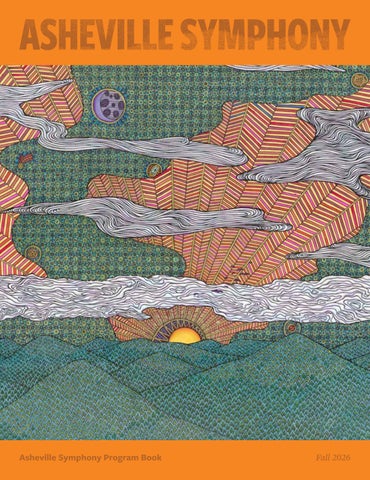
About the Cover Artist
Heather Divoky Heather Divoky is an artist and designer living and working in Asheville, North Carolina. She obtained her BA in Art History at Appalachian State University and her Masters in Arts and Culture at Leiden University, the Netherlands. Her work is shown nationally and internationally, from Nashville to Raleigh, all the way to Amsterdam. Divoky works mostly with marker and ink on paper to create rich story-telling through great detail and color. Each piece takes months to years to create, and hold vast ecosystems of lore which reflects her love of history and symbolism. She hopes the viewer walks away with a sense of wonder and curiosity. SELECTED IN COLLABORATION WITH
Founded in 2013, River Arts District Artists (RADA) supports, connects, and advocates for Asheville’s River Arts District creative community. Last season, the Asheville Symphony donated a portion of proceeds from Masterworks 1: Eroica featuring Emanuel Ax to support RADA’s continued recovery from Hurricane Helene. This season, the Symphony is pleased to continue our partnership by featuring artwork from RADA artists on our program book covers.
ASHEVILLE SYMPHONY STAFF EXECUTIVE OFFICE Daniel M. Crupi Executive Director Ines Lopes Assistant to the Executive Director ARTISTIC OPERATIONS Sally J. Keeney Orchestra Manager Molly Getsinger Chorus Manager Michael Di Trolio Principal Librarian Paul Stroebel Stage Manager DEVELOPMENT Joshua Thornton Director of Development Stella Plato Assistant Director of Donor Engagement Dana Alward Development Manager Liam Danzis Development Associate EDUCATION Tyson Hamrick Director of Education & Youth Orchestra Mika Hood Education Associate Sarah Fowler Education Assistant Rodney Workman ASYO Site Coordinator FINANCE Allie Lorette Controller MARKETING & PATRON RELATIONS Alex Hill Director of Marketing & Patron Relations Claire M. Allen Art Director Melissa Starkweather Patron Relations & Communications Manager Michelle Troszak Patron Relations & Office Coordinator Becca Szczepanski Marketing Assistant
KEEP IN TOUCH Asheville Symphony Office 27 College Place, Suite 100, Asheville, NC 28801 Monday - Friday ∙ 10:00 a.m. - 4:00 p.m. 828.254.7046 info@ashevillesymphony.org
Asheville AshevilleSymphony Symphony∙ ∙AshevilleSymphony.org AshevilleSymphony.org ∙ 13
Board of Directors OFFICERS Adarrell Gadsden • President Rachel Sossoman • President-Elect Sue Luther • Immediate Past President Sallie Broach • Secretary G. Edward Towson, II ⁺ • Treasurer
DIRECTORS Jack Anderson⁺⁺ Michael Andry Thomas C. Bolton⁺⁺ Rob Brady Sallie Broach Susan Harrington Butts Sean Comeaux Dr. John Cuellar George Dambach John W. Ellis Bolling Farmer Adarrell Gadsden Bill Gettys⁺⁺ Scott Gregg Fred Groce Tim Hill Bill Hume Keith Keener Pam Lowe-Hoyte Sue Luther Ricky McGrath Carol McCollum⁺⁺ Patrick O’Cain Jeffrey Owen Kevin Pasarilla Dr. Rachel Raab Richard Schaffer Jayne Schnaars Kevin Schwab Rachel Sossoman Jim Thompson G. Edward Towson, II⁺⁺ Sarah Van Gunten Judy Van Horne David Worley Olivia Zahler ⁺ Distinguished Directors
14 ∙ Fall 2026 Program Book
ADARRELL GADSDEN Board President
Friends of the Asheville Symphony, As I begin my second year as President of the Asheville Symphony Board of Directors, I want to thank you for all you do to support this incredible organization. As the premier performing arts organization in Asheville, I am continually humbled by how this community shows up for the Asheville Symphony. Whether in the home of our Givens Communities Masterworks series, First Baptist Church of Asheville, a Pops concert in Thomas Wolfe Auditorium, at Symphony in the Park at Pack Square Park, or in another one of the many venues across our eclectic city, I hope you take great pride and care in knowing this is your Asheville Symphony. For more than 60 years, the Asheville Symphony has remained a guiding presence within this intricate labyrinth that we call Asheville — reminding us of the diversity, vibrance, and creativity woven throughout our community. I know that will remain true as the Asheville Symphony embarks on what I believe to be one of our most thoughtfully curated seasons yet. I am most proud of the diversity you will see as you flip the pages of this program guide; this is not by accident, but the result of intentionality and thoughtfulness on the part of our staff and musicians, in their connectedness to our community and region. I remain inspired by the work happening through our educational offerings across Buncombe County and the surrounding areas of Western North Carolina. Reaching thousands of young people each year, the Asheville Symphony remains committed to uplifting tomorrow’s musicians. I am grateful to those of you who support these programs and continue to invest in our young people, ensuring that the power of music remains accessible for generations to come. I am ever grateful to our Board of Directors and their continued support of the Asheville Symphony; to our staff, who dedicate themselves to preserving the rich cultural identity of our community; to our musicians, who lend their individual talents to create an even greater collective; and, of course, to you and the many donors, business sponsors, municipal partners and patrons who make this work worthwhile. Welcome to the Asheville Symphony’s 2026-2027 season. It is my greatest honor to share in this journey alongside you as we continue to broaden our reach, deepen our impact, and collectively celebrate all that we have accomplished and all that we will achieve together. With immense gratitude,
Adarrell Gadsden Board President
Asheville AshevilleSymphony Symphony∙ ∙AshevilleSymphony.org AshevilleSymphony.org ∙ 15
DIRECTORS EMERITI
FA L L • W I N T E R • S P R I N G
Parker Concert Hall
George M. Bilbrey, Jr. M.D.* J.K. MacKendree Day
2026-27 SERIES
Joyce R. Dorr, Ph.D. George F. Goosmann, III
OCTOBER 18, 2026 SEASON OPENER with Stile Antico
Gerald C. Kitch Karl S. Quisenberry, Ph.D.* John J. Sherman, Jr. W. Herbert Smith, Jr.
NOVEMBER 10, 2026 * Deceased
PAST PRESIDENTS 1962-1964: Gaylord Davis 1964-1966: Rudolf Gumpert 1966-1968: John W. Rutland 1968-1970: Robert K. Weiler 1970-1971: Robert Saenger 1971-1972: William C. Spencer, Jr. 1972-1975: John K. Knight 1975-1977: Lawrence D. Ford 1977-1979: Mortimer Ryon 1979-1982: James E. Dooley 1982-1984: J.K. MacKendree Day 1984-1985: George Saenger 1985-1987: Spencer Atwater, M.D. 1987-1989: George Goosmann, III 1989-1992: John J. Sherman, Jr.
Django Festival Allstars DECEMBER 3, 2026
Handel’s Messiah DECEMBER 11, 2026 AN APPALACHIAN CHRISTMAS with
DePue Brothers Band
FEBRUARY 11, 2027 A VALENTINE CABARET with
Ann Hampton Callaway Trio MARCH 16, 2027 A ST. PATRICK’S DAY CELEBRATION with Téada APRIL 19, 2027
Aaron Diehl in Recital MAY 13, 2027 SEASON FINALE with Poiesis Quartet
1992-1994: G. Edward Towson, II 1994-1995: Stephen L. Barden, III 1995-1997: Joyce R. Dorr, Ph.D. 1997-1999: C. David Pheil 1999-2001: George M. Bilbrey, M.D.
Django Festival Allstars
Téada
2001-2003: W. Herbert Smith, Jr. 2003-2004: James P. Topp 2004-2006: Thomas C. Bolton 2006-2008: Carol McCollum 2008-2010: Jack Anderson 2010-2012: Carolyn L. Hubbard 2012-2014: William L. Gettys 2014-2017: Irene Stoll
Aaron Diehl
Poiesis Quartet
2017-2019: Doris Phillips Loomis 2019-2021: Bolling Farmer 2021-2023: Michael Andry 2023-2025: Sue Luther
828.862.2105 | brevardmusic.org 16 ∙ Fall 2026 Program ProgramBook Book
Ed Towson • Harvey Jenkins Eric Michael • Shon Norris Travis Keever • Cheryl McCormick Dan Mullinix • Terry Andersen
________________________________________________ ♦ Business Audit and Tax Service
♦ Individual Tax Planning and Preparation ♦ Management Advisory Services _________________________________________________
♦ Retirement and Estate Planning
Asheville • (828) 258-0363 Brevard • (828) 884-2021 Hendersonville • (828) 692-2583
Shon Norris
______________________________________________ ♦ Investment Advisory ♦ Group and Individual Insurance ♦ Comprehensive Financial Planning
_________________________________________
www.altamontcm.com (828) 236-0610
www.gk-cpa.com
active since 1978, we present exhibits, classes, concerts, festivals, public art projects, and even fm radio in the beautiful mountains of western north carolina. our creative community is strong and resilient. come say hello! we would love to see you. office and galleries at 90 S. Main Street in downtown marshall, n.c. www.madisoncountyarts.com www.wartfm.org facebook.com/MadisonCountyArts @madisoncountyarts Asheville Symphony ∙ AshevilleSymphony.org ∙ 17
Setting the stage for memorable moments A love of the arts and a sense of hospitality inspired George Vanderbilt’s masterpiece: Biltmore. Share in that legacy today by joining our Annual Passholder family, and discover more than you imagine with a year of unlimited visits.
18 ∙ Fall 2026 Program Book
biltmore.com/join
DARKO BUTORAC
Music Director
Darko Butorac is a conductor of rare interpretive authority. His presence on the podium has earned the sustained trust of leading orchestras across four continents and the most celebrated soloists of our time. In the 2026–27 season he makes his Carnegie Hall debut with the Orchestra of St. Luke’s and returns to the Wiener Konzerthaus in Vienna, the culmination of a career built over nearly two decades on musical intelligence, civic ambition, and a distinctive gift for drawing from any ensemble a quality of sound that lingers long after the final bar. Praised by the Westdeutsche Zeitung for his “exceptional combination of passion, elegance and well-timed pacing,” he has graced the podiums of more than thirty professional orchestras and opera companies. His European guest conducting has taken him to the Belgrade Philharmonic, the Georgische Kammerorchester Ingolstadt, Deutsche Kammerorchester Neuss, Rubinstein Philharmonic of Łódź, and Orchestra Giuseppe Verdi Parma. He led the opening concert of the 2022 European Capital of Culture alongside clarinetist Andreas Ottensamer with Camerata Novi Sad, and has appeared at the Wiener Konzerthaus, Kolarac Hall in Belgrade, the Gran Teatro Nacional of Lima, and the Aspen, Tartu and St. Olav festivals. A telling measure of Butorac’s impact is the consistency with which orchestras invite him back. When the Spokane Symphony called him on under twentyfour hours’ notice to step in for an ailing music director, he arrived, rehearsed, and delivered a Mendelssohn Scottish Symphony that critics placed “squarely in the great line of Austro-Germanic symphonic works of tragic scope,” earning a standing ovation and an immediate return engagement the following season. It is a pattern that has repeated itself across his career. The Belgrade Philharmonic reengaged him after his debut not once but twice, returning him for the season finale and the opening of the following season. The roster of artists who have chosen to share the stage with Butorac is itself telling: soprano Renée Fleming, pianists Emanuel Ax, Garrick Ohlsson and Olga Kern, tenor Lawrence Brownlee, mezzo-soprano Isabel Leonard, violinist Noah Bendix-Balgley, cellist Colin Carr, and clarinetist Anthony McGill, among them. His programming vision extends naturally across genres, with collaborations alongside mandolinist and MacArthur Fellow Chris Thile, banjoist Béla Fleck, and pianist Ben Folds, reflecting a musical sensibility that finds no useful distinction between tradition and vitality. The 2026–27 season is among the most ambitious of his career. Butorac makes his Carnegie Hall debut with the Orchestra of St. Luke’s in November 2026, and leads the Belgrade Classical Orchestra on a European tour through Belgrade and Sofia before culminating at the Wiener Konzerthaus in Vienna, all alongside soprano Tamara Radjenović. The season also brings a collaboration with Tony Award-winning soprano Kelli O’Hara, a concert with celebrated cellist Zlatomir Fung, the American premiere of Gabriel Prokofiev’s Concerto for Minimoog with pianist Inna Faliks, and a reimagining of Orff’s Carmina Burana featuring immersive image projections by award-winning designer Adam Larsen. Visit DarkoButorac.com to learn more.
Asheville AshevilleSymphony Symphony∙ ∙AshevilleSymphony.org AshevilleSymphony.org ∙ 19
ORCHESTRA PERSONNEL Violin Brian Allen • First Concertmaster Jackie Tso • Second Concertmaster Martha Gardner • Associate Concertmaster Arianna Argentieri • Assistant Concertmaster ⁺Pedro Oseias Maia • Principal Second Violin Debra L. Anthony • Associate Principal Second Violin Open Chair • Assistant Principal Second Violin Marianna Brickle Elizabeth Burch Teresa M. Curran Elizabeth Fee-Elliott Lori G. Hammel *Dorothy L. Knowles Virginia Kowal LuAda Malcom Ruben Orengo Karen Pommerich (loa) Mariya S. Potapova Inez Hullinger Redman Royce Richert Paul E. Stroebel Kathryn Gardner Triplett Viola Kara F. Poorbaugh • Principal Open Chair • Associate Principal Hannah Dara Gina Mashburn Heath Edward J. Smith Daphne Waggener Cello Daniel Mumm • Principal J. Franklin Keel • Associate Principal Paul Maxwell • Assistant Principal Cherylonda F. Fitzgerald Paul S. GhostHorse Katie Hamilton Patricia Koelling Johnston E. Sojeong Park Bass *M. Lee Metcalfe • Co-Principal Open Chair • Co-Principal Michael Di Trolio Vance Reese Matthew P. Waid
20 ∙ Fall 2026 Program ProgramBook Book
Flute Lissie J. Shanahan • Principal Kellie Henry Piccolo Dilshad B. Posnock Oboe Alicia Chapman • Principal *Cara Mia Jenkins English Horn Amanda J. LaBrecque Clarinet Harry H. “Chip” Hill • Principal Karen Farah Hill
Timpani Todd D. Mueller • Principal Percussion Open Chair • Principal Michael Morel Matthew Richmond *Brian Tinkel Harp Open Chair • Vetust Study Club Chair Keyboard Open Chair • Susanne Marcus Collins Chair
Bass Clarinet Shannon Thompson Bassoon Michael J. Burns • Principal Amber Ferenz Contrabassoon William L. Peebles Horn Jeffery B. Whaley • Principal *Michael L. Brubaker Anneka A. Zuehlke Travis A. Bennett Trumpet T. Mark Clodfelter • Principal Christopher Underwood • Assistant Principal Open Chair Trombone Justin Croushore • Principal L. Rienette Davis Bass Trombone Jeremy Marks Tuba Bethany Wiese • Principal
Sally Keeney • Orchestra Manager Michael Di Trolio • Principal Librarian Paul Stroebel • Stage Manager Claire M. Allen • Assistant to the Orchestra Manager *Orchestra Committee Member ⁺ One Year Appointment Section string players are listed alphabetically. (loa) = Leave of Absence
Plan your visit!
World-Class Art in the Heart of Downtown 20th and 21st Century American Art | ashevilleart.org
Thank you to our incredible musician hosts! The generosity and warmth of our musician hosts creates a welcoming home-away-fromhome for our traveling musicians. Thank you for being an integral part of the Asheville Symphony community! Mary and Jack Anderson Georgia Case Kathy and George Dambach Linda and Michael Gilpin Clair Griffith and Geoffrey Mitchell Suzanne and Steven Hageman Rita Hayes Barbara and Bill Hume Mountaine Jonas Pam and David Lane Jill and Joe Lawrence Susan and David Leader Sue and George Luther Suzanne Neilson Katie and Phil Osborn Odile Perrenoud and Bill Schulz Richard Schaffer and Anastasia Bartlett Jayne Schnaars and Donald Gavin Danielle Thout Jill Vargo and Tony Sciara Connie and Gary Wald Rebecca and Michael Weston Millie and Steve Whitney Robert Zeid and Amanda Hall
We’re also known for our notes. Tasting notes that play in every register. Curated cheese, charcuterie and wine in Asheville.
Get 15% off your next visit. Code SYMPHONY2026 southslopecheeseco.com
11 Southside Ave Asheville
Sharing the literature of the Appalachian region with the world and the world of good books with our community East Jackson Street | Sylva, North Carolina | Open seven days a week citylightsnc.com | (828) 586-9499
Asheville Symphony ∙ AshevilleSymphony.org ∙ 21
Some masterpieces are written in ink. Others are built in stone. the
BASILICA of
St. LAWRENCE Renaissance artwork, Bavarian stained glass, 17th-century wood carving and Daprato statuary. All under one of the most magnificent elliptical tile domes in the world. A sacred place where earthly music ascends to the divine. When Rafael Guastavino designed the Basilica of St. Lawrence, he masterfully wove together masonry, arches and tiles into his grandest composition. Using only brick, tile and the laws of pure geometry, the same Catalan vaulting genius that gave
Carnegie Hall its legendary acoustic warmth and created Grand Central Terminal’s mysterious Whispering Gallery composed a visual symphony, creating curvature which allows music to resonate perfectly throughout the space.
Experience awe in the heart of Asheville - plan your visit today 22 ∙ Fall 2026 Program Book
Graphic design studio crafting notice-worthy brands, websites + more for creatives + creators. Proud to collaborate with your Asheville Symphony. HELLECREATIVE.COM →
Asheville Symphony ∙ AshevilleSymphony.org ∙ 23
Season Overview Symphony in the Park September 6, 2026 Masterworks 1: Fellowship September 26, 2026 ALT ASO @ Pisgah Brewing: Balkan Brass Meets NOLA October 6, 2026 Masterworks 2: Nightfall October 17, 2026 ALT ASO @ Highland Brewing: Jazz & Pop November 2, 2026 Masterworks 3: Double Take November 14, 2026 Solo Piano Showcase with Inna Faliks November 17, 2026 ALT ASO @ The Orange Peel: Broadway & Great American Songbook December 1, 2026 Handel’s Messiah December 19, 2026 ALT ASO @ White Horse Black Mountain: From Bayou to Appalachian Roots January 19, 2027 Carmina Burana January 30, 2027 Masterworks 4: London February 20, 2027 ALT ASO @ The Orange Peel: 80s Prom March 11, 2027 Masterworks 5: Dedication March 20, 2027 Aaron Diehl Trio April 15, 2027 Masterworks 6: Marquee April 17, 2027 An Evening with Kelli O’Hara April 22, 2027 Holst & Heldenleben May 16, 2027 Masterworks 7: Homeland May 22, 2027
24 ∙ Fall 2026 Program ProgramBook Book
Become a Givens Communities Masterworks Series Subscriber and experience more music, more savings, and more exclusive benefits! The Givens Communities Masterworks Series is our flagship offering, with seven unforgettable performances that showcase the full power and range of your Asheville Symphony. Experience it all with a series subscription!
Exclusive Savings
FULL SERIES SUBSCRIPTION BENEFITS Get 15% off the entire seven-concert 2026-2027 Givens Communities Masterworks Series Keep your favorite seats year after year when you renew your full subscription by June 26, 2026 Enjoy priority seating for the best available seats as a new subscriber Plus all the subscriber benefits to the left.
Save up to 15% on single ticket prices and avoid extra fees.
First Access
Subscribers get early access to pops concerts and other add-ons before the general public.
Worry-Free Convenience
Change of plans? You can swap tickets to any other Masterworks performance.
Tax Deduction Perks
Donate unused tickets for a tax deduction upon request.
Don’t miss out on an unforgettable season — secure your seats today!
COMPOSE YOUR OWN SUBSCRIPTION BENEFITS Choose three or more Masterworks concerts and save up to 10% Upgrade your Compose Your Own Subscription at any point during the season and save
Visit AshevilleSymphony.org/Subscriptions to subscribe online, scan the QR code to the left, or call 828.254.7046 to subscribe over the phone. Asheville Symphony ∙ AshevilleSymphony.org ∙ 25
@VisitAsheville • ExploreAsheville.com
Dear Friends of the Asheville Symphony Orchestra, A deeply rooted pillar of Asheville’s creative community, the Asheville Symphony Orchestra has embodied a devotional passion for music since 1960. From innovative collaborations to genre-defying performances, ASO’s ever-evolving programming reflects the pulse of our city - each note captivating audiences and pushing beyond the boundaries of traditional concert experiences. Explore Asheville is honored to support your mission and talent in capturing the heart of the people of Western North Carolina and its guests. We are dedicated to shining our spotlight on the artists, makers, and musicians who help shape our community’s distinct story.
After all, we wouldn’t be Asheville without artists like you.
Explore Asheville’s Strategic Imperatives
DELIVERING BALANCED & SUSTAINABLE GROWTH
26 ∙ Fall 2026 Program Book
ENCOURAGING SAFE & RESPONSIBLE TRAVEL
ENGAGING & INVITING MORE DIVERSE AUDIENCES
PROMOTING & SUPPORTING ASHEVILLE’S CREATIVE SPIRIT
Where Artistry Meets Architecture Elevating Western North Carolina Real Estate. Just as a symphony requires precision, passion, and perfect timing, navigating today’s luxury real estate market demands a masterfully orchestrated approach. Mills Coin & Co. delivers unparalleled real estate expertise across Western North Carolina, with a premier specialization in the downtown Asheville luxury condominium market. From vibrant urban penthouses to serene mountain estates, we seamlessly compose every detail of your buying or selling experience. Your next movement begins here.
Scan to view availability and floorplans.
Mills Coin & Co.
(828) 782-5588 mills.coin@howardhannatate.com
Asheville Symphony ∙ AshevilleSymphony.org ∙ 27
Proudly Serving WNC Since 1900 www.SwannanoaCleaners.com
Come visit us! Fine Pottery and Ceramic Art 38 Working Artist Studios
Largest ceramic art center in WNC! Gallery and Studio Tours, Open to the Public Classes and Workshops for All Skill Levels 44 Westgate Pky, Asheville, NC | www.theVillagePotters.com
28 ∙ Fall 2026 Program Book
LODGING PARTNERS
FOOD & BEVERAGE PARTNERS
OFFICIAL HOTEL OF THE ASHEVILLE SYMPHONY
In the local hospitality scene and want to be on this list? Contact the Development team by email at development@ ashevillesymphony.org or by phone at 828.254.7046. AshevilleSymphony Symphony∙ ∙AshevilleSymphony.org AshevilleSymphony.org ∙ 29 Asheville
ENCORE! Visit our Mills River Taproom 100 Sierra Nevada Way, Mills River, NC 28732 ©Sierra Nevada Brewing Co. | Chico, CA & Mills River, NC | SierraNevada.com | Please Drink Responsibly | Please Recycle 30 ∙ Fall 2026 Program Book
Protecting wildlife and the wild heart of our home. Join us! wildwnc.org
Preserve Our Wild
a Leg
cy
Drive Change in Our Community DONATE YOUR CAR
CHANGE A LIFE
You can open the doors of opportunity for a local working family when you donate your car to Working Wheels. The donation is tax-deductible. The process is simple. The impact is real.
Call today (828) 633-6888
or visit workingwheelswnc.org to learn more
E x p e r i e n c e t h e Ar t s i n t h e H e ar t o f B l a ck M o u n t a i n
Proudly Serving the Swannanoa Valley for 25 Years Gallery • Theater • Dance Studio • Clay Studio Visual Arts Studio • Classes • Workshops Concerts • Performances • Special Events Local Arts Gift Shop • Rotating Free Monthly Exhibits
225 W State Street • 828.669.0930 • www.BlackMountainArts.org • @BlackMountainArts
Asheville Symphony ∙ AshevilleSymphony.org ∙ 31
The Asheville Symphony Society is the nonprofit organization at the core of everything we do — from world-class concerts to meaningful education and community programs. 32 ∙ Asheville Symphony Society
Through the Society, the Asheville Symphony brings together musicians, educators, volunteers, and supporters who believe in the power of music to inspire and uplift. In addition to the Asheville Symphony, the Asheville Symphony Society supports a family of affiliate organizations: the Asheville Symphony Guild, Asheville Symphony Chorus, Asheville Symphony Symphonettes, and the Asheville Symphony Youth Orchestra. Together, these programs enrich lives across Western North Carolina and help ensure that music remains a vital part of our community.
Visit AshevilleSymphony.org to learn more.
ASHEVILLE SYMPHONY SOCIETY
The Asheville Symphony Guild is a volunteer organization that has been supporting the Asheville area by raising funds and sponsoring music education programs in local schools for more than 50 years.
What does the Guild do? MUSICAL FEASTS From festive garden parties to elegant evenings with Asheville Symphony soloists, Musical Feasts are a chance to gather with friends, share great food, and support the Symphony you love while hearing from some of the greatest musicians playing today. Each event helps fund the Symphony’s inspiring programs. SUPPORTS MUSIC IN THE SCHOOLS The Guild helps bring classical music to thousands of elementary school children across Western North Carolina. Through Music in the Schools, professional musicians visit local classrooms — planting seeds of creativity and joy for the next generation. GUILD GATHERINGS Whether it’s the Fall Potluck or the annual Spring Gathering, our members treasure the friendships, laughter, and shared passion for music that the Guild provides.
Make friends. Make music matter. The Guild unites music lovers who want to give back, stay connected, and enrich our community. As a member, you’ll enjoy meaningful volunteer opportunities, vibrant social events, and the satisfaction of supporting music education for the next generation.
Visit AshevilleSymphonyGuild.org to join the Guild and be part of something joyful and lasting.
Asheville Asheville Symphony Symphony ∙ AshevilleSymphony.org ∙ 33
ASHEVILLE SYMPHONY SOCIETY
The Asheville Symphony Chorus is a volunteer vocal ensemble that has been performing in the Asheville area for over 30 years. Upcoming Events Handel’s Messiah with the Asheville Symphony December 19, 2026 • See page 72 for details Handel’s Messiah Singalong December 1, 2026 at Trinity Episcopal Church Sing along to this masterpiece with your community! Carmina Burana with Immersive Projection Art & the Asheville Symphony January 30, 2027 • See page 82 for details Black Mountain to Broadway April 20, 2027 at First Baptist Church of Asheville Part of Asheville Amadeus, this program journeys from the Blue Ridge to NYC through folk, musical theatre, and more.
Visit AshevilleSymphony.org/Chorus to learn about performances, auditions, and more.
Special thanks to the Friends of the Asheville Symphony Chorus! Mary and Jack Anderson Beverly Briedis Chaddick Foundation Bonnie Chazotte Scott Coates Scott and Sally Gregg Reni N. Hamner
34 ∙ Asheville Symphony Society
George Hellyer and George Wagner David Hopes Drs. Marilyn Kolton and Louis Dwarshuis Sarah Kotranza Sue Martin and Jim Ritzen Linda Melnick
Rebecca Morgan Suzanne Neilson and Gary Dial Diana Spangler Claudia and Joseph Templeton Dr. Larry R. Versteegh Paul and Valorie Vliek Jeff and Susie Wellington
ASHEVILLE SYMPHONY SOCIETY
The Asheville Symphony Symphonettes is a volunteer organization and high school girls’ service club. Inspiring the Next Generation Through Service and the Arts The Asheville Symphony Symphonettes fosters leadership, confidence, and a lifelong appreciation for music. Since 2011, the Symphonettes have supported the Asheville Symphony by welcoming concertgoers, distributing programs, and participating in meaningful service projects that strengthen our local music community. Through hands-on experiences and regular engagement with the arts, students build strong communication skills, form lasting friendships, and develop a sense of pride and responsibility in giving back.
For information about membership, funding, and more, please contact Leigh Verm at leighverm@gmail.com.
Asheville Asheville Symphony Symphony ∙ AshevilleSymphony.org ∙ 35
ASHEVILLE SYMPHONY SOCIETY
The Asheville Symphony Youth Orchestra (ASYO) is Western North Carolina’s premier orchestral training program, serving approximately 200 students ages 8 -19. 36 ∙ Asheville Asheville Symphony Symphony Society Affiliates
Asheville Symphony Youth Orchestra Faculty & Staff
Throughout the season, ASYO students participate in retreats, masterclasses, and workshops led by professional musicians, guest artists, and some of the top music educators in Western North Carolina. Through these experiences, students grow as individuals, develop ensemble skills, and gain life skills such as perseverance, hard work, planning, self-awareness, creativity, and self-evaluation — skills they can carry with them long after their time in the ASYO.
Tyson Hamrick Director of Education & Youth Orchestra ADMINISTRATIVE STAFF Mika Hood Education Associate & Chamber Music Coordinator Sarah Fowler Education Assistant Rodney Workman Site Coordinator Jason Posnock Advisor Cara Jenkins Advisor Cynthia Roop Advisor TEACHING STAFF Dr. Alexandra Dee Music Director, Youth Philharmonic & Concert Conductor Amanda Tant Assistant Music Director, Sinfonia Conductor Ashlee Booth Divertimento Conductor
Upcoming Performances NCMEA Conference Performance November 9, 2026 in Winston Salem, NC Winter ASYO Concert December 7, 2026 in Asheville, NC Chamber Music Showcase March 7, 2027 in Asheville, NC
Cady Robison Overture Class Conductor Dr. Brian Tinkel Percussion Director Dr. Sophia Anastasia Flute Choir Conductor Dr. Jason Slaughter Jazz Combo Director
Concerto Competition Finals April 25, 2027 in Asheville, NC Spring ASYO Concert May 3, 2027 in Asheville, NC Holst & Heldenleben with the Asheville Symphony May 16, 2027 in Brevard, NC
Visit AshevilleSymphony.org/ASYO to learn more about the Youth Orchestra including details about upcoming performances, audition information, and more.
A special thank you to Drs. Joanne and Tom Parker for their generous support of the ASYO this season. Their financial support will positively enhance music education for hundreds of students across Western North Carolina by providing scholarships, access to instruments, and unique experiences.
Asheville Asheville Symphony Symphony ∙ AshevilleSymphony.org ∙ 37
ASHEVILLE SYMPHONY SOCIETY
With two string orchestras, two full orchestras, a beginning strings class, percussion ensembles, a flute choir, a new jazz combo group, and various chamber ensembles, the Asheville Symphony Youth Orchestra offers an ensemble for nearly every instrument and experience level.
ASHEVILLE SYMPHONY SOCIETY
Friends of the ASYO $50,000+ Drs. Joanne and Tom Parker $25,000 – $49,999 Keith Keener $15,000 – $24,999 Henry A. LaBrun $10,000 – $14,999 Thomas C. Bolton Jerry and Diane Cunningham Gerald and Nancy Kitch Ralph Protsik and Susan Wolin $5,000 – $9,999 Russell and Ladene Newton Penley Produce Vacation Homes Jayne Schnaars and Donald Gavin Sarah Van Gunten $2,500 – $4,999 Diana Bilbrey Paul and Patty Gaumond Bill and Nancy Gettys Carol and Hugh McCollum Irene Dillingham Richards Family Foundation $1,000 – $2,499 Anonymous Michael and Catty Andry Beverly Briedis Georgia Case Dr. John and Mrs. Wendy Cuellar Ann Hayes Bill and Kitty Hunt Jon and Ann Kemske Jim and Mary Kirby Jill and Joe Lawrence Phil and Katie Osborn Gary and Jeanne Ann Stroebel Ed and Cindy Towson Steven and Michele Warner Olivia and Gary Zahler
38 ∙ Asheville Asheville Symphony Symphony Society Affiliates
$500 – $999 Mary and Jack Anderson Karen Campbell Gary and Patty Coleman Sharron Davis Dr. Bolling Farmer Troy Schmidt and Diane Song Carol and Terrence Tinkel Matthew and Sarah Volk
Wade and Mary Margaret Saunders Bill and Frances Smyth J. Howard and Honey Solomon Irene and Michael Stoll Paul Stroebel Betty Walker Larry and Janie Wilson Helen Yamada
$250 – $499
Shannon Baggett Elinor Bowman Hannah Boyd Deborah Francis Robin and Gordon Gaiser Clementine Gregory Xinni Guo Tom and Libby Irwin Rev. Alexandra Lusak Dagi Murphy Donald Poole David Russell Beth Stickle Schoenheit Melanie Welty
Gary & Sharon Clark Michael Cleveland and Maria-Grazia Nunzi Daniel and Caroline Crupi Martha Gettys Betty Gumpert Legerton Architecture Gail and Ron Manheimer Angie Newsome Bonnie Wheeler David and Dianne Worley Thomas Young $100 – $249 Asheville Alumnae Chapter of Sigma Alpha Iota Adlai and Karen Boyd Claude and Sallie Broach Rich and Diane Byers Nancy Casey Kim Eiring Polly S. Feitzinger Cary and Koni Findlay Gayle Freeauf Ellenor Frelick Linda and Jeffrey Fromson Robert Graf Michael J. Grillot Nan Jackson and Heinz Sauer Susan Jensen and Lew Gelfond Ruth Sieber Johnson Alan Lipsky and A.J. Rhodes Billie Marzullo Barbara Pettigrew Kathleen Quinlan and Marc Parham Vicki Richards Don Roberts Carol and Michael Rosenblum Susie and John Ruhl
$1 – $99
ASHEVILLE SYMPHONY SOCIETY
Tuition covers less than half of the Youth Orchestra’s operational costs. Your gift empowers students to participate in performances, retreats, masterclasses, special workshops, and touring performances regardless of their economic circumstances. Visit AshevilleSymphony.org/friendsof-the-asyo to donate online today.
PROGRAM HIGHLIGHT
ASYO Students Rehearse Alongside the Sphinx Virtuosi In another inspiring collaboration with Brevard Music Center, ASYO students had the opportunity to learn from and rehearse alongside the world-renowned Sphinx Virtuosi. The workshop opened with a Virtuosi performance previewing their upcoming concert in Brevard Music Center’s Parker Concert Hall Series, followed by a hands-on side-by-side session blending artistry, mentorship, and inspiration. Many ASYO students returned the following evening for the full Sphinx Virtuosi concert at Parker Concert Hall, experiencing the ensemble’s musicianship and its commitment to diversity in classical music firsthand. The partnership reached beyond ASYO. A quartet from Sphinx visited Koontz Intermediate School, performing for orchestra students from both Koontz Intermediate and Valley Springs Middle School before leading a workshop with Valley Springs’ 7th grade orchestra. Director Elizabeth Terry called it “the best visiting artist I’ve ever had in my classroom.” This is the kind of partnership the Asheville Symphony’s education program is built around: bringing high-caliber guest artists into rehearsal with ASYO, and getting those same artists in front of string students in area classrooms.
This series of events was made possible through the collaboration of Brevard Music Center, the Asheville Symphony, and our generous donors. Thank you for making this unforgettable experience possible. Asheville Asheville Symphony Symphony ∙ AshevilleSymphony.org ∙ 39
40 ∙ Fall 2026 Program Book
Asheville Symphony ∙ AshevilleSymphony.org ∙ 41
The Givens Communities Masterworks Series MASTERWORKS 1 First Baptist Church of Asheville September 26, 2026 at 2:00 p.m. + 8:00 p.m. Darko Butorac Conductor Jakob Aumiller Piano
42
What does genius look like? Often it looks like community. Brahms crafted his exuberant First Piano Concerto through years of collaboration with close friends and mentors, including Clara Schumann who inspired the concerto’s dreamy second movement. Beethoven’s relentless Seventh Symphony — a personal favorite of his with its unyielding rhythmic drive — premiered at a charity concert performed by an orchestra of friends and fellow composers. Both works emerged from profound creative kinship and community, proof that greatness rarely stands alone.
BRAHMS BEETHOVEN
Piano Concerto No. 1 in D minor, Op. 15 by Johannes Brahms Johannes Brahms was born in Hamburg, Germany, on May 7, 1833, and died in Vienna on April 3, 1897. His First Piano Concerto took shape over the years 1854‑1858. Brahms played the solo part in the first performance, which took place in Hanover on January 22, 1859, with Joseph Joachim conducting. In addition to the solo piano, the score calls for two each of flutes, oboes, clarinets, and bassoons, four horns, two trumpets, timpani, and strings. Duration is about 44 minutes. The two piano concertos by Johannes Brahms are works of, respectively, youth and maturity. Brahms himself wrote to Joachim, after the disastrous reception accorded the First in Leipzig, “..and a second one will sound very different.” The Second Concerto did not come for more than two decades; it was to be the work of a portly, bearded, middle‑aged figure whose music contained repose and poignancy. The First remains the work of a sensitive youth, a clean‑shaven stripling out of whom surged passionate and demanding music. The D‑minor concerto, coming at a time of disappointment, frustration, and doubt, caused Brahms enormous trouble. He was disturbed by the tragic breakdown and death of Robert Schumann, and by the conflicts in his feelings toward Clara Schumann. Even after starting the work, Brahms was not exactly sure what it was going to be — first a sonata for two pianos, then an orchestral score, finally a piano concerto. Months of worry, revising, questioning, and doubt followed. Brahms played it privately for Joachim in March 1858, but at the end he could only say, “It will never come to anything.” Finally, though, Joachim persuaded him to let the piece go, to send it to the copyist, and eventually out into the world. At the premiere, the D‑minor concerto was, above all, serious: closely argued, a solid, craggy monument, a truly symphonic work in what was normally a popular genre. The emotional range is generally limited to the darker moods, from tragedy to poignant resignation. Brahms more than compensates by the sheer strength of his technical aplomb in the part‑writing and harmonic scheme, which make the musical progress continually engrossing. Though the work is in D minor, the opening purposely avoids announcing the key. Joachim claimed that the tonally unstable opening was Brahms’s reaction to the news that Schumann had attempted suicide by throwing himself into the Rhine. Brahms extends the introduction with such ingenuity, such expressive drama, and such a wealth of resources, that it becomes a monumental preparation for the arrival of the real home key at the first entrance of the solo piano.
Johannes Brahms Piano Concerto No. 1 in D minor, Op. 15 Jakob Aumiller, Piano I. Maestoso II. Adagio III. Rondo: Allegro non troppo Sponsored by Timothy Butts & Susan Harrington Butts INTERMISSION
Ludwig van Beethoven Symphony No. 7 in A major, Op. 92 I. Poco sostenuto — Vivace II. Allegretto III. Presto IV. Allegro con brio Sponsored by John & Janet Long
CONCERT SPONSOR
Carol & Hugh McCollum GUEST ARTIST SPONSOR
Thomas C. Bolton
Media partner Blue Ridge Public Radio will air a recording of this performance, featuring conversations with the Asheville Symphony, on BPR Classic and bpr.org on Tuesday, October 13 at 7:00 p.m. and Thursday, October 15 at 9:00 a.m.
The opening movement is one of the largest symphonic movements composed by anyone after Beethoven, and it is dramatic in the way Beethoven was, employing musical ideas, keys, and sonorities almost as characters in a play. The piano appears as a real dramatic foil to the thundering orchestra. Though the pianist has much difficult music to play, there is no solo cadenza. The purpose of the solo part is not showiness, but concentrated, thoughtful dialogue. The second movement, in D major, offers a striking contrast to the storminess of the opening, but to Brahms it still seems to have evoked Schumann. Over the opening piano theme, Brahms wrote the words “Benedictus qui venit in nomine Domini” (“Blessed is he that comes in the name of the Lord”), a text from the Sanctus of the Mass. Because Brahms also frequently referred to Schumann
PREMIUM SEASON SPONSORS
OFFICIAL HOTEL OF THE ASHEVILLE SYMPHONY
(continued on next page)
Asheville Symphony ∙ AshevilleSymphony.org ∙ 43
as “Mynheer Domini,” Malcolm MacDonald suggests he may have intended this serene passage as a kind of “instrumental requiem” for that composer’s troubled spirit. For the finale, Brahms returns to the demonic energy of D minor, a fast-moving rondo that is more grim than cheerful, yet exhilarating, too. Brahms builds almost all of the themes in this movement on a rising arpeggio that seems to have grown out of the lyrical second theme of the opening movement. The way in which he constructs his themes, developing, linking, and transforming ideas not only within, but between, movements, is astonishingly mature.
Symphony No. 7 in A major, Op. 92 by Ludwig van Beethoven Ludwig van Beethoven was baptized in Bonn, Germany, on December 17, 1770, and died in Vienna on March 26, 1827. He began the Symphony No. 7 in the fall of 1811, completed it in the spring of 1812, and led the first public performance in Vienna on December 8, 1813. The symphony is scored for two each of flutes, oboes, clarinets, bassoons, horns, and trumpets, plus timpani and strings. Duration is about 36 minutes. The first performance of the Seventh Symphony, which took place in Vienna on December 8, 1813, at a charity concert that also included the premiere of Wellington’s Victory in the Battle of Vittoria, Op. 91, was one of the most splendid successes of Beethoven’s life. The concert was repeated four days later, at the same benefit prices, and raised a large sum of money for the aid of Austrian and Bavarian troops wounded in the Battle of Hanau. More important from the musical point of view, it marked the real arrival of popular recognition that Beethoven was the greatest living composer. To tell the truth, it was probably the potboiler Wellington’s Victory at the end of the program that spurred the most enthusiasm. Wellington, after all, was allied with the Austrians in opposing Napoleon, and a degree of patriotic fervor infected the proceedings. Moreover the piece was simply calculated to appeal to a broad general
44 ∙ Masterworks 1: Fellowship
audience more certainly than the lengthy abstract symphony that had opened the concert. Beethoven, of course, knew that the symphony was the greater piece. He called it, in fact, “one of my most excellent works” when writing to Johann Peter Salomon (for whom Haydn had written his symphonies 93‑101), asking him to use his good offices with a London publisher to sell a group of his works there. The new symphony contained difficulties that the violin section declared unperformable during rehearsals; Beethoven persuaded the players to take the music home and practice overnight, a concession almost unheard of! The rehearsal the next day went excellently. The composer Louis Spohr, who was playing in the violin section for that performance, has left in his memoirs a description of Beethoven’s conducting during the rehearsal — a remarkable enough feat since Beethoven’s hearing was by now seriously impaired. Spohr noted, “Beethoven had accustomed himself to indicate expression by all manner of singular body movements. So often as a sforzando occurred, he tore his arms, which he had previously crossed on his breast, with great vehemence asunder. At piano he crouched down lower and lower as he desired the degree of softness. If a crescendo then entered he gradually rose again and at the entrance of the forte jumped into the air. Sometimes, too, he unconsciously shouted to strengthen the forte.” Spohr realized that Beethoven could no longer hear the quiet passages in his own music. At one point during the rehearsal, Beethoven conducted through a pianissimo hold and got several measures ahead of the orchestra without knowing it. “[He] jumped into the air at the point where according to his calculation the forte ought to begin. When this did not follow his movement he looked about in a startled way, stared at the orchestra to see it still playing pianissimo and found his bearings only when the long‑expected forte came and was visible to him. Fortunately
this comical incident did not take place at the performance.” The extraordinary energy of the Seventh Symphony has generated many interpretations from the critics, among the most famous of which is Wagner’s description, “Apotheosis of the Dance.” The air of festive jubilation was certainly linked by the first audiences with the victory over Napoleon, but many later writers have spoken of “a bacchic orgy” or “the upsurge of a powerful dionysiac impulse.” Even for a composer to whom rhythm is so important a factor in his work, the rhythmic vehemence of this symphony, in all four movements, is striking. At the same time, Beethoven was beginning to exploit far-ranging harmonic schemes as the framework for his musical architecture. If the Sixth Symphony had been elaborated from the simplest and most immediate harmonic relations — subdominant and dominant — the Seventh draws on more distant keys borrowed from the scale of the minor mode. The very opening, the most spacious slow introduction Beethoven ever wrote, moves from the home key of A major through C major and F major — both closely related to A minor — before returning to A for the beginning of the Vivace. Wellington’s Victory was even more likely to be popular in England than in Vienna, and Beethoven adjusted his prices accordingly: a London publisher could have the “grand symphony” — the Seventh — for thirty ducats, but the Battle Symphony would cost eighty. Those fees do not reflect Beethoven’s view — or ours — of the relative merits of the two works; he was simply asking what he thought the market would bear. Nowhere, not even in the opening movement of the Fifth, does Beethoven stick so single‑mindedly to one rhythmic pattern as in the Vivace of the Seventh. It skips along as rhythmic surface or background throughout. The slow movement was a sensation from the beginning; it had to be encored at the first two benefit concerts, and during the nineteenth
century it was also frequently used, especially in Paris, as a substitute for the slow movement of the Second Symphony. The dark opening, stating the accompaniment to the entire march theme before the melody itself appears; the hypnotic repetition of a quarter‑note and two eighths; the alternation between major and minor, between strings and winds; the original fusion of march, rondo, and variation forms — all these contribute to the fascination of this movement.
Jakob Aumiller, Piano
The Presto of the third movement is a headlong rush, broken only slightly by the somewhat slower contrasting Trio. Beethoven brings the Trio around twice and hints that it might come for yet a third time (necessitating still one more round of scherzo) before dispelling our qualms with a few sharp closing chords. The closing Allegro con brio brings the symphony to its last and highest pitch of jubilation. It is murder on the lips of the brass players, and its constant drive and the motivic repetition (as in the earlier movements, too) led the contemporary American composer John Adams to refer to it, only half-jokingly, as the first minimalist symphony.
Praised for his dynamic range and subtle sense of color, pianist Jakob Aumiller has played in important venues throughout the United States and Europe including performances in Munich, Milan, New York and Berlin. He has played as a soloist with orchestras such as the Neue Philharmonie München, the Orchestra Filarmonica Veneta and the Philharmonic Orchestra of Bacau. Aumiller has won prizes at numerous national and international competitions, including first prizes at the “Mary Smart Concerto Competition” in New York, the “Giulio Rospigliosi” competition and the “Ischia” competition. In 2023, Aumiller won first prize at the “Lamberto Brunelli” competition in Vicenza and second prize at the “Premio Venezia” at the Teatro La Fenice in Venice. He also won prizes at the renowned “Ettlingen” competition in Germany, the “Cesar Franck” competition in Brussels and the “Concours international de Piano de Lyon” in France. Jakob Aumiller was born in Munich in 2001 and started playing the piano at the age of 5. He earned his Bachelor and Master of Music with honors at the Conservatorio di Musica F.A. Bonporti with Professor Massimiliano Mainolfi in Trento (Italy). Since August 2024, he has been studying for an Artist Diploma at the Cleveland Institute of Music under Professor Antonio Pompa-Baldi.
Program notes by Steve Ledbetter
The Asheville Symphony annually partners with Cleveland Institute of Music (CIM), one of the country’s top conservatories, to feature the CIM Concerto Competition winner. The partnership between CIM and the Asheville Symphony is made possible by Cleveland native and Asheville resident Tom Bolton, with the support of the Payne Fund, a longtime and generous supporter of conservatory scholarships at CIM.
Asheville Symphony ∙ AshevilleSymphony.org ∙ 45
46 ∙ Fall 2026 Program Book
The Givens Communities Masterworks Series is at the core of what we do — it’s the artistic heart of our Asheville Symphony. Subscribers are what make that possible. MUSIC DIRECTOR DARKO BUTORAC
Apply the cost of today’s ticket when you subscribe! ONLINE
AshevilleSymphony.org
PHONE
828.254.7046
IN PERSON
27 College Place, Suite 100 Asheville Symphony ∙ AshevilleSymphony.org ∙ 47
ALT ASO @ PISGAH BREWING BALKAN BRASS MEETS NOLA
48 ∙ ALT ASO @ Pisgah Brewing
TUESDAY, OCTOBER 6, 7:00 P.M. Darko Butorac, Conductor We kick off the 2026-2027 ALT ASO series in Black Mountain at Pisgah Brewing Co., where mountain views and open-air evenings set the stage. The feverish, intoxicating pulse of Balkan brass meets the jubilant swing of the Second Line, creating a celebratory atmosphere for our first ALT ASO of the year. The program features Bourbon St. Parade, When the Saints Go Marching In, and more! ALT ASO tickets are available for puchase by the general public eight weeks before the concert date. SERIES PRESENTING SPONSOR
Jill Vargo, MD & Tony Sciara, Ph.D. PLATINUM SPONSORS
Craig Allen & Julie Cowden Dr. Bolling Farmer Paul & Patty Gaumond Travis Worl & Richard Lindau GOLD SPONSORS
BRONZE SPONSORS
Michael & Catty Andry Olivia & Gary Zahler
Asheville Symphony ∙ AshevilleSymphony.org ∙ 49
Wealth Built Around What Matters Most. At Marlowe Pasarilla Wealth Management Group, we help individuals, families, and business owners navigate life's financial decisions with clarity and confidence. Through comprehensive planning and guidance, we help align wealth with the future you envision.
COMPREHENSIVE PLANNING FOR WHAT MATTERS MOST • Financial Planning • Investment Services • Insurance & Risk Management • Estate & Legacy Planning • Business Planning Solutions
Let's Start the Conversation Northwestern Mutual is the marketing name for The Northwestern Mutual Life Insurance Company (NM) and its subsidiaries including Northwestern Long Term Care Insurance Company (NLTC), Northwestern Mutual Investment Services, LLC (NMIS) (Investment Brokerage Services), a registered investment adviser, broker-dealer, and member of FINRA and SIPC, and Northwestern Mutual Wealth Management Company® (NMWMC) (Investment Advisory Services), a federal savings bank. Not all Northwestern Mutual representatives are advisors. Members of Marlowe Pasarilla Wealth Management Group use Marlowe Pasarilla Wealth Management Group as a marketing name for doing business as representatives of Northwestern Mutual. Marlowe Pasarilla Wealth Management Group is not a registered investment adviser, broker-dealer, insurance agency, or federal savings bank. To view detailed disclosures regarding individual representatives, view their information at www.mpwealthgroup.com.
50 ∙ Fall 2026 Program Book
Every great performance begins with the right players. So does every successful move. Whether you’re buying, selling, or simply considering what comes next, The Matt & Molly Team is ready to help you make a noteworthy move. Proud Sponsor of the Asheville Symphony
info@themattandmollyteam.com
Scan for great offers and real estate information!
Asheville Symphony ∙ AshevilleSymphony.org ∙ 51
CLYNE TAN SIBELIUS
The Givens Communities Masterworks Series MASTERWORKS 2 First Baptist Church of Asheville October 17, 2026 at 2:00 p.m. + 8:00 p.m. Darko Butorac Conductor Joseph Conyers Double Bass
52
There is a serene kind of beauty found only at twilight, when the landscape cedes to legend; this program lingers in these wild places at their most untamed and fragile. Anna Clyne’s stormy nocturne gathers “every shred of the luminous past” like “a naked woman running mad through the pure night.” Tan Dun’s spiritually cinematic Wolf Totem summons the mythical Mongolian wolf from the grasslands. Sibelius’s devastating Fifth conjures the inscrutable patterns of the aurora. Three works that find beauty in loss, solace in vast spaces, and mystery in the gathering dark.
Anna Clyne This Midnight Hour
This Midnight Hour by Anna Clyne Born in 1980, Anna Clyne composed this piece in 2015. It premiered on November 13, 2015 at the Théâtre Espace Coluche in Plaisir, France by the Orchestre National d’Île de France, conducted by Enrique Mazzola. Duration is approximately 12 minutes. Anna Clyne, according to the comprehensive review- and performance-aggregating web site Bachtrack, was the “Most Performed Living Woman Composer in the World” in 2025. Clyne was born in London in 1980, began composing at age eleven, and received her undergraduate training at Edinburgh University and a master’s degree from the Manhattan School of Music. Her career has been on a meteoric trajectory since she completed her education — performances, commissions and recordings by leading ensembles and soloists around the world; selection as a participant in a master class with Pierre Boulez in New York City; director of the New York Youth Symphony’s award-winning program for young composers “Making Score” from 2008 to 2010; Composer-in-Residence with the University of Oxford, Philharmonia Orchestra, Trondheim Symphony, Helsinki Philharmonic, Symphony Orchestra of Castilla y León (Spain), and Chicago Symphony Orchestra (2010-2015), when she not only composed six works for the ensemble — including the Grammy-nominated double-violin concerto Prince of Clouds — but also conducted workshops in schools, juvenile detention centers, and with residents in memory care units. Among Anna Clyne’s many honors are eight ASCAP Plus Awards, Charles Ives Fellowship from the American Academy of Arts and Letters, and Clutterbuck Award from the University of Edinburgh; she also received a grant from Opera America to develop a work titled Eva, about the German-born American post-minimalist sculptor Eva Hesse (1936-1970). Clyne wrote, “The opening of This Midnight Hour was inspired by the character and power of the lower strings of the orchestra. From there, it draws inspiration from two poems. Whilst it is not intended to depict a specific narrative, my intention is that it will evoke a visual journey for the listener.”
Sponsored by Daniel & Caroline Crupi
Tan Dun Contrabass Concerto: Wolf Totem Joseph Conyers, Double Bass I. Largo melancolia — Allegro II. Andante molto III. Allegro vivace Sponsored by Mountaine Jonas INTERMISSION
Jean Sibelius Symphony No. 5 in E-flat Major, Op. 82 I. Tempo molto moderato; Allegro moderato — Presto II. Andante mosso, quasi allegretto III. Allegro molto; Misterioso
CONCERT SPONSOR
David & Pamela Lane GUEST ARTIST SPONSOR
Dr. Rachel E. Raab & Dr. Francois Archambault This concert is supported in part by:
La Música by Juan Ramón Jiménez Music; — a woman unclad crazily running through the spotless night! Harmonie du soir (“Evening Harmony”) by Charles Baudelaire Now comes the time when, quivering on its stem, Each flower sheds perfume like a censer; Sounds and scents turn in the evening air; Melancholy waltz and reeling languor! Each flower sheds perfume like a censer; The violin throbs like a wounded heart, Melancholy waltz and reeling languor! The sky is sad and beautiful like a great altar.
Media partner Blue Ridge Public Radio will air a recording of this performance, featuring conversations with the Asheville Symphony, on BPR Classic and bpr.org on Tuesday, November 10 at 7:00 p.m. and Thursday, November 12 at 9:00 a.m.
The violin throbs like a wounded heart, A fond heart that loathes the vast black void! The sky is sad and beautiful like a great altar. The sun has drowned in its congealing blood. A fond heart that loathes the vast black void And garners in all the luminous past! The sun has drowned in its congealing blood ... Your memory within me shines like a monstrance! © 2026 Dr. Richard E. Rodda
PREMIUM SEASON SPONSORS
OFFICIAL HOTEL OF THE ASHEVILLE SYMPHONY
(continued on next page)
Asheville Symphony ∙ AshevilleSymphony.org ∙ 53
Contrabass Concerto: Wolf Totem by Tan Dun Born in 1957, Tan Dun composed this piece in 2014. It premiered on January 29, 2015 in Amsterdam by the Concertgebouw Orchestra, conducted by the composer with Dominic Seldis as soloist. Duration is approximately 20 minutes. Tan Dun was born in 1957 in Simao, in the southern Chinese province of Hunan. He lived in the countryside with his grandmother as a boy, but his youth was profoundly disrupted by the beginning of Mao’s Cultural Revolution in 1966. “My family was completely broken,” he recalled. “My mother was transformed into a ‘bare-foot doctor,’ according to Mao’s dictum. My father, the administrator of a research institute, was sent to clean bathrooms.” Nine-year-old Tan Dun was sent to a commune to plant rice and be “re-educated” by the peasants. Though formal training was impossible, Tan showed a remarkable natural gift for music, collecting folk songs, leading the music for rituals and celebrations, and organizing impromptu performances on any available instruments or music-makers (often cooking pots). With Mao’s death in 1976, the Cultural Revolution had run its painful course and Tan was among the first composition students admitted to the newly reopened Central Conservatory in Beijing, where he encountered modern Western music for the first time. Tan became a leader of the Chinese “New Wave” — visual artists, writers, filmmakers and composers who embraced the pluralism filtering into the country’s cultural life in the early 1980s. He won recognition outside his homeland (his String Quartet: Feng Ya Song was awarded the Weber Prize in Dresden in 1983), but drew charges of “spiritual pollution” from government hardliners; performances and broadcasts of his music were banned for six months. In 1986, Tan was invited by Chou Wen-Chung to accept a fellowship to study composition with him at Columbia University; he completed his Doctor of Musical Arts degree in 1993. Tan Dan’s many distinctions include the Grawemeyer Award (for the opera Marco Polo), an Oscar and
54 ∙ Masterworks 2: Nightfall
a Grammy for his score for Ang Lee’s Crouching Tiger, Hidden Dragon, and selection as Musical America’s 2003 “Composer of the Year.” In 2019, Tan began his tenure as Dean of the Bard College Conservatory of Music. Tan Dun’s publisher, G. Schirmer, has provided the following information by Peggy Monastra for Wolf Totem: “At the time Tan Dun began conceptualizing this concerto, he had recently read the Chinese novel Wolf Totem by Jiang Rong. Written as a period epic novel as well as a fable for modern days, the novel depicts the dying culture of the Mongols — the descendants of the Mongol hordes who at one time terrorized the world — and the parallel extinction of the animal they believe to be sacred: the fierce and otherworldly Mongolian Wolf. For Tan Dun, the symbol of the Mongolian Wolf and its life in the grasslands is a mirror of the human spirit and our relationship to the natural world. “The first movement opens quietly with an atmosphere of mystery and melancholy as the soloist is accompanied by the orchestral bass section in harmonics and the haunting sounds of Tibetan ‘singing bowls.’ Following this extended song in the solo bass, the music expands gradually into a depiction of the running of the wolves and wild horses across the Mongolian grasslands. Rhythmic patterns in the brass, winds, percussion and pizzicato strings drive the movement forward. The melodies travel around the orchestral sections while the solo bass — the wolf — also takes up the running gestures to drive the movement faster and faster to its close. “The song-like second movement depicts the loneliness of a young wolf missing its mother, missing the sky and grasslands of its home. “The final movement returns to the scene of the running horses, heard in the galloping figures of the orchestra while the soloist alternates between lyrical episodes and joining the orchestra’s rhythmic gestures. The solo line is dominated by large leaps alternating with pulsing notes as the work reaches its dramatic climax.” © 2026 Dr. Richard E. Rodda
Symphony No. 5 in E-flat Major, Op. 82 by Jean Sibelius Jean Julius Christian Sibelius was born in Hämeenlinna (then known by the Swedish name Tavastehus), Finland, on December 8, 1865, and died at Järvenpää, near Helsinki, on September 20, 1957. He composed the first version of his Fifth Symphony late in 1914 and introduced it at a concert on his fiftieth birthday, December 8, 1915, in Helsinki. A year later he tried a second version on December 14, 1916. He withdrew the score again and led the third, and definitive version, only on November 24, 1919. Duration is about 30 minutes. Though Sibelius’s Fifth Symphony shares with the Second the distinction of being his most popular work in that genre, it underwent a long and painful progress from the first version, begun in 1914 and performed the following year as part of celebrations of the composer’s fiftieth birthday, to the publication of the third and final version in 1921. Sibelius’s musical language is deeply rooted in late nineteenth-century romanticism, yet his mature music sounds strikingly modern. This has a great deal to do with his treatment of the orchestra. He scoffed at Wagner’s habit of blending instruments from different orchestral families to produce a mixed sonority, and instead preferred to isolate the woodwinds, brass, and strings, often assigning them different kinds of musical ideas. This creates various levels of activity that frequently seem to operate in different rhythms or even go their own way. Yet while generating a powerful nervous energy, they unfold a fairly small number of thematic ideas that change character as they change rhythm and orchestral coloration. It is worth remembering two things about this symphony: it was composed mostly during the horrors of World War I, and it follows the Fourth Symphony, in many ways the most “advanced” work Sibelius ever composed. The Fifth seems in some ways to be a step back, especially by the time of the powerful close of the last movement. Yet it can also be seen as a work that demands sanity in a world gone insane.
Even when its harmonies seem “easier” than those of the Fourth, Sibelius poses harmonic challenges that are answered in novel and imaginative ways.
Joseph Conyers, Double Bass
One recent musical analyst has called Sibelius the truest descendant of Beethoven as a symphonic composer, and the Fifth Symphony makes an excellent case: a handful of abstract musical ideas are made over into a vast range of musical experiences. Though the Fifth lacks a chorus, the celebratory final pages carry echoes in musical character — though not quotations — of Beethoven’s Ninth: darkness and tension resolving into brilliant transfiguration, a central movement built largely out of a single rhythmic pattern repeated hypnotically, and finally a feeling of uplift and heroic conquest. The first version of the symphony had four movements. Sibelius later fused the original first and second movements into one, reworking them so that what had been the independent second movement becomes a central episode in the first. In doing this, he frequently hints at older forms and causes the listener to expect some particular kind of musical event, then undercuts that expectation and surprises us. The complex opening movement grows out of a horn call figure that Brahms had loved and often used, here with a slight rhythmic surprise that hints at the rhythmic complexities to come. From this point on, one thing grows from another with seeming naturalness, as it does in Beethoven’s Pastoral Symphony. The former second movement seems to appear as a kind of fast waltz in the middle of the movement, but this activity proves to be another view of the opening, and it builds to a sonorous conclusion. The middle movement is based almost entirely on a single rhythmic idea. It has the effect of a period of relative calm between two movements of gigantic power, while offering its own interest in progressively developing the basic rhythm and the figure that expresses it. The finale begins with a rapid buzzing in the strings that builds to a tolling figure in the brass, finally reaching the sonorous and heroic home key of E-flat with a glorious sound and a sense of finality that casts aside all earlier doubts. Program notes by Steve Ledbetter
Citizen musician, social entrepreneur, and youth advocate, Philadelphia Orchestra Principal Bass Joseph H. Conyers is a multi-faceted 21st-century artist whose innovative work on the stage, coupled with his life’s dedication to music education and access, has been recognized internationally. He was honored as a WHYY “Good Soul” in 2025 and named The Philadelphia Orchestra’s Education and Community Ambassador in 2024. He joined the Orchestra in 2010 and won the principal position in May 2023 — becoming the first Black musician to hold a playing principal position in its history, and likely the first Black principal of a string section among the world’s greatest orchestras. A native of Savannah, Georgia, and an alumnus of the Curtis Institute of Music, Mr. Conyers studied with Harold Robinson and famed bass soloist Edgar Meyer. His many honors include the Sphinx Organization’s Medal of Excellence, its most prestigious recognition; the C. Hartman Kuhn Award; an Honorary Doctor of Musical Arts from the Cleveland Institute of Music; and a 2023 cover of The Strad. A 2004 Sphinx Laureate, Mr. Conyers is founder and vision advisor of Project 440, a thriving Philadelphia non-profit that has helped thousands of high school students use their interest in music to explore new pathways and ignite change in their communities. For 11 seasons he has been music director of Philadelphia’s famed All City Orchestra, and he is also founder of the chamber collective Dubhe and co-host of the podcast Tacet No More. A sought-after pedagogue, Mr. Conyers serves on the double bass faculty of the Juilliard School and Temple University. He performs on the “Zimmerman/Gladstone” 1802 Vincenzo Panormo bass, which he has affectionately named “Norma.”
Asheville Symphony ∙ AshevilleSymphony.org ∙ 55
Proud Presenting Sponsor of the Asheville Symphony's 2026-27 Masterworks Series
56 ∙ Fall 2026 Program Book
Asheville Symphony ∙ AshevilleSymphony.org ∙ 57
ALT ASO @ HIGHLAND BREWING JAZZ & POP
58 ∙ ALT ASO @ Highland Brewing
MONDAY, NOVEMBER 2, 7:00 P.M. Darko Butorac, Conductor Katie Oberholtzer, Guest Artist ALT ASO heads to Highland Brewing for an evening of jazz favorites, soulful ballads, and swinging rhythms featuring vocalist Katie Oberholtzer. Known for her expressive style and dazzling scat singing, Oberholtzer brings her distinctive voice to a program that moves from intimate, lyrical moments to bluesy, feel-good finales. Expect the warmth, spontaneity, and unmistakable spirit of jazz in a relaxed Asheville setting. SERIES PRESENTING SPONSOR
Jill Vargo, MD & Tony Sciara, Ph.D. PLATINUM SPONSORS
Craig Allen & Julie Cowden Dr. Bolling Farmer Paul & Patty Gaumond Travis Worl & Richard Lindau GOLD SPONSORS
SILVER SPONSORS
BRONZE SPONSORS
Paul & Liz Hosier
Asheville Symphony ∙ AshevilleSymphony.org ∙ 59
The Givens Communities Masterworks Series MASTERWORKS 3 First Baptist Church of Asheville November 14, 2026 at 2:00 p.m. + 8:00 p.m. Darko Butorac Conductor Inna Faliks Minimoog Some moments demand a double take: Romeo catching sight of Juliet across a crowded ballroom, a synthesizer taking the stage where the piano should be. This program explores impossible and intoxicating pairings. Sergei Prokofiev conjures Shakespeare’s star-crossed tragedy in all its beauty and brutality — forbidden love, violent delights, and violent ends. Grandson Gabriel Prokofiev offers his own unlikely pairing with the firstever concerto for Asheville’s own Minimoog, where acid house collides with the classical and shattering convention becomes a family tradition. PRESENTED IN COLLABORATION WITH
60
KABALEVSKY PROKOFIEV PROKOFIEV
Overture from Colas Breugnon, Op. 24 by Dmitry Kabalevsky
Dmitry Kabalevsky Overture from Colas Breugnon, Op. 24 Sponsored by Gail Reagan & Jim Graham
Dmitri Kabalevsky was born in St. Petersburg on December 30, 1904, and died in Moscow on February 14, 1987. He composed the opera Kola Bryun’yon (Colas Breugnon, originally performed as The Master of Clamecy) after a novel by Romain Rolland between 1936 and 1938. The first performance took place at the Malïy Theatre in Leningrad on February 22, 1938. (He revised the work in 1968 as Opus 90; that version was premiered in the same theater in 1970.) The score calls for two flutes and piccolo, three oboes, three clarinets, three bassoons, four horns, three trumpets, three trombones, tuba, timpani, xylophone, triangle, field drum, cymbals, bass drum, harp, and strings. Duration is about 5 minutes.
Gabriel Prokofiev Concerto for Minimoog Synthesizer and Orchestra
Though his family intended that he go into mathematics or economics (fields in which his father worked), Dmitri Kabalevsky showed early artistic talent, both in painting and music. He continued to paint all his life, but it was music that became his profession. He aimed first to become a pianist and a piano teacher; he wrote his first compositions as little pieces for his pupils. He was always a politically conscious composer (having joined the Communist party in 1940), and that meant, during Stalin’s regime, close adherence to a particular musical style, one that considered concert music to be intended for the broadest possible audience and insisted that music should be tuneful (often using folk tunes) and end in a major key.
Sergei Prokofiev Suite from Romeo & Juliet
Kabalevsky’s greatest fame in Russia came as a composer of operas, though the political character of most Soviet music from the Stalinist period has meant that his most famous works at home are rarely if ever performed abroad, except for some overtures. Yet he enjoyed a successful, if not a sensational, career as a Soviet composer, which meant meeting demands for “popular” art preferred by the authorities, while usually depicting some social issue in strongly patriotic terms. Kabalevsky began composing his opera Colas Breugnon, based on a novel by Romain Rolland, in 1936, completing it two years later. It is a lively and lyrical work, with a plot set in Burgundy and a musical style based on French folksong. Though Rolland gave Kabalevsky and his librettist permission to adapt his novel as they saw fit, he felt, in the end, that his work had been somewhat manhandled. When critics at the premiere criticized the dramatic structure of the plot, Kabalevsky undertook a major revision to bring it closer to the novelist’s approach. It was a long process, requiring nearly three decades (intermingled with other work) for its completion, but the premiere in Leningrad in 1970 was sufficient to win the composer the Lenin Prize for 1972. In the meantime, though, much of the music had already attained popularity, and the bubbly, effervescent overture, which captures the joie de vivre of the title character, quickly became a concert favorite.
Inna Faliks, Minimoog I. Allegro Brilliante II. Grave III. Andante Aggressivo IV. Misterioso Sponsored by Daniel & Caroline Crupi INTERMISSION
I. The Montagues and the Capulets II. Juliet — The Young Girl III. Masks IV. Romeo and Juliet V. Dance VI. Romeo and Juliet Before Parting VII. The Death of Tybalt VIII. Romeo at Juliet’s Grave Sponsored by Jim & Mary Kirby
CONCERT SPONSOR
Henry A. LaBrun GUEST ARTIST SPONSOR
Media partner Blue Ridge Public Radio will air a recording of this performance, featuring conversations with the Asheville Symphony, on BPR Classic and bpr.org on Tuesday, February 16 at 7:00 p.m. and Thursday, February 18 at 9:00 a.m.
Program notes by Steve Ledbetter
Concerto for Minimoog Synthesizer and Orchestra by Gabriel Prokofiev Born in 1975, Gabriel Prokofiev composed this piece in 2025. It premiered on November 15, 2025 in Porto, Portugal by the Sinfónica do Porto Casa da Música, conducted by Andrew Gourlay with Inna Faliks as soloist. Duration is approximately 30 minutes. Gabriel Prokofiev, like his famous grandfather, Sergei Prokofiev, creates his music from both the old and the new — Sergei from
PREMIUM SEASON SPONSORS
OFFICIAL HOTEL OF THE ASHEVILLE SYMPHONY
(continued on next page)
Asheville Symphony ∙ AshevilleSymphony.org ∙ 61
the Russian Romantic tradition of Tchaikovsky and the modern harmonies and rhythms of the early 20th century; Gabriel by, according to his web site, “composing music that both embraces and challenges western classical traditions… and developing a parallel music career as a dance, grime, electro and hip-hop producer.” Gabriel Prokofiev was born in London in 1975, where his father, artist, sculptor and poet Oleg, Sergei Prokofiev’s second son, had immigrated from Russia four years before. Gabriel inherited the family’s creative temperament, and studied piano, horn and trumpet, and sang choral music as a youngster. At age ten, he started writing songs and joined a pop band, and during his teen years became involved in the electronic dance music of the 1990s while retaining an interest in classical composition. Reflecting both passions, he studied traditional and electro-acoustic music at the University of Birmingham and the University of York. He has gone on to compose a large body of orchestral and chamber works, notably nine concertos (three featuring turntables and one for solo bass drum), as well as many electronic pieces, which often combine synthesizers with classical instrumentation, that have been performed by leading American and European orchestras and dance companies in England, Germany and Switzerland; his first full-length opera, Elizabetta, was premiered by Regensburg Opera in Bavaria in 2019. Gabriel Prokofiev has also created the nonclassical record label, which has released more than a dozen albums and produces concert series at nightclubs, warehouses and other non-traditional venues “at which,” according to the organization’s web site, “contemporary classical and experimental music is presented to reach diverse audiences as if it were rock or electronic music: bands play through the pub’s PA, everyone has a pint in their hand, and there are DJs playing throughout the night.” Prokofiev’s Concerto for Minimoog and Orchestra was commissioned by the Asheville Symphony and the Orquestra Sinfónica do Porto Casa da Música in Portugal, and premiered
62 ∙ Masterworks 3: Double Take
in Porto on November 15, 2025, conducted by Andrew Gourlay with soloist Inna Faliks. “This concerto is the first ever composed for a single ‘mono-synth’ [i.e., can play only one note at a time],” wrote the composer, “placed in front of the orchestra in traditional soloist position, dynamically filtering and modulating the sounds of the instrument in real-time as the performance evolves. It features the ‘Minimoog,’ the godmother of all synths, probably the most influential synthesizer of all time, which kickstarted the electronic music revolution when it was first issued in 1970. The Minimoog has an unrivalled legacy, and its design laid the foundations for the future generations of synthesizers. “Though electronic music is all around us and has become the soundtrack to contemporary life, there are surprisingly few symphonic concert works that bring together electronic music with orchestra in a dynamic performative way. With this Synthesizer Concerto, I think I have found a very exciting solution. Using the right contemporary synth sounds played by a virtuoso keyboardist, a Minimoog synthesizer can be an effective and exciting way to combine live electronic sounds with orchestra. “In my Concerto, the synthesizer moves between the sounds of acid house, expressive theremin, complex multiphonics, techno, drum machine, grimy bass-lines, and beyond. It continually interacts with the orchestra, whose role moves from traditional symphonic to mimicking the synth, to expressive solos, to DJ-like beats. “As a classical composer who loves the traditional concerto form, but who also grew up with electronic music (from 80s synth-pop, to 90s rave, to 00s electro), composing this Concerto has been one of my most exciting adventures. The way the Minimoog interacts with orchestra has totally exceeded my expectations. “I feel that this piece captures a particular energy and sound world that is representative of recent and current contemporary culture. Bringing the synthesizer into the orchestra as a solo instrument creates a deep connection with electronic music
culture, but in the form of a classical symphonic concerto.” © 2026 Dr. Richard E. Rodda
Selections from Romeo & Juliet Suite by Sergei Prokofiev Born in 1891, Sergei Prokofiev composed this piece in 1935. It premiered in Brno, Czechoslovakia in December 1938. Duration is approximately 40 minutes. When Sergei Prokofiev returned to Russia in 1933 after his long sojourn in the West, he had already acquired a reputation as a composer of ballet. His first balletic effort had been the volcanic Ala and Lolly written for Diaghilev in Paris in 1914, whose music is better known in its concert form as the Scythian Suite. Though Diaghilev did not like the piece and refused to stage it, he remained convinced of Prokofiev’s talent and commissioned Chout (“The Buffoon”) from him in 1921 and produced it with his Ballet Russe. Le Pas d’acier (“The Steel Step”) followed in 1927, and The Prodigal Son in 1928, the last new ballet Diaghilev produced before his death the following year. Sur le Borysthène (“On the Dnieper”) was staged, unsuccessfully, by the Paris Opéra in 1932. The last two of these works showed a move away from the spiky musical language of Prokofiev’s earlier years toward a simpler, more lyrical style, and the Kirov Theater in Leningrad took them as evidence in 1934 that he should be commissioned to compose a fulllength ballet on Shakespeare’s Romeo and Juliet. Prokofiev was immediately taken with the Leningrad Kirov’s proposal for a Romeo and Juliet ballet, and spent much time during the spring of 1935 with the company’s stage director, Sergei Radlov, working out a detailed scenario. Enough of the music was composed during the summer that he could write to a friend in late July, “Juliet is already tripping through the third act.” For reasons never made clear (had the outspoken Prokofiev tread on some sensitive political toe?), the Kirov withdrew its offer to produce the ballet, and a contract with the Moscow Bolshoi was arranged instead. A tryout of the music was given in October,
but failed to ignite enthusiasm. “Undanceable,” declared some. Journalist V.V. Konin criticized “the awkward incongruity between the realistic idiom of the musical language and the blind submission to the worst traditions of the old form.” This last comment referred to the “happy ending” of the original scenario, in which Romeo and Juliet survive to join in the finale. (“Dead people don’t dance,” reasoned Prokofiev.) Whatever its motive, the Bolshoi broke its contract to stage the ballet, so Prokofiev turned to the expedient of extracting music for concert performance. The complete ballet was finally premiered in Brno, Czechoslovakia in December 1938, and the success of that production and of the ballet’s music in concert finally convinced the Bolshoi to stage the work. A satisfactory way was found to restore the tragic close of the original play, and the ballet was successfully staged in Moscow in January 1940. Romeo and Juliet has since become one of Prokofiev’s most beloved creations in both the theater and the concert hall. The Montagues and the Capulets incorporates, as slow introduction, the music accompanying the Duke as he forbids further fights between the families on pain of death, the heavy-footed Dance of the Capulet Knights from the Act I ballroom scene, and a graceful transformation of the Knights’ theme to portray Juliet. Juliet, the Young Girl characterizes the several moods of the heroine, not yet fourteen years old. The swaggering/cautious Masks depicts the arrival in masks and costumes of Romeo, Mercutio and Benvolio at the ball in the house of their enemy. The rapturous balcony scene is titled simply Romeo and Juliet. Dance of the Five Couples is an episode from the scene of the folk festival in Act II. Romeo and Juliet Before Parting is the music of the lovers’ first and only night as man and wife. Tybalt’s Death is based on the music accompanying the duel of Tybalt and Mercutio, Tybalt’s death, and his funeral procession. Romeo at Juliet’s Tomb is taken from the ballet’s final scene — Juliet’s funeral procession and Romeo’s grief at her presumed death. © 2026 Dr. Richard E. Rodda
Inna Faliks, Minimoog
Described by The New Yorker as “adventurous and passionate,” Ukrainian-born pianist Inna Faliks is recognized as one of the most poetic and versatile artists of her generation. Known for commanding performances of the standard repertoire as well as innovative interdisciplinary projects, she has built a music life defined by passion, sincerity, intellectual depth, and creative curiosity. She has performed thousands of recitals across the United States, Asia, Europe, and the Middle East, appearing at leading venues including Carnegie Hall, Alice Tully Hall, and Moscow’s Tchaikovsky Hall, and at major festivals such as Ravinia, Verbier, Gilmore, and Newport Classical. Since her acclaimed debut with the Chicago Symphony, Faliks has remained a sought-after concerto soloist with leading orchestras in the US and abroad, in works spanning Beethoven’s complete piano concerti to Clara Schumann, Florence Price, and Rachmaninoff. Her interdisciplinary work includes her one-woman show “Polonaise-Fantasie, the Story of a Pianist” and her long-running poetry and music project, Music/Words. A committed chamber musician, she collaborates with major artists such as Rachel Barton Pine, Gilles Apap, and Hila Plitmann. A defining element of her artistry is her commitment to contemporary music, with numerous works written for her and many world premieres to her name. In the 2025–26 season, she gave the world premiere of Gabriel Prokofiev’s Concerto for Minimoog Synthesizer and Orchestra with Orquestra Sinfónica do Porto Casa da Música — the first and only concert pianist in the world to appear on stage as a virtuoso of the Minimoog Synthesizer in a concerto format. She serves as Professor of Piano and Head of Piano at UCLA Herb Alpert School of Music. A Yamaha Artist and internationally respected performer, Inna Faliks continues to shape today’s piano landscape with vision, depth, and expressive power. Inna Faliks is a Yamaha Artist. To learn more about her, visit innafaliks.com
Asheville Symphony ∙ AshevilleSymphony.org ∙ 63
3 Romances in A Minor, Op. 21, No. 1 by Clara Schumann Born in 1819, Schumann composed this piece in 1853. Duration is approximately 6 minutes.
SOLO PIANO SHOWCASE with Inna Faliks First Baptist Church of Asheville November 17, 2026 7:00 p.m.
Described by The New Yorker as “adventurous and passionate,” our Masterworks 3 guest artist (page 60 for details) presents a program featuring works by Schumann, Beethoven, and Chopin, all showcasing her poetic and communicative style.
64 ∙ Solo Piano Showcase with Inna Faliks
Goethe called her “a noble phenomenon”; Franz Grillparzer, Austria’s greatest poet and a sensitive musician, was inspired to write a poem titled When She Played Beethoven’s F minor Sonata; the prestigious journal Neue Zeitschrift für Musik ranked her as the third greatest pianist of the day, behind only Franz Liszt and Sigismond Thalberg. The object of these encomia was a teenage girl from Leipzig, a dazzling Wunderkind who possessed not only flawless keyboard technique but also extraordinary artistic sensitivity and unswerving dedication to the most elevated principles of the musical art — Clara Wieck. Clara’s father, Friedrich, a noted teacher of piano and voice, operator of a music-lending library and a piano store, and a former preacher, vowed even before the girl was born that he would develop her into a consummate artist, and he showed considerable restraint by not beginning her lessons until she was five. His instruction fell upon a fertile talent — Clara made her public debut at the Leipzig Gewandhaus on October 20, 1828 (she was nine-and-aquarter years old), gave her first complete recital two years later, and made her debut international tour the following season. By 1835, she was acclaimed throughout Europe as a child prodigy. In 1829, the nineteen-year-old Robert Schumann met Friedrich Wieck, and he was accepted by the pedagogue as a student; the following year, Robert moved into the Wieck household. He was at first amused by his teacher’s gifted daughter, but over the course of the following years, the couple’s relationship developed into true love and became one of the great romances of the 19th century. After they married in 1840, Clara put her domestic duties before her professional ambitions (she gave birth to eight children between 1841 and 1854), concertizing only occasionally and composing just a piano trio and a handful of songs and solo piano pieces. Following her husband’s death in a Bonn asylum in 1856, she resumed touring and teaching, but never composed again. The first of the Op. 21 Romances (A
minor) is poignantly bittersweet, a sentiment somewhat moderated by a more animated central episode. Clara composed the piece after visiting her husband at the Endenich asylum on April 2, 1855 and then recorded in her diary, “It is really sad in mood, just as I was when writing it.”
Scherzo in B minor Op. 20, No. 1 by Frédéric Chopin Born in 1810, Chopin composed this piece 1830-1831. Duration is approximately 9 minutes. Chopin departed from Warsaw in November 1830 for his second visit to Vienna, hoping to further his career as a virtuoso pianist by building on the success he had enjoyed in that city a year earlier. His hope was in vain. The Viennese were fickle in their musical taste, and Chopin had expended his novelty value upon his first foray, so he found little response there to his attempts to produce some concerts for himself. His difficulties were exacerbated by the Polish insurrection against Russian oppression that erupted only days after he arrived in the Habsburg capital. Conservative Austria was troubled by the anti-monarchial unrest to its north, and feared that the Czar might petition them for help against the uprising. Polish nationals in Austria were therefore thrown into an uncomfortable situation, and Chopin took considerable care in expressing his patriotic sympathies too openly. He wallowed in indecision for another six months, unsure whether to head for London or Munich or Milan, but finally settled on Paris, where he arrived in September 1831. Within a year, he had become one of the most acclaimed musicians in France. Though Chopin composed little during his difficult time in Vienna in 18301831, he did write the first of his four Scherzos, a work of strong, almost violent emotions that may well reflect some of his frustrations of those months. The “scherzo” as perfected by Beethoven has about it an air of humor, or at least joie de vivre, that is reflected in its name, which, in both German and Italian, means “joke.” There is, however, little lighthearted sentiment in the outer sections of Chopin’s Scherzo in B minor (“How is ‘gravity’ to clothe itself, if ‘jest’ goes about in dark veils,” Schumann wondered), but the central portions of the piece turn to sweeter thoughts by presenting a sumptuously lyrical theme derived from the old Polish Christmas song Sleep, Baby Jesus.
Nocturne in D-flat major, Op. 27, No. 2 by Frédéric Chopin
Clara Schumann 3 Romances in A Minor, Op. 21, No. 1 Frédéric Chopin Scherzo in B minor Op. 20, No. 1 Frédéric Chopin Nocturne in D-flat major, Op. 27, No. 2 Ludwig van Beethoven Piano Sonata No. 23 in F minor, Op. 57, “Appassionata” I. Allegro assai II. Andante con moto III. Allegro ma non troppo — Presto Sponsored by B.A. & Gary Schenk
Robert Schumann Symphonic Études, Op. 13 CONCERT SPONSOR
Dr. and Mrs. Ralph C. Loomis Visit page 63 to learn more about Inna Faliks and visit page 60 to learn more about her performance with the Asheville Symphony.
Composed in 1835. Duration is approximately 6 minutes. Contemporary accounts of Chopin’s piano playing invariably refer to the extreme delicacy of his touch, the beauty of his tone, and the poetic nature of his expression, qualities faithfully reflected in the 21 Nocturnes he created between 1827 and 1846. Chopin derived the name and general style for these works from the Nocturnes of John Field, the Irish composer–pianist who spent most of his life in Moscow and Paris. Both composers were influenced in the rich harmonies and long melodic lines of their Nocturnes by the bel canto operatic style that was popular at the time, though Chopin’s examples exhibit a greater depth of expression and a wider range of keyboard technique than do those of Field. The introspective moods of the Nocturnes pierced to the heart of the Romantic sensibility, and, along with the Waltzes, were Chopin’s most popular works during his lifetime. The Nocturne in D-flat major, Op. 27, No. 2, written in 1835 and dedicated upon its publication the following year to Countess Therese Apponyi, wife of the Austrian ambassador to Paris and a frequent hostess to the
PREMIUM SEASON SPONSORS
OFFICIAL HOTEL OF THE ASHEVILLE SYMPHONY
(continued on next page)
Asheville Symphony ∙ AshevilleSymphony.org ∙ 65
composer, is one of Chopin’s most entrancing crepuscular evocations. Its long, graceful arch of melody recalls the lyrical flights of contemporary bel canto opera (Bellini was a good friend and sometime duet partner at the Parisian salons), though the rapturous mood and exquisitely varied figurations could have originated with no one but Chopin. After hearing Chopin play this Nocturne, Charles Hallé, the English pianist-composer whose name is memorialized by Manchester’s chief orchestra, wrote, “He carried you away with him into a dreamland, in which you would like to dwell forever.” Claude Debussy, who undertook an edition of Chopin’s works in 1914, said that this piece is “among the most beautiful music ever written ... which often takes flight towards the forest of As You Like It, where the fairies alone hold sway over our minds.”
Piano Sonata No. 23 in F minor, Op. 57, “Appassionata” by Ludwig van Beethoven Born in 1770, Beethoven composed this piece 1804-1806. Duration is approximately 25 minutes. Beethoven spent the summer of 1804 in Döbling, an elegant suburb of Vienna nestled in the foothills of the Wienerwald north of the central city. He wrote to his brother Johann, a prosperous apothecary in Vienna, “Not on my life would I have believed that I could be so lazy as I am here. If it is followed by an outburst of industry, something worthwhile may be accomplished.” The country air and fizzy Heurigen wine of Döbling must have been inspiration to Beethoven, because during the following three years he had a remarkable burst of creativity that included the “Appassionata” Sonata (Op. 57). Its sobriquet was applied not by the composer but by the Hamburg publisher Cranz when he issued a two-piano version of the work in 1838. The F minor Sonata is in three movements: two massive sonata-form essays anchor it at beginning and end, and surround a short, rapt set of variations in which Beethoven tried to make time itself stand still.
66 ∙ Solo Piano Showcase with Inna Faliks
When Glenn Gould’s recording of the “Appassionata” was issued in 1974, he provided for it a surprisingly curmudgeonly set of liner notes that, nevertheless, penetrate to the essence of Beethoven’s creative procedure in the outer movements of this composition: “The ‘Appassionata,’ in common with most of the works Beethoven wrote in the first decade of the 19th century, is a study in thematic tenacity. His conceit at this period was to create mammoth structures from material that, in lesser hands, would scarcely have afforded a good sixteen-bar introduction. The themes, as such, are usually of minimal interest but are often of such primal urgency that one wonders why it took a Beethoven to think them up.” The “Appassionata” Sonata stands upon the highest plateau of Beethoven’s achievement.
Symphonic Études, Op. 13 by Robert Schumann Born in 1810, Schumann composed this piece 1834-1835; revised in 1837 and 1852. Duration is approximately 23 minutes. Early in 1834, Baron von Fricken of Asch in Bohemia heard little Clara Wieck play a recital in Plauen. So impressed was the Baron with the results of Friedrich Wieck’s method of piano tutelage that he determined to send his daughter, Ernestine, to Leipzig to study with the noted pedagogue. Ernestine duly presented herself as a student and boarder at the Wieck household in April, and immediately became acquainted with Robert Schumann, the gifted 24-year-old pianist, composer and writer who was Wieck’s chief protégé at the time. When Fricken inquired about Schumann, he was told by Wieck, “There is no limit to the number of things I could write you about this rather fantastic person; headstrong he may be, but also noble, splendid, enthusiastic, wonderfully gifted, highly cultured, and a writer and musician of genius.” Ernestine, then seventeen, also found much to admire about the dashing Robert, an affection returned by Schumann, who had been advised by his physician that to fully recover from his nervous breakdown of the previous year, “You need a wife. Medicine is no good here.”
The affair proved serious enough that he presented Ernestine with a ring in September and presumably proposed marriage, though the engagement was never announced publicly. The following month, her course of study with Wieck apparently completed, Ernestine was summoned back to Asch by the Baron. This amatory adventure was pretty well spent by the end of the year, when Schumann began to turn his attention to Clara Wieck, with whom he was to create one of the great love stories of the 19th century, but he remained friends with Ernestine, and dedicated to her the Allegro for Piano, Op. 8 (composed in 1831, and published in 1835) and the Three Songs, Op. 31 (1840). Schumann’s brief fling with Ernestine von Fricken helped to inspire two of his most important piano compositions of those years. In one, Carnaval, a tiny musical motive built from pitches corresponding to the letters of her home town, Asch, is woven throughout; in the other, the Symphonic Etudes, he erected a splendid set of variations upon a theme composed by Baron von Fricken, a talented musical amateur. Though the theme of the Symphonic Etudes is decidedly somber in countenance, it displays a richness of harmonic color that Schumann exploited with dramatic effect in the variation-etudes that follow. He eschewed the theme in the finale, however, in favor of a brilliant movement based on Du stolzes England, freue dich (“Proud England, Delight Yourself”) from Marschner’s once-popular opera Der Templer und die Jüdin (“The Templar and the Jewess”), based on Scott’s Ivanhoe. Such an apparent incongruity in this testament to young German love is explained by the fact that the published score was dedicated not to Ernestine von Fricken but to William Sterndale Bennett, the English composer who had come to Leipzig to commune with his idol Mendelssohn, then conductor of the Gewandhaus concerts, and met Schumann during his stay. Schumann admired Bennett, calling him “a complete Englishman, a glorious artist and a beautiful and poetic spirit,” and left an enduring monument to him in the finale of the Symphonic Etudes. © 2026 Dr. Richard E. Rodda
Bardo arts center
Fall Season 2026
Geoffrey Bowton, Contagion Effect: the soldier series, 2020, glass, steel, copper, found objects, 26 x 44 x 12 inches. Image courtesy of the artist. © Geoffrey Bowton.
WCU FINE ART MUSEUM
FRee and Open to the public
8/11 - 12/4
Reception: Thur. Sep. 10, 5 - 7 PM
Veteran Obsolete: Geoffrey Bowton
8/11 - 12/4
Reception: Tues. Sep. 22, 5 - 7 PM
Mary Stewart: Apocalypse Series and Other Works
8/11 - 10/23
Reception: Thur. Oct. 8, 5 - 7 PM
2026 South Arts Southern Prize and State Fellowships for Visual Arts Exhibition
11/10 - 12/4
Reception: Thur. Nov. 12, 5 - 7 PM
2026 Bachelor of Fine Arts Portfolio Exhibition
Image taken by ©Anne Fishbein.
BAC PERFORMANCE HALL All events are ticketed
9/17, Thursday at 7:30 PM Kruger Brothers with Soluna String Quartet
10/29, Thursday at 7:30 PM An Evening with David Sedaris
12/4, Friday at 7:30 PM | 12/5, Saturday at 3:00 PM The Nutcracker feat. Ballet Conservatory of Asheville
Asheville Symphony ∙ AshevilleSymphony.org ∙ 67
68 ∙ Fall 2026 Program Book
We proudly support the Asheville Symphony Orchestra
| 7 PATTON AVENUE | ASHEVILLE, NC 28801 | 825.255.0303 HOTELARRAS.COM | BARGELLOAVL.COM | DISTRICT42AVL.COM
Asheville Symphony ∙ AshevilleSymphony.org ∙ 69
ALT ASO @ THE ORANGE PEEL BROADWAY & GREAT AMERICAN SONGBOOK
70 ∙ ALT ASO @ The Orange Peel
TUESDAY, DECEMBER 1, 7:00 P.M. Darko Butorac, Conductor Andrea Ross, Guest Artist Broadway and songbook favorites meet beloved pop songs in a fresh, genrecrossing evening at The Orange Peel featuring vocalist Andrea Ross. The program moves from the sweeping drama of The Man of La Mancha and The Man That Got Away to iconic songs by Joni Mitchell and Sting, including “Both Sides Now” and “Fields of Gold,” with plenty of surprises along the way. SERIES PRESENTING SPONSOR
Jill Vargo, MD & Tony Sciara, Ph.D. PLATINUM SPONSORS
Craig Allen & Julie Cowden Dr. Bolling Farmer Paul & Patty Gaumond Travis Worl & Richard Lindau GOLD SPONSORS
SILVER SPONSORS The Brookshire Garside Group
BRONZE SPONSORS
Jim & Mary Kirby Jayne Schnaars & Donald Gavin Asheville Symphony ∙ AshevilleSymphony.org ∙ 71
First Baptist Church of Asheville December 19, 2026 at 2:00 p.m. + 8:00 p.m. Darko Butorac Conductor Asheville Symphony Chorus Dr. Justin Addington Chorus Director Elizabeth LaJeunesse Chorus Assistant Director Jessica Beebe Soprano Kristen Dubenion-Smith Alto Ben Gulley Tenor Sam Dhobhany Bass
72
Celebrate the holiday season with the might and emotional weight of Handel’s iconic Messiah, featuring the Asheville Symphony Chorus, four incredible soloists, and your Asheville Symphony.
George Frideric Handel Messiah
Messiah by George Frideric Handel Georg Friedrich Händel was born in Halle, Germany, on February 23, 1685, and, having in the meantime adopted the English spelling George Frideric Handel, died in London on April 14, 1759. He composed Messiah to a text consisting of scriptural passages selected and arranged by Charles Jennens in the twenty-three days between August 22 and September 14, 1741. The first performance took place in Dublin on April 13, 1742 (a public rehearsal had taken place four days earlier). Handel’s written score contains, in addition to the vocal parts, lines only for the strings of the orchestra, with two trumpets and timpani added in certain climactic passages, but contemporary practice called for the addition of oboes and bassoons doubling the string parts in certain places, a practice that can be confirmed by the study of the actual performance parts for Handel’s various productions of the work. As one of those musical compositions whose fate has been overwhelming popularity, Handel’s Messiah has labored under many misconceptions. Everyone knows some of it; a smaller number know it in its entirety. And even those who do are often unfamiliar with the rest of Handel’s voluminous output of oratorios, operas, and much else. Messiah is so frequently performed that many people assume that it is “typical Handel,” though in many respects it is one of his least typical works. The example of Messiah suggests that Handel’s oratorios are non‑dramatic sacred works, setting a collection of Biblical texts. Most people, moreover, assume (from popular practice) that Messiah itself was intended for church performance at Christmas. Actually Handel never considered Messiah a church piece (though he always arranged performances for the benefit of charity). His primary interest was in musical drama, the Italian opera with which he began his career. He stumbled across the English oratorio, his principal innovation in music history, almost by accident, when English audiences turned away from the expensive operatic productions. In 1732, after disillusionment and operatic failures, Handel brought out enlarged versions of some little English pieces he had composed more than a decade earlier. Their success demonstrated the public’s interest in musical entertainments in their own tongue. Handel still wrote operas but hedged his bets by also composing dramatic oratorios in English. The oratorios were performed, in the first place, during Lent, when stage performances with costumes and theatrical paraphernalia were banned by ecclesiastical authorities, so the vacant theaters were available for unstaged musical events. Most of Handel’s oratorios were shaped like operas, with each singer representing a different character playing a role in a dramatic plot. As long as these were given what we call “concert performances,” without sets and costumes, they could be, and were, performed in the otherwise empty theaters. By the end of the 1730s, a stroke had left Handel partially paralyzed, and his recent operas had been commercial failures. His fortunes changed in the summer of 1741 when he received an invitation to go to Dublin. Almost at once he began composing two works, Messiah and Samson, both probably intended for performance in Dublin, though in the end only the former was given there. Since Handel had a reputation as a generous man, it is likely that Messiah was intended from the outset for the purpose it served at its premiere — to raise money for three Dublin charities, Mercer’s Hospital, the Charitable Infirmary, and the Charitable Music Society (for the relief of imprisoned debtors).
1. Sinfonia 2. “Comfort Ye” 3. “Ev’ry Valley” 4. “And the Glory of the Lord” 5. “Thus Saith the Lord” 6. “But Who May Abide” 7. “And He Shall Purify” 8. “Behold, A Virgin Shall Conceive” 9. “O! Thou that Tellest” 10. “For Behold! Darkness Shall Cover the Earth” 11. “The People that Walked in Darkness” 12. “For Unto us a Child is Born” 13. Pastoral Symphony 14a. “There Were Shepherds” 14b. “And Lo! The Angel of the Lord” 15. “And the Angel Said Unto Them” 16. “And Suddenly There was With the Angel” 17. “Glory to God” 18. “Rejoice Greatly” 19. “Then Shall the Eyes of the Blind” 20. “He Shall Feed His Flock / Come Unto Him” 21. “His Yoke Is Easy” INTERMISSION 22. “Behold the Lamb of God” 24. “Surely He Hath Borne our Griefs” 36. “Thou Art Gone Up on High” 38. “How Beautiful Are the Feet” 42. “He That Dwelleth in Heaven” 43. “Thou Shalt Break Them” 44. “Hallelujah” 47. “Behold, I Tell You a Mystery” 48. “The Trumpet Shall Sound” 53. “Worthy is the Lamb / Amen”
CONCERT CO-SPONSORS
Leslie Connolly in Memory of Judy Galloway
GUEST ARTIST SPONSOR
Sarah Van Gunten
PREMIUM SEASON SPONSORS
OFFICIAL HOTEL OF THE ASHEVILLE SYMPHONY
(continued on next page)
Asheville Symphony ∙ AshevilleSymphony.org ∙ 73
The composition went at a miraculous pace. The text, assembled by Charles Jennens from the Bible, or more likely the Anglican Prayer Book, since most of the text of Part I comes from the Anglican Christmas service, that of Part II from the services for Holy Week, Easter, Ascension, and Whitsunday, and that of Part III from the Burial Service. Handel told Jennens that he expected to take a year to set the text to music, but once he got started, he actually completed the entire score in just twenty‑three days of feverish composition, from August 22 to September 14. (Even then he was not written out; after a few days’ break, he composed Samson in just five weeks!) The premiere on April 13, 1742, was a great success; Faulkner’s Dublin Journal reported that Messiah was considered “by the greatest Judges to be the finest Composition of Musick that ever was heard.” The London premiere eleven months later was a different story. Puritan suspicion of anything connected with the theater induced Handel not even to publish the title (which might be offensive to some religious tastes); he simply called it “a New Sacred Oratorio.” Even so, he was roundly attacked by clergymen for daring to perform the piece (heaven forbid!) in a theater. One letter published in the Universal Spectator a few days before the London premiere noted, “David said, How can we sing the Lord’s Song in a strange Land; but sure he would have thought it much stranger to have heard it sung in a Playhouse.” Not until 1750, when Handel began offering annual performances to benefit for his favorite charity, the Foundling Hospital, did the work really catch on in the capital. Though it is the best known, Messiah remains the least typical of Handel’s oratorios. We may lament the fact that the other great oratorios have been eclipsed by it, but there is no reason to bemoan its great popularity, for it is consistently of a very high level of inspiration. Divided into a symbolic three sections, Messiah provides a series of meditations on the prophecy and realization of God’s plan for the redemption of mankind through the coming of the Messiah; the accomplishment of that redemption through
74 ∙ Handel’s Messiah
the sacrifice of Jesus; and an extended hymn of thanks for the final overthrow of death. Many performances today (including the present one) take place in connection with the Christmas season; they emphasize Part I and abbreviate Parts II and III. The work’s contemplative character grows from the fact that much of the text is not from Gospel accounts of the life of Jesus but rather from Old Testament prophets, creating an element of distance from the immediacy of narrative. Handel set his text to music in what might be construed as a series of “scenes” consisting of a recitative followed by an aria and then a chorus. In each scene, the recitative explained some aspect of the situation, setting up the individual lyrical response in the aria that follows. The chorus then supplies the communal response of Christendom. Each such scene is a self‑contained harmonic unit in the overall plan.
offers equally rich treasures in the intertwining of four parts, weaving the lines into delicate contrapuntal webs that suddenly coalesce into mighty blocks of hammering sound. Handel was always aware of each part’s most effective range, and when he wanted a real climax, he crafted his choral writing so that each singer would, at one instant, be singing in his or her most resonant and effective range. This is but one reason why “For unto us a child is born” and “Hallelujah” and the final “Amen,” to mention only three movements, will remain at the heart of the choral repertory as long as we continue to sing.
The stern French overture is in E minor. The dotted rhythm of the opening provides a nice contrast to the taut fugue that follows, and the cadence leads to one of the simplest and most magical strokes in the whole work: the sudden consoling change from E minor to E major for the opening of the tenor recitative on the words “Comfort ye.” The movement labeled “Pifa,” or “Pastoral symphony,” is a representation of the bagpipes that shepherds have traditionally played in many countries, for many centuries. In Messiah it sets up the actual Christmas story, as recounted in the second chapter of Luke, the only part of the entire oratorio that enacts a scene in a quasi-theatrical way, when the angels sing above the manger and gradually disappear. The level of inspiration throughout the score is extraordinary. The recitatives and arias overflow with wonderful musical imagery to mirror the images of the text while they provide expressive interpretations of the meaning behind the texts. The choruses provide the center of gravity. They include some of the greatest examples of the choral art of the Baroque, and, indeed, of all time. If Handel treats the solo voice with singular skill, he
Program notes by © Steve Ledbetter
Messiah Libretto 1. Sinfonia
7. “And He Shall Purify”
13. Pastoral Symphony
2. “Comfort Ye”
And He shall purify the sons of Levi, that they may offer unto the Lord an offering in righteousness. (Malachi 3:3)
14a. “There Were Shepherds”
Comfort ye, comfort ye, my people, saith your God: Speak ye comfortably to Jerusalem, and cry unto her, that her warfare is accomplish’d, that her iniquity is pardoned. The voice of Him that crieth in the wilderness: Prepare ye the way of the Lord, make straight in the desert a highway for our God. (Isaiah 40:1–3) 3. “Ev’ry Valley” Ev’ry valley shall be exalted, and ev’ry mountain and hill made low, the crooked straight and the rough places plain. (Isaiah 40:4) 4. “And the Glory of the Lord” And the glory of the Lord shall be revealed. And all flesh shall see it together, for the mouth of the Lord hath spoken it. (Isaiah 40:5) 5. “Thus Saith the Lord” Thus saith the Lord of Hosts: Yet once a little while, and I will shake the heav’ns and the earth, the sea, and the dry land, all nations I’ll shake; and the desire of all nations shall come. The Lord, whom ye seek, shall suddenly come to His temple; even the messenger of the Covenant whom ye delight in, behold, He shall come, saith the Lord of Hosts. (Haggai 2:6–7, Malachi 3:1) 6. “But Who May Abide” But who may abide the day of His coming, and who shall stand when He appeareth? For He is like a refiner’s fire. (Malachi 3:2)
8. “Behold, A Virgin Shall Conceive” Behold, a virgin shall conceive, and bear a son, and shall call His name Emmanuel, “God with us.” (Isaiah 7:14, Matthew 1:23) 9. “O! Thou That Tellest” O thou that tellest good tidings to Zion get Thee up into the high mountain; O thou that tellest good tidings to Jerusalem lift up thy voice with strength, lift it up, be not afraid; say unto the cities of Judah: Behold your God! Arise, shine, for thy light is come, and the glory of the Lord is risen upon thee. (Isaiah 40:9, 40:1) 10. “For Behold! Darkness Shall Cover the Earth” For behold, darkness shall cover the earth, and gross darkness the people: but the Lord shall arise upon thee, and His glory shall be seen upon thee. And the Gentiles shall come to thy light, and kings to the brightness of thy rising. (Isaiah 60:2–3) 11. “The People That Walked in Darkness” The people that walked in darkness have seen a great light. And they that dwell in the land of the shadow of death, upon them hath the light shined. (Isaiah 9:2) 12. “For Unto Us a Child is Born” For unto us a Child is born, unto us a Son is given and the government shall be upon His shoulder, and His name shall be called: Wonderful Counsellor, The Mighty God, The Everlasting Father, The Prince of Peace! (Isaiah 9:6)
There were shepherds abiding in the field, keeping watch over their flock by night. (Luke 2:8) 14b. “And Lo! The Angel of the Lord” And lo, the angel of the Lord came upon them, and the glory of the Lord shone round about them, and they were sore afraid. (Luke 2:9) 15. “And the Angel Said Unto Them” And the angel said unto them: Fear not; for behold, I bring you good tidings of great joy, which shall be to all people. For unto you is born this day, in the city of David, a Saviour, which is Christ the Lord. (Luke 2:10–11) 16. “And Suddenly There was With the Angel” And suddenly there was with the angel a multitude of the heav’nly host, praising God, and saying: (Luke 2:13) 17. “Glory to God” “Glory to God in the highest, and peace on earth, good will toward men.” (Luke 2:14) 18. “Rejoice Greatly” Rejoice greatly, O daughter of Zion! Shout, O daughter of Jerusalem! Behold, thy King com’th unto thee. He is the righteous Saviour, and He shall speak peace unto the heathen. (Zechariah 9:9–10)
(continued on next page)
Asheville Symphony ∙ AshevilleSymphony.org ∙ 75
Messiah Libretto (continued) 19. “Then Shall the Eyes of the Blind” Then shall the eyes of the blind be open’d, and the ears of the deaf unstopped; then shall the lame man leap as an hart, and the tongue of the dumb shall sing. (Isaiah 35:5–6) 20. “He Shall Feed His Flock / Come Unto Him” He shall feed His flock like a shepherd: and He shall gather the lambs with His arm, and carry them in His bosom, and gently lead those that are with young. Come unto Him, all ye that labour, come unto Him all ye that are heavy laden, and He will give you rest. Take His yoke upon you, and learn of Him; for He is meek and lowly of heart: and ye shall find rest unto your souls. (Isaiah 40:11, Matthew 11:28–9)
38. “How Beautiful Are the Feet”
53. “Worthy is the Lamb / Amen”
How beautiful are the feet of them that preach the gospel of peace, and bring glad tidings of good things. (Romans 10:15)
Worthy is the Lamb that was slain, and hath redeemed us to God by His blood, to receive power, and riches, and wisdom, and strength, and honour, and glory, and blessing. Blessing, and honour, glory, and pow’r be unto Him that sitteth upon the throne and unto the Lamb for ever and ever. (Revelation 5:9, 12–13)
42. “He That Dwelleth in Heaven” He that dwelleth in heaven shall laugh them to scorn: the Lord shall have them in derision. (Psalm 2:4) 43. “Though Shalt Break Them” Thou shalt break them with a rod of iron; Thou shalt dash them in pieces like a potter’s vessel. (Psalm 2:9) 44. “Hallelujah”
His yoke is easy, and His burden is light. (Matthew 11:30)
Hallelujah, for the Lord God Omnipotent reigneth. The Kingdom of this world is become the Kingdom of our Lord and of His Christ; and He shall reign forever and ever. King of Kings, and Lord of Lords. Hallelujah! (Revelation 19:6, 11:5, 19:16)
22. “Behold the Lamb of God”
47. “Behold, I Tell You a Mystery”
Behold the Lamb of God, that taketh away the sin of the world. (John 1:29)
Behold, I tell you a mystery: we shall not all sleep, but we shall all be chang’d, in a moment, in the twinkling of an eye, at the last trumpet. (I Corinthians 15:51–52)
21. “His Yoke is Easy”
24. “Surely He Hath Borne our Griefs” Surely He hath borne our griefs and carried our sorrows; He was wounded for our transgressions, He was bruised for our iniquities; the chastisement of our peace was upon Him. (Isaiah 53:4–5) 36. “Thou Art Gone Up on High” Thou art gone up on high; Thou hast led captivity captive, and received gifts for men; yea, even from Thine enemies, that the Lord God might dwell among them. (Psalm 68:18)
76 ∙ Handel’s Messiah
48. “The Trumpet Shall Sound” The trumpet shall sound and the dead shall be rais’d incorruptible, and we shall be chang’d. For this corruptible must put on incorruption and this mortal must put on immortality. (I Corinthians 15:52–54)
Amen.
Jessica Beebe, Soprano Lauded by Opera News as “evocative and ethereal,” “a honey-colored tone,” and “the most radiant solo singing,” soprano Jessica Beebe is steadily gaining international attention as an affecting interpreter of repertoire spanning over four centuries, ranging from Renaissance music to contemporary American opera. In recent seasons, she has appeared as a guest soloist in concert with The New York City Chamber Orchestra at Carnegie Hall, The Los Angeles Philharmonic at Walt Disney Hall, and more. In the realm of opera, Ms. Beebe has performed a variety of roles including Barbarina in Le nozze di Figaro, Zerlina in Don Giovanni, Despina in Così fan tutte, and more.
Kristen Dubenion-Smith, Alto Recognized for her “velvety legato and embracing warmth of sound” (Washington Classical Review) and “lyric-mezzo of uncommon beauty” (The Washington Post), mezzo soprano Kristen Dubenion-Smith enjoys an active performing career in oratorio and sacred vocal chamber music, specializing in music of the medieval, renaissance, and baroque eras. In recent seasons, she has appeared as a soloist with the Washington National Cathedral Baroque Orchestra, the Tallahassee Symphony Orchestra, The Washington Bach Consort, and more. As a concert soloist, Ms. Dubenion-Smith has performed a range of works including Bach’s St. Matthew Passion, Handel’s Messiah, Pergolesi’s Stabat Mater, and more.
Ben Gulley, Tenor Hailed as “outstanding” (Opera News) and “startlingly gifted” (San Francisco Classical Voice), American tenor Ben Gulley is an award-winning artist whose recent seasons have included feature roles in opera, solo engagements, concert, film work, touring, and important appearances abroad. His 2025–26 season includes Don José in Carmen with Knoxville Opera, Radames in Aida with Anchorage Opera, and Canio in Pagliacci with Opera San José, alongside concert appearances with the Lancaster Festival, the South Dakota Symphony Orchestra, and more. In the realm of opera, Mr. Gulley has performed a variety of roles including Rodolfo in La bohème, Edgardo in Lucia di Lammermoor, and more.
Sam Dhobhany, Bass Born and raised in Brooklyn, New York, 24-year-old American bass-baritone Sam Dhobhany makes his entrance into the operatic scene by storm, entering his second year in Houston Grand Opera’s Butler Studio after winning the 2024 Ana María Martínez Encouragement Award in HGO’s 36th Annual Eleanor McCollum Competition Concert of Arias. In the 2025–26 season, he makes his concert debut as the Bass Soloist in The Santa Fe Symphony’s Messiah, among other engagements. In the realm of opera, Mr. Dhobhany performs a variety of roles including George Milton in Of Mice and Men, Ser Amantio di Nicolao in Gianni Schicchi, the British Major in Silent Night, and more.
Asheville Symphony ∙ AshevilleSymphony.org ∙ 77
Discover the Power of the Arts We applaud the Asheville Symphony Orchestra for sharing one of life’s greatest treasures with our community.
The Brookshire Garside Group Alan Brookshire, CFP®, QPFC Julie Garside Willard, QPFC Colton Brookshire
“Where Words Fail, Music Speaks”
Private Wealth Management 828-239-8781 BrookshireGarsideGroup.com
– Hans Christian Andersen
©2026 Robert W. Baird & Co. Incorporated. Member SIPC.
78 ∙ Fall 2026 Program Book
The area’s only local, independent nonprofit urgent care system — allowing us to focus on our patients, not our profits.
Your ad could be here! See your ad in the next Asheville Symphony Program Book! Our program book consists of advertisements from sponsors, paid advertisers, and even donated ad space. With over 25 performances during the season, we’ll distribute over 10,000 copies of the program book between September and May. Interested in seeing your ad in the next program book? Call 828.254.7046 or email info@ashevillesymphony.org for more details on how to advertise or sponsor! Asheville Symphony ∙ AshevilleSymphony.org ∙ 79
ALT ASO @ WHITE HORSE BLACK MOUNTAIN FROM BAYOU TO APPALACHIAN ROOTS
80 ∙ ALT ASO @ White Horse Black Mountain
TUESDAY, JANUARY 19, 7:00 P.M. Darko Butorac, Conductor Jeremiah Harmon, Guest Artist From the bayou to the Blue Ridge, ALT ASO explores the musical roots shared across two distinctly American traditions. Vocalist Jeremiah Harmon, featured on American Idol, brings his powerful, soulful voice to an evening that moves between the haunting sounds of the Louisiana bayou and the enduring songs of Appalachia. Hear favorites including “House of the Rising Sun,” “St. James Infirmary,” “Down to the River to Pray,” and “Will the Circle Be Unbroken” in a performance that connects the deep musical traditions of two regions through story, rhythm, and song. SERIES PRESENTING SPONSOR
Jill Vargo, MD & Tony Sciara, Ph.D. PLATINUM SPONSORS
Craig Allen & Julie Cowden Dr. Bolling Farmer Paul & Patty Gaumond Travis Worl & Richard Lindau SILVER SPONSORS
BRONZE SPONSORS
Michael & Catty Andry Olivia & Gary Zahler
Asheville Symphony ∙ AshevilleSymphony.org ∙ 81
with Immersive Projection Art
Thomas Wolfe Auditorium January 30, 2027 at 8:00 p.m. Darko Butorac Conductor Asheville Symphony Chorus Dr. Justin Addington Chorus Director Elizabeth LaJeunesse Chorus Assistant Director Jana McIntyre Soprano Andrew Morstein Tenor Craig Verm Baritone Adam Larsen Projection Art
82
Join your Asheville Symphony and the Asheville Symphony Chorus for a truly unique and immersive way to experience Carl Orff’s epic masterpiece, one of the most popular and widely performed works of the 20th century.
Carl Orff Carmina Burana (Songs of Beuren)
Carmina Burana by Carl Orff Carl Orff was born July 10, 1895 in Munich and died March 29, 1982 in Munich. This piece was composed 1935-1936 and premiered in Frankfurt on December 8, 1937, conducted by Bertil Wetzelberger. About thirty miles south of Munich, in the foothills of the Bavarian Alps, is the abbey of Benediktbeuren. In 1803, a 13th-century codex was discovered among its holdings that contains some 200 secular poems that give a vivid, earthy portrait of Medieval life. Many of these poems, attacking the defects of the Church, satirizing contemporary manners and morals, criticizing the omnipotence of money, and praising the sensual joys of food, drink and physical love, were written by an amorphous band known as “Goliards.” These wandering scholars and ecclesiastics, who were often esteemed teachers and recipients of courtly patronage, filled their worldly verses with images of self-indulgence that were probably as much literary license as biographical fact in a language that was a heady mixture of Latin, old German and old French. Some paleographic musical notation appended to a few of the poems indicates that they were sung, but it is today so obscure as to be indecipherable. The manuscript was published in 1847 by Johann Andreas Schmeller under the title, Carmina Burana (“Songs of Beuren”), “carmina” being the plural of the Latin word for song, “carmen.” Carl Orff encountered these lusty lyrics for the first time in the 1930s, and he was immediately struck by their theatrical potential. Like Aaron Copland and Virgil Thomson in the United States, Orff at that time was searching for a simpler, more direct musical expression that could immediately affect listeners. Orff’s view, however, was more Teutonically philosophical than that of the Americans, who were seeking a music for the common man, one related to the everyday world. Orff sought to create a musical idiom that would serve as a means of drawing listeners away from their daily experiences and closer to the realization of oneness with the universe. In the words of the composer’s biographer Andreas Liess, “Orff’s spiritual form is molded by the superimposition of a high intellect on a primitive creative instinct,” thus establishing a tension between the rational (intellect) and the irrational (instinct). The artistic presentation of the deep-seated psychological self to the thinking person allows an exploration of the regions of being that have been overlaid by accumulated layers of civilization. To portray the connection between the physical and spiritual spheres, Orff turned to the theater. His theater, however, was hardly the conventional one. His modern vision entailed stripping away not only the richly Romantic musical language of traditional opera, but also eliminating its elaborate stagecraft, costumes and scenery, so that it was reduced to just its essential elements of production. Orff’s reform even went so far as to question the validity of any works written before 1935, including his own, to express the state of modern man, and he told his publisher to destroy all his music (i.e., Orff’s) which “unfortunately” had been printed. The first piece that embodied Orff’s new outlook was Carmina Burana. Though Carmina Burana is most frequently heard in the concert hall, Orff insisted that it was intended to be staged, and that the music was only one of its constituent parts. “I have never been concerned with music as such, but rather with music as ‘spiritual discussion,’” he wrote. “Music is the servant of the word, trying not to disturb, but to emphasize and underline.” He felt that this objective was best achieved in the theater, but Carmina Burana still has a stunning
Fortuna Imperatrix Mundi Sponsored by Linda & Michael Gilpin 1. O Fortuna 2. Fortune plango vulnera I. Primo Vere 3. Veris leta facies 4. Omnia Sol temperat 5. Ecce gratum Uf dem Anger 6. Tanz 7. Floret silva 8. Chramer, gip die varwe mir 9. Reie 10. Were diu werlt alle min II. In Taberna Sponsored by John & Janet Long 11. Estuans interius 12. Cignus ustus cantat 13. Ego sum abbas 14. In taberna quando sumus III. Cour d’Amours Sponsored by John & Janet Long 15. Amor volat undique 16. Dies, nox et omnia 17. Stetit puella 18. Circa mea pectora 19. Si puer com puellula 20. Veni, veni, venias 21. In trutina 22. Tempus est iocundum 23. Dulcissime Blanziflor et Helena Sponsored by John & Janet Long 24. Ave formosissima Fortuna Imperatrix Mundi Sponsored by Richard Hall in memory of his wife, Yolanda 25. O Fortuna
CONCERT SPONSOR
David & Pamela Lane GUEST ARTIST SPONSOR
PREMIUM SEASON SPONSORS
OFFICIAL HOTEL OF THE ASHEVILLE SYMPHONY
(continued on next page)
Asheville Symphony ∙ AshevilleSymphony.org ∙ 83
impact even without its visual element. Its effect arises from the monumental simplicity of the musical style by which Orff sought to depict the primitive, instinctive side of mankind. Gone are the long, intricate forms of traditional German symphonic music, the opulent homogeneity of the Romantic orchestra, the rich textures of the 19th-century masters. They are replaced by a structural simplicity and a sinewy muscularity that is driven by an almost primeval rhythmic energy. “The simpler and more reduced to essentials a statement is, the more immediate and profound its effect,” wrote Orff. It is precisely through this enforced simplicity that Orff intended to draw listeners to their instinctual awareness of “oneness with the universe.” Whether he succeeded as philosopher is debatable. Hanspeter Krellmann wrote in the New Grove Dictionary of Music and Musicians, “The four aspects of Orff’s musical theater [tragedy of archetypes, visionary embodiment of metaphysical ideas, bizarre fantasy, and physical exuberance] are usually intertwined; and it is apparent from the works that Orff’s main concern is not with the exposition of human nature in tragedy, nor with whimsical fancy, nor with the statement of supernatural truths, nor with joyous exultation. His intention seems to be to create a spectacle.” So what then is Carmina Burana: a set of ribald songs? a Medieval morality play? a philosophical tract? Perhaps it is all of these. But more than anything, it is one of the most invigorating, entertaining, easily heard and memorable musical creations of the 20th century. Orff chose 24 poems from the Carmina Burana to include in his work. Since the 13th-century music for them was unknown, all of their settings are original with him. The work is disposed in three large sections with prologue and epilogue. The three principal divisions — Primo Vere (“Springtime”), In Taberna (“In the Tavern”) and Cour d’Amours (“Court of Love”) — sing the libidinous songs of youth, joy and love. However, the prologue and epilogue (using the same verses and music) that frame these pleasurable accounts warn against unbridled enjoyment. “The wheel of fortune
turns; dishonored I fall from grace and another is raised on high,” caution the words of Fortuna Imperatrix Mundi (“Fortune, Empress of the World”), the chorus that stands like pillars of eternal verity at the entrance and exit of this Medieval world. They are the ancient poet’s reminder that mortality is the human lot, that the turning of the same Wheel of Fortune that brings sensual pleasure may also grind that joy to dust. It is this bald juxtaposition of antitheses — the most rustic human pleasures with the sternest of cosmic admonitions — coupled with Orff’s elemental musical idiom that gives Carmina Burana its dynamic theatricality.
universality of Orff’s Carmina Burana, “No individual destiny is touched upon — there are no dramatic personae in the normal sense of the term. Instead primeval forces are invoked, such as the ever-turning wheel of fortune, the revivifying power of spring, the intoxicating effect of love, and those elements in man which prompt him to the enjoyment of earthly and all-tooearthly pleasures. The principal figure is man, as a natural being delivered over to forces stronger than himself.”
The work opens with the chorus Fortuna Imperatrix Mundi, depicting the terrible revolution of the Wheel of Fate through a powerful repeated rhythmic figure that grows inexorably to a stunning climax. After a brief morality tale (Fortune plango vulnera — “I lament the wounds that fortune deals”), the Springtime section begins. Its songs and dances are filled with the sylvan brightness and optimistic expectancy appropriate to the annual rebirth of the earth and the spirit. The next section, In Taberna (“In the Tavern”), is given over wholly to the men’s voices. Along with a hearty drinking song are heard two satirical stories: Olim lacus colueram (“Once in lakes I made my home”) — one of the most fiendishly difficult pieces in the tenor repertory — and Ego sum abbas Cucaniensis (“I am the abbot of Cucany”). The third division, Cour d’Amours (“Court of Love”), leaves far behind the rowdy revels of the tavern to enter a refined, seductive world of sensual pleasure. The music is limpid, gentle and enticing, and marks the first appearance of the soprano soloist. The lovers’ urgent entreaties grow in ardor, with insistent encouragement from the chorus, until submission is won in the most rapturous moment in the score, Dulcissime (“Sweetest Boy”). The grand paean to the loving couple (Blanzifor et Helena) is cut short by the intervention of imperious fate, as the opening chorus (Fortuna), like the turning of the great wheel, comes around once again to close this mighty work. Karl
84 ∙ Carmina Burana with Immersive Projection Art
Schumann
wrote
of
the
© 2026 Dr. Richard E. Rodda
Jana McIntyre, Soprano Versatile and dynamic in both repertoire and style, soprano Jana McIntyre is known for her brilliant vocal agility and powerful stage presence, captivating audiences with her “dancer’s grace, mercurial wit, and vibrant soprano tone” (Opera Magazine). This season, she joins the roster of The Metropolitan Opera for their new production of I Puritani. She has also appeared with The New York Philharmonic, the Los Angeles Philharmonic under Gustavo Dudamel, and the San Francisco Opera, and more. In the realm of opera, Ms. McIntyre has performed a variety of roles including Mabel in The Pirates of Penzance, Aithra in Die Ägyptische Helena, Tytania in A Midsummer Night’s Dream, and more.
Andrew Morstein, Tenor Winner of “Best Male Newcomer” at the Österreichischer MusikTheater Preis Awards in Vienna and praised for his “vocal virtuosity” (Olyrix), American tenor Andrew Morstein is a recent graduate of the Junges Ensemble Theater with the Theater an der Wien. In recent seasons, he has appeared in concert singing the tenor solo in Carmina Burana with the New Jersey Symphony Orchestra and the Amarillo Symphony, Mozart’s Requiem with the Boise Philharmonic, and more. In the realm of opera, Mr. Morstein has performed a variety of roles including Don Ramiro in La Cenerentola, Alfredo in La traviata, Don Ottavio in Don Giovanni, and more.
Craig Verm, Baritone Praised for his “arrestingly vibrant” and “robust” baritone, Craig Verm has brought his riveting dramatic portrayals to stages around the world, most recently earning high praise for the title role in Billy Budd for Des Moines Metro Opera. In recent seasons, he has appeared in Carmina Burana with the Alexandria Symphony, Vaughan Williams’ Five Mystical Songs with the Asheville Symphony, and Handel’s Messiah with the Rhode Island Philharmonic, and more. He has also made international debuts on stages including Lyric Opera of Chicago, Teatro Municipal de Santiago, and more. In the realm of opera, Mr. Verm has performed a variety of roles including Don Giovanni, Papageno in The Magic Flute, and more.
Adam Larsen, Projection Art Adam Larsen is a documentary filmmaker, projection artist, and designer based in Asheville, NC, whose work spans a variety of media, including immersive installations and live performance design. For opera and symphonic performance, he has directed three semi-staged operas for the Houston Symphony — Bluebeard’s Castle, Oedipus Rex, and Salome — and crafted Missy Mazzoli’s Let Me Freeze Again to Death for the Guggenheim’s Works & Process series. As a projection designer, Adam has contributed to over 200 productions in theatre, dance, and more, with credits including Broadway’s LoveMusik, Corigliano’s The Lord of Cries at Santa Fe Opera, David Lang’s Prisoner of the State with the New York Philharmonic, and more.
Asheville Symphony ∙ AshevilleSymphony.org ∙ 85
On Stage with Your Asheville Symphony. By Your Side in Real Estate.
TERESA CURRAN BROKER/REALTOR® 803-389-4977 39 WOODFIN STREET, ASHEVILLE PREFERREDPROP.COM
Asheville Area Piano Forum Celebrating Piano Music in WNC Please Join Us For The Asheville Area Piano Forum’s Annual Benefit Concerts FALL CONCERT October 11, 2026 Warren Wilson Presbyterian Church SPRING CONCERT April 11, 2027 First Presbyterian Church of Asheville
Please visit www.ashevillepiano.org or scan QR code for information on concerts and events. 86 ∙ Fall 2026 Program Book
HomeTrust Bank proudly supports the Asheville Symphony Business | Commercial | Personal | Mortgage
htb.com 10 Woodfin Street Asheville, NC 28801 828.254.8144
1825 Hendersonville Road Asheville, NC 28803 828.277.4300
192 Airport Road Arden, NC 28704 828.684.3156
5 Northridge Commons Parkway Weaverville, NC 28787 828.645.4277
260730-1484168126 Asheville Symphony ∙ AshevilleSymphony.org ∙ 87
88NCD_XX_5305836_Asheville ∙ Fall 2026 Program Book Symphony - Print Ad.indd 1
7/15/2026 6:03:23 PM
Good Vibes
and even better banking.
Supporting your goals is what we do best. From checking accounts to loan options, keep the good going with your local First Bank team.
Visit one of our 8 branches across Buncombe County.
Loans subject to credit approval.
Equal Housing Lender. Member FDIC. NMLS #474504
AMERICAN TRADITIONS CELEBRATING THE ART OF AMERICAN SONG
AMERICAN TRADITIONS COLLECTION
vocal
SCHEDULE & TICKETS AVAILABLE AT WWW.ATCSAVANNAH.ORG
Asheville Symphony ∙ AshevilleSymphony.org ∙ 89
Our biennial festival returns in April 2027, bringing the bright lights of Broadway to Asheville. Asheville Amadeus is back for its sixth iteration, bringing two superstar co-headliners to Asheville: Kelli O’Hara and Aaron Diehl. Experience ten days of performances, education programs, special collaborations, and community events, inspired by the artistic energy of New York and the creative spirit of Asheville. The Asheville Amadeus Festival began in 2015 with legendary pianist Emanuel Ax. Since its first iteration, the Festival has grown and evolved, redefining what it means to celebrate Wolfgang Amadeus Mozart’s legacy of creativity and excellence in Asheville. Festival headliners Chris Thile, Kishi Bashi, Warren Haynes, Midori, Time for Three, Garrick Ohlsson, and Béla Fleck have each brought their unique genres, talent, and stories to the Festival. We can’t wait to share more details about what’s to come for the 2027 Festival! Mark your calendars for April 14-23, 2027 and visit AshevilleSymphony.org to learn more about the Festival.
Support the Festival The Asheville Amadeus Festival is a celebration of creativity, collaboration, and community, bringing together artists and audiences from across Western North Carolina and beyond. Ticket sales cover less than 35% of the Festival’s cost. Your support helps make this vibrant, multiday experience possible while sustaining the partnerships and programming that define it. Join the 1756 Society to deepen your connection to the Festival and enjoy exclusive access to special events and artist experiences. Contact our Development Team at 828.254.7046 ext. 177 or development@ashevillesymphony.org to learn more, or visit AshevilleSymphony.org.
90 ∙ Asheville Fall 2026Amadeus Program Festival Book
Kelli O’Hara Hailed by The New York Times as “Broadway musical’s undisputed queen,” Kelli O’Hara has established herself as one of Broadway’s greatest leading ladies. A Tony Award winner and Emmyand GRAMMY-nominated performer, she has appeared in twelve Broadway shows for which she has garnered eight Tony nominations. Her credits include a number of renowned productions and revivals including The King and I, Kiss Me Kate, and South Pacific. A once-in-alifetime talent, O’Hara made history in 2015 as the first artist to make the crossover from Broadway to opera with her Metropolitan Opera debut in Léhar’s The Merry Widow, opposite Renée Fleming.
FEATURED FESTIVAL COLLABORATORS
Aaron Diehl Pianist Aaron Diehl has quietly redefined the lines between jazz and classical and built a global career around his nuanced, understated approach to music-making. Praised for his “traditional jazz sound with a sophisticated contemporary spin” (The Guardian), Diehl is a leader in contemporary jazz and has performed with musical giants such as Wynton Marsalis, Cécile McLorin Salvant, and Philip Glass. As a soloist, he has performed with the New York Philharmonic, Los Angeles Philharmonic, San Francisco Symphony, and more. His expansive, orchestral, lyrical approach to the piano channels genre predecessors like Ahmad Jamal, Art Tatum, and Jelly Roll Morton.
Asheville Symphony ∙ AshevilleSymphony.org ∙ 91
KATHERINE ALEXANDER FINE JEWELRY HANDMADE LUXURY
IN THE HISTORIC GROVE ARCADE 1 PAGE AVE., STE 142 DOWNTOWN ASHEVILLE
KATHERINEALEXANDERFINEJEWELRY.COM
Fauré Quartet Friday October 30 7:30 p.m.
Mahler, Mozart, Dvořák
Callisto Quartet
seraph brass
Sunday February 28 4:00 p.m.
Sunday September 13 4:00 p.m. Grieg, Verdi, Liszt
Bringing world-class chamber music to WNC for over 70 years ASHEVILLECHAMBERMUSIC.ORG
Beethoven, Montgomery, Mendelssohn
55 Haywood S t reet A shev ille, NC 28801 828.254.6734 www.malaprops .com
Mon - Fr i: 10am - 7pm Sund ay: 11am - pm
92 ∙ Fall 2026 Program Book
67 North Lexington Ave. Asheville, NC 28801 828.253.8654 www.dbnbooks.com
Mon - Thu: 10am - 6pm Fri - Sat: 10am - 7pm Sunday: 11am - 5pm
Revel in the Unexpected Featured Fall & Winter performances: STUN DOM Oct 10 NEW DIAL ECT Oct 23 & 24 THE SISTE R MOO N PROJ ECT
Celebrating the Music of Sting & The Police
Nov 5
DORR ANCE DANC E Nov 11 & 12 DALL AS BRAS S Nov 13 A SWAN NAN OA SOLS TICE Dec 20 ON A WINT ER’S NIGH T Jan 7 HYM N TO LOVE
The Music of Edith Piaf & Other Classics
Jan 21–23
NoGravity Theatre Apr 28 & 29 Photo by Eimiliano Pellisari
C ELLO G AYAG EUM Feb 4
View the full season wo r t h a m a r t s . o r g
20 2 6/2 7 S E A S O N Asheville Symphony ∙ AshevilleSymphony.org ∙ 93
WINNER
Gold Craftsmanship Award
Best Swimming Pool
Best Interior Merchandising
Best Landscape Design
Luxury Crafted, Enduring Design Luxury Homes & Renovations with a Design + Build Approach
94 ∙ Fall 2026 Program Book
BuchananConstruction.com (828) 650-6565
Here’s how we make music with your dollars:
Shop our 12,000 sq ft sales floor
Consign gently used furnishings & home decor
Scallywag’s
$50
Covers the music for one Asheville Symphony Youth Orchestra Honors Strings Ensemble performance
$170
Covers the cost of orchestra folders for ten Asheville Symphony Youth Orchestra students
$450
Pays for one Music in the Schools program (one quintet, one school, one hour)
$750
Allows us to offer one masterclass for emerging young musicians with an esteemed guest soloist
$1,300
Covers the cost of one Asheville Symphony Youth Orchestra student’s participation throughout the school year, including tuition and other program expenses
$5,000
Allows for one workshop for the Asheville Symphony Youth Orchestra
$10,000
Pays the fees and travel for one guest soloist
$40,000
Covers the cost of presenting one Young People’s Concert for Asheville City’s and Buncombe County’s fifth graders
consignment furniture 2024-2026
THE MOUNTAINEER
BEST OF HAYWOOD COUNTY
171 Muse Business Park Waynesville, NC 28786 scallywagweb.com 828-454-1960 Asheville Symphony ∙ AshevilleSymphony.org ∙ 95
ASHEVILLE SYMPHONY SUPPORTERS
INSTITUTIONAL SUPPORTERS
The Asheville Symphony recognizes the following organizations whose generous commitment to the arts in WNC enables us to present top-quality concerts and music education programs in our 2026-2027 season:
$50,000+
PREMIUM SEASON SPONSORS
OFFICIAL HOTEL OF THE ASHEVILLE SYMPHONY
$25,000+
This project was supported by the North Carolina Arts Council, a division of the Department of Natural and Cultural Resources.
$15,000+
$10,000+
The Brookshire Garside Group
$5,000+
Supporters 96 ∙ Asheville Asheville Symphony Symphony Supporters
$3,000+
Every Asheville Symphony performance represents an opportunity for meaningful connection with a multigenerational audience of more than 50,000 individuals per year. When you partner with the Asheville Symphony, you support our mission to transform lives with the power of music while engaging with business leaders, community advocates, and local decisionmakers who recognize the organizations that invest in our community’s artistic ecosystem.
Corporate and business sponsorships provide vital support through a variety of dynamic funding opportunities that enable our artistic, community outreach, and music education programs. Partnering with us will enable your company to: • • • •
Increase brand awareness Receive complimentary tickets and discounts Entertain clients and reward employees Enjoy access to Asheville Symphony artists, leadership, and guest performers • Market your company in creative ways
MEDIA SPONSORS
MEDIA PARTNER
Contact the Development team at 828.254.7046 ext. 177 or development@ashevillesymphony.org to learn more about how a partnership can achieve your organization’s goals while strengthening our community’s cultural fabric. We look forward to customizing a sponsorship package that maximizes your impact.
Asheville AshevilleSymphony Symphony∙ ∙AshevilleSymphony.org AshevilleSymphony.org ∙ 97
ASHEVILLE SYMPHONY SUPPORTERS
PARTNERSHIPS WITH IMPACT
WHERE SPORTS CREATE LASTING IMPACT
OUR MISSION The Asheville Buncombe Regional Sports Commission attracts and supports sporting events that strengthen our economy, enhance quality of life, and showcase Western North Carolina as a premier sports destination. From locally grown competitions to regional and national events, we work alongside organizers and community partners to create lasting impact.
EVENTS
COMMUNITY
ECONOMIC IMPACT
Attracting major sporting events and supporting locally grown competitions across Western North Carolina.
Creating opportunities for athletes, families, and volunteers, together through sport.
Driving visitor spending that supports local businesses and strengthens the Western North Carolina economy.
98 ∙ Fall 2026 Program Book
HELP US MAKE AN IMPACT Your support helps attract events, support locally grown competitions, and create lasting economic and community impact across Western North Carolina.
AshevilleSports.org/donate
SCAN TO LEARN MORE OR DONATE
Asheville Symphony ∙ AshevilleSymphony.org ∙ 99
ASHEVILLE SYMPHONY SUPPORTERS Thank you for supporting your Asheville Symphony. Contributions to the Asheville Symphony support our artistic and educational programming — everything from the music performed on stage by our highly trained and talented musicians to the education programs our musicians implement when visiting local elementary schools. With ticket sales making up less than one third of our budget, the Asheville Symphony relies on the generosity of community members like you to provide the support we need to continue serving Western North Carolina. You can choose how to direct your support: • • • • • •
Annual Fund Sponsorship Asheville Amadeus Festival Asheville Symphony Youth Orchestra Music Education Initiatives Endowment
The following recognition is updated through July 31, 2026.
Supporters 100 ∙ Asheville Asheville Symphony Symphony Supporters
$100,000+ John and Carol Jackson in honor of Doris Harwitz
$50,000 - $99,999 Asheville Symphony Guild Bill and Nancy Gettys Givens Communities iHeart Media Kimpton Hotel Arras Drs. Joanne and Tom Parker Jill Vargo, MD and Tony Sciara, Ph.D.
$25,000 - $49,999 ArtsAVL Keith Keener Henry A. LaBrun Lewis Real Estate North Carolina Arts Council Phil and Katie Osborn John and Carolyn Peterson Charitable Foundation Jo Edda Rosskamp Bonnie Stone
$15,000 - $24,999 Craig Allen and Julie Cowden Michael and Catty Andry Thomas C. Bolton Lynne and John Eramo Explore Asheville Dr. Bolling Farmer Flow Volkswagen Porsche Audi of Asheville Jim and Mary Kirby David and Pamela Lane Morgan Stanley Private Wealth Management: The Andry / Harris Team Morgan Stanley Foundation Northwestern Mutual: Marlowe Pasarilla Wealth Management Group Nova Kitchen and Bath Kevin Pasarilla and Jennifer Marlowe Ralph Protsik and Susan Wolin Jayne Schnaars and Donald Gavin Sarah Van Gunten Travis Worl & Richard Lindau David and Dianne Worley Olivia and Gary Zahler
Anonymous Mary and Jack Anderson Audrey Love Charitable Foundation The Brookshire Garside Group of BAIRD Rich and Diane Byers Chaddick Foundation Sean and Erika Comeaux Leslie Connolly Dr. E. Brown Crosby Jerry and Diane Cunningham Robert Maxwell and Shelia Elingburg George and Kathy Dambach Paul and Patty Gaumond Hatchworks Coworking Helle Creative HomeTrust Bank Randall and Mary Johnson Gerald and Nancy Kitch Amy Loether Barbra and Keith Love Carol and Hugh McCollum William McKenna and Suzanne Landis The Payne Fund Bob and Martha Pierce QC Kinetix Richard Schaffer and Anastasia Bartlett Ed and Cindy Towson Walnut Cove Members Association
$7,500 - $9,999 Beverly Briedis Timothy Butts and Susan Harrington Butts Gary and Patty Coleman Amy Gordon Paul and Liz Hosier Dr. and Mrs. Ralph C. Loomis McGuire, Wood & Bissette Russell and Ladene Newton Dr. Rachel E. Raab and Dr. Francois Archambault Gary and Neesa Warlen
$5,000 - $7,499 Anonymous (2) Diana Bilbrey Ed and Donna Broadwell Tony McLean Brown Buncombe County Birch Carlson
Georgia Case Churchill Residences City of Asheville Clover CBD Dispensary Dr. John and Mrs. Wendy Cuellar John and Suellyn Felker First Bank Elaine and Michael Fulbright Steve Gigliotti and Kathy Volatile Linda and Michael Gilpin Anonymous Fred and Cindy Groce Richard Hall in memory of his wife Yolanda Highland Brewing Company Mountaine Jonas Kathryn Theodore Travel Advisors Jill and Joe Lawrence Carolyn Marlowe The Matt & Molly Team Ann and Jerry McLellan Mercy Urgent Care Kathryn and Peter Muhs National Endowment for the Arts Penley Produce Vacation Homes Publix Super Market Charities Irene Dillingham Richards Family Foundation Robert & Mercedes Eichholz Foundation Susie and John Ruhl B.A. and Gary Schenk Thomas G. Tachovsky and Lynn G. Baird James S. Thompson Steven and Michele Warner
$2,500 - $4,999 Anonymous Anne Jarema and Clifford Albertson Brad and Diane Arnold Diana and Henry Asher David and Sydney Atkinson Meredith Balgley and Erik Bendix Lucy and Kirk Borland Alexander Collett and Derek Long Joel and Carole Hampton Cotter Crawley, Lee & Company, PA Hunting and Mary Deutsch Jurgen and Leslie Dierks Nancy and Ron Edgerton Betty Fox Adarrell Gadsden and Marcie Ownbey Anne Gatling Peter and Jasmin Gentling Clair Griffith and Geoffrey Mitchell
Michael J. Grillot Barbara and Bill Hume Jon and Ann Kemske Susan and David Leader John and Janet Long Sue and George Luther Margarete W. Moon Endowment of the CFWNC Billie Marzullo Roberta Moll Amy Neel Ann Perry Gail Reagan and Jim Graham Jim Reeves Reynolds Mountain Dentistry The Sabri Foundation Yvonne Smith Troy Schmidt and Diane Song Mark and Rachel Sossoman Irene and Michael Stoll Constance Wald Alan and Kathleen Young
$1,000 - $2,499 Anonymous (4) Don and Nancy Ackermann Cole Lisa Allen Ruth Barnhardt Bass Charitable Fund Mike Bauer and Rosaire Nottage Mr. and Mrs. Robert T. Bayer William Bond and Johnny Ko Dr. Jane Bramham Claude and Sallie Broach Bill* and Clarita Burton Nan Buschmann Linda Bushar Amy Campbell Randy and Martha Carson Gene* and Lee Casey John and Jeanne Condren Virginia Craig Daniel and Caroline Crupi Lynn Crystal Sharron Davis Darilyn Dealy and Lee Pagel Vincent Devore Lori Doerr John and Suzie Donahoe Karen Dugas Kristen Dusenbery Patricia Eargle Richard and Bridget Eckerd John and Marsha Ellis
Asheville Symphony ∙ AshevilleSymphony.org ∙ 101
ASHEVILLE SYMPHONY SUPPORTERS
$10,000 - $14,999
ASHEVILLE SYMPHONY SUPPORTERS
Dr. Alan and Suzanne Escovitz Susan Fisher Linda and Jeffrey Fromson Neil and Cindy Garroway Joseph Gigliotti Scott and Sally Gregg Clementine Gregory Stephen Griffith Rhonda and Marcus Grimes Dr. and Mrs. Heinz K. Grohs Betty Gumpert Sam and Robin Harben Ann Hayes Virginia W. Hayes Dr. John Hazlehurst Jill and Dwight Healy Tom and Patricia Hearron Timothy Hill Jennine Hough Fred and Heather Hudson Bill and Kitty Hunt Nan Jackson and Heinz Sauer Ruth Sieber Johnson Pat Johnston Suzanne Jones Elizabeth Justice Cleveland and King Donor Fund Sandra Kinzie Mr. and Mrs. Lawrence Koupal Bebe Landis Tom and Dian Leeper Nancy Lilly and Marie-Odile Froment James Losse and Ellen Haack Linda Lutz and Gary Ticknor Cynthia MacLeod Henry and Elizabeth Mainwaring Diane and John Martin Carol and Pedro Martinez Ricky McGrath James H. McMillan and Carol H. Kaufman Barbara McWicker Lois S. Carlson and Jerome Mrowca Barbara Mueller Lucille Mueller Jeffrey and Lisa Owen Dale and Barbara Phipps Pam and Rex Prosser Michelle Rippon and Larry Farr Stan Ingber* and Laura Robbins Robin T. Rutledge and Karen Keeler Rogers Wade and Mary Margaret Saunders Beth Stickle Schoenheit Larry and Marilyn Shames 102 ∙ Asheville Symphony Supporters
Edward Sims J. Howard and Honey Solomon Evelyn Spies James Storey and Janice Collins Gary and Jeanne Ann Stroebel Cathy Stryker Josh and Stephanee Thornton Jill Tourtellot Judith Van Horne and Stephen Hendricks Dr. Larry R. Versteegh Paul and Valorie Vliek Kathleen Busby and Razz Waff Betty Walker Jeff and Susie Wellington Bonnie Wheeler George Wilds and Steve Connell Hank Young Greg and Marjorie Zack Rose Ann Zaloshinsky
$500 - $999 Anonymous (3) Susan Arnold Joseph Beckham Don and Nanette Blandin Dr. Stephen D. and Mrs. Linda B. Brown Elizabeth Button Karen Campbell Jeannette and Robert Cannon Jane Caris Michael Cleveland and Maria-Grazia Nunzi Todd and Paula Clossin Douglas and Lousia Combs Ellie Daniels Al and Jamye Davis Mary Ellen Dendy and Aaron Dahlstrom Judith Domer Drs. Louis Dwarshuis and Marilyn Kolton Bruce and Day Ann Emory Carol Falender Polly S. Feitzinger Lynnell Goacher Jennifer Greenow Derek Hoffman Nancy Houha Robert Stone and Jan Hundhausen Tom and Libby Irwin Amy and John Kelso Pat & Bud Kofron Michael Kryzanek Elfi LaPlante Rita Lenderman Virginia and Drew Litzenberger
Chuck Lockwood and Patrick Ryan Kathryn Long and Axel Graumann Gail and Ron Manheimer Sue Martin and Jim Ritzen Anna and Michael Mazur The Patricia McCauley Charitable Gift Fund Anne McKenzie David Miller Leslie Newman John K. Orr Pete and Cindy Perez Amy Plankenhorn Julene Reese Roberts Kitti Reynolds John and Pam Roeth Frank Rutland Patrick Ryan Bob Rymer Kenneth and Elizabeth Schapira Ann H. Skoglund Barbara and Marty Stickle Carol and Terrence Tinkel Scott Tower and Diane Tower-Jones Christopher Underwood Matthew and Sarah Volk Donna and Randy Weast Paul B. Williamson
$250 - $499 Anonymous (2) Joshua Aaronson Brad and Roberta Allen Dr. Sophia Anastasia and Mr. Nicholas Tzavaras Karen Bain David and Ann Bottomy Elizabeth Boys David G. and Lin Brown Clinton Bugg and Jeff Nucey Lana Burns Bob and Bonnie Busby Gary & Sharon Clark Bill and Meg Clontz Sandra K. Cummings Gerald Davies Bob and Pam Drew Amanda and Derek Edwards Kim Eiring Linda Engwall Francis Erckmann Robin and Gordon Gaiser Martha Gettys Mrs. Edeltraut Gilgan-Hunt
Your gift to the Annual Fund makes a difference. Ticket and subscription sales cover about 35% of our yearly operating costs. Support for the Annual Fund keeps ticket prices accessible, ensures education programs like the Asheville Symphony Youth Orchestra and Young People’s Concerts continue inspiring thousands of young people across Western North Carolina, and sustains artistic excellence from Music Director Darko Butorac and the musicians of your Asheville Symphony. Your donation, no matter the size, is vital to the mission of the Asheville Symphony: to perform and promote symphonic music for the benefit, enjoyment, and education of the people of Western North Carolina. To learn more about the Annual Fund, or to make a contribution today, contact the Development team at 828.254.7046 ext. 177 or development@ashevillesymphony.org.
Powerful, world-class performances
Bringing the joy of music to WNC kids
Make your gift today at AshevilleSymphony.org/Donate.
Uniting our community through music Asheville AshevilleSymphony Symphony∙ ∙AshevilleSymphony.org AshevilleSymphony.org ∙ 103
ASHEVILLE SYMPHONY SUPPORTERS
Your gift to the Asheville Symphony’s Annual Fund makes a difference in our community.
ASHEVILLE SYMPHONY SUPPORTERS
Christine Glaser George and Elaine Goosmann Tom Gurley Amanda Hall and Robert Zeid Joseph and Debra Hanig Lorraine Harrison Logan Hatchett Peter Wortham Hawes Sara Y. Henley Terry Hess Joel Horwich Christa Hyatt Bill Jacobs and Susan Posey Marian and Thomas Jerdee Katherine and Jon Karraker Margaret and Charles Kelso Arthur Kirby Drs. Paul and Hannah Kirschenfeld Eric and Mala Lapp Legerton Architecture Meredith Lenell Pamela Lowe-Hoyte and Otho Hoyte Karen Medeiros Elwood Miles Martha and Thomas Mills Gina and Dale Nelson Angie Newsome Barbara Phelan Laurie Pulver Vicki Richards Don Roberts Carol and Michael Rosenblum David Russell Dorothy Sagel Nancy Schuman Ilona and Michael Sena
Matching Gifts Many companies offer a matching gift program for employee (and retiree!) charitable donations — this can double or triple your gift! Thank you to the following companies who have recently matched donor gifts: AIG Boeing Eli Lilly & Co Gartner Microsoft Steelcase Foundation Shell Oil Company
104 ∙ Asheville Symphony Supporters
Brooks Sizemore Bill and Frances Smyth Margaret K. Storey Donald Talbert Michael Thompson Roberta Wade Andy and Betsy White Christy Winer Marlene and John Yokim Thomas Young
$100 - $249 Anonymous (2) Michael Aldredge Daniel Angerstein Pauline Aridas Asheville Alumnae Chapter of Sigma Alpha Iota Douglas Atchley and Lee Davis Bill and Sally Atkins Viva Banzon & Robert Evans Tom and Kay Beardsley Marty and Barbara Beckerman William Berenson Kate Blanchard Adlai and Karen Boyd Nancy Bracken Richard Brandsma Diana Brewster Rita Nilsen and Carl Brickman Barbara Brinson Sandra Bromble Allan and Jean Brown Nathan and Anne Burkhardt Lynne Cannady John and Gail Carpenter Arden Carson Carol Carson Nancy Casey Allyson Conner Kaye Cox-Andrews Bishop Charles and Karen Crutchfield Mary Cunningham Alexa and Rich Dann Lisa Darling Dennis Stuligross Karen Doerr Amy Dragon Ivy and Martin Dyckman Don and Joy Erbes Edward and Amy Euler Cary and Koni Findlay Stephen and Jackie Finstad Lauren Flickinger
Maralyn Flint Catharine R. Ford Frederic Arnold Gayle Freeauf Alan J. Freedman Ellenor Frelick Chowdhary Gondy Mary Goodkind Robert Graf M. Greene and J. Weinreb Michael Groothuis Carolyn Guthrie Robin Hardy Gail Harris and John Boneparth Mark Hornsby John Hoskins Margaret Hsiao Steve and Nancy Hurst Ralph and Sheryl Husby Thorunn Ivey John and Karla Jalocha Susan Jensen and Lew Gelfond Christopher Keene Donald Kehrberg Ann Batchelder and Henri Kieffer Bill Kilpatrick Gary Knebel Karen Lachow Tim Lawler Lynn Lederer and Leslie Long Walter Leginski Jody Lehman Deborah Lewis Alan Lipsky and A.J. Rhodes Constance Lofton Dr. Ken and Mrs. Marjorie Loken Rev. Alexandra Lusak Shane and Sarah Lympany Suzanne and Jay Mahler Tonya Maxwell and Kim Stevens Jerry McAninch Geeta Jyothi McGahey Patricia Meckler Steven Meyerson Julie Modaff Robert Moench Allen and Joyce Moore Frank Moretz Joanne Neary Francis Nullet William O’Connell Christopher Okopny Eric and Lynn Ordnung Tom Oreck Karen and Rachel Paar
Your support in the 2025-2026 season made the following possible: • Our free Symphony in the Park performance that brought over 10,000 guests to Downtown Asheville. • Music education programs that served thousands of Asheville City and Buncombe County elementary students. • Tuition assistance for young musicians in the Asheville Symphony Youth Orchestra. • Distribution of more than 1,500 complimentary tickets to students, families, and seniors who otherwise might not have been able to attend. Our partnerships with senior living communities, public libraries, and outreach initiatives ensure that music reaches every corner of our city. Whether on stage or in our communities, music brings us together — lifting our spirits, connecting generations, and strengthening the fabric of our community.
Betty J. Paine Sharon Parker Paul Peindl Nadine Perry Barbara Pettigrew Clary Pickering Jack and Susan Pierce Donald Poole Pamela Putman Kathleen Quinlan and Marc Parham Mary Racek Lynnell W. Reese Richard and Deborah Reynolds Barbara Robinson Sherree Roller and David Janson Evan and Susan Rosenberg Stephanie Rosener Jeffrey and Bea Russell Barbara Schrader Chuck Schwarz Steven Scott Katina Scudder Stephen and Carol Sedgwick Leonora Sharpe Angela Sherzer Frederick and Dorothy Smith
Gary D. Smith Jane and Edward Smith Jerrold Smith Barbara and Barry Stagg Paul Stroebel Robert and Karen Sutton John and Mary Tadey Janet Thatcher The Togar family Elise Van Audenhove Linda VanSciver Jean Veilleux Robert Weinberg Sue and Robert White Calvin and Susan Willis Larry and Janie Wilson Denise A Wind Barbara Witt Helen Yamada
$50 - $99 Margie Armour Shannon Baggett Jeff and Elizabeth Baker Timothy Beavers
Elinor Bowman Howard Brodt Anna Broome Nancy Buchanan Dr. Sausan Campbell Marie Chamberlin Marvin Cole Mary Celia Coulombe Susan Delaloye Elizabeth Caughman Chris Foster Deborah Francis James Gatto Linda Hawkins Jessica and Steve Honigberg Michael and Laura Hoskins John and Jill Hyman Jenna Manning Deborah Klopp Rosalind Koepke Joe Krzeminski Fran Lane Marilyn Laurie Jessica Leeds Jeremy and Susan Lerner Brian Lewis Asheville Symphony ∙ AshevilleSymphony.org ∙ 105
ASHEVILLE SYMPHONY SUPPORTERS
Your support brings the concert hall to life, building community around music that matters, and memories that last a lifetime.
ASHEVILLE SYMPHONY SUPPORTERS
Kathleen Link Barbara Loeb Rebekah Lowe Ferris L. Lyle John and Elaine Maimone Vernon Marchal Carol Marin Don McAdam Martha McPhail Doug Michaels Dagi Murphy Melissa Noel Stephen V. Pascale
Judith Polinko K. Ramaswamy Philip Ramsey Norman Ray Robert Paul Thomas Roman Leilani Ruggles Anna Smith David Stevenson Colleen and Jimmy Sullivan James Tober Paulette Webb Norman and Janet Weeks
Angela Weilbaecher Melanie Welty Helen Whitlock Jackie Wintle Mary Ziebart
*Denotes Deceased
Tribute Gifts In memory of Katherine Armitage and Jack Jones Diane and Rich Byers In memory of Kathy Baker Mary Ziebart In honor of Phyllis Brown Tony McLean Brown In memory of Tom Bushar Calvin and Susan Willis In honor of Darko Butorac Diana and Henry Asher In honor of Darko Butorac, Musicians, and Sally Keeney’s Dedicated Work Anonymous In memory of John B. Campbell Amy Campbell In memory of Daniel B. Dunn Amy Gordon In memory of Doris Dye Barbara Robinson In memory of Judy Galloway Jane Caris Leslie Connolly In memory of Lindley Garner Mary Goodkind In honor of Nancy and Bill Gettys Martha Gettys Bill and Kitty Hunt
In honor of Scott Gregg Sally Jeter Gregg Mr. and Mrs. John W. Hammond Mr. and Mrs. Matthew Hammond Mr. and Mrs. Davon Harrelson Dr. Katherine Jeter Stephanie Klein Mr. and Mrs. John Thad Wade
In memory of Agnes Mattia Denise A. Wind
In memory of Albert Allen Gumpert Margie Armour Tom and Libby Irwin Irene and Michael Stoll Robert and Karen Sutton
In honor of Katie and Phil Osborn Barbara Schrader
In memory of Charles “Chick” McDowell Nancy Schuman In memory of Manny Medeiros Karen Medeiros
In memory of Betty Paine Beverly Briedis
In honor of Mr. & Mrs. Lloyd Penley In memory of Carole’s brother, Wade Penley Produce Vacation Homes G. Hampton, III In honor of Phyllis Penley Patton Joel and Carole Hampton Cotter Penley Produce Vacation Homes In honor of Doris Harwitz In memory of Jack Smith John and Carol Jackson Yvonne Smith In honor of Tim Hill In honor of Mark and Rachel Charles Efird Sossoman In memory of Gail Jolley Kathleen Link Keith Keener In honor of Derin Togar In honor of Keith Keener The Togar Family Judith Domer In honor of Amanda Tant and Dr. Dee In honor of Mary and Jim Kirby Angie Newsome Arthur Kirby In celebration of Chris Underwood In memory of Patricia “Pat” Rodgers Almy Underwood-Lema Koontz In memory of Claire M. Versteegh Robin Hardy Dr. Larry R. Versteegh Marilyn Laurie Claudia and Joseph Templeton In memory of Peter Landis Bebe Landis
Every effort has been made to ensure the accuracy of this list. If you believe that an error or omission has occurred, please call 828.254.7046 ext. 177 or send an email to development@ashevillesymphony.org 106 ∙ Asheville Symphony Supporters
The musicians of the Asheville Symphony Society, Inc., are the lifeblood of your Symphony: uniting our community, lifting hearts, and inspiring with the power of orchestral music. By making an Asheville Symphony Legacy Society pledge to the Endowment during your lifetime, you are demonstrating a commitment to the Asheville Symphony’s musicians today and our vibrant future. For more information about joining the Legacy Society and supporting the Endowment (including naming opportunities), contact the Development office by calling 828.318.8176 or emailing development@ashevillesymphony.org. If you have already included the Asheville Symphony in your estate plans, please let us know so that we may include you on this list and recognize your generosity.
Dorel Abbott* Don and Nancy Ackermann Cole Jack Jones and Katherine Armitage* Mr.* and Mrs. Stephen Barden III Dr.* and Mrs. Luther Barnhardt Mary and Leland Bartholomew* George* and Diana Bilbrey Marion Bleyler* Mr. and Mrs.* Thomas C. Bolton Joyce Bost Hogan* Mrs. Charles Butler* Ken and Alma Chatfield* Barbra and Beirne Chisolm* Jane Christiansen* Mr. and Mrs. Gary Coleman Nancy Crosby Dr. and Mrs. John Cuellar Robert DiDiego Lori Doerr Mr. and Mrs. David Dolan Drs. Joyce and Lawrence* Dorr Mrs. C.H. Elmslie Robert and Jeane* Etter Dr. Linda Sokalski Farrell Dr. Bolling Farmer Francis Fee Doris Kistler and Fred Wightman William and Nancy Gettys
Lindley Garner* and Mary Goodkind Mr. and Mrs. George Goosman Michael J. Grillot Paula J. Grillot Mr. and Mrs. Steven Hageman Dr. and Mrs. Matthew Hahner Eleanor Hall* Dick and Yolanda* Hall Virginia and Emmet* Hayes Anna and Anthony* Hayward Joel Horwich Carolyn L. Hubbard Bill and Kitty Hunt Bill Jacobs and Susan Posey Ralph Protsik and Susan Wolin Pat and Doug* Johnston Gail Jolley* Mountaine Jonas James Laird* Christine Longoria Dr. and Mrs. Carlo Mainardi Mabel Marlsbury* Mr. and Mrs. Arthur Mattson* Carol and Hugh McCollum Ann and Gerald McLellan Manuel* and Karen Medeiros Ingeborg and Kenneth Meeke* Fred Meyer
Russell and Ladene Newton Arch and Zeffie Nichols* Mr. and Mrs. David Pheil Mary L. Powell Education Fund in memory of Beatrice Wells Monte Richardson* Ernest Rosenau* Dr. and Mrs. Joel Rosenberg William* and Carole Roskind August Schmidt* Jill Vargo and Tony Sciara John Schuler* JoAnne Setzer* Robert Sorton Jan and Wayne Stanko Bonnie Stone Norretta L. Taylor* Edna Thompson* Mr. and Mrs. Ed Towson Sarah Van Gunten Albert and Lucia Ward* Eleanor Weil Schulmon*
*Denotes Deceased
Asheville Symphony ∙ AshevilleSymphony.org ∙ 107
ASHEVILLE SYMPHONY SUPPORTERS
LEGACY SOCIETY
Proud to Support the Asheville Symphony
Brunk Auctions has been bringing buyers and sellers together for 40 years. We specialize in the sale of fine art, jewelry, Asian art, antique furniture, coins, and countless other areas of collecting, ranging from contemporary art to antiquities. Excellence in connoisseurship is the hallmark of our specialist staff. Whether buying or selling, our goal is consistent and thoughtful client service and results that will exceed your expectations. Aways Accepting Quality Consignments
info@brunkauctions.com 108 ∙ Fall 2026 Program Book
brunkauctions.com
828-254-6846
OUR MISSION To build community and strengthen democracy by serving an engaged, thoughtful constituency at the local level – where the impact of citizen action is greatest. We report on local events, regional issues and the area’s vibrant artsand-culture scene – independently, fairly and in-depth.
SUBSCR IBE:
E M O H ERY
V DELI ABLE IL AVA
We partner with the community to create an ongoing civic dialogue. We offer exceptional and affordable media opportunities for local businesses, professionals and nonprofit groups to promote their offerings to the community.
Serving WNC since 1994
40% DISCOUNT: use code friendsofmx Asheville Symphony ∙ AshevilleSymphony.org ∙ 109
110 ∙ Fall 2026 Program Book
Bravo! Now for Brunch. brunch daily 10 a.m. - 2:30 p.m. dinner nightly from 5 p.m. 48 biltmore ave downtown
Our Timing Is Delicious DE LIGHTFUL DINNE R COMPOSITIONS
Dinner from 5 p.m. Brunch 9:30 a.m. - 2:30 p.m.
3 B O S T O N WAY B I LTM O R E V I L L A G E
Asheville Symphony ∙ AshevilleSymphony.org ∙ 111
I think that’s really what it’s all about: to leave something behind as you move on, of lasting value, which will bring joy and light into other people’s lives as it has yours. SARAH VAN GUNTEN
Legacy Society Member & Board Member
112 ∙ Asheville Asheville Symphony Symphony Supporters Supporters
Like many people entering retirement and looking to relocate, Sarah Van Gunten avidly researched and spent extended time at several possible locations in different states. While considering Asheville as a potential location during a winter stay, she attended an Asheville Symphony performance at Thomas Wolfe Auditorium. She struck up a conversation with the person sitting next to her. Having spent her career living just outside of the bustling New York City metro, Van Gunten was immediately warmed by the friendliness and impressed with the orchestra’s artistic excellence. “I loved that I could have a conversation with a stranger, unlike in metro New York City, where that’s uncommon,” Van Gunten said. “Here I was in this vast concert hall, having a very friendly conversation, and hearing the Asheville Symphony.” By then, she found herself saying, “I think this is a place that I would retire to.”
New Beginnings & Meaningful Connections Van Gunten moved to Asheville on July 1, 2014, just a few months later, and one of the first things she did was buy a season ticket to the Symphony. “I think the only way to make any place your home is to become involved,” Van Gunten said. Over the past 11 years, she has become a devoted advocate and ambassador for the Asheville Symphony and an active citizen of Western North Carolina. She would not only join the Asheville Symphony Guild — a volunteer organization that raises funds to support the Symphony and is focused on music education for young people — but also become its president for several years. The Guild’s president also serves on the Asheville Symphony Board of Directors, and the dual roles strengthened Van Gunten’s connection to the organization even further. During the summer of 2022, as the Symphony ramped up operations for its first post-pandemic season with a
minimal staff, Van Gunten and another Guild member volunteered in the Symphony office, helping to open mail, answer phones, and sell season tickets. After her term as Guild president ended, she was asked to join the Symphony Board and has served as Chair of the Education Committee for the past three years. With her career background and love of music, Van Gunten finds herself well-suited for the position.
Changing Lives & Inspiring Greatness Van Gunten started taking piano lessons at 6 or 7 years old and continued through high school. Inspired by her father, who had a small record collection at their home, she developed an adoration for classical music. She also sang in her school, church, and community choirs — something she still does as a member of the Asheville Senior Chorus and other groups. She firmly believes in the power of music to change lives and inspire greatness. As the Education Chair of the Symphony Board, she has been able to put that inspiration into action by working on the Music in the Schools and the Asheville Youth Symphony Orchestra programs. Realizing that not everyone grows up with a dad who shares his love of music, she says it’s a matter of introducing young people to everything in the world that might be of interest to them, that they might want to pursue, or enjoy throughout their lives. She recalled, “After one of the [educational performances], one of the bus drivers said, ‘You probably just don’t understand that the kids on my bus have never heard anything like that before. And they were still talking about it on the bus as he drove them home.’” There are lessons to be learned through orchestral music, Van Gunten believes. “Watching an ensemble allows kids to learn how to work together, how together you create something beautiful. So much goes into making music with a group of other people that goes far beyond the actual musicianship itself.”
Future Plans & Lasting Value As an educator, Van Gunten spent a lot of time thinking about the future — for others and herself — and she still does.
She says it’s never too early to start planning. “I remember turning 40, and for the first time saying to myself, ‘You know what? You’re not going to be here forever.’ So fast forward, to nearly another 40 years, and I’m asking myself, ‘What can I do to serve somebody else in the future?’” For more than a decade, Van Gunten’s involvement with the Asheville Symphony and other organizations has helped make Asheville her home. Citing the Symphony’s progress she’s seen over the years, such as artistic advancement, creative innovation, outstanding leadership, and community engagement, her plans involve leaving a gift to the Asheville Symphony through her will. She encourages anyone else in a similar situation to do the same, and asserts that joining the Asheville Symphony Legacy Society and making a planned gift doesn’t have to be complex. “Usually, I think people designate an organization in their will, much like you designate a member of your family — because you love it, you’re passionate about it, you see its potential, you want to see it grow into the future and to begin to impact other people’s lives as it has impacted your own,” she said. “I think that’s really what it’s all about: to leave something behind as you move on, of lasting value, which will bring joy and light into other people’s lives as it has yours.” — Written by Nicole Ward Beckley
Are you interested in learning how you can support the Asheville Symphony with an impactful gift? Let us help you find the right plan for orchestrating your legacy. Contact the Asheville Symphony Development team by phone at 828. 318.8176 or email at development@ ashevillesymphony.org.
Asheville Symphony ∙ AshevilleSymphony.org ∙ 113
ASHEVILLE SYMPHONY SUPPORTERS
After a fulfilling career as a public-school educator in New Jersey, Sarah Van Gunten, now retired and living in Asheville, continues to make a positive impact and will even after her lifetime.
114 ∙ Fall 2026 Program Book
Blue Ridge Public Radio is honored to support the Asheville Symphony Orchestra.
BPR informs, inspires, and connects Western North Carolina with news, classical music and jazz.
Learn more at bpr.org.
Asheville Symphony ∙ AshevilleSymphony.org ∙ 115
artsavl.org
116 ∙ Fall 2026 Program Book
Morgan Stanley Private Wealth Management Is Proud To Support Asheville Symphony The Andry-Harris Group at Morgan Stanley Private Wealth Management Michael Andry Family Wealth Director Senior Vice President Private Wealth Advisor 500 College Street Asheville, NC 28801 828-250-8744 michael.andry@morganstanleypwm.com advisor.morganstanley.com/the-andry-harris-group NC Insurance Lic. #15850592 NMLS #663185
© 2025 Morgan Stanley Private Wealth Management, a division of Morgan Stanley Smith Barney LLC. Member SIPC. PWM003B CRC 4064990 12/24 CS 1463820-5201673 12/24
Asheville Symphony ∙ AshevilleSymphony.org ∙ 117
ADVERTISER INDEX American Traditions Vocal Collection
89
Ardenwoods
17
ArtsAVL
116
Asheville Area Piano Forum
86
Asheville Art Museum
21
Asheville Buncombe Regional Sports Commission 98 Asheville Chamber Music Series
92
Asheville Citizen Times/LocaliQ 4 Asheville Dental
3
Asheville Humane Society
5
The Basilica of St. Lawrence
22
Biltmore
18
Churchill Residences
2
Legacy at Mills River
8
City Lights Bookstore
21
Madison Country Arts Council 17
Clover CBD
119
Deerfield
116
Malaprop’s Bookstore & Cafe/ Downtown Books & News 92
Estate Jewelry AVL
BC
Explore Asheville
Roberts & Stevens Attorneys at Law
23
Scallywag’s Consignment
95
Sierra Nevada
30
Smart Feller Treeworks
67
Sound Lab Studios
98
South Slope Cheese Co.
21
Swannanoa Cleaners
28
Teresa Curran Realtor Preferred Properties
86
Terpsicorps
92
The Matt & Molly Team
51
26
McGuire, Wood & Bissette Law Firm
10
First Bank
89
Mercy Urgent Care
79
Flat Rock Playhouse
41
Mills Coin & Co
27
Frugal Framer
67
Gillespie Dental Associates
99
Mission Health/ HCA Healthcare
88
Givens Communities
56
Moogseum
67
Golden Hour
14
Morgan Stanley
117
The Brookshire Garside Group - Baird
78
Gould Killian CPA Group
17
Mountain Aging Partners
110
Trackside Studios
86
Green Truck Gardens
41
Mountain Xpress
109
NC Stage
116
The Village Potters Clay Center
28
50
Western Carolina University - Bardo Arts Center
67
WNC Nature Center
31
Working Wheels
31
Black Mountain Center for the Arts
31
Hatch Coworking
40
Blue Ridge Orchestra
86
Helle Creative
23
Northwestern Mutual - Asheville
Blue Ridge Public Radio
115
HomeTrust Bank
87
Nova Kitchen & Bath
9
Brevard Music Center
16
iHeart Media
46
Parkway Playhouse
28
Brock Builders
14
28
Wortham Center for the Performing Arts
93
108
92
Penland School of Craft
Brunk Auctions
Katherine Alexander Fine Jewelry
114
YMCA
6
94
51
Red Fiddle Vittles
Buchanan Construction
Kathryn Theodore Travel
Chestnut/Corner Kitchen
111
Kimpton Hotel Arras
68
Reynolds Mountain Dentistry 14 River Arts District Artists
12
Your ad could be here! See your ad in the next Asheville Symphony Program Book! Our program book consists of advertisements from sponsors, paid advertisers, and even donated ad space. With over 25 performances during the season, we’ll distribute over 10,000 copies of the program book between September and May. Interested in seeing your ad in the next program book? Call 828.254.7046 or email info@ashevillesymphony.org for more details on how to advertise or sponsor!
118 ∙ Fall 2026 Program Book
Asheville Symphony ∙ AshevilleSymphony.org ∙ 119
L O C AT E D I N T H E H AY W O O D P A R K H O T E L 3 0 H AY W O O D S T . ASHEVILLE, NC 28801 W W W. E S T A T E J E W E L R YAV L . C O M
120 ∙ Fall 2026 Program Book
8 2 8 . 2 74 . 7 0 0 7