ASHBURY NEWS SPRING·SUMMER 2026
O T TA W A
AFTER ASHBURY: NEW PATHWAYS FORWARD
|
CANADA
APRÈS ASHBURY : NOUVEAUX PARCOURS D’AVENIR
Contents 34
2
Land Acknowledgement
3
From the Head of School
FEATURES
Ashbury News Spring · Summer 2026 Ashbury News is published twice a year and sent to over 4,000 alumni, parents, and friends worldwide. Submit news or story ideas to: alumni@ashbury.ca Photography: Nadine Basil, Chris Miedema, Justin Routhier, and Fuad Saneen
4
The Right Fit
8
Alumni Profiles
14
From the Archives
16
Beyond Titles
NEWS & NOTES
22
The Memorial Gym
24
Retirements
Design and Layout: AN Design Communications
28
Lunar New Year
Connect with us on: Instagram: ashbury.alumni Facebook: Ashburians LinkedIn: Ashbury College Alumni
30
Meet the Teacher
32
Campus Happenings
Editor: Wendy Hough Associate Editor: Laura Miles
@ashburycollege
In keeping with Ashbury’s commitment to sustainability, Ashbury News is printed on recycled paper.
8 ASHBURY GIVES
34
Niki Choo Bursary
35
Ray Anderson Bursary
ASHBURY ALUMNI
36
Chatter
40
Upcoming Events
41
Remembering Ashburians
16
28
COVER IMAGE:
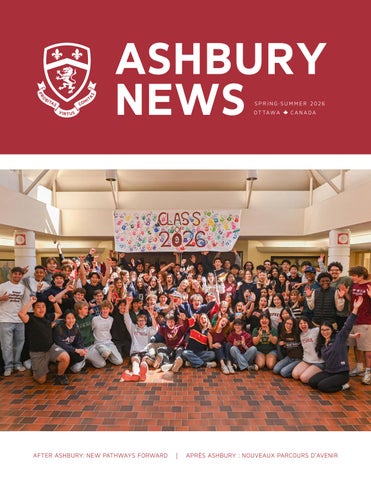
Graduating class of 2026, photographed by Justin Routhier.
32
Land Acknowledgement Ashbury College acknowledges that its campus is located on the traditional, unceded territory of the Anishinàbe Omàmìwininì Algonquin Nation, whose presence here dates back to time immemorial. Nous reconnaissons les membres de la Nation Algonquine Anishinàbe Omàmìwininì comme gardiens et défenseurs traditionnels du bassin hydrographique de la rivière des Outaouais et de ses affluents. Nous rendons hommage à leur longue tradition et à leur constante protection de cette terre, ainsi qu’à leur rôle dans la sauvegarde de ce beau territoire. Nigìkenindànànàn kìbi ànimiziwàdj kaye kì mino pagidinigewàdj ogog kakina Màyàmindji Nitam Pemàdizidjig, Àbitawizìg, kaye Àshkìmeg eyediwehì enigokwàg iyo Mikinàk Minitig. Niga pàjigwàdizimin kidji kikenindamokìyàng kàbi Awakàzodjig ogog kà abidjig kikinàmàdinànikàng, ashidj niga mino wìdjikiwemànànig ogog Màyàmindji Nitam Pemàdizidjig ondaje wàkàhì.
2
AS HBU R YY NNEW E WSS FA L LING ·WI N· SUM TE R M2025 ASHB UR SPR ER 2 02 6
From the Head of School Un mot du directeur ALUMNI PATHWAYS — LE PARCOURS DE NOS ANCIENS
G
raduation from Ashbury is just one milestone in the lives of our alumni —albeit an important one that helps set a framework for future
studies and opportunities. As each graduating class prepares to leave Ashbury, and I have seen 13 classes thus far through different Leaver’s Chapel services and closing ceremonies, a time of reflection sets in with a mix of trepidation and excitement about what lies ahead. Our mission to engage students as intellectually curious, responsible global citizens is one in which we hope each student leaves with a sense of community and an embrace of our values. A compass is a delicate thing to hold, and finding one’s true north can require adjustments before finding direction. Once graduates declare their university programs, most stay the course, but others change tack along the way. In many cases, the university becomes a place of discovery that furthers curiosity, fosters community, and builds on the foundation laid at Ashbury. As students fan out to universities across Canada and around the world each year, it is so enriching to hear of the unique journeys each takes. We are grateful to alumni who are so willing to share their journeys with our students as they prepare for the next step in their lives. Nous accordons une importance primordiale au retour d’expérience de nos anciennes et anciens, dont la transmission des savoirs enrichit durablement le parcours de nos élèves.
Norman Southward Head of School — Directeur
US || CO COM IITAS PPRROOBBIITAS TAS || VVIIRT RT U TAS
3
FE AT URE S
RIGHT THE
FIT FIT
RETHINKING SUCCESS, CHOICE, & THE PATH BEYOND ASHBURY
A
t Ashbury College, a long-standing marker of success
grade threshold, or a path that is different from what they
is our 100% university acceptance rate, a statistic that
originally imagined. The reality, as Naufal Moffatt reminds
speaks to both ambition and achievement. Each spring at
students and families, is that while students can aspire to a
closing, that number is accompanied by a joyful celebration
particular university, the final decision ultimately rests with
of the wide range of universities Ashbury students choose
the institution itself.
to attend across Canada and around the world. This
An important part of her work, especially at this time
year, 32 graduates will continue their studies outside the
of year, is helping students process that reality and move
country—a reminder of the globally minded citizens we
beyond the sting of rejection toward a thoughtful reassess-
have educated. But as Ashbury’s Director of University
ment of the excellent options and opportunities still before
Counselling, Donna Naufal Moffatt, is quick to point out,
them. “The goal,” she says, “is not just that students get
the acceptance rate tells only part of the story. Behind it lies
in somewhere. It is that they end up where they can thrive
a far more complex and individual process.
and be happy.”
Each year, students arrive in her office with hopes tied
In today’s increasingly complex admissions landscape,
to specific institutions, often shaped by rankings, family
university counselling is no longer just about gaining entry.
expectations, or long-held dreams. And each year, some
It is about self-discovery, perspective, and finding the right
leave facing disappointment: an unmet offer, a missed
fit academically, socially, and personally.
“
The goal is not just that students get in somewhere. It is that they end up where they can thrive and be happy.
“
GLOBAL UNIVERSITIES FAIR 2026
4
AS HBU R Y N E WS S PR I N G · S U MME R 2 02 6
F EATURE S
Unpacking the Number
Building the Foundations for Success
Each year, the University Counselling Office prepares a
Naufal Moffatt sees the strength of Ashbury’s approach not
report that includes student statistics and departmental
in a single outcome but in a sustained, collaborative effort
activities, including the infamous Ashbury 100% accep-
to prepare students over time. “There is a high level of
tance rate. The figure reflects the success of students who
academic expectation in our classrooms, and I have seen
apply to university, though each year we do have a small
that both as Director and as a parent,” she says.
number of students who do not apply. Many of those are
That preparation is intentionally scaffolded through
international students whose application timelines in their
close collaboration among teachers, the student success
home countries do not align with North American systems.
team, teacher advisors, and university counselling. “We
“In countries like Germany, for example, students may
work together to build habits and skills for the future. Con-
only apply once final records are complete in the summer,”
sistency is key. There is genuine care in how we support
she explains. “As a global school, we expect those differ-
students, even when that process is challenging for families.”
ences,” including a small number of students who choose to take a gap year or follow alternative pathways. Still, she is candid about her ambivalence toward the
At times, those expectations can feel demanding. But the intention is always clear. “Ultimately, the goal is what is in the best interest of the student.”
statistic itself. “I don’t love the attention we give this number,” she admits. “I would much rather focus on what I call the
THE UNIVERSITY COUNSELLING TEAM
‘happiness factor’; something that can’t be quantified but rather is felt. I do understand why the statistic matters. Families want reassurance that their child will be supported throughout the process and gain university admission, and it provides our Admissions team with a clear, measurable outcome to share.” What matters more, she argues, is the growth that occurs in their final year of high school, while they wait for offers to land in their inboxes or on application portals.
P R O B ITAS | V IRT U S | CO M ITAS
5
FE AT URE S
From ‘Where’ to ‘Why’ In recent years, Naufal Moffatt has seen a marked shift in her conversations with students and families. “They are much more grounded in reality now, both in terms of where students are academically and how universities are assessing applicants.” Rather than focusing solely on aspiration, she encourages families to examine evidence: transcripts, patterns of achievement, and realistic projections. “If a student says, ‘I need this mark,’ but they have never achieved it before, that evidence matters,” she explains. “We look at their transcript together to understand where they are and where they are likely to land.” This often reframes long-held ambitions. “A student might say, ‘I’ve dreamed of going to Cambridge since I was
Defining ‘Fit’ Central to Naufal Moffatt’s approach is the concept of “fit.” “I talk to students about their ‘fit factors,’” she explains.
six.’ That may still be possible, but perhaps at the master’s
At the beginning of the year, students complete a profile
or PhD level. That shift opens the door to excellent options
reflecting what matters most to them: academic rigour,
they may have dismissed.”
campus size, environment, location, and lifestyle. “For
“
some, it is about a top-ranked program. For others, it is about the living environment, whether they want a small campus, green space, or the energy of a big city.”
This is not about lowering expectations. It is about expanding them.”
Even when students group schools by rankings, she pushes them to think more deeply. “They might say, ‘I’d be happy at UBC, U of T, or McGill.’ But those are very different institutions from one another. Rankings may align, but the experience does not.” Ironically, she notes, the most difficult part of the pro-
Managing expectations also extends to parents, many
cess is not the application. It is the decision. “In the spring,
of whom bring their own experiences and assumptions
students often have several excellent offers. That is when
into the process. “The landscape has changed. Globally,
the real challenge begins.”
university admissions today are far more competitive, grade-driven, and influenced by expectations of hyper-
Expanding the Conversation
performance. Parents need to understand that their
Families often begin the process with a limited set of
own university experiences are not always relevant in the
universities in mind. Naufal Moffatt’s role is to widen that
current climate.”
lens. “There are not just five or ten universities in the world.
She also encourages families to move beyond a nar-
There are thousands,” she says. Through conversation and
row focus on a few highly recognized institutions. “We
examples, she introduces programs and institutions that
need to let go of the ‘big three’ mindset. Some schools and
families may never have considered. “This is not about
programs are dismissed as ‘safety schools,’ when in fact
lowering expectations. It is about expanding them.”
they may be an exceptional fit. There are so many excellent
She also encourages a shift in perspective, particularly
options, and a fixed mindset can limit that conversation.”
for students focused on elite U.S. institutions. “There are
6
AS HBU R Y N E WS S PR I N G · S U MME R 2 02 6
F EATURE S
4,000 universities in the United States, and students often
Outcomes That Matter
know ten of them.” By unpacking assumptions around
While familiar destinations and programs remain popular,
prestige, cost, and feasibility, she helps families make more informed, individualized decisions. “It is like peeling back an onion,” she says. “That is when the real conversation begins.”
Innovation and Opportunity Looking beyond traditional pathways often reveals unexpected opportunities. “There are so many innovative programs if you move beyond conventional thinking about careers,” Naufal Moffatt notes. She points to interdisciplinary programs that combine environmental and business studies, as well as emerging fields such as cognitive science and specialized nursing programs. “They are everywhere,” she says. “Universities are constantly evolving. Every institution has something new and interesting to offer.”
Alternative Pathways: Intentional Choices Interest in options such as co-op programs, direct-entry professional tracks, and gap years continues to grow, driven by both student curiosity and parental concern about future outcomes. “Co-op, in particular, offers tremendous value,”
Naufal Moffatt is seeing subtle shifts. “More students are taking the time to consider less familiar options seriously.” She sees growth in how students make decisions. “Between Grade 11 and Grade 12, there is a real evolution. Initial choices, often shaped by rankings or family history, become more thoughtful and personal.” She recalls one student who ultimately chose Huron University, which is affiliated with Western. “It was a perfect fit, small, community-oriented, and aligned with the student’s goals. Although the family was less familiar with Huron than with other options, the student was excited. That is what matters.” For Naufal Moffatt, that is the true measure of success.
“
There is a place for every student. The key is finding the right one.”
Naufal Moffatt explains. “It provides paid work experience, builds networks, and helps students transition into careers. For many families, it offers a sense of security.” Gap years, too, are gaining recognition as intentional and valuable choices. “It is a mistake to assume students take a gap year because they did not get in,” she says. “Often, it is the opposite.” She recalls students who stepped away from strong offers to travel or pursue personal development, only to return with renewed focus and perspective. “What they gain is self-discovery, confidence, and a clearer sense of direction. Sometimes that is exactly what they need.”
Conclusion: The Measure of Success In the end, the work of university counselling extends far beyond acceptance letters. It is about helping students understand themselves: how they learn, what they value, and where they are most likely to thrive. At a moment when outcomes can feel intensely personal, when disappointment is real, and expectations must sometimes be recalibrated, Naufal Moffatt’s guiding principle remains steady. “There is a place for every student,” she says. “The key is finding the right one.” At Ashbury, the 100% acceptance rate remains a point of pride. But it is the quieter measure, the confidence to move forward, the ability to make thoughtful choices, and the sense of being exactly where you belong, that ultimately defines success.
P R O B ITAS | V IRT U S | CO M ITAS
7
FE AT URE S
Alumni Profiles
PATHS THAT FIT
For many students, a version of the future begins to take shape by Grade 11, often centred on a particular program, a competitive pathway, a destination of choice. At Ashbury, those ambitions are realized in a wide range of ways. While many students follow a traditional academic path beyond our doors, others pursue less conventional routes that are equally intentional and often more individualized. To explore what these paths look like in practice, Ashbury News connected with four alumni whose choices reflect both ambition and openness to possibility. Their experiences include an innovative co-op program, a gap year spent travelling before university, a direct-entry medical pathway, and a route shaped by elite athletics that ultimately led to graduate study at Columbia. Together, they offer a broad view of success, one that extends beyond familiar destinations to the many ways students can reach their goals.
JACKSON LAFRANCE HAD BEEN
“I didn’t really want to just go to
of expectations. At Shopify, Jackson
considering universities such as the
university and only do school,” Jackson
works on a team with real deadlines
University of Toronto and McGill, but
says. In high school, he was already
and shared responsibilities. “If you
the traditional classroom model did
building coding projects for local busi-
don’t do something on time, you’ll get
not quite fit with how he wanted to
nesses and developing his own work, a
fired,” he says. “It’s a different zone.”
learn. Instead, he found himself drawn
momentum he wasn’t ready to give up.
In school, he notes, missing a dead-
to the highly competitive Shopify Dev
The Shopify Dev Degree program of-
line might mean a lower grade; in
Degree program, a hybrid model that
fered a way to continue hands-on work
the workplace, the consequences are
allows him to earn a computer science
while studying. “This was something I
more immediate. The experience has
degree at Carleton University while
was really excited about.”
sharpened his sense of accountability
working as a paid software developer at Shopify.
8
Working in a professional environment has introduced a different set
AS HBU R Y N E WS S PR I N G · S U MME R 2 02 6
and shown him how his skills apply beyond the classroom.
“
If there is something you enjoy, you will work harder and be better at it.”
F EATURE S
managing real deadlines, collaborat-
pursue a program that matched how
ing with experienced developers, and
he learns best.
contributing to projects that mattered
For Jackson, the experience
pushed him to grow quickly. “You can’t
has reshaped how he thinks about
hide in this environment,” he says.
success. Rather than focusing on a
“People rely on you.” That sense of
school’s name, he emphasizes choos-
Starting out, the experience was
responsibility changed how he saw
ing work that feels engaging and
intimidating. Going into a place like
himself, not just as a student who was
meaningful. “If there is something you
Shopify felt like a significant step up,
good at coding but as someone ca-
enjoy, you will work harder and be bet-
even with prior experience. There was
pable of contributing to a professional
ter at it,” he says. For him, that sense
a learning curve, and the uncertainty
space. It also made him more intention-
of enjoyment is not about ease but
of being a beginner. But over time,
al about how he used his time, asked
about committing to something and
that began to shift. “When you go in,
questions, and approached challenges.
building on it over time. “The name
learn how it works, and get over the
“It forces you to level up,” he says.
of the school does not matter. If your
challenges of being a beginner, you
Jackson credits Ashbury with giv-
realize you know how to code,” he
ing him the early confidence to take
says. “The skills you learned at school,
on real-world challenges, especially
you learned them for a reason, and you
through the independence he found
experience
can actually use them in the real world.”
in computer science courses and per-
Jackson is beginning to see new
As he settled into the rhythm of
sonal projects. He also credits the Uni-
possibilities ahead. The combination
balancing work and school, Jackson
versity Counselling Office for helping
of hands-on learning and exposure
began to understand how much the
him navigate a path that looked dif-
to industry has given him both confi-
experience was shaping him beyond
ferent from the traditional application
dence and direction. “It lets me dream
technical skills. The independence of
process, giving him the confidence to
bigger,” he says.
life is going to be based around being good at one thing, it better be fun.” With a foundation of real-world already
taking
shape,
FOR RUSS SHANTZ, THE PATH
“I was in no real rush to start my
beyond Ashbury initially felt like a
degree,” Russ says, remembering
current he was expected to follow,
how the pace of Grades 11 and 12
one that pointed straight toward uni-
made it feel as though he would sim-
versity. Instead, he chose to step
ply be carried along. “It felt like I was
away from that momentum, taking a
going to get swept up in the stream
gap year to travel and gain perspec-
and end up at school.”
tive before beginning his studies in
The decision to do something
Natural Resource Conservation at the
different came quickly. An evening
University of British Columbia.
walk and conversation with a close
P R O B ITAS | V IRT U S | CO M ITAS
9
FE AT URE S
“
That’s when I realized this is what I should be doing. There was nowhere else I would rather be. That was a nice moment.”
be for many reasons, he struggled to reconcile the marks he needed to get in with his belief that those marks did not matter as much as experience. “It was an infinite feedback loop.” The experience also forced a level of independence that surprised him.
Travelling
without
structure
friend, who was also unsure about
down.” Staying longer in one place
meant taking responsibility for both
heading straight to university, turned
gave him time to reflect. “That’s when I
daily life and larger decisions. “There
into a shared commitment to take
realized this is what I should be doing.
was no one in charge,” he says. “I feel
a year and travel. Both had been
There was nowhere else I would rather
like I became an adult in that year.”
working
be. That was a nice moment.”
Interacting with people of all ages
throughout
high
school,
saving money without a clear plan. “We actually shook on it that night,” he recalls. What had been a vague idea suddenly became real. Support for this decision extended beyond his friend. Russ describes his parents as consistently relaxed
“Understanding and having a passion for what you’re learning— that’s what matters.”
further reshaped his sense of himself. “You realize everyone is just a person. You can connect with anyone.” For Russ, that perspective continues to shape how he sees both education and success. “Understanding and having a passion for what
and trusting, giving him the space to
More than the travel itself, it
you’re learning—that’s what matters,”
make his own decisions. That sense of
was the perspective Russ gained
he says. “Grades mean nothing.” His
independence made the choice to
that stayed with him. Meeting people
focus, both during his gap year and
step away from a traditional path feel
at different stages of life challenged
now at university, remains on expe-
both possible and supported.
his assumptions about timelines and
rience, curiosity, and growth rather than external benchmarks.
After graduating, Russ spent the
success. “I met a lot of people in their
summer working, first at a camp in
mid-20s who were still figuring things
Looking back, he is clear about
Ottawa and then at a restaurant,
out, and they were doing just fine,” he
what the experience gave him: time,
before setting out on a ten-month
says. “It made me realize I have a lot
confidence, and a broader view of
backpacking trip. He and his friend
more time than I think I do,” he says.
what is possible. It also left him more
began in Europe, travelling quickly and
That realization allowed him to step
open to uncertainty and opportunity. “I
trying to see as much as possible. It
back from what he describes as a
think I’m more receptive to wherever
was only later, in Southeast Asia, that
“race-towards-success” mindset.
life wants to bring me,” he says.
This new mindset stood in con-
For students trying to decide
“In Europe, I think I was still in
trast to the pressure he had felt in
what comes next, his advice is simple.
that mindset of needing to do as
high school about his university des-
“It doesn’t really matter as much as
much as I could,” he says. “Then we
tination of choice, UBC. Although he
you think it does,” he says. “You have
got to Vietnam, and everything slowed
knew that was where he wanted to
more time than you think.”
the pace shifted.
10
AS HBU R Y N E WS S PR I N G · S U MME R 2 02 6
F EATURE S
years and significant tuition on a degree
place where she figured out who she
that might not lead to a career in med-
was becoming and how she wanted
icine felt increasingly at odds with her
to carry herself in the world.
goal of becoming a physician. “It was
The program was demanding,
the first time I realized the decision was
but the transition back to Canada felt
really mine,” she says. “I had to choose
manageable. After completing her
what made sense for me. It just felt
early medical training in Dublin, she
more straightforward to commit to a
returned to Canada for her clinical
direct-entry program in Dublin.”
years and began working in Kingston.
Living in Dublin became its own
She understood the residency match
kind of education. Her classmates
process clearly, a national system that
ALYSSA CHOW ENTERED HER FINAL
came from all over the world, and she
places medical graduates into training
year at Ashbury with one certainty:
loved being part of a community that
programs through both a main match
she wanted to be in science. “I knew
brought so many perspectives togeth-
and a dedicated stream for Canadians
all along I wanted to be in science,”
er. As one of Ashbury’s first cohort of
who study medicine abroad. As a
she says, recalling how she registered
female lifers, she had grown up in a
Canadian returning from an interna-
for all three IB sciences in Grade 11
close-knit school community, and
tional program, she knew there were
simply because she was curious. The
leaving that familiar “Ashbury bubble”
established pathways and an in-
IB program gave her confidence in her
creasing number of spots. When she
“I had to learn how to show up in all these different ways; As a friend, as a classmate, as a practitioner, and as a person living on my own.”
began her clinical work in Kingston,
the Canadian pathway can be. A four-
was both exciting and disorienting. The
drawn to. She realized she was drawn
year undergraduate degree, followed
independence of managing her own
to fields that felt logical and solvable.
by competitive applications and often
life, far from family and everything fa-
“I like when you can work through it
additional years of study, does not
miliar, pushed her to grow in ways she
and make sense of it,” she says, a
guarantee admission. “I could have
had not expected. “I had to learn how
realization that made endocrinology
done four years of undergrad, a mas-
to show up in all these different ways,”
feel like a natural fit. She is now head-
ter’s, and still not been able to get in,”
she says. “As a friend, as a classmate,
ing to Ottawa to continue her training
she says. For someone who already
as a practitioner, and as a person
in the field, a direction that aligns with
knew her goal, the idea of spending
living on my own.” Dublin became the
her curiosity.
ability to manage heavy content and standardized exams, and that foundation shaped the path she eventually chose. Alyssa credits Ashbury with giving her a genuine love of learning, something that shaped how she approached her studies and continues to guide her through medical training. Like many students who are serious about medicine, Alyssa already understood how long and uncertain
she found herself younger than many of her peers and facing significant choices about next steps. “It was harder to figure out what I wanted to do next,” she says. “I did not have the same constraints as people who were older or had families. That made the decision feel bigger.” Her time in Kingston helped her clarify what kind of work she was
P R O B ITAS | V IRT U S | CO M ITAS
11
“ FE AT URE S
It is easy to worry about the expectations of others. But you have to make the choice that feels right for you.”
“To be confident, you do not need to
encourages parents not to let fear or
know everything,” she says. Letting go
the what-ifs cloud the moment. “I was
of comparison allowed her to focus on
caught up in my own world,” she says.
learning rather than competing. “It takes
“It is easy to worry about the expecta-
the competitiveness out of it,” she says.
tions of others. But you have to make
“You can focus on your own goals.”
the choice that feels right for you.”
When she reflects on what she
For Alyssa, the path she chose
Alyssa speaks openly about the
would tell students and parents fac-
was the best decision she could have
balance between ambition and well-
ing their own decisions, her advice is
made. It pushed her to grow, to trust
ness, and how her understanding of
thoughtful and grounded. She encour-
herself, and to see beyond the familiar.
success has evolved. In high school,
ages students to look closely at what
And it taught her something she still
she often felt pressure to excel, to be
empowers them, to draw on their
carries with her: “All paths give you
perfect, to stay ahead. Medical train-
experiences, and to tease apart the
new experiences and help you learn
ing forced her to rethink that mindset.
variables that matter most. And she
about yourself.”
What followed was not a detour
opportunity was there, and it opened
so much as a series of choices,
the door to playing at a higher level,
sometimes difficult and sometimes
eventually leading to his recruitment
exhilarating, that reshaped how he un-
by Amherst College in Massachusetts.
derstood himself and what he wanted.
Amherst was small, rigorous, and
“I kept finding myself at these cross-
community-oriented, a place where he
roads where both options were good,”
felt both challenged and seen. “It was
he says. “And I had to decide which
a great fit,” he says. “I loved it there.”
one felt true to me.” Looking back,
Another choice soon followed.
he sees that each decision was driven
Amherst did not offer engineering,
by a desire to understand what he was
and Michael had the opportunity to
capable of and to see where a harder
complete a dual degree at Dartmouth.
path might lead. It was “curiosity.”
It meant leaving a team he loved, a
Leaving Queen’s to pursue hockey
campus where he felt at home, and a
full-time was the first of those choic-
community that had become central
WHEN MICHAEL CULLEN GRADUATED
es. It was not the obvious decision,
to his identity. “It was one of the hard-
from Ashbury in 2014, he assumed he
and it was not the easy one. But the
est decisions I have made,” he says.
would follow a familiar path: university, engineering, and a steady progression from one stage to the next. He enrolled at Queen’s, ready to begin that journey. But within months, an unexpected opportunity pulled him off the linear track he thought he was on.
12
“You cannot get to the bottom of everything in one lifetime, but I have enjoyed the daily challenge of trying.”
AS HBU R Y N E WS S PR I N G · S U MME R 2 02 6
“But it was a good choice versus another good choice. And that is a privilege.” He describes that moment as a test of honesty, a point where he had to decide whether to stay with what felt comfortable or pursue the path that would stretch him further.
“
F EATURE S
The more important work is figuring out who you are and what you want, because the right place becomes clearer once you understand yourself.” That idea, the privilege of hav-
follow a straight line, and none of them
ing choices, comes up often when
was predetermined. Each required
Michael reflects on his path. He
him to step away from something
speaks about it with gratitude, espe-
comfortable to pursue something that
cially when he talks about his parents.
felt more aligned with who he was
“They always supported me,” he says.
becoming. “You have to be honest
“They trusted me to make my own
with yourself,” he says. “You have to
decisions. They never pushed me to-
choose the thing that fits you, not the
ward one thing or another. That made
thing that looks right from the outside.”
it possible for me to choose what
When asked what advice he
felt right, even when it was not the
would offer to students who are try-
obvious path.” Their trust gave him
ing to decide where to go next, he
the freedom to explore, to take risks,
encourages them to take the pressure
and to follow the questions that mat-
off the moment. “The universities will
tered to him.
always be there,” he says. “The more
After completing his engineering
important work is figuring out who you
degree at Dartmouth, Michael made
are and what you want, because the
another difficult choice: to pursue
right place becomes clearer once you
graduate studies in electrical engi-
understand yourself.”
neering, a field he says requires pa-
He also credits Ashbury, not just
tience, persistence, and a willingness
the teachers but the students, for
to sit with complexity. Today, he is in
shaping that mindset. “The people
the fourth year of his PhD at Columbia
around me set such a high standard,”
University, working in photonics, a dis-
he says. “I looked up to them. They
cipline that continually challenges him
showed me what was possible, both
to think deeply. “I have learned that I
in school and in hockey. That had a
am someone who gravitates toward
huge influence on me.”
hard things,” he says. “Not because
For Michael, success has never
they are hard, but because I want to
been about prestige or predictabili-
understand them fully.” That instinct to
ty. It has been about fit, integrity, and
dig deeper, to keep asking what lies
the willingness to make hard choices
beneath the surface, has shaped every
when they matter. “You cannot get to
stage of his academic and athletic life.
the bottom of everything in one life-
Looking back, he sees a pattern
time,” he says, “but I have enjoyed the
in the choices he made. They didn’t
daily challenge of trying.”
P R O B ITAS | V IRT U S | CO M ITAS
13
FE AT URE S
FROM THE ARCHIVES Ashbury’s Special Awards
2026 GOVERNOR GENERAL’S ACADEMIC MEDAL RECIPIENT, MUNICH LIMAPICHAT, AND CHAIR OF THE BOARD OF GOVERNORS, DR. MELISSA FORGIE
T
he stories behind the trophies, cups, and medals
a frequent presence at special events, the medal was
presented at Ashbury’s Closing ceremonies offer a
sometimes presented in person. Early recipients includ-
window into the College’s history. Many named awards
ed P. E. Biggar (1913 and 1914), who went on to place
were donated or endowed by alumni, their families, found-
first in Canada upon entry to the Royal Military College;
ing supporters, or members of the Board of Governors.
A. R. Maclaren (1915), part of a family long associated
Others honour departing staff, such as the Drummond
with Ashbury; Michael Shenstone (1945), one of several
Lister Award for IB Literature and the Hugh Penton Senior
students who arrived from Abinger Hill School during the
History Essay Prize. Some of the most prestigious awards
Second World War; and Gerald Greenstone (1963), whose
recognize not only academic excellence, but also character
detailed memoir of his time at Ashbury is preserved in the
and achievement in scholarship and athletics.
Archives and was featured in the Spring–Summer 2025
The Governor General’s Medal, established in 1873 by
issue of Ashbury News.
Lord Dufferin, Canada’s third Governor General, honours
The Southam Cup, donated in 1922, was originally
the graduating student with the highest academic standing.
awarded to the student in the senior forms with the stron-
In Ashbury’s early years, when the Governor General was
gest combined record in scholarship and sport. It was first
14
AS HBU R Y N E WS S PR I N G · S U MME R 2 02 6
F EATURE S
awarded in 1922 and 1923 to F. G. Heney, a member of
Senior student who demonstrates outstanding character
one of Ashbury’s founding families. Another Heney, D. F.,
and leadership. Among its notable recipients is Adam
received it in 1950, and Richard B. Southam in 1966.
Podhradsky (1963), remembered for his resilience and pos-
Notable recipients include Robert Stanfield (1932), for-
itive spirit throughout the illness that claimed his life later
mer teacher Dave Beedell (1980), and CBC host Adrian
that year. His journey to Canada as a refugee in 1956 is also
Harewood (1989). Today, the Cup is awarded to the grad-
preserved in the Archives.
uating male student who best exemplifies excellence in both
Over the years, recipients of Ashbury’s major awards
academics and athletics. Its counterpart, the Beardmore
have gone on to distinguished careers while maintain-
Trophy, established in 1990, honours the graduating female
ing strong ties to the school through service, mentorship,
student for the same distinction.
and philanthropy. Ashbury Advancement and the Archives
The Headmaster’s Cup, established in 1947, was ini-
encourage alumni to stay connected and welcome dona-
tially awarded to the most improved students at the Junior,
tions of materials that help preserve the story of their time
Intermediate, and Senior levels. It is now presented to a
at the College.
AWARD TABLE AT CLOSING CEREMONY
P R O B ITAS | V IRT U S | CO M ITAS
15
FE AT URE S
BEYOND TITLES INSIDE ASHBURY’S STUDENT LEADERSHIP MODEL
S
tudent leadership has been part of the fabric of Ashbury College since the school’s inception. However, the face of student leadership has changed—and continues to change—with the times. Ashbury News spoke with Todd Lamont,
Director of Student Life in the Senior School, and Amy Greig, Junior School Leadership Coordinator, about our leadership model, what students are learning through the process, and how it connects to the school’s strategic goals.
What is the Ashbury model of student leadership, and how has it evolved?
so we implemented having one male and one female in
Ten years ago, I inherited a year-long change process from
even 50% gender split to reflect our co-ed school. This
Danielle Mitra, who, along with the Heads of House, was
was a really positive change.
each role, with the idea of forming a partnership with an
trying to figure out how to make the student leadership pro-
Since then, we have built on the portfolio idea rather
cess more inclusive and gender equal. Prior to that time,
than having people elected at-large. When we moved to
Prefects were elected at-large and assigned jobs after-
portfolios, students could apply for up to three roles that
ward, teachers had considerable influence in the electoral
interested them. Having these different areas of interest
process, and there was, historically, some male dominance
meant that the team was more diverse, with different
in student leadership. The system needed some updates,
perspectives, and reached different types of students.
16
AS HBU R Y N E WS S PR I N G · S U MME R 2 02 6
F EATURE S
Our goal was to do a four-year cycle with the new
We also looked at the House Captain system, which
system so that students went all the way through
was organized as a partnership within each of the four
before we did any major changes. I presented the model
Houses, with each house focused on house competition.
at CAIS and CIS, and people adopted similar models at
To shift this focus to community building, we have
different schools.
rebranded them collectively, with the Boarding Captains,
When we wanted to explore gender more—not just
as “Community Captains,” and reduced the number of
binary male-female—we started reflecting on whether we
House Captains from eight to four. They are supposed to
were making room for everybody. Now we use the lan-
work collectively to build community, and competition and
guage of “two different genders” so that there is space for
house spirit can be a part of that. The feedback has been
everybody. The ballot is no longer split by gender either.
very positive, and the captains are working well together.
More recently, we made another significant change: we reduced the team from 24 to 20 Prefects. We had become very good at adding new portfolios as people identified different needs for Prefects, but we had not done a good job of removing those that were no longer relevant. Moreover, we want to align the portfolios with the school’s
“
Student leadership has been part of the fabric of Ashbury College since the school’s inception.”
strategic vision and values. For instance, we have had
The process of becoming a student leader has also
an Academic Prefect because academic excellence is a
changed considerably, with the vote now the final step
value, and the athletics portfolio likewise reflects character
among several. We now have a robust review process
and personal growth. Sustainability has been a recently
that is like a job application. Applicants submit a one-
identified interest and need, and it has been added to the
page resume and a video, and then they have an inter-
team. This year, we also wanted to address the siloing in
view. If they make it through those stages, then their name
the portfolios, so we integrated academics and student
is put on the ballot for the whole community to vote on.
life, which had increasingly focused on student wellness
There is a scrutineer committee to review the results. And
rather than only on social activities, to create the student
from there, it is just democracy. Popularity may still
success portfolio, reflecting the new strategic focus on
influence the final decision, but this front-end-loaded process
thriving students.
has properly vetted all candidates.
P R O B ITAS | V IRT U S | CO M ITAS
17
FE AT URE S
There are between eight and 12 students on each council for a total of about 130 students involved; that is one-third of the school, and doesn’t even include sports teams or other leadership opportunities. Although some students overlap across leadership roles, successive selection of the positions helps spread them out. School Captains are selected in the spring, followed by the Prefects and House Captains, and then we do the secondary leads, such as Blazer, Grad Commitee and yearbook. We also want to ensure the students don’t take on too many roles to avoid burnout and schedule conflicts, both of which can prevent them from doing the jobs well. There is a similar model in boarding with Captains, a Boarding Council, and Wing Leaders.
Why has student leadership become part of the intentional programming at Ashbury College? There is a historical element to the Prefect role in British prep schools, but they used to serve more of a disciplinary function and were seen as upholders of rules. At Ashbury, there has been an intentional shift away from that model, with a focus on developing new portfolios and areas of interest to strengthen student voice in ways that align with
Are they developing leadership?
the school’s strategic direction. Our students are now the drivers of change in our
In my opinion, there is too much of a focus on leadership
school. I think about our work in pluralism, and while many
in North America—not everyone can be a leader. So, I try
adults are involved in that accelerator group, I think it
to frame the conversation from earlier grades in terms of
became a very visceral, robust, student-led change because
engagement. You don’t all have to be leaders, but you
the student leadership team took it on and made it a
want to be engaged in your community, and you can be
mission to have that conversation. I’m hoping we will see
changemakers and have an impact—not everybody has to
a similar thing with sustainability. Adults take a long time to
wear a burgundy blazer or have a title. There are so many
change, and institutions even longer. And students want
leadership opportunities around the school, whether in
change fast, but somewhere in the middle, the magic spot
Blazer magazine, the Grad Committee, Ambassadors,
happens. Change doesn’t come without squeaky wheels
Mentors, or on a sports team.
and excited students thinking that it can happen in two
I do think the council model does allow them to develop leadership. The Prefects are elected for their Grade 12 year, and they select a council for their portfolio from Grades 9 through 12, with members of different genders and interests. Students are appointed to the council. The Prefects work with the staff mentor in their portfolio area, review all applications, and choose their council.
18
AS HBU R Y N E WS S PR I N G · S U MME R 2 02 6
days. Their enthusiasm is harnessed through the pro-
“
gram’s structure, making it more productive.
Our students are now the drivers of change.”
F EATURE S
Are there other elements that contribute to the success of the student leadership program?
team together: we do activities, workshops, go to keynote
The decision to build time for leadership and clubs into
that as a gelled team. We begin meeting weekly from that
the schedule has been a huge factor in that success. We
time to set goals and prepare for the fall, when the team
used to have our council meetings at lunch, and I used to
hits the ground running. We used to train them after exams
use TAG time with the Prefects. We built in club time (two
in June and hope for the best come September!
speakers, and even eat together, and we come back from
45-minute blocks from 2:30 to 4:00) on Wednesday. Now,
We also take the opportunity to reflect on the
student leaders meet with their council in one of the two
leadership process. Once a term, the Prefects share an
club blocks, then meet together in the other for a weekly
update with the Head of School, and there is a mid-term form
check-in. We teach leadership skills during that time and
to complete and a performance-review-type interview to
plan events. At the same time, the Grade 11 leaders are
celebrate what is going well and identify next steps for how
meeting with their staff mentors and building their skills,
they can keep improving.
and so on.
“
We don’t just get good leaders; we coach and build good leaders. As soon as they are elected,
Most importantly, although I am very passionate about the role, I do not do this work alone. Andrea Kelly, Dean of Student Life and Director of Boarding, all the
You can be Heads of House, and the staff mentoring in we take the Prefects and Captains away on a changemakers each portfolio are part of a large superstrucretreat. For the past two years, we have gone and have an ture we have built to support the student leadto the Global Student Leadership Summit ership program at Ashbury. impact.” in Collingwood in April. We bring the entire P R O B ITAS | V IRT U S | CO M ITAS
19
FE AT URE S
What happens when there is a breakdown in the system?
Grade 6 and 7 students. The activity was to raise awareness
All student leaders are asked to sign a leadership contract
of the dangers and impacts of labelling individuals. Later
that defines leadership as both an art and a science and
in the year, they do a team-building or communication-
explains that they are serving others. Within that contract,
type activity. Every Friday, they sit at the lunch tables with
there is a tiered support system that culminates in a proba-
younger students to connect, get to know one another,
tionary period during which you may lose your role. The first
and build community.
step is for the School Captains to hold their own council to
House Captains apply, and the applications are post-
account; they would have a coaching conversation with
ed for the kids to read. This is followed by a “leadership
the person in question. The next step would be to have a
convention” in which the candidate gives a one-minute or
conversation with me, and sometimes with the Captains
less speech to the members of their house, then a vote.
or the Director of Boarding. It is essentially restorative jus-
The only vetting for the position is a set of criteria, includ-
tice with coaching conversations and talking about impact.
ing whether the candidate contributes positively to the
After that, we would place them on probation with a set of
school community, treats others with respect, sets a good
expectations they need to meet, and they would lose their
example for others, and so on. The Junior School staff
role for a period of time.
determines if the candidate meets these criteria before the
I see myself as a sort of relationship coach, teach-
vote. Although these positions used to be selected as one
ing soft skills to youth to help them resolve conflicts
male, one female, and another of either gender, they are
on their own or helping them bring things to me that
now chosen without regard to gender.
need to be talked through. I encourage them to be good partners in life, and point out that many of the skills they will need come from the work we are doing here. There is a hidden layer of social and soft skills veiled in this model of leadership. I often hear stories from recent alumni sharing how the hidden lessons of leadership have helped them in their years beyond Ashbury. This learning does not begin in Grade 9 at Ashbury; the Junior School has its own way of developing leadership. In fact, some form of leadership experience is required for the Junior School Diploma.
What does leadership training look like in Junior School? There are a few formal programs in place. First, we have a House Captain program for our Grade 8 students only. There is a team of 12 House Captains—three Goblins, Hobbits, Dragons, and Wizards are selected to represent
There is also a Class Representative program, in
the student population. They meet with me once a week,
which one student from each home form is elected as
oversee running events and activities in home forms, and
the representative. In Grades 4, 5, 6, and 7, there is a
are in charge of house spirit. For example, at Halloween,
leader who collaborates with the House Captains when
they ran classroom decorating and costume compe-
needed to make big things happen, such as the
titions as well as a scavenger hunt at recess. During
Snowsuit Fund initiative. The Class Reps are elected in a
Bullying Awareness Week, they prepared an activity for
simple in-class vote.
20
AS HBU R Y N E WS S PR I N G · S U MME R 2 02 6
F EATURE S
Finally, the Steward program ensures that all
Involving the entire Grade 8 class in the Steward pro-
Grade 8s have a leadership role. There is a huge
gram helps them recognize that they have a role to play
variety of Steward positions, from sports to Admissions
in the Junior School as the top age group and as role
Ambassadors to environmental to science to community
models—they buy into having a leadership role, even
engagement to Young Round Square, with more than
though some of them need more encouragement to put
20 options. Previously, students applied to whichever
themselves forward for a particular position.
position they wanted, but that didn’t always result in the right fit. Starting this year, each student is asked to identify
Are there any changes that need to be made to the program?
their top three choices, and then the teaching staff meets
There are always small things to be tweaked. For instance,
to try to match the student’s suitability to the portfolio. All
in keeping with the school’s strategic directions, we would
students get one of their top three choices, and every-
like to do more leadership development focused on
one has a role that makes sense for both the student and
environmentalism, so one of the new roles this year is an
the teacher mentor. Like the Senior School model, all of
Environmental Steward. We hope to work with those Stew-
this is made possible through the collaboration of a team
ards to bring environmental consciousness to the forefront
of Junior School teachers who serve as mentors to the
of our students’ minds.
Grade 8 Stewards and Class Representatives.
What is the relationship with the Senior School Leadership?
What is the goal of the leadership program in the Junior School?
Both Junior and Senior School leaders work together to
The goal has never been to emulate the Senior School pro-
carnivals, and this year we had the opportunity to work
gram, although it does a good job of preparing students
together before the new student orientation—it is more of a
for those positions. It’s about role models for the Junior
collaboration than mentoring. However, the Junior School
School: providing those kids with an amazing set of values
leadership program does prepare students for positions in
that other kids can live up to. It’s about teaching them to
Senior School, and I am always so happy to see students
be the best versions of themselves and letting that trickle
who have come through the Junior School on the Senior
down into the rest of the Junior School. It’s about creating
School leadership ballot.
plan events like spirit weeks and winter and spring
a sense of spirit and about making the place a really safe and welcoming community.
“
The Steward program ensures that all Grade 8s have a leadership role.”
Ashbury’s student leadership program has evolved into an inclusive, structured model spanning Junior and Senior Schools. Senior School leadership has shifted from traditional Prefect roles to a portfolio system aligned with strategic priorities, emphasizing diversity and skill development. Junior School programs ensure that every Grade 8 student participates, thereby promoting community and role modelling. Together, these initiatives create meaningful opportunities for engagement and leadership growth.
P R O B ITAS | V IRT U S | CO M ITAS
21
NE W S & NOTE S
THE
MEMORIAL GYM
A LIVING TRIBUTE RENEWED THE MEMORIAL GYMNASIUM,
1922 to 1985, it served as Ashbury’s
an academic classroom space, and
a landmark of Ashbury College for
sole gymnasium and became the
informal community hub. Its worn
more than a century, has long stood
backdrop for countless assemblies,
floorboards and echoing walls hold
as both a gathering place and a
spirited competitions, school pho-
the memories of a century of school
solemn tribute.
tos, and cherished moments shared
life. Recognizing its historical and
by generations of students, staff,
emotional significance, Ashbury has
Wing, the gym was created to honour
and alumni.
spent the past year carefully restoring
Ashburians who lost their lives in the
“
the space to preserve its character
Opened as part of the Memorial
Great War. Its dedication on Closing Day, June 11, 1924 by Governor General Lord Byng of Vimy marked not only the opening of a new facility but the establishment of a living memorial at the heart of the school. At the time of its construction the
Ashbury has spent the past year carefully restoring the space to preserve its character while adapting it for contemporary use.
”
while adapting it for contemporary use. The newly restored Memorial Gym re-emerges as a flexible, multi-purpose gathering space equipped with inviting lighting, acoustic baffles, and discreet, built-in seating. Its open-concept design allows it to host everything from
gym was a transformative addition
Over the years, the Memorial Gym
student presentations to community
to campus life, offering students a
has taken on many roles, including
meetings, small performances, and
much larger, heated space for phys-
serving as an athletics hall, perfor-
light physical education activities such
ical training through Ottawa’s long
mance venue, rehearsal space, exam
as yoga, while still honouring the in-
winters.
For
room, school library, an art room,
tegrity of the original architecture.
22
AS HBU R Y N E WS S PR I N G · S U MME R 2 02 6
six
decades,
from
N EW S & NOTE S
This renewal has been made pos-
BEFORE
sible through the generous support of the Ashbury community—alumni, families, and friends who recognize the importance of safeguarding the school’s heritage. Their contributions speak to the deep affection so many hold for this room, which has anchored student life for over 100 years and continues to honour those whose names are inscribed on the Memorial Wing. On
May
22,
the
Memorial
Gymnasium was officially reopened, marking the completion of its restoration. Project donors, school leadership, faculty, and Grade 10 history students gathered to recognize the moment. In his remarks, Head of School Norman Southward reflected on the significance of the space and its enduring
The revitalized Memorial Gym stands as a bridge between past and present: a reimagined space that remains true to its origins while welcoming the next century of Ashbury memories.
AFTER
place in Ashbury life.
P R O B ITAS | V IRT U S | CO M ITAS
23
NE W S & NOTE S
Celebrating 3 Distinguished Careers
This year, Ashbury College marks the retirement of three exceptional members of our community whose combined decades of service have left a lasting imprint on the life of the school. Alex Milroy, Ross Holman, and Andrew Moore each brought to us dedication, expertise, and a deep commitment to students and colleagues alike, shaping Ashbury in ways that will endure well beyond their time on campus.
24
AS HBU R Y N E WS S PR I N G · S U MME R 2 02 6
N EW S & NOTE S
ALEX MILROY Widely respected across the community, Alex earned the confidence of the Board of Governors for her ability to bring clarity to complex financial matters and to communicate them with precision and insight. Her work extended well beyond numbers. She approached every challenge with a solutions-oriented mindset and a strong sense of purpose, always grounded in Ashbury’s mission and values. A gifted mentor, Alex was known for her generosity with time and expertise. Colleagues often found a line outside her office, seeking advice, guidance, or simply her thoughtful perspective. She built and nurtured a strong finance and operations team, investing deeply in the growth and development of those around her.
A
Her influence reached across every aspect of School lex Milroy joined Ashbury in 2011 as Director of
life, from long-range planning and major projects to sup-
Finance and Operations and quickly became an in-
porting families and ensuring the smooth operation of daily
dispensable member of the leadership team. Over the past
systems. She brought people together, built trust across
fifteen years, she has served as Chief Financial Officer with
departments, and strengthened the foundations that sup-
distinction, guiding the school through periods of growth
port Ashbury’s continued success.
and complexity with intelligence, calm judgement, and un-
Colleagues and community members consistently
wavering professionalism.
point to Alex’s impact:
“
“
Key person does not come close; mission critical gets a bit closer. You know you are doing your job well when the board you report to identifies your retirement as one of the greatest risks facing the organization. Alex is the absolute master of her financial and operational domains and has served as Ashbury’s central nervous system since she arrived.” — Kevin Bon ’92, Foundation Board
Alex’s guidance made a lasting difference in my Ashbury journey. Great leaders leave marks that time can’t erase, and Alex’s influence extends far beyond the workplace. I will carry her lessons with me always.” — Diane Budge
“
Some managers oversee work. The greatest managers change lives. Her influence will never be forgotten.” — Michelle Demers-Parsons
Alex leaves behind a legacy of stability, integrity, and care. We thank her for her remarkable contributions and wish her much happiness in her retirement.
P R O B ITAS | V IRT U S | CO M ITAS
25
NE W S & NOTE S
ROSS HOLMAN
A
fter thirty years of dedicated service, Ross Holman retires having spent his entire teaching career at
Ashbury College. Since joining the school in 1995, he has been a central figure in the Mathematics department and a valued contributor to all aspects of school life. Ross is widely recognized as a supportive teacher and mentor who approached mathematics with rigour, clarity, and a sense of humour. From Grade 9 classrooms to IB courses, his commitment to student success was evident in every lesson. Alumni frequently remark on how well prepared they felt for university, particularly in mathematics, thanks to his teaching and the enrichment opportunities he championed, including competitions and examinations. As longtime Department Head of Mathematics, Ross guided the department through curriculum changes by both the Ministry of Education and the IB, always with a clear focus on preparing students not only for admission to university but for success once they arrived. His colleagues speak to his character and impact:
“
Ross consistently looked for ways to support those around him, and his kindness and generosity leave a lasting impact. He has always held high standards for his students while being fair and supportive.”
“
Ross valued people and wanted them to succeed. He had a way of making you feel supported.” — Ahlam Rashid
— Kathryn Mitchell
“
Beyond the classroom, Ross contributed fully to the
We appreciated his firmness in doing the right thing and his willingness to face challenges with resolve. While he never sought recognition, his support was always there.” — Zack Macaulay
life of the school as a coach, Housemaster, and Faculty Association President. Whether on the tennis courts, the golf course, in boarding, or in faculty leadership, he demonstrated a deep commitment to community and to the well-being of students and colleagues.
We thank Ross for his remarkable service and wish him every happiness in the years ahead.
26
AS HBU R Y N E WS S PR I N G · S U MME R 2 02 6
N EW S & NOTE S
ANDY MOORE
S
ince arriving at Ashbury in 1996, Andy Moore has distinguished himself as an exceptional educator and
a deeply principled member of the community. Over three decades, he taught English, History, IB Peace and Conflict Studies, and Global Politics, bringing intellectual energy and global awareness into every classroom. His teaching was marked by a dynamic connection to current events, ensuring that students understood not only historical context but also the relevance of their studies to the world around them. Andy was also a leader in the evolution of teaching and learning at Ashbury. He played a key role in establishing the school’s learning management systems, helping to position Ashbury at the forefront of digital learning. His work provided a strong foundation that proved invaluable during the periods of transition to online learning in recent years. Colleagues highlight both his intellectual contributions and his commitment to students:
“
From my first weeks at the school, Andy made me feel welcome. Our shared passion for hockey and the Toronto Maple Leafs sparked many conversations, but it was his wide-ranging interests, insight, and enthusiasm that stood out. Andy embodied lifelong learning and community connection, leaving a lasting impact.”
“
— Bruce Mutch
Andy is a very principled individual who always held his students to the highest standards. His students developed not only a strong understanding of history but also exceptional critical thinking, research, and writing skills.” — Ian Middleton
“
His remarkable breadth of knowledge, deep compassion for students, and unwavering commitment to excellence left an enduring mark on the school and on generations of students. Ashbury is unquestionably a better place because Andy Moore has been part of it.” — Alyssa Novick
Outside the classroom, Andy was a dedicated coach whose impact extended onto the playing fields and into the lives of countless students. Known to many as “Coach Moore,” he will be remembered for the same high standards, integrity, and care that defined his teaching.
We extend our sincere gratitude to Andy for his many contributions and wish him all the best in his retirement.
P R O B ITAS | V IRT U S | CO M ITAS
27
NE W S & NOTE S
Lunar New Year at Ashbury
CELEBRATING NEW BEGINNINGS L
unar New Year is celebrated across
many cultures in East and Southeast
Asia, as well as by communities around the world. Observed according to the lunar calendar, which follows the cycles of the moon, it marks a time of renewal, fresh beginnings and cultural heritage.
Celebrated across many cultures around the world, Lunar New Year is marked by a rich array of traditions that emphasize renewal, good fortune, family connections, and cultural heritage. Traditions rooted in Chinese Lunar New Year celebrations include the exchange of red envelopes as a symbol of luck and prosperity. Dragon and lion dances are performed to drive away bad luck from the previous
At Ashbury, the Lunar New Year holds particular
year and invite good fortune for the year ahead. Lanterns
significance within our school community. According to
represent joy and hope, while oranges and mandarins are
the School’s 2023 Student Demographic Survey, 19% of
shared as symbols of abundance and prosperity. Firecrack-
Senior School students report their birth region as Asia,
ers and drums, traditionally used to scare away evil spirits
27% identify their ethnicity as East Asian, and 19% observe
and the mythical Chinese monster Nian, add to the festive
Lunar New Year at home. Mandarin is also the third most
atmosphere and reflect the importance of welcoming the
commonly spoken language among our students. These
new year with optimism and energy.
statistics reflect how and why Lunar New Year traditions
Over time, Lunar New Year has become a highlight of
are not only recognized and respected at Ashbury, but also
Ashbury’s cultural calendar. Each year, a dedicated group
meaningfully lived and shared within our community.
of Ashbury parents, alumni, and staff come together to
The Chinese calendar uses a 60‑year cycle created
create a vibrant and immersive cultural experience for stu-
by pairing 12 zodiac animals with the five elements (in yin
dents and staff alike, centred on sharing food, traditions,
and yang forms), so each exact animal–element combina-
and learning. Elaborate Chinese decorations completely
tion repeats every 60 years. In 2026, the Fire Horse year
transform MacLaren Hall into a faraway place! To facilitate
combines the Horse’s energy and independence with the
ordering decorations, the planning and design meetings
Fire element’s passion and momentum, symbolizing move-
begin in the fall. The group fundraises to ensure the cele-
ment, confidence, and new beginnings.
bration is fantastic.
28
AS HBU R Y N E WS S PR I N G · S U MME R 2 02 6
N EW S & NOTE S
Lunar New Year traditions are not only recognized and respected at Ashbury, but also meaningfully lived and shared within our community.”
At this year’s celebration, students and staff enjoyed more than 2,200 freshly prepared dumplings, fried noodles, spring rolls, and steamed cakes while participating in a range of cultural activities and presentations, including showing how to make dumplings, serving bubble tea, playing ring toss, and exploring shadow puppetry, calligraphy, lantern riddles, and paper decorations. The celebrations extended beyond campus as well. On February 24, the Ashbury Parents’ Guild hosted their bi‑annual Lunar New Year Social at Peking Duck restaurant. The evening offered parents an opportunity to connect and celebrate together over a traditional meal, culminating in an energetic, festive dragon dance.
P R O B ITAS | V IRT U S | CO M ITAS
29
NE W S & NOTE S
MEET THE TEACHER
JENNIFER
NELSON This fall, Ashbury will welcome Grade 3 students to campus for the first time in many years — a significant milestone in the school’s ongoing evolution. As we expand into younger grades, we are delighted to introduce Ms. Jennifer Nelson, who will be joining Ashbury as our new Grade 3 teacher.
Ms. Nelson is a Primary–Junior educator with deep ex-
Centre for Effective Reading Instruction. Most recently, she
perience across early and middle elementary years. She
was recognized with the Leader in Literacy Award from the
most recently taught at Rockcliffe Park Public School,
International Dyslexia Association.
where she worked with students from Kindergarten
Beyond credentials, Ms. Nelson is known for creat-
through Grade 5 for over 11 years, and has also taught at
ing classroom environments rooted in joy, integrity, and
the Tulu School, Dunlop School, and the Ottawa Jewish
respect—places where students feel known, supported,
Community School.
and inspired to learn. As Ashbury extends its academic
A hallmark of Ms. Nelson’s work is her commitment to structured literacy instruction grounded in research and
journey into Grade 3, we are excited to have her guiding our youngest learners.
evidence‑based practice. She has completed more than 100 hours of structured literacy training, holds Orton‑ Gillingham certification, and has earned the Structured Literacy Classroom Teacher designation through the
30
AS HBU R Y N E WS S PR I N G · S U MME R 2 02 6
WE CAUGHT UP WITH MS. NELSON TO ASK ABOUT HER SENTIMENTS ON THIS NEW CHAPTER.
N EW S & NOTE S
My goal is always to learn about each child and build a genuine relationship with them. I begin this before the first day of school.”
curiosity among those just beginning to learn the patterns of language. Many of the most engaging learning moments I have been part of have been around language. When students are given the knowledge and framework to understand language, they are excited to make new connections and learn more. Having learned about digraphs, for example, and then being introduced to trigraphs, one Grade 2 student asked, “What would you call four letters that represent one sound?” when they learned about the vowel team ‘ough.’ Another student answered, “Maybe quadgraph?” and was
What excites you most about helping launch Grade 3 at Ashbury as the school expands to welcome younger learners?
able to justify the use of ‘quad’ because we had learned
Ashbury has a lot to offer students, from extracurricular
when ‘quadgraph’ was confirmed correct. Even students
opportunities and small class sizes to enriching ex-
who are strong readers and familiar with complex code
periences, community partnerships, high-quality learn-
enjoy learning about the morphemes in words and how
ing materials, and excellence in teaching. I have seen the
they can be combined with bases to build other words. It
difference this makes in a child’s education, and knowing
always helps when students can prove me wrong, and I am
that younger students will experience the benefits of an
happy to model that we are all learning and that revising
Ashbury education is extremely exciting. Knowing that I
what we know to be accurate is something to embrace.
get to be part of planning and delivering a high-quality academic program and enriching social experiences for Grade 3 students is amazing.
previously in math that it means four in Latin. While checking whether the student was correct, everyone celebrated
What helps you build a classroom community where every child feels known and valued? My goal is always to learn about each child and build a
What do you hope students feel when they walk into your classroom each day?
genuine relationship with them. I begin this before the first
I hope students feel welcome and that they are appreciated
and when they learn that I care about them and respect
members of the class and school community. I hope they
them, they can trust that what we do is worthwhile and
feel excited and challenged academically and emotionally
that they can share their ideas, connections, and disagree-
to do their best and to be their best. I hope they feel safe
ments. I do my best to listen, I make sure I am willing to
to be who they are, to express their ideas, to be vulnerable,
admit mistakes publicly and right away, and I model how
and to learn from their mistakes. I hope they feel like they
we should treat and communicate with one another. As a
belong, that they matter, and that they wouldn’t want to be
teacher, what I include in my lessons and activities shines
anywhere else.
a spotlight on value, and I use these opportunities to
day of school. When they feel appreciated and noticed,
select materials, stories, and activities that relate to who
How do you bring joy and curiosity into literacy learning, especially for young readers?
my students are. Read-alouds, chapter books, art projects,
Fortunately, my experience is that joy and curiosity come
foster a sense of belonging in each student. As a class-
hand in hand with literacy, especially with young readers.
room community, we care for one another, support one
What adults often view as boring is what sparks the most
another, and show respect for one another.
and even classroom pictures should all come together to
P R O B ITAS | V IRT U S | CO M ITAS
31
CAMPUS HAPPENINGS
NE W S & NOTE S
32
IB ART EXHIBITION
OTTAWA RACE WEEKEND
WINTER CARNIVAL
ROBOTICS TEAM AT THE CAMBRIAN COLLEGE VEX QUALIFYING TOURNAMENT
HUMAN CHAIN EVENT AT SPRING CARNIVAL
MUSIC STUDENTS IN AUSTRIA HALLOWEEN
AS HBU R Y N E WS S PR I N G · S U MME R 2 02 6
SPRING CONCERT
N EW S & NOTE S
BLACK HISTORY MONTH COFFEE HOUSE
ALPINE SKI TEAM AT MONT TREMBLANT
ELIZABETH MAY VISITS FOR EARTH MONTH
APOLISH GENDER NORMS
COLOUR RUN
LUMOS: TOGETHER WE LIGHT THE WAY EVENT
SCHOOL OF ROCK
MONTE CARLO NIGHT
HUMAN CURLING
P R O B ITAS | V IRT U S | CO M ITAS
33
AS HB URY G I V E S
THE LEGACY OF
Niki Choo ’01 A
Where Compassion and Curiosity Meet
shbury College is honoured to
She approached the world with
ensuring that deserving young people
share the establishment of the
compassion and conviction, guided
can access an Ashbury education re-
Niki Choo ’01 Memorial Bursary, cre-
by a belief that communities are
gardless of circumstance. The award
ated by her Ashbury classmates and
strengthened when diverse voices
is renewable for the duration of a
loved ones, in celebration of Niki’s life
are welcomed and supported. These
student’s time at the school, and may
and the values she carried into the
values shaped her life, and they now
be combined with other bursaries
world. This endowed bursary marks a
shape the purpose of this bursary.
when additional support is required. In
meaningful way to honour a remark-
this way, the bursary offers sustained,
able alumna whose spirit continues to
long‑term assistance to students
inspire those who knew her and those
whose perspectives and experiences
who will follow in her footsteps.
will enrich the Ashbury community.
“
Niki was an exceptional young woman whose presence was felt in
She approached the world with compassion and conviction”
every space she entered. She had a rare ability to bring together intellectual strength, creative expression, and a spirit of adventure. Whether solving a complex mathematical problem, exploring the visual arts, or crafting a
Niki’s legacy is one of connec-
piece of creative writing, she moved
tion — to people, to ideas, and to
easily between analytical thinking and
the natural world she cherished. The
artistic imagination. She loved the outdoors and embraced athletic and outdoor pursuits with enthusiasm, finding joy in the natural world.
L-R: NIKI ’01 AND HER SISTER, NATALIE ’00
bursary created in her honour carries forward that spirit, opening doors
The Niki Choo ’01 Memorial
for students who will bring their own
Bursary reflects the way Niki lived:
curiosity, creativity, and compassion
As she grew into adulthood,
with openness, courage, and a desire
to Ashbury.
Niki’s curiosity deepened into a
to make space for others. Establish-
Ashbury College is deeply grate-
thoughtful commitment to environ-
ed in 2026, the bursary will support
ful to all of the classmates and loved
mental sustainability and to equity
students entering Grades 9 through
ones who contributed to this thought-
and opportunity for women of colour.
12 who demonstrate financial need,
ful and generous tribute.
To learn more about the Niki Choo ’01 Memorial Bursary, please contact Stephanie Young, Director of Development, at stephanie.young@ashbury.ca.
34
AS HBU R Y N E WS S PR I N G · S U MME R 2 02 6
SUSAN ANDERSON, RAY’S DAUGHTER, PHOTOGRAPHED WHILE ON CAMPUS HOLDING A PHOTO OF HER FATHER.
ASH BU RY GIVE S
In Memory of Ray Anderson An Enduring Gift
I
Following the Spring 2025 tribute to the life and legacy of Ray Anderson, Ashbury College is deeply grateful to share
a meaningful new chapter in his story.
n Ray’s memory, his wife, Evelyn, and daughter, Susan,
as a living symbol of his deep roots at the school and the
have established the Ray Anderson Memorial Bursary,
steady, quiet influence he had on generations of students.
ensuring that Ray’s lifelong commitment to Ashbury will
Susan continues to visit the tree, a place of reflection that
continue to shape the school for generations to come. The
connects her father’s memory to the vibrant life of the
endowed bursary is an enduring reflection of the values
school he loved.
that Ray lived every day and will provide ongoing financial
Together, the endowed bursary and the memorial tree
assistance to students whose circumstances might other-
speak to a legacy defined not by titles or accolades, but
wise limit their ability to benefit from an Ashbury education.
by service, mentorship, and lasting impact. Ashbury is pro-
For Ray, Ashbury was never just a workplace. It was
foundly grateful to Evelyn and Susan for this generous and
a community, a calling, and a place where young people
thoughtful tribute, and for ensuring that Ray Anderson’s
learned the importance of effort, integrity, and resilience on
spirit will continue to shape the lives of students for many
the field, in the classroom, and in everyday life. The es-
years to come.
tablishment of this endowed bursary ensures that future students will continue to carry forward these values, regardless of financial need. The memorial tree planted in Mr. Anderson’s honour
If you would like to learn more about the Ray Anderson Memorial Bursary, please contact Stephanie Young, Director of Development, at stephanie.young@ashbury.ca .
in 2025 overlooks Ashbury’s main playing field and stands
What Is an Endowed Bursary? An endowed bursary is a permanent fund established to support students over the long term. The original gift is invested, and a portion of the annual investment income is used each year to provide financial assistance, while the principal remains intact.
In this way, an endowed bursary creates lasting support for students, generation after generation.
P R O B ITAS | V IRT U S | CO M ITAS
35
AS HB URY ALU MN I
C H AT T E R MACLEOD ’73
Nigel Macleod ’73 reconnected with Scott Lawley of
Shawnigan Lake School during a reunion marking more than 50 years since their participation in the Ashbury– Shawnigan exchange program in 1970–71. Both are recognized as Gold Club alumni at their respective schools. Nigel can be seen here volunteering at the World Cup! Bob Henderson ’75 presented a screening of his
HENDERSON ’75
documentary The Anti Expedition, followed by a Q&A alongside photographer Mike Beedell ’75. The film explores a reimagining of Himalayan travel, inspired by a 1971 journey that challenged traditional summit-focused expeditions in favour of a more respectful, culturally attuned approach. Henderson’s work reflects an ongoing commitment to environmental responsibility and more thoughtful, purpose-driven exploration. Bradley Hampson ’82 was recognized for nearly three decades of promoting military musical heritage through his work with the RCMP Pipes, Drums and Dancers. He was awarded the Sovereign’s Medal for Volunteers. A retired police officer with 33 years of service, he remains active in community service and regularly performs at
HAMPSON ’82
commemorative and sporting events. Paul Fortin ’86 and his wife, Anne Marie Fortin Langille ’86,
FORTIN ’86
reconnected with classmate Benet Chan ’86 in Singapore while attending the Singapore Airshow. Robert Posman ’86 was photographed 71 feet below the surface while exploring the interior of the “Okinawa Wreck,” a sunken U.S. Army tugboat. Captured by a fellow diver from California, the image shows Posman at work filming underwater video of the wreck, offering a glimpse into a POSMAN ’86
36
AS HBU R Y N E WS S PR I N G · S U MME R 2 02 6
rarely seen environment and reflecting his ongoing interest in underwater exploration.
ASH BU RY ALUMNI
AS H B U R Y A LU M N I Sam Chandan ’92 served as a Senior Fellow at the
CHANDAN ’92
McDonald Conference for Leaders of Character at the United States Military Academy at West Point, mentoring undergraduate students from around the world in discussions on leadership, collaboration, and global challenges. Josephine Yang ’92, Head of Gilead Sciences across Europe, Canada, and Australia, was recognized in 2025 for her work supporting vulnerable communities worldwide. She recently represented Gilead at a World Day of the Poor papal audience, underscoring her commitment to
YANG ’92,
compassion, global health, and human dignity.
TAGGART ’05
Pierre Tipple ’02 had a chance reunion with former Ashbury school nurse Tui Noonan while volunteering at St. George’s Church in Lisbon, Portugal. Danial Taggart ’05 and Hayley Magermans welcomed their third child, Rory, on February 16, 2026. He joins older
TIPPLE ’02
siblings Nellie and Hugh. Matt McLean ’10, Head Coach of the Bishop’s Gaiters MCLEAN ’10
men’s basketball team, was named U SPORTS Coach of the Year after leading his team to a 25–5 season and a silver medal finish at the national championships. Robert Ashe ’11 married Katya Smaliuk on April 11, 2026, in Bluffton, South Carolina. The celebration brought together a strong showing from the Class of 2011, including Mark Charette, Teddy Taggart, Brent McKean, Malcolm MacKenzie, Ryan Aimers, Andrew Mansfield, Andrew McIntyre, Harrison Brus, and Elie Vered, making it both a joyful milestone and a memorable reunion. Katherine Boxall ’11 presented two solo exhibitions: Trace of Being at McLennon Pen Co. Gallery in Austin, Texas, and Moon Garden at Jerald Melberg Gallery in Charlotte, North Carolina. The latter showcased a new body of abstract paintings exploring colour, gesture, and atmospheric space through richly layered compositions.
ASHE ’11
BOXALL ’11
P R O B ITAS | V IRT U S | CO M ITAS
37
AS HB URY ALU MN I
Sarah Hill ’15 married Riley Taggart ’15 on September 20, 2025, in East Hampton, New York. The couple, who
HILL ’15
began dating in Grade 10 at Ashbury, celebrated their wedding surrounded by friends and family, including a strong showing from the Class of 2015 (Colin Zed, Justine Jammes, Parker Aimers, Gabriela Foresti, Kyle Charron, Tate Rechan, Cole Rechan, Michelle Rhodes, Tanya Duncan, Alex Montgomery, Alyssa Satterthwaite, Marcus Saikaley, Mikey Rizk, and Mathieu Tuli), along with fellow alumni Danial Taggart ’05, Olivia Taggart ’08, Teddy Taggart ’11, Fraser Hill ’13, and Nikhil Dilawri ’16. Kerson Leong ’15 returned home to Ottawa to perform with the Thirteen Strings Chamber Orchestra as part of its 50th
LEONG ’15
LEUNG ’19
anniversary season. The internationally acclaimed violinist led a dynamic program featuring Vivaldi’s Four Seasons and Piazzolla’s Four Seasons of Buenos Aires. He returns to the stage with Thirteen Strings again this summer as part of the Music and Beyond Festival, continuing a celebratory year of performances in his hometown. Matthew Leung ’19 reconnected with John Li ’20 at the University of Melbourne after having lost touch since their time at Ashbury. Now both pursuing postgraduate studies, Leung is completing a Master of Environment while Li has begun a Doctor of Physiotherapy. Toshka Besharah-Hrebacka ’21 received a Leadership Award from the University of Ottawa’s Faculty of Medicine in recognition of her contributions to student engagement and academic community building. She continues to distinguish herself through her initiative, collaboration, and BESHARAH-HREBACKA ’21
commitment to building strong academic communities. Sarah Doshi ’22 completed an internship with the Office of Hillary Rodham Clinton and the Clinton Foundation, supporting research, policy development, and initiatives such as the Clinton Global Initiative. Her work included drafting briefing materials, conducting research for senior staff, and contributing to projects at the intersection of policy, philanthropy, and public service.
38
AS HBU R Y N E WS S PR I N G · S U MME R 2 02 6
DOSHI ’22
ASH BU RY ALUMNI
AS H B U R Y A LU M N I Jack Bon ’23 was named an Academic All-Canadian and received his team’s Oarsman of the Year award, recognizing both his academic achievement and athletic performance. The Academic All-Canadian distinction is awarded to varsity athletes who maintain a high academic standing while competing at the university level. BON ’23
Jalen Flindall ’24 was a member of the Carleton Ravens men’s basketball team that captured gold at the 2026 U SPORTS National Championships in Calgary, one of the
FLINDALL ’24
most competitive tournaments in Canadian university sport. Brian Storosko, former staff, joined fellow alumni and former Junior School staff members Guy Valentine, Peter Montgomery, and Mike King for a recent breakfast gathering with Darcy Walsh ’95, reconnecting and sharing memories of their time at Ashbury.
uation years e rad nd g i all
’1 in ng
or ’6
Celeb rat ing
STOROSKO
P R O B ITAS | V IRT U S | CO M ITAS
39
AS HB URY ALU MN I
UPCOMING
ALUMNI EVENTS Old Boys’ Summer Reception September 1
Homecoming 2026 September 25–26
Ashbury AGM & Donor Reception October 28
Kingston Alumni Meetup November 5
London, UK Reception November 16 (TBC)
Halifax Alumni Reception November 26
Alumni Holiday Party December 17
For more information on our events, please email alumni@ashbury.ca or visit ashbury.ca/alumni.
40
AS HBU R Y N E WS S PR I N G · S U MME R 2 02 6
Ashbury Ball
Save the Date
January 30, 2027
Remembering Ashburians Geoffrey Barber
Alumnus ’66
David Burder
Alumnus ’42
Nicole Choo
Alumnus ’01
John Craig
Parent of John ’92 and Andrew ’94
Kevin Keyes
Alumnus ’78
Shawn Lavery
Alumnus ’79
Paul Marland
Alumnus ’61; Past Staff
Scott McMaster
Alumnus ’88
Mark Zagerman
Alumnus ’76
Your Impact, Without Limits After planning for those you love, you may find deep fulfillment in shaping a lasting legacy—one that empowers Ashbury and supports future generations of Ashburians for years to come. If you are interested in learning more about Ashbury’s Legacy Society and planned giving, please contact Stephanie Young at stephanie.young@ashbury.ca.
Ashbury College 362 av. Mariposa Ave. Ottawa, ON K1M 0T3 ashbury.ca Address corrections can be forwarded to advancement@ashbury.ca Returns requested