

Targets Engelsk VG1 SF







Sonja Nygaard-Joki Rikke Pihlstrøm Stine Pernille Raustøl
Lillian Balsvik James Stephen Henry Karen Furuset Jensen Julia Kagge
Sonja Nygaard-Joki Rikke Pihlstrøm Stine Pernille Raustøl
Targets
Engelsk VG1 SF

Targets følger læreplanen i engelsk, vg1 studiespesialiserende utdanningsprogram (LK20).
© Aschehoug AS 2026 6. utgave / 1. opplag 2026
Materialet er vernet etter åndsverkloven.
Kopiering og tilgjengeliggjøring er ikke tillatt uten samtykke fra rettighetshaverne, avtale med Kopinor (www.kopinor.no) eller annen forvaltningsorganisasjon, eller hjemmel i lov. Forbudet gjelder også trening av og annen bruk av materialet i kunstig intelligens og innebærer et uttrykkelig forbehold mot tekst- og datautvinning etter digitalmarkedsdirektivet artikkel 4.
Redaktør: Ingun Kjelsvik Holøyen
Grafisk formgiving: Camilla Jakobsen
Omslag: Camilla Jakobsen
Omslagsfoto: Hirurg/iStock Tekniske tegninger og illustrasjoner: Benjamin Westerfjell
Grunnskrift: Inter
Papir: 100 g G-print
Trykk og innbinding: Livonia Print
ISBN 978-82-03-41530-2 Aunivers.no
1 Learning Languages
2 Between People
3 Between Cultures
4
Beyond the Surface
5 Systems and Power
6 Social Inequality
7 A Global Language
8 Belonging
9 Divisions
Skills
12 Grammar

1 Learning Languages
Mapping Multilingualism
An increasing number of people use multiple languages in their daily lives. Let’s map the language diversity of your class:
1 Make a list of all the languages you can communicate in. Start with the language(s) you use most often, then add any you are currently learning.
2 Use a pin or marker to locate your languages on a world map.
3 Which languages do most people share? Was there anything surprising about the class diversity? Would you describe your class as geographically diverse or mostly focused on one region (e.g. Europe)?

Before you read
Discuss the advantages of being fluent in multiple languages.
Multilingualism as a Way of Life
Being multilingual is simply the ability to communicate in multiple languages. This doesn’t mean that you must be an “expert” in all of the languages. Multilingualism can vary widely in terms of language proficiency. Language proficiency refers to how well you can speak, listen, read, and write in a specific language. Your skills might range from basic conversational skills like ordering food or asking for directions, to more advanced fluency of debating complex issues or reading a novel. In a multilingual life, every language serves a purpose, regardless of how well you speak it.
You are now going to read (a simplified version of) a newspaper article from The Observer about the increasing number of multilingual children in Britain. It explores how families mix languages naturally on a daily basis, to connect with both each other and their different cultures.
Eleanor Morgan is a psychotherapist and writer with a background in journalism. She has worked as an editor on magazines, and has written for a range of titles in the UK and internationally, such as The Times, The Independent, VOGUE, ELLE, The Guardian and The Observer. The text “Britain’s Multilingual Children’ was published in The Observer
Eleanor Morgan
Britain’s Multilingual Children: “We Speak Whatever Language Gets the Job Done”
Simplified and abridged version
In modern Britain, millions of kids grow up speaking more than one language, and experts believe that this has some surprising advantages. For many three-year-olds in the UK, learning English is difficult enough. However, a growing number of young children are learning and picking up words from multiple languages before they even begin primary school. In 2021, there were around 6 million people living in the UK, who were not British citizens. Almost one-third of the people living in London were born in another country. In British schools, about 20% of the pupils speak English as an additional language. There are over 300 different languages spoken in London schools.
The Attanasio family live in London. The father speaks Italian, the mother speaks Dutch and their son, three-year-old Bart, can communicate

in several languages. They all switch between different languages in a natural way: “We have busy lives and speak whatever language gets the job done.” Bart’s parents want him to be trilingual, meaning someone who can communicate in three languages (Italian, Dutch and English). His father explains: “When I was growing up in England, my Italian father wanted us to speak Italian so that we could communicate with our grandparents in Italy. I want Bart to have that too.” Bart’s mother adds: “When I speak to Bart in Dutch, he usually answers in English, and we let him. He understands me. His father and I speak to each other in English, and Bart learns a lot of English at nursery.” Bart’s way of learning languages fascinates his parents. Bart has a Spanish carer at nursery and his father says: “The other night, I was counting numbers with him, and he just kept going in Spanish. It was very cute, but I also thought: it’s incredible what you can already do.” For Bart and his family, it’s helpful to let their different languages mix naturally.
Multilingual families often have different approaches to language learning: in the “one-language-one-parent” approach, each parent only speaks their first language to their children; whilst in the “minoritylanguage-at-home” approach, parents only speak their heritage
“We have busy lives and speak whatever language gets the job done.”
language(s) at home, and their children will learn the local language at school. However, in today’s diverse societies, many language experts now support a new, more democratic approach to language learning called plurilingualism. In this approach, parents should use all of their different languages in a way that feels natural to them, instead of following any fixed rules.
Some families naturally use a more flexible way or “pluralistic” way of speaking their languages. Ellie Arya met her husband, Siavash Arya, in 2004. 18 years later, the couple are living in Lincolnshire, raising their two children, Niloufar (12) and Saam (10) to be bilingual in both Farsi and English. Siavash has always spoken Farsi with Niloufar and Saam, reading Farsi books and playing Iranian music since they were babies. Ellie has also learned some Farsi over the years. They call the version of their language “Finglish,” a mix of Farsi and English.
Some beliefs about language-learning can cause problems in families. For example, the idea that speaking two or more languages to a child might slow down their speech development or hurt their school performance. Researchers have however spent decades proving that this is not true,
advantage fordel multiple flere, mange / fleire, mange
primary school barneskole/ barneskule
Dutch nederlandsk nursery barnehage carer ansatt i barnehage / tilsett i barnehage approach tilnærming heritage arv pluri- fler-/fleirpluralistic som tillater flere måter / som tillet fleire måtar
executive utførende/ utførande
grey matter de ytre områdene av hjernen (hjernebarken) og de sentrale delene av ryggmargen / dei ytre områda av hjernen (hjernebarken) og dei sentrale delane av ryggmargen
promote her: bidra til
and instead emphasise how bilingual children have many advantages like better executive brain function: mental processes that help us focus, plan, remember, and manage many tasks at once.
Learning different languages clearly has many advantages. If you use two or more languages for a very long time, it can physically change your brain. Many studies show that the grey matter in your brain grows larger, especially in the areas that help with learning and remembering things quickly. Research also suggests that speaking multiple languages can lower the risk of dementia and promote “healthy ageing”. Also, children who speak other languages often become more empathic, meaning that they understand the feelings of others better, because they learn to see and understand things from different viewpoints.
How to make a reference to this text Morgan, Eleanor. (2022) 2026. “Britain’s Multilingual Children”. Reprinted in Balsvik et al. Targets. 10–12. Oslo: Aschehoug.
Reading
Understanding the text
1 Show your understanding of the terms multilingual and language proficiency by writing a paragraph which explains the statement in the headline of the article: “We speak whatever language gets the job done”
Speaking
Critical thinking
2 Imagine someone who has just started to learn a new language. Do you see this as a process where the person starts off with an empty mental box, which is gradually filled with words? Or is that new language already connected to the languages they already know? Discuss in pairs or small groups.
Reflecting
3 The article portrays multilingualism as a “way of life” where every language serves a purpose, regardless of differences in language proficiency. Can you give some examples of how you naturally mix different languages in your own life?

Before you read
You are about to read a poem called “Bilingual/Bilingüe”. Based on your understanding of the title: What do you think this poem will be about and why?
Metaphor: A metaphor is a poetic device that compares two different things without using the words like or as. By describing something as something else, a poet can create an interesting image in the reader’s mind. For example: “Life is a roller-coaster” suggests that life is full of both exciting and challenging experiences.
Contrast: Contrast is a poetic device that emphasizes the differences between two things to create a certain effect. An example of a classic contrast is heat vs. cold i.e. the warmth of summer vs. the chill of winter.
Language proficiency: Language proficiency refers to how well someone can use a language. It includes a range of skills like speaking, listening, reading and writing. A language user’s range of proficiency can vary widely, from basic conversational skills to advanced fluency.
Rhina P. Espaillat (b. 1932) was born in the Dominican Republic under the dictatorship of Rafael Trujillo. After Espaillat’s great-uncle opposed the regime, her family was exiled to the United States and settled in New York City. She began writing poetry as a young girl – in Spanish and then English – and has published in both languages. Source: The Poetry Foundation
Rhina P. Espaillat
Bilingual/Bilingüe
My father liked them separate, one there, one here (allá y aquí), as if aware
that words might cut in two his daughter’s heart (el corazón) and lock the alien part
to what he was – his memory, his name (su nombre) – with a key he could not claim.
“English outside this door, Spanish inside,” he said, “y basta.” But who can divide the world, the word (mundo y palabra) from any child? I knew how to be dumb and stubborn (testaruda); late, in bed, I hoarded secret syllables I read
until my tongue (mi lengua) learned to run where his stumbled. And still the heart was one.
I like to think he knew that, even when, proud (orgulloso) of his daughter’s pen,
he stood outside mis versos, half in fear of words he loved but wanted not to hear.
How to make a reference to this text Espaillat, Rhina P. (1998) 2026. “Bilingual/Bilingüe”. Reprinted in Balsvik et al. Targets. 14. Oslo: Aschehoug.
alien fremmed/framand hoard hamstre syllable stavelse/staving stumble snuble
Reading Understanding the text
Before you answer the following questions, read the poem carefully and take notes.
1a In the first line of the poem, the daughter explains how her father liked to keep the two languages separate; “English outside this door, Spanish inside.” In the following lines, poetic imagery involving a lock and key are introduced. How do you interpret the meaning of this?
b There is a strong contrast between the father’s fear of English and the daughter’s passion to learn English. Can you find an example of this in the poem?
c The difference between the father’s vs. the daughter’s ability to speak English is expressed in the metaphor “until my tongue (mi lengua) learned to run where his stumbled”. Can you explain this metaphor using the term language proficiency? (See page 13 for an explanation of the terms.)
d Why do you think that the poet has included the Spanish words and phrases in this poem?
e Look up the following three terms in an online dictionary and use them to comment on the main conflict of the poem: segregate – integrate – assimilate
f The title of the poem is “Bilingual/Bilingüe”. Point to both possible advantages and challenges of being a first-generation bilingual child in a family of immigrant parents
Creative task
Transform and record
2 Listening to a poem can be a powerful experience. In this group activity, you will create a new version of the poem and then make a recording of it. First, translate the Spanish words and phrases into a different language than Spanish (see table below). Then record the result and feel free to experiment with how you can use your voices, and perhaps other sound effects, to emphasize the meaning of the poem.
Spanish English New language
allá y aquí there and here el corazón the heart su nombrehis name y basta and that's enough mundo y palabra world and word testarudastubborn mi lenguamy tongue orgullosoproud mis versosmy verses
Jhumpa Lahiri is a British-American author. She was born in Britain and grew up in a Bengali-speaking home in the USA. She has written several prize-winning books, such as Interpreter of Maladies (1999) and The Lowland (2013). In 2012, she moved to Italy with her family and began writing in Italian. In alter parole (In Other Words) was published in 2016, written in Italian by Lahiri, and translated to English by Ann Goldstein.

Before you read
What is it like to learn a new language? Try to come up with a metaphor that illustrates the experience.
A memoir is a written account of one part of a person’s life written by that person. The memoir is often about events, emotions or struggles the person has overcome. It is written in the first person and is often structured either in chronological order, using flashbacks or focusing on specific themes. An autobiography, on the other hand, is a narrative about a person’s life from birth or early childhood. Both genres are non-fiction literary genres. (Britannica)
Genre: Memoir
Jhumpa Lahiri
The Crossing
In Other Words is an autobiographical work. It chronicles the writer’s personal journey of learning to express herself in a new language; “The book is about language and the voyage I have made from English to Italian.” The content of the English version of the book is presented in both English and Italian, with the same text in both languages on facing pages. The following excerpt is the English version of the opening pages:
I want to cross a small lake. It really is small, and yet the other shore seems too far away, beyond my abilities. I’m aware that the lake is very deep in the middle, and even though I know how to swim I’m afraid of being alone in the water, without any support.
The lake I’m talking about is in a secluded, isolated place. To get there you have to walk a short distance, through a silent wood. On the other side you can see a cottage, the only house on the shore. The lake was formed just after the last ice age, millennia ago. The water is clear but dark, heavier than salt water, with no current. Once you’re in, a few yards from the shore, you can no longer see the bottom.
In the morning I observe people coming to the lake, as I do. I watch them cross it in a confident, relaxed manner, stop for some minutes in front of the cottage, then return. I count their arm strokes. I envy them.
For a month I swim around the lake, never going too far out. This is a more significant distance – the circumference compared to the diameter. It takes me more than half an hour to make this circle. Yet I’m always close to the shore. I can stop, I can stand up if I’m tired. It’s good exercise, but not very exciting.
Then one morning, near the end of the summer, I meet two friends at the lake. I’ve decided to make the crossing with them, to finally get to the cottage on the other side. I’m tired of just going along the edge.
I count the strokes. I know that my companions are in the water with me, but I know that each of us is alone. After about a hundred and fifty strokes I’m in the middle, the deepest part. I keep going. After a hundred more I see the bottom again.
I arrive on the other side: I’ve made it with no trouble. I see the cottage, until now distant, just steps from me. I see the small, faraway silhouettes of my husband, my children. They seem unreachable, but I know they’re not. After a crossing, the known shore becomes the opposite side: here becomes there. Charged with energy, I cross the lake again. I’m elated.
For twenty years I studied Italian as if I were swimming along the edge of that lake. Always next to my dominant language, English. Always hugging
shore strand, bredd ability evne
secluded avsides, bortgjemt / avsides, bortgøymd millennia årtusener/tusenår current strøm/straum
yard lengdeenhet (0,9144 m) / lengdeeining (0,9144 m)
stroke her: svømmetak/ symjetak
circumference omkrets/ omkrins
distant fjern elated glad, triumferende / glad, triumferande
beneficial gunstig, sunn immerse senke ned, dyppe
departure avgang, avreise
that shore. It was good exercise. Beneficial for the muscles, for the brain, but not very exciting. If you study a foreign language that way, you won’t drown. The other language is always there to support you, to save you. But you can’t float without the possibility of drowning, of sinking. To know a new language, to immerse yourself, you have to leave the shore. Without a life vest. Without depending on solid ground.
A few weeks after crossing the small hidden lake, I make a second crossing, much longer but not at all difficult. It will be the first true departure of my life. On a ship this time, I cross the Atlantic Ocean, to live in Italy.
How to make a reference to this text Lahiri, Jhumpa. (2016) 2026. “The Crossing”. Reprinted in Balsvik et al. Targets 17–18. Oslo: Aschehoug.
Reading
Understanding the text
1a How is the lake described in the opening paragraphs?
b What is the protagonist’s initial feeling about crossing the lake?
c “In the morning I observe people coming to the lake”. Why does she envy these people?
d Why does she experience a great sense of accomplishment towards the end of summer?
e What does the crossing of the lake symbolize?
f In what way can relying on the support of your dominant language be compared to “hugging the shore” of a lake?
g Explain this passage: “To know a new language, to immerse yourself, you have to leave the shore. Without a life vest. Without depending on solid ground.”
h In the final lines of the excerpt she talks about making a second crossing. What kind of crossing is this?
Writing
“Beyond the shore”
Write a dialogue between the protagonist and a friend who is afraid to try something new. Use the metaphor of the lake to encourage the other person to overcome their initial fear and start their own crossing.

Before you read
A mosaic is a picture or pattern made up of many colourful and diverse elements. In what ways can a language be described as a mosaic of words?
A Weird and Wonderful Mosaic of Words
The English language has evolved through centuries of contact and interaction with other languages, making it a weird and wonderful mosaic of rich vocabulary, complex grammar and varied pronunciation. This mosaic is never finished; it continues to grow every day as English speakers around the world share their local expressions.
The Oxford English Dictionary (OED) is an extensive record of the English language, acting as a giant history book that tracks the continuous evolution of the English language. For a new word to be qualified to enter the dictionary, editors must be able to document broad evidence of the word’s use in a variety of different texts, such as newspaper articles or literary genres, over a certain period of time.
Here are some recent new entries from around the globe:
• carry-go-bring-come (Jamaica) Meaning: Gossip or a person who spreads gossip. Example of use: “This carry go bring come, my dear, bring misery.”
• rark up (New Zealand) Meaning: To provoke, annoy or to behave in a way that causes trouble. Example of use: “They rark up people, rather than having sensible dialogue.”
• Umuganda (Rwanda) Meaning: unpaid work carried out by an individual for the benefit of the community, typically involving cleaning up public areas or working in construction or agriculture. It is also what Rwandans call the last Saturday of every month on which they are required by law to perform this community service. Example of use: “A special Umuganda will be conducted at mont Kigali to fight soil erosion.”
• poody (Wales) Meaning: A fit of sullen or petulant ill temper; a childish sulk. Example of use: “Perhaps the fact I had a poody and missed three training sessions didn’t help my selection.”
• downball (Australia) Meaning: a children’s game resembling tennis or squash in which players strike the ball with the hand, typically played on a court divided into squares or against a wall. Example of use: “We had year sevens playing downball with the year twelves yesterday lunchtime.”
Source: https://www.oed.com/discover/press-releases
How to make a reference to this text
“A Weird and Wonderful Mosaic of Words”. In Balsvik et al. Targets. 19–20. Oslo: Aschehoug.
Speaking
Pitch a new word to the OED!
The editors at the Oxford English Dictionary are always looking for the next “new tile” to add to the colourful mosaic of World English.
Can you think of (or make up) a new word that is not yet included in an official English dictionary? In small groups, prepare a 30-second pitch (a short, playful and persuasive presentation) to convince the editors to include your new word in the OED.
Your pitch must include:
• the term
• the meaning; what specifically does it describe and why do we need it?
• a real-life example of how it is used.
Applying Your Knowledge
Speaking
Making a presentation
1 The article “Secrets of learning a language –quickly” lists the following top tips from experts on how to best learn a language efficiently:
• Take risks and speak the language whenever you can.
• Read children’s books and comic books in the foreign language.
• Consume foreign language media.
• Immerse yourself in the local culture.
• Make use of free foreign language podcasts and apps.
• Don’t practice in isolation; get feedback from native speakers.
• Don’t worry about making mistakes.
In pairs or small groups, decide which two tips that you believe are the most important and prepare a short presentation to explain why these two points are so effective. Remember to include some specific examples to illustrate your views.
Writing
Summarising
2 Write a paragraph of approximately 100 words or 6–8 lines, in which you summarise the content of this blog entry. Give your text a suitable title.
Language is constantly evolving – and today, technology is leading the change. From social media slang to artificial intelligence chatbots, the English language has entered a new digital era. The way we speak, write, and even think in English is being reshaped by the internet, smartphones, and online culture.
Technology hasn’t just changed how we communicate – it has changed English itself. The internet has turned English into a truly global language. Millions of people around the world use English every day to connect online – through videos, games, chats, and social media. Because of this, new forms of English are emerging everywhere:
• Internet English – full of memes, abbreviations, and humor.
• Global English – a simplified, practical version spoken by people from different countries.
• Text English – short, casual, and filled with emojis, acronyms, and creative spelling.
Technology has made English more accessible than ever before, but also more diverse. The future of English will likely be faster, simpler, and more visual. Technology encourages creativity, short attention spans, and new forms of self-expression. We might see more hybrid languages – mixes of English with other tongues, like “Spanglish” or “Hinglish.”But one thing will remain: English will continue to adapt. Just as it absorbed Latin, French, and Arabic centuries ago, it now absorbs memes, emojis, and hashtags. The language lives and grows with us.
Technology has forever changed the English language – from the way we spell and write to the way we feel and express ourselves. It has made communication faster, global, and more creative than ever. While some fear that modern English is becoming too casual or digital, the truth is that language is doing what it has always done: evolve. The power of English lies in its flexibility – and technology is simply its newest teacher.
Source: Medium. (2025).
Commenting
3 Comment on the main idea presented in the quotation below and then argue whether you agree with it or not. Use examples from your own use of different languages to illustrate your points.
“Ask me in English what my favourite food is, and I will picture myself in London choosing from the options I enjoy there. But ask me in French, and I transport myself to Paris, where the options I’ll choose from are different. So the same deeply personal question gets a different answer depending on the language in which you’re asking me. This idea that you gain a new personality with every language you speak, that you act differently when speaking different languages, is a profound one.”
(Source: BBC: The amazing benefits of being bilingual
Writing a longer text
4 Write a text in which you explore the relationship between language and identity. Use examples from the texts in this chapter to support your ideas. You can choose one of the following titles for your text, or you can create your own:
• Language shapes who you are
• More than just words
• Lost in translation
• The language of the heart

2 Between People
Applying Your Knowledge
Writing
Communicating
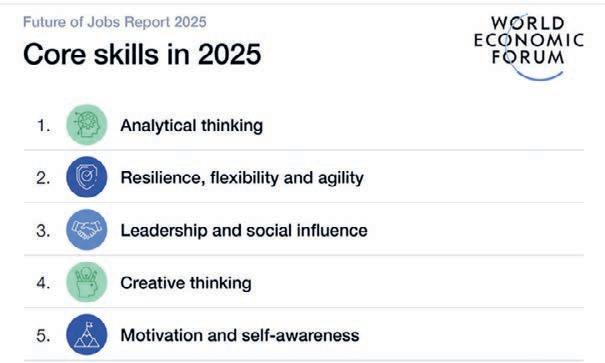
According to the 2025 Future of Jobs Report (World Economic Forum), these are the top five core skills needed for the workforce:
Source: World Economic Forum
1 Choose the skill which you believe will be the most important for workers in 2050.
a Define this skill in your own words.
b Explain why you think it will be essential in the future. Give your text a suitable title.
Writing a response
Duncan Thomasen (55), an AI artist and film editor from the UK, predicts that by 2035, AI will be fully embodied in children’s toys and by 2050, there will be an entire generation raised by AI:
“I think we’ll really see the shift by around 2035, when AI becomes fully embodied in things like teddy bears, dolls or action figures. Once that happens, especially for the younger generations, AI companions could feel like teachers, friends, even siblings. Maybe growing up with a teddy that knows you from birth, that bond could be just as strong, if not stronger, than with a casual human connection. And so by 2050, we could have an entire generation raised with AI toys, books, schools, even fridges and houses that all have personalities. At that point, the bond could become a familywide experience much like the way we bring pets into our lives.”
Source: Talker News, 26 August 2025
2 What do you think about the future society Duncan describes? Write a short response for the comment section of an online newspaper. Writing a five-paragraph essay
3 Write a five-paragraph essay about the following topic: Nature, nurture, or conscious choice? To what extent do we control who shapes our lives? nature v. nurture = arv vs. miljø
In this essay, we want you to reflect on how much we actually get to actively choose the people who are the most influential to our lives.
Suggested structure:
IntroductionIntroduce the main topic in an engaging way.
1st paragraph Which influential people do we typically get to choose?
2nd paragraphWhich influential people do we typically not get to choose?
3rd paragraph Reflect on a conflict or challenge that arises here.
ConclusionConclude by engaging the reader, without repeating yourself.

11 Skills
Vocabulary
1 Learning Vocabulary
Reading and actively using a language are the keys to acquiring new vocabulary. Remember that you do not need to understand every word to grasp the meaning. The context (the other words in the sentence and the topic of the text) often makes it clear.
Making word lists is an old and proven method. Each time you meet a new word, write it down with examples of usage and learn how to pronounce it. Words you write down and test yourself on will most likely stick in your memory.
Many apps and websites can help you drill new vocabulary, but research shows that handwritten notes are better retained than typed notes. In the end, find the method that works best for you.
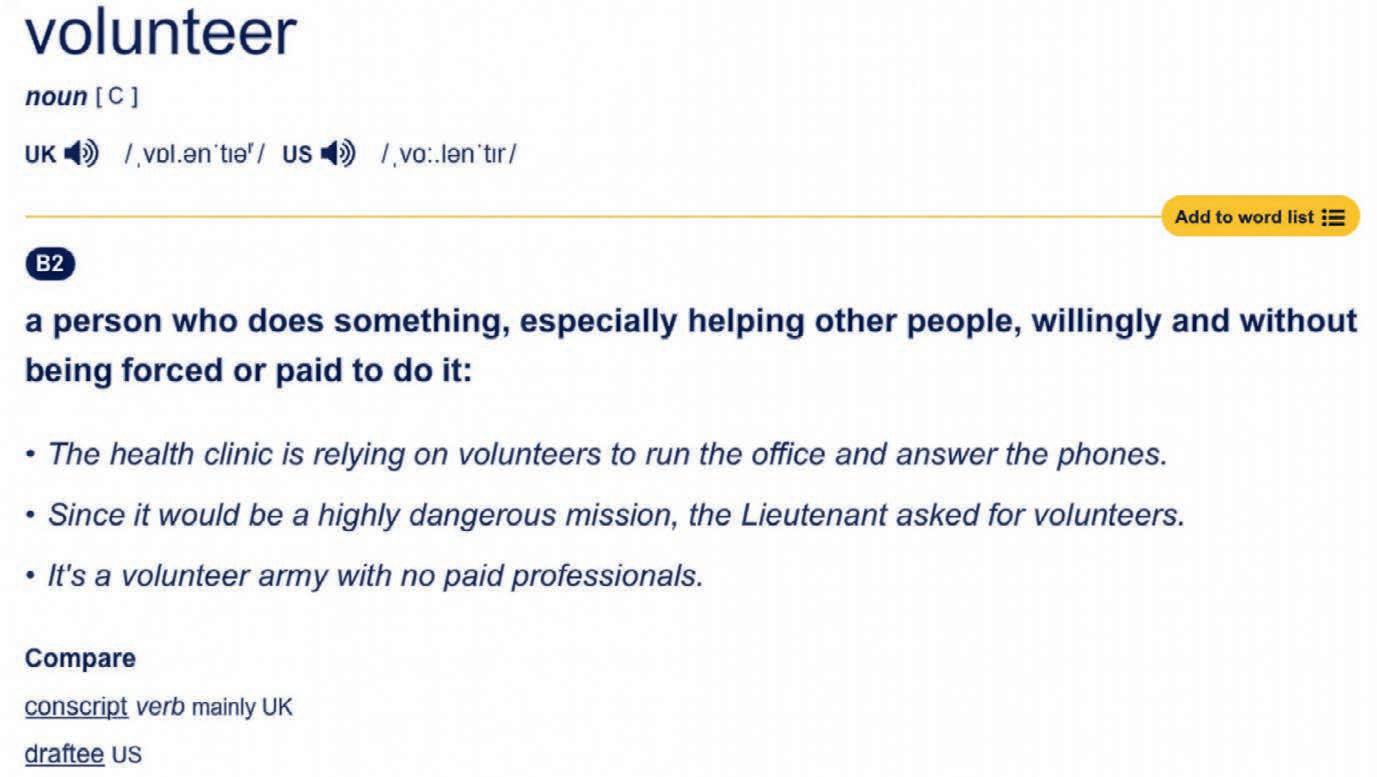
How to interpret a dictionary entry
Dictionaries give you the correct spelling, pronunciation, definition and usage of a word. They usually note whether a word is American or British English, and whether it is formal, informal or old-fashioned (archaic).
Forming words
Words can be formed by combining two words, as in postman. They can also be formed by adding prefixes or suffixes to a root or stem word. Knowing the most common prefixes and suffixes lets you recognise many new words at a glance.
Common prefixes
Prefix Meaning Examples
com-, co- with compassion, cooperate, correlate de- opposite, remove defrost dis- not, opposite of disagree e- electronic email, e-commerce, e-book en-, em- cause to, put into enable, embrace ex- out, previous export, ex-boyfriend in-, im-, il-, ir- not injustice, immortal, illegal, irregular inter- between, among interact, international mis- wrongly mistake non- not nonsense, non-profit over- over overlook post- after in time postpone, post-war pre- before in time, place prefix, pre-war re- again return, remake, repeat
Common suffixes
Suffix Meaning Examples
-able, -ible can be done comfortable, doable -er, -or one who worker, actor, blogger -ion, -tion, -ation, itionact, process occasion, attraction -ity, -ty state of infinity -less without hopeless -ment action or process enjoyment -ness state of, condition of sadness -ous, -eous, -ious possessing the qualities of dangerous -ish having the characteristics of foolish -ify, -fy to make or become glorify -y full of, condition of messy
Practising your skills
How many new words can you make from the following words using prefixes and suffixes?
happy, friend, grace, sleep, joy, take, child, lock, safe
Understanding the meaning of words
A word does not always have one fixed meaning. It can mean different things to different people and in different situations. This is worth keeping in mind when you read texts or talk to others.
Denotation and connotation
A word can have both a denotative and a connotative meaning. The denotative meaning is the literal definition you find in a dictionary. The connotative meaning is the associations – positive or negative – that the word gives us. For example, the definition of the word summer is the “season between spring and autumn”. What associations does the word summer give you? Are they positive or negative connotations?
Synonyms
Synonyms are words with the same meaning. Some are interchangeable (almost / nearly), while others differ in register: put up with and endure mean the same, but endure is more formal. Synonyms help you vary your writing.
Antonyms
Antonyms are words with the opposite meaning, such as small/large, few/ many or possible/impossible. When you learn a new word, also find its antonym to expand your vocabulary.
Homonyms
Homonyms are words that sound and are spelled the same but have several meanings. The word run, for example, has many meanings and can be both a verb and a noun.
Set phrases
An idiom is an expression whose meaning cannot be worked out from the individual words. Idioms are difficult to translate and often don’t exist in other languages. A piece of cake means something is easy. Pigs might fly means something will never happen.
A collocation is two or more words that often go together, learnt as a whole phrase: to make progress, free time, fast asleep.
Practising your skills
In pairs, find at least two more phrases for each category in the table. Think of expressions you have heard in debates, interviews, or podcasts. Share your lists with another pair.Listening
2 Listening Strategies
Listening is an essential skill in many daily activities, and especially when you are learning a foreign language. Before we explore strategies for
becoming a more active listener, take a few minutes to think about your own listening habits:
Practising your skills
Discuss the following statements in small groups.
• You can listen to songs in English all day, without really listening to the lyrics.
• Understanding a foreign language allows you to listen in on other people’s conversations!
• From a language-learning perspective, it’s best to watch a film or TV-series without any subtitles at all.
• The main challenge of having a conversation with a native speaker of English, is that there is no option to “pause”, “reduce speed” or “activate subtitles”.
Different purposes call for different listening strategies. You will often meet different listening tasks in class, in assessments and at exams. The strategies below can help you prepare for these situations and manage your time.
1 Listening for details
Listening for details means picking out specific information from a recording, for example, finding out when the next bus is leaving or what artist is playing on the radio.
2 Listening to summarise
Listening to summarise means explaining the main content of a recording in your own words. Practising this helps you catch the essence of what you hear, whether it is a story or a podcast.
3 Listening to elaborate and explore
Listening to elaborate and explore means commenting on and developing the main ideas of a recording and using them in your own reflections.
Pre-listening strategies: the three Ps
Are you PREPARED?
Your personal mindset and physical surroundings matter.
• Do you have a working environment that helps you concentrate?
• Are you motivated for the task? What can you PREDICT?
The more you know about the recording and the questions before you start, the better.
• Do you know anything about the content of the recordings?
• Have you been given any instructions, titles or questions beforehand?
Do you have a PLAN?
A clear plan or set of strategies boosts your confidence and helps you focus.
• How will you take notes? (This may depend on the type of questions –multiple choice or open answers.)
• How will you manage your time? (Will you have a chance to listen more than once?)
While-listening strategies: the three Rs
RELAX: Don’t panic if there are difficult words you don’t understand. The context of a difficult word (the parts before and after) will often help you grasp the meaning of the sentence, even if you do not understand every single word.
REACT: Note down key words as you listen. You do not have time for perfect sentences, just words and phrases that stand out and seem important.
REPEAT: If you can, listen to difficult passages more than once.
After-listening
strategies: the two Cs
CHECK: Re-read the question and make sure your answer covers exactly what it asks.
CORRECT: Re-read your answers and correct any language errors (spelling, grammar, punctuation).
3 Oral Discussions
Oral discussions are a common form of assessment in English class. During these discussions, you will explore and reflect on different topics in small groups. The goal is not to give a speech, but to share ideas, respond to others and develop your thinking together. The advice below will help you prepare and succeed in this setting.
1 Preparation is key!
A subject-specific discussion rarely flows smoothly without preparation. Therefore, it is important that you have done some work beforehand.
Remember to:
• Read the relevant pages in your textbook.
• Review your notes.
• Reflect on the topic and form your own opinions.
• Prepare a few examples or arguments you can use in the conversation.
2 Be an active participant
Finding the right balance between dominating the conversation and being too silent can be challenging. Just remember that the aim is to help the group develop ideas together.
You can:
• Share your opinions.
• Ask relevant questions.
• Build on what others are saying.
• Encourage quieter group members to speak.
3 Be a good listener
Listening is just as important as speaking in a discussion. Pay attention when others are talking and avoid interrupting them. You do not always have to agree, but you should respond to what others say and build on their ideas.
Try to:
• Refer to other people’s ideas.
• Avoid repeating points already made.
4 Give reasons for your views
When you share an opinion, try to explain why you think that way. This helps make the discussion more interesting.
You can:
• Give examples.
• Explain your reasoning.
• Refer to something you have read, watched or learned in class.
Final tips:
• Prepare notes, not a full script.
• Practise speaking about the topic with a classmate.
• It is okay to pause and think before answering.
• Accept that mistakes are a part of learning.
• Stay calm and trust the preparation you have done.
Useful phrases
Presenting ideas
One key reason why It is evident that Research indicates that Citing sources According to ...
As pointed out by ... ... states that
Asking for clarification Can you explain what you mean by ...? Could you give an example? Why do you say that?
Agreeing You’re absolutely right. That’s a very good point. I couldn’t agree more.
Partly disagreeing
That’s quite true, but I agree with you in principle, but I agree with you to a certain extent, but Another perspective might be ...
Disagreeing On the other hand, However, one must consider that Despite the fact that
Fishbowl Discussion
A fishbowl discussion allows students to explore complex or controversial topics in a structured and respectful way. It encourages listening, critical thinking, and participation.
Preparation
Each motion needs five students: one moderator, two who are for the motion, and two who are against it.
• Brainstorm arguments for and against the motion, and formulate your position in one clear sentence.
• Support your arguments with evidence: facts and statistics (logos), credible experts (ethos), and emotional appeals (pathos).
• Identify counter-arguments and prepare rebuttals supported by evidence.
• Listen to what your opponents actually say and acknowledge their views respectfully.
• You may bring one page of key words and notes.
Setup
Arrange two circles of chairs. The inner circle (the “fishbowl”) is for the moderator and the four debaters; the outer circle is for the listeners.
How it works
• The inner circle discusses one motion at a time, with a debate lasting 10–15 minutes.
• The outer circle listens silently and takes notes on the arguments.
• After each debate there are 5 minutes for questions.
The moderator must:
• Research both sides and prepare guiding questions to use if the discussion stalls.
• Introduce the topic and rules clearly.
• Ensures everyone speaks, keep the conversation on topic and respectful, and manage timing
• Not share personal opinions – only facilitate the discussion.
Debrief
After the discussion, the class reflects together:
• Who “won” the debate, and which arguments were the strongest?
• Did anyone’s opinion change?
• How could participants improve next time?
4 Delivering Successful Presentations
Some students feel confident speaking in front of an audience, while others find it more challenging. This is why preparation matters. The advice below will help you deliver a successful presentation.
1 Prepare well
The better you understand your topic, the easier it is to present clearly.
• Create an outline.
• Prepare slides with key points (not full text).
2 Structure your presentation clearly
A clear structure helps your audience follow your ideas.
• Introduction: present your topic and main message.
• Main part: develop your ideas step by step.
• Conclusion: summarise your key points.
• Use linking words (firstly, moreover, finally).
• Use visual aids to support your message.
• Build everything around one clear message.
3 Practise your presentation
Practising builds confidence and reduces nervousness.
• Rehearse several times.
• Practise in front of friends or family members.
• Record yourself and listen back.
4 Deliver your message clearly
How you speak is just as important as what you say.
• Speak clearly and at a steady pace.
• Maintain eye contact with the audience.
• Avoid reading directly from your notes.
Final advice
• Prepare in advance, rather than the night before.
• Focus on communicating, not memorising.
• It is okay to pause and think during your presentation.
• Confidence comes from preparation, not perfection.
5 Making a Podcast or a Video
Have you been asked to make a podcast or a video, for example for an exam or an in-depth project? Many of the tips for giving a presentation also apply here. The five points below are specific to audio and video productions.
1 Get inspired
Listen to or watch podcasts and videos you like. What catches your attention? What makes you want to keep listening or watching? Use what works as a model for your own production.
2 Know your audience
If you try to reach everyone at once, you risk reaching no one.
• Who exactly is your audience?
• Will you use formal or informal language?
• Will you use humour, suspense, music, or visual effects to keep them engaged?
3 Plan your script
Plan your production minute by minute – ideally second by second.
• In what order will you present your points?
• What is the most important thing you want to say?
• What do you want your audience to remember?
• When will you use music, sound effects, images, or video clips?
4 Tell a good story
A good story is something your audience can relate to. It triggers emotions and creates images in the listener’s head – or, in a video, supports the images you show.
• Can you use something from your own life?
• Is there a recent news angle?
• Is there a surprising element or a strong punchline?
5 Sound and visuals
• Audio: Speak calmly and clearly. Drink water to avoid a dry mouth. Record in a quiet room and check the levels, as muffled or distorted sound is hard to listen to.
• Visuals (video): Frame yourself in good light with an uncluttered background. Look at the camera, not at the screen. Keep cuts and effects simple. Content matters more than fancy editing.
A note on AI tools
If you are allowed to use one, you must say so and reference it, just like any other source.
In-text: (Anthropic 2026)
Reference: Anthropic. 2026. Claude. Large language model. https://claude.ai.
Your reader can’t open your conversation the way they can open a web page, so instead of an access date, explain briefly what you used the tool for and include the actual prompt(s) — in your text or in an appendix.
20 Citing and Referencing
Every source you mention has to appear twice: in the running text as an in-text citation, and in your reference list at the end (unless you used it only for general background, without referring to anything specific in it). The format below follows Chicago author-date style, with one exception: an access date is kept for every online source, because you are required to include one in your exam.
Novel
In-text: (Orwell [1949] 1987, 23)
Reference: Author. (orig. year) edition year. Title. City: Publisher. Orwell, George. (1949) 1987. Nineteen Eighty-Four. London: Penguin Classics.
Textbook
In-text: (Balsvik et al. 2026, 344)
Reference: Author(s). Year. Title. City: Publisher. Balsvik, L., K. Furuset Jensen, J. S. Henry, J. Kagge, S. Nygaard-Joki, R. Pihlstrøm, and S. P. Raustøl. 2026. Targets. Oslo: Aschehoug.
Online article
In-text: (Kristof 2026)
Reference: Author. Year. “Article Title.” Publication, Month day, year. Accessed date. url. Kristof, Nicholas. 2026. “This Is What Happened When Trump Abandoned the World’s Poorest Children.” The New York Times, May 9, 2026. Accessed June 20, 2026. https://www.nytimes. com/2026/05/09/opinion/foreign-aid-cuts.html.
Video
In-text: (BBC News 2026)
Reference: Creator. Year. “Title.” Medium, Month day, year. Accessed date. url.
BBC News. 2026. “Is Gen Z Trapped by AI?” YouTube video, June 20, 2026. Accessed June 20, 2026. https://www.youtube.com/watch?v=yrgzszEY4wI.
Poem – from a website
In-text: (Agard 2004)
Reference: Author. Year. “Title.” Site. Accessed date. url. Agard, John. 2004. “Flag.” Genius. Accessed June 20, 2026. Poem – from the textbook
In-text: (Agard [2004] 2026, 183)
Reference: Author. (orig. year) edition year. “Title.” In Textbook, edited by editors, pages. City: Publisher. Agard, John. (2004) 2026. “Flag.” In Targets, edited by L. Balsvik, K. Furuset Jensen, J. S. Henry, J. Kagge, S. Nygaard-Joki, R. Pihlstrøm, and S. P. Raustøl, 183. Oslo: Aschehoug.
General web page
In-text: (WWF, n.d.)
Reference: Author. n.d. “Title.” Accessed date. url. World Wildlife Fund. n.d. “Deforestation and Forest Degradation.” Accessed May 14, 2026. https:// www.worldwildlife.org/our-work/forests/deforestation-and-forest-degradation/. Film
In-text: (DuVernay 2014)
Reference: Director, dir. Year. Title. Studio. DuVernay, Ava, dir. 2014. Selma. Pathé.

Grammar
Word Classes
Words are put together to form sentences. Sentences form texts. We group words into different parts of speech or word classes. In English there are nine word classes.
Part of speechDescription
Verbs Denote actions or states.
Nouns Names of things, persons or places.
Examples
Action verbs: bring, read, learn, do, think
Stative verbs: seem, like, smell, prefer, be, look, taste
Common nouns: house, cat, idea, man
Proper nouns: Marie, London, Scotland
Adjectives Modify nouns. happy, red, lucky, old, new, blue: a red house.
Adverbs Answer questions such as: “How?”, “Why?”, “Where?” “When?”, “How much?”, etc.
They came here. (Where?)
They will be here later. (When?)
She is very happy. (How much?)
Modify a verb. She sings nicely. / She often sings. Modify an adjective. That is terribly difficult.
Modify an adverb. She is almost always right.
Modify a whole sentence. Hopefully, the rain will stop.
Pronouns Take the place of a noun. My sister is kind. –> She is kind he, she, him, us, they, etc.
Determiners Placed in front of a noun and help determine what the noun is referring to.
Prepositions
My/That/One/A train arrived
Articles a/an, the Possessives my, his, her, our, etc.
Demonstratives that, this, these, those
Quantifiers one, four, all, some, any, etc.
Placed in front of a noun or pronoun, and are used to show the relationship between words in a sentence.
The overview continues on the next page.
They are in town. The book is on the table. Look at him!
Conjunctions Link words, phrases, clauses and sentences together.
Coordinating conjunctions join two elements together. and, but, for, nor, or, so, yet; We paid and entered.
Correlative conjunctions work in pairs to join elements together. both ... and, either ... or, neither ... nor, not only ... but also, whether ... or; Either you pay or I have to pay.
Subordinating conjunctions introduce a subordinate clause. because, since, although, unless; Unless you pay, you cannot enter. Since you have paid, you can enter.
Interjections
Word or expression that on its own conveys emotions, greetings, exclamations
Verbs
Verbs are used to describe an action or a state.
Finite and non-finite verb forms
Verbs which have the past or the present tense are called finite verbs. The infinitive, present participle/ gerund (-ing form) and the past participle are non-finite verbs
Example Tense
Mary sings a song. Present tense
Finite or non-finite?
Finite
Mary sang a song yesterday. Past tense Finite
It was difficult to sing
Singing is difficult.
The verb has the infinitive form
Non-finite
The verb has the gerund form (-ing form) Non-finite
It was a tune sung by everyone. The verb has the past participle form Non-finite
Regular verbs
Regular verbs have -ed added to the root in the past and the past participle.
InfinitivePast Past participle
smell smelled smelled walk walked walked paint painted painted
Hello! Wow! Ouch! Yes.
Irregular verbs
Verbs that do not have -ed in the past and past participle are irregular. Because they do not follow a specific pattern, we need to learn how to conjugate each of them individually. Examples of such verbs are commonly used verbs such as see, go, and have. Please visit the Targets website for a list of the most common irregular verbs.
The infinitive
The infinitive is the base form. This is the form we find in dictionaries.
The infinitive marker is to.
Here are some examples:
Use
Example
Where we would use an at-clause in Norwegian. He told Mary to close the door. (Han sa at ...)
To express purpose
He bought a present to give to his girlfriend.
In order / in order not + to infinitive to express purpose We left at six o’clock in order to catch the train.
To express official arrangements or things to be done we can use to be + to infinitive.
To be about + to infinitive to refer to actions that will happen soon.
Unlike Norwegian, there is never a preposition in front of a to infinitive.
The -ing form
The managing director is to visit the office tomorrow.
The class is about to begin
I am glad to see you. (glad for å)
We make the -ing form by adding -ing to the infinitive:
Sing-ing: Singing is fun!
The -ing form may function as a verb, an adjective or as a noun in a sentence.
As a verb: The present participle
The present participle is used
• as part of the progressive form of the verb (see page 334): she is swimming, they have been walking
• in the pattern: verbs of position/movement + present participle: He stood there waiting for the others.
John sat watching TV.
Targets følger læreplanen i engelsk, vg1 SF LK20.
Targets består av lærebok med tekster og oppgaver, samt en rikholdig digital ressurs som du finner på Aunivers.no.
Læreboka finnes også i digital utgave med innlest lyd.