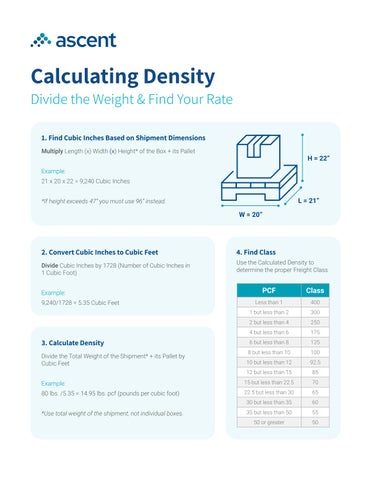
Calculating Density Divide the Weight & Find Your Rate 1. Find Cubic Inches Based on Shipment Dimensions Multiply Length (x) Width (x) Height* of the Box + its Pallet
H = 22”
Example: 21 x 20 x 22 = 9,240 Cubic Inches
L = 21”
*If height exceeds 47” you must use 96” instead.
W = 20”
2. Convert Cubic Inches to Cubic Feet
4. Find Class
Divide Cubic Inches by 1728 (Number of Cubic Inches in 1 Cubic Foot)
Use the Calculated Density to determine the proper Freight Class
PCF
Class
Less than 1
400
1 but less than 2
300
2 but less than 4
250
4 but less than 6
175
6 but less than 8
125
8 but less than 10
100
10 but less than 12
92.5
12 but less than 15
85
Example:
15 but less than 22.5
70
80 lbs. /5.35 = 14.95 lbs. pcf (pounds per cubic foot)
22.5 but less than 30
65
30 but less than 35
60
35 but less than 50
55
50 or greater
50
Example: 9,240/1728 = 5.35 Cubic Feet
3. Calculate Density Divide the Total Weight of the Shipment* + its Pallet by Cubic Feet
*Use total weight of the shipment, not individual boxes.