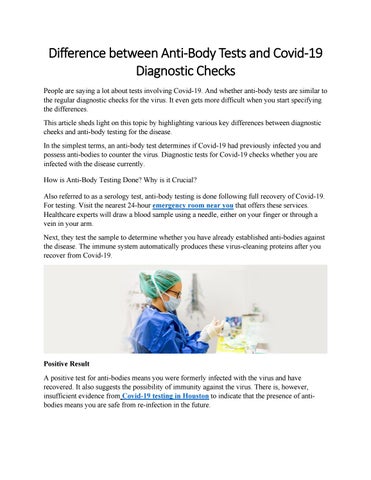
Difference between Anti-Body Tests and Covid-19 Diagnostic Checks People are saying a lot about tests involving Covid-19. And whether anti-body tests are similar to the regular diagnostic checks for the virus. It even gets more difficult when you start specifying the differences. This article sheds light on this topic by highlighting various key differences between diagnostic cheeks and anti-body testing for the disease. In the simplest terms, an anti-body test determines if Covid-19 had previously infected you and possess anti-bodies to counter the virus. Diagnostic tests for Covid-19 checks whether you are infected with the disease currently. How is Anti-Body Testing Done? Why is it Crucial? Also referred to as a serology test, anti-body testing is done following full recovery of Covid-19. For testing. Visit the nearest 24-hour emergency room near you that offers these services. Healthcare experts will draw a blood sample using a needle, either on your finger or through a vein in your arm. Next, they test the sample to determine whether you have already established anti-bodies against the disease. The immune system automatically produces these virus-cleaning proteins after you recover from Covid-19.
Positive Result A positive test for anti-bodies means you were formerly infected with the virus and have recovered. It also suggests the possibility of immunity against the virus. There is, however, insufficient evidence from Covid-19 testing in Houston to indicate that the presence of antibodies means you are safe from re-infection in the future.
Negative Result If you have a negative anti-body test result, you might never have contracted the disease. Engage your healthcare provider to discuss what various test results mean. Ascent er specialists suggest that you could still be infected since the body takes a maximum of 3 weeks to deliver anti-bodies. This means that if you are exposed to the virus, even after recovery, you could still get sick and also spread the virus. The period of developing anti-bodies depends on an individual, with some taking longer than others. Others don’t develop anti-bodies at all. A viral test is necessary if you notice symptoms even after an anti-body test. Regardless of your anti-body test results, we call for strict adherence of steps to safeguard yourself and others from the deadly virus.