Volume 59 issue three 2026 What's Inside 1
President’s Message
3
Selecting Stress-Tolerant Trees for Urban Landscapes
16
What are Phenology and Growing Degree Days
22
From Shelf Documenting to Operating System
27
When the Obvious Isn't the Answer
31
A Day in the Life: Interview with Joseph Gillingham
35
Tech Corner
37
Tree Appraisal: Credible and Reasonable as Terms of Art
63
Host a TPAQ® Course
66
Committee Reports
70
Member News
74
Send Us Your Best Shot Creative and Innovative Planting Practices
[The Arboricultural Consultant is a publication of the American Society of Consulting Arborists® 2023. All Rights Reserved. For more information, contact the ASCA headquarters office. Unless otherwise noted, all images are copyright ASCA and their respective owners. The ideas and opinions expressed in the Arboricultural Consultant are solely those of the contributors and do not necessarily represent the view, positions or policies of ASCA, its members, its board of directors, officers or staff. ASCA is not responsible for any claims made in any advertisement, and does not endorse any vendor. ASCA does not warrant the performance of any member.]
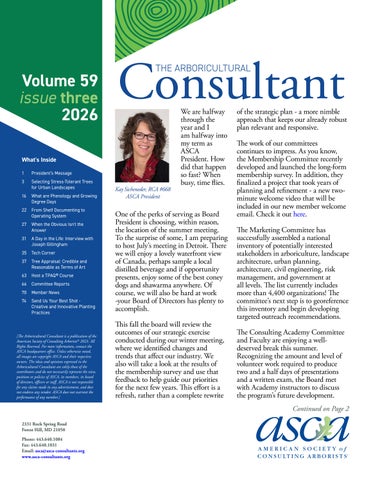
Kay Sicheneder, RCA #668 ASCA President
We are halfway through the year and I am halfway into my term as ASCA President. How did that happen so fast? When busy, time flies.
One of the perks of serving as Board President is choosing, within reason, the location of the summer meeting. To the surprise of some, I am preparing to host July’s meeting in Detroit. There we will enjoy a lovely waterfront view of Canada, perhaps sample a local distilled beverage and if opportunity presents, enjoy some of the best coney dogs and shawarma anywhere. Of course, we will also be hard at work -your Board of Directors has plenty to accomplish. This fall the board will review the outcomes of our strategic exercise conducted during our winter meeting, where we identified changes and trends that affect our industry. We also will take a look at the results of the membership survey and use that feedback to help guide our priorities for the next few years. This effort is a refresh, rather than a complete rewrite
of the strategic plan - a more nimble approach that keeps our already robust plan relevant and responsive. The work of our committees continues to impress. As you know, the Membership Committee recently developed and launched the long-form membership survey. In addition, they finalized a project that took years of planning and refinement - a new twominute welcome video that will be included in our new member welcome email. Check it out here. The Marketing Committee has successfully assembled a national inventory of potentially interested stakeholders in arboriculture, landscape architecture, urban planning, architecture, civil engineering, risk management, and government at all levels. The list currently includes more than 4,400 organizations! The committee’s next step is to georeference this inventory and begin developing targeted outreach recommendations. The Consulting Academy Committee and Faculty are enjoying a welldeserved break this summer. Recognizing the amount and level of volunteer work required to produce two and a half days of presentations and a written exam, the Board met with Academy instructors to discuss the program’s future development. Continued on Page 2
2331 Rock Spring Road Forest Hill, MD 21050 Phone: 443.640.1084 Fax: 443.640.1031 Email: asca@asca-consultants.org www.asca-consultants.org
2026 BOARD OF DIRECTORS President Kay Sicheneder, RCA #668, Attica, MI President-Elect Nick Martin, RCA #552, Algonquin, IL Immediate Past President Ron Matranga, RCA #488, Spring Valley, CA Secretary/Treasurer Christian Hughes, RCA #493, Atlanta, GA Directors: Monika Buczko, RCA #785, Warminster, PA Debra DeMarco, RCA #672, South Miami, FL Kyle Offerdahl, RCA #714, Portland, OR Richard 'Ricky' Peterika, RCA #641, Tampa, FL
STAFF Executive Director Kristen Philips, MBA, CAE Associate Director Lisa Blair, QAS Credentialing Programming Manager Amy Giesy, QAS Director of Meetings Diane Schafer, CMP, DES Director of Marketing and Communications Amie Goscinski CFO & Director of Finance Mary Skudzinskas, CPA
NEWSLETTER The Arboricultural Consultant is published four times a year by ASCA. Articles and news items are encouraged and must be submitted six weeks prior to publication.
Together, we decided to engage an outside educational consultant to help align learning objectives, course materials and exam. While we do not anticipate major changes in the Academy curriculum or format, we do expect to a more rigorous program with oversight and guidance by professionals consistent with the high standards expected of this premier program. Volunteers are essential to the work of this organization. Efforts directed by the members, for the members. If you have time, expertise or passion for your industry, I encourage you to get involved. If that level of involvement in ASCA is not in the cards right now, please do remember that this is a CEU renewal year. A total of 30 credits must be earned by September 30. While you do not need to enter the credits in your ASCA member portal, members
selected for an audit will be required to provide documentation of completed CEUs. Should you need CEUs check out our July 16 webinar: The #1 Practical Business Action for Every Consultant, presented by Jeff Ling, RCA #337. In the fall we will be offering the year’s final webinar and also a Town Hall Meeting where members can submit questions directly to the board. Finally, it is time to renew your membership and pay dues. This is another opportunity to be heard. Your continued support is evidence that you value ASCA, and we recognize and appreciate the trust you place in us to use those resources for the benefit of the membership. Sincerely,
Kay Sicheneder, RCA #668 ASCA President 2026
Editorial Committee Chair Kat Cummings, RCA #781 Editorial Review Committee Julie Collins, RCA #811 Lisa Smith, RCA #464 Craig Southwell, RCA #692 Steve Lane Jaclyn Salts Guy Meilleur Board Liaison: Ron Matranga, RCA #488
ASCA ANTITRUST STATEMENT The following antitrust statement has been approved by the president and board of directors of the American Society of Consulting Arborists. "Members of the American Society of Consulting Arborists, especially members of the board of directors and Society committees, are reminded that they do not and may not speak for or on behalf of the Society without the express permission of the president or board of directors of the American Society of Consulting Arborists. This prohibition includes the use of ASCA letterhead when making a statement of a technical, economic, or politcial nature. Members of ASCA speak only for themselves as professional consultants when giving or making statements.
American Society of Consulting American Arborists® Society of2 Consulting Arboricultural Arborists® Consultant 2 volume Arboricultural 59 issue 3C2026 onsultant volume 59 issue 3 2026
Selecting Stress-Tolerant Trees for Urban Landscapes. From Traditional Choice Lists to Physiological and Scientific Testing. By Dr. Glynn Percival, Bartlett Tree Research Laboratories
Why Urban Tree Selection Needs to Change Urban forests are expected to deliver measurable eco-system benefits such as heat mitigation, air quality improvement, stormwater regulation, and human well-being (Photo 1). However, trees planted within urban landscapes (street plantings, car parks, industrial sites, built landscapes) face a diverse array of environmental stresses (compacted soils, restricted rooting volume, low soil moisture, poor aeration, air pollution, wind exposure, elevated solar radiation, de-icing salts, soil chemical contaminants (herbicide, hydrocarbon residues)) detrimental to their biology. Such stresses are rarely encountered in woodlands, forests or public Photo 1: Trees In a Urban Landscape and private gardens. These adverse conditions may help explain why urban trees frequently exhibit higher mortality rates and reduced longevity compared with their counterparts growing in less disturbed woodland and forest environments (Hilbert et al. 2019; Smith et al. 2019). This sharp reduction in longevity raises a central question for urban forestry: are the trees currently selected for urban landscapes capable of meeting the biological, aesthetic, functional, and economic demands placed on them? Based on current planting outcomes and the increasing intensity of urban landscape stress (elevated heat stress episodes, chronic drought, anthropogenic activities) the answer is often no. Consequently, what are the processes by which trees are selected for urban plantings and are the right choices being made? If not, what alternative options are available to enable superior species/site selection. These questions will become of greater importance as future resource allocations to urban tree management are likely to decline, increasing pressure to deliver superior services at less costs. For the future, tree selection must move toward a more evidence-based process that identifies species, cultivars, varieties, and provenances capable of surviving and functioning under harsh urban conditions. Traditional Selection Methods Historically, tree selection for urban landscapes has primarily been driven by visible characteristics such as form, architecture, size, seasonal interest, and aesthetic appeal. In many cases, practitioners relied on approved species lists derived from nursery guides and nursery specifications, generalized tree orientated textbooks, university technical notes or reports or familiar planting schemes designed by landscape architects. While lists can be a useful starting point for tree selection purposes they also present several limitations. List-based selection may favor popular or historically proven species which can encourage low biodiversity within the landscape. List based selection can overlook site-specific survivability, and more importantly fail to account for changing climate conditions such as heatwaves, prolonged drought, unseasonal subzero temperatures and rainfall pattern shifts.
American Society of Consulting Arborists®
3
Arboricultural Consultant volume 59 issue 3 2026
Selecting Stress-Tolerant Trees for Urban Landscapes continued
Another common approach is to select trees based on what appears to grow well locally, especially those in harsh urban landscape conditions (Photo 2). This method has value because it reduces the likelihood of choosing species with an obvious climatic mismatch. However, it can also narrow the range of taxa considered for planting. Species that have not historically been planted in a region may be overlooked even if they are equally suitable, or better suited, to the conditions of a specific urban site. Local observation can also fail to capture important differences in microclimate, drainage, soil compaction, pollution exposure, and rooting conditions across a city. A tree that performs well in one urban setting may fail in another because the site stresses are subtly but significantly different. Consequently, practitioners still often disagree on species responses to specific stressors, and few species are perceived as tolerant across the full suite of urban constraints (Carol-Aristizabal et al. 2023). Provenance: Matching Genetic Origin to Urban Stress In forestry, provenance selection has long been used to identify seed sources or genetic populations adapted to specific environmental conditions with timber production as the primary focus. Provenance selection for urban landscapes, however, remains Photo 2: Tree Growing comparatively underdeveloped. Provenance trials have repeatedly demonstrated that In harsh Landscape populations of the same species can differ substantially in growth rate, phenology, drought tolerance, cold hardiness, and susceptibility to pests and diseases. These differences reflect local adaptation to the climatic and edaphic conditions under which populations evolved and suggest that successful urban tree selection should consider not only species identity but also genetic origin. Trees growing naturally or successfully in coastal regions exposed to salt spray and high winds, for example, may provide valuable genetic material for urban sites where salinity and exposure are major constraints. Similarly, trees originating from climates or soils comparable to a target planting site may be better able to establish, tolerate local stressors, and reduce transplant shock. Research on tree adaptation has shown that locally adapted or environmentally matched provenances often display superior survival and physiological performance compared with poorly matched seed sources. Such differences can be especially important in urban landscapes where trees must cope with multiple stressors simultaneously. Provenance selection can also support climate adaptation. The concept of assisted migration or climate-adjusted provenancing has gained increasing attention in forestry and restoration ecology, as it seeks to match planting stock to current environmental conditions and projected future climates (Aitken and Bemmels 2016). Studies of species such as Quercus, Pinus, Eucalyptus, and Pseudotsuga have demonstrated that populations originating from warmer and drier regions often possess traits associated with improved drought tolerance, including greater hydraulic safety, higher water-use efficiency, and more conservative growth strategies (Prober et al 2015; SáenzRomero et al 2021). Incorporating these provenances into urban planting programs may help improve resilience to future heatwaves and water scarcity (Williams and Dumroese 2013). However, provenance selection must be used carefully. Commercial plant distribution frequently moves trees far from their place of origin, and the assumption that a poorly matched tree will eventually acclimate to unsuitable conditions is rarely supported by evidence. Provenances adapted to warmer climates may exhibit reduced cold tolerance, while locally sourced material may become maladapted under rapidly changing climate conditions. Consequently, provenance choice requires balancing current adaptation with future climatic suitability (Bucharova 2017). By integrating provenance selection into urban forestry practice, managers can move beyond species-level recommendations and make informed decisions about the genetic material most likely to thrive under current and future urban conditions.
American Society of Consulting Arborists®
4
Arboricultural Consultant volume 59 issue 3 2026
Selecting Stress-Tolerant Trees for Urban Landscapes continued
Expanding the Urban Tree Palette One of the simplest ways to improve urban forest resilience is to broaden the range of species, cultivars and varieties used in planting programs. Despite the immense diversity of trees world-wide, only a limited number of species dominate our urban spaces. In many cities, planting palettes remain concentrated around a relatively small group of familiar species. For example, the average community in the United States relies on just six species for the majority (61.5%) of its street and park trees (Ma et al 2020). Likewise, a Tree Vitalize Study conducted in 2023 across 63 U.S. cities analyzed over 5 million trees. The study found a low diversity in many cities, with some dominated by a handful of species. For example, Worcester, MA had an effective species number of 6.43, London planetree (Platanus × acerifolia) was the most common species overall (4.2% of all trees) and the median diversity across cities was equivalent to circa 35 species, showing heavy reliance on a few species. The issue of low urban tree diversity is not confined to any one country. Globally, research has found that a single, dominant species typically makes up 20% of a given city’s tree population (Kendal et al 2014) increasing vulnerability of urban forests to pests, diseases, and climatic change. The aim is not to plant unusual trees for novelty alone. Alternative species should be evaluated against clearly defined stress criteria, including heat, drought, salt and pollution tolerance, rooting constraints, pest and disease resistance, and capacity to deliver ecosystem services under stress. Expanding the species pool through systematic evaluation of underused taxa can improve genetic diversity, reduce ecological risk, and strengthen long-term canopy stability. Systematic reviews show for example that urban tree performance during extreme heat varies with tree traits, site context, and climate zone (Percival 2023). In addition, because multiple stressors co-occur, the most important selection question is not simply ‘Which species tolerate drought?’ but ‘Which species maintains function and recovers under combinations of heat, drought, and additional site constraints typical of the urban landscape’? Such questions reinforce the need for several complementary predictors of tree performance and selection (Alonzo et al. 2025; Jang and Leung 2022). As a way forward ecological selection frameworks incorporate species functional traits linked to environmental tolerances to improve matching of tree biology and site conditions. Trait-based approaches, such as those described by Núñez-Flórez et al. (2019), emphasize the use of functional diversity metrics such as leaf morphology, hydraulic traits, and growth strategies to optimize ecosystem service delivery and resilience in urban forests. Similarly, Niinemets and Valladares (2006) highlight the importance of understanding multistress tolerance syndromes (e.g., trade-offs between shade, drought, and waterlogging tolerance), which are critical in heterogeneous urban environments. Advances in data integration further enhance this process. The application of “big data” approaches, as demonstrated by Watkins et al. (2020), enables the synthesis of climatic, geographic, and phenotypic datasets to improve ecotype matching and identify provenances better suited to future urban conditions. Likewise, urban microclimate modeling, such as that developed by Morakinyo et al. (2020), supports the concept of “right tree, right place” by quantifying spatial variability in heat exposure and guiding species selection for maximum thermal mitigation. Arboreta and Botanical Gardens as Living Laboratories for Tree Selection Arboreta and botanical gardens provides an important resource for improving urban tree selection because they contain diverse collections of species, cultivars, and varieties that may not be widely represented in commercial or municipal planting palettes. These collections allow researchers and practitioners to evaluate a broad range of genetic material under comparable environmental conditions, creating opportunities to identify trees that are better suited to future urban climates. Furthermore, arboreta often maintain well-documented accessions and mature specimens, enabling researchers to investigate variation in growth, phenology, stress tolerance, and survival across a wide range of taxa under field conditions. Hirons et al. (2021) emphasized that arboreta and botanic gardens contain taxonomically and functionally diverse collections that make them exceptional resources for evidence-based urban tree selection and diversification strategies. As well as relying on observational assessments of tree performance, arboreta can support controlled physiological screening programs. By comparing how different taxa respond to stress under standardized American Society of Consulting Arborists®
5
Arboricultural Consultant volume 59 issue 3 2026
Selecting Stress-Tolerant Trees for Urban Landscapes continued
conditions, researchers can identify candidates with superior tolerance traits before recommending them for wider urban use. A notable example is the study by Hirons et al. (2021), who evaluated the water potential at leaf turgor loss point, a key indicator of drought tolerance, across 96 species growing in seven botanic collections in Europe and North America. Their results revealed substantial variation in drought tolerance both among species and among closely related cultivars, demonstrating that trait-based screening can provide objective criteria for species selection rather than relying on anecdotal performance records alone. The study concluded that arboreta and botanical gardens play a vital role in identifying resilient tree species for future urban environments if they are managed as scientific resources rather than solely as visitor attractions. Recent studies on urban tree drought tolerance further demonstrate the value of physiological and traitbased assessments. Wang et al. (2023) examined five tree species commonly used in northern China's urban forests and found that resistance to drought-induced xylem embolism was a strong predictor of survival under prolonged water stress. Species with greater hydraulic safety exhibited lower mortality rates and improved drought performance, suggesting that hydraulic traits can provide valuable indicators of urban tree resilience. The authors argued that understanding these physiological mechanisms can directly inform urban species screening, planting-site selection, and long-term green infrastructure planning. Recent perspectives on the role of arboreta in climate change research further support this approach. Petrík et al. (2025) describe arboreta as "living laboratories" that enable investigation of species-specific responses to drought, heat, and other climate stressors outside their natural climatic ranges. Because arboreta and botanical gardens bring together a high diversity of mature trees growing under common environmental conditions, they provide unique opportunities for interspecific comparisons and long-term monitoring of acclimation processes. Such collections can therefore help researchers identify physiological traits linked to climate resilience and improve predictions of species performance under future environmental conditions supporting more diverse, adaptable, and evidence-based urban forests capable of withstanding the increasing challenges posed by climate change. Case Study: Screening Malus for Heat Tolerance The Bartlett Tree Research Laboratory and Arboretum have over 2000 individual tree species and four of the largest private collections of oak, magnolia, apple and holly in the world (Photo 3). Such a diversity of trees offers a large germplasm to identify tree species which are currently under-utilised in the urban landscape or not planted at all. For this reason, research by the author has been evaluating the heat tolerance of apple trees (Malus domestica Borkh.). These species, traditionally cultivated in temperate regions, are increasingly considered for urban planting due to their aesthetic value, cultural significance, and potential for multifunctional Photo 3: Bartlett Tree Research Laboratory and Arboretum landscapes. However, apples are highly sensitive to supraoptimal temperatures, which can disrupt photosynthesis, accelerate oxidative stress, reduce leaf chlorophyll content and impair fruit quality. As climate change increases the frequency and intensity of heatwaves, combined with the urban heat island effect that can elevate temperatures by 4–9 °C above surrounding rural areas, identifying heat-tolerant urban tree taxa has become increasingly important for sustaining canopy cover and the ecosystem services that trees provide.
American Society of Consulting Arborists®
6
Arboricultural Consultant volume 59 issue 3 2026
Selecting Stress-Tolerant Trees for Urban Landscapes continued
To evaluate heat tolerance, 35 Malus species, cultivars, and varieties were selected from the Bartlett Tree Research Laboratory Arboretum (Photo 4). Fully developed leaves were collected in May and August and exposed to controlled heat stress (Photo 5). Preliminary testing across a temperature gradient of 40–50 °C identified 45 °C for one hour as the most effective screening temperature because it provided the greatest separation among genotypes with differing thermal tolerances. Heat injury was quantified using chlorophyll fluorescence, specifically the Fv/Fm ratio, which measures the maximum quantum efficiency of photosystem II and is widely regarded as one of the most sensitive indicators of plant stress. Electrolyte leakage was also assessed as a complementary measure of cellular membrane damage, allowing physiological injury to be evaluated at both photosynthetic and cellular levels (Photograph 6). Strong correlations between the two measurements confirmed their usefulness as rapid screening tools for identifying heat-tolerant genotypes.
Photo 4: Malus Collection at BTRL
Photo 5 Evaluating Leaf Disks to Heat Stress
Photo 6: Electrolyte Leakage Assay
The results (Table 1 on page 8) showed substantial genotypic variation in heat tolerance. M. sargentii, M. ‘Prairifire’, M. baccata ‘Jackii’, M. ‘Royal Fountain Huber’, and M. ‘Donald Wyman’ consistently exhibited lower reductions in Fv/Fm indicating reduced damage to photosystem II under heat stress (Photo 7). In contrast, M. ‘Indian Magic’, M. ‘Coral Burst’, M. sargentii ‘Roseglow’, M. baccata var. mandshurica, and M. ‘Sugar Tyme’ showed severe declines in photosynthetic efficiency, identifying them as particularly sensitive to heat stress (Photo 8). Importantly, the relative ranking of tolerant and sensitive genotypes remained largely consistent between spring and summer foliage, suggesting that heat tolerance is an inherent characteristic of the genotype rather than simply a seasonal response. In practical terms, the more tolerant genotypes offer stronger potential for urban landscapes prone to heat stress episodes. Their ability to maintain photosynthetic function and membrane integrity under extreme temperatures suggests a greater likelihood of surviving future urban climates while continuing to deliver ecosystem services. The study also demonstrates the value of arboreta as living laboratories for climate-adaptive tree selection. By screening diverse collections using physiological traits rather than relying solely on visual observations or anecdotal experience, researchers can identify resilient planting material before widespread deployment. This case study illustrates how physiological screening can improve tree selection by revealing meaningful variation among taxa that might otherwise be treated as broadly similar, ultimately supporting the development of more diverse, resilient, and climate-ready urban forests.
Photo 7: Heat Tolerant Malus Genotype American Society of Consulting Arborists®
Photo 8: Heat Sensitive Malus Genotype 7
Arboricultural Consultant volume 59 issue 3 2026
Selecting Stress-Tolerant Trees for Urban Landscapes continued
Table 1. Percent reduction (-) in Fv/Fm compared to zero values i.e. before heat stress was imposed. Species are ranked in order of tolerance based on percent reductions in Fv/Fm as a measure of damage to the leaf photosynthetic system. Malus Species
May
September
Sargentii
46.3
32.9
Praire Fire
53.5
31.4
Baccata jackii
46.9
39.0
Cardnals Robb Keefie
46.7
39.3
Royal Fountain Huber
56.5
29.4
Donald Wyman Schmidtt
49.3
42.6
Winter Gold Schmidtt
50.3
42.0
Centurion Genzan
48.2
47.9
Weeping Candied
68.1
37.5
Orange Crush
63.9
42.7
Orientalis
62.9
44.1
New Centinnial
52.7
54.9
Moonglow
57.1
55.0
Red Jewel
53.4
61.2
Snowdrops
57.3
57.4
Adams
61.3
55.4
Radiant Schmidt
55.0
69.7
Liset Schmidt
70.1
54.9
Sparkling Sprite
70.6
67.8
Transitoria Royal Raindrops
59.9
78.8
Donald Wyman
61.1
79.4
Zumi Calcofera
75.9
68.0
Bob White
65.4
82.1
Ralph Shay
78.8
68.9
Snow Drift
52.9
95.3
Emerald Spire
62.7
88.4
Strawberry Parfait
91.9
82.7
Indian Magic
92.5
84.3
Sugar Tyme 'Sutzam'
97.8
80.7
Coral Burst
95.2
84.2
Dolgo
84.7
94.9
Sargentii Roseglow
87.5
92.1
Woven Gold
91.5
88.2
Baccata Mandshurka
89.1
93.2
Mary Potter Schmidt
98.3
88.8
All values mean of 50 leaves per tree.
American Society of Consulting Arborists®
8
Arboricultural Consultant volume 59 issue 3 2026
Selecting Stress-Tolerant Trees for Urban Landscapes continued
Integrating Scientific Tools into Selection Criteria Urban tree selection increasingly needs to combine field experience with measurable indicators of stress tolerance. Technologies such as chlorophyll fluorescence, gas exchange measurement, thermal imaging, electrolyte leakage analysis, and spectral sensing can provide rapid, non-destructive evidence of physiological stress and recovery. Chlorophyll fluorescence has become particularly valuable because it can detect disruption of photosystem II before visible symptoms appear. It has been widely used to assess heat tolerance in forest and urban trees, with reductions in the Fv/Fm ratio providing a sensitive indicator of damage to photosynthetic machinery. Gas exchange measurements provide another powerful assessment tool by quantifying photosynthetic rate, stomatal conductance, transpiration, and water-use efficiency. These measurements have been used extensively to evaluate species responses to drought and heat stress. Gillner et al. (2017), for example, compared urban tree species growing under hot and dry conditions and found contrasting physiological strategies, with some species maintaining gas exchange during drought while others adopted conservative water-saving mechanisms. Such differences help explain variation in long-term survival and performance under urban stress conditions. Likewise, thermal imaging has emerged as a promising screening technique because canopy temperature often reflects tree water status and stomatal regulation. Elevated leaf temperatures can indicate impaired transpiration and declining physiological performance before visible symptoms of stress develop, allowing earlier management intervention and more informed species selection. Trait-based approaches can further improve selection by linking tree biology directly to site conditions. Relevant traits include leaf morphology, wood density, hydraulic behavior, rooting characteristics, growth strategy and shade tolerance. One of the best-established examples is leaf turgor loss point, which has been proposed as a practical trait for urban tree selection because it provides a direct measure of drought tolerance. Sjöman, Hirons, and Bassuk (2018) demonstrated that turgor loss point can be used to improve confidence in species selection for challenging urban sites and argued that it offers a physiologically meaningful alternative to subjective drought-tolerance rankings. Similarly, Hirons et al. (2021) used turgor loss point measurements across 96 species in arboreta and botanic garden collections to identify major differences in drought tolerance among urban tree candidates, demonstrating the value of large-scale physiological screening. Hydraulic traits provide another important screening framework. Wang et al. (2023) showed that resistance to drought-induced xylem embolism was strongly associated with survival under prolonged drought stress among common urban tree species. Species with more negative P50 values and larger hydraulic safety margins experienced lower mortality, suggesting that hydraulic measurements can serve as predictive indicators of urban tree resilience. Because hydraulic failure represents a major mechanism of drought-induced tree mortality, these traits are increasingly being integrated into climate-adaptation strategies for urban forestry. Additional evidence comes from the extreme 2019–2020 drought and heatwave in Sydney, Australia. Marchin et al. (2022) found that plant functional traits, including wood density, leaf characteristics, drought strategy, and turgor loss point, explained crown dieback, mortality, and recovery patterns more effectively than climatic origin alone. Their results suggest that physiological and trait-based screening can provide urban foresters with predictive tools for identifying species capable of maintaining function under future climate conditions. Collectively, these studies demonstrate that integrating physiological measurements, hydraulic assessments, thermal imaging, and functional trait analysis into species evaluation can move urban forestry from reactive tree selection toward an evidence-based framework for developing resilient urban forests. However, urban trees rarely experience individual stressors in isolation. Consequently, the most useful question is not simply whether a species tolerates drought or heat alone, but whether it can maintain physiological function when exposed to combinations of heat, drought, restricted rooting volume, compacted soils, pollution, and salinity. As a step forward recent screening frameworks combined multiple physiological indicators rather than relying on a single measurement (Percival 2026). American Society of Consulting Arborists®
9
Arboricultural Consultant volume 59 issue 3 2026
Selecting Stress-Tolerant Trees for Urban Landscapes continued
Stress Metabolites and the Next Generation of Selection Tools Metabolomics refers to the systematic identification and quantification of all small-molecule metabolites including primary compounds (e.g., sugars, amino acids, organic acids) and specialized or secondary metabolites (e.g., phenolics, terpenoids, osmolytes, antioxidants) within biological tissue, organ, or organism (Kumar et al. 2025). Secondary metabolites are defined as specialized chemicals that help plants interact with their environment and improve survival under real-world conditions by participating in signaling, membrane stabilization, and ROS homeostasis. In essence secondary metabolites are the biochemical foundation of urban tree resilience (Cui et al 2024; Palazón et al 2025; Sana et al 2025). A recent arboreal review synthesizes evidence that long-lived trees rely on secondary metabolites to maintain high resistance to diverse abiotic stressors and highlights their importance in multiple long-lived tree lineages (Cui et al. 2024). Further reviews focused on forest trees similarly emphasize secondary metabolites as components of stress resistance and as targets for mechanistic research to identify forests suitable for future climatic extremes (Yu et al. 2023). Consequently, metabolomics potentially offers a useful tool for characterizing physiological responses to abiotic stressors frequently encountered in urban landscapes that in turn could be used to identify “metabolic biomarkers” associated with stress tolerance and so further aid in tree selection processes for urban landscapes. In support of this, metabolomics has emerged as a powerful tool for identifying stress-tolerant genotypes in globally important agricultural crops such as rice, wheat, and cereals, where metabolomic profiling has been used to characterize biochemical responses to heat, drought, and cold, enabling the identification of key metabolites associated with crop tolerance and yield stability. Recent reviews highlight stress-resilient crop genotypes consistently exhibit distinct metabolic signatures, including elevated levels of osmoprotectants (e.g., proline and soluble sugars) and antioxidants (e.g., phenolics and flavonoids) while advances in metabolomics have allowed for the identification of quantitative metabolic biomarkers that can be used to predict crop performance under adverse abiotic stress and help support breeding programs through metabolite-assisted selection. Similar approaches are increasingly being applied to woody plants and forest species. Metabolomic analysis has revealed that drought-tolerant trees frequently exhibit greater accumulation of osmoprotectants, antioxidants, and stress-related secondary compounds than sensitive species. Mangrove trees for example are adapted to survive in waterlogged saline conditions due to containing high concentrations of osmoprotectants such as glycine betaine, proline and mannitol within root systems that counteract the osmotic gradient caused by saline water (Photo 9). In addition, research has shown that metabolite profiles can distinguish between species that rely on different drought and heat response strategies, improving understanding of how trees maintain physiological function under extreme heat and drought episodes. Because metabolic responses integrate the effects of multiple stressors, they may provide a more comprehensive assessment of resilience than measurements focused on a single physiological process.
Photo 9: Mangrove Growing in Saline Conditions
Urban forestry has not yet fully translated these approaches into routine tree selection, but metabolite biomarkers could become a valuable complement to field observation and physiological screening. While chlorophyll fluorescence, gas exchange measurements, hydraulic traits, and leaf turgor loss point quantify the outcomes of stress, metabolomics offers insights into the biochemical mechanisms driving those responses. Future screening frameworks may therefore combine physiological indicators with metabolite profiling to identify resilient species, cultivars, and provenances before widespread deployment.
American Society of Consulting Arborists®
10
Arboricultural Consultant volume 59 issue 3 2026
Selecting Stress-Tolerant Trees for Urban Landscapes continued
As analytical costs continue to decline and high-throughput technologies become more accessible (Photo 10), metabolomics has the potential to become a powerful tool for climate-adaptive urban forestry. Identifying biochemical markers associated with tolerance to heat, drought, salinity, pollution, and other urban stressors could enable faster and more predictive tree selection, helping urban forest managers move beyond performance-based assessments towards a mechanistic understanding of resilience. Ultimately, integrating metabolomic data with physiological, trait-based, and provenance-focused approaches may represent the next generation of evidence-based urban tree selection. Toward An Integrated Decision Matrix Future tree selection for urban landscapes should integrate multiple layers of evidence. A practical decision matrix can help practitioners compare candidate trees against the site stresses and management objectives most likely to determine long-term performance.
Photo 10: High Performance Liquid Chromotography For Metabolomics Analysis
Selection criterion
Purpose in urban tree selection
Site stress profile
Identify dominant constraints such as heat, drought, compaction, salinity, pollution, restricted rooting volume, and poor drainage.
Climate and microclimate fit
Match trees to regional climate, local urban heat exposure, solar radiation, wind, and street-canyon effects.
Provenance
Consider genetic source and environmental origin to improve adaptive fit and reduce establishment risk.
Functional traits
Link tree biology to likely performance through traits such as leaf morphology, hydraulic behavior, growth strategy, and multi-stress tolerance.
Physiological screening
Use measurable indicators such as chlorophyll fluorescence, gas exchange, thermal imaging, or spectral sensing to evaluate stress response.
Diversity contribution
Reduce dependence on a narrow group of species and improve resilience against pests, disease, and climate extremes.
Pest and disease resilience
Assess vulnerability to known and emerging pests and pathogens before municipal-scale planting.
Metabolite biomarkers
Use biochemical signatures, where available, to identify stress tolerance mechanisms and support selection decisions.
American Society of Consulting Arborists®
11
Arboricultural Consultant volume 59 issue 3 2026
Selecting Stress-Tolerant Trees for Urban Landscapes continued
Photo 11 demonstrates how species selection can strongly influence tree performance in restrictive urban planting environments characterized by limited rooting volume and water availability. Under the same site conditions, the ash (Fraxinus angustifolia 'Raywood') exhibits a substantially healthy, full canopy, whereas the cherry (Prunus avium.), shows reduced vigor and canopy decline. Such observations reinforce the need for robust evaluation and selection programmes that provide practitioners with reliable information to match tree taxa to site conditions, thereby improving establishment success, reducing maintenance requirements, and enhancing long-term urban forest resilience.
Photo 11. Marked Contrast In Tree Health Between Two Tree Species
Conclusion Urban trees are expected to deliver cooling, shade, air-quality improvement, stormwater regulation, carbon sequestration, biodiversity value, and human well-being benefits under increasingly difficult landscape and climatic conditions. At the same time, urban sites expose trees to intense and interacting stressors that can sharply reduce survival and performance. Improving urban tree selection now requires a broader and more rigorous approach. Traditional selection lists and local experience remain useful, but they should be complemented by provenance selection, broader species evaluation, functional trait analysis, physiological screening, microclimate assessment, and emerging metabolomic tools. By combining ecological knowledge with measurable stress-tolerance criteria, urban forestry professionals can build more diverse, resilient, and future-ready urban forests capable of sustaining ecosystem services in an increasingly unpredictable global climate.
References
Aitken, S. N., & Bemmels, J. B. (2016). Time to get moving: Assisted gene flow of forest trees. Evolutionary Applications, 9(1), 271–290. Alonzo, M., Ibsen, P. C., & Locke, D. H. (2025). Urban Trees and Cooling: A Review of the Recent Literature (2018– 2024). Arboriculture & Urban Forestry, 51. https://doi.org/10.48044/jauf.2025.023 Bucharova, A. (2017). Assisted migration within species range ignores biotic interactions and lacks evidence. Restoration Ecology, 25(1), 14–18. Carol-Aristizabal, M., Dupras, J., Messier, C., & Sousa-Silva, R. (2024). Which Tree Species Best Withstand Urban Stressors? Ask the Experts. Arboriculture & Urban Forestry, 50(1), 57–75. https://doi.org/10.48044/jauf.2023.026 Cui J, Li X, Lu Z, Jin B. 2024. Plant secondary metabolites involved in the stress tolerance of long-lived trees. Tree Physiology. 44: Gillner, S., Korn, S., Hofmann, M., & Roloff, A. (2017). Contrasting strategies for tree species to cope with heat and dry conditions at urban sites. Urban Ecosystems, 20, 853–865. https://doi.org/10.1007/s11252-016-0636-z Guadagno, C. R., Ewers, B. E., Speckman, H. N., Aston, T. L., Huhn, B. J., DeVore, S. B., Ladwig, J. T., Strawn, R. N., & Weinig, C. (2017). Dead or alive? Using membrane failure and chlorophyll fluorescence to predict plant mortality from drought. Plant Physiology, 175(1), 223–234. Hilbert, D.R., Roman, L.A., Koeser, A.K., Vogt, J., & van Doorn, N.S. 2019. Urban Tree Mortality: A Literature Review. Arboriculture & Urban Forestry 45(5): 167–200. Hirons, A. D., Watkins, J. H. R., Baxter, T. J., Miesbauer, J. W., Male-Muñoz, A., Martin, K. W. E., Bassuk, N. L., & Sjöman, H. (2021). Using botanic gardens and arboreta to help identify urban trees for the future. Plants, People, Planet, 3(2), 182–193. https://doi.org/10.1002/ppp3.10162
American Society of Consulting Arborists®
12
Arboricultural Consultant volume 59 issue 3 2026
Selecting Stress-Tolerant Trees for Urban Landscapes continued
Jang J, Leung DWM. 2022. The morpho-physio-biochemical attributes of urban trees for resilience in regional ecosystems in cities: A mini-review. Urban Science. 6(2):37. https://doi.org/10.3390/urbansci6020037. Kendal, D., Dobbs, C., & Lohr, V. I. (2014). Global patterns of diversity in the urban forest: Is there evidence to support the 10/20/30 rule? Urban Forestry & Urban Greening, 13, 411–417. Kumar N, Bharat JS, Kumar A, Jaitak V. 2025. Recent advancement in mass based plant metabolomics: techniques, tools, and analytical approaches. Phytochemistry Reviews. 24:4013-4050. https://doi.org/10.1007/s11101-024-10028-y. Ma, B., Hauer, R. J., Wei, H., Koeser, A. K., Peterson, W., Simons, K., Timilsina, N., Werner, L. P., & Xu, C. (2020). An assessment of street tree diversity: Findings and implications in the United States. Urban Forestry & Urban Greening, 52, 126826. https://doi.org/10.1016/j.ufug.2020.126826 Marchin, R. M., Esperon-Rodriguez, M., Tjoelker, M. G., & Ellsworth, D. S. (2022). Crown dieback and mortality of urban trees linked to heatwaves during extreme drought. Science of the Total Environment, 850, 157915. https://doi. org/10.1016/j.scitotenv.2022.157915 Mejía, G. A., et al. (2024). Study examining drought tolerance and biodiversity patterns across urban forests in six U.S. cities. Frontiers in Ecology and the Environment. Mitchell, D., Schönbeck, L., Shah, S., & Santiago, L. S. (2025). Leaf drought and heat tolerance are integrated across three temperate biome types. Scientific Reports, 15, 95623. Morakinyo, T. E., Ouyang, W., Lau, K. K.-L., Ren, C., & Ng, E. (2020). Right tree, right place (urban canyon): Tree species selection approach for optimum urban heat mitigation—development and evaluation. Science of the Total Environment, 719, 137461. https://doi.org/10.1016/j.scitotenv.2020.137461 Morales-Quintana, L., Waite, J. M., Kalcsits, L., Torres, C. A., & Ramos, P. (2020). Sun injury on apple fruit: Physiological, biochemical and molecular advances, and future challenges. Scientia Horticulturae, 260, 108866. Niinemets Ü, Valladares F. 2006. Tolerance to shade, drought, and waterlogging of temperate Northern Hemisphere trees and shrubs. Ecological Monographs. 76:521–547. https://doi.org/10.1890/0012-9615(2006)076[0521:TTSDAW]2.0 .CO;2. Núñez-Flórez, R., Pérez-Gómez, U., & Fernández-Méndez, F. (2019). Functional diversity criteria for selecting urban trees.” Urban Forestry & Urban Greening, 38, 251–266. DOI: 10.1016/j.ufug.2019.01.005. Palazón J, Alcalde MA. 2025. Secondary metabolites in plants. Plants. 14:2146. https://doi.org/10.3390/plants14142146. Panigrahy, M., Paikaray, K. P., Bhusan, L. P., & Dash, S. (2025). Tolerance mechanisms and management strategies to combat heat stress in fruit crops. Applied Fruit Science, 67, 265. Percival, G. C. (2004). Evaluation of physiological stress in trees using chlorophyll fluorescence. Journal of Arboriculture, 30, 1–8. Percival, G. C. (2023). Heat tolerance of urban trees – A review. Urban Forestry & Urban Greening, 84, 128021. https://doi.org/10.1016/j.ufug.2023.128021 Percival, G. C. (2026). Genotypic variation in foliar heat tolerance among 35 Malus genotypes: Implications for urban tree selection under climate change. International Journal of Plant Biology, 17, 52. https://doi.org/10.3390/ijpb17070052 Petrík, P., Sliacka Konôpková, A., Plichta, R., Severd, K., & Petek-Petrik, A. (2025). Arboreta as key contributors to understanding climate acclimation and interspecific variability of trees. Canadian Journal of Botany. https://doi. org/10.1139/cjb-2025-0087 Prober, S. M., Byrne, M., McLean, E. H., Steane, D. A., Potts, B. M., Vaillancourt, R. E., & Stock, W. D. (2015). Climateadjusted provenancing: A strategy for climate-resilient ecological restoration. Frontiers in Ecology and Evolution, 3, 65. Sáenz-Romero, C., O’Neill, G., Aitken, S. N., & Lindig-Cisneros, R. (2021). Assisted migration field tests in forest trees: Lessons for climate change adaptation. Forests, 12(1), 49. Sana SA, Aftab T, Naeem M, Jha PK, Vara Prasad PV. 2025. Production of secondary metabolites under challenging environments: understanding functions and mechanisms of signalling molecules. Frontiers in Plant Science. 16:1569014. https://doi.org/10.3389/fpls.2025.1569014. Sjöman, H., Hirons, A. D., & Bassuk, N. L. (2018). Improving confidence in tree species selection for challenging urban sites: A role for leaf turgor loss. Urban Ecosystems, 21, 1171–1188. Smith, I.A., Dearborn, V.K., & Hutyra, L.R. 2019. Live fast, die young: Accelerated growth, mortality, and turnover in street trees. PLOS ONE 14:e0215846.
American Society of Consulting Arborists®
13
Arboricultural Consultant volume 59 issue 3 2026
Selecting Stress-Tolerant Trees for Urban Landscapes continued
Su, Y., Hao, Y., Cao, X., Wang, L., Xu, Z., Zhang, F., Ma, Z., Wang, X., Li, J., Fan, T., et al. (2026). Dissecting the genetic basis of climatic adaptation in wild relatives (Malus baccata) for climate-resilient apple breeding. Journal of Integrative Plant Biology. Wang, Y., Liao, T., Guo, L., Liu, G., & Xi, B. (2023). Hydraulics facilitate urban forest establishment by informing tree dynamics under drought. Forests, 14(12), 2415. https://doi.org/10.3390/f14122415 Watkins, J.H.R. Cameron, R.W.F., Sjöman, H., & Hitchmough, J.D. 2020. Using big data to improve ecotype matching for Magnolias in urban forestry. Urban Forestry & Urban Greening, 48, 126580. Williams, M. I., & Dumroese, R. K. (2013). Preparing for climate change: Forestry and assisted migration. Journal of Forestry, 111(4), 287–297. Yu N, Shi S, Yao T, Sun H-X. 2023. Editorial: Specialized metabolites and stress resistance of forest trees. Frontiers in Plant Science. 14:1211750. https://doi.org/10.3389/fpls.2023.1211750. Zhang, C., An, N., Jia, P., Zhang, W., Liang, J., Zhou, H., Zhang, D., Ma, J., Zhao, C., Han, M., et al. (2022). MdNup62 interactions with MdHSFs involved in flowering and heat-stress tolerance in apple. BMC Plant Biology, 22, 317.
Leading in the Community of Practice
We are proud to support ASCA and our team members who have demonstrated commitment to upholding its high standards.
Steve Geist, RCA #340, ASCA Past President
Sherry Fabricant, MLA, RCA #809, SUFC Committee Chair
Ron Matranga, RCA #488, ASCA Past President
Sibyl Weise, RCA #817
Dezirae Ayala, ASCA Member, Academy Graduate
Evan Anderson, RCA #853
Aron Landsaw, ASCA Member
Stacy Borden, RCA #519 Matt Weibel, RCA #534 Kay Sicheneder, RCA #668, ASCA President
Tom Miles, RCA #868
Chris Forman, ASCA Member
Daniel Bunner, RCA #879
Julia Cribbs, 2025 ASCA Academy Graduate
Vic Foerster, ASCA Member
Josh Wagner, ASCA Member
www.savatree.com
American Society of Consulting Arborists®
14
Arboricultural Consultant volume 59 issue 3 2026
WE’VE MADE YOUR TREES OUR BUSINESS. EXPERT TREE CARE FOR 119 YEARS — AND GROWING. Quercus alba. Acer macrophyllum. Carya ovata. Better known as White Oak, Bigleaf Maple and Shagbark Hickory, these are three of the thousands of species we specialize in. For 119 years, our family-owned company has brought a rare mix of groundbreaking science, award-winning safety practices, and global resources to every tree and shrub care task at hand. And at the heart of our success are our people — experts who know and champion every tree, no matter the species. Discover how our passion is inspiring one beautiful property after another.
Call 877-227-8538 or visit bartlett.com CONSULTING | PRUNING | FERTILIZATION | CABLING & BRACING INSECT & DISEASE MANAGEMENT | TREE INSPECTIONS STORM DAMAGE | LIGHTNING PROTECTION | REMOVALS The F. A. Bartlett Tree Expert Company
American Society of Consulting Arborists®
15
Arboricultural Consultant volume 59 issue 3 2026
What are Phenology and Growing Degree Days and How can You Use them in Your Practice By Patrick Anderson, RCA #475
Knowing the seasonal stage of a tree is important for consulting arborists. Predicting when leaves and flowers will emerge, when root growth will begin, or when a tree is entering dormancy can inform diagnosis, site observations, specifications, and long-term tree management recommendations. Likewise, understanding when pests and diseases are likely to reach identifiable or vulnerable stages allows consultants to recommend appropriate monitoring intervals, define treatment windows, and evaluate whether work has been performed at a biologically effective time. Trees and their pests, however, do not adhere to the Gregorian calendar. Some springs are warmer than others, and seasonal development may vary substantially among years and locations. Phenology and growing degree days provide consultants with tools for making recommendations based on current biological conditions rather than calendar dates alone. Human beings have been using nature’s cues for millenniums to predict the timing of events. Cave paintings dating from fifteen to forty thousand years ago document the mating seasons of birds, bison, and fish (Crimmins, 2025). Records from Chinese scholars dating back to 974 BCE (Budburst, n.d.) indicate scholars were tracking seasonal changes in plants. Indigenous communities in North America knew to plant corn when oak leaves were the size of a squirrel’s ear as they realized the soil was warm enough to prevent seeds from rotting, yet it was still early enough to reap a suitable harvest (Delahaut, 2012). Animals, plants, and fungi all respond to changes in day length, temperature, and moisture. These events may include when birds begin to migrate, when leaves emerge in spring, or when fungal fruiting bodies are present on decaying wood. Today we call the science of monitoring and interpreting recurring plant and animal life cycle stages and their timing and relationships with climate and other abiotic factors phenology. Phenology comes from the Greek word phainō meaning "to show, to bring to light, make appear." The term phenology was first used in a lecture by Charles François Antoine Morren, Director of the Jardin botanique de l’Université de Liège, in his 1849 Lecture “Souvenirs phénologiques de l’hiver 1852-1853” (“Phenological memories of the winter 1852-1853”), which describes an exceptionally warm winter when plants exhibited unusual phenological patterns. In the United States, Henry David Thoreau famously observed the first flowering dates for over 500 species of wildflowers in Concord, Massachusetts, between 1851 and 1858, recording them in a set of tables at Walden Pond. While Morren was noticing differences in plants year over year another Frenchman, this time an entomologist, was studying the relationship between the growth of insects and temperature. René Antoine Ferchault de Réaumur computed the rate of growth of insect populations and noted that there must be natural checks since the theoretical population numbers achievable by geometric progression were not matched by observations of actual populations (Egerton, 2006). This was the birth for the concept of growing degree days. Growing degree days (GDD), or heat units, are used to estimate the growth and development of certain crops and pests during the growing season (Curtis et al., 2026). A more encompassing definition of GDDs is they are a measure of heat accumulation used by horticulturists, gardeners, and farmers to predict plant and animal development rates such as the date that a flower will bloom, or a crop will reach maturity (Wikipedia contributors, n.d.). Insects & plants are considered poikilotherms (i.e., ectotherms), and their development rate is influenced by temperature, though day length and chill hours also play a role.
American Society of Consulting Arborists®
16
Arboricultural Consultant volume 59 issue 3 2026
Phenology and Growing Degree Days continued
Growing degrees days are defined as the number of degrees the average daily temperature exceeds a base temperature. The base temperature is the temperature below which the organism will remain in dormancy. While base temperature thresholds have been built out for several agriculturally important pests, in arboriculture/horticulture we often use a base temperature of 50°F because it represents the minimum developmental threshold at which active growth begins for most plants and arthropods. However, some models may use 42°F or 0°F. There a several methods for calculating growing degree days: Average Method: GDD = ((Tmax + Tmin)/2) - Tbase Modified Average Method: When minimum temperature drops below base temperature, set minimum = base temperature GDD = ((Tmax + Tbase)/2) - Tbase Modified Sine Wave Method - The number of degree days is then calculated as the area under this curve within the lower and upper temperature thresholds.
Utah State University Extension and Utah Plant Pest Diagnostic Laboratory IPM-05-08 April 2008
The Average Method is the most common formula used in arboriculture/horticulture. If the average temperature for a day is lower than the base temperature, then no Growing Degree Days are counted. Growing Degrees are accumulated daily, following a specified start date (usually January 1st, but in some cases March 1st), by adding each day’s total to all previous days’ totals (USA National Phenology Network, n.d.). Consulting arborists do not necessarily need to calculate growing degree days from raw temperature data each day. In many locations, accumulated GDD information is available from weather stations, extension services, and online mapping tools. The consultant’s role is to understand the model being used, evaluate its relevance to the site, and combine that information with field observations.
American Society of Consulting Arborists®
17
Arboricultural Consultant volume 59 issue 3 2026
Phenology and Growing Degree Days continued
In practice, GDDs can help a consultant: • Schedule inspections when diagnostic signs are most likely to be present • Anticipate pest emergence or plant development • Recommend monitoring and treatment windows • Establish timing requirements in specifications • Explain why a calendar-based recommendation may need to be adjusted • Coordinate follow-up inspections with contractors or property managers • Evaluate whether completed work occurred during the appropriate application timing GDDs should be treated as forecasting tools rather than substitutes for site inspection. The consultant still needs to verify actual phenological development, pest activity, tree condition, and site-specific microclimate before making a final recommendation. There are some limitations to using growing degree days alone as a predictor of plant and animal activity. Arthropods’ response to temperature is not linear, lower temperature thresholds are known for very few species, measured temperatures may not be the same as those experienced by the organism (i.e., microclimates), and there is variance between different degree day models and thresholds. However, since plant development is temperature dependent, phenological events of plants can also be used to track degree days and predict pest development. This leads us to the concept of synchronous phenological indicators (SPI), that is, one activity is based on the phenological cycle of a common but unrelated plant, insect, etc. Phenophase is an observable, distinct stage in the annual life cycle of a plant or animal, defined by a specific starting and ending point (USA National Phenology Network, n.d.). Using an example from earlier, planting corn when oak leaves are the size of a squirrel’s ear is an SPI. These two species are unrelated, but the phenophase of one plant indicates an action we can take to influence the health of another plant. Consulting arborists can use this same concept to anticipate when plant-damaging pests are approaching identifiable or vulnerable life stages. This information can guide inspection timing, monitoring recommendations, treatment specifications, and communication with the contractor responsible for implementation. Many of us were introduced to this concept by Donald Orton’s book Figure 1: Phenophase examples Coincide: The Orton System of Pest Management: (timing Pest Management with Ornamental Plant Development) first published in 1989 with a second edition in 2007. One of the best documented studies of using SPIs to predicate plant damaging pests comes from the work of Dr. Dan Herms while he was at The Ohio State University. Over a 7-year period the phenology of 45 key arthropod pests of ornamental plants (e.g., egg hatch, adult emergence) and the flowering sequence of 75 taxa of woody ornamental plants were tracked (Herms, 2004). There was strong annual correlation to the blooming of plants and the activity of insect pests. The work in Ohio was compared to a 5-year study conducted at Dow Gardens in Midland, Michigan. Even with dramatic variations of weather year over year, the sequence of phenological events remained consistent. For example, in both Michigan and Ohio, egg hatch of pine needle scale always occurred just as common lilac reached full bloom, and emergence of bronze birch borer adults always began just as black locust was blooming (Herms, 2004).
American Society of Consulting Arborists®
18
Arboricultural Consultant volume 59 issue 3 2026
Phenology and Growing Degree Days continued
This work demonstrates that phenological event sequences and their corresponding SPIs can be applied across regions to guide integrated pest management decisions. Let’s look at a case study from 2022 using oak lecanium scale (Parthenolecanium quercifex) as our subject in the City of Shelby, North Carolina. Oak lecanium scale is in the Coccidae family of insects, known as soft scales. They have a typical soft scale lifecycle; females overwinter as nymphs on twigs, in spring they begin to feed within the phloem and extract energy rich sap, after molting they develop into egg laying adults, newly hatched instars (i.e., crawlers) move and settle at new feeding sites throughout the growing season, moving back to settle on twigs in fall. As with many scale insects, the crawler stage is particularly vulnerable to certain management treatments. When developing a management plan, the consulting arborist therefore needs to estimate crawler emergence, schedule field verification, and provide the client or contractor with a defensible treatment window rather than a broad calendar date. Most university extension bulletins note crawlers hatch in late May through June. This is quite a wide time frame and can be arbitrary. In North Carolina temperatures in late May vary widely from costal environments to areas within the Appalachian Mountains. Shelby is located within the western Piedmont of the eastern United States close to the border of South Carolina. This is where knowing growing degree day thresholds can lend assistance. There are several documented sources of growing degree thresholds for oak lecanium scale, which offer a wide range of crawler activity ranging from 700 GDD – 1,645 GDD. In 2022 the 30-year average accumulated GDD was 776 GDD Figure 2: North catalpa bloom (left) is recorded as a during the second week of May and 1,565 GDD the 3rd SPI for lecanium scale crawlers (right) week of June. Using the 30-year average, our treatment window moves into early/mid-May. In 2022 actual accumulated GDDs were 725 the 1st week of May and 1,698 GDD the 3rd week of June, pushing our range up even further to early May. This is where SPIs can help narrow our focus. Northern catalpa (Catalpa speciosa) bloom, recorded as an SPI for oak lecanium scale egg hatch (Boggs, 2022), occurred on May 28th, 1,042 GDD. What does all of this tell us? If a consultant determined that a systemic insecticide (e.g., imidacloprid or dinotefuran) was appropriate for managing the oak lecanium scale population, the recommendation would need to account for the time required for the selected active ingredient and application method to achieve effective distribution within the tree. A specification based only on broad calendar guidance could result in implementation after crawler activity had begun. By using growing degree days, we can time these systemic applications to better match when the insects are active. If the management plan instead called for a product that must contact active crawlers, such as an insect growth regulator, the consultant could use the SPI (i.e., catalpa bloom) as a prompt for intensified monitoring. Treatment would then be recommended only after field observations confirmed that the target life stage was present or imminent. This demonstrates the use of GDDs and SPIs in integrated pest management programs allows us to use pesticides more effectively. Several university extensions have produced growing degree day and phenology tables including the University of Maryland, Ohio State University, Michigan State University, and Cornell University. Most documented GDD and SPI information was developed in continental or the northern parts of subtropical Köppen climate types that have cold winters and hot summers. But what if you reside in an area that does not fit these climate classifications? Knowing there is a predictable sequence of events that occur every year, you can develop your own GDD tolerances and SPIs. By monitoring and recording events overtime, you can begin to piece together American Society of Consulting Arborists®
19
Arboricultural Consultant volume 59 issue 3 2026
Phenology and Growing Degree Days continued
the sequence of phenophases and coinciding actives of interest (e.g., pest activity). There are several resources that can aid in developing local phenology tables. The National Phenology Network (usanpn.org), founded in 2007, uses nationally collected data to support decision making, such as when to treat invasive species, and provides useful information, such as when the allergy season may start. iNaturalist (inaturalist.org) is a crowdsourced species identification system and an organism occurrence recording tool that allows you to query about what plants and animals are active near you. Ultimately, phenology and growing degree days give consulting arborists a practical way to move beyond calendar-based assumptions and make management decisions that reflect what is actually happening in the landscape. By pairing accumulated heat units with observable biological indicators, consultants can better anticipate plant development, pest activity, and the most effective treatment windows. While there is some nuance to using these tools, they encourage arborists to look more closely, respond more precisely, and build management recommendations around the living systems they are working to protect.
Literature Cited
Boggs, J. (2022). Oak lecanium scale is producing sticky oaks. Buckeye Yard and Garden onLine (BYGL), The Ohio State University. https://bygl.osu.edu/node/1972 Budburst. (n.d.). Phenology. https://budburst.org/phenology Crimmins, T. M. (2025). Phenology. The MIT Press Curtis, Z., Clark, B., & Larson, Z. (2026, June 3). Understanding growing degree days. Penn State Extension. https://extension.psu.edu/understanding-growing-degree-days Delahaut, K. (2012, May 17). Phenology. Wisconsin Horticulture, University of Wisconsin–Madison Division of Extension. https://hort.extension.wisc.edu/articles/phenology/ Egerton, F. N. (2006). A history of the ecological sciences, Part 21: Réaumur and his history of insects. Bulletin of the Ecological Society of America, 87(3), 212–224. https://esapubs.org/bulletin/current/history_list/history21.pdf Herms, D. A. (2004). Using degree-days and plant phenology to predict pest activity. In V. Krischik & J. Davidson (Eds.), IPM (Integrated Pest Management) of Midwest landscapes (pp. 49–59). Minnesota Agricultural Experiment Station. https://bpb-us-w2.wpmucdn.com/u.osu.edu/dist/0/103634/files/2021/04/Herms-2004-Using-Degree-Days-PlantPhenology-to-predict-pest-emergence.pdf USA National Phenology Network. (n.d.). Accumulated growing degree day products. https://www.usanpn.org/data/maps/ AGDD USA National Phenology Network. (n.d.). Phenophase. https://www.usanpn.org/taxonomy/term/16 Wikipedia contributors. (n.d.). Growing degree-day. In Wikipedia. Retrieved July 6, 2026, from https://en.wikipedia.org/ wiki/Growing_degree-day
American Society of Consulting Arborists®
20
Arboricultural Consultant volume 59 issue 3 2026
available in
AGRILICIDE
capsules + 1 Liter Bottles
4% Emamectin Benzoate
Targeted protetion against
Bark-boring insects Systemic Insecticide for long-lasting control of destructive pests in trees
Advanced formulation delivers reliable protection where trees need it most.
Systemic action
effective control
Long-lasting
tree health
pro. Strength
Moves within the tree
Highly effective against EAB
Season-long residual control
Restores vigor & improves health
For tree care professionals
Targets Destructive Insects Like: Emerald ash borer spongy moth ambrosia beetle
asian longhorn beetle pine needle scale & over 30 other pests
available in:
Ideal for use on: Ash trees and other valuable ornamentals in urban, residential, commercial, and municipal landscapes.
& capsules
1 Liter bottles
Learn more at Mauget.com | Call: 540-551-0403 Email: Jordan@jjmauget.com
American Society of Consulting Arborists®
21
Arboricultural Consultant volume 59 issue 3 2026
From Shelf Document to Operating System: Bringing Professional Ethics Into Daily Consulting Practice By John Snow
Consulting arborists should be familiar with codes of ethics, standards of professional practice, and professional guidance documents. We read them. We agree with them. We sign that we will use and follow them. We often reference them in reports, proposals, teaching, or testimony. If we are honest, many of those documents spend most of their time sitting in a folder, saved as PDFs, or filed away as part of a credentialing or membership requirement. That does not mean we ignore them. I think most consulting arborists take professional ethics seriously. My concern is more practical than that. Do those codes and standards actually live inside our businesses? Most consultants already understand the importance of Assumptions and Limiting Conditions. Those statements help define an Assignment, clarify what was and was not included for field work and data, and prevent readers from drawing conclusions beyond the Scope of Work and the Report. What I began to realize is that ethics and professional practices should not be limited to pages of a report. They should be built into how the business scopes work, trains staff, drafts proposals, reviews deliverables, communicates with clients, and uses AI tools. Ethics Can Drift When They Are Not Built Into the System Ethical drift usually does not happen all at once. It happens slowly. A client asks for “just a quick opinion.” A limited assignment starts to sound like a full professional conclusion. A helpful comment starts to look like a referral. These are familiar rabbit holes, and they are exactly where drift can occur. This is where professional standards matter most. Not just as statements, but as operating controls. I also think this problem is not limited to arboriculture. Many large businesses and organizations have ethics statements and values posted somewhere, but unless those principles are built into the business model, workflow, incentives, and decision-making process, they can serve more as branding than guidance. The same risk exists in smaller businesses and for single practitioners too, just at a different scale. For a consulting arborist, the guardrails of ethics and standards may be simpler than in other professions, but they still matter. Taking Ethics Off the Shelf Over the past several weeks, I worked through a process of taking professional ethics and standards documents and converting them into a practical operating framework for our firm. The source material included professional ethics and standards from organizations such as ASCA, ISA, and SAF, as well as our firm’s service model, independence requirements, reporting practices, proposal standards, and client communication needs.
American Society of Consulting Arborists®
22
Arboricultural Consultant volume 59 issue 3 2026
From Shelf Documenting to Operating System continued
The goal was not to create a new code of ethics from scratch. The goal was to ask a more practical question: How should these principles from professional organizations we hold credentials in actually guide the way my business operates? That question changes the exercise. Independence, for example, is not just a professional value. It has to affect referral language, service descriptions, proposal wording, and client expectations. Competence is not just a credential issue. It has to affect who performs certain assignments, who reviews work, and when a matter should be escalated. Objectivity is not just a report-writing principle. It has to affect how findings are stated, how uncertainty is communicated, and how client pressure is handled. Confidentiality is not just a legal-sounding paragraph. It has to affect where files are stored, how client information is used, and what can or cannot be shared. Scope clarity is not just an engagement-letter issue. It has to affect every deliverable, every proposal, and every client conversation. That shift, from principle to operating behavior, is where the real value is. Human Decisions with AI Assistance AI was part of my research and review process, but it was not the decision-maker. I did not hand professional ethics to an AI tool and accept the result. I used AI to help organize, compare, structure, and draft. Then I reviewed every section of the resulting document word for word, as I would do for any draft document or research results produced by my assistant (whether human or electronic). That human review is always the most important part. I questioned the language. I revised sections that sounded too broad, too narrow, too formal, too vague, or too disconnected from actual consulting practice. I adjusted the wording to better reflect how I want the company to operate. I looked at each section through the lens of experience, client trust, independence, defensibility, and professional accountability. My AI Assistant helped with the process, but it did not decide our professional boundaries. It did not decide what level of risk was acceptable. It did not decide how the company handles conflicts, scope, client communication, or professional judgment. That responsibility remained with the team and me. AI did not replace the professional writing and review (or reconciliation) of our business practices and standards. It made the need for that process more obvious. The real value came from taking ethics and standards off the shelf, reviewing them through professional judgment, and building them into the business systems that guide daily practice. Turning Standards Into AI Guardrails Once the standards were converted into business language, the next step was to make them usable in daily work. That included creating a structure to guide me, my team, and our AI tools (AI assistants we program and use) as we draft, review, organize, or improve professional materials (letters, emails, reports, etc.). The key point is this: Using AI tools is not the standard. The standard comes first and is built into the work of our AI assistants, with human professional review as the final step in producing all materials.
American Society of Consulting Arborists®
23
Arboricultural Consultant volume 59 issue 3 2026
From Shelf Documenting to Operating System continued
For our use, that framework became three connected pieces. The first is a business truth file. It defines who the company is, what work it performs, what work it does not perform, what matters more than revenue, and what professional lines should not be crossed. For the company, one of those central truths is independence. We provide consulting. We do not perform or sell tree work. That has to be more than a marketing statement. It has to be built into recommendations, referrals, proposals, and client conversations. The second is an ethics guardrails file. This turns professional principles into practical reminders for use during drafting, review, and decision-making. For example, do not invent site observations. Do not recommend a specific contractor. Do not let client pressure shape findings. Do not let a limited scope become a full professional opinion. Do not treat AI output as a professional conclusion without a qualified human review. One of the simplest and most useful guardrails is this: Do not confuse helpfulness with overstepping. That one matters because most consultants want to be helpful. We want to answer the question, solve the problem, and give the client a clear path forward. But helpfulness without scope control creates professional risk. Good ethics help us serve the client without drifting beyond the assignment. The third is a service output rules file. This is where the standards meet the actual work product. It asks how the company’s standards should apply to proposals, reports, client emails, public education, training materials, and QA/QC review. A report should be tied to observations, data, photographs, or stated assumptions. A proposal should clearly explain what is included and what is not. A client email should not casually expand the scope. Public communication should not overstate certainty or imply consensus where there is none. That is how ethics become more than a document. They become part of the workflow. AI Makes This More Important, Not Less The question is no longer whether consulting arborists will use AI in any part of their work. AI is increasingly built into the everyday tools professionals already use, including phones, tablets, search, and writing apps. That is how many of these products are designed to work now. Whether you actively work with AI tools as trained assistants or simply use apps with built-in AI for research, emails, letters, worksheets, or reports, AI is already part of what you produce. The real question is not whether AI touches your work. It already does. The question is whether you are working inside a professional operating system that protects scope, independence, client trust, and defensibility, or just using the tools without one. The danger is not AI itself. The danger is using AI without a clear standard of practice or guardrails. AI can make weak systems faster. It can make unclear language sound polished. It can make unsupported conclusions sound confident. It can help a professional move quickly, but speed is not the same as judgment. This next part is my opinion, not a professional standard. The right approach is not to avoid AI entirely, but to make sure your own professional judgment stays in control. AI can serve as an assistant that you train and supervise, much like any human assistant you would hire. It can help identify inconsistencies, set document structure, improve clarity, and build checklists and review tools. But it should not replace professional judgment, field observation, or a qualified human review. Ultimately, it should never carry responsibility for the final work product.
American Society of Consulting Arborists®
24
Arboricultural Consultant volume 59 issue 3 2026
From Shelf Documenting to Operating System continued
The Real Opportunity The greater opportunity is not just using AI. It is improving professional practice through actively working with AI tools as assistants that are trained and supervised in their work. This process forced me to look more closely at the standards we already claimed to follow and ask whether they were actually built into the business. That was valuable even apart from AI. It clarified boundaries. It improved consistency. It strengthened scope control. It created better review points. It made professional values easier to apply in daily work. Professional ethics should not live only in a document. They should live in the business. They should shape how we sell, scope, write, review, communicate, and decide when to say no. For consulting arborists, that may be one of the most important uses of AI right now. Not replacing judgment, but helping us build systems that keep judgment, ethics, and professional standards closer to the work. Many professionals work with assistants to conduct research and draft their writing, with the resulting documents being the responsibility of the named author. This article included work with my AI assistants for the research and drafting, with the final professional writing and review by me, the author of this article.
2025
ANNUAL CONFERENCE
La Cantera Resort & Spa - San Antonio, Texas
2025 Annual Conference Recordings Are Now Available! ASCA Annual Conference 2025 session recordings are now available for purchase and instant download. Sessions available for purchase are the general sessions from Monday (12/8) to Wednesday (12/10)*. *Does not include pre- or post-conference workshops
20 ASCA CEUs Available* *Not approved for ISA CEUs
Pricing for purchase: - ASCA Member: $400 - Non-Members: $500
Click Here to Purchase! American Society of Consulting Arborists®
25
Arboricultural Consultant volume 59 issue 3 2026
American Society of Consulting Arborists®
26
Arboricultural Consultant volume 59 issue 3 2026
When the Obvious Isn't the Answer: A Forensic Arboriculture Investigation By Monika D. Andrews RCA #785, BCMA, CTSP, QT
Hear more about this topic at the 2026 Annual Conference
In March 2023, I was retained to investigate a serious injury that had occurred more than two years earlier at an industrial property. A tree worker had been struck by a large steel beam while removing a small tree, resulting in significant injuries and subsequent litigation. My assignment was to determine how the incident occurred and whether the work was performed in accordance with accepted industry safety standards. At first glance, the explanation seemed straightforward. The tree had been felled, a steel beam had fallen from a nearby storage rack, and the worker had been struck. The theory presented by my retaining attorney and parties associated with the defense was that the falling tree had somehow displaced the beam, causing it to fall from the rack. When I first reviewed the case materials, I accepted that possibility. However, the more information I reviewed, the more questions I had. The incident occurred in January 2021. By the time I became involved, the tree and stump had already been removed, leaving no opportunity to directly inspect the subject tree. Like many forensic assignments, I was forced to reconstruct events using whatever evidence remained. That evidence consisted primarily of a couple of scene photographs, deposition testimony, and observations made during my site inspection. I spent nearly two weeks reviewing photographs and deposition transcripts before ever setting foot on the property. During that time, I tried to understand not only what had happened, but whether the accepted explanation was physically possible. The more I studied the photographs, the more uncomfortable I became with the prevailing theory. The subject tree appeared relatively small. Based on available information, it was approximately 12 to 15 feet in height and located roughly five to seven feet from the beam rack. The beam involved in the incident was approximately 40 feet long, weighed between 800 and 1,000 pounds, and extended beyond the rack by approximately nine feet. An engineer involved in the case had calculated that approximately 191 pounds of force would have been required to pull the beam from its resting position. That calculation immediately caught my attention. Looking at the photographs, I struggled to understand how a small tree of that size could generate enough force at the proper angle and location to dislodge such a substantial object. The upper portions of the tree appeared to consist primarily of small branches and twigs. Intuitively, something did not seem right. As I continued reviewing the evidence, I found myself repeatedly returning to the same question: Did the tree actually have the capacity to do what everyone assumed it had done?
American Society of Consulting Arborists®
27
Arboricultural Consultant volume 59 issue 3 2026
When the Obvious Isn't the Answer continued
When I conducted my site inspection, I focused heavily on understanding the physical layout of the property. The site was an industrial setting with numerous obstacles concentrated within a relatively small area. A fence was located adjacent to the work area, and the beam rack sat near the tree removal location. The configuration of the site immediately suggested that there might be more to the story than simple tree-to-beam contact. Still, I needed evidence, not assumptions. To better understand the biomechanics involved, I conducted comparable field testing using vegetation similar in size and structure to the subject tree. I wanted to determine how much force small branches could realistically generate and transmit. The testing produced results that reinforced my concerns. The branches readily bent and released under loading rather than transmitting substantial force. The data did not support the idea that direct contact from a small tree alone would be sufficient to create the outcome observed during the incident. At that point, I knew there was a missing piece. The engineering calculations, the size of the tree, the position of the beam, and the testing results simply did not align with the accepted explanation. Whenever multiple pieces of evidence point in different directions, I have learned that it is usually because something important has been overlooked. I returned to the few photographs yet again. This time, instead of focusing solely on the tree and beam, I examined everything surrounding them. I studied the fence, the rack, the vegetation, the work area, and the relationships between the various site features. As I worked through only a handful of photographs provided to me, one detail began to stand out. It was not a large detail; in fact, it was the type of detail that could easily be dismissed during a routine inspection. However, the more closely I examined it, the more significant it became, and ultimately, that observation completely changed the direction of my investigation. For the first time, I had a plausible explanation that reconciled the engineering calculations, the physical layout of the site, the witness testimony, and the testing data. What had previously appeared to be conflicting information suddenly began to fit together. As the causation analysis developed, I was also asked to evaluate whether the work was performed in accordance with accepted industry practices and standards. Deposition testimony revealed several concerns regarding work planning and hazard assessment. The work area contained numerous obstacles and hazards beyond the tree itself. Based on the available information, a comprehensive assessment of surrounding site hazards did not appear to have been performed prior to beginning work. Escape route planning was also questionable given the proximity of the fence and other obstacles. Testimony indicated that the worker remained within the drop zone while attempting to influence the direction of the tree's fall and did not utilize methods that would have allowed greater separation from the work area. As I compared the work practices described in testimony with the requirements of ANSI Z133, it became apparent that multiple opportunities existed to reduce worker exposure to injury. Regardless of the ultimate
American Society of Consulting Arborists®
28
Arboricultural Consultant volume 59 issue 3 2026
When the Obvious Isn't the Answer continued
cause of the beam movement, proper planning, hazard recognition, worker positioning, and escape route selection remained important considerations. By the conclusion of my investigation, the case looked very different than it had when I first opened the file. What initially appeared to be a simple accident involving a tree and a steel beam evolved into a detailed forensic reconstruction involving biomechanics, engineering calculations, site conditions, witness testimony, and a critical detail hidden in plain sight. The answer was not found by accepting the obvious explanation. It was found by questioning it. The specific site condition and mechanism ultimately determined to be responsible for dislodging the beam have intentionally been omitted from this article. The complete causation analysis, including the critical evidence, testing, forensic reconstruction, and final conclusions, will be presented and discussed during my presentation, When the Obvious Isn't the Answer: A Forensic Arboriculture Investigation, at the American Society of Consulting Arborists Annual Conference in Long Beach, California, December 2–5, 2026. Sometimes the most important part of a forensic investigation is not finding what is visible. It is recognizing what everyone else overlooked.
Are You a Registered Consulting Arborist?
Show off your great accomplishment with the RCA Electronic Stamp! The RCA electronic stamp is a digital image customized for you! You can use this as part of your email signature, on professional documents, on social media, business cards, and on your website. Using your RCA digital stamp will differentiate yourself and showcase your valuable credential.
Email Signature & More!
Social Media
For More Information Email: lisa@asca-consultants.org American Society of Consulting Arborists®
29
Arboricultural Consultant volume 59 issue 3 2026
205 West Rankin Street, Jackson, MS 39201 www.forestry-suppliers.com
The gear you need, when you need it. Since 1949, we’ve been committed to providing you with the tools you need exactly when you need them. Trust us to help you get the job done without any compromises.
Save 7% on your next purchase!
Contact ASCA Headquarters at asca@asca-consultants.org for the code to take advantage of the member discount! Don’t miss out on this exclusive Forestry Suppliers promotion!
Over 13K unique & hard-to-
We have been an independent
find products serving outdoor
and family-owned business
professionals!
since day one!
PROFESSIONAL PRODUCTS TO GET THE JOB DONE WITHOUT COMPROMISE.
American Society of Consulting Arborists®
Follow us on Facebook, Instagram, and LinkedIn to stay up to date on social media-specific promotions and sales.
/ForestrySuppliers
30
Arboricultural Consultant volume 59 issue 3 2026
A Day in the Life: Interview with Joseph Gillingham Interviewed by Craig Southwell, RCA #692
Craig Southwell: Hi Joseph. Thank you for agreeing to be interviewed for The Arboricultural Consultant. Just a little bit of background. I'm on the editorial committee for The Arboricultural Consultant and we try to conduct an interview with an ASCA member for each publication. I volunteered to do an interview and thought it would be interesting to choose someone with a similar expat background to mine. Having met you at the last conference I thought you would be a very interesting person to meet with and share your story with other members. By way of introduction, can you just tell me a little bit about yourself and how you got into the Arboricultural industry? Joseph Gillingham: Sure. I'm from Bath in England, but I am a Canadian citizen. My Mum’s from here, so I've been coming back and forth all my life. I moved out to Saskatchewan in ‘95 and in the late 90s started tree planting in Alberta in the silviculture industry and did some seasons out there. And that got me into trees when I was scrabbling around trying to find out what to do with my life. My Dad actually suggested tree surgery, so I went back to England after eight years out west in Canada. He lived in Guildford (he's passed now), so I attended the nearby Merrist Wood College in 2004. I lived with him and completed the 10-week tree surgery course under Jack Kenyon. CS: Yes, I remember Jack and Merrist Wood producing some of the top people in the industry in the UK over the years. JG: Around the same time, I'd met a Canadian lady, and it turned out I was having a child in Canada. So, I went to the Tree Surgery College thinking that I needed a solid career path, because I wasn't sure what I was doing (I wanted to be a photographer and various other things as a young man). After completing the course, I moved promptly to Toronto to be a father with this new training under my belt. At the time, I wasn't that in love with it. I mean, it was just a new thing. It was hard. It was difficult. I had worked briefly for a company in Bristol in the UK and then moved to Toronto. And I moved to Toronto in 2005 when my son was born, who has just turned 20 and he's moved back to Bristol, amazingly. I have been working as an Arborist ever since in Toronto. I worked for a few companies, but I was young and I didn't really love working for other people. I saw the gap in the market and I just went for it. So, I started like everyone else with a pickup truck and a small trailer and handing out flyers in the neighborhood. My first boss when I was there, he helped me by passing jobs my way. And then he broke his leg so he passed all his jobs over to me. That helped me get really started with lots of jobs coming my way. There was a huge amount of need for it. There still is, but much more back then, amazingly. I was straight away super busy. But it was very difficult. It took years and years to hone my craft and to build my business in all the various ways it takes to build a business. And we gradually, gradually built it, over time. And all the way along, I wanted to not just be a tree guy, but to be the best arborist that I could be. To run a great company. So I really focused on it and just building it in all the dimensions that it needs to: branding, online presence, systems in the company which took years to figure out. There was no guidebook to say this is what you needed American Society of Consulting Arborists®
31
Arboricultural Consultant volume 59 issue 3 2026
Day in the Life - Interview with Joseph Gillingham continued
to do. There were no YouTube videos to help me along and so I just worked it out very slowly over time. When I first came here, I worked for a guy called Ian Bruce, who is an RCA. He's a very well-known arborist in the city. CS: Yes, Ian is well known and respected in the Ontario industry. JG: I worked for him initially and he actually, and this sounds terrible, I was very young. He fired me. But then 10 years later, after not working for him, he ended up passing on his excess business to me. This is how well I did in that first decade, in terms of professionalism and care of trees and growing my educational background and doing courses and running a good business. So I went from being a clueless young guy to being a businessman and an Arborist. Having Ian Bruce pass on jobs to me was a great sort of indication. Then slowly but surely, I've built it. This is year 19 or 20. Just recently I was on the crew, but I rarely climb anymore. I was able to do everything all the way along, climbing, sales, everything. All the parts that you have to become proficient at in order to run a company. You can't do one part and expect to hire other people to do the other part. You have to be a jack of all trades and build it slowly but surely. But all the way along, I knew I wanted to be a BCMA and I accomplished that about three years ago. I've been collecting tree books, hundreds of them, and just being, trying, spending the winters, taking breaks, working on business infrastructure, education, going on trips, looking after my body, and slowly but surely I built it to what it is now. CS: I know from conversations we've had before that you have quite an interesting niche in the Toronto market for tree management. Can you just tell me a little bit about that? JG: We're based right downtown in the west end, so I've always lived in High Park, which is black oak savannah, a remnant oak forest of Ontario in the Carolinian zone. We are in the southern part, where there are still large oaks and especially in the neighbourhood of this West End downtown. Consequently, I've really focused on looking after large mature oaks, and that seems to be the bread and butter of my company. We specialise in doing large tree work in tricky spaces, care and attention for smaller pruning, high-end pruning, shrub and small tree care, focusing on gardens that have a bit of everything in them and really being able to talk to people about the specifics of each individual plant. Having the BCMA was a great boon to the business, not only as a personal thing, but people see that and they know they're talking to someone who cares, knows what they're talking about. They come to me for advice and I give it, and often the advice comes with some sort of tree work attached to it. CS: That’s great. JG: But not always! CS: This leads nicely into how you moved from being just a pure contracting business to starting to do consulting work? JG: Every time you do a quote and you look at the tree, you're consulting, as far as I'm concerned. You're not just giving them a prescription for work; you are talking about the whole needs and wants of the tree and possibilities of what you can do for it. From improving its health to reducing risk in someone's garden. Consulting is basically something we are doing every day in some form or another. When it comes to larger consulting like commercial projects and Arborist reports, to be able to not only talk about it, but be able to compose a report is very, very useful. It's just an aspect of the company that is vital to have if we are to be taken seriously. CS: I agree. When you first started dipping your toe into the consulting area, when you started maybe writing up these things as more formal reports, as opposed to going out every day with a chainsaw in your hand, what American Society of Consulting Arborists®
32
Arboricultural Consultant volume 59 issue 3 2026
Day in the Life - Interview with Joseph Gillingham continued
training, qualifications and designations did you think were the most important at that time? JG: Having experience in the area and with what's growing here, the place itself, having a close affiliation with the areas I work in for an experiential point of view is very important. Then being able to extrapolate that information, that sort of knowledge and experience, but mirroring, marrying that with formal research and education, you know what I mean? So you know what you're talking about. You're not just guessing or coming up with your own ideas. It's cross-referencing it with hard data. For example, with the oak wilt that's now come to Ontario, having knowledge on what that's about, what that means, being a font of knowledge for people who have oaks is very important. You have to warn people but you also have to educate them. I took all my company to an oak wilt accreditation course with the invasive species association, so we're all accredited oak wilt certified. CS: That’s excellent. In retrospect, how do you think the wider industry, not just ASCA, supports people who want to make that move and become consultants? What would have helped, looking back? JG: ASCA is not really part of the Canadian arboricultural community. A lot of people don't know about it. They know about ISA of course. Better education and outreach from ASCA into Canada would be useful because, like I said, the ISA has very limited resources for consulting. Often Arborists who are done with either being climbers or running contracting companies or they want to move into a different role while staying in their trade, the prospects can be limited. It seems like a natural progression to become a consultant, but there are not really the resources here. So to become a consultant in Canada, it is just a decision that you make and that you try and work it out as you go along. CS: We can jump back to that in terms of ASCA's presence in Canada, but you're a fairly new ASCA member. You've been to the latest conference and the Academy, and you're working towards the RCA. You were telling me that you've got some reports in and a few more to do, and hopefully you'll be an RCA soon enough. What attracted you to ASCA, given that you're from outside of the US where the organisation is less well known? JG: There's a hierarchy of reasons. Starting number one is to be educated, to know as much as possible in all the aspects of my field. Getting the BCMA was about trees, about the science and art of trees. And to further my education into the consultancy realm is just a whole other dimension that was absolutely vital for me personally. The next reason was so it can further my career once I decide to give up my contracting company, which might be sooner rather than later, and to work within a field that's of great interest, and within the consultancy realm, working on bigger projects, whether it be municipal or private. It's also a stepping stone towards further higher education. I would like to one day work towards my master's degree in Arboriculture or Arboricultural Leadership at the University of British Columbia or through Myerscough College in Manchester with Duncan Slater. Because I don't have a foundation degree, I need to have experience by having those key stepping stones in formal education such as the BCMA and the RCA. CS: Good. How's it going so far? We bumped into each other at the conference and we both agreed we were having a good time there, but how's the ASCA experience going so far, pros and cons? JG: Well, it has been a great experience. I decided for this winter that I would really, really explore ASCA as best I could with the two outings. First of all, going to the conference, which was great. It was added to by doing the tree anatomy course prior to the actual conference. So that was a week of the best education I could have had. The conference was brilliant. I met lots of people from a wide range of backgrounds and from different strands of the industry wanting to work towards the RCA. People like me who had been in the trade, people that have been in consulting all the way through, people from different areas of the US and Canada. And it was just very eye opening that anyone could work towards that. It really was the cream of the crop in terms of people wanting American Society of Consulting Arborists®
33
Arboricultural Consultant volume 59 issue 3 2026
Day in the Life - Interview with Joseph Gillingham continued
to further their education within the field. And that was a great thing to be around. Then in February, I went to the Consulting Academy and that was even more distilled. Just a great group of people, but everyone was so focused on what they were learning and it was a great experience. It's very hard, much harder than I thought. Doing the reports is very complicated, very difficult, for someone like myself who doesn't have a formal, classic education. But it got the juices flowing in my mind, that hadn't been tapped into much. So I really started to get kind of excited about the concept of the scenarios and then applying it to the seven steps of the seven parts to the report was tough. You do a pre-conference report and then a postconference report. And I felt I knew so much more by the time I did the post - academy report. CS: I guess it is good that it was challenging. JG: Hopefully I will pass and then move on to applying for the RCA and doing two more reports. And then after that, I feel as though I'm getting the hang of it somewhat. And then of course, there was the exam during the academy that was tough. One thing I can say is I wish they'd add an extra half an hour to that I tell you, because everyone was sweating just trying to finish it, you know! CS: It's great that you seem to be having a positive experience with ASCA. What could ASCA do better to attract people from within the industry and people outside the country in Canada, the UK and other parts of the world? How could they do things differently to attract people, as either members, conference attendees, or RCAs? JG: Having a presence such as a booth at all the ISA chapter conferences including Canada, just so people can learn about the organisation. And the UK is a different beast with the Arboricultural Association. They have their own educational levels and the consultancy portion of the education there is very different, as you may know. ISA hasn't got that consultancy portion. I think for people like me who run companies and just aspire to know more, having the BCMA is obvious. But for me, it was like, what can I do now? What other certification is there in North America? RCA is really the only one and that is the ultimate standard. But in terms of outreach, having more of a presence at the local and international conferences. Maybe having some sort of partnership with the ISA and similar organisations and then appealing to the BCMAs in particular. A lot of people start off they become Certified Arborists and then they run a company and they're getting older and they don't want to educate themselves any further because they have what they need. But there's a small percentage that wants to keep going and become consultants eventually. CS: There is also the demand side. What do you think we could be doing better so that clients are recognising RCAs and saying, hey, that's a high level professional. We should be hiring this person over somebody who's less well qualified. JG: That's hard to answer because someone in Canada who hires a consulting Arborist might not know. I mean, it's a very nice title, Registered Consulting Arborist, but I don't think they would know. Would they know the difference between a report written by someone who's RCA rather than someone who isn't? So I'm not sure about Canada. I was in America recently and I was wondering why there are so many more RCAs than in Canada? Driving from the airport seeing all the lawyer’s signs made me think it's just a much more litigious country, and that maybe there's less need for it in Canada. CS: Where do you hope to take your business, particularly the consulting part of the business, and your career in the future? What opportunities do you see? JG: Well like I said about the educational part, to have a master's degree. My goal is to have my company acquired in the next few years, to be able to move on in my life away from running a contracting company in American Society of Consulting Arborists®
34
Arboricultural Consultant volume 59 issue 3 2026
Day in the Life - Interview with Joseph Gillingham continued
Toronto. I would like to keep raising my education and improving my abilities beyond Toronto as I do not want to just practise here necessarily. I'd like to use the opportunity to either move back to the UK or somewhere else in Canada. There are so many more consulting opportunities in the UK, from what I can tell and I would like to become much more hireable when I move to England. Or to work for a larger company and become a consulting Arborist in the greater Toronto area. I'm not sure at present and there are several possibilities in the future. There's a fork in the road somewhere off in the distance that includes discussions with family! CS: That's great. I think the RCA and being a member of ASCA, are certainly not going to do you any harm in terms of your prospects. It's great that you've come on board and taken the journey towards becoming an RCA. Thank you for your time Joseph and good luck on your journey to becoming an RCA and beyond!
Tech Corner CompanyCam
Submitted by Lisa Smith, RCA #464 CompanyCam is an app that can help you in the field. I use it to take photos of trees and then I can dictate on each photo and organically discuss my observations and recommendations that are placed on each photo. Then, back in the office I can create a Photo Report that already has the text typed in from my field dictation. This is a pricey app, running around $150/month, however it's so incredibly efficient, it saves me time. Also, when the cost is distributed between projects, it really is barely costing me anything...Also, when I'm inventorying trees, I can dictate the tree number, species, any details, and match it up with my field notes back in the office. It saves all the photos in the cloud, which is nice for freeing up space on my phone and such. You can also download the photos from the app, and place them into the project folder if desired. The following is information for their webite: www.companycam.com CompanyCam is a field-to-office photo documentation and project management app built specifically for contractors and service professionals. It automatically organizes job site photos, videos, and project files by GPS location and date, allowing teams in the field to instantly share visual progress with the office. Key features and functions include: • GPS-Stamped Organizing: Every photo taken is tagged with a timestamp, location, and the name of the team member who took it, making it easy to track project timelines and resolve disputes. • Cloud Storage & Collaboration: Media is saved to the cloud, freeing up phone storage and allowing off-site staff to view job progress in real-time. Teams can communicate using comments, task assignments, and @mentions on specific photos. • AI-Powered Tools: The app features AI tools that automatically generate shareable overviews, formatted notes, and summaries without requiring typing. • Task Management & Checklists: Users can build custom to-do lists and photo checklists that require team members to upload images before a task can be marked as complete. • Reporting & Document Management: You can create PDF photo reports, build before-and-after galleries for clients, scan contracts, request digital signatures, and even collect payments directly inside the app. American Society of Consulting Arborists®
35
Arboricultural Consultant volume 59 issue 3 2026
American Society of Consulting Arborists®
36
Arboricultural Consultant volume 59 issue 3 2026
Tree Appraisal: Credible and Reasonable as Terms of Art By Scott Cullen, RCA #348
Introduction The Guide for Plant Appraisal, 10th Edition1 (CTLA 2020) is the currently published industry guidance, authored by the Council of Tree and Landscape Appraisers—CTLA. CTLA is currently composed of seven “green industry” organizations (see 10th Edition, p. 2; Cullen 2024, Figure 2; ISA 2024a). 10th Edition Chapter 8, Reconciliation, Reasonableness and Reporting (p. 105), “…discusses three aspects of the appraisal process2: [1] reconciliation, [2] creating a reasonable and credible result3, and [3] reporting.” One section of Chapter 8—The Reasonable and Credible Appraisal—states (p. 109) that “appraisers should strive to produce reasonable and credible work products.” [emphases added] This article is about credible and reasonable as terms of art in both tree appraisal and general appraisal practice. What Are Terms of Art? Merriam-Webster (2026d) defines term of art as “a term that has a specialized meaning in a particular field or profession.” Black’s Law Dictionary (Garner 2024) defines term of art as “a word or phrase having a specific, precise meaning in a given specialty, apart from its general meaning in ordinary contexts.” Tree Appraisal Practice. What is tree appraisal practice? The 10th Edition Glossary defines appraisal as “the act or process of developing an opinion of value, cost, or some other specified assignment result.” Cullen (2024) explained that while the Guide for Plant Appraisal’s scope is permissively broad, the guidance, methodology, and examples remain focused on tree appraisal. For the purposes of this article, tree appraisal practice is a specialty limited to the appraisal of amenity, landscape, shade, and ornamental (ALSO) trees and other plants. Confusion in tree appraisal practice. Mission: Impossible?4 As documented in the following sections, neither credible nor reasonable have ever been defined in any edition of the Guide. Thus, it is not immediately clear if the terms are applied to the amount of appraisal results; or to appraisal analysis, methodology, or process. Nor is it clear if credible and reasonable are intended to be on the one hand interchangeable or synonymous, or on the The 10th Edition was released in August 2018 (CTLA 2018a, dark green cover). Within months, the first printing was withdrawn to correct formatting, typography, and other errors (CTLA 2018b). A second printing, released in July 2019 (CTLA 2019, light green cover), still contained errors and significant conceptual flaws. In November 2019, some of the 10th Edition worksheets were revealed to be unworkable (Cullen 2019). Revised worksheets (ISA 2020a, 2020b) attempted to correct errors and are included in the 10th Edition Revised (CTLA 2020, light green cover). The Quebec Chapter of the International Society of Arboriculture released a French translation and adaptation, of the 2020 Revised Edition, for the Canadian province of Quebec (SIAQ 2023, advertised with blue cover).
1
References in this article are to the 10th Edition Revised (2020); however, pagination is generally consistent in the three printings. In 2026 the 9th Edition (CTLA 2000) reportedly remains in use (see, for example: Appendix I in this article; IAA 2023; ISA-RMC 2025; MFPA 2022). 2
Reconciliation and Reporting are Steps 5 and 6, respectively, of the Appraisal Process (10th Edition Chapter 3). Reasonableness, however, is not a step in the Appraisal Process.
3
Assignment results are defined in the 10th Edition Glossary as “the appraiser’s opinions and conclusions developed for a specific assignment.” For the purposes of this article “work products” and “results” are used interchangeably.
4
Mission: Impossible, an American television and film series (Wikipedia 2026), portrays extremely difficult assignments undertaken by a heroic figure who fantastically manages to accomplish the impossible.
American Society of Consulting Arborists®
37
Arboricultural Consultant volume 59 issue 3 2026
Tree Appraisal: Credible and Reasonable as Terms of Art continued
other hand distinct attributes or tests. Undefined terms hardly satisfy the Black’s requirement that terms of art have “specific, precise meaning.” “…neither credible nor reasonable have ever been defined in the Guide.”
The 10th Edition suggests (p. 110) that “appraisers should have a good idea of what is reasonable and what is not,” even though the term is not defined. Tree appraisers can feel duty-bound to develop assignment results that are credible and reasonable, even though the terms are not defined. Tree appraisers can feel empowered to declare whether other appraisers’ assignment results are credible and reasonable, even though the terms are not defined. It should not be surprising that some tree appraisers have expressed confusion about what the terms— particularly reasonable—mean and how they are applied in tree appraisal practice. Three recent examples of this confusion are documented in Appendix I of this article. Has the reasonable appraisal always been a Mission: Impossible? General Appraisal Practice. What is general appraisal practice? General appraisal practice is not defined in the 10th Edition, but can be simply understood as appraisal, by qualified appraisers, of things other than amenity, landscape, shade, and ornamental trees and plants. Relevance to tree appraisal. General appraisal practice is relevant to tree appraisal because a goal of the 10th Edition is “to align the concepts and terminology of plant appraisal with those employed in the general practice of appraisal” (p. ix), and “by the larger appraisal profession and by the legal profession” (p. 54). General appraisal best practices, in North America, are described, and in some settings governed, by the Uniform Standards of Professional Appraisal Practice — USPAP (Appraisal Foundation 2024) and the Canadian Uniform Standards of Professional Appraisal Practice — C-USPAP (Appraisal Institute of Canada 2026). Professional appraisal organizations, and their published guidance, generally adhere to these practice standards. The 10th Edition notes that “plant appraisers using the Guide should consider USPAP a useful resource” (p. 5), and describes USPAP requirements (e.g., p. 26, pp. 105-106, p. 111). Purposes of this Article. The purposes of this article are a) to trace the use of “reasonable” in tree appraisal, b) to document that reasonable has never been a generally accepted term of art in general appraisal practice, c) to explain the meaning and use of “credible” in professional appraisal literature and standards and in the 10th Edition, and d) to add to the secondary tree appraisal literature which may inform development of the 11th Edition5. Earlier Guide Editions Cited. This article also refers to earlier editions of the Guide. 9th 8th 7th Manual
(CTLA 2000) (CTLA 1992) (Neely 1988) (CTLA 1986)
6th 5th 4th 3rd
(Neely 1983) (Neely 1979) (Neely 1975) (Lewis 1970)
2nd (Tilford, 1965) 1st (NSTC/NAA 1957) Preprint (Tilford 1955)
10th Edition Table 1.1 depicts the publication sequence of the Guide. 5
The 8th, 9th, and 10th Editions were authored by the Council of Tree and Landscape Appraisers—CTLA (10th Edition, pp. 2-3). In December 2023 ISA (ISA 2024a), with support from the other CTLA organizations, announced that public comments on the 10th Edition would be accepted throughout 2024 (see also ISA 2024b), followed by a five-year drafting and review process leading to publication of the 11th Edition by 2030. In 2025 ISA (2025) subsequently announced appointment of members of the seven CTLA organizations in 11th Edition content and administrative roles.
American Society of Consulting Arborists®
38
Arboricultural Consultant volume 59 issue 3 2026
Tree Appraisal: Credible and Reasonable as Terms of Art continued
Sources Reviewed. The following sections of this article review the definition and use of credible and reasonable in a range of relevant sources. • 10th Edition • 9th and 8th Editions • Earlier Guide Editions • Everyday Definitions
• Legal Definitions • Professional Appraisal Standards • Appraisal Institute Terminologies and Textbooks
Each of these individual sections only reviews the treatment of credible and reasonable in the particular sources. None of these individual sections are intended to present overall definitive treatment of reasonable and credible as terms of art. Appendices. For readability, some foundational and supporting materials are provided in appendices. • Appendix I • Appendix II • Appendix III • Appendix IV • Appendix V
Confusion in Tree Appraisal Practice The 9th and 8th Editions Earlier Guide Editions Uniform Standards of Professional Appraisal Practice — USPAP Appraisal Institute Terminologies and Textbooks
The 10th Edition As noted in the Introduction to this article, 10th Edition Chapter 8 describes The Reasonable and Credible Appraisal, and states that “appraisers should strive to produce reasonable and credible work products,” that is, assignment results. This article section reviews what the 10th Edition actually says about reasonable and credible. Reasonable in the 10th Edition Chapter 8 suggests that “reasonable can be viewed as logical, empirical, objective, and sensible…” (p. 109); and that “appraisers should have a good idea of what is reasonable and what is not” (p. 110). But reasonable is not defined in the 10th Edition Glossary. A more detailed analysis of possible meanings of reasonable is included in the Everyday Definitions section of this article, below. Where did reasonable come from? Chapter 1 (p. 4) notes that “both the eighth and ninth editions emphasized that ‘appraised tree value should be reasonable’.” Chapter 8 (p. 109) notes that “the ninth edition… introduced the topic of reasonableness as follows…” Thus, the 10th Edition relies blindly on the two preceding editions for the concept of a reasonable appraisal. What the 9th and 8th Editions actually said about reasonable is detailed in Appendix II, and earlier editions are detailed in Appendix III, both in this article. Reasonable result? Or reasonable analysis, methodology, or process? As already noted, the 10th Edition states (p. 109) that “appraisers should strive to produce reasonable…work products.” However, it also states (p. 110) that “conducting work to acceptable professional standards is the technical side of reasonableness.” Thus, the 10th Edition applies reasonable to both assignment results and to systematic appraisal process6 and analysis.
6
The appraisal process is detailed in 10th Edition Chapter 3 and is defined as “systematic steps that an appraiser takes to solve for [sic] an appraisal problem.”
American Society of Consulting Arborists®
39
Arboricultural Consultant volume 59 issue 3 2026
Tree Appraisal: Credible and Reasonable as Terms of Art continued
Absolute or relative test of reasonable results? In Chapter 1 — Introduction — the 10th Edition implies that the 8th and 9th Editions required a reasonable appraisal to be related to contributory real estate market value. “Both the eighth and ninth editions emphasized that ‘appraised tree value should be reasonable.’ In this context, reasonable [emphasis in original] was described as the contribution of trees and landscape to real estate market value. This is a foundational7 [emphasis added] aspect of establishing plant value.” (p. 4) Thus, Chapter 1 suggests that contributory real estate market value is an absolute test of reasonable results. 10th Edition Chapter 8, however, quotes the 9th Edition (p. 99) more accurately than Chapter 1 does. “…[this 9th Edition] Guide advocates that methods be used in a reasonable manner. It gives the plant appraiser information about balancing plant appraisals against actual property values in the marketplace. Tests of reasonableness may [emphasis added] be used to compare appraised plant values to total property value.” In fact, the 9th Edition continued “Sometimes [emphasis added] the plant appraiser is estimating the contributory value of plants and landscapes to entire properties.” As explained in Appendix II in this article, may and sometimes do not mean always. In fact, 10th Edition Chapter 8, discussing Reconciliation (p. 107), states “it may…be appropriate for the appraiser to comment on the reasonableness or applicability of cost or value estimates, based on the context of the assignment…” Discussing the Reasonable and Credible Appraisal (p. 109), it states that “the appraisal problem and the context of the assignment should determine whether a particular appraisal methodology or conclusion is reasonable.” [emphases added] It goes on to say that “the issue of reasonableness often arises where concepts of substitution and market value are relevant to the appraisal assignment;” which suggests there are times when concepts of substitution and market value are not relevant. It should be clear from these 10th Edition, Chapter 8 statements that real estate market value or contributory real estate market might or might not be relevant and that market value is actually a conditional or relative test of reasonable results. These Chapter 8 statements: do not support the idea that market value is an absolute test of reasonable results; and do not support the Chapter 1 statement (p. 4) that the market value relationship is “foundational.” “10th Edition, Chapter 8 statements…do not support the Chapter 1 statement that the market value relationship is ‘foundational’.”
Credible in the 10th Edition Credible, like reasonable, is not defined in the 10th Edition Glossary. Chapter 8 (p. 109) suggests that “credible is believable, trustworthy, and/or supported by relevant data and sound analyses.” Chapter 8 (p. 110) continues: “The credibility of the plant appraisal profession depends on appraisers remaining independent and objective throughout the appraisal process and conducting work to acceptable professional practices. This is the ethical side of reasonableness. Conducting work to acceptable professional standards is the technical side of reasonableness.” [emphases added]
7
Merriam-Webster (2026b) defines foundational, an adjective, as “of, relating to, or forming or serving as a base or foundation: FUNDAMENTAL.”
American Society of Consulting Arborists®
40
Arboricultural Consultant volume 59 issue 3 2026
Tree Appraisal: Credible and Reasonable as Terms of Art continued
A muddle. Here the 10th Edition Chapter 8 muddles a) the credibility of the plant appraisal profession and the credible appraisal, b) the ethical behavior and the technical competence of individual appraisers, c) professional practices and professional standards, and d) the terms credibility and reasonableness. Recall from the Introduction to this article that it is not immediately clear whether credible and reasonable are intended to be on the one hand interchangeable or synonymous, or on the other hand distinct attributes or tests. Here the 10th Edition does not clarify. It actually creates ambiguity, and inconsistency with general appraisal sources as detailed in following sections. As noted in the discussion of reasonable, above, Chapter 1 stated “the contribution of trees and landscape to real estate market value...is a foundational [emphasis added] aspect of establishing plant value” (p. 4). Reading only that Chapter 1 statement with the Chapter 8 statement (p. 110, noted above) could imply or suggest that an assignment result not reasonably related to real estate market value must be unethical per se; and therefore not credible. But the Chapter 8 statement (p. 109) that “the appraisal problem and the context of the assignment should determine whether a particular appraisal methodology or conclusion is reasonable” suggests that an assignment result not reasonably related to real estate market value can be entirely ethical and credible. Which is it? Biasing the peer group? The 10th Edition (p. 111) cites the USPAP Scope of Work Rule requirement to produce credible appraisals: “The scope of work is acceptable when it meets or exceeds the expectations of parties who are regularly intended users for similar assignments; and [emphasis added] what an appraiser’s peers8 actions would be in performing the same or a similar assignment.” The Chapter 1 statement that the market value relationship is foundational (inconsistent with Chapter 8 statements) could have the effect of biasing the peer group’s view of acceptable practice. Excluding otherwise admissible evidence? The Chapter 1 statement that the market value relationship is foundational (inconsistent with Chapter 8 statements) is a seductively convenient way for appraisers to undermine the credibility of, otherwise well supported, opposing appraisal opinions which are not related to market value. Cullen (2024, §8) suggested that “the Guide must not — through bias, misguided caution, or ignorance — exclude otherwise admissible evidence by making it professionally improper for competent tree appraisers to even develop it." Appendix I in this article provides recent examples of confusion in tree appraisal practice. Where did credible come from? As explained in the Introduction to this article, the 10th Edition Introduction (p. 5) notes that “plant appraisers using the Guide should consider the Uniform Standards of Professional Appraisal Practice (USPAP) a useful resource.” Chapter 8 (p. 111) states that “USPAP…requires appraisers to produce ‘credible’ appraisals…” As noted in Appendix II in this article, the 9th Edition (p. 1) used “credible.” As noted in Appendix III in this article, the 1986 Manual for Plant Appraisers used “credibility.” Credible result? Or credible analysis, methodology, or process? As already noted, the 10th Edition states (p. 109) that “appraisers should strive to produce credible…work products” [results]. It also states (p. 110) that “The credibility of the plant appraisal profession depends on appraisers remaining independent and objective throughout the appraisal process and conducting work to acceptable professional practices” and describes “conducting work to acceptable professional standards.” USPAP (Appraisal Foundation 2024) defines “Appraisers Peers: other appraisers who have expertise and competency in a similar type of assignment.”
8
American Society of Consulting Arborists®
41
Arboricultural Consultant volume 59 issue 3 2026
Tree Appraisal: Credible and Reasonable as Terms of Art continued
The 10th Edition language is less than clear, but it appears to apply credible to both assignment results and to systematic appraisal process9 and analysis. Absolute or relative test of credible appraisal? Chapter 3 (p. 19) states that “the credibility of an appraisal is always judged or measured in terms of the intended use of the appraisal.” Thus, any test of whether an appraisal is credible is conditional or relative. Identifying and solving appraisal problems. As noted just above, the 10th Edition appraisal process involves systematic steps to solve appraisal problems. The first step in the process is identifying the appraisal problem (pp. 18-24). One element of the appraisal problem is its intended use. Another element of the appraisal problem is the type of assignment result, which is a function of the intended use of the appraisal. Recall from above that the 10th Edition states “the credibility of an appraisal is always judged or measured in terms of the intended use of the appraisal” (p. 19); and that “the appraisal problem and the context of the assignment should determine whether a particular appraisal methodology or conclusion is reasonable” (p. 109). Thus, any test of whether an appraisal is either credible or reasonable must be conditional or relative. Earlier Guide Editions Earlier Guide editions also used but did not define credible, reasonable, or related terms such as “fair” and “realistic.” What the 9th Edition and 8th Edition actually said is detailed in Appendix II; and what earlier editions actually said is detailed in Appendix III, both in this article. Everyday Definitions Since the Guide has never defined credible or reasonable, appraisers or appraisal users might look to common, everyday, or ordinary definitions. Credible. Merriam-Webster (2026a) defines credible, an adjective, as “offering reasonable grounds for being believed or trusted.” This is somewhat circular because it relies on reasonable, which as noted below has varied meanings and at least two connotations. Garner’s Modern American Usage (Garner 2009) notes simply: “credible = worthy of belief.” Reasonable. Merriam-Webster (2026c) defines reasonable, an adjective, a number of ways. “1a. being in accordance with reason <a reasonable theory>.” “1b. not extreme or excessive <reasonable requests>.” “1c. moderate, fair <a reasonable chance, a reasonable price>.” “1d. inexpensive.” “2a. having the faculty of reason.” “2b. possessing sound judgment <a reasonable man>.” Thus, in everyday use reasonable has at least two very different connotations. 1a, 2a, and 2b connote the exercise of reason; while 1b, 1c, and 1d connote qualitative or quantitative limitation of results.
9
The appraisal process is detailed in 10th Edition Chapter 3 and is defined as “systematic steps that an appraiser takes to solve for [sic] an appraisal problem.”
American Society of Consulting Arborists®
42
Arboricultural Consultant volume 59 issue 3 2026
Tree Appraisal: Credible and Reasonable as Terms of Art continued
In an appraisal context, “not excessive” begs the question “not in excess of what?” “Inexpensive” dictates a solution which may not be relevant to the appraisal problem or supported by factual analysis; it is an imposed and imprecise limitation. In an appraisal context, “moderate” is also an imprecise limitation which may be unsupported by factual analysis. “Fair” suggests some balancing or weighing of interests which is inconsistent with the independent and objective nature of appraisal. Recall, from a preceding section that the 10th Edition suggests (p. 109) that “reasonable can be viewed as logical, empirical, objective, and sensible…” Thus, as with these Merriam-Webster definitions, there are at least two very different 10th Edition connotations. Logical, empirical, and objective relate to factual analysis; while sensible implies some imprecise qualitative assessment of conclusions or outcomes. Note that the Merriam-Webster definitions of reasonable do not include adherence to ethical practices as suggested by the 10th Edition muddle at p. 110. Looking to another source, Garner’s Modern American Usage (Garner 2009) explains that “generally reasonable means ‘according to reason,’ while rational means ‘having reason’.” [emphases in original] Legal Definitions As noted in the Introduction to this article, a goal of the 10th Edition is “to align the concepts and terminology of plant appraisal with those employed… by the legal profession” (p.54). Since the Guide has never defined credible or reasonable, appraisers or appraisal users might look to legal definitions. Reasonable. Black’s Law Dictionary, Twelfth Edition (Garner 2024) lists reasonable as an adjective and includes several definitions. “1. (Of a person) possessing the rational faculty; capable of coherent and reality-based thinking <a reasonable person would have looked both ways before crossing>.” “2. Reflecting good judgment; fair and proper under the circumstances; rational, sound, and sensible <a reasonable decision>.” “3. According to reason; PLAUSIBLE (1) <your argument is reasonable but not convincing>.“ “4. Within sensible or rational limits; not excessive10; moderate <a reasonable amount of documentation>.” “5. Behaving rationally <a sober, reasonable decision-maker>.” “6-7.” Black’s definitions 6 and 7 are related to search and seizure and to homicide victims and are not included here. As with everday definitions, in legal use reasonable has at least two very different connotations. 1, 3, and 5 connote the exercise of reason; while 4 connotes qualitative or quantitative limitation of results. In 2, fair suggests some balancing or weighing of interests which is inconsistent with the independent and objective nature of appraisal; and sensible implies some imprecise qualitative assessment11 of conclusions or outcomes. As with everyday definitions, the Black’s legal definitions of reasonable do not include adherence to ethical practices as suggested by the 10th Edition muddle at p. 110. Prof. Zipursky (2025, p. 2138) suggests that “Frequently in the law, reasonableness is utilized to qualify prices, rates, and costs… In all of these cases, ‘reasonable’ is roughly the opposite of ‘excessive’… It is worth recognizing that… there may be significant variation in force, tone, and nuance.”
10
Prof. Zipursky (2025, p. 2133) describes the irony in “the word ‘reasonable’ is a paradigmatic example of a standard [emphasis in original] in the law, and its meaning is, if nothing else, ‘vague’.”
11
American Society of Consulting Arborists®
43
Arboricultural Consultant volume 59 issue 3 2026
Tree Appraisal: Credible and Reasonable as Terms of Art continued
Credible. Black’s Law Dictionary, Twelfth Edition (Garner 2024) merely notes that credible is an adjective. Credibility, a noun, is defined simply as “the quality that makes something (as a witness or some evidence) worthy of belief.” The Cornell Law School – Legal Information Institute (Cornell 2026a) does not define credible. Garner’s Dictionary of Legal Usage (Garner 2011) notes simply: “credible = worthy of belief.” The Cornell Law School – Legal Information Institute (Cornell 2026b) states that “Reasonable means just, rational, appropriate, ordinary, or usual under the circumstances. In law, it is a flexible standard used across many contexts…” including reasonable accommodation, care, cause, doubt, and person. Garner’s Dictionary of Legal Usage (Garner 2011) explains that “generally reasonable means ‘according to reason,’ while rational means ‘having reason’.” [emphases in original] Professional Appraisal Standards As noted in the Introduction to this article, in North America, general appraisal best practices are described, and in some settings governed, by the Uniform Standards of Professional Appraisal Practice — USPAP (Appraisal Foundation 2024) and the Canadian Uniform Standards of Professional Appraisal Practice — C-USPAP (Appraisal Institute of Canada 2026, 2024). As also noted in the Introduction to this article, the 10th Edition (p. 5) advises that “plant appraisers using the Guide should consider the Uniform Standards of Professional Appraisal Practice (USPAP) a useful resource.” And as noted above, Chapter 8 of the 10th Edition (p. 111) states that “USPAP…requires appraisers to produce ‘credible’ appraisals…” Credible in USPAP. USPAP 202412 (Appraisal Foundation 2024) defines credible simply and unambiguously as “worthy of belief,” and it comments that “credible assignment results require support, by relevant evidence and logic, to the degree necessary for the intended use.” Additional USPAP detail is provided in Appendix IV in this report. Reasonable in USPAP. Reasonable is not defined in USPAP 2024, and does not appear to have been defined in any earlier versions. Additional USPAP detail is provided in Appendix IV in this report. Credible in C-USPAP. Credible is used throughout C-USPAP 2026 and C-USPAP 2024 but is not included in §3 Definitions in either version. Reasonable in C-USPAP. Reasonable is not defined in C-USPAP 2026 or C-USPAP 2024. “Reasonable Appraiser” is defined in C-USPAP 2026 (§3.66) and C-USPAP 2024 (§3.64) as “a Member providing Professional Services within an acceptable standard of care and based on rational assumptions.” USPAP 2024 has been extended through December31, 2026.
12
American Society of Consulting Arborists®
44
Arboricultural Consultant volume 59 issue 3 2026
Tree Appraisal: Credible and Reasonable as Terms of Art continued
Uniform Appraisal Standards for Federal Land Acquisitions. The limited scope of the Uniform Appraisal Standards for Federal Land Acquisitions, or so-called Yellow Book (ILAC 2016), is “…real estate valuation in [U.S.] federal eminent domain…” (p. 1). The Yellow Book clearly states that “Federal acquisitions entail different appraisal standards than other types of property transactions because they involve payment of just compensation” (p. 4, §0.2); and that “in all assignments for federal acquisitions under these Standards, the type of opinion to be developed is market value” (p. 10, §1.2.4). Thus, the Yellow Book governs specific appraisal problems and creates no blanket rules for other appraisal problems. Credible. The Yellow Book uses credible. It does not define credible but appears to adopt the USPAP definition. Reasonable. The Yellow Book does not define reasonable. §4.4.3 explains that the cost approach can be used “to test the reasonableness of estimates…indicated by other approaches.” The Yellow Book also uses reasonably knowledgeable buyers and sellers, reasonably near future, reasonably probable use, reasonable probability, and reasonable marketing time [emphases in original]. Appraisal Institute Standards of Valuation Practice. The Appraisal Institute’s Standards of Valuation Practice — SVP (Appraisal Institute 2020a) define credible as “Worthy of belief; supported by analysis of relevant information. Credibility is always measured in the context of intended use.” Reasonable is not defined in SVP. IAAO Glossary for Property Appraisal and Assessment. The International Association of Assessing Officers13 is an “organization of government assessment officials and others interested in the administration of the property tax.” Its Glossary for Property Appraisal and Assessment (IAAO 2021) does not define credible or reasonable. Appraisal Institute Terminologies14 and Textbooks The Appraisal Institute — AI is “the largest group of real property valuers in the United States.” AI “was established in 1991, when the American Institute of Real Estate Appraisers (AIREA)15 and the Society of Real Estate Appraisers [SRA] unified…” (Appraisal Institute 2026c). A Continuous Longitudinal Publication Series. The Appraisal Institute, and its predecessor AIREA, have published a continuous longitudinal series of real estate appraisal terminologies and textbooks from 1935 through 2026. This presents a unique research opportunity. For this article, I reviewed the treatment of credible and reasonable in this 91 year longitudinal series.16 Terminology Publications. AIREA’s Appraisal Terminology Committee published five Reports from 1935 to 1944; and five editions of its Appraisal Terminology and Handbook from 1950 to 1967. AIREA and SRA, published two editions of Real Estate Appraisal Terminology in 1975 and 1981. SRA published another edition in 1984. AIREA published the first two editions of the Dictionary of Real Estate Appraisal in 1984 and 1989. The Appraisal Institute has published the third (1993) through eighth (2026) editions of the Dictionary of Real Estate Appraisal.
13 14
https://www.iaao.org/about/iaaos-story/
Including Terminology Committee Reports, Terminology Handbooks, and Dictionaries.
AIREA was originally a specialty division of the National Association of Real Estate Boards. https://www.nar.realtor/about-nar/history
15
16
A number of Appraisal Institute specialty texts (e.g., land, litigation, rural properties, wetlands) were reviewed but, considering length and readability, are not included in this article.
American Society of Consulting Arborists®
45
Arboricultural Consultant volume 59 issue 3 2026
Tree Appraisal: Credible and Reasonable as Terms of Art continued
Credible was not defined until the USPAP definition was adopted in the Fifth Edition Dictionary in 2010. Reasonable was not defined, except for a description “in law” included only in the fourth (2002) and fifth (2010) editions of the Dictionary. These publications are listed in Appendix V, Table 1 in this article. The Appraisal of Real Estate. Sixteen editions of The Appraisal of Real Estate, a comprehensive text book, have been published since 1951. The first edition incorporated industry course materials developed between 1939 and 1946. AIREA published the first (1951) through ninth (1987) editions; and the Appraisal Institute has published the tenth (1993) through sixteenth (2026) editions. Credible was not defined in any of the textbook editions. The USPAP definition, adopted in the 2010 Dictionary of Real Estate Appraisal, would have been implied in later editions of the textbook. Reasonable was not defined in any of the textbook editions. The sixteen textbook editions, and early uses of reasonable are listed in Appendix V, Table 2 in this article. Summary This article is about credible and reasonable as terms of art in both tree appraisal and general appraisal practice. A term of art is defined as “a word or phrase having a specific, precise meaning in a given specialty.” This article traces the use of credible, reasonable, and related terms through: • all ten editions of the Guide for Plant Appraisal (1957-2020); • a Guide pre-print (1955) and the Manual for Plant Appraisers (1986); • everyday and legal definitions; • professional appraisal practice standards such as USPAP; and • a 91 year longitudinal series of Appraisal Institute publications (1935-2026). This Article’s Principal Findings. A) Reasonable has never been a defined term either in tree appraisal or in general appraisal practice, but its use is entrenched in tree appraisal culture. Both everyday definitions and legal definitions of reasonable are so broad and variable (with at least two different connotations) that they are at best ambiguous, confusing, and difficult to apply in tree appraisal practice. At worst, reasonable is subject to bias and misuse. Reasonable does not meet the criteria required of an appraisal term of art. B) Credible is precisely and succinctly defined in general appraisal practice as “worthy of belief. Credible assignment results require support, by relevant evidence and logic, to the degree necessary for the intended use” of the appraisal. Credible meets the criteria required of an appraisal term of art. C) Confusion in tree appraisal practice. This article documents admitted confusion in current tree appraisal practice about the application, meaning, relevance, and use of credible, and most particularly, of reasonable. This article also documents appraiser desire for greater clarity in the 11th Edition. The 11th Edition. One purpose of this article is to timely add to the secondary tree appraisal literature which may inform development of the Guide for Plant Appraisal, 11th Edition. Reasonable or credible? The literature review completed for this article found that confusion about reasonable in tree appraisal practice results as much from its inherently variable — even vague — attributes, as from ambiguous, ill-informed, imprecise, and potentially biased treatment in various editions of the Guide for Plant American Society of Consulting Arborists®
46
Arboricultural Consultant volume 59 issue 3 2026
Tree Appraisal: Credible and Reasonable as Terms of Art continued
Appraisal. In other words, better writing about reasonable in the 11th Edition still would not resolve the inherent underlying ambiguity of the term reasonable itself. This, together with the fact that reasonable has never been a defined term in general appraisal practice, suggests that 11th Edition authors could responsibly eliminate reasonable, entirely, as a test of tree appraisal practice or results. 11th Edition authors could responsibly adopt credible — a generally accepted and precisely defined appraisal term of art — as the test of tree appraisal practice or results. 11th Edition copy editing and review. The literature review completed for this article found ambiguous and conflicting treatment of reasonable in various Guide editions and related publications. Ambiguous and conflicting treatment of any key term17 could be symptomatic of a flawed guidance development process. Selfassessment by the authors of the Manual for Plant Appraisers18 is revealing. “Different opinions, attitudes, writing styles, and available time tended to make the drafts a potpourri of horticultural representation!” According to ISA, as publisher, “Throughout the development [of the 11th Edition], both [CTLA] committees will function to ensure the Guide for Plant Appraisal is kept current and relevant to the industry” (ISA 2025). This suggests that CTLA’s parent organizations and ISA as publisher have a duty to: first, allow adequate time for content development by 11th Edition authors; second, provide professional editing, in consultation with the authors, to eliminate ambiguous and conflicting content; and, third, allow adequate time19 for both public review of drafts and consideration of public comments by 11th Edition authors and the professional editor. Appendix I - Examples of Confusion in Tree Appraisal Practice As noted in the Introduction to this article, tree appraisers have openly expressed confusion about what the terms credible and, particularly, reasonable mean and how they are applied in 10th Edition practice. Tree appraisers still have questions about 9th Edition practice. Three recent examples are described in this appendix. ASCA Conference 2025 – Appraisal Panel20. The 2025 ASCA conference in San Antonio, TX (ASCA 2025) featured a three-expert panel answering and discussing audience appraisal questions. 10th Edition or 9th Edition? From the audience, ASCA member Ben Smith commented: “I began appraisal after the 10th Edition came out, and so had to go back to the 9th to learn that technique to kind of defend my 10th Edition appraisals [compared to other appraisals still using the 9th Edition].” Ben’s question demonstrates that the 9th Edition remains in use. Thus, the 9th Edition’s formative or continuing influence (see Appendix II in this article) on the current understanding of credible and reasonable among tree appraisers is relevant to this article. Credible and reasonable. Panelist Robert Brudenell, RCA #417 noted: “Real estate values may be used as a reasonableness test to validate another number and that might be used in the legal framework... [but] reasonableness, credibility… our job with USPAP [and] the International Valuation Standards… it’s all about credibility. Reasonableness is the job of the judge, the jury, or the parties… Yes, we have to be reasonable in our processes but credibility is most important… We develop an appraisal result that needs to be credible.”
As explained in Appendix II in this article, the 8th and 9th Editions both devoted an entire chapter to reasonable appraisal; and as noted earlier in this article, the 10th Edition devoted a chapter section to reasonable and credible appraisal. Thus the authors of these editions treated reasonable as a key term.
17
18
See Appendix III in this article.
For example, a pro forma 90-day public review of a complex draft which took several years to develop would be inadequate, perhaps absurd.
19
20
https://vimeo.com/showcase/12061311?share=copy&fl=sm&fe=fe contact ASCA for password.
American Society of Consulting Arborists®
47
Arboricultural Consultant volume 59 issue 3 2026
Tree Appraisal: Credible and Reasonable as Terms of Art continued
Panelist Lew Bloch, RCA #297 added: “We do not determine reasonableness. We do not determine what is reasonable. That is somebody else… we develop an appraisal result that needs to be credible.” From the audience, ASCA past-president Mike Galvin, RCA #432 commented: “If I could, I’m a little concerned about your experience and your comments about reasonable and saying ‘we are not the arbiters of reasonable.’ I’m afraid some of our less experienced people may think what you are saying is they can be unreasonable in their approach. And in our [ASCA] Professional Standards of Practice21 we are required to show Due Care and have reasonableness in how we execute that. If you can square the terminology in our Standards of Practice as a trade association with the comment you made earlier so our less experienced consultants understand.” Panelist Scott Cullen, RCA #348 replied: “Excellent Mike, thank you for asking that; and I think that the three of us [panelists] were using reasonableness related to the amount of the opinion. And that’s one place where reasonableness is considered and that’s not really our job. The other use of the term reasonable is in how well reasoned our analysis was; and our identification of data and the scope of work. Thank you so much for asking us to clarify that.” Panelist Lew Bloch reaffirmed “the reasonableness of the dollar amount is not up to us.” Panelist Robert Brudenell added “yes, the process needs to be reasonable, the methodology needs to be reasonable… But in the end, the number is the number, and we don’t look at the end value of the appraisal result and go ‘well that’s not reasonable’.” From the audience, South Dakota State Senator the Honorable Dave Johnson, RCA #459 commented “I want to thank you for mentioning, it’s the first time I’ve heard credibility of an appraisal versus the reasonableness… of the answer to the appraisal problem. So thank you for that.” ASCA Exchange 2026. The 2025 ASCA conference in San Antonio inspired an ASCA Exchange thread: Reasonableness - asking questions, looking for references.22 The original-poster observed “...I cannot find anywhere in general appraisal where reasonable is used within the context of results...” Another poster replied. “You bring up a great point, we discuss ‘reasonableness’ in our appraisals but we don't have a defined baseline except how it applies to the value of the property. ...can the tree be worth more than the appraised property value? ...is it reasonable to have an appraisal of tree value to be 105% of the property value, when a property appraisal may only show a 5% difference in property value with and without that tree...? I don't have an answer, nor do I have any references for you to work from, but I am glad that you are focusing on ‘reasonableness’ and hoping the 11th Edition addresses this idea with more clarity.” [typographical errors have been corrected] A reasonable value principle? As detailed in Appendix II in this article, Watson (2001) questioned the idea of a so-called “reasonable value principle;” and the, apparently single, property value “baseline” described in this Exchange post.
Detailed treatment is beyond the scope of this article. Readers can refer to the ASCA Standards of Professional Practice [SPP] (ASCA 2024). Reasonable is not defined but is discussed at §1.2, §1.6, and §2.1(B). Readers can also refer to the Guide to a Professional Consulting Practice (ASCA 2012) §11.2; and to Cullen and McNeil (2015).
21
22
https://exchange.asca-consultants.org/discussion/reasonableness-asking-questions-looking-for-references (accessed May 17, 2026)
American Society of Consulting Arborists®
48
Arboricultural Consultant volume 59 issue 3 2026
Tree Appraisal: Credible and Reasonable as Terms of Art continued
Appendix II - The 9th and 8th Editions As noted in the main body of this article, the 10th Edition cites the 9th and 8th Editions as sources of the concept that “appraised tree value should be reasonable.” This Appendix traces the use of reasonable, as well as credible and related terms, in the 9th and 8th Editions, and what those editions actually said. The 9th Edition. The 9th Edition was in use from its publication in Spring or early Summer of 2000 (Allen et al 2000) through first release of the 10th Edition in Summer 2018. Because the 10th Edition was withdrawn and re-released in 2019 and revised again in 202023, the 9th Edition was in common use for at least 20 years. It certainly influenced a generation of tree appraisers and the tree appraisal culture which they carried into 10th Edition practice. As noted in Appendix I in this article, the 9th Edition still exerts an influence on current tree appraisal practice. Neither credible nor reasonable were defined. In Chapter 1, the 9th Edition set expectations early. “…plant appraisers with the help of this Guide can proceed in a credible and acceptable manner to determine reasonable appraised monetary value of plants” (p.1). “Using the principles outlined in this Guide, a professional should be able to arrive at fair and reasonable plant appraisal values” (p.6). Chapter 2 stated “…the value of individual plants and the whole landscape should be reasonably and closely dependent upon the value of the land they occupy” (p. 10). Chapter 5 used “reasonable distance,” “reasonable profit,” “reasonable cost,” “reasonable time,” and “reasonable level of restoration.” [emphases added] Despite these uses, the 9th Edition did not have a Glossary, and neither credible nor reasonable were defined. Chapter 8 – “Appraised Values Should Be Reasonable.” The 9th Edition devoted an entire chapter (p. 99) to that proposition. “The Guide for Plant Appraisal is designed to help plant appraisers determine values of trees, shrubs and landscapes in a variety of urban and rural settings. The Guide advocates that methods be used in a reasonable manner. It gives the plant appraiser information on balancing plant appraisals against actual property values in the marketplace. Tests of reasonableness may [emphasis added] be used to compare appraised plant values to total property value. Sometimes [emphasis added] the plant appraiser is estimating the contributory value of plants and landscapes to entire properties.” The words “may” and “sometimes” do not mean always. Despite that, some tree appraisers apparently read the 9th Edition, Chapter 8 as if appraised values (assignment results in the 10th Edition) must always be related to real estate market value. They may treat that as an absolute test a) rather than a conditional test, and b) rather than “most appropriate and reasonable for the assignment” (9th Edition, p. 95). A contributory principle? During development of the 9th Edition, CTLA received and reviewed (Harris 1996) the Minnesota Supplement to the Guide for Plant Appraisal (Simons 1996). It stated (p. 20): “Tree values derived by the Trunk Formula Method can be ‘checked for reasonableness…’ Trunk Formula values should approximate the tree's contribution to the real estate value. The Basic Values designated by the Tree Valuation Committee were tested in sample tree appraisals to verify consistent conformance with the ‘contributory’ principle.” [emphases removed] The 9th Edition did not adopt the “contributory principle” language, but this regional supplement documented that the so-called principle was embraced by some tree appraisers. A reasonable value principle? After publication of the 9th Edition, Watson (2001) commented, on a so-called “reasonable value principle” and briefly discussed the dearth of reasonableness tests available to actually support such a principle in practice. 23
See the Introduction to this article.
American Society of Consulting Arborists®
49
Arboricultural Consultant volume 59 issue 3 2026
Tree Appraisal: Credible and Reasonable as Terms of Art continued
Watson wrote: “Abbott and Miller (1991) state that ‘appraisers have not learned, or failed to recognize, that reasonable value principle24.’ The only test of reasonableness mentioned in the [9th Edition] Guide is the value of the tree in relation to the value of the property.” Watson continued “But is it fair to conclude that the value of a tree is simply a proportion of total property value?” Assignments and Approaches in the 9th Edition. The 9th Edition introduced the three-approach framework and emphasized differences among assignments. The 9th Edition also clearly stated that “the type of value sought must be defined at the outset” (p. 19).25 Credible and reasonable must be considered in this context. Three approaches. Cullen (2024) and Cullen and McNeil (2020, Appendix II) explained that the 9th Edition recognized three approaches to value (which rely on different types of data). Chapter 2 noted that “every appraisal is different and the appraiser should select the most reasonable [emphasis added] approaches” (p. 11). Different assignments. The 9th Edition clearly recognized different appraisal assignments. “In choosing an appraisal method, the plant appraiser should systematically look at the appraisal situation and the assignment. Every appraisal is different, and the appraiser should select the most reasonable approaches” (p. 11). “The appraisal process is a systematic procedure that encompasses analysis, data collection, and the application of method(s) to derive reasonable conclusions and recommendations” (p. 13). Chapter 7 cautioned: “Remember that the Market Approach is only one value indicator… Often, two or more approaches could be used in the same situation. The appraiser should select the value that appears the most appropriate and reasonable for the assignment” (p. 95). [emphases added] The 8th Edition. The 8th Edition was in use from its publication in 1992 through release of the 9th Edition in 200026. Neither credible nor reasonable were defined. The 8th Edition had a few scattered and undefined uses of reasonable. “If a [hazardous] tree cannot be made safe at a reasonable cost… If a hazardous tree cannot be made reasonably safe…” (p. 34). “A second method that provides a reasonable estimate… the additional cost of pruning …would be reasonable…” (p. 56). “…the treatment to return the [damaged] property to a reasonable level of its original condition is known as the cost of cure… determining what level of restoration is reasonable” (p. 68). “A reasonable and unbiased estimate of the value…” (p. 84). [emphases added] It was not always clear if reasonable meant well-reasoned, or acceptably inexpensive. The 8th Edition (p. 99) cited a court case. “Reasonable [emphasis added] and practical replacement cost is the cost to replace the number, size and species of trees destroyed [subject to certain factors].” (The Rector, Wardens and Vestry of St. Christopher’s Episcopal Church vs. C.S. McCrossan, Inc., Supreme Court of Minnesota, 1975). Methodological shift. Cullen and McNeil (2020, Appendix IV) explained that the 8th Edition “abandoned the periodically updated national ‘value’ per square inch [used in trunk formula calculations] and adopted a ‘cost per unit area’...developed regionally or individually…” from available cost data. It is possible that this methodological shift prompted the Chapter 13 focus on reasonable Trunk Formula Method values. Abbott and Miller (1991) wrote “Some tree and landscape appraisers estimate tree and landscape value replacements upon an individual component basis but fall to adjust the total when the landscape component estimates exceeds [sic] the value of the total property, house, and land [and those appraisers] …fail to recognize that reasonable value principle” [emphasis added].
24
Abbott (1976) had earlier written: “The appraised value of trees, shrubs, or other plants cannot be greater than the value of the entire property (§III-B)… Be fair and reasonable in all calculations. It is much easier to defend a reasonable value than one where the highest conceivable value was used” (§III-G) [emphases in original]. As noted in the preceding section, the 10th Edition formalized identification of the appraisal problem as step 1 in the appraisal process.
25
26
For perspective, note that the 8th Edition was in use at the time of the first six ASCA Academies (1995-2000).
American Society of Consulting Arborists®
50
Arboricultural Consultant volume 59 issue 3 2026
Tree Appraisal: Credible and Reasonable as Terms of Art continued
Chapter 13 – “Appraised Values Should Be Reasonable.” The 8th Edition (like the 9th Edition) devoted an entire chapter (p. 70) to that proposition. “The appraised value of a tree should usually be reasonable in relation to the property on which it is situated… Should the appraised value of a casualty tree as determined by the Trunk Formula Method appear to be unreasonably high in relation to the total value of the property, consider using the Cost of Cure Method. The appraised value of the largest tree or trees considered replaceable in the region that would provide the same amount of shade, screening or other attributes of the casualty tree may be appropriate. Even though the value may appear high in relation to the value of the property, it could be justified…” [emphases added]. Usually was not defined and exceptions were not explained. Did 8th Edition Chapter 13 mean that a reasonable appraised value must always be related to the market value of the property? Did it mean that a reasonable appraised value need not be related to the market value of the property if there is a reasoned justification for it not to be? Did it mean that a reasonable appraised value should usually be related to the value of the property, unless it shouldn’t? Did it mean that the Trunk Formula Method was less reasonable than the Cost of Cure Method? Appendix III - Earlier Guide Editions Appendix II in this article traced the use of reasonable, as well as credible and related terms, in the 9th and 8th Editions. Recall that the 10th Edition blindly relied on those editions as the basis for reasonable values and the concept of a reasonable appraisal. This Appendix traces the use of reasonable, as well as credible and related terms, in the 7th back to 1st Editions and two closely related publications. 7th Edition. The 7th Edition (Neely 1988) noted that: “a fair and realistic market value can be derived from a formula based on either replacement cost and plant condition [replacement method] or on plant size, species, condition, and location [basic formula method].” [emphases added] Neither fair nor realistic were defined. The 7th Edition observed that “unrealistic” [emphasis added] values may be developed for trees larger than 40 inches in diameter. There was no explanation of what market value meant and no demonstration that the editor or committee knew what it meant. Commenting on the 7th Edition, Tate (1989) wrote: “Two appraisers can honestly value these [subjective] measures and observations differently and both be right. A better word would be reasonable. Much of our law system is based on the concept of reasonableness. If an appraiser’s opinion or judgment about a subjective factor can generally be supported by other professionals, it will hold up. Moreover, being able to illustrate and articulate how a subjective judgment was developed and that it is reasonable is the most important point here.” [emphases added] Tate did not define reasonable, but apparently applied it to appraisal process. Manual for Plant Appraisers. Although the Manual for Plant Appraisers (CTLA 1986) was not a Guide edition, it was released within the Guide’s publication sequence. The purpose of the Manual was to discuss, in greater detail than the 6th Edition, “basic considerations of all factors involved in diagnostic and evaluation procedures.” It was intended to serve as a supplement to the Guide, not a replacement for it. (p. 2). The 7th Edition cited the Manual as a reference. The Manual and the Guide were combined in the 8th Edition (p. vi). The Manual had a few scattered and undefined uses of reasonable, reasonably, unreasonable, realistic, unrealistic, fair, and credibility. The “appraiser has a responsibility to the client to provide a reasonable and unbiased estimate of the value…” (p. 5). “Low branching or an excessively flaring trunk may… give an unrealistic figure… measure above or below the 4.5 foot point to give a realistic diameter figure” (p. 17) “The American Society of Consulting Arborists®
51
Arboricultural Consultant volume 59 issue 3 2026
Tree Appraisal: Credible and Reasonable as Terms of Art continued
appraiser should be well versed in the functional and site spectrum of plants to make a complete and realistic appraisal” (p. 24). “…excessive cost, due to unreasonable distance from source or requirement for extraordinary treatment , etc.” (p. 25) “…there ae many appraisal situations where an exact or reasonably logical approach… is elusive.” Using the Cost of Cure method “…the fair and reasonable aspect enters the picture. There should be little opposition to the contention that the owner is entitled to have reasonable restoration of the property. … several estimates will add to the credibility of the appraiser’s report…” (p. 28) When appraising a crop loss “… yield times the net market value [of the yield] times the life expectancy of the yield period will offer a reasonable basis for evaluation…” (p. 30). In forest appraisal “ trees within a reasonable view from the house may have aesthetic value” (p. 31). “The [6th Edition] Guide suggests a range for Location in parks of 40-60 percent, but a 70% value or more is not unreasonable if the claim can be supported.” (p. 34) [emphases added] The terms reasonable, reasonably, unreasonable, realistic, unrealistic, fair, and credibility were obviously used by tree appraisers, even though the terms were undefined. The Manual authors’ self-assessment (p. iii) may be instructive: "Those who read this publication should be aware that nine people, representing all facets of the horticulture-related industries contributed as authors of the Manual. Different opinions, attitudes, writing styles, and available time tended to make the drafts a potpourri of horticultural representation!" The Manual’s sources. Two sources cited by the Manual presumably had an influence on it. Rey-Lescure (1985) noted that his “proposed formula… allows one to work out a reasonable [emphasis in original] appraisal…” Reasonable was not defined and it was unclear if it was applied to the appraisal process or result. Spicer (1949) wrote “the valuation of a tree must take into account all of these factors, each being to a considerable extent a matter of judgment, and the better the judgments used the more nearly correct the estimated value. The [Felt-Spicer] formula is so constituted as to make possible a reasonable [emphasis added] valuation even in extreme cases.” Spicer did not define reasonable, but apparently applied it to appraisal process. 6th Edition. The 6th Edition (Neely 1983) did not use reasonable. It did use “realistic values” both generally and in connection with multi-trunked trees requiring good appraiser judgment. Realistic was not defined. Revision IV - “5th Edition.” The “5th Edition” (Neely 1979) suggested that when different methods resulted in higher and lower values, the appraiser could either average the results or select the result considered the most “ fair and realistic.” It similarly noted that “the expertise of the professional appraiser is necessary in establishing realistic values for trees [larger than 40 inches in diameter].” [emphases added] Neither fair nor realistic were defined. Revision III - “4th Edition.” The “4th Edition” (Neely 1975) noted that: “Any means or formula…must be flexible. No given set of rules will apply in all cases… Always the judgment and opinions of the professional appraiser will be important in determining…realistic [emphasis added] values.” The “4th Edition” discussed alternative size or species selections “in arriving at a reasonable replacement cost in the restoration of the property;” and “reasonable repairs” as used in U.S. Treasury Regulations. [emphases added] Neither realistic nor reasonable were defined. Revision II - “3rd Edition.” The “3rd Edition” (Lewis 1970) used the same examples as Revision I and introduced the term “ fair [emphasis added] values,” which was undefined. American Society of Consulting Arborists®
52
Arboricultural Consultant volume 59 issue 3 2026
Tree Appraisal: Credible and Reasonable as Terms of Art continued
Revision I - “2nd Edition.” The “2nd Edition” (Tilford 1965) introduced the terms “fair values,” “realistic values,” and “reasonable values” to the Guide. The terms were not defined but it did provide a few examples: “For medium and large trees where a replacement value is impractical the [formula] method which has been described will give fair values… Unrealistic values may be obtained by applying [the formula] to trees in group plantings. For example, a group of trees growing close together might be of no more value to the landscape than one single specimen tree. When used on trees growing in groups the appraiser will need to introduce a percentage factor, based on his judgment, by which the values of individual trees of the group should be reduced. The same procedure may be necessary in dealing with trees having multiple trunks… Reasonable values can be established by this method for park trees that are not specimen trees, but because of the use of the area [the trees] are definitely worth more than their timber value.” [emphases added] Shade Tree Evaluation “1st Edition,” 1957. The 1st Edition (NSTC/NAA 1957) was co-written and co-published by the National Shade Tree Conference (NSTC) and the National Arborist Association (NAA). The 1st Edition did not use the term reasonable. It used, but did not define, the term fair: “Any means or formula…must be flexible. No hard and fast rule can be set up that will hold in all cases… Always the judgment and opinions of the appraiser will be a large factor in determining the value… For medium and large trees where a replacement value is impractical the [formula] method which has been described will give fair [emphasis added] values.” Dr. Paul E. Tilford, editor of the 1st Edition, was also editor of the Proceedings of the NSTC and executive director of NAA (Rowe 2017). He had earlier (Tilford 1947) written “formulas for evaluating shade trees are available and if used widely will give fair values.” Later, commenting on the 1st Edition, Tilford (1958) wrote “There are many…circumstances where good judgment must be exercised if realistic values [are to be] obtained… One should keep in mind that it is difficult to defend the position that trees on a property are worth more than the total sale value of the property including the trees…In general where the method has failed to give fair and realistic values, the fault lies in poor judgment on the part of the appraiser.” [emphases added] Neither fair nor realistic were defined. Determining the Value of Shade Trees, 1955. Determining the Value of Shade Trees (Tilford 1955) was a “pre-print” provided to NAA members. It summarized appraisal committee recommendations which had been published in the Proceedings of the NSTC. The “pre-print” did not use the term fair. Tilford noted that if the appraiser, exercising professional judgment, considers all factors “…I think it will average on the whole reasonably [emphasis added] well.” Secondary Literature. A number of secondary sources, including conference presentations and trade press articles from circa 1950 through 1992, were reviewed during research for this article. These sources used but did not define “fair,” “realistic,” and “reasonable.” In the interest of the readability of an already long article, these sources are not cited individually. Appendix IV - Uniform Standards of Professional Appraisal Practice — USPAP Credible in USPAP. Coleman (2006, p. 29) explained that “the term credible is a key term in USPAP. A definition of credible was added with the 2006 edition.” A Financial Institutions Letter from the FDIC (2006, §20) confirmed that a definition of credible was added to USPAP in 2006. Coleman (2016, 2020) later reaffirmed the significance of credible in USPAP. American Society of Consulting Arborists®
53
Arboricultural Consultant volume 59 issue 3 2026
Tree Appraisal: Credible and Reasonable as Terms of Art continued
As noted in the main body of this article, the current version of USPAP (Appraisal Foundation 2024) defines credible simply and unambiguously as “worthy of belief,” and it comments that “credible assignment results require support, by relevant evidence and logic, to the degree necessary for the intended use.” The same definition of credible has been used in USPAP since 2006. USPAP Version
Context
2020-2021 (Appraisal Foundation 2020)
This version (current through 2023) was current at 10th Edition Revised printing.
2018-2019 (Appraisal Foundation 2018)
This version was available during the 10th Edition development and current at 10th Edition first and second printings.
2016-2017 (Appraisal Foundation 2016)
This version was listed in the 10th Edition References.
2014-2015 (Appraisal Foundation 2014)
This version was available during the 10th Edition development.
2012-2013 (Appraisal Foundation 2012)
This version was available during the 10th Edition development.
2010-2011 (Appraisal Foundation 2010)
This version was available during the 10th Edition development.
2008-2009 (Appraisal Foundation 2008)
This version was available during the 10th Edition development.
2007 (Appraisal Foundation 2006)
This version was available during the 10th Edition development.
2006 (Appraisal Foundation 2006)
Credible was first defined in this version, which was available during 10th Edition development.
2005 (Appraisal Foundation 2005)
Credible used throughout but was not yet a defined term.
Table IV-1. Credible in USPAP from 2005 to 2023 is the same as USPAP 2024.
Reasonable in USPAP. As noted in the main body of this article, reasonable is not defined in the current version of USPAP, and does not appear to have been defined in any earlier versions. Reasonableness and appraisal review. USPAP Standards Rule 3-3(a)(ii) requires an appraiser performing a review of another appraiser’s work to develop an opinion as to whether the reviewed opinions and conclusions are credible. Considerations include “the reasonableness [emphasis added] of the analysis in the work under review.” Thus the reviewer’s opinion on the credibility of reviewed opinions and conclusions depends in part on the reviewer’s opinion on the reasonableness of the reviewed analysis. As noted above, however, reasonable and reasonableness are not defined in USPAP. Looking again to everday and legal definitions, as detailed in the main body of this article, there are at least two possible connotations: a) the exercise of reason in logical and factual analysis, and b) imprecise qualitative or quantitative limitation of results through the limitation of facts in order to limit results. See Table IV-2. USPAP Version
Context
2020-2021 (Appraisal Foundation 2020)
Reasonable not defined. This version (current through 2023) was current at 10th Edition Revised printing.
2018-2019 (Appraisal Foundation 2018)
Reasonable not defined. This version was available during 10th Edition development and current at 10th Edition first and second printings.
2016-2017 (Appraisal Foundation 2016)
Reasonable not defined. This version was listed in the 10th Edition References.
2014-2015 (Appraisal Foundation 2014)
Reasonable not defined. This version was available during the 10th Edition development.
2012-2013 (Appraisal Foundation 2012)
Reasonable not defined. This version was available during the 10th Edition development.
2010-2011 (Appraisal Foundation 2010)
Reasonable not defined. This version was available during the 10th Edition development.
2008-2009 (Appraisal Foundation 2008)
Reasonable not defined. This version was available during the 10th Edition development.
2007 (Appraisal Foundation 2006)
Reasonable not defined. This version was available during the 10th Edition development.
2006 (Appraisal Foundation 2006)
Reasonable not defined. This version was available during the 10th Edition development.
2005 (Appraisal Foundation 2005)
Reasonable not defined. This version was available during the 10th Edition development.
Table IV-2. Reasonable not defined in USPAP from 2005 to 2023.
American Society of Consulting Arborists®
54
Arboricultural Consultant volume 59 issue 3 2026
Tree Appraisal: Credible and Reasonable as Terms of Art continued
Appendix V - Appraisal Institute Terminologies and Textbooks As noted in the main body of this article, the Appraisal Institute, and its predecessor AIREA, have published a continuous longitudinal series of real estate appraisal terminology reports, terminology handbooks, dictionaries, and textbooks from 1935 through 2026. Tables 1 and 2 in this Appendix trace the definition and use of credible and reasonable in this longitudinal series.27
A number of Appraisal Institute specialty texts (e.g., land, litigation, rural properties, wetlands) were reviewed but, considering length and readability of this article, are not included in it.
27
American Society of Consulting Arborists®
55
Arboricultural Consultant volume 59 issue 3 2026
Tree Appraisal: Credible and Reasonable as Terms of Art continued
Literature Cited
Abbott, Richard E. 1976. Arboricultural and Horticultural Appraisal. The Arboriculturist 3(1):1-12. The Davey Tree Expert Company, Kent, OH. Abbott, Richard E. and Kenneth C. Miller. 1991. Utility tree damage claims. Journal of Arboriculture 17(5):113-116 (May). AIREA (American Institute of Real Estate Appraisers, K. Lee. Hyder, Ed.). 1935. Appraisal Terminology Committee Report American Institute of Real Estate Appraisers, Chicago. AIREA (American Institute of Real Estate Appraisers, K. Lee. Hyder, Ed.). 1937. Appraisal Terminology Committee Report American Institute of Real Estate Appraisers, Chicago. AIREA (American Institute of Real Estate Appraisers, K. Lee. Hyder, Ed.). 1938. Appraisal Terminology Committee Report American Institute of Real Estate Appraisers, Chicago. AIREA (American Institute of Real Estate Appraisers, K. Lee. Hyder, Ed.). 1940. Appraisal Terminology Committee Report American Institute of Real Estate Appraisers, Chicago. AIREA (American Institute of Real Estate Appraisers, K. Lee. Hyder, Ed.). 1944. Appraisal Terminology Committee Report American Institute of Real Estate Appraisers, Chicago. AIREA (American Institute of Real Estate Appraisers). 1948. Appraisal Terminology and Handbook, First Ed. American Institute of Real Estate Appraisers, Chicago. 230pp. AIREA (American Institute of Real Estate Appraisers). 1950. Appraisal Terminology and Handbook, Second Ed. American Institute of Real Estate Appraisers, Chicago. 230pp. AIREA (American Institute of Real Estate Appraisers). 1951. The Appraisal of Real Estate, [First Edition]. American Institute of Real Estate Appraisers, Chicago. 504pp. AIREA (American Institute of Real Estate Appraisers). 1952. The Appraisal of Real Estate, Second Edition. American Institute of Real Estate Appraisers, Chicago. 512pp. AIREA (American Institute of Real Estate Appraisers). 1954. Appraisal Terminology and Handbook, Third [1954] Ed. American Institute of Real Estate Appraisers, Chicago. 230pp. American Society of Consulting Arborists®
56
Arboricultural Consultant volume 59 issue 3 2026
Tree Appraisal: Credible and Reasonable as Terms of Art continued
AIREA (American Institute of Real Estate Appraisers). 1960. The Appraisal of Real Estate, Third Edition. American Institute of Real Estate Appraisers, Chicago. 475pp. AIREA (American Institute of Real Estate Appraisers). 1962. Appraisal Terminology and Handbook, Fourth Ed. American Institute of Real Estate Appraisers, Chicago. 254pp. AIREA (American Institute of Real Estate Appraisers). 196_ [year uncertain]. The Appraisal of Real Estate, Fourth Edition. American Institute of Real Estate Appraisers, Chicago. AIREA (American Institute of Real Estate Appraisers). 1967a. Appraisal Terminology and Handbook, Fifth Ed. American Institute of Real Estate Appraisers, Chicago. 268pp. AIREA (American Institute of Real Estate Appraisers). 1967b. The Appraisal of Real Estate, Fifth Edition. American Institute of Real Estate Appraisers, Chicago. 474pp. AIREA (American Institute of Real Estate Appraisers). 1973. The Appraisal of Real Estate, Sixth Edition. American Institute of Real Estate Appraisers, Chicago. 596pp. AIREA (American Institute of Real Estate Appraisers). 1978. The Appraisal of Real Estate, Seventh Edition. American Institute of Real Estate Appraisers, Chicago. 680pp. AIREA (American Institute of Real Estate Appraisers). 1983a. The Appraisal of Real Estate, Eighth Edition. American Institute of Real Estate Appraisers, Chicago. 742pp. AIREA (American Institute of Real Estate Appraisers). 1984. The Dictionary of Real Estate Appraisal, 1st Ed. American Institute of Real Estate Appraisers, Chicago. 368pp. AIREA (American Institute of Real Estate Appraisers). 1987. The Appraisal of Real Estate, Ninth Edition. American Institute of Real Estate Appraisers, Chicago. 756pp. AIREA (American Institute of Real Estate Appraisers). 1989. The Dictionary of Real Estate Appraisal, 2nd Ed. American Institute of Real Estate Appraisers, Chicago. 366pp. Allen, Ellis, Lew Bloch, Richard D. Harris, and Jim Ingram. 2000. The 9th Edition of the Guide for Plant Appraisal: Where we’ve been and where we’re going. Arboricultural Consultant 33(1):1-2 (Winter). Appraisal Foundation. 2005. Uniform Standards of Professional Appraisal Practice – USPAP. Effective January 1, 2005. The Appraisal Foundation, Washington, DC. Appraisal Foundation. 2006. Uniform Standards of Professional Appraisal Practice – USPAP. Apparently effective January 1, 2006 through December 31, 2007. The Appraisal Foundation, Washington, DC. Appraisal Foundation. 2008. Uniform Standards of Professional Appraisal Practice – USPAP. 2008-2009 Edition. Effective January 1, 2008 through December 31, 2009. The Appraisal Foundation, Washington, DC. Appraisal Foundation. 2010. Uniform Standards of Professional Appraisal Practice – USPAP. 2010-2011 Edition. Effective January 1, 2010 through December 31, 2011. The Appraisal Foundation, Washington, DC. Appraisal Foundation. 2012. Uniform Standards of Professional Appraisal Practice – USPAP. 2012-2013 Edition. Effective January 1, 2012 through December 31, 2013. The Appraisal Foundation, Washington, DC. Appraisal Foundation. 2014. Uniform Standards of Professional Appraisal Practice – USPAP. 2014-2015 Edition. Effective January 1, 2014 through December 31, 2015. The Appraisal Foundation, Washington, DC. Appraisal Foundation. 2016. Uniform Standards of Professional Appraisal Practice – USPAP. 2016-2017 Edition. Effective January 1, 2016 through December 31, 2017. The Appraisal Foundation, Washington, DC. Appraisal Foundation. 2018. Uniform Standards of Professional Appraisal Practice – USPAP. 2018-2019 Edition. Effective January 1, 2018. The Appraisal Foundation, Washington, DC. Appraisal Foundation. 2020. Uniform Standards of Professional Appraisal Practice – USPAP. 2020-2021 Edition. Effective January 1, 2020. Extended through December 31, 2023. The Appraisal Foundation, Washington, DC. Appraisal Foundation. 2024. Uniform Standards of Professional Appraisal Practice – USPAP. 2024 Edition. Effective January 1, 2024. Extended through December 31, 2026. The Appraisal Foundation, Washington, DC. Appraisal Institute. 1992. The Appraisal of Real Estate, 10th Ed. Appraisal Institute, Chicago, IL. 768pp. Appraisal Institute. 1993. The Dictionary of Real Estate Appraisal, 3rd Ed. Appraisal Institute, Chicago. 527pp. Appraisal Institute. 1996. The Appraisal of Real Estate, 11th Ed. Appraisal Institute, Chicago, IL. 820 pp. Appraisal Institute. 2001. The Appraisal of Real Estate, 12th Ed. Appraisal Institute, Chicago, IL. 759 pp. Appraisal Institute. 2002. The Dictionary of Real Estate Appraisal, 4th Ed. Appraisal Institute, Chicago. 448pp. Appraisal Institute. 2008. The Appraisal of Real Estate, 13th Ed. Appraisal Institute, Chicago, IL. 742pp. Appraisal Institute. 2010 The Dictionary of Real Estate Appraisal, 5th Ed. Appraisal Institute, Chicago. 403pp. American Society of Consulting Arborists®
57
Arboricultural Consultant volume 59 issue 3 2026
Tree Appraisal: Credible and Reasonable as Terms of Art continued
Appraisal Institute. 2013. The Appraisal of Real Estate, 14th Ed. Appraisal Institute, Chicago, IL. 847 pp. Appraisal Institute. 2015. The Dictionary of Real Estate Appraisal, 6th Ed. Appraisal Institute, Chicago. 434pp. Appraisal Institute. 2020a. Standards of Valuation Practice (Effective November 12, 2021). Appraisal Institute, Chicago, IL. Appraisal Institute. 2020b. The Appraisal of Real Estate, 15th Ed. Appraisal Institute, Chicago, IL. 705pp. Appraisal Institute. 2022. The Dictionary of Real Estate Appraisal, 7th Ed. Appraisal Institute, Chicago. 394pp. Appraisal Institute. 2026a. Dictionary of Real Estate, 8th Ed. Appraisal Institute, Chicago, IL. 356pp. Appraisal Institute. 2026b. The Appraisal of Real Estate, 16th Ed. Appraisal Institute, Chicago, IL. 681pp. Appraisal Institute. 2026c. Our History. https://www.appraisalinstitute.org/about (accessed May 25, 2026) Appraisal Institute of Canada. 2024. Canadian Uniform Standards of Professional Appraisal Practice – CUSPAP. Appraisal Institute of Canada, Ottawa, ON, Canada. Appraisal Institute of Canada. 2026. Canadian Uniform Standards of Professional Appraisal Practice – CUSPAP. Appraisal Institute of Canada, Ottawa, ON, Canada. 74pp. ASCA. 2012. Guide to a Professional Consulting Practice. American Society of Consulting Arborists (ASCA). Rockville, MD. 49pp. ASCA. 2024. ASCA Standards of Professional Practice, July 2024. https://cdn.ymaws.com/www.asca-consultants.org/ resource/resmgr/asca-consultants.site-ym.com/membership/standards_of_professional_pr.pdf (accessed May 21, 2026). ASCA. 2025. Answers and discussions on plant appraisal issues, protocols, and procedures. American Society of Consulting Arborists Annual Conference, La Cantera Resort & Spa, San Antonio, TX. December 10. Atkinson, Harry Grant and L.E. Frailey. 1946. Correlation and Final Estimate of Value. Unit 8 in Fundamentals of Real Estate Practice. Prentice-Hall, Inc., New York. 446pp. Boyce, Byrl N. 1975. Real Estate Appraisal Terminology. Jointly sponsored by the American Institute of Real Estate Appraisers and the Society of Real Estate Appraisers. Ballinger Publishing Company, Cambridge, MA. 306pp. Boyce, Byrl N. 1981. Real Estate Appraisal Terminology, Revised Edition. Jointly sponsored by the American Institute of Real Estate Appraisers and the Society of Real Estate Appraisers. Ballinger Publishing Company, Cambridge, MA. 367pp. Boyce, Byrl N. 1984. Real Estate Appraisal Terminology, Revised Edition. Sponsored by the Society of Real Estate Appraisers. Ballinger Publishing Company, Cambridge, MA. 367pp. Coleman, Stephanie. 2020. Scope of Work, Third Edition. Appraisal Institute, Chicago. 120 pp. Coleman, Stephanie. 2016. Scope of Work, Second Edition. Appraisal Institute, Chicago. 120 pp. Coleman, Stephanie. 2006. Scope of Work, First Edition. Appraisal Institute, Chicago. 120 pp. Cornell. 2026a. Cornell Law School – Legal Information Institute. Credible. https://www.law.cornell.edu/wex/credibility (accessed June 21, 2026) Cornell. 2026b. Cornell Law School – Legal Information Institute. Reasonable. https://www.law.cornell.edu/wex/reasonable (accessed June 7, 2026) CTLA (Council of Tree and Landscape Appraisers). 1986. Manual for Plant Appraisers (Supplement to 6th Ed.). CTLA, Washington, DC. 57pp. CTLA (Council of Tree and Landscape Appraisers). 1992. Guide for Plant Appraisal, 8th Ed. International Society of Arboriculture, Savoy, IL. 103pp. CTLA (Council of Tree and Landscape Appraisers). 2000. Guide for Plant Appraisal, 9th Ed. International Society of Arboriculture, Champaign, IL. 143pp. https://wwv.isa-arbor.com/store/product/4726/cid/33/ (accessed May 31, 2026) CTLA (Council of Tree & Landscape Appraisers). 2018a. Guide for Plant Appraisal, 10th Edition [first printing]. International Society of Arboriculture, Champaign, IL. 170 pp. CTLA (Council of Tree and Landscape Appraisers). 2019. Guide for Plant Appraisal, 10th Ed. (second printing). International Society of Arboriculture, Atlanta, GA. 181pp. CTLA (Council of Tree & Landscape Appraisers). 2020. Guide for Plant Appraisal, 10th Edition Revised [third printing]. International Society of Arboriculture, Atlanta, GA. 181 pp. Cullen, Scott. 2014. Contributory real estate market value of trees. Historical perspective and current competence requirements. Arboricultural Consultant 47(4):15-20. Cullen, Scott. 2018. Tree appraisal: Understanding the assignment, appraisal problem, and scope of work. Arboricultural Consultant 51(1):3-6.
American Society of Consulting Arborists®
58
Arboricultural Consultant volume 59 issue 3 2026
Tree Appraisal: Credible and Reasonable as Terms of Art continued
Cullen, Scott. 2023. Tree appraisal: Data, scope of work, and opinion in the 10th Edition. Arboricultural Consultant 56(3):12-23. Cullen, Scott. 2024. Tree appraisal: A vision for the future. Arboricultural Consultant 54(4):7-14. Cullen, Scott and Joseph D. McNeil. 2015. Adequate and Appropriate Methodology. Arboricultural Consultant 48(4):3-8. Cullen, Scott and Joe McNeil. 2020. Tree appraisal: Installed unit costs. Arboricultural Consultant 53(3):4-11. FDIC. 2006. 2006 USPAP and Scope of Work. https://www.fdic.gov/news/inactive-financial-institution-letters/2006/ fil06053a.pdf (accessed May 11, 2026) Garner, Bryan A, 2009. Garner’s Modern American Usage, Third Edition. Oxford University Press, New York. 991pp. Garner, Bryan A. 2011. Garner’s Dictionary of Legal Usage, Third Edition. Oxford University Press, New York. 991pp. Garner, Bryan A. (Ed.). 2024. Black’s Law Dictionary, Twelfth Edition. Thomson Reuters, St. Paul, MN. 2071pp. Harris, Dick. 1996. CTLA Chair Letter to CTLA with Minnesota Supplement to the Guide for Plant Appraisal (1996). December 21, 1996. IAA. 2023. Tree Species Rating Guide for Iowa. Iowa Arborist Association. https://iowaarboristassociation.org/iowa-treespecies-rating/ (accessed May 27, 2026) IAAO. 2021. IAAO Glossary for Property Appraisal and Assessment, Third Edition. International Association of Assessing Officers, Kansas City, MO. 147pp. ILAC (Interagency Land Acquisition Conference). 2016. Uniform Appraisal Standards for Federal Land Acquisitions (“Yellow Book”), Sixth Edition. The Appraisal Foundation and the United States Department of Justice, Washington, DC. 251pp. ISA. 2020a. Guide for Plant Appraisal, 10th Edition: Revised Corrigenda. https://wwv.isa-arbor.com/store/productfiles/Gui deforPlantAppraisal10thEditionRevised-2178-GPA_Corrigenda.pdf (accessed Dec. 27,2020) ISA. 2020b. Guide for Plant Appraisal, 10th Edition: Revised Forms. ISA Today, Nov. 17, 2020. ISA. 2024a. Council of Tree and Landscape Appraisers Outlines Path for New Edition of Guide for Plant Appraisal. https:// www.isa-arbor.com/Newsroom/council-of-tree-and-landscape-appraisers-outlines-path-for-new-edition-of-guide-forplant-appraisal (accessed May 10, 2026) ISA. 2024b. Public review of the Guide for Plant Appraisal, 10th Edition. Arboricultural Consultant 57(1):11. ISA. 2025. ISA Today May. Guide for Plant Appraisal Update. https://www.isa-arbor.com/Publications/ISA-Today/Issue/ Article/category/may-2025/guide-for-plant-appraisal-update (accessed May 10, 2026) ISA-RMC. 2025. Plant Material Cost Summary – 2025 Update. ISA Rocky Mountain Chapter. https://isarmc.org/images/ downloads/rpac_plant_marterial_costs_2026.pdf (accessed May 27, 2026) Lewis, Clarence E. (Ed.). 1970 Shade Tree Evaluation, Revision II [3rd Edition]. International Shade Tree Conference, Urbana, IL. 44 pp. Merriam-Webster. 2026a. Credible. https://www.merriam-webster.com/dictionary/credible (accessed May 24, 2026) Merriam-Webster. 2026b. Foundational. https://www.merriam-webster.com/dictionary/foundational (accessed July 1, 2026) Merriam-Webster. 2026c. Reasonable. https://www.merriam-webster.com/dictionary/reasonable (accessed May 15, 2026) Merriam-Webster. 2026d. Term of art. https://www.merriam-webster.com/dictionary/term of art (accessed May 20, 2026) MFPA. 2022. Michigan Tree Evaluation Guide 12th Edition (Regional Supplement to Guide for Plant Appraisal, 9th Edition). https://www.michiganforestryandparkassociation.com/michigan-tree-valuation-guide (accessed May 27, 2026). NSTC/NAA (National Shade Tree Conference/National Arborist Association). 1957. Shade Tree Evaluation [1st Edition]. National Shade Tree Conference, Columbus, OH, and National Arborist Association, Wooster, OH. Published at Wooster, OH. 14 pp. Neely, Dan (Ed.). 1975. A Guide to the Professional Evaluation of Landscape Trees, Specimen Shrubs, and Evergreens, Revision III [4th Edition]. International Society of Arboriculture, Champaign, IL. 18 pp. Neely, Dan (Ed.). 1979. Guide for Establishing Values of Trees and Other Plants, Revision IV [5th Edition]. International Society of Arboriculture, Champaign, IL. 42pp. Neely, Dan (Ed.). 1983. Guide for Establishing Values of Trees and Other Plants, 6th Edition [Revision V]. International Society of Arboriculture, Champaign, IL. 48 pp. Neely, Dan (Ed.). 1988. Valuation of Landscape Trees, Shrubs, and Other Plants. A Guide to the Methods and Procedures for Appraising Amenity Plants., 7th Edition. International Society of Arboriculture, Urbana, IL. 50pp. Rey-Lescure, Eric. 1985. The location factor in evaluating shade trees and the replacement value in appraising hedges: Two proposals. Journal of Arboriculture 11(5):132-136 (May). American Society of Consulting Arborists®
59
Arboricultural Consultant volume 59 issue 3 2026
Tree Appraisal: Credible and Reasonable as Terms of Art continued
Rowe, Randall C. 2017. Plant Pathology in Ohio, Second Edition. The Wooster Book Company, Wooster, OH. 89pp. SIAQ (La Société internationale d'arboriculture Québec inc.). 2023. Guide pour l'évaluation monétaire des végétaux 2023. Traduction en français et adaptation de 10e édition américaine 2020. SIAQ, Laval, QC, Canada. Simons, Ken. 1996. Minnesota Supplement to the Guide for Plant Appraisal [8th Edition] – With Regional Tree Appraisal Factors. Minnesota Society of Arboriculture. A Chapter of the International Society of Arboriculture, St. Paul, MN. 25pp. Spicer, Orville W. 1949. Evaluation of shade trees. Arborist’s News 14(11):137-142 (November). Tate, Robert. 1989. ISA tree valuation guide: A critical examination. Journal of Arboriculture 15(6):145-149. Tilford, Paul E. 1947. Shade Trees – Their cash value. Arborist’s News 12(6):41-44. Tilford, Paul E. 1955. Determining the value of shade trees. [NAA] Trees Magazine 15(4):20-21 (May-June). Tilford, Paul E. 1958. Shade tree evaluation. Trees 18(5):22. Tilford, Paul E. (Ed.). 1965. Shade Tree Evaluation, Revision I [2nd Edition]. International Shade Tree Conference, Columbus, OH. 29 pp. Watson, Gary. 2001. A study of CTLA formula values. Journal of Arboriculture 27(6):289-297 (November). Wikipedia. 2026. Mission: Impossible. https://en.wikipedia.org/wiki/Mission:_Impossible (accessed June 25, 2026) Zipursky, Benjamin C. 2015. University of Pennsylvania Law Review 163(7):2131-2170. https://scholarship.law.upenn.edu/ cgi/viewcontent.cgi?referer=&httpsredir=1&article=9500&context=penn_law_review (accessed July 30, 2026)
Backmatter
Acknowledgments: Honorary Life Member Lew Bloch, RCA #297, Robert Brudenell, RCA #417, and ASCA PastPresident Mike Galvin, RCA #432 reviewed Appendix I material related to the 2025 ASCA Conference. Lew also graciously provided historical perspective on the development and the release date of the 9th Edition. Honorary Life Member Joe McNeil, RCA# 299 and Jan Scow RCA #382 graciously provided insightful reviews of drafts of this article. Over many years, Prof. J. James Kielbaso had generously provided older source material and useful insights Scott Cullen, RCA #348, has been involved in various aspects of arboriculture since 1971. He is a full-time consultant based in the tri-state metropolitan New York area. He is an ISA Certified Arborist, a CT Licensed Arborist, a NJ Licensed Tree Expert, a RI Licensed Arborist, and also holds the ISA TRAQ credential. Scott is a CT Licensed Real Estate Broker, and earned a master’s degree in real estate development and investment from New York University. He was a member of ISA’s Plant Appraisal and Valuation Committee from its founding circa 2004 through its sunset in 2024, and was ISA’s representative to CTLA from 2011–2014.
American Society of Consulting Arborists®
60
Arboricultural Consultant volume 59 issue 3 2026
ASCA Lands’ End Store As an exclusive benefit to ASCA members only, ASCA has partnered with Lands’ End so members can now purchase clothing with the ASCA logo. This partnership includes the entire Lands’ End inventory for both men and women, in all sizes and colors, and offering an array of options for logo placement. Examples:
How to Order: • Visit the ASCA Lands’ End storefront (ASCA Members - Please contact ASCA for the store password) • Choose the category of clothing that you prefer • Once you click on the item you are interested in, select the size you would like • APPLY THE ASCA LOGO and select the logo location • Add the item(s) to your bag • Check out or continue shopping
CLICK HERE TO SHOP NOW
American Society of Consulting Arborists®
61
Arboricultural Consultant volume 59 issue 3 2026
New RCAs
Welcome New Members Coltan Armstrong Edmond, OK
Jeffrey Hubbard Reddick, FL
Nicholas Butler, RCA #932
John “Brian” Arnold McDonough, GA
Nicholas Lacovara, RCA #941 Upland, CA
Oscar Corvera, RCA #929
David Baker Bakersfield, CA
Jonathan Mason Los Angeles, CA
Bryan Dobbs, RCA #939
Zac Barbieur Rochester, MN
Jakob McWhorter
Martin Heynen, RCA #936
Matthew Beeghly Woodstock, VT Jason Conner Pompano Beach, FL Jonathan Dietz Lynnwood, WA Herbert Ellis Augusta, GA Gulliver Erickson Monrovia, CA Ricky Folse Houma, LA David Grant Boulder, CO
Joe Carmack, RCA #933
Jason Hardy, RCA #938
David Mikulak Buena Vista, CO
Kirby Koepke, RCA #937 Nicholas Lacovara, RCA #941
James Mitchell Richmond, VA
Jose Munoz, RCA #931
Francisco Ramires Yucaipa, CA
John Smithmyer, RCA #934
Samuel Ramirez Creston, CA
Dana Willson, RCA #930
Jared Tomlinson, RCA #935 Chris Wood, RCA #942
Samantha Sanchez Kansas City, MO Allison Serafin Aurora, CO Rubie Teffeteller Soulsbyville, CA
RCA Embosser and Stamp — Distinguish Yourself The Registered Consulting Arborist® (RCA)* status represents ASCA's premier level of membership. Official RCA stamps and embossers are available for purchase—use these items to distinguish your work products. *You must be an RCA to order RCA products.
Want to send a message of welcome or congratulations? Visit the "Find a Consulting Arborist" page on the ASCA website for individual contact information.
American Society of Consulting Arborists®
62
Arboricultural Consultant volume 59 issue 3 2026
Hear What Others are Saying!
Tree and Plant Appraisal Qualification®
Hosting a TPAQ course is a win-win: more attendees in your area have a place to obtain industry-validated tree and plant appraisal education, and ASCA provides your organization with all of the tools to make it possible. ASCA will provide all the necessary course materials, including the approved education curriculum and slides, workbooks for attendees, exams, etc. and the host will provide the classroom space, meals for students, an ASCA approved instructor and per-attendee licensing fee. The full list of host ad ASCA responsibilities can be found here. About the TPAQ program: The TPAQ curriculum is an introductory training course that will train green industry professionals in the theory and application of current tree and plant appraisal approaches, methods, and techniques to develop and implement an appraisal assignment. The course is for green industry professionals who wish to learn about tree, plant and landscape appraisal. Who is eligible to attend, and/or earn the TPAQ Certificate? Effective immediately, anyone can pay for and attend the TPAQ education sessions. However, eligibility requirements are still required for those who wish to sit for the exam and receive the TPAQ certificate. Opening the training to all allows as many people as possible to receive industry-validated appraisal education. Requiring those who wish to hold the TPAQ certificate to meet eligibility requirements ensures that the TPAQ certificate remains a high-level credential. For more details on eligibility requirements and the TPAQ certificate, please visit our website. If your organization would like to host a TPAQ workshop, contact Amy Giesy, QAS, Credentialing Programming Manager, at agiesy@asca-consultants.org.
Congratulations New TPAQ Recipients
PNW ISA Chapter
Jeffery Gillis Bryan Dobbs, RCA #939 Gerald Judge Jonathan Wyatt Nancy B. Murphy, RCA #927
American Society of Consulting Arborists®
Upcoming Courses: November 5-6, 2026 Clackamas College Oregon City, Oregon 97045
63
Arboricultural Consultant volume 59 issue 3 2026
Rate Card 2331 Rock Spring Road • Forest Hill, MD 21050
T 443-640-1084 F 443-640-1031
asca@asca-consultants.org
www.asca-consultants.org
Ad Sizes, Rates and Closing Dates Ad
Dimensions
Members
Non-members
1 Issue
4 Issues
1 Issue
4 Issues
Issue
Closing Dates Space Reservation
Payment/ Artwork
Electronic Distribution
Full Page
8.5 x 11"
$145
$505
$270
$930
1st quarter
1/9
2/9
3/3
1/2 Horizontal
7.5 x 4.5"
$95
$335
$170
$590
2nd quarter
4/11
5/11
6/2
1/2 Vertical
3.5 x 10"
$95
$335
$170
$590
3rd quarter
7/10
8/10
9/1
1/4 Page
3.5 x 4.5"
$80
$290
$140
$500
4th quarter
10/2
11/2
11/17
Classified Ads
Mechanical Requirements
Classified ads are a great way to find new employees or announce business opportunities. Payment must accompany copy. Send your classified ads to the ASCA office by email.
• Files must be sent via email. • Acceptable formats are hi-res JPEG and PDF.
General Information
Number of Words
Members
Non-members
Up to 200 Words
$50
$125
Each additional 100 words thereafter
• Advertising rates are effective October 1 through September 30 of the following year.
$25
$45
• Payment is due with signed contract and by final closing date for each issue. • Signed contract must accompany ad.
Design Services
• No refunds will be given on advertising payments. If ASCA membership is not renewed, member ad rates will revert to non-member rates.
ASCA offers in-house design services to help you with your ad design needs. Please call ASCA at (443) 640-1084 for rates. Any ads submitted that do not meet the proper size requirements will be reset, and production charges will be incurred at advertiser’s expense.
• When change of copy is not received by final closing date, publisher reserves right to print ad from previous issue.
Publisher Indemnities
Reserve Your Advertising Space Today!
Publisher reserves the right to mark “advertisement” on copy that readers might confuse with editorial content, and to refuse copy that offends good taste or takes unfair competitive advantage.
T(443)640-1084 F (443) 640-1031
American Society of Consulting Arborists®
2331 Rock Spring Road Forest Hill MD 21050
64
asca@asca-consultants.org www.asca-consultants.org
Arboricultural Consultant volume 59 issue 3 2026
Advertising Opportunities with ASCA Rate Card 2331 Rock Spring Road • Forest Hill, MD 21050
T 443-640-1084 F 443-640-1031
asca@asca-consultants.org
www.asca-consultants.org
Looking for other advertising Ad Sizes, Rates and Closingopportunities? Dates Co-Sponsoring Opportunities Closing Dates Members Non-members Co-sponsorsAdreceive year-round visibility with ASCA’s engaged professional audience, including discounted Dimensions Issue Space Electronic 1 Issue 4 Issues 1aIssue 4 Issues conference and Academy registrations for members, complimentary tabletop exhibitPayment/ at the Annual Reservation Artwork Distribution Conference, and a full-color ad in The Consultant. Additional recognition includes logo placement on the 1 1/9 2/9 listings3/3 PageAcademy 8.5 x 11" $145 $505 $270 $930 conferenceFulland websites, inclusion in promotional emails quarter and social media, and for your organization’s upcoming events, maximizing exposure before, during, and after the conference. Contact ASCA Headquarters at asca@asca-consultants.org for more$170 information. 2 5/11 6/2 4/11 1/2 Horizontal 7.5 x 4.5" $95 $335 $590 st
nd
quarter
Promote Your Event 3 8/10 9/1 1/2 Vertical 3.5 by x 10" $95 event $335 $170 Increase your visibility featuring your on our Events$590 Calendar and in 7/10 the ASCA Insider (sent to all quarter ASCA members quarterly) for just $199. Reach a targeted audience of industry professionals, drive engagement, 4 all with a simple, affordable listing. and showcase your event alongside trusted resources and opportunities, 11/2 11/17 10/2 1/4 Page 3.5 x 4.5" $80 $290 $140 $500 quarter Contact ASCA Headquarters at asca@asca-consultants.org for more information. rd
th
Exhibiting Classified Ads Mechanical Requirements The ASCA Annual held each December and is the Society's exclusive opportunity to exhibit Classified ads are aConference great way to findisnew employees or • Files must be sent via email. opportunities. Payment must accompany directlyannounce to ourbusiness members. Find upcoming conferences and• exhibitor details ourPDF. Calendar of Events. Acceptable formats are through hi-res JPEG and copy. Send your classified ads to the ASCA office by email.
General Information
Number of Words
Members
Non-members
Up to 200 Words
$50
$125
Each additional 100 words thereafter
• Advertising rates are effective October 1 through September 30 of the following year.
$25
$45
• Payment is due with signed contract and by final closing date for each issue. • Signed contract must accompany ad.
Design Services
• No refunds will be given on advertising payments. If ASCA membership is not renewed, member ad rates will revert to non-member rates.
ASCA offers in-house design services to help you with your ad design needs. Please call ASCA at (443) 640-1084 for rates. Any ads submitted that do not meet the proper size requirements will be reset, and production charges will be incurred at advertiser’s expense.
Submit Your CEUs!
• When change of copy is not received by final closing date, publisher reserves right to print ad from previous issue.
To maintain your ASCA Membership, you Once you have 30 approved CEUs for the Your CEUs Now” icon. must obtain 30 approved CEUs every two current renewal period, additional credits 4. Click on ‘Add Entry’Today! to add your years. The last renewalIndemnities cycle concluded on are not required. Reserve Your Advertising Space Publisher CEUs. September 30, 2024. The new CEU renewal 2331 Rock Spring Road Publisher reserves the right to mark “advertisement” on copy Submitting CEUs onlineForest is easy: *Be sure you select the correct CEU Hill MD 21050 cycle is October 1,might 2024confuse - September 30,content, that readers with editorial and to refuse renewal cycle to apply your credits! copy that offends good taste or takes unfair competitive T(443)640-1084 2026. While you are no longer required to asca@asca-consultants.org 1. Log in to the ASCAFwebsite. advantage. (443) 640-1031 www.asca-consultants.org upload all of your CEUs to your member **Do not enter an expiration date! portal (unless you are audited), the easiest 2. Click “Manage Profile.” way to keep track of your CEUs is to enter them View step-by-step directions here. into your member profile as you earn them. 3. At the top of the page, click the “Enter
American Society of Consulting Arborists®
65
Arboricultural Consultant volume 59 issue 3 2026
Editorial Review Committee Kat Cummings, RCA #781 - Chair | Julie Collins, RCA #811 | Lisa Smith, RCA#464 Craig Southwell, RCA #692 | Steve Lane | Jaclyn Salts | Guy Meilleur Ron Matranga, RCA #488 - Board Liaison
The Editorial Review Committee is pleased by the strong response to the call for articles for the Quarter 3 issue of The Arboricultural Consultant. It is inspiring to see so many members make time in their busy schedules to support the publication and the organization. The stories, experiences, insights, and lessons shared in the pages of The Arboricultural Consultant help strengthen ASCA’s professional community. We hope to carry this momentum forward as we prepare for the final issue of the year. Thank you to all of our contributing authors.
To further recognize authors for their contributions, we are pleased to announce that new badge ribbons will be available at the 2026 Annual Conference. Members who have authored an article in any 2026 issue of The Arboricultural Consultant will be able to highlight their authorship on their name badges. Interested in receiving a badge ribbon this year? Consider submitting an article for the fourth issue. There is still time! The committee is also exploring the possibility of revisiting articles from past issues of The Arboricultural Consultant. If you have a favorite article from the
archives that you believe would benefit members today, please reach out to the committee. We are also interested in working with past contributors who would like to submit an updated, revised, or annotated version of their work. These pieces can highlight how much we have grown as professionals and as an industry. Please share any additional content ideas or suggestions with the committee. We welcome your feedback and would be pleased to hear from you. Our goal is to tailor The Arboricultural Consultant to the interests of our readers and members!
Membership Committee JP McDonnell, RCA #777 - Chair | Dan Shaw, RCA #857 - Vice Chair William "Bill" Pramuk, RCA #409 | Dan Cathcart, RCA #766 Ryan Grubb, RCA #776 | Thomas Pope, RCA #839 | Dave Vandergriff Deb DeMarco, RCA #672 - Board Liaison
The Membership Committee has had a productive 2026, closing out two big initiatives and advancing a significant recommendation for the board's consideration. Below is a summary of our work to date, along with what the committee will be taking up through the remainder of the year.
What We’ve Accomplished New Member Welcome Orientation Video After several years in development, the committee is proud to share that the new member welcome orientation video is complete. This video will be included in new members’ welcome emails. Special thanks to Vice Chair Dan Shaw, RCA #857, for seeing this project through to an excellent final
American Society of Consulting Arborists®
66
product. The video is available here: https://www.youtube.com/ watch?v=R4tOTeMxyu8 5-Year Membership Survey The 2026 ASCA Membership Survey was finalized and distributed to the full membership on June 24. The response window has since closed, and the results are being compiled and analyzed to identify key findings and
Arboricultural Consultant volume 59 issue 3 2026
Committee Reports continued
recommendations for the board. Thank you to each of you who contributed to the survey - it is a small task that goes a long way in charting the organization’s path. CEU Verification for Membership and RCA Eligibility Applications The committee has been working on addressing a gap created by ISA's database transition, which now limits retrievable ISA CEU history to the most recent five years. Our review found this primarily affects new RCA applicants, some of whom use historical ISA CEU’s to meet part of their eligibility requirement.
To close this gap, the committee developed and shared a recommendation with the Board that we believe is fair and defensible without making membership or RCA eligibility easier to attain than it was before the ISA transition. Honorary Life Membership The committee is pleased to recommend Scott Cullen, RCA #348, for Honorary Life Membership, recognizing his sustained contributions to ASCA and the consulting arborist profession. Scott received more nominations than any candidate that I’ve seen in my last four years on the committee!
Looking Ahead: Remainder of 2026 - Membership Survey: Complete analysis of survey results and bring key findings and recommendations to the board. - ASCA Conference Planning: Organize the First Timer's Lunch, designed to maximize table engagement. - Member Outreach: Follow up with non-member webinar attendees and lapsed members to encourage engagement and membership renewal.
Program Planning Committee Kay Sicheneder, RCA #668 - Chair and Board Liason | Nick Martin, RCA #552 Scott Baker, RCA#414 | Ian Campbell, RCA #816 | Jack Ingram, RCA #727 Scott Liudahl, RCA #696 | William Eck, RCA #767 | Drew Zwart, RCA #630 Philip van Wassenaer, RCA #678 | Bill Logan JP McDonnell, RCA #777 - Membership Liaison
General Committee Updates: The Committee has had meetings every month in preparation for December’s Annual Conference, and securing webinar speakers. Progress made since last board meeting: The committee has a full schedule of activities and speakers for
the conference. There will be a field trip on tree incidents (fire hurricane, ice, etc.) and the impact on homeowners’ insurance.
Work planned between now and next board meeting: Finalizing conference details and obtaining a fall webinar speaker.
We had a successful webinar given by Jeff Ling speaking about building a consultancy in July and are working on our fall webinar offering.
Action items: Approval of the conference agenda.
American Society of Consulting Arborists®
67
Arboricultural Consultant volume 59 issue 3 2026
Committee Reports continued
Other ASCA Committees ANSI ASC A300 Committee Andrew Mertz, RCA #452, Representative and Chair Ryan Thomas, RCA #653, Representative Alternate Kyle Offerdahl, RCA #714, Board Liaison Audit Committee Chris Hughes, RCA #493, Chair and Treasurer Nick Martin, RCA #552 Ricky Peterika, RCA #641 Kay Sicheneder, RCA #668, ASCA President and Board Liaison Kristen Philips, CAE, ASCA Executive Director
Ethical Standards Committee Nick Martin, RCA #552 , Chair and President-Elect Aaron Dickinson, RCA #664 Micah Pace, RCA #607 Philip van Wassenaer, RCA #678 Douglas Gordon-Blackwood, RCA #689 Kristen Philips, CAE, ASCA Executive Director Nominations Committee Ron Matranga, RCA #488, ASCA Immediate Past President and Chair Debbie Evans, RCA #572 Patrick Anderson, RCA #475 Deb DeMarco, RCA #672 Cy Carlberg, RCA #405 Kristen Philips, CAE, Board Liasion
Sustainable Urban Forest Coalition (SUFC) TPAQ® Advisory Committee Patrick Anderson, RCA #475, Chair Sherry Fabricant Wood, RCA #809 Lisa Smith, RCA #464 Kay Sicheneder, RCA #668, Board Liaison Mark Webber, RCA #706 TPAQ Appeals and Complaints John Leffingwell, RCA #442 Sub-Committee William Fountain, RCA #594 John Leffingwell, RCA #442 Andrew Metz, RCA #452 Mark Webber, RCA #706 Chris Hughes, RCA #493, Board Liaison TPAQ® Subject Matter Experts Scott Baker, RCA #414 CTLA Committee John Harris, RCA #468 Chris Hughes, RCA #493, Admin Rep Chris Hughes, RCA #493, Kristen Philips, CAE, Admin Rep Instructor Advisor Robert Brudenell, RCA #417 Tom Smiley, RCA #635 John Harris, RCA #468 Robert Wells, RCA #593 Jan Scow, RCA #382 Marketing Committee Martin Heynen, RCA #936, Chair Richard Cory Kinley Dave Aviram, RCA #682 Timothy Armstrong, RCA #790 Chris Hughes, RCA #493 Douglas Gordon-Blackwood, RCA #689 Cy Carlberg, RCA #405 Sherry Fabricant, RCA #809 Coltan Armstrong Ricky Peterika, RCA #641, Board Liaison Consulting Academy Commitee Paul Hahn, RCA #791, Chair Rich Wilson, RCA #747 Will Mellott, RCA #837 Andrew Smit, RCA #768 Todd Prager, RCA #597 Allan Fenner Adela Parlesak, RCA #858 Merlin Schlumberger, RCA #687, NonVoting Faculty Member Monika Buczko, RCA #785, Board Liaison//Non-Voting Member
American Society of Consulting Arborists®
68
CTLA Technical Advisory Task Force Dan Cathcart, RCA #766 Scott Cullen, RCA #348 Steve Geist, RCA #340 Mark Webber, RCA #706 Joe McNeil, RCA #299 Lew Bloch, RCA #297 Jeff Ling, RCA #337 Russ Carlson, RCA #354 John Leffingwell, RCA #442 Zeb Haney, RCA #616
Arboricultural Consultant volume 59 issue 3 2026
Get your Get your products and and products services in in services Get your the hands the hands products and of decision of decision services makers in makers year year the handsround! round! of decision makers year round!
ASCAAnnual Annual ASCA SponsorshipProgram Program Sponsorship Expand Expertise. Build Connections. Maximize Impact. ASCAMaximize Annual Expand Expertise. Build Connections. Impact. Sponsorship Program
Thank You to 2025-2026 Annual Sponsors!
Expand Expertise. Build Connections. Maximize Impact.
Platinum:
Bronze:
Silver:
Click Here for More Details and to Sign Up American Society of Consulting Arborists®
69
Arboricultural Consultant volume 59 issue 3 2026
Member News
Submitted by Lisa Smith, RCA #464
In May 2026, I had the privilege of speaking at the annual California Association of Parks and Recreation conference in Monterey, California. The presentation focused on tree risk management in parks and recreational settings and was delivered in collaboration with an attorney with whom I have worked on numerous public park tree failure litigation cases. One of the most rewarding aspects of the presentation was the opportunity for each of us to discuss the subject from our respective areas of expertise. I presented the arboricultural perspective, focusing on tree risk assessment, duty of care, standards of care, inspection practices, and the factors that contribute to identifying and managing tree-related hazards. My co-presenter provided the legal perspective, helping attendees understand how courts evaluate liability, notice, foreseeability, and the responsibilities of public agencies when managing trees in areas frequented by the public. This dual-perspective approach allowed parks and recreation managers to gain a more comprehensive understanding of how arboricultural decision-making and legal considerations intersect. We discussed practical strategies for prioritizing inspections and maintenance activities, particularly in high-use areas where the likelihood of human occupancy and potential targets is greatest. The presentation also included several of my own real-world case studies involving tree failures in public parks. These examples highlighted circumstances in which agencies were found to have notice of a hazardous condition due to previous failures, documented defects, recurring issues, or other factors that indicated a heightened level of risk. By examining these cases, attendees gained valuable insight into how proactive tree management programs can reduce risk, improve public safety, and demonstrate a reasonable standard of care. Branch failures on mature trees seemed to be a common theme on cases I’ve been retained. Additionally, these trees were located directly over dedicated areas for the public, such as a bench, entry to a trail, parking lot, picnic area, and dedicated rented camping spaces. These trees had also been previously pruned or had lost other large branches and were mildly on the park radar. The common missing ingredient for tree managers was asking “what next?” and the lost opportunity to hire professional arborists to provide more meaningful guidance on risk reduction strategies. Amazingly, many parks are visible on Google street view, and some cases benefited from historical imagery which showed a subject tree as it continued to lose branches over a decade and its ripped branches were pruned out. Speaking at the conference was an incredibly enjoyable opportunity to engage with parks and recreation professionals from throughout California and to share practical tools for balancing public safety, risk management, and responsible urban forest stewardship.
American Society of Consulting Arborists®
70
Arboricultural Consultant volume 59 issue 3 2026
Member News
Submitted by Julie Collins, RCA #811, BCMA
A Brief Review of TRAQ 3.0
7 year term, no renewal, & 10 additional exam questions As of November 5, 2025, ISA Certified Arborists seeking to become qualified or continue to be qualified in Tree Risk Assessment have been experiencing the updates and changes. The ISA Credentialing Council, in response to the most recent Job Task Analysis and ASTM 2659-24 international standards, comprehensively reviewed the former TRAQ 2.0 program’s scope and learning objectives. Their dedication to providing appropriate and relevant training content and presentation structure has led to new materials and a revamped exam. The qualification term is now valid for 7 years. The full course and exam must be repeated so technically the option to renew the qualification is no longer an option. Requalification every 7 years ensures veteran credential holders receive current and updated training that covers new advances in the tree care practices and safety requirements. The course materials and their methods of delivery have also been altered and updated. The manual is available digitally through the ISA’s Online Learning Center. Additionally, two pre-course videos with correlating continuing education credits are found in the My Courses to provide an introductory overview of the tree risk assessment protocol. I completed the course in March of this year and personally found that both of these videos were valuable. The videos gave a brief overview of the tree risk assessment process and were a perfect primer that helped me get prepared for the in-person instruction. I highly recommend reviewing them twice, once before the course begins and again on the evening before the exam. Two resources are required for the course: the tree risk assessment workbook which is provided upon arrival at the course and the tree risk assessment manual which is available digitally. A printed copy of the manual can be ordered for an additional fee from ISA during the course registration. The exam now has an additional 10 questions for a total of 110 which must be completed within 2 hours, the same time frame as the previous TRAQ version. The exam questions are divided into 3 different weighted domains with a strong emphasis (61%) on the assessment methodology. 21% of the questions focus upon the basic tree risk assessment and risk analysis while reporting assessment findings and recommendations are the remaining 18% of the exam. Candidates are required to obtain a 75% score to pass. The exam does include 10 pretest questions that are used for exam development. The course is broken into 9 separate modules or workbook chapters that correlate with the instructor’s presentation slides. The workbook format encourages active note taking and emphasizes many key points with prompts, questions and fill-in-the-blanks. Group activities are interspersed throughout the structured curriculum to spur student collaboration and understanding. Finally, there were updates to the tree risk assessment form which were highlighted during the course instruction. I am sure I will form an opinion about the updates as I put it to use but I was very happy that Guy Meilleur took the time to summarize the form’s changes in a separate article. Guy’s insights and opinions are very relevant as you will see. The 2025 revised form is available: ISA TRA Form_K.indd.
American Society of Consulting Arborists®
71
Arboricultural Consultant volume 59 issue 3 2026
Member News
Submitted by Guy Meilleur
Basic Tree Risk Assessment Form Comparison Since writing Basic Tree Risk Assessment in 2006, I’ve watched that subject grow in popularity. The ANSI A300 Part 9 Risk Standard passed in 2010–but not unanimously! The BMP went through two closed-door reviews, which led to the TRACE credential in the PNW morphing into TRAQ. Ever since TRAQ 3.0 rolled out, we have heard that there were minor changes to the Basic Tree Risk Assessment form. I typically use an IAS–Inspection, Analysis, Specification–form, so it was not on my radar. Recently I was asked to use that form and do a tree risk assessment, so I compared the 2025 version to 2017. You’re welcome to follow along, and tell me where I went wrong. Taking it from the top: The assessor’s name is moved up, to the right corner now. That makes it more visible, which seems like a good thing. The seldom used “Sheet number“ was left out. “Tools“ deserved more room, and got it. “Crown spread” is a big factor in appraisal, but it won’t be missed here. The heading for “target assessment” was redundant, so it was deleted. The number of targets described is now three instead of four. “Target protection”, rarely used, was omitted, as were the columns for moving the target and restricting access. Now there’s more room for “occupancy rate”, a very important consideration. So far, so good! The next section is now titled “site conditions” instead of site factors. This broader term might encourage people to look wider and deeper. “History of failures” is a key feature to look for. Anytime a branch is lost, the adjacent branches are exposed to more and different loading. However, that vital consideration was replaced by “Concerns”. Whose concerns, about what, is anyone’s guess. Eliminating history was bad enough, but starting that section with a broad, negative term opens the door to bias and confusion. The targets are definitely concerns, and they are already listed above. What other concerns could there be? “Soil conditions” was shrunk, and moved down to the roots section. Topography and slope can impact stability. They are immediately noted and understood upon entering the site. But they are out. Prevailing wind direction and common weather were also taken out, thankfully. Weather is too volatile in 2026 to be considered “common”. “Tree health and species profile” was changed to “crown”. Below that, vigor and other descriptors of crown conditions was expanded to “Tree health”. But how can we judge the health of the tree, except perhaps vitality, at first glance? The line for “pests/biotic, abiotic“ was useful – pests can and do affect risk –, but it’s gone. So is “species failure profile”; good riddance! We all have limited experience with trees. A species can be misjudged, based on one bad experience. The redundant “Load factors“ is no longer a section by itself. Wind exposure and crown size were kept in which is important. Under crown density, interior branches and density were removed. Users will have to find out another way to note that a Tree crown has been cut. “Recent or expected change and load factors” is good to know. Was a nearby tree removed? Was a building recently built? Important factors, but it was removed. “Tree defects and conditions affecting the likelihood of failure“ was clunky and unnecessary. Reviewers suggested more accurate alternatives, like “conditions” or “features”. KOESER but “defects and conditions” American Society of Consulting Arborists®
72
Arboricultural Consultant volume 59 issue 3 2026
Basic Tree Risk Assessment Form Comparison continued
compounded the confusion. Thankfully, it is out as a section heading. There has long been an effort to remove “ defect” from use. It's another ill-fitting vestige of our forestry heritage that we need to leave behind. Dr. Kevin Smith*** gave it a good debunking. The VALID tree risk assessment scheme wrestled with it like a rotten tooth for many years before finally extracting it. But despite the term’s painfully obvious problems, the traditionbound ISA won’t let “defect” go. The next section is now “branches”. LCR (live crown ratio) is out, as are codominant or weak attachments, and previous crown cleaning, reduction and flush cuts. Flush cuts and weak attachments are hard to identify, and like branch cavities they don’t affect short term stability. But noting that a tree has been reduced, or has codominant seems useful when assessing risk Or have Or have codominant or weak attachments seems useful. INCLUDED? Looking closely at new growth sprouting can reveal a lot. “Excessive sprouts” and “supplemental support“ were good additions. Cables make a difference! The section on branches closed with “likelihood of failure“ ratings for 2 parts. The 2025 form adds the rest of the matrix information to complete the risk rating for these parts with different targets. These calculations take up vertical inches. In the trunk section, “abnormal bark texture/color“ is out. When a climbing structure was planned in a forest at Virginia Tech University, they chose to build it with dead lumber, instead of using the existing oak trees. When a nearby tree was assessed for risk, a big burl was subtracted from the trunk measurement because it was “abnormal“. That strengthening feature moved the “defect” from 11% to 41%, causing the tree to flunk the dubious ⅓ formula. Despite substantial evidence of the tree’s stability, it was cut down.
American Society of Consulting Arborists®
73
Arboricultural Consultant volume 59 issue 3 2026
Send Us Your Best Shot This Month's Prompt - Creative and Innovative Planting Practices
Submitted by Lisa Smith, RCA #464 The beautiful Royal Poinciana Tree (Delonix regia), which is famous on the Hawaiian Islands, blooms from spring through summer, which is nice for all the travelers and tourist, and you can spot this tree far away, and it compliments all of the other flowering trees of Hawaii such as the Plumerias.
Submitted by Arsen Margossian While in Vienna this past Easter, ASCA member Arsen Margossian, MS, saw this Downy oak (Quercus pubescens) as an interesting display. Root ball is in wire mesh and leaves, straw, etc.
American Society of Consulting Arborists®
74
Arboricultural Consultant volume 59 issue 3 2026
American Society of Consulting Arborists®
75
Arboricultural Consultant volume 59 issue 3 2026