Volume 59 issue four 2026 What's Inside 1
President’s Message
3
The Bond Douglas-Fir: Anatomy of a Tree Failure
11
Tree Care of a Cedrus deodara Specimen
18
What the Storm Did Not Explain
25
Tree Management, Preservation, and Protection During Construction
29
Case Capsule: An Appraisal Using Installed Reproduction Cost
38
Incoming and Outgoing Board Members
40
Redbanded Thrips Confirmed in Texas
45
Host a TPAQ® Course
48
Committee Reports
53
Book Review
58
Send Us Your Best Shot Drone Images
[The Arboricultural Consultant is a publication of the American Society of Consulting Arborists® 2023. All Rights Reserved. For more information, contact the ASCA headquarters office. Unless otherwise noted, all images are copyright ASCA and their respective owners. The ideas and opinions expressed in the Arboricultural Consultant are solely those of the contributors and do not necessarily represent the view, positions or policies of ASCA, its members, its board of directors, officers or staff. ASCA is not responsible for any claims made in any advertisement, and does not endorse any vendor. ASCA does not warrant the performance of any member.]
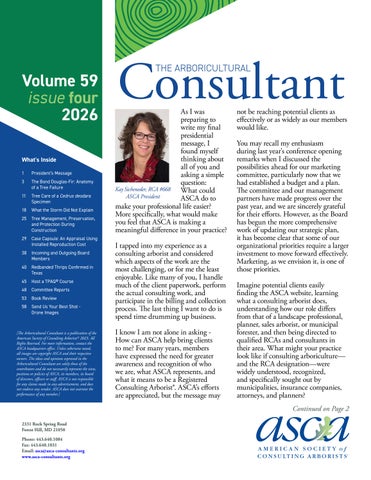
As I was preparing to write my final presidential message, I found myself thinking about all of you and asking a simple question: Kay Sicheneder, RCA #668 What could ASCA President ASCA do to make your professional life easier? More specifically, what would make you feel that ASCA is making a meaningful difference in your practice? I tapped into my experience as a consulting arborist and considered which aspects of the work are the most challenging, or for me the least enjoyable. Like many of you, I handle much of the client paperwork, perform the actual consulting work, and participate in the billing and collection process. The last thing I want to do is spend time drumming up business. I know I am not alone in asking How can ASCA help bring clients to me? For many years, members have expressed the need for greater awareness and recognition of who we are, what ASCA represents, and what it means to be a Registered Consulting Arborist®. ASCA’s efforts are appreciated, but the message may
not be reaching potential clients as effectively or as widely as our members would like. You may recall my enthusiasm during last year's conference opening remarks when I discussed the possibilities ahead for our marketing committee, particularly now that we had established a budget and a plan. The committee and our management partners have made progress over the past year, and we are sincerely grateful for their efforts. However, as the Board has begun the more comprehensive work of updating our strategic plan, it has become clear that some of our organizational priorities require a larger investment to move forward effectively. Marketing, as we envision it, is one of those priorities. Imagine potential clients easily finding the ASCA website, learning what a consulting arborist does, understanding how our role differs from that of a landscape professional, planner, sales arborist, or municipal forester, and then being directed to qualified RCAs and consultants in their area. What might your practice look like if consulting arboriculture— and the RCA designation—were widely understood, recognized, and specifically sought out by municipalities, insurance companies, attorneys, and planners? Continued on Page 2
2331 Rock Spring Road Forest Hill, MD 21050 Phone: 443.640.1084 Fax: 443.640.1031 Email: asca@asca-consultants.org www.asca-consultants.org
2026 BOARD OF DIRECTORS President Kay Sicheneder, RCA #668, Attica, MI President-Elect Nick Martin, RCA #552, Algonquin, IL Immediate Past President Ron Matranga, RCA #488, Spring Valley, CA Secretary/Treasurer Christian Hughes, RCA #493, Atlanta, GA Directors: Monika Buczko, RCA #785, Warminster, PA Debra DeMarco, RCA #672, South Miami, FL Kyle Offerdahl, RCA #714, Portland, OR Richard 'Ricky' Peterika, RCA #641, Tampa, FL
STAFF Executive Director Kristen Philips, MBA, CAE Associate Director Lisa Blair, QAS Credentialing Programming Manager Amy Giesy, QAS Director of Meetings Diane Schafer, CMP, DES Director of Marketing and Communications Amie Goscinski CFO & Director of Finance Mary Skudzinskas, CPA
NEWSLETTER The Arboricultural Consultant is published four times a year by ASCA. Articles and news items are encouraged and must be submitted six weeks prior to publication. Editorial Committee Chair Kat Cummings, RCA #781 Editorial Review Committee Julie Collins, RCA #811 Lisa Smith, RCA #464 Craig Southwell, RCA #692 Steve Lane Jaclyn Salts Guy Meilleur Board Liaison: Ron Matranga, RCA #488
I am increasingly convinced that my time and expertise are better spent applying my professional knowledge than pounding the pavement trying to make people aware that our profession exists. I suspect many of you feel the same way. There is good news for all of us. ASCA is financially stable, and over the past several years we have been able to build our financial reserves. The Board's goal is to maintain a reserve equivalent to one year's operating budget, consistent with recommended practices for 501(c)6 organizations. As I reported last year, we are well on our way toward meeting that goal in the coming years. With the strategic plan update, however, the Board is identifying important organizational needs that cannot wait. We have allocated funds to strengthen the organizational and educational foundation of the Consulting Academy to ensure our flagship program is in line with certificate program standards. To assist with this effort, we engaged CredUp, consultants specializing in education and credentialing. We have also allocated funds for marketing initiatives and anticipate supporting more substantial efforts over the coming year and beyond. We recognize that meaningful marketing takes time, planning,
and investment. Our hope is that you have already begun to see, or will soon see, the benefits of these efforts. Many years ago, while managing a plant health care department and later serving as a city forester, I thought of consulting as the nirvana of arboriculture. I am happy to say that I still see it that way. Our profession offers the opportunity to put experience, knowledge, and sound judgment to work in ways that make a real difference—and to actually get paid for our opinions! Through its continued investment in education, professional development, and especially marketing, ASCA seeks to support that almost nirvana-like appreciation of our craft. Just as importantly, we want to make it easier for the clients who need our expertise to recognize its value and find their way to us. Sincerely,
Kay Sicheneder, RCA #668 ASCA President 2026
ASCA ANTITRUST STATEMENT The following antitrust statement has been approved by the president and board of directors of the American Society of Consulting Arborists. "Members of the American Society of Consulting Arborists, especially members of the board of directors and Society committees, are reminded that they do not and may not speak for or on behalf of the Society without the express permission of the president or board of directors of the American Society of Consulting Arborists. This prohibition includes the use of ASCA letterhead when making a statement of a technical, economic, or politcial nature. Members of ASCA speak only for themselves as professional consultants when giving or making statements.
American Society of Consulting American Arborists® Society of2 Consulting Arboricultural Arborists® Consultant 2 volume Arboricultural 59 issue 4C2026 onsultant volume 59 issue 4 2026
The Bond Douglas-Fir: Anatomy of a Tree Failure By John Bornsworth, RCA #724, Peninsula Environmental
The Storm Outside, the familiar, looming trees in the backyard swayed against a dark January sky as another winter storm swept across Portland. The way the trees moved in the wind reminded him of Christmas trees haphazardly fastened to a van roof while driving on the highway. Gusts rattled the windows, branches flexed overhead, and faint noises of cracking wood could be heard in the distance. It was the kind of storm that makes homeowners glance outside more than once in the night. He had wondered about the tree before; pondered its health and its capacity for destruction. The large tree leaned towards his house and nearly over it. Its branches, beginning 50 feet in the air, imparted shadows across the roof. He had wondered and his concern had been reassured, though just partially. He had requested permission from the City of Portland to remove the tree. He was not a tree professional and had no consequential understanding of the tree and the potential danger it posed, but for him, the 100-foot or so tree leaning directly towards his house was enough to question its safety. He knew the consequences of it falling would be tremendous, even without a tree background. He did what responsible homeowners are encouraged to do: submit a permit for removal and have the City send out its tree inspector. Portland had responded, and a city tree inspector had examined the tree. Twenty-three months earlier, the tree inspector identified the tree as healthy and having no concerning features. The permit was denied; the tree could not be removed. This was not simply an opinion from a neighbor or a Reddit forum. This was the conclusion of a municipal authority responsible for determining whether a tree presented sufficient danger to warrant removal. To a homeowner, this decision offered some reassurance. It suggested the tree was evaluated by someone with the knowledge and authority to make that judgment. But the wind continued to blow and the wind seemed strong. Two inches of snow covered the ground and there were news reports of tree failures across Portland. When he heard the crack, he knew where it originated. Within seconds the tree crashed catastrophically into his house, axing through the roof and second story. Green needles and rain filled his home. The Case The Bond family filed suit against the City of Portland in 2024 after the 34-inch DBH Douglas-fir crashed into their home. Joseph Piucci, a distinguished trial attorney, took their case. Questions eventually led to months of forensic investigations, municipal policy review, depositions from the tree inspector and other city staff, including Portland's City Forester, and, ultimately, a trial jury. Trial lasted a week in July 2026. After hearing opinions from plaintiff’s experts Registered Consulting Arborists David Hunter, RCA #408 and myself, a meteorologist, and defense experts, the jury of twelve found the City of Portland liable for negligence, allocating 75% fault to the City and 25% to the Bonds.
American Society of Consulting Arborists®
3
Arboricultural Consultant volume 59 issue 4 2026
The Bond Douglas-Fir: Anatomy of a Tree Failure continued
As is common with large cities, the City of Portland regulates all trees over a certain diameter, whether they are publicly owned or privately owned. More unusually, Portland employs its own tree inspectors to provide an initial assessment of trees, while opinions from third-party consulting arborists are considered only after the tree owner pays the City a $200 appeal fee. Across the world, municipal arborists, urban foresters, and consulting arborists make thousands of decisions every year regarding potentially hazardous trees. Every assessment carries consequences. A permit denial by a tree inspector is more than an administrative decision – it communicates to a tree owner that the tree has been professionally evaluated and is sufficiently safe. This article examines the weight of arboricultural decisions, how defects and indicators of decay are interpreted, how tree risk is assessed and communicated, and the lessons consulting arborists can draw from this highly scrutinized tree failure. Reconstructing the Failure During forensic investigations by David Hunter and myself, details emerged that revolved around four distinct and overarching findings: Photo 2: Tree Growing In harsh Landscape
Finding 1: Tree Pathology, Decay, and External Indications The 34-inch DBH Douglas-fir snapped at its base. The tree did not overturn or uproot. The Certified Arborist who examined the tree after its failure in January 2024 noted extensive brown cubical rot inside the stump and into the trunk. Brown cubical rot growing inside live trees in the Pacific Northwest is commonly attributed to Phaeolus schweinitzii or Dyer’s polypore. P. schweinitzii is a facultative parasite and opportunistic wood-decay pathogen, meaning it will live saprobically by consuming dead wood but can also infect and cause dysfunction in living trees. Its consumption of nonliving heartwood is saprobic even while the tree remains alive. This differs from obligate parasitism where an organism depends on its host remaining alive. The City’s tree inspector did not observe a fruiting body of P. schweinitzii during the February 2022 inspection. During testimony, it was revealed that if a fungal fruiting body had been observed, the tree removal permit would have been authorized. The fruiting body of P. schweinitzii is episodic and semi-persistent. Its fruiting bodies are classified as annual because their spore production is limited to one growing season, not because they necessarily develop annually. The fruiting bodies may, or may not, externally reproduce in any given year depending on weather. These fruiting bodies normally appear between late August and October and present themselves on woody substrate, low to the ground or even near the soil. When growing on the soil, the fruiting bodies are commonly mowed over by homeowners or picked up and discarded. The fruiting bodies themselves have been described to homeowners as having a “bark-like” appearance, so their presence may or may not alert a homeowner. They also do not have the clear mushroom-like, or conk-like, appearance homeowners are familiar with. Semi-persistent? While the fruiting bodies do decay, they can persist for 1-3 years, becoming more bark-like, degraded, and indistinguishable over that duration. During my examination of the stump in 2026 I discovered a large P. schweinitzii fruiting body… inside the stump. The stump was extensively decayed; roughly 70% of its interior showed signs of advanced brown cubical rot. The cavity where the fruiting body was discovered was substantial. The fact this cavity was large enough for a fruiting body to develop 6 inches in depth indicated that the decay had been active for decades. This wood was not simply decayed – it was decomposed. American Society of Consulting Arborists®
4
Arboricultural Consultant volume 59 issue 4 2026
The Bond Douglas-Fir: Anatomy of a Tree Failure continued
P. schweinitzii is a slow processor of wood. Arboricultural studies are lacking, as they generally are, but anecdotal evidence indicates trees with active conks can themselves remain standing for decades. This indicates the fungal colonizer was present in the tree long before the tree was inspected 23 months preceding the failure. Due to the episodic nature of P. schweinitzii, and many other wood decay pathogens, presence or absence of fruiting bodies is not the only evidence that arborists are trained to interpret. Of course, observing and recording a fruiting body is useful. But the absence of a fruiting body during casual observation should not negate the possibility of decay. Instead, arborists use tools and indicators of wood decay upon which to predicate the existence of fungal colonization. Such indicators can include bole, root, or “butt” swelling, showing the tree’s gradual response growth in reaction to its own internal decay. All three arboricultural experts, representing both plaintiff and defense, noted the base of the tree appeared swollen. There was at least one, and possibly two, indentations on the trunk near two enlarged buttress roots. Depending on the severity, these indications do not necessarily and immediately condemn a tree, but they should provide reasonable evidence to a qualified tree risk assessor of the need to investigate further. Finding 2: The City's Inspection and Risk Communication The City of Portland defended its tree inspector's decision and the inspection as sufficient. During pretrial and trial testimony, the tree inspector and other City staff provided the following details: 1) The inspector spent less than 10 minutes on site evaluating the tree that failed. 2) The inspector never used a sounding mallet, believing sounding would provide insufficient information, and that other tools are available to produce more quantifiable results. 3) The inspector did not follow the ISA’s Qualified Tree Risk Assessment procedure, did not identify any targets, nor likelihood of impact or consequence of failure. 4) The City did not identify occupants of the residence as human targets. It was described during testimony that homeowners would have to expressly disclose the fact they lived in their home for the inspector to consider them a possible target. Further, testimony revealed the tree inspector routinely evaluated trees while owners were not present, giving little opportunity for any verbal disclosure. For this assessment, the tree inspector failed to notify the homeowners of their visit. 5) The tree inspector testified that they had not seen or read Portland’s Urban Forestry administrative manual, which outlines their process for risk assessments and the determination of a “danger tree.” This internal guidance specifies a 3-year timeframe on risk assessments, along with other administrative tree risk decisions. During trial testimony, plaintiff’s experts examined the lack of use of a sounding mallet. While there are certainly more advanced and reliable techniques to quantify decay present inside living trees, like sonic tomography and micro-resistance drills, these tools are expensive, require advanced training and are not readily accessible. Sounding mallets are readily available, inexpensive, and provide useful information when the user is properly trained and experienced. Indeed, even a diameter tape is not reliable until the user is trained on its proper use. The reasonableness of not identifying human occupants of a home as targets was examined by plaintiff’s experts. It was the opinion of those experts that 1) the homeowners were not properly informed that they needed to expressly disclose their level of occupancy within a home they lived in, and 2) it is unreasonable for a qualified Tree Risk Assessor to dismiss human targets within an occupied home simply because that information was not expressly disclosed.
American Society of Consulting Arborists®
5
Arboricultural Consultant volume 59 issue 4 2026
The Bond Douglas-Fir: Anatomy of a Tree Failure continued
Tree owners are not tree risk assessors. How can they know of extraneous details like targets, occupancy, and their implications on tree risk? Importantly, the City of Portland’s Urban Forestry administrative manual specifically differentiates between human and non-human targets. This manual establishes a lower risk threshold for classifying a tree as a ‘danger tree’ when humans are targets. Moderate and greater overall risk qualifies as a danger tree when humans are targets, whereas high and greater overall risk is required where non-humans are targets. This administrative nuance and the reluctance to identify homeowners as occupants of their own homes materially changed the interpretation of ‘danger tree’ in this situation. To quote the manual: “If the Target is a Person the tree will be considered dangerous if the risk is Moderate High or Extreme. If the Target is Not a Person the tree will be considered dangerous if the risk is High or Extreme.” Appealing decisions made by Portland tree inspectors begins with a $200 fee. Only then will the City review private, third-party diagnostics and opinions. During trial, the Bonds testified that they had not sought an appeal provided the tree had already been inspected by a tree inspector who were themselves Tree Risk Assessment Qualified. The Portland tree inspector had verbally provided the tree owner with general criteria required for the City to qualify the tree as a danger tree and authorize its removal. Such criteria included the presence of an externally visible fungal fruiting body. The Bonds had not observed such criteria and, as such, correctly or incorrectly, believed any future appeal would have resulted in the same denial. The concept of informed consent was a lingering concern. Portland’s Urban Forestry staff and third-party consulting arborists are professionally trained in tree risk assessment and should understand the bestmanagement practices and standards that apply to that work. Our clients are not. These practices and standards are not common knowledge, and assuming their implications are understood by our clients without expressly informing them is troublesome. Did the tree owners understand which targets were identified and which were not? Did they understand that Portland’s internal documentation specified a 3-year timeframe on tree assessments? Was it understood that private consultants may have different opinions? Most importantly, did the owners understand residual risk remained after the assessment was performed and what further options were available to them? Finding 3: Likelihood of Impact and Consequences of Failure Were High Notwithstanding the biological and anatomical evidence informing us of the tree’s likelihood of failure, the tree’s likelihood of impact and consequences of failure were examined. Two primary characteristics affected these risk criteria: the lean of the tree towards the house and the tree’s distance from the house. The tree was described in testimony as having a 10-15 degree lean directly toward the house. This lean started at the base of the tree, to roughly 50 feet high, at which point the lean self-corrected and continued vertically for another roughly 50 feet. From photos, the lean could be identified not as a sweep, or curve, but as a bend at a central point. This is important as it implies not a spatial or environmental phenomenon that caused the conifer to gently grow and curve in response to that phenomenon, but a more acute modification to its vertical axis, what we commonly refer to as a ‘crook’.
American Society of Consulting Arborists®
6
Arboricultural Consultant volume 59 issue 4 2026
The Bond Douglas-Fir: Anatomy of a Tree Failure continued
The growth of Douglas-fir trees was twice described in Portland’s testimony as phototropic, or growth in response to light. This phototropism, in Portland’s view, is what chronicled the acute bend in the tree. Douglas-fir trees do grow phototropically, primarily in their branch elongation and orientation, and slightly in their apical growth. Yet, it is well understood that in Douglas-fir, and many other conifers, phototropism is drastically outweighed and counteracted by their tendency toward gravitropism, or growth in response to gravity. The acute bend in the Douglas-fir could not reasonably be attributed to phototropism. Ironically, if the tree that fell had been within ten feet of the house, Portland’s Urban Forest code would have allowed for its removal based on that criterion alone, regardless of other characteristics. This is despite the fact that a tree located farther from a target must rotate through a greater angle before impact, allowing its angular velocity to increase as it falls. This results in greater impact velocity and energy, increasing the potential for damage when the tree strikes the target. To assist the jury in understanding these concepts, it was pointed out at trial that this is not advanced tree physics or biomechanics; this is baseline information taught in the two-day TRAQ class – there are even diagrams visually describing the concept in the manual. If the Bond tree had been located within 10 feet of their house, rather than at its 28 foot distance, it would not have impacted their house with as great a force upon failure. The lean and the distance demonstrated a high likelihood of impact and a severe consequence of failure. A large tree with a pronounced lean will most likely fall in the direction of that lean. Its target zone is reduced in dimension – the tree almost certainly will not fall against the lean – but the likelihood of failure within the remaining target zone is amplified by the lean. Further, due to the distance from the house and the resulting angular velocity at impact, the consequence of failure was severe. With likelihood of impact and consequence of failure established, a possible likelihood of failure would result in moderate overall risk, while a probable likelihood of failure would result in high overall risk.
Finding 4: The Wind Event Was Predictable and Precedented On or near January 13, 2024, between 600 and 800 trees fell in the Portland Metro area. In an effort to understand this phenomenon more thoroughly, I conducted a simple analysis of National Oceanic and Atmospheric Administration (NOAA) data between 1985 and 2025. NOAA provides historical daily and hourly weather data that can be freely downloaded, and this data includes a field for maximum recorded daily gusts. It was revealed in my analysis that Portland experienced the same and greater wind speeds between one and five times each year since 1985, with an even greater frequency occurring between 2015 and 2025. The tree had grown and responded to similar or greater winds for at least 40 years. Why did it fall on January 13, 2024?
American Society of Consulting Arborists®
7
Arboricultural Consultant volume 59 issue 4 2026
The Bond Douglas-Fir: Anatomy of a Tree Failure continued
After this cursory research, I recommended to plaintiff’s counsel that they retain a meteorologist. Arborists can only talk about weather so much. The expert meteorologist, using much more elaborate documentation, reached substantially the same conclusion. The wind speeds on January 13, 2024, were not extraordinary – they were like many other preceding storms. The wind speeds were not uncommon and had occurred one to five times annually for decades, since well before 1985. Aspects of localized wind speed and direction based on topography and other factors were considered, by the meteorologist, with no significant difference. Reconciling this information, why did 800 trees in Portland Metro fall during this one storm? It turns out the Portland storm on January 13, 2024, was unprecedented, but in a completely different manner: the 10 days leading up to the storm received nearly 6 inches of rain. This volume of precipitation was nearly double the preceding 10 days of precipitation during any of the other windstorms generating similar wind speeds. The soils in the region were highly saturated well before the wind started to blow. Soils lose strength as they become saturated. Think of the billions of tiny soil grains beneath your feet, all locked together. This interconnected framework, called the soil skeleton, allows the soil to resist movement and provides the anchorage that tree roots depend on. The soil grains remain in grain-to-grain contact, transferring forces between one another as loads are applied. As water fills the pore spaces between those grains, pore-water pressure increases and reduces the effective stress carried through the soil skeleton. With less effective stress between the soil grains, the soil has less resistance to movement and its shear strength decreases. For trees, that means root systems have less resistance from the soils they occupy as wind applies bending loads to the canopy and stem. This coincidence between soil saturation and wind speeds is what caused the mass failure of trees across the Portland Metro, not simply wind speeds alone. Yet, the tree that fell onto the Bonds’ home in January 2024 did not uproot, like hundreds of other trees in Portland did. This tree snapped at its base due to extensive decay present within the stump. Certainly, the predictable wind speeds on that day were a trigger for the wood fibers breaking, but the advanced internal decay created the susceptibility to that wind. Trigger and susceptibility. The Takeaway The aftermath of the Bonds’ Douglas-fir failure was more than simply a tree falling during a winter storm. This was a long process that began with fungal colonization and resulted in catastrophic damage. The wind during the storm was the trigger; the advanced internal decay was the susceptibility. Distinguishing between the two was fundamental to understanding why this tree failed. Weather may ultimately trigger a failure, but that does not necessarily explain why a particular tree was susceptible to failure under those specific weather conditions. True tree risk can rarely be defined by a single observation. Fruiting bodies may be absent, decay may be concealed, and individual defects may have little meaning when considered in isolation. Arborists instead need to assemble observations, site conditions, tree history, targets, and other available evidence to develop a defendable opinion of risk. Yet there is an inherent limitation to this process: we are typically asked to evaluate a tree at a single point in time. Trees are living, changing organisms growing within equally dynamic environments. We cannot observe every previous response to wind, every stage of decay development, or every condition that may occur in the future. Our assessment is a snapshot. The responsibility of the arborist is to make that snapshot as complete as reasonably possible by recognizing what is observable, understanding what those observations may indicate about conditions we cannot see, and investigating further when the evidence warrants it.
American Society of Consulting Arborists®
8
Arboricultural Consultant volume 59 issue 4 2026
The Bond Douglas-Fir: Anatomy of a Tree Failure continued
Perhaps most importantly, our clients rely upon the conclusions we provide. They do not necessarily understand assessment methodologies, timeframes, residual risk, or the limitations of an inspection unless we explain them. Our ethics compel us to support the informed consent of our clients. Whether working as a municipal arborist or private consultant, our decisions can carry significant consequences.
Finally.
arborcode.app
A software made for consulting arborists. Faster in the field. Less time at the desk.
Try it now. Easily import the surveyor’s files. Collect on your phone with your own custom fields, even offline. Save a trip. Catch weak GPS and missing data before leaving the site. Your report builds automatically as you collect. Export a CAD-ready DWG, photo report and client map.
American Society of Consulting Arborists®
9
arborcode.app
Works with
Used by
Arboricultural Consultant volume 59 issue 4 2026
WE’VE MADE YOUR TREES OUR BUSINESS. EXPERT TREE CARE FOR 119 YEARS — AND GROWING. Acer saccharum, better known as Sugar Maple, is just one of the thousands of species we specialize in. For 119 years, our family-owned company has brought a rare mix of groundbreaking science, award-winning safety practices, and global resources to every tree and shrub care task at hand. And at the heart of our success are our people — experts who know and champion every tree, no matter the species. Discover how our passion is inspiring one beautiful property after another.
Call 877-227-8538 or visit bartlett.com CONSULTING | PRUNING | FERTILIZATION | CABLING & BRACING INSECT & DISEASE MANAGEMENT | TREE INSPECTIONS STORM DAMAGE | LIGHTNING PROTECTION | REMOVALS The F. A. Bartlett Tree Expert Company
American Society of Consulting Arborists®
10
Arboricultural Consultant volume 59 issue 4 2026
A Day in the Life of a Consultant: Tree Care of a Cedrus deodara Specimen By Luciano Riva
The Himalayan Cedar (Cedrus deodara) is one of the most appreciated ornamental tree species in urban environments due to its high landscape value, its potential size, and its ability to adapt to different soil and climatic conditions. However, the management of mature specimens requires an integrated approach that takes into account not only the physiological needs of the species and disease management, but also the biotic and abiotic pressures to which the tree is exposed in city environments. This article analyzes the care process of an adult Cedrus deodara, with the aim of describing the strategies adopted to improve its vegetative condition and to ensure long-term structural stability. The analysis is part of a broader framework of ornamental green space management, contributing to the definition of operational protocols that can be replicated in similar conditions. With regard to its origin, Cedrus deodara naturally grows in a hardiness zone 7B, which is very similar to the zone where the specimen under care was planted (7A). The tree is located in the inner courtyard of a supermarket. Part of the green area surrounding the base of the tree is used as an outdoor seating area for a café and as a children's play area. The area is heavily frequented, during supermarket opening hours many people remain for relatively long periods in close proximity to the tree. As a result, heavy foot traffic leads to deteriorating soil conditions, causing soil compaction and reducing the amount of oxygen available to the tree. The first assessments of the tree were carried out in May 2019; the condition of the plant was as follows:
Cedrus deodara specimen, year 2019.
In 2019, the dimensions of the tree were as follows: height 82 feet (25 meters), trunk diameter 49 inches (124 cm). The address and the location of the tree are as follows: viale Belforte 315, Varese, Italy. Latitude 45°48’28.32’’N. Longitude 8°51’40.81’’E. American Society of Consulting Arborists®
11
Arboricultural Consultant volume 59 issue 4 2026
Tree Care of a Cedrus deodara Specimen continued
For disease diagnosis, and more generally to determine the condition of a tree, a logical–deductive method is used. Through the observation of symptoms and specific characteristics of the tree, both its health status and risk level are assessed. In this case, instrumental investigations were also carried out, including tomographic analyses to determine the condition of the internal portion of the trunk. As of 2019, the tree showed the following crown symptoms: microphyllia (needles shorter than normal), needle drop, high crown transparency, widespread dieback, a strong reduction in vitality and shoot growth, more severe symptoms in the upper part of the crown. The tree also showed synptoms on its trunk: spheroblasts at the base of the trunk, removal of two large lateral branches flush with the trunk with subsequent development of wood decay, resin exudation at the base of the trunk along the entire circumference and up to 1 meter above ground level. Other symptoms were also observed: absence of the original apex due to probable lightning damage, candelabra-shaped growth habit as a response to the removal or damage of the apex, branch dieback, the trunk also exhibited signs of lightning damage, visible in the bark.
Wood decay at the site of a big cut made for the removal of a branch, year 2019.
American Society of Consulting Arborists®
Resin exudations at the base of the trunk, year 2019.
12
Arboricultural Consultant volume 59 issue 4 2026
Tree Care of a Cedrus deodara Specimen continued
The parasites that could have accounted for the observed symptoms were the following: - Armillaria mellea (characteristic symptoms: presence of fan-shaped mycelium beneath the bark, formation of fruiting bodies in the autumn season preceding the investigations, rhizomor phs in the soil near the tree, initial development of white wood rot) - Phytophthora sp. (browning of subcortical tissues at the root collar, absence of visible mycelium, no rhizomorphs, sharp boundaries between infected woody tissues and adjacent healthy tissues) - Heterobasidion sp. (decay in the central part of the trunk, root wood decay even at a considerable distance from the collar, possible presence of fruiting bodies at the base of the trunk) - Rosellinia necatrix (cottony mycelium on the roots, no fan-shaped mycelium, more flattened rhizomorphs, more commonly associated with broadleaf species) - Internal wood decay within the trunk The non-parasitic factors that could have accounted for the symptoms were the following: - Water stress - Soil compaction - Low level of soil oxygen - Mechanical damage to the roots - High soil salinity A more detailed inspection made it possible to exclude the presence of Armillaria, due to the absence of mycelium, fruiting bodies, and rhizomorphs. The other possible pathological causes, such as Heterobasidion, Rosellinia, and Phytophthora, were also excluded because of the absence of their specific symptoms. Heterobasidion: root decay and deterioration of structural roots, absence of fruiting bodies. Rosellinia: cottonlike fungal micelium covering infected roots, absence of white micelium between bark and Wood, extensive decay of structural roots. Phytophtora: black discoloration of the tissues beneath the root bark, absence of the same symptom at the base of the trunk. The areas of decay on the trunk were examined in order to quantify the specific risk, in this case trunk failure. The assessment was carried out using a Resistograph, and a high risk of trunk breakage was excluded. To further investigate the condition of the trunk, particularly the internal, non-visible portion, a tomographic analysis was performed at the base. This investigation served to define the internal condition of the trunk, any reactions of the tree, and potential risks of failure. The instrumental test produced the following result:
American Society of Consulting Arborists®
13
Arboricultural Consultant volume 59 issue 4 2026
Tree Care of a Cedrus deodara Specimen continued
The central portion showed degradation affecting 42% of the total basal cross-sectional area of the trunk; the remaining outer sound wood layer was intact and continuous around the entire circumference, with no reaction barriers present. The remaining part of the trunk cross-section consisted of sound wood and reaction wood (46%), and wood with intermediate characteristics (12%). Tomography differentiates wood tissues into five categories: cavities or completely decayed wood (light blue), decayed wood (purple), wood with intermediate characteristics (green), sound wood (brown), and reaction wood (black). Reaction barriers can be identified when reaction wood is directly adjacent to cavities or decayed wood. In this case, no reaction barriers were detected in the tomogram because wood with intermediate characteristics (green) was present along the cavity boundaries, indicating a gradual deterioration of the wood tissues. Wood decay is progressing, as localized areas of decayed wood are also present within regions of otherwise sound wood. The degradation in the central part of the trunk, corresponding to 42% of the cross-sectional area, reduced the load-bearing capacity of the woody section by approximately 20%, given that the remaining outer layer was intact along the entire circumference. The degraded portion did not substantially affect the stability of the tree, resulting in a low risk of trunk failure. The relationship between the amount of decayed wood and the reduction in the load-bearing capacity of wood cross-sections is based on the studies conducted by engineer Wessolly. For wood decay such as that shown in the tomogram, the reduction in load-bearing capacity is approximately 20%, even though the decayed wood accounts for about 40% of the cross-sectional area. The wood decay located at the center of the basal portion of the trunk was not connected to, and was not responsible for, the symptoms observed. With regard to the crown, the needles showed symptoms of sooty mold disease, most likely due to the presence of aphids during the 2018 growing season. This disease is not severe, and cedar trees typically coexist with it. The tree did not show fungal root diseases nor serious crown diseases (e.g. Lophodermium cedrinum); however, its vitality was very low and the specimen exhibited advanced signs of physiological stress. The condition of the tree was attributable to the following main causes (in addition to secondary ones): lightning strike, heavy foot traffic, and the presence of a fabric covering the root system. Secondary causes contributing to the state of decline included wood decay at pruning cuts, aphids, and sooty mold on the needles. Once the symptoms had been identified, it was still necessary to determine the causes of the tree’s condition. At the base of the tree, works had been carried out that affected the root system: installation of a steel edging, placement of a surface fabric, installation of furnishings, and application of gravel. In addition, the area beneath the tree had been damaged by foot traffic, resulting in compaction of the soil.
American Society of Consulting Arborists®
14
Arboricultural Consultant volume 59 issue 4 2026
Tree Care of a Cedrus deodara Specimen continued
Among the causes of the tree’s decline, the main ones were trampling damage and the fabric placed over the root system. Fabrics placed above roots are typically installed to prevent or reduce weed growth, for easier area management. However, fabrics laid over roots are detrimental, as they reduce the amount of oxygen available to the roots, which is essential for all vital processes occurring in these organs. Oxygen moves by diffusion from the atmosphere (where it is more concentrated) into the soil (where it is less concentrated). Oxygen is present in the soil according to a concentration gradient: maximum at the interface with the atmosphere, decreasing to minimal or zero values at greater depths. The time required for the first symptoms of oxygen deficiency to appear is usually relatively long and depends on factors such as the ontogenetic age of the plant (specimens in the senescence phase show symptoms earlier), the presence of other pathologies, nutritional and vegetative status, and the duration of oxygen deficiency. Once the investigation phase was completed, it was necessary to formulate an intervention proposal, including a work plan aimed at improving the condition of the tree. This plan was then delivered to the arboricultural company responsible for implementing the recommended interventions. In this case, the recommended interventions were as follows: - removal of the fabric, edging, turf, gravel, and furnishings from above the roots - manual soil aeration near to the roots, up to a distance of at least 6 meters from the trunk, by creating vertical holes with a diameter of 2 cm, a depth of 50 cm, and a density of 5 holes per square meter - application of bark or wood chips up to a distance of 6 meters from the trunk - organic fertilization; organic matter promotes soil particle aggregation and improves soil aeration capacity - installation of a small wooden fence to delimit the area beneath the tree - application of products to increase the tree’s capacity to form roots, consisting of seaweed extracts (Ecklonia maxima) with hormone-like effects in plants - application of substances based on Bacillus subtilis and Streptomyces spp. - reassessment of conditions after two years Two years after the initial intervention, a site inspection was carried out to verify the condition of the tree. The condition of the cedar specimen in the years following the interventions can be seen in the photographs from 2020 to 2025.
August 2020
September 2023
American Society of Consulting Arborists®
September 2024
15
September 2025
Arboricultural Consultant volume 59 issue 4 2026
Tree Care of a Cedrus deodara Specimen continued
In view of the outcomes of the treatments, the monitoring activities will be completed through further site inspections in the following years, in order to verify the possible appearance of additional diseases or the execution of other human interventions that may interfere with the tree. Follow-up inspections were conducted annually after the initial investigations. During these inspections, particular attention was paid to the symptoms described earlier, associated with the main diseases to which Cedrus deodara is susceptible. After several years of observation, the improvements are believed to be primarily attributable to better soil conditions, including improved soil structure and adequate oxygen availability for the roots. No symptoms of new diseases were detected up to 2025. Regarding the wood decay at the base of the trunk, an additional follow-up tomographic assessment will be necessary (level 3 advanced assessment). The decay has not affected the tree's overall health, but it does have implications for its structural stability. In other words, the tree's health and vigor have improved as a result of better soil and root conditions. The wood decay at the base of the trunk will be monitored as part of the tree risk assessment, since it has not caused any deterioration in the vascular tissues responsible for transport, nor has it adversely affected the vitality and health of the crown. Pulling tests will not be performed, as no specific signs indicating a risk of tree overturning or root system failure have been observed.
2025
ANNUAL CONFERENCE
La Cantera Resort & Spa - San Antonio, Texas
2025 Annual Conference Recordings Are Now Available! ASCA Annual Conference 2025 session recordings are now available for purchase and instant download. Sessions available for purchase are the general sessions from Monday (12/8) to Wednesday (12/10)*. *Does not include pre- or post-conference workshops
20 ASCA CEUs Available* *Not approved for ISA CEUs
Pricing for purchase: - ASCA Member: $400 - Non-Members: $500
Click Here to Purchase! American Society of Consulting Arborists®
16
Arboricultural Consultant volume 59 issue 4 2026
205 West Rankin Street, Jackson, MS 39201 www.forestry-suppliers.com
The gear you need, when you need it. Since 1949, we’ve been committed to providing you with the tools you need exactly when you need them. Trust us to help you get the job done without any compromises.
Save 7% on your next purchase!
Contact ASCA Headquarters at asca@asca-consultants.org for the code to take advantage of the member discount! Don’t miss out on this exclusive Forestry Suppliers promotion!
Over 13K unique & hard-to-
We have been an independent
find products serving outdoor
and family-owned business
professionals!
since day one!
PROFESSIONAL PRODUCTS TO GET THE JOB DONE WITHOUT COMPROMISE.
American Society of Consulting Arborists®
Follow us on Facebook, Instagram, and LinkedIn to stay up to date on social media-specific promotions and sales.
/ForestrySuppliers
17
Arboricultural Consultant volume 59 issue 4 2026
A Day in the Life of a Consultant: What the Storm Did Not Explain Decay, Detectability, and Notice in a Hadonfield Tree Failure By Jason C. Miller, RCA #526, BCMA
When I inspected the Haddonfield site on December 1, 2020, nearly six months after the failure, only the fallen buttress and a few trunk sections remained. The interior of the buttress was largely missing. No substantial soilbearing root plate was attached, and the wood around the hollow was soft and spongy. Those observations made advanced decay difficult to dispute. They did not, by themselves, establish what anyone could have recognized while the tree was standing. According to Brenda Zadjeika, the black oak (Quercus velutina) failed around noon on June 3, 2020, during the derecho. It stood on property owned by New Jersey American Water. A plaque on the trunk commemorated Arbor Day 1985 and identified the black oak as dating to approximately 1830, calling it the “2nd oldest in N.J.” As it fell across Lake Street, it destroyed a utility pole and brought down the lines before striking a pin oak beside her property. Both trees collapsed onto her home, forcing her and her daughter to relocate. I was retained to investigate the cause and predictability of the black oak’s failure. The opposing arborist also acknowledged advanced decay. Our disagreement concerned its detectability before failure, the significance of the external indicators, and the role of the storm. For a consulting arborist, that is the useful part of this case: how far the available evidence could take us from a hollow buttress on the ground to an opinion about an inspection that might have occurred years earlier.
Figure 1. The fallen black oak extends from the lawn across Lake Street. The broken utility pole and downed lines lie in the foreground. June 3, 2020.
Reading the Failure at the Base At the buttress-root fractures, I found weakened wood with blocky, abrupt fracture patterns. The combination of missing interior wood, degraded remaining tissue, and fracture near ground level supported my opinion that advanced decay had materially reduced the strength of the base and structural roots. Photographs taken shortly after the incident showed the buttress in substantially similar condition, an important check on observations made months later.
American Society of Consulting Arborists®
18
Arboricultural Consultant volume 59 issue 4 2026
What the Storm Did Not Explain continued
My interpretation was facture through compromised basal and root tissues rather than a rotational or hingetype failure of an otherwise sound root system. The absence of a substanial root plate was one part of that interpretation. It was not a diagnostic test by itself, nor would the height of the break alone establish decay. The condition of the actual fracture surfaces supplied the stronger evidence. My August 2022 report was preliminary; the client did not authorize the cost of a full report. My inspection was observational. I did not perform invasive testing or measurements from which to calculate residual loadbearing capacity. A precise percentage of strength loss would therefore imply more information than I had. The defensible conclusion was substantial deterioration at the point of failure, supported by the physical evidence.
Figure 2a (left).The black oak buttress during my December 1, 2020 site inspection, showing extensive internal hollowing and deteriorated wood around the fracture. Figure 2b (right). A side view of the black oak buttress shows the point of failure.
Although not discussed in my preliminary report, the growth rings showed an abrupt reduction in radial growth beginning a little more than two decades earlier. I suspected mechanical root injury within the critical root zone. Installation of the sizable utility access panels approximately eight feet from the trunk, beside the building’s corner, was one possible explanation. Such an injury could have contributed to the decay and subsequent decline, but I had not established that sequence. Tracing the original injury was not my assignment; determining whether the resulting condition warranted attention was.
Figure 3. Growth rings showing the abrupt reduction in radial growth discussed above. The suspected root injury and its possible connection to utility work were not established. Scale in inches.
American Society of Consulting Arborists®
19
Arboricultural Consultant volume 59 issue 4 2026
What the Storm Did Not Explain continued
Reconstructing What Could Have Been Seen Google Street View supplied more than a decade of historical context. In my report, I discussed images dated September 2012 and August 2017. I interpreted them as showing sizable dead and deteriorating branches, long broken stubs, a trunk opening, and bark sloughing. The August 2017 imagery also showed fallen branch material near the tree. In reviewing the historical imagery, I noted several areas of apparent trunk bleeding. These were images taken from a roadway, with the usual limitations of viewing angle, resolution, and obstruction. They could document visible features and changes over time; they could not measure the residual wall or map decay through the root system. I used them to assess whether there were reasons for a closer inspection before the failure. The neighbors supplied a different kind of record. One who passed the tree almost daily from 2014 described uneven leafing, bare limbs, broken stubs, and fallen branches. She became concerned enough to cross the street or otherwise avoid the tree, particularly during storms. Witness accounts also included mushrooms near the base. I recall trial testimony that neighbors would not allow children to play in the field beneath the tree. Those accounts could help establish the persistence and visibility of conditions. They could not identify a decay organism or quantify a likelihood of failure. The technical task was to relate the observations to the tree’s condition without making each dead branch or reported mushroom carry more diagnostic weight than it could support. Explore a representative historical Street View panorama Interactive source: Google Maps / Street View
The Disputed Inspection Threshold The defense arborist interpreted the historical imagery differently. His report described the lower trunk, roots, and crown as appearing generally normal before the incident and characterized the decay as concealed by bark and soil. He also proposed earlier root injury associated with nearby construction as a cause of the decay and emphasized utility pruning by Public Service Electric & Gas (PSE&G). Those were competing interpretations of the record, not findings I shared. The practical disagreement was whether the external indicators warranted further assessment. In my opinion, the trunk opening and bark loss, substantial dead and deteriorating limbs, long stubs, and shed material provided that basis. Reported fungal growth added to the history. The proposed origin of the decay was a separate question from whether there were indications that an arborist should investigate it. Sounding became a surprisingly contested part of that discussion. Given the extent of hollowing, my opinion was that sounding the buttress with a mallet before failure would likely have produced a hollow response. The defense report challenged the scientific support for sounding and cited Kretzschmaria deusta as an example of decay that could escape detection. That limitation did not directly address my finding: extensive hollowing and soft, degraded wood in the subject tree’s buttress. As I recall, the defense expert testified that sounding was not a recognized inspection method and, on cross-examination, said he “would not use it.” Sounding was hardly an improvised inspection technique. A U.S. Forest Service guide described it by name in 1963, and subsequent arboricultural texts recognized mallet sounding as a useful preliminary screen for cavities. The mallet was decidedly low-tech; that was not the same as being uninformative. My conclusion was that the visible indicators warranted an assessment that would likely have disclosed the severe root and buttress decay and led to removal before the incident. That opinion depended on connecting the external indicators to the concealed condition through an appropriate inspection. It did not depend on a mallet providing a complete map of the defect. American Society of Consulting Arborists®
20
Arboricultural Consultant volume 59 issue 4 2026
What the Storm Did Not Explain continued
Accounting for the Derecho June 3, 2020, brought two distinct rounds of damaging weather to the region: the midday derecho, followed by a separate round of thunderstorms later that afternoon and evening. The National Weather Service’s event review describes both rounds. South Jersey Regional Airport (VAY) was slightly closer to the site than Philadelphia International Airport (PHL), but its observations around the reported failure time contained no wind speed or direction readings. I therefore used the PHL climatology report. My preliminary assessment reflected my understanding that thunderstorm gusts exceeding 50 mph were a recurring exposure in this region. Severe-thunderstorm warnings were a familiar part of the regional weather picture. Against that background, the 61-mph gust in the limited PHL record did not, by itself, strike me as evidence of extraordinary wind conditions. PHL recorded a higher gust of 68 mph during the separate round of thunderstorms later that day. The defense meteorologist, Gary Szatkowski, disputed that characterization and emphasized the derecho’s regional severity. Szatkowski cited the National Weather Service’s account of widespread damage, a measured 73-mph gust at Moorestown, approximately nine miles away, and a warning covering the site that anticipated 80-mph winds. He concluded that the event could uproot healthy trees. The black oak, however, did not uproot. It fractured at ground level through decayed basal and root tissues. The capacity of a storm to uproot healthy trees did not, by itself, explain that failure mechanism or resolve the contribution of pre-existing decay. An airport observation, a nearby measured gust, and a forecast warning are different kinds of evidence. None is a direct measurement of the wind acting on this crown at failure. They establish context for evaluating the load; they do not, on their own, determine the bending moment at the base or the remaining resistance of this tree. Exposure, crown architecture, and the distribution and condition of supporting tissues remain part of the analysis. Haddonfield is local to my practice, and I investigated a number of tree failures in southern New Jersey following this event. Every failure I investigated in that area involved a defect of one kind or another. In those cases, the central question was notice: whether the owner knew or reasonably should have known of the condition before failure. Defense counsel pointed to a tree failure a couple of blocks away that destroyed several cars as an example of the storm’s severity. I knew that tree, too: it was another of my investigations. The vehicle damage was substantial, but the exposed fracture also showed extensive internal decay. It was not an example of an otherwise sound tree failing.
Figure 4. A separate failure a couple of blocks away. Left: the fallen tree section and damaged vehicles. Right: the exposed fracture shows extensive internal deterioration. These are two views of the same failure, which I also investigated.
American Society of Consulting Arborists®
21
Arboricultural Consultant volume 59 issue 4 2026
What the Storm Did Not Explain continued
In eastern Pennsylvania, I encountered more severe storm damage and failures of otherwise sound trees. A healthy pin oak (Quercus palustris), approximately 100 years old, rotated in the soil and fell onto a building, killing someone inside. A roughly 70-year-old white pine (Pinus strobus) fractured at mid-trunk, shattering healthy wood. Those failures illustrated the wind’s capacity to overwhelm otherwise sound trees. They did not explain the fracture through decayed basal tissues in Haddonfield. For the black oak, the relevant question was how much resistance remained when this storm arrived. Its survival of storms in prior years did not establish that its structural capacity was unchanged by June 2020. Decay can progress between events, and local loading can differ between storm events. The analysis therefore had to address both the June 2020 loading and the tree’s deteriorated condition at that time.
Figure 5. Fallen stems and branches at the residence, with broken limbs, a damaged fence, and the downed utility pole and lines visible. The photograph records the post-failure arrangement; the impact sequence is interpreted with the other case evidence. June 3, 2020.
From Observable Conditions to Notice The distinction between an observable condition and notice matters here. A neighbor’s concern does not, by itself, establish that the owner received a complaint. It can help show what was visible, for how long, and why the condition attracted attention. Whether an owner knew or reasonably should have known about a condition requires the additional history of ownership, complaints, inspections, and maintenance. The appellate opinion records that Zadjeika contacted Haddonfield’s public works superintendent about the black oak in May 2020 and was told that the borough was not responsible for trees on private property. That exchange documents a warning to the borough, not proof that the warning reached New Jersey American Water. My arboricultural opinion addressed the separate question of what the visible indicators called for and what an appropriate assessment would likely have disclosed. The case proceeded to a six-day jury trial against New Jersey American Water in 2024. The borough and shade tree commission had previously obtained summary judgment on public-entity immunity and related grounds. The jury heard competing expert opinions and testimony about the tree before it fell. The case went to the jury on ordinary negligence. A central question was whether New Jersey American Water knew, or reasonably should have known, that the black oak posed a danger to neighboring people and property, and whether its failure to exercise reasonable care caused the damage.
American Society of Consulting Arborists®
22
Arboricultural Consultant volume 59 issue 4 2026
What the Storm Did Not Explain continued
The jury awarded Zadjeika $173,000. The Appellate Division affirmed in June 2026, including the ruling allowing the challenged neighbor testimony because New Jersey American Water had already deposed the witnesses and was not unfairly surprised. The opinion is unpublished and nonprecedential. The result establishes that the jury found liability on this record; it does not tell us which observation or part of an expert’s analysis it found decisive. What the Case Carries Forward For me, the useful discipline is to keep the reconstruction traceable. An early photograph can check whether a later inspection reflects the failure condition. A dated street image can establish that a visible indicator preceded the incident. A witness can supply duration and repeated observations that a photograph cannot. Each source answers a different part of the question, and each has limits. My assignments arising from the June 3, 2020 storm included three plaintiff matters as well as defense work. One of those plaintiff matters involved the destroyed vehicles a couple of blocks away. The Zadjeika case was the only plaintiff matter in which my findings supported the client’s position. In one of the other two, post-failure photographs were not provided until a few days before my report was due. After reviewing them, I promptly advised my client that the evidence no longer supported my earlier opinion. The reporting deadline had not changed; the evidence had. As subject experts, we must follow the evidence, even when it leads away from the answer our clients hoped to hear. In Haddonfield, the hollow buttress helped explain the failure mechanism. The more demanding work was connecting that mechanism to conditions that could have been recognized while the tree was standing. That connection required the dated imagery, the witness accounts, and an explanation of why the external indicators warranted further assessment. The storm explained the load. It still left the tree to be examined. My thanks to Dennis J. Crawford, Esq., trial counsel for the plaintiff, for reviewing this article and offering thoughtful comments on the case history and legal discussion.
About the Author
Jason C. Miller, RCA #526, BCMA, is the principal of Tree Resolutions in New Jersey. He has more than 30 years of arboricultural experience and specializes in forensic tree-failure analysis, tree risk assessment, appraisal, and litigation support.
Literature Cited
Brenda Zadjeika v. NJ American Water, et al. Superior Court of New Jersey, Law Division, Camden County, Trial Docket No. CAM-L-001057-21. Appeal No. A-2181-23, decided June 1, 2026. Unpublished and nonprecedential under Rule 1:36-3. Source Miller, J. C. 2022. Tree Failure Investigation Report. Prepared for Dennis Crawford, Esq., August 12, 2022. Observations and analysis, pp. 2–6; photographs, pp. 9–11. Defense arborist’s report on the Zadjeika tree failure. December 14, 2022. Plaque photograph, p. 14; competing interpretations, pp. 4, 7, 33–34, and 46. Szatkowski, G. S. 2022. Review of weather information for June 3, 2020 severe weather event. December 14, 2022. National Weather Service, Philadelphia/Mount Holly. 3 June 2020 Derecho. Event review and local storm reports. Source Wagener, W. W. 1963. Judging Hazard from Native Trees in California Recreational Areas: A Guide for Professional Foresters. U.S. Forest Service Research Paper PSW-P1, p. 23. Source Mucciardi, A. N., C. J. Luley, and K. H. Gormally. 2011. Preliminary Evidence for Using Statistical Classification of Vibration Waveforms as an Initial Decay Detection Tool. Arboriculture & Urban Forestry 37(5):191–199. Source
American Society of Consulting Arborists®
23
Arboricultural Consultant volume 59 issue 4 2026
American Society of Consulting Arborists®
24
Arboricultural Consultant volume 59 issue 4 2026
A Day in the Life of a Consultant: Tree Management, Preservation, and Protection During Construction By Thomas O. Miles, RCA #868
Tree protection and preservation during construction is becoming more common and is now often required as development pressure continues to increase in Massachusetts. Municipalities throughout the state have seen significant declines in tree canopy coverage and have developed a patchwork of tree ordinances or bylaws to protect trees over a certain diameter at breast height (“DBH”) during and following construction. DBH is the standard forestry measurement of a tree trunk’s diameter taken at 4.5 feet (1.37 meters) above grade. Many of these municipal tree ordinances or bylaws require that a tree preservation plan be prepared prior to the start of land disturbance for construction.
Tree Inventory Map
Tree preservation decisions are best identified in the planning phase, provided for in the design phase, and implemented during construction. A qualified Certified Arborist can prepare a tree preservation plan. If tree preservation plans occur later in the sequence from planning > design > preconstruction > construction > landscaping > post-construction, the cost of implementation increases and the probability of success declines. Improved results for tree protection may be realized if the Certified Arborist is included in the preconstruction meeting with the conservation agent, applicant, contractor, wetland scientist or other professional. Typical terms used in a tree preservation/protection plan may include (may vary depending on ordinance or bylaw): • Tree condition: assessment of plant condition considering health, structure, and form; • CRZ – Critical Root Zone: 1.5- or 1.0-foot radius from the face of the trunk per inch of tree diameter; • SRZ – Structural Root Zone: 0.5-foot radius from the face of the trunk per inch of tree diameter; • TPZ – Tree Protection Zone: area where disturbance and access is prohibited; • LOD – Limit of Disturbance: limit of work for a project often demarcated by an erosion control barrier; • PRZ – Protected Root Zone: physically fenced off area to be protected; and • Suitability for Preservation: a categorization of a tree’s potential to be an asset to the project following development based on species, size, condition, and species tolerance to construction. American Society of Consulting Arborists®
25
Arboricultural Consultant volume 59 issue 4 2026
Tree Management, Preservation, and Protection During Construction continued
The Arborists’ role in construction projects may include: • Evaluating the feasibility of the preservation of trees on a site during a proposed project; • Assessing tree suitability for preservation; • Evaluating whether trees are likely to survive construction; • Assisting the project development team or owner with design and site layout; • Creating appropriate tree protection zones and providing specifications for tree protection measures; • Complying with or enforcing tree ordinances/bylaws or permit requirements on behalf of a municipality; • Monitoring trees and protection measures during project construction; and • Implementing arboriculture throughout the project. Tree protection during construction involves creating a Tree Protection Zone (“TPZ”) and calculating the Critical Root Zone (“CRZ”) or Protected Root Zone (“PRZ”) to prevent or minimize root damage and soil compaction. Tree protection measures typically include tree fencing with signage, air knife/air spade for root pruning, root protection matting, supplemental irrigation, applying mulch, plant health care treatments, and pruning. Tree protection fencing is most effective if properly installed before any land disturbance, excavation, grading, or construction. The fencing with signage should be maintained and kept up until the completion of the project. Tree protection fencing specifications will vary depending on the municipal ordinance or bylaw. Six-foot chain link, four-foot welded wire, and four-foot blaze orange plastic fence are the most common types of fencing for tree protection.
Air spade trenching at
Tree protection fence with signage
Air spade work in Somerville, MA
Old sidewalk removed, Somerville, MA
National Gallery for Art in Washington, D.C.
Mulch can be used with different types of matting and used in unison with geotextile matting for extremely heavy or long-term weight loads over tree roots. Properly applying mulch in a TPZ safeguards root systems from compaction, retains soil moisture, and prevents mechanical damage from lawn or commercial equipment. Supplemental irrigation, bio-stimulants, or slow release fertilizers can help trees survive root damage, soil compaction, and drought stress during and after construction projects. An air knife/air spade is a pneumatic tool that uses a supersonic stream of compressed air to break up and clear soil safely without damaging tree roots. Arborists use it for root collar (flare) excavations, radial trenching, vertical mulching, and finding girdling roots.
American Society of Consulting Arborists®
26
Arboricultural Consultant volume 59 issue 4 2026
Tree Management, Preservation, and Protection During Construction continued
Case Study In 2025, the SavATree Consulting Group was hired by a general contractor to provide tree preservation services and monitoring during construction for renovations at an affordable housing complex in Somerville, Massachusetts. The renovations had started but the project was stopped due to violations within the Somerville Tree Ordinance. Renovations included new ADA compliant sidewalks, building exterior upgrades and changes to a playground. The construction plans did not show the trees on the site or contain any tree data or tree preservation methods. A tree inventory was conducted to compile the tree data and a tree protection plan was created. Tree fencing was installed by the contractor who followed the tree protection plan. The old sidewalk had to be carefully removed and the tree roots were exposed with an air knife and root pruned by hand. In certain locations, the sidewalk material was changed to minimize root pruning and impacting tree roots. Arborist monitoring during construction and root pruning were crucial to the success of this project. It was also vital that the project arborist and contractor followed the tree protection plan and communicated weekly about the next step for this project. Involving a qualified Certified Arborist in the planning phase and monitoring during the construction phase of a project is greatly beneficial for the survival rate of the trees. Professional construction monitoring ensures that contractors respect TPZs and helps to identify early signs of tree stress. This early warning allows remedial measures to be implemented, often leading to a successful outcome. Builders and developers are often unaware of the destructive nature that construction processes can have on trees because some effects may not show up until years later. Effective tree preservation begins well before the start of land disturbance. Without careful planning and proactive tree protection measures, the survival of trees adjacent to the construction zone is significantly reduced.
Sidewalk material changed to minimize root impact
New sidewalk installed, Somerville, MA
American Society of Consulting Arborists®
27
Sidewalk before demolition and construction
Arboricultural Consultant volume 59 issue 4 2026
FOR CONSULTING ARBORISTS & TREE-FAILURE INVESTIGATORS
Your opinion carries weight. Make the weather record clear. In a tree-failure investigation, a wind speed alone tells only part of the story. Where was it recorded? Was it measured or estimated? Were stronger winds reported before the failure?
A reported event in context: source, timing, estimated gust, and distance from the subject site.
Windward Tree brings the records and their context together. Review nearby station observations, mapped storm reports, and earlier events in a workspace built for tree-failure investigations. Follow the sources, evaluate their relevance, and present your research in organized PDF reports.
Examine the evidence. Explain the basis of your opinion. Explore the demonstration and sample report.
American Society of Consulting Arborists®
windwardtree.com/asca
28
Arboricultural Consultant volume 59 issue 4 2026
Case Capsule: An Appraisal Using Installed Reproduction Cost By Scott Cullen, RCA #348
Introduction A Tree Trespass Appraisal Case. A recent real world case involved a trespass in which at least six mature, standing trees and an uncertain number of small trees or bushes (underwood) were cut and removed without permission from the tree owner’s side of a shared boundary with an abutting real property. The tree stumps were also removed, limiting available evidence. This case required monetary appraisal of the cut trees and underwood, and I was the Plaintiff’s tree appraiser. The total appraised value1 was $112,000 and the case settled for $95,000. Because the case settled out of court, this case capsule disguises the location and applicable law while preserving key elements of the case and the appraisal. Location. The properties were located in the State of Bliss, which is east of the Mississippi River and west of the Atlantic Ocean. In Bliss as in most U.S. states, standing trees, growing in the “landscape,” whether naturally occurring or planted, are real estate.2 In Bliss, there is a Tree Trespass Statute, §T of the Bliss Real Property Gotcha Law.3 Purposes of this Case Capsule. The purposes of this case capsule are a) to explain the meaning of the terms “damage,” “damages,” and “measures of damages,” b) to provide an example of identifying the appraisal problem as described in the Guide for Plant Appraisal, 10th Edition (CTLA 2020)4, c) to provide an example of applicable and relevant use of installed reproduction cost in the cost approach, and d) to add to the secondary tree appraisal literature which may inform development of the 11th Edition5. Damage Merriam-Webster (2026) defines damage (noun) as “loss or harm resulting from injury to person, property, or reputation.” Black’s Law Dictionary, Twelfth Edition (Garner 2024) defines damage (noun) as “1. Loss or injury to person or property; esp. physical harm that is done to something or to part of someone’s body. 2. By extension, any bad effect on something.” The 10th Edition does not define damage, but describes assessing physical damage or injury to landscape plants (pp. 50-51).
Defined in the appraisal problem section of this case capsule.
1 2
Contrasted to personal property such as nursery stock. See the Guide for Plant Appraisal, 10th Edition, pp. 11-12.
3
This case capsule purposely disguises the actual state and statute. Tree appraisers may be familiar with applicable laws in their practice regions but should not give legal advice to their appraisal clients. Tree appraisers should rely on competent legal instruction on the particular applicable law in any particular case. Bliss happens to have a tree trespass statute, but in many U.S. states or Canadian provinces tree trespass is treated in the common or case law (explanation of the difference is beyond the scope of this case capsule).
The 10th Edition was released in August 2018 (CTLA 2018a, dark green cover). Within months, the first printing was withdrawn to correct formatting, typography, and other errors (CTLA 2018b). A second printing, released in July 2019 (CTLA 2019, light green cover), still contained errors and significant conceptual flaws. In November 2019, some of the 10th Edition worksheets were revealed to be unworkable (Cullen 2019). Revised worksheets (ISA 2020a, 2020b) attempted to correct errors and are included in the 10th Edition Revised (CTLA 2020, light green cover). The Quebec Chapter of the International Society of Arboriculture released a French translation and adaptation, of the 2020 Revised Edition, for the Canadian province of Quebec (SIAQ 2023, advertised with blue cover).
4
References in this article are to the 10th Edition Revised (2020); however, pagination is generally consistent in the three printings. 5
The 8th, 9th, and 10th Editions were authored by the Council of Tree and Landscape Appraisers—CTLA (10th Edition, pp. 2-3). In December 2023 ISA (ISA 2024a), with support from the other CTLA organizations, announced that public comments on the 10th Edition would be accepted throughout 2024 (see also ISA 2024b), followed by a five-year drafting and review process leading to publication of the 11th Edition by 2030. ISA (2025) subsequently announced appointment of members of the seven CTLA organizations in 11th Edition content and administrative roles.
American Society of Consulting Arborists®
29
Arboricultural Consultant volume 59 issue 4 2026
Case Capsule: An Appraisal Using Installed Reproduction Cost continued
Damages and Measure of Damages Appraisals are often needed to calculate or estimate the amount or quantum of damages to be claimed in a dispute, such as a tree trespass case. Tree appraisers who work in dispute settings, including litigation, should understand the meaning of “damages” and “measure of damages,” two distinct terms. Damages. Damages means monetary compensation—claimed by or ordered to be paid to a claimant or plaintiff— for actual damage, harm. injury, or loss (such as cut, damaged, or destroyed trees). See generally Appraisal Institute 2026b; Dunster 2018, p. 161; Garner 2024. Garner (2011) explained that “the word damage… is to be distinguished from its plural–damages” [emphases in original].6 Measure of Damages. The measure of damages is the legal basis for calculating damages; or the test by which the amount of damages is ascertained (see generally Dunster 2018, p. 161; Garner 2024). Stebbins and Sabo (1972) noted that “the purpose of a measure of damages is to ascertain what compensation to award the injured person.” Black (1990) described measure of damages as “the rule, or rather the system of rules, governing the adjustment or apportionment of damages as a compensation for injuries in an action at law.” Measures of damages for trees. Dunster (2018, p. 161) explained that for damage to trees the measure of damages might be: • the commodity value of the trees as stumpage or timber, or • the diminution in the value of the real estate on account of tree loss, or • the cost to restore the property to pre-damage condition. Which of those measures of damages for trees is applicable to a particular case varies a) among jurisdictions (for example, the law in the State of Bliss may vary from the law in the State of Shock), b) even within a jurisdiction based on the type of property or type of ownership, and c) with the facts of the case. Who decides? The applicable measure of damages is a matter of law. The tree appraiser does not determine or select the measure of damages which applies in a particular legal setting, but can properly receive an instruction on the law from a lawyer as to the applicable measure of damages. Identifying the Appraisal Problem — 10th Edition The 10th Edition (p. 18) explains that “the first step in the appraisal process is to identify the appraisal problem.” The 10th Edition does not define appraisal problem. Clark (2016) described it as “the context for the assignment, the question being asked, and the issue to be resolved.” Cullen described it as ““a careful and specific statement of the client’s question about value and its context” (2016) and explained that the “appraisal problem is described by a set of assumptions, circumstances, facts, and (where appropriate) legal context” (2018). The 10th Edition (pp. 18-24) lists six parameters of the appraisal problem: a) the client and intended users of the appraisal, b) the intended use of the appraisal, c) the type and definition of the assignment result, d) the effective date of the appraisal, e) the relevant characteristics of the tree or landscape being appraised, f) any assumptions and/or limiting conditions.
6
See also McCormick (1935, p. 2, f.n. 1.
American Society of Consulting Arborists®
30
Arboricultural Consultant volume 59 issue 4 2026
Case Capsule: An Appraisal Using Installed Reproduction Cost continued
Cullen (2024 §4) explained that these six problem-specific parameters must be identified in every assignment, whether simple or complex. Detailed explanation of all of these six parameters is beyond the scope of this case capsule. Readers should refer to the 10th Edition, or to Scope of Work (Coleman 2020). The 9th Edition. Cullen (2026 Appendix I) noted that the 9th Edition (CTLA 2000) remains in use. While the 9th Edition did not use the term appraisal problem, it clearly described identifying the intended use of the appraisal (p. 11), what is being appraised (pp. 13-17), and the type of value (p.19). Identifying this Appraisal Problem For readability, the complete identification of this case capsule’s appraisal problem, as an example, is provided in Appendix I. This case capsule focuses on two of the six problem-specific parameters: the intended use of the appraisal (i.e., litigation); and the type of opinion or assignment result (i.e., based on installed reproduction cost). Intended Use of this Appraisal. The 10th Edition (p. 19) explains that “the credibility of an appraisal is always judged or measured in terms of the intended use of the appraisal.” Coleman (2020 p. 29) similarly noted that “credibility relates directly to— and is measured in light of—intended use.” The intended use of this appraisal is litigation. In litigation appraisals, the type of opinion or assignment result—the next problem-specific parameter to be identified by the appraiser—is a function of the legal measure of damages (described above) which applies in the particular litigation. Type of Opinion or Assignment Result. Coleman (2020 p. 41) cautioned “keep in mind that the valuer does not decide what type of value [assignment result] will apply; he or she merely identifies the type needed given the nature of the client’s problem.” The Appraisal of Real Estate (Appraisal Institute 2026a, p. 39) explains that type and definition of value depend on the intended use of the appraisal. The 10th Edition (p. 22) notes that “the definition should come from an authoritative source [such as standards or texts], applicable law or regulation or an engagement letter.” “…the valuer does not decide what type of value will apply; he or she merely identifies the type needed given the nature of the client’s problem.”
Recall that this litigation appraisal problem involves tree trespass in the State of Bliss, and that in Bliss the Tree Trespass Statute is §T of the Bliss Real Property Gotcha Law. And as noted above, the applicable measure of damages in a litigation is a matter of law. I asked for and received an instruction on the law, from the hiring lawyer. That instruction on the law was that the available measure of damages in Bliss is the cost to return the property to pre-existing condition. Installed reproduction cost. Returning a property to pre-existing condition after trees are destroyed requires restoring the size and number of trees which were destroyed. The 10th Edition (p. 55) describes the “cost to duplicate or replicate the item being appraised” as a reproduction cost7. Restoring those trees requires obtaining them, delivering them to the property, and installing them. This litigation appraisal problem required installed reproduction cost data. 7
The scope of this case was limited to the monetary damages for the trees and smaller plants. If other property damage such as soil compaction, soil erosion, environmental contamination, etc. had required restoration to pre-existing property condition, the costs to do so could be “additional costs” (10th Edition p.65). Strictly speaking, they would not be appraised items; they would be conditions requiring additional cost estimates.
American Society of Consulting Arborists®
31
Arboricultural Consultant volume 59 issue 4 2026
Case Capsule: An Appraisal Using Installed Reproduction Cost continued
Replacement Value. The type of opinion in this litigation appraisal problem was defined as Replacement Value, that is, “the installed reproduction cost to return the real property to pre-existing condition; less depreciation for physical condition, functional factors, and external factors; unrelated to the market value of the real property.” This appraisal problem considered pre-existing condition to include any loss in benefits, function, or utility as reflected by the depreciation.8 Solving this Appraisal Problem As noted in the Introduction, the stumps had been removed, limiting the available evidence. Based on measurement of nearby remaining trees, historical aerial photos, the tree owner’s photos and videos taken before the trespass, and the tree owner’s description, I determined that six trees with an average caliper9 of 14” were removed. While 14” caliper trees of some species were available from a regional nursery, I used the cost of 12” caliper trees from that nursery as a conservative factor. I used installed costs in the Reproduction Cost Method and Direct Cost Technique (DCT).10,11 After depreciation for physical condition, functional factors, and external factors the Replacement Value of the six trees was about $105,000. Adding the Replacement Value of the smaller trees and bushes and the Statutory Value, the total appraised value was about $112,000. The case settled for about $95,000. Summary and Discussion This case capsule describes a recent real world appraisal using installed reproduction cost. It explains the meaning of the terms “damage,” “damages,” and “measure of damages.” It also explains that in the 10th Edition identifying the appraisal problem is the first step in the appraisal process and that the appraiser must identify six problem-specific parameters in every appraisal. Appendix I in this case capsule provides the identification of this appraisal problem as an example. The key problem-specific parameters in this case capsule are the intended use of the appraisal (i.e, litigation) and the type of value or assignment result (i.e., based on installed reproduction cost). Appraisers do not decide what type of value or assignment result will apply, but identify the type needed given the nature of the client’s appraisal problem. The measure of damages and legal instruction. In litigation appraisals the type of value or assignment result is a function of a measure of damages which is a matter of law. Appraisers properly accept instructions on the law from lawyers. Accepting an instruction on the law is not advocacy and is not biased. Coleman (2020 p. 48) noted that “it is incumbent on the valuer to find out which laws and regulations, if any, apply in an assignment… the valuer may need to obtain legal opinion from an attorney regarding their interpretation.” A legal instruction on the applicable measure of damages is not an instruction on the amount or quantum of damages expected of the appraiser.
8
Other appraisal problems may not deduct depreciation from basic cost (as defined in the 10th Edition).
9
Trunk diameter measured at 12 inches above grade. In this appraisal there happened to be a regional nursery stocking large caliper shade trees which enabled use of the Direct Cost Technique (DCT). If such large caliper nursery stock was not available the Trunk Formula Technique (TFT) would have been used. The requirement for installed cost would be the same.
10
The reproduction cost method uses “the cost to duplicate or replicate the item being appraised.” The Direct Cost Technique (DCT) “estimates actual costs to install…a landscape item.” (10th Edition p.55) Thus, this appraisal used the estimated installed cost for 12” caliper trees. An appraiser could include extraordinary establishments costs as part of the total installed cost for each tree (see Cullen 2022). This appraisal did not use an extrapolated cost technique (10th Edition p. 57) starting with the installed cost for a much smaller nursery tree.
11
American Society of Consulting Arborists®
32
Arboricultural Consultant volume 59 issue 4 2026
Case Capsule: An Appraisal Using Installed Reproduction Cost continued
Installed reproduction cost. This case capsule documents appropriate and relevant use of installed reproduction cost based on the legal measure of damages applicable to the appraisal problem. Cullen and McNeil (2020 Appendix III) explained that in the cost approach, total cost includes delivery and installation. Cullen (2022) explained that delivery and planting are not additional costs and that when “appraising trees that are growing or standing in the ground and intended to remain there, delivery, planting, and establishment costs are an inherent and indispensable part of total cost.” “…when appraising trees that are growing or standing in the ground and intended to remain there, delivery, planting, and establishment costs are an inherent and indispensable part of total cost.”
Some tree appraisers may believe that installed costs will not be credible in their appraisal problems and so may suggest that professional guidance should exclude installed costs in any appraisal problems, particularly using the Trunk Formula Technique (TFT).12 Identifying the appraisal problem, as the first step in the appraisal process, gives all appraisers the flexibility to solve any appraisal problem—litigation13 or otherwise. Excluding installed costs in professional guidance would a) miss the point of the flexibility provided by identifying the six problem-specific parameters in every appraisal problem and b) ignore the total cost concept noted above. The appraisal problem for the same number, size, and species of trees in a trespass litigation in another state, might vary from the appraisal problem in this case capsule. Appendix 1: Identification of this Appraisal Problem Client.
Jusitn Case, Esq. and the firm of Case & Case, LLP.
Intended Users. Jusitn Case, Esq., the firm of Case & Case, LLP, and Mr. and Mrs. Tree Owner. Type of Opinion.
Identification of trees that were cut, topped, or damaged (injured) on this parcel on or about June 2025.
Replacement Value of at least 6 trees, and a number of smaller trees (underwood) that were cut, topped, or damaged (injured) on this parcel on or about July 2025.
Definition of Value. In this appraisal Replacement Value is defined as the installed reproduction cost to return the real property to pre-existing condition; less depreciation for physical condition, functional factors, and external factors; unrelated to the market value of the real property. 12
Your instruction on the law is that §T of the Bliss Real Property Gotcha Law provides a remedy for unauthorized tree cutting, topping, or damage (injury); and that the available measure of damages is the cost to return the real property to pre-existing condition.
Credibly applying depreciation to installed costs, in the 10th Edition Reproduction Cost Method or Functional Replacement Cost Method, is beyond the scope of this case capsule.
Cullen and McNeil (2020) observed that in a litigation setting, professional guidance which excludes installed costs effectively excludes otherwise admissible evidence by making it professionally improper to even develop it.
13
American Society of Consulting Arborists®
33
Arboricultural Consultant volume 59 issue 4 2026
Case Capsule: An Appraisal Using Installed Reproduction Cost continued
Date of Loss.
The trees were cut, topped, or damaged (injured) on or about July 2025.
Effective Date. Replacement Value is as of Fall 2025, reflecting nursery costs for the earliest planting window. Relevant Property Characteristics.
At lease six (6) trees, and a number of smaller trees (underwood) on Parcel 12-72/Q that were cut, topped, or damaged (injured) on or about July 2025. Tree characteristics are described in detail in the report.
Assumptions and Limiting Conditions.
This appraisal relied on publicly available aerial photos, photos and videos taken before the trespass, and a professional survey of the parcel boundary. All are assumed to be reliable.
Literature Cited
Appraisal Institute. 2026a. The Appraisal of Real Estate, 16th Ed. Appraisal Institute, Chicago, IL. 681pp. Appraisal Institute. 2026b. The Dictionary of Real Estate Appraisal, 8th Ed. Appraisal Institute, Chicago. 356pp. Black, Henry Campbell. 1990. Black’s Law Dictionary, Sixth Edition. West Group, St. Paul, MN. 1657pp. Clark, Jim. 2016. CTLA representative report. Arboricultural Consultant 49(4):35. Coleman, Stephanie. 2020. Scope of Work, Third Edition. Appraisal Institute, Chicago. 120 pp. CTLA (Council of Tree and Landscape Appraisers). 2000. Guide for Plant Appraisal, 9th Ed. International Society of Arboriculture, Champaign, IL. 143pp. CTLA (Council of Tree & Landscape Appraisers). 2018a. Guide for Plant Appraisal, 10th Edition [first printing]. International Society of Arboriculture, Champaign, IL. 170 pp. CTLA (Council of Tree & Landscape Appraisers). 2018b. Guide for Plant Appraisal, 10th Edition. Corrigendum, Nov. 27, 2018, International Society of Arboriculture, Champaign, IL. CTLA (Council of Tree and Landscape Appraisers). 2019. Guide for Plant Appraisal, 10th Ed. (second printing). International Society of Arboriculture, Atlanta, GA. 181pp. CTLA (Council of Tree & Landscape Appraisers). 2020. Guide for Plant Appraisal, 10th Edition Revised [third printing]. International Society of Arboriculture, Atlanta, GA. 181 pp. Cullen, Scott. 2016. Trees, real estate, and market value: The real deal. Arboricultural Consultant 49(4):13-19. Cullen, Scott. 2018. Tree appraisal: Understanding the assignment, appraisal problem, and scope of work. Arboricultural Consultant 51(1):3-6. Cullen, Scott. 2019. 10th Edition worksheets that don't work. ASCA Exchange Post, Nov. 6, 2019. https://exchange.ascaconsultants.org Cullen, Scott. 2022. Tree appraisal: Planting is not an additional cost - part 1. Arboricultural Consultant 55(4):4-12. Cullen, Scott. 2024. Tree appraisal: A vision for the future. Arboricultural Consultant 54(4):7-14. Cullen, Scott. 2026. Tree appraisal: Credible and reasonable as terms of art. Arboricultural Consultant 59(3):37-60. Cullen, Scott and Joe McNeil. 2020. Tree appraisal: Installed unit costs. Arboricultural Consultant 53(3):4-11. Dunster, Julian A. 2018. Trees and the Law in Canada. Dunster & Associates, Victoria, BC, CANADA. 261pp. Garner, Bryan A. (Ed.). 2024. Black’s Law Dictionary, Twelfth Edition. Thomson Reuters, St. Paul, MN. 2071pp. Garner, Bryan A. 2011. Garner’s Dictionary of Legal Usage, Third Edition. Oxford University Press, Inc., New York, NY. 991pp. ISA. 2020a. Guide for Plant Appraisal, 10th Edition: Revised Corrigenda. https://wwv.isa-arbor.com/store/productfiles/Gui deforPlantAppraisal10thEditionRevised-2178-GPA_Corrigenda.pdf (accessed October 13, 2026) ISA. 2020b. Guide for Plant Appraisal, 10th Edition: Revised Forms. ISA Today, Nov. 17, 2020. ISA. 2024a. Council of Tree and Landscape Appraisers Outlines Path for New Edition of Guide for Plant Appraisal. https:// www.isa-arbor.com/Newsroom/council-of-tree-and-landscape-appraisers-outlines-path-for-new-edition-of-guide-forplant-appraisal (accessed May 10, 2026) ISA. 2024b. Public review of the Guide for Plant Appraisal, 10th Edition. Arboricultural Consultant 57(1):11.
American Society of Consulting Arborists®
34
Arboricultural Consultant volume 59 issue 4 2026
Case Capsule: An Appraisal Using Installed Reproduction Cost continued
ISA. 2025. ISA Today May. Guide for Plant Appraisal Update. https://www.isa-arbor.com/Publications/ISA-Today/Issue/ Article/category/may-2025/guide-for-plant-appraisal-update (accessed May 10, 2026) McCormick, Charles T. 1935. Damages (23rd Reprint 1985). West Publishing Company, St. Paul, MN. 811pp. Merriam-Webster. 2026. Damage. https://www.merriam-webster.com/dictionary/damage (accessed October 16, 2026) SIAQ (La Société internationale d'arboriculture Québec inc.). 2023. Guide pour l'évaluation monétaire des végétaux 2023. Traduction en français et adaptation de 10e édition américaine 2020. SIAQ, Laval, QC, Canada. Stebbins, Evelyn and Charels G. Sabo. 1972. Damages for loss of trees. Cleveland State Law Review 21(1):175-181 (January).
Backmatter
Acknowledgments: Honorary Life Member Joe McNeil, RCA# 299 and Jan Scow RCA #382 graciously provided insightful comments on a draft of this article. Scott Cullen, Honorary Life Member, RCA #348, has been involved in various aspects of arboriculture since 1971. He is a full-time consultant based in the tri-state metropolitan New York area. He is an ISA Certified Arborist, a CT Licensed Arborist, a NJ Licensed Tree Expert, a RI Licensed Arborist, and also holds the ISA TRAQ credential. Scott is a CT Licensed Real Estate Broker, and earned a master’s degree in real estate development and investment from New York University. He was a member of ISA’s Plant Appraisal and Valuation Committee from its founding circa 2004 through its sunset in 2024, and was ISA’s representative to CTLA from 2011–2014.
American Society of Consulting Arborists®
35
Arboricultural Consultant volume 59 issue 4 2026
ASCA Lands’ End Store As an exclusive benefit to ASCA members only, ASCA has partnered with Lands’ End so members can now purchase clothing with the ASCA logo. This partnership includes the entire Lands’ End inventory for both men and women, in all sizes and colors, and offering an array of options for logo placement. Examples:
How to Order: • Visit the ASCA Lands’ End storefront (ASCA Members - Please contact ASCA for the store password) • Choose the category of clothing that you prefer • Once you click on the item you are interested in, select the size you would like • APPLY THE ASCA LOGO and select the logo location • Add the item(s) to your bag • Check out or continue shopping
CLICK HERE TO SHOP NOW
American Society of Consulting Arborists®
36
Arboricultural Consultant volume 59 issue 4 2026
New RCAs
Welcome New Members Erica Allen Sacramento, CA
Henry Salazar Perez Saint Petersburg, FL
Allison Serafin, RCA #943
Mason Burkick Orange, CA
Jennifer Walker Philadelphia, PA
Kevin Murphy, RCA #945
Moses Cooper Durango, CO
Bryan Waller Tulsa, OK
Julia Cribbs, RCA #946
Andrew Engel Maplewood, NJ
Matthew Wendling Jeffrey City, WY
Dylan Kleine, RCA #948
Eric Garcia Grand Terrace, CA
Rhonda Wood Santa Ana, CA
Mordechay Buskila, RCA #944
Ronnie Simpson, RCA #947 Joran Viers, RCA #949 Jim Yelverton, RCA #950
Christopher Hunsaker Bellingham, WA Bradley Jennings Enid, OK James Kaufmann Silver Spring, MD David Leinbach Laramie, WY Michael Mather Midlothian, VA
Samuel Harris, RCA #951
Are You a Registered Consulting Arborist? Show off your great accomplishment with the RCA Electronic Stamp!
The RCA electronic stamp is a digital image customized for you! You can use this as part of your email signature, on professional documents, on social media, business cards, and on your website. Using your RCA digital stamp will differentiate yourself and showcase your valuable credential.
Darren Millama Anaheim, CA Randall Miller Syracuse, UT Erin Roberts Westlake Village, CA Social Media
Email Signature & More!
For More Information Email: lisa@asca-consultants.org
RCA Embosser and Stamp — Distinguish Yourself The Registered Consulting Arborist® (RCA)* status represents ASCA's premier level of membership. Official RCA stamps and embossers are available for purchase—use these items to distinguish your work products. *You must be an RCA to order RCA products.
Submit Your CEUs! To maintain your ASCA Membership, you must obtain 30 approved CEUs every two years. The last renewal cycle concluded on September 30, 2026. The new CEU renewal cycle is October 1, 2026 - September 30, 2028. While you are no longer required to upload all of your CEUs to your member portal (unless you are audited), the easiest way to keep track of your CEUs is to enter them into your member profile as you earn them.
Once you have 30 approved CEUs for the current renewal period, additional credits are not required. Submitting CEUs online is easy: 1.
Log in to the ASCA website.
2.
Click “Manage Profile.”
3.
At the top of the page, click the “Enter
American Society of Consulting Arborists®
37
Your CEUs Now” icon. 4. Click on ‘Add Entry’ to add your CEUs. *Be sure you select the correct CEU renewal cycle to apply your credits! **Do not enter an expiration date! View step-by-step directions here.
Arboricultural Consultant volume 59 issue 4 2026
Incoming and Outgoing Board Members
Welcoming New Board Members
Zeb Haney, RCA #616, Director. Zeb is a 27-year professional arborist from Washington State who has run an independent tree care and consulting practice since 2004. His connection to ASCA began in 2003 with a conversation with Favero Greenforest, RCA #379, one of the state’s first Registered Consulting Arborists®, and led to joining ASCA in 2008. Zeb credits the organization with years of mentorship, training, and connection to leading professionals, and joins the board hoping to give some of that back. Zeb earned ISA Certified Arborist status in 2005 and the BCMA in 2008 and successfully challenged TRACE in 2014. He now serves as a technical advisor to ASCA’s CTLA representatives. Teaching has been a constant for Zeb. He was an instructor with Arboriculture Canada Training and Education (formerly Arbormaster Canada) from 2006 to 2014, and most recently taught with an independent arborist training organization in the Pacific Northwest.
Zeb Haney, RCA #616 Director
Other service includes: • speaking and co-chairing at ISA Chapter conferences • hosting and chairing regional tree climbing competitions • coaching at the ASCA Academy • participating in the Academy Ambassador program Dan Shaw, RCA #857, Director. Dan brings a 27-year career in arboriculture to the ASCA board, spanning production work, utility forestry, and consulting. The path was unconventional. After building an entertainment marketing company that produced more than a thousand events across New England, he was drawn to trees through cabinetmaking and earned two science degrees as a self-funded, non-traditional student. Dan apprenticed as a production arborist at Collins Tree, then spent more than a decade in utility forestry with Eversource in southern Connecticut and CenterPoint Energy in Houston. That work involved regular collaboration with city councils, tree wardens, and interest groups. Other career highlights include a solo 16,000-tree inventory for Houston Parks and two years as a tree worker safety manager across a 10-state territory. In 2024, Dan moved to the Canadian Maritimes, a region with virtually no ASCA presence, and is now in the final candidacy stage to become a
American Society of Consulting Arborists®
38
Dan Shaw, RCA #857 Director
Arboricultural Consultant volume 59 issue 4 2026
Incoming and Outgoing Board Members continued
Registered Professional Forester in New Brunswick. As the region’s only RCA, Dan has worked to raise ASCA’s profile by: • sponsoring the Atlantic ISA 2025 Annual Conference • presenting to the Saint John Common Council • advocating for the RCA credential with New Brunswick Premier Susan Holt and Maine Governor Janet Mills • winning Englobe’s first bid award to an RCA in New Brunswick Within ASCA, Dan is Co-Chair of the Membership Committee and is the speaker in the New Member Welcome video. Dan also supports the History Task Force on the ASCA 60th Anniversary Diamond Project.
Outgoing Board Member
Ron Matranga, RCA #488. As my tenure on the ASCA board of Director comes to a close, I am proud of my nine years of service and of the opportunity to contribute to the Society during a period of significant change and growth. During my tenure, I have seen substantial changes in the way ASCA operates and, importantly, in the value and services it provides to its members. One of the accomplishments I am particularly proud of was being involved in the decision-making and management transition that significantly changed how the Society is operated. It was an important decision for ASCA, and I believe the results have demonstrated that we made the right choice. Ron Matranga, RCA #488
I have also been fortunate to serve with exceptionally dedicated Board Director members and volunteers. Although ASCA essentially has a new Board each year as members rotate on and off, I have been impressed by the cohesion, professionalism, and commitment of every Board on which I served. That has been one of the most rewarding aspects of my time with the Society. I was also pleased to help initiate a review and audit of the ASCA Academy. After many years of operating somewhat on “autopilot,” I felt it was important to take a fresh look at the Academy, its purpose, and how it could better serve ASCA members and the profession. Most of all, I am proud to have worked alongside people who care deeply about ASCA, its members, and its mission. There have been robust and energized discussions among Board members, and I have tried throughout my tenure to represent the membership in an honorable and thoughtful way, keeping the interests of our members at the forefront of my decisions and working toward changes that would enhance the value of ASCA for everyone. It has been a privilege and honor to serve, and I am grateful for the people I have met, the friendships I have developed, and the opportunity to help shape the future of an organization I believe strongly in.
American Society of Consulting Arborists®
39
Arboricultural Consultant volume 59 issue 4 2026
Redbanded Thrips Confirmed in Texas By Eric Putnam, ISA Board Certified Master Arborist; Shane M. Krajnik, ISA Certified Arborist; and Gabriella Putnam-Krajnik, ISA Certified Arborist, Eric Putnam BCMA Inc. | Houston, Texas
Houston Arborists Document a New State Pest
Redbanded Thrips (Selenothrips rubrocinctus) have been confirmed in Texas for the first time, following an investigation of premature leaf loss on young and mature sweetgum trees, including the cultivar ‘Slender Silhouette’ in the Houston area. On October 5, 2026, the U.S. Department of Agriculture issued a positive identification of specimens submitted by our team at Eric Putnam BCMA Inc. A corrected USDA notice made the significance explicit: “This is a New State Record for Texas.” [1, 2] The discovery expands the species’ documented continental U.S. distribution beyond Florida, the only mainland state listed in the extension references that guided our investigation. The species is documented in Hawaii and tropical regions elsewhere. The Texas finding gives arborists across the Gulf Coast and in other regions a reason to examine unexplained leaf injury and premature defoliation more closely. [3]
An Unfamiliar Pattern on Sweetgum
The investigation began with a pattern our arborists could not fully explain. Several sweetgum trees (Liquidambar styraciflua) had feeding injury, dark, tar-like spotting, and excessive leaf drop. We could see evidence of insect activity on the leaves but initially had difficulty finding the insects responsible. Lace bugs and chilli thrips were among the possibilities we considered. The residue on affected leaves differed from what our team had previously observed with either pest, but the symptoms alone were insufficient to determine the cause. At another affected sweetgum, ISA Certified Arborist Anderson Gonzales examined numerous leaves and photographed several life stages together on their undersides. He shared those observations with fellow ISA Certified Arborist Shane M. Krajnik. The pale immatures with conspicuous red abdominal bands, alongside the dark adults and marked leaf surfaces, led them to tentatively identify the pest as Redbanded Thrips.
Figure 1. Redbanded Thrips on the underside of a sweetgum leaf in the Houston area. Pale immatures with red abdominal bands occur alongside dark adults, fecal deposits, and dark coverings over eggs. Multiple life stages can be present on the same leaf. Photographs by Anderson Gonzales, Eric Putnam BCMA Inc.
American Society of Consulting Arborists®
40
Arboricultural Consultant volume 59 issue 4 2026
Redbanded Thrips Confirmed in Texas continued
At first, we thought we had identified another pest to recognize in our daily work. Preparing an entry for our Arborist Observation blog changed that. As we checked published descriptions and distribution information, we found that Texas was absent from the references. A public explanation for damaged sweetgums now pointed to a pest not previously documented in Texas! That finding prompted us to preserve specimens for outside identification. Krajnik worked with Gonzales and Avery Henderson, our senior lead plant health care and integrated pest management technician, to gather material from affected trees. Krajnik prepared the specimens for shipment to various organizations.
From Field Samples to USDA Confirmation
On September 10, Krajnik contacted Heena Mir at the Texas Department of Agriculture, who directed him to USDA’s local identifier in College Station. Samples were shipped September 14 and received the next morning. Krajnik also delivered material to James Boone Holladay, the Galveston County extension agent with Texas A&M AgriLife Extension Service. The samples followed two identification routes. Holladay reported positive identifications from Wizzie Brown, an entomology program specialist with Texas A&M AgriLife Extension in Travis County, and from the Texas A&M University Department of Entomology. USDA forwarded specimens to its National Identification Services taxonomic specialist. The USDA notice identified 15 immature specimens and 15 adults as Selenothrips rubrocinctus. It recorded the collection as September 9, 2026, in Houston, Harris County, under record TXCOLDOM26090001-DR01. The corrected notice explicitly designated the finding a new Texas state record. [2] Material submitted through Texas A&M was retained by the Texas A&M University Insect Collection. USDA advised that specimens sent to the national taxonomist would likely be deposited at the Smithsonian National Museum of Natural History with the collection data. That deposit remained pending when we prepared this article.
Observations Across the Houston Area
As the identification process continued, we encountered the same pest on additional trees across our service area. Our early September observations involved three sites, with the farthest two 18.5 miles apart. By September 15, our field observations extended across multiple cities, with the most widely separated sites 71.9 miles apart. Additional observations continued into October. We also observed Redbanded Thrips on common persimmon (Diospyros virginiana). This adds a local host association worth monitoring alongside sweetgum. Published accounts describe the insect as a devastating pest of a broad range of fruiting plants, including avocado, mango, and guava. Our observations on persimmon in Texas raise questions about which additional landscape and fruit trees may be affected and warrant closer inspection. [3, 4] Our public observation map, updated October 13, shows selected locations where we have encountered the pest. We now add points primarily to document a new city or a farther extent of our observations. The map records geographic reach rather than every affected tree, and the distances between sites do not establish how quickly the insect spread or when it arrived in Texas.
American Society of Consulting Arborists®
41
Arboricultural Consultant volume 59 issue 4 2026
Redbanded Thrips Confirmed in Texas continued
On affected sweetgums, premature defoliation has been the most concerning symptom. Losing leaves removes photosynthetic tissue and adds to the burden on trees already coping with other landscape stresses. Photographs of affected Slender Silhouette sweetgums show substantial thinning and leaf loss in the lower portions of their crowns. The effects of repeated infestations under Texas conditions will require continued observation.
Figure 2. Slender Silhouette sweetgum trees with premature leaf loss and thinning in the lower portions of their crowns, documented during the Redbanded Thrips investigation. Photographs by Avery Henderson, Eric Putnam BCMA Inc.
Recognizing the Insect and Its Damage
Look closely at the undersides of symptomatic leaves, especially the foliage closer to the ground as the infestation seems to start on the lowest foliage. Adult females are approximately 1.2 millimeters long and dark brown to black. The red bands are easier to see on the pale yellow to orange immatures. Eggs are inserted into leaf tissue and covered with a secretion that dries into a dark, disc-like cover. Several life stages may occur together on the same leaf, sometimes in large numbers. [3, 4] Lace bug feeding can produce similar pale stippling and dark fecal deposits beneath leaves. Look for adults with lace-like wings or flattened, spiny nymphs to distinguish them from these thrips. Chilli thrips commonly attack young leaves and buds, causing bronzing, curling, and distorted growth. In the sweetgums we examined, redbanded thrips feeding produced a gray or silvery discoloration of the affected leaves instead of distorting or curling the leaves. Adult chilli thrips are pale yellow with dark wings, unlike the dark brown to black adults of redbanded thrips. [4] For a suspected occurrence: • Contact an extension diagnostic service or plant health authority for collection, preservation, and submission instructions before preparing specimens. • Photograph both leaf surfaces, close views of the insects, and the tree’s overall condition. • Record the host species and cultivar when known, location, collection date, and extent of injury. • Collect, preserve, label, and submit specimens according to the receiving service’s instructions. Clear photographs helped guide our investigation, and preserved specimens allowed specialists to confirm the identification.
American Society of Consulting Arborists®
42
Arboricultural Consultant volume 59 issue 4 2026
Redbanded Thrips Confirmed in Texas continued
Management and Continued Monitoring
Management decisions should reflect active infestation levels, tree condition, and the severity of defoliation. Extension guidance describes natural enemies, including predatory bugs, lacewings, mites, and other thrips, and notes that these can often keep populations in check. [3, 4] However, their effectiveness against redbanded thrips under Texas conditions remains uncertain. Research is ongoing to determine which natural enemies are associated with local infestations, including whether parasitic wasps known to attack this pest elsewhere are present. We have observed lacewing larvae on some of the same leaves where redbanded thrips were feeding. Given their documented role as predators, we consider a feeding relationship plausible, but we have not confirmed that these larvae are feeding on redbanded thrips. Our field response has included broadcast applications of contact and systemic insecticides as an emergency response to severe infestations. The extensive feeding injury and defoliation we observed threatened, in our assessment, the health and survival of the affected trees. We do not yet have local guidance establishing whether predatory insects can provide adequate control of this pest under these conditions. This uncertainty, together with the severity of the damage, informed our decision to intervene while research continues. Where chemical intervention is warranted, product selection and application must follow the label for the host, site, and intended use, with consideration for effects on natural enemies because insecticides will likely reduce beneficial insect populations. Alongside these treatments, we are taking measures to improve soil and tree conditions, including applications of biostimulants containing humic acid and molasses. These measures are intended to support recovery, improve overall tree vigor, and help the trees maintain their natural defenses. Follow-up inspections will track live thrips, fresh feeding injury, continued leaf loss, and the presence and activity of potential natural enemies, including lacewing larvae. These observations can help determine whether additional treatment is needed and whether natural enemies are contributing to control. Further applications should be guided by continued pest activity and injury, with attention to conserving beneficial insects. Soil moisture, irrigation, and overall tree condition should also be assessed to identify additional stresses that may affect recovery. The effectiveness of sanitation or pruning specifically for managing redbanded thrips in Texas still needs evaluation. However, neither sanitation nor pruning currently appear practical for the affected trees we have assessed. The confirmed record raises practical questions for the next season: how widely the pest occurs, which hosts sustain populations, and whether it can overwinter in Texas. Those questions make observations from working arborists especially valuable. Documented findings can help researchers and plant health agencies determine the extent and consequences of its presence in Texas and assess its potential for further spread. Our discovery began with familiar trees showing damage that did not fit our initial diagnosis. Taking a closer look at the undersides of their leaves, documenting the insects, and submitting specimens turned that field problem into a confirmed state record. We encourage Texas and Gulf Coast arborists to document suspected redbanded thrips and submit specimens through their extension or plant health contacts. More broadly, we encourage arborists to document unfamiliar injury and maintain communication with diagnostic laboratories and plant health agencies so that new findings contribute to earlier detection and a better understanding of emerging pests of any species.
American Society of Consulting Arborists®
43
Arboricultural Consultant volume 59 issue 4 2026
Redbanded Thrips Confirmed in Texas continued
References
[1] Eric Putnam BCMA Inc. 2026. Liriope’s Muse: Arborist Observation: Redbanded Thrip. Updates through October 13, 2026. Includes field observations, photographs, maps, and reproduced identification correspondence. https://www.ericputnambcma.com/arborist-observation-red-banded-thrip [2] U.S. Department of Agriculture, Animal and Plant Health Inspection Service, Plant Protection and Quarantine, National Identification Services. 2026. Positive identification and corrected New State Record notice for Selenothrips rubrocinctus from Houston, Harris County, Texas. Record TXCOLDOM26090001-DR01. Notice signed by Tesfamariam Mengistu; correspondence reproduced in reference 1. [3] Denmark, H. A., and D. O. Wolfenbarger. n.d. Redbanded Thrips, Selenothrips rubrocinctus (Giard) (Insects: Thysanoptera: Thripidae). EENY-099/IN256. University of Florida, IFAS Extension. Accessed October 13, 2026. https://ask.ifas.ufl.edu/publication/IN256 [4] Baker, J. 2017. Redbanded Thrips on Ornamental Plants. NC State Extension. Revised July 6, 2022. Accessed October 13, 2026. https://content.ces.ncsu.edu/redbanded-thrips-on-ornamental-plants
Author Information
Eric Putnam is an ISA Board Certified Master Arborist and the Owner and CEO of Eric Putnam BCMA Inc., a leading Arboricultural Firm serving the Houston area and Texas Gulf Coast. Correspondence: contact@ericputnambcma.com. Shane M. Krajnik is an ISA Certified Arborist and the General Manager of Eric Putnam BCMA Inc. Email: skrajnik@ericputnambcma.com. Gabriella Putnam-Krajnik is an ISA Certified Arborist and the Head of Education at Eric Putnam BCMA Inc. Email: gkrajnik@ericputnambcma.com.
New for 2026! Wear a Ribbon. Start a Conversation. At the ASCA Annual Conference members wearing an Ambassador ribbon have volunteered to be approachable for questions and conversation. Look for the ribbon and say hello, or pick one up at registration and wear it yourself. No training, no commitment, just a friendly welcome.
American Society of Consulting Arborists®
44
Arboricultural Consultant volume 59 issue 4 2026
Hear What Others are Saying!
Tree and Plant Appraisal Qualification®
Hosting a TPAQ course is a win-win: more attendees in your area have a place to obtain industry-validated tree and plant appraisal education, and ASCA provides your organization with all of the tools to make it possible. ASCA will provide all the necessary course materials, including the approved education curriculum and slides, workbooks for attendees, exams, etc. and the host will provide the classroom space, meals for students, an ASCA approved instructor and per-attendee licensing fee. The full list of host ad ASCA responsibilities can be found here. About the TPAQ program: The TPAQ curriculum is an introductory training course that will train green industry professionals in the theory and application of current tree and plant appraisal approaches, methods, and techniques to develop and implement an appraisal assignment. The course is for green industry professionals who wish to learn about tree, plant and landscape appraisal.
Chris Forman Christopher Johnson Luke Killoran Jonathan Korman Scott Lussier, RCA #447 James Myer Andrew Petterson Thomas Read Camille Schillizzi Mary Tiernan Matthew Wendling
Western Chapter ISA
If your organization would like to host a TPAQ workshop, contact Amy Giesy, QAS, Credentialing Programming Manager, at agiesy@asca-consultants.org. 45
Coltan Armstrong John Arnold Jake Bolden Christine Bryant Nicholas J Butler, RCA #932 Paul Cancik Amber Carson, RCA #814 Moses Cooper Brad Davis Doug Durling, RCA #865
Upcoming Courses:
Who is eligible to attend, and/or earn the TPAQ Certificate? Effective immediately, anyone can pay for and attend the TPAQ education sessions. However, eligibility requirements are still required for those who wish to sit for the exam and receive the TPAQ certificate. Opening the training to all allows as many people as possible to receive industry-validated appraisal education. Requiring those who wish to hold the TPAQ certificate to meet eligibility requirements ensures that the TPAQ certificate remains a high-level credential. For more details on eligibility requirements and the TPAQ certificate, please visit our website.
American Society of Consulting Arborists®
Congratulations New TPAQ Recipients
December 6-7, 2026 Campfire, Long Beach CA
Ohio ISA Chapter March 4-5, 2027 Butler County OSU Extension, Hamilton OH
PNW ISA Chapter June 3-4, 2027 ADA County Extension Office Classroom Garden City, Idaho
Arboricultural Consultant volume 59 issue 4 2026
Rate Card 2331 Rock Spring Road • Forest Hill, MD 21050
T 443-640-1084 F 443-640-1031
asca@asca-consultants.org
www.asca-consultants.org
Ad Sizes, Rates and Closing Dates Ad
Dimensions
Members
Non-members
1 Issue
4 Issues
1 Issue
4 Issues
Issue
Closing Dates Space Reservation
Payment/ Artwork
Electronic Distribution
Full Page
8.5 x 11"
$145
$505
$270
$930
1st quarter
1/9
2/9
3/3
1/2 Horizontal
7.5 x 4.5"
$95
$335
$170
$590
2nd quarter
4/11
5/11
6/2
1/2 Vertical
3.5 x 10"
$95
$335
$170
$590
3rd quarter
7/10
8/10
9/1
1/4 Page
3.5 x 4.5"
$80
$290
$140
$500
4th quarter
10/2
11/2
11/17
Classified Ads
Mechanical Requirements
Classified ads are a great way to find new employees or announce business opportunities. Payment must accompany copy. Send your classified ads to the ASCA office by email.
• Files must be sent via email. • Acceptable formats are hi-res JPEG and PDF.
General Information
Number of Words
Members
Non-members
Up to 200 Words
$50
$125
Each additional 100 words thereafter
• Advertising rates are effective October 1 through September 30 of the following year.
$25
$45
• Payment is due with signed contract and by final closing date for each issue. • Signed contract must accompany ad.
Design Services
• No refunds will be given on advertising payments. If ASCA membership is not renewed, member ad rates will revert to non-member rates.
ASCA offers in-house design services to help you with your ad design needs. Please call ASCA at (443) 640-1084 for rates. Any ads submitted that do not meet the proper size requirements will be reset, and production charges will be incurred at advertiser’s expense.
• When change of copy is not received by final closing date, publisher reserves right to print ad from previous issue.
Publisher Indemnities
Reserve Your Advertising Space Today!
Publisher reserves the right to mark “advertisement” on copy that readers might confuse with editorial content, and to refuse copy that offends good taste or takes unfair competitive advantage.
T(443)640-1084 F (443) 640-1031
American Society of Consulting Arborists®
2331 Rock Spring Road Forest Hill MD 21050
46
asca@asca-consultants.org www.asca-consultants.org
Arboricultural Consultant volume 59 issue 4 2026
Advertising Opportunities with ASCA 2331 Rock Spring Road • Forest Hill, MD 21050
Rate Card T 443-640-1084 F 443-640-1031
asca@asca-consultants.org
www.asca-consultants.org
Looking for other advertising opportunities?
Ad Sizes, Rates and Closing Dates
Co-Sponsoring Opportunities Co-sponsors receive year-roundMembers visibility withNon-members Ad Dimensions ASCA’s engaged professional audience, including 1 Issue 4 Issues 1 Issue 4 Issues discounted conference and Academy registrations for members, a complimentary tabletop exhibit at Full x 11" $505 ad in $270 thePage Annual8.5Conference, and$145 a full-color The $930 Consultant. Additional recognition includes logo placement on the conference $95 and Academy websites, 1/2 Horizontal 7.5 x 4.5" $335 $170 $590 inclusion in promotional emails and social media, and listings for your organization’s upcoming events, 1/2maximizing Vertical 3.5exposure x 10" $170 before,$95 during,$335 and after the $590 conference. Contact ASCA Headquarters at asca@asca-consultants.org for more information. 1/4 Page
3.5 x 4.5"
$80
$290
$140
$500
Issue
Closing Dates Space Reservation
Payment/ Artwork
Electronic Distribution
1st quarter
1/9
2/9
3/3
2nd quarter
4/11
5/11
6/2
3rd quarter
7/10
8/10
9/1
4th quarter
10/2
11/2
11/17
Promote Your Event Increase your visibility by featuring your event on our Events Calendar and in the ASCA Insider (sentMechanical Requirements Classified Ads Classified ads are a great way to findquarterly) new employees to all ASCA members for or just $199. • Files must be sent via email. announce business opportunities. Payment must accompany • Acceptable formats are hi-res JPEG and PDF. Reach a targeted audience of industry professionals, copy. Send your classified ads to the ASCA office by email. drive engagement, and showcase your event alongside opportunities, all General Information Number of Words trusted resources Members and Non-members a simple, affordable ASCA • Advertising rates are effective October 1 through September Up towith 200 Words $50 listing. Contact $125 Headquarters at asca@asca-consultants.org for more30 of the following year. Each additional 100 $25 $45 information. • Payment is due with signed contract and by final closing date words thereafter for each issue.
Exhibiting
The ASCA Annual Conference is held each Design Services
• Signed contract must accompany ad.
Publisher Indemnities
Reserve Your Advertising Space Today!
Publisher reserves the right to mark “advertisement” on copy that readers might confuse with editorial content, and to refuse copy that offends good taste or takes unfair competitive advantage.
T(443)640-1084 F (443) 640-1031
• No refunds will be given on advertising payments. If ASCA isservices the Society's exclusive opportunitymembership is not renewed, member ad rates will revert to ASCA December offers in-houseand design to help you with your ad designto needs. Pleasedirectly call ASCAto at (443) for rates. Anyupcoming non-member rates. exhibit our640-1084 members. Find ads submitted that do not meet the proper size requirements conferences and exhibitor details through our • When change of copy is not received by final closing date, will be reset, and production charges will be incurred at publisher reserves right to print ad from previous issue. Calendar of Events. advertiser’s expense.
2331 Rock Spring Road Forest Hill MD 21050
American Society of Consulting Arborists®
47
asca@asca-consultants.org www.asca-consultants.org
Arboricultural Consultant volume 59 issue 4 2026
Membership Committee JP McDonnell, RCA #777 - Chair | Dan Shaw, RCA #857 - Vice Chair William "Bill" Pramuk, RCA #409 | Dan Cathcart, RCA #766 Ryan Grubb, RCA #776 | Thomas Pope, RCA #839 | Dave Vandergriff Deb DeMarco, RCA #672 - Board Liaison
This fall, the Membership Committee focused primarily on outreach to lapsed members, an important annual endeavor for the committee. Committee members each personally reached out to a share of lapsed members by email, text, or phone. We helped over 30% of lapsed members renew, allowing them to avoid the lapsed member renewal fee. The conversations also provided useful feedback on how ASCA can make renewing easier. As a result, a “Renew Your Membership” option has been added to the “Become a Member” drop-down list on the ASCA website. The committee is excited for the annual conference! We will be at the First Timer’s Lunch to help first-time attendees feel welcome. Additionally, this year, the Ambassador Program has been revised: members who are happy to chat with anyone will wear an Ambassador ribbon on their conference badge, making it easy for newcomers to find a friendly face. If you are interested in becoming more active in ASCA and serving on the Membership Committee in 2027, please reach out to any committee member!
American Society of Consulting Arborists®
48
Arboricultural Consultant volume 59 issue 4 2026
Editorial Review Committee Kat Cummings, RCA #781 - Chair | Julie Collins, RCA #811 | Lisa Smith, RCA#464 Craig Southwell, RCA #692 | Steve Lane | Jaclyn Salts | Guy Meilleur Ron Matranga, RCA #488 - Board Liaison
We have reached our final issue of 2026! The Editorial Review Committee thanks all authors, contributors, and readers for their efforts this year. This issue of The Arboricultural Consultant is yet another fantastic example of what makes this community special. The knowledge, skills, and expertise shared in these pages showcase a true commitment to excellence. The committee has been working to improve our messaging and reminders for article submissions. We are currently revising our Call for Member News to offer potential authors meaningful suggestions within the announcement. We have also begun posting reminders in the General Discussions community on ASCA’s Exchange platform. These reminders are designed to give members with busy schedules a quick prompt a couple of weeks after the Call for Member News is circulated. Stay up to date and be on the lookout for more discussion posts on the ASCA Exchange. The Editorial Review Committee is also compiling a collection of cross-publication opportunities and articles that may be suitable for republishing in The Arboricultural Consultant. If you read a fascinating article in another publication that you believe your peers would enjoy, please submit a suggestion. These efforts are intended to help us deliver practical and relevant industry news and provide readers with interesting content throughout the year. Thank you for reading and enjoying The Arboricultural Consultant. We hope to hear from you in 2027!
American Society of Consulting Arborists®
49
Arboricultural Consultant volume 59 issue 4 2026
Marketing Committee Martin Heynen, RCA #936 - Chair | Dave Aviram, RCA #682 | Cory Kinley Timothy Armstrong, RCA #790 | Cy Carlberg, RCA #405 Douglas Gordon-Blackwood, RCA #689 | Christian Hughes, RCA #493 Coltan Armstrong | Forest Bowen, RCA #815 | Sherry Fabricant Wood, RCA #809 Ricky Peterika - Board Liaison
General Committee Updates
• The committee has resumed monthly meetings, including a September 10 kickoff and October 23 working session. Meetings are being coordinated across time zones, with updates and follow-up shared through ASCA Exchange. • The committee’s role is to identify external-facing opportunities, partnerships and member expertise that complement (not duplicate) the organic marketing, publications, social media, events and communications already managed by ASCA HQ. • Work is being aligned with the approved marketing strategy: demonstrate the value of ASCA and the RCA designation, strengthen awareness among prospective members, and increase visibility with municipalities, developers, architects and other client-facing audiences.
Progress Made Since Last Board Meeting
• Conducted the September kickoff and October follow-up. Reviewed the Board’s priorities and discussed a manageable approach: focusing the existing organization/contact inventory on a smaller set of high-value outreach targets. • Obtained and began reviewing the stakeholder Airtable assembled by Ricky Peterika. The group discussed shortlisting
approximately 7–10 organizations, then selecting 2–3 for initial attention; the final shortlist and contact assignments remain in development. • Advanced a potential municipal/ urban-forestry outreach approach: identify department-level decision makers, coordinate ASCA-led introductory communications, and use local RCA/member relationships for follow-up. Members offered contacts or research in Southern California and other regions. • Discussed professionalassociation and 2027 conference opportunities, including architecture, landscape architecture, municipal forestry and tree-care audiences; no event commitments or expenditure approvals have been made. • Discussed member-speaker promotion, a short ASCA presentation toolkit, and member testimonials. Chris Hughes shared draft testimonial questions; ASCA HQ described refreshed advertising artwork and opportunities to collect appropriate photos and video. These remain separate HQ and committee workstreams. • This period has focused on organization and scoping. No new committee-led partnerships, event placements, or measurable outreach outcomes are being claimed as completed.
American Society of Consulting Arborists®
50
Work Planned Between Now and Next Board Meeting
• Finalize a prioritized outreach list with organization, audience, decisionmaker/contact, member connection, opportunity, recommended first step, owner and status; coordinate with Ricky to keep the Airtable current. • Develop an initial municipal outreach pilot, beginning with a practical list of agency/department contacts and identifying where members can support locally; coordinate messaging and outreach responsibilities with HQ. • Identify approximately five promising 2027 conferences, speaking programs or tradeshows and compare the value of a speaker, volunteer representative, attendee or exhibit presence, including resource and budget implications. • Work with HQ on reusable speaker-promotion content, a brief ASCA/RCA awareness presentation, approved testimonial questions, and professional-photo guidance; evaluate what can be gathered at existing events without new expenses. • Convene the November meeting, establish named owners and target dates for first deliverables, and report any defined pilot or resource request through the Board Liaison.
Arboricultural Consultant volume 59 issue 4 2026
Committee Reports continued
Other ASCA Committees
ANSI ASC A300 Committee Andrew Mertz, RCA #452, Representative and Chair Ryan Thomas, RCA #653, Representative Alternate Kyle Offerdahl, RCA #714, Board Liaison Audit Committee Chris Hughes, RCA #493, Chair and Treasurer Nick Martin, RCA #552 Ricky Peterika, RCA #641 Kay Sicheneder, RCA #668, ASCA President and Board Liaison Kristen Philips, CAE, ASCA Executive Director
Ethical Standards Committee Nick Martin, RCA #552 , Chair and President-Elect Aaron Dickinson, RCA #664 Micah Pace, RCA #607 Philip van Wassenaer, RCA #678 Douglas Gordon-Blackwood, RCA #689 Kristen Philips, CAE, ASCA Executive Director
Program Planning Commitee Kay Sicheneder, RCA #668, Chair Nick Martin, RCA #552, Vice Chair Scott Baker, RCA #414 Ian Campbell, RCA #816 Jack Ingram, RCA #727 Scott Liudahl, RCA #696 Adela Parlesak, RCA #858 William Eck, RCA #767 Drew Zwart, RCA #630 Philip van Wassenaer, RCA #678 Bill Logan JP McDonnell, RCA #777, Board Liaison TPAQ Appeals and Complaints Sub-Committee John Leffingwell, RCA #442 Mark Webber, RCA #706 TPAQ® Subject Matter Experts Scott Baker, RCA #414 John Harris, RCA #468 Chris Hughes, RCA #493, Instructor Advisor Tom Smiley, RCA #635 Robert Wells, RCA #593
Consulting Academy Commitee Paul Hahn, RCA #791, Chair Rich Wilson, RCA #747 Will Mellott, RCA #837 Andrew Smit, RCA #768 Todd Prager, RCA #597 Allan Fenner Adela Parlesak, RCA #858 Merlin Schlumberger, RCA #687, NonSustainable Urban Forest Coalition (SUFC) Voting Faculty Member Monika Buczko, RCA #785, Board Sherry Fabricant Wood, RCA #809 Liaison//Non-Voting Member Kay Sicheneder, RCA #668, Board Liaison Nominations Committee Ron Matranga, RCA #488, ASCA Immediate Past President and Chair Debbie Evans, RCA #572 Patrick Anderson, RCA #475 Deb DeMarco, RCA #672 Cy Carlberg, RCA #405 Kristen Philips, CAE, Board Liasion
American Society of Consulting Arborists®
51
TPAQ® Advisory Committee Patrick Anderson, RCA #475, Chair Lisa Smith, RCA #464 Mark Webber, RCA #706 John Leffingwell, RCA #442 William Fountain, RCA #594 Andrew Metz, RCA #452 Chris Hughes, RCA #493, Board Liaison
CTLA Committee Chris Hughes, RCA #493, Admin Rep Kristen Philips, CAE, Admin Rep Robert Brudenell, RCA #417 John Harris, RCA #468 Jan Scow, RCA #382 CTLA Technical Advisory Task Force Dan Cathcart, RCA #766 Scott Cullen, RCA #348 Steve Geist, RCA #340 Mark Webber, RCA #706 Joe McNeil, RCA #299 Lew Bloch, RCA #297 Jeff Ling, RCA #337 Russ Carlson, RCA #354 John Leffingwell, RCA #442 Zeb Haney, RCA #616
Arboricultural Consultant volume 59 issue 4 2026
Get your Get your products and and products services in in services Get your the hands the hands products and of decision of decision services makers in makers year year the handsround! round! of decision makers year round!
ASCAAnnual Annual ASCA SponsorshipProgram Program Sponsorship Expand Expertise. Build Connections. Maximize Impact. ASCAMaximize Annual Expand Expertise. Build Connections. Impact. Sponsorship Program
Thank You to 2025-2026 Annual Sponsors!
Expand Expertise. Build Connections. Maximize Impact.
Platinum:
Bronze:
Silver:
Click Here for More Details and to Sign Up American Society of Consulting Arborists®
52
Arboricultural Consultant volume 59 issue 4 2026
Book Reviews
Tree Architecture: A Review Submitted by Guy Meilleur
The architecture of buildings follows blueprints drawn up by architects. Those engineering plans bring their vision to reality. The architecture of trees follows programming drawn up by DNA. Those genetic plans determine the natural growth habit.
Builders can manipulate materials and methods, but the blueprints for a splitlevel house cannot result in Baldcypress (Taxodium distichum) reigns The Goethe Oak Tree drawn by a prisoner in a skyscraper. Arborists can over Goethe State Forest, Florida Buchenwald Camp in Germany. manipulate trees according to one blueprint, one vision of an urban tree form. But trees will grow and adapt as they are programmed. If pruning fights nature too hard, the resulting decay and uneven loading can lead to serious failures. Despite our interventions, the DNA of a redbud cannot create a redwood. The ANSI A300 Tree Care Standard gets it right: The “natural pruning system (is) intended to maintain the tree’s characteristic growth pattern and adaptations.” Just looking around, we intuitively understand the natural diversity of tree forms. By systematically studying the growth pattern of a tree, we can follow its genetically determined form, and specify pruning to maintain the tree’s natural architecture. Our challenge is to observe more closely, to inform our intuition. Characteristic patterns to look include: • growth rhythm - continuous or pulsing? Pulsing in a fixed or random pattern? • branching type - a single (monopodial) or many (sympodial)? • flowering position - at the tips (terminal) or on the sides (lateral)? • axis orientation - extending (orthotropic) or wide-spreading (plagiotropic)? How is this useful? One example: It helps explain why maples are shade tolerant – it is programmed to spread into the light. A pine is programmed to extend, not spread. I learned a little bit about tree architecture at universities in Wisconsin (1980s) and North Carolina (1990s), and applied my rough understanding while working on their trees. Surprisingly, today some university professors don’t recognize DNA’s role, and equate architecture with structure. When I asked a consultant listserv about the American Society of Consulting Arborists®
53
Arboricultural Consultant volume 59 issue 4 2026
Tree Architecture continued
concept and a 2025 book about it, few expressed familiarity. But maybe the program committee took note: A keynote talk at ASCA’s 2026 conference will be delivered by author Jeanne Millett. Her book is reviewed below, after a brief look at the preceding literature: Leonardo da Vinci's Rule of Trees & The Pipe Model Over 500 years ago, Leonardo da Vinci recorded a fundamental botanical observation in his notebooks: the total cross-sectional area of all branches at any given height is equal to the cross-sectional area of the main trunk below them. The Formula: D² = d₁² + d₂² + d₃² + ... (where D is the trunk diameter and d represents the branch diameters). The Pipe Model Theory advancing that ratio was formulated by Shinozaki et al. in 1964. The theory treats a tree as a bundle of unit-sized plumbing pipes connecting the roots directly to the leaves. If a bundle of 1,000 pipes splits into two branches, one branch might take 600 pipes and the other 400, but the total cross-sectional area (the "pipe count") remains perfectly conserved. Too perfect to be true in all cases. 2. Galileo's Scaling Law (The Structural Limit) While Da Vinci's pipe theory describes how tree branches split efficiently, Galileo Galilei's Square-Cube Law (from his 1638 work Two New Sciences) explains the structural limits of those "pipes". • The Conflict: If a tree grew perfectly symmetrically according to Da Vinci's rule forever, it would eventually collapse under its own weight. • Galileo's Law: Galileo proved that as an object scales up in size, its volume (and weight) grows cubically (x³), while its cross-sectional strength only grows quadratically (x²). • Therefore, as trees get taller and larger, they must grow exponentially wider at the base The Metamorphosis of Plants (1790) influenced Western thinkers from Darwin to Thoreau to the present. Johann Wolfgang von Goethe’s systematic use of imagination in scientific research developed foundational concepts like plant transformation and interdependence. Leonardi and Stagi’s The Architecture of Trees (1982, English in 2019) pictorially portrays plant forms through the eyes and hands of two talented landscape designers. Their remarkable illustrations will imprint those patterns into your brain! In Tropical Trees and Forests: An Architectural Analysis (1978), Hallé, Oldeman, and Tomlinson started the modern movement. They defined tree growth as genetically guided development that is shaped and modified by the environment. The authors proposed 25 distinct architectural models. Their system breaks down plant structure into five nested levels of biological organization: 1. The building block of the shoot (node, internode, leaf, and axillary bud). 2. Module or Growth Unit: The portion of an axis produced by a meristem during a single period of growth. 3. Axis: A stem system formed by a succession of growth units or modules. 4. Architectural Unit: The complete, integrated crown architecture formed by the set of coordinated axes following a specific model. 5. Reiterations: The secondary/duplicated structures formed when parts of the tree repeat the architectural unit due to injury or maturation.
American Society of Consulting Arborists®
54
Arboricultural Consultant volume 59 issue 4 2026
Tree Architecture continued
Jochen Pfisterer wrote Gehölzschnitt nach den Gesetzen der Natur (Pruning by the Laws of Nature, 1999) and delivered an eye-opening talk at the ISA conference in Nashville in 2005. He worked at Halle’s studio in the Mediterranean climate of southern France while he was exploring how trees respond to pruning. His Modern models in tree architecture as a helpful tool for natural pruning (2000) simplifies that tropical system for temperate plants, with just 10 architectural types.
Jeanne Millett and Andre Bouchard (1999) studied the Relationship between architecture and successional status of trees in the temperate deciduous forest in their native Quebec. Most of those species should be familiar to many North Americans. Millett was a doctoral student at Halle’s Institute. This paper is a more digestible introduction to the 2025 book. Barthelemy and Caraglio provide a highly detailed and well illustrated treatment of Plant Architecture: A Dynamic, Multilevel and Comprehensive Approach to Plant Form, Structure and Ontogeny (2007). In Arboritecture (2014), Kim Coder combines Galileo’s pipe theory with principles of plumbing to create a “pruning algorithm…following classic architectural design.” Coder’s mathematical proportions and ⅓ rules were hard to follow, but his images of cone-shaped trees rang true to me. Ever the independent, he recognizes just five tree forms, but does not try to integrate genetics. Coder does understand that “Trees with a naturally decurrent crown form can be allowed to broaden.” We can fight nature by forcing one single stem for only so long. Next door in Florida, Ed Gilman’s earlier pruning guide wisely advised arborists to look for a natural “inner crown” when specifying reduction. His Prescription Pruning Qualification (PPQ) program follows Arboritecture’s abstract design in its striving for an “urban compatible” tree form. In Tree Architecture vs Tree Structure (2018), David Restrepo confronts the unfortunate conflation of these two terms in the Prescription Pruning Qualification (PPQ) program. He notes that PPQ “...never goes inside the ‘tree architecture’ mechanics of how the apical meristem develops over time…insists on giving priority to apical dominance, leading to a single trunk…no matter what the developing state of the tree may be.” To be fair, the PPQ literature notes that naturally excurrent species tend to form one leader and hold that form through maturity, while decurrent species need more early attention to form a single stem and lose it during maturity. The Standard and the literature allow for multiple dominant stems. PPQ recognizes some genetic American Society of Consulting Arborists®
55
Arboricultural Consultant volume 59 issue 4 2026
Tree Architecture continued
influence, but holds one stem as the ideal, so it seems best suited for street trees. It echoes Richard Harris in Arboriculture (1994): “A goal of structural pruning is to maintain the size of lateral branches…If the branch is codominant or close to the size of the trunk or parent branch, thin the laterals on the competing branch 15 to 25 percent, particularly near the terminal.” If “thin” in 1994 involved reducing the end, that all sounds good. Removing a quantity of biomass reduces vitality, so it’s a major part of subordinating the competition. If the end (apex) remains, apical dominance persists. Auxin from the terminal bud suppresses those interior laterals that can form a lower crown, the tree’s bank account. Terminal growth from the terminal bud chemically limits the competition. Movement and contact by adjacent limbs physically limits the competition by slapping it around. As utility arborists specify clearance as the wires sag under load and branches sway the wind, most trees benefit by learning enough space to avoid contact. Specifications for effective subordination could include:
Select one dominant stem, if domination is strong, or imminent. Or, select multiple dominant stems, spaced to allow adjacent stems to mature.
Reduce (by 3’-6’?) the length of competing limbs. Take the ‘whip’ out. Reduce or remove laterals of competing limbs, to clear laterals of dominant limbs in a x mph wind by y’: 2’-4’?
Forcing a single trunk may work in formative pruning…(but) ignoring the fact that a broad-leaved tree, developing by…reiteration, may establish a main fork endogenously and that main forks are mechanically strong, is to assume that nature is wrong and that man can do better.” The natural architecture of the species, its characteristic growth patterns and adaptations, remains our guide.
Tree Morphogenesis by David Lloyd-Jones guides our observations to see trees differently. His “growth phase changes” are a fresh look at the traditional understanding of the formation of forks. He encourages training our eyes and brains to quickly shift focus between visual targets, like a quarterback scanning open receivers, like the Burst setting on a camera. This “saccade” approach activates the fovea, the small central region of the retina that provides sharp, detailed color images. These images travel the oculomotor pathway to the midbrain, which sends instructions back to the eyes. Like any skill, it develops with practice – worth a try! Tom Joye delivers a practical view of Tree architecture: a valuable (old) new tool (2019). He shows how a 350year old Tilia x europea can be growing like a teenager! That development stage tells us it can respond well to treatments like regenerative pruning, despite its chronological age. If the tree is not at a youthful stage, the attention goes to the roots. In this webinar and his talk at the 2023 ASCA conference, Peter Del Tredici described the biology behind the dynamic, modular construction of the characteristic shape of every species of tree. This architectural blueprint not only controls the development of trees under ideal circumstances but is also flexible enough to respond to changing environmental conditions and facilitate recovery from traumatic injury. Del Tredici’s images from around the world show the resulting growth, without delving into categories. The Architecture of Trees in Temperate Regions: Its History, Concepts, and Uses (2025) by Jeanne Millet of the University of Montreal is what ASCA’s conferencegoers will get a glimpse of.
American Society of Consulting Arborists®
56
Arboricultural Consultant volume 59 issue 4 2026
Tree Architecture continued
When we study trees, we are learning – consciously or unconsciously – what makes them tick. But if that learning followed a clear system, it could go much deeper. Based on 60 years of research, Millett attempts to fit the architecture of temperate zone trees into Halle’s tropical models. This comprehensive work features 375 illustrations and includes a glossary of 260 terms, offering a rich blend of theoretical insights and practical guidance on tree development. Unfortunately, this book is quite dense, even for readers familiar with tree architecture, “the nature and the relative arrangement of each of (a tree’s) parts.” I enjoyed following the chapter on tree architecture’s evolution from the 1960s to the present. The going got tougher with the foundational principles governing tree development, but I could still appreciate how the tree’s natural growth habit can be read like a map, a diagnostic tool for evaluating its relationship with the environment and its growth potential. The translation was good, though going from French to English never runs smooth. The reliance on Greek terms required too much flipping back to the glossary for my brain to stay on track. I kept wondering, why can’t they substitute “upright” for “orthotropic” and “spreading” for “plagiotropic”? Etc. It’s like you have to learn a whole new language! Thankfully, Millett provides icons to represent characteristics. Sketches of each species were also very helpful throughout the middle 237 pages, which illuminate the growth patterns of species common to northeastern North America. The development of silver maple and sugar maple is shown in a beautiful new light; natural architecture determining the tree’s structural development, and its adaptation to sun and saw and everything that comes its way. Immediately following this section came: “Caution: Importance of considering all features…”, which was a gold mine, starting–as always–with inspection. “The trap would be to arrive in front of the tree with preconceived ideas and not know how to put them aside…the elimination of a feature that seems to interfere with the prejudged ‘normal’ development of a tree is…likely to lead to errors… ‘It is the plants that are right.’ It is up to us to report on what they do…adjusting theoretical concepts as necessary so that they enlighten us and not blind us.” At the 2026 ASCA conference, listeners can adjust their theoretical concepts, and experience tree architecture’s impact on both the objectivity and the intuition needed for arboricultural consulting. Our familiarity can only grow by studying the literature during the dark nights this winter, and reading the enlightened histories of trees embedded in their leafless forms.
American Society of Consulting Arborists®
57
Arboricultural Consultant volume 59 issue 4 2026
Send Us Your Best Shot This Month's Prompt - Drone Images
Submitted by: Jonathan Mason This photo shows Lexington Creek and the adjacent road winding through Bureau of Land Management land in the foreground, with Great Basin National Park in the background.
This image is from a photo series I did of a friend's house, in Antelope Valley, CA, adjacent to Angeles National Forest.
Submitted by Tim Armstrong, RCA #790 Drone photos used to communicate targets and defects during a risk assessment.
American Society of Consulting Arborists®
58
Arboricultural Consultant volume 59 issue 4 2026
Best Shots continued
The below images submitted by Jason C. Miller, RCA #526
Tracks the progressive decline of trees after new construction in Philadelphia, PA.
The evaluation of a defect about 50 feet high in a tulip poplar (Liriodendron tulipifera)
Portland Head Light in Maine. (The sky understood the assignment.)
Somewhere in upstate New York. I just had to stop and grab a photo.
The photo shows a broken stub, 5 inches in diameter, in a tulip poplar (Liriodendron tulipifera). The photo was taken approximately 80 feet above the ground and about 25 feet away.
American Society of Consulting Arborists®
59
Arboricultural Consultant volume 59 issue 4 2026
American Society of Consulting Arborists®
60
Arboricultural Consultant volume 59 issue 4 2026