My first ASCA board meeting was in the spring of 2020 and held over the pandemic, on the Zoom platform. At that meeting, I mostly observed as seasoned board members discussed the significant challenges resulting from Covid. Would we be able to hold our Annual Conference in December? How could we support members facing financial hardships without jeopardizing our financial stability? How could we best serve our members in these changing and uncertain times?
Covid fundamentally changed how we live and work. The pandemic brought great loss and hardship to many, and I believe we all shared a collective sigh of relief as the world moved through the pandemic. Yet, as challenging as it was, Covid catalyzed change in ways that continue to benefit us today. Consider the shift to virtual meetings and education. Virtual sessions have increased productivity while also making education more accessible for folks who are unable to attend in person. For myself, I am surprised at how quickly I adapted to Zoom
meetings, depositions, and webinars.
The use of virtual tools is still evolving. While many institutions, corporations, and courts are returning to some form of in-person interaction, virtual options are here to stay. The Program Planning Committee’s efforts to organize both in-person and virtual educational opportunities is a good thing that is not likely to go away any time in the foreseeable future. The same applies to technology newer to our scene, such as artificial intelligence (AI).
Conversations surrounding Consultants’ use of AI have come to the attention of the board lately from a variety of sources. What constitutes proper use of AI in our industry? Is a report only valid if written and edited by the hand of the arborist? What guidance can ASCA provide on this matter?
AI was a topic of significant discussion at our spring board meeting. We are actively looking at how other organizations and institutions are navigating its use. At this stage, ASCA views AI as a tool like any other tool a consulting arborist might use. It has valid and productive applications, but there are also pitfalls that members should be aware of. Use care when sharing information with AI tools, especially personal or client data.
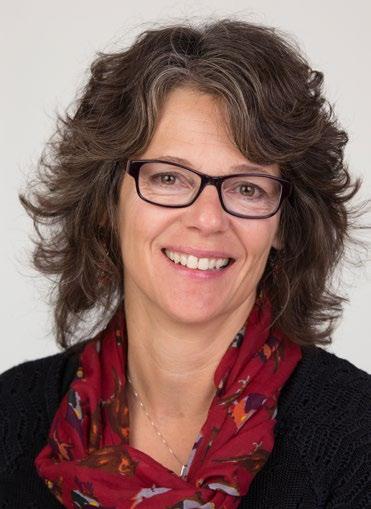
Kay Sicheneder, RCA #668 ASCA President
2026 BOARD OF DIRECTORS
President Kay Sicheneder, RCA #668, Attica, MI
President-Elect
Nick Martin, RCA #552, Algonquin, IL
Immediate Past President
Ron Matranga, RCA #488, Spring Valley, CA
Secretary/Treasurer
Christian Hughes, RCA #493, Atlanta, GA
Directors:
Monika Buczko, RCA #785, Warminster, PA
Debra DeMarco, RCA #672, South Miami, FL
Kyle Offerdahl, RCA #714, Portland, OR
Richard 'Ricky' Peterika, RCA #641, Tampa, FL
STAFF
Executive Director
Kristen Philips, MBA, CAE
Associate Director
Lisa Blair, QAS
Credentialing Programming Manager
Amy Giesy, QAS
Director of Meetings
Diane Schafer, CMP, DES
Director of Marketing and Communications
Amie Goscinski
CFO & Director of Finance
Mary Skudzinskas, CPA
NEWSLETTER
The Arboricultural Consultant is published four times a year by ASCA. Articles and news items are encouraged and must be submitted six weeks prior to publication.
Editorial Committee Chair
Kat Cummings, RCA #781
Editorial Review Committee
Julie Collins, RCA #811
Lisa Smith, RCA #464
Craig Southwell, RCA #692
Steve Lane
Jaclyn Salts
Guy Meilleur
Board Liaison: Ron Matranga, RCA #488
The following
"Members of the
of
Arborists, especially
of
reminded
express permission of the president or board of directors of the American Society of Consulting Arborists. This prohibition includes the use of ASCA letterhead when making a statement of a technical, economic, or politcial nature. Members of ASCA speak only for themselves as professional consultants when giving or making statements.
Be sure to independently verify any content generated by large language models, including reviewing and confirming referenced sources.
Here is the ASCA position on AI, as it stands today:
ASCA acknowledges that AI is rapidly evolving and transforming how we work. We view AI as a tool, much like other tools that consulting arborists use in their daily practice. It is up to each individual to use it responsibly. At this time, ASCA will not be regulating the use of AI, just as we do not regulate the use of the internet or other widely accepted tools.
On a personal note, I believe the key with AI is to use it thoughtfully. Educate yourself on its applications and be mindful of its limitations. Whether a report was dictated to a secretary, typed on a PC, or generated by AI from recorded or written field notes, the responsibility for the content rests with you. You must understand, own, and be prepared to defend everything in your report no matter how it was produced. This goes from Academy and RCA reports to expert witness opinions. And, at the end of the day, it’s up to you whether you
choose to use AI in your work or not.
Having said that, please choose to fill out the upcoming membership survey. This will be the comprehensive version. The board needs your thoughts as we will be refreshing our strategic plan this year.
Finally, I want to highlight the board’s recent strategic foresight discussion. We began by identifying factors that could impact ASCA in the coming years. These include environmental protection policies, the evolving needs of the workforce, and yes, the role of AI. We recognize that awareness of change and adapting to it is essential to keeping ASCA relevant in an evolving landscape. It is a process of constant growth, but one that I believe will keep us moving forward and better able to best serve our members.
Let’s continue to move forward together!
Kay Sicheneder, RCA #668 ASCA President 2026
Financial Report
Below is the audited Statement of Financial Position for FY2025 provided by independent third-party auditors from the CPA firm CliftonLarsonAllen(CLA). The Audit Committee is pleased to report to the membership that, again, the firm indicated that ASCA has achieved a clean audit, as stated in the Auditor's Report: “In our opinion, the financial statements referred to [below] present fairly, in all material respects, the financial position of American Society of Consulting Arborists as of September 30, 2025, and the changes in its net assets and its cash flows for the years then ended, in accordance with accounting principles generally accepted in the United States of America.”
The draft Financial Statement was distributed at the Annual Membership Meeting during the Annual Conference in San Antonio last December. In addition, the full audit report can be found in the ASCA Member Portal.
AMERICAN SOCIETY OF CONSULTING ARBORISTS
STATEMENTS OF FINANCIAL POSITION
SEPTEMBER 30, 2025 AND 2024
LIABILITIES AND NET ASSETS
Reprint: The Tale of Maid Marion
By Guy Meilleur
(original version published in Tree
Care Industry magazine,
2016)
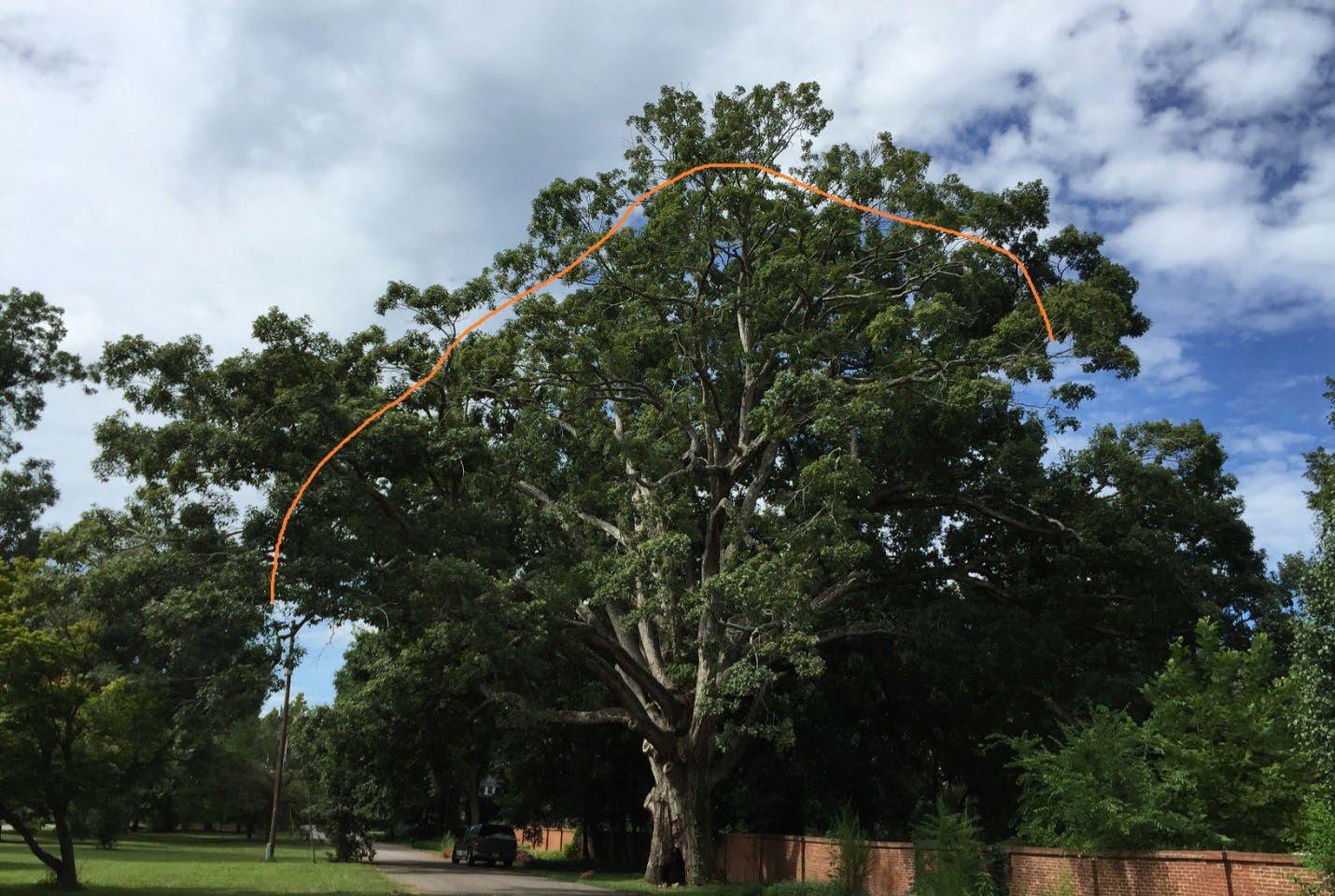
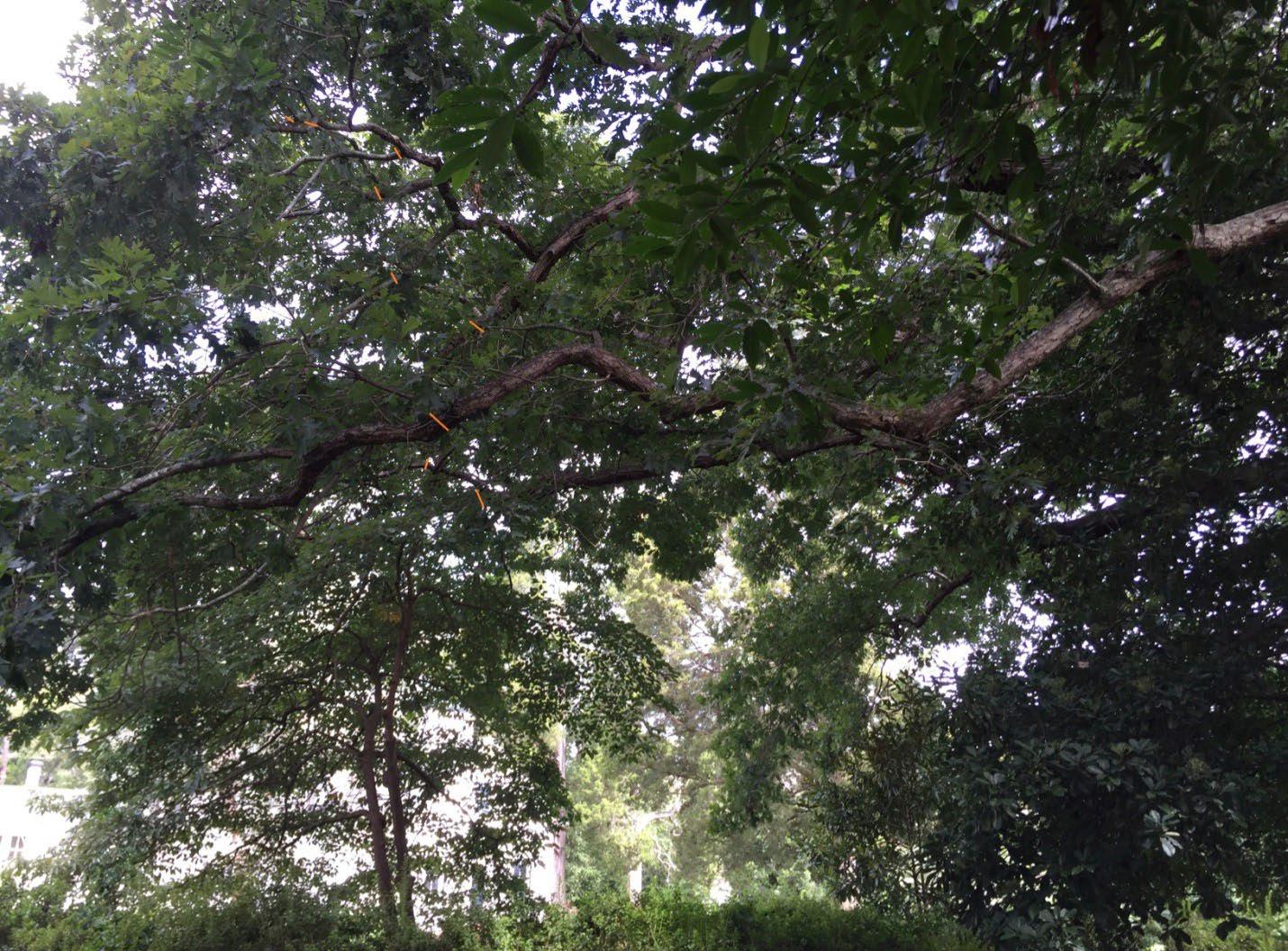
While attending the 2015 ISA conference in Orlando Florida I got a call telling me that Maid Marion was in trouble. Robin Hood’s girlfriend was in Sherwood Forest, while the call came from South Carolina. I later learned that Maid Marion (with an “o”) was a much-loved white oak (Quercus alba) tree on Marion Street in Aiken, South Carolina, US. When I got there, I learned some of its history:
• In 2011, city staff considered the tree “too big”, and amputated three big limbs over the road, exposing a huge amount of defenseless heartwood--just outside of a sizable cavity. Then, concrete and bricks were busted out of that cavity, exposing the interior to damage from drying.
• In the winter of 2014, two upright limbs directly above the amputation wounds broke off in a storm.
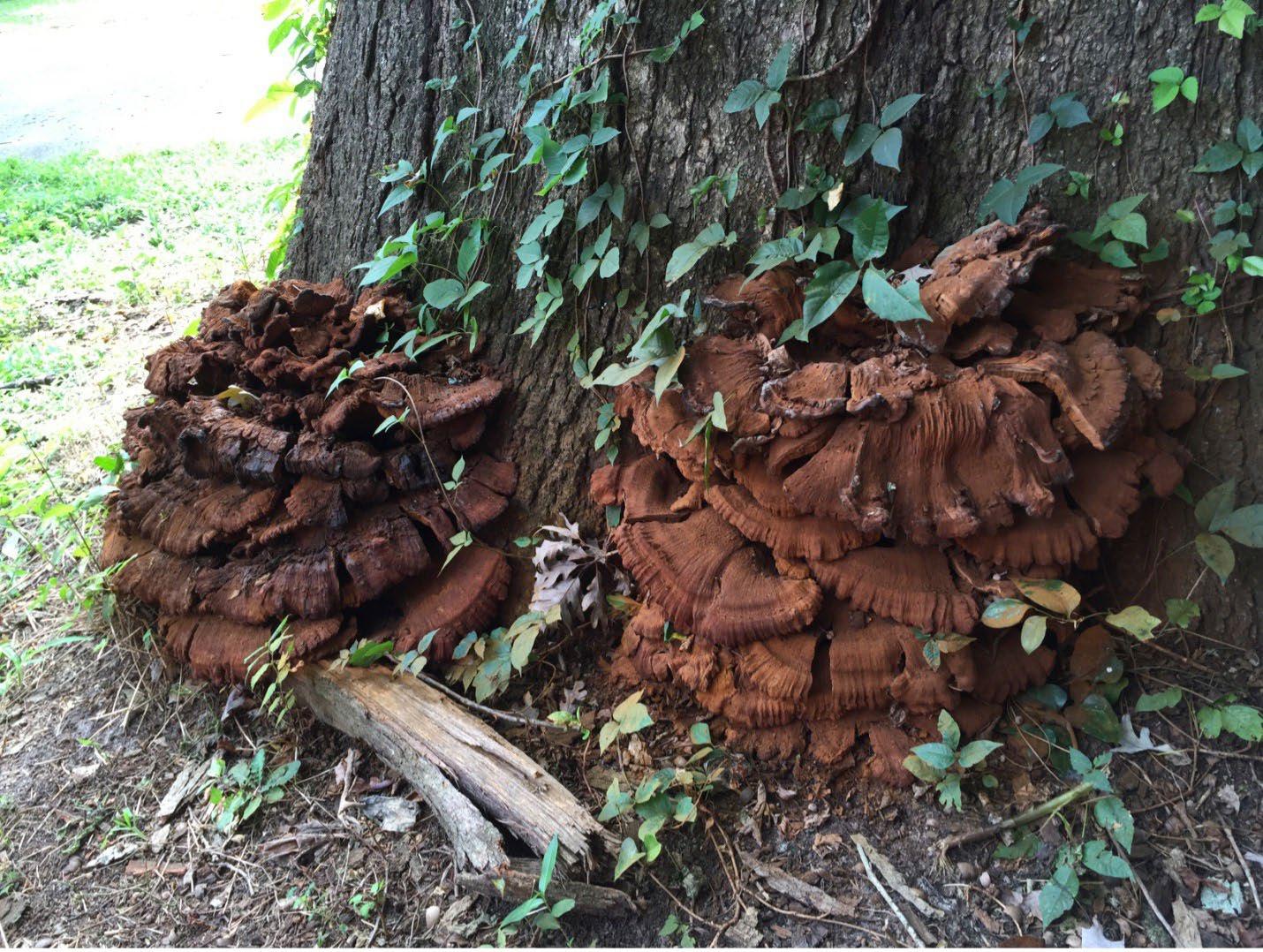
• In early 2015, fungal conks bloomed at the base. Four arborists recommended removal. One also suggested an alternative--closing off the road. All four reports pointed at potential targets. None described any other potential mitigation options.
In August 2015, I inspected the tree, following the inspection protocol detailed in the ANSI A300 Tree Care Standard Part 8 (2014). That level of diligence is so unusual today, it can be performed as a TRAQ Level III Assessment. No shiny toys required! A balanced “Inspection" should include:
• Stem tissue connecting the crown and the roots;
• Tree association with beneficial and harmful insects;
• Tree association with pathogenic and beneficial microorganisms;
• Wounds, and the tree’s response to wounds;
• Indications of root disease and response…
• Mulch, soil and foreign material should be removed as needed to allow inspection…Evaluate decay, callus and woundwood growth, and response growth in trunk and crown.
ANSI A300 Part 8 Influences
This Standard was guided by Germany’s ZTV Tree Care Standard. Its default objective was to “Provide maximum vitality health and safety of trees.” It continued, “Before contracts begin, a definite diagnosis…Inspect for… vitality, tipping and breaking safety…Investigation produces explicit and exhaustive specifications…Cost-benefit analysis considers ornamental, ecological, cultural, and functional significance of the tree. Consider supporting instead of pruning…Predict the trees reaction to the work…ability to compartmentalize…Coordinate any works on roots, stem and crown with each other.”
Another resource was 1999’s The Appropriate Response Process (ARP), a clunky phrase describing an elegant, simple tree care program. The arborist responds to the interactions of the tree, the pest, and the client in ongoing management decisions. ARP can be used with any tree pest, from aphids to Armillaria. (As noted in Fungal Strategies of Wood Decay in Trees, “it requires an effort to understand these…'trials of strength'…the only sensible approach to predicting the future expansion of a decay…” But there are “many trees, old and young, in which a decay has been successfully compartmentalized”).
When features on or in a tree cause concern about its health or structure, those features are monitored as the tree responds to work such as improving and mulching the soil, pruning overextended limbs, companion planting and irrigation. Response growth, including callus and woundwood and reinforcing ribs of bright orange reaction wood can show powerful expansion of the periderm. ARP documents these tree responses with images and measurements. The length, height and width of dead, infected and infested areas are also recorded, to get a balanced account of tree conditions. This host/pathogen relationship determines the dose of future treatments.
Reprint - The Tale of Maid Marion continued
The tree’s fate is at stake, so it seems only fair to give it a say in the matter. If woundwood is growing thicker, the specified pruning dose may be small, or none at all. How much risk was there? This was pre-TRAQ, so no time was spent with likelihoods or ratings. We can’t *know* those things, but we do know:
• The benefits of the tree are lost forever if it is removed
• The tree has stood up to storms over the centuries
• Foliage and wound closure indicate very good vitality
• Loading will be far less after specified pruning
• Strength will be immensely improved by guying
• Vitality will increase after the soil is modified
Tree assessment incorporated the environmental, social and economic contributions to the property and the community. According to one study, this tree’s 150’ canopy (73,671 square feet) could compensate for 1,598,521 vehicle-years of CO2 output. Oaks “are the host plants for more than 1,000 kinds of moth and butterfly caterpillars. These Lepidoptera larvae, in turn, are the most important protein that virtually all parent songbirds need to successfully raise their offspring—from cardinals and chickadees to wrens…In fall, oaks produce copious amounts of nutritious acorns that feed dozens of other wildlife species.” (Entomologist Doug Tallamy)
Inspecting Maid Marion
The crown is imbalanced to the southeast and west. The forks have wide angles and no cracks. The eastern side of the trunk has 5 large wounds from limb removal. Below these wounds is an open cavity, near conks of Meripilus giganteus. According to Fungal Strategies, that fungus “grows quite slowly and reacts very sensitively to changing substrate conditions,” so improving the soil could stop its spread…” The occurrence of fruit bodies does not necessarily mean that stability is impaired. As long as the statically important lateral roots are intact, vitality and stability are not impaired.”
“When fruit bodies appear, the radius should be determined, and the statically effective root plate radius deduced from this and checked by careful excavation. Root decay is largely restricted to roots and then mainly on their underside…the ability of this fungus to degrade tension fibers is…noteworthy.” Some digging and sounding showed the tension roots were intact.
I saw only three cars use the other side of the street in 30 minutes on site. The road is even less likely to be occupied during an extreme weather event that would topple the tree. But the potential for failure is still a concern; the tree is its own “target.” Because tension strength is lost on the northwest side of the trunk, the crown should be reduced on the southeast side. There was good interior growth, so it could respond to reduction by regenerating a smaller crown. Reducing 15% of the “whip” can increase stability by 50%.
Reprint - The Tale of Maid Marion continued
Specifications for Maid Marion’s Care
• Reduce southeast portion of the crown 20%. Cut back to vigorous upright laterals.
• Reduce the top portion 3’-6’ with <4” cuts at vigorous lateral(s) growing into the open.
• Reduce or remove downward growth from interior branches, to allow upward growth on branches below.
• Remove crowded branches back to their origin or the trunk.
Trunk: Using first blunt, then carefully with sharp noninvasive tools, clean loose, dead, foreign, and infectious material from the trunk. Rinse, and drench the area with fungistatic minerals such as phosphorous acid, and the growth regulator Paclobutrazol, per manufacturer’s recommendations. Mark the current extent of the infection. Document changes over time. Replace the insulating function of the bricks and concrete by sealing the opening of the cavity with windowscreen, stapled on the interior.
Soil: Confirm location of underground utilities. Remove grass and weeds closer than 4-6’ from the trunk. Remove soil <12” near the trunk that does not contain active roots > ¼”. Replace with 1-2” oak compost harvested from healthy white oaks. Add porous aggregate, stalite or equivalent, to grade. Maintain sterile zone >6” radius from trunk.
Use a ½” metal rod to make holes 12”-18” deep, 1-2’ apart. Use maximum air or water pressure to fracture soil. Fill the holes with 1 part porous aggregate and 2 parts oak compost and attached soil. Add compatible vegetation such as bulbs, flowers and clump grasses. Mulch with oak woodchips >6” from trunk, out to the dripline as practical.
Reprint
Cuts made to upright laterals (Harris) reduces load, and takes the whip out of the tree’s movement in storms
Supplemental Support System
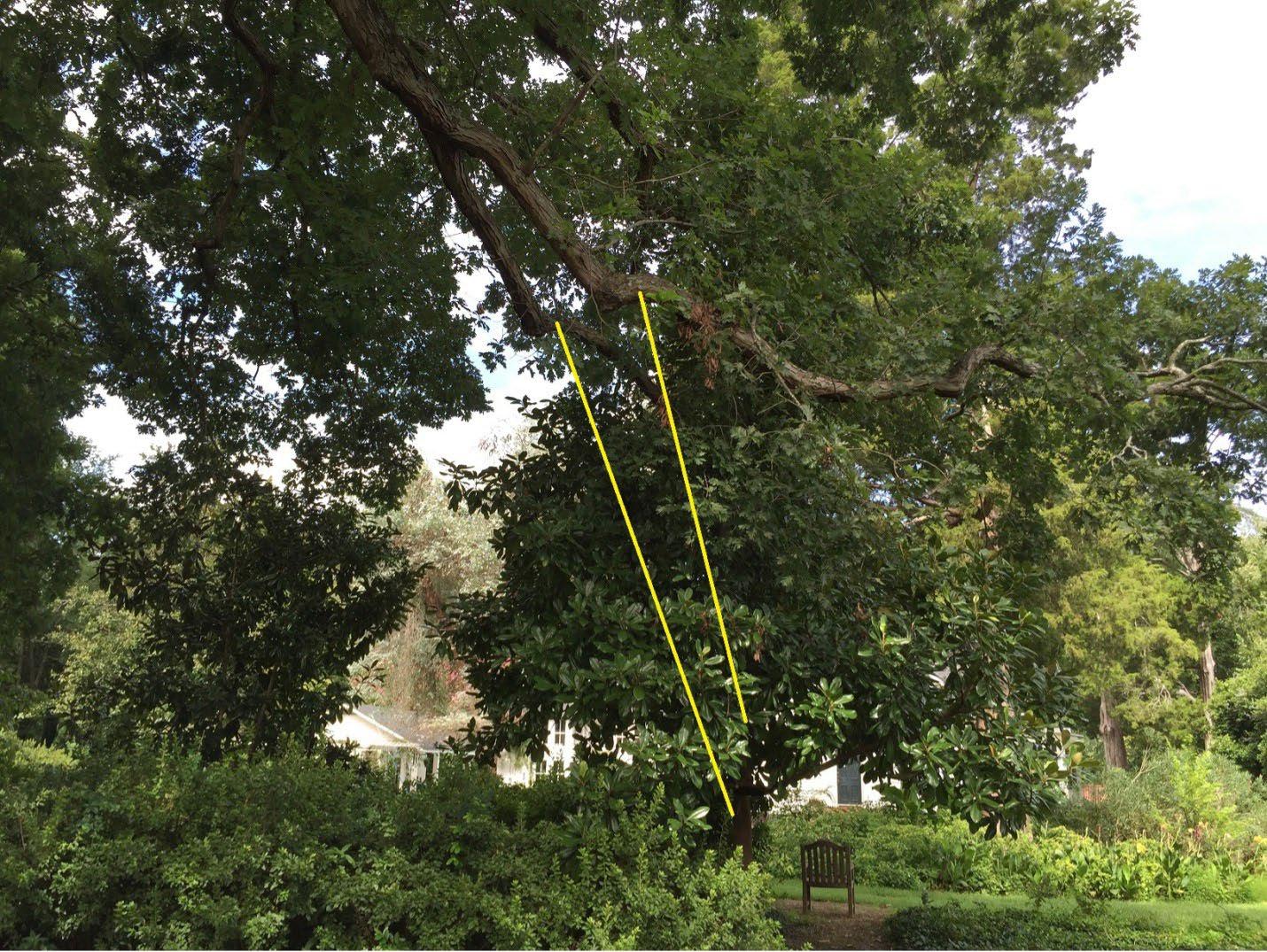
The city manager listened to this plan with interest, but faced with four contrary assessments, needed to hear more. “Is there any kind of support that can be installed?” he wondered. The amputation of lower limbs took propping off the table, so I proposed tree-to-tree guying, per ANSI A300. Four 3/16” EHS steel cables connecting lower limbs to magnolia trees below would only require ¼” holes to install, while adding 15,960 pounds of breaking strength. The report went to the city’s engineers, who approved the plan—a pleasant surprise!
Citizens were willing to cover most of the $5,000 cost for all the specified work, including the report, so I submitted a proposal. Up to then I’d been speculating that I might eventually get paid, and it was finally going to happen -- I could smell victory for the tree and for me. We waited for the permits, and for adjacent property owners to contribute their share. Weeks turned into months.
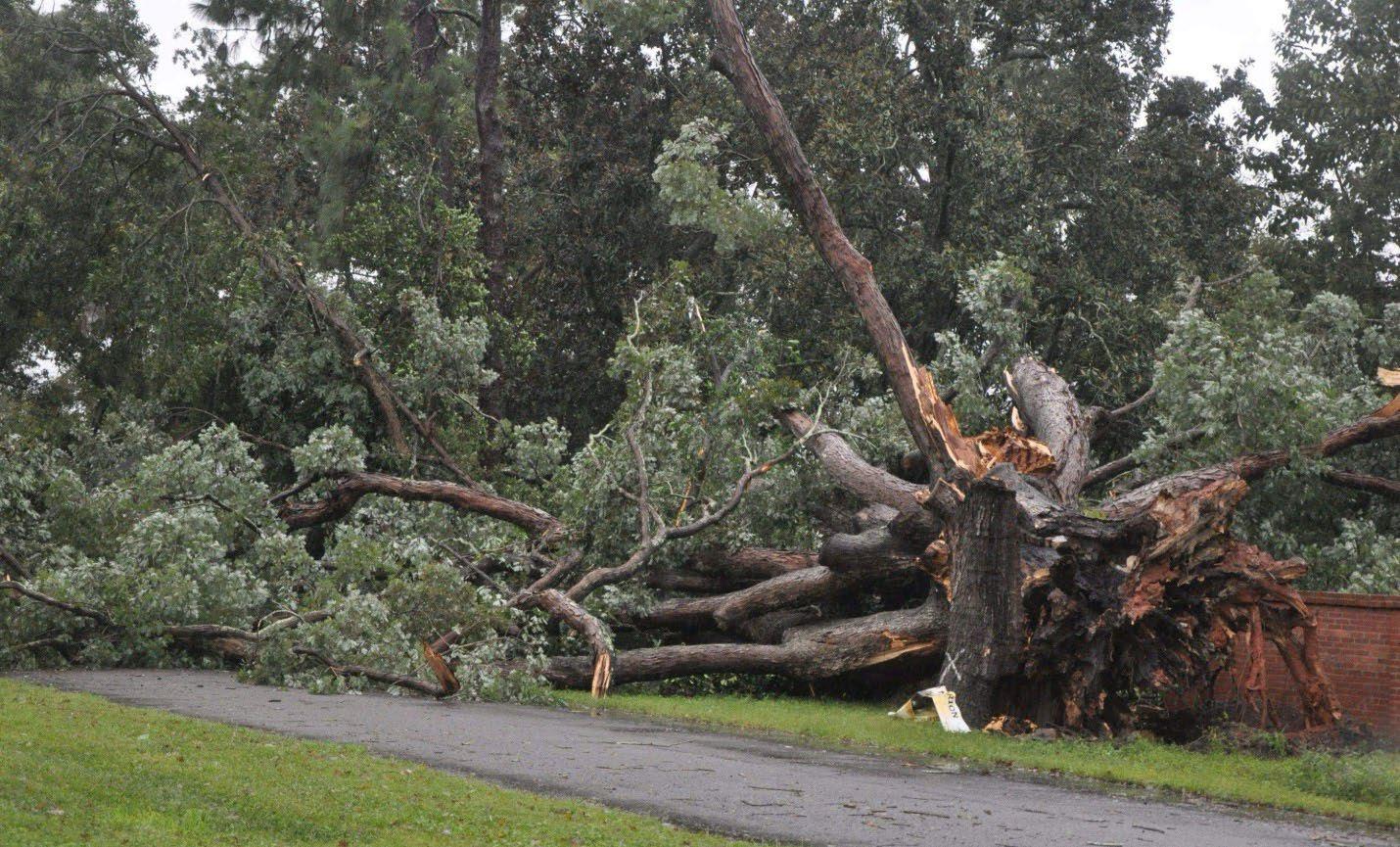
October 6, 2015, a long soaking rain was followed by a windstorm. In the dead of night her heart broke, and Maid Marion fell.
Reprint - The Tale of Maid Marion
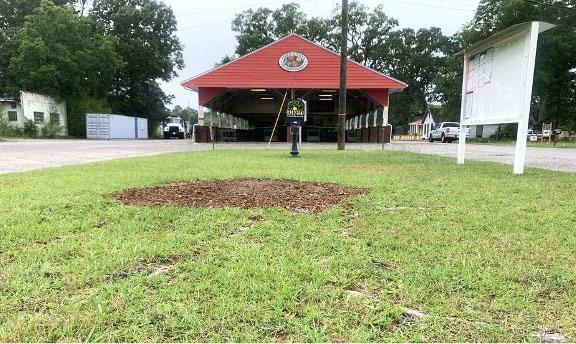
Careless amputations were the root cause of the failure, but nevertheless the city seized upon the tragedy to cut down other neglected trees. Citizens formed a Tree Committee, and the city committed to inventorying its trees, and specify standard care for them. They couldn’t save Maid Marion, but were cautiously optimistic. Since then, the city’s canopy has lost: Eight trees at the Aiken Farmers Market.
According to the city, the original plan to revitalize the street space included plans to chop down the eight trees, but those plans were revised leaving some of the trees standing. They said they don’t know who approved the old plan for the trees to be cut down in the first place. “This was a situation where, um, process and procedure, uh, wasn’t followed and should have been,” said a city manager.
Founder of the renowned Woodlanders Nursery Robert McCartney said it’s a sad reality to see the trees gone, especially the slash pine (Pinus elliotii var. Densa) he planted himself 20 years ago. The tree was part of the city Arboretum planted and cultivated over the past forty years by Woodlanders. “I was very upset…we had specimens of every pine species native to the southern United States in our collection,” he said.
Resident Lisa Smith noted, “No city meeting, no public hearing, no advanced notice. What is going to be done about this and what will prevent it in the future?”:
68 trees that once covered Smith-Hazel Park, due to miscommunication between the city and the state about rights-of-way.
Hundreds of trees, thanks to Hurricane Helene and its tornadoes.
22 water oaks on Charleston Street shaded two city blocks. After extensive utility cutting, oak wilt was detected in two of them. They were all cut down. The “revitalization” plan calls for dozens of azaleas and camellias, five Golden Globe ginkgoes, and lots of sunshine.
Keep Aiken County Beautiful launched in 2019. Since then, the group has planted close to 2,000 trees. In March of 2026, they planted over 400 trees to mitigate damage from Hurricane Helene, working with the Arbor Day Foundation and MathWorks, a private company. An arborist from the area ran the planting session, showing residents how to pick the right tree for each spot and keep them alive for years. How many will survive, and replace lost canopy? Citizens are helping with maintenance, and remaining cautiously optimistic.
Reprint - The Tale of Maid Marion continued
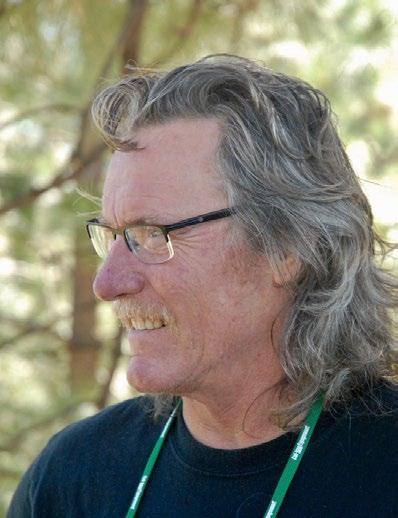
ADayintheLife:Interviewwith Ezekiel
Willard,RCA#774
Interviewed by Guy Meilleur; transcribed by Craig Southwell, RCA #692
GuyMeilleur: Thank you for agreeing to be interviewed for the American Society of Consulting Arborists’ quarterly publication known as The Consultant. We're interviewing a variety of members; veterans and newbies and mid-career Consulting Arborists. I think you might fit in that niche, so tell me, how did you become a Consulting Arborist? Where did you start?
EzekielWillard: Well, I got started in the green industry in Seattle many years ago. I got my first gardening job when I was about 20 or 21. I had a good friend who had been a gardener for many years. He kept asking me to check it out and see what it was like. At the time I was bartending, working nights. We went down to a gated community called the Seattle Highlands. A lot of those gardens were designed by the Olmsted brothers. It's a pretty special place, and I just fell instantly in love with it and started gardening there.
After a few years I realized I needed to learn more, so I started studying horticulture at Edmonds Community College. And then my wife and I moved down to LA, which did not work out for me. It's a beautiful place, but the city was not my cup of tea. I needed to finish school, so I went back up to Seattle. She stayed on there, while I went back to Seattle and finished school. One day a garden that I managed had a tree care company do some pruning on some big trees. I watched who I later found out was Dan Kraus -- who makes tree climbing look like nothing. He's more graceful up there than many of us are walking down the street. I thought to myself, why didn't anybody tell me that was a job? That started my journey into trees.
My wife and I looked at moving to Boise, Idaho. I interviewed with a lot of different companies. I was a very new little sapling arborist but boy, those interviews didn't go very well. There were really no companies I wanted to work with. We ended up chatting with a local lady who said, “We need people committed to proper tree care and education.” So we decided, well, let's move to a new state, let's have a baby, let's buy a house, and let's start a business. We just did it all at once. And from there it was all trees all the time. Consulting was a natural progression. I have some good friends over the years who are ASCA consultants, and I came to it a little late. I wish I'd known about it sooner, but the timing was right. I'd had time to learn, and learned how much I still needed to learn. So I joined ASCA in 2021 and went to my first conference in Lake Tahoe.
GM: Thank you, that was my next question.
EW: I was hooked. Before that conference, I was nervous. I thought, boy, this is, you know, the cream of the crop: How am I going to do this? I'm just a lowly tree geek. But the reception I got from the attendees and the members was just stunning. Everybody was very welcoming. The educational programs were second to none. So that was it, I have been every year since then. I got my RCA in 2022, then the TPAQ® in ‘23 when it got re-released. So that's the story of that journey
GM: How did you find starting a company to be? You said you were a bartender before, so you've got some people skills. Is that something you were able to maintain and still have a part-time consulting practice?
EW: Yeah, I'm definitely not a businessman. But I am a people person. So there were some things to learn. My wife helped a lot. She's a lot more numbers oriented than I was at the time. And I've got a really good team. I actually took a few years off to be a fly fishing trout bum, but got bored with that and came back to work. So
that tells you a little something about my sanity. And maybe how smart I am, but I’m fortunate to have a really good team. It is a lot of work for sure, but I have time to take up projects that are interesting, and just say no to stuff that doesn't sound like fun at all.
So, I think my retirement plan is to get one of those nice camper vans. And I'll put all my climbing gear, all my cool arborist toys, and my fly fishing gear in there, and just roam around the country, hanging out with cool trees and fly fishing. We'll see how that goes, but that's the plan.
GM: Well, you're some ways away from that, aren't you?
EW: A little bit, I'll be 56 this year, though, so it depends a lot on staffing and whether the company can operate on its own, and I think largely it can. So, we'll see. I'm not quite there yet.
GM: So, what is your company in Boise called?
EW: Idaho Tree Preservation. We pretty much stopped doing removals. It's not the kind of work we've structured ourselves to do. In a lot of cases, people were wanting to remove trees because it's messy, or some other odd reason. Our focus is preservation and improving health, so we have a Plant Healthcare Division. That really focuses on roots to shoots. We do a lot of soil remediation, trying to get the trees so they can fight their own battles. It's a different approach. Nobody's really doing that here, still. And good structural pruning and consultation and advice, and things like that.
GM: The market in Boise is keeping you busy, then?
EW: Oh my gosh. We're growing gangbusters. In fact, people complain about how quickly we're growing. But it's good for business, if nothing else.
GM: Well, it must be good for the trees if you're keeping them alive, and your clients are happy with them.
EW: Yeah. And one of my big focuses of late is the benefits of trees increasing as they age and get bigger. And I see a lot of fear around old trees, especially old trees with normal features of old trees, like decay. Or maybe they lost a branch or two here and there over the years. So a big mission of mine is to educate people and explain how old trees work. They have some kind of unfounded fear around them. They don't understand that a lot of this stuff is okay. So that's been a big focus of mine especially over the last handful of years.
GM: I've looked at a couple trees in Boise that you guys worked on, and talked with you about them. It’s clear that you have a successful approach. Several other companies have quit doing removals and gone to tree healthcare as their singular focus. All of them that I know of are getting by quite well. Do you refer work to other companies? How does that work?
EW: Yeah, absolutely. We're inundated with tree companies here. I think part of that was during COVID. We saw a big influx of people starting their own companies, and that's continued. The last time I checked, there was something like a hundred named tree companies around here, which is just crazy to me. But the reality is, and I think this is probably true everywhere, the vast majority are not aware of the standards, certainly not following them. There's a small percentage here of really high quality companies that we can refer to for things that we haven't built our company around doing.
So, we've got a good little network and we've got some young saplings coming up that have the right attitude, and I'm really happy to see that. People getting out, getting certified, taking classes. That's been a real problem here in Boise. When the chapter hosts training classes, in a lot of cases they have trouble filling the seats.
Day in the Life - Interview with Ezekiel Willard continued
GM: That’s got to be tough.
EW: And that's really frustrating to see. We have operated at a loss on a lot of these. So the other areas where they get good attendance have subsidized Boise, or we hit the minimum number to be able to have the class. But we're starting to see those classes fill up more. We just had a TRAQ 3.0 here and that sold out, which is great, so I think we're going in the right direction, for sure, so that's good to see.
GM: You're on the edge of the Pacific Northwest chapter?
EW: Yes. As I understand it, we were originally part of the Rocky Mountain chapter, which geographically and growing condition-wise probably makes a little more sense. We're the easterly-most member of the PNW, down here in the desert. So, it's definitely a different environment than the coast, Oregon, British Columbia, Washington, places like that. And the Yukon is also part of our chapter.
GM: The Yukon, I did not know that.
EW: I know, right? Isn't that wild?
GM: Well, about consulting, you mentioned you've got your TPAQ appraisal qualification. I'm wondering what aspects of consulting are most interesting or rewarding to you, and which perhaps you haven't gotten into, or maybe shy away from so far?
EW: Risk assessment and mitigation is of particular interest to me. I don't think that is a consultant's only realm, but that's a big one. Appraisal is always fascinating and challenging. Every time is different, trying to answer that appraisal question. Those are fun. I've been doing a little bit of expert witness work, which has been really, really fascinating. A little daunting, I will admit.
GM: At first, for everybody.
EW: I think we probably all have a natural aversion to court. Most times, you go to court's because you got some kind of ticket to pay off. It's not usually a fun experience. But it's been fascinating to get a peek behind the curtain. I think I'll probably pursue more of that.
Not all consulting is very much fun. I just did a little project where all I did was get some soil samples tested. Quite honestly, it was pretty boring. But it does pay well, so that softens the problem.
GM: When you're first considering a job, or get a call, how does it work? You're in kind of a tight little valley there, so there's maybe not as much driving time as in some other markets. How does it go with your initial contact with clients?
EW: The process basically starts when they contact the office and talk to my office manager. She'll ask some general questions, to get an idea of what's happening. And then we'll set up an on-site meeting. There's a fee to go out there and chat and get the lay of the land. If they’re not close, there’s a standard rate for driving. If what they're asking can be answered right then and there, great. If it can’t, we'll create a detailed proposal and price it all out. That works pretty well for us.
GM: Yeah, rates and fees vary according to people's businesses and markets and personality. About consulting, I wonder why you think arborists shy away from work where they must defend their opinion. They avoid even a remote chance of going to court. What do you think is the obstacle there?
Day in the Life - Interview with Ezekiel Willard continued
EW: I think having to defend your decisions or your statements can be a little bit daunting as well. I’ve been noticing lately that professionals online will see a photo of a tree that has a small cavity in it or something. So many initial reactions are, “Oh, you gotta cut that tree down because now that you've seen that defect. When it fails, you're gonna get sued.” And I'm like, wait, what? At the same time, they recommend work that is far outside the standards, damages the benefits of the tree, reduces its value, and increases risk. That's what they should be worried about. Not a little decay they can’t know anything about from a single picture.
GM: Troubles start with scaring the tree owner so they can kill the tree for cash. Troubles spiral by scaring themselves into thinking the tree had to be killed. That’s one theory.
EW: It's wild to me that they don't even think twice about stripping out and lion-tailing the whole interior of a tree. It's just a Monday morning. But boy, they see a tiny little cavity in a tree, and they just lose their minds. It doesn't make sense that defending your position is scary. Especially if you model your work and your actions around the standards and the BMPs and fulfilling your duty of care. That makes it a lot easier because you have the whole industry consensus behind you.
GM: I think you nailed it right there. We get our confidence from the team. The collective industry knowledge and our fellow consultants is our team. You're not out there alone. You can rely on other people's experience.
EW: Yes, exactly.
GM: So the more people learn, maybe the more confident they'll get, and the more they’ll trust the tree.
EW: Yeah.
GM: Where do you see your business in, let's say, 5 years, compared to its trajectory up to now? You're not gonna be in that RV going fly fishing quite yet, so where do you think you'll be?
EW: Probably not on the road quite yet. Maybe some test runs. We’ll continue to grow this company that is, as you say, trusting the trees. We're really pushing more into soil work, decompaction and radial trenching and things like that. We’re trying to make this environment better for the trees to grow and be vigorous and defend themselves with fewer or no chemicals at all. We’d like that to be a full-time division. Improving the root zone is such a critical thing, especially where we don't have the best soil to start with.
In Seattle the soil is amazing, and there’s lots of rain. I used to joke that our job was to kill the plants we didn't want, because everything else grew beautifully on its own. Anyway, I’ll continue supporting my amazing team. We're a bunch of tree geeks. We just love what we do, so I'm truly fortunate to have this group. Supporting them and helping them pursue their interests as well. When you hire somebody for one position, sometimes they get really interested in something else.
GM: Do you see any of them growing into the consulting side of things?
EW: I do. And we've certainly talked about maybe transitioning into more of a pure consultancy and maybe only pruning the really cool trees that we really want to, and kind of paring that regular tree care company side down and trying to grow that consultancy. I'm not convinced we have the market here, but maybe. It's something we're talking about and looking at, and I think if we could make it work, it'd be a pretty natural progression.
Day in the Life - Interview with Ezekiel Willard continued
GM: Well, your market's growing, right?
EW: It is, it is indeed, so in 5 years we may be ready to slip right into that spot.
GM: You joined ASCA just 5 or 6 years ago and got your RCA and appraisal qualification. Aside from the conferences, what's been your interaction or experience with the organization? What do you get the most out of? What do you think could be added, perhaps?
EW: Well, I've made some amazing friends and met new colleagues throughout this journey, which has been wonderful. Jim Flott has been a big influence for me.
GM: He's nearby in Spokane, right?
EW: He's up in Spokane, yeah. I met him at the ISA conference in Portland. We bonded over being upset that people came in at the end of the class to fill out the CEU sheet. I was just so upset about that. Anyway, Philip Van Wassenaer has become a good friend and just knowing that community is out there has been great. I do a lot of conferences, TCIA and different ISA ones, but if it came down to only one a year, it would 100% be the ASCA conference. Hands down. It's the absolute best.
The speakers they get, just amazing. On The Exchange, I'm a bit of a lurker. I follow that with interest. There's a lot of really smart people who post on there. So that's a great resource. I don't know if I have any constructive criticism. They seem to be doing a great job. I really learned a ton from the Academy. I was not a great report writer before I went through that process. Getting the RCA has been one of the most positive things I've done in my career. More than the BCMA. The RCA has really opened doors to consulting for me.
GM: Glad to hear it, for sure. Is there anything I should have asked, or that you might like to add as we wrap it up here?
EW: Not that I can think of. I just want to keep old trees around if it's possible. If there's concern, let’s inspect them, and apply all the tools that we have at our disposal before we take these great old historic trees out. So that's my current passion.
GM: Consultants provide positive information and help people review things logically, step by step. The more knowledge we bring in, the less negative emotions, right?
EW: Yes, yes. Trees are good at what they do. They've been doing it a really long time. It's just trying to override some of the fear that even industry professionals have. We can do better. I’m just trying to do my tiny little part to help improve the industry in any way that I can.
GM: Thank you so much for being a part of ASCA and taking time to talk with me today.
EW: Absolutely, thank you so much, I appreciate it.
GM: Keep up the good work!
Watch the full interview here: https://youtu.be/EjJU-CcTxH8
Day in the Life - Interview with Ezekiel Willard continued
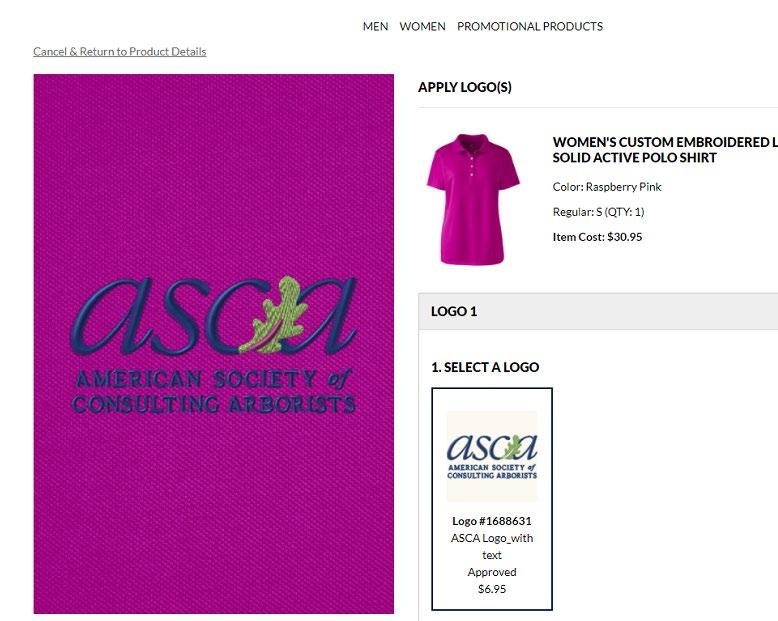
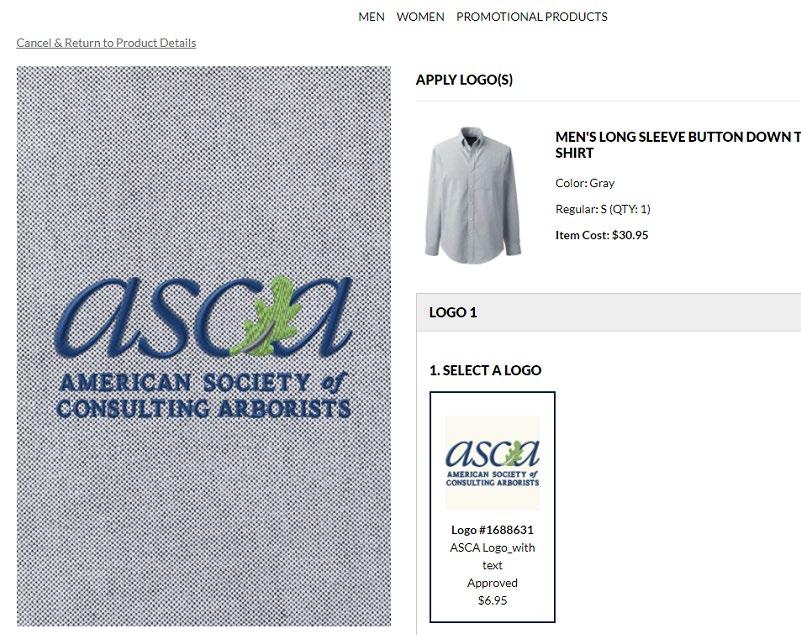
ASCA Lands’ End Store
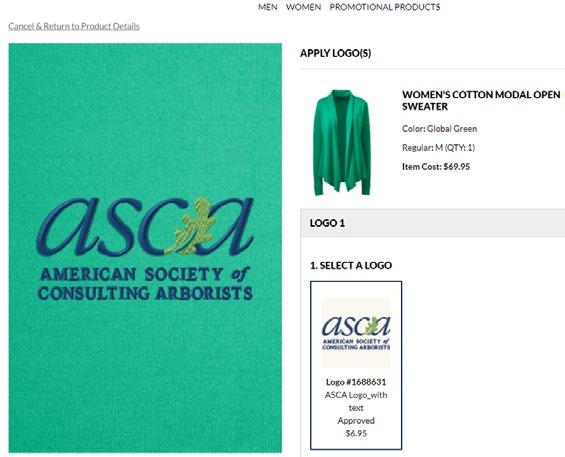
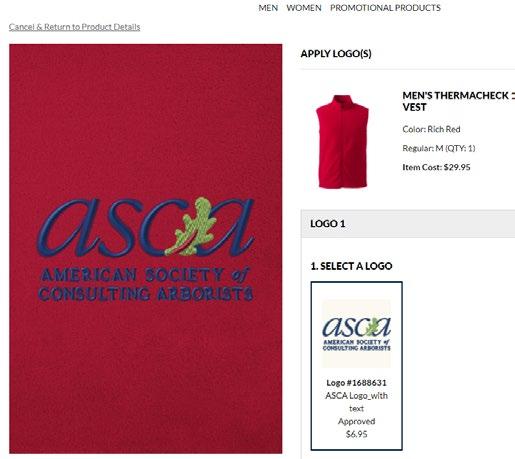
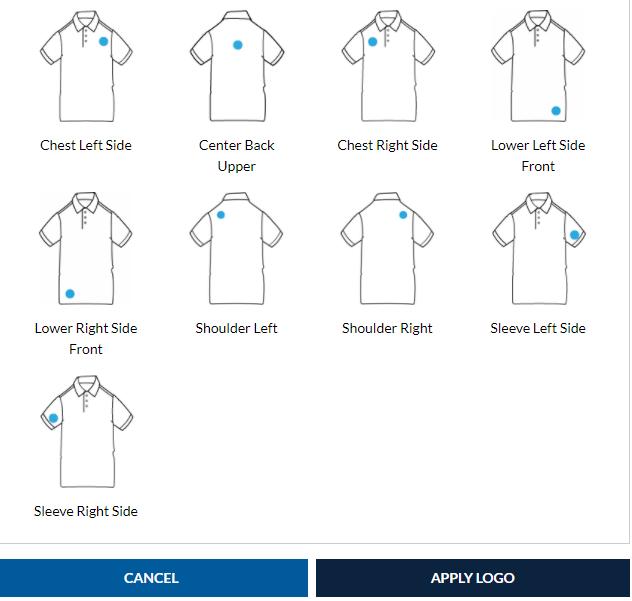
As an exclusive benefit to ASCA members only, ASCA has partnered with Lands’ End so members can now purchase clothing with the ASCA logo. This partnership includes the entire Lands’ End inventory for both men and women, in all sizes and colors, and offering an array of options for logo placement.
Examples:
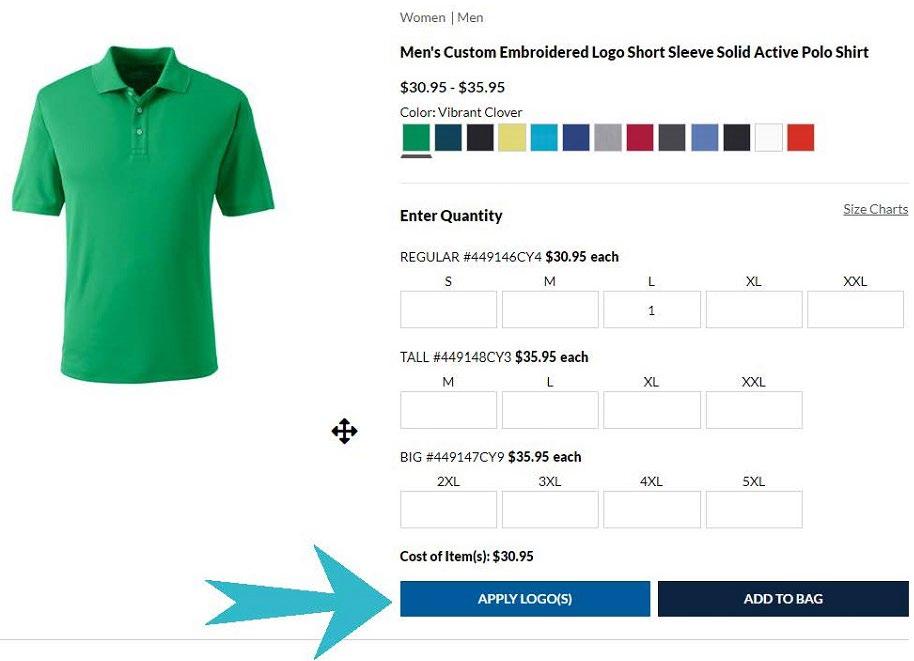
How to Order:
• Visit the ASCA Lands’ End storefront (ASCA Members - Please contact ASCA for the store password)
• Choose the category of clothing that you prefer
• Once you click on the item you are interested in, select the size you would like
• APPLY THE ASCA LOGO and select the logo location
• Add the item(s) to your bag
• Check out or continue shopping
Welcome New Members
Corey Bartholomew Hutchinson, KS
Christie M. Bryant Austell, GA
David Chalker Osterville, MA
Russell Clark New York, NY
Thomas J. Dossett Cummings, GA
Martin D. Heynen Escondido, CA
Jose A. Munoz
Los Angeles, CA
Arthur V. Murphy
San Pedro, CA
Hannah Imagine Shaw Columbia, TN
Una Smith, Ph.D. Los Alamos, NM
John Smithmyer Grasonville, MD
Kunyu Zhang Las Vegas, NV
Want to send a message of welcome or congratulations?
Visit the "Find a Consulting Arborist" page on the ASCA website for individual contact information.
Submit Your CEUs!
To maintain your ASCA Membership, you must obtain 30 approved CEUs every two years. The last renewal cycle concluded on September 30, 2024. The new CEU renewal cycle is October 1, 2024 - September 30, 2026. While you are no longer required to upload all of your CEUs to your member portal (unless you are audited), the easiest way to keep track of your CEUs is to enter them into your member profile as you earn them.
New RCAs
John Sheridan, RCA #912
John Davis, RCA #913
Brenda Wong, RCA #914
Albert Cho, RCA #915
Bob Meoak, RCA #916
Dezirae Ayala, RCA #917
Ryan Rastok, RCA #918
Jesse Kirk, RCA #919
Jonathan Brown, RCA #920
Luke Haynes, RCA #921
Eric Gowins, RCA #922
Larry Robinson, RCA #923
Derek Furry, RCA #924
Sean Bilodeau, RCA #925
Matthew Puckett, RCA #926
Nancy Murphy, RCA #927
Lorin Moll, RCA #928
RCA Embosser and Stamp — Distinguish Yourself
The Registered Consulting Arborist ® (RCA)* status represents ASCA's premier level of membership. Official RCA stamps and embossers are available for purchase—use these items to distinguish your work products.
*You must be an RCA to order RCA products.
Once you have 30 approved CEUs for the current renewal period, additional credits are not required.
Submitting CEUs online is easy:
1. Log in to the ASCA website
2. Click “Manage Profile.”
3. A t the top of the page, click the “Enter
Your CEUs Now” icon.
4. Click on ‘Add Entry’ to add your CEUs.
*Be sure you select the correct CEU renewal cycle to apply your credits!
**Do not enter an expiration date!
View step-by-step directions here
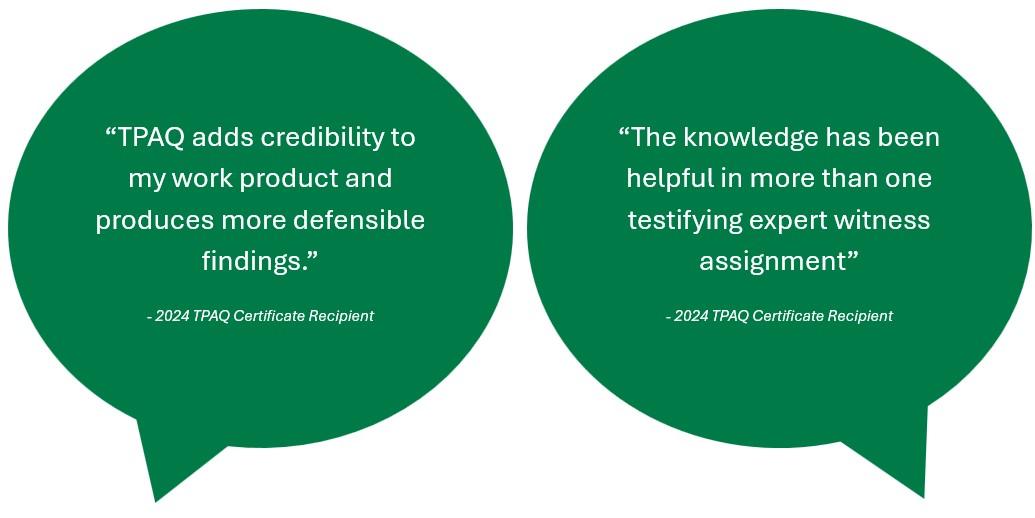
Hear What Others are Saying!
Tre e and Plant Appraisal Qualification®
Hosting a TPAQ course is a win-win: more attendees in your area have a place to obtain industry-validated tree and plant appraisal education, and ASCA provides your organization with all of the tools to make it possible.
ASCA will provide all the necessary course materials, including the approved education curriculum and slides, workbooks for attendees, exams, etc. and the host will provide the classroom space, meals for students, an ASCA approved instructor and per-attendee licensing fee. The full list of host ad ASCA responsibilities can be found here.
About the TPAQ program:
The TPAQ curriculum is an introductory training course that will train green industry professionals in the theory and application of current tree and plant appraisal approaches, methods, and techniques to develop and implement an appraisal assignment. The course is for green industry professionals who wish to learn about tree, plant and landscape appraisal.
Who is eligible to attend, and/or earn the TPAQ Certificate?
Effective immediately, anyone can pay for and attend the TPAQ education sessions. However, eligibility requirements are still required for those who wish to sit for the exam and receive the TPAQ certificate. Opening the training to all allows as many people as possible to receive industry-validated appraisal education. Requiring those who wish to hold the TPAQ certificate to meet eligibility requirements ensures that the TPAQ certificate remains a high-level credential. For more details on eligibility requirements and the TPAQ certificate, please visit our website.
If your organization would like to host a TPAQ workshop, contact Amy Giesy, QAS, Credentialing Programming Manager, at agiesy@asca-consultants.org.
Congratulations New TPAQ Recipients
Michael Arat, RCA #694
Carla L. Angulo
Molly Batchelder
Jacelyn Blank
Beowulf Brower
Frederic Chalfant
Amanda Clark
Morgan Colvin
William J. Cowden, RCA #751
Evan Earhart
Lisa Edwards
Barbara Fair
Amanda Hancock
Charles Holtzclaw
Sarah Jimenez
Cory Kinley
Katie Krebs
Christopher Livingston
Guy Meilleur
Michael Molkenthin
Aimee Nunez
Christopher Olson
John P. Pape, RCA #585
Alexander Pinto
James La Plante
Dustie Rushing, RCA #890
Daniel Savoie
Shayne Sills
Klayton Soucy, RCA #849
Mark Spitulski
Killian J. Vendler, RCA #889
Cody Willard
Chris Wood
Tim Wright
Timothy Zastrow, RCA #558
ASCA Annual Conference 2025 session recordings are now available for purchase and instant download. Sessions available for purchase are the general sessions from Monday (12/8) to Wednesday (12/10)*.
*Does not include pre- or post-conference workshops
20 ASCA CEUs Available*
*Not approved for ISA CEUs Pricing for purchase: - ASCA Member: $400 - Non-Members: $500
Editorial Review Committee
Lane | Jaclyn Salts | Guy Meilleur
Ron Matranga, RCA #488 - Board Liaison
The Editorial Review Committee recently sustained a loss. Former committee chair Maryellen Bell passed away in February. She will be deeply missed by many in ASCA, and her absence will be felt on this committee for a long time. Kat Cummings has agreed to step in as chair for the remainder of 2026. Under difficult circumstances, Kat is looking forward to making positive changes this year.
The committee has also been discussing new content ideas for readers. One proposal is to expand
Historic Task Force
the RCA Spotlight column. Traditionally, this section has focused on long-tenured RCAs with extensive consulting experience. Going forward, we plan to feature RCAs at a wider range of experience levels—including members who earned their RCA within the last 2–5 years—so readers can learn about their paths into consulting, involvement in ASCA, and experiences with the RCA program.
We’re also exploring a new column, ASCA Ask AI. Each installment will pose an AI prompt related
Deb DeMarco, RCA #672 - Chair | Philip van Wassenaer, RCA #678
Scott Cullen, RCA #348 | Scott Baker, RCA #414
Guy Meilleur | Dan Shaw, RCA #857
Written By: Deb DeMarco, RCA #672 - Chair
to consulting, then a tenured consultant will review the response—highlighting strengths, limitations, and practical takeaways. This should be an engaging feature as AI tools continue to evolve.
If you’re interested in being interviewed for RCA Spotlight, or if you have a prompt you’d like to see reviewed in ASCA Ask AI, please contact Amy Giesy or the Editorial Committee chair. We look forward to sharing more engaging content and articles from our members.
To tell the history of ASCA, we need a starting point. The team spent several months in a discovery phase to gather as much information as possible about the original charter members and the first twenty-five presidents of ASCA. This foundation research effort has shaped both the scope and direction of the historical record we are building.
We researched the pioneers of modern Arboriculture. Campania's book, The History and Development of Arboriculture in America , provides a strong foundation for understanding the early innovators who preceded ASCA's formation:
the Davey Tree Company, Bartlett Tree Care Experts, and the Asplund Tree Expert Company, whose development set the stage for the broader arboriculture profession. Their leadership, practices, and personnel planted the seeds from which the consulting specialty would grow. Periodicals such as Weeds, Trees and Turf provided context on the industry and its emerging leaders, helping us situate ASCA's founding within the larger professional landscape of the era.
We discussed the significance of the founding and charter members. The professional credentials of
these founding members aren't just biographical trivia; they're the argument for why the association mattered from day one. These were not peripheral figures in the field. They were arboricultural practitioners and academics with twenty to forty years of experience. They were experienced business owners who simultaneously held active roles in shaping the industry standards across the National Shade Tree Conference (NSTC), the International Society of Arboriculture (ISA), the International Shade Tree Conference (ISTC), the National Arborist Association (NAA), and
Kat Cummings, RCA #781 - Chair | Julie Collins, RCA #811 | Lisa Smith, RCA#464
Craig Southwell, RCA #692 | Steve
Committee Reports continued
the Tree Care Industry Association (TCIA). Their involvement across these organizations makes it plain that ASCA was developing under the guidance of top, experienced leaders.
It was built by men with decades of experience who were actively
developing the consulting profession and understood that consulting arboriculture requires a distinctive identity and standards of its own. This foundational character gives depth to our history, establishing ASCAns as experts which became significance in the arboriculture industry.
Over the next few months, we will begin with our interviews. We plan to include every living past president, the groundbreaking women, and cohorts of current and past members who helped shape our membership schemes, participated in writing our books, and developed our educational programs.
Other ASCA Committees
ANSI ASC A300 Committee
Andrew Mertz, RCA #452, Representative and Chair
Ryan Thomas, RCA #653, Representative Alternate
Kyle Offerdahl, RCA #714, Board Liaison
Audit Committee
Chris Hughes, RCA #493, Chair and Treasurer
Nick Martin, RCA #552
Ricky Peterika, RCA #641
Kay Sicheneder, RCA #668, ASCA President and Board Liaison
Kristen Philips, CAE, ASCA Executive Director
Ethical Standards Committee
Nick Martin, RCA #552 , Chair and President-Elect
Aaron Dickinson, RCA #664
Micah Pace, RCA #607
Philip van Wassenaer, RCA #678
Douglas Gordon-Blackwood, RCA #689
Kristen Philips, CAE, ASCA Executive Director
Nominations Committee
Ron Matranga, RCA #488, ASCA
Immediate Past President and Chair
Debbie Evans, RCA #572
Patrick Anderson, RCA #475
Deb DeMarco, RCA #672
Cy Carlberg, RCA #405
Kristen Philips, CAE, Board Liasion
Sustainable Urban Forest Coalition (SUFC)
Sherry Fabricant Wood, RCA #809
Kay Sicheneder, RCA #668, Board Liaison
TPAQ Appeals and Complaints
Sub-Committee
John Leffingwell, RCA #442
Mark Webber, RCA #706
Program Planning Committee
Kay Sicheneder, RCA #668, ASCA President and Chair
Nick Martin, RCA #552 , ASCA President-Elect and Vice Chair
Scott Baker, RCA #414
Ian Campbell, RCA #816
Jack Ingram, RCA #727
Scott Liudahl, RCA #696
William Eck, RCA #767
Drew Zwart, RCA #630
Philip van Wassenaer, RCA #678
JP McDonnell, RCA #777, Membership Liaison
TPAQ® Subject Matter Experts
Scott Baker, RCA #414
John Harris, RCA #468
Chris Hughes, RCA #493, Instructor Advisor
Tom Smiley, RCA #635
Robert Wells, RCA #593
Membership Committee
JP McDonnell, RCA #777, Chair
Dan Shaw, RCA # 857, Vice Chair
William "Bill" Pramuk, RCA #409
Dan Cathcart, RCA #766
Angela Anderson, RCA #860
Ryan Grubb, RCA #776
Dave Vandergriff
Thomas Pope, RCA #839
Deb DeMarco, RCA #672 , Board Liaison
Marketing Committee
Chris Diffley, RCA #821, Chair
Cory Kinley
Dave Aviram, RCA #682
Timothy Armstrong, RCA #790
Chris Hughes, RCA #493
Douglas Gordon-Blackwood, RCA #689
Cy Carlberg, RCA #405
Ricky Peterika, RCA #641, Board Liaison
Consulting Academy Commitee
Paul Hahn, RCA #791, Chair
Rich Wilson, RCA #747
Deanne Ecklund, RCA #647
Will Mellott, RCA #837
Andrew Smit, RCA #768
Todd Prager, RCA #597
Allan Fenner
Adela Parlesak, RCA #858
Merlin Schlumberger, RCA #687, Non-
Voting Faculty Member
Monika Buczko, RCA #785, Board Liaison//Non-Voting Member
TPAQ® Advisory Committee
Patrick Anderson, RCA #475, Chair
Lisa Smith, RCA #464
Mark Webber, RCA #706
Adam Trujillo, RCA #905
John Leffingwell, RCA #442
William Fountain, RCA #594
Andrew Metz, RCA #452
Chris Hughes, RCA #493, Board Liaison
CTLA Committee
Chris Hughes, RCA #493, Admin Rep
Kristen Philips, CAE, Admin Rep
Robert Brudenell, RCA #417
John Harris, RCA #468
Jan Scow, RCA #382
CTLA Technical Advisory Task Force
Dan Cathcart, RCA #766
Scott Cullen, RCA #348
Steve Geist, RCA #340
Mark Webber, RCA #706
Joe McNeil, RCA #299
Lew Bloch, RCA #297
Jeff Ling, RCA #337
Russ Carlson, RCA #354
John Leffingwell, RCA #442
Zeb Haney, RCA #616
Ad Sizes, Rates and Closing Dates
Classified Ads
Classified ads are a great way to find new employees or announce business opportunities. Payment must accompany copy. Send your classified ads to the ASCA office by email.
Up to 200 Words $50
Each additional 100 words thereafter $25
Design Services
ASCA offers in-house design services to help you with your ad design needs. Please call ASCA at (443) 640-1084 for rates. Any ads submitted that do not meet the proper size requirements will be reset, and production charges will be incurred at advertiser’s expense.
Publisher Indemnities
Publisher reserves the right to mark “advertisement” on copy that readers might confuse with editorial content, and to refuse copy that offends good taste or takes unfair competitive advantage.
Mechanical Requirements
• Files must be sent via email.
• Acceptable formats are hi-res JPEG and PDF.
General Information
• Advertising rates are effective October 1 through September 30 of the following year.
• Payment is due with signed contract and by final closing date for each issue.
• Signed contract must accompany ad.
• No refunds will be given on advertising payments. If ASCA membership is not renewed, member ad rates will revert to non-member rates.
• When change of copy is not received by final closing date, publisher reserves right to print ad from previous issue.
Reserve Your Advertising Space Today!
2331 Rock Spring Road Forest Hill MD 21050
T(443)640-1084 F (443) 640-1031
Advertising Opportunities with ASCA
Looking for other advertising opportunities?
Ad Sizes, Rates and Closing Dates
Co-Sponsoring Opportunities
Co-sponsors receive year-round visibility with ASCA’s engaged professional audience, including discounted conference and Academy registrations for members, a complimentary tabletop exhibit at the Annual Conference, and a full-color ad in The Consultant. Additional recognition includes logo placement on the conference and Academy websites, inclusion in promotional emails and social media, and listings for your organization’s upcoming events, maximizing exposure before, during, and after the conference. Contact ASCA Headquarters at asca@asca-consultants.org for more information.
1/2 Vertical 3.5 x 10" $95$335$170$590
1/4 Page 3.5 x 4.5" $80$290$140$500
Promote Your Event
Classified Ads
Classified ads are a great way to find new employees or announce business opportunities. Payment must accompany copy. Send your classified ads to the ASCA office by email.
Number of Words
Up to 200 Words
Each additional 100 words thereafter
Increase your visibility by featuring your event on our Events Calendar and in the ASCA Insider (sent to all ASCA members quarterly) for just $199. Reach a targeted audience of industry professionals, drive engagement, and showcase your event alongside trusted resources and opportunities, all with a simple, affordable listing. Contact ASCA Headquarters at asca@asca-consultants.org for more information.
Exhibiting
Design Services
ASCA offers in-house design services to help you with your ad design needs. Please call ASCA at (443) 640-1084 for rates. Any ads submitted that do not meet the proper size requirements will be reset, and production charges will be incurred at advertiser’s expense.
Yet across the country they’re stressed by climate shifts, pests, and neglect. Many problems are treatable if action is taken early. Find diagnostic tools and expert advice you can share with your customers at TreesNeedYou.com
Mechanical Requirements
• Files must be sent via email.
Together we can
• Acceptable formats are hi-res JPEG and PDF.
re-root
the future of oaks.
General Information
• Advertising rates are effective October 1 through September 30 of the following year.
• Payment is due with signed contract and by final closing date for each issue.
• Signed contract must accompany ad.
The ASCA Annual Conference is held each December and is the Society's exclusive opportunity to exhibit directly to our members. Find upcoming conferences and exhibitor details through our Calendar of Events
• No refunds will be given on advertising payments. If ASCA membership is not renewed, member ad rates will revert to non-member rates.
• When change of copy is not received by final closing date, publisher reserves right to print ad from previous issue.
Publisher Indemnities
Publisher reserves the right to mark “advertisement” on copy that readers might confuse with editorial content, and to refuse copy that offends good taste or takes unfair competitive advantage.
Oaks
inhabit, including our urban forests.
SCAN TO LEARN MORE
BIOCHAR IS A HOT TOPIC.
LET’S GET
THE FACTS STRAIGHT.
quality matters testing matters
we don’t stop at biochar
results matter
Our standards speak for themselves.
M a d e t o s t r i c t
s t a n d a r d s f o r
c l e a n , h i g hq u a l i t y
i n g r e d i e n t s
R e v i v e P l u s c o m b i n e s h i g h - q u a l i t y
m i c r o n i z e d b i o c h a r w i t h O M R I - l i s t e d
b i o s t i m u l a n t s f o r c o m p l e t e s o i l a n d
r o o t - z o n e s u p p o r t .
.
f i s h h y d r o l y s a t e m o l a s s e s k e l p e x t r a c t y u c c a e x t r a c t Better biochar better soil better results w w w . m a u g e t . c o m
j o r d a n @ j j m a u g e t c o m
5 4 0 - 5 5 1 - 0 4 0 3
Member News
A Tribute to Maryellen Bell, RCA #703
Submitted by Kat Cummings, RCA #781 and Tristan Fields
I am deeply saddened by the loss of Maryellen Bell this past February. Maryellen was a oneof-a-kind gem that I had the privilege of calling a colleague, an inspiration, and a friend. Maryellen graduated from Texas A&M University and was involved with arboricultural consulting work in Orange County and the San Francisco Bay area of California.
Most recently, Maryellen was a Consulting Advisor at Bartlett Tree Experts. In her role, she was passionate about improving those around her. Her strong integrity and can-do attitude made her a true asset for the Bartlett Consulting team. She was well known for her red pen when tasked with peer review, leaving no stone unturned in her relentless pursuit of excellence. Those who received her feedback quickly became better writers and consultants.
Maryellen was not only a Registered Consulting Arborist, but she was also active in the ASCA community. She began serving as chair of the Editorial Review Committee in 2025. As chair, she encouraged new voices throughout the organization and beyond. Maryellen was also part of the Ambassador Program in ASCA. Her mentee, Tristan Fields, recalls her relationship with Maryellen:
“I’m deeply saddened to hear of the passing of Maryellen Bell, who served as my mentor through the American Society of Consulting Arborists Ambassador Program.
Maryellen had a way of cutting straight to the point. She didn’t suffer fools, but she deeply respected people
who worked hard and showed dedication. Once she saw that in you, she would throw her full support behind helping you succeed. Being on the receiving end of her encouragement felt like standing ten feet taller.
She was sharp, funny, and completely herself—often delivering wisdom with a classic Texas saying and a quick laugh. She admired the best in people and never hesitated to tell you when she saw it. At the same time, she was refreshingly honest; if something didn’t sit right with her, you knew it.
Over the past several years Maryellen endured tremendous personal hardship, including the loss of her partner, yet she continued to show up with generosity, humor, and strength. Her ability to lift others up despite her own challenges says so much about who she was.
Maryellen was a brilliant, energetic, and unforgettable presence in our profession. I feel incredibly fortunate to have learned from her and to have been one of the many people whose path she helped shape.
Her mentorship and spirit will stay with me for the rest of my career.”
Maryellen’s presence, guidance, and energy will be truly missed by all who had the privilege of knowing her. One of the last words of wisdom she shared with me was, “Don’t you ever quit. Don’t you dare quit, even when it gets hard. You’ll make it through.” In her honor, I encourage you all to follow her advice with me and never quit.
Member News
A Tribute to Joe Schneider
Submitted by Bill Pramuk, RCA #409 and Robert Phillips
"The world lost one of the gentlest touchers of trees when Joseph A. Schneider passed quietly into the next life. Those that knew Joe in this life felt the wisdom, wit, and passion he shared with everyone during his walk through life. Joe entered my life when I saw him at a job site, high up in a tree. Days later, I met him at the office of his employer, the legendary John Britton. Shortly after that we were up a huge walnut tree, pruning back-to-back. Our friendship bonded immediately, and never wavered.
Joe and his son Jacob always prided themselves on offering complete tree health care, not just pruning and removal. They were always on the cutting edge of new technology and pursued the knowledge necessary to answer all questions regarding tree health and survival. Safety has always been strong in the company's operations.
Joe served as president of the Napa Valley Chapter of the California Arborist Association. He later served as my WCISA Annual Conference chair in 2004. Joe was responsible for bringing in Dr. Alex L. Shigo to give his last lecture in California. It was definitely a feather in his cap to secure the good doctor's participation.
Joe and I lectured from coast to coast on tree climbing skills and overall tree health care. We joined forces for WCISA meetings and workdays to support the John C. Britton Tree Fund. Joe and I always enjoyed the camaraderie of the magnificent individuals who make up the tree care industry.
Generous and compassionate, Joe always gave everything he had in support of trees. He volunteered his company's services any time I requested them. We all benefited by having Joseph A. Schneider in our industry, and I lost one of the greatest friends I will ever have. He adored his beautiful daughter Linden who he shared with his wonderful ex-wife Mary Jo.
He will forever be in our hearts, minds, and souls."
Book Reviews
Essentialism: The Disciplined Pursuit of Less by Greg McKeown
Submitted by Lisa Smith, RCA #464
As consulting arborists we are often asked daily to juggle fieldwork, report writing, client communication, invoicing, research and many other activities! Greg McKeown’s Essentialism: The Disciplined Pursuit of Less offers a timely and practical reminder that effectiveness does not come from doing more—but from doing what matters most.
McKeown introduces Essentialism as a disciplined approach to identifying the highest-value activities and intentionally eliminating distractions that do not contribute meaningful results. His message really applies and resonates strongly with consulting arborists, whose work depends on careful observation, sound judgment, and clear communication. The book reinforces the importance of slowing down enough to think critically, prioritize appropriately, and deliver wellsupported conclusions rather than becoming overextended with less meaningful tasks. Our tech heavy industry provides so many distractions and this book discusses and reminds us the importance of filtering the noise and being selective about what we dedicate our time towards and focus on.
This can apply to every aspect of our consulting. From how we take in new phone calls, emails, and any communication, to how we select which projects and clients we want to align with, and also how we create systems that allow us to have the bandwidth to focus on the meaningful work we choose.
One of the book’s most valuable takeaways is the concept of creating space for focused thinking. In consulting, this space allows for deeper analysis, more defensible opinions, and higher-quality reports. McKeown’s practical examples and straightforward writing style make the ideas easy to understand and apply, regardless of one’s stage in their consulting career.
While not specific to arboriculture, Essentialism provides a useful framework for refining one’s professional approach. It serves as a reminder that disciplined focus is not about limitation, but about maximizing impact.
This book is a worthwhile read for consulting arborists seeking to improve their effectiveness, protect their time, and elevate the quality of their consulting practice.
Send Us Your Best Shot
This Month's Prompt - Creative and Innovative Planting Practices
Submitted by Craig Southwell, RCA #692
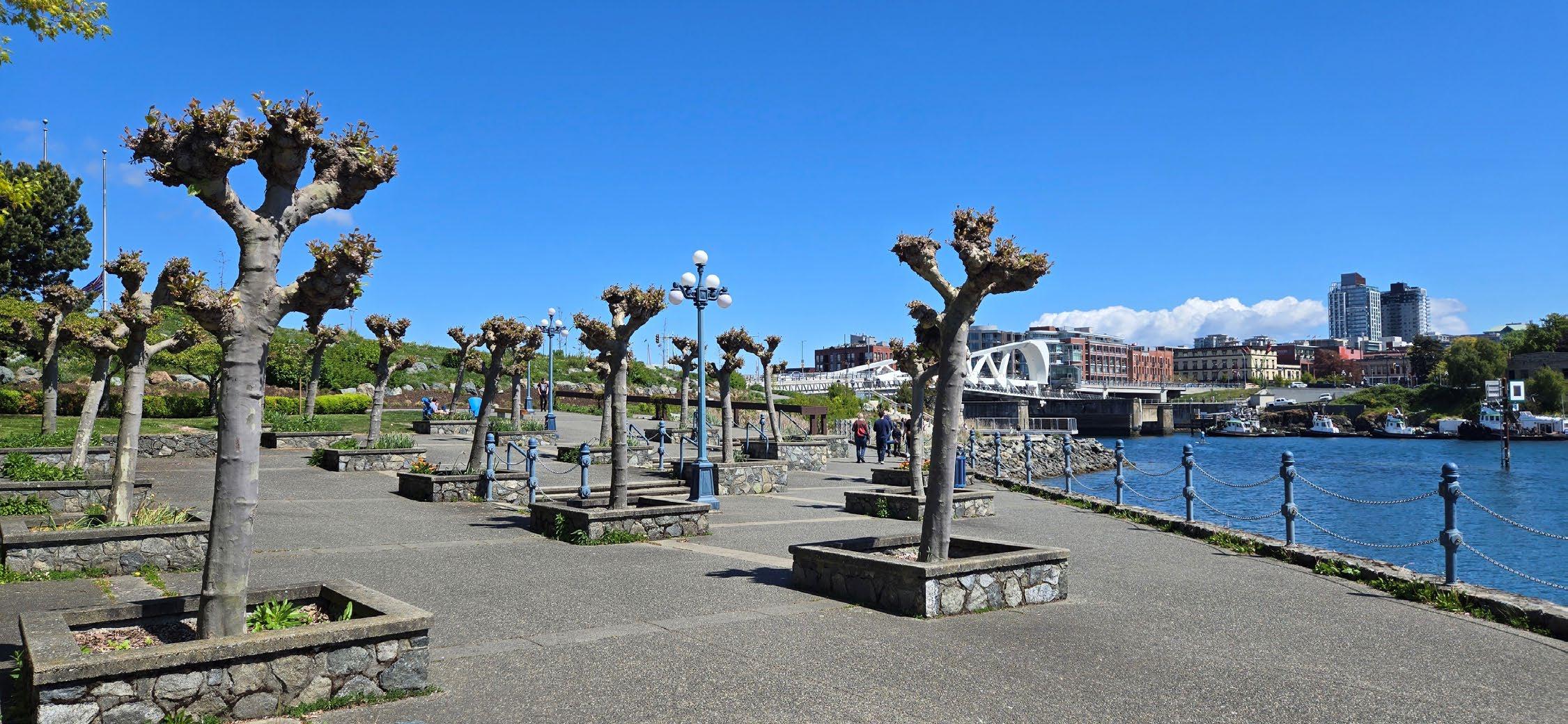
Pollarded sycamore (Platanus occidentalis) growing at the waterfront in downtown Victoria, BC Canada. This medieval form of pruning is a common sight in many parts of Europe where certain species form canopies for summer shade and are then cut back in the winter to maintain the overall size of the tree. A less common practice in North American but as can be seen here, it could likely be used more.
SEO Opportunity for ASCA Members
By Chris Whitman
Hopefully you have heard by now that ASCA is making some big changes in the way it supports and promotes its membership. One recent and impactful change has been to improve the way clients find us through Search Engine Optimization (SEO) of ASCA's own webpage. You may ask, what is SEO? SEO is the process of improving the quality and quantity of website traffic to a website or a web page from search engines.
For those who may not be aware of the importance of SEO and building a web presence, take a look at some of these statistics:
1.) 61% of B2B marketers stated that SEO and organic traffic generate more leads than any other marketing initiative.
2.) 75% of people never scroll past the first page of search engines results.
3.) 70% of online marketers say that SEO is better than PPC (Pay-Per-Click Advertising) for generating sales.
source: www.hubspot.com/state-of-marketing
As a result of these improvements, not only will you directly benefit from more traffic to the "Find a Consulting Arborist" web page, but ASCA has also negotiated and secured a deeply discounted member set-up rate from our SEO provider to deliver this same, critical, marketing assistance to
your consulting practice website and/or listing. You now have a direct opportunity to piggyback on ASCA's significant presence to promote your business while customizing your own SEO to fit your specific geographic and service market needs. ASCA's SEO Provider has extended an offer to all members for discounted SEO services tailored just to your needs.
Email ASCA@asca-consultants.org for more information. Use "SEO Offer" in your subject line.
“ASCA has also negotiated and secured a deeply discounted member set-up rate from our SEO provider to deliver this same, critical, marketing assistance to your consulting practice website and/or listing.”
This is also an ideal time to update and personalize your ASCA Profile Information.
Follow these easy steps:
- Go to asca-consultants.org
- Sign into your account
- Click "Profile Home"
- Scroll down to Professional Information and click "edit"
Here, you can customize your profile even further by selecting the services that you provide, such as appraisals, expert witness, etc. as well as selecting the various states in which you do business.
Be sure to take advantage of this offer and make your membership work for you. As author H.
Jackson Brown put it, "Nothing is more expensive than a missed opportunity."
Are You a Registered Consulting Arborist?
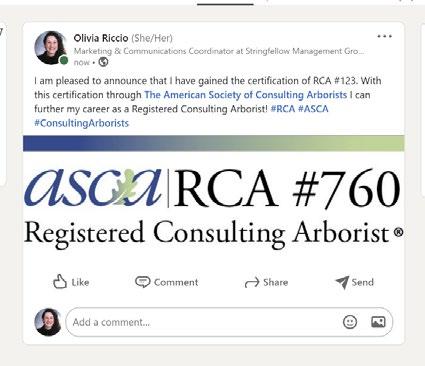
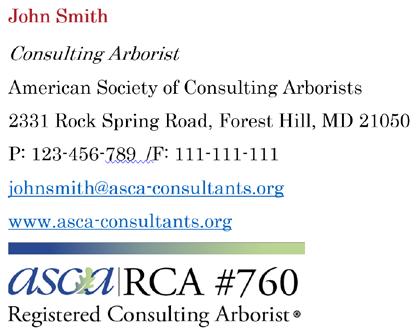
Show off your great accomplishment with the RCA Electronic Stamp!
The RCA electronic stamp is a digital image customized for you! You can use this as part of your email signature, on professional documents, on social media, business cards, and on your website. Using your RCA digital stamp will differentiate yourself and showcase your valuable credential.