A Day in the Life of a Consultant: What the Storm Did Not Explain Decay, Detectability, and Notice in a Hadonfield Tree Failure By Jason C. Miller, RCA #526, BCMA
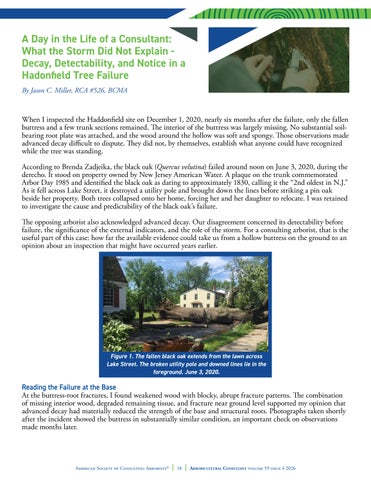
When I inspected the Haddonfield site on December 1, 2020, nearly six months after the failure, only the fallen buttress and a few trunk sections remained. The interior of the buttress was largely missing. No substantial soilbearing root plate was attached, and the wood around the hollow was soft and spongy. Those observations made advanced decay difficult to dispute. They did not, by themselves, establish what anyone could have recognized while the tree was standing. According to Brenda Zadjeika, the black oak (Quercus velutina) failed around noon on June 3, 2020, during the derecho. It stood on property owned by New Jersey American Water. A plaque on the trunk commemorated Arbor Day 1985 and identified the black oak as dating to approximately 1830, calling it the “2nd oldest in N.J.” As it fell across Lake Street, it destroyed a utility pole and brought down the lines before striking a pin oak beside her property. Both trees collapsed onto her home, forcing her and her daughter to relocate. I was retained to investigate the cause and predictability of the black oak’s failure. The opposing arborist also acknowledged advanced decay. Our disagreement concerned its detectability before failure, the significance of the external indicators, and the role of the storm. For a consulting arborist, that is the useful part of this case: how far the available evidence could take us from a hollow buttress on the ground to an opinion about an inspection that might have occurred years earlier.
Figure 1. The fallen black oak extends from the lawn across Lake Street. The broken utility pole and downed lines lie in the foreground. June 3, 2020.
Reading the Failure at the Base At the buttress-root fractures, I found weakened wood with blocky, abrupt fracture patterns. The combination of missing interior wood, degraded remaining tissue, and fracture near ground level supported my opinion that advanced decay had materially reduced the strength of the base and structural roots. Photographs taken shortly after the incident showed the buttress in substantially similar condition, an important check on observations made months later.
American Society of Consulting Arborists®
18
Arboricultural Consultant volume 59 issue 4 2026
What the Storm Did Not Explain continued
My interpretation was facture through compromised basal and root tissues rather than a rotational or hingetype failure of an otherwise sound root system. The absence of a substanial root plate was one part of that interpretation. It was not a diagnostic test by itself, nor would the height of the break alone establish decay. The condition of the actual fracture surfaces supplied the stronger evidence. My August 2022 report was preliminary; the client did not authorize the cost of a full report. My inspection was observational. I did not perform invasive testing or measurements from which to calculate residual loadbearing capacity. A precise percentage of strength loss would therefore imply more information than I had. The defensible conclusion was substantial deterioration at the point of failure, supported by the physical evidence.
Figure 2a (left).The black oak buttress during my December 1, 2020 site inspection, showing extensive internal hollowing and deteriorated wood around the fracture. Figure 2b (right). A side view of the black oak buttress shows the point of failure.
Although not discussed in my preliminary report, the growth rings showed an abrupt reduction in radial growth beginning a little more than two decades earlier. I suspected mechanical root injury within the critical root zone. Installation of the sizable utility access panels approximately eight feet from the trunk, beside the building’s corner, was one possible explanation. Such an injury could have contributed to the decay and subsequent decline, but I had not established that sequence. Tracing the original injury was not my assignment; determining whether the resulting condition warranted attention was.
Figure 3. Growth rings showing the abrupt reduction in radial growth discussed above. The suspected root injury and its possible connection to utility work were not established. Scale in inches.
American Society of Consulting Arborists®
19
Arboricultural Consultant volume 59 issue 4 2026
What the Storm Did Not Explain continued
Reconstructing What Could Have Been Seen Google Street View supplied more than a decade of historical context. In my report, I discussed images dated September 2012 and August 2017. I interpreted them as showing sizable dead and deteriorating branches, long broken stubs, a trunk opening, and bark sloughing. The August 2017 imagery also showed fallen branch material near the tree. In reviewing the historical imagery, I noted several areas of apparent trunk bleeding. These were images taken from a roadway, with the usual limitations of viewing angle, resolution, and obstruction. They could document visible features and changes over time; they could not measure the residual wall or map decay through the root system. I used them to assess whether there were reasons for a closer inspection before the failure. The neighbors supplied a different kind of record. One who passed the tree almost daily from 2014 described uneven leafing, bare limbs, broken stubs, and fallen branches. She became concerned enough to cross the street or otherwise avoid the tree, particularly during storms. Witness accounts also included mushrooms near the base. I recall trial testimony that neighbors would not allow children to play in the field beneath the tree. Those accounts could help establish the persistence and visibility of conditions. They could not identify a decay organism or quantify a likelihood of failure. The technical task was to relate the observations to the tree’s condition without making each dead branch or reported mushroom carry more diagnostic weight than it could support. Explore a representative historical Street View panorama Interactive source: Google Maps / Street View
The Disputed Inspection Threshold The defense arborist interpreted the historical imagery differently. His report described the lower trunk, roots, and crown as appearing generally normal before the incident and characterized the decay as concealed by bark and soil. He also proposed earlier root injury associated with nearby construction as a cause of the decay and emphasized utility pruning by Public Service Electric & Gas (PSE&G). Those were competing interpretations of the record, not findings I shared. The practical disagreement was whether the external indicators warranted further assessment. In my opinion, the trunk opening and bark loss, substantial dead and deteriorating limbs, long stubs, and shed material provided that basis. Reported fungal growth added to the history. The proposed origin of the decay was a separate question from whether there were indications that an arborist should investigate it. Sounding became a surprisingly contested part of that discussion. Given the extent of hollowing, my opinion was that sounding the buttress with a mallet before failure would likely have produced a hollow response. The defense report challenged the scientific support for sounding and cited Kretzschmaria deusta as an example of decay that could escape detection. That limitation did not directly address my finding: extensive hollowing and soft, degraded wood in the subject tree’s buttress. As I recall, the defense expert testified that sounding was not a recognized inspection method and, on cross-examination, said he “would not use it.” Sounding was hardly an improvised inspection technique. A U.S. Forest Service guide described it by name in 1963, and subsequent arboricultural texts recognized mallet sounding as a useful preliminary screen for cavities. The mallet was decidedly low-tech; that was not the same as being uninformative. My conclusion was that the visible indicators warranted an assessment that would likely have disclosed the severe root and buttress decay and led to removal before the incident. That opinion depended on connecting the external indicators to the concealed condition through an appropriate inspection. It did not depend on a mallet providing a complete map of the defect. American Society of Consulting Arborists®
20
Arboricultural Consultant volume 59 issue 4 2026
What the Storm Did Not Explain continued
Accounting for the Derecho June 3, 2020, brought two distinct rounds of damaging weather to the region: the midday derecho, followed by a separate round of thunderstorms later that afternoon and evening. The National Weather Service’s event review describes both rounds. South Jersey Regional Airport (VAY) was slightly closer to the site than Philadelphia International Airport (PHL), but its observations around the reported failure time contained no wind speed or direction readings. I therefore used the PHL climatology report. My preliminary assessment reflected my understanding that thunderstorm gusts exceeding 50 mph were a recurring exposure in this region. Severe-thunderstorm warnings were a familiar part of the regional weather picture. Against that background, the 61-mph gust in the limited PHL record did not, by itself, strike me as evidence of extraordinary wind conditions. PHL recorded a higher gust of 68 mph during the separate round of thunderstorms later that day. The defense meteorologist, Gary Szatkowski, disputed that characterization and emphasized the derecho’s regional severity. Szatkowski cited the National Weather Service’s account of widespread damage, a measured 73-mph gust at Moorestown, approximately nine miles away, and a warning covering the site that anticipated 80-mph winds. He concluded that the event could uproot healthy trees. The black oak, however, did not uproot. It fractured at ground level through decayed basal and root tissues. The capacity of a storm to uproot healthy trees did not, by itself, explain that failure mechanism or resolve the contribution of pre-existing decay. An airport observation, a nearby measured gust, and a forecast warning are different kinds of evidence. None is a direct measurement of the wind acting on this crown at failure. They establish context for evaluating the load; they do not, on their own, determine the bending moment at the base or the remaining resistance of this tree. Exposure, crown architecture, and the distribution and condition of supporting tissues remain part of the analysis. Haddonfield is local to my practice, and I investigated a number of tree failures in southern New Jersey following this event. Every failure I investigated in that area involved a defect of one kind or another. In those cases, the central question was notice: whether the owner knew or reasonably should have known of the condition before failure. Defense counsel pointed to a tree failure a couple of blocks away that destroyed several cars as an example of the storm’s severity. I knew that tree, too: it was another of my investigations. The vehicle damage was substantial, but the exposed fracture also showed extensive internal decay. It was not an example of an otherwise sound tree failing.
Figure 4. A separate failure a couple of blocks away. Left: the fallen tree section and damaged vehicles. Right: the exposed fracture shows extensive internal deterioration. These are two views of the same failure, which I also investigated.
American Society of Consulting Arborists®
21
Arboricultural Consultant volume 59 issue 4 2026
What the Storm Did Not Explain continued
In eastern Pennsylvania, I encountered more severe storm damage and failures of otherwise sound trees. A healthy pin oak (Quercus palustris), approximately 100 years old, rotated in the soil and fell onto a building, killing someone inside. A roughly 70-year-old white pine (Pinus strobus) fractured at mid-trunk, shattering healthy wood. Those failures illustrated the wind’s capacity to overwhelm otherwise sound trees. They did not explain the fracture through decayed basal tissues in Haddonfield. For the black oak, the relevant question was how much resistance remained when this storm arrived. Its survival of storms in prior years did not establish that its structural capacity was unchanged by June 2020. Decay can progress between events, and local loading can differ between storm events. The analysis therefore had to address both the June 2020 loading and the tree’s deteriorated condition at that time.
Figure 5. Fallen stems and branches at the residence, with broken limbs, a damaged fence, and the downed utility pole and lines visible. The photograph records the post-failure arrangement; the impact sequence is interpreted with the other case evidence. June 3, 2020.
From Observable Conditions to Notice The distinction between an observable condition and notice matters here. A neighbor’s concern does not, by itself, establish that the owner received a complaint. It can help show what was visible, for how long, and why the condition attracted attention. Whether an owner knew or reasonably should have known about a condition requires the additional history of ownership, complaints, inspections, and maintenance. The appellate opinion records that Zadjeika contacted Haddonfield’s public works superintendent about the black oak in May 2020 and was told that the borough was not responsible for trees on private property. That exchange documents a warning to the borough, not proof that the warning reached New Jersey American Water. My arboricultural opinion addressed the separate question of what the visible indicators called for and what an appropriate assessment would likely have disclosed. The case proceeded to a six-day jury trial against New Jersey American Water in 2024. The borough and shade tree commission had previously obtained summary judgment on public-entity immunity and related grounds. The jury heard competing expert opinions and testimony about the tree before it fell. The case went to the jury on ordinary negligence. A central question was whether New Jersey American Water knew, or reasonably should have known, that the black oak posed a danger to neighboring people and property, and whether its failure to exercise reasonable care caused the damage.
American Society of Consulting Arborists®
22
Arboricultural Consultant volume 59 issue 4 2026
What the Storm Did Not Explain continued
The jury awarded Zadjeika $173,000. The Appellate Division affirmed in June 2026, including the ruling allowing the challenged neighbor testimony because New Jersey American Water had already deposed the witnesses and was not unfairly surprised. The opinion is unpublished and nonprecedential. The result establishes that the jury found liability on this record; it does not tell us which observation or part of an expert’s analysis it found decisive. What the Case Carries Forward For me, the useful discipline is to keep the reconstruction traceable. An early photograph can check whether a later inspection reflects the failure condition. A dated street image can establish that a visible indicator preceded the incident. A witness can supply duration and repeated observations that a photograph cannot. Each source answers a different part of the question, and each has limits. My assignments arising from the June 3, 2020 storm included three plaintiff matters as well as defense work. One of those plaintiff matters involved the destroyed vehicles a couple of blocks away. The Zadjeika case was the only plaintiff matter in which my findings supported the client’s position. In one of the other two, post-failure photographs were not provided until a few days before my report was due. After reviewing them, I promptly advised my client that the evidence no longer supported my earlier opinion. The reporting deadline had not changed; the evidence had. As subject experts, we must follow the evidence, even when it leads away from the answer our clients hoped to hear. In Haddonfield, the hollow buttress helped explain the failure mechanism. The more demanding work was connecting that mechanism to conditions that could have been recognized while the tree was standing. That connection required the dated imagery, the witness accounts, and an explanation of why the external indicators warranted further assessment. The storm explained the load. It still left the tree to be examined. My thanks to Dennis J. Crawford, Esq., trial counsel for the plaintiff, for reviewing this article and offering thoughtful comments on the case history and legal discussion.
About the Author
Jason C. Miller, RCA #526, BCMA, is the principal of Tree Resolutions in New Jersey. He has more than 30 years of arboricultural experience and specializes in forensic tree-failure analysis, tree risk assessment, appraisal, and litigation support.
Literature Cited
Brenda Zadjeika v. NJ American Water, et al. Superior Court of New Jersey, Law Division, Camden County, Trial Docket No. CAM-L-001057-21. Appeal No. A-2181-23, decided June 1, 2026. Unpublished and nonprecedential under Rule 1:36-3. Source Miller, J. C. 2022. Tree Failure Investigation Report. Prepared for Dennis Crawford, Esq., August 12, 2022. Observations and analysis, pp. 2–6; photographs, pp. 9–11. Defense arborist’s report on the Zadjeika tree failure. December 14, 2022. Plaque photograph, p. 14; competing interpretations, pp. 4, 7, 33–34, and 46. Szatkowski, G. S. 2022. Review of weather information for June 3, 2020 severe weather event. December 14, 2022. National Weather Service, Philadelphia/Mount Holly. 3 June 2020 Derecho. Event review and local storm reports. Source Wagener, W. W. 1963. Judging Hazard from Native Trees in California Recreational Areas: A Guide for Professional Foresters. U.S. Forest Service Research Paper PSW-P1, p. 23. Source Mucciardi, A. N., C. J. Luley, and K. H. Gormally. 2011. Preliminary Evidence for Using Statistical Classification of Vibration Waveforms as an Initial Decay Detection Tool. Arboriculture & Urban Forestry 37(5):191–199. Source
American Society of Consulting Arborists®
23
Arboricultural Consultant volume 59 issue 4 2026