A Day in the Life of a Consultant: Tree Management, Preservation, and Protection During Construction By Thomas O. Miles, RCA #868
Tree protection and preservation during construction is becoming more common and is now often required as development pressure continues to increase in Massachusetts. Municipalities throughout the state have seen significant declines in tree canopy coverage and have developed a patchwork of tree ordinances or bylaws to protect trees over a certain diameter at breast height (“DBH”) during and following construction. DBH is the standard forestry measurement of a tree trunk’s diameter taken at 4.5 feet (1.37 meters) above grade. Many of these municipal tree ordinances or bylaws require that a tree preservation plan be prepared prior to the start of land disturbance for construction.
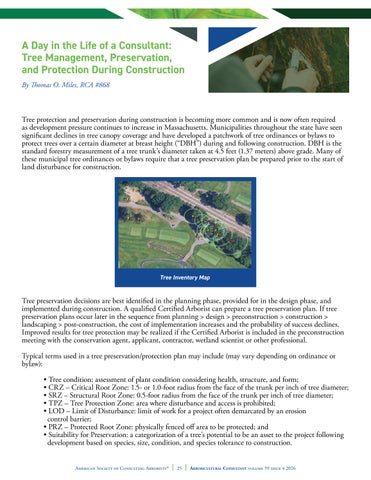
Tree Inventory Map
Tree preservation decisions are best identified in the planning phase, provided for in the design phase, and implemented during construction. A qualified Certified Arborist can prepare a tree preservation plan. If tree preservation plans occur later in the sequence from planning > design > preconstruction > construction > landscaping > post-construction, the cost of implementation increases and the probability of success declines. Improved results for tree protection may be realized if the Certified Arborist is included in the preconstruction meeting with the conservation agent, applicant, contractor, wetland scientist or other professional. Typical terms used in a tree preservation/protection plan may include (may vary depending on ordinance or bylaw): • Tree condition: assessment of plant condition considering health, structure, and form; • CRZ – Critical Root Zone: 1.5- or 1.0-foot radius from the face of the trunk per inch of tree diameter; • SRZ – Structural Root Zone: 0.5-foot radius from the face of the trunk per inch of tree diameter; • TPZ – Tree Protection Zone: area where disturbance and access is prohibited; • LOD – Limit of Disturbance: limit of work for a project often demarcated by an erosion control barrier; • PRZ – Protected Root Zone: physically fenced off area to be protected; and • Suitability for Preservation: a categorization of a tree’s potential to be an asset to the project following development based on species, size, condition, and species tolerance to construction. American Society of Consulting Arborists®
25
Arboricultural Consultant volume 59 issue 4 2026
Tree Management, Preservation, and Protection During Construction continued
The Arborists’ role in construction projects may include: • Evaluating the feasibility of the preservation of trees on a site during a proposed project; • Assessing tree suitability for preservation; • Evaluating whether trees are likely to survive construction; • Assisting the project development team or owner with design and site layout; • Creating appropriate tree protection zones and providing specifications for tree protection measures; • Complying with or enforcing tree ordinances/bylaws or permit requirements on behalf of a municipality; • Monitoring trees and protection measures during project construction; and • Implementing arboriculture throughout the project. Tree protection during construction involves creating a Tree Protection Zone (“TPZ”) and calculating the Critical Root Zone (“CRZ”) or Protected Root Zone (“PRZ”) to prevent or minimize root damage and soil compaction. Tree protection measures typically include tree fencing with signage, air knife/air spade for root pruning, root protection matting, supplemental irrigation, applying mulch, plant health care treatments, and pruning. Tree protection fencing is most effective if properly installed before any land disturbance, excavation, grading, or construction. The fencing with signage should be maintained and kept up until the completion of the project. Tree protection fencing specifications will vary depending on the municipal ordinance or bylaw. Six-foot chain link, four-foot welded wire, and four-foot blaze orange plastic fence are the most common types of fencing for tree protection.
Air spade trenching at
Tree protection fence with signage
Air spade work in Somerville, MA
Old sidewalk removed, Somerville, MA
National Gallery for Art in Washington, D.C.
Mulch can be used with different types of matting and used in unison with geotextile matting for extremely heavy or long-term weight loads over tree roots. Properly applying mulch in a TPZ safeguards root systems from compaction, retains soil moisture, and prevents mechanical damage from lawn or commercial equipment. Supplemental irrigation, bio-stimulants, or slow release fertilizers can help trees survive root damage, soil compaction, and drought stress during and after construction projects. An air knife/air spade is a pneumatic tool that uses a supersonic stream of compressed air to break up and clear soil safely without damaging tree roots. Arborists use it for root collar (flare) excavations, radial trenching, vertical mulching, and finding girdling roots.
American Society of Consulting Arborists®
26
Arboricultural Consultant volume 59 issue 4 2026
Tree Management, Preservation, and Protection During Construction continued
Case Study In 2025, the SavATree Consulting Group was hired by a general contractor to provide tree preservation services and monitoring during construction for renovations at an affordable housing complex in Somerville, Massachusetts. The renovations had started but the project was stopped due to violations within the Somerville Tree Ordinance. Renovations included new ADA compliant sidewalks, building exterior upgrades and changes to a playground. The construction plans did not show the trees on the site or contain any tree data or tree preservation methods. A tree inventory was conducted to compile the tree data and a tree protection plan was created. Tree fencing was installed by the contractor who followed the tree protection plan. The old sidewalk had to be carefully removed and the tree roots were exposed with an air knife and root pruned by hand. In certain locations, the sidewalk material was changed to minimize root pruning and impacting tree roots. Arborist monitoring during construction and root pruning were crucial to the success of this project. It was also vital that the project arborist and contractor followed the tree protection plan and communicated weekly about the next step for this project. Involving a qualified Certified Arborist in the planning phase and monitoring during the construction phase of a project is greatly beneficial for the survival rate of the trees. Professional construction monitoring ensures that contractors respect TPZs and helps to identify early signs of tree stress. This early warning allows remedial measures to be implemented, often leading to a successful outcome. Builders and developers are often unaware of the destructive nature that construction processes can have on trees because some effects may not show up until years later. Effective tree preservation begins well before the start of land disturbance. Without careful planning and proactive tree protection measures, the survival of trees adjacent to the construction zone is significantly reduced.
Sidewalk material changed to minimize root impact
New sidewalk installed, Somerville, MA
American Society of Consulting Arborists®
27
Sidewalk before demolition and construction
Arboricultural Consultant volume 59 issue 4 2026