A Day in the Life of a Consultant: Tree Care of a Cedrus deodara Specimen By Luciano Riva
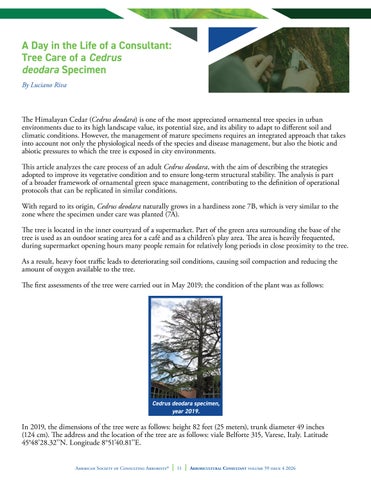
The Himalayan Cedar (Cedrus deodara) is one of the most appreciated ornamental tree species in urban environments due to its high landscape value, its potential size, and its ability to adapt to different soil and climatic conditions. However, the management of mature specimens requires an integrated approach that takes into account not only the physiological needs of the species and disease management, but also the biotic and abiotic pressures to which the tree is exposed in city environments. This article analyzes the care process of an adult Cedrus deodara, with the aim of describing the strategies adopted to improve its vegetative condition and to ensure long-term structural stability. The analysis is part of a broader framework of ornamental green space management, contributing to the definition of operational protocols that can be replicated in similar conditions. With regard to its origin, Cedrus deodara naturally grows in a hardiness zone 7B, which is very similar to the zone where the specimen under care was planted (7A). The tree is located in the inner courtyard of a supermarket. Part of the green area surrounding the base of the tree is used as an outdoor seating area for a café and as a children's play area. The area is heavily frequented, during supermarket opening hours many people remain for relatively long periods in close proximity to the tree. As a result, heavy foot traffic leads to deteriorating soil conditions, causing soil compaction and reducing the amount of oxygen available to the tree. The first assessments of the tree were carried out in May 2019; the condition of the plant was as follows:
Cedrus deodara specimen, year 2019.
In 2019, the dimensions of the tree were as follows: height 82 feet (25 meters), trunk diameter 49 inches (124 cm). The address and the location of the tree are as follows: viale Belforte 315, Varese, Italy. Latitude 45°48’28.32’’N. Longitude 8°51’40.81’’E. American Society of Consulting Arborists®
11
Arboricultural Consultant volume 59 issue 4 2026
Tree Care of a Cedrus deodara Specimen continued
For disease diagnosis, and more generally to determine the condition of a tree, a logical–deductive method is used. Through the observation of symptoms and specific characteristics of the tree, both its health status and risk level are assessed. In this case, instrumental investigations were also carried out, including tomographic analyses to determine the condition of the internal portion of the trunk. As of 2019, the tree showed the following crown symptoms: microphyllia (needles shorter than normal), needle drop, high crown transparency, widespread dieback, a strong reduction in vitality and shoot growth, more severe symptoms in the upper part of the crown. The tree also showed synptoms on its trunk: spheroblasts at the base of the trunk, removal of two large lateral branches flush with the trunk with subsequent development of wood decay, resin exudation at the base of the trunk along the entire circumference and up to 1 meter above ground level. Other symptoms were also observed: absence of the original apex due to probable lightning damage, candelabra-shaped growth habit as a response to the removal or damage of the apex, branch dieback, the trunk also exhibited signs of lightning damage, visible in the bark.
Wood decay at the site of a big cut made for the removal of a branch, year 2019.
American Society of Consulting Arborists®
Resin exudations at the base of the trunk, year 2019.
12
Arboricultural Consultant volume 59 issue 4 2026
Tree Care of a Cedrus deodara Specimen continued
The parasites that could have accounted for the observed symptoms were the following: - Armillaria mellea (characteristic symptoms: presence of fan-shaped mycelium beneath the bark, formation of fruiting bodies in the autumn season preceding the investigations, rhizomor phs in the soil near the tree, initial development of white wood rot) - Phytophthora sp. (browning of subcortical tissues at the root collar, absence of visible mycelium, no rhizomorphs, sharp boundaries between infected woody tissues and adjacent healthy tissues) - Heterobasidion sp. (decay in the central part of the trunk, root wood decay even at a considerable distance from the collar, possible presence of fruiting bodies at the base of the trunk) - Rosellinia necatrix (cottony mycelium on the roots, no fan-shaped mycelium, more flattened rhizomorphs, more commonly associated with broadleaf species) - Internal wood decay within the trunk The non-parasitic factors that could have accounted for the symptoms were the following: - Water stress - Soil compaction - Low level of soil oxygen - Mechanical damage to the roots - High soil salinity A more detailed inspection made it possible to exclude the presence of Armillaria, due to the absence of mycelium, fruiting bodies, and rhizomorphs. The other possible pathological causes, such as Heterobasidion, Rosellinia, and Phytophthora, were also excluded because of the absence of their specific symptoms. Heterobasidion: root decay and deterioration of structural roots, absence of fruiting bodies. Rosellinia: cottonlike fungal micelium covering infected roots, absence of white micelium between bark and Wood, extensive decay of structural roots. Phytophtora: black discoloration of the tissues beneath the root bark, absence of the same symptom at the base of the trunk. The areas of decay on the trunk were examined in order to quantify the specific risk, in this case trunk failure. The assessment was carried out using a Resistograph, and a high risk of trunk breakage was excluded. To further investigate the condition of the trunk, particularly the internal, non-visible portion, a tomographic analysis was performed at the base. This investigation served to define the internal condition of the trunk, any reactions of the tree, and potential risks of failure. The instrumental test produced the following result:
American Society of Consulting Arborists®
13
Arboricultural Consultant volume 59 issue 4 2026
Tree Care of a Cedrus deodara Specimen continued
The central portion showed degradation affecting 42% of the total basal cross-sectional area of the trunk; the remaining outer sound wood layer was intact and continuous around the entire circumference, with no reaction barriers present. The remaining part of the trunk cross-section consisted of sound wood and reaction wood (46%), and wood with intermediate characteristics (12%). Tomography differentiates wood tissues into five categories: cavities or completely decayed wood (light blue), decayed wood (purple), wood with intermediate characteristics (green), sound wood (brown), and reaction wood (black). Reaction barriers can be identified when reaction wood is directly adjacent to cavities or decayed wood. In this case, no reaction barriers were detected in the tomogram because wood with intermediate characteristics (green) was present along the cavity boundaries, indicating a gradual deterioration of the wood tissues. Wood decay is progressing, as localized areas of decayed wood are also present within regions of otherwise sound wood. The degradation in the central part of the trunk, corresponding to 42% of the cross-sectional area, reduced the load-bearing capacity of the woody section by approximately 20%, given that the remaining outer layer was intact along the entire circumference. The degraded portion did not substantially affect the stability of the tree, resulting in a low risk of trunk failure. The relationship between the amount of decayed wood and the reduction in the load-bearing capacity of wood cross-sections is based on the studies conducted by engineer Wessolly. For wood decay such as that shown in the tomogram, the reduction in load-bearing capacity is approximately 20%, even though the decayed wood accounts for about 40% of the cross-sectional area. The wood decay located at the center of the basal portion of the trunk was not connected to, and was not responsible for, the symptoms observed. With regard to the crown, the needles showed symptoms of sooty mold disease, most likely due to the presence of aphids during the 2018 growing season. This disease is not severe, and cedar trees typically coexist with it. The tree did not show fungal root diseases nor serious crown diseases (e.g. Lophodermium cedrinum); however, its vitality was very low and the specimen exhibited advanced signs of physiological stress. The condition of the tree was attributable to the following main causes (in addition to secondary ones): lightning strike, heavy foot traffic, and the presence of a fabric covering the root system. Secondary causes contributing to the state of decline included wood decay at pruning cuts, aphids, and sooty mold on the needles. Once the symptoms had been identified, it was still necessary to determine the causes of the tree’s condition. At the base of the tree, works had been carried out that affected the root system: installation of a steel edging, placement of a surface fabric, installation of furnishings, and application of gravel. In addition, the area beneath the tree had been damaged by foot traffic, resulting in compaction of the soil.
American Society of Consulting Arborists®
14
Arboricultural Consultant volume 59 issue 4 2026
Tree Care of a Cedrus deodara Specimen continued
Among the causes of the tree’s decline, the main ones were trampling damage and the fabric placed over the root system. Fabrics placed above roots are typically installed to prevent or reduce weed growth, for easier area management. However, fabrics laid over roots are detrimental, as they reduce the amount of oxygen available to the roots, which is essential for all vital processes occurring in these organs. Oxygen moves by diffusion from the atmosphere (where it is more concentrated) into the soil (where it is less concentrated). Oxygen is present in the soil according to a concentration gradient: maximum at the interface with the atmosphere, decreasing to minimal or zero values at greater depths. The time required for the first symptoms of oxygen deficiency to appear is usually relatively long and depends on factors such as the ontogenetic age of the plant (specimens in the senescence phase show symptoms earlier), the presence of other pathologies, nutritional and vegetative status, and the duration of oxygen deficiency. Once the investigation phase was completed, it was necessary to formulate an intervention proposal, including a work plan aimed at improving the condition of the tree. This plan was then delivered to the arboricultural company responsible for implementing the recommended interventions. In this case, the recommended interventions were as follows: - removal of the fabric, edging, turf, gravel, and furnishings from above the roots - manual soil aeration near to the roots, up to a distance of at least 6 meters from the trunk, by creating vertical holes with a diameter of 2 cm, a depth of 50 cm, and a density of 5 holes per square meter - application of bark or wood chips up to a distance of 6 meters from the trunk - organic fertilization; organic matter promotes soil particle aggregation and improves soil aeration capacity - installation of a small wooden fence to delimit the area beneath the tree - application of products to increase the tree’s capacity to form roots, consisting of seaweed extracts (Ecklonia maxima) with hormone-like effects in plants - application of substances based on Bacillus subtilis and Streptomyces spp. - reassessment of conditions after two years Two years after the initial intervention, a site inspection was carried out to verify the condition of the tree. The condition of the cedar specimen in the years following the interventions can be seen in the photographs from 2020 to 2025.
August 2020
September 2023
American Society of Consulting Arborists®
September 2024
15
September 2025
Arboricultural Consultant volume 59 issue 4 2026
Tree Care of a Cedrus deodara Specimen continued
In view of the outcomes of the treatments, the monitoring activities will be completed through further site inspections in the following years, in order to verify the possible appearance of additional diseases or the execution of other human interventions that may interfere with the tree. Follow-up inspections were conducted annually after the initial investigations. During these inspections, particular attention was paid to the symptoms described earlier, associated with the main diseases to which Cedrus deodara is susceptible. After several years of observation, the improvements are believed to be primarily attributable to better soil conditions, including improved soil structure and adequate oxygen availability for the roots. No symptoms of new diseases were detected up to 2025. Regarding the wood decay at the base of the trunk, an additional follow-up tomographic assessment will be necessary (level 3 advanced assessment). The decay has not affected the tree's overall health, but it does have implications for its structural stability. In other words, the tree's health and vigor have improved as a result of better soil and root conditions. The wood decay at the base of the trunk will be monitored as part of the tree risk assessment, since it has not caused any deterioration in the vascular tissues responsible for transport, nor has it adversely affected the vitality and health of the crown. Pulling tests will not be performed, as no specific signs indicating a risk of tree overturning or root system failure have been observed.
2025
ANNUAL CONFERENCE
La Cantera Resort & Spa - San Antonio, Texas
2025 Annual Conference Recordings Are Now Available! ASCA Annual Conference 2025 session recordings are now available for purchase and instant download. Sessions available for purchase are the general sessions from Monday (12/8) to Wednesday (12/10)*. *Does not include pre- or post-conference workshops
20 ASCA CEUs Available* *Not approved for ISA CEUs
Pricing for purchase: - ASCA Member: $400 - Non-Members: $500
Click Here to Purchase! American Society of Consulting Arborists®
16
Arboricultural Consultant volume 59 issue 4 2026